LIC
Linear Integrated Circuits
What are Integrated Circuits?
• Integrated Circuits, commonly known as ICs, are the building blocks of
modern electronic devices.
• An IC is a set of electronic circuits on a small flat piece (or "chip") of
semiconductor material, usually silicon.
• ICs can function as amplifiers, oscillators, timers, counters, computer
memory, microprocessors, and more.
History
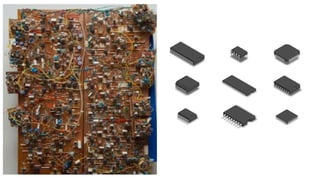
• Early Electronics: Before ICs, electronic circuits were built using
discrete components like resistors, capacitors, diodes, and transistors.
These components were soldered onto printed circuit boards (PCBs).
This method was bulky, expensive, and prone to failure.
• Birth of ICs: The concept of integrating electronic components on a
single silicon chip was pioneered by Jack Kilby at Texas Instruments
and Robert Noyce at Fairchild Semiconductor in the late 1950s. This
innovation led to the first IC in 1958.
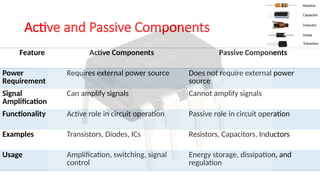
Active and Passive Components
Feature Active Components Passive Components
Power
Requirement
Requires external power source Does not require external power
source
Signal
Amplification
Can amplify signals Cannot amplify signals
Functionality Active role in circuit operation Passive role in circuit operation
Examples Transistors, Diodes, ICs Resistors, Capacitors, Inductors
Usage Amplification, switching, signal
control
Energy storage, dissipation, and
regulation
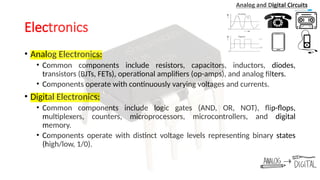
Electronics
• Analog Electronics:
• Common components include resistors, capacitors, inductors, diodes,
transistors (BJTs, FETs), operational amplifiers (op-amps), and analog filters.
• Components operate with continuously varying voltages and currents.
• Digital Electronics:
• Common components include logic gates (AND, OR, NOT), flip-flops,
multiplexers, counters, microprocessors, microcontrollers, and digital
memory.
• Components operate with distinct voltage levels representing binary states
(high/low, 1/0).
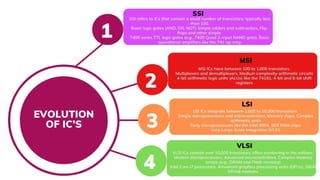
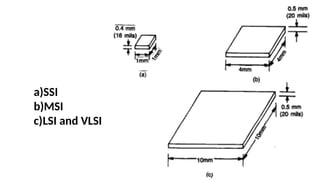
a)SSI
b)MSI
c)LSI and VLSI
Importance of Linear Integrated Circuits
• Signal Processing
• Versatility
• Miniaturization
• Reliability and Consistency
• Cost-Effectiveness
• Energy Efficiency
Applications of Linear Integrated Circuits
• Amplifiers
• Filters
• Oscillators
• ADC/DAC
• Voltage Regulators
• Timers and Phase-Locked Loops (PLLs)
• Comparators and Schmitt Triggers
Real-World Examples
•Consumer Electronics:
•Audio amplifiers in home theater systems, equalizers, and headphone amplifiers.
•Voltage regulators in laptops, smartphones, and tablets to provide stable power supply.
•Medical Devices:
•ECG and EEG amplifiers that require precise and low-noise amplification of biological signals.
•Portable diagnostic equipment using ADCs and DACs for accurate data conversion.
•Industrial Automation:
•Sensors and transducers interfacing using instrumentation amplifiers for process control and
monitoring.
•Signal conditioning circuits in automation systems to ensure accurate data acquisition.
•Automotive:
•Engine control units (ECUs) using op-amps and ADCs for sensor data processing.
•In-car audio and active noise cancellation systems use linear ICs for signal processing.
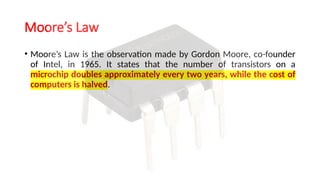
Moore’s Law
• Moore’s Law is the observation made by Gordon Moore, co-founder
of Intel, in 1965. It states that the number of transistors on a
microchip doubles approximately every two years, while the cost of
computers is halved.

Linear Integrated Circuits Introduction to IC.pptx

  • 1.
  • 2.
    What are IntegratedCircuits? • Integrated Circuits, commonly known as ICs, are the building blocks of modern electronic devices. • An IC is a set of electronic circuits on a small flat piece (or "chip") of semiconductor material, usually silicon. • ICs can function as amplifiers, oscillators, timers, counters, computer memory, microprocessors, and more.
  • 3.
    History • Early Electronics:Before ICs, electronic circuits were built using discrete components like resistors, capacitors, diodes, and transistors. These components were soldered onto printed circuit boards (PCBs). This method was bulky, expensive, and prone to failure. • Birth of ICs: The concept of integrating electronic components on a single silicon chip was pioneered by Jack Kilby at Texas Instruments and Robert Noyce at Fairchild Semiconductor in the late 1950s. This innovation led to the first IC in 1958.
  • 5.
    Active and PassiveComponents Feature Active Components Passive Components Power Requirement Requires external power source Does not require external power source Signal Amplification Can amplify signals Cannot amplify signals Functionality Active role in circuit operation Passive role in circuit operation Examples Transistors, Diodes, ICs Resistors, Capacitors, Inductors Usage Amplification, switching, signal control Energy storage, dissipation, and regulation
  • 6.
    Electronics • Analog Electronics: •Common components include resistors, capacitors, inductors, diodes, transistors (BJTs, FETs), operational amplifiers (op-amps), and analog filters. • Components operate with continuously varying voltages and currents. • Digital Electronics: • Common components include logic gates (AND, OR, NOT), flip-flops, multiplexers, counters, microprocessors, microcontrollers, and digital memory. • Components operate with distinct voltage levels representing binary states (high/low, 1/0).
  • 9.
  • 10.
    Importance of LinearIntegrated Circuits • Signal Processing • Versatility • Miniaturization • Reliability and Consistency • Cost-Effectiveness • Energy Efficiency
  • 11.
    Applications of LinearIntegrated Circuits • Amplifiers • Filters • Oscillators • ADC/DAC • Voltage Regulators • Timers and Phase-Locked Loops (PLLs) • Comparators and Schmitt Triggers
  • 12.
    Real-World Examples •Consumer Electronics: •Audioamplifiers in home theater systems, equalizers, and headphone amplifiers. •Voltage regulators in laptops, smartphones, and tablets to provide stable power supply. •Medical Devices: •ECG and EEG amplifiers that require precise and low-noise amplification of biological signals. •Portable diagnostic equipment using ADCs and DACs for accurate data conversion. •Industrial Automation: •Sensors and transducers interfacing using instrumentation amplifiers for process control and monitoring. •Signal conditioning circuits in automation systems to ensure accurate data acquisition. •Automotive: •Engine control units (ECUs) using op-amps and ADCs for sensor data processing. •In-car audio and active noise cancellation systems use linear ICs for signal processing.
  • 13.
    Moore’s Law • Moore’sLaw is the observation made by Gordon Moore, co-founder of Intel, in 1965. It states that the number of transistors on a microchip doubles approximately every two years, while the cost of computers is halved.