What is Transistor??
 A transistor amplifies and switches electrical
power and electronic signals.
 It is a semiconductor made of solid, non-moving
parts that control the flow of electricity in circuits.
 Transistors are used in the vast majority of
electronics. Some of the first products that used
them were transistor radios and hearing aids,
which came into use in the early 1950s.
Cont.
 Transistor radios work by amplifying signals. Radio
stations take sounds recorded through a microphone
and turn them into electrical signals.
 Those electrical signals travel through a circuit in the
transistor radio, and the transistor then amplifies the
signal, making it louder when it gets to the speaker.
 Transistors also changed how computers were made
because they replaced vacuums, which were big,
bulky and inefficient
Cont.
 Transistors are made of semiconducting materials,
such as silicone or germanium.
 The most common transistors are made in a
protective case and generally have three electrical
leads.
What does a transistor actually do?
 When it works as an amplifier, it takes in a tiny
electric current at one end (an input current) and
produces a much bigger electric current (an output
current) at the other. In other words, it's a kind of
current booster.
 Transistors can also work as switches. A tiny electric
current flowing through one part of a transistor can
make a much bigger current flow through another
part of it.
Cont.
 This is essentially how all computer chips work. For
example, a memory chip contains hundreds of
millions or even billions of transistors, each of which
can be switched on or off individually.
 Since each transistor can be in two distinct states, it
can store two different numbers, zero and one.
 With billions of transistors, a chip can store billions
of zeros and ones, and almost as many ordinary
numbers and letters (or characters, as we call them).
More about this in a moment.
How do transistors work in calculators
and computers?
 We can put a few transistor switches together to
make something called a logic gate,
 which compares several input currents and gives a
different output as a result.
 Logic gates let computers make very simple decisions
using a mathematical technique called Boolean
algebra.

Cont.
 Your brain makes decisions the same way. For example, using
"inputs" (things you know) about the weather and what you
have in your hallway, you can make a decision like this: "If it's
raining AND I have an umbrella, I will go to the shops". That's
an example of Boolean algebra using what's called an AND
"operator"
 You can make similar decisions with other operators. "If it's
windy OR it's snowing, then I will put on a coat" is an example
of using an OR operator.
 Or how about "If it's raining AND I have an umbrella OR I
have a coat then it's okay to go out".
 Using AND, OR, and other operators called NOR, XOR, NOT,
and NAND, computers can add up or compare binary
numbers.
 That idea is the foundation stone of computer programs: the
logical series of instructions that make computers do things.
Cont.
 Normally, a junction transistor is "off" when there is
no base current and switches to "on" when the base
current flows. That means it takes an electric current
to switch the transistor on or off.
What is Integration?
Integration is a technique that allows to build a system
with many more transistors allowing much more
computing power to be applied to solve a problem.
Integration == Circuit Integration
Integrated Circuit
IC (Chip)
11
•The level of integration of chip has been classified as
small-scale, medium scale, large scale and very large scale.
•Small scale integration (SSI) circuits such as the 7404
inverter have fewer than 10 gates with a conversion of
roughly half a dozen transistors per gate.
•Medium scale integration (MSI) circuit such as 74161
counter have up to 1000 gates.
• Large scale integration (LSI) circuit such as simple 8-bit
microprocessors have up to 10000 gates.
•VLSI such as 512 Mbits dynamic RAM contains more
than half a billion transistors.
Classification of IC according to
size of integration
Five Generations of IC
1960 SSI A few simple gates
1970 MSI Thousands of Transistors
1980 LSI One Hundred Thousand
Transistors
1990 VLSI Ten Million Transistors
2000 ULSI …………………..
Materials of IC
 Silicon
 Gallium Arsenide
Blessings of Integration
Microprocessor Name No. of Transistors Size( Micron)
Intel 80286 1,34,000 1.5
Intel 80386 2,75,000 1.5
Intel 80486 1,200,000 1.0
Pentium 3,100,000 0.8
Pentium Pro 5,500,000 0.6
15
ICs have three key advantages over digital circuits built from
discrete components
Size: Integrated circuits are much smaller-both
transistors and wire shrunk to micrometer sizes,
compared to the millimeter or centimeter scale of discrete
components. Small size leads to advantages in speed and
power consumption, since smaller components have
smaller parasitic resistances, capacitances and
inductances.
Speed: Signals can be switches between logic 0 and logic
1 much quicker within a chip than they can between chips.
Communication within a chip can occur hundreds of times
faster than Communication between chips on a printed
circuit board. The high speed of circuits on-chip is due to
their small size- smaller components.
16
Power consumption: Logic operations within a
chip also take much less power. Once again, lower
power consumption is largely due to the small size
of circuits on the chip- smaller parasitic
capacitances and resistances require less power to
derive them.
Why VLSI?
 Integration improves the design:
 lower parasitics = higher speed;
 lower power;
 physically smaller.
 Integration reduces manufacturing cost-(almost) no
manual assembly.
Why VLSI?..
The integration of a large number of functions on a single
chip usually provides:
 Less area/volume and therefore, compactness
 Less power consumption
 Less testing requirements at system level
 Higher reliability, mainly due to improved on-chip
interconnects
 Higher speed, due to significantly reduced interconnection
length
 Significant cost savings
VLSI and you
 Microprocessors:
 personal computers;
 microcontrollers.
 DRAM/SRAM
 Special-purpose processors
Moore’s Law
 Gordon Moore: co-founder of Intel.
 Predicted that number of transistors per chip would
grow exponentially (double every 18 months).
 Exponential improvement in technology is a natural
trend: steam engines, dynamos, automobiles.
Moore’s Law..
Technologies of VLSI
TTL ( Transistor Transistor Logic)
ECL ( Emitter Couple Logic)
MOS
Boolean Logic
Cost Factors in ICs
 For large-volume ICs:
 packaging is largest cost;
 testing is second-largest cost.
 For low-volume ICs, design costs may swamp all
manufacturing costs.
Challenges in VLSI Design
 Multiple levels of abstraction: transistors to CPUs.
 Multiple and conflicting constraints: low cost and
high performance are often at odds.
 Short design time: Late products are often irrelevant.
Dealing with Complexity
 Divide-and-conquer: limit the number of
components you deal with at any one time.
 Group several components into larger components:
 transistors form gates;
 gates form functional units;
 functional units form processing elements;
 etc.
Top-down vs. bottom-up Design
 Top-down design adds functional detail.
 Create lower levels of abstraction from upper levels.
 Bottom-up design creates abstractions from low-
level behavior.
 Good design needs both top-down and bottom-up
efforts.
VLSI Design Styles
 Field Programmable Gate Array (FPGA): Fully fabricated
FPGA chips containing thousands of logic gates or even more,
with programmable interconnects, are available to users for
their custom hardware programming to realize desired
functionality. This design style provides a means for fast
prototyping and also for cost-effective chip design, especially for
low-volume applications. A typical field programmable gate
array (FPGA) chip consists of I/O buffers, an array of
configurable logic blocks (CLBs), and programmable
interconnect structures. The programming of the interconnects
is implemented by programming of RAM cells whose output
terminals are connected to the gates of MOS pass transistors.
28
MOS transistors
An MOS (Metal-Oxide-Semiconductor) structure is created
by superimposing several layers of conduction and
insulating materials to form a sandwich-like structure.
CMOS technology provides two types of transistors: an n-
type transistor (nMOS) and a p-type transistor (pMOS).
Transistor operation is based on electric field so the
devices are called MOSFETs.
Ecah transistor consists of a stack of conducting gate
(formed from polycrystalline silicon /ploysillicon), an
insulating layer of SiO2 and the silicon wafer (also called
the substrate, body or bulk).
29
P
Bulk Si
n+ n+
S G D
nMOS
The gate is a control input: It affects the flow of electrical current
between the source and drain. Body is generally grounded so the
p-n junctions of the source and drain to the body are reverse-biased.
If the gate is also grounded, no current flows through the reverse-
biased junctions. Hence we say the transistor is off. If the gate voltage
is raised, it creates an electric field and starts to attract free electrons
to the underside of the Si-SiO2 interface. If the voltage is raised
enough, the electrons outnumber the holes and a thin region under
the gate called channel inverted to act as an n-type semiconductor.
Hence a conducting path of electron carriers is formed from S to D
and current can flow. We say the transistor is on.
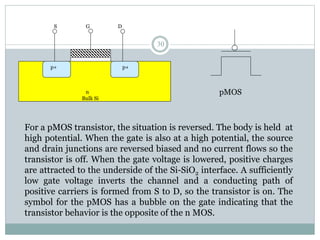
30
n
Bulk Si
p+ p+
S G D
pMOS
For a pMOS transistor, the situation is reversed. The body is held at
high potential. When the gate is also at a high potential, the source
and drain junctions are reversed biased and no current flows so the
transistor is off. When the gate voltage is lowered, positive charges
are attracted to the underside of the Si-SiO2 interface. A sufficiently
low gate voltage inverts the channel and a conducting path of
positive carriers is formed from S to D, so the transistor is on. The
symbol for the pMOS has a bubble on the gate indicating that the
transistor behavior is the opposite of the n MOS.
31
body/bulk
GROUND
NMOS/NFET PMOS/PFET
channel
shorter length,
faster transistor
(dist. for
electrons)
body/bulk
HIGH
positive voltage
(Vdd)
negative
voltage (rel.
to body)
(GND)
(S/D to body is
reverse-biased)
- - - + + +
+ + + - - -
current current

VLSI Lecture

  • 2.
    What is Transistor?? A transistor amplifies and switches electrical power and electronic signals.  It is a semiconductor made of solid, non-moving parts that control the flow of electricity in circuits.  Transistors are used in the vast majority of electronics. Some of the first products that used them were transistor radios and hearing aids, which came into use in the early 1950s.
  • 3.
    Cont.  Transistor radioswork by amplifying signals. Radio stations take sounds recorded through a microphone and turn them into electrical signals.  Those electrical signals travel through a circuit in the transistor radio, and the transistor then amplifies the signal, making it louder when it gets to the speaker.  Transistors also changed how computers were made because they replaced vacuums, which were big, bulky and inefficient
  • 4.
    Cont.  Transistors aremade of semiconducting materials, such as silicone or germanium.  The most common transistors are made in a protective case and generally have three electrical leads.
  • 5.
    What does atransistor actually do?  When it works as an amplifier, it takes in a tiny electric current at one end (an input current) and produces a much bigger electric current (an output current) at the other. In other words, it's a kind of current booster.  Transistors can also work as switches. A tiny electric current flowing through one part of a transistor can make a much bigger current flow through another part of it.
  • 6.
    Cont.  This isessentially how all computer chips work. For example, a memory chip contains hundreds of millions or even billions of transistors, each of which can be switched on or off individually.  Since each transistor can be in two distinct states, it can store two different numbers, zero and one.  With billions of transistors, a chip can store billions of zeros and ones, and almost as many ordinary numbers and letters (or characters, as we call them). More about this in a moment.
  • 7.
    How do transistorswork in calculators and computers?  We can put a few transistor switches together to make something called a logic gate,  which compares several input currents and gives a different output as a result.  Logic gates let computers make very simple decisions using a mathematical technique called Boolean algebra. 
  • 8.
    Cont.  Your brainmakes decisions the same way. For example, using "inputs" (things you know) about the weather and what you have in your hallway, you can make a decision like this: "If it's raining AND I have an umbrella, I will go to the shops". That's an example of Boolean algebra using what's called an AND "operator"  You can make similar decisions with other operators. "If it's windy OR it's snowing, then I will put on a coat" is an example of using an OR operator.  Or how about "If it's raining AND I have an umbrella OR I have a coat then it's okay to go out".  Using AND, OR, and other operators called NOR, XOR, NOT, and NAND, computers can add up or compare binary numbers.  That idea is the foundation stone of computer programs: the logical series of instructions that make computers do things.
  • 9.
    Cont.  Normally, ajunction transistor is "off" when there is no base current and switches to "on" when the base current flows. That means it takes an electric current to switch the transistor on or off.
  • 10.
    What is Integration? Integrationis a technique that allows to build a system with many more transistors allowing much more computing power to be applied to solve a problem. Integration == Circuit Integration Integrated Circuit IC (Chip)
  • 11.
    11 •The level ofintegration of chip has been classified as small-scale, medium scale, large scale and very large scale. •Small scale integration (SSI) circuits such as the 7404 inverter have fewer than 10 gates with a conversion of roughly half a dozen transistors per gate. •Medium scale integration (MSI) circuit such as 74161 counter have up to 1000 gates. • Large scale integration (LSI) circuit such as simple 8-bit microprocessors have up to 10000 gates. •VLSI such as 512 Mbits dynamic RAM contains more than half a billion transistors. Classification of IC according to size of integration
  • 12.
    Five Generations ofIC 1960 SSI A few simple gates 1970 MSI Thousands of Transistors 1980 LSI One Hundred Thousand Transistors 1990 VLSI Ten Million Transistors 2000 ULSI …………………..
  • 13.
    Materials of IC Silicon  Gallium Arsenide
  • 14.
    Blessings of Integration MicroprocessorName No. of Transistors Size( Micron) Intel 80286 1,34,000 1.5 Intel 80386 2,75,000 1.5 Intel 80486 1,200,000 1.0 Pentium 3,100,000 0.8 Pentium Pro 5,500,000 0.6
  • 15.
    15 ICs have threekey advantages over digital circuits built from discrete components Size: Integrated circuits are much smaller-both transistors and wire shrunk to micrometer sizes, compared to the millimeter or centimeter scale of discrete components. Small size leads to advantages in speed and power consumption, since smaller components have smaller parasitic resistances, capacitances and inductances. Speed: Signals can be switches between logic 0 and logic 1 much quicker within a chip than they can between chips. Communication within a chip can occur hundreds of times faster than Communication between chips on a printed circuit board. The high speed of circuits on-chip is due to their small size- smaller components.
  • 16.
    16 Power consumption: Logicoperations within a chip also take much less power. Once again, lower power consumption is largely due to the small size of circuits on the chip- smaller parasitic capacitances and resistances require less power to derive them.
  • 17.
    Why VLSI?  Integrationimproves the design:  lower parasitics = higher speed;  lower power;  physically smaller.  Integration reduces manufacturing cost-(almost) no manual assembly.
  • 18.
    Why VLSI?.. The integrationof a large number of functions on a single chip usually provides:  Less area/volume and therefore, compactness  Less power consumption  Less testing requirements at system level  Higher reliability, mainly due to improved on-chip interconnects  Higher speed, due to significantly reduced interconnection length  Significant cost savings
  • 19.
    VLSI and you Microprocessors:  personal computers;  microcontrollers.  DRAM/SRAM  Special-purpose processors
  • 20.
    Moore’s Law  GordonMoore: co-founder of Intel.  Predicted that number of transistors per chip would grow exponentially (double every 18 months).  Exponential improvement in technology is a natural trend: steam engines, dynamos, automobiles.
  • 21.
  • 22.
    Technologies of VLSI TTL( Transistor Transistor Logic) ECL ( Emitter Couple Logic) MOS Boolean Logic
  • 23.
    Cost Factors inICs  For large-volume ICs:  packaging is largest cost;  testing is second-largest cost.  For low-volume ICs, design costs may swamp all manufacturing costs.
  • 24.
    Challenges in VLSIDesign  Multiple levels of abstraction: transistors to CPUs.  Multiple and conflicting constraints: low cost and high performance are often at odds.  Short design time: Late products are often irrelevant.
  • 25.
    Dealing with Complexity Divide-and-conquer: limit the number of components you deal with at any one time.  Group several components into larger components:  transistors form gates;  gates form functional units;  functional units form processing elements;  etc.
  • 26.
    Top-down vs. bottom-upDesign  Top-down design adds functional detail.  Create lower levels of abstraction from upper levels.  Bottom-up design creates abstractions from low- level behavior.  Good design needs both top-down and bottom-up efforts.
  • 27.
    VLSI Design Styles Field Programmable Gate Array (FPGA): Fully fabricated FPGA chips containing thousands of logic gates or even more, with programmable interconnects, are available to users for their custom hardware programming to realize desired functionality. This design style provides a means for fast prototyping and also for cost-effective chip design, especially for low-volume applications. A typical field programmable gate array (FPGA) chip consists of I/O buffers, an array of configurable logic blocks (CLBs), and programmable interconnect structures. The programming of the interconnects is implemented by programming of RAM cells whose output terminals are connected to the gates of MOS pass transistors.
  • 28.
    28 MOS transistors An MOS(Metal-Oxide-Semiconductor) structure is created by superimposing several layers of conduction and insulating materials to form a sandwich-like structure. CMOS technology provides two types of transistors: an n- type transistor (nMOS) and a p-type transistor (pMOS). Transistor operation is based on electric field so the devices are called MOSFETs. Ecah transistor consists of a stack of conducting gate (formed from polycrystalline silicon /ploysillicon), an insulating layer of SiO2 and the silicon wafer (also called the substrate, body or bulk).
  • 29.
    29 P Bulk Si n+ n+ SG D nMOS The gate is a control input: It affects the flow of electrical current between the source and drain. Body is generally grounded so the p-n junctions of the source and drain to the body are reverse-biased. If the gate is also grounded, no current flows through the reverse- biased junctions. Hence we say the transistor is off. If the gate voltage is raised, it creates an electric field and starts to attract free electrons to the underside of the Si-SiO2 interface. If the voltage is raised enough, the electrons outnumber the holes and a thin region under the gate called channel inverted to act as an n-type semiconductor. Hence a conducting path of electron carriers is formed from S to D and current can flow. We say the transistor is on.
  • 30.
    30 n Bulk Si p+ p+ SG D pMOS For a pMOS transistor, the situation is reversed. The body is held at high potential. When the gate is also at a high potential, the source and drain junctions are reversed biased and no current flows so the transistor is off. When the gate voltage is lowered, positive charges are attracted to the underside of the Si-SiO2 interface. A sufficiently low gate voltage inverts the channel and a conducting path of positive carriers is formed from S to D, so the transistor is on. The symbol for the pMOS has a bubble on the gate indicating that the transistor behavior is the opposite of the n MOS.
  • 31.
    31 body/bulk GROUND NMOS/NFET PMOS/PFET channel shorter length, fastertransistor (dist. for electrons) body/bulk HIGH positive voltage (Vdd) negative voltage (rel. to body) (GND) (S/D to body is reverse-biased) - - - + + + + + + - - - current current