
Environment and Development Division
Stefanos Fotiou
Director, Environment and Development Division
United Nations ESCAP
Integrated Approaches for SDGs
planning
Environment and Development Division
Click to add title
Increase simultaneously effectiveness and efficiency
Systems Thinking Approach to SDG Planning
Environment and Development Division
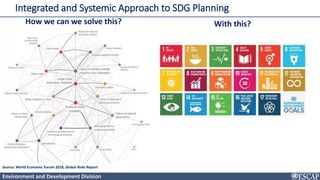
Integrated and Systemic Approach to SDG Planning
How we can we solve this? With this?
Source: World Economic Forum 2018, Global Risks Report
Environment and Development Division
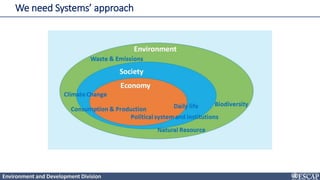
We need Systems’ approach
Environment and Development Division
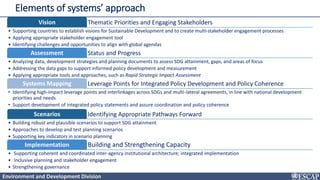
Elements of systems’ approach
Thematic Priorities and Engaging StakeholdersVision
• Supporting countries to establish visions for Sustainable Development and to create multi-stakeholder engagement processes
• Applying appropriate stakeholder engagement tool
• Identifying challenges and opportunities to align with global agendas
Status and ProgressAssessment
• Analyzing data, development strategies and planning documents to assess SDG attainment, gaps, and areas of focus
• Addressing the data gaps to support informed policy development and measurement
• Applying appropriate tools and approaches, such as Rapid Strategic Impact Assessment
Leverage Points for Integrated Policy Development and Policy CoherenceSystems Mapping
• Identifying high-impact leverage points and interlinkages across SDGs and multi-lateral agreements, in line with national development
priorities and needs
• Support development of integrated policy statements and assure coordination and policy coherence
Identifying Appropriate Pathways ForwardScenarios
• Building robust and plausible scenarios to support SDG attainment
• Approaches to develop and test planning scenarios
• Supporting key indicators in scenario planning
Building and Strengthening CapacityImplementation
• Supporting coherent and coordinated inter-agency institutional architecture; integrated implementation
• Inclusive planning and stakeholder engagement
• Strengthening governance
Environment and Development Division
Click to add title
Proving Methodologies -- the Sustainability Outlook Methodology
Supporting Integrated Solutions for Sustainability
Planning in the Region
Environment and Development Division
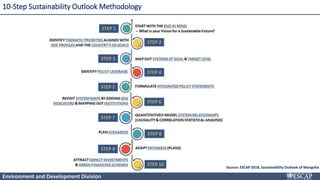
10-Step Sustainability Outlook Methodology
Source: ESCAP 2018, Sustainability Outlook of Mongolia
Environment and Development Division
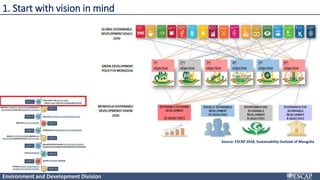
1. Start with vision in mind
Source: ESCAP 2018, Sustainability Outlook of Mongolia
Environment and Development Division
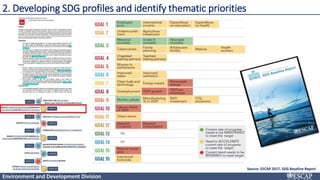
2. Developing SDG profiles and identify thematic priorities
Source: ESCAP 2017, SDG Baseline Report
Environment and Development Division
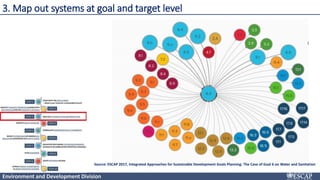
3. Map out systems at goal and target level
Source: ESCAP 2017, Integrated Approaches for Sustainable Development Goals Planning: The Case of Goal 6 on Water and Sanitation
Environment and Development Division
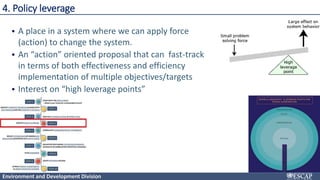
4. Policy leverage
• A place in a system where we can apply force
(action) to change the system.
• An “action” oriented proposal that can fast-track
in terms of both effectiveness and efficiency
implementation of multiple objectives/targets
• Interest on “high leverage points”
Environment and Development Division
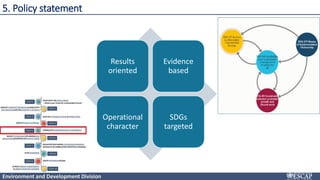
Results
oriented
Evidence
based
Operational
character
SDGs
targeted
5. Policy statement
Environment and Development Division
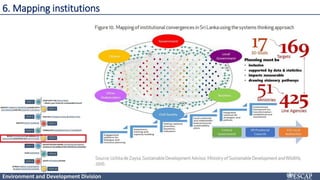
6. Mapping institutions
Environment and Development Division
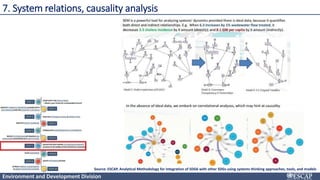
7. System relations, causality analysis
Source: ESCAP, Analytical Methodology for integration of SDG6 with other SDGs using systems thinking approaches, tools, and models
Environment and Development Division
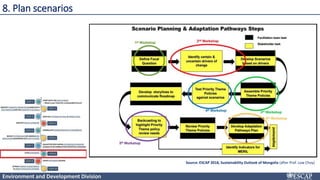
8. Plan scenarios
Source: ESCAP 2018, Sustainability Outlook of Mongolia (after Prof. Low Choy)
Environment and Development Division
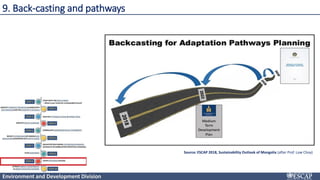
9. Back-casting and pathways
Source: ESCAP 2018, Sustainability Outlook of Mongolia (after Prof. Low Choy)
Environment and Development Division
10. Investments and green financing
Environment and Development Division
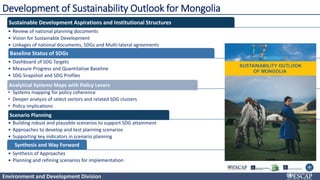
Development of Sustainability Outlook for Mongolia
Sustainable Development Aspirations and Institutional Structures
• Review of national planning documents
• Vision for Sustainable Development
• Linkages of national documents, SDGs and Multi-lateral agreements
Baseline Status of SDGs
• Dashboard of SDG Targets
• Measure Progress and Quantitative Baseline
• SDG Snapshot and SDG Profiles
Analytical Systems Maps with Policy Levers
• Systems mapping for policy coherence
• Deeper analysis of select sectors and related SDG clusters
• Policy implications
Scenario Planning
• Building robust and plausible scenarios to support SDG attainment
• Approaches to develop and test planning scenarios
• Supporting key indicators in scenario planning
Synthesis and Way Forward
• Synthesis of Approaches
• Planning and refining scenarios for implementation
Environment and Development Division
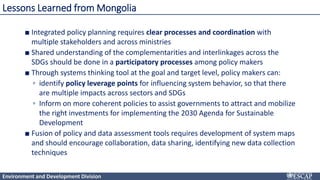
■ Integrated policy planning requires clear processes and coordination with
multiple stakeholders and across ministries
■ Shared understanding of the complementarities and interlinkages across the
SDGs should be done in a participatory processes among policy makers
■ Through systems thinking tool at the goal and target level, policy makers can:
▫ identify policy leverage points for influencing system behavior, so that there
are multiple impacts across sectors and SDGs
▫ Inform on more coherent policies to assist governments to attract and mobilize
the right investments for implementing the 2030 Agenda for Sustainable
Development
■ Fusion of policy and data assessment tools requires development of system maps
and should encourage collaboration, data sharing, identifying new data collection
techniques
Lessons Learned from Mongolia
Environment and Development Division
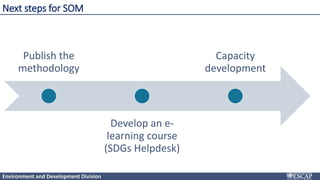
Publish the
methodology
Develop an e-
learning course
(SDGs Helpdesk)
Capacity
development
Next steps for SOM
Environment and Development Division
Thank you
ขอขอบคุณ
谢谢
Спасибо
ありがとうございました
Terima kasih
Salamat
धन्यवाद
Merci
Ευχαριστώ

Integrated Approaches for SDGs planning

  • 1.
    Environment and DevelopmentDivision Stefanos Fotiou Director, Environment and Development Division United Nations ESCAP Integrated Approaches for SDGs planning
  • 2.
    Environment and DevelopmentDivision Click to add title Increase simultaneously effectiveness and efficiency Systems Thinking Approach to SDG Planning
  • 3.
    Environment and DevelopmentDivision Integrated and Systemic Approach to SDG Planning How we can we solve this? With this? Source: World Economic Forum 2018, Global Risks Report
  • 4.
    Environment and DevelopmentDivision We need Systems’ approach
  • 5.
    Environment and DevelopmentDivision Elements of systems’ approach Thematic Priorities and Engaging StakeholdersVision • Supporting countries to establish visions for Sustainable Development and to create multi-stakeholder engagement processes • Applying appropriate stakeholder engagement tool • Identifying challenges and opportunities to align with global agendas Status and ProgressAssessment • Analyzing data, development strategies and planning documents to assess SDG attainment, gaps, and areas of focus • Addressing the data gaps to support informed policy development and measurement • Applying appropriate tools and approaches, such as Rapid Strategic Impact Assessment Leverage Points for Integrated Policy Development and Policy CoherenceSystems Mapping • Identifying high-impact leverage points and interlinkages across SDGs and multi-lateral agreements, in line with national development priorities and needs • Support development of integrated policy statements and assure coordination and policy coherence Identifying Appropriate Pathways ForwardScenarios • Building robust and plausible scenarios to support SDG attainment • Approaches to develop and test planning scenarios • Supporting key indicators in scenario planning Building and Strengthening CapacityImplementation • Supporting coherent and coordinated inter-agency institutional architecture; integrated implementation • Inclusive planning and stakeholder engagement • Strengthening governance
  • 6.
    Environment and DevelopmentDivision Click to add title Proving Methodologies -- the Sustainability Outlook Methodology Supporting Integrated Solutions for Sustainability Planning in the Region
  • 7.
    Environment and DevelopmentDivision 10-Step Sustainability Outlook Methodology Source: ESCAP 2018, Sustainability Outlook of Mongolia
  • 8.
    Environment and DevelopmentDivision 1. Start with vision in mind Source: ESCAP 2018, Sustainability Outlook of Mongolia
  • 9.
    Environment and DevelopmentDivision 2. Developing SDG profiles and identify thematic priorities Source: ESCAP 2017, SDG Baseline Report
  • 10.
    Environment and DevelopmentDivision 3. Map out systems at goal and target level Source: ESCAP 2017, Integrated Approaches for Sustainable Development Goals Planning: The Case of Goal 6 on Water and Sanitation
  • 11.
    Environment and DevelopmentDivision 4. Policy leverage • A place in a system where we can apply force (action) to change the system. • An “action” oriented proposal that can fast-track in terms of both effectiveness and efficiency implementation of multiple objectives/targets • Interest on “high leverage points”
  • 12.
    Environment and DevelopmentDivision Results oriented Evidence based Operational character SDGs targeted 5. Policy statement
  • 13.
    Environment and DevelopmentDivision 6. Mapping institutions
  • 14.
    Environment and DevelopmentDivision 7. System relations, causality analysis Source: ESCAP, Analytical Methodology for integration of SDG6 with other SDGs using systems thinking approaches, tools, and models
  • 15.
    Environment and DevelopmentDivision 8. Plan scenarios Source: ESCAP 2018, Sustainability Outlook of Mongolia (after Prof. Low Choy)
  • 16.
    Environment and DevelopmentDivision 9. Back-casting and pathways Source: ESCAP 2018, Sustainability Outlook of Mongolia (after Prof. Low Choy)
  • 17.
    Environment and DevelopmentDivision 10. Investments and green financing
  • 18.
    Environment and DevelopmentDivision Development of Sustainability Outlook for Mongolia Sustainable Development Aspirations and Institutional Structures • Review of national planning documents • Vision for Sustainable Development • Linkages of national documents, SDGs and Multi-lateral agreements Baseline Status of SDGs • Dashboard of SDG Targets • Measure Progress and Quantitative Baseline • SDG Snapshot and SDG Profiles Analytical Systems Maps with Policy Levers • Systems mapping for policy coherence • Deeper analysis of select sectors and related SDG clusters • Policy implications Scenario Planning • Building robust and plausible scenarios to support SDG attainment • Approaches to develop and test planning scenarios • Supporting key indicators in scenario planning Synthesis and Way Forward • Synthesis of Approaches • Planning and refining scenarios for implementation
  • 19.
    Environment and DevelopmentDivision ■ Integrated policy planning requires clear processes and coordination with multiple stakeholders and across ministries ■ Shared understanding of the complementarities and interlinkages across the SDGs should be done in a participatory processes among policy makers ■ Through systems thinking tool at the goal and target level, policy makers can: ▫ identify policy leverage points for influencing system behavior, so that there are multiple impacts across sectors and SDGs ▫ Inform on more coherent policies to assist governments to attract and mobilize the right investments for implementing the 2030 Agenda for Sustainable Development ■ Fusion of policy and data assessment tools requires development of system maps and should encourage collaboration, data sharing, identifying new data collection techniques Lessons Learned from Mongolia
  • 20.
    Environment and DevelopmentDivision Publish the methodology Develop an e- learning course (SDGs Helpdesk) Capacity development Next steps for SOM
  • 21.
    Environment and DevelopmentDivision Thank you ขอขอบคุณ 谢谢 Спасибо ありがとうございました Terima kasih Salamat धन्यवाद Merci Ευχαριστώ