Acknowledgements
Concept and outline: Stefanos Fotiou
Authors: Stefanos Fotiou, Janet Salem, Peerayot Sidonrusmee
Contributors/Reviewers: Emily Briggs, Heinz Schandl, Jim West, Kaveh Zahedi,
William Wyn Ellis, Donna Mei-Ling Park, Karin Hosking
Design and Layout: Peerayot Sidonrusmee
Cover photo: Mina Arampatzi
All data used in this report can be accessed at UNEP Live (http://uneplive.unep.org).
This publication is based on the following full report:
UNEP (2015), Indicators for a Resource Efficient and Green Asia and the Pacific -
Measuring progress of sustainable consumption and production, green economy and
resource efficiency policies in the Asia-Pacific region, Schandl, H., West, J., Baynes,
T., Hosking, K., Reinhardt, W., Geschke, A., Lenzen, M. United Nations Environment
Programme, Bangkok.
This publication should be referenced as follows:
UNEP (2015), Resource use in the Asia-Pacific - A booklet of infographics, United
Nations Environment Programme, Bangkok.
Advance copy for the:
Copyright © United Nations Environment Programme, 2015
This publication may be reproduced in whole or in part and in any form for
educational or non-profit purposes without special permission from the copyright
holder, provided acknowledgement of the source is made. UNEP would appreciate
receiving a copy of any publication that uses this publication as a source.
No use of this publication may be made for resale or for any other commercial
purpose whatsoever without prior permission in writing from the United Nations
Environment Programme.
Disclaimer
The designations employed and the presentation of the material in this publication
do not imply the expression of any opinion whatsoever on the part of the
United Nations Environment Programme concerning the legal
status of any country, territory, city or area or of its authorities,
or concerning delimitation of its frontiers or boundaries.
Moreover, the views expressed do not necessarily
represent the decision
or the stated policy of the United Nations
Environment Programme, nor does citing of trade
names or commercial processes constitute
endorsement.
UNEP
promotes environ-
mentally sound practices
globally and in its own activities.
This publication is printed on 100%
eco-fibers paper, using vegetable
-based inks and other eco-friendly
practices. Our distribution policy aims
to reduce UNEP’s carbon footprint.
1st FORUM OF
MINISTERS & ENVIRONMENT
AUTHORITIES OF ASIA PACIFIC
19 - 20 May 2015, Bangkok
Resource use in the Asia-Pacific
A booklet of infographics
Introduction
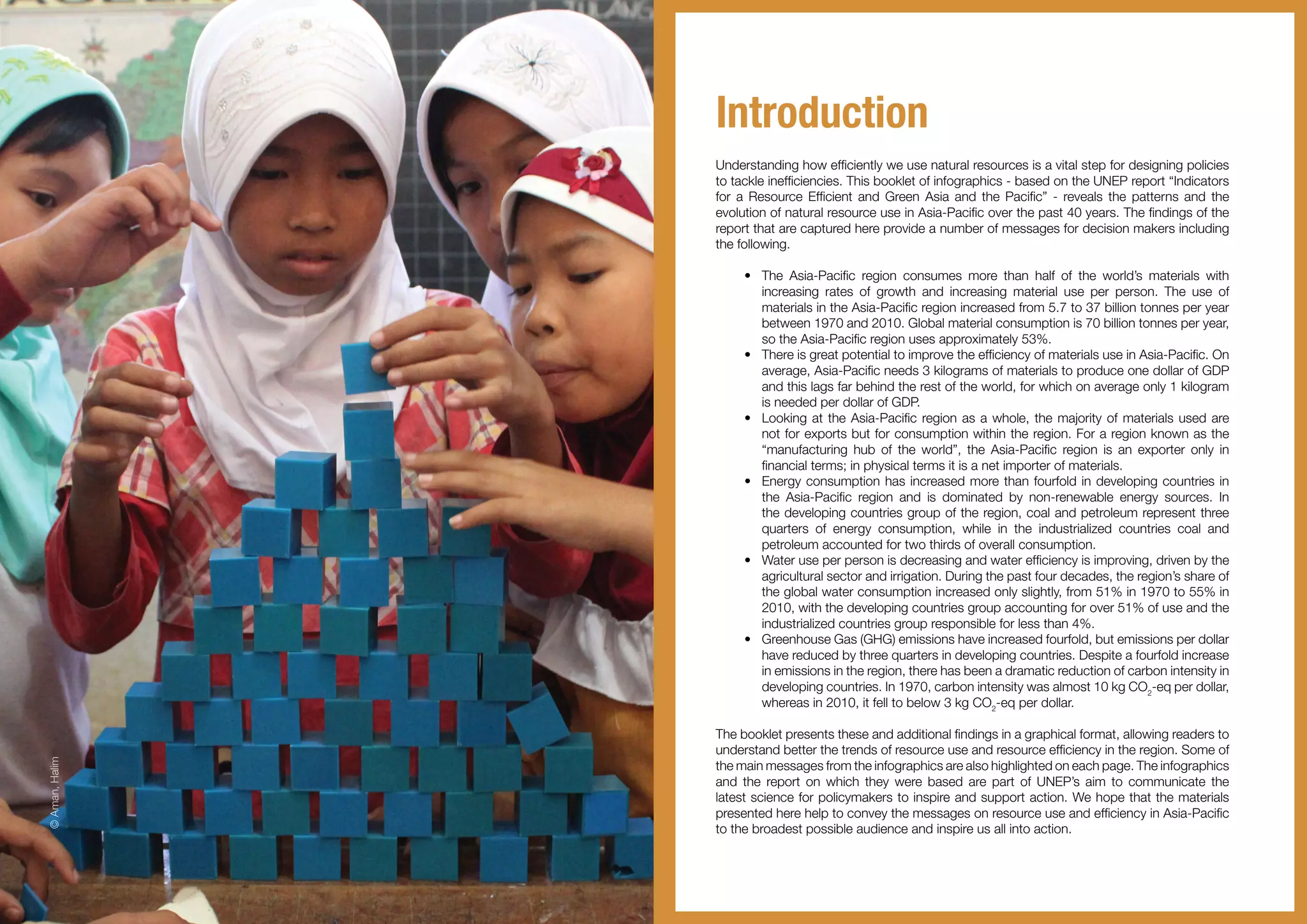
Understanding how efficiently we use natural resources is a vital step for designing policies
to tackle inefficiencies. This booklet of infographics - based on the UNEP report “Indicators
for a Resource Efficient and Green Asia and the Pacific” - reveals the patterns and the
evolution of natural resource use in Asia-Pacific over the past 40 years. The findings of the
report that are captured here provide a number of messages for decision makers including
the following.
•	 The Asia-Pacific region consumes more than half of the world’s materials with
increasing rates of growth and increasing material use per person. The use of
materials in the Asia-Pacific region increased from 5.7 to 37 billion tonnes per year
between 1970 and 2010. Global material consumption is 70 billion tonnes per year,
so the Asia-Pacific region uses approximately 53%.
•	 There is great potential to improve the efficiency of materials use in Asia-Pacific. On
average, Asia-Pacific needs 3 kilograms of materials to produce one dollar of GDP
and this lags far behind the rest of the world, for which on average only 1 kilogram
is needed per dollar of GDP.
•	 Looking at the Asia-Pacific region as a whole, the majority of materials used are
not for exports but for consumption within the region. For a region known as the
“manufacturing hub of the world”, the Asia-Pacific region is an exporter only in
financial terms; in physical terms it is a net importer of materials.
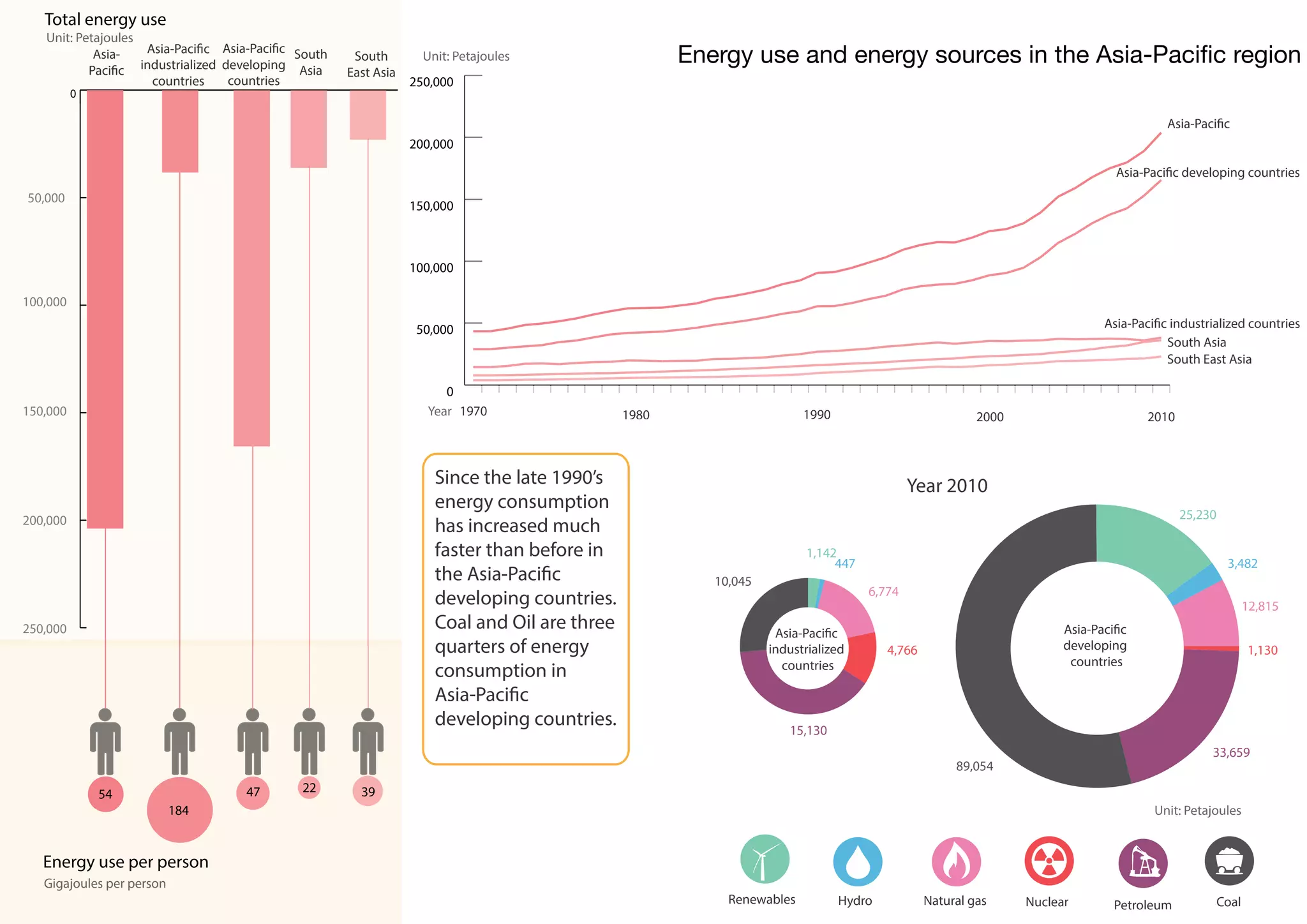
•	 Energy consumption has increased more than fourfold in developing countries in
the Asia-Pacific region and is dominated by non-renewable energy sources. In
the developing countries group of the region, coal and petroleum represent three
quarters of energy consumption, while in the industrialized countries coal and
petroleum accounted for two thirds of overall consumption.
•	 Water use per person is decreasing and water efficiency is improving, driven by the
agricultural sector and irrigation. During the past four decades, the region’s share of
the global water consumption increased only slightly, from 51% in 1970 to 55% in
2010, with the developing countries group accounting for over 51% of use and the
industrialized countries group responsible for less than 4%.
•	 Greenhouse Gas (GHG) emissions have increased fourfold, but emissions per dollar
have reduced by three quarters in developing countries. Despite a fourfold increase
in emissions in the region, there has been a dramatic reduction of carbon intensity in
developing countries. In 1970, carbon intensity was almost 10 kg CO2
-eq per dollar,
whereas in 2010, it fell to below 3 kg CO2
-eq per dollar.
The booklet presents these and additional findings in a graphical format, allowing readers to
understand better the trends of resource use and resource efficiency in the region. Some of
the main messages from the infographics are also highlighted on each page. The infographics
and the report on which they were based are part of UNEP’s aim to communicate the
latest science for policymakers to inspire and support action. We hope that the materials
presented here help to convey the messages on resource use and efficiency in Asia-Pacific
to the broadest possible audience and inspire us all into action.
©Aman,Halim
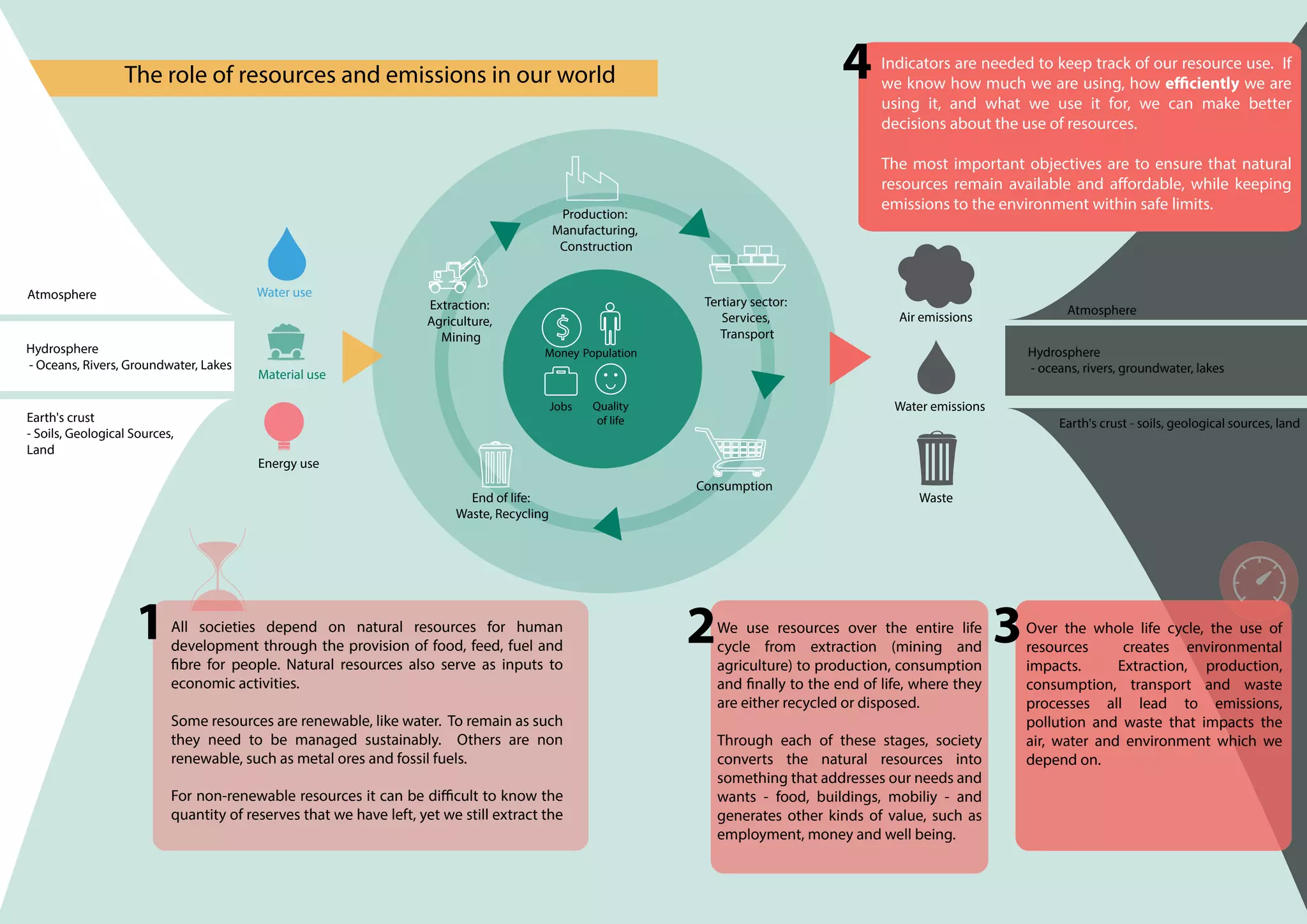
The role of resources and emissions in our world
All societies depend on natural resources for human
development through the provision of food, feed, fuel and
fibre for people. Natural resources also serve as inputs to
economic activities. 
Some resources are renewable, like water. To remain as such
they need to be managed sustainably. Others are non
renewable, such as metal ores and fossil fuels.
For non-renewable resources it can be difficult to know the
quantity of reserves that we have left, yet we still extract the
Indicators are needed to keep track of our resource use. If
we know how much we are using, how efficiently we are
using it, and what we use it for, we can make better
decisions about the use of resources.
The most important objectives are to ensure that natural
resources remain available and affordable, while keeping
emissions to the environment within safe limits.
Atmosphere
Hydrosphere
- Oceans, Rivers, Groundwater, Lakes
Earth's crust
- Soils, Geological Sources,
Land
Water use
Material use
Energy use
Air emissions
Water emissions
Atmosphere
Consumption
End of life:
Waste, Recycling
Extraction:
Agriculture,
Mining
Tertiary sector:
Services,
Transport
Hydrosphere
- oceans, rivers, groundwater, lakes
Earth's crust - soils, geological sources, land
1 2 Over the whole life cycle, the use of
resources creates environmental
impacts. Extraction, production,
consumption, transport and waste
processes all lead to emissions,
pollution and waste that impacts the
air, water and environment which we
depend on.
3
4
Money
Jobs
Population
Quality
of life
Production:
Manufacturing,
Construction
Waste
We use resources over the entire life
cycle from extraction (mining and
agriculture) to production, consumption
and finally to the end of life, where they
are either recycled or disposed.
Through each of these stages, society
converts the natural resources into
something that addresses our needs and
wants - food, buildings, mobiliy - and
generates other kinds of value, such as
employment, money and well being.
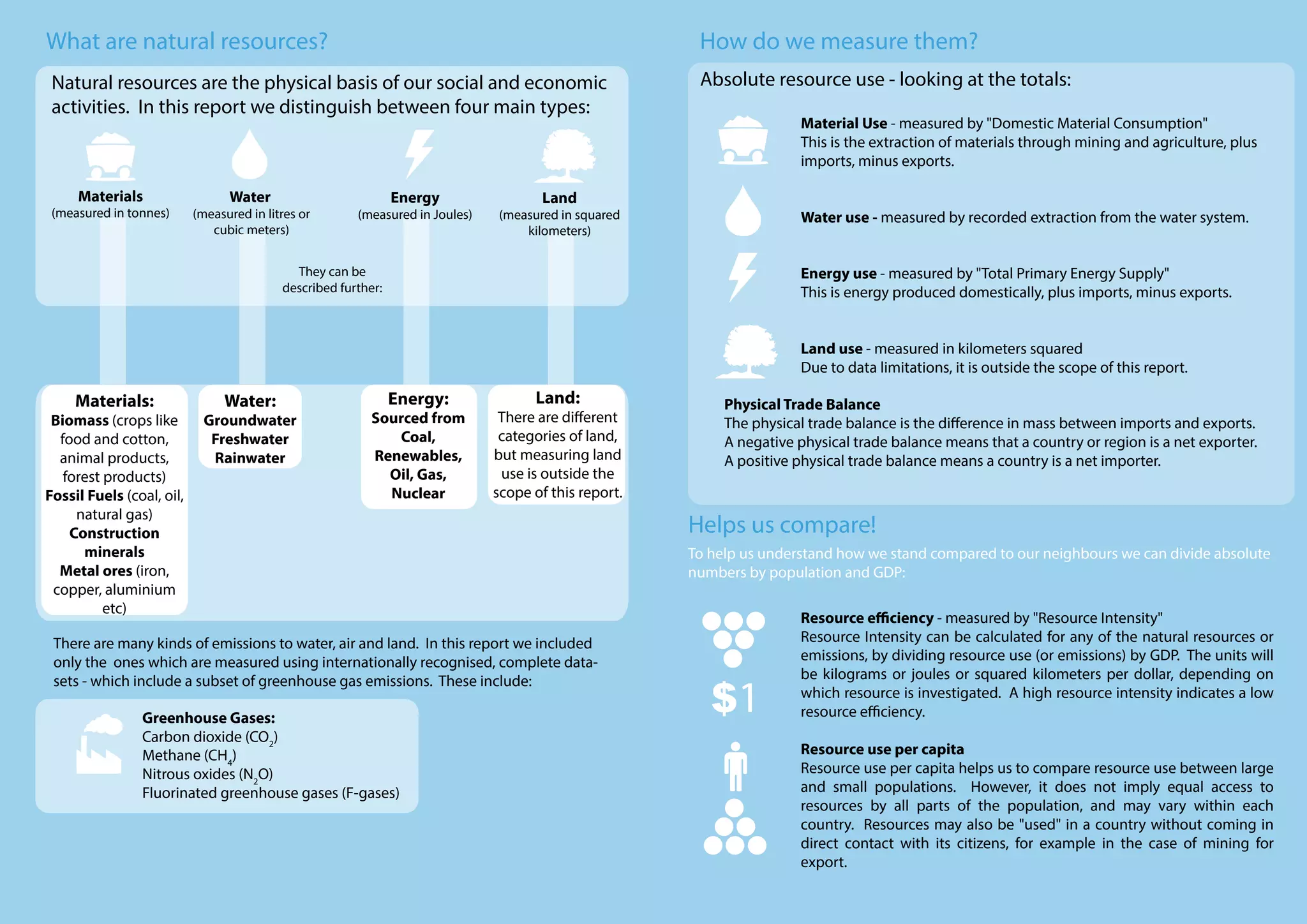
What are natural resources?
There are many kinds of emissions to water, air and land. In this report we included
only the ones which are measured using internationally recognised, complete data-
sets - which include a subset of greenhouse gas emissions. These include:
Natural resources are the physical basis of our social and economic
activities. In this report we distinguish between four main types:
They can be
described further:
How do we measure them?
Absolute resource use - looking at the totals:
Helps us compare!
To help us understand how we stand compared to our neighbours we can divide absolute
numbers by population and GDP:
Material Use - measured by "Domestic Material Consumption"
This is the extraction of materials through mining and agriculture, plus
imports, minus exports.
Water use - measured by recorded extraction from the water system.
Energy use - measured by "Total Primary Energy Supply"
This is energy produced domestically, plus imports, minus exports.
Land use - measured in kilometers squared
Due to data limitations, it is outside the scope of this report.
Materials
(measured in tonnes)
Materials:
Biomass (crops like
food and cotton,
animal products,
forest products)
Fossil Fuels (coal, oil,
natural gas)
Construction
minerals
Metal ores (iron,
copper, aluminium
etc)
Water:
Groundwater
Freshwater
Rainwater
Energy:
Sourced from
Coal,
Renewables,
Oil, Gas,
Nuclear
Greenhouse Gases:
Carbon dioxide (CO2
)
Methane (CH4
)
Nitrous oxides (N2
O)
Fluorinated greenhouse gases (F-gases)
Water
(measured in litres or
cubic meters)
Energy
(measured in Joules)
Land
(measured in squared
kilometers)
Land:
There are different
categories of land,
but measuring land
use is outside the
scope of this report.
(measured in tonnes)
cubic meters)
Physical Trade Balance
The physical trade balance is the difference in mass between imports and exports.
A negative physical trade balance means that a country or region is a net exporter.
A positive physical trade balance means a country is a net importer.
Resource efficiency - measured by "Resource Intensity"
Resource Intensity can be calculated for any of the natural resources or
emissions, by dividing resource use (or emissions) by GDP. The units will
be kilograms or joules or squared kilometers per dollar, depending on
which resource is investigated. A high resource intensity indicates a low
resource efficiency.
Resource use per capita
Resource use per capita helps us to compare resource use between large
and small populations. However, it does not imply equal access to
resources by all parts of the population, and may vary within each
country. Resources may also be "used" in a country without coming in
direct contact with its citizens, for example in the case of mining for
export.
1
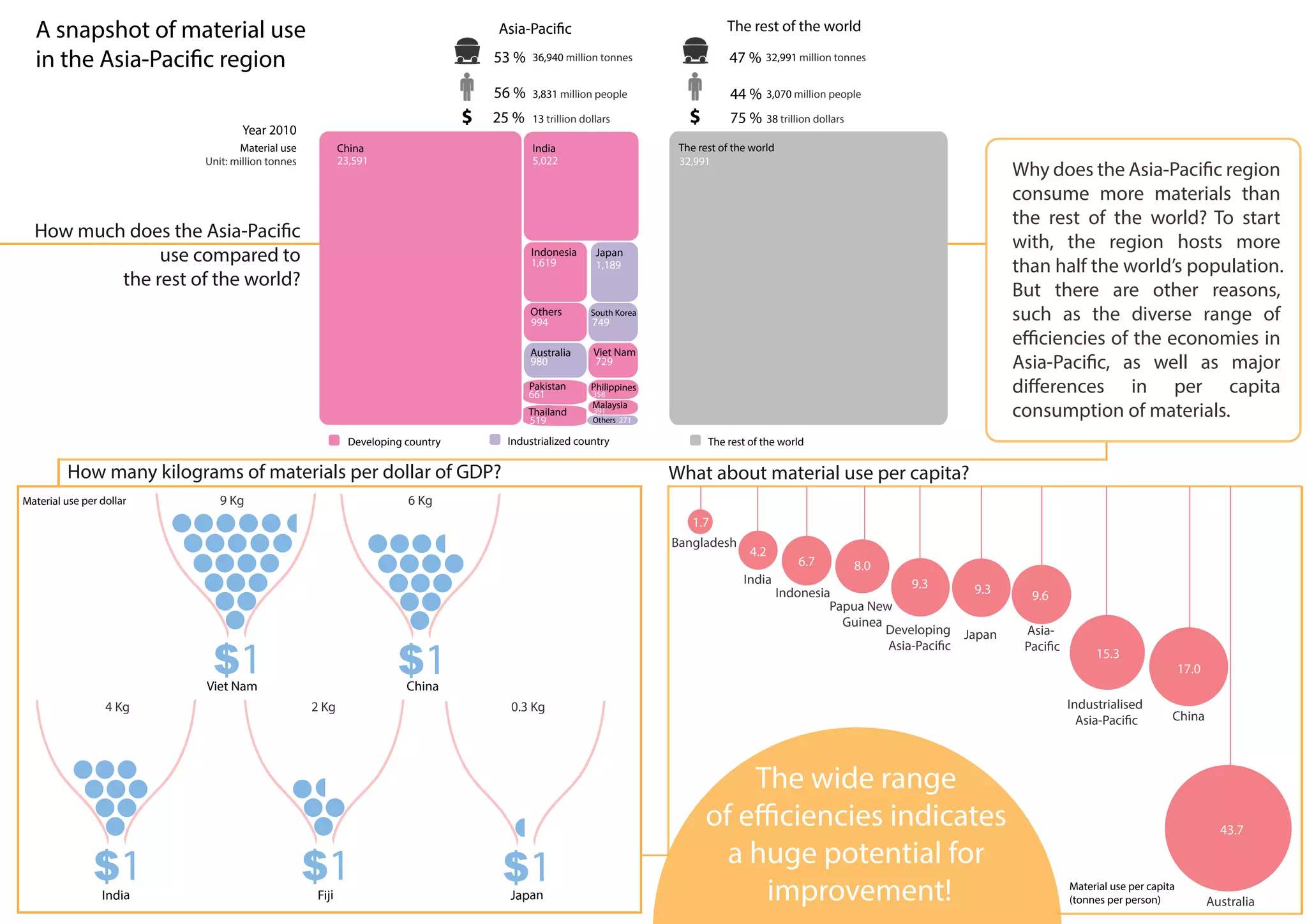
A snapshot of material use
in the Asia-Pacific region
Material use
Unit: million tonnes
Asia-Pacific The rest of the world
53 % 47 %36,940 million tonnes 32,991 million tonnes
China India
Indonesia
Viet Nam
Thailand
Australia
Philippines
Others
Japan
South Korea
Industrialized countryDeveloping country
Malaysia
Pakistan
Others
23,591 5,022
1,619 1,189
994 749
980 729
661
The rest of the world
32,991
The rest of the world
Viet Nam
1
Material use per dollar
How many kilograms of materials per dollar of GDP?
519
358
391
271
How much does the Asia-Pacific
use compared to
the rest of the world?
3,831 million people 3,070 million people
Year 2010
56 % 44 %
13 trillion dollars 38 trillion dollars25 % 75 %
What about material use per capita?
India Fiji Japan
China
1
1 1 1
$$
9 Kg 6 Kg
4 Kg 2 Kg 0.3 Kg
The wide range
of efficiencies indicates
a huge potential for
improvement!
India
China
Material use per capita
(tonnes per person)
Indonesia
Australia
Japan
Fact fact fact
Why does the Asia-Pacific region
Fact fact fact
Why does the Asia-Pacific region
Fact fact factconsume more materials thanFact fact factconsume more materials thanFact fact fact
the rest of the world? To start
with, the region hosts more
than half the world’s population.
But there are other reasons,
such as the diverse range of
efficiencies of the economies in
Asia-Pacific, as well as major
differences in per capita
consumption of materials.
Bangladesh
Papua New
Guinea
Developing
Asia-Pacific
Industrialised
Asia-Pacific
Asia-
Pacific
1.7
4.2
6.7 8.0
9.3 9.3 9.6
15.3
17.0
43.7
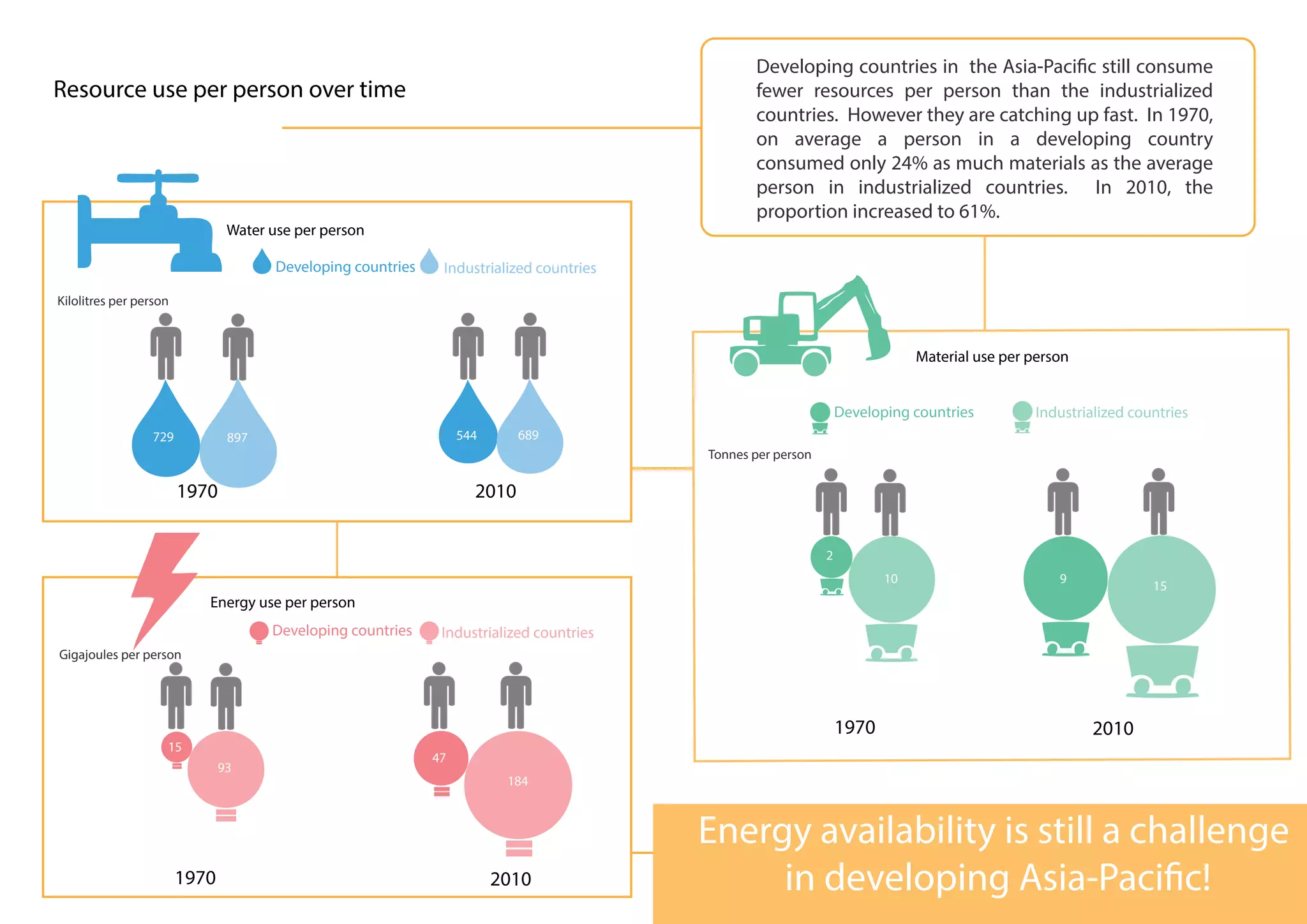
Resource use per person over time
Industrialized countriesDeveloping countries
Kilolitres per person
Tonnes per person
Gigajoules per person
Industrialized countriesDeveloping countries
1970 2010
1970 2010
1970 2010
Developing countries in the Asia-Pacific still consume
fewer resources per person than the industrialized
countries. However they are catching up fast. In 1970,
on average a person in a developing country
consumed only 24% as much materials as the average
person in industrialized countries. In 2010, the
proportion increased to 61%.
Water use per person
Material use per person
Energy use per person
Energy availability is still a challenge
in developing Asia-Pacific!
729 897 544 689
2
10 9
15
15
93
47
184
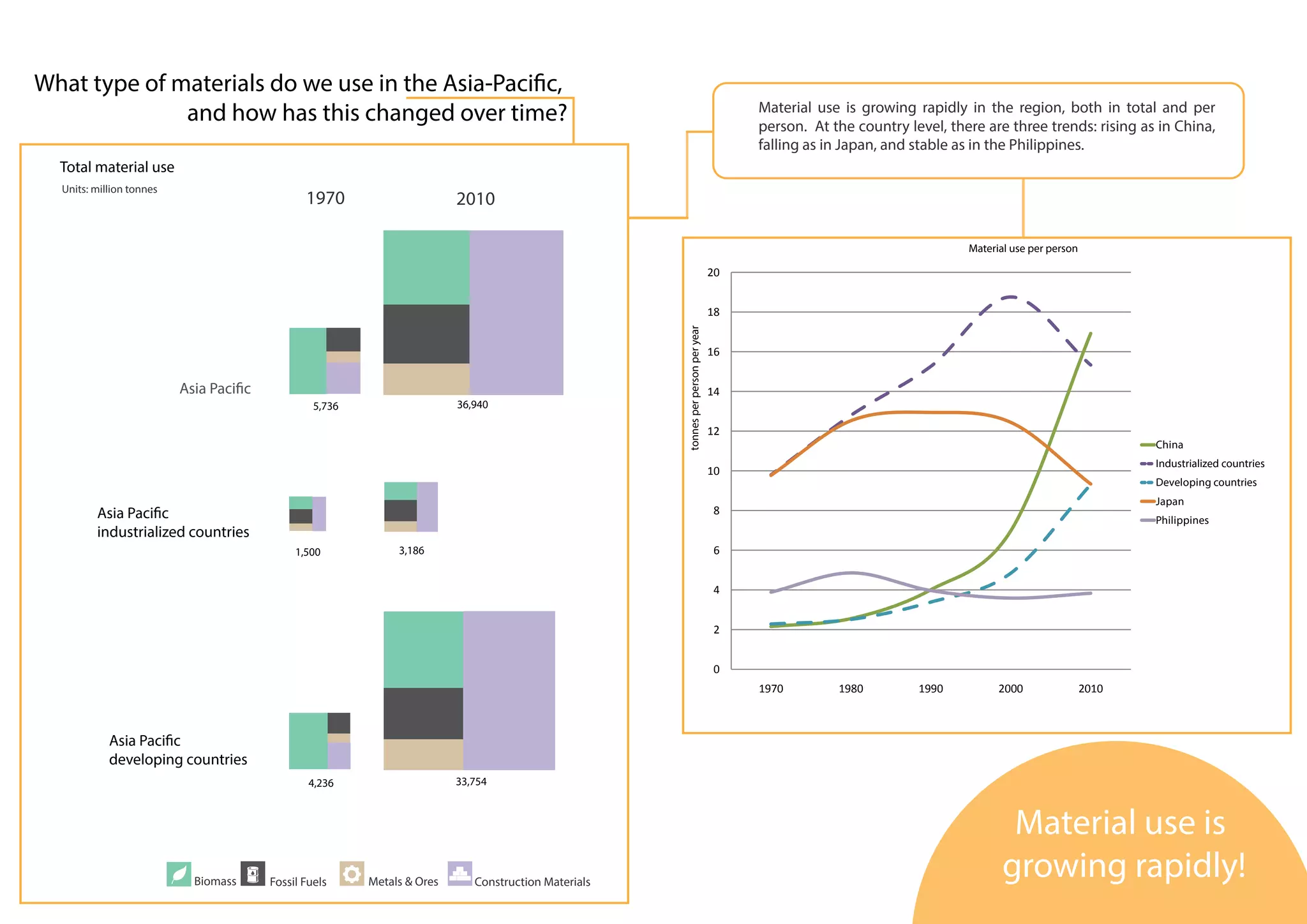
What type of materials do we use in the Asia-Pacific,
and how has this changed over time?
Total material use
Asia Pacific
1970 2010
Metals & OresFossil FuelsBiomass Construction Materials
Asia Pacific
developing countries
Asia Pacific
industrialized countries
0
2
4
6
8
10
12
14
16
18
20
1970 1980 1990 2000 2010
China
Industrialized countries
Developing countries
Japan
Philippines
Material use is
growing rapidly!
Material use is growing rapidly in the region, both in total and per
person. At the country level, there are three trends: rising as in China,
falling as in Japan, and stable as in the Philippines.
Material use per person
tonnesperpersonperyear
5,736 36,940
1,500 3,186
4,236 33,754
Units: million tonnes
Asia-
Pacific
Asia-Pacific
developing
countries
Asia-Pacific
industrialized
countries
South
Asia
South
East Asia
Total energy use
50,000
100,000
150,000
200,000
Unit: Petajoules
Asia-Pacific
Asia-Pacific developing countries
Asia-Pacific industrialized countries
South Asia
South East Asia
Unit: Petajoules
Year
0
250,000
Gigajoules per person
54
184
47 22 39
Energy use per person
0
50,000
100,000
150,000
200,000
250,000
Asia-Pacific developing countries
Unit: Petajoules
CoalHydro Natural gas Nuclear PetroleumRenewables
20101970 1980 1990 2000
Year 2010
Energy use and energy sources in the Asia-Pacific region
Since the late 1990’s
energy consumption
has increased much
faster than before in
the Asia-Pacific
developing countries.
Coal and Oil are three
quarters of energy
consumption in
Asia-Pacific
developing countries.
447
6,774
4,766
15,130
1,142
10,045
89,054
3,482
12,815
1,130
33,659
25,230
Asia-Pacific
industrialized
countries
Asia-Pacific
developing
countries
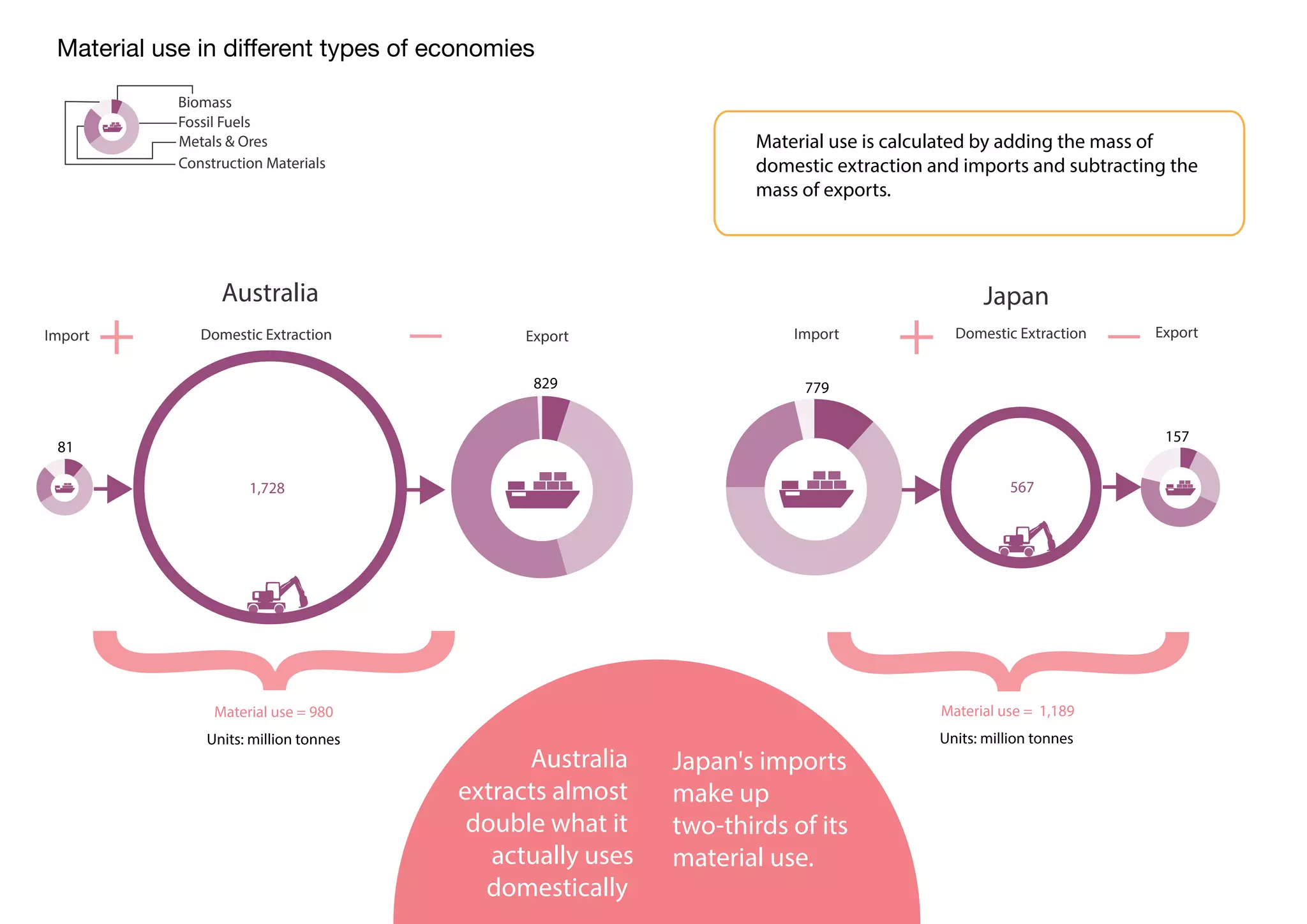
Material use in different types of economies
Australia
extracts almost
double what it
actually uses
domestically
Japan's imports
make up
two-thirds of its
material use.
Australia
Import Export
Material use is calculated by adding the mass of
domestic extraction and imports and subtracting the
mass of exports.
Japan
Import ExportDomestic Extraction
1,728
Material use = 980
567
Material use = 1,189
Domestic Extraction
}
}Units: million tonnes Units: million tonnes
829
81
779
157
Metals & Ores
Fossil Fuels
Biomass
Construction Materials
+ _ + _
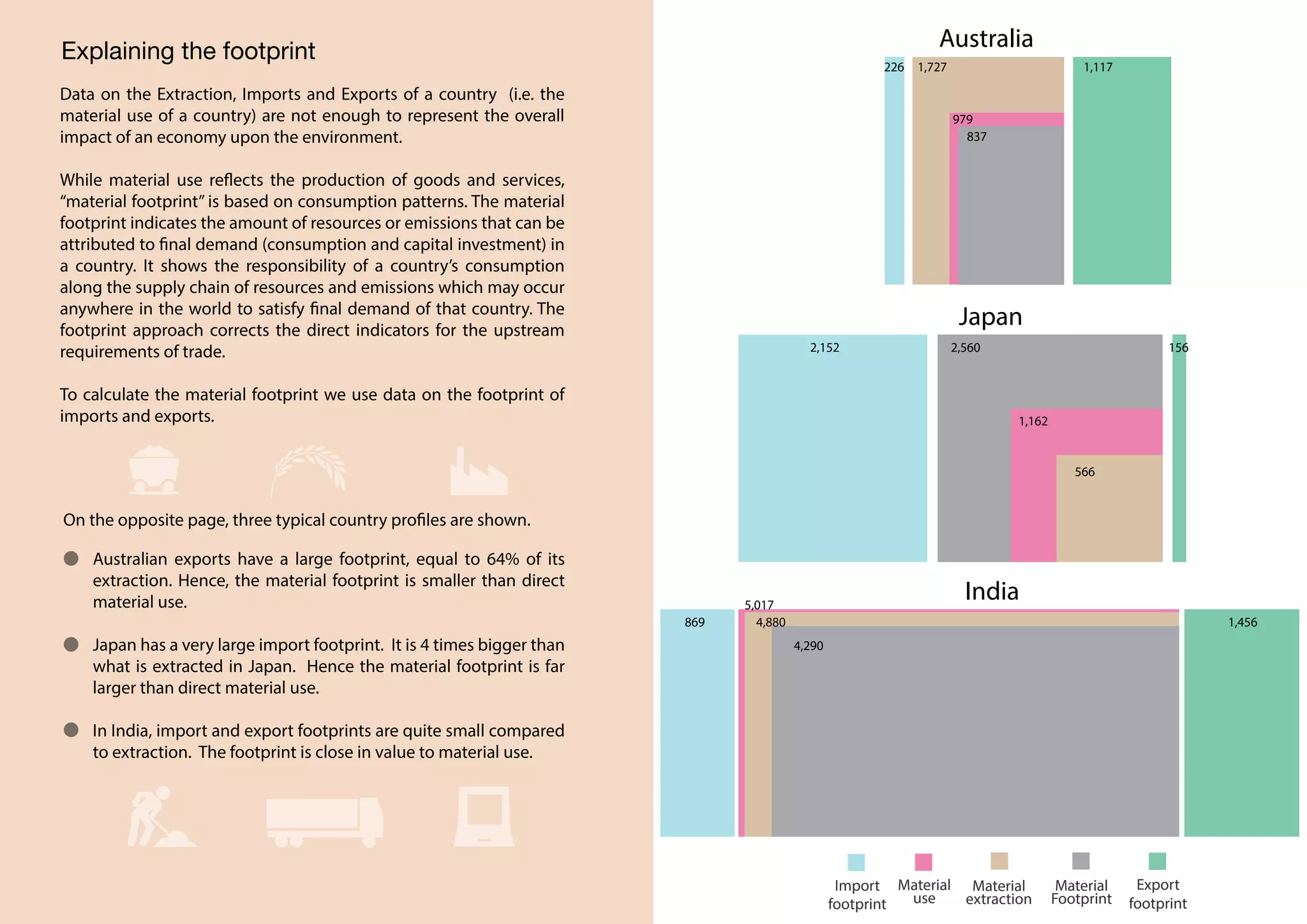
Explaining the footprint
Export
footprint
Material
extraction
Import
footprint
Material
use
Material
Footprint
India
1,456
4,290
869
5,017
4,880
Japan
1562,5602,152
1,162
566
Australia
1,117
837
226
979
1,727
Data on the Extraction, Imports and Exports of a country (i.e. the
material use of a country) are not enough to represent the overall
impact of an economy upon the environment.
While material use reflects the production of goods and services,
“material footprint” is based on consumption patterns. The material
footprint indicates the amount of resources or emissions that can be
attributed to final demand (consumption and capital investment) in
a country. It shows the responsibility of a country’s consumption
along the supply chain of resources and emissions which may occur
anywhere in the world to satisfy final demand of that country. The
footprint approach corrects the direct indicators for the upstream
requirements of trade.
To calculate the material footprint we use data on the footprint of
imports and exports.
On the opposite page, three typical country profiles are shown.
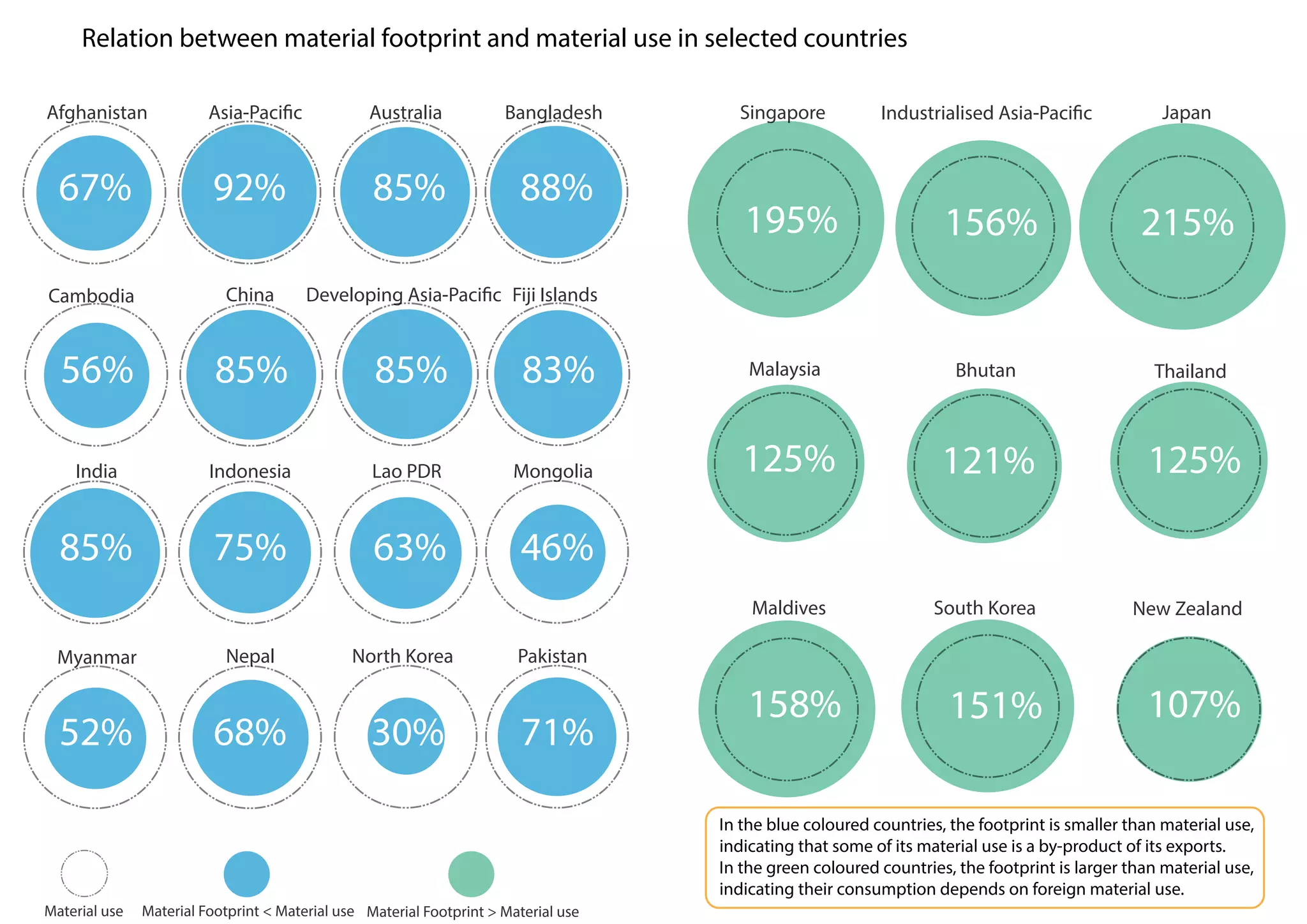
Australian exports have a large footprint, equal to 64% of its
extraction. Hence, the material footprint is smaller than direct
material use.
Japan has a very large import footprint. It is 4 times bigger than
what is extracted in Japan. Hence the material footprint is far
larger than direct material use.
In India, import and export footprints are quite small compared
to extraction. The footprint is close in value to material use.
Relation between material footprint and material use in selected countries
Afghanistan Asia-Pacific Australia
Bhutan
Industrialised Asia-Pacific Japan
Material Footprint > Material use
Bangladesh
Material Footprint < Material useMaterial use
AfghanistanAfghanistanAfghanistanAfghanistanAfghanistanAfghanistan BangladeshBangladeshBangladeshBangladeshBangladeshBangladesh
Cambodia China Developing Asia-Pacific Fiji IslandsDeveloping Asia-PacificDeveloping Asia-PacificDeveloping Asia-PacificDeveloping Asia-PacificDeveloping Asia-PacificDeveloping Asia-Pacific Fiji IslandsFiji IslandsFiji IslandsFiji IslandsFiji IslandsFiji Islands
India Indonesia Lao PDR MongoliaMongoliaMongoliaMongoliaMongolia
Myanmar Nepal North Korea PakistanMyanmarMyanmarMyanmarMyanmarMyanmarMyanmar NepalNepalNepalNepal
Malaysia
Maldives New Zealand
SingaporeSingapore
South Korea
Thailand
67% 85%92% 88%
121%
156% 215%
56% 85%85% 83%
85% 63%75% 46%
52% 30%68% 71%
125%
158% 107%
195%
151%
125%
In the blue coloured countries, the footprint is smaller than material use,
indicating that some of its material use is a by-product of its exports.
In the green coloured countries, the footprint is larger than material use,
indicating their consumption depends on foreign material use.
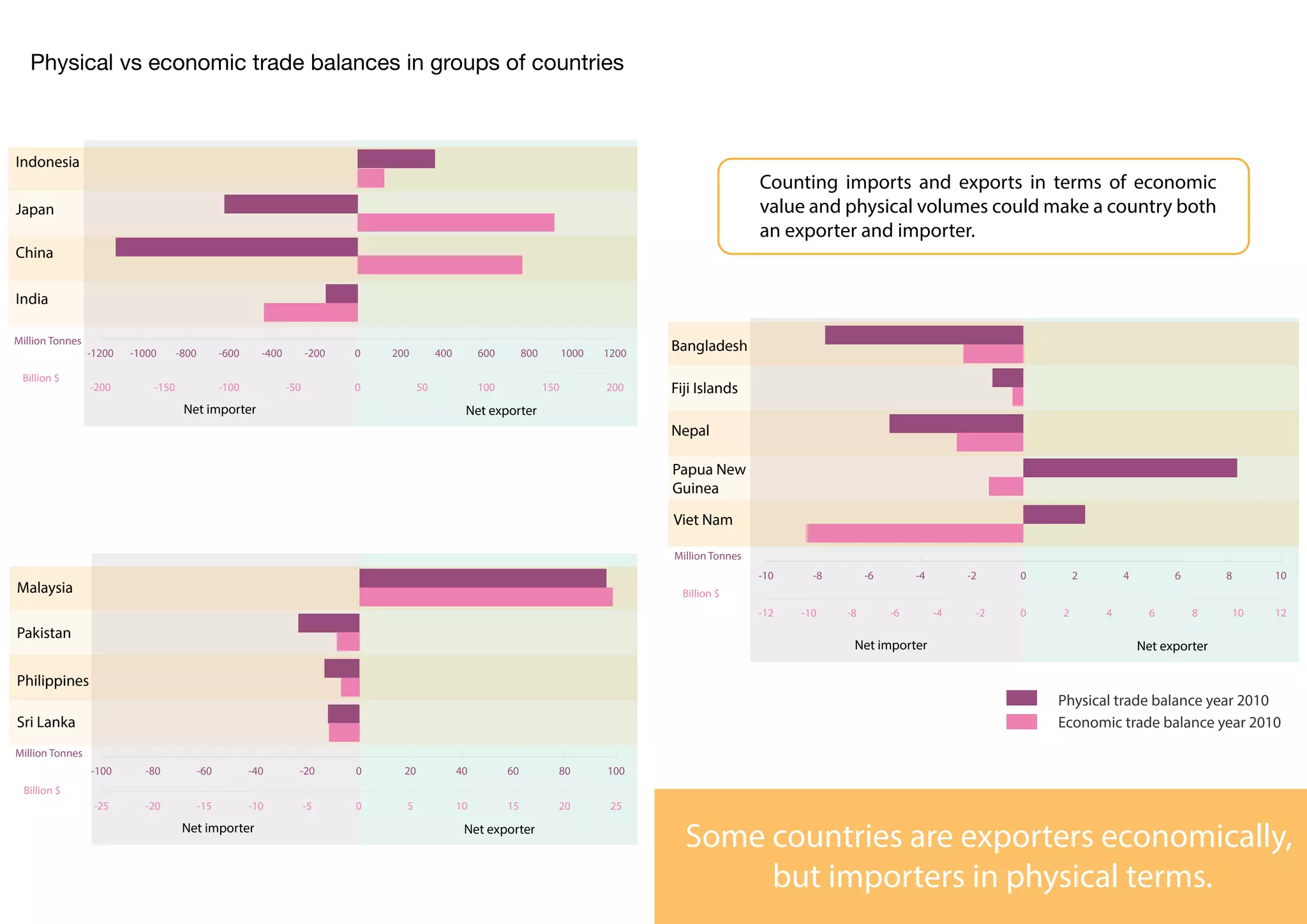
Physical vs economic trade balances in groups of countries
Some countries are exporters economically,
but importers in physical terms.
Million Tonnes
Billion $
Net exporterNet importer
Million Tonnes
Billion $
Net exporterNet importer
Counting imports and exports in terms of economic
value and physical volumes could make a country both
an exporter and importer.
Physical trade balance year 2010
Economic trade balance year 2010
China
Indonesia
Japan
-1200 -1000 -800 -600 -400 -200 0 200 400 600 800 1000 1200
-200 -150 -100 -50 0 50 100 150 200
Malaysia
Pakistan
-100 -80 -60 -40 -20 0 20 40 60 80 100
-25 -20 -15 -10 -5 0 5 10 15 20 25
Net exporterNet importer
Million Tonnes
Billion $
Bangladesh
Fiji Islands
Nepal
Papua New
Guinea
Viet Nam
-10 -8 -6 -4 -2 0 2 4 6 8 10
-12 -10 -8 -6 -4 -2 0 2 4 6 8 10 12
India
Philippines
Sri Lanka
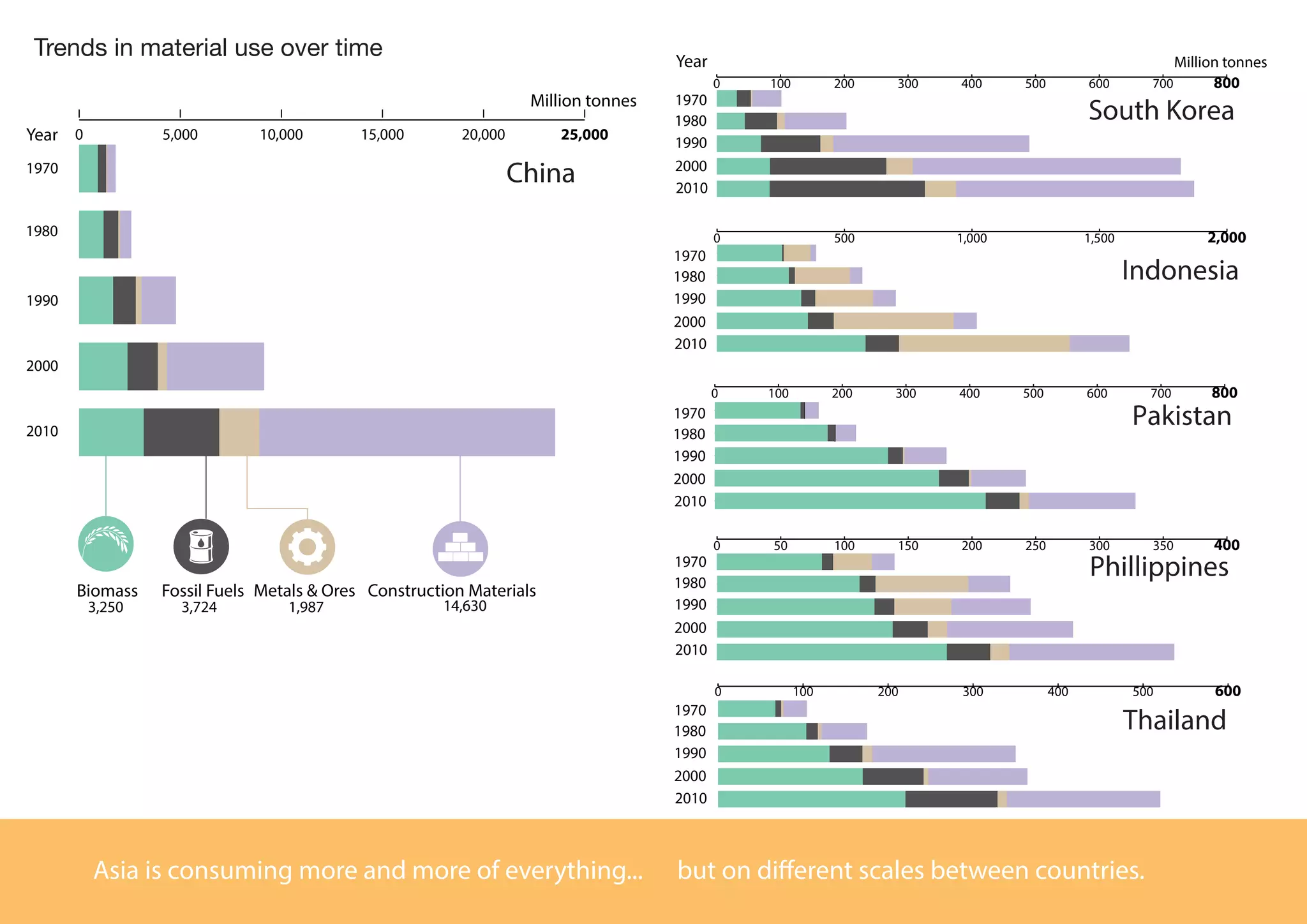
Asia is consuming more and more of everything... but on different scales between countries.
Trends in material use over time
0 5,000 10,000 15,000 20,000 25,000
Indonesia
Pakistan
Phillippines
Thailand
0 500 1,000 1,500 2,0000
0 100 200 300 400 500 600 700 8000
0 50 100 150 200 250 300 350 4000
0 100 200 300 400 500 6000
1970
1980
1990
2000
2010
China
1970
1980
1990
2000
2010
1970
1980
1990
2000
2010
1970
1980
1990
2000
2010
1970
1980
1990
2000
2010
0 100 200 300 400 500 600 700 800
South Korea
1970
1980
1990
2000
2010
Biomass Fossil Fuels Metals & Ores Construction Materials
Year
3,250 3,724 1,987 14,630
Million tonnes
Million tonnesYear
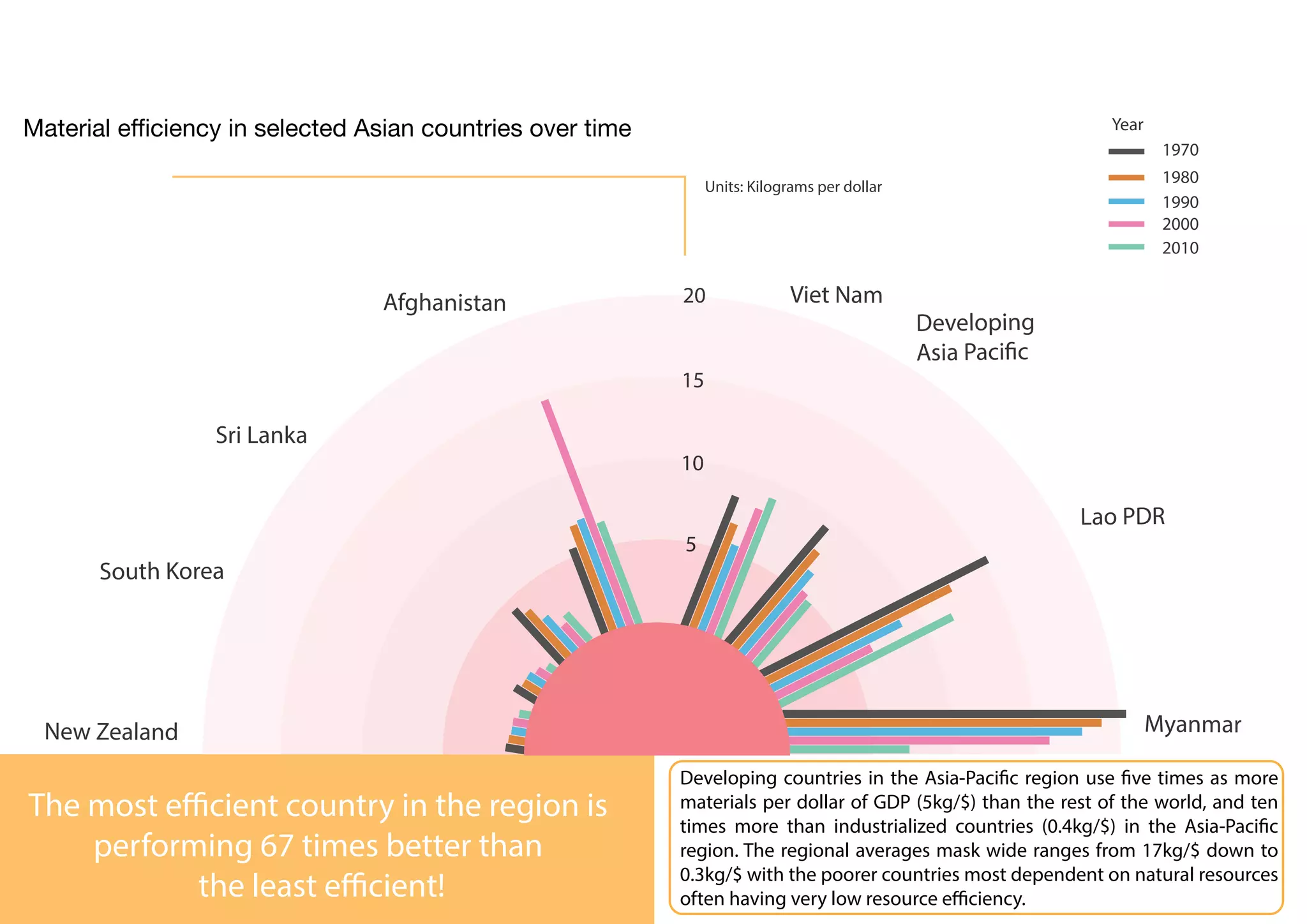
Material efficiency in selected Asian countries over time
Developing countries in the Asia-Pacific region use five times as more
materials per dollar of GDP (5kg/$) than the rest of the world, and ten
times more than industrialized countries (0.4kg/$) in the Asia-Pacific
region. The regional averages mask wide ranges from 17kg/$ down to
0.3kg/$ with the poorer countries most dependent on natural resources
often having very low resource efficiency.
The most efficient country in the region is
performing 67 times better than
the least efficient!
1970
1980
1990
2000
2010
Year
Units: Kilograms per dollar
Afghanistan
Developing
Asia Pacific
Myanmar
Lao PDR
South Korea
New Zealand
Viet Nam
Sri Lanka
55
1010
1515
2020
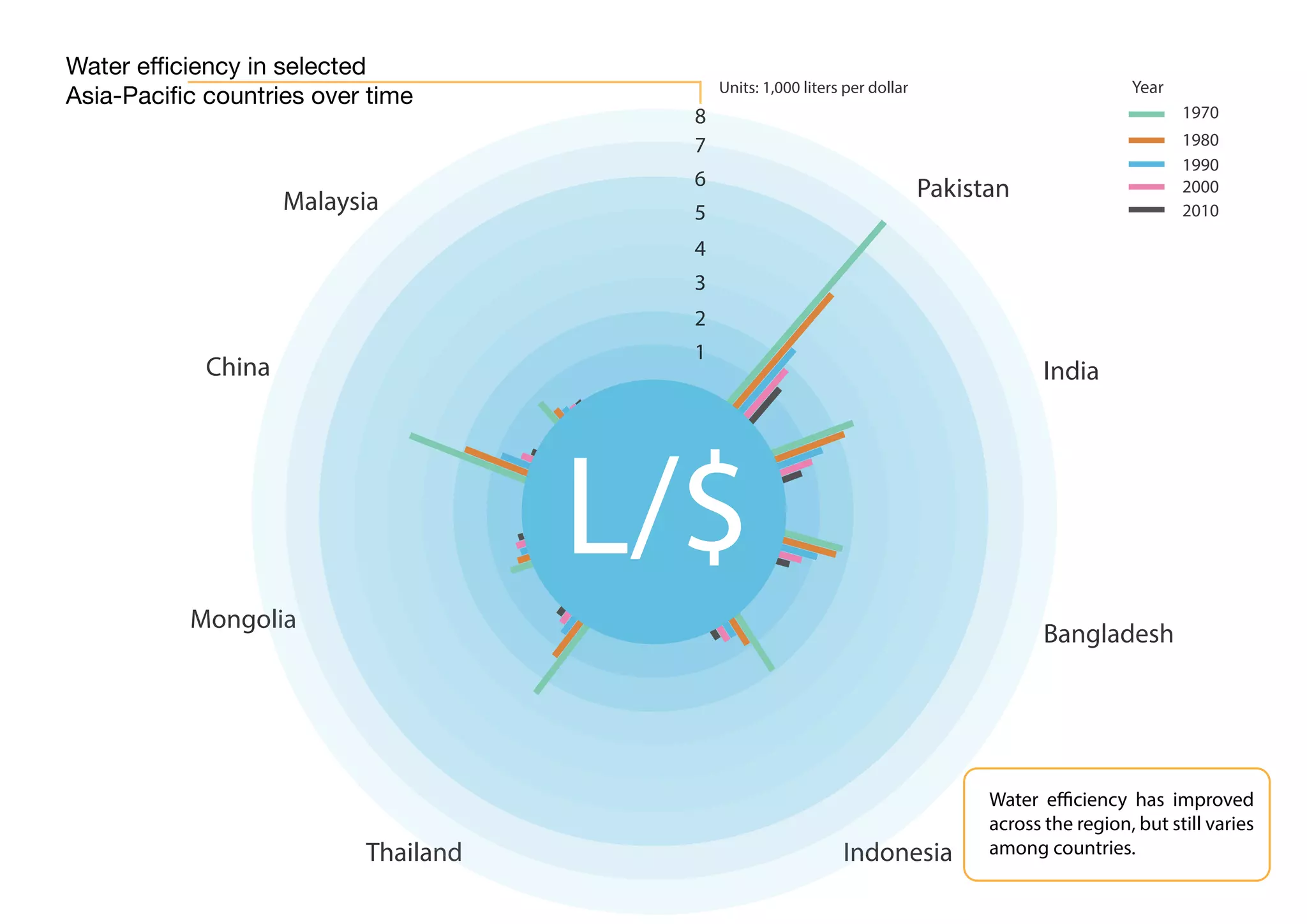
Water efficiency in selected
Asia-Pacific countries over time
Water efficiency has improved
across the region, but still varies
among countries.Thailand
Pakistan
Indonesia
Bangladesh
India
Malaysia
Mongolia
China
1970
1980
1990
2000
2010
Year
Thailand Indonesia
Mongolia
22
44
66
88
11
33
55
77
L/$
Units: 1,000 liters per dollar
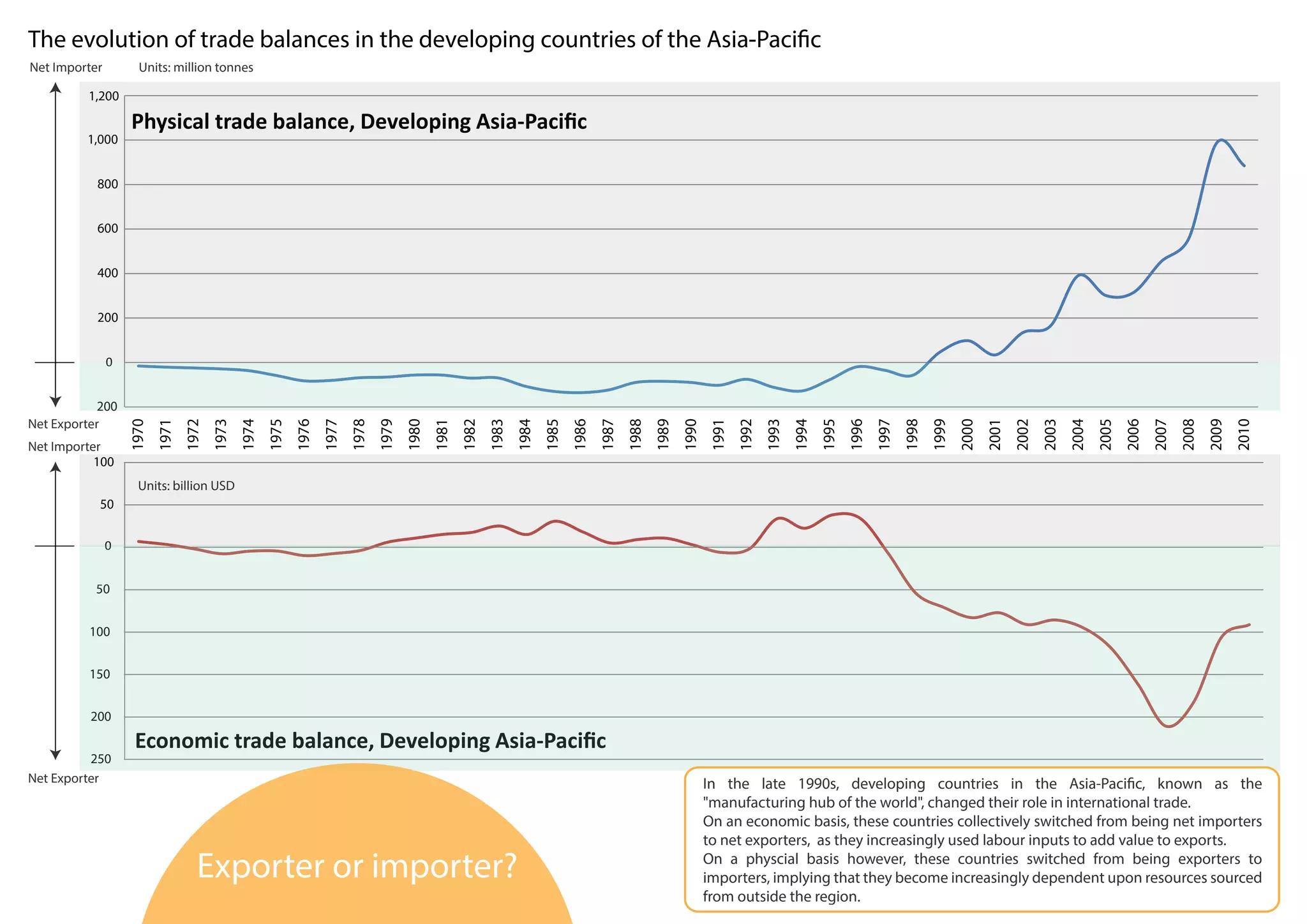
The evolution of trade balances in the developing countries of the Asia-Pacific
200
0
200
400
600
800
1,000
1,200
1970
1971
1972
1973
1974
1975
1976
1977
1978
1979
1980
1981
1982
1983
1984
1985
1986
1987
1988
1989
1990
1991
1992
1993
1994
1995
1996
1997
1998
1999
2000
2001
2002
2003
2004
2005
2006
2007
2008
2009
2010
250
200
150
100
50
50
100
E c o n o m i c t r a d e b a l a n c e , D e v e l o p i n g A s i a - P a c i fic
P h y s i c a l t r a d e b a l a n c e , D e v e l o p i n g A s i a - P a c i fic
Units: million tonnes
0
Net Importer
Net Importer
0
200
400
600
800
1,000
1,200
P h y s i c a l t r a d e b a l a n c e , D e v e l o p i n g A s i a - P a c i fic
200
0
50
100
0
250
200
150
100
50
E c o n o m i c t r a d e b a l a n c e , D e v e l o p i n g A s i a - P a c i fic
00
In the late 1990s, developing countries in the Asia-Pacific, known as the
"manufacturing hub of the world", changed their role in international trade.
On an economic basis, these countries collectively switched from being net importers
to net exporters, as they increasingly used labour inputs to add value to exports.
On a physcial basis however, these countries switched from being exporters to
importers, implying that they become increasingly dependent upon resources sourced
from outside the region.
Exporter or importer?
Net Exporter
Net Exporter
Units: billion USD
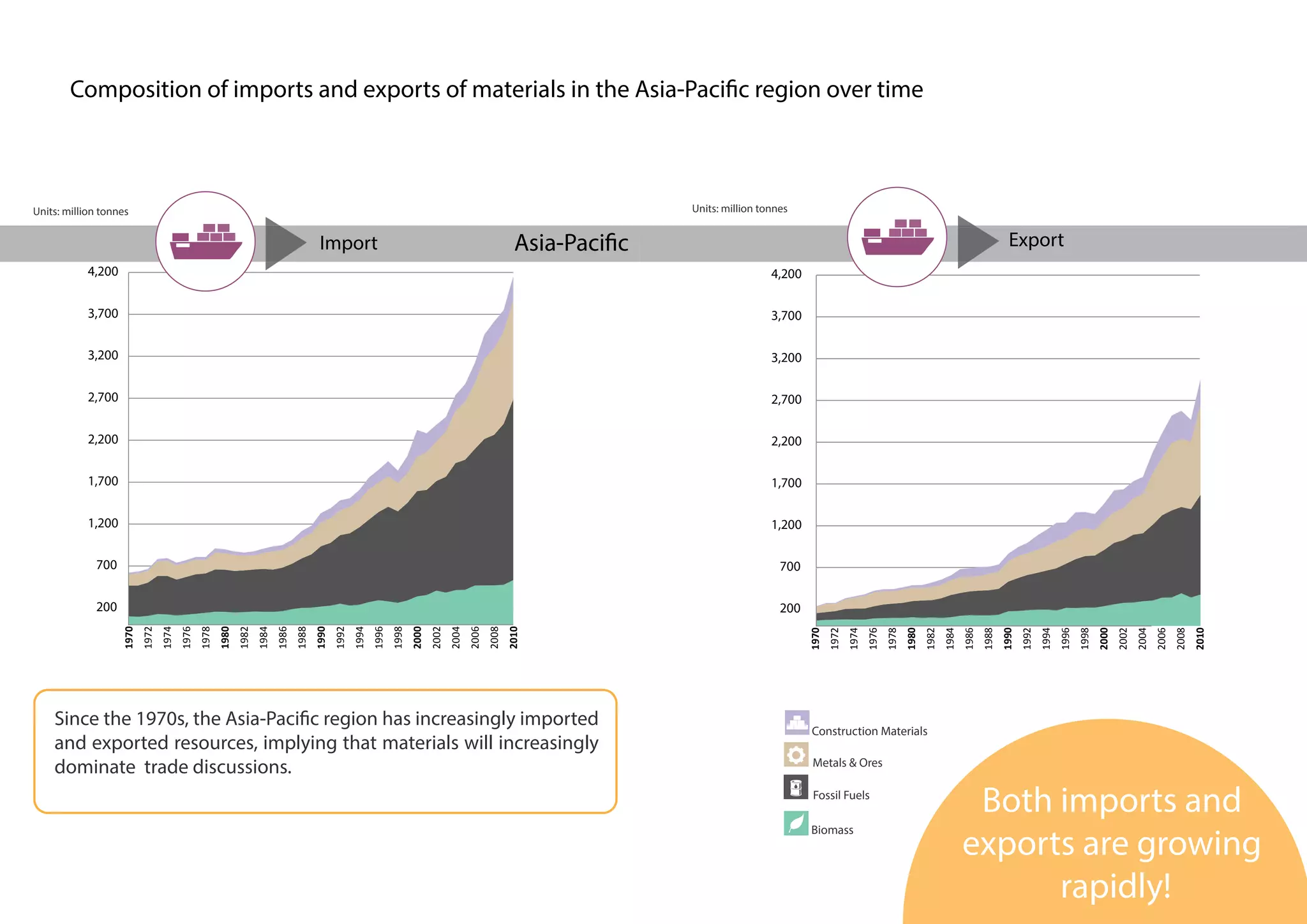
Composition of imports and exports of materials in the Asia-Pacific region over time
200
700
1,200
1,700
2,200
2,700
3,200
3,700
4,200
200
700
1,200
1,700
2,200
2,700
3,200
3,700
4,200
1970
1972
1974
1976
1978
1980
1982
1984
1986
1988
1990
1992
1994
1996
1998
2000
2002
2004
2006
2008
2010
Units: million tonnes Units: million tonnes
1970
1972
1974
1976
1978
1980
1982
1984
1986
1988
1990
1992
1994
1996
1998
2000
2002
2004
2006
2008
2010
Since the 1970s, the Asia-Pacific region has increasingly imported
and exported resources, implying that materials will increasingly
dominate trade discussions. Metals & Ores
Fossil Fuels
Biomass
Construction Materials
Both imports and
exports are growing
rapidly!
Asia-PacificImport Export
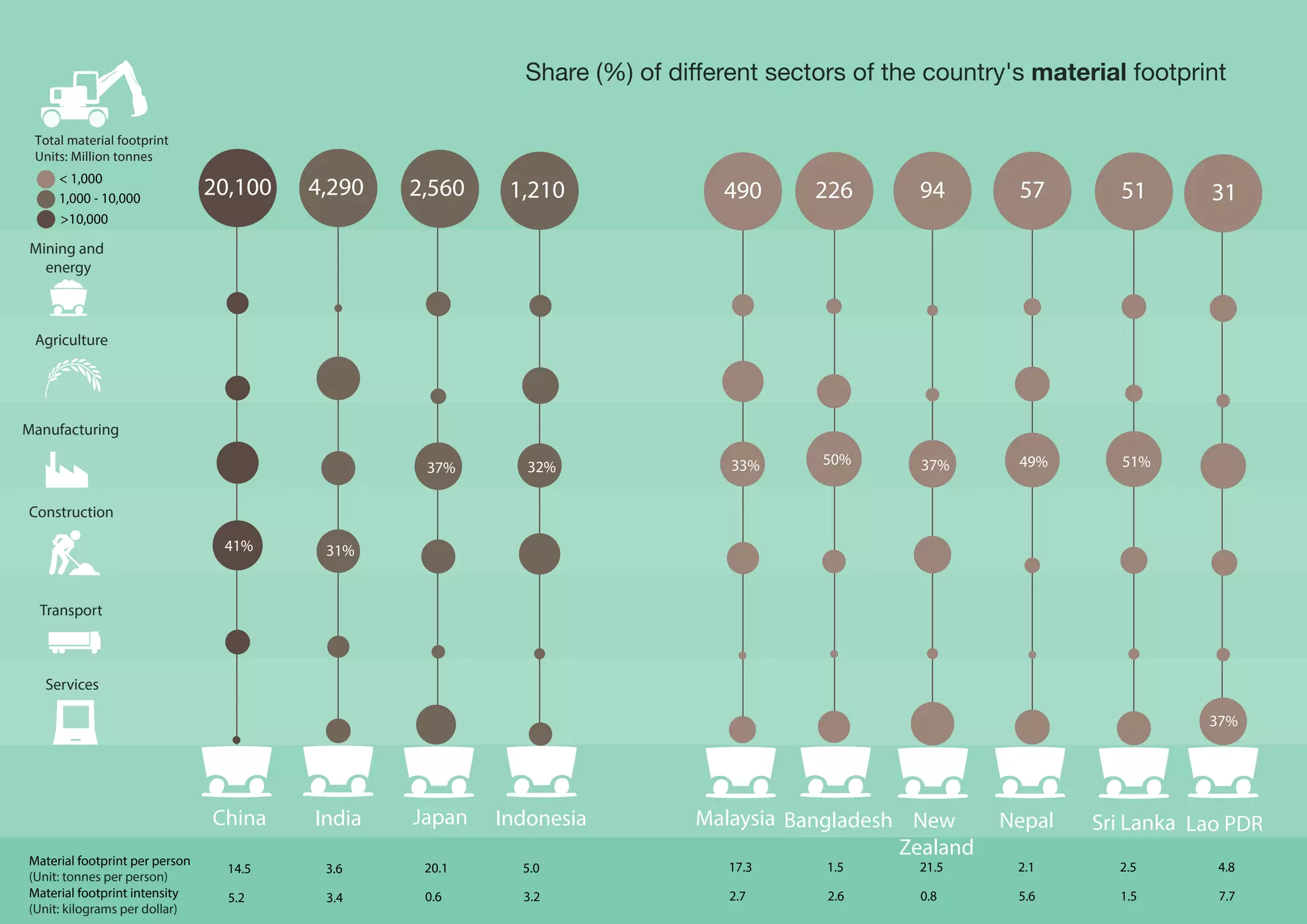
Share (%) of different sectors of the country's material footprint
Agriculture
Mining and
energy
Manufacturing
Construction
Transport
Services
< 1,000
1,000 - 10,000
>10,000
Total material footprint
Units: Million tonnes
BangladeshChina India IndonesiaJapan Lao PDRMalaysia NepalNew
Zealand
Sri Lanka
22620,100 4,290 1,2102,560 31490 5794 51
41% 31%
37% 32% 33% 50% 37% 49% 51%
37%
Material footprint per person
(Unit: tonnes per person)
Material footprint intensity
(Unit: kilograms per dollar)
14.5
5.2
3.6
3.4
20.1
0.6
5.0
3.2
17.3
2.7
1.5
2.6
21.5
0.8
2.1
5.6
2.5
1.5
4.8
7.7
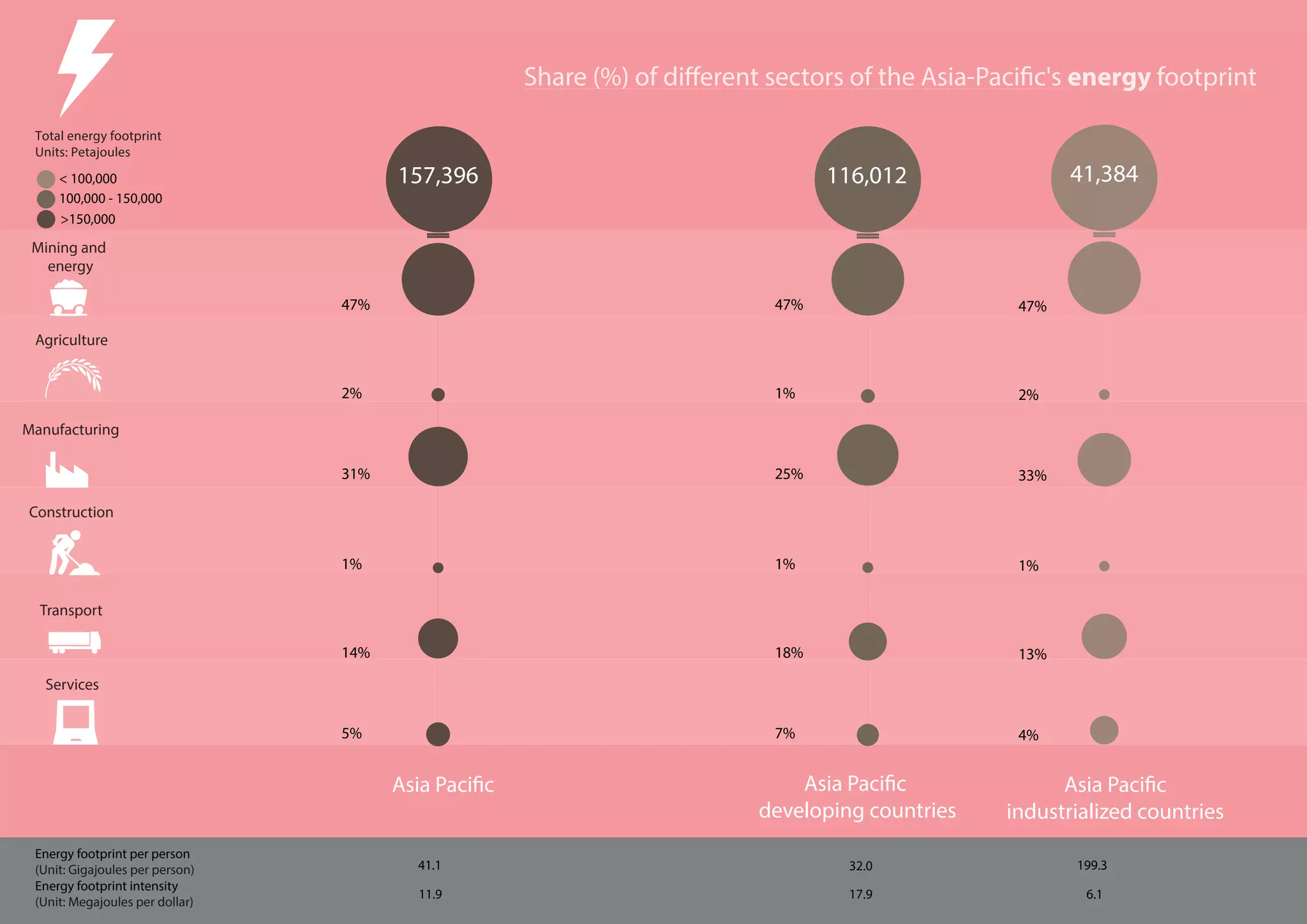
Share (%) of different sectors of the Asia-Pacific's energy footprint
Agriculture
Manufacturing
Construction
Transport
Services
< 100,000
100,000 - 150,000
>150,000
Mining and
energy
Total energy footprint
Units: Petajoules
Asia Pacific Asia Pacific
developing countries
Asia Pacific
industrialized countries
47%
2%
31%
1%
14%
5%
47%
1%
25%
1%
18%
7%
47%
2%
33%
1%
13%
4%
157,396 41,384116,012
Energy footprint per person
(Unit: Gigajoules per person)
Energy footprint intensity
(Unit: Megajoules per dollar)
41.1
11.9
199.3
6.1
32.0
17.9
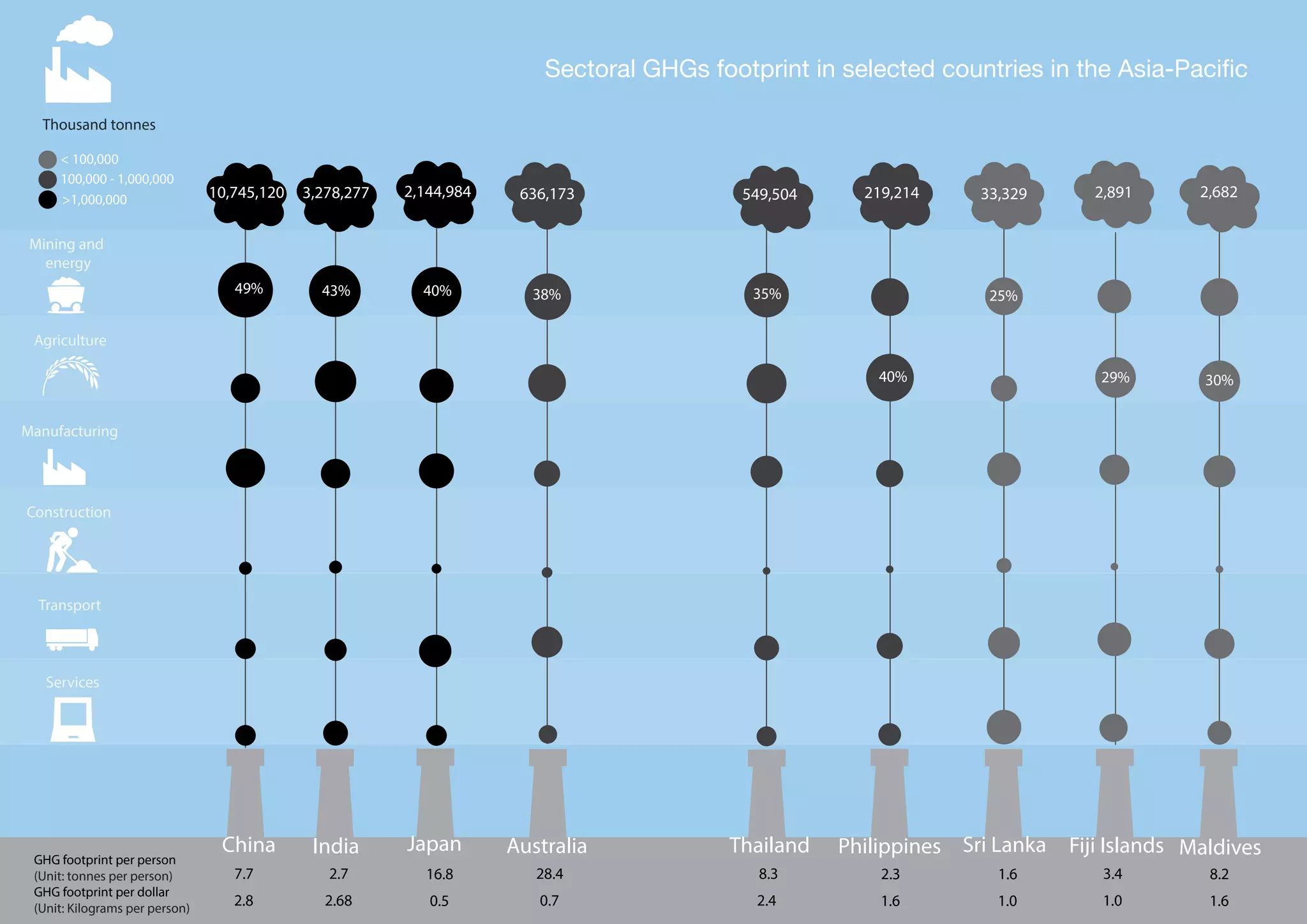
Sectoral GHGs footprint in selected countries in the Asia-Pacific
7.7 2.7 16.8 28.4 2.38.3 1.6 8.23.4
2.8 2.68 0.5 0.7 1.62.4 1.0 1.61.0
Agriculture
Manufacturing
Construction
Transport
Services
Mining and
energy
Australia MaldivesChina India Japan Fiji IslandsSri LankaPhilippinesThailand
Thousand tonnes
< 100,000
100,000 - 1,000,000
>1,000,000 636,173 2,68210,745,120 3,278,277 2,144,984 2,89133,329219,214549,504
49% 43% 40% 38%
40%
35% 25%
30%29%
GHG footprint per person
(Unit: tonnes per person)
GHG footprint per dollar
(Unit: Kilograms per person)
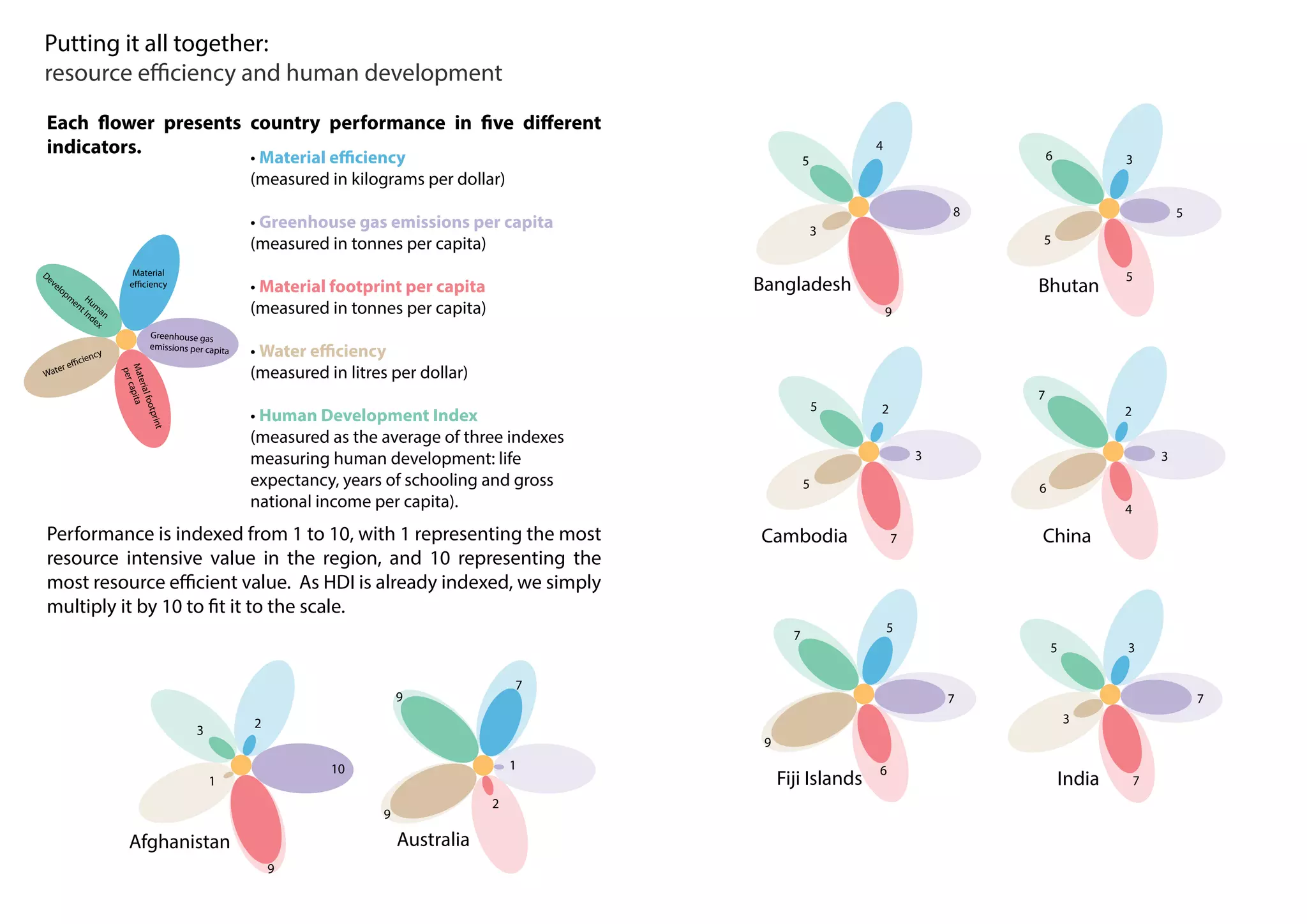
Putting it all together:
resource efficiency and human development
Afghanistan Australia
Bangladesh Bhutan
Cambodia China
Fiji Islands India
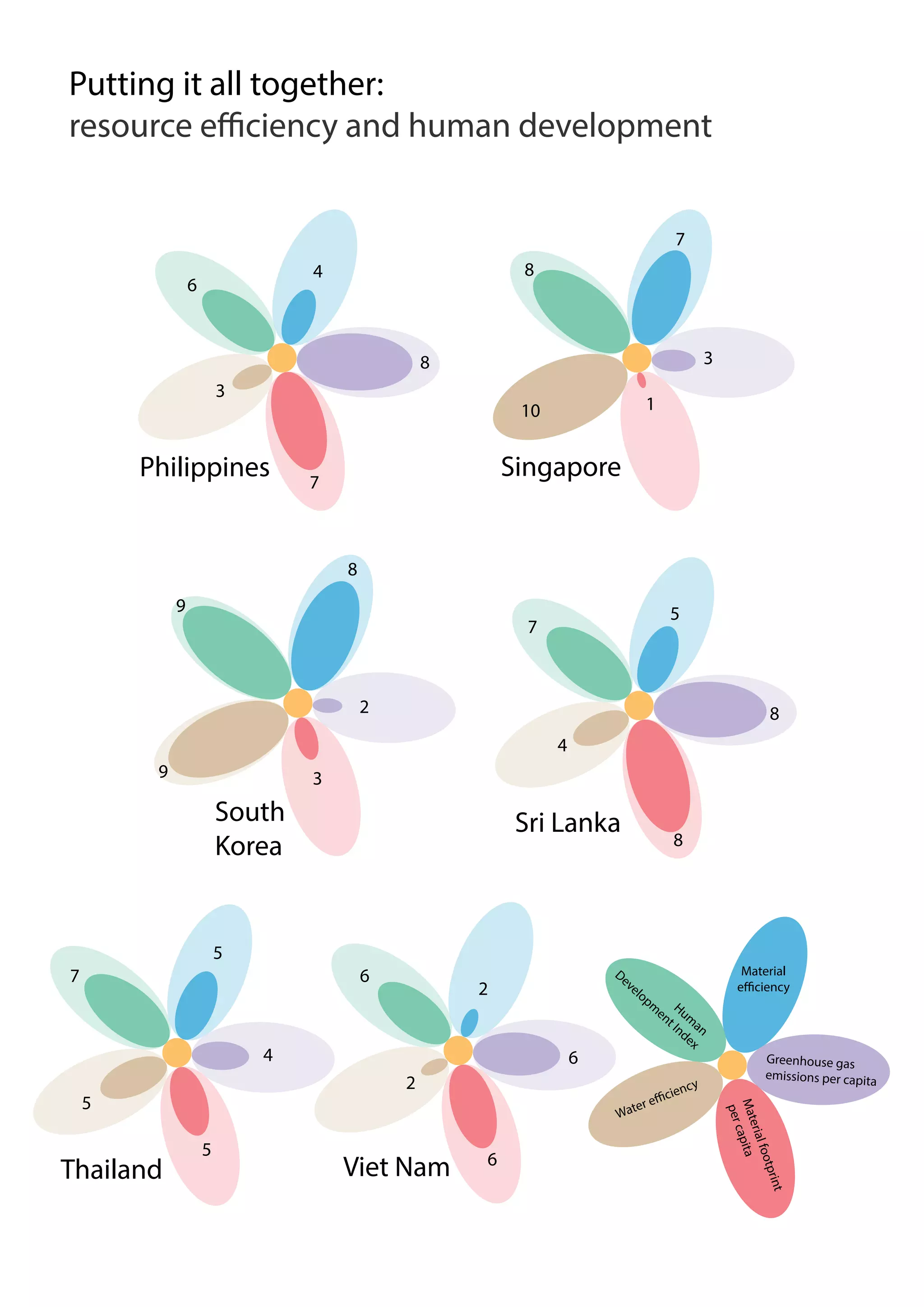
Each flower presents country performance in five different
indicators.
Performance is indexed from 1 to 10, with 1 representing the most
resource intensive value in the region, and 10 representing the
most resource efficient value. As HDI is already indexed, we simply
multiply it by 10 to fit it to the scale.
• Material efficiency
(measured in kilograms per dollar)
• Greenhouse gas emissions per capita
(measured in tonnes per capita)
• Material footprint per capita
(measured in tonnes per capita)
• Water efficiency
(measured in litres per dollar)
• Human Development Index
(measured as the average of three indexes
measuring human development: life
expectancy, years of schooling and gross
national income per capita).
Greenhouse gas
emissions per capita
Materialfootprint
percapita
Water efficiency
Hum
an
Developm
ent Index
Material
efficiency
Fiji Islands
10
9
1
3
2
1
2
9
9
7
8
9
3
5
4
5
5
5
6 3
3
7
5
5 2
3
4
6
7
2
7
6
9
7
5
7
7
3
5 3
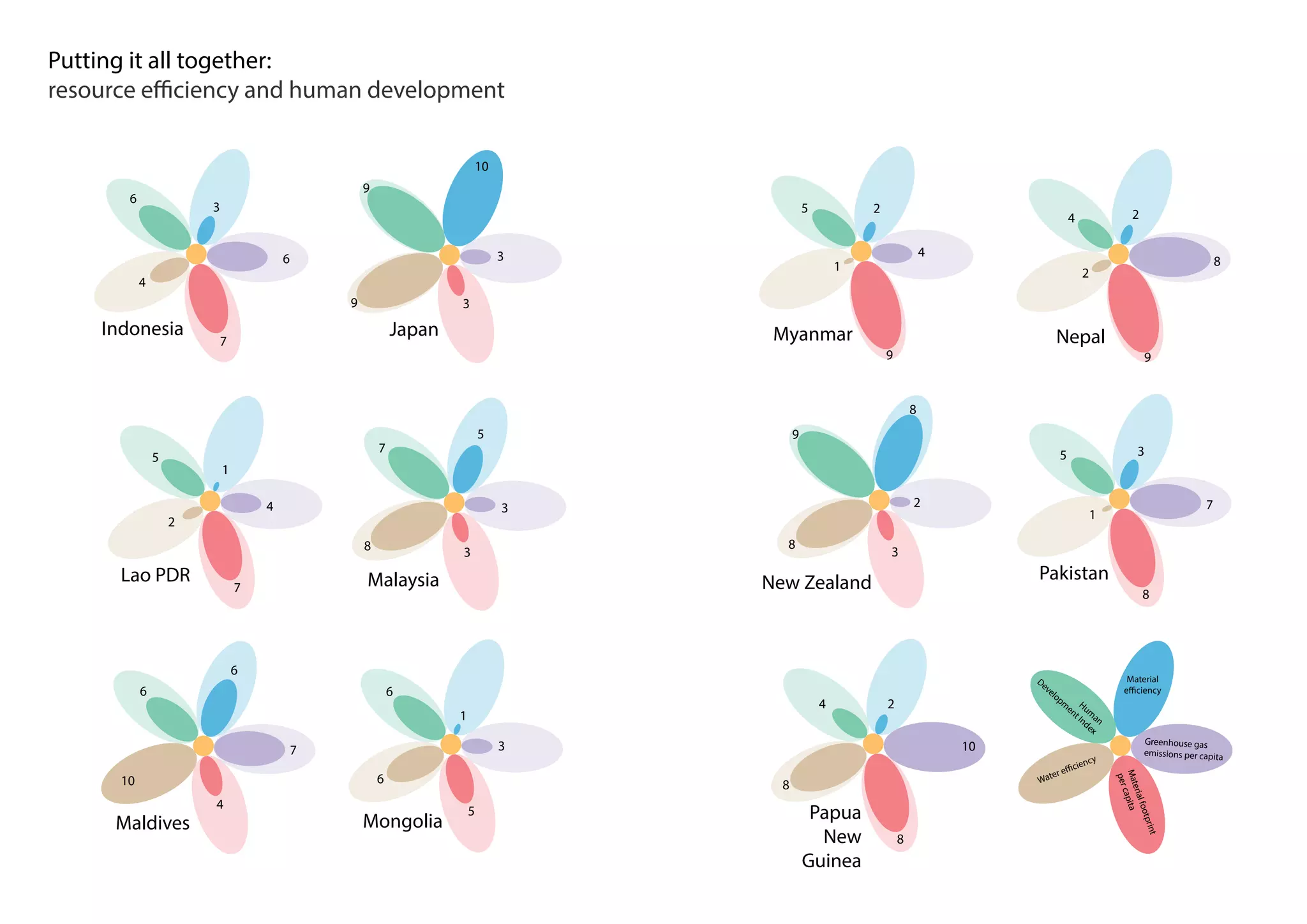
Putting it all together:
resource efficiency and human development
Pakistan
Papua
New
Guinea
Greenhouse gas
emissions per capita
Materialfootprint
percapita
Water efficiency
Hum
an
Developm
ent Index
Material
efficiency
7
8
1
5 3
10
8
8
4 2
Indonesia Japan
Lao PDR Malaysia
Maldives Mongolia
Myanmar Nepal
New Zealand
6
7
4
6
3
3
39
9
10
4
7
2
5
1
3
38
7
5
7
4
10
6
6
3
5
6
6
1
4
9
1
5 2
8
9
2
4 2
2
3
8
9
8
271
Putting it all together:
resource efficiency and human development
Philippines Singapore
South
Korea
Sri Lanka
Thailand Viet Nam
Greenhouse gas
emissions per capita
Materialfootprint
percapita
Water efficiency
Hum
an
Developm
ent Index
Material
efficiency
8
7
3
6
4
3
110
8
7
2
39
9
8
8
8
4
7
5
4
5
5
7
5
6
6
2
6
2
About the UNEP Division of Technology,
Industry and Economics
Set up in 1975, three years after UNEP was created, the Division of Technology, Industry
and Economics (DTIE) provides solutions to policy-makers and helps change the business
environment by offering platforms for dialogue and co-operation, innovative policy options,
pilot projects and creative market mechanisms.
DTIE plays a leading role in three of the six UNEP strategic priorities: climate change,
harmful substances and hazardous waste, resource efficiency.
DTIE is also actively contributing to the Green Economy Initiative launched by UNEP
in 2008. This aims to shift national and world economies on to a new path, in which jobs
and output growth are driven by increased investment in green sectors, and by a switch of
consumers’ preferences towards environmentally friendly goods and services.
Moreover, DTIE is responsible for fulfilling UNEP’s mandate as an implementing
agency for the Montreal Protocol Multilateral Fund and plays an executing role for a
number of UNEP projects financed by the Global Environment Facility.
The Office of the Director, located in Paris, coordinates activities through:
> The International Environmental Technology Centre - IETC (Osaka),
promotes the collection and dissemination of knowledge on Environmentally Sound
Technologies with a focus on waste management. The broad objective is to enhance the
understanding of converting waste into a resource and thus reduce impacts on human
health and the environment (land, water and air).
> Sustainable Consumption and Production (Paris), which promotes sustainable
consumption and production patterns as a contribution to human development through
global markets.
> Chemicals (Geneva), which catalyses global actions to bring about the sound
management of chemicals and the improvement of chemical safety worldwide.
> Energy (Paris and Nairobi), which fosters energy and transport policies for sustainable
development and encourages investment in renewable energy and energy efficiency.
> OzonAction (Paris), which supports the phase-out of ozone depleting substances in
developing countries and countries with economies in transition to ensure implementation
of the Montreal Protocol.
> Economics and Trade (Geneva), which helps countries to integrate environmental
considerations into economic and trade policies, and works with the finance sector to
incorporate sustainable development policies.
DTIE works with many partners (other UN agencies and programmes, international
organizations, governments, non-governmental organizations, business, industry, the media
and the public) to raise awareness, improve the transfer of knowledge and information,
foster technological cooperation and implement international conventions and agreements.
For more information,
www.unep.org/dtie
Infographic(Low-resolution)

Infographic(Low-resolution)

  • 2.
    Acknowledgements Concept and outline:Stefanos Fotiou Authors: Stefanos Fotiou, Janet Salem, Peerayot Sidonrusmee Contributors/Reviewers: Emily Briggs, Heinz Schandl, Jim West, Kaveh Zahedi, William Wyn Ellis, Donna Mei-Ling Park, Karin Hosking Design and Layout: Peerayot Sidonrusmee Cover photo: Mina Arampatzi All data used in this report can be accessed at UNEP Live (http://uneplive.unep.org). This publication is based on the following full report: UNEP (2015), Indicators for a Resource Efficient and Green Asia and the Pacific - Measuring progress of sustainable consumption and production, green economy and resource efficiency policies in the Asia-Pacific region, Schandl, H., West, J., Baynes, T., Hosking, K., Reinhardt, W., Geschke, A., Lenzen, M. United Nations Environment Programme, Bangkok. This publication should be referenced as follows: UNEP (2015), Resource use in the Asia-Pacific - A booklet of infographics, United Nations Environment Programme, Bangkok. Advance copy for the: Copyright © United Nations Environment Programme, 2015 This publication may be reproduced in whole or in part and in any form for educational or non-profit purposes without special permission from the copyright holder, provided acknowledgement of the source is made. UNEP would appreciate receiving a copy of any publication that uses this publication as a source. No use of this publication may be made for resale or for any other commercial purpose whatsoever without prior permission in writing from the United Nations Environment Programme. Disclaimer The designations employed and the presentation of the material in this publication do not imply the expression of any opinion whatsoever on the part of the United Nations Environment Programme concerning the legal status of any country, territory, city or area or of its authorities, or concerning delimitation of its frontiers or boundaries. Moreover, the views expressed do not necessarily represent the decision or the stated policy of the United Nations Environment Programme, nor does citing of trade names or commercial processes constitute endorsement. UNEP promotes environ- mentally sound practices globally and in its own activities. This publication is printed on 100% eco-fibers paper, using vegetable -based inks and other eco-friendly practices. Our distribution policy aims to reduce UNEP’s carbon footprint. 1st FORUM OF MINISTERS & ENVIRONMENT AUTHORITIES OF ASIA PACIFIC 19 - 20 May 2015, Bangkok
  • 3.
    Resource use inthe Asia-Pacific A booklet of infographics
  • 4.
    Introduction Understanding how efficientlywe use natural resources is a vital step for designing policies to tackle inefficiencies. This booklet of infographics - based on the UNEP report “Indicators for a Resource Efficient and Green Asia and the Pacific” - reveals the patterns and the evolution of natural resource use in Asia-Pacific over the past 40 years. The findings of the report that are captured here provide a number of messages for decision makers including the following. • The Asia-Pacific region consumes more than half of the world’s materials with increasing rates of growth and increasing material use per person. The use of materials in the Asia-Pacific region increased from 5.7 to 37 billion tonnes per year between 1970 and 2010. Global material consumption is 70 billion tonnes per year, so the Asia-Pacific region uses approximately 53%. • There is great potential to improve the efficiency of materials use in Asia-Pacific. On average, Asia-Pacific needs 3 kilograms of materials to produce one dollar of GDP and this lags far behind the rest of the world, for which on average only 1 kilogram is needed per dollar of GDP. • Looking at the Asia-Pacific region as a whole, the majority of materials used are not for exports but for consumption within the region. For a region known as the “manufacturing hub of the world”, the Asia-Pacific region is an exporter only in financial terms; in physical terms it is a net importer of materials. • Energy consumption has increased more than fourfold in developing countries in the Asia-Pacific region and is dominated by non-renewable energy sources. In the developing countries group of the region, coal and petroleum represent three quarters of energy consumption, while in the industrialized countries coal and petroleum accounted for two thirds of overall consumption. • Water use per person is decreasing and water efficiency is improving, driven by the agricultural sector and irrigation. During the past four decades, the region’s share of the global water consumption increased only slightly, from 51% in 1970 to 55% in 2010, with the developing countries group accounting for over 51% of use and the industrialized countries group responsible for less than 4%. • Greenhouse Gas (GHG) emissions have increased fourfold, but emissions per dollar have reduced by three quarters in developing countries. Despite a fourfold increase in emissions in the region, there has been a dramatic reduction of carbon intensity in developing countries. In 1970, carbon intensity was almost 10 kg CO2 -eq per dollar, whereas in 2010, it fell to below 3 kg CO2 -eq per dollar. The booklet presents these and additional findings in a graphical format, allowing readers to understand better the trends of resource use and resource efficiency in the region. Some of the main messages from the infographics are also highlighted on each page. The infographics and the report on which they were based are part of UNEP’s aim to communicate the latest science for policymakers to inspire and support action. We hope that the materials presented here help to convey the messages on resource use and efficiency in Asia-Pacific to the broadest possible audience and inspire us all into action. ©Aman,Halim
  • 5.
    The role ofresources and emissions in our world All societies depend on natural resources for human development through the provision of food, feed, fuel and fibre for people. Natural resources also serve as inputs to economic activities.  Some resources are renewable, like water. To remain as such they need to be managed sustainably. Others are non renewable, such as metal ores and fossil fuels. For non-renewable resources it can be difficult to know the quantity of reserves that we have left, yet we still extract the Indicators are needed to keep track of our resource use. If we know how much we are using, how efficiently we are using it, and what we use it for, we can make better decisions about the use of resources. The most important objectives are to ensure that natural resources remain available and affordable, while keeping emissions to the environment within safe limits. Atmosphere Hydrosphere - Oceans, Rivers, Groundwater, Lakes Earth's crust - Soils, Geological Sources, Land Water use Material use Energy use Air emissions Water emissions Atmosphere Consumption End of life: Waste, Recycling Extraction: Agriculture, Mining Tertiary sector: Services, Transport Hydrosphere - oceans, rivers, groundwater, lakes Earth's crust - soils, geological sources, land 1 2 Over the whole life cycle, the use of resources creates environmental impacts. Extraction, production, consumption, transport and waste processes all lead to emissions, pollution and waste that impacts the air, water and environment which we depend on. 3 4 Money Jobs Population Quality of life Production: Manufacturing, Construction Waste We use resources over the entire life cycle from extraction (mining and agriculture) to production, consumption and finally to the end of life, where they are either recycled or disposed. Through each of these stages, society converts the natural resources into something that addresses our needs and wants - food, buildings, mobiliy - and generates other kinds of value, such as employment, money and well being.
  • 6.
    What are naturalresources? There are many kinds of emissions to water, air and land. In this report we included only the ones which are measured using internationally recognised, complete data- sets - which include a subset of greenhouse gas emissions. These include: Natural resources are the physical basis of our social and economic activities. In this report we distinguish between four main types: They can be described further: How do we measure them? Absolute resource use - looking at the totals: Helps us compare! To help us understand how we stand compared to our neighbours we can divide absolute numbers by population and GDP: Material Use - measured by "Domestic Material Consumption" This is the extraction of materials through mining and agriculture, plus imports, minus exports. Water use - measured by recorded extraction from the water system. Energy use - measured by "Total Primary Energy Supply" This is energy produced domestically, plus imports, minus exports. Land use - measured in kilometers squared Due to data limitations, it is outside the scope of this report. Materials (measured in tonnes) Materials: Biomass (crops like food and cotton, animal products, forest products) Fossil Fuels (coal, oil, natural gas) Construction minerals Metal ores (iron, copper, aluminium etc) Water: Groundwater Freshwater Rainwater Energy: Sourced from Coal, Renewables, Oil, Gas, Nuclear Greenhouse Gases: Carbon dioxide (CO2 ) Methane (CH4 ) Nitrous oxides (N2 O) Fluorinated greenhouse gases (F-gases) Water (measured in litres or cubic meters) Energy (measured in Joules) Land (measured in squared kilometers) Land: There are different categories of land, but measuring land use is outside the scope of this report. (measured in tonnes) cubic meters) Physical Trade Balance The physical trade balance is the difference in mass between imports and exports. A negative physical trade balance means that a country or region is a net exporter. A positive physical trade balance means a country is a net importer. Resource efficiency - measured by "Resource Intensity" Resource Intensity can be calculated for any of the natural resources or emissions, by dividing resource use (or emissions) by GDP. The units will be kilograms or joules or squared kilometers per dollar, depending on which resource is investigated. A high resource intensity indicates a low resource efficiency. Resource use per capita Resource use per capita helps us to compare resource use between large and small populations. However, it does not imply equal access to resources by all parts of the population, and may vary within each country. Resources may also be "used" in a country without coming in direct contact with its citizens, for example in the case of mining for export. 1
  • 7.
    A snapshot ofmaterial use in the Asia-Pacific region Material use Unit: million tonnes Asia-Pacific The rest of the world 53 % 47 %36,940 million tonnes 32,991 million tonnes China India Indonesia Viet Nam Thailand Australia Philippines Others Japan South Korea Industrialized countryDeveloping country Malaysia Pakistan Others 23,591 5,022 1,619 1,189 994 749 980 729 661 The rest of the world 32,991 The rest of the world Viet Nam 1 Material use per dollar How many kilograms of materials per dollar of GDP? 519 358 391 271 How much does the Asia-Pacific use compared to the rest of the world? 3,831 million people 3,070 million people Year 2010 56 % 44 % 13 trillion dollars 38 trillion dollars25 % 75 % What about material use per capita? India Fiji Japan China 1 1 1 1 $$ 9 Kg 6 Kg 4 Kg 2 Kg 0.3 Kg The wide range of efficiencies indicates a huge potential for improvement! India China Material use per capita (tonnes per person) Indonesia Australia Japan Fact fact fact Why does the Asia-Pacific region Fact fact fact Why does the Asia-Pacific region Fact fact factconsume more materials thanFact fact factconsume more materials thanFact fact fact the rest of the world? To start with, the region hosts more than half the world’s population. But there are other reasons, such as the diverse range of efficiencies of the economies in Asia-Pacific, as well as major differences in per capita consumption of materials. Bangladesh Papua New Guinea Developing Asia-Pacific Industrialised Asia-Pacific Asia- Pacific 1.7 4.2 6.7 8.0 9.3 9.3 9.6 15.3 17.0 43.7
  • 8.
    Resource use perperson over time Industrialized countriesDeveloping countries Kilolitres per person Tonnes per person Gigajoules per person Industrialized countriesDeveloping countries Industrialized countriesDeveloping countries 1970 2010 1970 2010 1970 2010 Developing countries in the Asia-Pacific still consume fewer resources per person than the industrialized countries. However they are catching up fast. In 1970, on average a person in a developing country consumed only 24% as much materials as the average person in industrialized countries. In 2010, the proportion increased to 61%. Water use per person Material use per person Energy use per person Energy availability is still a challenge in developing Asia-Pacific! 729 897 544 689 2 10 9 15 15 93 47 184
  • 9.
    What type ofmaterials do we use in the Asia-Pacific, and how has this changed over time? Total material use Asia Pacific 1970 2010 Metals & OresFossil FuelsBiomass Construction Materials Asia Pacific developing countries Asia Pacific industrialized countries 0 2 4 6 8 10 12 14 16 18 20 1970 1980 1990 2000 2010 China Industrialized countries Developing countries Japan Philippines Material use is growing rapidly! Material use is growing rapidly in the region, both in total and per person. At the country level, there are three trends: rising as in China, falling as in Japan, and stable as in the Philippines. Material use per person tonnesperpersonperyear 5,736 36,940 1,500 3,186 4,236 33,754 Units: million tonnes
  • 10.
    Asia- Pacific Asia-Pacific developing countries Asia-Pacific industrialized countries South Asia South East Asia Total energyuse 50,000 100,000 150,000 200,000 Unit: Petajoules Asia-Pacific Asia-Pacific developing countries Asia-Pacific industrialized countries South Asia South East Asia Unit: Petajoules Year 0 250,000 Gigajoules per person 54 184 47 22 39 Energy use per person 0 50,000 100,000 150,000 200,000 250,000 Asia-Pacific developing countries Unit: Petajoules CoalHydro Natural gas Nuclear PetroleumRenewables 20101970 1980 1990 2000 Year 2010 Energy use and energy sources in the Asia-Pacific region Since the late 1990’s energy consumption has increased much faster than before in the Asia-Pacific developing countries. Coal and Oil are three quarters of energy consumption in Asia-Pacific developing countries. 447 6,774 4,766 15,130 1,142 10,045 89,054 3,482 12,815 1,130 33,659 25,230 Asia-Pacific industrialized countries Asia-Pacific developing countries
  • 11.
    Material use indifferent types of economies Australia extracts almost double what it actually uses domestically Japan's imports make up two-thirds of its material use. Australia Import Export Material use is calculated by adding the mass of domestic extraction and imports and subtracting the mass of exports. Japan Import ExportDomestic Extraction 1,728 Material use = 980 567 Material use = 1,189 Domestic Extraction } }Units: million tonnes Units: million tonnes 829 81 779 157 Metals & Ores Fossil Fuels Biomass Construction Materials + _ + _
  • 12.
    Explaining the footprint Export footprint Material extraction Import footprint Material use Material Footprint India 1,456 4,290 869 5,017 4,880 Japan 1562,5602,152 1,162 566 Australia 1,117 837 226 979 1,727 Dataon the Extraction, Imports and Exports of a country (i.e. the material use of a country) are not enough to represent the overall impact of an economy upon the environment. While material use reflects the production of goods and services, “material footprint” is based on consumption patterns. The material footprint indicates the amount of resources or emissions that can be attributed to final demand (consumption and capital investment) in a country. It shows the responsibility of a country’s consumption along the supply chain of resources and emissions which may occur anywhere in the world to satisfy final demand of that country. The footprint approach corrects the direct indicators for the upstream requirements of trade. To calculate the material footprint we use data on the footprint of imports and exports. On the opposite page, three typical country profiles are shown. Australian exports have a large footprint, equal to 64% of its extraction. Hence, the material footprint is smaller than direct material use. Japan has a very large import footprint. It is 4 times bigger than what is extracted in Japan. Hence the material footprint is far larger than direct material use. In India, import and export footprints are quite small compared to extraction. The footprint is close in value to material use.
  • 13.
    Relation between materialfootprint and material use in selected countries Afghanistan Asia-Pacific Australia Bhutan Industrialised Asia-Pacific Japan Material Footprint > Material use Bangladesh Material Footprint < Material useMaterial use AfghanistanAfghanistanAfghanistanAfghanistanAfghanistanAfghanistan BangladeshBangladeshBangladeshBangladeshBangladeshBangladesh Cambodia China Developing Asia-Pacific Fiji IslandsDeveloping Asia-PacificDeveloping Asia-PacificDeveloping Asia-PacificDeveloping Asia-PacificDeveloping Asia-PacificDeveloping Asia-Pacific Fiji IslandsFiji IslandsFiji IslandsFiji IslandsFiji IslandsFiji Islands India Indonesia Lao PDR MongoliaMongoliaMongoliaMongoliaMongolia Myanmar Nepal North Korea PakistanMyanmarMyanmarMyanmarMyanmarMyanmarMyanmar NepalNepalNepalNepal Malaysia Maldives New Zealand SingaporeSingapore South Korea Thailand 67% 85%92% 88% 121% 156% 215% 56% 85%85% 83% 85% 63%75% 46% 52% 30%68% 71% 125% 158% 107% 195% 151% 125% In the blue coloured countries, the footprint is smaller than material use, indicating that some of its material use is a by-product of its exports. In the green coloured countries, the footprint is larger than material use, indicating their consumption depends on foreign material use.
  • 14.
    Physical vs economictrade balances in groups of countries Some countries are exporters economically, but importers in physical terms. Million Tonnes Billion $ Net exporterNet importer Million Tonnes Billion $ Net exporterNet importer Counting imports and exports in terms of economic value and physical volumes could make a country both an exporter and importer. Physical trade balance year 2010 Economic trade balance year 2010 China Indonesia Japan -1200 -1000 -800 -600 -400 -200 0 200 400 600 800 1000 1200 -200 -150 -100 -50 0 50 100 150 200 Malaysia Pakistan -100 -80 -60 -40 -20 0 20 40 60 80 100 -25 -20 -15 -10 -5 0 5 10 15 20 25 Net exporterNet importer Million Tonnes Billion $ Bangladesh Fiji Islands Nepal Papua New Guinea Viet Nam -10 -8 -6 -4 -2 0 2 4 6 8 10 -12 -10 -8 -6 -4 -2 0 2 4 6 8 10 12 India Philippines Sri Lanka
  • 15.
    Asia is consumingmore and more of everything... but on different scales between countries. Trends in material use over time 0 5,000 10,000 15,000 20,000 25,000 Indonesia Pakistan Phillippines Thailand 0 500 1,000 1,500 2,0000 0 100 200 300 400 500 600 700 8000 0 50 100 150 200 250 300 350 4000 0 100 200 300 400 500 6000 1970 1980 1990 2000 2010 China 1970 1980 1990 2000 2010 1970 1980 1990 2000 2010 1970 1980 1990 2000 2010 1970 1980 1990 2000 2010 0 100 200 300 400 500 600 700 800 South Korea 1970 1980 1990 2000 2010 Biomass Fossil Fuels Metals & Ores Construction Materials Year 3,250 3,724 1,987 14,630 Million tonnes Million tonnesYear
  • 16.
    Material efficiency inselected Asian countries over time Developing countries in the Asia-Pacific region use five times as more materials per dollar of GDP (5kg/$) than the rest of the world, and ten times more than industrialized countries (0.4kg/$) in the Asia-Pacific region. The regional averages mask wide ranges from 17kg/$ down to 0.3kg/$ with the poorer countries most dependent on natural resources often having very low resource efficiency. The most efficient country in the region is performing 67 times better than the least efficient! 1970 1980 1990 2000 2010 Year Units: Kilograms per dollar Afghanistan Developing Asia Pacific Myanmar Lao PDR South Korea New Zealand Viet Nam Sri Lanka 55 1010 1515 2020
  • 17.
    Water efficiency inselected Asia-Pacific countries over time Water efficiency has improved across the region, but still varies among countries.Thailand Pakistan Indonesia Bangladesh India Malaysia Mongolia China 1970 1980 1990 2000 2010 Year Thailand Indonesia Mongolia 22 44 66 88 11 33 55 77 L/$ Units: 1,000 liters per dollar
  • 18.
    The evolution oftrade balances in the developing countries of the Asia-Pacific 200 0 200 400 600 800 1,000 1,200 1970 1971 1972 1973 1974 1975 1976 1977 1978 1979 1980 1981 1982 1983 1984 1985 1986 1987 1988 1989 1990 1991 1992 1993 1994 1995 1996 1997 1998 1999 2000 2001 2002 2003 2004 2005 2006 2007 2008 2009 2010 250 200 150 100 50 50 100 E c o n o m i c t r a d e b a l a n c e , D e v e l o p i n g A s i a - P a c i fic P h y s i c a l t r a d e b a l a n c e , D e v e l o p i n g A s i a - P a c i fic Units: million tonnes 0 Net Importer Net Importer 0 200 400 600 800 1,000 1,200 P h y s i c a l t r a d e b a l a n c e , D e v e l o p i n g A s i a - P a c i fic 200 0 50 100 0 250 200 150 100 50 E c o n o m i c t r a d e b a l a n c e , D e v e l o p i n g A s i a - P a c i fic 00 In the late 1990s, developing countries in the Asia-Pacific, known as the "manufacturing hub of the world", changed their role in international trade. On an economic basis, these countries collectively switched from being net importers to net exporters, as they increasingly used labour inputs to add value to exports. On a physcial basis however, these countries switched from being exporters to importers, implying that they become increasingly dependent upon resources sourced from outside the region. Exporter or importer? Net Exporter Net Exporter Units: billion USD
  • 19.
    Composition of importsand exports of materials in the Asia-Pacific region over time 200 700 1,200 1,700 2,200 2,700 3,200 3,700 4,200 200 700 1,200 1,700 2,200 2,700 3,200 3,700 4,200 1970 1972 1974 1976 1978 1980 1982 1984 1986 1988 1990 1992 1994 1996 1998 2000 2002 2004 2006 2008 2010 Units: million tonnes Units: million tonnes 1970 1972 1974 1976 1978 1980 1982 1984 1986 1988 1990 1992 1994 1996 1998 2000 2002 2004 2006 2008 2010 Since the 1970s, the Asia-Pacific region has increasingly imported and exported resources, implying that materials will increasingly dominate trade discussions. Metals & Ores Fossil Fuels Biomass Construction Materials Both imports and exports are growing rapidly! Asia-PacificImport Export
  • 20.
    Share (%) ofdifferent sectors of the country's material footprint Agriculture Mining and energy Manufacturing Construction Transport Services < 1,000 1,000 - 10,000 >10,000 Total material footprint Units: Million tonnes BangladeshChina India IndonesiaJapan Lao PDRMalaysia NepalNew Zealand Sri Lanka 22620,100 4,290 1,2102,560 31490 5794 51 41% 31% 37% 32% 33% 50% 37% 49% 51% 37% Material footprint per person (Unit: tonnes per person) Material footprint intensity (Unit: kilograms per dollar) 14.5 5.2 3.6 3.4 20.1 0.6 5.0 3.2 17.3 2.7 1.5 2.6 21.5 0.8 2.1 5.6 2.5 1.5 4.8 7.7
  • 21.
    Share (%) ofdifferent sectors of the Asia-Pacific's energy footprint Agriculture Manufacturing Construction Transport Services < 100,000 100,000 - 150,000 >150,000 Mining and energy Total energy footprint Units: Petajoules Asia Pacific Asia Pacific developing countries Asia Pacific industrialized countries 47% 2% 31% 1% 14% 5% 47% 1% 25% 1% 18% 7% 47% 2% 33% 1% 13% 4% 157,396 41,384116,012 Energy footprint per person (Unit: Gigajoules per person) Energy footprint intensity (Unit: Megajoules per dollar) 41.1 11.9 199.3 6.1 32.0 17.9
  • 22.
    Sectoral GHGs footprintin selected countries in the Asia-Pacific 7.7 2.7 16.8 28.4 2.38.3 1.6 8.23.4 2.8 2.68 0.5 0.7 1.62.4 1.0 1.61.0 Agriculture Manufacturing Construction Transport Services Mining and energy Australia MaldivesChina India Japan Fiji IslandsSri LankaPhilippinesThailand Thousand tonnes < 100,000 100,000 - 1,000,000 >1,000,000 636,173 2,68210,745,120 3,278,277 2,144,984 2,89133,329219,214549,504 49% 43% 40% 38% 40% 35% 25% 30%29% GHG footprint per person (Unit: tonnes per person) GHG footprint per dollar (Unit: Kilograms per person)
  • 23.
    Putting it alltogether: resource efficiency and human development Afghanistan Australia Bangladesh Bhutan Cambodia China Fiji Islands India Each flower presents country performance in five different indicators. Performance is indexed from 1 to 10, with 1 representing the most resource intensive value in the region, and 10 representing the most resource efficient value. As HDI is already indexed, we simply multiply it by 10 to fit it to the scale. • Material efficiency (measured in kilograms per dollar) • Greenhouse gas emissions per capita (measured in tonnes per capita) • Material footprint per capita (measured in tonnes per capita) • Water efficiency (measured in litres per dollar) • Human Development Index (measured as the average of three indexes measuring human development: life expectancy, years of schooling and gross national income per capita). Greenhouse gas emissions per capita Materialfootprint percapita Water efficiency Hum an Developm ent Index Material efficiency Fiji Islands 10 9 1 3 2 1 2 9 9 7 8 9 3 5 4 5 5 5 6 3 3 7 5 5 2 3 4 6 7 2 7 6 9 7 5 7 7 3 5 3
  • 24.
    Putting it alltogether: resource efficiency and human development Pakistan Papua New Guinea Greenhouse gas emissions per capita Materialfootprint percapita Water efficiency Hum an Developm ent Index Material efficiency 7 8 1 5 3 10 8 8 4 2 Indonesia Japan Lao PDR Malaysia Maldives Mongolia Myanmar Nepal New Zealand 6 7 4 6 3 3 39 9 10 4 7 2 5 1 3 38 7 5 7 4 10 6 6 3 5 6 6 1 4 9 1 5 2 8 9 2 4 2 2 3 8 9 8
  • 25.
    271 Putting it alltogether: resource efficiency and human development Philippines Singapore South Korea Sri Lanka Thailand Viet Nam Greenhouse gas emissions per capita Materialfootprint percapita Water efficiency Hum an Developm ent Index Material efficiency 8 7 3 6 4 3 110 8 7 2 39 9 8 8 8 4 7 5 4 5 5 7 5 6 6 2 6 2
  • 26.
    About the UNEPDivision of Technology, Industry and Economics Set up in 1975, three years after UNEP was created, the Division of Technology, Industry and Economics (DTIE) provides solutions to policy-makers and helps change the business environment by offering platforms for dialogue and co-operation, innovative policy options, pilot projects and creative market mechanisms. DTIE plays a leading role in three of the six UNEP strategic priorities: climate change, harmful substances and hazardous waste, resource efficiency. DTIE is also actively contributing to the Green Economy Initiative launched by UNEP in 2008. This aims to shift national and world economies on to a new path, in which jobs and output growth are driven by increased investment in green sectors, and by a switch of consumers’ preferences towards environmentally friendly goods and services. Moreover, DTIE is responsible for fulfilling UNEP’s mandate as an implementing agency for the Montreal Protocol Multilateral Fund and plays an executing role for a number of UNEP projects financed by the Global Environment Facility. The Office of the Director, located in Paris, coordinates activities through: > The International Environmental Technology Centre - IETC (Osaka), promotes the collection and dissemination of knowledge on Environmentally Sound Technologies with a focus on waste management. The broad objective is to enhance the understanding of converting waste into a resource and thus reduce impacts on human health and the environment (land, water and air). > Sustainable Consumption and Production (Paris), which promotes sustainable consumption and production patterns as a contribution to human development through global markets. > Chemicals (Geneva), which catalyses global actions to bring about the sound management of chemicals and the improvement of chemical safety worldwide. > Energy (Paris and Nairobi), which fosters energy and transport policies for sustainable development and encourages investment in renewable energy and energy efficiency. > OzonAction (Paris), which supports the phase-out of ozone depleting substances in developing countries and countries with economies in transition to ensure implementation of the Montreal Protocol. > Economics and Trade (Geneva), which helps countries to integrate environmental considerations into economic and trade policies, and works with the finance sector to incorporate sustainable development policies. DTIE works with many partners (other UN agencies and programmes, international organizations, governments, non-governmental organizations, business, industry, the media and the public) to raise awareness, improve the transfer of knowledge and information, foster technological cooperation and implement international conventions and agreements. For more information, www.unep.org/dtie