INTEGRAL CALCULUS (Integration)
Technical Mathematics
Grade 12-Just In Time Training
17 February 2018 ,
Ishaak Cassim
DCES: Technical Mathematics
Ishaak Cassim - February 2018 1
Outcomes for this section
• By the end of this section, you should be able to:
• Understand the concept of integration as a summation function (definite
integral) and as converse of differentiation (indefinite integral).
• Apply standard forms of integrals as a converse of differentiation.
• Integrate the following functions:
o kxn, with n ∈ ℝ; with 𝑛 ≠ – 1
o
𝒌
𝒙
and kanx with a > 0 ; k , a ∈ ℝ
• Integrate polynomials consisting of terms of the above forms.
• Apply integration to determine the magnitude of an area included by a
curve and the x-axis or by a curve, the x-axis and the ordinates x = a
and x = b where a , b ∈ ℤ.
Ishaak Cassim - February 2018 2
Introduction
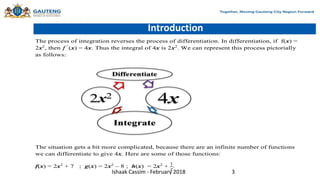
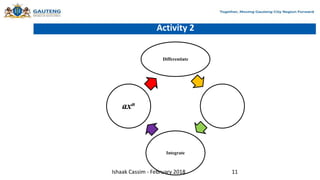
The process of integration reverses the process of differentiation. In differentiation, if f(x) =
2x2
, then 𝑓′
(x) = 4x. Thus the integral of 4x is 2x2
. We can represent this process pictorially
as follows:
The situation gets a bit more complicated, because there are an infinite number of functions
we can differentiate to give 4x. Here are some of those functions:
f(x) = 2x2
+ 7 ; g(x) = 2x2
– 8 ; h(x) = 2x2
+
1
2
.
Ishaak Cassim - February 2018 3
Activity 1
• Activity 1
• Write down at least five other functions whose
derivative is 4x.
Ishaak Cassim - February 2018 4
Introduction
• You would have noticed that all the functions have the same
derivative of 4x, because when we differentiate the constant
term we obtain zero.
• Hence, when we reverse the process, we have no idea what
the original constant term might have been.
• So we include in our response an unknown constant, c, called
the arbitrary constant of integration.
• The integral of 4x then is 2x2 + c.
Ishaak Cassim - February 2018 5
Introduction
• In differentiation, the differential coefficient
𝑑𝑦
𝑑𝑥
indicates that
a function of x is being differentiated with respect to x, the dx
indicating that it is “with respect to x”.
• In integration, the variable of integration is shown by adding
d(the variable) after the function to be integrated. When we
want to integrate a function, we use a special notation:
𝒇 𝒙 𝒅𝒙.
• Thus, to integrate 4x, we will write it as follows:
Ishaak Cassim - February 2018 6
Introduction
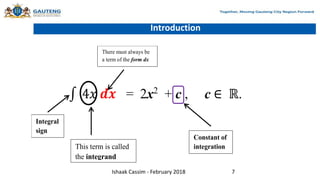
4𝑥 𝒅𝒙 = 2x2
+ c , c ∈ ℝ.
Integral
sign
This term is called
the integrand
There must always be
a term of the form dx
Constant of
integration
Ishaak Cassim - February 2018 7
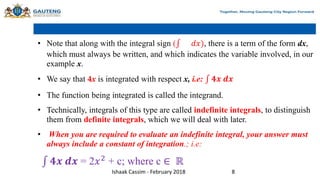
• Note that along with the integral sign ( 𝑑𝑥), there is a term of the form dx,
which must always be written, and which indicates the variable involved, in our
example x.
• We say that 4x is integrated with respect x, i.e: 𝟒𝒙 𝒅𝒙
• The function being integrated is called the integrand.
• Technically, integrals of this type are called indefinite integrals, to distinguish
them from definite integrals, which we will deal with later.
• When you are required to evaluate an indefinite integral, your answer must
always include a constant of integration.; i.e:
𝟒𝒙 𝒅𝒙 = 2𝑥2
+ c; where c ∈ ℝ
Ishaak Cassim - February 2018 8
Definition of anti-derivative
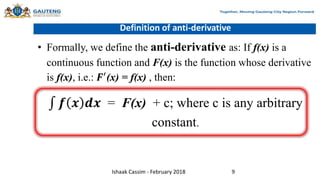
• Formally, we define the anti-derivative as: If f(x) is a
continuous function and F(x) is the function whose derivative
is f(x), i.e.: 𝑭′
(x) = f(x) , then:
𝒇 𝒙 𝒅𝒙 = F(x) + c; where c is any arbitrary
constant.
Ishaak Cassim - February 2018 9
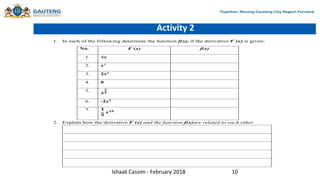
Activity 2
1. In each of the following determine the function f(x), if the derivative 𝑭′
(x) is given:
No. 𝑭′
(x) f(x)
1. 4x
2. x4
3. 2x2
4. 0
5.
𝒙
𝟑
𝟐
6. -2x3
7. 𝟏
𝟓
𝒙𝟏𝟎
2. Explain how the derivative 𝑭′
(x) and the function f(x)are related to each other
Ishaak Cassim - February 2018 10
Activity 2
Differentiate
Integrate
axn
Ishaak Cassim - February 2018 11
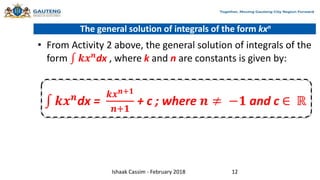
The general solution of integrals of the form kxn
• From Activity 2 above, the general solution of integrals of the
form 𝒌𝒙𝒏
dx , where k and n are constants is given by:
𝒌𝒙𝒏
dx =
𝒌𝒙𝒏+𝟏
𝒏+𝟏
+ c ; where 𝒏 ≠ −𝟏 and c ∈ ℝ
Ishaak Cassim - February 2018 12
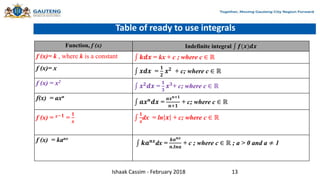
Table of ready to use integrals
Function, f (x) Indefinite integral 𝒇(𝒙)𝒅𝒙
f (x)= k , where k is a constant 𝒌𝒅𝒙 = kx + c ; where c ∈ ℝ
f (x)= x 𝒙𝒅𝒙 =
𝟏
𝟐
𝒙𝟐
+ c; where c ∈ ℝ
f (x) = x2
𝒙𝟐
𝒅𝒙 =
𝟏
𝟑
𝒙𝟑
+ c; where c ∈ ℝ
f(x) = axn
𝒂𝒙𝒏𝒅𝒙 =
𝒂𝒙𝒏+𝟏
𝒏+𝟏
+ c; where c ∈ ℝ
f (x) = 𝒙−𝟏
=
𝟏
𝒙
𝟏
𝒙
dx = ln 𝒙 + c; where c ∈ ℝ
f (x) = kanx
𝒌𝒂𝒏𝒙
dx =
𝒌𝒂𝒏𝒙
𝒏.𝒍𝒏𝒂
+ c ; where c ∈ ℝ ; a > 0 and a ≠ 1
Ishaak Cassim - February 2018 13
Worked Examples: Indefinite integrals
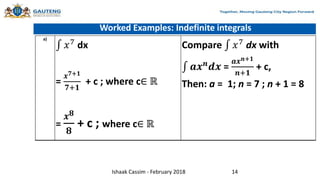
a)
𝑥7
dx
=
𝒙𝟕+𝟏
𝟕+𝟏
+ c ; where c∈ ℝ
=
𝒙𝟖
𝟖
+ c ; where c∈ ℝ
Compare 𝑥7
dx with
𝒂𝒙𝒏
𝒅𝒙 =
𝒂𝒙𝒏+𝟏
𝒏+𝟏
+ c,
Then: a = 1; n = 7 ; n + 1 = 8
Ishaak Cassim - February 2018 14
Worked Examples: Indefinite integrals
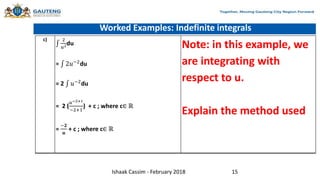
c) 2
𝑢2du
= 2𝑢−2du
= 2 𝑢−2du
= 2 (
𝑢−2+1
−2+1
) + c ; where c∈ ℝ
=
−𝟐
𝒖
+ c ; where c∈ ℝ
Note: in this example, we
are integrating with
respect to u.
Explain the method used
Ishaak Cassim - February 2018 15
Worked Examples: Indefinite integrals
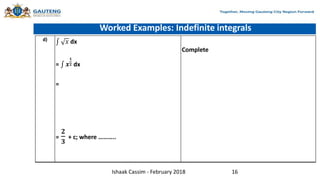
d) 𝑥 dx
= 𝒙
𝟏
𝟐 dx
=
=
𝟐
𝟑
+ c; where ………..
Complete
Ishaak Cassim - February 2018 16
Activity 3
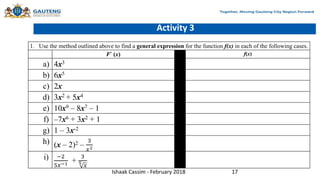
1. Use the method outlined above to find a general expression for the function f(x) in each of the following cases.
𝑭′
(x) f(x)
a) 4x3
b) 6x5
c) 2x
d) 3x2 + 5x4
e) 10x9 – 8x7 – 1
f) –7x6 + 3x2 + 1
g) 1 – 3x-2
h) (x – 2)2 –
3
𝑥2
i) −2
5𝑥−1 +
3
5
𝑥
Ishaak Cassim - February 2018 17
Activty 3 - continued
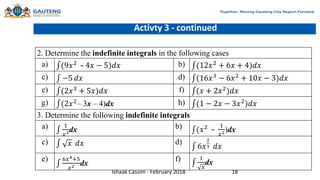
2. Determine the indefinite integrals in the following cases
a) (9𝑥2 – 4𝑥 − 5)𝑑𝑥 b) (12𝑥2 + 6𝑥 + 4)𝑑𝑥
c) −5 𝑑𝑥 d) (16𝑥3 − 6𝑥2 + 10𝑥 − 3)𝑑𝑥
e) (2𝑥3
+ 5𝑥)𝑑𝑥 f) (𝑥 + 2𝑥2
)𝑑𝑥
g) (2𝑥2– 3x – 4)dx h) (1 − 2𝑥 − 3𝑥2)𝑑𝑥
3. Determine the following indefinite integrals
a) 1
𝑥3dx b) (𝑥2 –
1
𝑥2)dx
c) 𝑥 𝑑𝑥 d)
6𝑥
2
3 𝑑𝑥
e) 6𝑥4+5
𝑥2 dx
f) 1
𝑥
dx
Ishaak Cassim - February 2018 18
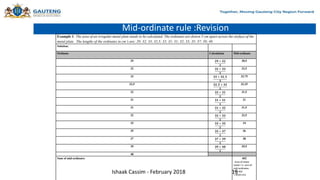
Mid-ordinate rule :Revision
Example 1: The area of an irregular metal plate needs to be calculated. The ordinates are drawn 5 cm apart across the surface of the
metal plate. The lengths of the ordinates in cm’s are: 29; 32; 33; 32,5; 32; 31; 31; 32; 33; 35; 37; 39; 40.
Solution:
Ordinate Calculation Mid-ordinate
29 𝟐𝟗 + 𝟑𝟐
𝟐
30,5
32 𝟑𝟐 + 𝟑𝟑
𝟐
32,5
33 𝟑𝟑 + 𝟑𝟐, 𝟓
𝟐
32,75
32,5 𝟑𝟐, 𝟓 + 𝟑𝟐
𝟐
32,25
32 𝟑𝟐 + 𝟑𝟏
𝟐
31,5
31 𝟑𝟏 + 𝟑𝟏
𝟐
31
31 𝟑𝟏 + 𝟑𝟐
𝟐
31,5
32 𝟑𝟐 + 𝟑𝟑
𝟐
32,5
33 𝟑𝟑 + 𝟑𝟓
𝟐
34
35 𝟑𝟓 + 𝟑𝟕
𝟐
36
37 𝟑𝟕 + 𝟑𝟗
𝟐
38
39 𝟑𝟗 + 𝟒𝟎
𝟐
39,5
40
Sum of mid-ordinates 402
Area of sheet
metal = k sum of
mid-ordinates
= 5 402
= 2010 cm2
Ishaak Cassim - February 2018 19
Area of irregular shapes- Revision
• We can verify, the accuracy of our work in example 1 above,
by using the following formula:
• Area = k × [(average of first & last ordinate)+ (sum of rest
of ordinates)]
= 5 × [(
29+40
2
) +( 32+33+32,5+32+31+31+32+33+35+37+39)]
= 5[ 34,5+ 367,5]
= 2010 cm2
Ishaak Cassim - February 2018 20
Revision: Area of irregular shapes
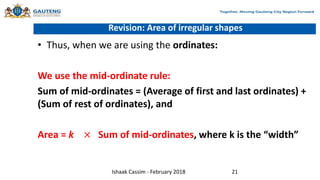
• Thus, when we are using the ordinates:
We use the mid-ordinate rule:
Sum of mid-ordinates = (Average of first and last ordinates) +
(Sum of rest of ordinates), and
Area = k × Sum of mid-ordinates, where k is the “width”
Ishaak Cassim - February 2018 21
Example 2: Area of irregular shape
Example 2: Determine the area of an irregular metal plate. Ordinates are drawn
1,5 cm apart. The lengths of the ordinates in cm are: 0;30;42;49;56;46;38;30;18;0
Solution:
Sum of mid-ordinates = (average of first and last ordinates) + (sum of other
ordinates)
= [(
0+0
2
) + (30 + 42+49+56+46+38+30+18)]
= [ 0 + 309]
= 309
Area = k × Sum of mid-ordinates
= 1,5 (309)
= 463,5 cm2
Ishaak Cassim - February 2018 22
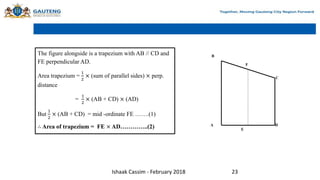
The figure alongside is a trapezium with AB // CD and
FE perpendicular AD.
Area trapezium =
1
2
× (sum of parallel sides) × perp.
distance
=
1
2
× (AB + CD) × (AD)
But
1
2
× (AB + CD) = mid -ordinate FE …….(1)
∴ Area of trapezium = FE × AD…………..(2) E
A
B
C
D
F
Ishaak Cassim - February 2018 23
Introduction to definite integral
O
x
A
C
B
D
I
E
H
G
F
J
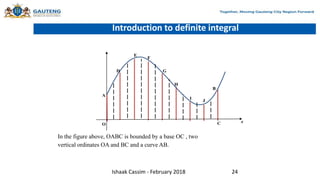
In the figure above, OABC is bounded by a base OC , two
vertical ordinates OA and BC and a curve AB.
Ishaak Cassim - February 2018 24
Introduction to definite intrgral
• To determine the area below the curve, divide the base OC into any
number of equal parts, each with length k units.
• Each of the strips, OADT, TDES, SEFR, RFGP, PGHN, NHIM, MIJL
and LJBC resemble trapezia (the plural of trapezium).
• Halfway, between each of the ordinates we draw mid-ordinates, i.e the
average of any two consecutive ordinates, as denoted by the dotted lines.
• We can thus calculate the area of each trapezium using the formula
developed above,
• Area of each strip = k × length of mid-ordinate, where k is the length of
the base of each trapezium
Ishaak Cassim - February 2018 25
Example 1
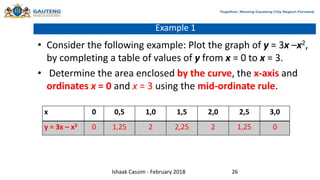
• Consider the following example: Plot the graph of y = 3x –x2,
by completing a table of values of y from x = 0 to x = 3.
• Determine the area enclosed by the curve, the x-axis and
ordinates x = 0 and x = 3 using the mid-ordinate rule.
x 0 0,5 1,0 1,5 2,0 2,5 3,0
y = 3x – x2 0 1,25 2 2,25 2 1,25 0
Ishaak Cassim - February 2018 26
Example 1
• Using the mid-ordinate rule with six intervals, where the mid-
ordinates are located at:
Area ≈ (0,5)[0,6875 + 1,6875 + 2,1875 + 2,1875 + 1,6875 +
0,6875]
= (0,5)(9,125)
= 4,563 square units
Mid -ordinate 0,25 0,75 1,25 1,75 2,25 2,75
Correspondin
g y-values
0,6875 1,6875 2,1875 2,1875 1,6875 0,6875
Ishaak Cassim - February 2018 27
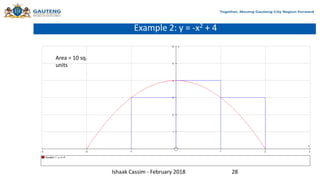
Example 2: y = -x2 + 4
Area = 10 sq.
units
Ishaak Cassim - February 2018 28
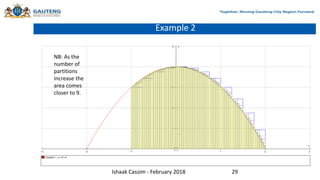
Example 2
NB: As the
number of
partitions
increase the
area comes
closer to 9.
Ishaak Cassim - February 2018 29
Activity 4
1. Using rectangles, calculate the areas described in each of the following cases. Use a partition with a sensible number
of rectangles. Make sure each rectangle has the same width. Make a rough sketch for each case.
a) f(x) = 2x + 7 between the x-axis, and x = – 2 and x = 3.
b) k(x) = x2 bounded by the x –axis and x = – 4 and x = – 1.
c) j(x) =
𝟏
𝒙
, with x > 0, bounded by the x-axis and x = 1 and x = 4.
d) m(x) = x2 + 2, between the x-axis and x = – 5 and x = 3. Is this area an under- or overestimate of the true area?
e) p(x) = 25– 𝑥2 between the x-axis and the two x-intercepts. Can you work out the exact area under this curve? How
accurate was your partitioning method?
f) h(x) = 2 sinx, between the x-axis and x =
𝝅
𝟒
and x = 𝜋.
2. Create an Excel spreadsheet to approximate the area bounded by the curve
t(x) = –x2 + 4 on the interval [–1 ; 2] for 3 different rectangle widths.
3. Determine the area under the function g(x) =
–12
𝑥
, for x ∈ [– 1 ; 6], by dividing the given interval into five trapeziums.
Let the height of each trapezium be 1 unit. Use the following formula to assist you to calculate the area of each
trapezium:
Area =
𝟏
𝟐
× (sum of parallel sides) × height
3.1 How does this method compare with method of dividing the given interval into rectangles?
Ishaak Cassim - February 2018 30
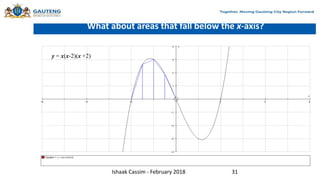
What about areas that fall below the x-axis?
y = x(x-2)(x +2)
Ishaak Cassim - February 2018 31
Area below the x-axis
• Whether you use the rectangle or trapezium method to calculate the area bounded by the curve,
the x-axis, between x = –2 and x = 2, you would use all the y-values as positive lengths in your
calculations. Alternatively, the total area is double the area under the curve from x = – 2 to x = 0.
• Using the trapezium rule, with partitions of
1
2
unit wide, the area of the left-hand half under the
curve, between x = –2 and x = 0 is:
Area = sum of areas of the trapeziums
= {[
1
2
× [ f(–2) +f(-1,5)] ×
1
2
} + {[
1
2
× [ f(–1,5) +f(-1)] ×
1
2
} +…+{[
1
2
× [ f(–1) +f(0)] ×
1
2
}
=
1
4
[0 +2,625 + 2,625+ 3 + 3+ 1,875 + 1,875 + 0]
=
15
4
square units OR (3,75 square units)
• So, total area = 2 (
𝟏𝟓
𝟒
) =
𝟏𝟓
𝟐
square units OR (7,5 square units)
Ishaak Cassim - February 2018 32
The definite integral
• In the previous section we developed a method (a long method!) of finding the
area between the curve and the x-axis.
• The general notation for the area under the curve is 𝒂
𝒃
𝒇 𝒙 𝒅𝒙. This is known
as the definite integral of f(x).
• We define the definite integral of a function f(x) as :
𝒂
𝒃
𝒇 𝒙 𝒅𝒙 = F(b) – F(a); where 𝑭′
(x) = f(x).
• We call this a definite integral because the result of integrating and evaluating
is a number. (The indefinite integral has an arbitrary constant in the result).
• The numbers a and b are called the lower limit and upper limit, respectively.
• We can see that the value of a definite integral is found by evaluating the
function (found by integration) at the upper limit and subtracting the value of
this function at the lower limit.
Ishaak Cassim - February 2018 33
The definite integral
• The definite integral, 𝒂
𝒃
𝒇 𝒙 𝒅𝒙 can be interpreted as the
area under the curve of y = f(x) from x = a to x = b, and in
general as a summation.
• NB: If we asked to evaluate the definite integral, without
mention of calculating area, one would proceed as follows:
• Evaluate: −𝟐
𝟐
𝒙𝟑
𝒅𝒙 =
𝟏
𝟒
[𝟐𝟒
– (– 𝟐)𝟒
] = 0
Ishaak Cassim - February 2018 34
The fundamental Theorem of Calculus
• If f(x) is continuous on the interval 𝒂 ≤ 𝒙 ≤ 𝒃 and if F(x) is any
indefinite integral of f(x), then:
𝑎
𝑏
𝑓 𝑥 𝑑𝑥 = [𝐹 𝑥 ]𝑎
𝑏
= F(b) – F(a)
• This theorem is showing us how to evaluate an integral once the
integration process has taken place.
• NB: When evaluating the definite integral there is no need to
consider the arbitrary constant.
Ishaak Cassim - February 2018 35
Worked examples – the definite integral
Evaluate the following definite integrals
1
𝟐
𝟓
𝟖𝐱𝐝𝐱 Let I = 2
5
8𝑥𝑑𝑥
=
8
2
[𝑥2 ]2
5
using definition
= 4[52 – 22] using fundamental
theorem of calculus
= 4[ 25 - 4]
= 4[21]
∴ I = 84
Ishaak Cassim - February 2018 36
Worked examples – the definite integral
Evaluate the following definite integrals
2.
𝟎
𝟐
𝟔𝐱 + 𝟕 𝐝𝐱 Let I = 𝟎
𝟐
𝟔𝐱 + 𝟕 𝒅𝒙
= [𝟑𝒙𝟐
+ 𝟕𝐱]𝟎
𝟐
= [3 (2)2 + 7(2)] – [3(0)2 + 7(0)]
= 12 + 14 – 0
∴ I = 26
Ishaak Cassim - February 2018 37
Worked examples- The definite integral
3.
𝟎
𝟏
𝟐𝒅𝒙 Let I = 0
1
2𝑑𝑥
= [2𝑥]0
1
= [2(1) – 2(0)]
∴ I = 2
Ishaak Cassim - February 2018 38
Worked examples- The definite integral
4.
𝟐
𝟒 𝟏𝟐
𝒙
dx Let I = 2
4 12
𝑥
dx
= 12 2
4 1
𝑥
dx
= 12 𝒍𝒏 𝑥 ]2
4
= 12(ln 4 – ln 2)
∴ I = 12ln 2
Ishaak Cassim - February 2018 39
Activity 5
1. Evaluate the following definite integrals, using the method outlined above.
a)
−1
1
𝑥 − 1 (𝑥 + b)
0
1
2𝑥 − 3 𝑑𝑥
c)
0
1
3𝑥 + 2 𝑑𝑥 d)
–1
0
5𝑥4
dx
e)
1
2 𝑑𝑥
𝑥2
f)
1
2 𝑥4+1
𝑥2 dx
g)
2
3
10𝑛𝑥
dx h)
−2
3
(𝑥2
+ 5)𝑑𝑥
Ishaak Cassim - February 2018 40
Some properties of integrals
1.
𝑎
𝑏
𝑓 𝑥 𝑑𝑥 = – 𝑏
𝑎
𝑓 𝑥 𝑑𝑥
2.
𝑎
𝑏
𝑓 𝑥 𝑑𝑥 + 𝑏
𝑐
𝑓 𝑥 𝑑𝑥 = 𝑎
𝑐
𝑓 𝑥 𝑑𝑥
3 Constants may be factored through the integral sign:
𝒂
𝒃
𝒌. 𝒇 𝒙 𝒅𝒙 = k. 𝒂
𝒃
𝒇 𝒙 𝒅𝒙
4. The integral of a sum (and /or difference) is the sum (and /or difference) of the integrals:
𝒂
𝒃
[𝒇 𝒙 ± 𝒈 𝒙 ]𝒅𝒙 = 𝒂
𝒃
𝒇 𝒙 𝒅𝒙 ± 𝒂
𝒃
𝒈 𝒙 𝒅𝒙
5. The integral of a linear combination is the linear combination of the integrals:
𝒂
𝒃
[𝒌. 𝒇 𝒙 + 𝒎. 𝒈 𝒙 ]𝒅𝒙 = k. 𝒂
𝒃
𝒇 𝒙 𝒅𝒙 + m. 𝒂
𝒃
𝒈 𝒙 𝒅𝒙
Here are some simple properties of the integral that are often used in computations. Throughout take f
and g as continuous functions.
Ishaak Cassim - February 2018 41
Activity 6
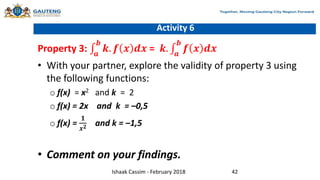
Property 3: 𝒂
𝒃
𝒌. 𝒇 𝒙 𝒅𝒙 = 𝒌. 𝒂
𝒃
𝒇 𝒙 𝒅𝒙
• With your partner, explore the validity of property 3 using
the following functions:
o f(x) = x2 and k = 2
o f(x) = 2x and k = –0,5
o f(x) =
𝟏
𝒙𝟐 and k = –1,5
• Comment on your findings.
Ishaak Cassim - February 2018 42
Activity 7
Investigate the validity of the following property:
• 𝒂
𝒃
𝒇 𝒙 + 𝒈 𝒙 𝒅𝒙 = 𝒂
𝒃
𝒇(𝒙)𝒅𝒙 + 𝒂
𝒃
𝒈(𝒙)𝒅𝒙,
if f(x) = –3x and g(x) = x2 + 6 for the interval [–4 ;–1].
o You will need to draw graphs of the two functions on the same set
of axis.
o You will need to show all working details.
• Comment on your findings.
Ishaak Cassim - February 2018 43
Activity 8
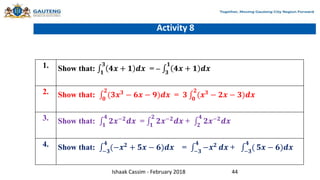
1. Show that: 𝟏
𝟑
𝟒𝒙 + 𝟏 𝒅𝒙 = – 𝟑
𝟏
𝟒𝒙 + 𝟏 𝒅𝒙
2. Show that: 𝟎
𝟐
(𝟑𝒙𝟑
− 𝟔𝒙 − 𝟗)𝒅𝒙 = 𝟑 𝟎
𝟐
(𝒙𝟑
− 𝟐𝒙 − 𝟑)𝒅𝒙
3. Show that: 𝟏
𝟒
𝟐𝒙−𝟐𝒅𝒙 = 𝟏
𝟐
𝟐𝒙−𝟐𝒅𝒙 + 𝟐
𝟒
𝟐𝒙−𝟐𝒅𝒙
4. Show that: −𝟑
𝟒
(−𝒙𝟐 + 𝟓𝒙 − 𝟔)𝒅𝒙 = −𝟑
𝟒
−𝒙𝟐 𝒅𝒙 + −𝟑
𝟒
( 𝟓𝒙 − 𝟔)𝒅𝒙
Ishaak Cassim - February 2018 44
Area under a curve
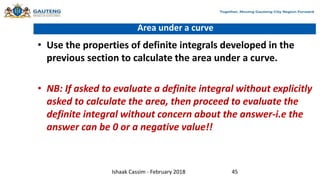
• Use the properties of definite integrals developed in the
previous section to calculate the area under a curve.
• NB: If asked to evaluate a definite integral without explicitly
asked to calculate the area, then proceed to evaluate the
definite integral without concern about the answer-i.e the
answer can be 0 or a negative value!!
Ishaak Cassim - February 2018 45
Area under a curve- Worked example
• Find the area under the curve y = x2 , between x = 1 and x =
3.
Let the required
area be A , then:
A = 1
3
𝑥2𝑑𝑥
= [
𝑥3
3
]1
3
=
33
3
–
13
3
A =
𝟐𝟔
𝟑
square
units
Ishaak Cassim - February 2018 46
Area under a curve
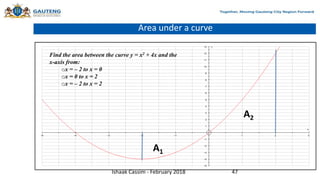
Find the area between the curve y = x2 + 4x and the
x-axis from:
ox = – 2 to x = 0
ox = 0 to x = 2
ox = – 2 to x = 2
Ishaak Cassim - February 2018 47
A1
A2
Worked example 2
For the interval [– 2 ; 2], we observe that the required area comprises of two parts – one part below the x-axis and the other part
above the x-axis.
Let A1 = −𝟐
𝟎
𝒙𝟐
+ 𝟒𝒙 𝒅𝒙
= [
𝑥3
3
+ 2𝑥2
]−2
0
= 0 –[
−23
3
+ 2(−2)2
]
= 0 – [
16
3
]
= –
16
3
…..the minus sign tells us the area is below the x-axis
Thus, A1 =
𝟏𝟔
𝟑
• Calculate A2 , as follows:
A2 = 0
2
𝑥2
+ 4𝑥 𝑑𝑥 =
32
3
(The reader should verify the accuracy)
• So, the area over the interval [–2 ; 2] is obtained by adding A1 and A2, i.e:
A = A1 + A2
=
𝟏𝟔
𝟑
+
𝟑𝟐
𝟑
= 16 square units.
Ishaak Cassim - February 2018 48
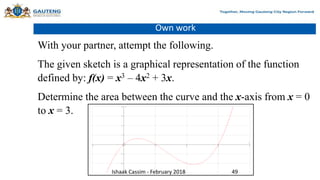
Own work
With your partner, attempt the following.
The given sketch is a graphical representation of the function
defined by: f(x) = x3 – 4x2 + 3x.
Determine the area between the curve and the x-axis from x = 0
to x = 3.
Ishaak Cassim - February 2018 49
Challenge
• Find the area enclosed between the curve
y = x2 – 2x –3 and the straight-line y = x + 1.
Ishaak Cassim - February 2018 50
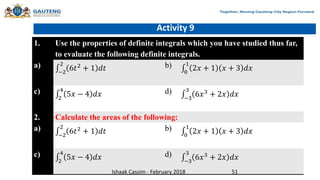
Activity 9
1. Use the properties of definite integrals which you have studied thus far,
to evaluate the following definite integrals.
a)
−2
2
6𝑡2
+ 1 𝑑𝑡 b)
0
1
2𝑥 + 1 𝑥 + 3 𝑑𝑥
c)
2
4
5𝑥 − 4 𝑑𝑥 d)
−3
3
6𝑥3 + 2𝑥 𝑑𝑥
2. Calculate the areas of the following:
a)
−2
2
6𝑡2
+ 1 𝑑𝑡 b)
0
1
2𝑥 + 1 𝑥 + 3 𝑑𝑥
c)
2
4
5𝑥 − 4 𝑑𝑥 d)
−3
3
6𝑥3
+ 2𝑥 𝑑𝑥
Ishaak Cassim - February 2018 51
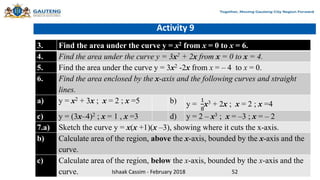
Activity 9
3. Find the area under the curve y = x2 from x = 0 to x = 6.
4. Find the area under the curve y = 3x2 + 2x from x = 0 to x = 4.
5. Find the area under the curve y = 3x2 -2x from x = – 4 to x = 0.
6. Find the area enclosed by the x-axis and the following curves and straight
lines.
a) y = x2 + 3x ; x = 2 ; x =5 b) y =
1
8
x3 + 2x ; x = 2 ; x =4
c) y = (3x–4)2 ; x = 1 , x =3 d) y = 2 – x3 ; x = –3 ; x = – 2
7.a) Sketch the curve y = x(x +1)(x –3), showing where it cuts the x-axis.
b) Calculate area of the region, above the x-axis, bounded by the x-axis and the
curve.
c) Calculate area of the region, below the x-axis, bounded by the x-axis and the
curve. Ishaak Cassim - February 2018 52
Activity 9
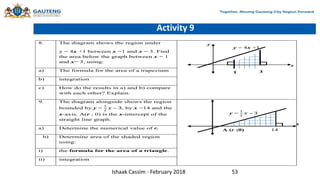
8. The diagram shows the region under
y = 4x +1 between x =1 and x = 3. Find
the area below the graph between x = 1
and x= 3, using:
a) The formula for the area of a trapezium
b) integration
c) How do the results in a) and b) compare
with each other? Explain.
9. The diagram alongside shows the region
bounded by y =
1
2
𝑥 – 3, by x =14 and the
x-axis. A(r ; 0) is the x-intercept of the
straight line graph.
a) Determine the numerical value of r.
b) Determine area of the shaded region
using:
i) the formula for the area of a triangle.
ii) integration
1 3
y = 4x +1
A (r ;0) 14
y =
1
2
𝑥 – 3
x
Ishaak Cassim - February 2018 53
Activity 9
10. Calculate the areas of the following:
a) y = 1 + x2 for
0 < x < 2
b) y = 5x – x2 ; for x ∈ [0 ; 5]
11. Evaluate 0
2
𝑥 𝑥– 1 𝑥– 2 𝑑𝑥 and explain your answer
with reference to the graph of
y = x(x–1)(x–2).
12. Given that: −𝑎
𝑎
15𝑥2
dx = 3430. Determine the
numerical value of a
13. Given that: 1
𝑝
(8𝑥3
+ 6𝑥)𝑑𝑥 = 39. Determine two
possible values of p. Use a graph to explain why there
are two values.
14. Show that the area enclosed between the curves
y = 9 –x2 and y = x2 – 7 is
128 2
3
Ishaak Cassim - February 2018 54
Conclusion
Ishaak Cassim - February 2018 55

technical-mathematics-integration-17-feb_2018.pptx

  • 1.
    INTEGRAL CALCULUS (Integration) TechnicalMathematics Grade 12-Just In Time Training 17 February 2018 , Ishaak Cassim DCES: Technical Mathematics Ishaak Cassim - February 2018 1
  • 2.
    Outcomes for thissection • By the end of this section, you should be able to: • Understand the concept of integration as a summation function (definite integral) and as converse of differentiation (indefinite integral). • Apply standard forms of integrals as a converse of differentiation. • Integrate the following functions: o kxn, with n ∈ ℝ; with 𝑛 ≠ – 1 o 𝒌 𝒙 and kanx with a > 0 ; k , a ∈ ℝ • Integrate polynomials consisting of terms of the above forms. • Apply integration to determine the magnitude of an area included by a curve and the x-axis or by a curve, the x-axis and the ordinates x = a and x = b where a , b ∈ ℤ. Ishaak Cassim - February 2018 2
  • 3.
    Introduction The process ofintegration reverses the process of differentiation. In differentiation, if f(x) = 2x2 , then 𝑓′ (x) = 4x. Thus the integral of 4x is 2x2 . We can represent this process pictorially as follows: The situation gets a bit more complicated, because there are an infinite number of functions we can differentiate to give 4x. Here are some of those functions: f(x) = 2x2 + 7 ; g(x) = 2x2 – 8 ; h(x) = 2x2 + 1 2 . Ishaak Cassim - February 2018 3
  • 4.
    Activity 1 • Activity1 • Write down at least five other functions whose derivative is 4x. Ishaak Cassim - February 2018 4
  • 5.
    Introduction • You wouldhave noticed that all the functions have the same derivative of 4x, because when we differentiate the constant term we obtain zero. • Hence, when we reverse the process, we have no idea what the original constant term might have been. • So we include in our response an unknown constant, c, called the arbitrary constant of integration. • The integral of 4x then is 2x2 + c. Ishaak Cassim - February 2018 5
  • 6.
    Introduction • In differentiation,the differential coefficient 𝑑𝑦 𝑑𝑥 indicates that a function of x is being differentiated with respect to x, the dx indicating that it is “with respect to x”. • In integration, the variable of integration is shown by adding d(the variable) after the function to be integrated. When we want to integrate a function, we use a special notation: 𝒇 𝒙 𝒅𝒙. • Thus, to integrate 4x, we will write it as follows: Ishaak Cassim - February 2018 6
  • 7.
    Introduction 4𝑥 𝒅𝒙 =2x2 + c , c ∈ ℝ. Integral sign This term is called the integrand There must always be a term of the form dx Constant of integration Ishaak Cassim - February 2018 7
  • 8.
    • Note thatalong with the integral sign ( 𝑑𝑥), there is a term of the form dx, which must always be written, and which indicates the variable involved, in our example x. • We say that 4x is integrated with respect x, i.e: 𝟒𝒙 𝒅𝒙 • The function being integrated is called the integrand. • Technically, integrals of this type are called indefinite integrals, to distinguish them from definite integrals, which we will deal with later. • When you are required to evaluate an indefinite integral, your answer must always include a constant of integration.; i.e: 𝟒𝒙 𝒅𝒙 = 2𝑥2 + c; where c ∈ ℝ Ishaak Cassim - February 2018 8
  • 9.
    Definition of anti-derivative •Formally, we define the anti-derivative as: If f(x) is a continuous function and F(x) is the function whose derivative is f(x), i.e.: 𝑭′ (x) = f(x) , then: 𝒇 𝒙 𝒅𝒙 = F(x) + c; where c is any arbitrary constant. Ishaak Cassim - February 2018 9
  • 10.
    Activity 2 1. Ineach of the following determine the function f(x), if the derivative 𝑭′ (x) is given: No. 𝑭′ (x) f(x) 1. 4x 2. x4 3. 2x2 4. 0 5. 𝒙 𝟑 𝟐 6. -2x3 7. 𝟏 𝟓 𝒙𝟏𝟎 2. Explain how the derivative 𝑭′ (x) and the function f(x)are related to each other Ishaak Cassim - February 2018 10
  • 11.
  • 12.
    The general solutionof integrals of the form kxn • From Activity 2 above, the general solution of integrals of the form 𝒌𝒙𝒏 dx , where k and n are constants is given by: 𝒌𝒙𝒏 dx = 𝒌𝒙𝒏+𝟏 𝒏+𝟏 + c ; where 𝒏 ≠ −𝟏 and c ∈ ℝ Ishaak Cassim - February 2018 12
  • 13.
    Table of readyto use integrals Function, f (x) Indefinite integral 𝒇(𝒙)𝒅𝒙 f (x)= k , where k is a constant 𝒌𝒅𝒙 = kx + c ; where c ∈ ℝ f (x)= x 𝒙𝒅𝒙 = 𝟏 𝟐 𝒙𝟐 + c; where c ∈ ℝ f (x) = x2 𝒙𝟐 𝒅𝒙 = 𝟏 𝟑 𝒙𝟑 + c; where c ∈ ℝ f(x) = axn 𝒂𝒙𝒏𝒅𝒙 = 𝒂𝒙𝒏+𝟏 𝒏+𝟏 + c; where c ∈ ℝ f (x) = 𝒙−𝟏 = 𝟏 𝒙 𝟏 𝒙 dx = ln 𝒙 + c; where c ∈ ℝ f (x) = kanx 𝒌𝒂𝒏𝒙 dx = 𝒌𝒂𝒏𝒙 𝒏.𝒍𝒏𝒂 + c ; where c ∈ ℝ ; a > 0 and a ≠ 1 Ishaak Cassim - February 2018 13
  • 14.
    Worked Examples: Indefiniteintegrals a) 𝑥7 dx = 𝒙𝟕+𝟏 𝟕+𝟏 + c ; where c∈ ℝ = 𝒙𝟖 𝟖 + c ; where c∈ ℝ Compare 𝑥7 dx with 𝒂𝒙𝒏 𝒅𝒙 = 𝒂𝒙𝒏+𝟏 𝒏+𝟏 + c, Then: a = 1; n = 7 ; n + 1 = 8 Ishaak Cassim - February 2018 14
  • 15.
    Worked Examples: Indefiniteintegrals c) 2 𝑢2du = 2𝑢−2du = 2 𝑢−2du = 2 ( 𝑢−2+1 −2+1 ) + c ; where c∈ ℝ = −𝟐 𝒖 + c ; where c∈ ℝ Note: in this example, we are integrating with respect to u. Explain the method used Ishaak Cassim - February 2018 15
  • 16.
    Worked Examples: Indefiniteintegrals d) 𝑥 dx = 𝒙 𝟏 𝟐 dx = = 𝟐 𝟑 + c; where ……….. Complete Ishaak Cassim - February 2018 16
  • 17.
    Activity 3 1. Usethe method outlined above to find a general expression for the function f(x) in each of the following cases. 𝑭′ (x) f(x) a) 4x3 b) 6x5 c) 2x d) 3x2 + 5x4 e) 10x9 – 8x7 – 1 f) –7x6 + 3x2 + 1 g) 1 – 3x-2 h) (x – 2)2 – 3 𝑥2 i) −2 5𝑥−1 + 3 5 𝑥 Ishaak Cassim - February 2018 17
  • 18.
    Activty 3 -continued 2. Determine the indefinite integrals in the following cases a) (9𝑥2 – 4𝑥 − 5)𝑑𝑥 b) (12𝑥2 + 6𝑥 + 4)𝑑𝑥 c) −5 𝑑𝑥 d) (16𝑥3 − 6𝑥2 + 10𝑥 − 3)𝑑𝑥 e) (2𝑥3 + 5𝑥)𝑑𝑥 f) (𝑥 + 2𝑥2 )𝑑𝑥 g) (2𝑥2– 3x – 4)dx h) (1 − 2𝑥 − 3𝑥2)𝑑𝑥 3. Determine the following indefinite integrals a) 1 𝑥3dx b) (𝑥2 – 1 𝑥2)dx c) 𝑥 𝑑𝑥 d) 6𝑥 2 3 𝑑𝑥 e) 6𝑥4+5 𝑥2 dx f) 1 𝑥 dx Ishaak Cassim - February 2018 18
  • 19.
    Mid-ordinate rule :Revision Example1: The area of an irregular metal plate needs to be calculated. The ordinates are drawn 5 cm apart across the surface of the metal plate. The lengths of the ordinates in cm’s are: 29; 32; 33; 32,5; 32; 31; 31; 32; 33; 35; 37; 39; 40. Solution: Ordinate Calculation Mid-ordinate 29 𝟐𝟗 + 𝟑𝟐 𝟐 30,5 32 𝟑𝟐 + 𝟑𝟑 𝟐 32,5 33 𝟑𝟑 + 𝟑𝟐, 𝟓 𝟐 32,75 32,5 𝟑𝟐, 𝟓 + 𝟑𝟐 𝟐 32,25 32 𝟑𝟐 + 𝟑𝟏 𝟐 31,5 31 𝟑𝟏 + 𝟑𝟏 𝟐 31 31 𝟑𝟏 + 𝟑𝟐 𝟐 31,5 32 𝟑𝟐 + 𝟑𝟑 𝟐 32,5 33 𝟑𝟑 + 𝟑𝟓 𝟐 34 35 𝟑𝟓 + 𝟑𝟕 𝟐 36 37 𝟑𝟕 + 𝟑𝟗 𝟐 38 39 𝟑𝟗 + 𝟒𝟎 𝟐 39,5 40 Sum of mid-ordinates 402 Area of sheet metal = k sum of mid-ordinates = 5 402 = 2010 cm2 Ishaak Cassim - February 2018 19
  • 20.
    Area of irregularshapes- Revision • We can verify, the accuracy of our work in example 1 above, by using the following formula: • Area = k × [(average of first & last ordinate)+ (sum of rest of ordinates)] = 5 × [( 29+40 2 ) +( 32+33+32,5+32+31+31+32+33+35+37+39)] = 5[ 34,5+ 367,5] = 2010 cm2 Ishaak Cassim - February 2018 20
  • 21.
    Revision: Area ofirregular shapes • Thus, when we are using the ordinates: We use the mid-ordinate rule: Sum of mid-ordinates = (Average of first and last ordinates) + (Sum of rest of ordinates), and Area = k × Sum of mid-ordinates, where k is the “width” Ishaak Cassim - February 2018 21
  • 22.
    Example 2: Areaof irregular shape Example 2: Determine the area of an irregular metal plate. Ordinates are drawn 1,5 cm apart. The lengths of the ordinates in cm are: 0;30;42;49;56;46;38;30;18;0 Solution: Sum of mid-ordinates = (average of first and last ordinates) + (sum of other ordinates) = [( 0+0 2 ) + (30 + 42+49+56+46+38+30+18)] = [ 0 + 309] = 309 Area = k × Sum of mid-ordinates = 1,5 (309) = 463,5 cm2 Ishaak Cassim - February 2018 22
  • 23.
    The figure alongsideis a trapezium with AB // CD and FE perpendicular AD. Area trapezium = 1 2 × (sum of parallel sides) × perp. distance = 1 2 × (AB + CD) × (AD) But 1 2 × (AB + CD) = mid -ordinate FE …….(1) ∴ Area of trapezium = FE × AD…………..(2) E A B C D F Ishaak Cassim - February 2018 23
  • 24.
    Introduction to definiteintegral O x A C B D I E H G F J In the figure above, OABC is bounded by a base OC , two vertical ordinates OA and BC and a curve AB. Ishaak Cassim - February 2018 24
  • 25.
    Introduction to definiteintrgral • To determine the area below the curve, divide the base OC into any number of equal parts, each with length k units. • Each of the strips, OADT, TDES, SEFR, RFGP, PGHN, NHIM, MIJL and LJBC resemble trapezia (the plural of trapezium). • Halfway, between each of the ordinates we draw mid-ordinates, i.e the average of any two consecutive ordinates, as denoted by the dotted lines. • We can thus calculate the area of each trapezium using the formula developed above, • Area of each strip = k × length of mid-ordinate, where k is the length of the base of each trapezium Ishaak Cassim - February 2018 25
  • 26.
    Example 1 • Considerthe following example: Plot the graph of y = 3x –x2, by completing a table of values of y from x = 0 to x = 3. • Determine the area enclosed by the curve, the x-axis and ordinates x = 0 and x = 3 using the mid-ordinate rule. x 0 0,5 1,0 1,5 2,0 2,5 3,0 y = 3x – x2 0 1,25 2 2,25 2 1,25 0 Ishaak Cassim - February 2018 26
  • 27.
    Example 1 • Usingthe mid-ordinate rule with six intervals, where the mid- ordinates are located at: Area ≈ (0,5)[0,6875 + 1,6875 + 2,1875 + 2,1875 + 1,6875 + 0,6875] = (0,5)(9,125) = 4,563 square units Mid -ordinate 0,25 0,75 1,25 1,75 2,25 2,75 Correspondin g y-values 0,6875 1,6875 2,1875 2,1875 1,6875 0,6875 Ishaak Cassim - February 2018 27
  • 28.
    Example 2: y= -x2 + 4 Area = 10 sq. units Ishaak Cassim - February 2018 28
  • 29.
    Example 2 NB: Asthe number of partitions increase the area comes closer to 9. Ishaak Cassim - February 2018 29
  • 30.
    Activity 4 1. Usingrectangles, calculate the areas described in each of the following cases. Use a partition with a sensible number of rectangles. Make sure each rectangle has the same width. Make a rough sketch for each case. a) f(x) = 2x + 7 between the x-axis, and x = – 2 and x = 3. b) k(x) = x2 bounded by the x –axis and x = – 4 and x = – 1. c) j(x) = 𝟏 𝒙 , with x > 0, bounded by the x-axis and x = 1 and x = 4. d) m(x) = x2 + 2, between the x-axis and x = – 5 and x = 3. Is this area an under- or overestimate of the true area? e) p(x) = 25– 𝑥2 between the x-axis and the two x-intercepts. Can you work out the exact area under this curve? How accurate was your partitioning method? f) h(x) = 2 sinx, between the x-axis and x = 𝝅 𝟒 and x = 𝜋. 2. Create an Excel spreadsheet to approximate the area bounded by the curve t(x) = –x2 + 4 on the interval [–1 ; 2] for 3 different rectangle widths. 3. Determine the area under the function g(x) = –12 𝑥 , for x ∈ [– 1 ; 6], by dividing the given interval into five trapeziums. Let the height of each trapezium be 1 unit. Use the following formula to assist you to calculate the area of each trapezium: Area = 𝟏 𝟐 × (sum of parallel sides) × height 3.1 How does this method compare with method of dividing the given interval into rectangles? Ishaak Cassim - February 2018 30
  • 31.
    What about areasthat fall below the x-axis? y = x(x-2)(x +2) Ishaak Cassim - February 2018 31
  • 32.
    Area below thex-axis • Whether you use the rectangle or trapezium method to calculate the area bounded by the curve, the x-axis, between x = –2 and x = 2, you would use all the y-values as positive lengths in your calculations. Alternatively, the total area is double the area under the curve from x = – 2 to x = 0. • Using the trapezium rule, with partitions of 1 2 unit wide, the area of the left-hand half under the curve, between x = –2 and x = 0 is: Area = sum of areas of the trapeziums = {[ 1 2 × [ f(–2) +f(-1,5)] × 1 2 } + {[ 1 2 × [ f(–1,5) +f(-1)] × 1 2 } +…+{[ 1 2 × [ f(–1) +f(0)] × 1 2 } = 1 4 [0 +2,625 + 2,625+ 3 + 3+ 1,875 + 1,875 + 0] = 15 4 square units OR (3,75 square units) • So, total area = 2 ( 𝟏𝟓 𝟒 ) = 𝟏𝟓 𝟐 square units OR (7,5 square units) Ishaak Cassim - February 2018 32
  • 33.
    The definite integral •In the previous section we developed a method (a long method!) of finding the area between the curve and the x-axis. • The general notation for the area under the curve is 𝒂 𝒃 𝒇 𝒙 𝒅𝒙. This is known as the definite integral of f(x). • We define the definite integral of a function f(x) as : 𝒂 𝒃 𝒇 𝒙 𝒅𝒙 = F(b) – F(a); where 𝑭′ (x) = f(x). • We call this a definite integral because the result of integrating and evaluating is a number. (The indefinite integral has an arbitrary constant in the result). • The numbers a and b are called the lower limit and upper limit, respectively. • We can see that the value of a definite integral is found by evaluating the function (found by integration) at the upper limit and subtracting the value of this function at the lower limit. Ishaak Cassim - February 2018 33
  • 34.
    The definite integral •The definite integral, 𝒂 𝒃 𝒇 𝒙 𝒅𝒙 can be interpreted as the area under the curve of y = f(x) from x = a to x = b, and in general as a summation. • NB: If we asked to evaluate the definite integral, without mention of calculating area, one would proceed as follows: • Evaluate: −𝟐 𝟐 𝒙𝟑 𝒅𝒙 = 𝟏 𝟒 [𝟐𝟒 – (– 𝟐)𝟒 ] = 0 Ishaak Cassim - February 2018 34
  • 35.
    The fundamental Theoremof Calculus • If f(x) is continuous on the interval 𝒂 ≤ 𝒙 ≤ 𝒃 and if F(x) is any indefinite integral of f(x), then: 𝑎 𝑏 𝑓 𝑥 𝑑𝑥 = [𝐹 𝑥 ]𝑎 𝑏 = F(b) – F(a) • This theorem is showing us how to evaluate an integral once the integration process has taken place. • NB: When evaluating the definite integral there is no need to consider the arbitrary constant. Ishaak Cassim - February 2018 35
  • 36.
    Worked examples –the definite integral Evaluate the following definite integrals 1 𝟐 𝟓 𝟖𝐱𝐝𝐱 Let I = 2 5 8𝑥𝑑𝑥 = 8 2 [𝑥2 ]2 5 using definition = 4[52 – 22] using fundamental theorem of calculus = 4[ 25 - 4] = 4[21] ∴ I = 84 Ishaak Cassim - February 2018 36
  • 37.
    Worked examples –the definite integral Evaluate the following definite integrals 2. 𝟎 𝟐 𝟔𝐱 + 𝟕 𝐝𝐱 Let I = 𝟎 𝟐 𝟔𝐱 + 𝟕 𝒅𝒙 = [𝟑𝒙𝟐 + 𝟕𝐱]𝟎 𝟐 = [3 (2)2 + 7(2)] – [3(0)2 + 7(0)] = 12 + 14 – 0 ∴ I = 26 Ishaak Cassim - February 2018 37
  • 38.
    Worked examples- Thedefinite integral 3. 𝟎 𝟏 𝟐𝒅𝒙 Let I = 0 1 2𝑑𝑥 = [2𝑥]0 1 = [2(1) – 2(0)] ∴ I = 2 Ishaak Cassim - February 2018 38
  • 39.
    Worked examples- Thedefinite integral 4. 𝟐 𝟒 𝟏𝟐 𝒙 dx Let I = 2 4 12 𝑥 dx = 12 2 4 1 𝑥 dx = 12 𝒍𝒏 𝑥 ]2 4 = 12(ln 4 – ln 2) ∴ I = 12ln 2 Ishaak Cassim - February 2018 39
  • 40.
    Activity 5 1. Evaluatethe following definite integrals, using the method outlined above. a) −1 1 𝑥 − 1 (𝑥 + b) 0 1 2𝑥 − 3 𝑑𝑥 c) 0 1 3𝑥 + 2 𝑑𝑥 d) –1 0 5𝑥4 dx e) 1 2 𝑑𝑥 𝑥2 f) 1 2 𝑥4+1 𝑥2 dx g) 2 3 10𝑛𝑥 dx h) −2 3 (𝑥2 + 5)𝑑𝑥 Ishaak Cassim - February 2018 40
  • 41.
    Some properties ofintegrals 1. 𝑎 𝑏 𝑓 𝑥 𝑑𝑥 = – 𝑏 𝑎 𝑓 𝑥 𝑑𝑥 2. 𝑎 𝑏 𝑓 𝑥 𝑑𝑥 + 𝑏 𝑐 𝑓 𝑥 𝑑𝑥 = 𝑎 𝑐 𝑓 𝑥 𝑑𝑥 3 Constants may be factored through the integral sign: 𝒂 𝒃 𝒌. 𝒇 𝒙 𝒅𝒙 = k. 𝒂 𝒃 𝒇 𝒙 𝒅𝒙 4. The integral of a sum (and /or difference) is the sum (and /or difference) of the integrals: 𝒂 𝒃 [𝒇 𝒙 ± 𝒈 𝒙 ]𝒅𝒙 = 𝒂 𝒃 𝒇 𝒙 𝒅𝒙 ± 𝒂 𝒃 𝒈 𝒙 𝒅𝒙 5. The integral of a linear combination is the linear combination of the integrals: 𝒂 𝒃 [𝒌. 𝒇 𝒙 + 𝒎. 𝒈 𝒙 ]𝒅𝒙 = k. 𝒂 𝒃 𝒇 𝒙 𝒅𝒙 + m. 𝒂 𝒃 𝒈 𝒙 𝒅𝒙 Here are some simple properties of the integral that are often used in computations. Throughout take f and g as continuous functions. Ishaak Cassim - February 2018 41
  • 42.
    Activity 6 Property 3:𝒂 𝒃 𝒌. 𝒇 𝒙 𝒅𝒙 = 𝒌. 𝒂 𝒃 𝒇 𝒙 𝒅𝒙 • With your partner, explore the validity of property 3 using the following functions: o f(x) = x2 and k = 2 o f(x) = 2x and k = –0,5 o f(x) = 𝟏 𝒙𝟐 and k = –1,5 • Comment on your findings. Ishaak Cassim - February 2018 42
  • 43.
    Activity 7 Investigate thevalidity of the following property: • 𝒂 𝒃 𝒇 𝒙 + 𝒈 𝒙 𝒅𝒙 = 𝒂 𝒃 𝒇(𝒙)𝒅𝒙 + 𝒂 𝒃 𝒈(𝒙)𝒅𝒙, if f(x) = –3x and g(x) = x2 + 6 for the interval [–4 ;–1]. o You will need to draw graphs of the two functions on the same set of axis. o You will need to show all working details. • Comment on your findings. Ishaak Cassim - February 2018 43
  • 44.
    Activity 8 1. Showthat: 𝟏 𝟑 𝟒𝒙 + 𝟏 𝒅𝒙 = – 𝟑 𝟏 𝟒𝒙 + 𝟏 𝒅𝒙 2. Show that: 𝟎 𝟐 (𝟑𝒙𝟑 − 𝟔𝒙 − 𝟗)𝒅𝒙 = 𝟑 𝟎 𝟐 (𝒙𝟑 − 𝟐𝒙 − 𝟑)𝒅𝒙 3. Show that: 𝟏 𝟒 𝟐𝒙−𝟐𝒅𝒙 = 𝟏 𝟐 𝟐𝒙−𝟐𝒅𝒙 + 𝟐 𝟒 𝟐𝒙−𝟐𝒅𝒙 4. Show that: −𝟑 𝟒 (−𝒙𝟐 + 𝟓𝒙 − 𝟔)𝒅𝒙 = −𝟑 𝟒 −𝒙𝟐 𝒅𝒙 + −𝟑 𝟒 ( 𝟓𝒙 − 𝟔)𝒅𝒙 Ishaak Cassim - February 2018 44
  • 45.
    Area under acurve • Use the properties of definite integrals developed in the previous section to calculate the area under a curve. • NB: If asked to evaluate a definite integral without explicitly asked to calculate the area, then proceed to evaluate the definite integral without concern about the answer-i.e the answer can be 0 or a negative value!! Ishaak Cassim - February 2018 45
  • 46.
    Area under acurve- Worked example • Find the area under the curve y = x2 , between x = 1 and x = 3. Let the required area be A , then: A = 1 3 𝑥2𝑑𝑥 = [ 𝑥3 3 ]1 3 = 33 3 – 13 3 A = 𝟐𝟔 𝟑 square units Ishaak Cassim - February 2018 46
  • 47.
    Area under acurve Find the area between the curve y = x2 + 4x and the x-axis from: ox = – 2 to x = 0 ox = 0 to x = 2 ox = – 2 to x = 2 Ishaak Cassim - February 2018 47 A1 A2
  • 48.
    Worked example 2 Forthe interval [– 2 ; 2], we observe that the required area comprises of two parts – one part below the x-axis and the other part above the x-axis. Let A1 = −𝟐 𝟎 𝒙𝟐 + 𝟒𝒙 𝒅𝒙 = [ 𝑥3 3 + 2𝑥2 ]−2 0 = 0 –[ −23 3 + 2(−2)2 ] = 0 – [ 16 3 ] = – 16 3 …..the minus sign tells us the area is below the x-axis Thus, A1 = 𝟏𝟔 𝟑 • Calculate A2 , as follows: A2 = 0 2 𝑥2 + 4𝑥 𝑑𝑥 = 32 3 (The reader should verify the accuracy) • So, the area over the interval [–2 ; 2] is obtained by adding A1 and A2, i.e: A = A1 + A2 = 𝟏𝟔 𝟑 + 𝟑𝟐 𝟑 = 16 square units. Ishaak Cassim - February 2018 48
  • 49.
    Own work With yourpartner, attempt the following. The given sketch is a graphical representation of the function defined by: f(x) = x3 – 4x2 + 3x. Determine the area between the curve and the x-axis from x = 0 to x = 3. Ishaak Cassim - February 2018 49
  • 50.
    Challenge • Find thearea enclosed between the curve y = x2 – 2x –3 and the straight-line y = x + 1. Ishaak Cassim - February 2018 50
  • 51.
    Activity 9 1. Usethe properties of definite integrals which you have studied thus far, to evaluate the following definite integrals. a) −2 2 6𝑡2 + 1 𝑑𝑡 b) 0 1 2𝑥 + 1 𝑥 + 3 𝑑𝑥 c) 2 4 5𝑥 − 4 𝑑𝑥 d) −3 3 6𝑥3 + 2𝑥 𝑑𝑥 2. Calculate the areas of the following: a) −2 2 6𝑡2 + 1 𝑑𝑡 b) 0 1 2𝑥 + 1 𝑥 + 3 𝑑𝑥 c) 2 4 5𝑥 − 4 𝑑𝑥 d) −3 3 6𝑥3 + 2𝑥 𝑑𝑥 Ishaak Cassim - February 2018 51
  • 52.
    Activity 9 3. Findthe area under the curve y = x2 from x = 0 to x = 6. 4. Find the area under the curve y = 3x2 + 2x from x = 0 to x = 4. 5. Find the area under the curve y = 3x2 -2x from x = – 4 to x = 0. 6. Find the area enclosed by the x-axis and the following curves and straight lines. a) y = x2 + 3x ; x = 2 ; x =5 b) y = 1 8 x3 + 2x ; x = 2 ; x =4 c) y = (3x–4)2 ; x = 1 , x =3 d) y = 2 – x3 ; x = –3 ; x = – 2 7.a) Sketch the curve y = x(x +1)(x –3), showing where it cuts the x-axis. b) Calculate area of the region, above the x-axis, bounded by the x-axis and the curve. c) Calculate area of the region, below the x-axis, bounded by the x-axis and the curve. Ishaak Cassim - February 2018 52
  • 53.
    Activity 9 8. Thediagram shows the region under y = 4x +1 between x =1 and x = 3. Find the area below the graph between x = 1 and x= 3, using: a) The formula for the area of a trapezium b) integration c) How do the results in a) and b) compare with each other? Explain. 9. The diagram alongside shows the region bounded by y = 1 2 𝑥 – 3, by x =14 and the x-axis. A(r ; 0) is the x-intercept of the straight line graph. a) Determine the numerical value of r. b) Determine area of the shaded region using: i) the formula for the area of a triangle. ii) integration 1 3 y = 4x +1 A (r ;0) 14 y = 1 2 𝑥 – 3 x Ishaak Cassim - February 2018 53
  • 54.
    Activity 9 10. Calculatethe areas of the following: a) y = 1 + x2 for 0 < x < 2 b) y = 5x – x2 ; for x ∈ [0 ; 5] 11. Evaluate 0 2 𝑥 𝑥– 1 𝑥– 2 𝑑𝑥 and explain your answer with reference to the graph of y = x(x–1)(x–2). 12. Given that: −𝑎 𝑎 15𝑥2 dx = 3430. Determine the numerical value of a 13. Given that: 1 𝑝 (8𝑥3 + 6𝑥)𝑑𝑥 = 39. Determine two possible values of p. Use a graph to explain why there are two values. 14. Show that the area enclosed between the curves y = 9 –x2 and y = x2 – 7 is 128 2 3 Ishaak Cassim - February 2018 54
  • 55.