CUTING INSTRUMENT APPLICATIONS
•Used to cut hard & soft tissues of the mouth.
Mainly we have:
• Excavators.
•Chisels.
• Other cutting instruments.
EXCAVATORS
*Ordinary hatchets
*Hoes
*Angle formers
*Spoons
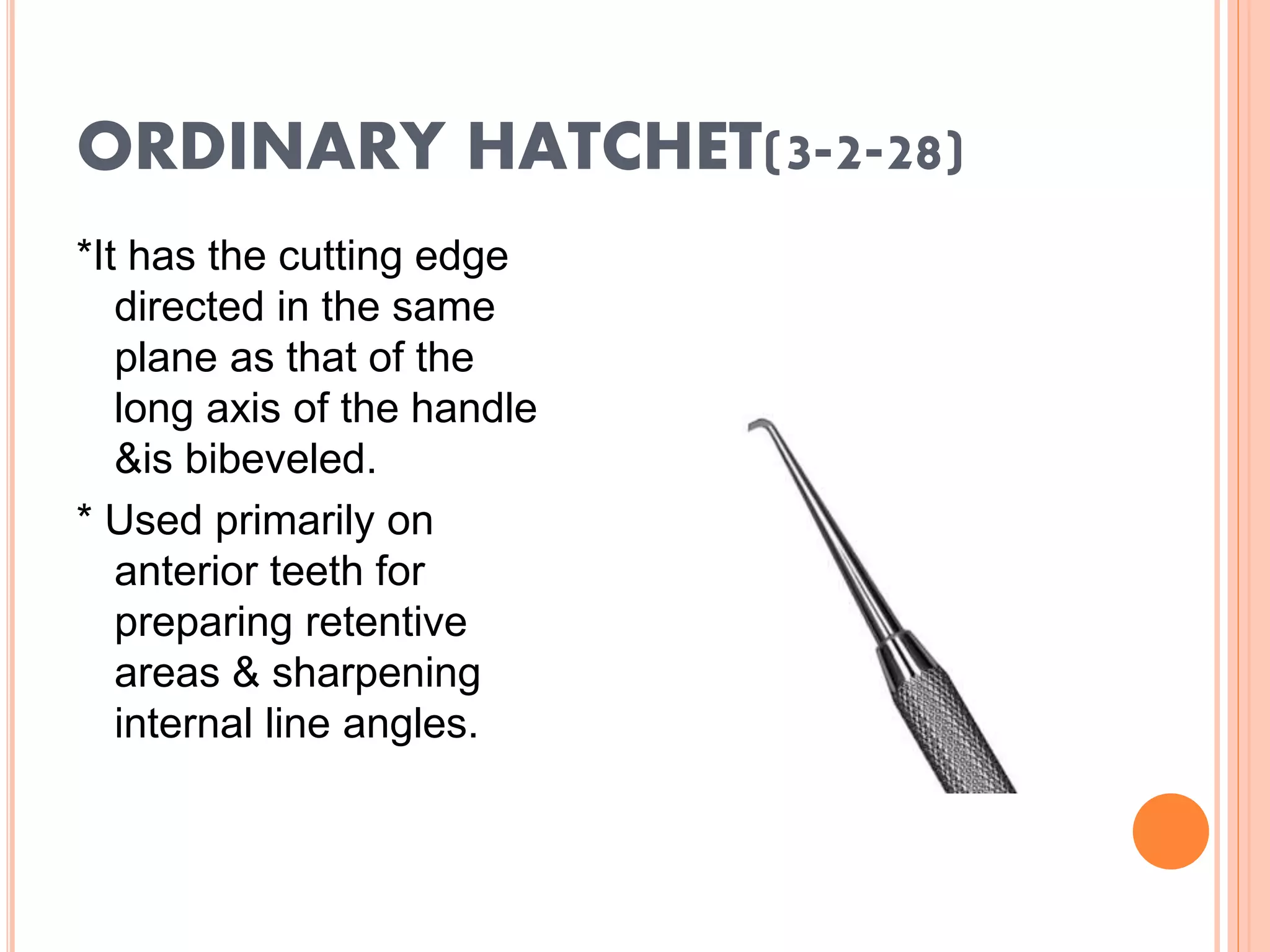
ORDINARY HATCHET(3-2-28)
*It has the cutting edge
directed in the same
plane as that of the
long axis of the handle
&is bibeveled.
* Used primarily on
anterior teeth for
preparing retentive
areas & sharpening
internal line angles.
HOE(4 ½ -1 ½ -22)
*cutting edge perpendicular to the
axis of the handle.
*used for planing tooth preparation
walls& forming line angles.
* Commonly used in classIII &
class V preparation for direct
gold restoration.
SPOON EXCAVATORS
 Bin angle spoon
(13-7-14)
 Triple angle spoon
(13-7-14)
* Spoon (15-7-14)
 spoon excavators are used for
>removing caries
>carving amalgam or direct wax pattern
*cutting edge of the spoon excavator are
>Discoid(circular)
>Cleoid(clawlike)
*shank may be bin angled or triple angled
CHISELS
1) Depending upon the shank angle& blade, it may be
>straight (12-7-0)
>Wedelstaedt(11 ½ -15-3)
>Bin angle(10-7-8)
2)Enamel hatchet
3)Gingival margin trimmer
 Straight chisel has a
shank & blade with the
bevel on one side.
 primary edge is
perpendicular to the
long axis of the handle.
 Bin-angle
&Wedelstaedt chisel
may have either a
distal bevel or a
mesial(reverse)bevel.
ENAMEL HATCHET(10-7-14)
 it is a chisel with larger
&heavier blade beveled
on only one side.
 cutting edge parallel
with the axis of handle.
 Use for cutting enamel
& comes as right or left
types.
GINGIVAL MARGIN TRIMMER
(12 ½-100-7-14)
 designed to produce
proper bevel on
gingival enamel
margins of proximo-
occlusal preparations.
 cutting edge is
angled(other than
perpendicular) to the
axis of the blade.
 comes as right and left
types.
OTHER CUTTING INSTRUMENTS
 Knife
 File
 Discoid-cleoid
instruments.
HAND INSTRUMENT TECHNIQUES
 Modified pen grasp
 Inverted pen grasp
 Palm-and-thumb &
 Modified palm-and-
thumb grasp
MODIFIED PEN GRASP
Similar to that of holding
a pen
Pads of thumb ,index ,&
middle fingers contact
the instrument, while
the tip of the fingers is
placed on a nearby
tooth of the same arch
as rest.
Palm generally is facing
away from the
operator.
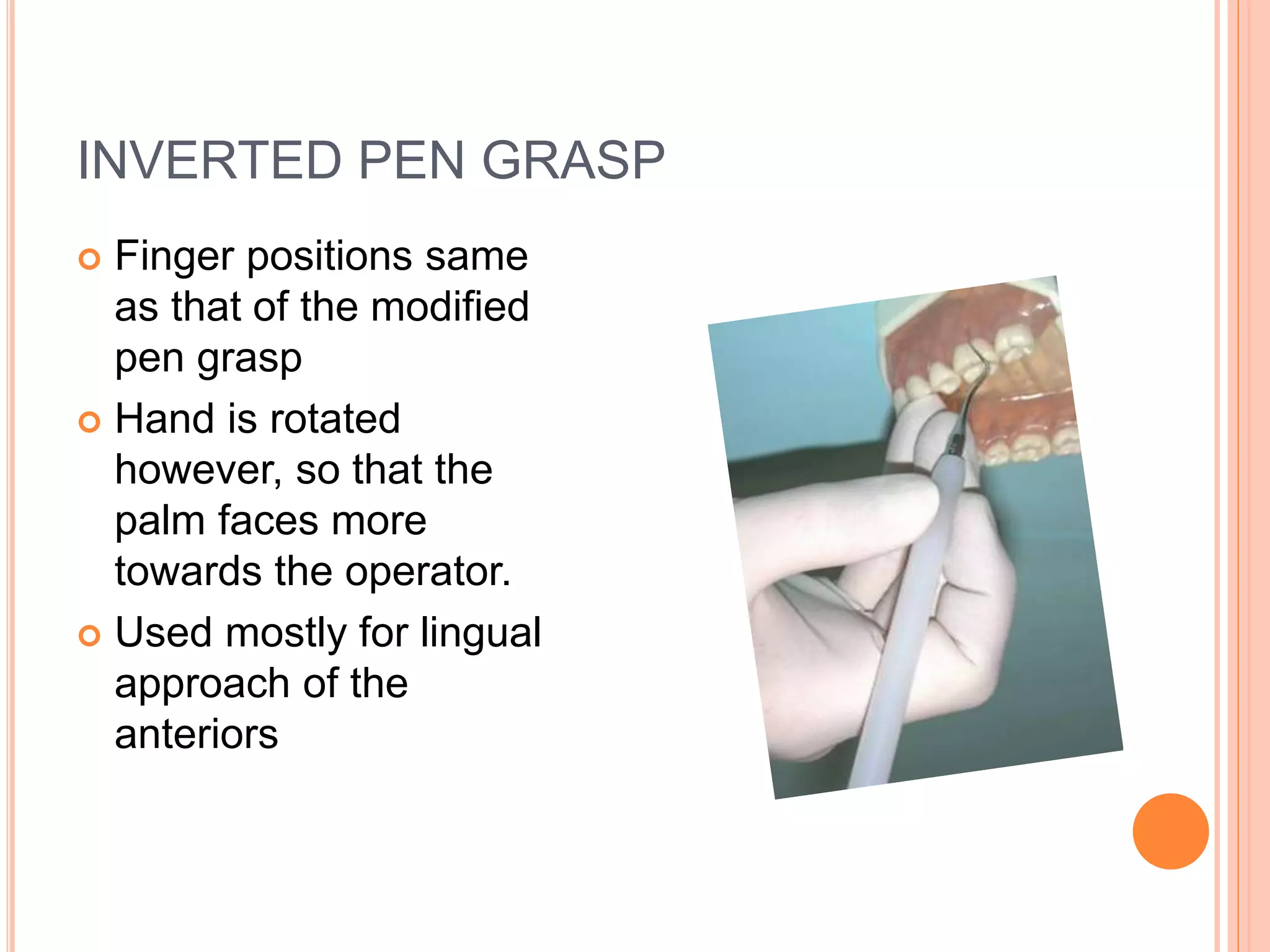
INVERTED PEN GRASP
 Finger positions same
as that of the modified
pen grasp
 Hand is rotated
however, so that the
palm faces more
towards the operator.
 Used mostly for lingual
approach of the
anteriors
PALM-AND-THUMB GRASP
 Handle is placed in the
palm and grasped by
all the fingers, while
thumb is free and the
rest is provided by
supporting the tip of the
thumb on a nearby
tooth of the same arch
or on firm stable
structure.
MODIFIED PALM-AND-THUMB GRASP
 Handle of the
instrument is held by all
the fingers whose pads
press the handle
against the distal area
of the palm & the pad &
first joint of the thumb.
 This grip fosters control
against slipage.
 RESTS:- the closer the
rest areas are to the
operating area, the
more reliable the are.
 GUARDS:- are hand
instruments or other
items such as
interproximal wedges,
used to protect soft
tissue from contact with
sharp or abrassive
instruments.
SHARPENING HAND INSTRUMENTS
 Requires because
instruments with dull
cutting edge cause
*More pain
*prolong operating
time
*more difficult to
control
*reduce quality in
tooth preparation
STATIONARY SHARPENING STONES
(OILSTONES)
 Available in coarse ,
medium& fine grit.
 Commonly used stones
are:- arkansas stone,
silicon carbide, aluminium
oxide& diamond.
 Technique;
 Thin film of light oil should
be placed on working
surface.
 grasp the instruments with
modified pen grasp,
 Use light stroke
 Establish proper 45degree
angle of the bevel and the
cutting edge of the stone
MECHANICAL SHARPNERS
 example:- the Rx
Honing Machine.
 This instrument moves
a hone in a
reciprocating motion at
a slow speed, while the
instrument is held at
the appropriate
angulation
 Interchangable hones
of different shapes and
coarseness are
available
PRINCIPLES OF SHARPENING
 Sharpen instruments only after they have been
clean & sterilized
 Establish the proper bevel angle usually of
45degree
 Use light stroke or pressure to minimze frictional
heat.
 Use a rest or guide
 Remove as little metal as possible
 After sharpening, resterilize the instrument
 Keep sharpening stones clean.
SHARPNESS TEST
 Tested by lightly resting the cutting edge on a hard
plastic surface.
 If it digs in during sliding, the instrument is sharp.
 if it slides , the instrument is dull.

Cuting instrument applications in conservative dentistry

  • 1.
    CUTING INSTRUMENT APPLICATIONS •Usedto cut hard & soft tissues of the mouth. Mainly we have: • Excavators. •Chisels. • Other cutting instruments.
  • 2.
  • 3.
    ORDINARY HATCHET(3-2-28) *It hasthe cutting edge directed in the same plane as that of the long axis of the handle &is bibeveled. * Used primarily on anterior teeth for preparing retentive areas & sharpening internal line angles.
  • 4.
    HOE(4 ½ -1½ -22) *cutting edge perpendicular to the axis of the handle. *used for planing tooth preparation walls& forming line angles. * Commonly used in classIII & class V preparation for direct gold restoration.
  • 5.
    SPOON EXCAVATORS  Binangle spoon (13-7-14)  Triple angle spoon (13-7-14) * Spoon (15-7-14)
  • 6.
     spoon excavatorsare used for >removing caries >carving amalgam or direct wax pattern *cutting edge of the spoon excavator are >Discoid(circular) >Cleoid(clawlike) *shank may be bin angled or triple angled
  • 7.
    CHISELS 1) Depending uponthe shank angle& blade, it may be >straight (12-7-0) >Wedelstaedt(11 ½ -15-3) >Bin angle(10-7-8) 2)Enamel hatchet 3)Gingival margin trimmer
  • 8.
     Straight chiselhas a shank & blade with the bevel on one side.  primary edge is perpendicular to the long axis of the handle.  Bin-angle &Wedelstaedt chisel may have either a distal bevel or a mesial(reverse)bevel.
  • 9.
    ENAMEL HATCHET(10-7-14)  itis a chisel with larger &heavier blade beveled on only one side.  cutting edge parallel with the axis of handle.  Use for cutting enamel & comes as right or left types.
  • 10.
    GINGIVAL MARGIN TRIMMER (12½-100-7-14)  designed to produce proper bevel on gingival enamel margins of proximo- occlusal preparations.  cutting edge is angled(other than perpendicular) to the axis of the blade.  comes as right and left types.
  • 11.
    OTHER CUTTING INSTRUMENTS Knife  File  Discoid-cleoid instruments.
  • 12.
    HAND INSTRUMENT TECHNIQUES Modified pen grasp  Inverted pen grasp  Palm-and-thumb &  Modified palm-and- thumb grasp
  • 13.
    MODIFIED PEN GRASP Similarto that of holding a pen Pads of thumb ,index ,& middle fingers contact the instrument, while the tip of the fingers is placed on a nearby tooth of the same arch as rest. Palm generally is facing away from the operator.
  • 14.
    INVERTED PEN GRASP Finger positions same as that of the modified pen grasp  Hand is rotated however, so that the palm faces more towards the operator.  Used mostly for lingual approach of the anteriors
  • 15.
    PALM-AND-THUMB GRASP  Handleis placed in the palm and grasped by all the fingers, while thumb is free and the rest is provided by supporting the tip of the thumb on a nearby tooth of the same arch or on firm stable structure.
  • 16.
    MODIFIED PALM-AND-THUMB GRASP Handle of the instrument is held by all the fingers whose pads press the handle against the distal area of the palm & the pad & first joint of the thumb.  This grip fosters control against slipage.
  • 17.
     RESTS:- thecloser the rest areas are to the operating area, the more reliable the are.  GUARDS:- are hand instruments or other items such as interproximal wedges, used to protect soft tissue from contact with sharp or abrassive instruments.
  • 18.
    SHARPENING HAND INSTRUMENTS Requires because instruments with dull cutting edge cause *More pain *prolong operating time *more difficult to control *reduce quality in tooth preparation
  • 19.
    STATIONARY SHARPENING STONES (OILSTONES) Available in coarse , medium& fine grit.  Commonly used stones are:- arkansas stone, silicon carbide, aluminium oxide& diamond.  Technique;  Thin film of light oil should be placed on working surface.  grasp the instruments with modified pen grasp,  Use light stroke  Establish proper 45degree angle of the bevel and the cutting edge of the stone
  • 20.
    MECHANICAL SHARPNERS  example:-the Rx Honing Machine.  This instrument moves a hone in a reciprocating motion at a slow speed, while the instrument is held at the appropriate angulation  Interchangable hones of different shapes and coarseness are available
  • 21.
    PRINCIPLES OF SHARPENING Sharpen instruments only after they have been clean & sterilized  Establish the proper bevel angle usually of 45degree  Use light stroke or pressure to minimze frictional heat.  Use a rest or guide  Remove as little metal as possible  After sharpening, resterilize the instrument  Keep sharpening stones clean.
  • 22.
    SHARPNESS TEST  Testedby lightly resting the cutting edge on a hard plastic surface.  If it digs in during sliding, the instrument is sharp.  if it slides , the instrument is dull.