EI: The Forgotten Component in Teaching
Mohammed Chadi, Qatar
University 2015
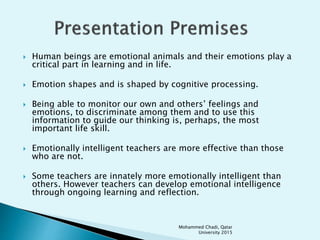
 Human beings are emotional animals and their emotions play a
critical part in learning and in life.
 Emotion shapes and is shaped by cognitive processing.
 Being able to monitor our own and others’ feelings and
emotions, to discriminate among them and to use this
information to guide our thinking is, perhaps, the most
important life skill.
 Emotionally intelligent teachers are more effective than those
who are not.
 Some teachers are innately more emotionally intelligent than
others. However teachers can develop emotional intelligence
through ongoing learning and reflection.
Mohammed Chadi, Qatar
University 2015
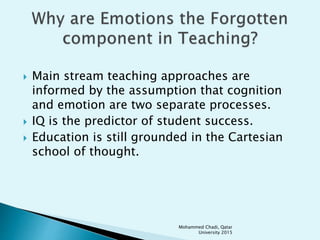
 Main stream teaching approaches are
informed by the assumption that cognition
and emotion are two separate processes.
 IQ is the predictor of student success.
 Education is still grounded in the Cartesian
school of thought.
Mohammed Chadi, Qatar
University 2015
Think of any
occasion when
you were a
learner that
aroused strong
feelings in you.
Mohammed Chadi, Qatar
University 2015
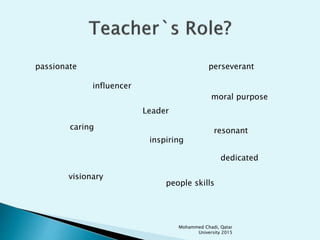
influencer
caring
inspiring
moral purpose
visionary
dedicated
people skills
passionate perseverant
Mohammed Chadi, Qatar
University 2015
resonant
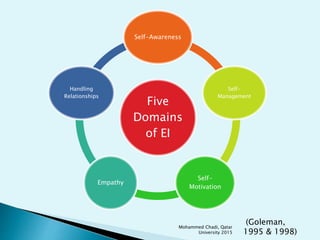
Five
Domains
of EI
Self-Awareness
Self-
Management
Self-
Motivation
Empathy
Handling
Relationships
(Goleman,
1995 & 1998)
Mohammed Chadi, Qatar
University 2015
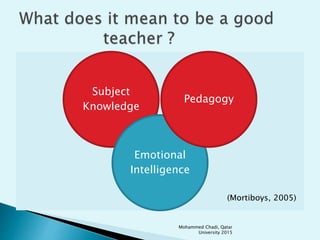
What does it mean to
be a good teacher ?
Mohammed Chadi, Qatar
University 2015
Subject
Knowledge
Emotional
Intelligence
Pedagogy
(Mortiboys, 2005)
Mohammed Chadi, Qatar
University 2015
 Teaching requires constant interaction with students
and hence a continuous interplay of emotions.
 it is now recognized that emotions serve as a
powerful vehicle for enhancing or inhibiting learning
(Greenleaf, 2002).
 Negative emotions can reduce working memory, the
memory system used for holding and manipulating
information while various mental tasks are carried
out (Linnenbrink & Pintrich, 2000)
 Effective and successful teachers are mainly those
who can handle negative feelings in a healthy way.
Mohammed Chadi, Qatar
University 2015
IQ or EQ: Which one
is more important?
Mohammed Chadi, Qatar
University 2015
 In work he carried out at the EI Research
Centre, Goleman identified that the
ingredients of excellent performance was 70
per cent EI and 30 per cent IQ. Covey
supports this in The 7 Habits of Highly
Effective People: "Research shows
convincingly that EI is more important than IQ
in almost every role and many times more
important in leadership roles."
Mohammed Chadi, Qatar
University 2015
Mohammed Chadi, Qatar
University 2015
Mohammed Chadi, Qatar
University 2015
EQ=80%
EQ
gets
you
promoted
Mohammed Chadi, Qatar
University 2015
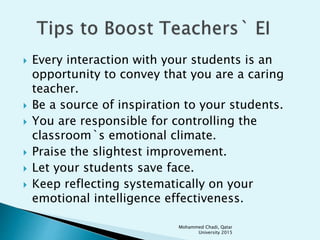
 Every interaction with your students is an
opportunity to convey that you are a caring
teacher.
 Be a source of inspiration to your students.
 You are responsible for controlling the
classroom`s emotional climate.
 Praise the slightest improvement.
 Let your students save face.
 Keep reflecting systematically on your
emotional intelligence effectiveness.
Mohammed Chadi, Qatar
University 2015
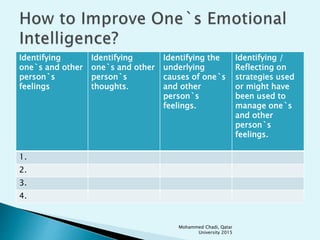
Identifying
one`s and other
person`s
feelings
Identifying
one`s and other
person`s
thoughts.
Identifying the
underlying
causes of one`s
and other
person`s
feelings.
Identifying /
Reflecting on
strategies used
or might have
been used to
manage one`s
and other
person`s
feelings.
1.
2.
3.
4.
Mohammed Chadi, Qatar
University 2015
Mohammed Chadi, Qatar
University 2015
Mohammed Chadi, Qatar
University 2015
Thank you
mohammed.chadi@qu.edu.qa

Inspiring Students through Emotional Intelligence

  • 1.
    EI: The ForgottenComponent in Teaching Mohammed Chadi, Qatar University 2015
  • 2.
     Human beingsare emotional animals and their emotions play a critical part in learning and in life.  Emotion shapes and is shaped by cognitive processing.  Being able to monitor our own and others’ feelings and emotions, to discriminate among them and to use this information to guide our thinking is, perhaps, the most important life skill.  Emotionally intelligent teachers are more effective than those who are not.  Some teachers are innately more emotionally intelligent than others. However teachers can develop emotional intelligence through ongoing learning and reflection. Mohammed Chadi, Qatar University 2015
  • 3.
     Main streamteaching approaches are informed by the assumption that cognition and emotion are two separate processes.  IQ is the predictor of student success.  Education is still grounded in the Cartesian school of thought. Mohammed Chadi, Qatar University 2015
  • 4.
    Think of any occasionwhen you were a learner that aroused strong feelings in you. Mohammed Chadi, Qatar University 2015
  • 5.
    influencer caring inspiring moral purpose visionary dedicated people skills passionateperseverant Mohammed Chadi, Qatar University 2015 resonant
  • 6.
  • 7.
    What does itmean to be a good teacher ? Mohammed Chadi, Qatar University 2015
  • 8.
  • 9.
     Teaching requiresconstant interaction with students and hence a continuous interplay of emotions.  it is now recognized that emotions serve as a powerful vehicle for enhancing or inhibiting learning (Greenleaf, 2002).  Negative emotions can reduce working memory, the memory system used for holding and manipulating information while various mental tasks are carried out (Linnenbrink & Pintrich, 2000)  Effective and successful teachers are mainly those who can handle negative feelings in a healthy way. Mohammed Chadi, Qatar University 2015
  • 10.
    IQ or EQ:Which one is more important? Mohammed Chadi, Qatar University 2015
  • 11.
     In workhe carried out at the EI Research Centre, Goleman identified that the ingredients of excellent performance was 70 per cent EI and 30 per cent IQ. Covey supports this in The 7 Habits of Highly Effective People: "Research shows convincingly that EI is more important than IQ in almost every role and many times more important in leadership roles." Mohammed Chadi, Qatar University 2015
  • 12.
  • 13.
  • 14.
  • 15.
     Every interactionwith your students is an opportunity to convey that you are a caring teacher.  Be a source of inspiration to your students.  You are responsible for controlling the classroom`s emotional climate.  Praise the slightest improvement.  Let your students save face.  Keep reflecting systematically on your emotional intelligence effectiveness. Mohammed Chadi, Qatar University 2015
  • 16.
    Identifying one`s and other person`s feelings Identifying one`sand other person`s thoughts. Identifying the underlying causes of one`s and other person`s feelings. Identifying / Reflecting on strategies used or might have been used to manage one`s and other person`s feelings. 1. 2. 3. 4. Mohammed Chadi, Qatar University 2015
  • 17.
  • 18.
    Mohammed Chadi, Qatar University2015 Thank you mohammed.chadi@qu.edu.qa

Editor's Notes

  • #2 EI is tricky to understand. Perhaps that is why the voluminous literature on college and university teaching essentially ignores it. EI has been avoided in favor of other variables, such as methods of teaching, modes of testing, and techniques of assessing teaching effectiveness, which can be more readily conceptualized and manipulated. Nonetheless, it is worth considering the role of EI if for no other reason than its contributions to effective teaching.
  • #7 just like metacognition, self- awareness involves cognition; – cognition of the way we feel versus – cognition of the way we think (metacognition) Self-awareness allows us to- recognize feelings as they occur- realize what is behind them realize what has caused them Self-management involves regulating our emotions after we have become aware of them, acting on them ,changing them Self-motivation involves finding ways to motivate ourselves to think positively- seek to overcome obstacles- have clear goals and an optimistic can-do attitude Empathy entails: Being able to put oneself in other people`s shoes. Seeing things from their perspective Respecting differences in how they feel about things. Handling relationships involves the ability to inspire, influence, and develop others manage emotions be assertive communicate, listen, show warmth, negotiate compromise think win/win believe in the principle of abundance
  • #9 A teacher needs awareness of his/her feelings, values and attitudes as a teacher, awareness of his/her behaviour and how others see them. Consistent and constructive feedback from students, colleagues and school authorities facilitates a teacher in better self-evaluation of his/her abilities. Those with good emotional intelligence have no hesitation in taking feedback from others and then working upon it to continuously evolve their performances
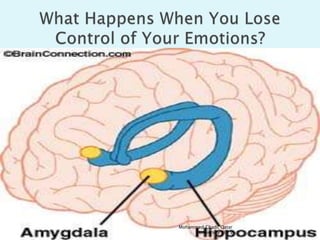
  • #13 Your amygdala is heavily associated with storing and using memory. When faced with a potentially threatening situation, your amygdala quickly accesses your experiences to determine if what you are facing is appropriate for a response of fear or anger. If so, the amygdala proclaims an emergency and recruits the rest of your brain and body to its urgent agenda.
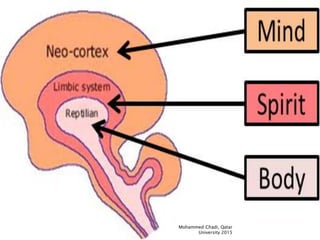
  • #14 It is not possible for a healthy leader to make decisions solely based on emotion or solely based on logical, rational thought. The neocortex, the thinking part of your brain, works in concert with the amygdala to generate all of your decisions. Finding the right balance, in the context of what you want to accomplish with and through other people, makes up what is now known as emotional intelligence.