RWKSHJ 1
INPUT DEVICES
RWKSHJ 2
SENSORS
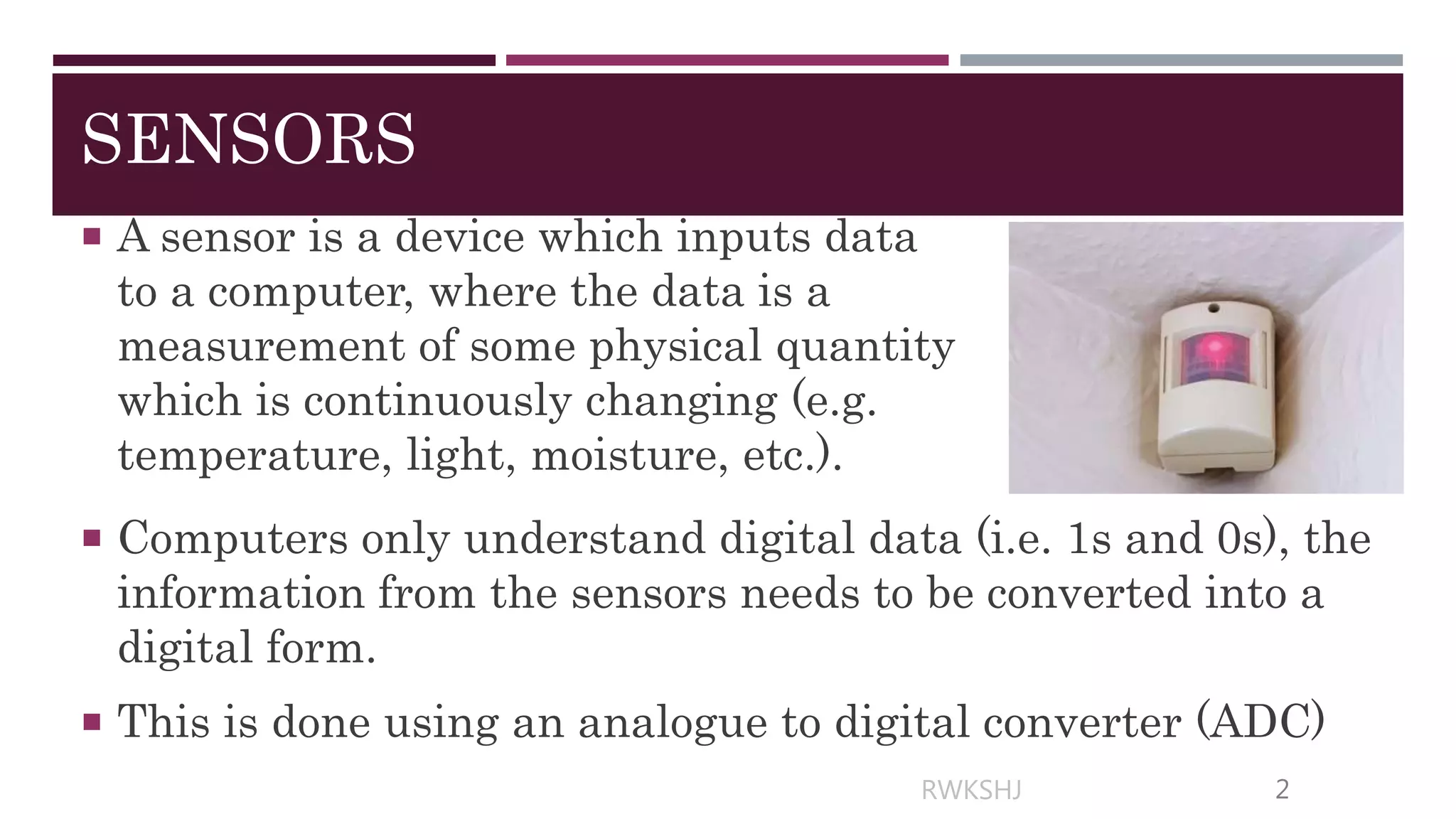
 A sensor is a device which inputs data
to a computer, where the data is a
measurement of some physical quantity
which is continuously changing (e.g.
temperature, light, moisture, etc.).
 Computers only understand digital data (i.e. 1s and 0s), the
information from the sensors needs to be converted into a
digital form.
 This is done using an analogue to digital converter (ADC)
RWKSHJ 3
HOW SENSORS WORK
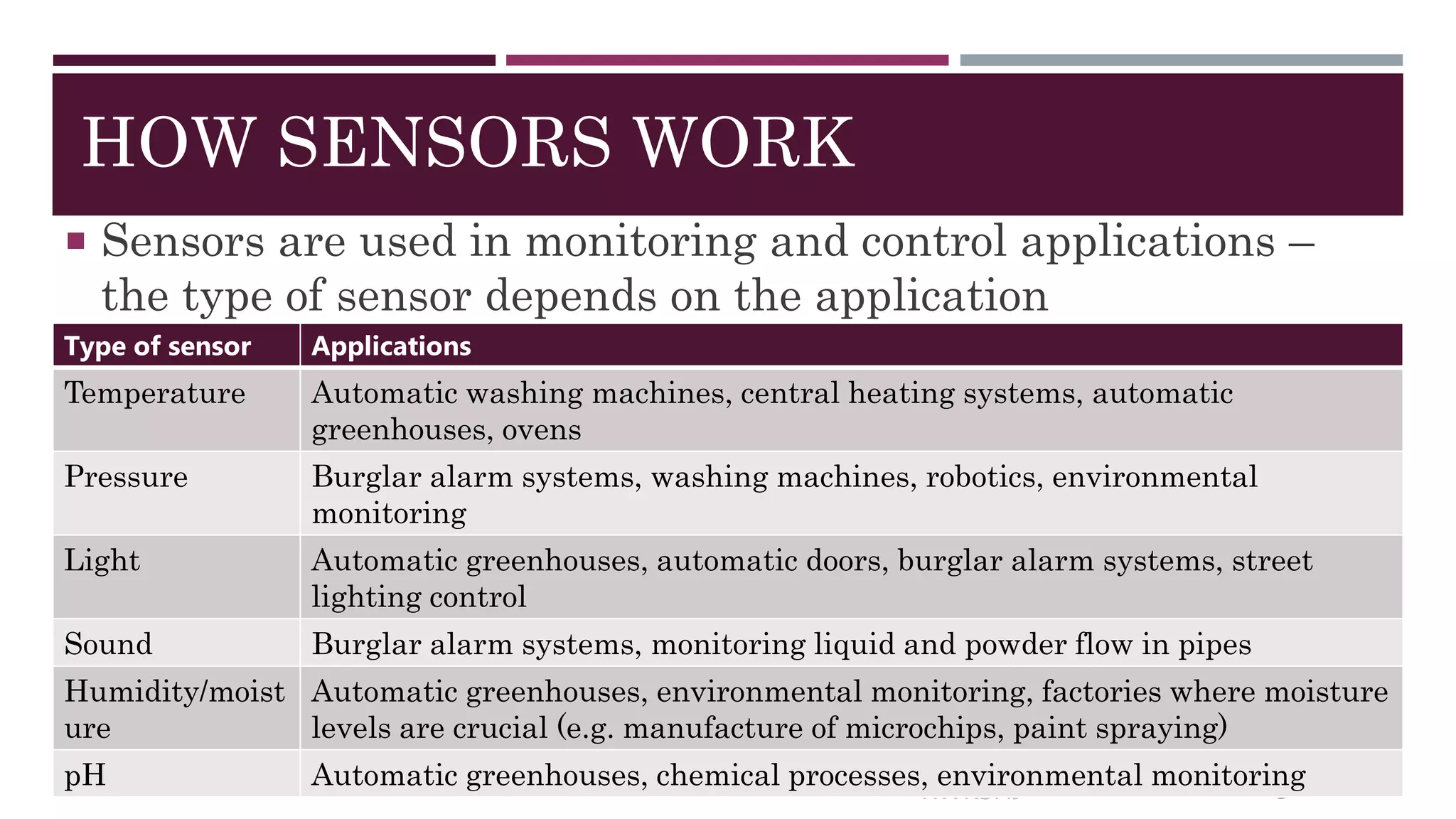
 Sensors are used in monitoring and control applications –
the type of sensor depends on the application
Type of sensor Applications
Temperature Automatic washing machines, central heating systems, automatic
greenhouses, ovens
Pressure Burglar alarm systems, washing machines, robotics, environmental
monitoring
Light Automatic greenhouses, automatic doors, burglar alarm systems, street
lighting control
Sound Burglar alarm systems, monitoring liquid and powder flow in pipes
Humidity/moist
ure
Automatic greenhouses, environmental monitoring, factories where moisture
levels are crucial (e.g. manufacture of microchips, paint spraying)
pH Automatic greenhouses, chemical processes, environmental monitoring
RWKSHJ 4
 When monitoring, the data sent to the computer is often
transferred directly to a spreadsheet package (e.g. taking
measurements in a scientific experiment, measuring
atmospheric pollution, etc.).
DISADVANTAGE
 Faulty sensors can give spurious results (e.g. if the sensors
on the rear bumper of a car which monitor for obstacles
become dirty, they may either not identify an obstacle or
give a continuous alarm).
RWKSHJ 5
ADVANTAGES
 Readings taken using sensors are generally more accurate
that those taken by human operators.
 Readings are continuous, so there is no break in the
monitoring.
 Because it is a continuous process, any necessary action
(control system) or warning (monitoring system) will be
initiated immediately.
 The system can be automatic, removing the need for human
intervention. This is particularly important if the process is
hazardous or needs precise control/monitoring.
RWKSHJ 6
MOUSE
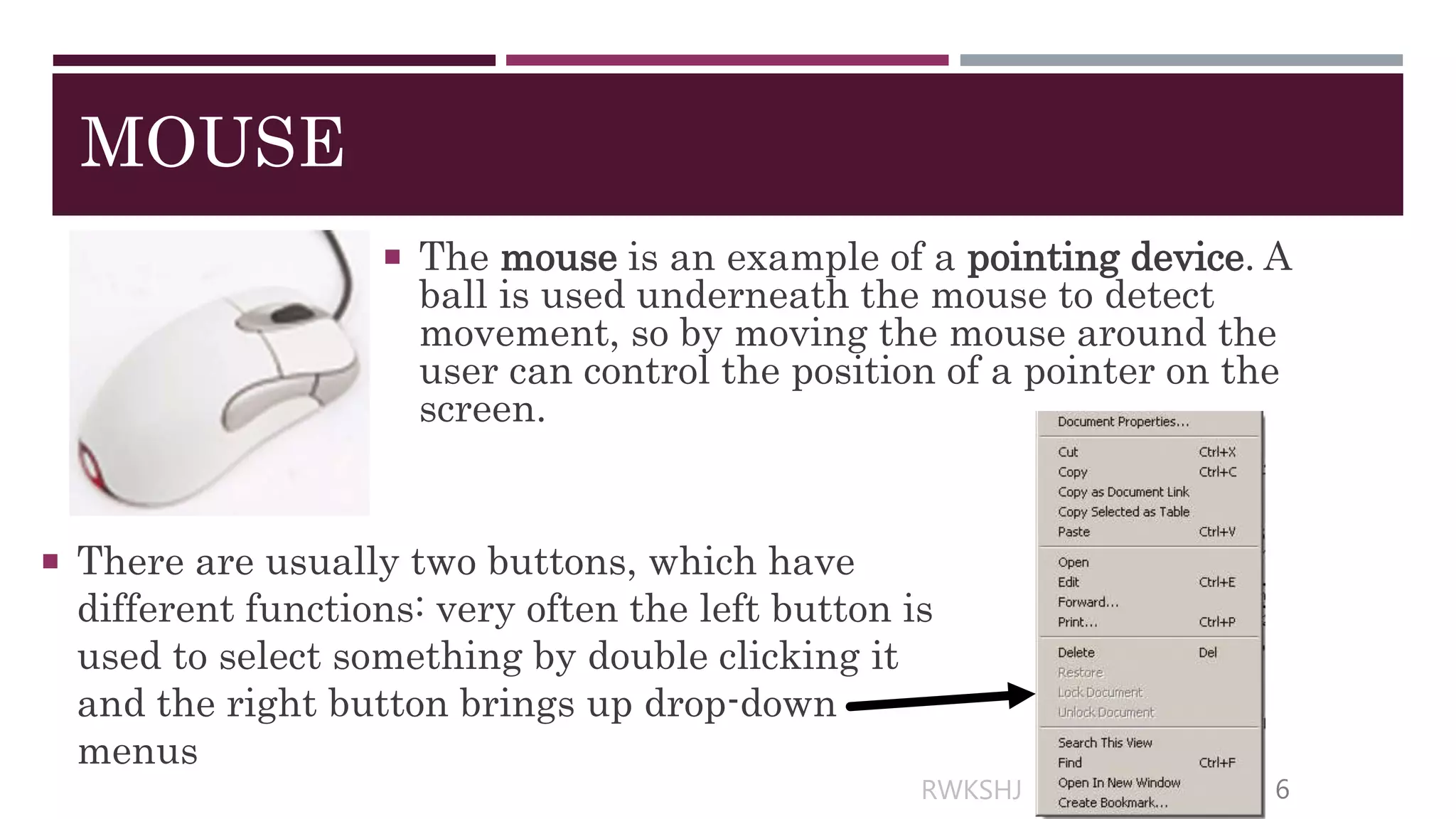
 The mouse is an example of a pointing device. A
ball is used underneath the mouse to detect
movement, so by moving the mouse around the
user can control the position of a pointer on the
screen.
 There are usually two buttons, which have
different functions: very often the left button is
used to select something by double clicking it
and the right button brings up drop-down
menus
RWKSHJ 7
 Recent developments have produced the optical mouse
(where movement is detected by reflected light rather than
the position of a moving ball) and the cordless mouse
(which is an example of a wireless device).
 The advantage of an optical mouse is it has no moving
parts and it also doesn’t pick up any dirt.
 This makes it more robust and improves its performance,
since the older type of mouse can ‘skid’ on certain surfaces
reducing the control of the pointer.
RWKSHJ 8
USES OF A MOUSE
 Mice can be used for opening, closing and minimising
software.
 They can be used for grouping, moving and deleting files.
 They are very useful when editing images, for example
controlling the size and position of a drawing pasted into a
document.
 Mice are used for controlling the position of a pointer on the
screen to allow selection from a menu or selecting an icon and
for scrolling up and down/left to right.
RWKSHJ 9
ADVANTAGES
 It can be faster to select an option using a mouse rather
than a keyboard.
 Mice enable rapid navigation through applications and the
internet.
 Mice are small and so take up little area.
RWKSHJ 10
DISADVANTAGES
 People with restricted hand/wrist movement can find it
hard to operate a mouse.
 Mice are easily damaged and the older type of mice also
quickly becomes clogged up with dirt.
 They are difficult to use if there is no flat surface readily
available (e.g. on an aeroplane).
RWKSHJ 11
TOUCHPADS
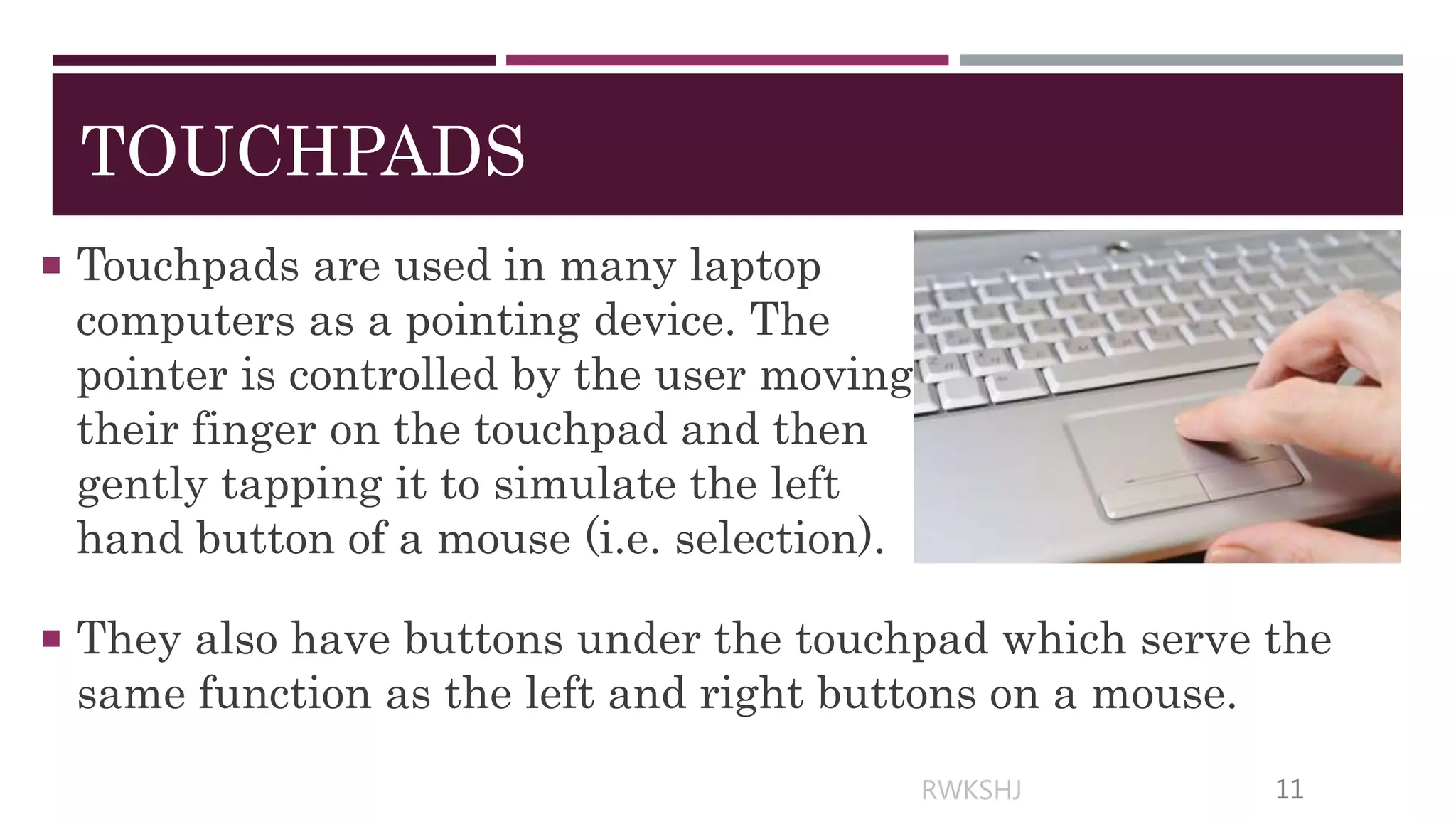
 Touchpads are used in many laptop
computers as a pointing device. The
pointer is controlled by the user moving
their finger on the touchpad and then
gently tapping it to simulate the left
hand button of a mouse (i.e. selection).
 They also have buttons under the touchpad which serve the
same function as the left and right buttons on a mouse.
RWKSHJ 12
ADVANTAGES
 It can be faster to select an option using a touchpad rather
than a keyboard.
 Touchpads enable rapid navigation through applications
and the internet.
 Since the touchpad is integrated into the laptop computer,
there is no need for a separate mouse, aiding portability.
 They can be used even when there are no flat surfaces
available.
RWKSHJ 13
DISADVANTAGES
 People with limited hand/wrist movement find touchpads
difficult to use.
 It can be more difficult to control the pointer when compared
with a mouse.
 They are more difficult to use when doing certain operations
such as ‘drag and drop’.
RWKSHJ 14
TRACKERBALLS
 Trackerballs are similar to a mouse, except
that the ball is on the top of the device and
the user controls the pointer on the screen
by rotating the ball with the hand.
 Some trackerballs have two buttons which have the same
function as the left- and right-hand mouse buttons. If they
have a third button, this is equivalent to a double click.
RWKSHJ 15
USES OF TRACKERBALLS
 They have the same pointing/cursor control capability as a
mouse.
 They are used in applications where the user has a
disability (such as RSI).
 They are used in a control room environment, where it is
faster than a mouse to navigate through process screens and
is more robust than a mouse.
RWKSHJ 16
ADVANTAGES
 Trackerballs do not need the same fine control as a mouse.
 People with limited hand/wrist movement find it easier to
use than a mouse.
 The pointer can be positioned more accurately on the
screen than with a mouse.
 They take up less desk space than mice since they are
stationary.
RWKSHJ 17
DISADVANTAGES
 Trackerballs are not supplied with the computer as
standard, so they are more expensive.
 User may need training since they are not standard
equipment.
RWKSHJ 18
GRAPHICS TABLETS
 A graphics tablet is used with
a stylus to produce freehand
drawings for example.
 The images produced can
then be stored in a file on a
computer.
RWKSHJ 19
USES OF GRAPHICS TABLETS
 Graphics tablets are used to produce drawings, computer
graphics, etc.
 In countries where characters are complex (e.g. China,
Japan), they are used as a form of input since it is faster
than typing in the characters using a keyboard.
 They are used in Computer Aided Design (CAD) work.
RWKSHJ 20
ADVANTAGES
 It is possible to modify drawings before they are input.
 They offer a very accurate method of drawing, which is
better than using a mouse or trackerball.
DISADVANTAGE
 They are more expensive than other pointing devices, such
as a mouse.
RWKSHJ 21
LIGHT PENS
 Light pens contain sensors that send
signals to a computer whenever light
changes are detected.
 The screen is refreshed 50 times every
second, so the computer is able to determine the pen’s
position by noting exactly when the light pen detected the
electron beam passing its tip.
RWKSHJ 22
USES
 Light pens are used for selecting objects on CRT screens.
 They are also used for drawing on screen (e.g. with CAD
packages).
ADVANTAGES
 Light pens are more accurate than touch screens.
 They are small, so can be used where space is an issue.
 They are easy to use.
RWKSHJ 23
DISADVANTAGES
 There are problems with lag when drawing on screen.
 At the moment, they only work with CRT monitors.
 They are not very accurate when drawing.
RWKSHJ 24
REMOTE CONTROLS
 A remote control is used to control the operation
of other devices remotely by using infra red
signals. The buttons on the keypad are used to
select options (such as television stations,
sound levels on a HiFi, timings on a DVD
recorder, etc.).
RWKSHJ 25
USES
 Most home entertainment devices such as a television,
satellite system, DVD player/recorder, HiFi systems, etc.
have remote controls.
 Remote controls are also used to control multimedia
systems.
 They are used in industrial applications to remotely control
processes, stop and start machinery, etc.
RWKSHJ 26
JOYSTICKS
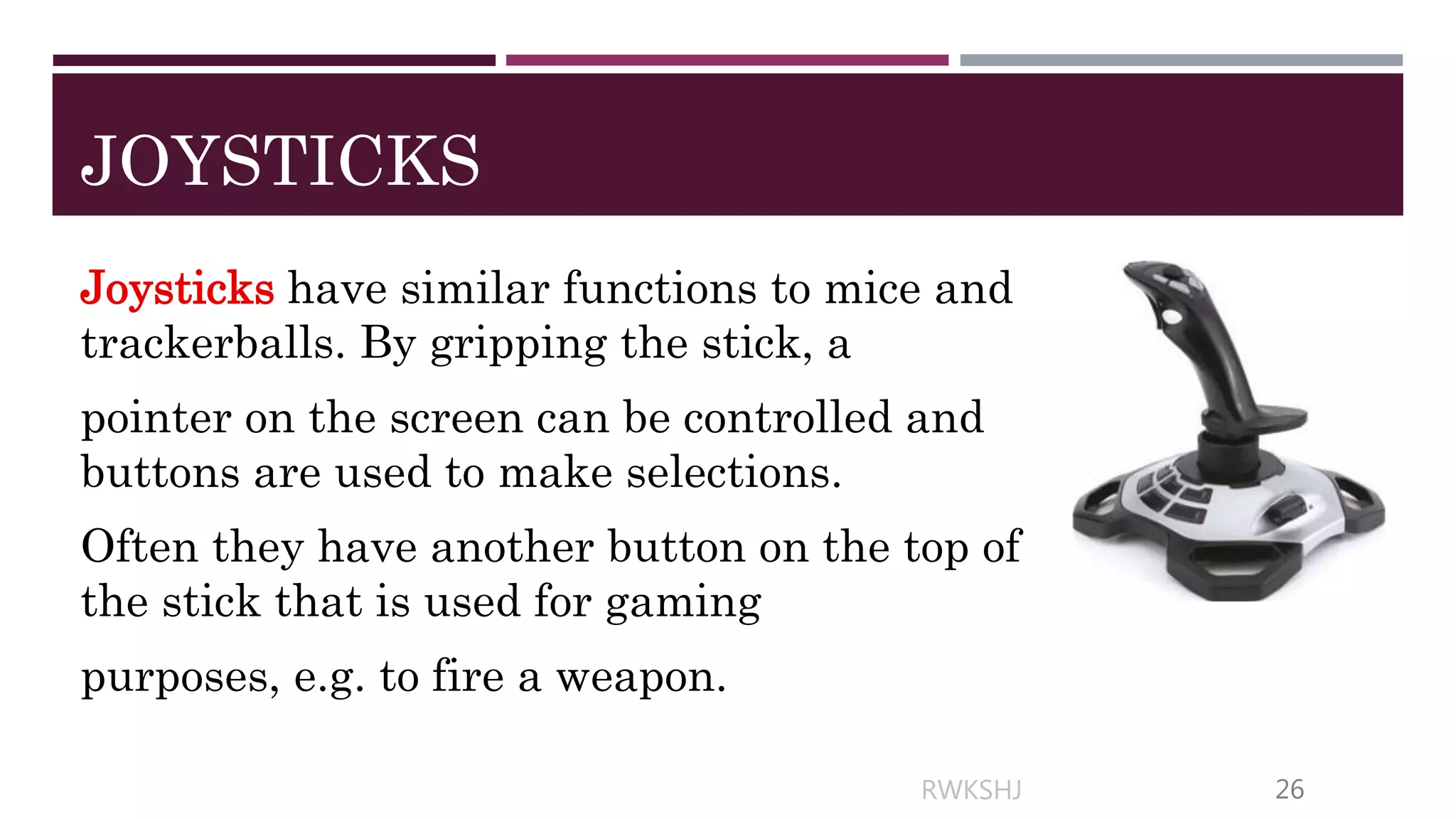
Joysticks have similar functions to mice and
trackerballs. By gripping the stick, a
pointer on the screen can be controlled and
buttons are used to make selections.
Often they have another button on the top of
the stick that is used for gaming
purposes, e.g. to fire a weapon.
RWKSHJ 27
USES
Video/computer games are often controlled by joysticks.
They are used in simulators (e.g. flight simulators) to mimic
actual controls.
Advantages
 It is easier to navigate round
a screen using a joystick
rather than a keyboard.
 Control is in three
dimensions.
Disadvantage
 It is more difficult to
control the on-screen
pointer with a joystick than
with other devices, such as
a mouse.
RWKSHJ 28
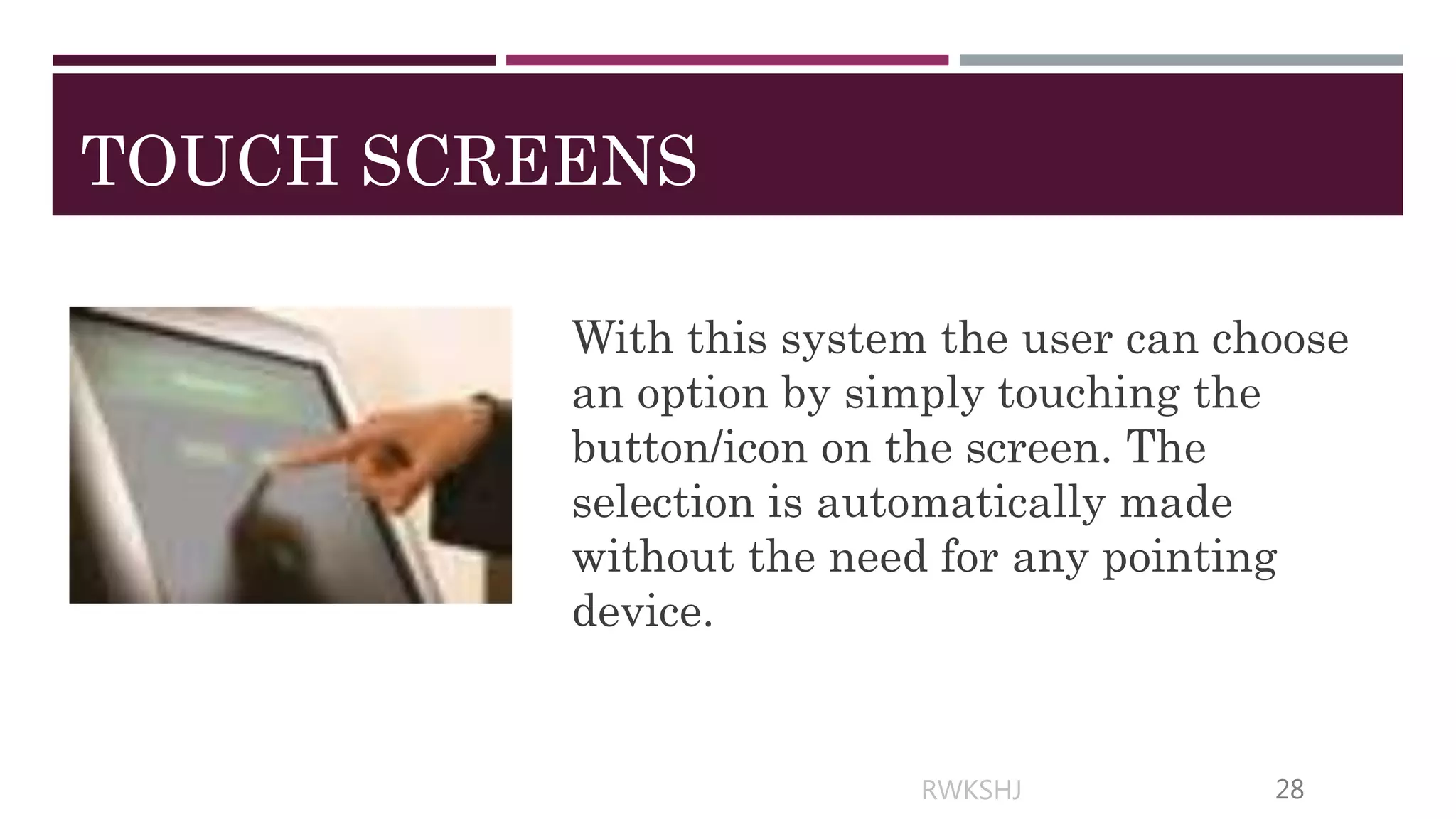
TOUCH SCREENS
With this system the user can choose
an option by simply touching the
button/icon on the screen. The
selection is automatically made
without the need for any pointing
device.
RWKSHJ 29
USES
 Touch screens are used for self-service tills, e.g. petrol stations,
where the user just touches the screen to select the fuel grade and
payment method.
 Touch screens are used where selections are made on screen, for
example ATMs, point of sale terminals (e.g. at restaurants), public
information systems at airports, railway stations, tourist offices.
 Personal digital assistants (PDAs), mobile phones and satellite
navigation systems use touch screens.
 Interactive white boards used for education are large touch
screens.
 Touch screens are used in computer base training (CBT) where
selections are made in answering on screen testing.
RWKSHJ 30
ADVANTAGES
 Touch screens enable faster entry of options than using a
keyboard or a mouse.
 It is very easy to choose options.
 It is a user friendly method for inputting data, so no
training is necessary.
 Touch screens are tamper proof, preventing people from
keying in information which could potentially corrupt the
computer system (e.g. at unmanned ticket collection kiosks).
RWKSHJ 31
DISADVANTAGES
 There is a limited number of options available.
 Using touch screens frequently can lead to health
problems (e.g. straining of arm muscles, RSI, etc.).
 The screen can get very dirty with constant touching.
RWKSHJ 32
MAGNETIC STRIPE READERS
These are used to read information on the magnetic stripe
found, for example, on the back of a credit card. The stripe
contains useful information,
such as the account number, sort code, expiry date and start
date.
RWKSHJ 33
USES
 Credit and debit cards have magnetic stripes that are used
by ATMs or EFTPOS (electronic funds transfer point of
sale) terminals.
 Security cards for entry to buildings, hotel rooms, etc. use
magnetic stripes.
 Travel systems (e.g. train and underground tickets) use
magnetic stripes.
RWKSHJ 34
ADVANTAGES
 Data entry is faster compared with keying in using a keyboard or
keypad.
 The system is error free, since no typing is involved.
 The information held on the magnetic stripe is secure: because it
cannot be read directly by a person; and, since there is no typing,
there is not the risk of somebody observing your key strokes.
 They can prevent access to restricted/secure areas.
 Magnetic stripes are unaffected by oil, water, moisture, etc.
 There are no moving parts, so they are physically very robust.
RWKSHJ 35
DISADVANTAGES
 If the magnetic stripe gets damaged (e.g. due to exposure
to a strong magnetic field or excessive use) the data is lost.
 The card needs to be in close contact with the reader, so
magnetic stripe readers don’t work at a distance.
 Since the information is not human readable, this can be a
disadvantage in some applications (e.g. hotel room
numbers are not printed on the card, so there needs to be
another way of showing the information for the customer).
RWKSHJ 36
SMART CARD READERS
Smart cards contain chips and are similar
to magnetic stripe cards.
With these cards the information is stored
on the chip (e.g. PIN and personal data).
The data stored on the chip can be
updated (e.g. on loyalty cards).
RWKSHJ 37
For example, certain Fueling
companies use these cards: when a
customer buys fuel at a filling station,
the loyalty card is swiped and ‘points’
are added to the card; these points can
be used for road miles, money off next
purchases, and so on. The storage
capacity of the chip is much greater
than a magnetic stripe, so more
information (such as customer details)
can be stored.

Input devices

  • 1.
  • 2.
    RWKSHJ 2 SENSORS  Asensor is a device which inputs data to a computer, where the data is a measurement of some physical quantity which is continuously changing (e.g. temperature, light, moisture, etc.).  Computers only understand digital data (i.e. 1s and 0s), the information from the sensors needs to be converted into a digital form.  This is done using an analogue to digital converter (ADC)
  • 3.
    RWKSHJ 3 HOW SENSORSWORK  Sensors are used in monitoring and control applications – the type of sensor depends on the application Type of sensor Applications Temperature Automatic washing machines, central heating systems, automatic greenhouses, ovens Pressure Burglar alarm systems, washing machines, robotics, environmental monitoring Light Automatic greenhouses, automatic doors, burglar alarm systems, street lighting control Sound Burglar alarm systems, monitoring liquid and powder flow in pipes Humidity/moist ure Automatic greenhouses, environmental monitoring, factories where moisture levels are crucial (e.g. manufacture of microchips, paint spraying) pH Automatic greenhouses, chemical processes, environmental monitoring
  • 4.
    RWKSHJ 4  Whenmonitoring, the data sent to the computer is often transferred directly to a spreadsheet package (e.g. taking measurements in a scientific experiment, measuring atmospheric pollution, etc.). DISADVANTAGE  Faulty sensors can give spurious results (e.g. if the sensors on the rear bumper of a car which monitor for obstacles become dirty, they may either not identify an obstacle or give a continuous alarm).
  • 5.
    RWKSHJ 5 ADVANTAGES  Readingstaken using sensors are generally more accurate that those taken by human operators.  Readings are continuous, so there is no break in the monitoring.  Because it is a continuous process, any necessary action (control system) or warning (monitoring system) will be initiated immediately.  The system can be automatic, removing the need for human intervention. This is particularly important if the process is hazardous or needs precise control/monitoring.
  • 6.
    RWKSHJ 6 MOUSE  Themouse is an example of a pointing device. A ball is used underneath the mouse to detect movement, so by moving the mouse around the user can control the position of a pointer on the screen.  There are usually two buttons, which have different functions: very often the left button is used to select something by double clicking it and the right button brings up drop-down menus
  • 7.
    RWKSHJ 7  Recentdevelopments have produced the optical mouse (where movement is detected by reflected light rather than the position of a moving ball) and the cordless mouse (which is an example of a wireless device).  The advantage of an optical mouse is it has no moving parts and it also doesn’t pick up any dirt.  This makes it more robust and improves its performance, since the older type of mouse can ‘skid’ on certain surfaces reducing the control of the pointer.
  • 8.
    RWKSHJ 8 USES OFA MOUSE  Mice can be used for opening, closing and minimising software.  They can be used for grouping, moving and deleting files.  They are very useful when editing images, for example controlling the size and position of a drawing pasted into a document.  Mice are used for controlling the position of a pointer on the screen to allow selection from a menu or selecting an icon and for scrolling up and down/left to right.
  • 9.
    RWKSHJ 9 ADVANTAGES  Itcan be faster to select an option using a mouse rather than a keyboard.  Mice enable rapid navigation through applications and the internet.  Mice are small and so take up little area.
  • 10.
    RWKSHJ 10 DISADVANTAGES  Peoplewith restricted hand/wrist movement can find it hard to operate a mouse.  Mice are easily damaged and the older type of mice also quickly becomes clogged up with dirt.  They are difficult to use if there is no flat surface readily available (e.g. on an aeroplane).
  • 11.
    RWKSHJ 11 TOUCHPADS  Touchpadsare used in many laptop computers as a pointing device. The pointer is controlled by the user moving their finger on the touchpad and then gently tapping it to simulate the left hand button of a mouse (i.e. selection).  They also have buttons under the touchpad which serve the same function as the left and right buttons on a mouse.
  • 12.
    RWKSHJ 12 ADVANTAGES  Itcan be faster to select an option using a touchpad rather than a keyboard.  Touchpads enable rapid navigation through applications and the internet.  Since the touchpad is integrated into the laptop computer, there is no need for a separate mouse, aiding portability.  They can be used even when there are no flat surfaces available.
  • 13.
    RWKSHJ 13 DISADVANTAGES  Peoplewith limited hand/wrist movement find touchpads difficult to use.  It can be more difficult to control the pointer when compared with a mouse.  They are more difficult to use when doing certain operations such as ‘drag and drop’.
  • 14.
    RWKSHJ 14 TRACKERBALLS  Trackerballsare similar to a mouse, except that the ball is on the top of the device and the user controls the pointer on the screen by rotating the ball with the hand.  Some trackerballs have two buttons which have the same function as the left- and right-hand mouse buttons. If they have a third button, this is equivalent to a double click.
  • 15.
    RWKSHJ 15 USES OFTRACKERBALLS  They have the same pointing/cursor control capability as a mouse.  They are used in applications where the user has a disability (such as RSI).  They are used in a control room environment, where it is faster than a mouse to navigate through process screens and is more robust than a mouse.
  • 16.
    RWKSHJ 16 ADVANTAGES  Trackerballsdo not need the same fine control as a mouse.  People with limited hand/wrist movement find it easier to use than a mouse.  The pointer can be positioned more accurately on the screen than with a mouse.  They take up less desk space than mice since they are stationary.
  • 17.
    RWKSHJ 17 DISADVANTAGES  Trackerballsare not supplied with the computer as standard, so they are more expensive.  User may need training since they are not standard equipment.
  • 18.
    RWKSHJ 18 GRAPHICS TABLETS A graphics tablet is used with a stylus to produce freehand drawings for example.  The images produced can then be stored in a file on a computer.
  • 19.
    RWKSHJ 19 USES OFGRAPHICS TABLETS  Graphics tablets are used to produce drawings, computer graphics, etc.  In countries where characters are complex (e.g. China, Japan), they are used as a form of input since it is faster than typing in the characters using a keyboard.  They are used in Computer Aided Design (CAD) work.
  • 20.
    RWKSHJ 20 ADVANTAGES  Itis possible to modify drawings before they are input.  They offer a very accurate method of drawing, which is better than using a mouse or trackerball. DISADVANTAGE  They are more expensive than other pointing devices, such as a mouse.
  • 21.
    RWKSHJ 21 LIGHT PENS Light pens contain sensors that send signals to a computer whenever light changes are detected.  The screen is refreshed 50 times every second, so the computer is able to determine the pen’s position by noting exactly when the light pen detected the electron beam passing its tip.
  • 22.
    RWKSHJ 22 USES  Lightpens are used for selecting objects on CRT screens.  They are also used for drawing on screen (e.g. with CAD packages). ADVANTAGES  Light pens are more accurate than touch screens.  They are small, so can be used where space is an issue.  They are easy to use.
  • 23.
    RWKSHJ 23 DISADVANTAGES  Thereare problems with lag when drawing on screen.  At the moment, they only work with CRT monitors.  They are not very accurate when drawing.
  • 24.
    RWKSHJ 24 REMOTE CONTROLS A remote control is used to control the operation of other devices remotely by using infra red signals. The buttons on the keypad are used to select options (such as television stations, sound levels on a HiFi, timings on a DVD recorder, etc.).
  • 25.
    RWKSHJ 25 USES  Mosthome entertainment devices such as a television, satellite system, DVD player/recorder, HiFi systems, etc. have remote controls.  Remote controls are also used to control multimedia systems.  They are used in industrial applications to remotely control processes, stop and start machinery, etc.
  • 26.
    RWKSHJ 26 JOYSTICKS Joysticks havesimilar functions to mice and trackerballs. By gripping the stick, a pointer on the screen can be controlled and buttons are used to make selections. Often they have another button on the top of the stick that is used for gaming purposes, e.g. to fire a weapon.
  • 27.
    RWKSHJ 27 USES Video/computer gamesare often controlled by joysticks. They are used in simulators (e.g. flight simulators) to mimic actual controls. Advantages  It is easier to navigate round a screen using a joystick rather than a keyboard.  Control is in three dimensions. Disadvantage  It is more difficult to control the on-screen pointer with a joystick than with other devices, such as a mouse.
  • 28.
    RWKSHJ 28 TOUCH SCREENS Withthis system the user can choose an option by simply touching the button/icon on the screen. The selection is automatically made without the need for any pointing device.
  • 29.
    RWKSHJ 29 USES  Touchscreens are used for self-service tills, e.g. petrol stations, where the user just touches the screen to select the fuel grade and payment method.  Touch screens are used where selections are made on screen, for example ATMs, point of sale terminals (e.g. at restaurants), public information systems at airports, railway stations, tourist offices.  Personal digital assistants (PDAs), mobile phones and satellite navigation systems use touch screens.  Interactive white boards used for education are large touch screens.  Touch screens are used in computer base training (CBT) where selections are made in answering on screen testing.
  • 30.
    RWKSHJ 30 ADVANTAGES  Touchscreens enable faster entry of options than using a keyboard or a mouse.  It is very easy to choose options.  It is a user friendly method for inputting data, so no training is necessary.  Touch screens are tamper proof, preventing people from keying in information which could potentially corrupt the computer system (e.g. at unmanned ticket collection kiosks).
  • 31.
    RWKSHJ 31 DISADVANTAGES  Thereis a limited number of options available.  Using touch screens frequently can lead to health problems (e.g. straining of arm muscles, RSI, etc.).  The screen can get very dirty with constant touching.
  • 32.
    RWKSHJ 32 MAGNETIC STRIPEREADERS These are used to read information on the magnetic stripe found, for example, on the back of a credit card. The stripe contains useful information, such as the account number, sort code, expiry date and start date.
  • 33.
    RWKSHJ 33 USES  Creditand debit cards have magnetic stripes that are used by ATMs or EFTPOS (electronic funds transfer point of sale) terminals.  Security cards for entry to buildings, hotel rooms, etc. use magnetic stripes.  Travel systems (e.g. train and underground tickets) use magnetic stripes.
  • 34.
    RWKSHJ 34 ADVANTAGES  Dataentry is faster compared with keying in using a keyboard or keypad.  The system is error free, since no typing is involved.  The information held on the magnetic stripe is secure: because it cannot be read directly by a person; and, since there is no typing, there is not the risk of somebody observing your key strokes.  They can prevent access to restricted/secure areas.  Magnetic stripes are unaffected by oil, water, moisture, etc.  There are no moving parts, so they are physically very robust.
  • 35.
    RWKSHJ 35 DISADVANTAGES  Ifthe magnetic stripe gets damaged (e.g. due to exposure to a strong magnetic field or excessive use) the data is lost.  The card needs to be in close contact with the reader, so magnetic stripe readers don’t work at a distance.  Since the information is not human readable, this can be a disadvantage in some applications (e.g. hotel room numbers are not printed on the card, so there needs to be another way of showing the information for the customer).
  • 36.
    RWKSHJ 36 SMART CARDREADERS Smart cards contain chips and are similar to magnetic stripe cards. With these cards the information is stored on the chip (e.g. PIN and personal data). The data stored on the chip can be updated (e.g. on loyalty cards).
  • 37.
    RWKSHJ 37 For example,certain Fueling companies use these cards: when a customer buys fuel at a filling station, the loyalty card is swiped and ‘points’ are added to the card; these points can be used for road miles, money off next purchases, and so on. The storage capacity of the chip is much greater than a magnetic stripe, so more information (such as customer details) can be stored.