Example of engaging participants with purpose from the moment they enter.Welcome!  As you enter…Write your two workshop ideas on the appropriate chart with your name beside it.Create a two-sided construction paper mask. One side represents the side of you that should tell the world how great you are.The other side represents the side of you that shares the things that you need from others or are not comfortable doing
Welcome!Oklahoma A+ Midwinter RetreatFebruary 20, 2010Designing and Facilitating Oklahoma A+ WorkshopsGlenda Cook, Cindy Scarberry and Rosalynn Wade
Example of meaningful / relevant introductions in a very large group.IntroductionsThinking of your gifts, talents and needs as you begin planning, share in small groups:Your name, area of expertise, length of time you’ve been with A+.The strengths you bring to the team, things you love to do, areas of expertise, things you need from others…brag ‘bout yaself! The areas where you are not so comfortable, things you’d prefer not to do, things you need from others…don’t be shy!
Oklahoma A+ Midwinter RetreatEssential questions are set for the large A+ event (sometimes shared as examples of EQs written for students).Essential Questions:What is A+?How do the A+ Essentials™  frame our work?Focus Questions:How do the Essentials™  guide A+ workshop development?Where do workshop ideas come from?How are ideas developed into an A+ workshop?Focus questions are written as the questions participants should be able to answer at the end of your workshop and describe the focus of your workshop.
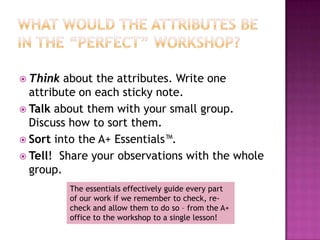
What would the attributes be in the “Perfect” workshop?Think about the attributes.Write one attribute on each sticky note.Talk about them with your small group. Discuss how to sort them.Sort into the A+ Essentials™.Tell!  Share your observations with the whole group.The essentials effectively guide every part of our work if we remember to check, re-check and allow them to do so – from the A+ office to the workshop to a single lesson!
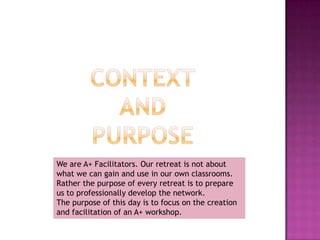
Contextand PurposeWe are A+ Facilitators. Our retreat is not about what we can gain and use in our own classrooms. Rather the purpose of every retreat is to prepare us to professionally develop the network.The purpose of this day is to focus on the creation and facilitation of an A+ workshop.
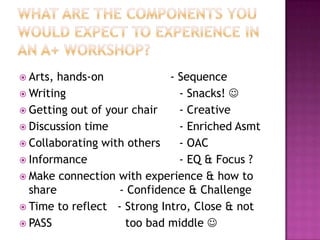
What are the components you would expect to experience in an A+ Workshop?Arts, hands-on                   - SequenceWriting				- Snacks! Getting out of your chair	- CreativeDiscussion time			- Enriched AsmtCollaborating with others	- OACInformance			- EQ & Focus ?Make connection with experience & how to share                  - Confidence & ChallengeTime to reflect   - Strong Intro, Close & not PASS                     too bad middle 
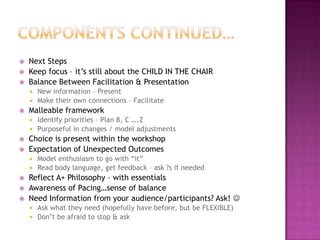
Components Continued…Next StepsKeep focus – it’s still about the CHILD IN THE CHAIRBalance Between Facilitation & PresentationNew information – PresentMake their own connections – FacilitateMalleable frameworkIdentify priorities – Plan B, C ….Z Purposeful in changes / model adjustmentsChoice is present within the workshopExpectation of Unexpected Outcomes Model enthusiasm to go with “it”Read body language, get feedback – ask ?s if neededReflect A+ Philosophy – with essentialsAwareness of Pacing…sense of balanceNeed Information from your audience/participants? Ask! Ask what they need (hopefully have before, but be FLEXIBLE)Don’t be afraid to stop & ask
How would you organize the components?Begin with the end in mindGive time for the creative process in developmentBe prepared, know it is not linear – SHIFT happensCommunicate your idea so your collaborator can understand what the idea isHear ALL ideas – keep an open mindKnow who your audience is/background infoHow long, who is it for? Who will facilitate what we create?Create the workshop that a collaborator can be identified that could share it with you.TODAY working on YOUR idea Think about Your idea - Explain the WHY of this idea, build the HOW as you plan
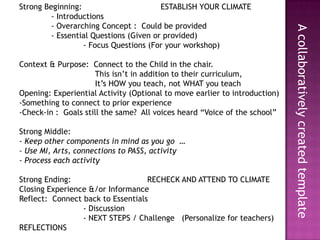
Strong Beginning:                                 ESTABLISH YOUR CLIMATE	- Introductions	- Overarching Concept :  Could be provided	- Essential Questions (Given or provided)		- Focus Questions (For your workshop)Context & Purpose:  Connect to the Child in the chair.  		     This isn’t in addition to their curriculum,   		     It’s HOW you teach, not WHAT you teach Opening: Experiential Activity (Optional to move earlier to introduction)Something to connect to prior experience
Check-in :  Goals still the same?  All voices heard “Voice of the school”Strong Middle:Keep other components in mind as you go  …- Use MI, Arts, connections to PASS, activity- Process each activityStrong Ending: 			RECHECK AND ATTEND TO CLIMATEClosing Experience &/or InformanceReflect:  Connect back to Essentials		- Discussion		- NEXT STEPS / Challenge   (Personalize for teachers)REFLECTIONSA collaboratively created template
Enjoy your break!See you in 15 minutes!Provide breaks for extended workshops. Watch your crowd and be ready to move your break time as needed.
Switch, Change, rotateMake a line with 2 other people (3 total)Listen for directions-Switch- 1st and 3rd change placesChange- change directions (leader decides)Rotate- 1st person goes to the backIn our processing we connected this to the flexibility and shifting roles of a team as we facilitate. Know the whole workshop, not just your sections… just in case. 
Partner up!This was only the beginning of our feedback and collaboration today. Did your partner’s feedback impact your choice?Share your two workshop ideas with your partner.Partner, listen and ask clarifying questions.Reverse roles.Give each other feedback on how each idea was presented; which idea elicited the most passion, expression, interest?Decide which of your ideas you’d like to work on today.
Consider these questions…Which content areas, arts and PASS skills will be integrated?What enduring understandings will participants take with them?What products and resources do you want them to have after experiencing the workshop?Shared for more collaborative feedback!
Focus Questions!What should focus questions include?Write two focus questions for your workshop.Share with your partner.Utilize your teammates! Begin and get feedback. Per Stephanie Crossno, “Preparation, incubation, illumination and implementation” can occur and cycle repeatedly in development of workshop.
LUNCH TIME!Ding! Ding! Ding!  Dinner’s ready!		Enjoy your lunch.			See you soon!For a full day experience monitor the approach of meal times to make sure you are at a logical break in content. Sometimes stopping at the right point can spur a natural continuation of conversations at meals - or even overnight.
Integrated Workshop FrameworkWhat MIs and Essentials have been addressed?How will you address those that have not been addressed?What’s missing?What are your next steps?What other information do you need to set the agenda?What experts can help you?Are you having fun yet?Find those components! They are there, and the framework will assist you in organizing and recording them!
Take a trip down memory lane…Did you include:Introductions?Focus questions?Experiential activities?Processing questions prepared in advance?An opportunity to create something?Reflection time
Consult and shift: the “SNOWBALL” versionEven these quick and purposeful activities can be quickly processed with participants for classroom use.Write your name and your workshop idea on a piece of paper.Wad it up and “throw your snowball” (gentle, not at anyone).Open, read. Write your name if you have ideas or info to share – OR the name of a Fellow to whom they might want to talk.Wad up and repeat several times.Open, read, and deliver to originator.
Processing Questions:How do you create high quality processing questions?Let’s go visit Mr. Bloom.Choose one part of your workshop.Brainstorm a list of processing questions using Bloom’s Taxonomy to inspire you.Write them! Use them! Add to your list as you create new ones over repetition of your workshop.
Reflect and act!What do I need to do to move forward in my planning?Do I need to make an appointment with a consultant, or can we talk today?Enjoy a 15 minute break, then join the break-out sessions.
Breakout sessions	Early Childhood and Elementary:The Art and Science of ProcessSecondary:ClaymationHow did these workshops incorporate the components we’ve been exploring? We moved in and out of the workshop to look again at the components in action. Remember today is about preparation to create and facilitate! The enjoyment and ideas for your classroom in these workshops are just the cherries on top! We’re here to improve what we give to the network!
Next Steps and ClosingSome schools may have Day 1 of Institute on-site in May or June and other 4 in July!Workshop framework:  is already in common docs. Minor revisions to it are in version available on ning – as is updated OK A+ logo.Let RW know when you have a good idea about a workshop for summer.  Ideas we’ve shared today will be posted to A+ Facilitators Group in A+ Ning. Record of workshops in progress:  If we see something for which there is a great need, share this info know so Fellows can get working.Already know we need:  Secondary workshops – especially those integrating multiple disciplines, EC – including arts experiences for infants and toddlers, Math, Special Ed, Differentiated Instruction Use common docs directories to find and contact collaborators as needed. May also contact in ning.Send your frameworks, handouts and any other electronic document you create or use to A+ to keep them safe and available for you. Send frameworks and docs electronically.Need to know Summer availability No Later Than March 30. Due date will be earlier to help ensure this. Survey forms will be sent by first week of March.Workshop essentials book if you have one to loan, please let Amanda Joy Wells know: amandajoy74@hotmail.com  Arts Integration Seminar in Tulsa Feb 27th. Free to A+ schools and facilitators. $30 for others. Excellent workshop with gift resource. To register: http://www.surveymonkey.com/s/WYYV9VN

Midwinter Retreat 2010 For Ning

  • 1.
    Example of engagingparticipants with purpose from the moment they enter.Welcome! As you enter…Write your two workshop ideas on the appropriate chart with your name beside it.Create a two-sided construction paper mask. One side represents the side of you that should tell the world how great you are.The other side represents the side of you that shares the things that you need from others or are not comfortable doing
  • 2.
    Welcome!Oklahoma A+ MidwinterRetreatFebruary 20, 2010Designing and Facilitating Oklahoma A+ WorkshopsGlenda Cook, Cindy Scarberry and Rosalynn Wade
  • 3.
    Example of meaningful/ relevant introductions in a very large group.IntroductionsThinking of your gifts, talents and needs as you begin planning, share in small groups:Your name, area of expertise, length of time you’ve been with A+.The strengths you bring to the team, things you love to do, areas of expertise, things you need from others…brag ‘bout yaself! The areas where you are not so comfortable, things you’d prefer not to do, things you need from others…don’t be shy!
  • 4.
    Oklahoma A+ MidwinterRetreatEssential questions are set for the large A+ event (sometimes shared as examples of EQs written for students).Essential Questions:What is A+?How do the A+ Essentials™ frame our work?Focus Questions:How do the Essentials™ guide A+ workshop development?Where do workshop ideas come from?How are ideas developed into an A+ workshop?Focus questions are written as the questions participants should be able to answer at the end of your workshop and describe the focus of your workshop.
  • 5.
    What would theattributes be in the “Perfect” workshop?Think about the attributes.Write one attribute on each sticky note.Talk about them with your small group. Discuss how to sort them.Sort into the A+ Essentials™.Tell! Share your observations with the whole group.The essentials effectively guide every part of our work if we remember to check, re-check and allow them to do so – from the A+ office to the workshop to a single lesson!
  • 6.
    Contextand PurposeWe areA+ Facilitators. Our retreat is not about what we can gain and use in our own classrooms. Rather the purpose of every retreat is to prepare us to professionally develop the network.The purpose of this day is to focus on the creation and facilitation of an A+ workshop.
  • 7.
    What are thecomponents you would expect to experience in an A+ Workshop?Arts, hands-on - SequenceWriting - Snacks! Getting out of your chair - CreativeDiscussion time - Enriched AsmtCollaborating with others - OACInformance - EQ & Focus ?Make connection with experience & how to share - Confidence & ChallengeTime to reflect - Strong Intro, Close & not PASS too bad middle 
  • 8.
    Components Continued…Next StepsKeepfocus – it’s still about the CHILD IN THE CHAIRBalance Between Facilitation & PresentationNew information – PresentMake their own connections – FacilitateMalleable frameworkIdentify priorities – Plan B, C ….Z Purposeful in changes / model adjustmentsChoice is present within the workshopExpectation of Unexpected Outcomes Model enthusiasm to go with “it”Read body language, get feedback – ask ?s if neededReflect A+ Philosophy – with essentialsAwareness of Pacing…sense of balanceNeed Information from your audience/participants? Ask! Ask what they need (hopefully have before, but be FLEXIBLE)Don’t be afraid to stop & ask
  • 9.
    How would youorganize the components?Begin with the end in mindGive time for the creative process in developmentBe prepared, know it is not linear – SHIFT happensCommunicate your idea so your collaborator can understand what the idea isHear ALL ideas – keep an open mindKnow who your audience is/background infoHow long, who is it for? Who will facilitate what we create?Create the workshop that a collaborator can be identified that could share it with you.TODAY working on YOUR idea Think about Your idea - Explain the WHY of this idea, build the HOW as you plan
  • 10.
    Strong Beginning: ESTABLISH YOUR CLIMATE - Introductions - Overarching Concept : Could be provided - Essential Questions (Given or provided) - Focus Questions (For your workshop)Context & Purpose: Connect to the Child in the chair. This isn’t in addition to their curriculum, It’s HOW you teach, not WHAT you teach Opening: Experiential Activity (Optional to move earlier to introduction)Something to connect to prior experience
  • 11.
    Check-in : Goals still the same? All voices heard “Voice of the school”Strong Middle:Keep other components in mind as you go …- Use MI, Arts, connections to PASS, activity- Process each activityStrong Ending: RECHECK AND ATTEND TO CLIMATEClosing Experience &/or InformanceReflect: Connect back to Essentials - Discussion - NEXT STEPS / Challenge (Personalize for teachers)REFLECTIONSA collaboratively created template
  • 12.
    Enjoy your break!Seeyou in 15 minutes!Provide breaks for extended workshops. Watch your crowd and be ready to move your break time as needed.
  • 13.
    Switch, Change, rotateMakea line with 2 other people (3 total)Listen for directions-Switch- 1st and 3rd change placesChange- change directions (leader decides)Rotate- 1st person goes to the backIn our processing we connected this to the flexibility and shifting roles of a team as we facilitate. Know the whole workshop, not just your sections… just in case. 
  • 14.
    Partner up!This wasonly the beginning of our feedback and collaboration today. Did your partner’s feedback impact your choice?Share your two workshop ideas with your partner.Partner, listen and ask clarifying questions.Reverse roles.Give each other feedback on how each idea was presented; which idea elicited the most passion, expression, interest?Decide which of your ideas you’d like to work on today.
  • 15.
    Consider these questions…Whichcontent areas, arts and PASS skills will be integrated?What enduring understandings will participants take with them?What products and resources do you want them to have after experiencing the workshop?Shared for more collaborative feedback!
  • 16.
    Focus Questions!What shouldfocus questions include?Write two focus questions for your workshop.Share with your partner.Utilize your teammates! Begin and get feedback. Per Stephanie Crossno, “Preparation, incubation, illumination and implementation” can occur and cycle repeatedly in development of workshop.
  • 17.
    LUNCH TIME!Ding! Ding!Ding! Dinner’s ready! Enjoy your lunch. See you soon!For a full day experience monitor the approach of meal times to make sure you are at a logical break in content. Sometimes stopping at the right point can spur a natural continuation of conversations at meals - or even overnight.
  • 18.
    Integrated Workshop FrameworkWhatMIs and Essentials have been addressed?How will you address those that have not been addressed?What’s missing?What are your next steps?What other information do you need to set the agenda?What experts can help you?Are you having fun yet?Find those components! They are there, and the framework will assist you in organizing and recording them!
  • 19.
    Take a tripdown memory lane…Did you include:Introductions?Focus questions?Experiential activities?Processing questions prepared in advance?An opportunity to create something?Reflection time
  • 20.
    Consult and shift:the “SNOWBALL” versionEven these quick and purposeful activities can be quickly processed with participants for classroom use.Write your name and your workshop idea on a piece of paper.Wad it up and “throw your snowball” (gentle, not at anyone).Open, read. Write your name if you have ideas or info to share – OR the name of a Fellow to whom they might want to talk.Wad up and repeat several times.Open, read, and deliver to originator.
  • 21.
    Processing Questions:How doyou create high quality processing questions?Let’s go visit Mr. Bloom.Choose one part of your workshop.Brainstorm a list of processing questions using Bloom’s Taxonomy to inspire you.Write them! Use them! Add to your list as you create new ones over repetition of your workshop.
  • 22.
    Reflect and act!Whatdo I need to do to move forward in my planning?Do I need to make an appointment with a consultant, or can we talk today?Enjoy a 15 minute break, then join the break-out sessions.
  • 23.
    Breakout sessions Early Childhoodand Elementary:The Art and Science of ProcessSecondary:ClaymationHow did these workshops incorporate the components we’ve been exploring? We moved in and out of the workshop to look again at the components in action. Remember today is about preparation to create and facilitate! The enjoyment and ideas for your classroom in these workshops are just the cherries on top! We’re here to improve what we give to the network!
  • 24.
    Next Steps andClosingSome schools may have Day 1 of Institute on-site in May or June and other 4 in July!Workshop framework: is already in common docs. Minor revisions to it are in version available on ning – as is updated OK A+ logo.Let RW know when you have a good idea about a workshop for summer.  Ideas we’ve shared today will be posted to A+ Facilitators Group in A+ Ning. Record of workshops in progress: If we see something for which there is a great need, share this info know so Fellows can get working.Already know we need: Secondary workshops – especially those integrating multiple disciplines, EC – including arts experiences for infants and toddlers, Math, Special Ed, Differentiated Instruction Use common docs directories to find and contact collaborators as needed. May also contact in ning.Send your frameworks, handouts and any other electronic document you create or use to A+ to keep them safe and available for you. Send frameworks and docs electronically.Need to know Summer availability No Later Than March 30. Due date will be earlier to help ensure this. Survey forms will be sent by first week of March.Workshop essentials book if you have one to loan, please let Amanda Joy Wells know: amandajoy74@hotmail.com  Arts Integration Seminar in Tulsa Feb 27th. Free to A+ schools and facilitators. $30 for others. Excellent workshop with gift resource. To register: http://www.surveymonkey.com/s/WYYV9VN