FACULTAD DE FILOSOFÍA, LETRAS Y CIENCIAS DE LA
                EDUCACIÓN

       Theme: General teaching Methods


                                     VALERIA VELASCO
.

             TEACHING METHODS
DEFINITION.
The set of moments and techniques logically
coordinated to direct the student toward
certain goals /objectives
It is a set of didactic procedure that lead the
learning.

It includes:
 Presentation of the subject.
Execution or development of the subject
Verification and rectification of learning.
Logical methods or knowledge methods

Are those that allow the acquisition or production
of knowledge: inductive, deductive, analytic and
synthetic. The induction, deduction, analysis and
synthesis, are processes that are complemented
within the teaching method.
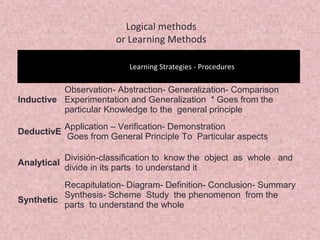
Logical methods
                         or Learning Methods

                            Learning Strategies - Procedures

          Observation- Abstraction- Generalization- Comparison
Inductive Experimentation and Generalization * Goes from the
          particular Knowledge to the general principle
             Application – Verification- Demonstration
DeductivE
             Goes from General Principle To Particular aspects

             División-classification to know the object as whole and
Analytical
             divide in its parts to understand it
          Recapitulation- Diagram- Definition- Conclusion- Summary
          Synthesis- Scheme Study the phenomenon from the
Synthetic
          parts to understand the whole
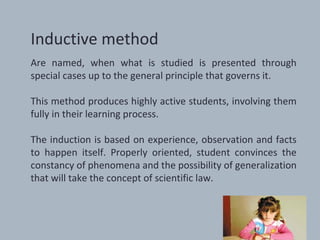
Inductive method
Are named, when what is studied is presented through
special cases up to the general principle that governs it.

This method produces highly active students, involving them
fully in their learning process.

The induction is based on experience, observation and facts
to happen itself. Properly oriented, student convinces the
constancy of phenomena and the possibility of generalization
that will take the concept of scientific law.
Deductive method

Is to infer particular propositions or broader universal
premises.
The teacher presents concepts, principles, statements or
definitions of which are being drawn conclusions and
consequences.
The teacher can lead students to conclusions or criticize
particular aspects based on general principles.
An example are the axioms learned in mathematics, which
can be applied to solve problems or cases.
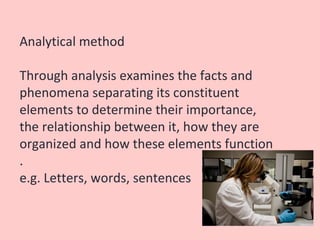
Analytical method

Through analysis examines the facts and
phenomena separating its constituent
elements to determine their importance,
the relationship between it, how they are
organized and how these elements function
.
e.g. Letters, words, sentences
Methods in relation to student work


           Individual


           Collective


             Mixed
Methods in relation to what is taught

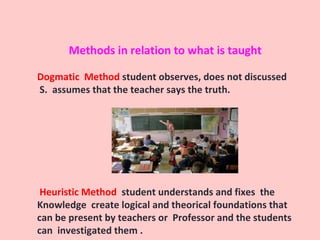
Dogmatic Method student observes, does not discussed
S. assumes that the teacher says the truth.


 Heuristic Method student understands and fixes the
Knowledge create logical and theorical foundations that
can be present by teachers or Professor and the students
can investigated them .
Teaching technique

• It Is the educational resource to which comes
  to concretize the method

• Teaching technique represents the way to
  achieve a purpose of educational process..
Teaching technique
•   Essential factors of teaching:
•   Analysis of participant
•   age
•   sex
•   schooling
•   skills
•   Experiences in the subjects
•   motivations
•   Analysis of matter:
•   thematic content
•   Instruction units
•   Key points (to illustrate, to define teaching time
Some Thecniques
•   Expository technique     •   seminar
•   Small Group Discussion   •   Tutorials
•   The case method
                             •   Using simulation models
•   Guided Reading
                             •   Conferences
•   Brainstorming
•   Group Dynamics           •   Company visits.
•   master class             •   dramatization
•   Practical classes.
Thanks

General teaching method

  • 1.
    FACULTAD DE FILOSOFÍA,LETRAS Y CIENCIAS DE LA EDUCACIÓN Theme: General teaching Methods VALERIA VELASCO
  • 2.
    . TEACHING METHODS DEFINITION. The set of moments and techniques logically coordinated to direct the student toward certain goals /objectives It is a set of didactic procedure that lead the learning. It includes: Presentation of the subject. Execution or development of the subject Verification and rectification of learning.
  • 3.
    Logical methods orknowledge methods Are those that allow the acquisition or production of knowledge: inductive, deductive, analytic and synthetic. The induction, deduction, analysis and synthesis, are processes that are complemented within the teaching method.
  • 4.
    Logical methods or Learning Methods Learning Strategies - Procedures Observation- Abstraction- Generalization- Comparison Inductive Experimentation and Generalization * Goes from the particular Knowledge to the general principle Application – Verification- Demonstration DeductivE Goes from General Principle To Particular aspects División-classification to know the object as whole and Analytical divide in its parts to understand it Recapitulation- Diagram- Definition- Conclusion- Summary Synthesis- Scheme Study the phenomenon from the Synthetic parts to understand the whole
  • 5.
    Inductive method Are named,when what is studied is presented through special cases up to the general principle that governs it. This method produces highly active students, involving them fully in their learning process. The induction is based on experience, observation and facts to happen itself. Properly oriented, student convinces the constancy of phenomena and the possibility of generalization that will take the concept of scientific law.
  • 6.
    Deductive method Is toinfer particular propositions or broader universal premises. The teacher presents concepts, principles, statements or definitions of which are being drawn conclusions and consequences. The teacher can lead students to conclusions or criticize particular aspects based on general principles. An example are the axioms learned in mathematics, which can be applied to solve problems or cases.
  • 7.
    Analytical method Through analysisexamines the facts and phenomena separating its constituent elements to determine their importance, the relationship between it, how they are organized and how these elements function . e.g. Letters, words, sentences
  • 11.
    Methods in relationto student work Individual Collective Mixed
  • 12.
    Methods in relationto what is taught Dogmatic Method student observes, does not discussed S. assumes that the teacher says the truth. Heuristic Method student understands and fixes the Knowledge create logical and theorical foundations that can be present by teachers or Professor and the students can investigated them .
  • 13.
    Teaching technique • ItIs the educational resource to which comes to concretize the method • Teaching technique represents the way to achieve a purpose of educational process..
  • 14.
    Teaching technique • Essential factors of teaching: • Analysis of participant • age • sex • schooling • skills • Experiences in the subjects • motivations • Analysis of matter: • thematic content • Instruction units • Key points (to illustrate, to define teaching time
  • 15.
    Some Thecniques • Expository technique • seminar • Small Group Discussion • Tutorials • The case method • Using simulation models • Guided Reading • Conferences • Brainstorming • Group Dynamics • Company visits. • master class • dramatization • Practical classes.
  • 16.