Innovation versus
Business
An archestra notebook.
© 2013 Malcolm Ryder / archestra
Why Bother
In a business, any innovation must pass the Who Cares test.
Business cares about innovation approximately because it needs to. Without
a need, an innovation is a change carrying some degree of latent interest.
Business is not a requirement of innovation.
But when a business needs an innovation, the key prerequisite is the ability
of the business to host the innovation. This usually means that some
innovations are more likely to succeed in the business than are others.
Impacts
• In the mid 1960s, Dick Fosbury jumped backwards over the high bar and permanently
changed how Olympic Gold Medals could be earned.
• In 1967, AT&T and the US Government together created the 9-1-1 telephone number.
• In the 1970’s home equity loans were introduced in the housing industry.
• In the 1980’s, turntabling was invented, an instrumental technique of Hip Hop that
completely reset expectations about future music and spawned an entire constellation of
new genres dominating much of musical culture for persons in the developed world born
during the next 25 years.
• High-powered computation, applied as sequence analysis in biology, created
comprehensive mapping of the human genome in April 2003, globally resetting the basis
for development of new medicines.
• In 2012, the Taco Bell food chain designed and launched the Doritos Locos Taco and sold
100 million of them in 10 weeks.
Originality
The importance of being original is highly relative.
• For a creator, originality is a motivation
• For a supplier, originality is a feature
• For an owner, originality is an asset
Originality can occur, simultaneously and unacknowledged, at multiple unrelated
starting points, and wind up converging at the same point in the same innovation.
Frequently, the key to being innovative is the creativity exercised in being
derivative.
Innovation does not depend on originality. Innovation is a predisposition of a way
to get something done.
Ideas
Many of the best moments of creation come from chance, from accidents, from
mistakes, and from breaking rules – mainly because those occasions introduce
something unusual into the existing point of view.
Resolving or accommodating the difference can generate unusual arrangements
that turn out to be useful.
So often, the surprise of many new ideas is, nothing more than an awareness and
acknowledgement that the difference is useful enough to reproduce on purpose.
Creativity simply assumes the permission to make that acknowledgement and do
something about it.
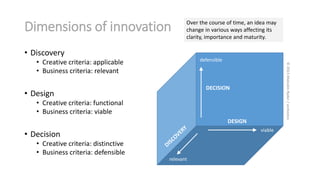
Dimensions of innovation

Over the course of time, an idea may
change in various ways affecting its
clarity, importance and maturity.

• Discovery

© 2013 Malcolm Ryder / archestra

defensible

• Creative criteria: applicable
• Business criteria: relevant

DECISION

• Design
• Creative criteria: functional
• Business criteria: viable

DESIGN
viable

• Decision
• Creative criteria: distinctive
• Business criteria: defensible
relevant
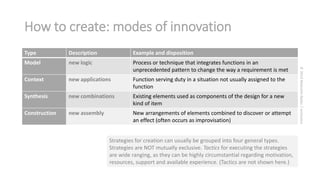
How to create: modes of innovation
Description

Example and disposition

Model

new logic

Process or technique that integrates functions in an
unprecedented pattern to change the way a requirement is met

Context

new applications

Function serving duty in a situation not usually assigned to the
function

Synthesis

new combinations

Existing elements used as components of the design for a new
kind of item

Construction

new assembly

New arrangements of elements combined to discover or attempt
an effect (often occurs as improvisation)

Strategies for creation can usually be grouped into four general types.
Strategies are NOT mutually exclusive. Tactics for executing the strategies
are wide ranging, as they can be highly circumstantial regarding motivation,
resources, support and available experience. (Tactics are not shown here.)

© 2013 Malcolm Ryder / archestra

Type
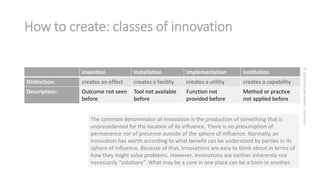
How to create: classes of innovation
Installation

Implementation

Institution

Distinction:

creates an effect

creates a facility

creates a utility

creates a capability

Description:

Outcome not seen
before

Tool not available
before

Function not
provided before

Method or practice
not applied before

The common denominator of innovation is the production of something that is
unprecedented for the location of its influence. There is no presumption of
permanence nor of presence outside of the sphere of influence. Normally, an
innovation has worth according to what benefit can be understood by parties in its
sphere of influence. Because of that, Innovations are easy to think about in terms of
how they might solve problems. However, innovations are neither inherently nor
necessarily “solutions”. What may be a cure in one place can be a toxin in another.

© 2013 Malcolm Ryder / archestra

Invention
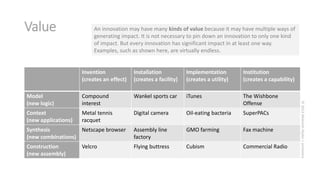
Value

An innovation may have many kinds of value because it may have multiple ways of
generating impact. It is not necessary to pin down an innovation to only one kind
of impact. But every innovation has significant impact in at least one way.
Examples, such as shown here, are virtually endless.

Installation
(creates a facility)

Implementation
(creates a utility)

Institution
(creates a capability)

Model
(new logic)

Compound
interest

Wankel sports car

iTunes

The Wishbone
Offense

Context
(new applications)

Metal tennis
racquet

Digital camera

Oil-eating bacteria

SuperPACs

Synthesis
Netscape browser
(new combinations)

Assembly line
factory

GMO farming

Fax machine

Construction
(new assembly)

Flying buttress

Cubism

Commercial Radio

Velcro

© 2013 Malcolm Ryder / archestra

Invention
(creates an effect)
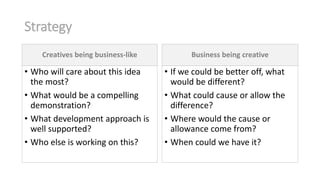
Strategy
Creatives being business-like

• Who will care about this idea
the most?
• What would be a compelling
demonstration?
• What development approach is
well supported?
• Who else is working on this?

Business being creative

• If we could be better off, what
would be different?
• What could cause or allow the
difference?
• Where would the cause or
allowance come from?
• When could we have it?
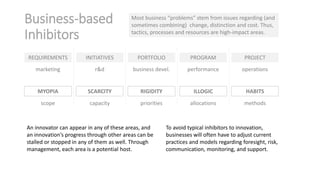
Business-based
Inhibitors

Most business “problems” stem from issues regarding (and
sometimes combining) change, distinction and cost. Thus,
tactics, processes and resources are high-impact areas.

REQUIREMENTS

INITIATIVES

PORTFOLIO

PROGRAM

PROJECT

marketing

r&d

business devel.

performance

operations

MYOPIA

SCARCITY

RIGIDITY

ILLOGIC

HABITS

scope

capacity

priorities

allocations

methods

An innovator can appear in any of these areas, and
an innovation’s progress through other areas can be
stalled or stopped in any of them as well. Through
management, each area is a potential host.

To avoid typical inhibitors to innovation,
businesses will often have to adjust current
practices and models regarding foresight, risk,
communication, monitoring, and support.
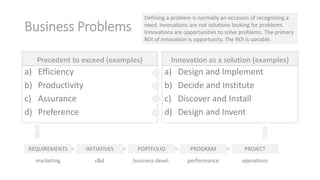
Defining a problem is normally an occasion of recognizing a
need. Innovations are not solutions looking for problems.
Innovations are opportunities to solve problems. The primary
ROI of innovation is opportunity. The ROI is variable.

Business Problems
Precedent to exceed (examples)

a)
b)
c)
d)

Efficiency
Productivity
Assurance
Preference

Innovation as a solution (examples)

a)
b)
c)
d)

Design and Implement
Decide and Institute
Discover and Install
Design and Invent

REQUIREMENTS

INITIATIVES

PORTFOLIO

PROGRAM

PROJECT

marketing

r&d

business devel.

performance

operations
Notes
• Eschew mythology. Innovations described somewhere are not
necessarily prescriptions for somewhere else.
• Big words apply to small things. For example, a tiny initiative is still an
initiative, but what matters is if an initiative is needed instead of
something else.
• In business, the really critical success factor is not what’s new, but
instead what’s next. Sometimes, it is important that what’s next is
new. Sometimes, new is not important.
• Unfortunately, business speakers tend to omit the word “business”
from the phrase “successful business innovation”. It’s a habit.

Innovation versus Business

  • 1.
    Innovation versus Business An archestranotebook. © 2013 Malcolm Ryder / archestra
  • 2.
    Why Bother In abusiness, any innovation must pass the Who Cares test. Business cares about innovation approximately because it needs to. Without a need, an innovation is a change carrying some degree of latent interest. Business is not a requirement of innovation. But when a business needs an innovation, the key prerequisite is the ability of the business to host the innovation. This usually means that some innovations are more likely to succeed in the business than are others.
  • 3.
    Impacts • In themid 1960s, Dick Fosbury jumped backwards over the high bar and permanently changed how Olympic Gold Medals could be earned. • In 1967, AT&T and the US Government together created the 9-1-1 telephone number. • In the 1970’s home equity loans were introduced in the housing industry. • In the 1980’s, turntabling was invented, an instrumental technique of Hip Hop that completely reset expectations about future music and spawned an entire constellation of new genres dominating much of musical culture for persons in the developed world born during the next 25 years. • High-powered computation, applied as sequence analysis in biology, created comprehensive mapping of the human genome in April 2003, globally resetting the basis for development of new medicines. • In 2012, the Taco Bell food chain designed and launched the Doritos Locos Taco and sold 100 million of them in 10 weeks.
  • 4.
    Originality The importance ofbeing original is highly relative. • For a creator, originality is a motivation • For a supplier, originality is a feature • For an owner, originality is an asset Originality can occur, simultaneously and unacknowledged, at multiple unrelated starting points, and wind up converging at the same point in the same innovation. Frequently, the key to being innovative is the creativity exercised in being derivative. Innovation does not depend on originality. Innovation is a predisposition of a way to get something done.
  • 5.
    Ideas Many of thebest moments of creation come from chance, from accidents, from mistakes, and from breaking rules – mainly because those occasions introduce something unusual into the existing point of view. Resolving or accommodating the difference can generate unusual arrangements that turn out to be useful. So often, the surprise of many new ideas is, nothing more than an awareness and acknowledgement that the difference is useful enough to reproduce on purpose. Creativity simply assumes the permission to make that acknowledgement and do something about it.
  • 6.
    Dimensions of innovation Overthe course of time, an idea may change in various ways affecting its clarity, importance and maturity. • Discovery © 2013 Malcolm Ryder / archestra defensible • Creative criteria: applicable • Business criteria: relevant DECISION • Design • Creative criteria: functional • Business criteria: viable DESIGN viable • Decision • Creative criteria: distinctive • Business criteria: defensible relevant
  • 7.
    How to create:modes of innovation Description Example and disposition Model new logic Process or technique that integrates functions in an unprecedented pattern to change the way a requirement is met Context new applications Function serving duty in a situation not usually assigned to the function Synthesis new combinations Existing elements used as components of the design for a new kind of item Construction new assembly New arrangements of elements combined to discover or attempt an effect (often occurs as improvisation) Strategies for creation can usually be grouped into four general types. Strategies are NOT mutually exclusive. Tactics for executing the strategies are wide ranging, as they can be highly circumstantial regarding motivation, resources, support and available experience. (Tactics are not shown here.) © 2013 Malcolm Ryder / archestra Type
  • 8.
    How to create:classes of innovation Installation Implementation Institution Distinction: creates an effect creates a facility creates a utility creates a capability Description: Outcome not seen before Tool not available before Function not provided before Method or practice not applied before The common denominator of innovation is the production of something that is unprecedented for the location of its influence. There is no presumption of permanence nor of presence outside of the sphere of influence. Normally, an innovation has worth according to what benefit can be understood by parties in its sphere of influence. Because of that, Innovations are easy to think about in terms of how they might solve problems. However, innovations are neither inherently nor necessarily “solutions”. What may be a cure in one place can be a toxin in another. © 2013 Malcolm Ryder / archestra Invention
  • 9.
    Value An innovation mayhave many kinds of value because it may have multiple ways of generating impact. It is not necessary to pin down an innovation to only one kind of impact. But every innovation has significant impact in at least one way. Examples, such as shown here, are virtually endless. Installation (creates a facility) Implementation (creates a utility) Institution (creates a capability) Model (new logic) Compound interest Wankel sports car iTunes The Wishbone Offense Context (new applications) Metal tennis racquet Digital camera Oil-eating bacteria SuperPACs Synthesis Netscape browser (new combinations) Assembly line factory GMO farming Fax machine Construction (new assembly) Flying buttress Cubism Commercial Radio Velcro © 2013 Malcolm Ryder / archestra Invention (creates an effect)
  • 10.
    Strategy Creatives being business-like •Who will care about this idea the most? • What would be a compelling demonstration? • What development approach is well supported? • Who else is working on this? Business being creative • If we could be better off, what would be different? • What could cause or allow the difference? • Where would the cause or allowance come from? • When could we have it?
  • 11.
    Business-based Inhibitors Most business “problems”stem from issues regarding (and sometimes combining) change, distinction and cost. Thus, tactics, processes and resources are high-impact areas. REQUIREMENTS INITIATIVES PORTFOLIO PROGRAM PROJECT marketing r&d business devel. performance operations MYOPIA SCARCITY RIGIDITY ILLOGIC HABITS scope capacity priorities allocations methods An innovator can appear in any of these areas, and an innovation’s progress through other areas can be stalled or stopped in any of them as well. Through management, each area is a potential host. To avoid typical inhibitors to innovation, businesses will often have to adjust current practices and models regarding foresight, risk, communication, monitoring, and support.
  • 12.
    Defining a problemis normally an occasion of recognizing a need. Innovations are not solutions looking for problems. Innovations are opportunities to solve problems. The primary ROI of innovation is opportunity. The ROI is variable. Business Problems Precedent to exceed (examples) a) b) c) d) Efficiency Productivity Assurance Preference Innovation as a solution (examples) a) b) c) d) Design and Implement Decide and Institute Discover and Install Design and Invent REQUIREMENTS INITIATIVES PORTFOLIO PROGRAM PROJECT marketing r&d business devel. performance operations
  • 13.
    Notes • Eschew mythology.Innovations described somewhere are not necessarily prescriptions for somewhere else. • Big words apply to small things. For example, a tiny initiative is still an initiative, but what matters is if an initiative is needed instead of something else. • In business, the really critical success factor is not what’s new, but instead what’s next. Sometimes, it is important that what’s next is new. Sometimes, new is not important. • Unfortunately, business speakers tend to omit the word “business” from the phrase “successful business innovation”. It’s a habit.