













TOOLS & PROCESSES
GTP INNOVATION WORKSHOP
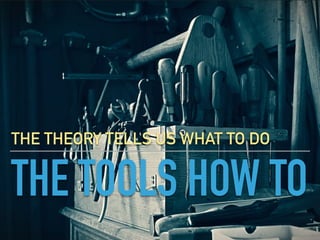
THE TOOLS HOW TO
THE THEORY TELLS US WHAT TO DO
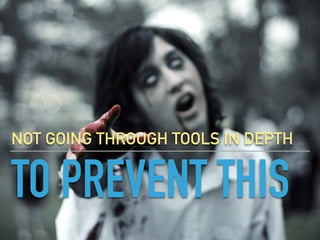
TO PREVENT THIS
NOT GOING THROUGH TOOLS IN DEPTH
BUT YOU
PROBABLY STILL
HAVE TO CALL
THE EXPERTS
DESIGN THINKING ROAD
WE ARE GOING DOWN THE
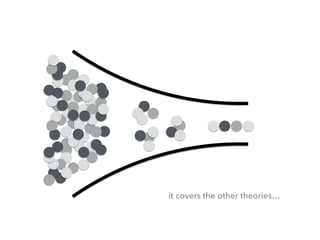
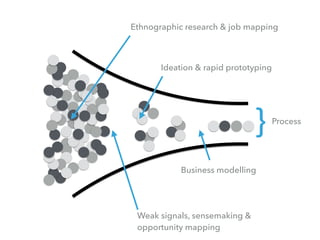
it covers the other theories…
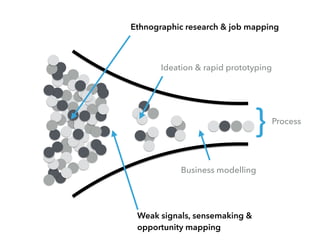
Ethnographic research & job mapping
Weak signals, sensemaking &
opportunity mapping
Ideation & rapid prototyping
Business modelling
} Process
ETHNOGRAPHIC RESEARCH
SURFACING UNMET NEEDS
BLINKERED
RESTRICTED BY 4 BRAND QUESTIONS
ETHNOGRAPHIC RESEARCH IS THE
ART AND SCIENCE OF TELLING
STORIES ABOUT PEOPLES’ STORIES.
IT’S A GREAT WAY TO DEVELOP
BIG INSIGHTS, DECODE
BEHAVIOURS, UNDERSTAND
CONTEXT AND LOCATE UNMET,
UNARTICULATED HUMAN NEED
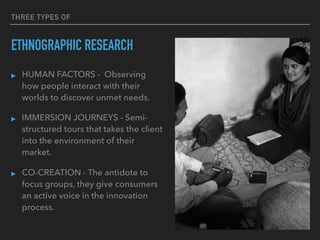
THREE TYPES OF
ETHNOGRAPHIC RESEARCH
▸ HUMAN FACTORS - Observing
how people interact with their
worlds to discover unmet needs.
▸ IMMERSION JOURNEYS - Semi-
structured tours that takes the client
into the environment of their
market.
▸ CO-CREATION - The antidote to
focus groups, they give consumers
an active voice in the innovation
process.
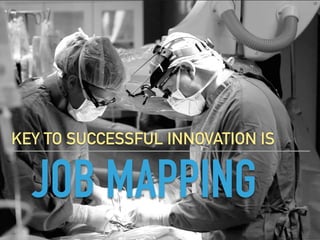
JOB MAPPING
KEY TO SUCCESSFUL INNOVATION IS
THE JOB MAP
▸ Often customers use different products or services to get a
single job done.
▸ Companies often just focus on the product or service that they
are already offering, rather than other products or services
required to complete the offering.
▸ Lance Bettencourt and Anthony Ulwick developed job mapping
which breaks the job down into eight discreet process steps.
▸ By creating the job map, companies can possibly discover new
complementary products and services to offer.
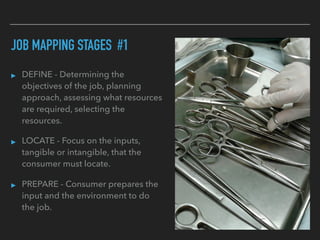
JOB MAPPING STAGES #1
▸ DEFINE - Determining the
objectives of the job, planning
approach, assessing what resources
are required, selecting the
resources.
▸ LOCATE - Focus on the inputs,
tangible or intangible, that the
consumer must locate.
▸ PREPARE - Consumer prepares the
input and the environment to do
the job.
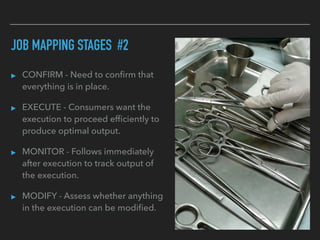
JOB MAPPING STAGES #2
▸ CONFIRM - Need to confirm that
everything is in place.
▸ EXECUTE - Consumers want the
execution to proceed efficiently to
produce optimal output.
▸ MONITOR - Follows immediately
after execution to track output of
the execution.
▸ MODIFY - Assess whether anything
in the execution can be modified.
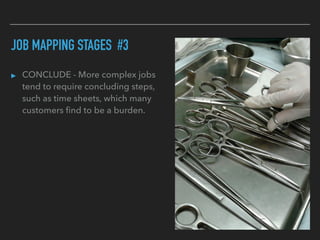
JOB MAPPING STAGES #3
▸ CONCLUDE - More complex jobs
tend to require concluding steps,
such as time sheets, which many
customers find to be a burden.
LOOK FOR WEAK SIGNALS
TO ANTICIPATE THE FUTURE
THE SHIP HAS SAILED
THE PROBLEM WITH TRENDS IS THAT
WEAK SIGNALS ARE SNIPPETS - NOT
STREAMS - OF INFORMATION THAT CAN
HELP COMPANIES FIGURE OUT WHAT
CUSTOMERS WANT AND SPOT LOOMING
INDUSTRY AND MARKET DISRUPTIONS
McKinsey & Co
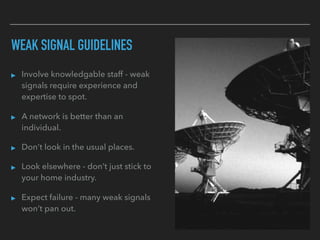
WEAK SIGNAL GUIDELINES
▸ Involve knowledgable staff - weak
signals require experience and
expertise to spot.
▸ A network is better than an
individual.
▸ Don’t look in the usual places.
▸ Look elsewhere - don’t just stick to
your home industry.
▸ Expect failure - many weak signals
won’t pan out.
SENSEMAKING
TACKLING THE UNKNOWN THROUGH
SENSEMAKING INVOLVES - AND INDEED
REQUIRES - AN ARTICULATION OF THE
UNKNOWN, BECAUSE, SOMETIMES TRYING TO
EXPLAIN THE UNKNOWN IS THE ONLY WAY TO
KNOW HOW MUCH YOU UNDERSTAND IT
Deborah Ancona, Director
MIT Leadership Centre
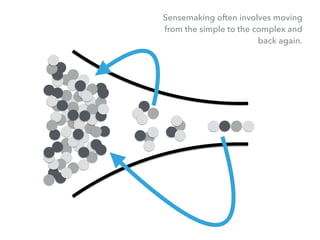
Sensemaking often involves moving
from the simple to the complex and
back again.
SENSEMAKING’S CORE ELEMENTS AND STEPS
EXPLORING THE WIDER SYSTEM
▸ Seek out numerous sources of
different type of quantitative and
qualitative data.
▸ Involve a diverse range of people
in trying to make sense of the data.
▸ Move beyond the obvious and the
stereotypes. Try to understand
nuances and develop empathy
▸ Get information from the front
lines. Look for weak signals.
SENSEMKING’S CORE ELEMENTS AND STEPS
CREATE A MAP OF THE SITUATION
▸ Do not simply apply your existing
framework of thinking /
assumptions. Let the framework
develop from your understanding
of the new situation.
▸ Use images, stories and metaphors
to capture the key elements of the
situation. Don’t be scared to show
multiple sides to issues.
SENSEMAKING’S CORE ELEMENTS AND STEPS
ACT TO CHANGE AND TO LEARN
▸ Learn from small experiments to
see if something is working. Learn
from mistakes and improve on the
previous experiment (think rapid
prototyping).
▸ People are constrained by the
environment that they create for
themselves. Be aware of the
environment and its constraints.
OPPORTUNITY MAPS
NEW LOOK AT COMPETITIVE LANDSCAPE
CRAFTING THE OPPORTUNITY MAP
▸ Often combined with sensemaking.
▸ Opportunity mapping is a convergent exercise that focuses on
distilling and synthesizing all previously gathered knowledge
and insights so that key patterns, themes and opportunity
spaces can be defined, refined and explored.
▸ Creates a visual picture for an organization’s potential future
projects and/or offerings.
▸ Think of it as the innovation equivalent of brand extension and/
or expansion.
BEFORE THERE ARE OPPORTUNITY MAPS…
CREATION OF OPPORTUNITY SPACES
▸ Unmet consumer needs
▸ Newly discovered consumer needs
▸ Unarticulated consumer needs
▸ Broad consumer aspirations
▸ Key gaps in the market
▸ Value drivers
▸ Market / industry intersections
▸ Enabling technologies
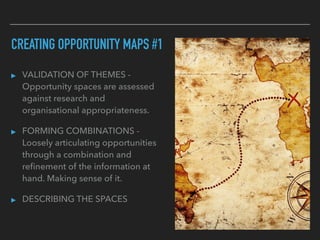
CREATING OPPORTUNITY MAPS #1
▸ VALIDATION OF THEMES -
Opportunity spaces are assessed
against research and
organisational appropriateness.
▸ FORMING COMBINATIONS -
Loosely articulating opportunities
through a combination and
refinement of the information at
hand. Making sense of it.
▸ DESCRIBING THE SPACES
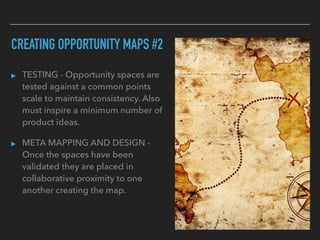
CREATING OPPORTUNITY MAPS #2
▸ TESTING - Opportunity spaces are
tested against a common points
scale to maintain consistency. Also
must inspire a minimum number of
product ideas.
▸ META MAPPING AND DESIGN -
Once the spaces have been
validated they are placed in
collaborative proximity to one
another creating the map.
Ethnographic research & job mapping
Weak signals, sensemaking &
opportunity mapping
Ideation & rapid prototyping
Business modelling
} Process
IDEATION
NOT AS EASY OR EXCLUSIVE AS IT LOOKS
CREATIVITY IS JUST CONNECTING THINGS. WHEN YOU
ASK CREATIVE PEOPLE HOW THEY DID SOMETHING,
THEY FEEL A LITTLE GUILTY BECAUSE THEY DIDN’T
REALLY DO IT, THEY JUST SAW SOMETHING. IT
SEEMED OBVIOUS TO THEM AFTER A WHILE.
Steve Jobs
MANY OPTIONS
WHEN IT COMES TO IDEATION, THERE ARE
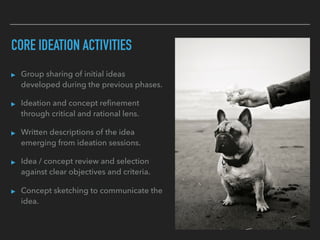
CORE IDEATION ACTIVITIES
▸ Group sharing of initial ideas
developed during the previous phases.
▸ Ideation and concept refinement
through critical and rational lens.
▸ Written descriptions of the idea
emerging from ideation sessions.
▸ Idea / concept review and selection
against clear objectives and criteria.
▸ Concept sketching to communicate the
idea.
RAPID PROTOTYPING
REFINING INNOVATION THROUGH IMPERFECTION
PROTOTYPES EXPLORE THE SOLUTION
SPACE. THEY MAY BE DIGITAL, PHYSICAL,
OR DIAGRAMMATIC, BUT IN ALL CASES
THEY ARE A WAY TO COMMUNICATE IDEAS.
Harvard Business Review
THREE BROAD CATEGORIES OF PROTOTYPING
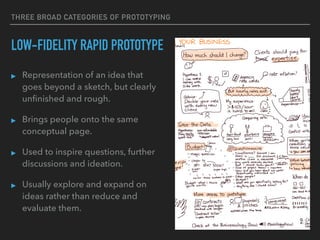
LOW-FIDELITY RAPID PROTOTYPE
▸ Representation of an idea that
goes beyond a sketch, but clearly
unfinished and rough.
▸ Brings people onto the same
conceptual page.
▸ Used to inspire questions, further
discussions and ideation.
▸ Usually explore and expand on
ideas rather than reduce and
evaluate them.
THREE BROAD CATEGORIES OF PROTOTYPING
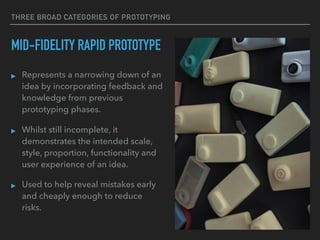
MID-FIDELITY RAPID PROTOTYPE
▸ Represents a narrowing down of an
idea by incorporating feedback and
knowledge from previous
prototyping phases.
▸ Whilst still incomplete, it
demonstrates the intended scale,
style, proportion, functionality and
user experience of an idea.
▸ Used to help reveal mistakes early
and cheaply enough to reduce
risks.
THREE BROAD CATEGORIES OF PROTOTYPING
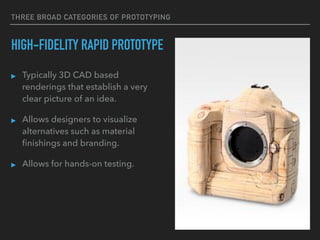
HIGH-FIDELITY RAPID PROTOTYPE
▸ Typically 3D CAD based
renderings that establish a very
clear picture of an idea.
▸ Allows designers to visualize
alternatives such as material
finishings and branding.
▸ Allows for hands-on testing.
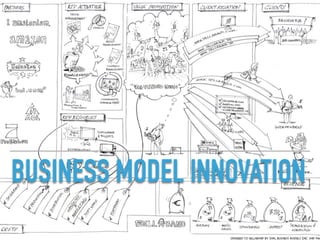
BUSINESS MODEL INNOVATION
BUSINESS MODEL REDESIGN
IS USUALLY THE RESULT OF
STRATEGIC INNOVATION.
SOMETIMES MAJOR
SOMETIMES THE REQUIREMENT IS MINOR
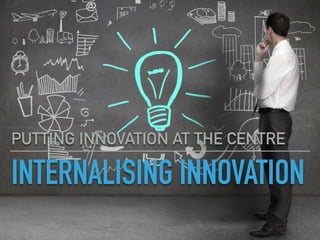
INTERNALISING INNOVATION
PUTTING INNOVATION AT THE CENTRE
WHO YOU GOING
TO CALL?
INTERNALISING INNOVATION
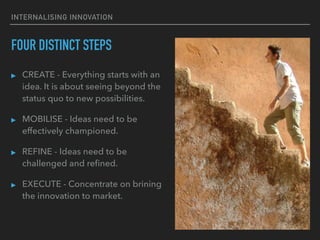
FOUR DISTINCT STEPS
▸ CREATE - Everything starts with an
idea. It is about seeing beyond the
status quo to new possibilities.
▸ MOBILISE - Ideas need to be
effectively championed.
▸ REFINE - Ideas need to be
challenged and refined.
▸ EXECUTE - Concentrate on brining
the innovation to market.
INTERNALISING INNOVATION
SEVEN TYPES OF PEOPLE #1
▸ IDEA GENERATORS - The team
members responsible for that first
idea are the ones who spark the
engine of innovation.
▸ IDEA ASSEMBLER - The master
tactician, the person who can connect
the dots and see the idea and its
potential in the most holistic way.
▸ INNOVATION CHAMPION - Tirelessly
pushes the process and the team
forward.
INTERNALISING INNOVATION
SEVEN TYPES OF PEOPLE #2
▸ SPONSOR - Usually a senior person
who has the power, position and
personality to translate an idea into
reality.
▸ PLUMBER - These are technical
thinkers who make sure the innovation
idea becomes functioning reality.
▸ FACILITATOR - Makes sure that project
members and stakeholders stay on
the same page and guides them
through the organizational maze.
INTERNALISING INNOVATION
SEVEN TYPES OF PEOPLE #3
▸ PROBLEM SOLVER - As experts in
the problem solving process they
are the team members who are
always searching for ideas that will
solve a particular business
problem.
INNOVATION TEAMS
ORGANISATIONAL STRUCTURE
WHEN IT COMES TO ORGANISING FOR
INNOVATION, THERE ARE ALMOST AS
MANY CONFIGURATIONS AS THERE ARE
DEFINITIONS FOR INNOVATION.
ORGANISING FOR INNOVATION #1
▸ VIRTUAL INNOVATION TEAMS -
Multi-disciplinary team mandated to
identify innovation opportunities not
tied to a specific project. Structure
often suffers from insufficient
collaboration and member bias.
▸ DISTRIBUTED INNOVATION
KNOWLEDGE NETWORK - Network
of “go to” persons with extensive
specific knowledge. Assembled for
specific tasks for the innovation
undertaking
ORGANISING FOR INNOVATION #2
▸ JOINT VENTURE INNOVATION
UNIT - Common when two or more
organisations collaborate on a
specific opportunity. Most effective
when teams bring unique and
complementary capabilities.
▸ CORPORATE LEVEL INNOVATION
TEAM - Similar to other C-Suite
support teams. Typically small
group with specialized skills.
Provide corporate view and
support.
ORGANISING FOR INNOVATION #3
▸ BUSINESS UNIT INNOVATION
TEAMS - Brand focused team often
found within FMCG / CPG firms.
Limited influence beyond brand
and innovation experience often
lacking.
▸ CROSS UNIT INNOVATION TEAMS
- Dedicated teams comprising
individuals from different
departments assembled to move
the innovation agenda into new
markets.
ORGANISING FOR INNOVATION #4
▸ INNOVATION SKUNKWORKS - A
skunkwork is a loosely-organized
innovation team that is virtually
given carte blanche to explore any
innovation research. Skunkworks
are encouraged to innovate and
are not subject to short-term
financial requirements .
WRAPPING UP
PATRICK COLLINGS
SAGACITE
PATRICK@SAGACITE-SA.COM
083 616 0967

Innovation Tools & Processes | 2016

  • 1.
    TOOLS & PROCESSES GTPINNOVATION WORKSHOP
  • 2.
    THE TOOLS HOWTO THE THEORY TELLS US WHAT TO DO
  • 3.
    TO PREVENT THIS NOTGOING THROUGH TOOLS IN DEPTH
  • 5.
    BUT YOU PROBABLY STILL HAVETO CALL THE EXPERTS
  • 6.
    DESIGN THINKING ROAD WEARE GOING DOWN THE
  • 7.
    it covers theother theories…
  • 8.
    Ethnographic research &job mapping Weak signals, sensemaking & opportunity mapping Ideation & rapid prototyping Business modelling } Process
  • 9.
  • 11.
  • 12.
    ETHNOGRAPHIC RESEARCH ISTHE ART AND SCIENCE OF TELLING STORIES ABOUT PEOPLES’ STORIES.
  • 13.
    IT’S A GREATWAY TO DEVELOP BIG INSIGHTS, DECODE BEHAVIOURS, UNDERSTAND CONTEXT AND LOCATE UNMET, UNARTICULATED HUMAN NEED
  • 14.
    THREE TYPES OF ETHNOGRAPHICRESEARCH ▸ HUMAN FACTORS - Observing how people interact with their worlds to discover unmet needs. ▸ IMMERSION JOURNEYS - Semi- structured tours that takes the client into the environment of their market. ▸ CO-CREATION - The antidote to focus groups, they give consumers an active voice in the innovation process.
  • 15.
    JOB MAPPING KEY TOSUCCESSFUL INNOVATION IS
  • 16.
    THE JOB MAP ▸Often customers use different products or services to get a single job done. ▸ Companies often just focus on the product or service that they are already offering, rather than other products or services required to complete the offering. ▸ Lance Bettencourt and Anthony Ulwick developed job mapping which breaks the job down into eight discreet process steps. ▸ By creating the job map, companies can possibly discover new complementary products and services to offer.
  • 17.
    JOB MAPPING STAGES#1 ▸ DEFINE - Determining the objectives of the job, planning approach, assessing what resources are required, selecting the resources. ▸ LOCATE - Focus on the inputs, tangible or intangible, that the consumer must locate. ▸ PREPARE - Consumer prepares the input and the environment to do the job.
  • 18.
    JOB MAPPING STAGES#2 ▸ CONFIRM - Need to confirm that everything is in place. ▸ EXECUTE - Consumers want the execution to proceed efficiently to produce optimal output. ▸ MONITOR - Follows immediately after execution to track output of the execution. ▸ MODIFY - Assess whether anything in the execution can be modified.
  • 19.
    JOB MAPPING STAGES#3 ▸ CONCLUDE - More complex jobs tend to require concluding steps, such as time sheets, which many customers find to be a burden.
  • 20.
    LOOK FOR WEAKSIGNALS TO ANTICIPATE THE FUTURE
  • 21.
    THE SHIP HASSAILED THE PROBLEM WITH TRENDS IS THAT
  • 22.
    WEAK SIGNALS ARESNIPPETS - NOT STREAMS - OF INFORMATION THAT CAN HELP COMPANIES FIGURE OUT WHAT CUSTOMERS WANT AND SPOT LOOMING INDUSTRY AND MARKET DISRUPTIONS McKinsey & Co
  • 24.
    WEAK SIGNAL GUIDELINES ▸Involve knowledgable staff - weak signals require experience and expertise to spot. ▸ A network is better than an individual. ▸ Don’t look in the usual places. ▸ Look elsewhere - don’t just stick to your home industry. ▸ Expect failure - many weak signals won’t pan out.
  • 25.
  • 26.
    SENSEMAKING INVOLVES -AND INDEED REQUIRES - AN ARTICULATION OF THE UNKNOWN, BECAUSE, SOMETIMES TRYING TO EXPLAIN THE UNKNOWN IS THE ONLY WAY TO KNOW HOW MUCH YOU UNDERSTAND IT Deborah Ancona, Director MIT Leadership Centre
  • 27.
    Sensemaking often involvesmoving from the simple to the complex and back again.
  • 29.
    SENSEMAKING’S CORE ELEMENTSAND STEPS EXPLORING THE WIDER SYSTEM ▸ Seek out numerous sources of different type of quantitative and qualitative data. ▸ Involve a diverse range of people in trying to make sense of the data. ▸ Move beyond the obvious and the stereotypes. Try to understand nuances and develop empathy ▸ Get information from the front lines. Look for weak signals.
  • 30.
    SENSEMKING’S CORE ELEMENTSAND STEPS CREATE A MAP OF THE SITUATION ▸ Do not simply apply your existing framework of thinking / assumptions. Let the framework develop from your understanding of the new situation. ▸ Use images, stories and metaphors to capture the key elements of the situation. Don’t be scared to show multiple sides to issues.
  • 31.
    SENSEMAKING’S CORE ELEMENTSAND STEPS ACT TO CHANGE AND TO LEARN ▸ Learn from small experiments to see if something is working. Learn from mistakes and improve on the previous experiment (think rapid prototyping). ▸ People are constrained by the environment that they create for themselves. Be aware of the environment and its constraints.
  • 32.
    OPPORTUNITY MAPS NEW LOOKAT COMPETITIVE LANDSCAPE
  • 33.
    CRAFTING THE OPPORTUNITYMAP ▸ Often combined with sensemaking. ▸ Opportunity mapping is a convergent exercise that focuses on distilling and synthesizing all previously gathered knowledge and insights so that key patterns, themes and opportunity spaces can be defined, refined and explored. ▸ Creates a visual picture for an organization’s potential future projects and/or offerings. ▸ Think of it as the innovation equivalent of brand extension and/ or expansion.
  • 38.
    BEFORE THERE AREOPPORTUNITY MAPS… CREATION OF OPPORTUNITY SPACES ▸ Unmet consumer needs ▸ Newly discovered consumer needs ▸ Unarticulated consumer needs ▸ Broad consumer aspirations ▸ Key gaps in the market ▸ Value drivers ▸ Market / industry intersections ▸ Enabling technologies
  • 39.
    CREATING OPPORTUNITY MAPS#1 ▸ VALIDATION OF THEMES - Opportunity spaces are assessed against research and organisational appropriateness. ▸ FORMING COMBINATIONS - Loosely articulating opportunities through a combination and refinement of the information at hand. Making sense of it. ▸ DESCRIBING THE SPACES
  • 40.
    CREATING OPPORTUNITY MAPS#2 ▸ TESTING - Opportunity spaces are tested against a common points scale to maintain consistency. Also must inspire a minimum number of product ideas. ▸ META MAPPING AND DESIGN - Once the spaces have been validated they are placed in collaborative proximity to one another creating the map.
  • 41.
    Ethnographic research &job mapping Weak signals, sensemaking & opportunity mapping Ideation & rapid prototyping Business modelling } Process
  • 42.
    IDEATION NOT AS EASYOR EXCLUSIVE AS IT LOOKS
  • 43.
    CREATIVITY IS JUSTCONNECTING THINGS. WHEN YOU ASK CREATIVE PEOPLE HOW THEY DID SOMETHING, THEY FEEL A LITTLE GUILTY BECAUSE THEY DIDN’T REALLY DO IT, THEY JUST SAW SOMETHING. IT SEEMED OBVIOUS TO THEM AFTER A WHILE. Steve Jobs
  • 44.
    MANY OPTIONS WHEN ITCOMES TO IDEATION, THERE ARE
  • 45.
    CORE IDEATION ACTIVITIES ▸Group sharing of initial ideas developed during the previous phases. ▸ Ideation and concept refinement through critical and rational lens. ▸ Written descriptions of the idea emerging from ideation sessions. ▸ Idea / concept review and selection against clear objectives and criteria. ▸ Concept sketching to communicate the idea.
  • 46.
  • 47.
    PROTOTYPES EXPLORE THESOLUTION SPACE. THEY MAY BE DIGITAL, PHYSICAL, OR DIAGRAMMATIC, BUT IN ALL CASES THEY ARE A WAY TO COMMUNICATE IDEAS. Harvard Business Review
  • 48.
    THREE BROAD CATEGORIESOF PROTOTYPING LOW-FIDELITY RAPID PROTOTYPE ▸ Representation of an idea that goes beyond a sketch, but clearly unfinished and rough. ▸ Brings people onto the same conceptual page. ▸ Used to inspire questions, further discussions and ideation. ▸ Usually explore and expand on ideas rather than reduce and evaluate them.
  • 49.
    THREE BROAD CATEGORIESOF PROTOTYPING MID-FIDELITY RAPID PROTOTYPE ▸ Represents a narrowing down of an idea by incorporating feedback and knowledge from previous prototyping phases. ▸ Whilst still incomplete, it demonstrates the intended scale, style, proportion, functionality and user experience of an idea. ▸ Used to help reveal mistakes early and cheaply enough to reduce risks.
  • 50.
    THREE BROAD CATEGORIESOF PROTOTYPING HIGH-FIDELITY RAPID PROTOTYPE ▸ Typically 3D CAD based renderings that establish a very clear picture of an idea. ▸ Allows designers to visualize alternatives such as material finishings and branding. ▸ Allows for hands-on testing.
  • 51.
  • 52.
    BUSINESS MODEL REDESIGN ISUSUALLY THE RESULT OF STRATEGIC INNOVATION.
  • 53.
    SOMETIMES MAJOR SOMETIMES THEREQUIREMENT IS MINOR
  • 54.
  • 55.
  • 56.
    INTERNALISING INNOVATION FOUR DISTINCTSTEPS ▸ CREATE - Everything starts with an idea. It is about seeing beyond the status quo to new possibilities. ▸ MOBILISE - Ideas need to be effectively championed. ▸ REFINE - Ideas need to be challenged and refined. ▸ EXECUTE - Concentrate on brining the innovation to market.
  • 57.
    INTERNALISING INNOVATION SEVEN TYPESOF PEOPLE #1 ▸ IDEA GENERATORS - The team members responsible for that first idea are the ones who spark the engine of innovation. ▸ IDEA ASSEMBLER - The master tactician, the person who can connect the dots and see the idea and its potential in the most holistic way. ▸ INNOVATION CHAMPION - Tirelessly pushes the process and the team forward.
  • 58.
    INTERNALISING INNOVATION SEVEN TYPESOF PEOPLE #2 ▸ SPONSOR - Usually a senior person who has the power, position and personality to translate an idea into reality. ▸ PLUMBER - These are technical thinkers who make sure the innovation idea becomes functioning reality. ▸ FACILITATOR - Makes sure that project members and stakeholders stay on the same page and guides them through the organizational maze.
  • 59.
    INTERNALISING INNOVATION SEVEN TYPESOF PEOPLE #3 ▸ PROBLEM SOLVER - As experts in the problem solving process they are the team members who are always searching for ideas that will solve a particular business problem.
  • 60.
  • 61.
    WHEN IT COMESTO ORGANISING FOR INNOVATION, THERE ARE ALMOST AS MANY CONFIGURATIONS AS THERE ARE DEFINITIONS FOR INNOVATION.
  • 62.
    ORGANISING FOR INNOVATION#1 ▸ VIRTUAL INNOVATION TEAMS - Multi-disciplinary team mandated to identify innovation opportunities not tied to a specific project. Structure often suffers from insufficient collaboration and member bias. ▸ DISTRIBUTED INNOVATION KNOWLEDGE NETWORK - Network of “go to” persons with extensive specific knowledge. Assembled for specific tasks for the innovation undertaking
  • 63.
    ORGANISING FOR INNOVATION#2 ▸ JOINT VENTURE INNOVATION UNIT - Common when two or more organisations collaborate on a specific opportunity. Most effective when teams bring unique and complementary capabilities. ▸ CORPORATE LEVEL INNOVATION TEAM - Similar to other C-Suite support teams. Typically small group with specialized skills. Provide corporate view and support.
  • 64.
    ORGANISING FOR INNOVATION#3 ▸ BUSINESS UNIT INNOVATION TEAMS - Brand focused team often found within FMCG / CPG firms. Limited influence beyond brand and innovation experience often lacking. ▸ CROSS UNIT INNOVATION TEAMS - Dedicated teams comprising individuals from different departments assembled to move the innovation agenda into new markets.
  • 65.
    ORGANISING FOR INNOVATION#4 ▸ INNOVATION SKUNKWORKS - A skunkwork is a loosely-organized innovation team that is virtually given carte blanche to explore any innovation research. Skunkworks are encouraged to innovate and are not subject to short-term financial requirements .
  • 66.
  • 67.