© Gordon Graham, 2015
Understand Innovation
in Five Minutes
What will you learn from
this?
• What innovation is
• Why it’s important
• The “types” of innovation
• The “degrees” of innovation
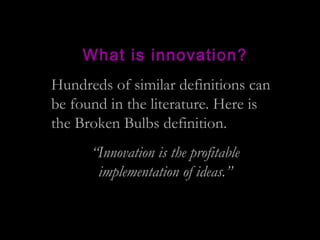
What is innovation?
Hundreds of similar definitions can
be found in the literature. Here is
the Broken Bulbs definition.
“Innovation is the profitable
implementation of ideas.”
An innovation can increase profits
on the value side (customers value
the innovation enough to pay more
for it) . . .
. . . or the cost-cutting side (the
company produces a product
offering in a more efficient way).
Either way, value is created for the
firm and the consumer.
$
An invention is different from an
innovation at any particular time in
that it doesn’t have commercial
value but . . .
. . . it may have in future.
Think of inventions as the laying of
an egg, innovation as the laying and
hatching.
There is no shortage of ideas and
inventions in the world. The
challenge is to introduce these
successfully to a market.
Only then can the idea/invention be
called an innovation.
In other words, innovation requires
interplay between a product offering
(technology) and a market.
Why is innovation
important?
Innovation reduces waste and
environmental damage.
Innovation creates growth, increases
productivity, and economic wealth
(avoids stagnation).
Innovation provides better goods
and services at a cheaper price –
higher standard of living.
More interesting work for
employees.
Old strategies get replicated and,
consequently, margins get squeezed.
Survival!
Source: United Kingdom Dept. Trade and
Industry
What are the types of
innovation?
Numerous types . . .
. . . but all these labels just describe
where something “new” or “better”
occurs.
Product
Process
Service
Business model
Value
Market
. . . and many more, depending on
the author. Basically, innovation can
occur anywhere in the firm’s
product offering.
Note! There is another type that
needs to be considered separately.
This is “disruptive innovation,” a
term coined by Clayton Christensen.
This type of innovation refers to a
firm’s strategy.
The degrees of innovation.
Once again, many labels . . .
. . . however, they all describe the
degree of change required by the
innovating firm and/or the market.
Incremental (sometimes called

“continuous” or “evolutionary” or
“small”)
Semi-radical
Radical (sometimes called
“discontinuous” or “revolutionary”
or “large”)
Incremental and radical innovations
need to managed differently.
Here’s a quote:
"He who innovates will have for his
enemies all those who are well off under the
existing order of things, and only
lukewarm supporters in those who might be
better off under the new."
Niccolo Machiaveli, The Prince
I hope you enjoyed this brief introduction
to innovation. You can learn much more
on the topic by listening to my full
audiobook online.
is.gd/innoUAE
Gordon Graham
Tel: 052 922 3352

Understand Innovation and Innovation Management