2020 IEEE International Conference on Semiconductor Electronics (ICSE)
978-1-7281-5968-3/20/$31.00 ©2020 IEEE
Inkjet-Printed Graphene-based Flexible Humidity
Sensor for Environmental Applications
Suraya Sulaiman
Nanoelectronics Lab
MIMOS Berhad
Kuala Lumpur, Malaysia
suraya.sulaiman@mimos.my
Nora’zah Abdul Rashid
Nanoelectronics Lab
MIMOS Berhad
Kuala Lumpur, Malaysia
norazah@mimos.my
Aiman Sajidah Abdul Aziz
Nanoelectronics Lab
MIMOS Berhad
Kuala Lumpur, Malaysia
aiman.sajidah@mimos.my
Liew Qiao Jun
Nanoelectronics Lab
MIMOS Berhad
Kuala Lumpur, Malaysia
qj.liew@mimos.my
Syed Muhammad Hafiz Syed Mohd Jaafar
Nanoelectronics Lab
MIMOS Berhad
Kuala Lumpur, Malaysia
hafiz.jaafar@mimos.my
Abstract—In this study, a fully flexible inkjet-printed
graphene-based capacitive humidity sensor is investigated
using graphene oxide (GO) as sensing material mixed with
Polyacrylic Acid, PAA. The printed humidity sensor consists
of i) an optimally designed interdigitated electrode (IDE)
made from reduced graphene oxide conductive ink material
decorated with silver nanoparticle (rGO/Ag), ii) inkjet-
printed GO as sensing material and iii) polyethylene
terephthalate, PET as flexible substrate. The conductive ink
is synthesize in house with a stable and consistent
temperature setting which has successfully improve the yield
performance of the graphene-based inkjet and the method of
preparation has prevent the ink from agglomeration during
printing. The multilayer inkjet-printed GO on top of the
rGO/Ag IDE is employ to increase the contact area between
the sensing layer and water vapor, thus leading to a high
sensitivity sensor. The results shows that as the relative
humidity is varies in the range of 30%RH to 90%RH, the
proposed humidity sensor is able to achieve a highest
sensitivity of 0.15pF/%RH at 50°C. The sensor show a stable
capacitance value with a linear output at low humidity and
increase exponentially at above 60%RH. The developed
sensor also show a good temperature dependence at
temperature below 60°C and humidity lower than 70%RH.
Keywords—flexible; printed; multilayer; graphene;
humidity
I. INTRODUCTION
The high demand for future electronic devices,
particularly on wearable device, seek a huge demand for
new production and manufacturing methods beyond the
traditional semiconductor cleanroom processes, which are
typically achieved at vacuum and high temperature
condition. In view of that, inkjet printing with the use of
nano-based conductive inks offers a high potential to
support the development of the next generation wearable
electronic devices due to its lower cost, low temperature,
less complex and vacuum-less process technologies.
The development of printing technology with the
formulation of a new simple, low-cost conductive ink
material will enable the production of a range of functional
sensors and electronics devices including humidity
sensors. Humidity sensors have been widely used in our
daily lives and become increasingly important in many
applications such as meteorology, agriculture, smart
homes, medical equipment, and biotechnology [1–4].
Various types of humidity sensors are available, based on
different measurement principles such as resistive,
capacitive, optical, acoustic, and thermal techniques.
Among them all, the capacitive devices are preferred due
to their high sensitivity, linearity, accuracy, fast response
time, and negligible temperature dependent. Most of these
capacitive sensors are based on the dielectric changes in
the sensing layer upon water vapour uptake as a measure
of the water vapour content in the environment.
II. SENSING PRINCIPLES
This paper propose a flexible, high-sensitivity and low-
hysteresis printed capacitive humidity sensor consists of
inkjet-printed IDE and GO as the sensing materials. This
capacitive humidity sensors utilize GO as the sensing
material which reacts to the environmental changes when
the surfaces adsorb water molecules. The change in
capacitance is directly in relation to the water
concentration or humidity in the environment. The IDE,
acting as the electrical conductor, is printed using
conductive rGO/Ag materials while the sensing material is
printed on top of the IDE to form the high-sensitivity
flexible humidity sensor as shown in Fig. 1 below. Here,
the sensor platform is equipped by inserting the inkjet-
printed sensor into a connector which is soldered to PCB
board that was attached with Harwin connector for use in
sensing test later.
Fig. 1. Samples of inkjet-printed graphene-based flexible humidity
sensor.
148
Authorized licensed use limited to: CMU Libraries - library.cmich.edu. Downloaded on August 18,2020 at 13:13:34 UTC from IEEE Xplore. Restrictions apply.
III. MATERIAL CHARACTERIZATION AND SENSOR
DESIGN
Transmission electron microscopy (TEM) measurement
is use to determine the morphology and size of the Ag
nanoparticle. It is also able to confirm the presence of Ag
in anchoring onto the rGO nanoflakes matrix in the
synthesised conductive ink. In Fig. 2, it is shown that the
reduced GO flakes were decorated by abundant of well-
disperse spherical Ag nanoparticles. Fig. 3 shows the
measured lattice fringe spacing of Ag nanoparticles is
0.239 nm which corresponds to the (111) crystal plane of
the Face Centered Cubic, FCC lattice. Next, the rGO/Ag
ink was further investigated using Energy-Dispersive X-
ray Spectroscopy (EDS) equipment. The peaks obtained in
EDS spectra have been identified as carbon (C), oxygen
(O), copper (Cu) and silver (Ag) as the main elemental
constituent of the synthesized rGO/Ag conductive ink.
The elemental chemical analysis revealed that a higher
share for C (94.11%), Cu (5.08%) O (0.18%) and Ag
(0.61%) is due to the basic elemental composition of
rGO/Ag. The weight and atomic proportion of identified
elements is given in Table 1.
The size of this sensor is 10,000 μm by 4,800 μm with
a sensing area of 4200 μm by 4800 μm. The finger length
of the interdigitated electrode is 500 μm with the width
and the gap both being 200 μm and 300 μm. A total of 4
pairs of IDEs are used. The rGO/Ag ink deposition on the
PET substrate was performed using a Fujifilm Dimatix
Materials Printer (DMP-2831) as shown in Fig. 4. For this
paper, 10 pL cartridges having 16 nozzles of diameter 21
μm that are driven by the piezoelectric element of the
Dimatix printer are used.
Table II shows the experimental printing parameters of
the IDE platform design. The parameters that control the
printing quality are jetting waveform, jetting voltage,
jetting frequency, cartridge temperature, platen
temperature and resolution of the pattern. To generate
optimum printing quality, these parameters were
optimized after multiple test printing. Table III shows the
optimal printing parameters used to print the humidity
sensors. Fig. 5 shows the final printing outcome of the
flexible IDE platform using the printing parameters stated
in Table 2 and Table 3.
Fig. 2. TEM view of rGO/Ag showing 0.61 wt.% of Ag.
Fig. 3. Silver nanoparticles with fringe spacing confirming the
attachment to the rGO sheets.
TABLE 1. ELEMENTAL COMPOSITION OF GRAPHENE-BASED INK
OBTAINED FROM EDS ANALYSIS
Element Weight % Atomic %
C (K) 94.11 98.77
O (K) 0.18 0.14
Cu (K) 5.08 1.00
Ag (L) 0.61 0.07
Fig. 4. Fujifilm Dimatix Materials Printer.
Fig. 5. Flexible IDE Platform.
TABLE II. EXPERIMENTAL PRINTING PARAMETERS
TABLE III. OPTIMAL PRINTING PARAMETERS
Jetting Voltage 15.4 V
Jetting Frequency 20 kHz
Drop Size 10 pL
Printing Print Height 200 μm
Cartridge Temperature 27°C
Platen Temperature 30°C
IV. RESULTS AND DISCUSSIONS
Capacitive humidity sensor respond to humidity change
by varying its dielectric permittivity. The variation is
directly proportional to the water vapour change. The
capacitance of the capacitive humidity sensor is expressed
as
C = H0Hr (A/d) (1)
where H0 is the permittivity of vacuum, Hr is the relative
permittivity of the sensing material, A is the effective
sensing area of the humidity sensor, and d is the thickness
of the sensing layer. The permittivity of the sensing
material changes proportionally with water vapour. By
measuring the changes in the capacitance, humidity
change is detected. Graphene's permittivity varies with
frequency. At frequencies near direct current, it is near
6.9. Water has dielectric permittivity of ~ 80. As humidity
Parameter Value Unit
Drop Spacing (DS) 16 μm
Number of printing layers (rGO/Ag) 2 layers
Number of printing layers (GO) 1 layer
Sintering Temperature None °C
149
Authorized licensed use limited to: CMU Libraries - library.cmich.edu. Downloaded on August 18,2020 at 13:13:34 UTC from IEEE Xplore. Restrictions apply.
increases, more water will be absorbed by the GO hence
higher permittivity will be observed.
Before testing took place, initially four samples
of flexible printed humidity sensors were placed inside the
bench top of Votsch Climatic Environmental Chamber
Model 7010 at humidity and surrounding temperature of
30%RH and 25°C, respectively to allow sensors to
stabilize. Testing frequency of the LCR meter was set at
150 Hz and the direct current voltage of 1V was used.
After that the capacitive response were varied towards
relative humidity at varying temperatures of 25°C, 40°C,
50°C and 60°C. All the measurement were recorded
manually using laptop. The examples of the results are
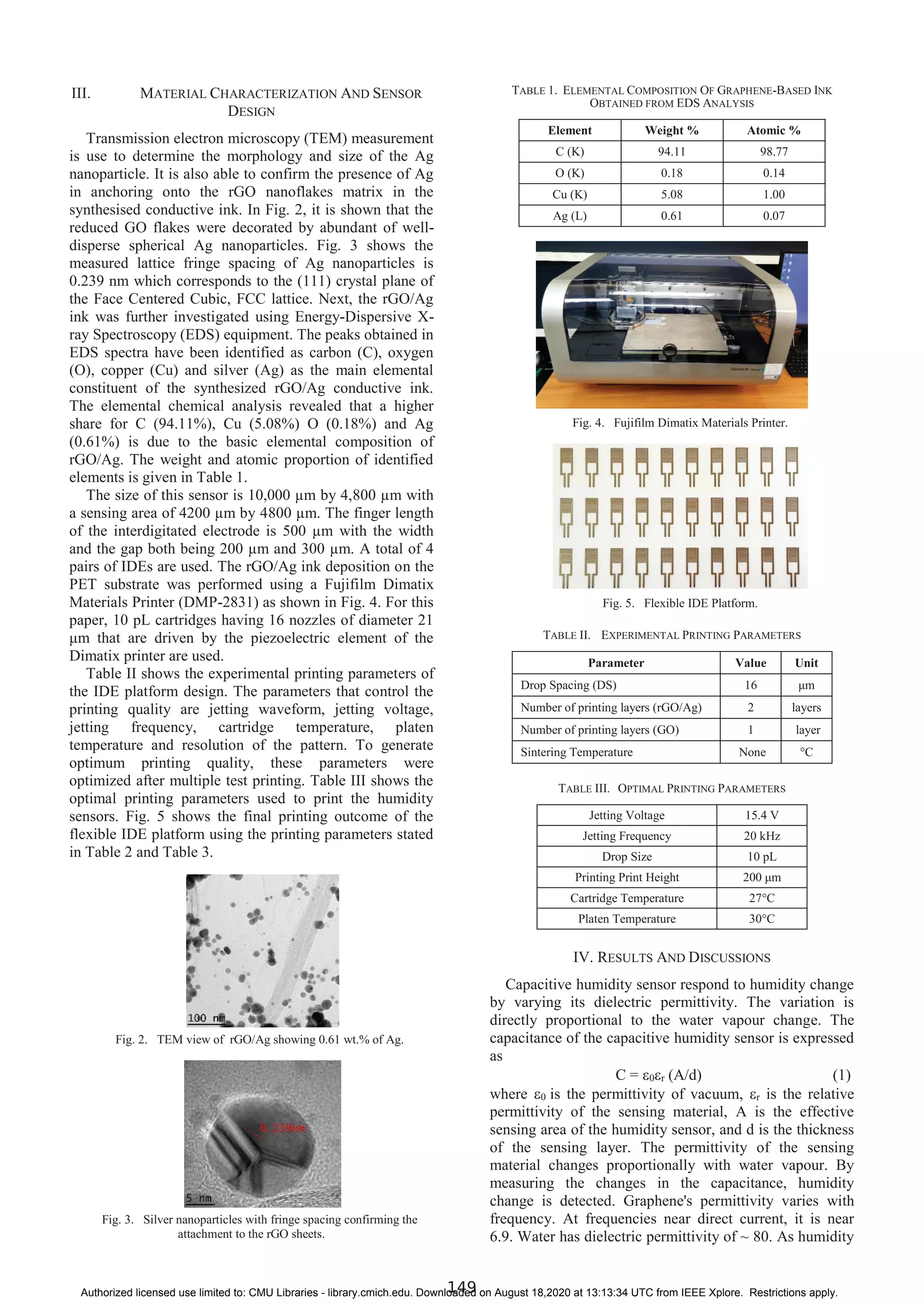
shown in Fig. 6 and Fig. 7. The response of the device
towards increasing humidity was recorded from 30%RH
to 90%RH with increment/decrement steps of 10%RH
while the temperature of the chamber was maintained at
constant temperatures of 25°C, 40°C, 50°C and 60°C. At
every temperature, the relationship of capacitance versus
%RH was observed. For all samples the increase in
capacitance was linear up to 60%RH and then increased
rapidly at higher humidity levels. This can be attributed to
the fact that GO absorb more water molecules at higher
humidity levels.
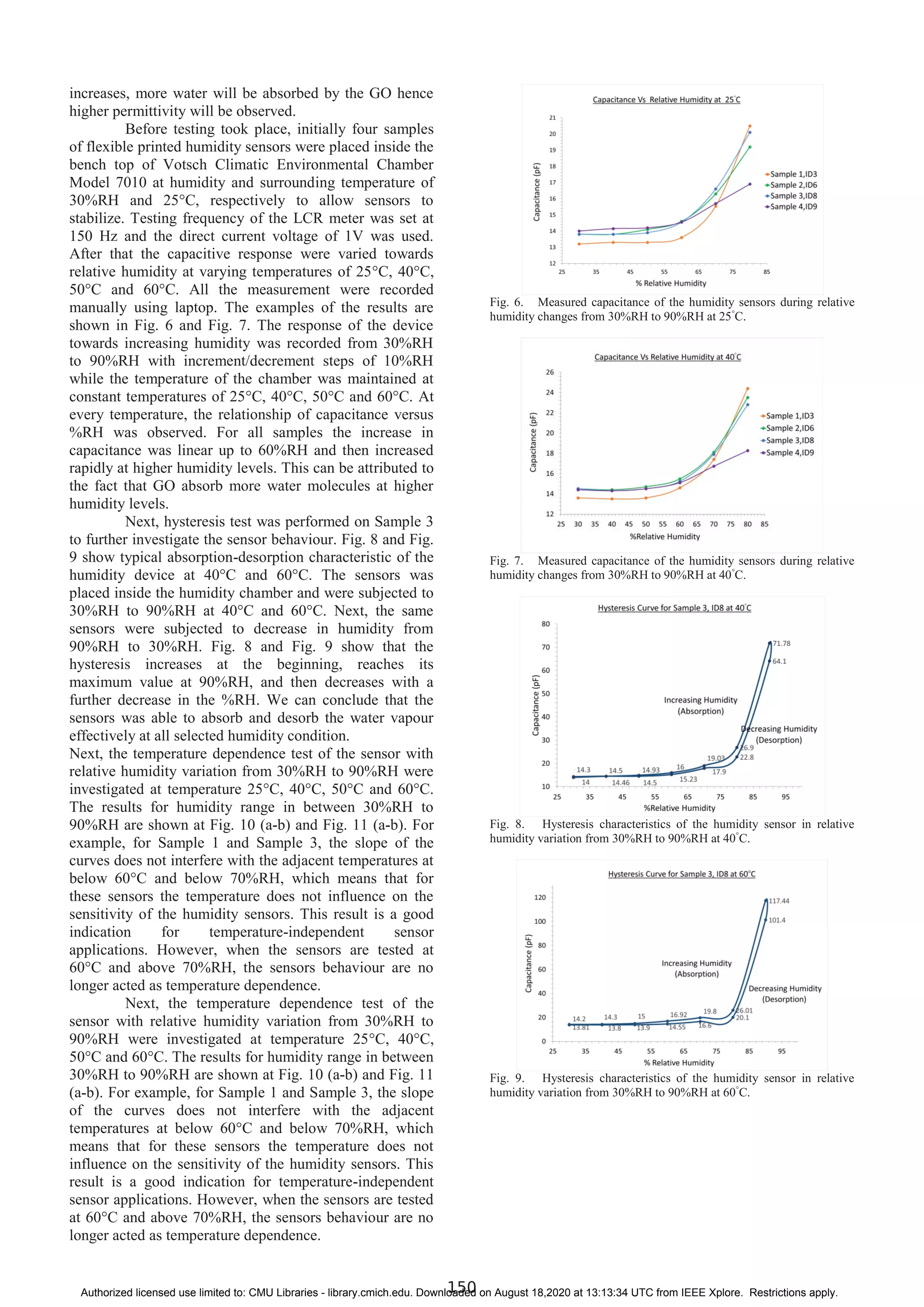
Next, hysteresis test was performed on Sample 3
to further investigate the sensor behaviour. Fig. 8 and Fig.
9 show typical absorption-desorption characteristic of the
humidity device at 40°C and 60°C. The sensors was
placed inside the humidity chamber and were subjected to
30%RH to 90%RH at 40°C and 60°C. Next, the same
sensors were subjected to decrease in humidity from
90%RH to 30%RH. Fig. 8 and Fig. 9 show that the
hysteresis increases at the beginning, reaches its
maximum value at 90%RH, and then decreases with a
further decrease in the %RH. We can conclude that the
sensors was able to absorb and desorb the water vapour
effectively at all selected humidity condition.
Next, the temperature dependence test of the sensor with
relative humidity variation from 30%RH to 90%RH were
investigated at temperature 25°C, 40°C, 50°C and 60°C.
The results for humidity range in between 30%RH to
90%RH are shown at Fig. 10 (a-b) and Fig. 11 (a-b). For
example, for Sample 1 and Sample 3, the slope of the
curves does not interfere with the adjacent temperatures at
below 60°C and below 70%RH, which means that for
these sensors the temperature does not influence on the
sensitivity of the humidity sensors. This result is a good
indication for temperature-independent sensor
applications. However, when the sensors are tested at
60°C and above 70%RH, the sensors behaviour are no
longer acted as temperature dependence.
Next, the temperature dependence test of the
sensor with relative humidity variation from 30%RH to
90%RH were investigated at temperature 25°C, 40°C,
50°C and 60°C. The results for humidity range in between
30%RH to 90%RH are shown at Fig. 10 (a-b) and Fig. 11
(a-b). For example, for Sample 1 and Sample 3, the slope
of the curves does not interfere with the adjacent
temperatures at below 60°C and below 70%RH, which
means that for these sensors the temperature does not
influence on the sensitivity of the humidity sensors. This
result is a good indication for temperature-independent
sensor applications. However, when the sensors are tested
at 60°C and above 70%RH, the sensors behaviour are no
longer acted as temperature dependence.
Fig. 6. Measured capacitance of the humidity sensors during relative
humidity changes from 30%RH to 90%RH at 25°
C.
Fig. 7. Measured capacitance of the humidity sensors during relative
humidity changes from 30%RH to 90%RH at 40°
C.
Fig. 8. Hysteresis characteristics of the humidity sensor in relative
humidity variation from 30%RH to 90%RH at 40°
C.
Fig. 9. Hysteresis characteristics of the humidity sensor in relative
humidity variation from 30%RH to 90%RH at 60°
C.
150
Authorized licensed use limited to: CMU Libraries - library.cmich.edu. Downloaded on August 18,2020 at 13:13:34 UTC from IEEE Xplore. Restrictions apply.
Fig. 10 (a)
Fig. 10 (b)
Fig.10. (a) Temperature dependence of the humidity sensor measured at
below 70%RH, at 25°C, 40°C, 50°C and 60°C for Sample 1 and (b)
Temperature dependence of the humidity sensor measured at below
70%RH, at 25°C, 40°C, 50°C and 60°C for Sample 3.
Fig. 11 (a)
Fig. 11 (b)
Fig.11. (a) Temperature dependence of the humidity sensor measured
over 70%RH, at 25°C, 40°C, 50°C and 60°C for Sample 1 and (b)
Temperature dependence of the humidity sensor measured over 70%RH,
at 25°C, 40°C, 50°C and 60°C for Sample 3.
Next, the sensitivity, S of the humidity sensors can be
expressed as;
S = C90 – C30 (pF/%RH) (2)
90 – 30
where C90 and C30 denote the capacitance obtained at
90%RH and 30%RH, respectively [5]. The 90 and 30
values are the highest and lowest relative humidity values
in the variation range, respectively. Fig. 12 shows the
sensitivity of humidity sensors at different temperature
variation for all sensors. From the histogram, sample 4
can be concluded as the most sensitive sensor. The results
show that as the relative humidity ranges from 30%RH to
90%RH, the proposed humidity sensors are able to
achieve a high sensitivity of 0.15pF/%RH at 50°C.
Fig. 12. Sensitivity of humidity sensor at temperature range between
25°C to 60°C.
V. CONCLUSIONS
In summary, a fully flexible ink-jet printed graphene-
based capacitive humidity sensor is investigated and
successfully demonstrated working at certain humidity
and temperature range. The humidity-sensitive layer
composed of a GO layer is successfully printed on IDE
platform which manage to simplify the fabrication process
of a conventional humidity sensor. During actual testing,
this paper demonstrated a sensor with a high sensitivity of
0.15pF/%RH at 50°C for Sample 4 with stable
capacitance value with an exponential output ranging
from 30%RH to 90%RH. It has been shown that the
developed sensor is also independent of temperature
change at temperature less than 60°C and humidity level
below 70%RH. More process optimization and
investigation need to be carried out later to improve the
sensor performance which include sensing thickness
optimization and optimum printing quality.
REFERENCES
[1] Chen, Z.; Lu, C. Humidity sensors: a review08p of materials and
mechanisms. Sensor Lett. 2005, 3, 274–295.[CrossRef]
[2] Lee, C.W.; Lee, S.J.; Kim, M.; Kyung, Y.; Eom, K. Capacitive
humidity sensor tag smart refrigerator system using the capacitive to
voltage converter. Int. J. Adv. Sci. Technol. 2011, 36, 15–25.
[3] Farahani, H.; Wagiran, R.; Hamidon, M.N. Humidity sensors
principle, mechanism, and fabrication technologies: a comprehensive
review. Sensors 2014, 14, 7881–7939. [CrossRef]
[4] Feng, Y.; Xie, L.; Chen, Q.; Zheng, L.R. Low-cost printed chipless
RFID humidity sensor tag for intelligent packaging. IEEE Sens. J. 2015,
15, 3201–3208. [CrossRef]
[5] Liu, M.Q; Wang, C.; Kim N.Y.; High-Sensitivity and Low-
Hysteresis Porous MIM-Type Capacitive Hum idity Sensor Using
Functional Polymer Mixed with TiO2 Microparticles. Sensors 2017, 17,
284, 1-11.
151
Authorized licensed use limited to: CMU Libraries - library.cmich.edu. Downloaded on August 18,2020 at 13:13:34 UTC from IEEE Xplore. Restrictions apply.

Inkjet printed graphene-based flexible humidity sensor for environmental applications

  • 1.
    2020 IEEE InternationalConference on Semiconductor Electronics (ICSE) 978-1-7281-5968-3/20/$31.00 ©2020 IEEE Inkjet-Printed Graphene-based Flexible Humidity Sensor for Environmental Applications Suraya Sulaiman Nanoelectronics Lab MIMOS Berhad Kuala Lumpur, Malaysia suraya.sulaiman@mimos.my Nora’zah Abdul Rashid Nanoelectronics Lab MIMOS Berhad Kuala Lumpur, Malaysia norazah@mimos.my Aiman Sajidah Abdul Aziz Nanoelectronics Lab MIMOS Berhad Kuala Lumpur, Malaysia aiman.sajidah@mimos.my Liew Qiao Jun Nanoelectronics Lab MIMOS Berhad Kuala Lumpur, Malaysia qj.liew@mimos.my Syed Muhammad Hafiz Syed Mohd Jaafar Nanoelectronics Lab MIMOS Berhad Kuala Lumpur, Malaysia hafiz.jaafar@mimos.my Abstract—In this study, a fully flexible inkjet-printed graphene-based capacitive humidity sensor is investigated using graphene oxide (GO) as sensing material mixed with Polyacrylic Acid, PAA. The printed humidity sensor consists of i) an optimally designed interdigitated electrode (IDE) made from reduced graphene oxide conductive ink material decorated with silver nanoparticle (rGO/Ag), ii) inkjet- printed GO as sensing material and iii) polyethylene terephthalate, PET as flexible substrate. The conductive ink is synthesize in house with a stable and consistent temperature setting which has successfully improve the yield performance of the graphene-based inkjet and the method of preparation has prevent the ink from agglomeration during printing. The multilayer inkjet-printed GO on top of the rGO/Ag IDE is employ to increase the contact area between the sensing layer and water vapor, thus leading to a high sensitivity sensor. The results shows that as the relative humidity is varies in the range of 30%RH to 90%RH, the proposed humidity sensor is able to achieve a highest sensitivity of 0.15pF/%RH at 50°C. The sensor show a stable capacitance value with a linear output at low humidity and increase exponentially at above 60%RH. The developed sensor also show a good temperature dependence at temperature below 60°C and humidity lower than 70%RH. Keywords—flexible; printed; multilayer; graphene; humidity I. INTRODUCTION The high demand for future electronic devices, particularly on wearable device, seek a huge demand for new production and manufacturing methods beyond the traditional semiconductor cleanroom processes, which are typically achieved at vacuum and high temperature condition. In view of that, inkjet printing with the use of nano-based conductive inks offers a high potential to support the development of the next generation wearable electronic devices due to its lower cost, low temperature, less complex and vacuum-less process technologies. The development of printing technology with the formulation of a new simple, low-cost conductive ink material will enable the production of a range of functional sensors and electronics devices including humidity sensors. Humidity sensors have been widely used in our daily lives and become increasingly important in many applications such as meteorology, agriculture, smart homes, medical equipment, and biotechnology [1–4]. Various types of humidity sensors are available, based on different measurement principles such as resistive, capacitive, optical, acoustic, and thermal techniques. Among them all, the capacitive devices are preferred due to their high sensitivity, linearity, accuracy, fast response time, and negligible temperature dependent. Most of these capacitive sensors are based on the dielectric changes in the sensing layer upon water vapour uptake as a measure of the water vapour content in the environment. II. SENSING PRINCIPLES This paper propose a flexible, high-sensitivity and low- hysteresis printed capacitive humidity sensor consists of inkjet-printed IDE and GO as the sensing materials. This capacitive humidity sensors utilize GO as the sensing material which reacts to the environmental changes when the surfaces adsorb water molecules. The change in capacitance is directly in relation to the water concentration or humidity in the environment. The IDE, acting as the electrical conductor, is printed using conductive rGO/Ag materials while the sensing material is printed on top of the IDE to form the high-sensitivity flexible humidity sensor as shown in Fig. 1 below. Here, the sensor platform is equipped by inserting the inkjet- printed sensor into a connector which is soldered to PCB board that was attached with Harwin connector for use in sensing test later. Fig. 1. Samples of inkjet-printed graphene-based flexible humidity sensor. 148 Authorized licensed use limited to: CMU Libraries - library.cmich.edu. Downloaded on August 18,2020 at 13:13:34 UTC from IEEE Xplore. Restrictions apply.
  • 2.
    III. MATERIAL CHARACTERIZATIONAND SENSOR DESIGN Transmission electron microscopy (TEM) measurement is use to determine the morphology and size of the Ag nanoparticle. It is also able to confirm the presence of Ag in anchoring onto the rGO nanoflakes matrix in the synthesised conductive ink. In Fig. 2, it is shown that the reduced GO flakes were decorated by abundant of well- disperse spherical Ag nanoparticles. Fig. 3 shows the measured lattice fringe spacing of Ag nanoparticles is 0.239 nm which corresponds to the (111) crystal plane of the Face Centered Cubic, FCC lattice. Next, the rGO/Ag ink was further investigated using Energy-Dispersive X- ray Spectroscopy (EDS) equipment. The peaks obtained in EDS spectra have been identified as carbon (C), oxygen (O), copper (Cu) and silver (Ag) as the main elemental constituent of the synthesized rGO/Ag conductive ink. The elemental chemical analysis revealed that a higher share for C (94.11%), Cu (5.08%) O (0.18%) and Ag (0.61%) is due to the basic elemental composition of rGO/Ag. The weight and atomic proportion of identified elements is given in Table 1. The size of this sensor is 10,000 μm by 4,800 μm with a sensing area of 4200 μm by 4800 μm. The finger length of the interdigitated electrode is 500 μm with the width and the gap both being 200 μm and 300 μm. A total of 4 pairs of IDEs are used. The rGO/Ag ink deposition on the PET substrate was performed using a Fujifilm Dimatix Materials Printer (DMP-2831) as shown in Fig. 4. For this paper, 10 pL cartridges having 16 nozzles of diameter 21 μm that are driven by the piezoelectric element of the Dimatix printer are used. Table II shows the experimental printing parameters of the IDE platform design. The parameters that control the printing quality are jetting waveform, jetting voltage, jetting frequency, cartridge temperature, platen temperature and resolution of the pattern. To generate optimum printing quality, these parameters were optimized after multiple test printing. Table III shows the optimal printing parameters used to print the humidity sensors. Fig. 5 shows the final printing outcome of the flexible IDE platform using the printing parameters stated in Table 2 and Table 3. Fig. 2. TEM view of rGO/Ag showing 0.61 wt.% of Ag. Fig. 3. Silver nanoparticles with fringe spacing confirming the attachment to the rGO sheets. TABLE 1. ELEMENTAL COMPOSITION OF GRAPHENE-BASED INK OBTAINED FROM EDS ANALYSIS Element Weight % Atomic % C (K) 94.11 98.77 O (K) 0.18 0.14 Cu (K) 5.08 1.00 Ag (L) 0.61 0.07 Fig. 4. Fujifilm Dimatix Materials Printer. Fig. 5. Flexible IDE Platform. TABLE II. EXPERIMENTAL PRINTING PARAMETERS TABLE III. OPTIMAL PRINTING PARAMETERS Jetting Voltage 15.4 V Jetting Frequency 20 kHz Drop Size 10 pL Printing Print Height 200 μm Cartridge Temperature 27°C Platen Temperature 30°C IV. RESULTS AND DISCUSSIONS Capacitive humidity sensor respond to humidity change by varying its dielectric permittivity. The variation is directly proportional to the water vapour change. The capacitance of the capacitive humidity sensor is expressed as C = H0Hr (A/d) (1) where H0 is the permittivity of vacuum, Hr is the relative permittivity of the sensing material, A is the effective sensing area of the humidity sensor, and d is the thickness of the sensing layer. The permittivity of the sensing material changes proportionally with water vapour. By measuring the changes in the capacitance, humidity change is detected. Graphene's permittivity varies with frequency. At frequencies near direct current, it is near 6.9. Water has dielectric permittivity of ~ 80. As humidity Parameter Value Unit Drop Spacing (DS) 16 μm Number of printing layers (rGO/Ag) 2 layers Number of printing layers (GO) 1 layer Sintering Temperature None °C 149 Authorized licensed use limited to: CMU Libraries - library.cmich.edu. Downloaded on August 18,2020 at 13:13:34 UTC from IEEE Xplore. Restrictions apply.
  • 3.
    increases, more waterwill be absorbed by the GO hence higher permittivity will be observed. Before testing took place, initially four samples of flexible printed humidity sensors were placed inside the bench top of Votsch Climatic Environmental Chamber Model 7010 at humidity and surrounding temperature of 30%RH and 25°C, respectively to allow sensors to stabilize. Testing frequency of the LCR meter was set at 150 Hz and the direct current voltage of 1V was used. After that the capacitive response were varied towards relative humidity at varying temperatures of 25°C, 40°C, 50°C and 60°C. All the measurement were recorded manually using laptop. The examples of the results are shown in Fig. 6 and Fig. 7. The response of the device towards increasing humidity was recorded from 30%RH to 90%RH with increment/decrement steps of 10%RH while the temperature of the chamber was maintained at constant temperatures of 25°C, 40°C, 50°C and 60°C. At every temperature, the relationship of capacitance versus %RH was observed. For all samples the increase in capacitance was linear up to 60%RH and then increased rapidly at higher humidity levels. This can be attributed to the fact that GO absorb more water molecules at higher humidity levels. Next, hysteresis test was performed on Sample 3 to further investigate the sensor behaviour. Fig. 8 and Fig. 9 show typical absorption-desorption characteristic of the humidity device at 40°C and 60°C. The sensors was placed inside the humidity chamber and were subjected to 30%RH to 90%RH at 40°C and 60°C. Next, the same sensors were subjected to decrease in humidity from 90%RH to 30%RH. Fig. 8 and Fig. 9 show that the hysteresis increases at the beginning, reaches its maximum value at 90%RH, and then decreases with a further decrease in the %RH. We can conclude that the sensors was able to absorb and desorb the water vapour effectively at all selected humidity condition. Next, the temperature dependence test of the sensor with relative humidity variation from 30%RH to 90%RH were investigated at temperature 25°C, 40°C, 50°C and 60°C. The results for humidity range in between 30%RH to 90%RH are shown at Fig. 10 (a-b) and Fig. 11 (a-b). For example, for Sample 1 and Sample 3, the slope of the curves does not interfere with the adjacent temperatures at below 60°C and below 70%RH, which means that for these sensors the temperature does not influence on the sensitivity of the humidity sensors. This result is a good indication for temperature-independent sensor applications. However, when the sensors are tested at 60°C and above 70%RH, the sensors behaviour are no longer acted as temperature dependence. Next, the temperature dependence test of the sensor with relative humidity variation from 30%RH to 90%RH were investigated at temperature 25°C, 40°C, 50°C and 60°C. The results for humidity range in between 30%RH to 90%RH are shown at Fig. 10 (a-b) and Fig. 11 (a-b). For example, for Sample 1 and Sample 3, the slope of the curves does not interfere with the adjacent temperatures at below 60°C and below 70%RH, which means that for these sensors the temperature does not influence on the sensitivity of the humidity sensors. This result is a good indication for temperature-independent sensor applications. However, when the sensors are tested at 60°C and above 70%RH, the sensors behaviour are no longer acted as temperature dependence. Fig. 6. Measured capacitance of the humidity sensors during relative humidity changes from 30%RH to 90%RH at 25° C. Fig. 7. Measured capacitance of the humidity sensors during relative humidity changes from 30%RH to 90%RH at 40° C. Fig. 8. Hysteresis characteristics of the humidity sensor in relative humidity variation from 30%RH to 90%RH at 40° C. Fig. 9. Hysteresis characteristics of the humidity sensor in relative humidity variation from 30%RH to 90%RH at 60° C. 150 Authorized licensed use limited to: CMU Libraries - library.cmich.edu. Downloaded on August 18,2020 at 13:13:34 UTC from IEEE Xplore. Restrictions apply.
  • 4.
    Fig. 10 (a) Fig.10 (b) Fig.10. (a) Temperature dependence of the humidity sensor measured at below 70%RH, at 25°C, 40°C, 50°C and 60°C for Sample 1 and (b) Temperature dependence of the humidity sensor measured at below 70%RH, at 25°C, 40°C, 50°C and 60°C for Sample 3. Fig. 11 (a) Fig. 11 (b) Fig.11. (a) Temperature dependence of the humidity sensor measured over 70%RH, at 25°C, 40°C, 50°C and 60°C for Sample 1 and (b) Temperature dependence of the humidity sensor measured over 70%RH, at 25°C, 40°C, 50°C and 60°C for Sample 3. Next, the sensitivity, S of the humidity sensors can be expressed as; S = C90 – C30 (pF/%RH) (2) 90 – 30 where C90 and C30 denote the capacitance obtained at 90%RH and 30%RH, respectively [5]. The 90 and 30 values are the highest and lowest relative humidity values in the variation range, respectively. Fig. 12 shows the sensitivity of humidity sensors at different temperature variation for all sensors. From the histogram, sample 4 can be concluded as the most sensitive sensor. The results show that as the relative humidity ranges from 30%RH to 90%RH, the proposed humidity sensors are able to achieve a high sensitivity of 0.15pF/%RH at 50°C. Fig. 12. Sensitivity of humidity sensor at temperature range between 25°C to 60°C. V. CONCLUSIONS In summary, a fully flexible ink-jet printed graphene- based capacitive humidity sensor is investigated and successfully demonstrated working at certain humidity and temperature range. The humidity-sensitive layer composed of a GO layer is successfully printed on IDE platform which manage to simplify the fabrication process of a conventional humidity sensor. During actual testing, this paper demonstrated a sensor with a high sensitivity of 0.15pF/%RH at 50°C for Sample 4 with stable capacitance value with an exponential output ranging from 30%RH to 90%RH. It has been shown that the developed sensor is also independent of temperature change at temperature less than 60°C and humidity level below 70%RH. More process optimization and investigation need to be carried out later to improve the sensor performance which include sensing thickness optimization and optimum printing quality. REFERENCES [1] Chen, Z.; Lu, C. Humidity sensors: a review08p of materials and mechanisms. Sensor Lett. 2005, 3, 274–295.[CrossRef] [2] Lee, C.W.; Lee, S.J.; Kim, M.; Kyung, Y.; Eom, K. Capacitive humidity sensor tag smart refrigerator system using the capacitive to voltage converter. Int. J. Adv. Sci. Technol. 2011, 36, 15–25. [3] Farahani, H.; Wagiran, R.; Hamidon, M.N. Humidity sensors principle, mechanism, and fabrication technologies: a comprehensive review. Sensors 2014, 14, 7881–7939. [CrossRef] [4] Feng, Y.; Xie, L.; Chen, Q.; Zheng, L.R. Low-cost printed chipless RFID humidity sensor tag for intelligent packaging. IEEE Sens. J. 2015, 15, 3201–3208. [CrossRef] [5] Liu, M.Q; Wang, C.; Kim N.Y.; High-Sensitivity and Low- Hysteresis Porous MIM-Type Capacitive Hum idity Sensor Using Functional Polymer Mixed with TiO2 Microparticles. Sensors 2017, 17, 284, 1-11. 151 Authorized licensed use limited to: CMU Libraries - library.cmich.edu. Downloaded on August 18,2020 at 13:13:34 UTC from IEEE Xplore. Restrictions apply.