Malaysian Journal of Mathematical Sciences 13(S) August: 3147 (2019)
Special Issue: The 6th International Cryptology and Information Security Conference
(CRYPTOLOGY2018)
MALAYSIAN JOURNAL OF MATHEMATICAL SCIENCES
Journal homepage: http://einspem.upm.edu.my/journal
Searchable Symmetric Encryption Security
Denitions
Mohamad, M.S.
∗1,2
, Tan, S.Y.
3
, and Chin, J.J.
4
1
Faculty of Computing and Informatics, Multimedia University,
Cyberjaya
2
Information Security Lab, Mimos Berhad, Kuala Lumpur
3
Faculty of Information Science and Technology, Multimedia
University, Melaka
4
Faculty of Engineering, Multimedia University, Cyberjaya
E-mail: soeheila.mohamad@mimos.my
∗
Corresponding author
ABSTRACT
After many searchable symmetric schemes have been proposed and proven
secure, a few published work show empirical evidence of successful attacks
on all published schemes. The attacks indicate a gap between the current
security models and the practical attackers. This work reviews indistin-
guishability and semantic security games for SSE. Finally, a new security
denition against the practical attacks is proposed and proven to imply
current security denitions.
Keywords: searchable encryption, SSE, security model.
Mohamad, M.S., Tan, S.Y.  Chin, J.J.
1. Introduction
Searchable symmetric encryption (SSE) is a category of schemes with ci-
phertext searching function utilising symmetric cryptographic algorithms. The
purpose of SSE is for a user to store a document collection in a storage facil-
ity without exposing the documents to the storage owner or co-resident. In
addition, the data owner or authorized users may perform searches to nd
documents of interest, while maintaining security.
In order to achieve sublinear search complexity, SSE scheme designs deploys
inverted index where the index key is encoded keywords and the index values
are document identiers. Examples of such design includes Curtmola et al.
(2006), Chase and Kamara (2010), Naveed et al. (2014), Cash et al. (2014) and
Kamara and Moataz (2017).
The trade o in enabling search on ciphertexts is the disclosure of some
information regarding the documents, called leakage. Despite the leakage, an
SSE scheme aims to protect the condentiality of the stored documents and
the queried keyword using symmetric cryptographic schemes. Currently, the L-
security (Chase and Kamara, 2010) is the denition accepted for SSE schemes
security.
However, attacks by Islam et al. (2012), Zhang et al. (2016) and Cash et al.
(2015) were successful in recovering query keywords in published index-based
SSE schemes. Wright and Pouloit (2017) generalized the attacks as statistic
inference attack and produced a statistical method framework to detect such
vulnerabilities in an SSE scheme. Cash et al. (2015) studied the practical
attacks and dened the attack goals and adversary capabilities. In addition,
they categorize SSE leakage proles to identify the extent of vulnerability of an
SSE design to the dierent attacks. Here we are only concerned with leakage
prole L1 which reveals keyword occurrence pattern only after search queries
are performed.
Our Contribution This work takes the provable security perspective by
comparing the indistinguishability and semantic security denitions for SSE to
the attacks. Then, a security game is proposed to dene strength against the
distribution-based query recovery attacks.
32 Malaysian Journal of Mathematical Sciences
SSE Security Denitions
2. Preliminaries
2.1 Searchable Symmetric Encryption Scheme
There are two types of SSE, static and dynamic. A static SSE is where the
data is prepared and uploaded to the storage server once and after that only
search queries are made. A dynamic SSE allows for data adding, removing
or modied after the rst uploading. A static SSE scheme consists of six
algorithms.
KeyGen This is a probabilistic algorithm run by the client. From a security pa-
rameter 1k
, this algorithm generates a set of symmetric keys, K, including
an encryption key.
BuildIndex This algorithm is run by the client, taking the document-keywords
mapping DB and keys K and output the index I.
Encrypt This a symmetric encryption algorithm is run by the client and is
usually probabilistic. For input a set of document D and keys K, this
algorithm outputs a set of ciphertexts c of the documents.
Trapdoor This algorithm is run by the client and is usually deterministic. It
takes as input the keyword w and the key K and outputs a trapdoor tw.
Search This is a deterministic interactive algorithm run by the server. Inputs
are tw sent by the client and the index I stored on the server. This algo-
rithm nds the set of document identiers corresponding to documents
containing the keyword w. The set of document identiers being output
is returned to the client.
Decrypt This the corresponding symmetric decryption algorithm which runs
on the client. Taking input ciphertexts c1, . . . , cn and key K to output
documents d1, . . . , dn.
There are schemes presented with four algorithms KeyGen, Setup, Search and
Decrypt where Setup consists of BuildIndex, Trapdoor and Encrypt, and Search is in-
teractive and includes Trapdoor and Search. Dynamic SSE schemes include another
algorithm, Update which takes as input a document, the list of keywords and an op-
eration name such as add, remove and modify. The algorithm outputs a new index
and ciphertext.
Let D(w) denote the set of documents containing keyword w and id(d) denote the
identier for document d ∈ D. An SSE scheme is correct if the symmetric encryption
Malaysian Journal of Mathematical Sciences 33
Mohamad, M.S., Tan, S.Y.  Chin, J.J.
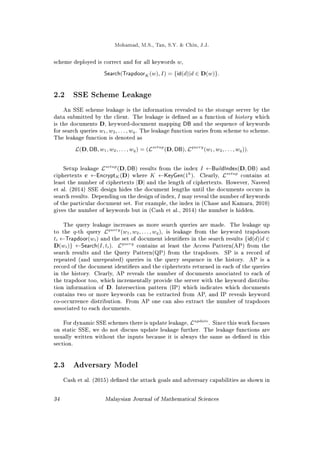
scheme deployed is correct and for all keywords w,
Search(TrapdoorK (w), I) = {id(d)|d ∈ D(w)}.
2.2 SSE Scheme Leakage
An SSE scheme leakage is the information revealed to the storage server by the
data submitted by the client. The leakage is dened as a function of history which
is the documents D, keyword-document mapping DB and the sequence of keywords
for search queries w1, w2, . . . , wq. The leakage function varies from scheme to scheme.
The leakage function is denoted as
L(D, DB, w1, w2, . . . , wq) = (Lsetup
(D, DB), Lquery
(w1, w2, . . . , wq)).
Setup leakage Lsetup
(D, DB) results from the index I ←BuildIndex(D, DB) and
ciphertexts c ←EncryptK (D) where K ←KeyGen(1k
). Clearly, Lsetup
contains at
least the number of ciphertexts |D| and the length of ciphertexts. However, Naveed
et al. (2014) SSE design hides the document lengths until the documents occurs in
search results. Depending on the design of index, I may reveal the number of keywords
of the particular document set. For example, the index in (Chase and Kamara, 2010)
gives the number of keywords but in (Cash et al., 2014) the number is hidden.
The query leakage increases as more search queries are made. The leakage up
to the q-th query Lquery
(w1, w2, . . . , wq), is leakage from the keyword trapdoors
ti ←Trapdoor(wi) and the set of document identiers in the search results {id(d)|d ∈
D(wi)} ←Search(I, ti). Lquery
contains at least the Access Pattern(AP) from the
search results and the Query Pattern(QP) from the trapdoors. SP is a record of
repeated (and unrepeated) queries in the query sequence in the history. AP is a
record of the document identiers and the ciphertexts returned in each of the queries
in the history. Clearly, AP reveals the number of documents associated to each of
the trapdoor too, which incrementally provide the server with the keyword distribu-
tion information of D. Intersection pattern (IP) which indicates which documents
contains two or more keywords can be extracted from AP, and IP reveals keyword
co-occurrence distribution. From AP one can also extract the number of trapdoors
associated to each documents.
For dynamic SSE schemes there is update leakage, Lupdate
. Since this work focuses
on static SSE, we do not discuss update leakage further. The leakage functions are
usually written without the inputs because it is always the same as dened in this
section.
2.3 Adversary Model
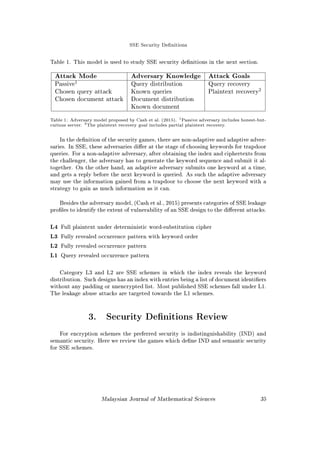
Cash et al. (2015) dened the attack goals and adversary capabilities as shown in
34 Malaysian Journal of Mathematical Sciences
SSE Security Denitions
Table 1. This model is used to study SSE security denitions in the next section.
Attack Mode Adversary Knowledge Attack Goals
Passive1 Query distribution Query recovery
Chosen query attack Known queries Plaintext recovery2
Chosen document attack Document distribution
Known document
Table 1: Adversary model proposed by Cash et al. (2015). 1
Passive adversary includes honest-but-
curious server. 2
The plaintext recovery goal includes partial plaintext recovery.
In the denition of the security games, there are non-adaptive and adaptive adver-
saries. In SSE, these adversaries dier at the stage of choosing keywords for trapdoor
queries. For a non-adaptive adversary, after obtaining the index and ciphertexts from
the challenger, the adversary has to generate the keyword sequence and submit it al-
together. On the other hand, an adaptive adversary submits one keyword at a time,
and gets a reply before the next keyword is queried. As such the adaptive adversary
may use the information gained from a trapdoor to choose the next keyword with a
strategy to gain as much information as it can.
Besides the adversary model, (Cash et al., 2015) presents categories of SSE leakage
proles to identify the extent of vulnerability of an SSE design to the dierent attacks.
L4 Full plaintext under deterministic word-substitution cipher
L3 Fully revealed occurrence pattern with keyword order
L2 Fully revealed occurrence pattern
L1 Query revealed occurrence pattern
Category L3 and L2 are SSE schemes in which the index reveals the keyword
distribution. Such designs has an index with entries being a list of document identiers
without any padding or unencrypted list. Most published SSE schemes fall under L1.
The leakage abuse attacks are targeted towards the L1 schemes.
3. Security Denitions Review
For encryption schemes the preferred security is indistinguishability (IND) and
semantic security. Here we review the games which dene IND and semantic security
for SSE schemes.
Malaysian Journal of Mathematical Sciences 35
Mohamad, M.S., Tan, S.Y.  Chin, J.J.
3.1 Indistinguishability
The IND game for encryption scheme involves the adversary providing two plain-
texts of the same length and then when given the encryption of one of them, having
to identify the corresponding plaintext. This denition implies that information re-
garding the plaintext is fully hidden in the ciphertext, except for its length.
The rst security denition for SSE is by Goh (2003). In that work, every docu-
ment ciphertext is appended with the list of encoded keyword contained in the doc-
uments. For this design the indistinguishability game is where the adversary chooses
two list of keywords associated to some documents and then is given as challenge
the encoded list of one of them. The adversary is asked to identify which keyword
list has been encoded to be the challenge. By this, the SSE is secure when the en-
coded keyword list does not reveal which document it belongs to, up to the subset of
documents having the same number of keywords.
Curtmola et al. (2006) adopted the game by Goh (2003) for index-based SSE
design. That is for all documents in the storage, there is one index whose key is the
encoded keyword and the entry lists identiers of documents containing the keyword.
The adversary is given the power to choose two sets of documents with the condition
their history (include search sequence) produce equal leakage. Then, the adversary
is given the corresponding two sets of index and ciphertexts and allowed to make
trapdoor queries. However, instead of two keyword lists, the adversary chooses two
keywords, one from each document set. When given the encoded keyword challenge,
the adversary have to guess which document set the keyword belong to. An SSE
scheme proven secure by rendering the adversary's advantage in this game insignif-
icant, means the scheme produces trapdoors, index and ciphertexts which do not
reveal any content of the documents.
The IND game for SSE as dened by (Curtmola et al., 2006) is presented here.
Denition 3.1. Let Σ=(KeyGen, Encrypt, BuildIndex, Trapdoor, Search, Decrypt) be
an index-based SSE, k ∈ N be a security parameter and A=(A0, A1, . . . , Aq+1) be
such that q ∈ N. Consider the following probabilistic experiment IndA,Σ(k): The
challenger begins with generating K ←KeyGen(1k
) and then randomly selecting b ←
{0, 1}. The adversary A0 generates two sets of documents D0, D1 with the restric-
tion that Lsetup
(D0)=Lsetup
(D1). The challenger returns cb ←EncryptK (Db) and
Ib ←BuildIndexK (Db). Next, for i = 1, . . . , qthe adversary Ai chooses a keyword w0,i
from D0 and w1,i from D1 such that Lquery
(w0,1, . . . , w0,q)=Lquery
(w1,1, . . . , w1,q).
For every query Ai waits for the reply, tb,i ←TrapdoorK (wb,i) before making the next
query. Finally, Aq+1 outputs b0
. If b0
= b, the experiment outputs 1, otherwise out-
puts 0. We say the that Σ achieves adaptive indistinguishability if for all polynomial
size adversaries A=(A0, A1, . . . , Aq+1) such that q is polynomial in terms of k,
Pr [IndΣ,A(k) = 1] 6
1
2
+ negl(k)
where the probability is over the choice of b and the coins of KeyGen and Encrypt.
36 Malaysian Journal of Mathematical Sciences
SSE Security Denitions
3.2 Semantic Security
Semantic security of an encryption scheme carries the meaning that no adversary
can recover partial information about the plaintexts from the ciphertexts. In the
context of SSE, semantic security means the same with the exception of the declared
leakage.
The rst simulation based security denition is by Chang and Mitzenmacher
(2005). In their game, the adversary A is given the actual communications between
server and user, Cq, while another adversary A∗
is given information learned (leakage)
from the communication, C∗
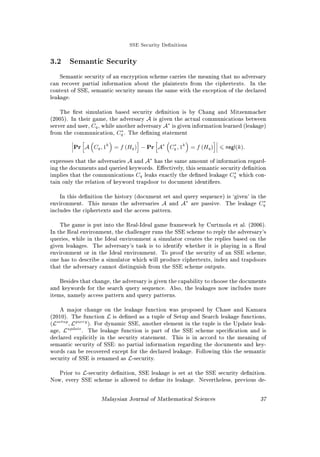
q . The dening statement
Pr
h
A

Cq, 1k

= f (Hq)
i
− Pr
h
A∗

C∗
q , 1k

= f (Hq)
i
6 negl(k).
expresses that the adversaries A and A∗
has the same amount of information regard-
ing the documents and queried keywords. Eectively, this semantic security denition
implies that the communications Cq leaks exactly the dened leakage C∗
q which con-
tain only the relation of keyword trapdoor to document identiers.
In this denition the history (document set and query sequence) is `given' in the
environment. This means the adversaries A and A∗
are passive. The leakage C∗
q
includes the ciphertexts and the access pattern.
The game is put into the Real-Ideal game framework by Curtmola et al. (2006).
In the Real environment, the challenger runs the SSE scheme to reply the adversary's
queries, while in the Ideal environment a simulator creates the replies based on the
given leakages. The adversary's task is to identify whether it is playing in a Real
environment or in the Ideal environment. To proof the security of an SSE scheme,
one has to describe a simulator which will produce ciphertexts, index and trapdoors
that the adversary cannot distinguish from the SSE scheme outputs.
Besides that change, the adversary is given the capability to choose the documents
and keywords for the search query sequence. Also, the leakages now includes more
items, namely access pattern and query patterns.
A major change on the leakage function was proposed by Chase and Kamara
(2010). The function L is dened as a tuple of Setup and Search leakage functions,
(Lsetup
, Lquery
). For dynamic SSE, another element in the tuple is the Update leak-
age, Lupdate
. The leakage function is part of the SSE scheme specication and is
declared explicitly in the security statement. This is in accord to the meaning of
semantic security of SSE: no partial information regarding the documents and key-
words can be recovered except for the declared leakage. Following this the semantic
security of SSE is renamed as L-security.
Prior to L-security denition, SSE leakage is set at the SSE security denition.
Now, every SSE scheme is allowed to dene its leakage. Nevertheless, previous de-
Malaysian Journal of Mathematical Sciences 37
Mohamad, M.S., Tan, S.Y.  Chin, J.J.
ned leakage is the minimum leakage for any SSE scheme. Some schemes leak more to
accommodate their design or data type. In fact this was proposed in (Chase and Ka-
mara, 2010) because they are applying searchable encryption on structured data such
such as matrix and graphs. In their SSE constructions some structure information is
leaked to complete the search result.
The widely used SSE security denition is the L-security game as presented below.
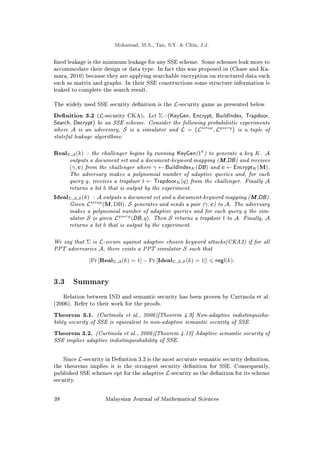
Denition 3.2 (L-security CKA). Let Σ= KeyGen, Encrypt, BuildIndex, Trapdoor,
Search, Decrypt

be an SSE scheme. Consider the following probabilistic experiments
where A is an adversary, S is a simulator and L = Lsetup
, Lquery

is a tuple of
stateful leakage algorithms:
RealΣ,A(k) : the challenger begins by running KeyGen(1k
) to generate a key K. A
outputs a document set and a document-keyword mapping (M,DB) and receives
(γ, c) from the challenger where γ ← BuildIndexK (DB) and c ← EncryptK (M).
The adversary makes a polynomial number of adaptive queries and, for each
query q, receives a trapdoor t ← TrapdoorK (q) from the challenger. Finally A
returns a bit b that is output by the experiment.
IdealΣ,A,S (k) : A outputs a document set and a document-keyword mapping (M,DB).
Given Lsetup
(M, DB), S generates and sends a pair (γ, c) to A. The adversary
makes a polynomial number of adaptive queries and for each query q the sim-
ulator S is given Lquery
(DB, q). Then S returns a trapdoor t to A. Finally, A
returns a bit b that is output by the experiment.
We say that Σ is L-secure against adaptive chosen keyword attacks(CKA2) if for all
PPT adversaries A, there exists a PPT simulator S such that
|Pr [RealΣ,A(k) = 1] − Pr [IdealΣ,A,S (k) = 1]| 6 negl(k).
3.3 Summary
Relation between IND and semantic security has been proven by Curtmola et al.
(2006). Refer to their work for the proofs.
Theorem 3.1. (Curtmola et al., 2006)[Theorem 4.9] Non-adaptive indistinguisha-
bility security of SSE is equivalent to non-adaptive semantic security of SSE.
Theorem 3.2. (Curtmola et al., 2006)[Theorem 4.12] Adaptive semantic security of
SSE implies adaptive indistinguishability of SSE.
Since L-security in Denition 3.2 is the most accurate semantic security denition,
the theorems implies it is the strongest security denition for SSE. Consequently,
published SSE schemes opt for the adaptive L-security as the denition for its scheme
security.
38 Malaysian Journal of Mathematical Sciences
SSE Security Denitions
Security Security Attack Mode Leakage
Denition Goal Prole
Goh (2003) IND of documents
w.r.t. index
Chosen keyword
 document
L4
Chang and
Mitzenmacher
(2005)
Semantic security of
documents and queries
Passive L2
Curtmola et al.
(2006) semantic
security
Semantic security of
document set
Chosen keyword
 document
L1
Curtmola
et al. (2006)
indistinguishability
IND of document sets Chosen keyword
 document
L1
Chase and Ka-
mara (2010) L-
security
Semantic security of
document set
Chosen query 
document
L1
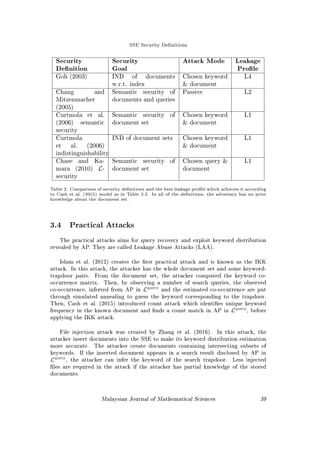
Table 2: Comparison of security denitions and the best leakage prole which achieves it according
to Cash et al. (2015) model as in Table 2.3. In all of the denitions, the adversary has no prior
knowledge about the document set.
3.4 Practical Attacks
The practical attacks aims for query recovery and exploit keyword distribution
revealed by AP. They are called Leakage Abuse Attacks (LAA).
Islam et al. (2012) creates the rst practical attack and is known as the IKK
attack. In this attack, the attacker has the whole document set and some keyword-
trapdoor pairs. From the document set, the attacker computed the keyword co-
occurrence matrix. Then, by observing a number of search queries, the observed
co-occurrence, inferred from AP in Lquery
and the estimated co-occurrence are put
through simulated annealing to guess the keyword corresponding to the trapdoor.
Then, Cash et al. (2015) introduced count attack which identies unique keyword
frequency in the known document and nds a count match in AP in Lquery
, before
applying the IKK attack.
File injection attack was created by Zhang et al. (2016). In this attack, the
attacker insert documents into the SSE to make its keyword distribution estimation
more accurate. The attacker create documents containing intersecting subsets of
keywords. If the inserted document appears in a search result disclosed by AP in
Lquery
, the attacker can infer the keyword of the search trapdoor. Less injected
les are required in the attack if the attacker has partial knowledge of the stored
documents.
Malaysian Journal of Mathematical Sciences 39
Mohamad, M.S., Tan, S.Y.  Chin, J.J.
3.5 Comparing Security Model to Attacks
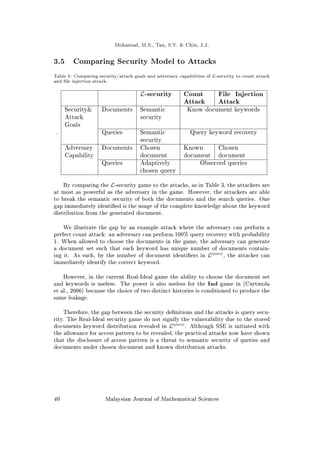
Table 3: Comparing security/attack goals and adversary capabilities of L-security to count attack
and le injection attack.
.
L-security Count
Attack
File Injection
Attack
Security
Attack
Goals
Documents Semantic
security
Know document keywords
Queries Semantic
security
Query keyword recovery
Adversary
Capability
Documents Chosen
document
Known
document
Chosen
document
Queries Adaptively
chosen query
Observed queries
By comparing the L-security game to the attacks, as in Table 3, the attackers are
at most as powerful as the adversary in the game. However, the attackers are able
to break the semantic security of both the documents and the search queries. One
gap immediately identied is the usage of the complete knowledge about the keyword
distribution from the generated document.
We illustrate the gap by an example attack where the adversary can perform a
perfect count attack: an adversary can perform 100% query recovery with probability
1. When allowed to choose the documents in the game, the adversary can generate
a document set such that each keyword has unique number of documents contain-
ing it. As such, by the number of document identiers in Lquery
, the attacker can
immediately identify the correct keyword.
However, in the current Real-Ideal game the ability to choose the document set
and keywords is useless. The power is also useless for the Ind game in (Curtmola
et al., 2006) because the choice of two distinct histories is conditioned to produce the
same leakage.
Therefore, the gap between the security denitions and the attacks is query secu-
rity. The Real-Ideal security game do not signify the vulnerability due to the stored
documents keyword distribution revealed in Lquery
. Although SSE is initiated with
the allowance for access pattern to be revealed, the practical attacks now have shown
that the disclosure of access pattern is a threat to semantic security of queries and
documents under chosen document and known distribution attacks.
40 Malaysian Journal of Mathematical Sciences
SSE Security Denitions
3.6 Update in Security Denitions
The main gap in adversary model and the attackers is the ability to choose the
document. The attack has shown this is a very powerful adversary. Hence the rst
changes noticed in the games is the source of the document set. The document set is
given in the environment in (Kamara and Moataz, 2017) and (Pouloit et al., 2017).
A more formal change made by Bost and Fouque (2017) denes a structure called
Constraint to declare the adversary's knowledge. This is deployed in the IND game
as in Denition 3.1. The documents sets have to fulll the Constraint as set by the
adversary.
Despite the changes, the security games maintain the status where the leakage is
allowed and does not identify whether the scheme secure against LAA. In the next
section we dene a game which if a scheme can be proven to allow only negligible
advantage for the adversary to win implies that the scheme is secure against query
recovery under LAA.
4. New Security Denition
Here, a security game is dened to discriminate SSE schemes whose leakage enable
query recovery attacks. The strength against query recovery is dened by providing
assurance that even knowing the set of all keywords and access to the trapdoor oracle,
the adversary would not be able to identify keywords of other trapdoors.
The adversary's prior knowledge determines the source of documents during the
game initiation as follows.
• Without prior knowledge: Document set D is in the environment.
• Known document distribution: D is set by environment. Challenger gives
adversary distribution information.
• Known document: D is set by environment. Challenger gives adversary all or
some document.
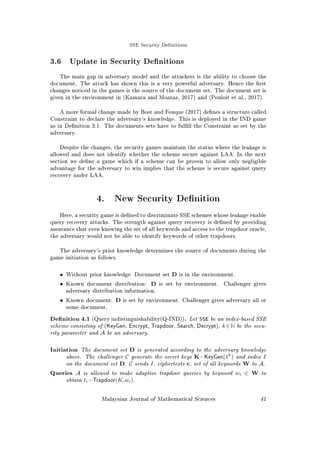
Denition 4.1 (Query indistinguishability(Q-IND)). Let SSE be an index-based SSE
scheme consisting of (KeyGen, Encrypt, Trapdoor, Search, Decrypt), k∈N be the secu-
rity parameter and A be an adversary.
Initiation The document set D is generated according to the adversary knowledge
above. The challenger C generate the secret keys K=KeyGen(1k
) and index I
on the document set D. C sends I, ciphertexts c, set of all keywords W to A.
Queries A is allowed to make adaptive trapdoor queries by keyword wi ∈ W to
obtain ti=Trapdoor(K,wi).
Malaysian Journal of Mathematical Sciences 41

Searchable symmetric encryption security definitions

  • 1.
    Malaysian Journal ofMathematical Sciences 13(S) August: 3147 (2019) Special Issue: The 6th International Cryptology and Information Security Conference (CRYPTOLOGY2018) MALAYSIAN JOURNAL OF MATHEMATICAL SCIENCES Journal homepage: http://einspem.upm.edu.my/journal Searchable Symmetric Encryption Security Denitions Mohamad, M.S. ∗1,2 , Tan, S.Y. 3 , and Chin, J.J. 4 1 Faculty of Computing and Informatics, Multimedia University, Cyberjaya 2 Information Security Lab, Mimos Berhad, Kuala Lumpur 3 Faculty of Information Science and Technology, Multimedia University, Melaka 4 Faculty of Engineering, Multimedia University, Cyberjaya E-mail: soeheila.mohamad@mimos.my ∗ Corresponding author ABSTRACT After many searchable symmetric schemes have been proposed and proven secure, a few published work show empirical evidence of successful attacks on all published schemes. The attacks indicate a gap between the current security models and the practical attackers. This work reviews indistin- guishability and semantic security games for SSE. Finally, a new security denition against the practical attacks is proposed and proven to imply current security denitions. Keywords: searchable encryption, SSE, security model.
  • 2.
    Mohamad, M.S., Tan,S.Y. Chin, J.J. 1. Introduction Searchable symmetric encryption (SSE) is a category of schemes with ci- phertext searching function utilising symmetric cryptographic algorithms. The purpose of SSE is for a user to store a document collection in a storage facil- ity without exposing the documents to the storage owner or co-resident. In addition, the data owner or authorized users may perform searches to nd documents of interest, while maintaining security. In order to achieve sublinear search complexity, SSE scheme designs deploys inverted index where the index key is encoded keywords and the index values are document identiers. Examples of such design includes Curtmola et al. (2006), Chase and Kamara (2010), Naveed et al. (2014), Cash et al. (2014) and Kamara and Moataz (2017). The trade o in enabling search on ciphertexts is the disclosure of some information regarding the documents, called leakage. Despite the leakage, an SSE scheme aims to protect the condentiality of the stored documents and the queried keyword using symmetric cryptographic schemes. Currently, the L- security (Chase and Kamara, 2010) is the denition accepted for SSE schemes security. However, attacks by Islam et al. (2012), Zhang et al. (2016) and Cash et al. (2015) were successful in recovering query keywords in published index-based SSE schemes. Wright and Pouloit (2017) generalized the attacks as statistic inference attack and produced a statistical method framework to detect such vulnerabilities in an SSE scheme. Cash et al. (2015) studied the practical attacks and dened the attack goals and adversary capabilities. In addition, they categorize SSE leakage proles to identify the extent of vulnerability of an SSE design to the dierent attacks. Here we are only concerned with leakage prole L1 which reveals keyword occurrence pattern only after search queries are performed. Our Contribution This work takes the provable security perspective by comparing the indistinguishability and semantic security denitions for SSE to the attacks. Then, a security game is proposed to dene strength against the distribution-based query recovery attacks. 32 Malaysian Journal of Mathematical Sciences
  • 3.
    SSE Security Denitions 2.Preliminaries 2.1 Searchable Symmetric Encryption Scheme There are two types of SSE, static and dynamic. A static SSE is where the data is prepared and uploaded to the storage server once and after that only search queries are made. A dynamic SSE allows for data adding, removing or modied after the rst uploading. A static SSE scheme consists of six algorithms. KeyGen This is a probabilistic algorithm run by the client. From a security pa- rameter 1k , this algorithm generates a set of symmetric keys, K, including an encryption key. BuildIndex This algorithm is run by the client, taking the document-keywords mapping DB and keys K and output the index I. Encrypt This a symmetric encryption algorithm is run by the client and is usually probabilistic. For input a set of document D and keys K, this algorithm outputs a set of ciphertexts c of the documents. Trapdoor This algorithm is run by the client and is usually deterministic. It takes as input the keyword w and the key K and outputs a trapdoor tw. Search This is a deterministic interactive algorithm run by the server. Inputs are tw sent by the client and the index I stored on the server. This algo- rithm nds the set of document identiers corresponding to documents containing the keyword w. The set of document identiers being output is returned to the client. Decrypt This the corresponding symmetric decryption algorithm which runs on the client. Taking input ciphertexts c1, . . . , cn and key K to output documents d1, . . . , dn. There are schemes presented with four algorithms KeyGen, Setup, Search and Decrypt where Setup consists of BuildIndex, Trapdoor and Encrypt, and Search is in- teractive and includes Trapdoor and Search. Dynamic SSE schemes include another algorithm, Update which takes as input a document, the list of keywords and an op- eration name such as add, remove and modify. The algorithm outputs a new index and ciphertext. Let D(w) denote the set of documents containing keyword w and id(d) denote the identier for document d ∈ D. An SSE scheme is correct if the symmetric encryption Malaysian Journal of Mathematical Sciences 33
  • 4.
    Mohamad, M.S., Tan,S.Y. Chin, J.J. scheme deployed is correct and for all keywords w, Search(TrapdoorK (w), I) = {id(d)|d ∈ D(w)}. 2.2 SSE Scheme Leakage An SSE scheme leakage is the information revealed to the storage server by the data submitted by the client. The leakage is dened as a function of history which is the documents D, keyword-document mapping DB and the sequence of keywords for search queries w1, w2, . . . , wq. The leakage function varies from scheme to scheme. The leakage function is denoted as L(D, DB, w1, w2, . . . , wq) = (Lsetup (D, DB), Lquery (w1, w2, . . . , wq)). Setup leakage Lsetup (D, DB) results from the index I ←BuildIndex(D, DB) and ciphertexts c ←EncryptK (D) where K ←KeyGen(1k ). Clearly, Lsetup contains at least the number of ciphertexts |D| and the length of ciphertexts. However, Naveed et al. (2014) SSE design hides the document lengths until the documents occurs in search results. Depending on the design of index, I may reveal the number of keywords of the particular document set. For example, the index in (Chase and Kamara, 2010) gives the number of keywords but in (Cash et al., 2014) the number is hidden. The query leakage increases as more search queries are made. The leakage up to the q-th query Lquery (w1, w2, . . . , wq), is leakage from the keyword trapdoors ti ←Trapdoor(wi) and the set of document identiers in the search results {id(d)|d ∈ D(wi)} ←Search(I, ti). Lquery contains at least the Access Pattern(AP) from the search results and the Query Pattern(QP) from the trapdoors. SP is a record of repeated (and unrepeated) queries in the query sequence in the history. AP is a record of the document identiers and the ciphertexts returned in each of the queries in the history. Clearly, AP reveals the number of documents associated to each of the trapdoor too, which incrementally provide the server with the keyword distribu- tion information of D. Intersection pattern (IP) which indicates which documents contains two or more keywords can be extracted from AP, and IP reveals keyword co-occurrence distribution. From AP one can also extract the number of trapdoors associated to each documents. For dynamic SSE schemes there is update leakage, Lupdate . Since this work focuses on static SSE, we do not discuss update leakage further. The leakage functions are usually written without the inputs because it is always the same as dened in this section. 2.3 Adversary Model Cash et al. (2015) dened the attack goals and adversary capabilities as shown in 34 Malaysian Journal of Mathematical Sciences
  • 5.
    SSE Security Denitions Table1. This model is used to study SSE security denitions in the next section. Attack Mode Adversary Knowledge Attack Goals Passive1 Query distribution Query recovery Chosen query attack Known queries Plaintext recovery2 Chosen document attack Document distribution Known document Table 1: Adversary model proposed by Cash et al. (2015). 1 Passive adversary includes honest-but- curious server. 2 The plaintext recovery goal includes partial plaintext recovery. In the denition of the security games, there are non-adaptive and adaptive adver- saries. In SSE, these adversaries dier at the stage of choosing keywords for trapdoor queries. For a non-adaptive adversary, after obtaining the index and ciphertexts from the challenger, the adversary has to generate the keyword sequence and submit it al- together. On the other hand, an adaptive adversary submits one keyword at a time, and gets a reply before the next keyword is queried. As such the adaptive adversary may use the information gained from a trapdoor to choose the next keyword with a strategy to gain as much information as it can. Besides the adversary model, (Cash et al., 2015) presents categories of SSE leakage proles to identify the extent of vulnerability of an SSE design to the dierent attacks. L4 Full plaintext under deterministic word-substitution cipher L3 Fully revealed occurrence pattern with keyword order L2 Fully revealed occurrence pattern L1 Query revealed occurrence pattern Category L3 and L2 are SSE schemes in which the index reveals the keyword distribution. Such designs has an index with entries being a list of document identiers without any padding or unencrypted list. Most published SSE schemes fall under L1. The leakage abuse attacks are targeted towards the L1 schemes. 3. Security Denitions Review For encryption schemes the preferred security is indistinguishability (IND) and semantic security. Here we review the games which dene IND and semantic security for SSE schemes. Malaysian Journal of Mathematical Sciences 35
  • 6.
    Mohamad, M.S., Tan,S.Y. Chin, J.J. 3.1 Indistinguishability The IND game for encryption scheme involves the adversary providing two plain- texts of the same length and then when given the encryption of one of them, having to identify the corresponding plaintext. This denition implies that information re- garding the plaintext is fully hidden in the ciphertext, except for its length. The rst security denition for SSE is by Goh (2003). In that work, every docu- ment ciphertext is appended with the list of encoded keyword contained in the doc- uments. For this design the indistinguishability game is where the adversary chooses two list of keywords associated to some documents and then is given as challenge the encoded list of one of them. The adversary is asked to identify which keyword list has been encoded to be the challenge. By this, the SSE is secure when the en- coded keyword list does not reveal which document it belongs to, up to the subset of documents having the same number of keywords. Curtmola et al. (2006) adopted the game by Goh (2003) for index-based SSE design. That is for all documents in the storage, there is one index whose key is the encoded keyword and the entry lists identiers of documents containing the keyword. The adversary is given the power to choose two sets of documents with the condition their history (include search sequence) produce equal leakage. Then, the adversary is given the corresponding two sets of index and ciphertexts and allowed to make trapdoor queries. However, instead of two keyword lists, the adversary chooses two keywords, one from each document set. When given the encoded keyword challenge, the adversary have to guess which document set the keyword belong to. An SSE scheme proven secure by rendering the adversary's advantage in this game insignif- icant, means the scheme produces trapdoors, index and ciphertexts which do not reveal any content of the documents. The IND game for SSE as dened by (Curtmola et al., 2006) is presented here. Denition 3.1. Let Σ=(KeyGen, Encrypt, BuildIndex, Trapdoor, Search, Decrypt) be an index-based SSE, k ∈ N be a security parameter and A=(A0, A1, . . . , Aq+1) be such that q ∈ N. Consider the following probabilistic experiment IndA,Σ(k): The challenger begins with generating K ←KeyGen(1k ) and then randomly selecting b ← {0, 1}. The adversary A0 generates two sets of documents D0, D1 with the restric- tion that Lsetup (D0)=Lsetup (D1). The challenger returns cb ←EncryptK (Db) and Ib ←BuildIndexK (Db). Next, for i = 1, . . . , qthe adversary Ai chooses a keyword w0,i from D0 and w1,i from D1 such that Lquery (w0,1, . . . , w0,q)=Lquery (w1,1, . . . , w1,q). For every query Ai waits for the reply, tb,i ←TrapdoorK (wb,i) before making the next query. Finally, Aq+1 outputs b0 . If b0 = b, the experiment outputs 1, otherwise out- puts 0. We say the that Σ achieves adaptive indistinguishability if for all polynomial size adversaries A=(A0, A1, . . . , Aq+1) such that q is polynomial in terms of k, Pr [IndΣ,A(k) = 1] 6 1 2 + negl(k) where the probability is over the choice of b and the coins of KeyGen and Encrypt. 36 Malaysian Journal of Mathematical Sciences
  • 7.
    SSE Security Denitions 3.2Semantic Security Semantic security of an encryption scheme carries the meaning that no adversary can recover partial information about the plaintexts from the ciphertexts. In the context of SSE, semantic security means the same with the exception of the declared leakage. The rst simulation based security denition is by Chang and Mitzenmacher (2005). In their game, the adversary A is given the actual communications between server and user, Cq, while another adversary A∗ is given information learned (leakage) from the communication, C∗ q . The dening statement
  • 10.
    Pr h A Cq, 1k = f(Hq) i − Pr h A∗ C∗ q , 1k = f (Hq) i
  • 13.
    6 negl(k). expresses thatthe adversaries A and A∗ has the same amount of information regard- ing the documents and queried keywords. Eectively, this semantic security denition implies that the communications Cq leaks exactly the dened leakage C∗ q which con- tain only the relation of keyword trapdoor to document identiers. In this denition the history (document set and query sequence) is `given' in the environment. This means the adversaries A and A∗ are passive. The leakage C∗ q includes the ciphertexts and the access pattern. The game is put into the Real-Ideal game framework by Curtmola et al. (2006). In the Real environment, the challenger runs the SSE scheme to reply the adversary's queries, while in the Ideal environment a simulator creates the replies based on the given leakages. The adversary's task is to identify whether it is playing in a Real environment or in the Ideal environment. To proof the security of an SSE scheme, one has to describe a simulator which will produce ciphertexts, index and trapdoors that the adversary cannot distinguish from the SSE scheme outputs. Besides that change, the adversary is given the capability to choose the documents and keywords for the search query sequence. Also, the leakages now includes more items, namely access pattern and query patterns. A major change on the leakage function was proposed by Chase and Kamara (2010). The function L is dened as a tuple of Setup and Search leakage functions, (Lsetup , Lquery ). For dynamic SSE, another element in the tuple is the Update leak- age, Lupdate . The leakage function is part of the SSE scheme specication and is declared explicitly in the security statement. This is in accord to the meaning of semantic security of SSE: no partial information regarding the documents and key- words can be recovered except for the declared leakage. Following this the semantic security of SSE is renamed as L-security. Prior to L-security denition, SSE leakage is set at the SSE security denition. Now, every SSE scheme is allowed to dene its leakage. Nevertheless, previous de- Malaysian Journal of Mathematical Sciences 37
  • 14.
    Mohamad, M.S., Tan,S.Y. Chin, J.J. ned leakage is the minimum leakage for any SSE scheme. Some schemes leak more to accommodate their design or data type. In fact this was proposed in (Chase and Ka- mara, 2010) because they are applying searchable encryption on structured data such such as matrix and graphs. In their SSE constructions some structure information is leaked to complete the search result. The widely used SSE security denition is the L-security game as presented below. Denition 3.2 (L-security CKA). Let Σ= KeyGen, Encrypt, BuildIndex, Trapdoor, Search, Decrypt be an SSE scheme. Consider the following probabilistic experiments where A is an adversary, S is a simulator and L = Lsetup , Lquery is a tuple of stateful leakage algorithms: RealΣ,A(k) : the challenger begins by running KeyGen(1k ) to generate a key K. A outputs a document set and a document-keyword mapping (M,DB) and receives (γ, c) from the challenger where γ ← BuildIndexK (DB) and c ← EncryptK (M). The adversary makes a polynomial number of adaptive queries and, for each query q, receives a trapdoor t ← TrapdoorK (q) from the challenger. Finally A returns a bit b that is output by the experiment. IdealΣ,A,S (k) : A outputs a document set and a document-keyword mapping (M,DB). Given Lsetup (M, DB), S generates and sends a pair (γ, c) to A. The adversary makes a polynomial number of adaptive queries and for each query q the sim- ulator S is given Lquery (DB, q). Then S returns a trapdoor t to A. Finally, A returns a bit b that is output by the experiment. We say that Σ is L-secure against adaptive chosen keyword attacks(CKA2) if for all PPT adversaries A, there exists a PPT simulator S such that |Pr [RealΣ,A(k) = 1] − Pr [IdealΣ,A,S (k) = 1]| 6 negl(k). 3.3 Summary Relation between IND and semantic security has been proven by Curtmola et al. (2006). Refer to their work for the proofs. Theorem 3.1. (Curtmola et al., 2006)[Theorem 4.9] Non-adaptive indistinguisha- bility security of SSE is equivalent to non-adaptive semantic security of SSE. Theorem 3.2. (Curtmola et al., 2006)[Theorem 4.12] Adaptive semantic security of SSE implies adaptive indistinguishability of SSE. Since L-security in Denition 3.2 is the most accurate semantic security denition, the theorems implies it is the strongest security denition for SSE. Consequently, published SSE schemes opt for the adaptive L-security as the denition for its scheme security. 38 Malaysian Journal of Mathematical Sciences
  • 15.
    SSE Security Denitions SecuritySecurity Attack Mode Leakage Denition Goal Prole Goh (2003) IND of documents w.r.t. index Chosen keyword document L4 Chang and Mitzenmacher (2005) Semantic security of documents and queries Passive L2 Curtmola et al. (2006) semantic security Semantic security of document set Chosen keyword document L1 Curtmola et al. (2006) indistinguishability IND of document sets Chosen keyword document L1 Chase and Ka- mara (2010) L- security Semantic security of document set Chosen query document L1 Table 2: Comparison of security denitions and the best leakage prole which achieves it according to Cash et al. (2015) model as in Table 2.3. In all of the denitions, the adversary has no prior knowledge about the document set. 3.4 Practical Attacks The practical attacks aims for query recovery and exploit keyword distribution revealed by AP. They are called Leakage Abuse Attacks (LAA). Islam et al. (2012) creates the rst practical attack and is known as the IKK attack. In this attack, the attacker has the whole document set and some keyword- trapdoor pairs. From the document set, the attacker computed the keyword co- occurrence matrix. Then, by observing a number of search queries, the observed co-occurrence, inferred from AP in Lquery and the estimated co-occurrence are put through simulated annealing to guess the keyword corresponding to the trapdoor. Then, Cash et al. (2015) introduced count attack which identies unique keyword frequency in the known document and nds a count match in AP in Lquery , before applying the IKK attack. File injection attack was created by Zhang et al. (2016). In this attack, the attacker insert documents into the SSE to make its keyword distribution estimation more accurate. The attacker create documents containing intersecting subsets of keywords. If the inserted document appears in a search result disclosed by AP in Lquery , the attacker can infer the keyword of the search trapdoor. Less injected les are required in the attack if the attacker has partial knowledge of the stored documents. Malaysian Journal of Mathematical Sciences 39
  • 16.
    Mohamad, M.S., Tan,S.Y. Chin, J.J. 3.5 Comparing Security Model to Attacks Table 3: Comparing security/attack goals and adversary capabilities of L-security to count attack and le injection attack. . L-security Count Attack File Injection Attack Security Attack Goals Documents Semantic security Know document keywords Queries Semantic security Query keyword recovery Adversary Capability Documents Chosen document Known document Chosen document Queries Adaptively chosen query Observed queries By comparing the L-security game to the attacks, as in Table 3, the attackers are at most as powerful as the adversary in the game. However, the attackers are able to break the semantic security of both the documents and the search queries. One gap immediately identied is the usage of the complete knowledge about the keyword distribution from the generated document. We illustrate the gap by an example attack where the adversary can perform a perfect count attack: an adversary can perform 100% query recovery with probability 1. When allowed to choose the documents in the game, the adversary can generate a document set such that each keyword has unique number of documents contain- ing it. As such, by the number of document identiers in Lquery , the attacker can immediately identify the correct keyword. However, in the current Real-Ideal game the ability to choose the document set and keywords is useless. The power is also useless for the Ind game in (Curtmola et al., 2006) because the choice of two distinct histories is conditioned to produce the same leakage. Therefore, the gap between the security denitions and the attacks is query secu- rity. The Real-Ideal security game do not signify the vulnerability due to the stored documents keyword distribution revealed in Lquery . Although SSE is initiated with the allowance for access pattern to be revealed, the practical attacks now have shown that the disclosure of access pattern is a threat to semantic security of queries and documents under chosen document and known distribution attacks. 40 Malaysian Journal of Mathematical Sciences
  • 17.
    SSE Security Denitions 3.6Update in Security Denitions The main gap in adversary model and the attackers is the ability to choose the document. The attack has shown this is a very powerful adversary. Hence the rst changes noticed in the games is the source of the document set. The document set is given in the environment in (Kamara and Moataz, 2017) and (Pouloit et al., 2017). A more formal change made by Bost and Fouque (2017) denes a structure called Constraint to declare the adversary's knowledge. This is deployed in the IND game as in Denition 3.1. The documents sets have to fulll the Constraint as set by the adversary. Despite the changes, the security games maintain the status where the leakage is allowed and does not identify whether the scheme secure against LAA. In the next section we dene a game which if a scheme can be proven to allow only negligible advantage for the adversary to win implies that the scheme is secure against query recovery under LAA. 4. New Security Denition Here, a security game is dened to discriminate SSE schemes whose leakage enable query recovery attacks. The strength against query recovery is dened by providing assurance that even knowing the set of all keywords and access to the trapdoor oracle, the adversary would not be able to identify keywords of other trapdoors. The adversary's prior knowledge determines the source of documents during the game initiation as follows. • Without prior knowledge: Document set D is in the environment. • Known document distribution: D is set by environment. Challenger gives adversary distribution information. • Known document: D is set by environment. Challenger gives adversary all or some document. Denition 4.1 (Query indistinguishability(Q-IND)). Let SSE be an index-based SSE scheme consisting of (KeyGen, Encrypt, Trapdoor, Search, Decrypt), k∈N be the secu- rity parameter and A be an adversary. Initiation The document set D is generated according to the adversary knowledge above. The challenger C generate the secret keys K=KeyGen(1k ) and index I on the document set D. C sends I, ciphertexts c, set of all keywords W to A. Queries A is allowed to make adaptive trapdoor queries by keyword wi ∈ W to obtain ti=Trapdoor(K,wi). Malaysian Journal of Mathematical Sciences 41