Graphene-based Polyelectrolytes Coating Assembly: Study on
Morphological, Optical and Mechanical Properties
Syed Muhammad Hafiz1
*, Norhaizam Mustaffa1
, Nora’zah Abdul Rashid1
, Aiman
Sajidah Abd Aziz1
, Suraya Sulaiman1
1
Flexible Electronics Laboratory, Research and Development, MIMOS Berhad,
Technology Park Malaysia, Kuala Lumpur, Malaysia
*Corresponding author’s phone: +603-8995 5000
E-mail: hafiz.jaafar@mimos.my
ABSTRACT
The structural practicality for real-
world application of polyelectrolytes
antibacterial coating has not been widely
studied yet despite having a huge potential.
Therefore, this may possess a huge
hindrance when the commercialization
stage takes place. In this study, various
loading of silane functionalized-graphene
(f-G) which then incorporated with
polyanion, i.e. polystyrene sulfonate
(PSS), was coated on a flexible amorphous
polyethylene terephthalate (APET)
substrate with polycation, i.e.
polydiallyldimethyl ammonium chloride
(PDDA) on top of it. The morphological,
optical and mechanical properties were
demonstrated for a coating assembly of
0.01 wt.% f-G/PSS that have high optical
transparency (90.9%) with low haze
(7.0%) as well as good adhesion according
toASTM D3359 (scaled at 5B) standard.
Keywords— polyelectrolyte assembly;
graphene; transparent coating; flexible
coating; antibacterial coating.
1.0 INTRODUCTION
With the ongoing worldwide
pandemic of coronavirus disease since late
2019 (COVID-19), the study on
antibacterial coating has been significantly
increased. In addition, water borne
microorganisms like undesirable bacteria
pose a significant risk to public health.
Pathogenic variants of Escherichia coliare
(E. Coli), for example, is one of the causes
of worldwide morbidity and mortality [1].
Several polyelectrolytes polymers (e.g.
PDDA and PSS) exhibit a useful
antimicrobial property has been discussed.
However, most studies inclined with the
relationship between structure-activity,
which still left a gap for a complete
investigation in terms ofthe relationship
between structure-practicality for real-
world application for example in terms of
adhesion and haze or optical transmission
[2].
2.0 THEORY
The mechanism of antibacterial
properties of polyelectrolytes might be
following several sequences of events
occurs with microorganisms exposed to
cationic or anionic agents, starting with;
(i) adsorption and penetration of the agent
into the cell wall; (ii) reaction with the
cytoplasmic membrane followed by
membrane disorganization; (iii) leakage
of intracellular low-molecular-weight
material; (iv) degradation of proteins and
nucleic acids; and finally (v) wall lysis
caused by autolytic enzymes. There would
be a loss of structural organization and
integrity of the cytoplasmic membrane in
bacteria, together with other damaging
effects to the bacterial cell [2].
3.0 MATERIALS
Amorphous polyethylene
terephthalate (APET) substrate was
supplied from Macro Plastic (M) Sdn.
Proceedings of the 4th International Symposium on Advanced Materials and Nanotechnology 2020
(i-SAMN2020), December 1-3, 2020
eISBN 978-983-42758-7-7 ©2020 ITMA, UPM 118
Bhd. Poly (sodium4-styrenesulfonate)
solution (PSS) Mw ~200,000 and Poly
(diallyldimethyl ammonium chloride)
solution (PDDA) Mw ~200,000-350,000,
both with 2 wt.% in H2O was purchased
from Sigma-Aldrich. Graphene
nanoplatelets, xGnP® with 5µm flake size
was purchase from XG Sciences Inc.
Silane coupling agent, (3-Aminopropyl)
triethoxysilane (APTES) ≥98%, was
purchased from Sigma-Aldrich.
4.0 EXPERIMENTAL
4.1 Preparation of f-G/PSS solution
For the preparation of silane
functionalized graphene, it was carried out
in water/ethanol mixture according to
reference [3]. In brief, xGnP® powder was
added into water/ethanol mixture under
mild sonication for 1 hour at 1 mg/mL
concentration. Then, APTES was added
into the mixture drop wise with 10 v/v% at
65 °C, and the reaction was continued to
process for 12 h under constant stirring.
Subsequently, the final reactant was
washed with methanol and filtered several
times. The products, (3-Aminopropyl)
triethoxysilane-xGnP, abbreviated as f-G
throughout this paper will then undergo
drying process in an oven at 60 °C for 12
h. Finally, the 0.1, 0.05 and 0.01 wt.% of f-
G powder was prepared by mixing with
polyanion PSS of 2 wt.% solution and
sonicated for 4 hours until homogeneous
mixture achieved. Figure 1(a) shows the
image of the as-prepared f-G/PSS final
solution.
Fig. 1: The as-prepared f-G/PSS (a) solution and
(b-c) coated on APET/PDDA substrate.
4.2 Preparation technique of
graphene-based polyelectrolyte
assembly coating
APET substrate was cut into 5 cm
x 5 cm size and then cleaned with 5 wt.%
NaOH followed with deionized water and
finally dip-coated with PDDA for 2
minutes. The substrate is now will be
referred as APET/PDDA. Next, the as-
prepared f-G/PSS solution was spray-
coated with 150 µL solution on
APET/PDDA substrate and left it dry
overnight at room temperature. Figure 1(b)
and (c) show the f-G/PSS coating which is
highly transparent and flexible.
4.3 Characterization
The morphology of coated samples
was characterized by a field emission
scanning electron microscopy (FESEM),
Hitachi SU8030. The images were
recorded at an accelerating voltage of 5kV.
X-ray energy dispersive spectroscopy
(EDS) was used to examine the chemical
composition on the surface of the coated
samples. The optical properties; haze and
transmittance of the coated samples were
determined by Haze & Reflectance Meter
HR-100, Murakami Color Research
Laboratory. The adhesion test, according
to ASTM D3359 standard was carried out
using 3MTM
#600 scotch tape to determine
the adhesion strength of the coated
samples.
5.0 RESULTS AND DISCUSSION
5.1 Morphological Properties
A typical optical image (top view,
10x objective) and FESEM micrograph
(cross-section view, 5k magnification) of
f-G/PSS coated morphology was shown in
Figure 2(a-b). The FESEM cross section
micrographs shows each assembly layer
for the f-G/PSS coated on APET/PDDA
substrate. The thickness of f-G/PSS is
around 159 to 240 nm while the thickness
of PDDA coated layer is 2.14 µm.
Bhd. Poly (sodium4-styrenesulfonate)
solution (PSS) Mw ~200,000 and Poly
(diallyldimethyl ammonium chloride)
solution (PDDA) Mw ~200,000-350,000,
both with 2 wt.% in H2O was purchased
from Sigma-Aldrich. Graphene
nanoplatelets, xGnP® with 5µm flake size
was purchase from XG Sciences Inc.
Silane coupling agent, (3-Aminopropyl)
triethoxysilane (APTES) ≥98%, was
purchased from Sigma-Aldrich.
4.0 EXPERIMENTAL
4.1 Preparation of f-G/PSS solution
For the preparation of silane
functionalized graphene, it was carried out
in water/ethanol mixture according to
reference [3]. In brief, xGnP® powder was
added into water/ethanol mixture under
mild sonication for 1 hour at 1 mg/mL
concentration. Then, APTES was added
into the mixture drop wise with 10 v/v% at
65 °C, and the reaction was continued to
process for 12 h under constant stirring.
Subsequently, the final reactant was
washed with methanol and filtered several
times. The products, (3-Aminopropyl)
triethoxysilane-xGnP, abbreviated as f-G
throughout this paper will then undergo
drying process in an oven at 60 °C for 12
h. Finally, the 0.1, 0.05 and 0.01 wt.% of f-
G powder was prepared by mixing with
polyanion PSS of 2 wt.% solution and
sonicated for 4 hours until homogeneous
mixture achieved. Figure 1(a) shows the
image of the as-prepared f-G/PSS final
solution.
Fig. 1: The as-prepared f-G/PSS (a) solution and
(b-c) coated on APET/PDDA substrate.
4.2 Preparation technique of
graphene-based polyelectrolyte
assembly coating
APET substrate was cut into 5 cm
x 5 cm size and then cleaned with 5 wt.%
NaOH followed with deionized water and
finally dip-coated with PDDA for 2
minutes. The substrate is now will be
referred as APET/PDDA. Next, the as-
prepared f-G/PSS solution was spray-
coated with 150 µL solution on
APET/PDDA substrate and left it dry
overnight at room temperature. Figure 1(b)
and (c) show the f-G/PSS coating which is
highly transparent and flexible.
4.3 Characterization
The morphology of coated samples
was characterized by a field emission
scanning electron microscopy (FESEM),
Hitachi SU8030. The images were
recorded at an accelerating voltage of 5kV.
X-ray energy dispersive spectroscopy
(EDS) was used to examine the chemical
composition on the surface of the coated
samples. The optical properties; haze and
transmittance of the coated samples were
determined by Haze & Reflectance Meter
HR-100, Murakami Color Research
Laboratory. The adhesion test, according
to ASTM D3359 standard was carried out
using 3MTM
#600 scotch tape to determine
the adhesion strength of the coated
samples.
5.0 RESULTS AND DISCUSSION
5.1 Morphological Properties
A typical optical image (top view,
10x objective) and FESEM micrograph
(cross-section view, 5k magnification) of
f-G/PSS coated morphology was shown in
Figure 2(a-b). The FESEM cross section
micrographs shows each assembly layer
for the f-G/PSS coated on APET/PDDA
substrate. The thickness of f-G/PSS is
around 159 to 240 nm while the thickness
of PDDA coated layer is 2.14 µm.
Bhd. Poly (sodium4-styrenesulfonate)
solution (PSS) Mw ~200,000 and Poly
(diallyldimethyl ammonium chloride)
solution (PDDA) Mw ~200,000-350,000,
both with 2 wt.% in H2O was purchased
from Sigma-Aldrich. Graphene
nanoplatelets, xGnP® with 5µm flake size
was purchase from XG Sciences Inc.
Silane coupling agent, (3-Aminopropyl)
triethoxysilane (APTES) ≥98%, was
purchased from Sigma-Aldrich.
4.0 EXPERIMENTAL
4.1 Preparation of f-G/PSS solution
For the preparation of silane
functionalized graphene, it was carried out
in water/ethanol mixture according to
reference [3]. In brief, xGnP® powder was
added into water/ethanol mixture under
mild sonication for 1 hour at 1 mg/mL
concentration. Then, APTES was added
into the mixture drop wise with 10 v/v% at
65 °C, and the reaction was continued to
process for 12 h under constant stirring.
Subsequently, the final reactant was
washed with methanol and filtered several
times. The products, (3-Aminopropyl)
triethoxysilane-xGnP, abbreviated as f-G
throughout this paper will then undergo
drying process in an oven at 60 °C for 12
h. Finally, the 0.1, 0.05 and 0.01 wt.% of f-
G powder was prepared by mixing with
polyanion PSS of 2 wt.% solution and
sonicated for 4 hours until homogeneous
mixture achieved. Figure 1(a) shows the
image of the as-prepared f-G/PSS final
solution.
Fig. 1: The as-prepared f-G/PSS (a) solution and
(b-c) coated on APET/PDDA substrate.
4.2 Preparation technique of
graphene-based polyelectrolyte
assembly coating
APET substrate was cut into 5 cm
x 5 cm size and then cleaned with 5 wt.%
NaOH followed with deionized water and
finally dip-coated with PDDA for 2
minutes. The substrate is now will be
referred as APET/PDDA. Next, the as-
prepared f-G/PSS solution was spray-
coated with 150 µL solution on
APET/PDDA substrate and left it dry
overnight at room temperature. Figure 1(b)
and (c) show the f-G/PSS coating which is
highly transparent and flexible.
4.3 Characterization
The morphology of coated samples
was characterized by a field emission
scanning electron microscopy (FESEM),
Hitachi SU8030. The images were
recorded at an accelerating voltage of 5kV.
X-ray energy dispersive spectroscopy
(EDS) was used to examine the chemical
composition on the surface of the coated
samples. The optical properties; haze and
transmittance of the coated samples were
determined by Haze & Reflectance Meter
HR-100, Murakami Color Research
Laboratory. The adhesion test, according
to ASTM D3359 standard was carried out
using 3MTM
#600 scotch tape to determine
the adhesion strength of the coated
samples.
5.0 RESULTS AND DISCUSSION
5.1 Morphological Properties
A typical optical image (top view,
10x objective) and FESEM micrograph
(cross-section view, 5k magnification) of
f-G/PSS coated morphology was shown in
Figure 2(a-b). The FESEM cross section
micrographs shows each assembly layer
for the f-G/PSS coated on APET/PDDA
substrate. The thickness of f-G/PSS is
around 159 to 240 nm while the thickness
of PDDA coated layer is 2.14 µm.
119
Fig. 2: Optical image and cross-section FESEM
micrograph of f-G/PSS coating morphology (a) and
(b). EDS spectra of corresponding coating layers of
the assembly starting from the top(c) f-G/PSS, (d)
PDDA, and (e) APET substrate.
The chemical composition for each
layer, Figure 2(c-e) was further evaluated
by EDS spectrum and the first layer
composed of C, Si and S correlates well
with f-G/PSS layer whereas the second
layer composed of N referred to PDDA
and the third layer composed of C and O,
the APET substrate. A close contact
between each layer shown in the cross-
section image indicates a good wettability
of the f-G/PSS solution when spray-coated
on top of APET/PDDA substrate.
5.2 Optical Properties
The haze and transmittance of 0.1,
0.05, and 0.01 wt.% of f-G/PSS coatings
were recorded in Table I with the haze was
measured to be at 20.4, 11.3, and 7.0 %,
respectively. The haze increase with the
increase of f-G wt.% loading.
The transmittance of 0.1, 0.05, and 0.01
wt.% f-G/PDDA coatings was measured at
66.5, 80.2, and 90.9 %, respectively. The
low haze and higher transmittance give out
the best transparency of the coating which
is comparable with recent work from Ren
et. al. and with 90% transparency,
respectively [4]. Therefore, in this work,
the 0.01 wt.% f-G/PDDA coating
portrayed the lowest haze and the highest
transmittance, making it suitable for
transparent antibacterial coating
applications.
TABLE I: Summary of Haze and
Transmittance of substrate with various
coating assembly.
Sample name
Haze
(%)
Transmittance
(%)
APET 2.2 92.5
APET/PDDA 2.6 92.4
0.1 wt.%
f-G/PSS
20.4 66.5
0.05 wt.%
f-G/PSS
11.3 80.2
0.01 wt.%
f-G/PSS
7.0 90.9
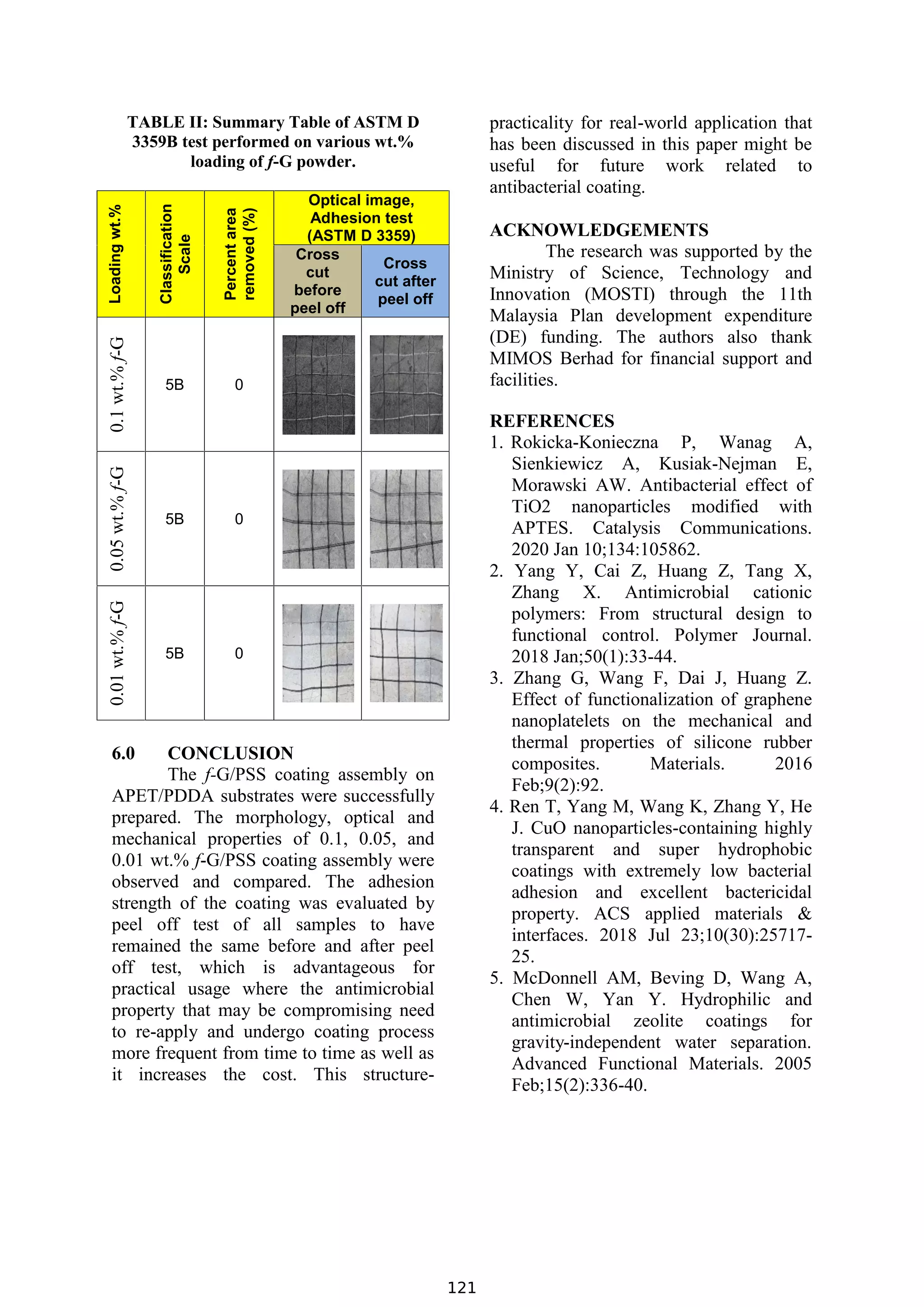
5.3 Mechanical Property
To analyze the adhesion strength of
the coating, Table II represents the result
of another adhesion test according to
ASTM D3359 which assessed on a 0B to
5B scale; 0B, >65%; 1B, 35-65%; 2B, 15-
35%; 3B, 5-15%; 4B <5% and 5B, 0%
area removed, respectively. All the
samples pass the tape adhesion test with a
classification of 5B with 0% area removed
after the test. It can be concluded that
despite the different wt.% loading of f-G
was used, all the samples have strong
adhesion towards the substrate which
correlates well with the FESEM cross-
section image. Despite simple coating
process, it is comparable to the complex
process found in the literature [5].
If the wt.% loading of f-G is below 0.01
wt.% or only PSS was used, it will not
retain a good adhesion anymore which
confirms that f-G plays an important role
in an excellent coating assembly.
Fig. 2: Optical image and cross-section FESEM
micrograph of f-G/PSS coating morphology (a) and
(b). EDS spectra of corresponding coating layers of
the assembly starting from the top(c) f-G/PSS, (d)
PDDA, and (e) APET substrate.
The chemical composition for each
layer, Figure 2(c-e) was further evaluated
by EDS spectrum and the first layer
composed of C, Si and S correlates well
with f-G/PSS layer whereas the second
layer composed of N referred to PDDA
and the third layer composed of C and O,
the APET substrate. A close contact
between each layer shown in the cross-
section image indicates a good wettability
of the f-G/PSS solution when spray-coated
on top of APET/PDDA substrate.
5.2 Optical Properties
The haze and transmittance of 0.1,
0.05, and 0.01 wt.% of f-G/PSS coatings
were recorded in Table I with the haze was
measured to be at 20.4, 11.3, and 7.0 %,
respectively. The haze increase with the
increase of f-G wt.% loading.
The transmittance of 0.1, 0.05, and 0.01
wt.% f-G/PDDA coatings was measured at
66.5, 80.2, and 90.9 %, respectively. The
low haze and higher transmittance give out
the best transparency of the coating which
is comparable with recent work from Ren
et. al. and with 90% transparency,
respectively [4]. Therefore, in this work,
the 0.01 wt.% f-G/PDDA coating
portrayed the lowest haze and the highest
transmittance, making it suitable for
transparent antibacterial coating
applications.
TABLE I: Summary of Haze and
Transmittance of substrate with various
coating assembly.
Sample name
Haze
(%)
Transmittance
(%)
APET 2.2 92.5
APET/PDDA 2.6 92.4
0.1 wt.%
f-G/PSS
20.4 66.5
0.05 wt.%
f-G/PSS
11.3 80.2
0.01 wt.%
f-G/PSS
7.0 90.9
5.3 Mechanical Property
To analyze the adhesion strength of
the coating, Table II represents the result
of another adhesion test according to
ASTM D3359 which assessed on a 0B to
5B scale; 0B, >65%; 1B, 35-65%; 2B, 15-
35%; 3B, 5-15%; 4B <5% and 5B, 0%
area removed, respectively. All the
samples pass the tape adhesion test with a
classification of 5B with 0% area removed
after the test. It can be concluded that
despite the different wt.% loading of f-G
was used, all the samples have strong
adhesion towards the substrate which
correlates well with the FESEM cross-
section image. Despite simple coating
process, it is comparable to the complex
process found in the literature [5].
If the wt.% loading of f-G is below 0.01
wt.% or only PSS was used, it will not
retain a good adhesion anymore which
confirms that f-G plays an important role
in an excellent coating assembly.
Fig. 2: Optical image and cross-section FESEM
micrograph of f-G/PSS coating morphology (a) and
(b). EDS spectra of corresponding coating layers of
the assembly starting from the top(c) f-G/PSS, (d)
PDDA, and (e) APET substrate.
The chemical composition for each
layer, Figure 2(c-e) was further evaluated
by EDS spectrum and the first layer
composed of C, Si and S correlates well
with f-G/PSS layer whereas the second
layer composed of N referred to PDDA
and the third layer composed of C and O,
the APET substrate. A close contact
between each layer shown in the cross-
section image indicates a good wettability
of the f-G/PSS solution when spray-coated
on top of APET/PDDA substrate.
5.2 Optical Properties
The haze and transmittance of 0.1,
0.05, and 0.01 wt.% of f-G/PSS coatings
were recorded in Table I with the haze was
measured to be at 20.4, 11.3, and 7.0 %,
respectively. The haze increase with the
increase of f-G wt.% loading.
The transmittance of 0.1, 0.05, and 0.01
wt.% f-G/PDDA coatings was measured at
66.5, 80.2, and 90.9 %, respectively. The
low haze and higher transmittance give out
the best transparency of the coating which
is comparable with recent work from Ren
et. al. and with 90% transparency,
respectively [4]. Therefore, in this work,
the 0.01 wt.% f-G/PDDA coating
portrayed the lowest haze and the highest
transmittance, making it suitable for
transparent antibacterial coating
applications.
TABLE I: Summary of Haze and
Transmittance of substrate with various
coating assembly.
Sample name
Haze
(%)
Transmittance
(%)
APET 2.2 92.5
APET/PDDA 2.6 92.4
0.1 wt.%
f-G/PSS
20.4 66.5
0.05 wt.%
f-G/PSS
11.3 80.2
0.01 wt.%
f-G/PSS
7.0 90.9
5.3 Mechanical Property
To analyze the adhesion strength of
the coating, Table II represents the result
of another adhesion test according to
ASTM D3359 which assessed on a 0B to
5B scale; 0B, >65%; 1B, 35-65%; 2B, 15-
35%; 3B, 5-15%; 4B <5% and 5B, 0%
area removed, respectively. All the
samples pass the tape adhesion test with a
classification of 5B with 0% area removed
after the test. It can be concluded that
despite the different wt.% loading of f-G
was used, all the samples have strong
adhesion towards the substrate which
correlates well with the FESEM cross-
section image. Despite simple coating
process, it is comparable to the complex
process found in the literature [5].
If the wt.% loading of f-G is below 0.01
wt.% or only PSS was used, it will not
retain a good adhesion anymore which
confirms that f-G plays an important role
in an excellent coating assembly.
120
TABLE II: Summary Table of ASTM D
3359B test performed on various wt.%
loading of f-G powder.
Loading
wt.%
Classification
Scale
Percent
area
removed
(%)
Optical image,
Adhesion test
(ASTM D 3359)
Cross
cut
before
peel off
Cross
cut after
peel off
0.1
wt.%
f-G
5B 0
0.05
wt.%
f-G
5B 0
0.01
wt.%
f-G
5B 0
6.0 CONCLUSION
The f-G/PSS coating assembly on
APET/PDDA substrates were successfully
prepared. The morphology, optical and
mechanical properties of 0.1, 0.05, and
0.01 wt.% f-G/PSS coating assembly were
observed and compared. The adhesion
strength of the coating was evaluated by
peel off test of all samples to have
remained the same before and after peel
off test, which is advantageous for
practical usage where the antimicrobial
property that may be compromising need
to re-apply and undergo coating process
more frequent from time to time as well as
it increases the cost. This structure-
practicality for real-world application that
has been discussed in this paper might be
useful for future work related to
antibacterial coating.
ACKNOWLEDGEMENTS
The research was supported by the
Ministry of Science, Technology and
Innovation (MOSTI) through the 11th
Malaysia Plan development expenditure
(DE) funding. The authors also thank
MIMOS Berhad for financial support and
facilities.
REFERENCES
1. Rokicka-Konieczna P, Wanag A,
Sienkiewicz A, Kusiak-Nejman E,
Morawski AW. Antibacterial effect of
TiO2 nanoparticles modified with
APTES. Catalysis Communications.
2020 Jan 10;134:105862.
2. Yang Y, Cai Z, Huang Z, Tang X,
Zhang X. Antimicrobial cationic
polymers: From structural design to
functional control. Polymer Journal.
2018 Jan;50(1):33-44.
3. Zhang G, Wang F, Dai J, Huang Z.
Effect of functionalization of graphene
nanoplatelets on the mechanical and
thermal properties of silicone rubber
composites. Materials. 2016
Feb;9(2):92.
4. Ren T, Yang M, Wang K, Zhang Y, He
J. CuO nanoparticles-containing highly
transparent and super hydrophobic
coatings with extremely low bacterial
adhesion and excellent bactericidal
property. ACS applied materials &
interfaces. 2018 Jul 23;10(30):25717-
25.
5. McDonnell AM, Beving D, Wang A,
Chen W, Yan Y. Hydrophilic and
antimicrobial zeolite coatings for
gravity‐independent water separation.
Advanced Functional Materials. 2005
Feb;15(2):336-40.
TABLE II: Summary Table of ASTM D
3359B test performed on various wt.%
loading of f-G powder.
Loading
wt.%
Classification
Scale
Percent
area
removed
(%)
Optical image,
Adhesion test
(ASTM D 3359)
Cross
cut
before
peel off
Cross
cut after
peel off
0.1
wt.%
f-G
5B 0
0.05
wt.%
f-G
5B 0
0.01
wt.%
f-G
5B 0
6.0 CONCLUSION
The f-G/PSS coating assembly on
APET/PDDA substrates were successfully
prepared. The morphology, optical and
mechanical properties of 0.1, 0.05, and
0.01 wt.% f-G/PSS coating assembly were
observed and compared. The adhesion
strength of the coating was evaluated by
peel off test of all samples to have
remained the same before and after peel
off test, which is advantageous for
practical usage where the antimicrobial
property that may be compromising need
to re-apply and undergo coating process
more frequent from time to time as well as
it increases the cost. This structure-
practicality for real-world application that
has been discussed in this paper might be
useful for future work related to
antibacterial coating.
ACKNOWLEDGEMENTS
The research was supported by the
Ministry of Science, Technology and
Innovation (MOSTI) through the 11th
Malaysia Plan development expenditure
(DE) funding. The authors also thank
MIMOS Berhad for financial support and
facilities.
REFERENCES
1. Rokicka-Konieczna P, Wanag A,
Sienkiewicz A, Kusiak-Nejman E,
Morawski AW. Antibacterial effect of
TiO2 nanoparticles modified with
APTES. Catalysis Communications.
2020 Jan 10;134:105862.
2. Yang Y, Cai Z, Huang Z, Tang X,
Zhang X. Antimicrobial cationic
polymers: From structural design to
functional control. Polymer Journal.
2018 Jan;50(1):33-44.
3. Zhang G, Wang F, Dai J, Huang Z.
Effect of functionalization of graphene
nanoplatelets on the mechanical and
thermal properties of silicone rubber
composites. Materials. 2016
Feb;9(2):92.
4. Ren T, Yang M, Wang K, Zhang Y, He
J. CuO nanoparticles-containing highly
transparent and super hydrophobic
coatings with extremely low bacterial
adhesion and excellent bactericidal
property. ACS applied materials &
interfaces. 2018 Jul 23;10(30):25717-
25.
5. McDonnell AM, Beving D, Wang A,
Chen W, Yan Y. Hydrophilic and
antimicrobial zeolite coatings for
gravity‐independent water separation.
Advanced Functional Materials. 2005
Feb;15(2):336-40.
TABLE II: Summary Table of ASTM D
3359B test performed on various wt.%
loading of f-G powder.
Loading
wt.%
Classification
Scale
Percent
area
removed
(%)
Optical image,
Adhesion test
(ASTM D 3359)
Cross
cut
before
peel off
Cross
cut after
peel off
0.1
wt.%
f-G
5B 0
0.05
wt.%
f-G
5B 0
0.01
wt.%
f-G
5B 0
6.0 CONCLUSION
The f-G/PSS coating assembly on
APET/PDDA substrates were successfully
prepared. The morphology, optical and
mechanical properties of 0.1, 0.05, and
0.01 wt.% f-G/PSS coating assembly were
observed and compared. The adhesion
strength of the coating was evaluated by
peel off test of all samples to have
remained the same before and after peel
off test, which is advantageous for
practical usage where the antimicrobial
property that may be compromising need
to re-apply and undergo coating process
more frequent from time to time as well as
it increases the cost. This structure-
practicality for real-world application that
has been discussed in this paper might be
useful for future work related to
antibacterial coating.
ACKNOWLEDGEMENTS
The research was supported by the
Ministry of Science, Technology and
Innovation (MOSTI) through the 11th
Malaysia Plan development expenditure
(DE) funding. The authors also thank
MIMOS Berhad for financial support and
facilities.
REFERENCES
1. Rokicka-Konieczna P, Wanag A,
Sienkiewicz A, Kusiak-Nejman E,
Morawski AW. Antibacterial effect of
TiO2 nanoparticles modified with
APTES. Catalysis Communications.
2020 Jan 10;134:105862.
2. Yang Y, Cai Z, Huang Z, Tang X,
Zhang X. Antimicrobial cationic
polymers: From structural design to
functional control. Polymer Journal.
2018 Jan;50(1):33-44.
3. Zhang G, Wang F, Dai J, Huang Z.
Effect of functionalization of graphene
nanoplatelets on the mechanical and
thermal properties of silicone rubber
composites. Materials. 2016
Feb;9(2):92.
4. Ren T, Yang M, Wang K, Zhang Y, He
J. CuO nanoparticles-containing highly
transparent and super hydrophobic
coatings with extremely low bacterial
adhesion and excellent bactericidal
property. ACS applied materials &
interfaces. 2018 Jul 23;10(30):25717-
25.
5. McDonnell AM, Beving D, Wang A,
Chen W, Yan Y. Hydrophilic and
antimicrobial zeolite coatings for
gravity‐independent water separation.
Advanced Functional Materials. 2005
Feb;15(2):336-40.
121

Graphene based polyelectrolytes coating assembly - study on morphological, optical and mechanical properties

  • 1.
    Graphene-based Polyelectrolytes CoatingAssembly: Study on Morphological, Optical and Mechanical Properties Syed Muhammad Hafiz1 *, Norhaizam Mustaffa1 , Nora’zah Abdul Rashid1 , Aiman Sajidah Abd Aziz1 , Suraya Sulaiman1 1 Flexible Electronics Laboratory, Research and Development, MIMOS Berhad, Technology Park Malaysia, Kuala Lumpur, Malaysia *Corresponding author’s phone: +603-8995 5000 E-mail: hafiz.jaafar@mimos.my ABSTRACT The structural practicality for real- world application of polyelectrolytes antibacterial coating has not been widely studied yet despite having a huge potential. Therefore, this may possess a huge hindrance when the commercialization stage takes place. In this study, various loading of silane functionalized-graphene (f-G) which then incorporated with polyanion, i.e. polystyrene sulfonate (PSS), was coated on a flexible amorphous polyethylene terephthalate (APET) substrate with polycation, i.e. polydiallyldimethyl ammonium chloride (PDDA) on top of it. The morphological, optical and mechanical properties were demonstrated for a coating assembly of 0.01 wt.% f-G/PSS that have high optical transparency (90.9%) with low haze (7.0%) as well as good adhesion according toASTM D3359 (scaled at 5B) standard. Keywords— polyelectrolyte assembly; graphene; transparent coating; flexible coating; antibacterial coating. 1.0 INTRODUCTION With the ongoing worldwide pandemic of coronavirus disease since late 2019 (COVID-19), the study on antibacterial coating has been significantly increased. In addition, water borne microorganisms like undesirable bacteria pose a significant risk to public health. Pathogenic variants of Escherichia coliare (E. Coli), for example, is one of the causes of worldwide morbidity and mortality [1]. Several polyelectrolytes polymers (e.g. PDDA and PSS) exhibit a useful antimicrobial property has been discussed. However, most studies inclined with the relationship between structure-activity, which still left a gap for a complete investigation in terms ofthe relationship between structure-practicality for real- world application for example in terms of adhesion and haze or optical transmission [2]. 2.0 THEORY The mechanism of antibacterial properties of polyelectrolytes might be following several sequences of events occurs with microorganisms exposed to cationic or anionic agents, starting with; (i) adsorption and penetration of the agent into the cell wall; (ii) reaction with the cytoplasmic membrane followed by membrane disorganization; (iii) leakage of intracellular low-molecular-weight material; (iv) degradation of proteins and nucleic acids; and finally (v) wall lysis caused by autolytic enzymes. There would be a loss of structural organization and integrity of the cytoplasmic membrane in bacteria, together with other damaging effects to the bacterial cell [2]. 3.0 MATERIALS Amorphous polyethylene terephthalate (APET) substrate was supplied from Macro Plastic (M) Sdn. Proceedings of the 4th International Symposium on Advanced Materials and Nanotechnology 2020 (i-SAMN2020), December 1-3, 2020 eISBN 978-983-42758-7-7 ©2020 ITMA, UPM 118
  • 2.
    Bhd. Poly (sodium4-styrenesulfonate) solution(PSS) Mw ~200,000 and Poly (diallyldimethyl ammonium chloride) solution (PDDA) Mw ~200,000-350,000, both with 2 wt.% in H2O was purchased from Sigma-Aldrich. Graphene nanoplatelets, xGnP® with 5µm flake size was purchase from XG Sciences Inc. Silane coupling agent, (3-Aminopropyl) triethoxysilane (APTES) ≥98%, was purchased from Sigma-Aldrich. 4.0 EXPERIMENTAL 4.1 Preparation of f-G/PSS solution For the preparation of silane functionalized graphene, it was carried out in water/ethanol mixture according to reference [3]. In brief, xGnP® powder was added into water/ethanol mixture under mild sonication for 1 hour at 1 mg/mL concentration. Then, APTES was added into the mixture drop wise with 10 v/v% at 65 °C, and the reaction was continued to process for 12 h under constant stirring. Subsequently, the final reactant was washed with methanol and filtered several times. The products, (3-Aminopropyl) triethoxysilane-xGnP, abbreviated as f-G throughout this paper will then undergo drying process in an oven at 60 °C for 12 h. Finally, the 0.1, 0.05 and 0.01 wt.% of f- G powder was prepared by mixing with polyanion PSS of 2 wt.% solution and sonicated for 4 hours until homogeneous mixture achieved. Figure 1(a) shows the image of the as-prepared f-G/PSS final solution. Fig. 1: The as-prepared f-G/PSS (a) solution and (b-c) coated on APET/PDDA substrate. 4.2 Preparation technique of graphene-based polyelectrolyte assembly coating APET substrate was cut into 5 cm x 5 cm size and then cleaned with 5 wt.% NaOH followed with deionized water and finally dip-coated with PDDA for 2 minutes. The substrate is now will be referred as APET/PDDA. Next, the as- prepared f-G/PSS solution was spray- coated with 150 µL solution on APET/PDDA substrate and left it dry overnight at room temperature. Figure 1(b) and (c) show the f-G/PSS coating which is highly transparent and flexible. 4.3 Characterization The morphology of coated samples was characterized by a field emission scanning electron microscopy (FESEM), Hitachi SU8030. The images were recorded at an accelerating voltage of 5kV. X-ray energy dispersive spectroscopy (EDS) was used to examine the chemical composition on the surface of the coated samples. The optical properties; haze and transmittance of the coated samples were determined by Haze & Reflectance Meter HR-100, Murakami Color Research Laboratory. The adhesion test, according to ASTM D3359 standard was carried out using 3MTM #600 scotch tape to determine the adhesion strength of the coated samples. 5.0 RESULTS AND DISCUSSION 5.1 Morphological Properties A typical optical image (top view, 10x objective) and FESEM micrograph (cross-section view, 5k magnification) of f-G/PSS coated morphology was shown in Figure 2(a-b). The FESEM cross section micrographs shows each assembly layer for the f-G/PSS coated on APET/PDDA substrate. The thickness of f-G/PSS is around 159 to 240 nm while the thickness of PDDA coated layer is 2.14 µm. Bhd. Poly (sodium4-styrenesulfonate) solution (PSS) Mw ~200,000 and Poly (diallyldimethyl ammonium chloride) solution (PDDA) Mw ~200,000-350,000, both with 2 wt.% in H2O was purchased from Sigma-Aldrich. Graphene nanoplatelets, xGnP® with 5µm flake size was purchase from XG Sciences Inc. Silane coupling agent, (3-Aminopropyl) triethoxysilane (APTES) ≥98%, was purchased from Sigma-Aldrich. 4.0 EXPERIMENTAL 4.1 Preparation of f-G/PSS solution For the preparation of silane functionalized graphene, it was carried out in water/ethanol mixture according to reference [3]. In brief, xGnP® powder was added into water/ethanol mixture under mild sonication for 1 hour at 1 mg/mL concentration. Then, APTES was added into the mixture drop wise with 10 v/v% at 65 °C, and the reaction was continued to process for 12 h under constant stirring. Subsequently, the final reactant was washed with methanol and filtered several times. The products, (3-Aminopropyl) triethoxysilane-xGnP, abbreviated as f-G throughout this paper will then undergo drying process in an oven at 60 °C for 12 h. Finally, the 0.1, 0.05 and 0.01 wt.% of f- G powder was prepared by mixing with polyanion PSS of 2 wt.% solution and sonicated for 4 hours until homogeneous mixture achieved. Figure 1(a) shows the image of the as-prepared f-G/PSS final solution. Fig. 1: The as-prepared f-G/PSS (a) solution and (b-c) coated on APET/PDDA substrate. 4.2 Preparation technique of graphene-based polyelectrolyte assembly coating APET substrate was cut into 5 cm x 5 cm size and then cleaned with 5 wt.% NaOH followed with deionized water and finally dip-coated with PDDA for 2 minutes. The substrate is now will be referred as APET/PDDA. Next, the as- prepared f-G/PSS solution was spray- coated with 150 µL solution on APET/PDDA substrate and left it dry overnight at room temperature. Figure 1(b) and (c) show the f-G/PSS coating which is highly transparent and flexible. 4.3 Characterization The morphology of coated samples was characterized by a field emission scanning electron microscopy (FESEM), Hitachi SU8030. The images were recorded at an accelerating voltage of 5kV. X-ray energy dispersive spectroscopy (EDS) was used to examine the chemical composition on the surface of the coated samples. The optical properties; haze and transmittance of the coated samples were determined by Haze & Reflectance Meter HR-100, Murakami Color Research Laboratory. The adhesion test, according to ASTM D3359 standard was carried out using 3MTM #600 scotch tape to determine the adhesion strength of the coated samples. 5.0 RESULTS AND DISCUSSION 5.1 Morphological Properties A typical optical image (top view, 10x objective) and FESEM micrograph (cross-section view, 5k magnification) of f-G/PSS coated morphology was shown in Figure 2(a-b). The FESEM cross section micrographs shows each assembly layer for the f-G/PSS coated on APET/PDDA substrate. The thickness of f-G/PSS is around 159 to 240 nm while the thickness of PDDA coated layer is 2.14 µm. Bhd. Poly (sodium4-styrenesulfonate) solution (PSS) Mw ~200,000 and Poly (diallyldimethyl ammonium chloride) solution (PDDA) Mw ~200,000-350,000, both with 2 wt.% in H2O was purchased from Sigma-Aldrich. Graphene nanoplatelets, xGnP® with 5µm flake size was purchase from XG Sciences Inc. Silane coupling agent, (3-Aminopropyl) triethoxysilane (APTES) ≥98%, was purchased from Sigma-Aldrich. 4.0 EXPERIMENTAL 4.1 Preparation of f-G/PSS solution For the preparation of silane functionalized graphene, it was carried out in water/ethanol mixture according to reference [3]. In brief, xGnP® powder was added into water/ethanol mixture under mild sonication for 1 hour at 1 mg/mL concentration. Then, APTES was added into the mixture drop wise with 10 v/v% at 65 °C, and the reaction was continued to process for 12 h under constant stirring. Subsequently, the final reactant was washed with methanol and filtered several times. The products, (3-Aminopropyl) triethoxysilane-xGnP, abbreviated as f-G throughout this paper will then undergo drying process in an oven at 60 °C for 12 h. Finally, the 0.1, 0.05 and 0.01 wt.% of f- G powder was prepared by mixing with polyanion PSS of 2 wt.% solution and sonicated for 4 hours until homogeneous mixture achieved. Figure 1(a) shows the image of the as-prepared f-G/PSS final solution. Fig. 1: The as-prepared f-G/PSS (a) solution and (b-c) coated on APET/PDDA substrate. 4.2 Preparation technique of graphene-based polyelectrolyte assembly coating APET substrate was cut into 5 cm x 5 cm size and then cleaned with 5 wt.% NaOH followed with deionized water and finally dip-coated with PDDA for 2 minutes. The substrate is now will be referred as APET/PDDA. Next, the as- prepared f-G/PSS solution was spray- coated with 150 µL solution on APET/PDDA substrate and left it dry overnight at room temperature. Figure 1(b) and (c) show the f-G/PSS coating which is highly transparent and flexible. 4.3 Characterization The morphology of coated samples was characterized by a field emission scanning electron microscopy (FESEM), Hitachi SU8030. The images were recorded at an accelerating voltage of 5kV. X-ray energy dispersive spectroscopy (EDS) was used to examine the chemical composition on the surface of the coated samples. The optical properties; haze and transmittance of the coated samples were determined by Haze & Reflectance Meter HR-100, Murakami Color Research Laboratory. The adhesion test, according to ASTM D3359 standard was carried out using 3MTM #600 scotch tape to determine the adhesion strength of the coated samples. 5.0 RESULTS AND DISCUSSION 5.1 Morphological Properties A typical optical image (top view, 10x objective) and FESEM micrograph (cross-section view, 5k magnification) of f-G/PSS coated morphology was shown in Figure 2(a-b). The FESEM cross section micrographs shows each assembly layer for the f-G/PSS coated on APET/PDDA substrate. The thickness of f-G/PSS is around 159 to 240 nm while the thickness of PDDA coated layer is 2.14 µm. 119
  • 3.
    Fig. 2: Opticalimage and cross-section FESEM micrograph of f-G/PSS coating morphology (a) and (b). EDS spectra of corresponding coating layers of the assembly starting from the top(c) f-G/PSS, (d) PDDA, and (e) APET substrate. The chemical composition for each layer, Figure 2(c-e) was further evaluated by EDS spectrum and the first layer composed of C, Si and S correlates well with f-G/PSS layer whereas the second layer composed of N referred to PDDA and the third layer composed of C and O, the APET substrate. A close contact between each layer shown in the cross- section image indicates a good wettability of the f-G/PSS solution when spray-coated on top of APET/PDDA substrate. 5.2 Optical Properties The haze and transmittance of 0.1, 0.05, and 0.01 wt.% of f-G/PSS coatings were recorded in Table I with the haze was measured to be at 20.4, 11.3, and 7.0 %, respectively. The haze increase with the increase of f-G wt.% loading. The transmittance of 0.1, 0.05, and 0.01 wt.% f-G/PDDA coatings was measured at 66.5, 80.2, and 90.9 %, respectively. The low haze and higher transmittance give out the best transparency of the coating which is comparable with recent work from Ren et. al. and with 90% transparency, respectively [4]. Therefore, in this work, the 0.01 wt.% f-G/PDDA coating portrayed the lowest haze and the highest transmittance, making it suitable for transparent antibacterial coating applications. TABLE I: Summary of Haze and Transmittance of substrate with various coating assembly. Sample name Haze (%) Transmittance (%) APET 2.2 92.5 APET/PDDA 2.6 92.4 0.1 wt.% f-G/PSS 20.4 66.5 0.05 wt.% f-G/PSS 11.3 80.2 0.01 wt.% f-G/PSS 7.0 90.9 5.3 Mechanical Property To analyze the adhesion strength of the coating, Table II represents the result of another adhesion test according to ASTM D3359 which assessed on a 0B to 5B scale; 0B, >65%; 1B, 35-65%; 2B, 15- 35%; 3B, 5-15%; 4B <5% and 5B, 0% area removed, respectively. All the samples pass the tape adhesion test with a classification of 5B with 0% area removed after the test. It can be concluded that despite the different wt.% loading of f-G was used, all the samples have strong adhesion towards the substrate which correlates well with the FESEM cross- section image. Despite simple coating process, it is comparable to the complex process found in the literature [5]. If the wt.% loading of f-G is below 0.01 wt.% or only PSS was used, it will not retain a good adhesion anymore which confirms that f-G plays an important role in an excellent coating assembly. Fig. 2: Optical image and cross-section FESEM micrograph of f-G/PSS coating morphology (a) and (b). EDS spectra of corresponding coating layers of the assembly starting from the top(c) f-G/PSS, (d) PDDA, and (e) APET substrate. The chemical composition for each layer, Figure 2(c-e) was further evaluated by EDS spectrum and the first layer composed of C, Si and S correlates well with f-G/PSS layer whereas the second layer composed of N referred to PDDA and the third layer composed of C and O, the APET substrate. A close contact between each layer shown in the cross- section image indicates a good wettability of the f-G/PSS solution when spray-coated on top of APET/PDDA substrate. 5.2 Optical Properties The haze and transmittance of 0.1, 0.05, and 0.01 wt.% of f-G/PSS coatings were recorded in Table I with the haze was measured to be at 20.4, 11.3, and 7.0 %, respectively. The haze increase with the increase of f-G wt.% loading. The transmittance of 0.1, 0.05, and 0.01 wt.% f-G/PDDA coatings was measured at 66.5, 80.2, and 90.9 %, respectively. The low haze and higher transmittance give out the best transparency of the coating which is comparable with recent work from Ren et. al. and with 90% transparency, respectively [4]. Therefore, in this work, the 0.01 wt.% f-G/PDDA coating portrayed the lowest haze and the highest transmittance, making it suitable for transparent antibacterial coating applications. TABLE I: Summary of Haze and Transmittance of substrate with various coating assembly. Sample name Haze (%) Transmittance (%) APET 2.2 92.5 APET/PDDA 2.6 92.4 0.1 wt.% f-G/PSS 20.4 66.5 0.05 wt.% f-G/PSS 11.3 80.2 0.01 wt.% f-G/PSS 7.0 90.9 5.3 Mechanical Property To analyze the adhesion strength of the coating, Table II represents the result of another adhesion test according to ASTM D3359 which assessed on a 0B to 5B scale; 0B, >65%; 1B, 35-65%; 2B, 15- 35%; 3B, 5-15%; 4B <5% and 5B, 0% area removed, respectively. All the samples pass the tape adhesion test with a classification of 5B with 0% area removed after the test. It can be concluded that despite the different wt.% loading of f-G was used, all the samples have strong adhesion towards the substrate which correlates well with the FESEM cross- section image. Despite simple coating process, it is comparable to the complex process found in the literature [5]. If the wt.% loading of f-G is below 0.01 wt.% or only PSS was used, it will not retain a good adhesion anymore which confirms that f-G plays an important role in an excellent coating assembly. Fig. 2: Optical image and cross-section FESEM micrograph of f-G/PSS coating morphology (a) and (b). EDS spectra of corresponding coating layers of the assembly starting from the top(c) f-G/PSS, (d) PDDA, and (e) APET substrate. The chemical composition for each layer, Figure 2(c-e) was further evaluated by EDS spectrum and the first layer composed of C, Si and S correlates well with f-G/PSS layer whereas the second layer composed of N referred to PDDA and the third layer composed of C and O, the APET substrate. A close contact between each layer shown in the cross- section image indicates a good wettability of the f-G/PSS solution when spray-coated on top of APET/PDDA substrate. 5.2 Optical Properties The haze and transmittance of 0.1, 0.05, and 0.01 wt.% of f-G/PSS coatings were recorded in Table I with the haze was measured to be at 20.4, 11.3, and 7.0 %, respectively. The haze increase with the increase of f-G wt.% loading. The transmittance of 0.1, 0.05, and 0.01 wt.% f-G/PDDA coatings was measured at 66.5, 80.2, and 90.9 %, respectively. The low haze and higher transmittance give out the best transparency of the coating which is comparable with recent work from Ren et. al. and with 90% transparency, respectively [4]. Therefore, in this work, the 0.01 wt.% f-G/PDDA coating portrayed the lowest haze and the highest transmittance, making it suitable for transparent antibacterial coating applications. TABLE I: Summary of Haze and Transmittance of substrate with various coating assembly. Sample name Haze (%) Transmittance (%) APET 2.2 92.5 APET/PDDA 2.6 92.4 0.1 wt.% f-G/PSS 20.4 66.5 0.05 wt.% f-G/PSS 11.3 80.2 0.01 wt.% f-G/PSS 7.0 90.9 5.3 Mechanical Property To analyze the adhesion strength of the coating, Table II represents the result of another adhesion test according to ASTM D3359 which assessed on a 0B to 5B scale; 0B, >65%; 1B, 35-65%; 2B, 15- 35%; 3B, 5-15%; 4B <5% and 5B, 0% area removed, respectively. All the samples pass the tape adhesion test with a classification of 5B with 0% area removed after the test. It can be concluded that despite the different wt.% loading of f-G was used, all the samples have strong adhesion towards the substrate which correlates well with the FESEM cross- section image. Despite simple coating process, it is comparable to the complex process found in the literature [5]. If the wt.% loading of f-G is below 0.01 wt.% or only PSS was used, it will not retain a good adhesion anymore which confirms that f-G plays an important role in an excellent coating assembly. 120
  • 4.
    TABLE II: SummaryTable of ASTM D 3359B test performed on various wt.% loading of f-G powder. Loading wt.% Classification Scale Percent area removed (%) Optical image, Adhesion test (ASTM D 3359) Cross cut before peel off Cross cut after peel off 0.1 wt.% f-G 5B 0 0.05 wt.% f-G 5B 0 0.01 wt.% f-G 5B 0 6.0 CONCLUSION The f-G/PSS coating assembly on APET/PDDA substrates were successfully prepared. The morphology, optical and mechanical properties of 0.1, 0.05, and 0.01 wt.% f-G/PSS coating assembly were observed and compared. The adhesion strength of the coating was evaluated by peel off test of all samples to have remained the same before and after peel off test, which is advantageous for practical usage where the antimicrobial property that may be compromising need to re-apply and undergo coating process more frequent from time to time as well as it increases the cost. This structure- practicality for real-world application that has been discussed in this paper might be useful for future work related to antibacterial coating. ACKNOWLEDGEMENTS The research was supported by the Ministry of Science, Technology and Innovation (MOSTI) through the 11th Malaysia Plan development expenditure (DE) funding. The authors also thank MIMOS Berhad for financial support and facilities. REFERENCES 1. Rokicka-Konieczna P, Wanag A, Sienkiewicz A, Kusiak-Nejman E, Morawski AW. Antibacterial effect of TiO2 nanoparticles modified with APTES. Catalysis Communications. 2020 Jan 10;134:105862. 2. Yang Y, Cai Z, Huang Z, Tang X, Zhang X. Antimicrobial cationic polymers: From structural design to functional control. Polymer Journal. 2018 Jan;50(1):33-44. 3. Zhang G, Wang F, Dai J, Huang Z. Effect of functionalization of graphene nanoplatelets on the mechanical and thermal properties of silicone rubber composites. Materials. 2016 Feb;9(2):92. 4. Ren T, Yang M, Wang K, Zhang Y, He J. CuO nanoparticles-containing highly transparent and super hydrophobic coatings with extremely low bacterial adhesion and excellent bactericidal property. ACS applied materials & interfaces. 2018 Jul 23;10(30):25717- 25. 5. McDonnell AM, Beving D, Wang A, Chen W, Yan Y. Hydrophilic and antimicrobial zeolite coatings for gravity‐independent water separation. Advanced Functional Materials. 2005 Feb;15(2):336-40. TABLE II: Summary Table of ASTM D 3359B test performed on various wt.% loading of f-G powder. Loading wt.% Classification Scale Percent area removed (%) Optical image, Adhesion test (ASTM D 3359) Cross cut before peel off Cross cut after peel off 0.1 wt.% f-G 5B 0 0.05 wt.% f-G 5B 0 0.01 wt.% f-G 5B 0 6.0 CONCLUSION The f-G/PSS coating assembly on APET/PDDA substrates were successfully prepared. The morphology, optical and mechanical properties of 0.1, 0.05, and 0.01 wt.% f-G/PSS coating assembly were observed and compared. The adhesion strength of the coating was evaluated by peel off test of all samples to have remained the same before and after peel off test, which is advantageous for practical usage where the antimicrobial property that may be compromising need to re-apply and undergo coating process more frequent from time to time as well as it increases the cost. This structure- practicality for real-world application that has been discussed in this paper might be useful for future work related to antibacterial coating. ACKNOWLEDGEMENTS The research was supported by the Ministry of Science, Technology and Innovation (MOSTI) through the 11th Malaysia Plan development expenditure (DE) funding. The authors also thank MIMOS Berhad for financial support and facilities. REFERENCES 1. Rokicka-Konieczna P, Wanag A, Sienkiewicz A, Kusiak-Nejman E, Morawski AW. Antibacterial effect of TiO2 nanoparticles modified with APTES. Catalysis Communications. 2020 Jan 10;134:105862. 2. Yang Y, Cai Z, Huang Z, Tang X, Zhang X. Antimicrobial cationic polymers: From structural design to functional control. Polymer Journal. 2018 Jan;50(1):33-44. 3. Zhang G, Wang F, Dai J, Huang Z. Effect of functionalization of graphene nanoplatelets on the mechanical and thermal properties of silicone rubber composites. Materials. 2016 Feb;9(2):92. 4. Ren T, Yang M, Wang K, Zhang Y, He J. CuO nanoparticles-containing highly transparent and super hydrophobic coatings with extremely low bacterial adhesion and excellent bactericidal property. ACS applied materials & interfaces. 2018 Jul 23;10(30):25717- 25. 5. McDonnell AM, Beving D, Wang A, Chen W, Yan Y. Hydrophilic and antimicrobial zeolite coatings for gravity‐independent water separation. Advanced Functional Materials. 2005 Feb;15(2):336-40. TABLE II: Summary Table of ASTM D 3359B test performed on various wt.% loading of f-G powder. Loading wt.% Classification Scale Percent area removed (%) Optical image, Adhesion test (ASTM D 3359) Cross cut before peel off Cross cut after peel off 0.1 wt.% f-G 5B 0 0.05 wt.% f-G 5B 0 0.01 wt.% f-G 5B 0 6.0 CONCLUSION The f-G/PSS coating assembly on APET/PDDA substrates were successfully prepared. The morphology, optical and mechanical properties of 0.1, 0.05, and 0.01 wt.% f-G/PSS coating assembly were observed and compared. The adhesion strength of the coating was evaluated by peel off test of all samples to have remained the same before and after peel off test, which is advantageous for practical usage where the antimicrobial property that may be compromising need to re-apply and undergo coating process more frequent from time to time as well as it increases the cost. This structure- practicality for real-world application that has been discussed in this paper might be useful for future work related to antibacterial coating. ACKNOWLEDGEMENTS The research was supported by the Ministry of Science, Technology and Innovation (MOSTI) through the 11th Malaysia Plan development expenditure (DE) funding. The authors also thank MIMOS Berhad for financial support and facilities. REFERENCES 1. Rokicka-Konieczna P, Wanag A, Sienkiewicz A, Kusiak-Nejman E, Morawski AW. Antibacterial effect of TiO2 nanoparticles modified with APTES. Catalysis Communications. 2020 Jan 10;134:105862. 2. Yang Y, Cai Z, Huang Z, Tang X, Zhang X. Antimicrobial cationic polymers: From structural design to functional control. Polymer Journal. 2018 Jan;50(1):33-44. 3. Zhang G, Wang F, Dai J, Huang Z. Effect of functionalization of graphene nanoplatelets on the mechanical and thermal properties of silicone rubber composites. Materials. 2016 Feb;9(2):92. 4. Ren T, Yang M, Wang K, Zhang Y, He J. CuO nanoparticles-containing highly transparent and super hydrophobic coatings with extremely low bacterial adhesion and excellent bactericidal property. ACS applied materials & interfaces. 2018 Jul 23;10(30):25717- 25. 5. McDonnell AM, Beving D, Wang A, Chen W, Yan Y. Hydrophilic and antimicrobial zeolite coatings for gravity‐independent water separation. Advanced Functional Materials. 2005 Feb;15(2):336-40. 121