









Low Back
Pain

Injection Treatments for Back Injury
Rohit Oza, MD
Physiatry Department
Summit Medical Group
Low Back
Pain
The Low Back Pain Story
 60-90% of adults will have low
back pain
 2nd most common reason to see
primary care physician
Low Back
Pain
Common Thinking
 40-50% of patients with low back pain will
improve within one week
Low Back
Pain
The Full Story
 62% of patients likely to have one or more
relapses during a one-year follow-up
Low Back
Pain
The Full Story
 Low back pain is the #1 disability in
patients under 45
Low Back
Pain
Common Thinking
 90% of patients with low back pain
improve without any medical care
Low Back
Pain
The Full Story
 Longer pain for patients who wait 6-10 weeks
 80% have pain at six months and one year
 12% disability at one year
Low Back
Pain
Difficulties in Treating LBP
1. Difficult to diagnose source
2. Requires “whole care” approach
3. Preventive program needed to
minimize recurrence
Low Back
Pain
Other Complicating Factors
 Complexity
 AHCPR guidelines
 Lack of research
 Managed care restrictions
Low Back
Pain
Leading cause of disability
70-90% of adults will
experience LBP
In their lifetime
Financial Impact:
medical expense anually
In medical bills, disabilty,
and loss of productivity
Interdisciplinary Team
Approach at SMG
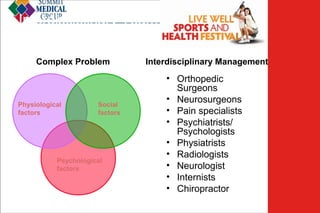
Complex Problem

Physiological
factors

Social
factors

Psychological
factors

Low Back
Pain

Interdisciplinary Management

• Orthopedic
Surgeons
• Neurosurgeons
• Pain specialists
• Psychiatrists/
Psychologists
• Physiatrists
• Radiologists
• Neurologist
• Internists
• Chiropractor
Low Back
Pain
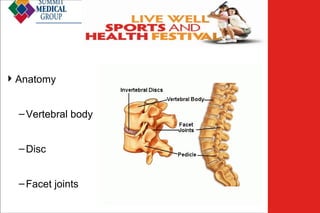
 Anatomy
– Vertebral body
– Disc
– Facet joints
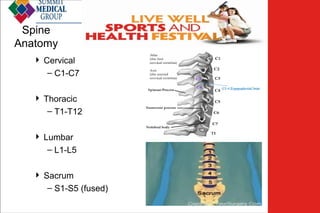
Spine
Anatomy
 Cervical
– C1-C7
 Thoracic
– T1-T12
 Lumbar
– L1-L5
 Sacrum
– S1-S5 (fused)

Low Back
Pain
Low Back
Pain
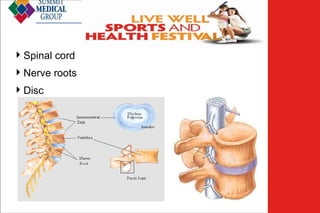
 Spinal cord
 Nerve roots
 Disc
Prevention
 Stretching
 Strengthening
 Posture
 Lifting techniques
 Ergonomics

Low Back
Pain
Low Back
Pain
 Common sources for LBP:
Structural
Myofascial

Muscles, Tendons, ligaments, fascia

Neural Tissue

Nerve root irritation, epidural
inflammation, epidural fibrosis,
arachnoiditis

Joints
Intervertebral
discs:
Skeletal bone
abnormalities

Facet joints, sacro iliac joints
Disc degeneration/disruption, disc
herniation
Osteoporosis, compression fractures,
spinal stenosis, spondylosis,
spondylolysis, spondylolisthesis,
Low Back
Pain

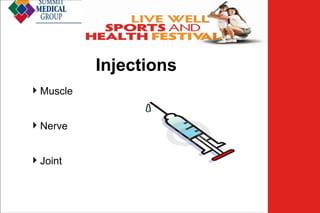
Injections
 Muscle
 Nerve
 Joint
Low Back
Pain
Injection Treatments: Muscle/Ligaments
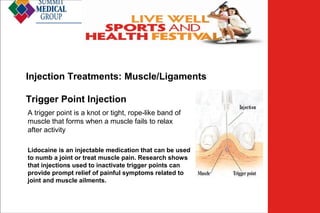
Trigger Point Injection
A trigger point is a knot or tight, rope-like band of
muscle that forms when a muscle fails to relax
after activity
Lidocaine is an injectable medication that can be used
to numb a joint or treat muscle pain. Research shows
that injections used to inactivate trigger points can
provide prompt relief of painful symptoms related to
joint and muscle ailments.
Low Back
Pain
Injection Treatments: Muscle/Ligaments
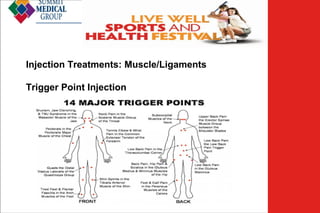
Trigger Point Injection
Low Back
Pain
Injection Treatments: Nerve
“Sciatica” Sciatica is a relatively common form of low back and leg pain, but the true meaning
of the term is often misunderstood.
Sciatica is a set of symptoms rather than a diagnosis
Symptoms include lower back pain, buttock pain, and pain, numbness or
weakness in various parts of the leg and foot. Other symptoms include a "
pins and needles" sensation, or tingling and difficulty moving or controlling the leg
Low Back
Pain

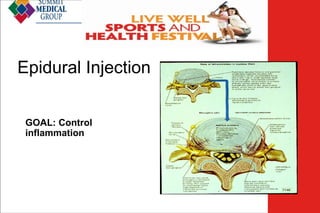
Epidural Injection
GOAL: Control
inflammation
Epidural Injection

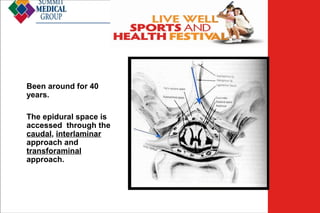
Been around for 40
years.
The epidural space is
accessed through the
caudal, interlaminar
approach and
transforaminal
approach.

Low Back
Pain
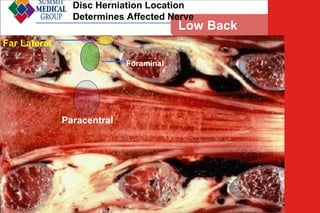
Disc Herniation Location
Determines Affected Nerve

Low Back
Pain

Far Lateral
Foraminal

Paracentral
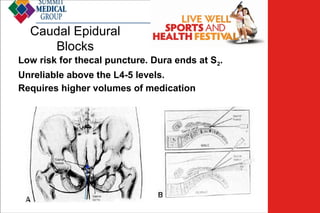
Caudal Epidural
Blocks

Low Back
Pain

Low risk for thecal puncture. Dura ends at S2.
Unreliable above the L4-5 levels.
Requires higher volumes of medication
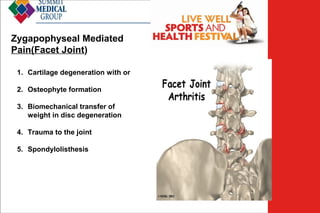
Zygapophyseal Mediated
Pain(Facet Joint)
1. Cartilage degeneration with or
2. Osteophyte formation
3. Biomechanical transfer of
weight in disc degeneration
4. Trauma to the joint
5. Spondylolisthesis

Low Back
Pain
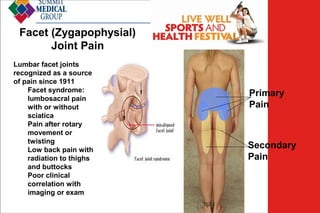
Facet (Zygapophysial)
Joint Pain
Lumbar facet joints
recognized as a source
of pain since 1911
Facet syndrome:
lumbosacral pain
with or without
sciatica
Pain after rotary
movement or
twisting
Low back pain with
radiation to thighs
and buttocks
Poor clinical
correlation with
imaging or exam

Low Back
Pain

Primary
Pain

Secondary
Pain
Low Back
Pain

Facet Injections
Intra-articular Joint Injections
Therapeutic (Local and steroid)
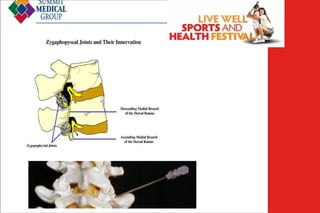
Paravertebral Facet Joint Nerve
Blocks(Medial Branch Blocks)
Diagnostic (Local only)
Therapeutic only with Neurolysis
(Radiofrequency)
Low Back
Pain
Neuroablation:RF

Low Back
Pain

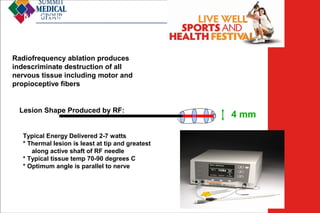
Radiofrequency ablation produces
indescriminate destruction of all
nervous tissue including motor and
propioceptive fibers

Lesion Shape Produced by RF:

Typical Energy Delivered 2-7 watts
* Thermal lesion is least at tip and greatest
along active shaft of RF needle
* Typical tissue temp 70-90 degrees C
* Optimum angle is parallel to nerve

4 mm
SI Joint
Accepted source of low
back and buttock pain
Prevalence of SI pain:
13 to 30% of cases of
low back pain
Moderate evidence for
efficacy of SI joint
injections

Low Back
Pain
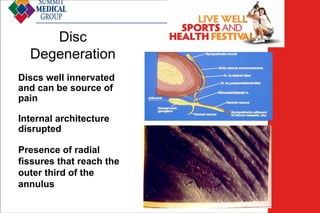
Disc
Degeneration
Discs well innervated
and can be source of
pain
Internal architecture
disrupted
Presence of radial
fissures that reach the
outer third of the
annulus

Low Back
Pain
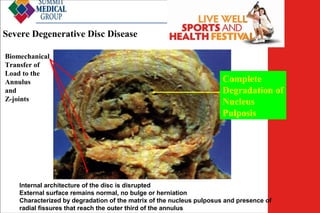
Severe Degenerative Disc Disease
Biomechanical
Transfer of
Load to the
Annulus
and
Z-joints

Low Back
Pain
Complete
Degradation of
Nucleus
Pulposis

Internal architecture of the disc is disrupted
External surface remains normal, no bulge or herniation
Characterized by degradation of the matrix of the nucleus pulposus and presence of
radial fissures that reach the outer third of the annulus
Stem Cells for Disc Degeneration

Low Back
Pain

Dr. Alon Terry(newest SMG Physiatrist) trained at HSS where he
worked on regenerative strategies for the disc
In a recent study by Dr. Terry and Dr. Lutz, cells from a patient’s blood were
taken out and injected into the disc to see if can stimulate a repair response.
They also worked on a study injecting growth factor into the disc to try to
turn on the disc’s inherent ability to heal itself.
These are some of the first studies that have
been done in the world in this area.
Conclusion

Low Back
Pain

Lumbar spine injections can be a valuable tool in
the management of LBP
Some injections can be diagnostic and/or
therapeutic
Injections represent one strategy in the
management of LBP
Multimodal treatment strategies have shown to
be most helpful in the long-term management of
chronic LBP

Injection Treatment for Back Injury

  • 1.
    Low Back Pain Injection Treatmentsfor Back Injury Rohit Oza, MD Physiatry Department Summit Medical Group
  • 2.
    Low Back Pain The LowBack Pain Story  60-90% of adults will have low back pain  2nd most common reason to see primary care physician
  • 3.
    Low Back Pain Common Thinking 40-50% of patients with low back pain will improve within one week
  • 4.
    Low Back Pain The FullStory  62% of patients likely to have one or more relapses during a one-year follow-up
  • 5.
    Low Back Pain The FullStory  Low back pain is the #1 disability in patients under 45
  • 6.
    Low Back Pain Common Thinking 90% of patients with low back pain improve without any medical care
  • 7.
    Low Back Pain The FullStory  Longer pain for patients who wait 6-10 weeks  80% have pain at six months and one year  12% disability at one year
  • 8.
    Low Back Pain Difficulties inTreating LBP 1. Difficult to diagnose source 2. Requires “whole care” approach 3. Preventive program needed to minimize recurrence
  • 9.
    Low Back Pain Other ComplicatingFactors  Complexity  AHCPR guidelines  Lack of research  Managed care restrictions
  • 10.
    Low Back Pain Leading causeof disability 70-90% of adults will experience LBP In their lifetime Financial Impact: medical expense anually In medical bills, disabilty, and loss of productivity
  • 11.
    Interdisciplinary Team Approach atSMG Complex Problem Physiological factors Social factors Psychological factors Low Back Pain Interdisciplinary Management • Orthopedic Surgeons • Neurosurgeons • Pain specialists • Psychiatrists/ Psychologists • Physiatrists • Radiologists • Neurologist • Internists • Chiropractor
  • 12.
    Low Back Pain  Anatomy –Vertebral body – Disc – Facet joints
  • 13.
    Spine Anatomy  Cervical – C1-C7 Thoracic – T1-T12  Lumbar – L1-L5  Sacrum – S1-S5 (fused) Low Back Pain
  • 14.
    Low Back Pain  Spinalcord  Nerve roots  Disc
  • 15.
    Prevention  Stretching  Strengthening Posture  Lifting techniques  Ergonomics Low Back Pain
  • 16.
    Low Back Pain  Commonsources for LBP: Structural Myofascial Muscles, Tendons, ligaments, fascia Neural Tissue Nerve root irritation, epidural inflammation, epidural fibrosis, arachnoiditis Joints Intervertebral discs: Skeletal bone abnormalities Facet joints, sacro iliac joints Disc degeneration/disruption, disc herniation Osteoporosis, compression fractures, spinal stenosis, spondylosis, spondylolysis, spondylolisthesis,
  • 17.
  • 18.
    Low Back Pain Injection Treatments:Muscle/Ligaments Trigger Point Injection A trigger point is a knot or tight, rope-like band of muscle that forms when a muscle fails to relax after activity Lidocaine is an injectable medication that can be used to numb a joint or treat muscle pain. Research shows that injections used to inactivate trigger points can provide prompt relief of painful symptoms related to joint and muscle ailments.
  • 19.
    Low Back Pain Injection Treatments:Muscle/Ligaments Trigger Point Injection
  • 20.
    Low Back Pain Injection Treatments:Nerve “Sciatica” Sciatica is a relatively common form of low back and leg pain, but the true meaning of the term is often misunderstood. Sciatica is a set of symptoms rather than a diagnosis Symptoms include lower back pain, buttock pain, and pain, numbness or weakness in various parts of the leg and foot. Other symptoms include a " pins and needles" sensation, or tingling and difficulty moving or controlling the leg
  • 21.
  • 22.
    Epidural Injection Been aroundfor 40 years. The epidural space is accessed through the caudal, interlaminar approach and transforaminal approach. Low Back Pain
  • 23.
    Disc Herniation Location DeterminesAffected Nerve Low Back Pain Far Lateral Foraminal Paracentral
  • 24.
    Caudal Epidural Blocks Low Back Pain Lowrisk for thecal puncture. Dura ends at S2. Unreliable above the L4-5 levels. Requires higher volumes of medication
  • 25.
    Zygapophyseal Mediated Pain(Facet Joint) 1.Cartilage degeneration with or 2. Osteophyte formation 3. Biomechanical transfer of weight in disc degeneration 4. Trauma to the joint 5. Spondylolisthesis Low Back Pain
  • 26.
    Facet (Zygapophysial) Joint Pain Lumbarfacet joints recognized as a source of pain since 1911 Facet syndrome: lumbosacral pain with or without sciatica Pain after rotary movement or twisting Low back pain with radiation to thighs and buttocks Poor clinical correlation with imaging or exam Low Back Pain Primary Pain Secondary Pain
  • 27.
    Low Back Pain Facet Injections Intra-articularJoint Injections Therapeutic (Local and steroid) Paravertebral Facet Joint Nerve Blocks(Medial Branch Blocks) Diagnostic (Local only) Therapeutic only with Neurolysis (Radiofrequency)
  • 28.
  • 29.
    Neuroablation:RF Low Back Pain Radiofrequency ablationproduces indescriminate destruction of all nervous tissue including motor and propioceptive fibers Lesion Shape Produced by RF: Typical Energy Delivered 2-7 watts * Thermal lesion is least at tip and greatest along active shaft of RF needle * Typical tissue temp 70-90 degrees C * Optimum angle is parallel to nerve 4 mm
  • 30.
    SI Joint Accepted sourceof low back and buttock pain Prevalence of SI pain: 13 to 30% of cases of low back pain Moderate evidence for efficacy of SI joint injections Low Back Pain
  • 31.
    Disc Degeneration Discs well innervated andcan be source of pain Internal architecture disrupted Presence of radial fissures that reach the outer third of the annulus Low Back Pain
  • 32.
    Severe Degenerative DiscDisease Biomechanical Transfer of Load to the Annulus and Z-joints Low Back Pain Complete Degradation of Nucleus Pulposis Internal architecture of the disc is disrupted External surface remains normal, no bulge or herniation Characterized by degradation of the matrix of the nucleus pulposus and presence of radial fissures that reach the outer third of the annulus
  • 33.
    Stem Cells forDisc Degeneration Low Back Pain Dr. Alon Terry(newest SMG Physiatrist) trained at HSS where he worked on regenerative strategies for the disc In a recent study by Dr. Terry and Dr. Lutz, cells from a patient’s blood were taken out and injected into the disc to see if can stimulate a repair response. They also worked on a study injecting growth factor into the disc to try to turn on the disc’s inherent ability to heal itself. These are some of the first studies that have been done in the world in this area.
  • 34.
    Conclusion Low Back Pain Lumbar spineinjections can be a valuable tool in the management of LBP Some injections can be diagnostic and/or therapeutic Injections represent one strategy in the management of LBP Multimodal treatment strategies have shown to be most helpful in the long-term management of chronic LBP

Editor's Notes

  • #2 PREFACE The AAPM&R PM&R Approach to Low Back Pain slide presentation (physician version) is provided as an educational service to assist physiatrists, particularly members of the American Academy of Physical Medicine and Rehabilitation, in marketing their services to primary care physicians. This presentation is one of the many products developed as part of the PM&R Awareness Initiative - a multi-year marketing and communications program addressing key audiences including: AAPM&R members, primary care physicians, employers, managed care organizations and insurers, allied health professionals, and the public. A key component of this plan is the creation of tools and resources that AAPM&R members can use to supplement marketing activities conducted at the national level. The PM&R Approach to Low Back Pain slide presentation is one of the tools developed specifically to help physiatrists demonstrate their role in providing total patient care. In addition to a general overview of the history and causes of low back pain, the presentation illustrates the PM&R approach to care and treatment. It includes a case study that can be easily adapted to reflect your own practice. The Academy welcomes your feedback on the utility of this product as well as suggestions or ideas for future updates to this presentation or additional products and services that would be useful to practicing PM&R physicians. Please direct comments and suggestions to the national office. The Academy acknowledges Drs. Stanley A. Herring, Jeff Young, and Joel Press for developing content for this presentation, and the AAPM&R Marketing Committee for their assistance in reviewing it. Members of the Marketing Committee include: Kristjan T. Ragnarsson, MD, ChairRoss D. Zafonte, DO (ex-officio) D. Nathan Cope, MDRobert D. Rondinelli, MD, PhD Steven L. Hendler, MDDavid L. Bagnall, MD, PASSOR Representative Kurtis M. Hoppe, MDNadine Maurer, MD, RPC Representative Austin I. Nobunaga, MDClaire V. Wolfe, MD, BOG Liaison Thanks are also due to members of the Academy national office staff and Tucker-Knapp Integrated Marketing Communications for overall management of the project and design, editing, and production of this slide presentation. (c) 1999 American Academy of Physical Medicine and Rehabilitation. All rights reserved. The PM&R Approach to Low Back Pain slide presentation (physician version) is owned and copyrighted by the American Academy of Physical Medicine and Rehabilitation. The PM&R Approach to Low Back Pain slide presentation cannot be licensed, sold, or distributed to another purchaser without the express written permission of the American Academy of Physical Medicine and Rehabilitation. Information in this presentation does not represent official policy of the American Academy of Physical Medicine and Rehabilitation unless specifically stated. The purpose of this presentation is to provide information for education and communication purposes only. The information contained herein is meant to be a helpful resource for AAPM&R members, referring physicians, healthcare professionals, and the public; AAPM&R does not guarantee and thus accepts no liability relative to the content, accuracy, or use of the content of this presentation. The information in this presentation should not be considered complete, nor should it be relied on to suggest a course of treatment for a particular individual. It should not be used as a substitute for a visit, call, consultation or the advice of a physician or other qualified health care provider. The information contained in this presentation was compiled from a variety of sources, and while every effort has been made to ensure its accuracy, it is intended only as a guide and is not a substitute for specific medical opinion.
  • #3 I'm sure it comes as no surprise to any physician that low back pain is one of the most common medical problems in this country. 60-90% of all adults will experience low back pain during their lifetimes. Fifty-five percent will suffer annual recurrence. In fact, low back pain is the second most common reason patients visit their primary care physicians.
  • #4 For example, it has been stated that 40-50% of patients with low back pain will improve within one week. That's true - as far as it goes in terms of immediate improvement.
  • #5 However, over 40% of all patients with low back pain will have persistent complaints of pain at one- and two-year follow-ups. Even studies that report a favorable natural history for low back pain in terms of short-term follow-up commonly demonstrate frequent relapses of low back pain or persistent low back pain for longer time frames. Sixty-two percent of patients are likely to have one or more relapses during a one-year follow-up. And persistent pain can mean more physician visits, more diagnostic tests, and more frustration for patient and physician.
  • #6 Improve, yes, but to what extent? Low back pain is the number one cause of disability in patients under the age of 45, and the number three disability in patients over 45. And consider the long-term consequences: If an injured worker has been off work for six months, there is only a 50% chance of that employee ever successfully returning to the same job. By the time an injured worker has been off work for two years or more, statistically there is little to no chance of that person ever returning to their previous job.
  • #7 Finally, it has been reported that 90% of patients with low back pain improve without any medical care.
  • #8 However, the truth is that continued problems with low back pain are even more likely in patients who wait six to 10 weeks from the first onset of pain before seeking medical care. These subacute back pain patients demonstrate an almost 80% incidence of back pain at six-month and one-year follow-ups. Indeed, in this patient group, there is a 26% increase in not only pain, but also marked disability at the six-month follow-up, and a 12% incidence of marked disability at the one year follow-up.
  • #9 3.)Reducing the risk of recurring back pain requires thorough patient education and an individualized program which the patient can largely self-manage.
  • #10 The complex interaction of physical, psychological, and lifestyle variables contributing to low back pain complicates the picture even more. And while attempts have been made to develop guidelines that can assist practitioners in diagnosis, their application hasn't been universally accepted. Clinical guidelines for low back pain published by the Agency for Health Care Policy and Research represent one of the most recent attempts to standardize this complex issue. The guidelines are valuable in that they emphasize conservative management, but they lack adequate data and research to support a practical guideline. Unfortunately, the science of low back pain therapy hasn't received the attention and funding necessary to adequately research and develop universally-accepted practice guidelines. The influence of managed care can also cause problems in treating low back pain. In an attempt to reduce costs, a health plan's definition of adequate outcome may differ significantly from that of the patient and treating physician.
  • #11 April 2004 issue of Newsweek The issue wrote about massage, acupuncture, chiropractic. The issue notes the lack of proven efficacy for many of these treatments. “ Like a temperamental sports car, the human spine is beautifully designed but maddeningly unreliable.” As long as we continue to lead overweight, sedentary, and stressful lives, these numbers are unlikely to go anywhere but up. The article talked about managing pain with multiple disciplines: Acupuncture, massage, and chiropractic practitioners are increasing in numbers. The number of Chiropracters increased 50% from 1990 to 2004.
  • #12 Interdisciplinary Approach to Pain Management Chronic spinal disorders are a complex phenomenon and is best managed by a interdisciplinary team. Primary coordination of treatment may depend on the individual patient’s needs and may change over time. For example, at one point the pain specialist’s input may be most urgent; subsequently, the physiatrist’s efforts may be most important, while at another point psychological therapy may be what the patient needs most. Chronic Spinal Disorders management challenges specialties to work together, often for long periods of time.