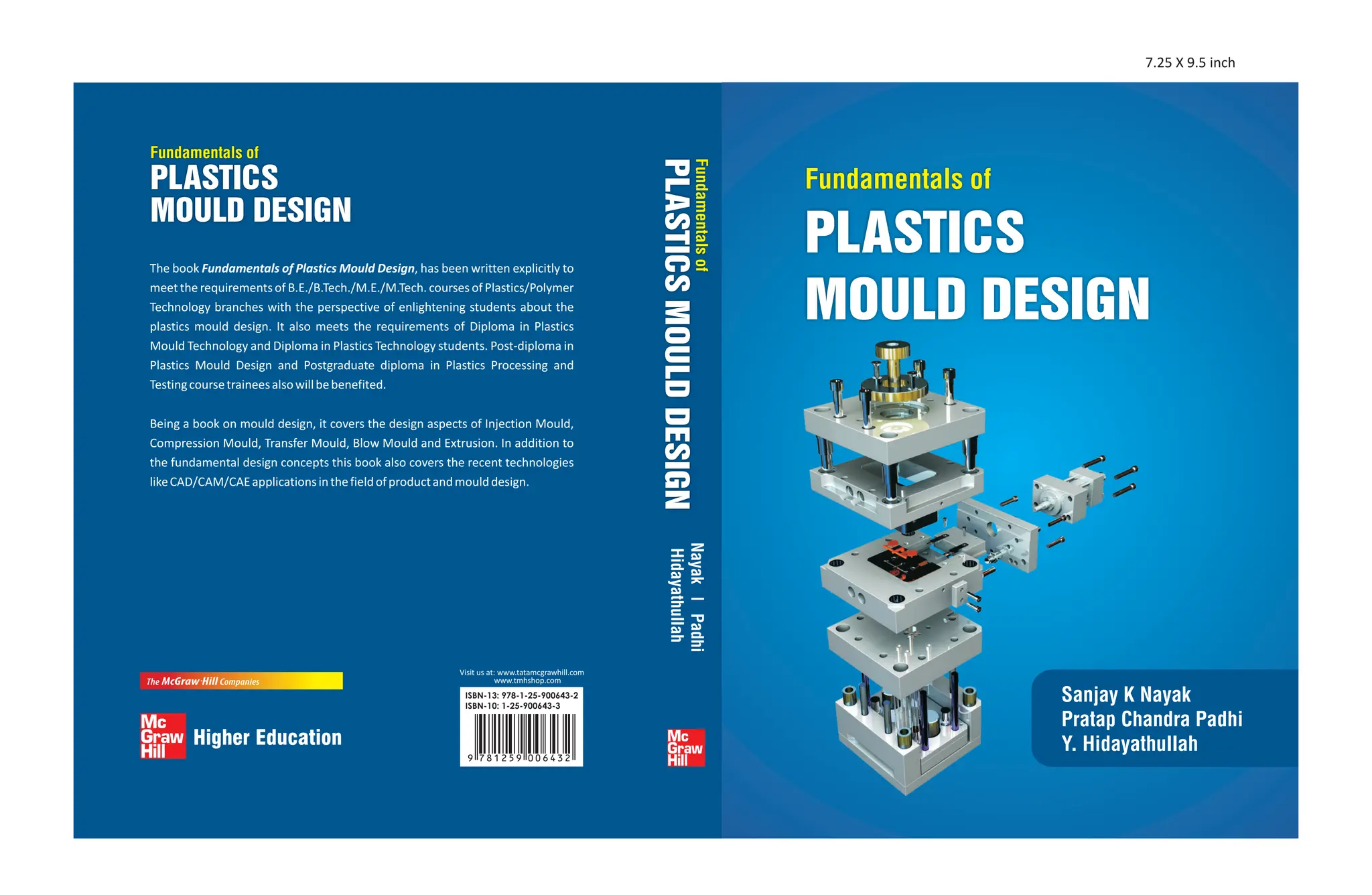
Fundamentals of
PLASTICS
MOULD DESIGN
Sanjay K Nayak
Pratap Chandra Padhi
Y. Hidayathullah
Fundamentals of
PLASTICS
MOULD DESIGN
Fundamentals
of
PLASTICS
MOULD
DESIGN
Nayak
|
Padhi
Hidayathullah
The book Fundamentals of Plastics Mould Design, has been written explicitly to
meet the requirements of B.E./B.Tech./M.E./M.Tech. courses of Plastics/Polymer
Technology branches with the perspective of enlightening students about the
plastics mould design. It also meets the requirements of Diploma in Plastics
Mould Technology and Diploma in Plastics Technology students. Post-diploma in
Plastics Mould Design and Postgraduate diploma in Plastics Processing and
Testingcoursetraineesalsowillbebenefited.
Being a book on mould design, it covers the design aspects of Injection Mould,
Compression Mould, Transfer Mould, Blow Mould and Extrusion. In addition to
the fundamental design concepts this book also covers the recent technologies
likeCAD/CAM/CAEapplicationsinthefieldofproductandmoulddesign.
ISBN-13: 978-1-25-900643-2
ISBN-10: 1-25-900643-3
Visit us at: www.tatamcgrawhill.com
www.tmhshop.com
7.25 X 9.5 inch
Fundamentals of Plastics
Mould Design
Fundamentals of Plastics
Mould design
Sanjay K. Nayak
Director General
Central Institute of Plastic and Engineering Technology
TVK Industrial Estate
Guindy, Chennai
Tamil Nadu
Pratap Chandra Padhi
Manager (Project)
Central Institute of Plastics Engineering and Technology (CIPET)
Bhubaneswar, Odisha
Y. Hidayathullah
Technical Officer - CAD/CAM
Central Institute of Plastics Engineering and Technology (CIPET)
Chennai,Tamilnadu
Tata McGraw-Hill
Published by Tata McGraw Hill Education Private Limited,
7 West Patel Nagar, New Delhi 110 008
Fundamentals of Plastics Mould design
Copyright ยฉ 2012, by Tata McGraw Hill Education Private Limited.
No part of this publication may be reproduced or distributed in any form or by any means, electronic,
mechanical, photocopying, recording, or otherwise or stored in a database or retrieval system without the
prior written permission of the publishers.The program listings (if any) may be entered, stored and executed
in a computer system, but they may not be reproduced for publication.
This edition can be exported from India only by the publishers,
Tata McGraw Hill Education Private Limited.
ISBN (13 digits):
ISBN (10 digits):
Vice President and Managing Directorโ€”McGraw-Hill Education: Ajay Shukla
Headโ€”Higher Education Publishing and Marketing: Vibha Mahajan
Publishing Managerโ€“โ€“SEM and Tech Ed.: Shalini Jha
Sr Editorial Researcher Acquisitions: Vamsi Deepak Sankar
Executiveโ€”Editorial Services: Sohini Mukherjee
Sr Production Manager: Satinder Singh Baveja
Marketing Managerโ€“โ€“Higher Education: Vijay Sarathi
Graphic Designerโ€“โ€“Cover: Meenu Raghav
General Managerโ€”Production: Rajender P Ghansela
Asst General Managerโ€”Production: Reji Kumar
Information contained in this work has been obtained byTata McGraw-Hill, from sources believed to be
reliable. However, neitherTata McGraw-Hill nor its authors guarantee the accuracy or completeness of
any information published herein, and neither Tata McGraw-Hill nor its authors shall be responsible
for any errors, omissions, or damages arising out of use of this information. This work is published
with the understanding that Tata McGraw-Hill and its authors are supplying information but are not
attempting to render engineering or other professional services. If such services are required, the
assistance of an appropriate professional should be sought.
Typeset at BeSpoke Integrated Solutions, Puducherry 605 008, India.
Cover Printer:
About the Authors
Prof. (Dr.) Sanjay K Nayak is currently the Director General,
Central Institute of Plastics Engineering and Technology, Chennai,
Tamilnadu. He is holding D.Sc. degree in Polymer composites and
nanocomposites.Hehasmorethan23yearsofteachingandindustrial
experience. He has published more than 120 research papers in
reputed journals. He has been author and editor for 10 Books in the
area of Advanced Materials and Polymer science & Engineering. As
a faculty, he has introduced new courses in both undergraduate and
post graduate level in the emerging area of plastics engineering and
technology.
Pratap Chandra Padhi is Manager (Project), Central Institute
of Plastics Engineering and Technology, Bhubaneswar. He
has graduated in Mechanical Engineering from Institute of
Engineers (India) and has 20 years of teaching experience in the
field of plastics moulds and die design, tooling, CAD/CAM/CAE
engineering. He has technical expertise in the state of the art
CNC - EDM, Wire cut EDM, Milling, Lathe machines and has
undertakenmanydevelopmentalprojectsfromIMMT,ISRO,ECIL,
HAL in the field of design, development of moulds and machining
of complex engineering components. Mr Padhi has contributed
in the development of syllabus curriculum for Diploma and
Post-Diploma programmes in the field of plastics engineering.
He is presently pursuing Ph.D. in Mechanical Engineering in the
emerging research area of Wire Electrical Discharge Machining
(WEDM) Process for Moulds and Die steels.
Y. Hidayathullah is working as Technical Officer - CAD/CAM
in Central Institute of Plastics Engineering and Technology
(CIPET), Guindy, Chennai, Tamilnadu. He has more than eight
years of experience in the field of CAD/CAM/CAE. He did his
Bachelor of Engineering in Mechanical under Bharathidasan
University, Tiruchirappalli, Tamil Nadu. He has good knowledge
on CAD/CAM/CAE softwares such as Unigraphics, CATIA,
Pro/Engineer, Moldflow and Auto CAD. As a Technical Officerโ€“
CAD/CAM, he has been involved in various projects related
to Plastics Product and Mould Design, Injection moulded part
validation using Moldflow software, Core & Cavity extraction of
๎ฃ About the Author ๎ข
vi
various plastic parts using Unigraphics software, etc. He is also teaching design subjects
such as Plastic Product and Mould Design, CAD/CAM Applications in Mould Design,
Engineering Drawing and Machine Drawing. He also has three and half years experience
as Production and Quality Control Engineer.
Contents
Preface xi
1. Product Design 1-1
1.1 General Product Design Concept 1-1
1.2 Designing for Plastics 1-4
1.3 Wall Thickness 1-11
1.4 Parting Line 1-16
1.5 Ribs, Bosses or Gussets 1-20
1.6 Radii and Fillets 1-26
1.7 Taper or Draft 1-28
1.8 Holes 1-28
1.9 Coring 1-36
1.10 Undercut 1-37
1.11 Threads 1-39
1.12 Inserts 1-47
1.13 Gate Size and Location 1-67
1.14 Location of Ejector Pins 1-69
1.15 Tolerance 1-70
1.16 Fastening 1-76
1.17 Shrinkage 1-86
1.18 Surface Finish 1-95
1.19 Designing with Plastics for Load Bearing Applications 1-96
1.20 Tooling Aspects on Product Design 1-111
1.21 ProcessingVariableVs Product Design 1-116
1.22 Mechanical Properties	 1-119
1.23 Product Design for Composites	 1-134
1.24 Modern Approaches to Product Design	 1-164
2. Injection Mould Design	 2-1
2.1 Introduction	 2-1
2.2 Selection of Machines	 2-38
2.3 Parting Line and Parting Surface	 2-42
2.4 MouldVenting  2-44
2.5 Feed System	 2-45
2.6 Ejection System	 2-71
2.7 Temperature Control System	 2-91
2.8 Methodical Approach to Mould Design	 2-106
2.9 Split Mould	 2-123
3. Compression Mould Design	 3-1
3.1 Introduction	 3-1
3.2 Compression Moulding Processes	 3-1
3.3 Thermo-set Plastics Materials and Product application	 3-2
๎ฃ Contents ๎ข
viii
3.4 Types of Compression Moulds 3-4
3.5 Bulk Factor	 3-9
3.6 Type of Loading Chamber Design	 3-10
3.7 Flash Thickness	 3-12
3.8 Clamping Force	 3-13
3.9 Determination of the Number of Cavities	 3-14
3.10. Factors that influence Thermoset Moulding 3-16
3.11 Heating of Compression moulds 3-17
3.12. MouldVents 3-20
3.13 Mould Construction	 3-22
3.14 Limitations of Compression Moulding	 3-23
4. Transfer Mould Design 4-1
4.1 Introduction 4-1
4.2 Types of Transfer Moulds 4-1
4.3 Pot Transfer Moulds 4-2
4.4 Plunger Transfer Mould 4-5
4.5 Transfer - Pot Calculations 4-8
4.6 Mould Heating 4-9
4.7 Selection of Moulding Method-Compression or Transfer 4-12
4.8 Economic Determination of the number of Cavities  4-13
4.9 Design of Sprue, Runner and Gate 4-15
4.10 Venting 4-21
4.11 Number of cavities	 4-22
4.12 Advantages and Disadvantages of Transfer Moulding 4-23
4.13 Comparison of Compression and Transfer moulding  4-24
4.14 General Mould Design Check List 4-29
4.15 Introduction to Thermo-set Plastic Materials 4-30
4.16 Trouble Shooting and Quality Assurance 4-37
4.17 Mould Material and its Selection 4-38
5. Advanced Injection Mould Design	 5-1
5.1 Moulds for Threaded Components 5-1
5.2 Hot Runner Mould 5-19
5.3 Outsert and Insert Moulding 5-37
5.4 Multicolour Injection Moulding 5-39
5.5 Gas-Assisted Injection Moulding 5-41
5.6 Stack Mould 5-46
5.7 Reaction Injection Moulding (RIM) 5-48
5.8 Casting 5-51
5.9 Resin Transfer Moulding (RTM) 5-52
5.10 Structural Foam Moulding 5-53
5.11 Lamination	 5-54
6. Blow Mould Design	 6-1
6.1 Introduction - Blow Moulding Process 6-1
๎ฃ Contents ๎ข ix
6.2 Blow Mould Terminology  6-3
6.3 Applications of Blow Moulded Parts 6-3
6.4 Blow Mould Part Design Parameters 6-4
6.5 Blow Moulded Part Design Considerations 6-5
6.6 Container Design Features 6-7
6.7 Design Details 6-8
6.8 Special Considerations for Bottle Design 6-9
6.9 Plastics materials for Blow Moulding 6-10
6.10 Types of Blow Moulding 6-12
6.11 Extrusion Blow Moulding Process 6-12
6.12 Injection Blow Moulding 6-30
6.13 Injection Stretch Blow Moulding Process 6-36
7. Extrusion Dies 7-1
7.1 Introduction 7-1
7.2 Characteristics and Property of Plastic Materials 7-1
7.3 Flow Properties of Solid Polymers 7-2
7.4 Flow Properties of Polymer Melts	 7-2
7.5 Effect of Temperature and Pressure onViscosity 7-4
7.6 Thermal Properties 7-4
7.7 Principles of Extrusion 7-5
7.8 Classification of Dies and Die Geometry 7-10
7.9 Types of Dies 7-17
7.10 Blown Film Dies 7-32
7.11 Flat Film and Sheet Dies 7-37
7.12 Wire and Cable Coating Dies 7-40
7.13 Die Making 7-42
7.14 Heating System Temperature Control 7-43
7.15 Maintenance and Cleaning of Die 7-45
7.16 Die Fabrication 7-45
8. CAD/CAM Applications in Mould Design 8-1
8.1 Introduction to Computers 8-1
8.2 Computer Fundamentals 8-8
8.3 Memory 8-13
8.4 Communication Devices 8-19
8.5 Principles of Programming 8-31
8.6 Interactive Computer Graphics 8-38
8.7 Database Management 8-44
8.8 Computer Networking 8-47
8.9 Basic Concepts of CAD 8-48
8.10 Two-Dimensional Drafting 8-53
8.11 Three-Dimensional Modelling 8-57
8.12 Concepts of Engineering Database 8-65
8.13 Advanced CAD/CAM Technologies 8-67
8.14 Computer Aided Engineering 8-82
8.15 Introduction to CAM 8-90
๎ฃ Contents ๎ข
x
8.16 Numerical Control 8-92
8.17 Part Programming 8-98
8.18 Computer Numerical Control 8-106
8.19 Direct Numerical Control 8-108
8.20 Adaptive Control 8-110
8.21 Computer Integrated Manufacturing 8-111
8.22 Advanced CAM Techniques 8-115
Preface
About the Book
We feel great pleasure to bringing out the book, Fundamentals of Plastics Mould Design, for
the benefit of the studentsโ€™ community. This book has been written explicitly to meet the
requirements of B.E./B.Tech./M.E./M.Tech.courses of Plastics/PolymerTechnology branches
and also with the perspective of enlightening students about the plasticsโ€™ mould design.
Fundamentals of Plastics Mould Design also meets the requirements of Diploma/ Post-diploma
/ Postgraduate diploma courses of Plastics Mould Technology and Plastics Technology/
Plastics Mould Design/Plastics Processing and Testing, respectively.
AllthemoulddesignersshouldknowaboutPlasticsProductDesign,MouldDesign,Plastic
materials, its processing and testing.This book covers the design aspects of the plastics such
as product design and mould design. Being a book on mould design, Fundamentals of Plastics
Mould Design covers the design aspects of Injection Mould, Compression Mould, Transfer
Mould, Blow Mould and Extrusion.
In addition to the fundamental design concepts such as Basic Mould Construction,
Ejection Systems, Feed Systems and Cooling Systems, this book also covers the calculation
aspects, the recent technologies like CAD/CAM applications in the field of product and
mould design, Prototype Development Methods, Reverse Engineering, Role of Mould flow
software for analysing the Plastics Injection Moulded Products, etc.
Salient features
Through out the book the same system of SI units are adopted
โ€ข
Also provided with equivalent fps system of unit in required areas
โ€ข
Easy communication between the book and the readers
โ€ข
In depth discussion in all chapters
โ€ข
Total of 550 Questions covering all chapters have been included
โ€ข
Solved examples for design calculations
โ€ข
Chapter Organisation
The book contains 8 chapters. Chapter 1 covers plastics product design, Chapter 2 discusses
injection mould design, compression mould design, transfer mould design are dealt in
Chapter 3 and 4 respectively. Chapter 5 covers advanced injection mould design, while
Chapter 6 covers blow mould design. Chapters 7 and 8 cover extrusion dies and CAD/CAM
applications in mould design.
๎ฃ Preface ๎ข
xii
All chapters of this book consist of simplified explanation in the introduction, relevant
illustrations and figures wherever required for the better understanding of students and
solved examples of numerical problems. Moreover, important questions at the end of each
chapter are given for the awareness of the students to face their exams confidently. The
fashion of presentation remains the same for all the eight chapters,for better communication
between the book and the readers.
Acknowledgements
We are thankful to our publisher,Tata McGraw-Hill for the cooperation and support towards the
outcome of this book.
Special thanks to Mr. Pheer Mohamed, Manager-Training, CIPET, Chennai and his team for his
undaunted support in bringing out the book.
Sanjay K. Nayak
Pratap Chandra Padhi
Y. Hidayathullah
Publisherโ€™s Note
Any constructive criticism of the book is most welcome by the readers. You can write to the
authors at cipethq@vsnl.com by mentioning the title and the authorโ€™s name along with your
feedback. Report of any piracy related problems will be highly appreciated both by the author
and the publisher.
Product Design
Chapter
1
1.1 General Product Design Concept
1.1.1โ€ƒIntroduction
Design is the universal term being used everywhere; it is the art of giving shape to the ideas
and defined as the product of creative thinking. It actually gives a complete description of an
object and prescription for its production. Hence, a product design deals with conversion of
ideas into reality and aims at fulfilling human needs.
1.1.2 Basic Concepts of Design
Any product design should have a definite shape, proportionate size with good appearance
and reveal the function of the product. Hence, the primary concept involved in design is shape,
size, aesthetics and function.
Shape is defined as the geometry and topology of a feature. All the parameters and their
values that fully define a feature are called size or size of a feature. If we combine shape
and size with suitable colours for the specific purpose of the product, it has to give attractive
appearance or good eye appeal, which is called aesthetics.
Appearance determines the whole โ€˜characterโ€™ of the product. It should reflect pride of
ownership, the function served, high product quality and value and the reputation of the
maker.
Analysis of product aesthetics The appearance of a product is the total visual effect produced
by structure, form, material, dimension and surface finish including colour. In ยญ
composite prod-
ucts, structure implies combined effect produced by positioning of adjacent forms in ยญ
deriving
the final product.
The visual appeal of objects like jewellery is very important. On the other hand, items such
as screws, nails, and ferrules have sheer functional value and negligible aesthetic value. An
attractive appearance alone is not only the deciding factor for a good design but the product
which is designed should fulfill the functional requirements of the consumer with reasonable
cost.
๎ฃ Fundamentals of Plastics Mould Design ๎ข
1-2
The concept involved in design of a product is its quality and economy. The term quality
means fitness for use. If a designer wants to produce a good quality product, then the cost of
the product will come into picture.
Hence, the product must be designed in such a way that without sacrificing the quality of
the product, the cost of the product should be brought down to an optimum level.Accordingly,
the product configuration / geometry, type of finish, accuracy, material selection, processing
methods and post-moulding procedures, etc., are to be selected.
1.1.3โ€ƒEssential Factors of Product Design
1. Need: A design must be in response to individual or social needs, which can be satis-
fied by the technological status of the times when the design is to be prepared.
2. Physical Reliability: A design should be convertible into material goods or services,
i.e., it must be physically reliable and should last long.
3. Economic Worthiness: The goods or services, described by a design, must be useful to
the consumer which equals or exceeds the sum of the total costs of making it available
to him.
4. Financial Feasibility: The operations of designing, producing and distributing the
goods must be financially supportable, i.e., a design project should be capable for
being funded by suitable agencies. The method for assessment of financial feasibility
could be โ€˜net present valueโ€™ which states that the present worth of cash flows in the
project when added up during the useful life of the product should be greater than the
initial investment for the product.
5. Optimality: The choice of a design concept must be optimal amongst the available
alternatives. The selection of the chosen design concept must be optimal among all
possible design proposals. Optimal design, in theory, strives to achieve the best or
singular point derived by calculus methods. In the context of optimisation under con-
straints for mechanical strength, better quality, minimum weight, minimum cost, etc.,
are the criteria for optimisation.
6. Design Criterion: Optimality must be established relative to a design criterion which
represents the designerโ€™s compromise among possibly conflicting value judgments,
which include those of the consumer, the producer, the distributor and his own.
7. Morphology: Design is progression from the abstract to the concrete. The morphology
of design refers to the study of the chronological horizontal structure of the design
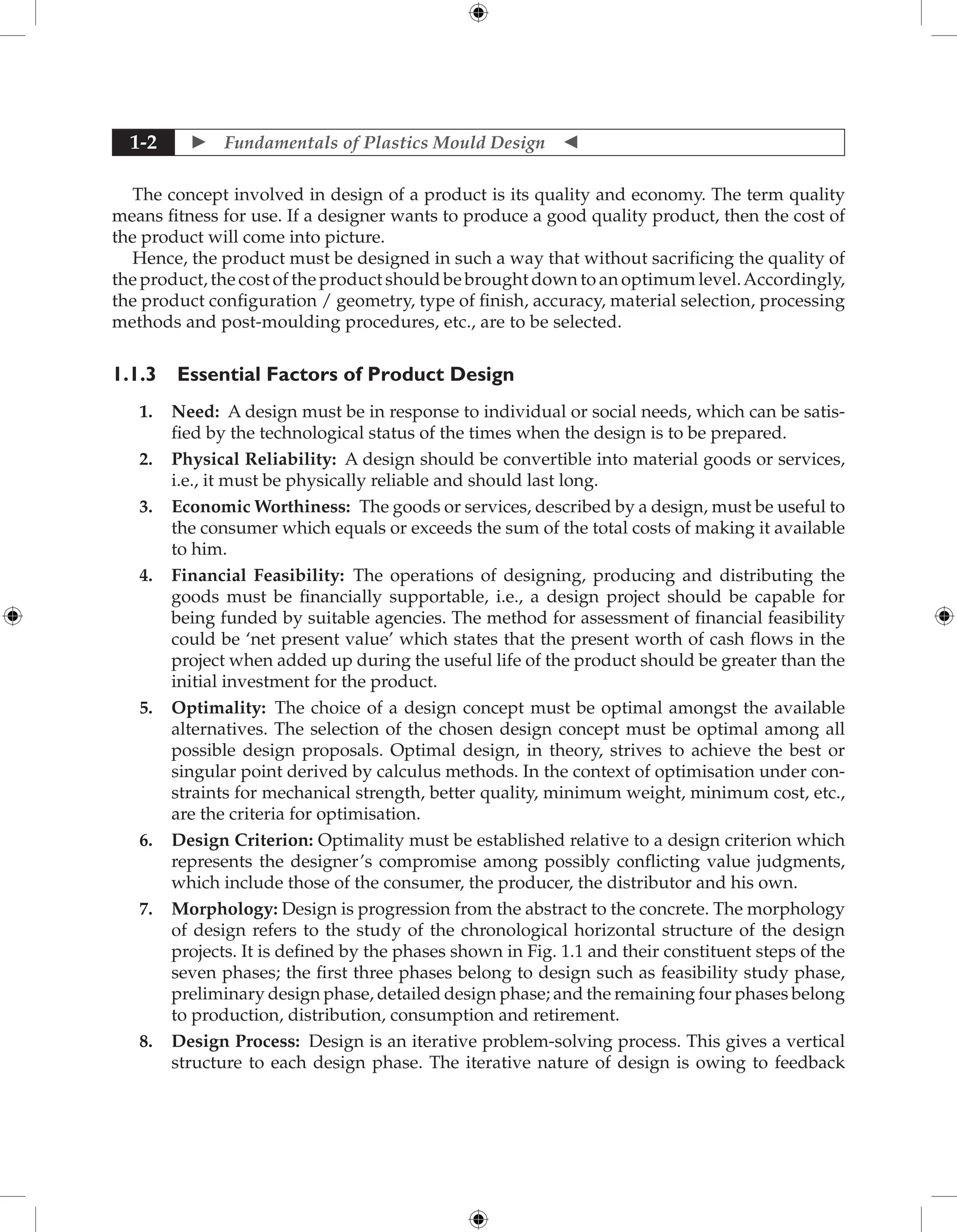
projects. It is defined by the phases shown in Fig. 1.1 and their constituent steps of the
seven phases; the first three phases belong to design such as feasibility study phase,
preliminary design phase, detailed design phase; and the remaining four phases belong
to production, distribution, consumption and retirement.
8. Design Process: Design is an iterative problem-solving process. This gives a vertical
structure to each design phase. The iterative nature of design is owing to feedback
๎ฃ Product Design ๎ข 1-3
from existing design and improvement with further information in the form of techno-
logical, financial and creativity inputs.
Primitive
Phase โ€“ I: Feasibility Study
Primary
Design
Phase
Phase โ€“ II: Preliminary Design
Phase โ€“ III: Detailed Design
Phase โ€“ IV: Planning for Production
Phase โ€“ V: Planning for Distribution
Consumption
Cycle
Phase
Related
to
Production
Phase โ€“ VI: Planning for Consumption
Phase โ€“ VII: Planning for Retirement
Fig. 1.1 Morphology of design process.
9. Subproblems: During the process of solution of the design problem, a sublayer of sub-
problems appears; the solution of the original problem is dependent on the solution of the
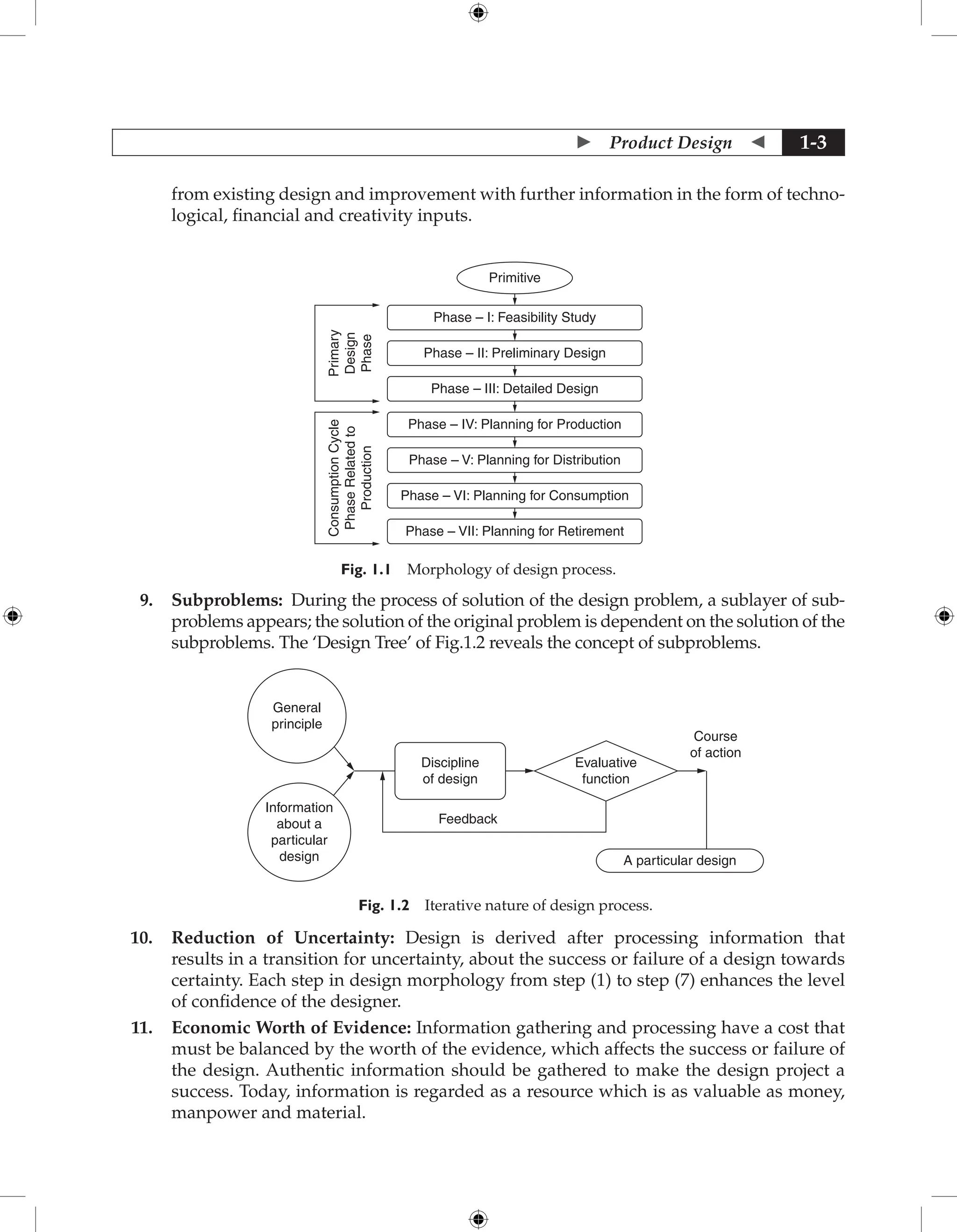
subproblems. The โ€˜Design Treeโ€™ of Fig.1.2 reveals the concept of subproblems.
General
principle
Discipline
of design
Evaluative
function
Course
of action
Feedback
A particular design
Information
about a
particular
design
Fig. 1.2 Iterative nature of design process.
10. Reduction of Uncertainty: Design is derived after processing information that
results in a transition for uncertainty, about the success or failure of a design towards
certainty. Each step in design morphology from step (1) to step (7) enhances the level
of confidence of the designer.
11. Economic Worth of Evidence: Information gathering and processing have a cost that
must be balanced by the worth of the evidence, which affects the success or failure of
the design. Authentic information should be gathered to make the design project a
success. Today, information is regarded as a resource which is as valuable as money,
manpower and material.
๎ฃ Fundamentals of Plastics Mould Design ๎ข
1-4
12. Bases for Decision: A design project is terminated when it is obvious that its failure calls
for its abandonment. It is continued when confidence in an available design solution is
high enough to indicate the commitment of resources necessary for the next phase.
13. Minimum Commitment: In the solution of a design problem at any stage of the process,
commitments which will fix future design decisions must not be made beyond what
is necessary to execute the immediate solution. This will allow maximum ยญ
freedom in
finding solutions to subproblems at the lower levels of design.
14. Communication: A design is a description of an object and prescription for its
production. It will exist to the extent it is expressed in the available modes of
communication. The best way to communicate a design is through drawings, which
is the universal language of designers. Three-dimensional renderings or sectional
views help explain the design to the user of the design. The present day impact of
computer aided modelling and drafting has resulted in very effective communica-
tion between the designer and the user.
1.2 Designing for Plastics
1.2.1โ€ƒIntroduction
In the present day the application of plastics is wide as compared to traditional material such
as metal. Plastics offer impressive advantages over metals. They are listed below:
1. They are not subjected to corrosion.
2. Light in weight with good strength to weight ratio.
3. Cost effective.
4. Less cycle time for production.
5. Unique design freedom.
6. Good mechanical, electrical and chemical properties.
7. They are available in wide range of colours.
8. Reduced assembly time.
In addition to it, each plastic material offers some special property which serves a particular
application or can be made to do so by the incorporation of suitable additives with the plastic
materials.
1.2.2โ€ƒAdvantages of Plastics
The successful use of plastics usually derives from a combination of cost savings and
improvement in performance or appearance, but often the cost saving alone is sufficient to
justify the choice of plastic material. Plastics can offer the following technical advantages:
๎ฃ Product Design ๎ข 1-5
(a) Light Weight: All plastics have low densities, generally in the range 830 to 2500 kg/mยณ.
These figures can be extended upward or downward. For example, foamed ยญ
materials
can have densities as low as 10 kg/mยณ and filled plastics as high as 3500 kg/mยณ. In
ยญ
comparison, the density of aluminium is about 2700 kg/mยณ and that of stainless steel
about 7900 kg/mยณ. It is evident that large volume of plastic material for unit weight can
be obtained than with metals.
(b) Toughness: Some plastics are very tough, and objects made from them are difficult
to destroy by mechanical treatment. Some plastics are less tough, and some others are
fragile.
(c) Resilience: Plastics show some of the behaviour associated with rubbers in accommo-
dating relatively large strains without fracture and in recovering their original shape
and dimensions when the stress is removed.
(d) Vibration Damping: The quietness in use of plastics gear trains and bottle crates
depends on the inherently high degradation of mechanical energy to heat.
(e) Resistance to Fatigue: In general plastics perform remarkably satisfactorily in situa-
tions involving dynamic stresses or strains.
(f) Low Coefficient of Friction: Plastics to plastics and plastics to metals combination
have low coefficient of friction and can often perform unlubricated without fear of
seizing.
(g) Thermal Insulation: Plastics are good insulators, their thermal conductivities
being many orders of magnitude lower than those of metals. This low conductivity
may be exploited in handles for utensils and in the design of pipes for carrying hot
fluids.
(h) Corrosion Resistance: In general, plastics are resistant to corrosion. They are resistant
to weak acids, weak bases and aqueous salt solutions, although strong oxidising acids
may cause some attack, leading to discolouration and possible embrittlement. On the
other hand, organic solvents, on which metals are generally inert, may cause swelling,
deterioration of properties and eventual dissolution.
(i) Colour Possibilities: Some plastics are transparent, some are translucent and a few
are opaque. Acrylics, polystyrenes, methylpentene polymers, polycarbonates and
certain grades of PVC can be very transparent indeed to visible light. All plastics can
be coloured by incorporating a wide range of dyes or pigments, thus avoiding the
need for painting. However, subsequent painting or plating is possible with some, if
required.
(j) Manufacturing Methods: A variety of automatic and semi-automatic techniques
allows easy, economical and reproducible fabrication of articles and components.
Further finishing operations are easy to carry out on most plastics.
(k) Integrated Design: The favourable processing characteristics and the properties
offered, allow the design and manufacture of polyfunctional shapes without the need
for assembly.
๎ฃ Fundamentals of Plastics Mould Design ๎ข
1-6
(l) Price: On a volume basis, raw materials of plastics are considerably less expensive than
many metals and in spite of inflationary pressures their prices have tended to fall relatively
to those of other materials.
1.2.3โ€ƒLimitations of Plastic
The disadvantages frequently turn out to be not so much limitations as challenges for the
designer to think of plastics as materials in their own right rather than as substitutes.
(a) Strength, surface hardness and abrasion resistance
(b) Modulus
(c) Temperature resistance
(d) UV Resistance and outdoor weathering
(e) Flammability
(f) Thermal expansion
(g) Electrostatic charges
(h) Orientation
The designer should therefore, bear this in mind and take appropriate steps to overcome the
same, in order to meet the specified requirements of application.
1.2.4โ€ƒThe Material Selection and Its Characteristics
The technical and cost considerations would influence selection of a particular material for
a particular product. Selection of materials is a highly complex process. In order to arrive
at the optimum materials for a given use with some degree of efficiency and reliability, a
systematic approach should be adopted to outline the proper approach to material selection
and to compare plastics both with other engineering materials and among themselves in terms
commonly used in material selection.
There are two criteria in the selection of materials, i.e., function and cost. How a material
will perform in a given use and the cost of the material are two of the primary considerations
in selecting a material.
The following criteria are required for selecting the plastic material:
1. Mechanical properties such as strength, toughness, rigidity, resistance to creep and
fatigue, abrasion and wear resistance, resilience and hardness.
2. Thermal properties which include the effect of temperature (particularly that of
maximum and minimum anticipated service temperature on engineering properties)
thermal conductivity, expandability, etc.
3. Electrical properties such as conductive or insulating qualities.
4. Resistance to chemicals or other environments.
The structural machine parts, products or devices are subject to loading conditions or
other external environments which produce internal stresses and strains. Knowledge of
๎ฃ Product Design ๎ข 1-7
stress, strain or mechanical behaviour of materials is important for a number of reasons.
In order to develop a safe and economical design with the minimum weight and cost, the
mechanical or stress strain properties of materials are to be considered. To achieve the above
requirements, part design becomes an integrative process, with many experiments and
false starts along the way. Although sheer creativity is essential to good design, engineers
also tend to go through a methodical series of steps in their quest for an optional design
solution.
The accurate geometry, i.e., shape and size of a component made in plastics is not its
functional guarantee, even if it is found fulfilling the immediate functional requirements. This
is arrived at by evaluating the long-term characteristics such as
1. Creep/flexural modulus
2. Resistance to electrical/potential discharge
3. Rate of imbrittlement
4. Environmental stress cracking/crazing
5. High temperature (continuous) with standability
6. Tribological properties
1.2.5 Methodical Approach in Plastics Product Design
The design of a good plastics product requires enough information about plastics and their
properties, different moulding methods, post-moulding procedures and information in
key design areas. Several factors have to be considered, which may lead to a wide choice in
ultimate design features of a product. To ensure proper design, close cooperation is required
between the industrial designer, the engineer, the draughtsman, the tool builder, the moulder,
and the raw material supplier. Preferably, each must become involved to some extent at the
very beginning of the design process.
The step-wise procedure for the development of a plastic part is detailed below:
1. Define the function of the part with life requirement.
2. Define shape and size based on space and capacity.
3. Assess loading conditions, stresses and deformation.
4. Define all environmental conditions.
5. Select several materials to satisfy the above conditions and other relevant properties.
6. Do several trial designs using different materials and geometries to perform the
required function.
7. Define the manufacturing process for each design.
8. Evaluate the trial designs on a cost effective basis. Determine several levels of perfor-
mance and the specific costs associated with each to the extent that it could be done
with available data.
9. Based on the above detailed study, select the best apparent choice and do a detailed
design of the part.
๎ฃ Fundamentals of Plastics Mould Design ๎ข
1-8
10. Based on the detailed design, select the probable part design, material and process.
11. Make a model, if necessary to test the effectiveness of the part.
12. Build prototype tooling, if necessary.
13. Make prototype parts to determine if they meet the required function.
14. Redesign the part if necessary based on the prototype testing.
15. Retest.
16. Make field tests.
17. Add instructions for use.
1.2.6 Design Theory
Design concept
1. What are the end use requirements for the part or product (aesthetic, structural,
mechanical)?
2. How many functional items can be designed into the part for cost effectiveness?
3. Can multiple parts be combined into one large part?
Engineering consideration
1. What are the structural requirements?
2. Are the load static, dynamic, cycling? What are the stress levels?
3. What deflection can be tolerated?
4. Is the part subject to impact loads?
5. What tolerances are required for proper functioning and assembly?
6. What kind of environment will the part see?
7. What operating temperature will it have?
8. What will its chemical exposure be?
9. What is the expected life of the product?
10. How will the product be assembled?
11. What kind of finish will be required on the parts?
12. Are agency requirements or codes involved?
13. Can the proposed product be moulded and finished economically?
Once the above questions have been considered, the next step is usually to consult data
property sheets to compare material. Properties presented in these sheets are for comparative
purposes and not generally for design. Seldom will a partโ€™s design conditions match the
conditions used for generating the data on the poperty sheets, but the standardised tests are a
valuable tool. Without standardised data properties, fair comparisons could not be made. The
standardised information on mechanical strength, impact, chemical resistance, etc., must be
adjusted for the end-use environments and life of the product.
๎ฃ Product Design ๎ข 1-9
After one selects the proper material for the part, calculations of wall thicknesses and part
geometry are made, followed by the next design step, which is to improve the effectiveness of
the design. In the case of injection moulded parts, the design should be reviewed in terms of
the following questions:
1. Can a tool be built and the part moulded?
2. Are the wall thicknesses adequate for the flow of the material to fill the part?
3. Have all internal corners been โ€˜radiusedโ€™ to reduce all high localised stress points?
4. Do all changes in wall thicknesses have smooth transitions?
5. Are heavy wall sections cored out to give a uniform wall where possible?
6. Is the ratio of rib or boss thickness to adjacent wall thickness proper?
7. Is it possible to gate into the thicker wall sections and flow to the thinner sections?
8. Are weld lines going to present strength or appearance problems?
9. Have adequate draft angles been included on all surfaces?
10. Have reasonable tolerances been selected for all parts?
If you have properly evaluated the needs of the product, chosen the proper material,
optimised the design for that material, and, finally, carefully considered proper manufacturing
practices, you will be on the way to having a part that works.
1.2.7 Quality and Economy
In product design the quality and economy are the most important requirements from raw
material selection to finished product and finally reach the customer.
To ensure the product quality the following factors must be considered:
1. Methodical approach in product design.
2. Selection of suitable processing machine.
3. Efficient and economy mould design.
4. Trouble free mould construction (minimum mould cost).
5. Adopt quality control methods.
6. Suitable correction and modification based on feedback from customers.
Economy Cost effectiveness is an important factor in product design. This can be achieved by
involving effective method of product design only. Economic success essentially depends upon
external influences such as market situation and competition and ecological considerations,
management attention must also be directed toward the possibilities existing inside its own
factory.
Product manufacturer will have to consider the following factors as most important to
achieve the economy in their product:
1. Selection of raw material (least in cost, but best in product required properties like
aesthetic, strength, etc.).
๎ฃ Fundamentals of Plastics Mould Design ๎ข
1-10
2. Product design concept like minimum / maximum wall thickness to meet out eco-
nomic product (the optimum wall thickness as to design without loss of its strength).
3. The prototype mould are rapid prototype product before regular mould to reduce the
initial mould development cost.
4. Selection of suitable processing machines to avoid wastage of raw material and time.
5. Best mould design to minimise the tooling cost and processing cost (reducing cycle
time).
6. Introduce modern technology method like hot runner / flash free quality moulds using
special grade of mould steels and surface treatments.
7. Engage minimum labour to minimise cost. Introduce modernised methods (like auto-
mation) if more labour is necessary.
1.2.8 Product Design Appraisal
Product design has to fulfil the essential qualities like shape, strength, aesthetic, shrinkage
and tolerance, etc. These qualities can be achieved by better methodical approach in product
design, good mould design concept, adopt modernised tool manufacturing methods, engaging
suitable processing machineries and adopt good quality assurance methods.
Check list has to be prepared to evaluate the product in order to evaluate the product design:
1. Check over all shape.
2. Functional aspect.
3. Size with recommended tolerance.
4. Aesthetic without any processing defects.
5. Without any defect in mould design concept.
6. Free from warpage, sink mark, burn mark.
7. Ensure selection of raw material, processing machines, recommended concept of
mould design and mould manufacturing methods.
With all above factors, quality products with cost effectiveness can be maintained.
1.2.9โ€ƒEmphasis on Designing with Engineering Plastics
Successful manufacture of good plastic products requires a combination of sound judgments
and experience. It also requires knowledge on plastic materials, their properties and
applications, various moulding methods, post-moulding procedures and information of key
design areas such as
1. Wall thickness
2. Parting line
3. Ribs, bosses and gussets
4. Radii and fillets
๎ฃ Product Design ๎ข 1-11
5. Taper / draft
6. Holes
7. Coring
8. Undercuts
9. Threads
10. Inserts
11. Gate size and location
12 Location of ejector pins
13. Tolerances
14. Fastening
15. Shrinkage
16. Surface finish
1.3 Wall Thickness
In plastic product design, selecting the correct nominal wall thickness is the most important
factor. Choosing proper wall sections sometimes determine the ultimate success or demise
of the product. While an inadequate wall section can lead to poor performance or structural
failure,asectionthatistooheavy,eveninjustcertainregions,canmaketheproductunattractive,
overweight, or too expensive. The following discussion on determining wall section thickness
should help the design or production engineer to eliminate potential problems on paper (or
computer screen) rather than in tool steel. In many parts, only some of the guidelines can be
followed due to geometric, structural, or functional requirements, but at least the potential
existence of a particular problem is known in advance and remedial action can be planned.
For example, if a surface defect is discovered to be likely to appear in a visible area during
moulding texture, logo or label can be planned for that region.
1.3.1โ€ƒNominal Wall Thickness
In product design, section thickness is usually governed by load requirements. But other
considerations such as moulded in stress, part geometry, uniformity of appearance, resin flow
or mouldability and economy are equally important. The design of wall thickness normally
depends upon the selection of the material for particular application.
Just as metals plastics also have normal working ranges of wall thickness. The vast majority
of injection moulded plastic parts probably range from 0.80 mm to 4.8 mm with the thickness
within that range generally related to the total size of the part. That does not mean those parts
cannot be moulded to be thinner or thicker or that a big part cannot be thin or a tiny part can
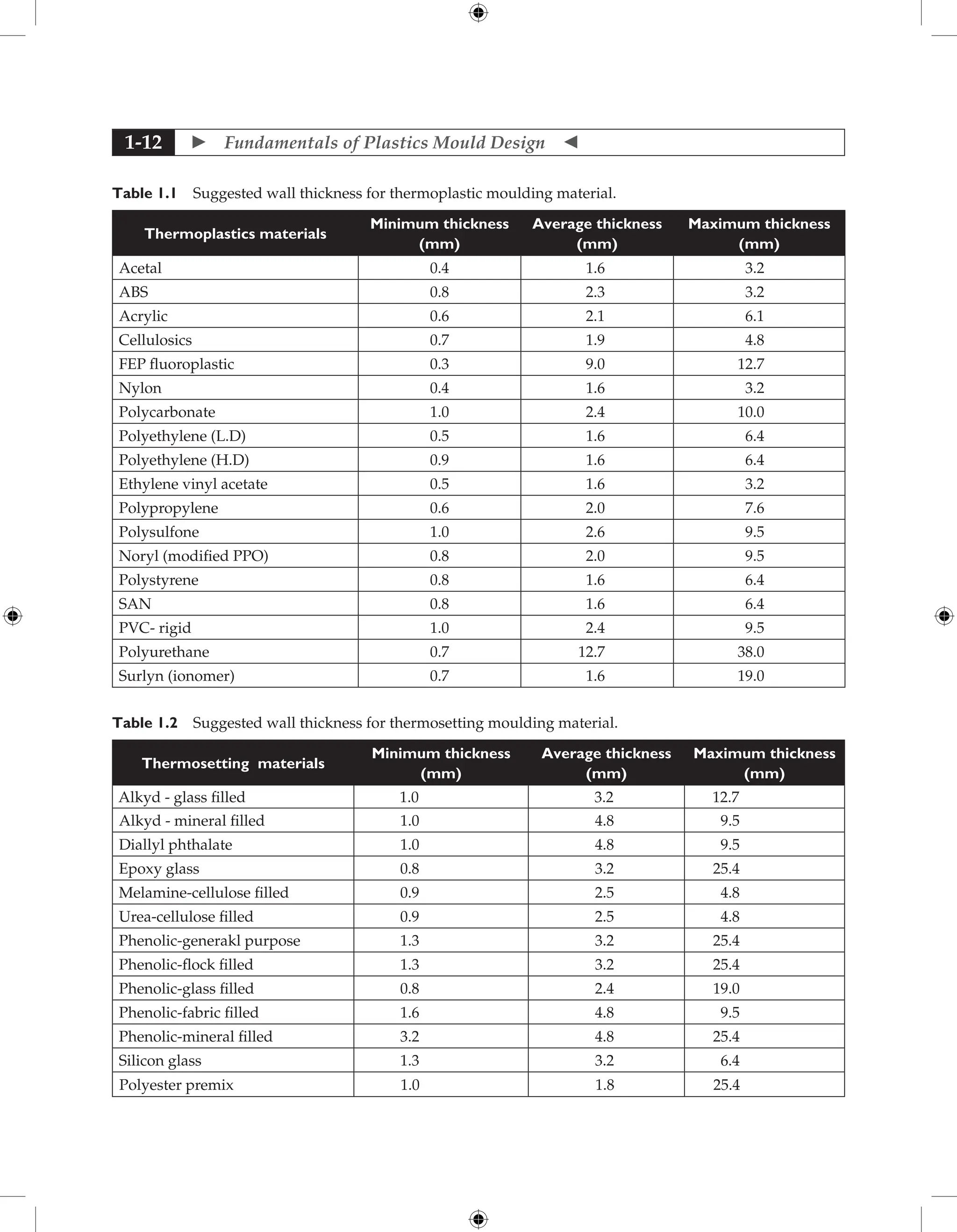
not be thick. However, these norms can act as a starting point for the design. Tables 1.1 and 1.2
show the guidelines for wall thickness of various classes of thermoplastics and thermosetting
plastics used in various applications.
๎ฃ Fundamentals of Plastics Mould Design ๎ข
1-12
Table 1.1 Suggested wall thickness for thermoplastic moulding material.
Thermoplastics materials
Minimum thickness
(mm)
Average thickness
(mm)
Maximum thickness
(mm)
Acetal 0.4 1.6 3.2
ABS 0.8 2.3 3.2
Acrylic 0.6 2.1 6.1
Cellulosics 0.7 1.9 4.8
FEP fluoroplastic 0.3 9.0 12.7
Nylon 0.4 1.6 3.2
Polycarbonate 1.0 2.4 10.0
Polyethylene (L.D) 0.5 1.6 6.4
Polyethylene (H.D) 0.9 1.6 6.4
Ethylene vinyl acetate 0.5 1.6 3.2
Polypropylene 0.6 2.0 7.6
Polysulfone 1.0 2.6 9.5
Noryl (modified PPO) 0.8 2.0 9.5
Polystyrene 0.8 1.6 6.4
SAN 0.8 1.6 6.4
PVC- rigid 1.0 2.4 9.5
Polyurethane 0.7 12.7 38.0
Surlyn (ionomer) 0.7 1.6 19.0
Table 1.2 Suggested wall thickness for thermosetting moulding material.
Thermosetting materials
Minimum thickness
(mm)
Average thickness
(mm)
Maximum thickness
(mm)
Alkyd - glass filled 1.0 3.2 12.7
Alkyd - mineral filled 1.0 4.8 9.5
Diallyl phthalate 1.0 4.8 9.5
Epoxy glass 0.8 3.2 25.4
Melamine-cellulose filled 0.9 2.5 4.8
Urea-cellulose filled 0.9 2.5 4.8
Phenolic-generakl purpose 1.3 3.2 25.4
Phenolic-flock filled 1.3 3.2 25.4
Phenolic-glass filled 0.8 2.4 19.0
Phenolic-fabric filled 1.6 4.8 9.5
Phenolic-mineral filled 3.2 4.8 25.4
Silicon glass 1.3 3.2 6.4
Polyester premix 1.0 1.8 25.4
๎ฃ Product Design ๎ข 1-13
The design engineer should also refer to data related to the ability of a plastic resin to flow into
the mould cavity. This information, usually shown in the form of spiral flow curves, gives a
relative measure of how far one can expect the plastic resin to flow from the gate (Fig. 1.3).
Injection pressure
1
2 3
4
Flow
length
Fig. 1.3 Some typical spiral flow curves; 1. Nylon 6/6, 2. Thermoplastic polyester, PBT liquid crystal -glass
reinforced, polyphenylene sulfide-glass reinforced, 3. Acetal copolymer, 4. PBT-glass reinforced.
A non-uniform wall thickness will cause more trouble than any other problem in part
design. A thick section will cool last and sink away from the mould, causing a โ€˜sink mark.โ€™
Heavy sections mean long cycle times. Fundamentals of design with any material require that
the wall sections are of adequate thickness for the application of the part and be shaped for
adequate strength.
Poor design
Better design
Sink mark
Warpage
Stress points
Fig. 1.4 Possibility of defects in poor design.
Wall thickness should be as uniform as possible to eliminate internal stresses, part distortion,
cracking, warpage and sink marks (Fig. 1.4).
๎ฃ Fundamentals of Plastics Mould Design ๎ข
1-14
As per thumb rule, thicker the wall, the longer the part will have to stay in the mould
in order to cure or cool properly. This rule is important while moulding by compression or
injection. If different wall thickness in a part cannot be eliminated they should be blended
gradually (Fig. 1.5).
Not good
Wall blended
gradually
Better
Fig. 1.5 Variable wall section on the part.
1.3.2 Variance in Wall Thickness
Wall thickness should neither be too heavy nor
it should vary greatly. It should not vary more
than a ratio of three to one. This is true of the fact
that the part is moulded either by compression or
injection methods. If parts are designed with thick
and thin sections, sink marks will be evident on the
thick sections. If translucent or transparent colour
materials are used, a variance in depth of colour will
be observed. Thick, heavy solid sections such as are
found in knobs and handles should be redesigned
into two individual mouldings (Fig. 1.6).
If a plastic part is designed with uneven wall thickness, it should be redesigned as shown
in Fig. 1.7.
Not this Not this
This
A = B
A
B
This
Fig. 1.7 Redesigned plastic product design for uniform wall thickness.
Fig. 1.6 Redesigned thick
and heavy solid sections.
Not good Better
๎ฃ Product Design ๎ข 1-15
Different methods of avoiding
such extra thickness
(a)
(b) (c)
Extra thickness of material
is very undersirable
(1)
Fig.1.8 Compensating for different wall thickness.
Hat section
Metal
reinforcement
Bidirectional
corrugation
Doming
Corrugation Crowing
Fig.1.9 Modifications to nominal wall to improve structural response.
1.3.3 Determining the Wall Thickness
The determination of wall thickness should be the result of an analysis of the following
requirements:
Functional requirements
1. Structure
2. Strength
3. Dimensional stability
๎ฃ Fundamentals of Plastics Mould Design ๎ข
1-16
4. Weight
5. Insulation
Manufacturing requirements
1. Moulding
2. Flow, setting and ejection
3. Assembly
4. Strength and precision
1.3.4โ€ƒStructural Requirements of the Nominal Wall
If a part is subjected to any significant loading, the load bearing areas should be analysed for
stress and deflection. If the stress or deflection is too high, the following alternatives should
be considered:
1. Use ribs or contours to increase the section modulus. This is often the most economical
solution and is discussed in detail under the heading โ€˜Ribs and Bossesโ€™.
2. Use a higher strength, higher modulus material.
3. Increase the wall section if it is not already too thick.
1.3.5โ€ƒInsulation Characteristics of the Nominal Wall
Plastic materials are good insulators for electrical and heat energy. They can also serve as
barriers and filters for sound and light. In general, insulating ability is directly related to the
thickness of the plastic. In the case of sound transmission, change in thickness may be needed
to change the resonant frequency of a plastic housing.
1.3.6โ€ƒImpact Response of the Nominal Wall
The impact resistance of a particular part is directly related to its ability to absorb mechanical
energy without fracture or plastic deformation. This, in turn, depends on the properties of
the plastic resin and the geometry of the part. Increasing wall thickness generally improves
the impact resistance of moulded parts. However, increased, wall thickness could hurt
impact resistance by making the part overly stiff, unable to deflect and distribute impact.
Both of these methods of absorbing impact energy should be examined when the nominal
wall thickness is being selected.
1.4 Parting Line
The parting lines may be described as those lines made by the juncture of the male and female
die and loose mould sections. It should be around the section of the part having the largest
๎ฃ Product Design ๎ข 1-17
cross-sectional area. A beaded parting line helps in disguising mould misalignment. In case of
peaked parting line, the flash can be cleaned without marring the surfaces. A stepped parting
line will also allow clean and easy finishing of the component: the flash will be horizontal and
easy to remove mechanically. In the event of bead is not permissible, a flush parting line may be
necessary. The flash may be removed by adding a decorative effect made by grooving the part at
the parting line. This method is possible only on round articles as shown in Fig.1.10 below.
Cavity
Moulding
Mouldingโ€™s
Parting Line
Mouldโ€™s Parting Surface
Fig. 1.10 Parting line of moulding
and parting surface of mould.
Component
(a) (b) (c)
This Not This
Mould
Under Cut
Under Cut
Fig. 1.11 Practicable and impracticable
choice of parting surface.
Fig. 1.12 Typical moulding which
permit flat parting surface to be
adopted.
๎ฃ Fundamentals of Plastics Mould Design ๎ข
1-18
Beaded
Peaked
P/L P/L
P/L
Stepped
Flush
Groove After
Moulding
0.25 mm โˆ’ 0.375 mm
P/L
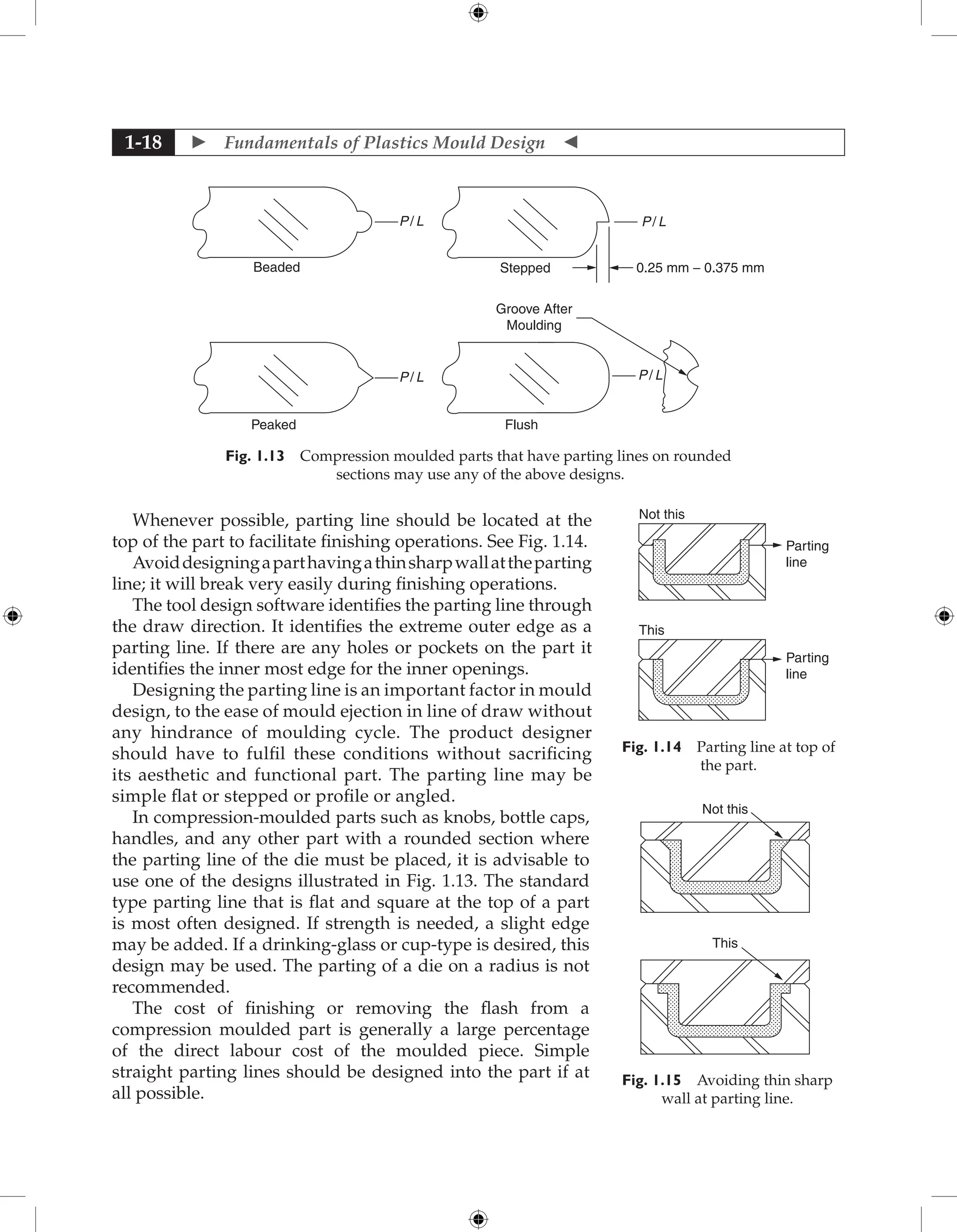
Fig. 1.13 Compression moulded parts that have parting lines on rounded
sections may use any of the above designs.
Whenever possible, parting line should be located at the
top of the part to facilitate finishing operations. See Fig. 1.14.
Avoiddesigningaparthavingathinsharpwallattheparting
line; it will break very easily during finishing operations.
The tool design software identifies the parting line through
the draw direction. It identifies the extreme outer edge as a
parting line. If there are any holes or pockets on the part it
identifies the inner most edge for the inner openings.
Designing the parting line is an important factor in mould
design, to the ease of mould ejection in line of draw without
any hindrance of moulding cycle. The product designer
should have to fulfil these conditions without sacrificing
its aesthetic and functional part. The parting line may be
simple flat or stepped or profile or angled.
In compression-moulded parts such as knobs, bottle caps,
handles, and any other part with a rounded section where
the parting line of the die must be placed, it is advisable to
use one of the designs illustrated in Fig. 1.13. The standard
type parting line that is flat and square at the top of a part
is most often designed. If strength is needed, a slight edge
may be added. If a drinking-glass or cup-type is desired, this
design may be used. The parting of a die on a radius is not
recommended.
The cost of finishing or removing the flash from a
compression moulded part is generally a large percentage
of the direct labour cost of the moulded piece. Simple
straight parting lines should be designed into the part if at
all possible.
Fig. 1.15 Avoiding thin sharp
wall at parting line.
Not this
This
Fig. 1.14 Parting line at top of
the part.
Parting
line
Parting
line
This
Not this
๎ฃ Product Design ๎ข 1-19
1.4.1 Designed Mismatch
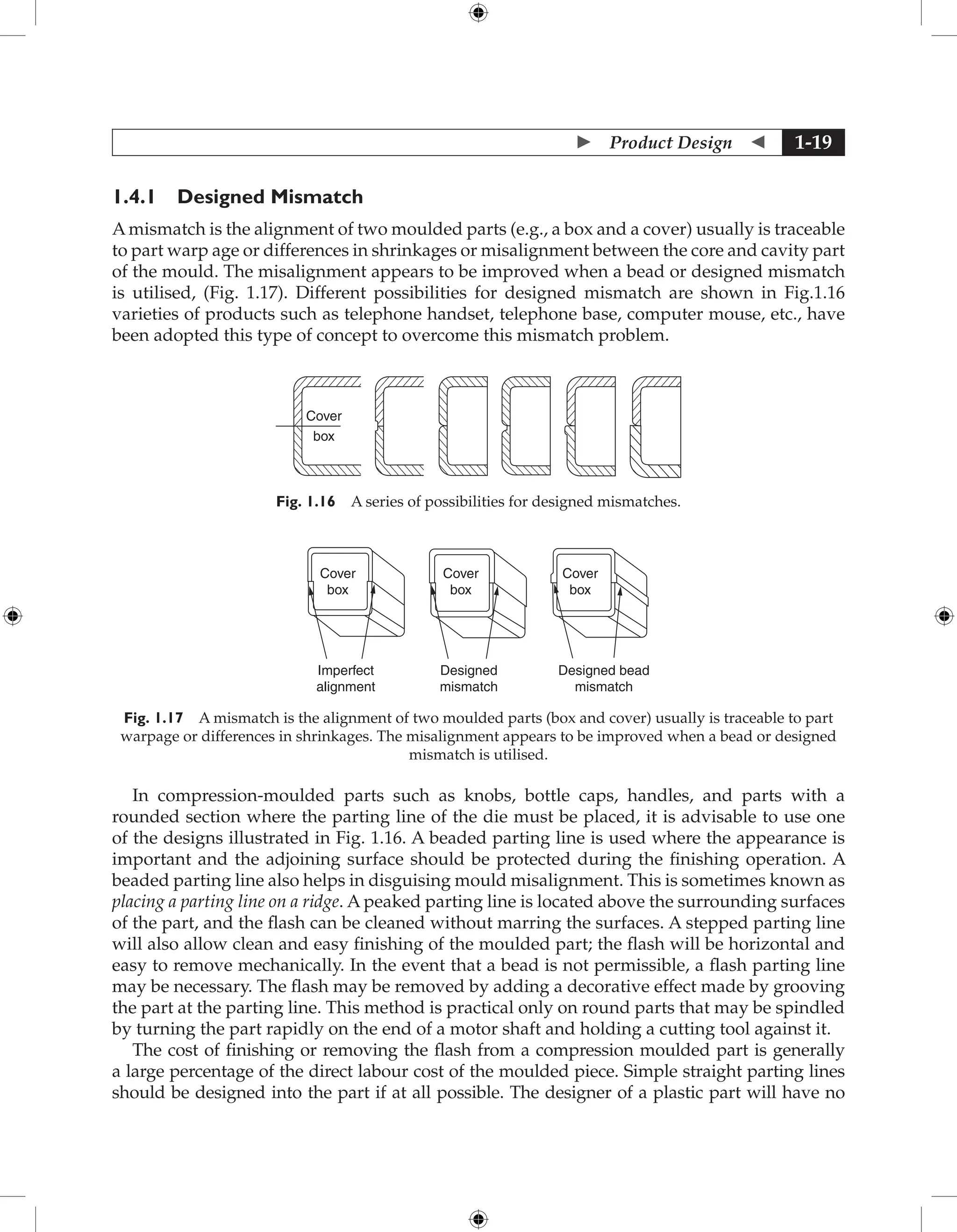
A mismatch is the alignment of two moulded parts (e.g., a box and a cover) usually is traceable
to part warp age or differences in shrinkages or misalignment between the core and cavity part
of the mould. The misalignment appears to be improved when a bead or designed mismatch
is utilised, (Fig. 1.17). Different possibilities for designed mismatch are shown in Fig.1.16
varieties of products such as telephone handset, telephone base, computer mouse, etc., have
been adopted this type of concept to overcome this mismatch problem.
Cover
box
Fig. 1.16 A series of possibilities for designed mismatches.
Imperfect
alignment
Designed
mismatch
Designed bead
mismatch
Cover
box
Cover
box
Cover
box
Fig. 1.17 A mismatch is the alignment of two moulded parts (box and cover) usually is traceable to part
warpage or differences in shrinkages. The misalignment appears to be improved when a bead or designed
mismatch is utilised.
In compression-moulded parts such as knobs, bottle caps, handles, and parts with a
rounded section where the parting line of the die must be placed, it is advisable to use one
of the designs illustrated in Fig. 1.16. A beaded parting line is used where the appearance is
important and the adjoining surface should be protected during the finishing operation. A
beaded parting line also helps in disguising mould misalignment. This is sometimes known as
placing a parting line on a ridge. A peaked parting line is located above the surrounding surfaces
of the part, and the flash can be cleaned without marring the surfaces. A stepped parting line
will also allow clean and easy finishing of the moulded part; the flash will be horizontal and
easy to remove mechanically. In the event that a bead is not permissible, a flash parting line
may be necessary. The flash may be removed by adding a decorative effect made by grooving
the part at the parting line. This method is practical only on round parts that may be spindled
by turning the part rapidly on the end of a motor shaft and holding a cutting tool against it.
The cost of finishing or removing the flash from a compression moulded part is generally
a large percentage of the direct labour cost of the moulded piece. Simple straight parting lines
should be designed into the part if at all possible. The designer of a plastic part will have no
๎ฃ Fundamentals of Plastics Mould Design ๎ข
1-20
difficulty with flash lines if they are located where they may be removed easily and where they
are inexpensive and where they may be disguised or at least unobjectionable.
Parting lines for injection moulds are shown in (Fig.1.18). The standard type parting line
that is flat and square at the top of a part is most often designed. If strength is needed, a slight
edge may be added. If a drinking-glass or cup-type is desired, this may be used. The parting
of a die on a radius is not recommended.
Cup or glass Not recommended
Strength
Standard
Fig. 1.18 Recommended parting line designs for injection moulding.
In order to increase the rigidity of such items as food containers moulded from the less rigid
thermoplastics, e.g., polyethylene, polypropylene, EVA, polyvinyl chloride, etc., it is necessary
to design the lip of the container to make it stiff.
1.4.2 Parting Line Mismatch
Repeated opening and closing of moulds will cause
them to wear. Wear between the plunger and cavity
pins and guide pin bushing causes the misalignment.
The excessive wear at mould parting lines can create a
mismatch, on a moulded part. Amismatch at a parting
line of a few thousandths of an inch may appear to
look many times larger. Tolerances for misalignment
of cavity and plunger should total 0.15 mm for the
average mould expected during the normal life of
mould. When parts are first produced from the mould,
the tolerance due to misalignment will be much less.
1.5	Ribs, Bosses and Gussets
1.5.1โ€ƒRibs
Ribs may be defined as long protrusions on the part which may be used to decorate or
strengthen the part and to prevent it from warping. The function of ribs is to increase the
strength and rigidity of a moulded piece without increasing wall thickness. Proper design of
ribs will usually prevent warpage during cooling, and in some cases, they facilitate smooth
flow during moulding. Several features in the design of a rib must be carefully considered in
order to minimise the internal stresses associated with irregularity in wall thickness.
Moulded
knob
Mould
units
L
Parting line mismatch
Fig. 1.19 Parting line mismatch.
๎ฃ Product Design ๎ข 1-21
Width, length, etc., must be analysed. For example, in
some applications, thick heavy ribs can cause vacuum
bubbles or sink marks at the intersection of mating
surfaces and will result in appearance problems,
structural discontinuity, high thermal stresses and
stress concentration. To eliminate these problems, long,
thin ribs should be used. It is also possible to core ribs
from the underside to maintain uniform wall thickness
(Fig. 1.21). A large rib placed on a part should result in a
non-uniform wall thickness and cause a sink mark area. It is better to make many smaller narrow
ribs instead of one large heavy rib or even better one long narrow rib (Figs. 1.22 and 1.23).
Fig. 1.21 Large rib cored out from
back side.
Rib
Hollowed
or cored out
Sink mark area
Ribbed part
better design
Poor design
Fig. 1.22 Many small rib instead of a
heavy rib.
(a) Heavy rib (b) Two small ribs (c) One longer deeper rib.
Not a good design Better design Best design
Fig. 1.23 Good rib design calls for narrow ribs instead of one large heavy rib.
The use of two or more ribs is better than to increase the height of a single rib and the
distance between them should be greater than the thickness of the wall to which they are
attached. Sides and front of ribs should be tapered ยฝo
to 5o
, depending on length and width,
to facilitate ejection. A fillet should be used where the rib joins the wall to minimise stress
concentration and provide additional strength. Fig. 1.24 illustrates the proportions of ribs used
in most of the thermoplastics.
Fig. 1.20 Plastic part with ribs and bosses.
Boss
Hole
Pad Plastic part
Ribs
Fillet
๎ฃ Fundamentals of Plastics Mould Design ๎ข
1-22
A
A
F D B C
A
E
Aโˆ’A
Fig. 1.24 Rib design where A = Wall thickness, B = 0.8 ร— A, C = 3 ร— B, D = 2 ร— B, E = 0.125 mm radius,
F = 1 1/2
o
to 2
o
. If more strength is required, add additional ribs.
A rib should be located in the corner or side of a moulded part. This will lower the mould
cost and allow easier filling of the plastic part (Fig. 1.25). Bosses and fillets will help to fill out
ribs (Fig. 1.26).
Rib
Fig. 1.25 Rib located in corner. Fig. 1.26 Bosses and fillets in rib.
Slot
Increased area
Fig. 1.27 Increasing the area of slot at
intervals.
Boss
Rib
Fig. 1.28 Ribs on the side of long
bosses.
Increasing the area of slots at intervals in the moulded parts will add strength to the mould
(Fig. 1.27). Rib on the side of long bosses will aid in filling them (Fig. 1.28).
๎ฃ Product Design ๎ข 1-23
(a) (b) (c)
Fig. 1.29 Distortion resulting from ribs present on one side of a plate; a) Distortion from thin ribs on a thick
plate, b) Distortion from thick ribs on a thin plate, c) Distortion from thick cross ribs on a thin plate.
1.8 mm
3 mm
3 mm
3 mm Sink mark Sink mark
Fig. 1.30 Thickness of adjacent walls and ribs in thermoplastic parts should be about 60% of thicknesses of
main bodies to reduce the possibility that sink marks will develop.
Poor
Void
Rib too thick
Sink
Fig. 1.31 Sink marks and voids developed due To thicker rib.
Poor Better Better
t
t t
t
1
2
/
Fig.1.32 Rib design for reinforcing thermoplastic parts.
๎ฃ Fundamentals of Plastics Mould Design ๎ข
1-24
G
D
C
A
F
E
B
Fig. 1.33 Rib design for thermosetting materials where A = Width of rib at base, B = A / 2, C = 3 ร— A,
D = A / 4, E = A / 4, F = 10
o
and G = 5
o
.
1.5.2 Bosses
Bosses may be defined as protruding studs on a part that assist in the assembling of a plastic
part with another part. Because they are frequently the anchoring members between both
part, they are subjected to strain and stresses not found in any other areas of the part. Bosses
with outside diameter equal to twice the whole diameter are sufficiently strong. Also they
can be used for pressed-in assembly, self-tapped screw assembly or tapped for a standard
machine screw. Special attention should be paid to the design of bosses, in contrast with
exterior surfaces, avoid any heavy sections to prevent voids or external sink marks. Avoid, if
possible, bosses too near an outside wall, because this will cause weak sections in the mould.
Sharp edges on bosses will cause more expense for the mould, hence it should be avoided. The
edges of the boss should be blended with 0.5 mm radius (1/64 inch). Square or oval holes are
difficult to machine in to mould steel and will result in a more expensive mould. It should be
avoided. To design a square or rectangular boss, the corners should have a radius of at least 0.4
mm (0.15 in). Any attached member to the wall should not be over 80% of the wall thickness.
H
A
A
L
Aโˆ’A
J D
F I G
C
B
A
K E
Fig. 1.34 This drawing illustrates design and proportions of a boss at a wall used for most thermoplastic
materials where A = Wall thickness, B = Diameter of boss over radii, C = 0.8 ร— A, D = 2 ร— B, E = 1o
to 2o
,
F = 0.125 mm (0.005โ€) radius, G = D, H = 0.8 ร— A, I = A / 4, J = 2 ร— B, K = J Max. or 0.3 ร— J Min. and L = 0.8 ร— A.
๎ฃ Product Design ๎ข 1-25
C
B
G
I
F
H
E
D
F A
Fig. 1.35 This drawing illustrates design and proportions of a boss away from wall used in most thermo-
plastics materials where A = Wall thickness, B = Diameter of boss over radii, C = 0.8 ร— A, D = 2 ร— B, E = 1o
to
2o
, F = 0.125 mm (0.005โ€) radius, G = 0.95 ร— D Max., H = G (Max.) and 0.3 ร— G (Min.) and I = 0.8 ร— A.
Sink
Connecting bosses with outside walls
with ribs
Use gussets rather than very thick bosses
when resistance to loading is required
0.6t
Heavy
section
Void
t
0.125 mm Min
1/2ยฐ Min
1/2ยฐ Min
1/2ยฐ Min
1/2ยฐ Min
Core from
below
(Parallel draft)
t
1/2t
Load
Fig. 1.36 Design of bosses.
Bosses can also be designed on the outside of the moulded part. An outside boss is used in
attaching a part to an assembly. Figure 1.37 shows the recommended proportions for a boss on
the outside of the moulded part.
B
A
A (Diameter)
SECTION A-A
B = A. B = 2 ร— A Max
Fig. 1.37 Recommended proportions for a boss on the outside of the moulded part.
๎ฃ Fundamentals of Plastics Mould Design ๎ข
1-26
1.5.3 Gussets
Gussets are supporting arrangements for edge. All dimensions of the gussets are a function of
the wall thickness (Fig. 1.38).
A = Wall thickness
B = A
C = B
D = 2 ร— B
E = 0.8 ร— A
F = 2 ร— E
A
C
B
E
F
D
Fig.1.38 This drawing illustrates design and proportions of gussets used in most thermoplastic materials.
1.6	Radii and Fillets
Fillets and radii are used at the ribs or bosses
to facilitate the flow of plastic material and to
eliminate sharp corners, thus, reducing stress
concentration in the moulded article. The radius
shouldbeatleast0.25mmandpreferably0.75mm.
All corners of mouldings should be filleted
(rounded) to improve the flow of the material.
Corner radii should be minimum ยผ of the part
thickness. Figure 1.39 shows the radius/thickness
ratio to avoid stress concentration.
The overall advantages of fillets and radii are:
(a) Improves flow of plastics material.
(b) Eliminates cracking and increase impact
strength.
(c) Better structure with more rigidity and
better stress distribution.
(d) Reduction in cycle time.
(e) Uniform density of the moulded article.
A = Part thickness
A
B
B = A/4 Min
Fig. 1.39 Corner radii should be a minimum of
1/4 of the part thickness for most thermoplastic
materials.
๎ฃ Product Design ๎ข 1-27
(f) Ensures more economical and long life of mould.
(g) Prevent cracking of mould parts during heat treatment.
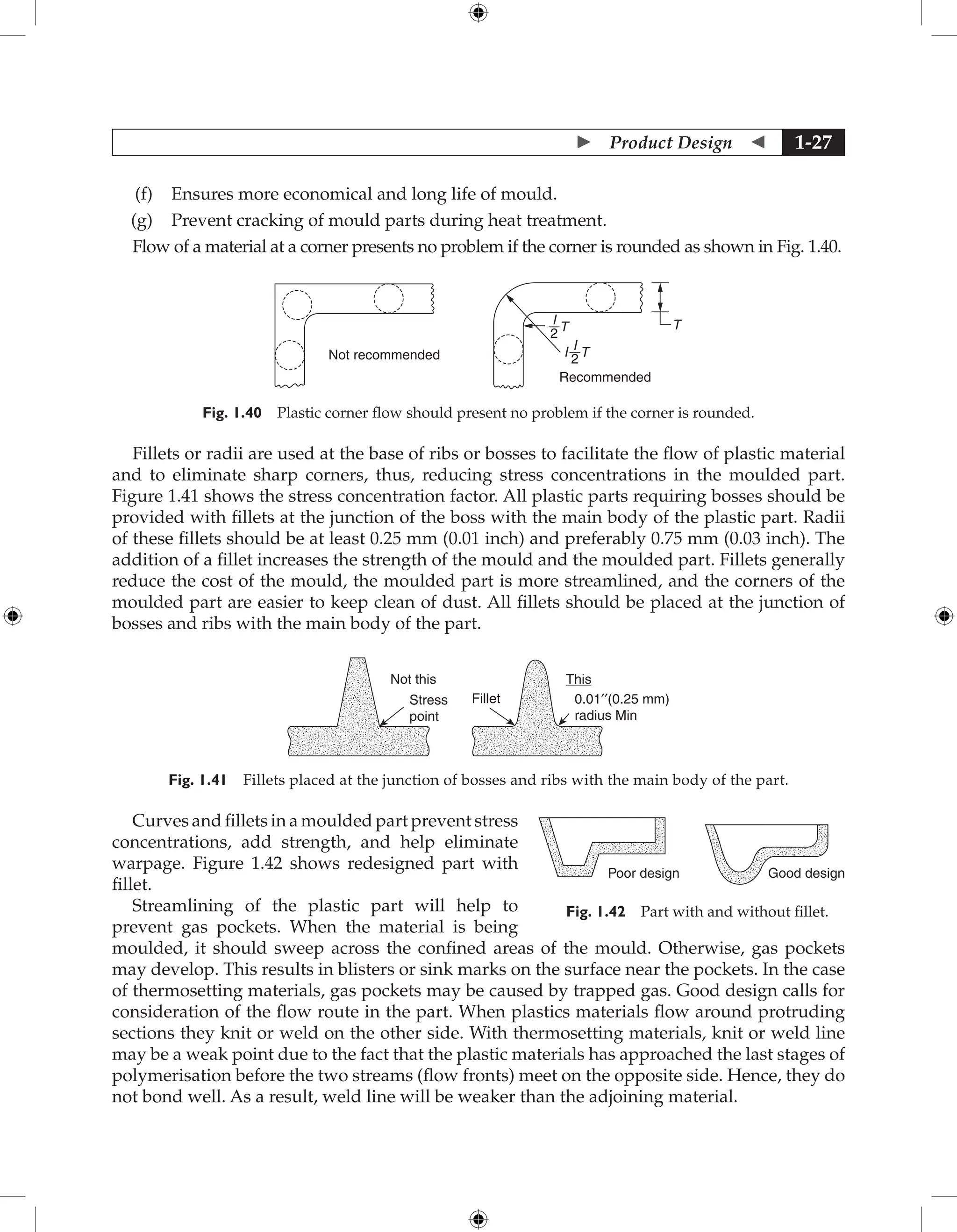
Flow of a material at a corner presents no problem if the corner is rounded as shown in Fig. 1.40.
Recommended
T
T
I
2
T
I
2
I
Not recommended
Fig. 1.40 Plastic corner flow should present no problem if the corner is rounded.
Fillets or radii are used at the base of ribs or bosses to facilitate the flow of plastic material
and to eliminate sharp corners, thus, reducing stress concentrations in the moulded part.
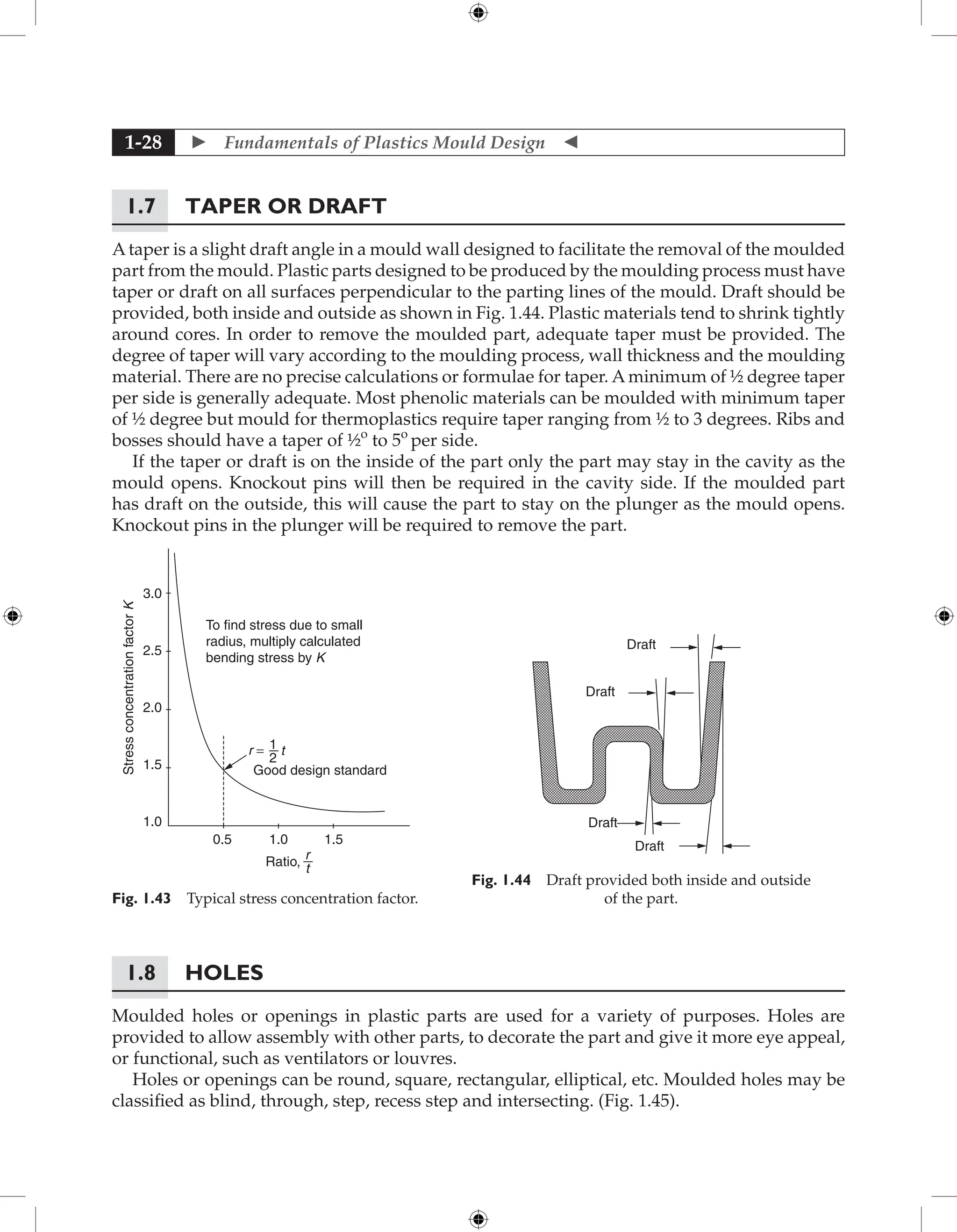
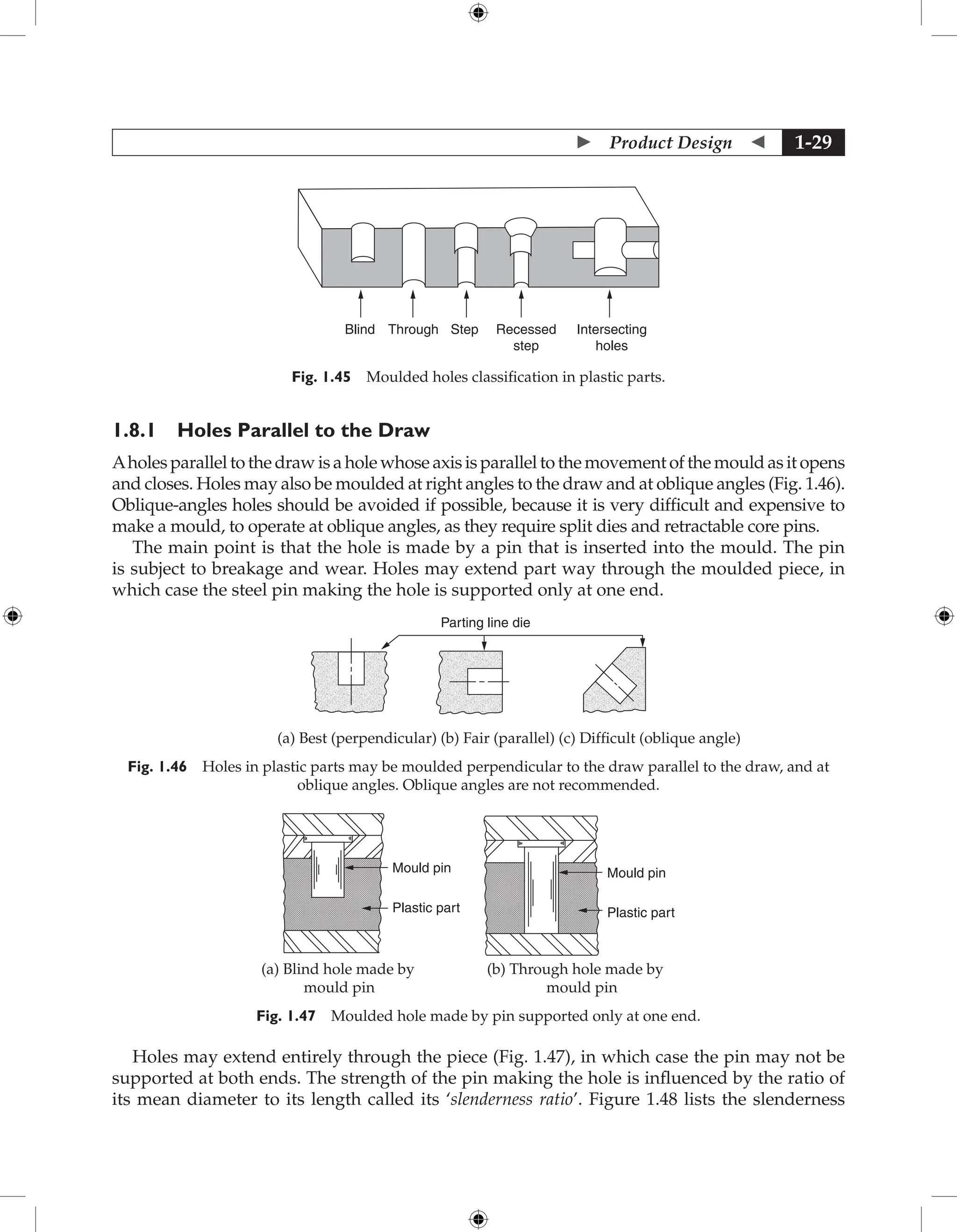
Figure 1.41 shows the stress concentration factor. All plastic parts requiring bosses should be
provided with fillets at the junction of the boss with the main body of the plastic part. Radii
of these fillets should be at least 0.25 mm (0.01 inch) and preferably 0.75 mm (0.03 inch). The
addition of a fillet increases the strength of the mould and the moulded part. Fillets generally
reduce the cost of the mould, the moulded part is more streamlined, and the corners of the
moulded part are easier to keep clean of dust. All fillets should be placed at the junction of
bosses and ribs with the main body of the part.
Not this
Fillet 0.01โ€ฒโ€ฒ(0.25 mm)
radius Min
This
Stress
point
Fig. 1.41 Fillets placed at the junction of bosses and ribs with the main body of the part.
Curves and fillets in a moulded part prevent stress
concentrations, add strength, and help eliminate
warpage. Figure 1.42 shows redesigned part with
fillet.
Streamlining of the plastic part will help to
prevent gas pockets. When the material is being
moulded, it should sweep across the confined areas of the mould. Otherwise, gas pockets
may develop. This results in blisters or sink marks on the surface near the pockets. In the case
of thermosetting materials, gas pockets may be caused by trapped gas. Good design calls for
consideration of the flow route in the part. When plastics materials flow around protruding
sections they knit or weld on the other side. With thermosetting materials, knit or weld line
may be a weak point due to the fact that the plastic materials has approached the last stages of
polymerisation before the two streams (flow fronts) meet on the opposite side. Hence, they do
not bond well. As a result, weld line will be weaker than the adjoining material.
Poor design Good design
Fig. 1.42 Part with and without fillet.
๎ฃ Fundamentals of Plastics Mould Design ๎ข
1-28
1.7	Taper or Draft
Ataper is a slight draft angle in a mould wall designed to facilitate the removal of the moulded
part from the mould. Plastic parts designed to be produced by the moulding process must have
taper or draft on all surfaces perpendicular to the parting lines of the mould. Draft should be
provided, both inside and outside as shown in Fig. 1.44. Plastic materials tend to shrink tightly
around cores. In order to remove the moulded part, adequate taper must be provided. The
degree of taper will vary according to the moulding process, wall thickness and the moulding
material. There are no precise calculations or formulae for taper. A minimum of ยฝ degree taper
per side is generally adequate. Most phenolic materials can be moulded with minimum taper
of ยฝ degree but mould for thermoplastics require taper ranging from ยฝ to 3 degrees. Ribs and
bosses should have a taper of ยฝo
to 5o
per side.
If the taper or draft is on the inside of the part only the part may stay in the cavity as the
mould opens. Knockout pins will then be required in the cavity side. If the moulded part
has draft on the outside, this will cause the part to stay on the plunger as the mould opens.
Knockout pins in the plunger will be required to remove the part.
Draft
Draft
Draft
Draft
Fig. 1.44 Draft provided both inside and outside
of the part.
To find stress due to small
radius, multiply calculated
bending stress by K
Good design standard
Stress
concentration
factor
K
0.5
1.0
1.5
2.0
2.5
3.0
1.0 1.5
Ratio,
r
t
r = t
1
2
Fig. 1.43 Typical stress concentration factor.
1.8	Holes
Moulded holes or openings in plastic parts are used for a variety of purposes. Holes are
provided to allow assembly with other parts, to decorate the part and give it more eye appeal,
or functional, such as ventilators or louvres.
Holes or openings can be round, square, rectangular, elliptical, etc. Moulded holes may be
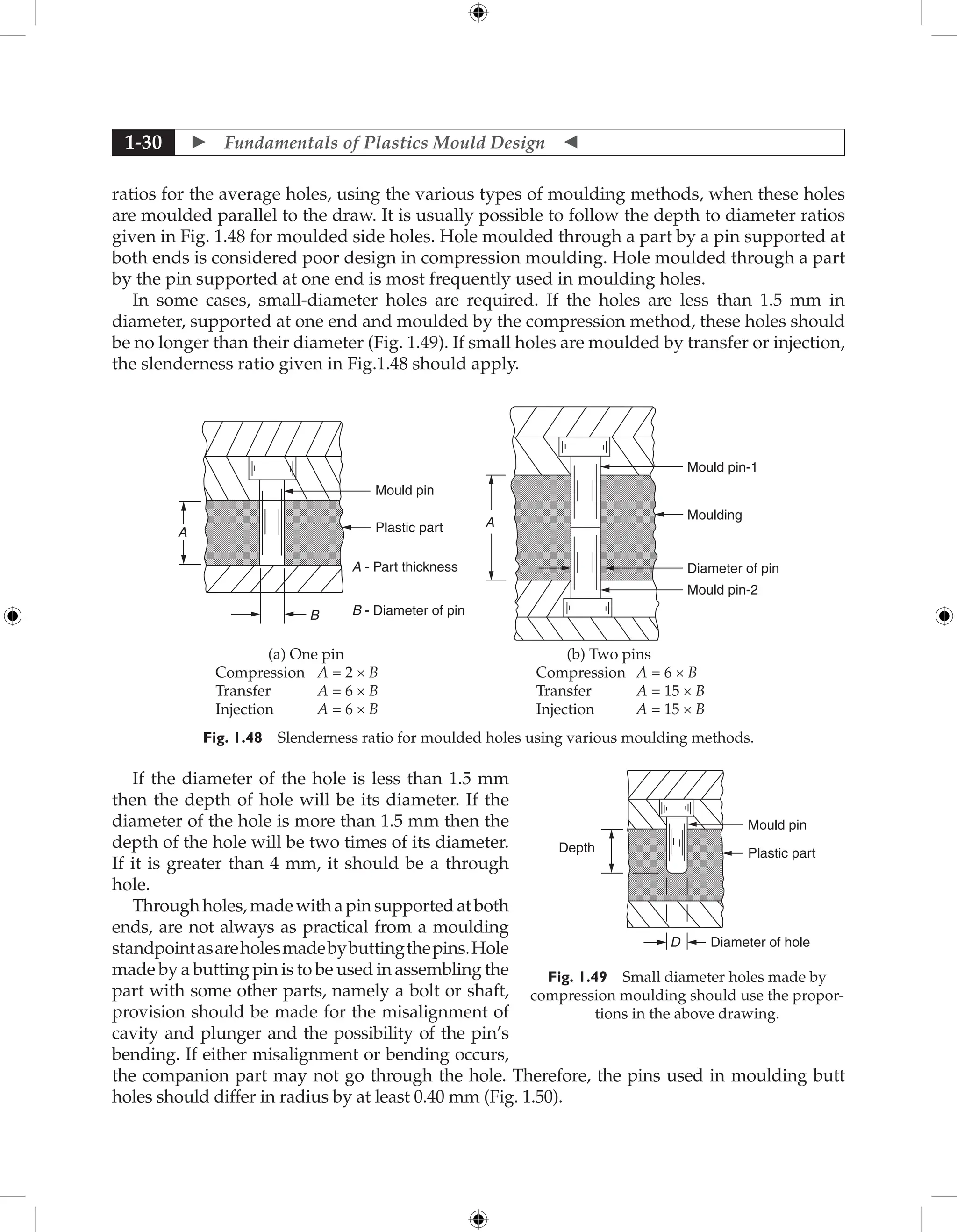
classified as blind, through, step, recess step and intersecting. (Fig. 1.45).
๎ฃ Product Design ๎ข 1-29
Blind Through Step Recessed
step
Intersecting
holes
Fig. 1.45 Moulded holes classification in plastic parts.
1.8.1โ€ƒHoles Parallel to the Draw
Aholes parallel to the draw is a hole whose axis is parallel to the movement of the mould as it opens
and closes. Holes may also be moulded at right angles to the draw and at oblique angles (Fig. 1.46).
Oblique-angles holes should be avoided if possible, because it is very difficult and expensive to
make a mould, to operate at oblique angles, as they require split dies and retractable core pins.
The main point is that the hole is made by a pin that is inserted into the mould. The pin
is subject to breakage and wear. Holes may extend part way through the moulded piece, in
which case the steel pin making the hole is supported only at one end.
Parting line die
(a) Best (perpendicular) (b) Fair (parallel) (c) Difficult (oblique angle)
Fig. 1.46 Holes in plastic parts may be moulded perpendicular to the draw parallel to the draw, and at
oblique angles. Oblique angles are not recommended.
Mould pin
Plastic part
Mould pin
Plastic part
(a) Blind hole made by (b) Through hole made by
mould pin	โ€ƒโ€ƒโ€ƒ mould pin
Fig. 1.47 Moulded hole made by pin supported only at one end.
Holes may extend entirely through the piece (Fig. 1.47), in which case the pin may not be
supported at both ends. The strength of the pin making the hole is influenced by the ratio of
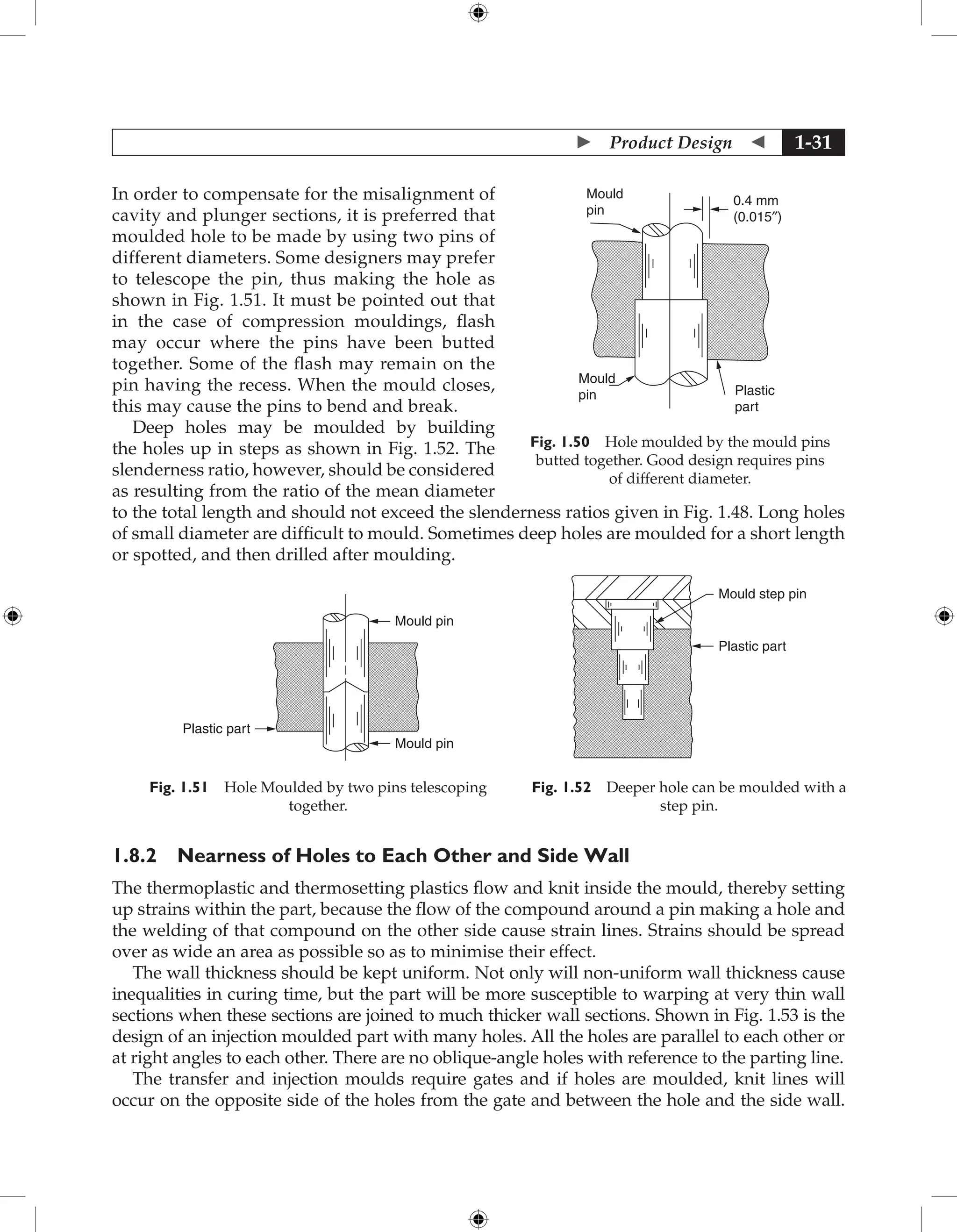
its mean diameter to its length called its โ€˜slenderness ratioโ€™. Figure 1.48 lists the slenderness
๎ฃ Fundamentals of Plastics Mould Design ๎ข
1-30
ratios for the average holes, using the various types of moulding methods, when these holes
are moulded parallel to the draw. It is usually possible to follow the depth to diameter ratios
given in Fig. 1.48 for moulded side holes. Hole moulded through a part by a pin supported at
both ends is considered poor design in compression moulding. Hole moulded through a part
by the pin supported at one end is most frequently used in moulding holes.
In some cases, small-diameter holes are required. If the holes are less than 1.5 mm in
diameter, supported at one end and moulded by the compression method, these holes should
be no longer than their diameter (Fig. 1.49). If small holes are moulded by transfer or injection,
the slenderness ratio given in Fig.1.48 should apply.
Mould pin
Mould pin-1
Mould pin-2
Moulding
Diameter of pin
Plastic part
A - Part thickness
B - Diameter of pin
B
A
A
(a) One pin (b) Two pins
Compression A = 2 ร— B Compression A = 6 ร— B
Transfer A = 6 ร— B Transfer A = 15 ร— B
Injection A = 6 ร— B Injection A = 15 ร— B
Fig. 1.48 Slenderness ratio for moulded holes using various moulding methods.
If the diameter of the hole is less than 1.5 mm
then the depth of hole will be its diameter. If the
diameter of the hole is more than 1.5 mm then the
depth of the hole will be two times of its diameter.
If it is greater than 4 mm, it should be a through
hole.
Throughholes,madewithapinsupportedatboth
ends, are not always as practical from a moulding
standpointasareholesmadebybuttingthepins.Hole
made by a butting pin is to be used in assembling the
part with some other parts, namely a bolt or shaft,
provision should be made for the misalignment of
cavity and plunger and the possibility of the pinโ€™s
bending. If either misalignment or bending occurs,
the companion part may not go through the hole. Therefore, the pins used in moulding butt
holes should differ in radius by at least 0.40 mm (Fig. 1.50).
Depth
Mould pin
Plastic part
Diameter of hole
D
Fig. 1.49 Small diameter holes made by
compression moulding should use the propor-
tions in the above drawing.
๎ฃ Product Design ๎ข 1-31
In order to compensate for the misalignment of
cavity and plunger sections, it is preferred that
moulded hole to be made by using two pins of
different diameters. Some designers may prefer
to telescope the pin, thus making the hole as
shown in Fig. 1.51. It must be pointed out that
in the case of compression mouldings, flash
may occur where the pins have been butted
together. Some of the flash may remain on the
pin having the recess. When the mould closes,
this may cause the pins to bend and break.
Deep holes may be moulded by building
the holes up in steps as shown in Fig. 1.52. The
slenderness ratio, however, should be considered
as resulting from the ratio of the mean diameter
to the total length and should not exceed the slenderness ratios given in Fig. 1.48. Long holes
of small diameter are difficult to mould. Sometimes deep holes are moulded for a short length
or spotted, and then drilled after moulding.
Mould pin
Mould pin
Plastic part
Fig. 1.51 Hole Moulded by two pins telescoping
together.
Mould step pin
Plastic part
Fig. 1.52 Deeper hole can be moulded with a
step pin.
1.8.2โ€ƒNearness of Holes to Each Other and Side Wall
The thermoplastic and thermosetting plastics flow and knit inside the mould, thereby setting
up strains within the part, because the flow of the compound around a pin making a hole and
the welding of that compound on the other side cause strain lines. Strains should be spread
over as wide an area as possible so as to minimise their effect.
The wall thickness should be kept uniform. Not only will non-uniform wall thickness cause
inequalities in curing time, but the part will be more susceptible to warping at very thin wall
sections when these sections are joined to much thicker wall sections. Shown in Fig. 1.53 is the
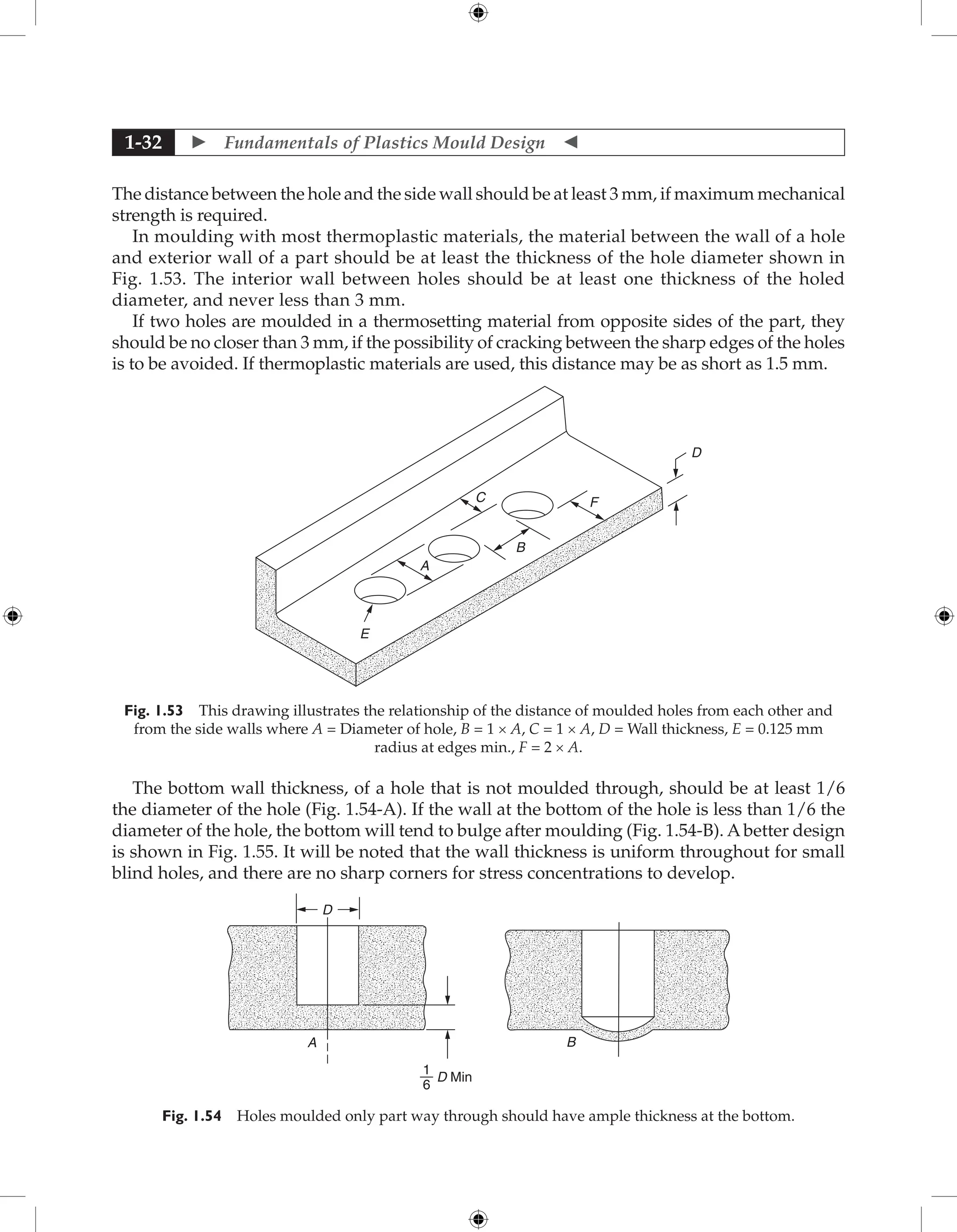
design of an injection moulded part with many holes. All the holes are parallel to each other or
at right angles to each other. There are no oblique-angle holes with reference to the parting line.
The transfer and injection moulds require gates and if holes are moulded, knit lines will
occur on the opposite side of the holes from the gate and between the hole and the side wall.
Mould
pin Plastic
part
0.4 mm
(0.015โ€ณ)
Mould
pin
Fig. 1.50 Hole moulded by the mould pins
butted together. Good design requires pins
of different diameter.
๎ฃ Fundamentals of Plastics Mould Design ๎ข
1-32
The distance between the hole and the side wall should be at least 3 mm, if maximum mechanical
strength is required.
In moulding with most thermoplastic materials, the material between the wall of a hole
and exterior wall of a part should be at least the thickness of the hole diameter shown in
Fig. 1.53. The interior wall between holes should be at least one thickness of the holed
diameter, and never less than 3 mm.
If two holes are moulded in a thermosetting material from opposite sides of the part, they
should be no closer than 3 mm, if the possibility of cracking between the sharp edges of the holes
is to be avoided. If thermoplastic materials are used, this distance may be as short as 1.5 mm.
C F
D
B
A
E
Fig. 1.53 This drawing illustrates the relationship of the distance of moulded holes from each other and
from the side walls where A = Diameter of hole, B = 1 ร— A, C = 1 ร— A, D = Wall thickness, E = 0.125 mm
radius at edges min., F = 2 ร— A.
The bottom wall thickness, of a hole that is not moulded through, should be at least 1/6
the diameter of the hole (Fig. 1.54-A). If the wall at the bottom of the hole is less than 1/6 the
diameter of the hole, the bottom will tend to bulge after moulding (Fig. 1.54-B). A better design
is shown in Fig. 1.55. It will be noted that the wall thickness is uniform throughout for small
blind holes, and there are no sharp corners for stress concentrations to develop.
D
A B
1
6
D Min
Fig. 1.54 Holes moulded only part way through should have ample thickness at the bottom.
๎ฃ Product Design ๎ข 1-33
A
C
B
A A
Blind hole
Section Aโˆ’A
Fig. 1.55 The wall thickness should be kept uniform for small blind holes where A = Diameter of hole,
B = 1 ร— A under 1.5 mm, B = 2 ร— A over 1.5 mm, C = B.
1.8.3 Moulding Holes not Parallel to the Draw
If the axis of a hole is not parallel to the draw, either the pin making the hole must be removed
from the part, before the part is extracted from the mould or the pin must be removed with
the part as it is extracted and then taken from the part. Usually, moulded holes not parallel
to the draw require more complicated moulds or more labour than do holes parallel to the
draw, and thus resulting in higher mould and higher parts costs. Therefore, holes entering
the side of the part should be avoided if possible.
Plastic part A
A
Plunger
Plastic part
Cavity
Fig. 1.56 Side holes or openings may be moulded without the use of pull pins or loose plugs in certain ap-
plications by using a โ€˜kiss-offโ€™ type of die.
This
Not this
Fig. 1.57 Extending side openings to the part will lower costs.
Certain designs of side holes, generally low cost moulding (Fig. 1.56) illustrate a side hole
that can be moulded without the necessity of the removal of the side pin, either before or after
the part is extracted. This design may be impractical for some applications because either
one or both the upper and lower surfaces of the cavity and plunger sections of the mould
๎ฃ Fundamentals of Plastics Mould Design ๎ข
1-34
making the hole must slide along each other in order to obtain a straight draw of the part
from the mould. Another design point that is often overlooked by engineers is the low cost of
moulding that can be effected if a side hole is extended the top of the part, thus facilitating a
straight draw (Fig. 1.57). Procedure is not practical in many designs, but it will lower price on
parts and mould costs if it can be used. Moulded-in side holes are trouble to produce because
extra provision is required to actuate the core pins from the side. Side holes may be moulded
automatically by using the cam action in the mould or with hydraulic or pneumatic actuators.
In compression moulding, drilling after the part is moulded usually simpler.
1.8.4 Drilled and Tapped Holes
When holes parallel to the draw are too slender
to be moulded it becomes necessary to drill these
holes after the part has been moulded. At times, it
may be more economical to drill a side hole than
to mould that hole. Good design calls for the spot
locations of a hole to be drilled (Fig. 1.58). This spot
acts as a guide for the drill entering the plastic. Spots
should be made only for holes that are to be drilled
parallel to the draw. A spot for a hole to be drilled
perpendicular to the draw would be an undercut in
the part and should not be used. (Fig. 1.59).
Ifthroughholesaredrilledinthemouldedplastic
part it is a good practice to note on the drawing
that the hole may chip on the edge where the drill
exists. It is best to avoid designing parts so that
drilling must be done on an angled surface. Drills
may break the surface or โ€˜walkโ€™ over the entering
surface. Drilled holes should be so designed that
the drill enters the part perpendicularly.
(a) (b)
Mould section
Spot
Plastic part
Spot moulded parallel
to the draw
Undercut
Spot
Plastic part
Spot moulded perpendicular
to the draw
Fig. 1.59 (a) Good design calls for a spot location of a hole that is to be drilled, (b) A spot should never be
located perpendicular to the draw as this will constitute an undercut.
Section Aโˆ’A
A A
Drilled holes
Moulded in spot
Fig. 1.58 It may be economical to drill a hole
than to mould it in the plastic part. Drilled
holes reduce mould costs, eliminate weld
lines, and reduce mould maintenance.
๎ฃ Product Design ๎ข 1-35
Frequently, moulded holes are tapped. Holes to be tapped after moulding or holes for
self-tapping screws or drive screws should be countersunk to allow the tap or to find its way
in and to prevent chipping at the entering end.
Many moulded plastic parts have holes drilled in the part after moulding. It is generally
less expensive to build a drill jig to drill holes in a moulded part than it is to incorporate
elaborate retractable core in the mould. Weld lines created by moulded holes can be
eliminated by moulding the holes two thirds of the way through and then drilling the
remainder of the way.
An electronic instrument case injection moulded from high-impact polystyrene, holes on
the side of case were drilled after moulding. This was necessary because of frequent changes
in the assembly of the part, in order to make the case versatile for other uses.
A designer should not call for a perfect chamber or radius at the end of a hole, because this
will call for extreme precision in the mould. If a conical-head screw is not to extend above the
surface of the plastic part the hole for the screw should be designed with a 0.4 mm of vertical
depth to allow for the variations in screws (Fig. 1.60).
Not this
this
0.4 mm
Fig. 1.60 Holes to be tapped or used with self-tapping screws should be countersunk.
Anymouldedholethatrequiresextremelytighttolerancesmaynecessitatesizedevelopment.
This means that the metal mould pin is made oversize and then gradually reduced in size by
removing metal from the pin until the exact dimensions are obtained in the moulded part.
(Fig. 1.61)
Plastic moulded part Mould pin
Fig. 1.61 Moulded through holes with tight tolerances may require size development of the mould pin.
The mould pin is made oversize and then reduced.
๎ฃ Fundamentals of Plastics Mould Design ๎ข
1-36
Elongated holes may be used with plastic materials that have uncontrollable shrinkages such as
the polyolefins shown in Fig. 1.62.
Elongated hole Not recommended
Fig. 1.62 Elongated holes may be used with plastic materials that have uncontrollable shrinkages.
Holes impractical to mould must be drilled.
But they must not be so close to edges or corners
because crack will result. Since a small diameter
hole is difficult to drill along its intended direction
to any great depth, the most practical approach in
many cases is to mould it partway and drill it the
remainder of the distance (Fig. 1.63).
1.9	Coring
Heavy section should be cored to provide uniform wall thickness. In the process, sink
marks, blow holes and thermal cycles are reduced. Coring at right angle to the direction of
moulding opening requires cams or hydraulic action which considerably increases the mould
cost. Movable and loose piece cores are expensive but can be used in areas such as internal
undercuts and thread moulding.
Heavy part cross section
(Undersirable)
Parts cored, cross section
(preferred)
Fig. 1.64 Parts having heavy cross sections are subject to longer cycles and causes laminations or sinks,
blisters, warpage and increased manufacturing costs. Core out or thin down heavy sections to preclude
difficulties.
Mould
Mould
P/ L
Drill
Mould part way and
complete with drill.
Fig. 1.63 Holes impractical to mould must
be drilled.
๎ฃ Product Design ๎ข 1-37
Core from
both sides
if possible
Poor rectangular
part with round holes Match outside configuration
to inside cores
Poor design
Sink marks
Void
Suggested alternatives
t
t
1/2 t
1/2 t
t
Warpage
Fig. 1.65 Coring examples.
1.10	Undercuts
An undercut is an indentation or projection on a moulded part, which makes ejection from the
simple two part mould almost impossible. Undercuts can be classified as internal undercut,
external undercut, circular undercut and an undercut on the side of the wall of a part formed
by a core pin (Fig. 1.66). The undercuts in plastic parts can increase the mould cost and product
cost by increasing the cycle time.
Circular Side wall
(a) (b) (c) (d)
Internal External
โ€“P/L
Fig. 1.66 Different types of undercuts in moulded plastic parts.
Undercuts may be moulded by means of split-mould cavity sections and by means of
movable side cores that must be drawn away from the part before the part can be extracted
from the mould. Because wedges or pull pins must be used to mould undercuts, flash or
parting lines will be evident where the movable mould sections meet or where they meet the
fixed mould sections.
Internal undercuts (Fig. 1.66(a)) are impractical and expensive and should be avoided.
Whenever undercuts are encountered, it is best to design the part in two halves and assemble
๎ฃ Fundamentals of Plastics Mould Design ๎ข
1-38
the two parts after they have been moulded. An internal undercut can be produced by using a
removable ejector wedge as shown in Fig. 1.67. This calls for elaborate tooling.
External undercuts (Fig. 1.66(b)) are located in the outside contours of the piece.
It would be impossible to withdraw a piece of such a shape from a one-piece mould
cavity. In order to mould such a part, it is necessary to build the cavities of two or more
loose members. After the part has been moulded, the loose members are parted, and the
moulded piece is removed. It must be remembered that a parting or flash line will be
visible on the moulded part.
Plastic
part Ejector
wedge
Punch Cavity
Fig. 1.67 An undercut in a moulded plastic part produced by using a removable ejector wedge.
Undercut
Plastic part
Core pins
separate
here
Fig. 1.68 An internal undercut can be moulded by using two separate core pins.
Circular undercuts (Fig. 1.66(c)) frequently can be made less expensive by grooving the part
in a lathe with properly designed cutting tool.
Undercuts in the side wall of a moulded part (Fig. 1.66(d)) are produced by retractable core
pins. Injection moulds may be designed with cam-operated side cores for automatic moulding.
Side cores for transfer and compression moulds are generally operated manually, although in
some cases they are run by pressure cylinder on the side of the mould.
๎ฃ Product Design ๎ข 1-39
Internal undercuts can be moulded by using two separate core pins as shown in Fig. 1.68.
This is a very practical method to use, but flash will sometimes occur where the two core pins
meet.
Stipper ring
Moulded part
Cavity
Fixed core
pin
Ejector or stripper
pin
Fig. 1.69 Many thermoplastic materials can be stripped from a mould.
Some mould parts may be stripped from the mould without damage to the moulded piece
(Fig. 1.69). All plastic materials, however, do not lend themselves to a stripping operation.
Most flexible thermoplastic materials can tolerate a 10% strain in the mould ejection and not
encounter permanent deformation.
1.11	Threads
Threads are used in plastics for the purpose of providing a secure anchorage for a mating part.
In all threads, a principle of wedge is used to lock or anchor the two parts. Thread forms in
plastics part may be moulded, tapped or part of insert.
1.11.1โ€ƒThread Classes and Fits
Generally seven different types of threads are used in plastic products. They are the American
standard, square, acme, buttress, bottle type, sharp โ€˜Vโ€™, and a unified screw thread.
๎ฃ Fundamentals of Plastics Mould Design ๎ข
1-40
The fitting of threads is classified as follows :
1. Class 1 A loose fit for quick and easy assembly.
2. Class 2 A moderate or free fit for interchangeable parts.
3. Class 3 A semiprecision or medium fit.
4. Class 4 A precision or snug fit for parts assembled with tools. The parts are not inter-
changeable. This type of thread fit is not recommended for plastics.
Threads of classes 1 and 2 are adequate for most application in moulded plastics. The
major diameter of a thread is the largest diameter of the thread of the screw or nut. The minor
diameter of a thread is the smallest diameter of the thread of the screw or nut.
1.11.2โ€ƒTypes of Threads
The general forms of threads used in plastics are:
1. American standard
2. Square
3. Acme
4. Buttress
5. Bottle
6. Sharp โ€˜Vโ€™
7. Unified screw thread
Coarse threads are generally preferred in moulding. The construction of mould becomes
sophisticated for getting very accurate internal thread forms. However, external threads are
produced by easier methods. Secondary operation may be required for cleaning the threads
(refer to Fig.1.70).
Internal thread
Threaded core pin tool must
unscrew as mould opens
Mould cavity
Mould cavity
Split cavity at
parting line
External thread
Fig. 1.70 Threads.
Different types of threads used in plastic parts are shown in Fig. 1.71.
๎ฃ Product Design ๎ข 1-41
Sharp โ€˜Vโ€™
Square Acme Buttress
American standard Bottle
Fig. 1.71 Various types of threads used in plastics.
Profiles of the six different types of threads used in moulded plastics are shown in Fig. 1.72.
Bottle type Sharp โ€œVโ€
not recommended
Buttress
Square Acme
American standard
Fig. 1.72 Six different types of threads profiles used in moulded plastics.
1. AmericanStandardThread: TheAmerican
standard thread is recommended for gen-
eral use in plastics engineering work. It is
used in threaded components where quick
and easy assembly of the part is desired,
and for all work where conditions do not
require the use of the fine-pitch threads.
This thread, in both the thermoplastics and
thermosetting moulded materials, is made
75% of full depth. Tapped threads average
70% of full depth (Fig. 1.73).
A B
Fig. 1.73 The American standard thread is
easily moulded or tapped. โ€˜Aโ€™ is 75 per cent
of โ€˜Bโ€™ when moulded and 70 per cent when
tapped.
๎ฃ Fundamentals of Plastics Mould Design ๎ข
1-42
2. Square Thread: A square thread is used where the highest strength is desired, e.g., in
pipe fittings.
3. Acme Thread: The acme thread is similar to the square thread and is used in applica-
tions requiring strength. This type of thread is much easier to mould or cut than the
square thread. Moulded acme threads are used in pump housing.
4. Buttress Thread: The buttress thread is used for transmitting power or strength in only one
direction. It has the efficiency of the square thread and the strength of the โ€˜Vโ€™ thread. It pro-
duces exceptionally high stresses in one direction only, along the threaded axis. Examples
of actual applications are caps for tooth paste tubes and caulking gun cartridges.
5. Bottle Thread: The bottle thread is the type commonly used on glass containers. It is
the accepted design standard set up by the Glass Container Association of America.
All types of threads cause stress points in plastic materials, but the bottle threads
results in the least. This type of thread has been developed to give the greatest ease
in screwing or unscrewing mating parts. The round profile thread has been found to
be very practical in plastic closures for glass containers, because of variations that
occur in cast glass threads. A half thread, or a developed one-quarter-turn, round-
type bottle thread is also used quite frequently.
Plasticpartsincorporatingroundprofilethreadsmaybestrippedfromthemouldifnoundercuts
other than threads exist. The plastic is actually stretched over the threads, and the method is
limited to certain types of plastics (Fig.1.74). Special grades of plastics suitable for stripping are
offered by the material suppliers in the ureas and phenolics, both thermosetting rigid materials.
Most thermoplastic materials can be stripped, due to their more deformable nature.
PER CENT STRAIN = MAJOR THREAD DIAMETER - MINOR
THREAD DIA / MINOR THREAD DIAMETER ร— 100
EXAMPLE
MATERIAL % STRAIN AT 150ยฐF
MAJOR DIAMETER 31.80
ABS 8
5
9
4
21
6
5
15
10
N.R
N.R
N.R
N.R
Minor THโ€™D.
Dia
Major THโ€™D.
Dia
Plastic
part
Cavity
Stripper plate
SAN
POLYSTYRENE
ACETAL
NYLON
ACRYLIC
POLYETHYLENE L.D.
POLYETHYLENE H.D.
POLYPROPYLENE
POLYALLOMER
POLYCARBONATE
NORYL
SURLYN
*N.R - NOT RECOMMENDED
1.250 - 1.157 / 1.157 ร— 100 = 8% STRAIN
MINOR DIAMETER 29.40
Fig. 1.74 Stripping of threaded undercuts is permissible with certain types of plastic materials.
A strain of 10 per cent is generally the maximum that is allowed.
๎ฃ Product Design ๎ข 1-43
6. Sharpโ€˜Vโ€™Threads:Althoughthestandardโ€˜Vโ€™typethreadissometimesusedinmoulded
plastic parts, it is not recommended. The sharp โ€˜Vโ€™ points, create stress points, making
the plastic part notch sensitive and subject to breakage in these areas. Moulded pipe
fittings that must match metal pipe fittings use this type of thread. The conventional
โ€˜Vโ€™ type thread is generally used for mechanical assemblies.
7. Unified Screw Threads: The developed unified screw thread is used frequently
(Fig. 1.75). It should be noted that the root of the thread has a radius and does not have
a โ€˜feather edgeโ€™. The tip or crest of the thread is flat and does not have a โ€˜feather edgeโ€™.
External thread
Internal thread
Fig.1.75 Developed unified screw thread. This type of thread does not have feathered edges. The root of
the thread has a radius and the tip or crest is flat.
1.11.3 Moulded Threads
A moulded internal thread (Fig. 1.76) to be
unscrewed from threaded pin in the mould.
A moulded external thread (Fig. 1.77) is
unscrewed from a threaded recess in the
mould, or a split mould section may be
used if flash from the parting line develops
between the threads. Difficult assembly with
the mating part is the result. To avoid the
possibility of flash developing between the
threads, it is best to use a split-mould section
only when moulding the thermoplastic
materials by injection moulding.
Moulded threads, particularly internal
one, should be designed so that they can
be removed quickly from the mould. Most
of the plastics compounds will shrink in
the mould. Internal threads are made by a
threaded pin in the mould, and the threads will shrink quickly around the pin. It is advisable
to design moulded threads no finer than 32 threads per inch and no longer than ยฝ in., or too
much time will be taken by the press operator when unscrewing the part from the mould.
If more threads per inch are required, in order to increase thread strength, it may be wise to
consider double or triple threads. On a single thread, the lead and pitch are equal. On a double
thread, the lead is twice the pitch, and on a triple thread, it is three times the pitch. This will
lessen the time of unscrewing from the mould and will provide greater thread strength.
Fig.1.76 An American standard moulded internal
thread. The thread starts and stops abruptly. The bottom
unthreaded portion of the hole has a diameter equal to
or less than the minor diameter of the thread.
Internal moulded
thread
๎ฃ Fundamentals of Plastics Mould Design ๎ข
1-44
If an internal thread is very fine and too
long, the part may shrink so tightly around
the threaded metal pin that it may crack
before the operator removes the part from the
mould. Shrinkage will also change the pitch of
a long thread and cause difficult engagement.
If a part having more than 32 threads to the
inch is moulded with cloth-r glass-reinforced
thermosetting plastic, the filler or reinforcement
may fail to enter the tip of the thread and may
leave a weak tip filled only with the resin binder.
If threads are required that are finer than 32
threads to the inch and more than ยฝ in. in length,
it is advisable that they be tapped, provided
they are no larger than ยฝ in. in diameter.
When threads are tapped in a plastic part, the
cutting of the thread is done across minute weld
linesintheplastic.Thisoftenresultsincrackingor
chipping of the thread, which can be seen only on
verycloseexamination.Asarule,closertolerances
can be held with a moulded thread than with a
tapped thread. This is due principally to the fact
that in a moulded thread, the exact impression of
the thread will be made from the mould itself.
1.11.4 Moulded Thread Design
A moulded thread design is different from the
design of a screw-machine thread or a tapped
thread. The fundamental difference is that a
moulded thread starts and stops abruptly. An
internalandexternalthreadshouldnotfeatherout.
Athreadthatfeathersmeansaweakmouldsection
that may break after repeated use. The thread itself will also be weak at this point. Figure 1.79(a) and
(b) illustrate a thread that feathers out.
Feather edge
Feather edge
(a) (b)
After mould
breaks
Fig. 1.79 Avoid plastic threads that feather out, as shown in (a) at the bottom thread. This will produce a
weak mould section which may break, causing a heavy moulded thread as shown in (b).
External moulded
thread
Fig.1.77 An American standard moulded exter-
nal thread. The thread may be unscrewed from the
mould or a split mould may be used. The thread
starts and stops abruptly. The unthreaded bottom
portion of the stud should have a diameter equal
or greater than the major diameter of the thread.
Split
mould
External
moulded
thread
Fig. 1.78 A split thread does not mean that the
thread is split, but that the mould that made the
thread is split or made in two parts. A split thread
generally leaves a visible parting line.
๎ฃ Product Design ๎ข 1-45
The bottom unthreaded portion of a moulded male threaded stud should have a diameter
equal to or greater than the major diameter of the thread. If the unthreaded portion is
less than the major diameter, the threads will be stripped by removing the part from the
mould. Figure 1.80 illustrates an incorrectly designed thread made by the ring section
of the mould. The operator must unscrew the ring up ward. If the thread is designed as
illustrated, unscrewing the ring will result in stripping the threads to diameter โ€˜Aโ€™ on the
ring.
A
Fig. 1.80 An incorrectly designed thread moulded
by a loose ring in the mould. As the operator un-
screws the ring upward, the threads will strip to the
diameter marked โ€˜Aโ€™.
Plastic part
Minor diameter
A
Fig.1.81 If diameter โ€˜Aโ€™ is larger than the
ยญ
minor diameter of the thread, the mould
ยญ
section can not be unscrewed from the
part without stripping the threads.
The bottom unthreaded portion of
a female threaded hole should have
a diameter equal to or less than the
minor diameter of the thread (Fig.
1.81). If the unthreaded portion is
more than the minor diameter of the
thread, the plug or pin will strip all
of the threads as the screw moves
upward.
If it is required that the mating
part seat or meet flush with the
companion plastic part, annular
grooves should be provided on both
male and female threads (Figs. 1.82,
1.83). Seating of a companion part
is advisable if total tolerances on
subassemblies are to be maintained
and if maximum overall strength of
the two parts is required.
Shoulder Recess
Fig. 1.82 Male thread. If the mating part is to seat ยญ
properly
with its companion plastic part, an annular groove should
be provided at the bottom of an externally threaded stud.
Also the recess at the base of the thread will allow the
thread to end without having a โ€˜feather edgeโ€™.
๎ฃ Fundamentals of Plastics Mould Design ๎ข
1-46
1.11.5โ€ƒRemoving Threaded Parts from the Mould
Injection moulded parts having moulded threads are often removed automatically, but when
designing compression moulded parts having moulded threads, it is advisable to consider
how the part will be removed from the mould. Compression moulded parts are usually
removed by hand after the mould opens. There are four commonly used methods for this
operation.
1. The operator may use a spanner wrench inserted in holes in the opposite side of the
part.
2. He may use a screwdriver inserted in a slot provided for that purpose.
3. He may use a wrench, gripping against flat sides placed 180ยฐ apart.
4. He may unscrew by hand.
Internal and external threads are generally moulded by means of a threaded metal ring.
This ring is removed with the part when the mould is opened and an identical metal ring is
placed in the mould so that the mould may be reloaded at once. During the moulding cycle,
the operator will unscrew the previously moulded part from the metal ring.
Fig. 1.83 Female thread. If the mating part is to seat properly with its companion plastic part, an annular
groove should be provided.
1.11.6โ€ƒTapped Thread Design
Tapped threads are not strong, nor can they be held to as close a fit, as a moulded thread.
For reasons of overall economy, self-tapping screws should be used, if the screw is not to be
removed and replaced frequently. Repeated unions of the two threads eventually will damage
the thread made in the plastic by the self-tapping screw.
Holes to be tapped should be slightly larger than those used in metal. The moulded
or drilled hole to be tapped should be slightly countersunk or chamfered (Fig.1.84) to
avoid chipping at the edge of the hole. A vertical step and chamfer (or countersink) will
be better if the location of the hole to a mating part is to be encountered. A through-hole
๎ฃ Product Design ๎ข 1-47
affords easier tapping than a blind hole, since chips resulting from this operation will fall
through the hole. A blind hole may require frequent extraction of a tap in order to remove
the chips.
Metal tap
Crack
(a) (b)
(c) (d)
Chamfer
Vertical step
and chamfer Tapped through
hole
Fig. 1.84 Moulded or drilled holes should be countersunk or chamfered if they are to be tapped. This will
avoid cracking at the hole entrance: (a) A plane hole will crack when tapped, (b) A countersink or chamfer
will avoid cracking when tapped, (c) A vertical step and a chamfer will avoid cracking when tapped and
also help in locating a mating part, (d) A through hole affords easier tapping, since chips resulting from
tapping can fall through.
1.12	Inserts
1.12.1 Materials for Inserts
Inserts are used in plastic parts to take wear and tear, to carry mechanical stresses that are
beyond the limits of the plastic material, to decorate the part, to transmit electric current,
and to aid in subassembly or assembly work. Inserts generally serve an important functional
purpose and are made of brass, aluminium, or steel, other materials, including ceramics and
plastics are used. Brass is used most frequently because it does not rust or corrode and is
inexpensive and easy to machine. Inserts must be designed to ensure a secure anchorage to the
plastic part, to prevent rotation as well as pulling out. Usually a medium or coarse diamond
knurl provides adequate holding strength. Figure 1.85 shows a selection of metal inserts used
in moulded plastic products.
๎ฃ Fundamentals of Plastics Mould Design ๎ข
1-48
Fig. 1.85 A selection of metal inserts used in moulded plastic products.
1.12.2โ€ƒTypes of Inserts
Various types of inserts and many methods of installation of inserts into plastic parts are used.
Two types of insert attachment are moulded-in inserts and post-moulded inserts. Moulded-
in inserts are placed in the mould before the mould closes. Fluid plastic (either thermoplastic
or thermo-set) surrounds the insert during the moulding process and holds it in place. Post-
moulded inserts are installed in the part after it has been moulded. Inserts that are installed
by use of mechanical pressure alone may be used for both thermoplastics and thermosets.
However, heated inserts or ultrasonic inserted inserts that permit localised melting of plastic
around the insert are only available to thermoplastics.
Common uses for inserts are threads, and electrical contacts, which must be made of metal.
Another outgrowth of insert moulding is encapsulation of electrical components such as coils.
Here, a wound coil is placed into the mould, and an insulating material like epoxy is injected
into the mould to form an insulating skin that also protects the delicate coils mechanically.
1.12.3 Factors to be considered with Moulded-In Inserts
1. The insert must provide the required mechanical strength. It should be of sufficient
size to resist forces likely to be met by the part in service. Sufficient anchorage must be
provided to prevent the insert from pulling out of the plastic.
2. It is not feasible to mould inserts in all plastic materials. Some plastic materials will
crack around the insert after they have aged. Other materials will creep in aging, or if
two inserts are rigidly located together in a mating part, one or the other of the inserts
will pull out as the plastic ages and shrinks.
3. The flow of the plastic material in the moulding process should not dislodge the insert.
In compression moulding, the flow of material is more violent than in transfer or injec-
tion moulding. It is not advisable, therefore, to use the compression method when
moulding delicate inserts, such as thin metal stampings or phosphor bronze spring
๎ฃ Product Design ๎ข 1-49
wires, although transfer moulding may be used when moulding such inserts. It is not
advisable to place fragile inserts in the path of the flow of material from the gates of
transfer or injection moulds. Too heavy an impact from the flow of compound against
a fragile or delicate insert will dislodge or break the insert.
4. Sufficient wall section should be allowed around the insert to prevent cracking
of the plastic as it cools. Plastic materials have a higher coefficient of thermal
expansion and contraction than the metals commonly used for inserts. Cracking
of a moulded part around an insert will result in its becoming loose and
pulling out of the part under slight strain. To help prevent cracking of plastic mate-
rial around inserts, the inserts may be preheated prior to moulding. This procedure
will allow a maximum expansion of the insert. Preheating inserts for thermoplastics
will tend to eliminate weld marks, as well as to prevent cracking.
5. Inserts may require retapping, facing, or other expensive cleaning operations after they
have been moulded in the part. If there is poor design or improper location of the insert
in the part, cleaning operations to remove objectionable flash will be required. This
expensive operation can be eliminated in many cases by a proper design of the insert.
1.12.4โ€ƒShapes of Male and Female Inserts
The majority of inserts used in plastic parts are made by either automatic screw machines or
metal stamping machines as shown in Fig. 1.86 and gives the proper name to most of the metal
inserts used in the plastic industry. Typical male and female inserts are shown in Fig. 1.87. The
end of the insert to be imbedded in the plastics is chamfered or rounded, which is desirable
so that the plastics will flow easily around the insert. Embedded sharp corners on inserts
causes the plastics to crack at the corners. Current carrying inserts with sharp corners also
bring about a concentration of electrical stresses or corona effect. Because the embedded end
of a female insert is closed, compound will not flow into the threads from this end. Tolerances
on the minor thread diameters of female inserts should be held to plus 0.050 mm and for
precision work minus 0.001 mm. Tolerances on the major thread diameters of male inserts
should be held to plus 0.05 mm and for precision work minus 0.001 mm. Close tolerances
on this dimension give the insert a positive location in the moulded part and help to prevent
compound from flowing into the insert during moulding.
Knurl
(a) (d)
(b) (c)
Internal
threads
Fig. 1.86 Various designed inserts are used in moulded plastics: (a) Blind hole female insert with internal
threads, (b) Open ends female insert with internal threads, (c) Blind hole female insert with internal threads
and counter bore, (d) Male stud with internal thread,
๎ฃ Fundamentals of Plastics Mould Design ๎ข
1-50
(k)
(j) (l) (m)
(i)
Sealing
shoulder
(g) (h)
(e)
External
threads
(f)
Fig. 1.86 (Contd.) (e) Eyelet projecting, (f) Eyelet both ends projecting, (g) Projecting rivet, (h) Double project-
ing insert with external threads, (i) Blind hole female insert with internal threads and double sealing shoulder,
(j) Metal stamped insert, (k) Female insert with undercut, (l) Drawn eyelet, (m) Rod or pin type insert
(Courtesy: Society of Plastic Industry).
Bar stock
Sealing
diameter
ยฑ 0.05 mm
Major
diameter ยฑ 0.06 mm
Allowances for
through threads
and space for chips
Knurl
Bar stock
Knurl
Knurl
1.0
mm
Minor diameter
ยฑ 0.06 mm
Sealing
diameter ยฑ 0.05 mm
1.0
mm
Usable
thread
length
1
1
/2
ร—
Tap
diameter
Minor diameter
Sealing
diameter ยฑ0.05 mm
ยฑ0.06 mm
45ยฐ
45ยฐ
45ยฐ
ยฑ1.0
mm
Fig. 1.87 Standard designs for male and female inserts.
๎ฃ Product Design ๎ข 1-51
Inserts should be located so as to be parallel to the movement of the mould as it opens and
closes. Inserts located at right angles and oblique angles are difficult and expensive to mould
(Fig. 1.88). This also holds true with moulded holes.
Parting line of die
Best perpendicular Fair parallel Difficult-not-oblique
Fig. 1.88 Inserts should be located so as to be parallel to the movement of the mould as it opens
and closes. Inserts located at right angles and oblique angles are difficult and
expensive to mould.
Some female inserts are open at both ends
and are moulded through the part (Fig.
1.89). The length of these inserts should be
0.025 mm to 0.050 mm over size; if there axes
are moulded parallel to the draw. The extra
length on the end of the insert aids greatly in
preventing plastic compound from covering
the ends of the insert and getting inside. More
extra length may cause the insert to break as
the mould comes together and pinches the
insert. If the outside diameters of the inserts
are used to hold the insert in place during
the moulding operation, tight tolerances are
required (Fig. 1.90).
Female inserts moulded through the
part frequently are not threaded before
moulding when a thermosetting material
and compression moulding are used. Plastics
material may flow into the threads, necessitating a retapping operation to remove the
compound. A well-constructed mould and good inserts allow little or no flash to get into the
threads. A female insert located on a mould pin or insert pin requires tight tolerances in order
to prevent misalignment.
Fig. 1.89 Female inserts which are open at both
ends should be designed to have an axial tolerance
of plus 0.025 mm to 0.050 mm, compared with the
part. This precaution will help to keep the plastic
compound from entering the thread.
0.025 mm to
0.05 mm
๎ฃ Fundamentals of Plastics Mould Design ๎ข
1-52
Mould
Mould
Insert
ยฑ 0.025 mm
ยฑ 0.025 mm
Fig. 1.90 If the outside diameters of
an insert are used to hold the insert in
place during the moulding operation,
tight tolerances are required.
Insert pin or
mould pin
Insert hole true inside
radius 0.075 mm
max. on insert
Insert
ยฑ 0.025 mm
Fig. 1.91 A female insert located on a mould pin will re-
quire close tolerances in order to prevent misalignment. It
will be noted in the drawing that the true inside radius of
the insert must be held to 0.075 mm maximum in relation
to the outside radius of the insert.
Male and female inserts should be provided with a shoulder in order to prevent plastic
compound from flowing into the threads (Fig. 1.92). An adequate sealing shoulder should be
allowed.
Mould
Mould
Sealing
shoulder
Insert
supporting
pin
Casting
Casting
Fig. 1.92 Male and female inserts should be provided with shoulders to help prevent the plastic com-
pound from flowing into the threads.
๎ฃ Product Design ๎ข 1-53
Mould
Flash on
thread
Plastic
part
No sealing
shoulder
(a)
Single sealing
shoulder
(b)
Double sealing
shoulder
(c)
Fig. 1.93 Avoid using an insert that has not been provided with a shoulder as shown in (a). A single seal-
ing shoulder (b) is better. A double sealing shoulder is the best (c) but it is more expensive.
Male inserts as bolts that are not provided with a shoulder (Fig. 1.93) should be avoided,
because compound will flow up into the threads during moulding. A single or double-sealing
shoulder is better. The necessity of chasing these threads after moulding may be eliminated
on male inserts not having shoulders, if threaded lugs or bullets are used (Fig. 1.94). This
procedure increases the parts cost, however, because the threaded mould section must be
unscrewed from the insert after each part is moulded.
Some designs require that a portion of the insert extends above the surface of the part
(Fig. 1.95). The extended portion should be round, since that portion of the insert must fit into a
recess in the mould while the part is being moulded. Anything but a round recess is expensive
to machine and should be avoided. Also, a round shoulder on the top of a hexagonal insert
eliminates the necessity to machine a hex hole in the mould (Fig. 1.96).
Bullet
Fig. 1.94 Plastic flash may be kept out
of threads on an insert by means of a
threaded lug or bullet.
Fig. 1.95 The portion of a moulded in insert that
extends above the surface of the part should
be round. Square holes are difficult and
expensive to machine in the mould.
๎ฃ Fundamentals of Plastics Mould Design ๎ข
1-54
Not good
design
Better
design
Round
shoulder
Hex type
insert
Fig. 1.96 A round shoulder on the top part of a hexagonal insert eliminates the necessity to machine a
hexagonal hole in the metal mould.
Male inserts extending through the top and bottom of the part and into recesses in
the mould (Fig. 1.97) are considered poor design. In cases of mould misalignment of a
maximum of 0.150 mm the mould in closing may scratch one of the extended portions of
the inserts.
Fig. 1.97 Avoid male inserts that extend above the top and below the bottom of the part. Mould
misalignment may cause damage to the insert as well as the mould, when the
mould closes.
Female spun-over inserts are used to provide a permanent assembly of contact strips and
washers to the moulded part (Fig. 1.98). The design features are essentially the same as those
used in threaded inserts, except for the tubular projection.
๎ฃ Product Design ๎ข 1-55
Spun-over insert
After assembly As moulded
Fig. 1.98 Female spun-over inserts are used to provide a permanent assembly of contact strips and wash-
ers to the moulded part.
No insert is so well sealed in the plastic that gas, under sufficiently high pressure, or a liquid
will not pass between the insert and the compound. To aid in preventing seepage around the
insert, a rubber โ€˜Oโ€™ ring may be moulded with the insert in the plastic part (Fig. 1.99). Sometimes
the rubber โ€˜Oโ€™ ring is placed around the insert and assembled after moulding (Fig. 1.100).
Metal insert moulded in place
Rubber
โ€œOโ€ ring seal
Fig. 1.99 Rubber โ€˜Oโ€™ rings are sometimes moulded with the metal insert to prevent gas or liquid seepage
around the insert.
๎ฃ Fundamentals of Plastics Mould Design ๎ข
1-56
Rubber โ€œOโ€
ring
Assembled
metal insert
Assembly
Fig. 1.100 Rubber โ€˜Oโ€™ rings are placed around inserts and assembled after moulding when it is impractical
to mould in the insert.
If an insert is subjected to excessive axial strain, a firmer anchorage of the insert to the
compound may be obtained by grooving (Fig. 1.101).
Fig. 1.101 An insert subject to excessive axial pull should be grooved in addition to being knurled to aid in
providing good anchorage.
1.12.5โ€ƒEffect on Mould Strength
The problems involved with the shape of inserts and their effect on mould strength are
similar to those encountered with holes in the product.
๎ฃ Product Design ๎ข 1-57
If compression moulding is used, it is
advisable to have the length of the embedded
portion of a closed-end insert should not be
more then twice its diameter, when the insert
is moulded parallel to the draw (Fig. 1.102).
It is best to have a through insert that is no
longerthantwiceitsdiameter,whenmoulded
parallel to the draw (Fig. 1.103).
1.12.6โ€ƒLocation of Inserts in the Part
Inserts that are improperly located in a part,
from a moulding stand point, may result
in objectionable decorative effects, poor
electrical properties, a weak part, a weak
mould, or excessive finishing costs.
Becauseofthedifferencesinthecoefficients
of expansion and contraction between
metals and plastics, sink marks or concaved
depressions on a part may result if the end
of the insert is too close to the opposite wall
(Fig. 1.104).Asink mark may be objectionable
from a decorative standpoint. If letters or
designs are to be hot-stamped on the surface
having the sink mark, they will not be as
deep on the sink mark area as on the rest of
the surface. If sink marks are to be avoided,
the thickness of the plastic compound at the
end of the insert should be at least one-sixth
the diameter of the insert.
Blister Sink mark
and improper world T
D
Fig. 1.104 If sink marks and blisters are to be avoided at the end of inserts, the thickness (T) of the plastic
at the embedded end of the insert should be at least 1/6 the diameter (D) of the insert.
D
L
Fig. 1.102 When compression moulding is used,
the length (L) of the embedded portion of an insert
should be no longer than twice its diameter (D)
when moulded parallel to the draw. When moulded
perpendicular to the draw, the length should be no
longer than the diameter.
D
L
Fig. 1.103 When compression moulding is used
a through insert when moulded parallel to the
draw should be no longer than twice its diameter.
๎ฃ Fundamentals of Plastics Mould Design ๎ข
1-58
The location of male and female inserts in a moulded part may affect the mould strength.
Female inserts, for example, are held in place by a steel rod or pin that has been inserted in a
hole in the mould. If the hole through which the pin is inserted is less than 0.50 in. from the
face of a mould section, the mould may crack at this point (Fig. 1.106).
Inserts used in bosses should extend to within one material thickness of the opposite wall,
and ribs should be used to support the boss (Fig. 1.107). The end of the insert should be rounded
or chamfered to avoid concentration of stresses at the sharp edges.
Moulded-in inserts are used to carry mechanical stresses that are beyond the limits of the
plastic material. When heavy loads are encountered, the insert and not the plastic should carry
the load (Fig.1.108).
The long male inserts present no problem as far as mould strength is concerned because the
larger portion of the length is firmly held by a recess in the mould and cannot be subjected to
the flow of the compound. The distance between the mould insert recess and the side of the
mould should be greater than 0.5 mm (Fig. 1.109).
Not this This
Fig. 1.107 Metal inserts in bosses should ex-
tend to within one material thickness of the op-
posite wall and ribs can be added for additional
support to the boss.
Not this
This
Fig. 1.108 When stresses are encountered, the insert
and not the plastics should carry the load.
Fig. 1.105 Inserts used in making and breaking electri-
cal circuits should extend above the plastic part.
Fig. 1.106 Avoid locating inserts too near
the edge of the part. If insert supporting
pins are used, the thin adjoining mould sec-
tion may crack. Minimum allowable thick-
ness for the mould section is 0.50 mm.
0.5 mm
๎ฃ Product Design ๎ข 1-59
Fig. 1.109 Mould recesses for male inserts should be
at least 0.5 mm from the edge of the mould if cracking
of the mould is to be avoided.
At least 0.5 mm
3.0 mm
Min.
1.5 mm
Min.
Poor
no shoulder
or seal
Better
horizontal and
vertical seal
Better
horizontal and
vertical seal
Good
horizontal
seal
Fig. 1.110 Male inserts should be so designed
that they have a shoulder in order to seal out any
plastic material that might be forced around the
insert during the moulding operation.
Shoulders should be located to afford a vertical as well as a horizontal seal. Providing
seals in both directions is the best preventive measure against the flow of compound over the
threads or over the inserts.
Figures 1.110 and 1.111 show various
methods of designing inserts for effective
seals. The shoulders or seals are always
flush with or in contact with a portion of
the mould (Fig. 1.112). Seals are located
to prevent material from flowing into
the threads. Female inserts generally are
supported by insert pins, and male inserts
are held in place by recesses in the mould.
If a female insert is used without
any sealing shoulder, the minor thread
diameter of the insert must be held to
plus or minus 0.025 mm, in order to keep
plastic material from flashing into the
threads. The close tolerance makes a tight
fit or seal between the threads on the insert
and the locating pin in the mould.
Good horizontal
seal
Poor horizontal
seal not effective
Better horizontal and
vertical seal
Better horizontal and
vertical seal
Fig. 1.111 Female inserts should be so designed that
they have a shoulder in order to seal out any plastic
material that might be forced into the insert during the
moulding operation.
๎ฃ Fundamentals of Plastics Mould Design ๎ข
1-60
Male inserts moulded without any sealing shoulders should have a tolerance of plus or
minus 0.025 mm on the major diameter, in order to help prevent material from flashing into
the threads on the insert and locating pin in the mould.
Major thread
diameter ยฑ 0.025 mm
Minor thread
diameter ยฑ 0.025 mm
P C
S
S S
I P
P OR C
OR
S
Fig. 1.112 Shoulders or seals are always flush or contact a portion of the mould. P or C, plunger or cavity;
IP, insert pin: I, insert; S, sealing surface, shown heavy.
1.12.7โ€ƒSuggested Minimum Wall Thickness for Inserts
Metal inserts moulded in either thermosetting or thermoplastic materials require a wall of
compound around them of sufficient thickness to prevent cracking upon alternate heating and
cooling and aging of the part. Table 1.3 gives what is considered the minimum wall thickness
requirements for both the thermoplastics and thermosetting compounds. In some cases, an
insert with sharp embedded corners is moulded in the plastic. Sharp corners increase the
danger of cracking through the wall (Fig. 1.113).
Inserts that are moulded in opposite sides of a thermosetting part should be no closer
than 3.2 mm. Cracking of the compound between the inserts may occur if they are closer.
If inserts moulded in this position carry electric current, they may short circuit through the
crack.
Table 1.3 Suggested minimum plastics wall thickness for inserts of various diameters.
Diameter of inserts (mm) 3.18 6.35 9.50 12.70 19.00 25.4
Plastic materials
ABS 3.18 6.35 9.50 12.70 19.0 25.4
Acetal 1.57 3.18 4.74 6.35 9.52 12.7
Acrylics 2.36 3.18 4.74 6.35 9.52 12.7
Cellulosics 3.18 6.35 9.52 12.7 19.0 25.4
Erthylene vinyl acetate 1.0 2.15 Not Recommended
F.E.P. (Flurocarbon) 0.63 15.24 Not Recommended
Nylon 3.18 6.35 9.52 12.7 19.0 25.4
(Contd.)
๎ฃ Product Design ๎ข 1-61
Table 1.3 (Contd.)
Diameter of inserts (mm) 3.18 6.35 9.50 12.70 19.00 25.4
Polyallomers 3.18 6.35 9.52 12.7 19.0 25.4
Polycarbonate 1.57 3.18 4.74 6.35 9.52 12.7
Polyethylene (H.D.) 3.18 6.35 9.52 12.7 19.0 25.4
Polypropylene 3.18 6.35 9.50 12.7 19.0 25.4
Polystyrene Not recommended
Polysulfone Not recommended
Surlyn (ionomer) 1.57 23.6 3.18 4.74 6.35 7.92
Phenolic G.P. 23.6 4.0 4.74 5.53 7.92 8.71
Phenolic (medium impact) 2.00 3.55 4.0 5.15 7.13 7.92
Phenolic (high impact) 1.57 3.20 3.55 4.74 6.35 7.13
Urea 2.36 4.0 4.74 5.53 7.92 8.71
Melamine 3.18 4.74 5.53 7.92 8.71 9.52
Epoxy 0.50 0.76 1.0 1.27 1.52 1.78
Alkyd 3.18 4.74 4.74 7.92 8.71 9.52
Diallyl phthalate 3.18 4.74 6.35 7.92 8.71 9.52
Polyester (premix) 2.36 3.18 3.55 4.74 6.35 7.13
Crack
Fig. 1.113 Inserts with sharp corners
should be avoided. Such inserts may
cause cracking of the part.
3.0 mm
Min
Fig. 1.114 Inserts moulded in opposite
sides of a thermosetting part should be no
closer than 3.0 mm.
If a boss supporting insert is required, it may be necessary to bring the boss down to a narrow
fin around the insert (Fig. 1.115) is to be avoided. The same results may be accomplished by
cutting the fin back, as illustrated in Fig. 1.116. Minimum compound wall thickness, as covered
in Table 1.3 should be allowed.
๎ฃ Fundamentals of Plastics Mould Design ๎ข
1-62
Narrow fin
Fig. 1.116 Avoid bringing a boss down to a
narrow fin around an insert. This may cause
cracking of the plastic material.
Min.wall
thickness
Fig. 1.117 Inserts moulded in bosses should
have enough compound around them to pre-
vent cracking. Minimum wall thickness can be
obtained from Table 1.3.
A few applications may call for a plastic material to be moulded in or around the inside of a
metal insert. Since the plastic material shrinks on cooling, the metal insert should be undercut
to prevent it from falling off (Fig.1.118).
Metal insert
A A
Undercut Aโ€“A
Moulded plastic
Fig. 1.118 A metal insert moulded around a plastic part should be provided
with proper undercuts in order to hold the plastic and metal together.
Sometimes, inserts will be covered with a certain amount of flash after they have been
moulded in the part. This is true even though the inserts have been provided with shoulders.
All inserts that are to be faced after moulding should project above the surface of the part at
least 0.4 mm (Fig.1.119). It may be necessary to face off an insert after moulding if a plastic
material with high shrinkage values has been used (Fig.1.120).
๎ฃ Product Design ๎ข 1-63
0.4 mm
Fig. 1.119 Inserts to be faced after moulding should
project above the part at least 0.4 mm.
Metal insert
Shrinkage after moulding
Moulded part
Fig. 1.120 It may be necessary to face off an in-
sert after moulding if a plastic material with high
shrinkage values has been used.
1.12.8 Pressed-in Inserts
Insert may be pressed into holes provided
for them immediately after the part has been
moulded. As the part cools, it shrinks around
the insert, holding it securely in place. Pressed
in inserts are not generally recommended for
use with thermoplastic moulded parts. These
parts have been cooled slightly before they
are removed from the mould. Care must be
taken to prevent exceeding the elastic limit of
the plastic material. Pressed-in inserts are not
used in more brittle plastics. Inserts that are to
be pressed in after moulding require a straight
knurl (Fig.1.121).
The holding qualities of these inserts are not
as good as those of moulded-in inserts, because
of the straight knurl feature. Sometimes it is
necessary to develop the hole size for an insert
that is to be pressed in place (Fig.1.122). This
means that the metal mould pin is made oversize
and then gradually reduced in size by removing
metal part. If a diamond knurl is used, it may be necessary to use a suitable adhesive to help
hold the insert in the plastic.
Fig. 1.121 Inserts that are pressed in after
moulding should be provided with a straight
knurl.
๎ฃ Fundamentals of Plastics Mould Design ๎ข
1-64
Insert to be pressed
in to place
Developed hole size
Fig. 1.122 It may be necessary to develop the hole size for an insert that is to be pressed in place. The
mould pin can be made oversize and turned down until the desired press fit is obtained.
1.12.9 Metal-Stamping and Rod-Type Inserts
Metal-stamping inserts (Fig.1.123) are not advisable, as it is difficult to hold them to proper
size for a close mould fit. The metal used in stamping the insert may be too soft to withstand
flow pressures. Flash will flow over the insert and must be cleaned by a finishing operation.
Metal-stamped inserts should be placed at the parting line or below, if scouring or pinching is
to be prevented. Also, some means should be provided for anchoring it solidly in the mould
and the part (Fig.1.124).
A B C D E
F
Fig. 1.123 Metal stampings or sheet metal inserts may be secured to the moulded plastic material through
the use of punched holes (A, B, C), notches (D, E) and bent tabs or flanges (F).
Locating pin Support pin
Sheet metal insert
Fig. 1.124 Sheet metal inserts and metal stampings should be anchored securely by locating pins and sup-
ported with die pins.
๎ฃ Product Design ๎ข 1-65
Fig. 1.125 Rod-type inserts are generally restricted to injection or transfer moulding. The rod insert may be
anchored by notching, bending, swaging, grooving, etc.
Rod-type inserts (Fig.1.125) should be used with
fairly soft or free flowing plastic moulding material.
Injection or transfer moulding with low moulding
pressures is required, or the rod insert will tend to
bend readily or, in some cases, shear off. Rod-type
inserts are also difficult to hold in position and will lift
out of location, due to the flow of the plastic material.
Figure 1.126 illustrates an automobile steering wheel
that is a successful rod type insert and that has been
used for many years. An injection moulded, cellulosic
type plastic material is popular, because colour can be
moulded-in. Other steering wheels are compression
moulded from hard rubber and then painted. The
same rod-type insert is used for both materials.
Carriage bolts, stove bolts, machine screws, etc., are
very similar to rod-type inserts and are not recommended, as they are difficult to anchor in the
plastic and generally require a cleaning operation after moulding (Fig.1.127).
Poor resistance
to rotation
Shoulder
keeps threads
clean
Knurl locks
insert
Better design
Plastic fills
threads
Not good design
Fig. 1.127 Avoid using standard threaded bolts as they will generally require a cleaning operation after
moulding.
1.12.10โ€ƒEncapsulation
Many intricate electronic devices are encapsulated or moulded in diallyl phthalate moulding
compounds. Figure 1.128 shows many types of metal protruding inserts that have been
Fig. 1.126 A cross section of an auto-
mobile injection moulded steering wheel
using a rod type insert.
๎ฃ Fundamentals of Plastics Mould Design ๎ข
1-66
moulded in plastic by the transfer process. Very low transfer moulding pressures are used to
prevent damage to the delicate inserts. Extreme accuracy is required in making the inserts and
the moulds. It has been the development of plastic materials that can be transferred at low
pressure that has made possible the embedment of delicate electronic parts.
1.12.11โ€ƒComposite Parts
Composite moulding is a moulding process whereby two or more plastic materials are
moulded in one operation to make one moulded part. The advantage of this type of moulding
is that it utilises the different properties of the two plastic materials.
Figure 1.129 shows a nylon coupling gear that is used in conjunction with an automobile
window lift motor. The whole assembly represents a composite gear made of nylon, rubber
and metal. The nylon gear is injection moulded around a straight knurled metal shaft. The
neoprene coupling shield is bonded to the nylon after moulding, and a metal back plate is
bonded to the neoprene rubber coupling shield. The neoprene rubber seals out any water that
might get into the electric motor.
(a)
(b)
(c)
(d)
Fig. 1.128 Intricate electronic parts showing moulded in metal inserts. A section of each part has been
cut away to show the insert: (a) An eyelet insert assembled after moulding, (b) A knurled wire or pin type
moulded through insert, (c) An eyelet pin type moulded through insert, (d) A flat ribbon wire moulded
through insert.
๎ฃ Product Design ๎ข 1-67
a
b
c
d
Fig. 1.129 This picture illustrates a cross section of a nylon coupling gear used in conjunction with an
electric motor for an automobile window lift. Note the straight knurled metal shaft: (a) Knurled metal shaft,
(b) Metal face plate, (c) Neoprene coupling shield, (d) Nylon moulded gear.
1.13 Gate Size and Location
The gate is the small channel in the flow path of the plastic melt that separates the mould
cavity from the runner. The major consideration in gate location is the effect upon appearance
or function of the moulded part. The end use of the part may place restrictions on the type of
the gate, gate location and size of the gate mark that is acceptable (Fig. 1.130). The area near
the gate is highly stressed due to frictional heat generated at the gate and the high velocities
of the flow material. The size of the gate can be considered in terms of the gate cross- sectional
area and the gate length (also called gate land).
A small gate is desirable so that
1. the gate freezes soon after the impression is filled and the injection plunger can be
withdrawn immediately without the probability of voids being created in the mould-
ing by suck back.
2. it allows for simple degating and in some moulds this degating can be automatic.
3. after degating, only a small witness mark remains.
4. better control of the filling of multiโ€“impression can be achieved.
5. packing the impression with material in excess of the required to compensate for
shrinkage is minimised.
๎ฃ Fundamentals of Plastics Mould Design ๎ข
1-68
Sprue gate
Diaphram gate
Tab gate
Spider gate
Side of
edge gate
Pin gate
Flash or film gate Internal ring gate
Fan gate
Submarine gate or tunnel gate External ring gate
Fig. 1.130. Types of Gate.
The optimum size for a gate will depend upon the following factors:
1. The flow characteristics of the material to be moulded.
2. The wall section of the moulding.
3. The volume of material to be injected into the impression.
4. The temperature of the melt.
5. The temperature of the mould.
The position of the gate should be such that there is an even flow of melt in the impression,
so that it fills uniformly and the advancing melt front spreads out and reaches the various
impression extremities at the same time.
๎ฃ Product Design ๎ข 1-69
1.14	Location of Ejector Pins
All thermoplastic materials contract as they solidify, which means that the moulding will
shrink on to the core which forms it. This shrinkage makes the moulding difficult to remove.
The ejection of a part from a mould requires careful consideration. Ejection should be positive
in action and also placed in a position that the ejector pins or blades marks will not be seen on
the moulded part when it is in normal use. When ejector pins are placed on thin wall sections,
the pin should be 0.13โ€“0.25 mm away from the wall on the core to get maximum amount of
bearing surface of the ejector pin on the piece part. Ejector pins are made so that they protrude
above the parting surface about 0.05 mm.
Ejector mechanism releases the moulded plastic part from the mould. Ejector pins should
be located at the thickest possible sections, preferably directly over bosses or ribs. A stripper
plate instead of knockout pins may be used to remove the part from the plunger. Knockout
pins should be recessed into the plastic surface approximately 0.4 mm (Fig. 1.131).
Knock out or ejector pins
(c) (d)
(b)
(a)
Not recommended
K.o. and mould pin K.o. blade K.o. pin
Circular
boss
K.o. pin
0.4
mm
Fig. 1.131 (a) Knockout pins should be recessed into the plastic surface approximately 0.4 mm,
(b) Knockout pins are sometimes used as mould pins, (c) Blade type knockout pins are not recommended.
They are expensive and difficult to maintain, (d) All knockout pins should have an adequate
surface to push against.
Knockout pins are sometime used as mould pins. Blade-type knockout pins are not
recommended as they are expensive and difficult to maintain. All knockout pins should have
an adequate surface to push against. Knockout pins are some time placed on runners. Wear
between the knockout pin and the mould will cause flash to occur around the pin. Pick-up ribs
are frequently used to make the moulded part remain in the cavity or on the punch.
If knockout marks are objectionable, a stripper plate may be used to remove the part from
the mould. It exerts a more even pressure on the moulding than ejector pins and results in less
distortion. Ejector sleeves are preferred when the moulded parts have to be stripped off of one
or more cores. Ejector sleeves are subjected to severe stress and wear. The outside diameter of
the sleeve should be held to 0.025 mm to 0.05 mm smaller than the hole in the cavity. Moulded
parts that have thin walls and deep draws can be ejected from the moulds by using air poppet
valves.
๎ฃ Fundamentals of Plastics Mould Design ๎ข
1-70
1.15	Tolerance
1.15.1 Definition
Dimension tolerances may be defined as follows:
Allowances are the intentional differences in dimensions to take care of fit. Tolerances are
the unintentional variations that occur during manufacture.
In the case of moulded plastics, they are the differences that exists in dimensions from cavity
to cavity, or the dimensions difference that exists, between parts, due to shrinkage, warpage, and
other uncontrollable factors. Limits are the maximum and minimum dimensions that define the
tolerances. Basic dimensions are the expressed theoretical value of a dimension from which the
allowable tolerance variations are to be calculated.
The following discussion of tolerances is limited to tolerances held by a moulded part
within a few hours after moulding and at normal temperature and atmospheric conditions.
Holding extreme accuracy of dimensions in moulded parts is expensive. Extremely close
tolerance increases the initial cost of the mould. The moulding operation costs are higher
because greater care is required to maintain moulding uniformity and extra cooling or shrink
fixtures may be needed after moulding. The designer should note that dimensional changes
due to temperature variations alone can be three to four times as great as the specified
tolerances. Also, the nature of the surrounding and processing conditions is important
items to consider. Dimensional tolerances in plastic moulded articles will be considered as
allowable variations, plus and minus, from a nominal or mean dimension, as used or set by
the plastic industry.
1.15.2 Parameters Influencing Part Tolerance
1. Part Design: Part configuration (size/shape), relate shape to flow of melt in mould to
meet performance requirements that should at least include tolerances.
2. Material: Chemical structure, molecular weight, amount and type of fillers / addi-
tives, heat history, storage handling.
3. Mould Design: Number of cavities, layout and size of cavities/runners/gates/cooling
lines/side actions/knockout pins/etc., relate layout to maximise proper performance
of melt and cooling flow patterns to meet part performance requirements, preโ€“engi-
neer design to minimise wear and deformation of mould (use proper steels) layout
cooling lines to meet temperature to time cooling rate of plastics (particularly crystal-
line types).
4. Machine Capability: Accuracy and repeatability of temperature / time / velocity /
pressure controls of injection unit, accuracy and repeatability of clamping force, flatness
and parallelism of platens, even distribution of clamping on all tie rods, repeatability
of controlling pressure and temperature of oil, minimise oil temperature variation,
no oil contamination (by the time you see oil contamination damage to the hydraulic
system could have already occurred), machine properly leveled.
๎ฃ Product Design ๎ข 1-71
5. Moulding Cycle: Set up the complete moulding cycle to repeatedly meet performance
requirements at the lowest cost by interrelating material / machine / mould controls.
Dimensional tolerance should be as generous as possible. Before specifying a dimensional
tolerance,thedesignerneedstoconsiderthisdemands,whichwillsubsequentlyplaceonthemould
designer and the plastics engineer - in - charge of productions. Extreme accuracy of dimensions
in moulded articles is difficult and expensive to achieve. Closer the tolerance demanded, greater
would be the cost of the moulds. Designer should keep this in mind while designing the product.
Also the toolmakerโ€™s tolerance is very much depending on the product designerโ€™s need.
Variables to be considered when stating tolerances are:
1. Mould makerโ€™s tolerances.
2. Plastic material shrinkage variances.
3. Moulding process techniques.
Dimensional tolerances are affected by several production and tooling variables such as the
number and the size of cavities and the degree of control to the moulding operations.
1.15.3โ€ƒStandard Tolerances on Moulded Articles
Tolerances over various dimensions of the moulded part will vary in accordance with the
method used in moulding. Figure 1.132 shows that the tolerances on the following dimensions
are influenced by the mould section:
1. โ€˜Aโ€™ in Fig. 1.132 represents dimensions established by fixed mould details.
2. โ€˜Bโ€™ represents dimensions established by fixed mould details extending across a cut off
line.
3. โ€˜Cโ€™ represents dimensions established by fixed mould details extending across a prat-
ing line.
4. โ€˜Dโ€™ represents a dimension established by fixed mould details extending across a cut
off line and one parting line.
In order to simplify drawings and to take cognisance of the fact that dimensions across cut
off lines vary from parallel dimensions that do not cross cut off lines, some manufacturers
dimension drawings as illustrated in Fig. 1.133(a). All vertical dimensions of the part made
by the cavity should be measured from the bottom of the part, that is the section of the part
made by the bottom of the cavity. All vertical dimensions made by the plunger should be
dimensioned from the bottom of the inside. Dimensions โ€˜Aโ€™ and โ€˜Dโ€™ will be the only ones
affected by the cut off. โ€˜Aโ€™ and โ€˜Dโ€™ will carry the cut off tolerance applicable to the particular
type of moulding used. Many engineers and draftsmen dimension their drawings from a single
locating point or line, as illustrated in Fig. 1.133(b). If this is used, more than one dimension
will be affected by the cut off tolerance, namely, dimensions โ€˜Eโ€™ and โ€˜Gโ€™ or the dimensions that
are made by the cavity section of the mould. Both โ€˜Eโ€™ and โ€˜Gโ€™ will require cut off tolerances.
The dimensions โ€˜Fโ€™ and โ€˜Hโ€™ which are by the plunger, will not be affected by the cut off. Figure
1.134 shows that when the cut off flash is increased, the plunger is raised, thus thickening
the part at the bottom. If the designer will remember to separate the dimensions made by
๎ฃ Fundamentals of Plastics Mould Design ๎ข
1-72
the plunger section, he will experience little difficulty in placing the correct tolerances on the
dimensions.
A A
C
D B
B
A
C
Fig.1.132 Tolerances on the dimensions of moulded parts vary, depending upon how the mould is made
and how the part is moulded. It is assumed that the part shown here was made from a mould.
Figure 1.135 illustrates isometrically the dimensions affected by the parting lines. The heavy
lines shown in Fig.1.135 indicate parting lines. There is a parting line on the bottom of the
upper flange and a parting line through the centre of the part. Dimensions โ€˜Bโ€™, โ€˜Cโ€™, and โ€˜Dโ€™ are,
therefore, the only dimensions affected by the parting line. Dimensions โ€˜Eโ€™ and โ€˜Fโ€™, because
they are made by fixed sections of the mould, do not carry additional parting line tolerances.
Dimension โ€˜Aโ€™ carries the cut off tolerance.
(a)
A E
B
G
H
C
D F
(b)
Fig.1.133 Critical dimensions should be based on locating points that are not subject to parting line varia-
tions. All dimensions in (b) refer to the parting line and hence all dimensions will vary with cut off tolerance.
However, in Fig. (a), only dimensions โ€˜Aโ€™ and โ€˜Dโ€™ will be affected by cut off tolerance.
๎ฃ Product Design ๎ข 1-73
CUT OFF
C
P
Fig.1.134 Dimensions controlled by the
plunger are not affected by the cut off
flash, but dimensions controlled by the
cavity are so affected. P is the plunger, C
the cavity.
C
B
A
F
E
D
Fig. 1.135 A plastic spool will have part-
ing lines as shown here by heavy lines.
A
A
Aโ€“A
P.L.
PARTING
LINE
Fig. 1.136 A cross section of a round moulded part which has one moulded through-hole. The parting
line of the die is indicated. Note that the parting line is placed near the bottom
of the piece.
Table 1.4 on standard tolerances for acrylic material contained in this book was prepared
by the custom moulders of The Society of Plastics Industry. This table is to be used only as
a guide. The dimensions are based on a hypothetical moulded article with a cross section
shown in the table and (Figs. 1.136 and 1.137 )explains the cross section of the moulded article
along with a mould that would make the plastic part. This illustration gives the reader a much
๎ฃ Fundamentals of Plastics Mould Design ๎ข
1-74
clearer picture of how the dimensions are taken or derived. Note that the cavity controls some
dimensions and the punch or force controls other dimensions.
Punch or force
Knockout pins
Parting line
of die
B
F
G
G
F
F
J
B
A
E
A
C
D
+ +
F
โˆ’ +
Cavity
Fig. 1.137 This drawing shows each dimension on the part and the corresponding
dimension of the die.
Figure 1.137 illustrates the mould dimensions and part dimensions. The following example
shows the reader how to use the tables. A round ABS injection moulded part is considered in
the Table 1.5. Fine tolerances represent the narrowest possible limits of variation obtainable
under close supervision and control of production. Commercial tolerances will be that which
can be held under average conditions of manufacture. Table 1.5 indicates dimensions taken
from Table 1.4.
๎ฃ Product Design ๎ข 1-75
๎ฃ Fundamentals of Plastics Mould Design ๎ข
1-76
Table 1.5 Tolerances for an ABS moulded part.
Dimensions of the moulded part
Tolerances (mm) ยฑ
Fine Commercial
A. 125.0 mm (made by core only) 0.175 0.290
B. 50.0 mm (made by core only) 0.100 0.175
C. 100.0 mm (made by cavity and core) 0.150 0.250
D. 2.5 mm (made by cavity and core) 0.050 0.100
E. 2.5 mm (made by core only) 0.050 0.075
F. 6.25 mm (made by mould pin in cavity or core) 0.025 0.050
G. 18.75 mm (made by core only) 0.075 0.625
J. Fillets, Ribs, Corners 0.375 0.625
Draft allowance per side 1 degree 2 degree
Flatness 125.0 mm 0.500 0.750
Concentricity (T.I.R., True Inside Radius) 0.125 0.225
1.16 Fastening
There are four broad techniques used for joining plastics to each other and to other materials:
(1) mechanical fasteners, such as rivets, pressed in inserts, self-thread cutting screws, etc.,
(2) mechanical means, snap-in fits, and press-in fits; (3) welding, such as spin welding, heat
welding, ultrasonic welding and electronic heat sealing; and (4) adhesives, including solvents,
elastomers, monomers, and epoxies. This chapter discusses in detail the mechanical fasteners
and mechanical means only.
1.16.1 Screws
The self-tapping screw is perhaps the oldest type or method of fastening plastic parts. There
are two types of self-tapping screws: thread-forming and thread-cutting. The self-tapping
screw tends to make its own threads. This is done either by compressing and extruding, as
in thread-forming screws, or displacement and cutting away of the plastic material in thread-
cutting screws.
In order to select the proper type of self-tapping screw, the designer should first select the
type of plastic that is to be used. If the plastic material selected is a thermoplastic, a thread-
forming type of screw should be used. If the plastic material selected is a thermoset, a thread-
cutting screw should be used.
1. Thread-forming Screws: The type of thread-forming screws recommended for most
thermoplastic materials is shown in Fig. 1.138. The USA Standard โ€˜Bโ€™ type screw is a blunt-
point, spaced-thread screw. It is a fast driving screw with tapered threads. The โ€˜BPโ€™ screw
is essentially the same as the type โ€˜B,โ€™ except that it has a 45o
included angle, unthreaded
cone point. The cone point helps in aligning holes in assembly. The โ€˜Uโ€™ type screw is a
๎ฃ Product Design ๎ข 1-77
multiple-threaddrivescrewwithabluntpoint.Thistypescrewisintendedformakingpermanent
fastenings and is not recommended where removal is anticipated. The side walls should be at
least as thick as the diameter of the screw. Metal threaded inserts should be considered when
frequent removal of small diameter screws with high pull-out strengths is required.
B U
BP L
Fig. 1.138 The four most often recommended USA standard thread-forming screws used in thermoplastic
materials.
Aspecial type of screw is used with nylon. It is called type โ€˜Lโ€™ screw and it is a combination of
thread-forming and thread-cutting screw. The end of the screw has a tapered flat edge to start
the thread, and then the remaining threads on the
screw form the full diameter thread in the nylon.
All thermoplastic materials will attempt to
return to their original shape if distorted. This is
the key factor in using a thread-forming screw. As
the screw is tightened, the thermoplastic material
is forced out of the way by the thread engagement,
but it continually tries to return to its original shape.
This principle produces a secure locking and tight
fit against the screw. On the other hand, if the same
type of screw were driven into a thermosetting
plastic material, it would set up stresses and
eventually cause the part to crack.
Figure 1.139 illustrates an assembly of a thread-
forming screw. The moulded or drilled hole should
have a chamfer in order to guide the screw into the
hole and to prevent it from any misalignment. The
chamfer also helps to prevent burring or swelling of
the plastic part.
D
F
G
BF
BT
T
Fig. 1.140 Six types of USA standard thread-cutting screws are recommended for use in thermosetting
plastic materials.
Thread forming
screw
Drilled or moulded
hole
Thermoplastic part
Assembled part
Charmfer hole
Fig. 1.139 This demonstrates a metal thread
forming screw assembly in a thermoplastic
material.
๎ฃ Fundamentals of Plastics Mould Design ๎ข
1-78
The taper on the moulded hole should carry the same taper as the thread forming screw. If the
thread-forming screw is to be located in a boss, the wall thickness of the boss should be equal
to one screw diameter.
2. Thread-cutting Screws: Thread-cutting screws have cutting edges and chip cavities that
actually cut a thread in the rigid thermosetting plastic material. The type of thread-cutting screws
recommended for most thermosetting plastic materials is shown in Fig. 1.140. The USAStandard
โ€˜Dโ€™ type screw has a blunt-point with threads of the same pitch as a standard machine screw. The
flute on the end of the screw is designed to produce a cutting edge. This type of screw is very easy
for a person to start to thread in a hole. The โ€˜Fโ€™ screw is similar to a machine screw thread and
has a blunt point. It has five evenly spaced cutting grooves and large chip cavities. It can be used
in most thermosetting plastic materials. The โ€˜Gโ€™ screw has a machine screw thread with a single
slot that forms two cutting edges. The โ€˜Tโ€™ screw has a blunt point with a wide flute that gives
more chip clearance. The โ€˜Tโ€™ type screw cuts easier than the โ€˜Dโ€™ type. The โ€˜Tโ€™ type screw is easy
to start in a hole, and the threads are resizable. The โ€˜BFโ€™ screw is like type โ€˜Bโ€™ (Fig. 1.138), with a
blunt point, but has five evenly spaced cutting grooves and chip cavities. The recommended wall
thickness for the โ€˜BFโ€™ screw is one and one half times the major thread diameter of the screw. This
type of screw drives faster and provides good pull out strength. The โ€˜BTโ€™ screw is the same as
the โ€˜BFโ€™ screw, except for a single wide flute that provides
room for large chips. The โ€˜BFโ€™ and โ€˜BTโ€™ screws require
lower driving torque and develop lower boss stresses
than thread-forming screws.
Thread-cutting screws are recommended and used
in most thermosetting plastic materials. Figure 1.141
illustrates an assembly with a thread-cutting screw. It
should be noted that the moulded or drilled hole should
have a chamfer in order to guide the screw into the hole
and prevent it from any misalignment. If possible, the
taper on the moulded hole should carry the same taper
as the thread-cutting screw. If the thread-cutting screw
is to be located in a boss, the wall thickness of the boss
should be equal to one screw diameter. Note the extra
area located at the bottom of the hole. This provides a
reservoir for thread-cutting chips.
It is advisable to contact the plastic material company
and the metal screw manufacturer to determine the
exact type of screw sizes that will be needed in any
fastening application.
1.16.2 Wire-Type Screw Thread Insert
Figure 1.142 illustrates a wire-type screw thread insert. The coil wire-type insert is made from
a diamond-shaped wire. The diamond-shape wire will act as an internal and external thread
Thread-Cutting
screw
Drilled or moulded
hole
Thermosetting plastic
part
Assembled part
Space for cutting
chips
Chamfer hole
Fig. 1.141 This demonstrates a metal
thread cutting screw assembly in a ther-
mosetting plastic materials.
๎ฃ Product Design ๎ข 1-79
when it is made into a coil form. It is installed by pushing the insert into a drilled or moulded
hole. This acts as a thread for the assembly screw. The thread of the insert is usually of standard
size and in thread form. This same type of wire insert principle can be used in a blind hole
by first taping the moulded hole and then threading in the wire coil insert. A wire-type screw
thread insert assures freedom from thread wear if an assembled part must be taken apart
frequently.
Wire-type
screw insert
screw
Assembly
Fig. 1.142 A cross-sectional drawing of
a wire-type screw thread installed in a
moulded through hole.
Internal threads
Spreader
Slotted insert
Spreader
Plastic part
Spreader moves
Downward locking
insert
Fig. 1.143 One type of a expansion
metal insert that is used after a plastic
part has been moulded.
1.16.3โ€ƒExpansion-Type Metal Inserts
A standard-type expansion insert is shown in Fig. 1.146. The insert is placed in a moulded or
drilled hole and the tapered knurled bottom section of the insert are spread apart by the metal
spreader as it is forced down the four slots in the insert. The moulded or drilled hole diameter
is generally 0.050 mm greater than the insert. The moulded hole should be flat at the bottom
in order to support and retain the spreader.
Figure 1.144 illustrates a cone-spread metal insert. The insert is made in one piece. It has a
knurled outside surface and threads on the inside. The insert has a spreader cone attached to
the closed end. As the insert is pressed down into the moulded or drilled hole, the spreader
cone breaks and forces the external knurls on the insert to expand against the hole wall and
lock the metal insert in place. The moulded or drilled hole diameter should be equal to the
insert body diameter.
๎ฃ Fundamentals of Plastics Mould Design ๎ข
1-80
Figure 1.145 shows an expansion stud-type insert. This metal insert works on the same
principle as the cone-spreader insert, except that it has a metal threaded stud above
the surface of the plastic part. The cone spreader inserts are generally made out of the
brass.
Internal
threads
Cone-spread
insert
Fully expanded
Plastic part
Fig. 1.144 A cone-spread metal insert. This type of metal insert is used in plastic parts that
have moulded or drilled holes.
Expansion stud
Plastic part
Fully expanded
Fig. 1.145 An expansion stud-type metal insert. It is used in plastic parts that have
moulded or drilled holes.
Figure 1.146 illustrates a double slotted metal insert. As the insert is pressed into the hole,
it is compressed until the slot is closed. The spring tension holds the insert in place. When the
screw is installed, it expands the slotted portion of the insert. The insert is then locked in place.
This type of insert is suitable for use in soft plastic materials.
๎ฃ Product Design ๎ข 1-81
1.16.4โ€ƒRivets
Perhaps the oldest method of fastening plastic
parts together is the metal rivet. Very few fasteners
can match the advantages of the tubular and split
rivets. Rivets can be used manually or on automatic
bench riveting equipment, but they do not carry the
precision tolerances of metal screws and inserts.
However, rivets are not considered to be the best
type of fastener to withstand tension. Their great
advantage is that they are inexpensive and easy to
install. In a semitubular rivet, the proportion for
the distance of the rivet from the edge should be
three times the shank diameter. The proportion for
the clinch allowance should be six tenths (.6) times
the shank diameter.
Blind Rivets A blind rivet is used when it is im-
possible to have access to the reverse side of the
joint. Blind rivets are available both in metal and
plastic and are designed for installation from one
side only. Essentially, the blind rivet consists of
a hollow body and a solid pin. The setting of the
rivet is done by driving or pulling the solid pin
through the hollow shank and flaring the shank on
the blind side of the rivet and joint. This provides a
positive locking action. There are a variety of pro-
prietary designs for plastic rivets.
1.16.5โ€ƒHinges
No discussion on the subject of fastening would be complete without covering hinges, which
act in effect as inserts to hold two plastic parts together. The two parts, top and bottom, of a
plastic closure may be held together by a hinge. Three types of hinges that are standard in the
plastic industry and have been used in the past are the Rathbun hinge, the piano hinge, and
the lug and pin hinge (Fig. 1.147).
1. Rathbun hinge: The Rathbun hinge uses elliptical shaped steel spring clips to hold a
box lid tightly closed or wide open. The steel spring clips are placed in small under-
cuts or slots provided in both top and bottom of the lid and box. Special tooling in
the mould is required in order to mould the undercuts. This type of hinge provides a
sturdy spring action and holds the cover of a box tightly in place.
2. Piano Hinge: The piano hinge is made of metal and is the same type design and con-
struction that is used to fasten the hinged cover of a piano. This type of hinge is used in
Slotted insert
Moulded or
drilled hole
Plastic part
Insert compressed
into place
Screw expands
the insert
Fig. 1.146 A metal expansion-type insert.
The double slotted insert is expanded when
the screw is installed.
๎ฃ Fundamentals of Plastics Mould Design ๎ข
1-82
the plastic industry on plastic containers, boxes, etc. The hinge is fastened to the plastic
parts by rivets or self-tapping screws. The holes for the rivets and self-tapping screws
are generally drilled after the part has been moulded.
3. Lug and Pin Hinge: The lug and pin hinge is the least expensive from a moulding and
assembly standpoint. This hinge requires a recess in the side of the box and a moulded
lug or prong on the cover. A hole is drilled through the side of the box and through the
centre of the lug, and then a metal pin is driven into the hole.
Spring snap
Rathbun hinge Piano hinge Lug and pin hinge
Spring snap
Fig. 1.147 Hinges used in plastics. The Rathbun hinge with moulded mating curved sections and moulded
special undercut grooves. The piano type of spring snap hinge assembled by rivets. The lug and pin hinge
with moulded mating lug and slot.
4. Standard Pin Hinge: The standard pin hinge will require moulded holes or
drilled holes. Moulded holes are expensive and will require cams in the mould
(Fig. 1.148).
5. Inexpensive Pin Hinge: The inexpensive pin hinge design will eliminate the drilling
or cam operation that is required in the standard pin hinge (Fig. 1.148).
6. Heat Sealed Hinge: Heat sealed hinges are very strong and durable. One half of this
hinge is moulded with a pin and the other half is moulded with two tabs. After the
hinge is assembled, the lower part of the two tabs are heated and bent permanently
around the two pins (Fig.1.148).
Standard pin hinge Inexpensive pin hinge
Heat sealed hinge
Box
Cover
Box
Cover
Tab
Fig. 1.148 Hinges used in plastics. The standard pin hinge will require moulded or drilled holes. The in-
expensive pin hinge design will eliminate moulding or drilling of holes. The heat sealed hinge is assembled
and the two tabs are heated and bent permanently around the two pins.
7. Integral Hinges: The integral hinges are shown in Fig.1.149 illustrates three modern-
type hinges that are classified as (a) Integral moulded strap hinge, (b) Integral moulded
hinge, and (c) Integral coined hinge.
๎ฃ Product Design ๎ข 1-83
		 (a)โ€ƒ
Integral Moulded Strap Hinge: The flexible strap hinge is generally moulded out
of the polyolefinโ€™s and is approximately 6.35 mm wide and 1.0 mm in. thick. The
straps can be spaced any distance apart.
Cover
Flexible
strap
Integral moulded
strap hinge
Box
Integral moulded
hinge
0.25 mm to
0.5 mm
1.5 mm R
Box
LID
HINGE
Coining
operation
Hinge
Integral coined hinge
Fig. 1.149 Three types of integral plastic hinges. The integral moulded strap
hinge and the integral moulded hinge are made from the polyolefins. The integral
coined hinge has been made from nylon, acetal, and the polyolefins.
		 (b)โ€ƒ
Integral Moulded Hinge: The integral moulded hinge is the most popular and
practical hinge used today. It is generally moulded out of polypropylene and can
be flexed many hundreds of thousands of times without failure. In order to orient
the molecular chains of the materials across the hinge for increased strength and
life, the part should be opened and closed a few times right after moulding. The
gate in the mould must be placed so that the flow of plastic is straight across the
hinge and not lengthwise. The gate should also be located in the heavier half of
the part so that the flow is across the hinge to the lighter half of the piece. Hinge
thickness is usually 0.25 to 0.50 mm.
The integral hinge can be extruded by the extrusion process; however, the
hinge has poor flex life as compared to the standard injection moulded hinge.
This is because the hinge is formed in the direction of plastic polymer flow, and as
a result it cannot be sufficiently oriented when flexed.
		 (c) 
Integral Coined Hinge: A coined hinge is made by placing the part to be coined
between two coining bars and applying enough pressure until the desired hinge
thickness is reached. Heat is sometimes applied to the coining bars. The pressure
is released and the hinge is removed. The hinge thickness ranges from 0.25 mm to
0.40 mm. The flex life of the coined hinge is not as good as the integral moulded
hinge, but the ability to resist tearing is greater. Coined hinges are made from nylon,
acetal, polypropylene, and polyethylene materials.
8. Ball Grip Hinge: Figure 1.150 shows a ball grip hinge design. This type of hinge is
used on small boxes and is an accepted standard in the box industry. The two balls are
approximately 3.2 mm in diameter and are moulded into one half of the box. The balls
snap into the two depressions on the other half of the box or container. Although the
two depressions are undercuts in the mould, the parts are stripped out. The depth of
the depression is approximately 0.45 mm.
๎ฃ Fundamentals of Plastics Mould Design ๎ข
1-84
Ball grip hinge
P.L.
P.L.
Depression
BALL
Lid
Lid
Box
Fixed balls
sinapped into
place
A
B
B
Box
A-A
B-B
A
Fig. 1.150 The ball grip hinge design. This type of hinge is used on small boxes and containers.
1.16.6โ€ƒClasps
Figure 1.151 displays many types of clasps that are used on plastic containers or boxes. It will
be noted that most of the clasps work on the friction hook principle.
Clasps
Press
Press
Lift
Friction
type Friction
type
Press
Lift
Fig. 1.151 Types of clasps used on plastic containers.
1.16.7โ€ƒSnap Fit
There are two basic methods of mechanical means of fastening. They are snap-in fittings or
snap-on fittings, and press or interference fits. Plastic parts can be joined together by using a
snap-on fit or a snap-in fit.
1. Snap-in and Snap-on Fittings: Figure 1.152 illustrates a snap-in fit and a snap-on fit. The
strength of snap fit comes from mechanical interlocking as well as from friction. Snap-in
fittings require a tough, stiff, plastic engineering material. The two ยญ
engineering materi-
als recommended are ABS, nylon, acetal and polycarbonate. The softer materials such as
polyethylene, polypropylene, flurocarbons, flexible vinyls, etc., are not recommended for
these two types of fittings. In the snap-in fit, the part design should provide sufficient flex-
ibility for the prongs to flex and snap back when they are inserted into the joining part. The
๎ฃ Product Design ๎ข 1-85
strength of the part is limited by the amount of undercut that can be produced by injection
moulding. Snap-on fits are used with the more flexible materials in food containers, etc.
Snap-on fit Snap-in fit
Fig. 1.152 Snap-on and snap-in fittings.
2. Press or Interference Fit: The press or interference fit is the forcing of a slightly over-
size part into a standard hole or opening. This is generally used in pressing metal
inserts into a plastic part. It is limited to the stiff and tough plastic engineering materi-
als. The designer should be aware of the fact that the joint may loosen in time, due to
creep in the plastic material.
1.16.8โ€ƒStaking
Circular staking
punch
Grooved
metal
insert
Thermoplastic
part
Plastic forced
into groove Insert staked
in place
Fig. 1.153 This illustrates a method of staking a metal insert in a plastic part.
In this process, a metal insert is held in place by cold flowing a thermoplastic material into an
external undercut on the insert (Fig.1.153). The metal insert should be knurled and slightly
oversize to help it from twisting loose when in use. An interference of approximately 0.25 mm
between the outer diameter of the knurl and the moulded hole is generally used. The metal
insert is pressed into the moulded hole and a circular staking punch comes in contact with the
plastic and forces the plastic material into the groove.
๎ฃ Fundamentals of Plastics Mould Design ๎ข
1-86
This is sometimes referred to as swaging or peening and is accomplished by compressively
loading the end of a plastic rivet or stud, while holding and containing the rivet or stud
body. A head is formed at the end of the rivet or stud by cold flow of the plastic when
the compressive stress exceeds the yield point. All thermoplastic materials cannot be cold
headed. Examples of cold-headed devices are snap fasteners in childrenโ€™s clothing and
electrical connectors.
1.16.9โ€ƒHeat Staking
This process also known as hot heading. In this process, a heated metal staking tool is pressed
down and over a thermoplastic stud (Fig.1.154). The thermoplastic stud melts, taking the form
of the staking tool. This type of staking is not as fast as ultrasonic staking. The amorphous type
of thermoplastic materials is much easier to heat stake than the crystalline materials.
Moulded plastic
part
Heated metal
staking tool
Before staking After staking
Assembly
Fig. 1.154 The process of heat staking a thermoplastic assembly part.
1.17	Shrinkage
Shrinkage is the contraction in dimensions of the product after it is moulded. All the plastic
materialshavetendencytoshrinkduringsolidification.Theshrinkagevaluediffersfrommaterial
to material and it is very difficult to predict. So the use of correct information is very important,
not only for having the desired proportions of a product, but also for fitting with other parts
and for functional purposes. The shrinkage data are usually given in a range of two values. The
lower value is intended to apply to thin parts, whereas the higher value for thick parts.
The choice of shrinkage for a selected material and a specific design is the responsibility of the
mould designer, moulder and product designer. In cases where very close tolerance are involved,
preparing a prototype of the part may be necessary to establish critical dimensions. If this test
is not practical, it may be necessary to test a mould during various stages of cavity and core
fabrication with allowances for correction in order to determine the exact shrinkage needed.
Considering the factors that can contribute to variations in shrinkage, it will be fully
appreciated how significant it is to select the appropriate numbers.
๎ฃ Product Design ๎ข 1-87
The thermosetting compression moulded parts will have a higher shrinkage
1. When cavity pressure is on the low side.
2. When mould temperature is on the high side.
3. When cures are shorter.
4. When parts are thicker (over 4.5 mm).
5. When a material is soft flowing (highly plasticised).
6. When a material is pre-heated at relatively low heat.
7. When a high moisture content is present in the raw material.
Transfer moulded and injection moulded thermosetting resin will have higher shrinkages in
comparison with compression moulded parts of the same design and material. Some of those
higher shrinkages are due to the imparted directional flow and others are due to a tendency to
use small gates that do not permit the application of higher pressures to the cavity.
1.17.1 Factors Affecting Shrinkage
The shrinkage of injection moulded thermoplastics will be affected as follows:
1. Higher cavity pressure will cause lower shrinkage
2. Thicker parts (3 mm or more) will shrink more than thinner ones.
3. Mould temperature 27ยฐC or less will bring about lower shrinkage, whereas tempera-
ture 40ยฐC and above or more will produce higher shrinkage.
4. A melt temperature of the material at the lower end of the recommended range will
produce a lower shrinkage, but the upper end of the range will produce a higher
shrinkage.
5. Longer cycle time, above the required solidification point, will bring about lower
shrinkage.
6. Openings in a part will bring out lower and varying shrinkage than the part without
opening.
7. Larger gates permit higher pressure build - up in the cavity and will cause lower
shrinkage.
8. For crystalline and semicrystalline materials, the shrinkage value will be higher in
flow direction and lower in perpendicular direction. But in a symmetrical part, when
centre gated, the shrinkage will average out and be reasonably uniform.
9. Glass reinforced or otherwise filled thermoplastics have considerably lower shrinkage
than the basic polymer.
Most thermoplastics attain their full shrinkage after 24 hours, but there are some, which
may take weeks time to stabilise their dimensions fully. The manufacture of the material
usually indicates whether there is a delayed shrinkage effect present. The data on shrinkage
have to be approached with much care if one to avoid dimensional problems with the plastic
product.
๎ฃ Fundamentals of Plastics Mould Design ๎ข
1-88
1.17.2 Basics of Shrinkage
Shrinkage is caused by volumetric change in the polymer as it cools from molten to solid.
Shrinkingisnotasingleeventbutoccursoveraperiodoftime.Mostofthecontraction(70โ€“90%)
occurs in the mould but it can continue for 24 to 48 hours until the part stabilises naturally.
The cause of part shrinkage is the internal stress. There are two types of stresses. Molecular
orientation stress within each molecules and stress between molecules.
1.17.3โ€ƒShrinkage in Amorphous and Crystalline Material
Shrinkage rate depends greatly on whether the polymer is crystalline or amorphous and on
how much reinforcement or filler it contains. Amorphous plastics shrink less than crystalline.
In amorphous plastics, shrinkage will be uniform in all directions. Amorphous plastic requires
lessheat(mouldandmelttemperature)thancrystallineplastics.Incrystallineplasticsshrinkage
is typically greater in one direction. Crystalline plastics shrinkage will be more compared to
amorphous plastics. Crystalline plastic requires more heat (mould and melt temperatures)
than amorphous plastics. Stress and low plastic rigidity cause additional shrinkage. Thin wall
parts typically shrink less than thick wall parts because, higher plastic pressures are required
to fill and pack it. Molecular orientation is affected by plastic fill rate and plastic cooling rate.
Polymer molecules are oriented in flow directions and the shrinkage is less. Polymer molecules
are non-oriented in perpendicular to the flow direction and the shrinkage will be more.
Whether the shrinkage is isotropic or anisotropic is another important factor. Amorphous
materials generally shrink isotropically, so they have the same mould shrinkage rate in both
the flow and cross flow directions. When glass fibre is added to amorphous materials, however,
the degree of anisotropic shrinkage typically increases in the material because the glass fibres
align in the direction of materials flow.
1.17.4 Mould Design Consideration
The main considerations in mould design affecting part shrinkage are adequate cooling, proper
gate size and location, and structural rigidity. Of the three, cooling conditions are most crucial,
especially for crystalline resins. The cooling system must be adequate for the heat load. Slow
cooling, increases shrinkages by giving resin molecules more time to reach a relaxed state. As
in crystalline resins, longer cooling time leads to a higher level of crystallinity, which in turn
accentuates shrinkage.
For the same reason, the cooling line layout should be engineered to make all melt containing
surfaces in the mould run close to the same temperature as possible. Hot spots can produce
local shrinkage, which is an open invitation to localised stress and warpage. Small cores and
core pins can be particularly troublesome because they tend to accumulate heat. Hot core pins
promote shrinkage in hole diameters.
Gatelocationandsizeareotherfactorstoconsider.Asexplainedabove,ifotherconsiderations
permit, gate placement to produce uniform flow length is highly desirable; it aids uniform
shrinkage by promoting the most uniform melt condition during filling and pressure profile
during packing (assuming no severe pinch point in the flow path). Edge gating of long thin
๎ฃ Product Design ๎ข 1-89
parts run the risk of differential shrinkage along its length and warpage. In such causes,
multiple gates may be needed.
Small gates promote shrinkage because they can freeze off prematurely and thus terminate
part packing too soon. Low material density encourages shrinkage. In general, the effect of
undersized gates increased with wall thickness and decreases with lower mould temperature.
Under the most adverse combinations, the shrink rate increased by over 50%.
1.17.5 Warpage vs Shrinkage
Warpage, an equally troublesome tolerance problem, is usually defined as the result of uneven
shrinkage in different areas of the part. Warpage is much more closely associated with part
geometry, such as thickness changes and with long, thin sections generally, than with the size
of the shrink rate of the polymer.
Basically, warpage is a reflection of uneven stress distribution on the part, which can be
produced by the combined effects of processing conditions, mould design and part geometry.
Many of the part, and mould designing and processing conditions that influence mould
shrinkage also affect the potential for warpage.
Generally, shrink rates vary substantially with wall thickness and part geometry. Since
shrinkage is so heavily affected by the specifications of the product, it makes sense to co-
ordinate the three functions in part development โ€“ part design, mould design and moulding
parameters โ€“ to prevent or at least minimise surprises when critical dimensions of the first
moulded part are checked.
1.17.6 Part Design Variables
Part configuration influences the amount of shrinkage and where it occurs. One of the most
significant factors is wall thickness. Doubling the wall thickness, from 1.0 mm to 2.0 mm, for
example, will increase shrinkage by about 50%.
Non-uniform wall thickness will produce different amounts of shrinkage along with a greater
potential for warpage. If part thickness must vary, the transition should be as gradual as possible.
Sharp corners produce localised shear heating and therefore slower cooling, higher stress (and
tendency to low) and higher crystallinity around those points. On edges and corners, particularly
in hollow shapes such as boxes, make the outside radius larger than the inside radius in order to
maintain a constant cross-sectional thickness between the edge and adjacent walls.
Draft angles on deep-draw parts can be reduced for resin having large shrink rates. The
high shrinkage helps free the part from the cavity, reducing drag as the core extracts the part
for ejection.
1.17.7โ€ƒShrinkage vs Tolerance
Several factors that affect tight-tolerance capability are material, general design, the types of
moulding machine and process variables, and tooling. The ability to hold tight tolerances
in moulded parts can be improved if the role and importance of each of these factors are
thoroughly understood.
๎ฃ Fundamentals of Plastics Mould Design ๎ข
1-90
1.17.8 Material
The most critical element involved in holding tight-tolerances is materials shrink rate. The
materials which shrink less are easier to hold to specified tolerances. Consequently, most
materials used for tight-tolerance applications have high reinforcement contents. While glass
fibre is the typical reinforcement used, materials are also available with mineral, mineral/
glass-fibre combinations, glass flaked and spheres and so on.
Whether the shrinkage is isotropic or anisotropic is another important factor. Amorphous
materials generally shrink isotropically, so they have the same mould shrinkage rate in both
the flow and cross flow directions. When glass fibre is added to amorphous materials, however,
the degree of anisotropic shrinkage typically increases in the material because the glass fibres
align in the direction of materials flow.
The addition of mineral to amorphous materials, on the other hand, generally reduces
mould shrinkage without increasing the degree of anisotropy, but does not impart equivalent
mechanical properties to the material. Meanwhile, glass flake reduces the degree of anisotropy
relative to the glass fibre, as well as provides marginally more mechanical properties than the
mineral or the glass fibre, but not without incurring additional costs. Finally, combinations
of these reinforcements can improve mechanical properties, reduce the mould shrinkage and
minimise degree of anisotropic shrinkage. It is much more difficult to predict and hold tight
tolerances where filled crystalline materials are concerned because they tend to have higher
shrinkage rates than equivalently filled amorphous materials.
The higher shrinkage rate, coupled with the different between flow and cross flow shrinkage
(anisotropy), is the leading cause of part warpage for filled crystalline materials.
Although filled amorphous plastics also shrink anisotropically, the actual shrinkage and the
difference between the flow and cross flow shrinkage are not as severe as in crystalline plastics.
Therefore, filled amorphous materials are more effective in tight-tolerance applications.
1.17.9โ€ƒASTM Shrinkage Values
The mould shrinkage rates listed on property data sheets can sometimes mislead designers.
Generally taken from ASTM, these mould shrinkage values are derived from a flammability
bar for shrinkage in the flow direction.
While these values are useful, wall thickness, flow length, and packing pressure also affect
materials mould shrinkage. Therefore, while the ASTM flow-direction mould shrinkage is
applicable for the given wall thickness and approximate flow length, it must be understood
that mould shrinkage typically increases as either flow length or wall thickness increases.
Mould shrinkage also increases with a decrease in packing pressure.
ASTM mould shrinkage in the cross flow direction is even more misleading. Ameasurement
is made across the middle of an edge-gated disk and defined as โ€˜cross flowโ€™ shrinkage.
However, the fibre orientation in the disk is actually pure cross flow only in a small portion
of the sample, while the rest of the sample varies between pure flow and pure cross flow. In
a pure cross flow situation, the actual shrinkage can be much greater than the ASTM value.
Therefore, the ASTM cross flow shrinkage is applicable only if the flow approximates the
radial flow pattern.
๎ฃ Product Design ๎ข 1-91
The use of regrind in tight-tolerance parts also must be closely monitored. Although the
mechanical properties of a material will not vary significantly at regrind levels up to 20%, the
regrind process will invariable shorten the length of the glass fibres in the materials, as well as
reduce the melt viscosity of the resin which may affect later the shrinkage characteristics of the
material to the point where part dimensions are affected. If regrind must be used, low levels
should be added initially, and increased only after each previous regrind level has proven to
be satisfactory in the moulded parts.
1.17.10 General Design
Tolerance capability is extremely design dependent. For simple geometrics, material advances
have measurably increased performance. However, this only means that a simple geometry
can be repeated within this tolerances - not that the initial design can be moulded within these
tolerances. As the specific dimension increases, the tolerance capability becomes even more
dependent on part design.
In standard tolerance applications, the rules for plastic part design are commonly stretched
or broken without significantly sacrificing end use performance. Designs for tight tolerance
parts, however, cannot violate these rules with impurity, as each violation reduces the
capability of the design. Maintaining constant nominal wall thickness improves the flow
patterns in the part and reduces the risk of warping. Generous radii are necessary to reduce
stress concentration at all corners and to prevent poor fill patterns. The design must also
include a minimum of ยฝยบ draft per side and solids eject areas to permit easy removal of the
part from the mould. Difficulty in ejecting a part has known to render a good tight tolerance
design ineffective.
The dimensions of small holes and bosses are relatively easy to hold to tight-tolerances.
Understanding this phenomenon has led to the use of edge details to further help to hold
tolerances. In some areas of the mould, part shrinkage is uncontrolled - a function only of
material shrinkage. However, in other areas, the part shrinks around the core, or around a core
pin. In these cases, the tool steel provides additional control over the part shrinkage, especially
with proper cooling control.
Extending the nominal wall or adding an edge rib to the design forces the material to cool
around a core, and increases a designerโ€™s tolerance capability. Since this often requires the use
of inserted side actions, however, it is normally employed only in the direction of draw, or
where a side action already exists for the formation of other features.
1.17.11	Types of Moulding Machine and Process Variables
The success of the part and mould design is determined by what happens in the moulding
process. Basically, part shrinkage is affected by a combination of temperature, pressure and
time in the mould. Mould parameters that affect orientation and the degree of crystallisation
in crystalline resins influence the amount of shrinkage.
The optimum combination consists of a melt injected at a rate and temperature in a
mould hot enough to fill the mould with minimum viscous shear. Packing pressure should
๎ฃ Fundamentals of Plastics Mould Design ๎ข
1-92
be high enough and gate freeze delayed long enough to fully pack the part. Pressure drop
between the gate and end of flow -largely a function of mould design in relation to part size
and geometry should be minimised to ensure proper fill and uniform pack - out density.
High material density inhibits shrinkage. The cooling rate must provide enough time for the
stressed layers of resin to relax, but still fast enough to prevent a higher level of crystallinity
in crystalline resins than the strength requirements of the part. The higher the crystallinity,
the higher the shrinkage. Any process parameter that increases cooling time will enhance
shrinkage.
Logically these parameters include raising the temperature of the mould and melt and
conditions that reduce cooling efficiency. Bear in mind, though, that shrinkage (and warpage)
cannot be permanently foiled by fast ejection. The part will continue to change size and perhaps
shape until enough stress is released to stabilise it, which may take from a few hours to two
days depending on its demoulded condition.
The injection moulding machine is another important variable in holding tight tolerance
plasticparts.Thetypeofmachineusedcanaffecttolerancecapability.Toggleinjectionmoulding
machines often have tighter specifications for parallel precision of die-plate alignment than do
hydraulic machines. However, over time, there may be more wear on the toggle machine, thus
negating this advantage for high volume parts.
The use of closed loop process controls, in conjunction with the injection moulding
process, is also highly recommended. Variation in packing pressure, melt temperature, and
material mixing can have a substantial impact on material shrinkage in the part. Closed loop
process controls allow the moulder to make adjustments to maintain moulding parameters as
constants.
Required press size for tight-tolerance injection moulded parts depends on the material, part
weight, part complexity and other processing and design concerns. However, initial estimates
can be based on the anticipated projected surface area of the part.
The highly filled amorphous resins used in tight-tolerance applications typically will need
4.5 to 5.5 tons of clamping force per square inch of projected surface area.
1.17.12	Tooling
In selection steel for tight โ€“ tolerance part, the reinforcement content of the resins being used
must be taken in to account.
For example, the pressure of glass and mica in the material can cause abrasion and wear on
the mould, changing the dimensions over time and reducing tolerance capability.
P-20, the steel of choice for many moulds, offers minimal resistance to the resulting abrasion
and wear when these materials are used and would not generally be recommended for such
applications, with possible exception of very large parts. Steel with higher carbon content
for overall hardness and higher chromium content for better wear resistance is suggested
for tight-tolerance design. Likewise, air-hardened steel is preferred over oil โ€“ hardened steel
because of improved dimensional stability during heat treatment.
๎ฃ Product Design ๎ข 1-93
Table 1.6 Shrinkage values for thermoplastics and thermosets.
Material
Mould
linear
shrinkage%
Material
Mould linear
shrinkage%
Polyethylene and
Ethylene Copolymers
Acrylics
1. Low density 1.5โ€“5.0 1. Moulding 0.1โ€“0.4 (C)
2. Medium density 1.5โ€“5.0 2.โ€‚
Impactacrylic moulding
compound
0.2โ€“0.8 (I)
3. High density 2.0โ€“5.0 3.โ€‚
MMA alphamethyle-styrene
copolymer
0.20โ€“0.6
4.โ€‚
Ethylene ethyl-acrylate
copolymer
1.5โ€“3.5 4. Acrylic multipolymer 0.6โ€“1.0
5.โ€‚
Ethylene vinyl acetate
copolymer
0.7โ€“1.1
Allylic Resins and Monomers
Polypropylenes
1.โ€‚
DAP Moulding compound
glass filled
0.20โ€“0.06
1. Unmodified 1.0โ€“2.5 2.โ€‚
DAL Moulding Compounds
a. Mineral filled
b. Synthetic fibre filled
0.5โ€“0.7
0.9โ€“1.1
2. Copolymer 0.9โ€“2.0 Compounded with Butadiene Acrylonitrile
Copolymers
3. Inert filled 0.5โ€“1.5 1.โ€‚
Wood flour and cotton flock
filled
0.4โ€“0.9
4. Glass reinforced 0.4โ€“0.8 2. Asbestos filled 0.4โ€“0.7
5. Impact(rubber modified) 1.0โ€“2.5 3. Rag filled 0.2โ€“0.4
Vinyl Polymers and Copolymers 4. Metal filled (iron, or lead) 0.3โ€“0.4
1. Rigid 0.1โ€“0.5 Cellulosic Moulding Compounds
2. Flexible unfilled 0.1โ€“0.5
(Varies with
Plasticiser)
1.โ€‚
Ethyl cellulose moulding
compounds and sheet
0.5โ€“0.9
3. Flexible filled 0.8โ€“3.5 2.โ€‚
Cellulose acetate
moulding
0.3โ€“1.0 (C)
0.3โ€“0.8 (I)
4. Vinyl butyral moulding 0.5โ€“2.5 3.โ€‚
Cellulose propionate mould-
ing compound
0.3โ€“0.9 (C)
0.3โ€“0.8 (I)
5.โ€‚
Vinyl formal moulding
compound
0.15โ€“0.30 4.โ€‚
Cellulose acetate butyrate
moulding compound
0.3โ€“0.9 (C)
0.3โ€“0.6 (I)
(Contd.)
๎ฃ Fundamentals of Plastics Mould Design ๎ข
1-94
Table 1.6 (Contd.)
6.โ€‚
Chlorinated polyvinyl
ยญ
chloride compound
0.3โ€“0.7 Chlorinated polyether 0.4โ€“0.6
7.โ€‚
ABS modified vinyl ยญ
chloride
Rigid
0.4โ€“1.5 Ionomers 0.3โ€“2.0
8.โ€‚
PP modified vinyl chloride
rigid
0.2โ€“0.5 Acrylonitrile-Butadiene - Styrene
Polystyrene 1. Extrusion grade 0.4โ€“0.5
1.โ€‚
Unfilled free flowing gen-
eral purpose heat resistant
0.1โ€“0.6 (C)
0.2โ€“0.6 (I)
2. High impact 0.5โ€“0.8
2.โ€‚
Impact Resistant, high im-
pact medium impact
0.2โ€“0.6 3. High heat resistant 0.5โ€“0.8
3.โ€‚
Special Heat and Chemical
Resistant Type
0.1โ€“0.8 4. Medium impact 0.5โ€“0.8w
4. 20-30% glass filled 0.1โ€“0.2 5. Self-extinguishing 0.6โ€“0.8
5. Styrene Acrylonitrile 0.2โ€“0.7 6. 20โ€“40% glass filled 0.1โ€“0.2
6. 20-30% glass filled 0.1โ€“0.2 7. Clear 0.6โ€“0.8
Styrene-Butadiene
Thermoplastic 0.1โ€“0.5
Nylons Polyphenylene Sulphides
1. Unmodified 0.8โ€“1.5 1. Unfilled 1.0
2. Nucleated 0.7โ€“1.2 2. Polysulfone 0.7
3. 30โ€“35% glass reinforced 0.5 3.โ€‚
Polymethyl pentene polymer 1.5โ€“3.0
Type - 6 Phenol Formaldehyde and Phenolfurfuralmoulding
Compounds
1. Unmodified 06โ€“1.4 1. No filler 1.0โ€“1.2
2. 30 - 35% glass reinforced 0.4 2.โ€‚
Wood flour and cotton flock
filled
0.4โ€“0.9
Type - 6/6 3. Asbestos filled 0.2โ€“0.9
Copolymer 0.6โ€“1.5 4. Mica filled 0.2โ€“0.6
Type 6/12 5. Glass fibre filled 0.2โ€“0.4
1. Unmodified 1.1 6.โ€‚
Macerated fabric and cord
filled
0.2โ€“0.9
2. 30โ€“35% glass reinforced 0.3 7.โ€‚
Pulp performed and mould-
ing board
0.18โ€“0.8
(Contd.)
๎ฃ Product Design ๎ข 1-95
Table 1.6 (Contd.)
Type 6/10 Melamine-Formaldehyde Moulding Compounds
1. Unmodified 1.2 1. No filler 1.1โ€“1.2
2. 30-35% glass reinforced 0.4 2. Alpha cellulose filled 0.5โ€“1.5
Type - 11 3. Cellulose filled 0.6โ€“0.8
Unmodified 1.2 4. Flock filled 0.6โ€“0.7
Type - 12 5. Asbestos filled 0.5โ€“0.7
1. Unmodified 0.3โ€“1.5 6. Macerated fabric filled 0.3โ€“0.4
2. 30-35% glass reinforced 0.3 7.โ€‚
Macerated fabric filled
(phenolic modified)
0.3โ€“0.6
Acetals 8.โ€‚
Glass fibre filled (Including
nodular)
0.1โ€“0.4
1. Homopolymer 2.0โ€“2.5 9.โ€‚
Melamine phenol moulding
compounds
0.4โ€“1.0
2. Copolymer 2.0 (Avg.) UREA formaldehyde moulding
compound
0.6โ€“1.4
3. 20% Glass filled 1.3โ€“2.8 Epoxy Resins
4. 25% glass filled Copolymer 0.2โ€“0.6 1. Glass Fibre filled 0.1โ€“0.5
5. TFE-fibre reinforced 2.0โ€“2.5 2. Mineral filled 0.2โ€“0.8
Fluoroplastics 3. Low density 0.6โ€“1.0
1. Polycholorotrifluoroethyl-
ene
1.0โ€“1.5
2. FET fluoroplastic 3.0โ€“6.0
3. Poly vinylidene fluoride 3.0
1.18	Surface Finish
Decorative textures are used on mould surfaces to improve the aesthetic look of parts.
Such textured surface are often helpful in hiding some moulding defects such as weld line,
flow lines, sink marks, etc. Electroplating of metal on plastics is also used to increase the
decorative effect. The necessary radii are provided so that, while plating the concentrated
effect is uniform throughout the surface. Raised letters on the components are easier and
cheaper to produce than depressed letters because the lettering is machined inside the mould
cavity (Refer to Fig.1.155).
๎ฃ Fundamentals of Plastics Mould Design ๎ข
1-96
Plastic
moulded
part
Plastic
moulded
part
Mould
inexpensive
Raised letter
Depressed letter Expensive mould
A
B
B-B
A-A
B
A
Fig. 1.155 Raised letters on the moulded plastic part are depressed letters on the mould. This allows
engraving the mould which is a cheap procedure. Depressed letters on the moulded plastic part are raised
letters on the mould. This means cutting away the mould around the letter which is an expensive operation.
If a hob is used in making the mould, the reverse is true.
1.19 Designing with Plastics for Load
Bearing Applications
The excellent mechanical, frictional, and chemical-resistance properties of engineering plastics
encourage their direct substitution for metals in applications such as sleeve bearings, gears, and
piping. Some of these plastics applications have been in wide use over a long time to develop
adequate technology for design purposes. In this topic, design of some of these mechanical
components like bearings, gears and sandwich laminates will be described.
1.19.1 Plastics Bearings
Some engineering plastics are sufficiently low in coefficient of sliding friction against metals
that additional fluid lubricants are not needed and a simple concentric sleeve suffices as a
journal bearing. In other applications, loads and speeds may be such that the plastic must
be reinforced with fibres and/or filled with an internal solid or liquid lubricant. Compared
with porous, oil-filled bronze bearings, some plastics have lower wear rates, lower coefficients
of friction, better resistance to chemicals, and lower noise generation. A major advantage is
the possibility of combining functions of several parts, including the bearing function, in one
moulded shape. Many different plastics are in use for bearings; some of the main resins for
๎ฃ Product Design ๎ข 1-97
sleeve bearings are nylons 6 and 6/6, acetal copolymers and homopolymers, polycarbonates,
polyesters, phenolics, polyimides, and PTFE. Among commonly used fillers are graphite,
molybdenum disulfide, PTFE, silicone oil, and fibreglass.
The chief rating factors for plastic or metal sleeve bearings are the following: maximum
static pressure P, maximum relative sliding speed V, the PV product (discussed in detail below),
maximum and minimum bearing temperatures, and permissible chemical environments.
The use of manufactureโ€™s data for bearing design is best presented by means of a numerical
example. The bearing material chosen for illustration is a crystallisable polyester or CPET sold
by ERTA, Inc., of Exton, PA, under the trade name ERTALYTE.
(b) Bracket bearing with plastic bush
(a) Pin joint with plastic bush bearing
Bearing
Bracket
Steel tubing
structure
Fitting
Shaft
Bearing
Fig. 1.156 Bearing design with plastics.
Table 1.7 shows the wear and friction data for acetal, nylon, and polysulphone. Wear factors
of 240 or less are considered very good for most design purposes. The pressure at the bearing
is the load divided by the projected area of the bearing (length ร— diameter).
Table 1.7 Friction coefficients and wear factors of plastics (*).
Bearing material Shaft mate-
rial Wear
(cm
cm
8
2
factor
radial wear
P V
hr 10
kg mpm
=
=
/
ยด
/ )
ยด
ยด
โˆ’
Coefficient of friction
Static Dynamic
Acetal Acetal 10,200 0.19 0.15
Acetal Steel 78 0.14 0.21
Acetal (20% TEF)* Steel 21 0.07 0.15
Nylon 6/6 Nylon 6/6 1380 0.12 0.21
Nylon 6/6 Steel 240 0.20 0.26
Nylon (20% TEF) Steel 144 0.10 0.18
(Contd.)
๎ฃ Fundamentals of Plastics Mould Design ๎ข
1-98
Table 1.7 (Contd.)
Nylon
(30% glass)
(15% TEF)
Steel 192 0.19 0.26
Polysulphone
(30% glass)
(15% TEF)
Steel 66 0.12 0.10
Polycarbonate
(30% glass)
*25% TEF)
Steel 36
Courtesy: * 
Theberge, J.E., B. Arkles, and P.J. Cloud, How plastics wear against plastics, Jour. Machine Design, Oct. 31, 1974,
pp. 60โ€“61
Operating conditions and formulae for Table 1.7 are tabulated as follows:
The wear factors in the above table were measured at
P = 2.8 kg/cm2
, V = 150 mpm, TEF - fluorocarbon
All fillers are percentage by weight.
Nylon and fluorocarbon bearings have a tendency to creep under moderate pressures. The
contact pressure can be decreased by increasing the length of the bearing. The product of
pressure and velocity, PV, is the power rating of the bearing per unit area. The product of PV
and the coefficient of friction gives the energy dissipation (or the rate of heat generation). The
wear rate is the product of the wear factor and PV. Increasing the material hardness by glass
filler or metal backing can reduce wear. Glass reinforcement is an important feature of most
of the bearings because the hardness of the resin alone is insufficient to protect a bush from
wear.
Friction and wear Plastic bearings are sensitive to temperature. When the temperature
rises above a certain point, wear becomes extremely fast. Because of the slow heat conduc-
tion through plastics, one of the methods used in removing heat is by a fluid such as oil or
water.
The coefficient of friction of ERTALYTE is about 0.20 compared with oil-filled porous bronze
at 0.30. One advantage of plastics, such as ERTALYTE, is that their static and dynamic friction
coefficients tend to be about equal. In some plastics the static coefficient is lower than the
dynamic coefficient. This suggests that there is little or no stick-slip action with plastic-metal
combinations; hence, there is easier starting and less wear. Table1.8 summarises friction and
wear properties of some commonly used plastic bearing materials. Friction and wear are given
for plastic bearings running on hardened steel shafts. The wear factor K in Table 1.8 is defined
by the following equation:
W = KFVt
๎ฃ Product Design ๎ข 1-99
Table 1.8 Friction and wear properties of plastic sleeve-bearing materials.
Material and filler
Maximum PV
unlubed/lubed
(KN.m/m2
/S
K
Dynamic
coefficient of
friction
Maximum tem-
perature (o
C)
PA/PTFE + glass 571400 16 0.26 93
PTFE/glass 1514260 7 0.09 260
CPET (ERTALYTE) 142850/399980 10 0.25โ€“0.08 93
PA/Oil (ERTALON LFX) 199990/399980 2 0.20โ€“0.08 93
Acetal (celcon) 114280/399980 65 0.25โ€“0.05 105
Bronze/oil 1428500 100 0.20 66
Phenolic / PTFE 428550 30 0.26 83
Polyimide (DuPont SP-1) 8571000 40 0.29 288
Polyimide/graphite (DuPont SP-21) 2857000 40 0.24 288*
* Intermittent contact to 393o
C
where t = time in hours, V = sliding speed in m/min, F = load in N, and W = total material removal in kilograms. There is
a different K factor for every different bearing-shaft material combination, speed, and temperature.
There is an as yet unexplained inverse correlation between shaft hardness and wear rate
for plastic bearings. Relative wear decreases by as much as five times between a shaft with a
20 RC and one with a 50 RC hardness for PTFE bearings. As might be expected, the smoother
the shaft, the lower the wear rate. PV ratings for plastic against plastic are reduced due to
higher temperature build ups. In addition, most plastic-metal combinations work better with
lubrication; even an initial grease application alone helps. Lubricants remove wear debris,
reduce friction coefficients, and help cool the bearing.
1.19.2 Plastic Gears
The main advantages of plastic gears are low cost for moulding or casting, low weight,
reduced noise even without lubrication, low friction, possibility of parts consolidation, and
environmental resistance. Commonly used plastic gear materials are nylons, acetals, and
phenolics. For gears in toys, any rigid commodity thermoplastic will suffice. However, no
plastics or plastics or plastic composites are known that can economically replace hardened
steels or ductile cast irons for highly loaded gears.
The design of plastic gears for strength and durability has not yet advanced to the level
of detailed consensus found in current standards for metallic gears, e.g., the A.G.M.A. gear
standards used in the U.S. The following numerical example indicates current technology
for plastic gears using data for Celcon, and acetal copolymer, published by the manufacture -
Hoechst Celanese. The approach of other plastic gear material suppliers and fabricators may
vary somewhat from that described here. Familiarity with basic terminology for gearing and
gear stresses, as presented in machine design courses, is assumed. The U.S. conventional unit
system is used. Subscripts p and g pertain to the pinion and gear, respectively.
๎ฃ Fundamentals of Plastics Mould Design ๎ข
1-100
Example 1.1
Given:
Pressure angle f = 20o
Steady load, 3 h/day
Diametral pitch Pd = 32 Continuously lubricated
Gear ratio m = 5 Steel pinion
Centre distance C = 1.5 in Celcon M90 gear
Face width f = 0.300 in Operating temperature 100o
F
Pinion speed np = 1500 rpm Minimum life 107
cycles
Horsepower P = 0.1
Check the feasibility of this design for bending and contact (compressive fatigue) stress.
1. From the given data, pitch diameters of the pinion and gear, numbers of teeth, and tangential
velocity are calculated:
Dp = 2 C/(1 + m) = 2 ร— 1.5/(1+5) = 0.50 in
therefore,
Dg = mDp = 5 ร— 0.50 = 2.50 in
V = pDp np/12 = 196 fpm
Since V is less than 2750 fpm, no correction for dynamic effects is necessary. With
plastic gears, low elastic modulus and high damping tend to give low dynamic loads.
In metal gearing, dynamic correction effects are significant at much lower V values.
In high modulus metal spur gears, the number of teeth in contact averages 1.2 or 1.3,
but in plastic-metal gear combinations it is closer to 2 teeth in contact. The number of
teeth in the Celcon gear is
Ng = Dg ร— Pd = 2.50 ร— 32 = 80
2. The bending stress formula for the Celcon gear is adapted from the Lewis equation. It gives
predicted unit load for failure Lf in terms of various factors that have been empirically
determined by Hoechst Celanese for Celcon.
Lfg = LuKtKLKmKsKg/Cs (1)
where Lu is the reference tangential load per unit face width per Fig.1.157 in this case
Lu = 182 lb/in. Applied tangential load Ft is given by
Ft = 33000 P/V = (33000 ร— 0.1)/196 = 16.8 lb
therefore, Lt = Ft/f = 16.8/0.300 = 56 lb/in = applied unit load to be compared with the
unit load at failure Lfg. The correction factors in Eq.: 1 are found as follows:
Kt = temperature factor = sy at ambient temp./ sy at 73F
๎ฃ Product Design ๎ข 1-101
CYCLES TO FAILURE
12 PITCH
0
105
106
107
108
50
100
150
200
250
300
12 PITCH
4650 PLV
2750 PLV
2750 PLV
32 and 24 PITCH
20ยฐ pressure angle
73 F ambient temp.
celcon M90
APPLIED
UNIT
LOAD
(Lu)
LBS/IN
Fig. 1.157 Allowable unit load versus revolutions to failure by flexural fatigue (fluctuating tooth bending
stress). For unfilled, acetal copolymer Celcon gear with steel pinion and initial grease lubrication. For Ex.
19.2, Lu = 182 lb/in at 107
cycles for a 32-pitch gear. (Hoechst Celanese Corp).
Kt = 7000/8800 = 0.80 at 100o
F
(See Table 1.8. Kt = 1.0 for metal gears)

KL = lubrication factor = 1.0 for initially lubricated pair (this case) = 1.5โ€“3.0 for
continuous lubrication

Km = mating material factor = 1.0 for steel pinion, 32 m in rms surface finish or better
with friction coefficient of 0.15
Km = 0.75 for acetal-steel pair with friction coefficient of 0.35
Ks = tooth type factor = Ydes for design gear/Yref for reference gear

where Y = Lewis form factor: Yref = 0.52, 0.64, or 0.69 for 12, 24, or 32 diametral pitch
gears, respectively. Ydes is given in Table 1.10 for full-depth 20o
pressure angle gears. In
this example, with 80 teeth in the acetal gear, Ydes = 0.739 and Ks = 0.739/0.69 = 1.07.
Kg = gear type factor = 1.0 for spur, internal, and helical gears.
Cs = service factor = 0.80 (Table 1.10)
Combining these factors gives the predicted load to failure in 107 cycles from Eq. 2.2:
Lf = (182 ร— 0.80 ร— 1.0 ร— 1.0 ร— 1.07)/0.80 = 195 lb/in
which is 348% greater than the applied unit load of 56 lb/in.
3. Plastic and metal gears generally fail because of wear or pitting associated with com-
pressive fatigue. The contact stress in this example will now be checked against the
allowable contact stress for Celcon. The allowable contact stress Sc for unlubricated
pairs is proportional to the reference value Sc in Fig.1.158 multiplied by the factor Ck,
which is given by
Ck = {0.70/[(1/E1 + 1/E2) cos f sin f ] } 0.5
๎ฃ Fundamentals of Plastics Mould Design ๎ข
1-102
E1 and E2 are Youngโ€™s moduli for the mating materials, and f is the pressure angle.

E1=29ร—106 psi for the steel pinion. E2=315,000 psi for the Celcon gear from Table 1.11 at
100F. Equation 2.3 gives Ck = 824. Figure 1.158 gives Sc - 2800 at 107 cycles. Therefore,
the allowable contact stress is
Sac = Sc Ck/639 = 2800 ร— 824/639 = 3610 psi
The applied contact stress is given by
sc = {[Lt Ck (m + 1)]/Dp m}0.5 = 9550 psi
Since the applied sc is considerably larger than the allowable sc, this design is not feasible.
The simplest fix is to increase gear face width from 0.300 to at least 2.10 in. The problem
then is that the pinion face width is about four times its pitch diameter, which will require
careful shaft alignment. A better solution might be to use a Celconโ€“Celcon pair. The advantage
is the much greater accommodation of plastic-plastic gear pairs to tooth misalignment, which
allows design of gears with higher face width/pitch diameter ratios.
Table 1.9 Tensile yield strength versus temperature for Celcon acetal copolymer*.
Temperature o
C โ€“18 10 38 66 93 100
Yield strength (MPa) 83 67 50 38 29 28
* Celcon M90, unfilled virgin resin (Hoechst Celanese Corp.).
Table 1.10 Lewis form factor Y for 20o
pressure angle, full depth gear teeth.
Number
of teeth
12 14 16 18 20 24 30 38 50 75 100 300
Y 0.415 0.468 0.500 0.520 0.544 0.571 0.605 0.650 0.696 0.734 0.758 0.802
73ยฐF (23ยฐC)
20ยฐ Pressure Angle
Celcon Gear and Pinion
Unlubricated
Pitch Line Velocity = 2330 FPM (710m/min.)
Curve reduced 25% form Experimental
Data (becuase data taken under laboratory
conditions)
104
2000
(140)
3000
(210)
4000
(280)
5000
(350)
6000
(420)
7000
(490)
105
106
NUMBER OF REVOLUTINS TO GEAR FAILURE
MAXIMUM
ALLOWABLE
CONTACT
STRESS
Sc,
psi
(KG/cm
2
)
107
108
Fig. 1.158 Allowable surface contact stress versus number of gear revolutions to failure by surface wear
for unfilled Celcon (Hoechst Celanese Corp.).
๎ฃ Product Design ๎ข 1-103
Table 1.11 Service factor Cs for Celcon gears mating with steel pinions, initial gear grease lubrication.
Type of load 24 hrs/day 8โ€“10 hrs/day 3 hrs/day 1/2 hrs/day
Steady 1.25 1.00 0.80 0.50
Light shock 1.50 1.25 1.00 0.80
Medium shock 1.75 1.50 1.25 1.00
Heavy shock 2.00 1.75 1.50 1.25
4. There are many more details to be considered in gear design for plastics. Designers
are advised to consult closely with resin suppliers on design of these components to
minimise trial-and-error development procedures (Fig. 1.158).
Table 1.12 Effect of ambient temperature on flexural modulus E for Celcon*.
Ambient temperature (ยฐC) 23 38 66 93 121
E (GPa) 2.8 2.2 1.4 0.90 0.51
Moulded plastic gear manufacturing technique Making an accurate plastic gear is more
difficult than making a similar machined gear because, a plastic gear is made by moulding
process. The engineer has to consider errors in the machining of the mould in the moulding of
the product, and the shrinkage of the particular material after moulding.
Design calculation Production of moulded plastic gear involves the following steps:
1. Cut a gear in a brass blank by hobbing.
2. With the brass gear as the tool, use EDM to create mould cavity in the die.
3. Injection of molten plastic into the mould to obtain plastic gear.
The final moulded plastic part will shrink and become smaller than the mould cavity.
Design calculations to combat shrinkage of plastic in the mould: The diameter of the mould cavity
should be the final diameter of the piece multiplied by (1 + s), where s is the fractional shrink-
age. In order to have the same number of teeth on a larger diameter, the pitch on the mould has
to be non-standard. The module of female gear in the mould has to be increased by the factor
(1 + s). The pressure angle in the mould should be smaller than the standard angle, in order
to get a moulded piece with the standard pressure angle. As an illustration, the shrinkage (S)
in acetal is 0.023. In order to get a 50 mm diameter gear of module m = 1.04 and 20o
pressure
angle, the mould should be made with 51.15 mm diameter, with a module of 1.065 and a pres-
sure angle of 15.99o
.
1.19.3โ€ƒSandwich Laminated Plastics
Laminated plastics are one form of โ€˜reinforced plasticsโ€™. The term โ€˜reinforced plasticsโ€™ is used
extensively, since it includes moulded parts, in which the reinforcing is not usually in the
๎ฃ Fundamentals of Plastics Mould Design ๎ข
1-104
laminated form, and both thermoplastic and thermosetting resins. Laminated plastics are piles
of sheet material (bases), usually impregnated with a thermosetting resin (binder), and bonded
together by means of heat and pressure to form sheets, tubes, rods, or moulded shapes.
The principal resins used in laminated thermosetting products are shown in Table 1.13.
Phenolics are low cost and have good electrical and physical properties. Another class
of thermosetting resins include the melamines. Melamines are more costly but offer flame
resistance and have excellent electrical properties. The polyesters are low in cost with average
properties. The epoxies are high in chemical resistance and are extremely moisture resistant.
Silicones are used primarily for their retention of mechanical and electrical properties, even at
very high temperatures, when their higher costs can be justified.
Table 1.13 Thermosetting resins used in laminated products.
General properties of thermosetting resin types
Property Phenolics Melamine Polyesters Epoxy Silicones
Specific gravity 1.3 1.48 1.3 1.25 1.3
Cost of price Low Medium Low Medium-
high
High
Advantages Good all
round proper-
ties
Good electri-
cal properties
Many types
and properties
Shrinkage
nil
Heat resistance
Heat resistance Excellent Excellent Good Fair Excellent
Physical properties Good Good Good Good Fair
Electrical properties Excellent Excellent Good Excellent Excellent
Water resistance Good Fair Good Excellent Good
Machining qualities Fair to good Fair to good Fair to good Good Good
Moulding pressures Low to high High Low Low to
medium
Low to high
Moulding qualities Excellent Good Excellent Fair Good
Laminating process Basically, the laminating process is carried out by impregnating base
sheet stock with the liquid thermosetting resin. If a flat laminate is to be made, the correct
number of sheets (stacked one upon the other) are simultaneously subjected to heat and pres-
sure between two polished plates in a laminating press. Heat and pressure are applied to the
layers, causing the resin to flow and harden the laminate into one solid mass. The equipment
for this consists of a platen press that is capable of squeezing the laminate together with suffi-
cient force, and some means of applying heat, usually through the platens of the press. Usually
a multiple platen is used so that more than one sheet can be laminated at one time.
The stock to be laminated is placed between highly polished plates that are then placed
between press platens. Heating is accomplished by passing steam through cores in the
platen or by using electricity to heat the press platens. The term โ€˜high-pressure laminateโ€™
is normally confined to those laminates moulded and cured in their final form at pressures
๎ฃ Product Design ๎ข 1-105
no lower than 70 kg/cm3
or 7 MPa and more commonly in the range of 84 to 140 kg/cm2
or 8.4 to 14 MPa. If the pressure is under 70 kg/cm2
or 7 MPa, the product is called low-
pressure laminates. Those laminates made with little or no pressure, such as hand lay-ups,
are sometimes called contact pressure laminates. The term laminate is sometimes used to
include composites of resins and fibres that are not in distinct layers, such as filament wound
structures and spray-ups.
After the compressed sheets have been cured into a solid state by the heat of the platens
and the platens have been cooled, the press is opened, and the sheets are removed. Cooling
the sheets before removing them from the press helps to prevent warpage. After the sheets are
trimmed at the edges, they are ready for fabricating.
Thermosetting rods and tubes are treated differently from laminated sheets. Solid laminated
rods are made by winding the impregnated filler web on a very thin mandrel, which is
withdrawn before moulding. The centre channel is filled-up when pressure is applied in the
metal mould. The mould, as it comes together, closes the centre hole and flash develops at the
lands of the mould. The flash is removed by centreless grinding. In making a tube, the mandrel
is left in the tube, and the tube is moulded in the same manner as the rod.
Articles with irregular shapes, such as gears and bearings, are often formed by cutting an
uncured impregnated sheet to a pattern and then stacking and moulding. Places where small
parts are required, as for spacers, cams, contact arms and levers, it is economical to saw them
or punch them from stock sheets, rods, or tubes.
Classification of laminates The high-pressure laminated grades of sheet stock, rods, and
tubes are classified by the National Electrical Manufacturers Association, commonly referred
to as NEMA. In as much as laminates have their chief use in the electrical field, it is essential
that the electrical properties must be classified along with the physical. The following list of
laminates explains some of their characteristics and applications:
NEMA Grade
X	
A laminate made with high-strength kraft paper with phenolic resin as the binder. It is used
in mechanical parts where electrical properties are of secondary importance. It is used in
household appliances, insulating washers, and coil forms.
P	
A paper-base laminate made with plasticised phenolic resin. This laminate is a punching stock
intended for general hot punching operations 120 to 140o
C.
PC	
A paper-base laminate made with phenolic resin. It is used for cold punching electrical and
mechanical parts.
XX	
A paper-base phenolic laminate. The electrical and mechanical properties make it suitable for
usual electrical applications, except where low losses or high humidity are involved. It is used
in instrument panels and machined washers, barriers, relays and switch bases.
XXP	
A paper-base phenolic laminate. This laminate is a general-purpose hot punching stock. It is
used in terminal boards, insulating washers, and switch parts.
XXX	
A paper-base phenolic laminate. It is a low-cost electrical grade for high-voltage and radio-
frequency uses. It has good dimensional stability under humid conditions. This type of laminate
is used for jack spacers, coil forms, radio and TV parts, and high-voltage switchgear.
๎ฃ Fundamentals of Plastics Mould Design ๎ข
1-106
XXXP	
Apaperโ€“base laminate with a plasticised phenolic resin. It is used in hot punching applications.
It has high insulation resistance and low dielectric losses at high frequencies. It is used in
terminal boards and radio and TV panels.
C	
A strong cotton fabric laminate bonded together with phenolic resin. Items fabricated from
this type laminate include gears, cams, pinions, bearings and structural parts. It is not to be
used for electrical parts.
CE	
A medium-weave, canvas-base phenolic laminate. It is used in panel boards, electrode
supports, switches, small gears, and small bearings.
L	
A laminate made from fine-weave cotton fabric and phenolic resin. It is used for fine machined
parts such as pinions, gears, breaker arms, and communication equipment.
LE	
A laminate made of cotton-linen base with phenolic resin as the binder. It is used for terminal
blocks and strips, radio parts, and ball-bearing retainer rings.
N1	
A nylon-cloth-base laminate with phenolic resin as the binder. It has good impact strength and
good machinability. It is used in high-voltage applications. It can be post formed.
MC	
A laminate made of a cotton canvas base with melamine resin as the binder. It is used in
applications requiring good resistance to caustics such as tank linings.
GP	
A laminate made from fibreglass mat and polyester resin. It is extremely tough mechanically
and has good arc resistance. It is used in transformers as supports, wedges, and spacers. It can
be punched cold.
A	
A laminate made from asbestos paper and phenolic resin. It has good dimensional stability
under humid conditions and has good flame resistant properties. It is used for heat controls
for household, ovens, electrical ranges, and furnace parts.
AA	
A laminate made from asbestos fabric and phenolic resin. It is used in clutches, in machine
tools, rotor vanes, and insulation gaskets.
AAA	
A laminate made from asbestos mat and phenolic resin. It is heat-resistant and has excellent
physical properties.
G-1	
A laminate made from a staple-fibre-type glass cloth and phenolic resin. It is the weakest of the
glass-base grades, but it has good dimensional stability.
G-3	
A laminate made from a continuous-filament-type glass cloth and phenolic resin. It is used in
armature slot wedges and structural parts requiring good electrical properties.
G-5	
A laminate made from a continuous-filament-type glass fabric with melamine resin as the
binder. It has excellent electrical properties under dry conditions. It is used in switch parts in
electrical and communications apparatus.
G-6	
A laminate made from a staple-fibre-type glass cloth with silicone resin as the binder. It has
high heat and is arc resistance.
G-7	
A laminate made from a continuous-filament-type glass fabric with silicone resin as the
binder. It is used in motor slot wedges, slot liners, and high-frequency radio and radar
insulators.
G-8	
A laminate made from fibreglass mat and melamine resin as the binder. It has high mechanical
strength and good electrical properties.
G-10	
A laminate made from a continuous-filament-type glass cloth with epoxy resin as the binder.
It is used for printed circuits and electronic appliances.
ES	
A paperโ€“base laminate with melamine as the binder. It is made with a black or gray surface
and a white opaque core. It is used mostly in engraving nameplates, etc.
๎ฃ Product Design ๎ข 1-107
Design consideration of laminates
1. Punching of Laminates: The term โ€˜punchingโ€™ is
usedtodescribetheproductionmethodsofmaking
laminated parts, by blanking, piercing, and shav-
ing, or combination of these operations. Holes of
nearlyeverygeometricalshapehavebeenpunched
in laminated sheets (Fig. 1.159). Certain basic
principles and limitations of design, however,
must be followed if the part is to be produced
successfully.
Punchable laminates can be cold punched in
maxium thicknesses ranging from 0.8 mm to 3.2
mm and hot punched in maximum thicknesses
ranging from 2.4 to 3.2 mm. All laminates do
not punch alike, and the only test of whether a
laminate is a punchable stock is actually to punch
parts from the laminate in question. Punch-
grade laminates can be divided into hot and cold
punching groups. The heating range of laminates
can be from 38o
C to 140o
C. The heating may
be accomplished by plate, heated by steam or
electricity, ovens, hot liquid baths, infra-red lamps,
or dielectric heating equipment. The laminated
material should be heated as rapidly and uniformly as possible and should not be kept hot
longer than necessary.
Punching is the forcing of a hole in a sheet, and blanking is the knocking (punching out) of
a piece from a sheet. Figure 1.160(a) illustrates a pierce, or punch, and black die and a typical
part produced by this die. Note that the part first is punched and then is blanked. Because of
the resilience (yield) of laminates, punched holes tend to be smaller than punches, and blanks
tend to be larger than blanking dies. With hot punching grades, thermal contraction results in
holes and blanks smaller than the corresponding punches or dies. The die designer must rely
on his knowledge of the characteristics of a certain type of laminate to be used and design the
die accordingly.
Parts having thicknesses greater than the maximum allowed for punching may be shaved
without damage to the piece or die. The part to be shaved is first rough cut to shape by
blanking, fly cutting, or band sawing. The rough cut part is then placed in a shaving die.
Figure 1.160(b) illustrates a shaving die. The die is mounted in the die shoe under the
punching die and shaves approximately 0.38 mm to 0.50 mm from the edge of the blanked
part. The shaving die finishes the rough blanked part to size and produces a very smooth
clean surface.
The shaving tool is made by machining the tool to the shape of the part. The shaped tool is
then ground on a 45ยฐ angle from the edge. This leaves a knife edge at the contour end of the
shaving die.
Fig. 1.159 Plastic laminates can be punched,
machined and engraved.
๎ฃ Fundamentals of Plastics Mould Design ๎ข
1-108
Blank part
Punch hole
Plastic
laminate
Hole punches
smaller than
die
Blanked
parts
larger than
die
Punching and blanking die
Shaving die
45ยฐ
Circular shaving
knife
Laminated
part
Die punch
Die plate
(a) (b)
Fig. 1.160 (a)The design of a punching and blanking die, (b) A shaving die.
The diameter or diagonal of a hole to be punched should be no less than the thickness of
the stock (Fig. 1.161(a)). Holes in laminate parts should be no closer to each other or to the
edge of the part than the thickness of the material (Fig. 1.161(b)). Square or rectangular holes
should have their corners even farther apart than the thickness of the stock, in order to prevent
cracking between the holes (Fig. 1.161(c)). If it is necessary to place holes closer together and
closer to the edge than the limits specified, the holes may be drilled.
Tolerances between holes and on the diameters of the holes vary with the thickness of the
stock being punched. Table 1.14 gives what is considered to be good shop practice on tolerances
for punched holes and slots.
Diameter no
less than T
Diagonal no less
than T
T
T
T T
D no closer than T D at least T + 10%
Provide some
radius to avoid
cracking
A A A A
D D
I ร—T I ร—T
I ร—T
I ร—T
(a) (b) (c)
Fig. 1.161 Punched holes in laminated sheet stock have limited sizes compared to the thickness of the
laminate as shown in (a), (b), and (c).
Punching beyond the maximum allowable thickness not only wears the die rapidly, but also
results in a poor piece (Fig. 1.162(a)). The face sheet on both sides of the laminate have been
pinched or pulled together at the edge, and this has resulted in squeezed-out laminations in
the core. With some designs, it may be desirable to punch a part with an offset wall section or
๎ฃ Product Design ๎ข 1-109
a hole part way through (Fig. 1.162(b)). When laminated sheet stock is used, the part is made
by forcing the punch only part way through the stock. Such a technique can be used with any
good grade of punching stock, but it must be remembered that the laminations will be broken,
and that this will encourage water absorption and arcing through the lamination, if the part
is subjected to electric current. The part should be considered only as a simple insulator and a
dust cap. Erratic shaped holes should be avoided, unless the laminate stock is thin enough to
allow the holes to be punched (Fig. 1.162(c)). Irregular holes in thick laminates require special
tools and additional operations.
Table 1.14 Standard tolerances for punched holes and slots maximum punching tolerances on sheet stock.
Material thick-
ness in inches
Distance between holes Size of slots
or diameter of
holes
Overall
dimension
Under 50
mm
50โ€“75
mm
75โ€“100
mm
100โ€“125
mm
Under 1.6 mm 0.076 0.10 0.12 0.15 0.38 0.20
1.6-2.4 mm 0.12 0.15 0.18 0.20 0.076 0.25
2.4-3.2 mm 0.15 0.18 0.20 0.22 0.12 0.38
This section may be
sanded off to make
a flat surcace
(a) (b) (c)
Fig. 1.162 Punched holes in laminated stock, (a) A hole punched beyond the allowable thickness, (b) A
hole punched part way through, (c) Erratic shaped holes should be avoided.
2. Dies Used for Punching: Dies used for punching laminates are of the same general
types as those used for punching metals, except that the clearances should be less than
those normally employed in punching metals. Progressive dies are usually preferred,
because they are more economical to make and permit higher production rates. For
clean punching of laminated parts it is recommended that close tolerances between the
punch and die be held. For standard tolerances, the die hole should be no more than
0.10 mm larger than the punch, giving 0.050 mm clearance all around. Deviation from
standard tolerance in the die construction can be permitted if several thousandths of
an inch tolerance on the size of the hole is allowed.
๎ฃ Fundamentals of Plastics Mould Design ๎ข
1-110
3. Milling Laminates: The milling of plastic laminated materials is very similar to that of
milling brass. Because of the laminated structure of the plastic laminate, climb or down
milling is always used to prevent any tendency towards delamination (Fig. 1.163).
Cutters should have a negative rake of about 10o
. The width of a ridge between two
milled slots should be greater than the depth of the slots. This will keep the ridge from
breaking (Fig. 1.163(a)).
Climb Milling
Cutter
Feed
Laminated Part
Milled
Slots D
W
W Should be Greater Than D
Diffcult To Machine
Not Good
Easy To
Machine With
An End mill
Better
Not Good
Fracture
Good
Corners Should
Be Rounded
(a) (b) (c)
Fig. 1.163 Machined laminates: (a) Climb milling is recommended for cutting slots, (b) Slot ends should
be round instead of square, (c) Corners on punched laminated parts should be rounded to
prevent fractures.
Slot ends should be designed to be round instead of square (Fig. 1.163(b)). This
makes a stronger part and will permit the use of an end mill, to make the rounded
end, instead of hand filing. Corners on machined or punched laminated parts should
be rounded to prevent delamination and fractures (Fig.1.163(c)).
Laminated plastics can be machined on standard wood or metal working equipment.
On glass-base laminates, the cutting tools dull rapidly. Diamond or tungsten-carbide
tools give a more satisfactory working life.
4. Threads Machined in Laminates: Threads are generally always machined and not
moulded in plastic laminated materials. Machined threads do not start abruptly, nor
do they come to an abrupt end, as do moulded threads. Threads start and stop with a
feather edge. The feather edge in laminated materials is weak. If the axis of a thread is
perpendicular to the laminations (Fig.1.164(a)), the thread will have maximum strength.
Assume that a thread is cut on the outside diameter of a tube or rod (Fig.1.164(b)). If
the mating part exerts strain in a direction parallel to the axis of the tube or rod, the
threads of the laminated part will tend to strip or delaminate.
When drilling or tapping parallel to the laminations, always clamp the workpiece
between two supports to prevent splitting. This is not necessary when working
perpendicularly to the lamination, although a back up plate to prevent chipping makes
a cleaner hole. A blind tapped hole should have a clearance at the bottom in order to
๎ฃ Product Design ๎ข 1-111
prevent stripping of the thread or delamination (Fig.1.164(c)). Through tapped holes
should be reamed before tapping as the edge of the cut thread will be much smoother.

All threads cut into laminated materials should be specified as U.S. Standard with
thread tolerance no closer than Class 2 fit.
A A A A
STRONG
THREADS
SECTION A-A SECTION A-A REAM HOLE BEFORE
TAPPING
WEAK THREADS
A- 2 ร— B MIN
B
A
(a) (b) (c)
Fig. 1.164 Threads machined in plastic laminates: (a) Cut threads with axes perpendicular to the lamina-
tions are strong threads, (b) Cut threads with axes parallel to the laminations of the rod or tube are weak,
(c) Blind tapped holes should have clearance at the bottom in order to prevent stripping of the thread or
delamination. Through tapped holes should be reamed before tapping.
1.20	Tooling Aspects on Product Design
1.20.1โ€ƒIntroduction
While designing any plastics product, the product designer should think of the simplicity of the
product design. That means the configuration / profile of the product should be as simple as
possible. The geometrical shape of the product should simplify the tooling operations. Unless
it is purposely required for the particular application the designer should not complicate the
profile of the product. The intricacy of the product design unnecessarily increases the tool
manufacturing cost which reflects in increase of product cost. Hence, the product designer
must be very careful while selecting the geometrical shape of the product for the particular
application. While fixing tolerance for the plastic product, the designer should aware of the
functional dimensional of the product. For example, a box with lid should have a tight fit
means that the matching area dimensions are critical one; there we have to provide closer
tolerance for the dimensions say +/โˆ’ 0.05 or +/โˆ’ 0.01 mm. In other area we may provide wider
tolerance say +/โˆ’ 0.1 mm or as applicable.
1.20.2โ€ƒUse of Special Machines
Now-a-days sophisticated special machines such as CNC MILLING, CNC LATHE, CNC EDM,
CNC WIRE CUT EDM, CNC GRINDING etc are used for making moulds for very precised
๎ฃ Fundamentals of Plastics Mould Design ๎ข
1-112
components. The machine hour rates (MHR) for special machines are very high when compared
to other conventional machines such as lathe, milling, shaping, planning, EDM, cylindrical
grinding, surface grinding, drilling machines etc. These conventional machines cannot maintain
very closer tolerance to the workpiece which are possible in special machines..
1.20.3โ€ƒTooling Cost vs Product Cost
The product designer should study / analyse the application of the product thoroughly
before deciding the cross-sectional shape of the product. Because circular cross section will
always easy to machine than other cross sections such as square, rectangle, elliptical, polygon,
irregular shapes, etc. Hence, the tool manufacturing cost will be higher for the products other
than circular shape. Moreover machine hour rate are very high for CNC machines. Unless it is
required, the product design should not complicate the cross-sectional shape of the product,
which results in increasing tool cost. The product which needs closer tolerance and other
than circular cross section may require CNC machines / special machines will leads to high
tooling cost. The case study of preferred product design for various applications of the plastics
products are shown in Figs. 1.165, 1.166, 1.167, 1.168 and 1.169.
This shows how the tooling cost is reduced in enormous proportion by way of changing
cross section of the product which ultimately reduces the product cost, to a minimum. Hence,
the product designer must carefully think of the cross-sectional shape and types of fits and
tolerance required for the product for the particular application accordingly that have to be
implemented in the product design.
TOOLING ASPECTS ON PRODUCT DESIGN
Design Solutions For Part Sections Having Similar Functions
Design โ€˜Aโ€™ Alternative Design โ€˜Bโ€™
High additional mould cost Reduced cost mould section
Product design
Mould
construction
* 75% design โ€˜Aโ€™, less mould parts, less machine cost, less labour time
Fig. 1.165 Tooling aspects on product design.
๎ฃ Product Design ๎ข 1-113
TOOLING ASPECTS ON PRODUCT DESIGN
Design Solutions For Part Sections Having Similar Functions
Design โ€˜Aโ€™ Alternative design โ€˜Bโ€™
High additional mould cost Reduced cost mould section
Product design
Mould
construction
* 80% design โ€˜Aโ€™, less labour time, less machine cost, faster cycle
Fig. 1.166 Tooling aspects on product design.
TOOLING ASPECTS ON PRODUCT DESIGN
Design Solutions For Part Sections Having Similar Functions
Design โ€˜Aโ€™ Alternative design โ€˜Bโ€™
High additional mould cost Reduced cost mould section
Product design
Mould
construction
* 50% design โ€˜Aโ€™, less mould parts, less labour time
Fig. 1.167 Tooling aspects on product design.
๎ฃ Fundamentals of Plastics Mould Design ๎ข
1-114
TOOLING ASPECTS ON PRODUCT DESIGN
Design Solutions For Part Sections Having Similar Functions
Design โ€˜Aโ€™ Alternative design โ€˜Bโ€™
High additional mould cost Reduced cost mould section
Product design
Mould
construction
* 60% design โ€˜Aโ€™, less labour cost, less machine cost, faster cycle, better cooling
Fig. 1.168 Tooling aspects on product design.
TOOLING ASPECTS ON PRODUCT DESIGN
Design Solutions For Part Sections Having Similar Functions
Design โ€˜Aโ€™ Alternative design โ€˜Bโ€™
High additional mould cost Reduced cost mould section
Product design
Mould
construction
* 50% design โ€˜Aโ€™, less mould part, less labour time, less machine cost, better cooling
Fig. 1.169 Tooling aspects on product design.
๎ฃ Product Design ๎ข 1-115
1.20.4 Mould Material
In selecting steel for tight-tolerance part, the reinforcement content of the resins being used
must be taken into account. For example, the pressure of glass and mica in the material can
cause abrasion and wear on the mould, changing the dimensions over time and reducing the
tolerance capability.
H13 or Pโ€“20, the steel of choice for many moulds, offers minimal resistance to the
resulting abrasion and wear when these materials are used would not generally be
recommended for such applications, with possible exception of very large parts. A steel
with higher carbon content for overall hardness and higher chromium content for better
wear resistance is suggested for tight-tolerance designs. Likewise, air-hardened steel is
preferred over oil-hardened steel because of improved dimensional stability during heat
treatment.
There are several other variables impacting tight-tolerance control that must be considered.
1.20.5โ€ƒCooling
Cooling is crucial for tolerance control. In order to allow the part to shrink evenly, an even
temperature must be maintained across the mould. Otherwise, uneven shrinkage will result,
leading to dimensional tolerance variations.
1.20.6โ€ƒRunner System
These are other variables in the tolerance capability of a process. Three plate moulds with
naturally balanced runner systems are preferred for tight-tolerance designs. Artificial
balancing of these runner systems through the use of mould-filling analysis and variations
in runner size can be effective; however, this introduces another variable to overall tolerance
capability.
The same is true of runner less (hot-runner) systems. While they can be effective, using
them may lead to reduced tolerance capability because the heat required to keep a runner
hot will also heat a portion of the mould. As a result, additional cooling will be necessary,
thus introducing another variable into the tight-tolerance equation. If a runner less
system is chosen, an adequate cooler plate must be used to control the mould temperature
properly.
1.20.7 Venting
While venting is not as critical factor as cooling and runner system, a mould should have as
much venting as possible. Too little venting can trap air in the mould and lead to variations
in the melt temperature and the cavity pressure as the part is filled; either condition can affect
tolerance capability. One method of venting injection moulds for thermoplastics materials is
shown below:
๎ฃ Fundamentals of Plastics Mould Design ๎ข
1-116
Vent
A
C
A
Plastic
part
Feed runner
Mould
cavity
A - A
B
A
D
Vent
Most thermoplastics
except nylon and acetal
A = 0.08 mm
B = 3.2 mm
C = 12.7 mm
D = 0.25 mm
A = 0.040 mm
B = 3.2 mm
C = 12.7 mm
D = 0.25 mm
Nylon and acetal
Fig. 1.170 This drawing illustrates one method of venting injection moulds for thermoplastic materials.
1.20.8โ€ƒCore Pins, Slides and Side Actions
These are common variables in tight-tolerance designs. Whenever possible, these components
shouldgothroughthepartandlockintoarestintheothermouldhalf.Otherwise,deflectionmay
result over time, merely by repeated impacts of viscous plastic flow fronts during processing.
1.21 Processing Variable Vs Product Design
1.21.1โ€ƒEffect of Temperature, Pressure and Cooling Time
The success of the part and mould design is determined by what happens in the moulding
process. Basically, part shrinkage is affected by a combination of temperature, pressure and
time in the mould. Mould parameters that affect orientation and the degree of crystalline resins
influence the amount of shrinkage.
The optimum combinations consist of a melt injected at a rate and temperature in a
mould hot enough to fill the mould with minimum viscous shear. Packing pressure should
be high enough and gate freeze delayed long enough to fully pack the part. Pressure drop
between the gate and end of flow โ€“ largely a function of mould design in relation to part.
High material density inhibits shrinkage. The cooling rate must provide enough time for the
stressed layers of resin to relax, but still fast enough to prevent a high level of crystallinity
in crystalline resins than the strength requirements of the part dictate. The higher the
crystallinity, the higher the shrinkage. Any process parameter that increases cooling time
will enhance shrinkage.
Logically these parameters include raising the temperature of the mould and melt and
conditions that reduce cooling efficiency. Bear in mind, though, that shrinkage (and warpage)
๎ฃ Product Design ๎ข 1-117
cannot be permanently foiled by fast ejection. The part will continue to change size and perhaps
shape until enough stress is released to stabilise it, which may take from a few hours to two
days depending on its demoulded condition.
1.21.2 Design for Flow and Shape
In moulding with any plastic material, parts should be designed with ample curves, expect at
the parting lines of the mould cavity section. If the material, as it is being moulded, does not
sweep across the confined areas of the mould, gas pockets or voids may develop. This results in
blisters or sinks marks on the surface nearest the pocket. With thermosetting materials, these gas
pockets may be caused by trapped gases produced during chemical cross-linking of the material
(Fig.1.171). With thermoplastics, these voids may be the result of โ€˜case hardeningโ€™ of the melt as
it momentarily hesitates and cools in the corner. If possible, avoid thick and thin or uneven wall
thicknesses in compression moulded phenolic moulded parts as gas pockets may form.
The strength of a plastic part depends largely on good design. When plastic materials flow
around protruding sections of a mould, they knit or weld on the other side. Good design calls
forconsiderationofthisflowrouteinthepart.Withthethermosettingmaterials,thisknitorweld
line may be a weak point, due to the fact that the plastic material has approached the last stages
of polymerisation before the two streams meet or weld on the opposite side. Thus, they do not
bondwell.Thethermoplasticmaterialstendtocoolastheyfillthemouldcavity,withtheresultthat
the weld or knit line will be weaker than the adjoining material. In using the thermosetting
materials,acaseorcoverwithopenlouversperpendiculartothedrawandmadebythesideofthe
mould should be avoided. Long louvers or open slots should be moulded in the bottom of
the mould so as to avoid welding as much as possible. If louvers or slots have to be made by
the side of the mould, they should run up and down the face (Fig. 1.172). When compression
moulding parts of high impact materials, thin sections some times loose strength, because
fibres do not flow into the narrow moulded paces (Fig. 1.173). Sharp corners, straight sides
and improper venting impade plastics flow during moulding, resulting in strains and possible
cracks. Optimum flow require maximum radii at corners reasonable inside and outside tapers
(1o
per side under 25mm, 1/2o
per side upto 50 mm) and proper vents, mould parting line,
pockets and blind holes (Fig.1.173) when holes are too near or near a corner, material may
not weld properly around mould pins and the flow of plastic can bend mould pins for blind
holes when length exceeds diameter by 2ยฝ times and when holes are to be long with small
diameters even if these are supported (anchored) at both ends.
Point of
mould wear
Gas pockets Blisters Better design
Fig. 1.171 Streamlining of the plastic part with help to prevent gas pockets.
๎ฃ Fundamentals of Plastics Mould Design ๎ข
1-118
Poor
design
W
W
Better
design
Better
design
W-Weak weld lines
Louvers horizontal Openings not well spaced
Poor
design
Louvers parallel Openings are well spaced
Fig. 1.172 In compression moulding, louvers should be parallel to the draw when made
by the side of the mould. This will prevent weld or knit lines
between the louvers.
Resin and filler
Thin with filler
Fig. 1.173 When compression moulding parts of high-impact materials, thin sections
sometimes loss strength because fibres do not flow into the
narrow moulded spaces.
๎ฃ Product Design ๎ข 1-119
Mould Vent Pins
Radii
Tapers
Radii
Vents
Vents
P/L
Vent Pins
Fig.1.174 Sharp corners, straight sides and improper venting impede plastics flow during moulding,
resulting in strains and possible cracks. Optimum flow requires maximum radii at corners, reasonable inside
and outside tapers (1o
per side under 25 mm ยฝo
per side up to 50 mm) and proper vents at mould parting
lines, packets and blind holes.
1.21.3 Flow Length vs Wall Thickness
When the polymer melt is entered from the gate point to the impression, the maximum distance
at which it can reach to the impression with respect to the wall thickness of the product for
certain thermoplastic materials is listed in Table 1.15 for reference. The material supplier may
provide this detail or it may be obtained from the standard materials data book. Based on this
flow length vs wall thickness (L / T) ratio, the designer should choose the gate position in the
product for the optimum filling the cavity without any short.
Table 1.15 Approx. max. flow path โ€“ to thickness ratio of thermoplastics.
A B S : 175 : 1
ACETAL : 140 : 1
ACRYLIC : 130โ€“150 : 1
NYLON : 150 : 1
POLY CARBONATE : 100 : 1
POLYETHEYLENE (L D) : 275โ€“300 : 1
POLYETHEYLENE (H D) : 225โ€“250 : 1
POLYPROPYLENE : 250โ€“275 : 1
POLYSTYRENE : 200โ€“250 : 1
PVC โ€“ RIGID : 100 : 1
1.22 Mechanical Properties
Mechanical properties are crucial since virtually all end-use applications involve some degree
of mechanical loading. Material selection for a variety of applications is often based on
mechanicalpropertiessuchastensilestrength,modulus,elongation,andimpactstrength.These
values are normally available in the marketing data sheets provided by material suppliers.
๎ฃ Fundamentals of Plastics Mould Design ๎ข
1-120
In partical applications, materials are seldom, if subjected to a single, steady deformation
without the presence of other adverse factors such as the environment and temperature. Since
published values of mechanical properties are generated from tests conducted in laboratories
under standard test conditions, the danger of selecting and specifying a material from these
values is obvious. A thorough understanding of mechanical properties and tests employed
to determine such properties, as well as the effect of adverse (or beneficial) conditions on
mechanical properties over long periods of time is extremely important. Some important basic
definitions of various mechanical properties are as follows:
1.22.1โ€ƒStress
Consider a three-dimensional body with
a balanced system of forces acting on it,
F1โ€“F5 in Fig. 1.175, such that the body is at rest.
A body subjected to external forces develops
internal forces to transfer and distribute the
external load. Imagine that the body as shown
in Fig. 1.175 is cut at an arbitrary cross section
and one part is removed. To keep the body at
rest, a system of forces must be acting on the
cut surface to balance the external forces. These
same systems of forces exist within the uncut
body and are called stresses. Stresses must be
describedwithbothamagnitudeandadirection.
Consider an arbitrary point P on the cut surface
as shown in Fig. 1.175, where the stress S, is
as indicated. For analysis, it is more convenient to resolve the
stress, S, into two stress components. One acts perpendicular to
the surface and is called a normal or direct stress, s. The second
stress acts parallel to the surface and is called a shear stress, t.
1.22.2โ€ƒNormal Stress
A basic understanding of load, deflection, and stress starts with
a simple tension test, shown in Fig.1.176. Direct stress is the ratio
of applied load to the original cross sectional area, expressed
in kg/cmยฒ. In the International System of units (SI), stress is
expressed as Newtons per square metre, or Pascals (Pa).
Stress = Load/Area
(or)
s = F/A
F1
F2
F 3
F1
p
s
t
s
F 4
F5
Cut
Cut
F 5
F4
Fig.1.175 Internal forces and stresses in a body.
F (Applied load)
L
F โˆ†L
(Original
length)
(Increase in
length due
to applied
load)
A
(Area)
Fig.1.176 Simple Tension Load.
๎ฃ Product Design ๎ข 1-121
If the load is applied as shown, the member is said to be in tension. If the load is reversed,
the member is in compression.
1.22.3โ€ƒNormal Strain
If a bar is subjected to a direct load, and thus a stress, the bar changes in length. If the bar has an
original length L and changes in length by an amount โˆ†L, the strain produced is defined as
Strain = Change in length / Original length
(or)
e = โˆ†L / L
Strain is a measure of the deformation of the material and is dimensionless, i.e., it has no
units. It is simply a ratio of two quantities with the same units.
In general, the extensions of materials under load are very small. With most metals, it
is convenient to measure and express strain in the form of cm/cm. The symbol me, called
microstrain, expresses this. With plastics, which generally undergo greater deformation than
metals under the same loading, strain is normally expressed as 10โˆ’5
cm/cm. Another common
way to express strain is as per cent strain. The equivalence of the three is as follows:
1000 me = 1000 ร— 10โˆ’6
= 0.001 = 0.1 % strain
10000 me = 10000 ร— 10โˆ’6
= 0.01 = 1.0 % strain
Figure 1.177 illustrates a typical tensile testing arrangement with a common test specimen.
The results obtained from this testing may be plotted in the form shown in Fig. 1.178. This is a
stress โ€“ strain curve, which characterises the mechanical behaviour of a material in tension.
Force
measurement
Test specimen
Fixed head
Grips
for
holding
specimen
firmly
strain
gauge
216 mm
12.7 mm
19 mm
Thickness 3.2 mm
Constant
rate of
motion
Movable
head
Gauge marks
Fig. 1.177 Typical test setup and specimen.
๎ฃ Fundamentals of Plastics Mould Design ๎ข
1-122
1.22.4 Modulus of Elasticity
Most materials, including metals and plastics, have a deformation that is proportional to the
imposed loads over at least a range of loads. Since stress is proportional to load and strain is
proportional to deformation, this also implies that stress is proportional to strain. Hookeโ€™s law
is the statement of that proportionality.
Stress/Strain = Constant
The constant E is called the modulus of elasticity, Youngโ€™s modulus, or in the plastics industry,
tensile modulus. In terms of the bar in (Fig.1.178) the tensile modulus is given by
E
F
L L
FL
A L
= =
/
/
ฮ‘
โˆ† โˆ†
The modulus is, therefore, the slope of the initial
portion of the stressโ€“strain curve. It must be noted that
an elastic material does not necessarily obey Hookeโ€™s
law. A material may return to its original shape without
the stress being proportional to the strain. However,
if a material obeys Hookeโ€™s law, it is elastic. In many
plastic materials, the straight region of the stressโ€“ strain
curve is so difficult to locate that a straight line tangent
to the initial portion of the curve must be constructed
to obtain a โ€˜modulusโ€™. A modulus obtained in this
manner is called the initial modulus. For some plastic
materials, the initial modulus can be misleading due
to the materialโ€™s non-linear elasticity. For this reason,
some suppliers provide the 1 % secant modulus as a
better representation of the materialโ€™s behaviour. The
designer is cautioned that the marketing data sheets do not always clarify whether the supplier
is providing Youngโ€™s modulus, an initial modulus, or a secant modulus. Thus, the designer is
reminded of the warning at the beginning of this chapter on placing too much emphasis on
the published data.
For metals, Youngโ€™s modulus is normally expressed in terms of 106
Mpa or Gpa. For plastics,
the tensile modulus is often expressed as 105
MPa.
A number of stress โ€“ strain curves are shown in Fig.1.179. The explanation of points A
through F on the curves is provided below.
1.22.5 Proportional Limit
With most materials, some point exists on the stressโ€“strain curve where the slope being to
change and the linearity ends. The proportional limit is the greatest stress at which a material
is capable of sustaining the applied load without deviating from the proportionality of stress
to strain. This limit is expressed in Pa and is shown as point A in Fig.1.179. Note that some
X BREAK
STRAIN
e = โˆ† L/L
X
STRESS
F
=
A
s
Fig.1.178 Plot of results of tensile
test (stress-strain curve).
๎ฃ Product Design ๎ข 1-123
materials maintain this proportionality for
large measures of stress and strain while others
show little or no proportionality as previously
discussed.
1.22.6 Yield Point
Yield point is the first point on the stressโ€“strain
curve where an increase in strain occurs without
an increase in stress. This is shown as point B in
Fig.1.179. The slope of the curve is zero at this
point.
1.22.7โ€ƒUltimate Strength
The ultimate strength is the maximum stress a material withstands when subjected to an
applied load. This is expressed in Pa and is denoted by Point C in Fig.1.179.
1.22.8โ€ƒElastic Limit
Many materials may be loaded beyond their proportional limit and still return to zero strain
when the load is removed. Other materials, particularly some plastics, have no proportional
limit in that no region exists where the stress is proportional to strain (the material obeys
Hookeโ€™s law). However, these materials may also sustain significant loads and still return to
zero strain when the load is removed. In either case, the point on the stressโ€“strain curve, D
in (Fig.1.179) represents the point beyond which the material is permanently deformed if the
load is removed. This point is called the elastic limit.
1.22.9โ€ƒSecant Modulus
The secant modulus is the ratio of stress to corresponding strain at any point on the stressโ€“strain
curve. For instance, in Fig.1.179, the secant modulus at point E is the slope of the line OE.
1.22.10 Yield Strength
Some materials do not exhibit a yield point. For such materials, it is desirable to establish yield
strength by picking a stress level beyond the elastic limit. Although developed for materials
that do not exhibit a yield point, this value is often used for plastics that have a very high
strain at the yield point to provide more realistic yield strength. This is shown as point F on the
curves on Fig.1.179. The yield strength is generally established by constructing a line parallel
to OA at a specified offset strain, point H. The stress where the line intersects the stress โ€“ strain
curve at point F is the yield strength at H offset. For instance, if point H were at 2% strain, then
point F would be termed the โ€˜yield strength at a 2% strain offsetโ€™.
STRAIN, e
0 H
STRESS,
s
X Break
x
x
x C
x C
C
B
E
D
D
D
D
F
F
A
A
B,C
A
Fig.1.179 Typical stress-strain curves.
๎ฃ Fundamentals of Plastics Mould Design ๎ข
1-124
1.22.11 Poissonโ€™s Ratio
Under the action of a tensile load, the bar shown in
Fig.1.180 increases in length by an amount โˆ†L, giving a
longitudinal strain in the bar of
e = โˆ†L / L
The bar also exhibits a reduction in dimensions
laterally, i.e., its breadth and depth both decrease.
The associated lateral strains are opposite in sign
(contracting vs. stretching) to the longitudinal strain,
and are given by
e lateral = โ€“ โˆ†b/b = โ€“ โˆ†d/d
Provided the material deformation is within the
elastic range, the ratio of the lateral to longitudinal
strains is always constant. This ratio is called Poissonโ€™s
ratio, and is designated by the Greek letter v.
V
d d
L L
=
Lateralstrain
Longitudinalstrain
=
โˆ†
โˆ†
/
/
For most engineering materials, the values of v lie between 0.20 and 0.40; however, a default
value of 0.35 is usually sufficient. Classically, v is between zero (no lateral contraction) and
0.5 (constant volume deformation). Table 1.16 shows typical values of v for various structural
materials. Poissonโ€™s ratio is a necessary constant for the stress and deflection analysis of plastic
structures such as plates, shells, and rotating discs.
Table 1.16 Typical values of Poissonโ€™s ratio.
Material Range of Poissonโ€™s ratio
Aluminium 0.33
Carbon Steel 0.29
Rubber 0.50
Rigid thermoplastics neat 0.20โ€“0.40
Filled or reinforced 0.10โ€“0.40
Structural foam 0.30โ€“0.40
Rigid thermosets neat 0.20โ€“0.40
Filled or reinforced 0.20โ€“0.40
1.22.12โ€ƒShear Stress
A block of material shown in Fig. 1.181 is subjected to a set of equal and opposite shearing
forces, Q. If the material is imagined as an infinite number of thin layers as shown in
b๏ฟฝ
b
F
โˆ†b = b โˆ’b๏ฟฝ
โˆ†d = d โˆ’d๏ฟฝ
d๏ฟฝ
d
L
โˆ†L F
Fig.1.180 Loaded tensile bar showing
dimensional change in length and width.
๎ฃ Product Design ๎ข 1-125
Fig. 1.181(b), a tendency exists for one layer of the material to slide over another to produce a
shear form of deformation, or failure if the force is great enough.
The shear stress, t, is defined as
t =
Shearload
ArearesistingShear
=
Q
A
Shearing
load
Q
(a)
Q
Q
Q
(b)
Area
g (Radians)
Shear
strain
A
Fig.1.181 Shear stress.
The shear stress is always tangential to the area on which it acts. The shearing strain is the
angle of deformation, g, and is measured in radians.
1.22.13โ€ƒShear Modulus
For materials that behave according to Hookeโ€™s law, the shear strain is proportional to the
shear stress producing it. Thus,
Shearstress
Shearstrain
= = Constant =
t
g
G
The constant G is called the shear modulus or modulus of rigidity, and is directly comparable
to the modulus of elasticity used in direct stress applications.
1.22.14โ€ƒRelating Material Constant
It was previously noted that only two material constants are required to characterise a material
if one assumes the material is linearly elastic, homogeneous, and isotropic. However, three
material constants have been introduced tensile modulus, E; Poissonโ€™s ratio, v; and shear
modulus G. Therefore, an equation relating these three constants is needed. On the basic of
elasticity principles that are beyond the scope of this manual, the following equation may be
developed:
E/G = 2 (1 + v)
๎ฃ Fundamentals of Plastics Mould Design ๎ข
1-126
This holds true for most metals and is generally applied to injection-mouldable
thermoplastics. However, the designer is reminded of the inherently non-linear, anisotropic
nature of most plastics, particularly fibre-reinforced and liquid crystalline materials.
1.22.15 Direct Shear
Figure 1.182 shows a typical shear strength setup
used for plastics. Data obtained by this method is
often reported in marketing data sheets as the shear
strength of the material. In strength of the materials
literature, this type of test is called direct shear.
The reader is cautioned to use the โ€˜shear strengthโ€™
reported by this method only in similar direct
shear situations. This is not a pure shear test. The
test cannot be used to develop shear stress-strain
curves or to determine the shear modulus because
a considerable portion of the load is transferred by
bending and/or compressing rather than by pure
shear. In addition, the results can be depend on the
susceptibility of the material to the sharpness of
the load faces. When plastics are analysed in a pure
shear situation or when the maximum shear stress
is calculated in a complex stress environment, the
use of a shear strength equal to half the tensile
strength, or the above reported shear strength, is
recommended, whichever is less.
1.22.16โ€ƒTrue Stress
Though infrequently used, the terms โ€˜true stress
and strainโ€™ are worth noting. In Fig.1.183, the
normal stress is calculated on the basis of an
increasing load, F, acting over a constant area, A.
This form of the direct stress, discussed previously,
is often called โ€˜engineering stress.โ€™ With most
materials, however, a โ€˜necking downโ€™ occurs in a
critical area where failure will eventually result.
If the smaller cross section, A, were used in place
of A, then the calculated stress would be referred
to as โ€˜true stressโ€™. In addition, the direct strain
discussed previously, i.e., total change in length
over original length, is often called โ€˜engineering
strainโ€™. The true strain would be the instantaneous
deformation over the instantaneous length.
Load
Test Sample
Male Punch
Fig.1.182 Direct shear stress test used in
plastics industry.
Original
area
A
F
F
A
F
F
Reduced
area due
to necking
down
Fig.1.183 True stress.
๎ฃ Product Design ๎ข 1-127
Therefore, the shapes of a true stress-strain curve. Almost universally, however, modulus
values and stress-strain curves are based on engineering stress and strain.
1.22.17โ€ƒOther Measures of Strength and Modulus
For many engineering materials that are treated as linearly elastic, homogenous, and isotropic,
the tensile and compression properties are considered identical. This eliminates the need to
measurepropertiesincompression.Further,iftensionandcompressionpropertiesareidentical,
there is no need to measure the properties in bending (under standard beam bending theory).
However, in concession to the non-linear, anisotropic nature of most plastics, these properties,
particularly flexural properties, are often reported on marketing data sheets.
1.22.18โ€ƒCompression Strength and Modulus
Because of the relative simplicity of testing in tension,
the elastic modulus of a material is usually measured
and reported as a tension value. A material can also be
loaded in compression. However, for design, the stress-
strain curve for compression loading is often required.
With most elastic materials at low stress levels, the
tensile and compressive stress-strain curves are nearly
equivalent, as depicted by the curve in Fig.1.184.
However, at higher stress levels, the compressive strain
is less than the tensile strain. Unlike tensile loading,
which usually results in a clear failure, stressing in
compression produces a slow, indefinite yielding; this
seldom leads to a failure. Therefore, the compressive
strength is customarily expressed as the stress in Pa,
required to deform a standard plastic specimen to a
certain strain.
Compression modulus is not always reported,
since defining a stress at a strain is equivalent to reporting a secant modulus. However, if a
compression modulus is reported, it is generally an initial modulus.
1.22.19 Bending Strength and Modulus
If a piece of plastic or metal, most conveniently a rectangular cross section, is bent between
oneโ€™s figures, it is readily apparent that one surface of the material stretches in tension while
the opposite surface compresses (Fig.1.185). It follows that there is a line or region of zero
stress between the two surfaces, called the neutral axis. In simple beam bending theory, the
following assumptions are made:
1. The beam is initially strong, unstressed, and symmetric.
2. The material of the beam is linearly elastic, homogeneous, and isotropic.
COMPRESSIVE TENSILE
STRESS
STRAIN
TENSILE
COMPRESSIVE
ET =
EC =
s
s
e
e
s
e
s
e
Fig. 1.184 Tensile and compressive
modulus.
๎ฃ Fundamentals of Plastics Mould Design ๎ข
1-128
3. The proportional limit is not exceeded.
4. Youngโ€™s modulus for the material is the
same in tension and compression.
5. All deflections are small, so that planar
cross sections remain planar before and
after bending.
Bending properties can be measured as shown
Fig. 1.186. Using classical beam formulas and
section properties, the following relationships
can be derived:
Bending Stress s = 3FL/2bhยฒ
Bending or Flexural Modulus E = FLยณ/4bhยณY
where Y is the deflection at the load point.
Withtheserelationships,theflexuralstrengthandflexuralmodulus(ofelasticity)canbedetermined
in a testing laboratory. Again, the reported flexural modulus is usually the initial modulus from
the load deflection curve. Since most plastic parts must be analysed in bending, flexural values
should lead to more accurate results than if the corresponding tensile values are used.
1.22.20โ€ƒRate Dependence of Mechanical Properties
The tensile and flexural data reported in marketing
data sheets are measured at a particular displacement
rate. Unfortunately, this rate is rarely consistent with
the end-use loading environment. The same plastic
material, under differing rate and/or environmental
conditions, can produce different stress-strain curves.
The designer must be aware of the loading rate in a
particular application and request the appropriate
data. Often the data are not available. Therefore, the
importance of end-use testing must be kept in mind.
1.22.21โ€ƒTime Related Mechanical
ยญ
Properties
In the previous discussion, the given mechanical
properties involved a gradually applied, short-
term load. In this section, the effects of time-related
loading, both long term and very short term, are
considered. With high-performance thermoplastic
materials,creep,impact,fatigue,andrelatedissues areimportantconsiderations.Unfortunately,
laboratory test data are not always directly applicable in estimating the structural response of
Neutral
Compressive
Stress
Axis
Tensile
Stress
Fig. 1.185 Beam in bending.
Applied load
h
L
F
b
Fig. 1.186 A simple bending fixture.
๎ฃ Product Design ๎ข 1-129
actual parts. The laboratory method of applying the time - dependent load is rarely consistent
with the end-use environment. Furthermore, in the actual end use, other factors are usually
involved which are covered by the laboratory test conditions.
Creep properties When a part or structure is subjected to a given load, there is a correspond-
ing predictable deformation. If the deformation continues to increase without any increase in
load or stress, the material is said to be experiencing cold flow or creep. Thus, creep can be
defined as increasing strain over time in the presence of a constant stress. The rate of creep for
any given material depends on applied stress, temperature, and time.
In parts that are to be subjected to loads for extended periods of time where the maximum
deflection is critical, the creep behaviour of a material is very important. Test samples may be
loaded in tension, compression, or flexure in a constant-temperature environment. With the
load constant, the deflection or strain is noted at regular intervals of hours, days, weeks, and/
or months. Generally, results are obtained at four or more stress levels.
Stress-strain-time data are usually presented as creep curves of strain vs. log time. Sets of
such creep curves, illustrated in Fig.1.187 can be produced by smoothing and interpolating
Log time
Creep curves, Strain
vs.
Log time
Increasing
stress
Strain
Isometric stress
vs. log time
Isochronous stress
vs. strain
Increasing
strain
Stress
Stress
Log time Strain
time
Increasing
Fig.1.187 Typical presentation of creep data.
Increasing
stress or strain
Log time
Creep
modulus
Fig.1.188 Creep modulus.
๎ฃ Fundamentals of Plastics Mould Design ๎ข
1-130
on a computer. These same data may be presented
other ways to facilitate the selections may be taken
through the creep curves at constant times, yielding
isochronousstress-straincurves;oratconstantstrain,
giving isometric stress vs. log time curves. These
derivations are shown schematically in Fig.1.187.
In general, crystalline materials have lower creep
rates than amorphous resins. Glass reinforcement
generally improves the creep resistance of a plastic
material.
Apparent or Creep Modulus If the deflection of
a part subject to continuous loading is calculated by
using the modulus of elasticity, E, the result is likely
to be inaccurate since the effects of creep have not
been considered. However, if the stress level and
temperature are known and the creep curves are
available at the temperature, an apparent or creep modulus, Eapp can be calculated by using
the creep curves as follows:
Eapp = s/ec
where s is the calculated stress level.
ec is the strain from the creep curves at the expected time and temperature.
This value, Eapp, can then be used instead of E to predict the maximum deflection.
Curves of creep modulus or log creep modulus vs. log time at either constant stress or strain
are often derived from the creep data and plotted as in Fig. 1.189(a). Data may also be provided
as tables at constant stress and temperature at various times. Many material suppliers provide
creep data in the form of creep modulus rather than by the various curves of Fig.1.188.
Creep Rupture Failure may occur in creep when a part exceeds allowable deformation or
ruptures. In creep rupture failures, the fracture may be brittle or ductile with some degree of
necking. Creep rupture data are obtained in the same manner as the creep data expect that
higher stresses are used and time is measured to failure. The strains are sometimes recorded,
but are not necessary for creep rupture. The results are generally plotted as log stress vs. log
time to failure (Fig.1.189(a)).
Bolted assembly
Light assembled stress
Fig. 1.189 (b) Examples of constant strain loads.
Log time
Creep rupture
Log
stress
Fig.1.189 (a) Creep rupture data - a curve
showing one cycle log time projection.
๎ฃ Product Design ๎ข 1-131
Stress Relaxation In many cases when plastic parts are assembled, they are placed
into a permanently deflected condition. Examples are press-fits, bolted assemblies, and
some plastic springs. In time, with the strain constant, the stress level decreases due to the
same internal molecular movement that produces the creep phenomenon. This gradual
decay in stress at constant strain is known as stress relaxation. This becomes important in
applications such as bolt preload and springs, where there is a concern for the retention
of load.
The relaxation can be measured by applying a fixed strain to a sample and measuring the
load with time. The resulting data can then be presented as a series of curves very similar
to the isometric stress curves in Fig.1.188. In addition, a relaxation modulus, similar to the
creep modulus, can be derived from the relaxation data. Generally, relaxation data are not
as available as creep data. However, the decrease in load due to stress relaxation can be
approximated by using the creep modulus, Eapp, calculated from the creep curves as in Fig.
1.189(a).
Plastic parts often fail due to excessive fixed strains imposed on them for extended
periods of time. An example would be the splitting of a plastic tube press fit over a steel
shaft. Unfortunately, there is no โ€˜relaxation ruptureโ€™ corollary to creep rupture. For purposes
of initial design concept development, a strain limit of 20% of the strain at the yield or yield
strength is suggested for high- elongation plastics. Likewise, 20% of the elongation at break is
suggested for low-elongation, brittle materials that do not have a yield point. However, this
is only a guideline for initial design. Prototype parts should be thoroughly tested at end-use
conditions to confirm the design. In addition, data that suggest a higher or lower limit may be
available on the specific material of interest.
Impact
Impact
IZOD
Charpy
lzod
Point of
impact
Point
of impact
Charpy
Charpy
Fig.1.190 Izod and charpy impact tests.
๎ฃ Fundamentals of Plastics Mould Design ๎ข
1-132
1.22.22โ€ƒImpact Loading
Whenever a part is loaded rapidly, the part is subjected to impact loading. Any moving body
has kinetic energy. When the motion is stopped due to a collision, energy must be dissipated.
The ability of a plastic part to absorb energy is determined by its shape, size, thickness, and the
type of material. Unfortunately, the impact testing methods presently available do not provide
the designer with information that can be used analytically. However, the tests are useful for
comparing the relative notch sensitivity of materials or the relative impact resistance. This can
be very useful in choosing a series of materials to be evaluated in an application or in rank
ordering materials within a series.
Izod Impact Probably one of the most widely used tests for impact strength is the notched
izod impact test. In this test a pendulum arm swung from certain height is made to impact a
notched, cantilevered beam (see Fig.1.190). Manufacturing the test specimen, the pendulum
continues to travel in the same direction, but with less energy due to the impact with the
specimen. This loss of energy, measured in J/m of beam thickness, is known as the izod
impact strength. This test can also be run with an unnotched specimen or with the notch
reversed, in which case it is reported as unnotched or a reversed notch izod impact strength,
respectively.
Charpy Impact Charpy impact is less common in the United States, but is widely used
in Europe. The test is essentially identical to the izod test expect that the test specimen is a
simply supported beam that is impacted midway between the supports. Like the izod test,
the specimen can be notched or unnotched, and the results are reported in J/m of beam
thickness.
Tensile Impact This test uses a swinging pendulum similar to that used in the izod impact
test, except the sample specimen is a tensile bar that is mounted as shown in Fig. 1.191 to
measure energy required to fracture it due to tensile impact loading.
Test Bar
Tensile
Impact
Anvil
Fig. 1.191 Tensile impact.
W
Dart
1โ€ Diameter
Fig.1.192 A typical dart impact
apparatus.
๎ฃ Product Design ๎ข 1-133
Falling Dart Impact Test In this test, a weight is dropped onto a flat disk of the material
being tested. The leading edge of the dart where it impacts the specimen has a specific diameter.
Figure 1.192 is one example of a falling dart apparatus. This test is valuable for ranking
materials since it tends to better represent the impact on actual parts in certain applications.
1.22.23 Fatigue Endurance
Generally, a material is subjected to fatigue when it is stressed repeatedly or in some defined cyclic
manner.Examplesareasnap-actionplasticlatchthatisconstantlyopenedandclosed,areciprocating
mechanical part on a machine, a gear tooth, a bearing, any structural component subjected to
vibration, and any part that is to be subjected to repeated impacts. Such cyclic loading can cause
mechanical deterioration and progressive fracture of the material, leading to ultimate failure.
Typical fatigue tests are conducted on a machine which subjects a cantilever beam to reverse
flexural loading cycles at different maximum stress levels. The number of cycles to failure is
recorded for each stress level. The data are generally presented in a plot of log stress vs. log
cycles, called an S-N curve. The cycle rate loading profile and environmental temperature
should be reported with the curve. Figure 1.193 illustrated a typical S-N curve.
With thermoplastic materials there is the added complication of the heat build up, that can
sometimes contribute to the actual failure. Figure 1.193 also illustrates the possible thermal
failure that can in a fatigue test. Thermal failure is attributed to heat build up resulting from
the frequency of the cyclic stress. Significant differences in the S-N curve can also be produced
by testing at different frequencies, different mean stresses, different wave forms, and different
test methods, i.e., tension rather than bending.
Although fatigue test data give some indication of the relative ability of plastic materials
to survive fatigue, the designer must be aware of the above variables. The tests are run on
specially prepared samples in a test environment, which ever resembles the actual loading
and environment of the actual injection-moulded parts under end-use operating conditions to
determine the true fatigue endurance of any part on which significant cyclic loading occurs.
S-N Curve
Temperature
Temperature
Log
stress
Log cycles
X X
X X
Fig.1.193 Typical S-N curve is shown along with thermal effects which
sometimes occur when plastics are fatigue tested.
๎ฃ Fundamentals of Plastics Mould Design ๎ข
1-134
1.23 Product Design for Composites
1.23.1โ€ƒIntroduction
The plastics industries are still in the developmental stages only even though there has
been remarkable growth of composites in the past few decades. Much of the research
and development work has been accomplished for aerospace and military applications,
although some civilian applications during the past two decades have resulted from the
initial RD work. An analogy of the composite industry may be made with the iron age.
We are in a period of rapid technological growth and transition. Many improvements in the
polymer matrices are made possible by alloying and the addition of numerous reinforcing
agents. Pure iron is soft, easily bent, and has little strength, but with the addition of
carbon and selected alloys, iron is transformed into a very durable, useful material. New
designs, applications, and industries evolved from the development of composites. Like
steel, composites are having and will continue to have a pervasive, dramatic impact on
civilisation.
There are a number of trends that have changed the way we view composite materials.
Most of todayโ€™s applications require high and often sophisticated performance. Parts are
being designed to use the merits of composite properties; they are no longer only substitutes
for other materials. The major drawback to more rapid adoption of composites is a lack of
design technology. The design considerations for composites are more complex than those of
homopolymers or metals. The viscoelasticity of a polymer matrix cannot be compared with
the elasticity of structural metals. An organic composite varies with time under load, rate
of loading, small changes in temperature, matrix composition, material form, reinforcement
configuration, and fabrication method. Isotropic materials have a well-defined elastic and
plastic stress-strain behaviour. Composites may be made isotropic, quasi-isotropic, or
anisotropic depending on design requirements.
1.23.2โ€ƒAdvantages of Composites
The principal advantages that may be gained from the use of organic matrix composites in
design are the following:
(a) Low energy costs per volume for manufacture and long term energy savings from
lighter components and structures are important economic considerations.
(b) Parts may be designed to be anisotropic to exploit directional properties with specific
strength and stiffness.
(c) Labour costs are reduced by automation.
(d) Fabrication processes allow the rapid manufacture of large, integrated, high-perfor-
mance components.
(e) Many designs provide excellent fatigue resistance.
(f) Military and civilian applications have shown that many critical component applica-
tions can withstand a high degree of damage tolerance.
๎ฃ Product Design ๎ข 1-135
(g) Corrosion resistance in a number of hostile environments is an asset for many
ยญ
applications.
(h) Composites can be made with varying degrees of electrical and thermal conductivi-
ties.
(i) The variety of materials, additives, blends, alloys, and processing techniques allows
for greater flexibility in the design of most components or structures.
(j) Many designs result in low scrap and post-processing operations.
1.23.3โ€ƒClassification of Composites
A composite may be classified as an article containing or made up of two or more different
substances. In the plastic industry, composites apply generally to structures of reinforced
elements. There are five general classifications of composite materials: (i) laminar; (ii) fibre;
(iii) flake; (iv) separate particles; and (v) filled. This is illustrated in Fig. 1.194.
Laminar
Fibre
Random Oriented
Wood or
cloth fabric
Flake
Metal flakes
in paint and
plastic
Separate
particles
Concrete, sand,
rock, stone
Filled
TFE in sintered
metal
Fig. 1.194 The five general classes of composites.
1. Laminar Composites: This is the first composite that was made by the man. It is made
of layers of different materials bonded or fastened together with different plastic resins.
In plywoods, the layers are generally of the same type of wood, but the orientation of
the layers differs. Plywood is made with the grain of alternating plies at right angles.
The wood layers are bonded together with an adhesive (generally plastic) to make a
solid, rigid article. Plywood is made from many species of hardwoods and softwoods,
๎ฃ Fundamentals of Plastics Mould Design ๎ข
1-136
ranging chiefly from 6 mm to 22 mm in
thickness, and with plastic adhesives that
differ in moisture resistance. Other com-
posite materials made of wood consist
of resin-impregnated woods, softboard,
hardboard, and particle board.
Laminar composites in the plastic field
consist of layers of resin-impregnated
fabrics, paper, glass cloth, etc., which
possess high strength to-weight ratios. If
highly directional materials like wood,
woven fabrics, or bundles or layers of
continuous filaments are employed, the
resulting laminate is highly directional in
its mechanical properties.
2. Fibre Composites: Practically every type
of plastic, rubber, elastomer, and ceramic
has been reinforced with fibres. In select-
ing a reinforced fibre for a composite, the
following should be considered: (i) fibre
orientation; (ii) length, shape, and com-
position of the fibres; (iii) mechanical
properties of the matrix; and (iv) integrity
of the bond between fibres and matrix.
Fibres are arranged in a random,
unidirectional, and bidirectional pattern.
Continuous filaments are generally used
in the filament winding process. (Figure
1.195) illustrates a filament wound
fibreglass epoxy water well casing.
The casing uses a double-keyed coupling that requires no adhesives, or screws
for attachment. The slot for the keyed coupling is parallel to the helically wound
filaments, which also contributes to the retention of pipe tensile strength by leaving
a maximum number of uncut filaments. The key strips are made from acetal resin,
aluminium or copper and copper alloys. The aluminium pigments reflect and produce
brilliant blue white highlights. The copper based pigments produce a bronze or gold
colour.
Numerous problems have been encountered in using metallic pigments in plastic
materials. In injection moulding, the orientation of the flake in the plastic material is
upset during the moulding process as flow and knit lines, producing an unsightly
appearance. This condition can be improved by using a large fan type gate.
3. Flake Composite: A very pleasing ยญ
decorative effect can be obtained by using small
metallic flakes in paints and plastics. The flakes produce a brilliant metallic highlight.
Fig. 1.195 A fibreglass epoxy filament wound
water well casing. The double-keyed coupling
can be quickly joined without adhesives. A
ยญ
flexible key strip (A) slides into the conduit
formed by matching grooves in the pipe end
and the coupling (Courtesy Westinghouse).
๎ฃ Product Design ๎ข 1-137
The highly reflective flake pigments are particles of either aluminium or copper and
copper alloys. The aluminium pigments reflect and produce brilliant blue-white high-
lights. The copper-based pigments produce a bronze or gold colour.
Numerous problems have been encountered in using metallic pigments in plastic
materials. In injection moulding, the orientation of the flake in the plastic material
is upset during the moulding process at flow and knit lines, producing an unsightly
appearance. This condition can be improved by using a large fan-type gate.
4. Separate Particle Composite: The oldest most widely used particle composite is
concrete. The gravel and sand are the particles and cement is the matrix. The cement
and water form a paste that hardens by chemical reaction into a strong stone-like mass.
No more cement paste is used than is necessary to coat all the aggregate surfaces and
fill all the voids. The quality of the paste formed by the cement and water largely deter-
mines the character of the concrete.
In the plastic industry, decorative panels for store fronts are made from sand and
polished pebbles with polyester resin as the matrix. The sand is thoroughly mixed with
the catalyzed polyester resin and cast into a slab mould. The polished stone pebbles
are partially imbedded on the surface of the sand resin mixture. After the polyester
resin composite mixture has polymerised and become, hard, it is removed from the
mould. The cast slab is coated with a silicone resin to protect the composite from the
outside elements. This type of slab composite is used only for a decorative item for
building fronts.
5. Filled Composites: A filled composite is an open matrix or sketal structure filled with
another material. It might be described as similar to filling the voids in a sponge with
a solid material such as plaster. A filled honeycomb is another example.
Materials that are porous and can be filled are metal castings, powder metal parts,
ceramics, graphite, and foams. Powdered metal parts can be impregnated with a PTFF
fluoroplastic to provide a good combination of bearing properties. The PTFE acts as a
lubricating medium. Porous castings of aluminium can be sealed with liquid plastic
resin such as polyester or epoxy. The liquid resin is forced into the porous metal by
air pressure or a vacuum. The liquid resin fills all of the voids and is polymerised
to a 100% solid. Almost all of the known plastics today can be filled, reinforced,
or both filled and reinforced with other materials. A filler is a material added to a
plastic resin in order to obtain desirable mechanical, chemical, or electrical properties
not possessed by the plastic resin itself. Reinforcing fillers or fibres are added to
plastic resins to enhance mechanical strengths. Table 1.17 shows the various fillers
and reinforcements that are used with plastic resins. A great number of fillers and
reinforced materials are used in the plastic industry. The following are the principal
fillers and reinforcements:
		 (a)โ€‚
Asbestos: Asbestos is a naturally occurring fibrous hydrated magnesium silicate.
Thismaterialisusedasareinforcementinthermosettingresinsandlaminates.Afiner
gradeisusedasafillerinpolyethylene,polypropylene,nylon,andvinyl.Inthevinyl
field, it is used mainly in vinyl asbestos floor tiles. Asbestos increases the heat resis-
tance and flame resistance of the material and decreases the water absorption and
๎ฃ Fundamentals of Plastics Mould Design ๎ข
1-138
shrinkage. Asbestos lowers the flexural and tensile strength and raises the specific
gravity. Asbestos is exceptionally good in filling out in a mould, but has very poor
colour properties.
		 (b)โ€‚
Mica: The advantages of this material as a filler is its excellent electrical properties.
Mica is used in finely powdered form and does not wet readily in plastic resins.
The principal use of mica is to make phenolic compounds for electrical applica-
tions requiring low-loss characteristics. Mica reduces the mechanical strength, and
the specific gravity is increased.
Asbestos and mica are added to thermosetting resins to impart higher heat
resistance and better electrical properties, rather than to reinforce the plastic resin.
Fibreglass performs the same functions and reinforces as well.
		 (c)โ€‚
Glass fibre Reinforcements: This family or reinforcing material is used in both
thermoplastic and thermosetting resins. It is used as a continuous filament, chopped
into short lengths, woven into cloth, or made into a mat. Glass fibres are used in
plastic resins to increase rigidity, toughness, dimensional stability, load-bearing
properties and heat resistance.
		 (d)โ€‚
Calcium Silicate: This is a naturally occurring white powder that is used as a
reinforcing agent in rubber and as filler in paints and plastic resins. This filler is
sometimes referred to as Wollastonite. Calcium silicate is used as filler in epoxies,
phenolics, PVC and polyolefins. It imparts all around good physical properties
and provides a smooth white surface.
		 (e)โ€‚
Diatomaceous Silica: This material is essentially amorphous silica of organic
origin, i.e., the fossil remains of microscopic plants known as diatoms. This material
is very fine in texture and very light in weight. It has a high absorptive capacity,
is chemically inert, and is heat stable at temperatures above those used for plastic
resins. It is available in several grades of different particle size, distribution, and
fineness. It mixes and bonds well with nearly all plastic resins, and gives excellent
and uniform surface finish and fine gloss.
		 (f)โ€‚
Talc: This filler is magnesium silicate. The structure is closely related to that of
mica. It is a soft friable mineral of fine colloidal particles with a soapy feel. Talc
imparts greater resistance to mechanical stresses, arising from temperature differ-
ences, and may also prevent crazing. Talc is used for cosmetics, paper coatings, and
as a filler for paints and plastics.
		 (g)โ€‚
Clay: This filler is known as kaolinite, china clay, or aluminium silicate. Clay helps
to maintain uniformity of the fibreglass resin mixture in polyester resins. When
this filler is used in plastic resins, it helps to control shrinkage, increase resistance
to water, and improves mouldability and surface gloss. This filler is used in epoxy
potting compounds, reinforced plastics, and PVC resins.
		 (h)โ€‚
Calcium Carbonate: Calcium carbonate is ground limestone. There are two cat-
egories of calcium carbonates, natural ground limestone and precipitated grades
of calcium limestone. The precipitated grade of calcium carbonate is used mostly
in plastic resins. This filler is used where a smooth surface is desired. It is used
mostly in PVC compounds and in polyester resins.
๎ฃ Product Design ๎ข 1-139
		 (i)โ€‚
Silica: Silica (silicon dioxide) is a family of materials. Natural silica occurs chiefly in
the form of quartz, sand, flint, opal, agate, etc. In the powdered form, natural silica is
used as filler in phenolic resins for high-heat applications. Synthetic silica is made by
treatingsiliconcompoundswithaflameorhotfumes,producingamorphousยญ
colloidal
particles. It has the appearance of a white fluffy powder. Synthetic silica is used in
polyester resins to increase the viscosity and impart thixotropy, without materially
raising the percentage of solids in the compound. It is used in epoxy resins as a flat-
ting agent to prevent the resin from running when it is placed on a slanted or curved
surface. Paints and varnishes made from alkyd, epoxy, acrylic and urethane use
synthetic silicas to improve thixotropy and flatting.
		 (j)โ€‚
Molybdenum Disulfide: This is a white, shiny crystalline material used as a lubri-
cant in many plastic resins. It lowers the coefficient of friction.
		 (k)โ€‚
Carbon Black: Carbon black is used as a filler and pigment in several plastic resins.
In polyethylene, carbon black acts as a cross-linking agent. It is used in colouring
black phenolic material and is restricted to those applications where the moulded
article must not bleed in contact with solvents. An example would be phenolic
moulded bottle caps. Carbon black helps in weather resistance, produces greater
mouldability, promotes electrical conductivity, and improves lubricity. It helps
most plastic materials in the resistance to ultraviolet light rays.
		 (l)โ€‚
Graphite: This material is a soft, greasy form of carbon. It is used as lubricating
filler for plastic resins. Graphite in the whisker form is used as reinforcement.
		 (m)โ€‚
Wood Flour: Wood flour is derived from resin free softwoods such as Douglas fir,
pine, and spruce. Wood flour is finely pulverised dried wood and is used mostly
as a filler in thermosetting moulding compounds. The wood flour enhances impact
strength, cuts cost, and provides greater shrinkage control in moulding. It gives
excellent mouldability and fair to good physical properties. It does absorb mois-
ture, as do other cellulosic fillers.
		 (n)โ€‚
Cotton Flock: This filler is finely divided cotton fibres. It is used to give higher
impact strength to thermosetting plastic moulding compounds. White bleached
flock is used in melamine and urea resins. Fairly dark flock is used in phenolic
brown or black materials. The water absorption and electrical properties are fair.
		 (o)โ€‚
Macerated Fabrics: This type of filler is produced by cutting various types of clean
cotton cloth into small pieces. Chopped cotton cloth is used in phenolic mould-
ing materials to raise the impact strength and lower the mould shrinkage. It has a
bulk factor four times greater than wood-flour-filled material and cannot be readily
preformed. The water absorption is high, and the electrical properties are poor.
Chopped cotton cord is used as a filler and yields the highest impact characteristics
for this type of moulding compound.
		 (p)โ€‚
Shell Flour: Shell flour is obtained by grinding walnut, pecan, peanut, or coconut
shells. It is primarily used in thermosetting moulding compounds. These fillers lack the
fibrous structure of wood flour and consequently have lower physical properties in the
moulded plastic part. They do provide a high luster and gloss to the moulded plastic part.
๎ฃ Fundamentals of Plastics Mould Design ๎ข
1-140
(q) Synthetic Organic Fibres: Nylon in the form of flock, filament, and chopped fabric
is used as a filler. Chopped fibres and filaments of polyester and polyacrylonitrile are
used to reinforce DAP resins.
(r) Miscellaneous Fillers and Chemicals: There are many chemical additives that are
used with plastic resin. Some of these additives are: plasticisers; pigments; oxidation
stabilisers; antistatic compounds; internal lubricants; ultraviolet light stabilisers; and
flame retardant compounds.
Table 1.17 
Basic types of fillers and reinforcements used in plastic resins (Courtesy : Materials in Design
Engineering).
Asbestos
Glass
fibres
Glass
cloth
Wood
flour
Cotton
flock
Chopped
cot-
ton
cloth
Mineral
fillers
Carbon
block
Graphite
Molybdenum
disulfide
Fluoro-carbon
powder
Talc
Metal
powders
or
fibres
Ceramic
fibres
Thermoplastics
ABS x x
Acetals x x x x x
Acrylics x
Cellulosics x x
Chlorinated
polyether
x x
Fluorocarbons x
PTFE x x x
PFEP x x
PTFCE x
PVF2 x
Nylons x x x x x
Polycarbonates x x x
Polyethylene x x x
Polyimides x x
PPO x x x
PPO modified x x x
Polypropylene x x x x x
Polystyrene x x x
Polysulfones x x
Polyurethanes x x
(Contd.)
๎ฃ Product Design ๎ข 1-141
Table 1.17 (Contd.)
Asbestos
Glass
fibres
Glass
cloth
Wood
flour
Cotton
flock
Chopped
cotton
cloth
Mineral
fillers
Carbon
block
Graphite
Molybdenum
disulfide
Fluoro-carbon
powder
Talc
Metal
powders
or
fibres
Ceramic
fibres
Vinyls
Flexible
x x
Rigid x x
ABS/polycar-
bonate Alloy
ABS / PVC
alloy
PVC / acrylic
alloy
Thermosets
Alkyds x x
DAP x x x x
Epoxies x x x x x x x x
Melamines x x x x x x x
Phenolics x x x x x x x x x
Polyesters x x x x x x
Ureas x x
Urethanes x
1.23.4 Basic Design Practise
The major emphasis in composite design and processing has been on automation, energy
reduction, lowering scrap rate, increasing productivity, lowering labour costs, and improving
reliability and processing techniques. Many of these concepts are being met by changes in
process technology. It has been estimated that flexible manufacturing systems will account for
more than half of all U.S. production by 1990. Increased utilisation of computers will result
in continued gains in productivity, product quality, and cost improvement. Programmable
robots should be used to relieve monotony, again repetitiveness, and protect workers from
high noise and hazardous processes.
GreatstrideshavebeenmadewiththeintroductionanduseofCAD/CAM/CAEsystems.The
designer is able to use a computer in the design, engineering, and manufacturing of composite
products. The entire production cycle may be studied using modelling and simulation. Some
of the high-cost elements such as material handling, tooling, tool maintenance, raw material
costs, and scrap losses may be evaluated and reviewed before production begins.
๎ฃ Fundamentals of Plastics Mould Design ๎ข
1-142
The data base may contain valuable information on the micromechanics and macro
mechanics of the matrix material selected. The detailed effects of temperature, stress, strain,
time, and environmental exposure on composite stiffness, strength, and fracture toughness
can be generated. The system may alert the user that a design is outside the parameters of the
material or process selected. Interaction with the computer model and personnel will allow
for accurate computations and design requirements. Productive models and computer-aided
design and manufacture can play an active role in achieving polymer composite reliability.
Computer-Integrated
manufacturing
Market objectives
Research
Scheduling
Accounting
Purchasing
Computer-Aided Design
Concept ideas
Documentation
Standards
Detailing
Materials selection
Modelling
Simulation
Computer-Assisted Engineering
Computer-Assisted
manufacturing
Tooling selection
machine selection
NC instructions
Robotics
Final design
Prototype
Production release
Production calculation
Performance predictions
Quality plans
Facilities layout
Analysis
Review
Analysis
Review
Analysis
Review
Analysis
Review
Fig. 1.196 CIM, CAD, CAE and CAM in the design production cycle.
The inter-relationship of the complex design process is shown in Fig. 1.196. This coherent
design process may vary, with many functions overlapping. The order and sequence of events
๎ฃ Product Design ๎ข 1-143
may vary at any phase in the development. Computer-Integrated Manufacturing (CIM) is
a concept where all manufacturing processes are integrated, allowing designers, engineers,
technicians, accountants, and others access to the same data base. The primary objective of CIM
is to develop a cohesive digital data base that integrates the functions of manufacturing, design,
and business operations. As a result, less human intervention is required on the shop floor. Part
of this integration implies there would be benefits from flexible automation or manufacturing
and savings in terms of reduced down time, labour costs, just-in-time (JIT) manufacturing or
zero-inventory, quick changeover for batch manufacturing, and allowance for design changes.
1. Computer-aided design (CAD) is that part of the system that aids or assists in the cre-
ation, modification, and display of a design.
2. Computer-aided engineering (CAE) is that part of the system that analyzes the design
and calculates the performance predictions.
3. Computer-aided manufacturing (CAM) is that part of the system that generates the
manufacturing oriented data. CAM may involve production programming, robotic
interfacing, quality control, and plant operations.
It is important to note that the design production cycle is an open-loop system with data
being shared. A review and analysis connection is shown between each phase. This review
procedure is conducted to confirm that all variables and constraints are considered in meeting
the product objectives and requirements. The final design review is recommended prior to
commitment to manufacture.
Thedesignofcompositepartsinvolvesthreemajorconsiderations:(i)material,(ii)production,
and (iii) design.
1.23.5 Material Considerations
In the past, the design was changed to meet the material limitations or properties. Today,
materials must be selected with the right properties to meet the design, economic, and service
conditions. This is not always an easy task. It must be remembered that most matrix compounds
are manufactured with a wide range of formulations and are available in a number of forms.
Some are reinforced with particles or short fibres and sold in pellet form for injection moulding,
while others are available as pre-impregnated (resin) fabrics, fibres, tapes, or compounds.
Material form is usually associated with a specific production technique.
It cannot be assumed that the information obtained from data sheets or the manufacturer
is adequate or predictive of matrix performance. Much of the data is based on laboratory-
controlledevaluation.Itissometimesdifficulttocompareproprietarydatafromseveraldifferent
suppliers. Generally, values are derived from statistical models requiring the evaluation of
numerous laboratory test coupons.
The following three requirements may be used as systematic screening methods of material
selection for a specific design: (i) functional property factors, (ii) processing parameters, and
(iii) economics. This does not imply that there is one best method to screen materials or that it
is a step-by-step procedure. During analysis and selection, new information, technologies, or
problems may require repetition of earlier steps.
Systematic methods are used with the aid of the computer. Failure analysis, cost-versus-
property indices, and weighted property indices are familiar examples. In weighted property
๎ฃ Fundamentals of Plastics Mould Design ๎ข
1-144
indices, each parameter is assigned a value depending on importance. The performance
of materials may then be compared. Computer models can predict and anticipate most
of the ways a material can fail. This method is called failure analysis. The complexity of
composites and the combination of materials and processes compound the difficulty of
failure analysis.
1.23.6 Functional Property Factors
One of the first requirements is to list (in quantitative terms) the functional property factors
that the part is expected to tolerate. Examples of these properties are tensile strength, creep,
thermal expansion, permeability, and impact strength. The following product property
parameters are given as an example:
1. Relative density to be less than 2.6 g/cm3
.
2. Withstand repeated deflection of not more than 0.20 mm at 43o
C.
3. Have a tensile strength of more than 1,400 kg/cm2
.
4. Have a linear expansion of less than 10 ร— 10 โ€“6
cm/cm/o
C.
5. Have a paintable, smooth surface.
6. Be able to withstand operating temperatures of more than 70o
C.
7. Withstand repeated exposure in a hostile environment of petroleum fuel and saltwater.
8. Be able to withstand an impact of more than 0.02 J/m.
9. Withstand a service life of more than 10 years.
10. Meet UL standard 94 flammability of HB of not more than 38mm /min in 3.0 โ€“ 3.1 mm
thick.
Onequestionthatshouldbeaskedis:โ€œDoanalogousapplicationsexist?โ€Afullydocumented
list of performance requirements may be available for a similar product.
The consumer is probably most aware of a productโ€™s appearance, utility, and reliability and
is more likely to be interested in service life, wear resistance, ease of operation, ease of repair,
and cost.
The composite designer must be concerned with structural and environmental questions at
this phase. Everyone involved in the design operation must know where and how the matrix
and finished composite component will be used.
The glass transition, melting, and crystallisation of most matrices are reversible phenomena,
while thermal degradation and cross linking are not. There are limitations on the maximum
service temperature to which organic matrix composites may be exposed.
It is the matrix that degrades and results in composite failure. Boron, graphite, carbon, and
most ceramic and metallic fibres have high temperature resistance. Polyimide-boron fibre
composites have high temperature resistance and high strength. Polyimide-graphite fibre
composites can compete with metals in strength and achieve a significant weight saving at
service temperatures up to 316ยฐC. Epoxies in many epoxy-graphite fibre composites do not
resist fire well. When exposed to excessive heat the epoxy matrix is damaged and releases the
adhesion to the graphite fibres.
๎ฃ Product Design ๎ข 1-145
If the polymer matrix is to be exposed to intense heat or flame, only those materials that
will not melt or seriously deteriorate should be evaluated. Boron powder may be added to the
matrix to stabilise the char that forms in thermal oxidation. Other flame-resistant additives or
an ablative matrix may be selected. The cryogenic temperatures of space or other environments
are opposite thermal extremes. Radiation can cause cross-linking in some thermoplastic
materials with a resulting change in properties. Weathering affects colour, finish, transparency
and other properties.
If the component is for under-the-hood applications in automobiles, it must also be able to
resist a chemical environment. Petroleum liquids, fumes, and salt solutions from the roadway
may attack the matrix. Some polymers simply swell while others dissolve.
The laminar composites used for kitchen countertops and many furniture surfaces must also
withstand chemical attack. Products requiring selective permeability and chemical resistance
may select multilayered barrier films and packages.
Zone 5
Zone 4
Zone 3
Zone 2
Zone 1
0.1 1 10 100
Time (h)
1000 10,000 100,000
38 100
93 200
149 300
204 400
260 500
316 600
372
Temperature
700
428 800
484 900
540 1000
1660 3000
ยฐF
ยฐC
Retaining 50% of Mechanical or Physical Properties
Tested at Temperature in Air
Zone 8
Zone 7
Zone 6
Fig. 1.197 How plastics perform on the basis of temperature and time. (D.V. Rosato. Plastics
World. p.30 (Mar.1968).
๎ฃ Fundamentals of Plastics Mould Design ๎ข
1-146
Moisture may be absorbed into the matrix, resulting in deterioration and weakening of the
reinforcement bond. Epoxies and polyimides are subject to moisture absorption which results
in a loss of strength at elevated temperatures. Any exposure of reinforcement fibres greatly
accelerates this potential problem. Allowance must be made for humidity and attraction of
dust and dirt because electrical arcing over the surface may result. Surfaces or machined
edges and holes may require a protective coating to prevent moisture infiltration or wicking.
Carbon, graphite, and metal or metal-coated fillers and reinforcements may be beneficial in
electromagnetic interference (EMI) shielding applications.
All the candidate materials for consideration can be subjected to the design parameters
entered into the computer. This should yield a list of the possible matrix candidates which
includes numerous matrix alloys and blends. Proprietary compounds or special mixtures
of additives may be recommended. Do not be tempted to enter the cost of materials into
your consideration at this phase. Materials with marginal performance properties and low
cost should still be considered. Redesign may compensate or bring the part into line with
specified requirements. Expensive materials can remain as possible candidates depending on
the processing parameters and the economics of assembly and finishing.
At this point we should narrow the number of material choices to only a few possibilities
(preferably less than six).
1.23.7 Processing Parameters
The next phase in the selection and systematic screening of a candidate matrix would include
processing parameters. This task must consider many variables, including (i) shape of the
product, (ii) tooling, (iii) number to be produced (quantity), (iv) rate of production, (v) capital
investment for new equipment or technologies, (vi) type and/or orientation of reinforcement,
(vii) required performance reliability and quality and (viii) rheological (viscosity, flow)
considerations of the matrix.
There are a number of processing techniques used by industry to produce composite
components and structures. Most of these processing techniques are listed in Table 1.18.
Table 1.18 Principle of composite processing techniques.
Process Remarks
Autoclave Modification of vacuum and pressure bag; low production; low void content; dense
parts; limited to autoclave size; wet
Blow moulding Mainly closed-mould process; multilayers; short fibres or particulates; high volume;
small to medium-sized products
Casting (simple) Open-mould process; low production; little control of reinforcement orientation;
monomers or polymers
Compression
moulding
Closed-mould process; preforms available; some control on orientation; dense
products
Expanding Mainly closed-mould process; low to high production rates; limited control of
ยญ
reinforcement orientation; small to large products; monomers or polymers
(Contd.)
๎ฃ Product Design ๎ข 1-147
Table 1.18 (Contd.)
Process Remarks
Extrusion Closed-mould process; continuous lengths; multiple layers; continuous long fibres
possible; preforms possible; some control on orientation
Filament winding Mainly open-mould process; low production; control of orientation; wet
Hand lay-up Open-mould process; low production; control of reinforcement orientation; large
parts; wet
Injection moulding Closed-mould process; short fibres or particulates; little control on reinforcement
orientation; small to medium-sized products
Laminating (con-
tinuous)
Mainly closed-mould process; medium to high production; control of reinforcement
orientation; small to large products; continuous; monomers or polymers
Matched-die
moulding
Closed-mould process; low to high production; some control of orientation;
ยญ
preforms; medium-sized products; monomers or polymers
Mechanical forming Mainly closed-mould process; medium to high production; preforms; some control
of reinforcement orientation
Pressure-bag
moulding
Open-mould process; low production; control of reinforcement orientation;
performs; wet
Pulforming Mainly closed-mould process; continuous; some control of reinforcement
ยญ
orientation; preforms; monomers or polymers
Pultrusion Mainly closed-mould process; continuous; some control of orientation; preforms;
monomers or polymers
Reaction injection
moulding
Closed-mould process; small to medium sized products; medium production;
monomers or polymers
Rotational casting
(centrifugal)
Open-mould process; low production; little control of reinforcement orientation;
small to large products; powders and wet
Spray-up Open-mould process; low production; little control of reinforcement orientation;
preforms; wet
Thermoforming Mainly open-mould process; preforms; medium to high production; little control of
reinforcement orientation; mostly short fibres or particulates
Transfer moulding Closed-mould process; high production; dense parts; little control of reinforcement ori-
entation; small to medium products; short fibres or particulates; monomers or polymers
Vacuum-bag
moulding
Open-mould process; low production; control of reinforcement orientation;
ยญ
preforms; wet
1. Shape of Product: The physical shape of the product may narrow the matrix choice to
only a few. For example, it may not be practical to select polyolefin composites for a
marine hull, but they may be considered for septic tanks. Epoxies and polyesters are
considered the workhorses of the composites industry. They are used in the produc-
tion of boat hulls, aircraft sections, helicopter blades, drive trains, and other structural
parts. Some composite materials are more easily produced into small intricate, and
complex shapes than others.
๎ฃ Fundamentals of Plastics Mould Design ๎ข
1-148
2. Tooling: In conjunction with shape, tooling must be considered. It must be ascertained
if it is practical to shape the matrix on conventional tooling. Polyamide with short
fibres or particulates is successfully moulded into small parts in automobiles, power
tool casings, and components. Heavily filled and reinforced composite materials may
require special precautions and preparations in tooling.
3. Quantity: If a large quantity of parts are to be produced, some materials may not
be practical. Some are not easily processed, or a great deal of reinforcement may be
needed to obtain the required mechanical properties. These additives may result in
moulding problems. In addition, the increased viscosity may require a different mate-
rial or processing technique to be selected.
4. Rate of Production: The rate of production may require that only fully polymerised
thermoplastic materials be used; for example, perhaps only those materials that lend
themselves to full automation can be selected. This would eliminate most wet-type
processes. Monomeric materials are often used where larger shapes or lower produc-
tion volume is needed.
5. Capital Investment: Shape, tooling, quantity, and production rate criteria may deter-
mine the selection of a material that requires additional capital investment for new
equipment, such as jigs, fixtures, or curing racks. The physical space of producing
large composite structures in a controlled atmosphere such as an autoclave may result
in consideration of different materials and/or processes. Many moulders specialise in
one or two moulding techniques which limits the potential materials selection.
6. Reinforcements: The type and orientation of reinforcement may not be available in the
desired matrix formulation. Fibre- and particulate-reinforced materials are available in a
number of forms, from pellets to preforms. If the product requires specified fibre orien-
tation, a monomeric preform or impregnating system may be needed. The use of LRIM
over RIM processes permits heavy reinforcements and mass production. The surface
condition of the reinforcement and matrix adhesion can be critical to the production of
composites of high quality. Carbon-reinforced composites are brittle and have no yield
behaviour. In addition, the matrix expands more than other materials; consequently,
there may be thermally induced stresses. Compatibility must be considered any time
several different materials are combined. Thermal expansion and galvanic corrosion
and electrolysis may present a problem with metallic reinforcements or assemblies.
7. Performance Reliability and Quality: A matrix candidate with minimal performance
characteristics may not be the best choice if reliability and high quality are impor-
tant. Reliability of a proposed composite material is difficult to measure because it is
dependent not only on material properties but on design and processing. The mois-
ture sensitivity of some E-glass composites may be overcome by the proper choice
of resin system and ratio of curing agent. Post-processing surface treatments may be
required. Heavily reinforced or cellular composites sometimes result in characteristic
flow marks, swirls, and weld lines. Matrix, design, and processing greatly influence
the appearance of the product. Moisture and corrosion of the composites can result in
notable decrease in the strength and thermal resistance of the matrix. Moisture acts as
a plasticiser in the epoxy and polyimide polymers.
๎ฃ Product Design ๎ข 1-149
8. Rheological: Closely associated with the material form and production process are
the rheological considerations of the matrix. Reinforced fluoroplastics may have all
the desired performance properties but some are not melt processible. Heavily filled,
viscous materials may not be easily forced into the mould cavity, resulting in poor
surface quality. Mould temperatures, melt temperature, and flow speed (injection) all
have a significant effect on the gloss of moulded parts. Rapid filling of a mould cavity
also minimises fibre orientation and enhances weldline integrity. Thixotropic additives
may greatly aid processing because the matrix is gel-like at rest but fluid when agi-
tated. The properties of a matrix affect the wetting, reaction, compatibility, and stress
transfer to the reinforcements.
1.23.8โ€ƒEconomics
The final phase in material selection is to consider the economics. For many, cost may be the
most important single factor in selecting suitable materials for the composite product. Some
matrix materials or reinforcements with the most desirable properties may be too expensive to
market. For composite products to compete with other materials in a variety of applications,
companies must be able to sell consumer products at a profit. Better education, planning,
design, and the use of newer technological operations, including automatic fabrication of
composite parts, should improve productivity, quality, reliability, and profitability. Many wet
or open moulding operations are labour intensive and cannot hope to compete with companies
that have increased production of composite parts in automated facilities. The CAD/CAM/
CAE/CIM systems are essential for cost-effective, large-scale production. In addition to the
development and production of superior composite parts, these systems may reduce materials
handling and inventory and maximise utilisation of equipment and personnel.
There are a number of methods to enhance the economic attractiveness of the matrix. It
is possible to change or optimise the micromechanics of the matrix material. Additives may
increase the desired property. Remember that a change in one property may result in a change
in several others. For example, the addition of glass fillers may increase the chemical and
thermal resistances but reduce toughness and rheological properties. Diluting expensive
matrices with fillers or other additives may provide a cost advantage and improve or maintain
performance properties.
Cost is often based on the production method and the number of items to be produced. For
example, a one-piece seamless gasoline tank may be rotationally cast or blow moulded. The
latter process uses more costly equipment but can produce the tanks more quickly, thus reducing
costs. A large storage tank may be produced at less cost by rotational casting than by blow
moulding. To amortise the tooling cost, volume sales are needed. Some processing operations
may require a special atmosphere or protection for personnel. One material may be more costly
because it is more difficult to machine, fabricate, or finish. A comparison of processing and
economic factors is shown in Table 1.19. It should be obvious that equipment and tooling costs
will vary depending on part size, performance needs, and complexity of design.
Composite materials are expensive when compared with other materials on a per volume
or weight (mass) basis. On a cost per kilogram basis, the matrix may cost ten times more than
steel; yet on a volume basis, some are lower in cost than steel.
๎ฃ Fundamentals of Plastics Mould Design ๎ข
1-150
Table 1.19 Economic factors associated with different processes.
Production method Economic minimum
Production
rate
Equipment cost Tooling cost
Autoclave 100โ€“1,000 Low High Low
Bag moulding 100โ€“1,000 Low Low Low
Blow moulding 1,000โ€“10,000 High Low Low
Casting processes 100โ€“1,000 Low-high Low Low
Compression moulding 1,000โ€“10,000 High Low-high Low-high
ERM 100โ€“1,000 High Low-high Low
Expanding processes 1,000โ€“10,000 High Low-high Low-high
Extrusion (metres) 1,000โ€“10,000 High High High
Filament winding 100โ€“10,000 Low-high Low-high Low-high
Injection moulding 10,000โ€“1,00,000 High High High
Laminating 1,000โ€“10,000 Low-high Low-high High
Lay-up 100โ€“1,000 Low Low Low
Matched die 1,000โ€“10,000 High High High
Press moulding 100โ€“1,000 High Low-high Low
Pultrusion (metres) 1,000โ€“10,000 High High High
RIM, LRIM, RRIM 1,000โ€“10,000 High High Low-high
Rotational casting 100โ€“1,000 Low-high Low-high Low
RTM 1,000โ€“10,000 High Low-high Low-high
Thermoforming 100โ€“1,000 High Low Low
Transfer moulding 1,000โ€“10,000 High High High
Apparent density and bulk factors are sometimes used to compare the costs of different
matrices.
Apparent density (bulk density) is the weight (mass) per unit volume.
Apparent density = W / V
where
V = volume (in cm3
) occupied by the material in the graduated cylinder, HA
H = height (in cm) of the material in the cylinder
A = cross-sectional area (in cm2
) of the measuring cylinder
W = mass (in grams) of the material in the cylinder
Bulk factor is the ratio of the volume of loose moulding powder to the volume of the same
mass of matrix after moulding.
Bulk factor = D1 / D2
where
D1 = average density of the moulded or formed specimen
๎ฃ Product Design ๎ข 1-151
D2 = average apparent density of the matrix material prior to forming
Composite parts may provide long-term benefits. Cost-effectiveness calculations must consider
that many composite designs and processing techniques will result in a net savings by reducing
the number of parts and the need to fabricate or assemble many components. One-piece hulls,
fuselage, or floor pan for an automobile may greatly reduce multiple tooling and assembly of
components. Reduced weight can more than offset the higher-cost material by decreasing fuel
costs. It has been estimated that for every 50 kg removed from a 1400 kg automobile, there will
be a fuel savings of 0.1 km / lit. These composite parts may also reduce corrosion, dampen
sound vibrations, reduce thermal transmission, and improve fatigue properties. For example,
a composite transportation vehicle may have an increased service life.
Since composites are mostly petroleum derived. It is apparent that competition for raw
materials will continue. Any material selection must consider the availability of the material
resources. For example, matrix and reinforcing materials may become scarce if one company
or country withholds the materials from the market.
A principal advantage of using organic matrix composites in many transportation designs
is the lower energy cost. This represents lower energy cost for a given volume of fabricated
composite and lower energy cost for fuel during the lifetime of the composite part. For
example, a composite automobile body may reduce the total energy cost over a steel body
by more than 40%. The energy requirement of selected polymers and metals is shown in
Fig. 1.198.
1
2
3
4
5
6
7
8
9
10
1
2
Energy
Requirements
(KJ/cm
3
)
1. Magnesium
2. Aluminium
3. Steel
4. Acetal
5. PPO
6. Polyamide
7. Polyester
8.Polycarbonate
9. Polypropylene
10. ABS
11. PVC
12. HDPE
Energy to Change Raw Material to Usable
form
Energy Content of Raw Material
3
4
5 6
7
8
9 10 11
12
Fig. 1.198 Energy requirements of selected polymers and metals.
๎ฃ Fundamentals of Plastics Mould Design ๎ข
1-152
An increasingly important factor in materials selection is disposability and recyclability
because of concern about the environment. Many composites do not degrade easily when
compared with metals. Only a small portion of the materials used by the composite industry
is economically recyclable. Homopolymers are more easily reused than heavily reinforced and
filled polymers. In some operations such as injection moulding and extrusion, a percentage
of regrind may be used as filler. Although it is difficult to visualise how a composite boat
hull or automobile fender could be recycled into the useful products, this does not mean that
researches could not provide an economical method and a useful product. One obvious method
of disposal would be to incinerate these organic materials and capture the energy that they
contain. High-technology incineration of municipal waste, including composite parts, could
provide a safe and relatively pollution-free energy source for generating electrical power.
1.23.9 Product Considerations
The part shape, size, matrix formulation and matrix form often limit the means of production
to one or two possibilities. Although selecting the method of production appears relatively
straightforward, a number of parameters must be considered. The feasibility of making the
tooling, the capacity of the moulding equipment, and the material exhibit, a close relationship.
Details such as forming pressure, temperature, surface quality, post-curing cycles and
production rates all come together in selecting the processing method.
As a rule, short-fibre and particulate reinforced materials are moulded by high-production
methods such as injection moulding. These moulded parts are not as strong as parts moulded
by processes that allow controlled filament orientation. Continuous fibre methods produce
highly aligned fibre arrangement yielding high-quality, nearly ideal composites. Pultrusion,
filament winding and laminating are typical processing methods.
Large composite structures such as pressure vessels, helicopter blades, fuselage structures,
spacecraft parts and storage tanks may require considerable investment in equipment and
tooling. Large ( 9000 Lit) multilayered, isotropic, reinforced storage tanks have been blow
moulded and rotationally cast.
Anypostfabricationorfinishingoperationsmustalsobeconsideredaspartoftheproduction
operation. If the composite product requires surface treatment such as painting, shielding,
or other coating operations, alternate production techniques may be required. Trimming,
cutting, boring holes or other fabricating or assembly techniques may slow production lower
performance properties and increase costs.
1.23.10 Product Design Considerations
Designing composite components or structures is an extremely complex activity. Many are
designed to be anisotropic to fully benefit from the directional properties of the reinforcing
additives. Composites with short fibres or particulars may be relatively isotropic or designed
for anisotropic orientation of properties. Some crystalline polymers are processed with a
directional molecular orientation.
In planning the preliminary ideas for a composite design there are a number of features
to kept in mind: (i) overall design parameters that have been produced from design studies,
๎ฃ Product Design ๎ข 1-153
(ii) overall design conditions that the part must meet,
(iii) tooling parameters and (iv) design analysis.
The advantages of composite materials are
becoming more familiar to a wider range of designers
and consumers. Composites have allowed designers
to develop components and structures not possible
with isotropic materials. One of the earliest steps
in product design is to review the data and design
studies that have been conducted. These may provide
valuable information and help in the preliminary
design of a new product.
Many problems may be overcome if the designer
is well informed. Composites simply do not perform
like isotropic and homogenous materials which have
well-defined elastic and stress-strain properties as
shown in Fig.1.199. The characteristic properties of a
composite are derived from its constituents, from its
processing, and from its microstructure. Experience
plays an important part in the understanding of
composite materials and processing.
In considering the overall design conditions, the
intended application or function, enviornment,
reliability requirements, and specifications must
be reviewed. It is helpful to list the anticipated
conditions, use, and performance requirements that
the part is likely to be expected to withstand. During the preliminary design review, it may
be necessary to consider the performance benefits of weight, cost, and property trade offs.
Deliberate strength anisotropy may result in increasing glass content or wall thickness. This
generally results in weakening at right angles to the fibres. The reduction of weight (mass)
may be desirable but requires more expensive materials and processing. Care must be taken
during this stage that generalised views and data do not mislead the designer. The complexity
of designs and sensitivity to material prices and innovative production techniques may alter
many decisions.
Part of the preliminary design must include tooling parameters. Next to materials selection,
tooling and processing have a marked effect on the properties and quality of composites.
Properly designed tooling may minimise stress concentrations and maximise desirable
properties. Tolerance specifications may demand that closed moulding methods be used. It
may be necessary to develop the composite design for an appropriate method of production.
Since in industry a major emphasis is placed on design to cost, the composite must be designed
for rapid production technologies.
For composite materials to gain increased use, they must be cost effective with other
material choices. There have been significant savings in assembly and tooling costs in the
automobile industry by new designs and integration of parts. Integrated composite structures
are presently made into bath fixtures, aerospace panels, and aircraft and automotive parts.
Isotropic
Materials
Anisotropic
Materials
Anisotropic
Materials
Direct Stress Shear Distortion
Fig. 1.199 Tensile stress causes length-
ening and contraction. Shear stress cause
angular distortion.
๎ฃ Fundamentals of Plastics Mould Design ๎ข
1-154
1.23.11 Design Analysis
Design analysis is most complicated for polymeric composites. There is a large data base of
properties needed for the design and analysis of the part over a variety of conditions. The
amount of calculations and data require that a computer be used. Finite-element analysis
is a method to analyze the stress response in structural elements. The part to be studied is
divided into elements which are jointed by node points. This network of nodes is used to
show how stresses are transmitted. By using the computer model it is possible to show the
stress response of the part with a specific geometry. CAD systems greatly reduce the model
construction time required. Finite-element analysis is only one step in the total product
development process.
1.23.12โ€ƒSafety Factor
A designer must produce a plan that will satisfy cost, functional, and reliability requirements.
It is more important to be able to predict property or part failure. A safety factor (sometimes
called design factor) is defined as the ratio of the ultimate strength of the material to the
allowable working stress:
SF = Ultimate strength / Allowable working stress
Allowable safety factors depend on a number of variables, many of which are specified by
codes or recognised authorities. The safety factor value should be based on (i) accurate, reliable
load estimates; (ii) analysis and stress determination; (iii) expected adverse environmental
conditions; (iv) quality of the processing technique to produce reliable parts; (v) the nature
and inhomogeneity of the loads; and (vi) criticality of application.
High safety factors have been used in designing polymeric composites for years. This
over design has been a result of inexperience. While metals have a well-established and
demonstrated performance level, composites lack this homogeneity. All values of composites
are a function of many variable and testing methods.
Thesafetyfactorformanycompositesis4.0.Forcriticalstructuralcomposites,thisfactormay
be as high as 10.0. Obviously, a composite helicopter rotor blade is a more critical application
than the drive link in an automobile.
With accurate, reliable data some designs are using a safety factor of 1.5. This means that
there must be a high degree of confidence in the method of fabrication, quality of materials,
available methods of testing, and knowledge of loads. Weight savings is a common goal in
most composite designs. If the safety factor and weight are to remain low, proper design and
processing are key elements. Many of the aerospace processing techniques are extremely
labour intensive to asure that design and processing defects are minimal.
The ultimate test is service. Computer modelling and other aids are simply not sufficient
for some designs. It may be necessary to test functional models and prototypes to optimise the
design and determine performance. Even if the safety factor is not a major concern, the quality
of parts may warrant a prototype. A prototype mould is invaluable in providing answers to
questions on the moulding needs of the part. This information can then be incorporated into
the production mould.
๎ฃ Product Design ๎ข 1-155
1.23.13 Design of Simple Structural Elements
There are numerous sources of information concerning basic design practices: Here only two
broad categories of guide lines are discussed: (i) product design and (ii) mould or tooling
design. This does not imply that they are to be considered as separate concepts. The very fact
that a part is to be moulded, not cast or machined, should illustrate the interdependence of
design considerations.
General product and mould design guidelines must be further divided into the three major
classifications of composites: (i) fibrous, (ii) laminar and (iii) particulate.
As a rule, we know that components benefit in several performance areas from fibrous
reinforcements. This can be seen in selected properties of unreinforced versus (30%) glass-
reinforced polymers in Table 1.20. Theremosetting compounds have similar improvements.
Thefollowinggeneralisedguidelinesmaybeappliedtomostthermosettingandthermoplastic
materials moulded by injection, compression, and transfer moulding techniques. Some may
also apply to other processing techniques.
Standard stress and deflection formulas may be calculated under various loading conditions
at room temperature. Figure 1.200 shows the beam dimensions and calculation of the moment
of inertia (I).
W = load (kg)
L = length of beam between supports (cm.)
Table 1.20 Selected properties of reinforced versus unreinforced thermoplastic polymers.
Polymer
Mould shrink-
age (mm)
Tensile
strength
(103
kg/cm2
)
Thermal
expansion (10-5
cm/cm/ o
C)
Deflection tempera-
ture at 210 kg/cm2
(o
C)
Acetal 0.08
(0.50)
1.37
(0.62)
4.0
(8.1)
162o
C
(110o
C)
Polyamide 6/6 0.10
(0.40)
1.54
(0.83)
3.24
(8.1)
252 o
C
(77 o
C)
Polycarbonate 0.02
(0.15)
1.30
(0.63)
2.34
(7.0)
149 o
C
(129 o
C)
Polyester (PBT) 0.07
(0.50)
1.37
(0.60)
2.16
(9.5)
221 o
C
(54 o
C)
Polyetherimide 0.05
(0.15)
2.0
(1.07)
2.0
(5.6)
216 o
C
(200 o
C)
Polyetheretherketone 0.07
(0.27)
1.76
(1.02)
3.24
(9.0)
316 o
C
(182 o
C)
Polyether sulfone 0.07
(0.18)
1.33
(0.84)
3.24
(5.6)
213 o
C
(204 o
C)
Values in parenthesis are for unreinforced thermoplastic polymers.
๎ฃ Fundamentals of Plastics Mould Design ๎ข
1-156
c = distance from the outermost point in tension to the neutral axis (cm)
b = beam width (cm)
d = beam height (cm)
E = modulus of material example (kg/cm2
)
Smax = maximum stress (kg/cm2
)
Ymax = maximum deflection (cm)
C = cyclic stress of material example
I = moment of inertia (cm4
)
Z = section modulus (cm3
)
M = load ร— distance to support ( kg ร— cm)
Example: Moment of Inertia
I
bd
= =
3 3
4
12
0 64 1 27
12
0 1092
( . )( . )
. cm
Example: Steady Load (Creep)
E
W
S I
LC
=
= =
=
1190
4 4 1190 0 1092
7 5 0 64
108
2
kg/cm
max
max ( )( )( . )
( . )( . )
.
.28 kg
Example: Cyclic Load (107
Cycles)
C
W
S I
LC
=
=
=
320
4 4 320 0 1092
7 5 0 64
29 11
2
kg cm
k
/
( )( )( . )
( . )( . )
.
max
max
g
g
L = 75 mm
W
d = 12.7 mm
b = 6.4 mm
Fig. 1.200 Beam used in examples.
Example : Short-Term Loading
L M
S
WLc
I
/
max
2
4
4
and =
WL
=
๎ฃ Product Design ๎ข 1-157
E
W
S I
LC
=
=
1256
4 4 1256 0 1092
7 5 0 64
2
kg/cm
max
max ( )( )( . )
( . )( . )
Short-term working stress = 114.3 kg
Y
WL
EI
L
E
max /
( . )( . )
( )( )( .
=
=
=
3
2
48
2
1256
114 3 7 5
48 1256 0 109
at
kg/cm
2
2
0 130
)
.
= cm
Examples of load considerations Some additional examples of load considerations are
shown in Figs. 1.202, 1.203, 1.204.
For a given composite, creep strain is directly related to the applied load. Creep resistance
is particularly important for extended service. In a thermoplastic matrix composite, creep rate
is inversely related to the amount of fibre it contains although not proportionally to stress.
Flexural creep is shown in Fig.1.201.
Integrated part designs are most efficient and generally reduce overall part cost. If the
designer can combine several functions and components into a single moulded part, such as
grills, ribs, or brackets, assembly and additional tooling costs can be reduced.
Design efficiency may require a decrease or an increase in wall section. Composite designs
may have reduced wall thickness up to 50% over unreinforced materials. However, reduction
in wall thickness may not always be the proper choice for decreasing costs. The use of ribs,
contours, corrugations, and other geometric factors may be a better alternative. When a
composite design requires a varying wall thickness, gradual transition is recommended to
eliminate distortion and reduce internal stresses. Part geometry is directly related to how
the matrix will fill the mould. This affects appearance, cycle time, flatness, dimensional
stability, and other performance properties of the part. Wall transition is shown in Fig. 1.205.
Fibre reinforced polymers shrink more along the axis traverse to flow than along the axis of
material flow. Because some fibres are broken during the moulding process, careful mould
design is important to ensure some degree of control over fibre length and orientation.
To facilitate removal of the part from the tooling, a small draft angle may be required.
Draft angles vary from 0.5o
to 3o
depending on complexity of design, depth of draw, and
texture of the mould surface. This is especially true with cores. With textured designs, the
draft angles should be at least 1o
per side (inside and outside) for every 25 mm of depth.
Typical shrinkage of fibre-reinforced polymers is about one-third to one-half that of nonโ€“
reinforced polymers.
๎ฃ Fundamentals of Plastics Mould Design ๎ข
1-158
Ymax
Ymax
Fixed ends,
uniform load
Fixed ends,
centre load
W (Total load)
(At supports)
Smax =
WL
8L
(At load)
Ymax =
WL3
192EI
(At supports)
Smax =
WL
L
L
12Z
(At centre)
Ymax =
WL3
384EI
W
Fig. 1.201 Examples of load considerations.
Warpage is somewhat proportional to the amount of shrinkage of the matrix. Residual
stresses are developed as a result of forcing the material to conform to a mould shape (molecular
and fibrous orientation). During cooling or curing, matrix shrinkage also locks in stresses.
These stresses make it difficult to produce an absolutely flat surface in moulded parts. Straight
side walls or surfaces may be designed with a slight dome of 0.05 mm or more to improve the
surface appearance, strengthen the part, and resist warpage.
(At supports)
Beam uniform load
W (Total load) Ymax
Ymax
L
Smax =
WL
Z
(At load)
Ymax =
WL3
3EI
(At supports)
Smax =
WL
2Z
(At free end)
Ymax =
WL3
8EI
W
Beam end load
L
Fig. 1.202 Examples of load considerations.
Coring is an effective way to reduce heavy sections, when the heaviness is not needed for
strength. Every effort should be made to keep all coring in the direction of pull or parallel
to movement of the mould when it opens. Blind cores should be avoided. As a rule, cores
less than 5 mm in diameter should be no greater than twice the diameter. Cored-through
holes should not exceed six times the diameter. Coring recommendations are shown in
Fig. 1.206.
๎ฃ Product Design ๎ข 1-159
ri
ro
t
b
c
d
b
c
t
d h
I
Z
=
bd3
bd3
h3
(bโˆ’t)
โˆ’
12
bd2
6
C
=
=
I
Stress on tubing
internal pressure (Pi)
Moment of inertia (I)
section modulus (Z)
Smax =
or
Pi
Smax = Pi
r2
o
r2
o r2
1
r2
1
+
โˆ’
r
t
(thin wall only)
I =
12
bd3
h3
(bโˆ’t)
โˆ’
I
C
=
=
Z
6d
Fig. 1.203 Examples of load considerations.
Ribs are used to reduce wall thickness yet support the desired loads of the part. Thick,
heavy ribs may cause vacuum bubbles or sink marks at the intersection of surfaces, therefore,
thin ribs are preferred. In general, rib size should have a width at the base equal to one-half the
thickness of the adjacent wall. They should be no higher than three times the wall thickness. A
taper should be used. Some sink marks may be eliminated by locating a sprue or gate close to
the ribbed section. Rib design recommendations are shown in Fig.1.207. General practice is to
gate into the thickest section of the part to minimise sinks or voids. Fibres may be damaged if
gated against a cavity wall or core pin. Round or rectangular gate size should be equal to the
full width of the cavity wall. Full round runners of more than 6 mm in diameter or the wall
thickness of the part are recommended.
10
0
0.25
0.50
Strain
(%)
0.75
1.00
102
103
Time (h)
104
Unreinforced (87.5 kg/cm2
)
30% Glass fibre (350 kg/cm2
)
40% Glass fibre (350 kg/cm2
)
30% Glass bead (87.5 kg/cm2
)
105
Fig. 1.204 Creep (23ฮฟ
C) of reinforced
polyamide 6/6.
Smooth Taper
Material Flow
Fig. 1.205 Gradual blending between
different wall thicknesses.
Flash forming around wedges, knockout pins, plugs, or name plates should be easy to clean.
Bosses are commonly used to facilitate mechanical assembly and add support. Generally, the
๎ฃ Fundamentals of Plastics Mould Design ๎ข
1-160
outside boss diameter should be equal to twice the inside diameter of the hole. They should be
no higher than twice their diameter. Several boss designs are illustrated in Fig. 1.208.
D
L
D
T
Blind Core, L  2 โˆ’ 3D
Cored Through, T  4 โˆ’ 6D
Fig. 1.206 General coring recommendations for
fibrous-reinforced parts.
W
W
1ยฐ to 1.5ยฐ Draft
Fig. 1.207 General recommendations for rib
size and design.
Undercuts require collapsing or removable cores and should be avoided to minimise tooling
costs.
Sharp corners should also be avoided. Sharp corners result in stress concentrations, while
liberal fillets and radii on internal corners reduce stress concentrations. A radius equal to half
the adjacent wall thickness is the recommended minimum.
Both internal and external threads may be moulded into fibrous composite parts. Metallic
inserts moulded into the part have greater strength. Generally, the ratio of wall thickness
around the insert to the outer diameter of the insert should be slightly greater than one. This
will allow sufficient material for strength. Any time two different materials are used (metal /
polymer) allowance for differential expansion must be considered.
t
t 1/2 T
โ‰ค
t 1/2 T
โ‰ค
d = 2/3 T
T
T
T
t
Fig. 1.208 Boss design.
There are a number of design variables when holes are required in the part. Fibres tend to
orient with a resulting weld line around holes. This presents a potentially weak point. Proper
gating and rapid filling are important to avoid this weld line.
๎ฃ Product Design ๎ข 1-161
Because of the high viscosity of most fibrous matrices, the mould cavity should be vented
wherever air may become entrapped. Vents of 0.1 mm long ร— 5 mm wide are sometimes
used.
Louvers or grillwork should be oriented in the direction of material flow. If this is not
possible, a runner should be used across the middle of the grillwork to allow easy filling of the
grill from the centre toward the sides.
The assembly methods vary greatly. There are a variety of mechanical joining techniques
available for fibrous-reinforced composites, varying from snap fits to mechanical fasteners
such as screws and rivets.
The assembly methods for ultrasonic, solvent, and adhesive bonding are well established.
Remember, assembly is associated with stress, both chemical and mechanical. Care should be
taken to minimise assembly stresses. Washers are used under bolt and screw heads to help
distribute the compression forces caused by torque assembly. Self-tapping screws may be used
with most thermoplastic and thermoset materials.
A snap-fit assembly, an economical and simple method of joining many composite parts, is
generally used less than ten times and little or no stress is left on the flexing finger after being
snapped into place. As shown in Fig. 1.209 graphite fibre composites are not suitable for snap-
fit assembly. No finger beam should be expected to exceed the recommended dynamic strain
limit.
Fb =
yEbT 3
4L3
L
T
y
Fb
A
C
D
b
C
D
Fp
Fb
Fb
Fc
Where E = Flexural modulus
Fb = Bending force
C,D = Incident angles
Pullout force (Fp):
Insertion force (Fi):
Fp
Fb
Fb
Fi
tan (90ยฐ โˆ’ C)
tan (90ยฐ โˆ’ D)
=
=
Fig.1.209 Snap-fit assembly forces.
Figure 1.210 shows how to calculate straight โ€“ and tapered-finger beam strain. The difference
between a snap and press fit is the undercut.
๎ฃ Fundamentals of Plastics Mould Design ๎ข
1-162
In blow moulding and thermoforming processes, the material is stretched at temperatures
below the melt temperature. It should be apparent that these processes result in stretch
orientation of the material and produce frozen-in stresses. The susceptibility of the part to
damage correlates to the extent of stretching and orientation. Designs for these processes
should attempt to minimise the amount of stretching.
Straight Beam
y (maximum
deflection)
y (Maximum
deflection)
Tapered Beam
L
t (At L)
T (At Support)
T (constant)
For rectangular cross sections:
eD (dynamic strain) = 3yT / 2L2
For any cross section: eD = 3yc / L2
where c = distance from neutral axis
to extreme fibre
For rectangular cross sections: eD = = 3yT / 2L2
k p
For any cross section: eD = = 3yc / L2
k p
where c = Distance from neutral axis to
extreme fibre at support
Kp = Stress concentration factor
Fig. 1.210 Straight and tapered finger beam calculations.
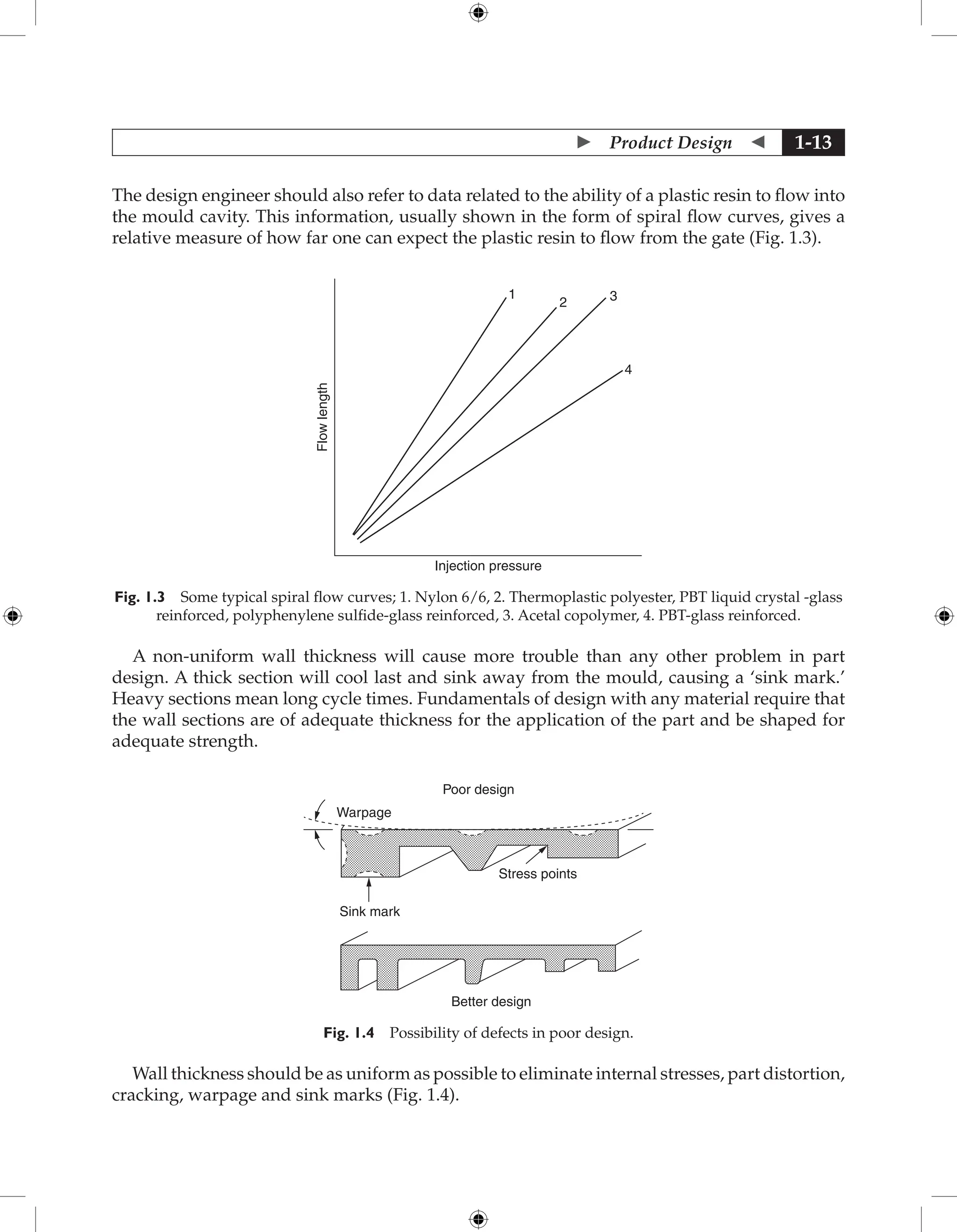
Part design for structural foamed composites are similiar to injection moulding. The
cellular core and solid skin of structural foam parts are made by both low- and high-pressure
processes. In low-pressure methods (70 kg/cm2
), there is very little moulded-in increased
strength properties. Because of the cellular core, bosses should have interconnecting ribs or
gussets to distribute loads. Ribs should be much heavier than those in solid configurations.
In general, ribs should have a width at the base equal to the thickness of the adjacent wall.
To avoid sink marks and warpage problems, a uniform wall thickness should be maintained
when possible.
1.23.14 Product Applications
The potential and future of polymer composite is very high. Most composites have a good
balance of physical properties, excellent strength-to-weight ratios, corrosion resistance, good
electrical properties, and low tooling cost. It is lower material costs, ease of fabrication,
integrated part designs, faster moulding cycles, improved finishing, product reliability,
environmental impact, and energy savings that will accelerate the growing consumer
acceptance of composites.
Aerospace and military research has changed our concept of design and traditional
construction techniques. Wood and fabric were major materials in aircraft and other
transportation systems at the time. The largest growth potential for composite materials is in
the areas of transportation and construction.
๎ฃ Product Design ๎ข 1-163
Automobiles, trucks, buses, vans, rapid transit vehicles, aircraft, boats, ships, aerospace
vehicles, and trains will benefit from composite design . The spin-off from space and military
programresearchhasallowedthecivilianmarketstomakeimpressivegains.Presentproduction
applications include drive shafts, side rails, doors, cross members, oil pans, suspension arms,
leaf springs, wheels, quarter panels, trunk decks, hoods, hinges, transmission support, front
and rear bumper components, seat frame, and wheels. Many engine components are being
tested in present racing engines ( Fig. 1.211).
Composite materials, in addition to providing weight savings over the life of a vehicle,
are also energy efficient. It has been estimated that for every 50 kg reduced from a 1150 kg
automobile, there will be a fuel savings of 0.1 km/lit. The energy resource requirements per kg
of most composite materials are only 1/4 of that of aluminium or steel. Competition for raw
material supplies between energy and petrochemical uses will continue to be a concern.
Torlon
injection
moulded
thermoplastic Torlon-C
developmental
thermoplastic
composite
Fig. 1.211 Schematic view of an engine includes piston skirts, piston pins, piston rings, connection rods,
valve stems, engine block, and cylinder heads made of carbon fibre - polyamide - imide composite (Amoco
Chemicals Company).
New truck designs will incorporate light, strong, aerodynamic bodies and cargo containers.
Reduction in wind resistance and vehicle weight will allow room for more cargo with less fuel
consumption. Many of these concepts will be used for buses, trains, and mass transportation
systems.
The search for higher strength-to-weight ratios and design flexibility has widened in aircraft
and aerospace designs. Glass fibre composites have a specific strength five times that of
aluminium, while graphite and boron in epoxy matrix have about a five times higher specific
stiffness.
The current list of composite aircraft and aerospace applications is impressive. The all-
composite horizontal stabiliser for the B-1 bomber, vertical and horizontal stabilisers on the
F-16 fighter, wing skins on the F-18, rudder and flaps for the A-4, helicopter rotor blades,
rudders, elevators ailerons, and spoilers on the B767 and B757, and payload doors of the Space
Shuttle Orbiter are the most familiar applications. It has been estimated that 20% of the total
๎ฃ Fundamentals of Plastics Mould Design ๎ข
1-164
weight of the AV-88 (barrier) will be composed of polymer composites. Even greater projected
use of composites are in the future for AFT, V/STOL, HOTOL, stealth bombers, and Mach 20
transports. It has been suggested that up to 65% of the structure weight may be composed of
polymer composites.
Glass fibre composite pleasure boats have been used for years. The 46 metre, Wilton in the
British navy is the worldโ€™s largest composite ship. It is likely that continued production of
small ships in the minesweeper, hydrofoil, and surface effect ship class will continue to grow.
Corrosion resistance, light weight, and low maintenance make marine use in hull structures,
fairwaters, sonar domes, antennas, floats, buoys, masts, spars, deckhouses and all kinds of
tanks an attractive application. Carbon composites are very radar absorptive and are likely to
find additional structural applications in both aircraft and ships.
The market penetration in sporting goods is expected to grow from 40 to 50% in the next five
years, replacing wood and metal, Graphite, boron, and Kevlar in an epoxy matrix have found
acceptance in golf carts, surf boards, hang-glider frames, javelins, hockey sticks, sailplanes,
sailboats, ski poles, safe playground equipment, golf shafts, fishing rods, snow and water skis,
bows, arrows, tennis rackets, pole-vaulting poles, skateboards, bats, helmets bicycle frames,
canoes, catamarans, oars, paddles and other items.
With changes in building codes, craft unions, consumer acceptance and acceptable designs,
construction has potential for considerable growth in composite usage. Not everyone can afford
a custom-built home made by traditional methods. Mass-produced, modular manufactured
composite homes may be in our future. The growing mobile-home, apartment, hotel, and
motel market is a natural for modular composite construction.
There are a number of miscellaneous applications, including soundboards for guitars and
violins, shells for musical drums, and lightweight armored products for personnel, vehicle,
and equipment protection. The appliance and furniture industries will continue to initiate
new designs using the merits of composites. Housings, frames, bases, tanks, and fans will be
used in the manufacture of computers, vacuum cleaners, air conditioners, refrigerators, and
other appliances. Chairs, lamps, tables, and other modern furniture designs are destined to
be made of composite materials. Biocompatible implants, prostheses, electrical circuit boards,
hammer handles, ladder rails, highway signs, wheel chairs and numerous pipes and ducting
for the food and chemical processing industries are present applications.
1.24 Modern Approaches to Product Design
Several modern approaches have been made with the help of computer in plastic product
design, manufacturing and engineering. Some of the modern approaches which have become
very popular are:
1. Prototype Development Methods
2. Reverse Engineering Approach
3. Concurrent Engineering Approach
4. Quality Function Deployment
๎ฃ Product Design ๎ข 1-165
1.24.1 Prototype Development Methods
Most of the investors do not believe that the product developers have really considered all of
the aspects, such as ramifications, variations, loads, permutations, and abuse that a new design
will engender. They want to see what the thing looks like and how it will perform. These same
investors will not commit funds to provide parts when they are expected to be manufactured,
until they are satisfied that the risk is acceptable. These people may be senior management,
marketing and sales, or customers. Since they pay the bills, product development must do
something to satisfy them. Construction of prototype parts and the products is the necessary
answer to the problem. Construction of prototypes implies that (i) the full production system
is not completed; (ii) time to prepare prototype tooling is short; and (iii) that the cost of the
prototype parts and assemblies will be higher than expected for production. However, because
the capital investment is low, the risk of prototype construction is also low.
Rapid Prototyping (RP) is the automated fabrication technologies of seamless and rapidly
creating accurate representative physical models of mechanical parts directly from three-
Dimensional ComputerAided Design (CAD) data without the use of tooling and with minimal
human intervention.
RP uses state of the art laser technology, positioning systems, materials and computer
technologies in the various processes. There are many RP processes that are widely used, each
one using different methods and materials to produce the final part.
The benefits of rapid prototyping, basic steps involved in it, its limitations, prototyping
materials, its applications, future developments in it and its various types are explained in
detail in Chapter 8, CAD/CAM applications in mould design.
1. CAD Solid Model: Engineering drawing programs, or computer aided design (CAD),
can provide very good visual and dimensional replication of the parts on the computer
screen. A solids rendition of the part can be shaded from different angles, to show
highlights and irregular surfaces. Perspective are also available, so that a true picture
of the part is obtained. Some colouring capabilities are also available. Often, a CAD
model will suffice for people who want to see a prototype part (Fig.1.212).
Fig. 1.212 CAD Solid Model.
๎ฃ Fundamentals of Plastics Mould Design ๎ข
1-166
	Advantages of CAD
		 (a)โ€ƒ
The Process is Fast: In the hands of the typical operator, a visual representation
of the part is no more than an adjunct to the drafting process. A few commands, a
few buttons to push, and a solids rendition of the part appears on the screen.
		 (b)โ€ƒ
Least Expensive: Since the rendition is a by-product of the drafting process, the
cost is part of the design process.
		 (c)โ€ƒ
Checks Form and Fit: Many of the current high-end drawing programs allows
two or more parts to be brought on to the screen at the same time. Fit between
parts can be checked either visually or numerically.
Disadvantages of CAD
		 (a)โ€ƒ
Cannot Touch or Feel: For those who want to touch a part or assembly, CAD will
not be acceptable.
		 (b)โ€ƒ
Cannot Check Part Functions: Although form and fit can be checked with a high-
end CAD program, functionality cannot. That is, movement of the components of
assemblies relative to each other, with restraints of motion from stops or walls, is
beyond the capabilities of these programs.
		 (c)โ€ƒ
Cannot Show Parts to the Customer: Since there are no parts, only the computer
version of the part can be shown to the customer. This may not be sufficient to the
people who wish to see the actual part.
Details about the computer aided design, and its modelling types, creation,
editing and support tools, its advantages are explained in detail in Chapter 8,
CAD/CAM applications in mould design.
2. Computer Aided Engineering (CAE)
Simulation: CAE is differentiated from CAD
and implies the numerical simulation of a
variety of actions on the part. CAE provide
the responds of the parts to loads, heat or
cold soaking, moulding, and the functional
relationship between parts. CAE programs
divide the part into smaller entities, called
mesh elements, and provide calculations
for the various functions from one mode of
the mesh to the next. The integration of the
effects over the whole part is the end point of
the program ( Fig.1.213).
Common CAE analyses include
		 (a) Thermal stress
		 (b) Structural analysis Fig. 1.213 CAE Simulation.
๎ฃ Product Design ๎ข 1-167
		 (c) Crush simulation
		 (d) Process simulation, such as for injection moulding
	Advantages of CAE
		 (a)โ€ƒ
Fast: Although not a part of development of the part drawing, CAE is a natural
next step. Since it is done on a computer, the CAD drawing is most often used as
the starting for generating the mesh. Actual execution of the analysis program is
depended on the number of nodes in the mesh, the particular functions that are
being modeled, and the power of the computer. Typical times are measured in
hours to a few days.
		 (b)โ€ƒ
Low expenses: The expense of the simulation is related to the resident expertise
available and how many hours are needed for: (i) mesh preparation, (ii) analysis
time, and (iii) interpretation of the results. The hours that the expert spends on
the project will be the significant cost of the project.
		 (c)โ€ƒ
Checks functionality: Motions between parts can be checked for assemblies as well
asdistortioncausedbyvariousloadingregimens.Thermalexpansionandcontraction
from heat or cold soaking can be checked. Processing of the parts can be simulated.
		 (d)โ€ƒ
No tool cost: With good expertise in-house, the cost of the analysis program will
be amortised over a number of analyses.
Disadvantages of CAE
(a)โ€ƒ
Cannot show the effect of wear or cumulative loading: No programs are avail-
able that will simulate the wear rate of one part against another or the effects of
repetitions of loading.
(b)โ€ƒ
Depends on the skill of the user: Except for simple analysis, the user should
be familiar with the functions that are being simulated. Detailed explanation
is required, have often been called on to explain why the simulation produced
results that were far from reality. The most typical solution to the discrepancy
is that the user did not provide adequate inputs to the simulation program.
(c)โ€ƒ
Depends on accurate characterisation of the materials: Materials testing is nec-
essary before starting the simulation, whether the user is looking for simulation
of processing, stress, or temperature. In every case, the constants that are used to
characterise the material for that kind of simulation are critical to the accuracy of
the results. Generic data, as for a class of materials, are not adequate. Data that
are averaged for a family should be used only in the absence of all other data. The
best and most accurate simulation will be from characterising the exact compo-
nent that will be used and that has been prepared in the same way that the final
product is expected to be prepared.
(d)โ€ƒ
Depends on the accuracy of the models used to simulate functions: Model is
the term used to describe the numerical processes and equations that are used
๎ฃ Fundamentals of Plastics Mould Design ๎ข
1-168
as the basis of the simulation. For example, it is recognised that the simulation
of plastics flow will not be accurately described by assuming that the viscosity is
constant. Several models of the viscosity behaviour are available that allow for
the change in viscosity from both temperature and shear rate changes.
Details about the computer aided engineering, finite element method and steps
involved in it, its advantages, disadvantages, types of mesh and elements used for it,
factors considered while taking finite element analysis decision, etc., are discussed in
detail in Chapter 8, CAD/CAM applications in mould design.
3. Machining: Extruded or cast stock shapes can be machined to provide the prototype
parts. Most thermoplastic materials are available in this form. The restrictions are the
ingenuity of the machinist in making the necessary cuts in the stock to get the desired
shape. With some materials, it is possible to bond parts together to provide a finished
assembly.
	Advantages of machining
		 (a)โ€ƒ
Form, fit, and function can be checked with the material of choice. This is espe-
cially important when wear and fatigue are involved. However, machining marks
can also be points of stress concentration.
		 (b)โ€ƒ
The parts will be the same size as the production parts, and tolerance variations
can be machined to check fits at high and low tolerance ranges.
		 (c)โ€ƒ
Typically, amorphous plastics can be painted to provide a colour that matches the
end use.
		 (d)โ€ƒ
Tool cost is low to nonโ€“existent. At most, a few jigs and fixtures may be con-
structed to hold parts while they are being bonded.
Disadvantages of machining
		 (a)โ€ƒ
Appearance may not match production needs, since machining marks may not be
appropriate to the use of the parts.
		 (b)โ€ƒ
Although the base material selection is the same as the material that will be used
in the end product, the bar stock will not have properties identical to those of the
moulded product.
		 (c)โ€ƒ
Surfaces will have a texture that is different from that of the moulded part. The
machining process will leave a texture of its own. Although polished surfaces can
be provided, specific textures cannot be included.
		 (d)โ€ƒ
The molecular structure will not match that of the moulded parts. This effect is
especially evident for the semicrystalline materials. The crystallisation process
from extrusion will result in a different orientation of the crystallites from that
expected from moulding.
		 (e)โ€ƒ
Molecular and fibre orientation will not match that in the moulded product
because the orientation processes of making rod stock are not the same as those
๎ฃ Product Design ๎ข 1-169
encountered in injection moulding. In the later process, the orientation resulting
from flow through the cavity is frozen into the skin layer. Interior layers have a
more random orientation. When machining an extrusion, the skin layer, where
any orientation may occur, is removed or at least interrupted.
		 (f)โ€ƒ
The very high part cost of machining will limit the number of parts that can be
produced. Thus, machining intricate parts with many features is not considered
appropriate for a large number of parts.
		 (g)โ€ƒ
For similar reasons, machining is typically not appropriate for very large parts. A
combination of thermoforming, machining, and bonding may be more appropri-
ate for large parts.
4. Casting: This process starts with liquid resins that can be catalyzed and polymerised.
Either a flexible mould is cast from a machined model of the part or a cavity is
machined. Since the pressures are from gravity, the cavities can be lightweight or
even flexible. In either case, multiple parts can be made from the models. For large
parts, fibre reinforcements can be added in a process akin to fibre-reinforced plastics
production.
	Advantages of casting
		 (a)โ€ƒ
Form, fit, and appearance can be checked. If the gravity process is enhanced with
evacuation of the mould, very fine details can be cast.
		 (b)โ€ƒ
Low tool cost, since there is no need to build the mould to resist the high pres-
sure of injection moulding. If the mould is cast from a flexible material, polished
surfaces, fine detail, and undercut surfaces can be accurately replicated.
		 (c)โ€ƒ
Casting material can be selected that have electrical properties equivalent to those
of the production parts.
		 (d)โ€ƒ
Casting material can be selected that have very low shrinkage rates. This allows
parts with close tolerances.
		 (e)โ€ƒ
Appropriate for tens of parts.
Disadvantages of casting
		 (a)โ€ƒ
Material properties may not match the functional needs, since the number of
plastic families that can be used in the process is limited. Wear and fatigue resis-
tance are seldom matched by any of these materials; reinforcements are limited to
woven and nonโ€“woven fabrics.
		 (b)โ€ƒ
Parts costs are high to pay for the relatively long cycle time per part and the high
cost of the equipment. For this reason, the process is considered appropriate only
for a few parts.
5. Thermoforming: This process is appropriate for parts that are too large to be machined
from available stock shapes. The idea is that the basic shape can be formed from sheet
and other features are added by being machined and then bonded in place.
๎ฃ Fundamentals of Plastics Mould Design ๎ข
1-170
	Advantages of thermoforming
		 (a)โ€ƒ
Parts too large for available stock shapes can be fabricated with minimal
tooling.
		 (b)โ€ƒ
The thermoforming tool can be fabricated from low-cost materials, such as wood:
Tool cost will be relatively low.
		 (c)โ€ƒ
Form, fit, function, and appearance can be checked.
		 (d)โ€ƒ
Appropriate for tens of parts.
Disadvantages of thermoforming
		 (a)โ€ƒ
The process is limited to materials that can be thermoformed. Semicrystalline
and fibre-reinforced materials should not be used. The properties may not match
those expected of the material selected for production.
		 (b)โ€ƒ
The costs of the part will be high. Thermoforming a few pieces, without the trim-
ming jigs and fixtures typical of the high production versions of the process will
be expensive. Fabrication of the auxiliary parts will also be costly, as with the
bonding process to locate and secure these parts.
		 (c)โ€ƒ
The joints between component of the fabricated assembly may be weaker than
those in the equivalent moulded part.
		 (d)โ€ƒ
Tolerances will be wide, to accommodate the thermoforming process. Thickness
is especially difficult to control to tightโ€“tolerances.
		 (e)โ€ƒ
Depending on the materials available for thermoforming, the parts may not be
functional equivalents of the injection moulded parts. Friction and fatigue life
will not match those of the selected materials.
6. Injection Moulding: Prototyping parts by injection moulding relies on low-cost tool-
ing approaches. The mould can be constructed by one of the following methods:
		 (a)โ€ƒ
Cast from metal-filled epoxy or urethane resin. The pattern is usually machined
from aluminium. The metal filling in the casting material provides higher thermal
conductivity and greater strength than the unfilled resin.
		 (b)โ€ƒ
Cast from low-temperature alloys, such as Kirk site .The pattern for the casting can
be machined from wood and replicated in plaster for casting the metal cavity.
		 (c)โ€ƒ
Electroformed surface with low-temperature alloy backing. Apattern is machined
from a nonโ€“conductive material. Copper is deposited from a chemical bath to
provide a conductive surface. This is plated, usually with nickel, to form a shell
that is backed up with cast plastic or low-temperature metal alloy.
		 (d)โ€ƒ
Aluminium plates can be machined more easily than the equivalent steel cavity.
However, the polished finish on the aluminium will not replicate that for hard-
ened steel.
		 (e)โ€ƒ
Mild steel can be machined more easily than the equivalent tool steel. If the cavity
is fabricated, that is, made from sections, the machining can be simpler than
expected for the production tooling.
๎ฃ Product Design ๎ข 1-171
	Advantages of injection moulding
		 (a)โ€ƒ
Form, fit, and appearance can be checked, since the material will be the same as
for production parts.
		 (b)โ€ƒ
Appearance depends on the mould surface, to reduce the costs, prototype moulds
may not be polished as finely as the production tool.
		 (c)โ€ƒ
The low part cost makes the process appropriate for hundreds to thousands of
parts. A good prototype mould can produce parts for early production.
Table 1.21 Comparison of materials for prototype injection moulds
Mould material Advantages Disadvantages
Cast epoxy or
urethane
Low cost Low thermal conductivity
Fast turn around Low thermal capacity
Good for small, intricate parts Metal filling may not get into sharp exterior corners
Life expectancy is less than 50
parts
Special efforts needed to avoid bubbles in casting
Surface finishes may not match production parts
Must be contained in strong mould based
Fine details will be fragile
Prone to chips around machined ejector pin holes
High wear rate with fibre reinforced materials
limited life.
Cast low-temp
alloys
Low cost Must be contained in strong mould.
Fast turn around Easily damaged by moulding debris.
Fair thermal conductivity Tends to peen near ejector pin holes.
Good thermal capacity High gate wear rate with fibre reinforced materials
Cooling lines can be machined Difficult to get good surface polish
Good for large parts
Life expectancy is about 100
parts
Electroformed
shell
Low cost Must be contained in strong mould base.
Fast turn around Easily damaged by moulding debris
Good replication of the pattern
surface
Prone to flash
(Contd.)
๎ฃ Fundamentals of Plastics Mould Design ๎ข
1-172
Table 1.21 (Contd.)
Mould material Advantages Disadvantages
Can be polished
Good wear rate
Life expectancy is several
hundred parts
Aluminium plates Fast machining Easily damaged by moulding debris
Good thermal conductivity Too soft to hold a good polish
Good thermal capacity Wear rate is high from fibre reinforced materials
Cooling lines can be machined
Good for large parts
Life expectancy is about 1,000
parts
Mild steel Good Polished surface is easily damaged
Good thermal conductivity Wear rate is higher than for hardened tool steel
Good thermal capacity
Cooling lines can be machined
Life expectancy is several
thousand parts
Disadvantages of prototype injection moulding
(a) Gate location may not match production. To accelerate the tool production, the tool
design may be simplified. For example instead of three-plate mould, including a cen-
tralised gate, a two-plate mould with an edge gate may be used.
(b) Gate scars may be more prominent than for the production tool. For example, subma-
rine gates may not be appropriate for the mould material.
(c) Filling patterns will be different from those expected from the production tool. This
implies that weld line location, flow orientation, shrinkage, and residual stress pat-
terns will also be different.
(d) Mould cooling may not match production. The simplified tool design may not pay as
much attention to the mould cooling as will be expected from the production tool. In
addition, the lower heat capacity or thermal conductivity of the mould material may
not much that of the production tool material.
(e) Uneven cooling may result that will cause different shrinkage rates than expected from
the production tool.
(f) The cooling rate may be different if the mould material thermal capacity and thermal
conductivity are different from those of the production tool.
๎ฃ Product Design ๎ข 1-173
(g) Production rates will be lower than that expected from the final tool. The tool design
compromises will often imply more mould open time and limited ability to run the
mould in an automatic mode. For example, rather than include cam-operated side
cores, loose insert may be used. These must be placed in the mould by hand between
each shot.
(h) Tool cost and lead time are higher than for any of the other prototype processes. The
longer time must be factored into the production schedule.
1.24.2โ€ƒReverse Engineering Approach
Reverse Engineering (RE) is a process that is used to create 3D CAD models directly from
physical parts with little or no additional design documentation. It is simply the act of figuring
out the real parts using software that you have.
When a detailed drawing of a component, is missing or insufficient to understand, or the
part is of a contour shape which cannot be measured easily by the measuring instrument, then
they are developed by the reverse engineering process. Reverse engineering process requires
a coordinate measuring machine or digitiser (3-D scanner) to extract the input data in terms
of point clouds from which the surface and model will be developed again. To develop the
model again as per the existing one or to modify the existing one, it requires the 3-D modelling
software. Hence, the knowledge of 3-D modelling software is essential for the designer. The
designer should also have a sound knowledge on CAE software for analyzing the product for
its functional requirements or its tool design verification.
The details about the reverse engineering process, steps involved in it, coordinate measuring
machine, digitiser, etc., are explained in detail in Chapter 8.
1. Use of 3-D Modelling Software in Product Design: Plastics engineering is an area
where CAD/CAM/CAE is being successfully used for quality improvement and for
complex designs. The complexities of designs, bulk of operations and the need for
quick changes have made the computer applications in plastics product and mould
design and tool making as more important.
With computer capability a person can modify designs quickly and even review
them with the customer on the spot to achieve the best package to meet the customersโ€™
requirement in the shortest possible time. Knowledge of the basic design and related
information has to be used by the designers regardless if CAD/CAM/CAE or
traditional drawing boards are used with the proper software package will โ€˜remindโ€™
the designer to follow a logical error free procedure.
The type of analytical problems are encountered in the product design/mould
design process generally fall into the sciences of mechanics, heat transfer and fluid
mechanics and material science. These fields encompass many mathematical functions
and relationships that are too time consuming to evaluate in manual or conventional
designs. The ability of the computer to remember and execute these computations
quickly adds new dimensions to the CAD/CAM/CAE process allowing prospective
alternative designs to be evaluated and simulated.
๎ฃ Fundamentals of Plastics Mould Design ๎ข
1-174
With the high speed digital computers on desktop category itself (beyond 1 GHz)
used for analysis, data processing activities and complete graphical information are
helping to automate a domain once thought of creative discipline, i.e., the design
process itself. The repetitive tasks like creating standard geometry, pack profiles,
mould base, adding shrinkage to the component have been cut down. The computer
ability to perform these tasks untiringly revolutionise the entire process we witness
today.
We may find that using CAD/CAM/CAE techniques the time required in the
conventional trial and error methodology is greatly reduced. Already there are enough
indications that the managements of various organisations have started realising the
impact of CAD/CAM/CAE in their industry.
With CAD/CAM coming a long way, there is an encouraging trend that the future
is still brighter unlike the other areas like software development, which see their
rise and fall in short periods of time. It is expected that new and more advanced
design algorithms continue to flood the market, which makes the job of designer and
manufacturer still easy.
Thebasicreasonsforimplementingacomputer-aideddesignsystem(3-Dmodelling)
are many. Some of them can be listed as follows.
		 (a) Provides better tools for reality in visualisation.
		 (b) Increases the effective skills of the designer.
		 (c) Improves accuracy and quality of the design.
		 (d) Reduces the visualisation and presentation problems.
		 (e) Creates a CNC manufacturing database based on design model.
We are very well aware that CAD and CAM are the divisions supporting the design
and manufacturing sections. If we tend to subdivide CAD, we may state that CAD is
inclusive of 3-D modelling, graphics operations and other engineering design tools.
In addition, CAD tools can provide facilities like analysis of model like fits, tolerance
studies, model properties like mass, moment of inertia, centre of gravity, etc. Also
nowadays the CAD systems are having the facility element analysis of models also for
structural analysis mainly.
2. 2-D Modelling: Creating a drawing using only the x and y coordinates on a paper
is termed to be a two-dimensional drawing. As such, 2-D draughting refers to the
extension of manual drawing methods in a computer. The various views such as plan,
elevation, end view, if necessary sectional view (to show inner details of the prod-
uct) enlarged view or reduced view on various scales can be drawn to give complete
description of the product.
The various functions used in the drafting can be grouped as:
		 (a) Drawing functions
		 (b) Editing functions
		 (c) Viewing Functions
		 (d) Drawing aid functions
๎ฃ Product Design ๎ข 1-175
		 (e) Utility functions
		 (f) Block functions
		 (g) Automatic dimensioning features
12.7
2 HOLES ร˜ 2.4
10.0
(TYP)
R
4
.
0
R6.0
R
4
.
5
(
T
Y
P
)
(TYP)
30ยฐ
=
=
=
=
=
=
=
=
32.0
30.0
5.0
24.0
R2.5(TYP)
(TYP)
ISOMETRIC VIEW
BOTTOM PLAN VIEW
SECTION XX
SECTION YY
35.0
R7.5
R
6.0
(TYP)
Y
5.0
A/F
R 4(TYP)
X
Y
X
R2.5
2.0
1.4
19.0
=
=
ร˜
5.0
ร˜
3.0
ร˜
38.4
ร˜
41.4
3.5
R
3
.
5
R
2
.
5
8.0
8.6
9.6
11.6
2.0
16.0
14.5
1.5
(TYP)
Fig. 1.214 2-D Drawing.
3. 3-D Modelling: There are certain limitations of orthographic as a means of repre-
senting product geometry. As a consequence of these limitations, various methods
have been developed for the representation of geometry with a more realistic view.
These utilise the construction of a single representation of the component geometry
in three-dimensional space. By using a single representation, the potential for error
inherent in the use of multiple views of a component is avoided. Also, a single rep-
resentation of an object is potentially far more useful as a basis for applications that
๎ฃ Fundamentals of Plastics Mould Design ๎ข
1-176
utilise the same master model to extract information for analysis and manufacture
related activity.
The methods that have been developed for three-dimensional modelling involve
the representation of geometry as a collection of lines and other curves, or of surfaces,
or of solids in space. Of these, the solid modelling technology is the latest. It has been
seen that drawings are constructed in two โ€“ dimensional coordinate system. Three-
dimensional (3-D) models are constructed in 3-D space โ€“ typically in a right-handed
Cartesian coordinate system. The various types of 3-D models are:
		 (a) Wire frame models
		 (b) Surface models
		 (c) Solid models
(a) Create four points
(c) Produce images in other
three views
(d) Project into third dimension
to give thickness to model
(b) Join them as straight lines
Fig. 1.215 Development of a wireframe model on a computer.
This?
Or this ?
Wireframe model
Surface model Hollow model Solid model
No ambiguities ?
Problem: Surface geometry has no mass properties
Centroid ?
Moments of inertia ?
Fig. 1.216 Various methods of modelling a solid.
๎ฃ Product Design ๎ข 1-177
Some of the 3-D modelling software that are used at present are:
		 (a) PRO.E
		 (b) UNIGRAPHICS
		 (c) CATIA
		 (d) IDEAS, etc.
	
By using any one of the above software, we can generate any shape and size of the
product with necessary colour contrast as per our requirements. If we need only
modification, addition, deletion that can also be done very easily within a short spell
of time we can also rotate the product to any convenient direction for better visual,
easy understanding.
4. Use of Mould Flow Software in Product Design: The benefits of using CAE software
to design and engineer components include:
		 (a) Improved and consistent component quality.
		 (b)โ€ƒ
Lower costs associated with the need for less prototyping, rework and lower
product development cycle time.
		 (c) Improved product design before the commencement of manufacturing.
		 (d) Lower manufacturing cycle times.
		 (e)โ€ƒ
To establish the idea of what will happen inside a mould when plastics flow
inside.
		 (f) To study the effects of post-moulding defects.
The details about mouldflow software, its uses in the filed of analyzing the plastics
products, steps involved in it, types of meshing used in it, various analyses done in
mouldflow, etc., are explained in Chapter 8.
5. Principles of Flow Design: The flow analysis software relies on certain fundamental
design principles to verify and optimise the flow pattern of the plastic parts. The basic
design principles used are:
		 (a)โ€ƒ
Flow must take place always in a single direction before it ends with the extremi-
ties of the product. This ensures a uniform filling pattern.
		 (b)โ€ƒ
The pressure drop occurring in a plastic part must be constant over the entire
length of the flow paths.
		 (c)โ€ƒ
The maximum shear stress induced in the component part must be less the criti-
cal shear stress acceptable for the particular plastic material chosen. If the stress
exceeds a critical value, then the part is likely to degrade.
		 (d) The cooling must be uniform throughout the plastics part to avoid warpage.
		 (e)โ€ƒ
Thin and thick sections are to be avoided to avoid the hesitation effects. Hesitations
occur when the flow takes a deviation from a thicker section to thin section. Because
there is no ease of flow, the material flow stops until sufficient pressure builds up.
		 (f)โ€ƒ
It is common knowledge that weld lines cannot be avoided altogether in all
โ€‚โ€‰โ€‰โ€‰cases of parts. The weld lines are to be positioned in the least sensitive
๎ฃ Fundamentals of Plastics Mould Design ๎ข
1-178
locations of the part so that while in service they will not affect the performance
of the part.
		 (g)โ€ƒ
Controlled frictional heating can be used to the advantage so that the thermal
properties of the plastic material can be protected to a certain extent.
		 (h)โ€ƒ
The feed system must be designed for thermal shut off so that any backflow can
be avoided.
1.24.3โ€ƒConcurrent Engineering Approach
Nowadays the fast developing industrial world has given rise to two important and novel
approaches to product design. The first approach is concurrent design while the second
approach is quality function deployment. At the concluding stage, we will highlight the two
important approaches in the product design.
Development from concept to product requires the consideration of four basic elements.
Central to this concept is the function of the product. Related to the function are the shape,
material, and production techniques used to manufacture and assemble the product.
Concurrent design is the simultaneous planning of the product and the process for producing
it. The role of manufacturing was to build what the designer conceived, improve the manufacture
andassemblyoftheproduct.Acertainindustrysurveyshowedthat60percentofallmanufactured
parts were not made exactly as represented in the drawings. The reasons varied:
(i) The drawings were incomplete.
(ii) The parts could not be made as specified.
(iii) The drawings were ambiguous.
(iv) The parts could not be assembled if manufactured as drawn.
Many of these problems have since been overcome by evolution of the design team and of the
philosophy of concurrent design. The process of translating from concept to a manufacturable
product is rarely accomplished now by the designer alone. Generally, a team comprising a
design engineer, a manufacturing engineer and a materials engineer plays a role in supporting
the chief designer. There are too many materials and manufacturing processes available for the
designer to be able to make good decisions without the help of specialists.
The design team Design is both a private, individual experience and a social, group experi-
ence. The ability to recall previous designs from memory and to synthesise partial concepts
together to form new ideas is unique to an individual designer. However, since most design
projects are large and require knowledge in many areas, they are generally accomplished by
teams of engineers with varying views and backgrounds.
We now provide a list of individuals who may fill a role on a product design team. Their
inclusion on the design team will vary from product to product, and their titles will vary from
company to company. Each position on the team will be described as if filled by one person,
but for large design projects, there may be many persons filling that role.
1. ProductDesignEngineer:Themajordesignresponsibilityiscarriedbytheproductdesign
engineer. He must be certain about the needs for the product are clearly understood and
๎ฃ Product Design ๎ข 1-179
that engineering requirements are developed and met by the product. This usually
requires both creative and analytical skills. The design engineer should bring knowl-
edge about the design process and about specific technologies to the product.
2. Marketing Manager or Product Marketing Manager: In many companies, the mar-
keting manager has the ultimate responsibility for the development of the product and
represents the major link between the product and the customer. Because the product
manager is accountable for the success of the product in the market, he is also often
referred to as the marketing manager or the product marketing manager. The product
manager also represents the interests of sales and service.
3. Production Engineer: It is not possible for the design engineer to have the necessary
know-how about production processes. This knowledge is provided by the person
who must have a grasp not only of in-house manufacturing capabilities, but also of
what the industry as a whole has to offer.
4. Design Detailer: In many companies the design engineer is responsible for specifica-
tion development, planning, conceptual design, and the early stages of product design.
The project is then turned over to detailers (often called designers), who finish detail-
ing the product and developing the manufacturing and assembly documentation.
5. Testing Engineer: The testing engineer aids the design engineer in developing test appa-
ratus, performing experiments, and gathering data in the development of the product.
The insights gained from the technicianโ€™s hand-on experience are usually invaluable.
6. Materials Engineer: In some products the choice of materials is forced by availabil-
ity. In others, materials may be designed to fit the needs of the product. The more a
product moves away from the use of known, available materials, the more a materials
specialist is needed as a member of the design team. Many suppliers actually provide
design assistance as part of their services.
7. Quality Control Specialist: A quality control (QC) specialist has training in techniques
for measuring a statistically significant sample to determine how well it meets speci-
fications. This inspection is done on incoming raw material, incoming products from
vendors, and products manufactured in-house.
8. Industrial Designer: Industrial designers are responsible for how a product looks and
how well it interacts with human users; they are the stylists who have a background in
fire arts and in human factors analysis. They often design the scope within which the
engineer has to work.
9. Assembly Engineer: While the production engineer involved in making the compo-
nents from raw materials, the assembly manager is responsible for putting the product
together. Concern for the assembly process is an important aspect of product design in
modern times.
10. Supplierโ€™s Representative: Very few products are made entirely inside one factory.
Usually there will be many suppliers of both raw material and finished goods. Often
it is important to have critical suppliers on the design team because the success of the
product may be highly dependent on them.
๎ฃ Fundamentals of Plastics Mould Design ๎ข
1-180
The details about concurrent engineering approach, product development cycle, characteristics
of concurrent engineering and its advantages are explained in Chapter 8.
1.24.4 Quality Function Deployment (QFD)
QFD is the latest approach to product design. It essentially consists of converting customerโ€™s
need statement (which is usually qualitative) into technical specifications. For example, a user
of automobile insists upon โ€˜easy closureโ€™ of the door. This voice of the customer enables the
design task force to derive the specifications of door closing mechanism in terms of kilograms
of force required for the mechanism. QFD enables organisations to be proactive rather than
reactive in QC. QFD involves (i) the customer, (ii) what is the customer requirement, (iii) how
to fulfil his requirements.
The details of quality function deployment, steps involved in it and its implementation in
production are explained in Chapter 8.
1. Explain the primary concepts involved in design.
2. What is the role of aesthetics in product design?
3. Write the disadvantages of evolutionary design.
4. Write two examples of design by innovation.
5. How does morphology in design influences?
6. What are the advantages of plastics over metals in product design?
7. Brief the limitation of plastics in product design.
8. Prepare a check list to evaluate the product design.
9. Give suggested wall thickness for thermoplastic and thermo-set moulding material.
10. Write short notes on wall thickness variance.
11. Why are ribs needed in product design? Explain the methodology with a neat sketch.
12. Write down the advantages of fillets and radii.
13. What is gusset in product? Explain with a neat sketch.
14. What is the significance of taper and draft in product design?
15. Why is coring needed?
16. Write the types of materials used for inserts.
17. Describe shapes of male and female inserts with a neat sketch.
18. What is pressed-in inserts in product design? Explain with neat a sketch.
19. Explain metal-stamping and rod-type inserts in product design with a neat sketch.
20. How metal inserts are replaced by plastic insert?
21. Write short notes on the following
		 (a) Encapsulation (b) Composite parts
Questions
๎ฃ Product Design ๎ข 1-181
22. What are the advantages of an ideal gate size and location?
23. List out the factors on which an optimum gate size depends.
24. Describe the ideal location of ejector pins as per the product design with a neat sketch.
25. Describe wire-type screw thread insert with a neat sketch.
26. How speed nuts and clips are used for fastening?
27. What is rivet?
28. Define clasps.
29. What are the two basic methods of mechanical means of fastening? Explain with a neat
sketch.
30. What are the factors affecting shrinkage?
31. Give a brief idea on bearing design with plastics.
32. Describe the manufacturing technique of plastic gear with its design calculation.
33. Explain Punching of laminates.
34. Give a brief note on product design variance pertaining to tooling aspects with a neat
sketch.
35. How are composites used in product design?
36. List out the advantages of composites in product design.
37. Explain CAD solid model. Write down the advantages and disadvantages of CAD.
38. What is machining? Write down the advantages and disadvantages of machining.
39. What is casting? Write down the advantages and disadvantages of casting.
40. What is thermoforming? Write down the advantages and disadvantages of
thermoforming.
41. What is injection moulding? Write down the advantages and disadvantages of injection
moulding.
42. Write short notes on the following:
		 a) 2-D Modelling b) 3-D Modelling
43. What are the essential factors of product design?
44. Explain methodical approach in plastics product design.
45. What are the important factors to be considered for maintaining the quality and economical
product?
46. What is the significance of wall thickness in product design?
47. What is the significance of parting line in product design?
48. Why bosses are needed in product design? Explain methodology with a neat sketch.
49. What is the methodology of providing holes in a product as per product design aspect?
Explain with a neat sketch.
50. Where are threads used? Classify threads and explain with a neat sketch.
51. Describe the location of inserts in the product with a neat sketch.
52. Why inserts are need for designing of a product? Explain with a neat sketch.
53. Define tolerance. Explain the parameters that influence part tolerance.
๎ฃ Fundamentals of Plastics Mould Design ๎ข
1-182
54. Explain with a neat sketch standard tolerances on moulded articles.
55. What are the techniques used for joining plastics to each other and to other materials?
Explain with a neat sketch.
56. What are hinges? Explain the types of hinges with a neat sketch.
57. What is shrinkage? At what condition thermosetting compression moulded parts will
have a higher shrinkage?
58. What are laminated plastics? Classify laminates and explain its process?
59. How processing variable influences product design?
60. Describe the mechanical properties such as stress, strain influences product design.
61. What is composite? Explain types of composites briefly.
62. Illustrate the steps involve before going to a product design.
		 What are the modern techniques used for a product design?
64. Explain CAE. Write down its application explain its advantages and disadvantage of
CAE?
65. Explain the role of 3-D modelling software in product design.
66. Describe the principles of flow design. What is the use of mould flow software in product
design?
67. Describe the individuals who may fill a role on a product design team.
๎ฑ Chitala, A. K. and Gupta R. C., Product Design and Manufacturing, Prentice Hall of India Pvt.
Ltd., New Delhi.
๎ฑ CIPET, โ€˜Technical Manualโ€™, Chennai.
๎ฑ Douglas M. Bryce, Plastic Injection Moulding, Society of Manufacturing Engineers, Michigan.
๎ฑ Ronald D. Beck, Plastic Product Design, Van Nostrand Reinhold Company, New York.
๎ฑ Sidney Levy, P. E. and Harry DuBois J., Plastic Product Design Engineering Handbook, Van
Nostrand Reinhold Company, New York.
๎ฑ Society of Plastic Industry Inc., Plastic Engineering Handbook.
References
Injection Mould
Design
Chapter
2
2.1 Introduction
When identical plastic products are to be manufactured in large quantities then the injection
moulding process is mostly preferred. The manufacturing process of the components is an
automatic process in nature but generally tends to be operated manually. The plastic cools and
takes the shape of the mould cavity. When the plastic component has solidified due to cooling,
the mould is opened and the moulding is ejected.
2.1.1โ€ƒUse of Mould Engineering for Thermo Plastic Material
Most of the items from electrical and home appliances are made from plastics. The technology
to make plastic product is by using injection mould of thermoplastic. When thermoplastic
material is heated, they change their state from solid to liquid. They will become soft, melt
and flowable. When cooled again, they become solid again. Such small items but in huge
quantities as bottles, sink plugs, model kits, toys,dustbins, bowls and milk crates, etc., can be
made using this system.
2.1.2 Basic Concept of Injection Moulds
Injection moulding process Injection moulding is the process of forcing melted plastic into
a mould cavity. Once the plastic has cooled, the part can be ejected. With this process, many
parts can be made at the same time, out of the same mould. Injection moulding is often used
in mass-production and prototyping. Injection moulding is a relatively simple technology to
manufacture parts.
Injection moulding is a plastic-forming process used in the production of most (about 65%)
of plastic parts. Other plastic-forming processes include blow moulding, pressure-forming,
and thermo-forming. Injection moulding is generally used in the high-speed manufacture of
low-cost, high-volume parts, like videocassette cases, plastic cups, printer parts, refrigerator
parts, automotive parts, and other electronic parts like casing, gear, etc.
The process of injection moulding starts with a barrel (a hollow cylinder) hot due to heaters
attached with barrel which change the status of granules into liquid plastic. The plastic is
๎ฃ Fundamentals of Plastics Mould Design ๎ข
2-2
rammed by the screw at high pressure into a mould. Once the plastic fills the mould, it is allowed
to cool and solidify. The finished part is then extracted automatically from the mould.
Stages in Injection Moulding Stage 1: Granulated or powdered thermoplastic material is
fed from a hopper (conical shaped device to receive materials) into the injection moulding
machine.
Stage 2: The injection moulding machine consists of
(a) Hollow steel barrel
(b) Rotating screw (Archimedean screw)
(c) Heaters
The barrel contains a rotating screw. The screw has its flight with some depth due to which
the screw carries the plastic along the barrel to the mould. Heaters surrounding the barrel melt
the plastic as it travels along the barrel.
Stage 3: Due to collection of melted plastic material at the end of barrel, the screw is forced
back. Once enough plastic has been collected at the end, hydraulic ram forces the screw for-
ward for injecting the plastic through a sprue into a mould cavity.
The mould is heated sometimes before injecting and the plastic is injected quickly to prevent it
from hardening before the mould is full because the entry point of material (gate) is very small.
Stage 4: Pressure is maintained in the machine for a short time (known as dwell time) to pre-
vent the material not to return back during hardening which prevents shrinkage and hollows,
therefore, giving a better quality product. The moulding is left for some time to cool before
ejecting from the mould. The moulding takes the shape of the mould cavity.
Screw
Heater
Product
Mould Hopper
Ram
Motor
Hydraulic fluid
Heater
Fig. 2.1 Injection moulding machine.
As it can be seen from the above Fig. 2.1, the plastic is fed into the hopper. It is forced forward
under pressure by the Archimedean screw. It is heated by the surrounding heater coils. As the
plastic builds up at the front of the chamber the screw moves backward. Eventually the screw
is forced forward by the hydraulic ram forcing the plastic through a sprue into the mould.
๎ฃ Injection Mould Design ๎ข 2-3
By this technique the car bonnet, crates, impeller and high precision components such as
camera parts, razors and gear wheels are injection moulded.
2.1.3โ€ƒTypes of Injection Moulds
Classification of injection mould depends upon what is required to make by plastic parts, what
is its applications, because every part has its own specific and unique design. When designing
the moulds it is required to decide some of the influencing factors like geometry, number of
cavities, ejection principle, plastic material and shape of parts.
Based on cavity layout The types of the moulds can be classified on the basis of number of
cavities or cavity layout.
1. Single Cavity: When the mould is designed for single cavity, the material is injected
by direct gate called sprue gate.
2. Multicavity: When the mould is designed for more than single cavity, the material is
injected by side or submarine gate. In two-plate mould and for three-plate mould, all
types of gates may be used.
Based on type of opening method and runner system
1. Standard moulds (two-plate moulds)
2. Three-plate moulds
3. Split-cavity moulds (split-follower moulds) stripper plate moulds
4. Stack moulds
5. Hot runner moulds
Based on injection moulding process Injection moulds may be divided into seven types.
They are:
1. Reaction injection moulding
2. Liquid injection moulding
3. Gas assisted injection moulding
4. Co-injection moulding
5. Shot injection moulding
6. Fusible core injection moulding
7. Rapid injection moulding
Depending on material to be injected
1. Thermoplastic injection moulds
2. Elastomer moulds
3. Thermoset moulds
4. Structural foam moulds
๎ฃ Fundamentals of Plastics Mould Design ๎ข
2-4
Introduction of Different Type of Injection Moulds
Two-plate mould The standard mould is the simplest design used for making plastic articles. It is
also known as two-plate mould. The mould is divided into two halves: cavity side and core side.
That is why this mould is known as two-plate mould. It consists of single daylight where the
mouldings and feed system get ejected during mould opening. Cavity side is the external part of
the component. On the base of external surface of the component, cavity plate is designed.
Fig. 2.2 Two-plate mould.
Locating
Ring Sprue
Top
Plate
Fixed Half
Cavity
Plate
Core
Plate
Bottom
Plate
Moving
Half
Ejector
Plate
Fig. 2.3 (a) and (b) Standard mould (Two-plate mould).
In this type ejection system is designed as shown in Fig. 2.2. Standard mould has one parting
line and has one opening direction. This type of mould is used in all kinds of plastic parts that
do not have undercut. In this type of mould, side gate is generally preferred. Subsurface gate
๎ฃ Injection Mould Design ๎ข 2-5
is also used as self degating in two-plate mould. In this type of mould, the waste (comprising
runner, gate and sprue) is also ejected with the component which is to be also trimmed as
secondary operation. Some other moulds as standard mould are shown in Fig. 2.3 (a) and (b).
Three-plate moulds Basically three-plate moulds have two openings/daylight and a floating plate.
Floating plate is guided by guide pillar as shown in Fig. 2.4 of opened and Fig. 2.5 of closed con-
dition of three-plate mould. Since the mould has two parting planes, the runner system can be
located on one side of floating plate. There is a special plate that is attached with floating plate
which is called runner ejector plate for ejecting out the runner system separately. Three plate
Fig. 2.4 Three-plate mould (Closed).
Sprue
System
Runner
Opening
System
Ejection
System
Mould
Opening
System
Fig. 2.5 Three-plate mould (Opened).
Fig. 2.6 Drawing for a small box (three-plate mould).
๎ฃ Fundamentals of Plastics Mould Design ๎ข
2-6
moulds are mostly used because of their flexibility in location of gate and are even used in mul-
tiple cavities. The 2D drawing for a small box is shown in Fig. 2.6.
Basically there are three opening types in three-plate moulds as shown in Fig. 2.7.
1. Sprue cut opening
2. Runner opening
3. Product opening
1. Sprue Cut Opening: This opening will cut sprue from nozzle, so the feeding system
(runner, sprue and gate) can be easily removed manually. This opening uses link bolt and
runner ejector plate to cut the sprue. The stripper plate will move after link bolts are pulled by
cavity plate. The link bolts are also end mounted in cavity plate. The opening length should be
between 5 mm and 10 mm. During movement of cavity plate the runner stripper plate comes
forward due to the link bolt which is attached with the cavity plate and sprue.
2. Runner Opening: This opening is used to eject runner system and then the runner will be
removed manually. This opening will make a space between runner, stripper plate and cavity
plate. To make sure this runner opening is done safely or degating perfectly, spring is to be
attached to puller bolts between runner stripper plate and cavity plate. Length of this opening
is same with runner length plus 20 mm which is decided on the basis of subrunner length.
3. Product Opening: As we know, this opening is to eject the product. This opening length is
about the length of the product plus space required for allowing the product to fall down plus 10
to 20 mm for ejection. This will be approximately one and half to two times of product length.
Sprue system
Sprue cut opening
Runner opening
system
Product opening
Mould opening
system
Runner system
Core cavity
Ejection system
Fig. 2.7 Opening system of three-plate mould.
Opening Sequence Actually when the cavity plate is pulled, it pulls the runner stripper plate
by puller bolts then open the stripper plate. It has two types, using tension link and magnet.
1. First Opening is Runner Opening: If first opening is not from runner opening side, there
is a chance of degating of the article without separating runner from the mould. To get first
๎ฃ Injection Mould Design ๎ข 2-7
opening from runner, some springs are always attached to make the first opening from here.
Some mould designers attach spring at puller bolts or in a pin with a hole each side to attach
the spring. But it is better to attach the spring in puller bolts, which is easier in process.
2. Second Opening is Product Opening: Parting Line between core-cavity plate is always easy
to open. When moving platen at the injection moulding machine pulls the bottom plate, core plate
and moves along with bottom plate thus creates product opening between the core and cavity.
3. Sprue Cutting Opening: After moving the platen, pull the core plate with tension link,
core plate will pull the cavity plate by some mechanism until cavity plate pulls the puller bolt
of runner stripper plate and make some space to cut the sprue from nozzle. Sometimes, it can
be done using a simple spring by placing it in some hole with pin.
Stripper ejector mould This type of mould have special purpose ejection to make a cup shaped
article without undercut. The stripper plate will make ejection easier and without a lot of
marks in product as shown in Fig. 2.8.
Sprue runner system
Cavity insert
Stationary
side
Cavity side
Core insert
Moving side
Stripper ejector
plate
Fig. 2.8 Stripper ejection.
Split mould In this type of mould, the sliders are used
for getting movement on core plate by using the move-
ment of the moving platen. The change of movement
from one to another (horizontal to vertical) is arranged
by some mechanism like finger cam, dog-leg cam and
cam track as per the requirement of the mould as shown
in Fig. 2.9 with finger cam. This type of mould is used
to make parts with undercut.
Mould with screw device This mould is special to make
threading components. For releasing threads, the core
can be rotated during the mould opening. Both inter-
nal and external threads can be formed by this type of
mould as shown in Fig. 2.10.
Moving side
Ejection system
Fixed half
Product
Split Angel pin
Fig. 2.9 Split mould.
๎ฃ Fundamentals of Plastics Mould Design ๎ข
2-8
Sprue system
Core
Gear
Moving side
Fixed side
Fig. 2.10 Unscrewing mould.
From the above Fig. 2.10, it can be easily seen that it has a gear system, which will rotate
with the movement of the machine platen and thread releases.
Collapsible core and cavity mould There are many applications for which a complete thread form
is not required. Bottle closures consist of partial threads which can be moulded using this
method. Two-segment or more segments cores may be used. Collapsible cores are like destroy-
ing and further assembling complete core by using some mechanism and movement of platen
as shown in Fig. 2.11(a). In Fig. 2.11(b), the central core is withdrawn downward away from
the moulding. As it moves, it forces the two small side cores to move inwards. This clears the
cores from the moulded thread. Finally, the part is stripped off the tool face.
Mould closed with collapsible core closed
(a)
(b)
A A
B
B C
Mould open with collapsible core opened
Fig. 2.11 (a) and (b) Two-segment collapsible core
Hot runner mould In a three-plate cold runner mould, the runner system must be reground and
the material is reused. In case of hot runner mould, it eliminates the solidification of runner
system entirely by keeping it in fluid by using heating system. The material is kept plasticised
๎ฃ Injection Mould Design ๎ข 2-9
by the hot runner manifold, which is heated with heating element like electric cartridge heaters
as shown in Fig. 2.12. The manifold block with cartridge heaters and the band heaters mounted
on round the nozzle or on subrunner are thermostatically controlled. The plastic is maintained
at liquid stage and the injection pressure is transmitted through the hot runner manifold.
Moving Side
Fixed Side
Hot Runner
System
Hot Runner
Channel
Ejection System
Product
Fig. 2.12 Hot runner mould.
Stack mould The stack mould is used for moulding shallow and small parts in large quantity
such as tape cassettes. In this, the cavities are located into two planes corresponding to the
parting lines and are filled at the same time as shown in Fig. 2.13. For moulding the stack
mould, it requires an injection moulding machine with large opening stroke and clamping
force of 15% higher than a standard mould. Stack moulds were originally operated with cold
runner design, which has to be moulded in each shot. Further, hot runner manifold is em-
ployed to increase the productivity.
Heating
Unit
Mould
Separates
Fig. 2.13 Stack mould.
Gas-injection mould Gas-injection moulding has been developed to
1. Shorten the cycle times
2. Save the material
3. Improve the surface of article of thick-walled injection-moulded parts
๎ฃ Fundamentals of Plastics Mould Design ๎ข
2-10
General principles of gas-injection mould
For gas-injection moulding, a standard injection-moulding machine can be used, except one
equipment for entering gas (normally nitrogen) in series and parallel directions with the
injection of the plastics melt as shown in Fig. 2.14.
Hopper
Gas
Mould
Fig. 2.14 Gas injection moulding.
Others New developments are water injection moulding, low pressure injection moulding and
others.
2.1.4 Parts of Injection Mould
A detailed 3D view of three-plate mould with its parts is shown in Fig. 2.15 and 2.16.
1. Fixed Clamping Plate or Top Plate: It holds the fixed side of the mould to be attached
with the fixed platen of the injection moulding machine. On this plate, locating ring,
eye bolt and sprue bush are attached.
2. Runner Stripper Plate: This plate is used in three-plate moulds. The function is to cut
the runner from the nozzle and pull the runner by length bolts and puller pin.
3. Cavity Plate: It is used to hold cavity side of product, leader pin, guide pillar, support
pin, puller bolts and finger cam with the slider attached.
4. Core Plate: It is used to attach the core side of product, return pin, leader bush and
split, if needed.
5. Back Plate: It is used to support cavity plate and to attach the hole for return pins and
cooling channel.
6. Spacer Block: It is mounted between the bottom mounting plate and the movable
core back plate to give space for ejection system. The required length of spacer block
depends on ejection stroke required to eject the component.
7. Ejector Retainer Plate: It is used to hold the ejector pin, sprue puller, push back pin,
and place for ejector pin and support pillar shown in Fig. 2.16.
8. Ejector back Plate: It pushes the ejector pins and return pins, fixed in the plate. In Fig.
2.16, number 8 is the ejector back plate.
๎ฃ Injection Mould Design ๎ข 2-11
Top Plate
1. Sprue Cut
Opening
2. Runner
Opening
3. Product
Opening
Stripper
Plate
Cavity Plate
Tension Link
Core Plate
Spacer Block
Bottom Plate
Fig. 2.15 Detailed 3D view of three-plate mould.
9. Movable Clamping Plate: It holds the movable side of the mould like spacer block,
support plate, core plate and ejector mechanism to the movable platen of the injection
machine shown in Fig. 2.16.
10. Impression: When the fixed and moving platens are touching, the space formed by
the cut-out portion is called impression, which defines the shape of the part. It means
the space between core and cavity when moulds are in closed position.
11. Sprue: The sprue is a tapered pathway for plastic material from machine nozzle to
runner through a hole cut into a bush fixed in the centre of the fixed platen. Molten
plastic flows from the sprue to fill the cavity.
Sprue bush
Top plate
runner
plate
Guide bush
Core
plate
Core back
plate
Support
block
Ejector
plate
Ejector
retainer
plate
Bottom
plate
Fig. 2.16 Injection moulds and its parts.
๎ฃ Fundamentals of Plastics Mould Design ๎ข
2-12
12. Runners: Runners are channels or pathways machined through which the plastic melt
passes from the sprue to the gate.
13. Gates: Gates are small openings between runners and impression, through which the
plastic melt enters the cavity. They are generally small so that the finished part may be
easily broken away from the sprue and runner material.
2.1.5 Steps for Quality Moulding
1. Sharp corners and sudden changes in section must be avoided. This may weaken the
plastic moulding wall.
2. Large, flat surfaces should be avoided on a mould as the plastic will not come out com-
pletely flat.
3. All surfaces on the mould should be smooth and highly polished.
4. The sprue bush is to be designed very carefully. Its passages are to be mirror finished
for allowing easy flow of resin. The sprue also needs to be small to allow the mould to
be filled very quickly.
2.1.6 Machine Specifications
The plastics mould design depends on the specification of the injection moulding machine,
which covers all the information related to the machine for the production of items.
The specifications of the injection moulding machine are given by the manufacturer along
with the machine in the below mentioned tabulated format.
Table 2.1 Screw type injection moulding machine specification format.
Machine series โ†’ Machine types
Item unit ST30 ST80 ST130 ST180 ST200
Screw diameter mm
Shot weight g
Shot volume cc
Injection pressure Mpa
Injection rate cc/sec
Screw L/D ratio
Injection stroke mm
Screw speed rpm
Plasticising capacity g/hr.
Nozzle retract stroke mm
Hopper capacity m3
ST80 means that the machine has the clamping capacity of 80 tons.
๎ฃ Injection Mould Design ๎ข 2-13
Clamping specification Clamping force, minimum mould heights (minimum day light),
maximum day light, mould opening stroke, space between tie bars, platen size, ejection stroke,
ejection force, etc., are also mentioned in the tabulated format.
General specifications Pump motor, dry cycle time, system pressure, oil tank capacity, heating
capacity, heating zones, machine dimensions and machine weight, etc., are also mentioned.
2.1.7 Deciding Number of Impressions
Number of impressions may be calculated on the basis of machine shot capacity, plasticising
capacity and clamping tonnage.
Shot capacity: It is defined as the maximum amount of plastic melt to be injected in one com-
plete stroke of the machine screw or plunger.
If the weight of the moulding = w
Some of the material is getting wasted in the form of sprue, runner and gates, so for
calculation this waste material will also be taken into consideration.
Here we may assume that the runner and gate weight on the basis of component weight.
Generally it takes 10% of the component weight.
Total weight of the material = w + 0.1w (10% of the component weight) = 1.1w
If the efficiency of machine be assumed as 85%. Then,
No. of impression by shot capacity hs = 0.85 W/ 1.1w
Plasticising capacity: It is defined as the amount of material that the machine can bring per
hour to moulding temperature.
If the weight of the moulding = w
Some of the material is getting wasted in the form of sprue, runner and gates, so for
calculation this waste material will also taken into consideration.
Here we may assume the runner and gate weight on the basis of component weight.
Generally it takes 10% of the component weight.
Total weight of the material = w + 0.1w (10% of the component weight) = 1.1w
Cycle time = t sec. = t/3600 hour
In one hour, required material = 1.1 ร— 3600 w/t
No. of impression by plasticising capacity = 0.85Pt /1.1 ร— 3600 w
Clamping force: The clamping force required to keep the mould closed during injection must
exceed the force given by the product of the injection pressure in the cavity and the total pro-
jected area of all impressions and runners.
So clamping force  Injection force
 Injection pressure ร— Projected area
Clamping force 	
Injection pressure at the nozzle tip ร— Projected area (with runner and
gate)
For n number of impression
๎ฃ Fundamentals of Plastics Mould Design ๎ข
2-14
Clamping force 	
Injection pressure at the nozzle tip ร— n (no. of projected area (with
runner and gate generally 10% extra can be assumed))
As per the above,
No. of impression 	
0.85 ร— Clamping force / (Injection pressure at the nozzle tip ร— 1.1
Projected area)
By the above three methods, the mould will be designed for the value which is minimum
out of above three values.
2.1.8 Mould Alignment
Locating Ring Other name of locating ring is register ring which is a round circular member
fitted at the top of the mould to locate the mould with the machine. Locating ring is simple
part but, very important when mould base is attached to injection moulding machine. This
part is used for the alignment of mould to machine. Locating ring is used in the injection
mould to maintain the mould axes and the axes of machine in one line.
Types of Register Ring (Locating Ring)
1. Constant diameter type
2. Increased diameter type
3. Reduced diameter type
4. Increased depth type
Constant Diameter Type: In this type of locating ring, the diameter of ring is constant
throughout the depth as shown in Fig. 2.17 which is fixed with front face of the mould by
using socket-headed screw.
Reduced Diameter Type: In this type the platen hole diameter is less compared to mould
recess diameter as shown in Fig. 2.18.
Increased Diameter Type: In this type the platen hole diameter is more when compared to
mould recess diameter.
Fig. 2.18 Reduced diameter.
Fig. 2.17 Constant diameter.
Increased depth type: It is identical to increased depth type except the depth of the mould
fitting diameter which is increased to accommodate insulated metal sheet adjacent to the front
plate.
๎ฃ Injection Mould Design ๎ข 2-15
(c) (d)
(a) (b)
Fig. 2.19 (a) Reduced diameter type, (b) Constant diameter type
(c) Increased diameter type (d) Increased depth type
Rules for Design
1. When designing a locating ring, first rule is to refer to the injection machine specifica-
tion chart, and find the dimension of hole provided in the machineโ€™s fixed platen. Hole
dimension can be easily obtained from the specification chart. In specification chart,
the dimension is mentioned in diameter with tolerance (generally H7). If the dimen-
sion of hole is diameter 140H7 for a particular machine and the diameter of nozzle is
36 mm, so the locating ringโ€™s outer diameter must be same as Diameter 140g6 used for
the machine.
2. The H7 means the tolerance in the dimension is +0.02, -0.00 and g6 means the toler-
ance in dimension is +0.00, โˆ’0.02 mm. Generally, the locating ring recess diameter is a
standard. In some cases it is considered 90 mm or in other places it is 100 or 120 mm.
So the reduced diameter, constant diameter and increased diameter locating ring is
decided on this basis. It means that if in any industry, the recess diameter of the locat-
ing ring is 120 mm then
		 (a)โ€‚
If the machine used for moulding has the platen hole size of 140 mm, the shape of
the ring would be reduced locating ring.
		 (b)โ€‚
If the machine used for moulding has the platen hole size of 120 mm, the shape of
the ring would be constant locating ring.
		 (c)โ€‚
If the machine used for moulding has the platen hole size of 90 mm, the shape of
the ring would be increased locating ring.
3. The locating ringโ€™s internal diameter is decided on the basis of nozzle diameter. The
internal diameter should be more than the nozzle diameter and it should not be more
than the sprue bushโ€™s maximum diameter. Otherwise, there will be a chance of the
sprue bush coming out of the mould. Locating ring attached with mould is shown in
Figs. 2.20 and 2.21.
Selection of locating ring in mould depends on injection machine nozzle, locating hole
diameter and nozzle length. Locating ring is fixed in the top mounting plate by socket-headed
screws.
๎ฃ Fundamentals of Plastics Mould Design ๎ข
2-16
Locating Ring
Mould base
Nozzle
Stationary Plate
at Injection Machine
Figs. 2.20 and 2.21 Injection mould after attaching the locating ring.
Guide pillar and guide bush
Fig. 2.22 Guide pillar 3D view. Fig. 2.23 Guide bush 3D view.
Guide bush A guide bush is used in a mould to provide a suitable wear resisting surface for a
movable guide pillar as shown in Fig. 2.23. The internal diameter of the hole of guide bush is
designed as a slide fit on the adjacent guide pillar whereas external diameter is a press fit into
the mould plate. A radius is made at front end of the bore to provide a lead in for the guide pil-
lar. The rear end of the bush is often counter bored to a greater diameter than the working diam-
eter. On each stroke the guide pillar should pass through the working diameter of the bush.
Guide Pillar A guide pillar is a male part for guiding of core and cavity with the guide bush as
shown in Fig. 2.22. It is constructed in two parts. One is fitting diameter which fits with the
core plate and other is sliding diameter which slides on the internal surface of guide bush
which fits with the cavity plate.
Different types of guide pillars are given below:
1. Leader Pin: The alignments between two plates were achieved by incorporating shouldered
pins in one half and by machining accompanying hole in the other half. It is a simple type of pin
which was being used in early period when only core and cavity plate are designed in the mould.
Disadvantage: Due to opening and closing of the mould, wear takes place in the hole and
once the hole of the plate is enlarged, the perfect matching of two halves is lost. And if due to
any chance the pin is bent, the removing of pin from plate will be very difficult.
๎ฃ Injection Mould Design ๎ข 2-17
2. Standard Guide Pillar and Guide Bush: As shown in Fig. 2.24, the fitting diameter is
greater than the working diameter by 8 to 10 mm. The working diameter is designed as a slide
fit with the adjacent hole in the guide bush. The fitting diameter is smaller than collar diameter
by 10 mm; the fitting diameter is designed as a press fit with the adjacent to the hole diameter
in the plate. Here the size of holes which is maintained for guide pillar and guide bush in two
different plates is maintained the same and the holes are easily maintained in the plate.
10 R1.5
R2.0
1 ร— 1 UC
D
+
8
D
+
16
D
15
Fig. 2.24 Guide pillar.
As Per
Guide Pillar
D
+
1
5
D
+
8
D
D
+
16
R2.0
Fig. 2.25 Guide bush.
In the working diameter, 1mm undercut at two or three places are provided for lubricant
between guide pillar and guide bush. As shown in Figs. 2.24 and 2.25, before starting the
process or closing the mould the lubricant is given on the surface of guide pillar and with
the undercut the lubricant spreads over the surface of pillar and bush. One undercut is also
provided between collar and fitting diameter to insure the sharp corner. A taper portion with
15 degree angle is made at the front face of the pillar with radius of 1.5 to provide guide pillar
a lead in the guide bush.
Position of guide pillar:
(a) The number of guide pillars incorporated in a mould varies from two to four. For
ยญ
circular moulds three numbers of guide pillars are generally preferable.
Moving half Fixed half
Fig. 2.26 Position of guide pillar.
๎ฃ Fundamentals of Plastics Mould Design ๎ข
2-18
(b) The guide pillars are to be incorporated generally in the moving half of the mould
shown in Fig. 2.26 at the four corners of a rectangular mould. For circular mould, the
pillars are positioned at 120ยฐ apart.
Strength of guide pillar The size of the working diameter of guide pillar depends on the size of
the mould and whether or not a side force is likely to be exerted on it. The moulds with deep
and heavy cross sectional cores exert side thrust and the guide pillars should be strong enough
to absorb them without any damage.
For circular cores, side thrust (Q) = 2/3 ร— d ร— h ร— Pf
where d = Maximum diameter of cores (cm); h = Height of core (cm)
Pf = 
Cavity pressure causing side thrust taking into consideration the effect of clamping
force (kg/ cm2
)
For rectangular cores, Q = a ร— h ร— Pf
where a = Maximum side of core (cm); h = Height of core (cm)
Working diameter (d) of guide pillar is d โ‰ฅ โˆš 4Q/ (N.fs. P )
where Q = Side thrust (kgf) ; N = no. of pillars ; fs = Shear stress
3. Spigotted Guide Pillar and Guide Bush: When an extra land called spigot is provided in
the standard guide pillar and bush to guide for a respective plate is known as spigotted guide
pillar and guide bush. It has very similar design as standard guide pillar and guide bush except
a spigot is provided in both the components for giving alignment to the respective mould plate
for both the members. The spigot of guide pillar is guided with an accommodating hole in the
backing plate similarly the spigot of guide bush is guided with the backing plate. In addition
to providing guiding to core and cavity, it additionally provides guiding to respective plates
also as shown in Fig. 2.27.
1
2 3 4
Fig. 2.27 Spigotted guide pillar and bush.
1. Spigotted guide pillar 2. Back respective mould plate
3. Spigotted guide bush 4. Front respective mould plate
Taper locator and taper location For the small moulds, the guide pillars and guide bush
are able to maintain guiding for perfect matching of core and cavity within closed tolerance,
irrespective of the force applied during injection. But for thin walled multicavity component
mould, by guide pillar and bush, the closed perfect alignment cannot be maintained. So in
design stage with the guide pillar and bush, a tapered location is used in addition to guide
pillar as shown in Fig. 2.28.
๎ฃ Injection Mould Design ๎ข 2-19
The core and cavity of the mould is separately machined in the tool room and when it is
matched, there may be a chance for not getting a perfect uniform impression of wall thickness.
In a thin walled component, the material flows into the impression to fill the cavity and as
per the fluid phenomenon. First, it fills the thicker portion of the part and apply force on core
which create discrepancy in the alignment of core and cavity. Due to first filling of thickest
portion, the result is that a differential force will be applied on face which is resisted by the
guide pillars and the result will cause variation in wall thickness and misalignment.
For fixing the taper location as shown in Fig. 2.28, a recess is machined in the core plate into
which the tapered projection part of cavity plate fits. Sometimes, taper locators are also used.
For fixing the taper locator, a taper hole is machined in the cavity plate. A tapered projection
part of same size is also fixed in the core plate. During matching of core and cavity plate, taper
projected pin of core plate perfectly fits into the taper hole of cavity plate. Taper locator is
turned from round bar and in the mould; four or more can be used.
1.5 mm (1/6 in) Relief
15ยฐ
13 mm (1/2 in)
Minimum
Fig. 2.28 Taper location.
In the taper locator, the disadvantage is that the applied internal forces may force the cavity
to expand and hence guiding of both the halves is lost. The taper locator consists of a pair of
circular matched members which are incorporated in the opposite faces of two mould halves.
The preferred method is to provide a tapered location on the cavity side fitting into a
recess on the core side. This achieves the same result, as in the previous case, but overcomes
disadvantage. It has also additional advantage of acting as a form of chase for the cavity,
helping it to resist the expansion forces.
Support Pin for the Mould Main part of support pin may be divided into three types.
1. Support pin: It is a simple leader pin known as the main support pin.
2. Bushings: As shown in Fig. 2.29, the number of bushes that can be needed depends on
the type of mould base, for example for three plate type of mould, it requires at least two
bushings, one in stripper plate and another in cavity plate. Bushings prevent the direct contact
of support pin with mould plate, because mould plate usually uses more soft material and
support pin is made of harder material, it can cause scratch if used for long time in mass
production. Bushings always use harder material with good tolerance to support pin. So the
other advantage is that the mould can be opened and closed with precision and can be used
in mass production.
๎ฃ Fundamentals of Plastics Mould Design ๎ข
2-20
Support
Pin
Bushings
Collars
Fig. 2.29 Support pin with bush.
3. Collar: It is used to prevent mould plates from leader pin when puller bolt is broken. Collar
gives security to the mould construction.
Ejector guide pillar and bush It is used to guide ejec-
tor plate and ejector back plate during ejection. The
ejector pin is located in the ejector plate. For safe work-
ing of pin, it is required to guide the ejector pin which
can be easily done by guiding the ejector plate by ejec-
tor guide pillar and guide bush. With the understand-
ing of ejector system and ejector guide pin function,
ejector guide pillar location is decided between ejector
plate and ejector back plate.
To fit the ejector pillar, the bolt (some times the
pillar is fixed press fit with bottom mounting plate)
can be used at the bottom of ejector guide pillar, and
clamped it in bottom mounting plate of mould and
ejector guide bush is fixed in the ejector plate and
ejector back plate as shown in Fig. 2.30. The working
diameter of guide pillar is machined as slide fit to the
inner surface of guide bush and the pillar slides on the
inner surface of the bush.
2.1.9 Mould Location
The cavity half of injection moulds is located and fixed on fixed platen of the machine by
matching the platen hole and the projected part (locating ring) of the mould. As per the
machine specification chart, dimension of platen hole is taken for the fabrication of locating
ring. During fabrication of locating ring, the given tolerance (slide fit) is adopted. During
loading of the mould, the fixed half of the mould is fixed in the fixed platen of the machine,
first by matching the hole of platen and projected part of locating ring and clamp the mould
fixed half with platen.
2.1.10 Mould Lifting
The three-plate mould in assembly condition is shown in Fig. 2.31. The status of mould is ready
to be lifted by crane and an eye-bolt is attached to centre of mould plate. After assembly process,
Ejector guide pin
Ejector plate
Egp brush
Bolts
Bottom plate
Ejector stripper
plate
Fig. 2.30 Assembly of ejector guide pillar.
๎ฃ Injection Mould Design ๎ข 2-21
for safety, a tension link is attached in three-plate mould type or safety bolt or magnet in two
plate type of mould which prevents mould plate from falling down when lifted up with crane.
1
2
Ejector
Plate
Bottom
Plate
Top Plate
Fig. 2.31 Mould lifting (1) is eye bolt and tension link (2) Mould is in ready position for handling.
After fabrication of the mould, it is loaded on the machine for trial production. For lifting
of the mould, special arrangement is provided to maintain the safety as well as to remove the
chances of damaging of the mould during shifting from machine shop to processing shop. The
mould is generally lifted by chain and hook system. In mould one, strip plate is fixed in such a
manner that one half of the strip is screwed with fixed mounting plate and other half with the
moving mounting plate and one hook is provided at the centre. For loading on the machine,
a hook is provided in both the half and through the hook by chain, the mould half is loaded
on the machine.
2.1.11 Mould Clamping Method
Clamping of the mould in the machine is of two methods:
1. Direct clamping method
2. Indirect clamping method
1. Direct Clamping: In this method, clamping of the mould halves are done by direct bolting.
Holes are provided in the mounting plates of both the mould halves. It is to be done with the
corresponding holes in the platen of the machine shown in Fig. 2.32. The main advantage is
๎ฃ Fundamentals of Plastics Mould Design ๎ข
2-22
that the maximum possible load is directly transmitted. Some of the systems are shown in Fig.
2.32. In the mounting plates, the holes or slots are made at the same distance as in the platen.
Fig. 2.32 Direct clamping.
2. Indirect Clamping: Due to the irregular size of the mould plates this method is adopted
when direct bolting is not possible for use. Assembly for the indirect clamping consists of
three parts โ€“ clamp plate, the bolt and the packing piece (refer to Fig. 2.33). Mould clamp plate
incorporates a central slot for adjustment purpose. The required clamping force is obtained by
tightening the bolt. In this method, the bolt is bolted at a distance from the plate.
Packing piece
Clamp plate
Bolt
Mould
Platen
Mould
Platen
Fig. 2.33 Indirect clamping.
2.1.12 Mould Construction and Assembly
Male and female parts The injection mould has two halves, one fixed and other moving.
Fixed half is fixed with the fixed platen of the machine and moving half with moving platen.
The fixed half of the mould consists of female part or cavity part and moving platen has core
or male part of the mould. The cavity part is made as per the external surface of the product
whereas core part is internal surface of the product.
Why is the core fixed in moving half of the mould? Because as the material enters into the
impression of the mould in the form of liquid, due to cooling, it changes its status from liquid
๎ฃ Injection Mould Design ๎ข 2-23
to solid and the molecules move towards the centre and shrink on the core part of the mould
and remains with it as the mould opens.
Face Product
Gas Vent
Fig. 2.35 Core side for bowl.
Fig. 2.34 Cap product.
Product Complete core and cavity mould design is explained below.
By looking at the bowl, the internal and external surface of the bowl can easily be considered
and for the above, please find below Fig. 2.35 core part of the article.
Parting line Selecting of the right parting line is an important part for the mould design. Parting
line will separate core and cavity side, because the parting line is the line which is created due
to the matching of cavity and core and get separated at this line. First we will take the bowl
in a block in such a manner as shown in Fig. 2.36 that if the product subtract by dividing and
splitting block at the edge of the bowl and the blocks for cavity and core are shown in Figs.
2.37 and 2.38.
ZO
YO
XO
Fig. 2.36 Bowl in a block to get core and cavity side.
๎ฃ Fundamentals of Plastics Mould Design ๎ข
2-24
ZC
XC
YC
Fig. 2.37 Core side.
YC XC
ZC
Fig. 2.38 Cavity side.
Assembly of mould Before starting assembly of the mould, the following points are to be checked:
1. Have all the mould plates, inserts, and components in one place ready for assembly.
2. Have a clean table and tools which are going to be used in good condition and the tools
include Allen wrenches, aluminium hammers, etc.
3. Cleanliness is critical in mould assembly. Make sure all plates, inserts and components
are clean and free from grit, debris, and chips. Cleaning should be done very carefully
not to damage sharp edges, parting surfaces, shutoffs or the cavity finish.
4. Install all subinserts, gate inserts, core pins, etc., into the primary inserts. Check that
all inserts and pins are marked and that they are installed in the correct location and
ยญ
position. Insert and grease all ejector pins, ejector sleeves, and ejector blades through the
pin retainer plate, support plate, and core inserts. Install all return pins and springs.
๎ฃ Injection Mould Design ๎ข 2-25
5. Assemble the ejector housing, with support pillars, guided ejection pins, etc. Guide
this assembly through the ejector and other plates and bolt it to the support plate.
Insert any core pins that are mounted in the bottom clamp plate and fasten their back
up plates. Lubricate the entire assembly.
6. Verify that the slide assembly moves freely; is greased; and that the slide retainer is
functioning properly.
7. Move the ejector assembly forward and check if all pins, sleeves, lift cores and all other
moving components spin freely.
8. Check that ejector plate can use the full length of travel.
9. Install split insert set, heel blocks, angle pins, and other components. Check that all parts
are marked for split mould and that they are installed in the correct location and position.
10. Install the locating ring and sprue bushing, check that sprue radius and orifice are of
the correct size and verify that the sprue bush rotation is locked and retained.
11. For three-plate moulds, verify that all latches function properly and that plate separa-
tion is sufficient for the part and the runner drop falls through clearly. Also check that
all latch dowel pins are secured so as not to come loose during operation. Lubricate the
whole assembly and verify that it moves freely.
12. For hot runner moulds check that all wiring is in a channel, free from damage, and free
from possible โ€˜pinchesโ€™ during assembly. Check continuity of all circuits.
13. Use teflon tape or suitable thread sealant for water test.
14. Check all limit switches and close the mould.
15. Verify that the mould has a mould strap and that it is fastened correctly.
2.1.13 Standard Mould Base
Thesizesandmeasurementofthestandardcomponentsormouldbasesaredirectlyrelatedtothe
platen size, the shot capacity, locking force and other parameters of the moulding machines.
A mould system is defined as an assembly of mould parts, the plates of which confirm to
accepted structural shape and size. Figure 2.39 shows a standard mould base.
Generally, two-plate mould is adopted as the standard mould system because it is the most
widely used design in industrial practice. The system comprises two mould plates namely
core and cavity plates, an ejector system, guide pillars, guide bushes, etc.
Main advantages of standard mould base
(a) By adopting standardisation, the designer does only the essential portion of the mould
design, e.g., core / cavity profile, feed system, ejection location, etc.
(b) The time spent on the manufacturing mould base can be utilised for manufacturing
core and cavity details so that the efficiency of the output can be easily increased.
(c) Machinists replace highly skilled mould makers.
(d) The cost of the mould unit is known, therefore, estimation is easier.
๎ฃ Fundamentals of Plastics Mould Design ๎ข
2-26
(e) Minimum stock of steels is required, resulting reduction of investment.
(f) Interchangeability of parts will be easy.
(g) Tool maintenance is reduced.
(h) The delivery time can be reduced.
Limitations of standard mould base
(a) The number of sizes available is limited.
(b) Maximum size, depth of the mould plate may not match with the actual size.
(c) In order to avoid the deflection of the mould plate, extra support blocks may be
required as the position of the support blocks may not match with the requirement.
(d) The ejector stroke may be larger than it is actually required.
Manufacturers of standard mould base Standard mould base includes all elements of a plas-
tic mould, excepting the core and cavity inserts. Different internal national agencies manufac-
ture standard mould system. Out of them, the following two are quite common:
1. DME Standard: In this standard, N-type ranges of mould systems are available which
include bore plates plus guide pillars, guide bushes, dowels and cap screws ; assembled mould
unit consisting of bored plates, push back pin, sprue bush, locating ring, etc.
2. HASCO standard: In this standard, K standard elements is used to designate their standard
system. Here mould plates are supplied; bored and ground to accommodate guide pillars,
guide bushes, etc.
Clamping plate
extended
Locating ring
Guide pillar
Guide bush
Return pin
Locating dowel
Clamping plate flush
Cavity plate
Punch plate
Back plate
Support block
Ejector plate
Ejector back plate
Clamping plate
extended
Clamping plate flush
Fig. 2.39 Standard mould base.
Mould vent It is a shallow recess or hole incorporated in the design to permit entrapped air
or other gases to escape freely. Most moulds do not need special design features for ยญ
venting
because air has sufficient possibilities to escape along ejector pins or at the parting line.
ยญ
Entrapment of air may cause mould defects like discolouration, sinks, incomplete filling, etc.
The configuration of the moulding, its position in the mould and its gating has a considerable
๎ฃ Injection Mould Design ๎ข 2-27
effect on venting. The approximate size of a vent is 0.05 mm deep by 3.0 mm wide.
Position where a vent is likely to be required are:
1. The furthest point from the gate on symmetrical mouldings.
2. At the point where flow paths are likely to meet.
3. At the bottom of projections.
2.1.14 Mould Material
Selection criteria of mould material How to select the mould steel?
Mould steel has three general types:
1. Forged steel
2. Prehardened steel
3. Tempered steel
With the consideration of below mentioned three factors, the steel material is selected.
1. Mould Life: Normally for the prehardened steel, the general mould life is 2 lakh shots. If it
is required to get the mould life higher then tempered steel is selected.
2. Finishing of Plastic Parts: Plastic surface requires finishing with fine texture or mirror
finished, it is suggested to use stainless steel or high nickel and chrome steel.
3. Plastic Raw Material: It is divided into two types: soft material and hard material. If plastic
parts are made from a soft material its quantity is not so high, prehardened steel can be used;
otherwise, use a kind of tempered steel.
Mould materials and their applications for a standard mould
1. Back plate (fixed half and moving half) : Mild steel
2. Core back plate : Mild steel
3. Cavity and core : Tool steel
4. Ejector back and retainer plate : Mild steel
5. Ejector and push back pin : Carbon steel
6. Guide pillar and guide bush : Case hardened steel
7. Sprue bush : Case hardened steel
8. Locating/Registered ring : Mild steel
Without proper mould material, proper tooling cannot be achieved. Wide ranges of mould
materials are used for fabrication of moulds and dies for plastics.
Main Requirements for Selecting Steels They are:
1. Excellent machinability
2. High wear resistance
3. Good polishability
4. Excellent heat treatability
5. Sufficient corrosion resistance
๎ฃ Fundamentals of Plastics Mould Design ๎ข
2-28
The steel materials like mild steel, alloy steel, carbon steel, case hardened steel, etc., are used
for the fabrication of mould. Selection of mould material should be carried out based on the
requirements from product / mould designer, mould maker and mould as shown in Table 2.2.
Productdesignrequirements Apartfromfunctionalperformanceofthecomponent,themould-
ing is required to meet the high standards of surface finish as well as dimensional tolerance over
long production run. These requirements will be met only if we have good product design, good
mould design, good mould making and proper selection of tool steels for the mould.
A product designer has to consider the following for trouble free production run.
1. The surface finish (mirror/optical finish) on component.
2. Whether pattern on the moulding is required by photo etching, etc.
3. Whether moulding material is corrosive, abrasive or both.
4. Requirements of maintaining close tolerance.
5. Quantities to be produced.
Table 2.2 Steel Requirements.
Steel
Product Designer Mould Designer
Mould Maker Moulds
โ€ข Surface finish
โ€ข Photo etching
โ€ข Effect of moulding material
โ€ข Production quantity
โ€ข Economy
โ€ข Standard sizes
โ€ข Free from defects
โ€ข Easy to machine and
polish
โ€ข Wear resistance
โ€ข Compressive strength
โ€ข Corrosion resistance
โ€ข Thermal conductivity
Considering the above features the designer can short-list the tool steels required for
manufacturing the mould.
Mould design requirements The mould designer can economise the tooling of the mould by
selecting standard steel grades, standard steel sizes and standard machined plates. The designer
along with the mould maker, shares the responsibility of producing a mould, which will give
reliable and economical production of the part visualised by the product designer. He has to see
that the mould maker fabricates the mould as easily and economically as ยญ
possible. This largely
depends on specifying best mould steel and optimum hardness required for different mould
parts. Selection of standard parts such as guide pillars, guide bushes, ejector pins, etc., and stan-
dard mould bases along with other machined plates considerably reduce time and cost as these
parts are nowadays available at far more competitive price. This in turn helps in better planning,
prompt mould delivery as well as in minimising initial machining cost and material losses.
Mould making requirements A substantial part of the total mould cost is that incurred in
machining of the mould.
๎ฃ Injection Mould Design ๎ข 2-29
The mould steel should have following properties:
1. Materials are free from any manufacturing defects
2. Good machinability
3. Good polishability
4. Good hardenability
5. Good dimensional stability
Moulder requirements A processor expects certain features in the mould such as:
1 Uniform and high rate of production
2. Uniform moulding quality
3. Longer mould life
4. Low mould maintenance cost
5. Lowest possible production cost
6. Easy components and material replacement
The selection of tool steels for mould not only depends on the product/mould design but
a considerable thinking has to be done from mould maker and processor point of view. If all
these factors are given thorough weightage, a mould can be manufactured and processed
economically and effectively.
Essential properties of mould materials
1. Excellent Machinability: The economic importance of machinability is very great indeed.
Roughly 30 % of the total cost of a mould is accounted by the machining costs.
2. High Compressive Strength Combined with Sufficient Toughness: In injection mould,
it is estimated that a locking force of 1 ton per 3-4 cm2
of projected surface is required. When
large items are being injection moulded the locking force calculation is very much important.
There is always a risk of indentation of the parting lines, but the risk decreases with increasing
compressivestrengthonthepartofthetoolsteeluse.Highcompressivestrengthisalsorequired
in view of the fact that the tools are liable to mechanical damage in course of transportation
and installation. In some cases, the tools are nitrided to prevent the cavity from becoming
scored or otherwise spoiled. The compressive strength of the steels can be improved through
nitriding.
3. Capacity for Heat Treatment without Problems: A small change in hardening is
unavoidable. It is nevertheless possible to limit the changes (warpage) through slow and even
heating to the hardening temperature and by choosing a low hardening temperature and a
suitable quenching medium.
The use of hardened and tempered steels does not require any further heat treatment.
4. Good Resistance to Heat and Wear: In order to improve the strength of the plastic product,
an addition of glass fibre, asbestos, wood fibre, etc., is frequently made. These substances have
an abrasive effect on parting lines, runner gates and inlet nozzles. For such products, it can
therefore, be advisable to choose particularly wear-resistant tool steel.
๎ฃ Fundamentals of Plastics Mould Design ๎ข
2-30
5. High Thermal Conductivity Every plastic manufacturer is anxious to maintain as high a
productionpaceaspossible.Thelimitationliesintheabilityofthemouldtoconductheatawayfrom
the plastic item. In this context, the thermal conductivity of the material is obviously important,
but so is heat transfer between tool and coolant and heat transport through the coolant.
6. Ability to Resist Corrosion Generally all moulds used for injection moulding come into
contact with cooling water. Some plastics are also corrosive to the mould material. Certain
plastics generate corrosive products such as hydrochloric acid from PVC plastics, acetic acids
from acetate plastics and water from amino-plastics. PVC plastics are well known for their
tendency to produce hydrochloric acid when heated to high temperature.
This type of corrosion attacks the surface of the mould. If the mould is then polished to high
gloss, the corrosive attack necessitates expensive repolishing.
7. Good Polishability Polishing is a time-consuming and costly process. The result of
polishing will depend in the first instance on the polishing technique used. The polishability
of steel depends on the homogeneity of the steel and on the type, distribution and size of slag
inclusions. Hard, large slag particles are particularly troublesome. Polishability is also highly
dependent on the hardness level and heat treatment of the material. To receive the highest
purity, the steel should be vacuum degassed or electro-slag refining.
Factors governing the choice of mould materials
1. Length of production run
2. Injection pressure required
3. Type of moulding material
4. Dimensional accuracy and intricacy
5. Method of manufacture
Cost considerations
Mould steel cost One of the major decisions that can favourably influence overall mould perfor-
mance and long term maintenance costs is to specify the best possible mould steel for the job.
The cost of the tool steel in a mould usually represents only 10โ€“15 % of the total cost and offer
savings made on buying cheaper mould steels turn out to be false encouragement.
Hardened steel applications
1. Moulds with long production runs
2. To resist abrasion from certain moulding materials
3. To counter high closing/injection pressures
Advantages
1. These steels are available in soft annealed and stress relieved condition.
2. They are also available in hardened and tempered to the required hardness (about
48โ€“60 HRC).
๎ฃ Injection Mould Design ๎ข 2-31
3. These are used for core and cavity inserts.
4. Better wear resistance, resistance to deformation and indentation and better polish-
ability.
5. Improved wear resistance is important when filled or reinforced plastic materials are
to be used.
6. Resistance to deformation and indention in the cavity, gate areas and parting lines
helps in maintaining proper part quality.
Corrosion resistant mould steels
Application
When a mould is likely to be exposed to a corrosive atmosphere, stainless steel is strongly
recommended. The higher initial cost of the steel will be less than the cost involved in
repolishing or replating of mould parts affected by corrosion.
Prehardened steels
Applications
1. Large moulds
2. Moulds with lower wear resistance requirement
3. High strength holder plates
4. Moulds with moderate production run
Advantages
1. These steels are available in the hardened and tempered condition having hardness
about 25โ€“30 HRC.
2. No heat treatment is necessary before the mould is put into use.
3. Flame hardening or nitriding can increase the surface hardness.
Effect of alloying elements in steels used for mould making
Table 2.3 Effect of alloying element on steel.
No. Element Increases Decreases
Common
percentage
(%)
1 Carbon
Strength,
Heat resistance up to 400ยฐC,
coarse-grain formation
Elongation, Ductility,
Deep-drawing quality, Malle-
ability
1.2
2 Manganese
Strength, Ductility, Malleabil-
ity, Forge weldability (with
small %), Hardenability, Wear
resistance, Coarse-grain forma-
tion, deoxidation
Resistance to wear and machin-
ability
 8
(Contd.)
๎ฃ Fundamentals of Plastics Mould Design ๎ข
2-32
Table 2.3 (Contd.)
3 Silicon
Strength, Hardenability,
Resistance to scaling, Coarse-
grain formation, Deoxidisation,
Elasticity, Yield point
Elongation (little), Impact value
(little), Cooling rate, Carbide
formation, Resistance to wear,
Machinability, Forgebility, Scal-
ing, Nitrability
 1
4 Aluminium
Resistance to scaling, Coarse-
grain formation, Deoxidisation,
Nitrability,
Impact value, Forgability, Scal-
ing.
 0.5
5 Nickel
Strength
Ductility,
Corrosion-resistance,
Elongation, Impact value
Machinability, Forgebility,
Scaling, Hardness, Yield point,
Cooling rate, Coarse-grain for-
mation, Magnetic properties
 10
6. Molybdenum
Strength, resistance to wear,
Heat resistance,
Hardenability, Retention of
hardness, Creep strength,
Nitrability
Resistance against hydrochlo-
ric and sulphuric acid, Carbide
formation, Scaling Magnetic
properties
Elongation, Cooling rate,
Forgebility, Machinability
 2
7 Vanadium
Strength, High carbide forma-
tion, Impact, elasticity, Heat
resistance, Resistance to wear,
Forgeability, Resistance to
corrosion, Nitrability, Creep
strength, Deoxidisation
Temper brittleness, Cooling
rate, Scaling
 2
8 Tungsten
Strength, Hardness,
Preservation of cutting edges,
Temperature of heat treatment,
Corrosion-resistance, Carbide
formation, Resistance to wear,
Magnetic-properties, Nitrability
Elongation, Coarse-grain for-
mation, Cooling rate, Forgeabil-
ity, Machinability, Scaling  2
9 Cobalt
Strength, Cooling rate, Resis-
tance to wear, Preservation
of cutting edges, Magnetic
properties.
Temper brittleness
Elongation, Forgeability, Scal-
ing
 2
10 Copper
Strength, Hardness, Yield point
improves, Resistance to corro-
sion
Tendency to rust, Reduces
forgeability
 0.5
11 Sulphur
More machinability, Red-hot
brittleness
Tendency to rust, Forgeability,
Impact value
 0.5
(Contd.)
๎ฃ Injection Mould Design ๎ข 2-33
Table 2.3 (Contd.)
12 Phosphorus
Strength, Heat resistance,
Fluidity, Cold brittleness,
Tempera-brittleness, Hardness,
Yield point, Reduces elonga-
tion, Machinability improves.
Elongation, Impact value Re-
duces Forgeability
 0.5
Materials and treatments for mould parts Service requirement, fabrication requirement
and economical requirement of various products are different from one another. These input
requirements are to be clearly understood before the selection of right material.
Therearesomecommonpropertiesrequiredinallpartssuchasgoodstrength,lessdimensional
changes during heat resistance treatments, good machinability, good polishability, etc.,
Table 2.4 Materials and Heat Treatment for Mould Parts
Name of the part Functional requirements Materials Treatment
1.Bolster
(a) Mounting plate
(b) Core and Cavity
retainer and back plate
(c) Ejector retainer and
back plate
(d) Spacerblock
To withstand bending
stress
High compressive
strength
Good dimensional
stability
Toughness at high temp.
Low carbon steel
EN2A,
Medium carbon
steel, En8, C45,
En 24
Prehardened steel
(P 20)
Toughening,
Case-hardening,
and Nitriding.
2. Guide pillar and
Guide bush
Good shear strength
Good wear resistance
Case-hardening
steels,(C 1020, C1030, etc.,)
Alloy steels
Case-hardening
3. Core pin/Ejector
pin/Sprue puller
Good impact strength
High wear resistance
Good corrosion resistance
Case-hardening
steel
En36,
Hot work steel(H 13)
Case-hardening,
Through hardening,
Nitriding
4. Sprue bush
Good hardenability
Good corrosion resistance
Good wear resistance
Good thermal ยญ
conductivity
Fully hardened
Steel (D2,H13,
H11, etc.,)
Hardening
5. Slides
Wear resistance
Shock resistance
Fully hardened Steel
Prehardened steel
(P20)
Hardening, Nitriding
6. Knockout rod
Good strength and rigidity
Good impact strength
Medium carbon steel En8,
En24 Toughening
๎ฃ Fundamentals of Plastics Mould Design ๎ข
2-34
Table 2.5 Applicable core/cavity materials according to type of plastics.
Sl.
No.
Types of plastics
Properties required for core/
cavity
Type of steel needed to select
1 General purpose PE, PP,
HDPE, ABS
Low strength Simple mould Prehardened steel with 22 to 25
HRC
2 Engineering plastics nylon,
PC.
Functional parts
High strength Precision mould
and distortion free after heat
treatment
Hot die steel (H-13, H-11, WPS,
etc.,)
3 Reinforced fibre glass
treated
High Strength
Long life mould and wear
resistance
Fully hardened mould (hot die
steel) above 50 H.R.C.
4. Fire retardant additives and
Vinyl chloride plastics
Corrosion resistance material Stainless steel.
5. Transparent plastics Better polishability of steel Steel with minimum impurities like
โ€˜Sโ€™โ€˜Mnโ€™ and higher Cr. and Ni.
6. Large moulds, e.g., Car dash
board
High toughness Prehardened steel up to 40 HTC
(bigger size of core/cavity/difficult
heat treat, where the chances of
crack or break is more )
Functional requirement of materials and treatment The core and cavity inserts are the
most important parts, which have to withstand various stresses continuously. There are vari-
ous materials used for core and cavity inserts and the proper selection is a difficult task, since
it decides the performance and life of the mould, along with other factors.
Table 2.6 Functional requirement of materials and treatment
Name of the part Functional requirement Materials Treatment
Core and Cavity
insert
Good strength and toughness
Good compressive, impact strength
Good corrosion, wear resistance
Good thermal conductivity
Good weldability
Low cost of thermal expansion.
The most common
steels are P20, H13,
Nitriding Steels,
Stainless steels (420)
BeCu alloys
Hardening, Nitriding
for prehardened steels
and coatings for im-
proved life.
Steels used for different mould parts
1. Constructional steel is used for mould bases and structural parts.
2. Components such as blocks, spacers, ejector pins and support block.
3. Pillars, Backing plates and locating rings, etc.
๎ฃ Injection Mould Design ๎ข 2-35
Material for guide pillar, bushes and ejector pins:
Table 2.7 En-18, En-19, En-24 and En-36 material composition.
Prehardened steels:
Sl.
No.
Steel
type
AISI C% Si Mn Cr W V Co Mo Ni
Hardness
rockwell โ€˜Cโ€™
1 En-2A /.12 - /.50
2 En-8 1040 0.35/
0.45
0.10/
0.35
0.60/
0.90
S and P Each 0.06 (max) BHN
179-229
3 En-9 1055 0.45/
0.06
0.10/
0.35
0.60/
0.80
S and P Each 0.06 (max) BHN
201-277
4 En-19 4140 0.35/
0.45
0.10/
0.35
0.50/
0.80
0.90/
1.50
S and P Each
0.05 (max)
0.20/
0.40
BHN
201-415
5 En-24 4340 0.35/
0.45
0.10/
0.35
0.45/
0.70
0.90/
1.40
S and P Each
0.05 (max)
0.20/
0.35
1.30/
1.80
BHN
223-444
Core and cavity material:
Table 2.8 Mould materials โ€“ Equivalents.
Steel type AISI C% Si Mn Cr W V Mo Ni
Hard-
ness
rockwell
โ€˜Cโ€™
Hot die
steel
H21
H13
H11
0.30
0.3โ€“0.4
0.36
0.20
0.8โ€“1.2
1.00
0.30
0.25โ€“0.5
0.40
2.60
4.75โ€“5.25
5.00
8.5
1.2โ€“1.6
-----
0.40
1.0โ€“1.2
0.40
----
1.2โ€“1.6
1.10
---
---
---
42โ€“50
38โ€“52
Non-
shrinking
die steel
HCHC
OHNS
D3
D2
01
02
2.00
1.70
0.95
0.90
0.30
0.30
---
0.20
0.30
0.30
1.00
1.90
12.00
12.00
0.50
0.30
---
0.50
0.50
----
---
0.10
0.10
0.10
---
0.600
----
----
---
---
---
---
58โ€“65
58โ€“65
58โ€“63
58โ€“64
Stainless
steel
410
304
0.10
0.08
0.75
1.00
1.00
2.00
13.00
18.00
---
---
---
---
---
---
0.60
10.0
BHN
159โ€“229
BHN
135โ€“185
Whenitcomestoinjectionmouldandblowplasticmouldmaterials,nothingspeedsproduction
like copper alloys. Mipalloy 100โ€™s thermal conductivity is almost 10 times greater than tool steels,
so it offers faster, more uniform heat dissipation. That means more than 20% shorter cycle times.
But speed of production is not the only factor. Current research at Western Michigan University
shows beryllium copper cores exceed most production requirements. For extreme conditions
such as long runs of 30% glass-filled nylon, beryllium copper lasts longer than P-20 steel cores.
Mipalloy 100 The plastics industry has proved it as a material of choice for injection moulding
and blow moulding applications.
๎ฃ Fundamentals of Plastics Mould Design ๎ข
2-36
Table 2.9 Mipalloy 100.
Mould material Thermal conductivity (Btu/Hr/Ft2/หšF)
Mipalloy 100 (C18000) 125
0.55% Beryllium copper 125
H-13 17
P-20 20
SS420 14
The injection moulding cycle is made up of a number of elements. They include the filling
portion, the cooling portion and the mould open portion. The cooling portion is always the
longest and is usually 65% of the overall cycle. Therefore, the longest element in the overall
cycle is where the greatest benefit can be obtained in improving the injection moulding cycle
and where beryllium copper works best.
In addition to its superior thermal conductivity mipalloy 100 offers the following
advantages:
(a) Maintains high surface finish.
(b) Accepts etching and texturing.
(c) Requires no additional heat treatment. Supplied in heat treated condition.
(d) Can be readily machined using conventional machining practices as well as Electrical
Discharge Machining (EDM).
Mipalloy manufactures and stocks beryllium copper in various shapes and sizes:
1. Round rod from 6 mm diameter to 145 mm diameter
2. Rectangular and square bars from 1โ€square upwards
3. Large forgings weighing more than 1000 kgs single piece
Recommended injection mould applications:
Core pins, cavity areas, sprue bushings, ejector pins and sleeves, manifold system.
Advantages
(a) Improved control of post-mould shrinkage.
(b) Better heat dissipation in areas of heavy wall sections or limited water channel access.
(c) Improved dimensional stability in multicavity tools or in large flat walled parts.
(d) Excellent wear life when mated with standard tool steels.
2.1.15 Mould Life Cycle
In the processing shop, it is clear that moulds do not last for ever. There are three basic failure
modes to permanent mould tooling.
1. Thermal fatigue manifested in cracking primarily.
2. Erosion manifested in dimensional errors and/or texture problems.
3. Damage due to improper handling or maintenance.
๎ฃ Injection Mould Design ๎ข 2-37
Moulds may be retired for many reasons such as obsolescence but they fail for one or more
of the three reasons above. It is also clear that moulds, even of the same design, do not last for
exactly the same number of shots. So mould tooling life is not characterised by a single factor.
Mould life cycle is dependent on various factors, which are
1. Plastic material to be moulded
2. Type of moulding operation viz. injection, blow, etc.,
3. Complexity of the part
4. Type of machine used for moulding
5. Operatorโ€™s care in moulding and maintenance / handling
6. Type of material used in the construction of the mould.
The table below lists the average number of mouldings to be expected, dependent on the
mould material.
Table 2.10 Materials and their number of shots.
Core and cavity material No. of shots
Alloy steel โ€“ OHNS
Hot die steel / HCHC/WPS
Prehardened steel P-20
2,00,000 โ€“ 3,00,000
2,00,000 - 5,00,000
1,00,000 - 2,00,000
Injection mould
2.1.16 Heat Treatment
In heat treatment mechanical properties are altered by:
1. Changing the size of the grains of what it is composed or by
2. Changing its micro constituents
Purpose of Heat Treatment
1. To improve machinability
2. To relieve internal stresses
3. To change or refine grain size
4. To improve mechanical properties
5. To improve resistance to wear, heat and corrosion
6. To produce a hard surface on a ductile interior
7. To improve magnetic and electrical properties
Different Process of Heat Treatment
1. Annealing is generally used to soften the steel.
2. Normalising is used to eliminate coarse grain structure obtained during forging, roll-
ing and stamping and to produce fine grains.
3. Hardening is done to develop high hardness to resist wear and enable to cut other
metals.
๎ฃ Fundamentals of Plastics Mould Design ๎ข
2-38
The hardness produced by hardening depending upon the carbon content of steel. Steel
containing less than 0.15% C does not respond to hardening treatment.
Low Tempering Medium Tempering High Tempering
Tempering
Fig. 2.41 Tempering chart.
Tempering is done to reduce internal stresses and reduce some of the hardness.
Special Hardening Techniques
1. Vacuum hardening
2. Laser hardening
3. Plasma hardening
0
5
10
15
20
25
30
0.2 0.4 0.6 0.8 1
% C in Steel
HRC
Before
hardening
After
hardening
Fig. 2.42 Hardening before and after.
2.2 Selection of Machines
2.2.1โ€ƒTypes of Injection Moulding Machine
The size of an injection mould to be designed depends on the moulding machine to be used.
The data of an injection moulding machine are mainly:
1. Shot capacity
2. Plasticising capacity
3. Clamping force
4. Daylight of the machine
5. Injection pressure
2.2.2 Shot Capacity
It is defined as the maximum amount of plastic materials to be injected in one complete cycle
of the machine.
๎ฃ Injection Mould Design ๎ข 2-39
2.2.3 Shot Weight
In a plunger type machine, shot capacity is rated as โ€˜shot weightโ€™ (gm/oz) with polystyrene.
Shot capacity (material ) = Shot capacity (material )
(De
B A
n
nsity of )
(Density of )
(Bulk factor of )
(Bulk factor
B
A
B
ร—
o
of )
A
Generally, polystyrene material is used as reference material A and B is the actual material
which is to be used.
The screw-
type machine is normally rated in terms of โ€˜swept volumeโ€™ of the injection.
Cylinder means (Cubic cm.)
Shot capacity = Swept volume ร— r ร— c
where r = Density of plastic at normal temperature (gm / cm3
)
c = Correction for percent volume expansion of the plastic at the moulding temperature.
For crystalline materials, approximately c = 0.85
For amorphous material, c = 0.93
2.2.4 Plasticising Capacity
It is expressed as the amount of material that the machine can bring per hour to moulding
temperature. It means approximately the material injected by the machine in an hour. The
plasticising rate of a machine of the material B can be found approximately from the machine
specification chart and plasticising rate based on polystyrene material from the formula:
Plasticising rate of the material =
Specific heat of
Spec
A
i
ific heat of
Moulding temperature of
Moulding temperat
B
A
ร—
u
ure of B
Plasticising rate can also be calculated from the following:
Plasticising rate (kg/ hr) = Weight of moulding (kg) ร— Number of mouldings / hr.
2.2.5โ€ƒClamping Force
Machines are usually characterised by the tonnage of the clamping force that they provide. The
clamping force indicates the amount of force that the clamping unit can apply to the mould to
keep it securely closed during the injection of the molten plastic, for example 80 tonnes means
80 tonnes of force as clamping force. Generally it is denoted on the machine as SP 80 or ST 130,
etc., (80,130 are the clamping tonnage).
Formula The clamping force is proportional to the projected area of the moulding and runner
and must be opposed by the clamping force. Although a proportion of the pressure produced
by the injection cylinder is transmitted to the cavity, various losses will be occurring in the
heating cylinder, nozzle and gate. It can be considered that force acts on the mould to make it
open. It can be calculated from the following formula:
Force (kg) = Pressure (kg/cm2
) ร— Projected area (cm2
)
๎ฃ Fundamentals of Plastics Mould Design ๎ข
2-40
2.2.6 Projected Area
Projected area is the area that is projected from base. For complete calculation, calculate the
runner projected area and the part projected area for more precision. Refer to Fig. 2.43 to get
the image of projected area.
Part
Projected
Area
Fig 2.43 Projected area.
Part
Projected Area
Clamping
Pressure
Fig. 2.44 Projected area, clamping force and
injection pressure.
The table can be used to define clamping pressure.
Table 2.11 Clamping pressure for moulding.
Average part section thickness
Clamping pressure in kgf/cm2
Flow path ratio L/t
mm 50/1 100/1 125/1 130/1 200/1
1.0 316 491 598 703
1/5 246 316 422 598 844
2.0 211 281 352 422 633
2.5 176 211 281 352 492
3.0 176 211 246 281 352
Clamping force (tons) = Projected area of moulding (sq. cm.) ร— 1/2 to 1/3 of injection pressure
(tons/sq.cm.)
1. Thin section requires a high injection pressure to fill and thus needs more clamping
force.
2. Relatively easy flowing material like high melt index polyethylene fills more readily
and hence requires a lower clamping force.
2.2.7 Platen Details
Injection moulding machines have two platens, one is fixed platen and other is moving platen.
Fixed platen is fixed on the machine with the barrel which has a nozzle for injection of the
๎ฃ Injection Mould Design ๎ข 2-41
plastics material and a plasticising screw to plasticise the material inside the barrel. Fixed
platen has a big hole in the centre for locating the mould to maintain the axes of the mould
with the machine.
Moving platen is fixed with the moving half of the machine guided with tie bars. Back side
of this platen, ejection system is provided with machine knockout rod. Both platens have the
threaded holes for loading the mould half.
2.2.8 Maximum and Minimum Daylight
In injection moulding machine, two types of daylight are:
1. Maximum Daylight: The maximum distance between the fixed platen (injection side)
and moving platen (ejection side).
During design of the mould, maximum daylight is generally compared with the
ejection stroke required for the mould to eject the components.
2. Minimum Daylight: The minimum distance between the fixed platen and moving
platen.
The mould height is decided on the basis of minimum daylight available in the
machine. Mould height should also be more than the minimum daylight.
2.2.9 Machine Nozzle
Other parameter, which controls the flow behaviour of the plastic melt, is machine nozzle. The
purpose of the nozzle is to provide a flow path for the plastic melt from the machineโ€™s cylinder
to the sprue bush of mould.
There are two types of standard nozzles used in injection moulding machine and they differ
only with the form of seating that is made with the sprue bush.
1. Spherical Nose: It has a hemispherical curvature which butts onto the sprue bush of
the mould
2. Flat Nose: It is flat ended which butts onto the sprue bush of the mould.
The small length of the reverse taper in the bore (at the front end of the nozzle) is such that
the sprue is broken just inside the nozzle. This helps to keep the nozzle face clean and assists
in maintaining a leak free sealing face.
2.2.10 Dry Cycle Time
Cycle time is the period or elapsed time between a certain point in one cycle and the same
point in the next.
The steps of moulding cycle in a typical injection mould are to
1. Lead the melt to the mould cavity or cavities
2. Fill the mould cavities
3. Cool the material
4. Demould and eject the moulded article
๎ฃ Fundamentals of Plastics Mould Design ๎ข
2-42
When the injection moulding machine operates without any plastic material, the cycle time
is called dry cycle time. Dry cycle time has an important role in the injection mould design. It
is useful for the following reasons:
1. Establishing the total shut height of the mould which are higher compared to the mini-
mum daylight of the machine.
2. To understand the type of locking mechanism, ejection mechanism and other features
available on the moulding machine.
2.3 Parting Line and Parting Surface
2.3.1 Introduction
Parting surface The parting surfaces are the parts of the surface where the core and cavity of
a mould are matched perfectly to remove the chance of flash. The surface is those portions of
both mould plates, which are adjacent to the impression and make a leak proof butting during
clamping, thus, preventing material leakage from the impression.
Parting line It is the line which can be seen in the component due to the matching of core and
cavity. This line during design construction of core and cavity can be easily decided. Some-
times in the article some other lines are also visible (in split mould the line due to the split
matching, etc.).
2.3.2โ€ƒTypes of parting surface
1. Plain parting surface
2. Non-plain parting surface
1. Plain Parting Surface: In this case, the surface is totally plain. In this type of surface, the
parting line lies in one plane as per the selection of the parting surface. The parting surface
must be selected to make the machining easy for core and cavity.
Cavity
Moulding
Moulding
parting line
Mould parting surface
Fig. 2.45 (a) Parting line of moulding and parting surface of mould.
๎ฃ Injection Mould Design ๎ข 2-43
Component
(a) (b) (c)
This Not This
Mould
Undercut
Undercut
Fig. 2.45 (b) Practicable and impracticable
choice of parting surface.
Fig. 2.45 (c) Typical moulding which permit flat
parting surface to be adopted.
2. Non-plain Parting Surface: In this case, the parting line lies on curved surface and is not in
a plane. Non-plain parting surface has been further classified depending on the requirement
of parting surface for easy machining of the plate.
(a) Stepped Parting Surface: This type of parting surface is generally in the shape of a step.
Design of core and cavity parting surface of the mould is designed in โ€˜steppedโ€™ as per the
component desired like plastic mug with handle in step.
(b) Irregular Parting Surface: As per the Fig. 2.45 (d) shown below, on the basis of component,
the surface is irregular profile in shape. The parting surface is selected to do easy machining
and easy opening and ejection. For multi-impression mould to reduce the machining, the
parting surface is made completely across the mould plates.
(c)
(b)
(a)
Parting surface
Parting line
Fig. 2.45 (d) Irregular parting surface.
(c) Angled Parting Surface: The parting surface is selected for easy ejection of the component.
Generally, the machining of the components is easy but with simple plastic surface (plain parting
surface) designing the component has ejection problem. Directly component cannot be ejected.
But by selecting angled parting surface as shown in Fig. 2.46, the ejection can be made easy. The
surface is selected to help the moulding to be placed in line of draw for proper ejection.
๎ฃ Fundamentals of Plastics Mould Design ๎ข
2-44
(d) ComplexEdgePartingSurface: Itisaspoontype
of component in which there is no constant edge. In
this type of surface, the parting line is also not in the
same plane as shown in Fig. 2.47(a). For mouldings,
the parting line and surface are decided on the basis
of edge of the component as shown in the Fig. 2.47.
2.4 Mould Venting
As molten plastic enters into the mould, it quickly displaces air in the tightly sealed mould.
Some of the air escapes through ejector pin, parting plane. But for complete air removal in
mould design, vents are provided to remove the chances of air trap.
2.4.1 Vents on Parting Line
The vents are generally provided along the mould parting line. The pathway on the parting
surface is made very easily by machining (especially by grinding, filing) to a particular size. This
pathway is used as vents in the mould for air escaping from the mould.
For reducing the chance of materials to flow into the vents during filling. The approximate
size of a vent is 0.05 mm deep by 3.0 mm wide. Selection of resin and processing conditions
determines the ventโ€™s depth.
2.4.2โ€ƒThumb Rules of Venting
1. The size of venting depends upon the part volume and filling speed.
2. For increasing venting, it would be better to give more number of vents.
3. To avoid flash, do not increase vent depth beyond the guidelines.
H
H
N
N
Section H-H Section N-N Section O-O
Parting
Surface
(a)
O
O Parting Line
Fig. 2.47 Complex edge parting surface.
Direction
Of Ejector
(a)
(c)
(b)
Fig. 2.46 Angled parting surface.
๎ฃ Injection Mould Design ๎ข 2-45
For the irregular part geometries, more vents are better because the resin has flame retardants
or other additives which boil at the flow front and deposit on the mould surface and vents.
Due to this deposit sometimes the vents are getting blocked. Overventing and number of
venting, reduce the chances of volatile or air trap in the article.
2.4.3 Vent Placement
Vents should be generally placed
1. along the runner system and
2. part perimeter
But, it is required to fill the resin up to last point of the cavity and due to the flowing of
resin, the air and volatile gases is also collected at the farthest point from the gate or last point
of the cavity from the gate. So the exact position of vents is at this point. If the last points of
cavity to be filled are not properly vented, the air may be trapped in the mould at this point
and due to high compression pressure it will cause air burnt on the part and erode the mould
steel.
Trapped air can also be removed by the elector pin vents; usually it gets self clean with each
ejection stroke. This type of venting requires regular cleaning of the pins after disassembling
the mould. Porous metal inserts can also be used as venting for air-trap but requires periodic
cleaning.
2.4.4 Importance of Venting in Injection Moulding
It is a shallow recess or hole incorporated in the design to permit entrapped air or other gases
to escape freely. Some moulds do not need to go for special design for venting because air has
sufficient possibilities to escape along ejector pins or at the parting line. Entrapment of air may
cause mould defects like discolouration, sinks, incomplete filling, voids, etc.
2.4.5 Designing for Proper Venting
The configuration of the moulding, its position in the mould and its gating has a considerable
effect on venting. The approximate size of a vent is 0.05 mm deep by 3.0 mm wide.
Positions where a vent is likely to be required are:
1. The furthest point from the gate on symmetrical mouldings.
2. At the point where flow paths are likely to meet.
3. At the bottom of projections.
2.5 Feed System
The pathway for plastic material from nozzle to each impression is called feed system. Feed
system comprises sprue, runner and gate.
๎ฃ Fundamentals of Plastics Mould Design ๎ข
2-46
2.5.1 Sprue Bush
During the injection process, the plastic material, as a melt is delivered from machine nozzle to
the impression through a passage. This passage is a tapered hole with in a bush. The material
in this passage is termed as sprue and the bush is called sprue bush.
During the injection process, sprue always contacts with nozzle from the injection machine
and the plastics first come into contact with sprue bush. While designing the sprue consider
the following:
1. No undercut in sprue
2. Diameter of nozzle
3. Aperture radius of nozzle
4. The dimensions of the sprue depend upon wall thickness. Small orifice in sprue will
make sprue cool faster and make insufficient flow.
Application of sprue bush The molten plastic injected from the injector nozzle will go through
a sprue (sprue bush), a runner, and a gate and fill the cavity. As the temperature of molten
plastic is lowered while going through the sprue and runner, the viscosity will rise; therefore,
the viscosity is lowered by shear heat generated when going through the gate to fill the cavity.
So sprue bush design is important, because sprue bush is the part that contacts first time with
melted plastic. Bad design of sprue bush can break the plastic product. Sprue bush is the con-
necting member between the machine nozzle and the mould face. In this part of the mould,
sprue is formed. The application of sprue bush is to maintain the axes of nozzle and the mould
axes by providing aperture radius. The radius of aperture is to maintain as per the nozzle
radius.
Cavity
Gate
Runner
Injection Device
Sprue Bush
Sprue
Fig. 2.48 Mould with feed system.
Actually the nozzle is set in the aperture of the sprue bush. Due to forward and backward of
the nozzle during moulding process, there is a chance of wearing and tearing of the aperture
of the nozzle if the aperture radius is equal to the nozzle radius. Hence, the aperture radius is
generally taken slightly higher than nozzle radius.
The draft is provided in the sprue bush for easy ejection of sprue. This draft angle is generally
3 to 5. The draft angle is decided on the basis to optimise the pressure drop and temperature
๎ฃ Injection Mould Design ๎ข 2-47
drop. Actually in injection moulding, the main aim is to control pressure and temperature
drop of plastics materials after coming out from nozzle in cold runner mould.
1. Pressure Drop: Pressure drop means the difference of pressure at internal and external
point. As per the diagram, point 1 is the inlet and point 2 is outlet of the plastics material in
sprue bush.
The pressure at point 2 (P2) = Force / Area of point 2.
The pressure Drop = (P1โˆ’P2) where P1 is the pressure at inlet.
If the draft angle is more, the area at outlet will be more and due to more area at point 2, the
pressure at point 2 will be less. So the pressure drop (P1โˆ’P2) in sprue bush which has more
draft angle will be more as compared to less draft angle. This will not meet our requirement.
Pressure drop in sprue bush should be optimised as per the requirement.
P1 P2
Fig. 2.49 Sprue bush.
2. Temperature Drop: The internal surface area of sprue bush will be more if the draft angle
will be more. The heat transfer increases when draft angle or surface area is more. So the
temperature drop will also be more in sprue bush. The draft angle is maintained at 3o
to 5o
.
Sprue bush and its types Sprue bush is generally of two types: spherical seating and flat
seating. In spherical seating, in the centre of sprue bush, one spherical radius is created as per
the nozzle radius for the perfect seating of nozzle. Whereas in flat seating, no spherical radius
Fig. 2.50 Sprue bush โ€“ Flat seating. Fig. 2.51 Sprue bush โ€“ Spherical seating.
๎ฃ Fundamentals of Plastics Mould Design ๎ข
2-48
is provided in the centre of the sprue bush. But in both type of seating, the matching of sprue
bush and the nozzle should be perfect, otherwise, leakages may occur. This type of sprue bush
is used in small size moulds only.
The other construction is 4 bolts, this sprue bush type commonly used in large mould type
and mass production, more than 200 ton as shown in Figs. 2.50 and 2.51.
Sprue bush size and its design rule
1. Aperture radius (the centre spherical radius) of sprue must be larger than nozzle radius.
For aperture radius, it would be better to get the nozzle radius from the machine speci-
fication chart. For example, when ball radius of nozzle of injection machine is 10 mm
use ball radius sprue bush of 11 mm.
2. The internal diameter of the sprue bush mouth hole must be larger than that of the
nozzle. Generally hole diameter of sprue is about 2 mm to 3 mm. The sprue mouth
hole diameter is generally 0.5 to 1 mm more than the nozzle hole diameter.
3. The cavity plate thickness should be perfectly matched with the length of sprue bush.
If nozzle and sprue bush are not perfectly matched, then the plastic comes out in the
form of flash between nozzle and sprue. Sometimes locating ring is designed to pre-
vent the chances of the sprue bush coming out the mould. The locating ring presses the
sprue bush perfectly to keep it in position. Locating ring and sprue bush in assembled
condition is shown in Fig. 2.51. As in two-plate moulds, there is no runner plate and
the gate type is side gate.
Location
ring
Z Pin ejector
Top plate
Cavity plate
Core plate
R
Fig. 2.51 Locating Ring and Sprue bush in Assembled Condition
Sprue puller pin ejector Sometimes to take the sprue from sprue bush, one sprue puller pin is
used. This pin pulls the sprue from sprue bush during opening of the mould and after open-
ing. It is used to push the runner and sprue together with ejectors. For extended sprue bush
refer to Figs. 2.52, 2.53 and 2.54.
Extended sprue bush Sometimes for deep article for two-plate mould with side gate and multi-
cavity three-plate mould, length of sprue bush will be longer. Due to this there is a chance of
๎ฃ Injection Mould Design ๎ข 2-49
temperature drop. To solve this problem, the extended sprue bush is used. In this method, the
sprue bush is made in such a manner that the nozzle is placed in the sprue bush with some
depth. As per the specification of the machine, the nozzle can easily take forward maximum
30 mm, so for deep article this 30 mm depth can be controlled and reduced from overall
length.
Locating ring
Runner
stripper
plate
Clamping plate
Fixed die
plate
Cavity
insert
Pin-point
gate
bushing
Runner
lock pin
Fig. 2.52 Extended sprue bush.
Cavity Inserts
Extended Bush
Pin-Point Gate
Bushings
Fig. 2.53 Extended sprue bush.
Pin-Point Gate
Bushings
Plate
Extended Bush
Fig. 2.54 Extended sprue bush.
Sprue bush cooling design and construction The sprue bush needs cooling to cut the cycle
time of injection process, when the diameter of sprue is large, cooling in sprue bush is impor-
tant. Sometimes the sprue bush is designed with cooling system containing cooling pipe as
shown in Figs. 2.55 and 2.56.
Some standard moulding companies have their own methods of inner cooling of the sprue
bush. In these types of sprue, sometimes the flow can be changed by changing the entrance
and exit flow by using stopper baffle as shown in Fig. 2.57 or it can make the flow straight.
The other cooling method in sprue is like the one shown in Fig. 2.58. In this type of cooling,
the O ring can also be used.
๎ฃ Fundamentals of Plastics Mould Design ๎ข
2-50
Inner Colling at
Sprue Bushing
Fig. 2.55 Sprue bush cooling. Fig. 2.56 Sprue bush cooling.
Cooling
Channel
Out In
Fig. 2.57 Stopper baffle. Fig. 2.58 Stopper baffle.
Stopper
Buffle
Cooling
Flow
2.5.2โ€ƒRunner
Main runner Before designing the runner system, the following points are to be kept in
mind:
Determine the number of cavities, shape and gate types and arrange the cavity layout in the
multicavity of mould.
Balancing of Runner Balancing ensures virtually equal flow of plastic through each gate. To
achieve balancing runner layout must be suitably designed.
Subrunner In multicavity mould, the runner is subdivided into subrunner as shown in Fig.
2.59. Subrunner is the continuous flow pathway from main runner to the gate. On the basis of
number of cavities, the size and number of subrunner is decided.
๎ฃ Injection Mould Design ๎ข 2-51
Cold slug When the runner layout bents, clod slug
may be required to continue plastic flow of better
quality to the cavities. The cold slug well helps
the flow of material through the runner ยญ
system by
stopping colder, higher viscous material moving at
the forefront of the molten mass entering into the
cavity. The length of the well is usually equal to or
greater about 1.5โ€“2 time than the runner ยญ
diameter.
Runner geometry There are various types of ge-
ometry that are generally used in runner system
such as
1. Full round
2. Half round
3. Trapezoidal
Full round and trapezoidal shapes are recommended in various moulds. Half round runners
are not recommended because of their low volume to surface ratio.
Runner dimensions The diameter of a runner depends on its length in addition to the part
volume, part flow length, injection machine capacity and gate size. Generally, runner must
never be smaller than the largest wall thickness of the product. It is usually made from 3 mm
to 12 mm. The runner should be large enough to minimise pressure loss, yet small enough to
maintain satisfactory cycle time.
Runner efficiency It is the ratio of cross sectional area of the runner to its periphery. Round and
square runners have the efficiency of 0.25 of its diameter / depth, whereas semicircular run-
ners have nearly half of the round runner efficiency. Example, for a round runner of diameter
4 mm (D), the runner efficiency is calculated as follows:
h = Cross-sectional area / its periphery
h = p r 2
/ 2 p r
h = 3.14 ร— 2 2
/ 2 ร— 3.14 ร— 2
h = 12.56 / 12.56
h = 1 (It is ยผ times of the diameter of the runner). It can be written as;
h = 0.25 D
Runner layout In general, there are three types of runner layout:
1. โ€˜Hโ€™ bridge (branching) runner system
2. Standard (herringbone) runner system (conventional runner)
3. Radial (star) runner system
Sprue
Main Runner
Product
Gate
Cold Slug
Sub Runner
Fig. 2.59 Cold slug well.
๎ฃ Fundamentals of Plastics Mould Design ๎ข
2-52
Table 2.12 Runner diameter and maximum runner length.
Runner diameter Maximum runner length
Low viscosity High viscosity
(In) (mm) (In) (mm) (In) (mm)
1/8 3 4 100 2 50
1/4 6 8 200 4 100
3/8 9 11 280 6 150
1/2 13 13 330 7 175
10ยฐ
A
A
A ร— 0.839
ref
A
10ยฐ
A
Fig. 2.60 Runner cross section.
Table 2.13 Cross-sectional area.
A Full Round Trapezoid Modified trapezoid
A A A
mm mm2
mm2
mm2
3.2 8.0 10.4 9.7
4.8 18.1 23.4 21.8
6.4 32.2 41.6 38.7
7.9 49.0 63.4 59.0
9.5 70.9 91.6 65.3
11.1 96.8 125.1 116.4
12.7 126.7 163.8 152.4
15.9 198.6 256.7 238.9
Runner balancing It is the balancing of runner by ensuring that all the mould cavities fill at the
same rate and pressure or in other way at the same time. If the product has no similar product
geometry, runner balancing is done on the basis of runner design. It is recommended to use
mould analysis software like mould flow or C-mould. Refer to Fig. 2.61, shown below is a star
layout runner system. Standard runner and H bridge type runner are shown in Fig. 2.62.
๎ฃ Injection Mould Design ๎ข 2-53
Conventional Runner
Runner System Layouts
Improved Runner
Balanced โ€˜Hโ€™ Runner
Fig. 2.62 H Bridge runner system.
Fig. 2.61 Star layout runner system.
Fig. 2.63 Plan view of runner system.
Fig. 2.64 3D view of runner system.
๎ฃ Fundamentals of Plastics Mould Design ๎ข
2-54
1. Balanced Layout Runner: Figures 2.63 and 2.64 show the layout model for 6 cavity
product; star layout is used to connect three cavities, and then connect again with a straight
line. Distance between one cavity and another is same. But this runner layout is balanced but
it is not a final solution. By reviewing the mould flow analysis, it is found out that the flow at
nearest sprue is faster than other and it fills first, although the distance from the branch to gate
is same.
2. Improved balanced runner layout: Another layout which is shown in Figs. 2.65 and 2.66
is an improved runner layout for six product cavity. Although it is not the best, it is more
improved than the first. But disadvantage of this runner layout is that it consumes more
material. Some of the other runner layouts are shown in Figs. 2.67, 2.68 and 2.69.
Fig. 2.65 Improved runner layout for 6 Cavity.
Fig. 2.66 3D view of six cavities runner layout.
๎ฃ Injection Mould Design ๎ข 2-55
Runner
Sprue
Balanced H pattern runner system
Gate
Part Part
Part Part
Runner
Fig. 2.67 Four cavities.
Sprue
Gate
Runner
Plastic Part
Cold Slug Well
Fig. 2.68 Six cavities.
Cold slug well
Plastic part
Gate Sprue Runner
Fig. 2.69 Eight cavities top view.
Fill time runner balance on six cavity mould Runner balancing is important when the mould is de-
signed for more than one cavity. Unbalanced runner can cause various problems like incom-
plete filling in mould (short shot), weld line, air traps, burning, etc.
Definition of unbalanced flow Unbalanced flow is the flow when plastic completely fills some flow
paths in the mould before other flow paths have filled. As per the simulation, the filling time
of cavity is shown below.
1. Unbalanced Runner System: Due to unbalanced runner system, the flow of plastic in
various cavities does not fill at the same time, therefore, it can cause flashing, short shots, high
cycle time, density differences throughout the part, warpage, air traps and extra weld lines as
shown in Fig. 2.70. Flashing will occur in cavity that fills earlier, because cavity that fills earlier
will continue to receive plastic flow until other cavities are filled. Short shots occur at cavity
that fills more slowly than other cavities. Then the pressure and cycle time are not enough to
fill the last cavity.
๎ฃ Fundamentals of Plastics Mould Design ๎ข
2-56
[sec]
0
0.09
0.18
0.26
0.35
0.44
0.53
0.62
0.71
0.79
20 mm
0.88
.55
.16
.22
Z
Y
X
Fill Time
Fig. 2.70 Unbalanced runner system.
2. Balanced Runner of Six Cavities: Although this runner layout is not the best solution but
it is better for six cavities layout as in this layout the fill time is same for all the six cavities as
shown in Fig. 2.71 and flow is better.
[sec]
Fill Time
0
0.11
0.21
0.32
0.42
0.53
0.64
0.74
0.85
0.96
1.06
126
161
โˆ’159
Z
Y
X
20 mm
4
5
6
3
2
1
Fig. 2.71 Filling time result.
Runner system an effective part of the system Since the design of the runner system has
large effect on moulding quality, moulding efficiency, cycle time, cooling time and other factor,
so it is important factor of the mould.
๎ฃ Injection Mould Design ๎ข 2-57
2.5.3 Gate
Introduction
1. It is a small orifice, which connects runner to impression.
2. It is small in cross section.
3. It freezes soon after the impression is filled so that nozzle can withdraw without pos-
sibility of back flow of material, voids, etc.
4. It should degate easily.
5. Small witness mark remains on the moulding after degating.
6. Better control of filling.
Definition of gate The entrance through which molten plastic flows into the impression
of the mould from the runner. It is positioned at the thickest area of a part. Other function
of gate is to provide high pressure to the plastic material from runner to moulding because
the runner has more volume when compared to gate and by gate only the runner is getting
separated from the part. It is recommended to consider gating options during the product
design.
Determination of location, shape and size of gate The factors for the determination of loca-
tion, shape and size of a gate are given below:
1. Moulding Material: Temperature, flow characteristics, shrinkage, viscosity.
2.โ€‚
Moulded Parts: Appearance geometry, wall thickness, quality demands with respect
dimensions, etc.
3. Generalities: Weld lines, distortion, moulding operation, ejection, costs, etc.
An eccentric positioning of gate is less expensive to accomplish. Demoulding and separation
from the part is easy. The cross sectional dimensions of a gate are determined by the plastics
used and the wall thickness of the moulding. It is a good practice to position the gate at the
thickest part of the component because thin part will be cooled easily and faster.
Sprue gate
Plate
Fig. 2.72 Sprue gate.
Runner
Gate
Mould steel
Cavity
Parting line
surface
Enlargement A
Gate scar
Plastic part
Fig. 2.73 Witness mark on moulding.
Types of gates Basic purpose of the gate is to fill the cavity easily and control the plastics. The
location of gate is decided on the basis of fluidity of the material. It should be made near the
๎ฃ Fundamentals of Plastics Mould Design ๎ข
2-58
centre of gravity of moulding or the line to make the flow uniform. The gate type depends on
part shape, mould layout, mould system, etc.
Gate types can be divided between manually and automatically trimmed gates.
Commonly used for single
cavity moulds
Minimises pressure drop
Leaves gate mark on the
part surface
Tab
Side view
Top view
Commonly used for single
cavity moulds
Minimises pressure drop
Leaves gate mark on the
part surface
Fig. 2.74 Sprue (Left) and tab (Right) gates
Cavity
Gate
Half of full
round runner
Plastic flow
Mould steel
Fig. 2.75 Gate channel machined on
mould plate.
Sprue
Runner
Gate
Part
Part
Enlargment
A
Gate scar
Fig. 2.76 Fan gate.
1. Manually Trimmed Gates: The manually
trimmed gate means the gate which can be
trimmed by operator separate parts from runners
during a secondary operation.
The manually trimmed gates are given below:
1. Sprue gate
2. Edge gate
3. Tab gate
4. Overlap gate
5. Fan gate
6. Film gate
7. Diaphragm gate
8. External ring gate
9. Spoke or multipoint gate
Gate scar
Boss
Plastic part
Round runner
Tunnel gate
Ejector pin
Fig. 2.77 Sub surface gate.
๎ฃ Injection Mould Design ๎ข 2-59
2. Automatically Trimmed Gates: Automatically trimmed gate means that the gates which
can be trimmed automatically as the mould is opened to eject. In this type of gate, the tool
some system is incorporated for automatically shearing off the gate.
For the gates the following points are generally kept in mind.
1. Avoid gate removal as a secondary operation.
2. Maintain consistent cycle times for all shots.
3. Minimise gate scars.
Gate types trimmed from the cavity automatically include:
1. Pin gate
2. Submarine (tunnel) gates
3. Hot runner gates
4. Valve gate
Details about Gates
1. Sprue Gate: This type of gate is recommended for single cavity moulds and for parts
requiring symmetrical filling. It is suitable for thick sections because holding pressure is more
effective. Asmall size sprue gate is good because rapid mould filling will be there and pressure
losses will also be less.
A cold slug well should be included which is opposite of the gate. The disadvantage of
using this type of gate is that the large gate mark is left on the part surface after the runner (or
sprue) is trimmed off. Freeze-off is controlled by the part thickness rather than the determined
gate thickness. The part shrinkage near the sprue gate will be low; shrinkage in the sprue gate
will be high. This results in high tensile stresses near the gate.
This type of gate is commonly used for single cavity moulds, where sprue feeds the material
directly to cavity with minimum pressure drop. Here the sprue of the mould serves as the gate.
It is placed on the top side of the product. The gate has to be cut manually by a cutter. This gate
type can only produce one part per shot. The moulding cost is low because the material from
the runner was eliminated. The injection pressure was reduced due to direct cavity filling. The
simple mould structure makes the mould cost lower.
Dimensions: Sprue diameter is controlled by the machine nozzle or orifice of the sprue bush.
The sprue diameter must be 0.5 mm approximately larger than the nozzle exit diameter.
Standard sprue bushes have a taper of 1.5 to 3 degrees, opening toward the part. Therefore, the
diameter of the gate will be controlled by sprue length of the diameter. A larger taper wastes
material and extends cooling time.
This type of gate is used for large sized products like boxes or cups like bathtub, plastic
bucket and others. In Fig. 2.79, cups are produced with direct gate before cutting.
From Fig. 2.80 as per the above construction of direct gate the parting line separates core
and cavity and the sprue gate is provided on the cavity. After injection process, the sprue will
cut manually. Starting sprue diameter is controlled by nozzle of injection.
It should be 1โ€“2 mm or about 1/32 inch.
๎ฃ Fundamentals of Plastics Mould Design ๎ข
2-60
Direct gate
Sprue
Part
Fig. 2.78 Sprue gate line diagram.
Direct Gate
Product
Fig. 2.79 3D view box with sprue gate.
Fig. 2.80 Assembly of sprue gate.
1. Taper is provided at the sprue from orifice diameter to product about 1.5โ€“3 degree
which will make the product demoulded from the cavity side more easily.
2. In general, the diameter of the gate should be more than the thickness of the product.
Advantages
(a) Low cost of design
(b) The injection pressure was reduced due to direct cavity filling
(c) Simple way to design gate and runner system
(d) Easy design and maintenance
Disadvantages
(a) Due to excessive stress around the gate, cracking often starts around the gate
(b) Gate marks left on part surface
๎ฃ Injection Mould Design ๎ข 2-61
(c) This gate type can only produce one part per shot
(d) The gate has to be cut manually by a cutter
(e) Not applicable in small sized products
2. Side/Edge Gate: This is the most commonly used and simplest type of gates. It is normally
used for two-plate mould with two or more cavities. It is placed at the side of the plastic
product. It is used at the product parting line. The gate has to be cut manually by a cutter.
The gate is located on the parting thick sections and can be used on multicavity. The material
fills from the side, top or bottom. This type of gate has various names. The common names
are standard gate, edge gate and side gate. This is the most typical gate in moulds, which is
applied to almost all types of plastics. The line diagram of side gate is shown in Figs. 2.81 and
2.82. It is single side gate from sprue.
Sprue
Runner
Side gate
Part
Fig. 2.81 Side gate.
C = 0.8 โ€“ 1.5 mm
R
C
L
I
T
I = 0.6 โ€“ 0.7 ร— t prod
L = 0.8 โ€“ 0.9 ร— R
T = 1 โ€“ 5 mm
Fig. 2.82 Line diagram of side gate.
Fig. 2.83 Side gate.
Dimensions:
Runner width and height for side gate or edge gate,
Height = 0.75 of width of runner.
Width of runner depends on product size and weight,
So width = 3 to 7 mm
๎ฃ Fundamentals of Plastics Mould Design ๎ข
2-62
T is the gate width, for 200 gm weight product width should be taken as 1 to 5 mm and for
very large products width is up to 12 mm.
C is the land of gate from runner, the land length should not be no more than 1.5 mm.
Sometimes radius R is also provided on both sides. 3D view of side gate is given below:
Fig. 2.84 3D view of side gate. Fig. 2.85 3D view of side gate.
Both Figs. 2.84 and 2.85, show edge gate or side gate of different design on the basis of,
application, parting line, taper and R system.
How the parting line is decided on the basis of edge gate?
These are about three methods chosen when designing parting line:
(a) Core Side Process: In this type of parting line, only core side to be machined is present.
Fig. 2.86 below shows side gate design with flat parting line in core side process.
This type of parting line is useful in product without taper in side product, but when
product has taper in side (as shown in Fig. 2.86), it will undercut and need slider to form the
side of product.
Parting line Cavity side
Core side
Fig. 2.86 Side gate design with parting line. Fig. 2.87 Product with taper.
(b) Cavity Side Process: In this type of gate design, parting line is one method to hide the
marks of gate after injection process. In this type runner channel is machined in cavity side,
then a little gate machined at core side. This type of gate parting line is better and cheaper than
number one when product has taper as shown in Fig. 2.87.
(c) Cavity and Core Side Parting Line: This type of parting line for gate and runner is not
common in use. When we use this type of parting line runner and gate, cylindrical type of
runner of semicylindrical type of runner must be used.
๎ฃ Injection Mould Design ๎ข 2-63
3. Tab Gate: In injection moulding machine, after nozzle, plastic material enters into the feed
system and the cavity with stress affects the quality of the products. This gate reduces the
stress. This gating technique is particularly used for feeding solid block type mouldings. A
projection / tab is moulded of the side of the component and a conventional rectangular edge
gate feeds this tab.
The melt takes a sharp right angled turn due to which the melt flow will be smooth, steady
and the impression will fill uniformly. Due to the sharp right angle, the material before turning
for a moment stays at the place and takes the turn and relieve some stress as shown in Fig. 2.89.
Tab gate is used in various plastic materials such us ABS, PS, acrylic, PP, PVC, polycarbonate,
SAN and other which have relatively low fluidity. This is also called collision.
Runner
L
I
D
W
D
Edge gate
Moulding
Fig. 2.88 Cylindrical type runner. Fig. 2.89 Tab gate.
General rule of tab gate
(a) The gate is designed as centrally as possible in the product side, by considering the
product size and shape.
(b) The thickness of tab gate should be the same as the part wall thickness.
Fig. 2.90 Top view. Fig. 2.91 Front view.
๎ฃ Fundamentals of Plastics Mould Design ๎ข
2-64
Dimensions: The minimum tab width is 6 mm.
The minimum tab thickness is 75% of the depth
of the cavity. The dimensions of tab depend upon
the diameter of the runner. For tab gate, the views
are shown in Figs. 2.90 and 2.91.
Use: This type of gate is useful for transparent
solid block-type components.
4. Overlap Gate: For removing and eliminating
any chance of jetting, the overlap gate is preferred.
It is similar to an edge gate except that the gate
overlaps the wall or surfaces of the products. The
new type of gate has replaced the rectangular
gate. In the rectangular gate, the flow of material
is directly applied against the opposite surface of
the product/impression. The cross section of the
gate is rectangular. The disadvantage of the gate
is removal of it from the product as it leaves a gate
mark on the moulding.
Dimensions: The typical gate size is 1.0 mm in
length ร— 50% of wall thickness and 1.0 to 12 mm
wide.
Use: Overlap gate is used for block type of mouldings.
5. Rectangular Edge Gate: This gate feeds the material from one side into the mould cavity.
The main advantages of this type of gate are:
(a) Machining cost is less.
(b) The dimensions of the gates can be easily modified.
(c) Close accuracy in the gate dimensions can be achieved.
The main disadvantage of this type of gate is visible witness mark on the moulding.
6. Fan Gate: A fan gate is a wide edge gate with variable thickness as shown in Figs. 2.94 and
2.95. This type is often used for large area thick-sectioned mouldings. Because of this a large
volume of material can be injected in a short time. This is favoured for low stress mouldings
or where warpage and dimensional stability are the main concerns. The gate should taper in
both width and thickness, to maintain a constant cross sectional area.
Purpose of fan gate
1. The pressure is the same across the entire width.
2. The entire width is being used for the flow.
3. The melt velocity will be constant.
4. Due to the even plastic flow of the material into the cavity through a wide area, back
filling is minimised and reduces imperfections and stresses in the part.
5. Used for large thin-sectioned mouldings.
6. Used where warpage and dimensional stability are the main factors.
Fig 2.92 Side view.
Wall Thickness
Minimum
T
50% T
10 mm Maximum
Fig. 2.93 Overlap gate.
๎ฃ Injection Mould Design ๎ข 2-65
Construction and design
Fig. 2.94 Front view of fan gate. Fig. 2.95 3D view of fan gate.
Figure 2.96 shows the fan gate.
Fig. 2.96 Fan gate.
Runner Part
Fan Gate
Sprue
Fig. 2.97 2D view of fan gate.
Dimension: The land thickness can be very thin relative to the part thickness because the gate
is wide. As with other manually trimmed gates, the maximum thickness should be not more
than 80% of the part thickness. If the parts are very thin like 0.8 mm, the thickness can also
be used as 0.7 mm. The gate width varies typically from 6 mm to 25% of the cavity length. In
large parts, the width is often used as wide as the part itself. The recommended land length
is 1.3 mm.
Use: This type of gate is used for thin walled large area moulding.
7. Film or Flash Gate: A film or flash gate consists of a straight runner and a gate land across
either the entire length or a portion of the cavity. It is used for long flat thin walled parts and
provides even filling. Shrinkage will be more uniform which is important especially for fibre
reinforced thermoplastics and where warpage must be kept to a minimum. Film gate is very thin
๎ฃ Fundamentals of Plastics Mould Design ๎ข
2-66
compared to other gates. This thin gate is like a film which has parallel runner before the gate.
This type of gate is used for straight edges. Figures 2.98 and 2.99 below show film gate with main
parts. Film gate is used for flat mobile phone cap, Ipod cap, comb, etc. This is particularly useful
for those materials which exhibit differential shrinkage for which central feeding is impractical.
Product
Film gate
Runner
Slug runner
Fig.2.98 Film gate.
Product
film gate
Parallel
runner
Runner
Fig. 2.99 Film gate from top view.
Dimension: Recommended dimensions are
approximately 0.2 mm to 0.6 mm in thick, the
land area (parallel runner) is also kept small
approximately 0.6 mmโ€“1 mm depending on the size
and weight of the product.
Other Design: Figure 2.100 shows other design of
film gate, which are more reliable and have an easy
process.
Dimensions : The gate size is small, typically 0.25 mm
to 0.5 mm thick. The land area (gate length) must also
be kept small, approximately 0.5 to 1.0 mm long as
shown in Fig. 2.101.
The gate depth h = 0.7 nt (n = Material constant, t = Wall thickness in mm).
Moulding
Runner
Flash gate
L
H
A A
W
Fig. 2.101 Design of film gate.
The film gate is used for thin flat mouldings, especially those made of semicrystalline
thermoplastics, where the shrinkage depends on the flow direction.
8. Diaphragm Gate: A diaphragm gate is often used for gating cylindrical or hollow round
parts. It is used for single cavity moulds. It is used when concentricity is important and the
Fig. 2.100 3D view of film gate.
๎ฃ Injection Mould Design ๎ข 2-67
presence of a weld line is not acceptable. In this type of gate, the material collects in the circular
disc type recess which is slightly smaller than the inside diameter of the component. The
material leads to the cavity radially from this recess. Here the recess forms a small circular
runner in the centre of the component.
Sometimes it is also called disc gate. The basic diagram of diaphragm gate is as shown in Fig.
2.102. After moulding, this gate is trimmed off with circular disc by punching out after ejection.
Sprue
Product
Fig. 2.102 Diaphragm gate.
Disc
Sprue
Product
t
T โˆ…d
ยงD
Land
Fig. 2.103 Design of diaphragm gate.
Design and size: Figure 2.103 shows basic part and size of diaphragm gate. The gate height (t)
is preferred about 0.1mmโ€“0.15 mm. The circular runner height (T) is recommended about 5 to
10 mm depending on the size of product.
Land size (Dโˆ’d) is the difference of internal diameter of the component and the diameter of disc
which is about 1 mmโ€“5 mm each side. Gate thickness is 0.25 to 1.5 mm.
As per the definition and position of gate, it can also be seen from the figure that this type of
gate is used for the article in which external surface of the article is important for the customer
because in this type of gate, the gate mark will be marked on the internal surface of the gate.
9. Ring Gate: The plastic melt flows from the sprue to a circular runner to enter the mould
cavity along a film gate all round the circumference either from centre or inside as shown in
Fig. 2.104 or from inside as shown in Fig. 2.105.
Fig. 2.104 Internal ring gate. Fig. 2.105 External ring gate.
This gate is used for tubular articles in a multicavity mould or when a diaphragm gate is not
practical. Material enters the external ring from one side forming a weld line on the opposite
side of the runner and the weld line is not typically transferred to the part.
๎ฃ Fundamentals of Plastics Mould Design ๎ข
2-68
Dimensions: Typical gate thickness is 0.25 to 1.5 mm. This is useful when more than one
impression is required in a two-plate mould.
10. Spoke Gate or Multipoint Gate: This kind of gate is used for cylindrical parts and offers
easy degating and material savings. Disadvantages are the possibility of weld lines. This type
of gate is round shaped and lies in the centre of the runner as shown in Fig. 2.106. The smallest
diameter is about 1/3 of the diameter of the runner. The length of the gate equals the diameter
(minimum 1mm) with a reverse taper towards the mould cavity.
Dimensions: The gate size ranges from 0.8 to 5 mm diameter use:
1. Three plate underfeed type of mould
2. Hot runner moulds
3. Two-plate moulds with special nozzles.
Due to the smallest dimension, automatic degating is possible which prevents any post
moulding operation.
11. Pin Gates: Pin gates are only feasible with a three-plate mould because it must be
ejected separately from the part in the opposite direction. The gate must be weak enough
to break off without damaging the part. This type of gate is most suitable for use with thin
sections. The design is particularly useful for multicavity to assure symmetric filling as
shown in Fig. 2.107.
Fig.2.106 Spoke gate.
Runner
Sprue
Pin gate
Part
Fig. 2.107 Line diagram of pin point gate.
Dimensions: Gate diameters for unreinforced thermoplastics range from 0.75 to 7 mm. Smaller
gates may induce high shear and thus thermal degradation. Reinforced thermoplastics require
slightly larger gates  1 mm. The maximum land length should be 1 mm.This type of gate is
not favourable for the component which has wall thickness larger than 5 mm.
12. Submarine Gate: The positioning of this gate is flexible throughout the sides of the plastic
product. It can be placed on the fixed or movable side of the mould but during design, one
important point is to be thought properly so that the product will not be left inside the fixed
cavity. The gate automatically detaches itself as the mould opens. So this type of gate can be
used in two-plate mould with multicavity mould.
At an angle one tapered hole as a tunnel is machined from the end of the runner to the
cavity, just below the parting line in such a manner that the second end of the gate should
be punched as shown in Fig. 2.108 and line diagram 2.109. When the parts are ejected
along with runner, the gate is sheared off at the part. The angled hole can be located either
in the moving mould half or in the fixed half. To degate, the hole for gate requires a good
๎ฃ Injection Mould Design ๎ข 2-69
taper and must be free to bend. This is one type of edge gate in which the material is
injected below the parting line through an angled hole into the mould cavity, at a point
just below the edge of the moulding. During opening of the mould, the runners and parts
are ejected.
Dimensions: Typical gate size is 0.8 mm to 1.5 mm, for glass reinforced materials size would
be larger. The recommended land length of this gate is 1.8 mm (minimum).
This gate is mainly used to produce smaller mouldings in multicavity moulds where the
20ยฐ
45ยฐ
0.8โˆ’1.5
f 1.8โˆ’2.5
Fig. 2.108 Design of submarine gate.
Submarine gate
Part
Sprue
Runner
Fig. 2.109 Submarine gate.
edge can be provided. Avariation of the tunnel gate design is the curved tunnel gate where the
tunnel is machined in the movable mould half. This is not suitable for reinforced materials.
13. Curved Tunnel gate: The gate shown in Fig. 2.110 is one type of tunnel gates. In this type
of gate the material comes out in a tunnel shape.
Fig. 2.110 Curved tunnel (Winkle) gate.
14. Hot Runner Gates: Hot runner gates are also known as sprueless gating. The nozzle of
a runnerless mould is extended forward to the part and the material is injected through a
pinpoint gate. The face of the nozzle is part of the cavity surface which will cause appearance
problems (matt appearance and rippled surface). That is why the nozzle diameter should be
kept as small as possible. This is most suitable for thin walled parts with short cycle times, and
to avoid freezing of the nozzle.
๎ฃ Fundamentals of Plastics Mould Design ๎ข
2-70
Polymer
Fig. 2.111 Hot runner gates.
Polymer
Heater
Needle
Valve
Fig. 2.112 Valve gate.
15. Valve Gates: The valve gate adds a valve rod to the hot runner gate. The valve can be
activated to close the gate just before the material gets frozen. This allows a larger gate diameter
and smoothens over the gate scar. Since the valve rod controls the packing cycle, better control
of the cycle is maintained with more consistent quality.
Gates vary in size and shape depending upon the type of plastic material being moulded
and they also depend on the size and shape of the part. Obviously, larger parts require larger
gates, or even several gates.
Gate types and properties
Gate type Runner type Degating method Shear rates Resulting flow
Sprue Cold Manual Moderate Radial
Pin-point Cold Automatic High Radial
Edge Cold Manual Moderate Radial
Tab Cold Manual Moderate Radial
Flash/diaphragm Cold Manual Moderate Linear
Fan Cold Manual Low Linear
Tunnel/submarine Cold Automatic High Radial
Thermal pin-point Hot Automatic High Radial
Thermal sprue Hot Automatic Moderate Radial
Valve Hot Automatic Moderate Radial
The factors which affect the gate size The size of gate plays an important role for the ยญ
quality
of article. Large size gate will make unbalanced flow and defect in product. Small size gate
๎ฃ Injection Mould Design ๎ข 2-71
makes the cycle time high. Short fill of product and sink mark problem will appear in product.
There are various factors that affect gate size and they are given below.
1. Mass of Part: More mass of part requires large size of gate.
2. Size of Part: Large size of part requires larger size of gate.
3. Temperature of Melt: Sometimes when material is getting filled in the cavity with the
possible maximum temperature, the cavity is still not fully filled.At that time, it would be better
to go for smaller gate. Because of smaller gate more heat from the heater can be transferred
to resin and as shear stress of resin increases and viscosity will decrease, then resin will flow
easily with small value of viscosity.
4. Nozzle Tip Position: The length between nozzle tip and gate should be kept longer, because,
with minimum length it will make freeze premature. If for a mould it is not possible to make
longer length, it can be controlled by making the gate smaller.
5. Viscosity of Resin: Viscosity of resin and shear stress of resin have large effect on proper
gate designing. Calculation can be done for average plastic flow by dividing shear volume
by injection time. There are some other factors like cooling speed, cooling temperature and
injection time which also have a valuable effect when designing the gate.
Gate balancing When the mould is designed for a large number of different components or
sometimes due to not proper machining of the impression of the multicavity mould, balanced
filing is done by balancing gate by varying the dimension of gate.
2.6 Ejection System
The thermoplastic material after cooling sticks on core or projected portion of the mould due
to shrinkage. As per the injection moulding machine design, the ejection rod is provided in the
moving side of the machine. It means that the ejection system in the mould is incorporated in the
movinghalfofmouldandthecoreasprojectionportionofthemouldisgenerallyfittedinmoving
side of the mould. Due to some mechanism like link bolt, knockout rod movement, the ejector
plate moves forward and this makes the ejector pins or systems to eject the components.
1. The ejection system consists of the following:
2. Types of ejection like pins, step pins, valve pins, stripper plate, etc.
3. Ejector plate assembly consist of two plate, i.e., ejector plate and ejector back plate
4. Ejector grid place for the ejector assembly
5. Sprue puller for pulling the sprue from sprue bush button
Complete ejection system is shown in Fig. 2.113.
2.6.1 Ejector Grid
It is the most important part of the ejection system and creates the space for ejection assembly
and makes them freely operate. The space is generally created by using mould bottom
mounting plate and spacer block.
๎ฃ Fundamentals of Plastics Mould Design ๎ข
2-72
Types of ejector grid Ejector grid is divided into three types:
1. Circular or round shape
2. In line system
3. Frame system
Ejector
Plate
Assembly
Push
Back
Pin
Ejector
Pin
Sprue
Bush
Fig. 2.113 Ejection system.
1. Circular And Round Shape Ejector Grid: For creating a space for ejection assembly in
this type of ejector grid, a number of circular blocks are positioned on the mounting plate of
the mould. The small round blocks are fitted between bottom mounting plate and the core
back plate with the edge of plates and in the centre, the space is created for the ejector plate
assembly. But the disadvantage in this type of ejector grid is deflection of the back plate due to
high injection pressure on back plate.
Support Blocks: To reduce the greater deflection in the back plate due to injection pressure in
large moulds, round blocks are used in the centre of the space called support blocks.
2. In Line-Type Grid: The ejector grid two rectangular blocks are mounted and clamped on
bottom mounting plate. This type of ejector grid is also known as U-type ejector grid because
it creates a U shape with the bottom mounting plate. In this type of ejector grid, to reduce
deflection in the core back plate due to the injection pressure, the distance between two spacer
block is to be kept minimum. The deflection in a simply supported beam depends upon the
length of the beam. A great distance between the two blocks creates more deflection and may
cause the mould plate to be distorted due to the high injection pressure. To overcome this,
sometimes extra support blocks are incorporated between the two blocks.
(a) Spacer Block: It is a block which is used to create the space for the ejection system in the
mould as shown in Fig. 2.114. In the mould, the spacer block in two numbers are fixed on the
bottom plate by using socket-head screw.
๎ฃ Injection Mould Design ๎ข 2-73
(b) Calculation of Height and Width of Spacer Block:
(i) The Width: It is decided on the basis of size of ejector plate. The size of ejector plate is
decided on the basis of placement of ejector pin.
The width of the spacer block = the width of the plate โ€“ width of ejector plate โˆ’ 4mm (2 mm
clearance per side).
(ii) The Height: It is decided on the basis of ejection stroke of the mould. Ejection stroke
means the required forward movement of the ejector pin for ejection of article.
The height of spacer block = ejection stroke + ejector plate thickness + ejector back plate
thickness + 2 mm for button.
(c) Design of Spacer Block:
Uniformly Distributed
at one Point
Fig. 2.114 Line diagram of spacer block.
In the line diagram shown in Fig. 2.114, spacer block is fitted to create space for the ejection
assembly. When plastic material enters into the impression, the direct force is applied on core
and the effect of this direct uniformly distributed force can be analysed on spacer block and
back plate. As shown in the line diagram Fig. 2.114, reaction force in the spacer block will be
the half of the total load of back plate.
In the mould, spacer block withstands compressive stress as the force is applied from both sides
of the block. Let us assume that the size of spacer block is H ร— L ร— b where b is to be calculated and
other two can be calculated as per the ejection stroke and core back plate width and the reaction
load in spacer block is k. If the two numbers M10 hole is made for fixing of spacer block, then
The area withstands the compressive load = HLB-2(p/4) 102
= HLB-50 p
The compressive stress = k / (HLB - 50 p). This value should be compared with the
compressive stress of spacer block material and find out the value of b.
(d) Bolt for Spacer Block
To make the position of spacer block fit between core back plate or core plate and bottom plate,
bolts from bottom plate to spacer block can be used. Refer to Fig. 2.115 below. In each spacer
block, add two pieces of bolts.
The other function is when disassembling the mould, spacer block and bottom plate become
one part, it makes dissembling easier.
๎ฃ Fundamentals of Plastics Mould Design ๎ข
2-74
Fig. 2.115 Assembly of spacer block.
3. Frame Type Grid: It is the type of in line ejector grid except mounting of four numbers of spacer
blocks.Inthistypeofejectorgrid,completeframeismachinedoutsideandfittedwiththemounting
plate. Because of complete frame it creates one boundary for the ejection system. As per the design
of frame, the grid can be designed as rectangular, square or round type of frame ejector grid.
The main advantages of this type of ejector grid are:
(a) Good support to the back plate from all four directions.
(b) Deflection problem can be solved up to a certain level.
(c) Manufacturing cost is less.
(d) The ejection system is completely covered by one boundary, thus it prevents outside
particle to enter the system.
On the basis of shape, the frame grid is further divided as per the shape:
1. Rectangular Type: The blocks are placed as the shape of rectangle called spacer
block.
2. Square Type: The frame is machined as the shape of square called square type grid.
3. Round Type: The blocks are machined in the round shape or well type called round
type grid.
2.6.2 Ejector Plate Assembly
It is that part of the mould to which the ejector element is fitted. It normally consists of an
ejector plate, retaining plate and ejector rod as shown in Fig. 2.115.
Ejector plate It is a steel plate in which the ejector system like ejector [pin, valve, step pin] is
incorporated. The force is applied from the machine moving half to this plate for transmitting
๎ฃ Injection Mould Design ๎ข 2-75
it to the article for ejection through the pins or other mechanism. The size depends upon the
product shape or profile and the thickness depends upon the force required to striping off the
product by the pin.
Retaining plate This plate is used to remove the chances of ejector pin to retain in the ejec-
tor plate and withstand the force received from the ejector pin. The plate is screwed by the
socketโ€“headed screw with the ejector plate. The plate thickness generally takes same or more
than ejector plate thickness.
Ejector Plate and Back Plate
Knockout Rod
Fig. 2.115 Ejector plate assembly.
Knockout rod It is a circular steel rod which
ยญ
provides the actuation and guiding functions of the
ejector plate. It is attached to the ejector plate by
means of a thread.
Tie rod bolts Tierodboltsareusedtopushthestrip-
per plate when ejecting process begins. It requires a
connector from ejector plate to stripper plate. In this
case, tie rod can be used as shown in Fig. 2.116.
Button During the closing of the mould any
foreign particle sticks to the bottom plate of the
mould. When the ejector plate returns back, it
will not seat properly on actual position. This
will cause the ejector pin slightly protrude from
its position. So, for getting some recess, four but-
tons are fixed on the bottom plate of the mould. If
foreign particle sticks with the bottom plate, due
to button the ejector plate will seat on its actual
position.
The suitable steel material used for button is
generally En-31.
Stripper
plate Core
Insert
Core
Plate Core
Block
Ejector
Puller
Bolts
Spacer
Block
Bottom Plate
Fig 2.116 Use of tie rod for stripper ring.
๎ฃ Fundamentals of Plastics Mould Design ๎ข
2-76
Push back pin The function of push back pin is to take back the ejector assembly after ejec-
tion, when mould is being closed to get back to its original position as shown in Fig. 2.117. It is
one type of ejector pin normally in size of diameter 8 mm to diameter 12 mm, which is fixed in
ejector plate the same way as ejector pin. The other part of the pin is made in contact with the
parting surface. Sometimes for small mould a spring is provided in the knockout rod. During
actuation of the ejector assembly, the springs are getting compressed. While during closing of
the mould, the spring forces the ejector assembly to its original position.
Push back
pin
Ejector pin
Product
Knock out rod
Fig. 2.117 Working of ejection system.
2.6.3โ€ƒTypes of Ejection
When the moulding cools after injection, it shrinks on to the core for which some positive
types of ejection techniques are to be adopted. For the ejection of any component, the ejector
pin is provided on wall thickness. The size of ejector pin depends upon the area of contact
with the plastic material. For easy ejection, the area of contact of the pin with plastic material
should be more. If it is less, there is a chance of the pin piercing the plastic material. As per
the Fig. 2.118 shown below, the ejector pin shape is decided on the basis of area of contact.
There are different types of ejection systems adopted in a mould. The normally used ejection
systems are as follows:
For the ejector pin, the size of the pin is decided on the basis of wall thickness as shown in
Fig. 2.118.
1. Diameter of pin is nearly equal to wall thickness which is acceptable.
2. Diameter of pin is very small which
will cause piercing of the material by
the pin.
3. Diameter of pin is very large which is
not suitable or loss of efficiency.
Therefore, example a is correct.
Wall
thickness
Fig. 2.118 Size of ejector pin.
๎ฃ Injection Mould Design ๎ข 2-77
1. Pin ejection: * Plain diameter ejector pin: a) Moulding face ejector pin
					 b) Parting face ejector pin
			 * Stepped ejector pin
			 * D shaped ejector pin
2. Sleeve ejection 3. Blade ejection
4. Valve ejection 5. Air ejection
6. Stripper plate ejection 7. Stripper bar ejection
Plain diameter pin ejection This type of technique is generally used for the ejection of article.
In operation, the ejector pins, which are fitted in the ejector plate assembly, are moved forward
and backward due to the motion and force of knockout rod relative to the mould plate. The
shapes of pins are generally circular.
The working diameter of the ejector pin is a slide fit in the core plate and clearance fit in the
back plate by providing tolerance hole in the plates. The placement of pins and its number are
decided as per the profile of the component and it is located in such a way that the uniform
force should be applied on to the components. The plain diameter ejector pins are classified
into two:
(a) Moulding Face Pin: This type of ejector pin is used where the hole of the top surface of
the pin is in contact with the moulding. The moulding must be ejected from the cavity and has
no internal form.
(b) Parting Face Pin: This is used mostly for standard box shaped mouldings. A part of the
top surface of the pin is in contact with the moulding and the rest supports the parting surface
of the closed mould. The pins push the side walls of the moulding during ejection as shown
in Fig. 2.119. The steel material of the ejector pins should have good strength, wear resistance
and toughness.
Fig. 2.119 Parting pin ejection.
๎ฃ Fundamentals of Plastics Mould Design ๎ข
2-78
Stepped ejector pin This type of pin is generally used where the wall thickness is very less
and the diameter of pin is also small and which will not withstand the force applied from the
machine to component. It will get buckling /bending in the hole. So for this condition, stepped
pin is used and it is machined in two parts. One part in which the diameter of the pin is ma-
chined as per the wall thickness for a minimum length to withstand the force (no buckling
of the pin occurs) and in other part the diameter takes more to cover entire length of ejection
stroke. The total length of the pin is decided on the base of total ejection stroke.
The length of the small diameter of the pin should be kept small. This length can be calculated
from the following as shown in Fig. 2.120.
L = L1 + L2 + L 3
where L = Total length of the small diameter of the ejector pin
L1 = 	
Length in contact with the mould plate which is at least 5 times the diameter of
the ejector pin
This is decided on the basis of slenderness ratio (L/D) ratio.
L2 = Ejector stroke; L3 = A small allowance of 5 mm.
Fig. 2.120 Step pin.
Fig. 2.121 Increasing contact area for ejection on the moulding.
๎ฃ Injection Mould Design ๎ข 2-79
D shaped ejector pin The area of contact of moulding
plays an important role for the ejection of component.
For increasing the area of contact and for thin wall
component, the ejector pin of large diameter is made
in contact with moulding as shown in Fig. 2.121. Now
the area which is not in contact with the moulding
is machined, removed and given the D shape. This
type of pin is used advantageously due to greatly in-
creased effective ejection area compared to standard
parting surface ejector pin as shown in Fig. 2.122.
Pin blade ejection This type of ejector system is
used for releasing very slender parts such as ribs,
projections, which cannot be properly ejected by the
standard type of ejector pins as shown in Fig. 2.121.
For increasing the area of contact and for thin walled
component, the ejector pin of large diameter is made
in contact with moulding as shown in Fig. 2.122. Now the area which is not in contact with
the moulding is machined, removed and given the rectangular shape. The blade ejector can
be fitted to the ejector assembly in the same manner to that of a standard ejector pin. Very thin
ejector blades (thickness less than 1 mm) are supported on one side by a slot machined into a
link shaped support block.
Actually for blade ejection, the pocket of blade size cannot be easily machined in the mould
back and core plate. The same size pocket can be machined only by electric discharge machine
which is a costly and time taking work.
Sleeve ejection This system is used when part has a hole inside. Standard ejector pin cannot
put in the product, because the ejector pin cannot be placed in the face as the area of face is
very small where the ejector pin touches the product surrounding the hole. Refer to the Fig.
2.123 below.
Fig. 2.123 Sleeve ejection.
As per the Fig. 2.123 the only way to eject this part is by using sleeve ejector that will be located
at circumferential face.
The mechanism of sleeve ejector is to make core of the article not to move when sleeve
ejector moves to eject the hollow product. Basic construction of sleeve ejector system is shown
Fig. 2.122 Assembly of D-shaped pin.
๎ฃ Fundamentals of Plastics Mould Design ๎ข
2-80
in Fig. 2.125 and its working is shown in Fig. 2.124. In this figure, step by step the working
of sleeve ejector pin is shown. The main part of the mechanism is product 1. sleeve ejector 2.
core insert pin which is fitted at centre of sleeve ejector and others are mould base core, cavity
insert, cavity pin insert, and cavity mould base.
1. After plastic material is injected at cavity insert then cooling water/liquid will flow
to transfer heat from mould to liquid. At this position mould base closes, just seconds
before ejecting process begins.
Fig. 2.124 Process of sleeve ejection. Fig. 2.125 Sleeve ejection.
2. Ejecting process begins, first mould will open, core insert move with moving half,
because shrinkage of material always moves to inner side, product will stick in core
insert pin.
3. Sleeve core moves forward when ejecting process begins, sleeve core will eject the
product, and the product will leave core insert pin, because core insert pin does not
move forward.
This is one type of hollow circular ejector pin which is fitted at the rear end to the ejector
assembly or bottom mounting plate (refer to Fig. 2.126). The sleeve is a sliding fit in the cavity
core pin. The core pin extends completely through the sleeve and is attached to the back plate.
In operation, the sleeve moves relative to the core and cavity and the moulding is ejected. In
this type of ejection, ejection force is applied on a large surface area.
Generally circular type of sleeves is recommended due to ease of machining and cheaper
cost. This type of ejection is generally restricted to the following types of moulding:
(a) Certain types of circular mouldings
(b) Circular projections on a moulding
(c) Moulding having round hole
๎ฃ Injection Mould Design ๎ข 2-81
Fig. 2.126 Sleeve ejection.
When a moulding requires a sleeve with a wall thickness of less than 2 mm, then stepped
sleeve is used. In this type, the diameter of the lower end is made larger in order to increase
the strength of the sleeve. The length of the thin wall section is kept small. In order to reduce
frictional wear, and for proper fitting the surface contact between the sleeve and the core pin
is kept minimum. This type of ejection technique is recommended for limited number of
impressions (generally two) of a particular component.
Stripper bar ejection In this ejection system, the ejector element, a stripper bar, pushes the
bottom edge wall of the moulding. The ejection principle is same as that of standard pin type
ejection. The stripper bar is fitted into the mould plate and a small angle of 10ยฐ is incorporated
all around its periphery in order to minimise wear. The stripper bar is coupled to the ejector
plate by a tie rod whose one end is threaded and attached to the stripper bar. A gap of about
3 mm should be provided between the ejector plate and back plate to ensure that the stripper
bar seats properly in the mould plate.
Stripper plate ejection
(a) (b) (c)
Fig. 2.127 Principle of stripper plate ejection mould.
In this type of ejection, one extra steel plate termed as stripper plate is actuated between core
and cavity as shown in Fig. 2.127. In the above Fig. 2.127 (a), the plate is centrally machined
as per the profile or shape of the core part. During ejection, the stripper which is floating plate
๎ฃ Fundamentals of Plastics Mould Design ๎ข
2-82
and guided by guide pillar moves along with core and article (article sticks with core due to
shrinkage property) when mould start opens as shown in Fig. 2.127 (b), The stripper plate has
sliding fit with core. Now the article is totally free from the cavity. Now there are two types of
conditions for the movement of stripper plate:
1. By providing some means to stop/arrest the movement of stripper plate and core is
getting opened with moving platen of the machine as shown in the Fig. 2.127 (c).
2. As per the Fig. 2.128 in opposite direction the movement can be given to stripper plate
by using tie rod which is fixed in the ejector assembly. Due to opposite direction move-
ment, the article is released from the core and ejected. Generally the size of the stripper
plate is the same as the other mould plates.
Sprue Cavity
Ejected part
Core
Stipper plate
Stipper plate pin
Ejector assembly
Fig. 2.128 Stripper plate ejection.
Simple stripper plate consists of three main parts:
1. Stripper plate as shown in Fig. 2.129 and its assembly as
shown in Fig. 2.130.
2. Bolts for clamp
3. Ejector pin
1. Stripper Plate: The main function is to push product when
ejecting, for ejection it does not require much part of contact area
of the product with the plate. Only 0.8 mm product will be ejected
from core insert side. Clearance and dimension tolerance below is
shown in the Fig. 2.131.
(a) Between cores insert and core plate, fit tolerance about
0.010 mm with height about 15 mm from parting line. Fig. 2.129 Stripper plate.
๎ฃ Injection Mould Design ๎ข 2-83
Fig. 2.130 Assembly of stripper plate.
Ejector Pin
Core Insert
Core Block
Product
Ejector Pin Bolts
Stripper Plate
Fig. 2.131 Assembly of stripper plate with
tolerance.
(b) Between stripper and core block, it is given free tolerance about 0.5 mm each side.
(c) Between stripper plate and core insert it is fit tolerance about 0.005 mm to 0.010 mm to
prevent plastic flash.
(d) Between ejector pin bolts and stripper plate, it gives free tolerance from 0.5 mm to
1 mm.
(e) Ejector core pin and core block, it gives slide fit tolerance about 0.010 in top side with
height 10 mm, after that gives free clearance about 0.5 mm in each side.
Different types of actuation of stripper plate are:
(i) Tie rod actuation
(ii) Length bolt actuation
(iii) Chain /External link actuation
(iv) Direct actuation
(i) Tie Rod Actuation: In this system, the stripper plate is coupled to the ejector plate by
three or four tie rods. During opening of the mould, the moving half moves in back-
ward direction and strikes the actuating rod of the machine. The movement of the
ejector plate and the stripper plate is arrested and the moulding is stripped from the
core. It means that the stripper plate has the movement on guide pillar by the tie rod
(one end fixed with the ejection assembly and other end threaded with the stripper
plate)for ejection of the component after complete opening of the mould as shown in
Fig. 2.132 (a) and (b).
๎ฃ Fundamentals of Plastics Mould Design ๎ข
2-84
(a)
(b)
Fig. 2.132 Tie rod actuation (a) and (b).
In this method, the ejector plate does not seat on the back plate of the mould. An ejector
plate and ejector grid system are adopted in this design. The working of tie rod for stripper
plate is shown in Fig. 2.133.
Guide
bush Bush
Cavity
mould
plate
Stipper
bush Core
Stipper
plate
Guide
pillars
Core
plate
Ejector
grid
Tie rod
Ejector
plate
Ejector
rod
Fig. 2.133 Working of tie rod.
(ii) Length Bolt Actuation: In this method, the ejector plate is arrested by length bolts situ-
ated within the mould. The head of the length bolt is accommodated inside the fixed
๎ฃ Injection Mould Design ๎ข 2-85
mould plate and the nut and locknut of the mould are accommodated in a clearance
hole in the moving half. Here the ejection of component is designed in such a manner
that there is no movement of stripper plate due to the restriction of length bolt,only due
to the sufficient movement of core plate with the moving half of the mould to release the
component fully from core. Complete calculation of length bolt actuation is shown in Fig.
2.134. This method is generally recommended for very deep moulds as the maximum
stripper plate movement depends upon the mould height. To overcome this problem, an
alternative design called telescopic length bolt is used even on shallow moulds.
This method is cheaper than tie rod actuation and is lighter than other processes.
A
B
A+B
Fig. 2.134 Length bolt assembly.
Generally, three length bolts are recommended on circular type of mould whereas four on
rectangular type.
(iii) Chain /External Link Actuation: In this method, chains are used to arrest the motion
of the stripper plate instead of length bolts. One end of the chain is connected to the
stripper plate externally and the other end to the fixed mould plate. During opening of
the mould, the chains are progressively straightened until the movement of the strip-
per plate is arrested. One or two chains are used per side depending upon the size of
the mould.
More economic and effective alternative design for chain is external link. It is a machined
rectangular block having slot in it. It functions in the similar manner as that of chain.
(iv) Direct Actuation: In this method, the stripper plate moves back during opening of
the mould with the moving half of the mould until it is getting arrested by the actuat-
ing rods of the moulding machine. Further movement of moving mould half causes
the core to be withdrawn through the stripper bush and the moulding is ejected. In
this method the length of stripper plate is taken larger and the actuating rods of the
machine strike the stripper plate directly during opening of the mould and arrest the
๎ฃ Fundamentals of Plastics Mould Design ๎ข
2-86
movement of the stripper plate. Core is moved with the moving half of the mould and
relieved the component from the core. In this system, no ejector assembly is required.
Valve ejection This type of ejection is used for ejection of deep and large components.
ยญ
Actually as per the principle of ejection, โ€˜the contact area of pin with plastics material
should be moreโ€™. So for a large base area and deep component, the area of contact of the pin
is less, which pierces the plastic material. To overcome this problem, a large area valve head
as shown in Fig. 2.135 is machined and fitted with the ejector pin. Due to the large area of
contact with the plastic material, ejection force is uniformly distributed on the surface area
of the component. To ensure a material leak free joint, a small parallel portion of a length
of 2.5 mm (max.) is provided at the major diameter of the valve. The included angle of the
valve is between 90ยฐ and 120ยฐ.
Valve pin which is assembled with spring is actuated directly against the spring and ejects
the article. When the mould gets close, injection machineโ€™s ejector operating system returns
to its original position, the spring causes the valve to return to its original position. Here the
valve ejector pin is machined in two ways. Once the valve head is machined separately and
threaded with the pin. During assembly also in the mould the pin is first fixed with the ejection
assembly and from other side valve head is threaded with the pin and other one as shown in
Fig. 2.135, the ejector pin is machined with valve head and during assembly after assembly of
valve head pin is fixed by socket-headed screw.
Air Valve
Air Ejection
Fig. 2.136 Air ejection.
Fig. 2.135 Valve ejection.
Air ejection This ejection system (Fig. 2.136) is the same as valve ejector pin. The only
ยญ
difference is the compressed air which is used directly on to the moulding face via a small air
valve. In this type of ejection small slots are made in the periphery of the valve head. These
slots have the connection with a centre hole in the pin. The compressed air passes through this
line and applies a uniform pressure on the article. The amount of ejection force is dependent
on the pressure of the compressed air and the area on which it acts. The valve is mounted
on a spring which controls its movement. It is in contact with the moulding. When the force
exerted by compressed air is larger enough than the spring force, air forces the valve through
๎ฃ Injection Mould Design ๎ข 2-87
a slot machined on the ยญ
periphery. The valve moves forward and ejects the moulding from the
core. The control valve is used for controlling the compressed air.
Stipper plate
ejector
Moulded ejected
part
Core
Open
air
line
Spring housing
Open poppet valve
Fig. 2.137 Double ejection (Air and stripper plate ejection).
The main advantages of this ejection are:
(a) Ejector grid or ejector assembly is not required.
(b) The air ejection can be used for any type of mould and located at any half of the mould,
and operated at any time during the opening of the mould.
The main limitations of this ejection technique are:
(a) Air compressor is required for this type of ejection.
(b) Useful for box type of moulding. Sometimes, the double ejection is required for the
article like mineral bottle cap, etc. In this type of mould, the air ejection with valve
is provided in the centre of the moulding as well as the stripper plate ejection is also
provided at the periphery of the component. It is shown in Fig. 2.138 both the ejections
work simultaneously.
2.6.4 Ejection from Fixed Mould Half
If the article sticks with cavity, the ejection will be required from the fixed half. In this article
the sprue gate mark is not acceptable on outside surface. To design the mould, the sprue gate
will be provided from fixed half and the article will remain in the fixed half after getting mould
opens, for ejection of article the ejection has to be provided from fixed half. In this method, a
conventional ejector assembly and ejector grid is incorporated behind the fixed mould plate
which is to be actuated from the moving half of the machine.
The main drawback is that the fixed half of the mould will be very deep resulting in excessive
length of the sprue. This can be minimised by special extension nozzle. Figure 2.138 shows
fixed half ejection.
๎ฃ Fundamentals of Plastics Mould Design ๎ข
2-88
Retaining plate
Ejector plate
Support block
Ejector pins
Push back pins
Front plate
Support blocks
Fig. 2.138 Ejection from fixed half.
2.6.5โ€ƒCalculation of Ejection Force Required
Ejection force required to strip a moulding off a male core may be calculated from the following
formula:
F
St E A
D D t Dm t
=
s
( / ) ( / )
2 4
- }
{
St = Thermal expansion of the pin (cm)
St = 	
ฮฑ (t1โ€“t2)D here t1 and t2 are the temperature difference between softening and ejection
temperature
E = Modulus of elasticity
A = Total area of contact between moulding and mould faces in line of draw(cm2
)
s = Coefficient of friction between plastics and steel material (for PP it is 0.33)
D = 	
Diameter of circle of circumference equal to length of perimeter of moulding
surrounding male core (cm)
t = Wall thickness of moulding (cm)
m = Poisson ratio of used plastics (for PP, it is 0.4)
F = Ejection force required (kgf)
๎ฃ Injection Mould Design ๎ข 2-89
2.6.6 Sprue Puller
It is also one type of pin which is used for removal of sprue from the sprue bush. Generally one
undercut is machined in the pin placed on the opposite of the sprue entry. During filling of the
material first fills the undercut of the puller pin and on solidification provides sufficient force
to pull the sprue from the mould during opening. This is generally used for multi- impression
moulds where the removal of sprue would be difficult during ejection. Different types of sprue
pullers are used depending upon the type of ejection which are listed below:
1. Sprue puller at cold slug well (Fig. 2.139)
2. Sprue puller at grooved slug well (Fig. 2.140)
3. Z type sprue puller
All the above sprue pullers depend upon the undercut provided in the puller and this
undercut of the puller is situated within the cold slug well region and below the parting
surface. Generally these pullers work on the principle of ejector pin type ejection technique.
As moulded Ejected
Cold slug well Sprue pin
Feed
system
Fig. 2.139 Sprue puller at cold slug well.
Sprue pin
As moulded Ejected
Grooves
Fig. 2.140 Sprue puller at grooved slug well.
The following types of sprue pullers are used when the undercut of the sprue puller is
situated above the parting surface:
(a) Mushroom headed sprue puller
(b) Reverse taper sprue puller (Fig. 2.141)
๎ฃ Fundamentals of Plastics Mould Design ๎ข
2-90
The above types of sprue puller work on the principle of withdrawing through a plate such
as a stripper plate in order to eject the feed system.
As moulded Ejected
Taper pin
Fig. 2.141 Reverse taper sprue puller.
2.6.7โ€ƒCalculation of Support Pillar Requirement
In a mould, ejector grid is U shaped. If the span between spacer blocks is long enough, forces
of injection can cause a deflection in the back plates. For determination of pillars and their
spacing, a formula from strength of material can be used.
Let us consider t thick plate as a beam supported at 190 mm centre distance and with a
uniform load.
Stress at centre s = Pl/8z
where P = Load on the back plate
l = Centre distance between spacer block
z = Section modulus of back plate = wt3
/12
i e z
t
t
. ., =
ร—
246
6
41
3
3
=
Here w = 246 mm and t is the thickness of the back plate
as shown in Figure.
Safe allowable stress for the back plate material = 1000
kg/cm2
s = Pl/8z
Here P is load exerted from the cavities on the back
plate. The compression force on the plate will be on
the base of the injection pressure, i.e., 500 kg/cm2
.
Area of the back plate = 246 ร— 246
So P = 500 ร— A
s = 500 ร— 246 ร— 246 ร— 190/8 ร— 41 t 3
= 1000
t3
= 500 ร— 246 ร— 246 ร— 190/8 ร— 41 ร— 1000
t = 25.975 mm
Now if one more pillar support is added, the centre
distance between the supports will also become half. Thus, thickness of the plate will be 20.65
approximately.
Back plate
Spacer block
๎ฃ Injection Mould Design ๎ข 2-91
2.7โ€ƒTemperature Control System
The cooling conditions in a mould affects the cycle time, part dimensions, surface finish, and
warpage. Mould cooling time is the biggest contributor to the overall cycle time, it could be
two-thirds or 70โˆ’80% of total cycle time. If an efficient cooling circuit can reduce the cooling
time, besides uniform cooling improves part quality by reducing residual stress, stability of
heat transfer, and accuracies of part after cooling.
2.7.1 Basic Cooling Principles and their Importance to Product Quality
Mould cooling serves to dissipate the heat of the moulding quickly and uniformly. Fast
cooling is necessary to obtain economical production; and uniform cooling is required for
product quality. Adequate mould temperature control is essential for consistent moulding.
The layout of the cooling circuit plays an important role on the quality of the article as the
cooling time is two thirds of a product cycle time.
Optimal properties of engineering plastics depend on the mould and material temperature.
The mould temperature has a substantial effect on
1. Shrinkage behaviour
2. Warpage
3. Mechanical properties
4. Surface quality
5. Flow length in thin walled parts
6. Cycle time
The semicrystalline thermoplastics need to be cooled down at an optimal crystallisation rate.
Parts with widely varying wall thicknesses are likely to deform because of local differences
in the degree of crystallisation. Additionally, the required cooling time increases rapidly with
wall thickness.
2.7.2 Heat Pipe Technology
The heat pipe technology is the passive heat transfer for achieving better efficiency.
Heat rod method This system is incorporated in cooling of slender type of core inserts where
other types of cooling circuits are not practicable. A heat rod is basically a cylindrical metal rod
(preferably copper) which is inserted into an accommodating hole machined in the core insert.
Its purpose is to facilitate the conduction of heat from the impression.
One portion of the heat rod is always kept in contact with the water.One hole is drilled
in the plate and water flows into it and the heat rod is placed in the core insert as shown in
Fig 2.142. Then the heat rod absorbs the heat from the plastic material stuck with core. Heat
is transferred by conduction mode from molecules to molecules. And the heat reaches the
top end of the rod where water is passing through the hole and water takes heat from rod
and cools plastic materials.
๎ฃ Fundamentals of Plastics Mould Design ๎ข
2-92
Heat Pipe Heat pipes offer high effective thermal conductivities (5,000 watts/meterยทK to
200,000 watts/meterยทK), energy-efficiency, light weight, low cost, simple and reliable opera-
tion, no moving parts, ability to transport heat over long distances and quiet vibration-free
operation and it transfers heat more efficiently and evenly.
First, the heat pipe is one type of pipe filled with a small quantity of working fluid. Heat
is transferred from the core part to the working fluid of heat pipes and get vapourised. This
vapour transfers the heat to a cooling medium called condenser. The same condensed fluid
is further returned to the evaporator by the gravity of the fluid. The fluids generally used are
water, acetone, nitrogen, methanol, ammonia or sodium.
Evaporator Transport
Container
Condenser
75 60 75
Vapour flow
Heat input
Wick
Condensate
liquide flow
Heat output
Condenser
Heat In
Wick
Evaporator
Heat out
Liquid Turning to Vapour
Fig. 2.142 Heat pipe.
1. Working of Heat Pipe: Heat pipes work on the principles on the two-phase heat transfer
system; the liquid-vapour phase (boiling/evaporation and condensation) of a working fluid is
shown in Fig. 2.142. While solid conductors such as aluminium, copper, graphite and diamond
have thermal conductivities ranging from 250 W/mโ€ขK to 1,500 W/mโ€ขK, heat pipes have
effective thermal conductivities that range from 5,000 W/mโ€ขK to 200,000 W/mโ€ขK. Heat pipes
transfer heat from the heat source (evaporator) to the heat sink (condenser) over relatively
long distances through the latent heat of vapourisation of a working fluid. Heat pipes typically
have three sections: an evaporator section (heat input/source), adiabatic (or transport) section
and a condenser section (heat output/sink).
2. Key Components of a Heat Pipe: The three major components of a heat pipe include:
(a) A hollow vacuum tight-sealed shell or vessel
(b) Working fluid
(c) Capillary wick structure
All the above items work together for efficient heat transfer. The hollow shell inner surface
is one type of wick structure lines and is saturated with the working fluid. Generally, wick
structure provides the capillary action for the returning condensed fluid. Since the heat pipe
contains a vacuum, the working fluid will boil and take up latent heat, at well below its boiling
point at atmospheric pressure. Water, for instance, will boil at just above 273ยฐ K (0ยฐC) and start
to effectively transfer latent heat at this low temperature.
3. Heat pipe Shell or Containment Vessel: Heat pipes can be constructed from a variety
of different materials specially which depends on the compatibility of working fluid. The
๎ฃ Injection Mould Design ๎ข 2-93
material of vessel for heat pipes are aluminium, copper, titanium, monel, stainless steel, inconel
and tungsten. The most common material generally used is copper.
4. Working Fluid: The heat pipe working fluid chosen depends on the operating temperature
rangeoftheapplication.Workingfluidsrangefromliquidheliumforextremelylowtemperature
applications (โˆ’271ยฐC) to silver (2,000ยฐC) for extremely high temperatures. The most common
heat pipe working fluid is water for an operating temperature range from 1ยฐC to 325ยฐC. Low
temperature heat pipes use fluids like ammonia and nitrogen. High temperature heat pipes
utilise cesium, potassium, NaK and sodium (873โ€“1,473ยฐK).
Table 1.14 Heat pipe working fluids and their operating temperatures.
Heat pipe working fluid Operating temperature range
(ยฐC)
Heat pipe shell material
Low temperature or cryogenic heat pipe working fluids
Carbon Dioxide โˆ’50 to 30 Aluminium, Stainless steel, Titanium
Helium โˆ’271 to โˆ’269 Stainless steel, Titanium
Hydrogen โˆ’260 to โˆ’230 Stainless steel
Methane โˆ’180 to โˆ’100 Stainless steel
Neon โˆ’240 to โˆ’230 Stainless steel
Nitrogen โˆ’200 to โˆ’160 Stainless steel
Oxygen โˆ’210 to โˆ’130 Aluminium, Titanium
Mid range heat pipe working fluids
Acetone โˆ’48 to 125 Aluminium, Stainless steel
Ammonia โˆ’75 to 125 Aluminium, Stainless steel
Ethane โˆ’150 to 25 Aluminium
Methanol โˆ’75 to 120 Copper, Stainless steel
Methylamine โˆ’90 to 125 Aluminium
Pentane โˆ’125 to 125 Aluminium, Stainless steel
Propylene โˆ’150 to 60 Aluminium, Stainless steel
Water 1 to 325 Copper, Monel, Nickel, Titanium
High temperature heat pipe fluids
Cesium 350 to 925 Stainless steel, Inconel, Haynes
NaK 425 to 825 Stainless steel, Inconel, Haynes
Potassium 400 to 1,025 Stainless steel, Inconel, Haynes
Sodium 500 to 1,225 Stainless steel, Inconel, Haynes
Lithium 925 to 1,825 Tungsten, Niobium
Silver 1,625 to 2,025 Tungsten, Molybdenum
5. Wick Structures: The heat pipe wick structure is a structure that uses capillaries to move
the liquid working fluid from condenser back to the evaporator section. Wick structures are
๎ฃ Fundamentals of Plastics Mould Design ๎ข
2-94
generally constructed from various materials and methods. The most common heat pipe
wick structures include: Axial grooves, screen/wire and โ€˜sintered powder metalโ€™, arteries,
bidispersed sintered powder and composite wick structures.
2.7.3โ€ƒTypes of Cooling
It is classified into two parts:
1. Cooling integer type
2. Cooling insert type
Cooling integer type is further classified into integer cavity and integer core plate.
1. Cooling Integer Cavity Plate: The temperature of an integer mould plate is controlled by
circulating water through holes bored into the plate. The holes are normally interconnected to
form a circuit. The number of circuits will depend upon the depth of the mould plate. Water
enters into the mould plate through these holes, termed as an inlet and after circulation goes out
through separate holes termed outlet. Several circuits are generally recommended. They are:
(a) Circuit as U type: The holes by drill is bored as shown in Fig. 2.143 as a line diagram
and Fig. 2.144 to give the shape as U letter.
(b) Rectangular Circuit: Here the holes are drilled as shown in Fig. 2.145 and take the
shape of rectangular, due to which the water is circulated around the cavity.
Fig. 2.143 U-Type cooling layout.
Fig. 2.144 U-Type cooling.
D D
Flow Out Flow In
Fig. 2.145 Rectangular circuit.
Serial and parallel cooling layouts in mould base As we know that cooling is the biggest part that
effects cycle time of injection mould. A good design of the circuit is to provide good heat
๎ฃ Injection Mould Design ๎ข 2-95
exchange media between plastics resin and the cooling fluid and reduce cycle time and give
good product. For efficient cooling we can use parallel or series of cooling methods.
Parallel cooling channel: In this type of cooling basic mould base has four parts, they are:
Main cooling pipe: In this type of cooling the drilled hole is machined in the plate for the cooling
channel. The drilled hole is made throughout the plate by using longer drill tools. The actual
size of the hole is generally 6 to 8 mm. Figure 2.146 below shows parallel cooling channel con-
cept. As shown in the figure, the vertical drill holes are also made which are interconnected.
Stopper plugs: It is used to prevent the water to flow to undesirable channel.
Inner stopper plugs: It is also one type of stopper plugs to prevent the water from flowing to the
inner cooling.
Parallel cooling channels are drilled straight through to cooling pipe, because of the parallel
flow characteristics. The flow rate along various cooling will be different, because each cooling
pipe has their own flow resistance. As a result, cooling of the mould will not be uniform. So the
parallel circuits of cooling in moulds are of very poor flow rate.
Series cooling: The type of cooling is machined in the same way as parallel cooling type. Only
the location of stopper plug is different as shown in Fig. 2.147. In the series cooling channel
types, the drilled holes are continuously connected from the coolant inlet to its outlet. The flow
can be easily configured by adjusting the inner stopper plug.
When designing this type of cooling, it is recommended to use the same size of diameter
cooling to maintain turbulent flow. The turbulent flow enables heat to be transferred more
effectively.
Join plug Inner plug
Stoper plug
Fig. 2.146 Parallel cooling channel.
Join plug Inner plug
Stoper plug
Fig. 2.147 Series cooling.
(c) Balanced Z Circuit: In this type the water is circulated as Z-type circuit. It is also the same
as series cooling type circuit.
(iii) Multilevel Cooling System
Multilevel cooling system is recommended for cooling of deep integer type cavities. In this
system, the circuit is machined at two or three levels to provide uniform cooling through
the cavity and all levels are joined by drilled hole. On each level, it is arranged to follow the
contour of the cavity as far as possible.
๎ฃ Fundamentals of Plastics Mould Design ๎ข
2-96
2. Cooling Integer Core Plate: Different methods of cooling integer cores are:
(a) Angle Hole System: In this system, the drill is made in the core block in such a manner
that both side drilled holes are interconnected to each other. So water flows through
the circuits, making an angle from the underside of the core plate by doing some cal-
culation for making both the circuits interconnected.
Fig. 2.148 Angle hole system.
(b) Baffled Straight Hole System: In this system, the holes are made on some periphery
in the core block and the entire hole is interconnected. Water passes through a number
of holes machined in which baffles are fitted as shown in Fig. 2.149.
Fig. 2.149 Baffled straight hole system.
Cooling insert โ€“bolster assembly: Why cooling is necessary in core?
As per the principle of shrinkage of plastic materials, the material in fluid form enters into
the impression. When the fluid changes its status from liquid to solid, the material sticks on
core. It means that the plastics material comes into contact with the cavities for a little time.
Generally only 1/3rd
of total cooling time the material comes into contact with cavity. So more
heat is transferred to core. Core absorbs most of the heat from the plastics. That is why cooling
is necessary in core.
It is classified into the following:
(a) Cooling the bolster
(b) Cooling the insert
(a) Bolster Cooling: This is adopted for shallow type of core/cavity inserts where the cooling
circuits can only be incorporated in the bolster plate (refer to Fig. 2.150). The recommended
circuits are:
Rectangular circuit: The circuit is machined in the plate as shown in Fig. 2.151. The actual shape
of the circuit is rectangle.
๎ฃ Injection Mould Design ๎ข 2-97
Outlet
baffle
Plug
Inlet
Fig. 2.150 Bolster cooling, Z circuit.
Z circuit: The circuit is machined in the bottom portion plate (Fig.2.150). The circuit shape of
the cooling is Z shape.
O Ring Cooling
channel
Insert
stoper plug
Fig. 2.152 Cooling rectangular insert.
Inlet
Outlet
Fig. 2.151 Bolster cooling, rectangular circuit.
(b) Cavity Insert Cooling:
Cooling rectangular insert: In this method, one recess is machined on the periphery of the insert
as shown in Fig. 2.152. In cavity retainer plate hole is drilled in the same position of recess of
the insert. Near to the recess O ring hole is machined to prevent any leakage of water.
Interconnecting groove design In this method, the coolant annulus is incorporated as groove
machined into the mould plates. This design is adopted when inserts are arranged in line or
on a pitch circle diameter.
(c) Core Insert Cooling: It is divided into two types:
(i) Shallow core insert cooling
(ii) Deep core insert cooling
(i) Shallow Core Insert Cooling: Most common methods are: U circuit; balanced Z circuit;
spiral circuit.
๎ฃ Fundamentals of Plastics Mould Design ๎ข
2-98
(ii) Deep Core Insert Cooling: Heat transfer from the core surface can be efficiently made by
circulating the coolant deeply inside the core insert. There are various methods for cooling of
core insert. They are:
Deep chamber design In this method, the back face of the core insert is machined to form a deep
chamber. Water from the inlet passes through the pipe fitted on the centre of the chamber. Af-
ter circulation, water comes out through the outlet.
2.7.4 Alternative Cooling Devices
For areas in the mould, where it is not possible to use normal drilled cooling channels,
alternative methods must be used to perfect uniform cooling. The method employed usually
includes baffles, bubblers, or thermal pins.
Baffles Abaffle is actually a cooling channel drilled perpendicular to a main cooling line, with
a thin plate which is called baffle, that separates one cooling passage into two semicircular
channels. The coolant flows in one side of the plate from the main cooling line, turns around
the tip to the other side of the baffle, and then flows back to the main cooling line.
Mould part
Parting
line Copper
alloy
pin
In
Pressure plug
Out
Straight baffle Parting line Moulded part
Spiral
baffle
In out
Pressure plug Baffle
In Out
Top view
Example of Core cooling
(Tube with flange):
Good heat discharge at core top
Fig. 2.153 Baffle hole system.
๎ฃ Injection Mould Design ๎ข 2-99
Baffled hole system In this design, baffled holes are used. Each insert incorporates a chamber
which connects with the inlet and outlet passage as shown in Fig. 2.153. Baffles are incorpo-
rated in each insert chamber at right angle to the inlet outlet passage. This method is limited
to a small number of inserts as the temperature of water entering the last insert is higher
than that of the first insert which results in non-uniform cooling which is the disadvantage of
baffled cooling.
Baffles and bubblers are good sections of cooling lines that divert the coolant flow into
areas.
Example of core cooling by means of baffles
Less effective heat discharge at core top
Baffles cooling are an easy method to provide cooling in the core, but it is difficult to keep
the baffles by dividing exactly in the centre. Because of this cooling effect will be different
in both sides of the core. The use of a helix baffle as shown in Fig. 2.154 will solve the
problem by conveying the coolant to the tip and back in the form of a helix. It is useful for
diameters of 12 to 50 mm, and makes for a very homogeneous temperature distribution.
Another logical development of baffles is single or double-flight spiral cores as shown in
Fig. 2.154.
Fig. 2.154 Single and double flight spiral cores.
Bubbler As in the baffle cooling system, same wa-
ter is circulated in all cavities of multicavity mould.
So uniform cooling cannot be maintained. To over-
come this problem, the bubbler cooling is used. A
bubbler cooling is similar to a baffle except that the
blade is replaced with a small tube. The coolant
flows into the bottom of the tube and โ€˜bubblesโ€™ out
of the top, like a fountain. The coolant then flows
down around the outside of the tube to continue its
flow through the cooling channels.
For slender cores this is the most effective form
of cooling. The inner and outer diameters must be
adjusted to maintain same flow resistance in both
cross sections. The condition for this is:
Inner Diameter / Outer Diameter = 0.7
U
Core
Bolster
Pipe
V
V
Outlet
Inlet
Fig. 2.155 Bubbler cooling.
๎ฃ Fundamentals of Plastics Mould Design ๎ข
2-100
In this system, the inlet and outlet passages are different (Fig. 2.155 and 2.156). Due to this,
the temperature of water entering the first insert is same as that of the last insert. This gives the
uniform cooling of the core inserts.
Example of core cooling (tube with flange): good heat discharge at core top
Coolant Fluid Line
O Ring
Tall mould pin
or steel section
Heat pipe conducts
Heat to coolant
Fluid line
Fig. 2.157 Thermal pin.
Example of core cooling
(Tube with flange):
Good heat discharge at core top
Fig. 2.156 Core cooling (tube with flange).
Thermal pin A thermal pin is an alternative to baffles and bubblers. It is a sealed cylinder
filled with a fluid. The fluid vapourises as it draws heat from the tool steel and condenses as it
releases the heat to the coolant. The heat transfer efficiency of a thermal pin is almost ten times
as greater than a copper tube. For good heat conduction, avoid an air gap between the thermal
pin and the wall or fill it with a highly conductive sealant as shown in Fig. 2.157.
Cooling of large cores For large core diameters (40 mm and larger), a positive transport of
coolant must be ensured. This can be done with inserts in which the coolant reaches the tip of
the core through a central bore and is led through a spiral to its circumference, and between
core and insert helically to the outlet. This design weakens the core significantly.
Cooling of cylinder core Cooling of cylinder cores and other round parts should be done with
a double helix, as shown in Fig. 2.158 below. The coolant flows to the core tip in one helix and
returns in another helix. The wall thickness of the core should be at least 3 mm in this case.
Helical cooling for
large core diameters
Fig. 2.159 Helical core insert cooling.
W
V
X
Fig. 2.158 X - Outlet port; Y โ€“ Inlet port; W โ€“ Water
flow through a pipe.
๎ฃ Injection Mould Design ๎ข 2-101
Helical channel design This design is adopted to en-
sure that the coolant follows a precise path and no
dead water is possible which results in rapid transfer
of heat from the moulding. Here the water follows
a helical path machined into a steel or brass block
which is fitted inside the chamber as shown in Fig.
2.158 and Fig. 2.159.
If the diameter or width is very small (less than
3 mm), only air-cooling is feasible. Air is blown at
the cores from the outside during opening or flows
through a central hole from inside as shown in Fig.
2.160. In this procedure the maintaining of exact
temperature is very difficult.
Better cooling of slender cores (those measuring less than 5 mm) is accomplished by using
inserts made of materials with high thermal conductivity, such as copper or beryllium-copper
materials. Such inserts are press-fitted into the core and extended with their base, which has
a cross section as large as is feasible, into a cooling channel as shown in Fig. 2.160.
2.7.5โ€ƒCalculation of Rate of Heat to be Removed by Cooling Circuit
Q = M ร— [Cp {T 1 โˆ’ T 2}+ L]
where Q = Heat to be transferred from mould per hour (cal/ hr)
Cp = Specific heat of material (cal/gm/ ยฐC)
M = Mass of plastic material injected into the mould per hour (gm/hr)
L = Latent heat of fusion of plastic materials (cal/gm)
T1 = Injection temperature of material (ยฐC ) ; T2 = Temperature of mould (ยฐC)
2.7.6 Ejection Temperature
The operating temperature for a particular mould will depend on the following factors:
1. Type and grade of plastic material to be moulded
2. Length of flow within the impression
3. Wall section of the moulding
4. Length of the feed system
Maintaining the optimum temperature in a mould is very important as:
1. It improves the cycle time
2. It improves the quality of the product
3. It avoids distortion of the product
The holes or channels through which water/coolant passes are termed as flow ways and the
complete system of flow ways is called circuit.
Air
d
Fig. 2.160 Cooling of slender core insert.
๎ฃ Fundamentals of Plastics Mould Design ๎ข
2-102
2.7.7 Weight of Water to be Circulated per Hour
The following formula gives weight of water to be circulated per hour to dissipate the heat;
Q = k m1 (Tout - Tin)
where Qw = Rate of heat extracted (kcal/hr)
k = Constant to allow for heat transfer efficiency
m1 = Weight of water passed (gm/hr)
Tout โ€“ T in = 5ยฐC
For the component shown in the Fig. 2.2, the value of Q can be calculated as follows:
Q = 2316 ร— [0.5 ร— (250โ€“60) + 20.1]
		 = 	
266571.6 cal/hr. = 266.57 kcal/hr (Assuming single impression and 1 min. cycle
time)
where Cp = 	
0.5 cal/ยฐ C/gm for PP; M = Shot wt. of the product ร— No. of shot/hr. = 38.6 gms.
(including 10% feed system) ; L = 20.1 cal/gm. For PP; T1 = Injection temp. of
PP; T2 = Mould temp. for PP
Weight of water to be circulated per hour is 266571.6 = 0.64 ร— m1 ร— 5 ; m1 = 83303.625 gm/hr =
83.3 kg/hr.
2.7.8โ€ƒCooling Time
Theoretically, cooling time is proportional to the square of the heaviest part wall thickness or
the power of 1.6 for the largest runner diameter. That is given in Table 2.15.
Table 2.15
Cooling time=
(Heaviest wallthickness)
Thermaldiffusivityof po
2
l
lymermelt
Cooling time=
(Largestrunnerdiameter)
Thermaldif
1.6
f
fusivityof polymermelt
wherethethermaldiffusivityof polymerme
eltisdefinedas
Thermaldiffusivity =
(Thermalconductivity)1.6
(
(Density)(Specificheat)
In other words, doubling the wall thickness quadruples the cooling time
2.7.9โ€ƒCooling Channel Configuration
In general, the cooling system will be roughly drilled or milled. Rough inner surfaces enhance
turbulent flow of coolant, thus, providing better heat exchange. Turbulent flow achieves 3 to
5 times as much heat transfer as does non-turbulent flow. Cooling channels should be placed
close to the mould cavity surface with equal centre distances in between. The mechanical
strength of the mould steel should be considered when designing the cooling system.
๎ฃ Injection Mould Design ๎ข 2-103
Basic principles of cooling channels Proper care should be taken in the correct placing of
seals. It may be damaged by the sharp edges of the pocket when the mould insert is mounted.
Seals or O rings should be resistant to elevated temperatures and oils.
Sealing and cooling channel layout The complete layout structure is shown in Fig. 2.161.
โ€œwโ€
Wall Thickness Of
The Product
Mm (In)
2 (0.08)
2โ€“4 (0.08โ€“0.16)
4โ€“6 (0.16โ€“0.24)
โ€œdโ€
Diameter Of The
Cooling Chanels
mm (In)
8โ€“10 (0.31โ€“0.40)
12โ€“14 (0.47โ€“0.55)
10โ€“12 (0.40โ€“0.47)
โ€œaโ€
Centre Distance
With Respect To
Mould Cavity
1.5โ€“2d
โ€œbโ€
Centre Distances
Between Cooling
Channels
2โ€“3d
a
b
d
w
Uniformable
Non-uniform temperature
Correct
Uniform temperature
Fig. 2.161 Cooling channel layout.
Uniformable Correct
Temperature peaks at corners
Unfavourable O-ring sealing
Uniform temperature
Correct O-ring sealing
Fig. 2.162 Sealing of cooling channel.
๎ฃ Fundamentals of Plastics Mould Design ๎ข
2-104
2.7.10 โ€˜Oโ€™ Ring
Function of โ€˜Oโ€™ Ring O ring is elastomer with a round (o-shaped) cross section used as a
mechanical seal or gasket as shown in Fig. 2.163. They are designed to be seated in a groove
and compressed during assembly between two or more parts, creating a seal at the interface.
O-rings are doughnut-shaped objects made from elastomeric compounds such as natural or
synthetic rubber, and are used to seal mechanical parts against fluid movement (air or liquid).
O ring drawing is shown in Fig. 2.163.
Radial
Cross section
Axial
Cross section
Flash
.005 Max
Typical
Flash
.003 Max
Typical
Cross section
Top view
Inside
Diameter
(ID)
Figure. 2.163 O โ€“ Ring.
Static Seals exist where there is no relative motion between the mating surfaces being sealed.
Figure 2.164 below shows the fitting of O-ring and its placing.
Basic rules from the picture are:
1. T is height of O-ring
2. Some part of O-ring always comes out form its groove that will receive pressure from
cavity plate. 15โˆ’30% from its height is best. This little pressure prevents leak when
water flows in cooling system.
t2
t
Cooling pipe
t=15โ€“30%.T
t2=t
L=1.5โ€“3 mm
L
T
Mould base
Cavity
Fig. 2.164 Fitting of O-Ring.
3. t2 value is same with t, but t2 is horizontal, because O ring is always made from elasto-
meric plastic; by little pressure we can add O ring to O ring hole.
4. L is gap between cooling channel and O ring hole.
๎ฃ Injection Mould Design ๎ข 2-105
O Ring design considerations
1. Proper squeeze
		 (a) Compression expressed as a percentage
		 (b) cs
B G
d d

-
2
		 (c) Face seal: 20โˆ’30%
		 (d) Static male/female: 18โˆ’25%
		 (e) Reciprocating: 10โˆ’20%
		 (f) Rotary: 0โˆ’10%
2. In static seals, where the O-Ring is not in axial motion in the bore, the recommended
maximum compression is approximately 40%.
3. The O-Ring must be compressed by a predetermined amount, and this compression
determines the O-Ring cross section diameter.
4. The O-Ring inner diameter is typically chosen to be close to the grooveโ€™s inner diam-
eter; by selecting it to be slightly less than the grooveโ€™s inner diameter, the O-Ring will
stretch and hug the groove.
5. The groove width must be larger than the diameter of O-Ring cross section, to accom-
modate the radial expansion of the O-Ring when it is axially compressed in the gland
stretch.
6. Excessive stretch can overstress material,
7. Sharp corners make R in corner to prevent damage during seal installation.
8. Pressure and clearance gap. Most elastomeric seals are designed to operate within
ambient pressure to about 1,500 psi. At very high pressure, the seal must have suf-
ficient strength to resist extrusion into the clearance gap.
9. DO NOT use lubricant of the same material as the O-ring. For example, a silicone
lubricant should NOT be used with a
silicone O-ring.
2.7.11 Water Connectors
Adaptors: It is a standard mould pipe fitting
which is fitted to the inlet and outlet holes of
the water cooling system.
Long and short nipple joint plug assembly
methods Considering mould base material
strength, closer distance between two nipple
plug are not advisable, as shown in Fig. 2.165.
Assembly between long type and shorts type is
Long nippel joint
plug type
Mould base Short inner
joint plut type
6
12
Fig. 2.165 Long and short nipple joint plug
assembly
๎ฃ Fundamentals of Plastics Mould Design ๎ข
2-106
different, by using long type minimum length from both side is 6 mm, except for little diam-
eter hole, less then 5 mm, smaller length spacing may be acceptable.
Tips for the design of cooling pipe for cavity
1. The side of cooling pipe should have enough length from insert. It should be a mini-
mum of 3 cm.
2. Suitable diameter must be chosen for the hole like 6 mm, 8 mm or 10 mm.
3. When injection process begins make sure using calculation to get turbulent flow in
cooling pipe.
4. The pipe should be longer to get turbulent flow.
2.8. Methodical Approach to Mould Design
2.8.1 Basic Principles of Mould Design
1. The part design, quantity, appointed time, moulding material, surface finish, toler-
ances, etc., to be considered.
2. Moulding machine specifications like number of cavities and arrangements of cavities
to be calculated.
3. Type of mould to be designed, selection of parting surface, development of core and
cavity should be taken care.
4. Incorporation of feed system like sprue, runner, gate must be proper.
5. Incorporation of ejection system must be proper.
6. Provision for temperature control system.
7. Alignment of mould.
8. Provision for mould location.
9. Arrangement for mould lifting and clamping.
10. Preparation of bill of materials.
11. Comparison with mould design check list.
Classification of injection moulds In general two types of moulds are common. They are:
1. Two-plate mould
2. Three-plate mould
In a standard two-plate mould, it opens at the parting surface. This is called single daylight
mould.
๎ฃ Injection Mould Design ๎ข 2-107
18
17
16
15
14
13
A
12
11
10
9
8
7
6
5
4
3
2
1
Parting
line
Ejector Side Injection Side
Moving Side Stationary Side
Fig. 2.166 A standard two-plate mould.
1 โ€“ Back Plate ( Ejection side) ; 2 โ€“ Support Pillar ; 3 โ€“ Guide Bush ; 4 โ€“ Guide Pillar ; 5 โ€“ Sleeve
Ejector ; 6 โ€“ Core Pin ; 7 โ€“ Ejector Return Mechanism ; 8 โ€“ Sprue Puller; 9 โ€“ Ejector pin ; 10 โ€“
Retaining plate; 11 โ€“ Ejector plate ; 12 โ€“ Push Back Pin ; 13 โ€“ Core Retainer Plate ; 14 โ€“ Core and
Cavity Inserts ; 15 โ€“ Sprue Bush ; 16 โ€“ Locating Ring ; 17 โ€“ Back Plate (Injection Side) ; 18 โ€“ Core
and Cavity Plates.
๎ฃ Fundamentals of Plastics Mould Design ๎ข
2-108
A standard three-plate mould is a mould plate assembly consisting of three mould parts. In
this type, mould opens at two parts. An example of an underfeed mould๏ฃงone opening will
be at the parting surface and the other opening at the floating cavity plate situated in between
the cavity plate and core plate.
The main applications of this type of mould are:
1. Centre feeding of components in multi-impression tools
2. Area feeding of components with multiple restricted gates, etc.
The recommended gates are inherently self degating like pin point gate since the gate breaks
off as soon as the mould opens and the product is pulled out of the cavity. Cross section of
the recommended runners is a trapezoid cut into the cavity plate. The runner ejector plate is
always flat with only the sprue puller projecting at the drops.
Limit bolt
Pusher
Runner stripper
plate Limit bolt
Limit bolt
Open view
Fig. 2.167 Three-plate mould.
Elastic Modulus of Steel โ€˜Elastic modulusโ€™ is a material property that indicates the strength
or elasticity of the steel materials used for making mould parts. The elastic modulus is also
called the โ€˜Youngโ€™s modulusโ€™. The elastic modulus is the coefficient of proportionality between
the โ€˜strainโ€™ and the โ€˜tensile stressโ€™ when the steel material is pulled. This relationship can be
expressed by the following equation:
s = E ร— e
Table 2.16 Unit of important factors.
Description Unit
Elastic Modulus: E kgf/cm2
or Pa
Strain: e
Tensile stress: s kgf/cm2
or Pa
๎ฃ Injection Mould Design ๎ข 2-109
e : Epsilon s : Sigma
In other words, โ€˜stress is proportional to strainโ€™. The physical value of the elastic modulus
is determined by the type of the metallic material. In general, a material with a larger value
for the elastic modulus has a higher tensile stress or rigidity. The data of the elastic modulus is
shown in Table 2.17 for some typical metallic materials.
Table 2.17 Elastic modulus.
Description (kgf/cm2
)
Low carbon steel 210 ร— 104
S50C 210 ร— 104
Prehardened steel (SCM440 series) 203 ร— 104
SDK11 210 ร— 104
Brass 63 ร— 104
Copper 105 ร— 104
Aluminium 68 ร— 104
Super duralumin 73 ร— 104
2.8.2โ€ƒRigidity and the Rigidity of Mould
A plastic injection mould is subjected to high internal pressure at the time of filling the molten
plastic, and also, it is subjected to high compression stress at the time of clamping of the mould.
In addition, if the mould becomes large, it can also be subjected to a bending stress due to its
own weight. In order to make sure that the mould does not get deformed or broken due to the
external stresses or stresses due to its own weight, it is necessary to strengthen the rigidity of
the mould. Rigidity is the resistance to deformation when subjected to a load. The modulus of
longitudinal elasticity E and the modulus of transverse elasticity G of the material affect the
rigidity. A material for which the value of E or G is large can be said to have a high rigidity.
In other words, it exhibits strong resistance to bending or twisting. For a rigid material, the
material is difficult to bend, and also has a very small deflection.
For example, while the value of E for prehardened steel is 2.03 ร— 106
(kgf/cm2
) but the value
of E for cold rolled die steel is 2.10 ร— 106
(kgf/cm2
). It can be said that cold rolled die steel is
more rigid.
โ€˜Bending rigidityโ€™ is particularly more important in the case of the moulds for plastic injection
moulding. Bending rigidity (flexural rigidity) indicates the resistance to bending due to I. (I is
moment of inertia of area.) In order to select I large, which causes increase of the bending rigidity,
so it is necessary to select a material with a large value of the modulus of longitudinal elasticity
E and also adopting a cross sectional shape that makes the moment of inertia I large results in
making the bending rigidity high. If the structure has a high bending rigidity, even the deflection
becomes small and it is also possible to resist breakage due to bending deformations.
๎ฃ Fundamentals of Plastics Mould Design ๎ข
2-110
2.8.3 Section Modulus of Mould Components
The section modulus of mould components which is very important for predicting the bending
stress is explained below:
At the time of calculating the strength against bending of a mould for plastic injection
moulding, the term โ€˜section modulusโ€™ plays an important role. The โ€˜section modulusโ€™ depends
on the cross-sectional shape of the part. Therefore, there is no direct effect of material of the
part. For example, if the cross sectional area of the sample is same, the value of the โ€˜section
modulusโ€™ will also be same. This principle is correct for any type of material whether the
material is non-heat treated steel, tempered steel, or even wood.
Definition: A section modulus is the value of the moment of inertia โ€˜related to the neutral axis of
the crosssection of a beam multiplied by the distance from the neutral axis to the outer surfaceโ€™.
Therefore, the relationship between the section modulus Z and the moment of inertia of area I
is as expressed by the following equation. Section Modulus Z = I / Y (unit is mm3
or m3
).
where
I = The moment of inertia of area
Y = The distance from the neutral axis to the outer surface
The symbol Z is used for the section modulus. In general, as the section modulus becomes
larger, the strength against bending also becomes larger. Regarding bending, the maximum
bending stress s acting on the outer surface of the part can be calculated using the following
equation.
s = M / Z
where
s = Maximum bending stress (kgf/cm2
) and
M = The maximum bending moment (kgf * m)
If the crosssectional shape is rectangular or circular, the basic equation for calculation
becomes clear as is shown in Table 2. 18.
2.8.4 Moment of Inertia of Mould Components
The moment of inertia of mould components is given below:
At the time of carrying out the strength calculations of a mould for plastic injection
moulding, the moment of inertia is used for several calculations. Moment of inertia is a value
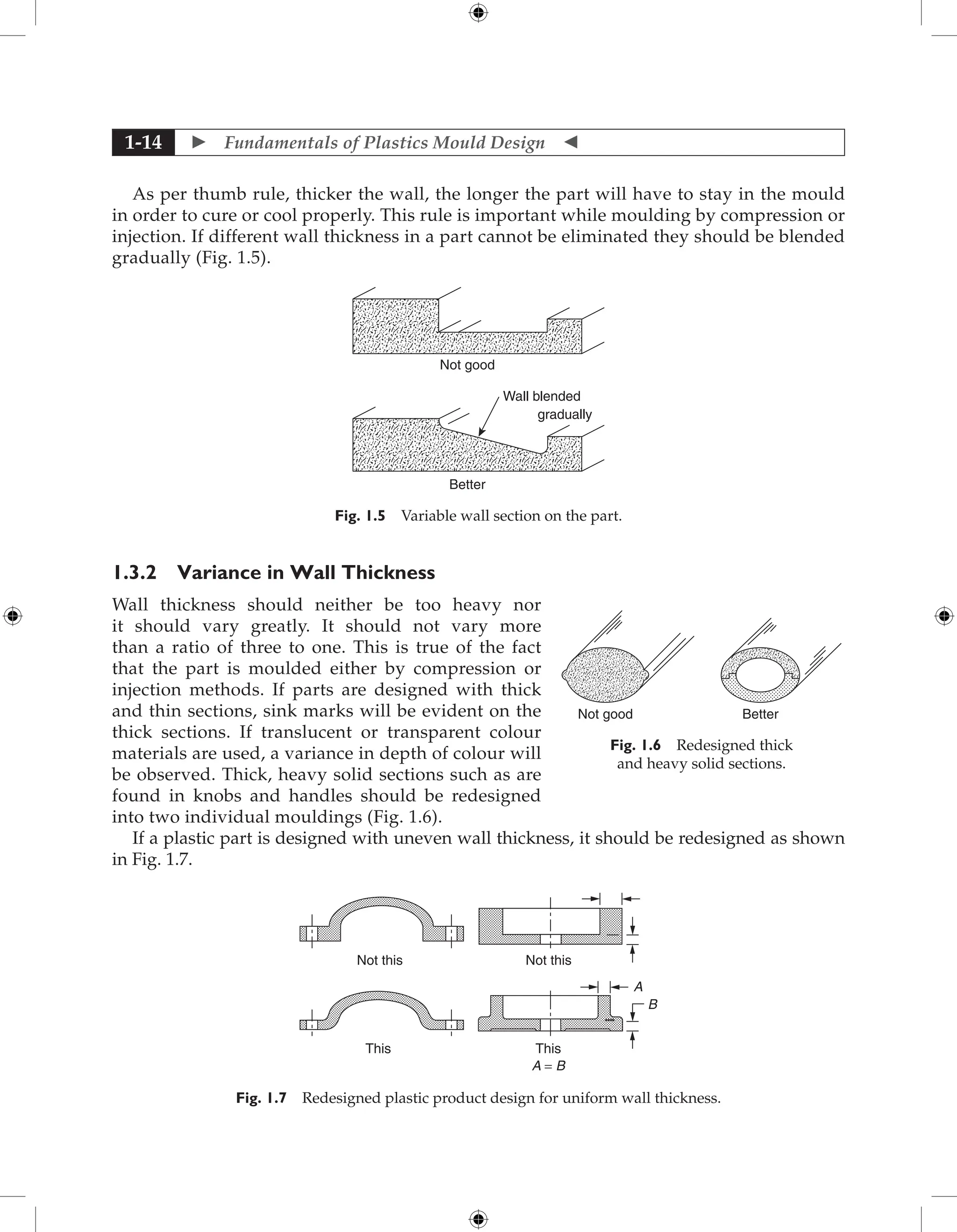
that is identified by the cross-sectional shape of the part. This is used frequently for estimating
the amount of deflection due to the bending moment or injection pressure. The moment of
inertia depends only on the cross-sectional shape of a part. Therefore, it has no relationship
with the material. For example, if the cross-sectional shape is same, the value of the moment
of inertia is also the same whether the material is a non-heat treated steel, tempered steel, or
even wood. The definition of moment of inertia according to mechanics is as follows:
โ€˜When a cross section is divided into an infinite number of differential areas dA and the
distance from one axis X is a taken as Y, the moment of inertia of area is the sum over the entire
area the product of the differential area and the square of the distanceโ€™.
๎ฃ Injection Mould Design ๎ข 2-111
This can be expressed in the form of an equation as follows:
Cross section second order moment is I = โˆ‘Y2
ร— dA unit is mm4
or m4
The moment of inertia is usually represented by the symbol I. In general, the strength against
bending becomes larger as the moment of inertia of area becomes larger. If the cross-sectional
shape is rectangular or circular, the basic equation for calculation becomes clear.
Table 2.18 Moment of inertia and modulus of Section - I.
Cross section shape Moment of inertia area modulus of section Z
b
h
I
bh
=
3
12
Z
bh
=
2
6
a
a
I
a
=
4
12
Z
a
=
3
6
Table 2.19 Moment of inertia and modulus of Section - II.
Cross section shape Moment of inertia area modulus of section Z
r
d
r
I
d r
= =
p p
4 4
64 4
Z
d r
= =
p p
3 3
32 4
d
d
1
d
2
t
d d
I t
=
-
=
p
p
( )
4
1
4
3
64
8
Thin wall dm
i
Z
d dr
d
Z t
=
-
=
p
p
( )
4 4
2
32
4
Thin wall dm
i
2.8.5โ€ƒThermal Expansion of Mould Components
The basic knowledge about the thermal expansion of components in the moulds for plastic
injection moulding is discussed below:
In the case of a mould for plastic injection moulding, the appropriate cavity surface
temperature, should be maintained at 30 to 150ยฐC. On the other hand, molten plastic flows
into the sprue, runner, and cavity, which receive heat from the plastic at temperatures in the
range of 180 to 300ยฐC. Metals generally undergo thermal expansion when the temperature
rises. Therefore, even the constituent parts of a mould for plastic injection moulding undergo
thermal expansion. Thermal expansion can disrupt the mating between the guide post and
guide bush, or can cause bad movement of the slide core, or can enlarge the dimensions of the
core pins. The basic changes in the dimensions due to thermal expansion can be calculated
using the following equation:
ฮ” = a lo (Tโˆ’Ta)
Square
Rectangle
Circle
Hollow circle
๎ฃ Fundamentals of Plastics Mould Design ๎ข
2-112
where ฮ” is the expansion (in mm) in the dimensions expected to thermally expand, a is the
linear thermal expansion coefficient (mm/mm) of the metal, lo is the initial length (mm), t is
the initial temperature (ยฐC), and Ta is the temperature after heating.
The linear thermal expansion coefficients for typical metallic material used in moulds are
given below:
Table 2.20 Linear thermal expansion coefficient.
Material a Linear thermal expansion coeff. (mm/mm)
S50C 11.7 ร— 10โ€“6
SKD11 11.7 ร— 10โ€“6
Prehardened steel (SCM440 series) 11.5 ร— 10โ€“6
18-8 Stainless steel (17~18) ร— 10โ€“6
36% Nickel steel 0.9 ร— 10โ€“6
Super duralumin 23.4 ร— 10โ€“6
Brass (18~23) ร— 10โ€“6
Copper 16.5 ร— 10โ€“6
Thermal expansion examples Let us see a case study about the thermal expansion of mould
components described in the last course. The overall length of a core prepared in a 27ยฐC was
26.43 mm. When this core is heated to 162ยฐC, how long is the amount of thermal expansion?
The material of the core is prehardened steel of the SCM440 series.
Sample answer The equation for calculating the thermal expansion of metals is the follow-
ing:
Let us substitute the values in this equation.
ฮ” = a lo (Tโˆ’Ta)
where ฮ” is the elongation (mm) of the core pin due to thermal expansion anda is the linear
thermal expansion coefficient of the metal (mm/mm). In the case of a pre-hardened steel,
a = 11.5 ร— 10โ€“6
mm/mm
lo is the initial length of the core pin (mm)
lo = 26.43 mm
T is the initial temperature (ยฐC), T = 27ยฐC
Ta is the temperature after heating (ยฐC), Ta = 162ยฐC.
Therefore, ฮ” = 11.5 ร— 10โˆ’6
ร— 26.43 ร— (162โˆ’27) = 0.04103 (mm).
๎ฃ Injection Mould Design ๎ข 2-113
2.8.6 Deflection Calculation
To calculate the deflection in guide pillar when it receives the weight of a mould base plate on
its one end. The pillar may deflect at the end due to a large amount of bending moment. To
choose right diameter on the base of its length, this deflection is due to the weight of mould
base plate. Refer to Fig. 2.168 given below:
Stopper
bolts Puller bolts
W W2
Support
pin
support pin collars
Cavity
Fig. 2.168 Assembly of guide pillar.
In three-plate-type mould, minimum load is from weight of stripper plate and cavity plate,
with simple calculation of deflection from strength of material, the following formula can be
used for getting approximate value of deflection.
Mmax = Wl
dmax =
Wl3
dmax
3EI
M
l
W
W l
Fig. 2.169 (a) Bending of core pins due to injection pressure.
The basic equations for calculating the bending deformation of core pins due to the injection
pressure are explained. In injection moulding, due to high filling pressure inside the cavity, the
core pins, insert pins and long thin parts may get deflected which may cause accidents. The
force acting on the pins depends upon the flow pattern of the molten plastic in the mould.
1. When a concentrated load acts upon the tip of the core pin
ฮดmax =
W l
EI
3
3

Here, d max is the maximum amount of bending (cm), W is the concentrated load (kgf), E
is the longitudinal elastic modulus (kgf/cm2
), and I is moment of inertia of area (cm4
).
2. When a uniformly distributed load is assumed to act on the side surface of the core
pin
๎ฃ Fundamentals of Plastics Mould Design ๎ข
2-114
dmax =
W l
EI
4
8
where W is the uniformly distributed load (kgf/cm2
)
Core plate
Packing plate
Mould plate
F=5 kgf
L=35 mm
B=12 mm
h=2.5 mm
Fig 2.169 (b) Placing of core insert.
2.8.7 Procedure for Determining the External Dimensions of a Cavity
Step 1: Calculating the minimum wall thickness
A cavity is the external shape of the product which is machined inside a block of steel material,
with the thickness โ€˜hโ€™ of the wall. The steel material between the shape of the moulded product
and the external shape of the block has a certain thickness. The thickness will be selected to
withstand deformation due to the filling pressure of the plastic. It is possible to obtain the
recommended value of this thickness by theoretical calculations by applying the equations of
the field of strength of materials.
The appropriate equation should be selected on the basis of cavity machining.
1. The external shape of the cavity (cubical or cylindrical).
2. The structure of the cavity (unified or separated).
t
P I A
E b
= 3
5
32
4
ร— ร— ร—
ร— ร— ร—d max
Here, p = Injection pressure
A = Area of the wall
E = Modulus of elasticity of steel material
b = Width of the wall
l = Length of the wall
๎ฃ Injection Mould Design ๎ข 2-115
The data is substituted in the equation and the thickness of steel material is determined. A
margin of safety is also considered for the value of โ€˜tโ€™ obtained by the calculation.
Step 2: Cavity
After the calculation of t at the time of fixing the cavity to the mould plate, some flange
is provided or to make some extra space for drilling hole for the screw, etc. In such cases,
dimensions should be determined so that any one of these can be placed, and the final cavity
dimensions are determined using even integer numbers that are round numbers (for example,
50 mm, 80 mm, etc.).
X
h
Flange
h
Hole for the fixing screw
h: Minimum wall thickness to ensure
that the mould does not break
Fig. 2.170 Cavity wall thickness.
Cavity wall thickness, examples
Let us assume
Two no. of cavities and the cavities sizes are 50 mm long, 60 mm wide and 40 mm deep,
Projected area = 5 ร— 6 = 30 cm2
Projected area of runners and sprue = 3 cm2
(10% of total projected area)
Tons capacity = 2(30 + 3) ร— 700 /1000 = 46.20 ton,
Here, 700 kg/cm2
is assumed injection pressure at the tip of nozzle. (1/2 of injection pressure
in hydraulic cylinder)
For this tonnage next tonnage which is available = 80 tons
For the 80 tons
Contact area of the cavities = 80 ร— 1000/allowable stress = 80000/700 = 114.3 cm2
๎ฃ Fundamentals of Plastics Mould Design ๎ข
2-116
Area for one cavity = 57.15 cm2
and as per the figure
2 ร— 5 ร— T + 2 ร— 4 ร— T + 4T2 =
57.15
4T2
+ 18T โ€“ 57.15 = 0
So, T = 21.48 mm
Second method
The fluid pressure that would be exerted on the 50 mm long, 40
mm deep cavity blocks
= 5 ร— 4 ร— 1400 = 28,000 kg (1400 kg/cm2
is the injection pressure)
Now with the strength of material
The deflection = W l3
/192 E I
Here w = 28,000 kg, l = 50 mm, E = 2x 10⁶
kg/cm2
, I = bt3
/12
For the cavity, more 0.02 mm deflection is not acceptable to receive flash free sample.
0.002 = 28,000 ร— 5 ร— 5 ร— 5/192 ร— 2000000 ร— I
So I = 28,000 ร— 125 /192 ร— 2000000 ร— 0.002
I = 4.55 cm3
= bt3
/12
t3
= 12 ร— 4.55/4 = 13.65
t = 23.9 mm
By the above two methods cavity wall thickness can be calculated.
2.8.8 Guide Pillar Diameter Calculation
The guide pillar can be assumed as a beam which is fixed at one end and free at other end. The
deflection as per strength of material is given below.
ฮ” = Pl3
/3EI
Fixed Load of stripper and cavity
plate
Guide pillar
Cavity wall
thickness
๎ฃ Injection Mould Design ๎ข 2-117
For this equation,
P = Weight of floating plate,
L = Length of guide pillar = 150 mm (assume)
E = Modulus of elasticity = 2.1 ร— 106
kg/cm2
I = Moment of inertia = p d4
/64
Let us assume that the size of floating plate is 246 ร— 246 ร— 18. Then
Weight of plate = 8.6 kg (approx.)
There are four pillars. So each pillar withstands equal load.
Load on one pillar = 2.15, d = diameter of guide pillar
The deflection should not be more than 0.02 mm
ฮ” = Pl3
/3EI = 2.15 ร— 150 ร— 150 ร— 150 ร— 64/3 ร— 2.1 ร— 1000000 ร— p ร— d4
d4
= 2.15 ร— 150 ร— 150 ร— 150 ร— 64/3 ร— 2.1 ร— 1000000 ร— p ร— 0.002
d = 18.51 mm which can be compared with the actual guide pillar.
2.8.9โ€ƒChecking of Floating Stripper Plate Weight on Guide Pillar
As the guide pillar is fixed at one end and free at other end so the maximum deflection at the
free end
ฮ” = Wl3
/3EI
where
W = Weight of the stripper plate = l(length) ร— w(width) ร— h(height) ร— 7.85 units
7.85 g/cc is taken as density of steel material
For the stripper plate of size 246 ร— 246 ร— 26 mm3,
the weight would be 12.35 kg
l = Length of guide pillar = 106 mm (assume)
E = Modulus of elasticity = 2.1 ร— 106
kg/cm2
I = Moment of inertia for guide pillar = pD4
/64 = 1.149
where D = Diameter of guide pillar = 22 mm
ฮ” = Wl3
/3EI = 12.35 ร— 10.6 ร— 10.6 ร— 10.6/3 ร— 2.1 ร— 1000000 ร— 1.149
ฮ” = 0.0020 = 0.02 mm which is up to certain level acceptable.
2.8.10โ€ƒThickness of Steel Material Between Plastic Material and
Cooling Channel
Thickness of steel material between plastic material and cooling channel (L) can be calculated
by referring to the figure. Here it is considered as a fixed beam at both end and load at the
centre is considered as the strength of material.
The deflection at this point where the cooling channel is made
โˆ‚ = Wl3
/192EI
The hydraulic pressure exerted in the cylinder is approximately 1400 kg/cm2
๎ฃ Fundamentals of Plastics Mould Design ๎ข
2-118
and the pressure drop inside the cavity is about 350 kg/cm2
So the pressure inside the cavity will be 1050 kg/cm2
W = LOAD on 1cm2
of hole opening = 1050 kg
L = Minimum distance between cooling channel and the cavity wall
b ร— l = 1cm2
l = length of the beam = diameter of the channel (D)-0.8 cm
b = 1/D = 1/D
E = 2.1 ร— 106
kg/cm2
I = bh3
/12 = bL3
/12
โˆ‚ = 0.0002 mm = 0.00002 cm
0.00002 = 1050 ร— D3
/192 ร— 2.1 ร— 106
ร— (L3
/12D)
0.00002 = 1050D4
/33.6 ร— 106
L3
672 L3
= 1050 D4
L3
= 1050 D4
/672 = 1.5625 D4
= 0.254D
L = 1.1604 D 4/3
Here if D = 0.8 cm, L = 0.86
Cooling channel
Cavity
surface
Distance
If D = 1.2cm, L = 12 so the steel material thickness should be equal to the diameter of water
channel.
2.8.11 Spacer Block Design
Most attention is the contact area of the spacer block. The stress on the area of spacer block
should be such as to prevent the embedding of the blocks into the plates. Actually the weak
area in the spacer block is at the clamping slot area. Sometimes, in the spacer block, no slot is
provided. The area of the block is a ร— b and width of the slot is w given in the
block is w.
The effecting area = (aโˆ’w) b with slot and a ร— b without slot, there are two
blocks
Area ร— Allowable stress = Compressive force
The allowable stress for low carbon steel is 1400 kg/cm2
๎ฃ Injection Mould Design ๎ข 2-119
So the compressive force = 1400b (aโˆ’w) with slot
= 1400ab without slot
This will be compared with the force comes to the spacer block due to injection pressure. Let
us assume that w is the injection force applied on the cavity.
The load/force comes on the spacer block which is explained by the line diagram = w/2
So w/2 = 1400b (aโˆ’w) or 1400ab, from here a can be calculated.
2.8.12 Flow Length/Wall Thickness Ratio
Another criterion pertaining to the machine is the ratio between flow length and wall thickness.
According to Hagenโ€“Poiseuilleโ€™s law, the ratio between flow length L and the square of the
wall thickness of the moulding H2
is determined by the injection pressure Pinj, quantity of the
machine, and the viscosity of the melt, if the velocity of the melt flow is given.
For thermoplastics there are certain optimum values for the velocity which are determined
by the orientation, to which the molecules are subjected. They are around Vinj 30 cm/s.
2.8.13 Sprue Bush Pressure Drop
Pressuredrop
1
(Area at external pathway)
1
(Area at internal pat
2
a -
h
hway)2
As per the above sprue bush, the molten plastic material enters into the sprue bush
So as per the Bernoulis theorem
P1/Y + V1
2
/2g + Z 1 = P2/Y + V2
2
/ 2g + Z2 + losses
As per above equation
2
1
Let us consider losses are negligible and during processing Z 1 and Z 2 are equal
P1/Y + V1
2
/2g = P2/Y + V2
2
/ 2g
(P1 โ€“ P2 ) /Y = (V2
2
โ€“ V1
2
) / 2g
As per continuity theorem
Q = A1V1 = A2V2; V1 = Q/A1 and V2 = Q/A2
A1 = p /4d1
2
and A2 = p /4d2
2
By placing the values of A1 and A2, we may prove that
๎ฃ Fundamentals of Plastics Mould Design ๎ข
2-120
Pressure drop
1
(Area at external pathway)
1
(Area at internal pat
2
a -
h
hway)2
2.8.14 Design of Step Ejector Pin
The critical force that will cause buckling of the ejector pin can be calculated as follows:
P = 2p 2
EM/l2
where P = Critical load (Kg), E = Modulus of elasticity (Kg/cm2)
M = Moment of inertia (cm4
), and l = Critical length (cm)
And stripping force which is required for the stripping of the moulding from the core
d1
d2
I
I1
Iโˆ’I1
For the ejection;
Stripping force = P = 2 p 2
EM/l2
= 2p 2
E p d4
/64l2
= p3
Ed4
/32l2
Stripping force = P = (St ร— E ร— A ร— f p) / [d ร— (d/2tโˆ’d ร— Pp/4t)]
St = Coefficient of thermal expansion ร— temperature difference between softening point and
ejection temperature ร— d (cm)
E = Elastic modulus (kgf/cm2
)
A = Total area of contact between moulding and mould faces in line of draw (cm2
)
f p = Coefficient of friction between plastics and steel
d = Diameter of circle of circumference equal to length of perimeter of moulding
surrounding male core (cm)
t = Thickness of moulding
Pp = Poisson`s ratio of plastics
In the step pin, the diameter (d1)of the portion which is in contact with the plastic material is a
known quantity as per the wall thickness of moulding. We have to calculate the length (l1) of
this portion that can be done by placing d1 and find the length l1from the above equation.
After finding l1 from the above equation, the diameter of other portion d2 of the step pin can
be calculated by placing length of this portion l2 (total length โ€“ l1) in the above equation.
2.8.15 Heaters
The calculation is done to calculate number of heaters required for manifolds
Manifolds dimension is a ร— b ร— c
๎ฃ Injection Mould Design ๎ข 2-121
Now it is required to come up the manifold up to temperature to 30 min. The processing
temperature is tยฐF and the starting point is TยฐF (preheat temperature)of plastics material.
1. Required capacity for bringing the job up to operating temperature in the desired
time
Q = m cv d t
where Q = Heat content in kcal per hr, m = Weight of manifold = abc โˆ‚ units
cv = 
Specific heat of manifolds material = 0.12 (generally for steel), d t = Temperature
rise (T- t1), โˆ‚ = Density of manifolds material.
So,
Q1 = a ร— b ร— c ร— s ร— cv ร— (T โ€“ t1) units /hr.
2. Heat loses at processing temperature
		 a) Heat loss by radiation and convection
The exposed area = 2(bc + ac) units
Heat loss by radiation Q2 = s Aโ‚ฌ{(t + 273)4
โ€“(t1
4
โ€“ 273)}units per hr.
Here s = Stefan Boltzman constant = 5.76 ร— 10โ€“12
, A = Exposed area, โ‚ฌ = Emissivity,
t = Processing temperature and t1 = Room temperature in Kelvin
Heat loss by convection Q3 = h A(tโ€“t1) units per hr
Here h = Heat transfer coefficient, A = Exposed area,
3. Losses by conduction through insulation Q4 = kA (t โ€“ t1) units per hr.
where A = Conduction area (area of contact with the plates) = 2ab
K = Thermal conductivity of insulation material
4. Heat required for plastic material
Q5 = m1 cv1 d t
where m1 = Weight of plastic material, cv1 = Specific heat of plastics material,
d t = (tโ€“T)
Total heat required = (Q1 + Q2 + Q3 + Q4 + Q5)kcal per hr
Kilowatt = (Q1 + Q2 + Q3 + Q4 + Q5)/867
As per the above we may decide the number of heaters required for manifolds.
2.8.16 Determining the Economical Number of Cavities
Determination of the Number of Cavities in Moulds with Economical Way.
Let us assume that
1, 00,000pcs = n = The total number of parts are required by the party
X = Number of mould cavities to be fabricated
r = 15% of wages/hr = Overhead cost
w = Rs. 25 per hour = Wages of the workers
A = Production and maintenance cost of one cavity = 10,000/-
B = Production cost of mould casing
T = Cycle time = 60 second
๎ฃ Fundamentals of Plastics Mould Design ๎ข
2-122
S = Total manufacturing cost of the parts
By the above we may conclude that
No. of cycle required = n/x
Total time required = n T/x seconds = nT/60 x minutes
Total worker cost with overhead = n T w(1+r)/x
So S = {nT The temperature difference between mould plates and other plates from platen
side or platen w(1 + r)/60x} + Ax + B
This is the equation for the total cost of the parts. By differential calculation we try to get the
very economical number of cavities by assuming minimum manufacturing cost. For getting
this differentiates the equation with respect to x.
d/dx(S) = d/dx[{nTw(1+r)/60x} + Ax+B]
		 = d/dx[{nTw(1+r)/60x} + d/dx (Ax) + d/dx (B)]
		 = d/dx{nTw(1+r)/60x} + A
		 = d/dx{nTw(1+r)x-1
/60} + A
		 = -nTw(1+r)xโ€“2
/60+ A = 0
A = nTw(1 + r)xโ€“2
/60
x2
= nTw(1 + r)/60A
x = โˆšnTw(1 + r)/60A by putting the values
x = โˆš{1,00,000 ร— 60 ร— 25(1+0.15)/60 ร— 10,000}
x = 16.9 = 16 number of cavities
For the above data, 16 is the economical number of cavity. Now we have compared the
number with the technological number of cavity. Whichever is less, we have to design the
mould for that number.
2.8.17โ€ƒCost Reduction through Design Arrangement
1. Cost of the mould: The cost of a particular mould is expensive. To reduce the cost of the
mould, it would be better to go for multicavities injection mould by which the cost of one
product can be reduced. Take one example.
2. By the production of large quantities: The approximate cost of a mould that may make a
lunch box moulding may be Rs. 50,000 to Rs. 1,00,000. The capital cost is of course expensive
but consider that a single mould may produce ten lakhs of mouldings. Therefore, the unit cost
of each moulding can be very low because they are manufactured in such large quantities.
3. By the fabrication of multi-impression mould: DME can be further reduced by fabricat-
ing the mould in multicavities. In multicavities mould the cost of mould is increased by 1.4 to
1.5 times but the production cost is reduced due to number of cavities per cycle time.
4. By the fabrication of family type of mould: The mould cost is also reduced by fabricating
family type of mould.
5. By quick change insert system: By fabrication of one mould with different type of its
insert, cost of the mould can be reduced by quick- change tooling systems. These kits offer
๎ฃ Injection Mould Design ๎ข 2-123
inserts to modify existing moulds rather than making new ones every time. This has also re-
duced the setting up times of the injection moulding machine. This is called the quick change
injection moulding technique.
2.8.18 Effect of Draft on Design
For easy removal or movement of one part from another, it is required to provide the draft in
the mould parts like sprue bush, core and cavities, etc. These drafts are used to give proper
and easy movement to the parts.
Like in sprue bush, the draft is provided for easy ejection of sprue from sprue bush. In sprue
bush 1.5ยฐ to 3ยฐ angle draft is generally given. Same way in deep core or cavities, the draft is
provided as per the depth of the components.
2.9 Split Mould
2.9.1 Introduction
This mould is used for the components which have projection or undercut on the surface
of component. Due to this projection undercut, the component cannot be ejected from the
mould. Actually, recess or projection of component prevents its removal from the cavity. That
can be removed only by the opening of half cavity on either direction as shown in the Figs.
2.171 and 2.172. (In closed and opened conditions of split) split mould is used for this type of
components. In this type of mould two blocks are guided together and are kept it with perfect
matching by using locking heels during injection and it is called split mould. It is required
to split the cavity insert into parts and open at right angles to the line of draw, to relieve the
undercut before the moulding is removed. Aparting line can be visible on the components due
to the matching of split blocks. For perfect matching and opening and closing of the split, the
splits are fixed in guide rails on a flat mould plate and they are actuated by some mechanism.
The splits are possible to mount on either the moving or fixed mould plate. A screw-threaded
component or undercut/recess component is shown in Fig. 2.171.
Parting
line
Joint line
Parting line
Joing line
Fig. 2.171 Split moulding.
๎ฃ Fundamentals of Plastics Mould Design ๎ข
2-124
Mould plate Guide strip
Split block
Fig. 2.172 Split in closed and open position.
2.9.2 Guiding and Retention of Splits
The guide rail shown in Fig. 2.173 and assembly of
splits are shown below in the Fig. 2.174.
Clearance
Clearance
Slide
fit
Clearance
Clearance
Slide fit
Split
Slide
fit
Clearance
Split
Split
Fig. 2.174 Split block with assembly of splits.
2.9.3 Split Mould Design Requirements
1. Amount of splits movement required.
2. Amount of delay period and length of delay period required.
Fig. 2.173 Guide rail.
๎ฃ Injection Mould Design ๎ข 2-125
3. Whether moulding inserts are to be incorporated or not.
4. Whether the available machines are programmed for ancillary cylinder control or
not.
5. Whether a short or long production run is required.
2.9.4โ€ƒTypes of Split Mould Actuation Methods
1. Finger cam actuation method
2. Dog-leg cam actuation method
3. Cam track actuation method
4. Hydraulic actuation method
5. Spring actuation system
6. Angled-lift splits.
1. Finger Cam Actuation Method: Mould has a linear motion due to machine platen. In this
method, for the operation of split on guide rail, the linear motion of mould half is used to
change the direction of motion for split opening. This is done by using a round bar fixed at an
angle with fixed mounting plate or fixed half of the mould. The round bar is called finger cam
which is made out of hardened and tempered tool steel.
Moulding Finger Cam
Split
Fig. 2.175 Split actuation.
As the mould opens, the finger cam first comes in contact with the split hole wall and forces
the split to move outwards and sliding on the mould plate as per the guide rail provided
on the cavity plate. Once the contact with the finger cam is lost, the splitโ€™s movement stops
immediately. After required opening of the moving half, the ejector system operates and ejects
the moulding as shown in the Fig. 2.175. On closing of the mould, the reverse action occurs.
The finger cam re-enters the hole in the split and forces the split to move inwards. The final
closing of the splits is achieved by the locking heels and not by the finger cams as the finger
cam is assembled in the free hole of split. The finger cam movement can be computed by the
formula: M = (L sinq) โ€“ (C / cosq).
๎ฃ Fundamentals of Plastics Mould Design ๎ข
2-126
C
L
Split D
M
Fixed mould plate
q +5ยฐ
q
Fig. 2.176 Finger cam pin actuation.
If the required movement is known from the amount of component undercut, the following
formula is used to determine the finger cam length.
L = (M / sinq) + (2C / sin 2q)
where M = Split movement
q = Angle of finger cam (10โˆ’25ยฐ)
L = Working length of finger cam
C = Clearance
The clearance โ€˜Cโ€™ provides for
1. No direct force on finger cam pin.
2. Permits to open the mould to open a predetermined amount before the splits are actu-
ated.
3. The amount of delay (movement โ€˜Dโ€™) before the splits are actuated is determined by
the formula: D = C/sin q
The finger cam angle is generally selected from 10ยฐ to 25ยฐ. If the mould height is higher, long
finger cam is required and hence, the angle can be increased up to 25ยฐ. For actuating small
splits, a finger cam diameter of 13 mm is suitable, but for large splits or where greater than 10ยฐ
angle is used for split, the diameter should be increased accordingly. The lead-in angle at the
front end of the finger cam is taken normally (q + 5ยฐ) which allows the re-entry of the finger
cam into the splits.
Calculation of finger cam pin diameter: For a finger cam operation, the diameter of finger cam can
be calculated as follows:
Finger cam is a member which is fixed at an angle (20ยฐ with vertical) at one place and free at
other end. The finger cam passes through the split hole for giving the movement to split.
Let us assume that the weight of split = w
Forthemovementofsplit,theforceonfingercam(at70ยฐwithfingercam)=ยตwwherethecoefficient
of friction between split and base plate and this load is uniformly distributed on the finger cam
๎ฃ Injection Mould Design ๎ข 2-127
The actual load which will cause to bend the finger cam = ยตw sin 70
As per the strength of material the maximum deflection in the finger cam
ฮ” = 
Wl3
/8EI, where w = Load on finger cam = ยตw sin 70, l = Length of finger cam,
E = Modulus of elasticity and I = Moment of inertia for finger cam = pD4
/64
(D = Diameter of finger cam)
Here the deflection should not be more than 0.02 mm after substituting the values,
ฮ” = 
0.3 ร— 12.5 ร— sin70 ร— 15 ร— 15 ร— 15 ร— 64/8 ร— 2.1 ร— 1000000 ร— 3.14 ร— D4
here we have
assumed Weight of split = 12.5 kg,
ยต = 0.3(as per the web site)
E = 2.1 ร— 1000000, length of finger cam- 150 mm
D4
= 0.3 ร— 12.5 ร— 0.969 ร— 15 ร— 15 ร— 15 ร— 64/8 ร— 2.1 ร— 1000000 ร— 3.14 ร— 0.002
D = 16.15 mm
2. Dog-Leg Cam Actuation: It is also one type of actuation which is similar to finger cam.
In the place of round bar of finger cam, the cam of dog-leg cam is in the shape of rectangular
section and fixed with the mounting plate. In this type of cam actuation, the delay period
is decided on the basis of eccentric length of dog-leg cam and
it is more when compared to finger cam. Each split having a
rectangular hole allows entering the cam for actuating inward
movement of the splits.
The dog-leg cam actuation system is shown in Fig. 2.178. The
mould is in closed condition and the splits are locked together by
the locking heels of the fixed mould plate. As the mould opens, no
movement will be in the split on either direction which is known
as delay action of the split. After sometime, the splits cause a delay
period to start open when the mould halves are parted because of
the straight portion of the dog-leg cam. The moulding, which is
made within the splits, will thus be pulled from the stationary core.
Dog-leg
cam pin
Straight portion
for delay time
Fig. 2.177 Dog-leg cam.
Locking heel
Splits
Fixed mould
core
S
Splits closed position
Fig. 2.178 Dog-leg cam actuated closed
split mould.
Moulding
Stationary
core
Dog-leg cams
Splits opened by dog-leg cam
Fig. 2.179 Dog-leg cam actuated opened split mould.
๎ฃ Fundamentals of Plastics Mould Design ๎ข
2-128
Further movement of the mould half causes actuation of the splits by the dog-leg cams, thereby
releases the moulding shown in Fig. 2.179. The reverse action occurs when the mould is closed.
The cross section dimensions of a dog-leg cam are 13 mm by 18 mm and the angle q is 10ยฐ to 25ยฐ.
The relevant formula for calculating the opening movement, the length of cam, and the
delay period are given by
M = La tan q โ€“ C, La = (M + C)/ tan q, D = (Ls โ€“ e) + (C/tan q)
where M = Movement of each split, La = Angled length of cam, Ls = Straight length of cam,
q = Cam angle, C = Clearance, D = Delay, e = Length of straight portion of the hole.
e
q
A
Core
Sleeve
Cavity insert Splits Cavity insert
Fixed mould
plate
Core
Z
Moulding
C
S
S
Dog-leg cam pin
S
D
M
La Ls
Fig. 2.180 Dog-leg cam actuated mould.
3. Cam Track Actuation: For getting more delay, cam track actuation method is used. In this
method, the cam is fixed outside of the mould. The cam track (Fig. 2.181) is machined into a steel
plate, attached to the fixed mould half.Aboss fitted to both sides of the split runs in this cam track.
The movement of the splits is accurately controlled by specific cam track design shown in Fig.
2.182. A radius or taper should be provided at the entrance for the boss as it re-enters the track.
The splits are mounted on a mould plate and the bosses are fixed into the side faces of the
split, projected into the cam track plates. A clearance of 1.5 mm is provided between the cam
track plate and the moving mould half. The permissible angle of the cam track plate is between
10ยฐ and 40ยฐ. The formula for calculating the distance required for each split, the length of cam
track, and the delay period are as follows:
M = La tan q โˆ’ c
๎ฃ Injection Mould Design ๎ข 2-129
Cam track
Fig. 2.181 Cam track plate designs.
Moving
plate
Split Dowel
Fixed side
plate
Cam track
plate
1.5
Fig. 2.182 Assembly of cam track actuation closed point.
L
M c
D L
c
r
a
a
=
+
= + +
๏ฃซ
๏ฃญ
๏ฃฌ
๏ฃถ
๏ฃธ
๏ฃท
tan
tan tan sin
q
q q q
1 1
-
where M = Movement of each split
La = Angled length of cam track Ls = Straight length of cam track
q = Cam track angle, 10 โ€“ 40ยฐ c = Clearance, 1.5 mm
D = Delay r = Radius of boss
La Ls
M
q
C
Fig. 2.183 Cam track actuation.
4. Hydraulic Actuation: In this method,
(a) The splits are actuated by hydraulic mechanism.
(b) Thehydraulicactuationsystemisusedfordesignoflargeshapesplitmouldยญ
components
as more locking force is required to keep the splits closed during the injection phase.
(c) In this case, more delay movement and large split movements can be achieved.
๎ฃ Fundamentals of Plastics Mould Design ๎ข
2-130
(d) The splits having a projection on the underside to which the ram of the hydraulic
actuator is attached.
(e) The hydraulic actuator is fitted in a mounting plate, which is fixed to the side wall of
the mould plate.
(f) The splits are closed by the locking heels of the chase bolster.
(g) To reduce the cycle time, the splits should be opened while the mould is opening.
(h) On return strokes, the splits should be closed before they re-enter inside the chase bol-
ster of the mould shown in Fig. 2.184.
mounting plate
Chase
bolster
Splits
Ram
Hydraulic
actuator
Mould
plate
Fig. 2.184 Hydraulic actuation.
Disadvantages
(a) The mould is more bulky when compared with the other designs and makes the mould
setting more difficult.
(b) The hydraulic system has to be connected each time when the mould is set up.
(c) Mould cost is high.
5. Spring Actuation: Sequence of operation:
(a) First, the chase bolster holds the splits during the injection phase.
๎ฃ Injection Mould Design ๎ข 2-131
(b) The compression springs exert a force to split
halves immediately when the mould starts to
open.
(c) The stud reaching the end of the slot in the
mould plate stops the split movement.
During the closing stroke, the splits re-enter the
chasebolsterandareprogressivelyclosed.Theformula
for calculating the splits opening movement is
M = ยฝ H tan q
where M = 
Movement of each split
(approximately M = 0.2 H)
H = Height of locking heel
q = Angle of locking heel
A suitable angle for the locking heel is 20ยฐ to 25ยฐ.
The splits open immediately the mould parts
without any delay period and the moulding remains
in the moving half so that it can be positively ejected. It is advised to provide one stud per split
which is under 76 mm width.
Ejector plate
backward position
Splits closed Splits open
Ejector plate
forward position
Fig. 2.186 Angled lift splits.
6. Angled-Lift Splits: In this system, the splits are mounted in a chase-bolster, and it is opened
by moving out an angular pin of which one part is attached with ejector plate and second part
is fixed with split of the mould, which relieves the undercut
portion of the moulding as shown in the Fig. 2.186. The
alignment of the split is accomplished by their being seated
in the chase-bolster.
Angled guide dowel actuating system In this design, the guide
dowels are fitted at an angle to the underside of each split.
These guide dowels are passed through holes machined at
an angle in the chase-bolster. When the ejector system is
actuated, the relative movements between the ejector plate
and the enclosed chase-bolster cause the guide dowels to
Chase
bolster
Studs Splits
Compression
spring
Mould plate
Lower mould
plate
Fig. 2.185 Spring actuation.
Ejector system Guide dowels
Split
Chase
bolster
Wear
strip
Fig. 2.187 Actuation of angle lift.
๎ฃ Fundamentals of Plastics Mould Design ๎ข
2-132
move forward at an angle corresponding to the splits. They
open as shown in Fig. 2.188.
A convenient angle for the guide dowel is 10ยฐ but this
may be increased if large opening movement is required.
The opening movement of each split is computed from:
M = E tan q
where E = Effective ejector plate movement
q = Guide dowel angle
2.9.5 Side Cores
It is a local core, which is generally mounted normal to the mould axis for forming a hole or
recess in the side of a moulding. This side core prevents the in-line removal of the moulding
and some means must be provided for withdrawing the side core prior to ejection.
Internal side core assembly In this design, the side core is fixed in a T-shaped slide block
(carriage) which is mounted on guides, now as per same principle during opening of the
mould, due to cam actuation, the slide block is moved with side core pin, relieved the compo-
nents. The slide block is locked in the forward position by the locking heel.
Types of actuation The internal side core assembly can be actuated by means of
1. Finger Cam for short delay, the length of finger cam depends on the relieving move-
ment of side core pin
2. Dog-leg cam actuation
3. Spring actuation
1. Finger Cam Method: The finger cam method is already discussed in the previous topics
in detail.
2. Dog-Leg Cam Method: The dog-leg cam method is already discussed in the previous
topics in detail.
Side core
element
Moulding
Wear plate
Dog-leg cam
Carriage
Retaining plate
Fixed mould
plate
Moving mould
plate
Guide strips
Fig. 2.189 Dog-leg cam method of actuating side core assembly.
Spring
q
Fig. 2.188 Actuation of angle lift.
๎ฃ Injection Mould Design ๎ข 2-133
3. The Spring-Loaded System: It is an operating method confined to moulding has very
shallow undercuts or projections. As shown in Fig. 2.190, a stud is fixed to the underside of the
split block and it is accommodated in a slot machined in the mould plate.Aspring or springs are
fitted to the slot and cause the side core assembly to withdraw the mould opens immediately.
The locking heel is used to progressively return the assembly when the mould is being closed.
M
Spring
Slot portion Stud Mould plate
Carriage
assembly
Side core
Component
Fig. 2.190 Spring loaded system for actuating side core assembly.
2.9.6 External Undercuts
Threaded Splits This method is adopted when automatic production is required for an exter-
nally threaded component, where the thread form is such that it cannot be stripped. Extreme
accuracy is to be maintained while manufacturing and fitting of the splits; otherwise flashing
may occur along the joint line which impairs the efficiency and quality of the produced com-
ponent. In the case of a component which has an interrupted thread form as shown in Fig.
2.191, the joint line can be positioned on the plain section, thereby avoiding the necessity of
requiring such extreme accuracy in the fitting of the split.
A split mould with finger or dog-leg cam operation can be used for an externally threaded
component.
(a) Joint line
Fig. 2.191 Joint line on externally threaded components in splits.
(b) Joint line
Fig. 2.192 Split mould for externally threaded component.
๎ฃ Fundamentals of Plastics Mould Design ๎ข
2-134
1. Write down the advantages of gas injection mould.
2. Write down the general principle of gas injection mould.
3. What are steps involved in quality moulding?
4. How mould design depends on machine specification?
5. What is short capacity?
6. Write short notes on the following:
		 a) Guide pillar b) Guide bush
7. What are the design guide lines for proper alignment of guide pillar and guide bush?
8. How can the strength of guide pillar be calculated?
9. Write brief note on spigotted guide pillar and guide bush.
10. Draw a support pin and explain its parts.
11. Write a short note on mould lifting.
12. Why is the core fixed in the moving half of the mould?
13. How do parting lines influence moulding?
14. Name the two manufactures of standard mould base.
15. What is the significance of mould venting on mould?
16. What are the selection criteria of mould material?
17. List out the mould materials and their applications for a standard mould.
18. What are the main requirements for sleeping steels?
19. Explain the essential property of mould material.
20. Write the advantages and application of hardened steel of mould design.
21. Write the advantages and application of prehardened steel of mould design.
22. Explain the application of corrosion registrant mould steel.
23. Write short notes on the following:
		 a) Parting line b) Parting surface
24. The vents are generally provided along the mould parting line. Justify.
25. Write thumb rule of venting.
26. Describe vent placement.
27. What should be the design criteria for proper venting?
28. Define feed system.
29. Define sprue bush.
30. Explain extended sprue bush with a neat sketch.
31. Why does balancing of runner play a vital role in injection mould?
32. Define cold slug.
33. Classify runner according to their cross section. Explain with a neat sketch.
34. What do you mean by runner efficiency? How can it be calculated?
Questions
๎ฃ Injection Mould Design ๎ข 2-135
35. List out the three general types of runner layout.
36. Explain various types of runner methodology used in injection mould.
37. What is unbalanced flow?
38. Describe gate.
39. Describe the determination of location shape and size of gate.
40. What is sprue gate? Write its advantages and disadvantages with the help of a neat
sketch.
41. How is the parting line decided on the basis of edge gate?
42. Explain tap gate with a neat sketch.
43. Explain fan gate and its purpose.
44. What is rectangular edge gate? Write its three advantages.
45. Explain the following:
		 a) Film or flash gate b) Diaphragm c) Spoke gate
46. Explain the following:
		 a) Pin gates b) Submarine gate c) Curved tunnel gate.
47. Explain the following:
		 a) Hot runner gate b) Valve gate.
48. List out the factors which affect the gate size.
49. What is ejection system? Describe the parts which ejection system consists of.
50. How do you calculate the height and width of a pressure block?
51. Explain the following:
		a)Ejector plate b) Ejector retainer plate c) Knock out road d) Tie rod bolts.
52. Describe the function of bottom plate in ejector plate assembly.
53. Describe the size of ejector pin decided on basis of wall thickness.
54. Explain the following with a neat sketch.
		 a) Pin ejection b) Sleeve ejection c) Blade ejection.
55. Explain the following with neat sketch.
		 a) Valve ejection b) Air ejection
56. Explain the following with a neat sketch.
		 a) Stripper plate ejection b) Stripper bar ejection.
57. How can the ejection force requirement be calculated?
58. How can the support pillar requirement be calculated?
59. Why does mould need cooling?
60. Describe basic cooling principles and their importance to product quality.
61. Write short notes on following:
		 a) Parallel cooling channel b) Series cooling
62. How is cooling is done in integer cavity plate?
63. How is cooling done in integer core plate?
๎ฃ Fundamentals of Plastics Mould Design ๎ข
2-136
64. Why is cooling necessary in core?
65. Explain the following with a neat sketch:
		 a) Bolster cooling b) Cavity insert cooling c) Core insert cooling
66. What is the use of baffles in cooling system of a mould?
67. What is bubbler cooling? Explain with the help of a neat sketch.
68. What is the use of thermal pin in cooling system of a mould?
69. How can large cores be cooled?
70. How can slender core be cooled?
71. Explain helical channel design.
72. What are the factors on which, the operating temperature of a mould will depend?
73. Write the calculation for weight of water to be circulated per hour?
74. Draw a simple sealing and cooling channel layout?
75. What is โ€˜Oโ€™ ring? Explain its function with a neat sketch.
76. How can โ€˜Oโ€™ ring size be determined?
77. What is the design consideration for โ€˜Oโ€™ ring?
78. What is the role of water connector in mould?
79. What should a designer consider before designing of cooling pipe for cavity?
80. How can diameter of guide pillar be calculated?
81. Derive the calculation for thickness of steel materials between plastic material and cooling
channel.
82. Derive the equation for pressure drop in sprue bush.
83. Derive the equation for designing step ejector pin.
84. What is the effect of draft in mould design?
85. What design arrangement can be made in mould for cost reduction?
86. What is split in mould?
87. What are the requirements of split design?
88. List out the types of split mould actuation methods?
89. Explain the finger cam actuation method with a neat sketch.
90. Explain the cam track actuation method following with a neat sketch.
91. Explain the spring actuation system with a neat sketch.
92. Explain the angled โ€“ lift split system with a neat sketch
93. What is threaded split? Where is it used?
94. How can flank thread angle be calculated?
95. Explain hydraulic actuation method with a neat sketch.
96. Explain dog-leg cam actuation method with a neat sketch.
97. Explain the stages of injection moulding process with a neat sketch.
98. Classify the injection mould based on cavity layout, based on injection moulding process
and based on materials to be injected.
๎ฃ Injection Mould Design ๎ข 2-137
99. Draw a two-plate mould sketch and show its various parts and explain.
100. Explain the types of opening in three-plate moulds.
101. Write short notes on following:
		 a) Stepper injection mould b) Split mould
102. Write short notes on following:
		 a) Collapsible core and Cavity mould b) Hot runner mould
103. Draw a schematic diagram of stack mould and explain.
104. How are number of impressions calculated in injection mould?
105. Describe the types of locating with a neat sketch.
106. What rules should a designer follow before designing a locating ring?
107. Explain the mould clamping methods.
108. List out the checking points before starting assembly of a mould.
109. Explain standard mould base and list out its advantages and limitations.
110. Describe the materials and heat treatments of various mould parts.
111. Give a brief idea on mipalloy100 and write its advantages.
112. What is mould life cycle?
113. Write down the various factors which depend on mould life cycle.
114. What is heat treatment process and write its purpose.
115. What are different types of heat treatment process?
116. Explain types of surface with a neat sketch.
117. 
Write the application of sprue bush. Explain pressure and temperature draw in sprue
bush.
118. Give a brief idea on design rule for size of sprue bush.
119. Classify types of gate. Explain any five with neat sketches.
120. What is ejector grid? Explain types of ejector grid with neat sketches.
121. Explain the types of ejection with neat sketches.
122. Explain different types of actuation of stripper plate ejection.
123. What is sprue puller? Explain types of sprue puller with neat sketches.
124. Explain the heat rod method with a neat sketch.
125. Explain the types of cooling with schematic diagram.
126. 
What are the procedures for determining the external dimension s of a cavity? Explain
with example and required calculation.
127. Derive and explain the calculation for Finger CAM actuation with a neat sketch.
128. Derive and explain the calculation for Dog-leg CAM actuation with a neat sketch.
129. Derive and explain the calculation for Cam track actuation with a neat sketch.
130. Derive the calculation for number of heaters required for manifolds.
131. Explain the heat pipe method with a neat sketch.
๎ฃ Fundamentals of Plastics Mould Design ๎ข
2-138
1. CIPET, Technical Manual, Chennai.
2. Dominick V. Rosato. P. E. and Donald V. Rosato, Injection Molding Handbook, CBS Publishers
and Distributors, New Delhi.
3. DuBois, J. H. and Pribble, W. I., Plastics Mold Engineering, Reinhold Publishing Corporation,
New York.
4. Gastrow, Injection Molds, Hanser Publishers, New York.
5. Irvin I. Rubin, Injection Molding : Theory and Practice, Wiley Interscience Publication. New
York.
6. Laszlo Sors, Plastic Mould Engineering, Pergamon Press, London.
7. Pye, R. G. W., Injection Mould Design, Affiliated East-West Press. Pvt. Ltd., New Delhi.
8. Rees, Herbert, Mold Engineering, Hanser Publishers, New York.
9. Tim A. Osswald, Lih-Sheng Turng and Paul Gramann, Injection Molding Handbook, Hanser
Publishers, Munich.
10. Wordingham, J. A. and Reeboul, P., Dictionary of Plastics, Littlefield Adams and Co., New
Jersey.
References
Compression
Mould Design
Chapter
3
3.1 Introduction
Compression moulding is the process for moulding thermo-set polymers like phenolics,
melamines, ureas, diallyl phthalates (DAPS), unsaturated polyesters, silicones, epoxies,
alkyds, etc. Unlike thermoplastics, thermo-set plastics experience an irreversible and
exothermic chemical reaction during moulding called polymerisation, brought about by heat
(approximately 160ยฐC) and pressure (between 1800 to 4500 lb/in2
). Following polymerisation,
the rigid thermo-set moulded parts retain their physical, chemical, and electrical properties
through a temperature range from 70ยฐC to 160ยฐC. The thermo-set moulding is of low cost,
temperature, solvent and chemical resistant having good electrical insulation properties.
3.2 Compression Moulding Processes
Compression moulding is the most commonly used method by which thermo-set plastics are
moulded. Thermo-set plastic materials are one type of polymeric resin that are capable of
forming chemical cross linking of the molecules which is called curing of the materials. By this
cross linking of the molecules, the structure gets the shape of wire frame model which cannot
be further melted.
In this method, the plastic, in the form of powder, pellet, or disc, is dried by preheating up
to a temperature of 70หšCโ€“80หšC to remove the moisture from the material and the preheated
thermo-set material is loaded directly into the mould cavity. Further, the temperature of the
mould cavity is held at 150หšCโ€“200หšC, depending on the material. The mould is then partially
closed, and the plastic, which is liquefied by the heat and the exerted pressure, flows into the
recess of the mould. At this stage, the mould is fully closed, and the flow and cure of the plastic
are complete. Finally, the mould is opened, and the completely cured moulded part is ejected
as shown in Fig. 3.1.
Compression-moulding equipment consists of a matched mould, a means of heating the
plastic and the mould, and ejector mechanism for exerting force on the mould halves. For
severe moulding conditions, moulds are usually made of various grades of tool steel, cavity
and core are polished to improve material flow and overall part quality.
๎ฃ Fundamentals of Plastics Mould Design ๎ข
3-2
Punch
Upper Mould Half
Cavity
Charge
Lower Mould Half
Knockout Pin
(1)
v, F
v
v
Moulded Part
(2)
(3)
Fig. 3.1 Compression moulding process
In compression moulding, a pressure of 158 kg/cm2
to 211 kg/cm2
is suitable for
phenolic materials. The lower pressure is adequate only for easy-flow materials and a
simple uncomplicated shallow moulded shape. For a medium-flow material and where
there are average-sized recesses, cores, shapes, and pins in the moulding cavity, a pressure
of 3,000 psi (211 kg/cm2
) or above is required. For moulding urea and melamine materials,
pressures of approximately one and one-half times needed for phenolic material are
necessary.
3.3	Thermo-set Plastics Materials and
Product application
Thermo-set materials are chemical compounds made by processing a mixture of heat reactive
resin with fillers, pigments, dyestuffs, lubricants, etc. These materials or moulding compounds
๎ฃ Compression Mould Design ๎ข 3-3
are in powder, granulated or nodular form, having bulk factors ranging from 1.2 to 10. Some
are used in the form of rope, putty or slabs.
Phenol formaldehyde (PF) is a common resin and catalyst combination, generally mineral
like mica; the moulded part will have good electrical properties. If the filler is glass fibers of one
quarter inch long, the moulded part will have good impact strength. Small hollow glass micro
balloons have been used as fillers to make low density parts. A very wide range of properties
can be obtained from PF because of their compatibility with a variety of reinforcements and
fillers, so the properties are dependent on the fillers used. Wood flour filled PF is regarded as
general purpose thermo-set material.
Applications of thermo-set materials: Melamine formaldehyde (often used in plastic
dinnerware), urea formaldehyde (common in white or pastel heat resistant handles for
kitchen ware, or outlet sockets for household use), alkyds and polyesters (often used in high
voltage insulators in TV sets, or for arc resistance and insulation in circuit breakers and switch
gear), dialkyl epoxy (housings for electronic components), and silicone (high temperature
requirements to 600o
F). The common fillers used in thermo-set moulding are silica, glass,
wood flour, natural or synthetic fibers and combination of these.
Fig. 3.2 Compression-moulded products: electric plugs, sockets, and housings
Thermo-set mouldings are glossy, opaque, dark coloured and inherently flame retardant.
They are stiff, hard having low elongation properties and possess good creep resistance.
๎ฃ Fundamentals of Plastics Mould Design ๎ข
3-4
3.4	Types of Compression Moulds
Compression moulds are made out of high carbon and high chromium steel, hot-die steel;
nickel alloy steels are case-hardened in order to withstand the high temperature and pressures
of compression moulding. The core and cavity should be heat treated to the required hardness
for maintaining the dimensional accuracy of the product and the life of the mould.
Types of Compression Moulds
Hand Compression Mould Semiโ€“Automatic Moulds
Semi-automatic open flash mould
Semi-automatic fully positive and
landed positive mould
Semi-automatic semipositive moulds
Semipositive, Vertical flash type mould
Semipositive, Horizontal flash type
3.4.1	Hand Compression Mould
Hand compression moulds are used for smaller production runs or prototypes, experimental
jobs that require lower mould costs and parts having open tolerances and less intricacy.
Top Force Retainer Plate
Top Force
Bottom Force Insert
Guide Pillar
Bottom Force
Guide Bush
Bottom Force Plate
Fig. 3.3 Hand compression mould
These moulds are used advantageously for complex parts incorporating number of loose pull
pins and wedges. Hand moulds weigh less than 15 kg for easy manual handling and the
operations are fully manual. Hence, the hand moulds are slow in operation which requires
longer cycle time and is labour intensive, adding to production cost as compared to other type
of moulds. Moreover, the moulds are more easily damaged by misalignment, mishandling, etc.,
๎ฃ Compression Mould Design ๎ข 3-5
which may result from improper mould operation and closing of the mould. Flash must be
removed in the land areas and additional pressure pads should be provided outside the cavity
to have better mould life. The hand moulds are less costly and recommended for simple
components only as shown in Fig. 3.3.
The overall height of the moulding and density is controlled by land areas on mating
surfaces and the clearance between the top force and cavity. Generally, high bulk materials are
used for processing large deep drawn parts of maximum density.
3.4.2โ€ƒSemiโ€“Automatic Moulds
Semi-automatic moulds are fastened in the compression moulding press for the duration of the
run. In the process of loading the thermo-set material into a compression mould, the charges
of the material to be moulded are some what smaller in length and width but are thicker than
the final part and are loaded near the geometric centre of the mould cavity. The closing of the
mould spreads the preform / powder to fill the cavity and the component is produced. The
semi-automatic moulds are used for mass production of jobs and complex components can be
processed. They are classified into the following types:
1. Semi-automatic open flash mould
2. Semi-automatic fully positive and landed positive mould
3. Semi-automatic semipositive mould
Semi-automatic open flash mould The flash-type compression mould is used to produce
shallow shaped components and in this mould a slight excess of moulding powder is loaded
into the mould cavity as shown in Fig. 3.4. On closing the top and bottom platens, the excess
material is forced out and flash is formed. The flash blocks the plastic remaining in the ยญ
cavity
causes the mould plunger to exert pressure on it. Gas or air can be trapped by closing the
mould too quickly, and finely powdered material can be splashed out of the mould.
Since the only pressure on the material remaining in the flash mould when it is closed
results from the high viscosity of the melt which did not allow it to escape, only resins having
high melt viscosities can be moulded by this process. Because of lower pressure exerted on
the plastic in the flash moulds, the moulded products are usually less dense than when made
using other moulds. Moreover, because of the excess material loading needed, the process
is somewhat wasteful as far as raw materials are concerned. However, the process has the
advantage that the moulds are cheap, and very slight labour costs are necessary in weighing
out the powder. However, the moulds are suitable for building up into tools containing multi-
impressions.
Semi-automatic fully positive and landed positive mould The positive type of compression
mould in which the plunger telescopes within the cavity, compressing the thermo-set material
and the moulding is formed as shown in Fig. 3.5(a) and 3.5(b). There is very little clearance be-
tween the plunger and the cavity wall. In the positive mould, almost all the pressure is exerted
on the material and a very little material is allowed to escape as flash, the clearance between
๎ฃ Fundamentals of Plastics Mould Design ๎ข
3-6
the plunger and cavity varies between 0.035 mm to 0.135 mm per side, depending on the size
of the mould and the material to be moulded. The flash is formed vertically on the type of
mould shown. The disadvantage of the positive type of mould is that after frequent operation
the cavity walls become scored and ejection of piece parts is difficult. Flash is formed on every
piece part moulded by the compression method. The thickness and position of this flash de-
pends on the design of the mould, type of material being moulded, and accuracy of the mould.
Flash is removed by filling, sanding, and tumbling. The positive mould is used primarily with
material containing coarse fillers and the amount of material placed into the mould cavity
must be measured accurately as there is very limited means for the excess material to escape.
Core Retainer
Core (Plunger)
Cavity Retainer
Cavity
5 mm
Black Plate
Heat Source
Fig. 3.4 Semi-automatic open flash mould
Direct Positive Type
Mounting
Retainer
Heat Source
Heat Source
Clearance
Straight
Wall
(0.2โˆ’0.3)
Fig. 3.5 (a) Semi-automatic fully positive
๎ฃ Compression Mould Design ๎ข 3-7
Mounting
Retainer
Moulding
Mounting
Heat Source
Land
Landed Positive Type
Cavity Side Wall
10 Taper On
Heat Source
Fig. 3.5 (b) Semi-automatic landed positive mould
Semi-automatic semi-positive moulds The semipositive mould is a combination of the
features of open flash and fully positive moulds and allows for excess powder and flash.
It is also possible to get both horizontal and vertical flash. Semipositive moulds are more ex-
pensive to manufacture and maintain than the other type compression moulds. Semipositive
moulds are suitable for producing components to close tolerance and better surface finish. A
clearance of 0.025 mm per side, for a diameter of 25 mm between the plunger (top force) and
the cavity is maintained for satisfactory operation of mould. Moreover, the mould is given a
2ยฐ taper on each side of the cavity for allowing the flash to flow on and the entrapped gases to
escape along with it, thereby producing a clean, blemish-free mould component.
Semipositive, vertical flash-type mould These types of moulds are suitable for moulding
components of high-density and critical dimensions as related to cavity and top force. Easy
removal of flash on large parts and leaves no flash line scars on the side of the parts.
Core
Cavity
Ejection Pin
Retainer
Semipositive Vertical Flash Type
Moulding Component
Fig. 3.6 (a) Semipositive vertical flash type
๎ฃ Fundamentals of Plastics Mould Design ๎ข
3-8
Semipositive, horizontal flash type These types of moulds are recommended for processing
of components having close dimensional tolerance and higher accuracy. The component pro-
duced out of the mould assures minimum flash finish.
Core
Cavity
Retainer
Semipositive Horizontal Flash Type
Moulding Component
Fig. 3.6(b) Semipositive horizontal flash type
3.4.3โ€ƒSubcavity Mould
Compression moulds can be further classified by the number of piece parts produced in each
cycle. Single cavity moulds producing one piece are generally used in moulding large cavities.
Multiple cavity moulds come in several types. Identical cavity moulds contain a separate
cavity, top force and loading well.
Area
โ€˜Aโ€™ โ€˜Aโ€™
Land
Fig. 3.7 Illustrates the plan view of cavities
For each piece part the number of cavities varies depending on the size of the piece part,
locking force and pressure of the press, ease of loading and ejection of the piece parts. Often
two or more cavities moulding differently shaped piece parts are mounted in the same mould
base, of the plunger of a subcavity mould.
Cavities Section โ€˜AAโ€™
Land Area
Flash
Fig. 3.8 Shows a cross section of a subcavity mould
๎ฃ Compression Mould Design ๎ข 3-9
External
โ€˜Aโ€™
โ€˜Aโ€™
Flash Grooves
Fig. 3.9 Shows the plan view of the plunger
Another type of multiple cavity mould is called the subcavity mould, or gang mould.
Contains common well or loading chamber and common top force and a number of identical
parts are moulded. The subcavity mould is used for moulding small parts where loading of
individual cavities would be impractical. Measured quantity of powder or material is placed
in the common well to produce all the pieces. The top force should not touch the bottom on the
land surface of the loading well and an external land provided to keep the top force 0.05 mm
to 0.13 mm from the inner land surface. This clearance between the land surface and the top
force forms a thin flash between the cavities, which breaks off easily. The land area between
the cavities should be kept at a minimum. If the land area between cavities is too large, much
of the moulding pressure is wasted on moulding and not enough pressure is exerted on the
piece parts, resulting in shorts moulding and parts of low density.
Flash grooves of 0.2 mm deep, 2.5 mm wide are spaced above 12.5 mm apart on the outside
edge of the top force to vent the mould and to facilitate the removal of excess material.
It is recommended that the moulding area should be approximately three times greater than
the land area. This type of mould is recommended when moulding small and shallow parts
using the more free flowing thermosetting materials.
3.5 Bulk Factor
It is the ratio of the volume of the loose plastic powder to the volume of the moulding. The
bulk factor varies for different thermo-set plastic materials.
Let us assume, the weight of the part is w1
The volume of the same part = w1/r
where
r - Density of the plastic material
If, K - Bulk factor of the material, then;
The loose powder volume required for the moulding = w1 K/r
The flash allowance will also be taken into account that will be 10 to 20% extra.
With extra material the loose powder volume = (1.1 to 1.2) w1 K/r
The inclusion of different fillers, affect the bulk factor of the material. The bulk factor for
general purpose material and most mineral fillers varies between 2 and 3. In the case of light
fabric filler the bulk factor will increase between 8 and 15 and use of a heavy fabric or string
filler can increase the bulk factor to between 12 and 24.
๎ฃ Fundamentals of Plastics Mould Design ๎ข
3-10
The size of the charge, in unmoulded powder form, regulates the size of the โ€˜powder wellโ€™
or space provided above the cavity impression, in the case of compression moulding.
In general, the dimension of the powder well in a compression mould should be kept to a
minimum. The โ€˜landโ€™ dimension, i.e., the distance between the actual cavity dimension and the
vertical wall of the powder well should be between 4 mm to 9 mm on normal sized mouldings.
On large compression mouldings, such as large table model radio cabinets, containers, etc., a
land dimension of 9 mm to 16 mm can be used.
Two advantages are obtained by keeping the powder well area as small as possible:
1. Moulding pressure is increased.
2. Less obstruction is put in the way of the escaping excess moulding material (flash)
Keeping in view the mould height dimension and press โ€˜daylightโ€™ consideration, the mould
powder well should be made deeper rather than have its area increased to take the charge of
moulding material. On deep box type or container mouldings it is not necessary to provide
a powder well, as the volume of the moulding cavity itself is large enough to contain the
charge. But it is a good design practice to include a shallow powder well even in case of bigger
mouldings, of say 9 mm deep, as this provides a positive location between the two mould
halves.
For the materials having high bulk factor, the pressing of such material often requires an
extra high loading chamber and therefore, when pressing bearing bushes or similar parts the
punch being not only long but also thin, hence a removal loading chamber extension is fixed
to the mould as shown in Fig. 3.10.
The loading chamber has to be designed with a flare of 1/3โ€“1ยฐ. Generally the start of the
flare should lie only 4โ€“6 mm above the compacted moulding. The upper edges should be
rounded off with a radius R=2โ€“5 mm as shown in Fig. 3.11. The different design of loading
chamber used in compression moulds are illustrated in Fig. 3.12 and 3.13.
3.6	Type of Loading Chamber Design
Plastic powder fed to the mould need more space
in a loose state than in the pressed moulding. The
mould cavity design must allow for sufficient space
for the loose powder.
Calculation of loading chamber depth
D = (VT - VC) / A
where
D - Depth of loading space from top of cavity
to pinch-off land
VC -Volume of actual cavity space (cm3
)
VT -Total volume of loose powder (cm3
)
A -Projected area of the loading chamber (cm2
)
Extension of the
Loading Chamber
Mould Casting
Lower Heating Plate
Fig. 3.10 Extension of the loading chamber
๎ฃ Compression Mould Design ๎ข 3-11
where V-Total volume of part including flash factor 10 to 20%. In this way, the depth of
loading chamber can be determined.
Cavity R 2โˆ’5 mm
4โˆ’6 mm
1/3โˆ’1ยฐ
Fig. 3.11 Loading chamber design
Punch
Semipositive Moulds
Loading Chamber Design
Pot
Pot
0.3โˆ’0.5
Punch
H7/f 7
H8/f8
R
1/3 โ€“ 1ยฐ
โ‰ˆ 7
โ‰ˆ 7
4โ€“6 0.1
Fig. 3.12 Vertical flash type
Wood Flour
Comp : 0.1 mm
Rag and Cotton
Flock Comp
0.4โ€“0.5 mm
Wood Flour Comp : 0.2 mm
Rag and Cotton Flock
Comp : 0.4 mm
H8/I8
R 0.4โ€“0.5
Pot
4โ€“5
1โ€“2
Punch
Punch
Pot
0.8
30ยฐโˆ’45ยฐ
H8โ€“f8
Rag and Cotton
Flock Comp
0.4โ€“0.5 MM
Fig. 3.13 Inclined flash type (flash may be easily removed by grinding)
๎ฃ Fundamentals of Plastics Mould Design ๎ข
3-12
3.7 Flash Thickness
The excess material flow out from the cavity and form a thin layer of plastic film called flash
over land portion of the mould before solidifying the material as shown in Fig. 3.14.
Fig. 3.14 Line diagram of flash on mould
The fitting arrangement of punch and loading chamber of semipositive mould and the space
between punch and loading chamber wall through which the plastic material comes out in the
form of thin layer as flash as shown in Fig. 3.15.
Punch
H8/F8
Pot
4 to 6.0.
1/3 to 1ยฐ
Fig. 3.15 Location of punch and cavity for semipositive mould
3.7.1 Flash Thickness Allowance
Allowances for flash thickness in compression moulds, using thermosetting compounds are:
Rag-filled high impact compound - 0.25 mm
Cotton โ€“ flock compounds in large moulds - 0.2 mm
Wood โ€“flour compounds in small moulds - 0.1 mm
๎ฃ Compression Mould Design ๎ข 3-13
All other moulds and for all other compounds allow 0.13 mm (as previously noted).
Because of the flash thickness that we are considering in the mould design the depth of
cavity become:
Depth of cavity = Minimum dimension of moulding + Shrinkage of compound
The flash thickness adds to the total thickness of the part and this thickness must be
subtracted from the basic cavity depth in order that the finished piece may have the desired
thickness.
3.8 Clamping Force
Clamping force is the force which is required to hold both the mould half in closed position
press against the compression pressure.
Clamping force (kgf) = Projected area of the moulding (cm2
) ร—
Compression pressure of the plastic material (kgf/cm2
)
For vertical flash or positive type mould where there is no horizontal land, the pressure
will be acted fully on the plastic materials but for horizontal mould, the horizontal land is
provided for horizontal flash. So during calculation for number of cavities this horizontal flash
should be added in the projected area.
3.8.1โ€ƒProjected Area
The projected area is the total area of the moulding, when viewed in the direction of
the moulding in the plane normal to the press opening. View (A) in Fig. 3.16 illustrates a
side evaluation of a component and the view (B) a plan view of the same component. The
moulding has a central cut-out opening of dimensions (w ร— h). Thus the area of the cavity
which sets up pressure opposing the clamp is the projected area (W ร— H) less the area of the
opening (w ร— h). The total projected area is shown shaded in the view (C), and this is equal
to (W ร— H) โˆ’ (w ร— h).
Machine
Clamp
Direction
Plane Normal to
Clamp Direction
View-A
View-B
View-C
W
w
h
h
w
W
H
Fig. 3.16 Projected area
๎ฃ Fundamentals of Plastics Mould Design ๎ข
3-14
3.9 Determination of the Number of Cavities
Number of cavities can be determined in two ways. They are:
1. Technological determination
2. Economical determination
3.9.1โ€ƒTechnological Determination
During calculation of the number of cavities or impressions by technological method for
multicavity moulds, the following parameters should be considered:
1. Compression moulding press (machine) โ€“ available machine clamping force, and size
of the platen to be considered.
2. Moulding material โ€“ The compression pressure of the thermo-set material and the
component projected area should be taken into consideration during calculation.
The calculation is as follows:
Clamping force (kgf) = Projected area of the moulding (cm2
) x
Compression pressure of the plastic material.
3. The projected area can vary depending on the size of the component as well as on the
design of cavity or loading chamber and the compression pressure also can vary based
on the type of plastic materials.
Forexample,inaverticalflashorpositivetypeofmould,thereisnoneedofhorizontal
land. But in the case of horizontal flash type of mould the flash width should be taken
in to account for the determination of the projected area.
So the projected area in the case of vertical flash-type mould is same as the projected
area of the component. But, in the case of horizontal flash type, 20% of the projected
area of the component should be taken into account for the flash.
Therefore, the actual projected area
= 1.2 ร— Projected Area of the component
4. The compression pressure must be regulated in order to produce satisfactory parts
economically. Pressure needed to mould a particular article depends on the flow char-
acteristics of the material, the cavity depth and the projected area of the piece part.
Generally, it is recommended that minimum moulding pressure of 240 kg/cm2
of pro-
jected area be used. However, in practise, about 300 kg/cm2
of projected area is used
to compensate for any variables that may be encountered.
5. After finding the clamping force required for one impression, the number of impres-
sions can be determined from the actual clamping force available for a particular
machine:
No. of impression = Clamping force available on the machine / Clamping force
required for an impression
๎ฃ Compression Mould Design ๎ข 3-15
3.9.2โ€ƒEconomical Determination
Let us assume that
1, 00,000 pcs = n = The total number of parts are required by the party.
x = Number of mould cavities to be fabricated
r = 15% of wages/hr = Overhead cost
w = ` 25 per hour = Wages of the workers
A = Production and maintenance cost of one cavity = ` 10,000/-
B = Production cost of mould casing
T = Cycle time = 60 seconds
S = Total manufacturing cost of the parts
By the above we may conclude that
No. of cycle required = n/x
Total time required= n T/x seconds = nT/60x minutes
Total worker cost with overhead = n T w(1 + r)/x
So,
S = {nT The temperature difference between mould plates and other plates from platen side
or platen
w(1 + r)/60x} + Ax + B
This equation derives the total cost of the part. By differential calculation, we try to get the
very economical number of cavities by assuming minimum manufacturing cost. For getting
this, differentiate the equation with respect to x.
d/dx(S) = d/dx[{nTw(1 + r)/60x} + Ax + B]
= d/dx[{nTw(1 + r)/60x} + d/dx (Ax) + d/dx (B)]
= d/dx{nTw(1 + r)/60x} + A
= d/dx{nTw(1 + r)x-1
/60} + A
= -nTw(1 + r)x-2
/60 + A = 0
A = nTw(1 + r)x-2
/60
x2
= nTw(1 + r)/60A
x = โˆšnTw(1 + r)/60A by putting the values
x = โˆš{1,00,000 ร— 60 ร— 25(1 + 0.15)/60 ร— 10,000}
x = 16.9 =16 number of cavities
For the above data, 16 is the economical number of cavity. Now we have compared the number
with the technological number of cavity. Whichever is less, we have to design the mould for
that number.
๎ฃ Fundamentals of Plastics Mould Design ๎ข
3-16
3.10 Factors that influence Thermoset Moulding
The following three important factors considered in thermoset moulding are:
1. Temperature
2. Pressure
3. Cure time
3.10.1โ€ƒTemperature
The thermo-set compounds are generally heated approximately up to a temperature of 190ยฐC
for optimum cure and the temperature for moulding of the various materials can be determined
by experimentation or the data received from the manufacturer of the particular material.
Highertemperaturesmaydegradesomeofthephysicalpropertiesorelectricalcharacteristics
of the materials, may cause the materials to precure before the cavity is completely filled. High
temperatures also cause blisters and burn spots on the finished articles.
Low temperature does not allow the material to flow properly and result in incompletely
cured piece parts of poor consistency, thus reducing the productivity of the cycle. There
is generally an optimum temperature which produces the best flow characteristics for the
particular material and cavity.
The mould temperature not only varies with the material used and the type of the mould
but also varies with the geometry of the moulded components and type of plastic material
whether it is loose powder or preheated forms.
Preheated material generally flows more rapidly during the actual moulding process and
the time of complete the cure in the mould cavity is shortened, generally yielding a more
economical overall cycle.
3.10.2โ€ƒPressure
In compression moulding process, the pressure plays a vital role for ideal filling of the cavity
so as to get a defect free component. The thermo-set plastics require greater pressure due to
the following reasons:
1. To ensure that the plastic fills all the cavities and has relatively uniform density through-
out the moulding. The pressure causes the cavity to fill and resists the tendency of internal
gases to form voids or gas pockets and to overcome resistance of the plastic to flow.
2. To ensure better heat transfer to the material, i.e., higher pressure produces a higher
density, which generally means faster thermal conductivity.
In compression moulding a pressure ranging from 158 to 211 kg/cm2
is suitable for
processing of shallow moulded shape components, whereas pins in the moulding cavity
where the material has to flow in to small intricacies and orifices to produce a good quality
hard packed and dense moulding, a pressure of 211 kg/cm2
or above, is necessary.
For deeper moulding cavity, more pressure is required and the thumb rule is to add
approximately 19.3 kg/cm2
per cm of depth in excess of 2.54 cm of cavity depth (maximum
๎ฃ Compression Mould Design ๎ข 3-17
up to 30 cm depth) for the material without preheat and for the material with preheat, the
pressure approximately 70 kg/cm2
or above is required.
For moulding urea and melamine material, pressure of 2 times that needed for phenolic
material are necessary, (i.e.), approximately 315 kg/cm2
, again adding 19.3 kg/cm2
per cm of
depth in excess of 2.54 cm is added for material without preheat.
3.10.3 Cure Time
The period required to harden thermosetting material to partial or complete polymerisation
is called the curetime. Many compounds produce parts that are hard enough, blister free and
apparently cured, yet the polymerisation of the resin system is not complete and a post back
cycle may be required to optimise properties.
To achieve the minimum cure time, the material must be at the maximum temperature
when it is loaded in to the moulds.
Material may be preheated by using infrared lamps, radio frequency preheaters and
extrudates formed from screw feed material in a heated barrel.
3.10.4 Material Type
General-purpose materials having wood flour, cotton flock, cellulose, paper and so on offer
the greatest moulding latitudes. Mineral and glass-filled materials are more heat sensitive
and are more difficult to mould. Adjustments of preheat temperature, plasticity and mould
temperature must be studied to obtain the optimum mould cycle.
3.10.5 Cross sectional Area
The cross sectional area or wall thickness of the moulding will determine the cure-time
required to produce the part. A cross section up to 2 mm to 4 mm thick will cure in a matter
of second, where as increased wall sections may require minutes. Parts having thicknesses or
cross sectional areas in excess of 9.5 mm to 13 mm may be difficult to mould by compression
moulding, hence, transfer moulding process will be ideal.
3.11	Heating of Compression Moulds
Thermosetting materials which are used in compression moulding are cured by heat and
pressure. Heating of compression moulds is an important phase in the moulding operation.
Heat must soften the material sufficiently to allow it to flow under the influence of the
compression pressure into the cavity opening of the mould.
Calculated amount of heat must be applied to bring about the chemical change or polymerize
the material into its hard, infusible finished state.
The moulds are generally heated electrically, but steam or hot water is also used. The electrical
heatingismoreeffectivethansteamorhotwaterheating.Themouldtemperaturecanbecontrolled
more easily and over a wide range with electrical heating than with steam or hot water heating.
๎ฃ Fundamentals of Plastics Mould Design ๎ข
3-18
The maintenance of the switching and control devices in electrical system is easy compared
with maintenance of complicated equipments in steam heating.
In electrical system, the heating coil should be placed at equal distance from the moulding
surface, as local overheating or under heating can occur more easily than with steam or hot
water system.
With all heating methods the proper dimensioning of the heating elements is an essential
condition for economic production. Electric resistance heating is besides electric induction
heating the most frequently used method. It is easily controllable and clean. Frames, tapes and
cartridges are used as heaters.
Heater tapes have diameter from 50 mm to 500 mm and are available with different widths.
Their heating power amounts up to 3 watt/cm2
. The cartridge heaters are fitted tightly inside
the cylindrical holes provided in the compression mould and the usual cartridge diameters are
17 and 19 mm, but sometimes 12.5, 16, 20, 24, 32, 40 and up to 50 mm diameters are also used
depending on the size of the mould.
The cartridge length is generally 100 mm, but in special cases 300 mm, or at most 1200 mm
may be used based on the mould specification. The required number of cartridges may be
calculated from the current rate.
Actually, by empirical way, the power requirement is calculated on the basis of weight of
the mould, i.e., 25 watt/kg steel is taken as standard. Medium sized and bigger moulds are
sometimes induction heated. Insulated copper conductors of large cross section are embedded
in the mould. Alternating current of 50 Hertz at 20 volt and several hundred ampere cause
eddy currents that heat up the mould.
When moulding thermo-set compounds by compression or transfer methods, the mould is
maintained at a constant temperature set for optimum polymerization of the material at each
cycle.Suchtemperaturesrangefrom300โ€“400F(149โ€“204ยฐC).Foroptimummouldingoperations,
temperature must be uniform across the surface of the mould and in the cavity areas, ideally
to ยฑ2 ยฐF (ยฑ1.1ยฐC). Electric heating is presently the most common technique, utilising multiple
electric heating cartridges inserted in the top and bottom halves of the mould, positioned to
supply heat to all cavity areas. On larger moulds, temperature controllers and sensing elements
are often used in several zones. Steam has the advantage of rapid temperature recovery because
of its tendency to condense in the steam channels when any lower temperature occurs, rapidly
releasing the heat of condensation. It requires excessively high pressures when higher mould
temperatures are required.
By contrast, hydraulic oil is also used for mould heating which can easily bring the mould
temperatures up to 400 F (204 ยฐC) or higher. Self contained oil heating and cooling systems are
used for mould heating, although the cost of fluid-heated moulds is generally higher than the
cost of electric cartridge-heated moulds.
3.11.1โ€ƒHeat Losses in Compression Mould
1. Heat loss by conduction
2. Heat loss by radiation
3. Heat loss by convection
๎ฃ Compression Mould Design ๎ข 3-19
3.11.2โ€ƒHeat Loss by Conduction
During compression or transfer moulding process heat from the mould will be transferred by
conduction from the mould plates to the mould platens thereby causing loss of heat due to
conduction. This heat loss can be calculated by using the formula,
Qc1= (k A โˆ†T)/t
where
K: Thermal conductivity of asbestos or other used insulation
A: Total area of the mould plates through which heat is transferred
towards the platen
โˆ†T:	
The temperature difference between mould plates and other plates from platen side or
platen
t: Total thickness of the asbestos material
3.11.3โ€ƒHeat Loss by Radiation
Initially compression or transfer moulds are heated in closed position so the only radiation
losses are from the vertical faces of the mould plates. However, when the mould opens
horizontal faces are also exposed for a certain period of time so this should also be taken into
consideration. This heat loss can be calculated by using the formula,
Qr2 = 1.38 ร— 10-9
(T2 + 460)4
ร— A2
where
Qr2: Heat loss by radiation
1.38 X 10โ€“9
: Steffan Boltzman constant for rough finished tool surface.
A2: Surface area of exposed tool faces.
T2: Temperature of mould in ยฐC or ยฐF
3.11.4โ€ƒHeat Loss by Convection
Heat in compression will be transferred by convection from the vertical faces of the mould.
During heating up of the mould, normally the mould is in closed condition and convention
heat transferred from vertical faces only.
Qc3 = (0.7 + โˆ†T3/375) โˆ†T3 A2
where
Qc3: Heat lost by convection
A2: Area of vertical faces of the mould
โˆ†T3: The temperature difference between mould plates and room temperature
๎ฃ Fundamentals of Plastics Mould Design ๎ข
3-20
The heat required for heating of the mould
Qr = Qc1+ Qr2 + Qc3 + Q4
The heat required for maintaining the mould at operating temperature for curing thermo-
set plastic material
Qr = Qc1 + Qr2 + Qc3 + Q5
where
Qr : The heat required for heating of the mould
Qc1 : Heat loss by conduction
Qr2 : Heat loss by radiation
Qc3 : Heat loss by convection
Q4 : Heat required to raise the temperature of the material to operating temperature
Q5 : Heat required for heating plastic material
The initial heat required to raise the tool from room temperature to operating temperature,
considering the heat losses, can be calculated
Q4 = m1 ร— Cp1 ร— โˆ†T4
where
m1 = Weight of mould (lb or kg)
Cp1 = Specific heat capacity of mould steel
โˆ†T4 = Temperature rise from room temperature to operating temperature (ยฐF or ยฐC).
Heat required to cure the moulding material is given by
Q5 = m2 ร— Cp2 ร— โˆ†T5
where
m2 = Weight of mould (lb/h or kg/h)
Cp2 = Specific heat capacity of moulding material
โˆ†T5 = 
Temperature rise required from room (or preheat) temperature to moulding
temperature (ยฐF or ยฐC)
3.12 Mould Vents
During the process of compression moulding, gases are formed as the chemical reaction takes
place in the material. The provisions should be made to get rid of the air; volatile gasses from
the mould cavity, otherwise poor piece parts will be produced. The air acts as gas pockets in
the mould which causes incomplete shots or blistered in the piece part.
One method of getting rid of the gases is to allow the mould to breathe; that is, the mould is
closed and then opened again for about 3 mm to get rid of the gases and then closed again.
The other method is to incorporate `openings` located at mould parting surface. The size
of the vent depends upon the viscosity of the thermo-set material. Small grooves of size 0.05
๎ฃ Compression Mould Design ๎ข 3-21
mm to 0.25 mm deep and 3 mm to 6 mm wide ground on the periphery of the plunger that
telescope into the cavity as shown in Fig.3.17.
Grooved
Grooved
Flats
Flats
Fig. 3.17 Types of vents
3.12.1โ€ƒTypes of Vents
The recommended vent size of phenolic parts should be 6 mm wide and 0.08 mmโ€“0.09 mm
deep and for polyester parts 6 mm wide and 0.05 mmโ€“0.06 mm deep.
The vent should be approximately 25 mm long to allow pressure to build in the cavity after
the material in the vent cures.
All the moulding surfaces should be polished and chrome plated including the vents for
free flow of material and release of gases from the mould.
Knockout pins often provide a means for venting and requires recessed section, such as
โ€›flatsโ€ฒ ground on the diameter that will allow venting in a compression mould.
Cavity
0.15 in
Vent Land
0.30 in
Core
Vent Channel
โ‰ฅ 0.04 in
Vent Depth D
Fig. 3.18 Vent grooves
๎ฃ Fundamentals of Plastics Mould Design ๎ข
3-22
Vents should be located in the movable half of the mould, wherever a gas void or knit line
is seen on a part.
3.13 Mould Construction
The design and manufacturing of compression mould plays a significant role in dimensional
integrity of the final product. The proper choice of material for construction of core and cavity is
paramount to quality, performance and longevity. Desirable properties are good machinability
of metal parts, material that will accept the desired finish, ability with the mould to transfer the
heat rapidly and evenly, capability to sustained production without frequent maintenance.
Mould materials can be classified according to the size and the number of cavities required
in a compression mould. Tool steels, high quality nickel alloy steel are recommended for
manufacturing of core and cavity for long production run. Generally, the mould materials like
P-20 (C-0.3%, Cr-1.65%) prehardened alloys steel used for making mould base plates, large
cavity and core, slides and interlocks.
H-13, hot die steel with 5% chromium, higher hardness than P-20 steel, it has good toughness
and polishability, used for manufacturing of top punch and cavities.
A-2 cold die steel (C-1%, Cr-5%) used for manufacturing of core, cavity with high hardness
and abrasion resistance, long wearing compression characteristics.
D-2 cold die steel (C-1.55%, Cr-11.5%) has highest abrasion resistance and corrosion
resistance used for manufacturing of small compression moulds.
High carbon high chromium (HCHC) steel are preferred due to itโ€™s high compression
strength, good polishability, corrosion resistance, toughness to withstand pressure, uniform
thermal conductivity and good machinability characteristics.
414 stainless steel (C-0.3%, Cr-12%, Ni-2% and Cd-1%) used for manufacturing of mould
base and large mould back plates.
In a compression mould, the inserted cavities and cores are encouraged due to the reason
that in the event of an individual cavity or core being damaged, that particular cavity can be
removed from the mould and repaired while the rest of the mould is put back into service.
Having individual cavity also allows for insert changes that make it possible to run the multiple
versions of the same basic part simultaneously.
The top force and cavity generally case hardened to have tough core as well as a wear
resistance surface after heat treatment. The high surface hardness and di-oxidation methods
offer the best condition for polishing.
3.13.1โ€ƒPolishing and Plating
The moulds manufactured in conventional machining process shows cutter marks on the core
and cavity surfaces. The non-polished areas will generate frictional heat in the plastic material
during its flow and causes degradation of polymer melt. Hence, the mould surfaces need to be
mirror polished like core, cavity, vents, ejector pins, guide pillar, guide bush, etc. Core, cavity,
vents need to be polished in the direction of material flow and they should have the same
degree of polish in all the areas uniformly.
๎ฃ Compression Mould Design ๎ข 3-23
After the mould is completely polished, the core and cavity surfaces should be hard chrome
plated to a thickness of 30 to 40 ยต which provides the best part release and protects the moulding
surfaces. After the mould is plated, it is necessary to repolish the chrome plated areas to avoid
sticking of the components.
3.14	Limitations of Compression Moulding
In case of intricate design articles containing undercuts, side draws and small hole, the
compression moulding method is not practicable.
Articles of polyesters require very careful adherence to all rules for draft angle. Ejector
pins should be ideally located in a mould to avoid fracture on the component during ejection.
Hence, compression moulding of thermo-set materials is not suitable for production of
polyester articles having extremely close dimensional tolerance.
Multicavity moulds, particularly in relation to non-uniformity of thickness at the parting
line of the moulded articles cannot be processed in a compression mould.
Thermo-set materials having high bulk factor is not suitable for compression moulding.
Curing rate of heavy section (or wall thickness) is longer hence not advisable in compression
moulding process.
Part design incorporating undercuts or side draws are troublesome because of high
maintenance cost.
Questions
1. Write a brief note on compression moulding.
2. List out the different types of compression moulding.
3. Explain hand compression mould with a neat sketch.
4. Explain semi-automatic open flash mould with a neat sketch.
5. Describe semi-automatic fully positive mould with a neat sketch.
6. Explain semi-automatic, semipositive mould with a neat sketch.
7. What is subcavity mould?
8. Explain bulk factor in compression mould.
9. Explain loading chamber in compression mould with a neat sketch.
10. Why is flash thickness allowance required?
11. How does mould vent act in compression mould?
12. How is polishing done in compression mould?
13. Explain the process of plating in compression mould.
14. What are the limitations of compression moulding?
15. Describe landed positive mould with a neat sketch.
16. What is compression mould? What are the different types of compression mould? Explain
any one with a neat sketch.
๎ฃ Fundamentals of Plastics Mould Design ๎ข
3-24
17. What is a semi-automatic mould? What are the different types of semi-automatic mould?
Explain any one with a neat sketch.
18. What is the technological determination of the number of cavities in compression
mould?
19. What is the economical determination of the number of cavities in compression mould?
20. How do temperature, pressure and cure time play a vital role while moulding thermo-set
material in compression mould?
1. Bruce A. Davis, Paul J. Gramann, Tim A Oswald and Antoine C. Rios. Compression Moulding,
Hanser Publishers. Munich.
2. Charles A. Harper, Handbook of Plastic Processes, Wiley Interscience Publication, New Jersey.
3. CIPET, Technical Manual, Chennai.
4. Dominick V. Rosato, P. E., Plastics Processing Data Handbook, Second Edition.
5. Dominik V. Rosato, Plastics Processing Data Handbook, Chapman and Hall, London.
6. Harry DuBois and Wayne I. Pribble, Plastics Mold Engineering Handbook, Reinhold Publishing
Corporation, New York.
7. Manas Chanda, Salil K. Roy, Plastics Technology Handbook, CRC Press, London.
References
Transfer Mould
Design
Chapter
4
4.1 Introduction
Compression moulds are not suitable for moulding intricate sections, thick mould walls, long
through holes, fragile inserts and components having close tolerance. Due to high compression
pressure, there are chances of bending of pins which causes poor quality of product. In case
of transfer moulds, the liquid plastics enters and fills the impressions into the two half of the
mould through runner and gate at the parting line of the mould, like injection mould. Transfer
moulds are used frequently when the moulding sections are delicate and component thickness
more than 3.2 mm.
Transfer moulding process Transfer moulding is a process where the predetermined quan-
tity of thermo-set plastic material is inserted inside the cavity before the moulding takes place.
The moulding material is preheated and loaded into a chamber known as the โ€˜potโ€™. A plunger
is then used to force the material from the pot through channels (known as a sprue, runner,
and gate) system into the mould cavities. The mould remains closed as the material is inserted
and curing takes place and finally the mould is opened to release the part. The mould walls are
heated to a temperature above the melting point of the moulding material; this allows a faster
flow of material through the cavities.
It is a process in which measured quantity of preform thermo-set polymer material is
heated in a pot and it is transferred into the heated mould. Due to increase of pressure the
polymer melt is forced through runner and gate, leading to homogenisation and causes cross-
linking of the polymer and solidification of the part. Generally transfer moulding is used for
the production of precise shaped electrical and electronics items.
4.2 Types of Transfer Moulds
Transfer moulds are of semi-automatic type and are made in single and multiple cavities.
The types of transfer moulds are detailed below:
๎ฃ Fundamentals of Plastics Mould Design ๎ข
4-2
Types of Transfer Mould
Pot-type transfer mould Plunger-type transfer mould
Bottom plunger transfer mould
Top plunger transfer mould
4.3	Pot Transfer Moulds
The pot type transfer mould and its function used in conventional transfer moulding press are
shown in Figs. 4.1 to 4.4.
4.3.1 Designs of Pot and Plunger
The pot and plunger are made out of good quality wear resistant tool steel which is heat treated
and ground and are of square, rectangular or round in shape. The shape is determined based on
theshapeofthepiecepart,numberofcavities,andavailablespaceinthemouldbase.Roundshape
pots and plungers are preferred because less machining difficulties are encountered. A clearance
of 0.02 to 0.07 mm per side is provided between the pot and plunger to avoid abrasion.
The area of the pot should be 20 to 30% higher than the projected area of all the cavities and
runners. The dimensions of the pot either round or square, can be calculated once the cavity
area is known.
To determine the volume of the pot, the total volume of all the piece parts, the runner and
the sprue, plus a small amount for a 0.35 to 0.70 mm thick cull, is calculated. At least twice this
volume is to be used for the pot volume. Knowing the area and the volume, the depth of the
pot is derived by dividing the volume by the area. The additional volume in the pot is provided
to compensate for the bulk factor of the preforms used and to allow the plunger to enter the
pot a short distance before exerting pressure on the material. High bulk factor materials are
generally not preferred in transfer moulding. The bulk factor of the preforms used in transfer
moulding is approximately 1 to 2. Figure 4.5 illustrates the construction details of the pot and
plunger.
For sufficient strength, horizontal distance โ€˜Yโ€™ should be equal to the depth of the pot โ€˜Yโ€™,
and 1.5 to 3 mm radius is provided at the top edge of the pot, 1.5 mm radius is machined at
the bottom of the pot to facilitate the flow of the material and to simplify the machining of the
corner. A 2.5 to 3 mm radius is machined at the bottom of the plunger. The difference in the
radii on the plunger and the bottom of the pot results in a clearance so that the plunger will
not wedge in the pot but will land on the flat surface of the pot. In assembly, a small clearance
between the plunger and the transfer pot is maintained.
Fitting the plunger to the cold pot size-the plunger staying relatively cold during operation
but the pot having to be heated-the clearance widened between them allowing material
outflow.
๎ฃ Transfer Mould Design ๎ข 4-3
Adjusting the plunger to the chamber when expanded by heat prevented its entrance
in the cold state. So the plunger is forced into the pot strongly on clamping the mould and
there is cracking and other damage occurs. This problem is solved by adjusting the plunger
to the cold pot with running fit, but permitting material flow around the plunger so as to
form a collar when solidified according to the hot pot size, thus preventing material flow out,
during moulding. A sealing groove approximately 2.5 mm wide and 0.8 mm deep is cut in the
perimeter or periphery of the plunger.
During the operation of the mould, groove fills with the moulding material and acts as a
natural seal, allowing very little material to escape past the bearing surface of the plunger.
Flats or grooves are ground on the bearing surface of the plunger for venting purposes. A
clearance of 0.75 mm per side is machined above the bearing surface of the plunger. This
clearance keeps the bearing surface narrow to prevent galling, and allows flash and excess
material to escape. The sprue and the interior of the pot are polished so the material can
flow easily. The sprue has a taper of 2o
to 3o
per side. The large diameter of the sprue varies
in size from 9 to 12 mm with a 1.5 to 3 mm radius at the entrance of the sprue. The small
diameter at the runner or piece part varies from 3 mm to 6 mm depending on the size of the
piece part. Wedge-shaped slots called cull pick up are machined in the plunger. The thick or
heavy section of the cull pick up is located directly above the sprue as shown in Fig. 4.5. The
length of the cull pick up varies from 3 to 6 times the diameter of the sprue, depending on
the location of the sprue and the diameter of the pot. The width is generally 2 to 3 times the
diameter of the sprue.
Clamping Plate
Land
Pot
Plunger
Cull
Pick Up
Sprue
Preform
Pot
Plunger
Plate
Runner
Gate
Project Area
Ejector
Pin
Fig. 4.1 Pot transfer mould (Preform loaded position).
๎ฃ Fundamentals of Plastics Mould Design ๎ข
4-4
Movement
of mould
opening
Fig. 4.2 Pot transfer mould fully closed position.
Movement
of mould
Cull
Piece part
Fig. 4.3 Pot transfer mould with plunger open
position.
Movement
of mould
Fig. 4.4 Pot transfer mould fully open position.
๎ฃ Transfer Mould Design ๎ข 4-5
0.7
Clearance
7.93โˆ’9.52
1
.
5
8
R
2.38โˆ’3.17
(Wide)
0.79(Deep)
1.58R
R2.8โˆ’3.9
Y
Y
โˆ’
Sprue
2โˆ’30
Perside
1.58โˆ’3.17R
Fig. 4.5 Construction details of pot and plunger.
4.4	Plunger Transfer Mould
Plunger
Change (Preform)
Cavities
Ejector pins
(1) (2) (3)
v,F v
v
v v
Cull
moulded
part
Fig. 4.6 Plunger transfer moulding:
(1) Charge is loaded into pot (2) Softened polymer is pressed into mould cavity and cured
(3) Part is ejected.
Plunger type of transfer mould shown in closed position with the preforms in the target
area and the plunger on its downward stroke. The combination of the heat of the mould and
the pressure of the plunger on the preforms causes the material to become fluid and to flow
through the runners and gates into the cavities. The plunger transfer differs from the pot
transfer in that the plunger is part of the moulding press and not a part of the mould itself.
By the use of this plunger, the sprue is eliminated and very thin cull of small area is formed
above the target area, thus reducing the loss of material. The top clamp plate is fastened to
the stationary platen of the press. The arrow at the right is shown in Fig. 4.6 (3) indicates the
movement of the mould base at the parting line.
๎ฃ Fundamentals of Plastics Mould Design ๎ข
4-6
The preheated preforms are placed or stacked in the target area as shown in Fig. 4.6. As the
mould is closed, the preforms are lifted into the transfer sleeve. Once the mould is completely
closed, the plunger is activated for its downward stroke.
The mould is closed, and the preforms are loaded into the closed mould through the opening
at the top of the transfer sleeve. The plunger is then activated, forcing the material throughout
the mould.
Movement of
plunger
Top clamp plate
Cavity
insert
Runner
Runner
plate
Gate
Preform
Transfer
sleeve
Seal groove
plunger
Fig. 4.7 Plunger-type transfer mould.
A two cavity plunger type transfer mould illustrated in Fig. 4.7 feeding the material into the
runners, round type of runner is used. In order to maintain a constant volume flowing into the
runner system, the runners are machined at an angle in the runner plate. The type of loading
depends on the height and size of the press used and clamping pressure of 700 to 800 kg/cm2
is used to keep the mould together at the parting line. All transfer moulds are vented to allow
air to escape from the cavities.
4.4.1 Top Plunger Transfer Moulding
Top plunger mould is a two plate mould in which the preforms, tablets are placed into the
space provided in the mould. The plunger is the part of press and not to the part of mould.
The press plunger moves downward and applied the pressure on the charge. Due to heat and
pressure in the cylinder, the thermo-set material changes its state from solid to liquid. This
liquid is forced into the cavity by runner and gate and the sprue is not required as pot type
๎ฃ Transfer Mould Design ๎ข 4-7
transfer mould. The material gets cured in the cavity and the press is opened and the part is
got ejected by knockout pins as shown in Figs. 4.8 and 4.9.
Runner plate
Cavity
Top clamp plate
Gate
Seal groove plunger
Transfer sleeve
Runner
Preforms
Fig. 4.8 Top plunger transfer mould.
5.0
5.0
10.0
C
30 Degree
3.0
3 degree
0.8โˆ’1.0 mm
5 degree
R0.1 mm
Enlarged
Section
At - โ€˜Cโ€™
Fig. 4.9 Standard top plunger design.
4.4.2 Bottom Plunger Transfer Moulding
Bottom plunger mould is a two plate mould. The preforms, tablets are placed into the sleeve;
cylinder or space provided in the mould and the plunger is the part of press and not to the part
of mould. The bottom plunger moves upward and applies the pressure on the charge. Due to
๎ฃ Fundamentals of Plastics Mould Design ๎ข
4-8
the heat and pressure in the cylinder, the charge changes its state from solid to liquid. This
liquid forced into the cavity by runner and gate and the material gets cured in the cavity. Then
the press is opened and the part is ejected by knockout pins.
The plunger in the bottom half of the mould, the process consists of placing preheated
preforms in the transfer sleeve or cylinder, closing the two halves of the mould, and activating
the plunger, which forces material out through the passage known as runners, and the gate
area into the mould halves. When the cavities are completely filled, the excess material remains
as a cull at the face of the plunger. After the material is cured, the press is opened at the parting
line, parts are removed and the gate, runner and cull. This moulding process is commonly
called the bottom plunger transfer moulding. In this process, all the activity of the process is
automatic, and auxiliary devices are used to load the preheated preforms, and unloading trays
are utilised to receive and separate the parts, runner gate and plunger culls.
X
0.2
X
7.0
6.0
5.0
5.0
D+C
C
5.0
5ยฐ
R0.1
0.75โˆ’1.0
Enlarged View
at โ€˜Cโ€™
D H7g6
Fig. 4.10 Design of lower plunger.
4.5 Transfer - Pot Calculations
The clamping pressure provided by the loading chamber is an important factor in transfer
mould. If the total cavity area is greater than the total pot area, the hydraulic pressure exerted
by the plastic compound would tend to open the mould at the parting line. To ensure perfect
mould locking, the area (Ap) should be 20%-25% greater than the combined area of the
moulding surface and the area of all runners and sprue.
The dimensions of the pot, if it is round or square can be calculated once the area is known.
Total area of pot Ap = Total projected area of cavities, runners and sprue + 25โ€“30% of total
projected area.
Volume of pot Vp = Total volume of all the piece parts, the runners and the sprue plus
approximate volume of a small amount for a 0.5 to 1 mm thick cull multiplied by bulk factor
of the compound.
๎ฃ Transfer Mould Design ๎ข 4-9
Depth of pot = Vp / Ap
Calculation aspects:
Ram load
1. Transfer ram load required (tonf) = Area of transfer plunger (cm2
) ร— Pressure required
to transfer moulding material (tonf/cm2
)
The pressure required for transfer moulding for the particular material may be obtained from
the material manufacturerโ€™s data, e.g., for Phenolic 3โ€“6 tonf/in2
(472-945 kgf/cm2
).
2.		 Main ram load		 Pressure developed
			 required to clamp = by transfer ram (tf/cm2
)
			 mould (tonf)
ร—
Projected area of
moulding at flash
face, including
runners (cm
m )
bottom transfer
Area of transfer pot (cm )
2
2
+
(
๏ฃซ
๏ฃญ
๏ฃฌ
๏ฃฌ
๏ฃฌ
๏ฃฌ
๏ฃถ
๏ฃธ
๏ฃท
๏ฃท
๏ฃท
๏ฃท
๏ฃท
A safety margin of clamp over transfer pressure of 10โ€“20% is added.
3. To maintain balance where transfer moulds employ an integral pot:
Area of pot (cm2
) = Projected area of mould cavities and runners (in2
or cm2
)
With adequate gates and runners the projected area of the mould may sometimes exceed
that of the pot, although conservative practice adopts the reverse-the area of the pot exceeding
that of the mould by amounts varying from 10 to 25%.
Press tonnage required for integral pot moulds is given by
Main ram load (tonf ) = Area of transfer pot plunger (cm2
) ร— (
Pressure available to transfer
moulding material (tf/cm2
)
4.6 Mould Heating
A uniform mould temperature is to be maintained in each half of the mould well within
3ยฐC for all locations, heated by oil or steam. Moulds that are heated with electric cartridge
heaters can vary by as much as 6ยฐC. A mould with a uniform temperature will fill easier and
produce parts with less warpage, improved dimensional stability and a uniform surface
appearance.
The mould heating by steam or oil will have a uniform mould temperature because the heat
source maintains a constant temperature. But steam heating is more effective than oil heating.
Therefore, when using oil to heat a mould, it is necessary to set the oil temperature higher than
the desired mould temperature.
Electrically heated moulds are more difficult to maintain at a uniform temperature because
the cartridge heaters are constantly cycling on and off. When they are on, they generate a great
๎ฃ Fundamentals of Plastics Mould Design ๎ข
4-10
deal of heat at the source but this heat must be distributed throughout the mould in a way that
produces a uniform mould temperature.
The amount of wattage needed to heat a mould is generally 1ยผ kilowatts for every 45 kg of
mould steel.
Locating a heater on the centreline of the mould is not recommended, because the centre
of the mould is normally hot enough without adding any additional heat. The cartridge
heaters are located in the support plates, with a distance of 60 mm between the heaters
and the deep draw moulds requires heaters in the retainer plate. The thermocouples are
provided to control the temperature of each half of the mould. The thermocouples should
be located in the โ€˜Aโ€™ and โ€˜Bโ€™ plates, between two heaters and at a distance of 32 mm to
38 mm from the respective cartridge heater. This distance is to be measured from the
edge of thermocouple hole to the edge of the cartridge heater hole. The distance from
the thermocouple to the heater is important because a heater that is too close will cause
the thermocouple to turn off the heat before the mould is at temperature. A heater that is
too far away from the thermocouple will result in a mould that overheats and then gets
too cool. The thermocouple should be located 35 mm to 50 mm inside the mould, since
the temperature taken there, is less susceptible to outside influences and therefore, more
stable.
Electrical energy requirements to heat the mould The empirical formula to heat the mould
is 20โ€“40 Watt/kg of mould.
The heat required to raise the mould to operating temperature is given by
Q5 = Q1 + Q2 + Q3 + Q4
where
Q1 = Conduction losses through asbestos insulation from mould to platens (cal/h)
Q2 = Radiation losses from mould faces (cal/h)
Q3 = Convection losses from mould faces (cal/h)
Q4 = Heat required to raise temperature of metal to operating temperature (cal/h)
Q5 = Heat required for heating plastic material (cal/h)
1.
Q1 = KA1โˆ†T1 / L
where k = Thermal conductivity of asbestos insulation (cgs units)
A1 = Total area of mould top and bottom faces in contact insulation (cm2
)
L = Total thickness of top and bottom asbestos insulation (cm)
โˆ†T1 = Temperature difference between mould and press (o
C)
2.
Q2 = 1.38 ร— 10-9
(T2+460)4
ร— A2
where
1.38 ร— 10โ€“9
(T2+460)4
is the modified Stefanโ€™s constant for a rough finished mould surface
๎ฃ Transfer Mould Design ๎ข 4-11
T2 = Temperature of mould (o
C)
A2 = Area of exposed mould faces (cm2
).
The radiation losses are from the vertical faces of the mould, however, the horizontal faces
area exposed for a proportion of the time and hence an additional allowance must be made
when determining the heat requirements during moulding.
3.
The heat lost by convection from the vertical faces is
Q
T
T A
3
3
3 2
0 7
375
= +
๏ฃซ
๏ฃญ
๏ฃฌ
๏ฃถ
๏ฃธ
๏ฃท
.
โˆ†
โˆ†
where โˆ†T3 = Temperature difference between mould and surrounding air (o
C).
During initial heating, the mould is normally closed and the only convection losses are
from the vertical faces considered above. However, the horizontal faces are exposed when the
mould is open so that the losses from these must be taken into account when determining the
heat requirements during moulding.
The heat lost by convection from horizontal faces lying upwards is
Q
T
T A
3
3
3 3
0 7
375
โ€ฒ
+ ร—1.1ร—
=
โˆ†
๏ฃซ
๏ฃญ
๏ฃฌ
๏ฃถ
๏ฃธ
๏ฃท โˆ†
.
The heat lost by convection from horizontal faces lying downwards is
Q
T T
A
3
3 3
4
0 7
375 2
โ€ณ
+ ร—
=
โˆ†
๏ฃซ
๏ฃญ
๏ฃฌ
๏ฃถ
๏ฃธ
๏ฃท
โˆ†
.
where A3 = Area of mould face lying upwards (cm2
)
and A4 = Area of mould face lying downwards (cm2
)
4. The initial heat required to raise the mould from room temperature to operating tem-
perature, additional to the heat losses listed, is Q4 = m1 ร— Cp1 ร— โˆ†T4
where m1 = Weight of mould (kg)
Cp1 = Specific heat capacity of moulding material
โˆ†T4 = Temperature rise from room temperature to operating temperature (o
C).
5. Heat required to cure the moulding material is given by Q4 = m2 ร— Cp2 ร— โˆ†T4
where m2 = Weight of mould (kg/h)
Cp2 = Specific heat capacity of moulding material
โˆ†T5 = 	
Temperature rise from room (or preheat temperature) to moulding
temperature (o
C).
๎ฃ Fundamentals of Plastics Mould Design ๎ข
4-12
4.7	Selection of Moulding Method-Compression
or Transfer
Table 4.1 Comparison of compression and transfer moulds.
Factor to consider; advantages-limitations Compression Transfer
Close tolerance, projected area โ€ข
Close tolerances, over flash line, minimum flash โ€ข
Lowest mould shrinkage โ€ข
Uniform shrinkage, all directions โ€ข
Maximum uniform density โ€ข
Reduced cure, thick sections โ€ข
No weld lines, less moulded in strains โ€ข
Small holes, longer length, through holes โ€ข
Extremely thin mould sections, telescoping โ€ข
No venting problems โ€ข
Impact strength โ€ข
Moulds with movable sections or cores โ€ข
Moulded in inserts โ€ข
Large projected area parts โ€ข
Lowest mould-flash scrap โ€ข
Generally less mould maintenance โ€ข
Gate or sprue removal necessary โ€ข
Maximum number of cavities per clamps force โ€ข
Mould erosion, sprues, runners, gates โ€ข
Generally higher mould cost โ€ข
๎ฃ Transfer Mould Design ๎ข 4-13
4.8	Economic Determination of the Number of
Cavities
n = The total number of parts to be processed
x = Number of mould cavities
t (minute) = Period of pressing + Change of piece using a mould with x cavities
G (`) = Production cost of the mould casing
A1(`) = Production and maintenance cost of a cavity
R = Workshop overheads calculated with the wages in decimal fractions
A (`/hr) = Wage per hour of a worker
K = a (1+r) (`/hr) - The hourly wage plus operating costs
P (`) = 	
Total manufacturing cost of the n pieces to be produced (including mould
production costs)
					
P
n
x
t
K
G A
โ‰ˆ . . + + 1
60
 ............(4.1)
It is evident that
The total number of parts to be produced per cavity
Cycle time with x cavities in minutes
The hourly wage plus operating costs
n
p
K
G x A1
+ +
60
t
โ‰ˆ
x
Processing cost of
number of pieces
produced by single cavity
Total manufacturing cost of the n pieces to be produced (including mould
production cost).
Production cost of
the mould casting
Production and maintenance
This cost, as a function of the number of cavities has a minimum value when,
dp
d x
dp
d x
dp
d
nt K
x G X A
( )
( )
=
= + +
๏ฃซ
๏ฃญ
๏ฃฌ
๏ฃถ
๏ฃธ
๏ฃท =
-
0
60
0
1
1
where n, t, k, G, and A1 are constants for a particular case.
๎ฃ Fundamentals of Plastics Mould Design ๎ข
4-14
โˆด = - + + =
=
-
+ =
โˆด
-
+ =
-
dp
dx
nt K
x A
dp
dx
nt K
x
A
nt K
x
A
A
60
1 0 0
60
0
60
0
2
1
2 1
2 1
( )
1
1 2
2
1
60 60
=
-
=
-
nt K
x
x
nt K
A
;
The most economical number of cavities is
					
x
nt K
A
=
-
60 1
 ............(4.2)
The results of the formula (4.2) can be considered as an approximate value and the economical
number of cavities should be checked technologically. For example, there may not be enough
clamping power available in the machine, therefore, a mould with a limited number of cavities
is used.
This method of calculating the number of impression is practically impossible during design
stage. So the number of impression can be determined only by the technological method.
4.8.1 Moulding Pressure
In transfer moulding, both clamp pressure and transfer pressure are to be considered. In case
of pot-type transfer, the transfer force ranges from 35 to 69 N/mm2
of pot. The clamp pressure
must be sufficient to keep the mould from flashing or opening. The pot area must therefore, be
equal to or slightly greater than the projected area of the moulded part.
Plunger-transfer operating or transfer forces are in the 41โ€“52 N/mm2
area of plunger range.
The clamping loads must be greater than the load developed by the transfer pressure acting on
the area of the plunger, runners, gates and projected area of the parts. Low-pressure materials
will require much less transfer pressure.
4.8.2 Transfer Moulding Relates to Pressure, Cure and Quality
Transfer moulds are charged with preheated material in a preform state and the preheat
temperatures in the range of 93 to 127o
C. These result in lowering transfer pressures and
reduces cure, especially where the part design has heavy or thick cross sections. The proper
selection of the type of gate, gate size and location helps the part to fill with a minimum knit
line. Large flat parts are difficult to mould free of flow lines that appear on the moulded
surfaces. Venting of moulding is very important to avoid burning of material caused by
trapped air and volatiles. Vents also prevent weld or knit lines around pins or openings near
the outside edges of the part.
๎ฃ Transfer Mould Design ๎ข 4-15
4.9 Design of Sprue, Runner and Gate
The ideal design of sprue, runner and the gate is very important in the success of transfer
moulding.
The sprue leads directly to the mould cavity in a single cavity mould. In multicavity moulds
material flows through the runner from the sprue to the mould cavities. There is a โ€˜gateโ€™ located
at the end of the runner before the cavity. The kinetic energy of the material is transformed into
heat and the heating of the material is most rapid at the gate.
The shortest possible runner is always an ideal design. Abigger diameter runner is desirable
for promoting material flow and a low transfer pressure, but on the other hand, material is
deposited in the runners after each injection, reducing it to the minimum possible diameter is
advantageous.
Gates, a degate of the moulds serve a double purpose: first the uniform heating of the
material, secondly to ensure a degate of the moulded part without any trace. For this, a gate
with small diameter is desirable.
E E
R0.8
D
0.5โˆ’0.8
C
R
Fig. 4.11 Sprue, runner and gate design.
10ยฐ
Ax 0.839
ref
A
A A
Fig. 4.12 Sprue, runner and gate design โ€“ Cross section.
The amount of pressure needed for forcing the thermo-set material to flow are considerably
increased by decreasing the runner diameter, thus limiting diameter reduction. Viscosity of
๎ฃ Fundamentals of Plastics Mould Design ๎ข
4-16
plastic material plays an important role to determine the gate and runner flow conditions from
the laws and equations of fluid mechanics. The viscosity of the fluidised plastic powder is not
only a function of the resin quality and its filler content, but of the instantaneous temperature
which fluctuates owing to friction and the state of curing.
The runner and gate dimensions as shown in Figs. 4.11 and 4.12 as recommended are listed
in Table 4.2.
Table 4.2 Runner and gate dimensions.
Type of plastic powder Minimum diameter
dmin.
R E Cmin K
Wood flour phenolic 4 1/2(D+5) 2.5 0.8 0.28โ€“0.30
Cotton flock phenolic 5โ€“6 1/2(D+5) 3 1.2 0.32โ€“0.36
Fabric-filled phenolic 6โ€“7 1/2(D+7) 4 1.6 0.37โ€“0.42
6.0
R3
Dia 22.0 8ยฐ D Dia 20.0 Dia 25.0
According to the
dimension of the mould
Fig. 4.13 Sprue bush.
The minimum sprue area or with multicavity moulds, the sum of gate areas may be
determined from the formula.
A = GK
where A (mm2
) = The minimum runner area and the sum of gate areas.
G(gm/stroke)= Weight of pieces produced
K = Value to be found in Table 4.2
It is also possible to determine optimum cross-sectional areas of runner and gate, utilising
the weights of moulded part and the weight of material to be transferred through runners and
gates.
Various gate designs used in transfer moulds are rectangular gate, half round and full round
gate. The runner and gate design depends on the following factors:
1. Geometry of the moulded part
2. Location of the gate
3. Moulding pressure required
4. Number of impressions
5. Plasticity and heat sensitivity of the material selected for the application
6. Physical properties required in the moulded part
๎ฃ Transfer Mould Design ๎ข 4-17
The half round runner and rectangular gate system require 35% higher injection pressure
to fill the cavity in the same time. The half round runner and gate system required 15% higher
injection pressures to fill the cavity in the same amount of time. In general, greater the injection
pressure, greater the wear on erosion of runners and gates. Therefore, the full round runner
and gate should be used whenever possible.
4.9.1โ€ƒRunner Design
When designing runners for moulds, there are number of possible approaches. These include
the standard full round with a centreline. This is the most efficient runner, but in some cases
it is necessary for the runner to be in only one half of the mould. Round runners are the most
efficient types but are the most expensive because they must be machined into both plates of
the mould.
Full round
runner
P
L
Standard trapezoid
runner
P
L
Waste
Effective
runner
size
Modified trapezoid
runner
P
L
Waste
Effective
runner
size
Fig. 4.14 Runner design.
A standard trapezoid runner is used in transfer moulds and it is machined in one half
of the mould only. Due to sharp corners the material movement is restricted hence the
application of such type of runner is very limited. To reduce the amount of scrap in the runner,
a modified trapezoid runner design is suggested. This design is more efficient and avoids the
flow restriction due to the radius provided in corner areas in the runner. Effectiveness of this
runner: These runners are machined into only one mould plate but reduce the pressure and
temperature losses observed with half-round runners.
Gates The gates for thermo-set moulds are the high wear areas of the mould. The gate should
be made using a replaceable insert so that when the gate becomes badly worn, it can easily be
replaced. A gate should be made of good quality tool steel, that do not wear easily. The materi-
als commonly used for gate inserts are OHNS, hot die steel, D-2 steel, EN-24 steel, etc.
A gate should be large enough to allow the part to fill without using excessive transfer
pressures or requiring long transfer times.
4.9.2โ€ƒCore and Cavity
It is preferred to use the inserted cavities and cores in a transfer mould due to its better
interchangeability. The primary reason for this is in the event of an individual cavity or core
being damaged, that particular cavity can be removed from the mould and repaired while
the rest of the mould is put back into service. Having individual cavities also allows for insert
changes that make it possible to run multiple versions of the same basic part simultaneously.
๎ฃ Fundamentals of Plastics Mould Design ๎ข
4-18
When the parts are very small and there is a large number of cavities, individual cavity inserts
might not be feasible. In those cases, the cavity inserts of 3 or 4 cavities can be machined in
a single insert. The materials most commonly used for cavity inserts are H-13 and S-7, P-20;
prehardened steel, OHNS, EN-19 and EN-24 steel, hot die steel, etc. The core and cavity steel is
hardened to Rockwell 52 to 54 HRC and can be polished to produce an excellent surface finish
on the parts.
4.9.3โ€ƒGuide Pins and Ejector Pins
Ejector pins are used to eject the component from the mould once it is cured. The ejection
technique is used both in compression moulding and transfer moulding. The guide pins are
sufficiently long to enter the guide bushings before the transfer plunger enters the chamber
and when anchored in the cavity plate, it must be long enough to enter the chamber. The guide
pins when anchored in the cavity plate must be long enough to enter the guide bushing before
the horizontal core pins enter their tapered seat.
Mould plate
Pin ejector
Ejector plate
assembly Ejector pin
๏ฟฝ
๏ฟฝ
๏ฟฝ ๏ฟฝ
๏ฟฝ
๏ฟฝ
๏ฟฝ
๏ฟฝ ๏ฟฝ ๏ฟฝ ๏ฟฝ ๏ฟฝ
๏ฟฝ
Fig. 4.15 (a) Transverse movement of misaligned ejector pin.
The guide pins are provided in the transfer plunger retainer plate. It provides the alignment
between the cavity sections and between the transfer chamber and plunger. Pins of this type
must have sufficient length to project far enough through the loading plate to enter the guide
bushings in the lower cavity plate before these two plates come together. Guide pins always
enter their guide bushings before any of the other mould parts are engaged.
Safety pins are used on transfer moulds in the same manner as on compression moulds.
When used in conjunction with side springs, they give positive assurance that the ejector bar
and pins will seat properly. When the press is not equipped with side springs below the platen,
the safety pin can be mounted directly on the mould.
Ejector pins are relatively short, since the flat type of parting line is used. The pins must
have enough length of permit use of a stripping fork when required. Agood minimum amount
of ejector pin travel will lift the moulded part about 25 mm above the flash line. The ejector
pins also serve as insert holding pins, as this combination will usually necessitate the use of
๎ฃ Transfer Mould Design ๎ข 4-19
a stripping fork for removal of the part in case of
hollow components. The ejector pin, guide pins are
made out of good quality silver steel.
4.9.4โ€ƒGuide Bushes and Guide Pillars
Guidepillarandguidebushesareusedforconcentric
alignment of core and cavity of a mould so as to get
a uniform wall thickness component in a mould.
Guide bushes A guide bush is incorporated in a
mould to provide a suitable wear-resisting surface
for the guide pillar and to provide replacement in
the event of wear and damage.
The guide bush is shown in Fig. 4.16. The internal
bore is designed as a slide fit on the adjacent guide
pillar, while the external diameter is a press fit into
the mould plate. A radius is made at the front end
of the bore to provide a lead-in for the guide pillar.
The rear end of the bush is often counter bored to a
greater diameter than the working diameter.
On each stroke the guide pillar should ideally
pass through the working diameter of the bush, its end passing well into the counter bore. If
the counter bore is not incorporated, the guide pillar will operate over a limited part of the
internal bore and causes uneven wear on long production runs, may cause a ridge to occur
inside the bush.
To suit
guide pillar
5 mm
D + 3 mm
d + 0.8 mm
3 mm Rad.
Slight undercut to
ensure sharp corners
10 mm
D
d + 7 mm
1.5 mm Rad
3 mm Rad
15ยฐ
d
Fig. 4.16 Guide pillar and guide bush design.
Guide pillar There are different types of guide pillars viz. leader pins, standard, spigotted,
surface fitting, pull-back type.
(a)
(b)
(c)
(d)
(e)
(f)
(g)
Fig. 4.15 (b) Types of ejector elements: (a)
Pin (b) Shouldered Pin (c) D-pin (d) Sleeve
(e) blade (f) Valve headed type (g) Bar.
๎ฃ Fundamentals of Plastics Mould Design ๎ข
4-20
Leader Pin
Fig. 4.17 A non-stepped guide pillar - โ€˜Leader Pinโ€™.
Leader pins The transfer mould consists of two plates, a cavity plate and a core plate. The
alignment between the two plates was achieved by incorporating shouldered pins in one half
and by machining accommodating holes in the other half. These pins are called โ€˜leader pinsโ€™
The guide pillar, guide bush, leader pins are made out of good quality steel viz: EN- 24,
EN-31, EN-18 steels. These are hardened and tempered to 42 to 45 HRC to have better wear
resistance, improved polishability.
Polishing and plating The transfer mould parts like core and cavity are being machined that
show cutter marks on the surface of the parts. The non-polished areas will generate friction-
al heat in the material as it passes over these areas. This added heat causes the material to
cure prior to filling the part. The unpolished areas change the filling pattern of the material,
which results in gas being trapped in locations that cannot be vented. For these reasons, all
the moulding surfaces are to be polished to a minimum of SPI #2 rating. The mould surfaces
to be polished include the cavities and cores, vents, gates, runners, transfer pot and the entire
parting surface. The mould polishing should be done in the direction of draw around the
moulding areas and the vents to be polished in the direction of material flow and they should
have the same degree of polish as the cavity and core. Flat surfaces that have no influence on
the part removal. They can be polished in any direction.
After the mould is completely polished, it is to be plated. The defects in the steel surface will
not be covered by the plating, but will be accentuated by it. While there are a number of different
types of plating available, whereas the hard chrome plating provides the best part release,
surface finish and able to sustain high temperature. Because some materials have fillers that
are incompatible with nickel, the use of nickel or electro-less nickel to plate moulding surfaces
is discouraged. In addition, nickel plating lack the wear resistance of chrome plating.
The surfaces to be plated in a mould are the cores, cavities, core pins, ends of the ejector
pins, runner blocks, vents, and the entire parting line. To protect the moulding surfaces and
to insure good part release, it is necessary to plate all the surfaces that were polished. After
the mould is plated, it will be necessary to repolish the chrome because unpolished chrome
plating causes sticking.
Centre supports The moulds built to run thermo set materials having no support in the mid-
dle, results heavy flash around the sprue and parts that vary in thickness from the sprue side
๎ฃ Transfer Mould Design ๎ข 4-21
to the side opposite. To avoid this problem substantial support pillars down the centre of the
mould between the parallels are provided called the centre support.
High centreing of the mould Sometimes the centre of a mould will have heavy flash even
with good centre support. In these cases, it is necessary to provide steel shim of size 0.05 to 0.07
mm on the support pillars in the centre of the mould, which will cause the moving side of the
mould to be slightly domed called high centreing of the mould.
Side locks If the alignment of the mould halves is critical to meet the quality-requirements
then the non-tapered side locks are provided on all four sides of the mould. The overall design
of ยญ
progressive components side locks is very good, since they have a longer engagement and
are thicker.
4.10	Venting
Intransfermouldingwhenthethermo-setmaterialpolymerisationprocesstakesplace,itproduces
volatile gases along with the trapped air already within the cavity chamber. Then it is heated to a
temperature of 375ยฐC to 425ยฐ C. If the gases are not allowed to escape through the vents, it oxidises
the surface and the lubricant creates burn marks on the part. Improper venting results voids in the
moulding, which causes dimensional inaccuracy and less physical and electrical strength.
Vents should be located in the movable half of the mould and must lead to the atmosphere.
Vents for phenolic parts should be 6 mm wide and 0.08 to 0.09 mm deep and vents for polyester
parts should be 6 mm wide and 0.05 to 0.06 mm deep. The vent should initially be cut to a
depth of 0.08 mm and extend to atmosphere. The vent should be approximately 25 mm long
to allow pressure to build in the cavity after the material in the vent cures. After this point, the
vent can be relieved to a depth of 0.25 to 0.50 mm and the corner of the vent at the part edge
can be made radius or chamfered.
The โ€˜deadโ€™ areas of the mould are vented with vented ejector pins. Before adding the
vents, the ejector pins should fit the hole in which it will operate within 0.025 mm. A flat is
then ground on the diameter not deeper than 0.13 mm for a distance that will take the vent
3 mm below the fitting diameter of the ejector pin and the fitting diameter should be 13 to
16 mm long. In addition, the stroke of the ejectors should be long enough for the entire vent
plus 3 mm to come up above the bottom of the cavity.
All vents are to be mirror polished in the direction of flow, as well as the cavities and
the cores. They should be polished for their entire length including the relieved distance.
If a mould is to be chrome plated, all the moulding surfaces should be polished and plated
including vents.
Air or volatile gases entrapped within a mould are the cause of many moulding problems.
In the case of transfer moulding, the location of vented knockout pins, proper venting at
activated mould sections, and placement of vented activated pins at dead end sections of the
mould will provide adequate venting. A breathe cycle, wherein the mould is opened slightly
for a second or two shortly after closing and then is closed again for the cure, allows easy
escape of volatiles that otherwise would be trapped in the moulded part, creating voids.
๎ฃ Fundamentals of Plastics Mould Design ๎ข
4-22
If entrapped air and volatiles are not permitted to escape, they will prevent the filling of the
cavity, will produce porosity in the part, which may cause warpage and dimensional problem,
and may contain weld lines causing weak parts. The trapped air, being heated by compression,
causes a burning of the material. Vents a minimum of 3/16 inch in width and 0.003 to 0.005
inch in depth should be ground in the face of the sealing or land area of the cavity.
Location of Vents
1. At the far corners
2. Near inserts or thin-walled sections where a knit line will be formed
3. At side-pull pins which form holes in bosses
4. At the point where the cavity fills last
5. In insert holding pins
6. Around ejector pins
4.11	Number of Cavities
Pot calculation For pot calculation, cavity area is a one important factor of consideration. The
cavity area should be less than the pot area, otherwise the mould gets opened. So the pot area
should always be greater than 1.3 times of the total surface area plus runner area.
Let us assume that the pot is in the shape of round with the diameter D and height H.
Number of cavity = n
Component weight = W (gm)
Sprue, runner and gate weight = 15% to 25% of total cavity area = (0.15 to 0.25) nW gm
Volume with sprue, runner and gate = (1.15 to 1.25) nW/r mm3
Cull volume = 10 to 20 % of the total volume
Total volume with cull = (1.1to 1.2) (1.15 to 1.25) nW/r mm3
Bulk factor of the material = K
Total loose powder volume = (1.1to 1.2) (1.15 to 1.25) nWK/ r mm3
This volume is required to keep in the pot. So pot volume should be more than these
volumes.
Required round pot volume = p r2
h = (1.1to 1.2) (1.15 to 1.25) nWK/r
Pot area ร— Pot depth = (1.1to 1.2) (1.15 to 1.25) nWk/r
โ€˜The pot area should always be greater than 1.3 times of the total cavity surface area +
runner areaโ€™ so,
1.3 ร— (Cavity surface area + Runner and gate area) (Pot depth)
= (1.1 to 1.2) (1.15 to 1.25) nWK/r
Potdepth
(1.1 to 1.2) (1.15 to 1.25) n WK/
1.3 (Cavity
=
r
ร— s
surface area + Runner and gate area)
๎ฃ Transfer Mould Design ๎ข 4-23
4.12	Advantages and Disadvantages of Transfer
Moulding
4.12.1โ€ƒAdvantages
(a) Loading a preform into the pot takes less time than loading preforms into each mould
cavity.
(b) Higher tensile and flexural strength achieved in a component with transfer moulding
process.
(c) Mould maintenance cost is low, although gates and runners are susceptible to normal
wear.
(d) Due to closing of the mould before the process starts, delicate inserts and sections can
be easily moulded.
(e) Longer core pins can be used and can be supported on both ends, allowing smaller
diameters.
(f) Automatic degating of the components in transfer mould by provision of tunnel
gates.
(g) Tolerance in part can be maintained up to 0.05 mm
(h) Larger structures can be processed.
(i) Increased flexibility of design features.
(j) Lower cost of production.
(k) Reduces cure time.
(l) Smaller diameter holes with longer lengths can be easily moulded.
(m) The actuation of side core for any side projection or undercut can easily be actuated.
(n) The process for insert moulding article can be easily done.
(o) Minimum flash lines on moulding.
4.12.2 Disadvantages
(a) Gate or sprue removal necessary unless pinpoint or tunnel gate is used.
(b) Moulded parts contain knit lines in back of pins and inserts.
(c) Reduces the moulded partโ€™s impact strength near to gate or runner.
(d) Improper gate locations cause warpage due to uneven fill or lack of density.
(e) Depending on gate location, circular parts may be considerably out of round.
(f) Large flat parts have flow lines.
(g) Mould vents are required.
(h) As the material gets waste in sprue or cull, runner, gates and vents in each cycle; mate-
rial loss is higher.
(i) More stress which causes uneven shrinkage, warpage and weakness in the part.
๎ฃ Fundamentals of Plastics Mould Design ๎ข
4-24
(j) Number of cavity may be limited to runner length.
(k) Part weight and size limited on the base of press tonnage capacity.
(l) Mould costs are more than compression moulds.
4.13	Comparison of Compression and Transfer
moulding
Table 4.3 Comparison of compression and transfer moulding processes.
S.No. Description Compression moulding Transfer moulding
1 Cycle Time Longer Shorter
2 Shapes Problem arises to develop complicated
shapes
Capable to produce complicated
shapes
3 Moulding Not suitable or problem arises for
moulding with inserts
Suitable for moulding with
ceramic or metallic inserts
4 Tolerance Close tolerance cannot be maintained Possible to maintain tolerance
up to 0.05 mm
5 Parallel smaller holes
of longer depths
Due to lengthy insert pins, chances of
bending of the pins
Easily moulded
6 Perpendicular holes Easily not possible Side core can be easily assem-
bled
7 Maintenance of the
mould
More care required for maintenance Less maintenance
8 Strength Strength cannot be achieved as injec-
tion moulding
Higher strength can be archived
in the direction of flow
9 Flash Higher flash, not controlled Minimum flash
10 Gate mark Gate is not provided Gate mark available
11 Gate location Gate is not provided Cause warpage due to improper
filling
12 Weld lines No weld line, melt lines Weld line will be noticed on the
article
13 Mould vents Breathing and vent both provided Breathing and vent both pro-
vided
14 Pressure Pressure not uniform, used for flow of
plastic materials
Uniform pressure applied
15 Scrap Scrap is less in the form of flash only More scrap in the form of sprue,
gate cull, runner, vents
16 Moulded in stress Very less More chance, causes uneven
shrink age, warpage, etc.
17 Number of cavities No such type of limitation Limited to runner length
18 Mould cost Cheaper cost of the mould Costlier than injection mould
๎ฃ Transfer Mould Design ๎ข 4-25
4.13.1 Mould Design Data for Thermo-set Moulding
Table 4.4 Pressure table: Pressure, psi of projected land area.
Conventional phenolic Low pressure phenolic
Depth of
moulding (in.)
Preheated by
high frequency
Not preheated
Preheated by
high frequency
Not preheated
0โ€“3/4 1000โ€“2000 3000 350 1000
3/4โ€“3/2 1250โ€“2500 3700 450 1250
2 1500โ€“3000 4400 550 1500
3 1750โ€“3500 5100 650 1750
4 2000โ€“4000 5800 750 2000
5 2250โ€“4500 * 850 **
6 2500โ€“5000 * 950 **
7 2750โ€“5500 * 1050 **
8 3000โ€“6000 * 1150 **
9 3250โ€“6500 * 1250 **
10 3500โ€“7000 * 1350 **
12 4000โ€“8000 * 1450 **
14 4500โ€“9000 * 1550 **
16 5000โ€“10000 * 1650 **
* Add 700 psi for each additional inch of cavity depth.
** Add 250 psi for each additional inch of depth.
4.13.2โ€ƒRecommended Moulding Pressures for Compression Mould
Table 4.5 Types of fillers and recommended moulding pressures.
Type of filler Moulding pressure (psi)
Phenolic : Wood flour 1500โ€“3500
Cotton flock 1500โ€“4000
Macerated cotton 2000โ€“5000
Tire cord 2000โ€“5000
Sisal 2000โ€“5000
Rubber 1500โ€“3000
Mica 1500โ€“3000
Asbestos 2000โ€“4000
(Contd.)
๎ฃ Fundamentals of Plastics Mould Design ๎ข
4-26
Table 4.5 (Contd.)
Type of filler Moulding pressure (psi)
Mineral 2000โ€“3000
Glass : Diced squares 2000โ€“10000
Chopped roving 2000โ€“6000
Bulk 1000โ€“6000
Urea : Alpha cellulose 4000โ€“8000
Alpha cellulose plus plasticiser 2000โ€“4000
Melamine :Alpha cellulose 2000โ€“8000
Asbestos 2000โ€“8000
Mineral 2000โ€“6000
Glass : Chopped roving 2000โ€“8000
Bulk 2000โ€“6000
Alkyds :Mineral (granular) 1000โ€“1500
Glass : Extruded rope 600โ€“1000
Putty 400โ€“800
Bulk 1000โ€“2500
Diallylphthalate (DAP) : Synthetic (nylon, orlon,
dacron)
500โ€“2000
Glass fibre 500โ€“2000
Asbestos 500โ€“2000
Polyester : Glass fibre (premix) 50โ€“500
Sisal 50โ€“500
Mineral (clay) 50โ€“300
Epoxy 50
Mineral 100โ€“1000
Glass fibre 100โ€“2000
Silicone : Asbestos 1000โ€“8000
Glass fibre 1000โ€“5000
Mineral 1000โ€“5000
Mould pressure (tons) = Moving press (Psi) ร— Projected area (in2
)
๎ฃ Transfer Mould Design ๎ข 4-27
4.13.3โ€ƒSpecific Gravity and Bulk Factor of Plastics Material
Table 4.6 Specific gravity and bulk factor of thermo-set materials.
Material
Filler or rein-
forcement
Specific
gravity
Specific weight
(lb/cu.in)
Specific volume
(cu.in/lb)
Bulk factor
Phenol formaldehyde Cellulose 1.32โ€“1.45 0.047โ€“0.052 21.0โ€“19.1 2.1โ€“4.4
Mica 1.65โ€“1.92 0.059โ€“0.069 16.98โ€“14.4 2.1โ€“2.8
Glass 1.60โ€“2.20 0.058โ€“0.079 17.3โ€“12.6 2.0โ€“10
Asbestos 1.45โ€“1.90 0.052โ€“0.068 19.1โ€“14.6 2.0โ€“14
Macerated fabric 1.36โ€“1.43 0.048โ€“0.051 20.4โ€“19.4 3.5โ€“18
Urea formaldehyde Cellulose 1.45โ€“1.55 0.052โ€“0.056 19.1โ€“17.9 2.2โ€“30
Melamine formaldehyde Cellulose 1.45โ€“1.55 0.052โ€“0.056 19.1โ€“17.9 2.2โ€“2.5
Asbestos 1.70โ€“2.00 0.061โ€“0.072 15.4โ€“13.9 5.0โ€“12
Glass 1.80โ€“2.00 0.065โ€“0.072 15.4โ€“13.9 5.8โ€“12
Macerated fabric 1.50โ€“1.55 0.054โ€“0.056 18.5โ€“17.9 5.0โ€“10
Epoxy (cast, unfilled)
moulded
Glass
1.11โ€“1.40
1.60โ€“2.00
0.040โ€“0.050
0.057โ€“0.072
25.0โ€“19.8
17.3โ€“13.9
--
2.0โ€“7
Polyester and DAP (cast,
unfilled) moulded
1.12โ€“1.18 0.040โ€“0.042 24.7โ€“23.5 --
Clay 1.40โ€“1.60 0.050โ€“0.058 19.8โ€“17.3 2.0โ€“4
Glass 1.35โ€“2.30 0.049โ€“0.083 20.5โ€“12.0 2.0โ€“10
Silicone Asbestos 1.60โ€“1.90 0.057โ€“0.068 17.3โ€“14.6 6.0โ€“8
Glass 1.68โ€“2.00 0.060โ€“0.072 16.5โ€“13.9 6.0โ€“9
Alkyd Powder 1.60โ€“2.30 0.057โ€“0.083 17.3โ€“12.0 1.8โ€“2.5
Putty 1.60โ€“2.30 0.057โ€“0.083 17.3โ€“12.0 1.0โ€“1.2
๎ฃ Fundamentals of Plastics Mould Design ๎ข
4-28
4.13.4โ€ƒProcessing Parameters
Table 4.7 Processing parameters.
S.
No.
Material
Compression
moulding temp. o
C
Compression moulding
pressure kg/cm3
Mould linear
shrinkage%
DAL moulding compounds
1. Mineral filled - - 0.5โ€“0.7
2. Synthetic fibre filled - - 0.9โ€“1.1
Epoxy resins
1. Glass fibre filled 150โ€“170 - 0.1โ€“0.5
2. Mineral filled 120โ€“170 - 0.2โ€“0.8
3. Low density 125โ€“150 7-105 0.6โ€“1.0
Polyester
1. SMC 130-650 21โ€“85 0.05โ€“04
2. BMC and TMC 150-190 35โ€“141 0.05โ€“04
BMC 150-190 - 0.05โ€“04
Silicon epoxy 180 28โ€“70 0.5โ€“06
Cellulosic
1. Cellulose acetate 130-220 565โ€“2260 0.3โ€“1.0
2. Cellulose acetate butyrate 130-200 565โ€“2260 0.3โ€“0.9
3. Cellulse nitrate 90-130 180 -
4. Polyimide unifilled 330-370 210โ€“352 -
5. 40% Graphite filled 370 210โ€“352 -
6. 50% Glass fibre reinforced 240 210โ€“706 0.2
Melamine-formaldehyde moulding compounds
1. No filler 130โ€“165 140โ€“350 1.1โ€“1.2
2. Alpha cellulose filled 140โ€“185 105โ€“560 0.5โ€“1.5
3. Cellulose filled 145โ€“180 105โ€“420 0.6โ€“0.8
4. Flock filled 140โ€“165 280โ€“560 0.6โ€“0.7
5. Asbestos filled 140โ€“170 70โ€“490 0.5โ€“07
6. Macerated fabric filled 140โ€“165 280โ€“560 0.3-0.4
7. Macerated fabric
filled (phenolic modified)
150โ€“175 140โ€“560 0.3โ€“06
8. Glass fibre filled (including
bodular)
140โ€“170 140โ€“350 0.1โ€“0.4
9. Melamine phenol moulding
compounds
150โ€“175 140โ€“280 0.4โ€“1.0
(Contd.)
๎ฃ Transfer Mould Design ๎ข 4-29
Table 4.7 (Contd.)
S.
No.
Material
Compression
moulding temp. o
C
Compression moulding
pressure kg/cm3
Mould linear
shrinkage%
Phenol formaldehyde and phenol-furfural moulding compounds
1. No filler 115โ€“160 140โ€“350 1.0โ€“1.2
2. Wood flour and cotton flock
filled
145โ€“190 140โ€“350 0.4โ€“0.9
3. Asbestos filled 145โ€“190 140โ€“350 0.2โ€“0.9
4. Mica filled 135โ€“175 70โ€“420 0.2โ€“0.6
5. Glass fibre filled 135โ€“175 140โ€“280 0.0โ€“0.4
6. Macerated fabric and cord
filled
140โ€“190 140โ€“280 0.2โ€“0.9
7. Plup performed and moulding
board
145โ€“175 - 0.18โ€“0.8
Compounded with butadiene acrylonitrile copolymers
1. Wood flour and cotton flock
filled
150โ€“180 140โ€“280 0.4โ€“0.9
2. Asbestos filled 155โ€“180 140โ€“280 0.4โ€“0.7
3. Rag filled 155โ€“180 140โ€“280 0.2โ€“0.4
4. Metal filled (iron or lead) 140โ€“160 140โ€“350 0.3โ€“0.4
Urea formaldehyde moulding compound
1. Ally to resins and monomers 130โ€“160 140โ€“560 0.6โ€“1.4
2. DAP moulding compounds
glass filled
150โ€“180 140โ€“420 0.20โ€“0.6
3. DAP moulding compounds
mineral filled
140โ€“180 170โ€“300 0.19โ€“0.6
4.14	General Mould Design Check List
All mould components contacted by the moulding compoundโ€”runners, gates, cavities, land
areasโ€”should be made of through-hardened tool steels, hardened to 65 to 68 on the Rockwell
C scale, highly polished, and hard chrome plated.
Because most thermo-set compounds are slightly soft at the time of ejection from cavities,
ejector pins should have an adequate correctional area to minimise the possibility of distorting
or puncturing the moulded plastic at this point in the cycle.
In automatic moulds, it is to ensure, with part design, undercuts, or hold-down pins, that the
moulded parts, during mould opening, consistently remain in the desired half of the mould,
so that when the parts and the runner system are ejected, the extractor will always โ€˜findโ€™ them
and effect positive removal.
๎ฃ Fundamentals of Plastics Mould Design ๎ข
4-30
Flash removal from the mould, each cycle is critical for successful automatic moulding. The
flash should be ejected with the moulded part. An air blast, directed appropriately to cavities
and land areas each moulding cycle when the mould or press to further ensure the absence of
flash each cycle.
Moulds should be of uniform temperature in the cavities, and should have adequate heating
capacity to ensure maintenance of the desired temperature despite continual heat extraction
by the relatively cooler moulding compound each cycle.
Temperature sensors and heating cartridges must be judiciously placed to provide this
uniformity of temperature. Insulating blankets may prove helpful to minimise mould heat
losses and variations due to local air currents around moulds and presses.
To minimise local temperature variations in large moulds, heating cartridges often are
grouped in zones, with each zone having its own temperature controller and sensor.
The โ€˜mould over temperatureโ€™ sensor, which will cut off power to the heating cartridges are
provided whenever it senses a mould temperature more than a few degree over the desired
mould temperature.
Excessive mould temperature not only will result in rejecting parts, but also anneals the
mould steels and warp critical mould components.
An adequate moulding press should be used considering the required tonnage capacity of
mould. Over tonnage application damages the mould.
For a transfer mould, the pot dimension must be adequate to the required volume of loose
power for plastic material feeding.
4.15 Introduction to Thermo-set Plastic Materials
Thermosetting materials are chemical compounds made by processing a mixture of heat
reactive resin with fillers, pigments, dyestuffs, lubricants, etc., in preparation for the final
moulding operation. These materials or moulding compounds are in most cases, in powder,
granulated or nodular form, having bulk factors ranging from 1.2 to 10. Some are used in the
form of rope, putty or slabs.
The material of power bulk factor for usually those having wood flour or mineral compounds
as fillers, while those of higher bulk factor have as fillers cotton or nylon flock, rag fibres, pieces
of macerated rag, tire cord, sisal and for very high impact strengths, glass roving. Phenol
formaldehyde is the single most common resin and catalyst combination, generally a mineral
such as mica, the moulded part will have good electrical properties. If the filler is glass fibres,
say one quarter inch long, the moulded part will have good impact strength. Small hollow
glass micro balloons have been used as fillers to make low density parts.
Other resin systems include melamine formaldehyde (often used in plastic dinnerware),
urea formaldehyde (common in white or pastel heat resistant handles for kitchen ware, or
outlet sockets for household use), alkyds and polyesters (often used in high voltage insulators
in TV sets, or for arc resistance and insulation in circuit breakers and switch gear), dialkyl
epoxy (housings for electronic components), and silicone (high temperature requirements to
600 F or more). Common fillers include silica, glass, wood flour, natural or synthetic fibres and
combination of these.
๎ฃ Transfer Mould Design ๎ข 4-31
Although most thermosetting formulations are dry and granular at room temperature,
some are putty like, some in the form of dry or moist matted fibres and some a fine powder.
When subjected to heat, thermosetting formulations first become liquid then undergo
an irreversible chemical reaction called cure or polymerisation. If polymerisation occurs
under mechanical pressure, as in a closed mould, the resulting material is a dense solid.
Polymerisation is generally a time temperature relationship with shorter cure times
when higher temperatures are used. Typical pressure, temperature and time values, for a
phenolic wall socket, in semi-automatic compression moulding, might be 3000 psi, 300 F,
and 1-1/2 min.
4.15.1โ€ƒPhenol Formaldehyde
Common name(s): Phenolics: phenolic moulding materials
Abbreviation: PF
Alternative Names: Bakelite; phenoplast; phenolic resin holding compounds; novolak resin
moulding compounds.
Material properties Phenolic resins are based on the resinous material formed when a phe-
nol type material is reacted with an aldehyde. Phenol itself is widely used as the resins pro-
duced have good mechanical strength and cure quickly. Cresols may be used for more acid
resistant products and the use of phenol/cresol mixtures lowers the cost and controls the flow
in processing, for example, in compression moulding, the use of 20% cresol may be employed.
Where improved alkali resistance is required, xylenols may be used. Formaldehyde is far and
away the most widely used aldehyde.
The unreinforced resin is very brittle and requires extensive modification with fillers to
produce useful products. A wide range of properties can be obtained from PFs because of their
compatibility with a variety of reinforcements and fillers, so the properties are very dependent
on the fillers used. Wood flour gives reasonable properties at an acceptable cost, and so wood
flour filled PF is regarded as a general-purpose (GP) material. The use of more fibrous, organic
filler (cellulose fibres) gives improved toughness and impact strength.
Modification with material fillers yields increased rigidity, improved dimensional and
thermal stability, results in a higher UL index of use, lower water absorption and thermal
expansion. Glass fibre (GF) addition can improve the dimensional stability and rigidity even
more; the UL index of use can reach 180o
C/356o
F. Because of density differences, organic fillers
are used in a weight ratio of 1:1 with the resin and inorganic fillers (mineral and glass) used
in the ratio of 1.5:1.
Mouldings are glossy, opaque and dark coloured but have also tremendous advantage
of being inherently flame retardant, low smoke systems which do not require halogen or
phosphorous-based additives. They are stiff, hard, have low elongations and possess good
creep resistance.
The materials are commonly supplied in powder form and have a useful combination of low
cost, ease and versatility of moulding, temperature resistance, solvent and chemical resistance
and, good electrical insulation properties. They have better water resistance than melamine
formaldehyde and possess a more stable melt rheology than amino-plastics, i.e., they are not
๎ฃ Fundamentals of Plastics Mould Design ๎ข
4-32
so temperature dependent. Tracking resistance under conditions of high humidity is poor and
their impact resistance is not very good. Electrical properties, especially tracking resistance is
inferior to amino-plastics. Melamine phenolics (MPF) have superior electrical properties to
phenolics and have a wider colour range; they are used in decorative and electrical application
that is in areas which are beyond PFs. The reduced post-moulding shrinkage of this class of
materials is a significant advantage over MFs.
Powder grades are available in differing granulations to suit the process. For example,
fine powders are used in compression moulding where limited flow is envisaged but a high
gloss is required. Fine free grades are preferred in automatic compression moulding, so as
to avoid premature melting of the fines in the hopper. When injection moulding, choose a
granulation that is large enough to flow freely from the hopper and gives consistent pick up
on the screw.
Mould consideration High quality nickel-chromium steels used, should be suitably hard-
ened and chrome plated. Maintain the plating and polish as wear occurs so as to ensure lack of
mould staining and ease of ejection. During the transfer moulding, mould temperatures of 160
to 180o
C are usual. Vents are tapered with a narrow end at the mould face; the vent then wid-
ens as the cavity is left behind. The sprue should be short and well tapered (up to 5 degrees),
the gates should be machined on the inserts so that it can be easily replaced as wear occurs,
and ion implantation and titanium nitriding help to minimise the wear.
Bulk factor of general purpose compression grades is approximate 2.3. High impact grades
can reach 3.6. Powders are generally easy to palletise.
Ease of flow PF is available in range of flows soft (easy), medium and hard (stiff). It is hard,
stiff materials which require high pressure to get smooth mould filling and having more stable
melt rheology than amino-plastics. The flow, and cure rate, of a moulding material is deter-
mined by the amount of resin, the degree of condensation of the resin, the residual volatile
content and the moisture content. If the resin is only lightly condensed during manufacture
then, the resulting moulding material will flow easily but will require comparatively long cure
times; the moulding will exhibit high shrinkage and will not exhibit the best mechanical prop-
erties. Increasing the degree of condensation will worsen the flow but improve the properties
of the mouldings.
Shrinkage For GP compression moulding grades, it is about 0.8% that is 0.008 mm/mm; that
of glass filled grades may be reduced to 0.3%. The shrinkage of acid resistant and minimum
odour grades will be higher than GP. Injection grades (GP) will range from 1 to 1.7%, but
ยญ
impact and heat resistant grades could be as low as 0.8%.
Applications Phenolic resins are used in place of polyester resins to allow the production
of large, glass fibre reinforced mouldings by low pressure processes such as hand or spray
lay up. Complex mouldings like train cab components may be produced without the need
for heat, pressure and expensive forming tools. The big advantage is that phenolics are in-
herently fire resistant and in a fire do not produce copious quantities of smoke and fumes.
๎ฃ Transfer Mould Design ๎ข 4-33
4.15.2โ€ƒUrea Formaldehyde
Common name: Urea formaldehyde moulding material
Abbreviation: UF
Alternative name: Amino-plastic; urea; urea resin moulding compounds or materials.
Material properties It is an amino-plastic plastic material formed by the reaction between
materials containing amine (-NH2) or amide groups and aldehydes. The two, commercially
important members of this group are UF and MR. To make a UF material, a low molecular
weight resin is produced by reacting urea and formaldehyde and this syrup is combined with
fillers, lubricants, hardeners, etc., to give a moulding powder. UFs are thermosetting materials
which are available in fine powder or granular form. A wide colour range is possible (because
of the lack of resin colour). When wood flour is used as the filler, brown mouldings will result;
this is masked by intense colouring so as to give black or brown shades. Such moulding pow-
ders have a well balanced range of properties and are cheap. They are used in electrical and
closure applications. If bleached wood pulp (paper) is used as the filler, then a wide colour
range is possible as the resultant compound can be translucent; bright, intense, colours are
possible including pastel shades and white. Such colours are light fast. The properties are
similar to wood flour filled grades and, the mouldings are widely used in electrical fittings for
their low cost, wide colour range, rigidity and good electrical properties.
The heat resistance of UFโ€™s is lower than that of PFโ€™s but their resistance is higher and
curing time is faster. The water absorption is also significantly higher than for either PF or MF.
In order to obtain improved water resistance, the resin may be fortified with melamine; acid,
alkali; heat resistances are thus improved.
Colour The materials are supplied in a wide range of colours. White tints (from semitrans-
lucent to fully opaque), pastel shades and intense colours (from white to black) are available.
Light fast in both white and pastel shades.
Moulding Condition Moulding temperatures are slightly lower than those recommended for
MF. Too low an injection barrel temperature should however, be avoided as this will tend to
cause procure due to the development of large amounts of frictional heat. Such heat is unlikely
to be uniformly distributed and so may result in highly stressed mouldings. As with other
thermo-sets, a reasonably fast injection speed is suggested as to get rapid cure and a good
surface finish; speeds should be slightly lower than those used for PF.
If mould temperatures are too high, blisters will occur on moulding surfaces. If porosity is
observed the injection speed is too high, the mould temperature is too low (under 135o
C/275o
F).
Temperatures must be held accuratelyโ€”more accurately than for PF. UF can also discolour
through over curing of delicate shades.
When compression moulding, a cure time of about 20 seconds for 0.078 in thick moulding
at a temperature of 150o
C/302o
F; a 4 mm/0.157 inch thick moulding will require about 50
seconds. If the material is being preheated by infrared, keep it well stirred or keep in very
shallow layers; when preheated to high temperatures (60 to 90o
C/140 to 194o
F) by this
๎ฃ Fundamentals of Plastics Mould Design ๎ข
4-34
method, care must be taken so as to prevent powder โ€˜lumpingโ€™ occurring. With UF it is very
easy to confuse under cure with over cure as both may result in the appearance of blisters.
Mould consideration When injection moulding amino-plastics, the cavities should be electro-
plated and due allowance is made for after shrinkage. During the hardening or setting process,
a large amount of volatile material, i.e., water is produced. Adequate mould venting must be
provided - through pins, or through wide shallows slots around the mould periphery. Vent-
ing to atmosphere is essential; chrome plating and draw polishing of vents is also essential as
these allow an easier passage for the escape of gases and for the removal of excess flash.
The technique known as โ€˜breathingโ€™ helps just before the mould fills, injection is momentarily
stopped and the mould is slightly parted or โ€˜bumpedโ€™. After final mould closing, injection is
completed under second stage pressure.
Ease of flow UF comes in a range of flows or grinds, such as easy, medium and stiff for com-
pression and transfer moulding. โ€˜Easyโ€™ is used for transfer moulding, medium for general
purpose compression moulding and โ€˜stiffโ€™ for the compression moulding of large and deep
draw articles. Special injection moulding grades are available.
Shrinkage This may reach 1% but is usually 0.5 to 0.38%. After shrinkage, up to 1% will oc-
cur on heating, Test mouldings, by heating them at 80o
C/176o
F for 48 hours- about 0.5% after
shrinkage should result. (Dimensional stability of amino-plastics is not very good at elevated
temperatures for example over 80o
C/176o
F). Shrinkage may be reduced by using a highly
condensed resin to make the moulding powder to maintain ease of flow, a plasticiser, such as
glyceryl-tolyl-ether, may then also be added.
Applications Moulding powder use is only a small outlet for UF resins. They are more widely
used as adhesives in, particle board and plywood.
UFs are used extensively in the electrical industry for insulating parts in plugs, sockets,
switches, connectors and lamps. In domestic applications, UFs find use as handles and knobs
(furniture and kitchen utensils), buttons, buckles and closures for jars and bottles; this is
because of its good resistance to solvents, etc., and excellent surface finish. They are widely
used for toilet seats, because of the bright, attractive appearance possible.
Table 4.8 Suggested processing conditions for UF.
Process Setting Unit Value MF
Compression Preheat temperature
Tool temperature
Pressure
Curing time
o
C
o
C
MNmโ€“2
S
 95
135 to 165
 15 eg 30 to 60
30 to 180
Transfer Tool temperature
Transfer pressure
Curing time
o
C
MNmโ€“2
S
150 to 170
 50 eg 60 to 120
30 to 120
(Contd.)
๎ฃ Transfer Mould Design ๎ข 4-35
Table 4.8 (Contd.)
Process Setting Unit Value MF
Injection Cylinder temperature
Nozzle temperature
Melt temperature
Screw temperature
Tool temperature
Thin section  3 mm
Thick section  3 mm
Injection pressure
Back pressure
Curing time
o
C
o
C
o
C
o
C
o
C
MNmโ€“2
MNmโ€“2
S
65 to 95
85 to 110
120 to 140
50 to 80
145 to 165
145 to 155
135 to 145
100 to 248
 1 (eg 0.5)
15 to 80
4.15.3 Melamine Formaldehyde
Common Name: Melamine formaldehyde: melamine formaldehyde moulding material
Abbreviation: MF
Alternate Name: Melamine resin moulding material or compound. MF like UF is an amino-
plastic that is the moulding powders based on an amino formaldehyde resin.
Material properties Melamine may be made from urea and like urea it contains amine (-NH2)
groups. These react with formaldehyde to form a resin which is combined with fillers, harden-
ers, pigments, etc., to make a moulding powder. As with colourless UF resins, it is possible
to produce moulding powders of virtually any colour when white alpha cellulose, or paper
fillers, is used. Mouldings are bright and attractive but unfortunately they are more expensive
than UF or PF. They have lower water absorption than UF, are less flammable, maintain their
electrical properties better in conditions of high humidity (particularly when mineral filled),
are harder and resist staining and heat to a greater degree.
MF is supplied as granular powders which have a bulk density of about 2:1. Particle size
and size distribution, is adjusted during manufacture so that the material may be loaded either
by weight or by volume or it may be pelleted and used with or without preheating. Grades
are chosen to suit the process and application, for example, compression, transfer moulding.
Special grades are available for the compression moulding of plates; the use of such grades
gives an even, hard, scratch resistance surface. These grades are usually in the form of fine
powder rather than a granular material.
Colour possibilities There is an unlimited choice of colour, with a wide range of colours of-
fered by manufacturers. MF gives very even pigmentation and may be colour coded according
to RAL system. MPF materials are also available in white and pastel shades colour stability is
adequate for many uses.
Moulding conditions When injection moulding the highest mould temperature are for
the thinnest sections below 3 mm thickness. Thicker section requires lower temperatures,
๎ฃ Fundamentals of Plastics Mould Design ๎ข
4-36
around 155o
C, but longer cure times. The screw speed low about 50 rpm and fill the mould
as quickly as possible consistent with avoiding gas trapping. Avoid over packing use up to
30% of the injection pressure as packing pressure bring this in when the screw is about 10
mm, away from bottom. At this point, it is possible to arrange for mould breathing to occur
although MF is not as gassy as UF, good venting and/or breathing is still necessary. When
processing melamine phenolics, screw surface speeds of up to 0.3 m/s, approximately 1ft/s,
are permissible for plasticising.
In compression moulding, MF is usually run hotter than UF at around 160o
C/320o
F. At this
temperature a 2 mm or 0.079 in, thick component will need a cure of 30 seconds, a 4 mm/0.157
in, section will need 60 seconds. To prevent cracking around large inserts, warm them to the
mould temperature before use. If the material is preheated (HF) then the equipment must
be powerful enough to raise the temperature from 100o
C to 212o
C, in less than 60 seconds to
avoid moulding problem. Preheating improves appearance, electrical properties, dimensional
stability and output. Compared to UF materials, MF is normally pelleted and preheated prior
to introduction into the mould. Materials handling can be improved by producing a heated
slug of material on an in line screw unit, this saves pelleting and preheating.
Ease of flow MF materials can be of comparatively low viscosity. Such flow properties permit
the moulding of large complex handles and the bowls which give design freedom.
Shrinkage About 0.7% or 0.007 in/in, or 0.007 mm/mm. Like UF after shrinkage will occur if
the moulding is held at high temperatures. Such shrinkage is usually identified by testing at
110o
C for 48 hours, after this time, the MF moulding will shrink up to 1.2%.
MF mouldings are resistant to fuels, oils, greases, common organic liquids and organic
solvents such as acetone and alcohol. Also resistant to cold dilute acids and alkalis; MF is
more chemically resistant and more stain resistant than UF that is, with better resistance to
weak acids, alkalis and water. UF mouldings are attacked by boiling water; fully cured MFs
are more resistant, being attacked only by concentrated acids and alkalis or by hot dilute
acids.
Applications MF resins are widely used in laminates as by their use it is possible to produce
a very wide range of attractive, and durable, patterned laminates - the pattern printed on
the paper base shows through the colourless resin. The laminate core is made of cheaper, PF
coated paper. Such laminates have excellent light stability. MF resins are also used for textile
treatments and for paint manufacture.
Because moulded components can be free from odour and are bright, attractive, scratch and
stain resistant, they are widely used in dinnerware and kitchen utensils. Such items can be
made more attractive by moulding in foils which carry a legend or picture.
MF is also used for handles, knobs, household appliances and electricity insulating parts -
particularly where these must withstand high temperatures. It can withstand repeated cycling
from 150o
C (302 F) into cold water. Compared to other thermo-sets, MFs are expensive and are
only selected where appearance is of prime importance. Where improved impact strength is
required, glass fibre is used as filler - it gives high mechanical strength and heat resistance. The
moulding process goods are track resistance and burn with difficulty.
๎ฃ Transfer Mould Design ๎ข 4-37
Table 4.9 Suggested processing conditions for MF.
Process Setting Unit Value MF Value MPF
Compression Preheat temperature
Tool temperature
Pressure
Curing time
o
C
o
C
MNmโ€“2
S
 100
140 to 180
15 to 60
40 to 210
 100
150 to 175
20 to 60
20 to 40
Transfer Tool temperature
Transfer pressure
Curing time
o
C
MNmโ€“2
S
150 to 170
60 to 120
30 to 120
140 to 170
80 to 150
60 to 120
Injection Cylinder temperature
Nozzle temperature
Melt temperature
Screw temperature
Tool temperature
Injection pressure
Back pressure
Curing time
o
C
o
C
o
C
o
C
o
C
MNmโ€“2
MNmโ€“2
S
85 to 105
95 to 120
120 to 140
65 to 80
145 to 180
100 to 248
 1 (eg 0.5)
15 to 80
70 to 80
110 to 120
120 to 140
65 to 80
165 to 180
100 to 175
8 to 12
25 to 50
4.16 Trouble Shooting and Quality Assurance
Table 4.10 Moulding problems and its remedies.
S.No. Trouble/Problems Remedies
1. Excess flash on mouldings Pressure pad dimensions to be rectified
2. Poor surface finish Processing parameters and mould temperature is to be
checked
3. More cycle time Processing parameters and mould temperature is to be
checked
4. Burn marks on moulding Processing parameters and venting is to be verified
5. Mismatching on parting line and vari-
able wall thickness
Mould alignment to be rectified
6. Variable part dimension Powder/material, feed system is to improve
7. Unsafe mould temperature Thermocouple and temperature controller is to be
checked
8. Component brakes during ejection Types of ejection system and ejector pin dimension is to
be rectified.
9. Heater burnt out frequently Poor heating element or improper heater capacity used
in the mould
10. Uneven shrinkage Uniform mould temperature required with good quality
of plastic material used
๎ฃ Fundamentals of Plastics Mould Design ๎ข
4-38
4.17 Mould Material and its Selection
Table 4.11 General characteristics and applications of mould steels.
AIS1 type General characteristics Applications
P-20 Medium carbon (0.30%) and chrome
(1.65%) alloy available prehardened
or annealed form.
High grade mould base plates, large cavity and cores,
gibs, slides and interlocks
H-13 Hot die steel with 5% chrome Higher hardness than P-20. Good toughness and
polishability. Used for punch and cavities
A-2 Cold die steel with hot carbon (1%)
and chrome (5%)
Punch and cavity with high hardness for abrasion
resistant, long wearing compression, transfer moulds,
limited to small size
D-2 Cold die steel, high carbon (1.55%)
and chrome (11.5%)
Highest abrasion resistance, difficult to machine sus-
ceptible to stress cracking used for small moulds
414 Stainless steel with 12% chrome, 2%
Ni, 1% Br Cd, low carbon 0.03%
Stainless steel version of P-20 with similar properties
and use
420 Stainless steel, 13% chrome, 0.8% Ni,
medium carbon 0.30%
Stainless steel version of H-13. Similar property and
use
4145 Medium carbon 0.50%, chrome 0.65% Low cost steel used for mould bases and large mould
back plates not suitable for high surface finish
Table 4.12 Typical heat treatment of mould steel and uses.
AISI SAE
Steel designation
General characteristics and
uses
Typical heat treatment
AISI 1030 carbon steel Mould bases and structural com-
ponents such as blocks, spacers,
ejector housings, clamping plates
Normalising 870โ€“915o
C
Annealing 675โ€“745o
C
Hardening 855โ€“900o
C
Quenching water or oil
Tempering optional
AISI 1040 carbon steel Support pillars Normalising 855โ€“900o
C
Annealing 845โ€“885o
C
Hardening 815โ€“855o
C
Quenching water or oil
Tempering 315โ€“750o
C, RC 20โ€“26
AISI 1095 carbon steel Backing plates
(Contd.)
๎ฃ Transfer Mould Design ๎ข 4-39
Table 4.12 (Contd.)
AIS1 type General characteristics Typical heat treatment
AISI 4130 alloy steel, generally
supplied preheat treated
Mould bases and structural com-
ponents such as cavity retainer
plates, support plates, clamping
plates
Normalising 870โ€“925o
C
Annealing 800โ€“845o
C
Hardening 870โ€“900o
C
Quenching oil
Tempering 315โ€“750o
C, RC 18โ€“44
AISI 4140 alloy steel Structural components such as
retainer plates, support plates,
clamping plates
Heat treated to approx. RC 32
AISI 6150 alloy steel Sprue bushings Normalising 870โ€“900o
C
Annealing 855โ€“900o
C
Hardening 870โ€“900o
C
Quenching oil
Tempering 455โ€“565o
C, RC 17โ€“46
AISI 8620 alloy steel Cast steel Normalising 925โ€“955o
C
Annealing 540โ€“650o
C
Hardening 800โ€“830o
C
Quenching oil
Tempering 455โ€“565o
C, RC 24โ€“49
AISI S1 tool steel Master hobs Annealing 800o
C
Hardening 900โ€“925o
C
Quenching oil
Tempering 455โ€“565o
C, RC 58โ€“40
AISI P2 tool steel Hobbed cavity inserts
AISI P20 tool steel usually
supplied prehardened
Machined and hobbed cavity
inserts, stripper plates
Annealing 915o
C
Carburising 925o
C
Tempering 175โ€“230o
C, RC 64โ€“58
Forging 1090โ€“925o
C
Normalising 850o
C
Soft annealing 800o
C, RC 20
Stress relieving 550o
C
Carburising 850โ€“940o
C
Quenching oil
Tempering 180โ€“650o
C,RC 28โ€“52
Nitriding 525o
C
AISI 420 tool steel generally
supplied fully annealed
Cavity inserts Soft annealing 780o
C RC 18
Stress relieving 650o
C
Preheating 600โ€“850o
C
Hardening 980โ€“1050o
C
Quenching air
Tempering 180โ€“450o
C, RC 58โ€“62
Nitriding : Not recommended
๎ฃ Fundamentals of Plastics Mould Design ๎ข
4-40
4.17.1 Typical Applications for Steels in Moulds
Table 4.13 Typical applications of steels in moulds.
AISI SAE
Steel designation
General characteristics
and uses
Typical heat treatment
AISI S7 shock resistant
tool steel
Interlocks, latches, sprue,
bushings
Forging : 1120โ€“925o
C
Normalising : Do not normalise
Annealing : 815โ€“845o
C
BHN : 197 (max)
Stress relieving : 675o
C
Carburising : Delivered with RC 55โ€“58
Preheating : 590โ€“700o
C
Hardening : 925โ€“955o
C
Quenching :	
Air for smaller than 60 mm
oil for sections larger than 60
down to 540o
C then air
Tempering : 180โ€“540o
C, RC 50โ€“58
AISI 01 tool steel Master hobs, plate for
gate cutting, small inserts
Annealing : 790o
C, RC 62โ€“57
Hardening :
Quenching : Oil
Tempering :
AISI A2 medium alloy
tool steel
Master hobs, slides, plates
for gate cutting, cold work
Annealing : 900o
C
Hardening : 925โ€“980o
C
Quenching : 175โ€“540o
C, RC 62โ€“57
Tempering :
AISI A6 tool steel Master hobs, plates for
gate cutting, for cavity
requiring optical finish
Annealing : 760o
C
Hardening : 830โ€“870o
C
Quenching : air
Tempering : 175โ€“540o
C, RC 60โ€“54
AISI D2 high carbon,
high chromium tool
steel
Master hobs, slides, lifters,
cold work
Annealing : 900o
C
Hardening : 980โ€“1025o
C
Quenching : Air
Tempering : 150โ€“425o
C, RC 61โ€“54
AISI H13 hot work tool
steel, chromium base,
generally supplied fully
annealed
Cavity plates and inserts,
hot hobs, ejector pins, core
pins, leader pins, return
pins, sprue pullers
Soft annealing : 850o
C RC9
Stress relieving : 650o
C
Carburising : 900โ€“980o
C
Preheating : 600โ€“850o
C
Hardening : 980โ€“1080o
C
Quenching : Air
Tempering : 180โ€“500o
C, RC 57โ€“60
Nitriding : 525o
C
(Contd.)
๎ฃ Transfer Mould Design ๎ข 4-41
Table 4.13 (Contd.)
AISI SAE
Steel designation
General characteristics
and uses
Typical heat treatment
AISI H23 tool steel Hot hobs for beryllium
copper hobbing
Annealing : 880o
C
Hardening : 1090โ€“1260o
C
Tempering : 650โ€“815o
C, RC 47โ€“30
AISI 1020 carbon steel Ejector plates, ejector
retainer plates
Normalising : 900โ€“955o
C
Annealing : 540โ€“730o
C
Hardening : 870โ€“910o
C
Quenching : water or oil
Tempering : 120โ€“205o
C
4.17.2 Mould Materials - Equivalent Standards
Table 4.14 Mould materials and its equivalent standards.
S.No. ISI BS DIN AISI/SAE
W.nr. (Ger-
man)
JIS
1 T35Cr5Mo1V30 BH 11 X38CrMoV51 H 11 -- --
2 T55Cr5MoW1V30 BH 12 X37CrMo W51 H 12 -- --
3 T35Cr5MoW1 BH 13 -- H 13 -- --
4 -- EN 110 34CrNiMo6 -- -- --
5 40Ni2Cr1Mo28 EN 24 30CrNiMo4 * 9840 -- --
***6 13Ni3Cr28 EN 368 14NiCr14 * 3318 -- --
**7 -- BF 1 120WA4 F 1 -- --
(a)8 T105Cr1 EN31/B13 100Cr 13 -- --
(b)9 T103 BW 18 C10 5W1 W1 -- --
(c)10 C10 and C14 EN 2A -- *1006 -- --
11 C35Mn75 EN 8 -- *1040/
C1040
-- --
12 40Cr1 EN 18 -- *5140 -- --
(d) 13 50Cr1V23 EN 47 50Cr84 6152 -- --
(e) 14 50Cr1V23 EN 48 -- 5152 -- --
15 T55Ni2Cr65Mo30 -- -- -- -- --
16 -- -- -- 420
improved
1.2083 SUS 420
*SAE specification; ** silver steel; *** case hardening; (a) bearing steel; (b) carbon tool steel;
(c) mild steel; (d) 1% chromium spring steel; (e) corrosion resisting, direct quenching steel for
moulds used for moulding corrosive plastics used for thermo-set moulds, for gate, runners
and cavities.
๎ฃ Fundamentals of Plastics Mould Design ๎ข
4-42
4.17.3โ€ƒApplications for the Typical Mould Steel
Table 4.15 Applications for the typical mould steels.
Type of steel Typical uses in injection moulds
4130/4140 General mould base plates
P-20
High grade mould base plates, hot runner manifolds, large cavities and cores, gibs,
slides, interlocks
4414 SS, 420 SS
(preheated)
Best grade mould base plate (no plating required), large cores, cavities and inserts
P5, P6 Hobbed cavities
01 Gibs, slides, water plates
06 Gibs, slides, water plates, stripper rings
H -13 Cavities, cores, inserts, ejector pins, sleeves
S7 Cavities, cores, inserts, striper rings
A2 Small inserts in high water areas
A6 Cavities, cores, inserts for high wear areas
A10 Excellent for high wear areas, gibs, interlocks, wedges
D2 Cavities, cores, runner and gates inserts for abrasive plastics
420 SS Best all round cavity, core and insert steel, best polishability
440C SS Small to medium size cavities, cores, inserts, stripper rings
250, 350 Highest toughness for cavities, cores, small unsupported inserts
455M SS High toughness for cavities, cores, inserts
M2 Small core pins, ejector pins, ejector blades (up to 5/8 in.diameter)
ASP 30 Best high strength steel for tall, unsupported cores and core pins
4.17.4 Mould Material and its Applications
Table 4.16 Mould material and its applications.
ISI Applications
T35Cr5Mo1V30 Cavities, cores, ejector pins, guides, wear pads of moulds
T35CrMo1 W1V30 Die casting dies, plastics moulds
T35Cr5Mo1 V1 Cavities, cores, ejector pins, guides, wear pads of moulds
40Ni2Cr1Mo28
High tensile load applications max. strength when hardened to 58โ€“60 Rc used
for cavity housing core and cavity back plate, shoulder screws, clamp
13Ni3Cr80 Cavity and core
T105Cr1 Used for guide pillar, bush and bearing purposes
T103 Used as a wear plate, backing pad
C10 and C14 Bolster, support block, plates, backing plate, holder plates
(Contd.)
๎ฃ Transfer Mould Design ๎ข 4-43
Table 4.16 (Contd.)
ISI Applications
C35Mn75 Moulds with a shorter run and on non-accurate cavities
40Cr1 Pillar, bush, sprue bush, locating ring, bigger diameter ejector pins
50Cr1 V23 Used for coil and plate springs
T55Ni2Cr65Mo30 Core and cavity
Table 4.17 Spectrum of materials used in building moulds - Arranged in order of surface hardness.
Material class Surface hardness Core hardness
Carbides 68โ€“75 RC 68โ€“75 RC
Steel, nitriding  68 RC  38 RC
Steel, carburising 60-65 RC 20โ€“42 RC
Steel, water hardening 67 RC 40โ€“55 RC
Steel, oil hardening 62 RC 40โ€“60 RC
Steel, air hardening 60 RC 60 RC
Nickel cobalt alloy 45โ€“52 RC 45โ€“52 RC
Steel, prehardened 44 RC 44 RC
Beryllium-copper 28โ€“42 RC 44 RC
Steel, prehardened 28โ€“32 RC 28โ€“32 RC
Kisksite (zinc alloy) 80โ€“105 BN (1) 80โ€“105 BN (1)
Aluminium alloy 60โ€“95 BN (1) 60โ€“95 BN (1)
Brass 50 BN (1) 50 BN (1)
Sprayed metal  50 BN (1)  50 BN (1)
Epoxy, metal filled 85 RM 85 RM
Silicone rubber 15โ€“65 Shore โ€˜Aโ€™ 15โ€“65 Shore โ€˜Aโ€™
Legend: RC = Rockwell hardness = 'C' scale; RM = 'M' scale; BHN = Brinell number 3000 kg
load; BN (1) = Brinell number 500 kg load.
๎ฃ Fundamentals of Plastics Mould Design ๎ข
4-44
1. Write about transfer moulding process.
2. Explain transfer โ€“pot calculation.
3. How does mould heating occur in transfer mould?
4. How does moulding pressure act in transfer mould?
5. How does transfer moulding relate to pressure, cure and quality?
6. What is transfer moulding? Classify transfer moulding and explain any one.
7. Explain pot-type transfer moulding with a neat sketch.
8. Explain various types of plunger transfer moulding with required sketch.
9. Describe the electrical energy requirements to heat the mould.
10. How sprue, runner and gate influence a successful moulding in transfer mould?
11. Write down the advantage and disadvantage of transfer moulding.
12. What is the difference between compression moulding and transfer moulding?
13. List out the mould design check list to be considered in transfer moulding.
14. What are the factors that influence while designing runner and gate?
Questions
1. Charles A. Harper, Handbook of Plastic Processes, Wiley Interscience Publication, New
Jersey.
2. CIPET, Technical Manual, Chennai.
3. Dominick V. Rosato, P. E., Plastics Processing Data Handbook, Second Edition, Chapman and
Hall, London.
4. Harry DuBois and Wayne I. Pribble, Plastics Mould Engineering Handbook, Reinhold
Publishing Corporation, New York.
5. Manas Chanda, Salil K. Roy, Plastics Technology Handbook, CRC Press, London.
References
Advanced Injection
Mould Design
Chapter
5
5.1 Moulds for Threaded Components
5.1.1 Introduction
The threaded components are used where two mating parts โ€“ assembly and disassembly are
required. The threads must have sufficient strength to withstand the pressure without wear.
There are various types of threads used in injection moulding components like: (a) blind and
open female threads, (b) male threads of V-shape, roll thread and modified square threads, etc.
The threads are formed by various processes like the drilled holes made in plastic component
with either thread cutting or thread forming using self-tapping type screws. Parts can be
moulded with local inserts, moulded threads are formed by using unscrewing threaded
inserts method.
Due to the increased complexity of the mould, extra mechanism is required to unscrew the
threaded core pins in each cycle. The moulded component, which incorporates a thread, is
classified as external thread and internal thread and according to thread shape, it is subdivided
into continuous and discontinuous threads.
(c) Instrument case
Internal
threaded
hole
Local threaded
projection
(d) Junction box
(a) External thread (b) Internal thread
Fig. 5.1 Components incorporating threads.
๎ฃ Fundamentals of Plastics Mould Design ๎ข
5-2
The small-diameter internal thread below 8 mm diameter is normally incorporated in
a moulded part by means of metal inserts for attachment with other parts. The larger
internal threads are moulded without the metal insert and can be used in conjunction with
moulded male threaded components. Different types of threaded components are shown
in Fig. 5.1.
The external and internal threads can be directly moulded into the part, eliminating the
need for mechanical thread forming operations.
5.1.2 Thread Profile
The Unified Thread Standard is best for moulded plastic threaded parts as it eliminates the
feathered edge at both the tip and root of the thread. Other thread profiles such as acme or
buttress threads are used with good results.
The Unified Thread Standard is divided into three categories:
1. Class 1A, 1B: Adequate for most threaded nuts and bolts.
2. Class 2A, 2B: Provides a tighter fit than Class 1 with no looseness in the thread.
3. Class 3A, 3B: Used in precision work and requires extreme care during the moulding
operation.
โ€˜Aโ€™ refers to external thread, โ€˜Bโ€™ to internal. Threads finer than 32 pitches are difficult to mould
successfully, hence they are avoided. Sometimes a small interference is placed between two
threaded parts, which will prevent loosening under mechanical vibration.
Parts should be designed so that threads terminate a minimum of 0.8 mm from the end as
shown in Figs. 5.2 and 5.3.
Good Poor
0.9 mm(1/32โ€)
Fig. 5.2 Correct termination of threads.
0.8 mm (1/32โ€)
0.8 mm (1/32โ€)
0.8 mm (1/32โ€)
0.8 mm (1/32โ€)
Fig. 5.3 Suggested end clearance on threads.
๎ฃ Advanced Injection Mould Design ๎ข 5-3
This practise helps reduce fretting from repeated assembly and disassembly, and eliminates
compound sharp corners at the end of the thread. It also prevents cross-threading of finer
threads when assembled to a mating metal thread.
Threads-effect of creep When designing threaded assemblies of metal to plastic, it is prefer-
able to have the metal part external to the plastic. In other words, the male thread should be on
the plastic part. However, in a metal/plastic assembly, the large difference in the coefficient of
linear thermal expansion between the metal and plastic must be carefully considered. Thermal
stresses are created because of this difference, which will result in creep or stress relaxation
of the plastic part after an extended period of time if the assembly is subject to temperature
fluctuations or if the end use temperature is elevated. If the plastic part must be external to the
metal, a metal back up sleeve may be needed as shown in Fig. 5.4.
Wrong
Correct
Correct
Metal
sleeve
Fig. 5.4 Different thread assemblies.
5.1.3 Application of Shrinkage Allowance on Thread Forms
In all injection moulds shrinkage allowance is added to the dimensions of core and cavity
to achieve the actual size of the component after cooling. Shrinkage value varies with the
processing conditions and grade of plastic material used for a given process.
Generally, higher the material shrinkage, the larger the cavity and core sizes have to be
compensated. Often there is cavity or core forms that will restrict the full amount of shrinkage
taking place and moulding a screw thread undergoes such restrictions. If the thread form is a
continuous helical undercut then it will prevent free, unrestricted shrinkage in the component.
Hence, it is suggested that a lower shrinkage factor should be applied to the pitch than to the
thread diameters, where such restrictions do not exist. This becomes increasingly important as
the thread accuracy requirements increase, for such applications it is suggested that a reduced
shrinkage allowance of 0.7 mm of the normal shrinkage allowance to be applied.
5.1.4 Moulds for Internally Threaded Components
Generally, the threaded components form a restriction during straight draw removal of the
moulding from the core. Different types of mould designs adopted for withdrawing the
threaded components from the core are detailed below:
1. Stripping (jumping-off) thread design
2. Fixed threaded core design
๎ฃ Fundamentals of Plastics Mould Design ๎ข
5-4
3. Loose threaded core design
4. Collapsible core design
5. Unscrewing mould designs
Stripping internal threads The internally threaded components are stripped from the core
using the stripper plate design for roll threads and the plastic material has sufficient elasticity
during the ejection phase. The same principle is applied for stripping any internal undercut
components, i.e., the moulding must be free to expand during ejection to permit the moulded
undercut to ride over the restriction on the core as shown in Fig. 5.5. This means that the
outside form of the component must be such that it can be formed in a cavity, which is fully,
contained in one half of the mould. This method is recommended for polyethylene (PE), poly-
propylene (PP).
Stripper plate Cavity
Moulding
Core 01
02
Fig. 5.5 Stripping internally threaded components.
This figure shows a single impression mould for an internally threaded cap. The moulding is
formed by the cavity and core and the ejection is by means of a stripper plate actuation system.
In the stripper plate mould after the injection and cooling stage are complete, the mould
opens at the parting surface and the component sticks to the core, then the stripper plate
moves forward by the action of ejector rod and the core withdraws the moulding through the
stripper plate.
The through hole in the stripper plate must be slightly larger in diameter than the major
diameter of the thread in order to prevent scoring of the thread. This principle is applicable for
single and multi-impression moulds.
Fixed threaded core design In this method, the thread form is incorporated on a non-rotat-
ing core fixed to the moving mould plate and an integer type cavity forms the external shape
of the moulding as shown in the Fig. 5.6.
In operation, when the mould is opened, the moulding remains on the core and is afterward
unscrewed by the operator or using release devices.
๎ฃ Advanced Injection Mould Design ๎ข 5-5
The advantages of this design, compared with the unscrewing
type mould design are as follows:
1. Mould cost is cheaper than the unscrewing mould design
because of the non-requirement of ejection mechanism.
2. Maintenance costs are minimum as there is no moving
part within the mould.
The major disadvantage of this method particularly for multi-
impression moulds, as the individual mouldings must be
unscrewed manually, which increases the moulding cycle time.
Loose threaded cores Thismethodissuitableforlargeยญ
component
which incorporates a local internally threaded hole or has several
internally threaded holes in close proximity to each other. The loose
threaded core technique should be considered. This technique
prevents automatic unscrewing thereby considerably reducing
the cost of the mould. This design is not suitable where number
of holes are closely spaced as it requires space to adopt like gear
ยญ
arrangement in automatic unscrewing operation.
Moulding
Loose threaded
core
Main core
Ejector pin
(a)
(b)
Fig. 5.7 Loose threaded cores: (a) In moulding position, (b) In partly ejected position.
Non-rotating core
Moving mould plate Cavity
Fig. 5.6 Fixed threaded
core.
๎ฃ Fundamentals of Plastics Mould Design ๎ข
5-6
The basic principle of the loose threaded core design is shown in Fig. 5.7 (a), the mould is
shown in closed position. The loose threaded core is forming the threaded hole in the moulding.
This loose core, which has a valve head type seating, is accommodated in the pocket machined
into the main core. When the mould is opened shown in Fig. 5.7 (b), the loose threaded core
is ejected with the moulding, and afterwards it is unscrewed manually by using secondary
devices like spanner. Two sets of loose cores are used during production. At the end of the
first moulding cycle, the second set of cores can be inserted into the mould and the next cycle
started. During this cycle the first set of loose cores can be removed from the first moulding
and made ready for insertion into the mould immediately the next component is ejected.
Collapsible core This is another widely used method for producing screw threads and a very
convenient one for the internal undercuts and threads. In this the core block is machined in
such a manner that during mould closing and opening, it works as expansion of core to take
the shape of the internal article and reducing the size to remove the formed article. In collaps-
ible core design, two parts are there one as mandrel and second as collapsible sleeve. The col-
lapsible sleeve is slotted through a greater part of the length, forming a number of individual
segments. These segments are moving inwards and outwards for reducing and expanding the
size of core for ejection.
Types of collapsible core
There are two basic types of collapsible coring:
1. Two-segment core
2. Multisegment core
1. Two-Segment Core: In this method, discontinuous thread in a component is produced like
bottle closures use the partial threads.
Two plate moulds are not suitable for collapsible core as longer thread length components
are required. In this mould two-segment cores are used and collapsible cores are like mini side
core units placed at an angle to the axis of the core.
Stripper plate
Mould closed with
collapsible core closed
Mould open with
collapsible core opened
A A
B
B
C
Fig. 5.8 Two-segment collapsible core details.
๎ฃ Advanced Injection Mould Design ๎ข 5-7
In Fig. 5.8, the central core is withdrawn downward
(action C) away from the moulding.As it moves it forces
the two small side cores to move inwards (action B).
This clears the cores from the moulded thread. Finally,
the part is stripped off from the mould face (action A).
An undercut form cannot be placed on the non-side
core areas, as it would not be released when the central
core withdraws.
2. Multisegment Collapsible Cores: The multisegment
collapsible cores consist of a number of segments, which
are constrained to move inwards or outwards by the
action of a tapered sleeve expanding and collapsing all
the individual segments. This system is very similar to
the two-segment system but in this the undercut thread
form must be machined in a number of segments.
The advantage of collapsible core is to eliminate the
need for complex unscrewing mechanisms. This design
is applicable for components having internally threads
and internal undercuts. The important advantage of this
method over the rotating threaded core designs is that
it eliminates the need of unscrewing mechanisms using
the gear mechanism. The principle of the collapsible
core is shown in Fig. 5.9.
The assembly consists of two primary parts, a centre
mandrel and a collapsible sleeve. The collapsible sleeve
is slotted through a greater part of its length, forming
a number of individual segments. The mechanism,
upon which this โ€˜collapsible coreโ€™ operates, is shown
in Fig. 5.9 (a), (b) and (c). The segment in their
extended moulding position is shown in Fig. 5.9 (b).
For explanation purposes, let us assume that the
โ€˜blackโ€™ segments โ€˜Aโ€™ can be moved inwards towards
each other as shown at Fig. 5.9 (b). This creates a
space, which allows the larger shaded segments โ€˜Bโ€™ to
collapse inwards, as shown at Fig. 5.9 (c). As the central
mandrel is removed the segments collapse to their final
positions. The comparison between the diameters of
the collapsed state and uncollapsed state is shown as
dimension โ€˜Xโ€™ and โ€˜Yโ€™ in Fig. 5.9 (c).
The collapsible core of the mould is installed in the ejector plate assembly as shown in Fig.
5.10 (a) comes through the support plates and the stripper plate, into the cavity inserts area to
mould the inside of a cap. The centre core pin (mandrel) is attached to the back clamp plate
of the mould. In moulding sequence, after the mould opens, the ejector plate and the stripper
plate come forward together, during which the segments collape away from the internal
Central
Mandrel
Collapsible
Sleeve
(a)
(b)
(c)
A
A
A
A
B
B
B B
B
B
B B
x
y
Fig. 5.9 Collapsible core: (a) Hollow
core shown in the moulding position,
(b, c) showing progressive โ€˜collapseโ€™
of core.
(a)
(b)
Ejector plate assembly
Stripper plate
Central mandrel
Fig. 5.10 Section view: (a) Ejector
plate assembly operated causing
collapse of core, (b) Stripper plate
operated to eject the moulding.
๎ฃ Fundamentals of Plastics Mould Design ๎ข
5-8
threads (since the centre core pin retracts). At the end of the ejector plate travel, the stripper
plate is actuated to lift the moulded part of the collapsed core as shown in Fig. 5.10 (b).
These units can be used for single or multicavity moulds and are available in six sizes, from
25 mm diameter approximately to 90 mm diameter, with corresponding collapses per side of
approximately 1.1 mm for the smallest and 3.5 mm for the largest, at the top of the core. These
collapses can be reduced by 0.5 mm along segment length within usable moulding length.
Advantages and disadvantages of collapsible core
Advantages: This type of mould is available as standard units with reasonable range of sizes
and an undercut form in the component is up to 5 mm. It is cost effective and suitable for small
numbers of impression.
Disadvantages: This type of mould is suitable for limited thread length components. Mould
maintenance cost is more and cooling of core is difficult.
Rotary unscrewing Rotary unscrewing is used where split line witness cannot be accepted
on the component when larger numbers of impressions are required in a mould. The basic
method for rotary unscrewing is either to unscrew the part from the core or to unscrew the
core from the part as shown in Fig. 5.11.
Driver gear
Hardened bushes
Idler/Spacer gear
Unscrewing pinion Split line
Moulding
Hot
runner
tip
Motor
Fig. 5.11 Rotating core unscrewing tool.
Rotating cores or cavities can be actuated by a rack-and-pinion system, with a rotating core or
with a rotating cavity.
Core unscrewing Core unscrewing is used to free internal screw thread forms and falls into
two categories:
1. Core remains fixed with respect to the mould
2. Core moves axially with respect to mould
๎ฃ Advanced Injection Mould Design ๎ข 5-9
Fixed core systems: Fixed core systems are the most widely used method for automatic
ยญ
unscrewing. With this system, the core rotates in a static plane, simply revolving with no axial
displacement of the core relative to the mould tool.
Types of unscrewing moulds: In an unscrewing type mould, either the cores or the cavities
are rotated to automatically unscrew the mouldings from the mould. The unscrewing mecha-
nism is fitted behind the moving mould plate in place of the conventional ejector unit which
provides required rotational motion. From the impression construction stand point; various
designs are followed like
1. The axially fixed core design in which the threaded core is rotated to remove the
moulding.
2. The extractor plate design in which an extractor plate is actuated at the same time as
the threaded core is rotated.
3. The withdrawing rotating core design in which the threaded core, being rotated and
simultaneously.
4. The rotating cavity design.
Types of impression layouts in an unscrewing mould is 1. pitch circle diameter (PCD) layout
2. in-line layout.
1. Manually powered transmission system: In this method, the moulding is unscrewed
manually by the operator using the rotating handle positioned either at the top or the front of
the mould. The handle assembly is usually mounted on an extension of the back plate and the
Core shaft
Handle shaft
Handle
Core shaft
Sun gear
Drive shaft
Driven shaft
Idler gear
Driving gear
Fig. 5.12 Manually powered fixed rotating core design
with gear transmission.
๎ฃ Fundamentals of Plastics Mould Design ๎ข
5-10
assembly consists of a U-shaped handle block locked to the handle shaft by a grub screw. The
manually powered systems differ with respect to the transmission system used to connect the
handle assembly to the sun gear drive shaft.
(a) Manually powered fixed rotating core design with gear transmission In axially fixed rotating core
design, the driving gear is mounted on the handle shaft and a driven gear on the drive shaft. The
idler gears are provided between the driving and the driven gears to complete the gear train.
The manual rotation of the handle causes the sun gear, pinions and core shaft to rotate which
in turn causes the moulding to ride up their respective threads and thereby the component is
ejected. All the shafts which are rotated are mounted in bearings, as shown in Fig. 5.12.
Driving
sprocket
Handle block
Handle
shaft
Bearing bush Handle
Grub screw
Mould
opening
position
Chain
Back plate
Driven shaft
Sun gear
Driven
sprocket
Drive shaft
Cavity
insert
Planet gear
Core shaft
Fig. 5.13 Manually powered design with fixed rotating core and chain and
sprocket transmission.
In manually powered design with fixed rotating core and chain and sprocket transmission
system, the mould opens at the parting surface and the moulding remains at the cavity. The
feed system is pulled by the puller incorporated in the drive shaft. As the mould opens the
๎ฃ Advanced Injection Mould Design ๎ข 5-11
operator rotates the driving sprocket by the handle and the handle shaft. A chain connects
the driving and driven sprockets, the latter mounted on the drive shaft. The sun gear also
mounted on the drive shaft meshes with the planet gears or pinions secure to the individual
core shafts. The rotation of handle causes the individual core shafts to rotate, which in turn
causes the mouldings to be ejected.
(b) Manually powered withdrawing core design, with rack-and-pinion transmission In this method,
the unscrewing mechanism is operated by rack-and-pinion transmission system.
Hand
block
Handle
shaft
Driving pinion
Back plate
Main drive
shaft
Pinion
Transmission plate Sun gear Planet gear
Handle
Rack Core shaft
Moulding
01
Fig. 5.14 Manually powered withdrawing core design, with rack-and-pinion
transmission.
A pinion is secured to the main driving shaft on which the sun gear is mounted. A rack
suitably guided within the transmission plate, meshes with the pinion, and also with the
๎ฃ Fundamentals of Plastics Mould Design ๎ข
5-12
driving pinion located within the handle block
assembly. Manual rotation of the driving pinion
by the handle causes the rack to move upwards,
which in turn causes the driven pinion and
hence the sun gear rotates. The planet gears are
thereby rotated, which causes the core shafts
to be progressively withdrawn through their
respective bushes and the mouldings ejected.
2. Machine-powered system: The machine
powered system is suitable for an in-line layout
of gear arrangements. In this mechanism two
racks are mounted at right angle to each other
as shown in Fig. 5.15. The horizontal rack and
pinion transform a linear motion of the platen
to rotary motion and the vertical rack transmits
the rotary motion to the core shaft pinions.
When the mould is initially open, the
mouldings are withdrawn from the cavities as
a slight delay is provided on the front part of
the rack. Immediately, this delay movement has
been taken up the horizontal rack is stopped by
the stop bar mounted on the fixed mould plate
Pinion Vertical rack
Plates for
construction
Horizontal rack
Stop bar
Core
shaft
pinion
Moving mould half
Mould plate assembly
Fig. 5.15 Machine powered in-line unscrewing
system.
Bevel gear box
Shaft
Bevel gear
assembly
Pinion Rack Front plate
Fig. 5.16 Machine powered, horizontal rack design.
๎ฃ Advanced Injection Mould Design ๎ข 5-13
assembly, the horizontal rack passes through a slot machined in the back plate. The continued
movement of the moving mould half causes the operating pinion to rotate. The rotation of the
pinion causes the vertical rack to move upward, thus the vertical movement of the rack causes
the core shaft pinion to be rotated and the mouldings are unscrewed.
3.โ€‚Rotating helix spindle method: In rotating helix spindle mechanism, a multiple start helix
spindle is mounted in bearings located in the moving half of the mould, while a complemen-
tary multistart helix nut is attached to a rear machine platen or auxiliary platen shown in
Fig. 5.17. The helix spindle remains in contact with the fixed helix nut and during the mould
opening stroke, the moving mould half moves to the left and relative longitudinal motion
ยญ
occurs between the helix spindle and the helix nut. This causes the helix spindle to rotate. The
sun gear is attached to the helix spindle and rotation of the gear wheel operates a number of
planetary gears. Closing the mould causes the helix spindle to rotate in the opposite direction,
thereby returning the planet gears to their original positions.
Archimedean screw
(Multistart)
Planet
gear
Sun
gear
Drive
shaft
Moving
platen
Operating nut
Fixed
rear
platen
Fig. 5.17 Machine powered, archimedean screw design.
Fixed helix spindle In this method, the helix spindle is attached to the fixed mould half, and
the helix nut is rotated within the moving mould half during the opening stroke. During the
opening stroke, the moving mould half moves to the left, relative movement occurs between
the helix spindle and helix nut causing the helix nut and sun gear to rotate. This in turn rotates
the planetary gears thereby unscrewing the mouldings. The mould closing stroke causes the
helix spindle to rotate in the opposite direction and returning the individual gears and core
shafts to their previous position.
๎ฃ Fundamentals of Plastics Mould Design ๎ข
5-14
4.โ€‚HydraulicallyorPneumaticallyPoweredSystems:
In this method, the actuation of rack and pinion is
done hydraulically. It is advancement of the manual
rack-and-pinion design which allows the unscrewing
operation to be made fully automatic. The operating
handle assembly is replaced by an actuator, the ram of
which is directly coupled to the rack. The ยญ
actuator is
mounted on a platform which is supported on columns
suitably secured to the moving half of the mould. The
rack extends through the mould is coupled to the ram
of the actuator and independent control of the actuator
causes the ยญ
unscrewing operation.
Hydraulically or pneumatically powered ยญ
systems This
ยญ
design is used for power transmission by using
ยญ
rack-and-pinion method which allows the ยญ
unscrewing
operation to be made fully automatic. The handle as-
sembly is ยญ
operated by hydraulically or pneumatically
powered systems with the help of an actuator, which is directly coupled to the rack. The rack
extends through the mould is coupled to the ram of the actuator and the actuator causes the
ยญ
unscrewing operation shown in Fig. 5.19.
Pinion gear
Air of
hydraulic
cylinder
Threaded
shaft and
bushing
Gear rack
extended
Retracted core
Ejected part
Fixed mould half
Fig. 5.19 Unscrewing with hydraulic system.
5.1.5โ€ƒExternal Threads
The components with external threads can be moulded in two ways. One method is to design
the split cavity mould in which the parting line is located on the centreline of the thread
and two cavity halves move oppositely to release the part as shown in Fig. 5.20. The second
Actuator
Platform
Columns
Ram
Rack
Mould
Fig. 5.18 Hydraulically powered
systems.
๎ฃ Advanced Injection Mould Design ๎ข 5-15
method of moulding and unscrewing the external thread in the
direction of mould opening is done by manual and automatic
thread unscrewing devices.
5.1.6 Moulds for Externally Threaded Components
The externally threaded moulding is considered as an undercut
while designing the mould and it prevents straight draw removal
of the moulding from the cavity during ejection. The threaded type of moulding can be released
from the cavity by unscrewing mechanism, stripper ejection method or by incorporating split
mould technique.
The unscrewing mechanism requires rotary motion within the mould to perform the
unscrewing operation of the component automatically. The stripping method makes the
production cycle faster, but it is limited to those components which incorporate roll threads
only. In case of split mould design, the thread shape is machined in the splits and it is opened
by using finger cam or dog-leg pin method for releasing the moulding from the cavity.
Fixed threaded cavity design This type of mould is used for producing externally threaded
component in which the threaded portion is machined directly into the cavity insert shown
in Fig. 5.21 (a). When the mould is opened the moulding is unscrewed from the mould core
plate shown in Fig. 5.21 (b). The unscrewing method can be manual or electrically power as-
sisted.
(c)
Key
Moulding
(a) (b)
Serrated
edge
Fig. 5.21 Fixed threaded cavity design: (a) Mould closed, (b) Mould open, (c) Moulding and release key.
The components should have sufficient grip for unscrewing. The parting line has been
chosen to allow the head of the component to project above the mouldโ€™s parting surface and
the edge of the head is serrated to provide a grip. An alternative method is to design the
component with either a square or a hexagonal aperture. This permits the use of a key as
shown in Fig. 5.21(c) for unscrewing the moulding.
External
mould
thread
Split
mould
Fig. 5.20 Split mould.
๎ฃ Fundamentals of Plastics Mould Design ๎ข
5-16
Advantages of fixed thread cavity design over the
automatic splits or rotating cavity designs:
The mould cost is cheaper compared to the automatic
design and the joint line is not visible in case of automatic
unscrewing method, as the disadvantage associated
with the split design in fixed thread cavity mould.
Since there are no moving parts within the mould the
maintenance cost is low compared with automatic moulds.
The major disadvantage of the fixed thread design
is that the moulding cycle is relatively long because it
involves a manual unscrewing operation.
Automatic unscrewing of externally threaded
ยญ
components This design is the same as the automatic
unscrewing method for internally threaded components.
However, for externally threaded components the cavity
is fixed and the core is rotated for unscrewing action.
The operating sequence of the automatic unscrewing
mould as follows:
After the cavity is filled the moulding is cooled
sufficiently, further the mould is opened at the parting surface as (01) shown in Fig. 5.22 (b) and
the core shaft is rotated. Thus the moulding is progressively unscrewed from the cavity and the
gate is broken in the process. While moulding is being unscrewed the second opening occurs
between the floating cavity plate and the feed plate. This allows for the removal of the feed
system and the moulding is ejected from the core.
The rate at which the moulding is unscrewed must be synchronised with the opening
movement of the mould and this can be achieved by the use of the screw jack. It is essential
that the shape of the core is such that it acts as a key when the core shaft is rotated, to unscrew
the moulding. For example, small projecting ribs on the internal bore of a component
provide a suitable grip for unscrewing purposes. The general build-up of the moving half
of the mould is basically the same as for the fixed rotating core arrangement and similar
layout, power unit and transmission systems are adopted.
Stripping (jumping) external threads This method is applicable for the components having
external threads in rolled form and the moulding material should be sufficiently elastic to re-
turn to its original shape after being deformed.
The stripping design of mould avoids the unscrewing method of moulding, or
using splits, and fully automatic operation. The stripping mechanism is shown in
Fig. 5.23 in which the external shape of the moulding is machined in the cavity insert and it
is mounted in the moving mould plate, the core is mounted in the fixed mould plate. When
the mould is opened the component is retained in the cavity by the threads and is, therefore,
pulled from the cavity. Relatively large ejector pin is positioned below the lower face of
the moulding and when the ejector assembly is actuated the moulding is ejected from the
01 02
(a)
Core shaft Feed plate
Floating cavity plate
(b)
Fig. 5.22 Automatic unscrewing for
externally threaded components.
๎ฃ Advanced Injection Mould Design ๎ข 5-17
cavity. The pocket in the component, formed by the core, permits slight contraction, which
allows the moulded threads to ride over the complementary cavity threads.
Figure 5.24 shows the roll thread form of the moulding. The recommended plastic material
is PP, HDPE, LDPE and LLDPE. This method is not suitable for moulding conventional โ€˜Vโ€™ or
square threads as the sharp edges will be damaged during ejection phase.
Ejection pin
Moving mould
plate
Fixed mould
plate
Cavity insert Core
Fig. 5.23 Stripping (Jumping).
R R
R
P=3.46 R
Fig. 5.24 Typical roll thread.
The joint line impairs the efficiency and quality of the produced component. In the case of a
component which has an interrupted thread, from the joint line can be positioned on the plain
section, thereby avoiding the necessity of requiring such extreme accuracy as shown in Fig. 5.25.
Joint line Joint line
(a) (b)
Fig. 5.25 Joint line on externally threaded components in splits.
Threaded splits This method is adopted when automatic production is required for an exter-
nally threaded component, where the thread form is such that it cannot be stripped. Extreme
accuracy is to be maintained while manufacturing and fitting of the splits; otherwise, flashing
may occur along the fitting of the spilt. A spilt mould for an externally threaded component is
shown in Fig. 5.26.
In this design the dog-leg cam operating method was chosen to permit the use of simple pin
ejector system. The dog-leg cam provides sufficient delay, before the splits are opened, to allow
the moulding to be pulled clear of the core. The square thread profile will always create an
undercut of varying severity according to the pitch and depth of thread shown in Fig. 5.27.
The point โ€˜Xโ€™ is situated on the minor thread diameter at the joint line. The complementary
point on the splits must travel distance โ€˜Yโ€™before it is clear of the thread shown in Fig. 5.27. The
point โ€˜Zโ€™ at which the split loses contact with the moulding is higher than point โ€˜Xโ€™, therefore,
๎ฃ Fundamentals of Plastics Mould Design ๎ข
5-18
an undercut must result. To avoid this, the thread profile should be changed to a trapezoidal
form having a flank thread angle q. From the formula a value for q can be calculated.
Fig. 5.26 Split mould for externally threaded components.
Y
X
X
Z
L
D
d
t
Undercut
Square profile
Profile required to
obviate undercuts
q
Fig. 5.27 Design of thread.
tanq
p
=
-
L
Dt
D d
2 2
2
๎ฃ Advanced Injection Mould Design ๎ข 5-19
where L = Lead of thread
D = Major thread diameter
d = Minor thread diameter
t = 0.5 (Dโ€“d)
5.2	Hot Runner Mould
5.2.1 Introduction
The hot runner mould contains a heated runner manifold block within the mould and the
manifold block is insulated from the rest of the mould, is maintained at a closely controlled
elevated temperature to keep the runner permanently as a melt. The polymer material
is directed to the mould cavities without loss of heat and pressure. The hot runner unit is
mounted adjacent to the cavity plate. The polymer material enters via a centrally positioned
sprue bush via secondary nozzle to the impression. The hot runner system represents the most
extensive technological development from a conventional runner system to a system ready to
be installed. Large mouldings such as automotive dashboards, bumpers, computer housing,
etc., are produced using hot runner moulds. Almost all the plastic materials can be moulded in
hot runner system, even reinforced plastic and structural foam can also be processed.
The injection moulds are classified in to the following types:
1. Cold runner system
2. Hot runner system
1. Cold runner mould: A cold runner mould is a conventional mould in which the feed sys-
tem, i.e., the sprue, runner and gate is cooled and ejected with the part. Every production
cycle, the component and runner are produced. There are two major types of cold runner
moulds, i.e., two plate and three-plate mould.
The advantage of cold runner mould is the mould requires less maintenance and the design
is simple, much cheaper than a hot runner system. Less skill requires setting up the mould
and operation. Colour changes are also very easy, since all of the plastic in the mould is ejected
with each cycle.
The disadvantage of cold runner mould is the plastic waste that is generated and the runners
are either disposed of, or reprocessed with the original material. The regrind plastic material
will increase variation in the injection moulding process, and decreases the mechanical
properties of polymer.
5.2.2โ€ƒRunnerless Moulding
Runnerless moulding can be described as a system of moulding in which the conventional
melt from the barrel is brought directly to the cavities. Thus, the molten materials are delivered
through auxiliary heated passages and into the parts that are being moulded.
The advantage of runnerless moulding is that there are no runners to regrind and
consequently no need for use of a mixture with regrinds in moulded parts. The use of regrind
๎ฃ Fundamentals of Plastics Mould Design ๎ข
5-20
in a mix with virgin material increases the rejection rate, which is higher compared with the
use of virgin material alone.
The melt is delivered to the cavity at optimum flowability. Each plastic has its limited flow
length, and, when runners are long, the flow in the cavity may be working in the tail end of
polymer flow length and thus requires high pressure for filling the cavity.
Polymer melt is used at lower range of the temperature, thus providing the potential
of lower cycles. Furthermore, only solidification of the part rather than that of the runner
determine the duration of the cycle. Press plasticising capacity is improved because no volume
is required for sprue and runner and available heated volume contributed by the auxiliary
manifold system is increased and moulding problems associated with sprue and runners are
eliminated.
Injection-pressure requirements are lowered because the melt fluidity is maintained right
up to the gate. Good fluidity of melt at the gate reduces injection-pressure values, which in
turn is reflected in lower clamp-pressure requirement. Greater freedom of gate location is
afforded as a result of the melt being fully fluid at the entrance to the part.
Mouldingsrequiringlongflowpathscanbemadewithasinglegate,whereas,inconventional
runner moulding multiple gating is required because of loss of heat in the runner. Since there
is no wastage of feed system, requirements for plastic material grinders are reduced and
handling of regrind is eliminated.
The disadvantage of runnerless moulding is the mould cost is higher compared to
conventional injection moulds. In this process, the controls for manifold and nozzle
temperature are required and the initial debugging time is longer than in a conventional
mould.
Sprue bushing Locating ring Support pins
Electric
cartridge
heater
Hot runner
manifold
Air gaps
Nozzle
A-plate
B-plate
Cooling channels
KO pin
Core
Plastic
Auxiliary bushing
Band heater
Hot
plastic
Air
gaps
Fig. 5.28 Hot runner mould.
๎ฃ Advanced Injection Mould Design ๎ข 5-21
The runnerless moulding is accomplished by the use of
1. Hot runner manifold
2. Insulated manifold
5.2.3โ€ƒPrinciple of Hot Runner Mould
In a three-plate cold runner mould, the runner system is reground and the material is re-
used. In case of hot runner mould, it eliminates the solidification of runner system entirely by
keeping it fluid. The material is kept plasticised by the hot runner manifold, which is heated
with heating element like electric cartridge heaters. The manifold block and the band heaters
mounted round the nozzle are thermostatically controlled. The plastic is kept fluid and the
injection pressure is transmitted through the hot runner manifold.
Fixed plate
Support block
Cavity
insert
sleeve
Cavity
insert
Stripper
bush
Cavity
bolster
Stripper
plate
Tie
rod
Cartridge
heater
Shoulder
screw
Hot runner
manifold
block
Sprue
bush
Secondary
nozzle
Register
plate
Pressure
pad
Insulation
material or
air gap
Runner
plug
Theromocouple
Cavity back
plate
Guide bush
Core back
plate
Spacer block
Guide piller
๏ฟฝ
๏ฟฝ ๏ฟฝ ๏ฟฝ ๏ฟฝ ๏ฟฝ ๏ฟฝ
๏ฟฝ ๏ฟฝ ๏ฟฝ
๏ฟฝ
Screw
Ejector
plate
Back plate
Ejector
rod
Core insert
Core
bolster
Fig. 5.29 Assembly parts of hot runner mould.
๎ฃ Fundamentals of Plastics Mould Design ๎ข
5-22
The hot runner mould takes more starts up time and in case of multicavity moulds,
balancing of gate, the melt flow and preventing drooling are difficult. A keen balance between
no drooling and freezing up of the nozzle must be achieved. The hot runner mould is highly
affected to tramp metal, wood, paper, and other contaminants, which quickly block the nozzle.
Cleaning out plugged hot runner mould is a long process. These moulds are more expensive
compared to cold runner moulds.
Hot runner mould with externally heated manifold and drops A two plate hot runner
mould with a heated runner system inside one half of the mould is shown in the Fig. 5.30 in
which the runner system is divided into two parts are manifold and drops. The manifold has
channels that convey the plastic melt on a single plane, parallel to the parting line, to a point
above the cavity and the drops are situated perpendicular to the manifold convey the plastic
from the manifold to the part. The heating system in hot runner mould is categorised as inter-
nal and external heating of manifolds and drops.
Tip insert
Heater band
Drop
Hot manifold
Spacer
Locating ring
Cartridge heather
Air gap
Cavity plate
Air gap
Core plate
Fig. 5.30 Hot runner mould with externally heated manifold and drop.
Fig. 5.31 Internally heated-core rod-secondary nozzle.
๎ฃ Advanced Injection Mould Design ๎ข 5-23
Externally heated hot runner channels have the lowest pressure drop of any other runner
system, because there is no heater obstructing the melt flow path and they are better for colour
changes. There are no places for material to hang up and degrade, so externally heated systems
are good for thermally sensitive materials.
Internally heated runner systems require higher moulding pressures, and colour changes are
very difficult in this process. There are many places for material to hang up and degrade, so
thermally sensitive materials should not be used. Internally heated drops offer better gate tip
controlandinternallyheatedmanifoldseparatesrunnerheatfromthemouldbecauseaninsulating
frozen layer is formed against the steel mould wall on the inside surface of the flow channel.
5.2.4 Design Guidelines of the Hot-Runner System
The following are the design considerations of a hot runner mould:
1. The insert plugs and close off manifold bores should be smooth for free flow of mate-
rial.
2. The pressure drop from sprue bushing to tip should be not more than 25 per cent of the
maximum plastic fill pressure, with the resulting temperature increase and the runner
volume should be 25 per cent of the part volume.
3. Sufficient heaters should be incorporated in the mould so that the hot-runner unit
heats quickly to the required moulding temperature from cold.
4. Sufficient heat energy must be supplied to heat the hot-runner unit to compensate the
heat losses by conduction, convection and radiation.
5. Suitable location of the heating elements is essential to ensure that the temperature of
the melt in the flow-way is maintained to keep it molten. Considerable production time
may be lost if a heater fails, hence proper choice of heating element; its location and
the facilities for removing it must be ideally done. The layout of the wiring system of
heaters should be neat and easily traceable and heating element wires, which are sub-
ject to, heat or abrasion attack should be protected. While fitting the heating elements,
cartridge type heaters are recommended and necessary clearance must be provided.
The cartridge-heating element does not release heat over its entire length as there are
end โ€˜cold spotsโ€™. Flat-type heating elements and induction heating elements should be
completely enclosed within the unit for maximum efficiency.
Allowance is provided as the hot-runner unit increases in size in three dimensions when
heated and it should be insulated from the rest of the mould structure. For many materials,
close control of the temperature of the melt is vital hence, careful consideration to the location
of thermocouples is essential.
To minimise degradation, colour-changing and material-changing problems the melt-flow-
way must be as streamlined as possible, without sharp corners, edges or other stagnation
points which tend to hold back the polymer melt for extended period.
Applications of hot-runner mould In hot runner moulds the pin point gating of mouldings
on multi-impression types of mould is adopted and it also allows for multipoint gating on
๎ฃ Fundamentals of Plastics Mould Design ๎ข
5-24
single-impression and multi-impression moulds. It is feasible for side or film gating of large
mouldings and it permits the semirunnerless design to be adopted, where small groups of
impressions are fed from secondary sprue.
5.2.5 The Manifold Block
The manifold block and secondary nozzle is the main part of hot runner mould. The design of
manifold parts varies depending upon the moulding size and material properties. The function
of manifold is to convey the melt to the cavities without affecting polymer properties. It is
made from hardened hot worked tool steel (P20), OHNS, etc., which can withstand highest
moulding pressure and temperature.
The manifold block is designed to withstand highest melt pressure of 1800โ€“2500 bar and it
should be correctly sized, smooth flowing and balanced melt channel layout to be made. It must
be durable and easily replaceable heating elements with quick heat-up system to be fitted.
The manifold block should have low radiation losses and temperature variation as low as
possible. Embedded or surface mounted thermocouples should be provided and influence of
thermal expansion on the position of gate in the cavity occurs.
The manifold block can be classified according to its cross-sectional shape; rectangular or
circular. While the rectangular type is usually manufactured as a one-piece structure and the
circular cross-sectional manifold block is of composite structure.
Two types of manifold blocks are shown in Figs. 5.32 and 5.33. The difference between these
two is the method adopted for heating the manifold blocks. In the rectangular design, cartridge,
coil or flat-type heating elements are fitted into suitably shaped holes or recesses within the
manifold block, whereas in the cylindrical design, band or coil-type heating elements are fitted
on the outside of the manifold block.
The efficiency of the manifold is determined by estimating the amount of heat loss to
surrounding mould components.Amanifold with a relatively low surface contact area through
spacers and runner bushings and with a relatively large gap on all sides of the manifold will
be more efficient than that with a high number of spacers, etc.
Rectangular manifold block The rectangular cross sectional manifold block is one among
the number of alternative shapes as shown in Fig. 5.32(a). The right prism manifold block is
manufactured from a rectangular block of steel in which holes are bored to form the flow way
system. The outlet apertures should be in one line to permit the individual holes to intercon-
nect by straight drilling.
However, for widely spaced outlet points or for applications where the outlet points are
not symmetrical about the mouldโ€™s centreline, the use of an alternative manifold block shape
should be designated by X-shaped unit and an H-shaped unit shown in Fig. 5.33.
Circular manifold block The circular cross section manifold block consists of an assembly of
cylindrical sections, an inlet block and outlet blocks. The simplest version of the circular cross-
sectional manifold block is illustrated in Fig. 5.32 (b). It is manufactured from a cylindrical
bar of steel and incorporates a central flow way drilling and the outlet flow-ways is bored to
interconnect with the central drilling.
๎ฃ Advanced Injection Mould Design ๎ข 5-25
Rectangular unit manifold block
(a)
Circular unit manifold block
(b)
Fig. 5.32 (a) Rectangular unit (b) Circular unit manifold blocks.
5.2.6โ€ƒHeating of Manifolds
Incorrect selection of heaters or their mounting create
problems connected with the hot runner system, for
which the calculation is required to get the heater size
for heating up the manifold.
Let us assume that the length, width and height of the
manifold is a x b x c, respectively. The time required to
heat up the manifolds up to the required temperature =
30 min.
The processing temperature will be T2 and the starting
temperature is T1.
The amount of heat for the job is determined by the
need for bringing the manifold to operating temperature
in the required time and by the amount necessary to
maintain the temperature under operating conditions
whichever be the higher will be the one selected for the job.
1. Required heaters size for bringing the manifolds up to the processing temperature
T2 in 1 hour from T1

Heat required = Weight of manifolds ร— Specific heat ร— Temperature difference
= abcr ร— k ร— (T2โ€“T1) = abckr (T2โ€“T1) kcal/hr = Q(assume)
2. Heat losses at T2
(a) Losses due to convection and radiation
Exposed surface area = 2(ac + bc)
Losses due to convection Qc =h A (T2โ€“T1) where h = Heat transfer coefficient and
A=Exposed area of manifolds
Losses due to radiation Qr = โ‚ฌs A (T2
4
โ€“T1
4
)
here โ‚ฌ = Emissivity
s = Stefan Boltzmann Constant
(a)
(c) (d)
(b)
Fig. 5.33 Different types of rectan-
gular manifold design.
๎ฃ Fundamentals of Plastics Mould Design ๎ข
5-26
Heat losses due to convection and radiation (Qc + Qr), by putting the values, Qc and
Qr can be calculated.
(b) Losses by conduction
Q con = K A (T2โ€“T1)/L
Where K= Thermal conductivity of insulation, A= Area of conduction and
L= Thickness of insulation generally air may be selected.
Area of conduction= 2ab
By selecting the values, calculate the Q con
Total heat required per hour = (Q+Q c+ Qr + Q con) kcal/hr
Watt required = Total heat required in (Kcal/ hr)/ (864).
Criteria for heaters into the manifold The holes for the heater should be reamed to a smooth
finish and size so that the clearance per side should be 0.125 mm.
The heater should be spaced so that the lead end is flush with the opening.The heater should
be retained in place by a clip attached to the manifold so that it will not move out of opposition
from either direction.
The leads should be protected by armoured covering and held in position to keep away
from vibration.
The wires extending to the leads should be the heat resisting type attached firmly with
crimped tubing so that there is no chance of poor contact.
Capacities of wires, terminal block, connector plugs, etc., should be carefully checked out for
current carrying ability and correct voltage.
The melt-flow-way The melt-flow-way is the series of drilled holes formed in the manifold
block through which the melted material passes from the primary nozzle ,i.e., injection ma-
chine nozzle to the various secondary nozzles in the multicavity mould. The path of the melt
-flow-way should be smooth otherwise the polymer material will be held up in the way, dif-
ficulties arise when changing colour or type of material, and also degradation of the stagnant
material may lead to discolouration of the moulding. There are various possible designs for
the flow-way, shown in Fig. 5.34.
Runner plug The runner plug is made from stainless steel and it is fitted in the flow path of
hot runner system to direct the plasticised materials. It has a larger thermal expansion than the
manifold material. As the manifold is heated to operating temperature, the stainless plugs will
expand at a greater rate making the possibility of leakage impossible.
5.2.7โ€ƒSecondary Nozzles
The secondary nozzle provides a connecting flow path from the manifold block to the cavity
plate impression in a hot runner mould. The function of secondary hot nozzle is to convey
the melt through a gate into the space between core and cavity. If the secondary nozzle can
not control the gate temperature accurately, the gate may string from being too hot or freeze
off. Hence, the nozzle must provide just enough heat to the gate to keep it molten without
drooling. Therefore, the heat supplied to the gate must be very carefully controlled by either
๎ฃ Advanced Injection Mould Design ๎ข 5-27
fluctuating power to the gate or precisely balancing the cooling and heating in the gate area.
In order to separate the hot nozzle tip from the cooled cavity plate, a space called insulating
bubble is machined into the gate detail. The insulating bubble fills with the molten melt and
acts as an excellent insulator.
It should also have low heat losses to reduce unnecessary heating of nozzle and the tip
of nozzle should be as close as possible to the moulding surface. Nozzle should be made of
wear resistance material with high thermal conductivity and a wear resistance coating helps
in increasing the life of nozzle. Positioning of the heater fitting either internally or externally
depends primarily on the design of secondary nozzle.
Standard secondary nozzle It is a type of secondary nozzle shown in Fig. 5.35. Its front
face is in sliding contact with the cavity plate. When expansion of the manifold block
Flow way systems
Circular Combined Annular
Circular main flow way Annular main flow way
(a) (b)
(c) (d)
Fig. 5.34 Melt-flow-way system.
๎ฃ Fundamentals of Plastics Mould Design ๎ข
5-28
ยญ
occurs in the heating-up phase, the secondary nozzle slides across the surface of the cav-
ity plate.
When calculating the position of the secondary nozzles allowance must be provided for
expansion in the manifold block so that, at its working temperature, the corresponding holes
in the secondary nozzles and mould plate are in line.
In this type, the conventional sprue gate is adopted to connect the secondary nozzle outlet to
the impression.Alternatively, when the hot-runner unit is being used as a semirunnerless system,
a conventional sprue is used to connect the secondary nozzle outlet with the runner system.
Heater Thermocouple
Manifold block
recess
Manifold block
Fig. 5.35 Standard secondary nozzle.
Barb nozzle Generally, in case of conventional sprue gate system the gate mark is visible at the
injection point on moulding. In order to reduce the gate mark to minimum barb nozzle is used. It
is a special nozzle in conjunction with a reverse-tapered sprue shown in Fig. 5.36. The barb nozzle
is similar to standard nozzle except that there is a projection at the front, which incorporates
barbs. In this nozzle, the projected portion is accommodated in the reverse-tapered sprue ensur-
ing that the flat face of the nozzle seats on to the sprue bush and prevents leakage of material.
Moulding
projection
Barb nozzle
Y
S
Fig. 5.36 Barb nozzle.
๎ฃ Advanced Injection Mould Design ๎ข 5-29
In operation, the plastic material flows through the nozzle, sprue, and gate, and so into
the impression. After the material has solidified, the sprue is pulled from the sprue bush by
the barbs as soon as the nozzle is withdrawn. The mould is opened and the moulding ejected
in the normal way. To permit the removal of the sprue from the nozzle a larger than normal
sprue break is required; hence it is normally used on injection machines incorporate a sliding
carriage, which can be withdrawn automatically as part of the machineโ€™s normal cycle of
operation.
The sprue is normally removed manually from the nozzle, which lengthens the moulding
cycle. An alternate design incorporates a local stripper plate, to strip the sprue from the barbs.
Extended nozzle This type of extended nozzle protrudes into a pocket machined in the mould
plate to prevent the undue cooling of the plastic material shown in Fig. 5.37. A resistance type
band heater is provided which is controlled by means of thermocouple and the thermocouple is
fitted into a slot machined into the barrel section of the nozzle directly beneath the heater band.
To minimise the transfer of heat from the heated nozzle to the mould, a circumferential
clearance of at least 5โ€“7mm to be provided between the two parts.
The main advantage of this type of nozzle is that it minimises the length of the sprue gate as
short as possible. The pressure drop across the gate is minimised and it avoids the post process
of sprue removal.
Mould plate
Thermocouple
Nozzle
Heater
Fig. 5.37 Extended nozzle.
Antechamber secondary nozzle In this design, the nose of the secondary nozzle is bell-
shaped and it extends into the cavity plate directly behind the impression. The body of the
secondary nozzle, is large in diameter, and touches against the face of the cavity plate. A ring,
manufactured from an insulating material, is usually incorporated at the junction between
nozzle and local cavity insert for the transfer of heat from the secondary nozzle to the cavity
plate is minimised. As the insulating material is slightly compressed due to the expansion of
the manifold block, a good leak-free material seal is achieved.
๎ฃ Fundamentals of Plastics Mould Design ๎ข
5-30
Duringprocessing,theantechamberisfilledwithasmallvolumeofpolymermelt.Thepolymer
melt passes from the manifold block, through the central hole of the secondary nozzle and into
the antechamber via two or three small holes machined at an acute angle in the bell-shaped
nose. Further the melt flows into the impression via the gate. The principle of the antechamber
design is that, because polymers are poor conductors of heat, the material adjacent to the wall of
the secondary nozzle nose remains sufficient fluid to allow the melt to pass intermittently into
the impression via the gate. The layer of material adjacent to the cavity plate acts as an insulator,
preventing undue loss of heat from the secondary nozzle to the cavity plate.
Cavity plate Cooling sleeve
Nozzle
Heater
Nozzle
Insulation
disk
Y
X
Local insert
Core
Stripper ring
Fig. 5.38 Antechamber design.
Internally heated sprue bush In this design, the heating element is incorporated on the centre
line of the sprue bush in the flow-way between the injection machine nozzle and the gate into
the impression. By this means, the polymer material is kept at an elevated, controlled tempera-
ture up to a position relatively close to the gate. Astandard injection machine nozzle, with either
a flat or a radius end, is used in this method.
Internally heated sprue bush consists of basic parts torpedo, cartridge heater. The cartridge
heater is housed within the torpedo assembly shown in Fig. 5.39. The heater wires pass through
one of the torpedo legs via an internal insulator and adapter. The torpedo assembly is mounted
inside part of the sprue. The front end of the sprue body-outer is conical in shape, with a small
parallel nose which fits into a complementary hole machined in the cavity plate. The insulation
gap between the body-outer and the cavity plate should be provided to minimise heat transfer.
When an internally heated sprue bush is incorporated in design, careful consideration must
be given to the disposition of the coolant flow-way system in the cavity plate to minimise local
heating effects.
๎ฃ Advanced Injection Mould Design ๎ข 5-31
Torpedo tip
Cartridge
heater
Adaptor
Torpedo
Fig. 5.39 Internal flow way heater-cartridge heater-type sprue bush.
5.2.8โ€ƒHeating System
The ideal temperature required for heating the hot runner unit plays a vital role for getting
stress free component. Generally the heating element used in hot runner mould is cast in pure
copper into the manifold to provide uniform and constant temperature profile. The heater
should be durable, easily replaceable and efficient. Heaters in the manifold should be located
at a minimum and consistent distance from the melt channels and it should not cross the melt
channels. Heater size should be about 2โ€“3 Watts / cm2
of manifold plus calculated heat loss per
contact point. The temperature variation of melt in the channels should be as low as possible.
It should be less than 5ยฐor at the most less than 10ยฐ.Temperature uniformity is primarily
achieved by reducing the heat losses and also by heating the manifold uniformly. Heat losses
are reduced by designing suitable back up insulators like, pressure pad or spacers. An air
gap of 5 mm to 10 mm is provided around the manifold, gives good insulation. Electrical
devices are normally preferred for heating the manifold block although other systems such
as circulating hot oil, high-pressure hot water and stream have been used. Nickel-chromium
alloy, heavy gauge copper wires are used in electrical heaters.
Heating methods Different electrical devices are used for heating the manifold block although
other methods like circulating hot oil, high pressure hot water and steam are circulated. There
are various types of electrical systems such as (1) standard voltage resistance heating (2) low
voltage resistance heating (3) induction heating.
1. Standard Voltage Resistance Heating: In this method, the manifold block is heated by
means of voltage resistance heating elements. The heating element is embedded in a refractory
material and enclosed in a metal casing. Generally, cartridge heating element, the flat heating
element and the band heating element are commonly used.
2. Low Voltage Resistance Heating: In this method, the heating element is a length of
relatively thick wire made with high resistivity value, 80/20 Ni-Cr alloy. The wire is formed
into a shape such as a coil or a zigzag to facilitate it into the manifold block when the current
is passed through the wire; it heats as a result of the resistance to the flow.
๎ฃ Fundamentals of Plastics Mould Design ๎ข
5-32
3. Induction Heating: In this case, when a conductor is placed with in a magnetic field
carrying an alternating current, eddy current is induced into the conductor, causing it to heat.
The surface is heated immediately and further the current maintains the heat right through the
body. The coils used in induction heating are made out of copper wire.
The external flow-way heating The external flow way heating of manifold blocks is shown
in Fig. 5.40, positioned in the centre of the rectangular and cylindrical type. The flow-way is
not necessarily central in the manifold block.
Low voltage zig-zag heating
(a)
(c) (d)
(b)
Resistance-type strip heating
Induction heating system Main voltage band heating and low
voltage coil heating
Fig. 5.40 External flow-way heating systems: (a) Induction heating, (b) Band heating and coil heating, (c)
Resistance-type strip heating, (d) Low voltage zig-zag heating.
The arrows in the manifold block indicate the conduction heat flow path from the heating
element to the flow. The relative distance between heating element and flow-way can be
decided based on the type of heater provided in the mould.
There are different methods used for external flow-way heating, viz. cartridge heating
element, low voltage coil (internal) heater, flat heating element, low voltage zigzag heating,
induction heating coil, band heaters, low voltage coil external heater.
1. Cartridge Heating Element: Cartridge heaters are available as a standard part in various
diameters which ranges from 6.5โ€“19 mm. The cylindrical cartridge heating element is fitted
into a hole bored and reamed through the manifold block.
2. Low Voltage Coil Heater: In this method, a relatively thick wire is wound onto a cartridge
heater form a spring like coil. Terminals are attached to the coil for low voltage supply. The
๎ฃ Advanced Injection Mould Design ๎ข 5-33
wire used in this process should have high resistivity value to obtain the desired heating effect.
The coil heaters are fitted into holes bored through the manifold block near to the flow way.
3. Flat Heating System: It is a rectangular section having shallow heating capacity. It is
available as a standard part in a range of sizes and wattages. The flat heating element is
accommodated in a slot machined into the side of the manifold block and clamped with a
cover plate. The cover plate should have good surface to surface contact between heating
element and manifold block to have better heat conduction. The flat heating elements are
commonly fitted in all four sides of the manifold block.
4. Low Voltage Zig-zag Elements: In this method high resistivity wire is fitted in a zigzag
configuration and terminals are fitted in either end of the wire to facilitate its connection to the
low voltage supply. The total length of the wire required depends upon the resistivity value of
the wire, the voltage used and power input required. The zigzag element is fitted into a recess
in the sidewall of the manifold block and secured by a cover plate.
5. Induction Heating Coil: In this method, heavy gauge copper wire is wound onto a heater
and then bound with tape to form a coil. The induction heating coil is fitted into a recess
machined into the sides of the manifold block. When the current is passed through the coil,
eddy currents are induced into the surface of the manifold block and heat is transferred from
the coil to the melt-flow-way by conduction.
The above external flow-way heating methods are used for rectangular cross section manifold
blocks. For heating cylindrical manifold blocks the band heaters and the low voltage coil
heaters are used.
6. Band Heating Elements: In this type, the main voltage resistance type of element is
enclosed within a casing which is in the form of split hollow cylinder. It is mounted in the
external surface of the cylindrical manifold block. The band heaters are available as a standard
part in a variety of diameters, widths and wattages. The band heaters are also used for heating
of secondary nozzles and manifold bush.
(a) (b)
Fig. 5.41 (a) Cartridge (b) Low voltage coil heating element. Fig. 5.42 Main voltage cartridge heating.
๎ฃ Fundamentals of Plastics Mould Design ๎ข
5-34
The internal flow-way heating system In internal flow-way heating method, the annular
flow-way system is adopted. The annulus is formed by the inner surface of a relatively large
central bore hole and the outer surface of a heater tube. A heating element is fitted down the
centre of the tube shown in Fig. 5.42; the heating element is in close proximity to the relatively
thin shell of polymer melt.
This concept makes use of the excellent insulating properties of polymer materials. The low
thermal conductivity values reduce the flow of heat from the polymer to the cooler manifold
block. Two types of heating elements are used in conjunction with the annulus system, the
cartridge heat element and the low voltage coil heaters.
A hot-runner unit is an insulated heated assembly, which is mounted within the structure
of a mould to provide a flow-path for the polymer, melts from the injection machineโ€™s nozzle
to the gate entry into the impression.
5.2.9โ€ƒExpansion Problems in Hot Runner Mould
In a hot-runner mould, when the manifold block is heated by the heating elements, the metal
expands in all directions. The distance between the centres of the secondary nozzles will
increase with respect to the โ€˜fixedโ€™ distance between the centres of the impressions machined
in the cavity plate. While designing the hot runner mould, allowance must be provided for the
expansion to ensure that the centrelines are in line during production.
Nozzle length
Nozzle length at
20ยฐ
Heat expansion
+
Fig. 5.43 Expansion of the manifold block.
NOZZLE LENGTH 200ยฐ 250ยฐ 300ยฐ
48 mm
68 mm
0.13
0.20
0.17
0.20
0.21
0.30
The general equation for calculating expansion is as follows:
e = L ร— a ร— โˆ† T
๎ฃ Advanced Injection Mould Design ๎ข 5-35
where e = Expansion (mm or in) ; L = Length dimension (mm or in)
a = Coefficient of thermal expansion (mm/mmยฐC or in / inยฐC)
โˆ† T = Increase in temperature (ยฐC)
5.2.10 Advantages and Disadvantages of Hot Runner System
Advantages The hot runner system completely eliminates the runner scrap, so there are no feed
systems to sort from the parts and no runners to throw away or regrind into the virgin material.
Hot runner moulds are more effective for mass production parts, especially with a
multicavity injection mould.
Disadvantages Hot runner mould is much more expensive than a cold runner mould, mould
maintenance cost is more and skilled workforce is required to operate.
Colour changes of material with hot runner moulds are difficult, since it is practically
impossible to remove all of the plastic from an internal runner system.
5.2.11โ€ƒLimitations of Hot Runner System
Limitations
(a) The mould setting time is generally higher than a cold runner mould.
(b) An extended period waiting and the initial debugging of a new hot-runner unit mould
is usually more extensive than with a standard mould.
(c) The cost is higher than that of a standard two plate mould and an underfeed mould.
(d) The area of the moulding adjacent to the gate may be blemished with surface heat
marks.
(e) Polymer melt leaking from the hot-runner unit creates problems.
(f) Polymer material at the gate if solidified then creates interruption in production.
(g) Certain materials have a tendency to drool from the gate into the impression when the
mould is open. This causes blemishes on the subsequent moulding.
(h) Some materials have the tendency to string when the moulding is extracted from the
cavity. This has adverse effects similar to the above.
(i) Replacement of the heating element is sometimes difficult and can be time consuming.
(j) There are degradation problems if the runner flow path and temperature of the melt
are not maintained properly
(k) Changing the colour and the grade of plastic material is difficult.
5.2.12 Insulated Runner Mould
The insulated runner mould in which the melt flows through a large diameter runner machined
in the butting surfaces of the cavity plate and feed plate of a three-plate mould. The polymer
๎ฃ Fundamentals of Plastics Mould Design ๎ข
5-36
melt flows from a standard or extended nozzle into a large diameter runner and finally into
the impression via the reverse taper sprue and gate shown in Fig. 5.44. The insulated runner is
not heated; the runner channels are extremely thick and stay molten during constant cycling.
This system is very inexpensive, and offers the flexible gating advantages of other hot runners
and the elimination of gates without the added cost of the manifold and drops of a heated hot
runner system.
Moulding Pin point gate
Quick-release swing latches
Cavity plate
Feed plate
Reverse tapered sprue
Large diameter runner
Nozzle
Fig. 5.44 Insulated runner mould.
The insulated runner mould consists of a large diameter runner, generally used in a three
plate mould, the outside periphery freezes and the inside area remains molten and act as a
runner. After the first shot, when the system is filled with molten material, the centre portion
of the materials fluid due to the passage of freshly plasticised material with each cycle. The
outer portion of the material in the manifold forms a solidified shell or tube, through which
the molten material delivered with the shot, will flow into the cavities. The heat insulating
characteristics of plastic material are used to good advantages by having the outer portion of
the runner, which is frozen, insulated the hot molten materials.
The two halves of the runner are machined in the respective mould plates, when the
component is cooled the runner system freezes. During mould opening stage, the two plates
are separated and the runner system is removed. As soon as the runner reaches equilibrium,
the latch is closed and the mould is operated. Usually a heated torpedo individually controlled
is inserted into each gate area and kept on continually and the wattage is controlled and set
pragmatically. The gate size will vary with the material, but it should be somewhat smaller
than the standard recommendations because of the high fluidity of the resin. The land should
be about half of the gate diameter. For some materials, it is advantageous to provide a chamber
on the tip of the nozzle should not only have a very fine finish, but should also offer smooth
transition from one area to another. Insulated runner moulds are more difficult to start and
operate than three-plate moulds, but are considerably easier than a hot runner mould. In
insulated runner mould there is no runner system to regrind.
๎ฃ Advanced Injection Mould Design ๎ข 5-37
5.3	Outsert and Insert Moulding
In outsert moulding process, one or a number of plastic functional components are injection
moulded in one operation onto both sides of a base plate made out of ferrous or non- ferrous
metals as shown in Fig. 5.45.
The metal insert as shown in Fig. 5.45, is placed in the injection mould and the plastic is then
injected into the mould cavities and hence into the appropriate cut-outs in the plate as shown
in Fig. 5.46.
Metal insert
Fig. 5.45 Plastic moulding with
metal insert.
Metal plate
Plastic moulding
Fig. 5.46 Plastics mouldings anchored in a metal
plate by injection moulding (Outsert moulding).
1. Pillar with anchoraging flange
2. Pillar, centred
3. Bearing for shafts
4. Slider guide, perpendicular to plate
5. Pin (All plastic)
6. Metal pin in plastic anchorage
7. Spring
8. Spring operating perpendicular to plate
9. Slider guide, parrallel with plate
10. Snapfit hook
11. Rotating component
7 6
9
8
10 1
11
2
4
5
3
Fig. 5.47 Basic components of outsert moulding.
๎ฃ Fundamentals of Plastics Mould Design ๎ข
5-38
5.3.1โ€ƒObjectives of Outsert Moulding
As manufacturing of metal components individually by turning, drilling, milling, etc., and
then assemble them on a base plate is a time-consuming, labour-intensive operation, hence
the outsert moulding is preferred. The aim of outsert moulding is to produce at a lower cost
engineering assemblies which match or exceed the quality of those manufactured by traditional
methods. Reduction in manufacturing costs would be possible with assemblies that are still
produced entirely from metal and comprises a number of functional components like plastics
or metal individually mounted on base plate.
5.3.2 Application of Outsert Moulding
Component requirements in outsert moulding depend primarily on the function to be
fulfilled. The following individual precision engineering components are used either alone or
in combination as shown in Fig. 5.47, viz. bearings, pins,
pillars, rotating parts, guides, slide ways, springs, hooks,
etc.
The materials for outsert moulding components
should have special properties like high mechanical load-
bearing properties, low creep, good sliding properties,
low coefficient of friction, good spring properties, high
dimensional stability, no environmental stress cracking
and high chemical resistance.
5.3.3 Insert Moulding
It is an injection moulding process in which the plastic
material is injected into a cavity and around an insert
piece placed into the same cavity just prior to moulding.
Fig. 5.50 Component with moulded
inserts.
Fig. 5.49 Brass inserts
Insert placed in mould Plastic injected
Fig. 5.48 Insert mould.
๎ฃ Advanced Injection Mould Design ๎ข 5-39
In this type of design, the plastic parts containing metal inserts are produced using injection
moulding. Generally inserts made out of ferrous or non-ferrous metal are placed inside the
mould prior to the injection of plastic. The polymer melt flows around the inserts and fixes
their position.
The advantage of insert moulding is that, a single piece with the insert is encapsulated by
the plastic. Insert moulding was initially developed to place threaded inserts in moulded parts
and to encapsulate the wire-plug connection on electrical cords. Insert moulding is also used
quite extensively in the manufacture of medical devices. The typical applications of insert
moulding include insert-moulded needle hubs and bifurcations, as well as encapsulated
electrical components and threaded fasteners, etc.
5.4 Multicolour Injection Moulding
In multicolour injection moulding, the parts are produced that are made from different
coloured plastics. The individual components are not merged, but are processed in separate
colours. The visual effects can be created by combining areas of different colours or even
transparent and optically conductive areas. As a result, the moulded parts are resistant to
external influences such as chemical, thermal and mechanical loads.
Fig. 5.51 Components of multicolour injection moulding.
๎ฃ Fundamentals of Plastics Mould Design ๎ข
5-40
5.4.1 Mould Concepts
The multicolour moulding is processed by following two different types of mould concepts.
The first method is transferring the premoulded part to another cavity by means of a rotary
movement, by hand or by using a robotics system, so that it may then be encapsulated by the
second component. This method is switching the component from one mould cavity to another.
The second method is the use of internal movement of the component inside the mould to
free up space for the next set of components, i.e., only one cavity is used.
5.4.2โ€ƒRotary Moulds
Inthismethod,thefirststeptobeperformedwhenusingrotarymouldsistheinitialproduction
of a premoulded part in one of the cavities. Subsequently, during the next step, the part is
manually shifted into the required position by transferring it into a second cavity by means
of a rotary movement of 180ยฐ, so that it can be encapsulated by the second component.
Fig. 5.52 Rotary moulds.
The advantage of using rotary moulds is that premoulded parts can be produced at the
same time that parts are encapsulated by the second component.
Based on the geometry of the part, different design systems are available for performing the
rotary movement, whereby either the entire mould half or individual parts of the mould are
rotated like rotation of a stripper plate, rotation of a platen by means of an ejector movement,
rotation of an insert, rotation of the moveable mould half, rotation of a central platen.
5.4.3 Altering the Mould Using an Internal Movement Inside the Mould
The other method is by shifting the cores or sliders inside the mould as part of the composite
injection moulding process. The hollow spaces can first of all be closed off and subsequently
reopened and the polymer melt is injected inside the cavity accordingly as shown in Fig. 5.53.
The moulds are configured by lifting and lowering movements and by sliding movements.
The main advantage of this process is that parts can be produced without the need for
intermediate opening of the mould and without further transport of the premoulded part.
The production is performed as per sequence, whereas with rotary moulds simultaneous
operations are possible.
๎ฃ Advanced Injection Mould Design ๎ข 5-41
Fig. 5.53 Cores or sliders.
5.4.4 Transfer by Hand or Robotic System
The alternate method of rotary movement is that the premoulded part can also be transferred
from the first cavity to a second one ready for the final injection stage, either by using
conventional means, i.e., by hand or a robotic system.
The transfer is advantageous when processing the cross-linking materials such as liquid
silicones (LSR), because the mould can be divided into two distinct halves, each of which is
completely thermally insulated from the other.
5.4.5โ€ƒSimultaneous Direct Injection
In this method, the polymer melt is directly injected inside the cavity simultaneously to form
two components in a single cavity, without having to alter the mould. However, in this process
an uneven dividing line is formed between the two materials with the result that it is only used
for parts whose ultimate visual appearance is not of prime concern.
5.5 Gas-Assisted Injection Moulding
The gas-assisted injection moulding is a process in which hollow rigid parts can be produced
which are free of sink marks and weigh less thereby saving resin material. The process begins
with a partial or full injection of polymer melt into the mould cavity. Compressed gas is then
injected into the core of the polymer melt to help fill and pack the mould as shown in Figs.
5.54 and 5.55.
Other advantages include shorter cooling cycles, reduced clamp force tonnage and part
consolidation. The process allows high precision moulding with greater dimensional stability
by eliminating uneven mould shrinkage and makes it possible to mould complicated shapes
in single form, thus reducing product assembly work and simplifying mould design.
The formation of thick walled sections of a moulding can be easily achieved by introducing
gas in the desired locations. The gas channels which are formed also effectively support the
flow of resin. It allows reducing the moulding pressure. The effect of which, is that internal
stresses are reduced. Moulding gets uniform mould shrinkage, and reduces sink marks and
warpage.
๎ฃ Fundamentals of Plastics Mould Design ๎ข
5-42
5.5.1 Working Principle of Gas-Assisted Injection Moulding
Standard injection-moulding machine is used for gas-injection moulding process. Only
additional equipments are fitted to the moulding machine to inject the nitrogen gas parallel or
in series with the injection of the melt as shown in Fig. 5.54.
The gas is injected through the same nozzle in which the melt flows in the machine nozzle,
or via one or more special gas injection needles located at the runner or where there are more
material concentrations, generally in thicker walls. Special machine nozzles are designed and
used to ensure reliability.
The gas-injection moulding process starts with injection of plastic into the cavity as shown
in Fig. 5.54 and Fig. 5.55. When the cavity is 50 to 95% full, depending on the shape of the
part the barrel is closed by a โ€˜shut-offโ€™ nozzle and gas injection starts. It can be controlled by
pressure or by volume. The gas expands in the cavity, pushing the plastic in front of it until
the cavity is filled. Then the gas-pressure is reduced by withdrawing the injection nozzle from
the sprue, so that the gas can escape. In some designs the gas is allowed to escape from the
cavity via the injection needle, so that the machine can recover the gas for re-use. If the gas is
injected through the same nozzle as the melt, a second injection of plastic is made to seal the
hole in the part.
Gas front
Melt
Flow
Front
Melt Front
STAGE I : Inject plastic
l-a
l-b
Fig. 5.54 Injection of plastic into the cavity.
STAGE II : Inject gas untill part is filled
STAGE II : II-A: Via same (Specific) needle
STAGE II : II-B:
STAGE II : II-C: Via special needle
Gas
Gas injection in runner
Gas injection
Fig. 5.55 Injection of gas into the cavity.
๎ฃ Advanced Injection Mould Design ๎ข 5-43
STAGE III: (In case of II A and B) Close gate with plastics
Plastics
Fig. 5.56 Close gate with plastics.
Different gas-assist injection moulding techniques are followed as detailed below:
1. The short-shot moulding, i.e., prefill of cavity with melt, followed by gas injection.
2. The full-shot moulding, i.e., complete fill of cavity with melt, followed by gas injection.
3. The full-shot moulding with overspill, i.e., complete fill of cavity with melt, followed
by gas injection and opening of overspill cavities.
4. The full-shot moulding pushes resin back into barrel, i.e., similar to the overspill tech-
nique using the machine barrel as the overspill cavity.
5. The external gas moulding, i.e., adding a layer of nitrogen gas to the part surface adja-
cent to the cosmetic surface after complete fill of the cavity.
Other than the above processes, there are some methods that use low-temperature nitrogen
gas to create a gas flow through the part for an additional cooling effect. For some resins,
the short-shot method cannot be used because of cosmetic surface requirements. Full-shot
processes that have additional cavities, into which the resin in the core is evacuated, generally
provide more control over the process.
5.5.2 Design Considerations.
The most ideal designs for gas-injection moulding are parts in which the gas flow is in one
direction only, i.e., not around corners or bends.
There are special rules applied to parts designed for the gas-injection moulding process.
The basic rule is that the gas always pushes the plastic away at the locations with the best flow
conditions that is, where resistance to the melt front is the lowest. For this reason, gas channels
will tend to appear in sections with large cross sectional area and higher melt temperatures.
In Fig. 5.57, the Fig. 5.57 (a) shows a design with a sharp corner and melt accumulation; the
Fig. 5.57 (b) shows an improved design with rounded corners.
Gas channel
Very low wall thickness Improved walls
thickness ratios
Gas channel
(a) (b)
Wall thickness in a corner without and with rounding off
Fig. 5.57 (a) Design with sharp corner, (b) Improved design with rounded corners.
๎ฃ Fundamentals of Plastics Mould Design ๎ข
5-44
The gas in the cavity of gas injection moulding fulfils two main functions:
1. It produces a hollow cavity by the gas which causes the weight reduction of the com-
ponent.
2. It provides constant pressure throughout the part in order to compensate volume
shrinkage after the cavity has been filled.
The main objective of this process is to avoid sink marks and to obtain a smooth surface in the
moulding. Gas-assisted injection moulding is used for producing thin parts with a relatively
large cross section, such as handles, weight saving items.
Gas channel incorporated in the mould is the main feature of this design. For shallow parts
with stiffening ribs, the main reason for using gas-injection moulding is the processing the
components with a smooth surface without sink marks. The ideal location of gas channels
is very much required to avoid sink marks in moulding. As shell structures in housings
normally do not include sections which can be used as gas channels, channels are to be
specially designed. This is done at corners for the shell or at ribs or shell junctions as shown
in Fig. 5.58.
Specially designed gas channels for shallow structures
B
or:
T
B
B
B
T
= 2โˆ’3
Fig. 5.58 Specially designed gas channels.
The ribbed components with gas channels avoid sink marks due to the link of the ribs in a
network by an incorporated gas channel which goes around the geometry of the part. In this
method it reduces warpage in the part. The size of the gas channel depends on the volume
shrinkage of the material and on the size of the shell.
The following considerations are of importance:
The gas pocket size is smaller compared to the total flow length and the sooner the gas
pressure has to be activated in order to avoid the gas channels freezing off. This means that
the gas channel will try to compensate the volume shrinkage of the flat part, by pushing melt
into flat, shrinking sections. A cross section over a part with a gas channel that is too small
results such as those shown in Fig. 5.59. Because of lack of melt, gas is pushed into the shell,
producing โ€˜notchesโ€™ which are defect in the part and unable to resist high dynamic loads.
If the part has an application of integrated function, such as carrying liquids, or if it has
connectors attached to it, the gas channel has to extend over the full length of the part, leaving
only a thin skin of plastic as shown in Fig. 5.59.
๎ฃ Advanced Injection Mould Design ๎ข 5-45
Cross sections of too small gas chemicals
Formation of initial crack
Incase of unsufficient melt
Fig. 5.59 Cross sections of too small gas channels.
In this case, the size of the gas channel will depend on part design and determined by process
simulation studies, which reduces the need for practical trials. Inserts are a challenging design
problem for gas-injected parts. Inserts have to be properly surrounded by plastic material;
the gas channel has to be placed at a certain distance from it. Usually, this can be achieved by
using a separate gas-injection needle placed downstream from the insert as shown in Fig. 5.60,
if the machine nozzle is used for gas injection. More design effort will be needed to ensure that
the insert remains properly surrounded by plastic.
Placment of gas-injection needle with inserts
โ€˜Fillingโ€™
Insert Flow front Cut-off
Overflow
Gas-injection needle
โ€˜Filledโ€™
Insert
Gas-injection needle
Fig. 5.60 Placement of gas-injection needles.
5.5.3 Gate
The design of gate in gas-injection moulding is different from gates for conventional moulding.
The gas-injection is done via the machine nozzle, the gate and runner dimensions have to be
about twice as big as for conventional moulding. The gate should be positioned so that the
melt is injected in a wide, even flow along the cavity wall, as in the extrusion process; split
flows and confluences, which can lead to unwanted turbulence and should be avoided.
5.5.4 Advantages of Gas-Injection Moulding
The gas-injection moulding process requires lower clamping force; the pressure drop during
the moulding is less. Large-size mouldings can be produced with greater flow length. The
mould is simple and cheaper compared to hot runner moulds.
๎ฃ Fundamentals of Plastics Mould Design ๎ข
5-46
In terms of design of mould: Lower part weight (reduction up to 40%), less sink marks, less
shrinkage across the direction of flow, higher torque resistance, more design freedom with
non-uniform wall thicknesses.
5.5.5โ€ƒLimitations
Processing
1. Extra equipments are attached in injection moulding machine.
2. Special nozzle design/gas-injection needles are provided.
Design
1. Achieving exact wall thickness of component is difficult.
2. Cross section of gas channels less than 15 to 20 mm is preferred.
3. Increased shrinkage in the direction of gas channel flow.
Material
1. Material properties usually lower than in equivalent part processed by conventional
injection moulding process.
2. Surface quality of part depends on plastic material used.
5.5.6 General Applications
1. Automotive: Sunshine roof trim, external mirror housings, handles, wiper blade, car-
riers, covers and panels, seat frames, head rests, pedals, steering wheels, knobs and
gears, filter housings
2. Furniture: Armrests, chair bases, back shells, seat-pans, housings, and bathroom products
3. Packaging: Boxes, pallets
4. Appliances: Handles, lawn mower housings
5. Sports: Racquets, hockey sticks, ski bindings, ski boots
5.6	Stack Mould
In stack mould, two injection moulds are operated in the same moulding machine and these
moulds are used for moulding shallow, small parts in large quantities like tape cassettes
,etc. The cavities are located in two planes corresponding to two parting lines and are filled.
Clamping force required for filling the mould is 15% higher than a standard moulds.
It is the simplest mould design, from a runner point of view. It is a single-cavity, single-face
mould arranged in back to back configuration of same impression or different impressions.
๎ฃ Advanced Injection Mould Design ๎ข 5-47
Fig. 5.61 Stack mould.
The machine nozzle injects plastic directly into the mould cavity. The single-face mould can
also be extended to a multicavity layout.
The machine nozzle injects the melt into a runner system that feeds each individual cavity.
This type of mould is suitable for processing thin-wall injection moulding with hot runner
designs.
Fig. 5.62 Stack mould.
๎ฃ Fundamentals of Plastics Mould Design ๎ข
5-48
5.6.1 Types of Stack Mould
1. Two-face or two-level stack moulds
2. Three-face or three-level stack moulds
Two-Face (Two-Level) stack moulds This type of stack moulds quadruples the output over
single-face moulds, and are suitable for very high production volumes of shallow parts.
Quick change moulds switch from one product to another in less than an hour in both
single-face and two-face stack mould applications.
Two-cavity slack moulds produce moulding of large parts in a back-to-back configuration,
thus doubling the machine capacity. The two-face stack mould is two-stack moulds placed
back-to-back and it increases the mould shut height.
It operates in the same moulding machine with same cycle time as a conventional stack
mould.
Shot-to-shot change over time of less than one hour is required for both mechanically and
air ejected parts in the stack mould. Machine shut height remains the same from one product
to the other.
Three-Face (Three-Level) stack moulds This type of mould permits moulding of deep-
draw or tall pans to maximise the productivity of machine shut height. It is the development
of a proprietary melt transfer system to pass the plastic across the mould parting line. The
system avoids drooling on mould opening due to the self-decompression of the central hot
runner system.
The three-level stack mould uses triple Valueless Melt Transfer System (VMTS) cross over
nozzles to provide equal pressure and flow characteristics to the plastic melt to each cavity.
This stack mould is used when a two-level mould cannot produce enough pans and a four-
level mould is too large for the machine to process.
Three-level stack mould is used to produce both shallow draw parts like packaging lids and
deep draw pans such as tall containers. It can be combined with quick-change systems to give
added flexibility to high-production tooling.
5.7	Reaction Injection Moulding (RIM)
5.7.1 Introduction
The reaction injection moulding process is based on a chemical reaction.Areactive liquid mixture
usually polyol and isocyanate is injected or poured into a mould where a chemical reaction takes
place. The finished part is produced after an exothermic reaction and heat is generated during
the process. Depending on the chemical formulation, the end product can take on a wide range
of physical characteristics like foam or solid, highly rigid or very flexible. This method saves
material and energy costs compared to thermoplastics, where high heat and pressure is required
to melt the resins. The parts are formed from two liquid components that chemically react inside
a mould and it requires significantly less heat, clamping pressure and tooling cost.
๎ฃ Advanced Injection Mould Design ๎ข 5-49
This process is less complicated with a reduced initial cost of investment and it requires
lower-tonnage presses than thermoplastic moulding. RIM process needs less equipment and
floor space than injection moulding and the mould manufacturing cost is less compared to
injection moulds.
Isocyanate
โ€˜Aโ€™
Nucleator
Polyol
โ€˜Bโ€™
Supply line
Axial piston
Pump and motor
Heat exchanger
Flowmeter
Return line
Return line
Flowmeter
Supply line
Axial piston
pump and piston
Heat
exchanger
Mould
Fig. 5.63 Reaction injection moulding (RIM) process
The RIM process involves three steps viz; material storage, dispensing and moulding.
5.7.2 Material Storage
In the RIM operation, the raw materials are stored in bulk storage tanks before processing.
The materials are temperature-controlled to the optimum processing temperature as per the
material specification. This results in a consistent manufacturing environment and provides
the desired physical properties or cell structure. If the materials have other ingredients like
fillers or pigments that need to be evenly dispersed throughout the chemical system, stirring
devices or tank agitators are often incorporated into the tanks to prevent settling or chemical
separation. Recirculation of the materials is continuously circulated at low pressure by the
pumping system and through the mixing head. When the materials reach the mixing head,
they are recirculated back to the day tanks and then through the same path again back out to the
mixing head. This low-pressure recirculation can be used to maintain temperature, nucleation,
and will help keep added ingredients such as fillers or pigments evenly dispersed.
5.7.3 Dispensing
Dispensing is a process in which the two reactive materials, polyol and isocyanate, are kept
separate until they reach the mixing head. When it is time to dispense a shot or make a pour,
the machine automatically switches from recirculation to dispense mode. At this point, the
metreing pumps precisely deliver the materials to the mixing head at the required volume,
๎ฃ Fundamentals of Plastics Mould Design ๎ข
5-50
ratio, flow rate and temperature. The chemicals are then mixed by either high-pressure
impingement or in a high shear dynamic mix chamber. The mixture is then injected into a
closed mould or poured into an open mould or cavity.
5.7.4 Moulding
In moulding process, the chemical reaction takes place inside the mixing head, with a
continued exothermic reaction inside the mould cavity as the curing process progresses. When
processing foams, significant forces created inside the mould must be resisted to ensure the
integrity of the part. The clamping pressure required can be up to many tons depending on
the size, expansion rates, and the desired density of the part, along with other material factors.
Mounting the mould in a pneumatic or hydraulic press provides the force required to keep the
mould tightly closed during the curing process. The elastomeric materials require very little
clamping pressure as they do not expand or develop internal mould forces.
5.7.5 Benefits of RIM
Very large, lightweight parts are produced by RIM process and the โ€˜flowabilityโ€™of polyurethane
components allows for even distribution of the material within the mould. Bigger size
mouldings can be moulded due to low pressure requirement which is not possible with
injection moulding machine.
The mould manufacturing cost is less and generally mould materials like steel, aluminium,
Kirksite alloys, nickel, epoxy, silicone and fibreglass are used.
Complex shapes or highly detailed parts with intricate design features at relatively low
tooling and capital equipment costs can be designed. Monolithic parts or components with
varying wall thicknesses are designed into the same moulded part.
The prototype moulds can be developed with less lead time at a cost much less than
traditional injection moulding. This also helps in functionality testing prior to machining
actual high-pressure injection moulds. RIM process is ideal for shorter production run. The
surface finish of RIM parts produces high-gloss that matches with painted metal parts.
Table 5.1 Comparison of thermoplastic moulding with RIM.
Conventional thermoplastics moulding vs reaction injection moulding
Thermoplastic moulding RIM
Material Thermoplastics in pellet form Low viscosity liquids
Processing
Temperature
350โ—ฆ
to 450โ—ฆ
F(176โ—ฆ
to 232โ—ฆ
C)
Low processing temperatures
90โ—ฆ
to 105โ—ฆ
F (32โ—ฆ
to 40โ—ฆ
C)
Mould
Temperature
350โ—ฆ
to 450โ—ฆ
F (176โ—ฆ
to 232โ—ฆ
C)
Low mould temperatures
90โ—ฆ
to 105โ—ฆ
F (32โ—ฆ
to 40โ—ฆ
C)
Mould
Pleasure
Multiple tons of pressure
Low internal mould pressure
50 psi (3.4 bar) and up
(Contd.)
๎ฃ Advanced Injection Mould Design ๎ข 5-51
Table 5.1 (Contd.)
Conventional thermoplastics moulding vs reaction injection moulding
Thermoplastic moulding RIM
Floor Space
Equipment and moulds
require more floor space
Equipment requires less floor space
Energy More energy to make a product Less energy to make a product
Investment High initial investment Low initial investment
5.8 Casting
5.8.1 Introduction
Casting is the process in which the polymer material in liquid form is poured into a box as per
the required shape of the component called a mould and is kept for becoming solid mass. This
type of process is found in civil construction, casting of steel, etc.
The modified monomers, powders, solvent solutions in liquid form are poured into a mould
or die and allowed it to polymerise to become a solid plastic shape. The liquid plastic changes
its status by evaporation, chemical action, cooling or external heat. In general no pressure is
applied in casting.
The most widely used casting processes are simple casting, slush casting, rotational casting
and solvent casting.
5.8.2โ€ƒSimple Casting
This process is used for moulding rods, tubes, cylinders, sheets, etc. Liquid resins are mixed
with catalyst or molten plastics and are poured into moulds and this is allowed to polymerise
and become a solid mass. The plastics part is then removed from the mould for further finishing
if required. In simple casting, wood, metal, plaster of paris, glass, elastomers are used for
making the mould. The acrylic sheets are made by pouring the polymerised resins between
two parallel glass surfaces. After full polymerisation in the oven, the sheet is separated from
the glass surface and the internal stresses are relieved by reheating.
5.8.3โ€ƒSlush Casting
In this process, the polymer melt is poured into a heated hollow mould. During pouring,
the materials strike the wall of mould and get solidified with wall.By regular pouring of the
material, the wall thickness of the moulded part is increased as the temperature increases. The
pouring continues until the desired thickness is reached. The mould is then placed in an oven
until the plastic fuses together or evaporation of solvent is completed. After water cooling, the
mould is opened and the product is removed. Aluminium, ceramic, steel or plastic material
are used for making the mould. Sometime vibrating, spinning or the use of vacuum chambers
may also be used to remove the air bubbles in the product. Rain boots, shoes, hollow toys, and
dolls and automotive products ,etc., are made by this process.
๎ฃ Fundamentals of Plastics Mould Design ๎ข
5-52
5.8.4โ€ƒRotational Casting
The rotational casting is sometimes named as centrifugal casting. A predetermined quantity
of plastics powder or monomers is placed in one half of the mould. The mould is closed by
keeping the other half and placed in a hot oven and rotated into axes. Because of the bi-axial
rotation and the centrifugal force, the plastic material sticks with the wall of the mould and
gets cooled. The solidified plastic product is removed. This process is used for making balls,
toys, containers, fuel tank, large pipes and tubes ,etc. On the base of rotation speed, the wall
thickness in different areas is controlled.
5.8.5โ€ƒSolvent Process
Solvent process is used to make sheets and films of uniform sizes. Plastics are dissolved in a
solvent along with additives plasticisers and colourants. Further the mixtures are poured on
to a stainless steel belt. The film or sheets, made by process is free from stresses and will be
uniform in thickness. This method is an easy way to make films and sheets. The materials used
for making sheet are cellulose acetate, cellulose butyrate, PVC, PMMA, PC, PVA and other
copolymers.
5.9	Resin Transfer Moulding (RTM)
5.9.1 General Process
In this process, the dry unimpregnated reinforcement is preshaped and oriented into skeleton
of the actual part known as the preform, which is inserted into matched die mould as shown
in Fig. 5.64. The mould is then closed, and a low-viscosity reactive fluid is injected into the
tool. The air is displaced and escapes from vent ports placed at the high points. During this
time, known as the injection or infiltration stage, the resin โ€˜wets outโ€™ the fibres. Heat applied
to the mould activates polymerisation mechanisms that solidify the resin in the mould known
as cure, as shown in the Fig. 5.65.
The resin cure begins during filling and continues after the filling process. Once the part
develops sufficient green strength, it is moved or demoulded. Green strength refers to the
strength of apart before it has completely cured. The green strength is an indication of how
well it holds its shape until it is completely cross linked as shown in the Fig. 5.66.
Injection gate
Preform lay-up
inside the mould
Fig. 5.64 Loading of preform.
Resin impregnation and cure
Air/
effluents
Q
Resin and
curing agent
Q Heat
flux
Mould filling
and curing
Fig. 5.65 Solidification by using
heat.
Part
removal
Demoulding or
part removal
Fig. 5.66 Demoulding.
๎ฃ Advanced Injection Mould Design ๎ข 5-53
5.9.2 Advantage of Resin Transfer Moulding (RTM)
The advantage of RTM relative to other polymer composite manufacturing techniques is the
separation of the moulding process from the design of the fibre architecture.
This process is of low capital investment, good surface quality is achieved and flexibility in
tooling, large and complex shapes can be moulded. The components can be processed with ribs
and parts integration is easier. Range of resins can be processed and re-enforcement is easier.
5.10	Structural Foam Moulding
5.10.1 Introduction
This is a low pressure injection moulding process where the plastic melt is foamed with
nitrogen gas or with a chemical blowing agent. Once the plastic fills the mould, the wall of the
part solidifies against the cold mould wall and a thin layer of plastic solidifies along the mould
wall. This thin layer forms a skin structure over the foamed inner core. The thin outer solid
wall is supported by the interior cellular foam structure. This process can be used on many
different sized parts, small to large, to produce a stronger and potentially longer lasting part.
Many large parts require thicker walls than standard injection moulding can produce.
Structural foam moulding allows for the injection moulding of large parts through the
addition of a foaming agent. Any injection mouldable plastic can be used in the structural
foam moulding process. Structural foam moulding allows for the injection moulding of such
parts through the addition of a foaming agent.
The lower viscosity of this mixture and the thicker cross section of the moulded part, results
in less injection and clamping pressures required and less stresses created during injecting
the plastic into the mould. As low pressures and forces are involved in processing, it allows
more economical moulding equipment and tooling to be utilised. Structural foam moulding is
suitable for mass production of multiple parts in the same machine cycle.
Gas Teledyne
Isco
syringe
pump
Gear
pump
Reservoir
(accumulator)
Blowing
agent
Plastic
pellets
Extrusion barrel
Shot pot (plunger)
Shutoff valves
Mould
Fig. 5.67 Structural foam moulding.
๎ฃ Fundamentals of Plastics Mould Design ๎ข
5-54
5.10.2 Advantages
The advantage of this process is that, the mould cavity pressures are 10โ€“20 times less than the
conventional injection moulding and the part weight can be reduced to 15โ€“30%.Large mould
parts with high rigidity with reduced stress and warpage is produced, multiple parts can be
moulded in a single cycle. Low cavity pressure permits use of lower cost aluminium moulds.
Smooth and uniform surface finish is achieved; reduced cycle time is required for producing
very large parts and high stiffness-to-weight ratio. Thicker parts and tubular shapes are
processed without sink marks.
5.11	Lamination
The laminate is a material that can be constructed by uniting two or more layers of material
together. The process of creating a laminate is called lamination.
There are different lamination processes, depending on the type of materials to be laminated.
The materials used in laminates can be the same or different, depending on the processes and
the object to be laminated.
5.11.1โ€ƒHot Roll and Belt Lamination
The hot roll and belt lamination uses heat and pressure by means of bonding shown in figure
below, the adhesive film and substrate are drawn onto heated rollers where the materials
are heated and pressed together. The heat activates the adhesive film, creating a bond when
pressed against the substrate material. Hot roll and belt lamination of adhesive films allow for
continuous in-line lamination and an even distribution of adhesive.
Integral film
Hot Roller or
flame nozzle/bar
Hard rubber roll
Web structure
To takeaway
Fig. 5.68 Hot Roll / Belt Lamination
5.11.2โ€ƒFlame Lamination
The flame lamination is generally used to bond film and fabric to soft polyurethane foams.
The process is shown in figure below, involves the passing of the soft foam over an open
๎ฃ Advanced Injection Mould Design ๎ข 5-55
flame, which creates a thin layer of molten polymer. The film and/or fabric are quickly pressed
against the foam while it is still in the molten state. The strength of the bond depends upon the
film, fabric and foam selected and the processing conditions ,i.e., gas type, flame height and
spread, foam burn-off and nip pressure.
Flame lamination is a continuous process that, depending on the equipment, adheres fabric
or film to one or both sides of the foam in a single pass.
End product
Pressure roller
Pressure roller
Fabric
Flame
Foam
Flame
Film
Fig. 5.69 Flame lamination.
5.11.3 Calendar Lamination
Thecalendarlaminationofadhesivefilmsallowsforcontinuousin-linelaminationandprovides
an opportunity for an even distribution of adhesive. Calendar lamination, similar to hot roll
Fabric film web
substrate
Heated three
roll stacks
or cans
Integral film
To takeaway
Fig. 5.70 Calendar lamination.
๎ฃ Fundamentals of Plastics Mould Design ๎ข
5-56
lamination, uses a heated three-roll stack to heat and activate adhesive films. The adhesive
film and substrate as shown in Fig. 5.70 are drawn into a stack of heated rolls where the film
is heated, activated and applied to the substrate. Material selection is critical in providing a
strong, long-lasting bond between the film and the substrate.
1. Where are threaded components used?
2. What are the categories of unified thread? Explain briefly.
3. How does shrinkage allowance play an important role in thread forms?
4. Write the various types of mould design techniques for withdrawing the threaded
components?
5. How does โ€˜stripping internal thread designโ€™ work?
6. What is the difference between fixed threaded core and loose threaded core?
7. List out the advantages of fixed threaded core over unscrewing mould design.
8. What is collapsible core? Write down the advantages and disadvantages of collapsible core.
9. Explain the rotary unscrewing.
10. How does โ€˜manually powered fixed rotating core design with gear transmissionโ€™ mechanism
work?
11. What is the role of chain and sprocket transmission in manually power design with fixed
rotating core mechanism?
12. Explain briefly rotating helix spindle method with a neat sketch?
13. List out the types of mould design techniques for withdrawing the external threaded
components.
14. How does automatic unscrewing mechanism work to release external threaded component?
15. Explain stripping (jumping) method to release external threaded component.
16. How does a split work to release external threaded component?
17. What is hot runner mould?
18. Explain cold runner mould.
19. Explain runnerless moulding.
20. Classify runnerless moulding and explain any one.
21. Explain the application of hot runner mould.
22. How does manifold block play an important role in hot runner mould?
23. What is the difference between rectangular manifold block and circular manifold block?
24. Explain the selection criteria of heaters for the manifold.
25. What do you mean by melt-flow-way in manifold?
26. Why is runner plug required in manifold?
27. What role does secondary nozzle play in manifold?
28. Explain standard secondary nozzle.
Questions
๎ฃ Advanced Injection Mould Design ๎ข 5-57
29. Explain the working principle of internally heated sprue bush with a neat sketch.
30. How does expansion problem occur in manifold? Explain its remedy with formula.
31. Explain outsert and insert moulding with a neat sketch.
32. Write the objective and application of outsert moulding.
33. What is insert moulding? Explain with a neat sketch.
34. Write notes on dispensing.
35. Describe the design consideration in gas-assisted injection moulding process.
36. What is reaction injection moulding (RIM)?
37. Write notes on material storage.
38. Describe the benefits of RIM?
39. Describe structural foam moulding?
40. Write down the advantages of foam moulding.
41. What are the different types of mould design techniques for withdrawing the threaded
components? Explain any one.
42. How does collapsible cores mechanism work to release undercuts from mould? Explain
the different types of collapsible coring techniques.
43. What are the types of unscrewing mould? Explain briefly.
44. Explain the principle of hot runner mould with a neat sketch.
45. What are the design guidelines to be considered while making hot runner moulds?
46. How does heating of manifold take place in hot runner mould? Explain with formula.
47. Explain barb nozzle with a neat sketch.
48. Draw an neat sketch of an antechamber secondary nozzle and explain its working
principle.
49. Describe the heating system in hot runner unit and explain its method.
50. Explain the external flow way heating system with a neat sketch.
51. Explain the internal flow way heating system with a neat sketch.
52. Write the advantages, disadvantages and limitation of hot runner system.
53. Explain the principle of insulated runner mould with a neat sketch.
54. Describe the working principle of gas-assisted injection moulding process with a suitable
sketch.
55. Write the advantages, limitation and application of gas-assisted injection moulding
process.
56. What is stack mould? Explain the types of stack mould.
57. What is casting? Explain various types of casting.
58. Describe the process and advantages of resin transfer moulding (RTM) with a suitable
sketch.
59. What is lamination? Explain various types of lamination.
60. Write notes on the following:
		 (a) Multicolour injection mould and (b) Rotary mould.
๎ฃ Fundamentals of Plastics Mould Design ๎ข
5-58
References
1. CIPET, Technical Manual, Chennai.
2. Jones, Peter, The Mould Design Guide, Smithers Rapra Technology, Ltd. UK.
3. Pye R. G. W., Injection Mould Design, Affiliated East West Press Pvt. Ltd. New Delhi.
Blow Mould Design
Chapter
6
6.1 Introduction โ€“ Blow Moulding Process
Blow moulding is a plastic moulding process where a thermoplastic material is heated to its
forming temperature, which is below the plasticising temperature of the plastic materials
being used to form a hollow tube called a parison. This heated homogeneous plastic material
is then placed between two female mould halves. The two female mould halves are then
closed and compressed air enters via an open end of the parison via a blow pin or needle,
the air blown into the closed female mould halves forces the parison to take the internal
shape of the closed mould thereby forming the blown component. The mould halves are
cooled through suitable medium through the entire process so that the blown parison when
comes in contact solidifies immediately. The two female moulds are then separated and
shaped hollow component is then ejected or allowed to drop out and the cycle is repeated
again.
Air blown
into mould
From extruder
Moulding
Plastic
expands to
fill mould
Base of parison
squeezed by
mould
Parison inside
mould
Fig. 6.1 Blow moulding process.
๎ฃ Fundamentals of Plastics Mould Design ๎ข
6-2
Flash
Cavity
Parison
1
2 3
4 5
Trim
Fig. 6.2 Five stages in blow moulding process.
Stages in blow moulding process:
1. Plasticising or melting the resin
2. Parison or preform production
3. Inflation of the parison or preform in a mould to produce the end part
4. Ejection of the part
5. Trimming and finishing of the part
Hot parison
or preform
Blow mould
cavity
Mould coolant
connections
Blow pin
Mould closing
action
Pressure
expands
parison
Fig. 6.3 Basic blow moulding process.
๎ฃ Blow Mould Design ๎ข 6-3
6.2 Blow Mould Terminology
Blow mould terminology
Assembly
screws
Blow pin
insert
Thread
insert
section
Dowel
pins
Body
water
lines
Main
body
section
Pinch-off
Back
plate
Relief
area of
pinch-off
8 mm deep
each hall, leave
0.5 mm land
Bottom
insert
section
Pinch-off
water
lines
Side view
Front view
Oil ring
seals
Fig. 6.4 Extrusion blow mould showing different parts.
6.3 Applications of Blow Moulded Parts
Application of blow moulding components is given below:
1. Packagings for milk, fluids, medicines, cosmetics, etc.
2. Automotive fuel tanks, oil bottles, air-ducts, and seat-backs, etc.
3. Consumer products like toys, house-wares, sports goods, etc.
4. Drums for chemical industries.
5. Bellow shaped shields and double-walled carrying cases.
๎ฃ Fundamentals of Plastics Mould Design ๎ข
6-4
Fig. 6.5 Applications of blow moulded parts.
6.4 Blow Mould Part Design Parameters
Design of a blow-moulded part involves the selection of proper plastics, appearance of the
product, end use properties and cost economics.
The property requirements vary with the specific application of the product like crack-
resistance, impact-resistance, chemical-resistance, etc.
The appearance of the part covers basic design along with factors such as gloss, smoothness,
wall-thickness, colour, etc.
Design of a blow moulded bottle and other shapes requires consideration of the factors
like:
1. Material to be blown
2. Size and weight of the product and mould
3. Contours on the part
4. Surface texture and engraving
5. Sharp corners and straight edges
6. Blow opening available and locations
7. Parting lines
Blow moulded articles perform better with rounded, slanted and tapered surfaces. Squares
and flat surfaces with sharp corners should be avoided.
The blow-ratio of a blow moulded part gives the amount of stretch for a given combination
of parison size and part size.
For cylindrical containers, blow-ratio = (Mould or part diameter / Parison diameter)
This ratio is usually between 1.5 to 3.0, it can be maximum up to 7.
๎ฃ Blow Mould Design ๎ข 6-5
6.5 Blow Moulded Part Design Considerations
1 2
Base
Push-up Base radius
Foot
Base of neck
Body
Waist
Shoulder
Bead
Finish
Neck
Fig. 6.6 Terminology of blow moulded parts.
6.5.1โ€ƒCorner and Edge Rounding
Wall thinning in corner areas should be considered, as it creates weaker areas in the
moulding.
Practical guideline for designing corner and edge-rounding is given below:
1. Rectangular containers : at least 1/3rd
depth of mould half
2. Cylindrical containers : at least 1/10th
depth of mould half
1
1
1
1
2
2
2
Corners/
Shoulders
Bottom corner
radius
Fig. 6.7 Corner and edge rounding.
๎ฃ Fundamentals of Plastics Mould Design ๎ข
6-6
6.5.2 Volume
For designing the mould cavity, overall cavity volume is calculated as
Voc = Vc + Vb โ€“ Vs - Vr
where
Voc= Overall cavity volume
Vc = Usable volume of container
Vb = Volume increase due to sidewall bulging
Vs = Volume loss due to shrinkage of container
Vr = Volume of resin in the part
Bulging is usually more in flat-sided containers. This can be reduced by using ridges or
grooves.
Volume adjustment can also be done by using changeable inserts in the mould, for side
walls. The depth of these inserts can be changed for adjusting the volume.
6.5.3โ€ƒNeck, Spouts and Other Openings
Each part must be designed with an opening, which may be utilised for blow and this opening
is utilised as neck or spout.
The important dimensions of a threaded neck finish are shown in Fig. 6.8.
I
E
T
S
H
b
H
Bead finish Beadless finish
(Undercut optional)
Fig. 6.8 Neck finish of blow moulded parts.
Wide mouthed containers are blown through a chamber type cavity near the neck area. This
chamber is later trimmed-off with a rotating knife.
6.5.4 Base Design
OnstretchblownPETbottles,thebaseshouldbesphericalduetointernalpressure.Petaloidtype
base provides a self-standing container with several egg-shaped feet on which it balances.
๎ฃ Blow Mould Design ๎ข 6-7
R
h
Push-Up
Fig. 6.9 Push-up for stability of part.
6.6	Container Design Features
The basic shapes of containers are round, square, oblong, or oval. The following are the factors
to be considered before proceeding for design.
1. The type of plastic material to be used
2. The physical size and shape of the container
3. The neck finish size and design
4. The shape of the container
5. Type of thread
6. The undercuts
7. The parting line location, the surface finish
8. The fill point and weight of the container
Round Square Oval Oblong
Fig. 6.10 Types of containers.
๎ฃ Fundamentals of Plastics Mould Design ๎ข
6-8
6.6.1โ€ƒRib design
The round containers are provided with horizontal ribs to improve hoop stiffness, and vertical
ribs for compression stiffness, as shown in Fig. 6.11.
The square containers reduce stiffness, thus losing both top load strength and bulge
resistance as well. Square containers are shown in Fig. 6.12 and truss groove as shown in
Fig. 6.13.
Horizontal ribs Vertical ribs
Fig. 6.11 Horizontal and
vertical ribs.
Radius, Slant and Taper
All Bottle Surface
Fig. 6.12 Square containers.
Sidewall off container
Groove
profile
Truss groove
70162/ 1/2 Gallon
Fig. 6.13 Truss groove.
6.7 Design Details
One of the major advantages with plastic processes is the ability
to add strength to the container by incorporating bosses, snap-
fits, inserts and gussets in the mould/components.
1. Mould-in Inserts or Components: Blow moulded
components have certain limitations based on its size,
shape, type of material, etc., during the moulding pro-
cess. Low pressure is required during blowing and
also to eject the moulding from the mould cavity.
2. Snap-Fits: Open top container with lids such as waste or trash bins are moulded with
the lid and container in one piece and cut apart in a post moulding operation as shown
in Fig. 6.14. When the component is cut apart the lid will snap fit to the container.
3. Multiple/Combination Cavities: To reduce the cost of producing an open top product,
making two parts from the same parison is to be considered. In two siamese moulding,
the mould is built with open ends together with the moulded part cut in two halves.
A short transition between the two halves is desired so that the parison to be blown
through a hollow needle, which pierces and blows through this area leaving no hole in
the part. Two cuts are made, separating the moulding into two containers leaving the
transition which is later reground.
4. Tack-offโ€™s: Stiffening ribs are added to a blow moulded part by allowing the inflated
parison to compress, in local areas as shown in Fig. 6.15.
Cut lines
Two-up moulding
Fig. 6.14 Lid with snap fit.
๎ฃ Blow Mould Design ๎ข 6-9
Fig. 6.15 Tack-off ribs.
5. Container Configuration: The effect of warpage in
square and rectangular shape containers is high,
the flat sides tend to warp, and the warpage is
ยญ
exaggerated after the part is cut due to stress set
up by shrinkage and wall thickness variations.
Hence a shallow curvature is recommended in the
containers.
Warpage is experienced when the container is cut to create
the opening. This is because the lip tends to fold inward. To
avoid this phenomenon a corrugated or cross section design
must be considered as shown in Fig. 6.16.
6.8	Special considerations for bottle design
The most important structural and mechanical considerations in a bottle design include:
1. Vertical strength
2. Wall thickness uniformity
3. Highlight deflection
4. Push-up strength
5. Label considerations
6. Rigidity
7. Shape
8. Hot-fill capacity
If the bottle is subjected to vertical loadings, horizontal corrugations or bellows on the part
should be avoided.
Fig. 6.16 Corrugated cross
section.
๎ฃ Fundamentals of Plastics Mould Design ๎ข
6-10
Load Load
Fig. 6.17 Loading consideration for a blow moulded part.
6.9 Plastics Materials for Blow Moulding
The following properties are suitable for blow moulding applications:
1. Good thermal stability
2. Good flowability of homogenous melt
3. Sufficient stretchability of parison
4. Excellent repeatability of parison weight and length
5. Smooth parison surface
6. Compatibility with additives
7. Sufficient wide processing range
8. Excellent lot to lot consistency
Blow mouldable polyolefinโ€™s materials
LDPE : Low Density Polyethylene
LLDPE : Linear Low Density Polyethylene
HDPE : High Density Polyethylene
EVA : Ethylene Vinyl Acetate and Ethylene copolymers
PP : Polypropylene and Polypropylene copolymers
๎ฃ Blow Mould Design ๎ข 6-11
Table 6.1 Blow moulding resins grade.
S.No. Resin Melt Index Range ( gm / 10 min )
1. LLDPE  1 to 2
2. LDPE  1 to 2
3. HDPE  1 to 2
4. EVA  1 to 3
5. PP  1 to 4 ** MFR
Melt index describes the flow behaviour of a resin at a specified test temp (190ยฐC), and a
specified test weight (2,160 gm). Higher value indicates easy flow of the melt.
** Melt Flow Rate (MFR) describes the flow behaviour of polypropylene resins at a specified
test temp (230ยฐC) and a specified test weight (2,160 gm).
HDPE: Blow moulding grade
High density polyethylene grades are suitable for general purpose extrusion blow moulding
applications.
Articles blown from these grades exhibit good stiffness. The resin offers good melt strength,
ESCR and impact resistance and typically used for packaging of oil, vanaspati, general purpose
containers, jerry can, etc.
Table 6.2 Physical characteristics.
Physical Characteristics
S.No. Property Unit Test Method Value
1. Density g/cc ASTM D 1505 0.956
2. MFI (2.16 kg) g/10 min ASTM D 1238 0.30
Typical Properties
S.No. Property Unit Test Method Value
1. Tensile strength at yield MPa ASTM D 638 26
2. Elongation at break % ASTM D 638 550
3. Flexural yield strength MPa ASTM D 790 28.5
4. Flexural modulus MPa ASTM D 790 900
5. Hardness Shore D ASTM D 2240 69
6. Vicat softening point ยฐC ASTM D 1525 128
Processing parameters
1. Melt temperature in range of 175โ€“205o
C are recommended.
2. Temperature of 190โ€“205o
C will result in optimum ESCR properties.
๎ฃ Fundamentals of Plastics Mould Design ๎ข
6-12
6. 10	Types of Blow Moulding
Blow moulding components are produced either by extrusion or injection process. The
breakdown of the subsidiary methods are given below:
Extrusion Injection Stretch
Intermittent
Reciprocating
screw
Accumulator
head
Side ram
accumulator
Continuous
Shuttle
Wheel
Blow moulding process
Special
Bi-axial
orientation
1 Step
2 Step
Multilayer
Neck ring Drape Dip/
displacement
6.11	Extrusion Blow Moulding Process
In this process heat and pressure are applied to melt the resin and force it through an accurately
dimensioned die to produce the desired shape. There are several main parts to an extrusion
blow moulding machine, viz. hopper, screw, barrel, feed section, compression section, metreing
section, screen pack, breaker plates, adapter, die head, core, mandrel, and die tip. The resin is
melted in various sections and plasticised, and then the melt is delivered to the die at proper
temperature in a uniform rate as shown in Fig. 6.18.
Advantages of extrusion blow moulding It is a process for producing containers and hollow
parts preferred for moulding high volume containers.
Disadvantages of extrusion blow moulding Uneven wall thickness components are pro-
duced and difficult to achieve close dimensional tolerances; relatively low accuracy of surface
finishing is achieved.
๎ฃ Blow Mould Design ๎ข 6-13
Resin supply
Electrical heaters
Die head
Platen
Water cooled
mould
Parison
Air source
Water cooled
mould
Platen
Extruder screw
Finished product
1
2
3
3
4
5
Fig. 6.18 Cross section - extrusion blow mould machine.
Air hose
Die head Mould
Moulded part
Molten
plastic
Blow pin
Extruder
Cooling
lines
Mould cavity
Parison
Mould half
Parison extrusion
cross section
Blow moulding
cross section
Part formed
Moulded part
Air
Fig. 6.19 Various stages of extrusion blow moulding process.
6.11.1 Blow-ratio
Blow-ratio is one of the most important factors for designing a blow moulded part.
In blow moulding, the blow-up ratio is the ratio of the mould cavity diameter to the parison
diameter.
The materials of different blow grades exhibit differing stretch behaviour. The blow-ratio of
a moulding is a way of representing the amount of stretch involved for a given combination
of parison size and part size.
Blow-ratio is a measure of the amount of stretch the parison will experience when it is
blown into the partโ€™s shape.
๎ฃ Fundamentals of Plastics Mould Design ๎ข
6-14
For cylindrical containers,
Blow-ratio = Mould diameter / Parison diameter
In general, this value is between 1.5 to 3, and
maximum up to 7.
From the hollow parison, the product is formed by
expansion of air. The blow-ratio is the maximum part
finished outer diameter divided by die outer diameter
of the parison.
It depends on the parison temperature and
thickness.
6.11.2 Dies for Parison
After the molten polymer melt leaves the extruder
manifold, it enters the die-head shown in Fig. 6.21.
Thepolymermeltforcedinsidethedieassemblyandsplit
into two streams around a mandrel- sleeve or flow-divider
and meet on the opposite side where it welds together. This
is the first step in forming a hollow tube or parison.
6.11.3 Die-Head Design
In case of bottle weight where no significant parison
draw-down occurs, the relationship between bottle
weight and die/mandrel dimension may be determined
approximately from the following formula:
W = C p dmtls2
where W =	
Weight of moulding including neck
flash (g)
I =	
Length of moulding a parison
including pinch-off flash (cm)
dm = Mean diameter of die annulus (cm)
t = Annulus gap (cm)
S = Die swell ratio of polymer concerned
C = Constant for polyolefins
		 = 0.78 (metric units)
This formula applies directly to landed (fixed gap) dies only. On machine with parison
control (variable die gap) appropriate modifications have to be made to calculation in
accordance with the parison thickness profile adopted.
6.11.4 Parison Programming
Parison programming is the control of the wall-thickness, from top to bottom, of the parison
as it emerges from the die-head during extrusion.
Extruder
Die-head
Fig. 6.21 Die for producing parison.
Body
diameter
E
diameter
Bottle blow-up ratio
Body Diameter
= 3.1 (Recommended)
โ€˜Eโ€™ Diameter
Fig. 6.20 Blow up ratio.
๎ฃ Blow Mould Design ๎ข 6-15
0.052 0.070
0.090
0.066
0.084
0.100
0.027
0.031
0.031
0.034
Die Mandrel
Programmed
Parison
Showing
Heavier
Wall Thickness
for Greatest
Expansion
Area
Back-up Plate
Cooling
Cavity
Cooling
Cavity
Cooling
Cavity
Cooling
Cavity
Mould
Cavity
Mould
Cavity
Fig. 6.22 Wall-thickness variation in parison.
Optimum wall
thickness on
bottle
Neck flash
Tail flash
Short shot
Program start delay
Parison thickness
5 10 15 20
.1
.4
.9
.13
.15
.20
Programmer
matrix board
pills
Mandrel
M
A
N
D
R
E
L
Servo
valve
Electrical box
Cylinder
Reciprocating
screw
L.V.D.T body
L.V.D.T actuator
Row If used
DIE Barrel
End of shot (Die Gap Pressure)
F
L
O
W
P
A
R
I
S
O
N
L
E
H
G
T
H
Fig. 6.23 A parison programming device.
6.11.5 Parting Lines
The parting line is the line at which the two halves of a mould meet when the blow mould
closes. It should be decided in a mould suitably to create two equal or mirror image mould
halves. For unsymmetrical or awkwardly shaped angled articles the location of parting
line is determined by the ideal blowing position and avoiding the ejection difficulties.
๎ฃ Fundamentals of Plastics Mould Design ๎ข
6-16
Cylindrical articles are parted along the axis of rotation and elliptical shapes along the
large diameter. Cube shaped articles can be parted along the diagonals or parallel to the
side faces.
Various types of parting lines like pinch, dammed and flat parting surfaces are used in
extrusion blow moulds.
Pinch parting line Pinch parting line is used in the areas where the parison is to be pinched
together, creating flash. A pinch design is shown in the Fig. 6.24 in which pinch land length
is 0.50โ€“0.75 mm with a pinch angle of 45 degrees. Pinch relief depth is 1.5โ€“2.0 times the wall
thickness.
Pinch relief depth
1.5โ€“2.0 x Wall thickness
45ยฐ
Cavity surface
Pinch land length
0.50โ€“0.75 mm (0.02โ€“0.03 in)
Fig. 6.24 Pinch parting line.
Dammed parting line This is used in areas where the parting line on the inside requires
additional material. It is often used when an inside diameter must be machined smooth to
contain no voids.
Parting line Parting line
With dam Without dam
Typical Inside surface
Additional material
Fig. 6.25 Dammed parting line.
Flat parting line A flat parting line is used where the parison is captured inside the cavity and
will not contact the parting line until blowing.
6.11.6โ€ƒClamping Force
The clamping force in a blow mould plays an important role to keep the two mould halves
closed so as to produce a defect free component.
๎ฃ Blow Mould Design ๎ข 6-17
The clamp and platen mechanism in a blow moulding process serves the following
functions:
Cavity surface
Parting line
Fig. 6.26 Flat parting line.
1. Holding and aligning the mould halves properly.
2. Cycle the mould from open to closed position.
3. Holding the mould closed against the pressure of blowing air.
4. Large platen areas are desirable to provide uniform pressures to reduce the tendency
of the mould to bend and to take different mould sizes. The clamping force required to
keep the mould closed during blow moulding must exceed the cavity pressure and the
total projected area of the impressions.
Clamp forces(kg) = 1.25 ร— Projected area of component (cm2
) ร— Blow pressure (kg/cm2
)
The required clamping force should be 25% higher than the projected area of the component
and the blow pressure to keep the mould closed so as to avoid flash between the mould halves,
as well as surface contact between the mould halves during the pinch-off.
Theblowingpressureisusuallyintheregionof0.21to2.1MPa,preferably0.5to1.0MPa.This
requires a clamping force of at least approximately 10 tons per unit pressure and square metre
of the projected area on the mould mounting platens. These data are of particular importance
for the design of blow moulds when the weight of the mould is of prime consideration (steel,
aluminium, etc., has different compression loading limits).
6.11.7 Pinch-off Design
The pinch-off areas pinches the ends of the plastic parison and seals the edges together when
the mould closes. These surfaces are subjected to more wear than other parts of the mould, the
metal with high thermal conductivity are preferred for blow moulds, such as aluminium and
copper alloys are less wear resistant than steel. Steel inserts made out of hard and tough steel
are often used for the pinch-off areas of blow mould. Due to the comparatively high pressure
and mechanical stress exerted on the mould bottom halfโ€™s during closing of mould, it pinches
one end of the parison together. The pinch-off section does not cut off the excess parison
โ€˜tailโ€™. Its protruding edges are cut nearly through, creating an airtight closure by pinching the
parison along a straight line which makes it easy later to break off or otherwise remove the
excess โ€˜tailโ€™ piece. A high quality pinch-off of a thick-walled parison is more difficult to obtain
than that of a thin-walled parison. It depends on the construction of the pinch-off insert.
๎ฃ Fundamentals of Plastics Mould Design ๎ข
6-18
45ยฐ
15ยฐ
Cavity A Cavity B Cavity C
45ยฐ
Fig. 6.27 Various classification of pinch- off design.
The pinch-off sections are very critical parts of blow mouldings. It
should have good thermal conductivity for rapid cooling and good
toughness for long production run. The pinch-off is shown in Fig.
6.27. โ€˜Aโ€™ is one of the most widely used designs. In case of the part is
large relative to the parison diameter in the area of the pinch-off, the
plastic will thin down and sometimes leave a hole on the parting line.
To prevent this, design โ€˜Bโ€™ is used.
This design which has shallow angle of 15ยฐ has a tendency to force
the plastic to the inside of the blown part, thereby increasing the
thickness at the parting line. Another method which has proven to be
successful is to use a design similar to that shown in design โ€˜Aโ€™ and
install a dam in the relieved area of pinch-off has shown in design โ€˜Cโ€˜.
Pinch-off is the bottom part of the mould where parison is squeezed
and welded/sealed together.
Pinch-off design for thin bottles and parts The pinch-off should not
be knife-edged, to be formed by lands about 0.1 to 0.5 mm long. The
total angle outward from the pinch-off should be acute, up to 15ยฐ. Be-
cause of the land and acute angle a welding line in the bottom part of
Blown item
0.005
to 0.015 in.
(0.1 to 0.5 mm)
Resin โ€œTailโ€
0 to 15 degrees
Fig. 6.29 Pinch-off design for thin bottles and parts.
Fig. 6.28 Dimensions
pinch-off design.
0โ€“1.5
4.5/4.5
s1=6 c1=5
Mould Cavity 0.254โ€“0.76
mm Land
0.020
in
0.020
in
1/2 in
45
1/2 in
๎ฃ Blow Mould Design ๎ข 6-19
the component is formed. It should be smooth
on the outside and forms a float elevated line or
a low bead inside the component. There should
not be formation of groove which weakens the
bottom along the seam.
Pinch-offs and inserts design Pinch-off is the
part of the mould that welds the ends and the
interior portions of the parison and also cut it
to facilitate its removal. As the plastic material
is thicker at the pinch-off areas, the heat load is
higher in this zone. Beryllium-Copper is often
used as mould material at pinch-off area, which
is highly conductive and heat sensitive in na-
ture. Interchangeable inserts are preferred for
pinch-off area which facilitates rapid changing
of brand name, designation, and date or worn
out inserts.
The width of the pinch-off edge depends on the plastic material, parison-thickness and
part-size. The thumb rule is, the width of edge in mm = (volume)1/3
.
Flash-pockets are the areas in the parting surface of the mould that allow the mould to close,
without parison holding it apart. The depth of these pockets should be large enough to slightly
compress the parison to cool it adequately.
Inserts are fitted for pinch-off areas, to utilise a tougher and thermally conductive material
than the rest of the mould. Changeable inserts are fitted to facilitate rapid changing of brand
name, designation, date or other information.
Functions of pinch-off The main function of pinch-off is to withstand the pressure of plastic
material, sustain the repeated pressure during closing of the mould and the thermal conduc-
tivity should be more for instant cooling. The design should be in such a manner that some
plastics material moves inside the part to the thick bottom area and makes it full proof sealing
joint. A break point should be provided to cut it from the parison.
Generally two types of pinch-offs are used in extrusion blow moulds as described below:
1. Double angle pinch-off
2. Compression pinch-off
Double angle pinch-off The double angle Pinch-off withstands more pressure and a land
of 0.25 mm is provided in the pinch off area. A clear break point is formed with 30ยฐ angle is
machined in the pinch-off insert for sending the melt to increase the thickness at the weld
area.
Compression pinch-off The compression pinch-off is used where the parison is stretched too
much by the mould before it is squeezed and welded and the weld line is usually thin and weak.
t
a
s
Fig. 6.30 Pinch-off angle showing styles of
pinch-off pockets and welding edges
s = Edge width; a = Opening angle of pinch-off
pocket; t = Width of pinch-off pocket.
๎ฃ Fundamentals of Plastics Mould Design ๎ข
6-20
The land length is 3.17 mm to 6.35 mm which can push more amount of material in to interior of
the part.
6.11.8 Flash Pocket
Factors determining depth of flash pocket depend on approximate density of plastic
material, the weight of the part, approximate weight of the parison and estimate of parison
diameter.
If the flash pocket depth is too shallow the flash will be squeezed with too much pressure
which create undue certain on the moulds, mould pinch off area, and clamping system. If
the pocket depth is too deep the flash will not be in contact with mould surface for proper
cooling.
6.11.9 Flash Trimming
Automatic trimming is essential in large-volume container production. The trimming can be
performed in the mould or in separate stations.
The mould wear and tear can be minimised by trimming in separate stations.
Blow pin is designed to cut the neck and retain the shoulder flash until the bottle has been
separated.
A
Press
Platen
Aโ€™
1
2
3
Fig. 6.31 Flash or parison trimming.
6.11.10 Handles
Moulded handles must lie along the parting line of the mould. The central cutout or eye of
the handle must be pinched-out, and should therefore, have a proper pinch-off or flash-pocket
design. This section may be designed as an insert.
The cross section of the handle should be a rounded square or rectangle for optimal wall
thickness.
๎ฃ Blow Mould Design ๎ข 6-21
Blow
Pin
Parison
Part
with
Handle
Fig. 6.32 Bottom blowing after
spreading the parison.
Parison
Blowing Needle
Part to Be Moulded
Fig. 6.33 Needle blowing the parison.
6.11.11โ€ƒShrinkage
Shrinkage allowance: In all mould manufacturing, allowances must be made for shrinkage
of the material being moulded. Shrinkage value varies with the processing conditions and
particular grades of material used for a given process. The shrinkage values for various plastic
materials are shown in Table 6.3. As in injection moulding, in blow moulding process also
shrinkage is to be added in the cavity dimensions while designing the mould. But due to
shrinkage the bottle dimension as well as its volume is also changed. As blow moulded parts
cools in the mould under air pressure, it will cool to the mould dimension. When the part is
decompressed and ejected from the mould, it will shrink more than the nominal values and
may not be within the desired final part dimensions. HDPE bottle shrink, with 80โ€“90 percent
of the shrinkage taking place in the first 24 hours.
Table. 6.3 Recommended mould shrinkage value for different plastic materials.
Materials Longitudinal shrinkage
Acetral
Cellulose acetate
Nylon
Phenoxy
Polycarbonate
Polyethylene
Low density
High density
Polypropylene
Polystyrene
Toughened
Polyvinyl chloride
Styrene acrylonitrile
0.025โ€“0.035
0.003โ€“0.007
0.01โ€“0.02
0.003โ€“0.004
0.005โ€“0.01
0.015โ€“0.03
0.08โ€“0.04
0.02โ€“0.035
0.002โ€“0.008
0.003โ€“0.01
0.003โ€“0.01
0.003โ€“0.004
๎ฃ Fundamentals of Plastics Mould Design ๎ข
6-22
Shrinkage numbers will vary with different grades of same material manufactured by a
different process. Operating conditions such as cooling time and temperature will greatly
influence the amount of shrinkage that occurs after the part is moulded.
Table 6.4
Shrinkage (%) Shrinkage (%)
Polyethylene PVC
Longitudinal shrinkage
Transverse shrinkage
Neck length shrinkage
2.1 ยฑ 0.1
1.9 ยฑ 0.2
3.7 ยฑ 0.1
0.36 ยฑ 0.04
0.13 ยฑ 0.05
0.98 ยฑ 0.16
The concave bottom is best suited to compensate for shrinkage in blow moulded articles. It is
therefore, preferred to be round basis, roof shaped or inclined base designs are recommended
for other shapes. The height of the curvature depends on the rigidity of the plastic material as
well as on the geometry of the hollow object.
6.11.12 Venting
The air that first occupied the cavity area must escape more rapidly than the rate at which the
hot plastic is blown to fill the product area within the closed blow mould is known as venting.
Moulds are vented through the parting line, with face vents and with small holes. The
venting is incorporated in one mould half and this type of venting can be used on all sizes of
moulds. When certain areas of the mould cavity are prone to air trap, core vents can be used.
Venting in the mould cavity should be anticipated in the mould design and layout of the
cooling channels so that provisions can be made for their locations.
The air between parison and mould must be expelled as completely as possible during
blowing so that the moulded part receives the correct shape and cool down when contact
with the mould walls. The surface quality of the moulded article is very much improved by
the venting of the mould, in addition to the condition of the mould surface and the blowing
pressure.
The mould surface should be mirror polished and scratch free. Chrome plating is usually
not recommended as it could flake-off around pressurised edges.
Types of Venting
Parting Line Venting Parting line venting is used in the areas of the mould containing flat
parting lines. It is added to only one side of the mould. Vent depths range from 0.05โ€“0.08 mm
with a land of 6.0 mm. Beyond the land, vent depth is increased to 0.25โ€“0.40 mm through
channels that lead to the atmosphere.
Cavity Venting Cavity venting is added to areas inside the cavity containing deep draws
and flat surfaces. Slotted vents are used for non-cosmetic parts.
๎ฃ Blow Mould Design ๎ข 6-23
Cavity
A A
Cavity
Section A-A
Vent depth
0.25โ€“0.40 mm
(0.0098โ€“0.016 in)
Parting line
vent land
6.00 mm
(0.02 in)
Vent depth
0.05โ€“0.08 mm
(0.002โ€“0.003 in)
Fig. 6.34 Parting line venting.
Slotted Venting Aluminium or brass slotted vents are available in a variety of sizes. They
are installed from the cavity side after the cavity is cut, and they are benched to match the
cavity contour. Slot widths should be in the range of 0.40โ€“1.25 mm.
Slotted vent
Cavity
B B
View B-B
Back of mould
2.0 mm
(0.079 in)
Secondary
vent channel
Fig. 6.35 Slotted venting.
Pinhole Venting Pinhole vents are typically used for cosmetic parts. A pinhole vent can
consist of one or a group of holes anywhere from 0.40โ€“1.25 mm diameter. A secondary vent
channel is drilled from the back of the mould block to within 2.0 mm of the cavity surface. The
pinhole vents are then drilled into the secondary vent channel from the cavity side.
๎ฃ Fundamentals of Plastics Mould Design ๎ข
6-24
Pinhole vent
Cavity
C
Back mould
Secondary
vent channel
View C-C
Pinhole diameter
0.40โ€“1.25 mm
(0.016โ€“0.049 in)
Fig. 6.36 Pinhole venting.
Surface Venting In order to effectively vent the air from a mould, the surface of the mould
should be either sandblasted or lightly textured. This is necessary to allow the air contained
between the parison and the mould surface to migrate through the valleys of the mould surface
finish and exit through the vents.
Drilled cooling channel Parting line
3 mm
3 mm
0.127โ€“0.38 mm
Porus metal plug
rough side in
Mould cavity
Relief channel Drilled vent recess
Fig. 6.37 Positions for venting in a blow mould and venting positions on a blow mould.
6.11.13 Blow Mould Design Check List
Part Description :- -------------------------------------------------------------------------------
Part Number :- -------------------------- Material :- ------------------------------
Material Shrinkage :- -------------------- Wall thickness :- ----------------------
Number of Cavities :- ------------------- Centre Line Distance :- --------------
Press Size :- ------------------------------- Platen Size :- --------------------------
Mounting Holes (Size) :- --------------- Location :- -----------------------------
(Contd.)
๎ฃ Blow Mould Design ๎ข 6-25
Shut Height :- Max : --------------------- Min : ------------------------------------
Type of Blow :- -------------------------- Blow Pin :- ----------------------------
Parting Line Location :- ----------------
Relief Requirements :- ----------------- Orientation of Part :- -----------------
Pinch-Off areas :- ------------------------ Depth of Relief :- ---------------------
Cavity Construction :- ------------------- Material :- -----------------------------
Machined :- -------------------------------- Cast :- ----------------------------------
Model Required :- ------------------------ CAD :- ---------------------------------
Type of Cooling :- ------------------------ Size, In/Out Connectors :- ------------
Venting :- Parting Line------------------- Within Cavity -------------------------
Inserts :------------------------------------- Secondary Action :- ------------------
Cavity Finish :- --------------------------- Texture :- ------------------------------
Engraving :- ------------------------------- General Notes :- ----------------------
6.11.14 Mould Mounting, Set up and Guiding
Mounting the mould onto the machine is facilitated by laterally protruding base plates or
strips. The mould is fastened to the platens by bolts or clamps. Heavier blow moulds are
provided with tapped holes for eyebolts.
The blow mould should be centrally aligned with the parison.
The mould is guided by the respective pins and their corresponding bushings of the machine
platen. Flush clamping of the mould halves is ensured by sinking the guide pins and bushings
below the surface by 1 to 2 mm. Mould opening on the work-bench is facilitated by milling 3
to 4 mm wide deep slots into the parting line.
(c) Cross
strap
(d) Eye-bolt
(a) Base plate
(e) Cleaning hole
(b) Mould half
(f) Parting line
(g) Slot for mould
opening on the bench
+
Fig. 6.38 View of a closed blow mould, ready to be loaded on the machine.
6.11.15 Moving Section Blow Moulds
The technique used to make a threaded neck off the parting line of a mould is done with
a reciprocating plug. The sequence is to blow the parison against the extended plug and
(Contd.)
๎ฃ Fundamentals of Plastics Mould Design ๎ข
6-26
retracting the plug during the blowing operation. Moving sections moulds are used to make
water cooler lids having integral handles.
6.11.16 Blow Mould Construction
Materials for Blow Mould Construction
1.โ€‚
Aluminium Alloy: Aircraft grade aluminium which contains zinc, magnesium, copper and
chromium is most popular choice for blow moulds. It has high thermal conductivity, good
machineability, light weight and resistance to corrosion. Another grade of aluminium may
be cast directly into the desired shape, for large moulds. Cast moulds may have low cooling
efficiency due to porosity.
Fig. 6.39 A handled cap made by using moving-section blow mould.
2.โ€‚
Beryllium-Copper (Be-Cu) Alloy: These alloys are used extensively due to excellent
thermal conductivity, corrosion-resistance and mechanical toughness. Their drawback is
high cost and poor machineability as compared to aluminium.
In some cases Be-Cu pinch-off inserts are used, to its hardness and to reduce mould cost.
With corrosive plastics, the entire mould may be produced from Be-Cu.
3.โ€‚
Steel: It is mostly used for blow moulds for PVC or engineering resins, due to its corrosion
resistance and extreme toughness. Excellent surface finish can be obtained by etching process.
AISI-P20 prehardened steel is widely used. For corrosive resins, AISI-420 stainless steel
is used.
4.โ€‚
Miscellaneous Materials: Zinc alloy (Kirksite) can be used for casting large moulds or large
quantities of small moulds. It has good thermal conductivity.
๎ฃ Blow Mould Design ๎ข 6-27
Synthetic plastics such as acrylates, polyesters and epoxies can be cast to produce low cost
moulds and prototypes.
6.11.17 Mould Cooling
Effective part cooling can be achieved by observing heat transfer related to
1. The type of plastic being moulded
2. Wall thickness of the moulded part
3. Type of mould material used to construct the mould
4. Mould wall thickness between cooling channels and the cavity wall
5. Temperature of the cooling water
6. Volume of mould cooling water
7. Design of mould cooling water zone
8. Blow air pressure
9. Surface roughness of mould cavity
Cooling of a blow moulded part consists of the following heat transfer mechanisms:
1. Conduction of heat in the wall of the part.
2. Conduction of heat in the mould wall.
3. Convective transfer of heat in cooling fluid.
4. Cooling of flash is also important to effectively trim the part.
External mould cooling In a blow mould the cooling fluid channels are drilled, interconnect-
ed in tube-like passages; drilled passages are plugged and cross-drilled with other passages.
These passages drilled in the mould halves should be easy to clean and reroute during mould
cleaning and reconditioning.
The cooling lines centre-to-centre distance and distance from mould surface should be at
least twice the diameter of drilled holes.
Back plate
Thread insert
Out
In
cooling water
(to cooling cavity)
Pinch off
Mould cavity
Mould guide pin
Fig. 6.40 Blow mould half with cooling water channels.
๎ฃ Fundamentals of Plastics Mould Design ๎ข
6-28
Cooling channels produced during machining must be impregnated with a sealant to
prevent leakage of water. The back plates are fitted with gasket on to the rear end of the cavity
block where the cooling channels are machined. This backing plate may be removed for easy
cleaning of the cooling channels.
The location of cooling channel fluid entrance should be at the bottom of the mould and the
exit at a higher level to eliminate air trapping.
Out
a
b
c
In
Fig. 6.41 Channel System with Labyrinth-type Water Flow Produced by Baffles (a) Mounting Plate (b)
Blow Mould (c) Visible Contours of Mould Cavity for a Canister with Fillers Connections at One Corner.
The water circulates through the hollow mould halves and to create the most useful flow.
Water channels are machined in the rear side of the cavity halves. Sometimes, the copper
tubing system is cast into the mould for better cooling efficiency.
(3)
(2)
Out
Out
Out
(1)
In (1)
In (2)
c
b
a
In(3)
Fig. 6.43 Water circulation.
b
Out
a
In
Fig. 6.42 Cooling channels with labyrinth-type
water flow (a) Continuous rod with stoppers,
(b) Inserted copper spiral.
Cooling a blow mould by means of three cooling circuits and cooling
1. Mounting plate
2. Blow mould
3. Visible contours of mould cavity for a canister with a filler connection
๎ฃ Blow Mould Design ๎ข 6-29
Well-placed cooling channels will ensure that the cooling water comes as close to the mould
shown in figures below cavity as is feasible.
Proper cooling passage design
mould cavity
P
d
D
d = Diameter of Water Line = 11 to 14 mm
D = Depth of Water Line = d to 2d
P = Pitch = 3d to 5d
Fig. 6.44 Cooling water lines spacing.
Internal cooling Sometimes an additional means of cooling is required to cool the inside of
the part. The following methods may be employed:
1. Venting of blow air to create turbulence inside the part
2. Blowing with a cryogenic liquefied gas to quickly cool the inside of the part
3. Blowing with a fine mist of water or ice
These internal cooling methods results in faster cooling time, less stresses and warpage in
blown parts.
6.11.18 Blow Mould Ancillary Elements
Base plates Blow moulds are usually mounted on the base plates that are larger than the
mould plates in size. The mould is attached to the base plates or backing plates by means of
bolts or pins. Sometimes base plate can be used to mount more than one blow mould.
Base plates can also be used as a manifold for coolant lines. O rings are used to seal the
mating surfaces between mould and base plates.
Alignment Pins These are provided to ensure accurate positioning of the mould halves as
they are closed. These steel parts may be hardened to 55โ€“60 HRC.
The surface of the guide pins and bushings are usually recessed into the mould to allow
flush closing. To allow removal of plastic that is trapped into the alignment bushings, the
bush-fitting hole is drilled completely through the mould.
Striker plates Mould inserts are generally used to produce the neck of a bottle. Astriker-plate
is fitted across the top of the insert to cut the flash from the neck.
Ejectors When the blow-pin inserted into the top of the mould, ejection mechanisms can be
arranged to grasp the tail flash, the bottle can be moved onto a cooling bed or conveyor belt
for subsequent handling.
๎ฃ Fundamentals of Plastics Mould Design ๎ข
6-30
For a bottom-blow pin type of mould, the part is retained on the pin as the mould indexes
over to grasp the next parison. The part is dropped on the collection bed when the blow pin
is retracted.
Miscellaneous Features A hole should be drilled and tapped into the top of heavy moulds to
allow fitting an eye-bolt for ease of lifting and fitting onto machine. Mechanical arrangement
should be provided to lock the mould halves together to prevent accidental opening of the
mould.
6.12 Injection Blow Moulding
6.12.1 Introduction
The injection blow moulding is a process used for mass production of plastic containers
ranging from 1 ml to 2 litres capacity. These containers meet the exact dimensional tolerance
and consistent to weight and volume. It has got wide applications from pharmaceuticals to
toiletries, automotive to household use.
Injection blow moulding machine cost is almost similarly with extrusion blow moulding
machine, but with injection blow moulding it is possible to produce more bottles per cycle and
more bottles per hour without deflashing, trimming, regranulation and remixing of scrap, at
a constant weight and with injection moulding tolerances. Injection blow moulding does not
produce a significant amount of scrap polymer like extrusion blow moulding.
The injection blow moulding is a process in which a triangular rotary table indexes in
120ยฐ steps. Core rods mounted on the face of the table form the inside of the hot parison (or
preform), later blown into the finished container.
Station 2 Station 1
Preform
mould
Blow
mould
Station 3
Stripper
ejection
Fig. 6.45 Injection blow moulding process.
Station 1 In preform mould, the molten material is injected under low pressure into the mould
cavity, where it forms a parison around the core rod. In this stage, the neck section is injection
moulded to close tolerances and after suitable conditioning, the moulds open and the parison
is transferred on the core rod to station 2.
๎ฃ Blow Mould Design ๎ข 6-31
Station 2 The parison blow takes place in station 2 and the container is formed as per the shape
and finish of the cavity. In this process, the parison is blown with air fed internally through
the core rod. As the blown plastic contacts with the cold blow mould, the final moulding is
produced. The mould opens and the finished bottle is transferred on the core rod to station 3.
Station 3 Finally, the bottle is ejected from the core rod.
6.12.2 Plastic Materials for Injection Blow Moulding
Generally the plastic materials like LDPE, HDPE, PP, PS, SAN, EVA, PVC, PC, PET, etc., are
used for manufacturing of injection blow moulding components.
6.12.3 Parison Layout
The parison layout requires the knowledge of injection blow process, material behaviour, and
swell and shrinkage factors. The outside configuration of the parison is formed by neck-ring
and the parison mould and the inside shape is formed by core-rod.
Parison volume is defined as the weight of container divided by the material density.
Parison volume calculations involve the optimal relationship between a minimum wall
thickness of approximately 2 mm and a maximum blow-up ratio of approximately 3:1.
Core - Rod
Wall
Parison
Part
Parison
Fig. 6.46 Parison layout.
6.12.4 Parison Mould
The parison mould comprises of the body and the neck-ring. Moulds are made with
cooling lines in a V-shape perpendicular to the parison. The neck-ring forms the thread is
๎ฃ Fundamentals of Plastics Mould Design ๎ข
6-32
hardened to HRC 40โ€“45 and it locates the core-rod in its pocket. All surfaces that come in
contact with plastics are highly polished and chrome plated for ease of fill and release of
component.
Retaining screw hole
Threaded neck cavity
Blow neck- ring half
Bottom-plug half
Retaining screw hole
Mould cavity
face
relief
Blow neck-ring
pocket
Core-road shank
fit area
Venting
Tie-rod
hole
Cooling channels
Land
Bottom
pocket
Shack
height
Retaining screw hole
Threaded neck cavity
Parison neck-ring
half
Nozzle
Nozzle
Seat
Stack
height
Temperature control
chamber
Tie rod
hole
Parison neck - ring
pocket
Core rod shaft
fit area
Fig. 6.47 Parison mould.
6.12.5 Injection Blow Mould Core Rods
The blow mould forms the final shape of the container. For polyolefin materials, the mould
body and bottom plug are made from aircraft aluminium alloy.
๎ฃ Blow Mould Design ๎ข 6-33
For hard resins, such as PS or PC, air hardened tool-steel is used, and for PVC beryllium-
copper alloy or stainless steel is used. The cooling lines are drilled in a V-shape to allow
maximum circumferential cooling.
Stationary die set
Water channel Tie-bolt hole
Bottom
plug
Face block
Core rod
retainer
Core rod
Blow mould
neck ring
Blow mould
cavity
Movable die set
Fig. 6.48 Injection blow mould.
The core-rod forms the internal diameter of the neck and parison, when sitting in the parison
mould. After conditioning the core-rod transfers the parison into blow mould.
There is a valve mechanism in the core-rod that allows blowing the parison into its final
shape and cooling it.
Core-rod body
Shank area
Blow by
groove
Air entrance
to parison
Rod stem
Rod tip Cam nut
Spring
Rod
stem
Star lock
nut
Fig. 6.49 Core rod assembly.
๎ฃ Fundamentals of Plastics Mould Design ๎ข
6-34
6.12.6โ€ƒCore-Rod Holder
The core-rod holders are mounted on the machineโ€™s indexing head.
6.12.7 Manifold Assembly
The manifold assembly is similar to a hot runner mould used in injection mould. The assembly
is mounted on a die set and is made up of a base, clamps and nozzle clamps.
Fig. 6.50 Manifold assembly section view.
Key
Runner
plug
Set
Split
bushing
Cartridge
Support block
Thermocouple
Manifold
Nozzle
Nozzle
clamp
Manifold
clamp
Dowel
Fig. 6.51 Manifold assembly.
The manifold assembly is mounted on the parison mould die-set.
6.12.8 Die-Set
The parison and blow mould cavities are assembled on individual die-sets. Die-sets facilitate
mould alignment in the machine and mould change-over.
๎ฃ Blow Mould Design ๎ข 6-35
6.12.9 Mould Mounting, Set up and Guiding
With injection blow moulding the precise set up of the mould is of prime importance to ensure
that transfer of the preform takes place accurately and reliably to prevent damaging the
preform and the mould.
6.12.10 Injection Blow Mould Construction
Materials for mould construction Core rods are typically hardened steel, polished and hard-
chromed, parison moulds are made from P-20 prehardened steel. Blow moulds are made from
steel, Be-Cu alloy and aluminium.
Mould cavity production techniques The advanced machining methods using CNC and
conventional machining operations are involved for manufacturing of injection blow moulds.
Proper heat treatment processes like hardening and tempering of steel inserts are required
to sustain the pressure and resistance to wear, which is highly essential for durability. The
final phase of mould involves polishing, and surface treatment processes like sandblasting or
photo-etching the surface.
Injection nozzles Injection nozzles are a critical interface between the manifold and the
parison mould and it is made from P-21 prehardened tool-steel. Because the front face of the
nozzle comes in contact with the parison, it is important for it to be polished and chrome-
plated for easy release.
The gate dimensions of a nozzle vary according to preform dimensions. The follow-up
pressure used in the injection stage, the amount of pressure as well as the time hold is dependent
on the size of gate and type of plastic material used. The
various types of nozzles used in injection blow moulds
are shown in the Fig. 6.52 below:
The different gating designs are:
1. Cylindrical
2. Identical cone
3. Double cone
4. Opposed cone
5. Tunnel gate
6. Needle valve nozzle
Stripper plates The stripper plate is shaped to form
the shoulder of the container; it pulls the finished bot-
tle off the core-rods after blowing. After stripping the
bottle the stripper plate most often remains in the ex-
tended position and compressed air is blown against
the tips of the core-rods.
Unfavourable
(1) (4)
(5)
(6)
Favourable
(3)
(2)
Fig. 6.52 Injection nozzles.
๎ฃ Fundamentals of Plastics Mould Design ๎ข
6-36
6.13 Injection Stretch Blow Moulding Process
Injection stretch blow moulding is used for the production of high quality containers. The
process involves the following steps.
6.13.1 Injection
Molten polymer flows into the injection cavity via the hot runner block, to produce the desired
shape of the preform with a mandrel (the core pin) producing the inner diameter and the
injection cavity forms the outer shape.
The injection moulds and core pins part after the set time and the preform held in a neck
carrier is rotated 90ยบ.
6.13.2โ€ƒStretching and Blowing
The preform is conditioned to the desired temperature for stretching and blowing to the
finished shape. Once the preform is within the blow mould area the moulds close and a stretch
rod is introduced to stretch the preform longitudinally using two levels of air pressure, the
preform is blown circumferentially.
6.13.3โ€ƒEjection
After the cooling cycle, the moulds open and the preform is removed via drop chutes or
robotics. These stages are carried out concurrently using a revolving carousel of moulds.
Fig. 6.53 The stretch blow moulding process.
6.13.4 Products and their Applications
Injection blow moulded products are produced for various applications like carbonated
and soft drink bottles, cooking oil containers, agrochemical containers, health, oral hygiene
products, bathroom and toiletry products, etc.
๎ฃ Blow Mould Design ๎ข 6-37
The injection blow moulding process produces bottles of superior visual and dimensional
quality compared to extrusion blow moulding. The process is ideal for both narrow and wide-
mouthed finished containers without flash. The identification of injection blow moulding is
the seam where the two halves of the mould meet.
Fig. 6.54 Examples of stretch blow moulded parts.
Thisprocessinvolvestheproductionofhollowobjects,suchasbottles,havingbiaxialmolecular
orientation. Bi-axial orientation provides enhanced physical properties, clarity, and gas barrier
properties, which are all important in products such as bottles for carbonated beverages.
Typical plastic materials used
1. Polyethylene-terephthalate (PET)
2. Polyolefins (PE)
3. PVC
Polyethylene terephthalate (PET) is a thermoplastic resin of the polyester family that is used
to make beverage, food and other liquid containers, synthetic fibres, as well as for some other
thermoforming applications.
6.13.5 PET Preform and Bottle
6.13.5.1โ€ƒThe One-Step Method In this method, all processes starting from PET granule to
finished bottle are completed on one integrated machine. The injection moulded preform is
withdrawn from the injection cavity in hot condition and stretch blown to form the bottle. No
extra heating of preform is required for the stretch blow process. Since preforms are not stock-
piled to be blown at a later date, there is no risk of surface damage from preforms ยญ
knocking
together during storage or transportation.
One-step method is highly suited to small and medium scale production lines.
๎ฃ Fundamentals of Plastics Mould Design ๎ข
6-38
Two-step method The two-step method requires two separate machines. The ยญ
preform is in-
jection moulded on the first stage, then reheated and blown on the second stage. The two-
step system uses an injection moulding machine for making the preforms, and a reheat blow
moulding machine to reheat the preforms from cold and blow the bottles. The requirement for
a preform heating system means the two-step process has a lower thermal efficiency.
This method is most suited to medium to large-scale production.
Usually two-stage method is adopted to produce PET bottle. It involves the following steps:
PET absorbs moisture from the atmosphere. This must be removed by a dehumidifying
drying before processing named as PET drying.
Dried PET pellets are compressed and melted by a rotating screw for plasticising purpose.
Molten PET is injected into the injection cavity and cooled rapidly to form the test-tube-like
form from which bottles are blown is known as a preform.
The heating of PET preform is done by adjusting the temperature to achieve the correct
profile by blowing.
The hot preform is simultaneously stretched and blown thereby orienting the crystals
and strengthening the PET into a blow mould to form a tough, lightweight container. PET
is heated to a temperature where its chain-like molecules are sufficiently mobile to uncoil
instead of breaking when extended, can be oriented by stretching. Stretching applied from
two directions at right angles, as in stretch blow moulding, gives bi-axial orientation.
Oriented PET contains closely packed chains aligned in the directions of stretch. The material
is stronger because the molecules act together instead of individually stretching. The tensile
strength of oriented PET is several times higher than that of the unstretched material and the
impact strength, barrier and chemical resistance are also significantly improved, so bottles
can be lighter without sacrificing the performance. The finished container is ejected after the
blowing process completes.
(a)
(c) (d)
(b)
Fig. 6.55 A typical two-stage method of producing parts.
๎ฃ Blow Mould Design ๎ข 6-39
6.13.6 PET Preforms
A wide range of PET preforms for PET bottles and containers can be produced, which includes
preforms for mineral water, carbonated soft drinks, and hot-fill drinks such as orange juice,
milk, tea and isotonic beverages, and preforms for wide mouth jars and containers.
Fig. 6.56 Preforms used for stretch blow moulding.
Preform quality requirements
1. The preform should be gate-free.
2. Low preform eccentricity, no more than 0.10 mm.
3. Low weight variation between cavities, +/-0.2 g.
4. Low acetaldehyde level.
5. Low preform temperature at exit to avoid preform
scratches.
22 g 25 g 20 g
41 g 40 g
Fig. 6.58 Preforms.
Fig. 6.57 Stretching a preform.
๎ฃ Fundamentals of Plastics Mould Design ๎ข
6-40
Preform design The container shape is determined based on the shape and size of the pre-
form. To maintain the bottle weight and minimum wall thickness the preform will be smaller
in diameter which in turn increases the blow-up ratio. When considering preforms for an oval
container, the parison is usually ovalised in the direction of the container depth. To prevent
weld lines, the maximum wall thickness should be kept to the minimum, the preform across
section should be less than 1.5. Because it is difficult to adequately condition in the preform cav-
ity during the blowing process, a wall thickness of less than 0.35 mm is considered unsuitable.
Neck
Thread
side
Cavity side
Core
Body
Part below support ring
Diameter and
wall-thickness defined by
neck finish
Body
Diameter, length and
wall-thickness defined by bottle
shape/dimensions, applications
and weight
Neck
Defined by bottle
Taper
Length defined by length
of botttle shoulder
Base
Diameter and wall-thickness defined
by preform body and application
Fig. 6.59 Preform details.
6.13.6.2 Preform Moulds
The preform mould is made out of:
1. Stainless steel mould plates for corrosion resistance and easier mould maintenance.
2. Part ejection sensors that monitor preform transfer to a take-off plate for cycle optimi-
sation.
3. Auxiliary tapers that reduce mould wear by pre-aligning the mould halves prior to the
engagement of the neck-ring tapers.
4. Standard interchangeable mould componentsโ€™.
๎ฃ Blow Mould Design ๎ข 6-41
Fig. 6.60 PET preform hot runner moulds.
5. Water hoses are manifolded at bottom of mould, eliminating leaks and water marks on
preforms.
6. Roller cams actuate both the opening and closing actions on the thread splits, a design
that requires fewer components and simplifies mould maintenance.
6.13.6.3 PET Moulds with Hot Runner Systems
1. It reduces thermal variation between cavities through better flow path design, improves
preform consistency and provides easier start ups.
2. Longer intervals between preventive maintenance through reducing the operating
temperature in the piston area.
3. Three-level design for precise geometric balancing and reduced cavity-to-cavity
ยญ
variation.
Fig. 6.62 Balanced six-cavity hot runner
design for preform moulds.
Fig. 6.61 Examples of some PET
preform hot runner moulds.
๎ฃ Fundamentals of Plastics Mould Design ๎ข
6-42
Common neck finish for pet preforms
ยง 34 ยฑ 0.15
Preform Neck Finish
ยง 34 ยฑ 0.15 ยง 51.56 ยฑ 0.26
ยง 41.18 ยฑ 0.25
ยง 44.7
ยง 25.1 ยฑ 0.1 ยง 25.1 ยฑ 0.1
ยง 28 ยฑ 0.15
ยง 28 ยฑ 0.15
30/25 Low(16.8 mm)
Commonly for 16โ€“42 gms
30/25 High(18.5 mm)
Commonly for 16โ€“42 gms
48/40 Neck finish
Commonly for 5 L and above
16.8
ยฑ
0.15
15.5
ยฑ
0.15
19.5
Fig. 6.63 Preforms for water bottles.
Standard BPF
Commonly for 16โ€“47 gms
Standard PCO
(For plastic closure only
commonly for 16โ€“47 gms)
ยง 33 ยฑ 0.2
ยง 21.74 ยฑ 0.12
ยง 25.5
ยง
21
ยฑ
0.15
CSD (Carbonated soft drink)
ยง 33 ยฑ 0.2
ยง 21.74 ยฑ 0.12
ยง 26.00
ยง
22.80
ยฑ
0.15
Fig. 6.64 Preforms for soft drink bottles.
๎ฃ Blow Mould Design ๎ข 6-43
Dropless neck-finish
commonly for 22โ€“32 gms
Standard neck-finsh
commonly for 53.5โ€“70 gms
ยง 38.5 ยฑ 0.2
ยง 30.88 ยฑ 0.1
ยง 29 ยฑ 0.1
10
ยง 32 ยฑ 0.1
Edible Oil
ยง 30.7 ยฑ 0.15
ยง 23.4 ยฑ 0.1
ยง 20.9 ยฑ 0.1
10.4
ยง 24 ยฑ 0.1
Fig. 6.65 Preforms for edible oil bottles.
29/23 neck-finish
commonly for 36 gms
f35.2 ยฑ 0.2
f23. ยฑ 0.1
f26.0
17.75
f27.7
Detergent
DIN28(28 mm) neck-finish
commonly for 28โ€“42 gms
f21.7
f24.5
f25
13.8
Fig. 6.66 Preforms for liquid detergent bottles.
1. Write the stages of blow moulding process.
2. Briefly explain the application of blow moulding.
3. What are the design considerations before designing a blow mould?
4. What are the practical guidelines for designing corner and edge rounding in blow mould?
5. Why are truss grooves required in blow moulding?
6. What are the important structural and mechanical considerations for blow moulding?
7. What should be the properties of plastic materials used in blow moulding?
Questions
๎ฃ Fundamentals of Plastics Mould Design ๎ข
6-44
8. What are the blow moulding materials?
9. What is blow up ratio? Explain with a neat sketch.
10. What is parison programming?
11. Explain various types of parting line in blow moulding.
12. What are the functions served by the clamp and platen mechanism in blow moulding?
13. What is the function of pinch-off?
14. Write sort notes on flash pocket.
15. How does shrinkage play a major role in blow moulding?
16. Write sort notes on mould mounting, set up and guiding.
17. Explain the materials used for blow mould construction.
18. Describe the ancillary elements in blow mould.
19. Explain the injection blow moulding process.
20. What are the plastic materials used for injection blow moulding?
21. Explain the parison layout with a neat sketch.
22. What is the function of core rods in injection blow mould?
23. Explain various types of injection nozzles used in injection blow mould with a neat
sketch.
24. Describe injection stretch blow moulding process.
25. Write down various injection stretch blow moulding products and its application.
26. What are the preform quality requirements?
27. Write the advantages of PET moulds with hot runner systems.
28. Explain the parison mould with a neat sketch.
29. Write short notes on flash trimming.
30. Explain various types of pinch-off in extrusion blow moulds.
31. Explain extrusion blow moulding process. Write its advantages and disadvantages.
32. Explain pinch-off design with a neat sketch.
33. What is the significance of venting in blow mould? Explain types of venting used in blow
mould with a neat sketch.
34. Describe the types of cooling systems used in blow moulding with line diagram.
35. Explain the steps involved to manufacture PET preform and bottle.
36. Describe the various features of preform with a neat sketch and explain the following:
		 a) Preform design b) Preform moulds
37. Define pinch-off. Explain various types of pinch-off.
38. What is the purpose of venting? Explain different methods of it.
39. Explain the nomenclature of blow mould.
40. Explain different types of materials used for manufacturing blow mould.
๎ฃ Blow Mould Design ๎ข 6-45
1. CIPET, Technical Manual, Chennai.
2. Extrusion Blow Molding Guide for Thermoplastic Rubbers and Thermoplastic Elastomers.
3. Norman C. Lee, Practical Guide to Blow Moulding, Van Nostrand Reinhold, New York.
4. RosatoD.V.,RosatoA.V.andDavidP.Dimitia,BlowMouldingHandbook,HanserPublishers,
Munich.
5. Samuel L. Belcher, Practical Guide to Injection Blow Molding, CRC Press, Taylor and Francis
Group, Boca Ratan, London.
References
Extrusion Dies
Chapter
7
7.1 Introduction
Polymer products are primarily categorised into two types. The injection, compression, transfer
moulded products, which are in form of fixed dimension with changing cross-sectional shapes
as per the mould dimensions called intermittent process and second, which has fixed cross
section and has long length called continuous process. First one is produced by moulding and
second one by extrusion process.
In extrusion process, the extruder pushes the polymer melt in semifluid form through the
die, mandrel and the product is cooled to get required shape. This conversion or processing
operations primarily involve four stages, viz; the first stage is converting plastics granules
into homogeneous melt: the next stage is forwarding the melt to achieve a high output rate
in a desired shape from the extruder through the die; the third stage is forming the product
outside the die; and the final stage makes the product form stable.
In order to produce a quality product in an optimum condition with high output rate, the
following factors are to be considered with relevance to processing.
1. The characteristics and property of plastic material
2. Extruder characteristics and types
3. Die geometry with respect to the shape of the product
4. The melt flow behaviour along die geometry and die swell
5. Extruder - die system characteristics
6. Heating system and temperature control
7. Die strength and material of construction
7.2	Characteristics and Property of
Plastic Materials
The relevant property of polymers under different physical states varies during the conversion
process. Initially the plastic material is in the solid form and is further converted to a melt.
From the melt stage, the product shape is obtained in the subsequent processes by proper
๎ฃ Fundamentals of Plastics Mould Design ๎ข
7-2
forming and cooling. The properties such as flow melt rheological, thermal properties, etc.,
influence the processing operations and these properties under operating conditions must be
known for the polymer to be processed.
The rheological and thermal properties of polymer melt play a vital role for design of
extrusion die. Thermoplastic resins are extruded, based on the properties of the material
and specific grade of thermoplastic resins is used in the extrusion process. According to
the basic resin, formulation of the compound and the operating condition properties vary
considerably.
The viscosity of the polymer melts causes a pressure drop, as the melt flow in the die.
Temperature and shear rate influence the range of viscosity. Pressure drop, therefore will vary
according to the operating conditions. Similarly, elastic properties of the polymer melt causes
additional pressure drop certain die shapes as also swelling of the extrudate. Elasticity is also
influenced by similar operating conditions. Certain thermoplastics are prone to degradation
and discolouration due to over heating stagnation. Smooth melt flow and temperature controls
are essential. Some thermoplastics are likely to corrode the material of construction of the dies.
This must be taken into consideration in making a choice of the material.
7.3	Flow Properties of Solid Polymers
Usually solid polymers in the form of powder, granules or pellets are used during the initial
stage of conversion of polymers. A particulate flow is essential and in this type of flow, the
controlling properties are bulk density of bulk factor, interparticle cohesion and particle-to-
metal adhesion.
A high bulk density is required in order to facilitate easy flow of polymer melt. The bulk
density is largely influenced by the shape, size and size distribution of the particles. The
cohesion or agglomeration of particles is the result of surface forces. Low cohesion forces and
smooth surfaces favour easy flow. A small average particle size increases surface-to-volume
ratio and favours cohesion. Adhesion between powders and metal surfaces of equipment is
undesirable. The major factor causing adhesion is static electricity. This may be generated by
friction between the particles as they flow.
In particulate flow problems, any pressure exerted on a volume of powder will tend to pack
the particles and increase cohesive forces and therefore, lower mass flow. Similarly, flow of
powder through a long tube is greater than through a short orifice of the same diameter. These
characteristics of particulate flow differ from a normal fluid flow.
7.4	Flow Properties of Polymer Melts
The most important characteristic of polymer melts is that they are highly viscous. The
viscosity decreases when the velocity of melt flow is increased or if temperature increases
and the viscosity increases when pressure on melt flow is increased. Liquids such as water
and common organic solvents do not exhibit such reduction or increase in viscosity. Another
interesting property of polymer melts is elasticity. Whenever a polymer melt is extruded
through a capillary, the extrudate diameter is greater than the capillary diameter, indicating
๎ฃ Extrusion Dies ๎ข 7-3
recovery of elastic strain. This is also exhibited by polymer melts in their ability to generate
normal stresses. These melts are therefore, known as visco-elastic fluids.
The parameters that define the rheological behaviour of visco-elastic polymer melts are
viscosity, elasticity under simple shear and simple tension. Viscous deformation is permanent
while elastic deformation is recoverable.
7.4.1 Viscosity under Simple Shear
The stress deformation behaviour under simple shear can be considered by imagining two
parallel plates of large area A, separated by a distance by the fluid. A shear force F, is applied
to the top plate and it is made to move with a uniform velocity (V). The fluid in contact with
the plate will move with a velocity V, while the fluid in contact with the lower stationary plate
will not move at all. This will give rise to shearing of the fluid. An ordinary fluid will obey the
following relationship:
T = n y
T is shear stress, y is strain rate and n is the coefficient of viscosity. In normal fluids, viscosity
n, remains constant with shear rate y. These are known as Newtonian fluids and when polymer
melts, viscosity changes with shear rate. This behaviour is quite often represented by a
relationship known as power law.
T = k(y)n
where k is the consistency index and n is the flow behaviour index. If n  1, viscosity
decreases with shear rate (shear thinning). Such fluids are non-Newtonian and are known as
pseudo plastics. If n 1, viscosity increases with shear rate, these are known as dilatant fluids.
7.4.2 Viscosity under Simple Tension
Polymer melts can be made to flow by uni-axial stretching as in the case of fibre spinning.
Other examples include parison sag and blow moulding. This is known as extensional flow.
Such flows are possible only for liquids having a sufficiently high viscosity. During such flows
polymer melts exhibit viscosity which is known as traction viscosity.
The tensile melt property of thermoplastic at given temperature and pressure can be
expressed as tensile viscosity (l), defined as ratio of tensile stress to tensile strain rate.
l = s /e
At low stress, the viscosity under tension is independent of stress and equal to three-time
viscosity under simple shear
l = 3 h
At high stress, this viscosity increases, decreases or be independent of stress.
7.4.3 Elasticity under Simple Shear
In addition to viscosity polymer melts also exhibit elasticity. The extruded swelling manifests
the effect of elasticity when the melt is extruded through the capillary. Similarly, when a rod
๎ฃ Fundamentals of Plastics Mould Design ๎ข
7-4
is rotated in the melt, the liquid melt climbs up. This phenomenon is due to an elastic stress
generated in the normal direction.
Elasticity in simple sheer can be assessed by the phenomenon of die swell, in which the
cross section of melts increases as it flows out of a capillary. In the capillary, the melt is under
stress, and is therefore, deformed, but the elastic component of the deformation can recover
on the removal of stress.
7.4.4 Elasticity under Simple Tension
When the polymer melt is subjected to uniaxial stretching, a tensile stress is created along with
an elastic strain.
Usually the modulus under tension E is equal to three times the modulus under shear
G. Elasticity plays a larger part in extensional flows than in simple shear flows of the same
magnitude.
Various plastic materials can bear different level of stress and strain. This value is measured
based on the required processing temperature.
7.5 Effect of Temperature and Pressure on Viscosity
The increase in temperature of a polymer melt reduces its viscosity. Among various
polymer melts, acrylic has a viscosity most sensitive to temperature while polyethylene and
polypropylene are the most insensitive. Similarly, viscosity at high shear rates is not as sensitive
to temperature as at low shear rates. The problem of temperature dependency of viscosity, at
lower shear rates therefore, becomes an important consideration in the extrusion process and
increase in pressure increases viscosity of the melt.
7.6	Thermal Properties
7.6.1โ€ƒSpecific Heat
The specific heat is an important parameter in processing of plastics. From the theoretical point
of view a curve of specific heat against temperature is extremely valuable in the calculation
of thermodynamic properties like enthalpy, entropy, free energy, etc., and changes in such
properties influence such physical process as crystallisation, melting, quenching and cooling.
The melting point of polymers is not sharply defined, since crystallinity is either absent
in polystyrene, PVC or only partially present in polyethylene, PTFE, etc., ethyl-temperature
relationship of amorphous and crystalline polymers, from which it may be seen that the specific
heat of crystalline polymer tends to increase much more rapidly below transition temperature
than that of amorphous polymer, and above the transition point the specific heat remains
fairly constant with temperature.
Polymer melts show an increase in specific heat with temperature. With certain polymer this
increase is irregular, showing a sudden rise in specific heat and subsequent drop. Relationship
๎ฃ Extrusion Dies ๎ข 7-5
between specific heat and temperature must be known over the processing temperature
range.
7.6.2โ€ƒThermal Conductivity
The thermal conductivity of polymers plays a vital role, since most of the polymers are heated
and cooled during processing. Amorphous polymers such as polystyrene, polyvinyl chloride
and polycarbonate show relatively small changes in thermal conductivity of partly crystalline
polymer may either decrease with temperature or increase slightly.
7.6.3โ€ƒThermal Diffusivity
As the polymers are heated or cooled by the use of external means, both specific heat and
conductivity are important properties influencing many processing operations. A useful
property which incorporated both the above properties is the thermal diffusivity which is
defined by the equation.
Diffusivity = Conductivity / Density ร— Specific heat
7.7 Principles of Extrusion
7.7.1โ€ƒScrew Extruder
In extrusion process of polymer products, the function of an extruder is to convert a solid
polymer, to a homogeneous melt and transfer it thoroughly and deliver it at a constant rate
and at uniform temperature and pressure. There are two basic types of extruders, viz. single
and twin screw extruder.Aproperly designed screw of appropriate length rotating in a heating
barrel will fulfil the following functions like transporting the solid plastic material, which may
be in the form of powder, granules, pellets, chips, film scrap, etc., and heating and plasticising
the material.
The homogenising, metreing and building up pressure for pumping of the melt through the
die is done in this process.
Extrusion is a continuous process of manufacturing long products of constant cross section
like rods, sheets, pipes, films, wire insulation coating, etc., forcing softened polymer through
a die with an opening.
Plastic material in form of pellets or granules is fed into an extruder through a hopper. The
material is then conveyed forward by a feeding screw and forced through a die, converting to
continuous polymer product. The heating elements, placed over the barrel, soften and melt
the polymer and the temperature of the material is controlled by thermocouples. The product
going out of the die is cooled by blown air or in water bath. It is a continuous process used to
produce both solid and hollow products that have a constant cross section like window frame,
pipe, hose pipe, profiles, etc.
The two main components of an extruder are barrel and screw. Die is not an extruder
component.
๎ฃ Fundamentals of Plastics Mould Design ๎ข
7-6
Hopper
Plastic pellets
Heaters
Polymer melt
Screw
Barrel
Breaker plate
Die
Extrudate
v
Metreing section
Compression section
Feed section
Fig. 7.1 Extrusion process.
7.7.2โ€ƒSingle Screw Extrusion Process
In order to study the single screw extrusion process, it is convenient to consider the screw as
divided into three different sections, viz. feed section, transition section and metreing section.
The feed section has the deepest channel and it picks up the solid material from a hopper and
conveys it forward to the transition section. The channel depth decreases over the length of the
transition section and the loosely packed material in first compacted and then melted as it passes
through it. The heat that causes melting is initially conducted from the hot barrel surface, but
as melting proceeds considerable heat is dissipated by shear within the newly molten viscous
material. On leaving the transition section the molten material enters the shallow channel
metreing section of the screw. After passing through the metreing section of the melt is forced
through the die head assembly which includes the screen pack and breaker plate.
Feed section The solid plastic material in the form of powder, granules, pellets, etc., fed to
the extruder is compacted to a solid mass as soon as it enters the screw channel. The heaters
provided in barrel wall heat the material trough conduction. The heat conducted may be just
sufficient to increase the temperature of the solid mass without any melting or it may heat the
material to a temperature approaching the melting point. The material will have no relative
movement of the layers and in some case a film of the melt will be formed at the barrel surface
and the material conveying will be controlled by viscous drag mechanism.
Transition section In the transition section the material is compacted due to a granule re-
duction in channel depth. The compacted solid polymer is called solid plug or solid bed. The
major portion of melting occurs on the side in contact with the heated barrel surface. A melt
film is formed near the surface of the barrel, which is scraped off by the advancing flight and
accumulates in the channel space adjoining the solid bed.
The heat is generated due to viscous shear of the melt and as the melt volume increases, it
exerts a pressure on the solid bed and forces it towards the barrel surfaces. Since the melting
process requires sufficient time it is essential to compress the material gradually over a
sufficient length, otherwise the channel may get plugged and may give rise to pressure surges.
๎ฃ Extrusion Dies ๎ข 7-7
At some stage during the down channel movement, the solid bed becomes physically unstable
and breaks up. The unmelted material floats in the melt pool and moves with it. The length of
the transition section is the controlling factor in screw operation. The length should be enough
to complete the melting process by the time the material reaches the end of the section.
Metreing section In the metreing section the melt along with some unmelted material is
sheared and generates heat, which helps to produce a homogenous melt. Special mixing de-
vice are sometimes corporate to facilitate melting and homogenisation, so that no insufficiently
molten solid particles reach the end of screw.
A normal metreing section has constant depth shallow channel, in which the melt flows by
the drag of the barrel, and moves towards the discharge end, the resistance to the melt flow to
the die result into a back flow or pressure flow through the channel.
7.7.3โ€ƒSingle Screw Extruder Characteristics
In single screw extruder, the output is the head pressure developed due to die resistance
characteristics for screws with different metreing section depths operating under identical
condition at same melt viscosity and temperature. The shallow channel metreing screw is less
sensitive to change in back pressure and higher speed gives higher output.
The output of the section is also pressure dependent and the output of the solid transport
section should match with output of the metreing section. If the output of the feed section is
greater than the metreing section, a pressure will be built up within the extruder, resulting in
an increase in pressure flow.
7.7.4 Modified Single Screw Extruders
Modifications to single screw extruders have been adopted to improve the performance of the
conventional single screw extruder. Some of these modifications are as follows:
Devolatising type extruder In extrusion operations, it is necessary to process polymers
which contain volatiles in the form of moisture, solvents, or adsorbed gases. Unless these are
removed, the product may contain bubbles. There are two approaches used to remove volatile
from the polymer. In the conventional method Avnet port is provided in the barrel wall at the
appropriate position. In the other method the volatile are extracted through a hole drilled into
the bottom of the screw channel to the hollow core of the screw. In both methods, the extrac-
tion of the volatile takes place in the zone of the screw in which the channel is only partially
filled.
Feed section modification In feed section, it compacts the granules, pellets, chips or powder
feed into it and convey the solid plug so formed against high feed pressure. The performance
of the feed section can be improved by the use of the special trapped bushes with axial groves
fitted inside the feed section barrel. These groves prevent the polymer plug from rotating
with screw, so that the plug is moved forward like a nut held at its circumference, on a screw
rotating inside.
๎ฃ Fundamentals of Plastics Mould Design ๎ข
7-8
Mixing device In a conventional single extruder, the improved mixing and homogenisation
mixing devices are incorporated. These devices help to create a uniform melt of constant tem-
perature and discharge pressure. They are usually adopted especially for large diameter screws
and for high-speed operation according to the type of mixing action and other characteristics.
7.7.5โ€ƒTwin Screw Extruder
In twin screw extruder, two parallel screws are placed in a barrel with figure of eight cross
sections. Generally the arrangement of the screws can be divided into two major categories.
In non-intermeshing extruder type, the separation between the screw axes is at least equal to
the screw outer diameter. This configuration can be regarded more or less as two single screw
extruder and should be more appropriately called double screw extruder.
When the screws are intermeshing, the separation between the screw axes is somewhat
less than the outer screw diameter, in the limit the screw surface can be in mutual contact.
According to the screw rotation intermeshing screws are known as contra-rotating and
corotating screws. The shape of the screws and the pattern of the material conveyance in each
case are as follows:
Contra-rotating screws In case of contra-rotating screws, the screw rotations and the helix
angle of the flights are in opposite directions. The plastic material is carried by the screw flights
in such a way that all the material is forced on the centre where the two screws meet forming
a build-up or accumulation and the consequent creation of high pressure zone. Due to the gap
between the screws certain amount of material will pass through it and rotate with the parting
screw flights. It is subjected to an extremely high degree of shear. According to the extent of the
gap, it is possible to adjust the amount of shear and mixing. The clearance between screws pre-
vents the flight of one screw from completely wiping the channel of the other screw.
Corotating screws The screw rotation and the helix angle of the flights are in the same reaction
for these screws. When the flights and channels of the screw intermesh without leaving any gap,
the screw profiles are said to be conjugating. Except for mechanical tolerance, no clearances are
left. When the material contained within a channel of one screw reaches an intermeshing point
finds no passage to the other screw, since the intermeshing flight of the other screw penetrates
the channel. The flank of that flight acts as a wedge and forces the material to leave the channel
and move into the adjacent channel of the other screw. The transfer of material from one screw
to other creates a movement around both screws in a figure of eight pattern. Each time the mate-
rial reaches the intermeshing point, it moves from screw to the other, but it is also displaced half
a pitch in axial direction. This creates a distributive mixing action. Due to very close tolerance
between screw and barrel as well as between screws, wiping of screws is complete.
7.7.6โ€ƒTwin Screw Extrusion Process
Similar to single screw extruder, twin screw extruders have three sections, a solid conveying
section near the hopper known as feed section, a pump section near the end of the extruder
๎ฃ Extrusion Dies ๎ข 7-9
and a transition section in between, where melting takes place. The extruder with closely
intermeshing screws can be conveniently represented by two series of C-shaped chambers-
one for each screw. These chambers convey the plastic material positively from hopper to the
die by the rotation of the screws.
Feed section It is usual to feed the plastic material by a mechanical feeder regulated inde-
pendently of screw speed, which partly feeds the screw channel. The material in the feed
section is moved axially and positively down the barrel by the intermeshing screw flights.
The screw feed zone temperature must be well below the adhesion temperature of the
plastic material, so as to avoid sticking of the material to the screws and passing through
the gaps.
Transition section The melting mechanism in a twin screw extruder differs considerably
from that in single screw extruders. The melting takes place within five or six chambers. This
means that the screw length between the chamber in which no melt has yet been formed and
the chamber in which the entire polymer molten is of the order of one screw diameter. More-
over, the process has a repetitive character. Complete melting sequence takes place within one
chamber. The head pressure of the die affects both the length and the position of the melting
zone, i.e., the transition section.
Pumping section In the pumping section of the extruder, the chambers are generally filled
with the melt. In a plasticating extruder screws are fully filled with the melt. The idealised
theoretical volumetric output is given by
Q = 2NV
where N = Revolutions per unit time; V = Chamber volume.
This output is reduced due to leakage through the following gaps between screw flights:
Over the flights
At the flight root
Through the tetrahedron shaped spaces between the flight walls
Through the equatorial gap between the sides of the intermeshing flights
All the above leakage varies linearly with screw speed and is controlled by the axial pressure
gradient.
7.7.7โ€ƒTwin Screw Extruder
Characteristics
The output vs head pressure characteristic
is completely independent of operating
conditions. It is greatly dependent on details
of the screw geometry. The size of the gaps
and the pressure gradient are responsible
for the reduction in output at increased head
pressures.
0
0 0 20
16
12
8
20
40
Output
60
80
100
Head pressure
Fig. 7.2 Twin screw extruder characteristic.
๎ฃ Fundamentals of Plastics Mould Design ๎ข
7-10
7.8 Classification of Dies and Die Geometry
7.8.1 Introduction
Extrusion dies are used to streamline the flow path to give shape to melt pumped by the
extruder. As per the die design guidelines, the abrupt change in cross section should be
avoided. Stagnation areas should be avoided in the flow path and flow should be smooth. The
melt should be maintained compact by ensuring sufficient pressure on melt possibly by path
restriction. The die construction should be able to withstand internal pressure and the die
temperature should be maintained.
7.8.2โ€ƒClassification of Dies
According to the extrudate
1. Solid Extrudate Dies are used for manufacturing rod, sheet, and profiles, etc.
2. Hollow Extrudate Dies are used for manufacturing pipe, wire coating components, etc.
According to direction of flow of melt
1. Straight through or inline die: In this type of die the flow in die is in line with
extruder.
2. Cross-Head Dies: In this case the flow is diverted perpendicular to extruder either
upward (blown film), downward (cast film, parison die) or sidewise (wires and cable)
by the die.
3. Offset Dies: Flow is diverted by right angle twice and is maintained offset to extruder
flow axis. (in certain pipe).
According to the construction
1. Integer Dies: Integer die consists of a single piece die head, which has a streamlined
tapered approach section followed by a land section orifice, shaped to produce appro-
priate product cross section. It is mainly used for production of sections, which have
regular and simple cross sections such as rods.
2. Split Dies: This type of die is used for extrusion of sections such as tapes, belts, ยญ
gaskets
and for profiles of more complex shapes, dies have to be made in to pieces by splitting
them either transversely or longitudinally. The approach section and land section may
be made as two separate pieces. An alternate arrangement is to make the approach
section as a truncated conical piece, which merely reduces the diameter and a second
piece, which has an abrupt transition from the reduced diameter to the requisite pro-
file followed, by the land orifice section. The two pieces are finally clamped together by
bolts or for small circular dies a threaded retainer ring may be used. In addition, dies
can also be split longitudinally to form two separate halves, which are then clamped
together to form a single die. Dowel pins can be used to maintain perfect alignment
between split sections during and after assembly. Split construction facilitates easy
machining and alterations.
๎ฃ Extrusion Dies ๎ข 7-11
Fig. 7.3 Split dies.
3. Plate dies: These dies are made up of two or more plates which incorporate the approach
section and the land section. Each plate has a limited thickness, which facilitates the
machining of the flow channels. In this type of die, abrupt changes in the flow channels are
common, but streamlining is effected in the final plate. The plate dies offer many advan-
tages, such as simple construction, low cost, easy adjustment and mounting. The plates
are clamped together by axial screws. These dies are only used for heat-stable materials.
The land orifice plate can be changed so as to obtain interchangeability of shapes.
Fig. 7.4 Plate dies.
7.8.3 Die Design Procedure
Die design procedure involves the following steps:
1. While designing a die the extruder performance regarding flow output, output pres-
sure, and linear velocity of melt and the plastic material melt property and its behaviour
should be considered.
๎ฃ Fundamentals of Plastics Mould Design ๎ข
7-12
2. Based on the product shape or geometry and the flow, profile of melt in die is
designed.
3. The minimum wall thickness of the die is decided based on the strength of material
and actual dimension thereof depending upon assembly requirements.
7.8.4โ€ƒOperation of Die
In case of extrusion process, both the extruder and the die performance affect the output
performance. The graph below shows performance of an extruder and a die at specified
temperature.
If extruder runs at pressure Pc extruder is extruding melt at โ€˜cโ€™ rate and die supply also at
โ€˜cโ€™ rate. Thus, the overall process output is โ€˜cโ€™, which is optimum output rate for this particular
set up of extruder and die. If extruder runs at pressure Pi, although extruder can extrude melt
at โ€˜aโ€™ rate higher than โ€˜cโ€™ but die can supply only at โ€˜bโ€™ rate, which is lower than โ€˜cโ€™. Thus, the
overall process output is โ€˜bโ€™ which is lower than โ€˜cโ€™. If extruder runs at pressure Po, although
die can supply only at โ€˜dโ€™ rate higher than โ€˜cโ€™ but extruder can extrude melt at โ€˜eโ€™ rate which is
lower than โ€˜cโ€™. Thus, the overall process output is โ€˜eโ€™ which is lower than โ€˜cโ€™.
Output
Extrude performance
Die performance
a
C
Pc Po
Pi
b
Pressure Developed, By Extruder
and Available For Die
d
e
Fig. 7.5 Die and extruder characteristics curve.
7.8.5 Die Geometry
The function of the die is to change the cross section of the flow channel, i.e., the circular shape of
the extruder barrel to a required cross section which is very close to the product section or profile.
This is usually done by a streamlined die channel, which is formed to obtain a gradual change of
cross section. The flow in a die channel is not uniform. The material at the centre of the channel
moves at a higher velocity than at the wall. The layer of the melt, which is in direct contact with
๎ฃ Extrusion Dies ๎ข 7-13
the die wall, is likely to adhere to the walls and degrade. It is therefore, advisable to provide short
and narrow channels to minimise the residential time of the plastic melt in the die.
Extruder
(a) (b)
Die
(c) (d) (e)
Breaker plate Approach Land
Fig. 7.6 Die extruder (a) Extruder (b) Die (c) Breaker plate (d) Approach (e) Land.
The die channel is made up of two sections, namely 1. Approach section 2.Forming section
or land section.
Approach section The approach section is a convergent channel, which helps to change the
cross section of the extruder to the desired shape and create a compression of the melt, as it
flows. Compression of the melt, due to narrowing of the convergent channel is essential to cre-
ate a uniform pressure and eliminate stagnation. The angle of the convergent section is usually
between 20 to 30 degrees depending on the viscosity of the melt. The convergent approach
section has 30ยฐ to 90ยฐ included angles. For viscous melts such as acrylic or polycarbonate, the
angle may be reduced. Similarly, for the production of small size rods the angle should be
considerably reduced. For heat sensitive materials the approach should be fully streamlined
to avoid stagnation and consequent degradation. For higher viscosity a smaller angle is pre-
ferred. Judicious use of tapered channels permits considerable increase in output rates of the
product free from defects.
Die land design The land section has the cross section of the desired product, and is there-
fore, the most vital section of the die. It should be long enough to produce a sufficient back
pressure, so that the exit of the extrudate will be smooth and even. The major pressure drop
takes place along the carefully dimensioned land, thus achieving the desired metreing effect.
Properties of the product usually improve with increased land length and compression ratios.
Back pressure must be within stipulated range and frictional heat should be controlled. Usu-
ally, the purpose is to allow the material to relax in the land, before leaving the die; the length
of the land section depends on the shape and size of the product and also on the material to
be extruded. It is necessary to make the land orifice oversized because a certain amount of ten-
sion is needed to pull the extrudate away from the die, resulting in a draw down of the cross
section, i.e., the residence time of the melt should be at least equal to relaxation time. The land
should help to bring about a perfect appearance and correct dimensions of the product. The
length of the land depends on the extruder output, type of resin and the size of the product, it
is assumed as 15 to 50 times the product wall thickness.
๎ฃ Fundamentals of Plastics Mould Design ๎ข
7-14
The choice of the die channel dimensions depends on several factors, such as the plastic
material, additives, product shape, variation in wall thickness, die swell, extrusion rate,
temperature, cooling system, shrinkage, etc.
Die swell As soon as melt emerges out of the die, it swells due to its elastic property. This is
called die swell. It is influenced by temperature along with following factors:
1. Shear rate, as shear rate increases die swell increases.
2. Length to diameter ratio of die land, as length to diameter ratio increases die swell
decreases
3. Ratio of extruder diameter to land diameter, as ratio of extruder diameter to land
diameter increases die swell increases.
Table 7.1 Die swell ratio with respect to shear rate.
Die swell ratio Approximate shear rate (s-1
)
Polymer 10 100 400 700
Acrylic, high impact 1.17 1.27 1.35 1.42
Polyethylene low density 1.45 1.58 - -
Polyethylene high density 1.49 1.92 2.15 2.35
Polypropylene copolymer 1.52 1.84 2.1 -
Polypropylene homopolymer 1.61 1.9 2.05 -
Polystyrene (G.P) 1.37 1.7 1.88 -
Polystyrene (toughened) 1.22 1.4 - -
Polyvinyl chloride (rigid) 1.35 1.5 1.52 1.53
Die swell, or more properly called extrudate swell, is the actual material swelling as it exits
the die polymer molecules or chains oriented in the flow direction in the die land area relax
and re-entangle once the material exits the die due to the polymer elastic component. This
relaxation and re-entanglement of polymer chains causes distortion of the extrudate cross
sectional area compared to the die cross section.
When polymer exits the die of the extruder it will swell, this action is called die swell. Die
swell occurs because the sudden release of pressure causes the polymer chains to relax and
remember its previous shape when in the larger cross section of the extruder, tries to return
to it after leaving the die orifice since polymers are visco-elastic and display time dependent
stress relaxation.
Die swell or extrudate swell depends on the following:
1. Shear rates in the die
๎ฃ Extrusion Dies ๎ข 7-15
2. Melt temperature
3. Die land length
4. Reservoir length
Flow of Polymer
Die
Extrudate
v
Dx
Dd
Fig. 7.7 Die swell.
High die shear rates and low melt temperature create more die swell, while longer die
land lengths and lower reservoir-to-land length lead to less extrudate swell or die swell.
Combinations of these factors can create different conditions, giving the same cross sectional
profile. The Fig. 7.8 shows distortion in a square cross section and the die shape required to
produce a square rod. Table 7.2 indicates the information on cross sectional guidelines for
different materials.
Table 7.2 Cross-sectional guidelines.
Polymer Increase in orifice size relative
to cross-sectional area of part, %
Polyethylene 15โ€“20
Rigid PVC 12โ€“15
Flexible PVC Small Profile: 8โ€“10
Flexible PVC 5โ€“10
Flexible PVC Large Profile: 3โ€“5
Polystyrene 8โ€“10
Polyamide 15โ€“20
On the left, a profile obtained from the die is shown above. The hot liquid profile as it leaves
the die, has dimensions which exceed those of the die, there is a change of 12%.
๎ฃ Fundamentals of Plastics Mould Design ๎ข
7-16
Die Die
Product
Square section requires
distorated die
Product
Square die yields
distorted section
Orifice
Orifice
Orifice
Extruded
section
Extruded
section
Extruded
section
Fig. 7.8 Extrudate distortion due to die swell.
20
20
3
100
30 33.6
22.4
โˆ† = 12%
112
22.4
3.36
Profile dimensions Die dimensions
(a)
๎ฃ Extrusion Dies ๎ข 7-17
(b) Dimensions of die orifice
1.378 in.
0.229 in. Rad
0.171 in. Rad
.030 in. Rad
0162 in. Rad
Typically .058 in.
Full Rad
0.162 in. Rad
0.470
in.
0.308
in.
0.209
in.
1.370 in.
0.253 in.
0.308 in.
0.229
in.
Rad
0.479
in.
Full Rad
(c) Dimensions of final product
1.252 in.
0.215 in. Rad
0.155 in. Rad
.030 in. Rad
0.147 in.
Typically 0.060 in.
Full Rad
0.147 in. Rad
0.427
in.
0.280
in.
0.190
in.
1.245 in.
0.230 in.
0.280 in.
0.215
in.
Rad
0.435
in.
Full Rad
Fig. 7. 9 (a), (b) and (c) Example dimensional changes for a PVC profile shape from the
die orifice to the product.
7.9	Types of Dies
7.9.1 Introduction
Various types of solid sections are extruded from different thermoplastic materials such as
rod, tape, strip, etc., that have a simple and uniform cross section. Others known as profiles
are irregular and complex in cross section. The design and fabrication of dies for complex
sections requires skill, along with experience. Further, the plastic to be processed influences
๎ฃ Fundamentals of Plastics Mould Design ๎ข
7-18
die dimensions and these dies are designed especially
for extrusion of specific plastics and their compounds.
7.9.2โ€ƒRod Die
The rod die has a simpler geometry and it consists of
an approach section with a taper of 60ยฐ to 90ยฐ included
angle. The length of the land depends on the material
extruded, rod diameter, extrusion rate, etc., and special
care to be taken while designing dies for crystalline
polymers such as nylon and polyacetal. In these
materials, rapid volume change takes place during post
extrusion cooling and solidifying, which will create
voids in the central portion of rods. With amorphous
polymers such as polycarbonate and PVC, the change
in specific volume is more gradual and limited.
The method of extruding rods in nylon is free extrusion into a water quench bath which
requires a circular die land that has a diameter 1.7 to 2.0 times the diameter of the desired rod.
A closely balanced cooling system is necessary to obtain a round, void-free rod. Shrinkage
voids are usually eliminated by shortening the length of quench bath, by air quenching
or by a hot oil bath. This method is suitable for making rods up to 12.5 mm diameter. For
larger diameter rods or where precise control of diameter is desired, a forming box method is
used. The molten mass is extruded under pressure through a short die land, then through a
converging section and finally through a cylindrical water-cooled tube. The rod is thus shaped
by the pressure from the extruder, which supplies the melt continuously to the central cone
and eliminates voids due to shrinkage.
Example for design of die for a rod
Data given or assumed
Extruder size [Es] - 45 mm
Extruder output (Qm) - 30 kg/hr
Rod diameter[Pd] - 15 mm
Material- L. D. polyethylene
Properties
Solid density (rs) - 0.923 gm/cm3
Melt density (rm) - 0.76 gm/cm3
at 170ยฐC
Power law constants (at 170ยฐC)
(n) - 1/3
(k) - 3250 kg (f) sec-1
/ m2
Extensional viscosity (l) - 0.822 * 104
kg (f) sec/ m2
Critical extensional strain rate (ee) - 18 sec-1
La L
t
E
s
D
b
Fig. 7.10 Rod die.
๎ฃ Extrusion Dies ๎ข 7-19
Permissible tensile strength of die material (f) - 1400 kg/cm2
Design Calculation
1. Volumetric output of extruder
Qv = Qm ร— 1000 / rm
		 = (30*1000)/ 0.76 = 39500 cm3
/hr
2. Velocity of melt
V = Qv/A = (Qv/60) * (4 / p Es2
)
		 = (39500/60) * (4/p 0.452
) = 372 cm/min = 3.72 m/min.
Land section
Assuming land length to be twice the product wall and land wall to be 10% larger than product
to accommodate draw down.
Land section (L) = 30 mm
Land diameter (D) = 16.5 mm
Designing for length of approach section
PL = [((3n + 1)/n) (Qv / pR3
)] n (2kL / R)
where Qv = Volumetric flow rate
R = Radius of land
L = Length of land
PL = Pressure drop in land
K and n are power law constants
PL = 	
[(((3 ร— 1/3) + 1)/ (1/3)) ร— (39500/ (60 ร— 60)) ร— (1 / (p ร— (1.65/2)3
))] 1/3
ร— [((2 ร— 3250)/
104
) ร— (3 /(1.65/2))]
		 = 6.25 kg / cm2
Shear stress
tw = (RP)/2L = (1.65 ร— 6.25) / (2 ร— 2 ร— 3.0)
		 = 0.859 kg / cm2
Shear rate
gw = ((3n + 1) / n) ( Qv / pR3
)
= 6 ร— (39500/(60 ร— 60)) ( 1/( p (1.65/2)3
)
= 37.74 sec-1
Approach section
To calculate approach angle a
tan a = 2 ec / g
where		 ec = Critical extensional strain rate
		 g = Shear rate
tan a = 2 ร— 18/37.74 = 0.954
		 a = 43o
40โ€™
๎ฃ Fundamentals of Plastics Mould Design ๎ข
7-20
				 Extruder size = 45 mm
Tan a (45 โ€“ 16.5) / ( 2 * La )
where La = Length of approach section
La = 15.1 mm.
Calculation for Minimum Thickness of Die Wall
Pressure drop in the approach section
Ps = (2t/3n tan a ) [ 1 โ€“ (R0/Ri )3n
]
		 = (2 ร— 0.859)/(3 ร— 1/3 ร— 0.954) [ 1 โ€“ (16.5/45)3 ร— 1/3
]
		 = 1.14 kg/cm2
Pe = ((2lec)/3) [ 1 โ€“ (R0/Ri )3
]
		 = ((2 ร— 0.822 ร— 104 ร—
18 )/3) [ 1 โ€“ (16.5/45)3
]
		 = 9.38 kg/cm2
So, pressure drop in approach section = 1.14 + 9.38 = 10.52 kg / cm2
Assuming no pressure drop in the breaker plate, screen pack and the adapter.
Total pressure drop in die (Pt) = Pressure drop in land + Pressure drop in approach
Pt = 6.25 + 10.52 = 16.77 kg / cm2
Minimum die wall thickness (t)
From Eq. t = (D/2) [ ( ( f + Pt ) / ( f โ€“ Pt ))1/2
โˆ’ 1 ]
where, D = Land diameter
f = Permissible tensile strength of die material
Pt = Total pressure drop in die
So, t = (16.5/2) [((1400 + 16.77) / (1400โˆ’16.78))1/2
โˆ’ 1 ]
		 = 8.25 * 0.01 = 0.0825 mm.
Actual wall thickness is to be decided depending upon assembly situation.
7.9.3 Pipe Die
Pipe is basically a hollow and symmetric round cross sections and a pipe extrusion line is
very similar to a profile line with a vacuum sizing cooling unit, puller, and saw or on cutter.
Products can be rigid or flexible and vary from something very small, such as a catheter tube
used in medical applications, to large-diameter pipe used to transport water or other fluid.
Pipe or tubing can be wound up as a continuous product or cut to length. Pipe and tubing can
be extruded for added value and to meet specific end-use requirements.
There are different types of die used for manufacturing of pipes. Various types of dies are
in line or straight through or offset type.
Function of die
The extrusion head or die is determined by the diameter and wall thickness required in the
final product. The extrudate enters directly from the extruder through the breaker plate into
the die. Large dies require a die stand to support the die weight and prevent distorting the
extruder barrel. An adapter is present between the extruder and the pipe or tubing die, versus
the direct connection the entrance cone distributes the melt uniformly around the mandrel.
The mandrel or centre section is held in place by spokes radiating out from the mandrel called
๎ฃ Extrusion Dies ๎ข 7-21
a spider ring with the individual spokes referred to as spider legs. The spider legs support the
mandrel weight and the shearing forces from the high upstream pressure.
The number of spider legs is determined by the die size and the individual spider leg size.
The load on each spider leg is calculated similar to the extruder thrust bearing load, where the
head pressure is multiplied by the cross sectional area, divided by the number of spider legs.
Equation below can be used to calculate the force on each spider leg:
L
P R
N
sl
d
=
ร— ร—
p 2
where
Lsl = Spider leg load
Pd = Die pressure
R = Die radius
N = Number of spider legs
As the number of spider legs is increased, their size can be decreased. Each spider leg
divides the polymer flow, causing a knit or weld line that is a potential weakness in the final
pipe or tube.
Spider legs are shaped to minimise the melt stream disturbance. Sufficient die length has
to be present after the spider ring for the polymer chains to re-entangle and provide proper
strength at the weld line.
Molecular chain re-entanglement is encouraged by
1. Higher melt temperature (more molecular motion)
2. Higher die pressure (forces more molecules to pack into a given area)
3. Longer die and land length (provides more time)
A larger melt channel area after the spider ring followed by a flow channel restriction
(increased mandrel diameter or decreased bushing inside diameter) builds pressure to
encourage molecular re-entanglement.
The mandrel is centred in the die and the bushing is centred around the mandrel. To make
adjustments, the bushing clamping ring is loosened and the die adjustment bolts are used. If
the bushing is improperly centred, the pipe or tube concentricity will be incorrect, with one
side having a thicker wall than the other side. Through one spider leg, there is an air inlet
tube that supplies air to the centre of the pipe. Air is critical in obtaining the correct pipe or
tube diameter in the calibration tank. The air supply is normally at atmospheric pressure. The
die area where the melt channel in a constant diameter is called the die land area and is used
to shape the molten polymer into a pipe or tube before it exits the die. Die land lengths need
to be proper for the polymer being processed. Longer land lengths may generate too much
shear, while shorter land lengths may not provide sufficient molecular orientation and lead to
extrudate swell.
Die development over the years has focused on minimising weld lines caused by the
spider ring. Two approaches have been successful in eliminating weld lines. First, the spiral
dies are used in large-diameter pipe applications. Second, a melt pool is generated directly
after the spider ring by expanding the flow channel followed by a restriction. Expanding
and contracting the flow channel one or two times forces the polymer chains to re-entangle.
๎ฃ Fundamentals of Plastics Mould Design ๎ข
7-22
Regardless of the die used, the polymer melt channel has to be properly streamlined to prevent
stagnation, which can generate degraded or cross-linked polymer. Degraded polymer in the
melt channel can cause a weld line with no mechanical mechanism to encourage the polymer
molecules to recombine. This causes a weak area in the pipe. Larger extruders can be used to
produce multiple pipes by splitting the melt stream as it exits the extruder and feeding two
dies. Instead of using end-fed dies, the dies are side-fed. As the polymer melt converges on the
back side of the mandrel, it has to mix to allow the polymer molecules to properly entangle.
Melt impinging on the mandrel cannot deform or move the mandrel in the die. Multiple dies
are used when small-diameter pipe or tubing is produced on large extruders with excessive
capacity for one small-diameter product.
By varying the rotation speed with the puller speed or extruder screw speed, the inside
diameter and outside diameter of the tube can be changed independently, using the same
tubing die without changing any of its components:
Advantages of this die are:
1. A single die can be used to manufacture different outside diameter and inside diam-
eter.
2. Tubing is weld line free.
3. Tubing with different outside diameter and inside diameter can be produced by chang-
ing the rotation speed during tube production.
4. Tubing is more uniform.
In-line or straight-through dies These dies are most widely used for the production of hol-
low articles. The components of die are designed to suit specific material and product size and
accordingly the shape of the components is modified. The adapter is attached to the end of the
extruder. With the cone shaped spider, it forms the flow channel of increasing volume com-
pression. The degree of taper is determined by the size of the channels formed in the spider.
The axial length of the flow channel, formed prior to the spider, is made large compared to
L
2b
2a
g
h
o
i
(a)
(b) Approach section geometry
a
z y w
c b
b
d
e
f
g
Fig. 7. 11 In-line pipe die: (a) Die head, (b) Mandrel, (c) Spider, (d) Die bush, (e) Die ring,
(f) Adjusting screw, (g) Air inlet.
๎ฃ Extrusion Dies ๎ข 7-23
the dimensions of the flow channel in the spider. This helps to reduce the obstruction to melt
flow in the spider channels. High melt temperature and frictional drag in the spider passage
should be avoided. The ratio between the land length and the annular gap which forms the
wall thickness varies between 10 to 30. The annulus is usually designed to oversize to allow
for some draw down and an excess diameter of 10 to 30 per cent is usual. The mean diameter
of the annular gap should be 5 to 25 per cent larger in the case of pipes. The lower values refer
to rigid PVC and larger values to polyolefinโ€™s.
Cross section of flow should gradually decrease from section โ€˜zโ€™ to โ€˜yโ€™ to โ€˜wโ€™ (see Fig. 7.11).
Example for design of in-line pipe die
Data given or assumed -
Extruder size [Es] - 65 mm
Extruder output (Qm) - 60 kg/hr
Outside diameter of pipe		 - 90 mm
Thickness of pipe		 - 4.5 mm
Material and its property		 - H.D. Polyethylene
Density of solid (rs) - 0.955 g /cm3
Density of melt (rm) - 0.81 g /cm3
at 170ยฐC
Power-law constants
K - 631 kg(f) sec- 0.56
/m2
n - 0.56
Design calculation
1. Volumetric output of extruder
Qv = Qm ร— 1000 / rm
		 = (60 ร— 1000) / 0.81 = 74074 cm3
/hr
2. Velocity of melt V = Qv/A = ( Qv/60 ) ร— (4/p Es2
)
		 = (74074/60) ร— (4/p 0.652
)
		 = 372 cm/min = 3.72 m/min.
Land section
Assuming land length to be 15 times the product wall thickness and land wall to be 2% larger
than product to accommodate draw down.
Outside diameter of annulus - 90 * 1.02 = 91.8 mm
Inside diameter of annulus (mandrel diameter) - 91.8 - (4.5 * 2) = 82.8 mm
Land length - 15 * 4.5 = 67.5 mm
Shear rate in land
Shear rate (g ) = (6 Qv) / [ p (R0 + Ri)(R0 - Ri)2
]
		 = (6 * 74074) / [ p (4.59 + 4.14)( 4.59 โ€“ 4.14)2
ร— 3600 ]
		 = 22.24 sec-1
๎ฃ Fundamentals of Plastics Mould Design ๎ข
7-24
where Qv = Volumetric output of extruder
Ri = Inlet radius of taper
R0 = Outlet radius of taper
Pressure drop in land can be obtained from (assuming thickness very less compared to
radius)
Qv = (n / (2n + 1)) * (p R0
3
) [ (R0 P) / (2KL) ] 1/n
( (b - 1) / b )((2n + 1) / n)
( ( 1 + b ) / 2b )
where P = Pressure Drop in Land
b = R0 / RI = 4.59 / 4.14 = 1.11
k, n = Flow behaviour index
Ri = Inlet radius
R0 = Outlet radius
L = Land length
Q = 	
{(0.56/2.12) ร— p ร— (4.59)3
) [ (4.59DP)/(2(631/104
))]1/0.56
((0.11โ€“1.11)(2.12/0.56)
(2.11/2.22)}
		 = 0.012 ร— (5.388 P)1.785
P1.785
= 22.24 / ( 0.012 ร— 20.21) = 91.71
P = 12.57 kg / cm2
Approach section
Assuming angle of approach (convergence) b = 20ยฐ
2b = 40ยฐ
and assuming 2 a = 10ยฐ
Assuming the length of approach section = 100 mm
Pressure drop in approach section = Due to simple shear flow (Ps) + Due to Extensional
Flow (Pe)
Ps = ( Kg n
/ Ho ) (1 / (U - V)) loge [ (1 + UL) / (1 + VL) ]
Pe = [ 1 โˆ’ (RoHo
2
/ RiHi
2
) ] l / 2
where K, n = Power law constant; g = Shear rate;
l = Viscosity under simple tension
Ro = Mean radius in outlet of approach section
Ri = Mean radius in inlet of approach section
Hi = Half Gap in inlet of approach section
Ho = Half Gap in outlet of approach section
L = Length of approach section
U = ( (tan a sec b ) / Ho )
V = n [ (tanb / Ro ) + 2U ]
U = ( (tan a sec b ) / h0 ) = (0.0875 ร— 1 ) / (( 0.45/2) ร— 0.94 ) = 0.41 cm
V = n [ (tanb / R0 ) + 2U]
		 = 0.56 [ (0.364 / 4.59 ) + (2 ร— 0.41) ]
		 = 0.56 ร— 0.899
		 = 0.5 cm
๎ฃ Extrusion Dies ๎ข 7-25
Ps = 	
(631/104
) ร— ((22.24)0.56
/0.45) ร— (1/(0.41 โ€“ 0.5)) loge [ (1 + (0.41 ร— 10)) / (1 + (0.5 ร— 10))
]
		 = (631 / 104
) ร— ((22.24)0.56
/0.45) ร— (- (1/0.09)) ร— (โ€“0.1625) = 1.438 kg/cm2
Pe = Assumed negligible
The total pressure drop
Pt = Papproach + Pland = 1.438 + 12.57 = 14.008 kg/cm2
.
Minimum die wall thickness ( t )
t = (D/2) [ ( ( f + Pt ) / ( f โ€“ Pt ))1/2
โˆ’ 1 ]
where D = Land diameter; f = Permissible tensile strength of die material
Pt = Total pressure drop in die
t = (91.8/2) [ ( (1400 + 14) / (1400-14))1/2
- 1 ] = 0.23 mm.
Actual wall thickness is to be decided depending upon assembly situation.
7.9.4โ€ƒOffset Dies
Offset dies are used in certain special cases like production of pipes. The flow is diverted twice
by right angle to offset flow parallel to axis of extruder.
(a)
(b)
(d)
(c)
(e)
Fig. 7.12 Offset pipe die: (a) Die head, (b) Adapter, (c) Mandrel, (d) Die bush,
(e) Die ring.
7.9.5โ€ƒCo-extrusion In-Line Pipe Die
Co-extrusion dies extrude pipes with two layers of different materials, by use of special dies,
which are fed from two separate extruders. The melts from the extruders are supplied to
different manifolds in the die. These manifolds are usually placed at an angle of 90ยฐ. One of the
manifolds is in line with one of the screw extruder, while the other feeds the material similar
to a cross-head die. The annular flow paths are therefore, provided around two concentric
mandrels. One of the flow paths is between the inner mandrel and the surrounding outer
mandrel and the other flow path is between the outer mandrel and the die body. The flow
๎ฃ Fundamentals of Plastics Mould Design ๎ข
7-26
of each melt therefore, takes place independently till it reaches close to the die land. The
laminating of melt layers then occurs just upstream of the die land. In other respects, the die is
similar to a standard in line pipe die.
a
i
c
b
d
e
h
g
f
Fig. 7.13 Co-extrusion die: (a) Adapter, (b) Die head, (c) Hollow mandrel, (d) Die bush, (e) Ring, (f) Spider,
(g) Mandrel, (h) Adjusting screws.
7.9.6 Profile Die
Profile sections sometimes have varying thickness along the cross section. The cross section is
divided into number of subsections depending on its area and shape. Different orifice section
needs different land. Longer land gives better surface finish but more pressure drop occurs.
Table 7.3 and 7.4 shows general requirement of land length in respect to profile thickness.
Non-uniform swelling of extrudate from rectangular and T-section causes problem in the final
product. It can be overcome by concave curvature in die as shown by dotted line in Fig. 7.14.
Fig. 7.14 Curvature in die for T-section and rectangular cross section.
Table 7.3 Typical size of land section and slit section.
Type Die land / profile thickness Thickness of slit upon product
UPVC 20 โ€“ 30 0.9 โ€“ 1.0
Soft PVC 6 โ€“ 9 1.1 โ€“ 1.2
PE 15 โ€“ 20 1.1 โ€“ 1.2
Nylon 10 โ€“ 20 1.5 โ€“ 2.0
๎ฃ Extrusion Dies ๎ข 7-27
Table 7.4 Typical ratio of die length and various thicknesses.
S.No. Types of plastic Land length Channel profile wall thickness
Profile thickness Product profile wall thickness
1. Plasticised PVC 6โ€“9 1.1โ€“1.2
2. Rigid PVC 20โ€“30 0.9โ€“1.00
3. PVC dry blend 15 0.9โ€“1.1
4. Polyethylene 15โ€“20 1.1โ€“1.2
5. Cellulose acetate 20 1.1โ€“1.3
6. Nylon 10โ€“20 1.5โ€“2.00
Table 7.5 Per cent oversize of die orifice as compare to product thickness.
S.No. Types of plastic Profile width (%) Profile height (%)
1. Plasticised PVC + 20 + 30
2. Rigid PVC + 5 + 5
3. Polyethylene + 10 + 15
4. Cellulose acetate + 20 + 20
5. Polystyrene + 20 + 20
Profile extrusion Profiles are the shapes that are other than circular or are not symmetrical.
However, there are also symmetrical extruded products, such as capillary tubing, electrical
cable casings, and window profiles. Profiles can be solid, hollow, or a combination of both and
the design of the type of die depends on whether the product is hollow or compact/solid. Also
whether the cross section is simple or complex.
Fig. 7.15 Some products produced by profile extrusion.
๎ฃ Fundamentals of Plastics Mould Design ๎ข
7-28
Fig. 7.16 Modular designed window profile die.
1
2
3
4
5 6
7
8
Fig. 7.17 U profile stack die: Exploded view.
The die has to be properly designed to have uniform flow and pressure drops in all the legs of the
profile. Improperly designed dies can lead to severe warpage problems associated with the profiles.
The preferred geometry has uniform wall thickness around the entire part. Depending on
the profile, constant wall thickness over the entire part is not always possible. The resistance
to flow in a die channel is given by:
R = R
P
n Q
=
ร—
D
R = Resistance to flow
ฮ”P = Pressure drop
n = Melt viscosity
Q = Volumetric throughput rate
The volumetric throughput of the different channels has to be constant to prevent warpage.
If the melt temperature is the same and the shear rates are similar, the melt viscosity in the
different channels will be the same. This leaves the pressure drop to balance the resistance in
each section or leg of the die.
๎ฃ Extrusion Dies ๎ข 7-29
1 2 3 8 4
5
11
9 10
Melt
6
7
(b)
(a)
Fig. 7.18 U profile stack die: (1) Extruder mounting plate, (2) Die adapter plate, (3) Transition plate,
(4) Preland plate, (5) Die land plate, (6) Die bolt hole, (7) Alignment dowel pin hole, (8) Thermocouple well,
(9) Pressure transducer port, (10) Heater band, (11) Breaker plate recess, (a) Die exit profile,
(b) Product profile.
Poor
designs
Good
designs
Fig. 7.19 Comparison of profiles with uniform versus non-uniform cross sections.
The pressure drop in the die is calculated from the following formula:
DP
l
h
=
2ร— ร—
t
where
t = Shear stress = Force/area
l = channel length
h = channel height
The proper design of die is highly essential to produce uniform parts without warpage. The
design criterion includes the following:
1. Thicker wall thickness components require more time for cooling, leading to lower
production rate hence, proper calculation of wall thickness is to be done based on the
product performance requirements. The ideal wall thickness is approximately 0.7 mm
to 3.0 mm.
2. The wall thickness of the component should be reduced and the same stiffness can be
achieved with the incorporation of ribs on the back side or the use of corrugated structures.
๎ฃ Fundamentals of Plastics Mould Design ๎ข
7-30
3. Uneven wall thicknesses lead to uneven flow in the die and differential profile cooling
that can lead to warpage, bow, and twist in the final part. If more than one wall thickness
is present in the part, make the transition from one wall thickness to the next gradual.
4. Ribs provided in the part leads to sink marks caused by the extra mass and the poly-
mer shrinkage. The shrink marks can be eliminated by building the profile up opposite
the rib or making the rib smaller so there is less material. The provision of radii in the
part reduces shrink mark and the radii between the rib and the rest of the part are
required to provide the necessary strength.
5. All inner and outer corners need to be designed with proper radii, eliminating sharp
corners. Sharp corners generate high stress areas that cause premature part failure.
6. It is advisable to eliminate through-holes in the profile wherever possible; these are
expensive from both a tooling perspective and the potential need for vacuum sizing. It
is better to have through-holes in a profile than uneven wall thicknesses. Uneven walls
can lead to more significant processing problems.
The control of die temperature is another key variable affecting the profile and uniformity.
The die has to have uniform heat to provide a uniform melt viscosity across the entire profile.
Large profiles may require insulation around the die to maintain uniform die temperature.
The die face should be a large area with only a single heater band around the outside edge to
maintain the temperature.
Changes in die temperature affect the melt temperature, with high temperatures producing
lower melt viscosities.
The profile die construction is made out of high quality tool steel, hot die steel, P-20, H-11
steel and hardened. It should have gloss surface finish, the die land area is to be highly polished
and chrome or nickel plated.
A profile die is attached to the extruder with an adapter that funnels the melt to a die
cross section that is slightly larger than the profile cross section. Three profile die designs are
used, depending on the production run length and the polymer being processed. The types of
profile dies are flat back, semistreamlined and streamlined.
1. Flat Back Dies: These types of dies are used for low volume or prototype runs for duration
of four to six hours long. A flat back die is a flat plate with the desired profile cut into its centre
and mounted to a round tube that conveys the molten polymer from the extruder. The die
plate is flat on the side facing the extruder and is bolted directly on to the tube comprising
the die body. The disadvantage associated with a flat plate die are dead spaces in the die
body around the front plate, where molten polymer can stagnate and degrade, and poor flow
patterns within the die body.
2. ASemi-streamlinedDie:Thesemistreamlineddie,hasataperedchannelinthediebodythat
compresses the polymer flow as it approaches the die plate. It is designed to produce uniform
flow velocity in all the channels with less extrudate swell and melt fracture. Streamlined dies are
used in long production runs where polymer cannot be allowed to degrade. Semistreamlined
dies are somewhere between the two die extremes. These types of dies are made with inserts
allowing different shapes or slight modifications of a basic profile to be made more easily.
The main factors in semistreamlined die design are the land length and the draw down ratio.
๎ฃ Extrusion Dies ๎ข 7-31
The land length is defined as the uniform flow channel just prior to the die exit. The land lengths
within the die determine the flow resistance for the different profile sections or channels. Thinner
profile sections require less land length than thicker sections in the profile to produce the same
flow resistance. Longer land lengths are used to produce profiles with higher gloss. The proper
land length depends on the die gap, the orifice area, flow rates, melt viscosity, and the optimum
pressure for the die and extruder. The die land length guidelines are detailed in Table 7.6.
Table 7.6 Recommended draw down ratios and land lengths for different materials.
Material
Die Land
Length *
Draw
Down, %
LDPE 15:1 30
MDPE 15:1 25
HDPE 15:1 20
PP 15:1 30
PPVC 15:1 5โ€“25
UPVC 20:1 4โ€“10
GPS 20:1 8โ€“20
ABS 25:1 25
Nylon 6.6 20:1 15โ€“20
Nylon 6 20:1 20
PC 10:1 15-25
Norylยฎ 20:1 25-40
* Land length to thickness ratio
Profile
Flat Plate
Die
Recess for
Breaker Plate
Die
Face
Polymer
Melt
Channel
Fig. 7.20 A semi-streamlined die.
The land length is to provide sufficient land to generate 1000 to 1500 psi pressure across the
land and the draw down ratio is the draw between the die and the final shape.As polymer exits
๎ฃ Fundamentals of Plastics Mould Design ๎ข
7-32
the die, it is drawn by the puller and shaped by a sizing device to produce the desired shape.
The draw determines the final molecular orientation in the part and the product performance.
Higher draw ratios yield higher properties in the machine direction and lower properties in
the transverse direction. With a specific cross section, the throughput rate is matched to one
puller speed to produce the desired profile dimensions. The draw down ratio in a particular
operation depends on the profile and the performance criteria.
7.10 Blown Film Dies
Types of blown film dies Dies for tubular blown film can be classified as
1. Side fed dies or cross-head die
2. Centre fed dies, when the film is blown vertically upwards; this type is termed as
bottom fed
7.10.1โ€ƒSide Fed Dies
Mandrel
Die ring
Adjustment rod
Nuts
Adapter
Adjusting screw
Die ring
Fig. 7.21 Side fed dies.
The die body is kept vertical with the centrally located mandrel fixed to lower side. The
adjustable die bush is located at the top and helps to adjust radially the die gap or orifice. The
๎ฃ Extrusion Dies ๎ข 7-33
melt from the extruder flows through the adapter in a horizontal direction and turns through
90ยฐ, either in the upward or downward direction, and flows around the mandrel in the annular
gap formed between the die body and the mandrel.
For large film sizes, the annular gap diameter is enlarged with a divergent taper. A land is
provided at the end with radially adjustable die bush.
7.10.2โ€ƒCentre Fed Dies (Bottom Fed Dies)
In this type of die the melt flow is turned through 90ยฐ before it enters the die. This is done by using
an adapter located under the die. The axial flow path prior to the spider is sufficiently long. The
melt then passes through the passages of the spider and further in an annular gap. The mandrel
is either supported along the circumference by the spider or bolted down around the base.
Centreing Screw
Body
Spider
Die Ring
Die Bush
Fig. 7.22 Centre fed die.
7.10.3 Die Gap and Die Land
It is essential to obtain accurate concentricity of the die orifice or gap at the land portion. This
is achieved either by a movable mandrel and/or by the die bush. In addition, a series of screw
around the circumference of the bush may be positioned for adjustment effected by distorting
of the die bush. The die gap is usually between 0.5โ€“2 mm, depending on the thickness of the
film required.
This can be determined by the following equation:
Film thickness = (Die gap ร— Swelling ratio) / (Blow ratio ร— Draw-down ratio)
7.10.4โ€ƒRotating Tubular Die
This type of die is advancement of the bottom fed die. In a normal film die, localised variations
in the film thickness are available, irrespective of accuracy of positioning the die ring in the
๎ฃ Fundamentals of Plastics Mould Design ๎ข
7-34
centre around the mandrel. This means that any thin or thick spots are built at the same place
on the finished film roll. In the rotating die the entire die body is slowly rotated around the
vertical axis by an external drive. Any variation in thickness is therefore, evenly distributed.
The rotation is provided through a spur gear system.
Seal
Slip Ring
Body
Mandrel
Gear
Motor
Adapter
Spider
Fig. 7.23 Rotating tubular die.
7.10.5โ€ƒSpiral Mandrel Die
In case of side fed or bottom fed dies, it is difficult to obtain uniformity of thickness of the
extruded film. It is also difficult to recombine and knit the divided melt streams, which gives
rise to weld or spider lines in the film. In addition, the flow in these dies occurs at low shear
rates, resulting in poor purging performance and long melts residence times. The spiral-
mandrel die is designed to eliminate these problems.
Bush
Screw
Mandrel
Body
Air Inlet
Inlet Port
Fig. 7.24 Spiral mandrel die.
๎ฃ Extrusion Dies ๎ข 7-35
7.10.6 Parison Die
The parison dies are used to form parison in extrusion blow moulding process. The dies for
parison are cross head dies and are classified as per flow of melt from extruder to the die. They
are divided into two types. 1. Axial flow-head die 2. Radial flow cross-head die.
Mandrel
Die ring
Adjustment rod
Nuts
Adatper
Adjusting screw
Die ring
Fig. 7.25 Axial flow-head die.
Plug with bent flow channel
Die head
Lining
Mandrel
Die bush
Die ring
Spider
Fig. 7.26 Radial flow cross head die with
through mandrel.
7.10.7โ€ƒControl of Wall Thickness
Generally the wall thickness and the surface quality of the parison are influenced by the
appropriate design of die and certain die components such as die body, mandrel or core, die
bush, etc. When the melt enters the die, due to asymmetrical flow in the cross region, non-
uniformities of stress are created. The stresses must be allowed to relax to provide a fully
developed profile. Hence, a die relaxation zone is therefore, necessary. The convergent taper
on the bush should be provided and the corresponding taper on the core should be greater.
This will create a compression in this tapered annular gap. In some dies this taper is made
divergent. These are sometimes known as expansion dies, and are used when the parison
diameter has to be greater than the flow channel in the relaxation zone. The land section is
either parallel, convergent or divergent. The latter two conical land sections are necessary for
the regulation of wall thickness of the parison during extrusion.
Parallel land section The die length to gap ratio for parallel lands is usually between 5 to
20 mm, it depends on the blow moulding requirement. In blow moulded containers weight
and wall thickness distribution can be controlled by adjusting the die gap in the tapered sec-
tion. This method is particularly effective with melts having pronounced swell characteristics,
and with short die land lengths.
When thin-walled parison with larger diameters are extruded, longitudinal folds may
develop. These are formed with increasing parison length because swelling is obstructed
below the die. This shortcoming can be overcome by changing the shape of the land.
๎ฃ Fundamentals of Plastics Mould Design ๎ข
7-36
Conical land sections The conical land sections are either convergent or divergent, and are
suitable for manual gap adjustment, to regulate wall thickness and container weight. The die
gap is adjusted by raising and lowering the die bush in axial flow cross heads, or by moving
the core with a spindle in radial flow cross-heads with through mandrels.
1. The convergent land section should have an angle 20 to 30 degree on the core, and 30
to 50 degree on corresponding die bush portion. It is an advantage to incorporate a
parallel land section, prior to the final convergent land section. This design is suitable
for dies with small diameters only.
Mandrel
Die ring
Die bush
Mandrel
extension
Adjusting
Screw
Fig. 7.27 Convergent land section.
2. The divergent land section should have an angle not exceeding 40 degree, with a par-
allel die gap prior to the divergent land section. This design is particularly suitable for
the production of thin-walled parison, as it prevents longitudinal folds.
Mandrel
Die ring
Die bush
Mandrel
extension
Adjusting screw
Fig. 7.28 Divergent land section.
๎ฃ Extrusion Dies ๎ข 7-37
Parison and die sizing The diameter of parison is related to the die annulus, the formula is
D = SDm = 2L/p
where D = Parison diameter ; Dm = Mean diameter
S = Die swell ratio for the polymer (see Table 7.7)
L = Pinch-off length ; p - Pi
The die gap in the land section can be obtained from the relationship between container weight
and die dimensions. This is approximately given as
t = W / C p Dm LS2
where t = Die gap (annulus gap) ; W = Weight of moulding including flash
Dm = Mean diameter ; L = Pinch-off length
S = Die swell ratio for the polymer (see table 7. 7) ; C = Constant (0.78)
Table 7.7 Die swell ratio for polymer.
Die swell ratio 	Approximate shear rate (s-1
)
Polymer 10 100 400 700
Acrylic, high impact 1.17 1.27 1.35 1.42
Polyethylene low density 1.45 1.58 - -
Polyethylene high density 1.49 1.92 2.15 2.35
Polypropylene copolymer 1.52 1.84 2.1 -
Polypropylene homopolymer 1.61 1.9 2.05 -
Polystyrene (G.P) 1.37 1.7 1.88 -
Polystyrene (toughtened) 1.22 1.4 - -
Polyvinyl chloride (rigid) 1.35 1.5 1.52 1.53
7.11	Flat Film and Sheet Dies
Dies used to make film less then 0.25 mm thickness uses flat, slit shaped dies called T-dies and
it is similar to coat-hanger type dies. A variety of dies are used for extrusion of flat films and
sheets are designed and fabricated. These are based on various features such as, manifold shape
and layout, arrangements for control of flow and pressure, methods of die lip adjustment,
configuration of the die face, etc. Based on the manifold system, dies can be classified as:
1. Manifold T- die
2. Fishtail die
3. Coat-hanger die
In the above said dies, the design features are added to facilitate extrusion of sheets, films
and coated products.
๎ฃ Fundamentals of Plastics Mould Design ๎ข
7-38
7.11.1 Manifold T-Die
In manifold T-die, the melt from the extruder is fed at the centre of the die by an adapter
attached to the extruder. The melt flows in a manifold of circular cross section, perpendicular
to the extruder axis but in the same plane. The manifold extends over the entire die width. The
melt is, therefore, distributed towards both the sides of the die. Through a slit in the manifold,
the melt flows in the next portion of the die, known as damper section, which is in the form
of a rectangular section, of suitable gap. The manifold can be streamlined by adopting cross
sections of the shape of a tear-drop or a flat sided tear-drop. At the end of the damper section
a special groove is provided extending over the entire die width. A metal bar matching the
groove shape is placed in the groove. This is known as a choker bar. A nut is placed on the end
of the stud which can be tightened to effect deflection of the choke bar, which acts like a valve
with restriction in the flow passage. Choker bar acts as a restriction, so that a uniform pressure
can be set up along the whole length of the die lips. The choker bar is therefore, used as a
means of regulating the thickness of the sheet. The last portion of the die forms the lip section,
with a gap smaller than the gap of the damper section. The lip section may be in the form of
two jaws extending over the die width, the lower jaw being adjustable. The sides of the die
are closed by end plates, which are easily provided with blender holes, to prevent stagnation
of melt at the manifold ends. The die block is made into two halves, which are clamped by a
series of cap screws, placed just behind the manifold region.
(a)
(b)
(c)
(d)
Fig. 7.29 Manifold T-die: (a) Die body, (b) Manifold, (c) Adjusting lip, (d) Clamping screw.
7.11.2โ€ƒFish tail Die
Fish tail type of die is used for extrusion of sheets of limited width or strips up to 150 mm
width. It is a straight through die, in which the melt is fed from a circular adapter, also named
as gate, which is attached to the extruder. The melt supplied at the centre of die flows radially
over an arc subtended by an appropriate angle. The flow path cross section can be made
slightly curved, with decreasing section towards the two sides. This can be considered as a
fish tail section, and is of short length. The remaining length of the die consists of damper and
lip sections in the form of slits, each having a different gap width. The die is formed of two
plates which are held firmly by a series of bolts. The gaps of the damper section and fish tail
๎ฃ Extrusion Dies ๎ข 7-39
section are made progressively greater, so that the melt flow accelerates from the die entrance
to the lip section. All thermoplastic melts neck-in somewhat on exit from the die lips. Extruded
sheets have therefore, to be trimmed on the width. An appropriate allowance is made in the
width of the die opening. This die is more streamlined than other sheeting dies, and can be
used for heat sensitive materials.
(b)
(c)
(d) (e)
(a)
+
+
Fig. 7.30 Fish tail die: (a) Die body (b) Adjustable lip (c) Lip clamping screw (d) Lip adjusting screw
(e) Clamping screw.
7.11.3โ€ƒCoat-Hanger Die
The coat-hanger die is similar to the T-die, except for the cross section and layout of the
manifold. In this case, the manifold, instead of being perpendicular to the flow direction of the
feed, is sloping at an angle, and has, therefore-the shape of a coat-hanger. The manifold cross
section in most cases gradually decreases from the central feed to the side of the die. Through
a gap in the manifold, the melt flows in the coat-hanger, damper, choker bar and lip sections
with acceleration due to progressively smaller gaps in each section. The gap of the choker bar
at fully open position should not exceed the damper section gap. For extrusion of films, the
flow path from the manifold gap to the die lips is a continuous taper and no sections or choker
๎ฃ Fundamentals of Plastics Mould Design ๎ข
7-40
bar is provided. Circular manifold profiles are difficult and expensive to fabricate. It is easier
to cut circular segments in each half of the die.
(a)
(f)
(b)
(e)
(g)
(d) (c)
Fig. 7.31 Coat-hanger die: (a) Die body (b) Manifold (c) Fixed jaw (d) Movable jaw (e) Choker bar
(f) Clamping screw (g) Jaw adjustment screw.
7.12	Wire and Cable Coating Dies
The wire and cable coating dies are used for coating metallic wires or cables with a concentric
layer of plastic material formed by the process of extrusion the wire or the cable is continuously
fed to the die along with the plastic melt from the extruder. To facilitate continuous coating
of the wire or cable the melt flow channel in the die is located at an angle of 30 o
, 45 o
and 90 o
to the screw extruder axis, making it similar to a cross-head die. In order to make the design
easier, construction of die head with right angle diversion of channel in the horizontal plane
of the extruder axis is preferred.
Basic features This type of die is similar to a
cross-head die. The melt from the extruder flows
through a channel in an adapter and further
around the core in the die head toward the die
orifice. The core is in the form of a hollow cylin-
der through which the wire is fed to the die and is
therefore, known as wire or cable guide. Two meth-
ods commonly used are known as a pressure die
and tubing die.
7.12.1 Pressure Die
In case of pressure die, the coating on wire takes
place within the die with the melt under pressure,
(a)
(b)
(c)
(d)
(e)
Fig. 7.32 Schematic arrangement of wire
coating die: (a) Screw extruder (b) Adapter (c)
Guide bush (d) Wire (e) Coated cable.
๎ฃ Extrusion Dies ๎ข 7-41
the melt flow surrounding the wire which leaves the die fully coated. The melt pressure
produces a tight insulation which fills any space between conductors or those between
insulated cores and produces a uniform circular surface.
The internal diameter of the die bush should be as close as possible to require coated wire
diameter and the die land usually short which causes swelling of the extrudate. The radial
clearance between the wire and the guide bush must be small, i.e., between 0.025 and 0.05
mm, to prevent the plastic melt entering the guide bush and obstructing the easy movement of
wire.
(a)
(b)
(c)
Fig. 7.33 Pressure die: (a) Die body (b) Guide bush (c) Wire.
7.12.2โ€ƒTubing Die
In case of tubing die, the thin walled tube of plastic material is extruded around the guide
bush, without any contact with the wire of cable. This tube is drawn or shrunk on the wire
(a)
(b)
(c)
Fig. 7.34 Tubing die: (a) Die body (b) Guide bush (c) Wire.
๎ฃ Fundamentals of Plastics Mould Design ๎ข
7-42
immediately outside the die. A partial vacuum is sometimes produced in the tube to assist the
shrinkage operation. Sufficient clearance must be maintained between the wire and the inside
of the tube to draw vacuum. Tubing dies are commonly used for jacketing cables or coating
very thin wires with viscous melt.
The ratio of area of the melt flow annulus channel forming the tube to the cross-sectional
area of the final plastic coating is known as draw down ratio. This ratio is critical and has an
effect on the surface roughness and internal stress in the coating.
Typical draw down ratios are:
Plasticised PVC and L.D.P.E - 1. 5
HDPE - 1. 2
Nylon - 4. 0
To reduce the draw down to a minimum, the thickness of the guide bush should be as small
as possible, consistent with its mechanical strength, so that the inside diameter of the annulus
can be sufficiently small.
7.12.3โ€ƒCore Deflector
The melt from the extruder flows through an adapter and enters into a channel formed between
the inner and the outer hollow and cores. Since the melt tends to take the shortest path nearer
the entrance side, this path is blocked by a heart shaped area, which fills the radial gap and
forces the melt to follow along longer flow paths of more uniform length. This method is
termed as die with core deflector.
7.12.4โ€ƒSpiral Channel Die
It is a die where the melt entry is in a plane tangential to the core, so that the melt flow is not
divided into two paths. The flow takes place in a spiral channel surrounding the core. The
flight depth is reduced to increase the gap between the die body and the flight toward the
end of the core. As the melt flows down the annular channel, the original helical flow changes
gradually to an axial flow. This construction is similar to the spiral mandrel die used in film
production. It is termed as tangential entry spiral channel die.
7.13 Die Making
7.13.1โ€ƒSteel Materials for Construction
The material commonly used for production of dies is alloy steel. Usually nickel-chromium
(4โ€“41
/2% Ni-Cr), nickel-chromium-molybdenum and high carbon high chromium steels (1.25โ€“
2.5% C, 12 to 14% Cr), H-11 steel, hot die steel and some varieties of stainless steels, with high
carbon and high nickel-chromium content which have excellent corrosion resistance properties
are used for manufacturing of dies. The stainless steels for dies must possess high strength,
good hardenability, resistance to corrosion and must accept mirror polish. Easy machinability
๎ฃ Extrusion Dies ๎ข 7-43
is a basic necessity in all die steels. Steel blocks in die making are vacuum degassed and are
ultrasonically inspected to ensure that there are no pores, holes or voids. Die bodies are heat
treated in order to obtain hardness between 42โ€“48 HRC. A hard chromium plating or nickel
plating of the flow path surface gives a high degree of surface finish.
7.13.2โ€ƒStrength and Rigidity
As the dies are subjected to high pressures, it must be designed to withstand such high
temperature and pressure. Also the variation in pressure and temperature inside the die must
be taken into account. An analysis of the stresses and deformations can be made and values can
be ascertained by application of strength of materials. In general, internal pressures produce
either tensile stress of flexural stress. It is also necessary to determine accurately the extent
of deformation or deflection of certain parts or components of the die, in particular die lips,
which control the extrudate size. Similarly die walls and flanges must be strong and rigid, so
that any joining made between such components will not develop any clearance, so as to avoid
leakage of the melt. Screwed or welded joints must be rigid and perfectly aligned. Usually
all types of dies overhang from the end of extruder barrel which causes deflection in the die
components. Thick walls and sections will help to reduce deflection to a minimum values.
7.14	Heating System Temperature Control
The extrusion dies require heating system to maintain a constant temperature of the melt
during its passage through the die. This involves heating from normal temperature and
subsequent heating to make up for the losses from the die surface. Heat is required to bring
the dies to operating temperatures in a reasonable period, which may be about two to three
hours and the losses are due to convection and radiation. Losses due to conduction can be
eliminated if the joint or adopter between the extruder and die is properly heated.
Different electrical heating systems used for heating the die are detailed below:
7.14.1โ€ƒStandard Voltage Resistance Heating
This method of heating is based on the main voltage electric supply and the resistance element
is formed by embedding a resistance wire or tape in a refractory material enclosed in a metallic
sheath. The elements can be formed to obtain suitable shapes such as strip, band, sleeve, horse-
shoe, and cartridge. The type of the heaters depends on the shape and construction of the die.
Band heaters are the least expensive type and can be obtained in all shapes and sizes. It
must be tight against the die surface otherwise that will burn out. Cartridge heater must also
remain tight in the holes. Cast-in aluminium heaters are available in higher watt densities, but
they are more expensive than band heaters. They have been used extensively for heating of
large film and sheet dies, but the trend is toward the use of cartridge heaters. Since cartridge
heaters are placed within the die, heat to atmosphere from the heater surface is negligible.
๎ฃ Fundamentals of Plastics Mould Design ๎ข
7-44
7.14.2โ€ƒLow Voltage Resistance Heating
It requires a low voltage electric supply and the heating element made from the relatively
thick wire which has a high specific resistance. The wire is formed into a shape such as a coil
or a zigzag, which can be either located within the die or surrounding it.
7.14.3 Induction Heating
Induction heating is the process in which the heat generated in eddy currents induced by
an alternating current which generates an alternating magnetic field around the conductor.
The heating element consists of a heavy gauge copper wire wound into a former and bound
with tape to form a coil of convenient size. The coil is embedded in or located around the die.
When an alternating current is passed through the coil, eddy currents are included in the die,
resulting in heat generation.
7.14.4 Design of Electric Heaters
The electric heaters used in dies are in the shape of a strip, clamp or cartridge; their capacities
are based on watt density, which is the wattage per unit area. To assess the capacity of
heaters for a die, the amount of heat for bringing the die to the operating temperature in the
required time is primarily determined. Secondly, the amount of heat necessary to maintain
the operating temperature is also determined. Whichever of the two is large will decide the
heater size.
1. Required capacity for bringing the die up to the operating temperature (Ha):
HA = Weight of the die ร— Specific heat of die material ร— Rise in temperature
		 = WDCP (t1 โ€“ t2) kilocalories (Kcal)
WD = Weight in kg
CP = Specific heat in Kcal/ยฐC/kg where, t1 and t2 in ยฐC.
If the time required to attain the operating temperature (t1) is T (hours),
then, heater capacity (K.W) (for heating of die) = HA / T ร— 860
2. Heat losses (HL): Losses due to convection and radiation. If the surface area of the die
is calculated, kilowatts lost through convection and radiation can be calculated. Since the die
is attached to the extruder, losses due to conduction may be neglected.
Average loss during heating up of the die = HL / 2
Heater capacity (K.W.) = (HL / 2 ) / 860
So, heater capacity for bringing the die up to the operating temperature,
including losses (K.W.)
[A] = (HA + HL/2) / 860
Total losses during operation (K.W.) [B] = HL / 860
๎ฃ Extrusion Dies ๎ข 7-45
The higher of the two values (A or B) is to be accepted for determining heater capacity. As
a safety factor, an addition of 15 to 20 per cent may be made. Heater is made with densities
ranging from 5 watts per sq. cm to 25 watts per sq. cm. For long life and best performance,
heaters with lower densities are preferred.
7.15 Maintenance and Cleaning of Die
During the working process, the dies accumulate plastic material in certain channel, plate
and flash occur. Accumulation of material can be avoided if the flow path of the melt is free
and smooth. So any obstruction in the flow in the flow path should be streamlined and all
corners should have a radius polyvinyl chloride component. They have a tendency to plate
out, which forms deposits on the die channels. Suitable temperature at decompression zones
help to reduce plate out. Flashing is the leakage of melt due to clearance between components.
The die has to be cleaned often to remove such material, so as to avoid material degradation
and blemishes on the extrudate surface. It should be possible to remove material deposits
without dismantling the entire die. The material has to be scraped off and this should not
damage the surface finish of the die channel. Cleaning should be carried out without creating
any scratches on the surface.
After continuous use the die channels may wear out. The land section of the die may need
adjustment or replacement after wear out. This part of the die being the most critical has to be
checked for accurate dimensions and smooth surface finish. Dies should be designed with a
view to facilitate easy adjustment and minimum wear.
7.16 Die Fabrication
Dies are fabricated from standard metals, such as rods, sheets, plate, section, billets, etc.
The techniques adopted to machine the final precise dimension and to ensure the desired
surface finish-such methods are planning, shaping, turning, milling, drilling, boring, reaming,
broaching,grinding,honing,polishing,electroplating,coating,etc.Thefirstgroupoffabrication
techniques is mainly used for fabrication of these products which are available in all metals,
both ferrous and non-ferrous. The die blocks cut to appropriate sizes are, therefore, used in die
fabrication work. The initial machining operations of giving a suitable shape are carried on a
lathe, planer or shaper. More complex shapes such as slots, recesses, grooves, special contours,
etc., are carried out on milling machines. Drilling machines are used for drilling holes and
tapping; for production precision cylindrical and flat surfaces grinding machines are used.
In present days the dies are manufactured using advanced machining techniques using CNC
machines to an accuracy of 5 microns.
๎ฃ Fundamentals of Plastics Mould Design ๎ข
7-46
1. What role does feed section play in extrusion process?
2. Describe transition section in extrusion process.
3. What is metreing section?
4. Describe the characteristics of single screw extruder.
5. Explain devolatising type of extruder.
6. Write the significance of mixing device extrusion machine.
7. Explain twin screw extruder.
8. Write a note on the following:
		 a) Contra-rotating screw b) Corotating screw
9. Briefly explain the characteristics of twin screw extruder with output Vs head pressure
graph.
10. How does a die play a vital role in extrusion process?
11. Write down the uses of following:
		 a) Solid extrudate dies b) Hollow extrudate dies
12. How are the dies classified according to direction of flow of melt?
13. What are the types of dies according to the construction? Explain any one.
14. Briefly explain the die design procedure?
15. Explain operation of die with die and extruder characteristics curve.
16. What is the role of approach section in die? Explain with a neat sketch.
17. Explain die land design with a neat sketch.
18. Explain offset-dies with a neat sketch.
19. Describe co-extrusion in-Line pipe die with a neat sketch.
20. Draw a U profile stack die and name the various parts.
21. Write a short note on the following:
		 a) Flat back plate b) Semistreamlined die
22. What is die gap and die land? How can we determine film thickness?
23. Explain wire and cable coating die with a neat sketch.
24. Explain pressure die with a neat sketch.
25. Describe tubing die with a neat sketch.
26. Explain core deflector.
27. Write down the different types of steel materials used for die making.
28. Write brief note on maintenance and cleaning of dies.
29. Write a short note on die fabrication.
30. Explain spiral channel die.
31. Describe the principle of extrusion process with a neat sketch.
32. Explain twin screw extrusion process.
33. Classify various types of dies and explain any two.
Questions
๎ฃ Extrusion Dies ๎ข 7-47
34. What are the types of dies according to the construction? Explain any one with a neat
sketch.
35. What is die swell? Explain the factors which depend by die Swell with a neat sketch.
36. Explain rod die with its land and approach section calculation.
37. What is pipe die? Describe its function.
38. Explain in-line or straight-through dies with design calculation and sketch.
39. Classify blown film dies. Explain with a neat sketch
40. Explain rotating tubular die with a neat sketch.
41. Explain the spiral mandrel die with a neat sketch.
42. What are the various techniques to control the wall thickness die? Explain with a neat
sketch.
43. Classify dies based on manifold system. Explain with a neat sketch.
44. How can we control heating system in die?
45. Explain the parison Die with a neat sketch.
1. Rosato D. V., Extruding Plastics: A Practical Processing Handbook.
2. Herold F. Giles, John R. Wagner and Eldridge M. Mount, Extrusion: The Definitive Processing
Guide and Handbook, William Andrew Publishing, New York.
3. Joshi M. V., Dies for Plastics Extrusion, Macmillan India Ltd., Chennai.
4. Milivoje M Kostic, Dekalb and Louis G. Reifshneider, Design of Extrusion Dies, Paper
submitted to Illinois State University, Illinois.
5. CIPET, Technical Manual, Chennai.
References
CAD/CAM Applications
in Mould Design
Chapter
8
8.1 Introduction to Computers
8.1.1 Introduction
Computer is an electronic machine that can perform arithmetic and logical calculations and
data processing functions in accordance with a predetermined programme of instructions. It
processes information based upon the instructions provided, and generates the desire output.
Like any other system, a computer system also requires an input which is processed to get the
desired output. In the case of computers, two kinds of inputs are required. One, the basic of
raw data and two, a set of instructions containing the methodology to process this data. This
set of instructions is called programme or software.
8.1.2 Characteristics of Computers
Every computer performs four basic functions. They are input, storage, processing and output
of data. The power and usefulness of the computer are due to its following characteristics:
1. Computers are automatic machines, because once started on a job, they carry on, until
the job is finished, normally without any human assistance.
2. A computer is a very fast device. It can perform in a few seconds, the amount of work
that a human being can do in an entire year.
3. Computers are very accurate.
4. A computer can work for any longer time without getting tired like human beings.
5. Computers can carry out different functions or different operations simultaneously.
6. Any amount of data can be stored in a computer and these may be retrieved at any
time we require.
7. A computer works according to the instructions given by the user and it can neither
take decision on its own nor work by itself.
8. If an error occurs in the working of computer it is due to the faulty operation of a
human being only.
๎ฃ Fundamentals of Plastics Mould Design ๎ข
8-2
9. There is a possibility of storing more data in a computer by using secondary storage
devices such as pen drives, disk drives, etc. Also data can be easily transferred from
one computer to other computers.
8.1.3โ€ƒTypes of Computers
Computers can be classified into five major types. They are:
1. Micro computers (portable computers)
2. Mini computers (personal computers)
3. Workstations and servers
4. Mainframe computers
5. Super computers.
Fig. 8.1 Palmtop.
Fig. 8.2 Laptop.
Fig. 8.3 Wearable computer.
๎ฃ CAD/CAM Application in Mould Design ๎ข 8-3
1. Micro computers: (Portable computers): Portable computers, such as palmtop, wearable
computers, and laptops come under this category. These computers have lower capabilities
than that of desktop computers. These can be used for performing simple tasks such as word
processing, spreadsheet calculations, presentations, simple multimedia tasks such as image
and audio editing, browsing and playing small games, etc. These computers come under
personal computers of portable type.
(a) Palmtop: With miniaturisation and high density packing of transistors on a chip, computers
with capabilities nearly that of desktops which can be held in a palm, have emerged. These are
called palmtops. It is also known as Personal Digital Assistant (PDA). Palmtop accepts hand
written inputs using an electronic pen which can be used to write on a palm screen. It also has
facilities to use it as mobile phone, fax and e-mail machine. At present these computers have 1
to 8 GB of storage capacities; 512 MB of memory; screen size varies from 3 to 7 inches. Operating
system such as windows mobile is used in palmtops. Some of the companyโ€™s manufacturing
palmtops in todayโ€™s market are Blackberry, Samsung, HTC, Acer, LG, Sony Ericsson, Nokia, etc.
Simputer is a mobile hand held computer with input through icons on a touch sensitive
overlayontheLCDpanel.Italsohassamefacilitieslikepalmtops.But,unlikepalmtop,simputer
uses free open source OS, hence the cost of a simputer is less than that of a palmtop. Simputer
is an Indian initiative to meet the needs of rural population of developing countries.
(b) Laptops: Laptops are designed to run with batteries for few hours and are thus, designed
to conserve energy by using power efficient chips. Many laptops can be connected to a
network through wireless connectivity to read files from large stationary computers. Laptop
uses miniature components which consume low power and have to be packaged in small
volume. So they cost 2 to 3 times the cost of same capacity desktops. Laptops weigh around
1 to 5 kgs. It may be either AC powered, or battery powered or both. At present major laptop
manufacturers in the Indian market are IBM, HP, Dell, HCL, Acer, Zenith, Wipro, Sony, etc.
Laptops can be further classified into two categories are detailed below:
(i) Netbooks: They consume less power than that of desktop computers. But they are smaller
in size. They are little more expensive than desktops. Netbooks are used for basic and common
processing tasks such as word processing, spreadsheet calculations, presentations, audio and
image editing, playing songs and CD quality movies, small games and browsing, etc. These
netbooks are more compact and weigh less than โ€˜notebooksโ€™. The processing speed varies
from 1 GHz to 1.5 GHz; screen size varies from 7 inches to 10 inches; memory capacity varies
from 1 GB to 2 GB; and storage capacities vary from 160 GB to 320 GB. Intel atom processor
based laptops are good examples for this category. Normally these laptops use Windows XP
or UNIX or Linux operating systems. Recent netbooks have built in graphics processor, and
main processor in the motherboard to reduce the space, power consumption, and to enhance
the multimedia and graphics capabilities.
(ii) Notebooks: They are more powerful than netbooks and have emerged as desktop
replacements. They are costlier than netbooks. They look similar to netbooks but are slightly
bigger in size. Its processing speed varies from 2 GHz to 2.5 GHz; memory capacity varies from
2 GB to 4 GB; storage capacity varies from 250 GB to 500 GB; screen size varies from 10 inches
to 17 inches. These notebooks can be used in moderate to high performance applications such
๎ฃ Fundamentals of Plastics Mould Design ๎ข
8-4
as multimedia, home entertainment, running CAD/CAM/CAE software applications, etc., in
addition to the common basic processing tasks. Recently Intel has launched core i3 processor
for these laptops, which use Microsoft Windows 7 as OS.
(c) Wearable Computers: The size of the wearable computer is very small so that it can be
worn on the body itself. It requires smaller processing power. It finds its application in the
field of medicine. For example, a pacemaker is used to correct the heart beats; insulin metre is
used to find the levels of insulin in the blood.
2. Mini Computers: (Personal Computers) Unlike laptops these computers are designed to
use in a place and use standard size components hence the power consumption is more when
compared to laptops. The size of the computer and its performance are more than that of
laptops. This falls into two categories. They are:
Fig. 8.4 Net tops. Fig. 8.5 Desktops.
(a) Nettops: A new category of desktop that came into the market recently is nettops. It has
the same performance with very compact size CPU. Connections to the input and output
devices are done through USB ports. Miniature storage and cabinets are used in this type of
computer for compact CPU size. These net tops can do all normal processing such as browsing,
word processing, spreadsheet calculations, presentations, gaming, etc. It can also be used as
a multimedia PC. It can even support playing full HD quality videos because of the built-in
graphics. Memory varies from 1 to 4 GB. Processor with built-in graphics is integrated in the
main board to achieve compactness. The storage varies from 250 GB to 500 GB. The power
consumption is less compared to desktops.
๎ฃ CAD/CAM Application in Mould Design ๎ข 8-5
(b) Desktops: It is a normal personal computer used at home. It can perform the same
normal processing tasks of nettops and notebooks with little high performance. The size of the
desktop is bigger than nettops and the power consumption also is more. It can also perform
higher multimedia tasks, and high end CAD/CAM/CAE software applications. The power
and performance of the desktops now equal the workstations. Desktops range from 2 to 3 GHz
processing speed with 1 to 6 GB of memory and 250 GB to 1 TB of storage capacity. Screen
size varies from 15 inches to 24 inches. Intelโ€™s recent core i5 processor based systems are good
example for this category.
3. Workstations and Servers: Workstations are also desktop computers, but it is for
engineering applications such as CAD/CAM/CAE, multimedia software usage, and other
types of applications that require moderate to high amount of computing power and relatively
high quality graphics capabilities. Workstations generally come with a large, high resolution
graphics screen, built-in network support and graphical user interface. The most common
operating systems for workstations are UNIX, Windows server, etc. Workstations provide 2
to 5 times of processing speed than that of PCs, with high memory ranges from 4 GB to 16
GB, and the data are stored in a network with several times higher capacities normally in
TB. Workstations are used for executing numeric and graphics intensive applications such as
those which arise in computer aided design, simulation of complex systems and visualising
the simulation results. Some manufacturers of workstations are, Silicon Graphics, IBM, Sun
Micro systems, HP, HCL, etc.
Servers are high performance workstations intended to control the workstations under
their network, to distribute the licenses among workstations, to manage the database, high
performance numerical computing (called compute server), Web hosting, network printing,
etc. Computer servers have high performance processors with large main memory; database
servers have big on-line disk storage (terra bytes); and print servers support several high
speed printers.
4. Mainframe Computers: Organisations such as banks, insurance companies, airlines and
railways process large number of transactions on-line. They require computer with very
large amount of disks to store several terra bytes of data and transfer data from disk to main
memory at several hundred megabytes per second. The processing power needed from such
computers is hundred million transactions per second. These computers are much bigger and
faster than workstations and several times more expensive. They normally use proprietary
operating systems which usually provide extensive services such as user accounting, file
security and control. They are normally much more reliable when compared to operating
systems on PCs. These types of computers are called mainframe computers. The most popular
mainframe computer manufacturer is IBM.
5. Super Computers: Super computers are designed for ultra high performance tasks such
as weather analysis, designing supersonic aircrafts, modelling complex molecules, study on
the effect of collision of planets on space, very complex engineering analysis calculations, etc.
Super computers are large, very expensive, usually owned by government agencies and large
corporations. These super computers can carry out several trillion floating point operations per
second.Supercomputersarealsousedtoanalyselargecommercialdatabases,toproduceanimated
movies, etc. Super computers also have parallel processing capabilities, (i.e., various workstations
๎ฃ Fundamentals of Plastics Mould Design ๎ข
8-6
in the network can run different analysis by using processing capabilities of super computer at the
same time). Examples for super computers manufacturers are IBM and Silicon Graphics.
Fig. 8.6 Mainframe computer. Fig. 8.7 Super computer.
8.1.4 Merits and Demerits of Computer
Computer technology has revolutionised the way things were done before. They have entered our
livesandhavemadethingseasierforus.Itisoneofthebestinventionsofthisworld.Theyhavehelped
simplify complex task and have reduced the human efforts and work load. They have numerous
benefits; however, they have certain drawbacks as well depending on how they are used.
Following are the merits of computer:
1. They have become a source of income for numerous individuals and companies.
2. It has made processing of difficult task easier.
3. It has made huge database management easier.
4. It saves time and money.
5. It has helped in convergence of several technologies like audio, video, mobile, etc.
6. Communication has been made easier by use of computers.
7. Source of information.
8. It helps in instant communication across different parts of the world.
9. It reduces or eliminates redundant activities.
10. It reduces the work load in offices and it has eliminated paper work.
๎ฃ CAD/CAM Application in Mould Design ๎ข 8-7
Following are the demerits of computer:
1. It affects the concept of society in the world.
2. It isolates people from one another.
3. Some people waste a lot of time in meaningless activities.
4. It promotes unhealthy activities in youth.
5. It affects the health of the individuals.
8.1.5โ€ƒProgrammable Controllers
Programmable controller as defined by the National Electrical Manufacturers โ€˜is a digitally
operated electronic apparatus which uses a programmable memory for the internal storage of
instructions for implementing specific functions such as logic sequencing, timing, counting,
and arithmetic to control through digital or analog input / output modules, for various types
of machines or processes.โ€™ Programmable controllers are used in many industrial applications
including transfer machines, flow line conveyor systems, injection moulding, grinding,
welding, cement processing, food processing, energy management, testing equipment, etc.
Basic components of programmable controller (PC):
The basic components of PC are:
1. Input/Output Interface: The PC is designed to be connected to industrial equipments.
This connection is accomplished by means of the input/output interface. The input interface
receives process and machine signals and converts them into usable form for the PC. The
output interface converts the PC control signals into usable form for process equipment.
2. Processor: The processor, also called Central Processing Unit (CPU) is the central
component of the PC. It performs arithmetic and logic operations on inputs, and determines
the appropriate outputs.
3. Memory: The memory is used to store the programme. Its capacity ranges from 1K to more
than 48 K.
4. Programming Device: The programme is loaded into the PC memory by a programming
device. Two types of programming devices used are CRT terminal and keyboard device.
Power
Supply
Processor
I/O
INTERFACE Connection
To
Industrial
Equipment
Programming
Device
Memory
Fig. 8.8 Programmable controller.
๎ฃ Fundamentals of Plastics Mould Design ๎ข
8-8
5. Power Supply: The power supply runs the PC and provides a source power for the output
signals.
Programming the programmable controller (PC): Ease of programming is one of the at-
tractive features of a PC. Various PC manufacturers come out with different language formats
but there are three basic types of PC programming languages. They are:
1. Relay Ladder Diagrams: It is currently the most popular type, as electricians, control
engineers, and maintenance personnel prefer them.
2. Boolean Based Languages: It makes use of logic statements to establish relationships
among PC inputs and outputs.
3. Mnemonics Languages: It is similar to computer assembly languages.
Functions of programmable controllers:
1. Control relay functions involve generation of output signal from the inputs contained in
the PC memory.
2. Timing functions are used to generate an output signal of a specified delay time after an
input signal has been received.
3. Counting functions in which the counter adds up the number of input contacts and
generate a programmed output when the sum reaches a particular count.
4. Arithmetic functions are used in arithmetic and logic operations.
5. Analog control functions are used to accomplish proportional, integral, and derivative
control functions.
Advantages of programmable controllers:
(a) Programming PC is much easier than the conventional.
(b) PC can be reprogrammed.
(c) It occupies less floor space.
(d) Maintenance is easier
(e) Better reliability
(f) It can be interfaced with plant computer systems more easily.
8.2 Computer Fundamentals
There are two components in computer system, namely:
1. Computer hardware
2. Computer software
๎ฃ CAD/CAM Application in Mould Design ๎ข 8-9
1. Computer Hardware: Computer hardware is termed as devices or parts of computer to
perform a specific task.
2. Computer software: Computer software is a set of programmes used to manage the
operations and perform the specific task of a computer.
8.2.1 Computer Hardware
A computer is designed using four basic units. They are:
1. Input unit
2. Central Processing Unit (CPU)
		 a. Control unit
		 b. Arithmetic Logic Unit (ALU)
		 c. Registers
3. Memory unit
4. Output unit
Input
Unit
Ouput
Unit
CPU
Control Unit (CU)
Arithmetic
Logic Unit (ALU)
Registers
Memory
Fig. 8.9 Block diagram of computer.
1. Input Unit: Input unit performs the operation of receiving data and instructions from
external world to the computer system. The input unit consists of one or more input devices
such as keyboard and mouse.
2. Central Processing Unit: Central processing unit (CPU) is the main part of the computer
system. It regulates the operation of all system components and performs the arithmetic and
logical operations on the data. CPU consists of three operating units. They are:
(a) Control unit
(b) Arithmetic logic unit (ALU)
(c) Registers
(a) Control Unit: The control unit coordinates the various operations specified by the
programme of instructions. These operations include receiving data and deciding how and
๎ฃ Fundamentals of Plastics Mould Design ๎ข
8-10
when the data should be processed. The control unit directs the operation of the arithmetic
logic unit (ALU). It sends data to the ALU and tells it what functions are to be performed on
the data and where to store the results. It controls the input and output of information between
the computer and the outside world through I/O section.
(b) Arithmetic Logic Unit (ALU): The arithmetic and logic unit performs operations such as
addition, subtraction, multiplication, division, and comparisons according to the programmed
instructions. These operations are carried out on data in binary form.
(c) Registers: Registers are small memory devices that can receive, hold, and transfer data. Both
control unit and arithmetic logic unit perform their functions by utilising registers. Each register
consists of binary cells to hold bits of data. The number of bits in the register establishes the word
length that the computer is capable of handling. The number of bits per word can vary from 4 to 64.
Functions of registers:
(i) Programme Counter: The programme counter holds the location or address of the next
instruction.An instruction word contains an operator and an operand. The operator defines the
type of operation to be carried out and the operand specifies the data on which the operation
is to be performed.
(ii) Memory Address Register: The location of data contained in the computerโ€™s memory
unit is identified for an instruction by the memory address register. This unit is used to hold
the address of data held in memory.
(iii) Instruction Register: The instruction register is used to hold the instruction for decoding.
(Decoding refers to the interpretation of the coded instruction word so that the desired
operation is carried out by the CPU.)
(iv) Accumulator: An accumulator is a temporary storage register which is used during an
arithmetic or logic operation.
(v) Status Register: Status registers indicate the internal condition of the CPU.
(vi) Arithmetic Logic Unit: Provides the circuitry required to perform the various calculations
and manipulations of data.
The digital information from one unit to another is carried by multiple wires called buses.
There are three principal buses in a computer:
1. Address bus
2. Data bus
3. Control bus
3. Memory Unit: The data and the instructions required for processing have to be stored in
the memory unit before the actual processing starts. The results generated from processing
are also to be preserved before it is displayed. The memory unit thus, provides space to store
input data, intermediate results and the final output generated. Additional memories are used
to store huge information for future use.
4. Output Unit: It is used to print or display the results, which are stored in the memory
unit. Output unit links the computer to the outside world. It consists of monitors, printers,
speakers, etc.
๎ฃ CAD/CAM Application in Mould Design ๎ข 8-11
8.2.2 Computer Software
Computer software is divided into two types. They are:
1. Operating system
2. Application software
1. Operating System: Operating system is a group of programmes which manage the
operations of the computer. These programmes control the flow of information among the
many units of the computer, namely monitor, keyboard, memory disk drives, printer, plotter,
etc. The important functions of an operating system are:
(a) Transferring data between computer and peripheral devices for input and output.
(b) Managing computer files, directories and folders, etc.
(c) Loading computer programs into memory and controlling programs execution.
(d) The commands of operating system can be used to set the date and time, display the
content of a file, display the contents of a directory, check disk status, clear display
screen, setting resolution of monitor, etc.
Examples for operating systems are, Windows (98, 2000, NT, XP, Vista and 7), UNIX, Linux,
MS DOS, etc.
2. Application Software: Application software is a set of programs used to perform a specific
task. It is written in high level languages by specialist companies. These packages may be
specifically designed for one type of computer, and ideally will be compatible for a range
of different hardware suppliers. Most CAD application softwares are written in compiled
languages such as FORTRAN, PASCAL, C, C++, etc., eg.,AutoCAD, ProEngineer, Unigraphics,
CATIA, MasterCAM, Moldflow, etc.
8.2.3 Integrated Circuits
In electronics, an integrated circuit is a miniaturised electronic circuit that has been
manufactured in the surface of a thin substrate of semiconductor material. They are used
in almost all electronic equipment in use today and have revolutionised the world of
electronics. Computers, cellular phones, and other digital appliances are now inextricable
parts of the structure of modern societies, made possible by the low cost production of
integrated circuits. Integrated circuits were made possible by experimental discoveries
which showed that semiconductor devices could perform the functions of vacuum tubes.
The integration of large numbers of tiny transistors into a small chip was an enormous
improvement over the manual assembly of circuits using electronic components. The
integrated circuits mass production capability, reliability, and building-block approach to
circuit design ensured the rapid adoption of standardised ICs in place of designs using
discrete transistors.
There are two main advantages of ICs over discrete circuits: cost and performance. Cost is
low because the chips, with all their components, are printed as a unit by photolithography
rather than being constructed one transistor at a time. Furthermore, much less material is used
to construct a packaged IC die than a discrete circuit. Performance is high since the components
๎ฃ Fundamentals of Plastics Mould Design ๎ข
8-12
switch quickly and consumes little power compared to their discrete counterparts, because the
components are small and positioned close together.
The first integrated circuits contained only a few transistors, called โ€˜Small-Scale Integrationโ€™
(SSI), digital circuits containing transistors numbering in the tens provided a few logic gates.
The next step in the development of integrated circuits, which contained hundreds of
transistors on each chip, called โ€˜Medium-Scale Integrationโ€™ (MSI). They were attractive
economically because while they cost little more to produce than SSI devices, they allowed
more complex systems to be produced using smaller circuit boards, less assembly work
because of fewer separate components, etc.
Further development, driven by the same economic factors, led to โ€˜Large-Scale
Integrationโ€™(LSI), with tens of thousands of transistors per chip. Integrated circuits such as
1K-bit RAMs, calculator chips, and the first microprocessors, that began to be manufactured
in moderate quantities in the early 1970s, had under 4000 transistors.
Thefinalstepinthedevelopmentprocess,startinginthe1980sandcontinuingthroughthepresent,
was โ€˜Very Large-Scale Integrationโ€™ (VLSI). The development started with hundreds of thousands
of transistors in the early 1980s, and continues beyond several billion transistors as of 2009.
8.2.4 Microprocessor
A microprocessor is a computer electronic component made from miniaturised transistors and
other circuit elements on a single semiconductor integrated circuit. CPU, ALU, and control
functions are combined in microprocessor.
The first microprocessors emerged in the early 1970s and were used for electronic calculators,
using Binary-Coded Decimal (BCD) arithmetic on 4-bit words. The integration of a whole CPU
onto a single chip greatly reduced the cost of processing power. From these humble beginnings,
continued increases in microprocessor capacity have rendered other forms of computers almost
completely obsolete. With one or more microprocessors used in everything from the smallest
embedded systems and handheld devices to the largest mainframes and supercomputers.
Fig. 8.10 Intel 4004 - The first commercial general-purpose microprocessor.
8.2.5โ€ƒPrinted Circuit Board
A
Fundamentals of Mould Design lecture.pdf

Fundamentals of Mould Design lecture.pdf

  • 1.
    Fundamentals of PLASTICS MOULD DESIGN SanjayK Nayak Pratap Chandra Padhi Y. Hidayathullah Fundamentals of PLASTICS MOULD DESIGN Fundamentals of PLASTICS MOULD DESIGN Nayak | Padhi Hidayathullah The book Fundamentals of Plastics Mould Design, has been written explicitly to meet the requirements of B.E./B.Tech./M.E./M.Tech. courses of Plastics/Polymer Technology branches with the perspective of enlightening students about the plastics mould design. It also meets the requirements of Diploma in Plastics Mould Technology and Diploma in Plastics Technology students. Post-diploma in Plastics Mould Design and Postgraduate diploma in Plastics Processing and Testingcoursetraineesalsowillbebenefited. Being a book on mould design, it covers the design aspects of Injection Mould, Compression Mould, Transfer Mould, Blow Mould and Extrusion. In addition to the fundamental design concepts this book also covers the recent technologies likeCAD/CAM/CAEapplicationsinthefieldofproductandmoulddesign. ISBN-13: 978-1-25-900643-2 ISBN-10: 1-25-900643-3 Visit us at: www.tatamcgrawhill.com www.tmhshop.com 7.25 X 9.5 inch
  • 2.
  • 4.
    Fundamentals of Plastics Moulddesign Sanjay K. Nayak Director General Central Institute of Plastic and Engineering Technology TVK Industrial Estate Guindy, Chennai Tamil Nadu Pratap Chandra Padhi Manager (Project) Central Institute of Plastics Engineering and Technology (CIPET) Bhubaneswar, Odisha Y. Hidayathullah Technical Officer - CAD/CAM Central Institute of Plastics Engineering and Technology (CIPET) Chennai,Tamilnadu
  • 5.
    Tata McGraw-Hill Published byTata McGraw Hill Education Private Limited, 7 West Patel Nagar, New Delhi 110 008 Fundamentals of Plastics Mould design Copyright ยฉ 2012, by Tata McGraw Hill Education Private Limited. No part of this publication may be reproduced or distributed in any form or by any means, electronic, mechanical, photocopying, recording, or otherwise or stored in a database or retrieval system without the prior written permission of the publishers.The program listings (if any) may be entered, stored and executed in a computer system, but they may not be reproduced for publication. This edition can be exported from India only by the publishers, Tata McGraw Hill Education Private Limited. ISBN (13 digits): ISBN (10 digits): Vice President and Managing Directorโ€”McGraw-Hill Education: Ajay Shukla Headโ€”Higher Education Publishing and Marketing: Vibha Mahajan Publishing Managerโ€“โ€“SEM and Tech Ed.: Shalini Jha Sr Editorial Researcher Acquisitions: Vamsi Deepak Sankar Executiveโ€”Editorial Services: Sohini Mukherjee Sr Production Manager: Satinder Singh Baveja Marketing Managerโ€“โ€“Higher Education: Vijay Sarathi Graphic Designerโ€“โ€“Cover: Meenu Raghav General Managerโ€”Production: Rajender P Ghansela Asst General Managerโ€”Production: Reji Kumar Information contained in this work has been obtained byTata McGraw-Hill, from sources believed to be reliable. However, neitherTata McGraw-Hill nor its authors guarantee the accuracy or completeness of any information published herein, and neither Tata McGraw-Hill nor its authors shall be responsible for any errors, omissions, or damages arising out of use of this information. This work is published with the understanding that Tata McGraw-Hill and its authors are supplying information but are not attempting to render engineering or other professional services. If such services are required, the assistance of an appropriate professional should be sought. Typeset at BeSpoke Integrated Solutions, Puducherry 605 008, India. Cover Printer:
  • 6.
    About the Authors Prof.(Dr.) Sanjay K Nayak is currently the Director General, Central Institute of Plastics Engineering and Technology, Chennai, Tamilnadu. He is holding D.Sc. degree in Polymer composites and nanocomposites.Hehasmorethan23yearsofteachingandindustrial experience. He has published more than 120 research papers in reputed journals. He has been author and editor for 10 Books in the area of Advanced Materials and Polymer science & Engineering. As a faculty, he has introduced new courses in both undergraduate and post graduate level in the emerging area of plastics engineering and technology. Pratap Chandra Padhi is Manager (Project), Central Institute of Plastics Engineering and Technology, Bhubaneswar. He has graduated in Mechanical Engineering from Institute of Engineers (India) and has 20 years of teaching experience in the field of plastics moulds and die design, tooling, CAD/CAM/CAE engineering. He has technical expertise in the state of the art CNC - EDM, Wire cut EDM, Milling, Lathe machines and has undertakenmanydevelopmentalprojectsfromIMMT,ISRO,ECIL, HAL in the field of design, development of moulds and machining of complex engineering components. Mr Padhi has contributed in the development of syllabus curriculum for Diploma and Post-Diploma programmes in the field of plastics engineering. He is presently pursuing Ph.D. in Mechanical Engineering in the emerging research area of Wire Electrical Discharge Machining (WEDM) Process for Moulds and Die steels. Y. Hidayathullah is working as Technical Officer - CAD/CAM in Central Institute of Plastics Engineering and Technology (CIPET), Guindy, Chennai, Tamilnadu. He has more than eight years of experience in the field of CAD/CAM/CAE. He did his Bachelor of Engineering in Mechanical under Bharathidasan University, Tiruchirappalli, Tamil Nadu. He has good knowledge on CAD/CAM/CAE softwares such as Unigraphics, CATIA, Pro/Engineer, Moldflow and Auto CAD. As a Technical Officerโ€“ CAD/CAM, he has been involved in various projects related to Plastics Product and Mould Design, Injection moulded part validation using Moldflow software, Core & Cavity extraction of
  • 7.
    ๎ฃ About theAuthor ๎ข vi various plastic parts using Unigraphics software, etc. He is also teaching design subjects such as Plastic Product and Mould Design, CAD/CAM Applications in Mould Design, Engineering Drawing and Machine Drawing. He also has three and half years experience as Production and Quality Control Engineer.
  • 8.
    Contents Preface xi 1. ProductDesign 1-1 1.1 General Product Design Concept 1-1 1.2 Designing for Plastics 1-4 1.3 Wall Thickness 1-11 1.4 Parting Line 1-16 1.5 Ribs, Bosses or Gussets 1-20 1.6 Radii and Fillets 1-26 1.7 Taper or Draft 1-28 1.8 Holes 1-28 1.9 Coring 1-36 1.10 Undercut 1-37 1.11 Threads 1-39 1.12 Inserts 1-47 1.13 Gate Size and Location 1-67 1.14 Location of Ejector Pins 1-69 1.15 Tolerance 1-70 1.16 Fastening 1-76 1.17 Shrinkage 1-86 1.18 Surface Finish 1-95 1.19 Designing with Plastics for Load Bearing Applications 1-96 1.20 Tooling Aspects on Product Design 1-111 1.21 ProcessingVariableVs Product Design 1-116 1.22 Mechanical Properties 1-119 1.23 Product Design for Composites 1-134 1.24 Modern Approaches to Product Design 1-164 2. Injection Mould Design 2-1 2.1 Introduction 2-1 2.2 Selection of Machines 2-38 2.3 Parting Line and Parting Surface 2-42 2.4 MouldVenting 2-44 2.5 Feed System 2-45 2.6 Ejection System 2-71 2.7 Temperature Control System 2-91 2.8 Methodical Approach to Mould Design 2-106 2.9 Split Mould 2-123 3. Compression Mould Design 3-1 3.1 Introduction 3-1 3.2 Compression Moulding Processes 3-1 3.3 Thermo-set Plastics Materials and Product application 3-2
  • 9.
    ๎ฃ Contents ๎ข viii 3.4Types of Compression Moulds 3-4 3.5 Bulk Factor 3-9 3.6 Type of Loading Chamber Design 3-10 3.7 Flash Thickness 3-12 3.8 Clamping Force 3-13 3.9 Determination of the Number of Cavities 3-14 3.10. Factors that influence Thermoset Moulding 3-16 3.11 Heating of Compression moulds 3-17 3.12. MouldVents 3-20 3.13 Mould Construction 3-22 3.14 Limitations of Compression Moulding 3-23 4. Transfer Mould Design 4-1 4.1 Introduction 4-1 4.2 Types of Transfer Moulds 4-1 4.3 Pot Transfer Moulds 4-2 4.4 Plunger Transfer Mould 4-5 4.5 Transfer - Pot Calculations 4-8 4.6 Mould Heating 4-9 4.7 Selection of Moulding Method-Compression or Transfer 4-12 4.8 Economic Determination of the number of Cavities 4-13 4.9 Design of Sprue, Runner and Gate 4-15 4.10 Venting 4-21 4.11 Number of cavities 4-22 4.12 Advantages and Disadvantages of Transfer Moulding 4-23 4.13 Comparison of Compression and Transfer moulding 4-24 4.14 General Mould Design Check List 4-29 4.15 Introduction to Thermo-set Plastic Materials 4-30 4.16 Trouble Shooting and Quality Assurance 4-37 4.17 Mould Material and its Selection 4-38 5. Advanced Injection Mould Design 5-1 5.1 Moulds for Threaded Components 5-1 5.2 Hot Runner Mould 5-19 5.3 Outsert and Insert Moulding 5-37 5.4 Multicolour Injection Moulding 5-39 5.5 Gas-Assisted Injection Moulding 5-41 5.6 Stack Mould 5-46 5.7 Reaction Injection Moulding (RIM) 5-48 5.8 Casting 5-51 5.9 Resin Transfer Moulding (RTM) 5-52 5.10 Structural Foam Moulding 5-53 5.11 Lamination 5-54 6. Blow Mould Design 6-1 6.1 Introduction - Blow Moulding Process 6-1
  • 10.
    ๎ฃ Contents ๎ขix 6.2 Blow Mould Terminology 6-3 6.3 Applications of Blow Moulded Parts 6-3 6.4 Blow Mould Part Design Parameters 6-4 6.5 Blow Moulded Part Design Considerations 6-5 6.6 Container Design Features 6-7 6.7 Design Details 6-8 6.8 Special Considerations for Bottle Design 6-9 6.9 Plastics materials for Blow Moulding 6-10 6.10 Types of Blow Moulding 6-12 6.11 Extrusion Blow Moulding Process 6-12 6.12 Injection Blow Moulding 6-30 6.13 Injection Stretch Blow Moulding Process 6-36 7. Extrusion Dies 7-1 7.1 Introduction 7-1 7.2 Characteristics and Property of Plastic Materials 7-1 7.3 Flow Properties of Solid Polymers 7-2 7.4 Flow Properties of Polymer Melts 7-2 7.5 Effect of Temperature and Pressure onViscosity 7-4 7.6 Thermal Properties 7-4 7.7 Principles of Extrusion 7-5 7.8 Classification of Dies and Die Geometry 7-10 7.9 Types of Dies 7-17 7.10 Blown Film Dies 7-32 7.11 Flat Film and Sheet Dies 7-37 7.12 Wire and Cable Coating Dies 7-40 7.13 Die Making 7-42 7.14 Heating System Temperature Control 7-43 7.15 Maintenance and Cleaning of Die 7-45 7.16 Die Fabrication 7-45 8. CAD/CAM Applications in Mould Design 8-1 8.1 Introduction to Computers 8-1 8.2 Computer Fundamentals 8-8 8.3 Memory 8-13 8.4 Communication Devices 8-19 8.5 Principles of Programming 8-31 8.6 Interactive Computer Graphics 8-38 8.7 Database Management 8-44 8.8 Computer Networking 8-47 8.9 Basic Concepts of CAD 8-48 8.10 Two-Dimensional Drafting 8-53 8.11 Three-Dimensional Modelling 8-57 8.12 Concepts of Engineering Database 8-65 8.13 Advanced CAD/CAM Technologies 8-67 8.14 Computer Aided Engineering 8-82 8.15 Introduction to CAM 8-90
  • 11.
    ๎ฃ Contents ๎ข x 8.16Numerical Control 8-92 8.17 Part Programming 8-98 8.18 Computer Numerical Control 8-106 8.19 Direct Numerical Control 8-108 8.20 Adaptive Control 8-110 8.21 Computer Integrated Manufacturing 8-111 8.22 Advanced CAM Techniques 8-115
  • 12.
    Preface About the Book Wefeel great pleasure to bringing out the book, Fundamentals of Plastics Mould Design, for the benefit of the studentsโ€™ community. This book has been written explicitly to meet the requirements of B.E./B.Tech./M.E./M.Tech.courses of Plastics/PolymerTechnology branches and also with the perspective of enlightening students about the plasticsโ€™ mould design. Fundamentals of Plastics Mould Design also meets the requirements of Diploma/ Post-diploma / Postgraduate diploma courses of Plastics Mould Technology and Plastics Technology/ Plastics Mould Design/Plastics Processing and Testing, respectively. AllthemoulddesignersshouldknowaboutPlasticsProductDesign,MouldDesign,Plastic materials, its processing and testing.This book covers the design aspects of the plastics such as product design and mould design. Being a book on mould design, Fundamentals of Plastics Mould Design covers the design aspects of Injection Mould, Compression Mould, Transfer Mould, Blow Mould and Extrusion. In addition to the fundamental design concepts such as Basic Mould Construction, Ejection Systems, Feed Systems and Cooling Systems, this book also covers the calculation aspects, the recent technologies like CAD/CAM applications in the field of product and mould design, Prototype Development Methods, Reverse Engineering, Role of Mould flow software for analysing the Plastics Injection Moulded Products, etc. Salient features Through out the book the same system of SI units are adopted โ€ข Also provided with equivalent fps system of unit in required areas โ€ข Easy communication between the book and the readers โ€ข In depth discussion in all chapters โ€ข Total of 550 Questions covering all chapters have been included โ€ข Solved examples for design calculations โ€ข Chapter Organisation The book contains 8 chapters. Chapter 1 covers plastics product design, Chapter 2 discusses injection mould design, compression mould design, transfer mould design are dealt in Chapter 3 and 4 respectively. Chapter 5 covers advanced injection mould design, while Chapter 6 covers blow mould design. Chapters 7 and 8 cover extrusion dies and CAD/CAM applications in mould design.
  • 13.
    ๎ฃ Preface ๎ข xii Allchapters of this book consist of simplified explanation in the introduction, relevant illustrations and figures wherever required for the better understanding of students and solved examples of numerical problems. Moreover, important questions at the end of each chapter are given for the awareness of the students to face their exams confidently. The fashion of presentation remains the same for all the eight chapters,for better communication between the book and the readers. Acknowledgements We are thankful to our publisher,Tata McGraw-Hill for the cooperation and support towards the outcome of this book. Special thanks to Mr. Pheer Mohamed, Manager-Training, CIPET, Chennai and his team for his undaunted support in bringing out the book. Sanjay K. Nayak Pratap Chandra Padhi Y. Hidayathullah Publisherโ€™s Note Any constructive criticism of the book is most welcome by the readers. You can write to the authors at cipethq@vsnl.com by mentioning the title and the authorโ€™s name along with your feedback. Report of any piracy related problems will be highly appreciated both by the author and the publisher.
  • 14.
    Product Design Chapter 1 1.1 GeneralProduct Design Concept 1.1.1โ€ƒIntroduction Design is the universal term being used everywhere; it is the art of giving shape to the ideas and defined as the product of creative thinking. It actually gives a complete description of an object and prescription for its production. Hence, a product design deals with conversion of ideas into reality and aims at fulfilling human needs. 1.1.2 Basic Concepts of Design Any product design should have a definite shape, proportionate size with good appearance and reveal the function of the product. Hence, the primary concept involved in design is shape, size, aesthetics and function. Shape is defined as the geometry and topology of a feature. All the parameters and their values that fully define a feature are called size or size of a feature. If we combine shape and size with suitable colours for the specific purpose of the product, it has to give attractive appearance or good eye appeal, which is called aesthetics. Appearance determines the whole โ€˜characterโ€™ of the product. It should reflect pride of ownership, the function served, high product quality and value and the reputation of the maker. Analysis of product aesthetics The appearance of a product is the total visual effect produced by structure, form, material, dimension and surface finish including colour. In ยญ composite prod- ucts, structure implies combined effect produced by positioning of adjacent forms in ยญ deriving the final product. The visual appeal of objects like jewellery is very important. On the other hand, items such as screws, nails, and ferrules have sheer functional value and negligible aesthetic value. An attractive appearance alone is not only the deciding factor for a good design but the product which is designed should fulfill the functional requirements of the consumer with reasonable cost.
  • 15.
    ๎ฃ Fundamentals ofPlastics Mould Design ๎ข 1-2 The concept involved in design of a product is its quality and economy. The term quality means fitness for use. If a designer wants to produce a good quality product, then the cost of the product will come into picture. Hence, the product must be designed in such a way that without sacrificing the quality of the product, the cost of the product should be brought down to an optimum level.Accordingly, the product configuration / geometry, type of finish, accuracy, material selection, processing methods and post-moulding procedures, etc., are to be selected. 1.1.3โ€ƒEssential Factors of Product Design 1. Need: A design must be in response to individual or social needs, which can be satis- fied by the technological status of the times when the design is to be prepared. 2. Physical Reliability: A design should be convertible into material goods or services, i.e., it must be physically reliable and should last long. 3. Economic Worthiness: The goods or services, described by a design, must be useful to the consumer which equals or exceeds the sum of the total costs of making it available to him. 4. Financial Feasibility: The operations of designing, producing and distributing the goods must be financially supportable, i.e., a design project should be capable for being funded by suitable agencies. The method for assessment of financial feasibility could be โ€˜net present valueโ€™ which states that the present worth of cash flows in the project when added up during the useful life of the product should be greater than the initial investment for the product. 5. Optimality: The choice of a design concept must be optimal amongst the available alternatives. The selection of the chosen design concept must be optimal among all possible design proposals. Optimal design, in theory, strives to achieve the best or singular point derived by calculus methods. In the context of optimisation under con- straints for mechanical strength, better quality, minimum weight, minimum cost, etc., are the criteria for optimisation. 6. Design Criterion: Optimality must be established relative to a design criterion which represents the designerโ€™s compromise among possibly conflicting value judgments, which include those of the consumer, the producer, the distributor and his own. 7. Morphology: Design is progression from the abstract to the concrete. The morphology of design refers to the study of the chronological horizontal structure of the design projects. It is defined by the phases shown in Fig. 1.1 and their constituent steps of the seven phases; the first three phases belong to design such as feasibility study phase, preliminary design phase, detailed design phase; and the remaining four phases belong to production, distribution, consumption and retirement. 8. Design Process: Design is an iterative problem-solving process. This gives a vertical structure to each design phase. The iterative nature of design is owing to feedback
  • 16.
    ๎ฃ Product Design๎ข 1-3 from existing design and improvement with further information in the form of techno- logical, financial and creativity inputs. Primitive Phase โ€“ I: Feasibility Study Primary Design Phase Phase โ€“ II: Preliminary Design Phase โ€“ III: Detailed Design Phase โ€“ IV: Planning for Production Phase โ€“ V: Planning for Distribution Consumption Cycle Phase Related to Production Phase โ€“ VI: Planning for Consumption Phase โ€“ VII: Planning for Retirement Fig. 1.1 Morphology of design process. 9. Subproblems: During the process of solution of the design problem, a sublayer of sub- problems appears; the solution of the original problem is dependent on the solution of the subproblems. The โ€˜Design Treeโ€™ of Fig.1.2 reveals the concept of subproblems. General principle Discipline of design Evaluative function Course of action Feedback A particular design Information about a particular design Fig. 1.2 Iterative nature of design process. 10. Reduction of Uncertainty: Design is derived after processing information that results in a transition for uncertainty, about the success or failure of a design towards certainty. Each step in design morphology from step (1) to step (7) enhances the level of confidence of the designer. 11. Economic Worth of Evidence: Information gathering and processing have a cost that must be balanced by the worth of the evidence, which affects the success or failure of the design. Authentic information should be gathered to make the design project a success. Today, information is regarded as a resource which is as valuable as money, manpower and material.
  • 17.
    ๎ฃ Fundamentals ofPlastics Mould Design ๎ข 1-4 12. Bases for Decision: A design project is terminated when it is obvious that its failure calls for its abandonment. It is continued when confidence in an available design solution is high enough to indicate the commitment of resources necessary for the next phase. 13. Minimum Commitment: In the solution of a design problem at any stage of the process, commitments which will fix future design decisions must not be made beyond what is necessary to execute the immediate solution. This will allow maximum ยญ freedom in finding solutions to subproblems at the lower levels of design. 14. Communication: A design is a description of an object and prescription for its production. It will exist to the extent it is expressed in the available modes of communication. The best way to communicate a design is through drawings, which is the universal language of designers. Three-dimensional renderings or sectional views help explain the design to the user of the design. The present day impact of computer aided modelling and drafting has resulted in very effective communica- tion between the designer and the user. 1.2 Designing for Plastics 1.2.1โ€ƒIntroduction In the present day the application of plastics is wide as compared to traditional material such as metal. Plastics offer impressive advantages over metals. They are listed below: 1. They are not subjected to corrosion. 2. Light in weight with good strength to weight ratio. 3. Cost effective. 4. Less cycle time for production. 5. Unique design freedom. 6. Good mechanical, electrical and chemical properties. 7. They are available in wide range of colours. 8. Reduced assembly time. In addition to it, each plastic material offers some special property which serves a particular application or can be made to do so by the incorporation of suitable additives with the plastic materials. 1.2.2โ€ƒAdvantages of Plastics The successful use of plastics usually derives from a combination of cost savings and improvement in performance or appearance, but often the cost saving alone is sufficient to justify the choice of plastic material. Plastics can offer the following technical advantages:
  • 18.
    ๎ฃ Product Design๎ข 1-5 (a) Light Weight: All plastics have low densities, generally in the range 830 to 2500 kg/mยณ. These figures can be extended upward or downward. For example, foamed ยญ materials can have densities as low as 10 kg/mยณ and filled plastics as high as 3500 kg/mยณ. In ยญ comparison, the density of aluminium is about 2700 kg/mยณ and that of stainless steel about 7900 kg/mยณ. It is evident that large volume of plastic material for unit weight can be obtained than with metals. (b) Toughness: Some plastics are very tough, and objects made from them are difficult to destroy by mechanical treatment. Some plastics are less tough, and some others are fragile. (c) Resilience: Plastics show some of the behaviour associated with rubbers in accommo- dating relatively large strains without fracture and in recovering their original shape and dimensions when the stress is removed. (d) Vibration Damping: The quietness in use of plastics gear trains and bottle crates depends on the inherently high degradation of mechanical energy to heat. (e) Resistance to Fatigue: In general plastics perform remarkably satisfactorily in situa- tions involving dynamic stresses or strains. (f) Low Coefficient of Friction: Plastics to plastics and plastics to metals combination have low coefficient of friction and can often perform unlubricated without fear of seizing. (g) Thermal Insulation: Plastics are good insulators, their thermal conductivities being many orders of magnitude lower than those of metals. This low conductivity may be exploited in handles for utensils and in the design of pipes for carrying hot fluids. (h) Corrosion Resistance: In general, plastics are resistant to corrosion. They are resistant to weak acids, weak bases and aqueous salt solutions, although strong oxidising acids may cause some attack, leading to discolouration and possible embrittlement. On the other hand, organic solvents, on which metals are generally inert, may cause swelling, deterioration of properties and eventual dissolution. (i) Colour Possibilities: Some plastics are transparent, some are translucent and a few are opaque. Acrylics, polystyrenes, methylpentene polymers, polycarbonates and certain grades of PVC can be very transparent indeed to visible light. All plastics can be coloured by incorporating a wide range of dyes or pigments, thus avoiding the need for painting. However, subsequent painting or plating is possible with some, if required. (j) Manufacturing Methods: A variety of automatic and semi-automatic techniques allows easy, economical and reproducible fabrication of articles and components. Further finishing operations are easy to carry out on most plastics. (k) Integrated Design: The favourable processing characteristics and the properties offered, allow the design and manufacture of polyfunctional shapes without the need for assembly.
  • 19.
    ๎ฃ Fundamentals ofPlastics Mould Design ๎ข 1-6 (l) Price: On a volume basis, raw materials of plastics are considerably less expensive than many metals and in spite of inflationary pressures their prices have tended to fall relatively to those of other materials. 1.2.3โ€ƒLimitations of Plastic The disadvantages frequently turn out to be not so much limitations as challenges for the designer to think of plastics as materials in their own right rather than as substitutes. (a) Strength, surface hardness and abrasion resistance (b) Modulus (c) Temperature resistance (d) UV Resistance and outdoor weathering (e) Flammability (f) Thermal expansion (g) Electrostatic charges (h) Orientation The designer should therefore, bear this in mind and take appropriate steps to overcome the same, in order to meet the specified requirements of application. 1.2.4โ€ƒThe Material Selection and Its Characteristics The technical and cost considerations would influence selection of a particular material for a particular product. Selection of materials is a highly complex process. In order to arrive at the optimum materials for a given use with some degree of efficiency and reliability, a systematic approach should be adopted to outline the proper approach to material selection and to compare plastics both with other engineering materials and among themselves in terms commonly used in material selection. There are two criteria in the selection of materials, i.e., function and cost. How a material will perform in a given use and the cost of the material are two of the primary considerations in selecting a material. The following criteria are required for selecting the plastic material: 1. Mechanical properties such as strength, toughness, rigidity, resistance to creep and fatigue, abrasion and wear resistance, resilience and hardness. 2. Thermal properties which include the effect of temperature (particularly that of maximum and minimum anticipated service temperature on engineering properties) thermal conductivity, expandability, etc. 3. Electrical properties such as conductive or insulating qualities. 4. Resistance to chemicals or other environments. The structural machine parts, products or devices are subject to loading conditions or other external environments which produce internal stresses and strains. Knowledge of
  • 20.
    ๎ฃ Product Design๎ข 1-7 stress, strain or mechanical behaviour of materials is important for a number of reasons. In order to develop a safe and economical design with the minimum weight and cost, the mechanical or stress strain properties of materials are to be considered. To achieve the above requirements, part design becomes an integrative process, with many experiments and false starts along the way. Although sheer creativity is essential to good design, engineers also tend to go through a methodical series of steps in their quest for an optional design solution. The accurate geometry, i.e., shape and size of a component made in plastics is not its functional guarantee, even if it is found fulfilling the immediate functional requirements. This is arrived at by evaluating the long-term characteristics such as 1. Creep/flexural modulus 2. Resistance to electrical/potential discharge 3. Rate of imbrittlement 4. Environmental stress cracking/crazing 5. High temperature (continuous) with standability 6. Tribological properties 1.2.5 Methodical Approach in Plastics Product Design The design of a good plastics product requires enough information about plastics and their properties, different moulding methods, post-moulding procedures and information in key design areas. Several factors have to be considered, which may lead to a wide choice in ultimate design features of a product. To ensure proper design, close cooperation is required between the industrial designer, the engineer, the draughtsman, the tool builder, the moulder, and the raw material supplier. Preferably, each must become involved to some extent at the very beginning of the design process. The step-wise procedure for the development of a plastic part is detailed below: 1. Define the function of the part with life requirement. 2. Define shape and size based on space and capacity. 3. Assess loading conditions, stresses and deformation. 4. Define all environmental conditions. 5. Select several materials to satisfy the above conditions and other relevant properties. 6. Do several trial designs using different materials and geometries to perform the required function. 7. Define the manufacturing process for each design. 8. Evaluate the trial designs on a cost effective basis. Determine several levels of perfor- mance and the specific costs associated with each to the extent that it could be done with available data. 9. Based on the above detailed study, select the best apparent choice and do a detailed design of the part.
  • 21.
    ๎ฃ Fundamentals ofPlastics Mould Design ๎ข 1-8 10. Based on the detailed design, select the probable part design, material and process. 11. Make a model, if necessary to test the effectiveness of the part. 12. Build prototype tooling, if necessary. 13. Make prototype parts to determine if they meet the required function. 14. Redesign the part if necessary based on the prototype testing. 15. Retest. 16. Make field tests. 17. Add instructions for use. 1.2.6 Design Theory Design concept 1. What are the end use requirements for the part or product (aesthetic, structural, mechanical)? 2. How many functional items can be designed into the part for cost effectiveness? 3. Can multiple parts be combined into one large part? Engineering consideration 1. What are the structural requirements? 2. Are the load static, dynamic, cycling? What are the stress levels? 3. What deflection can be tolerated? 4. Is the part subject to impact loads? 5. What tolerances are required for proper functioning and assembly? 6. What kind of environment will the part see? 7. What operating temperature will it have? 8. What will its chemical exposure be? 9. What is the expected life of the product? 10. How will the product be assembled? 11. What kind of finish will be required on the parts? 12. Are agency requirements or codes involved? 13. Can the proposed product be moulded and finished economically? Once the above questions have been considered, the next step is usually to consult data property sheets to compare material. Properties presented in these sheets are for comparative purposes and not generally for design. Seldom will a partโ€™s design conditions match the conditions used for generating the data on the poperty sheets, but the standardised tests are a valuable tool. Without standardised data properties, fair comparisons could not be made. The standardised information on mechanical strength, impact, chemical resistance, etc., must be adjusted for the end-use environments and life of the product.
  • 22.
    ๎ฃ Product Design๎ข 1-9 After one selects the proper material for the part, calculations of wall thicknesses and part geometry are made, followed by the next design step, which is to improve the effectiveness of the design. In the case of injection moulded parts, the design should be reviewed in terms of the following questions: 1. Can a tool be built and the part moulded? 2. Are the wall thicknesses adequate for the flow of the material to fill the part? 3. Have all internal corners been โ€˜radiusedโ€™ to reduce all high localised stress points? 4. Do all changes in wall thicknesses have smooth transitions? 5. Are heavy wall sections cored out to give a uniform wall where possible? 6. Is the ratio of rib or boss thickness to adjacent wall thickness proper? 7. Is it possible to gate into the thicker wall sections and flow to the thinner sections? 8. Are weld lines going to present strength or appearance problems? 9. Have adequate draft angles been included on all surfaces? 10. Have reasonable tolerances been selected for all parts? If you have properly evaluated the needs of the product, chosen the proper material, optimised the design for that material, and, finally, carefully considered proper manufacturing practices, you will be on the way to having a part that works. 1.2.7 Quality and Economy In product design the quality and economy are the most important requirements from raw material selection to finished product and finally reach the customer. To ensure the product quality the following factors must be considered: 1. Methodical approach in product design. 2. Selection of suitable processing machine. 3. Efficient and economy mould design. 4. Trouble free mould construction (minimum mould cost). 5. Adopt quality control methods. 6. Suitable correction and modification based on feedback from customers. Economy Cost effectiveness is an important factor in product design. This can be achieved by involving effective method of product design only. Economic success essentially depends upon external influences such as market situation and competition and ecological considerations, management attention must also be directed toward the possibilities existing inside its own factory. Product manufacturer will have to consider the following factors as most important to achieve the economy in their product: 1. Selection of raw material (least in cost, but best in product required properties like aesthetic, strength, etc.).
  • 23.
    ๎ฃ Fundamentals ofPlastics Mould Design ๎ข 1-10 2. Product design concept like minimum / maximum wall thickness to meet out eco- nomic product (the optimum wall thickness as to design without loss of its strength). 3. The prototype mould are rapid prototype product before regular mould to reduce the initial mould development cost. 4. Selection of suitable processing machines to avoid wastage of raw material and time. 5. Best mould design to minimise the tooling cost and processing cost (reducing cycle time). 6. Introduce modern technology method like hot runner / flash free quality moulds using special grade of mould steels and surface treatments. 7. Engage minimum labour to minimise cost. Introduce modernised methods (like auto- mation) if more labour is necessary. 1.2.8 Product Design Appraisal Product design has to fulfil the essential qualities like shape, strength, aesthetic, shrinkage and tolerance, etc. These qualities can be achieved by better methodical approach in product design, good mould design concept, adopt modernised tool manufacturing methods, engaging suitable processing machineries and adopt good quality assurance methods. Check list has to be prepared to evaluate the product in order to evaluate the product design: 1. Check over all shape. 2. Functional aspect. 3. Size with recommended tolerance. 4. Aesthetic without any processing defects. 5. Without any defect in mould design concept. 6. Free from warpage, sink mark, burn mark. 7. Ensure selection of raw material, processing machines, recommended concept of mould design and mould manufacturing methods. With all above factors, quality products with cost effectiveness can be maintained. 1.2.9โ€ƒEmphasis on Designing with Engineering Plastics Successful manufacture of good plastic products requires a combination of sound judgments and experience. It also requires knowledge on plastic materials, their properties and applications, various moulding methods, post-moulding procedures and information of key design areas such as 1. Wall thickness 2. Parting line 3. Ribs, bosses and gussets 4. Radii and fillets
  • 24.
    ๎ฃ Product Design๎ข 1-11 5. Taper / draft 6. Holes 7. Coring 8. Undercuts 9. Threads 10. Inserts 11. Gate size and location 12 Location of ejector pins 13. Tolerances 14. Fastening 15. Shrinkage 16. Surface finish 1.3 Wall Thickness In plastic product design, selecting the correct nominal wall thickness is the most important factor. Choosing proper wall sections sometimes determine the ultimate success or demise of the product. While an inadequate wall section can lead to poor performance or structural failure,asectionthatistooheavy,eveninjustcertainregions,canmaketheproductunattractive, overweight, or too expensive. The following discussion on determining wall section thickness should help the design or production engineer to eliminate potential problems on paper (or computer screen) rather than in tool steel. In many parts, only some of the guidelines can be followed due to geometric, structural, or functional requirements, but at least the potential existence of a particular problem is known in advance and remedial action can be planned. For example, if a surface defect is discovered to be likely to appear in a visible area during moulding texture, logo or label can be planned for that region. 1.3.1โ€ƒNominal Wall Thickness In product design, section thickness is usually governed by load requirements. But other considerations such as moulded in stress, part geometry, uniformity of appearance, resin flow or mouldability and economy are equally important. The design of wall thickness normally depends upon the selection of the material for particular application. Just as metals plastics also have normal working ranges of wall thickness. The vast majority of injection moulded plastic parts probably range from 0.80 mm to 4.8 mm with the thickness within that range generally related to the total size of the part. That does not mean those parts cannot be moulded to be thinner or thicker or that a big part cannot be thin or a tiny part can not be thick. However, these norms can act as a starting point for the design. Tables 1.1 and 1.2 show the guidelines for wall thickness of various classes of thermoplastics and thermosetting plastics used in various applications.
  • 25.
    ๎ฃ Fundamentals ofPlastics Mould Design ๎ข 1-12 Table 1.1 Suggested wall thickness for thermoplastic moulding material. Thermoplastics materials Minimum thickness (mm) Average thickness (mm) Maximum thickness (mm) Acetal 0.4 1.6 3.2 ABS 0.8 2.3 3.2 Acrylic 0.6 2.1 6.1 Cellulosics 0.7 1.9 4.8 FEP fluoroplastic 0.3 9.0 12.7 Nylon 0.4 1.6 3.2 Polycarbonate 1.0 2.4 10.0 Polyethylene (L.D) 0.5 1.6 6.4 Polyethylene (H.D) 0.9 1.6 6.4 Ethylene vinyl acetate 0.5 1.6 3.2 Polypropylene 0.6 2.0 7.6 Polysulfone 1.0 2.6 9.5 Noryl (modified PPO) 0.8 2.0 9.5 Polystyrene 0.8 1.6 6.4 SAN 0.8 1.6 6.4 PVC- rigid 1.0 2.4 9.5 Polyurethane 0.7 12.7 38.0 Surlyn (ionomer) 0.7 1.6 19.0 Table 1.2 Suggested wall thickness for thermosetting moulding material. Thermosetting materials Minimum thickness (mm) Average thickness (mm) Maximum thickness (mm) Alkyd - glass filled 1.0 3.2 12.7 Alkyd - mineral filled 1.0 4.8 9.5 Diallyl phthalate 1.0 4.8 9.5 Epoxy glass 0.8 3.2 25.4 Melamine-cellulose filled 0.9 2.5 4.8 Urea-cellulose filled 0.9 2.5 4.8 Phenolic-generakl purpose 1.3 3.2 25.4 Phenolic-flock filled 1.3 3.2 25.4 Phenolic-glass filled 0.8 2.4 19.0 Phenolic-fabric filled 1.6 4.8 9.5 Phenolic-mineral filled 3.2 4.8 25.4 Silicon glass 1.3 3.2 6.4 Polyester premix 1.0 1.8 25.4
  • 26.
    ๎ฃ Product Design๎ข 1-13 The design engineer should also refer to data related to the ability of a plastic resin to flow into the mould cavity. This information, usually shown in the form of spiral flow curves, gives a relative measure of how far one can expect the plastic resin to flow from the gate (Fig. 1.3). Injection pressure 1 2 3 4 Flow length Fig. 1.3 Some typical spiral flow curves; 1. Nylon 6/6, 2. Thermoplastic polyester, PBT liquid crystal -glass reinforced, polyphenylene sulfide-glass reinforced, 3. Acetal copolymer, 4. PBT-glass reinforced. A non-uniform wall thickness will cause more trouble than any other problem in part design. A thick section will cool last and sink away from the mould, causing a โ€˜sink mark.โ€™ Heavy sections mean long cycle times. Fundamentals of design with any material require that the wall sections are of adequate thickness for the application of the part and be shaped for adequate strength. Poor design Better design Sink mark Warpage Stress points Fig. 1.4 Possibility of defects in poor design. Wall thickness should be as uniform as possible to eliminate internal stresses, part distortion, cracking, warpage and sink marks (Fig. 1.4).
  • 27.
    ๎ฃ Fundamentals ofPlastics Mould Design ๎ข 1-14 As per thumb rule, thicker the wall, the longer the part will have to stay in the mould in order to cure or cool properly. This rule is important while moulding by compression or injection. If different wall thickness in a part cannot be eliminated they should be blended gradually (Fig. 1.5). Not good Wall blended gradually Better Fig. 1.5 Variable wall section on the part. 1.3.2 Variance in Wall Thickness Wall thickness should neither be too heavy nor it should vary greatly. It should not vary more than a ratio of three to one. This is true of the fact that the part is moulded either by compression or injection methods. If parts are designed with thick and thin sections, sink marks will be evident on the thick sections. If translucent or transparent colour materials are used, a variance in depth of colour will be observed. Thick, heavy solid sections such as are found in knobs and handles should be redesigned into two individual mouldings (Fig. 1.6). If a plastic part is designed with uneven wall thickness, it should be redesigned as shown in Fig. 1.7. Not this Not this This A = B A B This Fig. 1.7 Redesigned plastic product design for uniform wall thickness. Fig. 1.6 Redesigned thick and heavy solid sections. Not good Better
  • 28.
    ๎ฃ Product Design๎ข 1-15 Different methods of avoiding such extra thickness (a) (b) (c) Extra thickness of material is very undersirable (1) Fig.1.8 Compensating for different wall thickness. Hat section Metal reinforcement Bidirectional corrugation Doming Corrugation Crowing Fig.1.9 Modifications to nominal wall to improve structural response. 1.3.3 Determining the Wall Thickness The determination of wall thickness should be the result of an analysis of the following requirements: Functional requirements 1. Structure 2. Strength 3. Dimensional stability
  • 29.
    ๎ฃ Fundamentals ofPlastics Mould Design ๎ข 1-16 4. Weight 5. Insulation Manufacturing requirements 1. Moulding 2. Flow, setting and ejection 3. Assembly 4. Strength and precision 1.3.4โ€ƒStructural Requirements of the Nominal Wall If a part is subjected to any significant loading, the load bearing areas should be analysed for stress and deflection. If the stress or deflection is too high, the following alternatives should be considered: 1. Use ribs or contours to increase the section modulus. This is often the most economical solution and is discussed in detail under the heading โ€˜Ribs and Bossesโ€™. 2. Use a higher strength, higher modulus material. 3. Increase the wall section if it is not already too thick. 1.3.5โ€ƒInsulation Characteristics of the Nominal Wall Plastic materials are good insulators for electrical and heat energy. They can also serve as barriers and filters for sound and light. In general, insulating ability is directly related to the thickness of the plastic. In the case of sound transmission, change in thickness may be needed to change the resonant frequency of a plastic housing. 1.3.6โ€ƒImpact Response of the Nominal Wall The impact resistance of a particular part is directly related to its ability to absorb mechanical energy without fracture or plastic deformation. This, in turn, depends on the properties of the plastic resin and the geometry of the part. Increasing wall thickness generally improves the impact resistance of moulded parts. However, increased, wall thickness could hurt impact resistance by making the part overly stiff, unable to deflect and distribute impact. Both of these methods of absorbing impact energy should be examined when the nominal wall thickness is being selected. 1.4 Parting Line The parting lines may be described as those lines made by the juncture of the male and female die and loose mould sections. It should be around the section of the part having the largest
  • 30.
    ๎ฃ Product Design๎ข 1-17 cross-sectional area. A beaded parting line helps in disguising mould misalignment. In case of peaked parting line, the flash can be cleaned without marring the surfaces. A stepped parting line will also allow clean and easy finishing of the component: the flash will be horizontal and easy to remove mechanically. In the event of bead is not permissible, a flush parting line may be necessary. The flash may be removed by adding a decorative effect made by grooving the part at the parting line. This method is possible only on round articles as shown in Fig.1.10 below. Cavity Moulding Mouldingโ€™s Parting Line Mouldโ€™s Parting Surface Fig. 1.10 Parting line of moulding and parting surface of mould. Component (a) (b) (c) This Not This Mould Under Cut Under Cut Fig. 1.11 Practicable and impracticable choice of parting surface. Fig. 1.12 Typical moulding which permit flat parting surface to be adopted.
  • 31.
    ๎ฃ Fundamentals ofPlastics Mould Design ๎ข 1-18 Beaded Peaked P/L P/L P/L Stepped Flush Groove After Moulding 0.25 mm โˆ’ 0.375 mm P/L Fig. 1.13 Compression moulded parts that have parting lines on rounded sections may use any of the above designs. Whenever possible, parting line should be located at the top of the part to facilitate finishing operations. See Fig. 1.14. Avoiddesigningaparthavingathinsharpwallattheparting line; it will break very easily during finishing operations. The tool design software identifies the parting line through the draw direction. It identifies the extreme outer edge as a parting line. If there are any holes or pockets on the part it identifies the inner most edge for the inner openings. Designing the parting line is an important factor in mould design, to the ease of mould ejection in line of draw without any hindrance of moulding cycle. The product designer should have to fulfil these conditions without sacrificing its aesthetic and functional part. The parting line may be simple flat or stepped or profile or angled. In compression-moulded parts such as knobs, bottle caps, handles, and any other part with a rounded section where the parting line of the die must be placed, it is advisable to use one of the designs illustrated in Fig. 1.13. The standard type parting line that is flat and square at the top of a part is most often designed. If strength is needed, a slight edge may be added. If a drinking-glass or cup-type is desired, this design may be used. The parting of a die on a radius is not recommended. The cost of finishing or removing the flash from a compression moulded part is generally a large percentage of the direct labour cost of the moulded piece. Simple straight parting lines should be designed into the part if at all possible. Fig. 1.15 Avoiding thin sharp wall at parting line. Not this This Fig. 1.14 Parting line at top of the part. Parting line Parting line This Not this
  • 32.
    ๎ฃ Product Design๎ข 1-19 1.4.1 Designed Mismatch A mismatch is the alignment of two moulded parts (e.g., a box and a cover) usually is traceable to part warp age or differences in shrinkages or misalignment between the core and cavity part of the mould. The misalignment appears to be improved when a bead or designed mismatch is utilised, (Fig. 1.17). Different possibilities for designed mismatch are shown in Fig.1.16 varieties of products such as telephone handset, telephone base, computer mouse, etc., have been adopted this type of concept to overcome this mismatch problem. Cover box Fig. 1.16 A series of possibilities for designed mismatches. Imperfect alignment Designed mismatch Designed bead mismatch Cover box Cover box Cover box Fig. 1.17 A mismatch is the alignment of two moulded parts (box and cover) usually is traceable to part warpage or differences in shrinkages. The misalignment appears to be improved when a bead or designed mismatch is utilised. In compression-moulded parts such as knobs, bottle caps, handles, and parts with a rounded section where the parting line of the die must be placed, it is advisable to use one of the designs illustrated in Fig. 1.16. A beaded parting line is used where the appearance is important and the adjoining surface should be protected during the finishing operation. A beaded parting line also helps in disguising mould misalignment. This is sometimes known as placing a parting line on a ridge. A peaked parting line is located above the surrounding surfaces of the part, and the flash can be cleaned without marring the surfaces. A stepped parting line will also allow clean and easy finishing of the moulded part; the flash will be horizontal and easy to remove mechanically. In the event that a bead is not permissible, a flash parting line may be necessary. The flash may be removed by adding a decorative effect made by grooving the part at the parting line. This method is practical only on round parts that may be spindled by turning the part rapidly on the end of a motor shaft and holding a cutting tool against it. The cost of finishing or removing the flash from a compression moulded part is generally a large percentage of the direct labour cost of the moulded piece. Simple straight parting lines should be designed into the part if at all possible. The designer of a plastic part will have no
  • 33.
    ๎ฃ Fundamentals ofPlastics Mould Design ๎ข 1-20 difficulty with flash lines if they are located where they may be removed easily and where they are inexpensive and where they may be disguised or at least unobjectionable. Parting lines for injection moulds are shown in (Fig.1.18). The standard type parting line that is flat and square at the top of a part is most often designed. If strength is needed, a slight edge may be added. If a drinking-glass or cup-type is desired, this may be used. The parting of a die on a radius is not recommended. Cup or glass Not recommended Strength Standard Fig. 1.18 Recommended parting line designs for injection moulding. In order to increase the rigidity of such items as food containers moulded from the less rigid thermoplastics, e.g., polyethylene, polypropylene, EVA, polyvinyl chloride, etc., it is necessary to design the lip of the container to make it stiff. 1.4.2 Parting Line Mismatch Repeated opening and closing of moulds will cause them to wear. Wear between the plunger and cavity pins and guide pin bushing causes the misalignment. The excessive wear at mould parting lines can create a mismatch, on a moulded part. Amismatch at a parting line of a few thousandths of an inch may appear to look many times larger. Tolerances for misalignment of cavity and plunger should total 0.15 mm for the average mould expected during the normal life of mould. When parts are first produced from the mould, the tolerance due to misalignment will be much less. 1.5 Ribs, Bosses and Gussets 1.5.1โ€ƒRibs Ribs may be defined as long protrusions on the part which may be used to decorate or strengthen the part and to prevent it from warping. The function of ribs is to increase the strength and rigidity of a moulded piece without increasing wall thickness. Proper design of ribs will usually prevent warpage during cooling, and in some cases, they facilitate smooth flow during moulding. Several features in the design of a rib must be carefully considered in order to minimise the internal stresses associated with irregularity in wall thickness. Moulded knob Mould units L Parting line mismatch Fig. 1.19 Parting line mismatch.
  • 34.
    ๎ฃ Product Design๎ข 1-21 Width, length, etc., must be analysed. For example, in some applications, thick heavy ribs can cause vacuum bubbles or sink marks at the intersection of mating surfaces and will result in appearance problems, structural discontinuity, high thermal stresses and stress concentration. To eliminate these problems, long, thin ribs should be used. It is also possible to core ribs from the underside to maintain uniform wall thickness (Fig. 1.21). A large rib placed on a part should result in a non-uniform wall thickness and cause a sink mark area. It is better to make many smaller narrow ribs instead of one large heavy rib or even better one long narrow rib (Figs. 1.22 and 1.23). Fig. 1.21 Large rib cored out from back side. Rib Hollowed or cored out Sink mark area Ribbed part better design Poor design Fig. 1.22 Many small rib instead of a heavy rib. (a) Heavy rib (b) Two small ribs (c) One longer deeper rib. Not a good design Better design Best design Fig. 1.23 Good rib design calls for narrow ribs instead of one large heavy rib. The use of two or more ribs is better than to increase the height of a single rib and the distance between them should be greater than the thickness of the wall to which they are attached. Sides and front of ribs should be tapered ยฝo to 5o , depending on length and width, to facilitate ejection. A fillet should be used where the rib joins the wall to minimise stress concentration and provide additional strength. Fig. 1.24 illustrates the proportions of ribs used in most of the thermoplastics. Fig. 1.20 Plastic part with ribs and bosses. Boss Hole Pad Plastic part Ribs Fillet
  • 35.
    ๎ฃ Fundamentals ofPlastics Mould Design ๎ข 1-22 A A F D B C A E Aโˆ’A Fig. 1.24 Rib design where A = Wall thickness, B = 0.8 ร— A, C = 3 ร— B, D = 2 ร— B, E = 0.125 mm radius, F = 1 1/2 o to 2 o . If more strength is required, add additional ribs. A rib should be located in the corner or side of a moulded part. This will lower the mould cost and allow easier filling of the plastic part (Fig. 1.25). Bosses and fillets will help to fill out ribs (Fig. 1.26). Rib Fig. 1.25 Rib located in corner. Fig. 1.26 Bosses and fillets in rib. Slot Increased area Fig. 1.27 Increasing the area of slot at intervals. Boss Rib Fig. 1.28 Ribs on the side of long bosses. Increasing the area of slots at intervals in the moulded parts will add strength to the mould (Fig. 1.27). Rib on the side of long bosses will aid in filling them (Fig. 1.28).
  • 36.
    ๎ฃ Product Design๎ข 1-23 (a) (b) (c) Fig. 1.29 Distortion resulting from ribs present on one side of a plate; a) Distortion from thin ribs on a thick plate, b) Distortion from thick ribs on a thin plate, c) Distortion from thick cross ribs on a thin plate. 1.8 mm 3 mm 3 mm 3 mm Sink mark Sink mark Fig. 1.30 Thickness of adjacent walls and ribs in thermoplastic parts should be about 60% of thicknesses of main bodies to reduce the possibility that sink marks will develop. Poor Void Rib too thick Sink Fig. 1.31 Sink marks and voids developed due To thicker rib. Poor Better Better t t t t 1 2 / Fig.1.32 Rib design for reinforcing thermoplastic parts.
  • 37.
    ๎ฃ Fundamentals ofPlastics Mould Design ๎ข 1-24 G D C A F E B Fig. 1.33 Rib design for thermosetting materials where A = Width of rib at base, B = A / 2, C = 3 ร— A, D = A / 4, E = A / 4, F = 10 o and G = 5 o . 1.5.2 Bosses Bosses may be defined as protruding studs on a part that assist in the assembling of a plastic part with another part. Because they are frequently the anchoring members between both part, they are subjected to strain and stresses not found in any other areas of the part. Bosses with outside diameter equal to twice the whole diameter are sufficiently strong. Also they can be used for pressed-in assembly, self-tapped screw assembly or tapped for a standard machine screw. Special attention should be paid to the design of bosses, in contrast with exterior surfaces, avoid any heavy sections to prevent voids or external sink marks. Avoid, if possible, bosses too near an outside wall, because this will cause weak sections in the mould. Sharp edges on bosses will cause more expense for the mould, hence it should be avoided. The edges of the boss should be blended with 0.5 mm radius (1/64 inch). Square or oval holes are difficult to machine in to mould steel and will result in a more expensive mould. It should be avoided. To design a square or rectangular boss, the corners should have a radius of at least 0.4 mm (0.15 in). Any attached member to the wall should not be over 80% of the wall thickness. H A A L Aโˆ’A J D F I G C B A K E Fig. 1.34 This drawing illustrates design and proportions of a boss at a wall used for most thermoplastic materials where A = Wall thickness, B = Diameter of boss over radii, C = 0.8 ร— A, D = 2 ร— B, E = 1o to 2o , F = 0.125 mm (0.005โ€) radius, G = D, H = 0.8 ร— A, I = A / 4, J = 2 ร— B, K = J Max. or 0.3 ร— J Min. and L = 0.8 ร— A.
  • 38.
    ๎ฃ Product Design๎ข 1-25 C B G I F H E D F A Fig. 1.35 This drawing illustrates design and proportions of a boss away from wall used in most thermo- plastics materials where A = Wall thickness, B = Diameter of boss over radii, C = 0.8 ร— A, D = 2 ร— B, E = 1o to 2o , F = 0.125 mm (0.005โ€) radius, G = 0.95 ร— D Max., H = G (Max.) and 0.3 ร— G (Min.) and I = 0.8 ร— A. Sink Connecting bosses with outside walls with ribs Use gussets rather than very thick bosses when resistance to loading is required 0.6t Heavy section Void t 0.125 mm Min 1/2ยฐ Min 1/2ยฐ Min 1/2ยฐ Min 1/2ยฐ Min Core from below (Parallel draft) t 1/2t Load Fig. 1.36 Design of bosses. Bosses can also be designed on the outside of the moulded part. An outside boss is used in attaching a part to an assembly. Figure 1.37 shows the recommended proportions for a boss on the outside of the moulded part. B A A (Diameter) SECTION A-A B = A. B = 2 ร— A Max Fig. 1.37 Recommended proportions for a boss on the outside of the moulded part.
  • 39.
    ๎ฃ Fundamentals ofPlastics Mould Design ๎ข 1-26 1.5.3 Gussets Gussets are supporting arrangements for edge. All dimensions of the gussets are a function of the wall thickness (Fig. 1.38). A = Wall thickness B = A C = B D = 2 ร— B E = 0.8 ร— A F = 2 ร— E A C B E F D Fig.1.38 This drawing illustrates design and proportions of gussets used in most thermoplastic materials. 1.6 Radii and Fillets Fillets and radii are used at the ribs or bosses to facilitate the flow of plastic material and to eliminate sharp corners, thus, reducing stress concentration in the moulded article. The radius shouldbeatleast0.25mmandpreferably0.75mm. All corners of mouldings should be filleted (rounded) to improve the flow of the material. Corner radii should be minimum ยผ of the part thickness. Figure 1.39 shows the radius/thickness ratio to avoid stress concentration. The overall advantages of fillets and radii are: (a) Improves flow of plastics material. (b) Eliminates cracking and increase impact strength. (c) Better structure with more rigidity and better stress distribution. (d) Reduction in cycle time. (e) Uniform density of the moulded article. A = Part thickness A B B = A/4 Min Fig. 1.39 Corner radii should be a minimum of 1/4 of the part thickness for most thermoplastic materials.
  • 40.
    ๎ฃ Product Design๎ข 1-27 (f) Ensures more economical and long life of mould. (g) Prevent cracking of mould parts during heat treatment. Flow of a material at a corner presents no problem if the corner is rounded as shown in Fig. 1.40. Recommended T T I 2 T I 2 I Not recommended Fig. 1.40 Plastic corner flow should present no problem if the corner is rounded. Fillets or radii are used at the base of ribs or bosses to facilitate the flow of plastic material and to eliminate sharp corners, thus, reducing stress concentrations in the moulded part. Figure 1.41 shows the stress concentration factor. All plastic parts requiring bosses should be provided with fillets at the junction of the boss with the main body of the plastic part. Radii of these fillets should be at least 0.25 mm (0.01 inch) and preferably 0.75 mm (0.03 inch). The addition of a fillet increases the strength of the mould and the moulded part. Fillets generally reduce the cost of the mould, the moulded part is more streamlined, and the corners of the moulded part are easier to keep clean of dust. All fillets should be placed at the junction of bosses and ribs with the main body of the part. Not this Fillet 0.01โ€ฒโ€ฒ(0.25 mm) radius Min This Stress point Fig. 1.41 Fillets placed at the junction of bosses and ribs with the main body of the part. Curves and fillets in a moulded part prevent stress concentrations, add strength, and help eliminate warpage. Figure 1.42 shows redesigned part with fillet. Streamlining of the plastic part will help to prevent gas pockets. When the material is being moulded, it should sweep across the confined areas of the mould. Otherwise, gas pockets may develop. This results in blisters or sink marks on the surface near the pockets. In the case of thermosetting materials, gas pockets may be caused by trapped gas. Good design calls for consideration of the flow route in the part. When plastics materials flow around protruding sections they knit or weld on the other side. With thermosetting materials, knit or weld line may be a weak point due to the fact that the plastic materials has approached the last stages of polymerisation before the two streams (flow fronts) meet on the opposite side. Hence, they do not bond well. As a result, weld line will be weaker than the adjoining material. Poor design Good design Fig. 1.42 Part with and without fillet.
  • 41.
    ๎ฃ Fundamentals ofPlastics Mould Design ๎ข 1-28 1.7 Taper or Draft Ataper is a slight draft angle in a mould wall designed to facilitate the removal of the moulded part from the mould. Plastic parts designed to be produced by the moulding process must have taper or draft on all surfaces perpendicular to the parting lines of the mould. Draft should be provided, both inside and outside as shown in Fig. 1.44. Plastic materials tend to shrink tightly around cores. In order to remove the moulded part, adequate taper must be provided. The degree of taper will vary according to the moulding process, wall thickness and the moulding material. There are no precise calculations or formulae for taper. A minimum of ยฝ degree taper per side is generally adequate. Most phenolic materials can be moulded with minimum taper of ยฝ degree but mould for thermoplastics require taper ranging from ยฝ to 3 degrees. Ribs and bosses should have a taper of ยฝo to 5o per side. If the taper or draft is on the inside of the part only the part may stay in the cavity as the mould opens. Knockout pins will then be required in the cavity side. If the moulded part has draft on the outside, this will cause the part to stay on the plunger as the mould opens. Knockout pins in the plunger will be required to remove the part. Draft Draft Draft Draft Fig. 1.44 Draft provided both inside and outside of the part. To find stress due to small radius, multiply calculated bending stress by K Good design standard Stress concentration factor K 0.5 1.0 1.5 2.0 2.5 3.0 1.0 1.5 Ratio, r t r = t 1 2 Fig. 1.43 Typical stress concentration factor. 1.8 Holes Moulded holes or openings in plastic parts are used for a variety of purposes. Holes are provided to allow assembly with other parts, to decorate the part and give it more eye appeal, or functional, such as ventilators or louvres. Holes or openings can be round, square, rectangular, elliptical, etc. Moulded holes may be classified as blind, through, step, recess step and intersecting. (Fig. 1.45).
  • 42.
    ๎ฃ Product Design๎ข 1-29 Blind Through Step Recessed step Intersecting holes Fig. 1.45 Moulded holes classification in plastic parts. 1.8.1โ€ƒHoles Parallel to the Draw Aholes parallel to the draw is a hole whose axis is parallel to the movement of the mould as it opens and closes. Holes may also be moulded at right angles to the draw and at oblique angles (Fig. 1.46). Oblique-angles holes should be avoided if possible, because it is very difficult and expensive to make a mould, to operate at oblique angles, as they require split dies and retractable core pins. The main point is that the hole is made by a pin that is inserted into the mould. The pin is subject to breakage and wear. Holes may extend part way through the moulded piece, in which case the steel pin making the hole is supported only at one end. Parting line die (a) Best (perpendicular) (b) Fair (parallel) (c) Difficult (oblique angle) Fig. 1.46 Holes in plastic parts may be moulded perpendicular to the draw parallel to the draw, and at oblique angles. Oblique angles are not recommended. Mould pin Plastic part Mould pin Plastic part (a) Blind hole made by (b) Through hole made by mould pin โ€ƒโ€ƒโ€ƒ mould pin Fig. 1.47 Moulded hole made by pin supported only at one end. Holes may extend entirely through the piece (Fig. 1.47), in which case the pin may not be supported at both ends. The strength of the pin making the hole is influenced by the ratio of its mean diameter to its length called its โ€˜slenderness ratioโ€™. Figure 1.48 lists the slenderness
  • 43.
    ๎ฃ Fundamentals ofPlastics Mould Design ๎ข 1-30 ratios for the average holes, using the various types of moulding methods, when these holes are moulded parallel to the draw. It is usually possible to follow the depth to diameter ratios given in Fig. 1.48 for moulded side holes. Hole moulded through a part by a pin supported at both ends is considered poor design in compression moulding. Hole moulded through a part by the pin supported at one end is most frequently used in moulding holes. In some cases, small-diameter holes are required. If the holes are less than 1.5 mm in diameter, supported at one end and moulded by the compression method, these holes should be no longer than their diameter (Fig. 1.49). If small holes are moulded by transfer or injection, the slenderness ratio given in Fig.1.48 should apply. Mould pin Mould pin-1 Mould pin-2 Moulding Diameter of pin Plastic part A - Part thickness B - Diameter of pin B A A (a) One pin (b) Two pins Compression A = 2 ร— B Compression A = 6 ร— B Transfer A = 6 ร— B Transfer A = 15 ร— B Injection A = 6 ร— B Injection A = 15 ร— B Fig. 1.48 Slenderness ratio for moulded holes using various moulding methods. If the diameter of the hole is less than 1.5 mm then the depth of hole will be its diameter. If the diameter of the hole is more than 1.5 mm then the depth of the hole will be two times of its diameter. If it is greater than 4 mm, it should be a through hole. Throughholes,madewithapinsupportedatboth ends, are not always as practical from a moulding standpointasareholesmadebybuttingthepins.Hole made by a butting pin is to be used in assembling the part with some other parts, namely a bolt or shaft, provision should be made for the misalignment of cavity and plunger and the possibility of the pinโ€™s bending. If either misalignment or bending occurs, the companion part may not go through the hole. Therefore, the pins used in moulding butt holes should differ in radius by at least 0.40 mm (Fig. 1.50). Depth Mould pin Plastic part Diameter of hole D Fig. 1.49 Small diameter holes made by compression moulding should use the propor- tions in the above drawing.
  • 44.
    ๎ฃ Product Design๎ข 1-31 In order to compensate for the misalignment of cavity and plunger sections, it is preferred that moulded hole to be made by using two pins of different diameters. Some designers may prefer to telescope the pin, thus making the hole as shown in Fig. 1.51. It must be pointed out that in the case of compression mouldings, flash may occur where the pins have been butted together. Some of the flash may remain on the pin having the recess. When the mould closes, this may cause the pins to bend and break. Deep holes may be moulded by building the holes up in steps as shown in Fig. 1.52. The slenderness ratio, however, should be considered as resulting from the ratio of the mean diameter to the total length and should not exceed the slenderness ratios given in Fig. 1.48. Long holes of small diameter are difficult to mould. Sometimes deep holes are moulded for a short length or spotted, and then drilled after moulding. Mould pin Mould pin Plastic part Fig. 1.51 Hole Moulded by two pins telescoping together. Mould step pin Plastic part Fig. 1.52 Deeper hole can be moulded with a step pin. 1.8.2โ€ƒNearness of Holes to Each Other and Side Wall The thermoplastic and thermosetting plastics flow and knit inside the mould, thereby setting up strains within the part, because the flow of the compound around a pin making a hole and the welding of that compound on the other side cause strain lines. Strains should be spread over as wide an area as possible so as to minimise their effect. The wall thickness should be kept uniform. Not only will non-uniform wall thickness cause inequalities in curing time, but the part will be more susceptible to warping at very thin wall sections when these sections are joined to much thicker wall sections. Shown in Fig. 1.53 is the design of an injection moulded part with many holes. All the holes are parallel to each other or at right angles to each other. There are no oblique-angle holes with reference to the parting line. The transfer and injection moulds require gates and if holes are moulded, knit lines will occur on the opposite side of the holes from the gate and between the hole and the side wall. Mould pin Plastic part 0.4 mm (0.015โ€ณ) Mould pin Fig. 1.50 Hole moulded by the mould pins butted together. Good design requires pins of different diameter.
  • 45.
    ๎ฃ Fundamentals ofPlastics Mould Design ๎ข 1-32 The distance between the hole and the side wall should be at least 3 mm, if maximum mechanical strength is required. In moulding with most thermoplastic materials, the material between the wall of a hole and exterior wall of a part should be at least the thickness of the hole diameter shown in Fig. 1.53. The interior wall between holes should be at least one thickness of the holed diameter, and never less than 3 mm. If two holes are moulded in a thermosetting material from opposite sides of the part, they should be no closer than 3 mm, if the possibility of cracking between the sharp edges of the holes is to be avoided. If thermoplastic materials are used, this distance may be as short as 1.5 mm. C F D B A E Fig. 1.53 This drawing illustrates the relationship of the distance of moulded holes from each other and from the side walls where A = Diameter of hole, B = 1 ร— A, C = 1 ร— A, D = Wall thickness, E = 0.125 mm radius at edges min., F = 2 ร— A. The bottom wall thickness, of a hole that is not moulded through, should be at least 1/6 the diameter of the hole (Fig. 1.54-A). If the wall at the bottom of the hole is less than 1/6 the diameter of the hole, the bottom will tend to bulge after moulding (Fig. 1.54-B). A better design is shown in Fig. 1.55. It will be noted that the wall thickness is uniform throughout for small blind holes, and there are no sharp corners for stress concentrations to develop. D A B 1 6 D Min Fig. 1.54 Holes moulded only part way through should have ample thickness at the bottom.
  • 46.
    ๎ฃ Product Design๎ข 1-33 A C B A A Blind hole Section Aโˆ’A Fig. 1.55 The wall thickness should be kept uniform for small blind holes where A = Diameter of hole, B = 1 ร— A under 1.5 mm, B = 2 ร— A over 1.5 mm, C = B. 1.8.3 Moulding Holes not Parallel to the Draw If the axis of a hole is not parallel to the draw, either the pin making the hole must be removed from the part, before the part is extracted from the mould or the pin must be removed with the part as it is extracted and then taken from the part. Usually, moulded holes not parallel to the draw require more complicated moulds or more labour than do holes parallel to the draw, and thus resulting in higher mould and higher parts costs. Therefore, holes entering the side of the part should be avoided if possible. Plastic part A A Plunger Plastic part Cavity Fig. 1.56 Side holes or openings may be moulded without the use of pull pins or loose plugs in certain ap- plications by using a โ€˜kiss-offโ€™ type of die. This Not this Fig. 1.57 Extending side openings to the part will lower costs. Certain designs of side holes, generally low cost moulding (Fig. 1.56) illustrate a side hole that can be moulded without the necessity of the removal of the side pin, either before or after the part is extracted. This design may be impractical for some applications because either one or both the upper and lower surfaces of the cavity and plunger sections of the mould
  • 47.
    ๎ฃ Fundamentals ofPlastics Mould Design ๎ข 1-34 making the hole must slide along each other in order to obtain a straight draw of the part from the mould. Another design point that is often overlooked by engineers is the low cost of moulding that can be effected if a side hole is extended the top of the part, thus facilitating a straight draw (Fig. 1.57). Procedure is not practical in many designs, but it will lower price on parts and mould costs if it can be used. Moulded-in side holes are trouble to produce because extra provision is required to actuate the core pins from the side. Side holes may be moulded automatically by using the cam action in the mould or with hydraulic or pneumatic actuators. In compression moulding, drilling after the part is moulded usually simpler. 1.8.4 Drilled and Tapped Holes When holes parallel to the draw are too slender to be moulded it becomes necessary to drill these holes after the part has been moulded. At times, it may be more economical to drill a side hole than to mould that hole. Good design calls for the spot locations of a hole to be drilled (Fig. 1.58). This spot acts as a guide for the drill entering the plastic. Spots should be made only for holes that are to be drilled parallel to the draw. A spot for a hole to be drilled perpendicular to the draw would be an undercut in the part and should not be used. (Fig. 1.59). Ifthroughholesaredrilledinthemouldedplastic part it is a good practice to note on the drawing that the hole may chip on the edge where the drill exists. It is best to avoid designing parts so that drilling must be done on an angled surface. Drills may break the surface or โ€˜walkโ€™ over the entering surface. Drilled holes should be so designed that the drill enters the part perpendicularly. (a) (b) Mould section Spot Plastic part Spot moulded parallel to the draw Undercut Spot Plastic part Spot moulded perpendicular to the draw Fig. 1.59 (a) Good design calls for a spot location of a hole that is to be drilled, (b) A spot should never be located perpendicular to the draw as this will constitute an undercut. Section Aโˆ’A A A Drilled holes Moulded in spot Fig. 1.58 It may be economical to drill a hole than to mould it in the plastic part. Drilled holes reduce mould costs, eliminate weld lines, and reduce mould maintenance.
  • 48.
    ๎ฃ Product Design๎ข 1-35 Frequently, moulded holes are tapped. Holes to be tapped after moulding or holes for self-tapping screws or drive screws should be countersunk to allow the tap or to find its way in and to prevent chipping at the entering end. Many moulded plastic parts have holes drilled in the part after moulding. It is generally less expensive to build a drill jig to drill holes in a moulded part than it is to incorporate elaborate retractable core in the mould. Weld lines created by moulded holes can be eliminated by moulding the holes two thirds of the way through and then drilling the remainder of the way. An electronic instrument case injection moulded from high-impact polystyrene, holes on the side of case were drilled after moulding. This was necessary because of frequent changes in the assembly of the part, in order to make the case versatile for other uses. A designer should not call for a perfect chamber or radius at the end of a hole, because this will call for extreme precision in the mould. If a conical-head screw is not to extend above the surface of the plastic part the hole for the screw should be designed with a 0.4 mm of vertical depth to allow for the variations in screws (Fig. 1.60). Not this this 0.4 mm Fig. 1.60 Holes to be tapped or used with self-tapping screws should be countersunk. Anymouldedholethatrequiresextremelytighttolerancesmaynecessitatesizedevelopment. This means that the metal mould pin is made oversize and then gradually reduced in size by removing metal from the pin until the exact dimensions are obtained in the moulded part. (Fig. 1.61) Plastic moulded part Mould pin Fig. 1.61 Moulded through holes with tight tolerances may require size development of the mould pin. The mould pin is made oversize and then reduced.
  • 49.
    ๎ฃ Fundamentals ofPlastics Mould Design ๎ข 1-36 Elongated holes may be used with plastic materials that have uncontrollable shrinkages such as the polyolefins shown in Fig. 1.62. Elongated hole Not recommended Fig. 1.62 Elongated holes may be used with plastic materials that have uncontrollable shrinkages. Holes impractical to mould must be drilled. But they must not be so close to edges or corners because crack will result. Since a small diameter hole is difficult to drill along its intended direction to any great depth, the most practical approach in many cases is to mould it partway and drill it the remainder of the distance (Fig. 1.63). 1.9 Coring Heavy section should be cored to provide uniform wall thickness. In the process, sink marks, blow holes and thermal cycles are reduced. Coring at right angle to the direction of moulding opening requires cams or hydraulic action which considerably increases the mould cost. Movable and loose piece cores are expensive but can be used in areas such as internal undercuts and thread moulding. Heavy part cross section (Undersirable) Parts cored, cross section (preferred) Fig. 1.64 Parts having heavy cross sections are subject to longer cycles and causes laminations or sinks, blisters, warpage and increased manufacturing costs. Core out or thin down heavy sections to preclude difficulties. Mould Mould P/ L Drill Mould part way and complete with drill. Fig. 1.63 Holes impractical to mould must be drilled.
  • 50.
    ๎ฃ Product Design๎ข 1-37 Core from both sides if possible Poor rectangular part with round holes Match outside configuration to inside cores Poor design Sink marks Void Suggested alternatives t t 1/2 t 1/2 t t Warpage Fig. 1.65 Coring examples. 1.10 Undercuts An undercut is an indentation or projection on a moulded part, which makes ejection from the simple two part mould almost impossible. Undercuts can be classified as internal undercut, external undercut, circular undercut and an undercut on the side of the wall of a part formed by a core pin (Fig. 1.66). The undercuts in plastic parts can increase the mould cost and product cost by increasing the cycle time. Circular Side wall (a) (b) (c) (d) Internal External โ€“P/L Fig. 1.66 Different types of undercuts in moulded plastic parts. Undercuts may be moulded by means of split-mould cavity sections and by means of movable side cores that must be drawn away from the part before the part can be extracted from the mould. Because wedges or pull pins must be used to mould undercuts, flash or parting lines will be evident where the movable mould sections meet or where they meet the fixed mould sections. Internal undercuts (Fig. 1.66(a)) are impractical and expensive and should be avoided. Whenever undercuts are encountered, it is best to design the part in two halves and assemble
  • 51.
    ๎ฃ Fundamentals ofPlastics Mould Design ๎ข 1-38 the two parts after they have been moulded. An internal undercut can be produced by using a removable ejector wedge as shown in Fig. 1.67. This calls for elaborate tooling. External undercuts (Fig. 1.66(b)) are located in the outside contours of the piece. It would be impossible to withdraw a piece of such a shape from a one-piece mould cavity. In order to mould such a part, it is necessary to build the cavities of two or more loose members. After the part has been moulded, the loose members are parted, and the moulded piece is removed. It must be remembered that a parting or flash line will be visible on the moulded part. Plastic part Ejector wedge Punch Cavity Fig. 1.67 An undercut in a moulded plastic part produced by using a removable ejector wedge. Undercut Plastic part Core pins separate here Fig. 1.68 An internal undercut can be moulded by using two separate core pins. Circular undercuts (Fig. 1.66(c)) frequently can be made less expensive by grooving the part in a lathe with properly designed cutting tool. Undercuts in the side wall of a moulded part (Fig. 1.66(d)) are produced by retractable core pins. Injection moulds may be designed with cam-operated side cores for automatic moulding. Side cores for transfer and compression moulds are generally operated manually, although in some cases they are run by pressure cylinder on the side of the mould.
  • 52.
    ๎ฃ Product Design๎ข 1-39 Internal undercuts can be moulded by using two separate core pins as shown in Fig. 1.68. This is a very practical method to use, but flash will sometimes occur where the two core pins meet. Stipper ring Moulded part Cavity Fixed core pin Ejector or stripper pin Fig. 1.69 Many thermoplastic materials can be stripped from a mould. Some mould parts may be stripped from the mould without damage to the moulded piece (Fig. 1.69). All plastic materials, however, do not lend themselves to a stripping operation. Most flexible thermoplastic materials can tolerate a 10% strain in the mould ejection and not encounter permanent deformation. 1.11 Threads Threads are used in plastics for the purpose of providing a secure anchorage for a mating part. In all threads, a principle of wedge is used to lock or anchor the two parts. Thread forms in plastics part may be moulded, tapped or part of insert. 1.11.1โ€ƒThread Classes and Fits Generally seven different types of threads are used in plastic products. They are the American standard, square, acme, buttress, bottle type, sharp โ€˜Vโ€™, and a unified screw thread.
  • 53.
    ๎ฃ Fundamentals ofPlastics Mould Design ๎ข 1-40 The fitting of threads is classified as follows : 1. Class 1 A loose fit for quick and easy assembly. 2. Class 2 A moderate or free fit for interchangeable parts. 3. Class 3 A semiprecision or medium fit. 4. Class 4 A precision or snug fit for parts assembled with tools. The parts are not inter- changeable. This type of thread fit is not recommended for plastics. Threads of classes 1 and 2 are adequate for most application in moulded plastics. The major diameter of a thread is the largest diameter of the thread of the screw or nut. The minor diameter of a thread is the smallest diameter of the thread of the screw or nut. 1.11.2โ€ƒTypes of Threads The general forms of threads used in plastics are: 1. American standard 2. Square 3. Acme 4. Buttress 5. Bottle 6. Sharp โ€˜Vโ€™ 7. Unified screw thread Coarse threads are generally preferred in moulding. The construction of mould becomes sophisticated for getting very accurate internal thread forms. However, external threads are produced by easier methods. Secondary operation may be required for cleaning the threads (refer to Fig.1.70). Internal thread Threaded core pin tool must unscrew as mould opens Mould cavity Mould cavity Split cavity at parting line External thread Fig. 1.70 Threads. Different types of threads used in plastic parts are shown in Fig. 1.71.
  • 54.
    ๎ฃ Product Design๎ข 1-41 Sharp โ€˜Vโ€™ Square Acme Buttress American standard Bottle Fig. 1.71 Various types of threads used in plastics. Profiles of the six different types of threads used in moulded plastics are shown in Fig. 1.72. Bottle type Sharp โ€œVโ€ not recommended Buttress Square Acme American standard Fig. 1.72 Six different types of threads profiles used in moulded plastics. 1. AmericanStandardThread: TheAmerican standard thread is recommended for gen- eral use in plastics engineering work. It is used in threaded components where quick and easy assembly of the part is desired, and for all work where conditions do not require the use of the fine-pitch threads. This thread, in both the thermoplastics and thermosetting moulded materials, is made 75% of full depth. Tapped threads average 70% of full depth (Fig. 1.73). A B Fig. 1.73 The American standard thread is easily moulded or tapped. โ€˜Aโ€™ is 75 per cent of โ€˜Bโ€™ when moulded and 70 per cent when tapped.
  • 55.
    ๎ฃ Fundamentals ofPlastics Mould Design ๎ข 1-42 2. Square Thread: A square thread is used where the highest strength is desired, e.g., in pipe fittings. 3. Acme Thread: The acme thread is similar to the square thread and is used in applica- tions requiring strength. This type of thread is much easier to mould or cut than the square thread. Moulded acme threads are used in pump housing. 4. Buttress Thread: The buttress thread is used for transmitting power or strength in only one direction. It has the efficiency of the square thread and the strength of the โ€˜Vโ€™ thread. It pro- duces exceptionally high stresses in one direction only, along the threaded axis. Examples of actual applications are caps for tooth paste tubes and caulking gun cartridges. 5. Bottle Thread: The bottle thread is the type commonly used on glass containers. It is the accepted design standard set up by the Glass Container Association of America. All types of threads cause stress points in plastic materials, but the bottle threads results in the least. This type of thread has been developed to give the greatest ease in screwing or unscrewing mating parts. The round profile thread has been found to be very practical in plastic closures for glass containers, because of variations that occur in cast glass threads. A half thread, or a developed one-quarter-turn, round- type bottle thread is also used quite frequently. Plasticpartsincorporatingroundprofilethreadsmaybestrippedfromthemouldifnoundercuts other than threads exist. The plastic is actually stretched over the threads, and the method is limited to certain types of plastics (Fig.1.74). Special grades of plastics suitable for stripping are offered by the material suppliers in the ureas and phenolics, both thermosetting rigid materials. Most thermoplastic materials can be stripped, due to their more deformable nature. PER CENT STRAIN = MAJOR THREAD DIAMETER - MINOR THREAD DIA / MINOR THREAD DIAMETER ร— 100 EXAMPLE MATERIAL % STRAIN AT 150ยฐF MAJOR DIAMETER 31.80 ABS 8 5 9 4 21 6 5 15 10 N.R N.R N.R N.R Minor THโ€™D. Dia Major THโ€™D. Dia Plastic part Cavity Stripper plate SAN POLYSTYRENE ACETAL NYLON ACRYLIC POLYETHYLENE L.D. POLYETHYLENE H.D. POLYPROPYLENE POLYALLOMER POLYCARBONATE NORYL SURLYN *N.R - NOT RECOMMENDED 1.250 - 1.157 / 1.157 ร— 100 = 8% STRAIN MINOR DIAMETER 29.40 Fig. 1.74 Stripping of threaded undercuts is permissible with certain types of plastic materials. A strain of 10 per cent is generally the maximum that is allowed.
  • 56.
    ๎ฃ Product Design๎ข 1-43 6. Sharpโ€˜Vโ€™Threads:Althoughthestandardโ€˜Vโ€™typethreadissometimesusedinmoulded plastic parts, it is not recommended. The sharp โ€˜Vโ€™ points, create stress points, making the plastic part notch sensitive and subject to breakage in these areas. Moulded pipe fittings that must match metal pipe fittings use this type of thread. The conventional โ€˜Vโ€™ type thread is generally used for mechanical assemblies. 7. Unified Screw Threads: The developed unified screw thread is used frequently (Fig. 1.75). It should be noted that the root of the thread has a radius and does not have a โ€˜feather edgeโ€™. The tip or crest of the thread is flat and does not have a โ€˜feather edgeโ€™. External thread Internal thread Fig.1.75 Developed unified screw thread. This type of thread does not have feathered edges. The root of the thread has a radius and the tip or crest is flat. 1.11.3 Moulded Threads A moulded internal thread (Fig. 1.76) to be unscrewed from threaded pin in the mould. A moulded external thread (Fig. 1.77) is unscrewed from a threaded recess in the mould, or a split mould section may be used if flash from the parting line develops between the threads. Difficult assembly with the mating part is the result. To avoid the possibility of flash developing between the threads, it is best to use a split-mould section only when moulding the thermoplastic materials by injection moulding. Moulded threads, particularly internal one, should be designed so that they can be removed quickly from the mould. Most of the plastics compounds will shrink in the mould. Internal threads are made by a threaded pin in the mould, and the threads will shrink quickly around the pin. It is advisable to design moulded threads no finer than 32 threads per inch and no longer than ยฝ in., or too much time will be taken by the press operator when unscrewing the part from the mould. If more threads per inch are required, in order to increase thread strength, it may be wise to consider double or triple threads. On a single thread, the lead and pitch are equal. On a double thread, the lead is twice the pitch, and on a triple thread, it is three times the pitch. This will lessen the time of unscrewing from the mould and will provide greater thread strength. Fig.1.76 An American standard moulded internal thread. The thread starts and stops abruptly. The bottom unthreaded portion of the hole has a diameter equal to or less than the minor diameter of the thread. Internal moulded thread
  • 57.
    ๎ฃ Fundamentals ofPlastics Mould Design ๎ข 1-44 If an internal thread is very fine and too long, the part may shrink so tightly around the threaded metal pin that it may crack before the operator removes the part from the mould. Shrinkage will also change the pitch of a long thread and cause difficult engagement. If a part having more than 32 threads to the inch is moulded with cloth-r glass-reinforced thermosetting plastic, the filler or reinforcement may fail to enter the tip of the thread and may leave a weak tip filled only with the resin binder. If threads are required that are finer than 32 threads to the inch and more than ยฝ in. in length, it is advisable that they be tapped, provided they are no larger than ยฝ in. in diameter. When threads are tapped in a plastic part, the cutting of the thread is done across minute weld linesintheplastic.Thisoftenresultsincrackingor chipping of the thread, which can be seen only on verycloseexamination.Asarule,closertolerances can be held with a moulded thread than with a tapped thread. This is due principally to the fact that in a moulded thread, the exact impression of the thread will be made from the mould itself. 1.11.4 Moulded Thread Design A moulded thread design is different from the design of a screw-machine thread or a tapped thread. The fundamental difference is that a moulded thread starts and stops abruptly. An internalandexternalthreadshouldnotfeatherout. Athreadthatfeathersmeansaweakmouldsection that may break after repeated use. The thread itself will also be weak at this point. Figure 1.79(a) and (b) illustrate a thread that feathers out. Feather edge Feather edge (a) (b) After mould breaks Fig. 1.79 Avoid plastic threads that feather out, as shown in (a) at the bottom thread. This will produce a weak mould section which may break, causing a heavy moulded thread as shown in (b). External moulded thread Fig.1.77 An American standard moulded exter- nal thread. The thread may be unscrewed from the mould or a split mould may be used. The thread starts and stops abruptly. The unthreaded bottom portion of the stud should have a diameter equal or greater than the major diameter of the thread. Split mould External moulded thread Fig. 1.78 A split thread does not mean that the thread is split, but that the mould that made the thread is split or made in two parts. A split thread generally leaves a visible parting line.
  • 58.
    ๎ฃ Product Design๎ข 1-45 The bottom unthreaded portion of a moulded male threaded stud should have a diameter equal to or greater than the major diameter of the thread. If the unthreaded portion is less than the major diameter, the threads will be stripped by removing the part from the mould. Figure 1.80 illustrates an incorrectly designed thread made by the ring section of the mould. The operator must unscrew the ring up ward. If the thread is designed as illustrated, unscrewing the ring will result in stripping the threads to diameter โ€˜Aโ€™ on the ring. A Fig. 1.80 An incorrectly designed thread moulded by a loose ring in the mould. As the operator un- screws the ring upward, the threads will strip to the diameter marked โ€˜Aโ€™. Plastic part Minor diameter A Fig.1.81 If diameter โ€˜Aโ€™ is larger than the ยญ minor diameter of the thread, the mould ยญ section can not be unscrewed from the part without stripping the threads. The bottom unthreaded portion of a female threaded hole should have a diameter equal to or less than the minor diameter of the thread (Fig. 1.81). If the unthreaded portion is more than the minor diameter of the thread, the plug or pin will strip all of the threads as the screw moves upward. If it is required that the mating part seat or meet flush with the companion plastic part, annular grooves should be provided on both male and female threads (Figs. 1.82, 1.83). Seating of a companion part is advisable if total tolerances on subassemblies are to be maintained and if maximum overall strength of the two parts is required. Shoulder Recess Fig. 1.82 Male thread. If the mating part is to seat ยญ properly with its companion plastic part, an annular groove should be provided at the bottom of an externally threaded stud. Also the recess at the base of the thread will allow the thread to end without having a โ€˜feather edgeโ€™.
  • 59.
    ๎ฃ Fundamentals ofPlastics Mould Design ๎ข 1-46 1.11.5โ€ƒRemoving Threaded Parts from the Mould Injection moulded parts having moulded threads are often removed automatically, but when designing compression moulded parts having moulded threads, it is advisable to consider how the part will be removed from the mould. Compression moulded parts are usually removed by hand after the mould opens. There are four commonly used methods for this operation. 1. The operator may use a spanner wrench inserted in holes in the opposite side of the part. 2. He may use a screwdriver inserted in a slot provided for that purpose. 3. He may use a wrench, gripping against flat sides placed 180ยฐ apart. 4. He may unscrew by hand. Internal and external threads are generally moulded by means of a threaded metal ring. This ring is removed with the part when the mould is opened and an identical metal ring is placed in the mould so that the mould may be reloaded at once. During the moulding cycle, the operator will unscrew the previously moulded part from the metal ring. Fig. 1.83 Female thread. If the mating part is to seat properly with its companion plastic part, an annular groove should be provided. 1.11.6โ€ƒTapped Thread Design Tapped threads are not strong, nor can they be held to as close a fit, as a moulded thread. For reasons of overall economy, self-tapping screws should be used, if the screw is not to be removed and replaced frequently. Repeated unions of the two threads eventually will damage the thread made in the plastic by the self-tapping screw. Holes to be tapped should be slightly larger than those used in metal. The moulded or drilled hole to be tapped should be slightly countersunk or chamfered (Fig.1.84) to avoid chipping at the edge of the hole. A vertical step and chamfer (or countersink) will be better if the location of the hole to a mating part is to be encountered. A through-hole
  • 60.
    ๎ฃ Product Design๎ข 1-47 affords easier tapping than a blind hole, since chips resulting from this operation will fall through the hole. A blind hole may require frequent extraction of a tap in order to remove the chips. Metal tap Crack (a) (b) (c) (d) Chamfer Vertical step and chamfer Tapped through hole Fig. 1.84 Moulded or drilled holes should be countersunk or chamfered if they are to be tapped. This will avoid cracking at the hole entrance: (a) A plane hole will crack when tapped, (b) A countersink or chamfer will avoid cracking when tapped, (c) A vertical step and a chamfer will avoid cracking when tapped and also help in locating a mating part, (d) A through hole affords easier tapping, since chips resulting from tapping can fall through. 1.12 Inserts 1.12.1 Materials for Inserts Inserts are used in plastic parts to take wear and tear, to carry mechanical stresses that are beyond the limits of the plastic material, to decorate the part, to transmit electric current, and to aid in subassembly or assembly work. Inserts generally serve an important functional purpose and are made of brass, aluminium, or steel, other materials, including ceramics and plastics are used. Brass is used most frequently because it does not rust or corrode and is inexpensive and easy to machine. Inserts must be designed to ensure a secure anchorage to the plastic part, to prevent rotation as well as pulling out. Usually a medium or coarse diamond knurl provides adequate holding strength. Figure 1.85 shows a selection of metal inserts used in moulded plastic products.
  • 61.
    ๎ฃ Fundamentals ofPlastics Mould Design ๎ข 1-48 Fig. 1.85 A selection of metal inserts used in moulded plastic products. 1.12.2โ€ƒTypes of Inserts Various types of inserts and many methods of installation of inserts into plastic parts are used. Two types of insert attachment are moulded-in inserts and post-moulded inserts. Moulded- in inserts are placed in the mould before the mould closes. Fluid plastic (either thermoplastic or thermo-set) surrounds the insert during the moulding process and holds it in place. Post- moulded inserts are installed in the part after it has been moulded. Inserts that are installed by use of mechanical pressure alone may be used for both thermoplastics and thermosets. However, heated inserts or ultrasonic inserted inserts that permit localised melting of plastic around the insert are only available to thermoplastics. Common uses for inserts are threads, and electrical contacts, which must be made of metal. Another outgrowth of insert moulding is encapsulation of electrical components such as coils. Here, a wound coil is placed into the mould, and an insulating material like epoxy is injected into the mould to form an insulating skin that also protects the delicate coils mechanically. 1.12.3 Factors to be considered with Moulded-In Inserts 1. The insert must provide the required mechanical strength. It should be of sufficient size to resist forces likely to be met by the part in service. Sufficient anchorage must be provided to prevent the insert from pulling out of the plastic. 2. It is not feasible to mould inserts in all plastic materials. Some plastic materials will crack around the insert after they have aged. Other materials will creep in aging, or if two inserts are rigidly located together in a mating part, one or the other of the inserts will pull out as the plastic ages and shrinks. 3. The flow of the plastic material in the moulding process should not dislodge the insert. In compression moulding, the flow of material is more violent than in transfer or injec- tion moulding. It is not advisable, therefore, to use the compression method when moulding delicate inserts, such as thin metal stampings or phosphor bronze spring
  • 62.
    ๎ฃ Product Design๎ข 1-49 wires, although transfer moulding may be used when moulding such inserts. It is not advisable to place fragile inserts in the path of the flow of material from the gates of transfer or injection moulds. Too heavy an impact from the flow of compound against a fragile or delicate insert will dislodge or break the insert. 4. Sufficient wall section should be allowed around the insert to prevent cracking of the plastic as it cools. Plastic materials have a higher coefficient of thermal expansion and contraction than the metals commonly used for inserts. Cracking of a moulded part around an insert will result in its becoming loose and pulling out of the part under slight strain. To help prevent cracking of plastic mate- rial around inserts, the inserts may be preheated prior to moulding. This procedure will allow a maximum expansion of the insert. Preheating inserts for thermoplastics will tend to eliminate weld marks, as well as to prevent cracking. 5. Inserts may require retapping, facing, or other expensive cleaning operations after they have been moulded in the part. If there is poor design or improper location of the insert in the part, cleaning operations to remove objectionable flash will be required. This expensive operation can be eliminated in many cases by a proper design of the insert. 1.12.4โ€ƒShapes of Male and Female Inserts The majority of inserts used in plastic parts are made by either automatic screw machines or metal stamping machines as shown in Fig. 1.86 and gives the proper name to most of the metal inserts used in the plastic industry. Typical male and female inserts are shown in Fig. 1.87. The end of the insert to be imbedded in the plastics is chamfered or rounded, which is desirable so that the plastics will flow easily around the insert. Embedded sharp corners on inserts causes the plastics to crack at the corners. Current carrying inserts with sharp corners also bring about a concentration of electrical stresses or corona effect. Because the embedded end of a female insert is closed, compound will not flow into the threads from this end. Tolerances on the minor thread diameters of female inserts should be held to plus 0.050 mm and for precision work minus 0.001 mm. Tolerances on the major thread diameters of male inserts should be held to plus 0.05 mm and for precision work minus 0.001 mm. Close tolerances on this dimension give the insert a positive location in the moulded part and help to prevent compound from flowing into the insert during moulding. Knurl (a) (d) (b) (c) Internal threads Fig. 1.86 Various designed inserts are used in moulded plastics: (a) Blind hole female insert with internal threads, (b) Open ends female insert with internal threads, (c) Blind hole female insert with internal threads and counter bore, (d) Male stud with internal thread,
  • 63.
    ๎ฃ Fundamentals ofPlastics Mould Design ๎ข 1-50 (k) (j) (l) (m) (i) Sealing shoulder (g) (h) (e) External threads (f) Fig. 1.86 (Contd.) (e) Eyelet projecting, (f) Eyelet both ends projecting, (g) Projecting rivet, (h) Double project- ing insert with external threads, (i) Blind hole female insert with internal threads and double sealing shoulder, (j) Metal stamped insert, (k) Female insert with undercut, (l) Drawn eyelet, (m) Rod or pin type insert (Courtesy: Society of Plastic Industry). Bar stock Sealing diameter ยฑ 0.05 mm Major diameter ยฑ 0.06 mm Allowances for through threads and space for chips Knurl Bar stock Knurl Knurl 1.0 mm Minor diameter ยฑ 0.06 mm Sealing diameter ยฑ 0.05 mm 1.0 mm Usable thread length 1 1 /2 ร— Tap diameter Minor diameter Sealing diameter ยฑ0.05 mm ยฑ0.06 mm 45ยฐ 45ยฐ 45ยฐ ยฑ1.0 mm Fig. 1.87 Standard designs for male and female inserts.
  • 64.
    ๎ฃ Product Design๎ข 1-51 Inserts should be located so as to be parallel to the movement of the mould as it opens and closes. Inserts located at right angles and oblique angles are difficult and expensive to mould (Fig. 1.88). This also holds true with moulded holes. Parting line of die Best perpendicular Fair parallel Difficult-not-oblique Fig. 1.88 Inserts should be located so as to be parallel to the movement of the mould as it opens and closes. Inserts located at right angles and oblique angles are difficult and expensive to mould. Some female inserts are open at both ends and are moulded through the part (Fig. 1.89). The length of these inserts should be 0.025 mm to 0.050 mm over size; if there axes are moulded parallel to the draw. The extra length on the end of the insert aids greatly in preventing plastic compound from covering the ends of the insert and getting inside. More extra length may cause the insert to break as the mould comes together and pinches the insert. If the outside diameters of the inserts are used to hold the insert in place during the moulding operation, tight tolerances are required (Fig. 1.90). Female inserts moulded through the part frequently are not threaded before moulding when a thermosetting material and compression moulding are used. Plastics material may flow into the threads, necessitating a retapping operation to remove the compound. A well-constructed mould and good inserts allow little or no flash to get into the threads. A female insert located on a mould pin or insert pin requires tight tolerances in order to prevent misalignment. Fig. 1.89 Female inserts which are open at both ends should be designed to have an axial tolerance of plus 0.025 mm to 0.050 mm, compared with the part. This precaution will help to keep the plastic compound from entering the thread. 0.025 mm to 0.05 mm
  • 65.
    ๎ฃ Fundamentals ofPlastics Mould Design ๎ข 1-52 Mould Mould Insert ยฑ 0.025 mm ยฑ 0.025 mm Fig. 1.90 If the outside diameters of an insert are used to hold the insert in place during the moulding operation, tight tolerances are required. Insert pin or mould pin Insert hole true inside radius 0.075 mm max. on insert Insert ยฑ 0.025 mm Fig. 1.91 A female insert located on a mould pin will re- quire close tolerances in order to prevent misalignment. It will be noted in the drawing that the true inside radius of the insert must be held to 0.075 mm maximum in relation to the outside radius of the insert. Male and female inserts should be provided with a shoulder in order to prevent plastic compound from flowing into the threads (Fig. 1.92). An adequate sealing shoulder should be allowed. Mould Mould Sealing shoulder Insert supporting pin Casting Casting Fig. 1.92 Male and female inserts should be provided with shoulders to help prevent the plastic com- pound from flowing into the threads.
  • 66.
    ๎ฃ Product Design๎ข 1-53 Mould Flash on thread Plastic part No sealing shoulder (a) Single sealing shoulder (b) Double sealing shoulder (c) Fig. 1.93 Avoid using an insert that has not been provided with a shoulder as shown in (a). A single seal- ing shoulder (b) is better. A double sealing shoulder is the best (c) but it is more expensive. Male inserts as bolts that are not provided with a shoulder (Fig. 1.93) should be avoided, because compound will flow up into the threads during moulding. A single or double-sealing shoulder is better. The necessity of chasing these threads after moulding may be eliminated on male inserts not having shoulders, if threaded lugs or bullets are used (Fig. 1.94). This procedure increases the parts cost, however, because the threaded mould section must be unscrewed from the insert after each part is moulded. Some designs require that a portion of the insert extends above the surface of the part (Fig. 1.95). The extended portion should be round, since that portion of the insert must fit into a recess in the mould while the part is being moulded. Anything but a round recess is expensive to machine and should be avoided. Also, a round shoulder on the top of a hexagonal insert eliminates the necessity to machine a hex hole in the mould (Fig. 1.96). Bullet Fig. 1.94 Plastic flash may be kept out of threads on an insert by means of a threaded lug or bullet. Fig. 1.95 The portion of a moulded in insert that extends above the surface of the part should be round. Square holes are difficult and expensive to machine in the mould.
  • 67.
    ๎ฃ Fundamentals ofPlastics Mould Design ๎ข 1-54 Not good design Better design Round shoulder Hex type insert Fig. 1.96 A round shoulder on the top part of a hexagonal insert eliminates the necessity to machine a hexagonal hole in the metal mould. Male inserts extending through the top and bottom of the part and into recesses in the mould (Fig. 1.97) are considered poor design. In cases of mould misalignment of a maximum of 0.150 mm the mould in closing may scratch one of the extended portions of the inserts. Fig. 1.97 Avoid male inserts that extend above the top and below the bottom of the part. Mould misalignment may cause damage to the insert as well as the mould, when the mould closes. Female spun-over inserts are used to provide a permanent assembly of contact strips and washers to the moulded part (Fig. 1.98). The design features are essentially the same as those used in threaded inserts, except for the tubular projection.
  • 68.
    ๎ฃ Product Design๎ข 1-55 Spun-over insert After assembly As moulded Fig. 1.98 Female spun-over inserts are used to provide a permanent assembly of contact strips and wash- ers to the moulded part. No insert is so well sealed in the plastic that gas, under sufficiently high pressure, or a liquid will not pass between the insert and the compound. To aid in preventing seepage around the insert, a rubber โ€˜Oโ€™ ring may be moulded with the insert in the plastic part (Fig. 1.99). Sometimes the rubber โ€˜Oโ€™ ring is placed around the insert and assembled after moulding (Fig. 1.100). Metal insert moulded in place Rubber โ€œOโ€ ring seal Fig. 1.99 Rubber โ€˜Oโ€™ rings are sometimes moulded with the metal insert to prevent gas or liquid seepage around the insert.
  • 69.
    ๎ฃ Fundamentals ofPlastics Mould Design ๎ข 1-56 Rubber โ€œOโ€ ring Assembled metal insert Assembly Fig. 1.100 Rubber โ€˜Oโ€™ rings are placed around inserts and assembled after moulding when it is impractical to mould in the insert. If an insert is subjected to excessive axial strain, a firmer anchorage of the insert to the compound may be obtained by grooving (Fig. 1.101). Fig. 1.101 An insert subject to excessive axial pull should be grooved in addition to being knurled to aid in providing good anchorage. 1.12.5โ€ƒEffect on Mould Strength The problems involved with the shape of inserts and their effect on mould strength are similar to those encountered with holes in the product.
  • 70.
    ๎ฃ Product Design๎ข 1-57 If compression moulding is used, it is advisable to have the length of the embedded portion of a closed-end insert should not be more then twice its diameter, when the insert is moulded parallel to the draw (Fig. 1.102). It is best to have a through insert that is no longerthantwiceitsdiameter,whenmoulded parallel to the draw (Fig. 1.103). 1.12.6โ€ƒLocation of Inserts in the Part Inserts that are improperly located in a part, from a moulding stand point, may result in objectionable decorative effects, poor electrical properties, a weak part, a weak mould, or excessive finishing costs. Becauseofthedifferencesinthecoefficients of expansion and contraction between metals and plastics, sink marks or concaved depressions on a part may result if the end of the insert is too close to the opposite wall (Fig. 1.104).Asink mark may be objectionable from a decorative standpoint. If letters or designs are to be hot-stamped on the surface having the sink mark, they will not be as deep on the sink mark area as on the rest of the surface. If sink marks are to be avoided, the thickness of the plastic compound at the end of the insert should be at least one-sixth the diameter of the insert. Blister Sink mark and improper world T D Fig. 1.104 If sink marks and blisters are to be avoided at the end of inserts, the thickness (T) of the plastic at the embedded end of the insert should be at least 1/6 the diameter (D) of the insert. D L Fig. 1.102 When compression moulding is used, the length (L) of the embedded portion of an insert should be no longer than twice its diameter (D) when moulded parallel to the draw. When moulded perpendicular to the draw, the length should be no longer than the diameter. D L Fig. 1.103 When compression moulding is used a through insert when moulded parallel to the draw should be no longer than twice its diameter.
  • 71.
    ๎ฃ Fundamentals ofPlastics Mould Design ๎ข 1-58 The location of male and female inserts in a moulded part may affect the mould strength. Female inserts, for example, are held in place by a steel rod or pin that has been inserted in a hole in the mould. If the hole through which the pin is inserted is less than 0.50 in. from the face of a mould section, the mould may crack at this point (Fig. 1.106). Inserts used in bosses should extend to within one material thickness of the opposite wall, and ribs should be used to support the boss (Fig. 1.107). The end of the insert should be rounded or chamfered to avoid concentration of stresses at the sharp edges. Moulded-in inserts are used to carry mechanical stresses that are beyond the limits of the plastic material. When heavy loads are encountered, the insert and not the plastic should carry the load (Fig.1.108). The long male inserts present no problem as far as mould strength is concerned because the larger portion of the length is firmly held by a recess in the mould and cannot be subjected to the flow of the compound. The distance between the mould insert recess and the side of the mould should be greater than 0.5 mm (Fig. 1.109). Not this This Fig. 1.107 Metal inserts in bosses should ex- tend to within one material thickness of the op- posite wall and ribs can be added for additional support to the boss. Not this This Fig. 1.108 When stresses are encountered, the insert and not the plastics should carry the load. Fig. 1.105 Inserts used in making and breaking electri- cal circuits should extend above the plastic part. Fig. 1.106 Avoid locating inserts too near the edge of the part. If insert supporting pins are used, the thin adjoining mould sec- tion may crack. Minimum allowable thick- ness for the mould section is 0.50 mm. 0.5 mm
  • 72.
    ๎ฃ Product Design๎ข 1-59 Fig. 1.109 Mould recesses for male inserts should be at least 0.5 mm from the edge of the mould if cracking of the mould is to be avoided. At least 0.5 mm 3.0 mm Min. 1.5 mm Min. Poor no shoulder or seal Better horizontal and vertical seal Better horizontal and vertical seal Good horizontal seal Fig. 1.110 Male inserts should be so designed that they have a shoulder in order to seal out any plastic material that might be forced around the insert during the moulding operation. Shoulders should be located to afford a vertical as well as a horizontal seal. Providing seals in both directions is the best preventive measure against the flow of compound over the threads or over the inserts. Figures 1.110 and 1.111 show various methods of designing inserts for effective seals. The shoulders or seals are always flush with or in contact with a portion of the mould (Fig. 1.112). Seals are located to prevent material from flowing into the threads. Female inserts generally are supported by insert pins, and male inserts are held in place by recesses in the mould. If a female insert is used without any sealing shoulder, the minor thread diameter of the insert must be held to plus or minus 0.025 mm, in order to keep plastic material from flashing into the threads. The close tolerance makes a tight fit or seal between the threads on the insert and the locating pin in the mould. Good horizontal seal Poor horizontal seal not effective Better horizontal and vertical seal Better horizontal and vertical seal Fig. 1.111 Female inserts should be so designed that they have a shoulder in order to seal out any plastic material that might be forced into the insert during the moulding operation.
  • 73.
    ๎ฃ Fundamentals ofPlastics Mould Design ๎ข 1-60 Male inserts moulded without any sealing shoulders should have a tolerance of plus or minus 0.025 mm on the major diameter, in order to help prevent material from flashing into the threads on the insert and locating pin in the mould. Major thread diameter ยฑ 0.025 mm Minor thread diameter ยฑ 0.025 mm P C S S S I P P OR C OR S Fig. 1.112 Shoulders or seals are always flush or contact a portion of the mould. P or C, plunger or cavity; IP, insert pin: I, insert; S, sealing surface, shown heavy. 1.12.7โ€ƒSuggested Minimum Wall Thickness for Inserts Metal inserts moulded in either thermosetting or thermoplastic materials require a wall of compound around them of sufficient thickness to prevent cracking upon alternate heating and cooling and aging of the part. Table 1.3 gives what is considered the minimum wall thickness requirements for both the thermoplastics and thermosetting compounds. In some cases, an insert with sharp embedded corners is moulded in the plastic. Sharp corners increase the danger of cracking through the wall (Fig. 1.113). Inserts that are moulded in opposite sides of a thermosetting part should be no closer than 3.2 mm. Cracking of the compound between the inserts may occur if they are closer. If inserts moulded in this position carry electric current, they may short circuit through the crack. Table 1.3 Suggested minimum plastics wall thickness for inserts of various diameters. Diameter of inserts (mm) 3.18 6.35 9.50 12.70 19.00 25.4 Plastic materials ABS 3.18 6.35 9.50 12.70 19.0 25.4 Acetal 1.57 3.18 4.74 6.35 9.52 12.7 Acrylics 2.36 3.18 4.74 6.35 9.52 12.7 Cellulosics 3.18 6.35 9.52 12.7 19.0 25.4 Erthylene vinyl acetate 1.0 2.15 Not Recommended F.E.P. (Flurocarbon) 0.63 15.24 Not Recommended Nylon 3.18 6.35 9.52 12.7 19.0 25.4 (Contd.)
  • 74.
    ๎ฃ Product Design๎ข 1-61 Table 1.3 (Contd.) Diameter of inserts (mm) 3.18 6.35 9.50 12.70 19.00 25.4 Polyallomers 3.18 6.35 9.52 12.7 19.0 25.4 Polycarbonate 1.57 3.18 4.74 6.35 9.52 12.7 Polyethylene (H.D.) 3.18 6.35 9.52 12.7 19.0 25.4 Polypropylene 3.18 6.35 9.50 12.7 19.0 25.4 Polystyrene Not recommended Polysulfone Not recommended Surlyn (ionomer) 1.57 23.6 3.18 4.74 6.35 7.92 Phenolic G.P. 23.6 4.0 4.74 5.53 7.92 8.71 Phenolic (medium impact) 2.00 3.55 4.0 5.15 7.13 7.92 Phenolic (high impact) 1.57 3.20 3.55 4.74 6.35 7.13 Urea 2.36 4.0 4.74 5.53 7.92 8.71 Melamine 3.18 4.74 5.53 7.92 8.71 9.52 Epoxy 0.50 0.76 1.0 1.27 1.52 1.78 Alkyd 3.18 4.74 4.74 7.92 8.71 9.52 Diallyl phthalate 3.18 4.74 6.35 7.92 8.71 9.52 Polyester (premix) 2.36 3.18 3.55 4.74 6.35 7.13 Crack Fig. 1.113 Inserts with sharp corners should be avoided. Such inserts may cause cracking of the part. 3.0 mm Min Fig. 1.114 Inserts moulded in opposite sides of a thermosetting part should be no closer than 3.0 mm. If a boss supporting insert is required, it may be necessary to bring the boss down to a narrow fin around the insert (Fig. 1.115) is to be avoided. The same results may be accomplished by cutting the fin back, as illustrated in Fig. 1.116. Minimum compound wall thickness, as covered in Table 1.3 should be allowed.
  • 75.
    ๎ฃ Fundamentals ofPlastics Mould Design ๎ข 1-62 Narrow fin Fig. 1.116 Avoid bringing a boss down to a narrow fin around an insert. This may cause cracking of the plastic material. Min.wall thickness Fig. 1.117 Inserts moulded in bosses should have enough compound around them to pre- vent cracking. Minimum wall thickness can be obtained from Table 1.3. A few applications may call for a plastic material to be moulded in or around the inside of a metal insert. Since the plastic material shrinks on cooling, the metal insert should be undercut to prevent it from falling off (Fig.1.118). Metal insert A A Undercut Aโ€“A Moulded plastic Fig. 1.118 A metal insert moulded around a plastic part should be provided with proper undercuts in order to hold the plastic and metal together. Sometimes, inserts will be covered with a certain amount of flash after they have been moulded in the part. This is true even though the inserts have been provided with shoulders. All inserts that are to be faced after moulding should project above the surface of the part at least 0.4 mm (Fig.1.119). It may be necessary to face off an insert after moulding if a plastic material with high shrinkage values has been used (Fig.1.120).
  • 76.
    ๎ฃ Product Design๎ข 1-63 0.4 mm Fig. 1.119 Inserts to be faced after moulding should project above the part at least 0.4 mm. Metal insert Shrinkage after moulding Moulded part Fig. 1.120 It may be necessary to face off an in- sert after moulding if a plastic material with high shrinkage values has been used. 1.12.8 Pressed-in Inserts Insert may be pressed into holes provided for them immediately after the part has been moulded. As the part cools, it shrinks around the insert, holding it securely in place. Pressed in inserts are not generally recommended for use with thermoplastic moulded parts. These parts have been cooled slightly before they are removed from the mould. Care must be taken to prevent exceeding the elastic limit of the plastic material. Pressed-in inserts are not used in more brittle plastics. Inserts that are to be pressed in after moulding require a straight knurl (Fig.1.121). The holding qualities of these inserts are not as good as those of moulded-in inserts, because of the straight knurl feature. Sometimes it is necessary to develop the hole size for an insert that is to be pressed in place (Fig.1.122). This means that the metal mould pin is made oversize and then gradually reduced in size by removing metal part. If a diamond knurl is used, it may be necessary to use a suitable adhesive to help hold the insert in the plastic. Fig. 1.121 Inserts that are pressed in after moulding should be provided with a straight knurl.
  • 77.
    ๎ฃ Fundamentals ofPlastics Mould Design ๎ข 1-64 Insert to be pressed in to place Developed hole size Fig. 1.122 It may be necessary to develop the hole size for an insert that is to be pressed in place. The mould pin can be made oversize and turned down until the desired press fit is obtained. 1.12.9 Metal-Stamping and Rod-Type Inserts Metal-stamping inserts (Fig.1.123) are not advisable, as it is difficult to hold them to proper size for a close mould fit. The metal used in stamping the insert may be too soft to withstand flow pressures. Flash will flow over the insert and must be cleaned by a finishing operation. Metal-stamped inserts should be placed at the parting line or below, if scouring or pinching is to be prevented. Also, some means should be provided for anchoring it solidly in the mould and the part (Fig.1.124). A B C D E F Fig. 1.123 Metal stampings or sheet metal inserts may be secured to the moulded plastic material through the use of punched holes (A, B, C), notches (D, E) and bent tabs or flanges (F). Locating pin Support pin Sheet metal insert Fig. 1.124 Sheet metal inserts and metal stampings should be anchored securely by locating pins and sup- ported with die pins.
  • 78.
    ๎ฃ Product Design๎ข 1-65 Fig. 1.125 Rod-type inserts are generally restricted to injection or transfer moulding. The rod insert may be anchored by notching, bending, swaging, grooving, etc. Rod-type inserts (Fig.1.125) should be used with fairly soft or free flowing plastic moulding material. Injection or transfer moulding with low moulding pressures is required, or the rod insert will tend to bend readily or, in some cases, shear off. Rod-type inserts are also difficult to hold in position and will lift out of location, due to the flow of the plastic material. Figure 1.126 illustrates an automobile steering wheel that is a successful rod type insert and that has been used for many years. An injection moulded, cellulosic type plastic material is popular, because colour can be moulded-in. Other steering wheels are compression moulded from hard rubber and then painted. The same rod-type insert is used for both materials. Carriage bolts, stove bolts, machine screws, etc., are very similar to rod-type inserts and are not recommended, as they are difficult to anchor in the plastic and generally require a cleaning operation after moulding (Fig.1.127). Poor resistance to rotation Shoulder keeps threads clean Knurl locks insert Better design Plastic fills threads Not good design Fig. 1.127 Avoid using standard threaded bolts as they will generally require a cleaning operation after moulding. 1.12.10โ€ƒEncapsulation Many intricate electronic devices are encapsulated or moulded in diallyl phthalate moulding compounds. Figure 1.128 shows many types of metal protruding inserts that have been Fig. 1.126 A cross section of an auto- mobile injection moulded steering wheel using a rod type insert.
  • 79.
    ๎ฃ Fundamentals ofPlastics Mould Design ๎ข 1-66 moulded in plastic by the transfer process. Very low transfer moulding pressures are used to prevent damage to the delicate inserts. Extreme accuracy is required in making the inserts and the moulds. It has been the development of plastic materials that can be transferred at low pressure that has made possible the embedment of delicate electronic parts. 1.12.11โ€ƒComposite Parts Composite moulding is a moulding process whereby two or more plastic materials are moulded in one operation to make one moulded part. The advantage of this type of moulding is that it utilises the different properties of the two plastic materials. Figure 1.129 shows a nylon coupling gear that is used in conjunction with an automobile window lift motor. The whole assembly represents a composite gear made of nylon, rubber and metal. The nylon gear is injection moulded around a straight knurled metal shaft. The neoprene coupling shield is bonded to the nylon after moulding, and a metal back plate is bonded to the neoprene rubber coupling shield. The neoprene rubber seals out any water that might get into the electric motor. (a) (b) (c) (d) Fig. 1.128 Intricate electronic parts showing moulded in metal inserts. A section of each part has been cut away to show the insert: (a) An eyelet insert assembled after moulding, (b) A knurled wire or pin type moulded through insert, (c) An eyelet pin type moulded through insert, (d) A flat ribbon wire moulded through insert.
  • 80.
    ๎ฃ Product Design๎ข 1-67 a b c d Fig. 1.129 This picture illustrates a cross section of a nylon coupling gear used in conjunction with an electric motor for an automobile window lift. Note the straight knurled metal shaft: (a) Knurled metal shaft, (b) Metal face plate, (c) Neoprene coupling shield, (d) Nylon moulded gear. 1.13 Gate Size and Location The gate is the small channel in the flow path of the plastic melt that separates the mould cavity from the runner. The major consideration in gate location is the effect upon appearance or function of the moulded part. The end use of the part may place restrictions on the type of the gate, gate location and size of the gate mark that is acceptable (Fig. 1.130). The area near the gate is highly stressed due to frictional heat generated at the gate and the high velocities of the flow material. The size of the gate can be considered in terms of the gate cross- sectional area and the gate length (also called gate land). A small gate is desirable so that 1. the gate freezes soon after the impression is filled and the injection plunger can be withdrawn immediately without the probability of voids being created in the mould- ing by suck back. 2. it allows for simple degating and in some moulds this degating can be automatic. 3. after degating, only a small witness mark remains. 4. better control of the filling of multiโ€“impression can be achieved. 5. packing the impression with material in excess of the required to compensate for shrinkage is minimised.
  • 81.
    ๎ฃ Fundamentals ofPlastics Mould Design ๎ข 1-68 Sprue gate Diaphram gate Tab gate Spider gate Side of edge gate Pin gate Flash or film gate Internal ring gate Fan gate Submarine gate or tunnel gate External ring gate Fig. 1.130. Types of Gate. The optimum size for a gate will depend upon the following factors: 1. The flow characteristics of the material to be moulded. 2. The wall section of the moulding. 3. The volume of material to be injected into the impression. 4. The temperature of the melt. 5. The temperature of the mould. The position of the gate should be such that there is an even flow of melt in the impression, so that it fills uniformly and the advancing melt front spreads out and reaches the various impression extremities at the same time.
  • 82.
    ๎ฃ Product Design๎ข 1-69 1.14 Location of Ejector Pins All thermoplastic materials contract as they solidify, which means that the moulding will shrink on to the core which forms it. This shrinkage makes the moulding difficult to remove. The ejection of a part from a mould requires careful consideration. Ejection should be positive in action and also placed in a position that the ejector pins or blades marks will not be seen on the moulded part when it is in normal use. When ejector pins are placed on thin wall sections, the pin should be 0.13โ€“0.25 mm away from the wall on the core to get maximum amount of bearing surface of the ejector pin on the piece part. Ejector pins are made so that they protrude above the parting surface about 0.05 mm. Ejector mechanism releases the moulded plastic part from the mould. Ejector pins should be located at the thickest possible sections, preferably directly over bosses or ribs. A stripper plate instead of knockout pins may be used to remove the part from the plunger. Knockout pins should be recessed into the plastic surface approximately 0.4 mm (Fig. 1.131). Knock out or ejector pins (c) (d) (b) (a) Not recommended K.o. and mould pin K.o. blade K.o. pin Circular boss K.o. pin 0.4 mm Fig. 1.131 (a) Knockout pins should be recessed into the plastic surface approximately 0.4 mm, (b) Knockout pins are sometimes used as mould pins, (c) Blade type knockout pins are not recommended. They are expensive and difficult to maintain, (d) All knockout pins should have an adequate surface to push against. Knockout pins are sometime used as mould pins. Blade-type knockout pins are not recommended as they are expensive and difficult to maintain. All knockout pins should have an adequate surface to push against. Knockout pins are some time placed on runners. Wear between the knockout pin and the mould will cause flash to occur around the pin. Pick-up ribs are frequently used to make the moulded part remain in the cavity or on the punch. If knockout marks are objectionable, a stripper plate may be used to remove the part from the mould. It exerts a more even pressure on the moulding than ejector pins and results in less distortion. Ejector sleeves are preferred when the moulded parts have to be stripped off of one or more cores. Ejector sleeves are subjected to severe stress and wear. The outside diameter of the sleeve should be held to 0.025 mm to 0.05 mm smaller than the hole in the cavity. Moulded parts that have thin walls and deep draws can be ejected from the moulds by using air poppet valves.
  • 83.
    ๎ฃ Fundamentals ofPlastics Mould Design ๎ข 1-70 1.15 Tolerance 1.15.1 Definition Dimension tolerances may be defined as follows: Allowances are the intentional differences in dimensions to take care of fit. Tolerances are the unintentional variations that occur during manufacture. In the case of moulded plastics, they are the differences that exists in dimensions from cavity to cavity, or the dimensions difference that exists, between parts, due to shrinkage, warpage, and other uncontrollable factors. Limits are the maximum and minimum dimensions that define the tolerances. Basic dimensions are the expressed theoretical value of a dimension from which the allowable tolerance variations are to be calculated. The following discussion of tolerances is limited to tolerances held by a moulded part within a few hours after moulding and at normal temperature and atmospheric conditions. Holding extreme accuracy of dimensions in moulded parts is expensive. Extremely close tolerance increases the initial cost of the mould. The moulding operation costs are higher because greater care is required to maintain moulding uniformity and extra cooling or shrink fixtures may be needed after moulding. The designer should note that dimensional changes due to temperature variations alone can be three to four times as great as the specified tolerances. Also, the nature of the surrounding and processing conditions is important items to consider. Dimensional tolerances in plastic moulded articles will be considered as allowable variations, plus and minus, from a nominal or mean dimension, as used or set by the plastic industry. 1.15.2 Parameters Influencing Part Tolerance 1. Part Design: Part configuration (size/shape), relate shape to flow of melt in mould to meet performance requirements that should at least include tolerances. 2. Material: Chemical structure, molecular weight, amount and type of fillers / addi- tives, heat history, storage handling. 3. Mould Design: Number of cavities, layout and size of cavities/runners/gates/cooling lines/side actions/knockout pins/etc., relate layout to maximise proper performance of melt and cooling flow patterns to meet part performance requirements, preโ€“engi- neer design to minimise wear and deformation of mould (use proper steels) layout cooling lines to meet temperature to time cooling rate of plastics (particularly crystal- line types). 4. Machine Capability: Accuracy and repeatability of temperature / time / velocity / pressure controls of injection unit, accuracy and repeatability of clamping force, flatness and parallelism of platens, even distribution of clamping on all tie rods, repeatability of controlling pressure and temperature of oil, minimise oil temperature variation, no oil contamination (by the time you see oil contamination damage to the hydraulic system could have already occurred), machine properly leveled.
  • 84.
    ๎ฃ Product Design๎ข 1-71 5. Moulding Cycle: Set up the complete moulding cycle to repeatedly meet performance requirements at the lowest cost by interrelating material / machine / mould controls. Dimensional tolerance should be as generous as possible. Before specifying a dimensional tolerance,thedesignerneedstoconsiderthisdemands,whichwillsubsequentlyplaceonthemould designer and the plastics engineer - in - charge of productions. Extreme accuracy of dimensions in moulded articles is difficult and expensive to achieve. Closer the tolerance demanded, greater would be the cost of the moulds. Designer should keep this in mind while designing the product. Also the toolmakerโ€™s tolerance is very much depending on the product designerโ€™s need. Variables to be considered when stating tolerances are: 1. Mould makerโ€™s tolerances. 2. Plastic material shrinkage variances. 3. Moulding process techniques. Dimensional tolerances are affected by several production and tooling variables such as the number and the size of cavities and the degree of control to the moulding operations. 1.15.3โ€ƒStandard Tolerances on Moulded Articles Tolerances over various dimensions of the moulded part will vary in accordance with the method used in moulding. Figure 1.132 shows that the tolerances on the following dimensions are influenced by the mould section: 1. โ€˜Aโ€™ in Fig. 1.132 represents dimensions established by fixed mould details. 2. โ€˜Bโ€™ represents dimensions established by fixed mould details extending across a cut off line. 3. โ€˜Cโ€™ represents dimensions established by fixed mould details extending across a prat- ing line. 4. โ€˜Dโ€™ represents a dimension established by fixed mould details extending across a cut off line and one parting line. In order to simplify drawings and to take cognisance of the fact that dimensions across cut off lines vary from parallel dimensions that do not cross cut off lines, some manufacturers dimension drawings as illustrated in Fig. 1.133(a). All vertical dimensions of the part made by the cavity should be measured from the bottom of the part, that is the section of the part made by the bottom of the cavity. All vertical dimensions made by the plunger should be dimensioned from the bottom of the inside. Dimensions โ€˜Aโ€™ and โ€˜Dโ€™ will be the only ones affected by the cut off. โ€˜Aโ€™ and โ€˜Dโ€™ will carry the cut off tolerance applicable to the particular type of moulding used. Many engineers and draftsmen dimension their drawings from a single locating point or line, as illustrated in Fig. 1.133(b). If this is used, more than one dimension will be affected by the cut off tolerance, namely, dimensions โ€˜Eโ€™ and โ€˜Gโ€™ or the dimensions that are made by the cavity section of the mould. Both โ€˜Eโ€™ and โ€˜Gโ€™ will require cut off tolerances. The dimensions โ€˜Fโ€™ and โ€˜Hโ€™ which are by the plunger, will not be affected by the cut off. Figure 1.134 shows that when the cut off flash is increased, the plunger is raised, thus thickening the part at the bottom. If the designer will remember to separate the dimensions made by
  • 85.
    ๎ฃ Fundamentals ofPlastics Mould Design ๎ข 1-72 the plunger section, he will experience little difficulty in placing the correct tolerances on the dimensions. A A C D B B A C Fig.1.132 Tolerances on the dimensions of moulded parts vary, depending upon how the mould is made and how the part is moulded. It is assumed that the part shown here was made from a mould. Figure 1.135 illustrates isometrically the dimensions affected by the parting lines. The heavy lines shown in Fig.1.135 indicate parting lines. There is a parting line on the bottom of the upper flange and a parting line through the centre of the part. Dimensions โ€˜Bโ€™, โ€˜Cโ€™, and โ€˜Dโ€™ are, therefore, the only dimensions affected by the parting line. Dimensions โ€˜Eโ€™ and โ€˜Fโ€™, because they are made by fixed sections of the mould, do not carry additional parting line tolerances. Dimension โ€˜Aโ€™ carries the cut off tolerance. (a) A E B G H C D F (b) Fig.1.133 Critical dimensions should be based on locating points that are not subject to parting line varia- tions. All dimensions in (b) refer to the parting line and hence all dimensions will vary with cut off tolerance. However, in Fig. (a), only dimensions โ€˜Aโ€™ and โ€˜Dโ€™ will be affected by cut off tolerance.
  • 86.
    ๎ฃ Product Design๎ข 1-73 CUT OFF C P Fig.1.134 Dimensions controlled by the plunger are not affected by the cut off flash, but dimensions controlled by the cavity are so affected. P is the plunger, C the cavity. C B A F E D Fig. 1.135 A plastic spool will have part- ing lines as shown here by heavy lines. A A Aโ€“A P.L. PARTING LINE Fig. 1.136 A cross section of a round moulded part which has one moulded through-hole. The parting line of the die is indicated. Note that the parting line is placed near the bottom of the piece. Table 1.4 on standard tolerances for acrylic material contained in this book was prepared by the custom moulders of The Society of Plastics Industry. This table is to be used only as a guide. The dimensions are based on a hypothetical moulded article with a cross section shown in the table and (Figs. 1.136 and 1.137 )explains the cross section of the moulded article along with a mould that would make the plastic part. This illustration gives the reader a much
  • 87.
    ๎ฃ Fundamentals ofPlastics Mould Design ๎ข 1-74 clearer picture of how the dimensions are taken or derived. Note that the cavity controls some dimensions and the punch or force controls other dimensions. Punch or force Knockout pins Parting line of die B F G G F F J B A E A C D + + F โˆ’ + Cavity Fig. 1.137 This drawing shows each dimension on the part and the corresponding dimension of the die. Figure 1.137 illustrates the mould dimensions and part dimensions. The following example shows the reader how to use the tables. A round ABS injection moulded part is considered in the Table 1.5. Fine tolerances represent the narrowest possible limits of variation obtainable under close supervision and control of production. Commercial tolerances will be that which can be held under average conditions of manufacture. Table 1.5 indicates dimensions taken from Table 1.4.
  • 88.
  • 89.
    ๎ฃ Fundamentals ofPlastics Mould Design ๎ข 1-76 Table 1.5 Tolerances for an ABS moulded part. Dimensions of the moulded part Tolerances (mm) ยฑ Fine Commercial A. 125.0 mm (made by core only) 0.175 0.290 B. 50.0 mm (made by core only) 0.100 0.175 C. 100.0 mm (made by cavity and core) 0.150 0.250 D. 2.5 mm (made by cavity and core) 0.050 0.100 E. 2.5 mm (made by core only) 0.050 0.075 F. 6.25 mm (made by mould pin in cavity or core) 0.025 0.050 G. 18.75 mm (made by core only) 0.075 0.625 J. Fillets, Ribs, Corners 0.375 0.625 Draft allowance per side 1 degree 2 degree Flatness 125.0 mm 0.500 0.750 Concentricity (T.I.R., True Inside Radius) 0.125 0.225 1.16 Fastening There are four broad techniques used for joining plastics to each other and to other materials: (1) mechanical fasteners, such as rivets, pressed in inserts, self-thread cutting screws, etc., (2) mechanical means, snap-in fits, and press-in fits; (3) welding, such as spin welding, heat welding, ultrasonic welding and electronic heat sealing; and (4) adhesives, including solvents, elastomers, monomers, and epoxies. This chapter discusses in detail the mechanical fasteners and mechanical means only. 1.16.1 Screws The self-tapping screw is perhaps the oldest type or method of fastening plastic parts. There are two types of self-tapping screws: thread-forming and thread-cutting. The self-tapping screw tends to make its own threads. This is done either by compressing and extruding, as in thread-forming screws, or displacement and cutting away of the plastic material in thread- cutting screws. In order to select the proper type of self-tapping screw, the designer should first select the type of plastic that is to be used. If the plastic material selected is a thermoplastic, a thread- forming type of screw should be used. If the plastic material selected is a thermoset, a thread- cutting screw should be used. 1. Thread-forming Screws: The type of thread-forming screws recommended for most thermoplastic materials is shown in Fig. 1.138. The USA Standard โ€˜Bโ€™ type screw is a blunt- point, spaced-thread screw. It is a fast driving screw with tapered threads. The โ€˜BPโ€™ screw is essentially the same as the type โ€˜B,โ€™ except that it has a 45o included angle, unthreaded cone point. The cone point helps in aligning holes in assembly. The โ€˜Uโ€™ type screw is a
  • 90.
    ๎ฃ Product Design๎ข 1-77 multiple-threaddrivescrewwithabluntpoint.Thistypescrewisintendedformakingpermanent fastenings and is not recommended where removal is anticipated. The side walls should be at least as thick as the diameter of the screw. Metal threaded inserts should be considered when frequent removal of small diameter screws with high pull-out strengths is required. B U BP L Fig. 1.138 The four most often recommended USA standard thread-forming screws used in thermoplastic materials. Aspecial type of screw is used with nylon. It is called type โ€˜Lโ€™ screw and it is a combination of thread-forming and thread-cutting screw. The end of the screw has a tapered flat edge to start the thread, and then the remaining threads on the screw form the full diameter thread in the nylon. All thermoplastic materials will attempt to return to their original shape if distorted. This is the key factor in using a thread-forming screw. As the screw is tightened, the thermoplastic material is forced out of the way by the thread engagement, but it continually tries to return to its original shape. This principle produces a secure locking and tight fit against the screw. On the other hand, if the same type of screw were driven into a thermosetting plastic material, it would set up stresses and eventually cause the part to crack. Figure 1.139 illustrates an assembly of a thread- forming screw. The moulded or drilled hole should have a chamfer in order to guide the screw into the hole and to prevent it from any misalignment. The chamfer also helps to prevent burring or swelling of the plastic part. D F G BF BT T Fig. 1.140 Six types of USA standard thread-cutting screws are recommended for use in thermosetting plastic materials. Thread forming screw Drilled or moulded hole Thermoplastic part Assembled part Charmfer hole Fig. 1.139 This demonstrates a metal thread forming screw assembly in a thermoplastic material.
  • 91.
    ๎ฃ Fundamentals ofPlastics Mould Design ๎ข 1-78 The taper on the moulded hole should carry the same taper as the thread forming screw. If the thread-forming screw is to be located in a boss, the wall thickness of the boss should be equal to one screw diameter. 2. Thread-cutting Screws: Thread-cutting screws have cutting edges and chip cavities that actually cut a thread in the rigid thermosetting plastic material. The type of thread-cutting screws recommended for most thermosetting plastic materials is shown in Fig. 1.140. The USAStandard โ€˜Dโ€™ type screw has a blunt-point with threads of the same pitch as a standard machine screw. The flute on the end of the screw is designed to produce a cutting edge. This type of screw is very easy for a person to start to thread in a hole. The โ€˜Fโ€™ screw is similar to a machine screw thread and has a blunt point. It has five evenly spaced cutting grooves and large chip cavities. It can be used in most thermosetting plastic materials. The โ€˜Gโ€™ screw has a machine screw thread with a single slot that forms two cutting edges. The โ€˜Tโ€™ screw has a blunt point with a wide flute that gives more chip clearance. The โ€˜Tโ€™ type screw cuts easier than the โ€˜Dโ€™ type. The โ€˜Tโ€™ type screw is easy to start in a hole, and the threads are resizable. The โ€˜BFโ€™ screw is like type โ€˜Bโ€™ (Fig. 1.138), with a blunt point, but has five evenly spaced cutting grooves and chip cavities. The recommended wall thickness for the โ€˜BFโ€™ screw is one and one half times the major thread diameter of the screw. This type of screw drives faster and provides good pull out strength. The โ€˜BTโ€™ screw is the same as the โ€˜BFโ€™ screw, except for a single wide flute that provides room for large chips. The โ€˜BFโ€™ and โ€˜BTโ€™ screws require lower driving torque and develop lower boss stresses than thread-forming screws. Thread-cutting screws are recommended and used in most thermosetting plastic materials. Figure 1.141 illustrates an assembly with a thread-cutting screw. It should be noted that the moulded or drilled hole should have a chamfer in order to guide the screw into the hole and prevent it from any misalignment. If possible, the taper on the moulded hole should carry the same taper as the thread-cutting screw. If the thread-cutting screw is to be located in a boss, the wall thickness of the boss should be equal to one screw diameter. Note the extra area located at the bottom of the hole. This provides a reservoir for thread-cutting chips. It is advisable to contact the plastic material company and the metal screw manufacturer to determine the exact type of screw sizes that will be needed in any fastening application. 1.16.2 Wire-Type Screw Thread Insert Figure 1.142 illustrates a wire-type screw thread insert. The coil wire-type insert is made from a diamond-shaped wire. The diamond-shape wire will act as an internal and external thread Thread-Cutting screw Drilled or moulded hole Thermosetting plastic part Assembled part Space for cutting chips Chamfer hole Fig. 1.141 This demonstrates a metal thread cutting screw assembly in a ther- mosetting plastic materials.
  • 92.
    ๎ฃ Product Design๎ข 1-79 when it is made into a coil form. It is installed by pushing the insert into a drilled or moulded hole. This acts as a thread for the assembly screw. The thread of the insert is usually of standard size and in thread form. This same type of wire insert principle can be used in a blind hole by first taping the moulded hole and then threading in the wire coil insert. A wire-type screw thread insert assures freedom from thread wear if an assembled part must be taken apart frequently. Wire-type screw insert screw Assembly Fig. 1.142 A cross-sectional drawing of a wire-type screw thread installed in a moulded through hole. Internal threads Spreader Slotted insert Spreader Plastic part Spreader moves Downward locking insert Fig. 1.143 One type of a expansion metal insert that is used after a plastic part has been moulded. 1.16.3โ€ƒExpansion-Type Metal Inserts A standard-type expansion insert is shown in Fig. 1.146. The insert is placed in a moulded or drilled hole and the tapered knurled bottom section of the insert are spread apart by the metal spreader as it is forced down the four slots in the insert. The moulded or drilled hole diameter is generally 0.050 mm greater than the insert. The moulded hole should be flat at the bottom in order to support and retain the spreader. Figure 1.144 illustrates a cone-spread metal insert. The insert is made in one piece. It has a knurled outside surface and threads on the inside. The insert has a spreader cone attached to the closed end. As the insert is pressed down into the moulded or drilled hole, the spreader cone breaks and forces the external knurls on the insert to expand against the hole wall and lock the metal insert in place. The moulded or drilled hole diameter should be equal to the insert body diameter.
  • 93.
    ๎ฃ Fundamentals ofPlastics Mould Design ๎ข 1-80 Figure 1.145 shows an expansion stud-type insert. This metal insert works on the same principle as the cone-spreader insert, except that it has a metal threaded stud above the surface of the plastic part. The cone spreader inserts are generally made out of the brass. Internal threads Cone-spread insert Fully expanded Plastic part Fig. 1.144 A cone-spread metal insert. This type of metal insert is used in plastic parts that have moulded or drilled holes. Expansion stud Plastic part Fully expanded Fig. 1.145 An expansion stud-type metal insert. It is used in plastic parts that have moulded or drilled holes. Figure 1.146 illustrates a double slotted metal insert. As the insert is pressed into the hole, it is compressed until the slot is closed. The spring tension holds the insert in place. When the screw is installed, it expands the slotted portion of the insert. The insert is then locked in place. This type of insert is suitable for use in soft plastic materials.
  • 94.
    ๎ฃ Product Design๎ข 1-81 1.16.4โ€ƒRivets Perhaps the oldest method of fastening plastic parts together is the metal rivet. Very few fasteners can match the advantages of the tubular and split rivets. Rivets can be used manually or on automatic bench riveting equipment, but they do not carry the precision tolerances of metal screws and inserts. However, rivets are not considered to be the best type of fastener to withstand tension. Their great advantage is that they are inexpensive and easy to install. In a semitubular rivet, the proportion for the distance of the rivet from the edge should be three times the shank diameter. The proportion for the clinch allowance should be six tenths (.6) times the shank diameter. Blind Rivets A blind rivet is used when it is im- possible to have access to the reverse side of the joint. Blind rivets are available both in metal and plastic and are designed for installation from one side only. Essentially, the blind rivet consists of a hollow body and a solid pin. The setting of the rivet is done by driving or pulling the solid pin through the hollow shank and flaring the shank on the blind side of the rivet and joint. This provides a positive locking action. There are a variety of pro- prietary designs for plastic rivets. 1.16.5โ€ƒHinges No discussion on the subject of fastening would be complete without covering hinges, which act in effect as inserts to hold two plastic parts together. The two parts, top and bottom, of a plastic closure may be held together by a hinge. Three types of hinges that are standard in the plastic industry and have been used in the past are the Rathbun hinge, the piano hinge, and the lug and pin hinge (Fig. 1.147). 1. Rathbun hinge: The Rathbun hinge uses elliptical shaped steel spring clips to hold a box lid tightly closed or wide open. The steel spring clips are placed in small under- cuts or slots provided in both top and bottom of the lid and box. Special tooling in the mould is required in order to mould the undercuts. This type of hinge provides a sturdy spring action and holds the cover of a box tightly in place. 2. Piano Hinge: The piano hinge is made of metal and is the same type design and con- struction that is used to fasten the hinged cover of a piano. This type of hinge is used in Slotted insert Moulded or drilled hole Plastic part Insert compressed into place Screw expands the insert Fig. 1.146 A metal expansion-type insert. The double slotted insert is expanded when the screw is installed.
  • 95.
    ๎ฃ Fundamentals ofPlastics Mould Design ๎ข 1-82 the plastic industry on plastic containers, boxes, etc. The hinge is fastened to the plastic parts by rivets or self-tapping screws. The holes for the rivets and self-tapping screws are generally drilled after the part has been moulded. 3. Lug and Pin Hinge: The lug and pin hinge is the least expensive from a moulding and assembly standpoint. This hinge requires a recess in the side of the box and a moulded lug or prong on the cover. A hole is drilled through the side of the box and through the centre of the lug, and then a metal pin is driven into the hole. Spring snap Rathbun hinge Piano hinge Lug and pin hinge Spring snap Fig. 1.147 Hinges used in plastics. The Rathbun hinge with moulded mating curved sections and moulded special undercut grooves. The piano type of spring snap hinge assembled by rivets. The lug and pin hinge with moulded mating lug and slot. 4. Standard Pin Hinge: The standard pin hinge will require moulded holes or drilled holes. Moulded holes are expensive and will require cams in the mould (Fig. 1.148). 5. Inexpensive Pin Hinge: The inexpensive pin hinge design will eliminate the drilling or cam operation that is required in the standard pin hinge (Fig. 1.148). 6. Heat Sealed Hinge: Heat sealed hinges are very strong and durable. One half of this hinge is moulded with a pin and the other half is moulded with two tabs. After the hinge is assembled, the lower part of the two tabs are heated and bent permanently around the two pins (Fig.1.148). Standard pin hinge Inexpensive pin hinge Heat sealed hinge Box Cover Box Cover Tab Fig. 1.148 Hinges used in plastics. The standard pin hinge will require moulded or drilled holes. The in- expensive pin hinge design will eliminate moulding or drilling of holes. The heat sealed hinge is assembled and the two tabs are heated and bent permanently around the two pins. 7. Integral Hinges: The integral hinges are shown in Fig.1.149 illustrates three modern- type hinges that are classified as (a) Integral moulded strap hinge, (b) Integral moulded hinge, and (c) Integral coined hinge.
  • 96.
    ๎ฃ Product Design๎ข 1-83 (a)โ€ƒ Integral Moulded Strap Hinge: The flexible strap hinge is generally moulded out of the polyolefinโ€™s and is approximately 6.35 mm wide and 1.0 mm in. thick. The straps can be spaced any distance apart. Cover Flexible strap Integral moulded strap hinge Box Integral moulded hinge 0.25 mm to 0.5 mm 1.5 mm R Box LID HINGE Coining operation Hinge Integral coined hinge Fig. 1.149 Three types of integral plastic hinges. The integral moulded strap hinge and the integral moulded hinge are made from the polyolefins. The integral coined hinge has been made from nylon, acetal, and the polyolefins. (b)โ€ƒ Integral Moulded Hinge: The integral moulded hinge is the most popular and practical hinge used today. It is generally moulded out of polypropylene and can be flexed many hundreds of thousands of times without failure. In order to orient the molecular chains of the materials across the hinge for increased strength and life, the part should be opened and closed a few times right after moulding. The gate in the mould must be placed so that the flow of plastic is straight across the hinge and not lengthwise. The gate should also be located in the heavier half of the part so that the flow is across the hinge to the lighter half of the piece. Hinge thickness is usually 0.25 to 0.50 mm. The integral hinge can be extruded by the extrusion process; however, the hinge has poor flex life as compared to the standard injection moulded hinge. This is because the hinge is formed in the direction of plastic polymer flow, and as a result it cannot be sufficiently oriented when flexed. (c) Integral Coined Hinge: A coined hinge is made by placing the part to be coined between two coining bars and applying enough pressure until the desired hinge thickness is reached. Heat is sometimes applied to the coining bars. The pressure is released and the hinge is removed. The hinge thickness ranges from 0.25 mm to 0.40 mm. The flex life of the coined hinge is not as good as the integral moulded hinge, but the ability to resist tearing is greater. Coined hinges are made from nylon, acetal, polypropylene, and polyethylene materials. 8. Ball Grip Hinge: Figure 1.150 shows a ball grip hinge design. This type of hinge is used on small boxes and is an accepted standard in the box industry. The two balls are approximately 3.2 mm in diameter and are moulded into one half of the box. The balls snap into the two depressions on the other half of the box or container. Although the two depressions are undercuts in the mould, the parts are stripped out. The depth of the depression is approximately 0.45 mm.
  • 97.
    ๎ฃ Fundamentals ofPlastics Mould Design ๎ข 1-84 Ball grip hinge P.L. P.L. Depression BALL Lid Lid Box Fixed balls sinapped into place A B B Box A-A B-B A Fig. 1.150 The ball grip hinge design. This type of hinge is used on small boxes and containers. 1.16.6โ€ƒClasps Figure 1.151 displays many types of clasps that are used on plastic containers or boxes. It will be noted that most of the clasps work on the friction hook principle. Clasps Press Press Lift Friction type Friction type Press Lift Fig. 1.151 Types of clasps used on plastic containers. 1.16.7โ€ƒSnap Fit There are two basic methods of mechanical means of fastening. They are snap-in fittings or snap-on fittings, and press or interference fits. Plastic parts can be joined together by using a snap-on fit or a snap-in fit. 1. Snap-in and Snap-on Fittings: Figure 1.152 illustrates a snap-in fit and a snap-on fit. The strength of snap fit comes from mechanical interlocking as well as from friction. Snap-in fittings require a tough, stiff, plastic engineering material. The two ยญ engineering materi- als recommended are ABS, nylon, acetal and polycarbonate. The softer materials such as polyethylene, polypropylene, flurocarbons, flexible vinyls, etc., are not recommended for these two types of fittings. In the snap-in fit, the part design should provide sufficient flex- ibility for the prongs to flex and snap back when they are inserted into the joining part. The
  • 98.
    ๎ฃ Product Design๎ข 1-85 strength of the part is limited by the amount of undercut that can be produced by injection moulding. Snap-on fits are used with the more flexible materials in food containers, etc. Snap-on fit Snap-in fit Fig. 1.152 Snap-on and snap-in fittings. 2. Press or Interference Fit: The press or interference fit is the forcing of a slightly over- size part into a standard hole or opening. This is generally used in pressing metal inserts into a plastic part. It is limited to the stiff and tough plastic engineering materi- als. The designer should be aware of the fact that the joint may loosen in time, due to creep in the plastic material. 1.16.8โ€ƒStaking Circular staking punch Grooved metal insert Thermoplastic part Plastic forced into groove Insert staked in place Fig. 1.153 This illustrates a method of staking a metal insert in a plastic part. In this process, a metal insert is held in place by cold flowing a thermoplastic material into an external undercut on the insert (Fig.1.153). The metal insert should be knurled and slightly oversize to help it from twisting loose when in use. An interference of approximately 0.25 mm between the outer diameter of the knurl and the moulded hole is generally used. The metal insert is pressed into the moulded hole and a circular staking punch comes in contact with the plastic and forces the plastic material into the groove.
  • 99.
    ๎ฃ Fundamentals ofPlastics Mould Design ๎ข 1-86 This is sometimes referred to as swaging or peening and is accomplished by compressively loading the end of a plastic rivet or stud, while holding and containing the rivet or stud body. A head is formed at the end of the rivet or stud by cold flow of the plastic when the compressive stress exceeds the yield point. All thermoplastic materials cannot be cold headed. Examples of cold-headed devices are snap fasteners in childrenโ€™s clothing and electrical connectors. 1.16.9โ€ƒHeat Staking This process also known as hot heading. In this process, a heated metal staking tool is pressed down and over a thermoplastic stud (Fig.1.154). The thermoplastic stud melts, taking the form of the staking tool. This type of staking is not as fast as ultrasonic staking. The amorphous type of thermoplastic materials is much easier to heat stake than the crystalline materials. Moulded plastic part Heated metal staking tool Before staking After staking Assembly Fig. 1.154 The process of heat staking a thermoplastic assembly part. 1.17 Shrinkage Shrinkage is the contraction in dimensions of the product after it is moulded. All the plastic materialshavetendencytoshrinkduringsolidification.Theshrinkagevaluediffersfrommaterial to material and it is very difficult to predict. So the use of correct information is very important, not only for having the desired proportions of a product, but also for fitting with other parts and for functional purposes. The shrinkage data are usually given in a range of two values. The lower value is intended to apply to thin parts, whereas the higher value for thick parts. The choice of shrinkage for a selected material and a specific design is the responsibility of the mould designer, moulder and product designer. In cases where very close tolerance are involved, preparing a prototype of the part may be necessary to establish critical dimensions. If this test is not practical, it may be necessary to test a mould during various stages of cavity and core fabrication with allowances for correction in order to determine the exact shrinkage needed. Considering the factors that can contribute to variations in shrinkage, it will be fully appreciated how significant it is to select the appropriate numbers.
  • 100.
    ๎ฃ Product Design๎ข 1-87 The thermosetting compression moulded parts will have a higher shrinkage 1. When cavity pressure is on the low side. 2. When mould temperature is on the high side. 3. When cures are shorter. 4. When parts are thicker (over 4.5 mm). 5. When a material is soft flowing (highly plasticised). 6. When a material is pre-heated at relatively low heat. 7. When a high moisture content is present in the raw material. Transfer moulded and injection moulded thermosetting resin will have higher shrinkages in comparison with compression moulded parts of the same design and material. Some of those higher shrinkages are due to the imparted directional flow and others are due to a tendency to use small gates that do not permit the application of higher pressures to the cavity. 1.17.1 Factors Affecting Shrinkage The shrinkage of injection moulded thermoplastics will be affected as follows: 1. Higher cavity pressure will cause lower shrinkage 2. Thicker parts (3 mm or more) will shrink more than thinner ones. 3. Mould temperature 27ยฐC or less will bring about lower shrinkage, whereas tempera- ture 40ยฐC and above or more will produce higher shrinkage. 4. A melt temperature of the material at the lower end of the recommended range will produce a lower shrinkage, but the upper end of the range will produce a higher shrinkage. 5. Longer cycle time, above the required solidification point, will bring about lower shrinkage. 6. Openings in a part will bring out lower and varying shrinkage than the part without opening. 7. Larger gates permit higher pressure build - up in the cavity and will cause lower shrinkage. 8. For crystalline and semicrystalline materials, the shrinkage value will be higher in flow direction and lower in perpendicular direction. But in a symmetrical part, when centre gated, the shrinkage will average out and be reasonably uniform. 9. Glass reinforced or otherwise filled thermoplastics have considerably lower shrinkage than the basic polymer. Most thermoplastics attain their full shrinkage after 24 hours, but there are some, which may take weeks time to stabilise their dimensions fully. The manufacture of the material usually indicates whether there is a delayed shrinkage effect present. The data on shrinkage have to be approached with much care if one to avoid dimensional problems with the plastic product.
  • 101.
    ๎ฃ Fundamentals ofPlastics Mould Design ๎ข 1-88 1.17.2 Basics of Shrinkage Shrinkage is caused by volumetric change in the polymer as it cools from molten to solid. Shrinkingisnotasingleeventbutoccursoveraperiodoftime.Mostofthecontraction(70โ€“90%) occurs in the mould but it can continue for 24 to 48 hours until the part stabilises naturally. The cause of part shrinkage is the internal stress. There are two types of stresses. Molecular orientation stress within each molecules and stress between molecules. 1.17.3โ€ƒShrinkage in Amorphous and Crystalline Material Shrinkage rate depends greatly on whether the polymer is crystalline or amorphous and on how much reinforcement or filler it contains. Amorphous plastics shrink less than crystalline. In amorphous plastics, shrinkage will be uniform in all directions. Amorphous plastic requires lessheat(mouldandmelttemperature)thancrystallineplastics.Incrystallineplasticsshrinkage is typically greater in one direction. Crystalline plastics shrinkage will be more compared to amorphous plastics. Crystalline plastic requires more heat (mould and melt temperatures) than amorphous plastics. Stress and low plastic rigidity cause additional shrinkage. Thin wall parts typically shrink less than thick wall parts because, higher plastic pressures are required to fill and pack it. Molecular orientation is affected by plastic fill rate and plastic cooling rate. Polymer molecules are oriented in flow directions and the shrinkage is less. Polymer molecules are non-oriented in perpendicular to the flow direction and the shrinkage will be more. Whether the shrinkage is isotropic or anisotropic is another important factor. Amorphous materials generally shrink isotropically, so they have the same mould shrinkage rate in both the flow and cross flow directions. When glass fibre is added to amorphous materials, however, the degree of anisotropic shrinkage typically increases in the material because the glass fibres align in the direction of materials flow. 1.17.4 Mould Design Consideration The main considerations in mould design affecting part shrinkage are adequate cooling, proper gate size and location, and structural rigidity. Of the three, cooling conditions are most crucial, especially for crystalline resins. The cooling system must be adequate for the heat load. Slow cooling, increases shrinkages by giving resin molecules more time to reach a relaxed state. As in crystalline resins, longer cooling time leads to a higher level of crystallinity, which in turn accentuates shrinkage. For the same reason, the cooling line layout should be engineered to make all melt containing surfaces in the mould run close to the same temperature as possible. Hot spots can produce local shrinkage, which is an open invitation to localised stress and warpage. Small cores and core pins can be particularly troublesome because they tend to accumulate heat. Hot core pins promote shrinkage in hole diameters. Gatelocationandsizeareotherfactorstoconsider.Asexplainedabove,ifotherconsiderations permit, gate placement to produce uniform flow length is highly desirable; it aids uniform shrinkage by promoting the most uniform melt condition during filling and pressure profile during packing (assuming no severe pinch point in the flow path). Edge gating of long thin
  • 102.
    ๎ฃ Product Design๎ข 1-89 parts run the risk of differential shrinkage along its length and warpage. In such causes, multiple gates may be needed. Small gates promote shrinkage because they can freeze off prematurely and thus terminate part packing too soon. Low material density encourages shrinkage. In general, the effect of undersized gates increased with wall thickness and decreases with lower mould temperature. Under the most adverse combinations, the shrink rate increased by over 50%. 1.17.5 Warpage vs Shrinkage Warpage, an equally troublesome tolerance problem, is usually defined as the result of uneven shrinkage in different areas of the part. Warpage is much more closely associated with part geometry, such as thickness changes and with long, thin sections generally, than with the size of the shrink rate of the polymer. Basically, warpage is a reflection of uneven stress distribution on the part, which can be produced by the combined effects of processing conditions, mould design and part geometry. Many of the part, and mould designing and processing conditions that influence mould shrinkage also affect the potential for warpage. Generally, shrink rates vary substantially with wall thickness and part geometry. Since shrinkage is so heavily affected by the specifications of the product, it makes sense to co- ordinate the three functions in part development โ€“ part design, mould design and moulding parameters โ€“ to prevent or at least minimise surprises when critical dimensions of the first moulded part are checked. 1.17.6 Part Design Variables Part configuration influences the amount of shrinkage and where it occurs. One of the most significant factors is wall thickness. Doubling the wall thickness, from 1.0 mm to 2.0 mm, for example, will increase shrinkage by about 50%. Non-uniform wall thickness will produce different amounts of shrinkage along with a greater potential for warpage. If part thickness must vary, the transition should be as gradual as possible. Sharp corners produce localised shear heating and therefore slower cooling, higher stress (and tendency to low) and higher crystallinity around those points. On edges and corners, particularly in hollow shapes such as boxes, make the outside radius larger than the inside radius in order to maintain a constant cross-sectional thickness between the edge and adjacent walls. Draft angles on deep-draw parts can be reduced for resin having large shrink rates. The high shrinkage helps free the part from the cavity, reducing drag as the core extracts the part for ejection. 1.17.7โ€ƒShrinkage vs Tolerance Several factors that affect tight-tolerance capability are material, general design, the types of moulding machine and process variables, and tooling. The ability to hold tight tolerances in moulded parts can be improved if the role and importance of each of these factors are thoroughly understood.
  • 103.
    ๎ฃ Fundamentals ofPlastics Mould Design ๎ข 1-90 1.17.8 Material The most critical element involved in holding tight-tolerances is materials shrink rate. The materials which shrink less are easier to hold to specified tolerances. Consequently, most materials used for tight-tolerance applications have high reinforcement contents. While glass fibre is the typical reinforcement used, materials are also available with mineral, mineral/ glass-fibre combinations, glass flaked and spheres and so on. Whether the shrinkage is isotropic or anisotropic is another important factor. Amorphous materials generally shrink isotropically, so they have the same mould shrinkage rate in both the flow and cross flow directions. When glass fibre is added to amorphous materials, however, the degree of anisotropic shrinkage typically increases in the material because the glass fibres align in the direction of materials flow. The addition of mineral to amorphous materials, on the other hand, generally reduces mould shrinkage without increasing the degree of anisotropy, but does not impart equivalent mechanical properties to the material. Meanwhile, glass flake reduces the degree of anisotropy relative to the glass fibre, as well as provides marginally more mechanical properties than the mineral or the glass fibre, but not without incurring additional costs. Finally, combinations of these reinforcements can improve mechanical properties, reduce the mould shrinkage and minimise degree of anisotropic shrinkage. It is much more difficult to predict and hold tight tolerances where filled crystalline materials are concerned because they tend to have higher shrinkage rates than equivalently filled amorphous materials. The higher shrinkage rate, coupled with the different between flow and cross flow shrinkage (anisotropy), is the leading cause of part warpage for filled crystalline materials. Although filled amorphous plastics also shrink anisotropically, the actual shrinkage and the difference between the flow and cross flow shrinkage are not as severe as in crystalline plastics. Therefore, filled amorphous materials are more effective in tight-tolerance applications. 1.17.9โ€ƒASTM Shrinkage Values The mould shrinkage rates listed on property data sheets can sometimes mislead designers. Generally taken from ASTM, these mould shrinkage values are derived from a flammability bar for shrinkage in the flow direction. While these values are useful, wall thickness, flow length, and packing pressure also affect materials mould shrinkage. Therefore, while the ASTM flow-direction mould shrinkage is applicable for the given wall thickness and approximate flow length, it must be understood that mould shrinkage typically increases as either flow length or wall thickness increases. Mould shrinkage also increases with a decrease in packing pressure. ASTM mould shrinkage in the cross flow direction is even more misleading. Ameasurement is made across the middle of an edge-gated disk and defined as โ€˜cross flowโ€™ shrinkage. However, the fibre orientation in the disk is actually pure cross flow only in a small portion of the sample, while the rest of the sample varies between pure flow and pure cross flow. In a pure cross flow situation, the actual shrinkage can be much greater than the ASTM value. Therefore, the ASTM cross flow shrinkage is applicable only if the flow approximates the radial flow pattern.
  • 104.
    ๎ฃ Product Design๎ข 1-91 The use of regrind in tight-tolerance parts also must be closely monitored. Although the mechanical properties of a material will not vary significantly at regrind levels up to 20%, the regrind process will invariable shorten the length of the glass fibres in the materials, as well as reduce the melt viscosity of the resin which may affect later the shrinkage characteristics of the material to the point where part dimensions are affected. If regrind must be used, low levels should be added initially, and increased only after each previous regrind level has proven to be satisfactory in the moulded parts. 1.17.10 General Design Tolerance capability is extremely design dependent. For simple geometrics, material advances have measurably increased performance. However, this only means that a simple geometry can be repeated within this tolerances - not that the initial design can be moulded within these tolerances. As the specific dimension increases, the tolerance capability becomes even more dependent on part design. In standard tolerance applications, the rules for plastic part design are commonly stretched or broken without significantly sacrificing end use performance. Designs for tight tolerance parts, however, cannot violate these rules with impurity, as each violation reduces the capability of the design. Maintaining constant nominal wall thickness improves the flow patterns in the part and reduces the risk of warping. Generous radii are necessary to reduce stress concentration at all corners and to prevent poor fill patterns. The design must also include a minimum of ยฝยบ draft per side and solids eject areas to permit easy removal of the part from the mould. Difficulty in ejecting a part has known to render a good tight tolerance design ineffective. The dimensions of small holes and bosses are relatively easy to hold to tight-tolerances. Understanding this phenomenon has led to the use of edge details to further help to hold tolerances. In some areas of the mould, part shrinkage is uncontrolled - a function only of material shrinkage. However, in other areas, the part shrinks around the core, or around a core pin. In these cases, the tool steel provides additional control over the part shrinkage, especially with proper cooling control. Extending the nominal wall or adding an edge rib to the design forces the material to cool around a core, and increases a designerโ€™s tolerance capability. Since this often requires the use of inserted side actions, however, it is normally employed only in the direction of draw, or where a side action already exists for the formation of other features. 1.17.11 Types of Moulding Machine and Process Variables The success of the part and mould design is determined by what happens in the moulding process. Basically, part shrinkage is affected by a combination of temperature, pressure and time in the mould. Mould parameters that affect orientation and the degree of crystallisation in crystalline resins influence the amount of shrinkage. The optimum combination consists of a melt injected at a rate and temperature in a mould hot enough to fill the mould with minimum viscous shear. Packing pressure should
  • 105.
    ๎ฃ Fundamentals ofPlastics Mould Design ๎ข 1-92 be high enough and gate freeze delayed long enough to fully pack the part. Pressure drop between the gate and end of flow -largely a function of mould design in relation to part size and geometry should be minimised to ensure proper fill and uniform pack - out density. High material density inhibits shrinkage. The cooling rate must provide enough time for the stressed layers of resin to relax, but still fast enough to prevent a higher level of crystallinity in crystalline resins than the strength requirements of the part. The higher the crystallinity, the higher the shrinkage. Any process parameter that increases cooling time will enhance shrinkage. Logically these parameters include raising the temperature of the mould and melt and conditions that reduce cooling efficiency. Bear in mind, though, that shrinkage (and warpage) cannot be permanently foiled by fast ejection. The part will continue to change size and perhaps shape until enough stress is released to stabilise it, which may take from a few hours to two days depending on its demoulded condition. The injection moulding machine is another important variable in holding tight tolerance plasticparts.Thetypeofmachineusedcanaffecttolerancecapability.Toggleinjectionmoulding machines often have tighter specifications for parallel precision of die-plate alignment than do hydraulic machines. However, over time, there may be more wear on the toggle machine, thus negating this advantage for high volume parts. The use of closed loop process controls, in conjunction with the injection moulding process, is also highly recommended. Variation in packing pressure, melt temperature, and material mixing can have a substantial impact on material shrinkage in the part. Closed loop process controls allow the moulder to make adjustments to maintain moulding parameters as constants. Required press size for tight-tolerance injection moulded parts depends on the material, part weight, part complexity and other processing and design concerns. However, initial estimates can be based on the anticipated projected surface area of the part. The highly filled amorphous resins used in tight-tolerance applications typically will need 4.5 to 5.5 tons of clamping force per square inch of projected surface area. 1.17.12 Tooling In selection steel for tight โ€“ tolerance part, the reinforcement content of the resins being used must be taken in to account. For example, the pressure of glass and mica in the material can cause abrasion and wear on the mould, changing the dimensions over time and reducing tolerance capability. P-20, the steel of choice for many moulds, offers minimal resistance to the resulting abrasion and wear when these materials are used and would not generally be recommended for such applications, with possible exception of very large parts. Steel with higher carbon content for overall hardness and higher chromium content for better wear resistance is suggested for tight-tolerance design. Likewise, air-hardened steel is preferred over oil โ€“ hardened steel because of improved dimensional stability during heat treatment.
  • 106.
    ๎ฃ Product Design๎ข 1-93 Table 1.6 Shrinkage values for thermoplastics and thermosets. Material Mould linear shrinkage% Material Mould linear shrinkage% Polyethylene and Ethylene Copolymers Acrylics 1. Low density 1.5โ€“5.0 1. Moulding 0.1โ€“0.4 (C) 2. Medium density 1.5โ€“5.0 2.โ€‚ Impactacrylic moulding compound 0.2โ€“0.8 (I) 3. High density 2.0โ€“5.0 3.โ€‚ MMA alphamethyle-styrene copolymer 0.20โ€“0.6 4.โ€‚ Ethylene ethyl-acrylate copolymer 1.5โ€“3.5 4. Acrylic multipolymer 0.6โ€“1.0 5.โ€‚ Ethylene vinyl acetate copolymer 0.7โ€“1.1 Allylic Resins and Monomers Polypropylenes 1.โ€‚ DAP Moulding compound glass filled 0.20โ€“0.06 1. Unmodified 1.0โ€“2.5 2.โ€‚ DAL Moulding Compounds a. Mineral filled b. Synthetic fibre filled 0.5โ€“0.7 0.9โ€“1.1 2. Copolymer 0.9โ€“2.0 Compounded with Butadiene Acrylonitrile Copolymers 3. Inert filled 0.5โ€“1.5 1.โ€‚ Wood flour and cotton flock filled 0.4โ€“0.9 4. Glass reinforced 0.4โ€“0.8 2. Asbestos filled 0.4โ€“0.7 5. Impact(rubber modified) 1.0โ€“2.5 3. Rag filled 0.2โ€“0.4 Vinyl Polymers and Copolymers 4. Metal filled (iron, or lead) 0.3โ€“0.4 1. Rigid 0.1โ€“0.5 Cellulosic Moulding Compounds 2. Flexible unfilled 0.1โ€“0.5 (Varies with Plasticiser) 1.โ€‚ Ethyl cellulose moulding compounds and sheet 0.5โ€“0.9 3. Flexible filled 0.8โ€“3.5 2.โ€‚ Cellulose acetate moulding 0.3โ€“1.0 (C) 0.3โ€“0.8 (I) 4. Vinyl butyral moulding 0.5โ€“2.5 3.โ€‚ Cellulose propionate mould- ing compound 0.3โ€“0.9 (C) 0.3โ€“0.8 (I) 5.โ€‚ Vinyl formal moulding compound 0.15โ€“0.30 4.โ€‚ Cellulose acetate butyrate moulding compound 0.3โ€“0.9 (C) 0.3โ€“0.6 (I) (Contd.)
  • 107.
    ๎ฃ Fundamentals ofPlastics Mould Design ๎ข 1-94 Table 1.6 (Contd.) 6.โ€‚ Chlorinated polyvinyl ยญ chloride compound 0.3โ€“0.7 Chlorinated polyether 0.4โ€“0.6 7.โ€‚ ABS modified vinyl ยญ chloride Rigid 0.4โ€“1.5 Ionomers 0.3โ€“2.0 8.โ€‚ PP modified vinyl chloride rigid 0.2โ€“0.5 Acrylonitrile-Butadiene - Styrene Polystyrene 1. Extrusion grade 0.4โ€“0.5 1.โ€‚ Unfilled free flowing gen- eral purpose heat resistant 0.1โ€“0.6 (C) 0.2โ€“0.6 (I) 2. High impact 0.5โ€“0.8 2.โ€‚ Impact Resistant, high im- pact medium impact 0.2โ€“0.6 3. High heat resistant 0.5โ€“0.8 3.โ€‚ Special Heat and Chemical Resistant Type 0.1โ€“0.8 4. Medium impact 0.5โ€“0.8w 4. 20-30% glass filled 0.1โ€“0.2 5. Self-extinguishing 0.6โ€“0.8 5. Styrene Acrylonitrile 0.2โ€“0.7 6. 20โ€“40% glass filled 0.1โ€“0.2 6. 20-30% glass filled 0.1โ€“0.2 7. Clear 0.6โ€“0.8 Styrene-Butadiene Thermoplastic 0.1โ€“0.5 Nylons Polyphenylene Sulphides 1. Unmodified 0.8โ€“1.5 1. Unfilled 1.0 2. Nucleated 0.7โ€“1.2 2. Polysulfone 0.7 3. 30โ€“35% glass reinforced 0.5 3.โ€‚ Polymethyl pentene polymer 1.5โ€“3.0 Type - 6 Phenol Formaldehyde and Phenolfurfuralmoulding Compounds 1. Unmodified 06โ€“1.4 1. No filler 1.0โ€“1.2 2. 30 - 35% glass reinforced 0.4 2.โ€‚ Wood flour and cotton flock filled 0.4โ€“0.9 Type - 6/6 3. Asbestos filled 0.2โ€“0.9 Copolymer 0.6โ€“1.5 4. Mica filled 0.2โ€“0.6 Type 6/12 5. Glass fibre filled 0.2โ€“0.4 1. Unmodified 1.1 6.โ€‚ Macerated fabric and cord filled 0.2โ€“0.9 2. 30โ€“35% glass reinforced 0.3 7.โ€‚ Pulp performed and mould- ing board 0.18โ€“0.8 (Contd.)
  • 108.
    ๎ฃ Product Design๎ข 1-95 Table 1.6 (Contd.) Type 6/10 Melamine-Formaldehyde Moulding Compounds 1. Unmodified 1.2 1. No filler 1.1โ€“1.2 2. 30-35% glass reinforced 0.4 2. Alpha cellulose filled 0.5โ€“1.5 Type - 11 3. Cellulose filled 0.6โ€“0.8 Unmodified 1.2 4. Flock filled 0.6โ€“0.7 Type - 12 5. Asbestos filled 0.5โ€“0.7 1. Unmodified 0.3โ€“1.5 6. Macerated fabric filled 0.3โ€“0.4 2. 30-35% glass reinforced 0.3 7.โ€‚ Macerated fabric filled (phenolic modified) 0.3โ€“0.6 Acetals 8.โ€‚ Glass fibre filled (Including nodular) 0.1โ€“0.4 1. Homopolymer 2.0โ€“2.5 9.โ€‚ Melamine phenol moulding compounds 0.4โ€“1.0 2. Copolymer 2.0 (Avg.) UREA formaldehyde moulding compound 0.6โ€“1.4 3. 20% Glass filled 1.3โ€“2.8 Epoxy Resins 4. 25% glass filled Copolymer 0.2โ€“0.6 1. Glass Fibre filled 0.1โ€“0.5 5. TFE-fibre reinforced 2.0โ€“2.5 2. Mineral filled 0.2โ€“0.8 Fluoroplastics 3. Low density 0.6โ€“1.0 1. Polycholorotrifluoroethyl- ene 1.0โ€“1.5 2. FET fluoroplastic 3.0โ€“6.0 3. Poly vinylidene fluoride 3.0 1.18 Surface Finish Decorative textures are used on mould surfaces to improve the aesthetic look of parts. Such textured surface are often helpful in hiding some moulding defects such as weld line, flow lines, sink marks, etc. Electroplating of metal on plastics is also used to increase the decorative effect. The necessary radii are provided so that, while plating the concentrated effect is uniform throughout the surface. Raised letters on the components are easier and cheaper to produce than depressed letters because the lettering is machined inside the mould cavity (Refer to Fig.1.155).
  • 109.
    ๎ฃ Fundamentals ofPlastics Mould Design ๎ข 1-96 Plastic moulded part Plastic moulded part Mould inexpensive Raised letter Depressed letter Expensive mould A B B-B A-A B A Fig. 1.155 Raised letters on the moulded plastic part are depressed letters on the mould. This allows engraving the mould which is a cheap procedure. Depressed letters on the moulded plastic part are raised letters on the mould. This means cutting away the mould around the letter which is an expensive operation. If a hob is used in making the mould, the reverse is true. 1.19 Designing with Plastics for Load Bearing Applications The excellent mechanical, frictional, and chemical-resistance properties of engineering plastics encourage their direct substitution for metals in applications such as sleeve bearings, gears, and piping. Some of these plastics applications have been in wide use over a long time to develop adequate technology for design purposes. In this topic, design of some of these mechanical components like bearings, gears and sandwich laminates will be described. 1.19.1 Plastics Bearings Some engineering plastics are sufficiently low in coefficient of sliding friction against metals that additional fluid lubricants are not needed and a simple concentric sleeve suffices as a journal bearing. In other applications, loads and speeds may be such that the plastic must be reinforced with fibres and/or filled with an internal solid or liquid lubricant. Compared with porous, oil-filled bronze bearings, some plastics have lower wear rates, lower coefficients of friction, better resistance to chemicals, and lower noise generation. A major advantage is the possibility of combining functions of several parts, including the bearing function, in one moulded shape. Many different plastics are in use for bearings; some of the main resins for
  • 110.
    ๎ฃ Product Design๎ข 1-97 sleeve bearings are nylons 6 and 6/6, acetal copolymers and homopolymers, polycarbonates, polyesters, phenolics, polyimides, and PTFE. Among commonly used fillers are graphite, molybdenum disulfide, PTFE, silicone oil, and fibreglass. The chief rating factors for plastic or metal sleeve bearings are the following: maximum static pressure P, maximum relative sliding speed V, the PV product (discussed in detail below), maximum and minimum bearing temperatures, and permissible chemical environments. The use of manufactureโ€™s data for bearing design is best presented by means of a numerical example. The bearing material chosen for illustration is a crystallisable polyester or CPET sold by ERTA, Inc., of Exton, PA, under the trade name ERTALYTE. (b) Bracket bearing with plastic bush (a) Pin joint with plastic bush bearing Bearing Bracket Steel tubing structure Fitting Shaft Bearing Fig. 1.156 Bearing design with plastics. Table 1.7 shows the wear and friction data for acetal, nylon, and polysulphone. Wear factors of 240 or less are considered very good for most design purposes. The pressure at the bearing is the load divided by the projected area of the bearing (length ร— diameter). Table 1.7 Friction coefficients and wear factors of plastics (*). Bearing material Shaft mate- rial Wear (cm cm 8 2 factor radial wear P V hr 10 kg mpm = = / ยด / ) ยด ยด โˆ’ Coefficient of friction Static Dynamic Acetal Acetal 10,200 0.19 0.15 Acetal Steel 78 0.14 0.21 Acetal (20% TEF)* Steel 21 0.07 0.15 Nylon 6/6 Nylon 6/6 1380 0.12 0.21 Nylon 6/6 Steel 240 0.20 0.26 Nylon (20% TEF) Steel 144 0.10 0.18 (Contd.)
  • 111.
    ๎ฃ Fundamentals ofPlastics Mould Design ๎ข 1-98 Table 1.7 (Contd.) Nylon (30% glass) (15% TEF) Steel 192 0.19 0.26 Polysulphone (30% glass) (15% TEF) Steel 66 0.12 0.10 Polycarbonate (30% glass) *25% TEF) Steel 36 Courtesy: * Theberge, J.E., B. Arkles, and P.J. Cloud, How plastics wear against plastics, Jour. Machine Design, Oct. 31, 1974, pp. 60โ€“61 Operating conditions and formulae for Table 1.7 are tabulated as follows: The wear factors in the above table were measured at P = 2.8 kg/cm2 , V = 150 mpm, TEF - fluorocarbon All fillers are percentage by weight. Nylon and fluorocarbon bearings have a tendency to creep under moderate pressures. The contact pressure can be decreased by increasing the length of the bearing. The product of pressure and velocity, PV, is the power rating of the bearing per unit area. The product of PV and the coefficient of friction gives the energy dissipation (or the rate of heat generation). The wear rate is the product of the wear factor and PV. Increasing the material hardness by glass filler or metal backing can reduce wear. Glass reinforcement is an important feature of most of the bearings because the hardness of the resin alone is insufficient to protect a bush from wear. Friction and wear Plastic bearings are sensitive to temperature. When the temperature rises above a certain point, wear becomes extremely fast. Because of the slow heat conduc- tion through plastics, one of the methods used in removing heat is by a fluid such as oil or water. The coefficient of friction of ERTALYTE is about 0.20 compared with oil-filled porous bronze at 0.30. One advantage of plastics, such as ERTALYTE, is that their static and dynamic friction coefficients tend to be about equal. In some plastics the static coefficient is lower than the dynamic coefficient. This suggests that there is little or no stick-slip action with plastic-metal combinations; hence, there is easier starting and less wear. Table1.8 summarises friction and wear properties of some commonly used plastic bearing materials. Friction and wear are given for plastic bearings running on hardened steel shafts. The wear factor K in Table 1.8 is defined by the following equation: W = KFVt
  • 112.
    ๎ฃ Product Design๎ข 1-99 Table 1.8 Friction and wear properties of plastic sleeve-bearing materials. Material and filler Maximum PV unlubed/lubed (KN.m/m2 /S K Dynamic coefficient of friction Maximum tem- perature (o C) PA/PTFE + glass 571400 16 0.26 93 PTFE/glass 1514260 7 0.09 260 CPET (ERTALYTE) 142850/399980 10 0.25โ€“0.08 93 PA/Oil (ERTALON LFX) 199990/399980 2 0.20โ€“0.08 93 Acetal (celcon) 114280/399980 65 0.25โ€“0.05 105 Bronze/oil 1428500 100 0.20 66 Phenolic / PTFE 428550 30 0.26 83 Polyimide (DuPont SP-1) 8571000 40 0.29 288 Polyimide/graphite (DuPont SP-21) 2857000 40 0.24 288* * Intermittent contact to 393o C where t = time in hours, V = sliding speed in m/min, F = load in N, and W = total material removal in kilograms. There is a different K factor for every different bearing-shaft material combination, speed, and temperature. There is an as yet unexplained inverse correlation between shaft hardness and wear rate for plastic bearings. Relative wear decreases by as much as five times between a shaft with a 20 RC and one with a 50 RC hardness for PTFE bearings. As might be expected, the smoother the shaft, the lower the wear rate. PV ratings for plastic against plastic are reduced due to higher temperature build ups. In addition, most plastic-metal combinations work better with lubrication; even an initial grease application alone helps. Lubricants remove wear debris, reduce friction coefficients, and help cool the bearing. 1.19.2 Plastic Gears The main advantages of plastic gears are low cost for moulding or casting, low weight, reduced noise even without lubrication, low friction, possibility of parts consolidation, and environmental resistance. Commonly used plastic gear materials are nylons, acetals, and phenolics. For gears in toys, any rigid commodity thermoplastic will suffice. However, no plastics or plastics or plastic composites are known that can economically replace hardened steels or ductile cast irons for highly loaded gears. The design of plastic gears for strength and durability has not yet advanced to the level of detailed consensus found in current standards for metallic gears, e.g., the A.G.M.A. gear standards used in the U.S. The following numerical example indicates current technology for plastic gears using data for Celcon, and acetal copolymer, published by the manufacture - Hoechst Celanese. The approach of other plastic gear material suppliers and fabricators may vary somewhat from that described here. Familiarity with basic terminology for gearing and gear stresses, as presented in machine design courses, is assumed. The U.S. conventional unit system is used. Subscripts p and g pertain to the pinion and gear, respectively.
  • 113.
    ๎ฃ Fundamentals ofPlastics Mould Design ๎ข 1-100 Example 1.1 Given: Pressure angle f = 20o Steady load, 3 h/day Diametral pitch Pd = 32 Continuously lubricated Gear ratio m = 5 Steel pinion Centre distance C = 1.5 in Celcon M90 gear Face width f = 0.300 in Operating temperature 100o F Pinion speed np = 1500 rpm Minimum life 107 cycles Horsepower P = 0.1 Check the feasibility of this design for bending and contact (compressive fatigue) stress. 1. From the given data, pitch diameters of the pinion and gear, numbers of teeth, and tangential velocity are calculated: Dp = 2 C/(1 + m) = 2 ร— 1.5/(1+5) = 0.50 in therefore, Dg = mDp = 5 ร— 0.50 = 2.50 in V = pDp np/12 = 196 fpm Since V is less than 2750 fpm, no correction for dynamic effects is necessary. With plastic gears, low elastic modulus and high damping tend to give low dynamic loads. In metal gearing, dynamic correction effects are significant at much lower V values. In high modulus metal spur gears, the number of teeth in contact averages 1.2 or 1.3, but in plastic-metal gear combinations it is closer to 2 teeth in contact. The number of teeth in the Celcon gear is Ng = Dg ร— Pd = 2.50 ร— 32 = 80 2. The bending stress formula for the Celcon gear is adapted from the Lewis equation. It gives predicted unit load for failure Lf in terms of various factors that have been empirically determined by Hoechst Celanese for Celcon. Lfg = LuKtKLKmKsKg/Cs (1) where Lu is the reference tangential load per unit face width per Fig.1.157 in this case Lu = 182 lb/in. Applied tangential load Ft is given by Ft = 33000 P/V = (33000 ร— 0.1)/196 = 16.8 lb therefore, Lt = Ft/f = 16.8/0.300 = 56 lb/in = applied unit load to be compared with the unit load at failure Lfg. The correction factors in Eq.: 1 are found as follows: Kt = temperature factor = sy at ambient temp./ sy at 73F
  • 114.
    ๎ฃ Product Design๎ข 1-101 CYCLES TO FAILURE 12 PITCH 0 105 106 107 108 50 100 150 200 250 300 12 PITCH 4650 PLV 2750 PLV 2750 PLV 32 and 24 PITCH 20ยฐ pressure angle 73 F ambient temp. celcon M90 APPLIED UNIT LOAD (Lu) LBS/IN Fig. 1.157 Allowable unit load versus revolutions to failure by flexural fatigue (fluctuating tooth bending stress). For unfilled, acetal copolymer Celcon gear with steel pinion and initial grease lubrication. For Ex. 19.2, Lu = 182 lb/in at 107 cycles for a 32-pitch gear. (Hoechst Celanese Corp). Kt = 7000/8800 = 0.80 at 100o F (See Table 1.8. Kt = 1.0 for metal gears) KL = lubrication factor = 1.0 for initially lubricated pair (this case) = 1.5โ€“3.0 for continuous lubrication Km = mating material factor = 1.0 for steel pinion, 32 m in rms surface finish or better with friction coefficient of 0.15 Km = 0.75 for acetal-steel pair with friction coefficient of 0.35 Ks = tooth type factor = Ydes for design gear/Yref for reference gear where Y = Lewis form factor: Yref = 0.52, 0.64, or 0.69 for 12, 24, or 32 diametral pitch gears, respectively. Ydes is given in Table 1.10 for full-depth 20o pressure angle gears. In this example, with 80 teeth in the acetal gear, Ydes = 0.739 and Ks = 0.739/0.69 = 1.07. Kg = gear type factor = 1.0 for spur, internal, and helical gears. Cs = service factor = 0.80 (Table 1.10) Combining these factors gives the predicted load to failure in 107 cycles from Eq. 2.2: Lf = (182 ร— 0.80 ร— 1.0 ร— 1.0 ร— 1.07)/0.80 = 195 lb/in which is 348% greater than the applied unit load of 56 lb/in. 3. Plastic and metal gears generally fail because of wear or pitting associated with com- pressive fatigue. The contact stress in this example will now be checked against the allowable contact stress for Celcon. The allowable contact stress Sc for unlubricated pairs is proportional to the reference value Sc in Fig.1.158 multiplied by the factor Ck, which is given by Ck = {0.70/[(1/E1 + 1/E2) cos f sin f ] } 0.5
  • 115.
    ๎ฃ Fundamentals ofPlastics Mould Design ๎ข 1-102 E1 and E2 are Youngโ€™s moduli for the mating materials, and f is the pressure angle. E1=29ร—106 psi for the steel pinion. E2=315,000 psi for the Celcon gear from Table 1.11 at 100F. Equation 2.3 gives Ck = 824. Figure 1.158 gives Sc - 2800 at 107 cycles. Therefore, the allowable contact stress is Sac = Sc Ck/639 = 2800 ร— 824/639 = 3610 psi The applied contact stress is given by sc = {[Lt Ck (m + 1)]/Dp m}0.5 = 9550 psi Since the applied sc is considerably larger than the allowable sc, this design is not feasible. The simplest fix is to increase gear face width from 0.300 to at least 2.10 in. The problem then is that the pinion face width is about four times its pitch diameter, which will require careful shaft alignment. A better solution might be to use a Celconโ€“Celcon pair. The advantage is the much greater accommodation of plastic-plastic gear pairs to tooth misalignment, which allows design of gears with higher face width/pitch diameter ratios. Table 1.9 Tensile yield strength versus temperature for Celcon acetal copolymer*. Temperature o C โ€“18 10 38 66 93 100 Yield strength (MPa) 83 67 50 38 29 28 * Celcon M90, unfilled virgin resin (Hoechst Celanese Corp.). Table 1.10 Lewis form factor Y for 20o pressure angle, full depth gear teeth. Number of teeth 12 14 16 18 20 24 30 38 50 75 100 300 Y 0.415 0.468 0.500 0.520 0.544 0.571 0.605 0.650 0.696 0.734 0.758 0.802 73ยฐF (23ยฐC) 20ยฐ Pressure Angle Celcon Gear and Pinion Unlubricated Pitch Line Velocity = 2330 FPM (710m/min.) Curve reduced 25% form Experimental Data (becuase data taken under laboratory conditions) 104 2000 (140) 3000 (210) 4000 (280) 5000 (350) 6000 (420) 7000 (490) 105 106 NUMBER OF REVOLUTINS TO GEAR FAILURE MAXIMUM ALLOWABLE CONTACT STRESS Sc, psi (KG/cm 2 ) 107 108 Fig. 1.158 Allowable surface contact stress versus number of gear revolutions to failure by surface wear for unfilled Celcon (Hoechst Celanese Corp.).
  • 116.
    ๎ฃ Product Design๎ข 1-103 Table 1.11 Service factor Cs for Celcon gears mating with steel pinions, initial gear grease lubrication. Type of load 24 hrs/day 8โ€“10 hrs/day 3 hrs/day 1/2 hrs/day Steady 1.25 1.00 0.80 0.50 Light shock 1.50 1.25 1.00 0.80 Medium shock 1.75 1.50 1.25 1.00 Heavy shock 2.00 1.75 1.50 1.25 4. There are many more details to be considered in gear design for plastics. Designers are advised to consult closely with resin suppliers on design of these components to minimise trial-and-error development procedures (Fig. 1.158). Table 1.12 Effect of ambient temperature on flexural modulus E for Celcon*. Ambient temperature (ยฐC) 23 38 66 93 121 E (GPa) 2.8 2.2 1.4 0.90 0.51 Moulded plastic gear manufacturing technique Making an accurate plastic gear is more difficult than making a similar machined gear because, a plastic gear is made by moulding process. The engineer has to consider errors in the machining of the mould in the moulding of the product, and the shrinkage of the particular material after moulding. Design calculation Production of moulded plastic gear involves the following steps: 1. Cut a gear in a brass blank by hobbing. 2. With the brass gear as the tool, use EDM to create mould cavity in the die. 3. Injection of molten plastic into the mould to obtain plastic gear. The final moulded plastic part will shrink and become smaller than the mould cavity. Design calculations to combat shrinkage of plastic in the mould: The diameter of the mould cavity should be the final diameter of the piece multiplied by (1 + s), where s is the fractional shrink- age. In order to have the same number of teeth on a larger diameter, the pitch on the mould has to be non-standard. The module of female gear in the mould has to be increased by the factor (1 + s). The pressure angle in the mould should be smaller than the standard angle, in order to get a moulded piece with the standard pressure angle. As an illustration, the shrinkage (S) in acetal is 0.023. In order to get a 50 mm diameter gear of module m = 1.04 and 20o pressure angle, the mould should be made with 51.15 mm diameter, with a module of 1.065 and a pres- sure angle of 15.99o . 1.19.3โ€ƒSandwich Laminated Plastics Laminated plastics are one form of โ€˜reinforced plasticsโ€™. The term โ€˜reinforced plasticsโ€™ is used extensively, since it includes moulded parts, in which the reinforcing is not usually in the
  • 117.
    ๎ฃ Fundamentals ofPlastics Mould Design ๎ข 1-104 laminated form, and both thermoplastic and thermosetting resins. Laminated plastics are piles of sheet material (bases), usually impregnated with a thermosetting resin (binder), and bonded together by means of heat and pressure to form sheets, tubes, rods, or moulded shapes. The principal resins used in laminated thermosetting products are shown in Table 1.13. Phenolics are low cost and have good electrical and physical properties. Another class of thermosetting resins include the melamines. Melamines are more costly but offer flame resistance and have excellent electrical properties. The polyesters are low in cost with average properties. The epoxies are high in chemical resistance and are extremely moisture resistant. Silicones are used primarily for their retention of mechanical and electrical properties, even at very high temperatures, when their higher costs can be justified. Table 1.13 Thermosetting resins used in laminated products. General properties of thermosetting resin types Property Phenolics Melamine Polyesters Epoxy Silicones Specific gravity 1.3 1.48 1.3 1.25 1.3 Cost of price Low Medium Low Medium- high High Advantages Good all round proper- ties Good electri- cal properties Many types and properties Shrinkage nil Heat resistance Heat resistance Excellent Excellent Good Fair Excellent Physical properties Good Good Good Good Fair Electrical properties Excellent Excellent Good Excellent Excellent Water resistance Good Fair Good Excellent Good Machining qualities Fair to good Fair to good Fair to good Good Good Moulding pressures Low to high High Low Low to medium Low to high Moulding qualities Excellent Good Excellent Fair Good Laminating process Basically, the laminating process is carried out by impregnating base sheet stock with the liquid thermosetting resin. If a flat laminate is to be made, the correct number of sheets (stacked one upon the other) are simultaneously subjected to heat and pres- sure between two polished plates in a laminating press. Heat and pressure are applied to the layers, causing the resin to flow and harden the laminate into one solid mass. The equipment for this consists of a platen press that is capable of squeezing the laminate together with suffi- cient force, and some means of applying heat, usually through the platens of the press. Usually a multiple platen is used so that more than one sheet can be laminated at one time. The stock to be laminated is placed between highly polished plates that are then placed between press platens. Heating is accomplished by passing steam through cores in the platen or by using electricity to heat the press platens. The term โ€˜high-pressure laminateโ€™ is normally confined to those laminates moulded and cured in their final form at pressures
  • 118.
    ๎ฃ Product Design๎ข 1-105 no lower than 70 kg/cm3 or 7 MPa and more commonly in the range of 84 to 140 kg/cm2 or 8.4 to 14 MPa. If the pressure is under 70 kg/cm2 or 7 MPa, the product is called low- pressure laminates. Those laminates made with little or no pressure, such as hand lay-ups, are sometimes called contact pressure laminates. The term laminate is sometimes used to include composites of resins and fibres that are not in distinct layers, such as filament wound structures and spray-ups. After the compressed sheets have been cured into a solid state by the heat of the platens and the platens have been cooled, the press is opened, and the sheets are removed. Cooling the sheets before removing them from the press helps to prevent warpage. After the sheets are trimmed at the edges, they are ready for fabricating. Thermosetting rods and tubes are treated differently from laminated sheets. Solid laminated rods are made by winding the impregnated filler web on a very thin mandrel, which is withdrawn before moulding. The centre channel is filled-up when pressure is applied in the metal mould. The mould, as it comes together, closes the centre hole and flash develops at the lands of the mould. The flash is removed by centreless grinding. In making a tube, the mandrel is left in the tube, and the tube is moulded in the same manner as the rod. Articles with irregular shapes, such as gears and bearings, are often formed by cutting an uncured impregnated sheet to a pattern and then stacking and moulding. Places where small parts are required, as for spacers, cams, contact arms and levers, it is economical to saw them or punch them from stock sheets, rods, or tubes. Classification of laminates The high-pressure laminated grades of sheet stock, rods, and tubes are classified by the National Electrical Manufacturers Association, commonly referred to as NEMA. In as much as laminates have their chief use in the electrical field, it is essential that the electrical properties must be classified along with the physical. The following list of laminates explains some of their characteristics and applications: NEMA Grade X A laminate made with high-strength kraft paper with phenolic resin as the binder. It is used in mechanical parts where electrical properties are of secondary importance. It is used in household appliances, insulating washers, and coil forms. P A paper-base laminate made with plasticised phenolic resin. This laminate is a punching stock intended for general hot punching operations 120 to 140o C. PC A paper-base laminate made with phenolic resin. It is used for cold punching electrical and mechanical parts. XX A paper-base phenolic laminate. The electrical and mechanical properties make it suitable for usual electrical applications, except where low losses or high humidity are involved. It is used in instrument panels and machined washers, barriers, relays and switch bases. XXP A paper-base phenolic laminate. This laminate is a general-purpose hot punching stock. It is used in terminal boards, insulating washers, and switch parts. XXX A paper-base phenolic laminate. It is a low-cost electrical grade for high-voltage and radio- frequency uses. It has good dimensional stability under humid conditions. This type of laminate is used for jack spacers, coil forms, radio and TV parts, and high-voltage switchgear.
  • 119.
    ๎ฃ Fundamentals ofPlastics Mould Design ๎ข 1-106 XXXP Apaperโ€“base laminate with a plasticised phenolic resin. It is used in hot punching applications. It has high insulation resistance and low dielectric losses at high frequencies. It is used in terminal boards and radio and TV panels. C A strong cotton fabric laminate bonded together with phenolic resin. Items fabricated from this type laminate include gears, cams, pinions, bearings and structural parts. It is not to be used for electrical parts. CE A medium-weave, canvas-base phenolic laminate. It is used in panel boards, electrode supports, switches, small gears, and small bearings. L A laminate made from fine-weave cotton fabric and phenolic resin. It is used for fine machined parts such as pinions, gears, breaker arms, and communication equipment. LE A laminate made of cotton-linen base with phenolic resin as the binder. It is used for terminal blocks and strips, radio parts, and ball-bearing retainer rings. N1 A nylon-cloth-base laminate with phenolic resin as the binder. It has good impact strength and good machinability. It is used in high-voltage applications. It can be post formed. MC A laminate made of a cotton canvas base with melamine resin as the binder. It is used in applications requiring good resistance to caustics such as tank linings. GP A laminate made from fibreglass mat and polyester resin. It is extremely tough mechanically and has good arc resistance. It is used in transformers as supports, wedges, and spacers. It can be punched cold. A A laminate made from asbestos paper and phenolic resin. It has good dimensional stability under humid conditions and has good flame resistant properties. It is used for heat controls for household, ovens, electrical ranges, and furnace parts. AA A laminate made from asbestos fabric and phenolic resin. It is used in clutches, in machine tools, rotor vanes, and insulation gaskets. AAA A laminate made from asbestos mat and phenolic resin. It is heat-resistant and has excellent physical properties. G-1 A laminate made from a staple-fibre-type glass cloth and phenolic resin. It is the weakest of the glass-base grades, but it has good dimensional stability. G-3 A laminate made from a continuous-filament-type glass cloth and phenolic resin. It is used in armature slot wedges and structural parts requiring good electrical properties. G-5 A laminate made from a continuous-filament-type glass fabric with melamine resin as the binder. It has excellent electrical properties under dry conditions. It is used in switch parts in electrical and communications apparatus. G-6 A laminate made from a staple-fibre-type glass cloth with silicone resin as the binder. It has high heat and is arc resistance. G-7 A laminate made from a continuous-filament-type glass fabric with silicone resin as the binder. It is used in motor slot wedges, slot liners, and high-frequency radio and radar insulators. G-8 A laminate made from fibreglass mat and melamine resin as the binder. It has high mechanical strength and good electrical properties. G-10 A laminate made from a continuous-filament-type glass cloth with epoxy resin as the binder. It is used for printed circuits and electronic appliances. ES A paperโ€“base laminate with melamine as the binder. It is made with a black or gray surface and a white opaque core. It is used mostly in engraving nameplates, etc.
  • 120.
    ๎ฃ Product Design๎ข 1-107 Design consideration of laminates 1. Punching of Laminates: The term โ€˜punchingโ€™ is usedtodescribetheproductionmethodsofmaking laminated parts, by blanking, piercing, and shav- ing, or combination of these operations. Holes of nearlyeverygeometricalshapehavebeenpunched in laminated sheets (Fig. 1.159). Certain basic principles and limitations of design, however, must be followed if the part is to be produced successfully. Punchable laminates can be cold punched in maxium thicknesses ranging from 0.8 mm to 3.2 mm and hot punched in maximum thicknesses ranging from 2.4 to 3.2 mm. All laminates do not punch alike, and the only test of whether a laminate is a punchable stock is actually to punch parts from the laminate in question. Punch- grade laminates can be divided into hot and cold punching groups. The heating range of laminates can be from 38o C to 140o C. The heating may be accomplished by plate, heated by steam or electricity, ovens, hot liquid baths, infra-red lamps, or dielectric heating equipment. The laminated material should be heated as rapidly and uniformly as possible and should not be kept hot longer than necessary. Punching is the forcing of a hole in a sheet, and blanking is the knocking (punching out) of a piece from a sheet. Figure 1.160(a) illustrates a pierce, or punch, and black die and a typical part produced by this die. Note that the part first is punched and then is blanked. Because of the resilience (yield) of laminates, punched holes tend to be smaller than punches, and blanks tend to be larger than blanking dies. With hot punching grades, thermal contraction results in holes and blanks smaller than the corresponding punches or dies. The die designer must rely on his knowledge of the characteristics of a certain type of laminate to be used and design the die accordingly. Parts having thicknesses greater than the maximum allowed for punching may be shaved without damage to the piece or die. The part to be shaved is first rough cut to shape by blanking, fly cutting, or band sawing. The rough cut part is then placed in a shaving die. Figure 1.160(b) illustrates a shaving die. The die is mounted in the die shoe under the punching die and shaves approximately 0.38 mm to 0.50 mm from the edge of the blanked part. The shaving die finishes the rough blanked part to size and produces a very smooth clean surface. The shaving tool is made by machining the tool to the shape of the part. The shaped tool is then ground on a 45ยฐ angle from the edge. This leaves a knife edge at the contour end of the shaving die. Fig. 1.159 Plastic laminates can be punched, machined and engraved.
  • 121.
    ๎ฃ Fundamentals ofPlastics Mould Design ๎ข 1-108 Blank part Punch hole Plastic laminate Hole punches smaller than die Blanked parts larger than die Punching and blanking die Shaving die 45ยฐ Circular shaving knife Laminated part Die punch Die plate (a) (b) Fig. 1.160 (a)The design of a punching and blanking die, (b) A shaving die. The diameter or diagonal of a hole to be punched should be no less than the thickness of the stock (Fig. 1.161(a)). Holes in laminate parts should be no closer to each other or to the edge of the part than the thickness of the material (Fig. 1.161(b)). Square or rectangular holes should have their corners even farther apart than the thickness of the stock, in order to prevent cracking between the holes (Fig. 1.161(c)). If it is necessary to place holes closer together and closer to the edge than the limits specified, the holes may be drilled. Tolerances between holes and on the diameters of the holes vary with the thickness of the stock being punched. Table 1.14 gives what is considered to be good shop practice on tolerances for punched holes and slots. Diameter no less than T Diagonal no less than T T T T T D no closer than T D at least T + 10% Provide some radius to avoid cracking A A A A D D I ร—T I ร—T I ร—T I ร—T (a) (b) (c) Fig. 1.161 Punched holes in laminated sheet stock have limited sizes compared to the thickness of the laminate as shown in (a), (b), and (c). Punching beyond the maximum allowable thickness not only wears the die rapidly, but also results in a poor piece (Fig. 1.162(a)). The face sheet on both sides of the laminate have been pinched or pulled together at the edge, and this has resulted in squeezed-out laminations in the core. With some designs, it may be desirable to punch a part with an offset wall section or
  • 122.
    ๎ฃ Product Design๎ข 1-109 a hole part way through (Fig. 1.162(b)). When laminated sheet stock is used, the part is made by forcing the punch only part way through the stock. Such a technique can be used with any good grade of punching stock, but it must be remembered that the laminations will be broken, and that this will encourage water absorption and arcing through the lamination, if the part is subjected to electric current. The part should be considered only as a simple insulator and a dust cap. Erratic shaped holes should be avoided, unless the laminate stock is thin enough to allow the holes to be punched (Fig. 1.162(c)). Irregular holes in thick laminates require special tools and additional operations. Table 1.14 Standard tolerances for punched holes and slots maximum punching tolerances on sheet stock. Material thick- ness in inches Distance between holes Size of slots or diameter of holes Overall dimension Under 50 mm 50โ€“75 mm 75โ€“100 mm 100โ€“125 mm Under 1.6 mm 0.076 0.10 0.12 0.15 0.38 0.20 1.6-2.4 mm 0.12 0.15 0.18 0.20 0.076 0.25 2.4-3.2 mm 0.15 0.18 0.20 0.22 0.12 0.38 This section may be sanded off to make a flat surcace (a) (b) (c) Fig. 1.162 Punched holes in laminated stock, (a) A hole punched beyond the allowable thickness, (b) A hole punched part way through, (c) Erratic shaped holes should be avoided. 2. Dies Used for Punching: Dies used for punching laminates are of the same general types as those used for punching metals, except that the clearances should be less than those normally employed in punching metals. Progressive dies are usually preferred, because they are more economical to make and permit higher production rates. For clean punching of laminated parts it is recommended that close tolerances between the punch and die be held. For standard tolerances, the die hole should be no more than 0.10 mm larger than the punch, giving 0.050 mm clearance all around. Deviation from standard tolerance in the die construction can be permitted if several thousandths of an inch tolerance on the size of the hole is allowed.
  • 123.
    ๎ฃ Fundamentals ofPlastics Mould Design ๎ข 1-110 3. Milling Laminates: The milling of plastic laminated materials is very similar to that of milling brass. Because of the laminated structure of the plastic laminate, climb or down milling is always used to prevent any tendency towards delamination (Fig. 1.163). Cutters should have a negative rake of about 10o . The width of a ridge between two milled slots should be greater than the depth of the slots. This will keep the ridge from breaking (Fig. 1.163(a)). Climb Milling Cutter Feed Laminated Part Milled Slots D W W Should be Greater Than D Diffcult To Machine Not Good Easy To Machine With An End mill Better Not Good Fracture Good Corners Should Be Rounded (a) (b) (c) Fig. 1.163 Machined laminates: (a) Climb milling is recommended for cutting slots, (b) Slot ends should be round instead of square, (c) Corners on punched laminated parts should be rounded to prevent fractures. Slot ends should be designed to be round instead of square (Fig. 1.163(b)). This makes a stronger part and will permit the use of an end mill, to make the rounded end, instead of hand filing. Corners on machined or punched laminated parts should be rounded to prevent delamination and fractures (Fig.1.163(c)). Laminated plastics can be machined on standard wood or metal working equipment. On glass-base laminates, the cutting tools dull rapidly. Diamond or tungsten-carbide tools give a more satisfactory working life. 4. Threads Machined in Laminates: Threads are generally always machined and not moulded in plastic laminated materials. Machined threads do not start abruptly, nor do they come to an abrupt end, as do moulded threads. Threads start and stop with a feather edge. The feather edge in laminated materials is weak. If the axis of a thread is perpendicular to the laminations (Fig.1.164(a)), the thread will have maximum strength. Assume that a thread is cut on the outside diameter of a tube or rod (Fig.1.164(b)). If the mating part exerts strain in a direction parallel to the axis of the tube or rod, the threads of the laminated part will tend to strip or delaminate. When drilling or tapping parallel to the laminations, always clamp the workpiece between two supports to prevent splitting. This is not necessary when working perpendicularly to the lamination, although a back up plate to prevent chipping makes a cleaner hole. A blind tapped hole should have a clearance at the bottom in order to
  • 124.
    ๎ฃ Product Design๎ข 1-111 prevent stripping of the thread or delamination (Fig.1.164(c)). Through tapped holes should be reamed before tapping as the edge of the cut thread will be much smoother. All threads cut into laminated materials should be specified as U.S. Standard with thread tolerance no closer than Class 2 fit. A A A A STRONG THREADS SECTION A-A SECTION A-A REAM HOLE BEFORE TAPPING WEAK THREADS A- 2 ร— B MIN B A (a) (b) (c) Fig. 1.164 Threads machined in plastic laminates: (a) Cut threads with axes perpendicular to the lamina- tions are strong threads, (b) Cut threads with axes parallel to the laminations of the rod or tube are weak, (c) Blind tapped holes should have clearance at the bottom in order to prevent stripping of the thread or delamination. Through tapped holes should be reamed before tapping. 1.20 Tooling Aspects on Product Design 1.20.1โ€ƒIntroduction While designing any plastics product, the product designer should think of the simplicity of the product design. That means the configuration / profile of the product should be as simple as possible. The geometrical shape of the product should simplify the tooling operations. Unless it is purposely required for the particular application the designer should not complicate the profile of the product. The intricacy of the product design unnecessarily increases the tool manufacturing cost which reflects in increase of product cost. Hence, the product designer must be very careful while selecting the geometrical shape of the product for the particular application. While fixing tolerance for the plastic product, the designer should aware of the functional dimensional of the product. For example, a box with lid should have a tight fit means that the matching area dimensions are critical one; there we have to provide closer tolerance for the dimensions say +/โˆ’ 0.05 or +/โˆ’ 0.01 mm. In other area we may provide wider tolerance say +/โˆ’ 0.1 mm or as applicable. 1.20.2โ€ƒUse of Special Machines Now-a-days sophisticated special machines such as CNC MILLING, CNC LATHE, CNC EDM, CNC WIRE CUT EDM, CNC GRINDING etc are used for making moulds for very precised
  • 125.
    ๎ฃ Fundamentals ofPlastics Mould Design ๎ข 1-112 components. The machine hour rates (MHR) for special machines are very high when compared to other conventional machines such as lathe, milling, shaping, planning, EDM, cylindrical grinding, surface grinding, drilling machines etc. These conventional machines cannot maintain very closer tolerance to the workpiece which are possible in special machines.. 1.20.3โ€ƒTooling Cost vs Product Cost The product designer should study / analyse the application of the product thoroughly before deciding the cross-sectional shape of the product. Because circular cross section will always easy to machine than other cross sections such as square, rectangle, elliptical, polygon, irregular shapes, etc. Hence, the tool manufacturing cost will be higher for the products other than circular shape. Moreover machine hour rate are very high for CNC machines. Unless it is required, the product design should not complicate the cross-sectional shape of the product, which results in increasing tool cost. The product which needs closer tolerance and other than circular cross section may require CNC machines / special machines will leads to high tooling cost. The case study of preferred product design for various applications of the plastics products are shown in Figs. 1.165, 1.166, 1.167, 1.168 and 1.169. This shows how the tooling cost is reduced in enormous proportion by way of changing cross section of the product which ultimately reduces the product cost, to a minimum. Hence, the product designer must carefully think of the cross-sectional shape and types of fits and tolerance required for the product for the particular application accordingly that have to be implemented in the product design. TOOLING ASPECTS ON PRODUCT DESIGN Design Solutions For Part Sections Having Similar Functions Design โ€˜Aโ€™ Alternative Design โ€˜Bโ€™ High additional mould cost Reduced cost mould section Product design Mould construction * 75% design โ€˜Aโ€™, less mould parts, less machine cost, less labour time Fig. 1.165 Tooling aspects on product design.
  • 126.
    ๎ฃ Product Design๎ข 1-113 TOOLING ASPECTS ON PRODUCT DESIGN Design Solutions For Part Sections Having Similar Functions Design โ€˜Aโ€™ Alternative design โ€˜Bโ€™ High additional mould cost Reduced cost mould section Product design Mould construction * 80% design โ€˜Aโ€™, less labour time, less machine cost, faster cycle Fig. 1.166 Tooling aspects on product design. TOOLING ASPECTS ON PRODUCT DESIGN Design Solutions For Part Sections Having Similar Functions Design โ€˜Aโ€™ Alternative design โ€˜Bโ€™ High additional mould cost Reduced cost mould section Product design Mould construction * 50% design โ€˜Aโ€™, less mould parts, less labour time Fig. 1.167 Tooling aspects on product design.
  • 127.
    ๎ฃ Fundamentals ofPlastics Mould Design ๎ข 1-114 TOOLING ASPECTS ON PRODUCT DESIGN Design Solutions For Part Sections Having Similar Functions Design โ€˜Aโ€™ Alternative design โ€˜Bโ€™ High additional mould cost Reduced cost mould section Product design Mould construction * 60% design โ€˜Aโ€™, less labour cost, less machine cost, faster cycle, better cooling Fig. 1.168 Tooling aspects on product design. TOOLING ASPECTS ON PRODUCT DESIGN Design Solutions For Part Sections Having Similar Functions Design โ€˜Aโ€™ Alternative design โ€˜Bโ€™ High additional mould cost Reduced cost mould section Product design Mould construction * 50% design โ€˜Aโ€™, less mould part, less labour time, less machine cost, better cooling Fig. 1.169 Tooling aspects on product design.
  • 128.
    ๎ฃ Product Design๎ข 1-115 1.20.4 Mould Material In selecting steel for tight-tolerance part, the reinforcement content of the resins being used must be taken into account. For example, the pressure of glass and mica in the material can cause abrasion and wear on the mould, changing the dimensions over time and reducing the tolerance capability. H13 or Pโ€“20, the steel of choice for many moulds, offers minimal resistance to the resulting abrasion and wear when these materials are used would not generally be recommended for such applications, with possible exception of very large parts. A steel with higher carbon content for overall hardness and higher chromium content for better wear resistance is suggested for tight-tolerance designs. Likewise, air-hardened steel is preferred over oil-hardened steel because of improved dimensional stability during heat treatment. There are several other variables impacting tight-tolerance control that must be considered. 1.20.5โ€ƒCooling Cooling is crucial for tolerance control. In order to allow the part to shrink evenly, an even temperature must be maintained across the mould. Otherwise, uneven shrinkage will result, leading to dimensional tolerance variations. 1.20.6โ€ƒRunner System These are other variables in the tolerance capability of a process. Three plate moulds with naturally balanced runner systems are preferred for tight-tolerance designs. Artificial balancing of these runner systems through the use of mould-filling analysis and variations in runner size can be effective; however, this introduces another variable to overall tolerance capability. The same is true of runner less (hot-runner) systems. While they can be effective, using them may lead to reduced tolerance capability because the heat required to keep a runner hot will also heat a portion of the mould. As a result, additional cooling will be necessary, thus introducing another variable into the tight-tolerance equation. If a runner less system is chosen, an adequate cooler plate must be used to control the mould temperature properly. 1.20.7 Venting While venting is not as critical factor as cooling and runner system, a mould should have as much venting as possible. Too little venting can trap air in the mould and lead to variations in the melt temperature and the cavity pressure as the part is filled; either condition can affect tolerance capability. One method of venting injection moulds for thermoplastics materials is shown below:
  • 129.
    ๎ฃ Fundamentals ofPlastics Mould Design ๎ข 1-116 Vent A C A Plastic part Feed runner Mould cavity A - A B A D Vent Most thermoplastics except nylon and acetal A = 0.08 mm B = 3.2 mm C = 12.7 mm D = 0.25 mm A = 0.040 mm B = 3.2 mm C = 12.7 mm D = 0.25 mm Nylon and acetal Fig. 1.170 This drawing illustrates one method of venting injection moulds for thermoplastic materials. 1.20.8โ€ƒCore Pins, Slides and Side Actions These are common variables in tight-tolerance designs. Whenever possible, these components shouldgothroughthepartandlockintoarestintheothermouldhalf.Otherwise,deflectionmay result over time, merely by repeated impacts of viscous plastic flow fronts during processing. 1.21 Processing Variable Vs Product Design 1.21.1โ€ƒEffect of Temperature, Pressure and Cooling Time The success of the part and mould design is determined by what happens in the moulding process. Basically, part shrinkage is affected by a combination of temperature, pressure and time in the mould. Mould parameters that affect orientation and the degree of crystalline resins influence the amount of shrinkage. The optimum combinations consist of a melt injected at a rate and temperature in a mould hot enough to fill the mould with minimum viscous shear. Packing pressure should be high enough and gate freeze delayed long enough to fully pack the part. Pressure drop between the gate and end of flow โ€“ largely a function of mould design in relation to part. High material density inhibits shrinkage. The cooling rate must provide enough time for the stressed layers of resin to relax, but still fast enough to prevent a high level of crystallinity in crystalline resins than the strength requirements of the part dictate. The higher the crystallinity, the higher the shrinkage. Any process parameter that increases cooling time will enhance shrinkage. Logically these parameters include raising the temperature of the mould and melt and conditions that reduce cooling efficiency. Bear in mind, though, that shrinkage (and warpage)
  • 130.
    ๎ฃ Product Design๎ข 1-117 cannot be permanently foiled by fast ejection. The part will continue to change size and perhaps shape until enough stress is released to stabilise it, which may take from a few hours to two days depending on its demoulded condition. 1.21.2 Design for Flow and Shape In moulding with any plastic material, parts should be designed with ample curves, expect at the parting lines of the mould cavity section. If the material, as it is being moulded, does not sweep across the confined areas of the mould, gas pockets or voids may develop. This results in blisters or sinks marks on the surface nearest the pocket. With thermosetting materials, these gas pockets may be caused by trapped gases produced during chemical cross-linking of the material (Fig.1.171). With thermoplastics, these voids may be the result of โ€˜case hardeningโ€™ of the melt as it momentarily hesitates and cools in the corner. If possible, avoid thick and thin or uneven wall thicknesses in compression moulded phenolic moulded parts as gas pockets may form. The strength of a plastic part depends largely on good design. When plastic materials flow around protruding sections of a mould, they knit or weld on the other side. Good design calls forconsiderationofthisflowrouteinthepart.Withthethermosettingmaterials,thisknitorweld line may be a weak point, due to the fact that the plastic material has approached the last stages of polymerisation before the two streams meet or weld on the opposite side. Thus, they do not bondwell.Thethermoplasticmaterialstendtocoolastheyfillthemouldcavity,withtheresultthat the weld or knit line will be weaker than the adjoining material. In using the thermosetting materials,acaseorcoverwithopenlouversperpendiculartothedrawandmadebythesideofthe mould should be avoided. Long louvers or open slots should be moulded in the bottom of the mould so as to avoid welding as much as possible. If louvers or slots have to be made by the side of the mould, they should run up and down the face (Fig. 1.172). When compression moulding parts of high impact materials, thin sections some times loose strength, because fibres do not flow into the narrow moulded paces (Fig. 1.173). Sharp corners, straight sides and improper venting impade plastics flow during moulding, resulting in strains and possible cracks. Optimum flow require maximum radii at corners reasonable inside and outside tapers (1o per side under 25mm, 1/2o per side upto 50 mm) and proper vents, mould parting line, pockets and blind holes (Fig.1.173) when holes are too near or near a corner, material may not weld properly around mould pins and the flow of plastic can bend mould pins for blind holes when length exceeds diameter by 2ยฝ times and when holes are to be long with small diameters even if these are supported (anchored) at both ends. Point of mould wear Gas pockets Blisters Better design Fig. 1.171 Streamlining of the plastic part with help to prevent gas pockets.
  • 131.
    ๎ฃ Fundamentals ofPlastics Mould Design ๎ข 1-118 Poor design W W Better design Better design W-Weak weld lines Louvers horizontal Openings not well spaced Poor design Louvers parallel Openings are well spaced Fig. 1.172 In compression moulding, louvers should be parallel to the draw when made by the side of the mould. This will prevent weld or knit lines between the louvers. Resin and filler Thin with filler Fig. 1.173 When compression moulding parts of high-impact materials, thin sections sometimes loss strength because fibres do not flow into the narrow moulded spaces.
  • 132.
    ๎ฃ Product Design๎ข 1-119 Mould Vent Pins Radii Tapers Radii Vents Vents P/L Vent Pins Fig.1.174 Sharp corners, straight sides and improper venting impede plastics flow during moulding, resulting in strains and possible cracks. Optimum flow requires maximum radii at corners, reasonable inside and outside tapers (1o per side under 25 mm ยฝo per side up to 50 mm) and proper vents at mould parting lines, packets and blind holes. 1.21.3 Flow Length vs Wall Thickness When the polymer melt is entered from the gate point to the impression, the maximum distance at which it can reach to the impression with respect to the wall thickness of the product for certain thermoplastic materials is listed in Table 1.15 for reference. The material supplier may provide this detail or it may be obtained from the standard materials data book. Based on this flow length vs wall thickness (L / T) ratio, the designer should choose the gate position in the product for the optimum filling the cavity without any short. Table 1.15 Approx. max. flow path โ€“ to thickness ratio of thermoplastics. A B S : 175 : 1 ACETAL : 140 : 1 ACRYLIC : 130โ€“150 : 1 NYLON : 150 : 1 POLY CARBONATE : 100 : 1 POLYETHEYLENE (L D) : 275โ€“300 : 1 POLYETHEYLENE (H D) : 225โ€“250 : 1 POLYPROPYLENE : 250โ€“275 : 1 POLYSTYRENE : 200โ€“250 : 1 PVC โ€“ RIGID : 100 : 1 1.22 Mechanical Properties Mechanical properties are crucial since virtually all end-use applications involve some degree of mechanical loading. Material selection for a variety of applications is often based on mechanicalpropertiessuchastensilestrength,modulus,elongation,andimpactstrength.These values are normally available in the marketing data sheets provided by material suppliers.
  • 133.
    ๎ฃ Fundamentals ofPlastics Mould Design ๎ข 1-120 In partical applications, materials are seldom, if subjected to a single, steady deformation without the presence of other adverse factors such as the environment and temperature. Since published values of mechanical properties are generated from tests conducted in laboratories under standard test conditions, the danger of selecting and specifying a material from these values is obvious. A thorough understanding of mechanical properties and tests employed to determine such properties, as well as the effect of adverse (or beneficial) conditions on mechanical properties over long periods of time is extremely important. Some important basic definitions of various mechanical properties are as follows: 1.22.1โ€ƒStress Consider a three-dimensional body with a balanced system of forces acting on it, F1โ€“F5 in Fig. 1.175, such that the body is at rest. A body subjected to external forces develops internal forces to transfer and distribute the external load. Imagine that the body as shown in Fig. 1.175 is cut at an arbitrary cross section and one part is removed. To keep the body at rest, a system of forces must be acting on the cut surface to balance the external forces. These same systems of forces exist within the uncut body and are called stresses. Stresses must be describedwithbothamagnitudeandadirection. Consider an arbitrary point P on the cut surface as shown in Fig. 1.175, where the stress S, is as indicated. For analysis, it is more convenient to resolve the stress, S, into two stress components. One acts perpendicular to the surface and is called a normal or direct stress, s. The second stress acts parallel to the surface and is called a shear stress, t. 1.22.2โ€ƒNormal Stress A basic understanding of load, deflection, and stress starts with a simple tension test, shown in Fig.1.176. Direct stress is the ratio of applied load to the original cross sectional area, expressed in kg/cmยฒ. In the International System of units (SI), stress is expressed as Newtons per square metre, or Pascals (Pa). Stress = Load/Area (or) s = F/A F1 F2 F 3 F1 p s t s F 4 F5 Cut Cut F 5 F4 Fig.1.175 Internal forces and stresses in a body. F (Applied load) L F โˆ†L (Original length) (Increase in length due to applied load) A (Area) Fig.1.176 Simple Tension Load.
  • 134.
    ๎ฃ Product Design๎ข 1-121 If the load is applied as shown, the member is said to be in tension. If the load is reversed, the member is in compression. 1.22.3โ€ƒNormal Strain If a bar is subjected to a direct load, and thus a stress, the bar changes in length. If the bar has an original length L and changes in length by an amount โˆ†L, the strain produced is defined as Strain = Change in length / Original length (or) e = โˆ†L / L Strain is a measure of the deformation of the material and is dimensionless, i.e., it has no units. It is simply a ratio of two quantities with the same units. In general, the extensions of materials under load are very small. With most metals, it is convenient to measure and express strain in the form of cm/cm. The symbol me, called microstrain, expresses this. With plastics, which generally undergo greater deformation than metals under the same loading, strain is normally expressed as 10โˆ’5 cm/cm. Another common way to express strain is as per cent strain. The equivalence of the three is as follows: 1000 me = 1000 ร— 10โˆ’6 = 0.001 = 0.1 % strain 10000 me = 10000 ร— 10โˆ’6 = 0.01 = 1.0 % strain Figure 1.177 illustrates a typical tensile testing arrangement with a common test specimen. The results obtained from this testing may be plotted in the form shown in Fig. 1.178. This is a stress โ€“ strain curve, which characterises the mechanical behaviour of a material in tension. Force measurement Test specimen Fixed head Grips for holding specimen firmly strain gauge 216 mm 12.7 mm 19 mm Thickness 3.2 mm Constant rate of motion Movable head Gauge marks Fig. 1.177 Typical test setup and specimen.
  • 135.
    ๎ฃ Fundamentals ofPlastics Mould Design ๎ข 1-122 1.22.4 Modulus of Elasticity Most materials, including metals and plastics, have a deformation that is proportional to the imposed loads over at least a range of loads. Since stress is proportional to load and strain is proportional to deformation, this also implies that stress is proportional to strain. Hookeโ€™s law is the statement of that proportionality. Stress/Strain = Constant The constant E is called the modulus of elasticity, Youngโ€™s modulus, or in the plastics industry, tensile modulus. In terms of the bar in (Fig.1.178) the tensile modulus is given by E F L L FL A L = = / / ฮ‘ โˆ† โˆ† The modulus is, therefore, the slope of the initial portion of the stressโ€“strain curve. It must be noted that an elastic material does not necessarily obey Hookeโ€™s law. A material may return to its original shape without the stress being proportional to the strain. However, if a material obeys Hookeโ€™s law, it is elastic. In many plastic materials, the straight region of the stressโ€“ strain curve is so difficult to locate that a straight line tangent to the initial portion of the curve must be constructed to obtain a โ€˜modulusโ€™. A modulus obtained in this manner is called the initial modulus. For some plastic materials, the initial modulus can be misleading due to the materialโ€™s non-linear elasticity. For this reason, some suppliers provide the 1 % secant modulus as a better representation of the materialโ€™s behaviour. The designer is cautioned that the marketing data sheets do not always clarify whether the supplier is providing Youngโ€™s modulus, an initial modulus, or a secant modulus. Thus, the designer is reminded of the warning at the beginning of this chapter on placing too much emphasis on the published data. For metals, Youngโ€™s modulus is normally expressed in terms of 106 Mpa or Gpa. For plastics, the tensile modulus is often expressed as 105 MPa. A number of stress โ€“ strain curves are shown in Fig.1.179. The explanation of points A through F on the curves is provided below. 1.22.5 Proportional Limit With most materials, some point exists on the stressโ€“strain curve where the slope being to change and the linearity ends. The proportional limit is the greatest stress at which a material is capable of sustaining the applied load without deviating from the proportionality of stress to strain. This limit is expressed in Pa and is shown as point A in Fig.1.179. Note that some X BREAK STRAIN e = โˆ† L/L X STRESS F = A s Fig.1.178 Plot of results of tensile test (stress-strain curve).
  • 136.
    ๎ฃ Product Design๎ข 1-123 materials maintain this proportionality for large measures of stress and strain while others show little or no proportionality as previously discussed. 1.22.6 Yield Point Yield point is the first point on the stressโ€“strain curve where an increase in strain occurs without an increase in stress. This is shown as point B in Fig.1.179. The slope of the curve is zero at this point. 1.22.7โ€ƒUltimate Strength The ultimate strength is the maximum stress a material withstands when subjected to an applied load. This is expressed in Pa and is denoted by Point C in Fig.1.179. 1.22.8โ€ƒElastic Limit Many materials may be loaded beyond their proportional limit and still return to zero strain when the load is removed. Other materials, particularly some plastics, have no proportional limit in that no region exists where the stress is proportional to strain (the material obeys Hookeโ€™s law). However, these materials may also sustain significant loads and still return to zero strain when the load is removed. In either case, the point on the stressโ€“strain curve, D in (Fig.1.179) represents the point beyond which the material is permanently deformed if the load is removed. This point is called the elastic limit. 1.22.9โ€ƒSecant Modulus The secant modulus is the ratio of stress to corresponding strain at any point on the stressโ€“strain curve. For instance, in Fig.1.179, the secant modulus at point E is the slope of the line OE. 1.22.10 Yield Strength Some materials do not exhibit a yield point. For such materials, it is desirable to establish yield strength by picking a stress level beyond the elastic limit. Although developed for materials that do not exhibit a yield point, this value is often used for plastics that have a very high strain at the yield point to provide more realistic yield strength. This is shown as point F on the curves on Fig.1.179. The yield strength is generally established by constructing a line parallel to OA at a specified offset strain, point H. The stress where the line intersects the stress โ€“ strain curve at point F is the yield strength at H offset. For instance, if point H were at 2% strain, then point F would be termed the โ€˜yield strength at a 2% strain offsetโ€™. STRAIN, e 0 H STRESS, s X Break x x x C x C C B E D D D D F F A A B,C A Fig.1.179 Typical stress-strain curves.
  • 137.
    ๎ฃ Fundamentals ofPlastics Mould Design ๎ข 1-124 1.22.11 Poissonโ€™s Ratio Under the action of a tensile load, the bar shown in Fig.1.180 increases in length by an amount โˆ†L, giving a longitudinal strain in the bar of e = โˆ†L / L The bar also exhibits a reduction in dimensions laterally, i.e., its breadth and depth both decrease. The associated lateral strains are opposite in sign (contracting vs. stretching) to the longitudinal strain, and are given by e lateral = โ€“ โˆ†b/b = โ€“ โˆ†d/d Provided the material deformation is within the elastic range, the ratio of the lateral to longitudinal strains is always constant. This ratio is called Poissonโ€™s ratio, and is designated by the Greek letter v. V d d L L = Lateralstrain Longitudinalstrain = โˆ† โˆ† / / For most engineering materials, the values of v lie between 0.20 and 0.40; however, a default value of 0.35 is usually sufficient. Classically, v is between zero (no lateral contraction) and 0.5 (constant volume deformation). Table 1.16 shows typical values of v for various structural materials. Poissonโ€™s ratio is a necessary constant for the stress and deflection analysis of plastic structures such as plates, shells, and rotating discs. Table 1.16 Typical values of Poissonโ€™s ratio. Material Range of Poissonโ€™s ratio Aluminium 0.33 Carbon Steel 0.29 Rubber 0.50 Rigid thermoplastics neat 0.20โ€“0.40 Filled or reinforced 0.10โ€“0.40 Structural foam 0.30โ€“0.40 Rigid thermosets neat 0.20โ€“0.40 Filled or reinforced 0.20โ€“0.40 1.22.12โ€ƒShear Stress A block of material shown in Fig. 1.181 is subjected to a set of equal and opposite shearing forces, Q. If the material is imagined as an infinite number of thin layers as shown in b๏ฟฝ b F โˆ†b = b โˆ’b๏ฟฝ โˆ†d = d โˆ’d๏ฟฝ d๏ฟฝ d L โˆ†L F Fig.1.180 Loaded tensile bar showing dimensional change in length and width.
  • 138.
    ๎ฃ Product Design๎ข 1-125 Fig. 1.181(b), a tendency exists for one layer of the material to slide over another to produce a shear form of deformation, or failure if the force is great enough. The shear stress, t, is defined as t = Shearload ArearesistingShear = Q A Shearing load Q (a) Q Q Q (b) Area g (Radians) Shear strain A Fig.1.181 Shear stress. The shear stress is always tangential to the area on which it acts. The shearing strain is the angle of deformation, g, and is measured in radians. 1.22.13โ€ƒShear Modulus For materials that behave according to Hookeโ€™s law, the shear strain is proportional to the shear stress producing it. Thus, Shearstress Shearstrain = = Constant = t g G The constant G is called the shear modulus or modulus of rigidity, and is directly comparable to the modulus of elasticity used in direct stress applications. 1.22.14โ€ƒRelating Material Constant It was previously noted that only two material constants are required to characterise a material if one assumes the material is linearly elastic, homogeneous, and isotropic. However, three material constants have been introduced tensile modulus, E; Poissonโ€™s ratio, v; and shear modulus G. Therefore, an equation relating these three constants is needed. On the basic of elasticity principles that are beyond the scope of this manual, the following equation may be developed: E/G = 2 (1 + v)
  • 139.
    ๎ฃ Fundamentals ofPlastics Mould Design ๎ข 1-126 This holds true for most metals and is generally applied to injection-mouldable thermoplastics. However, the designer is reminded of the inherently non-linear, anisotropic nature of most plastics, particularly fibre-reinforced and liquid crystalline materials. 1.22.15 Direct Shear Figure 1.182 shows a typical shear strength setup used for plastics. Data obtained by this method is often reported in marketing data sheets as the shear strength of the material. In strength of the materials literature, this type of test is called direct shear. The reader is cautioned to use the โ€˜shear strengthโ€™ reported by this method only in similar direct shear situations. This is not a pure shear test. The test cannot be used to develop shear stress-strain curves or to determine the shear modulus because a considerable portion of the load is transferred by bending and/or compressing rather than by pure shear. In addition, the results can be depend on the susceptibility of the material to the sharpness of the load faces. When plastics are analysed in a pure shear situation or when the maximum shear stress is calculated in a complex stress environment, the use of a shear strength equal to half the tensile strength, or the above reported shear strength, is recommended, whichever is less. 1.22.16โ€ƒTrue Stress Though infrequently used, the terms โ€˜true stress and strainโ€™ are worth noting. In Fig.1.183, the normal stress is calculated on the basis of an increasing load, F, acting over a constant area, A. This form of the direct stress, discussed previously, is often called โ€˜engineering stress.โ€™ With most materials, however, a โ€˜necking downโ€™ occurs in a critical area where failure will eventually result. If the smaller cross section, A, were used in place of A, then the calculated stress would be referred to as โ€˜true stressโ€™. In addition, the direct strain discussed previously, i.e., total change in length over original length, is often called โ€˜engineering strainโ€™. The true strain would be the instantaneous deformation over the instantaneous length. Load Test Sample Male Punch Fig.1.182 Direct shear stress test used in plastics industry. Original area A F F A F F Reduced area due to necking down Fig.1.183 True stress.
  • 140.
    ๎ฃ Product Design๎ข 1-127 Therefore, the shapes of a true stress-strain curve. Almost universally, however, modulus values and stress-strain curves are based on engineering stress and strain. 1.22.17โ€ƒOther Measures of Strength and Modulus For many engineering materials that are treated as linearly elastic, homogenous, and isotropic, the tensile and compression properties are considered identical. This eliminates the need to measurepropertiesincompression.Further,iftensionandcompressionpropertiesareidentical, there is no need to measure the properties in bending (under standard beam bending theory). However, in concession to the non-linear, anisotropic nature of most plastics, these properties, particularly flexural properties, are often reported on marketing data sheets. 1.22.18โ€ƒCompression Strength and Modulus Because of the relative simplicity of testing in tension, the elastic modulus of a material is usually measured and reported as a tension value. A material can also be loaded in compression. However, for design, the stress- strain curve for compression loading is often required. With most elastic materials at low stress levels, the tensile and compressive stress-strain curves are nearly equivalent, as depicted by the curve in Fig.1.184. However, at higher stress levels, the compressive strain is less than the tensile strain. Unlike tensile loading, which usually results in a clear failure, stressing in compression produces a slow, indefinite yielding; this seldom leads to a failure. Therefore, the compressive strength is customarily expressed as the stress in Pa, required to deform a standard plastic specimen to a certain strain. Compression modulus is not always reported, since defining a stress at a strain is equivalent to reporting a secant modulus. However, if a compression modulus is reported, it is generally an initial modulus. 1.22.19 Bending Strength and Modulus If a piece of plastic or metal, most conveniently a rectangular cross section, is bent between oneโ€™s figures, it is readily apparent that one surface of the material stretches in tension while the opposite surface compresses (Fig.1.185). It follows that there is a line or region of zero stress between the two surfaces, called the neutral axis. In simple beam bending theory, the following assumptions are made: 1. The beam is initially strong, unstressed, and symmetric. 2. The material of the beam is linearly elastic, homogeneous, and isotropic. COMPRESSIVE TENSILE STRESS STRAIN TENSILE COMPRESSIVE ET = EC = s s e e s e s e Fig. 1.184 Tensile and compressive modulus.
  • 141.
    ๎ฃ Fundamentals ofPlastics Mould Design ๎ข 1-128 3. The proportional limit is not exceeded. 4. Youngโ€™s modulus for the material is the same in tension and compression. 5. All deflections are small, so that planar cross sections remain planar before and after bending. Bending properties can be measured as shown Fig. 1.186. Using classical beam formulas and section properties, the following relationships can be derived: Bending Stress s = 3FL/2bhยฒ Bending or Flexural Modulus E = FLยณ/4bhยณY where Y is the deflection at the load point. Withtheserelationships,theflexuralstrengthandflexuralmodulus(ofelasticity)canbedetermined in a testing laboratory. Again, the reported flexural modulus is usually the initial modulus from the load deflection curve. Since most plastic parts must be analysed in bending, flexural values should lead to more accurate results than if the corresponding tensile values are used. 1.22.20โ€ƒRate Dependence of Mechanical Properties The tensile and flexural data reported in marketing data sheets are measured at a particular displacement rate. Unfortunately, this rate is rarely consistent with the end-use loading environment. The same plastic material, under differing rate and/or environmental conditions, can produce different stress-strain curves. The designer must be aware of the loading rate in a particular application and request the appropriate data. Often the data are not available. Therefore, the importance of end-use testing must be kept in mind. 1.22.21โ€ƒTime Related Mechanical ยญ Properties In the previous discussion, the given mechanical properties involved a gradually applied, short- term load. In this section, the effects of time-related loading, both long term and very short term, are considered. With high-performance thermoplastic materials,creep,impact,fatigue,andrelatedissues areimportantconsiderations.Unfortunately, laboratory test data are not always directly applicable in estimating the structural response of Neutral Compressive Stress Axis Tensile Stress Fig. 1.185 Beam in bending. Applied load h L F b Fig. 1.186 A simple bending fixture.
  • 142.
    ๎ฃ Product Design๎ข 1-129 actual parts. The laboratory method of applying the time - dependent load is rarely consistent with the end-use environment. Furthermore, in the actual end use, other factors are usually involved which are covered by the laboratory test conditions. Creep properties When a part or structure is subjected to a given load, there is a correspond- ing predictable deformation. If the deformation continues to increase without any increase in load or stress, the material is said to be experiencing cold flow or creep. Thus, creep can be defined as increasing strain over time in the presence of a constant stress. The rate of creep for any given material depends on applied stress, temperature, and time. In parts that are to be subjected to loads for extended periods of time where the maximum deflection is critical, the creep behaviour of a material is very important. Test samples may be loaded in tension, compression, or flexure in a constant-temperature environment. With the load constant, the deflection or strain is noted at regular intervals of hours, days, weeks, and/ or months. Generally, results are obtained at four or more stress levels. Stress-strain-time data are usually presented as creep curves of strain vs. log time. Sets of such creep curves, illustrated in Fig.1.187 can be produced by smoothing and interpolating Log time Creep curves, Strain vs. Log time Increasing stress Strain Isometric stress vs. log time Isochronous stress vs. strain Increasing strain Stress Stress Log time Strain time Increasing Fig.1.187 Typical presentation of creep data. Increasing stress or strain Log time Creep modulus Fig.1.188 Creep modulus.
  • 143.
    ๎ฃ Fundamentals ofPlastics Mould Design ๎ข 1-130 on a computer. These same data may be presented other ways to facilitate the selections may be taken through the creep curves at constant times, yielding isochronousstress-straincurves;oratconstantstrain, giving isometric stress vs. log time curves. These derivations are shown schematically in Fig.1.187. In general, crystalline materials have lower creep rates than amorphous resins. Glass reinforcement generally improves the creep resistance of a plastic material. Apparent or Creep Modulus If the deflection of a part subject to continuous loading is calculated by using the modulus of elasticity, E, the result is likely to be inaccurate since the effects of creep have not been considered. However, if the stress level and temperature are known and the creep curves are available at the temperature, an apparent or creep modulus, Eapp can be calculated by using the creep curves as follows: Eapp = s/ec where s is the calculated stress level. ec is the strain from the creep curves at the expected time and temperature. This value, Eapp, can then be used instead of E to predict the maximum deflection. Curves of creep modulus or log creep modulus vs. log time at either constant stress or strain are often derived from the creep data and plotted as in Fig. 1.189(a). Data may also be provided as tables at constant stress and temperature at various times. Many material suppliers provide creep data in the form of creep modulus rather than by the various curves of Fig.1.188. Creep Rupture Failure may occur in creep when a part exceeds allowable deformation or ruptures. In creep rupture failures, the fracture may be brittle or ductile with some degree of necking. Creep rupture data are obtained in the same manner as the creep data expect that higher stresses are used and time is measured to failure. The strains are sometimes recorded, but are not necessary for creep rupture. The results are generally plotted as log stress vs. log time to failure (Fig.1.189(a)). Bolted assembly Light assembled stress Fig. 1.189 (b) Examples of constant strain loads. Log time Creep rupture Log stress Fig.1.189 (a) Creep rupture data - a curve showing one cycle log time projection.
  • 144.
    ๎ฃ Product Design๎ข 1-131 Stress Relaxation In many cases when plastic parts are assembled, they are placed into a permanently deflected condition. Examples are press-fits, bolted assemblies, and some plastic springs. In time, with the strain constant, the stress level decreases due to the same internal molecular movement that produces the creep phenomenon. This gradual decay in stress at constant strain is known as stress relaxation. This becomes important in applications such as bolt preload and springs, where there is a concern for the retention of load. The relaxation can be measured by applying a fixed strain to a sample and measuring the load with time. The resulting data can then be presented as a series of curves very similar to the isometric stress curves in Fig.1.188. In addition, a relaxation modulus, similar to the creep modulus, can be derived from the relaxation data. Generally, relaxation data are not as available as creep data. However, the decrease in load due to stress relaxation can be approximated by using the creep modulus, Eapp, calculated from the creep curves as in Fig. 1.189(a). Plastic parts often fail due to excessive fixed strains imposed on them for extended periods of time. An example would be the splitting of a plastic tube press fit over a steel shaft. Unfortunately, there is no โ€˜relaxation ruptureโ€™ corollary to creep rupture. For purposes of initial design concept development, a strain limit of 20% of the strain at the yield or yield strength is suggested for high- elongation plastics. Likewise, 20% of the elongation at break is suggested for low-elongation, brittle materials that do not have a yield point. However, this is only a guideline for initial design. Prototype parts should be thoroughly tested at end-use conditions to confirm the design. In addition, data that suggest a higher or lower limit may be available on the specific material of interest. Impact Impact IZOD Charpy lzod Point of impact Point of impact Charpy Charpy Fig.1.190 Izod and charpy impact tests.
  • 145.
    ๎ฃ Fundamentals ofPlastics Mould Design ๎ข 1-132 1.22.22โ€ƒImpact Loading Whenever a part is loaded rapidly, the part is subjected to impact loading. Any moving body has kinetic energy. When the motion is stopped due to a collision, energy must be dissipated. The ability of a plastic part to absorb energy is determined by its shape, size, thickness, and the type of material. Unfortunately, the impact testing methods presently available do not provide the designer with information that can be used analytically. However, the tests are useful for comparing the relative notch sensitivity of materials or the relative impact resistance. This can be very useful in choosing a series of materials to be evaluated in an application or in rank ordering materials within a series. Izod Impact Probably one of the most widely used tests for impact strength is the notched izod impact test. In this test a pendulum arm swung from certain height is made to impact a notched, cantilevered beam (see Fig.1.190). Manufacturing the test specimen, the pendulum continues to travel in the same direction, but with less energy due to the impact with the specimen. This loss of energy, measured in J/m of beam thickness, is known as the izod impact strength. This test can also be run with an unnotched specimen or with the notch reversed, in which case it is reported as unnotched or a reversed notch izod impact strength, respectively. Charpy Impact Charpy impact is less common in the United States, but is widely used in Europe. The test is essentially identical to the izod test expect that the test specimen is a simply supported beam that is impacted midway between the supports. Like the izod test, the specimen can be notched or unnotched, and the results are reported in J/m of beam thickness. Tensile Impact This test uses a swinging pendulum similar to that used in the izod impact test, except the sample specimen is a tensile bar that is mounted as shown in Fig. 1.191 to measure energy required to fracture it due to tensile impact loading. Test Bar Tensile Impact Anvil Fig. 1.191 Tensile impact. W Dart 1โ€ Diameter Fig.1.192 A typical dart impact apparatus.
  • 146.
    ๎ฃ Product Design๎ข 1-133 Falling Dart Impact Test In this test, a weight is dropped onto a flat disk of the material being tested. The leading edge of the dart where it impacts the specimen has a specific diameter. Figure 1.192 is one example of a falling dart apparatus. This test is valuable for ranking materials since it tends to better represent the impact on actual parts in certain applications. 1.22.23 Fatigue Endurance Generally, a material is subjected to fatigue when it is stressed repeatedly or in some defined cyclic manner.Examplesareasnap-actionplasticlatchthatisconstantlyopenedandclosed,areciprocating mechanical part on a machine, a gear tooth, a bearing, any structural component subjected to vibration, and any part that is to be subjected to repeated impacts. Such cyclic loading can cause mechanical deterioration and progressive fracture of the material, leading to ultimate failure. Typical fatigue tests are conducted on a machine which subjects a cantilever beam to reverse flexural loading cycles at different maximum stress levels. The number of cycles to failure is recorded for each stress level. The data are generally presented in a plot of log stress vs. log cycles, called an S-N curve. The cycle rate loading profile and environmental temperature should be reported with the curve. Figure 1.193 illustrated a typical S-N curve. With thermoplastic materials there is the added complication of the heat build up, that can sometimes contribute to the actual failure. Figure 1.193 also illustrates the possible thermal failure that can in a fatigue test. Thermal failure is attributed to heat build up resulting from the frequency of the cyclic stress. Significant differences in the S-N curve can also be produced by testing at different frequencies, different mean stresses, different wave forms, and different test methods, i.e., tension rather than bending. Although fatigue test data give some indication of the relative ability of plastic materials to survive fatigue, the designer must be aware of the above variables. The tests are run on specially prepared samples in a test environment, which ever resembles the actual loading and environment of the actual injection-moulded parts under end-use operating conditions to determine the true fatigue endurance of any part on which significant cyclic loading occurs. S-N Curve Temperature Temperature Log stress Log cycles X X X X Fig.1.193 Typical S-N curve is shown along with thermal effects which sometimes occur when plastics are fatigue tested.
  • 147.
    ๎ฃ Fundamentals ofPlastics Mould Design ๎ข 1-134 1.23 Product Design for Composites 1.23.1โ€ƒIntroduction The plastics industries are still in the developmental stages only even though there has been remarkable growth of composites in the past few decades. Much of the research and development work has been accomplished for aerospace and military applications, although some civilian applications during the past two decades have resulted from the initial RD work. An analogy of the composite industry may be made with the iron age. We are in a period of rapid technological growth and transition. Many improvements in the polymer matrices are made possible by alloying and the addition of numerous reinforcing agents. Pure iron is soft, easily bent, and has little strength, but with the addition of carbon and selected alloys, iron is transformed into a very durable, useful material. New designs, applications, and industries evolved from the development of composites. Like steel, composites are having and will continue to have a pervasive, dramatic impact on civilisation. There are a number of trends that have changed the way we view composite materials. Most of todayโ€™s applications require high and often sophisticated performance. Parts are being designed to use the merits of composite properties; they are no longer only substitutes for other materials. The major drawback to more rapid adoption of composites is a lack of design technology. The design considerations for composites are more complex than those of homopolymers or metals. The viscoelasticity of a polymer matrix cannot be compared with the elasticity of structural metals. An organic composite varies with time under load, rate of loading, small changes in temperature, matrix composition, material form, reinforcement configuration, and fabrication method. Isotropic materials have a well-defined elastic and plastic stress-strain behaviour. Composites may be made isotropic, quasi-isotropic, or anisotropic depending on design requirements. 1.23.2โ€ƒAdvantages of Composites The principal advantages that may be gained from the use of organic matrix composites in design are the following: (a) Low energy costs per volume for manufacture and long term energy savings from lighter components and structures are important economic considerations. (b) Parts may be designed to be anisotropic to exploit directional properties with specific strength and stiffness. (c) Labour costs are reduced by automation. (d) Fabrication processes allow the rapid manufacture of large, integrated, high-perfor- mance components. (e) Many designs provide excellent fatigue resistance. (f) Military and civilian applications have shown that many critical component applica- tions can withstand a high degree of damage tolerance.
  • 148.
    ๎ฃ Product Design๎ข 1-135 (g) Corrosion resistance in a number of hostile environments is an asset for many ยญ applications. (h) Composites can be made with varying degrees of electrical and thermal conductivi- ties. (i) The variety of materials, additives, blends, alloys, and processing techniques allows for greater flexibility in the design of most components or structures. (j) Many designs result in low scrap and post-processing operations. 1.23.3โ€ƒClassification of Composites A composite may be classified as an article containing or made up of two or more different substances. In the plastic industry, composites apply generally to structures of reinforced elements. There are five general classifications of composite materials: (i) laminar; (ii) fibre; (iii) flake; (iv) separate particles; and (v) filled. This is illustrated in Fig. 1.194. Laminar Fibre Random Oriented Wood or cloth fabric Flake Metal flakes in paint and plastic Separate particles Concrete, sand, rock, stone Filled TFE in sintered metal Fig. 1.194 The five general classes of composites. 1. Laminar Composites: This is the first composite that was made by the man. It is made of layers of different materials bonded or fastened together with different plastic resins. In plywoods, the layers are generally of the same type of wood, but the orientation of the layers differs. Plywood is made with the grain of alternating plies at right angles. The wood layers are bonded together with an adhesive (generally plastic) to make a solid, rigid article. Plywood is made from many species of hardwoods and softwoods,
  • 149.
    ๎ฃ Fundamentals ofPlastics Mould Design ๎ข 1-136 ranging chiefly from 6 mm to 22 mm in thickness, and with plastic adhesives that differ in moisture resistance. Other com- posite materials made of wood consist of resin-impregnated woods, softboard, hardboard, and particle board. Laminar composites in the plastic field consist of layers of resin-impregnated fabrics, paper, glass cloth, etc., which possess high strength to-weight ratios. If highly directional materials like wood, woven fabrics, or bundles or layers of continuous filaments are employed, the resulting laminate is highly directional in its mechanical properties. 2. Fibre Composites: Practically every type of plastic, rubber, elastomer, and ceramic has been reinforced with fibres. In select- ing a reinforced fibre for a composite, the following should be considered: (i) fibre orientation; (ii) length, shape, and com- position of the fibres; (iii) mechanical properties of the matrix; and (iv) integrity of the bond between fibres and matrix. Fibres are arranged in a random, unidirectional, and bidirectional pattern. Continuous filaments are generally used in the filament winding process. (Figure 1.195) illustrates a filament wound fibreglass epoxy water well casing. The casing uses a double-keyed coupling that requires no adhesives, or screws for attachment. The slot for the keyed coupling is parallel to the helically wound filaments, which also contributes to the retention of pipe tensile strength by leaving a maximum number of uncut filaments. The key strips are made from acetal resin, aluminium or copper and copper alloys. The aluminium pigments reflect and produce brilliant blue white highlights. The copper based pigments produce a bronze or gold colour. Numerous problems have been encountered in using metallic pigments in plastic materials. In injection moulding, the orientation of the flake in the plastic material is upset during the moulding process as flow and knit lines, producing an unsightly appearance. This condition can be improved by using a large fan type gate. 3. Flake Composite: A very pleasing ยญ decorative effect can be obtained by using small metallic flakes in paints and plastics. The flakes produce a brilliant metallic highlight. Fig. 1.195 A fibreglass epoxy filament wound water well casing. The double-keyed coupling can be quickly joined without adhesives. A ยญ flexible key strip (A) slides into the conduit formed by matching grooves in the pipe end and the coupling (Courtesy Westinghouse).
  • 150.
    ๎ฃ Product Design๎ข 1-137 The highly reflective flake pigments are particles of either aluminium or copper and copper alloys. The aluminium pigments reflect and produce brilliant blue-white high- lights. The copper-based pigments produce a bronze or gold colour. Numerous problems have been encountered in using metallic pigments in plastic materials. In injection moulding, the orientation of the flake in the plastic material is upset during the moulding process at flow and knit lines, producing an unsightly appearance. This condition can be improved by using a large fan-type gate. 4. Separate Particle Composite: The oldest most widely used particle composite is concrete. The gravel and sand are the particles and cement is the matrix. The cement and water form a paste that hardens by chemical reaction into a strong stone-like mass. No more cement paste is used than is necessary to coat all the aggregate surfaces and fill all the voids. The quality of the paste formed by the cement and water largely deter- mines the character of the concrete. In the plastic industry, decorative panels for store fronts are made from sand and polished pebbles with polyester resin as the matrix. The sand is thoroughly mixed with the catalyzed polyester resin and cast into a slab mould. The polished stone pebbles are partially imbedded on the surface of the sand resin mixture. After the polyester resin composite mixture has polymerised and become, hard, it is removed from the mould. The cast slab is coated with a silicone resin to protect the composite from the outside elements. This type of slab composite is used only for a decorative item for building fronts. 5. Filled Composites: A filled composite is an open matrix or sketal structure filled with another material. It might be described as similar to filling the voids in a sponge with a solid material such as plaster. A filled honeycomb is another example. Materials that are porous and can be filled are metal castings, powder metal parts, ceramics, graphite, and foams. Powdered metal parts can be impregnated with a PTFF fluoroplastic to provide a good combination of bearing properties. The PTFE acts as a lubricating medium. Porous castings of aluminium can be sealed with liquid plastic resin such as polyester or epoxy. The liquid resin is forced into the porous metal by air pressure or a vacuum. The liquid resin fills all of the voids and is polymerised to a 100% solid. Almost all of the known plastics today can be filled, reinforced, or both filled and reinforced with other materials. A filler is a material added to a plastic resin in order to obtain desirable mechanical, chemical, or electrical properties not possessed by the plastic resin itself. Reinforcing fillers or fibres are added to plastic resins to enhance mechanical strengths. Table 1.17 shows the various fillers and reinforcements that are used with plastic resins. A great number of fillers and reinforced materials are used in the plastic industry. The following are the principal fillers and reinforcements: (a)โ€‚ Asbestos: Asbestos is a naturally occurring fibrous hydrated magnesium silicate. Thismaterialisusedasareinforcementinthermosettingresinsandlaminates.Afiner gradeisusedasafillerinpolyethylene,polypropylene,nylon,andvinyl.Inthevinyl field, it is used mainly in vinyl asbestos floor tiles. Asbestos increases the heat resis- tance and flame resistance of the material and decreases the water absorption and
  • 151.
    ๎ฃ Fundamentals ofPlastics Mould Design ๎ข 1-138 shrinkage. Asbestos lowers the flexural and tensile strength and raises the specific gravity. Asbestos is exceptionally good in filling out in a mould, but has very poor colour properties. (b)โ€‚ Mica: The advantages of this material as a filler is its excellent electrical properties. Mica is used in finely powdered form and does not wet readily in plastic resins. The principal use of mica is to make phenolic compounds for electrical applica- tions requiring low-loss characteristics. Mica reduces the mechanical strength, and the specific gravity is increased. Asbestos and mica are added to thermosetting resins to impart higher heat resistance and better electrical properties, rather than to reinforce the plastic resin. Fibreglass performs the same functions and reinforces as well. (c)โ€‚ Glass fibre Reinforcements: This family or reinforcing material is used in both thermoplastic and thermosetting resins. It is used as a continuous filament, chopped into short lengths, woven into cloth, or made into a mat. Glass fibres are used in plastic resins to increase rigidity, toughness, dimensional stability, load-bearing properties and heat resistance. (d)โ€‚ Calcium Silicate: This is a naturally occurring white powder that is used as a reinforcing agent in rubber and as filler in paints and plastic resins. This filler is sometimes referred to as Wollastonite. Calcium silicate is used as filler in epoxies, phenolics, PVC and polyolefins. It imparts all around good physical properties and provides a smooth white surface. (e)โ€‚ Diatomaceous Silica: This material is essentially amorphous silica of organic origin, i.e., the fossil remains of microscopic plants known as diatoms. This material is very fine in texture and very light in weight. It has a high absorptive capacity, is chemically inert, and is heat stable at temperatures above those used for plastic resins. It is available in several grades of different particle size, distribution, and fineness. It mixes and bonds well with nearly all plastic resins, and gives excellent and uniform surface finish and fine gloss. (f)โ€‚ Talc: This filler is magnesium silicate. The structure is closely related to that of mica. It is a soft friable mineral of fine colloidal particles with a soapy feel. Talc imparts greater resistance to mechanical stresses, arising from temperature differ- ences, and may also prevent crazing. Talc is used for cosmetics, paper coatings, and as a filler for paints and plastics. (g)โ€‚ Clay: This filler is known as kaolinite, china clay, or aluminium silicate. Clay helps to maintain uniformity of the fibreglass resin mixture in polyester resins. When this filler is used in plastic resins, it helps to control shrinkage, increase resistance to water, and improves mouldability and surface gloss. This filler is used in epoxy potting compounds, reinforced plastics, and PVC resins. (h)โ€‚ Calcium Carbonate: Calcium carbonate is ground limestone. There are two cat- egories of calcium carbonates, natural ground limestone and precipitated grades of calcium limestone. The precipitated grade of calcium carbonate is used mostly in plastic resins. This filler is used where a smooth surface is desired. It is used mostly in PVC compounds and in polyester resins.
  • 152.
    ๎ฃ Product Design๎ข 1-139 (i)โ€‚ Silica: Silica (silicon dioxide) is a family of materials. Natural silica occurs chiefly in the form of quartz, sand, flint, opal, agate, etc. In the powdered form, natural silica is used as filler in phenolic resins for high-heat applications. Synthetic silica is made by treatingsiliconcompoundswithaflameorhotfumes,producingamorphousยญ colloidal particles. It has the appearance of a white fluffy powder. Synthetic silica is used in polyester resins to increase the viscosity and impart thixotropy, without materially raising the percentage of solids in the compound. It is used in epoxy resins as a flat- ting agent to prevent the resin from running when it is placed on a slanted or curved surface. Paints and varnishes made from alkyd, epoxy, acrylic and urethane use synthetic silicas to improve thixotropy and flatting. (j)โ€‚ Molybdenum Disulfide: This is a white, shiny crystalline material used as a lubri- cant in many plastic resins. It lowers the coefficient of friction. (k)โ€‚ Carbon Black: Carbon black is used as a filler and pigment in several plastic resins. In polyethylene, carbon black acts as a cross-linking agent. It is used in colouring black phenolic material and is restricted to those applications where the moulded article must not bleed in contact with solvents. An example would be phenolic moulded bottle caps. Carbon black helps in weather resistance, produces greater mouldability, promotes electrical conductivity, and improves lubricity. It helps most plastic materials in the resistance to ultraviolet light rays. (l)โ€‚ Graphite: This material is a soft, greasy form of carbon. It is used as lubricating filler for plastic resins. Graphite in the whisker form is used as reinforcement. (m)โ€‚ Wood Flour: Wood flour is derived from resin free softwoods such as Douglas fir, pine, and spruce. Wood flour is finely pulverised dried wood and is used mostly as a filler in thermosetting moulding compounds. The wood flour enhances impact strength, cuts cost, and provides greater shrinkage control in moulding. It gives excellent mouldability and fair to good physical properties. It does absorb mois- ture, as do other cellulosic fillers. (n)โ€‚ Cotton Flock: This filler is finely divided cotton fibres. It is used to give higher impact strength to thermosetting plastic moulding compounds. White bleached flock is used in melamine and urea resins. Fairly dark flock is used in phenolic brown or black materials. The water absorption and electrical properties are fair. (o)โ€‚ Macerated Fabrics: This type of filler is produced by cutting various types of clean cotton cloth into small pieces. Chopped cotton cloth is used in phenolic mould- ing materials to raise the impact strength and lower the mould shrinkage. It has a bulk factor four times greater than wood-flour-filled material and cannot be readily preformed. The water absorption is high, and the electrical properties are poor. Chopped cotton cord is used as a filler and yields the highest impact characteristics for this type of moulding compound. (p)โ€‚ Shell Flour: Shell flour is obtained by grinding walnut, pecan, peanut, or coconut shells. It is primarily used in thermosetting moulding compounds. These fillers lack the fibrous structure of wood flour and consequently have lower physical properties in the moulded plastic part. They do provide a high luster and gloss to the moulded plastic part.
  • 153.
    ๎ฃ Fundamentals ofPlastics Mould Design ๎ข 1-140 (q) Synthetic Organic Fibres: Nylon in the form of flock, filament, and chopped fabric is used as a filler. Chopped fibres and filaments of polyester and polyacrylonitrile are used to reinforce DAP resins. (r) Miscellaneous Fillers and Chemicals: There are many chemical additives that are used with plastic resin. Some of these additives are: plasticisers; pigments; oxidation stabilisers; antistatic compounds; internal lubricants; ultraviolet light stabilisers; and flame retardant compounds. Table 1.17 Basic types of fillers and reinforcements used in plastic resins (Courtesy : Materials in Design Engineering). Asbestos Glass fibres Glass cloth Wood flour Cotton flock Chopped cot- ton cloth Mineral fillers Carbon block Graphite Molybdenum disulfide Fluoro-carbon powder Talc Metal powders or fibres Ceramic fibres Thermoplastics ABS x x Acetals x x x x x Acrylics x Cellulosics x x Chlorinated polyether x x Fluorocarbons x PTFE x x x PFEP x x PTFCE x PVF2 x Nylons x x x x x Polycarbonates x x x Polyethylene x x x Polyimides x x PPO x x x PPO modified x x x Polypropylene x x x x x Polystyrene x x x Polysulfones x x Polyurethanes x x (Contd.)
  • 154.
    ๎ฃ Product Design๎ข 1-141 Table 1.17 (Contd.) Asbestos Glass fibres Glass cloth Wood flour Cotton flock Chopped cotton cloth Mineral fillers Carbon block Graphite Molybdenum disulfide Fluoro-carbon powder Talc Metal powders or fibres Ceramic fibres Vinyls Flexible x x Rigid x x ABS/polycar- bonate Alloy ABS / PVC alloy PVC / acrylic alloy Thermosets Alkyds x x DAP x x x x Epoxies x x x x x x x x Melamines x x x x x x x Phenolics x x x x x x x x x Polyesters x x x x x x Ureas x x Urethanes x 1.23.4 Basic Design Practise The major emphasis in composite design and processing has been on automation, energy reduction, lowering scrap rate, increasing productivity, lowering labour costs, and improving reliability and processing techniques. Many of these concepts are being met by changes in process technology. It has been estimated that flexible manufacturing systems will account for more than half of all U.S. production by 1990. Increased utilisation of computers will result in continued gains in productivity, product quality, and cost improvement. Programmable robots should be used to relieve monotony, again repetitiveness, and protect workers from high noise and hazardous processes. GreatstrideshavebeenmadewiththeintroductionanduseofCAD/CAM/CAEsystems.The designer is able to use a computer in the design, engineering, and manufacturing of composite products. The entire production cycle may be studied using modelling and simulation. Some of the high-cost elements such as material handling, tooling, tool maintenance, raw material costs, and scrap losses may be evaluated and reviewed before production begins.
  • 155.
    ๎ฃ Fundamentals ofPlastics Mould Design ๎ข 1-142 The data base may contain valuable information on the micromechanics and macro mechanics of the matrix material selected. The detailed effects of temperature, stress, strain, time, and environmental exposure on composite stiffness, strength, and fracture toughness can be generated. The system may alert the user that a design is outside the parameters of the material or process selected. Interaction with the computer model and personnel will allow for accurate computations and design requirements. Productive models and computer-aided design and manufacture can play an active role in achieving polymer composite reliability. Computer-Integrated manufacturing Market objectives Research Scheduling Accounting Purchasing Computer-Aided Design Concept ideas Documentation Standards Detailing Materials selection Modelling Simulation Computer-Assisted Engineering Computer-Assisted manufacturing Tooling selection machine selection NC instructions Robotics Final design Prototype Production release Production calculation Performance predictions Quality plans Facilities layout Analysis Review Analysis Review Analysis Review Analysis Review Fig. 1.196 CIM, CAD, CAE and CAM in the design production cycle. The inter-relationship of the complex design process is shown in Fig. 1.196. This coherent design process may vary, with many functions overlapping. The order and sequence of events
  • 156.
    ๎ฃ Product Design๎ข 1-143 may vary at any phase in the development. Computer-Integrated Manufacturing (CIM) is a concept where all manufacturing processes are integrated, allowing designers, engineers, technicians, accountants, and others access to the same data base. The primary objective of CIM is to develop a cohesive digital data base that integrates the functions of manufacturing, design, and business operations. As a result, less human intervention is required on the shop floor. Part of this integration implies there would be benefits from flexible automation or manufacturing and savings in terms of reduced down time, labour costs, just-in-time (JIT) manufacturing or zero-inventory, quick changeover for batch manufacturing, and allowance for design changes. 1. Computer-aided design (CAD) is that part of the system that aids or assists in the cre- ation, modification, and display of a design. 2. Computer-aided engineering (CAE) is that part of the system that analyzes the design and calculates the performance predictions. 3. Computer-aided manufacturing (CAM) is that part of the system that generates the manufacturing oriented data. CAM may involve production programming, robotic interfacing, quality control, and plant operations. It is important to note that the design production cycle is an open-loop system with data being shared. A review and analysis connection is shown between each phase. This review procedure is conducted to confirm that all variables and constraints are considered in meeting the product objectives and requirements. The final design review is recommended prior to commitment to manufacture. Thedesignofcompositepartsinvolvesthreemajorconsiderations:(i)material,(ii)production, and (iii) design. 1.23.5 Material Considerations In the past, the design was changed to meet the material limitations or properties. Today, materials must be selected with the right properties to meet the design, economic, and service conditions. This is not always an easy task. It must be remembered that most matrix compounds are manufactured with a wide range of formulations and are available in a number of forms. Some are reinforced with particles or short fibres and sold in pellet form for injection moulding, while others are available as pre-impregnated (resin) fabrics, fibres, tapes, or compounds. Material form is usually associated with a specific production technique. It cannot be assumed that the information obtained from data sheets or the manufacturer is adequate or predictive of matrix performance. Much of the data is based on laboratory- controlledevaluation.Itissometimesdifficulttocompareproprietarydatafromseveraldifferent suppliers. Generally, values are derived from statistical models requiring the evaluation of numerous laboratory test coupons. The following three requirements may be used as systematic screening methods of material selection for a specific design: (i) functional property factors, (ii) processing parameters, and (iii) economics. This does not imply that there is one best method to screen materials or that it is a step-by-step procedure. During analysis and selection, new information, technologies, or problems may require repetition of earlier steps. Systematic methods are used with the aid of the computer. Failure analysis, cost-versus- property indices, and weighted property indices are familiar examples. In weighted property
  • 157.
    ๎ฃ Fundamentals ofPlastics Mould Design ๎ข 1-144 indices, each parameter is assigned a value depending on importance. The performance of materials may then be compared. Computer models can predict and anticipate most of the ways a material can fail. This method is called failure analysis. The complexity of composites and the combination of materials and processes compound the difficulty of failure analysis. 1.23.6 Functional Property Factors One of the first requirements is to list (in quantitative terms) the functional property factors that the part is expected to tolerate. Examples of these properties are tensile strength, creep, thermal expansion, permeability, and impact strength. The following product property parameters are given as an example: 1. Relative density to be less than 2.6 g/cm3 . 2. Withstand repeated deflection of not more than 0.20 mm at 43o C. 3. Have a tensile strength of more than 1,400 kg/cm2 . 4. Have a linear expansion of less than 10 ร— 10 โ€“6 cm/cm/o C. 5. Have a paintable, smooth surface. 6. Be able to withstand operating temperatures of more than 70o C. 7. Withstand repeated exposure in a hostile environment of petroleum fuel and saltwater. 8. Be able to withstand an impact of more than 0.02 J/m. 9. Withstand a service life of more than 10 years. 10. Meet UL standard 94 flammability of HB of not more than 38mm /min in 3.0 โ€“ 3.1 mm thick. Onequestionthatshouldbeaskedis:โ€œDoanalogousapplicationsexist?โ€Afullydocumented list of performance requirements may be available for a similar product. The consumer is probably most aware of a productโ€™s appearance, utility, and reliability and is more likely to be interested in service life, wear resistance, ease of operation, ease of repair, and cost. The composite designer must be concerned with structural and environmental questions at this phase. Everyone involved in the design operation must know where and how the matrix and finished composite component will be used. The glass transition, melting, and crystallisation of most matrices are reversible phenomena, while thermal degradation and cross linking are not. There are limitations on the maximum service temperature to which organic matrix composites may be exposed. It is the matrix that degrades and results in composite failure. Boron, graphite, carbon, and most ceramic and metallic fibres have high temperature resistance. Polyimide-boron fibre composites have high temperature resistance and high strength. Polyimide-graphite fibre composites can compete with metals in strength and achieve a significant weight saving at service temperatures up to 316ยฐC. Epoxies in many epoxy-graphite fibre composites do not resist fire well. When exposed to excessive heat the epoxy matrix is damaged and releases the adhesion to the graphite fibres.
  • 158.
    ๎ฃ Product Design๎ข 1-145 If the polymer matrix is to be exposed to intense heat or flame, only those materials that will not melt or seriously deteriorate should be evaluated. Boron powder may be added to the matrix to stabilise the char that forms in thermal oxidation. Other flame-resistant additives or an ablative matrix may be selected. The cryogenic temperatures of space or other environments are opposite thermal extremes. Radiation can cause cross-linking in some thermoplastic materials with a resulting change in properties. Weathering affects colour, finish, transparency and other properties. If the component is for under-the-hood applications in automobiles, it must also be able to resist a chemical environment. Petroleum liquids, fumes, and salt solutions from the roadway may attack the matrix. Some polymers simply swell while others dissolve. The laminar composites used for kitchen countertops and many furniture surfaces must also withstand chemical attack. Products requiring selective permeability and chemical resistance may select multilayered barrier films and packages. Zone 5 Zone 4 Zone 3 Zone 2 Zone 1 0.1 1 10 100 Time (h) 1000 10,000 100,000 38 100 93 200 149 300 204 400 260 500 316 600 372 Temperature 700 428 800 484 900 540 1000 1660 3000 ยฐF ยฐC Retaining 50% of Mechanical or Physical Properties Tested at Temperature in Air Zone 8 Zone 7 Zone 6 Fig. 1.197 How plastics perform on the basis of temperature and time. (D.V. Rosato. Plastics World. p.30 (Mar.1968).
  • 159.
    ๎ฃ Fundamentals ofPlastics Mould Design ๎ข 1-146 Moisture may be absorbed into the matrix, resulting in deterioration and weakening of the reinforcement bond. Epoxies and polyimides are subject to moisture absorption which results in a loss of strength at elevated temperatures. Any exposure of reinforcement fibres greatly accelerates this potential problem. Allowance must be made for humidity and attraction of dust and dirt because electrical arcing over the surface may result. Surfaces or machined edges and holes may require a protective coating to prevent moisture infiltration or wicking. Carbon, graphite, and metal or metal-coated fillers and reinforcements may be beneficial in electromagnetic interference (EMI) shielding applications. All the candidate materials for consideration can be subjected to the design parameters entered into the computer. This should yield a list of the possible matrix candidates which includes numerous matrix alloys and blends. Proprietary compounds or special mixtures of additives may be recommended. Do not be tempted to enter the cost of materials into your consideration at this phase. Materials with marginal performance properties and low cost should still be considered. Redesign may compensate or bring the part into line with specified requirements. Expensive materials can remain as possible candidates depending on the processing parameters and the economics of assembly and finishing. At this point we should narrow the number of material choices to only a few possibilities (preferably less than six). 1.23.7 Processing Parameters The next phase in the selection and systematic screening of a candidate matrix would include processing parameters. This task must consider many variables, including (i) shape of the product, (ii) tooling, (iii) number to be produced (quantity), (iv) rate of production, (v) capital investment for new equipment or technologies, (vi) type and/or orientation of reinforcement, (vii) required performance reliability and quality and (viii) rheological (viscosity, flow) considerations of the matrix. There are a number of processing techniques used by industry to produce composite components and structures. Most of these processing techniques are listed in Table 1.18. Table 1.18 Principle of composite processing techniques. Process Remarks Autoclave Modification of vacuum and pressure bag; low production; low void content; dense parts; limited to autoclave size; wet Blow moulding Mainly closed-mould process; multilayers; short fibres or particulates; high volume; small to medium-sized products Casting (simple) Open-mould process; low production; little control of reinforcement orientation; monomers or polymers Compression moulding Closed-mould process; preforms available; some control on orientation; dense products Expanding Mainly closed-mould process; low to high production rates; limited control of ยญ reinforcement orientation; small to large products; monomers or polymers (Contd.)
  • 160.
    ๎ฃ Product Design๎ข 1-147 Table 1.18 (Contd.) Process Remarks Extrusion Closed-mould process; continuous lengths; multiple layers; continuous long fibres possible; preforms possible; some control on orientation Filament winding Mainly open-mould process; low production; control of orientation; wet Hand lay-up Open-mould process; low production; control of reinforcement orientation; large parts; wet Injection moulding Closed-mould process; short fibres or particulates; little control on reinforcement orientation; small to medium-sized products Laminating (con- tinuous) Mainly closed-mould process; medium to high production; control of reinforcement orientation; small to large products; continuous; monomers or polymers Matched-die moulding Closed-mould process; low to high production; some control of orientation; ยญ preforms; medium-sized products; monomers or polymers Mechanical forming Mainly closed-mould process; medium to high production; preforms; some control of reinforcement orientation Pressure-bag moulding Open-mould process; low production; control of reinforcement orientation; performs; wet Pulforming Mainly closed-mould process; continuous; some control of reinforcement ยญ orientation; preforms; monomers or polymers Pultrusion Mainly closed-mould process; continuous; some control of orientation; preforms; monomers or polymers Reaction injection moulding Closed-mould process; small to medium sized products; medium production; monomers or polymers Rotational casting (centrifugal) Open-mould process; low production; little control of reinforcement orientation; small to large products; powders and wet Spray-up Open-mould process; low production; little control of reinforcement orientation; preforms; wet Thermoforming Mainly open-mould process; preforms; medium to high production; little control of reinforcement orientation; mostly short fibres or particulates Transfer moulding Closed-mould process; high production; dense parts; little control of reinforcement ori- entation; small to medium products; short fibres or particulates; monomers or polymers Vacuum-bag moulding Open-mould process; low production; control of reinforcement orientation; ยญ preforms; wet 1. Shape of Product: The physical shape of the product may narrow the matrix choice to only a few. For example, it may not be practical to select polyolefin composites for a marine hull, but they may be considered for septic tanks. Epoxies and polyesters are considered the workhorses of the composites industry. They are used in the produc- tion of boat hulls, aircraft sections, helicopter blades, drive trains, and other structural parts. Some composite materials are more easily produced into small intricate, and complex shapes than others.
  • 161.
    ๎ฃ Fundamentals ofPlastics Mould Design ๎ข 1-148 2. Tooling: In conjunction with shape, tooling must be considered. It must be ascertained if it is practical to shape the matrix on conventional tooling. Polyamide with short fibres or particulates is successfully moulded into small parts in automobiles, power tool casings, and components. Heavily filled and reinforced composite materials may require special precautions and preparations in tooling. 3. Quantity: If a large quantity of parts are to be produced, some materials may not be practical. Some are not easily processed, or a great deal of reinforcement may be needed to obtain the required mechanical properties. These additives may result in moulding problems. In addition, the increased viscosity may require a different mate- rial or processing technique to be selected. 4. Rate of Production: The rate of production may require that only fully polymerised thermoplastic materials be used; for example, perhaps only those materials that lend themselves to full automation can be selected. This would eliminate most wet-type processes. Monomeric materials are often used where larger shapes or lower produc- tion volume is needed. 5. Capital Investment: Shape, tooling, quantity, and production rate criteria may deter- mine the selection of a material that requires additional capital investment for new equipment, such as jigs, fixtures, or curing racks. The physical space of producing large composite structures in a controlled atmosphere such as an autoclave may result in consideration of different materials and/or processes. Many moulders specialise in one or two moulding techniques which limits the potential materials selection. 6. Reinforcements: The type and orientation of reinforcement may not be available in the desired matrix formulation. Fibre- and particulate-reinforced materials are available in a number of forms, from pellets to preforms. If the product requires specified fibre orien- tation, a monomeric preform or impregnating system may be needed. The use of LRIM over RIM processes permits heavy reinforcements and mass production. The surface condition of the reinforcement and matrix adhesion can be critical to the production of composites of high quality. Carbon-reinforced composites are brittle and have no yield behaviour. In addition, the matrix expands more than other materials; consequently, there may be thermally induced stresses. Compatibility must be considered any time several different materials are combined. Thermal expansion and galvanic corrosion and electrolysis may present a problem with metallic reinforcements or assemblies. 7. Performance Reliability and Quality: A matrix candidate with minimal performance characteristics may not be the best choice if reliability and high quality are impor- tant. Reliability of a proposed composite material is difficult to measure because it is dependent not only on material properties but on design and processing. The mois- ture sensitivity of some E-glass composites may be overcome by the proper choice of resin system and ratio of curing agent. Post-processing surface treatments may be required. Heavily reinforced or cellular composites sometimes result in characteristic flow marks, swirls, and weld lines. Matrix, design, and processing greatly influence the appearance of the product. Moisture and corrosion of the composites can result in notable decrease in the strength and thermal resistance of the matrix. Moisture acts as a plasticiser in the epoxy and polyimide polymers.
  • 162.
    ๎ฃ Product Design๎ข 1-149 8. Rheological: Closely associated with the material form and production process are the rheological considerations of the matrix. Reinforced fluoroplastics may have all the desired performance properties but some are not melt processible. Heavily filled, viscous materials may not be easily forced into the mould cavity, resulting in poor surface quality. Mould temperatures, melt temperature, and flow speed (injection) all have a significant effect on the gloss of moulded parts. Rapid filling of a mould cavity also minimises fibre orientation and enhances weldline integrity. Thixotropic additives may greatly aid processing because the matrix is gel-like at rest but fluid when agi- tated. The properties of a matrix affect the wetting, reaction, compatibility, and stress transfer to the reinforcements. 1.23.8โ€ƒEconomics The final phase in material selection is to consider the economics. For many, cost may be the most important single factor in selecting suitable materials for the composite product. Some matrix materials or reinforcements with the most desirable properties may be too expensive to market. For composite products to compete with other materials in a variety of applications, companies must be able to sell consumer products at a profit. Better education, planning, design, and the use of newer technological operations, including automatic fabrication of composite parts, should improve productivity, quality, reliability, and profitability. Many wet or open moulding operations are labour intensive and cannot hope to compete with companies that have increased production of composite parts in automated facilities. The CAD/CAM/ CAE/CIM systems are essential for cost-effective, large-scale production. In addition to the development and production of superior composite parts, these systems may reduce materials handling and inventory and maximise utilisation of equipment and personnel. There are a number of methods to enhance the economic attractiveness of the matrix. It is possible to change or optimise the micromechanics of the matrix material. Additives may increase the desired property. Remember that a change in one property may result in a change in several others. For example, the addition of glass fillers may increase the chemical and thermal resistances but reduce toughness and rheological properties. Diluting expensive matrices with fillers or other additives may provide a cost advantage and improve or maintain performance properties. Cost is often based on the production method and the number of items to be produced. For example, a one-piece seamless gasoline tank may be rotationally cast or blow moulded. The latter process uses more costly equipment but can produce the tanks more quickly, thus reducing costs. A large storage tank may be produced at less cost by rotational casting than by blow moulding. To amortise the tooling cost, volume sales are needed. Some processing operations may require a special atmosphere or protection for personnel. One material may be more costly because it is more difficult to machine, fabricate, or finish. A comparison of processing and economic factors is shown in Table 1.19. It should be obvious that equipment and tooling costs will vary depending on part size, performance needs, and complexity of design. Composite materials are expensive when compared with other materials on a per volume or weight (mass) basis. On a cost per kilogram basis, the matrix may cost ten times more than steel; yet on a volume basis, some are lower in cost than steel.
  • 163.
    ๎ฃ Fundamentals ofPlastics Mould Design ๎ข 1-150 Table 1.19 Economic factors associated with different processes. Production method Economic minimum Production rate Equipment cost Tooling cost Autoclave 100โ€“1,000 Low High Low Bag moulding 100โ€“1,000 Low Low Low Blow moulding 1,000โ€“10,000 High Low Low Casting processes 100โ€“1,000 Low-high Low Low Compression moulding 1,000โ€“10,000 High Low-high Low-high ERM 100โ€“1,000 High Low-high Low Expanding processes 1,000โ€“10,000 High Low-high Low-high Extrusion (metres) 1,000โ€“10,000 High High High Filament winding 100โ€“10,000 Low-high Low-high Low-high Injection moulding 10,000โ€“1,00,000 High High High Laminating 1,000โ€“10,000 Low-high Low-high High Lay-up 100โ€“1,000 Low Low Low Matched die 1,000โ€“10,000 High High High Press moulding 100โ€“1,000 High Low-high Low Pultrusion (metres) 1,000โ€“10,000 High High High RIM, LRIM, RRIM 1,000โ€“10,000 High High Low-high Rotational casting 100โ€“1,000 Low-high Low-high Low RTM 1,000โ€“10,000 High Low-high Low-high Thermoforming 100โ€“1,000 High Low Low Transfer moulding 1,000โ€“10,000 High High High Apparent density and bulk factors are sometimes used to compare the costs of different matrices. Apparent density (bulk density) is the weight (mass) per unit volume. Apparent density = W / V where V = volume (in cm3 ) occupied by the material in the graduated cylinder, HA H = height (in cm) of the material in the cylinder A = cross-sectional area (in cm2 ) of the measuring cylinder W = mass (in grams) of the material in the cylinder Bulk factor is the ratio of the volume of loose moulding powder to the volume of the same mass of matrix after moulding. Bulk factor = D1 / D2 where D1 = average density of the moulded or formed specimen
  • 164.
    ๎ฃ Product Design๎ข 1-151 D2 = average apparent density of the matrix material prior to forming Composite parts may provide long-term benefits. Cost-effectiveness calculations must consider that many composite designs and processing techniques will result in a net savings by reducing the number of parts and the need to fabricate or assemble many components. One-piece hulls, fuselage, or floor pan for an automobile may greatly reduce multiple tooling and assembly of components. Reduced weight can more than offset the higher-cost material by decreasing fuel costs. It has been estimated that for every 50 kg removed from a 1400 kg automobile, there will be a fuel savings of 0.1 km / lit. These composite parts may also reduce corrosion, dampen sound vibrations, reduce thermal transmission, and improve fatigue properties. For example, a composite transportation vehicle may have an increased service life. Since composites are mostly petroleum derived. It is apparent that competition for raw materials will continue. Any material selection must consider the availability of the material resources. For example, matrix and reinforcing materials may become scarce if one company or country withholds the materials from the market. A principal advantage of using organic matrix composites in many transportation designs is the lower energy cost. This represents lower energy cost for a given volume of fabricated composite and lower energy cost for fuel during the lifetime of the composite part. For example, a composite automobile body may reduce the total energy cost over a steel body by more than 40%. The energy requirement of selected polymers and metals is shown in Fig. 1.198. 1 2 3 4 5 6 7 8 9 10 1 2 Energy Requirements (KJ/cm 3 ) 1. Magnesium 2. Aluminium 3. Steel 4. Acetal 5. PPO 6. Polyamide 7. Polyester 8.Polycarbonate 9. Polypropylene 10. ABS 11. PVC 12. HDPE Energy to Change Raw Material to Usable form Energy Content of Raw Material 3 4 5 6 7 8 9 10 11 12 Fig. 1.198 Energy requirements of selected polymers and metals.
  • 165.
    ๎ฃ Fundamentals ofPlastics Mould Design ๎ข 1-152 An increasingly important factor in materials selection is disposability and recyclability because of concern about the environment. Many composites do not degrade easily when compared with metals. Only a small portion of the materials used by the composite industry is economically recyclable. Homopolymers are more easily reused than heavily reinforced and filled polymers. In some operations such as injection moulding and extrusion, a percentage of regrind may be used as filler. Although it is difficult to visualise how a composite boat hull or automobile fender could be recycled into the useful products, this does not mean that researches could not provide an economical method and a useful product. One obvious method of disposal would be to incinerate these organic materials and capture the energy that they contain. High-technology incineration of municipal waste, including composite parts, could provide a safe and relatively pollution-free energy source for generating electrical power. 1.23.9 Product Considerations The part shape, size, matrix formulation and matrix form often limit the means of production to one or two possibilities. Although selecting the method of production appears relatively straightforward, a number of parameters must be considered. The feasibility of making the tooling, the capacity of the moulding equipment, and the material exhibit, a close relationship. Details such as forming pressure, temperature, surface quality, post-curing cycles and production rates all come together in selecting the processing method. As a rule, short-fibre and particulate reinforced materials are moulded by high-production methods such as injection moulding. These moulded parts are not as strong as parts moulded by processes that allow controlled filament orientation. Continuous fibre methods produce highly aligned fibre arrangement yielding high-quality, nearly ideal composites. Pultrusion, filament winding and laminating are typical processing methods. Large composite structures such as pressure vessels, helicopter blades, fuselage structures, spacecraft parts and storage tanks may require considerable investment in equipment and tooling. Large ( 9000 Lit) multilayered, isotropic, reinforced storage tanks have been blow moulded and rotationally cast. Anypostfabricationorfinishingoperationsmustalsobeconsideredaspartoftheproduction operation. If the composite product requires surface treatment such as painting, shielding, or other coating operations, alternate production techniques may be required. Trimming, cutting, boring holes or other fabricating or assembly techniques may slow production lower performance properties and increase costs. 1.23.10 Product Design Considerations Designing composite components or structures is an extremely complex activity. Many are designed to be anisotropic to fully benefit from the directional properties of the reinforcing additives. Composites with short fibres or particulars may be relatively isotropic or designed for anisotropic orientation of properties. Some crystalline polymers are processed with a directional molecular orientation. In planning the preliminary ideas for a composite design there are a number of features to kept in mind: (i) overall design parameters that have been produced from design studies,
  • 166.
    ๎ฃ Product Design๎ข 1-153 (ii) overall design conditions that the part must meet, (iii) tooling parameters and (iv) design analysis. The advantages of composite materials are becoming more familiar to a wider range of designers and consumers. Composites have allowed designers to develop components and structures not possible with isotropic materials. One of the earliest steps in product design is to review the data and design studies that have been conducted. These may provide valuable information and help in the preliminary design of a new product. Many problems may be overcome if the designer is well informed. Composites simply do not perform like isotropic and homogenous materials which have well-defined elastic and stress-strain properties as shown in Fig.1.199. The characteristic properties of a composite are derived from its constituents, from its processing, and from its microstructure. Experience plays an important part in the understanding of composite materials and processing. In considering the overall design conditions, the intended application or function, enviornment, reliability requirements, and specifications must be reviewed. It is helpful to list the anticipated conditions, use, and performance requirements that the part is likely to be expected to withstand. During the preliminary design review, it may be necessary to consider the performance benefits of weight, cost, and property trade offs. Deliberate strength anisotropy may result in increasing glass content or wall thickness. This generally results in weakening at right angles to the fibres. The reduction of weight (mass) may be desirable but requires more expensive materials and processing. Care must be taken during this stage that generalised views and data do not mislead the designer. The complexity of designs and sensitivity to material prices and innovative production techniques may alter many decisions. Part of the preliminary design must include tooling parameters. Next to materials selection, tooling and processing have a marked effect on the properties and quality of composites. Properly designed tooling may minimise stress concentrations and maximise desirable properties. Tolerance specifications may demand that closed moulding methods be used. It may be necessary to develop the composite design for an appropriate method of production. Since in industry a major emphasis is placed on design to cost, the composite must be designed for rapid production technologies. For composite materials to gain increased use, they must be cost effective with other material choices. There have been significant savings in assembly and tooling costs in the automobile industry by new designs and integration of parts. Integrated composite structures are presently made into bath fixtures, aerospace panels, and aircraft and automotive parts. Isotropic Materials Anisotropic Materials Anisotropic Materials Direct Stress Shear Distortion Fig. 1.199 Tensile stress causes length- ening and contraction. Shear stress cause angular distortion.
  • 167.
    ๎ฃ Fundamentals ofPlastics Mould Design ๎ข 1-154 1.23.11 Design Analysis Design analysis is most complicated for polymeric composites. There is a large data base of properties needed for the design and analysis of the part over a variety of conditions. The amount of calculations and data require that a computer be used. Finite-element analysis is a method to analyze the stress response in structural elements. The part to be studied is divided into elements which are jointed by node points. This network of nodes is used to show how stresses are transmitted. By using the computer model it is possible to show the stress response of the part with a specific geometry. CAD systems greatly reduce the model construction time required. Finite-element analysis is only one step in the total product development process. 1.23.12โ€ƒSafety Factor A designer must produce a plan that will satisfy cost, functional, and reliability requirements. It is more important to be able to predict property or part failure. A safety factor (sometimes called design factor) is defined as the ratio of the ultimate strength of the material to the allowable working stress: SF = Ultimate strength / Allowable working stress Allowable safety factors depend on a number of variables, many of which are specified by codes or recognised authorities. The safety factor value should be based on (i) accurate, reliable load estimates; (ii) analysis and stress determination; (iii) expected adverse environmental conditions; (iv) quality of the processing technique to produce reliable parts; (v) the nature and inhomogeneity of the loads; and (vi) criticality of application. High safety factors have been used in designing polymeric composites for years. This over design has been a result of inexperience. While metals have a well-established and demonstrated performance level, composites lack this homogeneity. All values of composites are a function of many variable and testing methods. Thesafetyfactorformanycompositesis4.0.Forcriticalstructuralcomposites,thisfactormay be as high as 10.0. Obviously, a composite helicopter rotor blade is a more critical application than the drive link in an automobile. With accurate, reliable data some designs are using a safety factor of 1.5. This means that there must be a high degree of confidence in the method of fabrication, quality of materials, available methods of testing, and knowledge of loads. Weight savings is a common goal in most composite designs. If the safety factor and weight are to remain low, proper design and processing are key elements. Many of the aerospace processing techniques are extremely labour intensive to asure that design and processing defects are minimal. The ultimate test is service. Computer modelling and other aids are simply not sufficient for some designs. It may be necessary to test functional models and prototypes to optimise the design and determine performance. Even if the safety factor is not a major concern, the quality of parts may warrant a prototype. A prototype mould is invaluable in providing answers to questions on the moulding needs of the part. This information can then be incorporated into the production mould.
  • 168.
    ๎ฃ Product Design๎ข 1-155 1.23.13 Design of Simple Structural Elements There are numerous sources of information concerning basic design practices: Here only two broad categories of guide lines are discussed: (i) product design and (ii) mould or tooling design. This does not imply that they are to be considered as separate concepts. The very fact that a part is to be moulded, not cast or machined, should illustrate the interdependence of design considerations. General product and mould design guidelines must be further divided into the three major classifications of composites: (i) fibrous, (ii) laminar and (iii) particulate. As a rule, we know that components benefit in several performance areas from fibrous reinforcements. This can be seen in selected properties of unreinforced versus (30%) glass- reinforced polymers in Table 1.20. Theremosetting compounds have similar improvements. Thefollowinggeneralisedguidelinesmaybeappliedtomostthermosettingandthermoplastic materials moulded by injection, compression, and transfer moulding techniques. Some may also apply to other processing techniques. Standard stress and deflection formulas may be calculated under various loading conditions at room temperature. Figure 1.200 shows the beam dimensions and calculation of the moment of inertia (I). W = load (kg) L = length of beam between supports (cm.) Table 1.20 Selected properties of reinforced versus unreinforced thermoplastic polymers. Polymer Mould shrink- age (mm) Tensile strength (103 kg/cm2 ) Thermal expansion (10-5 cm/cm/ o C) Deflection tempera- ture at 210 kg/cm2 (o C) Acetal 0.08 (0.50) 1.37 (0.62) 4.0 (8.1) 162o C (110o C) Polyamide 6/6 0.10 (0.40) 1.54 (0.83) 3.24 (8.1) 252 o C (77 o C) Polycarbonate 0.02 (0.15) 1.30 (0.63) 2.34 (7.0) 149 o C (129 o C) Polyester (PBT) 0.07 (0.50) 1.37 (0.60) 2.16 (9.5) 221 o C (54 o C) Polyetherimide 0.05 (0.15) 2.0 (1.07) 2.0 (5.6) 216 o C (200 o C) Polyetheretherketone 0.07 (0.27) 1.76 (1.02) 3.24 (9.0) 316 o C (182 o C) Polyether sulfone 0.07 (0.18) 1.33 (0.84) 3.24 (5.6) 213 o C (204 o C) Values in parenthesis are for unreinforced thermoplastic polymers.
  • 169.
    ๎ฃ Fundamentals ofPlastics Mould Design ๎ข 1-156 c = distance from the outermost point in tension to the neutral axis (cm) b = beam width (cm) d = beam height (cm) E = modulus of material example (kg/cm2 ) Smax = maximum stress (kg/cm2 ) Ymax = maximum deflection (cm) C = cyclic stress of material example I = moment of inertia (cm4 ) Z = section modulus (cm3 ) M = load ร— distance to support ( kg ร— cm) Example: Moment of Inertia I bd = = 3 3 4 12 0 64 1 27 12 0 1092 ( . )( . ) . cm Example: Steady Load (Creep) E W S I LC = = = = 1190 4 4 1190 0 1092 7 5 0 64 108 2 kg/cm max max ( )( )( . ) ( . )( . ) . .28 kg Example: Cyclic Load (107 Cycles) C W S I LC = = = 320 4 4 320 0 1092 7 5 0 64 29 11 2 kg cm k / ( )( )( . ) ( . )( . ) . max max g g L = 75 mm W d = 12.7 mm b = 6.4 mm Fig. 1.200 Beam used in examples. Example : Short-Term Loading L M S WLc I / max 2 4 4 and = WL =
  • 170.
    ๎ฃ Product Design๎ข 1-157 E W S I LC = = 1256 4 4 1256 0 1092 7 5 0 64 2 kg/cm max max ( )( )( . ) ( . )( . ) Short-term working stress = 114.3 kg Y WL EI L E max / ( . )( . ) ( )( )( . = = = 3 2 48 2 1256 114 3 7 5 48 1256 0 109 at kg/cm 2 2 0 130 ) . = cm Examples of load considerations Some additional examples of load considerations are shown in Figs. 1.202, 1.203, 1.204. For a given composite, creep strain is directly related to the applied load. Creep resistance is particularly important for extended service. In a thermoplastic matrix composite, creep rate is inversely related to the amount of fibre it contains although not proportionally to stress. Flexural creep is shown in Fig.1.201. Integrated part designs are most efficient and generally reduce overall part cost. If the designer can combine several functions and components into a single moulded part, such as grills, ribs, or brackets, assembly and additional tooling costs can be reduced. Design efficiency may require a decrease or an increase in wall section. Composite designs may have reduced wall thickness up to 50% over unreinforced materials. However, reduction in wall thickness may not always be the proper choice for decreasing costs. The use of ribs, contours, corrugations, and other geometric factors may be a better alternative. When a composite design requires a varying wall thickness, gradual transition is recommended to eliminate distortion and reduce internal stresses. Part geometry is directly related to how the matrix will fill the mould. This affects appearance, cycle time, flatness, dimensional stability, and other performance properties of the part. Wall transition is shown in Fig. 1.205. Fibre reinforced polymers shrink more along the axis traverse to flow than along the axis of material flow. Because some fibres are broken during the moulding process, careful mould design is important to ensure some degree of control over fibre length and orientation. To facilitate removal of the part from the tooling, a small draft angle may be required. Draft angles vary from 0.5o to 3o depending on complexity of design, depth of draw, and texture of the mould surface. This is especially true with cores. With textured designs, the draft angles should be at least 1o per side (inside and outside) for every 25 mm of depth. Typical shrinkage of fibre-reinforced polymers is about one-third to one-half that of nonโ€“ reinforced polymers.
  • 171.
    ๎ฃ Fundamentals ofPlastics Mould Design ๎ข 1-158 Ymax Ymax Fixed ends, uniform load Fixed ends, centre load W (Total load) (At supports) Smax = WL 8L (At load) Ymax = WL3 192EI (At supports) Smax = WL L L 12Z (At centre) Ymax = WL3 384EI W Fig. 1.201 Examples of load considerations. Warpage is somewhat proportional to the amount of shrinkage of the matrix. Residual stresses are developed as a result of forcing the material to conform to a mould shape (molecular and fibrous orientation). During cooling or curing, matrix shrinkage also locks in stresses. These stresses make it difficult to produce an absolutely flat surface in moulded parts. Straight side walls or surfaces may be designed with a slight dome of 0.05 mm or more to improve the surface appearance, strengthen the part, and resist warpage. (At supports) Beam uniform load W (Total load) Ymax Ymax L Smax = WL Z (At load) Ymax = WL3 3EI (At supports) Smax = WL 2Z (At free end) Ymax = WL3 8EI W Beam end load L Fig. 1.202 Examples of load considerations. Coring is an effective way to reduce heavy sections, when the heaviness is not needed for strength. Every effort should be made to keep all coring in the direction of pull or parallel to movement of the mould when it opens. Blind cores should be avoided. As a rule, cores less than 5 mm in diameter should be no greater than twice the diameter. Cored-through holes should not exceed six times the diameter. Coring recommendations are shown in Fig. 1.206.
  • 172.
    ๎ฃ Product Design๎ข 1-159 ri ro t b c d b c t d h I Z = bd3 bd3 h3 (bโˆ’t) โˆ’ 12 bd2 6 C = = I Stress on tubing internal pressure (Pi) Moment of inertia (I) section modulus (Z) Smax = or Pi Smax = Pi r2 o r2 o r2 1 r2 1 + โˆ’ r t (thin wall only) I = 12 bd3 h3 (bโˆ’t) โˆ’ I C = = Z 6d Fig. 1.203 Examples of load considerations. Ribs are used to reduce wall thickness yet support the desired loads of the part. Thick, heavy ribs may cause vacuum bubbles or sink marks at the intersection of surfaces, therefore, thin ribs are preferred. In general, rib size should have a width at the base equal to one-half the thickness of the adjacent wall. They should be no higher than three times the wall thickness. A taper should be used. Some sink marks may be eliminated by locating a sprue or gate close to the ribbed section. Rib design recommendations are shown in Fig.1.207. General practice is to gate into the thickest section of the part to minimise sinks or voids. Fibres may be damaged if gated against a cavity wall or core pin. Round or rectangular gate size should be equal to the full width of the cavity wall. Full round runners of more than 6 mm in diameter or the wall thickness of the part are recommended. 10 0 0.25 0.50 Strain (%) 0.75 1.00 102 103 Time (h) 104 Unreinforced (87.5 kg/cm2 ) 30% Glass fibre (350 kg/cm2 ) 40% Glass fibre (350 kg/cm2 ) 30% Glass bead (87.5 kg/cm2 ) 105 Fig. 1.204 Creep (23ฮฟ C) of reinforced polyamide 6/6. Smooth Taper Material Flow Fig. 1.205 Gradual blending between different wall thicknesses. Flash forming around wedges, knockout pins, plugs, or name plates should be easy to clean. Bosses are commonly used to facilitate mechanical assembly and add support. Generally, the
  • 173.
    ๎ฃ Fundamentals ofPlastics Mould Design ๎ข 1-160 outside boss diameter should be equal to twice the inside diameter of the hole. They should be no higher than twice their diameter. Several boss designs are illustrated in Fig. 1.208. D L D T Blind Core, L 2 โˆ’ 3D Cored Through, T 4 โˆ’ 6D Fig. 1.206 General coring recommendations for fibrous-reinforced parts. W W 1ยฐ to 1.5ยฐ Draft Fig. 1.207 General recommendations for rib size and design. Undercuts require collapsing or removable cores and should be avoided to minimise tooling costs. Sharp corners should also be avoided. Sharp corners result in stress concentrations, while liberal fillets and radii on internal corners reduce stress concentrations. A radius equal to half the adjacent wall thickness is the recommended minimum. Both internal and external threads may be moulded into fibrous composite parts. Metallic inserts moulded into the part have greater strength. Generally, the ratio of wall thickness around the insert to the outer diameter of the insert should be slightly greater than one. This will allow sufficient material for strength. Any time two different materials are used (metal / polymer) allowance for differential expansion must be considered. t t 1/2 T โ‰ค t 1/2 T โ‰ค d = 2/3 T T T T t Fig. 1.208 Boss design. There are a number of design variables when holes are required in the part. Fibres tend to orient with a resulting weld line around holes. This presents a potentially weak point. Proper gating and rapid filling are important to avoid this weld line.
  • 174.
    ๎ฃ Product Design๎ข 1-161 Because of the high viscosity of most fibrous matrices, the mould cavity should be vented wherever air may become entrapped. Vents of 0.1 mm long ร— 5 mm wide are sometimes used. Louvers or grillwork should be oriented in the direction of material flow. If this is not possible, a runner should be used across the middle of the grillwork to allow easy filling of the grill from the centre toward the sides. The assembly methods vary greatly. There are a variety of mechanical joining techniques available for fibrous-reinforced composites, varying from snap fits to mechanical fasteners such as screws and rivets. The assembly methods for ultrasonic, solvent, and adhesive bonding are well established. Remember, assembly is associated with stress, both chemical and mechanical. Care should be taken to minimise assembly stresses. Washers are used under bolt and screw heads to help distribute the compression forces caused by torque assembly. Self-tapping screws may be used with most thermoplastic and thermoset materials. A snap-fit assembly, an economical and simple method of joining many composite parts, is generally used less than ten times and little or no stress is left on the flexing finger after being snapped into place. As shown in Fig. 1.209 graphite fibre composites are not suitable for snap- fit assembly. No finger beam should be expected to exceed the recommended dynamic strain limit. Fb = yEbT 3 4L3 L T y Fb A C D b C D Fp Fb Fb Fc Where E = Flexural modulus Fb = Bending force C,D = Incident angles Pullout force (Fp): Insertion force (Fi): Fp Fb Fb Fi tan (90ยฐ โˆ’ C) tan (90ยฐ โˆ’ D) = = Fig.1.209 Snap-fit assembly forces. Figure 1.210 shows how to calculate straight โ€“ and tapered-finger beam strain. The difference between a snap and press fit is the undercut.
  • 175.
    ๎ฃ Fundamentals ofPlastics Mould Design ๎ข 1-162 In blow moulding and thermoforming processes, the material is stretched at temperatures below the melt temperature. It should be apparent that these processes result in stretch orientation of the material and produce frozen-in stresses. The susceptibility of the part to damage correlates to the extent of stretching and orientation. Designs for these processes should attempt to minimise the amount of stretching. Straight Beam y (maximum deflection) y (Maximum deflection) Tapered Beam L t (At L) T (At Support) T (constant) For rectangular cross sections: eD (dynamic strain) = 3yT / 2L2 For any cross section: eD = 3yc / L2 where c = distance from neutral axis to extreme fibre For rectangular cross sections: eD = = 3yT / 2L2 k p For any cross section: eD = = 3yc / L2 k p where c = Distance from neutral axis to extreme fibre at support Kp = Stress concentration factor Fig. 1.210 Straight and tapered finger beam calculations. Part design for structural foamed composites are similiar to injection moulding. The cellular core and solid skin of structural foam parts are made by both low- and high-pressure processes. In low-pressure methods (70 kg/cm2 ), there is very little moulded-in increased strength properties. Because of the cellular core, bosses should have interconnecting ribs or gussets to distribute loads. Ribs should be much heavier than those in solid configurations. In general, ribs should have a width at the base equal to the thickness of the adjacent wall. To avoid sink marks and warpage problems, a uniform wall thickness should be maintained when possible. 1.23.14 Product Applications The potential and future of polymer composite is very high. Most composites have a good balance of physical properties, excellent strength-to-weight ratios, corrosion resistance, good electrical properties, and low tooling cost. It is lower material costs, ease of fabrication, integrated part designs, faster moulding cycles, improved finishing, product reliability, environmental impact, and energy savings that will accelerate the growing consumer acceptance of composites. Aerospace and military research has changed our concept of design and traditional construction techniques. Wood and fabric were major materials in aircraft and other transportation systems at the time. The largest growth potential for composite materials is in the areas of transportation and construction.
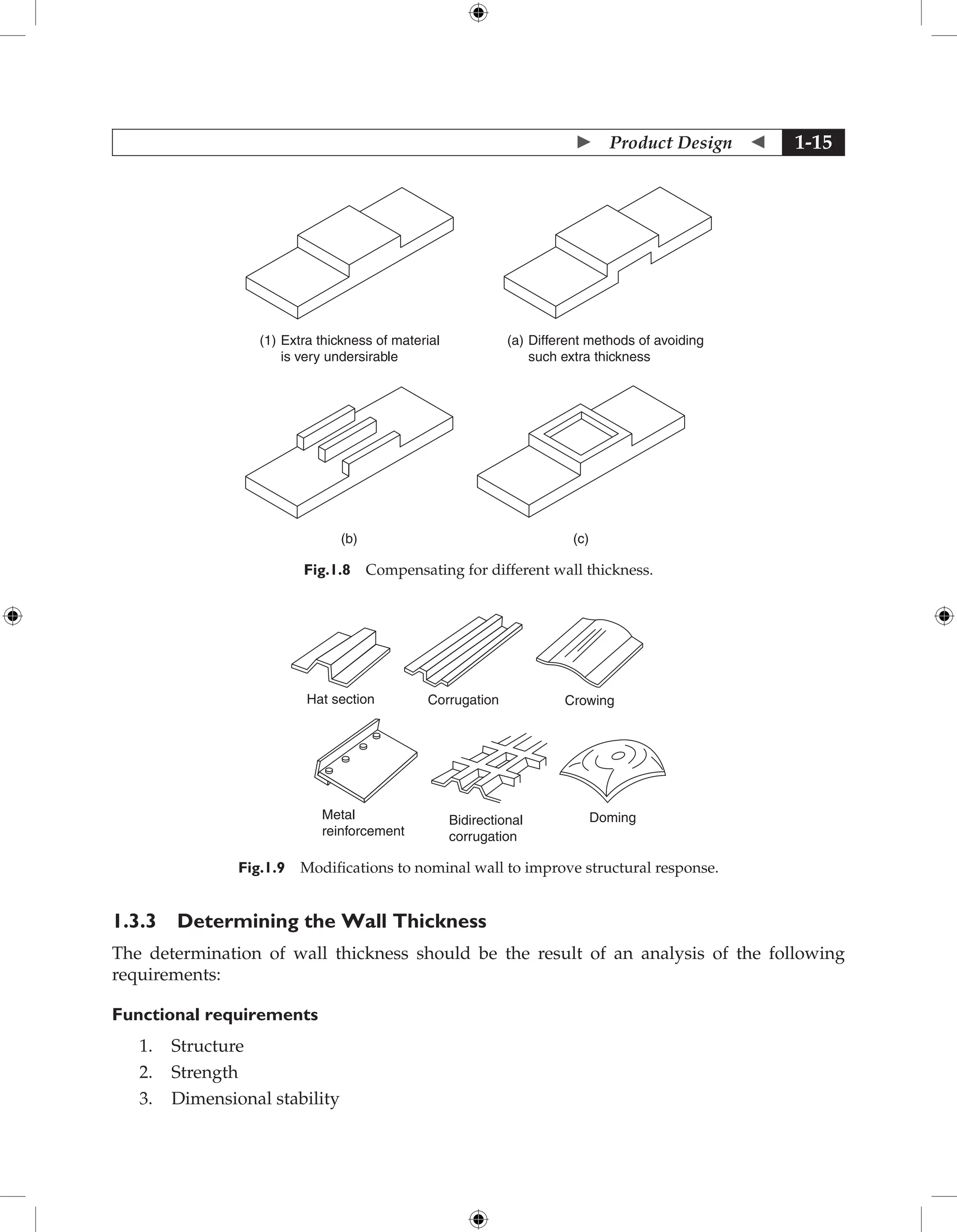
  • 176.
    ๎ฃ Product Design๎ข 1-163 Automobiles, trucks, buses, vans, rapid transit vehicles, aircraft, boats, ships, aerospace vehicles, and trains will benefit from composite design . The spin-off from space and military programresearchhasallowedthecivilianmarketstomakeimpressivegains.Presentproduction applications include drive shafts, side rails, doors, cross members, oil pans, suspension arms, leaf springs, wheels, quarter panels, trunk decks, hoods, hinges, transmission support, front and rear bumper components, seat frame, and wheels. Many engine components are being tested in present racing engines ( Fig. 1.211). Composite materials, in addition to providing weight savings over the life of a vehicle, are also energy efficient. It has been estimated that for every 50 kg reduced from a 1150 kg automobile, there will be a fuel savings of 0.1 km/lit. The energy resource requirements per kg of most composite materials are only 1/4 of that of aluminium or steel. Competition for raw material supplies between energy and petrochemical uses will continue to be a concern. Torlon injection moulded thermoplastic Torlon-C developmental thermoplastic composite Fig. 1.211 Schematic view of an engine includes piston skirts, piston pins, piston rings, connection rods, valve stems, engine block, and cylinder heads made of carbon fibre - polyamide - imide composite (Amoco Chemicals Company). New truck designs will incorporate light, strong, aerodynamic bodies and cargo containers. Reduction in wind resistance and vehicle weight will allow room for more cargo with less fuel consumption. Many of these concepts will be used for buses, trains, and mass transportation systems. The search for higher strength-to-weight ratios and design flexibility has widened in aircraft and aerospace designs. Glass fibre composites have a specific strength five times that of aluminium, while graphite and boron in epoxy matrix have about a five times higher specific stiffness. The current list of composite aircraft and aerospace applications is impressive. The all- composite horizontal stabiliser for the B-1 bomber, vertical and horizontal stabilisers on the F-16 fighter, wing skins on the F-18, rudder and flaps for the A-4, helicopter rotor blades, rudders, elevators ailerons, and spoilers on the B767 and B757, and payload doors of the Space Shuttle Orbiter are the most familiar applications. It has been estimated that 20% of the total
  • 177.
    ๎ฃ Fundamentals ofPlastics Mould Design ๎ข 1-164 weight of the AV-88 (barrier) will be composed of polymer composites. Even greater projected use of composites are in the future for AFT, V/STOL, HOTOL, stealth bombers, and Mach 20 transports. It has been suggested that up to 65% of the structure weight may be composed of polymer composites. Glass fibre composite pleasure boats have been used for years. The 46 metre, Wilton in the British navy is the worldโ€™s largest composite ship. It is likely that continued production of small ships in the minesweeper, hydrofoil, and surface effect ship class will continue to grow. Corrosion resistance, light weight, and low maintenance make marine use in hull structures, fairwaters, sonar domes, antennas, floats, buoys, masts, spars, deckhouses and all kinds of tanks an attractive application. Carbon composites are very radar absorptive and are likely to find additional structural applications in both aircraft and ships. The market penetration in sporting goods is expected to grow from 40 to 50% in the next five years, replacing wood and metal, Graphite, boron, and Kevlar in an epoxy matrix have found acceptance in golf carts, surf boards, hang-glider frames, javelins, hockey sticks, sailplanes, sailboats, ski poles, safe playground equipment, golf shafts, fishing rods, snow and water skis, bows, arrows, tennis rackets, pole-vaulting poles, skateboards, bats, helmets bicycle frames, canoes, catamarans, oars, paddles and other items. With changes in building codes, craft unions, consumer acceptance and acceptable designs, construction has potential for considerable growth in composite usage. Not everyone can afford a custom-built home made by traditional methods. Mass-produced, modular manufactured composite homes may be in our future. The growing mobile-home, apartment, hotel, and motel market is a natural for modular composite construction. There are a number of miscellaneous applications, including soundboards for guitars and violins, shells for musical drums, and lightweight armored products for personnel, vehicle, and equipment protection. The appliance and furniture industries will continue to initiate new designs using the merits of composites. Housings, frames, bases, tanks, and fans will be used in the manufacture of computers, vacuum cleaners, air conditioners, refrigerators, and other appliances. Chairs, lamps, tables, and other modern furniture designs are destined to be made of composite materials. Biocompatible implants, prostheses, electrical circuit boards, hammer handles, ladder rails, highway signs, wheel chairs and numerous pipes and ducting for the food and chemical processing industries are present applications. 1.24 Modern Approaches to Product Design Several modern approaches have been made with the help of computer in plastic product design, manufacturing and engineering. Some of the modern approaches which have become very popular are: 1. Prototype Development Methods 2. Reverse Engineering Approach 3. Concurrent Engineering Approach 4. Quality Function Deployment
  • 178.
    ๎ฃ Product Design๎ข 1-165 1.24.1 Prototype Development Methods Most of the investors do not believe that the product developers have really considered all of the aspects, such as ramifications, variations, loads, permutations, and abuse that a new design will engender. They want to see what the thing looks like and how it will perform. These same investors will not commit funds to provide parts when they are expected to be manufactured, until they are satisfied that the risk is acceptable. These people may be senior management, marketing and sales, or customers. Since they pay the bills, product development must do something to satisfy them. Construction of prototype parts and the products is the necessary answer to the problem. Construction of prototypes implies that (i) the full production system is not completed; (ii) time to prepare prototype tooling is short; and (iii) that the cost of the prototype parts and assemblies will be higher than expected for production. However, because the capital investment is low, the risk of prototype construction is also low. Rapid Prototyping (RP) is the automated fabrication technologies of seamless and rapidly creating accurate representative physical models of mechanical parts directly from three- Dimensional ComputerAided Design (CAD) data without the use of tooling and with minimal human intervention. RP uses state of the art laser technology, positioning systems, materials and computer technologies in the various processes. There are many RP processes that are widely used, each one using different methods and materials to produce the final part. The benefits of rapid prototyping, basic steps involved in it, its limitations, prototyping materials, its applications, future developments in it and its various types are explained in detail in Chapter 8, CAD/CAM applications in mould design. 1. CAD Solid Model: Engineering drawing programs, or computer aided design (CAD), can provide very good visual and dimensional replication of the parts on the computer screen. A solids rendition of the part can be shaded from different angles, to show highlights and irregular surfaces. Perspective are also available, so that a true picture of the part is obtained. Some colouring capabilities are also available. Often, a CAD model will suffice for people who want to see a prototype part (Fig.1.212). Fig. 1.212 CAD Solid Model.
  • 179.
    ๎ฃ Fundamentals ofPlastics Mould Design ๎ข 1-166 Advantages of CAD (a)โ€ƒ The Process is Fast: In the hands of the typical operator, a visual representation of the part is no more than an adjunct to the drafting process. A few commands, a few buttons to push, and a solids rendition of the part appears on the screen. (b)โ€ƒ Least Expensive: Since the rendition is a by-product of the drafting process, the cost is part of the design process. (c)โ€ƒ Checks Form and Fit: Many of the current high-end drawing programs allows two or more parts to be brought on to the screen at the same time. Fit between parts can be checked either visually or numerically. Disadvantages of CAD (a)โ€ƒ Cannot Touch or Feel: For those who want to touch a part or assembly, CAD will not be acceptable. (b)โ€ƒ Cannot Check Part Functions: Although form and fit can be checked with a high- end CAD program, functionality cannot. That is, movement of the components of assemblies relative to each other, with restraints of motion from stops or walls, is beyond the capabilities of these programs. (c)โ€ƒ Cannot Show Parts to the Customer: Since there are no parts, only the computer version of the part can be shown to the customer. This may not be sufficient to the people who wish to see the actual part. Details about the computer aided design, and its modelling types, creation, editing and support tools, its advantages are explained in detail in Chapter 8, CAD/CAM applications in mould design. 2. Computer Aided Engineering (CAE) Simulation: CAE is differentiated from CAD and implies the numerical simulation of a variety of actions on the part. CAE provide the responds of the parts to loads, heat or cold soaking, moulding, and the functional relationship between parts. CAE programs divide the part into smaller entities, called mesh elements, and provide calculations for the various functions from one mode of the mesh to the next. The integration of the effects over the whole part is the end point of the program ( Fig.1.213). Common CAE analyses include (a) Thermal stress (b) Structural analysis Fig. 1.213 CAE Simulation.
  • 180.
    ๎ฃ Product Design๎ข 1-167 (c) Crush simulation (d) Process simulation, such as for injection moulding Advantages of CAE (a)โ€ƒ Fast: Although not a part of development of the part drawing, CAE is a natural next step. Since it is done on a computer, the CAD drawing is most often used as the starting for generating the mesh. Actual execution of the analysis program is depended on the number of nodes in the mesh, the particular functions that are being modeled, and the power of the computer. Typical times are measured in hours to a few days. (b)โ€ƒ Low expenses: The expense of the simulation is related to the resident expertise available and how many hours are needed for: (i) mesh preparation, (ii) analysis time, and (iii) interpretation of the results. The hours that the expert spends on the project will be the significant cost of the project. (c)โ€ƒ Checks functionality: Motions between parts can be checked for assemblies as well asdistortioncausedbyvariousloadingregimens.Thermalexpansionandcontraction from heat or cold soaking can be checked. Processing of the parts can be simulated. (d)โ€ƒ No tool cost: With good expertise in-house, the cost of the analysis program will be amortised over a number of analyses. Disadvantages of CAE (a)โ€ƒ Cannot show the effect of wear or cumulative loading: No programs are avail- able that will simulate the wear rate of one part against another or the effects of repetitions of loading. (b)โ€ƒ Depends on the skill of the user: Except for simple analysis, the user should be familiar with the functions that are being simulated. Detailed explanation is required, have often been called on to explain why the simulation produced results that were far from reality. The most typical solution to the discrepancy is that the user did not provide adequate inputs to the simulation program. (c)โ€ƒ Depends on accurate characterisation of the materials: Materials testing is nec- essary before starting the simulation, whether the user is looking for simulation of processing, stress, or temperature. In every case, the constants that are used to characterise the material for that kind of simulation are critical to the accuracy of the results. Generic data, as for a class of materials, are not adequate. Data that are averaged for a family should be used only in the absence of all other data. The best and most accurate simulation will be from characterising the exact compo- nent that will be used and that has been prepared in the same way that the final product is expected to be prepared. (d)โ€ƒ Depends on the accuracy of the models used to simulate functions: Model is the term used to describe the numerical processes and equations that are used
  • 181.
    ๎ฃ Fundamentals ofPlastics Mould Design ๎ข 1-168 as the basis of the simulation. For example, it is recognised that the simulation of plastics flow will not be accurately described by assuming that the viscosity is constant. Several models of the viscosity behaviour are available that allow for the change in viscosity from both temperature and shear rate changes. Details about the computer aided engineering, finite element method and steps involved in it, its advantages, disadvantages, types of mesh and elements used for it, factors considered while taking finite element analysis decision, etc., are discussed in detail in Chapter 8, CAD/CAM applications in mould design. 3. Machining: Extruded or cast stock shapes can be machined to provide the prototype parts. Most thermoplastic materials are available in this form. The restrictions are the ingenuity of the machinist in making the necessary cuts in the stock to get the desired shape. With some materials, it is possible to bond parts together to provide a finished assembly. Advantages of machining (a)โ€ƒ Form, fit, and function can be checked with the material of choice. This is espe- cially important when wear and fatigue are involved. However, machining marks can also be points of stress concentration. (b)โ€ƒ The parts will be the same size as the production parts, and tolerance variations can be machined to check fits at high and low tolerance ranges. (c)โ€ƒ Typically, amorphous plastics can be painted to provide a colour that matches the end use. (d)โ€ƒ Tool cost is low to nonโ€“existent. At most, a few jigs and fixtures may be con- structed to hold parts while they are being bonded. Disadvantages of machining (a)โ€ƒ Appearance may not match production needs, since machining marks may not be appropriate to the use of the parts. (b)โ€ƒ Although the base material selection is the same as the material that will be used in the end product, the bar stock will not have properties identical to those of the moulded product. (c)โ€ƒ Surfaces will have a texture that is different from that of the moulded part. The machining process will leave a texture of its own. Although polished surfaces can be provided, specific textures cannot be included. (d)โ€ƒ The molecular structure will not match that of the moulded parts. This effect is especially evident for the semicrystalline materials. The crystallisation process from extrusion will result in a different orientation of the crystallites from that expected from moulding. (e)โ€ƒ Molecular and fibre orientation will not match that in the moulded product because the orientation processes of making rod stock are not the same as those
  • 182.
    ๎ฃ Product Design๎ข 1-169 encountered in injection moulding. In the later process, the orientation resulting from flow through the cavity is frozen into the skin layer. Interior layers have a more random orientation. When machining an extrusion, the skin layer, where any orientation may occur, is removed or at least interrupted. (f)โ€ƒ The very high part cost of machining will limit the number of parts that can be produced. Thus, machining intricate parts with many features is not considered appropriate for a large number of parts. (g)โ€ƒ For similar reasons, machining is typically not appropriate for very large parts. A combination of thermoforming, machining, and bonding may be more appropri- ate for large parts. 4. Casting: This process starts with liquid resins that can be catalyzed and polymerised. Either a flexible mould is cast from a machined model of the part or a cavity is machined. Since the pressures are from gravity, the cavities can be lightweight or even flexible. In either case, multiple parts can be made from the models. For large parts, fibre reinforcements can be added in a process akin to fibre-reinforced plastics production. Advantages of casting (a)โ€ƒ Form, fit, and appearance can be checked. If the gravity process is enhanced with evacuation of the mould, very fine details can be cast. (b)โ€ƒ Low tool cost, since there is no need to build the mould to resist the high pres- sure of injection moulding. If the mould is cast from a flexible material, polished surfaces, fine detail, and undercut surfaces can be accurately replicated. (c)โ€ƒ Casting material can be selected that have electrical properties equivalent to those of the production parts. (d)โ€ƒ Casting material can be selected that have very low shrinkage rates. This allows parts with close tolerances. (e)โ€ƒ Appropriate for tens of parts. Disadvantages of casting (a)โ€ƒ Material properties may not match the functional needs, since the number of plastic families that can be used in the process is limited. Wear and fatigue resis- tance are seldom matched by any of these materials; reinforcements are limited to woven and nonโ€“woven fabrics. (b)โ€ƒ Parts costs are high to pay for the relatively long cycle time per part and the high cost of the equipment. For this reason, the process is considered appropriate only for a few parts. 5. Thermoforming: This process is appropriate for parts that are too large to be machined from available stock shapes. The idea is that the basic shape can be formed from sheet and other features are added by being machined and then bonded in place.
  • 183.
    ๎ฃ Fundamentals ofPlastics Mould Design ๎ข 1-170 Advantages of thermoforming (a)โ€ƒ Parts too large for available stock shapes can be fabricated with minimal tooling. (b)โ€ƒ The thermoforming tool can be fabricated from low-cost materials, such as wood: Tool cost will be relatively low. (c)โ€ƒ Form, fit, function, and appearance can be checked. (d)โ€ƒ Appropriate for tens of parts. Disadvantages of thermoforming (a)โ€ƒ The process is limited to materials that can be thermoformed. Semicrystalline and fibre-reinforced materials should not be used. The properties may not match those expected of the material selected for production. (b)โ€ƒ The costs of the part will be high. Thermoforming a few pieces, without the trim- ming jigs and fixtures typical of the high production versions of the process will be expensive. Fabrication of the auxiliary parts will also be costly, as with the bonding process to locate and secure these parts. (c)โ€ƒ The joints between component of the fabricated assembly may be weaker than those in the equivalent moulded part. (d)โ€ƒ Tolerances will be wide, to accommodate the thermoforming process. Thickness is especially difficult to control to tightโ€“tolerances. (e)โ€ƒ Depending on the materials available for thermoforming, the parts may not be functional equivalents of the injection moulded parts. Friction and fatigue life will not match those of the selected materials. 6. Injection Moulding: Prototyping parts by injection moulding relies on low-cost tool- ing approaches. The mould can be constructed by one of the following methods: (a)โ€ƒ Cast from metal-filled epoxy or urethane resin. The pattern is usually machined from aluminium. The metal filling in the casting material provides higher thermal conductivity and greater strength than the unfilled resin. (b)โ€ƒ Cast from low-temperature alloys, such as Kirk site .The pattern for the casting can be machined from wood and replicated in plaster for casting the metal cavity. (c)โ€ƒ Electroformed surface with low-temperature alloy backing. Apattern is machined from a nonโ€“conductive material. Copper is deposited from a chemical bath to provide a conductive surface. This is plated, usually with nickel, to form a shell that is backed up with cast plastic or low-temperature metal alloy. (d)โ€ƒ Aluminium plates can be machined more easily than the equivalent steel cavity. However, the polished finish on the aluminium will not replicate that for hard- ened steel. (e)โ€ƒ Mild steel can be machined more easily than the equivalent tool steel. If the cavity is fabricated, that is, made from sections, the machining can be simpler than expected for the production tooling.
  • 184.
    ๎ฃ Product Design๎ข 1-171 Advantages of injection moulding (a)โ€ƒ Form, fit, and appearance can be checked, since the material will be the same as for production parts. (b)โ€ƒ Appearance depends on the mould surface, to reduce the costs, prototype moulds may not be polished as finely as the production tool. (c)โ€ƒ The low part cost makes the process appropriate for hundreds to thousands of parts. A good prototype mould can produce parts for early production. Table 1.21 Comparison of materials for prototype injection moulds Mould material Advantages Disadvantages Cast epoxy or urethane Low cost Low thermal conductivity Fast turn around Low thermal capacity Good for small, intricate parts Metal filling may not get into sharp exterior corners Life expectancy is less than 50 parts Special efforts needed to avoid bubbles in casting Surface finishes may not match production parts Must be contained in strong mould based Fine details will be fragile Prone to chips around machined ejector pin holes High wear rate with fibre reinforced materials limited life. Cast low-temp alloys Low cost Must be contained in strong mould. Fast turn around Easily damaged by moulding debris. Fair thermal conductivity Tends to peen near ejector pin holes. Good thermal capacity High gate wear rate with fibre reinforced materials Cooling lines can be machined Difficult to get good surface polish Good for large parts Life expectancy is about 100 parts Electroformed shell Low cost Must be contained in strong mould base. Fast turn around Easily damaged by moulding debris Good replication of the pattern surface Prone to flash (Contd.)
  • 185.
    ๎ฃ Fundamentals ofPlastics Mould Design ๎ข 1-172 Table 1.21 (Contd.) Mould material Advantages Disadvantages Can be polished Good wear rate Life expectancy is several hundred parts Aluminium plates Fast machining Easily damaged by moulding debris Good thermal conductivity Too soft to hold a good polish Good thermal capacity Wear rate is high from fibre reinforced materials Cooling lines can be machined Good for large parts Life expectancy is about 1,000 parts Mild steel Good Polished surface is easily damaged Good thermal conductivity Wear rate is higher than for hardened tool steel Good thermal capacity Cooling lines can be machined Life expectancy is several thousand parts Disadvantages of prototype injection moulding (a) Gate location may not match production. To accelerate the tool production, the tool design may be simplified. For example instead of three-plate mould, including a cen- tralised gate, a two-plate mould with an edge gate may be used. (b) Gate scars may be more prominent than for the production tool. For example, subma- rine gates may not be appropriate for the mould material. (c) Filling patterns will be different from those expected from the production tool. This implies that weld line location, flow orientation, shrinkage, and residual stress pat- terns will also be different. (d) Mould cooling may not match production. The simplified tool design may not pay as much attention to the mould cooling as will be expected from the production tool. In addition, the lower heat capacity or thermal conductivity of the mould material may not much that of the production tool material. (e) Uneven cooling may result that will cause different shrinkage rates than expected from the production tool. (f) The cooling rate may be different if the mould material thermal capacity and thermal conductivity are different from those of the production tool.
  • 186.
    ๎ฃ Product Design๎ข 1-173 (g) Production rates will be lower than that expected from the final tool. The tool design compromises will often imply more mould open time and limited ability to run the mould in an automatic mode. For example, rather than include cam-operated side cores, loose insert may be used. These must be placed in the mould by hand between each shot. (h) Tool cost and lead time are higher than for any of the other prototype processes. The longer time must be factored into the production schedule. 1.24.2โ€ƒReverse Engineering Approach Reverse Engineering (RE) is a process that is used to create 3D CAD models directly from physical parts with little or no additional design documentation. It is simply the act of figuring out the real parts using software that you have. When a detailed drawing of a component, is missing or insufficient to understand, or the part is of a contour shape which cannot be measured easily by the measuring instrument, then they are developed by the reverse engineering process. Reverse engineering process requires a coordinate measuring machine or digitiser (3-D scanner) to extract the input data in terms of point clouds from which the surface and model will be developed again. To develop the model again as per the existing one or to modify the existing one, it requires the 3-D modelling software. Hence, the knowledge of 3-D modelling software is essential for the designer. The designer should also have a sound knowledge on CAE software for analyzing the product for its functional requirements or its tool design verification. The details about the reverse engineering process, steps involved in it, coordinate measuring machine, digitiser, etc., are explained in detail in Chapter 8. 1. Use of 3-D Modelling Software in Product Design: Plastics engineering is an area where CAD/CAM/CAE is being successfully used for quality improvement and for complex designs. The complexities of designs, bulk of operations and the need for quick changes have made the computer applications in plastics product and mould design and tool making as more important. With computer capability a person can modify designs quickly and even review them with the customer on the spot to achieve the best package to meet the customersโ€™ requirement in the shortest possible time. Knowledge of the basic design and related information has to be used by the designers regardless if CAD/CAM/CAE or traditional drawing boards are used with the proper software package will โ€˜remindโ€™ the designer to follow a logical error free procedure. The type of analytical problems are encountered in the product design/mould design process generally fall into the sciences of mechanics, heat transfer and fluid mechanics and material science. These fields encompass many mathematical functions and relationships that are too time consuming to evaluate in manual or conventional designs. The ability of the computer to remember and execute these computations quickly adds new dimensions to the CAD/CAM/CAE process allowing prospective alternative designs to be evaluated and simulated.
  • 187.
    ๎ฃ Fundamentals ofPlastics Mould Design ๎ข 1-174 With the high speed digital computers on desktop category itself (beyond 1 GHz) used for analysis, data processing activities and complete graphical information are helping to automate a domain once thought of creative discipline, i.e., the design process itself. The repetitive tasks like creating standard geometry, pack profiles, mould base, adding shrinkage to the component have been cut down. The computer ability to perform these tasks untiringly revolutionise the entire process we witness today. We may find that using CAD/CAM/CAE techniques the time required in the conventional trial and error methodology is greatly reduced. Already there are enough indications that the managements of various organisations have started realising the impact of CAD/CAM/CAE in their industry. With CAD/CAM coming a long way, there is an encouraging trend that the future is still brighter unlike the other areas like software development, which see their rise and fall in short periods of time. It is expected that new and more advanced design algorithms continue to flood the market, which makes the job of designer and manufacturer still easy. Thebasicreasonsforimplementingacomputer-aideddesignsystem(3-Dmodelling) are many. Some of them can be listed as follows. (a) Provides better tools for reality in visualisation. (b) Increases the effective skills of the designer. (c) Improves accuracy and quality of the design. (d) Reduces the visualisation and presentation problems. (e) Creates a CNC manufacturing database based on design model. We are very well aware that CAD and CAM are the divisions supporting the design and manufacturing sections. If we tend to subdivide CAD, we may state that CAD is inclusive of 3-D modelling, graphics operations and other engineering design tools. In addition, CAD tools can provide facilities like analysis of model like fits, tolerance studies, model properties like mass, moment of inertia, centre of gravity, etc. Also nowadays the CAD systems are having the facility element analysis of models also for structural analysis mainly. 2. 2-D Modelling: Creating a drawing using only the x and y coordinates on a paper is termed to be a two-dimensional drawing. As such, 2-D draughting refers to the extension of manual drawing methods in a computer. The various views such as plan, elevation, end view, if necessary sectional view (to show inner details of the prod- uct) enlarged view or reduced view on various scales can be drawn to give complete description of the product. The various functions used in the drafting can be grouped as: (a) Drawing functions (b) Editing functions (c) Viewing Functions (d) Drawing aid functions
  • 188.
    ๎ฃ Product Design๎ข 1-175 (e) Utility functions (f) Block functions (g) Automatic dimensioning features 12.7 2 HOLES ร˜ 2.4 10.0 (TYP) R 4 . 0 R6.0 R 4 . 5 ( T Y P ) (TYP) 30ยฐ = = = = = = = = 32.0 30.0 5.0 24.0 R2.5(TYP) (TYP) ISOMETRIC VIEW BOTTOM PLAN VIEW SECTION XX SECTION YY 35.0 R7.5 R 6.0 (TYP) Y 5.0 A/F R 4(TYP) X Y X R2.5 2.0 1.4 19.0 = = ร˜ 5.0 ร˜ 3.0 ร˜ 38.4 ร˜ 41.4 3.5 R 3 . 5 R 2 . 5 8.0 8.6 9.6 11.6 2.0 16.0 14.5 1.5 (TYP) Fig. 1.214 2-D Drawing. 3. 3-D Modelling: There are certain limitations of orthographic as a means of repre- senting product geometry. As a consequence of these limitations, various methods have been developed for the representation of geometry with a more realistic view. These utilise the construction of a single representation of the component geometry in three-dimensional space. By using a single representation, the potential for error inherent in the use of multiple views of a component is avoided. Also, a single rep- resentation of an object is potentially far more useful as a basis for applications that
  • 189.
    ๎ฃ Fundamentals ofPlastics Mould Design ๎ข 1-176 utilise the same master model to extract information for analysis and manufacture related activity. The methods that have been developed for three-dimensional modelling involve the representation of geometry as a collection of lines and other curves, or of surfaces, or of solids in space. Of these, the solid modelling technology is the latest. It has been seen that drawings are constructed in two โ€“ dimensional coordinate system. Three- dimensional (3-D) models are constructed in 3-D space โ€“ typically in a right-handed Cartesian coordinate system. The various types of 3-D models are: (a) Wire frame models (b) Surface models (c) Solid models (a) Create four points (c) Produce images in other three views (d) Project into third dimension to give thickness to model (b) Join them as straight lines Fig. 1.215 Development of a wireframe model on a computer. This? Or this ? Wireframe model Surface model Hollow model Solid model No ambiguities ? Problem: Surface geometry has no mass properties Centroid ? Moments of inertia ? Fig. 1.216 Various methods of modelling a solid.
  • 190.
    ๎ฃ Product Design๎ข 1-177 Some of the 3-D modelling software that are used at present are: (a) PRO.E (b) UNIGRAPHICS (c) CATIA (d) IDEAS, etc. By using any one of the above software, we can generate any shape and size of the product with necessary colour contrast as per our requirements. If we need only modification, addition, deletion that can also be done very easily within a short spell of time we can also rotate the product to any convenient direction for better visual, easy understanding. 4. Use of Mould Flow Software in Product Design: The benefits of using CAE software to design and engineer components include: (a) Improved and consistent component quality. (b)โ€ƒ Lower costs associated with the need for less prototyping, rework and lower product development cycle time. (c) Improved product design before the commencement of manufacturing. (d) Lower manufacturing cycle times. (e)โ€ƒ To establish the idea of what will happen inside a mould when plastics flow inside. (f) To study the effects of post-moulding defects. The details about mouldflow software, its uses in the filed of analyzing the plastics products, steps involved in it, types of meshing used in it, various analyses done in mouldflow, etc., are explained in Chapter 8. 5. Principles of Flow Design: The flow analysis software relies on certain fundamental design principles to verify and optimise the flow pattern of the plastic parts. The basic design principles used are: (a)โ€ƒ Flow must take place always in a single direction before it ends with the extremi- ties of the product. This ensures a uniform filling pattern. (b)โ€ƒ The pressure drop occurring in a plastic part must be constant over the entire length of the flow paths. (c)โ€ƒ The maximum shear stress induced in the component part must be less the criti- cal shear stress acceptable for the particular plastic material chosen. If the stress exceeds a critical value, then the part is likely to degrade. (d) The cooling must be uniform throughout the plastics part to avoid warpage. (e)โ€ƒ Thin and thick sections are to be avoided to avoid the hesitation effects. Hesitations occur when the flow takes a deviation from a thicker section to thin section. Because there is no ease of flow, the material flow stops until sufficient pressure builds up. (f)โ€ƒ It is common knowledge that weld lines cannot be avoided altogether in all โ€‚โ€‰โ€‰โ€‰cases of parts. The weld lines are to be positioned in the least sensitive
  • 191.
    ๎ฃ Fundamentals ofPlastics Mould Design ๎ข 1-178 locations of the part so that while in service they will not affect the performance of the part. (g)โ€ƒ Controlled frictional heating can be used to the advantage so that the thermal properties of the plastic material can be protected to a certain extent. (h)โ€ƒ The feed system must be designed for thermal shut off so that any backflow can be avoided. 1.24.3โ€ƒConcurrent Engineering Approach Nowadays the fast developing industrial world has given rise to two important and novel approaches to product design. The first approach is concurrent design while the second approach is quality function deployment. At the concluding stage, we will highlight the two important approaches in the product design. Development from concept to product requires the consideration of four basic elements. Central to this concept is the function of the product. Related to the function are the shape, material, and production techniques used to manufacture and assemble the product. Concurrent design is the simultaneous planning of the product and the process for producing it. The role of manufacturing was to build what the designer conceived, improve the manufacture andassemblyoftheproduct.Acertainindustrysurveyshowedthat60percentofallmanufactured parts were not made exactly as represented in the drawings. The reasons varied: (i) The drawings were incomplete. (ii) The parts could not be made as specified. (iii) The drawings were ambiguous. (iv) The parts could not be assembled if manufactured as drawn. Many of these problems have since been overcome by evolution of the design team and of the philosophy of concurrent design. The process of translating from concept to a manufacturable product is rarely accomplished now by the designer alone. Generally, a team comprising a design engineer, a manufacturing engineer and a materials engineer plays a role in supporting the chief designer. There are too many materials and manufacturing processes available for the designer to be able to make good decisions without the help of specialists. The design team Design is both a private, individual experience and a social, group experi- ence. The ability to recall previous designs from memory and to synthesise partial concepts together to form new ideas is unique to an individual designer. However, since most design projects are large and require knowledge in many areas, they are generally accomplished by teams of engineers with varying views and backgrounds. We now provide a list of individuals who may fill a role on a product design team. Their inclusion on the design team will vary from product to product, and their titles will vary from company to company. Each position on the team will be described as if filled by one person, but for large design projects, there may be many persons filling that role. 1. ProductDesignEngineer:Themajordesignresponsibilityiscarriedbytheproductdesign engineer. He must be certain about the needs for the product are clearly understood and
  • 192.
    ๎ฃ Product Design๎ข 1-179 that engineering requirements are developed and met by the product. This usually requires both creative and analytical skills. The design engineer should bring knowl- edge about the design process and about specific technologies to the product. 2. Marketing Manager or Product Marketing Manager: In many companies, the mar- keting manager has the ultimate responsibility for the development of the product and represents the major link between the product and the customer. Because the product manager is accountable for the success of the product in the market, he is also often referred to as the marketing manager or the product marketing manager. The product manager also represents the interests of sales and service. 3. Production Engineer: It is not possible for the design engineer to have the necessary know-how about production processes. This knowledge is provided by the person who must have a grasp not only of in-house manufacturing capabilities, but also of what the industry as a whole has to offer. 4. Design Detailer: In many companies the design engineer is responsible for specifica- tion development, planning, conceptual design, and the early stages of product design. The project is then turned over to detailers (often called designers), who finish detail- ing the product and developing the manufacturing and assembly documentation. 5. Testing Engineer: The testing engineer aids the design engineer in developing test appa- ratus, performing experiments, and gathering data in the development of the product. The insights gained from the technicianโ€™s hand-on experience are usually invaluable. 6. Materials Engineer: In some products the choice of materials is forced by availabil- ity. In others, materials may be designed to fit the needs of the product. The more a product moves away from the use of known, available materials, the more a materials specialist is needed as a member of the design team. Many suppliers actually provide design assistance as part of their services. 7. Quality Control Specialist: A quality control (QC) specialist has training in techniques for measuring a statistically significant sample to determine how well it meets speci- fications. This inspection is done on incoming raw material, incoming products from vendors, and products manufactured in-house. 8. Industrial Designer: Industrial designers are responsible for how a product looks and how well it interacts with human users; they are the stylists who have a background in fire arts and in human factors analysis. They often design the scope within which the engineer has to work. 9. Assembly Engineer: While the production engineer involved in making the compo- nents from raw materials, the assembly manager is responsible for putting the product together. Concern for the assembly process is an important aspect of product design in modern times. 10. Supplierโ€™s Representative: Very few products are made entirely inside one factory. Usually there will be many suppliers of both raw material and finished goods. Often it is important to have critical suppliers on the design team because the success of the product may be highly dependent on them.
  • 193.
    ๎ฃ Fundamentals ofPlastics Mould Design ๎ข 1-180 The details about concurrent engineering approach, product development cycle, characteristics of concurrent engineering and its advantages are explained in Chapter 8. 1.24.4 Quality Function Deployment (QFD) QFD is the latest approach to product design. It essentially consists of converting customerโ€™s need statement (which is usually qualitative) into technical specifications. For example, a user of automobile insists upon โ€˜easy closureโ€™ of the door. This voice of the customer enables the design task force to derive the specifications of door closing mechanism in terms of kilograms of force required for the mechanism. QFD enables organisations to be proactive rather than reactive in QC. QFD involves (i) the customer, (ii) what is the customer requirement, (iii) how to fulfil his requirements. The details of quality function deployment, steps involved in it and its implementation in production are explained in Chapter 8. 1. Explain the primary concepts involved in design. 2. What is the role of aesthetics in product design? 3. Write the disadvantages of evolutionary design. 4. Write two examples of design by innovation. 5. How does morphology in design influences? 6. What are the advantages of plastics over metals in product design? 7. Brief the limitation of plastics in product design. 8. Prepare a check list to evaluate the product design. 9. Give suggested wall thickness for thermoplastic and thermo-set moulding material. 10. Write short notes on wall thickness variance. 11. Why are ribs needed in product design? Explain the methodology with a neat sketch. 12. Write down the advantages of fillets and radii. 13. What is gusset in product? Explain with a neat sketch. 14. What is the significance of taper and draft in product design? 15. Why is coring needed? 16. Write the types of materials used for inserts. 17. Describe shapes of male and female inserts with a neat sketch. 18. What is pressed-in inserts in product design? Explain with neat a sketch. 19. Explain metal-stamping and rod-type inserts in product design with a neat sketch. 20. How metal inserts are replaced by plastic insert? 21. Write short notes on the following (a) Encapsulation (b) Composite parts Questions
  • 194.
    ๎ฃ Product Design๎ข 1-181 22. What are the advantages of an ideal gate size and location? 23. List out the factors on which an optimum gate size depends. 24. Describe the ideal location of ejector pins as per the product design with a neat sketch. 25. Describe wire-type screw thread insert with a neat sketch. 26. How speed nuts and clips are used for fastening? 27. What is rivet? 28. Define clasps. 29. What are the two basic methods of mechanical means of fastening? Explain with a neat sketch. 30. What are the factors affecting shrinkage? 31. Give a brief idea on bearing design with plastics. 32. Describe the manufacturing technique of plastic gear with its design calculation. 33. Explain Punching of laminates. 34. Give a brief note on product design variance pertaining to tooling aspects with a neat sketch. 35. How are composites used in product design? 36. List out the advantages of composites in product design. 37. Explain CAD solid model. Write down the advantages and disadvantages of CAD. 38. What is machining? Write down the advantages and disadvantages of machining. 39. What is casting? Write down the advantages and disadvantages of casting. 40. What is thermoforming? Write down the advantages and disadvantages of thermoforming. 41. What is injection moulding? Write down the advantages and disadvantages of injection moulding. 42. Write short notes on the following: a) 2-D Modelling b) 3-D Modelling 43. What are the essential factors of product design? 44. Explain methodical approach in plastics product design. 45. What are the important factors to be considered for maintaining the quality and economical product? 46. What is the significance of wall thickness in product design? 47. What is the significance of parting line in product design? 48. Why bosses are needed in product design? Explain methodology with a neat sketch. 49. What is the methodology of providing holes in a product as per product design aspect? Explain with a neat sketch. 50. Where are threads used? Classify threads and explain with a neat sketch. 51. Describe the location of inserts in the product with a neat sketch. 52. Why inserts are need for designing of a product? Explain with a neat sketch. 53. Define tolerance. Explain the parameters that influence part tolerance.
  • 195.
    ๎ฃ Fundamentals ofPlastics Mould Design ๎ข 1-182 54. Explain with a neat sketch standard tolerances on moulded articles. 55. What are the techniques used for joining plastics to each other and to other materials? Explain with a neat sketch. 56. What are hinges? Explain the types of hinges with a neat sketch. 57. What is shrinkage? At what condition thermosetting compression moulded parts will have a higher shrinkage? 58. What are laminated plastics? Classify laminates and explain its process? 59. How processing variable influences product design? 60. Describe the mechanical properties such as stress, strain influences product design. 61. What is composite? Explain types of composites briefly. 62. Illustrate the steps involve before going to a product design. What are the modern techniques used for a product design? 64. Explain CAE. Write down its application explain its advantages and disadvantage of CAE? 65. Explain the role of 3-D modelling software in product design. 66. Describe the principles of flow design. What is the use of mould flow software in product design? 67. Describe the individuals who may fill a role on a product design team. ๎ฑ Chitala, A. K. and Gupta R. C., Product Design and Manufacturing, Prentice Hall of India Pvt. Ltd., New Delhi. ๎ฑ CIPET, โ€˜Technical Manualโ€™, Chennai. ๎ฑ Douglas M. Bryce, Plastic Injection Moulding, Society of Manufacturing Engineers, Michigan. ๎ฑ Ronald D. Beck, Plastic Product Design, Van Nostrand Reinhold Company, New York. ๎ฑ Sidney Levy, P. E. and Harry DuBois J., Plastic Product Design Engineering Handbook, Van Nostrand Reinhold Company, New York. ๎ฑ Society of Plastic Industry Inc., Plastic Engineering Handbook. References
  • 196.
    Injection Mould Design Chapter 2 2.1 Introduction Whenidentical plastic products are to be manufactured in large quantities then the injection moulding process is mostly preferred. The manufacturing process of the components is an automatic process in nature but generally tends to be operated manually. The plastic cools and takes the shape of the mould cavity. When the plastic component has solidified due to cooling, the mould is opened and the moulding is ejected. 2.1.1โ€ƒUse of Mould Engineering for Thermo Plastic Material Most of the items from electrical and home appliances are made from plastics. The technology to make plastic product is by using injection mould of thermoplastic. When thermoplastic material is heated, they change their state from solid to liquid. They will become soft, melt and flowable. When cooled again, they become solid again. Such small items but in huge quantities as bottles, sink plugs, model kits, toys,dustbins, bowls and milk crates, etc., can be made using this system. 2.1.2 Basic Concept of Injection Moulds Injection moulding process Injection moulding is the process of forcing melted plastic into a mould cavity. Once the plastic has cooled, the part can be ejected. With this process, many parts can be made at the same time, out of the same mould. Injection moulding is often used in mass-production and prototyping. Injection moulding is a relatively simple technology to manufacture parts. Injection moulding is a plastic-forming process used in the production of most (about 65%) of plastic parts. Other plastic-forming processes include blow moulding, pressure-forming, and thermo-forming. Injection moulding is generally used in the high-speed manufacture of low-cost, high-volume parts, like videocassette cases, plastic cups, printer parts, refrigerator parts, automotive parts, and other electronic parts like casing, gear, etc. The process of injection moulding starts with a barrel (a hollow cylinder) hot due to heaters attached with barrel which change the status of granules into liquid plastic. The plastic is
  • 197.
    ๎ฃ Fundamentals ofPlastics Mould Design ๎ข 2-2 rammed by the screw at high pressure into a mould. Once the plastic fills the mould, it is allowed to cool and solidify. The finished part is then extracted automatically from the mould. Stages in Injection Moulding Stage 1: Granulated or powdered thermoplastic material is fed from a hopper (conical shaped device to receive materials) into the injection moulding machine. Stage 2: The injection moulding machine consists of (a) Hollow steel barrel (b) Rotating screw (Archimedean screw) (c) Heaters The barrel contains a rotating screw. The screw has its flight with some depth due to which the screw carries the plastic along the barrel to the mould. Heaters surrounding the barrel melt the plastic as it travels along the barrel. Stage 3: Due to collection of melted plastic material at the end of barrel, the screw is forced back. Once enough plastic has been collected at the end, hydraulic ram forces the screw for- ward for injecting the plastic through a sprue into a mould cavity. The mould is heated sometimes before injecting and the plastic is injected quickly to prevent it from hardening before the mould is full because the entry point of material (gate) is very small. Stage 4: Pressure is maintained in the machine for a short time (known as dwell time) to pre- vent the material not to return back during hardening which prevents shrinkage and hollows, therefore, giving a better quality product. The moulding is left for some time to cool before ejecting from the mould. The moulding takes the shape of the mould cavity. Screw Heater Product Mould Hopper Ram Motor Hydraulic fluid Heater Fig. 2.1 Injection moulding machine. As it can be seen from the above Fig. 2.1, the plastic is fed into the hopper. It is forced forward under pressure by the Archimedean screw. It is heated by the surrounding heater coils. As the plastic builds up at the front of the chamber the screw moves backward. Eventually the screw is forced forward by the hydraulic ram forcing the plastic through a sprue into the mould.
  • 198.
    ๎ฃ Injection MouldDesign ๎ข 2-3 By this technique the car bonnet, crates, impeller and high precision components such as camera parts, razors and gear wheels are injection moulded. 2.1.3โ€ƒTypes of Injection Moulds Classification of injection mould depends upon what is required to make by plastic parts, what is its applications, because every part has its own specific and unique design. When designing the moulds it is required to decide some of the influencing factors like geometry, number of cavities, ejection principle, plastic material and shape of parts. Based on cavity layout The types of the moulds can be classified on the basis of number of cavities or cavity layout. 1. Single Cavity: When the mould is designed for single cavity, the material is injected by direct gate called sprue gate. 2. Multicavity: When the mould is designed for more than single cavity, the material is injected by side or submarine gate. In two-plate mould and for three-plate mould, all types of gates may be used. Based on type of opening method and runner system 1. Standard moulds (two-plate moulds) 2. Three-plate moulds 3. Split-cavity moulds (split-follower moulds) stripper plate moulds 4. Stack moulds 5. Hot runner moulds Based on injection moulding process Injection moulds may be divided into seven types. They are: 1. Reaction injection moulding 2. Liquid injection moulding 3. Gas assisted injection moulding 4. Co-injection moulding 5. Shot injection moulding 6. Fusible core injection moulding 7. Rapid injection moulding Depending on material to be injected 1. Thermoplastic injection moulds 2. Elastomer moulds 3. Thermoset moulds 4. Structural foam moulds
  • 199.
    ๎ฃ Fundamentals ofPlastics Mould Design ๎ข 2-4 Introduction of Different Type of Injection Moulds Two-plate mould The standard mould is the simplest design used for making plastic articles. It is also known as two-plate mould. The mould is divided into two halves: cavity side and core side. That is why this mould is known as two-plate mould. It consists of single daylight where the mouldings and feed system get ejected during mould opening. Cavity side is the external part of the component. On the base of external surface of the component, cavity plate is designed. Fig. 2.2 Two-plate mould. Locating Ring Sprue Top Plate Fixed Half Cavity Plate Core Plate Bottom Plate Moving Half Ejector Plate Fig. 2.3 (a) and (b) Standard mould (Two-plate mould). In this type ejection system is designed as shown in Fig. 2.2. Standard mould has one parting line and has one opening direction. This type of mould is used in all kinds of plastic parts that do not have undercut. In this type of mould, side gate is generally preferred. Subsurface gate
  • 200.
    ๎ฃ Injection MouldDesign ๎ข 2-5 is also used as self degating in two-plate mould. In this type of mould, the waste (comprising runner, gate and sprue) is also ejected with the component which is to be also trimmed as secondary operation. Some other moulds as standard mould are shown in Fig. 2.3 (a) and (b). Three-plate moulds Basically three-plate moulds have two openings/daylight and a floating plate. Floating plate is guided by guide pillar as shown in Fig. 2.4 of opened and Fig. 2.5 of closed con- dition of three-plate mould. Since the mould has two parting planes, the runner system can be located on one side of floating plate. There is a special plate that is attached with floating plate which is called runner ejector plate for ejecting out the runner system separately. Three plate Fig. 2.4 Three-plate mould (Closed). Sprue System Runner Opening System Ejection System Mould Opening System Fig. 2.5 Three-plate mould (Opened). Fig. 2.6 Drawing for a small box (three-plate mould).
  • 201.
    ๎ฃ Fundamentals ofPlastics Mould Design ๎ข 2-6 moulds are mostly used because of their flexibility in location of gate and are even used in mul- tiple cavities. The 2D drawing for a small box is shown in Fig. 2.6. Basically there are three opening types in three-plate moulds as shown in Fig. 2.7. 1. Sprue cut opening 2. Runner opening 3. Product opening 1. Sprue Cut Opening: This opening will cut sprue from nozzle, so the feeding system (runner, sprue and gate) can be easily removed manually. This opening uses link bolt and runner ejector plate to cut the sprue. The stripper plate will move after link bolts are pulled by cavity plate. The link bolts are also end mounted in cavity plate. The opening length should be between 5 mm and 10 mm. During movement of cavity plate the runner stripper plate comes forward due to the link bolt which is attached with the cavity plate and sprue. 2. Runner Opening: This opening is used to eject runner system and then the runner will be removed manually. This opening will make a space between runner, stripper plate and cavity plate. To make sure this runner opening is done safely or degating perfectly, spring is to be attached to puller bolts between runner stripper plate and cavity plate. Length of this opening is same with runner length plus 20 mm which is decided on the basis of subrunner length. 3. Product Opening: As we know, this opening is to eject the product. This opening length is about the length of the product plus space required for allowing the product to fall down plus 10 to 20 mm for ejection. This will be approximately one and half to two times of product length. Sprue system Sprue cut opening Runner opening system Product opening Mould opening system Runner system Core cavity Ejection system Fig. 2.7 Opening system of three-plate mould. Opening Sequence Actually when the cavity plate is pulled, it pulls the runner stripper plate by puller bolts then open the stripper plate. It has two types, using tension link and magnet. 1. First Opening is Runner Opening: If first opening is not from runner opening side, there is a chance of degating of the article without separating runner from the mould. To get first
  • 202.
    ๎ฃ Injection MouldDesign ๎ข 2-7 opening from runner, some springs are always attached to make the first opening from here. Some mould designers attach spring at puller bolts or in a pin with a hole each side to attach the spring. But it is better to attach the spring in puller bolts, which is easier in process. 2. Second Opening is Product Opening: Parting Line between core-cavity plate is always easy to open. When moving platen at the injection moulding machine pulls the bottom plate, core plate and moves along with bottom plate thus creates product opening between the core and cavity. 3. Sprue Cutting Opening: After moving the platen, pull the core plate with tension link, core plate will pull the cavity plate by some mechanism until cavity plate pulls the puller bolt of runner stripper plate and make some space to cut the sprue from nozzle. Sometimes, it can be done using a simple spring by placing it in some hole with pin. Stripper ejector mould This type of mould have special purpose ejection to make a cup shaped article without undercut. The stripper plate will make ejection easier and without a lot of marks in product as shown in Fig. 2.8. Sprue runner system Cavity insert Stationary side Cavity side Core insert Moving side Stripper ejector plate Fig. 2.8 Stripper ejection. Split mould In this type of mould, the sliders are used for getting movement on core plate by using the move- ment of the moving platen. The change of movement from one to another (horizontal to vertical) is arranged by some mechanism like finger cam, dog-leg cam and cam track as per the requirement of the mould as shown in Fig. 2.9 with finger cam. This type of mould is used to make parts with undercut. Mould with screw device This mould is special to make threading components. For releasing threads, the core can be rotated during the mould opening. Both inter- nal and external threads can be formed by this type of mould as shown in Fig. 2.10. Moving side Ejection system Fixed half Product Split Angel pin Fig. 2.9 Split mould.
  • 203.
    ๎ฃ Fundamentals ofPlastics Mould Design ๎ข 2-8 Sprue system Core Gear Moving side Fixed side Fig. 2.10 Unscrewing mould. From the above Fig. 2.10, it can be easily seen that it has a gear system, which will rotate with the movement of the machine platen and thread releases. Collapsible core and cavity mould There are many applications for which a complete thread form is not required. Bottle closures consist of partial threads which can be moulded using this method. Two-segment or more segments cores may be used. Collapsible cores are like destroy- ing and further assembling complete core by using some mechanism and movement of platen as shown in Fig. 2.11(a). In Fig. 2.11(b), the central core is withdrawn downward away from the moulding. As it moves, it forces the two small side cores to move inwards. This clears the cores from the moulded thread. Finally, the part is stripped off the tool face. Mould closed with collapsible core closed (a) (b) A A B B C Mould open with collapsible core opened Fig. 2.11 (a) and (b) Two-segment collapsible core Hot runner mould In a three-plate cold runner mould, the runner system must be reground and the material is reused. In case of hot runner mould, it eliminates the solidification of runner system entirely by keeping it in fluid by using heating system. The material is kept plasticised
  • 204.
    ๎ฃ Injection MouldDesign ๎ข 2-9 by the hot runner manifold, which is heated with heating element like electric cartridge heaters as shown in Fig. 2.12. The manifold block with cartridge heaters and the band heaters mounted on round the nozzle or on subrunner are thermostatically controlled. The plastic is maintained at liquid stage and the injection pressure is transmitted through the hot runner manifold. Moving Side Fixed Side Hot Runner System Hot Runner Channel Ejection System Product Fig. 2.12 Hot runner mould. Stack mould The stack mould is used for moulding shallow and small parts in large quantity such as tape cassettes. In this, the cavities are located into two planes corresponding to the parting lines and are filled at the same time as shown in Fig. 2.13. For moulding the stack mould, it requires an injection moulding machine with large opening stroke and clamping force of 15% higher than a standard mould. Stack moulds were originally operated with cold runner design, which has to be moulded in each shot. Further, hot runner manifold is em- ployed to increase the productivity. Heating Unit Mould Separates Fig. 2.13 Stack mould. Gas-injection mould Gas-injection moulding has been developed to 1. Shorten the cycle times 2. Save the material 3. Improve the surface of article of thick-walled injection-moulded parts
  • 205.
    ๎ฃ Fundamentals ofPlastics Mould Design ๎ข 2-10 General principles of gas-injection mould For gas-injection moulding, a standard injection-moulding machine can be used, except one equipment for entering gas (normally nitrogen) in series and parallel directions with the injection of the plastics melt as shown in Fig. 2.14. Hopper Gas Mould Fig. 2.14 Gas injection moulding. Others New developments are water injection moulding, low pressure injection moulding and others. 2.1.4 Parts of Injection Mould A detailed 3D view of three-plate mould with its parts is shown in Fig. 2.15 and 2.16. 1. Fixed Clamping Plate or Top Plate: It holds the fixed side of the mould to be attached with the fixed platen of the injection moulding machine. On this plate, locating ring, eye bolt and sprue bush are attached. 2. Runner Stripper Plate: This plate is used in three-plate moulds. The function is to cut the runner from the nozzle and pull the runner by length bolts and puller pin. 3. Cavity Plate: It is used to hold cavity side of product, leader pin, guide pillar, support pin, puller bolts and finger cam with the slider attached. 4. Core Plate: It is used to attach the core side of product, return pin, leader bush and split, if needed. 5. Back Plate: It is used to support cavity plate and to attach the hole for return pins and cooling channel. 6. Spacer Block: It is mounted between the bottom mounting plate and the movable core back plate to give space for ejection system. The required length of spacer block depends on ejection stroke required to eject the component. 7. Ejector Retainer Plate: It is used to hold the ejector pin, sprue puller, push back pin, and place for ejector pin and support pillar shown in Fig. 2.16. 8. Ejector back Plate: It pushes the ejector pins and return pins, fixed in the plate. In Fig. 2.16, number 8 is the ejector back plate.
  • 206.
    ๎ฃ Injection MouldDesign ๎ข 2-11 Top Plate 1. Sprue Cut Opening 2. Runner Opening 3. Product Opening Stripper Plate Cavity Plate Tension Link Core Plate Spacer Block Bottom Plate Fig. 2.15 Detailed 3D view of three-plate mould. 9. Movable Clamping Plate: It holds the movable side of the mould like spacer block, support plate, core plate and ejector mechanism to the movable platen of the injection machine shown in Fig. 2.16. 10. Impression: When the fixed and moving platens are touching, the space formed by the cut-out portion is called impression, which defines the shape of the part. It means the space between core and cavity when moulds are in closed position. 11. Sprue: The sprue is a tapered pathway for plastic material from machine nozzle to runner through a hole cut into a bush fixed in the centre of the fixed platen. Molten plastic flows from the sprue to fill the cavity. Sprue bush Top plate runner plate Guide bush Core plate Core back plate Support block Ejector plate Ejector retainer plate Bottom plate Fig. 2.16 Injection moulds and its parts.
  • 207.
    ๎ฃ Fundamentals ofPlastics Mould Design ๎ข 2-12 12. Runners: Runners are channels or pathways machined through which the plastic melt passes from the sprue to the gate. 13. Gates: Gates are small openings between runners and impression, through which the plastic melt enters the cavity. They are generally small so that the finished part may be easily broken away from the sprue and runner material. 2.1.5 Steps for Quality Moulding 1. Sharp corners and sudden changes in section must be avoided. This may weaken the plastic moulding wall. 2. Large, flat surfaces should be avoided on a mould as the plastic will not come out com- pletely flat. 3. All surfaces on the mould should be smooth and highly polished. 4. The sprue bush is to be designed very carefully. Its passages are to be mirror finished for allowing easy flow of resin. The sprue also needs to be small to allow the mould to be filled very quickly. 2.1.6 Machine Specifications The plastics mould design depends on the specification of the injection moulding machine, which covers all the information related to the machine for the production of items. The specifications of the injection moulding machine are given by the manufacturer along with the machine in the below mentioned tabulated format. Table 2.1 Screw type injection moulding machine specification format. Machine series โ†’ Machine types Item unit ST30 ST80 ST130 ST180 ST200 Screw diameter mm Shot weight g Shot volume cc Injection pressure Mpa Injection rate cc/sec Screw L/D ratio Injection stroke mm Screw speed rpm Plasticising capacity g/hr. Nozzle retract stroke mm Hopper capacity m3 ST80 means that the machine has the clamping capacity of 80 tons.
  • 208.
    ๎ฃ Injection MouldDesign ๎ข 2-13 Clamping specification Clamping force, minimum mould heights (minimum day light), maximum day light, mould opening stroke, space between tie bars, platen size, ejection stroke, ejection force, etc., are also mentioned in the tabulated format. General specifications Pump motor, dry cycle time, system pressure, oil tank capacity, heating capacity, heating zones, machine dimensions and machine weight, etc., are also mentioned. 2.1.7 Deciding Number of Impressions Number of impressions may be calculated on the basis of machine shot capacity, plasticising capacity and clamping tonnage. Shot capacity: It is defined as the maximum amount of plastic melt to be injected in one com- plete stroke of the machine screw or plunger. If the weight of the moulding = w Some of the material is getting wasted in the form of sprue, runner and gates, so for calculation this waste material will also be taken into consideration. Here we may assume that the runner and gate weight on the basis of component weight. Generally it takes 10% of the component weight. Total weight of the material = w + 0.1w (10% of the component weight) = 1.1w If the efficiency of machine be assumed as 85%. Then, No. of impression by shot capacity hs = 0.85 W/ 1.1w Plasticising capacity: It is defined as the amount of material that the machine can bring per hour to moulding temperature. If the weight of the moulding = w Some of the material is getting wasted in the form of sprue, runner and gates, so for calculation this waste material will also taken into consideration. Here we may assume the runner and gate weight on the basis of component weight. Generally it takes 10% of the component weight. Total weight of the material = w + 0.1w (10% of the component weight) = 1.1w Cycle time = t sec. = t/3600 hour In one hour, required material = 1.1 ร— 3600 w/t No. of impression by plasticising capacity = 0.85Pt /1.1 ร— 3600 w Clamping force: The clamping force required to keep the mould closed during injection must exceed the force given by the product of the injection pressure in the cavity and the total pro- jected area of all impressions and runners. So clamping force Injection force Injection pressure ร— Projected area Clamping force Injection pressure at the nozzle tip ร— Projected area (with runner and gate) For n number of impression
  • 209.
    ๎ฃ Fundamentals ofPlastics Mould Design ๎ข 2-14 Clamping force Injection pressure at the nozzle tip ร— n (no. of projected area (with runner and gate generally 10% extra can be assumed)) As per the above, No. of impression 0.85 ร— Clamping force / (Injection pressure at the nozzle tip ร— 1.1 Projected area) By the above three methods, the mould will be designed for the value which is minimum out of above three values. 2.1.8 Mould Alignment Locating Ring Other name of locating ring is register ring which is a round circular member fitted at the top of the mould to locate the mould with the machine. Locating ring is simple part but, very important when mould base is attached to injection moulding machine. This part is used for the alignment of mould to machine. Locating ring is used in the injection mould to maintain the mould axes and the axes of machine in one line. Types of Register Ring (Locating Ring) 1. Constant diameter type 2. Increased diameter type 3. Reduced diameter type 4. Increased depth type Constant Diameter Type: In this type of locating ring, the diameter of ring is constant throughout the depth as shown in Fig. 2.17 which is fixed with front face of the mould by using socket-headed screw. Reduced Diameter Type: In this type the platen hole diameter is less compared to mould recess diameter as shown in Fig. 2.18. Increased Diameter Type: In this type the platen hole diameter is more when compared to mould recess diameter. Fig. 2.18 Reduced diameter. Fig. 2.17 Constant diameter. Increased depth type: It is identical to increased depth type except the depth of the mould fitting diameter which is increased to accommodate insulated metal sheet adjacent to the front plate.
  • 210.
    ๎ฃ Injection MouldDesign ๎ข 2-15 (c) (d) (a) (b) Fig. 2.19 (a) Reduced diameter type, (b) Constant diameter type (c) Increased diameter type (d) Increased depth type Rules for Design 1. When designing a locating ring, first rule is to refer to the injection machine specifica- tion chart, and find the dimension of hole provided in the machineโ€™s fixed platen. Hole dimension can be easily obtained from the specification chart. In specification chart, the dimension is mentioned in diameter with tolerance (generally H7). If the dimen- sion of hole is diameter 140H7 for a particular machine and the diameter of nozzle is 36 mm, so the locating ringโ€™s outer diameter must be same as Diameter 140g6 used for the machine. 2. The H7 means the tolerance in the dimension is +0.02, -0.00 and g6 means the toler- ance in dimension is +0.00, โˆ’0.02 mm. Generally, the locating ring recess diameter is a standard. In some cases it is considered 90 mm or in other places it is 100 or 120 mm. So the reduced diameter, constant diameter and increased diameter locating ring is decided on this basis. It means that if in any industry, the recess diameter of the locat- ing ring is 120 mm then (a)โ€‚ If the machine used for moulding has the platen hole size of 140 mm, the shape of the ring would be reduced locating ring. (b)โ€‚ If the machine used for moulding has the platen hole size of 120 mm, the shape of the ring would be constant locating ring. (c)โ€‚ If the machine used for moulding has the platen hole size of 90 mm, the shape of the ring would be increased locating ring. 3. The locating ringโ€™s internal diameter is decided on the basis of nozzle diameter. The internal diameter should be more than the nozzle diameter and it should not be more than the sprue bushโ€™s maximum diameter. Otherwise, there will be a chance of the sprue bush coming out of the mould. Locating ring attached with mould is shown in Figs. 2.20 and 2.21. Selection of locating ring in mould depends on injection machine nozzle, locating hole diameter and nozzle length. Locating ring is fixed in the top mounting plate by socket-headed screws.
  • 211.
    ๎ฃ Fundamentals ofPlastics Mould Design ๎ข 2-16 Locating Ring Mould base Nozzle Stationary Plate at Injection Machine Figs. 2.20 and 2.21 Injection mould after attaching the locating ring. Guide pillar and guide bush Fig. 2.22 Guide pillar 3D view. Fig. 2.23 Guide bush 3D view. Guide bush A guide bush is used in a mould to provide a suitable wear resisting surface for a movable guide pillar as shown in Fig. 2.23. The internal diameter of the hole of guide bush is designed as a slide fit on the adjacent guide pillar whereas external diameter is a press fit into the mould plate. A radius is made at front end of the bore to provide a lead in for the guide pil- lar. The rear end of the bush is often counter bored to a greater diameter than the working diam- eter. On each stroke the guide pillar should pass through the working diameter of the bush. Guide Pillar A guide pillar is a male part for guiding of core and cavity with the guide bush as shown in Fig. 2.22. It is constructed in two parts. One is fitting diameter which fits with the core plate and other is sliding diameter which slides on the internal surface of guide bush which fits with the cavity plate. Different types of guide pillars are given below: 1. Leader Pin: The alignments between two plates were achieved by incorporating shouldered pins in one half and by machining accompanying hole in the other half. It is a simple type of pin which was being used in early period when only core and cavity plate are designed in the mould. Disadvantage: Due to opening and closing of the mould, wear takes place in the hole and once the hole of the plate is enlarged, the perfect matching of two halves is lost. And if due to any chance the pin is bent, the removing of pin from plate will be very difficult.
  • 212.
    ๎ฃ Injection MouldDesign ๎ข 2-17 2. Standard Guide Pillar and Guide Bush: As shown in Fig. 2.24, the fitting diameter is greater than the working diameter by 8 to 10 mm. The working diameter is designed as a slide fit with the adjacent hole in the guide bush. The fitting diameter is smaller than collar diameter by 10 mm; the fitting diameter is designed as a press fit with the adjacent to the hole diameter in the plate. Here the size of holes which is maintained for guide pillar and guide bush in two different plates is maintained the same and the holes are easily maintained in the plate. 10 R1.5 R2.0 1 ร— 1 UC D + 8 D + 16 D 15 Fig. 2.24 Guide pillar. As Per Guide Pillar D + 1 5 D + 8 D D + 16 R2.0 Fig. 2.25 Guide bush. In the working diameter, 1mm undercut at two or three places are provided for lubricant between guide pillar and guide bush. As shown in Figs. 2.24 and 2.25, before starting the process or closing the mould the lubricant is given on the surface of guide pillar and with the undercut the lubricant spreads over the surface of pillar and bush. One undercut is also provided between collar and fitting diameter to insure the sharp corner. A taper portion with 15 degree angle is made at the front face of the pillar with radius of 1.5 to provide guide pillar a lead in the guide bush. Position of guide pillar: (a) The number of guide pillars incorporated in a mould varies from two to four. For ยญ circular moulds three numbers of guide pillars are generally preferable. Moving half Fixed half Fig. 2.26 Position of guide pillar.
  • 213.
    ๎ฃ Fundamentals ofPlastics Mould Design ๎ข 2-18 (b) The guide pillars are to be incorporated generally in the moving half of the mould shown in Fig. 2.26 at the four corners of a rectangular mould. For circular mould, the pillars are positioned at 120ยฐ apart. Strength of guide pillar The size of the working diameter of guide pillar depends on the size of the mould and whether or not a side force is likely to be exerted on it. The moulds with deep and heavy cross sectional cores exert side thrust and the guide pillars should be strong enough to absorb them without any damage. For circular cores, side thrust (Q) = 2/3 ร— d ร— h ร— Pf where d = Maximum diameter of cores (cm); h = Height of core (cm) Pf = Cavity pressure causing side thrust taking into consideration the effect of clamping force (kg/ cm2 ) For rectangular cores, Q = a ร— h ร— Pf where a = Maximum side of core (cm); h = Height of core (cm) Working diameter (d) of guide pillar is d โ‰ฅ โˆš 4Q/ (N.fs. P ) where Q = Side thrust (kgf) ; N = no. of pillars ; fs = Shear stress 3. Spigotted Guide Pillar and Guide Bush: When an extra land called spigot is provided in the standard guide pillar and bush to guide for a respective plate is known as spigotted guide pillar and guide bush. It has very similar design as standard guide pillar and guide bush except a spigot is provided in both the components for giving alignment to the respective mould plate for both the members. The spigot of guide pillar is guided with an accommodating hole in the backing plate similarly the spigot of guide bush is guided with the backing plate. In addition to providing guiding to core and cavity, it additionally provides guiding to respective plates also as shown in Fig. 2.27. 1 2 3 4 Fig. 2.27 Spigotted guide pillar and bush. 1. Spigotted guide pillar 2. Back respective mould plate 3. Spigotted guide bush 4. Front respective mould plate Taper locator and taper location For the small moulds, the guide pillars and guide bush are able to maintain guiding for perfect matching of core and cavity within closed tolerance, irrespective of the force applied during injection. But for thin walled multicavity component mould, by guide pillar and bush, the closed perfect alignment cannot be maintained. So in design stage with the guide pillar and bush, a tapered location is used in addition to guide pillar as shown in Fig. 2.28.
  • 214.
    ๎ฃ Injection MouldDesign ๎ข 2-19 The core and cavity of the mould is separately machined in the tool room and when it is matched, there may be a chance for not getting a perfect uniform impression of wall thickness. In a thin walled component, the material flows into the impression to fill the cavity and as per the fluid phenomenon. First, it fills the thicker portion of the part and apply force on core which create discrepancy in the alignment of core and cavity. Due to first filling of thickest portion, the result is that a differential force will be applied on face which is resisted by the guide pillars and the result will cause variation in wall thickness and misalignment. For fixing the taper location as shown in Fig. 2.28, a recess is machined in the core plate into which the tapered projection part of cavity plate fits. Sometimes, taper locators are also used. For fixing the taper locator, a taper hole is machined in the cavity plate. A tapered projection part of same size is also fixed in the core plate. During matching of core and cavity plate, taper projected pin of core plate perfectly fits into the taper hole of cavity plate. Taper locator is turned from round bar and in the mould; four or more can be used. 1.5 mm (1/6 in) Relief 15ยฐ 13 mm (1/2 in) Minimum Fig. 2.28 Taper location. In the taper locator, the disadvantage is that the applied internal forces may force the cavity to expand and hence guiding of both the halves is lost. The taper locator consists of a pair of circular matched members which are incorporated in the opposite faces of two mould halves. The preferred method is to provide a tapered location on the cavity side fitting into a recess on the core side. This achieves the same result, as in the previous case, but overcomes disadvantage. It has also additional advantage of acting as a form of chase for the cavity, helping it to resist the expansion forces. Support Pin for the Mould Main part of support pin may be divided into three types. 1. Support pin: It is a simple leader pin known as the main support pin. 2. Bushings: As shown in Fig. 2.29, the number of bushes that can be needed depends on the type of mould base, for example for three plate type of mould, it requires at least two bushings, one in stripper plate and another in cavity plate. Bushings prevent the direct contact of support pin with mould plate, because mould plate usually uses more soft material and support pin is made of harder material, it can cause scratch if used for long time in mass production. Bushings always use harder material with good tolerance to support pin. So the other advantage is that the mould can be opened and closed with precision and can be used in mass production.
  • 215.
    ๎ฃ Fundamentals ofPlastics Mould Design ๎ข 2-20 Support Pin Bushings Collars Fig. 2.29 Support pin with bush. 3. Collar: It is used to prevent mould plates from leader pin when puller bolt is broken. Collar gives security to the mould construction. Ejector guide pillar and bush It is used to guide ejec- tor plate and ejector back plate during ejection. The ejector pin is located in the ejector plate. For safe work- ing of pin, it is required to guide the ejector pin which can be easily done by guiding the ejector plate by ejec- tor guide pillar and guide bush. With the understand- ing of ejector system and ejector guide pin function, ejector guide pillar location is decided between ejector plate and ejector back plate. To fit the ejector pillar, the bolt (some times the pillar is fixed press fit with bottom mounting plate) can be used at the bottom of ejector guide pillar, and clamped it in bottom mounting plate of mould and ejector guide bush is fixed in the ejector plate and ejector back plate as shown in Fig. 2.30. The working diameter of guide pillar is machined as slide fit to the inner surface of guide bush and the pillar slides on the inner surface of the bush. 2.1.9 Mould Location The cavity half of injection moulds is located and fixed on fixed platen of the machine by matching the platen hole and the projected part (locating ring) of the mould. As per the machine specification chart, dimension of platen hole is taken for the fabrication of locating ring. During fabrication of locating ring, the given tolerance (slide fit) is adopted. During loading of the mould, the fixed half of the mould is fixed in the fixed platen of the machine, first by matching the hole of platen and projected part of locating ring and clamp the mould fixed half with platen. 2.1.10 Mould Lifting The three-plate mould in assembly condition is shown in Fig. 2.31. The status of mould is ready to be lifted by crane and an eye-bolt is attached to centre of mould plate. After assembly process, Ejector guide pin Ejector plate Egp brush Bolts Bottom plate Ejector stripper plate Fig. 2.30 Assembly of ejector guide pillar.
  • 216.
    ๎ฃ Injection MouldDesign ๎ข 2-21 for safety, a tension link is attached in three-plate mould type or safety bolt or magnet in two plate type of mould which prevents mould plate from falling down when lifted up with crane. 1 2 Ejector Plate Bottom Plate Top Plate Fig. 2.31 Mould lifting (1) is eye bolt and tension link (2) Mould is in ready position for handling. After fabrication of the mould, it is loaded on the machine for trial production. For lifting of the mould, special arrangement is provided to maintain the safety as well as to remove the chances of damaging of the mould during shifting from machine shop to processing shop. The mould is generally lifted by chain and hook system. In mould one, strip plate is fixed in such a manner that one half of the strip is screwed with fixed mounting plate and other half with the moving mounting plate and one hook is provided at the centre. For loading on the machine, a hook is provided in both the half and through the hook by chain, the mould half is loaded on the machine. 2.1.11 Mould Clamping Method Clamping of the mould in the machine is of two methods: 1. Direct clamping method 2. Indirect clamping method 1. Direct Clamping: In this method, clamping of the mould halves are done by direct bolting. Holes are provided in the mounting plates of both the mould halves. It is to be done with the corresponding holes in the platen of the machine shown in Fig. 2.32. The main advantage is
  • 217.
    ๎ฃ Fundamentals ofPlastics Mould Design ๎ข 2-22 that the maximum possible load is directly transmitted. Some of the systems are shown in Fig. 2.32. In the mounting plates, the holes or slots are made at the same distance as in the platen. Fig. 2.32 Direct clamping. 2. Indirect Clamping: Due to the irregular size of the mould plates this method is adopted when direct bolting is not possible for use. Assembly for the indirect clamping consists of three parts โ€“ clamp plate, the bolt and the packing piece (refer to Fig. 2.33). Mould clamp plate incorporates a central slot for adjustment purpose. The required clamping force is obtained by tightening the bolt. In this method, the bolt is bolted at a distance from the plate. Packing piece Clamp plate Bolt Mould Platen Mould Platen Fig. 2.33 Indirect clamping. 2.1.12 Mould Construction and Assembly Male and female parts The injection mould has two halves, one fixed and other moving. Fixed half is fixed with the fixed platen of the machine and moving half with moving platen. The fixed half of the mould consists of female part or cavity part and moving platen has core or male part of the mould. The cavity part is made as per the external surface of the product whereas core part is internal surface of the product. Why is the core fixed in moving half of the mould? Because as the material enters into the impression of the mould in the form of liquid, due to cooling, it changes its status from liquid
  • 218.
    ๎ฃ Injection MouldDesign ๎ข 2-23 to solid and the molecules move towards the centre and shrink on the core part of the mould and remains with it as the mould opens. Face Product Gas Vent Fig. 2.35 Core side for bowl. Fig. 2.34 Cap product. Product Complete core and cavity mould design is explained below. By looking at the bowl, the internal and external surface of the bowl can easily be considered and for the above, please find below Fig. 2.35 core part of the article. Parting line Selecting of the right parting line is an important part for the mould design. Parting line will separate core and cavity side, because the parting line is the line which is created due to the matching of cavity and core and get separated at this line. First we will take the bowl in a block in such a manner as shown in Fig. 2.36 that if the product subtract by dividing and splitting block at the edge of the bowl and the blocks for cavity and core are shown in Figs. 2.37 and 2.38. ZO YO XO Fig. 2.36 Bowl in a block to get core and cavity side.
  • 219.
    ๎ฃ Fundamentals ofPlastics Mould Design ๎ข 2-24 ZC XC YC Fig. 2.37 Core side. YC XC ZC Fig. 2.38 Cavity side. Assembly of mould Before starting assembly of the mould, the following points are to be checked: 1. Have all the mould plates, inserts, and components in one place ready for assembly. 2. Have a clean table and tools which are going to be used in good condition and the tools include Allen wrenches, aluminium hammers, etc. 3. Cleanliness is critical in mould assembly. Make sure all plates, inserts and components are clean and free from grit, debris, and chips. Cleaning should be done very carefully not to damage sharp edges, parting surfaces, shutoffs or the cavity finish. 4. Install all subinserts, gate inserts, core pins, etc., into the primary inserts. Check that all inserts and pins are marked and that they are installed in the correct location and ยญ position. Insert and grease all ejector pins, ejector sleeves, and ejector blades through the pin retainer plate, support plate, and core inserts. Install all return pins and springs.
  • 220.
    ๎ฃ Injection MouldDesign ๎ข 2-25 5. Assemble the ejector housing, with support pillars, guided ejection pins, etc. Guide this assembly through the ejector and other plates and bolt it to the support plate. Insert any core pins that are mounted in the bottom clamp plate and fasten their back up plates. Lubricate the entire assembly. 6. Verify that the slide assembly moves freely; is greased; and that the slide retainer is functioning properly. 7. Move the ejector assembly forward and check if all pins, sleeves, lift cores and all other moving components spin freely. 8. Check that ejector plate can use the full length of travel. 9. Install split insert set, heel blocks, angle pins, and other components. Check that all parts are marked for split mould and that they are installed in the correct location and position. 10. Install the locating ring and sprue bushing, check that sprue radius and orifice are of the correct size and verify that the sprue bush rotation is locked and retained. 11. For three-plate moulds, verify that all latches function properly and that plate separa- tion is sufficient for the part and the runner drop falls through clearly. Also check that all latch dowel pins are secured so as not to come loose during operation. Lubricate the whole assembly and verify that it moves freely. 12. For hot runner moulds check that all wiring is in a channel, free from damage, and free from possible โ€˜pinchesโ€™ during assembly. Check continuity of all circuits. 13. Use teflon tape or suitable thread sealant for water test. 14. Check all limit switches and close the mould. 15. Verify that the mould has a mould strap and that it is fastened correctly. 2.1.13 Standard Mould Base Thesizesandmeasurementofthestandardcomponentsormouldbasesaredirectlyrelatedtothe platen size, the shot capacity, locking force and other parameters of the moulding machines. A mould system is defined as an assembly of mould parts, the plates of which confirm to accepted structural shape and size. Figure 2.39 shows a standard mould base. Generally, two-plate mould is adopted as the standard mould system because it is the most widely used design in industrial practice. The system comprises two mould plates namely core and cavity plates, an ejector system, guide pillars, guide bushes, etc. Main advantages of standard mould base (a) By adopting standardisation, the designer does only the essential portion of the mould design, e.g., core / cavity profile, feed system, ejection location, etc. (b) The time spent on the manufacturing mould base can be utilised for manufacturing core and cavity details so that the efficiency of the output can be easily increased. (c) Machinists replace highly skilled mould makers. (d) The cost of the mould unit is known, therefore, estimation is easier.
  • 221.
    ๎ฃ Fundamentals ofPlastics Mould Design ๎ข 2-26 (e) Minimum stock of steels is required, resulting reduction of investment. (f) Interchangeability of parts will be easy. (g) Tool maintenance is reduced. (h) The delivery time can be reduced. Limitations of standard mould base (a) The number of sizes available is limited. (b) Maximum size, depth of the mould plate may not match with the actual size. (c) In order to avoid the deflection of the mould plate, extra support blocks may be required as the position of the support blocks may not match with the requirement. (d) The ejector stroke may be larger than it is actually required. Manufacturers of standard mould base Standard mould base includes all elements of a plas- tic mould, excepting the core and cavity inserts. Different internal national agencies manufac- ture standard mould system. Out of them, the following two are quite common: 1. DME Standard: In this standard, N-type ranges of mould systems are available which include bore plates plus guide pillars, guide bushes, dowels and cap screws ; assembled mould unit consisting of bored plates, push back pin, sprue bush, locating ring, etc. 2. HASCO standard: In this standard, K standard elements is used to designate their standard system. Here mould plates are supplied; bored and ground to accommodate guide pillars, guide bushes, etc. Clamping plate extended Locating ring Guide pillar Guide bush Return pin Locating dowel Clamping plate flush Cavity plate Punch plate Back plate Support block Ejector plate Ejector back plate Clamping plate extended Clamping plate flush Fig. 2.39 Standard mould base. Mould vent It is a shallow recess or hole incorporated in the design to permit entrapped air or other gases to escape freely. Most moulds do not need special design features for ยญ venting because air has sufficient possibilities to escape along ejector pins or at the parting line. ยญ Entrapment of air may cause mould defects like discolouration, sinks, incomplete filling, etc. The configuration of the moulding, its position in the mould and its gating has a considerable
  • 222.
    ๎ฃ Injection MouldDesign ๎ข 2-27 effect on venting. The approximate size of a vent is 0.05 mm deep by 3.0 mm wide. Position where a vent is likely to be required are: 1. The furthest point from the gate on symmetrical mouldings. 2. At the point where flow paths are likely to meet. 3. At the bottom of projections. 2.1.14 Mould Material Selection criteria of mould material How to select the mould steel? Mould steel has three general types: 1. Forged steel 2. Prehardened steel 3. Tempered steel With the consideration of below mentioned three factors, the steel material is selected. 1. Mould Life: Normally for the prehardened steel, the general mould life is 2 lakh shots. If it is required to get the mould life higher then tempered steel is selected. 2. Finishing of Plastic Parts: Plastic surface requires finishing with fine texture or mirror finished, it is suggested to use stainless steel or high nickel and chrome steel. 3. Plastic Raw Material: It is divided into two types: soft material and hard material. If plastic parts are made from a soft material its quantity is not so high, prehardened steel can be used; otherwise, use a kind of tempered steel. Mould materials and their applications for a standard mould 1. Back plate (fixed half and moving half) : Mild steel 2. Core back plate : Mild steel 3. Cavity and core : Tool steel 4. Ejector back and retainer plate : Mild steel 5. Ejector and push back pin : Carbon steel 6. Guide pillar and guide bush : Case hardened steel 7. Sprue bush : Case hardened steel 8. Locating/Registered ring : Mild steel Without proper mould material, proper tooling cannot be achieved. Wide ranges of mould materials are used for fabrication of moulds and dies for plastics. Main Requirements for Selecting Steels They are: 1. Excellent machinability 2. High wear resistance 3. Good polishability 4. Excellent heat treatability 5. Sufficient corrosion resistance
  • 223.
    ๎ฃ Fundamentals ofPlastics Mould Design ๎ข 2-28 The steel materials like mild steel, alloy steel, carbon steel, case hardened steel, etc., are used for the fabrication of mould. Selection of mould material should be carried out based on the requirements from product / mould designer, mould maker and mould as shown in Table 2.2. Productdesignrequirements Apartfromfunctionalperformanceofthecomponent,themould- ing is required to meet the high standards of surface finish as well as dimensional tolerance over long production run. These requirements will be met only if we have good product design, good mould design, good mould making and proper selection of tool steels for the mould. A product designer has to consider the following for trouble free production run. 1. The surface finish (mirror/optical finish) on component. 2. Whether pattern on the moulding is required by photo etching, etc. 3. Whether moulding material is corrosive, abrasive or both. 4. Requirements of maintaining close tolerance. 5. Quantities to be produced. Table 2.2 Steel Requirements. Steel Product Designer Mould Designer Mould Maker Moulds โ€ข Surface finish โ€ข Photo etching โ€ข Effect of moulding material โ€ข Production quantity โ€ข Economy โ€ข Standard sizes โ€ข Free from defects โ€ข Easy to machine and polish โ€ข Wear resistance โ€ข Compressive strength โ€ข Corrosion resistance โ€ข Thermal conductivity Considering the above features the designer can short-list the tool steels required for manufacturing the mould. Mould design requirements The mould designer can economise the tooling of the mould by selecting standard steel grades, standard steel sizes and standard machined plates. The designer along with the mould maker, shares the responsibility of producing a mould, which will give reliable and economical production of the part visualised by the product designer. He has to see that the mould maker fabricates the mould as easily and economically as ยญ possible. This largely depends on specifying best mould steel and optimum hardness required for different mould parts. Selection of standard parts such as guide pillars, guide bushes, ejector pins, etc., and stan- dard mould bases along with other machined plates considerably reduce time and cost as these parts are nowadays available at far more competitive price. This in turn helps in better planning, prompt mould delivery as well as in minimising initial machining cost and material losses. Mould making requirements A substantial part of the total mould cost is that incurred in machining of the mould.
  • 224.
    ๎ฃ Injection MouldDesign ๎ข 2-29 The mould steel should have following properties: 1. Materials are free from any manufacturing defects 2. Good machinability 3. Good polishability 4. Good hardenability 5. Good dimensional stability Moulder requirements A processor expects certain features in the mould such as: 1 Uniform and high rate of production 2. Uniform moulding quality 3. Longer mould life 4. Low mould maintenance cost 5. Lowest possible production cost 6. Easy components and material replacement The selection of tool steels for mould not only depends on the product/mould design but a considerable thinking has to be done from mould maker and processor point of view. If all these factors are given thorough weightage, a mould can be manufactured and processed economically and effectively. Essential properties of mould materials 1. Excellent Machinability: The economic importance of machinability is very great indeed. Roughly 30 % of the total cost of a mould is accounted by the machining costs. 2. High Compressive Strength Combined with Sufficient Toughness: In injection mould, it is estimated that a locking force of 1 ton per 3-4 cm2 of projected surface is required. When large items are being injection moulded the locking force calculation is very much important. There is always a risk of indentation of the parting lines, but the risk decreases with increasing compressivestrengthonthepartofthetoolsteeluse.Highcompressivestrengthisalsorequired in view of the fact that the tools are liable to mechanical damage in course of transportation and installation. In some cases, the tools are nitrided to prevent the cavity from becoming scored or otherwise spoiled. The compressive strength of the steels can be improved through nitriding. 3. Capacity for Heat Treatment without Problems: A small change in hardening is unavoidable. It is nevertheless possible to limit the changes (warpage) through slow and even heating to the hardening temperature and by choosing a low hardening temperature and a suitable quenching medium. The use of hardened and tempered steels does not require any further heat treatment. 4. Good Resistance to Heat and Wear: In order to improve the strength of the plastic product, an addition of glass fibre, asbestos, wood fibre, etc., is frequently made. These substances have an abrasive effect on parting lines, runner gates and inlet nozzles. For such products, it can therefore, be advisable to choose particularly wear-resistant tool steel.
  • 225.
    ๎ฃ Fundamentals ofPlastics Mould Design ๎ข 2-30 5. High Thermal Conductivity Every plastic manufacturer is anxious to maintain as high a productionpaceaspossible.Thelimitationliesintheabilityofthemouldtoconductheatawayfrom the plastic item. In this context, the thermal conductivity of the material is obviously important, but so is heat transfer between tool and coolant and heat transport through the coolant. 6. Ability to Resist Corrosion Generally all moulds used for injection moulding come into contact with cooling water. Some plastics are also corrosive to the mould material. Certain plastics generate corrosive products such as hydrochloric acid from PVC plastics, acetic acids from acetate plastics and water from amino-plastics. PVC plastics are well known for their tendency to produce hydrochloric acid when heated to high temperature. This type of corrosion attacks the surface of the mould. If the mould is then polished to high gloss, the corrosive attack necessitates expensive repolishing. 7. Good Polishability Polishing is a time-consuming and costly process. The result of polishing will depend in the first instance on the polishing technique used. The polishability of steel depends on the homogeneity of the steel and on the type, distribution and size of slag inclusions. Hard, large slag particles are particularly troublesome. Polishability is also highly dependent on the hardness level and heat treatment of the material. To receive the highest purity, the steel should be vacuum degassed or electro-slag refining. Factors governing the choice of mould materials 1. Length of production run 2. Injection pressure required 3. Type of moulding material 4. Dimensional accuracy and intricacy 5. Method of manufacture Cost considerations Mould steel cost One of the major decisions that can favourably influence overall mould perfor- mance and long term maintenance costs is to specify the best possible mould steel for the job. The cost of the tool steel in a mould usually represents only 10โ€“15 % of the total cost and offer savings made on buying cheaper mould steels turn out to be false encouragement. Hardened steel applications 1. Moulds with long production runs 2. To resist abrasion from certain moulding materials 3. To counter high closing/injection pressures Advantages 1. These steels are available in soft annealed and stress relieved condition. 2. They are also available in hardened and tempered to the required hardness (about 48โ€“60 HRC).
  • 226.
    ๎ฃ Injection MouldDesign ๎ข 2-31 3. These are used for core and cavity inserts. 4. Better wear resistance, resistance to deformation and indentation and better polish- ability. 5. Improved wear resistance is important when filled or reinforced plastic materials are to be used. 6. Resistance to deformation and indention in the cavity, gate areas and parting lines helps in maintaining proper part quality. Corrosion resistant mould steels Application When a mould is likely to be exposed to a corrosive atmosphere, stainless steel is strongly recommended. The higher initial cost of the steel will be less than the cost involved in repolishing or replating of mould parts affected by corrosion. Prehardened steels Applications 1. Large moulds 2. Moulds with lower wear resistance requirement 3. High strength holder plates 4. Moulds with moderate production run Advantages 1. These steels are available in the hardened and tempered condition having hardness about 25โ€“30 HRC. 2. No heat treatment is necessary before the mould is put into use. 3. Flame hardening or nitriding can increase the surface hardness. Effect of alloying elements in steels used for mould making Table 2.3 Effect of alloying element on steel. No. Element Increases Decreases Common percentage (%) 1 Carbon Strength, Heat resistance up to 400ยฐC, coarse-grain formation Elongation, Ductility, Deep-drawing quality, Malle- ability 1.2 2 Manganese Strength, Ductility, Malleabil- ity, Forge weldability (with small %), Hardenability, Wear resistance, Coarse-grain forma- tion, deoxidation Resistance to wear and machin- ability 8 (Contd.)
  • 227.
    ๎ฃ Fundamentals ofPlastics Mould Design ๎ข 2-32 Table 2.3 (Contd.) 3 Silicon Strength, Hardenability, Resistance to scaling, Coarse- grain formation, Deoxidisation, Elasticity, Yield point Elongation (little), Impact value (little), Cooling rate, Carbide formation, Resistance to wear, Machinability, Forgebility, Scal- ing, Nitrability 1 4 Aluminium Resistance to scaling, Coarse- grain formation, Deoxidisation, Nitrability, Impact value, Forgability, Scal- ing. 0.5 5 Nickel Strength Ductility, Corrosion-resistance, Elongation, Impact value Machinability, Forgebility, Scaling, Hardness, Yield point, Cooling rate, Coarse-grain for- mation, Magnetic properties 10 6. Molybdenum Strength, resistance to wear, Heat resistance, Hardenability, Retention of hardness, Creep strength, Nitrability Resistance against hydrochlo- ric and sulphuric acid, Carbide formation, Scaling Magnetic properties Elongation, Cooling rate, Forgebility, Machinability 2 7 Vanadium Strength, High carbide forma- tion, Impact, elasticity, Heat resistance, Resistance to wear, Forgeability, Resistance to corrosion, Nitrability, Creep strength, Deoxidisation Temper brittleness, Cooling rate, Scaling 2 8 Tungsten Strength, Hardness, Preservation of cutting edges, Temperature of heat treatment, Corrosion-resistance, Carbide formation, Resistance to wear, Magnetic-properties, Nitrability Elongation, Coarse-grain for- mation, Cooling rate, Forgeabil- ity, Machinability, Scaling 2 9 Cobalt Strength, Cooling rate, Resis- tance to wear, Preservation of cutting edges, Magnetic properties. Temper brittleness Elongation, Forgeability, Scal- ing 2 10 Copper Strength, Hardness, Yield point improves, Resistance to corro- sion Tendency to rust, Reduces forgeability 0.5 11 Sulphur More machinability, Red-hot brittleness Tendency to rust, Forgeability, Impact value 0.5 (Contd.)
  • 228.
    ๎ฃ Injection MouldDesign ๎ข 2-33 Table 2.3 (Contd.) 12 Phosphorus Strength, Heat resistance, Fluidity, Cold brittleness, Tempera-brittleness, Hardness, Yield point, Reduces elonga- tion, Machinability improves. Elongation, Impact value Re- duces Forgeability 0.5 Materials and treatments for mould parts Service requirement, fabrication requirement and economical requirement of various products are different from one another. These input requirements are to be clearly understood before the selection of right material. Therearesomecommonpropertiesrequiredinallpartssuchasgoodstrength,lessdimensional changes during heat resistance treatments, good machinability, good polishability, etc., Table 2.4 Materials and Heat Treatment for Mould Parts Name of the part Functional requirements Materials Treatment 1.Bolster (a) Mounting plate (b) Core and Cavity retainer and back plate (c) Ejector retainer and back plate (d) Spacerblock To withstand bending stress High compressive strength Good dimensional stability Toughness at high temp. Low carbon steel EN2A, Medium carbon steel, En8, C45, En 24 Prehardened steel (P 20) Toughening, Case-hardening, and Nitriding. 2. Guide pillar and Guide bush Good shear strength Good wear resistance Case-hardening steels,(C 1020, C1030, etc.,) Alloy steels Case-hardening 3. Core pin/Ejector pin/Sprue puller Good impact strength High wear resistance Good corrosion resistance Case-hardening steel En36, Hot work steel(H 13) Case-hardening, Through hardening, Nitriding 4. Sprue bush Good hardenability Good corrosion resistance Good wear resistance Good thermal ยญ conductivity Fully hardened Steel (D2,H13, H11, etc.,) Hardening 5. Slides Wear resistance Shock resistance Fully hardened Steel Prehardened steel (P20) Hardening, Nitriding 6. Knockout rod Good strength and rigidity Good impact strength Medium carbon steel En8, En24 Toughening
  • 229.
    ๎ฃ Fundamentals ofPlastics Mould Design ๎ข 2-34 Table 2.5 Applicable core/cavity materials according to type of plastics. Sl. No. Types of plastics Properties required for core/ cavity Type of steel needed to select 1 General purpose PE, PP, HDPE, ABS Low strength Simple mould Prehardened steel with 22 to 25 HRC 2 Engineering plastics nylon, PC. Functional parts High strength Precision mould and distortion free after heat treatment Hot die steel (H-13, H-11, WPS, etc.,) 3 Reinforced fibre glass treated High Strength Long life mould and wear resistance Fully hardened mould (hot die steel) above 50 H.R.C. 4. Fire retardant additives and Vinyl chloride plastics Corrosion resistance material Stainless steel. 5. Transparent plastics Better polishability of steel Steel with minimum impurities like โ€˜Sโ€™โ€˜Mnโ€™ and higher Cr. and Ni. 6. Large moulds, e.g., Car dash board High toughness Prehardened steel up to 40 HTC (bigger size of core/cavity/difficult heat treat, where the chances of crack or break is more ) Functional requirement of materials and treatment The core and cavity inserts are the most important parts, which have to withstand various stresses continuously. There are vari- ous materials used for core and cavity inserts and the proper selection is a difficult task, since it decides the performance and life of the mould, along with other factors. Table 2.6 Functional requirement of materials and treatment Name of the part Functional requirement Materials Treatment Core and Cavity insert Good strength and toughness Good compressive, impact strength Good corrosion, wear resistance Good thermal conductivity Good weldability Low cost of thermal expansion. The most common steels are P20, H13, Nitriding Steels, Stainless steels (420) BeCu alloys Hardening, Nitriding for prehardened steels and coatings for im- proved life. Steels used for different mould parts 1. Constructional steel is used for mould bases and structural parts. 2. Components such as blocks, spacers, ejector pins and support block. 3. Pillars, Backing plates and locating rings, etc.
  • 230.
    ๎ฃ Injection MouldDesign ๎ข 2-35 Material for guide pillar, bushes and ejector pins: Table 2.7 En-18, En-19, En-24 and En-36 material composition. Prehardened steels: Sl. No. Steel type AISI C% Si Mn Cr W V Co Mo Ni Hardness rockwell โ€˜Cโ€™ 1 En-2A /.12 - /.50 2 En-8 1040 0.35/ 0.45 0.10/ 0.35 0.60/ 0.90 S and P Each 0.06 (max) BHN 179-229 3 En-9 1055 0.45/ 0.06 0.10/ 0.35 0.60/ 0.80 S and P Each 0.06 (max) BHN 201-277 4 En-19 4140 0.35/ 0.45 0.10/ 0.35 0.50/ 0.80 0.90/ 1.50 S and P Each 0.05 (max) 0.20/ 0.40 BHN 201-415 5 En-24 4340 0.35/ 0.45 0.10/ 0.35 0.45/ 0.70 0.90/ 1.40 S and P Each 0.05 (max) 0.20/ 0.35 1.30/ 1.80 BHN 223-444 Core and cavity material: Table 2.8 Mould materials โ€“ Equivalents. Steel type AISI C% Si Mn Cr W V Mo Ni Hard- ness rockwell โ€˜Cโ€™ Hot die steel H21 H13 H11 0.30 0.3โ€“0.4 0.36 0.20 0.8โ€“1.2 1.00 0.30 0.25โ€“0.5 0.40 2.60 4.75โ€“5.25 5.00 8.5 1.2โ€“1.6 ----- 0.40 1.0โ€“1.2 0.40 ---- 1.2โ€“1.6 1.10 --- --- --- 42โ€“50 38โ€“52 Non- shrinking die steel HCHC OHNS D3 D2 01 02 2.00 1.70 0.95 0.90 0.30 0.30 --- 0.20 0.30 0.30 1.00 1.90 12.00 12.00 0.50 0.30 --- 0.50 0.50 ---- --- 0.10 0.10 0.10 --- 0.600 ---- ---- --- --- --- --- 58โ€“65 58โ€“65 58โ€“63 58โ€“64 Stainless steel 410 304 0.10 0.08 0.75 1.00 1.00 2.00 13.00 18.00 --- --- --- --- --- --- 0.60 10.0 BHN 159โ€“229 BHN 135โ€“185 Whenitcomestoinjectionmouldandblowplasticmouldmaterials,nothingspeedsproduction like copper alloys. Mipalloy 100โ€™s thermal conductivity is almost 10 times greater than tool steels, so it offers faster, more uniform heat dissipation. That means more than 20% shorter cycle times. But speed of production is not the only factor. Current research at Western Michigan University shows beryllium copper cores exceed most production requirements. For extreme conditions such as long runs of 30% glass-filled nylon, beryllium copper lasts longer than P-20 steel cores. Mipalloy 100 The plastics industry has proved it as a material of choice for injection moulding and blow moulding applications.
  • 231.
    ๎ฃ Fundamentals ofPlastics Mould Design ๎ข 2-36 Table 2.9 Mipalloy 100. Mould material Thermal conductivity (Btu/Hr/Ft2/หšF) Mipalloy 100 (C18000) 125 0.55% Beryllium copper 125 H-13 17 P-20 20 SS420 14 The injection moulding cycle is made up of a number of elements. They include the filling portion, the cooling portion and the mould open portion. The cooling portion is always the longest and is usually 65% of the overall cycle. Therefore, the longest element in the overall cycle is where the greatest benefit can be obtained in improving the injection moulding cycle and where beryllium copper works best. In addition to its superior thermal conductivity mipalloy 100 offers the following advantages: (a) Maintains high surface finish. (b) Accepts etching and texturing. (c) Requires no additional heat treatment. Supplied in heat treated condition. (d) Can be readily machined using conventional machining practices as well as Electrical Discharge Machining (EDM). Mipalloy manufactures and stocks beryllium copper in various shapes and sizes: 1. Round rod from 6 mm diameter to 145 mm diameter 2. Rectangular and square bars from 1โ€square upwards 3. Large forgings weighing more than 1000 kgs single piece Recommended injection mould applications: Core pins, cavity areas, sprue bushings, ejector pins and sleeves, manifold system. Advantages (a) Improved control of post-mould shrinkage. (b) Better heat dissipation in areas of heavy wall sections or limited water channel access. (c) Improved dimensional stability in multicavity tools or in large flat walled parts. (d) Excellent wear life when mated with standard tool steels. 2.1.15 Mould Life Cycle In the processing shop, it is clear that moulds do not last for ever. There are three basic failure modes to permanent mould tooling. 1. Thermal fatigue manifested in cracking primarily. 2. Erosion manifested in dimensional errors and/or texture problems. 3. Damage due to improper handling or maintenance.
  • 232.
    ๎ฃ Injection MouldDesign ๎ข 2-37 Moulds may be retired for many reasons such as obsolescence but they fail for one or more of the three reasons above. It is also clear that moulds, even of the same design, do not last for exactly the same number of shots. So mould tooling life is not characterised by a single factor. Mould life cycle is dependent on various factors, which are 1. Plastic material to be moulded 2. Type of moulding operation viz. injection, blow, etc., 3. Complexity of the part 4. Type of machine used for moulding 5. Operatorโ€™s care in moulding and maintenance / handling 6. Type of material used in the construction of the mould. The table below lists the average number of mouldings to be expected, dependent on the mould material. Table 2.10 Materials and their number of shots. Core and cavity material No. of shots Alloy steel โ€“ OHNS Hot die steel / HCHC/WPS Prehardened steel P-20 2,00,000 โ€“ 3,00,000 2,00,000 - 5,00,000 1,00,000 - 2,00,000 Injection mould 2.1.16 Heat Treatment In heat treatment mechanical properties are altered by: 1. Changing the size of the grains of what it is composed or by 2. Changing its micro constituents Purpose of Heat Treatment 1. To improve machinability 2. To relieve internal stresses 3. To change or refine grain size 4. To improve mechanical properties 5. To improve resistance to wear, heat and corrosion 6. To produce a hard surface on a ductile interior 7. To improve magnetic and electrical properties Different Process of Heat Treatment 1. Annealing is generally used to soften the steel. 2. Normalising is used to eliminate coarse grain structure obtained during forging, roll- ing and stamping and to produce fine grains. 3. Hardening is done to develop high hardness to resist wear and enable to cut other metals.
  • 233.
    ๎ฃ Fundamentals ofPlastics Mould Design ๎ข 2-38 The hardness produced by hardening depending upon the carbon content of steel. Steel containing less than 0.15% C does not respond to hardening treatment. Low Tempering Medium Tempering High Tempering Tempering Fig. 2.41 Tempering chart. Tempering is done to reduce internal stresses and reduce some of the hardness. Special Hardening Techniques 1. Vacuum hardening 2. Laser hardening 3. Plasma hardening 0 5 10 15 20 25 30 0.2 0.4 0.6 0.8 1 % C in Steel HRC Before hardening After hardening Fig. 2.42 Hardening before and after. 2.2 Selection of Machines 2.2.1โ€ƒTypes of Injection Moulding Machine The size of an injection mould to be designed depends on the moulding machine to be used. The data of an injection moulding machine are mainly: 1. Shot capacity 2. Plasticising capacity 3. Clamping force 4. Daylight of the machine 5. Injection pressure 2.2.2 Shot Capacity It is defined as the maximum amount of plastic materials to be injected in one complete cycle of the machine.
  • 234.
    ๎ฃ Injection MouldDesign ๎ข 2-39 2.2.3 Shot Weight In a plunger type machine, shot capacity is rated as โ€˜shot weightโ€™ (gm/oz) with polystyrene. Shot capacity (material ) = Shot capacity (material ) (De B A n nsity of ) (Density of ) (Bulk factor of ) (Bulk factor B A B ร— o of ) A Generally, polystyrene material is used as reference material A and B is the actual material which is to be used. The screw- type machine is normally rated in terms of โ€˜swept volumeโ€™ of the injection. Cylinder means (Cubic cm.) Shot capacity = Swept volume ร— r ร— c where r = Density of plastic at normal temperature (gm / cm3 ) c = Correction for percent volume expansion of the plastic at the moulding temperature. For crystalline materials, approximately c = 0.85 For amorphous material, c = 0.93 2.2.4 Plasticising Capacity It is expressed as the amount of material that the machine can bring per hour to moulding temperature. It means approximately the material injected by the machine in an hour. The plasticising rate of a machine of the material B can be found approximately from the machine specification chart and plasticising rate based on polystyrene material from the formula: Plasticising rate of the material = Specific heat of Spec A i ific heat of Moulding temperature of Moulding temperat B A ร— u ure of B Plasticising rate can also be calculated from the following: Plasticising rate (kg/ hr) = Weight of moulding (kg) ร— Number of mouldings / hr. 2.2.5โ€ƒClamping Force Machines are usually characterised by the tonnage of the clamping force that they provide. The clamping force indicates the amount of force that the clamping unit can apply to the mould to keep it securely closed during the injection of the molten plastic, for example 80 tonnes means 80 tonnes of force as clamping force. Generally it is denoted on the machine as SP 80 or ST 130, etc., (80,130 are the clamping tonnage). Formula The clamping force is proportional to the projected area of the moulding and runner and must be opposed by the clamping force. Although a proportion of the pressure produced by the injection cylinder is transmitted to the cavity, various losses will be occurring in the heating cylinder, nozzle and gate. It can be considered that force acts on the mould to make it open. It can be calculated from the following formula: Force (kg) = Pressure (kg/cm2 ) ร— Projected area (cm2 )
  • 235.
    ๎ฃ Fundamentals ofPlastics Mould Design ๎ข 2-40 2.2.6 Projected Area Projected area is the area that is projected from base. For complete calculation, calculate the runner projected area and the part projected area for more precision. Refer to Fig. 2.43 to get the image of projected area. Part Projected Area Fig 2.43 Projected area. Part Projected Area Clamping Pressure Fig. 2.44 Projected area, clamping force and injection pressure. The table can be used to define clamping pressure. Table 2.11 Clamping pressure for moulding. Average part section thickness Clamping pressure in kgf/cm2 Flow path ratio L/t mm 50/1 100/1 125/1 130/1 200/1 1.0 316 491 598 703 1/5 246 316 422 598 844 2.0 211 281 352 422 633 2.5 176 211 281 352 492 3.0 176 211 246 281 352 Clamping force (tons) = Projected area of moulding (sq. cm.) ร— 1/2 to 1/3 of injection pressure (tons/sq.cm.) 1. Thin section requires a high injection pressure to fill and thus needs more clamping force. 2. Relatively easy flowing material like high melt index polyethylene fills more readily and hence requires a lower clamping force. 2.2.7 Platen Details Injection moulding machines have two platens, one is fixed platen and other is moving platen. Fixed platen is fixed on the machine with the barrel which has a nozzle for injection of the
  • 236.
    ๎ฃ Injection MouldDesign ๎ข 2-41 plastics material and a plasticising screw to plasticise the material inside the barrel. Fixed platen has a big hole in the centre for locating the mould to maintain the axes of the mould with the machine. Moving platen is fixed with the moving half of the machine guided with tie bars. Back side of this platen, ejection system is provided with machine knockout rod. Both platens have the threaded holes for loading the mould half. 2.2.8 Maximum and Minimum Daylight In injection moulding machine, two types of daylight are: 1. Maximum Daylight: The maximum distance between the fixed platen (injection side) and moving platen (ejection side). During design of the mould, maximum daylight is generally compared with the ejection stroke required for the mould to eject the components. 2. Minimum Daylight: The minimum distance between the fixed platen and moving platen. The mould height is decided on the basis of minimum daylight available in the machine. Mould height should also be more than the minimum daylight. 2.2.9 Machine Nozzle Other parameter, which controls the flow behaviour of the plastic melt, is machine nozzle. The purpose of the nozzle is to provide a flow path for the plastic melt from the machineโ€™s cylinder to the sprue bush of mould. There are two types of standard nozzles used in injection moulding machine and they differ only with the form of seating that is made with the sprue bush. 1. Spherical Nose: It has a hemispherical curvature which butts onto the sprue bush of the mould 2. Flat Nose: It is flat ended which butts onto the sprue bush of the mould. The small length of the reverse taper in the bore (at the front end of the nozzle) is such that the sprue is broken just inside the nozzle. This helps to keep the nozzle face clean and assists in maintaining a leak free sealing face. 2.2.10 Dry Cycle Time Cycle time is the period or elapsed time between a certain point in one cycle and the same point in the next. The steps of moulding cycle in a typical injection mould are to 1. Lead the melt to the mould cavity or cavities 2. Fill the mould cavities 3. Cool the material 4. Demould and eject the moulded article
  • 237.
    ๎ฃ Fundamentals ofPlastics Mould Design ๎ข 2-42 When the injection moulding machine operates without any plastic material, the cycle time is called dry cycle time. Dry cycle time has an important role in the injection mould design. It is useful for the following reasons: 1. Establishing the total shut height of the mould which are higher compared to the mini- mum daylight of the machine. 2. To understand the type of locking mechanism, ejection mechanism and other features available on the moulding machine. 2.3 Parting Line and Parting Surface 2.3.1 Introduction Parting surface The parting surfaces are the parts of the surface where the core and cavity of a mould are matched perfectly to remove the chance of flash. The surface is those portions of both mould plates, which are adjacent to the impression and make a leak proof butting during clamping, thus, preventing material leakage from the impression. Parting line It is the line which can be seen in the component due to the matching of core and cavity. This line during design construction of core and cavity can be easily decided. Some- times in the article some other lines are also visible (in split mould the line due to the split matching, etc.). 2.3.2โ€ƒTypes of parting surface 1. Plain parting surface 2. Non-plain parting surface 1. Plain Parting Surface: In this case, the surface is totally plain. In this type of surface, the parting line lies in one plane as per the selection of the parting surface. The parting surface must be selected to make the machining easy for core and cavity. Cavity Moulding Moulding parting line Mould parting surface Fig. 2.45 (a) Parting line of moulding and parting surface of mould.
  • 238.
    ๎ฃ Injection MouldDesign ๎ข 2-43 Component (a) (b) (c) This Not This Mould Undercut Undercut Fig. 2.45 (b) Practicable and impracticable choice of parting surface. Fig. 2.45 (c) Typical moulding which permit flat parting surface to be adopted. 2. Non-plain Parting Surface: In this case, the parting line lies on curved surface and is not in a plane. Non-plain parting surface has been further classified depending on the requirement of parting surface for easy machining of the plate. (a) Stepped Parting Surface: This type of parting surface is generally in the shape of a step. Design of core and cavity parting surface of the mould is designed in โ€˜steppedโ€™ as per the component desired like plastic mug with handle in step. (b) Irregular Parting Surface: As per the Fig. 2.45 (d) shown below, on the basis of component, the surface is irregular profile in shape. The parting surface is selected to do easy machining and easy opening and ejection. For multi-impression mould to reduce the machining, the parting surface is made completely across the mould plates. (c) (b) (a) Parting surface Parting line Fig. 2.45 (d) Irregular parting surface. (c) Angled Parting Surface: The parting surface is selected for easy ejection of the component. Generally, the machining of the components is easy but with simple plastic surface (plain parting surface) designing the component has ejection problem. Directly component cannot be ejected. But by selecting angled parting surface as shown in Fig. 2.46, the ejection can be made easy. The surface is selected to help the moulding to be placed in line of draw for proper ejection.
  • 239.
    ๎ฃ Fundamentals ofPlastics Mould Design ๎ข 2-44 (d) ComplexEdgePartingSurface: Itisaspoontype of component in which there is no constant edge. In this type of surface, the parting line is also not in the same plane as shown in Fig. 2.47(a). For mouldings, the parting line and surface are decided on the basis of edge of the component as shown in the Fig. 2.47. 2.4 Mould Venting As molten plastic enters into the mould, it quickly displaces air in the tightly sealed mould. Some of the air escapes through ejector pin, parting plane. But for complete air removal in mould design, vents are provided to remove the chances of air trap. 2.4.1 Vents on Parting Line The vents are generally provided along the mould parting line. The pathway on the parting surface is made very easily by machining (especially by grinding, filing) to a particular size. This pathway is used as vents in the mould for air escaping from the mould. For reducing the chance of materials to flow into the vents during filling. The approximate size of a vent is 0.05 mm deep by 3.0 mm wide. Selection of resin and processing conditions determines the ventโ€™s depth. 2.4.2โ€ƒThumb Rules of Venting 1. The size of venting depends upon the part volume and filling speed. 2. For increasing venting, it would be better to give more number of vents. 3. To avoid flash, do not increase vent depth beyond the guidelines. H H N N Section H-H Section N-N Section O-O Parting Surface (a) O O Parting Line Fig. 2.47 Complex edge parting surface. Direction Of Ejector (a) (c) (b) Fig. 2.46 Angled parting surface.
  • 240.
    ๎ฃ Injection MouldDesign ๎ข 2-45 For the irregular part geometries, more vents are better because the resin has flame retardants or other additives which boil at the flow front and deposit on the mould surface and vents. Due to this deposit sometimes the vents are getting blocked. Overventing and number of venting, reduce the chances of volatile or air trap in the article. 2.4.3 Vent Placement Vents should be generally placed 1. along the runner system and 2. part perimeter But, it is required to fill the resin up to last point of the cavity and due to the flowing of resin, the air and volatile gases is also collected at the farthest point from the gate or last point of the cavity from the gate. So the exact position of vents is at this point. If the last points of cavity to be filled are not properly vented, the air may be trapped in the mould at this point and due to high compression pressure it will cause air burnt on the part and erode the mould steel. Trapped air can also be removed by the elector pin vents; usually it gets self clean with each ejection stroke. This type of venting requires regular cleaning of the pins after disassembling the mould. Porous metal inserts can also be used as venting for air-trap but requires periodic cleaning. 2.4.4 Importance of Venting in Injection Moulding It is a shallow recess or hole incorporated in the design to permit entrapped air or other gases to escape freely. Some moulds do not need to go for special design for venting because air has sufficient possibilities to escape along ejector pins or at the parting line. Entrapment of air may cause mould defects like discolouration, sinks, incomplete filling, voids, etc. 2.4.5 Designing for Proper Venting The configuration of the moulding, its position in the mould and its gating has a considerable effect on venting. The approximate size of a vent is 0.05 mm deep by 3.0 mm wide. Positions where a vent is likely to be required are: 1. The furthest point from the gate on symmetrical mouldings. 2. At the point where flow paths are likely to meet. 3. At the bottom of projections. 2.5 Feed System The pathway for plastic material from nozzle to each impression is called feed system. Feed system comprises sprue, runner and gate.
  • 241.
    ๎ฃ Fundamentals ofPlastics Mould Design ๎ข 2-46 2.5.1 Sprue Bush During the injection process, the plastic material, as a melt is delivered from machine nozzle to the impression through a passage. This passage is a tapered hole with in a bush. The material in this passage is termed as sprue and the bush is called sprue bush. During the injection process, sprue always contacts with nozzle from the injection machine and the plastics first come into contact with sprue bush. While designing the sprue consider the following: 1. No undercut in sprue 2. Diameter of nozzle 3. Aperture radius of nozzle 4. The dimensions of the sprue depend upon wall thickness. Small orifice in sprue will make sprue cool faster and make insufficient flow. Application of sprue bush The molten plastic injected from the injector nozzle will go through a sprue (sprue bush), a runner, and a gate and fill the cavity. As the temperature of molten plastic is lowered while going through the sprue and runner, the viscosity will rise; therefore, the viscosity is lowered by shear heat generated when going through the gate to fill the cavity. So sprue bush design is important, because sprue bush is the part that contacts first time with melted plastic. Bad design of sprue bush can break the plastic product. Sprue bush is the con- necting member between the machine nozzle and the mould face. In this part of the mould, sprue is formed. The application of sprue bush is to maintain the axes of nozzle and the mould axes by providing aperture radius. The radius of aperture is to maintain as per the nozzle radius. Cavity Gate Runner Injection Device Sprue Bush Sprue Fig. 2.48 Mould with feed system. Actually the nozzle is set in the aperture of the sprue bush. Due to forward and backward of the nozzle during moulding process, there is a chance of wearing and tearing of the aperture of the nozzle if the aperture radius is equal to the nozzle radius. Hence, the aperture radius is generally taken slightly higher than nozzle radius. The draft is provided in the sprue bush for easy ejection of sprue. This draft angle is generally 3 to 5. The draft angle is decided on the basis to optimise the pressure drop and temperature
  • 242.
    ๎ฃ Injection MouldDesign ๎ข 2-47 drop. Actually in injection moulding, the main aim is to control pressure and temperature drop of plastics materials after coming out from nozzle in cold runner mould. 1. Pressure Drop: Pressure drop means the difference of pressure at internal and external point. As per the diagram, point 1 is the inlet and point 2 is outlet of the plastics material in sprue bush. The pressure at point 2 (P2) = Force / Area of point 2. The pressure Drop = (P1โˆ’P2) where P1 is the pressure at inlet. If the draft angle is more, the area at outlet will be more and due to more area at point 2, the pressure at point 2 will be less. So the pressure drop (P1โˆ’P2) in sprue bush which has more draft angle will be more as compared to less draft angle. This will not meet our requirement. Pressure drop in sprue bush should be optimised as per the requirement. P1 P2 Fig. 2.49 Sprue bush. 2. Temperature Drop: The internal surface area of sprue bush will be more if the draft angle will be more. The heat transfer increases when draft angle or surface area is more. So the temperature drop will also be more in sprue bush. The draft angle is maintained at 3o to 5o . Sprue bush and its types Sprue bush is generally of two types: spherical seating and flat seating. In spherical seating, in the centre of sprue bush, one spherical radius is created as per the nozzle radius for the perfect seating of nozzle. Whereas in flat seating, no spherical radius Fig. 2.50 Sprue bush โ€“ Flat seating. Fig. 2.51 Sprue bush โ€“ Spherical seating.
  • 243.
    ๎ฃ Fundamentals ofPlastics Mould Design ๎ข 2-48 is provided in the centre of the sprue bush. But in both type of seating, the matching of sprue bush and the nozzle should be perfect, otherwise, leakages may occur. This type of sprue bush is used in small size moulds only. The other construction is 4 bolts, this sprue bush type commonly used in large mould type and mass production, more than 200 ton as shown in Figs. 2.50 and 2.51. Sprue bush size and its design rule 1. Aperture radius (the centre spherical radius) of sprue must be larger than nozzle radius. For aperture radius, it would be better to get the nozzle radius from the machine speci- fication chart. For example, when ball radius of nozzle of injection machine is 10 mm use ball radius sprue bush of 11 mm. 2. The internal diameter of the sprue bush mouth hole must be larger than that of the nozzle. Generally hole diameter of sprue is about 2 mm to 3 mm. The sprue mouth hole diameter is generally 0.5 to 1 mm more than the nozzle hole diameter. 3. The cavity plate thickness should be perfectly matched with the length of sprue bush. If nozzle and sprue bush are not perfectly matched, then the plastic comes out in the form of flash between nozzle and sprue. Sometimes locating ring is designed to pre- vent the chances of the sprue bush coming out the mould. The locating ring presses the sprue bush perfectly to keep it in position. Locating ring and sprue bush in assembled condition is shown in Fig. 2.51. As in two-plate moulds, there is no runner plate and the gate type is side gate. Location ring Z Pin ejector Top plate Cavity plate Core plate R Fig. 2.51 Locating Ring and Sprue bush in Assembled Condition Sprue puller pin ejector Sometimes to take the sprue from sprue bush, one sprue puller pin is used. This pin pulls the sprue from sprue bush during opening of the mould and after open- ing. It is used to push the runner and sprue together with ejectors. For extended sprue bush refer to Figs. 2.52, 2.53 and 2.54. Extended sprue bush Sometimes for deep article for two-plate mould with side gate and multi- cavity three-plate mould, length of sprue bush will be longer. Due to this there is a chance of
  • 244.
    ๎ฃ Injection MouldDesign ๎ข 2-49 temperature drop. To solve this problem, the extended sprue bush is used. In this method, the sprue bush is made in such a manner that the nozzle is placed in the sprue bush with some depth. As per the specification of the machine, the nozzle can easily take forward maximum 30 mm, so for deep article this 30 mm depth can be controlled and reduced from overall length. Locating ring Runner stripper plate Clamping plate Fixed die plate Cavity insert Pin-point gate bushing Runner lock pin Fig. 2.52 Extended sprue bush. Cavity Inserts Extended Bush Pin-Point Gate Bushings Fig. 2.53 Extended sprue bush. Pin-Point Gate Bushings Plate Extended Bush Fig. 2.54 Extended sprue bush. Sprue bush cooling design and construction The sprue bush needs cooling to cut the cycle time of injection process, when the diameter of sprue is large, cooling in sprue bush is impor- tant. Sometimes the sprue bush is designed with cooling system containing cooling pipe as shown in Figs. 2.55 and 2.56. Some standard moulding companies have their own methods of inner cooling of the sprue bush. In these types of sprue, sometimes the flow can be changed by changing the entrance and exit flow by using stopper baffle as shown in Fig. 2.57 or it can make the flow straight. The other cooling method in sprue is like the one shown in Fig. 2.58. In this type of cooling, the O ring can also be used.
  • 245.
    ๎ฃ Fundamentals ofPlastics Mould Design ๎ข 2-50 Inner Colling at Sprue Bushing Fig. 2.55 Sprue bush cooling. Fig. 2.56 Sprue bush cooling. Cooling Channel Out In Fig. 2.57 Stopper baffle. Fig. 2.58 Stopper baffle. Stopper Buffle Cooling Flow 2.5.2โ€ƒRunner Main runner Before designing the runner system, the following points are to be kept in mind: Determine the number of cavities, shape and gate types and arrange the cavity layout in the multicavity of mould. Balancing of Runner Balancing ensures virtually equal flow of plastic through each gate. To achieve balancing runner layout must be suitably designed. Subrunner In multicavity mould, the runner is subdivided into subrunner as shown in Fig. 2.59. Subrunner is the continuous flow pathway from main runner to the gate. On the basis of number of cavities, the size and number of subrunner is decided.
  • 246.
    ๎ฃ Injection MouldDesign ๎ข 2-51 Cold slug When the runner layout bents, clod slug may be required to continue plastic flow of better quality to the cavities. The cold slug well helps the flow of material through the runner ยญ system by stopping colder, higher viscous material moving at the forefront of the molten mass entering into the cavity. The length of the well is usually equal to or greater about 1.5โ€“2 time than the runner ยญ diameter. Runner geometry There are various types of ge- ometry that are generally used in runner system such as 1. Full round 2. Half round 3. Trapezoidal Full round and trapezoidal shapes are recommended in various moulds. Half round runners are not recommended because of their low volume to surface ratio. Runner dimensions The diameter of a runner depends on its length in addition to the part volume, part flow length, injection machine capacity and gate size. Generally, runner must never be smaller than the largest wall thickness of the product. It is usually made from 3 mm to 12 mm. The runner should be large enough to minimise pressure loss, yet small enough to maintain satisfactory cycle time. Runner efficiency It is the ratio of cross sectional area of the runner to its periphery. Round and square runners have the efficiency of 0.25 of its diameter / depth, whereas semicircular run- ners have nearly half of the round runner efficiency. Example, for a round runner of diameter 4 mm (D), the runner efficiency is calculated as follows: h = Cross-sectional area / its periphery h = p r 2 / 2 p r h = 3.14 ร— 2 2 / 2 ร— 3.14 ร— 2 h = 12.56 / 12.56 h = 1 (It is ยผ times of the diameter of the runner). It can be written as; h = 0.25 D Runner layout In general, there are three types of runner layout: 1. โ€˜Hโ€™ bridge (branching) runner system 2. Standard (herringbone) runner system (conventional runner) 3. Radial (star) runner system Sprue Main Runner Product Gate Cold Slug Sub Runner Fig. 2.59 Cold slug well.
  • 247.
    ๎ฃ Fundamentals ofPlastics Mould Design ๎ข 2-52 Table 2.12 Runner diameter and maximum runner length. Runner diameter Maximum runner length Low viscosity High viscosity (In) (mm) (In) (mm) (In) (mm) 1/8 3 4 100 2 50 1/4 6 8 200 4 100 3/8 9 11 280 6 150 1/2 13 13 330 7 175 10ยฐ A A A ร— 0.839 ref A 10ยฐ A Fig. 2.60 Runner cross section. Table 2.13 Cross-sectional area. A Full Round Trapezoid Modified trapezoid A A A mm mm2 mm2 mm2 3.2 8.0 10.4 9.7 4.8 18.1 23.4 21.8 6.4 32.2 41.6 38.7 7.9 49.0 63.4 59.0 9.5 70.9 91.6 65.3 11.1 96.8 125.1 116.4 12.7 126.7 163.8 152.4 15.9 198.6 256.7 238.9 Runner balancing It is the balancing of runner by ensuring that all the mould cavities fill at the same rate and pressure or in other way at the same time. If the product has no similar product geometry, runner balancing is done on the basis of runner design. It is recommended to use mould analysis software like mould flow or C-mould. Refer to Fig. 2.61, shown below is a star layout runner system. Standard runner and H bridge type runner are shown in Fig. 2.62.
  • 248.
    ๎ฃ Injection MouldDesign ๎ข 2-53 Conventional Runner Runner System Layouts Improved Runner Balanced โ€˜Hโ€™ Runner Fig. 2.62 H Bridge runner system. Fig. 2.61 Star layout runner system. Fig. 2.63 Plan view of runner system. Fig. 2.64 3D view of runner system.
  • 249.
    ๎ฃ Fundamentals ofPlastics Mould Design ๎ข 2-54 1. Balanced Layout Runner: Figures 2.63 and 2.64 show the layout model for 6 cavity product; star layout is used to connect three cavities, and then connect again with a straight line. Distance between one cavity and another is same. But this runner layout is balanced but it is not a final solution. By reviewing the mould flow analysis, it is found out that the flow at nearest sprue is faster than other and it fills first, although the distance from the branch to gate is same. 2. Improved balanced runner layout: Another layout which is shown in Figs. 2.65 and 2.66 is an improved runner layout for six product cavity. Although it is not the best, it is more improved than the first. But disadvantage of this runner layout is that it consumes more material. Some of the other runner layouts are shown in Figs. 2.67, 2.68 and 2.69. Fig. 2.65 Improved runner layout for 6 Cavity. Fig. 2.66 3D view of six cavities runner layout.
  • 250.
    ๎ฃ Injection MouldDesign ๎ข 2-55 Runner Sprue Balanced H pattern runner system Gate Part Part Part Part Runner Fig. 2.67 Four cavities. Sprue Gate Runner Plastic Part Cold Slug Well Fig. 2.68 Six cavities. Cold slug well Plastic part Gate Sprue Runner Fig. 2.69 Eight cavities top view. Fill time runner balance on six cavity mould Runner balancing is important when the mould is de- signed for more than one cavity. Unbalanced runner can cause various problems like incom- plete filling in mould (short shot), weld line, air traps, burning, etc. Definition of unbalanced flow Unbalanced flow is the flow when plastic completely fills some flow paths in the mould before other flow paths have filled. As per the simulation, the filling time of cavity is shown below. 1. Unbalanced Runner System: Due to unbalanced runner system, the flow of plastic in various cavities does not fill at the same time, therefore, it can cause flashing, short shots, high cycle time, density differences throughout the part, warpage, air traps and extra weld lines as shown in Fig. 2.70. Flashing will occur in cavity that fills earlier, because cavity that fills earlier will continue to receive plastic flow until other cavities are filled. Short shots occur at cavity that fills more slowly than other cavities. Then the pressure and cycle time are not enough to fill the last cavity.
  • 251.
    ๎ฃ Fundamentals ofPlastics Mould Design ๎ข 2-56 [sec] 0 0.09 0.18 0.26 0.35 0.44 0.53 0.62 0.71 0.79 20 mm 0.88 .55 .16 .22 Z Y X Fill Time Fig. 2.70 Unbalanced runner system. 2. Balanced Runner of Six Cavities: Although this runner layout is not the best solution but it is better for six cavities layout as in this layout the fill time is same for all the six cavities as shown in Fig. 2.71 and flow is better. [sec] Fill Time 0 0.11 0.21 0.32 0.42 0.53 0.64 0.74 0.85 0.96 1.06 126 161 โˆ’159 Z Y X 20 mm 4 5 6 3 2 1 Fig. 2.71 Filling time result. Runner system an effective part of the system Since the design of the runner system has large effect on moulding quality, moulding efficiency, cycle time, cooling time and other factor, so it is important factor of the mould.
  • 252.
    ๎ฃ Injection MouldDesign ๎ข 2-57 2.5.3 Gate Introduction 1. It is a small orifice, which connects runner to impression. 2. It is small in cross section. 3. It freezes soon after the impression is filled so that nozzle can withdraw without pos- sibility of back flow of material, voids, etc. 4. It should degate easily. 5. Small witness mark remains on the moulding after degating. 6. Better control of filling. Definition of gate The entrance through which molten plastic flows into the impression of the mould from the runner. It is positioned at the thickest area of a part. Other function of gate is to provide high pressure to the plastic material from runner to moulding because the runner has more volume when compared to gate and by gate only the runner is getting separated from the part. It is recommended to consider gating options during the product design. Determination of location, shape and size of gate The factors for the determination of loca- tion, shape and size of a gate are given below: 1. Moulding Material: Temperature, flow characteristics, shrinkage, viscosity. 2.โ€‚ Moulded Parts: Appearance geometry, wall thickness, quality demands with respect dimensions, etc. 3. Generalities: Weld lines, distortion, moulding operation, ejection, costs, etc. An eccentric positioning of gate is less expensive to accomplish. Demoulding and separation from the part is easy. The cross sectional dimensions of a gate are determined by the plastics used and the wall thickness of the moulding. It is a good practice to position the gate at the thickest part of the component because thin part will be cooled easily and faster. Sprue gate Plate Fig. 2.72 Sprue gate. Runner Gate Mould steel Cavity Parting line surface Enlargement A Gate scar Plastic part Fig. 2.73 Witness mark on moulding. Types of gates Basic purpose of the gate is to fill the cavity easily and control the plastics. The location of gate is decided on the basis of fluidity of the material. It should be made near the
  • 253.
    ๎ฃ Fundamentals ofPlastics Mould Design ๎ข 2-58 centre of gravity of moulding or the line to make the flow uniform. The gate type depends on part shape, mould layout, mould system, etc. Gate types can be divided between manually and automatically trimmed gates. Commonly used for single cavity moulds Minimises pressure drop Leaves gate mark on the part surface Tab Side view Top view Commonly used for single cavity moulds Minimises pressure drop Leaves gate mark on the part surface Fig. 2.74 Sprue (Left) and tab (Right) gates Cavity Gate Half of full round runner Plastic flow Mould steel Fig. 2.75 Gate channel machined on mould plate. Sprue Runner Gate Part Part Enlargment A Gate scar Fig. 2.76 Fan gate. 1. Manually Trimmed Gates: The manually trimmed gate means the gate which can be trimmed by operator separate parts from runners during a secondary operation. The manually trimmed gates are given below: 1. Sprue gate 2. Edge gate 3. Tab gate 4. Overlap gate 5. Fan gate 6. Film gate 7. Diaphragm gate 8. External ring gate 9. Spoke or multipoint gate Gate scar Boss Plastic part Round runner Tunnel gate Ejector pin Fig. 2.77 Sub surface gate.
  • 254.
    ๎ฃ Injection MouldDesign ๎ข 2-59 2. Automatically Trimmed Gates: Automatically trimmed gate means that the gates which can be trimmed automatically as the mould is opened to eject. In this type of gate, the tool some system is incorporated for automatically shearing off the gate. For the gates the following points are generally kept in mind. 1. Avoid gate removal as a secondary operation. 2. Maintain consistent cycle times for all shots. 3. Minimise gate scars. Gate types trimmed from the cavity automatically include: 1. Pin gate 2. Submarine (tunnel) gates 3. Hot runner gates 4. Valve gate Details about Gates 1. Sprue Gate: This type of gate is recommended for single cavity moulds and for parts requiring symmetrical filling. It is suitable for thick sections because holding pressure is more effective. Asmall size sprue gate is good because rapid mould filling will be there and pressure losses will also be less. A cold slug well should be included which is opposite of the gate. The disadvantage of using this type of gate is that the large gate mark is left on the part surface after the runner (or sprue) is trimmed off. Freeze-off is controlled by the part thickness rather than the determined gate thickness. The part shrinkage near the sprue gate will be low; shrinkage in the sprue gate will be high. This results in high tensile stresses near the gate. This type of gate is commonly used for single cavity moulds, where sprue feeds the material directly to cavity with minimum pressure drop. Here the sprue of the mould serves as the gate. It is placed on the top side of the product. The gate has to be cut manually by a cutter. This gate type can only produce one part per shot. The moulding cost is low because the material from the runner was eliminated. The injection pressure was reduced due to direct cavity filling. The simple mould structure makes the mould cost lower. Dimensions: Sprue diameter is controlled by the machine nozzle or orifice of the sprue bush. The sprue diameter must be 0.5 mm approximately larger than the nozzle exit diameter. Standard sprue bushes have a taper of 1.5 to 3 degrees, opening toward the part. Therefore, the diameter of the gate will be controlled by sprue length of the diameter. A larger taper wastes material and extends cooling time. This type of gate is used for large sized products like boxes or cups like bathtub, plastic bucket and others. In Fig. 2.79, cups are produced with direct gate before cutting. From Fig. 2.80 as per the above construction of direct gate the parting line separates core and cavity and the sprue gate is provided on the cavity. After injection process, the sprue will cut manually. Starting sprue diameter is controlled by nozzle of injection. It should be 1โ€“2 mm or about 1/32 inch.
  • 255.
    ๎ฃ Fundamentals ofPlastics Mould Design ๎ข 2-60 Direct gate Sprue Part Fig. 2.78 Sprue gate line diagram. Direct Gate Product Fig. 2.79 3D view box with sprue gate. Fig. 2.80 Assembly of sprue gate. 1. Taper is provided at the sprue from orifice diameter to product about 1.5โ€“3 degree which will make the product demoulded from the cavity side more easily. 2. In general, the diameter of the gate should be more than the thickness of the product. Advantages (a) Low cost of design (b) The injection pressure was reduced due to direct cavity filling (c) Simple way to design gate and runner system (d) Easy design and maintenance Disadvantages (a) Due to excessive stress around the gate, cracking often starts around the gate (b) Gate marks left on part surface
  • 256.
    ๎ฃ Injection MouldDesign ๎ข 2-61 (c) This gate type can only produce one part per shot (d) The gate has to be cut manually by a cutter (e) Not applicable in small sized products 2. Side/Edge Gate: This is the most commonly used and simplest type of gates. It is normally used for two-plate mould with two or more cavities. It is placed at the side of the plastic product. It is used at the product parting line. The gate has to be cut manually by a cutter. The gate is located on the parting thick sections and can be used on multicavity. The material fills from the side, top or bottom. This type of gate has various names. The common names are standard gate, edge gate and side gate. This is the most typical gate in moulds, which is applied to almost all types of plastics. The line diagram of side gate is shown in Figs. 2.81 and 2.82. It is single side gate from sprue. Sprue Runner Side gate Part Fig. 2.81 Side gate. C = 0.8 โ€“ 1.5 mm R C L I T I = 0.6 โ€“ 0.7 ร— t prod L = 0.8 โ€“ 0.9 ร— R T = 1 โ€“ 5 mm Fig. 2.82 Line diagram of side gate. Fig. 2.83 Side gate. Dimensions: Runner width and height for side gate or edge gate, Height = 0.75 of width of runner. Width of runner depends on product size and weight, So width = 3 to 7 mm
  • 257.
    ๎ฃ Fundamentals ofPlastics Mould Design ๎ข 2-62 T is the gate width, for 200 gm weight product width should be taken as 1 to 5 mm and for very large products width is up to 12 mm. C is the land of gate from runner, the land length should not be no more than 1.5 mm. Sometimes radius R is also provided on both sides. 3D view of side gate is given below: Fig. 2.84 3D view of side gate. Fig. 2.85 3D view of side gate. Both Figs. 2.84 and 2.85, show edge gate or side gate of different design on the basis of, application, parting line, taper and R system. How the parting line is decided on the basis of edge gate? These are about three methods chosen when designing parting line: (a) Core Side Process: In this type of parting line, only core side to be machined is present. Fig. 2.86 below shows side gate design with flat parting line in core side process. This type of parting line is useful in product without taper in side product, but when product has taper in side (as shown in Fig. 2.86), it will undercut and need slider to form the side of product. Parting line Cavity side Core side Fig. 2.86 Side gate design with parting line. Fig. 2.87 Product with taper. (b) Cavity Side Process: In this type of gate design, parting line is one method to hide the marks of gate after injection process. In this type runner channel is machined in cavity side, then a little gate machined at core side. This type of gate parting line is better and cheaper than number one when product has taper as shown in Fig. 2.87. (c) Cavity and Core Side Parting Line: This type of parting line for gate and runner is not common in use. When we use this type of parting line runner and gate, cylindrical type of runner of semicylindrical type of runner must be used.
  • 258.
    ๎ฃ Injection MouldDesign ๎ข 2-63 3. Tab Gate: In injection moulding machine, after nozzle, plastic material enters into the feed system and the cavity with stress affects the quality of the products. This gate reduces the stress. This gating technique is particularly used for feeding solid block type mouldings. A projection / tab is moulded of the side of the component and a conventional rectangular edge gate feeds this tab. The melt takes a sharp right angled turn due to which the melt flow will be smooth, steady and the impression will fill uniformly. Due to the sharp right angle, the material before turning for a moment stays at the place and takes the turn and relieve some stress as shown in Fig. 2.89. Tab gate is used in various plastic materials such us ABS, PS, acrylic, PP, PVC, polycarbonate, SAN and other which have relatively low fluidity. This is also called collision. Runner L I D W D Edge gate Moulding Fig. 2.88 Cylindrical type runner. Fig. 2.89 Tab gate. General rule of tab gate (a) The gate is designed as centrally as possible in the product side, by considering the product size and shape. (b) The thickness of tab gate should be the same as the part wall thickness. Fig. 2.90 Top view. Fig. 2.91 Front view.
  • 259.
    ๎ฃ Fundamentals ofPlastics Mould Design ๎ข 2-64 Dimensions: The minimum tab width is 6 mm. The minimum tab thickness is 75% of the depth of the cavity. The dimensions of tab depend upon the diameter of the runner. For tab gate, the views are shown in Figs. 2.90 and 2.91. Use: This type of gate is useful for transparent solid block-type components. 4. Overlap Gate: For removing and eliminating any chance of jetting, the overlap gate is preferred. It is similar to an edge gate except that the gate overlaps the wall or surfaces of the products. The new type of gate has replaced the rectangular gate. In the rectangular gate, the flow of material is directly applied against the opposite surface of the product/impression. The cross section of the gate is rectangular. The disadvantage of the gate is removal of it from the product as it leaves a gate mark on the moulding. Dimensions: The typical gate size is 1.0 mm in length ร— 50% of wall thickness and 1.0 to 12 mm wide. Use: Overlap gate is used for block type of mouldings. 5. Rectangular Edge Gate: This gate feeds the material from one side into the mould cavity. The main advantages of this type of gate are: (a) Machining cost is less. (b) The dimensions of the gates can be easily modified. (c) Close accuracy in the gate dimensions can be achieved. The main disadvantage of this type of gate is visible witness mark on the moulding. 6. Fan Gate: A fan gate is a wide edge gate with variable thickness as shown in Figs. 2.94 and 2.95. This type is often used for large area thick-sectioned mouldings. Because of this a large volume of material can be injected in a short time. This is favoured for low stress mouldings or where warpage and dimensional stability are the main concerns. The gate should taper in both width and thickness, to maintain a constant cross sectional area. Purpose of fan gate 1. The pressure is the same across the entire width. 2. The entire width is being used for the flow. 3. The melt velocity will be constant. 4. Due to the even plastic flow of the material into the cavity through a wide area, back filling is minimised and reduces imperfections and stresses in the part. 5. Used for large thin-sectioned mouldings. 6. Used where warpage and dimensional stability are the main factors. Fig 2.92 Side view. Wall Thickness Minimum T 50% T 10 mm Maximum Fig. 2.93 Overlap gate.
  • 260.
    ๎ฃ Injection MouldDesign ๎ข 2-65 Construction and design Fig. 2.94 Front view of fan gate. Fig. 2.95 3D view of fan gate. Figure 2.96 shows the fan gate. Fig. 2.96 Fan gate. Runner Part Fan Gate Sprue Fig. 2.97 2D view of fan gate. Dimension: The land thickness can be very thin relative to the part thickness because the gate is wide. As with other manually trimmed gates, the maximum thickness should be not more than 80% of the part thickness. If the parts are very thin like 0.8 mm, the thickness can also be used as 0.7 mm. The gate width varies typically from 6 mm to 25% of the cavity length. In large parts, the width is often used as wide as the part itself. The recommended land length is 1.3 mm. Use: This type of gate is used for thin walled large area moulding. 7. Film or Flash Gate: A film or flash gate consists of a straight runner and a gate land across either the entire length or a portion of the cavity. It is used for long flat thin walled parts and provides even filling. Shrinkage will be more uniform which is important especially for fibre reinforced thermoplastics and where warpage must be kept to a minimum. Film gate is very thin
  • 261.
    ๎ฃ Fundamentals ofPlastics Mould Design ๎ข 2-66 compared to other gates. This thin gate is like a film which has parallel runner before the gate. This type of gate is used for straight edges. Figures 2.98 and 2.99 below show film gate with main parts. Film gate is used for flat mobile phone cap, Ipod cap, comb, etc. This is particularly useful for those materials which exhibit differential shrinkage for which central feeding is impractical. Product Film gate Runner Slug runner Fig.2.98 Film gate. Product film gate Parallel runner Runner Fig. 2.99 Film gate from top view. Dimension: Recommended dimensions are approximately 0.2 mm to 0.6 mm in thick, the land area (parallel runner) is also kept small approximately 0.6 mmโ€“1 mm depending on the size and weight of the product. Other Design: Figure 2.100 shows other design of film gate, which are more reliable and have an easy process. Dimensions : The gate size is small, typically 0.25 mm to 0.5 mm thick. The land area (gate length) must also be kept small, approximately 0.5 to 1.0 mm long as shown in Fig. 2.101. The gate depth h = 0.7 nt (n = Material constant, t = Wall thickness in mm). Moulding Runner Flash gate L H A A W Fig. 2.101 Design of film gate. The film gate is used for thin flat mouldings, especially those made of semicrystalline thermoplastics, where the shrinkage depends on the flow direction. 8. Diaphragm Gate: A diaphragm gate is often used for gating cylindrical or hollow round parts. It is used for single cavity moulds. It is used when concentricity is important and the Fig. 2.100 3D view of film gate.
  • 262.
    ๎ฃ Injection MouldDesign ๎ข 2-67 presence of a weld line is not acceptable. In this type of gate, the material collects in the circular disc type recess which is slightly smaller than the inside diameter of the component. The material leads to the cavity radially from this recess. Here the recess forms a small circular runner in the centre of the component. Sometimes it is also called disc gate. The basic diagram of diaphragm gate is as shown in Fig. 2.102. After moulding, this gate is trimmed off with circular disc by punching out after ejection. Sprue Product Fig. 2.102 Diaphragm gate. Disc Sprue Product t T โˆ…d ยงD Land Fig. 2.103 Design of diaphragm gate. Design and size: Figure 2.103 shows basic part and size of diaphragm gate. The gate height (t) is preferred about 0.1mmโ€“0.15 mm. The circular runner height (T) is recommended about 5 to 10 mm depending on the size of product. Land size (Dโˆ’d) is the difference of internal diameter of the component and the diameter of disc which is about 1 mmโ€“5 mm each side. Gate thickness is 0.25 to 1.5 mm. As per the definition and position of gate, it can also be seen from the figure that this type of gate is used for the article in which external surface of the article is important for the customer because in this type of gate, the gate mark will be marked on the internal surface of the gate. 9. Ring Gate: The plastic melt flows from the sprue to a circular runner to enter the mould cavity along a film gate all round the circumference either from centre or inside as shown in Fig. 2.104 or from inside as shown in Fig. 2.105. Fig. 2.104 Internal ring gate. Fig. 2.105 External ring gate. This gate is used for tubular articles in a multicavity mould or when a diaphragm gate is not practical. Material enters the external ring from one side forming a weld line on the opposite side of the runner and the weld line is not typically transferred to the part.
  • 263.
    ๎ฃ Fundamentals ofPlastics Mould Design ๎ข 2-68 Dimensions: Typical gate thickness is 0.25 to 1.5 mm. This is useful when more than one impression is required in a two-plate mould. 10. Spoke Gate or Multipoint Gate: This kind of gate is used for cylindrical parts and offers easy degating and material savings. Disadvantages are the possibility of weld lines. This type of gate is round shaped and lies in the centre of the runner as shown in Fig. 2.106. The smallest diameter is about 1/3 of the diameter of the runner. The length of the gate equals the diameter (minimum 1mm) with a reverse taper towards the mould cavity. Dimensions: The gate size ranges from 0.8 to 5 mm diameter use: 1. Three plate underfeed type of mould 2. Hot runner moulds 3. Two-plate moulds with special nozzles. Due to the smallest dimension, automatic degating is possible which prevents any post moulding operation. 11. Pin Gates: Pin gates are only feasible with a three-plate mould because it must be ejected separately from the part in the opposite direction. The gate must be weak enough to break off without damaging the part. This type of gate is most suitable for use with thin sections. The design is particularly useful for multicavity to assure symmetric filling as shown in Fig. 2.107. Fig.2.106 Spoke gate. Runner Sprue Pin gate Part Fig. 2.107 Line diagram of pin point gate. Dimensions: Gate diameters for unreinforced thermoplastics range from 0.75 to 7 mm. Smaller gates may induce high shear and thus thermal degradation. Reinforced thermoplastics require slightly larger gates 1 mm. The maximum land length should be 1 mm.This type of gate is not favourable for the component which has wall thickness larger than 5 mm. 12. Submarine Gate: The positioning of this gate is flexible throughout the sides of the plastic product. It can be placed on the fixed or movable side of the mould but during design, one important point is to be thought properly so that the product will not be left inside the fixed cavity. The gate automatically detaches itself as the mould opens. So this type of gate can be used in two-plate mould with multicavity mould. At an angle one tapered hole as a tunnel is machined from the end of the runner to the cavity, just below the parting line in such a manner that the second end of the gate should be punched as shown in Fig. 2.108 and line diagram 2.109. When the parts are ejected along with runner, the gate is sheared off at the part. The angled hole can be located either in the moving mould half or in the fixed half. To degate, the hole for gate requires a good
  • 264.
    ๎ฃ Injection MouldDesign ๎ข 2-69 taper and must be free to bend. This is one type of edge gate in which the material is injected below the parting line through an angled hole into the mould cavity, at a point just below the edge of the moulding. During opening of the mould, the runners and parts are ejected. Dimensions: Typical gate size is 0.8 mm to 1.5 mm, for glass reinforced materials size would be larger. The recommended land length of this gate is 1.8 mm (minimum). This gate is mainly used to produce smaller mouldings in multicavity moulds where the 20ยฐ 45ยฐ 0.8โˆ’1.5 f 1.8โˆ’2.5 Fig. 2.108 Design of submarine gate. Submarine gate Part Sprue Runner Fig. 2.109 Submarine gate. edge can be provided. Avariation of the tunnel gate design is the curved tunnel gate where the tunnel is machined in the movable mould half. This is not suitable for reinforced materials. 13. Curved Tunnel gate: The gate shown in Fig. 2.110 is one type of tunnel gates. In this type of gate the material comes out in a tunnel shape. Fig. 2.110 Curved tunnel (Winkle) gate. 14. Hot Runner Gates: Hot runner gates are also known as sprueless gating. The nozzle of a runnerless mould is extended forward to the part and the material is injected through a pinpoint gate. The face of the nozzle is part of the cavity surface which will cause appearance problems (matt appearance and rippled surface). That is why the nozzle diameter should be kept as small as possible. This is most suitable for thin walled parts with short cycle times, and to avoid freezing of the nozzle.
  • 265.
    ๎ฃ Fundamentals ofPlastics Mould Design ๎ข 2-70 Polymer Fig. 2.111 Hot runner gates. Polymer Heater Needle Valve Fig. 2.112 Valve gate. 15. Valve Gates: The valve gate adds a valve rod to the hot runner gate. The valve can be activated to close the gate just before the material gets frozen. This allows a larger gate diameter and smoothens over the gate scar. Since the valve rod controls the packing cycle, better control of the cycle is maintained with more consistent quality. Gates vary in size and shape depending upon the type of plastic material being moulded and they also depend on the size and shape of the part. Obviously, larger parts require larger gates, or even several gates. Gate types and properties Gate types and properties Gate type Runner type Degating method Shear rates Resulting flow Sprue Cold Manual Moderate Radial Pin-point Cold Automatic High Radial Edge Cold Manual Moderate Radial Tab Cold Manual Moderate Radial Flash/diaphragm Cold Manual Moderate Linear Fan Cold Manual Low Linear Tunnel/submarine Cold Automatic High Radial Thermal pin-point Hot Automatic High Radial Thermal sprue Hot Automatic Moderate Radial Valve Hot Automatic Moderate Radial The factors which affect the gate size The size of gate plays an important role for the ยญ quality of article. Large size gate will make unbalanced flow and defect in product. Small size gate
  • 266.
    ๎ฃ Injection MouldDesign ๎ข 2-71 makes the cycle time high. Short fill of product and sink mark problem will appear in product. There are various factors that affect gate size and they are given below. 1. Mass of Part: More mass of part requires large size of gate. 2. Size of Part: Large size of part requires larger size of gate. 3. Temperature of Melt: Sometimes when material is getting filled in the cavity with the possible maximum temperature, the cavity is still not fully filled.At that time, it would be better to go for smaller gate. Because of smaller gate more heat from the heater can be transferred to resin and as shear stress of resin increases and viscosity will decrease, then resin will flow easily with small value of viscosity. 4. Nozzle Tip Position: The length between nozzle tip and gate should be kept longer, because, with minimum length it will make freeze premature. If for a mould it is not possible to make longer length, it can be controlled by making the gate smaller. 5. Viscosity of Resin: Viscosity of resin and shear stress of resin have large effect on proper gate designing. Calculation can be done for average plastic flow by dividing shear volume by injection time. There are some other factors like cooling speed, cooling temperature and injection time which also have a valuable effect when designing the gate. Gate balancing When the mould is designed for a large number of different components or sometimes due to not proper machining of the impression of the multicavity mould, balanced filing is done by balancing gate by varying the dimension of gate. 2.6 Ejection System The thermoplastic material after cooling sticks on core or projected portion of the mould due to shrinkage. As per the injection moulding machine design, the ejection rod is provided in the moving side of the machine. It means that the ejection system in the mould is incorporated in the movinghalfofmouldandthecoreasprojectionportionofthemouldisgenerallyfittedinmoving side of the mould. Due to some mechanism like link bolt, knockout rod movement, the ejector plate moves forward and this makes the ejector pins or systems to eject the components. 1. The ejection system consists of the following: 2. Types of ejection like pins, step pins, valve pins, stripper plate, etc. 3. Ejector plate assembly consist of two plate, i.e., ejector plate and ejector back plate 4. Ejector grid place for the ejector assembly 5. Sprue puller for pulling the sprue from sprue bush button Complete ejection system is shown in Fig. 2.113. 2.6.1 Ejector Grid It is the most important part of the ejection system and creates the space for ejection assembly and makes them freely operate. The space is generally created by using mould bottom mounting plate and spacer block.
  • 267.
    ๎ฃ Fundamentals ofPlastics Mould Design ๎ข 2-72 Types of ejector grid Ejector grid is divided into three types: 1. Circular or round shape 2. In line system 3. Frame system Ejector Plate Assembly Push Back Pin Ejector Pin Sprue Bush Fig. 2.113 Ejection system. 1. Circular And Round Shape Ejector Grid: For creating a space for ejection assembly in this type of ejector grid, a number of circular blocks are positioned on the mounting plate of the mould. The small round blocks are fitted between bottom mounting plate and the core back plate with the edge of plates and in the centre, the space is created for the ejector plate assembly. But the disadvantage in this type of ejector grid is deflection of the back plate due to high injection pressure on back plate. Support Blocks: To reduce the greater deflection in the back plate due to injection pressure in large moulds, round blocks are used in the centre of the space called support blocks. 2. In Line-Type Grid: The ejector grid two rectangular blocks are mounted and clamped on bottom mounting plate. This type of ejector grid is also known as U-type ejector grid because it creates a U shape with the bottom mounting plate. In this type of ejector grid, to reduce deflection in the core back plate due to the injection pressure, the distance between two spacer block is to be kept minimum. The deflection in a simply supported beam depends upon the length of the beam. A great distance between the two blocks creates more deflection and may cause the mould plate to be distorted due to the high injection pressure. To overcome this, sometimes extra support blocks are incorporated between the two blocks. (a) Spacer Block: It is a block which is used to create the space for the ejection system in the mould as shown in Fig. 2.114. In the mould, the spacer block in two numbers are fixed on the bottom plate by using socket-head screw.
  • 268.
    ๎ฃ Injection MouldDesign ๎ข 2-73 (b) Calculation of Height and Width of Spacer Block: (i) The Width: It is decided on the basis of size of ejector plate. The size of ejector plate is decided on the basis of placement of ejector pin. The width of the spacer block = the width of the plate โ€“ width of ejector plate โˆ’ 4mm (2 mm clearance per side). (ii) The Height: It is decided on the basis of ejection stroke of the mould. Ejection stroke means the required forward movement of the ejector pin for ejection of article. The height of spacer block = ejection stroke + ejector plate thickness + ejector back plate thickness + 2 mm for button. (c) Design of Spacer Block: Uniformly Distributed at one Point Fig. 2.114 Line diagram of spacer block. In the line diagram shown in Fig. 2.114, spacer block is fitted to create space for the ejection assembly. When plastic material enters into the impression, the direct force is applied on core and the effect of this direct uniformly distributed force can be analysed on spacer block and back plate. As shown in the line diagram Fig. 2.114, reaction force in the spacer block will be the half of the total load of back plate. In the mould, spacer block withstands compressive stress as the force is applied from both sides of the block. Let us assume that the size of spacer block is H ร— L ร— b where b is to be calculated and other two can be calculated as per the ejection stroke and core back plate width and the reaction load in spacer block is k. If the two numbers M10 hole is made for fixing of spacer block, then The area withstands the compressive load = HLB-2(p/4) 102 = HLB-50 p The compressive stress = k / (HLB - 50 p). This value should be compared with the compressive stress of spacer block material and find out the value of b. (d) Bolt for Spacer Block To make the position of spacer block fit between core back plate or core plate and bottom plate, bolts from bottom plate to spacer block can be used. Refer to Fig. 2.115 below. In each spacer block, add two pieces of bolts. The other function is when disassembling the mould, spacer block and bottom plate become one part, it makes dissembling easier.
  • 269.
    ๎ฃ Fundamentals ofPlastics Mould Design ๎ข 2-74 Fig. 2.115 Assembly of spacer block. 3. Frame Type Grid: It is the type of in line ejector grid except mounting of four numbers of spacer blocks.Inthistypeofejectorgrid,completeframeismachinedoutsideandfittedwiththemounting plate. Because of complete frame it creates one boundary for the ejection system. As per the design of frame, the grid can be designed as rectangular, square or round type of frame ejector grid. The main advantages of this type of ejector grid are: (a) Good support to the back plate from all four directions. (b) Deflection problem can be solved up to a certain level. (c) Manufacturing cost is less. (d) The ejection system is completely covered by one boundary, thus it prevents outside particle to enter the system. On the basis of shape, the frame grid is further divided as per the shape: 1. Rectangular Type: The blocks are placed as the shape of rectangle called spacer block. 2. Square Type: The frame is machined as the shape of square called square type grid. 3. Round Type: The blocks are machined in the round shape or well type called round type grid. 2.6.2 Ejector Plate Assembly It is that part of the mould to which the ejector element is fitted. It normally consists of an ejector plate, retaining plate and ejector rod as shown in Fig. 2.115. Ejector plate It is a steel plate in which the ejector system like ejector [pin, valve, step pin] is incorporated. The force is applied from the machine moving half to this plate for transmitting
  • 270.
    ๎ฃ Injection MouldDesign ๎ข 2-75 it to the article for ejection through the pins or other mechanism. The size depends upon the product shape or profile and the thickness depends upon the force required to striping off the product by the pin. Retaining plate This plate is used to remove the chances of ejector pin to retain in the ejec- tor plate and withstand the force received from the ejector pin. The plate is screwed by the socketโ€“headed screw with the ejector plate. The plate thickness generally takes same or more than ejector plate thickness. Ejector Plate and Back Plate Knockout Rod Fig. 2.115 Ejector plate assembly. Knockout rod It is a circular steel rod which ยญ provides the actuation and guiding functions of the ejector plate. It is attached to the ejector plate by means of a thread. Tie rod bolts Tierodboltsareusedtopushthestrip- per plate when ejecting process begins. It requires a connector from ejector plate to stripper plate. In this case, tie rod can be used as shown in Fig. 2.116. Button During the closing of the mould any foreign particle sticks to the bottom plate of the mould. When the ejector plate returns back, it will not seat properly on actual position. This will cause the ejector pin slightly protrude from its position. So, for getting some recess, four but- tons are fixed on the bottom plate of the mould. If foreign particle sticks with the bottom plate, due to button the ejector plate will seat on its actual position. The suitable steel material used for button is generally En-31. Stripper plate Core Insert Core Plate Core Block Ejector Puller Bolts Spacer Block Bottom Plate Fig 2.116 Use of tie rod for stripper ring.
  • 271.
    ๎ฃ Fundamentals ofPlastics Mould Design ๎ข 2-76 Push back pin The function of push back pin is to take back the ejector assembly after ejec- tion, when mould is being closed to get back to its original position as shown in Fig. 2.117. It is one type of ejector pin normally in size of diameter 8 mm to diameter 12 mm, which is fixed in ejector plate the same way as ejector pin. The other part of the pin is made in contact with the parting surface. Sometimes for small mould a spring is provided in the knockout rod. During actuation of the ejector assembly, the springs are getting compressed. While during closing of the mould, the spring forces the ejector assembly to its original position. Push back pin Ejector pin Product Knock out rod Fig. 2.117 Working of ejection system. 2.6.3โ€ƒTypes of Ejection When the moulding cools after injection, it shrinks on to the core for which some positive types of ejection techniques are to be adopted. For the ejection of any component, the ejector pin is provided on wall thickness. The size of ejector pin depends upon the area of contact with the plastic material. For easy ejection, the area of contact of the pin with plastic material should be more. If it is less, there is a chance of the pin piercing the plastic material. As per the Fig. 2.118 shown below, the ejector pin shape is decided on the basis of area of contact. There are different types of ejection systems adopted in a mould. The normally used ejection systems are as follows: For the ejector pin, the size of the pin is decided on the basis of wall thickness as shown in Fig. 2.118. 1. Diameter of pin is nearly equal to wall thickness which is acceptable. 2. Diameter of pin is very small which will cause piercing of the material by the pin. 3. Diameter of pin is very large which is not suitable or loss of efficiency. Therefore, example a is correct. Wall thickness Fig. 2.118 Size of ejector pin.
  • 272.
    ๎ฃ Injection MouldDesign ๎ข 2-77 1. Pin ejection: * Plain diameter ejector pin: a) Moulding face ejector pin b) Parting face ejector pin * Stepped ejector pin * D shaped ejector pin 2. Sleeve ejection 3. Blade ejection 4. Valve ejection 5. Air ejection 6. Stripper plate ejection 7. Stripper bar ejection Plain diameter pin ejection This type of technique is generally used for the ejection of article. In operation, the ejector pins, which are fitted in the ejector plate assembly, are moved forward and backward due to the motion and force of knockout rod relative to the mould plate. The shapes of pins are generally circular. The working diameter of the ejector pin is a slide fit in the core plate and clearance fit in the back plate by providing tolerance hole in the plates. The placement of pins and its number are decided as per the profile of the component and it is located in such a way that the uniform force should be applied on to the components. The plain diameter ejector pins are classified into two: (a) Moulding Face Pin: This type of ejector pin is used where the hole of the top surface of the pin is in contact with the moulding. The moulding must be ejected from the cavity and has no internal form. (b) Parting Face Pin: This is used mostly for standard box shaped mouldings. A part of the top surface of the pin is in contact with the moulding and the rest supports the parting surface of the closed mould. The pins push the side walls of the moulding during ejection as shown in Fig. 2.119. The steel material of the ejector pins should have good strength, wear resistance and toughness. Fig. 2.119 Parting pin ejection.
  • 273.
    ๎ฃ Fundamentals ofPlastics Mould Design ๎ข 2-78 Stepped ejector pin This type of pin is generally used where the wall thickness is very less and the diameter of pin is also small and which will not withstand the force applied from the machine to component. It will get buckling /bending in the hole. So for this condition, stepped pin is used and it is machined in two parts. One part in which the diameter of the pin is ma- chined as per the wall thickness for a minimum length to withstand the force (no buckling of the pin occurs) and in other part the diameter takes more to cover entire length of ejection stroke. The total length of the pin is decided on the base of total ejection stroke. The length of the small diameter of the pin should be kept small. This length can be calculated from the following as shown in Fig. 2.120. L = L1 + L2 + L 3 where L = Total length of the small diameter of the ejector pin L1 = Length in contact with the mould plate which is at least 5 times the diameter of the ejector pin This is decided on the basis of slenderness ratio (L/D) ratio. L2 = Ejector stroke; L3 = A small allowance of 5 mm. Fig. 2.120 Step pin. Fig. 2.121 Increasing contact area for ejection on the moulding.
  • 274.
    ๎ฃ Injection MouldDesign ๎ข 2-79 D shaped ejector pin The area of contact of moulding plays an important role for the ejection of component. For increasing the area of contact and for thin wall component, the ejector pin of large diameter is made in contact with moulding as shown in Fig. 2.121. Now the area which is not in contact with the moulding is machined, removed and given the D shape. This type of pin is used advantageously due to greatly in- creased effective ejection area compared to standard parting surface ejector pin as shown in Fig. 2.122. Pin blade ejection This type of ejector system is used for releasing very slender parts such as ribs, projections, which cannot be properly ejected by the standard type of ejector pins as shown in Fig. 2.121. For increasing the area of contact and for thin walled component, the ejector pin of large diameter is made in contact with moulding as shown in Fig. 2.122. Now the area which is not in contact with the moulding is machined, removed and given the rectangular shape. The blade ejector can be fitted to the ejector assembly in the same manner to that of a standard ejector pin. Very thin ejector blades (thickness less than 1 mm) are supported on one side by a slot machined into a link shaped support block. Actually for blade ejection, the pocket of blade size cannot be easily machined in the mould back and core plate. The same size pocket can be machined only by electric discharge machine which is a costly and time taking work. Sleeve ejection This system is used when part has a hole inside. Standard ejector pin cannot put in the product, because the ejector pin cannot be placed in the face as the area of face is very small where the ejector pin touches the product surrounding the hole. Refer to the Fig. 2.123 below. Fig. 2.123 Sleeve ejection. As per the Fig. 2.123 the only way to eject this part is by using sleeve ejector that will be located at circumferential face. The mechanism of sleeve ejector is to make core of the article not to move when sleeve ejector moves to eject the hollow product. Basic construction of sleeve ejector system is shown Fig. 2.122 Assembly of D-shaped pin.
  • 275.
    ๎ฃ Fundamentals ofPlastics Mould Design ๎ข 2-80 in Fig. 2.125 and its working is shown in Fig. 2.124. In this figure, step by step the working of sleeve ejector pin is shown. The main part of the mechanism is product 1. sleeve ejector 2. core insert pin which is fitted at centre of sleeve ejector and others are mould base core, cavity insert, cavity pin insert, and cavity mould base. 1. After plastic material is injected at cavity insert then cooling water/liquid will flow to transfer heat from mould to liquid. At this position mould base closes, just seconds before ejecting process begins. Fig. 2.124 Process of sleeve ejection. Fig. 2.125 Sleeve ejection. 2. Ejecting process begins, first mould will open, core insert move with moving half, because shrinkage of material always moves to inner side, product will stick in core insert pin. 3. Sleeve core moves forward when ejecting process begins, sleeve core will eject the product, and the product will leave core insert pin, because core insert pin does not move forward. This is one type of hollow circular ejector pin which is fitted at the rear end to the ejector assembly or bottom mounting plate (refer to Fig. 2.126). The sleeve is a sliding fit in the cavity core pin. The core pin extends completely through the sleeve and is attached to the back plate. In operation, the sleeve moves relative to the core and cavity and the moulding is ejected. In this type of ejection, ejection force is applied on a large surface area. Generally circular type of sleeves is recommended due to ease of machining and cheaper cost. This type of ejection is generally restricted to the following types of moulding: (a) Certain types of circular mouldings (b) Circular projections on a moulding (c) Moulding having round hole
  • 276.
    ๎ฃ Injection MouldDesign ๎ข 2-81 Fig. 2.126 Sleeve ejection. When a moulding requires a sleeve with a wall thickness of less than 2 mm, then stepped sleeve is used. In this type, the diameter of the lower end is made larger in order to increase the strength of the sleeve. The length of the thin wall section is kept small. In order to reduce frictional wear, and for proper fitting the surface contact between the sleeve and the core pin is kept minimum. This type of ejection technique is recommended for limited number of impressions (generally two) of a particular component. Stripper bar ejection In this ejection system, the ejector element, a stripper bar, pushes the bottom edge wall of the moulding. The ejection principle is same as that of standard pin type ejection. The stripper bar is fitted into the mould plate and a small angle of 10ยฐ is incorporated all around its periphery in order to minimise wear. The stripper bar is coupled to the ejector plate by a tie rod whose one end is threaded and attached to the stripper bar. A gap of about 3 mm should be provided between the ejector plate and back plate to ensure that the stripper bar seats properly in the mould plate. Stripper plate ejection (a) (b) (c) Fig. 2.127 Principle of stripper plate ejection mould. In this type of ejection, one extra steel plate termed as stripper plate is actuated between core and cavity as shown in Fig. 2.127. In the above Fig. 2.127 (a), the plate is centrally machined as per the profile or shape of the core part. During ejection, the stripper which is floating plate
  • 277.
    ๎ฃ Fundamentals ofPlastics Mould Design ๎ข 2-82 and guided by guide pillar moves along with core and article (article sticks with core due to shrinkage property) when mould start opens as shown in Fig. 2.127 (b), The stripper plate has sliding fit with core. Now the article is totally free from the cavity. Now there are two types of conditions for the movement of stripper plate: 1. By providing some means to stop/arrest the movement of stripper plate and core is getting opened with moving platen of the machine as shown in the Fig. 2.127 (c). 2. As per the Fig. 2.128 in opposite direction the movement can be given to stripper plate by using tie rod which is fixed in the ejector assembly. Due to opposite direction move- ment, the article is released from the core and ejected. Generally the size of the stripper plate is the same as the other mould plates. Sprue Cavity Ejected part Core Stipper plate Stipper plate pin Ejector assembly Fig. 2.128 Stripper plate ejection. Simple stripper plate consists of three main parts: 1. Stripper plate as shown in Fig. 2.129 and its assembly as shown in Fig. 2.130. 2. Bolts for clamp 3. Ejector pin 1. Stripper Plate: The main function is to push product when ejecting, for ejection it does not require much part of contact area of the product with the plate. Only 0.8 mm product will be ejected from core insert side. Clearance and dimension tolerance below is shown in the Fig. 2.131. (a) Between cores insert and core plate, fit tolerance about 0.010 mm with height about 15 mm from parting line. Fig. 2.129 Stripper plate.
  • 278.
    ๎ฃ Injection MouldDesign ๎ข 2-83 Fig. 2.130 Assembly of stripper plate. Ejector Pin Core Insert Core Block Product Ejector Pin Bolts Stripper Plate Fig. 2.131 Assembly of stripper plate with tolerance. (b) Between stripper and core block, it is given free tolerance about 0.5 mm each side. (c) Between stripper plate and core insert it is fit tolerance about 0.005 mm to 0.010 mm to prevent plastic flash. (d) Between ejector pin bolts and stripper plate, it gives free tolerance from 0.5 mm to 1 mm. (e) Ejector core pin and core block, it gives slide fit tolerance about 0.010 in top side with height 10 mm, after that gives free clearance about 0.5 mm in each side. Different types of actuation of stripper plate are: (i) Tie rod actuation (ii) Length bolt actuation (iii) Chain /External link actuation (iv) Direct actuation (i) Tie Rod Actuation: In this system, the stripper plate is coupled to the ejector plate by three or four tie rods. During opening of the mould, the moving half moves in back- ward direction and strikes the actuating rod of the machine. The movement of the ejector plate and the stripper plate is arrested and the moulding is stripped from the core. It means that the stripper plate has the movement on guide pillar by the tie rod (one end fixed with the ejection assembly and other end threaded with the stripper plate)for ejection of the component after complete opening of the mould as shown in Fig. 2.132 (a) and (b).
  • 279.
    ๎ฃ Fundamentals ofPlastics Mould Design ๎ข 2-84 (a) (b) Fig. 2.132 Tie rod actuation (a) and (b). In this method, the ejector plate does not seat on the back plate of the mould. An ejector plate and ejector grid system are adopted in this design. The working of tie rod for stripper plate is shown in Fig. 2.133. Guide bush Bush Cavity mould plate Stipper bush Core Stipper plate Guide pillars Core plate Ejector grid Tie rod Ejector plate Ejector rod Fig. 2.133 Working of tie rod. (ii) Length Bolt Actuation: In this method, the ejector plate is arrested by length bolts situ- ated within the mould. The head of the length bolt is accommodated inside the fixed
  • 280.
    ๎ฃ Injection MouldDesign ๎ข 2-85 mould plate and the nut and locknut of the mould are accommodated in a clearance hole in the moving half. Here the ejection of component is designed in such a manner that there is no movement of stripper plate due to the restriction of length bolt,only due to the sufficient movement of core plate with the moving half of the mould to release the component fully from core. Complete calculation of length bolt actuation is shown in Fig. 2.134. This method is generally recommended for very deep moulds as the maximum stripper plate movement depends upon the mould height. To overcome this problem, an alternative design called telescopic length bolt is used even on shallow moulds. This method is cheaper than tie rod actuation and is lighter than other processes. A B A+B Fig. 2.134 Length bolt assembly. Generally, three length bolts are recommended on circular type of mould whereas four on rectangular type. (iii) Chain /External Link Actuation: In this method, chains are used to arrest the motion of the stripper plate instead of length bolts. One end of the chain is connected to the stripper plate externally and the other end to the fixed mould plate. During opening of the mould, the chains are progressively straightened until the movement of the strip- per plate is arrested. One or two chains are used per side depending upon the size of the mould. More economic and effective alternative design for chain is external link. It is a machined rectangular block having slot in it. It functions in the similar manner as that of chain. (iv) Direct Actuation: In this method, the stripper plate moves back during opening of the mould with the moving half of the mould until it is getting arrested by the actuat- ing rods of the moulding machine. Further movement of moving mould half causes the core to be withdrawn through the stripper bush and the moulding is ejected. In this method the length of stripper plate is taken larger and the actuating rods of the machine strike the stripper plate directly during opening of the mould and arrest the
  • 281.
    ๎ฃ Fundamentals ofPlastics Mould Design ๎ข 2-86 movement of the stripper plate. Core is moved with the moving half of the mould and relieved the component from the core. In this system, no ejector assembly is required. Valve ejection This type of ejection is used for ejection of deep and large components. ยญ Actually as per the principle of ejection, โ€˜the contact area of pin with plastics material should be moreโ€™. So for a large base area and deep component, the area of contact of the pin is less, which pierces the plastic material. To overcome this problem, a large area valve head as shown in Fig. 2.135 is machined and fitted with the ejector pin. Due to the large area of contact with the plastic material, ejection force is uniformly distributed on the surface area of the component. To ensure a material leak free joint, a small parallel portion of a length of 2.5 mm (max.) is provided at the major diameter of the valve. The included angle of the valve is between 90ยฐ and 120ยฐ. Valve pin which is assembled with spring is actuated directly against the spring and ejects the article. When the mould gets close, injection machineโ€™s ejector operating system returns to its original position, the spring causes the valve to return to its original position. Here the valve ejector pin is machined in two ways. Once the valve head is machined separately and threaded with the pin. During assembly also in the mould the pin is first fixed with the ejection assembly and from other side valve head is threaded with the pin and other one as shown in Fig. 2.135, the ejector pin is machined with valve head and during assembly after assembly of valve head pin is fixed by socket-headed screw. Air Valve Air Ejection Fig. 2.136 Air ejection. Fig. 2.135 Valve ejection. Air ejection This ejection system (Fig. 2.136) is the same as valve ejector pin. The only ยญ difference is the compressed air which is used directly on to the moulding face via a small air valve. In this type of ejection small slots are made in the periphery of the valve head. These slots have the connection with a centre hole in the pin. The compressed air passes through this line and applies a uniform pressure on the article. The amount of ejection force is dependent on the pressure of the compressed air and the area on which it acts. The valve is mounted on a spring which controls its movement. It is in contact with the moulding. When the force exerted by compressed air is larger enough than the spring force, air forces the valve through
  • 282.
    ๎ฃ Injection MouldDesign ๎ข 2-87 a slot machined on the ยญ periphery. The valve moves forward and ejects the moulding from the core. The control valve is used for controlling the compressed air. Stipper plate ejector Moulded ejected part Core Open air line Spring housing Open poppet valve Fig. 2.137 Double ejection (Air and stripper plate ejection). The main advantages of this ejection are: (a) Ejector grid or ejector assembly is not required. (b) The air ejection can be used for any type of mould and located at any half of the mould, and operated at any time during the opening of the mould. The main limitations of this ejection technique are: (a) Air compressor is required for this type of ejection. (b) Useful for box type of moulding. Sometimes, the double ejection is required for the article like mineral bottle cap, etc. In this type of mould, the air ejection with valve is provided in the centre of the moulding as well as the stripper plate ejection is also provided at the periphery of the component. It is shown in Fig. 2.138 both the ejections work simultaneously. 2.6.4 Ejection from Fixed Mould Half If the article sticks with cavity, the ejection will be required from the fixed half. In this article the sprue gate mark is not acceptable on outside surface. To design the mould, the sprue gate will be provided from fixed half and the article will remain in the fixed half after getting mould opens, for ejection of article the ejection has to be provided from fixed half. In this method, a conventional ejector assembly and ejector grid is incorporated behind the fixed mould plate which is to be actuated from the moving half of the machine. The main drawback is that the fixed half of the mould will be very deep resulting in excessive length of the sprue. This can be minimised by special extension nozzle. Figure 2.138 shows fixed half ejection.
  • 283.
    ๎ฃ Fundamentals ofPlastics Mould Design ๎ข 2-88 Retaining plate Ejector plate Support block Ejector pins Push back pins Front plate Support blocks Fig. 2.138 Ejection from fixed half. 2.6.5โ€ƒCalculation of Ejection Force Required Ejection force required to strip a moulding off a male core may be calculated from the following formula: F St E A D D t Dm t = s ( / ) ( / ) 2 4 - } { St = Thermal expansion of the pin (cm) St = ฮฑ (t1โ€“t2)D here t1 and t2 are the temperature difference between softening and ejection temperature E = Modulus of elasticity A = Total area of contact between moulding and mould faces in line of draw(cm2 ) s = Coefficient of friction between plastics and steel material (for PP it is 0.33) D = Diameter of circle of circumference equal to length of perimeter of moulding surrounding male core (cm) t = Wall thickness of moulding (cm) m = Poisson ratio of used plastics (for PP, it is 0.4) F = Ejection force required (kgf)
  • 284.
    ๎ฃ Injection MouldDesign ๎ข 2-89 2.6.6 Sprue Puller It is also one type of pin which is used for removal of sprue from the sprue bush. Generally one undercut is machined in the pin placed on the opposite of the sprue entry. During filling of the material first fills the undercut of the puller pin and on solidification provides sufficient force to pull the sprue from the mould during opening. This is generally used for multi- impression moulds where the removal of sprue would be difficult during ejection. Different types of sprue pullers are used depending upon the type of ejection which are listed below: 1. Sprue puller at cold slug well (Fig. 2.139) 2. Sprue puller at grooved slug well (Fig. 2.140) 3. Z type sprue puller All the above sprue pullers depend upon the undercut provided in the puller and this undercut of the puller is situated within the cold slug well region and below the parting surface. Generally these pullers work on the principle of ejector pin type ejection technique. As moulded Ejected Cold slug well Sprue pin Feed system Fig. 2.139 Sprue puller at cold slug well. Sprue pin As moulded Ejected Grooves Fig. 2.140 Sprue puller at grooved slug well. The following types of sprue pullers are used when the undercut of the sprue puller is situated above the parting surface: (a) Mushroom headed sprue puller (b) Reverse taper sprue puller (Fig. 2.141)
  • 285.
    ๎ฃ Fundamentals ofPlastics Mould Design ๎ข 2-90 The above types of sprue puller work on the principle of withdrawing through a plate such as a stripper plate in order to eject the feed system. As moulded Ejected Taper pin Fig. 2.141 Reverse taper sprue puller. 2.6.7โ€ƒCalculation of Support Pillar Requirement In a mould, ejector grid is U shaped. If the span between spacer blocks is long enough, forces of injection can cause a deflection in the back plates. For determination of pillars and their spacing, a formula from strength of material can be used. Let us consider t thick plate as a beam supported at 190 mm centre distance and with a uniform load. Stress at centre s = Pl/8z where P = Load on the back plate l = Centre distance between spacer block z = Section modulus of back plate = wt3 /12 i e z t t . ., = ร— 246 6 41 3 3 = Here w = 246 mm and t is the thickness of the back plate as shown in Figure. Safe allowable stress for the back plate material = 1000 kg/cm2 s = Pl/8z Here P is load exerted from the cavities on the back plate. The compression force on the plate will be on the base of the injection pressure, i.e., 500 kg/cm2 . Area of the back plate = 246 ร— 246 So P = 500 ร— A s = 500 ร— 246 ร— 246 ร— 190/8 ร— 41 t 3 = 1000 t3 = 500 ร— 246 ร— 246 ร— 190/8 ร— 41 ร— 1000 t = 25.975 mm Now if one more pillar support is added, the centre distance between the supports will also become half. Thus, thickness of the plate will be 20.65 approximately. Back plate Spacer block
  • 286.
    ๎ฃ Injection MouldDesign ๎ข 2-91 2.7โ€ƒTemperature Control System The cooling conditions in a mould affects the cycle time, part dimensions, surface finish, and warpage. Mould cooling time is the biggest contributor to the overall cycle time, it could be two-thirds or 70โˆ’80% of total cycle time. If an efficient cooling circuit can reduce the cooling time, besides uniform cooling improves part quality by reducing residual stress, stability of heat transfer, and accuracies of part after cooling. 2.7.1 Basic Cooling Principles and their Importance to Product Quality Mould cooling serves to dissipate the heat of the moulding quickly and uniformly. Fast cooling is necessary to obtain economical production; and uniform cooling is required for product quality. Adequate mould temperature control is essential for consistent moulding. The layout of the cooling circuit plays an important role on the quality of the article as the cooling time is two thirds of a product cycle time. Optimal properties of engineering plastics depend on the mould and material temperature. The mould temperature has a substantial effect on 1. Shrinkage behaviour 2. Warpage 3. Mechanical properties 4. Surface quality 5. Flow length in thin walled parts 6. Cycle time The semicrystalline thermoplastics need to be cooled down at an optimal crystallisation rate. Parts with widely varying wall thicknesses are likely to deform because of local differences in the degree of crystallisation. Additionally, the required cooling time increases rapidly with wall thickness. 2.7.2 Heat Pipe Technology The heat pipe technology is the passive heat transfer for achieving better efficiency. Heat rod method This system is incorporated in cooling of slender type of core inserts where other types of cooling circuits are not practicable. A heat rod is basically a cylindrical metal rod (preferably copper) which is inserted into an accommodating hole machined in the core insert. Its purpose is to facilitate the conduction of heat from the impression. One portion of the heat rod is always kept in contact with the water.One hole is drilled in the plate and water flows into it and the heat rod is placed in the core insert as shown in Fig 2.142. Then the heat rod absorbs the heat from the plastic material stuck with core. Heat is transferred by conduction mode from molecules to molecules. And the heat reaches the top end of the rod where water is passing through the hole and water takes heat from rod and cools plastic materials.
  • 287.
    ๎ฃ Fundamentals ofPlastics Mould Design ๎ข 2-92 Heat Pipe Heat pipes offer high effective thermal conductivities (5,000 watts/meterยทK to 200,000 watts/meterยทK), energy-efficiency, light weight, low cost, simple and reliable opera- tion, no moving parts, ability to transport heat over long distances and quiet vibration-free operation and it transfers heat more efficiently and evenly. First, the heat pipe is one type of pipe filled with a small quantity of working fluid. Heat is transferred from the core part to the working fluid of heat pipes and get vapourised. This vapour transfers the heat to a cooling medium called condenser. The same condensed fluid is further returned to the evaporator by the gravity of the fluid. The fluids generally used are water, acetone, nitrogen, methanol, ammonia or sodium. Evaporator Transport Container Condenser 75 60 75 Vapour flow Heat input Wick Condensate liquide flow Heat output Condenser Heat In Wick Evaporator Heat out Liquid Turning to Vapour Fig. 2.142 Heat pipe. 1. Working of Heat Pipe: Heat pipes work on the principles on the two-phase heat transfer system; the liquid-vapour phase (boiling/evaporation and condensation) of a working fluid is shown in Fig. 2.142. While solid conductors such as aluminium, copper, graphite and diamond have thermal conductivities ranging from 250 W/mโ€ขK to 1,500 W/mโ€ขK, heat pipes have effective thermal conductivities that range from 5,000 W/mโ€ขK to 200,000 W/mโ€ขK. Heat pipes transfer heat from the heat source (evaporator) to the heat sink (condenser) over relatively long distances through the latent heat of vapourisation of a working fluid. Heat pipes typically have three sections: an evaporator section (heat input/source), adiabatic (or transport) section and a condenser section (heat output/sink). 2. Key Components of a Heat Pipe: The three major components of a heat pipe include: (a) A hollow vacuum tight-sealed shell or vessel (b) Working fluid (c) Capillary wick structure All the above items work together for efficient heat transfer. The hollow shell inner surface is one type of wick structure lines and is saturated with the working fluid. Generally, wick structure provides the capillary action for the returning condensed fluid. Since the heat pipe contains a vacuum, the working fluid will boil and take up latent heat, at well below its boiling point at atmospheric pressure. Water, for instance, will boil at just above 273ยฐ K (0ยฐC) and start to effectively transfer latent heat at this low temperature. 3. Heat pipe Shell or Containment Vessel: Heat pipes can be constructed from a variety of different materials specially which depends on the compatibility of working fluid. The
  • 288.
    ๎ฃ Injection MouldDesign ๎ข 2-93 material of vessel for heat pipes are aluminium, copper, titanium, monel, stainless steel, inconel and tungsten. The most common material generally used is copper. 4. Working Fluid: The heat pipe working fluid chosen depends on the operating temperature rangeoftheapplication.Workingfluidsrangefromliquidheliumforextremelylowtemperature applications (โˆ’271ยฐC) to silver (2,000ยฐC) for extremely high temperatures. The most common heat pipe working fluid is water for an operating temperature range from 1ยฐC to 325ยฐC. Low temperature heat pipes use fluids like ammonia and nitrogen. High temperature heat pipes utilise cesium, potassium, NaK and sodium (873โ€“1,473ยฐK). Table 1.14 Heat pipe working fluids and their operating temperatures. Heat pipe working fluid Operating temperature range (ยฐC) Heat pipe shell material Low temperature or cryogenic heat pipe working fluids Carbon Dioxide โˆ’50 to 30 Aluminium, Stainless steel, Titanium Helium โˆ’271 to โˆ’269 Stainless steel, Titanium Hydrogen โˆ’260 to โˆ’230 Stainless steel Methane โˆ’180 to โˆ’100 Stainless steel Neon โˆ’240 to โˆ’230 Stainless steel Nitrogen โˆ’200 to โˆ’160 Stainless steel Oxygen โˆ’210 to โˆ’130 Aluminium, Titanium Mid range heat pipe working fluids Acetone โˆ’48 to 125 Aluminium, Stainless steel Ammonia โˆ’75 to 125 Aluminium, Stainless steel Ethane โˆ’150 to 25 Aluminium Methanol โˆ’75 to 120 Copper, Stainless steel Methylamine โˆ’90 to 125 Aluminium Pentane โˆ’125 to 125 Aluminium, Stainless steel Propylene โˆ’150 to 60 Aluminium, Stainless steel Water 1 to 325 Copper, Monel, Nickel, Titanium High temperature heat pipe fluids Cesium 350 to 925 Stainless steel, Inconel, Haynes NaK 425 to 825 Stainless steel, Inconel, Haynes Potassium 400 to 1,025 Stainless steel, Inconel, Haynes Sodium 500 to 1,225 Stainless steel, Inconel, Haynes Lithium 925 to 1,825 Tungsten, Niobium Silver 1,625 to 2,025 Tungsten, Molybdenum 5. Wick Structures: The heat pipe wick structure is a structure that uses capillaries to move the liquid working fluid from condenser back to the evaporator section. Wick structures are
  • 289.
    ๎ฃ Fundamentals ofPlastics Mould Design ๎ข 2-94 generally constructed from various materials and methods. The most common heat pipe wick structures include: Axial grooves, screen/wire and โ€˜sintered powder metalโ€™, arteries, bidispersed sintered powder and composite wick structures. 2.7.3โ€ƒTypes of Cooling It is classified into two parts: 1. Cooling integer type 2. Cooling insert type Cooling integer type is further classified into integer cavity and integer core plate. 1. Cooling Integer Cavity Plate: The temperature of an integer mould plate is controlled by circulating water through holes bored into the plate. The holes are normally interconnected to form a circuit. The number of circuits will depend upon the depth of the mould plate. Water enters into the mould plate through these holes, termed as an inlet and after circulation goes out through separate holes termed outlet. Several circuits are generally recommended. They are: (a) Circuit as U type: The holes by drill is bored as shown in Fig. 2.143 as a line diagram and Fig. 2.144 to give the shape as U letter. (b) Rectangular Circuit: Here the holes are drilled as shown in Fig. 2.145 and take the shape of rectangular, due to which the water is circulated around the cavity. Fig. 2.143 U-Type cooling layout. Fig. 2.144 U-Type cooling. D D Flow Out Flow In Fig. 2.145 Rectangular circuit. Serial and parallel cooling layouts in mould base As we know that cooling is the biggest part that effects cycle time of injection mould. A good design of the circuit is to provide good heat
  • 290.
    ๎ฃ Injection MouldDesign ๎ข 2-95 exchange media between plastics resin and the cooling fluid and reduce cycle time and give good product. For efficient cooling we can use parallel or series of cooling methods. Parallel cooling channel: In this type of cooling basic mould base has four parts, they are: Main cooling pipe: In this type of cooling the drilled hole is machined in the plate for the cooling channel. The drilled hole is made throughout the plate by using longer drill tools. The actual size of the hole is generally 6 to 8 mm. Figure 2.146 below shows parallel cooling channel con- cept. As shown in the figure, the vertical drill holes are also made which are interconnected. Stopper plugs: It is used to prevent the water to flow to undesirable channel. Inner stopper plugs: It is also one type of stopper plugs to prevent the water from flowing to the inner cooling. Parallel cooling channels are drilled straight through to cooling pipe, because of the parallel flow characteristics. The flow rate along various cooling will be different, because each cooling pipe has their own flow resistance. As a result, cooling of the mould will not be uniform. So the parallel circuits of cooling in moulds are of very poor flow rate. Series cooling: The type of cooling is machined in the same way as parallel cooling type. Only the location of stopper plug is different as shown in Fig. 2.147. In the series cooling channel types, the drilled holes are continuously connected from the coolant inlet to its outlet. The flow can be easily configured by adjusting the inner stopper plug. When designing this type of cooling, it is recommended to use the same size of diameter cooling to maintain turbulent flow. The turbulent flow enables heat to be transferred more effectively. Join plug Inner plug Stoper plug Fig. 2.146 Parallel cooling channel. Join plug Inner plug Stoper plug Fig. 2.147 Series cooling. (c) Balanced Z Circuit: In this type the water is circulated as Z-type circuit. It is also the same as series cooling type circuit. (iii) Multilevel Cooling System Multilevel cooling system is recommended for cooling of deep integer type cavities. In this system, the circuit is machined at two or three levels to provide uniform cooling through the cavity and all levels are joined by drilled hole. On each level, it is arranged to follow the contour of the cavity as far as possible.
  • 291.
    ๎ฃ Fundamentals ofPlastics Mould Design ๎ข 2-96 2. Cooling Integer Core Plate: Different methods of cooling integer cores are: (a) Angle Hole System: In this system, the drill is made in the core block in such a manner that both side drilled holes are interconnected to each other. So water flows through the circuits, making an angle from the underside of the core plate by doing some cal- culation for making both the circuits interconnected. Fig. 2.148 Angle hole system. (b) Baffled Straight Hole System: In this system, the holes are made on some periphery in the core block and the entire hole is interconnected. Water passes through a number of holes machined in which baffles are fitted as shown in Fig. 2.149. Fig. 2.149 Baffled straight hole system. Cooling insert โ€“bolster assembly: Why cooling is necessary in core? As per the principle of shrinkage of plastic materials, the material in fluid form enters into the impression. When the fluid changes its status from liquid to solid, the material sticks on core. It means that the plastics material comes into contact with the cavities for a little time. Generally only 1/3rd of total cooling time the material comes into contact with cavity. So more heat is transferred to core. Core absorbs most of the heat from the plastics. That is why cooling is necessary in core. It is classified into the following: (a) Cooling the bolster (b) Cooling the insert (a) Bolster Cooling: This is adopted for shallow type of core/cavity inserts where the cooling circuits can only be incorporated in the bolster plate (refer to Fig. 2.150). The recommended circuits are: Rectangular circuit: The circuit is machined in the plate as shown in Fig. 2.151. The actual shape of the circuit is rectangle.
  • 292.
    ๎ฃ Injection MouldDesign ๎ข 2-97 Outlet baffle Plug Inlet Fig. 2.150 Bolster cooling, Z circuit. Z circuit: The circuit is machined in the bottom portion plate (Fig.2.150). The circuit shape of the cooling is Z shape. O Ring Cooling channel Insert stoper plug Fig. 2.152 Cooling rectangular insert. Inlet Outlet Fig. 2.151 Bolster cooling, rectangular circuit. (b) Cavity Insert Cooling: Cooling rectangular insert: In this method, one recess is machined on the periphery of the insert as shown in Fig. 2.152. In cavity retainer plate hole is drilled in the same position of recess of the insert. Near to the recess O ring hole is machined to prevent any leakage of water. Interconnecting groove design In this method, the coolant annulus is incorporated as groove machined into the mould plates. This design is adopted when inserts are arranged in line or on a pitch circle diameter. (c) Core Insert Cooling: It is divided into two types: (i) Shallow core insert cooling (ii) Deep core insert cooling (i) Shallow Core Insert Cooling: Most common methods are: U circuit; balanced Z circuit; spiral circuit.
  • 293.
    ๎ฃ Fundamentals ofPlastics Mould Design ๎ข 2-98 (ii) Deep Core Insert Cooling: Heat transfer from the core surface can be efficiently made by circulating the coolant deeply inside the core insert. There are various methods for cooling of core insert. They are: Deep chamber design In this method, the back face of the core insert is machined to form a deep chamber. Water from the inlet passes through the pipe fitted on the centre of the chamber. Af- ter circulation, water comes out through the outlet. 2.7.4 Alternative Cooling Devices For areas in the mould, where it is not possible to use normal drilled cooling channels, alternative methods must be used to perfect uniform cooling. The method employed usually includes baffles, bubblers, or thermal pins. Baffles Abaffle is actually a cooling channel drilled perpendicular to a main cooling line, with a thin plate which is called baffle, that separates one cooling passage into two semicircular channels. The coolant flows in one side of the plate from the main cooling line, turns around the tip to the other side of the baffle, and then flows back to the main cooling line. Mould part Parting line Copper alloy pin In Pressure plug Out Straight baffle Parting line Moulded part Spiral baffle In out Pressure plug Baffle In Out Top view Example of Core cooling (Tube with flange): Good heat discharge at core top Fig. 2.153 Baffle hole system.
  • 294.
    ๎ฃ Injection MouldDesign ๎ข 2-99 Baffled hole system In this design, baffled holes are used. Each insert incorporates a chamber which connects with the inlet and outlet passage as shown in Fig. 2.153. Baffles are incorpo- rated in each insert chamber at right angle to the inlet outlet passage. This method is limited to a small number of inserts as the temperature of water entering the last insert is higher than that of the first insert which results in non-uniform cooling which is the disadvantage of baffled cooling. Baffles and bubblers are good sections of cooling lines that divert the coolant flow into areas. Example of core cooling by means of baffles Less effective heat discharge at core top Baffles cooling are an easy method to provide cooling in the core, but it is difficult to keep the baffles by dividing exactly in the centre. Because of this cooling effect will be different in both sides of the core. The use of a helix baffle as shown in Fig. 2.154 will solve the problem by conveying the coolant to the tip and back in the form of a helix. It is useful for diameters of 12 to 50 mm, and makes for a very homogeneous temperature distribution. Another logical development of baffles is single or double-flight spiral cores as shown in Fig. 2.154. Fig. 2.154 Single and double flight spiral cores. Bubbler As in the baffle cooling system, same wa- ter is circulated in all cavities of multicavity mould. So uniform cooling cannot be maintained. To over- come this problem, the bubbler cooling is used. A bubbler cooling is similar to a baffle except that the blade is replaced with a small tube. The coolant flows into the bottom of the tube and โ€˜bubblesโ€™ out of the top, like a fountain. The coolant then flows down around the outside of the tube to continue its flow through the cooling channels. For slender cores this is the most effective form of cooling. The inner and outer diameters must be adjusted to maintain same flow resistance in both cross sections. The condition for this is: Inner Diameter / Outer Diameter = 0.7 U Core Bolster Pipe V V Outlet Inlet Fig. 2.155 Bubbler cooling.
  • 295.
    ๎ฃ Fundamentals ofPlastics Mould Design ๎ข 2-100 In this system, the inlet and outlet passages are different (Fig. 2.155 and 2.156). Due to this, the temperature of water entering the first insert is same as that of the last insert. This gives the uniform cooling of the core inserts. Example of core cooling (tube with flange): good heat discharge at core top Coolant Fluid Line O Ring Tall mould pin or steel section Heat pipe conducts Heat to coolant Fluid line Fig. 2.157 Thermal pin. Example of core cooling (Tube with flange): Good heat discharge at core top Fig. 2.156 Core cooling (tube with flange). Thermal pin A thermal pin is an alternative to baffles and bubblers. It is a sealed cylinder filled with a fluid. The fluid vapourises as it draws heat from the tool steel and condenses as it releases the heat to the coolant. The heat transfer efficiency of a thermal pin is almost ten times as greater than a copper tube. For good heat conduction, avoid an air gap between the thermal pin and the wall or fill it with a highly conductive sealant as shown in Fig. 2.157. Cooling of large cores For large core diameters (40 mm and larger), a positive transport of coolant must be ensured. This can be done with inserts in which the coolant reaches the tip of the core through a central bore and is led through a spiral to its circumference, and between core and insert helically to the outlet. This design weakens the core significantly. Cooling of cylinder core Cooling of cylinder cores and other round parts should be done with a double helix, as shown in Fig. 2.158 below. The coolant flows to the core tip in one helix and returns in another helix. The wall thickness of the core should be at least 3 mm in this case. Helical cooling for large core diameters Fig. 2.159 Helical core insert cooling. W V X Fig. 2.158 X - Outlet port; Y โ€“ Inlet port; W โ€“ Water flow through a pipe.
  • 296.
    ๎ฃ Injection MouldDesign ๎ข 2-101 Helical channel design This design is adopted to en- sure that the coolant follows a precise path and no dead water is possible which results in rapid transfer of heat from the moulding. Here the water follows a helical path machined into a steel or brass block which is fitted inside the chamber as shown in Fig. 2.158 and Fig. 2.159. If the diameter or width is very small (less than 3 mm), only air-cooling is feasible. Air is blown at the cores from the outside during opening or flows through a central hole from inside as shown in Fig. 2.160. In this procedure the maintaining of exact temperature is very difficult. Better cooling of slender cores (those measuring less than 5 mm) is accomplished by using inserts made of materials with high thermal conductivity, such as copper or beryllium-copper materials. Such inserts are press-fitted into the core and extended with their base, which has a cross section as large as is feasible, into a cooling channel as shown in Fig. 2.160. 2.7.5โ€ƒCalculation of Rate of Heat to be Removed by Cooling Circuit Q = M ร— [Cp {T 1 โˆ’ T 2}+ L] where Q = Heat to be transferred from mould per hour (cal/ hr) Cp = Specific heat of material (cal/gm/ ยฐC) M = Mass of plastic material injected into the mould per hour (gm/hr) L = Latent heat of fusion of plastic materials (cal/gm) T1 = Injection temperature of material (ยฐC ) ; T2 = Temperature of mould (ยฐC) 2.7.6 Ejection Temperature The operating temperature for a particular mould will depend on the following factors: 1. Type and grade of plastic material to be moulded 2. Length of flow within the impression 3. Wall section of the moulding 4. Length of the feed system Maintaining the optimum temperature in a mould is very important as: 1. It improves the cycle time 2. It improves the quality of the product 3. It avoids distortion of the product The holes or channels through which water/coolant passes are termed as flow ways and the complete system of flow ways is called circuit. Air d Fig. 2.160 Cooling of slender core insert.
  • 297.
    ๎ฃ Fundamentals ofPlastics Mould Design ๎ข 2-102 2.7.7 Weight of Water to be Circulated per Hour The following formula gives weight of water to be circulated per hour to dissipate the heat; Q = k m1 (Tout - Tin) where Qw = Rate of heat extracted (kcal/hr) k = Constant to allow for heat transfer efficiency m1 = Weight of water passed (gm/hr) Tout โ€“ T in = 5ยฐC For the component shown in the Fig. 2.2, the value of Q can be calculated as follows: Q = 2316 ร— [0.5 ร— (250โ€“60) + 20.1] = 266571.6 cal/hr. = 266.57 kcal/hr (Assuming single impression and 1 min. cycle time) where Cp = 0.5 cal/ยฐ C/gm for PP; M = Shot wt. of the product ร— No. of shot/hr. = 38.6 gms. (including 10% feed system) ; L = 20.1 cal/gm. For PP; T1 = Injection temp. of PP; T2 = Mould temp. for PP Weight of water to be circulated per hour is 266571.6 = 0.64 ร— m1 ร— 5 ; m1 = 83303.625 gm/hr = 83.3 kg/hr. 2.7.8โ€ƒCooling Time Theoretically, cooling time is proportional to the square of the heaviest part wall thickness or the power of 1.6 for the largest runner diameter. That is given in Table 2.15. Table 2.15 Cooling time= (Heaviest wallthickness) Thermaldiffusivityof po 2 l lymermelt Cooling time= (Largestrunnerdiameter) Thermaldif 1.6 f fusivityof polymermelt wherethethermaldiffusivityof polymerme eltisdefinedas Thermaldiffusivity = (Thermalconductivity)1.6 ( (Density)(Specificheat) In other words, doubling the wall thickness quadruples the cooling time 2.7.9โ€ƒCooling Channel Configuration In general, the cooling system will be roughly drilled or milled. Rough inner surfaces enhance turbulent flow of coolant, thus, providing better heat exchange. Turbulent flow achieves 3 to 5 times as much heat transfer as does non-turbulent flow. Cooling channels should be placed close to the mould cavity surface with equal centre distances in between. The mechanical strength of the mould steel should be considered when designing the cooling system.
  • 298.
    ๎ฃ Injection MouldDesign ๎ข 2-103 Basic principles of cooling channels Proper care should be taken in the correct placing of seals. It may be damaged by the sharp edges of the pocket when the mould insert is mounted. Seals or O rings should be resistant to elevated temperatures and oils. Sealing and cooling channel layout The complete layout structure is shown in Fig. 2.161. โ€œwโ€ Wall Thickness Of The Product Mm (In) 2 (0.08) 2โ€“4 (0.08โ€“0.16) 4โ€“6 (0.16โ€“0.24) โ€œdโ€ Diameter Of The Cooling Chanels mm (In) 8โ€“10 (0.31โ€“0.40) 12โ€“14 (0.47โ€“0.55) 10โ€“12 (0.40โ€“0.47) โ€œaโ€ Centre Distance With Respect To Mould Cavity 1.5โ€“2d โ€œbโ€ Centre Distances Between Cooling Channels 2โ€“3d a b d w Uniformable Non-uniform temperature Correct Uniform temperature Fig. 2.161 Cooling channel layout. Uniformable Correct Temperature peaks at corners Unfavourable O-ring sealing Uniform temperature Correct O-ring sealing Fig. 2.162 Sealing of cooling channel.
  • 299.
    ๎ฃ Fundamentals ofPlastics Mould Design ๎ข 2-104 2.7.10 โ€˜Oโ€™ Ring Function of โ€˜Oโ€™ Ring O ring is elastomer with a round (o-shaped) cross section used as a mechanical seal or gasket as shown in Fig. 2.163. They are designed to be seated in a groove and compressed during assembly between two or more parts, creating a seal at the interface. O-rings are doughnut-shaped objects made from elastomeric compounds such as natural or synthetic rubber, and are used to seal mechanical parts against fluid movement (air or liquid). O ring drawing is shown in Fig. 2.163. Radial Cross section Axial Cross section Flash .005 Max Typical Flash .003 Max Typical Cross section Top view Inside Diameter (ID) Figure. 2.163 O โ€“ Ring. Static Seals exist where there is no relative motion between the mating surfaces being sealed. Figure 2.164 below shows the fitting of O-ring and its placing. Basic rules from the picture are: 1. T is height of O-ring 2. Some part of O-ring always comes out form its groove that will receive pressure from cavity plate. 15โˆ’30% from its height is best. This little pressure prevents leak when water flows in cooling system. t2 t Cooling pipe t=15โ€“30%.T t2=t L=1.5โ€“3 mm L T Mould base Cavity Fig. 2.164 Fitting of O-Ring. 3. t2 value is same with t, but t2 is horizontal, because O ring is always made from elasto- meric plastic; by little pressure we can add O ring to O ring hole. 4. L is gap between cooling channel and O ring hole.
  • 300.
    ๎ฃ Injection MouldDesign ๎ข 2-105 O Ring design considerations 1. Proper squeeze (a) Compression expressed as a percentage (b) cs B G d d - 2 (c) Face seal: 20โˆ’30% (d) Static male/female: 18โˆ’25% (e) Reciprocating: 10โˆ’20% (f) Rotary: 0โˆ’10% 2. In static seals, where the O-Ring is not in axial motion in the bore, the recommended maximum compression is approximately 40%. 3. The O-Ring must be compressed by a predetermined amount, and this compression determines the O-Ring cross section diameter. 4. The O-Ring inner diameter is typically chosen to be close to the grooveโ€™s inner diam- eter; by selecting it to be slightly less than the grooveโ€™s inner diameter, the O-Ring will stretch and hug the groove. 5. The groove width must be larger than the diameter of O-Ring cross section, to accom- modate the radial expansion of the O-Ring when it is axially compressed in the gland stretch. 6. Excessive stretch can overstress material, 7. Sharp corners make R in corner to prevent damage during seal installation. 8. Pressure and clearance gap. Most elastomeric seals are designed to operate within ambient pressure to about 1,500 psi. At very high pressure, the seal must have suf- ficient strength to resist extrusion into the clearance gap. 9. DO NOT use lubricant of the same material as the O-ring. For example, a silicone lubricant should NOT be used with a silicone O-ring. 2.7.11 Water Connectors Adaptors: It is a standard mould pipe fitting which is fitted to the inlet and outlet holes of the water cooling system. Long and short nipple joint plug assembly methods Considering mould base material strength, closer distance between two nipple plug are not advisable, as shown in Fig. 2.165. Assembly between long type and shorts type is Long nippel joint plug type Mould base Short inner joint plut type 6 12 Fig. 2.165 Long and short nipple joint plug assembly
  • 301.
    ๎ฃ Fundamentals ofPlastics Mould Design ๎ข 2-106 different, by using long type minimum length from both side is 6 mm, except for little diam- eter hole, less then 5 mm, smaller length spacing may be acceptable. Tips for the design of cooling pipe for cavity 1. The side of cooling pipe should have enough length from insert. It should be a mini- mum of 3 cm. 2. Suitable diameter must be chosen for the hole like 6 mm, 8 mm or 10 mm. 3. When injection process begins make sure using calculation to get turbulent flow in cooling pipe. 4. The pipe should be longer to get turbulent flow. 2.8. Methodical Approach to Mould Design 2.8.1 Basic Principles of Mould Design 1. The part design, quantity, appointed time, moulding material, surface finish, toler- ances, etc., to be considered. 2. Moulding machine specifications like number of cavities and arrangements of cavities to be calculated. 3. Type of mould to be designed, selection of parting surface, development of core and cavity should be taken care. 4. Incorporation of feed system like sprue, runner, gate must be proper. 5. Incorporation of ejection system must be proper. 6. Provision for temperature control system. 7. Alignment of mould. 8. Provision for mould location. 9. Arrangement for mould lifting and clamping. 10. Preparation of bill of materials. 11. Comparison with mould design check list. Classification of injection moulds In general two types of moulds are common. They are: 1. Two-plate mould 2. Three-plate mould In a standard two-plate mould, it opens at the parting surface. This is called single daylight mould.
  • 302.
    ๎ฃ Injection MouldDesign ๎ข 2-107 18 17 16 15 14 13 A 12 11 10 9 8 7 6 5 4 3 2 1 Parting line Ejector Side Injection Side Moving Side Stationary Side Fig. 2.166 A standard two-plate mould. 1 โ€“ Back Plate ( Ejection side) ; 2 โ€“ Support Pillar ; 3 โ€“ Guide Bush ; 4 โ€“ Guide Pillar ; 5 โ€“ Sleeve Ejector ; 6 โ€“ Core Pin ; 7 โ€“ Ejector Return Mechanism ; 8 โ€“ Sprue Puller; 9 โ€“ Ejector pin ; 10 โ€“ Retaining plate; 11 โ€“ Ejector plate ; 12 โ€“ Push Back Pin ; 13 โ€“ Core Retainer Plate ; 14 โ€“ Core and Cavity Inserts ; 15 โ€“ Sprue Bush ; 16 โ€“ Locating Ring ; 17 โ€“ Back Plate (Injection Side) ; 18 โ€“ Core and Cavity Plates.
  • 303.
    ๎ฃ Fundamentals ofPlastics Mould Design ๎ข 2-108 A standard three-plate mould is a mould plate assembly consisting of three mould parts. In this type, mould opens at two parts. An example of an underfeed mould๏ฃงone opening will be at the parting surface and the other opening at the floating cavity plate situated in between the cavity plate and core plate. The main applications of this type of mould are: 1. Centre feeding of components in multi-impression tools 2. Area feeding of components with multiple restricted gates, etc. The recommended gates are inherently self degating like pin point gate since the gate breaks off as soon as the mould opens and the product is pulled out of the cavity. Cross section of the recommended runners is a trapezoid cut into the cavity plate. The runner ejector plate is always flat with only the sprue puller projecting at the drops. Limit bolt Pusher Runner stripper plate Limit bolt Limit bolt Open view Fig. 2.167 Three-plate mould. Elastic Modulus of Steel โ€˜Elastic modulusโ€™ is a material property that indicates the strength or elasticity of the steel materials used for making mould parts. The elastic modulus is also called the โ€˜Youngโ€™s modulusโ€™. The elastic modulus is the coefficient of proportionality between the โ€˜strainโ€™ and the โ€˜tensile stressโ€™ when the steel material is pulled. This relationship can be expressed by the following equation: s = E ร— e Table 2.16 Unit of important factors. Description Unit Elastic Modulus: E kgf/cm2 or Pa Strain: e Tensile stress: s kgf/cm2 or Pa
  • 304.
    ๎ฃ Injection MouldDesign ๎ข 2-109 e : Epsilon s : Sigma In other words, โ€˜stress is proportional to strainโ€™. The physical value of the elastic modulus is determined by the type of the metallic material. In general, a material with a larger value for the elastic modulus has a higher tensile stress or rigidity. The data of the elastic modulus is shown in Table 2.17 for some typical metallic materials. Table 2.17 Elastic modulus. Description (kgf/cm2 ) Low carbon steel 210 ร— 104 S50C 210 ร— 104 Prehardened steel (SCM440 series) 203 ร— 104 SDK11 210 ร— 104 Brass 63 ร— 104 Copper 105 ร— 104 Aluminium 68 ร— 104 Super duralumin 73 ร— 104 2.8.2โ€ƒRigidity and the Rigidity of Mould A plastic injection mould is subjected to high internal pressure at the time of filling the molten plastic, and also, it is subjected to high compression stress at the time of clamping of the mould. In addition, if the mould becomes large, it can also be subjected to a bending stress due to its own weight. In order to make sure that the mould does not get deformed or broken due to the external stresses or stresses due to its own weight, it is necessary to strengthen the rigidity of the mould. Rigidity is the resistance to deformation when subjected to a load. The modulus of longitudinal elasticity E and the modulus of transverse elasticity G of the material affect the rigidity. A material for which the value of E or G is large can be said to have a high rigidity. In other words, it exhibits strong resistance to bending or twisting. For a rigid material, the material is difficult to bend, and also has a very small deflection. For example, while the value of E for prehardened steel is 2.03 ร— 106 (kgf/cm2 ) but the value of E for cold rolled die steel is 2.10 ร— 106 (kgf/cm2 ). It can be said that cold rolled die steel is more rigid. โ€˜Bending rigidityโ€™ is particularly more important in the case of the moulds for plastic injection moulding. Bending rigidity (flexural rigidity) indicates the resistance to bending due to I. (I is moment of inertia of area.) In order to select I large, which causes increase of the bending rigidity, so it is necessary to select a material with a large value of the modulus of longitudinal elasticity E and also adopting a cross sectional shape that makes the moment of inertia I large results in making the bending rigidity high. If the structure has a high bending rigidity, even the deflection becomes small and it is also possible to resist breakage due to bending deformations.
  • 305.
    ๎ฃ Fundamentals ofPlastics Mould Design ๎ข 2-110 2.8.3 Section Modulus of Mould Components The section modulus of mould components which is very important for predicting the bending stress is explained below: At the time of calculating the strength against bending of a mould for plastic injection moulding, the term โ€˜section modulusโ€™ plays an important role. The โ€˜section modulusโ€™ depends on the cross-sectional shape of the part. Therefore, there is no direct effect of material of the part. For example, if the cross sectional area of the sample is same, the value of the โ€˜section modulusโ€™ will also be same. This principle is correct for any type of material whether the material is non-heat treated steel, tempered steel, or even wood. Definition: A section modulus is the value of the moment of inertia โ€˜related to the neutral axis of the crosssection of a beam multiplied by the distance from the neutral axis to the outer surfaceโ€™. Therefore, the relationship between the section modulus Z and the moment of inertia of area I is as expressed by the following equation. Section Modulus Z = I / Y (unit is mm3 or m3 ). where I = The moment of inertia of area Y = The distance from the neutral axis to the outer surface The symbol Z is used for the section modulus. In general, as the section modulus becomes larger, the strength against bending also becomes larger. Regarding bending, the maximum bending stress s acting on the outer surface of the part can be calculated using the following equation. s = M / Z where s = Maximum bending stress (kgf/cm2 ) and M = The maximum bending moment (kgf * m) If the crosssectional shape is rectangular or circular, the basic equation for calculation becomes clear as is shown in Table 2. 18. 2.8.4 Moment of Inertia of Mould Components The moment of inertia of mould components is given below: At the time of carrying out the strength calculations of a mould for plastic injection moulding, the moment of inertia is used for several calculations. Moment of inertia is a value that is identified by the cross-sectional shape of the part. This is used frequently for estimating the amount of deflection due to the bending moment or injection pressure. The moment of inertia depends only on the cross-sectional shape of a part. Therefore, it has no relationship with the material. For example, if the cross-sectional shape is same, the value of the moment of inertia is also the same whether the material is a non-heat treated steel, tempered steel, or even wood. The definition of moment of inertia according to mechanics is as follows: โ€˜When a cross section is divided into an infinite number of differential areas dA and the distance from one axis X is a taken as Y, the moment of inertia of area is the sum over the entire area the product of the differential area and the square of the distanceโ€™.
  • 306.
    ๎ฃ Injection MouldDesign ๎ข 2-111 This can be expressed in the form of an equation as follows: Cross section second order moment is I = โˆ‘Y2 ร— dA unit is mm4 or m4 The moment of inertia is usually represented by the symbol I. In general, the strength against bending becomes larger as the moment of inertia of area becomes larger. If the cross-sectional shape is rectangular or circular, the basic equation for calculation becomes clear. Table 2.18 Moment of inertia and modulus of Section - I. Cross section shape Moment of inertia area modulus of section Z b h I bh = 3 12 Z bh = 2 6 a a I a = 4 12 Z a = 3 6 Table 2.19 Moment of inertia and modulus of Section - II. Cross section shape Moment of inertia area modulus of section Z r d r I d r = = p p 4 4 64 4 Z d r = = p p 3 3 32 4 d d 1 d 2 t d d I t = - = p p ( ) 4 1 4 3 64 8 Thin wall dm i Z d dr d Z t = - = p p ( ) 4 4 2 32 4 Thin wall dm i 2.8.5โ€ƒThermal Expansion of Mould Components The basic knowledge about the thermal expansion of components in the moulds for plastic injection moulding is discussed below: In the case of a mould for plastic injection moulding, the appropriate cavity surface temperature, should be maintained at 30 to 150ยฐC. On the other hand, molten plastic flows into the sprue, runner, and cavity, which receive heat from the plastic at temperatures in the range of 180 to 300ยฐC. Metals generally undergo thermal expansion when the temperature rises. Therefore, even the constituent parts of a mould for plastic injection moulding undergo thermal expansion. Thermal expansion can disrupt the mating between the guide post and guide bush, or can cause bad movement of the slide core, or can enlarge the dimensions of the core pins. The basic changes in the dimensions due to thermal expansion can be calculated using the following equation: ฮ” = a lo (Tโˆ’Ta) Square Rectangle Circle Hollow circle
  • 307.
    ๎ฃ Fundamentals ofPlastics Mould Design ๎ข 2-112 where ฮ” is the expansion (in mm) in the dimensions expected to thermally expand, a is the linear thermal expansion coefficient (mm/mm) of the metal, lo is the initial length (mm), t is the initial temperature (ยฐC), and Ta is the temperature after heating. The linear thermal expansion coefficients for typical metallic material used in moulds are given below: Table 2.20 Linear thermal expansion coefficient. Material a Linear thermal expansion coeff. (mm/mm) S50C 11.7 ร— 10โ€“6 SKD11 11.7 ร— 10โ€“6 Prehardened steel (SCM440 series) 11.5 ร— 10โ€“6 18-8 Stainless steel (17~18) ร— 10โ€“6 36% Nickel steel 0.9 ร— 10โ€“6 Super duralumin 23.4 ร— 10โ€“6 Brass (18~23) ร— 10โ€“6 Copper 16.5 ร— 10โ€“6 Thermal expansion examples Let us see a case study about the thermal expansion of mould components described in the last course. The overall length of a core prepared in a 27ยฐC was 26.43 mm. When this core is heated to 162ยฐC, how long is the amount of thermal expansion? The material of the core is prehardened steel of the SCM440 series. Sample answer The equation for calculating the thermal expansion of metals is the follow- ing: Let us substitute the values in this equation. ฮ” = a lo (Tโˆ’Ta) where ฮ” is the elongation (mm) of the core pin due to thermal expansion anda is the linear thermal expansion coefficient of the metal (mm/mm). In the case of a pre-hardened steel, a = 11.5 ร— 10โ€“6 mm/mm lo is the initial length of the core pin (mm) lo = 26.43 mm T is the initial temperature (ยฐC), T = 27ยฐC Ta is the temperature after heating (ยฐC), Ta = 162ยฐC. Therefore, ฮ” = 11.5 ร— 10โˆ’6 ร— 26.43 ร— (162โˆ’27) = 0.04103 (mm).
  • 308.
    ๎ฃ Injection MouldDesign ๎ข 2-113 2.8.6 Deflection Calculation To calculate the deflection in guide pillar when it receives the weight of a mould base plate on its one end. The pillar may deflect at the end due to a large amount of bending moment. To choose right diameter on the base of its length, this deflection is due to the weight of mould base plate. Refer to Fig. 2.168 given below: Stopper bolts Puller bolts W W2 Support pin support pin collars Cavity Fig. 2.168 Assembly of guide pillar. In three-plate-type mould, minimum load is from weight of stripper plate and cavity plate, with simple calculation of deflection from strength of material, the following formula can be used for getting approximate value of deflection. Mmax = Wl dmax = Wl3 dmax 3EI M l W W l Fig. 2.169 (a) Bending of core pins due to injection pressure. The basic equations for calculating the bending deformation of core pins due to the injection pressure are explained. In injection moulding, due to high filling pressure inside the cavity, the core pins, insert pins and long thin parts may get deflected which may cause accidents. The force acting on the pins depends upon the flow pattern of the molten plastic in the mould. 1. When a concentrated load acts upon the tip of the core pin ฮดmax = W l EI 3 3 Here, d max is the maximum amount of bending (cm), W is the concentrated load (kgf), E is the longitudinal elastic modulus (kgf/cm2 ), and I is moment of inertia of area (cm4 ). 2. When a uniformly distributed load is assumed to act on the side surface of the core pin
  • 309.
    ๎ฃ Fundamentals ofPlastics Mould Design ๎ข 2-114 dmax = W l EI 4 8 where W is the uniformly distributed load (kgf/cm2 ) Core plate Packing plate Mould plate F=5 kgf L=35 mm B=12 mm h=2.5 mm Fig 2.169 (b) Placing of core insert. 2.8.7 Procedure for Determining the External Dimensions of a Cavity Step 1: Calculating the minimum wall thickness A cavity is the external shape of the product which is machined inside a block of steel material, with the thickness โ€˜hโ€™ of the wall. The steel material between the shape of the moulded product and the external shape of the block has a certain thickness. The thickness will be selected to withstand deformation due to the filling pressure of the plastic. It is possible to obtain the recommended value of this thickness by theoretical calculations by applying the equations of the field of strength of materials. The appropriate equation should be selected on the basis of cavity machining. 1. The external shape of the cavity (cubical or cylindrical). 2. The structure of the cavity (unified or separated). t P I A E b = 3 5 32 4 ร— ร— ร— ร— ร— ร—d max Here, p = Injection pressure A = Area of the wall E = Modulus of elasticity of steel material b = Width of the wall l = Length of the wall
  • 310.
    ๎ฃ Injection MouldDesign ๎ข 2-115 The data is substituted in the equation and the thickness of steel material is determined. A margin of safety is also considered for the value of โ€˜tโ€™ obtained by the calculation. Step 2: Cavity After the calculation of t at the time of fixing the cavity to the mould plate, some flange is provided or to make some extra space for drilling hole for the screw, etc. In such cases, dimensions should be determined so that any one of these can be placed, and the final cavity dimensions are determined using even integer numbers that are round numbers (for example, 50 mm, 80 mm, etc.). X h Flange h Hole for the fixing screw h: Minimum wall thickness to ensure that the mould does not break Fig. 2.170 Cavity wall thickness. Cavity wall thickness, examples Let us assume Two no. of cavities and the cavities sizes are 50 mm long, 60 mm wide and 40 mm deep, Projected area = 5 ร— 6 = 30 cm2 Projected area of runners and sprue = 3 cm2 (10% of total projected area) Tons capacity = 2(30 + 3) ร— 700 /1000 = 46.20 ton, Here, 700 kg/cm2 is assumed injection pressure at the tip of nozzle. (1/2 of injection pressure in hydraulic cylinder) For this tonnage next tonnage which is available = 80 tons For the 80 tons Contact area of the cavities = 80 ร— 1000/allowable stress = 80000/700 = 114.3 cm2
  • 311.
    ๎ฃ Fundamentals ofPlastics Mould Design ๎ข 2-116 Area for one cavity = 57.15 cm2 and as per the figure 2 ร— 5 ร— T + 2 ร— 4 ร— T + 4T2 = 57.15 4T2 + 18T โ€“ 57.15 = 0 So, T = 21.48 mm Second method The fluid pressure that would be exerted on the 50 mm long, 40 mm deep cavity blocks = 5 ร— 4 ร— 1400 = 28,000 kg (1400 kg/cm2 is the injection pressure) Now with the strength of material The deflection = W l3 /192 E I Here w = 28,000 kg, l = 50 mm, E = 2x 10⁶ kg/cm2 , I = bt3 /12 For the cavity, more 0.02 mm deflection is not acceptable to receive flash free sample. 0.002 = 28,000 ร— 5 ร— 5 ร— 5/192 ร— 2000000 ร— I So I = 28,000 ร— 125 /192 ร— 2000000 ร— 0.002 I = 4.55 cm3 = bt3 /12 t3 = 12 ร— 4.55/4 = 13.65 t = 23.9 mm By the above two methods cavity wall thickness can be calculated. 2.8.8 Guide Pillar Diameter Calculation The guide pillar can be assumed as a beam which is fixed at one end and free at other end. The deflection as per strength of material is given below. ฮ” = Pl3 /3EI Fixed Load of stripper and cavity plate Guide pillar Cavity wall thickness
  • 312.
    ๎ฃ Injection MouldDesign ๎ข 2-117 For this equation, P = Weight of floating plate, L = Length of guide pillar = 150 mm (assume) E = Modulus of elasticity = 2.1 ร— 106 kg/cm2 I = Moment of inertia = p d4 /64 Let us assume that the size of floating plate is 246 ร— 246 ร— 18. Then Weight of plate = 8.6 kg (approx.) There are four pillars. So each pillar withstands equal load. Load on one pillar = 2.15, d = diameter of guide pillar The deflection should not be more than 0.02 mm ฮ” = Pl3 /3EI = 2.15 ร— 150 ร— 150 ร— 150 ร— 64/3 ร— 2.1 ร— 1000000 ร— p ร— d4 d4 = 2.15 ร— 150 ร— 150 ร— 150 ร— 64/3 ร— 2.1 ร— 1000000 ร— p ร— 0.002 d = 18.51 mm which can be compared with the actual guide pillar. 2.8.9โ€ƒChecking of Floating Stripper Plate Weight on Guide Pillar As the guide pillar is fixed at one end and free at other end so the maximum deflection at the free end ฮ” = Wl3 /3EI where W = Weight of the stripper plate = l(length) ร— w(width) ร— h(height) ร— 7.85 units 7.85 g/cc is taken as density of steel material For the stripper plate of size 246 ร— 246 ร— 26 mm3, the weight would be 12.35 kg l = Length of guide pillar = 106 mm (assume) E = Modulus of elasticity = 2.1 ร— 106 kg/cm2 I = Moment of inertia for guide pillar = pD4 /64 = 1.149 where D = Diameter of guide pillar = 22 mm ฮ” = Wl3 /3EI = 12.35 ร— 10.6 ร— 10.6 ร— 10.6/3 ร— 2.1 ร— 1000000 ร— 1.149 ฮ” = 0.0020 = 0.02 mm which is up to certain level acceptable. 2.8.10โ€ƒThickness of Steel Material Between Plastic Material and Cooling Channel Thickness of steel material between plastic material and cooling channel (L) can be calculated by referring to the figure. Here it is considered as a fixed beam at both end and load at the centre is considered as the strength of material. The deflection at this point where the cooling channel is made โˆ‚ = Wl3 /192EI The hydraulic pressure exerted in the cylinder is approximately 1400 kg/cm2
  • 313.
    ๎ฃ Fundamentals ofPlastics Mould Design ๎ข 2-118 and the pressure drop inside the cavity is about 350 kg/cm2 So the pressure inside the cavity will be 1050 kg/cm2 W = LOAD on 1cm2 of hole opening = 1050 kg L = Minimum distance between cooling channel and the cavity wall b ร— l = 1cm2 l = length of the beam = diameter of the channel (D)-0.8 cm b = 1/D = 1/D E = 2.1 ร— 106 kg/cm2 I = bh3 /12 = bL3 /12 โˆ‚ = 0.0002 mm = 0.00002 cm 0.00002 = 1050 ร— D3 /192 ร— 2.1 ร— 106 ร— (L3 /12D) 0.00002 = 1050D4 /33.6 ร— 106 L3 672 L3 = 1050 D4 L3 = 1050 D4 /672 = 1.5625 D4 = 0.254D L = 1.1604 D 4/3 Here if D = 0.8 cm, L = 0.86 Cooling channel Cavity surface Distance If D = 1.2cm, L = 12 so the steel material thickness should be equal to the diameter of water channel. 2.8.11 Spacer Block Design Most attention is the contact area of the spacer block. The stress on the area of spacer block should be such as to prevent the embedding of the blocks into the plates. Actually the weak area in the spacer block is at the clamping slot area. Sometimes, in the spacer block, no slot is provided. The area of the block is a ร— b and width of the slot is w given in the block is w. The effecting area = (aโˆ’w) b with slot and a ร— b without slot, there are two blocks Area ร— Allowable stress = Compressive force The allowable stress for low carbon steel is 1400 kg/cm2
  • 314.
    ๎ฃ Injection MouldDesign ๎ข 2-119 So the compressive force = 1400b (aโˆ’w) with slot = 1400ab without slot This will be compared with the force comes to the spacer block due to injection pressure. Let us assume that w is the injection force applied on the cavity. The load/force comes on the spacer block which is explained by the line diagram = w/2 So w/2 = 1400b (aโˆ’w) or 1400ab, from here a can be calculated. 2.8.12 Flow Length/Wall Thickness Ratio Another criterion pertaining to the machine is the ratio between flow length and wall thickness. According to Hagenโ€“Poiseuilleโ€™s law, the ratio between flow length L and the square of the wall thickness of the moulding H2 is determined by the injection pressure Pinj, quantity of the machine, and the viscosity of the melt, if the velocity of the melt flow is given. For thermoplastics there are certain optimum values for the velocity which are determined by the orientation, to which the molecules are subjected. They are around Vinj 30 cm/s. 2.8.13 Sprue Bush Pressure Drop Pressuredrop 1 (Area at external pathway) 1 (Area at internal pat 2 a - h hway)2 As per the above sprue bush, the molten plastic material enters into the sprue bush So as per the Bernoulis theorem P1/Y + V1 2 /2g + Z 1 = P2/Y + V2 2 / 2g + Z2 + losses As per above equation 2 1 Let us consider losses are negligible and during processing Z 1 and Z 2 are equal P1/Y + V1 2 /2g = P2/Y + V2 2 / 2g (P1 โ€“ P2 ) /Y = (V2 2 โ€“ V1 2 ) / 2g As per continuity theorem Q = A1V1 = A2V2; V1 = Q/A1 and V2 = Q/A2 A1 = p /4d1 2 and A2 = p /4d2 2 By placing the values of A1 and A2, we may prove that
  • 315.
    ๎ฃ Fundamentals ofPlastics Mould Design ๎ข 2-120 Pressure drop 1 (Area at external pathway) 1 (Area at internal pat 2 a - h hway)2 2.8.14 Design of Step Ejector Pin The critical force that will cause buckling of the ejector pin can be calculated as follows: P = 2p 2 EM/l2 where P = Critical load (Kg), E = Modulus of elasticity (Kg/cm2) M = Moment of inertia (cm4 ), and l = Critical length (cm) And stripping force which is required for the stripping of the moulding from the core d1 d2 I I1 Iโˆ’I1 For the ejection; Stripping force = P = 2 p 2 EM/l2 = 2p 2 E p d4 /64l2 = p3 Ed4 /32l2 Stripping force = P = (St ร— E ร— A ร— f p) / [d ร— (d/2tโˆ’d ร— Pp/4t)] St = Coefficient of thermal expansion ร— temperature difference between softening point and ejection temperature ร— d (cm) E = Elastic modulus (kgf/cm2 ) A = Total area of contact between moulding and mould faces in line of draw (cm2 ) f p = Coefficient of friction between plastics and steel d = Diameter of circle of circumference equal to length of perimeter of moulding surrounding male core (cm) t = Thickness of moulding Pp = Poisson`s ratio of plastics In the step pin, the diameter (d1)of the portion which is in contact with the plastic material is a known quantity as per the wall thickness of moulding. We have to calculate the length (l1) of this portion that can be done by placing d1 and find the length l1from the above equation. After finding l1 from the above equation, the diameter of other portion d2 of the step pin can be calculated by placing length of this portion l2 (total length โ€“ l1) in the above equation. 2.8.15 Heaters The calculation is done to calculate number of heaters required for manifolds Manifolds dimension is a ร— b ร— c
  • 316.
    ๎ฃ Injection MouldDesign ๎ข 2-121 Now it is required to come up the manifold up to temperature to 30 min. The processing temperature is tยฐF and the starting point is TยฐF (preheat temperature)of plastics material. 1. Required capacity for bringing the job up to operating temperature in the desired time Q = m cv d t where Q = Heat content in kcal per hr, m = Weight of manifold = abc โˆ‚ units cv = Specific heat of manifolds material = 0.12 (generally for steel), d t = Temperature rise (T- t1), โˆ‚ = Density of manifolds material. So, Q1 = a ร— b ร— c ร— s ร— cv ร— (T โ€“ t1) units /hr. 2. Heat loses at processing temperature a) Heat loss by radiation and convection The exposed area = 2(bc + ac) units Heat loss by radiation Q2 = s Aโ‚ฌ{(t + 273)4 โ€“(t1 4 โ€“ 273)}units per hr. Here s = Stefan Boltzman constant = 5.76 ร— 10โ€“12 , A = Exposed area, โ‚ฌ = Emissivity, t = Processing temperature and t1 = Room temperature in Kelvin Heat loss by convection Q3 = h A(tโ€“t1) units per hr Here h = Heat transfer coefficient, A = Exposed area, 3. Losses by conduction through insulation Q4 = kA (t โ€“ t1) units per hr. where A = Conduction area (area of contact with the plates) = 2ab K = Thermal conductivity of insulation material 4. Heat required for plastic material Q5 = m1 cv1 d t where m1 = Weight of plastic material, cv1 = Specific heat of plastics material, d t = (tโ€“T) Total heat required = (Q1 + Q2 + Q3 + Q4 + Q5)kcal per hr Kilowatt = (Q1 + Q2 + Q3 + Q4 + Q5)/867 As per the above we may decide the number of heaters required for manifolds. 2.8.16 Determining the Economical Number of Cavities Determination of the Number of Cavities in Moulds with Economical Way. Let us assume that 1, 00,000pcs = n = The total number of parts are required by the party X = Number of mould cavities to be fabricated r = 15% of wages/hr = Overhead cost w = Rs. 25 per hour = Wages of the workers A = Production and maintenance cost of one cavity = 10,000/- B = Production cost of mould casing T = Cycle time = 60 second
  • 317.
    ๎ฃ Fundamentals ofPlastics Mould Design ๎ข 2-122 S = Total manufacturing cost of the parts By the above we may conclude that No. of cycle required = n/x Total time required = n T/x seconds = nT/60 x minutes Total worker cost with overhead = n T w(1+r)/x So S = {nT The temperature difference between mould plates and other plates from platen side or platen w(1 + r)/60x} + Ax + B This is the equation for the total cost of the parts. By differential calculation we try to get the very economical number of cavities by assuming minimum manufacturing cost. For getting this differentiates the equation with respect to x. d/dx(S) = d/dx[{nTw(1+r)/60x} + Ax+B] = d/dx[{nTw(1+r)/60x} + d/dx (Ax) + d/dx (B)] = d/dx{nTw(1+r)/60x} + A = d/dx{nTw(1+r)x-1 /60} + A = -nTw(1+r)xโ€“2 /60+ A = 0 A = nTw(1 + r)xโ€“2 /60 x2 = nTw(1 + r)/60A x = โˆšnTw(1 + r)/60A by putting the values x = โˆš{1,00,000 ร— 60 ร— 25(1+0.15)/60 ร— 10,000} x = 16.9 = 16 number of cavities For the above data, 16 is the economical number of cavity. Now we have compared the number with the technological number of cavity. Whichever is less, we have to design the mould for that number. 2.8.17โ€ƒCost Reduction through Design Arrangement 1. Cost of the mould: The cost of a particular mould is expensive. To reduce the cost of the mould, it would be better to go for multicavities injection mould by which the cost of one product can be reduced. Take one example. 2. By the production of large quantities: The approximate cost of a mould that may make a lunch box moulding may be Rs. 50,000 to Rs. 1,00,000. The capital cost is of course expensive but consider that a single mould may produce ten lakhs of mouldings. Therefore, the unit cost of each moulding can be very low because they are manufactured in such large quantities. 3. By the fabrication of multi-impression mould: DME can be further reduced by fabricat- ing the mould in multicavities. In multicavities mould the cost of mould is increased by 1.4 to 1.5 times but the production cost is reduced due to number of cavities per cycle time. 4. By the fabrication of family type of mould: The mould cost is also reduced by fabricating family type of mould. 5. By quick change insert system: By fabrication of one mould with different type of its insert, cost of the mould can be reduced by quick- change tooling systems. These kits offer
  • 318.
    ๎ฃ Injection MouldDesign ๎ข 2-123 inserts to modify existing moulds rather than making new ones every time. This has also re- duced the setting up times of the injection moulding machine. This is called the quick change injection moulding technique. 2.8.18 Effect of Draft on Design For easy removal or movement of one part from another, it is required to provide the draft in the mould parts like sprue bush, core and cavities, etc. These drafts are used to give proper and easy movement to the parts. Like in sprue bush, the draft is provided for easy ejection of sprue from sprue bush. In sprue bush 1.5ยฐ to 3ยฐ angle draft is generally given. Same way in deep core or cavities, the draft is provided as per the depth of the components. 2.9 Split Mould 2.9.1 Introduction This mould is used for the components which have projection or undercut on the surface of component. Due to this projection undercut, the component cannot be ejected from the mould. Actually, recess or projection of component prevents its removal from the cavity. That can be removed only by the opening of half cavity on either direction as shown in the Figs. 2.171 and 2.172. (In closed and opened conditions of split) split mould is used for this type of components. In this type of mould two blocks are guided together and are kept it with perfect matching by using locking heels during injection and it is called split mould. It is required to split the cavity insert into parts and open at right angles to the line of draw, to relieve the undercut before the moulding is removed. Aparting line can be visible on the components due to the matching of split blocks. For perfect matching and opening and closing of the split, the splits are fixed in guide rails on a flat mould plate and they are actuated by some mechanism. The splits are possible to mount on either the moving or fixed mould plate. A screw-threaded component or undercut/recess component is shown in Fig. 2.171. Parting line Joint line Parting line Joing line Fig. 2.171 Split moulding.
  • 319.
    ๎ฃ Fundamentals ofPlastics Mould Design ๎ข 2-124 Mould plate Guide strip Split block Fig. 2.172 Split in closed and open position. 2.9.2 Guiding and Retention of Splits The guide rail shown in Fig. 2.173 and assembly of splits are shown below in the Fig. 2.174. Clearance Clearance Slide fit Clearance Clearance Slide fit Split Slide fit Clearance Split Split Fig. 2.174 Split block with assembly of splits. 2.9.3 Split Mould Design Requirements 1. Amount of splits movement required. 2. Amount of delay period and length of delay period required. Fig. 2.173 Guide rail.
  • 320.
    ๎ฃ Injection MouldDesign ๎ข 2-125 3. Whether moulding inserts are to be incorporated or not. 4. Whether the available machines are programmed for ancillary cylinder control or not. 5. Whether a short or long production run is required. 2.9.4โ€ƒTypes of Split Mould Actuation Methods 1. Finger cam actuation method 2. Dog-leg cam actuation method 3. Cam track actuation method 4. Hydraulic actuation method 5. Spring actuation system 6. Angled-lift splits. 1. Finger Cam Actuation Method: Mould has a linear motion due to machine platen. In this method, for the operation of split on guide rail, the linear motion of mould half is used to change the direction of motion for split opening. This is done by using a round bar fixed at an angle with fixed mounting plate or fixed half of the mould. The round bar is called finger cam which is made out of hardened and tempered tool steel. Moulding Finger Cam Split Fig. 2.175 Split actuation. As the mould opens, the finger cam first comes in contact with the split hole wall and forces the split to move outwards and sliding on the mould plate as per the guide rail provided on the cavity plate. Once the contact with the finger cam is lost, the splitโ€™s movement stops immediately. After required opening of the moving half, the ejector system operates and ejects the moulding as shown in the Fig. 2.175. On closing of the mould, the reverse action occurs. The finger cam re-enters the hole in the split and forces the split to move inwards. The final closing of the splits is achieved by the locking heels and not by the finger cams as the finger cam is assembled in the free hole of split. The finger cam movement can be computed by the formula: M = (L sinq) โ€“ (C / cosq).
  • 321.
    ๎ฃ Fundamentals ofPlastics Mould Design ๎ข 2-126 C L Split D M Fixed mould plate q +5ยฐ q Fig. 2.176 Finger cam pin actuation. If the required movement is known from the amount of component undercut, the following formula is used to determine the finger cam length. L = (M / sinq) + (2C / sin 2q) where M = Split movement q = Angle of finger cam (10โˆ’25ยฐ) L = Working length of finger cam C = Clearance The clearance โ€˜Cโ€™ provides for 1. No direct force on finger cam pin. 2. Permits to open the mould to open a predetermined amount before the splits are actu- ated. 3. The amount of delay (movement โ€˜Dโ€™) before the splits are actuated is determined by the formula: D = C/sin q The finger cam angle is generally selected from 10ยฐ to 25ยฐ. If the mould height is higher, long finger cam is required and hence, the angle can be increased up to 25ยฐ. For actuating small splits, a finger cam diameter of 13 mm is suitable, but for large splits or where greater than 10ยฐ angle is used for split, the diameter should be increased accordingly. The lead-in angle at the front end of the finger cam is taken normally (q + 5ยฐ) which allows the re-entry of the finger cam into the splits. Calculation of finger cam pin diameter: For a finger cam operation, the diameter of finger cam can be calculated as follows: Finger cam is a member which is fixed at an angle (20ยฐ with vertical) at one place and free at other end. The finger cam passes through the split hole for giving the movement to split. Let us assume that the weight of split = w Forthemovementofsplit,theforceonfingercam(at70ยฐwithfingercam)=ยตwwherethecoefficient of friction between split and base plate and this load is uniformly distributed on the finger cam
  • 322.
    ๎ฃ Injection MouldDesign ๎ข 2-127 The actual load which will cause to bend the finger cam = ยตw sin 70 As per the strength of material the maximum deflection in the finger cam ฮ” = Wl3 /8EI, where w = Load on finger cam = ยตw sin 70, l = Length of finger cam, E = Modulus of elasticity and I = Moment of inertia for finger cam = pD4 /64 (D = Diameter of finger cam) Here the deflection should not be more than 0.02 mm after substituting the values, ฮ” = 0.3 ร— 12.5 ร— sin70 ร— 15 ร— 15 ร— 15 ร— 64/8 ร— 2.1 ร— 1000000 ร— 3.14 ร— D4 here we have assumed Weight of split = 12.5 kg, ยต = 0.3(as per the web site) E = 2.1 ร— 1000000, length of finger cam- 150 mm D4 = 0.3 ร— 12.5 ร— 0.969 ร— 15 ร— 15 ร— 15 ร— 64/8 ร— 2.1 ร— 1000000 ร— 3.14 ร— 0.002 D = 16.15 mm 2. Dog-Leg Cam Actuation: It is also one type of actuation which is similar to finger cam. In the place of round bar of finger cam, the cam of dog-leg cam is in the shape of rectangular section and fixed with the mounting plate. In this type of cam actuation, the delay period is decided on the basis of eccentric length of dog-leg cam and it is more when compared to finger cam. Each split having a rectangular hole allows entering the cam for actuating inward movement of the splits. The dog-leg cam actuation system is shown in Fig. 2.178. The mould is in closed condition and the splits are locked together by the locking heels of the fixed mould plate. As the mould opens, no movement will be in the split on either direction which is known as delay action of the split. After sometime, the splits cause a delay period to start open when the mould halves are parted because of the straight portion of the dog-leg cam. The moulding, which is made within the splits, will thus be pulled from the stationary core. Dog-leg cam pin Straight portion for delay time Fig. 2.177 Dog-leg cam. Locking heel Splits Fixed mould core S Splits closed position Fig. 2.178 Dog-leg cam actuated closed split mould. Moulding Stationary core Dog-leg cams Splits opened by dog-leg cam Fig. 2.179 Dog-leg cam actuated opened split mould.
  • 323.
    ๎ฃ Fundamentals ofPlastics Mould Design ๎ข 2-128 Further movement of the mould half causes actuation of the splits by the dog-leg cams, thereby releases the moulding shown in Fig. 2.179. The reverse action occurs when the mould is closed. The cross section dimensions of a dog-leg cam are 13 mm by 18 mm and the angle q is 10ยฐ to 25ยฐ. The relevant formula for calculating the opening movement, the length of cam, and the delay period are given by M = La tan q โ€“ C, La = (M + C)/ tan q, D = (Ls โ€“ e) + (C/tan q) where M = Movement of each split, La = Angled length of cam, Ls = Straight length of cam, q = Cam angle, C = Clearance, D = Delay, e = Length of straight portion of the hole. e q A Core Sleeve Cavity insert Splits Cavity insert Fixed mould plate Core Z Moulding C S S Dog-leg cam pin S D M La Ls Fig. 2.180 Dog-leg cam actuated mould. 3. Cam Track Actuation: For getting more delay, cam track actuation method is used. In this method, the cam is fixed outside of the mould. The cam track (Fig. 2.181) is machined into a steel plate, attached to the fixed mould half.Aboss fitted to both sides of the split runs in this cam track. The movement of the splits is accurately controlled by specific cam track design shown in Fig. 2.182. A radius or taper should be provided at the entrance for the boss as it re-enters the track. The splits are mounted on a mould plate and the bosses are fixed into the side faces of the split, projected into the cam track plates. A clearance of 1.5 mm is provided between the cam track plate and the moving mould half. The permissible angle of the cam track plate is between 10ยฐ and 40ยฐ. The formula for calculating the distance required for each split, the length of cam track, and the delay period are as follows: M = La tan q โˆ’ c
  • 324.
    ๎ฃ Injection MouldDesign ๎ข 2-129 Cam track Fig. 2.181 Cam track plate designs. Moving plate Split Dowel Fixed side plate Cam track plate 1.5 Fig. 2.182 Assembly of cam track actuation closed point. L M c D L c r a a = + = + + ๏ฃซ ๏ฃญ ๏ฃฌ ๏ฃถ ๏ฃธ ๏ฃท tan tan tan sin q q q q 1 1 - where M = Movement of each split La = Angled length of cam track Ls = Straight length of cam track q = Cam track angle, 10 โ€“ 40ยฐ c = Clearance, 1.5 mm D = Delay r = Radius of boss La Ls M q C Fig. 2.183 Cam track actuation. 4. Hydraulic Actuation: In this method, (a) The splits are actuated by hydraulic mechanism. (b) Thehydraulicactuationsystemisusedfordesignoflargeshapesplitmouldยญ components as more locking force is required to keep the splits closed during the injection phase. (c) In this case, more delay movement and large split movements can be achieved.
  • 325.
    ๎ฃ Fundamentals ofPlastics Mould Design ๎ข 2-130 (d) The splits having a projection on the underside to which the ram of the hydraulic actuator is attached. (e) The hydraulic actuator is fitted in a mounting plate, which is fixed to the side wall of the mould plate. (f) The splits are closed by the locking heels of the chase bolster. (g) To reduce the cycle time, the splits should be opened while the mould is opening. (h) On return strokes, the splits should be closed before they re-enter inside the chase bol- ster of the mould shown in Fig. 2.184. mounting plate Chase bolster Splits Ram Hydraulic actuator Mould plate Fig. 2.184 Hydraulic actuation. Disadvantages (a) The mould is more bulky when compared with the other designs and makes the mould setting more difficult. (b) The hydraulic system has to be connected each time when the mould is set up. (c) Mould cost is high. 5. Spring Actuation: Sequence of operation: (a) First, the chase bolster holds the splits during the injection phase.
  • 326.
    ๎ฃ Injection MouldDesign ๎ข 2-131 (b) The compression springs exert a force to split halves immediately when the mould starts to open. (c) The stud reaching the end of the slot in the mould plate stops the split movement. During the closing stroke, the splits re-enter the chasebolsterandareprogressivelyclosed.Theformula for calculating the splits opening movement is M = ยฝ H tan q where M = Movement of each split (approximately M = 0.2 H) H = Height of locking heel q = Angle of locking heel A suitable angle for the locking heel is 20ยฐ to 25ยฐ. The splits open immediately the mould parts without any delay period and the moulding remains in the moving half so that it can be positively ejected. It is advised to provide one stud per split which is under 76 mm width. Ejector plate backward position Splits closed Splits open Ejector plate forward position Fig. 2.186 Angled lift splits. 6. Angled-Lift Splits: In this system, the splits are mounted in a chase-bolster, and it is opened by moving out an angular pin of which one part is attached with ejector plate and second part is fixed with split of the mould, which relieves the undercut portion of the moulding as shown in the Fig. 2.186. The alignment of the split is accomplished by their being seated in the chase-bolster. Angled guide dowel actuating system In this design, the guide dowels are fitted at an angle to the underside of each split. These guide dowels are passed through holes machined at an angle in the chase-bolster. When the ejector system is actuated, the relative movements between the ejector plate and the enclosed chase-bolster cause the guide dowels to Chase bolster Studs Splits Compression spring Mould plate Lower mould plate Fig. 2.185 Spring actuation. Ejector system Guide dowels Split Chase bolster Wear strip Fig. 2.187 Actuation of angle lift.
  • 327.
    ๎ฃ Fundamentals ofPlastics Mould Design ๎ข 2-132 move forward at an angle corresponding to the splits. They open as shown in Fig. 2.188. A convenient angle for the guide dowel is 10ยฐ but this may be increased if large opening movement is required. The opening movement of each split is computed from: M = E tan q where E = Effective ejector plate movement q = Guide dowel angle 2.9.5 Side Cores It is a local core, which is generally mounted normal to the mould axis for forming a hole or recess in the side of a moulding. This side core prevents the in-line removal of the moulding and some means must be provided for withdrawing the side core prior to ejection. Internal side core assembly In this design, the side core is fixed in a T-shaped slide block (carriage) which is mounted on guides, now as per same principle during opening of the mould, due to cam actuation, the slide block is moved with side core pin, relieved the compo- nents. The slide block is locked in the forward position by the locking heel. Types of actuation The internal side core assembly can be actuated by means of 1. Finger Cam for short delay, the length of finger cam depends on the relieving move- ment of side core pin 2. Dog-leg cam actuation 3. Spring actuation 1. Finger Cam Method: The finger cam method is already discussed in the previous topics in detail. 2. Dog-Leg Cam Method: The dog-leg cam method is already discussed in the previous topics in detail. Side core element Moulding Wear plate Dog-leg cam Carriage Retaining plate Fixed mould plate Moving mould plate Guide strips Fig. 2.189 Dog-leg cam method of actuating side core assembly. Spring q Fig. 2.188 Actuation of angle lift.
  • 328.
    ๎ฃ Injection MouldDesign ๎ข 2-133 3. The Spring-Loaded System: It is an operating method confined to moulding has very shallow undercuts or projections. As shown in Fig. 2.190, a stud is fixed to the underside of the split block and it is accommodated in a slot machined in the mould plate.Aspring or springs are fitted to the slot and cause the side core assembly to withdraw the mould opens immediately. The locking heel is used to progressively return the assembly when the mould is being closed. M Spring Slot portion Stud Mould plate Carriage assembly Side core Component Fig. 2.190 Spring loaded system for actuating side core assembly. 2.9.6 External Undercuts Threaded Splits This method is adopted when automatic production is required for an exter- nally threaded component, where the thread form is such that it cannot be stripped. Extreme accuracy is to be maintained while manufacturing and fitting of the splits; otherwise flashing may occur along the joint line which impairs the efficiency and quality of the produced com- ponent. In the case of a component which has an interrupted thread form as shown in Fig. 2.191, the joint line can be positioned on the plain section, thereby avoiding the necessity of requiring such extreme accuracy in the fitting of the split. A split mould with finger or dog-leg cam operation can be used for an externally threaded component. (a) Joint line Fig. 2.191 Joint line on externally threaded components in splits. (b) Joint line Fig. 2.192 Split mould for externally threaded component.
  • 329.
    ๎ฃ Fundamentals ofPlastics Mould Design ๎ข 2-134 1. Write down the advantages of gas injection mould. 2. Write down the general principle of gas injection mould. 3. What are steps involved in quality moulding? 4. How mould design depends on machine specification? 5. What is short capacity? 6. Write short notes on the following: a) Guide pillar b) Guide bush 7. What are the design guide lines for proper alignment of guide pillar and guide bush? 8. How can the strength of guide pillar be calculated? 9. Write brief note on spigotted guide pillar and guide bush. 10. Draw a support pin and explain its parts. 11. Write a short note on mould lifting. 12. Why is the core fixed in the moving half of the mould? 13. How do parting lines influence moulding? 14. Name the two manufactures of standard mould base. 15. What is the significance of mould venting on mould? 16. What are the selection criteria of mould material? 17. List out the mould materials and their applications for a standard mould. 18. What are the main requirements for sleeping steels? 19. Explain the essential property of mould material. 20. Write the advantages and application of hardened steel of mould design. 21. Write the advantages and application of prehardened steel of mould design. 22. Explain the application of corrosion registrant mould steel. 23. Write short notes on the following: a) Parting line b) Parting surface 24. The vents are generally provided along the mould parting line. Justify. 25. Write thumb rule of venting. 26. Describe vent placement. 27. What should be the design criteria for proper venting? 28. Define feed system. 29. Define sprue bush. 30. Explain extended sprue bush with a neat sketch. 31. Why does balancing of runner play a vital role in injection mould? 32. Define cold slug. 33. Classify runner according to their cross section. Explain with a neat sketch. 34. What do you mean by runner efficiency? How can it be calculated? Questions
  • 330.
    ๎ฃ Injection MouldDesign ๎ข 2-135 35. List out the three general types of runner layout. 36. Explain various types of runner methodology used in injection mould. 37. What is unbalanced flow? 38. Describe gate. 39. Describe the determination of location shape and size of gate. 40. What is sprue gate? Write its advantages and disadvantages with the help of a neat sketch. 41. How is the parting line decided on the basis of edge gate? 42. Explain tap gate with a neat sketch. 43. Explain fan gate and its purpose. 44. What is rectangular edge gate? Write its three advantages. 45. Explain the following: a) Film or flash gate b) Diaphragm c) Spoke gate 46. Explain the following: a) Pin gates b) Submarine gate c) Curved tunnel gate. 47. Explain the following: a) Hot runner gate b) Valve gate. 48. List out the factors which affect the gate size. 49. What is ejection system? Describe the parts which ejection system consists of. 50. How do you calculate the height and width of a pressure block? 51. Explain the following: a)Ejector plate b) Ejector retainer plate c) Knock out road d) Tie rod bolts. 52. Describe the function of bottom plate in ejector plate assembly. 53. Describe the size of ejector pin decided on basis of wall thickness. 54. Explain the following with a neat sketch. a) Pin ejection b) Sleeve ejection c) Blade ejection. 55. Explain the following with neat sketch. a) Valve ejection b) Air ejection 56. Explain the following with a neat sketch. a) Stripper plate ejection b) Stripper bar ejection. 57. How can the ejection force requirement be calculated? 58. How can the support pillar requirement be calculated? 59. Why does mould need cooling? 60. Describe basic cooling principles and their importance to product quality. 61. Write short notes on following: a) Parallel cooling channel b) Series cooling 62. How is cooling is done in integer cavity plate? 63. How is cooling done in integer core plate?
  • 331.
    ๎ฃ Fundamentals ofPlastics Mould Design ๎ข 2-136 64. Why is cooling necessary in core? 65. Explain the following with a neat sketch: a) Bolster cooling b) Cavity insert cooling c) Core insert cooling 66. What is the use of baffles in cooling system of a mould? 67. What is bubbler cooling? Explain with the help of a neat sketch. 68. What is the use of thermal pin in cooling system of a mould? 69. How can large cores be cooled? 70. How can slender core be cooled? 71. Explain helical channel design. 72. What are the factors on which, the operating temperature of a mould will depend? 73. Write the calculation for weight of water to be circulated per hour? 74. Draw a simple sealing and cooling channel layout? 75. What is โ€˜Oโ€™ ring? Explain its function with a neat sketch. 76. How can โ€˜Oโ€™ ring size be determined? 77. What is the design consideration for โ€˜Oโ€™ ring? 78. What is the role of water connector in mould? 79. What should a designer consider before designing of cooling pipe for cavity? 80. How can diameter of guide pillar be calculated? 81. Derive the calculation for thickness of steel materials between plastic material and cooling channel. 82. Derive the equation for pressure drop in sprue bush. 83. Derive the equation for designing step ejector pin. 84. What is the effect of draft in mould design? 85. What design arrangement can be made in mould for cost reduction? 86. What is split in mould? 87. What are the requirements of split design? 88. List out the types of split mould actuation methods? 89. Explain the finger cam actuation method with a neat sketch. 90. Explain the cam track actuation method following with a neat sketch. 91. Explain the spring actuation system with a neat sketch. 92. Explain the angled โ€“ lift split system with a neat sketch 93. What is threaded split? Where is it used? 94. How can flank thread angle be calculated? 95. Explain hydraulic actuation method with a neat sketch. 96. Explain dog-leg cam actuation method with a neat sketch. 97. Explain the stages of injection moulding process with a neat sketch. 98. Classify the injection mould based on cavity layout, based on injection moulding process and based on materials to be injected.
  • 332.
    ๎ฃ Injection MouldDesign ๎ข 2-137 99. Draw a two-plate mould sketch and show its various parts and explain. 100. Explain the types of opening in three-plate moulds. 101. Write short notes on following: a) Stepper injection mould b) Split mould 102. Write short notes on following: a) Collapsible core and Cavity mould b) Hot runner mould 103. Draw a schematic diagram of stack mould and explain. 104. How are number of impressions calculated in injection mould? 105. Describe the types of locating with a neat sketch. 106. What rules should a designer follow before designing a locating ring? 107. Explain the mould clamping methods. 108. List out the checking points before starting assembly of a mould. 109. Explain standard mould base and list out its advantages and limitations. 110. Describe the materials and heat treatments of various mould parts. 111. Give a brief idea on mipalloy100 and write its advantages. 112. What is mould life cycle? 113. Write down the various factors which depend on mould life cycle. 114. What is heat treatment process and write its purpose. 115. What are different types of heat treatment process? 116. Explain types of surface with a neat sketch. 117. Write the application of sprue bush. Explain pressure and temperature draw in sprue bush. 118. Give a brief idea on design rule for size of sprue bush. 119. Classify types of gate. Explain any five with neat sketches. 120. What is ejector grid? Explain types of ejector grid with neat sketches. 121. Explain the types of ejection with neat sketches. 122. Explain different types of actuation of stripper plate ejection. 123. What is sprue puller? Explain types of sprue puller with neat sketches. 124. Explain the heat rod method with a neat sketch. 125. Explain the types of cooling with schematic diagram. 126. What are the procedures for determining the external dimension s of a cavity? Explain with example and required calculation. 127. Derive and explain the calculation for Finger CAM actuation with a neat sketch. 128. Derive and explain the calculation for Dog-leg CAM actuation with a neat sketch. 129. Derive and explain the calculation for Cam track actuation with a neat sketch. 130. Derive the calculation for number of heaters required for manifolds. 131. Explain the heat pipe method with a neat sketch.
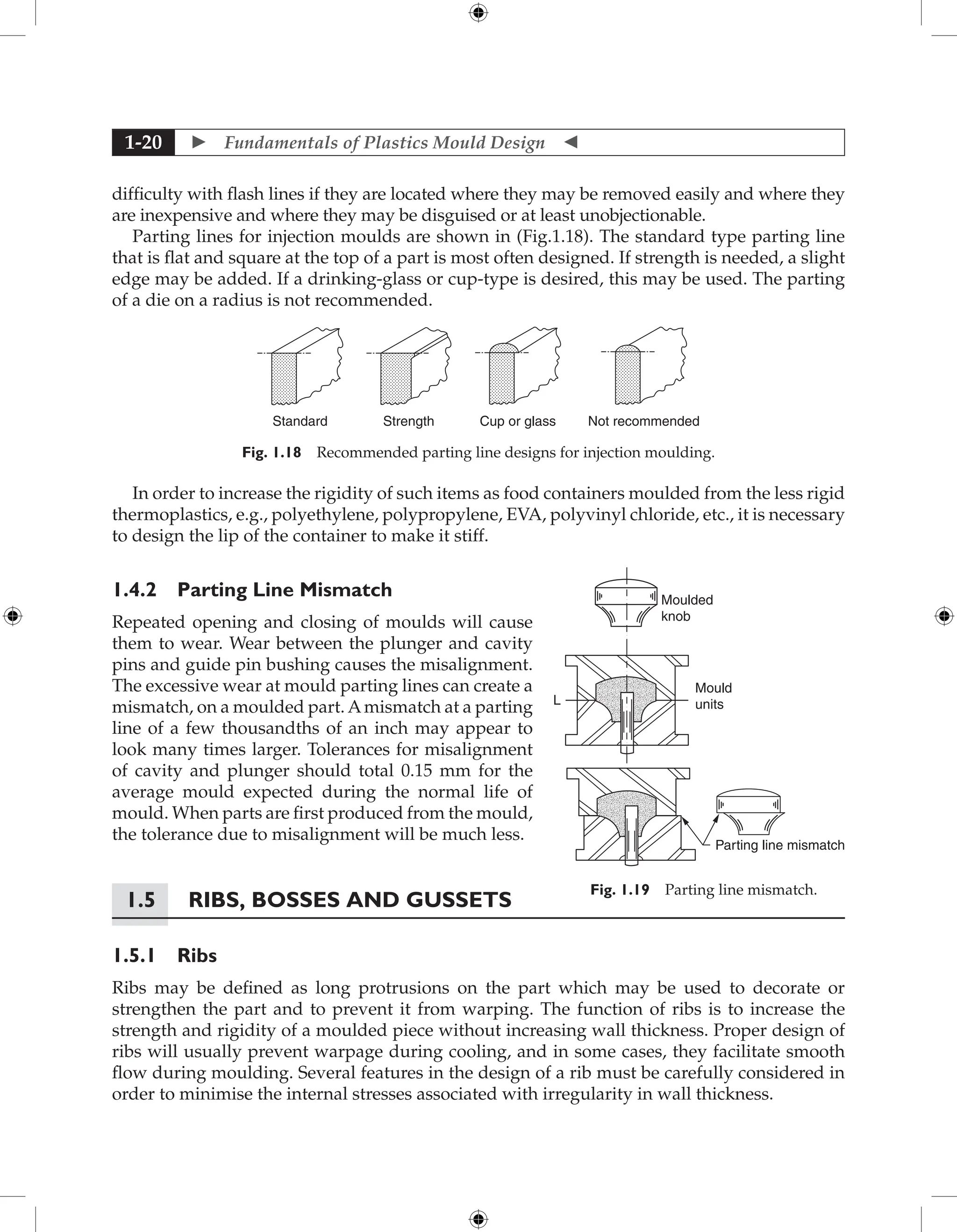
  • 333.
    ๎ฃ Fundamentals ofPlastics Mould Design ๎ข 2-138 1. CIPET, Technical Manual, Chennai. 2. Dominick V. Rosato. P. E. and Donald V. Rosato, Injection Molding Handbook, CBS Publishers and Distributors, New Delhi. 3. DuBois, J. H. and Pribble, W. I., Plastics Mold Engineering, Reinhold Publishing Corporation, New York. 4. Gastrow, Injection Molds, Hanser Publishers, New York. 5. Irvin I. Rubin, Injection Molding : Theory and Practice, Wiley Interscience Publication. New York. 6. Laszlo Sors, Plastic Mould Engineering, Pergamon Press, London. 7. Pye, R. G. W., Injection Mould Design, Affiliated East-West Press. Pvt. Ltd., New Delhi. 8. Rees, Herbert, Mold Engineering, Hanser Publishers, New York. 9. Tim A. Osswald, Lih-Sheng Turng and Paul Gramann, Injection Molding Handbook, Hanser Publishers, Munich. 10. Wordingham, J. A. and Reeboul, P., Dictionary of Plastics, Littlefield Adams and Co., New Jersey. References
  • 334.
    Compression Mould Design Chapter 3 3.1 Introduction Compressionmoulding is the process for moulding thermo-set polymers like phenolics, melamines, ureas, diallyl phthalates (DAPS), unsaturated polyesters, silicones, epoxies, alkyds, etc. Unlike thermoplastics, thermo-set plastics experience an irreversible and exothermic chemical reaction during moulding called polymerisation, brought about by heat (approximately 160ยฐC) and pressure (between 1800 to 4500 lb/in2 ). Following polymerisation, the rigid thermo-set moulded parts retain their physical, chemical, and electrical properties through a temperature range from 70ยฐC to 160ยฐC. The thermo-set moulding is of low cost, temperature, solvent and chemical resistant having good electrical insulation properties. 3.2 Compression Moulding Processes Compression moulding is the most commonly used method by which thermo-set plastics are moulded. Thermo-set plastic materials are one type of polymeric resin that are capable of forming chemical cross linking of the molecules which is called curing of the materials. By this cross linking of the molecules, the structure gets the shape of wire frame model which cannot be further melted. In this method, the plastic, in the form of powder, pellet, or disc, is dried by preheating up to a temperature of 70หšCโ€“80หšC to remove the moisture from the material and the preheated thermo-set material is loaded directly into the mould cavity. Further, the temperature of the mould cavity is held at 150หšCโ€“200หšC, depending on the material. The mould is then partially closed, and the plastic, which is liquefied by the heat and the exerted pressure, flows into the recess of the mould. At this stage, the mould is fully closed, and the flow and cure of the plastic are complete. Finally, the mould is opened, and the completely cured moulded part is ejected as shown in Fig. 3.1. Compression-moulding equipment consists of a matched mould, a means of heating the plastic and the mould, and ejector mechanism for exerting force on the mould halves. For severe moulding conditions, moulds are usually made of various grades of tool steel, cavity and core are polished to improve material flow and overall part quality.
  • 335.
    ๎ฃ Fundamentals ofPlastics Mould Design ๎ข 3-2 Punch Upper Mould Half Cavity Charge Lower Mould Half Knockout Pin (1) v, F v v Moulded Part (2) (3) Fig. 3.1 Compression moulding process In compression moulding, a pressure of 158 kg/cm2 to 211 kg/cm2 is suitable for phenolic materials. The lower pressure is adequate only for easy-flow materials and a simple uncomplicated shallow moulded shape. For a medium-flow material and where there are average-sized recesses, cores, shapes, and pins in the moulding cavity, a pressure of 3,000 psi (211 kg/cm2 ) or above is required. For moulding urea and melamine materials, pressures of approximately one and one-half times needed for phenolic material are necessary. 3.3 Thermo-set Plastics Materials and Product application Thermo-set materials are chemical compounds made by processing a mixture of heat reactive resin with fillers, pigments, dyestuffs, lubricants, etc. These materials or moulding compounds
  • 336.
    ๎ฃ Compression MouldDesign ๎ข 3-3 are in powder, granulated or nodular form, having bulk factors ranging from 1.2 to 10. Some are used in the form of rope, putty or slabs. Phenol formaldehyde (PF) is a common resin and catalyst combination, generally mineral like mica; the moulded part will have good electrical properties. If the filler is glass fibers of one quarter inch long, the moulded part will have good impact strength. Small hollow glass micro balloons have been used as fillers to make low density parts. A very wide range of properties can be obtained from PF because of their compatibility with a variety of reinforcements and fillers, so the properties are dependent on the fillers used. Wood flour filled PF is regarded as general purpose thermo-set material. Applications of thermo-set materials: Melamine formaldehyde (often used in plastic dinnerware), urea formaldehyde (common in white or pastel heat resistant handles for kitchen ware, or outlet sockets for household use), alkyds and polyesters (often used in high voltage insulators in TV sets, or for arc resistance and insulation in circuit breakers and switch gear), dialkyl epoxy (housings for electronic components), and silicone (high temperature requirements to 600o F). The common fillers used in thermo-set moulding are silica, glass, wood flour, natural or synthetic fibers and combination of these. Fig. 3.2 Compression-moulded products: electric plugs, sockets, and housings Thermo-set mouldings are glossy, opaque, dark coloured and inherently flame retardant. They are stiff, hard having low elongation properties and possess good creep resistance.
  • 337.
    ๎ฃ Fundamentals ofPlastics Mould Design ๎ข 3-4 3.4 Types of Compression Moulds Compression moulds are made out of high carbon and high chromium steel, hot-die steel; nickel alloy steels are case-hardened in order to withstand the high temperature and pressures of compression moulding. The core and cavity should be heat treated to the required hardness for maintaining the dimensional accuracy of the product and the life of the mould. Types of Compression Moulds Hand Compression Mould Semiโ€“Automatic Moulds Semi-automatic open flash mould Semi-automatic fully positive and landed positive mould Semi-automatic semipositive moulds Semipositive, Vertical flash type mould Semipositive, Horizontal flash type 3.4.1 Hand Compression Mould Hand compression moulds are used for smaller production runs or prototypes, experimental jobs that require lower mould costs and parts having open tolerances and less intricacy. Top Force Retainer Plate Top Force Bottom Force Insert Guide Pillar Bottom Force Guide Bush Bottom Force Plate Fig. 3.3 Hand compression mould These moulds are used advantageously for complex parts incorporating number of loose pull pins and wedges. Hand moulds weigh less than 15 kg for easy manual handling and the operations are fully manual. Hence, the hand moulds are slow in operation which requires longer cycle time and is labour intensive, adding to production cost as compared to other type of moulds. Moreover, the moulds are more easily damaged by misalignment, mishandling, etc.,
  • 338.
    ๎ฃ Compression MouldDesign ๎ข 3-5 which may result from improper mould operation and closing of the mould. Flash must be removed in the land areas and additional pressure pads should be provided outside the cavity to have better mould life. The hand moulds are less costly and recommended for simple components only as shown in Fig. 3.3. The overall height of the moulding and density is controlled by land areas on mating surfaces and the clearance between the top force and cavity. Generally, high bulk materials are used for processing large deep drawn parts of maximum density. 3.4.2โ€ƒSemiโ€“Automatic Moulds Semi-automatic moulds are fastened in the compression moulding press for the duration of the run. In the process of loading the thermo-set material into a compression mould, the charges of the material to be moulded are some what smaller in length and width but are thicker than the final part and are loaded near the geometric centre of the mould cavity. The closing of the mould spreads the preform / powder to fill the cavity and the component is produced. The semi-automatic moulds are used for mass production of jobs and complex components can be processed. They are classified into the following types: 1. Semi-automatic open flash mould 2. Semi-automatic fully positive and landed positive mould 3. Semi-automatic semipositive mould Semi-automatic open flash mould The flash-type compression mould is used to produce shallow shaped components and in this mould a slight excess of moulding powder is loaded into the mould cavity as shown in Fig. 3.4. On closing the top and bottom platens, the excess material is forced out and flash is formed. The flash blocks the plastic remaining in the ยญ cavity causes the mould plunger to exert pressure on it. Gas or air can be trapped by closing the mould too quickly, and finely powdered material can be splashed out of the mould. Since the only pressure on the material remaining in the flash mould when it is closed results from the high viscosity of the melt which did not allow it to escape, only resins having high melt viscosities can be moulded by this process. Because of lower pressure exerted on the plastic in the flash moulds, the moulded products are usually less dense than when made using other moulds. Moreover, because of the excess material loading needed, the process is somewhat wasteful as far as raw materials are concerned. However, the process has the advantage that the moulds are cheap, and very slight labour costs are necessary in weighing out the powder. However, the moulds are suitable for building up into tools containing multi- impressions. Semi-automatic fully positive and landed positive mould The positive type of compression mould in which the plunger telescopes within the cavity, compressing the thermo-set material and the moulding is formed as shown in Fig. 3.5(a) and 3.5(b). There is very little clearance be- tween the plunger and the cavity wall. In the positive mould, almost all the pressure is exerted on the material and a very little material is allowed to escape as flash, the clearance between
  • 339.
    ๎ฃ Fundamentals ofPlastics Mould Design ๎ข 3-6 the plunger and cavity varies between 0.035 mm to 0.135 mm per side, depending on the size of the mould and the material to be moulded. The flash is formed vertically on the type of mould shown. The disadvantage of the positive type of mould is that after frequent operation the cavity walls become scored and ejection of piece parts is difficult. Flash is formed on every piece part moulded by the compression method. The thickness and position of this flash de- pends on the design of the mould, type of material being moulded, and accuracy of the mould. Flash is removed by filling, sanding, and tumbling. The positive mould is used primarily with material containing coarse fillers and the amount of material placed into the mould cavity must be measured accurately as there is very limited means for the excess material to escape. Core Retainer Core (Plunger) Cavity Retainer Cavity 5 mm Black Plate Heat Source Fig. 3.4 Semi-automatic open flash mould Direct Positive Type Mounting Retainer Heat Source Heat Source Clearance Straight Wall (0.2โˆ’0.3) Fig. 3.5 (a) Semi-automatic fully positive
  • 340.
    ๎ฃ Compression MouldDesign ๎ข 3-7 Mounting Retainer Moulding Mounting Heat Source Land Landed Positive Type Cavity Side Wall 10 Taper On Heat Source Fig. 3.5 (b) Semi-automatic landed positive mould Semi-automatic semi-positive moulds The semipositive mould is a combination of the features of open flash and fully positive moulds and allows for excess powder and flash. It is also possible to get both horizontal and vertical flash. Semipositive moulds are more ex- pensive to manufacture and maintain than the other type compression moulds. Semipositive moulds are suitable for producing components to close tolerance and better surface finish. A clearance of 0.025 mm per side, for a diameter of 25 mm between the plunger (top force) and the cavity is maintained for satisfactory operation of mould. Moreover, the mould is given a 2ยฐ taper on each side of the cavity for allowing the flash to flow on and the entrapped gases to escape along with it, thereby producing a clean, blemish-free mould component. Semipositive, vertical flash-type mould These types of moulds are suitable for moulding components of high-density and critical dimensions as related to cavity and top force. Easy removal of flash on large parts and leaves no flash line scars on the side of the parts. Core Cavity Ejection Pin Retainer Semipositive Vertical Flash Type Moulding Component Fig. 3.6 (a) Semipositive vertical flash type
  • 341.
    ๎ฃ Fundamentals ofPlastics Mould Design ๎ข 3-8 Semipositive, horizontal flash type These types of moulds are recommended for processing of components having close dimensional tolerance and higher accuracy. The component pro- duced out of the mould assures minimum flash finish. Core Cavity Retainer Semipositive Horizontal Flash Type Moulding Component Fig. 3.6(b) Semipositive horizontal flash type 3.4.3โ€ƒSubcavity Mould Compression moulds can be further classified by the number of piece parts produced in each cycle. Single cavity moulds producing one piece are generally used in moulding large cavities. Multiple cavity moulds come in several types. Identical cavity moulds contain a separate cavity, top force and loading well. Area โ€˜Aโ€™ โ€˜Aโ€™ Land Fig. 3.7 Illustrates the plan view of cavities For each piece part the number of cavities varies depending on the size of the piece part, locking force and pressure of the press, ease of loading and ejection of the piece parts. Often two or more cavities moulding differently shaped piece parts are mounted in the same mould base, of the plunger of a subcavity mould. Cavities Section โ€˜AAโ€™ Land Area Flash Fig. 3.8 Shows a cross section of a subcavity mould
  • 342.
    ๎ฃ Compression MouldDesign ๎ข 3-9 External โ€˜Aโ€™ โ€˜Aโ€™ Flash Grooves Fig. 3.9 Shows the plan view of the plunger Another type of multiple cavity mould is called the subcavity mould, or gang mould. Contains common well or loading chamber and common top force and a number of identical parts are moulded. The subcavity mould is used for moulding small parts where loading of individual cavities would be impractical. Measured quantity of powder or material is placed in the common well to produce all the pieces. The top force should not touch the bottom on the land surface of the loading well and an external land provided to keep the top force 0.05 mm to 0.13 mm from the inner land surface. This clearance between the land surface and the top force forms a thin flash between the cavities, which breaks off easily. The land area between the cavities should be kept at a minimum. If the land area between cavities is too large, much of the moulding pressure is wasted on moulding and not enough pressure is exerted on the piece parts, resulting in shorts moulding and parts of low density. Flash grooves of 0.2 mm deep, 2.5 mm wide are spaced above 12.5 mm apart on the outside edge of the top force to vent the mould and to facilitate the removal of excess material. It is recommended that the moulding area should be approximately three times greater than the land area. This type of mould is recommended when moulding small and shallow parts using the more free flowing thermosetting materials. 3.5 Bulk Factor It is the ratio of the volume of the loose plastic powder to the volume of the moulding. The bulk factor varies for different thermo-set plastic materials. Let us assume, the weight of the part is w1 The volume of the same part = w1/r where r - Density of the plastic material If, K - Bulk factor of the material, then; The loose powder volume required for the moulding = w1 K/r The flash allowance will also be taken into account that will be 10 to 20% extra. With extra material the loose powder volume = (1.1 to 1.2) w1 K/r The inclusion of different fillers, affect the bulk factor of the material. The bulk factor for general purpose material and most mineral fillers varies between 2 and 3. In the case of light fabric filler the bulk factor will increase between 8 and 15 and use of a heavy fabric or string filler can increase the bulk factor to between 12 and 24.
  • 343.
    ๎ฃ Fundamentals ofPlastics Mould Design ๎ข 3-10 The size of the charge, in unmoulded powder form, regulates the size of the โ€˜powder wellโ€™ or space provided above the cavity impression, in the case of compression moulding. In general, the dimension of the powder well in a compression mould should be kept to a minimum. The โ€˜landโ€™ dimension, i.e., the distance between the actual cavity dimension and the vertical wall of the powder well should be between 4 mm to 9 mm on normal sized mouldings. On large compression mouldings, such as large table model radio cabinets, containers, etc., a land dimension of 9 mm to 16 mm can be used. Two advantages are obtained by keeping the powder well area as small as possible: 1. Moulding pressure is increased. 2. Less obstruction is put in the way of the escaping excess moulding material (flash) Keeping in view the mould height dimension and press โ€˜daylightโ€™ consideration, the mould powder well should be made deeper rather than have its area increased to take the charge of moulding material. On deep box type or container mouldings it is not necessary to provide a powder well, as the volume of the moulding cavity itself is large enough to contain the charge. But it is a good design practice to include a shallow powder well even in case of bigger mouldings, of say 9 mm deep, as this provides a positive location between the two mould halves. For the materials having high bulk factor, the pressing of such material often requires an extra high loading chamber and therefore, when pressing bearing bushes or similar parts the punch being not only long but also thin, hence a removal loading chamber extension is fixed to the mould as shown in Fig. 3.10. The loading chamber has to be designed with a flare of 1/3โ€“1ยฐ. Generally the start of the flare should lie only 4โ€“6 mm above the compacted moulding. The upper edges should be rounded off with a radius R=2โ€“5 mm as shown in Fig. 3.11. The different design of loading chamber used in compression moulds are illustrated in Fig. 3.12 and 3.13. 3.6 Type of Loading Chamber Design Plastic powder fed to the mould need more space in a loose state than in the pressed moulding. The mould cavity design must allow for sufficient space for the loose powder. Calculation of loading chamber depth D = (VT - VC) / A where D - Depth of loading space from top of cavity to pinch-off land VC -Volume of actual cavity space (cm3 ) VT -Total volume of loose powder (cm3 ) A -Projected area of the loading chamber (cm2 ) Extension of the Loading Chamber Mould Casting Lower Heating Plate Fig. 3.10 Extension of the loading chamber
  • 344.
    ๎ฃ Compression MouldDesign ๎ข 3-11 where V-Total volume of part including flash factor 10 to 20%. In this way, the depth of loading chamber can be determined. Cavity R 2โˆ’5 mm 4โˆ’6 mm 1/3โˆ’1ยฐ Fig. 3.11 Loading chamber design Punch Semipositive Moulds Loading Chamber Design Pot Pot 0.3โˆ’0.5 Punch H7/f 7 H8/f8 R 1/3 โ€“ 1ยฐ โ‰ˆ 7 โ‰ˆ 7 4โ€“6 0.1 Fig. 3.12 Vertical flash type Wood Flour Comp : 0.1 mm Rag and Cotton Flock Comp 0.4โ€“0.5 mm Wood Flour Comp : 0.2 mm Rag and Cotton Flock Comp : 0.4 mm H8/I8 R 0.4โ€“0.5 Pot 4โ€“5 1โ€“2 Punch Punch Pot 0.8 30ยฐโˆ’45ยฐ H8โ€“f8 Rag and Cotton Flock Comp 0.4โ€“0.5 MM Fig. 3.13 Inclined flash type (flash may be easily removed by grinding)
  • 345.
    ๎ฃ Fundamentals ofPlastics Mould Design ๎ข 3-12 3.7 Flash Thickness The excess material flow out from the cavity and form a thin layer of plastic film called flash over land portion of the mould before solidifying the material as shown in Fig. 3.14. Fig. 3.14 Line diagram of flash on mould The fitting arrangement of punch and loading chamber of semipositive mould and the space between punch and loading chamber wall through which the plastic material comes out in the form of thin layer as flash as shown in Fig. 3.15. Punch H8/F8 Pot 4 to 6.0. 1/3 to 1ยฐ Fig. 3.15 Location of punch and cavity for semipositive mould 3.7.1 Flash Thickness Allowance Allowances for flash thickness in compression moulds, using thermosetting compounds are: Rag-filled high impact compound - 0.25 mm Cotton โ€“ flock compounds in large moulds - 0.2 mm Wood โ€“flour compounds in small moulds - 0.1 mm
  • 346.
    ๎ฃ Compression MouldDesign ๎ข 3-13 All other moulds and for all other compounds allow 0.13 mm (as previously noted). Because of the flash thickness that we are considering in the mould design the depth of cavity become: Depth of cavity = Minimum dimension of moulding + Shrinkage of compound The flash thickness adds to the total thickness of the part and this thickness must be subtracted from the basic cavity depth in order that the finished piece may have the desired thickness. 3.8 Clamping Force Clamping force is the force which is required to hold both the mould half in closed position press against the compression pressure. Clamping force (kgf) = Projected area of the moulding (cm2 ) ร— Compression pressure of the plastic material (kgf/cm2 ) For vertical flash or positive type mould where there is no horizontal land, the pressure will be acted fully on the plastic materials but for horizontal mould, the horizontal land is provided for horizontal flash. So during calculation for number of cavities this horizontal flash should be added in the projected area. 3.8.1โ€ƒProjected Area The projected area is the total area of the moulding, when viewed in the direction of the moulding in the plane normal to the press opening. View (A) in Fig. 3.16 illustrates a side evaluation of a component and the view (B) a plan view of the same component. The moulding has a central cut-out opening of dimensions (w ร— h). Thus the area of the cavity which sets up pressure opposing the clamp is the projected area (W ร— H) less the area of the opening (w ร— h). The total projected area is shown shaded in the view (C), and this is equal to (W ร— H) โˆ’ (w ร— h). Machine Clamp Direction Plane Normal to Clamp Direction View-A View-B View-C W w h h w W H Fig. 3.16 Projected area
  • 347.
    ๎ฃ Fundamentals ofPlastics Mould Design ๎ข 3-14 3.9 Determination of the Number of Cavities Number of cavities can be determined in two ways. They are: 1. Technological determination 2. Economical determination 3.9.1โ€ƒTechnological Determination During calculation of the number of cavities or impressions by technological method for multicavity moulds, the following parameters should be considered: 1. Compression moulding press (machine) โ€“ available machine clamping force, and size of the platen to be considered. 2. Moulding material โ€“ The compression pressure of the thermo-set material and the component projected area should be taken into consideration during calculation. The calculation is as follows: Clamping force (kgf) = Projected area of the moulding (cm2 ) x Compression pressure of the plastic material. 3. The projected area can vary depending on the size of the component as well as on the design of cavity or loading chamber and the compression pressure also can vary based on the type of plastic materials. Forexample,inaverticalflashorpositivetypeofmould,thereisnoneedofhorizontal land. But in the case of horizontal flash type of mould the flash width should be taken in to account for the determination of the projected area. So the projected area in the case of vertical flash-type mould is same as the projected area of the component. But, in the case of horizontal flash type, 20% of the projected area of the component should be taken into account for the flash. Therefore, the actual projected area = 1.2 ร— Projected Area of the component 4. The compression pressure must be regulated in order to produce satisfactory parts economically. Pressure needed to mould a particular article depends on the flow char- acteristics of the material, the cavity depth and the projected area of the piece part. Generally, it is recommended that minimum moulding pressure of 240 kg/cm2 of pro- jected area be used. However, in practise, about 300 kg/cm2 of projected area is used to compensate for any variables that may be encountered. 5. After finding the clamping force required for one impression, the number of impres- sions can be determined from the actual clamping force available for a particular machine: No. of impression = Clamping force available on the machine / Clamping force required for an impression
  • 348.
    ๎ฃ Compression MouldDesign ๎ข 3-15 3.9.2โ€ƒEconomical Determination Let us assume that 1, 00,000 pcs = n = The total number of parts are required by the party. x = Number of mould cavities to be fabricated r = 15% of wages/hr = Overhead cost w = ` 25 per hour = Wages of the workers A = Production and maintenance cost of one cavity = ` 10,000/- B = Production cost of mould casing T = Cycle time = 60 seconds S = Total manufacturing cost of the parts By the above we may conclude that No. of cycle required = n/x Total time required= n T/x seconds = nT/60x minutes Total worker cost with overhead = n T w(1 + r)/x So, S = {nT The temperature difference between mould plates and other plates from platen side or platen w(1 + r)/60x} + Ax + B This equation derives the total cost of the part. By differential calculation, we try to get the very economical number of cavities by assuming minimum manufacturing cost. For getting this, differentiate the equation with respect to x. d/dx(S) = d/dx[{nTw(1 + r)/60x} + Ax + B] = d/dx[{nTw(1 + r)/60x} + d/dx (Ax) + d/dx (B)] = d/dx{nTw(1 + r)/60x} + A = d/dx{nTw(1 + r)x-1 /60} + A = -nTw(1 + r)x-2 /60 + A = 0 A = nTw(1 + r)x-2 /60 x2 = nTw(1 + r)/60A x = โˆšnTw(1 + r)/60A by putting the values x = โˆš{1,00,000 ร— 60 ร— 25(1 + 0.15)/60 ร— 10,000} x = 16.9 =16 number of cavities For the above data, 16 is the economical number of cavity. Now we have compared the number with the technological number of cavity. Whichever is less, we have to design the mould for that number.
  • 349.
    ๎ฃ Fundamentals ofPlastics Mould Design ๎ข 3-16 3.10 Factors that influence Thermoset Moulding The following three important factors considered in thermoset moulding are: 1. Temperature 2. Pressure 3. Cure time 3.10.1โ€ƒTemperature The thermo-set compounds are generally heated approximately up to a temperature of 190ยฐC for optimum cure and the temperature for moulding of the various materials can be determined by experimentation or the data received from the manufacturer of the particular material. Highertemperaturesmaydegradesomeofthephysicalpropertiesorelectricalcharacteristics of the materials, may cause the materials to precure before the cavity is completely filled. High temperatures also cause blisters and burn spots on the finished articles. Low temperature does not allow the material to flow properly and result in incompletely cured piece parts of poor consistency, thus reducing the productivity of the cycle. There is generally an optimum temperature which produces the best flow characteristics for the particular material and cavity. The mould temperature not only varies with the material used and the type of the mould but also varies with the geometry of the moulded components and type of plastic material whether it is loose powder or preheated forms. Preheated material generally flows more rapidly during the actual moulding process and the time of complete the cure in the mould cavity is shortened, generally yielding a more economical overall cycle. 3.10.2โ€ƒPressure In compression moulding process, the pressure plays a vital role for ideal filling of the cavity so as to get a defect free component. The thermo-set plastics require greater pressure due to the following reasons: 1. To ensure that the plastic fills all the cavities and has relatively uniform density through- out the moulding. The pressure causes the cavity to fill and resists the tendency of internal gases to form voids or gas pockets and to overcome resistance of the plastic to flow. 2. To ensure better heat transfer to the material, i.e., higher pressure produces a higher density, which generally means faster thermal conductivity. In compression moulding a pressure ranging from 158 to 211 kg/cm2 is suitable for processing of shallow moulded shape components, whereas pins in the moulding cavity where the material has to flow in to small intricacies and orifices to produce a good quality hard packed and dense moulding, a pressure of 211 kg/cm2 or above, is necessary. For deeper moulding cavity, more pressure is required and the thumb rule is to add approximately 19.3 kg/cm2 per cm of depth in excess of 2.54 cm of cavity depth (maximum
  • 350.
    ๎ฃ Compression MouldDesign ๎ข 3-17 up to 30 cm depth) for the material without preheat and for the material with preheat, the pressure approximately 70 kg/cm2 or above is required. For moulding urea and melamine material, pressure of 2 times that needed for phenolic material are necessary, (i.e.), approximately 315 kg/cm2 , again adding 19.3 kg/cm2 per cm of depth in excess of 2.54 cm is added for material without preheat. 3.10.3 Cure Time The period required to harden thermosetting material to partial or complete polymerisation is called the curetime. Many compounds produce parts that are hard enough, blister free and apparently cured, yet the polymerisation of the resin system is not complete and a post back cycle may be required to optimise properties. To achieve the minimum cure time, the material must be at the maximum temperature when it is loaded in to the moulds. Material may be preheated by using infrared lamps, radio frequency preheaters and extrudates formed from screw feed material in a heated barrel. 3.10.4 Material Type General-purpose materials having wood flour, cotton flock, cellulose, paper and so on offer the greatest moulding latitudes. Mineral and glass-filled materials are more heat sensitive and are more difficult to mould. Adjustments of preheat temperature, plasticity and mould temperature must be studied to obtain the optimum mould cycle. 3.10.5 Cross sectional Area The cross sectional area or wall thickness of the moulding will determine the cure-time required to produce the part. A cross section up to 2 mm to 4 mm thick will cure in a matter of second, where as increased wall sections may require minutes. Parts having thicknesses or cross sectional areas in excess of 9.5 mm to 13 mm may be difficult to mould by compression moulding, hence, transfer moulding process will be ideal. 3.11 Heating of Compression Moulds Thermosetting materials which are used in compression moulding are cured by heat and pressure. Heating of compression moulds is an important phase in the moulding operation. Heat must soften the material sufficiently to allow it to flow under the influence of the compression pressure into the cavity opening of the mould. Calculated amount of heat must be applied to bring about the chemical change or polymerize the material into its hard, infusible finished state. The moulds are generally heated electrically, but steam or hot water is also used. The electrical heatingismoreeffectivethansteamorhotwaterheating.Themouldtemperaturecanbecontrolled more easily and over a wide range with electrical heating than with steam or hot water heating.
  • 351.
    ๎ฃ Fundamentals ofPlastics Mould Design ๎ข 3-18 The maintenance of the switching and control devices in electrical system is easy compared with maintenance of complicated equipments in steam heating. In electrical system, the heating coil should be placed at equal distance from the moulding surface, as local overheating or under heating can occur more easily than with steam or hot water system. With all heating methods the proper dimensioning of the heating elements is an essential condition for economic production. Electric resistance heating is besides electric induction heating the most frequently used method. It is easily controllable and clean. Frames, tapes and cartridges are used as heaters. Heater tapes have diameter from 50 mm to 500 mm and are available with different widths. Their heating power amounts up to 3 watt/cm2 . The cartridge heaters are fitted tightly inside the cylindrical holes provided in the compression mould and the usual cartridge diameters are 17 and 19 mm, but sometimes 12.5, 16, 20, 24, 32, 40 and up to 50 mm diameters are also used depending on the size of the mould. The cartridge length is generally 100 mm, but in special cases 300 mm, or at most 1200 mm may be used based on the mould specification. The required number of cartridges may be calculated from the current rate. Actually, by empirical way, the power requirement is calculated on the basis of weight of the mould, i.e., 25 watt/kg steel is taken as standard. Medium sized and bigger moulds are sometimes induction heated. Insulated copper conductors of large cross section are embedded in the mould. Alternating current of 50 Hertz at 20 volt and several hundred ampere cause eddy currents that heat up the mould. When moulding thermo-set compounds by compression or transfer methods, the mould is maintained at a constant temperature set for optimum polymerization of the material at each cycle.Suchtemperaturesrangefrom300โ€“400F(149โ€“204ยฐC).Foroptimummouldingoperations, temperature must be uniform across the surface of the mould and in the cavity areas, ideally to ยฑ2 ยฐF (ยฑ1.1ยฐC). Electric heating is presently the most common technique, utilising multiple electric heating cartridges inserted in the top and bottom halves of the mould, positioned to supply heat to all cavity areas. On larger moulds, temperature controllers and sensing elements are often used in several zones. Steam has the advantage of rapid temperature recovery because of its tendency to condense in the steam channels when any lower temperature occurs, rapidly releasing the heat of condensation. It requires excessively high pressures when higher mould temperatures are required. By contrast, hydraulic oil is also used for mould heating which can easily bring the mould temperatures up to 400 F (204 ยฐC) or higher. Self contained oil heating and cooling systems are used for mould heating, although the cost of fluid-heated moulds is generally higher than the cost of electric cartridge-heated moulds. 3.11.1โ€ƒHeat Losses in Compression Mould 1. Heat loss by conduction 2. Heat loss by radiation 3. Heat loss by convection
  • 352.
    ๎ฃ Compression MouldDesign ๎ข 3-19 3.11.2โ€ƒHeat Loss by Conduction During compression or transfer moulding process heat from the mould will be transferred by conduction from the mould plates to the mould platens thereby causing loss of heat due to conduction. This heat loss can be calculated by using the formula, Qc1= (k A โˆ†T)/t where K: Thermal conductivity of asbestos or other used insulation A: Total area of the mould plates through which heat is transferred towards the platen โˆ†T: The temperature difference between mould plates and other plates from platen side or platen t: Total thickness of the asbestos material 3.11.3โ€ƒHeat Loss by Radiation Initially compression or transfer moulds are heated in closed position so the only radiation losses are from the vertical faces of the mould plates. However, when the mould opens horizontal faces are also exposed for a certain period of time so this should also be taken into consideration. This heat loss can be calculated by using the formula, Qr2 = 1.38 ร— 10-9 (T2 + 460)4 ร— A2 where Qr2: Heat loss by radiation 1.38 X 10โ€“9 : Steffan Boltzman constant for rough finished tool surface. A2: Surface area of exposed tool faces. T2: Temperature of mould in ยฐC or ยฐF 3.11.4โ€ƒHeat Loss by Convection Heat in compression will be transferred by convection from the vertical faces of the mould. During heating up of the mould, normally the mould is in closed condition and convention heat transferred from vertical faces only. Qc3 = (0.7 + โˆ†T3/375) โˆ†T3 A2 where Qc3: Heat lost by convection A2: Area of vertical faces of the mould โˆ†T3: The temperature difference between mould plates and room temperature
  • 353.
    ๎ฃ Fundamentals ofPlastics Mould Design ๎ข 3-20 The heat required for heating of the mould Qr = Qc1+ Qr2 + Qc3 + Q4 The heat required for maintaining the mould at operating temperature for curing thermo- set plastic material Qr = Qc1 + Qr2 + Qc3 + Q5 where Qr : The heat required for heating of the mould Qc1 : Heat loss by conduction Qr2 : Heat loss by radiation Qc3 : Heat loss by convection Q4 : Heat required to raise the temperature of the material to operating temperature Q5 : Heat required for heating plastic material The initial heat required to raise the tool from room temperature to operating temperature, considering the heat losses, can be calculated Q4 = m1 ร— Cp1 ร— โˆ†T4 where m1 = Weight of mould (lb or kg) Cp1 = Specific heat capacity of mould steel โˆ†T4 = Temperature rise from room temperature to operating temperature (ยฐF or ยฐC). Heat required to cure the moulding material is given by Q5 = m2 ร— Cp2 ร— โˆ†T5 where m2 = Weight of mould (lb/h or kg/h) Cp2 = Specific heat capacity of moulding material โˆ†T5 = Temperature rise required from room (or preheat) temperature to moulding temperature (ยฐF or ยฐC) 3.12 Mould Vents During the process of compression moulding, gases are formed as the chemical reaction takes place in the material. The provisions should be made to get rid of the air; volatile gasses from the mould cavity, otherwise poor piece parts will be produced. The air acts as gas pockets in the mould which causes incomplete shots or blistered in the piece part. One method of getting rid of the gases is to allow the mould to breathe; that is, the mould is closed and then opened again for about 3 mm to get rid of the gases and then closed again. The other method is to incorporate `openings` located at mould parting surface. The size of the vent depends upon the viscosity of the thermo-set material. Small grooves of size 0.05
  • 354.
    ๎ฃ Compression MouldDesign ๎ข 3-21 mm to 0.25 mm deep and 3 mm to 6 mm wide ground on the periphery of the plunger that telescope into the cavity as shown in Fig.3.17. Grooved Grooved Flats Flats Fig. 3.17 Types of vents 3.12.1โ€ƒTypes of Vents The recommended vent size of phenolic parts should be 6 mm wide and 0.08 mmโ€“0.09 mm deep and for polyester parts 6 mm wide and 0.05 mmโ€“0.06 mm deep. The vent should be approximately 25 mm long to allow pressure to build in the cavity after the material in the vent cures. All the moulding surfaces should be polished and chrome plated including the vents for free flow of material and release of gases from the mould. Knockout pins often provide a means for venting and requires recessed section, such as โ€›flatsโ€ฒ ground on the diameter that will allow venting in a compression mould. Cavity 0.15 in Vent Land 0.30 in Core Vent Channel โ‰ฅ 0.04 in Vent Depth D Fig. 3.18 Vent grooves
  • 355.
    ๎ฃ Fundamentals ofPlastics Mould Design ๎ข 3-22 Vents should be located in the movable half of the mould, wherever a gas void or knit line is seen on a part. 3.13 Mould Construction The design and manufacturing of compression mould plays a significant role in dimensional integrity of the final product. The proper choice of material for construction of core and cavity is paramount to quality, performance and longevity. Desirable properties are good machinability of metal parts, material that will accept the desired finish, ability with the mould to transfer the heat rapidly and evenly, capability to sustained production without frequent maintenance. Mould materials can be classified according to the size and the number of cavities required in a compression mould. Tool steels, high quality nickel alloy steel are recommended for manufacturing of core and cavity for long production run. Generally, the mould materials like P-20 (C-0.3%, Cr-1.65%) prehardened alloys steel used for making mould base plates, large cavity and core, slides and interlocks. H-13, hot die steel with 5% chromium, higher hardness than P-20 steel, it has good toughness and polishability, used for manufacturing of top punch and cavities. A-2 cold die steel (C-1%, Cr-5%) used for manufacturing of core, cavity with high hardness and abrasion resistance, long wearing compression characteristics. D-2 cold die steel (C-1.55%, Cr-11.5%) has highest abrasion resistance and corrosion resistance used for manufacturing of small compression moulds. High carbon high chromium (HCHC) steel are preferred due to itโ€™s high compression strength, good polishability, corrosion resistance, toughness to withstand pressure, uniform thermal conductivity and good machinability characteristics. 414 stainless steel (C-0.3%, Cr-12%, Ni-2% and Cd-1%) used for manufacturing of mould base and large mould back plates. In a compression mould, the inserted cavities and cores are encouraged due to the reason that in the event of an individual cavity or core being damaged, that particular cavity can be removed from the mould and repaired while the rest of the mould is put back into service. Having individual cavity also allows for insert changes that make it possible to run the multiple versions of the same basic part simultaneously. The top force and cavity generally case hardened to have tough core as well as a wear resistance surface after heat treatment. The high surface hardness and di-oxidation methods offer the best condition for polishing. 3.13.1โ€ƒPolishing and Plating The moulds manufactured in conventional machining process shows cutter marks on the core and cavity surfaces. The non-polished areas will generate frictional heat in the plastic material during its flow and causes degradation of polymer melt. Hence, the mould surfaces need to be mirror polished like core, cavity, vents, ejector pins, guide pillar, guide bush, etc. Core, cavity, vents need to be polished in the direction of material flow and they should have the same degree of polish in all the areas uniformly.
  • 356.
    ๎ฃ Compression MouldDesign ๎ข 3-23 After the mould is completely polished, the core and cavity surfaces should be hard chrome plated to a thickness of 30 to 40 ยต which provides the best part release and protects the moulding surfaces. After the mould is plated, it is necessary to repolish the chrome plated areas to avoid sticking of the components. 3.14 Limitations of Compression Moulding In case of intricate design articles containing undercuts, side draws and small hole, the compression moulding method is not practicable. Articles of polyesters require very careful adherence to all rules for draft angle. Ejector pins should be ideally located in a mould to avoid fracture on the component during ejection. Hence, compression moulding of thermo-set materials is not suitable for production of polyester articles having extremely close dimensional tolerance. Multicavity moulds, particularly in relation to non-uniformity of thickness at the parting line of the moulded articles cannot be processed in a compression mould. Thermo-set materials having high bulk factor is not suitable for compression moulding. Curing rate of heavy section (or wall thickness) is longer hence not advisable in compression moulding process. Part design incorporating undercuts or side draws are troublesome because of high maintenance cost. Questions 1. Write a brief note on compression moulding. 2. List out the different types of compression moulding. 3. Explain hand compression mould with a neat sketch. 4. Explain semi-automatic open flash mould with a neat sketch. 5. Describe semi-automatic fully positive mould with a neat sketch. 6. Explain semi-automatic, semipositive mould with a neat sketch. 7. What is subcavity mould? 8. Explain bulk factor in compression mould. 9. Explain loading chamber in compression mould with a neat sketch. 10. Why is flash thickness allowance required? 11. How does mould vent act in compression mould? 12. How is polishing done in compression mould? 13. Explain the process of plating in compression mould. 14. What are the limitations of compression moulding? 15. Describe landed positive mould with a neat sketch. 16. What is compression mould? What are the different types of compression mould? Explain any one with a neat sketch.
  • 357.
    ๎ฃ Fundamentals ofPlastics Mould Design ๎ข 3-24 17. What is a semi-automatic mould? What are the different types of semi-automatic mould? Explain any one with a neat sketch. 18. What is the technological determination of the number of cavities in compression mould? 19. What is the economical determination of the number of cavities in compression mould? 20. How do temperature, pressure and cure time play a vital role while moulding thermo-set material in compression mould? 1. Bruce A. Davis, Paul J. Gramann, Tim A Oswald and Antoine C. Rios. Compression Moulding, Hanser Publishers. Munich. 2. Charles A. Harper, Handbook of Plastic Processes, Wiley Interscience Publication, New Jersey. 3. CIPET, Technical Manual, Chennai. 4. Dominick V. Rosato, P. E., Plastics Processing Data Handbook, Second Edition. 5. Dominik V. Rosato, Plastics Processing Data Handbook, Chapman and Hall, London. 6. Harry DuBois and Wayne I. Pribble, Plastics Mold Engineering Handbook, Reinhold Publishing Corporation, New York. 7. Manas Chanda, Salil K. Roy, Plastics Technology Handbook, CRC Press, London. References
  • 358.
    Transfer Mould Design Chapter 4 4.1 Introduction Compressionmoulds are not suitable for moulding intricate sections, thick mould walls, long through holes, fragile inserts and components having close tolerance. Due to high compression pressure, there are chances of bending of pins which causes poor quality of product. In case of transfer moulds, the liquid plastics enters and fills the impressions into the two half of the mould through runner and gate at the parting line of the mould, like injection mould. Transfer moulds are used frequently when the moulding sections are delicate and component thickness more than 3.2 mm. Transfer moulding process Transfer moulding is a process where the predetermined quan- tity of thermo-set plastic material is inserted inside the cavity before the moulding takes place. The moulding material is preheated and loaded into a chamber known as the โ€˜potโ€™. A plunger is then used to force the material from the pot through channels (known as a sprue, runner, and gate) system into the mould cavities. The mould remains closed as the material is inserted and curing takes place and finally the mould is opened to release the part. The mould walls are heated to a temperature above the melting point of the moulding material; this allows a faster flow of material through the cavities. It is a process in which measured quantity of preform thermo-set polymer material is heated in a pot and it is transferred into the heated mould. Due to increase of pressure the polymer melt is forced through runner and gate, leading to homogenisation and causes cross- linking of the polymer and solidification of the part. Generally transfer moulding is used for the production of precise shaped electrical and electronics items. 4.2 Types of Transfer Moulds Transfer moulds are of semi-automatic type and are made in single and multiple cavities. The types of transfer moulds are detailed below:
  • 359.
    ๎ฃ Fundamentals ofPlastics Mould Design ๎ข 4-2 Types of Transfer Mould Pot-type transfer mould Plunger-type transfer mould Bottom plunger transfer mould Top plunger transfer mould 4.3 Pot Transfer Moulds The pot type transfer mould and its function used in conventional transfer moulding press are shown in Figs. 4.1 to 4.4. 4.3.1 Designs of Pot and Plunger The pot and plunger are made out of good quality wear resistant tool steel which is heat treated and ground and are of square, rectangular or round in shape. The shape is determined based on theshapeofthepiecepart,numberofcavities,andavailablespaceinthemouldbase.Roundshape pots and plungers are preferred because less machining difficulties are encountered. A clearance of 0.02 to 0.07 mm per side is provided between the pot and plunger to avoid abrasion. The area of the pot should be 20 to 30% higher than the projected area of all the cavities and runners. The dimensions of the pot either round or square, can be calculated once the cavity area is known. To determine the volume of the pot, the total volume of all the piece parts, the runner and the sprue, plus a small amount for a 0.35 to 0.70 mm thick cull, is calculated. At least twice this volume is to be used for the pot volume. Knowing the area and the volume, the depth of the pot is derived by dividing the volume by the area. The additional volume in the pot is provided to compensate for the bulk factor of the preforms used and to allow the plunger to enter the pot a short distance before exerting pressure on the material. High bulk factor materials are generally not preferred in transfer moulding. The bulk factor of the preforms used in transfer moulding is approximately 1 to 2. Figure 4.5 illustrates the construction details of the pot and plunger. For sufficient strength, horizontal distance โ€˜Yโ€™ should be equal to the depth of the pot โ€˜Yโ€™, and 1.5 to 3 mm radius is provided at the top edge of the pot, 1.5 mm radius is machined at the bottom of the pot to facilitate the flow of the material and to simplify the machining of the corner. A 2.5 to 3 mm radius is machined at the bottom of the plunger. The difference in the radii on the plunger and the bottom of the pot results in a clearance so that the plunger will not wedge in the pot but will land on the flat surface of the pot. In assembly, a small clearance between the plunger and the transfer pot is maintained. Fitting the plunger to the cold pot size-the plunger staying relatively cold during operation but the pot having to be heated-the clearance widened between them allowing material outflow.
  • 360.
    ๎ฃ Transfer MouldDesign ๎ข 4-3 Adjusting the plunger to the chamber when expanded by heat prevented its entrance in the cold state. So the plunger is forced into the pot strongly on clamping the mould and there is cracking and other damage occurs. This problem is solved by adjusting the plunger to the cold pot with running fit, but permitting material flow around the plunger so as to form a collar when solidified according to the hot pot size, thus preventing material flow out, during moulding. A sealing groove approximately 2.5 mm wide and 0.8 mm deep is cut in the perimeter or periphery of the plunger. During the operation of the mould, groove fills with the moulding material and acts as a natural seal, allowing very little material to escape past the bearing surface of the plunger. Flats or grooves are ground on the bearing surface of the plunger for venting purposes. A clearance of 0.75 mm per side is machined above the bearing surface of the plunger. This clearance keeps the bearing surface narrow to prevent galling, and allows flash and excess material to escape. The sprue and the interior of the pot are polished so the material can flow easily. The sprue has a taper of 2o to 3o per side. The large diameter of the sprue varies in size from 9 to 12 mm with a 1.5 to 3 mm radius at the entrance of the sprue. The small diameter at the runner or piece part varies from 3 mm to 6 mm depending on the size of the piece part. Wedge-shaped slots called cull pick up are machined in the plunger. The thick or heavy section of the cull pick up is located directly above the sprue as shown in Fig. 4.5. The length of the cull pick up varies from 3 to 6 times the diameter of the sprue, depending on the location of the sprue and the diameter of the pot. The width is generally 2 to 3 times the diameter of the sprue. Clamping Plate Land Pot Plunger Cull Pick Up Sprue Preform Pot Plunger Plate Runner Gate Project Area Ejector Pin Fig. 4.1 Pot transfer mould (Preform loaded position).
  • 361.
    ๎ฃ Fundamentals ofPlastics Mould Design ๎ข 4-4 Movement of mould opening Fig. 4.2 Pot transfer mould fully closed position. Movement of mould Cull Piece part Fig. 4.3 Pot transfer mould with plunger open position. Movement of mould Fig. 4.4 Pot transfer mould fully open position.
  • 362.
    ๎ฃ Transfer MouldDesign ๎ข 4-5 0.7 Clearance 7.93โˆ’9.52 1 . 5 8 R 2.38โˆ’3.17 (Wide) 0.79(Deep) 1.58R R2.8โˆ’3.9 Y Y โˆ’ Sprue 2โˆ’30 Perside 1.58โˆ’3.17R Fig. 4.5 Construction details of pot and plunger. 4.4 Plunger Transfer Mould Plunger Change (Preform) Cavities Ejector pins (1) (2) (3) v,F v v v v Cull moulded part Fig. 4.6 Plunger transfer moulding: (1) Charge is loaded into pot (2) Softened polymer is pressed into mould cavity and cured (3) Part is ejected. Plunger type of transfer mould shown in closed position with the preforms in the target area and the plunger on its downward stroke. The combination of the heat of the mould and the pressure of the plunger on the preforms causes the material to become fluid and to flow through the runners and gates into the cavities. The plunger transfer differs from the pot transfer in that the plunger is part of the moulding press and not a part of the mould itself. By the use of this plunger, the sprue is eliminated and very thin cull of small area is formed above the target area, thus reducing the loss of material. The top clamp plate is fastened to the stationary platen of the press. The arrow at the right is shown in Fig. 4.6 (3) indicates the movement of the mould base at the parting line.
  • 363.
    ๎ฃ Fundamentals ofPlastics Mould Design ๎ข 4-6 The preheated preforms are placed or stacked in the target area as shown in Fig. 4.6. As the mould is closed, the preforms are lifted into the transfer sleeve. Once the mould is completely closed, the plunger is activated for its downward stroke. The mould is closed, and the preforms are loaded into the closed mould through the opening at the top of the transfer sleeve. The plunger is then activated, forcing the material throughout the mould. Movement of plunger Top clamp plate Cavity insert Runner Runner plate Gate Preform Transfer sleeve Seal groove plunger Fig. 4.7 Plunger-type transfer mould. A two cavity plunger type transfer mould illustrated in Fig. 4.7 feeding the material into the runners, round type of runner is used. In order to maintain a constant volume flowing into the runner system, the runners are machined at an angle in the runner plate. The type of loading depends on the height and size of the press used and clamping pressure of 700 to 800 kg/cm2 is used to keep the mould together at the parting line. All transfer moulds are vented to allow air to escape from the cavities. 4.4.1 Top Plunger Transfer Moulding Top plunger mould is a two plate mould in which the preforms, tablets are placed into the space provided in the mould. The plunger is the part of press and not to the part of mould. The press plunger moves downward and applied the pressure on the charge. Due to heat and pressure in the cylinder, the thermo-set material changes its state from solid to liquid. This liquid is forced into the cavity by runner and gate and the sprue is not required as pot type
  • 364.
    ๎ฃ Transfer MouldDesign ๎ข 4-7 transfer mould. The material gets cured in the cavity and the press is opened and the part is got ejected by knockout pins as shown in Figs. 4.8 and 4.9. Runner plate Cavity Top clamp plate Gate Seal groove plunger Transfer sleeve Runner Preforms Fig. 4.8 Top plunger transfer mould. 5.0 5.0 10.0 C 30 Degree 3.0 3 degree 0.8โˆ’1.0 mm 5 degree R0.1 mm Enlarged Section At - โ€˜Cโ€™ Fig. 4.9 Standard top plunger design. 4.4.2 Bottom Plunger Transfer Moulding Bottom plunger mould is a two plate mould. The preforms, tablets are placed into the sleeve; cylinder or space provided in the mould and the plunger is the part of press and not to the part of mould. The bottom plunger moves upward and applies the pressure on the charge. Due to
  • 365.
    ๎ฃ Fundamentals ofPlastics Mould Design ๎ข 4-8 the heat and pressure in the cylinder, the charge changes its state from solid to liquid. This liquid forced into the cavity by runner and gate and the material gets cured in the cavity. Then the press is opened and the part is ejected by knockout pins. The plunger in the bottom half of the mould, the process consists of placing preheated preforms in the transfer sleeve or cylinder, closing the two halves of the mould, and activating the plunger, which forces material out through the passage known as runners, and the gate area into the mould halves. When the cavities are completely filled, the excess material remains as a cull at the face of the plunger. After the material is cured, the press is opened at the parting line, parts are removed and the gate, runner and cull. This moulding process is commonly called the bottom plunger transfer moulding. In this process, all the activity of the process is automatic, and auxiliary devices are used to load the preheated preforms, and unloading trays are utilised to receive and separate the parts, runner gate and plunger culls. X 0.2 X 7.0 6.0 5.0 5.0 D+C C 5.0 5ยฐ R0.1 0.75โˆ’1.0 Enlarged View at โ€˜Cโ€™ D H7g6 Fig. 4.10 Design of lower plunger. 4.5 Transfer - Pot Calculations The clamping pressure provided by the loading chamber is an important factor in transfer mould. If the total cavity area is greater than the total pot area, the hydraulic pressure exerted by the plastic compound would tend to open the mould at the parting line. To ensure perfect mould locking, the area (Ap) should be 20%-25% greater than the combined area of the moulding surface and the area of all runners and sprue. The dimensions of the pot, if it is round or square can be calculated once the area is known. Total area of pot Ap = Total projected area of cavities, runners and sprue + 25โ€“30% of total projected area. Volume of pot Vp = Total volume of all the piece parts, the runners and the sprue plus approximate volume of a small amount for a 0.5 to 1 mm thick cull multiplied by bulk factor of the compound.
  • 366.
    ๎ฃ Transfer MouldDesign ๎ข 4-9 Depth of pot = Vp / Ap Calculation aspects: Ram load 1. Transfer ram load required (tonf) = Area of transfer plunger (cm2 ) ร— Pressure required to transfer moulding material (tonf/cm2 ) The pressure required for transfer moulding for the particular material may be obtained from the material manufacturerโ€™s data, e.g., for Phenolic 3โ€“6 tonf/in2 (472-945 kgf/cm2 ). 2. Main ram load Pressure developed required to clamp = by transfer ram (tf/cm2 ) mould (tonf) ร— Projected area of moulding at flash face, including runners (cm m ) bottom transfer Area of transfer pot (cm ) 2 2 + ( ๏ฃซ ๏ฃญ ๏ฃฌ ๏ฃฌ ๏ฃฌ ๏ฃฌ ๏ฃถ ๏ฃธ ๏ฃท ๏ฃท ๏ฃท ๏ฃท ๏ฃท A safety margin of clamp over transfer pressure of 10โ€“20% is added. 3. To maintain balance where transfer moulds employ an integral pot: Area of pot (cm2 ) = Projected area of mould cavities and runners (in2 or cm2 ) With adequate gates and runners the projected area of the mould may sometimes exceed that of the pot, although conservative practice adopts the reverse-the area of the pot exceeding that of the mould by amounts varying from 10 to 25%. Press tonnage required for integral pot moulds is given by Main ram load (tonf ) = Area of transfer pot plunger (cm2 ) ร— ( Pressure available to transfer moulding material (tf/cm2 ) 4.6 Mould Heating A uniform mould temperature is to be maintained in each half of the mould well within 3ยฐC for all locations, heated by oil or steam. Moulds that are heated with electric cartridge heaters can vary by as much as 6ยฐC. A mould with a uniform temperature will fill easier and produce parts with less warpage, improved dimensional stability and a uniform surface appearance. The mould heating by steam or oil will have a uniform mould temperature because the heat source maintains a constant temperature. But steam heating is more effective than oil heating. Therefore, when using oil to heat a mould, it is necessary to set the oil temperature higher than the desired mould temperature. Electrically heated moulds are more difficult to maintain at a uniform temperature because the cartridge heaters are constantly cycling on and off. When they are on, they generate a great
  • 367.
    ๎ฃ Fundamentals ofPlastics Mould Design ๎ข 4-10 deal of heat at the source but this heat must be distributed throughout the mould in a way that produces a uniform mould temperature. The amount of wattage needed to heat a mould is generally 1ยผ kilowatts for every 45 kg of mould steel. Locating a heater on the centreline of the mould is not recommended, because the centre of the mould is normally hot enough without adding any additional heat. The cartridge heaters are located in the support plates, with a distance of 60 mm between the heaters and the deep draw moulds requires heaters in the retainer plate. The thermocouples are provided to control the temperature of each half of the mould. The thermocouples should be located in the โ€˜Aโ€™ and โ€˜Bโ€™ plates, between two heaters and at a distance of 32 mm to 38 mm from the respective cartridge heater. This distance is to be measured from the edge of thermocouple hole to the edge of the cartridge heater hole. The distance from the thermocouple to the heater is important because a heater that is too close will cause the thermocouple to turn off the heat before the mould is at temperature. A heater that is too far away from the thermocouple will result in a mould that overheats and then gets too cool. The thermocouple should be located 35 mm to 50 mm inside the mould, since the temperature taken there, is less susceptible to outside influences and therefore, more stable. Electrical energy requirements to heat the mould The empirical formula to heat the mould is 20โ€“40 Watt/kg of mould. The heat required to raise the mould to operating temperature is given by Q5 = Q1 + Q2 + Q3 + Q4 where Q1 = Conduction losses through asbestos insulation from mould to platens (cal/h) Q2 = Radiation losses from mould faces (cal/h) Q3 = Convection losses from mould faces (cal/h) Q4 = Heat required to raise temperature of metal to operating temperature (cal/h) Q5 = Heat required for heating plastic material (cal/h) 1. Q1 = KA1โˆ†T1 / L where k = Thermal conductivity of asbestos insulation (cgs units) A1 = Total area of mould top and bottom faces in contact insulation (cm2 ) L = Total thickness of top and bottom asbestos insulation (cm) โˆ†T1 = Temperature difference between mould and press (o C) 2. Q2 = 1.38 ร— 10-9 (T2+460)4 ร— A2 where 1.38 ร— 10โ€“9 (T2+460)4 is the modified Stefanโ€™s constant for a rough finished mould surface
  • 368.
    ๎ฃ Transfer MouldDesign ๎ข 4-11 T2 = Temperature of mould (o C) A2 = Area of exposed mould faces (cm2 ). The radiation losses are from the vertical faces of the mould, however, the horizontal faces area exposed for a proportion of the time and hence an additional allowance must be made when determining the heat requirements during moulding. 3. The heat lost by convection from the vertical faces is Q T T A 3 3 3 2 0 7 375 = + ๏ฃซ ๏ฃญ ๏ฃฌ ๏ฃถ ๏ฃธ ๏ฃท . โˆ† โˆ† where โˆ†T3 = Temperature difference between mould and surrounding air (o C). During initial heating, the mould is normally closed and the only convection losses are from the vertical faces considered above. However, the horizontal faces are exposed when the mould is open so that the losses from these must be taken into account when determining the heat requirements during moulding. The heat lost by convection from horizontal faces lying upwards is Q T T A 3 3 3 3 0 7 375 โ€ฒ + ร—1.1ร— = โˆ† ๏ฃซ ๏ฃญ ๏ฃฌ ๏ฃถ ๏ฃธ ๏ฃท โˆ† . The heat lost by convection from horizontal faces lying downwards is Q T T A 3 3 3 4 0 7 375 2 โ€ณ + ร— = โˆ† ๏ฃซ ๏ฃญ ๏ฃฌ ๏ฃถ ๏ฃธ ๏ฃท โˆ† . where A3 = Area of mould face lying upwards (cm2 ) and A4 = Area of mould face lying downwards (cm2 ) 4. The initial heat required to raise the mould from room temperature to operating tem- perature, additional to the heat losses listed, is Q4 = m1 ร— Cp1 ร— โˆ†T4 where m1 = Weight of mould (kg) Cp1 = Specific heat capacity of moulding material โˆ†T4 = Temperature rise from room temperature to operating temperature (o C). 5. Heat required to cure the moulding material is given by Q4 = m2 ร— Cp2 ร— โˆ†T4 where m2 = Weight of mould (kg/h) Cp2 = Specific heat capacity of moulding material โˆ†T5 = Temperature rise from room (or preheat temperature) to moulding temperature (o C).
  • 369.
    ๎ฃ Fundamentals ofPlastics Mould Design ๎ข 4-12 4.7 Selection of Moulding Method-Compression or Transfer Table 4.1 Comparison of compression and transfer moulds. Factor to consider; advantages-limitations Compression Transfer Close tolerance, projected area โ€ข Close tolerances, over flash line, minimum flash โ€ข Lowest mould shrinkage โ€ข Uniform shrinkage, all directions โ€ข Maximum uniform density โ€ข Reduced cure, thick sections โ€ข No weld lines, less moulded in strains โ€ข Small holes, longer length, through holes โ€ข Extremely thin mould sections, telescoping โ€ข No venting problems โ€ข Impact strength โ€ข Moulds with movable sections or cores โ€ข Moulded in inserts โ€ข Large projected area parts โ€ข Lowest mould-flash scrap โ€ข Generally less mould maintenance โ€ข Gate or sprue removal necessary โ€ข Maximum number of cavities per clamps force โ€ข Mould erosion, sprues, runners, gates โ€ข Generally higher mould cost โ€ข
  • 370.
    ๎ฃ Transfer MouldDesign ๎ข 4-13 4.8 Economic Determination of the Number of Cavities n = The total number of parts to be processed x = Number of mould cavities t (minute) = Period of pressing + Change of piece using a mould with x cavities G (`) = Production cost of the mould casing A1(`) = Production and maintenance cost of a cavity R = Workshop overheads calculated with the wages in decimal fractions A (`/hr) = Wage per hour of a worker K = a (1+r) (`/hr) - The hourly wage plus operating costs P (`) = Total manufacturing cost of the n pieces to be produced (including mould production costs) P n x t K G A โ‰ˆ . . + + 1 60 ............(4.1) It is evident that The total number of parts to be produced per cavity Cycle time with x cavities in minutes The hourly wage plus operating costs n p K G x A1 + + 60 t โ‰ˆ x Processing cost of number of pieces produced by single cavity Total manufacturing cost of the n pieces to be produced (including mould production cost). Production cost of the mould casting Production and maintenance This cost, as a function of the number of cavities has a minimum value when, dp d x dp d x dp d nt K x G X A ( ) ( ) = = + + ๏ฃซ ๏ฃญ ๏ฃฌ ๏ฃถ ๏ฃธ ๏ฃท = - 0 60 0 1 1 where n, t, k, G, and A1 are constants for a particular case.
  • 371.
    ๎ฃ Fundamentals ofPlastics Mould Design ๎ข 4-14 โˆด = - + + = = - + = โˆด - + = - dp dx nt K x A dp dx nt K x A nt K x A A 60 1 0 0 60 0 60 0 2 1 2 1 2 1 ( ) 1 1 2 2 1 60 60 = - = - nt K x x nt K A ; The most economical number of cavities is x nt K A = - 60 1 ............(4.2) The results of the formula (4.2) can be considered as an approximate value and the economical number of cavities should be checked technologically. For example, there may not be enough clamping power available in the machine, therefore, a mould with a limited number of cavities is used. This method of calculating the number of impression is practically impossible during design stage. So the number of impression can be determined only by the technological method. 4.8.1 Moulding Pressure In transfer moulding, both clamp pressure and transfer pressure are to be considered. In case of pot-type transfer, the transfer force ranges from 35 to 69 N/mm2 of pot. The clamp pressure must be sufficient to keep the mould from flashing or opening. The pot area must therefore, be equal to or slightly greater than the projected area of the moulded part. Plunger-transfer operating or transfer forces are in the 41โ€“52 N/mm2 area of plunger range. The clamping loads must be greater than the load developed by the transfer pressure acting on the area of the plunger, runners, gates and projected area of the parts. Low-pressure materials will require much less transfer pressure. 4.8.2 Transfer Moulding Relates to Pressure, Cure and Quality Transfer moulds are charged with preheated material in a preform state and the preheat temperatures in the range of 93 to 127o C. These result in lowering transfer pressures and reduces cure, especially where the part design has heavy or thick cross sections. The proper selection of the type of gate, gate size and location helps the part to fill with a minimum knit line. Large flat parts are difficult to mould free of flow lines that appear on the moulded surfaces. Venting of moulding is very important to avoid burning of material caused by trapped air and volatiles. Vents also prevent weld or knit lines around pins or openings near the outside edges of the part.
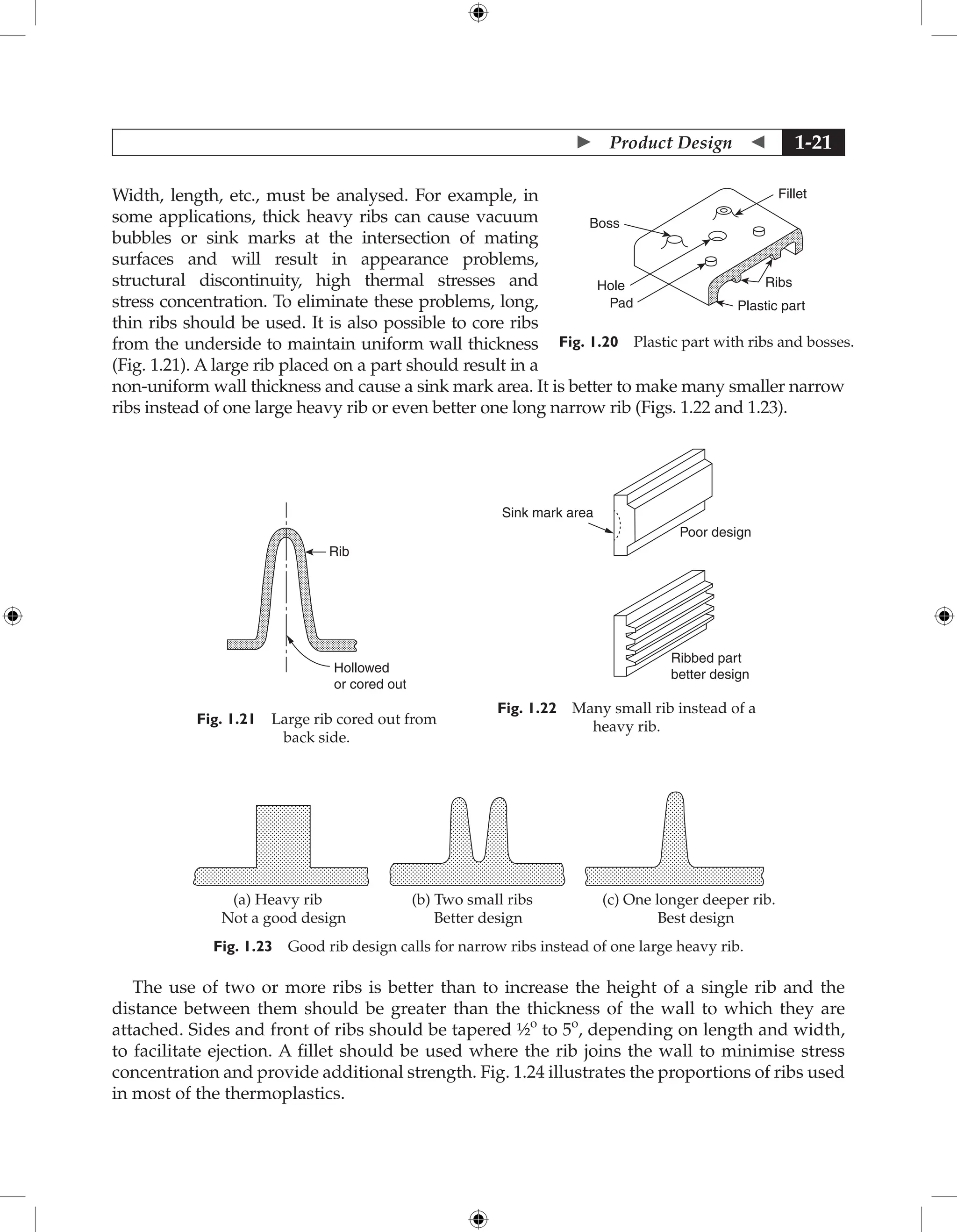
  • 372.
    ๎ฃ Transfer MouldDesign ๎ข 4-15 4.9 Design of Sprue, Runner and Gate The ideal design of sprue, runner and the gate is very important in the success of transfer moulding. The sprue leads directly to the mould cavity in a single cavity mould. In multicavity moulds material flows through the runner from the sprue to the mould cavities. There is a โ€˜gateโ€™ located at the end of the runner before the cavity. The kinetic energy of the material is transformed into heat and the heating of the material is most rapid at the gate. The shortest possible runner is always an ideal design. Abigger diameter runner is desirable for promoting material flow and a low transfer pressure, but on the other hand, material is deposited in the runners after each injection, reducing it to the minimum possible diameter is advantageous. Gates, a degate of the moulds serve a double purpose: first the uniform heating of the material, secondly to ensure a degate of the moulded part without any trace. For this, a gate with small diameter is desirable. E E R0.8 D 0.5โˆ’0.8 C R Fig. 4.11 Sprue, runner and gate design. 10ยฐ Ax 0.839 ref A A A Fig. 4.12 Sprue, runner and gate design โ€“ Cross section. The amount of pressure needed for forcing the thermo-set material to flow are considerably increased by decreasing the runner diameter, thus limiting diameter reduction. Viscosity of
  • 373.
    ๎ฃ Fundamentals ofPlastics Mould Design ๎ข 4-16 plastic material plays an important role to determine the gate and runner flow conditions from the laws and equations of fluid mechanics. The viscosity of the fluidised plastic powder is not only a function of the resin quality and its filler content, but of the instantaneous temperature which fluctuates owing to friction and the state of curing. The runner and gate dimensions as shown in Figs. 4.11 and 4.12 as recommended are listed in Table 4.2. Table 4.2 Runner and gate dimensions. Type of plastic powder Minimum diameter dmin. R E Cmin K Wood flour phenolic 4 1/2(D+5) 2.5 0.8 0.28โ€“0.30 Cotton flock phenolic 5โ€“6 1/2(D+5) 3 1.2 0.32โ€“0.36 Fabric-filled phenolic 6โ€“7 1/2(D+7) 4 1.6 0.37โ€“0.42 6.0 R3 Dia 22.0 8ยฐ D Dia 20.0 Dia 25.0 According to the dimension of the mould Fig. 4.13 Sprue bush. The minimum sprue area or with multicavity moulds, the sum of gate areas may be determined from the formula. A = GK where A (mm2 ) = The minimum runner area and the sum of gate areas. G(gm/stroke)= Weight of pieces produced K = Value to be found in Table 4.2 It is also possible to determine optimum cross-sectional areas of runner and gate, utilising the weights of moulded part and the weight of material to be transferred through runners and gates. Various gate designs used in transfer moulds are rectangular gate, half round and full round gate. The runner and gate design depends on the following factors: 1. Geometry of the moulded part 2. Location of the gate 3. Moulding pressure required 4. Number of impressions 5. Plasticity and heat sensitivity of the material selected for the application 6. Physical properties required in the moulded part
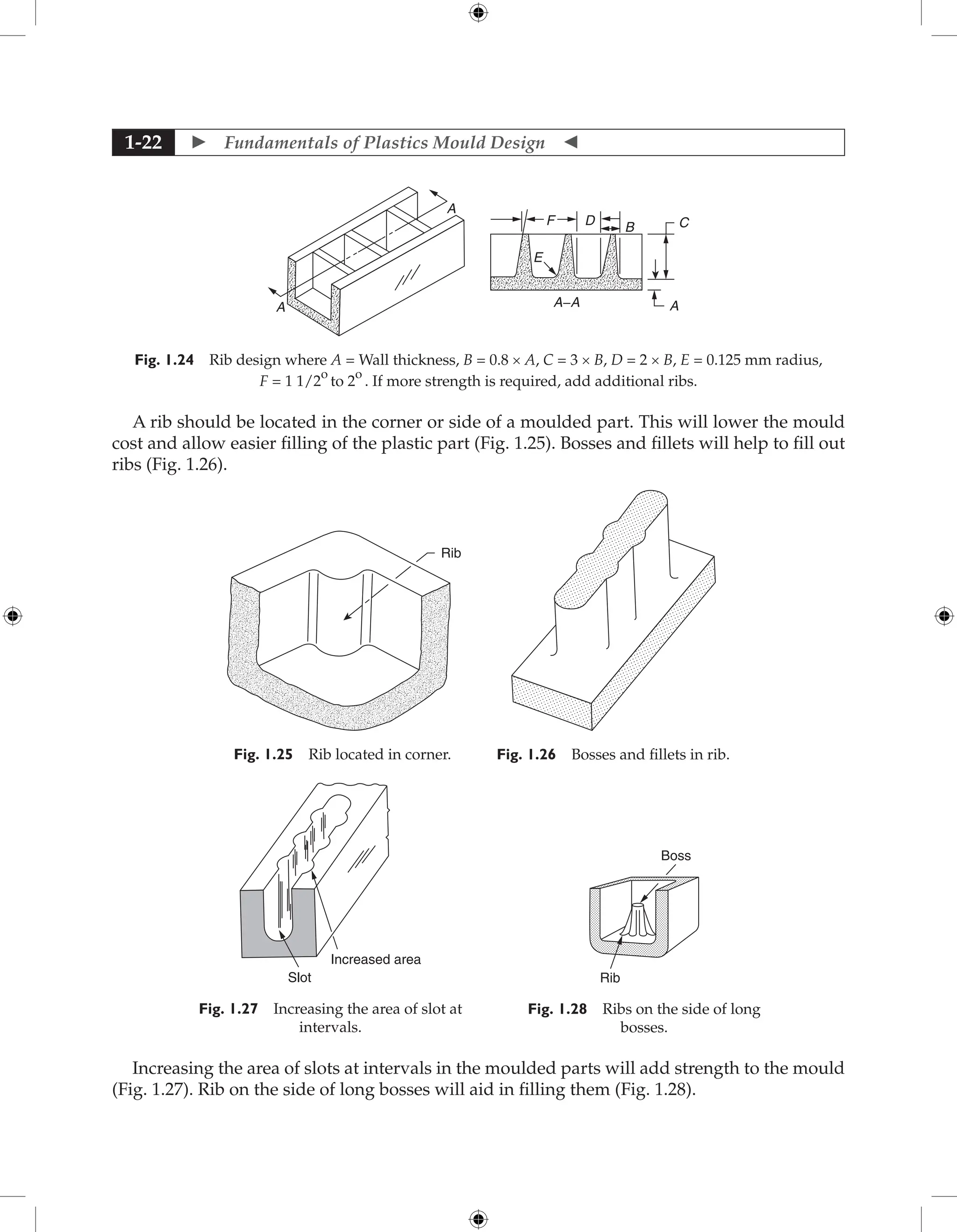
  • 374.
    ๎ฃ Transfer MouldDesign ๎ข 4-17 The half round runner and rectangular gate system require 35% higher injection pressure to fill the cavity in the same time. The half round runner and gate system required 15% higher injection pressures to fill the cavity in the same amount of time. In general, greater the injection pressure, greater the wear on erosion of runners and gates. Therefore, the full round runner and gate should be used whenever possible. 4.9.1โ€ƒRunner Design When designing runners for moulds, there are number of possible approaches. These include the standard full round with a centreline. This is the most efficient runner, but in some cases it is necessary for the runner to be in only one half of the mould. Round runners are the most efficient types but are the most expensive because they must be machined into both plates of the mould. Full round runner P L Standard trapezoid runner P L Waste Effective runner size Modified trapezoid runner P L Waste Effective runner size Fig. 4.14 Runner design. A standard trapezoid runner is used in transfer moulds and it is machined in one half of the mould only. Due to sharp corners the material movement is restricted hence the application of such type of runner is very limited. To reduce the amount of scrap in the runner, a modified trapezoid runner design is suggested. This design is more efficient and avoids the flow restriction due to the radius provided in corner areas in the runner. Effectiveness of this runner: These runners are machined into only one mould plate but reduce the pressure and temperature losses observed with half-round runners. Gates The gates for thermo-set moulds are the high wear areas of the mould. The gate should be made using a replaceable insert so that when the gate becomes badly worn, it can easily be replaced. A gate should be made of good quality tool steel, that do not wear easily. The materi- als commonly used for gate inserts are OHNS, hot die steel, D-2 steel, EN-24 steel, etc. A gate should be large enough to allow the part to fill without using excessive transfer pressures or requiring long transfer times. 4.9.2โ€ƒCore and Cavity It is preferred to use the inserted cavities and cores in a transfer mould due to its better interchangeability. The primary reason for this is in the event of an individual cavity or core being damaged, that particular cavity can be removed from the mould and repaired while the rest of the mould is put back into service. Having individual cavities also allows for insert changes that make it possible to run multiple versions of the same basic part simultaneously.
  • 375.
    ๎ฃ Fundamentals ofPlastics Mould Design ๎ข 4-18 When the parts are very small and there is a large number of cavities, individual cavity inserts might not be feasible. In those cases, the cavity inserts of 3 or 4 cavities can be machined in a single insert. The materials most commonly used for cavity inserts are H-13 and S-7, P-20; prehardened steel, OHNS, EN-19 and EN-24 steel, hot die steel, etc. The core and cavity steel is hardened to Rockwell 52 to 54 HRC and can be polished to produce an excellent surface finish on the parts. 4.9.3โ€ƒGuide Pins and Ejector Pins Ejector pins are used to eject the component from the mould once it is cured. The ejection technique is used both in compression moulding and transfer moulding. The guide pins are sufficiently long to enter the guide bushings before the transfer plunger enters the chamber and when anchored in the cavity plate, it must be long enough to enter the chamber. The guide pins when anchored in the cavity plate must be long enough to enter the guide bushing before the horizontal core pins enter their tapered seat. Mould plate Pin ejector Ejector plate assembly Ejector pin ๏ฟฝ ๏ฟฝ ๏ฟฝ ๏ฟฝ ๏ฟฝ ๏ฟฝ ๏ฟฝ ๏ฟฝ ๏ฟฝ ๏ฟฝ ๏ฟฝ ๏ฟฝ ๏ฟฝ Fig. 4.15 (a) Transverse movement of misaligned ejector pin. The guide pins are provided in the transfer plunger retainer plate. It provides the alignment between the cavity sections and between the transfer chamber and plunger. Pins of this type must have sufficient length to project far enough through the loading plate to enter the guide bushings in the lower cavity plate before these two plates come together. Guide pins always enter their guide bushings before any of the other mould parts are engaged. Safety pins are used on transfer moulds in the same manner as on compression moulds. When used in conjunction with side springs, they give positive assurance that the ejector bar and pins will seat properly. When the press is not equipped with side springs below the platen, the safety pin can be mounted directly on the mould. Ejector pins are relatively short, since the flat type of parting line is used. The pins must have enough length of permit use of a stripping fork when required. Agood minimum amount of ejector pin travel will lift the moulded part about 25 mm above the flash line. The ejector pins also serve as insert holding pins, as this combination will usually necessitate the use of
  • 376.
    ๎ฃ Transfer MouldDesign ๎ข 4-19 a stripping fork for removal of the part in case of hollow components. The ejector pin, guide pins are made out of good quality silver steel. 4.9.4โ€ƒGuide Bushes and Guide Pillars Guidepillarandguidebushesareusedforconcentric alignment of core and cavity of a mould so as to get a uniform wall thickness component in a mould. Guide bushes A guide bush is incorporated in a mould to provide a suitable wear-resisting surface for the guide pillar and to provide replacement in the event of wear and damage. The guide bush is shown in Fig. 4.16. The internal bore is designed as a slide fit on the adjacent guide pillar, while the external diameter is a press fit into the mould plate. A radius is made at the front end of the bore to provide a lead-in for the guide pillar. The rear end of the bush is often counter bored to a greater diameter than the working diameter. On each stroke the guide pillar should ideally pass through the working diameter of the bush, its end passing well into the counter bore. If the counter bore is not incorporated, the guide pillar will operate over a limited part of the internal bore and causes uneven wear on long production runs, may cause a ridge to occur inside the bush. To suit guide pillar 5 mm D + 3 mm d + 0.8 mm 3 mm Rad. Slight undercut to ensure sharp corners 10 mm D d + 7 mm 1.5 mm Rad 3 mm Rad 15ยฐ d Fig. 4.16 Guide pillar and guide bush design. Guide pillar There are different types of guide pillars viz. leader pins, standard, spigotted, surface fitting, pull-back type. (a) (b) (c) (d) (e) (f) (g) Fig. 4.15 (b) Types of ejector elements: (a) Pin (b) Shouldered Pin (c) D-pin (d) Sleeve (e) blade (f) Valve headed type (g) Bar.
  • 377.
    ๎ฃ Fundamentals ofPlastics Mould Design ๎ข 4-20 Leader Pin Fig. 4.17 A non-stepped guide pillar - โ€˜Leader Pinโ€™. Leader pins The transfer mould consists of two plates, a cavity plate and a core plate. The alignment between the two plates was achieved by incorporating shouldered pins in one half and by machining accommodating holes in the other half. These pins are called โ€˜leader pinsโ€™ The guide pillar, guide bush, leader pins are made out of good quality steel viz: EN- 24, EN-31, EN-18 steels. These are hardened and tempered to 42 to 45 HRC to have better wear resistance, improved polishability. Polishing and plating The transfer mould parts like core and cavity are being machined that show cutter marks on the surface of the parts. The non-polished areas will generate friction- al heat in the material as it passes over these areas. This added heat causes the material to cure prior to filling the part. The unpolished areas change the filling pattern of the material, which results in gas being trapped in locations that cannot be vented. For these reasons, all the moulding surfaces are to be polished to a minimum of SPI #2 rating. The mould surfaces to be polished include the cavities and cores, vents, gates, runners, transfer pot and the entire parting surface. The mould polishing should be done in the direction of draw around the moulding areas and the vents to be polished in the direction of material flow and they should have the same degree of polish as the cavity and core. Flat surfaces that have no influence on the part removal. They can be polished in any direction. After the mould is completely polished, it is to be plated. The defects in the steel surface will not be covered by the plating, but will be accentuated by it. While there are a number of different types of plating available, whereas the hard chrome plating provides the best part release, surface finish and able to sustain high temperature. Because some materials have fillers that are incompatible with nickel, the use of nickel or electro-less nickel to plate moulding surfaces is discouraged. In addition, nickel plating lack the wear resistance of chrome plating. The surfaces to be plated in a mould are the cores, cavities, core pins, ends of the ejector pins, runner blocks, vents, and the entire parting line. To protect the moulding surfaces and to insure good part release, it is necessary to plate all the surfaces that were polished. After the mould is plated, it will be necessary to repolish the chrome because unpolished chrome plating causes sticking. Centre supports The moulds built to run thermo set materials having no support in the mid- dle, results heavy flash around the sprue and parts that vary in thickness from the sprue side
  • 378.
    ๎ฃ Transfer MouldDesign ๎ข 4-21 to the side opposite. To avoid this problem substantial support pillars down the centre of the mould between the parallels are provided called the centre support. High centreing of the mould Sometimes the centre of a mould will have heavy flash even with good centre support. In these cases, it is necessary to provide steel shim of size 0.05 to 0.07 mm on the support pillars in the centre of the mould, which will cause the moving side of the mould to be slightly domed called high centreing of the mould. Side locks If the alignment of the mould halves is critical to meet the quality-requirements then the non-tapered side locks are provided on all four sides of the mould. The overall design of ยญ progressive components side locks is very good, since they have a longer engagement and are thicker. 4.10 Venting Intransfermouldingwhenthethermo-setmaterialpolymerisationprocesstakesplace,itproduces volatile gases along with the trapped air already within the cavity chamber. Then it is heated to a temperature of 375ยฐC to 425ยฐ C. If the gases are not allowed to escape through the vents, it oxidises the surface and the lubricant creates burn marks on the part. Improper venting results voids in the moulding, which causes dimensional inaccuracy and less physical and electrical strength. Vents should be located in the movable half of the mould and must lead to the atmosphere. Vents for phenolic parts should be 6 mm wide and 0.08 to 0.09 mm deep and vents for polyester parts should be 6 mm wide and 0.05 to 0.06 mm deep. The vent should initially be cut to a depth of 0.08 mm and extend to atmosphere. The vent should be approximately 25 mm long to allow pressure to build in the cavity after the material in the vent cures. After this point, the vent can be relieved to a depth of 0.25 to 0.50 mm and the corner of the vent at the part edge can be made radius or chamfered. The โ€˜deadโ€™ areas of the mould are vented with vented ejector pins. Before adding the vents, the ejector pins should fit the hole in which it will operate within 0.025 mm. A flat is then ground on the diameter not deeper than 0.13 mm for a distance that will take the vent 3 mm below the fitting diameter of the ejector pin and the fitting diameter should be 13 to 16 mm long. In addition, the stroke of the ejectors should be long enough for the entire vent plus 3 mm to come up above the bottom of the cavity. All vents are to be mirror polished in the direction of flow, as well as the cavities and the cores. They should be polished for their entire length including the relieved distance. If a mould is to be chrome plated, all the moulding surfaces should be polished and plated including vents. Air or volatile gases entrapped within a mould are the cause of many moulding problems. In the case of transfer moulding, the location of vented knockout pins, proper venting at activated mould sections, and placement of vented activated pins at dead end sections of the mould will provide adequate venting. A breathe cycle, wherein the mould is opened slightly for a second or two shortly after closing and then is closed again for the cure, allows easy escape of volatiles that otherwise would be trapped in the moulded part, creating voids.
  • 379.
    ๎ฃ Fundamentals ofPlastics Mould Design ๎ข 4-22 If entrapped air and volatiles are not permitted to escape, they will prevent the filling of the cavity, will produce porosity in the part, which may cause warpage and dimensional problem, and may contain weld lines causing weak parts. The trapped air, being heated by compression, causes a burning of the material. Vents a minimum of 3/16 inch in width and 0.003 to 0.005 inch in depth should be ground in the face of the sealing or land area of the cavity. Location of Vents 1. At the far corners 2. Near inserts or thin-walled sections where a knit line will be formed 3. At side-pull pins which form holes in bosses 4. At the point where the cavity fills last 5. In insert holding pins 6. Around ejector pins 4.11 Number of Cavities Pot calculation For pot calculation, cavity area is a one important factor of consideration. The cavity area should be less than the pot area, otherwise the mould gets opened. So the pot area should always be greater than 1.3 times of the total surface area plus runner area. Let us assume that the pot is in the shape of round with the diameter D and height H. Number of cavity = n Component weight = W (gm) Sprue, runner and gate weight = 15% to 25% of total cavity area = (0.15 to 0.25) nW gm Volume with sprue, runner and gate = (1.15 to 1.25) nW/r mm3 Cull volume = 10 to 20 % of the total volume Total volume with cull = (1.1to 1.2) (1.15 to 1.25) nW/r mm3 Bulk factor of the material = K Total loose powder volume = (1.1to 1.2) (1.15 to 1.25) nWK/ r mm3 This volume is required to keep in the pot. So pot volume should be more than these volumes. Required round pot volume = p r2 h = (1.1to 1.2) (1.15 to 1.25) nWK/r Pot area ร— Pot depth = (1.1to 1.2) (1.15 to 1.25) nWk/r โ€˜The pot area should always be greater than 1.3 times of the total cavity surface area + runner areaโ€™ so, 1.3 ร— (Cavity surface area + Runner and gate area) (Pot depth) = (1.1 to 1.2) (1.15 to 1.25) nWK/r Potdepth (1.1 to 1.2) (1.15 to 1.25) n WK/ 1.3 (Cavity = r ร— s surface area + Runner and gate area)
  • 380.
    ๎ฃ Transfer MouldDesign ๎ข 4-23 4.12 Advantages and Disadvantages of Transfer Moulding 4.12.1โ€ƒAdvantages (a) Loading a preform into the pot takes less time than loading preforms into each mould cavity. (b) Higher tensile and flexural strength achieved in a component with transfer moulding process. (c) Mould maintenance cost is low, although gates and runners are susceptible to normal wear. (d) Due to closing of the mould before the process starts, delicate inserts and sections can be easily moulded. (e) Longer core pins can be used and can be supported on both ends, allowing smaller diameters. (f) Automatic degating of the components in transfer mould by provision of tunnel gates. (g) Tolerance in part can be maintained up to 0.05 mm (h) Larger structures can be processed. (i) Increased flexibility of design features. (j) Lower cost of production. (k) Reduces cure time. (l) Smaller diameter holes with longer lengths can be easily moulded. (m) The actuation of side core for any side projection or undercut can easily be actuated. (n) The process for insert moulding article can be easily done. (o) Minimum flash lines on moulding. 4.12.2 Disadvantages (a) Gate or sprue removal necessary unless pinpoint or tunnel gate is used. (b) Moulded parts contain knit lines in back of pins and inserts. (c) Reduces the moulded partโ€™s impact strength near to gate or runner. (d) Improper gate locations cause warpage due to uneven fill or lack of density. (e) Depending on gate location, circular parts may be considerably out of round. (f) Large flat parts have flow lines. (g) Mould vents are required. (h) As the material gets waste in sprue or cull, runner, gates and vents in each cycle; mate- rial loss is higher. (i) More stress which causes uneven shrinkage, warpage and weakness in the part.
  • 381.
    ๎ฃ Fundamentals ofPlastics Mould Design ๎ข 4-24 (j) Number of cavity may be limited to runner length. (k) Part weight and size limited on the base of press tonnage capacity. (l) Mould costs are more than compression moulds. 4.13 Comparison of Compression and Transfer moulding Table 4.3 Comparison of compression and transfer moulding processes. S.No. Description Compression moulding Transfer moulding 1 Cycle Time Longer Shorter 2 Shapes Problem arises to develop complicated shapes Capable to produce complicated shapes 3 Moulding Not suitable or problem arises for moulding with inserts Suitable for moulding with ceramic or metallic inserts 4 Tolerance Close tolerance cannot be maintained Possible to maintain tolerance up to 0.05 mm 5 Parallel smaller holes of longer depths Due to lengthy insert pins, chances of bending of the pins Easily moulded 6 Perpendicular holes Easily not possible Side core can be easily assem- bled 7 Maintenance of the mould More care required for maintenance Less maintenance 8 Strength Strength cannot be achieved as injec- tion moulding Higher strength can be archived in the direction of flow 9 Flash Higher flash, not controlled Minimum flash 10 Gate mark Gate is not provided Gate mark available 11 Gate location Gate is not provided Cause warpage due to improper filling 12 Weld lines No weld line, melt lines Weld line will be noticed on the article 13 Mould vents Breathing and vent both provided Breathing and vent both pro- vided 14 Pressure Pressure not uniform, used for flow of plastic materials Uniform pressure applied 15 Scrap Scrap is less in the form of flash only More scrap in the form of sprue, gate cull, runner, vents 16 Moulded in stress Very less More chance, causes uneven shrink age, warpage, etc. 17 Number of cavities No such type of limitation Limited to runner length 18 Mould cost Cheaper cost of the mould Costlier than injection mould
  • 382.
    ๎ฃ Transfer MouldDesign ๎ข 4-25 4.13.1 Mould Design Data for Thermo-set Moulding Table 4.4 Pressure table: Pressure, psi of projected land area. Conventional phenolic Low pressure phenolic Depth of moulding (in.) Preheated by high frequency Not preheated Preheated by high frequency Not preheated 0โ€“3/4 1000โ€“2000 3000 350 1000 3/4โ€“3/2 1250โ€“2500 3700 450 1250 2 1500โ€“3000 4400 550 1500 3 1750โ€“3500 5100 650 1750 4 2000โ€“4000 5800 750 2000 5 2250โ€“4500 * 850 ** 6 2500โ€“5000 * 950 ** 7 2750โ€“5500 * 1050 ** 8 3000โ€“6000 * 1150 ** 9 3250โ€“6500 * 1250 ** 10 3500โ€“7000 * 1350 ** 12 4000โ€“8000 * 1450 ** 14 4500โ€“9000 * 1550 ** 16 5000โ€“10000 * 1650 ** * Add 700 psi for each additional inch of cavity depth. ** Add 250 psi for each additional inch of depth. 4.13.2โ€ƒRecommended Moulding Pressures for Compression Mould Table 4.5 Types of fillers and recommended moulding pressures. Type of filler Moulding pressure (psi) Phenolic : Wood flour 1500โ€“3500 Cotton flock 1500โ€“4000 Macerated cotton 2000โ€“5000 Tire cord 2000โ€“5000 Sisal 2000โ€“5000 Rubber 1500โ€“3000 Mica 1500โ€“3000 Asbestos 2000โ€“4000 (Contd.)
  • 383.
    ๎ฃ Fundamentals ofPlastics Mould Design ๎ข 4-26 Table 4.5 (Contd.) Type of filler Moulding pressure (psi) Mineral 2000โ€“3000 Glass : Diced squares 2000โ€“10000 Chopped roving 2000โ€“6000 Bulk 1000โ€“6000 Urea : Alpha cellulose 4000โ€“8000 Alpha cellulose plus plasticiser 2000โ€“4000 Melamine :Alpha cellulose 2000โ€“8000 Asbestos 2000โ€“8000 Mineral 2000โ€“6000 Glass : Chopped roving 2000โ€“8000 Bulk 2000โ€“6000 Alkyds :Mineral (granular) 1000โ€“1500 Glass : Extruded rope 600โ€“1000 Putty 400โ€“800 Bulk 1000โ€“2500 Diallylphthalate (DAP) : Synthetic (nylon, orlon, dacron) 500โ€“2000 Glass fibre 500โ€“2000 Asbestos 500โ€“2000 Polyester : Glass fibre (premix) 50โ€“500 Sisal 50โ€“500 Mineral (clay) 50โ€“300 Epoxy 50 Mineral 100โ€“1000 Glass fibre 100โ€“2000 Silicone : Asbestos 1000โ€“8000 Glass fibre 1000โ€“5000 Mineral 1000โ€“5000 Mould pressure (tons) = Moving press (Psi) ร— Projected area (in2 )
  • 384.
    ๎ฃ Transfer MouldDesign ๎ข 4-27 4.13.3โ€ƒSpecific Gravity and Bulk Factor of Plastics Material Table 4.6 Specific gravity and bulk factor of thermo-set materials. Material Filler or rein- forcement Specific gravity Specific weight (lb/cu.in) Specific volume (cu.in/lb) Bulk factor Phenol formaldehyde Cellulose 1.32โ€“1.45 0.047โ€“0.052 21.0โ€“19.1 2.1โ€“4.4 Mica 1.65โ€“1.92 0.059โ€“0.069 16.98โ€“14.4 2.1โ€“2.8 Glass 1.60โ€“2.20 0.058โ€“0.079 17.3โ€“12.6 2.0โ€“10 Asbestos 1.45โ€“1.90 0.052โ€“0.068 19.1โ€“14.6 2.0โ€“14 Macerated fabric 1.36โ€“1.43 0.048โ€“0.051 20.4โ€“19.4 3.5โ€“18 Urea formaldehyde Cellulose 1.45โ€“1.55 0.052โ€“0.056 19.1โ€“17.9 2.2โ€“30 Melamine formaldehyde Cellulose 1.45โ€“1.55 0.052โ€“0.056 19.1โ€“17.9 2.2โ€“2.5 Asbestos 1.70โ€“2.00 0.061โ€“0.072 15.4โ€“13.9 5.0โ€“12 Glass 1.80โ€“2.00 0.065โ€“0.072 15.4โ€“13.9 5.8โ€“12 Macerated fabric 1.50โ€“1.55 0.054โ€“0.056 18.5โ€“17.9 5.0โ€“10 Epoxy (cast, unfilled) moulded Glass 1.11โ€“1.40 1.60โ€“2.00 0.040โ€“0.050 0.057โ€“0.072 25.0โ€“19.8 17.3โ€“13.9 -- 2.0โ€“7 Polyester and DAP (cast, unfilled) moulded 1.12โ€“1.18 0.040โ€“0.042 24.7โ€“23.5 -- Clay 1.40โ€“1.60 0.050โ€“0.058 19.8โ€“17.3 2.0โ€“4 Glass 1.35โ€“2.30 0.049โ€“0.083 20.5โ€“12.0 2.0โ€“10 Silicone Asbestos 1.60โ€“1.90 0.057โ€“0.068 17.3โ€“14.6 6.0โ€“8 Glass 1.68โ€“2.00 0.060โ€“0.072 16.5โ€“13.9 6.0โ€“9 Alkyd Powder 1.60โ€“2.30 0.057โ€“0.083 17.3โ€“12.0 1.8โ€“2.5 Putty 1.60โ€“2.30 0.057โ€“0.083 17.3โ€“12.0 1.0โ€“1.2
  • 385.
    ๎ฃ Fundamentals ofPlastics Mould Design ๎ข 4-28 4.13.4โ€ƒProcessing Parameters Table 4.7 Processing parameters. S. No. Material Compression moulding temp. o C Compression moulding pressure kg/cm3 Mould linear shrinkage% DAL moulding compounds 1. Mineral filled - - 0.5โ€“0.7 2. Synthetic fibre filled - - 0.9โ€“1.1 Epoxy resins 1. Glass fibre filled 150โ€“170 - 0.1โ€“0.5 2. Mineral filled 120โ€“170 - 0.2โ€“0.8 3. Low density 125โ€“150 7-105 0.6โ€“1.0 Polyester 1. SMC 130-650 21โ€“85 0.05โ€“04 2. BMC and TMC 150-190 35โ€“141 0.05โ€“04 BMC 150-190 - 0.05โ€“04 Silicon epoxy 180 28โ€“70 0.5โ€“06 Cellulosic 1. Cellulose acetate 130-220 565โ€“2260 0.3โ€“1.0 2. Cellulose acetate butyrate 130-200 565โ€“2260 0.3โ€“0.9 3. Cellulse nitrate 90-130 180 - 4. Polyimide unifilled 330-370 210โ€“352 - 5. 40% Graphite filled 370 210โ€“352 - 6. 50% Glass fibre reinforced 240 210โ€“706 0.2 Melamine-formaldehyde moulding compounds 1. No filler 130โ€“165 140โ€“350 1.1โ€“1.2 2. Alpha cellulose filled 140โ€“185 105โ€“560 0.5โ€“1.5 3. Cellulose filled 145โ€“180 105โ€“420 0.6โ€“0.8 4. Flock filled 140โ€“165 280โ€“560 0.6โ€“0.7 5. Asbestos filled 140โ€“170 70โ€“490 0.5โ€“07 6. Macerated fabric filled 140โ€“165 280โ€“560 0.3-0.4 7. Macerated fabric filled (phenolic modified) 150โ€“175 140โ€“560 0.3โ€“06 8. Glass fibre filled (including bodular) 140โ€“170 140โ€“350 0.1โ€“0.4 9. Melamine phenol moulding compounds 150โ€“175 140โ€“280 0.4โ€“1.0 (Contd.)
  • 386.
    ๎ฃ Transfer MouldDesign ๎ข 4-29 Table 4.7 (Contd.) S. No. Material Compression moulding temp. o C Compression moulding pressure kg/cm3 Mould linear shrinkage% Phenol formaldehyde and phenol-furfural moulding compounds 1. No filler 115โ€“160 140โ€“350 1.0โ€“1.2 2. Wood flour and cotton flock filled 145โ€“190 140โ€“350 0.4โ€“0.9 3. Asbestos filled 145โ€“190 140โ€“350 0.2โ€“0.9 4. Mica filled 135โ€“175 70โ€“420 0.2โ€“0.6 5. Glass fibre filled 135โ€“175 140โ€“280 0.0โ€“0.4 6. Macerated fabric and cord filled 140โ€“190 140โ€“280 0.2โ€“0.9 7. Plup performed and moulding board 145โ€“175 - 0.18โ€“0.8 Compounded with butadiene acrylonitrile copolymers 1. Wood flour and cotton flock filled 150โ€“180 140โ€“280 0.4โ€“0.9 2. Asbestos filled 155โ€“180 140โ€“280 0.4โ€“0.7 3. Rag filled 155โ€“180 140โ€“280 0.2โ€“0.4 4. Metal filled (iron or lead) 140โ€“160 140โ€“350 0.3โ€“0.4 Urea formaldehyde moulding compound 1. Ally to resins and monomers 130โ€“160 140โ€“560 0.6โ€“1.4 2. DAP moulding compounds glass filled 150โ€“180 140โ€“420 0.20โ€“0.6 3. DAP moulding compounds mineral filled 140โ€“180 170โ€“300 0.19โ€“0.6 4.14 General Mould Design Check List All mould components contacted by the moulding compoundโ€”runners, gates, cavities, land areasโ€”should be made of through-hardened tool steels, hardened to 65 to 68 on the Rockwell C scale, highly polished, and hard chrome plated. Because most thermo-set compounds are slightly soft at the time of ejection from cavities, ejector pins should have an adequate correctional area to minimise the possibility of distorting or puncturing the moulded plastic at this point in the cycle. In automatic moulds, it is to ensure, with part design, undercuts, or hold-down pins, that the moulded parts, during mould opening, consistently remain in the desired half of the mould, so that when the parts and the runner system are ejected, the extractor will always โ€˜findโ€™ them and effect positive removal.
  • 387.
    ๎ฃ Fundamentals ofPlastics Mould Design ๎ข 4-30 Flash removal from the mould, each cycle is critical for successful automatic moulding. The flash should be ejected with the moulded part. An air blast, directed appropriately to cavities and land areas each moulding cycle when the mould or press to further ensure the absence of flash each cycle. Moulds should be of uniform temperature in the cavities, and should have adequate heating capacity to ensure maintenance of the desired temperature despite continual heat extraction by the relatively cooler moulding compound each cycle. Temperature sensors and heating cartridges must be judiciously placed to provide this uniformity of temperature. Insulating blankets may prove helpful to minimise mould heat losses and variations due to local air currents around moulds and presses. To minimise local temperature variations in large moulds, heating cartridges often are grouped in zones, with each zone having its own temperature controller and sensor. The โ€˜mould over temperatureโ€™ sensor, which will cut off power to the heating cartridges are provided whenever it senses a mould temperature more than a few degree over the desired mould temperature. Excessive mould temperature not only will result in rejecting parts, but also anneals the mould steels and warp critical mould components. An adequate moulding press should be used considering the required tonnage capacity of mould. Over tonnage application damages the mould. For a transfer mould, the pot dimension must be adequate to the required volume of loose power for plastic material feeding. 4.15 Introduction to Thermo-set Plastic Materials Thermosetting materials are chemical compounds made by processing a mixture of heat reactive resin with fillers, pigments, dyestuffs, lubricants, etc., in preparation for the final moulding operation. These materials or moulding compounds are in most cases, in powder, granulated or nodular form, having bulk factors ranging from 1.2 to 10. Some are used in the form of rope, putty or slabs. The material of power bulk factor for usually those having wood flour or mineral compounds as fillers, while those of higher bulk factor have as fillers cotton or nylon flock, rag fibres, pieces of macerated rag, tire cord, sisal and for very high impact strengths, glass roving. Phenol formaldehyde is the single most common resin and catalyst combination, generally a mineral such as mica, the moulded part will have good electrical properties. If the filler is glass fibres, say one quarter inch long, the moulded part will have good impact strength. Small hollow glass micro balloons have been used as fillers to make low density parts. Other resin systems include melamine formaldehyde (often used in plastic dinnerware), urea formaldehyde (common in white or pastel heat resistant handles for kitchen ware, or outlet sockets for household use), alkyds and polyesters (often used in high voltage insulators in TV sets, or for arc resistance and insulation in circuit breakers and switch gear), dialkyl epoxy (housings for electronic components), and silicone (high temperature requirements to 600 F or more). Common fillers include silica, glass, wood flour, natural or synthetic fibres and combination of these.
  • 388.
    ๎ฃ Transfer MouldDesign ๎ข 4-31 Although most thermosetting formulations are dry and granular at room temperature, some are putty like, some in the form of dry or moist matted fibres and some a fine powder. When subjected to heat, thermosetting formulations first become liquid then undergo an irreversible chemical reaction called cure or polymerisation. If polymerisation occurs under mechanical pressure, as in a closed mould, the resulting material is a dense solid. Polymerisation is generally a time temperature relationship with shorter cure times when higher temperatures are used. Typical pressure, temperature and time values, for a phenolic wall socket, in semi-automatic compression moulding, might be 3000 psi, 300 F, and 1-1/2 min. 4.15.1โ€ƒPhenol Formaldehyde Common name(s): Phenolics: phenolic moulding materials Abbreviation: PF Alternative Names: Bakelite; phenoplast; phenolic resin holding compounds; novolak resin moulding compounds. Material properties Phenolic resins are based on the resinous material formed when a phe- nol type material is reacted with an aldehyde. Phenol itself is widely used as the resins pro- duced have good mechanical strength and cure quickly. Cresols may be used for more acid resistant products and the use of phenol/cresol mixtures lowers the cost and controls the flow in processing, for example, in compression moulding, the use of 20% cresol may be employed. Where improved alkali resistance is required, xylenols may be used. Formaldehyde is far and away the most widely used aldehyde. The unreinforced resin is very brittle and requires extensive modification with fillers to produce useful products. A wide range of properties can be obtained from PFs because of their compatibility with a variety of reinforcements and fillers, so the properties are very dependent on the fillers used. Wood flour gives reasonable properties at an acceptable cost, and so wood flour filled PF is regarded as a general-purpose (GP) material. The use of more fibrous, organic filler (cellulose fibres) gives improved toughness and impact strength. Modification with material fillers yields increased rigidity, improved dimensional and thermal stability, results in a higher UL index of use, lower water absorption and thermal expansion. Glass fibre (GF) addition can improve the dimensional stability and rigidity even more; the UL index of use can reach 180o C/356o F. Because of density differences, organic fillers are used in a weight ratio of 1:1 with the resin and inorganic fillers (mineral and glass) used in the ratio of 1.5:1. Mouldings are glossy, opaque and dark coloured but have also tremendous advantage of being inherently flame retardant, low smoke systems which do not require halogen or phosphorous-based additives. They are stiff, hard, have low elongations and possess good creep resistance. The materials are commonly supplied in powder form and have a useful combination of low cost, ease and versatility of moulding, temperature resistance, solvent and chemical resistance and, good electrical insulation properties. They have better water resistance than melamine formaldehyde and possess a more stable melt rheology than amino-plastics, i.e., they are not
  • 389.
    ๎ฃ Fundamentals ofPlastics Mould Design ๎ข 4-32 so temperature dependent. Tracking resistance under conditions of high humidity is poor and their impact resistance is not very good. Electrical properties, especially tracking resistance is inferior to amino-plastics. Melamine phenolics (MPF) have superior electrical properties to phenolics and have a wider colour range; they are used in decorative and electrical application that is in areas which are beyond PFs. The reduced post-moulding shrinkage of this class of materials is a significant advantage over MFs. Powder grades are available in differing granulations to suit the process. For example, fine powders are used in compression moulding where limited flow is envisaged but a high gloss is required. Fine free grades are preferred in automatic compression moulding, so as to avoid premature melting of the fines in the hopper. When injection moulding, choose a granulation that is large enough to flow freely from the hopper and gives consistent pick up on the screw. Mould consideration High quality nickel-chromium steels used, should be suitably hard- ened and chrome plated. Maintain the plating and polish as wear occurs so as to ensure lack of mould staining and ease of ejection. During the transfer moulding, mould temperatures of 160 to 180o C are usual. Vents are tapered with a narrow end at the mould face; the vent then wid- ens as the cavity is left behind. The sprue should be short and well tapered (up to 5 degrees), the gates should be machined on the inserts so that it can be easily replaced as wear occurs, and ion implantation and titanium nitriding help to minimise the wear. Bulk factor of general purpose compression grades is approximate 2.3. High impact grades can reach 3.6. Powders are generally easy to palletise. Ease of flow PF is available in range of flows soft (easy), medium and hard (stiff). It is hard, stiff materials which require high pressure to get smooth mould filling and having more stable melt rheology than amino-plastics. The flow, and cure rate, of a moulding material is deter- mined by the amount of resin, the degree of condensation of the resin, the residual volatile content and the moisture content. If the resin is only lightly condensed during manufacture then, the resulting moulding material will flow easily but will require comparatively long cure times; the moulding will exhibit high shrinkage and will not exhibit the best mechanical prop- erties. Increasing the degree of condensation will worsen the flow but improve the properties of the mouldings. Shrinkage For GP compression moulding grades, it is about 0.8% that is 0.008 mm/mm; that of glass filled grades may be reduced to 0.3%. The shrinkage of acid resistant and minimum odour grades will be higher than GP. Injection grades (GP) will range from 1 to 1.7%, but ยญ impact and heat resistant grades could be as low as 0.8%. Applications Phenolic resins are used in place of polyester resins to allow the production of large, glass fibre reinforced mouldings by low pressure processes such as hand or spray lay up. Complex mouldings like train cab components may be produced without the need for heat, pressure and expensive forming tools. The big advantage is that phenolics are in- herently fire resistant and in a fire do not produce copious quantities of smoke and fumes.
  • 390.
    ๎ฃ Transfer MouldDesign ๎ข 4-33 4.15.2โ€ƒUrea Formaldehyde Common name: Urea formaldehyde moulding material Abbreviation: UF Alternative name: Amino-plastic; urea; urea resin moulding compounds or materials. Material properties It is an amino-plastic plastic material formed by the reaction between materials containing amine (-NH2) or amide groups and aldehydes. The two, commercially important members of this group are UF and MR. To make a UF material, a low molecular weight resin is produced by reacting urea and formaldehyde and this syrup is combined with fillers, lubricants, hardeners, etc., to give a moulding powder. UFs are thermosetting materials which are available in fine powder or granular form. A wide colour range is possible (because of the lack of resin colour). When wood flour is used as the filler, brown mouldings will result; this is masked by intense colouring so as to give black or brown shades. Such moulding pow- ders have a well balanced range of properties and are cheap. They are used in electrical and closure applications. If bleached wood pulp (paper) is used as the filler, then a wide colour range is possible as the resultant compound can be translucent; bright, intense, colours are possible including pastel shades and white. Such colours are light fast. The properties are similar to wood flour filled grades and, the mouldings are widely used in electrical fittings for their low cost, wide colour range, rigidity and good electrical properties. The heat resistance of UFโ€™s is lower than that of PFโ€™s but their resistance is higher and curing time is faster. The water absorption is also significantly higher than for either PF or MF. In order to obtain improved water resistance, the resin may be fortified with melamine; acid, alkali; heat resistances are thus improved. Colour The materials are supplied in a wide range of colours. White tints (from semitrans- lucent to fully opaque), pastel shades and intense colours (from white to black) are available. Light fast in both white and pastel shades. Moulding Condition Moulding temperatures are slightly lower than those recommended for MF. Too low an injection barrel temperature should however, be avoided as this will tend to cause procure due to the development of large amounts of frictional heat. Such heat is unlikely to be uniformly distributed and so may result in highly stressed mouldings. As with other thermo-sets, a reasonably fast injection speed is suggested as to get rapid cure and a good surface finish; speeds should be slightly lower than those used for PF. If mould temperatures are too high, blisters will occur on moulding surfaces. If porosity is observed the injection speed is too high, the mould temperature is too low (under 135o C/275o F). Temperatures must be held accuratelyโ€”more accurately than for PF. UF can also discolour through over curing of delicate shades. When compression moulding, a cure time of about 20 seconds for 0.078 in thick moulding at a temperature of 150o C/302o F; a 4 mm/0.157 inch thick moulding will require about 50 seconds. If the material is being preheated by infrared, keep it well stirred or keep in very shallow layers; when preheated to high temperatures (60 to 90o C/140 to 194o F) by this
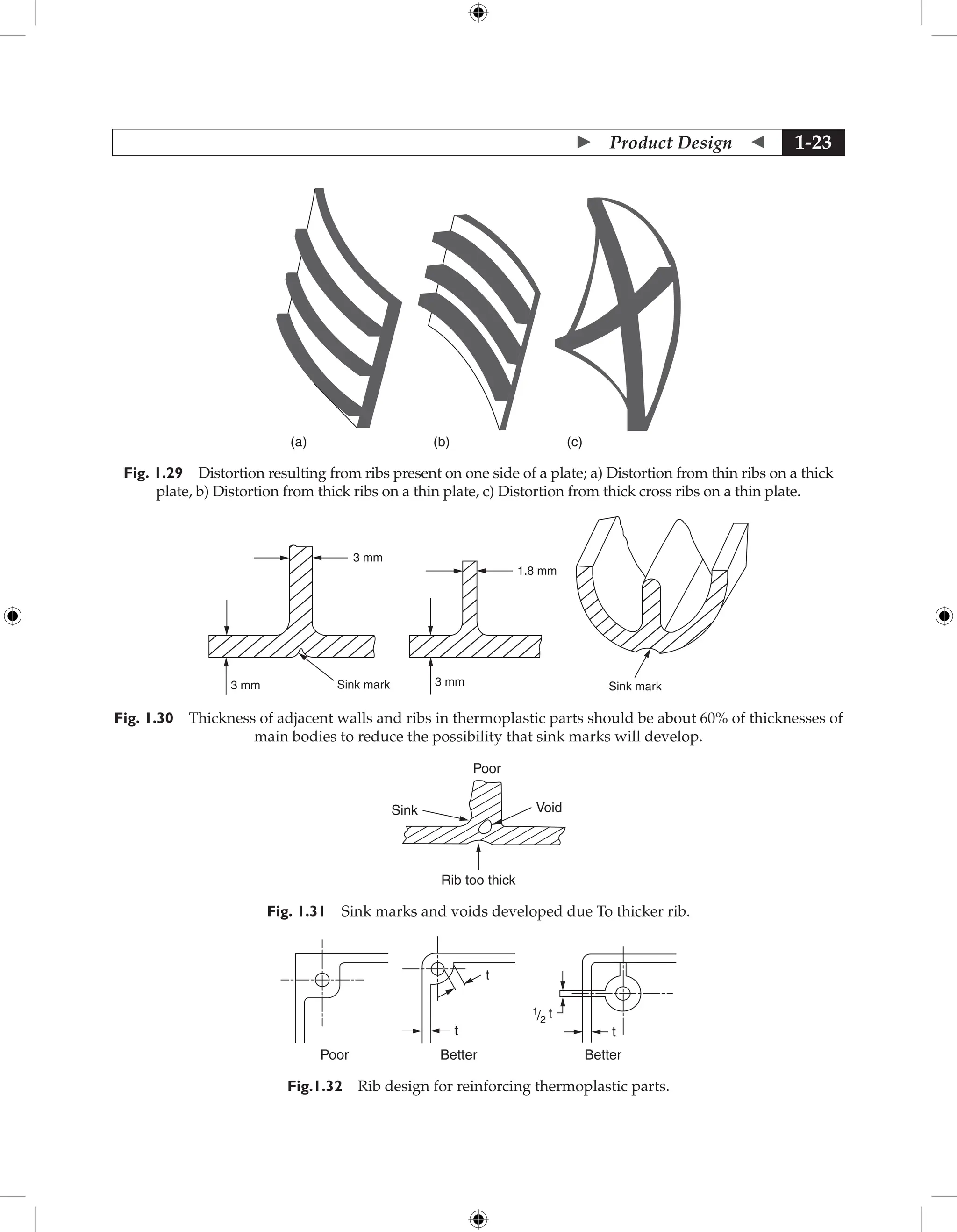
  • 391.
    ๎ฃ Fundamentals ofPlastics Mould Design ๎ข 4-34 method, care must be taken so as to prevent powder โ€˜lumpingโ€™ occurring. With UF it is very easy to confuse under cure with over cure as both may result in the appearance of blisters. Mould consideration When injection moulding amino-plastics, the cavities should be electro- plated and due allowance is made for after shrinkage. During the hardening or setting process, a large amount of volatile material, i.e., water is produced. Adequate mould venting must be provided - through pins, or through wide shallows slots around the mould periphery. Vent- ing to atmosphere is essential; chrome plating and draw polishing of vents is also essential as these allow an easier passage for the escape of gases and for the removal of excess flash. The technique known as โ€˜breathingโ€™ helps just before the mould fills, injection is momentarily stopped and the mould is slightly parted or โ€˜bumpedโ€™. After final mould closing, injection is completed under second stage pressure. Ease of flow UF comes in a range of flows or grinds, such as easy, medium and stiff for com- pression and transfer moulding. โ€˜Easyโ€™ is used for transfer moulding, medium for general purpose compression moulding and โ€˜stiffโ€™ for the compression moulding of large and deep draw articles. Special injection moulding grades are available. Shrinkage This may reach 1% but is usually 0.5 to 0.38%. After shrinkage, up to 1% will oc- cur on heating, Test mouldings, by heating them at 80o C/176o F for 48 hours- about 0.5% after shrinkage should result. (Dimensional stability of amino-plastics is not very good at elevated temperatures for example over 80o C/176o F). Shrinkage may be reduced by using a highly condensed resin to make the moulding powder to maintain ease of flow, a plasticiser, such as glyceryl-tolyl-ether, may then also be added. Applications Moulding powder use is only a small outlet for UF resins. They are more widely used as adhesives in, particle board and plywood. UFs are used extensively in the electrical industry for insulating parts in plugs, sockets, switches, connectors and lamps. In domestic applications, UFs find use as handles and knobs (furniture and kitchen utensils), buttons, buckles and closures for jars and bottles; this is because of its good resistance to solvents, etc., and excellent surface finish. They are widely used for toilet seats, because of the bright, attractive appearance possible. Table 4.8 Suggested processing conditions for UF. Process Setting Unit Value MF Compression Preheat temperature Tool temperature Pressure Curing time o C o C MNmโ€“2 S 95 135 to 165 15 eg 30 to 60 30 to 180 Transfer Tool temperature Transfer pressure Curing time o C MNmโ€“2 S 150 to 170 50 eg 60 to 120 30 to 120 (Contd.)
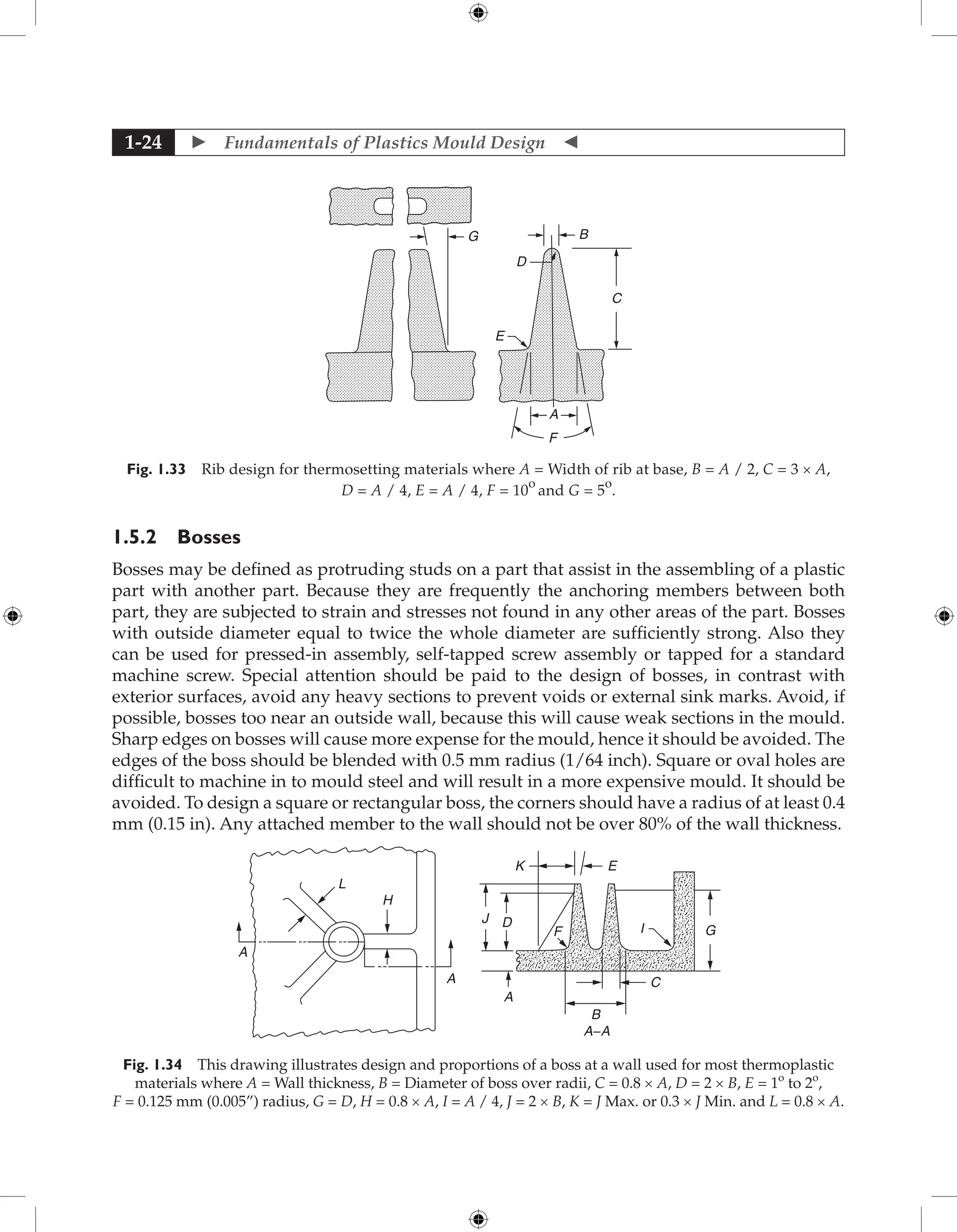
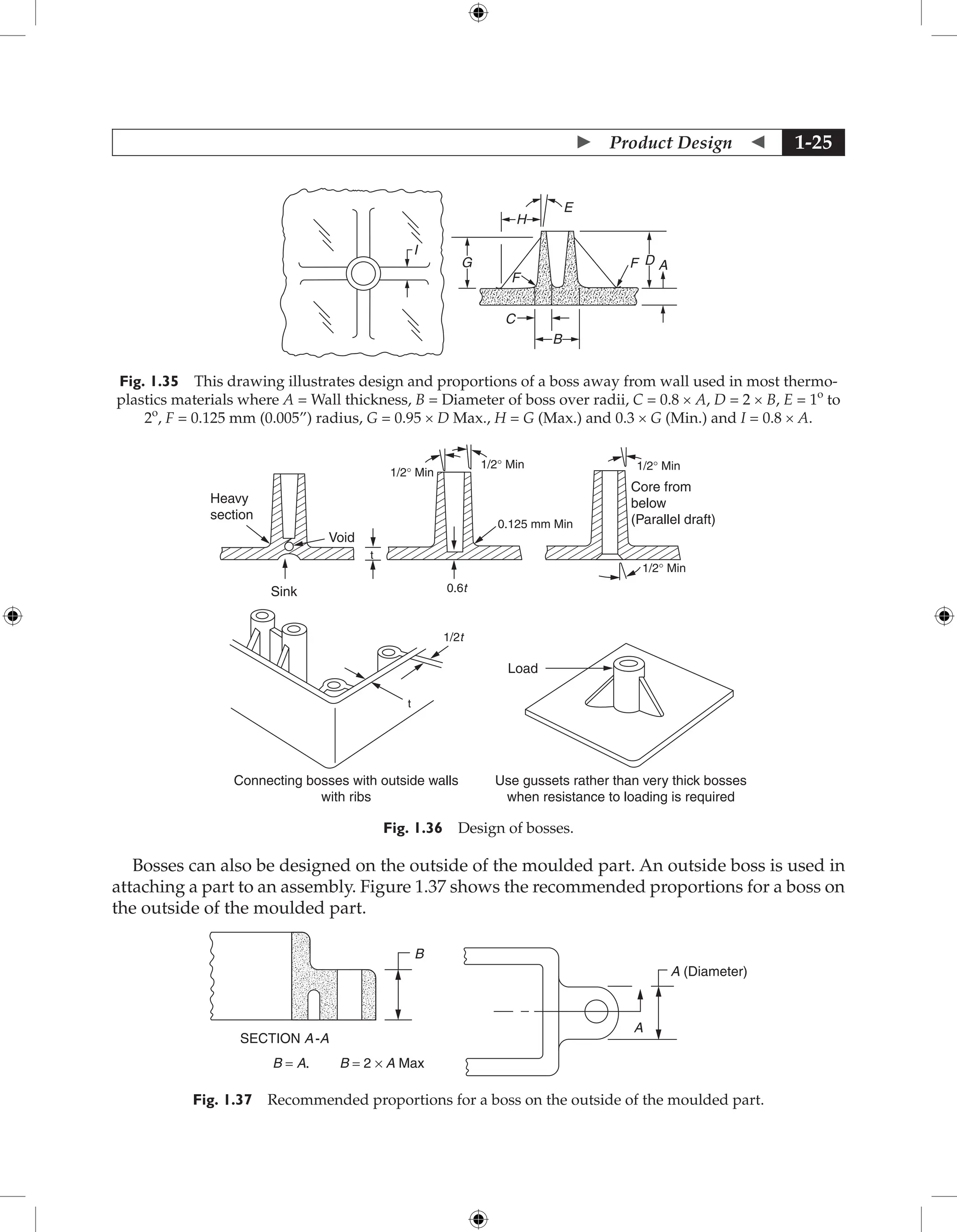
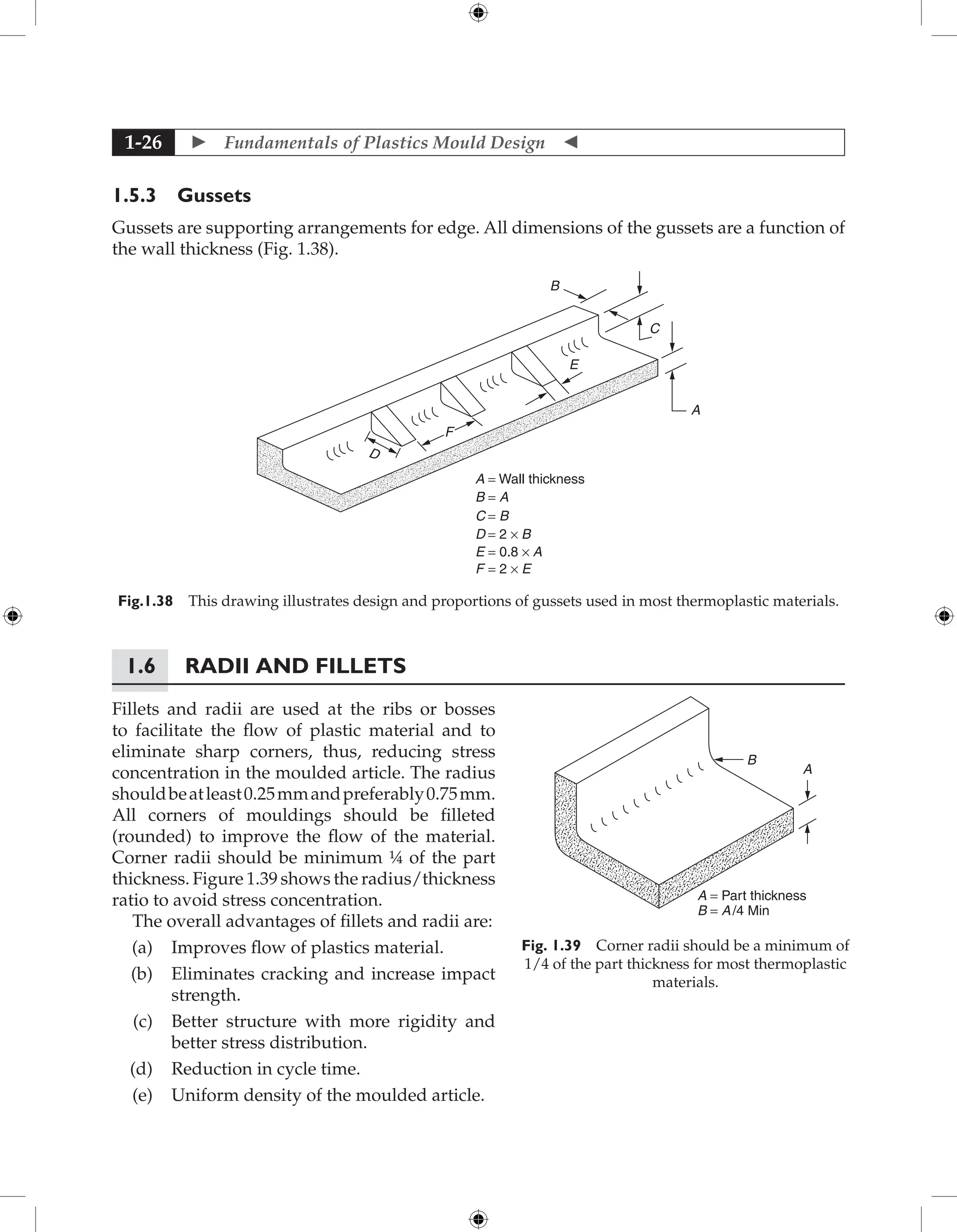
  • 392.
    ๎ฃ Transfer MouldDesign ๎ข 4-35 Table 4.8 (Contd.) Process Setting Unit Value MF Injection Cylinder temperature Nozzle temperature Melt temperature Screw temperature Tool temperature Thin section 3 mm Thick section 3 mm Injection pressure Back pressure Curing time o C o C o C o C o C MNmโ€“2 MNmโ€“2 S 65 to 95 85 to 110 120 to 140 50 to 80 145 to 165 145 to 155 135 to 145 100 to 248 1 (eg 0.5) 15 to 80 4.15.3 Melamine Formaldehyde Common Name: Melamine formaldehyde: melamine formaldehyde moulding material Abbreviation: MF Alternate Name: Melamine resin moulding material or compound. MF like UF is an amino- plastic that is the moulding powders based on an amino formaldehyde resin. Material properties Melamine may be made from urea and like urea it contains amine (-NH2) groups. These react with formaldehyde to form a resin which is combined with fillers, harden- ers, pigments, etc., to make a moulding powder. As with colourless UF resins, it is possible to produce moulding powders of virtually any colour when white alpha cellulose, or paper fillers, is used. Mouldings are bright and attractive but unfortunately they are more expensive than UF or PF. They have lower water absorption than UF, are less flammable, maintain their electrical properties better in conditions of high humidity (particularly when mineral filled), are harder and resist staining and heat to a greater degree. MF is supplied as granular powders which have a bulk density of about 2:1. Particle size and size distribution, is adjusted during manufacture so that the material may be loaded either by weight or by volume or it may be pelleted and used with or without preheating. Grades are chosen to suit the process and application, for example, compression, transfer moulding. Special grades are available for the compression moulding of plates; the use of such grades gives an even, hard, scratch resistance surface. These grades are usually in the form of fine powder rather than a granular material. Colour possibilities There is an unlimited choice of colour, with a wide range of colours of- fered by manufacturers. MF gives very even pigmentation and may be colour coded according to RAL system. MPF materials are also available in white and pastel shades colour stability is adequate for many uses. Moulding conditions When injection moulding the highest mould temperature are for the thinnest sections below 3 mm thickness. Thicker section requires lower temperatures,
  • 393.
    ๎ฃ Fundamentals ofPlastics Mould Design ๎ข 4-36 around 155o C, but longer cure times. The screw speed low about 50 rpm and fill the mould as quickly as possible consistent with avoiding gas trapping. Avoid over packing use up to 30% of the injection pressure as packing pressure bring this in when the screw is about 10 mm, away from bottom. At this point, it is possible to arrange for mould breathing to occur although MF is not as gassy as UF, good venting and/or breathing is still necessary. When processing melamine phenolics, screw surface speeds of up to 0.3 m/s, approximately 1ft/s, are permissible for plasticising. In compression moulding, MF is usually run hotter than UF at around 160o C/320o F. At this temperature a 2 mm or 0.079 in, thick component will need a cure of 30 seconds, a 4 mm/0.157 in, section will need 60 seconds. To prevent cracking around large inserts, warm them to the mould temperature before use. If the material is preheated (HF) then the equipment must be powerful enough to raise the temperature from 100o C to 212o C, in less than 60 seconds to avoid moulding problem. Preheating improves appearance, electrical properties, dimensional stability and output. Compared to UF materials, MF is normally pelleted and preheated prior to introduction into the mould. Materials handling can be improved by producing a heated slug of material on an in line screw unit, this saves pelleting and preheating. Ease of flow MF materials can be of comparatively low viscosity. Such flow properties permit the moulding of large complex handles and the bowls which give design freedom. Shrinkage About 0.7% or 0.007 in/in, or 0.007 mm/mm. Like UF after shrinkage will occur if the moulding is held at high temperatures. Such shrinkage is usually identified by testing at 110o C for 48 hours, after this time, the MF moulding will shrink up to 1.2%. MF mouldings are resistant to fuels, oils, greases, common organic liquids and organic solvents such as acetone and alcohol. Also resistant to cold dilute acids and alkalis; MF is more chemically resistant and more stain resistant than UF that is, with better resistance to weak acids, alkalis and water. UF mouldings are attacked by boiling water; fully cured MFs are more resistant, being attacked only by concentrated acids and alkalis or by hot dilute acids. Applications MF resins are widely used in laminates as by their use it is possible to produce a very wide range of attractive, and durable, patterned laminates - the pattern printed on the paper base shows through the colourless resin. The laminate core is made of cheaper, PF coated paper. Such laminates have excellent light stability. MF resins are also used for textile treatments and for paint manufacture. Because moulded components can be free from odour and are bright, attractive, scratch and stain resistant, they are widely used in dinnerware and kitchen utensils. Such items can be made more attractive by moulding in foils which carry a legend or picture. MF is also used for handles, knobs, household appliances and electricity insulating parts - particularly where these must withstand high temperatures. It can withstand repeated cycling from 150o C (302 F) into cold water. Compared to other thermo-sets, MFs are expensive and are only selected where appearance is of prime importance. Where improved impact strength is required, glass fibre is used as filler - it gives high mechanical strength and heat resistance. The moulding process goods are track resistance and burn with difficulty.
  • 394.
    ๎ฃ Transfer MouldDesign ๎ข 4-37 Table 4.9 Suggested processing conditions for MF. Process Setting Unit Value MF Value MPF Compression Preheat temperature Tool temperature Pressure Curing time o C o C MNmโ€“2 S 100 140 to 180 15 to 60 40 to 210 100 150 to 175 20 to 60 20 to 40 Transfer Tool temperature Transfer pressure Curing time o C MNmโ€“2 S 150 to 170 60 to 120 30 to 120 140 to 170 80 to 150 60 to 120 Injection Cylinder temperature Nozzle temperature Melt temperature Screw temperature Tool temperature Injection pressure Back pressure Curing time o C o C o C o C o C MNmโ€“2 MNmโ€“2 S 85 to 105 95 to 120 120 to 140 65 to 80 145 to 180 100 to 248 1 (eg 0.5) 15 to 80 70 to 80 110 to 120 120 to 140 65 to 80 165 to 180 100 to 175 8 to 12 25 to 50 4.16 Trouble Shooting and Quality Assurance Table 4.10 Moulding problems and its remedies. S.No. Trouble/Problems Remedies 1. Excess flash on mouldings Pressure pad dimensions to be rectified 2. Poor surface finish Processing parameters and mould temperature is to be checked 3. More cycle time Processing parameters and mould temperature is to be checked 4. Burn marks on moulding Processing parameters and venting is to be verified 5. Mismatching on parting line and vari- able wall thickness Mould alignment to be rectified 6. Variable part dimension Powder/material, feed system is to improve 7. Unsafe mould temperature Thermocouple and temperature controller is to be checked 8. Component brakes during ejection Types of ejection system and ejector pin dimension is to be rectified. 9. Heater burnt out frequently Poor heating element or improper heater capacity used in the mould 10. Uneven shrinkage Uniform mould temperature required with good quality of plastic material used
  • 395.
    ๎ฃ Fundamentals ofPlastics Mould Design ๎ข 4-38 4.17 Mould Material and its Selection Table 4.11 General characteristics and applications of mould steels. AIS1 type General characteristics Applications P-20 Medium carbon (0.30%) and chrome (1.65%) alloy available prehardened or annealed form. High grade mould base plates, large cavity and cores, gibs, slides and interlocks H-13 Hot die steel with 5% chrome Higher hardness than P-20. Good toughness and polishability. Used for punch and cavities A-2 Cold die steel with hot carbon (1%) and chrome (5%) Punch and cavity with high hardness for abrasion resistant, long wearing compression, transfer moulds, limited to small size D-2 Cold die steel, high carbon (1.55%) and chrome (11.5%) Highest abrasion resistance, difficult to machine sus- ceptible to stress cracking used for small moulds 414 Stainless steel with 12% chrome, 2% Ni, 1% Br Cd, low carbon 0.03% Stainless steel version of P-20 with similar properties and use 420 Stainless steel, 13% chrome, 0.8% Ni, medium carbon 0.30% Stainless steel version of H-13. Similar property and use 4145 Medium carbon 0.50%, chrome 0.65% Low cost steel used for mould bases and large mould back plates not suitable for high surface finish Table 4.12 Typical heat treatment of mould steel and uses. AISI SAE Steel designation General characteristics and uses Typical heat treatment AISI 1030 carbon steel Mould bases and structural com- ponents such as blocks, spacers, ejector housings, clamping plates Normalising 870โ€“915o C Annealing 675โ€“745o C Hardening 855โ€“900o C Quenching water or oil Tempering optional AISI 1040 carbon steel Support pillars Normalising 855โ€“900o C Annealing 845โ€“885o C Hardening 815โ€“855o C Quenching water or oil Tempering 315โ€“750o C, RC 20โ€“26 AISI 1095 carbon steel Backing plates (Contd.)
  • 396.
    ๎ฃ Transfer MouldDesign ๎ข 4-39 Table 4.12 (Contd.) AIS1 type General characteristics Typical heat treatment AISI 4130 alloy steel, generally supplied preheat treated Mould bases and structural com- ponents such as cavity retainer plates, support plates, clamping plates Normalising 870โ€“925o C Annealing 800โ€“845o C Hardening 870โ€“900o C Quenching oil Tempering 315โ€“750o C, RC 18โ€“44 AISI 4140 alloy steel Structural components such as retainer plates, support plates, clamping plates Heat treated to approx. RC 32 AISI 6150 alloy steel Sprue bushings Normalising 870โ€“900o C Annealing 855โ€“900o C Hardening 870โ€“900o C Quenching oil Tempering 455โ€“565o C, RC 17โ€“46 AISI 8620 alloy steel Cast steel Normalising 925โ€“955o C Annealing 540โ€“650o C Hardening 800โ€“830o C Quenching oil Tempering 455โ€“565o C, RC 24โ€“49 AISI S1 tool steel Master hobs Annealing 800o C Hardening 900โ€“925o C Quenching oil Tempering 455โ€“565o C, RC 58โ€“40 AISI P2 tool steel Hobbed cavity inserts AISI P20 tool steel usually supplied prehardened Machined and hobbed cavity inserts, stripper plates Annealing 915o C Carburising 925o C Tempering 175โ€“230o C, RC 64โ€“58 Forging 1090โ€“925o C Normalising 850o C Soft annealing 800o C, RC 20 Stress relieving 550o C Carburising 850โ€“940o C Quenching oil Tempering 180โ€“650o C,RC 28โ€“52 Nitriding 525o C AISI 420 tool steel generally supplied fully annealed Cavity inserts Soft annealing 780o C RC 18 Stress relieving 650o C Preheating 600โ€“850o C Hardening 980โ€“1050o C Quenching air Tempering 180โ€“450o C, RC 58โ€“62 Nitriding : Not recommended
  • 397.
    ๎ฃ Fundamentals ofPlastics Mould Design ๎ข 4-40 4.17.1 Typical Applications for Steels in Moulds Table 4.13 Typical applications of steels in moulds. AISI SAE Steel designation General characteristics and uses Typical heat treatment AISI S7 shock resistant tool steel Interlocks, latches, sprue, bushings Forging : 1120โ€“925o C Normalising : Do not normalise Annealing : 815โ€“845o C BHN : 197 (max) Stress relieving : 675o C Carburising : Delivered with RC 55โ€“58 Preheating : 590โ€“700o C Hardening : 925โ€“955o C Quenching : Air for smaller than 60 mm oil for sections larger than 60 down to 540o C then air Tempering : 180โ€“540o C, RC 50โ€“58 AISI 01 tool steel Master hobs, plate for gate cutting, small inserts Annealing : 790o C, RC 62โ€“57 Hardening : Quenching : Oil Tempering : AISI A2 medium alloy tool steel Master hobs, slides, plates for gate cutting, cold work Annealing : 900o C Hardening : 925โ€“980o C Quenching : 175โ€“540o C, RC 62โ€“57 Tempering : AISI A6 tool steel Master hobs, plates for gate cutting, for cavity requiring optical finish Annealing : 760o C Hardening : 830โ€“870o C Quenching : air Tempering : 175โ€“540o C, RC 60โ€“54 AISI D2 high carbon, high chromium tool steel Master hobs, slides, lifters, cold work Annealing : 900o C Hardening : 980โ€“1025o C Quenching : Air Tempering : 150โ€“425o C, RC 61โ€“54 AISI H13 hot work tool steel, chromium base, generally supplied fully annealed Cavity plates and inserts, hot hobs, ejector pins, core pins, leader pins, return pins, sprue pullers Soft annealing : 850o C RC9 Stress relieving : 650o C Carburising : 900โ€“980o C Preheating : 600โ€“850o C Hardening : 980โ€“1080o C Quenching : Air Tempering : 180โ€“500o C, RC 57โ€“60 Nitriding : 525o C (Contd.)
  • 398.
    ๎ฃ Transfer MouldDesign ๎ข 4-41 Table 4.13 (Contd.) AISI SAE Steel designation General characteristics and uses Typical heat treatment AISI H23 tool steel Hot hobs for beryllium copper hobbing Annealing : 880o C Hardening : 1090โ€“1260o C Tempering : 650โ€“815o C, RC 47โ€“30 AISI 1020 carbon steel Ejector plates, ejector retainer plates Normalising : 900โ€“955o C Annealing : 540โ€“730o C Hardening : 870โ€“910o C Quenching : water or oil Tempering : 120โ€“205o C 4.17.2 Mould Materials - Equivalent Standards Table 4.14 Mould materials and its equivalent standards. S.No. ISI BS DIN AISI/SAE W.nr. (Ger- man) JIS 1 T35Cr5Mo1V30 BH 11 X38CrMoV51 H 11 -- -- 2 T55Cr5MoW1V30 BH 12 X37CrMo W51 H 12 -- -- 3 T35Cr5MoW1 BH 13 -- H 13 -- -- 4 -- EN 110 34CrNiMo6 -- -- -- 5 40Ni2Cr1Mo28 EN 24 30CrNiMo4 * 9840 -- -- ***6 13Ni3Cr28 EN 368 14NiCr14 * 3318 -- -- **7 -- BF 1 120WA4 F 1 -- -- (a)8 T105Cr1 EN31/B13 100Cr 13 -- -- (b)9 T103 BW 18 C10 5W1 W1 -- -- (c)10 C10 and C14 EN 2A -- *1006 -- -- 11 C35Mn75 EN 8 -- *1040/ C1040 -- -- 12 40Cr1 EN 18 -- *5140 -- -- (d) 13 50Cr1V23 EN 47 50Cr84 6152 -- -- (e) 14 50Cr1V23 EN 48 -- 5152 -- -- 15 T55Ni2Cr65Mo30 -- -- -- -- -- 16 -- -- -- 420 improved 1.2083 SUS 420 *SAE specification; ** silver steel; *** case hardening; (a) bearing steel; (b) carbon tool steel; (c) mild steel; (d) 1% chromium spring steel; (e) corrosion resisting, direct quenching steel for moulds used for moulding corrosive plastics used for thermo-set moulds, for gate, runners and cavities.
  • 399.
    ๎ฃ Fundamentals ofPlastics Mould Design ๎ข 4-42 4.17.3โ€ƒApplications for the Typical Mould Steel Table 4.15 Applications for the typical mould steels. Type of steel Typical uses in injection moulds 4130/4140 General mould base plates P-20 High grade mould base plates, hot runner manifolds, large cavities and cores, gibs, slides, interlocks 4414 SS, 420 SS (preheated) Best grade mould base plate (no plating required), large cores, cavities and inserts P5, P6 Hobbed cavities 01 Gibs, slides, water plates 06 Gibs, slides, water plates, stripper rings H -13 Cavities, cores, inserts, ejector pins, sleeves S7 Cavities, cores, inserts, striper rings A2 Small inserts in high water areas A6 Cavities, cores, inserts for high wear areas A10 Excellent for high wear areas, gibs, interlocks, wedges D2 Cavities, cores, runner and gates inserts for abrasive plastics 420 SS Best all round cavity, core and insert steel, best polishability 440C SS Small to medium size cavities, cores, inserts, stripper rings 250, 350 Highest toughness for cavities, cores, small unsupported inserts 455M SS High toughness for cavities, cores, inserts M2 Small core pins, ejector pins, ejector blades (up to 5/8 in.diameter) ASP 30 Best high strength steel for tall, unsupported cores and core pins 4.17.4 Mould Material and its Applications Table 4.16 Mould material and its applications. ISI Applications T35Cr5Mo1V30 Cavities, cores, ejector pins, guides, wear pads of moulds T35CrMo1 W1V30 Die casting dies, plastics moulds T35Cr5Mo1 V1 Cavities, cores, ejector pins, guides, wear pads of moulds 40Ni2Cr1Mo28 High tensile load applications max. strength when hardened to 58โ€“60 Rc used for cavity housing core and cavity back plate, shoulder screws, clamp 13Ni3Cr80 Cavity and core T105Cr1 Used for guide pillar, bush and bearing purposes T103 Used as a wear plate, backing pad C10 and C14 Bolster, support block, plates, backing plate, holder plates (Contd.)
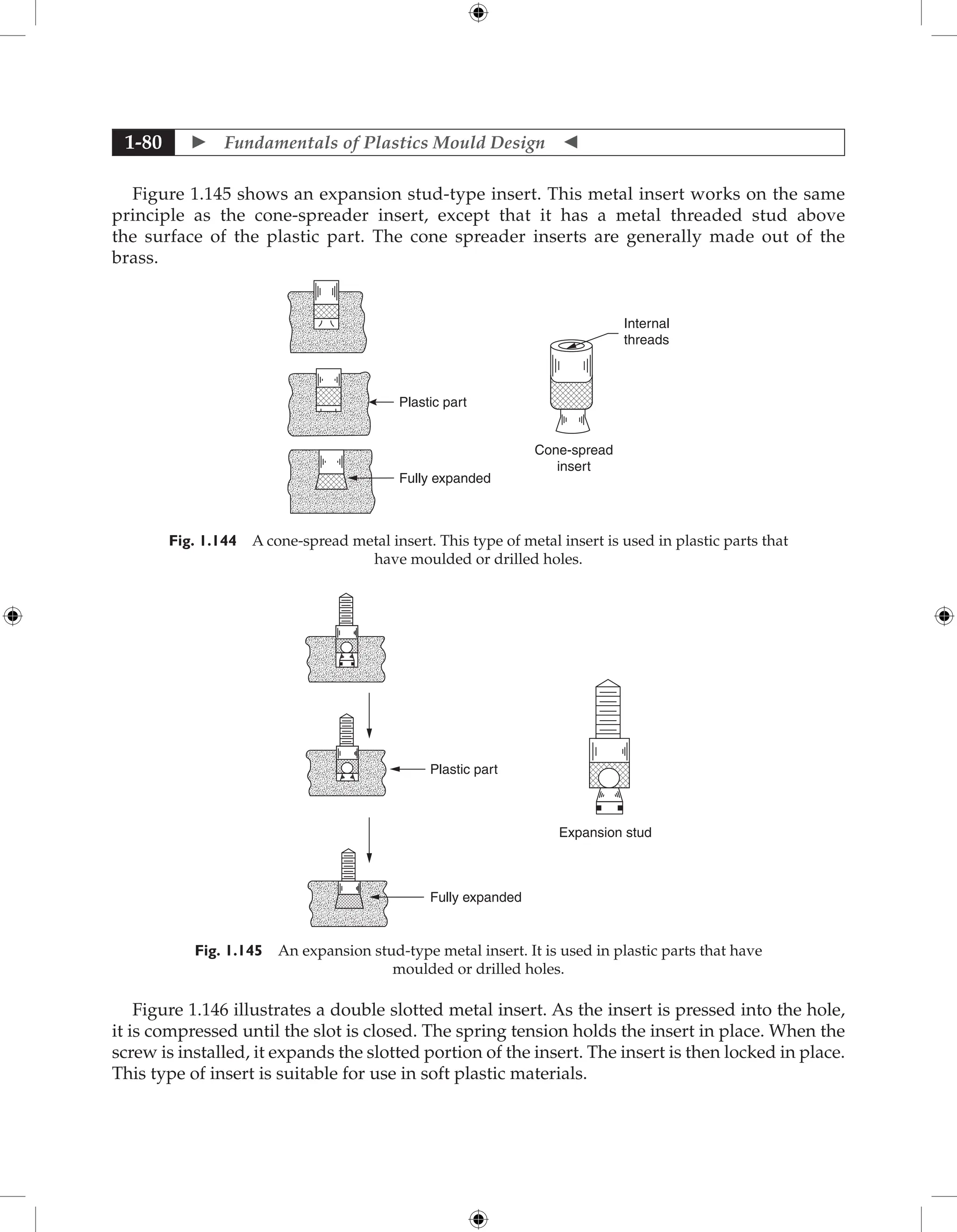
  • 400.
    ๎ฃ Transfer MouldDesign ๎ข 4-43 Table 4.16 (Contd.) ISI Applications C35Mn75 Moulds with a shorter run and on non-accurate cavities 40Cr1 Pillar, bush, sprue bush, locating ring, bigger diameter ejector pins 50Cr1 V23 Used for coil and plate springs T55Ni2Cr65Mo30 Core and cavity Table 4.17 Spectrum of materials used in building moulds - Arranged in order of surface hardness. Material class Surface hardness Core hardness Carbides 68โ€“75 RC 68โ€“75 RC Steel, nitriding 68 RC 38 RC Steel, carburising 60-65 RC 20โ€“42 RC Steel, water hardening 67 RC 40โ€“55 RC Steel, oil hardening 62 RC 40โ€“60 RC Steel, air hardening 60 RC 60 RC Nickel cobalt alloy 45โ€“52 RC 45โ€“52 RC Steel, prehardened 44 RC 44 RC Beryllium-copper 28โ€“42 RC 44 RC Steel, prehardened 28โ€“32 RC 28โ€“32 RC Kisksite (zinc alloy) 80โ€“105 BN (1) 80โ€“105 BN (1) Aluminium alloy 60โ€“95 BN (1) 60โ€“95 BN (1) Brass 50 BN (1) 50 BN (1) Sprayed metal 50 BN (1) 50 BN (1) Epoxy, metal filled 85 RM 85 RM Silicone rubber 15โ€“65 Shore โ€˜Aโ€™ 15โ€“65 Shore โ€˜Aโ€™ Legend: RC = Rockwell hardness = 'C' scale; RM = 'M' scale; BHN = Brinell number 3000 kg load; BN (1) = Brinell number 500 kg load.
  • 401.
    ๎ฃ Fundamentals ofPlastics Mould Design ๎ข 4-44 1. Write about transfer moulding process. 2. Explain transfer โ€“pot calculation. 3. How does mould heating occur in transfer mould? 4. How does moulding pressure act in transfer mould? 5. How does transfer moulding relate to pressure, cure and quality? 6. What is transfer moulding? Classify transfer moulding and explain any one. 7. Explain pot-type transfer moulding with a neat sketch. 8. Explain various types of plunger transfer moulding with required sketch. 9. Describe the electrical energy requirements to heat the mould. 10. How sprue, runner and gate influence a successful moulding in transfer mould? 11. Write down the advantage and disadvantage of transfer moulding. 12. What is the difference between compression moulding and transfer moulding? 13. List out the mould design check list to be considered in transfer moulding. 14. What are the factors that influence while designing runner and gate? Questions 1. Charles A. Harper, Handbook of Plastic Processes, Wiley Interscience Publication, New Jersey. 2. CIPET, Technical Manual, Chennai. 3. Dominick V. Rosato, P. E., Plastics Processing Data Handbook, Second Edition, Chapman and Hall, London. 4. Harry DuBois and Wayne I. Pribble, Plastics Mould Engineering Handbook, Reinhold Publishing Corporation, New York. 5. Manas Chanda, Salil K. Roy, Plastics Technology Handbook, CRC Press, London. References
  • 402.
    Advanced Injection Mould Design Chapter 5 5.1Moulds for Threaded Components 5.1.1 Introduction The threaded components are used where two mating parts โ€“ assembly and disassembly are required. The threads must have sufficient strength to withstand the pressure without wear. There are various types of threads used in injection moulding components like: (a) blind and open female threads, (b) male threads of V-shape, roll thread and modified square threads, etc. The threads are formed by various processes like the drilled holes made in plastic component with either thread cutting or thread forming using self-tapping type screws. Parts can be moulded with local inserts, moulded threads are formed by using unscrewing threaded inserts method. Due to the increased complexity of the mould, extra mechanism is required to unscrew the threaded core pins in each cycle. The moulded component, which incorporates a thread, is classified as external thread and internal thread and according to thread shape, it is subdivided into continuous and discontinuous threads. (c) Instrument case Internal threaded hole Local threaded projection (d) Junction box (a) External thread (b) Internal thread Fig. 5.1 Components incorporating threads.
  • 403.
    ๎ฃ Fundamentals ofPlastics Mould Design ๎ข 5-2 The small-diameter internal thread below 8 mm diameter is normally incorporated in a moulded part by means of metal inserts for attachment with other parts. The larger internal threads are moulded without the metal insert and can be used in conjunction with moulded male threaded components. Different types of threaded components are shown in Fig. 5.1. The external and internal threads can be directly moulded into the part, eliminating the need for mechanical thread forming operations. 5.1.2 Thread Profile The Unified Thread Standard is best for moulded plastic threaded parts as it eliminates the feathered edge at both the tip and root of the thread. Other thread profiles such as acme or buttress threads are used with good results. The Unified Thread Standard is divided into three categories: 1. Class 1A, 1B: Adequate for most threaded nuts and bolts. 2. Class 2A, 2B: Provides a tighter fit than Class 1 with no looseness in the thread. 3. Class 3A, 3B: Used in precision work and requires extreme care during the moulding operation. โ€˜Aโ€™ refers to external thread, โ€˜Bโ€™ to internal. Threads finer than 32 pitches are difficult to mould successfully, hence they are avoided. Sometimes a small interference is placed between two threaded parts, which will prevent loosening under mechanical vibration. Parts should be designed so that threads terminate a minimum of 0.8 mm from the end as shown in Figs. 5.2 and 5.3. Good Poor 0.9 mm(1/32โ€) Fig. 5.2 Correct termination of threads. 0.8 mm (1/32โ€) 0.8 mm (1/32โ€) 0.8 mm (1/32โ€) 0.8 mm (1/32โ€) Fig. 5.3 Suggested end clearance on threads.
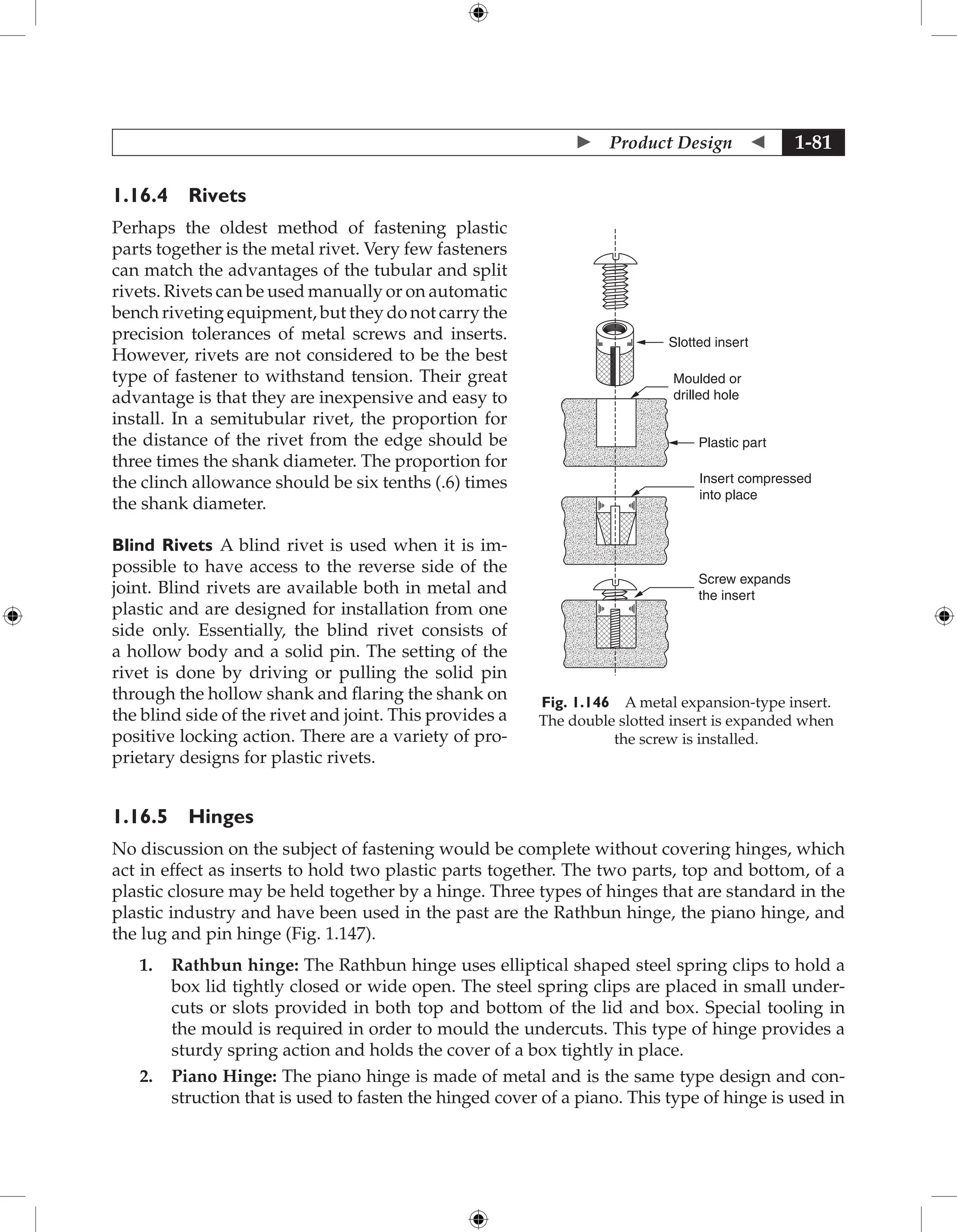
  • 404.
    ๎ฃ Advanced InjectionMould Design ๎ข 5-3 This practise helps reduce fretting from repeated assembly and disassembly, and eliminates compound sharp corners at the end of the thread. It also prevents cross-threading of finer threads when assembled to a mating metal thread. Threads-effect of creep When designing threaded assemblies of metal to plastic, it is prefer- able to have the metal part external to the plastic. In other words, the male thread should be on the plastic part. However, in a metal/plastic assembly, the large difference in the coefficient of linear thermal expansion between the metal and plastic must be carefully considered. Thermal stresses are created because of this difference, which will result in creep or stress relaxation of the plastic part after an extended period of time if the assembly is subject to temperature fluctuations or if the end use temperature is elevated. If the plastic part must be external to the metal, a metal back up sleeve may be needed as shown in Fig. 5.4. Wrong Correct Correct Metal sleeve Fig. 5.4 Different thread assemblies. 5.1.3 Application of Shrinkage Allowance on Thread Forms In all injection moulds shrinkage allowance is added to the dimensions of core and cavity to achieve the actual size of the component after cooling. Shrinkage value varies with the processing conditions and grade of plastic material used for a given process. Generally, higher the material shrinkage, the larger the cavity and core sizes have to be compensated. Often there is cavity or core forms that will restrict the full amount of shrinkage taking place and moulding a screw thread undergoes such restrictions. If the thread form is a continuous helical undercut then it will prevent free, unrestricted shrinkage in the component. Hence, it is suggested that a lower shrinkage factor should be applied to the pitch than to the thread diameters, where such restrictions do not exist. This becomes increasingly important as the thread accuracy requirements increase, for such applications it is suggested that a reduced shrinkage allowance of 0.7 mm of the normal shrinkage allowance to be applied. 5.1.4 Moulds for Internally Threaded Components Generally, the threaded components form a restriction during straight draw removal of the moulding from the core. Different types of mould designs adopted for withdrawing the threaded components from the core are detailed below: 1. Stripping (jumping-off) thread design 2. Fixed threaded core design
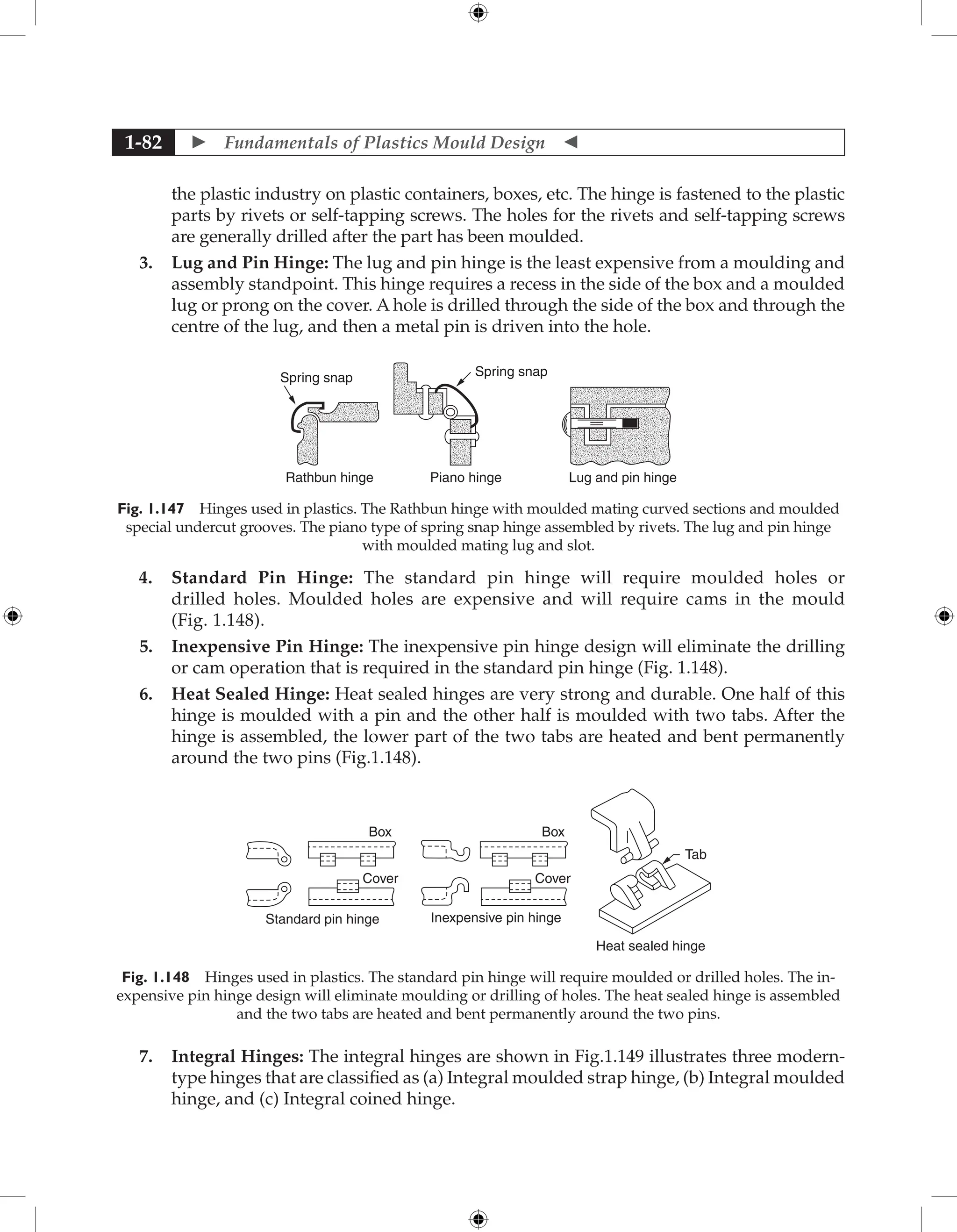
  • 405.
    ๎ฃ Fundamentals ofPlastics Mould Design ๎ข 5-4 3. Loose threaded core design 4. Collapsible core design 5. Unscrewing mould designs Stripping internal threads The internally threaded components are stripped from the core using the stripper plate design for roll threads and the plastic material has sufficient elasticity during the ejection phase. The same principle is applied for stripping any internal undercut components, i.e., the moulding must be free to expand during ejection to permit the moulded undercut to ride over the restriction on the core as shown in Fig. 5.5. This means that the outside form of the component must be such that it can be formed in a cavity, which is fully, contained in one half of the mould. This method is recommended for polyethylene (PE), poly- propylene (PP). Stripper plate Cavity Moulding Core 01 02 Fig. 5.5 Stripping internally threaded components. This figure shows a single impression mould for an internally threaded cap. The moulding is formed by the cavity and core and the ejection is by means of a stripper plate actuation system. In the stripper plate mould after the injection and cooling stage are complete, the mould opens at the parting surface and the component sticks to the core, then the stripper plate moves forward by the action of ejector rod and the core withdraws the moulding through the stripper plate. The through hole in the stripper plate must be slightly larger in diameter than the major diameter of the thread in order to prevent scoring of the thread. This principle is applicable for single and multi-impression moulds. Fixed threaded core design In this method, the thread form is incorporated on a non-rotat- ing core fixed to the moving mould plate and an integer type cavity forms the external shape of the moulding as shown in the Fig. 5.6. In operation, when the mould is opened, the moulding remains on the core and is afterward unscrewed by the operator or using release devices.
  • 406.
    ๎ฃ Advanced InjectionMould Design ๎ข 5-5 The advantages of this design, compared with the unscrewing type mould design are as follows: 1. Mould cost is cheaper than the unscrewing mould design because of the non-requirement of ejection mechanism. 2. Maintenance costs are minimum as there is no moving part within the mould. The major disadvantage of this method particularly for multi- impression moulds, as the individual mouldings must be unscrewed manually, which increases the moulding cycle time. Loose threaded cores Thismethodissuitableforlargeยญ component which incorporates a local internally threaded hole or has several internally threaded holes in close proximity to each other. The loose threaded core technique should be considered. This technique prevents automatic unscrewing thereby considerably reducing the cost of the mould. This design is not suitable where number of holes are closely spaced as it requires space to adopt like gear ยญ arrangement in automatic unscrewing operation. Moulding Loose threaded core Main core Ejector pin (a) (b) Fig. 5.7 Loose threaded cores: (a) In moulding position, (b) In partly ejected position. Non-rotating core Moving mould plate Cavity Fig. 5.6 Fixed threaded core.
  • 407.
    ๎ฃ Fundamentals ofPlastics Mould Design ๎ข 5-6 The basic principle of the loose threaded core design is shown in Fig. 5.7 (a), the mould is shown in closed position. The loose threaded core is forming the threaded hole in the moulding. This loose core, which has a valve head type seating, is accommodated in the pocket machined into the main core. When the mould is opened shown in Fig. 5.7 (b), the loose threaded core is ejected with the moulding, and afterwards it is unscrewed manually by using secondary devices like spanner. Two sets of loose cores are used during production. At the end of the first moulding cycle, the second set of cores can be inserted into the mould and the next cycle started. During this cycle the first set of loose cores can be removed from the first moulding and made ready for insertion into the mould immediately the next component is ejected. Collapsible core This is another widely used method for producing screw threads and a very convenient one for the internal undercuts and threads. In this the core block is machined in such a manner that during mould closing and opening, it works as expansion of core to take the shape of the internal article and reducing the size to remove the formed article. In collaps- ible core design, two parts are there one as mandrel and second as collapsible sleeve. The col- lapsible sleeve is slotted through a greater part of the length, forming a number of individual segments. These segments are moving inwards and outwards for reducing and expanding the size of core for ejection. Types of collapsible core There are two basic types of collapsible coring: 1. Two-segment core 2. Multisegment core 1. Two-Segment Core: In this method, discontinuous thread in a component is produced like bottle closures use the partial threads. Two plate moulds are not suitable for collapsible core as longer thread length components are required. In this mould two-segment cores are used and collapsible cores are like mini side core units placed at an angle to the axis of the core. Stripper plate Mould closed with collapsible core closed Mould open with collapsible core opened A A B B C Fig. 5.8 Two-segment collapsible core details.
  • 408.
    ๎ฃ Advanced InjectionMould Design ๎ข 5-7 In Fig. 5.8, the central core is withdrawn downward (action C) away from the moulding.As it moves it forces the two small side cores to move inwards (action B). This clears the cores from the moulded thread. Finally, the part is stripped off from the mould face (action A). An undercut form cannot be placed on the non-side core areas, as it would not be released when the central core withdraws. 2. Multisegment Collapsible Cores: The multisegment collapsible cores consist of a number of segments, which are constrained to move inwards or outwards by the action of a tapered sleeve expanding and collapsing all the individual segments. This system is very similar to the two-segment system but in this the undercut thread form must be machined in a number of segments. The advantage of collapsible core is to eliminate the need for complex unscrewing mechanisms. This design is applicable for components having internally threads and internal undercuts. The important advantage of this method over the rotating threaded core designs is that it eliminates the need of unscrewing mechanisms using the gear mechanism. The principle of the collapsible core is shown in Fig. 5.9. The assembly consists of two primary parts, a centre mandrel and a collapsible sleeve. The collapsible sleeve is slotted through a greater part of its length, forming a number of individual segments. The mechanism, upon which this โ€˜collapsible coreโ€™ operates, is shown in Fig. 5.9 (a), (b) and (c). The segment in their extended moulding position is shown in Fig. 5.9 (b). For explanation purposes, let us assume that the โ€˜blackโ€™ segments โ€˜Aโ€™ can be moved inwards towards each other as shown at Fig. 5.9 (b). This creates a space, which allows the larger shaded segments โ€˜Bโ€™ to collapse inwards, as shown at Fig. 5.9 (c). As the central mandrel is removed the segments collapse to their final positions. The comparison between the diameters of the collapsed state and uncollapsed state is shown as dimension โ€˜Xโ€™ and โ€˜Yโ€™ in Fig. 5.9 (c). The collapsible core of the mould is installed in the ejector plate assembly as shown in Fig. 5.10 (a) comes through the support plates and the stripper plate, into the cavity inserts area to mould the inside of a cap. The centre core pin (mandrel) is attached to the back clamp plate of the mould. In moulding sequence, after the mould opens, the ejector plate and the stripper plate come forward together, during which the segments collape away from the internal Central Mandrel Collapsible Sleeve (a) (b) (c) A A A A B B B B B B B B x y Fig. 5.9 Collapsible core: (a) Hollow core shown in the moulding position, (b, c) showing progressive โ€˜collapseโ€™ of core. (a) (b) Ejector plate assembly Stripper plate Central mandrel Fig. 5.10 Section view: (a) Ejector plate assembly operated causing collapse of core, (b) Stripper plate operated to eject the moulding.
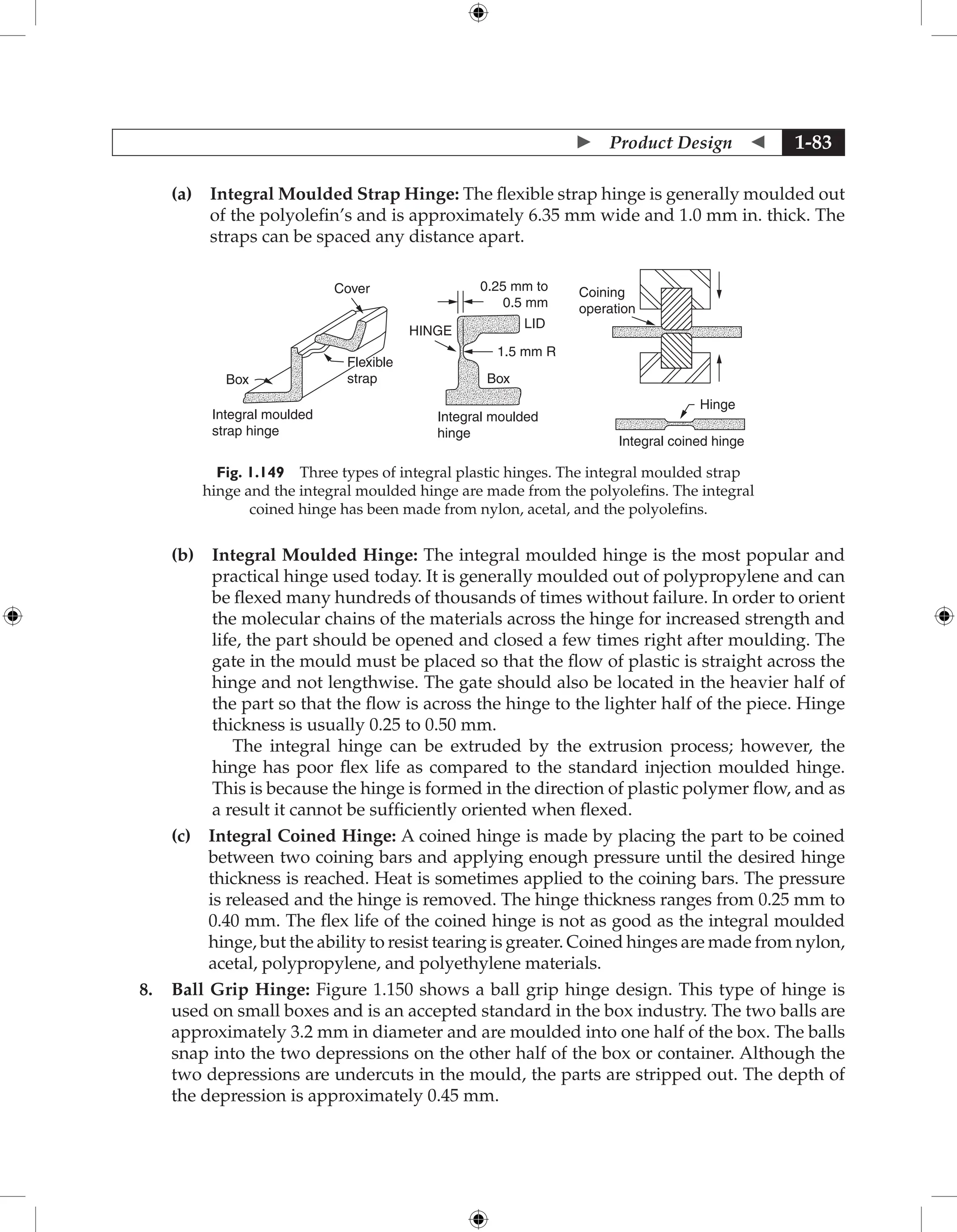
  • 409.
    ๎ฃ Fundamentals ofPlastics Mould Design ๎ข 5-8 threads (since the centre core pin retracts). At the end of the ejector plate travel, the stripper plate is actuated to lift the moulded part of the collapsed core as shown in Fig. 5.10 (b). These units can be used for single or multicavity moulds and are available in six sizes, from 25 mm diameter approximately to 90 mm diameter, with corresponding collapses per side of approximately 1.1 mm for the smallest and 3.5 mm for the largest, at the top of the core. These collapses can be reduced by 0.5 mm along segment length within usable moulding length. Advantages and disadvantages of collapsible core Advantages: This type of mould is available as standard units with reasonable range of sizes and an undercut form in the component is up to 5 mm. It is cost effective and suitable for small numbers of impression. Disadvantages: This type of mould is suitable for limited thread length components. Mould maintenance cost is more and cooling of core is difficult. Rotary unscrewing Rotary unscrewing is used where split line witness cannot be accepted on the component when larger numbers of impressions are required in a mould. The basic method for rotary unscrewing is either to unscrew the part from the core or to unscrew the core from the part as shown in Fig. 5.11. Driver gear Hardened bushes Idler/Spacer gear Unscrewing pinion Split line Moulding Hot runner tip Motor Fig. 5.11 Rotating core unscrewing tool. Rotating cores or cavities can be actuated by a rack-and-pinion system, with a rotating core or with a rotating cavity. Core unscrewing Core unscrewing is used to free internal screw thread forms and falls into two categories: 1. Core remains fixed with respect to the mould 2. Core moves axially with respect to mould
  • 410.
    ๎ฃ Advanced InjectionMould Design ๎ข 5-9 Fixed core systems: Fixed core systems are the most widely used method for automatic ยญ unscrewing. With this system, the core rotates in a static plane, simply revolving with no axial displacement of the core relative to the mould tool. Types of unscrewing moulds: In an unscrewing type mould, either the cores or the cavities are rotated to automatically unscrew the mouldings from the mould. The unscrewing mecha- nism is fitted behind the moving mould plate in place of the conventional ejector unit which provides required rotational motion. From the impression construction stand point; various designs are followed like 1. The axially fixed core design in which the threaded core is rotated to remove the moulding. 2. The extractor plate design in which an extractor plate is actuated at the same time as the threaded core is rotated. 3. The withdrawing rotating core design in which the threaded core, being rotated and simultaneously. 4. The rotating cavity design. Types of impression layouts in an unscrewing mould is 1. pitch circle diameter (PCD) layout 2. in-line layout. 1. Manually powered transmission system: In this method, the moulding is unscrewed manually by the operator using the rotating handle positioned either at the top or the front of the mould. The handle assembly is usually mounted on an extension of the back plate and the Core shaft Handle shaft Handle Core shaft Sun gear Drive shaft Driven shaft Idler gear Driving gear Fig. 5.12 Manually powered fixed rotating core design with gear transmission.
  • 411.
    ๎ฃ Fundamentals ofPlastics Mould Design ๎ข 5-10 assembly consists of a U-shaped handle block locked to the handle shaft by a grub screw. The manually powered systems differ with respect to the transmission system used to connect the handle assembly to the sun gear drive shaft. (a) Manually powered fixed rotating core design with gear transmission In axially fixed rotating core design, the driving gear is mounted on the handle shaft and a driven gear on the drive shaft. The idler gears are provided between the driving and the driven gears to complete the gear train. The manual rotation of the handle causes the sun gear, pinions and core shaft to rotate which in turn causes the moulding to ride up their respective threads and thereby the component is ejected. All the shafts which are rotated are mounted in bearings, as shown in Fig. 5.12. Driving sprocket Handle block Handle shaft Bearing bush Handle Grub screw Mould opening position Chain Back plate Driven shaft Sun gear Driven sprocket Drive shaft Cavity insert Planet gear Core shaft Fig. 5.13 Manually powered design with fixed rotating core and chain and sprocket transmission. In manually powered design with fixed rotating core and chain and sprocket transmission system, the mould opens at the parting surface and the moulding remains at the cavity. The feed system is pulled by the puller incorporated in the drive shaft. As the mould opens the
  • 412.
    ๎ฃ Advanced InjectionMould Design ๎ข 5-11 operator rotates the driving sprocket by the handle and the handle shaft. A chain connects the driving and driven sprockets, the latter mounted on the drive shaft. The sun gear also mounted on the drive shaft meshes with the planet gears or pinions secure to the individual core shafts. The rotation of handle causes the individual core shafts to rotate, which in turn causes the mouldings to be ejected. (b) Manually powered withdrawing core design, with rack-and-pinion transmission In this method, the unscrewing mechanism is operated by rack-and-pinion transmission system. Hand block Handle shaft Driving pinion Back plate Main drive shaft Pinion Transmission plate Sun gear Planet gear Handle Rack Core shaft Moulding 01 Fig. 5.14 Manually powered withdrawing core design, with rack-and-pinion transmission. A pinion is secured to the main driving shaft on which the sun gear is mounted. A rack suitably guided within the transmission plate, meshes with the pinion, and also with the
  • 413.
    ๎ฃ Fundamentals ofPlastics Mould Design ๎ข 5-12 driving pinion located within the handle block assembly. Manual rotation of the driving pinion by the handle causes the rack to move upwards, which in turn causes the driven pinion and hence the sun gear rotates. The planet gears are thereby rotated, which causes the core shafts to be progressively withdrawn through their respective bushes and the mouldings ejected. 2. Machine-powered system: The machine powered system is suitable for an in-line layout of gear arrangements. In this mechanism two racks are mounted at right angle to each other as shown in Fig. 5.15. The horizontal rack and pinion transform a linear motion of the platen to rotary motion and the vertical rack transmits the rotary motion to the core shaft pinions. When the mould is initially open, the mouldings are withdrawn from the cavities as a slight delay is provided on the front part of the rack. Immediately, this delay movement has been taken up the horizontal rack is stopped by the stop bar mounted on the fixed mould plate Pinion Vertical rack Plates for construction Horizontal rack Stop bar Core shaft pinion Moving mould half Mould plate assembly Fig. 5.15 Machine powered in-line unscrewing system. Bevel gear box Shaft Bevel gear assembly Pinion Rack Front plate Fig. 5.16 Machine powered, horizontal rack design.
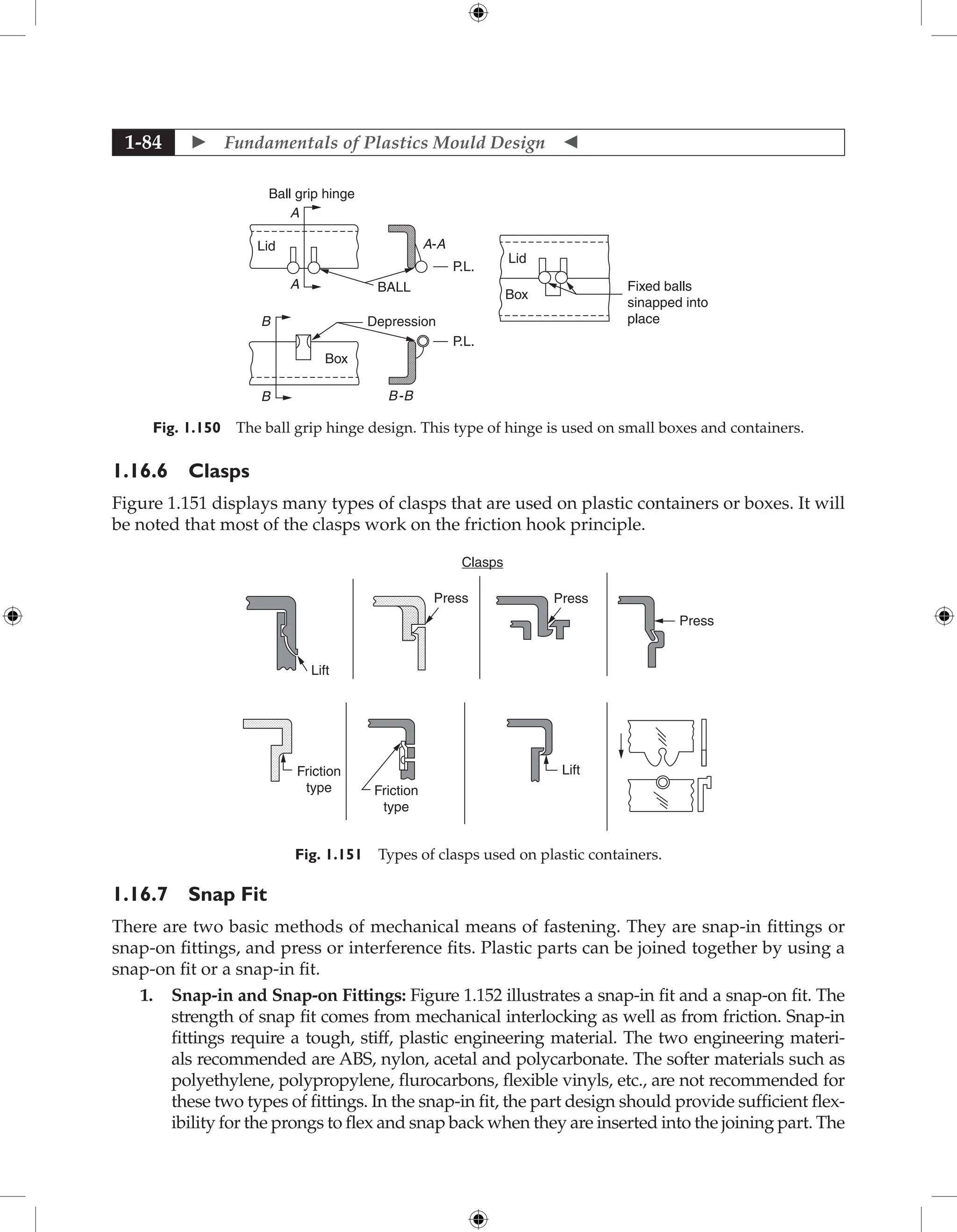
  • 414.
    ๎ฃ Advanced InjectionMould Design ๎ข 5-13 assembly, the horizontal rack passes through a slot machined in the back plate. The continued movement of the moving mould half causes the operating pinion to rotate. The rotation of the pinion causes the vertical rack to move upward, thus the vertical movement of the rack causes the core shaft pinion to be rotated and the mouldings are unscrewed. 3.โ€‚Rotating helix spindle method: In rotating helix spindle mechanism, a multiple start helix spindle is mounted in bearings located in the moving half of the mould, while a complemen- tary multistart helix nut is attached to a rear machine platen or auxiliary platen shown in Fig. 5.17. The helix spindle remains in contact with the fixed helix nut and during the mould opening stroke, the moving mould half moves to the left and relative longitudinal motion ยญ occurs between the helix spindle and the helix nut. This causes the helix spindle to rotate. The sun gear is attached to the helix spindle and rotation of the gear wheel operates a number of planetary gears. Closing the mould causes the helix spindle to rotate in the opposite direction, thereby returning the planet gears to their original positions. Archimedean screw (Multistart) Planet gear Sun gear Drive shaft Moving platen Operating nut Fixed rear platen Fig. 5.17 Machine powered, archimedean screw design. Fixed helix spindle In this method, the helix spindle is attached to the fixed mould half, and the helix nut is rotated within the moving mould half during the opening stroke. During the opening stroke, the moving mould half moves to the left, relative movement occurs between the helix spindle and helix nut causing the helix nut and sun gear to rotate. This in turn rotates the planetary gears thereby unscrewing the mouldings. The mould closing stroke causes the helix spindle to rotate in the opposite direction and returning the individual gears and core shafts to their previous position.
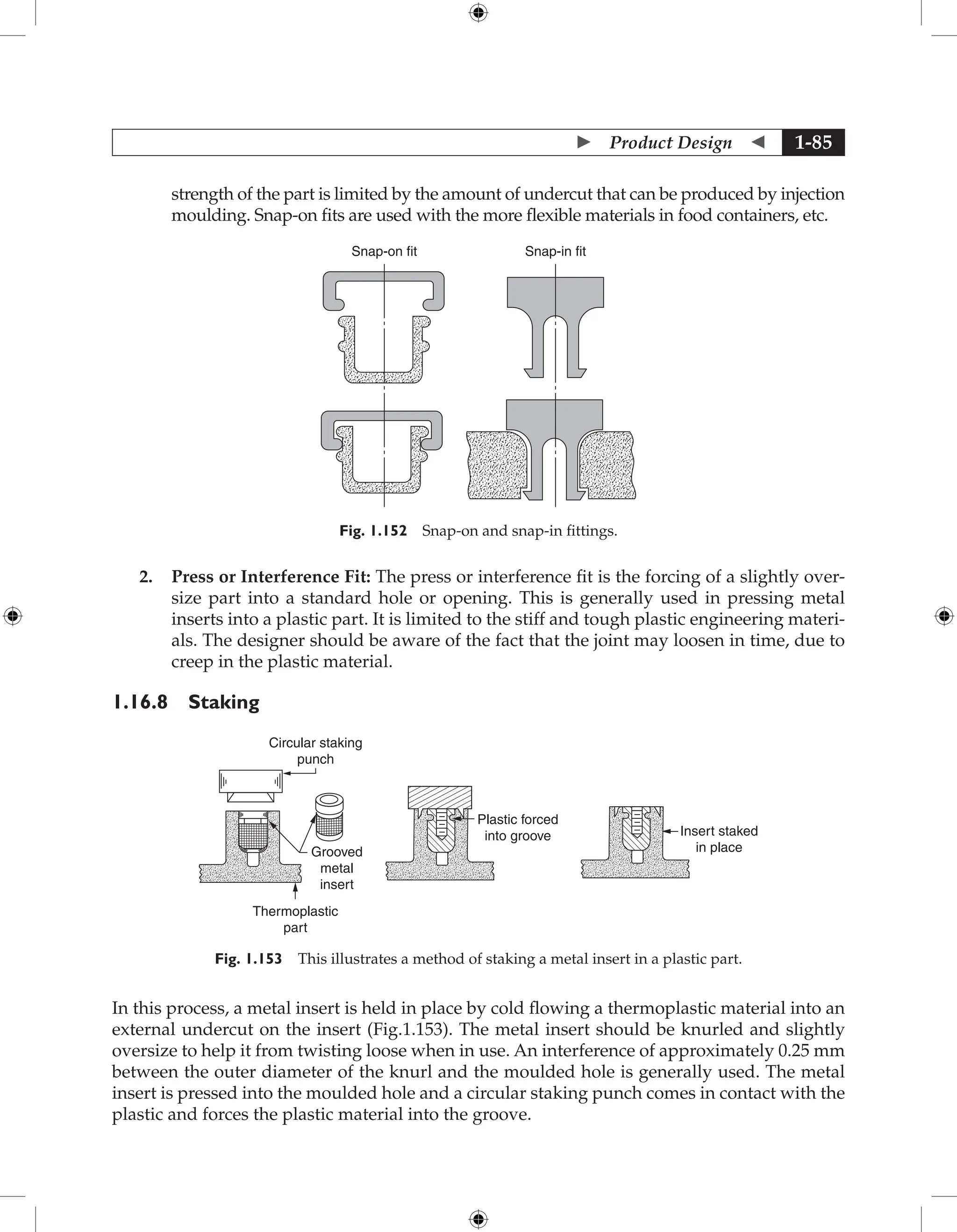
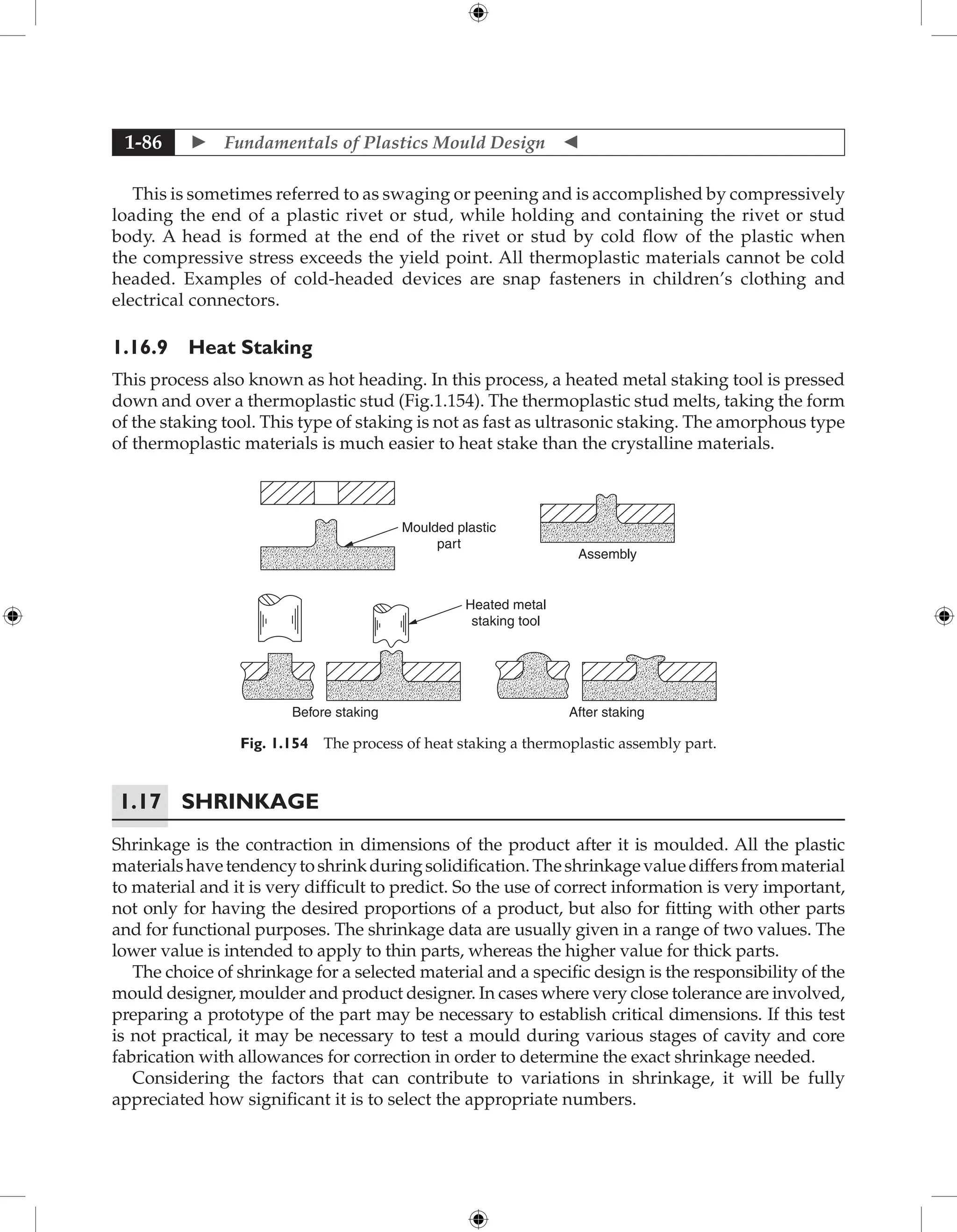
  • 415.
    ๎ฃ Fundamentals ofPlastics Mould Design ๎ข 5-14 4.โ€‚HydraulicallyorPneumaticallyPoweredSystems: In this method, the actuation of rack and pinion is done hydraulically. It is advancement of the manual rack-and-pinion design which allows the unscrewing operation to be made fully automatic. The operating handle assembly is replaced by an actuator, the ram of which is directly coupled to the rack. The ยญ actuator is mounted on a platform which is supported on columns suitably secured to the moving half of the mould. The rack extends through the mould is coupled to the ram of the actuator and independent control of the actuator causes the ยญ unscrewing operation. Hydraulically or pneumatically powered ยญ systems This ยญ design is used for power transmission by using ยญ rack-and-pinion method which allows the ยญ unscrewing operation to be made fully automatic. The handle as- sembly is ยญ operated by hydraulically or pneumatically powered systems with the help of an actuator, which is directly coupled to the rack. The rack extends through the mould is coupled to the ram of the actuator and the actuator causes the ยญ unscrewing operation shown in Fig. 5.19. Pinion gear Air of hydraulic cylinder Threaded shaft and bushing Gear rack extended Retracted core Ejected part Fixed mould half Fig. 5.19 Unscrewing with hydraulic system. 5.1.5โ€ƒExternal Threads The components with external threads can be moulded in two ways. One method is to design the split cavity mould in which the parting line is located on the centreline of the thread and two cavity halves move oppositely to release the part as shown in Fig. 5.20. The second Actuator Platform Columns Ram Rack Mould Fig. 5.18 Hydraulically powered systems.
  • 416.
    ๎ฃ Advanced InjectionMould Design ๎ข 5-15 method of moulding and unscrewing the external thread in the direction of mould opening is done by manual and automatic thread unscrewing devices. 5.1.6 Moulds for Externally Threaded Components The externally threaded moulding is considered as an undercut while designing the mould and it prevents straight draw removal of the moulding from the cavity during ejection. The threaded type of moulding can be released from the cavity by unscrewing mechanism, stripper ejection method or by incorporating split mould technique. The unscrewing mechanism requires rotary motion within the mould to perform the unscrewing operation of the component automatically. The stripping method makes the production cycle faster, but it is limited to those components which incorporate roll threads only. In case of split mould design, the thread shape is machined in the splits and it is opened by using finger cam or dog-leg pin method for releasing the moulding from the cavity. Fixed threaded cavity design This type of mould is used for producing externally threaded component in which the threaded portion is machined directly into the cavity insert shown in Fig. 5.21 (a). When the mould is opened the moulding is unscrewed from the mould core plate shown in Fig. 5.21 (b). The unscrewing method can be manual or electrically power as- sisted. (c) Key Moulding (a) (b) Serrated edge Fig. 5.21 Fixed threaded cavity design: (a) Mould closed, (b) Mould open, (c) Moulding and release key. The components should have sufficient grip for unscrewing. The parting line has been chosen to allow the head of the component to project above the mouldโ€™s parting surface and the edge of the head is serrated to provide a grip. An alternative method is to design the component with either a square or a hexagonal aperture. This permits the use of a key as shown in Fig. 5.21(c) for unscrewing the moulding. External mould thread Split mould Fig. 5.20 Split mould.
  • 417.
    ๎ฃ Fundamentals ofPlastics Mould Design ๎ข 5-16 Advantages of fixed thread cavity design over the automatic splits or rotating cavity designs: The mould cost is cheaper compared to the automatic design and the joint line is not visible in case of automatic unscrewing method, as the disadvantage associated with the split design in fixed thread cavity mould. Since there are no moving parts within the mould the maintenance cost is low compared with automatic moulds. The major disadvantage of the fixed thread design is that the moulding cycle is relatively long because it involves a manual unscrewing operation. Automatic unscrewing of externally threaded ยญ components This design is the same as the automatic unscrewing method for internally threaded components. However, for externally threaded components the cavity is fixed and the core is rotated for unscrewing action. The operating sequence of the automatic unscrewing mould as follows: After the cavity is filled the moulding is cooled sufficiently, further the mould is opened at the parting surface as (01) shown in Fig. 5.22 (b) and the core shaft is rotated. Thus the moulding is progressively unscrewed from the cavity and the gate is broken in the process. While moulding is being unscrewed the second opening occurs between the floating cavity plate and the feed plate. This allows for the removal of the feed system and the moulding is ejected from the core. The rate at which the moulding is unscrewed must be synchronised with the opening movement of the mould and this can be achieved by the use of the screw jack. It is essential that the shape of the core is such that it acts as a key when the core shaft is rotated, to unscrew the moulding. For example, small projecting ribs on the internal bore of a component provide a suitable grip for unscrewing purposes. The general build-up of the moving half of the mould is basically the same as for the fixed rotating core arrangement and similar layout, power unit and transmission systems are adopted. Stripping (jumping) external threads This method is applicable for the components having external threads in rolled form and the moulding material should be sufficiently elastic to re- turn to its original shape after being deformed. The stripping design of mould avoids the unscrewing method of moulding, or using splits, and fully automatic operation. The stripping mechanism is shown in Fig. 5.23 in which the external shape of the moulding is machined in the cavity insert and it is mounted in the moving mould plate, the core is mounted in the fixed mould plate. When the mould is opened the component is retained in the cavity by the threads and is, therefore, pulled from the cavity. Relatively large ejector pin is positioned below the lower face of the moulding and when the ejector assembly is actuated the moulding is ejected from the 01 02 (a) Core shaft Feed plate Floating cavity plate (b) Fig. 5.22 Automatic unscrewing for externally threaded components.

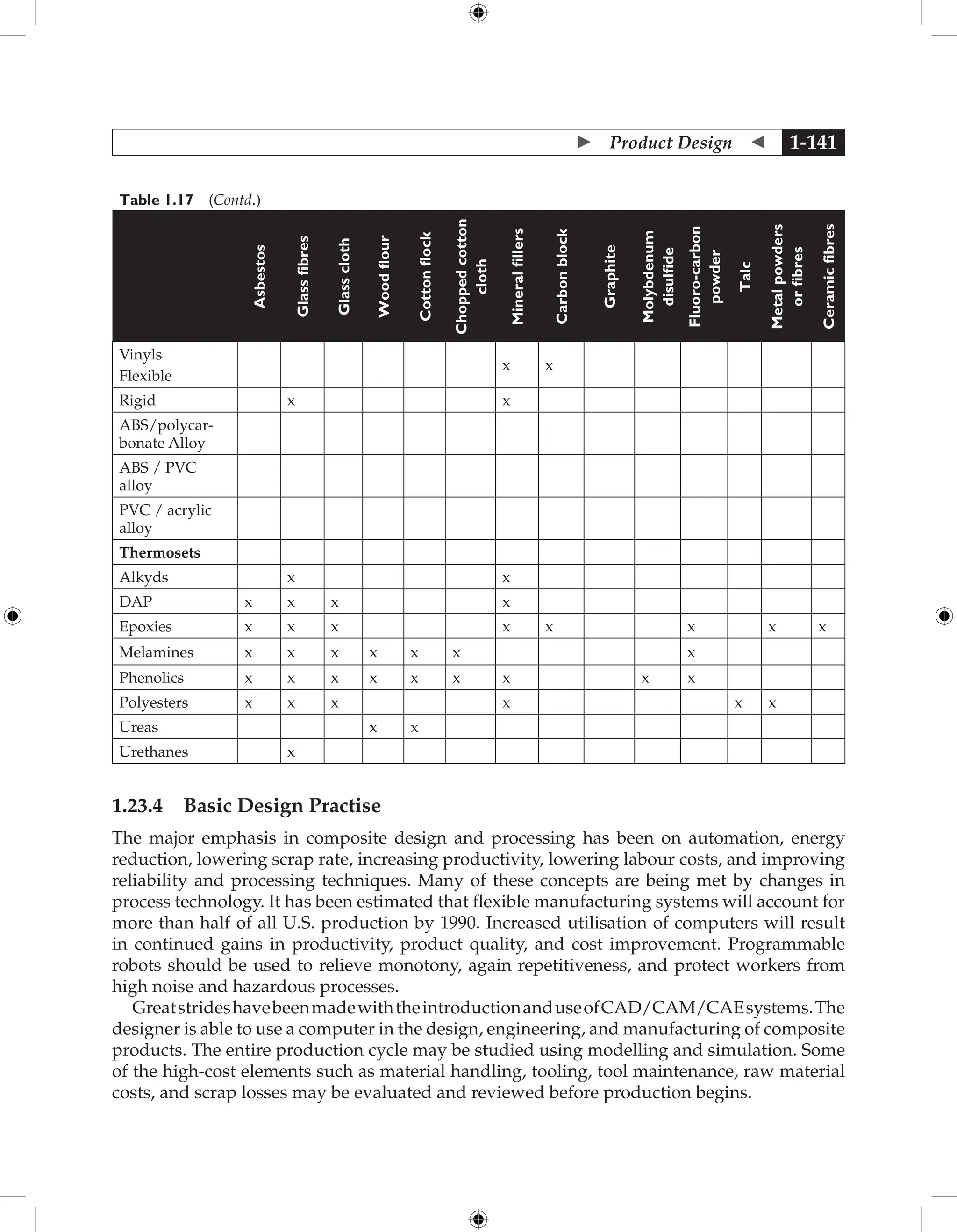
  • 418.
    ๎ฃ Advanced InjectionMould Design ๎ข 5-17 cavity. The pocket in the component, formed by the core, permits slight contraction, which allows the moulded threads to ride over the complementary cavity threads. Figure 5.24 shows the roll thread form of the moulding. The recommended plastic material is PP, HDPE, LDPE and LLDPE. This method is not suitable for moulding conventional โ€˜Vโ€™ or square threads as the sharp edges will be damaged during ejection phase. Ejection pin Moving mould plate Fixed mould plate Cavity insert Core Fig. 5.23 Stripping (Jumping). R R R P=3.46 R Fig. 5.24 Typical roll thread. The joint line impairs the efficiency and quality of the produced component. In the case of a component which has an interrupted thread, from the joint line can be positioned on the plain section, thereby avoiding the necessity of requiring such extreme accuracy as shown in Fig. 5.25. Joint line Joint line (a) (b) Fig. 5.25 Joint line on externally threaded components in splits. Threaded splits This method is adopted when automatic production is required for an exter- nally threaded component, where the thread form is such that it cannot be stripped. Extreme accuracy is to be maintained while manufacturing and fitting of the splits; otherwise, flashing may occur along the fitting of the spilt. A spilt mould for an externally threaded component is shown in Fig. 5.26. In this design the dog-leg cam operating method was chosen to permit the use of simple pin ejector system. The dog-leg cam provides sufficient delay, before the splits are opened, to allow the moulding to be pulled clear of the core. The square thread profile will always create an undercut of varying severity according to the pitch and depth of thread shown in Fig. 5.27. The point โ€˜Xโ€™ is situated on the minor thread diameter at the joint line. The complementary point on the splits must travel distance โ€˜Yโ€™before it is clear of the thread shown in Fig. 5.27. The point โ€˜Zโ€™ at which the split loses contact with the moulding is higher than point โ€˜Xโ€™, therefore,
  • 419.
    ๎ฃ Fundamentals ofPlastics Mould Design ๎ข 5-18 an undercut must result. To avoid this, the thread profile should be changed to a trapezoidal form having a flank thread angle q. From the formula a value for q can be calculated. Fig. 5.26 Split mould for externally threaded components. Y X X Z L D d t Undercut Square profile Profile required to obviate undercuts q Fig. 5.27 Design of thread. tanq p = - L Dt D d 2 2 2
  • 420.
    ๎ฃ Advanced InjectionMould Design ๎ข 5-19 where L = Lead of thread D = Major thread diameter d = Minor thread diameter t = 0.5 (Dโ€“d) 5.2 Hot Runner Mould 5.2.1 Introduction The hot runner mould contains a heated runner manifold block within the mould and the manifold block is insulated from the rest of the mould, is maintained at a closely controlled elevated temperature to keep the runner permanently as a melt. The polymer material is directed to the mould cavities without loss of heat and pressure. The hot runner unit is mounted adjacent to the cavity plate. The polymer material enters via a centrally positioned sprue bush via secondary nozzle to the impression. The hot runner system represents the most extensive technological development from a conventional runner system to a system ready to be installed. Large mouldings such as automotive dashboards, bumpers, computer housing, etc., are produced using hot runner moulds. Almost all the plastic materials can be moulded in hot runner system, even reinforced plastic and structural foam can also be processed. The injection moulds are classified in to the following types: 1. Cold runner system 2. Hot runner system 1. Cold runner mould: A cold runner mould is a conventional mould in which the feed sys- tem, i.e., the sprue, runner and gate is cooled and ejected with the part. Every production cycle, the component and runner are produced. There are two major types of cold runner moulds, i.e., two plate and three-plate mould. The advantage of cold runner mould is the mould requires less maintenance and the design is simple, much cheaper than a hot runner system. Less skill requires setting up the mould and operation. Colour changes are also very easy, since all of the plastic in the mould is ejected with each cycle. The disadvantage of cold runner mould is the plastic waste that is generated and the runners are either disposed of, or reprocessed with the original material. The regrind plastic material will increase variation in the injection moulding process, and decreases the mechanical properties of polymer. 5.2.2โ€ƒRunnerless Moulding Runnerless moulding can be described as a system of moulding in which the conventional melt from the barrel is brought directly to the cavities. Thus, the molten materials are delivered through auxiliary heated passages and into the parts that are being moulded. The advantage of runnerless moulding is that there are no runners to regrind and consequently no need for use of a mixture with regrinds in moulded parts. The use of regrind
  • 421.
    ๎ฃ Fundamentals ofPlastics Mould Design ๎ข 5-20 in a mix with virgin material increases the rejection rate, which is higher compared with the use of virgin material alone. The melt is delivered to the cavity at optimum flowability. Each plastic has its limited flow length, and, when runners are long, the flow in the cavity may be working in the tail end of polymer flow length and thus requires high pressure for filling the cavity. Polymer melt is used at lower range of the temperature, thus providing the potential of lower cycles. Furthermore, only solidification of the part rather than that of the runner determine the duration of the cycle. Press plasticising capacity is improved because no volume is required for sprue and runner and available heated volume contributed by the auxiliary manifold system is increased and moulding problems associated with sprue and runners are eliminated. Injection-pressure requirements are lowered because the melt fluidity is maintained right up to the gate. Good fluidity of melt at the gate reduces injection-pressure values, which in turn is reflected in lower clamp-pressure requirement. Greater freedom of gate location is afforded as a result of the melt being fully fluid at the entrance to the part. Mouldingsrequiringlongflowpathscanbemadewithasinglegate,whereas,inconventional runner moulding multiple gating is required because of loss of heat in the runner. Since there is no wastage of feed system, requirements for plastic material grinders are reduced and handling of regrind is eliminated. The disadvantage of runnerless moulding is the mould cost is higher compared to conventional injection moulds. In this process, the controls for manifold and nozzle temperature are required and the initial debugging time is longer than in a conventional mould. Sprue bushing Locating ring Support pins Electric cartridge heater Hot runner manifold Air gaps Nozzle A-plate B-plate Cooling channels KO pin Core Plastic Auxiliary bushing Band heater Hot plastic Air gaps Fig. 5.28 Hot runner mould.
  • 422.
    ๎ฃ Advanced InjectionMould Design ๎ข 5-21 The runnerless moulding is accomplished by the use of 1. Hot runner manifold 2. Insulated manifold 5.2.3โ€ƒPrinciple of Hot Runner Mould In a three-plate cold runner mould, the runner system is reground and the material is re- used. In case of hot runner mould, it eliminates the solidification of runner system entirely by keeping it fluid. The material is kept plasticised by the hot runner manifold, which is heated with heating element like electric cartridge heaters. The manifold block and the band heaters mounted round the nozzle are thermostatically controlled. The plastic is kept fluid and the injection pressure is transmitted through the hot runner manifold. Fixed plate Support block Cavity insert sleeve Cavity insert Stripper bush Cavity bolster Stripper plate Tie rod Cartridge heater Shoulder screw Hot runner manifold block Sprue bush Secondary nozzle Register plate Pressure pad Insulation material or air gap Runner plug Theromocouple Cavity back plate Guide bush Core back plate Spacer block Guide piller ๏ฟฝ ๏ฟฝ ๏ฟฝ ๏ฟฝ ๏ฟฝ ๏ฟฝ ๏ฟฝ ๏ฟฝ ๏ฟฝ ๏ฟฝ ๏ฟฝ Screw Ejector plate Back plate Ejector rod Core insert Core bolster Fig. 5.29 Assembly parts of hot runner mould.
  • 423.
    ๎ฃ Fundamentals ofPlastics Mould Design ๎ข 5-22 The hot runner mould takes more starts up time and in case of multicavity moulds, balancing of gate, the melt flow and preventing drooling are difficult. A keen balance between no drooling and freezing up of the nozzle must be achieved. The hot runner mould is highly affected to tramp metal, wood, paper, and other contaminants, which quickly block the nozzle. Cleaning out plugged hot runner mould is a long process. These moulds are more expensive compared to cold runner moulds. Hot runner mould with externally heated manifold and drops A two plate hot runner mould with a heated runner system inside one half of the mould is shown in the Fig. 5.30 in which the runner system is divided into two parts are manifold and drops. The manifold has channels that convey the plastic melt on a single plane, parallel to the parting line, to a point above the cavity and the drops are situated perpendicular to the manifold convey the plastic from the manifold to the part. The heating system in hot runner mould is categorised as inter- nal and external heating of manifolds and drops. Tip insert Heater band Drop Hot manifold Spacer Locating ring Cartridge heather Air gap Cavity plate Air gap Core plate Fig. 5.30 Hot runner mould with externally heated manifold and drop. Fig. 5.31 Internally heated-core rod-secondary nozzle.
  • 424.
    ๎ฃ Advanced InjectionMould Design ๎ข 5-23 Externally heated hot runner channels have the lowest pressure drop of any other runner system, because there is no heater obstructing the melt flow path and they are better for colour changes. There are no places for material to hang up and degrade, so externally heated systems are good for thermally sensitive materials. Internally heated runner systems require higher moulding pressures, and colour changes are very difficult in this process. There are many places for material to hang up and degrade, so thermally sensitive materials should not be used. Internally heated drops offer better gate tip controlandinternallyheatedmanifoldseparatesrunnerheatfromthemouldbecauseaninsulating frozen layer is formed against the steel mould wall on the inside surface of the flow channel. 5.2.4 Design Guidelines of the Hot-Runner System The following are the design considerations of a hot runner mould: 1. The insert plugs and close off manifold bores should be smooth for free flow of mate- rial. 2. The pressure drop from sprue bushing to tip should be not more than 25 per cent of the maximum plastic fill pressure, with the resulting temperature increase and the runner volume should be 25 per cent of the part volume. 3. Sufficient heaters should be incorporated in the mould so that the hot-runner unit heats quickly to the required moulding temperature from cold. 4. Sufficient heat energy must be supplied to heat the hot-runner unit to compensate the heat losses by conduction, convection and radiation. 5. Suitable location of the heating elements is essential to ensure that the temperature of the melt in the flow-way is maintained to keep it molten. Considerable production time may be lost if a heater fails, hence proper choice of heating element; its location and the facilities for removing it must be ideally done. The layout of the wiring system of heaters should be neat and easily traceable and heating element wires, which are sub- ject to, heat or abrasion attack should be protected. While fitting the heating elements, cartridge type heaters are recommended and necessary clearance must be provided. The cartridge-heating element does not release heat over its entire length as there are end โ€˜cold spotsโ€™. Flat-type heating elements and induction heating elements should be completely enclosed within the unit for maximum efficiency. Allowance is provided as the hot-runner unit increases in size in three dimensions when heated and it should be insulated from the rest of the mould structure. For many materials, close control of the temperature of the melt is vital hence, careful consideration to the location of thermocouples is essential. To minimise degradation, colour-changing and material-changing problems the melt-flow- way must be as streamlined as possible, without sharp corners, edges or other stagnation points which tend to hold back the polymer melt for extended period. Applications of hot-runner mould In hot runner moulds the pin point gating of mouldings on multi-impression types of mould is adopted and it also allows for multipoint gating on
  • 425.
    ๎ฃ Fundamentals ofPlastics Mould Design ๎ข 5-24 single-impression and multi-impression moulds. It is feasible for side or film gating of large mouldings and it permits the semirunnerless design to be adopted, where small groups of impressions are fed from secondary sprue. 5.2.5 The Manifold Block The manifold block and secondary nozzle is the main part of hot runner mould. The design of manifold parts varies depending upon the moulding size and material properties. The function of manifold is to convey the melt to the cavities without affecting polymer properties. It is made from hardened hot worked tool steel (P20), OHNS, etc., which can withstand highest moulding pressure and temperature. The manifold block is designed to withstand highest melt pressure of 1800โ€“2500 bar and it should be correctly sized, smooth flowing and balanced melt channel layout to be made. It must be durable and easily replaceable heating elements with quick heat-up system to be fitted. The manifold block should have low radiation losses and temperature variation as low as possible. Embedded or surface mounted thermocouples should be provided and influence of thermal expansion on the position of gate in the cavity occurs. The manifold block can be classified according to its cross-sectional shape; rectangular or circular. While the rectangular type is usually manufactured as a one-piece structure and the circular cross-sectional manifold block is of composite structure. Two types of manifold blocks are shown in Figs. 5.32 and 5.33. The difference between these two is the method adopted for heating the manifold blocks. In the rectangular design, cartridge, coil or flat-type heating elements are fitted into suitably shaped holes or recesses within the manifold block, whereas in the cylindrical design, band or coil-type heating elements are fitted on the outside of the manifold block. The efficiency of the manifold is determined by estimating the amount of heat loss to surrounding mould components.Amanifold with a relatively low surface contact area through spacers and runner bushings and with a relatively large gap on all sides of the manifold will be more efficient than that with a high number of spacers, etc. Rectangular manifold block The rectangular cross sectional manifold block is one among the number of alternative shapes as shown in Fig. 5.32(a). The right prism manifold block is manufactured from a rectangular block of steel in which holes are bored to form the flow way system. The outlet apertures should be in one line to permit the individual holes to intercon- nect by straight drilling. However, for widely spaced outlet points or for applications where the outlet points are not symmetrical about the mouldโ€™s centreline, the use of an alternative manifold block shape should be designated by X-shaped unit and an H-shaped unit shown in Fig. 5.33. Circular manifold block The circular cross section manifold block consists of an assembly of cylindrical sections, an inlet block and outlet blocks. The simplest version of the circular cross- sectional manifold block is illustrated in Fig. 5.32 (b). It is manufactured from a cylindrical bar of steel and incorporates a central flow way drilling and the outlet flow-ways is bored to interconnect with the central drilling.
  • 426.
    ๎ฃ Advanced InjectionMould Design ๎ข 5-25 Rectangular unit manifold block (a) Circular unit manifold block (b) Fig. 5.32 (a) Rectangular unit (b) Circular unit manifold blocks. 5.2.6โ€ƒHeating of Manifolds Incorrect selection of heaters or their mounting create problems connected with the hot runner system, for which the calculation is required to get the heater size for heating up the manifold. Let us assume that the length, width and height of the manifold is a x b x c, respectively. The time required to heat up the manifolds up to the required temperature = 30 min. The processing temperature will be T2 and the starting temperature is T1. The amount of heat for the job is determined by the need for bringing the manifold to operating temperature in the required time and by the amount necessary to maintain the temperature under operating conditions whichever be the higher will be the one selected for the job. 1. Required heaters size for bringing the manifolds up to the processing temperature T2 in 1 hour from T1 Heat required = Weight of manifolds ร— Specific heat ร— Temperature difference = abcr ร— k ร— (T2โ€“T1) = abckr (T2โ€“T1) kcal/hr = Q(assume) 2. Heat losses at T2 (a) Losses due to convection and radiation Exposed surface area = 2(ac + bc) Losses due to convection Qc =h A (T2โ€“T1) where h = Heat transfer coefficient and A=Exposed area of manifolds Losses due to radiation Qr = โ‚ฌs A (T2 4 โ€“T1 4 ) here โ‚ฌ = Emissivity s = Stefan Boltzmann Constant (a) (c) (d) (b) Fig. 5.33 Different types of rectan- gular manifold design.
  • 427.
    ๎ฃ Fundamentals ofPlastics Mould Design ๎ข 5-26 Heat losses due to convection and radiation (Qc + Qr), by putting the values, Qc and Qr can be calculated. (b) Losses by conduction Q con = K A (T2โ€“T1)/L Where K= Thermal conductivity of insulation, A= Area of conduction and L= Thickness of insulation generally air may be selected. Area of conduction= 2ab By selecting the values, calculate the Q con Total heat required per hour = (Q+Q c+ Qr + Q con) kcal/hr Watt required = Total heat required in (Kcal/ hr)/ (864). Criteria for heaters into the manifold The holes for the heater should be reamed to a smooth finish and size so that the clearance per side should be 0.125 mm. The heater should be spaced so that the lead end is flush with the opening.The heater should be retained in place by a clip attached to the manifold so that it will not move out of opposition from either direction. The leads should be protected by armoured covering and held in position to keep away from vibration. The wires extending to the leads should be the heat resisting type attached firmly with crimped tubing so that there is no chance of poor contact. Capacities of wires, terminal block, connector plugs, etc., should be carefully checked out for current carrying ability and correct voltage. The melt-flow-way The melt-flow-way is the series of drilled holes formed in the manifold block through which the melted material passes from the primary nozzle ,i.e., injection ma- chine nozzle to the various secondary nozzles in the multicavity mould. The path of the melt -flow-way should be smooth otherwise the polymer material will be held up in the way, dif- ficulties arise when changing colour or type of material, and also degradation of the stagnant material may lead to discolouration of the moulding. There are various possible designs for the flow-way, shown in Fig. 5.34. Runner plug The runner plug is made from stainless steel and it is fitted in the flow path of hot runner system to direct the plasticised materials. It has a larger thermal expansion than the manifold material. As the manifold is heated to operating temperature, the stainless plugs will expand at a greater rate making the possibility of leakage impossible. 5.2.7โ€ƒSecondary Nozzles The secondary nozzle provides a connecting flow path from the manifold block to the cavity plate impression in a hot runner mould. The function of secondary hot nozzle is to convey the melt through a gate into the space between core and cavity. If the secondary nozzle can not control the gate temperature accurately, the gate may string from being too hot or freeze off. Hence, the nozzle must provide just enough heat to the gate to keep it molten without drooling. Therefore, the heat supplied to the gate must be very carefully controlled by either
  • 428.
    ๎ฃ Advanced InjectionMould Design ๎ข 5-27 fluctuating power to the gate or precisely balancing the cooling and heating in the gate area. In order to separate the hot nozzle tip from the cooled cavity plate, a space called insulating bubble is machined into the gate detail. The insulating bubble fills with the molten melt and acts as an excellent insulator. It should also have low heat losses to reduce unnecessary heating of nozzle and the tip of nozzle should be as close as possible to the moulding surface. Nozzle should be made of wear resistance material with high thermal conductivity and a wear resistance coating helps in increasing the life of nozzle. Positioning of the heater fitting either internally or externally depends primarily on the design of secondary nozzle. Standard secondary nozzle It is a type of secondary nozzle shown in Fig. 5.35. Its front face is in sliding contact with the cavity plate. When expansion of the manifold block Flow way systems Circular Combined Annular Circular main flow way Annular main flow way (a) (b) (c) (d) Fig. 5.34 Melt-flow-way system.
  • 429.
    ๎ฃ Fundamentals ofPlastics Mould Design ๎ข 5-28 ยญ occurs in the heating-up phase, the secondary nozzle slides across the surface of the cav- ity plate. When calculating the position of the secondary nozzles allowance must be provided for expansion in the manifold block so that, at its working temperature, the corresponding holes in the secondary nozzles and mould plate are in line. In this type, the conventional sprue gate is adopted to connect the secondary nozzle outlet to the impression.Alternatively, when the hot-runner unit is being used as a semirunnerless system, a conventional sprue is used to connect the secondary nozzle outlet with the runner system. Heater Thermocouple Manifold block recess Manifold block Fig. 5.35 Standard secondary nozzle. Barb nozzle Generally, in case of conventional sprue gate system the gate mark is visible at the injection point on moulding. In order to reduce the gate mark to minimum barb nozzle is used. It is a special nozzle in conjunction with a reverse-tapered sprue shown in Fig. 5.36. The barb nozzle is similar to standard nozzle except that there is a projection at the front, which incorporates barbs. In this nozzle, the projected portion is accommodated in the reverse-tapered sprue ensur- ing that the flat face of the nozzle seats on to the sprue bush and prevents leakage of material. Moulding projection Barb nozzle Y S Fig. 5.36 Barb nozzle.
  • 430.
    ๎ฃ Advanced InjectionMould Design ๎ข 5-29 In operation, the plastic material flows through the nozzle, sprue, and gate, and so into the impression. After the material has solidified, the sprue is pulled from the sprue bush by the barbs as soon as the nozzle is withdrawn. The mould is opened and the moulding ejected in the normal way. To permit the removal of the sprue from the nozzle a larger than normal sprue break is required; hence it is normally used on injection machines incorporate a sliding carriage, which can be withdrawn automatically as part of the machineโ€™s normal cycle of operation. The sprue is normally removed manually from the nozzle, which lengthens the moulding cycle. An alternate design incorporates a local stripper plate, to strip the sprue from the barbs. Extended nozzle This type of extended nozzle protrudes into a pocket machined in the mould plate to prevent the undue cooling of the plastic material shown in Fig. 5.37. A resistance type band heater is provided which is controlled by means of thermocouple and the thermocouple is fitted into a slot machined into the barrel section of the nozzle directly beneath the heater band. To minimise the transfer of heat from the heated nozzle to the mould, a circumferential clearance of at least 5โ€“7mm to be provided between the two parts. The main advantage of this type of nozzle is that it minimises the length of the sprue gate as short as possible. The pressure drop across the gate is minimised and it avoids the post process of sprue removal. Mould plate Thermocouple Nozzle Heater Fig. 5.37 Extended nozzle. Antechamber secondary nozzle In this design, the nose of the secondary nozzle is bell- shaped and it extends into the cavity plate directly behind the impression. The body of the secondary nozzle, is large in diameter, and touches against the face of the cavity plate. A ring, manufactured from an insulating material, is usually incorporated at the junction between nozzle and local cavity insert for the transfer of heat from the secondary nozzle to the cavity plate is minimised. As the insulating material is slightly compressed due to the expansion of the manifold block, a good leak-free material seal is achieved.
  • 431.
    ๎ฃ Fundamentals ofPlastics Mould Design ๎ข 5-30 Duringprocessing,theantechamberisfilledwithasmallvolumeofpolymermelt.Thepolymer melt passes from the manifold block, through the central hole of the secondary nozzle and into the antechamber via two or three small holes machined at an acute angle in the bell-shaped nose. Further the melt flows into the impression via the gate. The principle of the antechamber design is that, because polymers are poor conductors of heat, the material adjacent to the wall of the secondary nozzle nose remains sufficient fluid to allow the melt to pass intermittently into the impression via the gate. The layer of material adjacent to the cavity plate acts as an insulator, preventing undue loss of heat from the secondary nozzle to the cavity plate. Cavity plate Cooling sleeve Nozzle Heater Nozzle Insulation disk Y X Local insert Core Stripper ring Fig. 5.38 Antechamber design. Internally heated sprue bush In this design, the heating element is incorporated on the centre line of the sprue bush in the flow-way between the injection machine nozzle and the gate into the impression. By this means, the polymer material is kept at an elevated, controlled tempera- ture up to a position relatively close to the gate. Astandard injection machine nozzle, with either a flat or a radius end, is used in this method. Internally heated sprue bush consists of basic parts torpedo, cartridge heater. The cartridge heater is housed within the torpedo assembly shown in Fig. 5.39. The heater wires pass through one of the torpedo legs via an internal insulator and adapter. The torpedo assembly is mounted inside part of the sprue. The front end of the sprue body-outer is conical in shape, with a small parallel nose which fits into a complementary hole machined in the cavity plate. The insulation gap between the body-outer and the cavity plate should be provided to minimise heat transfer. When an internally heated sprue bush is incorporated in design, careful consideration must be given to the disposition of the coolant flow-way system in the cavity plate to minimise local heating effects.
  • 432.
    ๎ฃ Advanced InjectionMould Design ๎ข 5-31 Torpedo tip Cartridge heater Adaptor Torpedo Fig. 5.39 Internal flow way heater-cartridge heater-type sprue bush. 5.2.8โ€ƒHeating System The ideal temperature required for heating the hot runner unit plays a vital role for getting stress free component. Generally the heating element used in hot runner mould is cast in pure copper into the manifold to provide uniform and constant temperature profile. The heater should be durable, easily replaceable and efficient. Heaters in the manifold should be located at a minimum and consistent distance from the melt channels and it should not cross the melt channels. Heater size should be about 2โ€“3 Watts / cm2 of manifold plus calculated heat loss per contact point. The temperature variation of melt in the channels should be as low as possible. It should be less than 5ยฐor at the most less than 10ยฐ.Temperature uniformity is primarily achieved by reducing the heat losses and also by heating the manifold uniformly. Heat losses are reduced by designing suitable back up insulators like, pressure pad or spacers. An air gap of 5 mm to 10 mm is provided around the manifold, gives good insulation. Electrical devices are normally preferred for heating the manifold block although other systems such as circulating hot oil, high-pressure hot water and stream have been used. Nickel-chromium alloy, heavy gauge copper wires are used in electrical heaters. Heating methods Different electrical devices are used for heating the manifold block although other methods like circulating hot oil, high pressure hot water and steam are circulated. There are various types of electrical systems such as (1) standard voltage resistance heating (2) low voltage resistance heating (3) induction heating. 1. Standard Voltage Resistance Heating: In this method, the manifold block is heated by means of voltage resistance heating elements. The heating element is embedded in a refractory material and enclosed in a metal casing. Generally, cartridge heating element, the flat heating element and the band heating element are commonly used. 2. Low Voltage Resistance Heating: In this method, the heating element is a length of relatively thick wire made with high resistivity value, 80/20 Ni-Cr alloy. The wire is formed into a shape such as a coil or a zigzag to facilitate it into the manifold block when the current is passed through the wire; it heats as a result of the resistance to the flow.
  • 433.
    ๎ฃ Fundamentals ofPlastics Mould Design ๎ข 5-32 3. Induction Heating: In this case, when a conductor is placed with in a magnetic field carrying an alternating current, eddy current is induced into the conductor, causing it to heat. The surface is heated immediately and further the current maintains the heat right through the body. The coils used in induction heating are made out of copper wire. The external flow-way heating The external flow way heating of manifold blocks is shown in Fig. 5.40, positioned in the centre of the rectangular and cylindrical type. The flow-way is not necessarily central in the manifold block. Low voltage zig-zag heating (a) (c) (d) (b) Resistance-type strip heating Induction heating system Main voltage band heating and low voltage coil heating Fig. 5.40 External flow-way heating systems: (a) Induction heating, (b) Band heating and coil heating, (c) Resistance-type strip heating, (d) Low voltage zig-zag heating. The arrows in the manifold block indicate the conduction heat flow path from the heating element to the flow. The relative distance between heating element and flow-way can be decided based on the type of heater provided in the mould. There are different methods used for external flow-way heating, viz. cartridge heating element, low voltage coil (internal) heater, flat heating element, low voltage zigzag heating, induction heating coil, band heaters, low voltage coil external heater. 1. Cartridge Heating Element: Cartridge heaters are available as a standard part in various diameters which ranges from 6.5โ€“19 mm. The cylindrical cartridge heating element is fitted into a hole bored and reamed through the manifold block. 2. Low Voltage Coil Heater: In this method, a relatively thick wire is wound onto a cartridge heater form a spring like coil. Terminals are attached to the coil for low voltage supply. The
  • 434.
    ๎ฃ Advanced InjectionMould Design ๎ข 5-33 wire used in this process should have high resistivity value to obtain the desired heating effect. The coil heaters are fitted into holes bored through the manifold block near to the flow way. 3. Flat Heating System: It is a rectangular section having shallow heating capacity. It is available as a standard part in a range of sizes and wattages. The flat heating element is accommodated in a slot machined into the side of the manifold block and clamped with a cover plate. The cover plate should have good surface to surface contact between heating element and manifold block to have better heat conduction. The flat heating elements are commonly fitted in all four sides of the manifold block. 4. Low Voltage Zig-zag Elements: In this method high resistivity wire is fitted in a zigzag configuration and terminals are fitted in either end of the wire to facilitate its connection to the low voltage supply. The total length of the wire required depends upon the resistivity value of the wire, the voltage used and power input required. The zigzag element is fitted into a recess in the sidewall of the manifold block and secured by a cover plate. 5. Induction Heating Coil: In this method, heavy gauge copper wire is wound onto a heater and then bound with tape to form a coil. The induction heating coil is fitted into a recess machined into the sides of the manifold block. When the current is passed through the coil, eddy currents are induced into the surface of the manifold block and heat is transferred from the coil to the melt-flow-way by conduction. The above external flow-way heating methods are used for rectangular cross section manifold blocks. For heating cylindrical manifold blocks the band heaters and the low voltage coil heaters are used. 6. Band Heating Elements: In this type, the main voltage resistance type of element is enclosed within a casing which is in the form of split hollow cylinder. It is mounted in the external surface of the cylindrical manifold block. The band heaters are available as a standard part in a variety of diameters, widths and wattages. The band heaters are also used for heating of secondary nozzles and manifold bush. (a) (b) Fig. 5.41 (a) Cartridge (b) Low voltage coil heating element. Fig. 5.42 Main voltage cartridge heating.
  • 435.
    ๎ฃ Fundamentals ofPlastics Mould Design ๎ข 5-34 The internal flow-way heating system In internal flow-way heating method, the annular flow-way system is adopted. The annulus is formed by the inner surface of a relatively large central bore hole and the outer surface of a heater tube. A heating element is fitted down the centre of the tube shown in Fig. 5.42; the heating element is in close proximity to the relatively thin shell of polymer melt. This concept makes use of the excellent insulating properties of polymer materials. The low thermal conductivity values reduce the flow of heat from the polymer to the cooler manifold block. Two types of heating elements are used in conjunction with the annulus system, the cartridge heat element and the low voltage coil heaters. A hot-runner unit is an insulated heated assembly, which is mounted within the structure of a mould to provide a flow-path for the polymer, melts from the injection machineโ€™s nozzle to the gate entry into the impression. 5.2.9โ€ƒExpansion Problems in Hot Runner Mould In a hot-runner mould, when the manifold block is heated by the heating elements, the metal expands in all directions. The distance between the centres of the secondary nozzles will increase with respect to the โ€˜fixedโ€™ distance between the centres of the impressions machined in the cavity plate. While designing the hot runner mould, allowance must be provided for the expansion to ensure that the centrelines are in line during production. Nozzle length Nozzle length at 20ยฐ Heat expansion + Fig. 5.43 Expansion of the manifold block. NOZZLE LENGTH 200ยฐ 250ยฐ 300ยฐ 48 mm 68 mm 0.13 0.20 0.17 0.20 0.21 0.30 The general equation for calculating expansion is as follows: e = L ร— a ร— โˆ† T
  • 436.
    ๎ฃ Advanced InjectionMould Design ๎ข 5-35 where e = Expansion (mm or in) ; L = Length dimension (mm or in) a = Coefficient of thermal expansion (mm/mmยฐC or in / inยฐC) โˆ† T = Increase in temperature (ยฐC) 5.2.10 Advantages and Disadvantages of Hot Runner System Advantages The hot runner system completely eliminates the runner scrap, so there are no feed systems to sort from the parts and no runners to throw away or regrind into the virgin material. Hot runner moulds are more effective for mass production parts, especially with a multicavity injection mould. Disadvantages Hot runner mould is much more expensive than a cold runner mould, mould maintenance cost is more and skilled workforce is required to operate. Colour changes of material with hot runner moulds are difficult, since it is practically impossible to remove all of the plastic from an internal runner system. 5.2.11โ€ƒLimitations of Hot Runner System Limitations (a) The mould setting time is generally higher than a cold runner mould. (b) An extended period waiting and the initial debugging of a new hot-runner unit mould is usually more extensive than with a standard mould. (c) The cost is higher than that of a standard two plate mould and an underfeed mould. (d) The area of the moulding adjacent to the gate may be blemished with surface heat marks. (e) Polymer melt leaking from the hot-runner unit creates problems. (f) Polymer material at the gate if solidified then creates interruption in production. (g) Certain materials have a tendency to drool from the gate into the impression when the mould is open. This causes blemishes on the subsequent moulding. (h) Some materials have the tendency to string when the moulding is extracted from the cavity. This has adverse effects similar to the above. (i) Replacement of the heating element is sometimes difficult and can be time consuming. (j) There are degradation problems if the runner flow path and temperature of the melt are not maintained properly (k) Changing the colour and the grade of plastic material is difficult. 5.2.12 Insulated Runner Mould The insulated runner mould in which the melt flows through a large diameter runner machined in the butting surfaces of the cavity plate and feed plate of a three-plate mould. The polymer
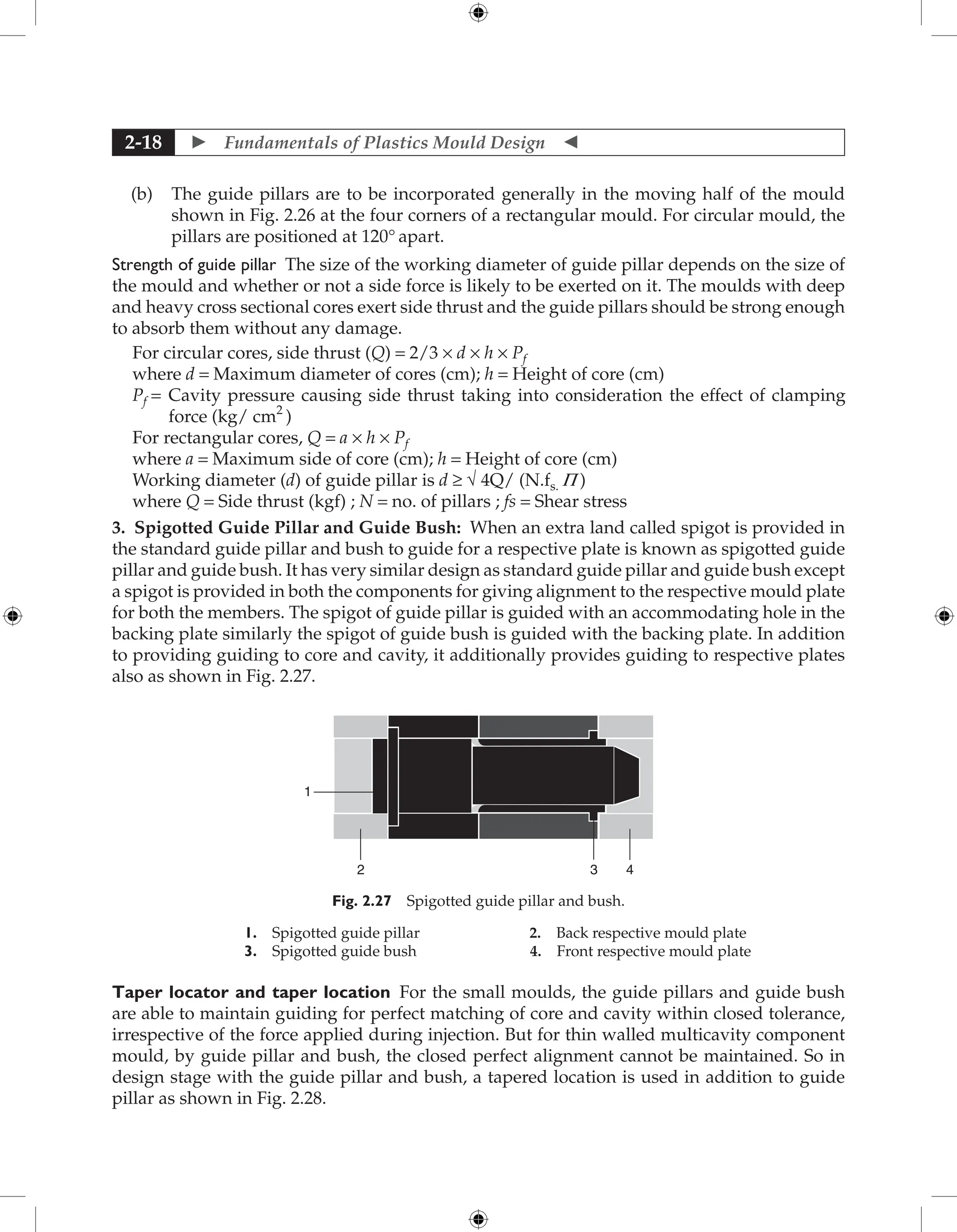
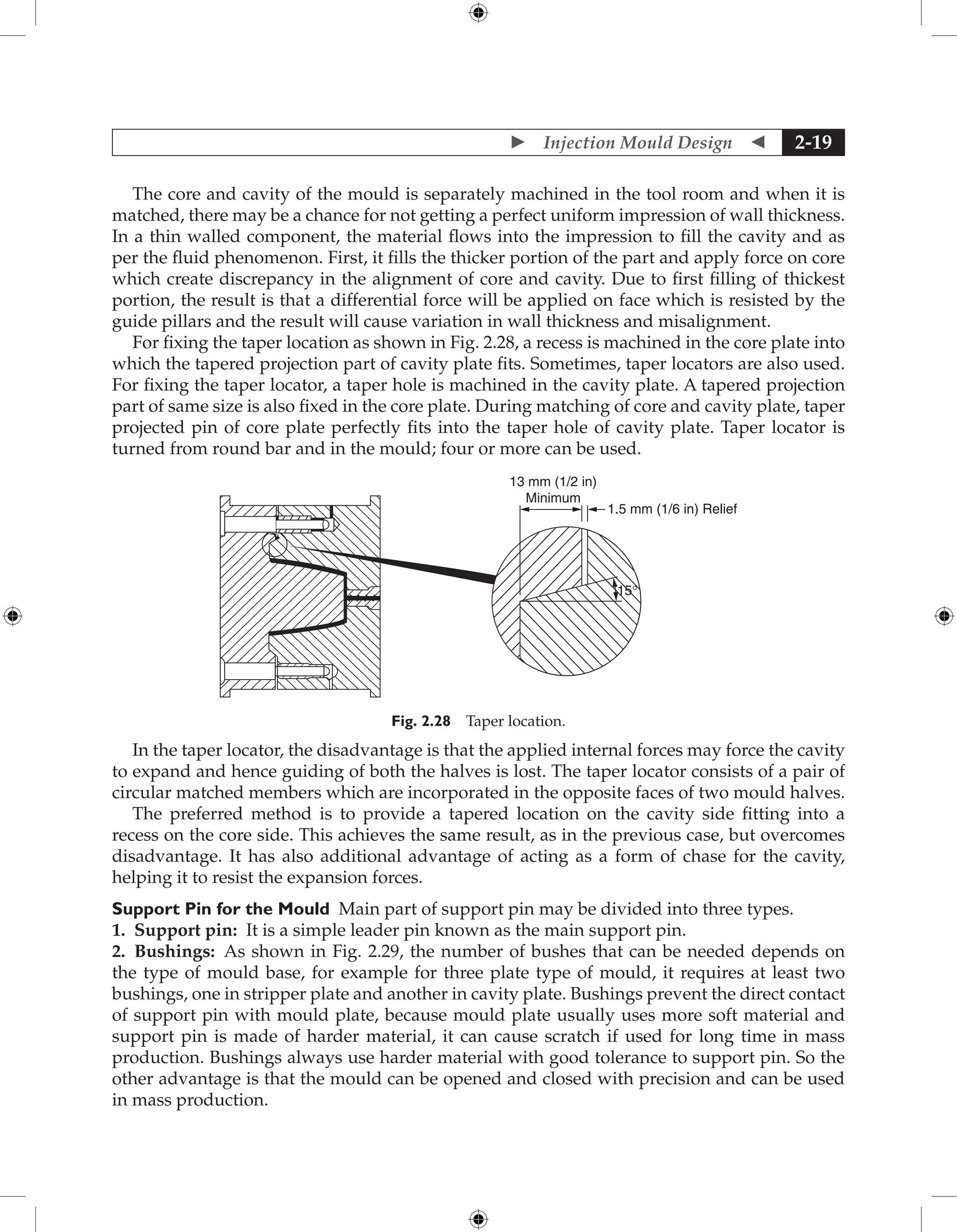
  • 437.
    ๎ฃ Fundamentals ofPlastics Mould Design ๎ข 5-36 melt flows from a standard or extended nozzle into a large diameter runner and finally into the impression via the reverse taper sprue and gate shown in Fig. 5.44. The insulated runner is not heated; the runner channels are extremely thick and stay molten during constant cycling. This system is very inexpensive, and offers the flexible gating advantages of other hot runners and the elimination of gates without the added cost of the manifold and drops of a heated hot runner system. Moulding Pin point gate Quick-release swing latches Cavity plate Feed plate Reverse tapered sprue Large diameter runner Nozzle Fig. 5.44 Insulated runner mould. The insulated runner mould consists of a large diameter runner, generally used in a three plate mould, the outside periphery freezes and the inside area remains molten and act as a runner. After the first shot, when the system is filled with molten material, the centre portion of the materials fluid due to the passage of freshly plasticised material with each cycle. The outer portion of the material in the manifold forms a solidified shell or tube, through which the molten material delivered with the shot, will flow into the cavities. The heat insulating characteristics of plastic material are used to good advantages by having the outer portion of the runner, which is frozen, insulated the hot molten materials. The two halves of the runner are machined in the respective mould plates, when the component is cooled the runner system freezes. During mould opening stage, the two plates are separated and the runner system is removed. As soon as the runner reaches equilibrium, the latch is closed and the mould is operated. Usually a heated torpedo individually controlled is inserted into each gate area and kept on continually and the wattage is controlled and set pragmatically. The gate size will vary with the material, but it should be somewhat smaller than the standard recommendations because of the high fluidity of the resin. The land should be about half of the gate diameter. For some materials, it is advantageous to provide a chamber on the tip of the nozzle should not only have a very fine finish, but should also offer smooth transition from one area to another. Insulated runner moulds are more difficult to start and operate than three-plate moulds, but are considerably easier than a hot runner mould. In insulated runner mould there is no runner system to regrind.
  • 438.
    ๎ฃ Advanced InjectionMould Design ๎ข 5-37 5.3 Outsert and Insert Moulding In outsert moulding process, one or a number of plastic functional components are injection moulded in one operation onto both sides of a base plate made out of ferrous or non- ferrous metals as shown in Fig. 5.45. The metal insert as shown in Fig. 5.45, is placed in the injection mould and the plastic is then injected into the mould cavities and hence into the appropriate cut-outs in the plate as shown in Fig. 5.46. Metal insert Fig. 5.45 Plastic moulding with metal insert. Metal plate Plastic moulding Fig. 5.46 Plastics mouldings anchored in a metal plate by injection moulding (Outsert moulding). 1. Pillar with anchoraging flange 2. Pillar, centred 3. Bearing for shafts 4. Slider guide, perpendicular to plate 5. Pin (All plastic) 6. Metal pin in plastic anchorage 7. Spring 8. Spring operating perpendicular to plate 9. Slider guide, parrallel with plate 10. Snapfit hook 11. Rotating component 7 6 9 8 10 1 11 2 4 5 3 Fig. 5.47 Basic components of outsert moulding.
  • 439.
    ๎ฃ Fundamentals ofPlastics Mould Design ๎ข 5-38 5.3.1โ€ƒObjectives of Outsert Moulding As manufacturing of metal components individually by turning, drilling, milling, etc., and then assemble them on a base plate is a time-consuming, labour-intensive operation, hence the outsert moulding is preferred. The aim of outsert moulding is to produce at a lower cost engineering assemblies which match or exceed the quality of those manufactured by traditional methods. Reduction in manufacturing costs would be possible with assemblies that are still produced entirely from metal and comprises a number of functional components like plastics or metal individually mounted on base plate. 5.3.2 Application of Outsert Moulding Component requirements in outsert moulding depend primarily on the function to be fulfilled. The following individual precision engineering components are used either alone or in combination as shown in Fig. 5.47, viz. bearings, pins, pillars, rotating parts, guides, slide ways, springs, hooks, etc. The materials for outsert moulding components should have special properties like high mechanical load- bearing properties, low creep, good sliding properties, low coefficient of friction, good spring properties, high dimensional stability, no environmental stress cracking and high chemical resistance. 5.3.3 Insert Moulding It is an injection moulding process in which the plastic material is injected into a cavity and around an insert piece placed into the same cavity just prior to moulding. Fig. 5.50 Component with moulded inserts. Fig. 5.49 Brass inserts Insert placed in mould Plastic injected Fig. 5.48 Insert mould.
  • 440.
    ๎ฃ Advanced InjectionMould Design ๎ข 5-39 In this type of design, the plastic parts containing metal inserts are produced using injection moulding. Generally inserts made out of ferrous or non-ferrous metal are placed inside the mould prior to the injection of plastic. The polymer melt flows around the inserts and fixes their position. The advantage of insert moulding is that, a single piece with the insert is encapsulated by the plastic. Insert moulding was initially developed to place threaded inserts in moulded parts and to encapsulate the wire-plug connection on electrical cords. Insert moulding is also used quite extensively in the manufacture of medical devices. The typical applications of insert moulding include insert-moulded needle hubs and bifurcations, as well as encapsulated electrical components and threaded fasteners, etc. 5.4 Multicolour Injection Moulding In multicolour injection moulding, the parts are produced that are made from different coloured plastics. The individual components are not merged, but are processed in separate colours. The visual effects can be created by combining areas of different colours or even transparent and optically conductive areas. As a result, the moulded parts are resistant to external influences such as chemical, thermal and mechanical loads. Fig. 5.51 Components of multicolour injection moulding.
  • 441.
    ๎ฃ Fundamentals ofPlastics Mould Design ๎ข 5-40 5.4.1 Mould Concepts The multicolour moulding is processed by following two different types of mould concepts. The first method is transferring the premoulded part to another cavity by means of a rotary movement, by hand or by using a robotics system, so that it may then be encapsulated by the second component. This method is switching the component from one mould cavity to another. The second method is the use of internal movement of the component inside the mould to free up space for the next set of components, i.e., only one cavity is used. 5.4.2โ€ƒRotary Moulds Inthismethod,thefirststeptobeperformedwhenusingrotarymouldsistheinitialproduction of a premoulded part in one of the cavities. Subsequently, during the next step, the part is manually shifted into the required position by transferring it into a second cavity by means of a rotary movement of 180ยฐ, so that it can be encapsulated by the second component. Fig. 5.52 Rotary moulds. The advantage of using rotary moulds is that premoulded parts can be produced at the same time that parts are encapsulated by the second component. Based on the geometry of the part, different design systems are available for performing the rotary movement, whereby either the entire mould half or individual parts of the mould are rotated like rotation of a stripper plate, rotation of a platen by means of an ejector movement, rotation of an insert, rotation of the moveable mould half, rotation of a central platen. 5.4.3 Altering the Mould Using an Internal Movement Inside the Mould The other method is by shifting the cores or sliders inside the mould as part of the composite injection moulding process. The hollow spaces can first of all be closed off and subsequently reopened and the polymer melt is injected inside the cavity accordingly as shown in Fig. 5.53. The moulds are configured by lifting and lowering movements and by sliding movements. The main advantage of this process is that parts can be produced without the need for intermediate opening of the mould and without further transport of the premoulded part. The production is performed as per sequence, whereas with rotary moulds simultaneous operations are possible.
  • 442.
    ๎ฃ Advanced InjectionMould Design ๎ข 5-41 Fig. 5.53 Cores or sliders. 5.4.4 Transfer by Hand or Robotic System The alternate method of rotary movement is that the premoulded part can also be transferred from the first cavity to a second one ready for the final injection stage, either by using conventional means, i.e., by hand or a robotic system. The transfer is advantageous when processing the cross-linking materials such as liquid silicones (LSR), because the mould can be divided into two distinct halves, each of which is completely thermally insulated from the other. 5.4.5โ€ƒSimultaneous Direct Injection In this method, the polymer melt is directly injected inside the cavity simultaneously to form two components in a single cavity, without having to alter the mould. However, in this process an uneven dividing line is formed between the two materials with the result that it is only used for parts whose ultimate visual appearance is not of prime concern. 5.5 Gas-Assisted Injection Moulding The gas-assisted injection moulding is a process in which hollow rigid parts can be produced which are free of sink marks and weigh less thereby saving resin material. The process begins with a partial or full injection of polymer melt into the mould cavity. Compressed gas is then injected into the core of the polymer melt to help fill and pack the mould as shown in Figs. 5.54 and 5.55. Other advantages include shorter cooling cycles, reduced clamp force tonnage and part consolidation. The process allows high precision moulding with greater dimensional stability by eliminating uneven mould shrinkage and makes it possible to mould complicated shapes in single form, thus reducing product assembly work and simplifying mould design. The formation of thick walled sections of a moulding can be easily achieved by introducing gas in the desired locations. The gas channels which are formed also effectively support the flow of resin. It allows reducing the moulding pressure. The effect of which, is that internal stresses are reduced. Moulding gets uniform mould shrinkage, and reduces sink marks and warpage.
  • 443.
    ๎ฃ Fundamentals ofPlastics Mould Design ๎ข 5-42 5.5.1 Working Principle of Gas-Assisted Injection Moulding Standard injection-moulding machine is used for gas-injection moulding process. Only additional equipments are fitted to the moulding machine to inject the nitrogen gas parallel or in series with the injection of the melt as shown in Fig. 5.54. The gas is injected through the same nozzle in which the melt flows in the machine nozzle, or via one or more special gas injection needles located at the runner or where there are more material concentrations, generally in thicker walls. Special machine nozzles are designed and used to ensure reliability. The gas-injection moulding process starts with injection of plastic into the cavity as shown in Fig. 5.54 and Fig. 5.55. When the cavity is 50 to 95% full, depending on the shape of the part the barrel is closed by a โ€˜shut-offโ€™ nozzle and gas injection starts. It can be controlled by pressure or by volume. The gas expands in the cavity, pushing the plastic in front of it until the cavity is filled. Then the gas-pressure is reduced by withdrawing the injection nozzle from the sprue, so that the gas can escape. In some designs the gas is allowed to escape from the cavity via the injection needle, so that the machine can recover the gas for re-use. If the gas is injected through the same nozzle as the melt, a second injection of plastic is made to seal the hole in the part. Gas front Melt Flow Front Melt Front STAGE I : Inject plastic l-a l-b Fig. 5.54 Injection of plastic into the cavity. STAGE II : Inject gas untill part is filled STAGE II : II-A: Via same (Specific) needle STAGE II : II-B: STAGE II : II-C: Via special needle Gas Gas injection in runner Gas injection Fig. 5.55 Injection of gas into the cavity.
  • 444.
    ๎ฃ Advanced InjectionMould Design ๎ข 5-43 STAGE III: (In case of II A and B) Close gate with plastics Plastics Fig. 5.56 Close gate with plastics. Different gas-assist injection moulding techniques are followed as detailed below: 1. The short-shot moulding, i.e., prefill of cavity with melt, followed by gas injection. 2. The full-shot moulding, i.e., complete fill of cavity with melt, followed by gas injection. 3. The full-shot moulding with overspill, i.e., complete fill of cavity with melt, followed by gas injection and opening of overspill cavities. 4. The full-shot moulding pushes resin back into barrel, i.e., similar to the overspill tech- nique using the machine barrel as the overspill cavity. 5. The external gas moulding, i.e., adding a layer of nitrogen gas to the part surface adja- cent to the cosmetic surface after complete fill of the cavity. Other than the above processes, there are some methods that use low-temperature nitrogen gas to create a gas flow through the part for an additional cooling effect. For some resins, the short-shot method cannot be used because of cosmetic surface requirements. Full-shot processes that have additional cavities, into which the resin in the core is evacuated, generally provide more control over the process. 5.5.2 Design Considerations. The most ideal designs for gas-injection moulding are parts in which the gas flow is in one direction only, i.e., not around corners or bends. There are special rules applied to parts designed for the gas-injection moulding process. The basic rule is that the gas always pushes the plastic away at the locations with the best flow conditions that is, where resistance to the melt front is the lowest. For this reason, gas channels will tend to appear in sections with large cross sectional area and higher melt temperatures. In Fig. 5.57, the Fig. 5.57 (a) shows a design with a sharp corner and melt accumulation; the Fig. 5.57 (b) shows an improved design with rounded corners. Gas channel Very low wall thickness Improved walls thickness ratios Gas channel (a) (b) Wall thickness in a corner without and with rounding off Fig. 5.57 (a) Design with sharp corner, (b) Improved design with rounded corners.
  • 445.
    ๎ฃ Fundamentals ofPlastics Mould Design ๎ข 5-44 The gas in the cavity of gas injection moulding fulfils two main functions: 1. It produces a hollow cavity by the gas which causes the weight reduction of the com- ponent. 2. It provides constant pressure throughout the part in order to compensate volume shrinkage after the cavity has been filled. The main objective of this process is to avoid sink marks and to obtain a smooth surface in the moulding. Gas-assisted injection moulding is used for producing thin parts with a relatively large cross section, such as handles, weight saving items. Gas channel incorporated in the mould is the main feature of this design. For shallow parts with stiffening ribs, the main reason for using gas-injection moulding is the processing the components with a smooth surface without sink marks. The ideal location of gas channels is very much required to avoid sink marks in moulding. As shell structures in housings normally do not include sections which can be used as gas channels, channels are to be specially designed. This is done at corners for the shell or at ribs or shell junctions as shown in Fig. 5.58. Specially designed gas channels for shallow structures B or: T B B B T = 2โˆ’3 Fig. 5.58 Specially designed gas channels. The ribbed components with gas channels avoid sink marks due to the link of the ribs in a network by an incorporated gas channel which goes around the geometry of the part. In this method it reduces warpage in the part. The size of the gas channel depends on the volume shrinkage of the material and on the size of the shell. The following considerations are of importance: The gas pocket size is smaller compared to the total flow length and the sooner the gas pressure has to be activated in order to avoid the gas channels freezing off. This means that the gas channel will try to compensate the volume shrinkage of the flat part, by pushing melt into flat, shrinking sections. A cross section over a part with a gas channel that is too small results such as those shown in Fig. 5.59. Because of lack of melt, gas is pushed into the shell, producing โ€˜notchesโ€™ which are defect in the part and unable to resist high dynamic loads. If the part has an application of integrated function, such as carrying liquids, or if it has connectors attached to it, the gas channel has to extend over the full length of the part, leaving only a thin skin of plastic as shown in Fig. 5.59.
  • 446.
    ๎ฃ Advanced InjectionMould Design ๎ข 5-45 Cross sections of too small gas chemicals Formation of initial crack Incase of unsufficient melt Fig. 5.59 Cross sections of too small gas channels. In this case, the size of the gas channel will depend on part design and determined by process simulation studies, which reduces the need for practical trials. Inserts are a challenging design problem for gas-injected parts. Inserts have to be properly surrounded by plastic material; the gas channel has to be placed at a certain distance from it. Usually, this can be achieved by using a separate gas-injection needle placed downstream from the insert as shown in Fig. 5.60, if the machine nozzle is used for gas injection. More design effort will be needed to ensure that the insert remains properly surrounded by plastic. Placment of gas-injection needle with inserts โ€˜Fillingโ€™ Insert Flow front Cut-off Overflow Gas-injection needle โ€˜Filledโ€™ Insert Gas-injection needle Fig. 5.60 Placement of gas-injection needles. 5.5.3 Gate The design of gate in gas-injection moulding is different from gates for conventional moulding. The gas-injection is done via the machine nozzle, the gate and runner dimensions have to be about twice as big as for conventional moulding. The gate should be positioned so that the melt is injected in a wide, even flow along the cavity wall, as in the extrusion process; split flows and confluences, which can lead to unwanted turbulence and should be avoided. 5.5.4 Advantages of Gas-Injection Moulding The gas-injection moulding process requires lower clamping force; the pressure drop during the moulding is less. Large-size mouldings can be produced with greater flow length. The mould is simple and cheaper compared to hot runner moulds.
  • 447.
    ๎ฃ Fundamentals ofPlastics Mould Design ๎ข 5-46 In terms of design of mould: Lower part weight (reduction up to 40%), less sink marks, less shrinkage across the direction of flow, higher torque resistance, more design freedom with non-uniform wall thicknesses. 5.5.5โ€ƒLimitations Processing 1. Extra equipments are attached in injection moulding machine. 2. Special nozzle design/gas-injection needles are provided. Design 1. Achieving exact wall thickness of component is difficult. 2. Cross section of gas channels less than 15 to 20 mm is preferred. 3. Increased shrinkage in the direction of gas channel flow. Material 1. Material properties usually lower than in equivalent part processed by conventional injection moulding process. 2. Surface quality of part depends on plastic material used. 5.5.6 General Applications 1. Automotive: Sunshine roof trim, external mirror housings, handles, wiper blade, car- riers, covers and panels, seat frames, head rests, pedals, steering wheels, knobs and gears, filter housings 2. Furniture: Armrests, chair bases, back shells, seat-pans, housings, and bathroom products 3. Packaging: Boxes, pallets 4. Appliances: Handles, lawn mower housings 5. Sports: Racquets, hockey sticks, ski bindings, ski boots 5.6 Stack Mould In stack mould, two injection moulds are operated in the same moulding machine and these moulds are used for moulding shallow, small parts in large quantities like tape cassettes ,etc. The cavities are located in two planes corresponding to two parting lines and are filled. Clamping force required for filling the mould is 15% higher than a standard moulds. It is the simplest mould design, from a runner point of view. It is a single-cavity, single-face mould arranged in back to back configuration of same impression or different impressions.
  • 448.
    ๎ฃ Advanced InjectionMould Design ๎ข 5-47 Fig. 5.61 Stack mould. The machine nozzle injects plastic directly into the mould cavity. The single-face mould can also be extended to a multicavity layout. The machine nozzle injects the melt into a runner system that feeds each individual cavity. This type of mould is suitable for processing thin-wall injection moulding with hot runner designs. Fig. 5.62 Stack mould.
  • 449.
    ๎ฃ Fundamentals ofPlastics Mould Design ๎ข 5-48 5.6.1 Types of Stack Mould 1. Two-face or two-level stack moulds 2. Three-face or three-level stack moulds Two-Face (Two-Level) stack moulds This type of stack moulds quadruples the output over single-face moulds, and are suitable for very high production volumes of shallow parts. Quick change moulds switch from one product to another in less than an hour in both single-face and two-face stack mould applications. Two-cavity slack moulds produce moulding of large parts in a back-to-back configuration, thus doubling the machine capacity. The two-face stack mould is two-stack moulds placed back-to-back and it increases the mould shut height. It operates in the same moulding machine with same cycle time as a conventional stack mould. Shot-to-shot change over time of less than one hour is required for both mechanically and air ejected parts in the stack mould. Machine shut height remains the same from one product to the other. Three-Face (Three-Level) stack moulds This type of mould permits moulding of deep- draw or tall pans to maximise the productivity of machine shut height. It is the development of a proprietary melt transfer system to pass the plastic across the mould parting line. The system avoids drooling on mould opening due to the self-decompression of the central hot runner system. The three-level stack mould uses triple Valueless Melt Transfer System (VMTS) cross over nozzles to provide equal pressure and flow characteristics to the plastic melt to each cavity. This stack mould is used when a two-level mould cannot produce enough pans and a four- level mould is too large for the machine to process. Three-level stack mould is used to produce both shallow draw parts like packaging lids and deep draw pans such as tall containers. It can be combined with quick-change systems to give added flexibility to high-production tooling. 5.7 Reaction Injection Moulding (RIM) 5.7.1 Introduction The reaction injection moulding process is based on a chemical reaction.Areactive liquid mixture usually polyol and isocyanate is injected or poured into a mould where a chemical reaction takes place. The finished part is produced after an exothermic reaction and heat is generated during the process. Depending on the chemical formulation, the end product can take on a wide range of physical characteristics like foam or solid, highly rigid or very flexible. This method saves material and energy costs compared to thermoplastics, where high heat and pressure is required to melt the resins. The parts are formed from two liquid components that chemically react inside a mould and it requires significantly less heat, clamping pressure and tooling cost.
  • 450.
    ๎ฃ Advanced InjectionMould Design ๎ข 5-49 This process is less complicated with a reduced initial cost of investment and it requires lower-tonnage presses than thermoplastic moulding. RIM process needs less equipment and floor space than injection moulding and the mould manufacturing cost is less compared to injection moulds. Isocyanate โ€˜Aโ€™ Nucleator Polyol โ€˜Bโ€™ Supply line Axial piston Pump and motor Heat exchanger Flowmeter Return line Return line Flowmeter Supply line Axial piston pump and piston Heat exchanger Mould Fig. 5.63 Reaction injection moulding (RIM) process The RIM process involves three steps viz; material storage, dispensing and moulding. 5.7.2 Material Storage In the RIM operation, the raw materials are stored in bulk storage tanks before processing. The materials are temperature-controlled to the optimum processing temperature as per the material specification. This results in a consistent manufacturing environment and provides the desired physical properties or cell structure. If the materials have other ingredients like fillers or pigments that need to be evenly dispersed throughout the chemical system, stirring devices or tank agitators are often incorporated into the tanks to prevent settling or chemical separation. Recirculation of the materials is continuously circulated at low pressure by the pumping system and through the mixing head. When the materials reach the mixing head, they are recirculated back to the day tanks and then through the same path again back out to the mixing head. This low-pressure recirculation can be used to maintain temperature, nucleation, and will help keep added ingredients such as fillers or pigments evenly dispersed. 5.7.3 Dispensing Dispensing is a process in which the two reactive materials, polyol and isocyanate, are kept separate until they reach the mixing head. When it is time to dispense a shot or make a pour, the machine automatically switches from recirculation to dispense mode. At this point, the metreing pumps precisely deliver the materials to the mixing head at the required volume,
  • 451.
    ๎ฃ Fundamentals ofPlastics Mould Design ๎ข 5-50 ratio, flow rate and temperature. The chemicals are then mixed by either high-pressure impingement or in a high shear dynamic mix chamber. The mixture is then injected into a closed mould or poured into an open mould or cavity. 5.7.4 Moulding In moulding process, the chemical reaction takes place inside the mixing head, with a continued exothermic reaction inside the mould cavity as the curing process progresses. When processing foams, significant forces created inside the mould must be resisted to ensure the integrity of the part. The clamping pressure required can be up to many tons depending on the size, expansion rates, and the desired density of the part, along with other material factors. Mounting the mould in a pneumatic or hydraulic press provides the force required to keep the mould tightly closed during the curing process. The elastomeric materials require very little clamping pressure as they do not expand or develop internal mould forces. 5.7.5 Benefits of RIM Very large, lightweight parts are produced by RIM process and the โ€˜flowabilityโ€™of polyurethane components allows for even distribution of the material within the mould. Bigger size mouldings can be moulded due to low pressure requirement which is not possible with injection moulding machine. The mould manufacturing cost is less and generally mould materials like steel, aluminium, Kirksite alloys, nickel, epoxy, silicone and fibreglass are used. Complex shapes or highly detailed parts with intricate design features at relatively low tooling and capital equipment costs can be designed. Monolithic parts or components with varying wall thicknesses are designed into the same moulded part. The prototype moulds can be developed with less lead time at a cost much less than traditional injection moulding. This also helps in functionality testing prior to machining actual high-pressure injection moulds. RIM process is ideal for shorter production run. The surface finish of RIM parts produces high-gloss that matches with painted metal parts. Table 5.1 Comparison of thermoplastic moulding with RIM. Conventional thermoplastics moulding vs reaction injection moulding Thermoplastic moulding RIM Material Thermoplastics in pellet form Low viscosity liquids Processing Temperature 350โ—ฆ to 450โ—ฆ F(176โ—ฆ to 232โ—ฆ C) Low processing temperatures 90โ—ฆ to 105โ—ฆ F (32โ—ฆ to 40โ—ฆ C) Mould Temperature 350โ—ฆ to 450โ—ฆ F (176โ—ฆ to 232โ—ฆ C) Low mould temperatures 90โ—ฆ to 105โ—ฆ F (32โ—ฆ to 40โ—ฆ C) Mould Pleasure Multiple tons of pressure Low internal mould pressure 50 psi (3.4 bar) and up (Contd.)
  • 452.
    ๎ฃ Advanced InjectionMould Design ๎ข 5-51 Table 5.1 (Contd.) Conventional thermoplastics moulding vs reaction injection moulding Thermoplastic moulding RIM Floor Space Equipment and moulds require more floor space Equipment requires less floor space Energy More energy to make a product Less energy to make a product Investment High initial investment Low initial investment 5.8 Casting 5.8.1 Introduction Casting is the process in which the polymer material in liquid form is poured into a box as per the required shape of the component called a mould and is kept for becoming solid mass. This type of process is found in civil construction, casting of steel, etc. The modified monomers, powders, solvent solutions in liquid form are poured into a mould or die and allowed it to polymerise to become a solid plastic shape. The liquid plastic changes its status by evaporation, chemical action, cooling or external heat. In general no pressure is applied in casting. The most widely used casting processes are simple casting, slush casting, rotational casting and solvent casting. 5.8.2โ€ƒSimple Casting This process is used for moulding rods, tubes, cylinders, sheets, etc. Liquid resins are mixed with catalyst or molten plastics and are poured into moulds and this is allowed to polymerise and become a solid mass. The plastics part is then removed from the mould for further finishing if required. In simple casting, wood, metal, plaster of paris, glass, elastomers are used for making the mould. The acrylic sheets are made by pouring the polymerised resins between two parallel glass surfaces. After full polymerisation in the oven, the sheet is separated from the glass surface and the internal stresses are relieved by reheating. 5.8.3โ€ƒSlush Casting In this process, the polymer melt is poured into a heated hollow mould. During pouring, the materials strike the wall of mould and get solidified with wall.By regular pouring of the material, the wall thickness of the moulded part is increased as the temperature increases. The pouring continues until the desired thickness is reached. The mould is then placed in an oven until the plastic fuses together or evaporation of solvent is completed. After water cooling, the mould is opened and the product is removed. Aluminium, ceramic, steel or plastic material are used for making the mould. Sometime vibrating, spinning or the use of vacuum chambers may also be used to remove the air bubbles in the product. Rain boots, shoes, hollow toys, and dolls and automotive products ,etc., are made by this process.
  • 453.
    ๎ฃ Fundamentals ofPlastics Mould Design ๎ข 5-52 5.8.4โ€ƒRotational Casting The rotational casting is sometimes named as centrifugal casting. A predetermined quantity of plastics powder or monomers is placed in one half of the mould. The mould is closed by keeping the other half and placed in a hot oven and rotated into axes. Because of the bi-axial rotation and the centrifugal force, the plastic material sticks with the wall of the mould and gets cooled. The solidified plastic product is removed. This process is used for making balls, toys, containers, fuel tank, large pipes and tubes ,etc. On the base of rotation speed, the wall thickness in different areas is controlled. 5.8.5โ€ƒSolvent Process Solvent process is used to make sheets and films of uniform sizes. Plastics are dissolved in a solvent along with additives plasticisers and colourants. Further the mixtures are poured on to a stainless steel belt. The film or sheets, made by process is free from stresses and will be uniform in thickness. This method is an easy way to make films and sheets. The materials used for making sheet are cellulose acetate, cellulose butyrate, PVC, PMMA, PC, PVA and other copolymers. 5.9 Resin Transfer Moulding (RTM) 5.9.1 General Process In this process, the dry unimpregnated reinforcement is preshaped and oriented into skeleton of the actual part known as the preform, which is inserted into matched die mould as shown in Fig. 5.64. The mould is then closed, and a low-viscosity reactive fluid is injected into the tool. The air is displaced and escapes from vent ports placed at the high points. During this time, known as the injection or infiltration stage, the resin โ€˜wets outโ€™ the fibres. Heat applied to the mould activates polymerisation mechanisms that solidify the resin in the mould known as cure, as shown in the Fig. 5.65. The resin cure begins during filling and continues after the filling process. Once the part develops sufficient green strength, it is moved or demoulded. Green strength refers to the strength of apart before it has completely cured. The green strength is an indication of how well it holds its shape until it is completely cross linked as shown in the Fig. 5.66. Injection gate Preform lay-up inside the mould Fig. 5.64 Loading of preform. Resin impregnation and cure Air/ effluents Q Resin and curing agent Q Heat flux Mould filling and curing Fig. 5.65 Solidification by using heat. Part removal Demoulding or part removal Fig. 5.66 Demoulding.
  • 454.
    ๎ฃ Advanced InjectionMould Design ๎ข 5-53 5.9.2 Advantage of Resin Transfer Moulding (RTM) The advantage of RTM relative to other polymer composite manufacturing techniques is the separation of the moulding process from the design of the fibre architecture. This process is of low capital investment, good surface quality is achieved and flexibility in tooling, large and complex shapes can be moulded. The components can be processed with ribs and parts integration is easier. Range of resins can be processed and re-enforcement is easier. 5.10 Structural Foam Moulding 5.10.1 Introduction This is a low pressure injection moulding process where the plastic melt is foamed with nitrogen gas or with a chemical blowing agent. Once the plastic fills the mould, the wall of the part solidifies against the cold mould wall and a thin layer of plastic solidifies along the mould wall. This thin layer forms a skin structure over the foamed inner core. The thin outer solid wall is supported by the interior cellular foam structure. This process can be used on many different sized parts, small to large, to produce a stronger and potentially longer lasting part. Many large parts require thicker walls than standard injection moulding can produce. Structural foam moulding allows for the injection moulding of large parts through the addition of a foaming agent. Any injection mouldable plastic can be used in the structural foam moulding process. Structural foam moulding allows for the injection moulding of such parts through the addition of a foaming agent. The lower viscosity of this mixture and the thicker cross section of the moulded part, results in less injection and clamping pressures required and less stresses created during injecting the plastic into the mould. As low pressures and forces are involved in processing, it allows more economical moulding equipment and tooling to be utilised. Structural foam moulding is suitable for mass production of multiple parts in the same machine cycle. Gas Teledyne Isco syringe pump Gear pump Reservoir (accumulator) Blowing agent Plastic pellets Extrusion barrel Shot pot (plunger) Shutoff valves Mould Fig. 5.67 Structural foam moulding.
  • 455.
    ๎ฃ Fundamentals ofPlastics Mould Design ๎ข 5-54 5.10.2 Advantages The advantage of this process is that, the mould cavity pressures are 10โ€“20 times less than the conventional injection moulding and the part weight can be reduced to 15โ€“30%.Large mould parts with high rigidity with reduced stress and warpage is produced, multiple parts can be moulded in a single cycle. Low cavity pressure permits use of lower cost aluminium moulds. Smooth and uniform surface finish is achieved; reduced cycle time is required for producing very large parts and high stiffness-to-weight ratio. Thicker parts and tubular shapes are processed without sink marks. 5.11 Lamination The laminate is a material that can be constructed by uniting two or more layers of material together. The process of creating a laminate is called lamination. There are different lamination processes, depending on the type of materials to be laminated. The materials used in laminates can be the same or different, depending on the processes and the object to be laminated. 5.11.1โ€ƒHot Roll and Belt Lamination The hot roll and belt lamination uses heat and pressure by means of bonding shown in figure below, the adhesive film and substrate are drawn onto heated rollers where the materials are heated and pressed together. The heat activates the adhesive film, creating a bond when pressed against the substrate material. Hot roll and belt lamination of adhesive films allow for continuous in-line lamination and an even distribution of adhesive. Integral film Hot Roller or flame nozzle/bar Hard rubber roll Web structure To takeaway Fig. 5.68 Hot Roll / Belt Lamination 5.11.2โ€ƒFlame Lamination The flame lamination is generally used to bond film and fabric to soft polyurethane foams. The process is shown in figure below, involves the passing of the soft foam over an open
  • 456.
    ๎ฃ Advanced InjectionMould Design ๎ข 5-55 flame, which creates a thin layer of molten polymer. The film and/or fabric are quickly pressed against the foam while it is still in the molten state. The strength of the bond depends upon the film, fabric and foam selected and the processing conditions ,i.e., gas type, flame height and spread, foam burn-off and nip pressure. Flame lamination is a continuous process that, depending on the equipment, adheres fabric or film to one or both sides of the foam in a single pass. End product Pressure roller Pressure roller Fabric Flame Foam Flame Film Fig. 5.69 Flame lamination. 5.11.3 Calendar Lamination Thecalendarlaminationofadhesivefilmsallowsforcontinuousin-linelaminationandprovides an opportunity for an even distribution of adhesive. Calendar lamination, similar to hot roll Fabric film web substrate Heated three roll stacks or cans Integral film To takeaway Fig. 5.70 Calendar lamination.
  • 457.
    ๎ฃ Fundamentals ofPlastics Mould Design ๎ข 5-56 lamination, uses a heated three-roll stack to heat and activate adhesive films. The adhesive film and substrate as shown in Fig. 5.70 are drawn into a stack of heated rolls where the film is heated, activated and applied to the substrate. Material selection is critical in providing a strong, long-lasting bond between the film and the substrate. 1. Where are threaded components used? 2. What are the categories of unified thread? Explain briefly. 3. How does shrinkage allowance play an important role in thread forms? 4. Write the various types of mould design techniques for withdrawing the threaded components? 5. How does โ€˜stripping internal thread designโ€™ work? 6. What is the difference between fixed threaded core and loose threaded core? 7. List out the advantages of fixed threaded core over unscrewing mould design. 8. What is collapsible core? Write down the advantages and disadvantages of collapsible core. 9. Explain the rotary unscrewing. 10. How does โ€˜manually powered fixed rotating core design with gear transmissionโ€™ mechanism work? 11. What is the role of chain and sprocket transmission in manually power design with fixed rotating core mechanism? 12. Explain briefly rotating helix spindle method with a neat sketch? 13. List out the types of mould design techniques for withdrawing the external threaded components. 14. How does automatic unscrewing mechanism work to release external threaded component? 15. Explain stripping (jumping) method to release external threaded component. 16. How does a split work to release external threaded component? 17. What is hot runner mould? 18. Explain cold runner mould. 19. Explain runnerless moulding. 20. Classify runnerless moulding and explain any one. 21. Explain the application of hot runner mould. 22. How does manifold block play an important role in hot runner mould? 23. What is the difference between rectangular manifold block and circular manifold block? 24. Explain the selection criteria of heaters for the manifold. 25. What do you mean by melt-flow-way in manifold? 26. Why is runner plug required in manifold? 27. What role does secondary nozzle play in manifold? 28. Explain standard secondary nozzle. Questions
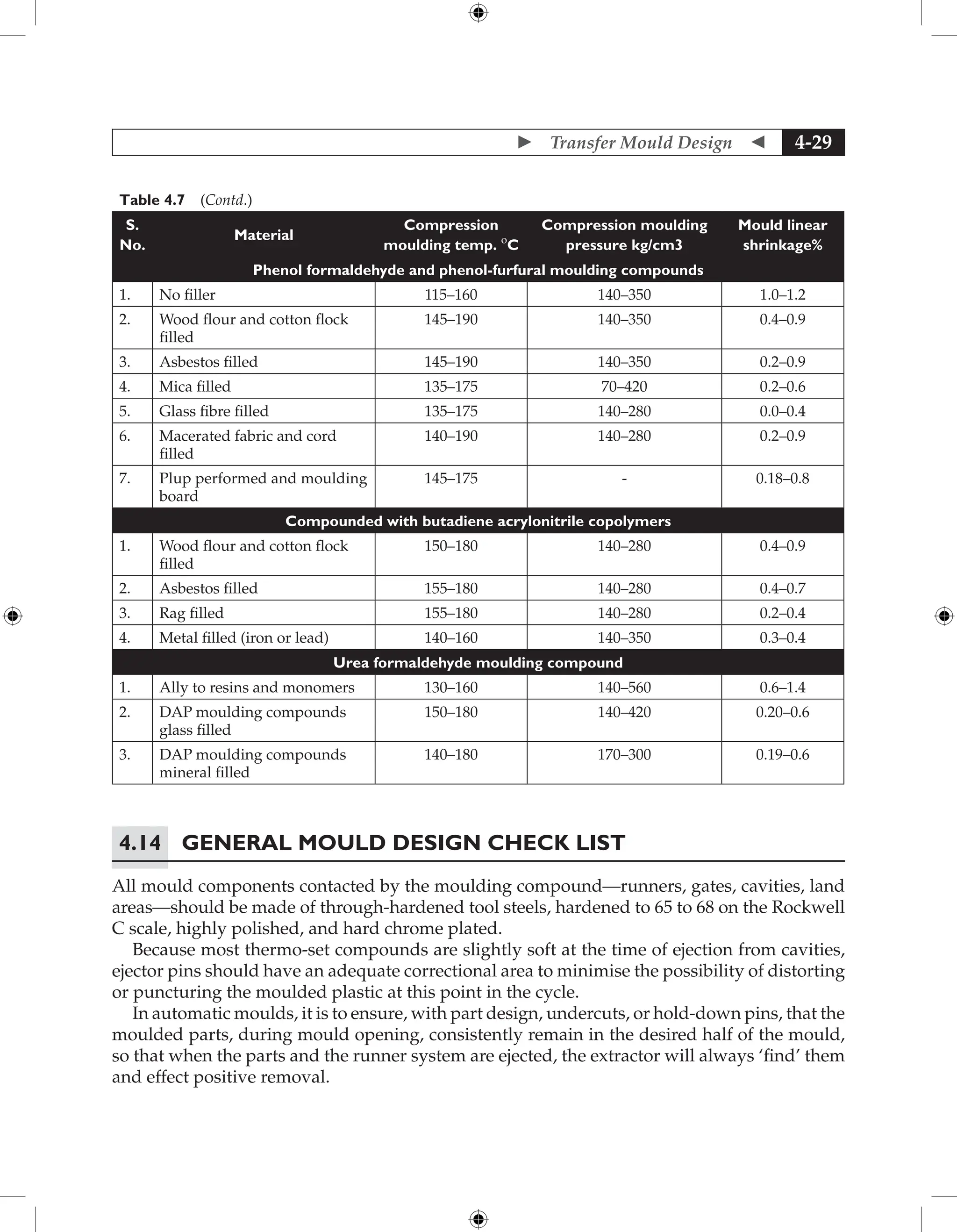
  • 458.
    ๎ฃ Advanced InjectionMould Design ๎ข 5-57 29. Explain the working principle of internally heated sprue bush with a neat sketch. 30. How does expansion problem occur in manifold? Explain its remedy with formula. 31. Explain outsert and insert moulding with a neat sketch. 32. Write the objective and application of outsert moulding. 33. What is insert moulding? Explain with a neat sketch. 34. Write notes on dispensing. 35. Describe the design consideration in gas-assisted injection moulding process. 36. What is reaction injection moulding (RIM)? 37. Write notes on material storage. 38. Describe the benefits of RIM? 39. Describe structural foam moulding? 40. Write down the advantages of foam moulding. 41. What are the different types of mould design techniques for withdrawing the threaded components? Explain any one. 42. How does collapsible cores mechanism work to release undercuts from mould? Explain the different types of collapsible coring techniques. 43. What are the types of unscrewing mould? Explain briefly. 44. Explain the principle of hot runner mould with a neat sketch. 45. What are the design guidelines to be considered while making hot runner moulds? 46. How does heating of manifold take place in hot runner mould? Explain with formula. 47. Explain barb nozzle with a neat sketch. 48. Draw an neat sketch of an antechamber secondary nozzle and explain its working principle. 49. Describe the heating system in hot runner unit and explain its method. 50. Explain the external flow way heating system with a neat sketch. 51. Explain the internal flow way heating system with a neat sketch. 52. Write the advantages, disadvantages and limitation of hot runner system. 53. Explain the principle of insulated runner mould with a neat sketch. 54. Describe the working principle of gas-assisted injection moulding process with a suitable sketch. 55. Write the advantages, limitation and application of gas-assisted injection moulding process. 56. What is stack mould? Explain the types of stack mould. 57. What is casting? Explain various types of casting. 58. Describe the process and advantages of resin transfer moulding (RTM) with a suitable sketch. 59. What is lamination? Explain various types of lamination. 60. Write notes on the following: (a) Multicolour injection mould and (b) Rotary mould.
  • 459.
    ๎ฃ Fundamentals ofPlastics Mould Design ๎ข 5-58 References 1. CIPET, Technical Manual, Chennai. 2. Jones, Peter, The Mould Design Guide, Smithers Rapra Technology, Ltd. UK. 3. Pye R. G. W., Injection Mould Design, Affiliated East West Press Pvt. Ltd. New Delhi.
  • 460.
    Blow Mould Design Chapter 6 6.1Introduction โ€“ Blow Moulding Process Blow moulding is a plastic moulding process where a thermoplastic material is heated to its forming temperature, which is below the plasticising temperature of the plastic materials being used to form a hollow tube called a parison. This heated homogeneous plastic material is then placed between two female mould halves. The two female mould halves are then closed and compressed air enters via an open end of the parison via a blow pin or needle, the air blown into the closed female mould halves forces the parison to take the internal shape of the closed mould thereby forming the blown component. The mould halves are cooled through suitable medium through the entire process so that the blown parison when comes in contact solidifies immediately. The two female moulds are then separated and shaped hollow component is then ejected or allowed to drop out and the cycle is repeated again. Air blown into mould From extruder Moulding Plastic expands to fill mould Base of parison squeezed by mould Parison inside mould Fig. 6.1 Blow moulding process.
  • 461.
    ๎ฃ Fundamentals ofPlastics Mould Design ๎ข 6-2 Flash Cavity Parison 1 2 3 4 5 Trim Fig. 6.2 Five stages in blow moulding process. Stages in blow moulding process: 1. Plasticising or melting the resin 2. Parison or preform production 3. Inflation of the parison or preform in a mould to produce the end part 4. Ejection of the part 5. Trimming and finishing of the part Hot parison or preform Blow mould cavity Mould coolant connections Blow pin Mould closing action Pressure expands parison Fig. 6.3 Basic blow moulding process.
  • 462.
    ๎ฃ Blow MouldDesign ๎ข 6-3 6.2 Blow Mould Terminology Blow mould terminology Assembly screws Blow pin insert Thread insert section Dowel pins Body water lines Main body section Pinch-off Back plate Relief area of pinch-off 8 mm deep each hall, leave 0.5 mm land Bottom insert section Pinch-off water lines Side view Front view Oil ring seals Fig. 6.4 Extrusion blow mould showing different parts. 6.3 Applications of Blow Moulded Parts Application of blow moulding components is given below: 1. Packagings for milk, fluids, medicines, cosmetics, etc. 2. Automotive fuel tanks, oil bottles, air-ducts, and seat-backs, etc. 3. Consumer products like toys, house-wares, sports goods, etc. 4. Drums for chemical industries. 5. Bellow shaped shields and double-walled carrying cases.
  • 463.
    ๎ฃ Fundamentals ofPlastics Mould Design ๎ข 6-4 Fig. 6.5 Applications of blow moulded parts. 6.4 Blow Mould Part Design Parameters Design of a blow-moulded part involves the selection of proper plastics, appearance of the product, end use properties and cost economics. The property requirements vary with the specific application of the product like crack- resistance, impact-resistance, chemical-resistance, etc. The appearance of the part covers basic design along with factors such as gloss, smoothness, wall-thickness, colour, etc. Design of a blow moulded bottle and other shapes requires consideration of the factors like: 1. Material to be blown 2. Size and weight of the product and mould 3. Contours on the part 4. Surface texture and engraving 5. Sharp corners and straight edges 6. Blow opening available and locations 7. Parting lines Blow moulded articles perform better with rounded, slanted and tapered surfaces. Squares and flat surfaces with sharp corners should be avoided. The blow-ratio of a blow moulded part gives the amount of stretch for a given combination of parison size and part size. For cylindrical containers, blow-ratio = (Mould or part diameter / Parison diameter) This ratio is usually between 1.5 to 3.0, it can be maximum up to 7.
  • 464.
    ๎ฃ Blow MouldDesign ๎ข 6-5 6.5 Blow Moulded Part Design Considerations 1 2 Base Push-up Base radius Foot Base of neck Body Waist Shoulder Bead Finish Neck Fig. 6.6 Terminology of blow moulded parts. 6.5.1โ€ƒCorner and Edge Rounding Wall thinning in corner areas should be considered, as it creates weaker areas in the moulding. Practical guideline for designing corner and edge-rounding is given below: 1. Rectangular containers : at least 1/3rd depth of mould half 2. Cylindrical containers : at least 1/10th depth of mould half 1 1 1 1 2 2 2 Corners/ Shoulders Bottom corner radius Fig. 6.7 Corner and edge rounding.
  • 465.
    ๎ฃ Fundamentals ofPlastics Mould Design ๎ข 6-6 6.5.2 Volume For designing the mould cavity, overall cavity volume is calculated as Voc = Vc + Vb โ€“ Vs - Vr where Voc= Overall cavity volume Vc = Usable volume of container Vb = Volume increase due to sidewall bulging Vs = Volume loss due to shrinkage of container Vr = Volume of resin in the part Bulging is usually more in flat-sided containers. This can be reduced by using ridges or grooves. Volume adjustment can also be done by using changeable inserts in the mould, for side walls. The depth of these inserts can be changed for adjusting the volume. 6.5.3โ€ƒNeck, Spouts and Other Openings Each part must be designed with an opening, which may be utilised for blow and this opening is utilised as neck or spout. The important dimensions of a threaded neck finish are shown in Fig. 6.8. I E T S H b H Bead finish Beadless finish (Undercut optional) Fig. 6.8 Neck finish of blow moulded parts. Wide mouthed containers are blown through a chamber type cavity near the neck area. This chamber is later trimmed-off with a rotating knife. 6.5.4 Base Design OnstretchblownPETbottles,thebaseshouldbesphericalduetointernalpressure.Petaloidtype base provides a self-standing container with several egg-shaped feet on which it balances.
  • 466.
    ๎ฃ Blow MouldDesign ๎ข 6-7 R h Push-Up Fig. 6.9 Push-up for stability of part. 6.6 Container Design Features The basic shapes of containers are round, square, oblong, or oval. The following are the factors to be considered before proceeding for design. 1. The type of plastic material to be used 2. The physical size and shape of the container 3. The neck finish size and design 4. The shape of the container 5. Type of thread 6. The undercuts 7. The parting line location, the surface finish 8. The fill point and weight of the container Round Square Oval Oblong Fig. 6.10 Types of containers.
  • 467.
    ๎ฃ Fundamentals ofPlastics Mould Design ๎ข 6-8 6.6.1โ€ƒRib design The round containers are provided with horizontal ribs to improve hoop stiffness, and vertical ribs for compression stiffness, as shown in Fig. 6.11. The square containers reduce stiffness, thus losing both top load strength and bulge resistance as well. Square containers are shown in Fig. 6.12 and truss groove as shown in Fig. 6.13. Horizontal ribs Vertical ribs Fig. 6.11 Horizontal and vertical ribs. Radius, Slant and Taper All Bottle Surface Fig. 6.12 Square containers. Sidewall off container Groove profile Truss groove 70162/ 1/2 Gallon Fig. 6.13 Truss groove. 6.7 Design Details One of the major advantages with plastic processes is the ability to add strength to the container by incorporating bosses, snap- fits, inserts and gussets in the mould/components. 1. Mould-in Inserts or Components: Blow moulded components have certain limitations based on its size, shape, type of material, etc., during the moulding pro- cess. Low pressure is required during blowing and also to eject the moulding from the mould cavity. 2. Snap-Fits: Open top container with lids such as waste or trash bins are moulded with the lid and container in one piece and cut apart in a post moulding operation as shown in Fig. 6.14. When the component is cut apart the lid will snap fit to the container. 3. Multiple/Combination Cavities: To reduce the cost of producing an open top product, making two parts from the same parison is to be considered. In two siamese moulding, the mould is built with open ends together with the moulded part cut in two halves. A short transition between the two halves is desired so that the parison to be blown through a hollow needle, which pierces and blows through this area leaving no hole in the part. Two cuts are made, separating the moulding into two containers leaving the transition which is later reground. 4. Tack-offโ€™s: Stiffening ribs are added to a blow moulded part by allowing the inflated parison to compress, in local areas as shown in Fig. 6.15. Cut lines Two-up moulding Fig. 6.14 Lid with snap fit.
  • 468.
    ๎ฃ Blow MouldDesign ๎ข 6-9 Fig. 6.15 Tack-off ribs. 5. Container Configuration: The effect of warpage in square and rectangular shape containers is high, the flat sides tend to warp, and the warpage is ยญ exaggerated after the part is cut due to stress set up by shrinkage and wall thickness variations. Hence a shallow curvature is recommended in the containers. Warpage is experienced when the container is cut to create the opening. This is because the lip tends to fold inward. To avoid this phenomenon a corrugated or cross section design must be considered as shown in Fig. 6.16. 6.8 Special considerations for bottle design The most important structural and mechanical considerations in a bottle design include: 1. Vertical strength 2. Wall thickness uniformity 3. Highlight deflection 4. Push-up strength 5. Label considerations 6. Rigidity 7. Shape 8. Hot-fill capacity If the bottle is subjected to vertical loadings, horizontal corrugations or bellows on the part should be avoided. Fig. 6.16 Corrugated cross section.
  • 469.
    ๎ฃ Fundamentals ofPlastics Mould Design ๎ข 6-10 Load Load Fig. 6.17 Loading consideration for a blow moulded part. 6.9 Plastics Materials for Blow Moulding The following properties are suitable for blow moulding applications: 1. Good thermal stability 2. Good flowability of homogenous melt 3. Sufficient stretchability of parison 4. Excellent repeatability of parison weight and length 5. Smooth parison surface 6. Compatibility with additives 7. Sufficient wide processing range 8. Excellent lot to lot consistency Blow mouldable polyolefinโ€™s materials LDPE : Low Density Polyethylene LLDPE : Linear Low Density Polyethylene HDPE : High Density Polyethylene EVA : Ethylene Vinyl Acetate and Ethylene copolymers PP : Polypropylene and Polypropylene copolymers
  • 470.
    ๎ฃ Blow MouldDesign ๎ข 6-11 Table 6.1 Blow moulding resins grade. S.No. Resin Melt Index Range ( gm / 10 min ) 1. LLDPE 1 to 2 2. LDPE 1 to 2 3. HDPE 1 to 2 4. EVA 1 to 3 5. PP 1 to 4 ** MFR Melt index describes the flow behaviour of a resin at a specified test temp (190ยฐC), and a specified test weight (2,160 gm). Higher value indicates easy flow of the melt. ** Melt Flow Rate (MFR) describes the flow behaviour of polypropylene resins at a specified test temp (230ยฐC) and a specified test weight (2,160 gm). HDPE: Blow moulding grade High density polyethylene grades are suitable for general purpose extrusion blow moulding applications. Articles blown from these grades exhibit good stiffness. The resin offers good melt strength, ESCR and impact resistance and typically used for packaging of oil, vanaspati, general purpose containers, jerry can, etc. Table 6.2 Physical characteristics. Physical Characteristics S.No. Property Unit Test Method Value 1. Density g/cc ASTM D 1505 0.956 2. MFI (2.16 kg) g/10 min ASTM D 1238 0.30 Typical Properties S.No. Property Unit Test Method Value 1. Tensile strength at yield MPa ASTM D 638 26 2. Elongation at break % ASTM D 638 550 3. Flexural yield strength MPa ASTM D 790 28.5 4. Flexural modulus MPa ASTM D 790 900 5. Hardness Shore D ASTM D 2240 69 6. Vicat softening point ยฐC ASTM D 1525 128 Processing parameters 1. Melt temperature in range of 175โ€“205o C are recommended. 2. Temperature of 190โ€“205o C will result in optimum ESCR properties.
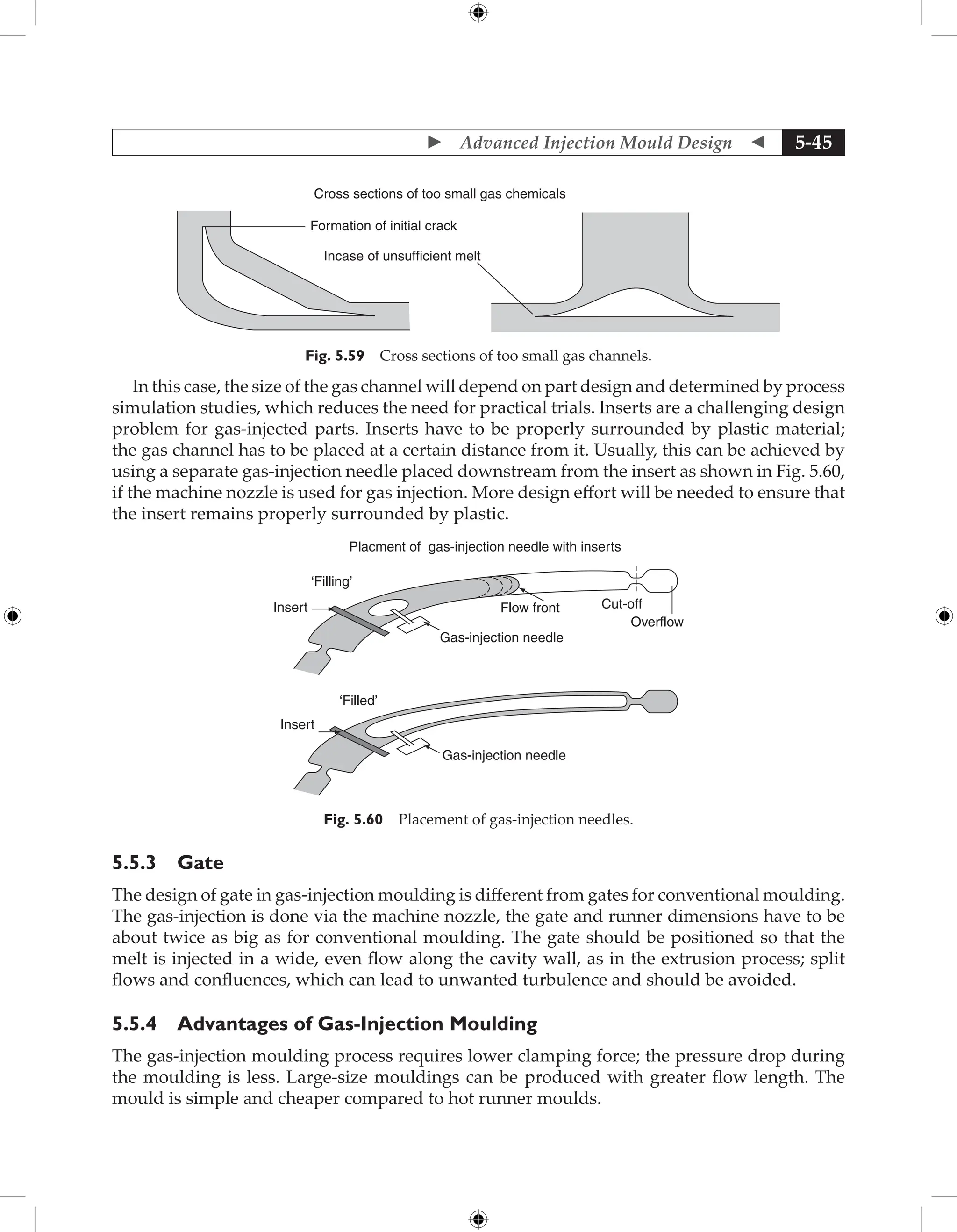
  • 471.
    ๎ฃ Fundamentals ofPlastics Mould Design ๎ข 6-12 6. 10 Types of Blow Moulding Blow moulding components are produced either by extrusion or injection process. The breakdown of the subsidiary methods are given below: Extrusion Injection Stretch Intermittent Reciprocating screw Accumulator head Side ram accumulator Continuous Shuttle Wheel Blow moulding process Special Bi-axial orientation 1 Step 2 Step Multilayer Neck ring Drape Dip/ displacement 6.11 Extrusion Blow Moulding Process In this process heat and pressure are applied to melt the resin and force it through an accurately dimensioned die to produce the desired shape. There are several main parts to an extrusion blow moulding machine, viz. hopper, screw, barrel, feed section, compression section, metreing section, screen pack, breaker plates, adapter, die head, core, mandrel, and die tip. The resin is melted in various sections and plasticised, and then the melt is delivered to the die at proper temperature in a uniform rate as shown in Fig. 6.18. Advantages of extrusion blow moulding It is a process for producing containers and hollow parts preferred for moulding high volume containers. Disadvantages of extrusion blow moulding Uneven wall thickness components are pro- duced and difficult to achieve close dimensional tolerances; relatively low accuracy of surface finishing is achieved.
  • 472.
    ๎ฃ Blow MouldDesign ๎ข 6-13 Resin supply Electrical heaters Die head Platen Water cooled mould Parison Air source Water cooled mould Platen Extruder screw Finished product 1 2 3 3 4 5 Fig. 6.18 Cross section - extrusion blow mould machine. Air hose Die head Mould Moulded part Molten plastic Blow pin Extruder Cooling lines Mould cavity Parison Mould half Parison extrusion cross section Blow moulding cross section Part formed Moulded part Air Fig. 6.19 Various stages of extrusion blow moulding process. 6.11.1 Blow-ratio Blow-ratio is one of the most important factors for designing a blow moulded part. In blow moulding, the blow-up ratio is the ratio of the mould cavity diameter to the parison diameter. The materials of different blow grades exhibit differing stretch behaviour. The blow-ratio of a moulding is a way of representing the amount of stretch involved for a given combination of parison size and part size. Blow-ratio is a measure of the amount of stretch the parison will experience when it is blown into the partโ€™s shape.
  • 473.
    ๎ฃ Fundamentals ofPlastics Mould Design ๎ข 6-14 For cylindrical containers, Blow-ratio = Mould diameter / Parison diameter In general, this value is between 1.5 to 3, and maximum up to 7. From the hollow parison, the product is formed by expansion of air. The blow-ratio is the maximum part finished outer diameter divided by die outer diameter of the parison. It depends on the parison temperature and thickness. 6.11.2 Dies for Parison After the molten polymer melt leaves the extruder manifold, it enters the die-head shown in Fig. 6.21. Thepolymermeltforcedinsidethedieassemblyandsplit into two streams around a mandrel- sleeve or flow-divider and meet on the opposite side where it welds together. This is the first step in forming a hollow tube or parison. 6.11.3 Die-Head Design In case of bottle weight where no significant parison draw-down occurs, the relationship between bottle weight and die/mandrel dimension may be determined approximately from the following formula: W = C p dmtls2 where W = Weight of moulding including neck flash (g) I = Length of moulding a parison including pinch-off flash (cm) dm = Mean diameter of die annulus (cm) t = Annulus gap (cm) S = Die swell ratio of polymer concerned C = Constant for polyolefins = 0.78 (metric units) This formula applies directly to landed (fixed gap) dies only. On machine with parison control (variable die gap) appropriate modifications have to be made to calculation in accordance with the parison thickness profile adopted. 6.11.4 Parison Programming Parison programming is the control of the wall-thickness, from top to bottom, of the parison as it emerges from the die-head during extrusion. Extruder Die-head Fig. 6.21 Die for producing parison. Body diameter E diameter Bottle blow-up ratio Body Diameter = 3.1 (Recommended) โ€˜Eโ€™ Diameter Fig. 6.20 Blow up ratio.
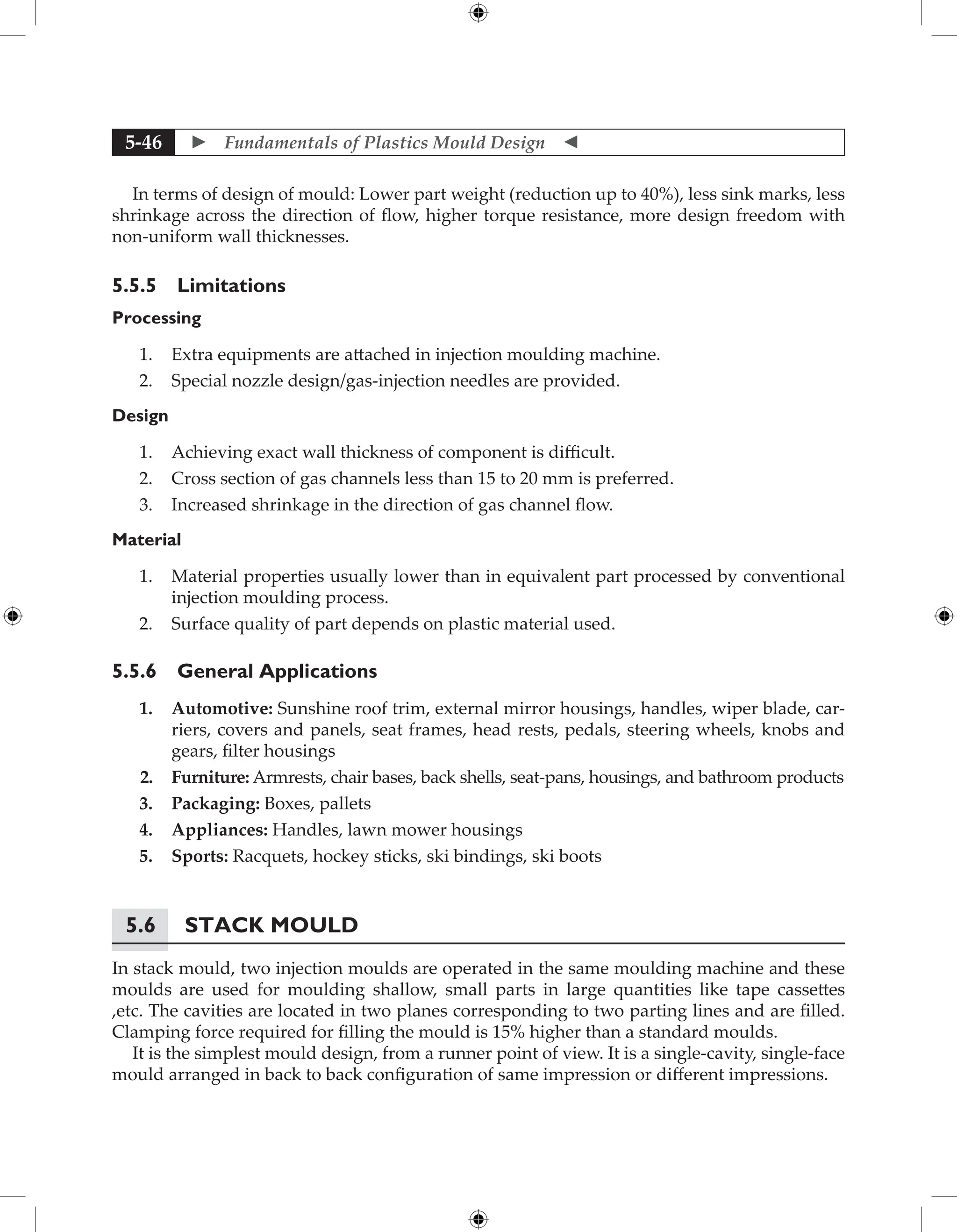
  • 474.
    ๎ฃ Blow MouldDesign ๎ข 6-15 0.052 0.070 0.090 0.066 0.084 0.100 0.027 0.031 0.031 0.034 Die Mandrel Programmed Parison Showing Heavier Wall Thickness for Greatest Expansion Area Back-up Plate Cooling Cavity Cooling Cavity Cooling Cavity Cooling Cavity Mould Cavity Mould Cavity Fig. 6.22 Wall-thickness variation in parison. Optimum wall thickness on bottle Neck flash Tail flash Short shot Program start delay Parison thickness 5 10 15 20 .1 .4 .9 .13 .15 .20 Programmer matrix board pills Mandrel M A N D R E L Servo valve Electrical box Cylinder Reciprocating screw L.V.D.T body L.V.D.T actuator Row If used DIE Barrel End of shot (Die Gap Pressure) F L O W P A R I S O N L E H G T H Fig. 6.23 A parison programming device. 6.11.5 Parting Lines The parting line is the line at which the two halves of a mould meet when the blow mould closes. It should be decided in a mould suitably to create two equal or mirror image mould halves. For unsymmetrical or awkwardly shaped angled articles the location of parting line is determined by the ideal blowing position and avoiding the ejection difficulties.
  • 475.
    ๎ฃ Fundamentals ofPlastics Mould Design ๎ข 6-16 Cylindrical articles are parted along the axis of rotation and elliptical shapes along the large diameter. Cube shaped articles can be parted along the diagonals or parallel to the side faces. Various types of parting lines like pinch, dammed and flat parting surfaces are used in extrusion blow moulds. Pinch parting line Pinch parting line is used in the areas where the parison is to be pinched together, creating flash. A pinch design is shown in the Fig. 6.24 in which pinch land length is 0.50โ€“0.75 mm with a pinch angle of 45 degrees. Pinch relief depth is 1.5โ€“2.0 times the wall thickness. Pinch relief depth 1.5โ€“2.0 x Wall thickness 45ยฐ Cavity surface Pinch land length 0.50โ€“0.75 mm (0.02โ€“0.03 in) Fig. 6.24 Pinch parting line. Dammed parting line This is used in areas where the parting line on the inside requires additional material. It is often used when an inside diameter must be machined smooth to contain no voids. Parting line Parting line With dam Without dam Typical Inside surface Additional material Fig. 6.25 Dammed parting line. Flat parting line A flat parting line is used where the parison is captured inside the cavity and will not contact the parting line until blowing. 6.11.6โ€ƒClamping Force The clamping force in a blow mould plays an important role to keep the two mould halves closed so as to produce a defect free component.
  • 476.
    ๎ฃ Blow MouldDesign ๎ข 6-17 The clamp and platen mechanism in a blow moulding process serves the following functions: Cavity surface Parting line Fig. 6.26 Flat parting line. 1. Holding and aligning the mould halves properly. 2. Cycle the mould from open to closed position. 3. Holding the mould closed against the pressure of blowing air. 4. Large platen areas are desirable to provide uniform pressures to reduce the tendency of the mould to bend and to take different mould sizes. The clamping force required to keep the mould closed during blow moulding must exceed the cavity pressure and the total projected area of the impressions. Clamp forces(kg) = 1.25 ร— Projected area of component (cm2 ) ร— Blow pressure (kg/cm2 ) The required clamping force should be 25% higher than the projected area of the component and the blow pressure to keep the mould closed so as to avoid flash between the mould halves, as well as surface contact between the mould halves during the pinch-off. Theblowingpressureisusuallyintheregionof0.21to2.1MPa,preferably0.5to1.0MPa.This requires a clamping force of at least approximately 10 tons per unit pressure and square metre of the projected area on the mould mounting platens. These data are of particular importance for the design of blow moulds when the weight of the mould is of prime consideration (steel, aluminium, etc., has different compression loading limits). 6.11.7 Pinch-off Design The pinch-off areas pinches the ends of the plastic parison and seals the edges together when the mould closes. These surfaces are subjected to more wear than other parts of the mould, the metal with high thermal conductivity are preferred for blow moulds, such as aluminium and copper alloys are less wear resistant than steel. Steel inserts made out of hard and tough steel are often used for the pinch-off areas of blow mould. Due to the comparatively high pressure and mechanical stress exerted on the mould bottom halfโ€™s during closing of mould, it pinches one end of the parison together. The pinch-off section does not cut off the excess parison โ€˜tailโ€™. Its protruding edges are cut nearly through, creating an airtight closure by pinching the parison along a straight line which makes it easy later to break off or otherwise remove the excess โ€˜tailโ€™ piece. A high quality pinch-off of a thick-walled parison is more difficult to obtain than that of a thin-walled parison. It depends on the construction of the pinch-off insert.


  • 477.
    ๎ฃ Fundamentals ofPlastics Mould Design ๎ข 6-18 45ยฐ 15ยฐ Cavity A Cavity B Cavity C 45ยฐ Fig. 6.27 Various classification of pinch- off design. The pinch-off sections are very critical parts of blow mouldings. It should have good thermal conductivity for rapid cooling and good toughness for long production run. The pinch-off is shown in Fig. 6.27. โ€˜Aโ€™ is one of the most widely used designs. In case of the part is large relative to the parison diameter in the area of the pinch-off, the plastic will thin down and sometimes leave a hole on the parting line. To prevent this, design โ€˜Bโ€™ is used. This design which has shallow angle of 15ยฐ has a tendency to force the plastic to the inside of the blown part, thereby increasing the thickness at the parting line. Another method which has proven to be successful is to use a design similar to that shown in design โ€˜Aโ€™ and install a dam in the relieved area of pinch-off has shown in design โ€˜Cโ€˜. Pinch-off is the bottom part of the mould where parison is squeezed and welded/sealed together. Pinch-off design for thin bottles and parts The pinch-off should not be knife-edged, to be formed by lands about 0.1 to 0.5 mm long. The total angle outward from the pinch-off should be acute, up to 15ยฐ. Be- cause of the land and acute angle a welding line in the bottom part of Blown item 0.005 to 0.015 in. (0.1 to 0.5 mm) Resin โ€œTailโ€ 0 to 15 degrees Fig. 6.29 Pinch-off design for thin bottles and parts. Fig. 6.28 Dimensions pinch-off design. 0โ€“1.5 4.5/4.5 s1=6 c1=5 Mould Cavity 0.254โ€“0.76 mm Land 0.020 in 0.020 in 1/2 in 45 1/2 in
  • 478.
    ๎ฃ Blow MouldDesign ๎ข 6-19 the component is formed. It should be smooth on the outside and forms a float elevated line or a low bead inside the component. There should not be formation of groove which weakens the bottom along the seam. Pinch-offs and inserts design Pinch-off is the part of the mould that welds the ends and the interior portions of the parison and also cut it to facilitate its removal. As the plastic material is thicker at the pinch-off areas, the heat load is higher in this zone. Beryllium-Copper is often used as mould material at pinch-off area, which is highly conductive and heat sensitive in na- ture. Interchangeable inserts are preferred for pinch-off area which facilitates rapid changing of brand name, designation, and date or worn out inserts. The width of the pinch-off edge depends on the plastic material, parison-thickness and part-size. The thumb rule is, the width of edge in mm = (volume)1/3 . Flash-pockets are the areas in the parting surface of the mould that allow the mould to close, without parison holding it apart. The depth of these pockets should be large enough to slightly compress the parison to cool it adequately. Inserts are fitted for pinch-off areas, to utilise a tougher and thermally conductive material than the rest of the mould. Changeable inserts are fitted to facilitate rapid changing of brand name, designation, date or other information. Functions of pinch-off The main function of pinch-off is to withstand the pressure of plastic material, sustain the repeated pressure during closing of the mould and the thermal conduc- tivity should be more for instant cooling. The design should be in such a manner that some plastics material moves inside the part to the thick bottom area and makes it full proof sealing joint. A break point should be provided to cut it from the parison. Generally two types of pinch-offs are used in extrusion blow moulds as described below: 1. Double angle pinch-off 2. Compression pinch-off Double angle pinch-off The double angle Pinch-off withstands more pressure and a land of 0.25 mm is provided in the pinch off area. A clear break point is formed with 30ยฐ angle is machined in the pinch-off insert for sending the melt to increase the thickness at the weld area. Compression pinch-off The compression pinch-off is used where the parison is stretched too much by the mould before it is squeezed and welded and the weld line is usually thin and weak. t a s Fig. 6.30 Pinch-off angle showing styles of pinch-off pockets and welding edges s = Edge width; a = Opening angle of pinch-off pocket; t = Width of pinch-off pocket.
  • 479.
    ๎ฃ Fundamentals ofPlastics Mould Design ๎ข 6-20 The land length is 3.17 mm to 6.35 mm which can push more amount of material in to interior of the part. 6.11.8 Flash Pocket Factors determining depth of flash pocket depend on approximate density of plastic material, the weight of the part, approximate weight of the parison and estimate of parison diameter. If the flash pocket depth is too shallow the flash will be squeezed with too much pressure which create undue certain on the moulds, mould pinch off area, and clamping system. If the pocket depth is too deep the flash will not be in contact with mould surface for proper cooling. 6.11.9 Flash Trimming Automatic trimming is essential in large-volume container production. The trimming can be performed in the mould or in separate stations. The mould wear and tear can be minimised by trimming in separate stations. Blow pin is designed to cut the neck and retain the shoulder flash until the bottle has been separated. A Press Platen Aโ€™ 1 2 3 Fig. 6.31 Flash or parison trimming. 6.11.10 Handles Moulded handles must lie along the parting line of the mould. The central cutout or eye of the handle must be pinched-out, and should therefore, have a proper pinch-off or flash-pocket design. This section may be designed as an insert. The cross section of the handle should be a rounded square or rectangle for optimal wall thickness.
  • 480.
    ๎ฃ Blow MouldDesign ๎ข 6-21 Blow Pin Parison Part with Handle Fig. 6.32 Bottom blowing after spreading the parison. Parison Blowing Needle Part to Be Moulded Fig. 6.33 Needle blowing the parison. 6.11.11โ€ƒShrinkage Shrinkage allowance: In all mould manufacturing, allowances must be made for shrinkage of the material being moulded. Shrinkage value varies with the processing conditions and particular grades of material used for a given process. The shrinkage values for various plastic materials are shown in Table 6.3. As in injection moulding, in blow moulding process also shrinkage is to be added in the cavity dimensions while designing the mould. But due to shrinkage the bottle dimension as well as its volume is also changed. As blow moulded parts cools in the mould under air pressure, it will cool to the mould dimension. When the part is decompressed and ejected from the mould, it will shrink more than the nominal values and may not be within the desired final part dimensions. HDPE bottle shrink, with 80โ€“90 percent of the shrinkage taking place in the first 24 hours. Table. 6.3 Recommended mould shrinkage value for different plastic materials. Materials Longitudinal shrinkage Acetral Cellulose acetate Nylon Phenoxy Polycarbonate Polyethylene Low density High density Polypropylene Polystyrene Toughened Polyvinyl chloride Styrene acrylonitrile 0.025โ€“0.035 0.003โ€“0.007 0.01โ€“0.02 0.003โ€“0.004 0.005โ€“0.01 0.015โ€“0.03 0.08โ€“0.04 0.02โ€“0.035 0.002โ€“0.008 0.003โ€“0.01 0.003โ€“0.01 0.003โ€“0.004
  • 481.
    ๎ฃ Fundamentals ofPlastics Mould Design ๎ข 6-22 Shrinkage numbers will vary with different grades of same material manufactured by a different process. Operating conditions such as cooling time and temperature will greatly influence the amount of shrinkage that occurs after the part is moulded. Table 6.4 Shrinkage (%) Shrinkage (%) Polyethylene PVC Longitudinal shrinkage Transverse shrinkage Neck length shrinkage 2.1 ยฑ 0.1 1.9 ยฑ 0.2 3.7 ยฑ 0.1 0.36 ยฑ 0.04 0.13 ยฑ 0.05 0.98 ยฑ 0.16 The concave bottom is best suited to compensate for shrinkage in blow moulded articles. It is therefore, preferred to be round basis, roof shaped or inclined base designs are recommended for other shapes. The height of the curvature depends on the rigidity of the plastic material as well as on the geometry of the hollow object. 6.11.12 Venting The air that first occupied the cavity area must escape more rapidly than the rate at which the hot plastic is blown to fill the product area within the closed blow mould is known as venting. Moulds are vented through the parting line, with face vents and with small holes. The venting is incorporated in one mould half and this type of venting can be used on all sizes of moulds. When certain areas of the mould cavity are prone to air trap, core vents can be used. Venting in the mould cavity should be anticipated in the mould design and layout of the cooling channels so that provisions can be made for their locations. The air between parison and mould must be expelled as completely as possible during blowing so that the moulded part receives the correct shape and cool down when contact with the mould walls. The surface quality of the moulded article is very much improved by the venting of the mould, in addition to the condition of the mould surface and the blowing pressure. The mould surface should be mirror polished and scratch free. Chrome plating is usually not recommended as it could flake-off around pressurised edges. Types of Venting Parting Line Venting Parting line venting is used in the areas of the mould containing flat parting lines. It is added to only one side of the mould. Vent depths range from 0.05โ€“0.08 mm with a land of 6.0 mm. Beyond the land, vent depth is increased to 0.25โ€“0.40 mm through channels that lead to the atmosphere. Cavity Venting Cavity venting is added to areas inside the cavity containing deep draws and flat surfaces. Slotted vents are used for non-cosmetic parts.
  • 482.
    ๎ฃ Blow MouldDesign ๎ข 6-23 Cavity A A Cavity Section A-A Vent depth 0.25โ€“0.40 mm (0.0098โ€“0.016 in) Parting line vent land 6.00 mm (0.02 in) Vent depth 0.05โ€“0.08 mm (0.002โ€“0.003 in) Fig. 6.34 Parting line venting. Slotted Venting Aluminium or brass slotted vents are available in a variety of sizes. They are installed from the cavity side after the cavity is cut, and they are benched to match the cavity contour. Slot widths should be in the range of 0.40โ€“1.25 mm. Slotted vent Cavity B B View B-B Back of mould 2.0 mm (0.079 in) Secondary vent channel Fig. 6.35 Slotted venting. Pinhole Venting Pinhole vents are typically used for cosmetic parts. A pinhole vent can consist of one or a group of holes anywhere from 0.40โ€“1.25 mm diameter. A secondary vent channel is drilled from the back of the mould block to within 2.0 mm of the cavity surface. The pinhole vents are then drilled into the secondary vent channel from the cavity side.
  • 483.
    ๎ฃ Fundamentals ofPlastics Mould Design ๎ข 6-24 Pinhole vent Cavity C Back mould Secondary vent channel View C-C Pinhole diameter 0.40โ€“1.25 mm (0.016โ€“0.049 in) Fig. 6.36 Pinhole venting. Surface Venting In order to effectively vent the air from a mould, the surface of the mould should be either sandblasted or lightly textured. This is necessary to allow the air contained between the parison and the mould surface to migrate through the valleys of the mould surface finish and exit through the vents. Drilled cooling channel Parting line 3 mm 3 mm 0.127โ€“0.38 mm Porus metal plug rough side in Mould cavity Relief channel Drilled vent recess Fig. 6.37 Positions for venting in a blow mould and venting positions on a blow mould. 6.11.13 Blow Mould Design Check List Part Description :- ------------------------------------------------------------------------------- Part Number :- -------------------------- Material :- ------------------------------ Material Shrinkage :- -------------------- Wall thickness :- ---------------------- Number of Cavities :- ------------------- Centre Line Distance :- -------------- Press Size :- ------------------------------- Platen Size :- -------------------------- Mounting Holes (Size) :- --------------- Location :- ----------------------------- (Contd.)
  • 484.
    ๎ฃ Blow MouldDesign ๎ข 6-25 Shut Height :- Max : --------------------- Min : ------------------------------------ Type of Blow :- -------------------------- Blow Pin :- ---------------------------- Parting Line Location :- ---------------- Relief Requirements :- ----------------- Orientation of Part :- ----------------- Pinch-Off areas :- ------------------------ Depth of Relief :- --------------------- Cavity Construction :- ------------------- Material :- ----------------------------- Machined :- -------------------------------- Cast :- ---------------------------------- Model Required :- ------------------------ CAD :- --------------------------------- Type of Cooling :- ------------------------ Size, In/Out Connectors :- ------------ Venting :- Parting Line------------------- Within Cavity ------------------------- Inserts :------------------------------------- Secondary Action :- ------------------ Cavity Finish :- --------------------------- Texture :- ------------------------------ Engraving :- ------------------------------- General Notes :- ---------------------- 6.11.14 Mould Mounting, Set up and Guiding Mounting the mould onto the machine is facilitated by laterally protruding base plates or strips. The mould is fastened to the platens by bolts or clamps. Heavier blow moulds are provided with tapped holes for eyebolts. The blow mould should be centrally aligned with the parison. The mould is guided by the respective pins and their corresponding bushings of the machine platen. Flush clamping of the mould halves is ensured by sinking the guide pins and bushings below the surface by 1 to 2 mm. Mould opening on the work-bench is facilitated by milling 3 to 4 mm wide deep slots into the parting line. (c) Cross strap (d) Eye-bolt (a) Base plate (e) Cleaning hole (b) Mould half (f) Parting line (g) Slot for mould opening on the bench + Fig. 6.38 View of a closed blow mould, ready to be loaded on the machine. 6.11.15 Moving Section Blow Moulds The technique used to make a threaded neck off the parting line of a mould is done with a reciprocating plug. The sequence is to blow the parison against the extended plug and (Contd.)
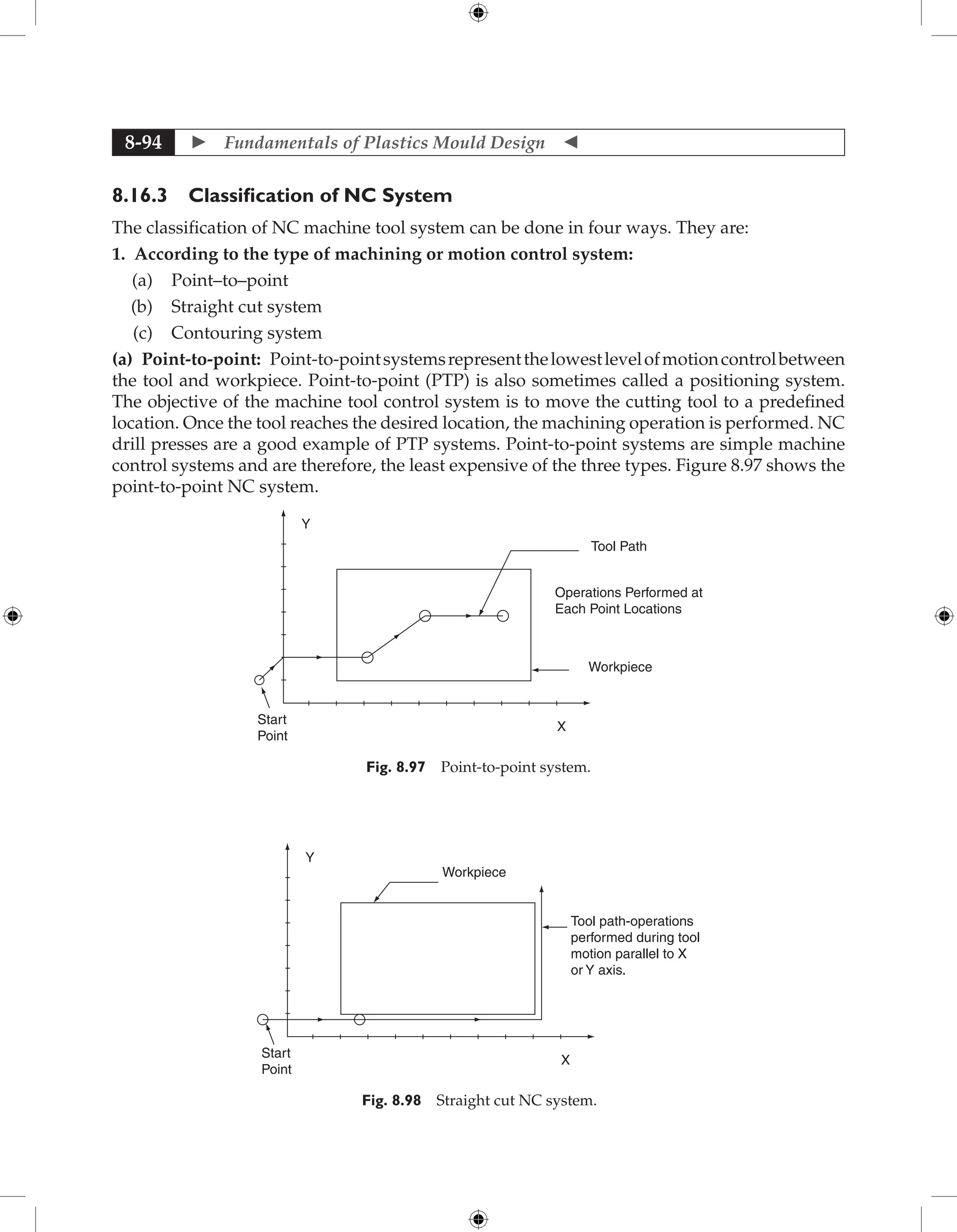
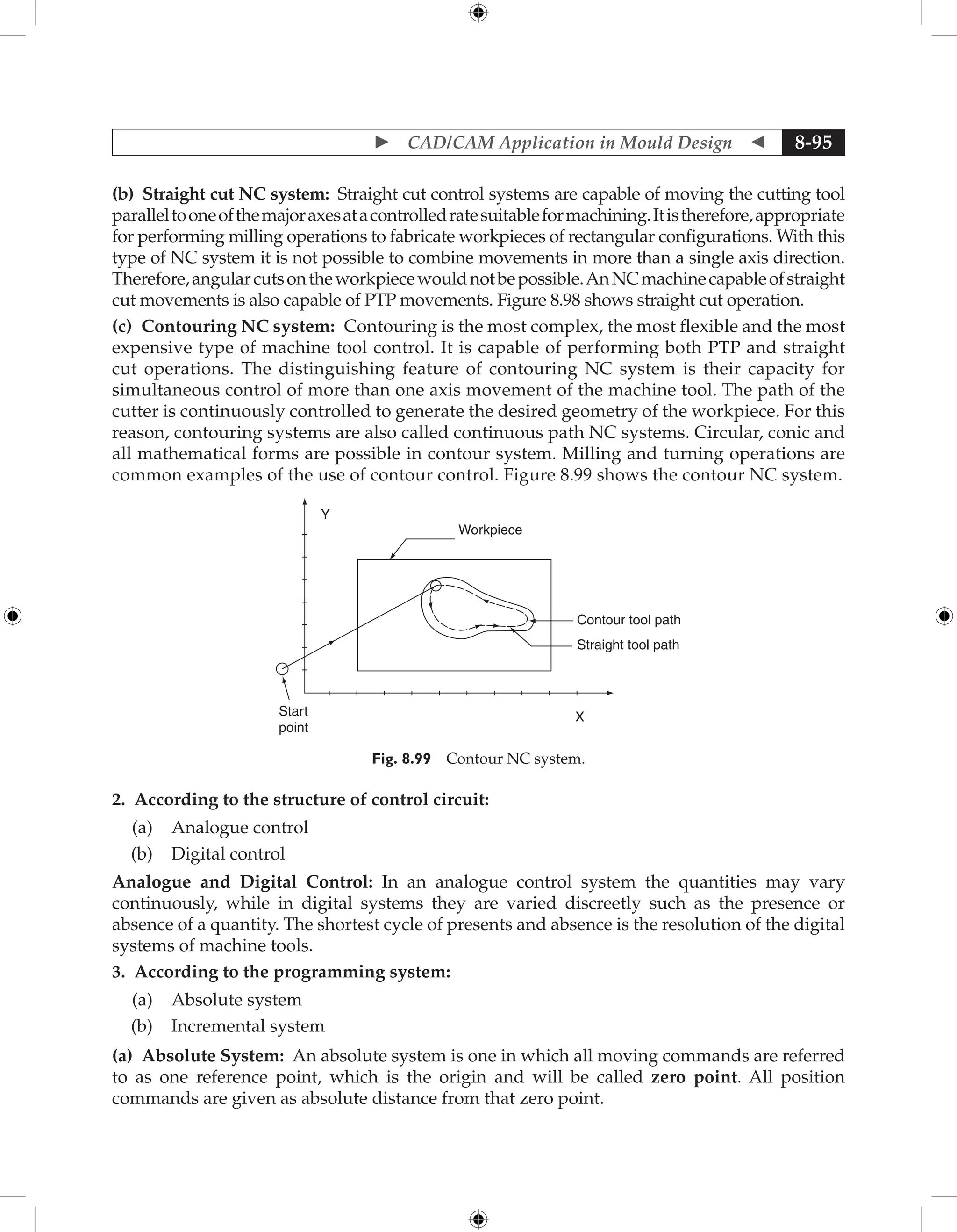
  • 485.
    ๎ฃ Fundamentals ofPlastics Mould Design ๎ข 6-26 retracting the plug during the blowing operation. Moving sections moulds are used to make water cooler lids having integral handles. 6.11.16 Blow Mould Construction Materials for Blow Mould Construction 1.โ€‚ Aluminium Alloy: Aircraft grade aluminium which contains zinc, magnesium, copper and chromium is most popular choice for blow moulds. It has high thermal conductivity, good machineability, light weight and resistance to corrosion. Another grade of aluminium may be cast directly into the desired shape, for large moulds. Cast moulds may have low cooling efficiency due to porosity. Fig. 6.39 A handled cap made by using moving-section blow mould. 2.โ€‚ Beryllium-Copper (Be-Cu) Alloy: These alloys are used extensively due to excellent thermal conductivity, corrosion-resistance and mechanical toughness. Their drawback is high cost and poor machineability as compared to aluminium. In some cases Be-Cu pinch-off inserts are used, to its hardness and to reduce mould cost. With corrosive plastics, the entire mould may be produced from Be-Cu. 3.โ€‚ Steel: It is mostly used for blow moulds for PVC or engineering resins, due to its corrosion resistance and extreme toughness. Excellent surface finish can be obtained by etching process. AISI-P20 prehardened steel is widely used. For corrosive resins, AISI-420 stainless steel is used. 4.โ€‚ Miscellaneous Materials: Zinc alloy (Kirksite) can be used for casting large moulds or large quantities of small moulds. It has good thermal conductivity.
  • 486.
    ๎ฃ Blow MouldDesign ๎ข 6-27 Synthetic plastics such as acrylates, polyesters and epoxies can be cast to produce low cost moulds and prototypes. 6.11.17 Mould Cooling Effective part cooling can be achieved by observing heat transfer related to 1. The type of plastic being moulded 2. Wall thickness of the moulded part 3. Type of mould material used to construct the mould 4. Mould wall thickness between cooling channels and the cavity wall 5. Temperature of the cooling water 6. Volume of mould cooling water 7. Design of mould cooling water zone 8. Blow air pressure 9. Surface roughness of mould cavity Cooling of a blow moulded part consists of the following heat transfer mechanisms: 1. Conduction of heat in the wall of the part. 2. Conduction of heat in the mould wall. 3. Convective transfer of heat in cooling fluid. 4. Cooling of flash is also important to effectively trim the part. External mould cooling In a blow mould the cooling fluid channels are drilled, interconnect- ed in tube-like passages; drilled passages are plugged and cross-drilled with other passages. These passages drilled in the mould halves should be easy to clean and reroute during mould cleaning and reconditioning. The cooling lines centre-to-centre distance and distance from mould surface should be at least twice the diameter of drilled holes. Back plate Thread insert Out In cooling water (to cooling cavity) Pinch off Mould cavity Mould guide pin Fig. 6.40 Blow mould half with cooling water channels.
  • 487.
    ๎ฃ Fundamentals ofPlastics Mould Design ๎ข 6-28 Cooling channels produced during machining must be impregnated with a sealant to prevent leakage of water. The back plates are fitted with gasket on to the rear end of the cavity block where the cooling channels are machined. This backing plate may be removed for easy cleaning of the cooling channels. The location of cooling channel fluid entrance should be at the bottom of the mould and the exit at a higher level to eliminate air trapping. Out a b c In Fig. 6.41 Channel System with Labyrinth-type Water Flow Produced by Baffles (a) Mounting Plate (b) Blow Mould (c) Visible Contours of Mould Cavity for a Canister with Fillers Connections at One Corner. The water circulates through the hollow mould halves and to create the most useful flow. Water channels are machined in the rear side of the cavity halves. Sometimes, the copper tubing system is cast into the mould for better cooling efficiency. (3) (2) Out Out Out (1) In (1) In (2) c b a In(3) Fig. 6.43 Water circulation. b Out a In Fig. 6.42 Cooling channels with labyrinth-type water flow (a) Continuous rod with stoppers, (b) Inserted copper spiral. Cooling a blow mould by means of three cooling circuits and cooling 1. Mounting plate 2. Blow mould 3. Visible contours of mould cavity for a canister with a filler connection
  • 488.
    ๎ฃ Blow MouldDesign ๎ข 6-29 Well-placed cooling channels will ensure that the cooling water comes as close to the mould shown in figures below cavity as is feasible. Proper cooling passage design mould cavity P d D d = Diameter of Water Line = 11 to 14 mm D = Depth of Water Line = d to 2d P = Pitch = 3d to 5d Fig. 6.44 Cooling water lines spacing. Internal cooling Sometimes an additional means of cooling is required to cool the inside of the part. The following methods may be employed: 1. Venting of blow air to create turbulence inside the part 2. Blowing with a cryogenic liquefied gas to quickly cool the inside of the part 3. Blowing with a fine mist of water or ice These internal cooling methods results in faster cooling time, less stresses and warpage in blown parts. 6.11.18 Blow Mould Ancillary Elements Base plates Blow moulds are usually mounted on the base plates that are larger than the mould plates in size. The mould is attached to the base plates or backing plates by means of bolts or pins. Sometimes base plate can be used to mount more than one blow mould. Base plates can also be used as a manifold for coolant lines. O rings are used to seal the mating surfaces between mould and base plates. Alignment Pins These are provided to ensure accurate positioning of the mould halves as they are closed. These steel parts may be hardened to 55โ€“60 HRC. The surface of the guide pins and bushings are usually recessed into the mould to allow flush closing. To allow removal of plastic that is trapped into the alignment bushings, the bush-fitting hole is drilled completely through the mould. Striker plates Mould inserts are generally used to produce the neck of a bottle. Astriker-plate is fitted across the top of the insert to cut the flash from the neck. Ejectors When the blow-pin inserted into the top of the mould, ejection mechanisms can be arranged to grasp the tail flash, the bottle can be moved onto a cooling bed or conveyor belt for subsequent handling.
  • 489.
    ๎ฃ Fundamentals ofPlastics Mould Design ๎ข 6-30 For a bottom-blow pin type of mould, the part is retained on the pin as the mould indexes over to grasp the next parison. The part is dropped on the collection bed when the blow pin is retracted. Miscellaneous Features A hole should be drilled and tapped into the top of heavy moulds to allow fitting an eye-bolt for ease of lifting and fitting onto machine. Mechanical arrangement should be provided to lock the mould halves together to prevent accidental opening of the mould. 6.12 Injection Blow Moulding 6.12.1 Introduction The injection blow moulding is a process used for mass production of plastic containers ranging from 1 ml to 2 litres capacity. These containers meet the exact dimensional tolerance and consistent to weight and volume. It has got wide applications from pharmaceuticals to toiletries, automotive to household use. Injection blow moulding machine cost is almost similarly with extrusion blow moulding machine, but with injection blow moulding it is possible to produce more bottles per cycle and more bottles per hour without deflashing, trimming, regranulation and remixing of scrap, at a constant weight and with injection moulding tolerances. Injection blow moulding does not produce a significant amount of scrap polymer like extrusion blow moulding. The injection blow moulding is a process in which a triangular rotary table indexes in 120ยฐ steps. Core rods mounted on the face of the table form the inside of the hot parison (or preform), later blown into the finished container. Station 2 Station 1 Preform mould Blow mould Station 3 Stripper ejection Fig. 6.45 Injection blow moulding process. Station 1 In preform mould, the molten material is injected under low pressure into the mould cavity, where it forms a parison around the core rod. In this stage, the neck section is injection moulded to close tolerances and after suitable conditioning, the moulds open and the parison is transferred on the core rod to station 2.
  • 490.
    ๎ฃ Blow MouldDesign ๎ข 6-31 Station 2 The parison blow takes place in station 2 and the container is formed as per the shape and finish of the cavity. In this process, the parison is blown with air fed internally through the core rod. As the blown plastic contacts with the cold blow mould, the final moulding is produced. The mould opens and the finished bottle is transferred on the core rod to station 3. Station 3 Finally, the bottle is ejected from the core rod. 6.12.2 Plastic Materials for Injection Blow Moulding Generally the plastic materials like LDPE, HDPE, PP, PS, SAN, EVA, PVC, PC, PET, etc., are used for manufacturing of injection blow moulding components. 6.12.3 Parison Layout The parison layout requires the knowledge of injection blow process, material behaviour, and swell and shrinkage factors. The outside configuration of the parison is formed by neck-ring and the parison mould and the inside shape is formed by core-rod. Parison volume is defined as the weight of container divided by the material density. Parison volume calculations involve the optimal relationship between a minimum wall thickness of approximately 2 mm and a maximum blow-up ratio of approximately 3:1. Core - Rod Wall Parison Part Parison Fig. 6.46 Parison layout. 6.12.4 Parison Mould The parison mould comprises of the body and the neck-ring. Moulds are made with cooling lines in a V-shape perpendicular to the parison. The neck-ring forms the thread is
  • 491.
    ๎ฃ Fundamentals ofPlastics Mould Design ๎ข 6-32 hardened to HRC 40โ€“45 and it locates the core-rod in its pocket. All surfaces that come in contact with plastics are highly polished and chrome plated for ease of fill and release of component. Retaining screw hole Threaded neck cavity Blow neck- ring half Bottom-plug half Retaining screw hole Mould cavity face relief Blow neck-ring pocket Core-road shank fit area Venting Tie-rod hole Cooling channels Land Bottom pocket Shack height Retaining screw hole Threaded neck cavity Parison neck-ring half Nozzle Nozzle Seat Stack height Temperature control chamber Tie rod hole Parison neck - ring pocket Core rod shaft fit area Fig. 6.47 Parison mould. 6.12.5 Injection Blow Mould Core Rods The blow mould forms the final shape of the container. For polyolefin materials, the mould body and bottom plug are made from aircraft aluminium alloy.
  • 492.
    ๎ฃ Blow MouldDesign ๎ข 6-33 For hard resins, such as PS or PC, air hardened tool-steel is used, and for PVC beryllium- copper alloy or stainless steel is used. The cooling lines are drilled in a V-shape to allow maximum circumferential cooling. Stationary die set Water channel Tie-bolt hole Bottom plug Face block Core rod retainer Core rod Blow mould neck ring Blow mould cavity Movable die set Fig. 6.48 Injection blow mould. The core-rod forms the internal diameter of the neck and parison, when sitting in the parison mould. After conditioning the core-rod transfers the parison into blow mould. There is a valve mechanism in the core-rod that allows blowing the parison into its final shape and cooling it. Core-rod body Shank area Blow by groove Air entrance to parison Rod stem Rod tip Cam nut Spring Rod stem Star lock nut Fig. 6.49 Core rod assembly.
  • 493.
    ๎ฃ Fundamentals ofPlastics Mould Design ๎ข 6-34 6.12.6โ€ƒCore-Rod Holder The core-rod holders are mounted on the machineโ€™s indexing head. 6.12.7 Manifold Assembly The manifold assembly is similar to a hot runner mould used in injection mould. The assembly is mounted on a die set and is made up of a base, clamps and nozzle clamps. Fig. 6.50 Manifold assembly section view. Key Runner plug Set Split bushing Cartridge Support block Thermocouple Manifold Nozzle Nozzle clamp Manifold clamp Dowel Fig. 6.51 Manifold assembly. The manifold assembly is mounted on the parison mould die-set. 6.12.8 Die-Set The parison and blow mould cavities are assembled on individual die-sets. Die-sets facilitate mould alignment in the machine and mould change-over.
  • 494.
    ๎ฃ Blow MouldDesign ๎ข 6-35 6.12.9 Mould Mounting, Set up and Guiding With injection blow moulding the precise set up of the mould is of prime importance to ensure that transfer of the preform takes place accurately and reliably to prevent damaging the preform and the mould. 6.12.10 Injection Blow Mould Construction Materials for mould construction Core rods are typically hardened steel, polished and hard- chromed, parison moulds are made from P-20 prehardened steel. Blow moulds are made from steel, Be-Cu alloy and aluminium. Mould cavity production techniques The advanced machining methods using CNC and conventional machining operations are involved for manufacturing of injection blow moulds. Proper heat treatment processes like hardening and tempering of steel inserts are required to sustain the pressure and resistance to wear, which is highly essential for durability. The final phase of mould involves polishing, and surface treatment processes like sandblasting or photo-etching the surface. Injection nozzles Injection nozzles are a critical interface between the manifold and the parison mould and it is made from P-21 prehardened tool-steel. Because the front face of the nozzle comes in contact with the parison, it is important for it to be polished and chrome- plated for easy release. The gate dimensions of a nozzle vary according to preform dimensions. The follow-up pressure used in the injection stage, the amount of pressure as well as the time hold is dependent on the size of gate and type of plastic material used. The various types of nozzles used in injection blow moulds are shown in the Fig. 6.52 below: The different gating designs are: 1. Cylindrical 2. Identical cone 3. Double cone 4. Opposed cone 5. Tunnel gate 6. Needle valve nozzle Stripper plates The stripper plate is shaped to form the shoulder of the container; it pulls the finished bot- tle off the core-rods after blowing. After stripping the bottle the stripper plate most often remains in the ex- tended position and compressed air is blown against the tips of the core-rods. Unfavourable (1) (4) (5) (6) Favourable (3) (2) Fig. 6.52 Injection nozzles.
  • 495.
    ๎ฃ Fundamentals ofPlastics Mould Design ๎ข 6-36 6.13 Injection Stretch Blow Moulding Process Injection stretch blow moulding is used for the production of high quality containers. The process involves the following steps. 6.13.1 Injection Molten polymer flows into the injection cavity via the hot runner block, to produce the desired shape of the preform with a mandrel (the core pin) producing the inner diameter and the injection cavity forms the outer shape. The injection moulds and core pins part after the set time and the preform held in a neck carrier is rotated 90ยบ. 6.13.2โ€ƒStretching and Blowing The preform is conditioned to the desired temperature for stretching and blowing to the finished shape. Once the preform is within the blow mould area the moulds close and a stretch rod is introduced to stretch the preform longitudinally using two levels of air pressure, the preform is blown circumferentially. 6.13.3โ€ƒEjection After the cooling cycle, the moulds open and the preform is removed via drop chutes or robotics. These stages are carried out concurrently using a revolving carousel of moulds. Fig. 6.53 The stretch blow moulding process. 6.13.4 Products and their Applications Injection blow moulded products are produced for various applications like carbonated and soft drink bottles, cooking oil containers, agrochemical containers, health, oral hygiene products, bathroom and toiletry products, etc.
  • 496.
    ๎ฃ Blow MouldDesign ๎ข 6-37 The injection blow moulding process produces bottles of superior visual and dimensional quality compared to extrusion blow moulding. The process is ideal for both narrow and wide- mouthed finished containers without flash. The identification of injection blow moulding is the seam where the two halves of the mould meet. Fig. 6.54 Examples of stretch blow moulded parts. Thisprocessinvolvestheproductionofhollowobjects,suchasbottles,havingbiaxialmolecular orientation. Bi-axial orientation provides enhanced physical properties, clarity, and gas barrier properties, which are all important in products such as bottles for carbonated beverages. Typical plastic materials used 1. Polyethylene-terephthalate (PET) 2. Polyolefins (PE) 3. PVC Polyethylene terephthalate (PET) is a thermoplastic resin of the polyester family that is used to make beverage, food and other liquid containers, synthetic fibres, as well as for some other thermoforming applications. 6.13.5 PET Preform and Bottle 6.13.5.1โ€ƒThe One-Step Method In this method, all processes starting from PET granule to finished bottle are completed on one integrated machine. The injection moulded preform is withdrawn from the injection cavity in hot condition and stretch blown to form the bottle. No extra heating of preform is required for the stretch blow process. Since preforms are not stock- piled to be blown at a later date, there is no risk of surface damage from preforms ยญ knocking together during storage or transportation. One-step method is highly suited to small and medium scale production lines.
  • 497.
    ๎ฃ Fundamentals ofPlastics Mould Design ๎ข 6-38 Two-step method The two-step method requires two separate machines. The ยญ preform is in- jection moulded on the first stage, then reheated and blown on the second stage. The two- step system uses an injection moulding machine for making the preforms, and a reheat blow moulding machine to reheat the preforms from cold and blow the bottles. The requirement for a preform heating system means the two-step process has a lower thermal efficiency. This method is most suited to medium to large-scale production. Usually two-stage method is adopted to produce PET bottle. It involves the following steps: PET absorbs moisture from the atmosphere. This must be removed by a dehumidifying drying before processing named as PET drying. Dried PET pellets are compressed and melted by a rotating screw for plasticising purpose. Molten PET is injected into the injection cavity and cooled rapidly to form the test-tube-like form from which bottles are blown is known as a preform. The heating of PET preform is done by adjusting the temperature to achieve the correct profile by blowing. The hot preform is simultaneously stretched and blown thereby orienting the crystals and strengthening the PET into a blow mould to form a tough, lightweight container. PET is heated to a temperature where its chain-like molecules are sufficiently mobile to uncoil instead of breaking when extended, can be oriented by stretching. Stretching applied from two directions at right angles, as in stretch blow moulding, gives bi-axial orientation. Oriented PET contains closely packed chains aligned in the directions of stretch. The material is stronger because the molecules act together instead of individually stretching. The tensile strength of oriented PET is several times higher than that of the unstretched material and the impact strength, barrier and chemical resistance are also significantly improved, so bottles can be lighter without sacrificing the performance. The finished container is ejected after the blowing process completes. (a) (c) (d) (b) Fig. 6.55 A typical two-stage method of producing parts.
  • 498.
    ๎ฃ Blow MouldDesign ๎ข 6-39 6.13.6 PET Preforms A wide range of PET preforms for PET bottles and containers can be produced, which includes preforms for mineral water, carbonated soft drinks, and hot-fill drinks such as orange juice, milk, tea and isotonic beverages, and preforms for wide mouth jars and containers. Fig. 6.56 Preforms used for stretch blow moulding. Preform quality requirements 1. The preform should be gate-free. 2. Low preform eccentricity, no more than 0.10 mm. 3. Low weight variation between cavities, +/-0.2 g. 4. Low acetaldehyde level. 5. Low preform temperature at exit to avoid preform scratches. 22 g 25 g 20 g 41 g 40 g Fig. 6.58 Preforms. Fig. 6.57 Stretching a preform.
  • 499.
    ๎ฃ Fundamentals ofPlastics Mould Design ๎ข 6-40 Preform design The container shape is determined based on the shape and size of the pre- form. To maintain the bottle weight and minimum wall thickness the preform will be smaller in diameter which in turn increases the blow-up ratio. When considering preforms for an oval container, the parison is usually ovalised in the direction of the container depth. To prevent weld lines, the maximum wall thickness should be kept to the minimum, the preform across section should be less than 1.5. Because it is difficult to adequately condition in the preform cav- ity during the blowing process, a wall thickness of less than 0.35 mm is considered unsuitable. Neck Thread side Cavity side Core Body Part below support ring Diameter and wall-thickness defined by neck finish Body Diameter, length and wall-thickness defined by bottle shape/dimensions, applications and weight Neck Defined by bottle Taper Length defined by length of botttle shoulder Base Diameter and wall-thickness defined by preform body and application Fig. 6.59 Preform details. 6.13.6.2 Preform Moulds The preform mould is made out of: 1. Stainless steel mould plates for corrosion resistance and easier mould maintenance. 2. Part ejection sensors that monitor preform transfer to a take-off plate for cycle optimi- sation. 3. Auxiliary tapers that reduce mould wear by pre-aligning the mould halves prior to the engagement of the neck-ring tapers. 4. Standard interchangeable mould componentsโ€™.
  • 500.
    ๎ฃ Blow MouldDesign ๎ข 6-41 Fig. 6.60 PET preform hot runner moulds. 5. Water hoses are manifolded at bottom of mould, eliminating leaks and water marks on preforms. 6. Roller cams actuate both the opening and closing actions on the thread splits, a design that requires fewer components and simplifies mould maintenance. 6.13.6.3 PET Moulds with Hot Runner Systems 1. It reduces thermal variation between cavities through better flow path design, improves preform consistency and provides easier start ups. 2. Longer intervals between preventive maintenance through reducing the operating temperature in the piston area. 3. Three-level design for precise geometric balancing and reduced cavity-to-cavity ยญ variation. Fig. 6.62 Balanced six-cavity hot runner design for preform moulds. Fig. 6.61 Examples of some PET preform hot runner moulds.
  • 501.
    ๎ฃ Fundamentals ofPlastics Mould Design ๎ข 6-42 Common neck finish for pet preforms ยง 34 ยฑ 0.15 Preform Neck Finish ยง 34 ยฑ 0.15 ยง 51.56 ยฑ 0.26 ยง 41.18 ยฑ 0.25 ยง 44.7 ยง 25.1 ยฑ 0.1 ยง 25.1 ยฑ 0.1 ยง 28 ยฑ 0.15 ยง 28 ยฑ 0.15 30/25 Low(16.8 mm) Commonly for 16โ€“42 gms 30/25 High(18.5 mm) Commonly for 16โ€“42 gms 48/40 Neck finish Commonly for 5 L and above 16.8 ยฑ 0.15 15.5 ยฑ 0.15 19.5 Fig. 6.63 Preforms for water bottles. Standard BPF Commonly for 16โ€“47 gms Standard PCO (For plastic closure only commonly for 16โ€“47 gms) ยง 33 ยฑ 0.2 ยง 21.74 ยฑ 0.12 ยง 25.5 ยง 21 ยฑ 0.15 CSD (Carbonated soft drink) ยง 33 ยฑ 0.2 ยง 21.74 ยฑ 0.12 ยง 26.00 ยง 22.80 ยฑ 0.15 Fig. 6.64 Preforms for soft drink bottles.
  • 502.
    ๎ฃ Blow MouldDesign ๎ข 6-43 Dropless neck-finish commonly for 22โ€“32 gms Standard neck-finsh commonly for 53.5โ€“70 gms ยง 38.5 ยฑ 0.2 ยง 30.88 ยฑ 0.1 ยง 29 ยฑ 0.1 10 ยง 32 ยฑ 0.1 Edible Oil ยง 30.7 ยฑ 0.15 ยง 23.4 ยฑ 0.1 ยง 20.9 ยฑ 0.1 10.4 ยง 24 ยฑ 0.1 Fig. 6.65 Preforms for edible oil bottles. 29/23 neck-finish commonly for 36 gms f35.2 ยฑ 0.2 f23. ยฑ 0.1 f26.0 17.75 f27.7 Detergent DIN28(28 mm) neck-finish commonly for 28โ€“42 gms f21.7 f24.5 f25 13.8 Fig. 6.66 Preforms for liquid detergent bottles. 1. Write the stages of blow moulding process. 2. Briefly explain the application of blow moulding. 3. What are the design considerations before designing a blow mould? 4. What are the practical guidelines for designing corner and edge rounding in blow mould? 5. Why are truss grooves required in blow moulding? 6. What are the important structural and mechanical considerations for blow moulding? 7. What should be the properties of plastic materials used in blow moulding? Questions
  • 503.
    ๎ฃ Fundamentals ofPlastics Mould Design ๎ข 6-44 8. What are the blow moulding materials? 9. What is blow up ratio? Explain with a neat sketch. 10. What is parison programming? 11. Explain various types of parting line in blow moulding. 12. What are the functions served by the clamp and platen mechanism in blow moulding? 13. What is the function of pinch-off? 14. Write sort notes on flash pocket. 15. How does shrinkage play a major role in blow moulding? 16. Write sort notes on mould mounting, set up and guiding. 17. Explain the materials used for blow mould construction. 18. Describe the ancillary elements in blow mould. 19. Explain the injection blow moulding process. 20. What are the plastic materials used for injection blow moulding? 21. Explain the parison layout with a neat sketch. 22. What is the function of core rods in injection blow mould? 23. Explain various types of injection nozzles used in injection blow mould with a neat sketch. 24. Describe injection stretch blow moulding process. 25. Write down various injection stretch blow moulding products and its application. 26. What are the preform quality requirements? 27. Write the advantages of PET moulds with hot runner systems. 28. Explain the parison mould with a neat sketch. 29. Write short notes on flash trimming. 30. Explain various types of pinch-off in extrusion blow moulds. 31. Explain extrusion blow moulding process. Write its advantages and disadvantages. 32. Explain pinch-off design with a neat sketch. 33. What is the significance of venting in blow mould? Explain types of venting used in blow mould with a neat sketch. 34. Describe the types of cooling systems used in blow moulding with line diagram. 35. Explain the steps involved to manufacture PET preform and bottle. 36. Describe the various features of preform with a neat sketch and explain the following: a) Preform design b) Preform moulds 37. Define pinch-off. Explain various types of pinch-off. 38. What is the purpose of venting? Explain different methods of it. 39. Explain the nomenclature of blow mould. 40. Explain different types of materials used for manufacturing blow mould.
  • 504.
    ๎ฃ Blow MouldDesign ๎ข 6-45 1. CIPET, Technical Manual, Chennai. 2. Extrusion Blow Molding Guide for Thermoplastic Rubbers and Thermoplastic Elastomers. 3. Norman C. Lee, Practical Guide to Blow Moulding, Van Nostrand Reinhold, New York. 4. RosatoD.V.,RosatoA.V.andDavidP.Dimitia,BlowMouldingHandbook,HanserPublishers, Munich. 5. Samuel L. Belcher, Practical Guide to Injection Blow Molding, CRC Press, Taylor and Francis Group, Boca Ratan, London. References
  • 505.
    Extrusion Dies Chapter 7 7.1 Introduction Polymerproducts are primarily categorised into two types. The injection, compression, transfer moulded products, which are in form of fixed dimension with changing cross-sectional shapes as per the mould dimensions called intermittent process and second, which has fixed cross section and has long length called continuous process. First one is produced by moulding and second one by extrusion process. In extrusion process, the extruder pushes the polymer melt in semifluid form through the die, mandrel and the product is cooled to get required shape. This conversion or processing operations primarily involve four stages, viz; the first stage is converting plastics granules into homogeneous melt: the next stage is forwarding the melt to achieve a high output rate in a desired shape from the extruder through the die; the third stage is forming the product outside the die; and the final stage makes the product form stable. In order to produce a quality product in an optimum condition with high output rate, the following factors are to be considered with relevance to processing. 1. The characteristics and property of plastic material 2. Extruder characteristics and types 3. Die geometry with respect to the shape of the product 4. The melt flow behaviour along die geometry and die swell 5. Extruder - die system characteristics 6. Heating system and temperature control 7. Die strength and material of construction 7.2 Characteristics and Property of Plastic Materials The relevant property of polymers under different physical states varies during the conversion process. Initially the plastic material is in the solid form and is further converted to a melt. From the melt stage, the product shape is obtained in the subsequent processes by proper
  • 506.
    ๎ฃ Fundamentals ofPlastics Mould Design ๎ข 7-2 forming and cooling. The properties such as flow melt rheological, thermal properties, etc., influence the processing operations and these properties under operating conditions must be known for the polymer to be processed. The rheological and thermal properties of polymer melt play a vital role for design of extrusion die. Thermoplastic resins are extruded, based on the properties of the material and specific grade of thermoplastic resins is used in the extrusion process. According to the basic resin, formulation of the compound and the operating condition properties vary considerably. The viscosity of the polymer melts causes a pressure drop, as the melt flow in the die. Temperature and shear rate influence the range of viscosity. Pressure drop, therefore will vary according to the operating conditions. Similarly, elastic properties of the polymer melt causes additional pressure drop certain die shapes as also swelling of the extrudate. Elasticity is also influenced by similar operating conditions. Certain thermoplastics are prone to degradation and discolouration due to over heating stagnation. Smooth melt flow and temperature controls are essential. Some thermoplastics are likely to corrode the material of construction of the dies. This must be taken into consideration in making a choice of the material. 7.3 Flow Properties of Solid Polymers Usually solid polymers in the form of powder, granules or pellets are used during the initial stage of conversion of polymers. A particulate flow is essential and in this type of flow, the controlling properties are bulk density of bulk factor, interparticle cohesion and particle-to- metal adhesion. A high bulk density is required in order to facilitate easy flow of polymer melt. The bulk density is largely influenced by the shape, size and size distribution of the particles. The cohesion or agglomeration of particles is the result of surface forces. Low cohesion forces and smooth surfaces favour easy flow. A small average particle size increases surface-to-volume ratio and favours cohesion. Adhesion between powders and metal surfaces of equipment is undesirable. The major factor causing adhesion is static electricity. This may be generated by friction between the particles as they flow. In particulate flow problems, any pressure exerted on a volume of powder will tend to pack the particles and increase cohesive forces and therefore, lower mass flow. Similarly, flow of powder through a long tube is greater than through a short orifice of the same diameter. These characteristics of particulate flow differ from a normal fluid flow. 7.4 Flow Properties of Polymer Melts The most important characteristic of polymer melts is that they are highly viscous. The viscosity decreases when the velocity of melt flow is increased or if temperature increases and the viscosity increases when pressure on melt flow is increased. Liquids such as water and common organic solvents do not exhibit such reduction or increase in viscosity. Another interesting property of polymer melts is elasticity. Whenever a polymer melt is extruded through a capillary, the extrudate diameter is greater than the capillary diameter, indicating
  • 507.
    ๎ฃ Extrusion Dies๎ข 7-3 recovery of elastic strain. This is also exhibited by polymer melts in their ability to generate normal stresses. These melts are therefore, known as visco-elastic fluids. The parameters that define the rheological behaviour of visco-elastic polymer melts are viscosity, elasticity under simple shear and simple tension. Viscous deformation is permanent while elastic deformation is recoverable. 7.4.1 Viscosity under Simple Shear The stress deformation behaviour under simple shear can be considered by imagining two parallel plates of large area A, separated by a distance by the fluid. A shear force F, is applied to the top plate and it is made to move with a uniform velocity (V). The fluid in contact with the plate will move with a velocity V, while the fluid in contact with the lower stationary plate will not move at all. This will give rise to shearing of the fluid. An ordinary fluid will obey the following relationship: T = n y T is shear stress, y is strain rate and n is the coefficient of viscosity. In normal fluids, viscosity n, remains constant with shear rate y. These are known as Newtonian fluids and when polymer melts, viscosity changes with shear rate. This behaviour is quite often represented by a relationship known as power law. T = k(y)n where k is the consistency index and n is the flow behaviour index. If n 1, viscosity decreases with shear rate (shear thinning). Such fluids are non-Newtonian and are known as pseudo plastics. If n 1, viscosity increases with shear rate, these are known as dilatant fluids. 7.4.2 Viscosity under Simple Tension Polymer melts can be made to flow by uni-axial stretching as in the case of fibre spinning. Other examples include parison sag and blow moulding. This is known as extensional flow. Such flows are possible only for liquids having a sufficiently high viscosity. During such flows polymer melts exhibit viscosity which is known as traction viscosity. The tensile melt property of thermoplastic at given temperature and pressure can be expressed as tensile viscosity (l), defined as ratio of tensile stress to tensile strain rate. l = s /e At low stress, the viscosity under tension is independent of stress and equal to three-time viscosity under simple shear l = 3 h At high stress, this viscosity increases, decreases or be independent of stress. 7.4.3 Elasticity under Simple Shear In addition to viscosity polymer melts also exhibit elasticity. The extruded swelling manifests the effect of elasticity when the melt is extruded through the capillary. Similarly, when a rod
  • 508.
    ๎ฃ Fundamentals ofPlastics Mould Design ๎ข 7-4 is rotated in the melt, the liquid melt climbs up. This phenomenon is due to an elastic stress generated in the normal direction. Elasticity in simple sheer can be assessed by the phenomenon of die swell, in which the cross section of melts increases as it flows out of a capillary. In the capillary, the melt is under stress, and is therefore, deformed, but the elastic component of the deformation can recover on the removal of stress. 7.4.4 Elasticity under Simple Tension When the polymer melt is subjected to uniaxial stretching, a tensile stress is created along with an elastic strain. Usually the modulus under tension E is equal to three times the modulus under shear G. Elasticity plays a larger part in extensional flows than in simple shear flows of the same magnitude. Various plastic materials can bear different level of stress and strain. This value is measured based on the required processing temperature. 7.5 Effect of Temperature and Pressure on Viscosity The increase in temperature of a polymer melt reduces its viscosity. Among various polymer melts, acrylic has a viscosity most sensitive to temperature while polyethylene and polypropylene are the most insensitive. Similarly, viscosity at high shear rates is not as sensitive to temperature as at low shear rates. The problem of temperature dependency of viscosity, at lower shear rates therefore, becomes an important consideration in the extrusion process and increase in pressure increases viscosity of the melt. 7.6 Thermal Properties 7.6.1โ€ƒSpecific Heat The specific heat is an important parameter in processing of plastics. From the theoretical point of view a curve of specific heat against temperature is extremely valuable in the calculation of thermodynamic properties like enthalpy, entropy, free energy, etc., and changes in such properties influence such physical process as crystallisation, melting, quenching and cooling. The melting point of polymers is not sharply defined, since crystallinity is either absent in polystyrene, PVC or only partially present in polyethylene, PTFE, etc., ethyl-temperature relationship of amorphous and crystalline polymers, from which it may be seen that the specific heat of crystalline polymer tends to increase much more rapidly below transition temperature than that of amorphous polymer, and above the transition point the specific heat remains fairly constant with temperature. Polymer melts show an increase in specific heat with temperature. With certain polymer this increase is irregular, showing a sudden rise in specific heat and subsequent drop. Relationship
  • 509.
    ๎ฃ Extrusion Dies๎ข 7-5 between specific heat and temperature must be known over the processing temperature range. 7.6.2โ€ƒThermal Conductivity The thermal conductivity of polymers plays a vital role, since most of the polymers are heated and cooled during processing. Amorphous polymers such as polystyrene, polyvinyl chloride and polycarbonate show relatively small changes in thermal conductivity of partly crystalline polymer may either decrease with temperature or increase slightly. 7.6.3โ€ƒThermal Diffusivity As the polymers are heated or cooled by the use of external means, both specific heat and conductivity are important properties influencing many processing operations. A useful property which incorporated both the above properties is the thermal diffusivity which is defined by the equation. Diffusivity = Conductivity / Density ร— Specific heat 7.7 Principles of Extrusion 7.7.1โ€ƒScrew Extruder In extrusion process of polymer products, the function of an extruder is to convert a solid polymer, to a homogeneous melt and transfer it thoroughly and deliver it at a constant rate and at uniform temperature and pressure. There are two basic types of extruders, viz. single and twin screw extruder.Aproperly designed screw of appropriate length rotating in a heating barrel will fulfil the following functions like transporting the solid plastic material, which may be in the form of powder, granules, pellets, chips, film scrap, etc., and heating and plasticising the material. The homogenising, metreing and building up pressure for pumping of the melt through the die is done in this process. Extrusion is a continuous process of manufacturing long products of constant cross section like rods, sheets, pipes, films, wire insulation coating, etc., forcing softened polymer through a die with an opening. Plastic material in form of pellets or granules is fed into an extruder through a hopper. The material is then conveyed forward by a feeding screw and forced through a die, converting to continuous polymer product. The heating elements, placed over the barrel, soften and melt the polymer and the temperature of the material is controlled by thermocouples. The product going out of the die is cooled by blown air or in water bath. It is a continuous process used to produce both solid and hollow products that have a constant cross section like window frame, pipe, hose pipe, profiles, etc. The two main components of an extruder are barrel and screw. Die is not an extruder component.
  • 510.
    ๎ฃ Fundamentals ofPlastics Mould Design ๎ข 7-6 Hopper Plastic pellets Heaters Polymer melt Screw Barrel Breaker plate Die Extrudate v Metreing section Compression section Feed section Fig. 7.1 Extrusion process. 7.7.2โ€ƒSingle Screw Extrusion Process In order to study the single screw extrusion process, it is convenient to consider the screw as divided into three different sections, viz. feed section, transition section and metreing section. The feed section has the deepest channel and it picks up the solid material from a hopper and conveys it forward to the transition section. The channel depth decreases over the length of the transition section and the loosely packed material in first compacted and then melted as it passes through it. The heat that causes melting is initially conducted from the hot barrel surface, but as melting proceeds considerable heat is dissipated by shear within the newly molten viscous material. On leaving the transition section the molten material enters the shallow channel metreing section of the screw. After passing through the metreing section of the melt is forced through the die head assembly which includes the screen pack and breaker plate. Feed section The solid plastic material in the form of powder, granules, pellets, etc., fed to the extruder is compacted to a solid mass as soon as it enters the screw channel. The heaters provided in barrel wall heat the material trough conduction. The heat conducted may be just sufficient to increase the temperature of the solid mass without any melting or it may heat the material to a temperature approaching the melting point. The material will have no relative movement of the layers and in some case a film of the melt will be formed at the barrel surface and the material conveying will be controlled by viscous drag mechanism. Transition section In the transition section the material is compacted due to a granule re- duction in channel depth. The compacted solid polymer is called solid plug or solid bed. The major portion of melting occurs on the side in contact with the heated barrel surface. A melt film is formed near the surface of the barrel, which is scraped off by the advancing flight and accumulates in the channel space adjoining the solid bed. The heat is generated due to viscous shear of the melt and as the melt volume increases, it exerts a pressure on the solid bed and forces it towards the barrel surfaces. Since the melting process requires sufficient time it is essential to compress the material gradually over a sufficient length, otherwise the channel may get plugged and may give rise to pressure surges.
  • 511.
    ๎ฃ Extrusion Dies๎ข 7-7 At some stage during the down channel movement, the solid bed becomes physically unstable and breaks up. The unmelted material floats in the melt pool and moves with it. The length of the transition section is the controlling factor in screw operation. The length should be enough to complete the melting process by the time the material reaches the end of the section. Metreing section In the metreing section the melt along with some unmelted material is sheared and generates heat, which helps to produce a homogenous melt. Special mixing de- vice are sometimes corporate to facilitate melting and homogenisation, so that no insufficiently molten solid particles reach the end of screw. A normal metreing section has constant depth shallow channel, in which the melt flows by the drag of the barrel, and moves towards the discharge end, the resistance to the melt flow to the die result into a back flow or pressure flow through the channel. 7.7.3โ€ƒSingle Screw Extruder Characteristics In single screw extruder, the output is the head pressure developed due to die resistance characteristics for screws with different metreing section depths operating under identical condition at same melt viscosity and temperature. The shallow channel metreing screw is less sensitive to change in back pressure and higher speed gives higher output. The output of the section is also pressure dependent and the output of the solid transport section should match with output of the metreing section. If the output of the feed section is greater than the metreing section, a pressure will be built up within the extruder, resulting in an increase in pressure flow. 7.7.4 Modified Single Screw Extruders Modifications to single screw extruders have been adopted to improve the performance of the conventional single screw extruder. Some of these modifications are as follows: Devolatising type extruder In extrusion operations, it is necessary to process polymers which contain volatiles in the form of moisture, solvents, or adsorbed gases. Unless these are removed, the product may contain bubbles. There are two approaches used to remove volatile from the polymer. In the conventional method Avnet port is provided in the barrel wall at the appropriate position. In the other method the volatile are extracted through a hole drilled into the bottom of the screw channel to the hollow core of the screw. In both methods, the extrac- tion of the volatile takes place in the zone of the screw in which the channel is only partially filled. Feed section modification In feed section, it compacts the granules, pellets, chips or powder feed into it and convey the solid plug so formed against high feed pressure. The performance of the feed section can be improved by the use of the special trapped bushes with axial groves fitted inside the feed section barrel. These groves prevent the polymer plug from rotating with screw, so that the plug is moved forward like a nut held at its circumference, on a screw rotating inside.
  • 512.
    ๎ฃ Fundamentals ofPlastics Mould Design ๎ข 7-8 Mixing device In a conventional single extruder, the improved mixing and homogenisation mixing devices are incorporated. These devices help to create a uniform melt of constant tem- perature and discharge pressure. They are usually adopted especially for large diameter screws and for high-speed operation according to the type of mixing action and other characteristics. 7.7.5โ€ƒTwin Screw Extruder In twin screw extruder, two parallel screws are placed in a barrel with figure of eight cross sections. Generally the arrangement of the screws can be divided into two major categories. In non-intermeshing extruder type, the separation between the screw axes is at least equal to the screw outer diameter. This configuration can be regarded more or less as two single screw extruder and should be more appropriately called double screw extruder. When the screws are intermeshing, the separation between the screw axes is somewhat less than the outer screw diameter, in the limit the screw surface can be in mutual contact. According to the screw rotation intermeshing screws are known as contra-rotating and corotating screws. The shape of the screws and the pattern of the material conveyance in each case are as follows: Contra-rotating screws In case of contra-rotating screws, the screw rotations and the helix angle of the flights are in opposite directions. The plastic material is carried by the screw flights in such a way that all the material is forced on the centre where the two screws meet forming a build-up or accumulation and the consequent creation of high pressure zone. Due to the gap between the screws certain amount of material will pass through it and rotate with the parting screw flights. It is subjected to an extremely high degree of shear. According to the extent of the gap, it is possible to adjust the amount of shear and mixing. The clearance between screws pre- vents the flight of one screw from completely wiping the channel of the other screw. Corotating screws The screw rotation and the helix angle of the flights are in the same reaction for these screws. When the flights and channels of the screw intermesh without leaving any gap, the screw profiles are said to be conjugating. Except for mechanical tolerance, no clearances are left. When the material contained within a channel of one screw reaches an intermeshing point finds no passage to the other screw, since the intermeshing flight of the other screw penetrates the channel. The flank of that flight acts as a wedge and forces the material to leave the channel and move into the adjacent channel of the other screw. The transfer of material from one screw to other creates a movement around both screws in a figure of eight pattern. Each time the mate- rial reaches the intermeshing point, it moves from screw to the other, but it is also displaced half a pitch in axial direction. This creates a distributive mixing action. Due to very close tolerance between screw and barrel as well as between screws, wiping of screws is complete. 7.7.6โ€ƒTwin Screw Extrusion Process Similar to single screw extruder, twin screw extruders have three sections, a solid conveying section near the hopper known as feed section, a pump section near the end of the extruder
  • 513.
    ๎ฃ Extrusion Dies๎ข 7-9 and a transition section in between, where melting takes place. The extruder with closely intermeshing screws can be conveniently represented by two series of C-shaped chambers- one for each screw. These chambers convey the plastic material positively from hopper to the die by the rotation of the screws. Feed section It is usual to feed the plastic material by a mechanical feeder regulated inde- pendently of screw speed, which partly feeds the screw channel. The material in the feed section is moved axially and positively down the barrel by the intermeshing screw flights. The screw feed zone temperature must be well below the adhesion temperature of the plastic material, so as to avoid sticking of the material to the screws and passing through the gaps. Transition section The melting mechanism in a twin screw extruder differs considerably from that in single screw extruders. The melting takes place within five or six chambers. This means that the screw length between the chamber in which no melt has yet been formed and the chamber in which the entire polymer molten is of the order of one screw diameter. More- over, the process has a repetitive character. Complete melting sequence takes place within one chamber. The head pressure of the die affects both the length and the position of the melting zone, i.e., the transition section. Pumping section In the pumping section of the extruder, the chambers are generally filled with the melt. In a plasticating extruder screws are fully filled with the melt. The idealised theoretical volumetric output is given by Q = 2NV where N = Revolutions per unit time; V = Chamber volume. This output is reduced due to leakage through the following gaps between screw flights: Over the flights At the flight root Through the tetrahedron shaped spaces between the flight walls Through the equatorial gap between the sides of the intermeshing flights All the above leakage varies linearly with screw speed and is controlled by the axial pressure gradient. 7.7.7โ€ƒTwin Screw Extruder Characteristics The output vs head pressure characteristic is completely independent of operating conditions. It is greatly dependent on details of the screw geometry. The size of the gaps and the pressure gradient are responsible for the reduction in output at increased head pressures. 0 0 0 20 16 12 8 20 40 Output 60 80 100 Head pressure Fig. 7.2 Twin screw extruder characteristic.
  • 514.
    ๎ฃ Fundamentals ofPlastics Mould Design ๎ข 7-10 7.8 Classification of Dies and Die Geometry 7.8.1 Introduction Extrusion dies are used to streamline the flow path to give shape to melt pumped by the extruder. As per the die design guidelines, the abrupt change in cross section should be avoided. Stagnation areas should be avoided in the flow path and flow should be smooth. The melt should be maintained compact by ensuring sufficient pressure on melt possibly by path restriction. The die construction should be able to withstand internal pressure and the die temperature should be maintained. 7.8.2โ€ƒClassification of Dies According to the extrudate 1. Solid Extrudate Dies are used for manufacturing rod, sheet, and profiles, etc. 2. Hollow Extrudate Dies are used for manufacturing pipe, wire coating components, etc. According to direction of flow of melt 1. Straight through or inline die: In this type of die the flow in die is in line with extruder. 2. Cross-Head Dies: In this case the flow is diverted perpendicular to extruder either upward (blown film), downward (cast film, parison die) or sidewise (wires and cable) by the die. 3. Offset Dies: Flow is diverted by right angle twice and is maintained offset to extruder flow axis. (in certain pipe). According to the construction 1. Integer Dies: Integer die consists of a single piece die head, which has a streamlined tapered approach section followed by a land section orifice, shaped to produce appro- priate product cross section. It is mainly used for production of sections, which have regular and simple cross sections such as rods. 2. Split Dies: This type of die is used for extrusion of sections such as tapes, belts, ยญ gaskets and for profiles of more complex shapes, dies have to be made in to pieces by splitting them either transversely or longitudinally. The approach section and land section may be made as two separate pieces. An alternate arrangement is to make the approach section as a truncated conical piece, which merely reduces the diameter and a second piece, which has an abrupt transition from the reduced diameter to the requisite pro- file followed, by the land orifice section. The two pieces are finally clamped together by bolts or for small circular dies a threaded retainer ring may be used. In addition, dies can also be split longitudinally to form two separate halves, which are then clamped together to form a single die. Dowel pins can be used to maintain perfect alignment between split sections during and after assembly. Split construction facilitates easy machining and alterations.
  • 515.
    ๎ฃ Extrusion Dies๎ข 7-11 Fig. 7.3 Split dies. 3. Plate dies: These dies are made up of two or more plates which incorporate the approach section and the land section. Each plate has a limited thickness, which facilitates the machining of the flow channels. In this type of die, abrupt changes in the flow channels are common, but streamlining is effected in the final plate. The plate dies offer many advan- tages, such as simple construction, low cost, easy adjustment and mounting. The plates are clamped together by axial screws. These dies are only used for heat-stable materials. The land orifice plate can be changed so as to obtain interchangeability of shapes. Fig. 7.4 Plate dies. 7.8.3 Die Design Procedure Die design procedure involves the following steps: 1. While designing a die the extruder performance regarding flow output, output pres- sure, and linear velocity of melt and the plastic material melt property and its behaviour should be considered.
  • 516.
    ๎ฃ Fundamentals ofPlastics Mould Design ๎ข 7-12 2. Based on the product shape or geometry and the flow, profile of melt in die is designed. 3. The minimum wall thickness of the die is decided based on the strength of material and actual dimension thereof depending upon assembly requirements. 7.8.4โ€ƒOperation of Die In case of extrusion process, both the extruder and the die performance affect the output performance. The graph below shows performance of an extruder and a die at specified temperature. If extruder runs at pressure Pc extruder is extruding melt at โ€˜cโ€™ rate and die supply also at โ€˜cโ€™ rate. Thus, the overall process output is โ€˜cโ€™, which is optimum output rate for this particular set up of extruder and die. If extruder runs at pressure Pi, although extruder can extrude melt at โ€˜aโ€™ rate higher than โ€˜cโ€™ but die can supply only at โ€˜bโ€™ rate, which is lower than โ€˜cโ€™. Thus, the overall process output is โ€˜bโ€™ which is lower than โ€˜cโ€™. If extruder runs at pressure Po, although die can supply only at โ€˜dโ€™ rate higher than โ€˜cโ€™ but extruder can extrude melt at โ€˜eโ€™ rate which is lower than โ€˜cโ€™. Thus, the overall process output is โ€˜eโ€™ which is lower than โ€˜cโ€™. Output Extrude performance Die performance a C Pc Po Pi b Pressure Developed, By Extruder and Available For Die d e Fig. 7.5 Die and extruder characteristics curve. 7.8.5 Die Geometry The function of the die is to change the cross section of the flow channel, i.e., the circular shape of the extruder barrel to a required cross section which is very close to the product section or profile. This is usually done by a streamlined die channel, which is formed to obtain a gradual change of cross section. The flow in a die channel is not uniform. The material at the centre of the channel moves at a higher velocity than at the wall. The layer of the melt, which is in direct contact with
  • 517.
    ๎ฃ Extrusion Dies๎ข 7-13 the die wall, is likely to adhere to the walls and degrade. It is therefore, advisable to provide short and narrow channels to minimise the residential time of the plastic melt in the die. Extruder (a) (b) Die (c) (d) (e) Breaker plate Approach Land Fig. 7.6 Die extruder (a) Extruder (b) Die (c) Breaker plate (d) Approach (e) Land. The die channel is made up of two sections, namely 1. Approach section 2.Forming section or land section. Approach section The approach section is a convergent channel, which helps to change the cross section of the extruder to the desired shape and create a compression of the melt, as it flows. Compression of the melt, due to narrowing of the convergent channel is essential to cre- ate a uniform pressure and eliminate stagnation. The angle of the convergent section is usually between 20 to 30 degrees depending on the viscosity of the melt. The convergent approach section has 30ยฐ to 90ยฐ included angles. For viscous melts such as acrylic or polycarbonate, the angle may be reduced. Similarly, for the production of small size rods the angle should be considerably reduced. For heat sensitive materials the approach should be fully streamlined to avoid stagnation and consequent degradation. For higher viscosity a smaller angle is pre- ferred. Judicious use of tapered channels permits considerable increase in output rates of the product free from defects. Die land design The land section has the cross section of the desired product, and is there- fore, the most vital section of the die. It should be long enough to produce a sufficient back pressure, so that the exit of the extrudate will be smooth and even. The major pressure drop takes place along the carefully dimensioned land, thus achieving the desired metreing effect. Properties of the product usually improve with increased land length and compression ratios. Back pressure must be within stipulated range and frictional heat should be controlled. Usu- ally, the purpose is to allow the material to relax in the land, before leaving the die; the length of the land section depends on the shape and size of the product and also on the material to be extruded. It is necessary to make the land orifice oversized because a certain amount of ten- sion is needed to pull the extrudate away from the die, resulting in a draw down of the cross section, i.e., the residence time of the melt should be at least equal to relaxation time. The land should help to bring about a perfect appearance and correct dimensions of the product. The length of the land depends on the extruder output, type of resin and the size of the product, it is assumed as 15 to 50 times the product wall thickness.
  • 518.
    ๎ฃ Fundamentals ofPlastics Mould Design ๎ข 7-14 The choice of the die channel dimensions depends on several factors, such as the plastic material, additives, product shape, variation in wall thickness, die swell, extrusion rate, temperature, cooling system, shrinkage, etc. Die swell As soon as melt emerges out of the die, it swells due to its elastic property. This is called die swell. It is influenced by temperature along with following factors: 1. Shear rate, as shear rate increases die swell increases. 2. Length to diameter ratio of die land, as length to diameter ratio increases die swell decreases 3. Ratio of extruder diameter to land diameter, as ratio of extruder diameter to land diameter increases die swell increases. Table 7.1 Die swell ratio with respect to shear rate. Die swell ratio Approximate shear rate (s-1 ) Polymer 10 100 400 700 Acrylic, high impact 1.17 1.27 1.35 1.42 Polyethylene low density 1.45 1.58 - - Polyethylene high density 1.49 1.92 2.15 2.35 Polypropylene copolymer 1.52 1.84 2.1 - Polypropylene homopolymer 1.61 1.9 2.05 - Polystyrene (G.P) 1.37 1.7 1.88 - Polystyrene (toughened) 1.22 1.4 - - Polyvinyl chloride (rigid) 1.35 1.5 1.52 1.53 Die swell, or more properly called extrudate swell, is the actual material swelling as it exits the die polymer molecules or chains oriented in the flow direction in the die land area relax and re-entangle once the material exits the die due to the polymer elastic component. This relaxation and re-entanglement of polymer chains causes distortion of the extrudate cross sectional area compared to the die cross section. When polymer exits the die of the extruder it will swell, this action is called die swell. Die swell occurs because the sudden release of pressure causes the polymer chains to relax and remember its previous shape when in the larger cross section of the extruder, tries to return to it after leaving the die orifice since polymers are visco-elastic and display time dependent stress relaxation. Die swell or extrudate swell depends on the following: 1. Shear rates in the die
  • 519.
    ๎ฃ Extrusion Dies๎ข 7-15 2. Melt temperature 3. Die land length 4. Reservoir length Flow of Polymer Die Extrudate v Dx Dd Fig. 7.7 Die swell. High die shear rates and low melt temperature create more die swell, while longer die land lengths and lower reservoir-to-land length lead to less extrudate swell or die swell. Combinations of these factors can create different conditions, giving the same cross sectional profile. The Fig. 7.8 shows distortion in a square cross section and the die shape required to produce a square rod. Table 7.2 indicates the information on cross sectional guidelines for different materials. Table 7.2 Cross-sectional guidelines. Polymer Increase in orifice size relative to cross-sectional area of part, % Polyethylene 15โ€“20 Rigid PVC 12โ€“15 Flexible PVC Small Profile: 8โ€“10 Flexible PVC 5โ€“10 Flexible PVC Large Profile: 3โ€“5 Polystyrene 8โ€“10 Polyamide 15โ€“20 On the left, a profile obtained from the die is shown above. The hot liquid profile as it leaves the die, has dimensions which exceed those of the die, there is a change of 12%.
  • 520.
    ๎ฃ Fundamentals ofPlastics Mould Design ๎ข 7-16 Die Die Product Square section requires distorated die Product Square die yields distorted section Orifice Orifice Orifice Extruded section Extruded section Extruded section Fig. 7.8 Extrudate distortion due to die swell. 20 20 3 100 30 33.6 22.4 โˆ† = 12% 112 22.4 3.36 Profile dimensions Die dimensions (a)
  • 521.
    ๎ฃ Extrusion Dies๎ข 7-17 (b) Dimensions of die orifice 1.378 in. 0.229 in. Rad 0.171 in. Rad .030 in. Rad 0162 in. Rad Typically .058 in. Full Rad 0.162 in. Rad 0.470 in. 0.308 in. 0.209 in. 1.370 in. 0.253 in. 0.308 in. 0.229 in. Rad 0.479 in. Full Rad (c) Dimensions of final product 1.252 in. 0.215 in. Rad 0.155 in. Rad .030 in. Rad 0.147 in. Typically 0.060 in. Full Rad 0.147 in. Rad 0.427 in. 0.280 in. 0.190 in. 1.245 in. 0.230 in. 0.280 in. 0.215 in. Rad 0.435 in. Full Rad Fig. 7. 9 (a), (b) and (c) Example dimensional changes for a PVC profile shape from the die orifice to the product. 7.9 Types of Dies 7.9.1 Introduction Various types of solid sections are extruded from different thermoplastic materials such as rod, tape, strip, etc., that have a simple and uniform cross section. Others known as profiles are irregular and complex in cross section. The design and fabrication of dies for complex sections requires skill, along with experience. Further, the plastic to be processed influences
  • 522.
    ๎ฃ Fundamentals ofPlastics Mould Design ๎ข 7-18 die dimensions and these dies are designed especially for extrusion of specific plastics and their compounds. 7.9.2โ€ƒRod Die The rod die has a simpler geometry and it consists of an approach section with a taper of 60ยฐ to 90ยฐ included angle. The length of the land depends on the material extruded, rod diameter, extrusion rate, etc., and special care to be taken while designing dies for crystalline polymers such as nylon and polyacetal. In these materials, rapid volume change takes place during post extrusion cooling and solidifying, which will create voids in the central portion of rods. With amorphous polymers such as polycarbonate and PVC, the change in specific volume is more gradual and limited. The method of extruding rods in nylon is free extrusion into a water quench bath which requires a circular die land that has a diameter 1.7 to 2.0 times the diameter of the desired rod. A closely balanced cooling system is necessary to obtain a round, void-free rod. Shrinkage voids are usually eliminated by shortening the length of quench bath, by air quenching or by a hot oil bath. This method is suitable for making rods up to 12.5 mm diameter. For larger diameter rods or where precise control of diameter is desired, a forming box method is used. The molten mass is extruded under pressure through a short die land, then through a converging section and finally through a cylindrical water-cooled tube. The rod is thus shaped by the pressure from the extruder, which supplies the melt continuously to the central cone and eliminates voids due to shrinkage. Example for design of die for a rod Data given or assumed Extruder size [Es] - 45 mm Extruder output (Qm) - 30 kg/hr Rod diameter[Pd] - 15 mm Material- L. D. polyethylene Properties Solid density (rs) - 0.923 gm/cm3 Melt density (rm) - 0.76 gm/cm3 at 170ยฐC Power law constants (at 170ยฐC) (n) - 1/3 (k) - 3250 kg (f) sec-1 / m2 Extensional viscosity (l) - 0.822 * 104 kg (f) sec/ m2 Critical extensional strain rate (ee) - 18 sec-1 La L t E s D b Fig. 7.10 Rod die.
  • 523.
    ๎ฃ Extrusion Dies๎ข 7-19 Permissible tensile strength of die material (f) - 1400 kg/cm2 Design Calculation 1. Volumetric output of extruder Qv = Qm ร— 1000 / rm = (30*1000)/ 0.76 = 39500 cm3 /hr 2. Velocity of melt V = Qv/A = (Qv/60) * (4 / p Es2 ) = (39500/60) * (4/p 0.452 ) = 372 cm/min = 3.72 m/min. Land section Assuming land length to be twice the product wall and land wall to be 10% larger than product to accommodate draw down. Land section (L) = 30 mm Land diameter (D) = 16.5 mm Designing for length of approach section PL = [((3n + 1)/n) (Qv / pR3 )] n (2kL / R) where Qv = Volumetric flow rate R = Radius of land L = Length of land PL = Pressure drop in land K and n are power law constants PL = [(((3 ร— 1/3) + 1)/ (1/3)) ร— (39500/ (60 ร— 60)) ร— (1 / (p ร— (1.65/2)3 ))] 1/3 ร— [((2 ร— 3250)/ 104 ) ร— (3 /(1.65/2))] = 6.25 kg / cm2 Shear stress tw = (RP)/2L = (1.65 ร— 6.25) / (2 ร— 2 ร— 3.0) = 0.859 kg / cm2 Shear rate gw = ((3n + 1) / n) ( Qv / pR3 ) = 6 ร— (39500/(60 ร— 60)) ( 1/( p (1.65/2)3 ) = 37.74 sec-1 Approach section To calculate approach angle a tan a = 2 ec / g where ec = Critical extensional strain rate g = Shear rate tan a = 2 ร— 18/37.74 = 0.954 a = 43o 40โ€™
  • 524.
    ๎ฃ Fundamentals ofPlastics Mould Design ๎ข 7-20 Extruder size = 45 mm Tan a (45 โ€“ 16.5) / ( 2 * La ) where La = Length of approach section La = 15.1 mm. Calculation for Minimum Thickness of Die Wall Pressure drop in the approach section Ps = (2t/3n tan a ) [ 1 โ€“ (R0/Ri )3n ] = (2 ร— 0.859)/(3 ร— 1/3 ร— 0.954) [ 1 โ€“ (16.5/45)3 ร— 1/3 ] = 1.14 kg/cm2 Pe = ((2lec)/3) [ 1 โ€“ (R0/Ri )3 ] = ((2 ร— 0.822 ร— 104 ร— 18 )/3) [ 1 โ€“ (16.5/45)3 ] = 9.38 kg/cm2 So, pressure drop in approach section = 1.14 + 9.38 = 10.52 kg / cm2 Assuming no pressure drop in the breaker plate, screen pack and the adapter. Total pressure drop in die (Pt) = Pressure drop in land + Pressure drop in approach Pt = 6.25 + 10.52 = 16.77 kg / cm2 Minimum die wall thickness (t) From Eq. t = (D/2) [ ( ( f + Pt ) / ( f โ€“ Pt ))1/2 โˆ’ 1 ] where, D = Land diameter f = Permissible tensile strength of die material Pt = Total pressure drop in die So, t = (16.5/2) [((1400 + 16.77) / (1400โˆ’16.78))1/2 โˆ’ 1 ] = 8.25 * 0.01 = 0.0825 mm. Actual wall thickness is to be decided depending upon assembly situation. 7.9.3 Pipe Die Pipe is basically a hollow and symmetric round cross sections and a pipe extrusion line is very similar to a profile line with a vacuum sizing cooling unit, puller, and saw or on cutter. Products can be rigid or flexible and vary from something very small, such as a catheter tube used in medical applications, to large-diameter pipe used to transport water or other fluid. Pipe or tubing can be wound up as a continuous product or cut to length. Pipe and tubing can be extruded for added value and to meet specific end-use requirements. There are different types of die used for manufacturing of pipes. Various types of dies are in line or straight through or offset type. Function of die The extrusion head or die is determined by the diameter and wall thickness required in the final product. The extrudate enters directly from the extruder through the breaker plate into the die. Large dies require a die stand to support the die weight and prevent distorting the extruder barrel. An adapter is present between the extruder and the pipe or tubing die, versus the direct connection the entrance cone distributes the melt uniformly around the mandrel. The mandrel or centre section is held in place by spokes radiating out from the mandrel called
  • 525.
    ๎ฃ Extrusion Dies๎ข 7-21 a spider ring with the individual spokes referred to as spider legs. The spider legs support the mandrel weight and the shearing forces from the high upstream pressure. The number of spider legs is determined by the die size and the individual spider leg size. The load on each spider leg is calculated similar to the extruder thrust bearing load, where the head pressure is multiplied by the cross sectional area, divided by the number of spider legs. Equation below can be used to calculate the force on each spider leg: L P R N sl d = ร— ร— p 2 where Lsl = Spider leg load Pd = Die pressure R = Die radius N = Number of spider legs As the number of spider legs is increased, their size can be decreased. Each spider leg divides the polymer flow, causing a knit or weld line that is a potential weakness in the final pipe or tube. Spider legs are shaped to minimise the melt stream disturbance. Sufficient die length has to be present after the spider ring for the polymer chains to re-entangle and provide proper strength at the weld line. Molecular chain re-entanglement is encouraged by 1. Higher melt temperature (more molecular motion) 2. Higher die pressure (forces more molecules to pack into a given area) 3. Longer die and land length (provides more time) A larger melt channel area after the spider ring followed by a flow channel restriction (increased mandrel diameter or decreased bushing inside diameter) builds pressure to encourage molecular re-entanglement. The mandrel is centred in the die and the bushing is centred around the mandrel. To make adjustments, the bushing clamping ring is loosened and the die adjustment bolts are used. If the bushing is improperly centred, the pipe or tube concentricity will be incorrect, with one side having a thicker wall than the other side. Through one spider leg, there is an air inlet tube that supplies air to the centre of the pipe. Air is critical in obtaining the correct pipe or tube diameter in the calibration tank. The air supply is normally at atmospheric pressure. The die area where the melt channel in a constant diameter is called the die land area and is used to shape the molten polymer into a pipe or tube before it exits the die. Die land lengths need to be proper for the polymer being processed. Longer land lengths may generate too much shear, while shorter land lengths may not provide sufficient molecular orientation and lead to extrudate swell. Die development over the years has focused on minimising weld lines caused by the spider ring. Two approaches have been successful in eliminating weld lines. First, the spiral dies are used in large-diameter pipe applications. Second, a melt pool is generated directly after the spider ring by expanding the flow channel followed by a restriction. Expanding and contracting the flow channel one or two times forces the polymer chains to re-entangle.
  • 526.
    ๎ฃ Fundamentals ofPlastics Mould Design ๎ข 7-22 Regardless of the die used, the polymer melt channel has to be properly streamlined to prevent stagnation, which can generate degraded or cross-linked polymer. Degraded polymer in the melt channel can cause a weld line with no mechanical mechanism to encourage the polymer molecules to recombine. This causes a weak area in the pipe. Larger extruders can be used to produce multiple pipes by splitting the melt stream as it exits the extruder and feeding two dies. Instead of using end-fed dies, the dies are side-fed. As the polymer melt converges on the back side of the mandrel, it has to mix to allow the polymer molecules to properly entangle. Melt impinging on the mandrel cannot deform or move the mandrel in the die. Multiple dies are used when small-diameter pipe or tubing is produced on large extruders with excessive capacity for one small-diameter product. By varying the rotation speed with the puller speed or extruder screw speed, the inside diameter and outside diameter of the tube can be changed independently, using the same tubing die without changing any of its components: Advantages of this die are: 1. A single die can be used to manufacture different outside diameter and inside diam- eter. 2. Tubing is weld line free. 3. Tubing with different outside diameter and inside diameter can be produced by chang- ing the rotation speed during tube production. 4. Tubing is more uniform. In-line or straight-through dies These dies are most widely used for the production of hol- low articles. The components of die are designed to suit specific material and product size and accordingly the shape of the components is modified. The adapter is attached to the end of the extruder. With the cone shaped spider, it forms the flow channel of increasing volume com- pression. The degree of taper is determined by the size of the channels formed in the spider. The axial length of the flow channel, formed prior to the spider, is made large compared to L 2b 2a g h o i (a) (b) Approach section geometry a z y w c b b d e f g Fig. 7. 11 In-line pipe die: (a) Die head, (b) Mandrel, (c) Spider, (d) Die bush, (e) Die ring, (f) Adjusting screw, (g) Air inlet.
  • 527.
    ๎ฃ Extrusion Dies๎ข 7-23 the dimensions of the flow channel in the spider. This helps to reduce the obstruction to melt flow in the spider channels. High melt temperature and frictional drag in the spider passage should be avoided. The ratio between the land length and the annular gap which forms the wall thickness varies between 10 to 30. The annulus is usually designed to oversize to allow for some draw down and an excess diameter of 10 to 30 per cent is usual. The mean diameter of the annular gap should be 5 to 25 per cent larger in the case of pipes. The lower values refer to rigid PVC and larger values to polyolefinโ€™s. Cross section of flow should gradually decrease from section โ€˜zโ€™ to โ€˜yโ€™ to โ€˜wโ€™ (see Fig. 7.11). Example for design of in-line pipe die Data given or assumed - Extruder size [Es] - 65 mm Extruder output (Qm) - 60 kg/hr Outside diameter of pipe - 90 mm Thickness of pipe - 4.5 mm Material and its property - H.D. Polyethylene Density of solid (rs) - 0.955 g /cm3 Density of melt (rm) - 0.81 g /cm3 at 170ยฐC Power-law constants K - 631 kg(f) sec- 0.56 /m2 n - 0.56 Design calculation 1. Volumetric output of extruder Qv = Qm ร— 1000 / rm = (60 ร— 1000) / 0.81 = 74074 cm3 /hr 2. Velocity of melt V = Qv/A = ( Qv/60 ) ร— (4/p Es2 ) = (74074/60) ร— (4/p 0.652 ) = 372 cm/min = 3.72 m/min. Land section Assuming land length to be 15 times the product wall thickness and land wall to be 2% larger than product to accommodate draw down. Outside diameter of annulus - 90 * 1.02 = 91.8 mm Inside diameter of annulus (mandrel diameter) - 91.8 - (4.5 * 2) = 82.8 mm Land length - 15 * 4.5 = 67.5 mm Shear rate in land Shear rate (g ) = (6 Qv) / [ p (R0 + Ri)(R0 - Ri)2 ] = (6 * 74074) / [ p (4.59 + 4.14)( 4.59 โ€“ 4.14)2 ร— 3600 ] = 22.24 sec-1
  • 528.
    ๎ฃ Fundamentals ofPlastics Mould Design ๎ข 7-24 where Qv = Volumetric output of extruder Ri = Inlet radius of taper R0 = Outlet radius of taper Pressure drop in land can be obtained from (assuming thickness very less compared to radius) Qv = (n / (2n + 1)) * (p R0 3 ) [ (R0 P) / (2KL) ] 1/n ( (b - 1) / b )((2n + 1) / n) ( ( 1 + b ) / 2b ) where P = Pressure Drop in Land b = R0 / RI = 4.59 / 4.14 = 1.11 k, n = Flow behaviour index Ri = Inlet radius R0 = Outlet radius L = Land length Q = {(0.56/2.12) ร— p ร— (4.59)3 ) [ (4.59DP)/(2(631/104 ))]1/0.56 ((0.11โ€“1.11)(2.12/0.56) (2.11/2.22)} = 0.012 ร— (5.388 P)1.785 P1.785 = 22.24 / ( 0.012 ร— 20.21) = 91.71 P = 12.57 kg / cm2 Approach section Assuming angle of approach (convergence) b = 20ยฐ 2b = 40ยฐ and assuming 2 a = 10ยฐ Assuming the length of approach section = 100 mm Pressure drop in approach section = Due to simple shear flow (Ps) + Due to Extensional Flow (Pe) Ps = ( Kg n / Ho ) (1 / (U - V)) loge [ (1 + UL) / (1 + VL) ] Pe = [ 1 โˆ’ (RoHo 2 / RiHi 2 ) ] l / 2 where K, n = Power law constant; g = Shear rate; l = Viscosity under simple tension Ro = Mean radius in outlet of approach section Ri = Mean radius in inlet of approach section Hi = Half Gap in inlet of approach section Ho = Half Gap in outlet of approach section L = Length of approach section U = ( (tan a sec b ) / Ho ) V = n [ (tanb / Ro ) + 2U ] U = ( (tan a sec b ) / h0 ) = (0.0875 ร— 1 ) / (( 0.45/2) ร— 0.94 ) = 0.41 cm V = n [ (tanb / R0 ) + 2U] = 0.56 [ (0.364 / 4.59 ) + (2 ร— 0.41) ] = 0.56 ร— 0.899 = 0.5 cm
  • 529.
    ๎ฃ Extrusion Dies๎ข 7-25 Ps = (631/104 ) ร— ((22.24)0.56 /0.45) ร— (1/(0.41 โ€“ 0.5)) loge [ (1 + (0.41 ร— 10)) / (1 + (0.5 ร— 10)) ] = (631 / 104 ) ร— ((22.24)0.56 /0.45) ร— (- (1/0.09)) ร— (โ€“0.1625) = 1.438 kg/cm2 Pe = Assumed negligible The total pressure drop Pt = Papproach + Pland = 1.438 + 12.57 = 14.008 kg/cm2 . Minimum die wall thickness ( t ) t = (D/2) [ ( ( f + Pt ) / ( f โ€“ Pt ))1/2 โˆ’ 1 ] where D = Land diameter; f = Permissible tensile strength of die material Pt = Total pressure drop in die t = (91.8/2) [ ( (1400 + 14) / (1400-14))1/2 - 1 ] = 0.23 mm. Actual wall thickness is to be decided depending upon assembly situation. 7.9.4โ€ƒOffset Dies Offset dies are used in certain special cases like production of pipes. The flow is diverted twice by right angle to offset flow parallel to axis of extruder. (a) (b) (d) (c) (e) Fig. 7.12 Offset pipe die: (a) Die head, (b) Adapter, (c) Mandrel, (d) Die bush, (e) Die ring. 7.9.5โ€ƒCo-extrusion In-Line Pipe Die Co-extrusion dies extrude pipes with two layers of different materials, by use of special dies, which are fed from two separate extruders. The melts from the extruders are supplied to different manifolds in the die. These manifolds are usually placed at an angle of 90ยฐ. One of the manifolds is in line with one of the screw extruder, while the other feeds the material similar to a cross-head die. The annular flow paths are therefore, provided around two concentric mandrels. One of the flow paths is between the inner mandrel and the surrounding outer mandrel and the other flow path is between the outer mandrel and the die body. The flow
  • 530.
    ๎ฃ Fundamentals ofPlastics Mould Design ๎ข 7-26 of each melt therefore, takes place independently till it reaches close to the die land. The laminating of melt layers then occurs just upstream of the die land. In other respects, the die is similar to a standard in line pipe die. a i c b d e h g f Fig. 7.13 Co-extrusion die: (a) Adapter, (b) Die head, (c) Hollow mandrel, (d) Die bush, (e) Ring, (f) Spider, (g) Mandrel, (h) Adjusting screws. 7.9.6 Profile Die Profile sections sometimes have varying thickness along the cross section. The cross section is divided into number of subsections depending on its area and shape. Different orifice section needs different land. Longer land gives better surface finish but more pressure drop occurs. Table 7.3 and 7.4 shows general requirement of land length in respect to profile thickness. Non-uniform swelling of extrudate from rectangular and T-section causes problem in the final product. It can be overcome by concave curvature in die as shown by dotted line in Fig. 7.14. Fig. 7.14 Curvature in die for T-section and rectangular cross section. Table 7.3 Typical size of land section and slit section. Type Die land / profile thickness Thickness of slit upon product UPVC 20 โ€“ 30 0.9 โ€“ 1.0 Soft PVC 6 โ€“ 9 1.1 โ€“ 1.2 PE 15 โ€“ 20 1.1 โ€“ 1.2 Nylon 10 โ€“ 20 1.5 โ€“ 2.0
  • 531.
    ๎ฃ Extrusion Dies๎ข 7-27 Table 7.4 Typical ratio of die length and various thicknesses. S.No. Types of plastic Land length Channel profile wall thickness Profile thickness Product profile wall thickness 1. Plasticised PVC 6โ€“9 1.1โ€“1.2 2. Rigid PVC 20โ€“30 0.9โ€“1.00 3. PVC dry blend 15 0.9โ€“1.1 4. Polyethylene 15โ€“20 1.1โ€“1.2 5. Cellulose acetate 20 1.1โ€“1.3 6. Nylon 10โ€“20 1.5โ€“2.00 Table 7.5 Per cent oversize of die orifice as compare to product thickness. S.No. Types of plastic Profile width (%) Profile height (%) 1. Plasticised PVC + 20 + 30 2. Rigid PVC + 5 + 5 3. Polyethylene + 10 + 15 4. Cellulose acetate + 20 + 20 5. Polystyrene + 20 + 20 Profile extrusion Profiles are the shapes that are other than circular or are not symmetrical. However, there are also symmetrical extruded products, such as capillary tubing, electrical cable casings, and window profiles. Profiles can be solid, hollow, or a combination of both and the design of the type of die depends on whether the product is hollow or compact/solid. Also whether the cross section is simple or complex. Fig. 7.15 Some products produced by profile extrusion.
  • 532.
    ๎ฃ Fundamentals ofPlastics Mould Design ๎ข 7-28 Fig. 7.16 Modular designed window profile die. 1 2 3 4 5 6 7 8 Fig. 7.17 U profile stack die: Exploded view. The die has to be properly designed to have uniform flow and pressure drops in all the legs of the profile. Improperly designed dies can lead to severe warpage problems associated with the profiles. The preferred geometry has uniform wall thickness around the entire part. Depending on the profile, constant wall thickness over the entire part is not always possible. The resistance to flow in a die channel is given by: R = R P n Q = ร— D R = Resistance to flow ฮ”P = Pressure drop n = Melt viscosity Q = Volumetric throughput rate The volumetric throughput of the different channels has to be constant to prevent warpage. If the melt temperature is the same and the shear rates are similar, the melt viscosity in the different channels will be the same. This leaves the pressure drop to balance the resistance in each section or leg of the die.
  • 533.
    ๎ฃ Extrusion Dies๎ข 7-29 1 2 3 8 4 5 11 9 10 Melt 6 7 (b) (a) Fig. 7.18 U profile stack die: (1) Extruder mounting plate, (2) Die adapter plate, (3) Transition plate, (4) Preland plate, (5) Die land plate, (6) Die bolt hole, (7) Alignment dowel pin hole, (8) Thermocouple well, (9) Pressure transducer port, (10) Heater band, (11) Breaker plate recess, (a) Die exit profile, (b) Product profile. Poor designs Good designs Fig. 7.19 Comparison of profiles with uniform versus non-uniform cross sections. The pressure drop in the die is calculated from the following formula: DP l h = 2ร— ร— t where t = Shear stress = Force/area l = channel length h = channel height The proper design of die is highly essential to produce uniform parts without warpage. The design criterion includes the following: 1. Thicker wall thickness components require more time for cooling, leading to lower production rate hence, proper calculation of wall thickness is to be done based on the product performance requirements. The ideal wall thickness is approximately 0.7 mm to 3.0 mm. 2. The wall thickness of the component should be reduced and the same stiffness can be achieved with the incorporation of ribs on the back side or the use of corrugated structures.
  • 534.
    ๎ฃ Fundamentals ofPlastics Mould Design ๎ข 7-30 3. Uneven wall thicknesses lead to uneven flow in the die and differential profile cooling that can lead to warpage, bow, and twist in the final part. If more than one wall thickness is present in the part, make the transition from one wall thickness to the next gradual. 4. Ribs provided in the part leads to sink marks caused by the extra mass and the poly- mer shrinkage. The shrink marks can be eliminated by building the profile up opposite the rib or making the rib smaller so there is less material. The provision of radii in the part reduces shrink mark and the radii between the rib and the rest of the part are required to provide the necessary strength. 5. All inner and outer corners need to be designed with proper radii, eliminating sharp corners. Sharp corners generate high stress areas that cause premature part failure. 6. It is advisable to eliminate through-holes in the profile wherever possible; these are expensive from both a tooling perspective and the potential need for vacuum sizing. It is better to have through-holes in a profile than uneven wall thicknesses. Uneven walls can lead to more significant processing problems. The control of die temperature is another key variable affecting the profile and uniformity. The die has to have uniform heat to provide a uniform melt viscosity across the entire profile. Large profiles may require insulation around the die to maintain uniform die temperature. The die face should be a large area with only a single heater band around the outside edge to maintain the temperature. Changes in die temperature affect the melt temperature, with high temperatures producing lower melt viscosities. The profile die construction is made out of high quality tool steel, hot die steel, P-20, H-11 steel and hardened. It should have gloss surface finish, the die land area is to be highly polished and chrome or nickel plated. A profile die is attached to the extruder with an adapter that funnels the melt to a die cross section that is slightly larger than the profile cross section. Three profile die designs are used, depending on the production run length and the polymer being processed. The types of profile dies are flat back, semistreamlined and streamlined. 1. Flat Back Dies: These types of dies are used for low volume or prototype runs for duration of four to six hours long. A flat back die is a flat plate with the desired profile cut into its centre and mounted to a round tube that conveys the molten polymer from the extruder. The die plate is flat on the side facing the extruder and is bolted directly on to the tube comprising the die body. The disadvantage associated with a flat plate die are dead spaces in the die body around the front plate, where molten polymer can stagnate and degrade, and poor flow patterns within the die body. 2. ASemi-streamlinedDie:Thesemistreamlineddie,hasataperedchannelinthediebodythat compresses the polymer flow as it approaches the die plate. It is designed to produce uniform flow velocity in all the channels with less extrudate swell and melt fracture. Streamlined dies are used in long production runs where polymer cannot be allowed to degrade. Semistreamlined dies are somewhere between the two die extremes. These types of dies are made with inserts allowing different shapes or slight modifications of a basic profile to be made more easily. The main factors in semistreamlined die design are the land length and the draw down ratio.
  • 535.
    ๎ฃ Extrusion Dies๎ข 7-31 The land length is defined as the uniform flow channel just prior to the die exit. The land lengths within the die determine the flow resistance for the different profile sections or channels. Thinner profile sections require less land length than thicker sections in the profile to produce the same flow resistance. Longer land lengths are used to produce profiles with higher gloss. The proper land length depends on the die gap, the orifice area, flow rates, melt viscosity, and the optimum pressure for the die and extruder. The die land length guidelines are detailed in Table 7.6. Table 7.6 Recommended draw down ratios and land lengths for different materials. Material Die Land Length * Draw Down, % LDPE 15:1 30 MDPE 15:1 25 HDPE 15:1 20 PP 15:1 30 PPVC 15:1 5โ€“25 UPVC 20:1 4โ€“10 GPS 20:1 8โ€“20 ABS 25:1 25 Nylon 6.6 20:1 15โ€“20 Nylon 6 20:1 20 PC 10:1 15-25 Norylยฎ 20:1 25-40 * Land length to thickness ratio Profile Flat Plate Die Recess for Breaker Plate Die Face Polymer Melt Channel Fig. 7.20 A semi-streamlined die. The land length is to provide sufficient land to generate 1000 to 1500 psi pressure across the land and the draw down ratio is the draw between the die and the final shape.As polymer exits
  • 536.
    ๎ฃ Fundamentals ofPlastics Mould Design ๎ข 7-32 the die, it is drawn by the puller and shaped by a sizing device to produce the desired shape. The draw determines the final molecular orientation in the part and the product performance. Higher draw ratios yield higher properties in the machine direction and lower properties in the transverse direction. With a specific cross section, the throughput rate is matched to one puller speed to produce the desired profile dimensions. The draw down ratio in a particular operation depends on the profile and the performance criteria. 7.10 Blown Film Dies Types of blown film dies Dies for tubular blown film can be classified as 1. Side fed dies or cross-head die 2. Centre fed dies, when the film is blown vertically upwards; this type is termed as bottom fed 7.10.1โ€ƒSide Fed Dies Mandrel Die ring Adjustment rod Nuts Adapter Adjusting screw Die ring Fig. 7.21 Side fed dies. The die body is kept vertical with the centrally located mandrel fixed to lower side. The adjustable die bush is located at the top and helps to adjust radially the die gap or orifice. The
  • 537.
    ๎ฃ Extrusion Dies๎ข 7-33 melt from the extruder flows through the adapter in a horizontal direction and turns through 90ยฐ, either in the upward or downward direction, and flows around the mandrel in the annular gap formed between the die body and the mandrel. For large film sizes, the annular gap diameter is enlarged with a divergent taper. A land is provided at the end with radially adjustable die bush. 7.10.2โ€ƒCentre Fed Dies (Bottom Fed Dies) In this type of die the melt flow is turned through 90ยฐ before it enters the die. This is done by using an adapter located under the die. The axial flow path prior to the spider is sufficiently long. The melt then passes through the passages of the spider and further in an annular gap. The mandrel is either supported along the circumference by the spider or bolted down around the base. Centreing Screw Body Spider Die Ring Die Bush Fig. 7.22 Centre fed die. 7.10.3 Die Gap and Die Land It is essential to obtain accurate concentricity of the die orifice or gap at the land portion. This is achieved either by a movable mandrel and/or by the die bush. In addition, a series of screw around the circumference of the bush may be positioned for adjustment effected by distorting of the die bush. The die gap is usually between 0.5โ€“2 mm, depending on the thickness of the film required. This can be determined by the following equation: Film thickness = (Die gap ร— Swelling ratio) / (Blow ratio ร— Draw-down ratio) 7.10.4โ€ƒRotating Tubular Die This type of die is advancement of the bottom fed die. In a normal film die, localised variations in the film thickness are available, irrespective of accuracy of positioning the die ring in the
  • 538.
    ๎ฃ Fundamentals ofPlastics Mould Design ๎ข 7-34 centre around the mandrel. This means that any thin or thick spots are built at the same place on the finished film roll. In the rotating die the entire die body is slowly rotated around the vertical axis by an external drive. Any variation in thickness is therefore, evenly distributed. The rotation is provided through a spur gear system. Seal Slip Ring Body Mandrel Gear Motor Adapter Spider Fig. 7.23 Rotating tubular die. 7.10.5โ€ƒSpiral Mandrel Die In case of side fed or bottom fed dies, it is difficult to obtain uniformity of thickness of the extruded film. It is also difficult to recombine and knit the divided melt streams, which gives rise to weld or spider lines in the film. In addition, the flow in these dies occurs at low shear rates, resulting in poor purging performance and long melts residence times. The spiral- mandrel die is designed to eliminate these problems. Bush Screw Mandrel Body Air Inlet Inlet Port Fig. 7.24 Spiral mandrel die.
  • 539.
    ๎ฃ Extrusion Dies๎ข 7-35 7.10.6 Parison Die The parison dies are used to form parison in extrusion blow moulding process. The dies for parison are cross head dies and are classified as per flow of melt from extruder to the die. They are divided into two types. 1. Axial flow-head die 2. Radial flow cross-head die. Mandrel Die ring Adjustment rod Nuts Adatper Adjusting screw Die ring Fig. 7.25 Axial flow-head die. Plug with bent flow channel Die head Lining Mandrel Die bush Die ring Spider Fig. 7.26 Radial flow cross head die with through mandrel. 7.10.7โ€ƒControl of Wall Thickness Generally the wall thickness and the surface quality of the parison are influenced by the appropriate design of die and certain die components such as die body, mandrel or core, die bush, etc. When the melt enters the die, due to asymmetrical flow in the cross region, non- uniformities of stress are created. The stresses must be allowed to relax to provide a fully developed profile. Hence, a die relaxation zone is therefore, necessary. The convergent taper on the bush should be provided and the corresponding taper on the core should be greater. This will create a compression in this tapered annular gap. In some dies this taper is made divergent. These are sometimes known as expansion dies, and are used when the parison diameter has to be greater than the flow channel in the relaxation zone. The land section is either parallel, convergent or divergent. The latter two conical land sections are necessary for the regulation of wall thickness of the parison during extrusion. Parallel land section The die length to gap ratio for parallel lands is usually between 5 to 20 mm, it depends on the blow moulding requirement. In blow moulded containers weight and wall thickness distribution can be controlled by adjusting the die gap in the tapered sec- tion. This method is particularly effective with melts having pronounced swell characteristics, and with short die land lengths. When thin-walled parison with larger diameters are extruded, longitudinal folds may develop. These are formed with increasing parison length because swelling is obstructed below the die. This shortcoming can be overcome by changing the shape of the land.
  • 540.
    ๎ฃ Fundamentals ofPlastics Mould Design ๎ข 7-36 Conical land sections The conical land sections are either convergent or divergent, and are suitable for manual gap adjustment, to regulate wall thickness and container weight. The die gap is adjusted by raising and lowering the die bush in axial flow cross heads, or by moving the core with a spindle in radial flow cross-heads with through mandrels. 1. The convergent land section should have an angle 20 to 30 degree on the core, and 30 to 50 degree on corresponding die bush portion. It is an advantage to incorporate a parallel land section, prior to the final convergent land section. This design is suitable for dies with small diameters only. Mandrel Die ring Die bush Mandrel extension Adjusting Screw Fig. 7.27 Convergent land section. 2. The divergent land section should have an angle not exceeding 40 degree, with a par- allel die gap prior to the divergent land section. This design is particularly suitable for the production of thin-walled parison, as it prevents longitudinal folds. Mandrel Die ring Die bush Mandrel extension Adjusting screw Fig. 7.28 Divergent land section.
  • 541.
    ๎ฃ Extrusion Dies๎ข 7-37 Parison and die sizing The diameter of parison is related to the die annulus, the formula is D = SDm = 2L/p where D = Parison diameter ; Dm = Mean diameter S = Die swell ratio for the polymer (see Table 7.7) L = Pinch-off length ; p - Pi The die gap in the land section can be obtained from the relationship between container weight and die dimensions. This is approximately given as t = W / C p Dm LS2 where t = Die gap (annulus gap) ; W = Weight of moulding including flash Dm = Mean diameter ; L = Pinch-off length S = Die swell ratio for the polymer (see table 7. 7) ; C = Constant (0.78) Table 7.7 Die swell ratio for polymer. Die swell ratio Approximate shear rate (s-1 ) Polymer 10 100 400 700 Acrylic, high impact 1.17 1.27 1.35 1.42 Polyethylene low density 1.45 1.58 - - Polyethylene high density 1.49 1.92 2.15 2.35 Polypropylene copolymer 1.52 1.84 2.1 - Polypropylene homopolymer 1.61 1.9 2.05 - Polystyrene (G.P) 1.37 1.7 1.88 - Polystyrene (toughtened) 1.22 1.4 - - Polyvinyl chloride (rigid) 1.35 1.5 1.52 1.53 7.11 Flat Film and Sheet Dies Dies used to make film less then 0.25 mm thickness uses flat, slit shaped dies called T-dies and it is similar to coat-hanger type dies. A variety of dies are used for extrusion of flat films and sheets are designed and fabricated. These are based on various features such as, manifold shape and layout, arrangements for control of flow and pressure, methods of die lip adjustment, configuration of the die face, etc. Based on the manifold system, dies can be classified as: 1. Manifold T- die 2. Fishtail die 3. Coat-hanger die In the above said dies, the design features are added to facilitate extrusion of sheets, films and coated products.
  • 542.
    ๎ฃ Fundamentals ofPlastics Mould Design ๎ข 7-38 7.11.1 Manifold T-Die In manifold T-die, the melt from the extruder is fed at the centre of the die by an adapter attached to the extruder. The melt flows in a manifold of circular cross section, perpendicular to the extruder axis but in the same plane. The manifold extends over the entire die width. The melt is, therefore, distributed towards both the sides of the die. Through a slit in the manifold, the melt flows in the next portion of the die, known as damper section, which is in the form of a rectangular section, of suitable gap. The manifold can be streamlined by adopting cross sections of the shape of a tear-drop or a flat sided tear-drop. At the end of the damper section a special groove is provided extending over the entire die width. A metal bar matching the groove shape is placed in the groove. This is known as a choker bar. A nut is placed on the end of the stud which can be tightened to effect deflection of the choke bar, which acts like a valve with restriction in the flow passage. Choker bar acts as a restriction, so that a uniform pressure can be set up along the whole length of the die lips. The choker bar is therefore, used as a means of regulating the thickness of the sheet. The last portion of the die forms the lip section, with a gap smaller than the gap of the damper section. The lip section may be in the form of two jaws extending over the die width, the lower jaw being adjustable. The sides of the die are closed by end plates, which are easily provided with blender holes, to prevent stagnation of melt at the manifold ends. The die block is made into two halves, which are clamped by a series of cap screws, placed just behind the manifold region. (a) (b) (c) (d) Fig. 7.29 Manifold T-die: (a) Die body, (b) Manifold, (c) Adjusting lip, (d) Clamping screw. 7.11.2โ€ƒFish tail Die Fish tail type of die is used for extrusion of sheets of limited width or strips up to 150 mm width. It is a straight through die, in which the melt is fed from a circular adapter, also named as gate, which is attached to the extruder. The melt supplied at the centre of die flows radially over an arc subtended by an appropriate angle. The flow path cross section can be made slightly curved, with decreasing section towards the two sides. This can be considered as a fish tail section, and is of short length. The remaining length of the die consists of damper and lip sections in the form of slits, each having a different gap width. The die is formed of two plates which are held firmly by a series of bolts. The gaps of the damper section and fish tail
  • 543.
    ๎ฃ Extrusion Dies๎ข 7-39 section are made progressively greater, so that the melt flow accelerates from the die entrance to the lip section. All thermoplastic melts neck-in somewhat on exit from the die lips. Extruded sheets have therefore, to be trimmed on the width. An appropriate allowance is made in the width of the die opening. This die is more streamlined than other sheeting dies, and can be used for heat sensitive materials. (b) (c) (d) (e) (a) + + Fig. 7.30 Fish tail die: (a) Die body (b) Adjustable lip (c) Lip clamping screw (d) Lip adjusting screw (e) Clamping screw. 7.11.3โ€ƒCoat-Hanger Die The coat-hanger die is similar to the T-die, except for the cross section and layout of the manifold. In this case, the manifold, instead of being perpendicular to the flow direction of the feed, is sloping at an angle, and has, therefore-the shape of a coat-hanger. The manifold cross section in most cases gradually decreases from the central feed to the side of the die. Through a gap in the manifold, the melt flows in the coat-hanger, damper, choker bar and lip sections with acceleration due to progressively smaller gaps in each section. The gap of the choker bar at fully open position should not exceed the damper section gap. For extrusion of films, the flow path from the manifold gap to the die lips is a continuous taper and no sections or choker
  • 544.
    ๎ฃ Fundamentals ofPlastics Mould Design ๎ข 7-40 bar is provided. Circular manifold profiles are difficult and expensive to fabricate. It is easier to cut circular segments in each half of the die. (a) (f) (b) (e) (g) (d) (c) Fig. 7.31 Coat-hanger die: (a) Die body (b) Manifold (c) Fixed jaw (d) Movable jaw (e) Choker bar (f) Clamping screw (g) Jaw adjustment screw. 7.12 Wire and Cable Coating Dies The wire and cable coating dies are used for coating metallic wires or cables with a concentric layer of plastic material formed by the process of extrusion the wire or the cable is continuously fed to the die along with the plastic melt from the extruder. To facilitate continuous coating of the wire or cable the melt flow channel in the die is located at an angle of 30 o , 45 o and 90 o to the screw extruder axis, making it similar to a cross-head die. In order to make the design easier, construction of die head with right angle diversion of channel in the horizontal plane of the extruder axis is preferred. Basic features This type of die is similar to a cross-head die. The melt from the extruder flows through a channel in an adapter and further around the core in the die head toward the die orifice. The core is in the form of a hollow cylin- der through which the wire is fed to the die and is therefore, known as wire or cable guide. Two meth- ods commonly used are known as a pressure die and tubing die. 7.12.1 Pressure Die In case of pressure die, the coating on wire takes place within the die with the melt under pressure, (a) (b) (c) (d) (e) Fig. 7.32 Schematic arrangement of wire coating die: (a) Screw extruder (b) Adapter (c) Guide bush (d) Wire (e) Coated cable.
  • 545.
    ๎ฃ Extrusion Dies๎ข 7-41 the melt flow surrounding the wire which leaves the die fully coated. The melt pressure produces a tight insulation which fills any space between conductors or those between insulated cores and produces a uniform circular surface. The internal diameter of the die bush should be as close as possible to require coated wire diameter and the die land usually short which causes swelling of the extrudate. The radial clearance between the wire and the guide bush must be small, i.e., between 0.025 and 0.05 mm, to prevent the plastic melt entering the guide bush and obstructing the easy movement of wire. (a) (b) (c) Fig. 7.33 Pressure die: (a) Die body (b) Guide bush (c) Wire. 7.12.2โ€ƒTubing Die In case of tubing die, the thin walled tube of plastic material is extruded around the guide bush, without any contact with the wire of cable. This tube is drawn or shrunk on the wire (a) (b) (c) Fig. 7.34 Tubing die: (a) Die body (b) Guide bush (c) Wire.
  • 546.
    ๎ฃ Fundamentals ofPlastics Mould Design ๎ข 7-42 immediately outside the die. A partial vacuum is sometimes produced in the tube to assist the shrinkage operation. Sufficient clearance must be maintained between the wire and the inside of the tube to draw vacuum. Tubing dies are commonly used for jacketing cables or coating very thin wires with viscous melt. The ratio of area of the melt flow annulus channel forming the tube to the cross-sectional area of the final plastic coating is known as draw down ratio. This ratio is critical and has an effect on the surface roughness and internal stress in the coating. Typical draw down ratios are: Plasticised PVC and L.D.P.E - 1. 5 HDPE - 1. 2 Nylon - 4. 0 To reduce the draw down to a minimum, the thickness of the guide bush should be as small as possible, consistent with its mechanical strength, so that the inside diameter of the annulus can be sufficiently small. 7.12.3โ€ƒCore Deflector The melt from the extruder flows through an adapter and enters into a channel formed between the inner and the outer hollow and cores. Since the melt tends to take the shortest path nearer the entrance side, this path is blocked by a heart shaped area, which fills the radial gap and forces the melt to follow along longer flow paths of more uniform length. This method is termed as die with core deflector. 7.12.4โ€ƒSpiral Channel Die It is a die where the melt entry is in a plane tangential to the core, so that the melt flow is not divided into two paths. The flow takes place in a spiral channel surrounding the core. The flight depth is reduced to increase the gap between the die body and the flight toward the end of the core. As the melt flows down the annular channel, the original helical flow changes gradually to an axial flow. This construction is similar to the spiral mandrel die used in film production. It is termed as tangential entry spiral channel die. 7.13 Die Making 7.13.1โ€ƒSteel Materials for Construction The material commonly used for production of dies is alloy steel. Usually nickel-chromium (4โ€“41 /2% Ni-Cr), nickel-chromium-molybdenum and high carbon high chromium steels (1.25โ€“ 2.5% C, 12 to 14% Cr), H-11 steel, hot die steel and some varieties of stainless steels, with high carbon and high nickel-chromium content which have excellent corrosion resistance properties are used for manufacturing of dies. The stainless steels for dies must possess high strength, good hardenability, resistance to corrosion and must accept mirror polish. Easy machinability
  • 547.
    ๎ฃ Extrusion Dies๎ข 7-43 is a basic necessity in all die steels. Steel blocks in die making are vacuum degassed and are ultrasonically inspected to ensure that there are no pores, holes or voids. Die bodies are heat treated in order to obtain hardness between 42โ€“48 HRC. A hard chromium plating or nickel plating of the flow path surface gives a high degree of surface finish. 7.13.2โ€ƒStrength and Rigidity As the dies are subjected to high pressures, it must be designed to withstand such high temperature and pressure. Also the variation in pressure and temperature inside the die must be taken into account. An analysis of the stresses and deformations can be made and values can be ascertained by application of strength of materials. In general, internal pressures produce either tensile stress of flexural stress. It is also necessary to determine accurately the extent of deformation or deflection of certain parts or components of the die, in particular die lips, which control the extrudate size. Similarly die walls and flanges must be strong and rigid, so that any joining made between such components will not develop any clearance, so as to avoid leakage of the melt. Screwed or welded joints must be rigid and perfectly aligned. Usually all types of dies overhang from the end of extruder barrel which causes deflection in the die components. Thick walls and sections will help to reduce deflection to a minimum values. 7.14 Heating System Temperature Control The extrusion dies require heating system to maintain a constant temperature of the melt during its passage through the die. This involves heating from normal temperature and subsequent heating to make up for the losses from the die surface. Heat is required to bring the dies to operating temperatures in a reasonable period, which may be about two to three hours and the losses are due to convection and radiation. Losses due to conduction can be eliminated if the joint or adopter between the extruder and die is properly heated. Different electrical heating systems used for heating the die are detailed below: 7.14.1โ€ƒStandard Voltage Resistance Heating This method of heating is based on the main voltage electric supply and the resistance element is formed by embedding a resistance wire or tape in a refractory material enclosed in a metallic sheath. The elements can be formed to obtain suitable shapes such as strip, band, sleeve, horse- shoe, and cartridge. The type of the heaters depends on the shape and construction of the die. Band heaters are the least expensive type and can be obtained in all shapes and sizes. It must be tight against the die surface otherwise that will burn out. Cartridge heater must also remain tight in the holes. Cast-in aluminium heaters are available in higher watt densities, but they are more expensive than band heaters. They have been used extensively for heating of large film and sheet dies, but the trend is toward the use of cartridge heaters. Since cartridge heaters are placed within the die, heat to atmosphere from the heater surface is negligible.
  • 548.
    ๎ฃ Fundamentals ofPlastics Mould Design ๎ข 7-44 7.14.2โ€ƒLow Voltage Resistance Heating It requires a low voltage electric supply and the heating element made from the relatively thick wire which has a high specific resistance. The wire is formed into a shape such as a coil or a zigzag, which can be either located within the die or surrounding it. 7.14.3 Induction Heating Induction heating is the process in which the heat generated in eddy currents induced by an alternating current which generates an alternating magnetic field around the conductor. The heating element consists of a heavy gauge copper wire wound into a former and bound with tape to form a coil of convenient size. The coil is embedded in or located around the die. When an alternating current is passed through the coil, eddy currents are included in the die, resulting in heat generation. 7.14.4 Design of Electric Heaters The electric heaters used in dies are in the shape of a strip, clamp or cartridge; their capacities are based on watt density, which is the wattage per unit area. To assess the capacity of heaters for a die, the amount of heat for bringing the die to the operating temperature in the required time is primarily determined. Secondly, the amount of heat necessary to maintain the operating temperature is also determined. Whichever of the two is large will decide the heater size. 1. Required capacity for bringing the die up to the operating temperature (Ha): HA = Weight of the die ร— Specific heat of die material ร— Rise in temperature = WDCP (t1 โ€“ t2) kilocalories (Kcal) WD = Weight in kg CP = Specific heat in Kcal/ยฐC/kg where, t1 and t2 in ยฐC. If the time required to attain the operating temperature (t1) is T (hours), then, heater capacity (K.W) (for heating of die) = HA / T ร— 860 2. Heat losses (HL): Losses due to convection and radiation. If the surface area of the die is calculated, kilowatts lost through convection and radiation can be calculated. Since the die is attached to the extruder, losses due to conduction may be neglected. Average loss during heating up of the die = HL / 2 Heater capacity (K.W.) = (HL / 2 ) / 860 So, heater capacity for bringing the die up to the operating temperature, including losses (K.W.) [A] = (HA + HL/2) / 860 Total losses during operation (K.W.) [B] = HL / 860
  • 549.
    ๎ฃ Extrusion Dies๎ข 7-45 The higher of the two values (A or B) is to be accepted for determining heater capacity. As a safety factor, an addition of 15 to 20 per cent may be made. Heater is made with densities ranging from 5 watts per sq. cm to 25 watts per sq. cm. For long life and best performance, heaters with lower densities are preferred. 7.15 Maintenance and Cleaning of Die During the working process, the dies accumulate plastic material in certain channel, plate and flash occur. Accumulation of material can be avoided if the flow path of the melt is free and smooth. So any obstruction in the flow in the flow path should be streamlined and all corners should have a radius polyvinyl chloride component. They have a tendency to plate out, which forms deposits on the die channels. Suitable temperature at decompression zones help to reduce plate out. Flashing is the leakage of melt due to clearance between components. The die has to be cleaned often to remove such material, so as to avoid material degradation and blemishes on the extrudate surface. It should be possible to remove material deposits without dismantling the entire die. The material has to be scraped off and this should not damage the surface finish of the die channel. Cleaning should be carried out without creating any scratches on the surface. After continuous use the die channels may wear out. The land section of the die may need adjustment or replacement after wear out. This part of the die being the most critical has to be checked for accurate dimensions and smooth surface finish. Dies should be designed with a view to facilitate easy adjustment and minimum wear. 7.16 Die Fabrication Dies are fabricated from standard metals, such as rods, sheets, plate, section, billets, etc. The techniques adopted to machine the final precise dimension and to ensure the desired surface finish-such methods are planning, shaping, turning, milling, drilling, boring, reaming, broaching,grinding,honing,polishing,electroplating,coating,etc.Thefirstgroupoffabrication techniques is mainly used for fabrication of these products which are available in all metals, both ferrous and non-ferrous. The die blocks cut to appropriate sizes are, therefore, used in die fabrication work. The initial machining operations of giving a suitable shape are carried on a lathe, planer or shaper. More complex shapes such as slots, recesses, grooves, special contours, etc., are carried out on milling machines. Drilling machines are used for drilling holes and tapping; for production precision cylindrical and flat surfaces grinding machines are used. In present days the dies are manufactured using advanced machining techniques using CNC machines to an accuracy of 5 microns.
  • 550.
    ๎ฃ Fundamentals ofPlastics Mould Design ๎ข 7-46 1. What role does feed section play in extrusion process? 2. Describe transition section in extrusion process. 3. What is metreing section? 4. Describe the characteristics of single screw extruder. 5. Explain devolatising type of extruder. 6. Write the significance of mixing device extrusion machine. 7. Explain twin screw extruder. 8. Write a note on the following: a) Contra-rotating screw b) Corotating screw 9. Briefly explain the characteristics of twin screw extruder with output Vs head pressure graph. 10. How does a die play a vital role in extrusion process? 11. Write down the uses of following: a) Solid extrudate dies b) Hollow extrudate dies 12. How are the dies classified according to direction of flow of melt? 13. What are the types of dies according to the construction? Explain any one. 14. Briefly explain the die design procedure? 15. Explain operation of die with die and extruder characteristics curve. 16. What is the role of approach section in die? Explain with a neat sketch. 17. Explain die land design with a neat sketch. 18. Explain offset-dies with a neat sketch. 19. Describe co-extrusion in-Line pipe die with a neat sketch. 20. Draw a U profile stack die and name the various parts. 21. Write a short note on the following: a) Flat back plate b) Semistreamlined die 22. What is die gap and die land? How can we determine film thickness? 23. Explain wire and cable coating die with a neat sketch. 24. Explain pressure die with a neat sketch. 25. Describe tubing die with a neat sketch. 26. Explain core deflector. 27. Write down the different types of steel materials used for die making. 28. Write brief note on maintenance and cleaning of dies. 29. Write a short note on die fabrication. 30. Explain spiral channel die. 31. Describe the principle of extrusion process with a neat sketch. 32. Explain twin screw extrusion process. 33. Classify various types of dies and explain any two. Questions
  • 551.
    ๎ฃ Extrusion Dies๎ข 7-47 34. What are the types of dies according to the construction? Explain any one with a neat sketch. 35. What is die swell? Explain the factors which depend by die Swell with a neat sketch. 36. Explain rod die with its land and approach section calculation. 37. What is pipe die? Describe its function. 38. Explain in-line or straight-through dies with design calculation and sketch. 39. Classify blown film dies. Explain with a neat sketch 40. Explain rotating tubular die with a neat sketch. 41. Explain the spiral mandrel die with a neat sketch. 42. What are the various techniques to control the wall thickness die? Explain with a neat sketch. 43. Classify dies based on manifold system. Explain with a neat sketch. 44. How can we control heating system in die? 45. Explain the parison Die with a neat sketch. 1. Rosato D. V., Extruding Plastics: A Practical Processing Handbook. 2. Herold F. Giles, John R. Wagner and Eldridge M. Mount, Extrusion: The Definitive Processing Guide and Handbook, William Andrew Publishing, New York. 3. Joshi M. V., Dies for Plastics Extrusion, Macmillan India Ltd., Chennai. 4. Milivoje M Kostic, Dekalb and Louis G. Reifshneider, Design of Extrusion Dies, Paper submitted to Illinois State University, Illinois. 5. CIPET, Technical Manual, Chennai. References
  • 553.
    CAD/CAM Applications in MouldDesign Chapter 8 8.1 Introduction to Computers 8.1.1 Introduction Computer is an electronic machine that can perform arithmetic and logical calculations and data processing functions in accordance with a predetermined programme of instructions. It processes information based upon the instructions provided, and generates the desire output. Like any other system, a computer system also requires an input which is processed to get the desired output. In the case of computers, two kinds of inputs are required. One, the basic of raw data and two, a set of instructions containing the methodology to process this data. This set of instructions is called programme or software. 8.1.2 Characteristics of Computers Every computer performs four basic functions. They are input, storage, processing and output of data. The power and usefulness of the computer are due to its following characteristics: 1. Computers are automatic machines, because once started on a job, they carry on, until the job is finished, normally without any human assistance. 2. A computer is a very fast device. It can perform in a few seconds, the amount of work that a human being can do in an entire year. 3. Computers are very accurate. 4. A computer can work for any longer time without getting tired like human beings. 5. Computers can carry out different functions or different operations simultaneously. 6. Any amount of data can be stored in a computer and these may be retrieved at any time we require. 7. A computer works according to the instructions given by the user and it can neither take decision on its own nor work by itself. 8. If an error occurs in the working of computer it is due to the faulty operation of a human being only.
  • 554.
    ๎ฃ Fundamentals ofPlastics Mould Design ๎ข 8-2 9. There is a possibility of storing more data in a computer by using secondary storage devices such as pen drives, disk drives, etc. Also data can be easily transferred from one computer to other computers. 8.1.3โ€ƒTypes of Computers Computers can be classified into five major types. They are: 1. Micro computers (portable computers) 2. Mini computers (personal computers) 3. Workstations and servers 4. Mainframe computers 5. Super computers. Fig. 8.1 Palmtop. Fig. 8.2 Laptop. Fig. 8.3 Wearable computer.
  • 555.
    ๎ฃ CAD/CAM Applicationin Mould Design ๎ข 8-3 1. Micro computers: (Portable computers): Portable computers, such as palmtop, wearable computers, and laptops come under this category. These computers have lower capabilities than that of desktop computers. These can be used for performing simple tasks such as word processing, spreadsheet calculations, presentations, simple multimedia tasks such as image and audio editing, browsing and playing small games, etc. These computers come under personal computers of portable type. (a) Palmtop: With miniaturisation and high density packing of transistors on a chip, computers with capabilities nearly that of desktops which can be held in a palm, have emerged. These are called palmtops. It is also known as Personal Digital Assistant (PDA). Palmtop accepts hand written inputs using an electronic pen which can be used to write on a palm screen. It also has facilities to use it as mobile phone, fax and e-mail machine. At present these computers have 1 to 8 GB of storage capacities; 512 MB of memory; screen size varies from 3 to 7 inches. Operating system such as windows mobile is used in palmtops. Some of the companyโ€™s manufacturing palmtops in todayโ€™s market are Blackberry, Samsung, HTC, Acer, LG, Sony Ericsson, Nokia, etc. Simputer is a mobile hand held computer with input through icons on a touch sensitive overlayontheLCDpanel.Italsohassamefacilitieslikepalmtops.But,unlikepalmtop,simputer uses free open source OS, hence the cost of a simputer is less than that of a palmtop. Simputer is an Indian initiative to meet the needs of rural population of developing countries. (b) Laptops: Laptops are designed to run with batteries for few hours and are thus, designed to conserve energy by using power efficient chips. Many laptops can be connected to a network through wireless connectivity to read files from large stationary computers. Laptop uses miniature components which consume low power and have to be packaged in small volume. So they cost 2 to 3 times the cost of same capacity desktops. Laptops weigh around 1 to 5 kgs. It may be either AC powered, or battery powered or both. At present major laptop manufacturers in the Indian market are IBM, HP, Dell, HCL, Acer, Zenith, Wipro, Sony, etc. Laptops can be further classified into two categories are detailed below: (i) Netbooks: They consume less power than that of desktop computers. But they are smaller in size. They are little more expensive than desktops. Netbooks are used for basic and common processing tasks such as word processing, spreadsheet calculations, presentations, audio and image editing, playing songs and CD quality movies, small games and browsing, etc. These netbooks are more compact and weigh less than โ€˜notebooksโ€™. The processing speed varies from 1 GHz to 1.5 GHz; screen size varies from 7 inches to 10 inches; memory capacity varies from 1 GB to 2 GB; and storage capacities vary from 160 GB to 320 GB. Intel atom processor based laptops are good examples for this category. Normally these laptops use Windows XP or UNIX or Linux operating systems. Recent netbooks have built in graphics processor, and main processor in the motherboard to reduce the space, power consumption, and to enhance the multimedia and graphics capabilities. (ii) Notebooks: They are more powerful than netbooks and have emerged as desktop replacements. They are costlier than netbooks. They look similar to netbooks but are slightly bigger in size. Its processing speed varies from 2 GHz to 2.5 GHz; memory capacity varies from 2 GB to 4 GB; storage capacity varies from 250 GB to 500 GB; screen size varies from 10 inches to 17 inches. These notebooks can be used in moderate to high performance applications such
  • 556.
    ๎ฃ Fundamentals ofPlastics Mould Design ๎ข 8-4 as multimedia, home entertainment, running CAD/CAM/CAE software applications, etc., in addition to the common basic processing tasks. Recently Intel has launched core i3 processor for these laptops, which use Microsoft Windows 7 as OS. (c) Wearable Computers: The size of the wearable computer is very small so that it can be worn on the body itself. It requires smaller processing power. It finds its application in the field of medicine. For example, a pacemaker is used to correct the heart beats; insulin metre is used to find the levels of insulin in the blood. 2. Mini Computers: (Personal Computers) Unlike laptops these computers are designed to use in a place and use standard size components hence the power consumption is more when compared to laptops. The size of the computer and its performance are more than that of laptops. This falls into two categories. They are: Fig. 8.4 Net tops. Fig. 8.5 Desktops. (a) Nettops: A new category of desktop that came into the market recently is nettops. It has the same performance with very compact size CPU. Connections to the input and output devices are done through USB ports. Miniature storage and cabinets are used in this type of computer for compact CPU size. These net tops can do all normal processing such as browsing, word processing, spreadsheet calculations, presentations, gaming, etc. It can also be used as a multimedia PC. It can even support playing full HD quality videos because of the built-in graphics. Memory varies from 1 to 4 GB. Processor with built-in graphics is integrated in the main board to achieve compactness. The storage varies from 250 GB to 500 GB. The power consumption is less compared to desktops.
  • 557.
    ๎ฃ CAD/CAM Applicationin Mould Design ๎ข 8-5 (b) Desktops: It is a normal personal computer used at home. It can perform the same normal processing tasks of nettops and notebooks with little high performance. The size of the desktop is bigger than nettops and the power consumption also is more. It can also perform higher multimedia tasks, and high end CAD/CAM/CAE software applications. The power and performance of the desktops now equal the workstations. Desktops range from 2 to 3 GHz processing speed with 1 to 6 GB of memory and 250 GB to 1 TB of storage capacity. Screen size varies from 15 inches to 24 inches. Intelโ€™s recent core i5 processor based systems are good example for this category. 3. Workstations and Servers: Workstations are also desktop computers, but it is for engineering applications such as CAD/CAM/CAE, multimedia software usage, and other types of applications that require moderate to high amount of computing power and relatively high quality graphics capabilities. Workstations generally come with a large, high resolution graphics screen, built-in network support and graphical user interface. The most common operating systems for workstations are UNIX, Windows server, etc. Workstations provide 2 to 5 times of processing speed than that of PCs, with high memory ranges from 4 GB to 16 GB, and the data are stored in a network with several times higher capacities normally in TB. Workstations are used for executing numeric and graphics intensive applications such as those which arise in computer aided design, simulation of complex systems and visualising the simulation results. Some manufacturers of workstations are, Silicon Graphics, IBM, Sun Micro systems, HP, HCL, etc. Servers are high performance workstations intended to control the workstations under their network, to distribute the licenses among workstations, to manage the database, high performance numerical computing (called compute server), Web hosting, network printing, etc. Computer servers have high performance processors with large main memory; database servers have big on-line disk storage (terra bytes); and print servers support several high speed printers. 4. Mainframe Computers: Organisations such as banks, insurance companies, airlines and railways process large number of transactions on-line. They require computer with very large amount of disks to store several terra bytes of data and transfer data from disk to main memory at several hundred megabytes per second. The processing power needed from such computers is hundred million transactions per second. These computers are much bigger and faster than workstations and several times more expensive. They normally use proprietary operating systems which usually provide extensive services such as user accounting, file security and control. They are normally much more reliable when compared to operating systems on PCs. These types of computers are called mainframe computers. The most popular mainframe computer manufacturer is IBM. 5. Super Computers: Super computers are designed for ultra high performance tasks such as weather analysis, designing supersonic aircrafts, modelling complex molecules, study on the effect of collision of planets on space, very complex engineering analysis calculations, etc. Super computers are large, very expensive, usually owned by government agencies and large corporations. These super computers can carry out several trillion floating point operations per second.Supercomputersarealsousedtoanalyselargecommercialdatabases,toproduceanimated movies, etc. Super computers also have parallel processing capabilities, (i.e., various workstations
  • 558.
    ๎ฃ Fundamentals ofPlastics Mould Design ๎ข 8-6 in the network can run different analysis by using processing capabilities of super computer at the same time). Examples for super computers manufacturers are IBM and Silicon Graphics. Fig. 8.6 Mainframe computer. Fig. 8.7 Super computer. 8.1.4 Merits and Demerits of Computer Computer technology has revolutionised the way things were done before. They have entered our livesandhavemadethingseasierforus.Itisoneofthebestinventionsofthisworld.Theyhavehelped simplify complex task and have reduced the human efforts and work load. They have numerous benefits; however, they have certain drawbacks as well depending on how they are used. Following are the merits of computer: 1. They have become a source of income for numerous individuals and companies. 2. It has made processing of difficult task easier. 3. It has made huge database management easier. 4. It saves time and money. 5. It has helped in convergence of several technologies like audio, video, mobile, etc. 6. Communication has been made easier by use of computers. 7. Source of information. 8. It helps in instant communication across different parts of the world. 9. It reduces or eliminates redundant activities. 10. It reduces the work load in offices and it has eliminated paper work.
  • 559.
    ๎ฃ CAD/CAM Applicationin Mould Design ๎ข 8-7 Following are the demerits of computer: 1. It affects the concept of society in the world. 2. It isolates people from one another. 3. Some people waste a lot of time in meaningless activities. 4. It promotes unhealthy activities in youth. 5. It affects the health of the individuals. 8.1.5โ€ƒProgrammable Controllers Programmable controller as defined by the National Electrical Manufacturers โ€˜is a digitally operated electronic apparatus which uses a programmable memory for the internal storage of instructions for implementing specific functions such as logic sequencing, timing, counting, and arithmetic to control through digital or analog input / output modules, for various types of machines or processes.โ€™ Programmable controllers are used in many industrial applications including transfer machines, flow line conveyor systems, injection moulding, grinding, welding, cement processing, food processing, energy management, testing equipment, etc. Basic components of programmable controller (PC): The basic components of PC are: 1. Input/Output Interface: The PC is designed to be connected to industrial equipments. This connection is accomplished by means of the input/output interface. The input interface receives process and machine signals and converts them into usable form for the PC. The output interface converts the PC control signals into usable form for process equipment. 2. Processor: The processor, also called Central Processing Unit (CPU) is the central component of the PC. It performs arithmetic and logic operations on inputs, and determines the appropriate outputs. 3. Memory: The memory is used to store the programme. Its capacity ranges from 1K to more than 48 K. 4. Programming Device: The programme is loaded into the PC memory by a programming device. Two types of programming devices used are CRT terminal and keyboard device. Power Supply Processor I/O INTERFACE Connection To Industrial Equipment Programming Device Memory Fig. 8.8 Programmable controller.
  • 560.
    ๎ฃ Fundamentals ofPlastics Mould Design ๎ข 8-8 5. Power Supply: The power supply runs the PC and provides a source power for the output signals. Programming the programmable controller (PC): Ease of programming is one of the at- tractive features of a PC. Various PC manufacturers come out with different language formats but there are three basic types of PC programming languages. They are: 1. Relay Ladder Diagrams: It is currently the most popular type, as electricians, control engineers, and maintenance personnel prefer them. 2. Boolean Based Languages: It makes use of logic statements to establish relationships among PC inputs and outputs. 3. Mnemonics Languages: It is similar to computer assembly languages. Functions of programmable controllers: 1. Control relay functions involve generation of output signal from the inputs contained in the PC memory. 2. Timing functions are used to generate an output signal of a specified delay time after an input signal has been received. 3. Counting functions in which the counter adds up the number of input contacts and generate a programmed output when the sum reaches a particular count. 4. Arithmetic functions are used in arithmetic and logic operations. 5. Analog control functions are used to accomplish proportional, integral, and derivative control functions. Advantages of programmable controllers: (a) Programming PC is much easier than the conventional. (b) PC can be reprogrammed. (c) It occupies less floor space. (d) Maintenance is easier (e) Better reliability (f) It can be interfaced with plant computer systems more easily. 8.2 Computer Fundamentals There are two components in computer system, namely: 1. Computer hardware 2. Computer software
  • 561.
    ๎ฃ CAD/CAM Applicationin Mould Design ๎ข 8-9 1. Computer Hardware: Computer hardware is termed as devices or parts of computer to perform a specific task. 2. Computer software: Computer software is a set of programmes used to manage the operations and perform the specific task of a computer. 8.2.1 Computer Hardware A computer is designed using four basic units. They are: 1. Input unit 2. Central Processing Unit (CPU) a. Control unit b. Arithmetic Logic Unit (ALU) c. Registers 3. Memory unit 4. Output unit Input Unit Ouput Unit CPU Control Unit (CU) Arithmetic Logic Unit (ALU) Registers Memory Fig. 8.9 Block diagram of computer. 1. Input Unit: Input unit performs the operation of receiving data and instructions from external world to the computer system. The input unit consists of one or more input devices such as keyboard and mouse. 2. Central Processing Unit: Central processing unit (CPU) is the main part of the computer system. It regulates the operation of all system components and performs the arithmetic and logical operations on the data. CPU consists of three operating units. They are: (a) Control unit (b) Arithmetic logic unit (ALU) (c) Registers (a) Control Unit: The control unit coordinates the various operations specified by the programme of instructions. These operations include receiving data and deciding how and
  • 562.
    ๎ฃ Fundamentals ofPlastics Mould Design ๎ข 8-10 when the data should be processed. The control unit directs the operation of the arithmetic logic unit (ALU). It sends data to the ALU and tells it what functions are to be performed on the data and where to store the results. It controls the input and output of information between the computer and the outside world through I/O section. (b) Arithmetic Logic Unit (ALU): The arithmetic and logic unit performs operations such as addition, subtraction, multiplication, division, and comparisons according to the programmed instructions. These operations are carried out on data in binary form. (c) Registers: Registers are small memory devices that can receive, hold, and transfer data. Both control unit and arithmetic logic unit perform their functions by utilising registers. Each register consists of binary cells to hold bits of data. The number of bits in the register establishes the word length that the computer is capable of handling. The number of bits per word can vary from 4 to 64. Functions of registers: (i) Programme Counter: The programme counter holds the location or address of the next instruction.An instruction word contains an operator and an operand. The operator defines the type of operation to be carried out and the operand specifies the data on which the operation is to be performed. (ii) Memory Address Register: The location of data contained in the computerโ€™s memory unit is identified for an instruction by the memory address register. This unit is used to hold the address of data held in memory. (iii) Instruction Register: The instruction register is used to hold the instruction for decoding. (Decoding refers to the interpretation of the coded instruction word so that the desired operation is carried out by the CPU.) (iv) Accumulator: An accumulator is a temporary storage register which is used during an arithmetic or logic operation. (v) Status Register: Status registers indicate the internal condition of the CPU. (vi) Arithmetic Logic Unit: Provides the circuitry required to perform the various calculations and manipulations of data. The digital information from one unit to another is carried by multiple wires called buses. There are three principal buses in a computer: 1. Address bus 2. Data bus 3. Control bus 3. Memory Unit: The data and the instructions required for processing have to be stored in the memory unit before the actual processing starts. The results generated from processing are also to be preserved before it is displayed. The memory unit thus, provides space to store input data, intermediate results and the final output generated. Additional memories are used to store huge information for future use. 4. Output Unit: It is used to print or display the results, which are stored in the memory unit. Output unit links the computer to the outside world. It consists of monitors, printers, speakers, etc.
  • 563.
    ๎ฃ CAD/CAM Applicationin Mould Design ๎ข 8-11 8.2.2 Computer Software Computer software is divided into two types. They are: 1. Operating system 2. Application software 1. Operating System: Operating system is a group of programmes which manage the operations of the computer. These programmes control the flow of information among the many units of the computer, namely monitor, keyboard, memory disk drives, printer, plotter, etc. The important functions of an operating system are: (a) Transferring data between computer and peripheral devices for input and output. (b) Managing computer files, directories and folders, etc. (c) Loading computer programs into memory and controlling programs execution. (d) The commands of operating system can be used to set the date and time, display the content of a file, display the contents of a directory, check disk status, clear display screen, setting resolution of monitor, etc. Examples for operating systems are, Windows (98, 2000, NT, XP, Vista and 7), UNIX, Linux, MS DOS, etc. 2. Application Software: Application software is a set of programs used to perform a specific task. It is written in high level languages by specialist companies. These packages may be specifically designed for one type of computer, and ideally will be compatible for a range of different hardware suppliers. Most CAD application softwares are written in compiled languages such as FORTRAN, PASCAL, C, C++, etc., eg.,AutoCAD, ProEngineer, Unigraphics, CATIA, MasterCAM, Moldflow, etc. 8.2.3 Integrated Circuits In electronics, an integrated circuit is a miniaturised electronic circuit that has been manufactured in the surface of a thin substrate of semiconductor material. They are used in almost all electronic equipment in use today and have revolutionised the world of electronics. Computers, cellular phones, and other digital appliances are now inextricable parts of the structure of modern societies, made possible by the low cost production of integrated circuits. Integrated circuits were made possible by experimental discoveries which showed that semiconductor devices could perform the functions of vacuum tubes. The integration of large numbers of tiny transistors into a small chip was an enormous improvement over the manual assembly of circuits using electronic components. The integrated circuits mass production capability, reliability, and building-block approach to circuit design ensured the rapid adoption of standardised ICs in place of designs using discrete transistors. There are two main advantages of ICs over discrete circuits: cost and performance. Cost is low because the chips, with all their components, are printed as a unit by photolithography rather than being constructed one transistor at a time. Furthermore, much less material is used to construct a packaged IC die than a discrete circuit. Performance is high since the components
  • 564.
    ๎ฃ Fundamentals ofPlastics Mould Design ๎ข 8-12 switch quickly and consumes little power compared to their discrete counterparts, because the components are small and positioned close together. The first integrated circuits contained only a few transistors, called โ€˜Small-Scale Integrationโ€™ (SSI), digital circuits containing transistors numbering in the tens provided a few logic gates. The next step in the development of integrated circuits, which contained hundreds of transistors on each chip, called โ€˜Medium-Scale Integrationโ€™ (MSI). They were attractive economically because while they cost little more to produce than SSI devices, they allowed more complex systems to be produced using smaller circuit boards, less assembly work because of fewer separate components, etc. Further development, driven by the same economic factors, led to โ€˜Large-Scale Integrationโ€™(LSI), with tens of thousands of transistors per chip. Integrated circuits such as 1K-bit RAMs, calculator chips, and the first microprocessors, that began to be manufactured in moderate quantities in the early 1970s, had under 4000 transistors. Thefinalstepinthedevelopmentprocess,startinginthe1980sandcontinuingthroughthepresent, was โ€˜Very Large-Scale Integrationโ€™ (VLSI). The development started with hundreds of thousands of transistors in the early 1980s, and continues beyond several billion transistors as of 2009. 8.2.4 Microprocessor A microprocessor is a computer electronic component made from miniaturised transistors and other circuit elements on a single semiconductor integrated circuit. CPU, ALU, and control functions are combined in microprocessor. The first microprocessors emerged in the early 1970s and were used for electronic calculators, using Binary-Coded Decimal (BCD) arithmetic on 4-bit words. The integration of a whole CPU onto a single chip greatly reduced the cost of processing power. From these humble beginnings, continued increases in microprocessor capacity have rendered other forms of computers almost completely obsolete. With one or more microprocessors used in everything from the smallest embedded systems and handheld devices to the largest mainframes and supercomputers. Fig. 8.10 Intel 4004 - The first commercial general-purpose microprocessor. 8.2.5โ€ƒPrinted Circuit Board A