Presentation on
INJECTION MOULDING
By
B.MANIK
Under the guidance of
N.SURESH
ASST.PROFESSOR
DEPARTMENT OF MECHANICAL ENGINEERING
GEETHANJALI COLLEGE OF ENGINEERING AND TECHNOLOGY
(Approved by AICTE, Permanently Affiliated by JNTUH, Accredited by NAAC ‘A’ grade and NBA)
Cheeryal (V), Keesara (M), Medchal Dist. TS -501301
2019 – 2020
ABSTRACT
Injection Moulding (IM) is considered to be one of the most prominent
processes for mass production of plastic products. One of the biggest
challenges, facing injection moulders today, is to determine the proper
settings for the IM process variables. Selecting the proper settings for an
IM process is crucial because the behavior of the polymeric material
during shaping is highly influenced by the process variables.
Consequently, the process variables govern the quality of the parts
produced. The difficulty of optimizing an IM process is that the
performance measures usually show conflicting behavior. Therefore, a
compromise must be found between all of the performance measures
of interest.
INJECTION MOULDING
Injection moulding is a manufacturing process for producing parts by
injecting material into a mould. Injection moulding can be performed
with a host of materials mainly including metals, glasses, elastomers,
confections, and most commonly thermoplastic and thermosetting
polymers. Material for the part is fed into a heated barrel, mixed, and
forced into a mould cavity, where it cools and hardens to the
configuration of the cavity.
During the process of plastic injection moulding ,plastic resin pellets are
heated until they melt. The melted liquid plastic is introduced,under
pressure(injected),into a mould. The molten form is then allowed to
cool down and set into a solid form.
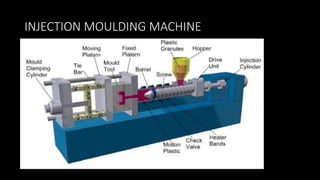
INJECTION MOULDING MACHINE
INJECTION MOULDING PROCESS
Material preparation
Feeding into hopper
Injection
Mould holding and cooling
Ejection
INJECTION MOULDING PROCESS
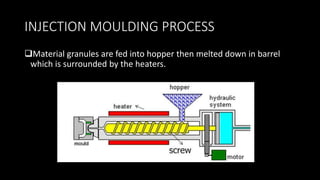
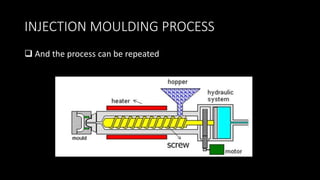
Material granules are fed into hopper then melted down in barrel
which is surrounded by the heaters.
INJECTION MOULDING PROCESS
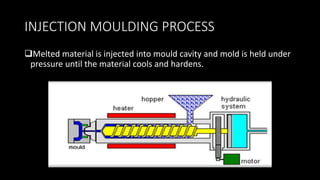
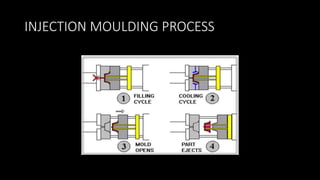
Melted material is injected into mould cavity and mold is held under
pressure until the material cools and hardens.
INJECTION MOULDING PROCESS
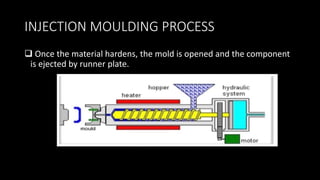
 Once the material hardens, the mold is opened and the component
is ejected by runner plate.
INJECTION MOULDING PROCESS
 And the process can be repeated
INJECTION MOULDING PROCESS
MOULD
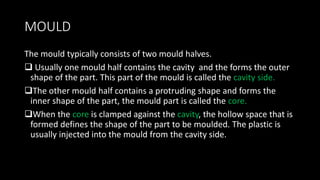
The mould typically consists of two mould halves.
 Usually one mould half contains the cavity and the forms the outer
shape of the part. This part of the mould is called the cavity side.
The other mould half contains a protruding shape and forms the
inner shape of the part, the mould part is called the core.
When the core is clamped against the cavity, the hollow space that is
formed defines the shape of the part to be moulded. The plastic is
usually injected into the mould from the cavity side.
PLASTIC INJECTION MOULDING
 It is a manufacturing process for producing components by injecting
polymer material into a mould.
Thermoplastic and Thermosetting plastic material are used.
Thermoplastic materials are reusable
MATERIAL USED
ABS(Acrylonitrile Butadiene Styrene)
Polypropylene
Polystyrene
HDPE( High density poly ethylene)
LDPE(Low density poly ethylene)
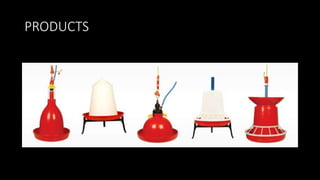
PRODUCTS
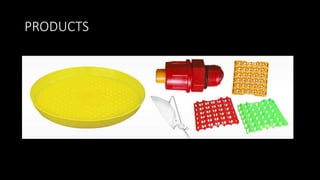
PRODUCTS
ADVANTAGES OF INJECTION MOULDING
Fast production.
Low labour costs.
 Design flexibility.
High-output production.
 Multiple materials can be used at the same time.
 Can be used to produce very small parts.
 Leaves little post-production scrap.
 Ability to include inserts.
Good colour control.
Good product consistency.
 Reduced requirements for finishing.
 Good dimensional control.
DISADVANTAGES OF INJECTION MOULDING
High initial tooling and machinery cost.
Part design restrictions.
Small runs of parts can be costly
APPLICATIONS OF INJECTION MOULDING
• Injection moulding is used to create many things such as Cups,
Containers, tools, etc.
• Injection moulding is the most common modern method of
manufacturing parts. It is ideal for producing high volumes of the
same object.
THANK YOU

Presentation on injection moulding (1)

  • 1.
    Presentation on INJECTION MOULDING By B.MANIK Underthe guidance of N.SURESH ASST.PROFESSOR DEPARTMENT OF MECHANICAL ENGINEERING GEETHANJALI COLLEGE OF ENGINEERING AND TECHNOLOGY (Approved by AICTE, Permanently Affiliated by JNTUH, Accredited by NAAC ‘A’ grade and NBA) Cheeryal (V), Keesara (M), Medchal Dist. TS -501301 2019 – 2020
  • 2.
    ABSTRACT Injection Moulding (IM)is considered to be one of the most prominent processes for mass production of plastic products. One of the biggest challenges, facing injection moulders today, is to determine the proper settings for the IM process variables. Selecting the proper settings for an IM process is crucial because the behavior of the polymeric material during shaping is highly influenced by the process variables. Consequently, the process variables govern the quality of the parts produced. The difficulty of optimizing an IM process is that the performance measures usually show conflicting behavior. Therefore, a compromise must be found between all of the performance measures of interest.
  • 3.
    INJECTION MOULDING Injection mouldingis a manufacturing process for producing parts by injecting material into a mould. Injection moulding can be performed with a host of materials mainly including metals, glasses, elastomers, confections, and most commonly thermoplastic and thermosetting polymers. Material for the part is fed into a heated barrel, mixed, and forced into a mould cavity, where it cools and hardens to the configuration of the cavity. During the process of plastic injection moulding ,plastic resin pellets are heated until they melt. The melted liquid plastic is introduced,under pressure(injected),into a mould. The molten form is then allowed to cool down and set into a solid form.
  • 4.
  • 5.
    INJECTION MOULDING PROCESS Materialpreparation Feeding into hopper Injection Mould holding and cooling Ejection
  • 6.
    INJECTION MOULDING PROCESS Materialgranules are fed into hopper then melted down in barrel which is surrounded by the heaters.
  • 7.
    INJECTION MOULDING PROCESS Meltedmaterial is injected into mould cavity and mold is held under pressure until the material cools and hardens.
  • 8.
    INJECTION MOULDING PROCESS Once the material hardens, the mold is opened and the component is ejected by runner plate.
  • 9.
    INJECTION MOULDING PROCESS And the process can be repeated
  • 10.
  • 11.
    MOULD The mould typicallyconsists of two mould halves.  Usually one mould half contains the cavity and the forms the outer shape of the part. This part of the mould is called the cavity side. The other mould half contains a protruding shape and forms the inner shape of the part, the mould part is called the core. When the core is clamped against the cavity, the hollow space that is formed defines the shape of the part to be moulded. The plastic is usually injected into the mould from the cavity side.
  • 12.
    PLASTIC INJECTION MOULDING It is a manufacturing process for producing components by injecting polymer material into a mould. Thermoplastic and Thermosetting plastic material are used. Thermoplastic materials are reusable
  • 13.
    MATERIAL USED ABS(Acrylonitrile ButadieneStyrene) Polypropylene Polystyrene HDPE( High density poly ethylene) LDPE(Low density poly ethylene)
  • 14.
  • 15.
  • 16.
    ADVANTAGES OF INJECTIONMOULDING Fast production. Low labour costs.  Design flexibility. High-output production.  Multiple materials can be used at the same time.  Can be used to produce very small parts.  Leaves little post-production scrap.  Ability to include inserts. Good colour control. Good product consistency.  Reduced requirements for finishing.  Good dimensional control.
  • 17.
    DISADVANTAGES OF INJECTIONMOULDING High initial tooling and machinery cost. Part design restrictions. Small runs of parts can be costly
  • 18.
    APPLICATIONS OF INJECTIONMOULDING • Injection moulding is used to create many things such as Cups, Containers, tools, etc. • Injection moulding is the most common modern method of manufacturing parts. It is ideal for producing high volumes of the same object.
  • 19.