Initiating a Network Effect in a
Social Network
Nasri Messarra – Anne Mione
17th EURAS Annual Standardization Conference
Kosice, Slovakia, 2012
Initiating a Network Effect in a
Social Network
• Can we initiate network effects on
the Facebook social network in a
non-automated experiment under
controlled environment?
Nasri Messara – Anne Mione
• How to put into evidence network
effects in a social network?
Objectives
Recent studies have focused on social network analysis suggesting
different methods to measure the density and activity of these
networks but also the role of the individuals as nodes and hubs, as well
as their centrality within these networks (Lazega, 2007; Wasserman &
Faust, 1994; Krackhardt, 1995, 1993). These studies allow us to
understand the workings of a network and the behavior of its
members, but they adopt a descriptive and analytical approach,
following Granovetter’s social approach (1974, 1985, 2000). They
examine established networks in adopting the position of observers.
We intend to explore the construction and development of a social
network from the perspective of its creator, in a strategic
entrepreneurial perspective. This posture supposes to handle specific
questions: what about the creator’s intervention? Can a social network
reach a critical mass allowing it to sustain itself and increase in size
without further intervention?
The Experiment
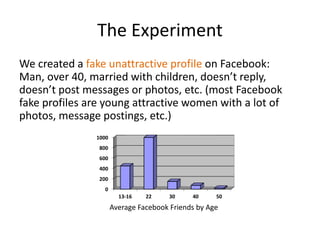
We created a fake unattractive profile on Facebook:
Man, over 40, married with children, doesn’t reply,
doesn’t post messages or photos, etc. (most Facebook
fake profiles are young attractive women with a lot of
photos, message postings, etc.)
0
200
400
600
800
1000
13-16 22 30 40 50
Average Facebook Friends by Age
The Befriending Strategy
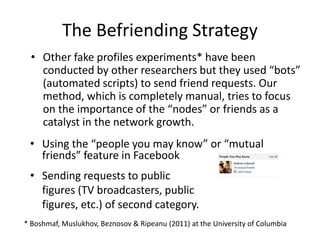
• Using the “people you may know” or “mutual
friends” feature in Facebook
• Sending requests to public
figures (TV broadcasters, public
figures, etc.) of second category.
• Other fake profiles experiments* have been
conducted by other researchers but they used “bots”
(automated scripts) to send friend requests. Our
method, which is completely manual, tries to focus
on the importance of the “nodes” or friends as a
catalyst in the network growth.
* Boshmaf, Muslukhov, Beznosov & Ripeanu (2011) at the University of Columbia
Network Effects Set Off
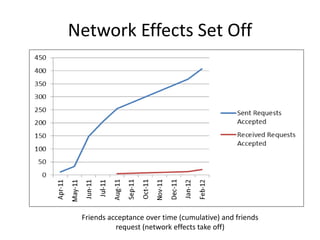
Friends acceptance over time (cumulative) and friends
request (network effects take off)
The multiplier role : a determinant
actor in the network
Spartacus
Zeina
Tahan Tarek-
Gabriel
Sikias
Michel
Hassoun
Asma
Andraos
Nagi
Gemayel
Ramia
Midani
Youssef
Mallat
Elie Kehde
Omar
Boustany
Tania
Bechara
Jad Habib
Fady
Salamoon
Joumana El-
Khoury
Raymond
Yazbeck
Denise
Chamassian
Roy
Ferneini
Carl BerKoff
# First Name Friends Friends of
Friends
Friends of Friends of Friends
1 Ahmad 0 0 0
2 Asma 133 2960 5514
3 Assaad 54 985 2937
4 Eileen 11 182 724
5 Farah 0 0 0
6 Ghassan 0 0 0
7 Hani 28 1356 8185
8 JeanMarc 50 885 2487
9 Joumana 34 1797 8658
10 Nadine 17 704 6615
11 Nasri 12 540 6256
12 Omar 176 5396 8402
13 Patricia 13 169 725
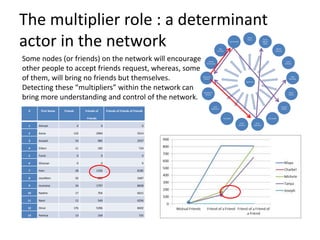
Some nodes (or friends) on the network will encourage
other people to accept friends request, whereas, some
of them, will bring no friends but themselves.
Detecting these “multipliers” within the network can
bring more understanding and control of the network.
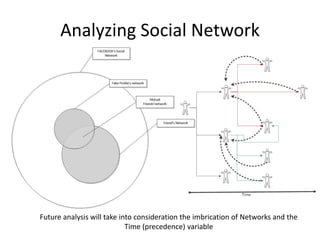
Analyzing Social Network
Future analysis will take into consideration the imbrication of Networks and the
Time (precedence) variable
Results
• We created a social network to an inexistent person and reached a
critical mass where, through externalities, our fake profile started
receiving friend requests without any action or reaction from his
end.
• This experiment also showed that network externalities, as
developed by Katz and Shapiro (1985) for several types of networks,
may be applied to social networks with all the benefits associated
to such networks, and that an entrepreneur can have better control
over social networks than over non-virtual networks.
• We have also shown how the number of adherents and the role of
the first adopters are determinant. We have demonstrated that this
network has strong and weak nodes and how some of the users can
have dangerous repercussions on the whole network.
Discussion
• In this experiment, the nature and role of the adopters
are examined. A next step of the experimentation can
be to interview the adherents. We can also announce
professional, commercial, or personal events to specific
people within the network, on a multiplier path or
outside it, and measure the reaction on the network.
• A lot remains to be analysed and automation using
accurate and powerful software tools should be
investigated. This experiment does not answer all the
questions asked but opens a door for a more thorough
and quantitative analysis.

Initiating a Network Effect in a Social Network - A Facebook Experiment

  • 1.
    Initiating a NetworkEffect in a Social Network Nasri Messarra – Anne Mione 17th EURAS Annual Standardization Conference Kosice, Slovakia, 2012
  • 2.
    Initiating a NetworkEffect in a Social Network • Can we initiate network effects on the Facebook social network in a non-automated experiment under controlled environment? Nasri Messara – Anne Mione • How to put into evidence network effects in a social network?
  • 3.
    Objectives Recent studies havefocused on social network analysis suggesting different methods to measure the density and activity of these networks but also the role of the individuals as nodes and hubs, as well as their centrality within these networks (Lazega, 2007; Wasserman & Faust, 1994; Krackhardt, 1995, 1993). These studies allow us to understand the workings of a network and the behavior of its members, but they adopt a descriptive and analytical approach, following Granovetter’s social approach (1974, 1985, 2000). They examine established networks in adopting the position of observers. We intend to explore the construction and development of a social network from the perspective of its creator, in a strategic entrepreneurial perspective. This posture supposes to handle specific questions: what about the creator’s intervention? Can a social network reach a critical mass allowing it to sustain itself and increase in size without further intervention?
  • 4.
    The Experiment We createda fake unattractive profile on Facebook: Man, over 40, married with children, doesn’t reply, doesn’t post messages or photos, etc. (most Facebook fake profiles are young attractive women with a lot of photos, message postings, etc.) 0 200 400 600 800 1000 13-16 22 30 40 50 Average Facebook Friends by Age
  • 5.
    The Befriending Strategy •Using the “people you may know” or “mutual friends” feature in Facebook • Sending requests to public figures (TV broadcasters, public figures, etc.) of second category. • Other fake profiles experiments* have been conducted by other researchers but they used “bots” (automated scripts) to send friend requests. Our method, which is completely manual, tries to focus on the importance of the “nodes” or friends as a catalyst in the network growth. * Boshmaf, Muslukhov, Beznosov & Ripeanu (2011) at the University of Columbia
  • 6.
    Network Effects SetOff Friends acceptance over time (cumulative) and friends request (network effects take off)
  • 7.
    The multiplier role: a determinant actor in the network Spartacus Zeina Tahan Tarek- Gabriel Sikias Michel Hassoun Asma Andraos Nagi Gemayel Ramia Midani Youssef Mallat Elie Kehde Omar Boustany Tania Bechara Jad Habib Fady Salamoon Joumana El- Khoury Raymond Yazbeck Denise Chamassian Roy Ferneini Carl BerKoff # First Name Friends Friends of Friends Friends of Friends of Friends 1 Ahmad 0 0 0 2 Asma 133 2960 5514 3 Assaad 54 985 2937 4 Eileen 11 182 724 5 Farah 0 0 0 6 Ghassan 0 0 0 7 Hani 28 1356 8185 8 JeanMarc 50 885 2487 9 Joumana 34 1797 8658 10 Nadine 17 704 6615 11 Nasri 12 540 6256 12 Omar 176 5396 8402 13 Patricia 13 169 725 Some nodes (or friends) on the network will encourage other people to accept friends request, whereas, some of them, will bring no friends but themselves. Detecting these “multipliers” within the network can bring more understanding and control of the network.
  • 8.
    Analyzing Social Network Futureanalysis will take into consideration the imbrication of Networks and the Time (precedence) variable
  • 9.
    Results • We createda social network to an inexistent person and reached a critical mass where, through externalities, our fake profile started receiving friend requests without any action or reaction from his end. • This experiment also showed that network externalities, as developed by Katz and Shapiro (1985) for several types of networks, may be applied to social networks with all the benefits associated to such networks, and that an entrepreneur can have better control over social networks than over non-virtual networks. • We have also shown how the number of adherents and the role of the first adopters are determinant. We have demonstrated that this network has strong and weak nodes and how some of the users can have dangerous repercussions on the whole network.
  • 10.
    Discussion • In thisexperiment, the nature and role of the adopters are examined. A next step of the experimentation can be to interview the adherents. We can also announce professional, commercial, or personal events to specific people within the network, on a multiplier path or outside it, and measure the reaction on the network. • A lot remains to be analysed and automation using accurate and powerful software tools should be investigated. This experiment does not answer all the questions asked but opens a door for a more thorough and quantitative analysis.