02/10/08 University of Minnesota 1
Data Mining Based Social NetworkData Mining Based Social Network
Analysis from Online BehaviourAnalysis from Online Behaviour
Jaideep Srivastava, Muhammad A. Ahmad, Nishith
Pathak, David Kuo-Wei Hsu
University of Minnesota
02/10/08 University of Minnesota 2
• Introduction
• Framework for Social Network Analysis
• Classical Social Network Analysis
• Social Networks in the Online Age
• Data Mining for Social Network Analysis
• Application of Data Mining based Social
Network Analysis Techniques
• Emerging Applications
• Conclusion
• References
Outline
02/10/08 University of Minnesota 3
Introduction to Social Network AnalysisIntroduction to Social Network Analysis
02/10/08 University of Minnesota 4
Social Networks
• A social network is a social structure of people, related
(directly or indirectly) to each other through a common
relation or interest
• Social network analysis (SNA) is the study of social
networks to understand their structure and behavior
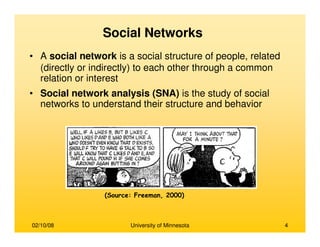
(Source: Freeman, 2000)
02/10/08 University of Minnesota 5
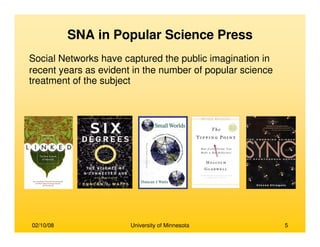
SNA in Popular Science Press
Social Networks have captured the public imagination in
recent years as evident in the number of popular science
treatment of the subject
02/10/08 University of Minnesota 6
Framework for Social Network AnalysisFramework for Social Network Analysis
02/10/08 University of Minnesota 7
Types of Social Network Analysis
• Sociocentric (whole) network analysis
– Emerged in sociology
– Involves quantification of interaction among a socially well-
defined group of people
– Focus on identifying global structural patterns
– Most SNA research in organizations concentrates on sociometric
approach
• Egocentric (personal) network analysis
– Emerged in anthropology and psychology
– Involves quantification of interactions between an individual
(called ego) and all other persons (called alters) related (directly
or indirectly) to ego
– Make generalizations of features found in personal networks
– Difficult to collect data, so till now studies have been rare
02/10/08 University of Minnesota 8
Types of Social Network Analysis
• Knowledge Based Network Analysis
– Emerged in Computer Science
– Involves quantification of interaction between
individuals, groups and other entities
– Knowledge discovery based on entities associated
with actors in the social network
02/10/08 University of Minnesota 9
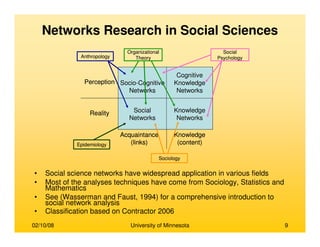
Networks Research in Social Sciences
• Social science networks have widespread application in various fields
• Most of the analyses techniques have come from Sociology, Statistics and
Mathematics
• See (Wasserman and Faust, 1994) for a comprehensive introduction to
social network analysis
• Classification based on Contractor 2006
Epidemiology
Sociology
Organizational
Theory
Social
PsychologyAnthropology
Socio-Cognitive
Networks
Cognitive
Knowledge
Networks
Social
Networks
Knowledge
Networks
Perception
Reality
Acquaintance
(links)
Knowledge
(content)Epidemiology
Sociology
Organizational
Theory
Social
PsychologyAnthropology
Socio-Cognitive
Networks
Cognitive
Knowledge
Networks
Social
Networks
Knowledge
Networks
Perception
Reality
Acquaintance
(links)
Knowledge
(content)
Socio-Cognitive
Networks
Cognitive
Knowledge
Networks
Social
Networks
Knowledge
Networks
Socio-Cognitive
Networks
Cognitive
Knowledge
Networks
Social
Networks
Knowledge
Networks
Perception
Reality
Acquaintance
(links)
Knowledge
(content)
02/10/08 University of Minnesota 10
Classical Social Network AnalysisClassical Social Network Analysis
02/10/08 University of Minnesota 11
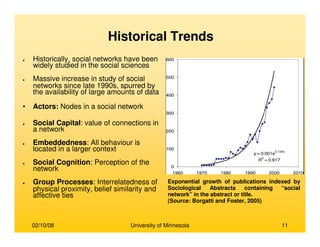
● Historically, social networks have been
widely studied in the social sciences
● Massive increase in study of social
networks since late 1990s, spurred by
the availability of large amounts of data
• Actors: Nodes in a social network
● Social Capital: value of connections in
a network
● Embeddedness: All behaviour is
located in a larger context
● Social Cognition: Perception of the
network
● Group Processes: Interrelatedness of
physical proximity, belief similarity and
affective ties
Exponential growth of publications indexed by
Sociological Abstracts containing “social
network” in the abstract or title.
(Source: Borgatti and Foster, 2005)
Historical Trends
02/10/08 University of Minnesota 12
• Dyad: A pair of actors (connected by a relationship) in
the network
● Triad: A subset of three actors or nodes connected to
each other by the social relationship
● Degree Centrality: Degree of a node normalized to the
interval {0 .. 1}
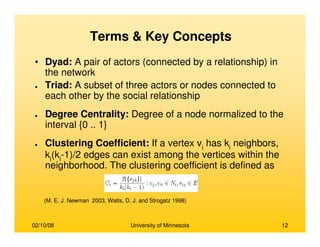
● Clustering Coefficient: If a vertex vi
has ki
neighbors,
ki
(ki
-1)/2 edges can exist among the vertices within the
neighborhood. The clustering coefficient is defined as
(M. E. J. Newman 2003, Watts, D. J. and Strogatz 1998)
Terms & Key Concepts
02/10/08 University of Minnesota 13
(Jon Kleinberg 1999, 2001) (D Watts, S Strogatz 1998), (D Watts 1999, 2003), (P. Marsden 2002)
(Barabasi and Albert, 1999)
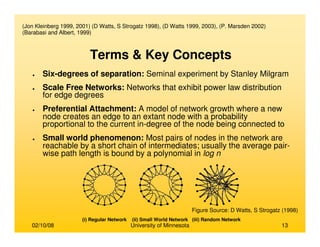
(i) Regular Network (ii) Small World Network (iii) Random Network
● Six-degrees of separation: Seminal experiment by Stanley Milgram
● Scale Free Networks: Networks that exhibit power law distribution
for edge degrees
● Preferential Attachment: A model of network growth where a new
node creates an edge to an extant node with a probability
proportional to the current in-degree of the node being connected to
● Small world phenomenon: Most pairs of nodes in the network are
reachable by a short chain of intermediates; usually the average pair-
wise path length is bound by a polynomial in log n
Terms & Key Concepts
Figure Source: D Watts, S Strogatz (1998)
02/10/08 University of Minnesota 14
Measures of network centrality
• Betweenness Centrality: Measures how many times a node
occurs in a shortest path; measure of ‘social brokerage power’
– Most popular measure of centrality
– Efficient computation is important, best technique is O(mn)
• Closeness Centrality: The total graph-theoretic distance of a given
node from all other nodes
• Degree centrality: Degree of a node normalized to the interval {0 ..
1}
– is in principle identical for egocentric and sociocentric network data
• Eigenvector centrality: Score assigned to a node based on the
principle that a high scoring neighbour contributes more weight to it
– Google’s PageRank is a special case of this
• Other measures
– Information centrality
• All of the above measures have directed counterparts
02/10/08 University of Minnesota 15
Statistical Models of Social Networks
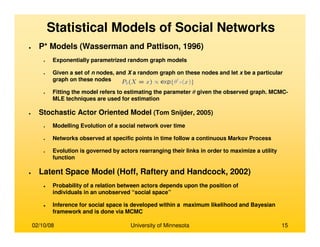
● P* Models (Wasserman and Pattison, 1996)
● Exponentially parametrized random graph models
● Given a set of n nodes, and X a random graph on these nodes and let x be a particular
graph on these nodes
● Fitting the model refers to estimating the parameter θ given the observed graph. MCMC-
MLE techniques are used for estimation
● Stochastic Actor Oriented Model (Tom Snijder, 2005)
● Modelling Evolution of a social network over time
● Networks observed at specific points in time follow a continuous Markov Process
● Evolution is governed by actors rearranging their links in order to maximize a utility
function
● Latent Space Model (Hoff, Raftery and Handcock, 2002)
Probability of a relation between actors depends upon the position of
individuals in an unobserved “social space”
Inference for social space is developed within a maximum likelihood and Bayesian
framework and is done via MCMC
02/10/08 University of Minnesota 16
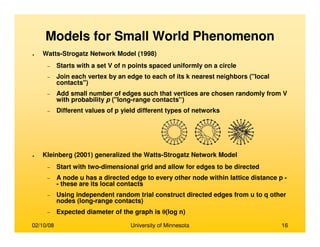
Models for Small World Phenomenon
● Watts-Strogatz Network Model (1998)
− Starts with a set V of n points spaced uniformly on a circle
− Join each vertex by an edge to each of its k nearest neighbors (''local
contacts'')
− Add small number of edges such that vertices are chosen randomly from V
with probability p (''long-range contacts'‘)
− Different values of p yield different types of networks
● Kleinberg (2001) generalized the Watts-Strogatz Network Model
− Start with two-dimensional grid and allow for edges to be directed
− A node u has a directed edge to every other node within lattice distance p -
- these are its local contacts
− Using independent random trial construct directed edges from u to q other
nodes (long-range contacts)
− Expected diameter of the graph is θθθθ(log n)
02/10/08 University of Minnesota 17
Models of Social Networks from Physics
• Reka and Barbasi’s model (Reka & Barabasi, 2000)
– Networks evolve because of local processes
– Addition of new nodes, new links or rewiring of old links
– Preferential attachment is used for link changes
– The relative frequency of these factors determine whether the
network topology has a power-law tail or is exponential
– A phase transition in the topology was also determined
• Characteristics of Collaboration Networks (Newman, 2001, 2003,
2004)
– Degree distribution follows a power-law
– Average separation decreases in time
– Clustering coefficient decays with time
– Relative size of the largest cluster increases
– Average degree increases
– Node selection is governed by preferential attachment
• Newman (2003) provides an extensive survey of various networks,
their properties and models
02/10/08 University of Minnesota 18
SNA and Epidemiology
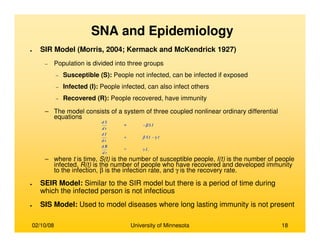
● SIR Model (Morris, 2004; Kermack and McKendrick 1927)
− Population is divided into three groups
− Susceptible (S): People not infected, can be infected if exposed
− Infected (I): People infected, can also infect others
− Recovered (R): People recovered, have immunity
– The model consists of a system of three coupled nonlinear ordinary differential
equations
– where t is time, S(t) is the number of susceptible people, I(t) is the number of people
infected, R(t) is the number of people who have recovered and developed immunity
to the infection, β is the infection rate, and γ is the recovery rate.
● SEIR Model: Similar to the SIR model but there is a period of time during
which the infected person is not infectious
● SIS Model: Used to model diseases where long lasting immunity is not present
02/10/08 University of Minnesota 19
Social Networks in the Online AgeSocial Networks in the Online Age
02/10/08 University of Minnesota 20
Computer networks as social networks
• “Computer networks are inherently social networks,
linking people, organizations, and knowledge”
(Wellman, 2001)
• Data sources include newsgroups like USENET;
instant messenger logs like AIM; e-mail messages;
social networks like Orkut and Yahoo groups; weblogs
like Blogger; and online gaming communities
USENET
02/10/08 University of Minnesota 21
Example: Enron email dataset
• Publicly available: http://www.cs.cmu.edu/~enron/
• Cleaned version of data
– 151 users, mostly senior management of Enron
– Approximately 200,399 email messages
– Almost all users use folders to organize their emails
– The upper bound for number of folders for a user was
approximately the log of the number
of messages for that user
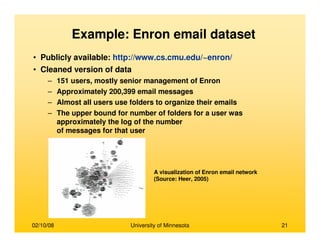
A visualization of Enron email network
(Source: Heer, 2005)
02/10/08 University of Minnesota 22
Spectral and graph theoretic analysis
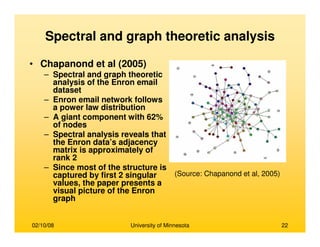
• Chapanond et al (2005)
– Spectral and graph theoretic
analysis of the Enron email
dataset
– Enron email network follows
a power law distribution
– A giant component with 62%
of nodes
– Spectral analysis reveals that
the Enron data’s adjacency
matrix is approximately of
rank 2
– Since most of the structure is
captured by first 2 singular
values, the paper presents a
visual picture of the Enron
graph
(Source: Chapanond et al, 2005)
02/10/08 University of Minnesota 23
Other analyses of Enron dataset
• Shetty and Adibi (2004)
– Introduction to the dataset
– Present basic statistics on Enron e-mail data such as email
frequency, indegree, outdegree w.r.t time etc.
• Diesner and Carley (2005)
– Compare the social network for the crisis period (Oct, 2001) to
that of a normal time period (Oct, 2000)
– The network in Oct, 2001 was more dense, connected and
centralized compared to that of Oct, 2000
– Half of the key actors in Oct, 2000 remained important in Oct,
2001
– During crisis, the communication among employees did not
necessarily follow the organization structure/hierarchy
– During the crisis period the top executives formed a tight clique
indicating mutual support
02/10/08 University of Minnesota 24
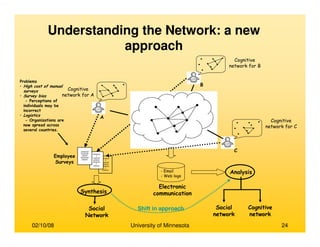
Understanding the Network: a new
approach
Problems
• High cost of manual
surveys
• Survey bias
- Perceptions of
individuals may be
incorrect
• Logistics
- Organizations are
now spread across
several countries.
Sdfdsfsd
f
Fvsdfsdf
sdfdfsd
Sdfdsfsd
f
Sdfsdfs
`
Sdfdsfsd
f
Fvsdfsdf
sdfdfsd
Sdfdsfsd
f
Sdfsdfs
`
Sdfdsfsdf
Fvsdfsdfs
dfdfsd
Sdfdsfsdf
Sdfsdfs
`
Electronic
communication
- Email
- Web logs
Analysis
Social
network
Cognitive
network
Social
Network
Employee
Surveys
Cognitive
network for B
Cognitive
network for C
Cognitive
network for A
A
B
C
Synthesis
Shift in approach
02/10/08 University of Minnesota 25
Key Drivers for CS Research in SNA
• Computer Science has created the über-cyber-
infrastructure for
– Social Interaction
– Knowledge Exchange
– Knowledge Discovery
• Ability to capture
– different about various types of social interactions
– at a very fine granularity
– with practically no reporting bias
• Data mining techniques can be used for building
descriptive and predictive models of social interactions
Fertile research area for data mining research
02/10/08 University of Minnesota 26
Data Mining for Social Network AnalysisData Mining for Social Network Analysis
02/10/08 University of Minnesota 27
DM for SNA (Overview)
• Community Extraction
• Link Prediction
• Cascading Behavior
• Identifying Prominent Actors and Experts in
Social Networks
• Search in Social Networks
• Trust in Social Networks
• Characterization of Social Networks
• Anonymity in Social Networks
• Other Research
02/10/08 University of Minnesota 28
Community ExtractionCommunity Extraction
02/10/08 University of Minnesota 29
Community Extraction
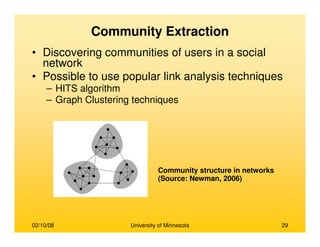
• Discovering communities of users in a social
network
• Possible to use popular link analysis techniques
– HITS algorithm
– Graph Clustering techniques
Community structure in networks
(Source: Newman, 2006)
02/10/08 University of Minnesota 30
Community Extraction
• Tyler et al (2003)
– A graph theoretic algorithm for discovering communities
– The graph is broken into connected components and each
component is checked to see if it is a community
– If a component is not a community then iteratively remove edges with
highest betweenness till component splits
• Betweenness is recomputed each time an edge is removed
– The order of in which edges are removed affects the final community
structure
– Since ties are broken arbitrarily, this affects the final community
structure
– In order to ensure stability of results, the entire procedure is repeated
i times and the results from each iteration are aggregated to produce
the final set of communities
• Girvan and Newman (2002) use a similar algorithm to analyze
community structure in social and biological networks
02/10/08 University of Minnesota 31
Community Extraction
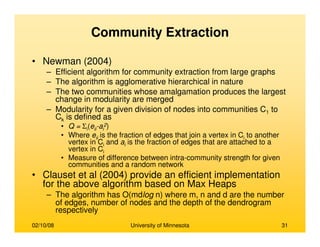
• Newman (2004)
– Efficient algorithm for community extraction from large graphs
– The algorithm is agglomerative hierarchical in nature
– The two communities whose amalgamation produces the largest
change in modularity are merged
– Modularity for a given division of nodes into communities C1 to
Ck is defined as
• Q = Σi(eii-ai
2)
• Where eii is the fraction of edges that join a vertex in Ci to another
vertex in Ci and ai is the fraction of edges that are attached to a
vertex in Ci
• Measure of difference between intra-community strength for given
communities and a random network
• Clauset et al (2004) provide an efficient implementation
for the above algorithm based on Max Heaps
– The algorithm has O(mdlog n) where m, n and d are the number
of edges, number of nodes and the depth of the dendrogram
respectively
02/10/08 University of Minnesota 32
Community Extraction
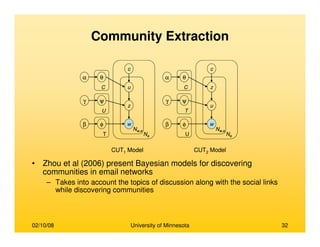
• Zhou et al (2006) present Bayesian models for discovering
communities in email networks
– Takes into account the topics of discussion along with the social links
while discovering communities
c
u
z
w
θ
ψ
φ
α
γ
β
C
U
T
Nw,e
Ne
c
z
u
w
θ
ψ
φ
α
γ
β
C
T
U
Nw,e
Ne
CUT1 Model CUT2 Model
c
u
z
w
θ
ψ
φ
α
γ
β
C
U
T
Nw,e
Ne
c
u
z
w
θ
ψ
φ
α
γ
β
C
U
T
Nw,e
Ne
c
z
u
w
θ
ψ
φ
α
γ
β
C
T
U
Nw,e
Ne
c
z
u
w
θ
ψ
φ
α
γ
β
C
T
U
Nw,e
Ne
CUT1 Model CUT2 Model
02/10/08 University of Minnesota 33
Community Extraction
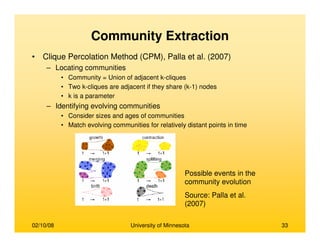
• Clique Percolation Method (CPM), Palla et al. (2007)
– Locating communities
• Community = Union of adjacent k-cliques
• Two k-cliques are adjacent if they share (k-1) nodes
• k is a parameter
– Identifying evolving communities
• Consider sizes and ages of communities
• Match evolving communities for relatively distant points in time
Possible events in the
community evolution
Source: Palla et al.
(2007)
02/10/08 University of Minnesota 34
CPM (Palla et al., 2007)
• Study of Evolution revealed four types
of communities in both co-authorship
and mobile phone networks:
– (a) a small and stationary community
• Stable as members are tight knit and available
– (b) a small and non-stationary community
• Unstable
– (c) a large and stationary community
• Unstable
– (d) a large and non-stationary community.
• Stable as the community is adaptable
02/10/08 University of Minnesota 35
Community Detection in Large Networks
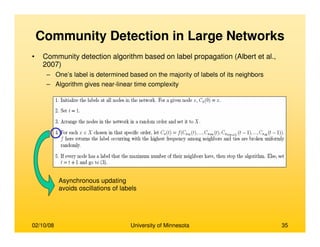
• Community detection algorithm based on label propagation (Albert et al.,
2007)
– One’s label is determined based on the majority of labels of its neighbors
– Algorithm gives near-linear time complexity
Asynchronous updating
avoids oscillations of labels
02/10/08 University of Minnesota 36
Link PredictionLink Prediction
02/10/08 University of Minnesota 37
Link Prediction
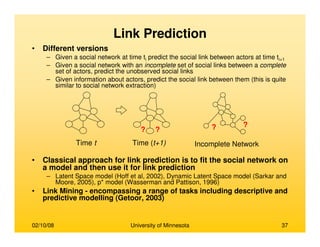
• Different versions
– Given a social network at time ti predict the social link between actors at time ti+1
– Given a social network with an incomplete set of social links between a complete
set of actors, predict the unobserved social links
– Given information about actors, predict the social link between them (this is quite
similar to social network extraction)
• Classical approach for link prediction is to fit the social network on
a model and then use it for link prediction
– Latent Space model (Hoff et al, 2002), Dynamic Latent Space model (Sarkar and
Moore, 2005), p* model (Wasserman and Pattison, 1996)
• Link Mining - encompassing a range of tasks including descriptive and
predictive modelling (Getoor, 2003)
? ?
Time t Time (t+1)
? ?
Incomplete Network
02/10/08 University of Minnesota 38
• Predictive powers of the various proximity features for predicting links
between authors in the future (Liben-Nowell and Kleinberg, 2003)
– Link prediction as a means to gauge the usefulness of a model
– Proximity Features: Common Neighbors, Katz, Jaccard, etc
– No single predictor consistently outperforms the others
• However all perform better than random
• Link Prediction using supervised learning (Hasan et al,
2006)
– Citation Network (BIOBASE, DBLP)
– Use machine learning algorithms to predict future co-authorship
(decision tree, k-NN, multilayer perceptron, SVM, RBF network)
– Identify a group of features that are most helpful in prediction
– Best Predictor Features: Keyword Match count, Sum of neighbors,
Sum of Papers, Shortest Distance
Link Prediction
02/10/08 University of Minnesota 39
Link Prediction
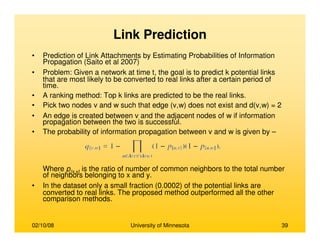
• Prediction of Link Attachments by Estimating Probabilities of Information
Propagation (Saito et al 2007)
• Problem: Given a network at time t, the goal is to predict k potential links
that are most likely to be converted to real links after a certain period of
time.
• A ranking method: Top k links are predicted to be the real links.
• Pick two nodes v and w such that edge (v,w) does not exist and d(v,w) = 2
• An edge is created between v and the adjacent nodes of w if information
propagation between the two is successful.
• The probability of information propagation between v and w is given by –
Where p{x,y} is the ratio of number of common neighbors to the total number
of neighbors belonging to x and y.
• In the dataset only a small fraction (0.0002) of the potential links are
converted to real links. The proposed method outperformed all the other
comparison methods.
02/10/08 University of Minnesota 40
Link Prediction
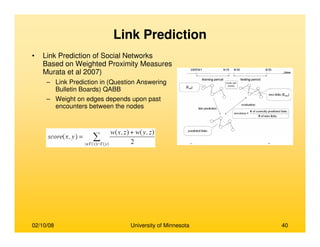
• Link Prediction of Social Networks
Based on Weighted Proximity Measures
Murata et al 2007)
– Link Prediction in (Question Answering
Bulletin Boards) QABB
– Weight on edges depends upon past
encounters between the nodes
02/10/08 University of Minnesota 41
Cascading BehaviorCascading Behavior
02/10/08 University of Minnesota 42
Cascading Models
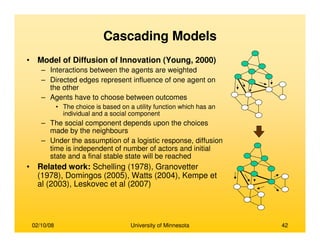
• Model of Diffusion of Innovation (Young, 2000)
– Interactions between the agents are weighted
– Directed edges represent influence of one agent on
the other
– Agents have to choose between outcomes
• The choice is based on a utility function which has an
individual and a social component
– The social component depends upon the choices
made by the neighbours
– Under the assumption of a logistic response, diffusion
time is independent of number of actors and initial
state and a final stable state will be reached
• Related work: Schelling (1978), Granovetter
(1978), Domingos (2005), Watts (2004), Kempe et
al (2003), Leskovec et al (2007)
02/10/08 University of Minnesota 43
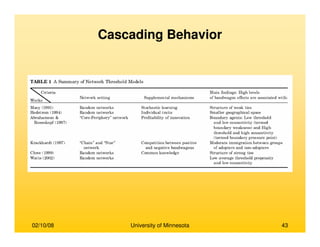
Cascading Behavior
02/10/08 University of Minnesota 44
Cascading Behavior
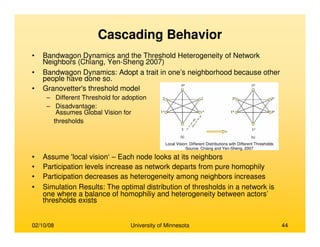
• Bandwagon Dynamics and the Threshold Heterogeneity of Network
Neighbors (Chiang, Yen-Sheng 2007)
• Bandwagon Dynamics: Adopt a trait in one’s neighborhood because other
people have done so.
• Granovetter's threshold model
– Different Threshold for adoption
– Disadvantage:
Assumes Global Vision for
thresholds
• Assume 'local vision‘ – Each node looks at its neighbors
• Participation levels increase as network departs from pure homophily
• Participation decreases as heterogeneity among neighbors increases
• Simulation Results: The optimal distribution of thresholds in a network is
one where a balance of homophiliy and heterogeneity between actors’
thresholds exists
Local Vision: Different Distributions with Different Thresholds
Source: Chiang and Yen-Sheng, 2007
02/10/08 University of Minnesota 45
Cascading Behavior
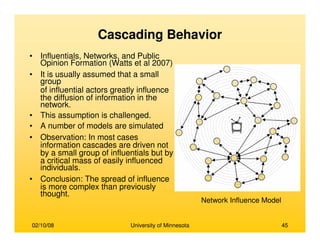
• Influentials, Networks, and Public
Opinion Formation (Watts et al 2007)
• It is usually assumed that a small
group
of influential actors greatly influence
the diffusion of information in the
network.
• This assumption is challenged.
• A number of models are simulated
• Observation: In most cases
information cascades are driven not
by a small group of influentials but by
a critical mass of easily influenced
individuals.
• Conclusion: The spread of influence
is more complex than previously
thought.
Network Influence Model
02/10/08 University of Minnesota 46
Cascading Behavior
• Maximizing Influence in a Competitive Social Network: A Follower's
Perspective (Tim Carnes et al 2007)
• Previous models of influence maximization in a social network assumed that
there is only one entity.
• How does one introduce a product in the market
when a similar product is already being introduced
in the market by a rival.
• Assumptions:
– A limited marketing budget.
– Knowledge of early adopters of rival's product.
– A node will not change to another technology
• Determining the set which contains the users that are most likely to adopt
the product is an NP hard problem (in the model setting.)
• An approximate solution is given is given to determine a subset of such
most influential users.
• This subset can be varied based upon the cost and also on the size.
• Two models for diffusion of two competing technologies are described.
• Model 1: Technology only diffuses from the set of initial adapters.
• Model 2: Model a node can interested in a technology and get it from a
neighbor.
02/10/08 University of Minnesota 47
Identifying Prominent Actors and ExpertsIdentifying Prominent Actors and Experts
in Social Networksin Social Networks
02/10/08 University of Minnesota 48
Link mining
• Availability of rich data on link structure between objects
• Link Mining - new emerging field encompassing a range of tasks
including descriptive and predictive modeling (Getoor, 2003)
• Extending classical data mining tasks
– Link-based classification – predict an object’s category based not
only on its attributes but also the links it participates in
– Link-based clustering – techniques grouping objects (or linked
objects)
• Special cases of link-based classification/clustering
– Identifying link type
– Predicting link strength
– Link cardinality
– Record linkage
• Getoor et al (2002)
– Two mechanisms to represent probabilistic distributions over link
structures
– Apply resulting model to predict link structure
02/10/08 University of Minnesota 49
Link Mining (Getoor & Diehl, 2005)
● Link Mining: Data Mining techniques that take into account the links
between objects and entities while building predictive or descriptive
models
● Link based object ranking, Group Detection, Entity Resolution, Link
Prediction
● Applications: Hyperlink Mining, Relational Learning, Inductive Logic
Programming, Graph Mining
Hubs and Authorities (Kleinberg, 1997)
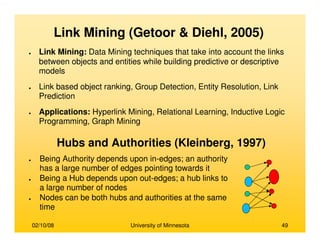
● Being Authority depends upon in-edges; an authority
has a large number of edges pointing towards it
● Being a Hub depends upon out-edges; a hub links to
a large number of nodes
● Nodes can be both hubs and authorities at the same
time
02/10/08 University of Minnesota 50
• A common approach is to compute scores/rankings over
the set (or a subset) of actors in the social network which
indicate degree of importance/expertise/influence
– E.g. Pagerank, HITS, centrality measures
• Various algorithms from the link analysis domain
– PageRank and its many variants
– HITS algorithm for determining authoritative sources
• Kleinberg (1999)
– Discusses different prominence measures in the social science,
citation analysis and computer science domains
• Centrality measures exist in the social science domain
for measuring importance of actors in a social network
– Degree Centrality
– Closeness Centrality
– Betweenness Centrality
Identifying Prominent Actors in a Social
Network
02/10/08 University of Minnesota 51
• Brandes, (2001)
– Prominence high betweenness value
– An efficient algorithm for computing for
betweenness cetrality
– Betweenness centrality requires computation
of number of shortest paths passing through
each node
– Compute shortest paths between all pairs of
vertices
– Trivial solution of counting all shortest paths
for all nodes takes O(n3) time
– A recursive formula is derived for the total
number of shortest paths originating from
source s and passing through a node v
δδδδs(v) = ΣΣΣΣ{wi} [1+δδδδs(wi)] (σσσσsv /σσσσsw)
σσσσij is the number of shortest paths between i and j
wi is a node which has node v preceding itself on
some shortest path from s to itself
– The time complexity reduces to O(mn) for
unweighted graphs and O(mn + log2n) for
weighted graphs
– The space complexity decreases from O(n2) to
O(n+m)
Nodes s, v and {wi}
Source: (Brandes, 2001)
Identifying Prominent Actors in a Social
Network
02/10/08 University of Minnesota 52
Identifying Experts in a Social Network
• Apart from link analysis there are other approaches for expert
identification
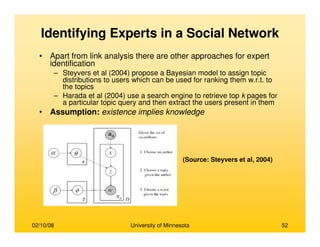
– Steyvers et al (2004) propose a Bayesian model to assign topic
distributions to users which can be used for ranking them w.r.t. to
the topics
– Harada et al (2004) use a search engine to retrieve top k pages for
a particular topic query and then extract the users present in them
• Assumption: existence implies knowledge
(Source: Steyvers et al, 2004)
02/10/08 University of Minnesota 53
Expertise in Social Networks
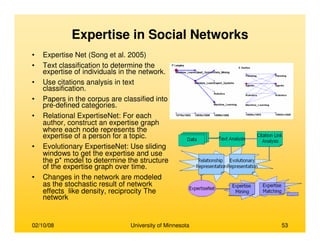
• Expertise Net (Song et al. 2005)
• Text classification to determine the
expertise of individuals in the network.
• Use citations analysis in text
classification.
• Papers in the corpus are classified into
pre-defined categories.
• Relational ExpertiseNet: For each
author, construct an expertise graph
where each node represents the
expertise of a person for a topic.
• Evolutionary ExpertiseNet: Use sliding
windows to get the expertise and use
the p* model to determine the structure
of the expertise graph over time.
• Changes in the network are modeled
as the stochastic result of network
effects like density, reciprocity The
network
02/10/08 University of Minnesota 54
Expertise in Social Networks
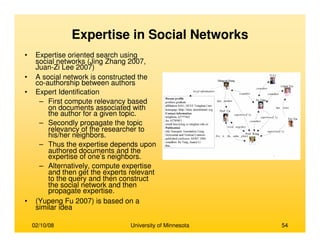
• Expertise oriented search using
social networks (Jing Zhang 2007,
Juan-Zi Lee 2007)
• A social network is constructed the
co-authorship between authors
• Expert Identification
– First compute relevancy based
on documents associated with
the author for a given topic.
– Secondly propagate the topic
relevancy of the researcher to
his/her neighbors.
– Thus the expertise depends upon
authored documents and the
expertise of one’s neighbors.
– Alternatively, compute expertise
and then get the experts relevant
to the query and then construct
the social network and then
propagate expertise.
• (Yupeng Fu 2007) is based on a
similar idea
02/10/08 University of Minnesota 55
Expertise in Social Networks
• Social Networks for Expertise Identification
(Yupeng Fu 2007)
– Identify experts based on documents for only a subset
of the data.
– Use this initial seed of people to propagate expertise
to other agents in the rest of the network
– The probability of a non-seed node being an expert
depends upon the expertise of the associated nodes.
The social network can be built based on co-
occurrence on web pages or co-occurrence in e-
mails for the whole corpus.
– Alternatively the social network can also be built
based on the web pages and e-mails which are
relevant to the query.
• Related Work: (Jing Zhang and Juan-Zi Lee 2007)
02/10/08 University of Minnesota 56
Search in Social NetworksSearch in Social Networks
02/10/08 University of Minnesota 57
Search in Social Networks
• Searching/Querying for information in a social network
• Query routing in a network
– A user can send out queries to neighbors
– If the neighbor knows the answer then he/she replies else forward it to
their neighbors. Thus a query propagates through a network
– Develop schemes for efficient routing through a network
• Adamic et al (2001)
– Present a greedy traversal algorithm for search in power law graphs
– At each step the query is passed to the neighbor with the most number
of neighbors
– A large portion of the graph is examined in a small number of hops
• Kleinberg and Raghavan (2005) present a game theoretic model for
routing queries in a network along with incentives for people who
provide answers to the queries
02/10/08 University of Minnesota 58
Search in Social Networks
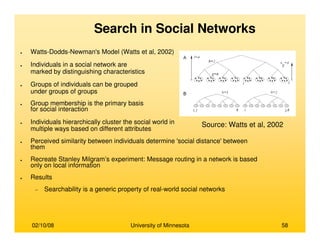
● Watts-Dodds-Newman's Model (Watts et al, 2002)
● Individuals in a social network are
marked by distinguishing characteristics
● Groups of individuals can be grouped
under groups of groups
● Group membership is the primary basis
for social interaction
● Individuals hierarchically cluster the social world in
multiple ways based on different attributes
● Perceived similarity between individuals determine 'social distance' between
them
● Recreate Stanley Milgram’s experiment: Message routing in a network is based
only on local information
● Results
− Searchability is a generic property of real-world social networks
Source: Watts et al, 2002
02/10/08 University of Minnesota 59
Search in Social Networks
• Yu and Singh (2003)
– Each actor has a vector over all terms and every actor stores the
vectors and immediate neighborhoods of his/her neighbors
– Individual vector entries indicate actor’s familiarity/knowledge
about the various terms
– Each neighbor is assigned a relevance score
– The score is a weighted linear combination of the similarity
between query and term vectors (cosine similarity based
measure) and the sociability of that neighbor
– Sociability is a measure of that neighbor knowing other people
who might know the answer
– The expert and sociability ratings maintained by a user are
updated based on answers provided by various users in the
network
02/10/08 University of Minnesota 60
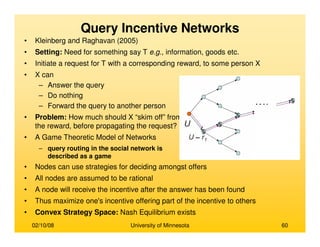
Query Incentive Networks
• Kleinberg and Raghavan (2005)
• Setting: Need for something say T e.g., information, goods etc.
• Initiate a request for T with a corresponding reward, to some person X
• X can
– Answer the query
– Do nothing
– Forward the query to another person
• Problem: How much should X “skim off” from
the reward, before propagating the request?
• A Game Theoretic Model of Networks
– query routing in the social network is
described as a game
• Nodes can use strategies for deciding amongst offers
• All nodes are assumed to be rational
• A node will receive the incentive after the answer has been found
• Thus maximize one's incentive offering part of the incentive to others
• Convex Strategy Space: Nash Equilibrium exists
02/10/08 University of Minnesota 61
Information Search in Social Network
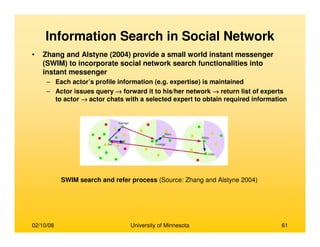
• Zhang and Alstyne (2004) provide a small world instant messenger
(SWIM) to incorporate social network search functionalities into
instant messenger
– Each actor’s profile information (e.g. expertise) is maintained
– Actor issues query →→→→ forward it to his/her network →→→→ return list of experts
to actor →→→→ actor chats with a selected expert to obtain required information
SWIM search and refer process (Source: Zhang and Alstyne 2004)
02/10/08 University of Minnesota 62
Search and Expert Identification
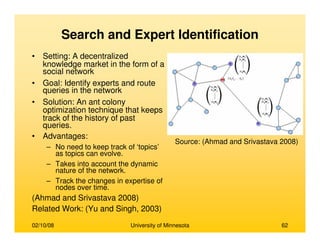
• Setting: A decentralized
knowledge market in the form of a
social network
• Goal: Identify experts and route
queries in the network
• Solution: An ant colony
optimization technique that keeps
track of the history of past
queries.
• Advantages:
– No need to keep track of ‘topics’
as topics can evolve.
– Takes into account the dynamic
nature of the network.
– Track the changes in expertise of
nodes over time.
(Ahmad and Srivastava 2008)
Related Work: (Yu and Singh, 2003)
Source: (Ahmad and Srivastava 2008)
02/10/08 University of Minnesota 63
Trust in Social NetworksTrust in Social Networks
02/10/08 University of Minnesota 64
Trust in Social Networks
• Trust propagation: An approach for inferring trust values in a
network
– A user trusts some of his friends, his/her friends trust their friends and
so on…
– Given trust and/or distrust values between a handful of pairs of users,
can one predict unknown trust/distrust values between any two users
• Golbeck et al (2003) discusses trust propagation and its usefulness
for the semantic web
• TrustMail
– Consider research groups X and Y headed by two professors
such that each professor knows the students in their respective
group
– If a student from group X sends a mail to the professor of group
Y then how will the student be rated?
– Use the rating of professor from group X who is in professor Y's
list of trusted list and propagate the rating
• Example of a real life trust model – www.ebay.com
02/10/08 University of Minnesota 65
Trust in Social Networks
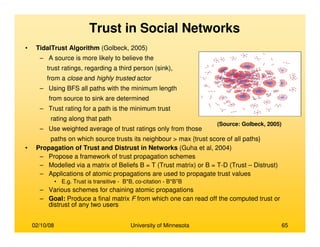
• TidalTrust Algorithm (Golbeck, 2005)
– A source is more likely to believe the
trust ratings, regarding a third person (sink),
from a close and highly trusted actor
– Using BFS all paths with the minimum length
from source to sink are determined
– Trust rating for a path is the minimum trust
rating along that path
– Use weighted average of trust ratings only from those
paths on which source trusts its neighbour > max {trust score of all paths}
• Propagation of Trust and Distrust in Networks (Guha et al, 2004)
– Propose a framework of trust propagation schemes
– Modelled via a matrix of Beliefs B = T (Trust matrix) or B = T-D (Trust – Distrust)
– Applications of atomic propagations are used to propagate trust values
• E.g. Trust is transitive - B*B, co-citation - B*BTB
– Various schemes for chaining atomic propagations
– Goal: Produce a final matrix F from which one can read off the computed trust or
distrust of any two users
(Source: Golbeck, 2005)
02/10/08 University of Minnesota 66
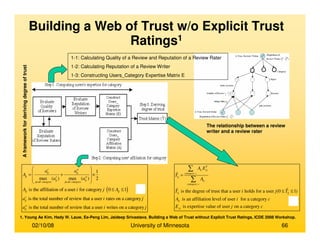
Building a Web of Trust w/o Explicit Trust
Ratings1
Aframeworkforderivingdegreeoftrust
The relationship between a review
writer and a review rater
1-1: Calculating Quality of a Review and Reputation of a Review Rater
1-2: Calculating Reputation of a Review Writer
1-3: Constructing Users_Category Expertise Matrix E
( )
1
max ( ) max ( ) 2
is the affiliation of a user for category 0 1 (4)
is the total number of review that a user rates on a ca
r w
ij ij
ij r w
ij ij
j all category j all category
ij ij
r
ij
a a
A
a a
A i j A
a i
∈ ∈
 
 = + ×
 
 
≤ ≤
tegory
is the total number of review that a user writes on a categoryw
ij
j
a i j
ˆ
ˆ ˆis the degree of trust that a user holds for a user (0 1)
is an affiliation level of user for a category (5)
is expertise
T
ic cj
category c
ij
ic
category c
ij ij
ic
jc
A E
T
A
T i j T
A i c
E
=
≤ ≤
∑
∑
value of user on a categoryj c
1. Young Ae Kim, Hady W. Lauw, Ee-Peng Lim, Jaideep Srivastava, Building a Web of Trust without Explicit Trust Ratings, ICDE 2008 Workshop.
02/10/08 University of Minnesota 67
Characterization of Social NetworksCharacterization of Social Networks
02/10/08 University of Minnesota 68
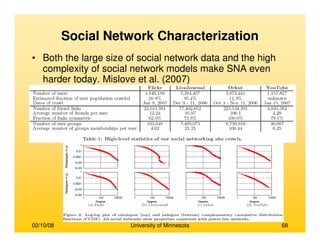
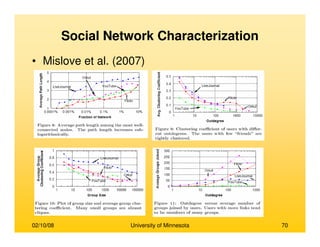
Social Network Characterization
• Both the large size of social network data and the high
complexity of social network models make SNA even
harder today. Mislove et al. (2007)
02/10/08 University of Minnesota 69
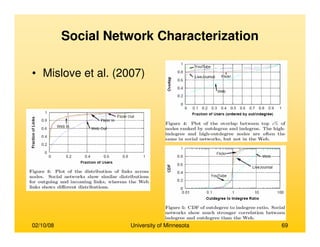
Social Network Characterization
• Mislove et al. (2007)
02/10/08 University of Minnesota 70
Social Network Characterization
• Mislove et al. (2007)
02/10/08 University of Minnesota 71
Social Network Extraction
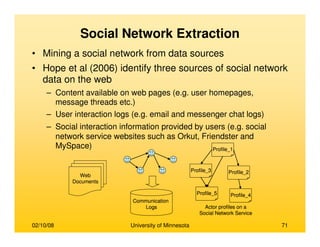
• Mining a social network from data sources
• Hope et al (2006) identify three sources of social network
data on the web
– Content available on web pages (e.g. user homepages,
message threads etc.)
– User interaction logs (e.g. email and messenger chat logs)
– Social interaction information provided by users (e.g. social
network service websites such as Orkut, Friendster and
MySpace)
Web
Documents
Communication
Logs
Profile_3
Profile_1
Profile_5 Profile_4
Profile_2
Actor profiles on a
Social Network Service
Web
Documents
Communication
Logs
Communication
Logs
Profile_3
Profile_1
Profile_5 Profile_4
Profile_2
Actor profiles on a
Social Network Service
Profile_3
Profile_1
Profile_5 Profile_4
Profile_2
Actor profiles on a
Social Network Service
02/10/08 University of Minnesota 72
• IR based extraction from web documents: Adamic and Ader (2003), Makrehchi
and Kamel (2005), Matsumura et al, (2005)
– Construct an “actor-by-term” matrix
– The terms associated with an actor come from web pages/documents
created by or associated with that actor
– IR techniques such as tf-idf, LSI and cosine matching or other intuitive
heuristic measures are used to quantify similarity between two actors’ term
vectors
– The similarity scores are the edge label in the network
• Thresholds on the similarity measure can be used in order to work with binary or
categorical edge labels
• Include edges between an actor and its k-nearest neighbors
• Co-occurrence based extraction from web documents Matsuo et al (2006), Kautz
et al (1997), Mika (2005)
– For each pair of actors X and Y, issue queries of the form “X and Y”, “X or Y”,
“X” and “Y” using a search engine (such as Google) and record
corresponding number of hits
– Use the number of hits to quantify strength of social relation between X & Y
• Jaccard Coefficient – J(x,y) = (hitsX and Y) / (hitsX or Y)
• Overlap Coefficient – OC(x,y) = (hitsX and Y) / min{hitsX,hitsY}
• See (Matsuo 2006) for a discussion on other measures
– Expand the social network by iteratively adding more actors
• Query known actor X and extract unknown actors from first k hits
Social Network Extraction
02/10/08 University of Minnesota 73
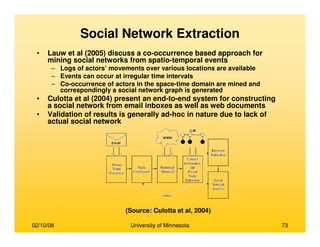
• Lauw et al (2005) discuss a co-occurrence based approach for
mining social networks from spatio-temporal events
– Logs of actors’ movements over various locations are available
– Events can occur at irregular time intervals
– Co-occurrence of actors in the space-time domain are mined and
correspondingly a social network graph is generated
• Culotta et al (2004) present an end-to-end system for constructing
a social network from email inboxes as well as web documents
• Validation of results is generally ad-hoc in nature due to lack of
actual social network
(Source: Culotta et al, 2004)
Social Network Extraction
02/10/08 University of Minnesota 74
• Approximating a large social network allows for easier analyses,
visualization and pattern detection
• Faloutsos et al (2004)
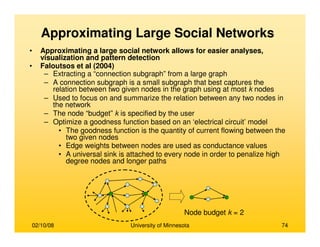
– Extracting a “connection subgraph” from a large graph
– A connection subgraph is a small subgraph that best captures the
relation between two given nodes in the graph using at most k nodes
– Used to focus on and summarize the relation between any two nodes in
the network
– The node “budget” k is specified by the user
– Optimize a goodness function based on an ‘electrical circuit’ model
• The goodness function is the quantity of current flowing between the
two given nodes
• Edge weights between nodes are used as conductance values
• A universal sink is attached to every node in order to penalize high
degree nodes and longer paths
Node budget k = 2
Approximating Large Social Networks
02/10/08 University of Minnesota 75
Approximating Large Social Networks
• Leskovic and Faloutsos (2006) compare various strategies for sampling a
small representative graph from a large graph
– Strategies: Random Node, Random Edge, Random Degree Node,
Random Edge Node, Random Walk etc.
– Various graph distribution properties are compared between samples
and original graph
– Random Walk performs best for sampling from large static graph
– Also discuss sampling history of evolution of a graph
• Wu et al (2004) presents an approach for summarizing scale-free networks
based on shortest paths between vertices
– Determine k number of “median” vertices such that the average shortest
path from any vertex to its closest median vertex is minimized
– Length of shortest path p between any two vertices is approximated by
the sum of
• shortest distance between median vertices for the clusters of the two
vertices + sum of shortest distance between the vertices and their respective
medians
– Median vertices are chosen as the nodes with highest degree, HITS
score, betweenness centrality and random selection
– Further efficiency can be achieved by recursively clustering a graph and
working with a hierarchy of simplified graphs
– Used for approximating shortest paths and their lengths for large graphs
– Around 20% error observed for querying a graph one magnitude smaller
02/10/08 University of Minnesota 76
Anonymity in Social NetworksAnonymity in Social Networks
02/10/08 University of Minnesota 77
Anonymity in Social Networks
• Anonymity in the Wild: Mixes on unstructured networks (Nagaraja,
2007)
– Message anonymity: The ability to protect message
communication (i.e., “who sent the message to whom”) from
being identified by attackers
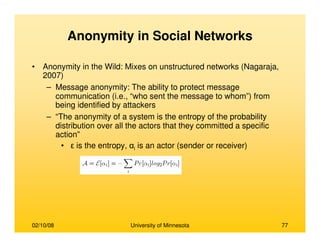
– “The anonymity of a system is the entropy of the probability
distribution over all the actors that they committed a specific
action”
• ε is the entropy, αi is an actor (sender or receiver)
02/10/08 University of Minnesota 78
Anonymity in Social Networks
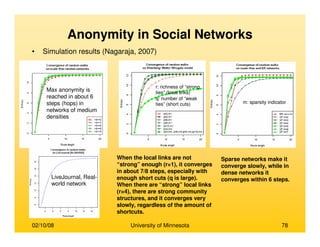
• Simulation results (Nagaraja, 2007)
Max anonymity is
reached in about 6
steps (hops) in
networks of medium
densities
When the local links are not
“strong” enough (r=1), it converges
in about 7/8 steps, especially with
enough short cuts (q is large).
When there are “strong” local links
(r=4), there are strong community
structures, and it converges very
slowly, regardless of the amount of
shortcuts.
r: richness of “strong
ties” (local links)
q: number of “weak
ties” (short cuts) m: sparsity indicator
Sparse networks make it
converge slowly, while in
dense networks it
converges within 6 steps.LiveJournal, Real-
world network
02/10/08 University of Minnesota 79
Anonymity in Social Networks
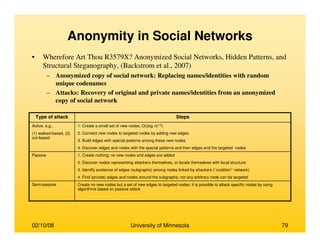
• Wherefore Art Thou R3579X? Anonymized Social Networks, Hidden Patterns, and
Structural Steganography, (Backstrom et al., 2007)
– Anonymized copy of social network: Replacing names/identities with random
unique codenames
– Attacks: Recovery of original and private names/identities from an anonymized
copy of social network
StepsType of attack
Create no new nodes but a set of new edges to targeted nodes; it is possible to attack specific nodes by using
algorithms based on passive attack
Semi-passive
1. Create nothing; no new nodes and edges are added
2. Discover nodes representing attackers themselves, or locate themselves with local structure
3. Identify existence of edges (subgraphs) among nodes linked by attackers (“coalition” network)
4. Find (private) edges and nodes around the subgraphs; not any arbitrary node can be targeted
Passive
1. Create a small set of new nodes; O((log n)1/2)
2. Connect new nodes to targeted nodes by adding new edges
3. Build edges with special patterns among these new nodes
4. Discover edges and nodes with the special patterns and then edges and the targeted nodes
Active, e.g.,
(1) walked-based, (2)
cut-based
02/10/08 University of Minnesota 80
Other Research in Social NetworksOther Research in Social Networks
02/10/08 University of Minnesota 81
Uncertainty in Social Networks
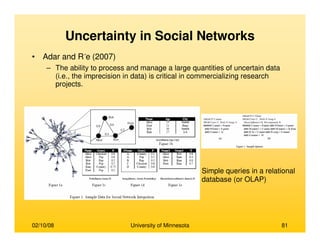
• Adar and R´e (2007)
– The ability to process and manage a large quantities of uncertain data
(i.e., the imprecision in data) is critical in commercializing research
projects.
Simple queries in a relational
database (or OLAP)
02/10/08 University of Minnesota 82
Visualization
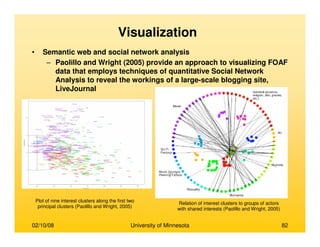
• Semantic web and social network analysis
– Paolillo and Wright (2005) provide an approach to visualizing FOAF
data that employs techniques of quantitative Social Network
Analysis to reveal the workings of a large-scale blogging site,
LiveJournal
Relation of interest clusters to groups of actors
with shared interests (Paolillo and Wright, 2005)
Plot of nine interest clusters along the first two
principal clusters (Paolillo and Wright, 2005)
02/10/08 University of Minnesota 83
SNA from IM Networks
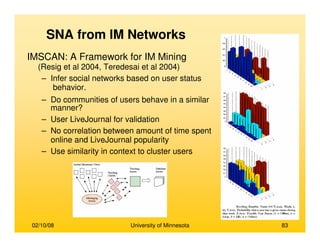
IMSCAN: A Framework for IM Mining
(Resig et al 2004, Teredesai et al 2004)
– Infer social networks based on user status
behavior.
– Do communities of users behave in a similar
manner?
– User LiveJournal for validation
– No correlation between amount of time spent
online and LiveJournal popularity
– Use similarity in context to cluster users
02/10/08 University of Minnesota 84
SNA from IM Networks
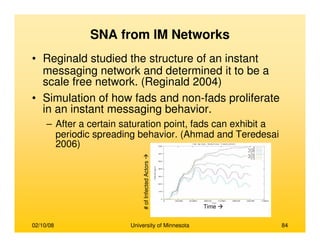
• Reginald studied the structure of an instant
messaging network and determined it to be a
scale free network. (Reginald 2004)
• Simulation of how fads and non-fads proliferate
in an instant messaging behavior.
– After a certain saturation point, fads can exhibit a
periodic spreading behavior. (Ahmad and Teredesai
2006)
Time
#ofInfectedActors
02/10/08 University of Minnesota 85
SNA from Online Networks
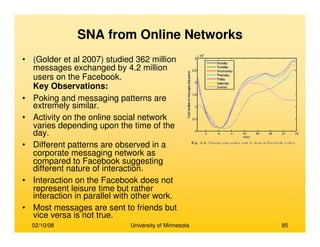
• (Golder et al 2007) studied 362 million
messages exchanged by 4.2 million
users on the Facebook.
Key Observations:
• Poking and messaging patterns are
extremely similar.
• Activity on the online social network
varies depending upon the time of the
day.
• Different patterns are observed in a
corporate messaging network as
compared to Facebook suggesting
different nature of interaction.
• Interaction on the Facebook does not
represent leisure time but rather
interaction in parallel with other work.
• Most messages are sent to friends but
vice versa is not true.
02/10/08 University of Minnesota 86
Learning Social Networks
• Learning Social Networks Using Multiple Resampling Method
(Makrehchi and Kamel, 2007)
– Goal: To learn unknown relations
• Application: Learning relations in an FOAF (Friend Of A Friend) network
– Learning social network ↔ text classification
• SVM with linear kernel is employed (to handle high dimensionality)
– Actor modeling: vector of documents, e.g., homepage, blog, CV, etc.
– Relation modeling: a relation vector is a vector of words from
documents associated with actors
• Aggregate document vectors between two actors using MAX operator
• Known relation is the label for a relation vector
– Social networks are so sparse that training data become imbalance
• To re-balance training data: undersampling the majority, oversampling the
minority
02/10/08 University of Minnesota 87
Alias Detection
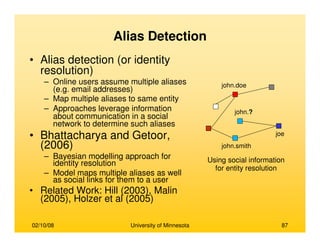
• Alias detection (or identity
resolution)
– Online users assume multiple aliases
(e.g. email addresses)
– Map multiple aliases to same entity
– Approaches leverage information
about communication in a social
network to determine such aliases
• Bhattacharya and Getoor,
(2006)
– Bayesian modelling approach for
identity resolution
– Model maps multiple aliases as well
as social links for them to a user
• Related Work: Hill (2003), Malin
(2005), Holzer et al (2005)
joe
john.smith
john.doe
john.?
Using social information
for entity resolution
02/10/08 University of Minnesota 88
Relationship Labeling in Social Networks
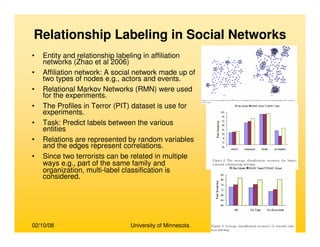
• Entity and relationship labeling in affiliation
networks (Zhao et al 2006)
• Affiliation network: A social network made up of
two types of nodes e.g., actors and events.
• Relational Markov Networks (RMN) were used
for the experiments.
• The Profiles in Terror (PIT) dataset is use for
experiments.
• Task: Predict labels between the various
entities
• Relations are represented by random variables
and the edges represent correlations.
• Since two terrorists can be related in multiple
ways e.g., part of the same family and
organization, multi-label classification is
considered.
02/10/08 University of Minnesota 89
Quadratic Assignment Procedure
• Problem: Are people more likely to be friends if they
share similar characteristics, such as being about the
same age?
• Observation: A significant correlation exists between the
two.
• Hypothesis: Is the correlation observed because
proximity constrains their friendship networks and advice
networks
• How to check for spurious correlations in dyadic data (in
Social Networks)?
• QAP (Quadratic Assignment Procedure) check if two
variables are spuriously correlated with one another
• Combines least squares estimation with Hubert's non-
parametric test
(Krackhardt 1987)
02/10/08 University of Minnesota 90
SNA Toolkit
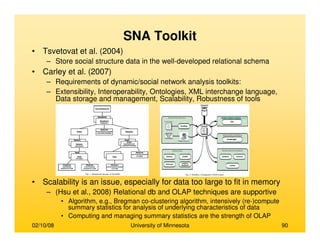
• Tsvetovat et al. (2004)
– Store social structure data in the well-developed relational schema
• Carley et al. (2007)
– Requirements of dynamic/social network analysis toolkits:
– Extensibility, Interoperability, Ontologies, XML interchange language,
Data storage and management, Scalability, Robustness of tools
• Scalability is an issue, especially for data too large to fit in memory
– (Hsu et al., 2008) Relational db and OLAP techniques are supportive
• Algorithm, e.g., Bregman co-clustering algorithm, intensively (re-)compute
summary statistics for analysis of underlying characteristics of data
• Computing and managing summary statistics are the strength of OLAP
02/10/08 University of Minnesota 91
Application of Data Mining Based SocialApplication of Data Mining Based Social
Network Analysis TechniquesNetwork Analysis Techniques
02/10/08 University of Minnesota 92
Applications (Outline)
• Organization Theory
• Semantic Web
• Viral Marketing
• Social Influence and E-Commerce
• Social Computing
• Criminal Network Analysis
• Newsgroup Message Classification
• Social Recommendation Systems
• Terrorism and Crime Related Weblog Social
Network
02/10/08 University of Minnesota 93
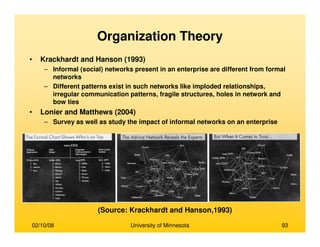
Organization Theory
• Krackhardt and Hanson (1993)
– Informal (social) networks present in an enterprise are different from formal
networks
– Different patterns exist in such networks like imploded relationships,
irregular communication patterns, fragile structures, holes in network and
bow ties
• Lonier and Matthews (2004)
– Survey as well as study the impact of informal networks on an enterprise
(Source: Krackhardt and Hanson,1993)
02/10/08 University of Minnesota 94
Extracting Co-appearance Networks
among Organizations
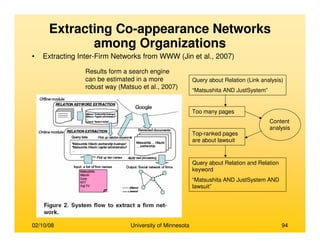
• Extracting Inter-Firm Networks from WWW (Jin et al., 2007)
Query about Relation (Link analysis)
“Matsushita AND JustSystem”
Too many pages
Top-ranked pages
are about lawsuit
Query about Relation and Relation
keyword
“Matsushita AND JustSystem AND
lawsuit”
Content
analysis
Results form a search engine
can be estimated in a more
robust way (Matsuo et al., 2007)
02/10/08 University of Minnesota 95
Semantic Web Community
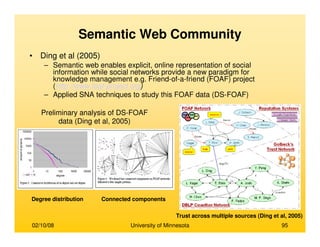
• Ding et al (2005)
– Semantic web enables explicit, online representation of social
information while social networks provide a new paradigm for
knowledge management e.g. Friend-of-a-friend (FOAF) project
(http://www.foaf-project.org)
– Applied SNA techniques to study this FOAF data (DS-FOAF)
Trust across multiple sources (Ding et al, 2005)
Preliminary analysis of DS-FOAF
data (Ding et al, 2005)
Degree distribution Connected components
02/10/08 University of Minnesota 96
Semantic Web and SNA
• The friend of a friend (FOAF) project has enabled collection of
machine readable data on online social interactions between
individuals. http://www.foaf-project.org
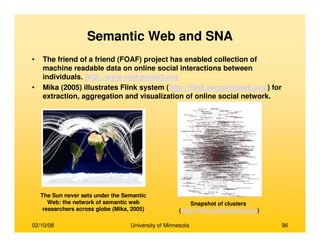
• Mika (2005) illustrates Flink system (http://flink.semanticweb.org/) for
extraction, aggregation and visualization of online social network.
The Sun never sets under the Semantic
Web: the network of semantic web
researchers across globe (Mika, 2005)
Snapshot of clusters
(http://flink.semanticweb.org/)
02/10/08 University of Minnesota 97
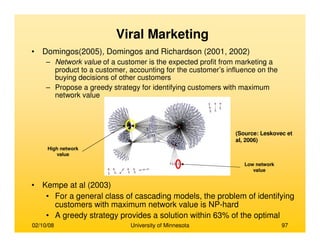
• Domingos(2005), Domingos and Richardson (2001, 2002)
– Network value of a customer is the expected profit from marketing a
product to a customer, accounting for the customer’s influence on the
buying decisions of other customers
– Propose a greedy strategy for identifying customers with maximum
network value
• Kempe at al (2003)
• For a general class of cascading models, the problem of identifying
customers with maximum network value is NP-hard
• A greedy strategy provides a solution within 63% of the optimal
Viral Marketing
(Source: Leskovec et
al, 2006)
High network
value
Low network
value
02/10/08 University of Minnesota 98
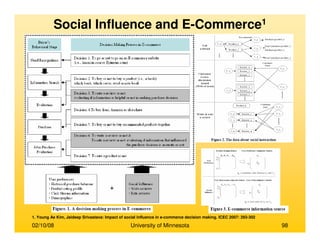
Social Influence and E-Commerce1
1. Young Ae Kim, Jaideep Srivastava: Impact of social influence in e-commerce decision making. ICEC 2007: 293-302
02/10/08 University of Minnesota 99
Social Computing
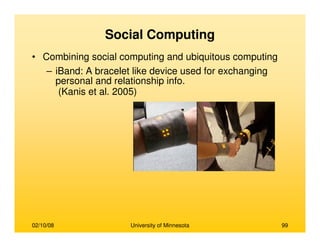
• Combining social computing and ubiquitous computing
– iBand: A bracelet like device used for exchanging
personal and relationship info.
(Kanis et al. 2005)
02/10/08 University of Minnesota 100
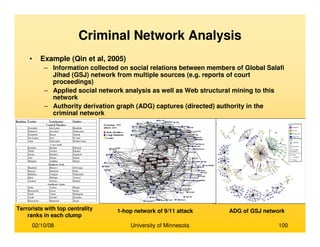
• Example (Qin et al, 2005)
– Information collected on social relations between members of Global Salafi
Jihad (GSJ) network from multiple sources (e.g. reports of court
proceedings)
– Applied social network analysis as well as Web structural mining to this
network
– Authority derivation graph (ADG) captures (directed) authority in the
criminal network
Criminal Network Analysis
Terrorists with top centrality
ranks in each clump
1-hop network of 9/11 attack ADG of GSJ network
02/10/08 University of Minnesota 101
Criminal Network Analysis
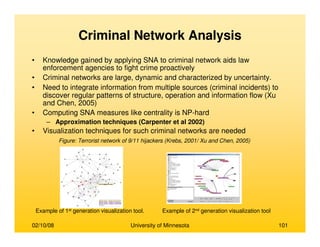
• Knowledge gained by applying SNA to criminal network aids law
enforcement agencies to fight crime proactively
• Criminal networks are large, dynamic and characterized by uncertainty.
• Need to integrate information from multiple sources (criminal incidents) to
discover regular patterns of structure, operation and information flow (Xu
and Chen, 2005)
• Computing SNA measures like centrality is NP-hard
– Approximation techniques (Carpenter et al 2002)
• Visualization techniques for such criminal networks are needed
Example of 1st generation visualization tool. Example of 2nd generation visualization tool
Figure: Terrorist network of 9/11 hijackers (Krebs, 2001/ Xu and Chen, 2005)
02/10/08 University of Minnesota 102
Newsgroup Message Classification
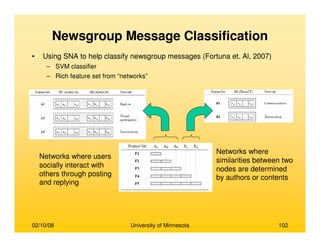
• Using SNA to help classify newsgroup messages (Fortuna et. Al, 2007)
– SVM classifier
– Rich feature set from “networks”
Networks where users
socially interact with
others through posting
and replying
Networks where
similarities between two
nodes are determined
by authors or contents
02/10/08 University of Minnesota 103
Social Recommendation Systems
• Initial approaches
– Anonymous recommendations: treat individuals preferences as independent of each
other
– Failure to account for influence of individual’s social network on his/her preferences
• Kautz et al (1997)
– Incorporate information of social networks into recommendation systems
– Enables more focused and effective search
• McDonald (2003)
– Analyzes the use of social networks in recommendation systems
– Highlights the need to balance between purely social match vs. expert match
– Aggregate social networks may not work best for individuals
• Palau et al, (2004)
– Apply social network analysis techniques to represent & analyze collaboration in
recommender systems
• Lam (2004)
– SNACK - an automated collaborative system that incorporates social information for
recommendations
– Mitigates the problem of cold-start, i.e. recommending to a user who not yet specified
preferences
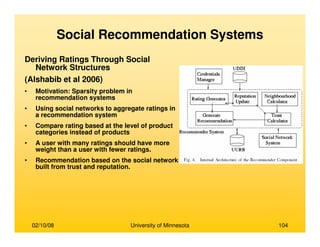
02/10/08 University of Minnesota 104
Social Recommendation Systems
Deriving Ratings Through Social
Network Structures
(Alshabib et al 2006)
• Motivation: Sparsity problem in
recommendation systems
• Using social networks to aggregate ratings in
a recommendation system
• Compare rating based at the level of product
categories instead of products
• A user with many ratings should have more
weight than a user with fewer ratings.
• Recommendation based on the social network
built from trust and reputation.
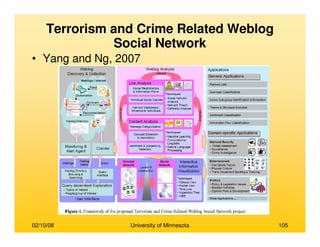
02/10/08 University of Minnesota 105
Terrorism and Crime Related Weblog
Social Network
• Yang and Ng, 2007
02/10/08 University of Minnesota 106
Emerging Applications in SNAEmerging Applications in SNA
02/10/08 University of Minnesota 107
Example of E-mail Communication
• A sends an e-mail to B
– With Cc to C
– And Bcc to D
• C forwards this e-mail to E
• From analyzing the header, we can infer
– A and D know that A, B, C and D know about this e-mail
– B and C know that A, B and C know about this e-mail
– C also knows that E knows about this e-mail
– D also knows that B and C do not know that it knows about this e-
mail; and that A knows this fact
– E knows that A, B and C exchanged this e-mail; and that neither
A nor B know that it knows about it
– and so on and so forth …
02/10/08 University of Minnesota 108
Modeling Pair-wise Communication
• Modeling pair-wise communication between actors
– Consider the pair of actors (Ax,Ay)
– Communication from Ax to Ay is modeled using the Bernoulli distribution
L(x,y)=[p,1-p]
– Where,
• p = (# of emails from Ax with Ay as recipient)/(total # of emails
exchanged in the network)
• For N actors there are N(N-1) such pairs and therefore N(N-1) Bernoulli
distributions
• Every email is a Bernoulli trial where success for L(x,y) is realized if Ax is the
sender and Ay is a recipient
Modeling an agent’s belief about global
communication
• Based on its observations, each actor entertains certain beliefs about the
communication strength between all actors in the network
• A belief about the communication expressed by L(x,y) is modeled as the Beta
distribution, J(x,y), over the parameter of L(x,y)
• Thus, belief is a probability distribution over all possible communication strengths for
a given ordered pair of actors (Ax,Ay)
02/10/08 University of Minnesota 109
Measures for Perceptual Closeness
• We analyze the following aspects
– Closeness between an actor’s belief and reality, i.e. “true
knowledge” of an actor
– Closeness between the beliefs of two actors, i.e. the “agreement”
between two actors
• We define two measures, r-closeness and a-closeness for measuring
the closeness to reality and closeness in the belief states of two actors
respectively
02/10/08 University of Minnesota 110
Perceptual Closeness Measures
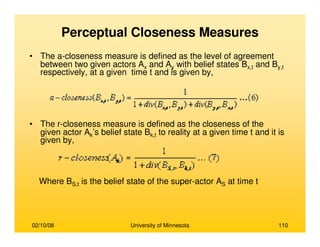
• The a-closeness measure is defined as the level of agreement
between two given actors Ax and Ay with belief states Bx,t and By,t
respectively, at a given time t and is given by,
• The r-closeness measure is defined as the closeness of the
given actor Ak’s belief state Bk,t to reality at a given time t and it is
given by,
Where BS,t is the belief state of the super-actor AS at time t
02/10/08 University of Minnesota 111
Online Games
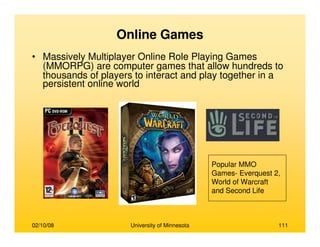
• Massively Multiplayer Online Role Playing Games
(MMORPG) are computer games that allow hundreds to
thousands of players to interact and play together in a
persistent online world
Popular MMO
Games- Everquest 2,
World of Warcraft
and Second Life
02/10/08 University of Minnesota 112
MMORPG – Everquest 2
• MMORPGs (MMO Role Playing Games) are the most popular of
MMO Games
– Examples: World of Warcraft by Blizzard and Everquest 2 by Sony
Online Entertainment
• Various logs of players’ behavior are maintained
• Player activity in the environment as well his/her chat is recorded at
regular time instances, each such record carries a time stamp and a
location ID
• Some of the logs capture different aspects of player behavior
– Guild membership history (member of, kicked out of, joined, left)
– Achievements (Quests completed, experience gained)
– Items exchanged and sold/bought between players
– Economy (Items/properties possessed/sold/bought, banking activity,
looting, items found/crafted)
– Faction membership (faction affiliation, record of actions affecting
faction affiliation)
02/10/08 University of Minnesota 113
Impact on Social Science
• Interactions in MMO Gaming environments are real
• MMO Games provide sociologists with a unique source of data
allowing them to observe real interactions in the context of a
complete environment on a very fine granularity
• Gets around the serious issue of unbiased complete data collection
• Analysis of such data presents novel computational challenges
– The scale of data is much larger than normally encountered in
traditional social network analysis
– The number of environment variables captured is greater
– Player interaction data is captured at a much finer granularity
• MMORPG data requires models capable of handling large amounts
of data as well as accounting for the many environment variables
impacting the social structure
02/10/08 University of Minnesota 114
Social Science Research with Everquest
2 Data
• Objective of our research from a social science point of view is to
improve understanding of the dynamics of group behavior
• Traditional analysis of dynamics of group behavior works with a
fixed and isolated set of individuals
• MMORPG data enables us to look at dynamics of groups in a new
way
– Multiple groups are part of a large social network
– Individuals from the social network can join or leave groups
– Groups are not isolated and some of them can be related i.e. they may
be geared towards specific objectives, each of which works towards a
larger goal (e.g. different teams working towards disaster recovery)
– The emergence, destruction as well as dynamic memberships of the
groups depend on the underlying social network as well as the
environment
02/10/08 University of Minnesota 115
DM Challenges for Social Science
Research with Everquest 2 Data
• Inferring player relationships and group memberships from game
logs
– Basic elements of the underlying social network such player-player and
layer-group relationships need to be extracted from the game logs
• Developing measures for studying player and group characteristics
– Novel measures need to be developed that measure individual and
group relationships for dynamic groups
– Novel metrics must also be developed for quantifying relationships
between the groups themselves, the groups and the underlying social
network as well as the groups and the environment
• Efficient computational models for analyzing group behavior
– Extend existing group analysis techniques from the social science
domain to handle large datasets
– Develop novel group analysis techniques that account for the dynamic
multiple group scenario as well as the data scale
02/10/08 University of Minnesota 116
Conclusion
• Computers have provided the ideal infrastructure
for
– Fostering social interaction
– Capture it at a very fine granularity
– Practically no reporting bias
• Fertile research area for data mining
research
• The emerging field of computational social
science has the potential to revolutionize social
sciences much as
– Gene Sequencing revolutionized study of genetics
– The electron microscope revolutionized chemistry
02/10/08 University of Minnesota 117
ReferencesReferences
02/10/08 University of Minnesota 118
1. L. Adamic, R.M.Lukose, A.R.Puniyani and B.A.Huberman. Search in power law networks. Phys. Rev. E 64,
046135(2001).
2. L. Adamic and E. Ader. Friends and Neighbors on the web. Social Netowrks, 25(3), pp 211-230, 2003.
3. Ahmad, Muhammad A., Teredesai, Ankur., Modeling Proliferation of Ideas in Online Social Networks,
Proceedings of the 5th Australasian Data Mining Conference, November 29-30 2006, Held in conjunction with
the 19th Australian Joint Conference on Artificial Intelligence, Sydney, AUS.
4. Ahmad, Muhammad A., Srivastava, Jaideep An Ant Colony Optimization Approach to Expert Identification in
Social Networks First International Workshop on Social Computing, Behavioral Modeling, and Prediction
Arizona April, 2008
5. Réka Albert; Albert-László Barabási, Topology of Evolving Networks: Local Events and Universality Physical
Review Letters, Volume 85, Issue 24, December 11, 2000, pp.5234-5237
6. Hameeda Alshabib, Omer F. Rana, and Ali Shaikh Ali, "Deriving Ratings Through Social Network Structures,"
Proceedings First International Conference on Availability, Reliability and Security (ARES'06), 2006.
7. B.W.Bader, R. Harshman and T. G. Kolda. Temporal Analysis of social networks using three way DEDICOM.
(Technical Report), SAND2006-2161, Sandia National Laboratories, 2006.
8. Backstrom , L., Dwork, C., Kleinberg, J.: Wherefore Art Thou R3579X? Anonymized Social Networks, Hidden
Patterns, and Structural Steganography, WWW, 2007
9. A L Barabasi, R Albert. Emergence of Scaling in Random networks. Science 15 October 1999:Vol. 286. no.
5439, pp. 509 - 512
10. Indrajit Bhattacharya, Lise Getoor: A Latent Dirichlet Model for Unsupervised Entity Resolution.
SDM 2006
11. S.P. Borgatti, and P. Foster., P. 2003. The network paradigm in organizational research: A review and
typology. Journal of Management. 29(6): 991-1013
12. U. Brandes. A Faster Algorithm for Betweenness Centrality. Journal of Mathematical Sociology 25(2):163-177,
2001.
13. G.G. Van De Bunt, M.A.J. Van Duijn, T.A.B Snijders Friendship Networks Through Time: An Actor-Oriented
Dynamic Statistical Network Organization Theory, Volume 5, Number 2, July 1999, pp. 167-192(26).
14. Tim Carnes, Chandrashekhar Nagarajan, Stefan Wild, and Anke van Zuylen. Maximizing Influence in a
Competitive Social Network: A Follower's Perspective
15. Cassi, Lorenzo. Information, Knowledge and Social Networks: Is a New Buzzword coming up? DRUID
Academy Winter 2003 PhD Conference.
References
02/10/08 University of Minnesota 119
References
1. Chiang, Yen-Sheng (2007) 'Birds of Moderately Different Feathers: Bandwagon Dynamics and the Threshold
Heterogeneity of Network Neighbors', The Journal of Mathematical Sociology, 31:1, 47 – 69
15. A. Clauset, M.E.J.Newman and C.Moore. Finding community structure in very large networks. Phys. Rev. E 70,
0066111(2004).
16. N. Contractor. Multi-theoretical multilevel MTML models to study the emergence of networks, NetSci conference,
2006.
17. A. Culotta, R.Bekkerman and A.McCallum. Extracting social networks and contact information from email and the
web. Conference on Email and Spam (CEAS), 2004.
18. J. Diesner and K.M. Carley. Exploration of Communication Networks from the Enron Email Corpus. Workshop on
Link Analysis, Counterterrorism and Security , In SIAM International Conference on Data Mining, 2005.
19. Li Ding, Tim Finin and Anupam Joshi. Analyzing Social Networks on the Semantic Web. IEEE Intelligent Systems,
2005.
20. Pedro Domingos and Matthew Richardson. Mining the Network Value of Customers. Proceedings of the Seventh
International Conference on Knowledge Discovery and Data Mining (pp. 57-66), 2001. San Francisco, CA: ACM
Press.
21. Pedro Domingos. Mining Social Networks for Viral Marketing (short paper). IEEE Intelligent Systems, 20(1), 80-82,
2005.
22. C. Faloutsos, K.S. McCurley and A. Tomkins. Fast discovery of connection subgraphs. ACM SIGKDD 2004: 118-
127.
23. Fortuna, B., Rodrigues, E. M., and Milic-Frayling, N.: Improving the classification of newsgroup messages through
social network analysis, CIKM '07, 877-880, 2007
24. L.C. Freeman, Visualizing Social Networks. Journal of Social Structure, 2000.
25. Linton C. Freeman. See you in the Funny Papers: Cartoons and Social Networks. CONNECTIONS, 23(1): 32-42,
2000.
26. Yupeng Fu, Rongjing Xiang, Yiqun Liu, Min Zhang, Shaoping Ma Finding Experts Using Social Network Analysis
2007 IEEE/WIC/ACM International Conference on Web Intelligence
27. L. Getoor, N. Friedman, D. Koller and B. Taskar. Learning Probabilistic Models of Link Structure. Journal of
Machine Learning Research, 2002.
28. L. Getoor. Link mining: a new data mining challenge. SIGKDD Explorations, 5(1):84–89, 2003.
29. M.Girvan and M.E.J.Newman. Community structure in social and biological networks. Proc. Natl. Acad. Sci. USA
99, 7821-7826, 2002.
02/10/08 University of Minnesota 120
References
30. J. Golbeck, B. Parsia, J. Hendler. Trust Networks on the Semantic Web. In Proceedings of Cooperative Intelligent
Agents 2003, Helsinki, Finland, August 27-29.
31. Golder S A, Wilkinson D and Huberman B A (2007) Rhythms of social interaction: Messaging within a massive
online network, 3rd International Conference on Communities and Technologies (CT2007), East Lansing, MI.
32. M Granovetter. Threshold models of collective behaviour. American Journal of Sociology, 83 (6): 1420-1443, 1978.
33. R. Guha, R. Kumar, P. Raghavan and A. Tomkins. Propagation of Trust and Distrust. In Proceedings of 13th
International World Wide Web Conference, 2004.
34. M. Harada, S. Sato and K. Kazama. Finding authoritative people from the web. In proceedings of the 4th
ACM/IEEE-CS joint conference on digital libraries. pp 306-313, 2004.
35. M.A.Hasan, V.Chaoji, S.Salem and M.Zaki. Link prediction using supervised learning. In Workshop on Link
Analysis, Counterterrorism and Security at SIAM International Conference on Data Mining, 2006.
36. Heer, J. Exploring Enron: Visual Data Mining. http://www.cs.berkeley.edu/~jheer/anlp/final/, 2005.
37. S. Hill. Social network relational vectors for anonymous identity matching. In Proceedings of the IJCAI Workshop
on Learning Statistical Models from Relational Data, Acapulco,Mexico, 2003.
38. P. D. Hoff, A. E. Raftery, and M. S. Handcock. Latent space approaches to social network analysis. Journal of the
American Statistical Association, 97:1090--1098, 2002.
39. Holzer R, Malin B, and Sweeney L.Email Alias Detection Using Network Analysis. In Proceedings of the ACM
SIGKDD Workshop on Link Discovery: Issues, Approaches, and Applications. Chicago, IL. August 2005.
40. T.Hope, T. Nishimura and H.Takeda. An integrated method for social network extraction. In WWW'06:
Proceedings of 15th international conference on World Wide Web, pp 845-846, New York, NY, USA, 2006, ACM
Press.
41. Hsu, K.-W., Banerjee, A., Srivastava, J.: I/O Scalable Bregman Co-clustering, 12th Pacific-Asia Conference on
Knowledge Discovery and Data Mining (PAKDD 2008), Osaka, Japan, May 2008.
42. Jackson, Matthew O., 2003. "A survey of models of network formation: Stability and efficiency," Working Papers
1161, California Institute of Technology, Division of the Humanities and Social Sciences.
43. Jin, Y., Matsuo, Y., Ishizuka, M.: Extracting Inter-Firm Networks from WorldWideWeb, CEC/EEE, 635-642, 2007
44. Marije Kanis, Niall Winters, Stefan Agamanolis, Anna Gavin, and Cian Cullinan, Toward Wearable Social
Networking with iBand, CHI 2005 Extended Abstracts on Human Factors in Computing Systems, Portland,
Oregon, 2 - 7 April 2005, ACM Press.
02/10/08 University of Minnesota 121
References
45. Kautz, H., Selman, B., and Shah, M. 1997. Referral Web: combining social networks and collaborative filtering. Commun. ACM 40, 3
(Mar. 1997), 63-65.
46. David Kempe, Jon M. Kleinberg, Éva Tardos: Maximizing the spread of influence through a social network. KDD 2003: 137-146
47. Kermack, W. O. and McKendrick, A. G. "A Contribution to the Mathematical Theory of Epidemics." Proc. Roy. Soc. Lond. A 115, 700-
721, 1927.
48. Young Ae Kim, Jaideep Srivastava: Impact of social influence in e-commerce decision making. ICEC 2007: 293-302
49. Jon M. Kleinberg. "Authoritative Sources in a Hyperlinked Environment" in Proceedings of ACM-SIAM Symposium on Discrete
Algorithms, 668-677, January 1998.
50. Jon Kleinberg. The small-world phenomenon: An algorithmic perspective. Cornell Computer Science Technical Report 99-1776,
October 1999
51. J.Kleinberg. Hubs, Authorities and Communities. ACM Computing Surveys, 31(4), December 1999.
52. Jon Kleinberg. Small-World Phenomena and the Dynamics of Information. Advances in Neural Information Processing Systems
(NIPS) 14, 2001.
53. J. Kleinberg and P. Raghavan. Query Incentive Networks. In FOCS '05: 46th Annual IEEE Symposium on Foundations of Computer
Science. Pittsburgh, PA, 132--141, 2005.
54. David Krackhardt, 1987. Qap partialling as a test of spuriousness. Social Networks, 9, 171-186
55. David Krackhardt and Jeffrey R. Hanson. Informal Networks: The Company Behind the Chart. Harvard Business Review, 1993.
56. Krebs, V. E. Mapping networks of terrorist cells. Connections 24, 3 (2001), 43–52.
57. Lam, C. 2004. SNACK: incorporating social network information in automated collaborative filtering. In Proceedings of the 5th ACM
Conference on Electronic Commerce (New York, NY, USA, May 17 - 20, 2004). EC '04.
58. H.Lauw, E-P.Lim, T.T.Tan and H.H. Pang. Mining social network from spatio-temporal events. In Workshop on Link Analysis,
Counterterrorism and Security at SIAM International Conference on Data Mining, 2005.
59. Jure Leskovec, Lada Adamic, and Bernardo Huberman. The Dynamics of Viral Marketing. EC'06.
60. J.Leskovic and C.Faloutsos. Sampling from large graphs. ACM SIGKDD 2006: 631-636.
61. Jure Leskovec, Mary McGlohon, Christos Faloutsos, Natalie S. Glance, Matthew Hurst: Patterns of Cascading Behavior in Large Blog
Graphs. SDM 2007
62. Juan-Zi Li, Jie Tang, Jing Zhang, Qiong Luo, Yunhao Liu, MingCai Hong. EOS: expertise oriented search using social networks. In
Proceedings of WWW'2007. 1271-1272
02/10/08 University of Minnesota 122
References
61. D. Liben-Nowell and J.Kleinberg. The link prediction problem for social networks. In CIKM'03: Proceedings of the
14th ACM international conference on Information and Knowledge Management, pp 556-559. ACM Press, 2003.
62. Hugo Liu and Pattie Maes. InterestMap: Harvesting Social Network Profiles for Recommendations. Workshop:
Beyond Personalization, IUI'05, 2005.
63. Lonier, T. & Matthews, C., 2004. "Measuring the Impact of Social Networks on Entrepreneurial Success: The
Master Mind Principle." Presented at the 2004 Babson Kauffman Entrepreneurship Research Conference,
Glasgow, Scotland, June.
64. M. Makrehchi and M.S. Kamel. Building social networks from web documents: A text mining approach. In the 2nd
LORNET Scientific Conference, 2005.
65. Makrehchi, M. and Kamel, M. S.: Learning Social Networks Using Multiple Resampling Method, IEEE International
Conference on Systems, Man and Cybernetics, 2007
66. B. Malin. Unsupervised name disambiguation via social network similarity. In Proc. SIAM Wksp on Link Analysis,
Counterterrorism, and Security, pages 93–102, Newport Beach, CA, 2005.
67. Murata, Tsuyoshi Moriyasu, Sakiko Link Prediction of Social Networks Based on Weighted Proximity Measures
IEEE/WIC/ACM International Conference on Web Intelligence: 85-88: 2-5 Nov. 2007
68. P. Marsden 1990. “Network Data and Measurement.” Annual Review of Sociology, Volume 16 (1990), pp. 435-
463.
69. Y.Matsao, J.Mori, M. Hamasaki, K. Ishida, T.Nishimura, H.Takeda, K.Hasida and M. Ishizuka. Polyphnet: an
advanced social network extraction system from the web. In WWW'06: Proceedings of 15th international
conference on World Wide Web, pp 397-406, New York, NY, USA, 2006, ACM Press.
70. Matsuo, Y., Tomobe, H., and Nishimura, T.: Robust Estimation of Google Counts for Social Network Extraction.
AAAI, 1395-1401, 2007
71. McDonald, D. W. 2003. Recommending collaboration with social networks: a comparative evaluation. In
Proceedings of the SIGCHI Conference on Human Factors in Computing Systems (Ft. Lauderdale, Florida, USA,
April 05 - 10, 2003). CHI '03.
72. Peter Mika. Flink: Using Semantic Web Technology for the Presentation and Analysis of Online Social Networks.
Journal of Web Semantics 3(2), Elsevier, 2005.
73. S. Milgram, ``The small world problem,'' Psychology Today 1, 61 (1967).
74. Martina Morris. Network Epidemiology: A Handbook for Survey Design and Data Collection (2004). London:
Oxford University Press.
02/10/08 University of Minnesota 123
References
75. N. Matsumura, D.E.Goldberg and X.Llor. Mining directed social network from message board. In WWW'05:
Proceedings of 14th international conference on World Wide Web, pp 1092-1093, New York, NY, USA, 2005,
ACM Press.
76. Nagaraja, S.: Anonymity in the Wild: Mixes on unstructured networks, Privacy Enhancing Technologies, 2007
77. M. E. J. Newman.. Who is the best connected scientist? A study of scientific coauthorship networks. Phys.Rev.
E64 (2001) 016131.
78. M. E. J. Newman. The structure and function of complex networks. SIAM Review, 45(2):167-- 256, 2003.
79. M.E.J.Newman. Fast algorithm for detecting community structure in networks. Phys. Rev. E 69, 066133, 2004.
80. M.E.J.Newman. Modularity and community structure in networks. Proc. of Natl Acad. of Sci. USA 103, 8577-8582,
2006.
81. J. Palau, M. Montaner, and B. Lopez. Collaboration analysis in recommender systems using social networks. In
Eighth Intl. Workshop on Cooperative Info. Agents (CIA'04), 2004.
82. Palla, G., Barabási, A.-L., and Vicsek, T.: Quantifying social group evolution, Nature 446, 664-667, 2007
83. Paolillo, J.C. and Wright, E. Social Network Analysis on the Semantic Web: Techniques and challenges for
Visualizing FOAF. Visualizing the Semantic Web (Draft Chapter), in press.,
84. Jialun Qin, Jennifer J. Xu, Daning Hu, Marc Sageman and Hsinchun Chen: Analyzing Terrorist Networks: A Case
Study of the Global Salafi Jihad Network. Intelligence and Security Informatics, 2005.
85. Raghavan , U., Albert, R., and Kumara, S.: Near linear time algorithm to detect community structures in large
scale networks, Phys. Rev. E 76, 036106, 2007
86. Resig, J., Teredesai, A., Dawara, S., & Homan, C., (2004) Extracting Social Networks from Instant Messaging
Populations. KDD 2004 Link Discovery Workshop.
87. Matthew Richardson and Pedro Domingos. 2002. Mining knowledge-sharing sites for viral marketing. In
Proceedings of the Eighth ACM SIGKDD international Conference on Knowledge Discovery and Data Mining
(Edmonton, Alberta, Canada, July 23 - 26, 2002). KDD '02. ACM Press, New York, NY, 61-70.
88. Kazumi Saito, Ryohei Nakano, Masahiro Kimura: Prediction of Link Attachments by Estimating Probabilities of
Information Propagation. KES (3) 2007: 235-242
89. P. Sarkar and A. Moore. Dynamic social network analysis using latent space models. ACM SIGKDD Explorations
Newsletter, 7(2), pp 31-40, 2005.
90. Schelling, T (1978). Micromotives and macrobehavior. New York: W. W. Norton.
02/10/08 University of Minnesota 124
References
91. Shetty, J., & Adibi, J. The Enron email dataset database schema and brief statistical report (Technical Report). Information Sciences
Institute, 2004.
92. J.Shetty and J.Adibi. Discovering important nodes through graph entropy the case of Enron email database. In Proceedings of 3rd
international Workshop on Link Discovery in ACM SIGKDD'05, pp 74-81, 2005.
93. Smith, R.D. (2002). Instant Messaging as a Scale-Free Network. cond-mat/0206378.
94. Snijders, T.A.B. (2005). Models for Longitudinal Network Data. Chapter 11 in P. Carrington, J. Scott, & S. Wasserman (Eds.), Models
and methods in social network analysis. New York: Cambridge University Press
95. Xiaodan Song, Belle L. Tseng, Ching-Yung Lin and Ming-Ting Sun, "ExpertiseNet: Relational and Evolutionary Expert Modeling", Intl.
Conf. on User Modeling, Edinburgh, UK, July 2005.
96. E. Spertus, Mehran Sahami, Orkut Buyukkokten: Evaluating similarity measures: a large-scale study in the orkut social network. KDD
2005: 678-684
97. M. Steyvers, P. Smyth, M. Rosen-Zvi, T. Griffiths. Probabilistic author-topic models for information discovery. In proceedings of 10th
ACM SIGKDD, pp 306-315, Seattle, WA, USA, 2004.
98. Teredesai, A., Resig, J., (2004) A Framework for Mining Instant Messaging Services. SIAM DM 2004 Workshop on Link Analysis,
Counter-Terrorism & Privacy.
99. J. Travers and S. Milgram, ``An experimental study of the small world problem,'' Sociometry 32, 425 (1969).
100. J.Tyler, D. Wilkinson and B. Huberman. Email as spectroscopy: automated discovery of community structure within organizations.
Communities and technologies, pp 81-69, 2003.
101. S. Wasserman, & K. Faust, Social Network Analysis: Methods and Applications. New York and Cambridge, ENG: Cambridge
University Press (1994).
102. D. J. Watts, S. H. Strogatz, "Collective Dynamics of Small-World Networks." Nature 393, 440-442, 1998.
103. D. Watts, Network dynamics and the small world phenomenon. Americal Journal of Sociology 105 (2), 493-527. 1999
104. D. J. Watts, P. S. Dodds, and M. E. J. Newman. Identity and search in social networks. Science, 296, 1302-1305 (2002).
105. D. Watts. Small Worlds: The Dynamics of Networks between Order and Randomness, 2003.
106. Duncan J. Watts and Peter Sheridan Dodds, "Influentials, Networks, and Public Opinion Formation." Journal of Consumer Research:
December 2007.
107. A.Y.Wu, M.Garland and J.Han. Mining scale free networks using geodesic clustering. ACM SIGKDD'04, pp 719-724, New York, NY,
USA, 2004, ACM Press.
108. Xu, J. and Chen, H. 2005. Criminal network analysis and visualization. Commun. ACM 48, 6 (Jun. 2005), 100-107.
02/10/08 University of Minnesota 125
References
107. Wan-Shiou Yang; Jia-Ben Dia; Hung-Chi Cheng; Hsing-Tzu Lin, "Mining Social Networks for Targeted
Advertising," System Sciences, 2006. HICSS '06. Proceedings of the 39th Annual Hawaii International Conference
on , vol.6, no.pp. 137a- 137a, 04-07 Jan. 2006.
108. H Peyton Young, 2000. "The Diffusion of Innovations in Social Networks," Economics Working Paper Archive 437,
The Johns Hopkins University,Department of Economics.
109. B. Yu and M. P. Singh. Searching social networks. In Proceedings of the 2nd International Joint Conference on
Autonomous Agents and MultiAgent Systems (AAMAS). ACM Press, July 2003.
110. Jing Zhang, Jie Tang, Juan-Zi Li. Expert Finding in a Social Network. In Proceedings of DASFAA'2007.
pp.1066~1069
111. Bin Zhao, Prithviraj Sen and Lise Getoor Entity and relationship labeling in affiliation networks, ICML workshop on
Statistical Network Analysis, 2006.
112. Zhang, J. and Van Alstyne, M. 2004. SWIM: fostering social network based information search. In CHI '04
Extended Abstracts on Human Factors in Computing Systems (Vienna, Austria, April 24 - 29, 2004). CHI '04. ACM
Press, New York, NY, 1568-1568.
113. Zheng, R., F. Provost and A. Ghose. Social Network Collaborative Filtering: Preliminary Results . Proceedings of
the Sixth Workshop on eBusiness (WEB2007), December 2007.
114. D. Zhou, E.Manavoglu, J.Li, C.L.Giles and H.Zha. Probabilistic models for discovering e-communities. In
WWW'06: Proceedings of 15th international conference on World Wide Web, pp 173-182, New York, NY, USA,
2006, ACM Press.

Data mining based social network

  • 1.
    02/10/08 University ofMinnesota 1 Data Mining Based Social NetworkData Mining Based Social Network Analysis from Online BehaviourAnalysis from Online Behaviour Jaideep Srivastava, Muhammad A. Ahmad, Nishith Pathak, David Kuo-Wei Hsu University of Minnesota
  • 2.
    02/10/08 University ofMinnesota 2 • Introduction • Framework for Social Network Analysis • Classical Social Network Analysis • Social Networks in the Online Age • Data Mining for Social Network Analysis • Application of Data Mining based Social Network Analysis Techniques • Emerging Applications • Conclusion • References Outline
  • 3.
    02/10/08 University ofMinnesota 3 Introduction to Social Network AnalysisIntroduction to Social Network Analysis
  • 4.
    02/10/08 University ofMinnesota 4 Social Networks • A social network is a social structure of people, related (directly or indirectly) to each other through a common relation or interest • Social network analysis (SNA) is the study of social networks to understand their structure and behavior (Source: Freeman, 2000)
  • 5.
    02/10/08 University ofMinnesota 5 SNA in Popular Science Press Social Networks have captured the public imagination in recent years as evident in the number of popular science treatment of the subject
  • 6.
    02/10/08 University ofMinnesota 6 Framework for Social Network AnalysisFramework for Social Network Analysis
  • 7.
    02/10/08 University ofMinnesota 7 Types of Social Network Analysis • Sociocentric (whole) network analysis – Emerged in sociology – Involves quantification of interaction among a socially well- defined group of people – Focus on identifying global structural patterns – Most SNA research in organizations concentrates on sociometric approach • Egocentric (personal) network analysis – Emerged in anthropology and psychology – Involves quantification of interactions between an individual (called ego) and all other persons (called alters) related (directly or indirectly) to ego – Make generalizations of features found in personal networks – Difficult to collect data, so till now studies have been rare
  • 8.
    02/10/08 University ofMinnesota 8 Types of Social Network Analysis • Knowledge Based Network Analysis – Emerged in Computer Science – Involves quantification of interaction between individuals, groups and other entities – Knowledge discovery based on entities associated with actors in the social network
  • 9.
    02/10/08 University ofMinnesota 9 Networks Research in Social Sciences • Social science networks have widespread application in various fields • Most of the analyses techniques have come from Sociology, Statistics and Mathematics • See (Wasserman and Faust, 1994) for a comprehensive introduction to social network analysis • Classification based on Contractor 2006 Epidemiology Sociology Organizational Theory Social PsychologyAnthropology Socio-Cognitive Networks Cognitive Knowledge Networks Social Networks Knowledge Networks Perception Reality Acquaintance (links) Knowledge (content)Epidemiology Sociology Organizational Theory Social PsychologyAnthropology Socio-Cognitive Networks Cognitive Knowledge Networks Social Networks Knowledge Networks Perception Reality Acquaintance (links) Knowledge (content) Socio-Cognitive Networks Cognitive Knowledge Networks Social Networks Knowledge Networks Socio-Cognitive Networks Cognitive Knowledge Networks Social Networks Knowledge Networks Perception Reality Acquaintance (links) Knowledge (content)
  • 10.
    02/10/08 University ofMinnesota 10 Classical Social Network AnalysisClassical Social Network Analysis
  • 11.
    02/10/08 University ofMinnesota 11 ● Historically, social networks have been widely studied in the social sciences ● Massive increase in study of social networks since late 1990s, spurred by the availability of large amounts of data • Actors: Nodes in a social network ● Social Capital: value of connections in a network ● Embeddedness: All behaviour is located in a larger context ● Social Cognition: Perception of the network ● Group Processes: Interrelatedness of physical proximity, belief similarity and affective ties Exponential growth of publications indexed by Sociological Abstracts containing “social network” in the abstract or title. (Source: Borgatti and Foster, 2005) Historical Trends
  • 12.
    02/10/08 University ofMinnesota 12 • Dyad: A pair of actors (connected by a relationship) in the network ● Triad: A subset of three actors or nodes connected to each other by the social relationship ● Degree Centrality: Degree of a node normalized to the interval {0 .. 1} ● Clustering Coefficient: If a vertex vi has ki neighbors, ki (ki -1)/2 edges can exist among the vertices within the neighborhood. The clustering coefficient is defined as (M. E. J. Newman 2003, Watts, D. J. and Strogatz 1998) Terms & Key Concepts
  • 13.
    02/10/08 University ofMinnesota 13 (Jon Kleinberg 1999, 2001) (D Watts, S Strogatz 1998), (D Watts 1999, 2003), (P. Marsden 2002) (Barabasi and Albert, 1999) (i) Regular Network (ii) Small World Network (iii) Random Network ● Six-degrees of separation: Seminal experiment by Stanley Milgram ● Scale Free Networks: Networks that exhibit power law distribution for edge degrees ● Preferential Attachment: A model of network growth where a new node creates an edge to an extant node with a probability proportional to the current in-degree of the node being connected to ● Small world phenomenon: Most pairs of nodes in the network are reachable by a short chain of intermediates; usually the average pair- wise path length is bound by a polynomial in log n Terms & Key Concepts Figure Source: D Watts, S Strogatz (1998)
  • 14.
    02/10/08 University ofMinnesota 14 Measures of network centrality • Betweenness Centrality: Measures how many times a node occurs in a shortest path; measure of ‘social brokerage power’ – Most popular measure of centrality – Efficient computation is important, best technique is O(mn) • Closeness Centrality: The total graph-theoretic distance of a given node from all other nodes • Degree centrality: Degree of a node normalized to the interval {0 .. 1} – is in principle identical for egocentric and sociocentric network data • Eigenvector centrality: Score assigned to a node based on the principle that a high scoring neighbour contributes more weight to it – Google’s PageRank is a special case of this • Other measures – Information centrality • All of the above measures have directed counterparts
  • 15.
    02/10/08 University ofMinnesota 15 Statistical Models of Social Networks ● P* Models (Wasserman and Pattison, 1996) ● Exponentially parametrized random graph models ● Given a set of n nodes, and X a random graph on these nodes and let x be a particular graph on these nodes ● Fitting the model refers to estimating the parameter θ given the observed graph. MCMC- MLE techniques are used for estimation ● Stochastic Actor Oriented Model (Tom Snijder, 2005) ● Modelling Evolution of a social network over time ● Networks observed at specific points in time follow a continuous Markov Process ● Evolution is governed by actors rearranging their links in order to maximize a utility function ● Latent Space Model (Hoff, Raftery and Handcock, 2002) Probability of a relation between actors depends upon the position of individuals in an unobserved “social space” Inference for social space is developed within a maximum likelihood and Bayesian framework and is done via MCMC
  • 16.
    02/10/08 University ofMinnesota 16 Models for Small World Phenomenon ● Watts-Strogatz Network Model (1998) − Starts with a set V of n points spaced uniformly on a circle − Join each vertex by an edge to each of its k nearest neighbors (''local contacts'') − Add small number of edges such that vertices are chosen randomly from V with probability p (''long-range contacts'‘) − Different values of p yield different types of networks ● Kleinberg (2001) generalized the Watts-Strogatz Network Model − Start with two-dimensional grid and allow for edges to be directed − A node u has a directed edge to every other node within lattice distance p - - these are its local contacts − Using independent random trial construct directed edges from u to q other nodes (long-range contacts) − Expected diameter of the graph is θθθθ(log n)
  • 17.
    02/10/08 University ofMinnesota 17 Models of Social Networks from Physics • Reka and Barbasi’s model (Reka & Barabasi, 2000) – Networks evolve because of local processes – Addition of new nodes, new links or rewiring of old links – Preferential attachment is used for link changes – The relative frequency of these factors determine whether the network topology has a power-law tail or is exponential – A phase transition in the topology was also determined • Characteristics of Collaboration Networks (Newman, 2001, 2003, 2004) – Degree distribution follows a power-law – Average separation decreases in time – Clustering coefficient decays with time – Relative size of the largest cluster increases – Average degree increases – Node selection is governed by preferential attachment • Newman (2003) provides an extensive survey of various networks, their properties and models
  • 18.
    02/10/08 University ofMinnesota 18 SNA and Epidemiology ● SIR Model (Morris, 2004; Kermack and McKendrick 1927) − Population is divided into three groups − Susceptible (S): People not infected, can be infected if exposed − Infected (I): People infected, can also infect others − Recovered (R): People recovered, have immunity – The model consists of a system of three coupled nonlinear ordinary differential equations – where t is time, S(t) is the number of susceptible people, I(t) is the number of people infected, R(t) is the number of people who have recovered and developed immunity to the infection, β is the infection rate, and γ is the recovery rate. ● SEIR Model: Similar to the SIR model but there is a period of time during which the infected person is not infectious ● SIS Model: Used to model diseases where long lasting immunity is not present
  • 19.
    02/10/08 University ofMinnesota 19 Social Networks in the Online AgeSocial Networks in the Online Age
  • 20.
    02/10/08 University ofMinnesota 20 Computer networks as social networks • “Computer networks are inherently social networks, linking people, organizations, and knowledge” (Wellman, 2001) • Data sources include newsgroups like USENET; instant messenger logs like AIM; e-mail messages; social networks like Orkut and Yahoo groups; weblogs like Blogger; and online gaming communities USENET
  • 21.
    02/10/08 University ofMinnesota 21 Example: Enron email dataset • Publicly available: http://www.cs.cmu.edu/~enron/ • Cleaned version of data – 151 users, mostly senior management of Enron – Approximately 200,399 email messages – Almost all users use folders to organize their emails – The upper bound for number of folders for a user was approximately the log of the number of messages for that user A visualization of Enron email network (Source: Heer, 2005)
  • 22.
    02/10/08 University ofMinnesota 22 Spectral and graph theoretic analysis • Chapanond et al (2005) – Spectral and graph theoretic analysis of the Enron email dataset – Enron email network follows a power law distribution – A giant component with 62% of nodes – Spectral analysis reveals that the Enron data’s adjacency matrix is approximately of rank 2 – Since most of the structure is captured by first 2 singular values, the paper presents a visual picture of the Enron graph (Source: Chapanond et al, 2005)
  • 23.
    02/10/08 University ofMinnesota 23 Other analyses of Enron dataset • Shetty and Adibi (2004) – Introduction to the dataset – Present basic statistics on Enron e-mail data such as email frequency, indegree, outdegree w.r.t time etc. • Diesner and Carley (2005) – Compare the social network for the crisis period (Oct, 2001) to that of a normal time period (Oct, 2000) – The network in Oct, 2001 was more dense, connected and centralized compared to that of Oct, 2000 – Half of the key actors in Oct, 2000 remained important in Oct, 2001 – During crisis, the communication among employees did not necessarily follow the organization structure/hierarchy – During the crisis period the top executives formed a tight clique indicating mutual support
  • 24.
    02/10/08 University ofMinnesota 24 Understanding the Network: a new approach Problems • High cost of manual surveys • Survey bias - Perceptions of individuals may be incorrect • Logistics - Organizations are now spread across several countries. Sdfdsfsd f Fvsdfsdf sdfdfsd Sdfdsfsd f Sdfsdfs ` Sdfdsfsd f Fvsdfsdf sdfdfsd Sdfdsfsd f Sdfsdfs ` Sdfdsfsdf Fvsdfsdfs dfdfsd Sdfdsfsdf Sdfsdfs ` Electronic communication - Email - Web logs Analysis Social network Cognitive network Social Network Employee Surveys Cognitive network for B Cognitive network for C Cognitive network for A A B C Synthesis Shift in approach
  • 25.
    02/10/08 University ofMinnesota 25 Key Drivers for CS Research in SNA • Computer Science has created the über-cyber- infrastructure for – Social Interaction – Knowledge Exchange – Knowledge Discovery • Ability to capture – different about various types of social interactions – at a very fine granularity – with practically no reporting bias • Data mining techniques can be used for building descriptive and predictive models of social interactions Fertile research area for data mining research
  • 26.
    02/10/08 University ofMinnesota 26 Data Mining for Social Network AnalysisData Mining for Social Network Analysis
  • 27.
    02/10/08 University ofMinnesota 27 DM for SNA (Overview) • Community Extraction • Link Prediction • Cascading Behavior • Identifying Prominent Actors and Experts in Social Networks • Search in Social Networks • Trust in Social Networks • Characterization of Social Networks • Anonymity in Social Networks • Other Research
  • 28.
    02/10/08 University ofMinnesota 28 Community ExtractionCommunity Extraction
  • 29.
    02/10/08 University ofMinnesota 29 Community Extraction • Discovering communities of users in a social network • Possible to use popular link analysis techniques – HITS algorithm – Graph Clustering techniques Community structure in networks (Source: Newman, 2006)
  • 30.
    02/10/08 University ofMinnesota 30 Community Extraction • Tyler et al (2003) – A graph theoretic algorithm for discovering communities – The graph is broken into connected components and each component is checked to see if it is a community – If a component is not a community then iteratively remove edges with highest betweenness till component splits • Betweenness is recomputed each time an edge is removed – The order of in which edges are removed affects the final community structure – Since ties are broken arbitrarily, this affects the final community structure – In order to ensure stability of results, the entire procedure is repeated i times and the results from each iteration are aggregated to produce the final set of communities • Girvan and Newman (2002) use a similar algorithm to analyze community structure in social and biological networks
  • 31.
    02/10/08 University ofMinnesota 31 Community Extraction • Newman (2004) – Efficient algorithm for community extraction from large graphs – The algorithm is agglomerative hierarchical in nature – The two communities whose amalgamation produces the largest change in modularity are merged – Modularity for a given division of nodes into communities C1 to Ck is defined as • Q = Σi(eii-ai 2) • Where eii is the fraction of edges that join a vertex in Ci to another vertex in Ci and ai is the fraction of edges that are attached to a vertex in Ci • Measure of difference between intra-community strength for given communities and a random network • Clauset et al (2004) provide an efficient implementation for the above algorithm based on Max Heaps – The algorithm has O(mdlog n) where m, n and d are the number of edges, number of nodes and the depth of the dendrogram respectively
  • 32.
    02/10/08 University ofMinnesota 32 Community Extraction • Zhou et al (2006) present Bayesian models for discovering communities in email networks – Takes into account the topics of discussion along with the social links while discovering communities c u z w θ ψ φ α γ β C U T Nw,e Ne c z u w θ ψ φ α γ β C T U Nw,e Ne CUT1 Model CUT2 Model c u z w θ ψ φ α γ β C U T Nw,e Ne c u z w θ ψ φ α γ β C U T Nw,e Ne c z u w θ ψ φ α γ β C T U Nw,e Ne c z u w θ ψ φ α γ β C T U Nw,e Ne CUT1 Model CUT2 Model
  • 33.
    02/10/08 University ofMinnesota 33 Community Extraction • Clique Percolation Method (CPM), Palla et al. (2007) – Locating communities • Community = Union of adjacent k-cliques • Two k-cliques are adjacent if they share (k-1) nodes • k is a parameter – Identifying evolving communities • Consider sizes and ages of communities • Match evolving communities for relatively distant points in time Possible events in the community evolution Source: Palla et al. (2007)
  • 34.
    02/10/08 University ofMinnesota 34 CPM (Palla et al., 2007) • Study of Evolution revealed four types of communities in both co-authorship and mobile phone networks: – (a) a small and stationary community • Stable as members are tight knit and available – (b) a small and non-stationary community • Unstable – (c) a large and stationary community • Unstable – (d) a large and non-stationary community. • Stable as the community is adaptable
  • 35.
    02/10/08 University ofMinnesota 35 Community Detection in Large Networks • Community detection algorithm based on label propagation (Albert et al., 2007) – One’s label is determined based on the majority of labels of its neighbors – Algorithm gives near-linear time complexity Asynchronous updating avoids oscillations of labels
  • 36.
    02/10/08 University ofMinnesota 36 Link PredictionLink Prediction
  • 37.
    02/10/08 University ofMinnesota 37 Link Prediction • Different versions – Given a social network at time ti predict the social link between actors at time ti+1 – Given a social network with an incomplete set of social links between a complete set of actors, predict the unobserved social links – Given information about actors, predict the social link between them (this is quite similar to social network extraction) • Classical approach for link prediction is to fit the social network on a model and then use it for link prediction – Latent Space model (Hoff et al, 2002), Dynamic Latent Space model (Sarkar and Moore, 2005), p* model (Wasserman and Pattison, 1996) • Link Mining - encompassing a range of tasks including descriptive and predictive modelling (Getoor, 2003) ? ? Time t Time (t+1) ? ? Incomplete Network
  • 38.
    02/10/08 University ofMinnesota 38 • Predictive powers of the various proximity features for predicting links between authors in the future (Liben-Nowell and Kleinberg, 2003) – Link prediction as a means to gauge the usefulness of a model – Proximity Features: Common Neighbors, Katz, Jaccard, etc – No single predictor consistently outperforms the others • However all perform better than random • Link Prediction using supervised learning (Hasan et al, 2006) – Citation Network (BIOBASE, DBLP) – Use machine learning algorithms to predict future co-authorship (decision tree, k-NN, multilayer perceptron, SVM, RBF network) – Identify a group of features that are most helpful in prediction – Best Predictor Features: Keyword Match count, Sum of neighbors, Sum of Papers, Shortest Distance Link Prediction
  • 39.
    02/10/08 University ofMinnesota 39 Link Prediction • Prediction of Link Attachments by Estimating Probabilities of Information Propagation (Saito et al 2007) • Problem: Given a network at time t, the goal is to predict k potential links that are most likely to be converted to real links after a certain period of time. • A ranking method: Top k links are predicted to be the real links. • Pick two nodes v and w such that edge (v,w) does not exist and d(v,w) = 2 • An edge is created between v and the adjacent nodes of w if information propagation between the two is successful. • The probability of information propagation between v and w is given by – Where p{x,y} is the ratio of number of common neighbors to the total number of neighbors belonging to x and y. • In the dataset only a small fraction (0.0002) of the potential links are converted to real links. The proposed method outperformed all the other comparison methods.
  • 40.
    02/10/08 University ofMinnesota 40 Link Prediction • Link Prediction of Social Networks Based on Weighted Proximity Measures Murata et al 2007) – Link Prediction in (Question Answering Bulletin Boards) QABB – Weight on edges depends upon past encounters between the nodes
  • 41.
    02/10/08 University ofMinnesota 41 Cascading BehaviorCascading Behavior
  • 42.
    02/10/08 University ofMinnesota 42 Cascading Models • Model of Diffusion of Innovation (Young, 2000) – Interactions between the agents are weighted – Directed edges represent influence of one agent on the other – Agents have to choose between outcomes • The choice is based on a utility function which has an individual and a social component – The social component depends upon the choices made by the neighbours – Under the assumption of a logistic response, diffusion time is independent of number of actors and initial state and a final stable state will be reached • Related work: Schelling (1978), Granovetter (1978), Domingos (2005), Watts (2004), Kempe et al (2003), Leskovec et al (2007)
  • 43.
    02/10/08 University ofMinnesota 43 Cascading Behavior
  • 44.
    02/10/08 University ofMinnesota 44 Cascading Behavior • Bandwagon Dynamics and the Threshold Heterogeneity of Network Neighbors (Chiang, Yen-Sheng 2007) • Bandwagon Dynamics: Adopt a trait in one’s neighborhood because other people have done so. • Granovetter's threshold model – Different Threshold for adoption – Disadvantage: Assumes Global Vision for thresholds • Assume 'local vision‘ – Each node looks at its neighbors • Participation levels increase as network departs from pure homophily • Participation decreases as heterogeneity among neighbors increases • Simulation Results: The optimal distribution of thresholds in a network is one where a balance of homophiliy and heterogeneity between actors’ thresholds exists Local Vision: Different Distributions with Different Thresholds Source: Chiang and Yen-Sheng, 2007
  • 45.
    02/10/08 University ofMinnesota 45 Cascading Behavior • Influentials, Networks, and Public Opinion Formation (Watts et al 2007) • It is usually assumed that a small group of influential actors greatly influence the diffusion of information in the network. • This assumption is challenged. • A number of models are simulated • Observation: In most cases information cascades are driven not by a small group of influentials but by a critical mass of easily influenced individuals. • Conclusion: The spread of influence is more complex than previously thought. Network Influence Model
  • 46.
    02/10/08 University ofMinnesota 46 Cascading Behavior • Maximizing Influence in a Competitive Social Network: A Follower's Perspective (Tim Carnes et al 2007) • Previous models of influence maximization in a social network assumed that there is only one entity. • How does one introduce a product in the market when a similar product is already being introduced in the market by a rival. • Assumptions: – A limited marketing budget. – Knowledge of early adopters of rival's product. – A node will not change to another technology • Determining the set which contains the users that are most likely to adopt the product is an NP hard problem (in the model setting.) • An approximate solution is given is given to determine a subset of such most influential users. • This subset can be varied based upon the cost and also on the size. • Two models for diffusion of two competing technologies are described. • Model 1: Technology only diffuses from the set of initial adapters. • Model 2: Model a node can interested in a technology and get it from a neighbor.
  • 47.
    02/10/08 University ofMinnesota 47 Identifying Prominent Actors and ExpertsIdentifying Prominent Actors and Experts in Social Networksin Social Networks
  • 48.
    02/10/08 University ofMinnesota 48 Link mining • Availability of rich data on link structure between objects • Link Mining - new emerging field encompassing a range of tasks including descriptive and predictive modeling (Getoor, 2003) • Extending classical data mining tasks – Link-based classification – predict an object’s category based not only on its attributes but also the links it participates in – Link-based clustering – techniques grouping objects (or linked objects) • Special cases of link-based classification/clustering – Identifying link type – Predicting link strength – Link cardinality – Record linkage • Getoor et al (2002) – Two mechanisms to represent probabilistic distributions over link structures – Apply resulting model to predict link structure
  • 49.
    02/10/08 University ofMinnesota 49 Link Mining (Getoor & Diehl, 2005) ● Link Mining: Data Mining techniques that take into account the links between objects and entities while building predictive or descriptive models ● Link based object ranking, Group Detection, Entity Resolution, Link Prediction ● Applications: Hyperlink Mining, Relational Learning, Inductive Logic Programming, Graph Mining Hubs and Authorities (Kleinberg, 1997) ● Being Authority depends upon in-edges; an authority has a large number of edges pointing towards it ● Being a Hub depends upon out-edges; a hub links to a large number of nodes ● Nodes can be both hubs and authorities at the same time
  • 50.
    02/10/08 University ofMinnesota 50 • A common approach is to compute scores/rankings over the set (or a subset) of actors in the social network which indicate degree of importance/expertise/influence – E.g. Pagerank, HITS, centrality measures • Various algorithms from the link analysis domain – PageRank and its many variants – HITS algorithm for determining authoritative sources • Kleinberg (1999) – Discusses different prominence measures in the social science, citation analysis and computer science domains • Centrality measures exist in the social science domain for measuring importance of actors in a social network – Degree Centrality – Closeness Centrality – Betweenness Centrality Identifying Prominent Actors in a Social Network
  • 51.
    02/10/08 University ofMinnesota 51 • Brandes, (2001) – Prominence high betweenness value – An efficient algorithm for computing for betweenness cetrality – Betweenness centrality requires computation of number of shortest paths passing through each node – Compute shortest paths between all pairs of vertices – Trivial solution of counting all shortest paths for all nodes takes O(n3) time – A recursive formula is derived for the total number of shortest paths originating from source s and passing through a node v δδδδs(v) = ΣΣΣΣ{wi} [1+δδδδs(wi)] (σσσσsv /σσσσsw) σσσσij is the number of shortest paths between i and j wi is a node which has node v preceding itself on some shortest path from s to itself – The time complexity reduces to O(mn) for unweighted graphs and O(mn + log2n) for weighted graphs – The space complexity decreases from O(n2) to O(n+m) Nodes s, v and {wi} Source: (Brandes, 2001) Identifying Prominent Actors in a Social Network
  • 52.
    02/10/08 University ofMinnesota 52 Identifying Experts in a Social Network • Apart from link analysis there are other approaches for expert identification – Steyvers et al (2004) propose a Bayesian model to assign topic distributions to users which can be used for ranking them w.r.t. to the topics – Harada et al (2004) use a search engine to retrieve top k pages for a particular topic query and then extract the users present in them • Assumption: existence implies knowledge (Source: Steyvers et al, 2004)
  • 53.
    02/10/08 University ofMinnesota 53 Expertise in Social Networks • Expertise Net (Song et al. 2005) • Text classification to determine the expertise of individuals in the network. • Use citations analysis in text classification. • Papers in the corpus are classified into pre-defined categories. • Relational ExpertiseNet: For each author, construct an expertise graph where each node represents the expertise of a person for a topic. • Evolutionary ExpertiseNet: Use sliding windows to get the expertise and use the p* model to determine the structure of the expertise graph over time. • Changes in the network are modeled as the stochastic result of network effects like density, reciprocity The network
  • 54.
    02/10/08 University ofMinnesota 54 Expertise in Social Networks • Expertise oriented search using social networks (Jing Zhang 2007, Juan-Zi Lee 2007) • A social network is constructed the co-authorship between authors • Expert Identification – First compute relevancy based on documents associated with the author for a given topic. – Secondly propagate the topic relevancy of the researcher to his/her neighbors. – Thus the expertise depends upon authored documents and the expertise of one’s neighbors. – Alternatively, compute expertise and then get the experts relevant to the query and then construct the social network and then propagate expertise. • (Yupeng Fu 2007) is based on a similar idea
  • 55.
    02/10/08 University ofMinnesota 55 Expertise in Social Networks • Social Networks for Expertise Identification (Yupeng Fu 2007) – Identify experts based on documents for only a subset of the data. – Use this initial seed of people to propagate expertise to other agents in the rest of the network – The probability of a non-seed node being an expert depends upon the expertise of the associated nodes. The social network can be built based on co- occurrence on web pages or co-occurrence in e- mails for the whole corpus. – Alternatively the social network can also be built based on the web pages and e-mails which are relevant to the query. • Related Work: (Jing Zhang and Juan-Zi Lee 2007)
  • 56.
    02/10/08 University ofMinnesota 56 Search in Social NetworksSearch in Social Networks
  • 57.
    02/10/08 University ofMinnesota 57 Search in Social Networks • Searching/Querying for information in a social network • Query routing in a network – A user can send out queries to neighbors – If the neighbor knows the answer then he/she replies else forward it to their neighbors. Thus a query propagates through a network – Develop schemes for efficient routing through a network • Adamic et al (2001) – Present a greedy traversal algorithm for search in power law graphs – At each step the query is passed to the neighbor with the most number of neighbors – A large portion of the graph is examined in a small number of hops • Kleinberg and Raghavan (2005) present a game theoretic model for routing queries in a network along with incentives for people who provide answers to the queries
  • 58.
    02/10/08 University ofMinnesota 58 Search in Social Networks ● Watts-Dodds-Newman's Model (Watts et al, 2002) ● Individuals in a social network are marked by distinguishing characteristics ● Groups of individuals can be grouped under groups of groups ● Group membership is the primary basis for social interaction ● Individuals hierarchically cluster the social world in multiple ways based on different attributes ● Perceived similarity between individuals determine 'social distance' between them ● Recreate Stanley Milgram’s experiment: Message routing in a network is based only on local information ● Results − Searchability is a generic property of real-world social networks Source: Watts et al, 2002
  • 59.
    02/10/08 University ofMinnesota 59 Search in Social Networks • Yu and Singh (2003) – Each actor has a vector over all terms and every actor stores the vectors and immediate neighborhoods of his/her neighbors – Individual vector entries indicate actor’s familiarity/knowledge about the various terms – Each neighbor is assigned a relevance score – The score is a weighted linear combination of the similarity between query and term vectors (cosine similarity based measure) and the sociability of that neighbor – Sociability is a measure of that neighbor knowing other people who might know the answer – The expert and sociability ratings maintained by a user are updated based on answers provided by various users in the network
  • 60.
    02/10/08 University ofMinnesota 60 Query Incentive Networks • Kleinberg and Raghavan (2005) • Setting: Need for something say T e.g., information, goods etc. • Initiate a request for T with a corresponding reward, to some person X • X can – Answer the query – Do nothing – Forward the query to another person • Problem: How much should X “skim off” from the reward, before propagating the request? • A Game Theoretic Model of Networks – query routing in the social network is described as a game • Nodes can use strategies for deciding amongst offers • All nodes are assumed to be rational • A node will receive the incentive after the answer has been found • Thus maximize one's incentive offering part of the incentive to others • Convex Strategy Space: Nash Equilibrium exists
  • 61.
    02/10/08 University ofMinnesota 61 Information Search in Social Network • Zhang and Alstyne (2004) provide a small world instant messenger (SWIM) to incorporate social network search functionalities into instant messenger – Each actor’s profile information (e.g. expertise) is maintained – Actor issues query →→→→ forward it to his/her network →→→→ return list of experts to actor →→→→ actor chats with a selected expert to obtain required information SWIM search and refer process (Source: Zhang and Alstyne 2004)
  • 62.
    02/10/08 University ofMinnesota 62 Search and Expert Identification • Setting: A decentralized knowledge market in the form of a social network • Goal: Identify experts and route queries in the network • Solution: An ant colony optimization technique that keeps track of the history of past queries. • Advantages: – No need to keep track of ‘topics’ as topics can evolve. – Takes into account the dynamic nature of the network. – Track the changes in expertise of nodes over time. (Ahmad and Srivastava 2008) Related Work: (Yu and Singh, 2003) Source: (Ahmad and Srivastava 2008)
  • 63.
    02/10/08 University ofMinnesota 63 Trust in Social NetworksTrust in Social Networks
  • 64.
    02/10/08 University ofMinnesota 64 Trust in Social Networks • Trust propagation: An approach for inferring trust values in a network – A user trusts some of his friends, his/her friends trust their friends and so on… – Given trust and/or distrust values between a handful of pairs of users, can one predict unknown trust/distrust values between any two users • Golbeck et al (2003) discusses trust propagation and its usefulness for the semantic web • TrustMail – Consider research groups X and Y headed by two professors such that each professor knows the students in their respective group – If a student from group X sends a mail to the professor of group Y then how will the student be rated? – Use the rating of professor from group X who is in professor Y's list of trusted list and propagate the rating • Example of a real life trust model – www.ebay.com
  • 65.
    02/10/08 University ofMinnesota 65 Trust in Social Networks • TidalTrust Algorithm (Golbeck, 2005) – A source is more likely to believe the trust ratings, regarding a third person (sink), from a close and highly trusted actor – Using BFS all paths with the minimum length from source to sink are determined – Trust rating for a path is the minimum trust rating along that path – Use weighted average of trust ratings only from those paths on which source trusts its neighbour > max {trust score of all paths} • Propagation of Trust and Distrust in Networks (Guha et al, 2004) – Propose a framework of trust propagation schemes – Modelled via a matrix of Beliefs B = T (Trust matrix) or B = T-D (Trust – Distrust) – Applications of atomic propagations are used to propagate trust values • E.g. Trust is transitive - B*B, co-citation - B*BTB – Various schemes for chaining atomic propagations – Goal: Produce a final matrix F from which one can read off the computed trust or distrust of any two users (Source: Golbeck, 2005)
  • 66.
    02/10/08 University ofMinnesota 66 Building a Web of Trust w/o Explicit Trust Ratings1 Aframeworkforderivingdegreeoftrust The relationship between a review writer and a review rater 1-1: Calculating Quality of a Review and Reputation of a Review Rater 1-2: Calculating Reputation of a Review Writer 1-3: Constructing Users_Category Expertise Matrix E ( ) 1 max ( ) max ( ) 2 is the affiliation of a user for category 0 1 (4) is the total number of review that a user rates on a ca r w ij ij ij r w ij ij j all category j all category ij ij r ij a a A a a A i j A a i ∈ ∈    = + ×     ≤ ≤ tegory is the total number of review that a user writes on a categoryw ij j a i j ˆ ˆ ˆis the degree of trust that a user holds for a user (0 1) is an affiliation level of user for a category (5) is expertise T ic cj category c ij ic category c ij ij ic jc A E T A T i j T A i c E = ≤ ≤ ∑ ∑ value of user on a categoryj c 1. Young Ae Kim, Hady W. Lauw, Ee-Peng Lim, Jaideep Srivastava, Building a Web of Trust without Explicit Trust Ratings, ICDE 2008 Workshop.
  • 67.
    02/10/08 University ofMinnesota 67 Characterization of Social NetworksCharacterization of Social Networks
  • 68.
    02/10/08 University ofMinnesota 68 Social Network Characterization • Both the large size of social network data and the high complexity of social network models make SNA even harder today. Mislove et al. (2007)
  • 69.
    02/10/08 University ofMinnesota 69 Social Network Characterization • Mislove et al. (2007)
  • 70.
    02/10/08 University ofMinnesota 70 Social Network Characterization • Mislove et al. (2007)
  • 71.
    02/10/08 University ofMinnesota 71 Social Network Extraction • Mining a social network from data sources • Hope et al (2006) identify three sources of social network data on the web – Content available on web pages (e.g. user homepages, message threads etc.) – User interaction logs (e.g. email and messenger chat logs) – Social interaction information provided by users (e.g. social network service websites such as Orkut, Friendster and MySpace) Web Documents Communication Logs Profile_3 Profile_1 Profile_5 Profile_4 Profile_2 Actor profiles on a Social Network Service Web Documents Communication Logs Communication Logs Profile_3 Profile_1 Profile_5 Profile_4 Profile_2 Actor profiles on a Social Network Service Profile_3 Profile_1 Profile_5 Profile_4 Profile_2 Actor profiles on a Social Network Service
  • 72.
    02/10/08 University ofMinnesota 72 • IR based extraction from web documents: Adamic and Ader (2003), Makrehchi and Kamel (2005), Matsumura et al, (2005) – Construct an “actor-by-term” matrix – The terms associated with an actor come from web pages/documents created by or associated with that actor – IR techniques such as tf-idf, LSI and cosine matching or other intuitive heuristic measures are used to quantify similarity between two actors’ term vectors – The similarity scores are the edge label in the network • Thresholds on the similarity measure can be used in order to work with binary or categorical edge labels • Include edges between an actor and its k-nearest neighbors • Co-occurrence based extraction from web documents Matsuo et al (2006), Kautz et al (1997), Mika (2005) – For each pair of actors X and Y, issue queries of the form “X and Y”, “X or Y”, “X” and “Y” using a search engine (such as Google) and record corresponding number of hits – Use the number of hits to quantify strength of social relation between X & Y • Jaccard Coefficient – J(x,y) = (hitsX and Y) / (hitsX or Y) • Overlap Coefficient – OC(x,y) = (hitsX and Y) / min{hitsX,hitsY} • See (Matsuo 2006) for a discussion on other measures – Expand the social network by iteratively adding more actors • Query known actor X and extract unknown actors from first k hits Social Network Extraction
  • 73.
    02/10/08 University ofMinnesota 73 • Lauw et al (2005) discuss a co-occurrence based approach for mining social networks from spatio-temporal events – Logs of actors’ movements over various locations are available – Events can occur at irregular time intervals – Co-occurrence of actors in the space-time domain are mined and correspondingly a social network graph is generated • Culotta et al (2004) present an end-to-end system for constructing a social network from email inboxes as well as web documents • Validation of results is generally ad-hoc in nature due to lack of actual social network (Source: Culotta et al, 2004) Social Network Extraction
  • 74.
    02/10/08 University ofMinnesota 74 • Approximating a large social network allows for easier analyses, visualization and pattern detection • Faloutsos et al (2004) – Extracting a “connection subgraph” from a large graph – A connection subgraph is a small subgraph that best captures the relation between two given nodes in the graph using at most k nodes – Used to focus on and summarize the relation between any two nodes in the network – The node “budget” k is specified by the user – Optimize a goodness function based on an ‘electrical circuit’ model • The goodness function is the quantity of current flowing between the two given nodes • Edge weights between nodes are used as conductance values • A universal sink is attached to every node in order to penalize high degree nodes and longer paths Node budget k = 2 Approximating Large Social Networks
  • 75.
    02/10/08 University ofMinnesota 75 Approximating Large Social Networks • Leskovic and Faloutsos (2006) compare various strategies for sampling a small representative graph from a large graph – Strategies: Random Node, Random Edge, Random Degree Node, Random Edge Node, Random Walk etc. – Various graph distribution properties are compared between samples and original graph – Random Walk performs best for sampling from large static graph – Also discuss sampling history of evolution of a graph • Wu et al (2004) presents an approach for summarizing scale-free networks based on shortest paths between vertices – Determine k number of “median” vertices such that the average shortest path from any vertex to its closest median vertex is minimized – Length of shortest path p between any two vertices is approximated by the sum of • shortest distance between median vertices for the clusters of the two vertices + sum of shortest distance between the vertices and their respective medians – Median vertices are chosen as the nodes with highest degree, HITS score, betweenness centrality and random selection – Further efficiency can be achieved by recursively clustering a graph and working with a hierarchy of simplified graphs – Used for approximating shortest paths and their lengths for large graphs – Around 20% error observed for querying a graph one magnitude smaller
  • 76.
    02/10/08 University ofMinnesota 76 Anonymity in Social NetworksAnonymity in Social Networks
  • 77.
    02/10/08 University ofMinnesota 77 Anonymity in Social Networks • Anonymity in the Wild: Mixes on unstructured networks (Nagaraja, 2007) – Message anonymity: The ability to protect message communication (i.e., “who sent the message to whom”) from being identified by attackers – “The anonymity of a system is the entropy of the probability distribution over all the actors that they committed a specific action” • ε is the entropy, αi is an actor (sender or receiver)
  • 78.
    02/10/08 University ofMinnesota 78 Anonymity in Social Networks • Simulation results (Nagaraja, 2007) Max anonymity is reached in about 6 steps (hops) in networks of medium densities When the local links are not “strong” enough (r=1), it converges in about 7/8 steps, especially with enough short cuts (q is large). When there are “strong” local links (r=4), there are strong community structures, and it converges very slowly, regardless of the amount of shortcuts. r: richness of “strong ties” (local links) q: number of “weak ties” (short cuts) m: sparsity indicator Sparse networks make it converge slowly, while in dense networks it converges within 6 steps.LiveJournal, Real- world network
  • 79.
    02/10/08 University ofMinnesota 79 Anonymity in Social Networks • Wherefore Art Thou R3579X? Anonymized Social Networks, Hidden Patterns, and Structural Steganography, (Backstrom et al., 2007) – Anonymized copy of social network: Replacing names/identities with random unique codenames – Attacks: Recovery of original and private names/identities from an anonymized copy of social network StepsType of attack Create no new nodes but a set of new edges to targeted nodes; it is possible to attack specific nodes by using algorithms based on passive attack Semi-passive 1. Create nothing; no new nodes and edges are added 2. Discover nodes representing attackers themselves, or locate themselves with local structure 3. Identify existence of edges (subgraphs) among nodes linked by attackers (“coalition” network) 4. Find (private) edges and nodes around the subgraphs; not any arbitrary node can be targeted Passive 1. Create a small set of new nodes; O((log n)1/2) 2. Connect new nodes to targeted nodes by adding new edges 3. Build edges with special patterns among these new nodes 4. Discover edges and nodes with the special patterns and then edges and the targeted nodes Active, e.g., (1) walked-based, (2) cut-based
  • 80.
    02/10/08 University ofMinnesota 80 Other Research in Social NetworksOther Research in Social Networks
  • 81.
    02/10/08 University ofMinnesota 81 Uncertainty in Social Networks • Adar and R´e (2007) – The ability to process and manage a large quantities of uncertain data (i.e., the imprecision in data) is critical in commercializing research projects. Simple queries in a relational database (or OLAP)
  • 82.
    02/10/08 University ofMinnesota 82 Visualization • Semantic web and social network analysis – Paolillo and Wright (2005) provide an approach to visualizing FOAF data that employs techniques of quantitative Social Network Analysis to reveal the workings of a large-scale blogging site, LiveJournal Relation of interest clusters to groups of actors with shared interests (Paolillo and Wright, 2005) Plot of nine interest clusters along the first two principal clusters (Paolillo and Wright, 2005)
  • 83.
    02/10/08 University ofMinnesota 83 SNA from IM Networks IMSCAN: A Framework for IM Mining (Resig et al 2004, Teredesai et al 2004) – Infer social networks based on user status behavior. – Do communities of users behave in a similar manner? – User LiveJournal for validation – No correlation between amount of time spent online and LiveJournal popularity – Use similarity in context to cluster users
  • 84.
    02/10/08 University ofMinnesota 84 SNA from IM Networks • Reginald studied the structure of an instant messaging network and determined it to be a scale free network. (Reginald 2004) • Simulation of how fads and non-fads proliferate in an instant messaging behavior. – After a certain saturation point, fads can exhibit a periodic spreading behavior. (Ahmad and Teredesai 2006) Time #ofInfectedActors
  • 85.
    02/10/08 University ofMinnesota 85 SNA from Online Networks • (Golder et al 2007) studied 362 million messages exchanged by 4.2 million users on the Facebook. Key Observations: • Poking and messaging patterns are extremely similar. • Activity on the online social network varies depending upon the time of the day. • Different patterns are observed in a corporate messaging network as compared to Facebook suggesting different nature of interaction. • Interaction on the Facebook does not represent leisure time but rather interaction in parallel with other work. • Most messages are sent to friends but vice versa is not true.
  • 86.
    02/10/08 University ofMinnesota 86 Learning Social Networks • Learning Social Networks Using Multiple Resampling Method (Makrehchi and Kamel, 2007) – Goal: To learn unknown relations • Application: Learning relations in an FOAF (Friend Of A Friend) network – Learning social network ↔ text classification • SVM with linear kernel is employed (to handle high dimensionality) – Actor modeling: vector of documents, e.g., homepage, blog, CV, etc. – Relation modeling: a relation vector is a vector of words from documents associated with actors • Aggregate document vectors between two actors using MAX operator • Known relation is the label for a relation vector – Social networks are so sparse that training data become imbalance • To re-balance training data: undersampling the majority, oversampling the minority
  • 87.
    02/10/08 University ofMinnesota 87 Alias Detection • Alias detection (or identity resolution) – Online users assume multiple aliases (e.g. email addresses) – Map multiple aliases to same entity – Approaches leverage information about communication in a social network to determine such aliases • Bhattacharya and Getoor, (2006) – Bayesian modelling approach for identity resolution – Model maps multiple aliases as well as social links for them to a user • Related Work: Hill (2003), Malin (2005), Holzer et al (2005) joe john.smith john.doe john.? Using social information for entity resolution
  • 88.
    02/10/08 University ofMinnesota 88 Relationship Labeling in Social Networks • Entity and relationship labeling in affiliation networks (Zhao et al 2006) • Affiliation network: A social network made up of two types of nodes e.g., actors and events. • Relational Markov Networks (RMN) were used for the experiments. • The Profiles in Terror (PIT) dataset is use for experiments. • Task: Predict labels between the various entities • Relations are represented by random variables and the edges represent correlations. • Since two terrorists can be related in multiple ways e.g., part of the same family and organization, multi-label classification is considered.
  • 89.
    02/10/08 University ofMinnesota 89 Quadratic Assignment Procedure • Problem: Are people more likely to be friends if they share similar characteristics, such as being about the same age? • Observation: A significant correlation exists between the two. • Hypothesis: Is the correlation observed because proximity constrains their friendship networks and advice networks • How to check for spurious correlations in dyadic data (in Social Networks)? • QAP (Quadratic Assignment Procedure) check if two variables are spuriously correlated with one another • Combines least squares estimation with Hubert's non- parametric test (Krackhardt 1987)
  • 90.
    02/10/08 University ofMinnesota 90 SNA Toolkit • Tsvetovat et al. (2004) – Store social structure data in the well-developed relational schema • Carley et al. (2007) – Requirements of dynamic/social network analysis toolkits: – Extensibility, Interoperability, Ontologies, XML interchange language, Data storage and management, Scalability, Robustness of tools • Scalability is an issue, especially for data too large to fit in memory – (Hsu et al., 2008) Relational db and OLAP techniques are supportive • Algorithm, e.g., Bregman co-clustering algorithm, intensively (re-)compute summary statistics for analysis of underlying characteristics of data • Computing and managing summary statistics are the strength of OLAP
  • 91.
    02/10/08 University ofMinnesota 91 Application of Data Mining Based SocialApplication of Data Mining Based Social Network Analysis TechniquesNetwork Analysis Techniques
  • 92.
    02/10/08 University ofMinnesota 92 Applications (Outline) • Organization Theory • Semantic Web • Viral Marketing • Social Influence and E-Commerce • Social Computing • Criminal Network Analysis • Newsgroup Message Classification • Social Recommendation Systems • Terrorism and Crime Related Weblog Social Network
  • 93.
    02/10/08 University ofMinnesota 93 Organization Theory • Krackhardt and Hanson (1993) – Informal (social) networks present in an enterprise are different from formal networks – Different patterns exist in such networks like imploded relationships, irregular communication patterns, fragile structures, holes in network and bow ties • Lonier and Matthews (2004) – Survey as well as study the impact of informal networks on an enterprise (Source: Krackhardt and Hanson,1993)
  • 94.
    02/10/08 University ofMinnesota 94 Extracting Co-appearance Networks among Organizations • Extracting Inter-Firm Networks from WWW (Jin et al., 2007) Query about Relation (Link analysis) “Matsushita AND JustSystem” Too many pages Top-ranked pages are about lawsuit Query about Relation and Relation keyword “Matsushita AND JustSystem AND lawsuit” Content analysis Results form a search engine can be estimated in a more robust way (Matsuo et al., 2007)
  • 95.
    02/10/08 University ofMinnesota 95 Semantic Web Community • Ding et al (2005) – Semantic web enables explicit, online representation of social information while social networks provide a new paradigm for knowledge management e.g. Friend-of-a-friend (FOAF) project (http://www.foaf-project.org) – Applied SNA techniques to study this FOAF data (DS-FOAF) Trust across multiple sources (Ding et al, 2005) Preliminary analysis of DS-FOAF data (Ding et al, 2005) Degree distribution Connected components
  • 96.
    02/10/08 University ofMinnesota 96 Semantic Web and SNA • The friend of a friend (FOAF) project has enabled collection of machine readable data on online social interactions between individuals. http://www.foaf-project.org • Mika (2005) illustrates Flink system (http://flink.semanticweb.org/) for extraction, aggregation and visualization of online social network. The Sun never sets under the Semantic Web: the network of semantic web researchers across globe (Mika, 2005) Snapshot of clusters (http://flink.semanticweb.org/)
  • 97.
    02/10/08 University ofMinnesota 97 • Domingos(2005), Domingos and Richardson (2001, 2002) – Network value of a customer is the expected profit from marketing a product to a customer, accounting for the customer’s influence on the buying decisions of other customers – Propose a greedy strategy for identifying customers with maximum network value • Kempe at al (2003) • For a general class of cascading models, the problem of identifying customers with maximum network value is NP-hard • A greedy strategy provides a solution within 63% of the optimal Viral Marketing (Source: Leskovec et al, 2006) High network value Low network value
  • 98.
    02/10/08 University ofMinnesota 98 Social Influence and E-Commerce1 1. Young Ae Kim, Jaideep Srivastava: Impact of social influence in e-commerce decision making. ICEC 2007: 293-302
  • 99.
    02/10/08 University ofMinnesota 99 Social Computing • Combining social computing and ubiquitous computing – iBand: A bracelet like device used for exchanging personal and relationship info. (Kanis et al. 2005)
  • 100.
    02/10/08 University ofMinnesota 100 • Example (Qin et al, 2005) – Information collected on social relations between members of Global Salafi Jihad (GSJ) network from multiple sources (e.g. reports of court proceedings) – Applied social network analysis as well as Web structural mining to this network – Authority derivation graph (ADG) captures (directed) authority in the criminal network Criminal Network Analysis Terrorists with top centrality ranks in each clump 1-hop network of 9/11 attack ADG of GSJ network
  • 101.
    02/10/08 University ofMinnesota 101 Criminal Network Analysis • Knowledge gained by applying SNA to criminal network aids law enforcement agencies to fight crime proactively • Criminal networks are large, dynamic and characterized by uncertainty. • Need to integrate information from multiple sources (criminal incidents) to discover regular patterns of structure, operation and information flow (Xu and Chen, 2005) • Computing SNA measures like centrality is NP-hard – Approximation techniques (Carpenter et al 2002) • Visualization techniques for such criminal networks are needed Example of 1st generation visualization tool. Example of 2nd generation visualization tool Figure: Terrorist network of 9/11 hijackers (Krebs, 2001/ Xu and Chen, 2005)
  • 102.
    02/10/08 University ofMinnesota 102 Newsgroup Message Classification • Using SNA to help classify newsgroup messages (Fortuna et. Al, 2007) – SVM classifier – Rich feature set from “networks” Networks where users socially interact with others through posting and replying Networks where similarities between two nodes are determined by authors or contents
  • 103.
    02/10/08 University ofMinnesota 103 Social Recommendation Systems • Initial approaches – Anonymous recommendations: treat individuals preferences as independent of each other – Failure to account for influence of individual’s social network on his/her preferences • Kautz et al (1997) – Incorporate information of social networks into recommendation systems – Enables more focused and effective search • McDonald (2003) – Analyzes the use of social networks in recommendation systems – Highlights the need to balance between purely social match vs. expert match – Aggregate social networks may not work best for individuals • Palau et al, (2004) – Apply social network analysis techniques to represent & analyze collaboration in recommender systems • Lam (2004) – SNACK - an automated collaborative system that incorporates social information for recommendations – Mitigates the problem of cold-start, i.e. recommending to a user who not yet specified preferences
  • 104.
    02/10/08 University ofMinnesota 104 Social Recommendation Systems Deriving Ratings Through Social Network Structures (Alshabib et al 2006) • Motivation: Sparsity problem in recommendation systems • Using social networks to aggregate ratings in a recommendation system • Compare rating based at the level of product categories instead of products • A user with many ratings should have more weight than a user with fewer ratings. • Recommendation based on the social network built from trust and reputation.
  • 105.
    02/10/08 University ofMinnesota 105 Terrorism and Crime Related Weblog Social Network • Yang and Ng, 2007
  • 106.
    02/10/08 University ofMinnesota 106 Emerging Applications in SNAEmerging Applications in SNA
  • 107.
    02/10/08 University ofMinnesota 107 Example of E-mail Communication • A sends an e-mail to B – With Cc to C – And Bcc to D • C forwards this e-mail to E • From analyzing the header, we can infer – A and D know that A, B, C and D know about this e-mail – B and C know that A, B and C know about this e-mail – C also knows that E knows about this e-mail – D also knows that B and C do not know that it knows about this e- mail; and that A knows this fact – E knows that A, B and C exchanged this e-mail; and that neither A nor B know that it knows about it – and so on and so forth …
  • 108.
    02/10/08 University ofMinnesota 108 Modeling Pair-wise Communication • Modeling pair-wise communication between actors – Consider the pair of actors (Ax,Ay) – Communication from Ax to Ay is modeled using the Bernoulli distribution L(x,y)=[p,1-p] – Where, • p = (# of emails from Ax with Ay as recipient)/(total # of emails exchanged in the network) • For N actors there are N(N-1) such pairs and therefore N(N-1) Bernoulli distributions • Every email is a Bernoulli trial where success for L(x,y) is realized if Ax is the sender and Ay is a recipient Modeling an agent’s belief about global communication • Based on its observations, each actor entertains certain beliefs about the communication strength between all actors in the network • A belief about the communication expressed by L(x,y) is modeled as the Beta distribution, J(x,y), over the parameter of L(x,y) • Thus, belief is a probability distribution over all possible communication strengths for a given ordered pair of actors (Ax,Ay)
  • 109.
    02/10/08 University ofMinnesota 109 Measures for Perceptual Closeness • We analyze the following aspects – Closeness between an actor’s belief and reality, i.e. “true knowledge” of an actor – Closeness between the beliefs of two actors, i.e. the “agreement” between two actors • We define two measures, r-closeness and a-closeness for measuring the closeness to reality and closeness in the belief states of two actors respectively
  • 110.
    02/10/08 University ofMinnesota 110 Perceptual Closeness Measures • The a-closeness measure is defined as the level of agreement between two given actors Ax and Ay with belief states Bx,t and By,t respectively, at a given time t and is given by, • The r-closeness measure is defined as the closeness of the given actor Ak’s belief state Bk,t to reality at a given time t and it is given by, Where BS,t is the belief state of the super-actor AS at time t
  • 111.
    02/10/08 University ofMinnesota 111 Online Games • Massively Multiplayer Online Role Playing Games (MMORPG) are computer games that allow hundreds to thousands of players to interact and play together in a persistent online world Popular MMO Games- Everquest 2, World of Warcraft and Second Life
  • 112.
    02/10/08 University ofMinnesota 112 MMORPG – Everquest 2 • MMORPGs (MMO Role Playing Games) are the most popular of MMO Games – Examples: World of Warcraft by Blizzard and Everquest 2 by Sony Online Entertainment • Various logs of players’ behavior are maintained • Player activity in the environment as well his/her chat is recorded at regular time instances, each such record carries a time stamp and a location ID • Some of the logs capture different aspects of player behavior – Guild membership history (member of, kicked out of, joined, left) – Achievements (Quests completed, experience gained) – Items exchanged and sold/bought between players – Economy (Items/properties possessed/sold/bought, banking activity, looting, items found/crafted) – Faction membership (faction affiliation, record of actions affecting faction affiliation)
  • 113.
    02/10/08 University ofMinnesota 113 Impact on Social Science • Interactions in MMO Gaming environments are real • MMO Games provide sociologists with a unique source of data allowing them to observe real interactions in the context of a complete environment on a very fine granularity • Gets around the serious issue of unbiased complete data collection • Analysis of such data presents novel computational challenges – The scale of data is much larger than normally encountered in traditional social network analysis – The number of environment variables captured is greater – Player interaction data is captured at a much finer granularity • MMORPG data requires models capable of handling large amounts of data as well as accounting for the many environment variables impacting the social structure
  • 114.
    02/10/08 University ofMinnesota 114 Social Science Research with Everquest 2 Data • Objective of our research from a social science point of view is to improve understanding of the dynamics of group behavior • Traditional analysis of dynamics of group behavior works with a fixed and isolated set of individuals • MMORPG data enables us to look at dynamics of groups in a new way – Multiple groups are part of a large social network – Individuals from the social network can join or leave groups – Groups are not isolated and some of them can be related i.e. they may be geared towards specific objectives, each of which works towards a larger goal (e.g. different teams working towards disaster recovery) – The emergence, destruction as well as dynamic memberships of the groups depend on the underlying social network as well as the environment
  • 115.
    02/10/08 University ofMinnesota 115 DM Challenges for Social Science Research with Everquest 2 Data • Inferring player relationships and group memberships from game logs – Basic elements of the underlying social network such player-player and layer-group relationships need to be extracted from the game logs • Developing measures for studying player and group characteristics – Novel measures need to be developed that measure individual and group relationships for dynamic groups – Novel metrics must also be developed for quantifying relationships between the groups themselves, the groups and the underlying social network as well as the groups and the environment • Efficient computational models for analyzing group behavior – Extend existing group analysis techniques from the social science domain to handle large datasets – Develop novel group analysis techniques that account for the dynamic multiple group scenario as well as the data scale
  • 116.
    02/10/08 University ofMinnesota 116 Conclusion • Computers have provided the ideal infrastructure for – Fostering social interaction – Capture it at a very fine granularity – Practically no reporting bias • Fertile research area for data mining research • The emerging field of computational social science has the potential to revolutionize social sciences much as – Gene Sequencing revolutionized study of genetics – The electron microscope revolutionized chemistry
  • 117.
    02/10/08 University ofMinnesota 117 ReferencesReferences
  • 118.
    02/10/08 University ofMinnesota 118 1. L. Adamic, R.M.Lukose, A.R.Puniyani and B.A.Huberman. Search in power law networks. Phys. Rev. E 64, 046135(2001). 2. L. Adamic and E. Ader. Friends and Neighbors on the web. Social Netowrks, 25(3), pp 211-230, 2003. 3. Ahmad, Muhammad A., Teredesai, Ankur., Modeling Proliferation of Ideas in Online Social Networks, Proceedings of the 5th Australasian Data Mining Conference, November 29-30 2006, Held in conjunction with the 19th Australian Joint Conference on Artificial Intelligence, Sydney, AUS. 4. Ahmad, Muhammad A., Srivastava, Jaideep An Ant Colony Optimization Approach to Expert Identification in Social Networks First International Workshop on Social Computing, Behavioral Modeling, and Prediction Arizona April, 2008 5. Réka Albert; Albert-László Barabási, Topology of Evolving Networks: Local Events and Universality Physical Review Letters, Volume 85, Issue 24, December 11, 2000, pp.5234-5237 6. Hameeda Alshabib, Omer F. Rana, and Ali Shaikh Ali, "Deriving Ratings Through Social Network Structures," Proceedings First International Conference on Availability, Reliability and Security (ARES'06), 2006. 7. B.W.Bader, R. Harshman and T. G. Kolda. Temporal Analysis of social networks using three way DEDICOM. (Technical Report), SAND2006-2161, Sandia National Laboratories, 2006. 8. Backstrom , L., Dwork, C., Kleinberg, J.: Wherefore Art Thou R3579X? Anonymized Social Networks, Hidden Patterns, and Structural Steganography, WWW, 2007 9. A L Barabasi, R Albert. Emergence of Scaling in Random networks. Science 15 October 1999:Vol. 286. no. 5439, pp. 509 - 512 10. Indrajit Bhattacharya, Lise Getoor: A Latent Dirichlet Model for Unsupervised Entity Resolution. SDM 2006 11. S.P. Borgatti, and P. Foster., P. 2003. The network paradigm in organizational research: A review and typology. Journal of Management. 29(6): 991-1013 12. U. Brandes. A Faster Algorithm for Betweenness Centrality. Journal of Mathematical Sociology 25(2):163-177, 2001. 13. G.G. Van De Bunt, M.A.J. Van Duijn, T.A.B Snijders Friendship Networks Through Time: An Actor-Oriented Dynamic Statistical Network Organization Theory, Volume 5, Number 2, July 1999, pp. 167-192(26). 14. Tim Carnes, Chandrashekhar Nagarajan, Stefan Wild, and Anke van Zuylen. Maximizing Influence in a Competitive Social Network: A Follower's Perspective 15. Cassi, Lorenzo. Information, Knowledge and Social Networks: Is a New Buzzword coming up? DRUID Academy Winter 2003 PhD Conference. References
  • 119.
    02/10/08 University ofMinnesota 119 References 1. Chiang, Yen-Sheng (2007) 'Birds of Moderately Different Feathers: Bandwagon Dynamics and the Threshold Heterogeneity of Network Neighbors', The Journal of Mathematical Sociology, 31:1, 47 – 69 15. A. Clauset, M.E.J.Newman and C.Moore. Finding community structure in very large networks. Phys. Rev. E 70, 0066111(2004). 16. N. Contractor. Multi-theoretical multilevel MTML models to study the emergence of networks, NetSci conference, 2006. 17. A. Culotta, R.Bekkerman and A.McCallum. Extracting social networks and contact information from email and the web. Conference on Email and Spam (CEAS), 2004. 18. J. Diesner and K.M. Carley. Exploration of Communication Networks from the Enron Email Corpus. Workshop on Link Analysis, Counterterrorism and Security , In SIAM International Conference on Data Mining, 2005. 19. Li Ding, Tim Finin and Anupam Joshi. Analyzing Social Networks on the Semantic Web. IEEE Intelligent Systems, 2005. 20. Pedro Domingos and Matthew Richardson. Mining the Network Value of Customers. Proceedings of the Seventh International Conference on Knowledge Discovery and Data Mining (pp. 57-66), 2001. San Francisco, CA: ACM Press. 21. Pedro Domingos. Mining Social Networks for Viral Marketing (short paper). IEEE Intelligent Systems, 20(1), 80-82, 2005. 22. C. Faloutsos, K.S. McCurley and A. Tomkins. Fast discovery of connection subgraphs. ACM SIGKDD 2004: 118- 127. 23. Fortuna, B., Rodrigues, E. M., and Milic-Frayling, N.: Improving the classification of newsgroup messages through social network analysis, CIKM '07, 877-880, 2007 24. L.C. Freeman, Visualizing Social Networks. Journal of Social Structure, 2000. 25. Linton C. Freeman. See you in the Funny Papers: Cartoons and Social Networks. CONNECTIONS, 23(1): 32-42, 2000. 26. Yupeng Fu, Rongjing Xiang, Yiqun Liu, Min Zhang, Shaoping Ma Finding Experts Using Social Network Analysis 2007 IEEE/WIC/ACM International Conference on Web Intelligence 27. L. Getoor, N. Friedman, D. Koller and B. Taskar. Learning Probabilistic Models of Link Structure. Journal of Machine Learning Research, 2002. 28. L. Getoor. Link mining: a new data mining challenge. SIGKDD Explorations, 5(1):84–89, 2003. 29. M.Girvan and M.E.J.Newman. Community structure in social and biological networks. Proc. Natl. Acad. Sci. USA 99, 7821-7826, 2002.
  • 120.
    02/10/08 University ofMinnesota 120 References 30. J. Golbeck, B. Parsia, J. Hendler. Trust Networks on the Semantic Web. In Proceedings of Cooperative Intelligent Agents 2003, Helsinki, Finland, August 27-29. 31. Golder S A, Wilkinson D and Huberman B A (2007) Rhythms of social interaction: Messaging within a massive online network, 3rd International Conference on Communities and Technologies (CT2007), East Lansing, MI. 32. M Granovetter. Threshold models of collective behaviour. American Journal of Sociology, 83 (6): 1420-1443, 1978. 33. R. Guha, R. Kumar, P. Raghavan and A. Tomkins. Propagation of Trust and Distrust. In Proceedings of 13th International World Wide Web Conference, 2004. 34. M. Harada, S. Sato and K. Kazama. Finding authoritative people from the web. In proceedings of the 4th ACM/IEEE-CS joint conference on digital libraries. pp 306-313, 2004. 35. M.A.Hasan, V.Chaoji, S.Salem and M.Zaki. Link prediction using supervised learning. In Workshop on Link Analysis, Counterterrorism and Security at SIAM International Conference on Data Mining, 2006. 36. Heer, J. Exploring Enron: Visual Data Mining. http://www.cs.berkeley.edu/~jheer/anlp/final/, 2005. 37. S. Hill. Social network relational vectors for anonymous identity matching. In Proceedings of the IJCAI Workshop on Learning Statistical Models from Relational Data, Acapulco,Mexico, 2003. 38. P. D. Hoff, A. E. Raftery, and M. S. Handcock. Latent space approaches to social network analysis. Journal of the American Statistical Association, 97:1090--1098, 2002. 39. Holzer R, Malin B, and Sweeney L.Email Alias Detection Using Network Analysis. In Proceedings of the ACM SIGKDD Workshop on Link Discovery: Issues, Approaches, and Applications. Chicago, IL. August 2005. 40. T.Hope, T. Nishimura and H.Takeda. An integrated method for social network extraction. In WWW'06: Proceedings of 15th international conference on World Wide Web, pp 845-846, New York, NY, USA, 2006, ACM Press. 41. Hsu, K.-W., Banerjee, A., Srivastava, J.: I/O Scalable Bregman Co-clustering, 12th Pacific-Asia Conference on Knowledge Discovery and Data Mining (PAKDD 2008), Osaka, Japan, May 2008. 42. Jackson, Matthew O., 2003. "A survey of models of network formation: Stability and efficiency," Working Papers 1161, California Institute of Technology, Division of the Humanities and Social Sciences. 43. Jin, Y., Matsuo, Y., Ishizuka, M.: Extracting Inter-Firm Networks from WorldWideWeb, CEC/EEE, 635-642, 2007 44. Marije Kanis, Niall Winters, Stefan Agamanolis, Anna Gavin, and Cian Cullinan, Toward Wearable Social Networking with iBand, CHI 2005 Extended Abstracts on Human Factors in Computing Systems, Portland, Oregon, 2 - 7 April 2005, ACM Press.
  • 121.
    02/10/08 University ofMinnesota 121 References 45. Kautz, H., Selman, B., and Shah, M. 1997. Referral Web: combining social networks and collaborative filtering. Commun. ACM 40, 3 (Mar. 1997), 63-65. 46. David Kempe, Jon M. Kleinberg, Éva Tardos: Maximizing the spread of influence through a social network. KDD 2003: 137-146 47. Kermack, W. O. and McKendrick, A. G. "A Contribution to the Mathematical Theory of Epidemics." Proc. Roy. Soc. Lond. A 115, 700- 721, 1927. 48. Young Ae Kim, Jaideep Srivastava: Impact of social influence in e-commerce decision making. ICEC 2007: 293-302 49. Jon M. Kleinberg. "Authoritative Sources in a Hyperlinked Environment" in Proceedings of ACM-SIAM Symposium on Discrete Algorithms, 668-677, January 1998. 50. Jon Kleinberg. The small-world phenomenon: An algorithmic perspective. Cornell Computer Science Technical Report 99-1776, October 1999 51. J.Kleinberg. Hubs, Authorities and Communities. ACM Computing Surveys, 31(4), December 1999. 52. Jon Kleinberg. Small-World Phenomena and the Dynamics of Information. Advances in Neural Information Processing Systems (NIPS) 14, 2001. 53. J. Kleinberg and P. Raghavan. Query Incentive Networks. In FOCS '05: 46th Annual IEEE Symposium on Foundations of Computer Science. Pittsburgh, PA, 132--141, 2005. 54. David Krackhardt, 1987. Qap partialling as a test of spuriousness. Social Networks, 9, 171-186 55. David Krackhardt and Jeffrey R. Hanson. Informal Networks: The Company Behind the Chart. Harvard Business Review, 1993. 56. Krebs, V. E. Mapping networks of terrorist cells. Connections 24, 3 (2001), 43–52. 57. Lam, C. 2004. SNACK: incorporating social network information in automated collaborative filtering. In Proceedings of the 5th ACM Conference on Electronic Commerce (New York, NY, USA, May 17 - 20, 2004). EC '04. 58. H.Lauw, E-P.Lim, T.T.Tan and H.H. Pang. Mining social network from spatio-temporal events. In Workshop on Link Analysis, Counterterrorism and Security at SIAM International Conference on Data Mining, 2005. 59. Jure Leskovec, Lada Adamic, and Bernardo Huberman. The Dynamics of Viral Marketing. EC'06. 60. J.Leskovic and C.Faloutsos. Sampling from large graphs. ACM SIGKDD 2006: 631-636. 61. Jure Leskovec, Mary McGlohon, Christos Faloutsos, Natalie S. Glance, Matthew Hurst: Patterns of Cascading Behavior in Large Blog Graphs. SDM 2007 62. Juan-Zi Li, Jie Tang, Jing Zhang, Qiong Luo, Yunhao Liu, MingCai Hong. EOS: expertise oriented search using social networks. In Proceedings of WWW'2007. 1271-1272
  • 122.
    02/10/08 University ofMinnesota 122 References 61. D. Liben-Nowell and J.Kleinberg. The link prediction problem for social networks. In CIKM'03: Proceedings of the 14th ACM international conference on Information and Knowledge Management, pp 556-559. ACM Press, 2003. 62. Hugo Liu and Pattie Maes. InterestMap: Harvesting Social Network Profiles for Recommendations. Workshop: Beyond Personalization, IUI'05, 2005. 63. Lonier, T. & Matthews, C., 2004. "Measuring the Impact of Social Networks on Entrepreneurial Success: The Master Mind Principle." Presented at the 2004 Babson Kauffman Entrepreneurship Research Conference, Glasgow, Scotland, June. 64. M. Makrehchi and M.S. Kamel. Building social networks from web documents: A text mining approach. In the 2nd LORNET Scientific Conference, 2005. 65. Makrehchi, M. and Kamel, M. S.: Learning Social Networks Using Multiple Resampling Method, IEEE International Conference on Systems, Man and Cybernetics, 2007 66. B. Malin. Unsupervised name disambiguation via social network similarity. In Proc. SIAM Wksp on Link Analysis, Counterterrorism, and Security, pages 93–102, Newport Beach, CA, 2005. 67. Murata, Tsuyoshi Moriyasu, Sakiko Link Prediction of Social Networks Based on Weighted Proximity Measures IEEE/WIC/ACM International Conference on Web Intelligence: 85-88: 2-5 Nov. 2007 68. P. Marsden 1990. “Network Data and Measurement.” Annual Review of Sociology, Volume 16 (1990), pp. 435- 463. 69. Y.Matsao, J.Mori, M. Hamasaki, K. Ishida, T.Nishimura, H.Takeda, K.Hasida and M. Ishizuka. Polyphnet: an advanced social network extraction system from the web. In WWW'06: Proceedings of 15th international conference on World Wide Web, pp 397-406, New York, NY, USA, 2006, ACM Press. 70. Matsuo, Y., Tomobe, H., and Nishimura, T.: Robust Estimation of Google Counts for Social Network Extraction. AAAI, 1395-1401, 2007 71. McDonald, D. W. 2003. Recommending collaboration with social networks: a comparative evaluation. In Proceedings of the SIGCHI Conference on Human Factors in Computing Systems (Ft. Lauderdale, Florida, USA, April 05 - 10, 2003). CHI '03. 72. Peter Mika. Flink: Using Semantic Web Technology for the Presentation and Analysis of Online Social Networks. Journal of Web Semantics 3(2), Elsevier, 2005. 73. S. Milgram, ``The small world problem,'' Psychology Today 1, 61 (1967). 74. Martina Morris. Network Epidemiology: A Handbook for Survey Design and Data Collection (2004). London: Oxford University Press.
  • 123.
    02/10/08 University ofMinnesota 123 References 75. N. Matsumura, D.E.Goldberg and X.Llor. Mining directed social network from message board. In WWW'05: Proceedings of 14th international conference on World Wide Web, pp 1092-1093, New York, NY, USA, 2005, ACM Press. 76. Nagaraja, S.: Anonymity in the Wild: Mixes on unstructured networks, Privacy Enhancing Technologies, 2007 77. M. E. J. Newman.. Who is the best connected scientist? A study of scientific coauthorship networks. Phys.Rev. E64 (2001) 016131. 78. M. E. J. Newman. The structure and function of complex networks. SIAM Review, 45(2):167-- 256, 2003. 79. M.E.J.Newman. Fast algorithm for detecting community structure in networks. Phys. Rev. E 69, 066133, 2004. 80. M.E.J.Newman. Modularity and community structure in networks. Proc. of Natl Acad. of Sci. USA 103, 8577-8582, 2006. 81. J. Palau, M. Montaner, and B. Lopez. Collaboration analysis in recommender systems using social networks. In Eighth Intl. Workshop on Cooperative Info. Agents (CIA'04), 2004. 82. Palla, G., Barabási, A.-L., and Vicsek, T.: Quantifying social group evolution, Nature 446, 664-667, 2007 83. Paolillo, J.C. and Wright, E. Social Network Analysis on the Semantic Web: Techniques and challenges for Visualizing FOAF. Visualizing the Semantic Web (Draft Chapter), in press., 84. Jialun Qin, Jennifer J. Xu, Daning Hu, Marc Sageman and Hsinchun Chen: Analyzing Terrorist Networks: A Case Study of the Global Salafi Jihad Network. Intelligence and Security Informatics, 2005. 85. Raghavan , U., Albert, R., and Kumara, S.: Near linear time algorithm to detect community structures in large scale networks, Phys. Rev. E 76, 036106, 2007 86. Resig, J., Teredesai, A., Dawara, S., & Homan, C., (2004) Extracting Social Networks from Instant Messaging Populations. KDD 2004 Link Discovery Workshop. 87. Matthew Richardson and Pedro Domingos. 2002. Mining knowledge-sharing sites for viral marketing. In Proceedings of the Eighth ACM SIGKDD international Conference on Knowledge Discovery and Data Mining (Edmonton, Alberta, Canada, July 23 - 26, 2002). KDD '02. ACM Press, New York, NY, 61-70. 88. Kazumi Saito, Ryohei Nakano, Masahiro Kimura: Prediction of Link Attachments by Estimating Probabilities of Information Propagation. KES (3) 2007: 235-242 89. P. Sarkar and A. Moore. Dynamic social network analysis using latent space models. ACM SIGKDD Explorations Newsletter, 7(2), pp 31-40, 2005. 90. Schelling, T (1978). Micromotives and macrobehavior. New York: W. W. Norton.
  • 124.
    02/10/08 University ofMinnesota 124 References 91. Shetty, J., & Adibi, J. The Enron email dataset database schema and brief statistical report (Technical Report). Information Sciences Institute, 2004. 92. J.Shetty and J.Adibi. Discovering important nodes through graph entropy the case of Enron email database. In Proceedings of 3rd international Workshop on Link Discovery in ACM SIGKDD'05, pp 74-81, 2005. 93. Smith, R.D. (2002). Instant Messaging as a Scale-Free Network. cond-mat/0206378. 94. Snijders, T.A.B. (2005). Models for Longitudinal Network Data. Chapter 11 in P. Carrington, J. Scott, & S. Wasserman (Eds.), Models and methods in social network analysis. New York: Cambridge University Press 95. Xiaodan Song, Belle L. Tseng, Ching-Yung Lin and Ming-Ting Sun, "ExpertiseNet: Relational and Evolutionary Expert Modeling", Intl. Conf. on User Modeling, Edinburgh, UK, July 2005. 96. E. Spertus, Mehran Sahami, Orkut Buyukkokten: Evaluating similarity measures: a large-scale study in the orkut social network. KDD 2005: 678-684 97. M. Steyvers, P. Smyth, M. Rosen-Zvi, T. Griffiths. Probabilistic author-topic models for information discovery. In proceedings of 10th ACM SIGKDD, pp 306-315, Seattle, WA, USA, 2004. 98. Teredesai, A., Resig, J., (2004) A Framework for Mining Instant Messaging Services. SIAM DM 2004 Workshop on Link Analysis, Counter-Terrorism & Privacy. 99. J. Travers and S. Milgram, ``An experimental study of the small world problem,'' Sociometry 32, 425 (1969). 100. J.Tyler, D. Wilkinson and B. Huberman. Email as spectroscopy: automated discovery of community structure within organizations. Communities and technologies, pp 81-69, 2003. 101. S. Wasserman, & K. Faust, Social Network Analysis: Methods and Applications. New York and Cambridge, ENG: Cambridge University Press (1994). 102. D. J. Watts, S. H. Strogatz, "Collective Dynamics of Small-World Networks." Nature 393, 440-442, 1998. 103. D. Watts, Network dynamics and the small world phenomenon. Americal Journal of Sociology 105 (2), 493-527. 1999 104. D. J. Watts, P. S. Dodds, and M. E. J. Newman. Identity and search in social networks. Science, 296, 1302-1305 (2002). 105. D. Watts. Small Worlds: The Dynamics of Networks between Order and Randomness, 2003. 106. Duncan J. Watts and Peter Sheridan Dodds, "Influentials, Networks, and Public Opinion Formation." Journal of Consumer Research: December 2007. 107. A.Y.Wu, M.Garland and J.Han. Mining scale free networks using geodesic clustering. ACM SIGKDD'04, pp 719-724, New York, NY, USA, 2004, ACM Press. 108. Xu, J. and Chen, H. 2005. Criminal network analysis and visualization. Commun. ACM 48, 6 (Jun. 2005), 100-107.
  • 125.
    02/10/08 University ofMinnesota 125 References 107. Wan-Shiou Yang; Jia-Ben Dia; Hung-Chi Cheng; Hsing-Tzu Lin, "Mining Social Networks for Targeted Advertising," System Sciences, 2006. HICSS '06. Proceedings of the 39th Annual Hawaii International Conference on , vol.6, no.pp. 137a- 137a, 04-07 Jan. 2006. 108. H Peyton Young, 2000. "The Diffusion of Innovations in Social Networks," Economics Working Paper Archive 437, The Johns Hopkins University,Department of Economics. 109. B. Yu and M. P. Singh. Searching social networks. In Proceedings of the 2nd International Joint Conference on Autonomous Agents and MultiAgent Systems (AAMAS). ACM Press, July 2003. 110. Jing Zhang, Jie Tang, Juan-Zi Li. Expert Finding in a Social Network. In Proceedings of DASFAA'2007. pp.1066~1069 111. Bin Zhao, Prithviraj Sen and Lise Getoor Entity and relationship labeling in affiliation networks, ICML workshop on Statistical Network Analysis, 2006. 112. Zhang, J. and Van Alstyne, M. 2004. SWIM: fostering social network based information search. In CHI '04 Extended Abstracts on Human Factors in Computing Systems (Vienna, Austria, April 24 - 29, 2004). CHI '04. ACM Press, New York, NY, 1568-1568. 113. Zheng, R., F. Provost and A. Ghose. Social Network Collaborative Filtering: Preliminary Results . Proceedings of the Sixth Workshop on eBusiness (WEB2007), December 2007. 114. D. Zhou, E.Manavoglu, J.Li, C.L.Giles and H.Zha. Probabilistic models for discovering e-communities. In WWW'06: Proceedings of 15th international conference on World Wide Web, pp 173-182, New York, NY, USA, 2006, ACM Press.