INHIBITORS
BY : RUBINA MANN
M.Sc. – II (Zoology)
What are INHIBITORS ?
Inhibitors are the inhibiting agents. They bind with the
specific electron carriers.
The inhibitors bind to different components of the ETC
and block the carrier.
After binding with the carrier it does not allow to change
in a reversible form from an oxidized state to a reduced
state.
It results in the accumulation of reduced forms prior to
the inhibitor point, and oxidized forms of the
components of the ETC down the line of inhibition point.
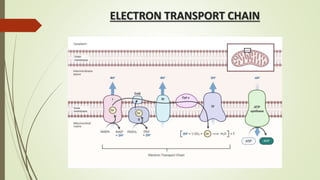
ELECTRON TRANSPORT CHAIN
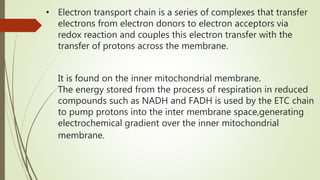
• Electron transport chain is a series of complexes that transfer
electrons from electron donors to electron acceptors via
redox reaction and couples this electron transfer with the
transfer of protons across the membrane.
It is found on the inner mitochondrial membrane.
The energy stored from the process of respiration in reduced
compounds such as NADH and FADH is used by the ETC chain
to pump protons into the inter membrane space,generating
electrochemical gradient over the inner mitochondrial
membrane.
Within the Electron Transport Chain
The Electron transport chain consists of Four protein
complexes, named as
Complex I Complex II
Complex III Complex IV
Complex I is responsible for relieving NADH of its hydrogen and electrons. The
energy received by taking the electrons allows Complex I to pump the hydrogen
atom through the inner mitochondrial membrane,which concentrates hydrogens
in the intermembrane space.
The electrons are then passed to coenzyme Q. CoQ can take on hydrogens and
electrons and can be reduces to CoQH. The coenzyme transfers the electrons to
Complex III.
Meanwhile Complex II is also receiving electrons and protons. These come from
FADH, from TCA cycle. Complex II relieves FADH of its electrons and passes them
to CoQ.
The coenzyme passes them to Complex III which now receives electrons and
energy from two sources. This allows Complex III to pump large amounts of
hydrogen across the membrane.
Cytochrome C allows the electrons to be passed to Complex IV, the final
in ETC. This complex passes the electrons to oxygen molecules,where they bind
with hydrogens to produce water.
INHIBITORS
Site specific inhibitors of ETC have identified.
These compounds prevent the transfer of
electrons by binding to a various complex of the
chain which blocks the redox reaction.
INHIBITORS OF COMPLEX- I
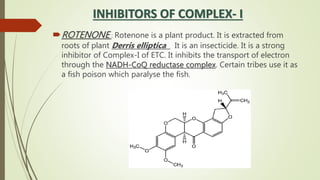
ROTENONE : Rotenone is a plant product. It is extracted from
roots of plant Derris elliptica It is an insecticide. It is a strong
inhibitor of Complex-I of ETC. It inhibits the transport of electron
through the NADH-CoQ reductase complex. Certain tribes use it as
a fish poison which paralyse the fish.
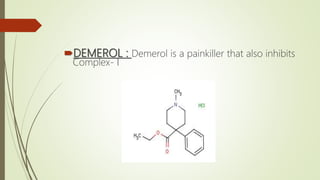
DEMEROL : Demerol is a painkiller that also inhibits
Complex- I
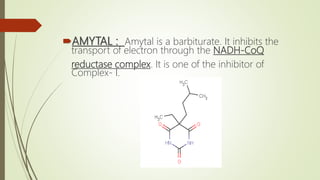
AMYTAL : Amytal is a barbiturate. It inhibits the
transport of electron through the NADH-CoQ
reductase complex. It is one of the inhibitor of
Complex- I.
INHIBITORS OF COMPLEX – II
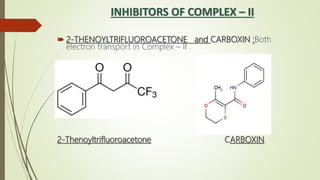
 2-THENOYLTRIFLUOROACETONE and CARBOXIN :Both
electron transport in Complex – II .
2-Thenoyltrifluoroacetone CARBOXIN
INHIBITORS OF COMPLEX – III
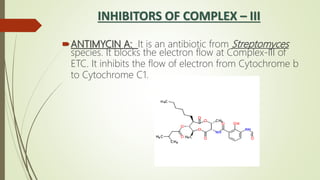
ANTIMYCIN A: It is an antibiotic from Streptomyces
species. It blocks the electron flow at Complex-III of
ETC. It inhibits the flow of electron from Cytochrome b
to Cytochrome C1.
INHIBITORS OF COMPLEX- IV
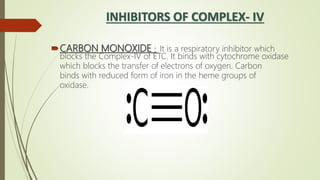
CARBON MONOXIDE : It is a respiratory inhibitor which
blocks the Complex-IV of ETC. It binds with cytochrome oxidase
which blocks the transfer of electrons of oxygen. Carbon
binds with reduced form of iron in the heme groups of
oxidase.
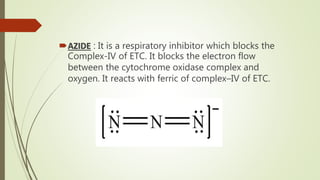
AZIDE : It is a respiratory inhibitor which blocks the
Complex-IV of ETC. It blocks the electron flow
between the cytochrome oxidase complex and
oxygen. It reacts with ferric of complex–IV of ETC.
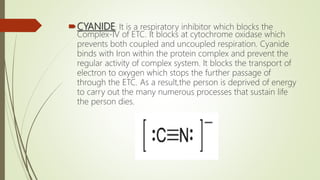
CYANIDE: It is a respiratory inhibitor which blocks the
Complex-IV of ETC. It blocks at cytochrome oxidase which
prevents both coupled and uncoupled respiration. Cyanide
binds with Iron within the protein complex and prevent the
regular activity of complex system. It blocks the transport of
electron to oxygen which stops the further passage of
through the ETC. As a result,the person is deprived of energy
to carry out the many numerous processes that sustain life
the person dies.
REFERENCES
 Lehninger Principles of Biochemistry 4th edition
 http://epgp.inflibnet.ac.in/epgpdata/uploads/epgp_content/S000002BI/P000982/
M017769/ET/1495006230E-Text-Moduel19InhibitorsofETC.pdf
 https://en.wikipedia.org/wiki/Electron_transport_chain
 https://biologydictionary.net/electron-transport-chain-and-oxidative-
phosphorylation/

Inhibitors

  • 1.
    INHIBITORS BY : RUBINAMANN M.Sc. – II (Zoology)
  • 2.
    What are INHIBITORS? Inhibitors are the inhibiting agents. They bind with the specific electron carriers. The inhibitors bind to different components of the ETC and block the carrier. After binding with the carrier it does not allow to change in a reversible form from an oxidized state to a reduced state. It results in the accumulation of reduced forms prior to the inhibitor point, and oxidized forms of the components of the ETC down the line of inhibition point.
  • 3.
  • 4.
    • Electron transportchain is a series of complexes that transfer electrons from electron donors to electron acceptors via redox reaction and couples this electron transfer with the transfer of protons across the membrane. It is found on the inner mitochondrial membrane. The energy stored from the process of respiration in reduced compounds such as NADH and FADH is used by the ETC chain to pump protons into the inter membrane space,generating electrochemical gradient over the inner mitochondrial membrane.
  • 5.
    Within the ElectronTransport Chain The Electron transport chain consists of Four protein complexes, named as Complex I Complex II Complex III Complex IV
  • 7.
    Complex I isresponsible for relieving NADH of its hydrogen and electrons. The energy received by taking the electrons allows Complex I to pump the hydrogen atom through the inner mitochondrial membrane,which concentrates hydrogens in the intermembrane space. The electrons are then passed to coenzyme Q. CoQ can take on hydrogens and electrons and can be reduces to CoQH. The coenzyme transfers the electrons to Complex III. Meanwhile Complex II is also receiving electrons and protons. These come from FADH, from TCA cycle. Complex II relieves FADH of its electrons and passes them to CoQ. The coenzyme passes them to Complex III which now receives electrons and energy from two sources. This allows Complex III to pump large amounts of hydrogen across the membrane. Cytochrome C allows the electrons to be passed to Complex IV, the final in ETC. This complex passes the electrons to oxygen molecules,where they bind with hydrogens to produce water.
  • 8.
    INHIBITORS Site specific inhibitorsof ETC have identified. These compounds prevent the transfer of electrons by binding to a various complex of the chain which blocks the redox reaction.
  • 9.
    INHIBITORS OF COMPLEX-I ROTENONE : Rotenone is a plant product. It is extracted from roots of plant Derris elliptica It is an insecticide. It is a strong inhibitor of Complex-I of ETC. It inhibits the transport of electron through the NADH-CoQ reductase complex. Certain tribes use it as a fish poison which paralyse the fish.
  • 10.
    DEMEROL : Demerolis a painkiller that also inhibits Complex- I
  • 11.
    AMYTAL : Amytalis a barbiturate. It inhibits the transport of electron through the NADH-CoQ reductase complex. It is one of the inhibitor of Complex- I.
  • 12.
    INHIBITORS OF COMPLEX– II  2-THENOYLTRIFLUOROACETONE and CARBOXIN :Both electron transport in Complex – II . 2-Thenoyltrifluoroacetone CARBOXIN
  • 13.
    INHIBITORS OF COMPLEX– III ANTIMYCIN A: It is an antibiotic from Streptomyces species. It blocks the electron flow at Complex-III of ETC. It inhibits the flow of electron from Cytochrome b to Cytochrome C1.
  • 14.
    INHIBITORS OF COMPLEX-IV CARBON MONOXIDE : It is a respiratory inhibitor which blocks the Complex-IV of ETC. It binds with cytochrome oxidase which blocks the transfer of electrons of oxygen. Carbon binds with reduced form of iron in the heme groups of oxidase.
  • 15.
    AZIDE : Itis a respiratory inhibitor which blocks the Complex-IV of ETC. It blocks the electron flow between the cytochrome oxidase complex and oxygen. It reacts with ferric of complex–IV of ETC.
  • 16.
    CYANIDE: It isa respiratory inhibitor which blocks the Complex-IV of ETC. It blocks at cytochrome oxidase which prevents both coupled and uncoupled respiration. Cyanide binds with Iron within the protein complex and prevent the regular activity of complex system. It blocks the transport of electron to oxygen which stops the further passage of through the ETC. As a result,the person is deprived of energy to carry out the many numerous processes that sustain life the person dies.
  • 17.
    REFERENCES  Lehninger Principlesof Biochemistry 4th edition  http://epgp.inflibnet.ac.in/epgpdata/uploads/epgp_content/S000002BI/P000982/ M017769/ET/1495006230E-Text-Moduel19InhibitorsofETC.pdf  https://en.wikipedia.org/wiki/Electron_transport_chain  https://biologydictionary.net/electron-transport-chain-and-oxidative- phosphorylation/