Organization of ETC:
• Inner mitochondrial membrane can be disrupted into five separate
protein complexs , called Complexes I,II,III,IV & V.
• Complex I-IV each contains part of the ETC. Each complex accepts
or donates electrons to relatively mobile electron carrier, such as
coenzyme Q & cytochrome C.
• Each carrier in the ETC can receive electrons from an electron
donor, & can donate electrons to the next carrier in the chain.
• Electrons ultimately combine with oxygen & protons to form
water.
• Complex V is a protein complex, contains F0 that spans the IMM
and F1 protrudes into the matrix. It catalyses ATP synthesis & so
referred to as ATP synthase.
Site of ETC: Inner Mitochondrial
Membrane
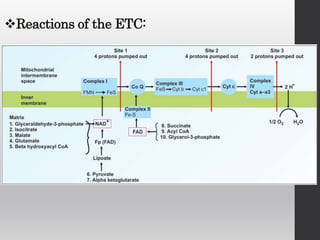
Reactions of the ETC:
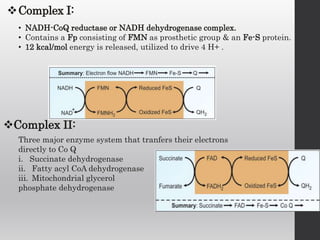
Complex I:
• NADH-CoQ reductase or NADH dehydrogenase complex.
• Contains a Fp consisting of FMN as prosthetic group & an Fe-S protein.
• 12 kcal/mol energy is released, utilized to drive 4 H+ .
Complex II:
Three major enzyme system that tranfers their electrons
directly to Co Q
i. Succinate dehydrogenase
ii. Fatty acyl CoA dehydrogenase
iii. Mitochondrial glycerol
phosphate dehydrogenase
 Coenzyme Q:
• Reduced successively to QH and finally QH2.
• Accepts a pair of electrons from NADH or FADH2 through Complex I or II.
• It is s Quinone derivative having a long isoprenoid tail
• It is the mobile electron carrier, transfers electrons to Complex III.
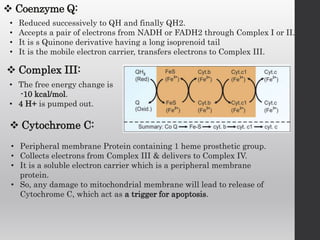
 Complex III:
• The free energy change is
-10 kcal/mol.
• 4 H+ is pumped out.
 Cytochrome C:
• Peripheral membrane Protein containing 1 heme prosthetic group.
• Collects electrons from Complex III & delivers to Complex IV.
• It is a soluble electron carrier which is a peripheral membrane
protein.
• So, any damage to mitochondrial membrane will lead to release of
Cytochrome C, which act as a trigger for apoptosis.
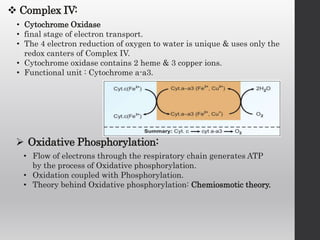
 Complex IV:
• Cytochrome Oxidase
• final stage of electron transport.
• The 4 electron reduction of oxygen to water is unique & uses only the
redox canters of Complex IV.
• Cytochrome oxidase contains 2 heme & 3 copper ions.
• Functional unit : Cytochrome a-a3.
 Oxidative Phosphorylation:
• Flow of electrons through the respiratory chain generates ATP
by the process of Oxidative phosphorylation.
• Oxidation coupled with Phosphorylation.
• Theory behind Oxidative phosphorylation: Chemiosmotic theory.
 Chemiosmotic theory:
• Proposed by Peter Mitchell
• Postulates that the two processes, Oxidation & Phosphorylation are
coupled by a proton gradient across the IMM.
• The proton motive force caused by the electrochemical potential
difference drives the mechanism of ATP synthesis.
 Complex V:
• ATP synthase Complex.
• Also called 5th complex of ETC.
• Smallest molecular motor present in the Human Body.
• Embedded in the IMM.
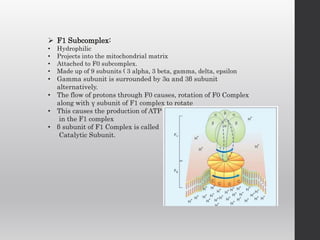
• Divided into 2 Subcomplex:
 F0 subcomplex
-Hydrophobic
-spans the IMM
-Forms a proton Channel
 F1 Subcomplex:
• Hydrophilic
• Projects into the mitochondrial matrix
• Attached to F0 subcomplex.
• Made up of 9 subunits ( 3 alpha, 3 beta, gamma, delta, epsilon
• Gamma subunit is surrounded by 3α and 3β subunit
alternatively.
• The flow of protons through F0 causes, rotation of F0 Complex
along with γ subunit of F1 complex to rotate
• This causes the production of ATP
in the F1 complex
• β subunit of F1 Complex is called
Catalytic Subunit.
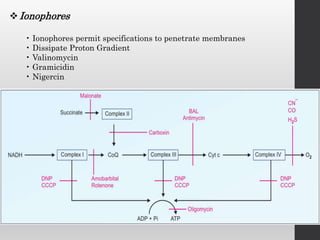
 INHIBITORS OF ETC:
• Divided into
• Inhibitors of Electron transfer
• Inhibitors of Oxidative Phosphorylation
• Uncouplers of Oxidative Phosphorylation
• Ionophores
Inhibitors of Electron Transfer
 Between NADH and CoQ [At Complex I]
• An insecticide and a fish Poison Rotenone
• Amobarbital which is a barbiturate
• Piericidin A.
 Inhibitor of Complex II
• TTFA (Tri enoyl TriFluoroAcetone) a Fe2+ Chelating agent
• Carboxin
• Malonate, a competitive inhibitor of Succinate Dehydrogenase.
 Between Cyt b and Cyt c [At Complex III]
• Antimycin A
• British Antilevisite [Dimercaprol]
 Inhibitor at Cytochrome c Oxidase [Complex IV]
• CO
• Cyanide
• H2 S
• Sodium Azide
Inhibitors of Oxidative Phosphorylation
 Atractyloside
By inhibiting the transporter of ADP into and ATP out of the
mitochondrion.
 Oligomycin an Antibiotic
Completely blocks oxidation and phosphorylation. By blocking the
flow of protons through F0 Complex of ATP Synthase
Uncoupler of Oxidative Phosphorylation
Mechanism of Action—Disruption of Proton Gradient across the
inner mitochondrial membrane
• 2,4 Dinitrophenol
• Dinitrocresol
• FCCP [Fluoro Carbonyl Cyanide Phenyl hydrazine]
• Aspirin in high dose
 Physiological Uncouplers : Thyroxine (in high doses),
Thermogenin.
Ionophores
• Ionophores permit specifications to penetrate membranes
• Dissipate Proton Gradient
• Valinomycin
• Gramicidin
• Nigercin

ETC.pptx electron transport chain PDUGMC

  • 1.
    Organization of ETC: •Inner mitochondrial membrane can be disrupted into five separate protein complexs , called Complexes I,II,III,IV & V. • Complex I-IV each contains part of the ETC. Each complex accepts or donates electrons to relatively mobile electron carrier, such as coenzyme Q & cytochrome C. • Each carrier in the ETC can receive electrons from an electron donor, & can donate electrons to the next carrier in the chain. • Electrons ultimately combine with oxygen & protons to form water. • Complex V is a protein complex, contains F0 that spans the IMM and F1 protrudes into the matrix. It catalyses ATP synthesis & so referred to as ATP synthase. Site of ETC: Inner Mitochondrial Membrane
  • 2.
  • 3.
    Complex I: • NADH-CoQreductase or NADH dehydrogenase complex. • Contains a Fp consisting of FMN as prosthetic group & an Fe-S protein. • 12 kcal/mol energy is released, utilized to drive 4 H+ . Complex II: Three major enzyme system that tranfers their electrons directly to Co Q i. Succinate dehydrogenase ii. Fatty acyl CoA dehydrogenase iii. Mitochondrial glycerol phosphate dehydrogenase
  • 4.
     Coenzyme Q: •Reduced successively to QH and finally QH2. • Accepts a pair of electrons from NADH or FADH2 through Complex I or II. • It is s Quinone derivative having a long isoprenoid tail • It is the mobile electron carrier, transfers electrons to Complex III.  Complex III: • The free energy change is -10 kcal/mol. • 4 H+ is pumped out.  Cytochrome C: • Peripheral membrane Protein containing 1 heme prosthetic group. • Collects electrons from Complex III & delivers to Complex IV. • It is a soluble electron carrier which is a peripheral membrane protein. • So, any damage to mitochondrial membrane will lead to release of Cytochrome C, which act as a trigger for apoptosis.
  • 5.
     Complex IV: •Cytochrome Oxidase • final stage of electron transport. • The 4 electron reduction of oxygen to water is unique & uses only the redox canters of Complex IV. • Cytochrome oxidase contains 2 heme & 3 copper ions. • Functional unit : Cytochrome a-a3.  Oxidative Phosphorylation: • Flow of electrons through the respiratory chain generates ATP by the process of Oxidative phosphorylation. • Oxidation coupled with Phosphorylation. • Theory behind Oxidative phosphorylation: Chemiosmotic theory.
  • 6.
     Chemiosmotic theory: •Proposed by Peter Mitchell • Postulates that the two processes, Oxidation & Phosphorylation are coupled by a proton gradient across the IMM. • The proton motive force caused by the electrochemical potential difference drives the mechanism of ATP synthesis.  Complex V: • ATP synthase Complex. • Also called 5th complex of ETC. • Smallest molecular motor present in the Human Body. • Embedded in the IMM. • Divided into 2 Subcomplex:  F0 subcomplex -Hydrophobic -spans the IMM -Forms a proton Channel
  • 7.
     F1 Subcomplex: •Hydrophilic • Projects into the mitochondrial matrix • Attached to F0 subcomplex. • Made up of 9 subunits ( 3 alpha, 3 beta, gamma, delta, epsilon • Gamma subunit is surrounded by 3α and 3β subunit alternatively. • The flow of protons through F0 causes, rotation of F0 Complex along with γ subunit of F1 complex to rotate • This causes the production of ATP in the F1 complex • β subunit of F1 Complex is called Catalytic Subunit.
  • 8.
     INHIBITORS OFETC: • Divided into • Inhibitors of Electron transfer • Inhibitors of Oxidative Phosphorylation • Uncouplers of Oxidative Phosphorylation • Ionophores Inhibitors of Electron Transfer  Between NADH and CoQ [At Complex I] • An insecticide and a fish Poison Rotenone • Amobarbital which is a barbiturate • Piericidin A.  Inhibitor of Complex II • TTFA (Tri enoyl TriFluoroAcetone) a Fe2+ Chelating agent • Carboxin • Malonate, a competitive inhibitor of Succinate Dehydrogenase.  Between Cyt b and Cyt c [At Complex III] • Antimycin A • British Antilevisite [Dimercaprol]  Inhibitor at Cytochrome c Oxidase [Complex IV] • CO • Cyanide • H2 S • Sodium Azide
  • 9.
    Inhibitors of OxidativePhosphorylation  Atractyloside By inhibiting the transporter of ADP into and ATP out of the mitochondrion.  Oligomycin an Antibiotic Completely blocks oxidation and phosphorylation. By blocking the flow of protons through F0 Complex of ATP Synthase Uncoupler of Oxidative Phosphorylation Mechanism of Action—Disruption of Proton Gradient across the inner mitochondrial membrane • 2,4 Dinitrophenol • Dinitrocresol • FCCP [Fluoro Carbonyl Cyanide Phenyl hydrazine] • Aspirin in high dose  Physiological Uncouplers : Thyroxine (in high doses), Thermogenin.
  • 10.
    Ionophores • Ionophores permitspecifications to penetrate membranes • Dissipate Proton Gradient • Valinomycin • Gramicidin • Nigercin