H–Antigen
&
Bombay Phenotype
• H-antigenis a precursor to A & B antigen, in the ABO blood group system.
• It is present over the surface of all RBCs in the ABO system (AH, BH, ABH, OH)
• As H-antigen acts as precursor, its absence means the absence of antigen A
and B, hence these individuals identified as O blood group.
• Those O individuals, who do not express H-antigen (also called substance H on their
RBCs surface, which is normally present in O blood group); produce isoantibodies to H-
antigen as well as to antigens A and B. Hence a person with (hh) phenotype
contain anti A, anti B & anti H. These individuals named as Bombay
Phenotype.
• As all O group of cases ( both Rh + or Rh -), containing H
antigen, when transfused to person who is not having H
antigen, causes haemolysis.
3.
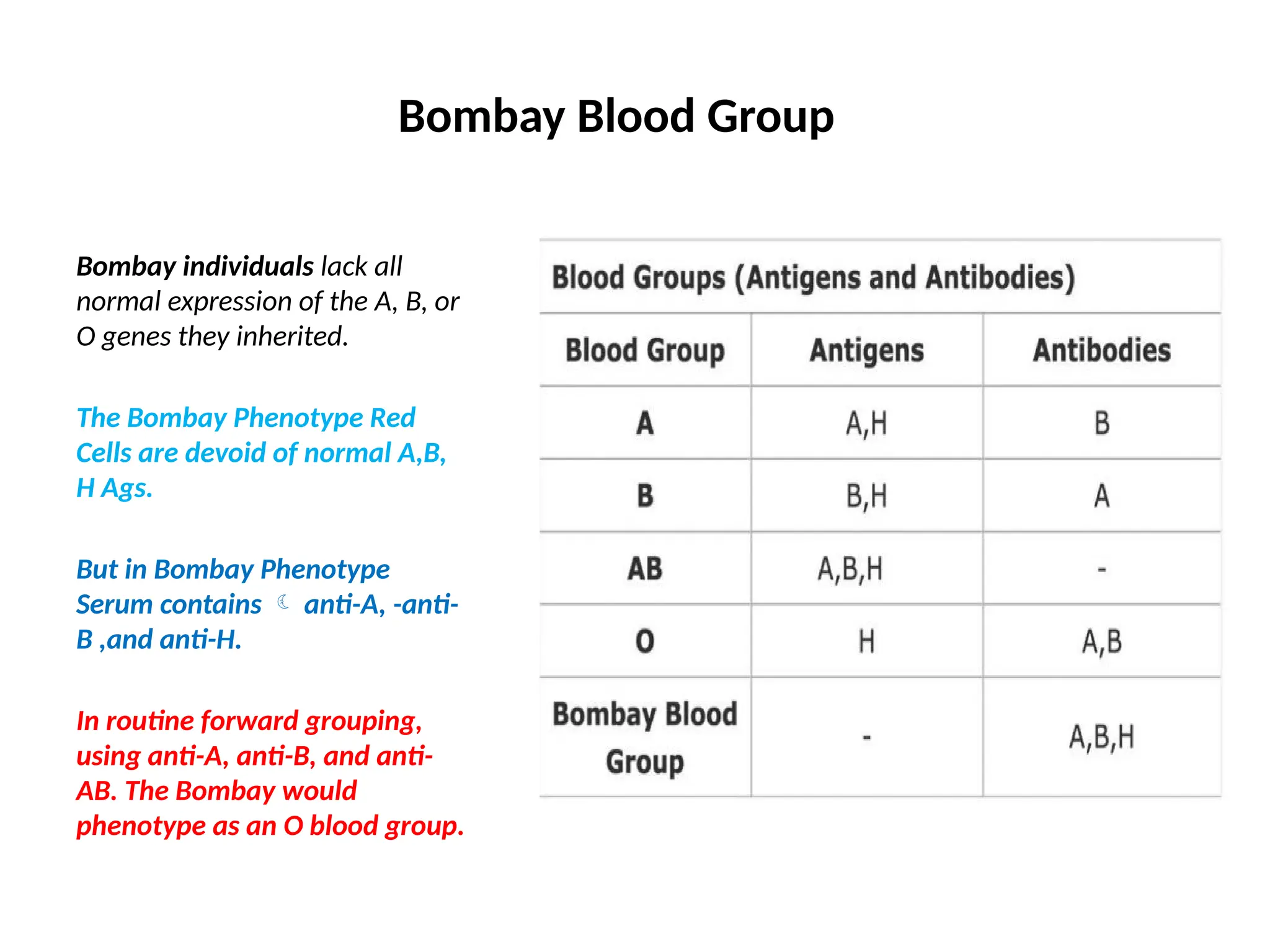
Bombay Blood Group
Bombayindividuals lack all
normal expression of the A, B, or
O genes they inherited.
The Bombay Phenotype Red
Cells are devoid of normal A,B,
H Ags.
But in Bombay Phenotype
Serum contains anti-A, -anti-
B ,and anti-H.
In routine forward grouping,
using anti-A, anti-B, and anti-
AB. The Bombay would
phenotype as an O blood group.
4.
Testing with
Anti OhAntibody
As Bombay Phenotype dose not contains “h”
antigen on the surface of the RBC it will show
no reaction when treated with Anti Oh
antibody, where as others will show positive
reaction.
Anti -D Anti -Oh Anti-Oh
O+ O+ O+
Agglutination O+ Agglutination O+ No agglutination
( Bombay Type)
5.
Testing with
Anti OhAntibody
As Bombay Phenotype dose not contains “h”
antigen on the surface of the RBC it will show
no reaction when treated with Anti Oh
antibody, where as others will show positive
reaction.
Anti -D Anti -Oh Anti-Oh
O+ O+ O+
Agglutination O+ Agglutination O+ No agglutination
( Bombay Type)
6.
A2 Phenotype.
• Itis observed that some of the A group
of patients reacted( Showed haemolytic
transfusion reaction) to a group of similar A
group of blood.
• This observation lead to the hypothesis
that not all “A group” cases are similar
in all aspects.
7.
Anti A1 antibody
(Anti-A1Lectin)
Anti- A1 Lectin is designed for
use in agglutination tests
for the detection of the A1
antigen on human red cells.
Erythrocytes possessing the A
antigen can be sub divided
into A1 and A2 cells.
Anti- A1 Lectin is designed for
use in agglutination tests for
the detection of the A1
antigen on human red cells.
Group A red blood cells
which are agglutinated with
Anti- A1 Lectin are said to be
of sub-group A1.
Those which are not
agglutinated by Anti-A1 Lectin
fall into subgroups weaker
than A1, the majority being
classified as A2.
Approximately 80 % of the population of blood
group A is A1, while the remaining 20% are A2 or
weaker subgroup.
8.
Reverse Typing
• Onreversed typing ( When plasma of the
patient is treated with A & B type of cells,
there is agglutination reaction to both the
groups, means it is type O).
So when a blood group is diagnose as A group in forward
typing & O group in reversed typing, in is thought to be case
of A2 Blood Group.
9.
Persons withtype A2 blood
group may possess anti-
A1 antibody .
It is estimated that A2 type
blood group is found in 1-8%
of all A individuals and 22-
35% of AB individuals) .
A2 cases will render the
reverse typing discordant
from forward typing.
• Such patients when grouped
would display A in forward
typing, but O in reverse
typing.
• Antibodies to A1 are present
in the type A2 patient.
Forward( Cell
s)
Reverse(Serum) Inferenc
e
Anti -
A1
A cells B -cells
Positi
ve
Negati
ve
Positive
A B A1
Forward Reverse Inferenc
e
Anti A1 Serum
A ( Clump) O ( No Clump) A2
10.
Rh System
The Rhsystem consists of over 50 antigens,
of which 5 important antigens (D, C&c, E,& e)
are of clinical implications and among them
D being the major antigen expressed by Rh D
protein.
• Molecular genetics has shown that there are two Rh genes,
one encoding D, the other encoding the Cc and Ee antigens
11.
Weak D represents
WeakD represents a D phenotype where due
to reduced D antigen expression on red cells,
the antigen is not detected by routine
techniques (spin tube method).
Weak D antigen positive cells have a weak expression of the
D antigen and may be misclassified as D negative cells in
routine Rh grouping procedures.
However, the demonstration of this weakly expressed
antigen can be undertaken by prolonged incubation and the
use of anti-human globulin.
12.
Procedure for WeakRhD antigen.
(Test Tube Method)
Equal volume of 5% red cells Suspension+ Anti D antisera Incubated at 37C for 45
minutes Centrifuge at 1000 rpm for 1 minute Examined both macro &
microscopically for agglutination.
Agglutination Rh D positive
No agglutination Rh D negative.
Do not report Negative results.
Perform Weak D antigen testing (Indirect antiglobulin test) by test tube or gel card
methods using a commercial polyspecific Antihuman Globulin (AHG) reagent containing
anti IgG and C3d.
Take the tested negative test samples of red cells, wash for 3 times with saline, decant
extra saline add AHG ( IgG +C3d) 2 drops Centrifuge for 1 minute at 1000 rpm
Re examine for agglutination both macroscopically/microscopically.
Those samples that showed agglutination with addition of AHG serum were labeled as
weak Rh D positive.
Only blood sample that was negative macroscopically and microscopically in the weak D
test was labeled as Rh D negative
13.
Procedure
Procedure:
o 1.Test Sample (The sample which is D negative& to be evaluated for weak D positive) A
5% RBC saline suspension was made by washing the RBCs with isotonic
saline in a test tube.
o 2. A control Saline in other test tube.
o 3. One drop of MEDICLONE D (IgG) and saline were added to the test
tube and control tube, respectively.
o 4. After mixing, incubation was done for 30 min for sensitization at 37 C.
o 5.After washing the sensitized cells 3–4 times with normal saline and
discarding the supernatant.
o 6. Two drops of Anti-human serum (Coomb's serum) were added and
centrifuged for 1 min.
o 7. The sediment cells were gently dislodged and examined
macroscopically as well as microscopically for agglutination.
1.Agglutination of sensitized RBC with Coomb's serum was considered as
weak D antigen (Du) positive,
2. No agglutination noted as Rh D-negative blood .
14.
Grouping by TubeMethod
with Albumin :
Prepare a washed RBC 3-5% suspension of
RBCs.
o Add 50ul Anti D & 1-2 drops Albumin in a tube
containing 50ul 3-5% Red cell suspension.
o Incubate the tube at 37°C for 45 minutes.
After 45 minutes, suspend the tube & examine agglutination,
if agglutination occurs it means Rh is positive
o if no agglutination present it confirmed that Rh is negative.
15.
Gel Card Method
Gelcard system used was Diamed ID Microtyping System
containing polyspecific AHG.
1. A 1% red cell suspension of blood sample was prepared in
Low Ionic Strength Solution (LISS).
Fifty microlitre of 1% RBC suspension was taken in
microtube of IgG gel card followed by
Addition of 50 μL of monoclonal anti IgG (ID Diaclon Anti-D).
2.This was followed by incubation at 37°C for 15 min and
fixed centrifugation for 10 minute then Examined.
Look for Agglutination.
16.
Principle of MatrixGel Card Method
PRINCIPLE IgG antibodies are also known as incomplete antibodies.
1. These antibodies can sensitize red cells when allowed to incubate at TM
37°C in presence of corresponding antigen.
2. Matrix Anti-D IgG contains monoclonal Anti-D IgG in a standardized TM
concentration.
3.Red blood cells when allowed to incubate with Matrix Anti-D IgG, red blood
cells will get sensitized if Rho (D) TM antigen or weaker expression is present.
4.This reaction can be detected when Matrix gel card containing Coombs Anti-
IgG is centrifuged under controlled conditions.
5.Cells sensitized with Anti-D IgG will be trapped within the gel matrix in
presence of Coombs Anti-IgG.
6.The red blood cells, which do not react are not trapped in the gel column and
get settled at the bottom of the microtube
17.
Anti-D IgG forWeak D testing on Matrix Gel System
SAMPLE COLLECTION: (No special preparation of patient is required prior to
sample collection by approved techniques).
For optimal results, freshly collected samples should be used.
Anticoagulants like EDTA, CPD-A and Citrate can be used.
Samples should be centrifuged at 1500g for 10 minutes to avoid fibrin residue
which may interfere with results.
SAMPLE PREPARATION for TM : (Prepare 0.8% red blood cell suspension in
Matrix Diluent- 2 LISS as follows):
1. Bring the Matrix Diluent -2 LISS to room temperature before use.
2. Dispense 1.0 ml of Matrix Diluent -2 LISS into a clean test tube.
3. Add 10µl of packed red cells to Matrix Diluent -2 LISS collected in test tube
and mix gently.
4. Red blood cell suspension so obtained should be used for testing.
REAGENT: Matrix Anti-D IgG contains monoclonal Anti-D IgG (Clone- MCAD6).
18.
Tulip Matrix Gelcard Method
TEST PROCEDURE TM :
• 1. Label the appropriate microtube of the Matrix Coombs Anti-IgG card with patient's /
donor’s name or identification number.
• Remove the aluminium foil of required number of microtubes carefully by pulling it
backwards.
• 2. Pipette 50 ìl of 0.8% patient's / donor’s red blood cell suspension to the microtube, taking
care to ensure that the micropipette tip does not touches the microtube.
• 3. Add 25ìl of Matrix Anti-D IgG to the above microtube.
• 4. Incubate the Matrix gel card for 15 minutes at 37°C in an incubator.
5. After incubation, centrifuge the Matrix gel card for 10 minutes in the gel card centrifuge.
• 6. Retrieve the card from centrifuge, read and record the results.
INTERPRETATION OF RESULTS:
Positive reaction: Agglutinated red blood cells forming a clear line at the top of the gel
column or agglutinates dispersed in the gel column.
Negative reaction: Non-agglutinated red blood cells settle at the bottom of the microtube
forming a compact button.
19.
Discrepancies
Some other thingsto keep in mind when performing a
weak D test include:
• A positive DAT result will invalidate the Du test.
• Low red blood cell concentrations can make it difficult to
visualize red blood cells, which can lead to weak positive
results being missed.
• Aged or hemolyzed blood may produce weaker reactions
than fresh red blood cells.
• Rouleaux caused by high concentrations of protein in
serum or plasma can cause difficulties in interpreting the
results.
20.
Interpretation of Results
•4+ Agglutinated red blood cells form a line at the top of the gel microtube.
3+ Most agglutinated red blood cells remain in the upper half of the
microtube.
• 2+ Agglutinated red blood cells are observed throughout the length of the
microtube. A small button of red blood cells may also be visible at the bottom of the
gel microtube.
• 1+ Most agglutinated red blood cells remain in the lower half of the microtube. A
button of cells may also be visible at the bottom of the gel microtube.
• ± Most agglutinated red blood cells are in the lower third part of the gel
microtube.
• Negative: All the red blood cells pass through and form a compact button at the
bottom of the gel microtube.
• Mixed field agglutination : Agglutinated red blood cells form a line at the top of the
gel and non-agglutinated red blood cells form a compact button at the bottom of the
gel microtube.
• H Hemolysis of red blood cells
21.
ADDITIONAL REAGENT MATERIALS
REQUIREDfor Tulip Matrix
• Diluent-2 LISS for preparation of red cell
suspension.
• Matrix Coombs Anti-IgG Card (Refer package insert
before use).
• Gel card centrifuge (85g),
• Incubator (37°C),
• Work station,
• Micropipette capable of delivering 5-50µl of
specimen and Bottle top dispenser.
Editor's Notes
#3 However, transfusing normal group O would cause immediate cell lysis by the potent anti-H of the Bombay individuals.
#7 Erythrocytes possessing the A antigen can be sub divided into A1 and A2 cells. Anti- A1 Lectin is designed for use in agglutination tests for the detection of the A1 antigen on human red cells. Group A red blood cells which are agglutinated with Anti- A1 Lectin are said to be of sub-group A1.Those which are not agglutinated by Anti-A1 Lectin fall into subgroups weaker than A1, the majority being classified as A2. Approximately 80 % of the population of blood group A is A1, while the remaining 20% are A2 or weaker subgroup.