Click to edit Master title style
1
Interferential Therapy (IFT)
P r e p a r e d b y
D r . S O M A B A L A J I P T
M S K & S P O R T S
Click to edit Master title style
2 2
Learning Objectives
•U n d er s ta n d the pri nc iple a nd mec h an is m of IF T
•L ea r n th e t e ch nic a l a sp e ct s a nd s et t in gs
•Kn ow th e ph ys io log ic al ef f e ct s
•M as te r the c lin ica l ap pli ca t i ons a nd
c ont r ai nd ica t i ons
•R e v ie w ev id e nce - b as e d e f f ec t iv e ne ss
•O b s er v e pra c t ic a l d emon st r at i on an d el ec t rod e
pl ac e me nt s
Click to edit Master title style
3 3
Introduction
•IFT i s a med iu m- f re q ue nc y el e ct r o the r a p y
mo d a lit y
•Pr i ma r i ly u s ed f or pa in re lie f , musc le
st imu la t io n , a n d in cre a sin g circ u lat ion
•Wor k s o n th e pr i n ci p le of int erf ere nc e of
t w o cu rren t s to p r o du c e lo w - f re que n cy
t he rap e ut i c ef f ec t
Click to edit Master title style
4 4
Historical Background
•Introduced by Dr. Hans Nemec (Austria, 1950s)
•Popularized in physiotherapy by European researchers
•Evolved with digital interferential units and portable
devices
Click to edit Master title style
5 5
Definition
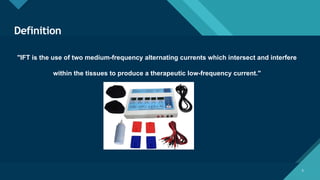
"IFT is the use of two medium-frequency alternating currents which intersect and interfere
within the tissues to produce a therapeutic low-frequency current."
Click to edit Master title style
6 6
Basic Principle
•Two medium-frequency currents: 4000 Hz and 4100 Hz
•These cross and interfere in the body tissues
•Results in a beat frequency = 100 Hz
•This beat frequency provides low-frequency stimulation at deeper tissue levels
Click to edit Master title style
7 7
Types of Interference
1. Constructive Interference – Enhanced current amplitude
2. Destructive Interference – Reduced amplitude
3. Continuous Interference Pattern – Varies based on frequency and vector
Click to edit Master title style
8 8
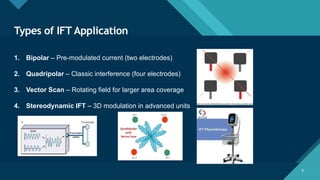
Types of IFT Application
1. Bipolar – Pre-modulated current (two electrodes)
2. Quadripolar – Classic interference (four electrodes)
3. Vector Scan – Rotating field for larger area coverage
4. Stereodynamic IFT – 3D modulation in advanced units
Click to edit Master title style
9 9
Electrode Placement
•Cross pattern (Quadripolar): Diagonal positioning for interference
•Bipolar: Current modulated within the machine
•Targeted placement: Over trigger points, muscle belly, joints
Click to edit Master title style
10
10
Parameters of IFT
•Carrier frequency: 4000 Hz (base)
•Beat frequency: 1–150 Hz
•Sweep frequency: Varies the beat (to avoid accommodation)
•Treatment time: 10–20 minutes
•Amplitude: Based on patient tolerance (usually strong but comfortable)
Click to edit Master title style
11
11
Frequency Effects (Clinical Relevance)
•0–10 Hz: Muscle stimulation
•10–20 Hz: Increases circulation
•20–50 Hz: Muscle relaxation
•90–100 Hz: Pain relief (gate control theory)
•130–150 Hz: Edema reduction
Click to edit Master title style
12
12
Sweep and Vector Mode
•Sweep mode: Prevents accommodation by changing frequency (e.g., 90–100 Hz sweep)
•Vector mode: Moves the current field dynamically in tissues
•Enhances coverage and comfort
Click to edit Master title style
13
13
Physiological Effects
•Increases blood flow
•Reduces muscle spasm
•Promotes tissue healing
•Provides pain relief through:
•Gate Control Theory
•Endorphin Release
•Decreased nerve excitability
Click to edit Master title style
14
14
Indications
•Musculoskeletal pain (e.g., back pain, OA, sprains)
•Post-operative pain
•Muscle spasm
•Edema management
•Neuralgia, Sciatica
•Trigger point pain etc..
Click to edit Master title style
15
15
Contraindications
•Over pacemakers or implanted devices
•Pregnancy (especially abdomen/lower back)
•Cancerous lesions
•Thrombophlebitis
•Open wounds (without protection)
•Over eyes, carotid sinus, or anterior neck
Click to edit Master title style
16
16
Precautions
•Check skin integrity
•Proper electrode contact
•Monitor intensity during treatment
•Avoid bony prominences for better comfort
Click to edit Master title style
17
17
Advantages of IFT
•Deep tissue penetration
•Comfortable stimulation (medium frequency is better tolerated)
•Versatile use for acute and chronic pain
•Non-invasive and drug-free
Click to edit Master title style
18
18
Disadvantages
•Requires careful electrode placement
•Equipment is expensive
•Some patients may not tolerate the sensation
•Not suitable for all areas (e.g., facial nerves)
Click to edit Master title style
19
19
Evidence-Based Practice
Systematic Reviews:
•Moderate evidence for chronic low back pain, OA knee
•IFT combined with exercise gives better results
•Effective in reducing post-op pain in orthopedics
Clinical Guidelines:
•Not standalone — best when combined with active rehab
Click to edit Master title style
20
20
Recent Research Findings
•IFT with TENS vs. IFT alone: IFT more effective in deep structures
•IFT combined with manual therapy shows faster recovery
•Smart IFT devices with programmable waveforms available
Click to edit Master title style
21
21
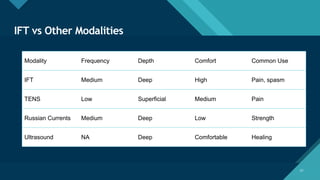
IFT vs Other Modalities
Modality Frequency Depth Comfort Common Use
IFT Medium Deep High Pain, spasm
TENS Low Superficial Medium Pain
Russian Currents Medium Deep Low Strength
Ultrasound NA Deep Comfortable Healing
Click to edit Master title style
22
22
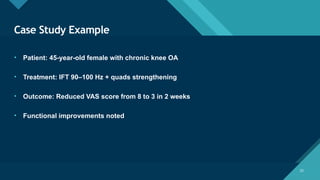
Case Study Example
• Patient: 45-year-old female with chronic knee OA
• Treatment: IFT 90–100 Hz + quads strengthening
• Outcome: Reduced VAS score from 8 to 3 in 2 weeks
• Functional improvements noted
Click to edit Master title style
23
23
Demonstration & Practical Tips (IN LAB)
•Show unit
•Electrode prep
•Intensity setting tips
•Communication with patient during session
Click to edit Master title style
24
24
Key Points
•IFT = Interference + Medium Frequency + Pain Modulation
•Comfortable, deep stimulation
•Clinical application must be goal-specific
•Combine with exercise for best results
Click to edit Master title style
25
25
VIVA QUESTIONS
Click to edit Master title style
26
26
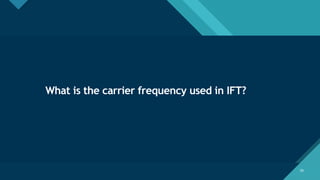
What is the carrier frequency used in IFT?
Click to edit Master title style
27
27
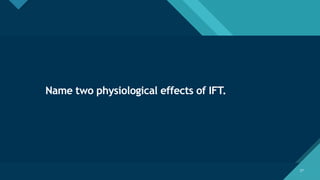
Name two physiological effects of IFT.
Click to edit Master title style
28
28
Why is sweep frequency important?
Click to edit Master title style
29
29
What is the difference between bipolar and
quadripolar application?
Click to edit Master title style
30
30
References
•Kumar, G.K. (2020). Electrotherapy: Evidence-Based Practice. Jaypee.
•Low & Reed. (2014). Electrotherapy Explained.
•Cochrane Database Reviews on IFT.
•APTA Guidelines for Electrotherapeutic Modalities.
•Peer-reviewed articles from PubMed and Google Scholar.
Click to edit Master title style
31
Thank You

Interferential Therapy (IFT) Electrotherapy

  • 1.
    Click to editMaster title style 1 Interferential Therapy (IFT) P r e p a r e d b y D r . S O M A B A L A J I P T M S K & S P O R T S
  • 2.
    Click to editMaster title style 2 2 Learning Objectives •U n d er s ta n d the pri nc iple a nd mec h an is m of IF T •L ea r n th e t e ch nic a l a sp e ct s a nd s et t in gs •Kn ow th e ph ys io log ic al ef f e ct s •M as te r the c lin ica l ap pli ca t i ons a nd c ont r ai nd ica t i ons •R e v ie w ev id e nce - b as e d e f f ec t iv e ne ss •O b s er v e pra c t ic a l d emon st r at i on an d el ec t rod e pl ac e me nt s
  • 3.
    Click to editMaster title style 3 3 Introduction •IFT i s a med iu m- f re q ue nc y el e ct r o the r a p y mo d a lit y •Pr i ma r i ly u s ed f or pa in re lie f , musc le st imu la t io n , a n d in cre a sin g circ u lat ion •Wor k s o n th e pr i n ci p le of int erf ere nc e of t w o cu rren t s to p r o du c e lo w - f re que n cy t he rap e ut i c ef f ec t
  • 4.
    Click to editMaster title style 4 4 Historical Background •Introduced by Dr. Hans Nemec (Austria, 1950s) •Popularized in physiotherapy by European researchers •Evolved with digital interferential units and portable devices
  • 5.
    Click to editMaster title style 5 5 Definition "IFT is the use of two medium-frequency alternating currents which intersect and interfere within the tissues to produce a therapeutic low-frequency current."
  • 6.
    Click to editMaster title style 6 6 Basic Principle •Two medium-frequency currents: 4000 Hz and 4100 Hz •These cross and interfere in the body tissues •Results in a beat frequency = 100 Hz •This beat frequency provides low-frequency stimulation at deeper tissue levels
  • 7.
    Click to editMaster title style 7 7 Types of Interference 1. Constructive Interference – Enhanced current amplitude 2. Destructive Interference – Reduced amplitude 3. Continuous Interference Pattern – Varies based on frequency and vector
  • 8.
    Click to editMaster title style 8 8 Types of IFT Application 1. Bipolar – Pre-modulated current (two electrodes) 2. Quadripolar – Classic interference (four electrodes) 3. Vector Scan – Rotating field for larger area coverage 4. Stereodynamic IFT – 3D modulation in advanced units
  • 9.
    Click to editMaster title style 9 9 Electrode Placement •Cross pattern (Quadripolar): Diagonal positioning for interference •Bipolar: Current modulated within the machine •Targeted placement: Over trigger points, muscle belly, joints
  • 10.
    Click to editMaster title style 10 10 Parameters of IFT •Carrier frequency: 4000 Hz (base) •Beat frequency: 1–150 Hz •Sweep frequency: Varies the beat (to avoid accommodation) •Treatment time: 10–20 minutes •Amplitude: Based on patient tolerance (usually strong but comfortable)
  • 11.
    Click to editMaster title style 11 11 Frequency Effects (Clinical Relevance) •0–10 Hz: Muscle stimulation •10–20 Hz: Increases circulation •20–50 Hz: Muscle relaxation •90–100 Hz: Pain relief (gate control theory) •130–150 Hz: Edema reduction
  • 12.
    Click to editMaster title style 12 12 Sweep and Vector Mode •Sweep mode: Prevents accommodation by changing frequency (e.g., 90–100 Hz sweep) •Vector mode: Moves the current field dynamically in tissues •Enhances coverage and comfort
  • 13.
    Click to editMaster title style 13 13 Physiological Effects •Increases blood flow •Reduces muscle spasm •Promotes tissue healing •Provides pain relief through: •Gate Control Theory •Endorphin Release •Decreased nerve excitability
  • 14.
    Click to editMaster title style 14 14 Indications •Musculoskeletal pain (e.g., back pain, OA, sprains) •Post-operative pain •Muscle spasm •Edema management •Neuralgia, Sciatica •Trigger point pain etc..
  • 15.
    Click to editMaster title style 15 15 Contraindications •Over pacemakers or implanted devices •Pregnancy (especially abdomen/lower back) •Cancerous lesions •Thrombophlebitis •Open wounds (without protection) •Over eyes, carotid sinus, or anterior neck
  • 16.
    Click to editMaster title style 16 16 Precautions •Check skin integrity •Proper electrode contact •Monitor intensity during treatment •Avoid bony prominences for better comfort
  • 17.
    Click to editMaster title style 17 17 Advantages of IFT •Deep tissue penetration •Comfortable stimulation (medium frequency is better tolerated) •Versatile use for acute and chronic pain •Non-invasive and drug-free
  • 18.
    Click to editMaster title style 18 18 Disadvantages •Requires careful electrode placement •Equipment is expensive •Some patients may not tolerate the sensation •Not suitable for all areas (e.g., facial nerves)
  • 19.
    Click to editMaster title style 19 19 Evidence-Based Practice Systematic Reviews: •Moderate evidence for chronic low back pain, OA knee •IFT combined with exercise gives better results •Effective in reducing post-op pain in orthopedics Clinical Guidelines: •Not standalone — best when combined with active rehab
  • 20.
    Click to editMaster title style 20 20 Recent Research Findings •IFT with TENS vs. IFT alone: IFT more effective in deep structures •IFT combined with manual therapy shows faster recovery •Smart IFT devices with programmable waveforms available
  • 21.
    Click to editMaster title style 21 21 IFT vs Other Modalities Modality Frequency Depth Comfort Common Use IFT Medium Deep High Pain, spasm TENS Low Superficial Medium Pain Russian Currents Medium Deep Low Strength Ultrasound NA Deep Comfortable Healing
  • 22.
    Click to editMaster title style 22 22 Case Study Example • Patient: 45-year-old female with chronic knee OA • Treatment: IFT 90–100 Hz + quads strengthening • Outcome: Reduced VAS score from 8 to 3 in 2 weeks • Functional improvements noted
  • 23.
    Click to editMaster title style 23 23 Demonstration & Practical Tips (IN LAB) •Show unit •Electrode prep •Intensity setting tips •Communication with patient during session
  • 24.
    Click to editMaster title style 24 24 Key Points •IFT = Interference + Medium Frequency + Pain Modulation •Comfortable, deep stimulation •Clinical application must be goal-specific •Combine with exercise for best results
  • 25.
    Click to editMaster title style 25 25 VIVA QUESTIONS
  • 26.
    Click to editMaster title style 26 26 What is the carrier frequency used in IFT?
  • 27.
    Click to editMaster title style 27 27 Name two physiological effects of IFT.
  • 28.
    Click to editMaster title style 28 28 Why is sweep frequency important?
  • 29.
    Click to editMaster title style 29 29 What is the difference between bipolar and quadripolar application?
  • 30.
    Click to editMaster title style 30 30 References •Kumar, G.K. (2020). Electrotherapy: Evidence-Based Practice. Jaypee. •Low & Reed. (2014). Electrotherapy Explained. •Cochrane Database Reviews on IFT. •APTA Guidelines for Electrotherapeutic Modalities. •Peer-reviewed articles from PubMed and Google Scholar.
  • 31.
    Click to editMaster title style 31 Thank You