



INTERFERENTI
AL
CURRUENTS
SUBMITTED BY:
HEMANT AGGARWAL
MPT(ORTHO)
INTRODUCTION:
 IFT is the the transcutaneous application of two
alternating medium frequency electrical currents
which are slightly out of phase,causing amplitude
modulation at low frequency used for therapeutic
purposes
 It is produced by interference of two medium frequency
currents(1000 to 10,000 Hz)
 In 1950,developed by Dr. Hans Nemac in Vienna
&become popular in UK DURING 1970s
WHY IFT?
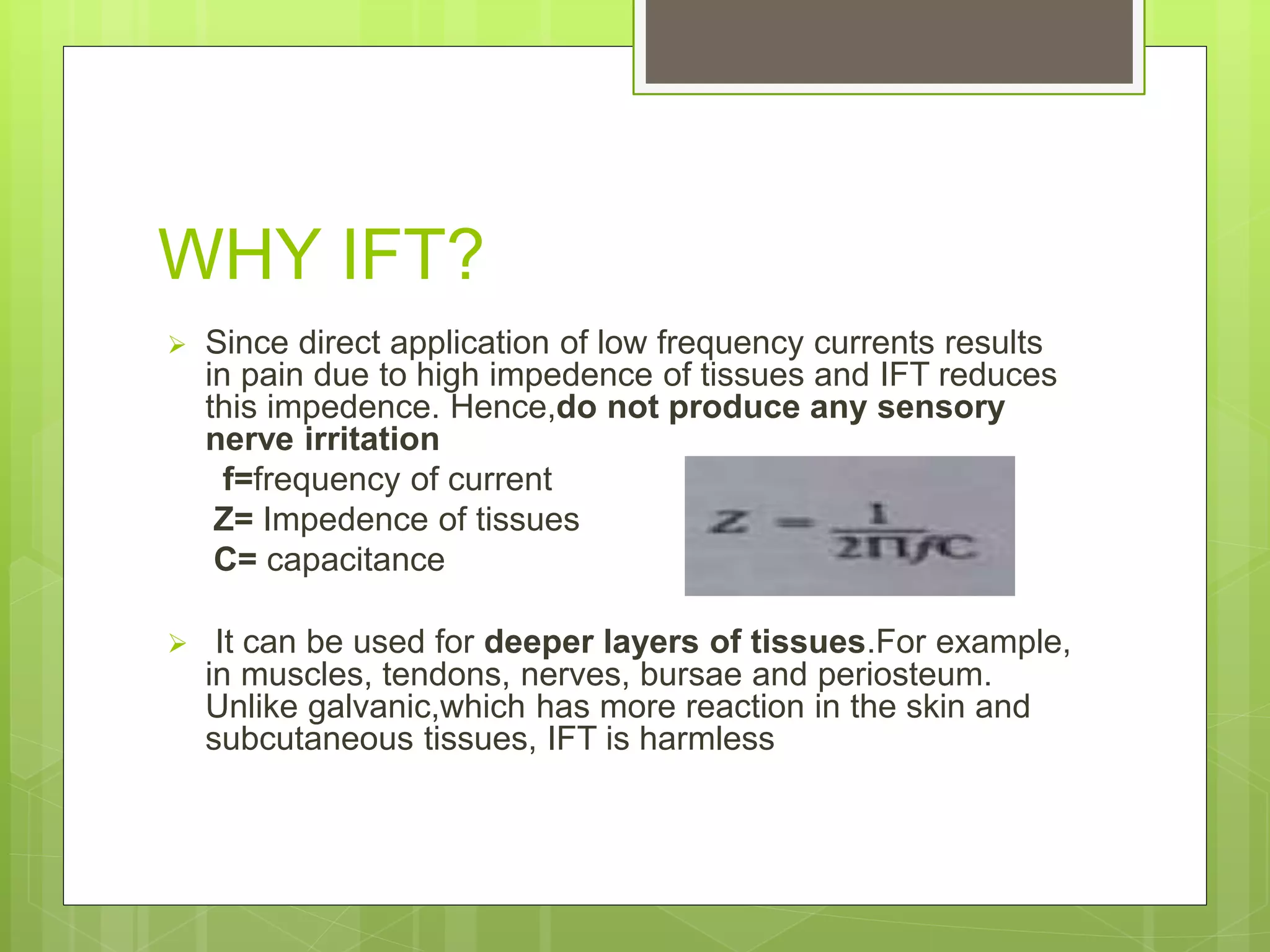
 Since direct application of low frequency currents results
in pain due to high impedence of tissues and IFT reduces
this impedence. Hence,do not produce any sensory
nerve irritation
f=frequency of current
Z= Impedence of tissues
C= capacitance
 It can be used for deeper layers of tissues.For example,
in muscles, tendons, nerves, bursae and periosteum.
Unlike galvanic,which has more reaction in the skin and
subcutaneous tissues, IFT is harmless
Principle:
 The Interferential therapy depends upon the
principles of Interferential effect of two
medium frequency currents crossing in the
patient’s tissues.
 The interference produced by two currents in
the tissues is called the Beat frequency.
Cont.
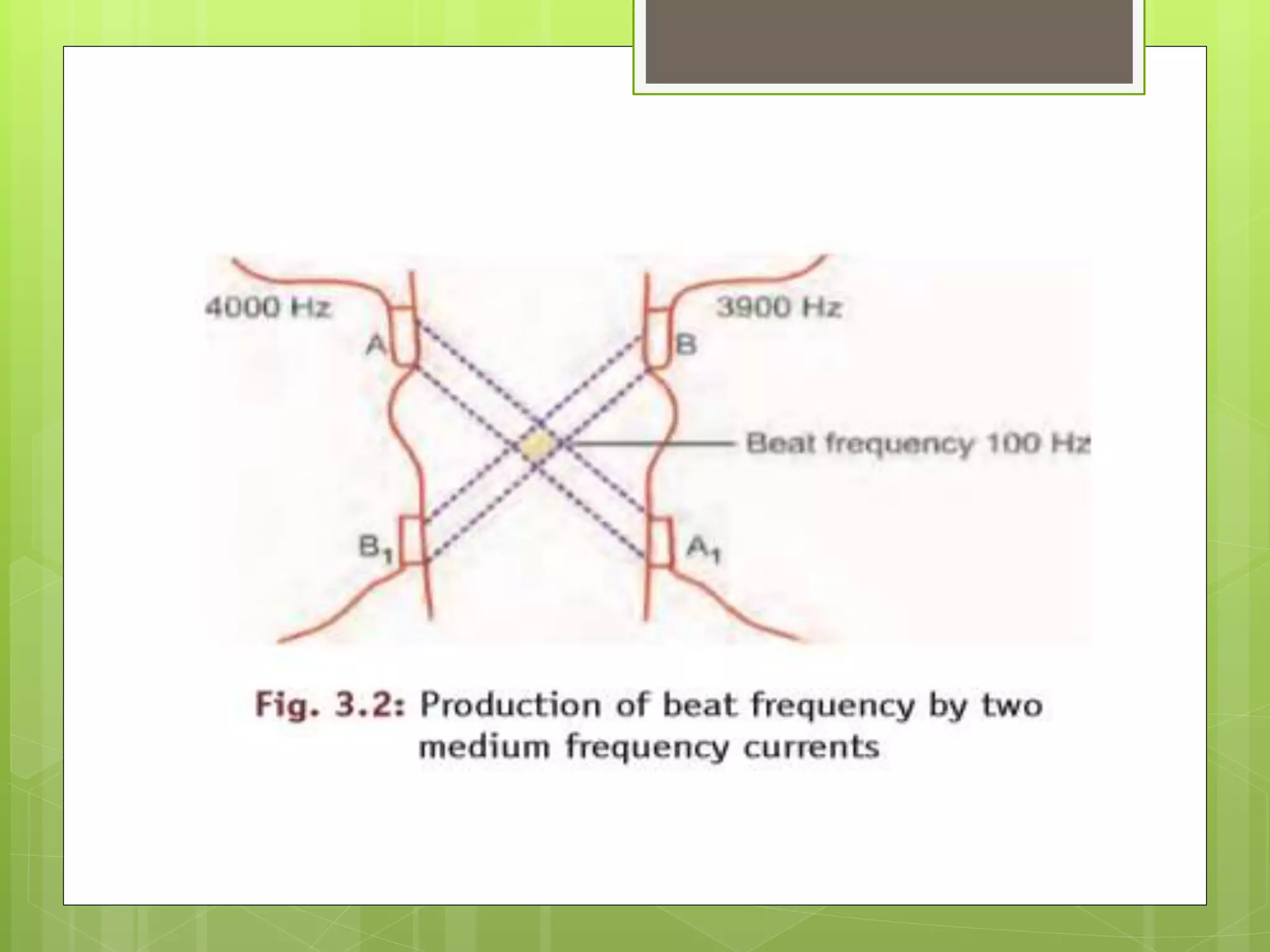
 For example, let us take two medium frequency
currents, current in circuit A = 4000 Hz and circuit
B = 3900 Hz (Carrier Frequencies)
 Where these two currents are applied to the
tissues, at the point where the currents cross over,
a new beat frequency current is set up whose
amplitude is modulated and the frequency of new
current is called Beat frequency (interferential
current) and that is 100 Hz
Cont.
 Out of these two medium frequency currents one
current is always of 4000 Hz because there is minimum
impedance generated by the tissues against this
frequency current.
 By varying the frequency of the second channel relative
to the constant frequency of the first, this is possible to
produce a range of beat frequencies deep in the
patient’s tissues. Thus, it is possible to produce any
desired frequency in the range of 1–250 Hz by varying
the frequency difference of the carrier currents
Physiological Effects:
 Relief of pain: A frequency of 80–100 Hz rhythmic is
usually chosen for this effect, as the problem of
accommodation is reduced
 Motor stimulation:At low frequencies a twitch is
produced, between 5 and 20 Hz a partial tetany, and
from 30 to 100 Hz a tetanic contraction. A complete
range of all these types of muscle contraction can be
seen when a rhythmical frequency of 1–100 Hz is used
Cont.
 Absorption of exudates: a frequency of 1–
10 Hz rhythmic, as a rhythmical pumping
action is produced by muscle contraction this
helps in absorption of exudates and thus
reduce swelling
Indications:
 Pain relief
 Odema relief
 Stress incontinence
Contraindications:
 Hemorrage
 Skin infection
 Malignancy
 Deep Vein Thrombosis
Modes of IFT:
 Vector Mode: used for diffuse area of
pathology where the accuracy of lesion is
doubtful and producesa scanning movement
of IFT
 Quadripolar: 4 pole IFT
 Bipolar: 2 pole IFT
Article Topic:
The effects of abdominal interferential
current therapy on waist circumference and
visceral fat distance in obese women
Researchers:
1)Young-Han Park, PhD
Department of Physical Therapy, Korea National
University of Transportation, Republic of Korea
2)Jung-Ho Lee, PhD
Department of Physical Therapy, Kyungdong University:
Bongpo-ri, Toseong-myeon, Goseong-gun, Gangwon-do,
Republic of Korea
Publishing House:
The Journal of Physical Therapy Science
Date of Publishing:
Jun. 20, 2017
AIM:
 To investigate the effects of interferential
current therapy on the waist circumference
and visceral fat length in obese women
 Methodology:
Sample Size-30 Subjects(Random)
 Group1: interferential current therapy three times a
week for four weeks (n=15)
 Group2: transcutaneous electrical nerve stimulation
three times a week for four weeks (n=15)
Selection creteria:
 patients whose BMI was over 25 kg/m2
 subjects not taking medication for diabetes,
endocrine disease, renal dysfunction, oral
contraception, hypertension, or hyperlipidemia
 whose Beck Depression Inventory score was
over 16
Tool:
 Bioimpedance Analysis Method and InBody 3.0 machine
for BMI mesurement
 Beck Depression Inventory Score
 IFT device
 Tape for measurement of waist circumference
 B-mode ultrasound machine for measuring visceral fat
length
NOTE: The visceral fat length was defined as the length
from the inner surface of the abdominal wall to the
anterior wall of the aorta
Procedure:
Group1:
An interfering current therapy device (Nemectron
GmbH, Germany) was used as follows:
 cuffs were wrapped around the participant’s
abdomen during 45-minute sessions, three times
a week, (a total of 12 times for 4 weeks)
 The program configuration was applied for 5
minutes at the IFT of 3 Hz, then 30 minutes at 50
Hz, and 10 minutes at 10 Hz
Group2:
TENS was applied to the abdomen using a low-
frequency electrical stimulator (STT-100,
Stratek, Korea). The stimulation parameters of
the triangle wave were applied at 100 Hz three
times a week, once for 45 minutes (for 4 weeks)
Results:
 The length of the waist circumference was statistically
significant in all groups in the pre- and post-evaluations
(p<0.05)
 There was also a statistically significant difference
between the group of waist circumference and the
change of waist circumference was larger the
experimental group than the control group (p<0.05).
The length of the visceral fat was statistically significant
in the pre- and post-evaluations (p<0.05)
Cont.:
 There was a statistically significant difference
between the group of visceral fat length, and
the change of visceral fat length was larger
the experimental group than the control group
(p<0.05)
Discussion:
 Currently, clinical treatment for obesity includes drug
therapy, lipolysis, IMS, electrotherapy (mid-frequency
and lowfrequency), and cognitive behavioral therapy.
Physical therapy for obesity management has long
been applied via water therapy, electrotherapy, and
stimulation therapy.
 However, as the application of exercise programs due
to busy daily lives becomes difficult, obesity
management using electrotherapy has begun to attract
attention
Cont.:
IFT for obesity management is a non-invasive
method, and the higher the frequency, the less
capacitance resistance (i.e., the current can
easily pass through the skin). Based on the
above description, interferential wave therapy
can stimulate internal tissues effectively, with
less irritation to the skin compared to low-
frequency currents
Cont.:
Limitation:
 The limitations of this study consisted of fewer
subjects and shorter treatment intervention
periods (4 weeks).
 It would be difficult to generalize the results of the
study because they represent evaluations of waist
circumference and length of abdominal visceral fat
only.
 Because the duration of the treatment intervention
was only 4 weeks, we were unable to determine
the long-term effects of therapeutic intervention
Interferential current (IFT)

Interferential current (IFT)

  • 1.
  • 2.
    INTRODUCTION:  IFT isthe the transcutaneous application of two alternating medium frequency electrical currents which are slightly out of phase,causing amplitude modulation at low frequency used for therapeutic purposes  It is produced by interference of two medium frequency currents(1000 to 10,000 Hz)  In 1950,developed by Dr. Hans Nemac in Vienna &become popular in UK DURING 1970s
  • 3.
    WHY IFT?  Sincedirect application of low frequency currents results in pain due to high impedence of tissues and IFT reduces this impedence. Hence,do not produce any sensory nerve irritation f=frequency of current Z= Impedence of tissues C= capacitance  It can be used for deeper layers of tissues.For example, in muscles, tendons, nerves, bursae and periosteum. Unlike galvanic,which has more reaction in the skin and subcutaneous tissues, IFT is harmless
  • 4.
    Principle:  The Interferentialtherapy depends upon the principles of Interferential effect of two medium frequency currents crossing in the patient’s tissues.  The interference produced by two currents in the tissues is called the Beat frequency.
  • 5.
    Cont.  For example,let us take two medium frequency currents, current in circuit A = 4000 Hz and circuit B = 3900 Hz (Carrier Frequencies)  Where these two currents are applied to the tissues, at the point where the currents cross over, a new beat frequency current is set up whose amplitude is modulated and the frequency of new current is called Beat frequency (interferential current) and that is 100 Hz
  • 7.
    Cont.  Out ofthese two medium frequency currents one current is always of 4000 Hz because there is minimum impedance generated by the tissues against this frequency current.  By varying the frequency of the second channel relative to the constant frequency of the first, this is possible to produce a range of beat frequencies deep in the patient’s tissues. Thus, it is possible to produce any desired frequency in the range of 1–250 Hz by varying the frequency difference of the carrier currents
  • 8.
    Physiological Effects:  Reliefof pain: A frequency of 80–100 Hz rhythmic is usually chosen for this effect, as the problem of accommodation is reduced  Motor stimulation:At low frequencies a twitch is produced, between 5 and 20 Hz a partial tetany, and from 30 to 100 Hz a tetanic contraction. A complete range of all these types of muscle contraction can be seen when a rhythmical frequency of 1–100 Hz is used
  • 9.
    Cont.  Absorption ofexudates: a frequency of 1– 10 Hz rhythmic, as a rhythmical pumping action is produced by muscle contraction this helps in absorption of exudates and thus reduce swelling
  • 10.
    Indications:  Pain relief Odema relief  Stress incontinence Contraindications:  Hemorrage  Skin infection  Malignancy  Deep Vein Thrombosis
  • 11.
    Modes of IFT: Vector Mode: used for diffuse area of pathology where the accuracy of lesion is doubtful and producesa scanning movement of IFT  Quadripolar: 4 pole IFT  Bipolar: 2 pole IFT
  • 12.
    Article Topic: The effectsof abdominal interferential current therapy on waist circumference and visceral fat distance in obese women
  • 13.
    Researchers: 1)Young-Han Park, PhD Departmentof Physical Therapy, Korea National University of Transportation, Republic of Korea 2)Jung-Ho Lee, PhD Department of Physical Therapy, Kyungdong University: Bongpo-ri, Toseong-myeon, Goseong-gun, Gangwon-do, Republic of Korea Publishing House: The Journal of Physical Therapy Science Date of Publishing: Jun. 20, 2017
  • 14.
    AIM:  To investigatethe effects of interferential current therapy on the waist circumference and visceral fat length in obese women
  • 15.
     Methodology: Sample Size-30Subjects(Random)  Group1: interferential current therapy three times a week for four weeks (n=15)  Group2: transcutaneous electrical nerve stimulation three times a week for four weeks (n=15)
  • 16.
    Selection creteria:  patientswhose BMI was over 25 kg/m2  subjects not taking medication for diabetes, endocrine disease, renal dysfunction, oral contraception, hypertension, or hyperlipidemia  whose Beck Depression Inventory score was over 16
  • 17.
    Tool:  Bioimpedance AnalysisMethod and InBody 3.0 machine for BMI mesurement  Beck Depression Inventory Score  IFT device  Tape for measurement of waist circumference  B-mode ultrasound machine for measuring visceral fat length NOTE: The visceral fat length was defined as the length from the inner surface of the abdominal wall to the anterior wall of the aorta
  • 18.
    Procedure: Group1: An interfering currenttherapy device (Nemectron GmbH, Germany) was used as follows:  cuffs were wrapped around the participant’s abdomen during 45-minute sessions, three times a week, (a total of 12 times for 4 weeks)  The program configuration was applied for 5 minutes at the IFT of 3 Hz, then 30 minutes at 50 Hz, and 10 minutes at 10 Hz
  • 19.
    Group2: TENS was appliedto the abdomen using a low- frequency electrical stimulator (STT-100, Stratek, Korea). The stimulation parameters of the triangle wave were applied at 100 Hz three times a week, once for 45 minutes (for 4 weeks)
  • 20.
    Results:  The lengthof the waist circumference was statistically significant in all groups in the pre- and post-evaluations (p<0.05)  There was also a statistically significant difference between the group of waist circumference and the change of waist circumference was larger the experimental group than the control group (p<0.05). The length of the visceral fat was statistically significant in the pre- and post-evaluations (p<0.05)
  • 21.
    Cont.:  There wasa statistically significant difference between the group of visceral fat length, and the change of visceral fat length was larger the experimental group than the control group (p<0.05)
  • 22.
    Discussion:  Currently, clinicaltreatment for obesity includes drug therapy, lipolysis, IMS, electrotherapy (mid-frequency and lowfrequency), and cognitive behavioral therapy. Physical therapy for obesity management has long been applied via water therapy, electrotherapy, and stimulation therapy.  However, as the application of exercise programs due to busy daily lives becomes difficult, obesity management using electrotherapy has begun to attract attention
  • 23.
    Cont.: IFT for obesitymanagement is a non-invasive method, and the higher the frequency, the less capacitance resistance (i.e., the current can easily pass through the skin). Based on the above description, interferential wave therapy can stimulate internal tissues effectively, with less irritation to the skin compared to low- frequency currents
  • 24.
    Cont.: Limitation:  The limitationsof this study consisted of fewer subjects and shorter treatment intervention periods (4 weeks).  It would be difficult to generalize the results of the study because they represent evaluations of waist circumference and length of abdominal visceral fat only.  Because the duration of the treatment intervention was only 4 weeks, we were unable to determine the long-term effects of therapeutic intervention