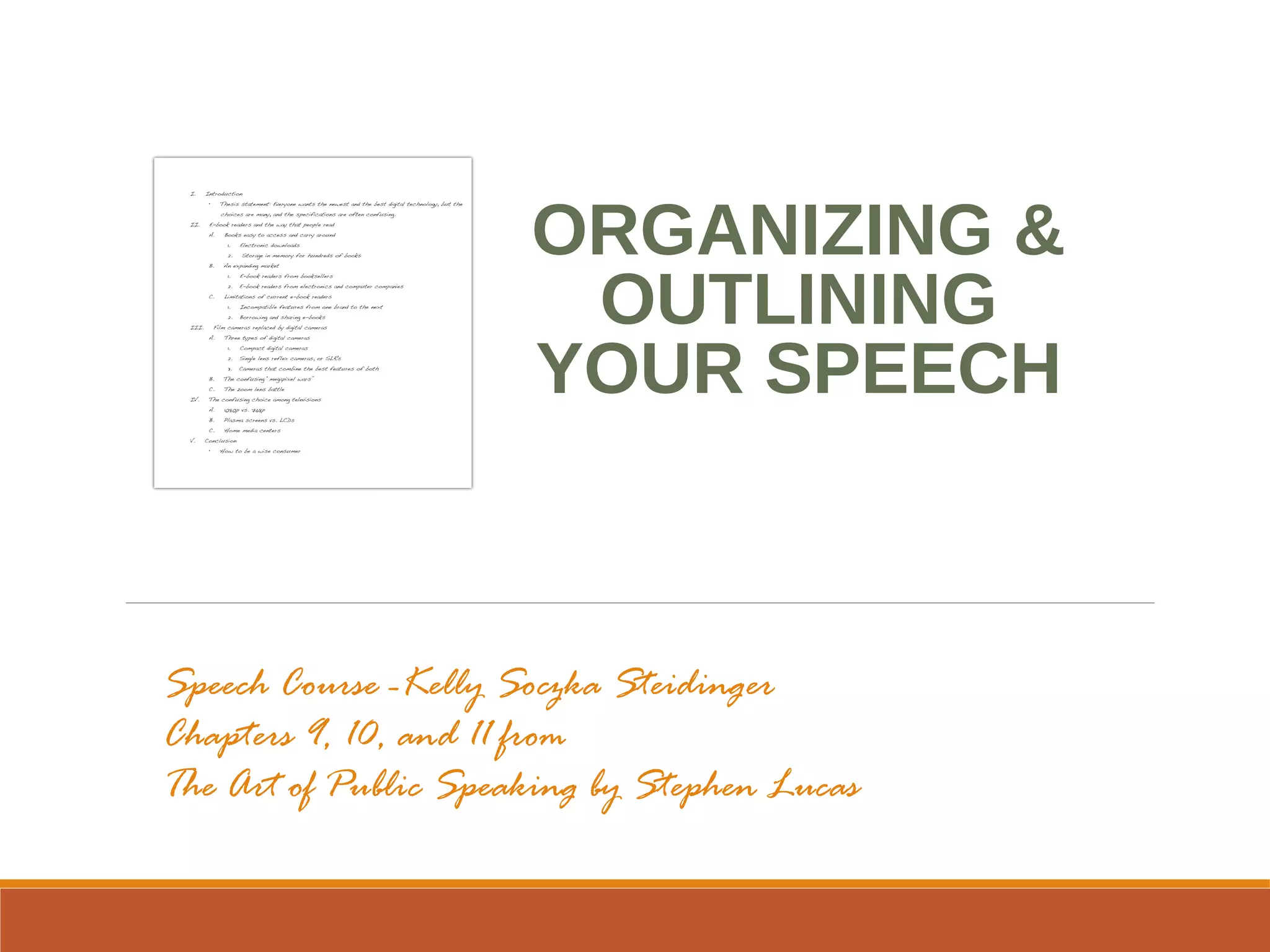
ORGANIZING &
OUTLINING
YOUR SPEECH
Speech Course -Kelly Soczka Steidinger
Chapters 9, 10, and 11 from
The Art of Public Speaking by Stephen Lucas
Why should you
write a speech
outline?
1. An organized speech, lowers the speaker’s
anxiety
2. So that your audience does not get lost
(Listeners only have one chance to hear & understand you!)
3. So that the speaker does not get lost
4. Well organized speeches are perceived as more
competent and credible because it exhibits your
critical thinking skills
3 Parts of a Speech
 Introduction
 Body
 Conclusion
Three Types of
Outlines
1. Preparation
This is the one you will turn into the instructor
Includes your list of references
2. Speaking
This one will be written on your notecards
Preparation Outline
Is a detailed outline developed during the speech
writing process that includes:
Full Sentences
The Introduction – The AGD, Thesis, Est. Credibility &
Preview of Main Points
Body – Main Points, Supporting Points, Sub-Supporting
Points & Transitions/Connectives
Conclusion
References – Both in-text citations & Reference page
Speaking Outline
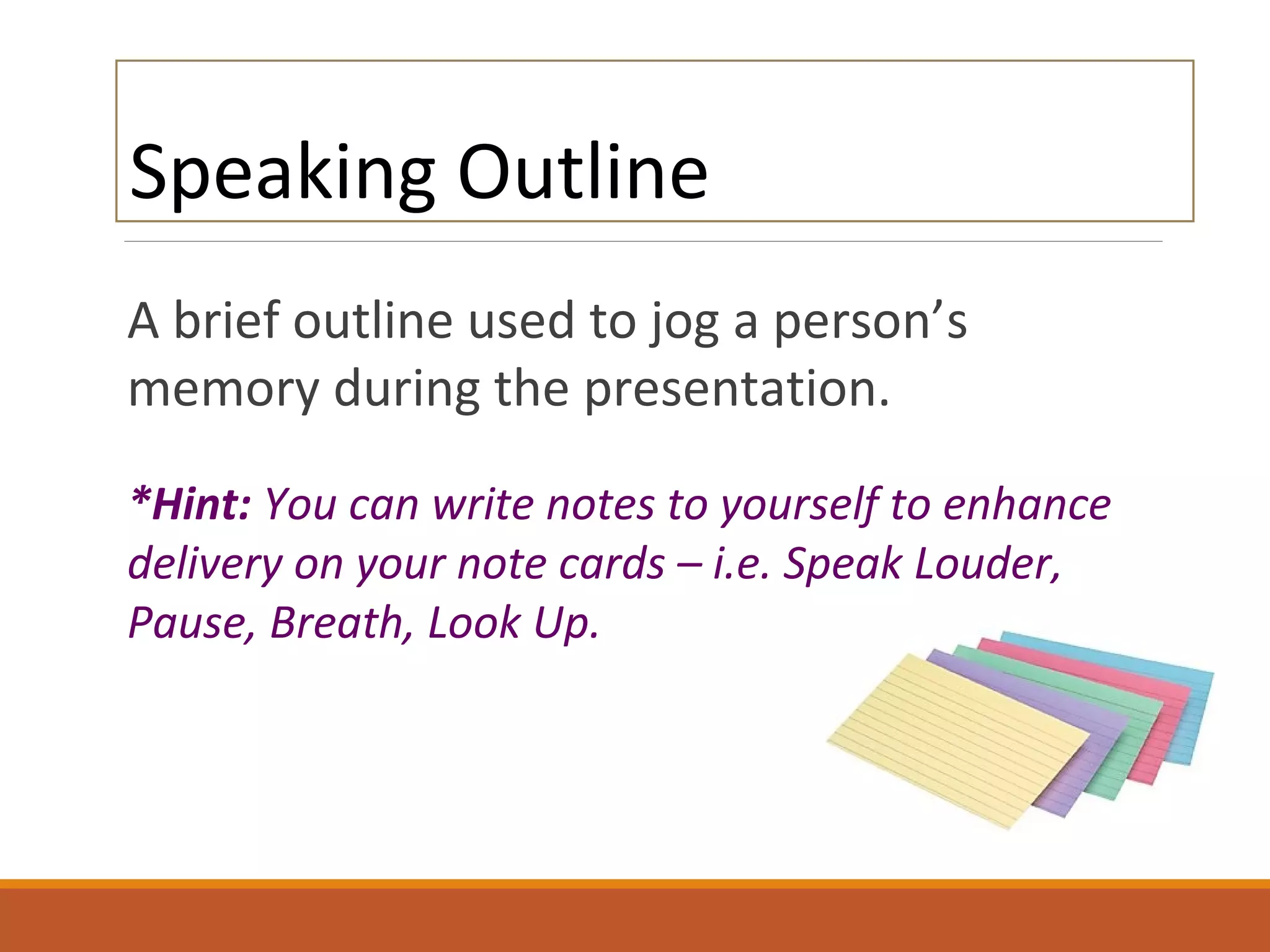
A brief outline used to jog a person’s
memory during the presentation.
*Hint: You can write notes to yourself to enhance
delivery on your note cards – i.e. Speak Louder,
Pause, Breath, Look Up.
Guidelines for the Speaking
Outline
 Use a visual framework
 Make sure it is legible
 Keep it as brief as possible
 Give yourself speaking clues
Visual Framework
A pattern of symbolization & indentation in a
speech that shows the relationships among
the speaker’s ideas.
Indentation
Roman Numerals, Letters, & Numbers
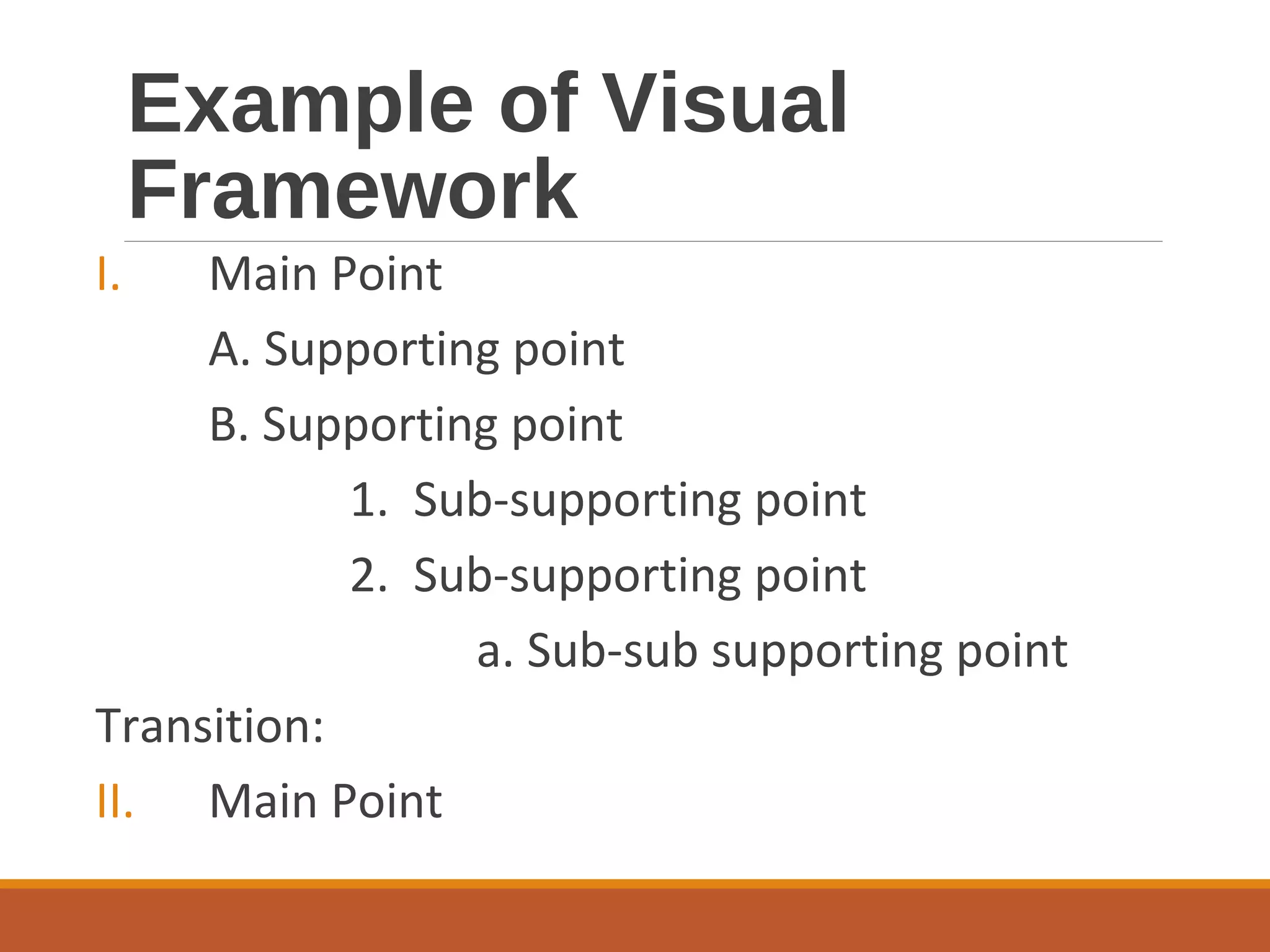
Example of Visual
Framework
I. Main Point
A. Supporting point
B. Supporting point
1. Sub-supporting point
2. Sub-supporting point
a. Sub-sub supporting point
Transition:
II. Main Point
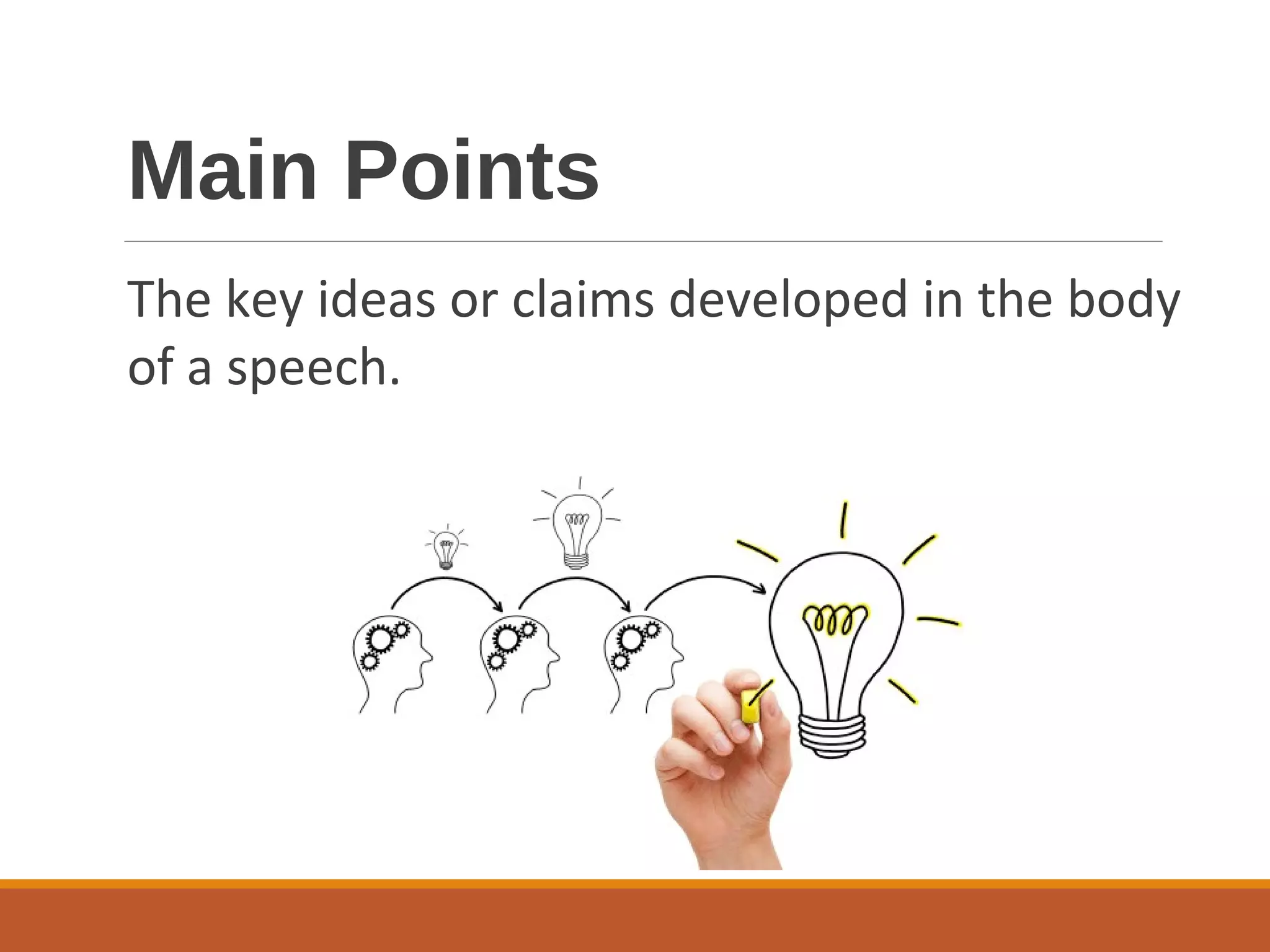
Main Points
The key ideas or claims developed in the body
of a speech.
Tips for Writing Main Points
1. Keep main points separate – use only one key
idea per main point
2. Try to use the same pattern of wording for main
points
3. Balance the amount of time devoted to
main points
1. Keep The Main Points
Separate
Example
Incorrect Correct
I. West Texas has
its own Grand
Canyon, and
South Texas has
its own desert.
I. West Texas
boasts its own
Grand Canyon.
II. South Texas
boasts its own
desert.
2. Use the same pattern of
wording
I. Regular exercise increases endurance.
II. Regular exercise improves your sleeping
pattern.
III. Regular exercise helps control your
weight.
3. Give equal time to main
points to balance your speech.
Incorrect Correct
I. 75%
II. 20%
III. 5%
I. 30%
II. 40%
III. 30%
How can you organize
How can you organizeyour main points?
your main points?
By Using Informative Speech Organizational Patterns
Organizational Patterns for
Informative Speeches Include:
1. Time Arrangement
2. Spatial Arrangement
3. Cause-Effect Arrangement
4. Topical Arrangement
Chronological
Arrangement
Organizing your speech based on a time or date
Thesis: Americans believe they have a fundamental right to
privacy.
I.More than a century ago, Justice Louis D. Brandeis called
privacy “the right to be alone.”
II.Within a decade, the courts began to recognize the right to
privacy.
III.The Supreme Court relied on a privacy rationale in teaching
its fundamental and controversial decisions on abortion.
IV.Threats to privacy are abound in today’s society.
Time pattern is also used
when explaining a process…
Thesis: There are four main steps to
getting a professional tattoo.
I. First, the hair is shaved…..
II. Second, the main lines are drawn.
III. Third, colored pigments are applied inside
the outline….
Spatial Arrangement
The main points follow a directional pattern.
The main points proceed from top to
bottom, left to right, front to back,
inside to outside, east to west or in some
other route.
Spatial
Example
Thesis: A hurricane is made up of three major cloud
formations.
I. At the center of the hurricane is the calm,
cloud-free cloud.
II. Surrounding the eye is the eye-wall, a dense
ring of clouds that produces the most intense
wind and rainfall.
III. Rotating around the eye wall are large bands
of swirling clouds.
Cause-Effect
Arrangement
Main points are organized in a cause – effect
relationship.
This speech has two main points:
1. One dealing with the causes of an event
2. The other dealing with its effects
**Can appear in reverse order – the effect, then the
Cause, but this is rare.**
Cause-Effect Example
I. Caused by the bite of infected mosquito, West
Nile virus is spreading throughout the U.S.
II. The effects of West Nile Virus include
flu-like symptoms, convulsions, swelling
of the brain and in some cases, death.
Topical Arrangement
The main points of the speech divide the
topic into logical and consistent subtopics.
Speeches that do not fit under any of the other
organizational patterns, usually can fit into this
pattern.
Topical Example
I. Genetic engineering is producing new plant
hybrids that will vastly increase world agricultural
production.
II. Genetic engineering is producing breakthroughs
in medicine that will allow people to live
healthier lives.
III. Genetic engineering is producing bacteria that
will help clean up industrial pollutants.
Once you have your main points organized, it is
time to add supporting points with supporting
materials (evidence) to your speech outline.
Yahoo!
Supporting Points
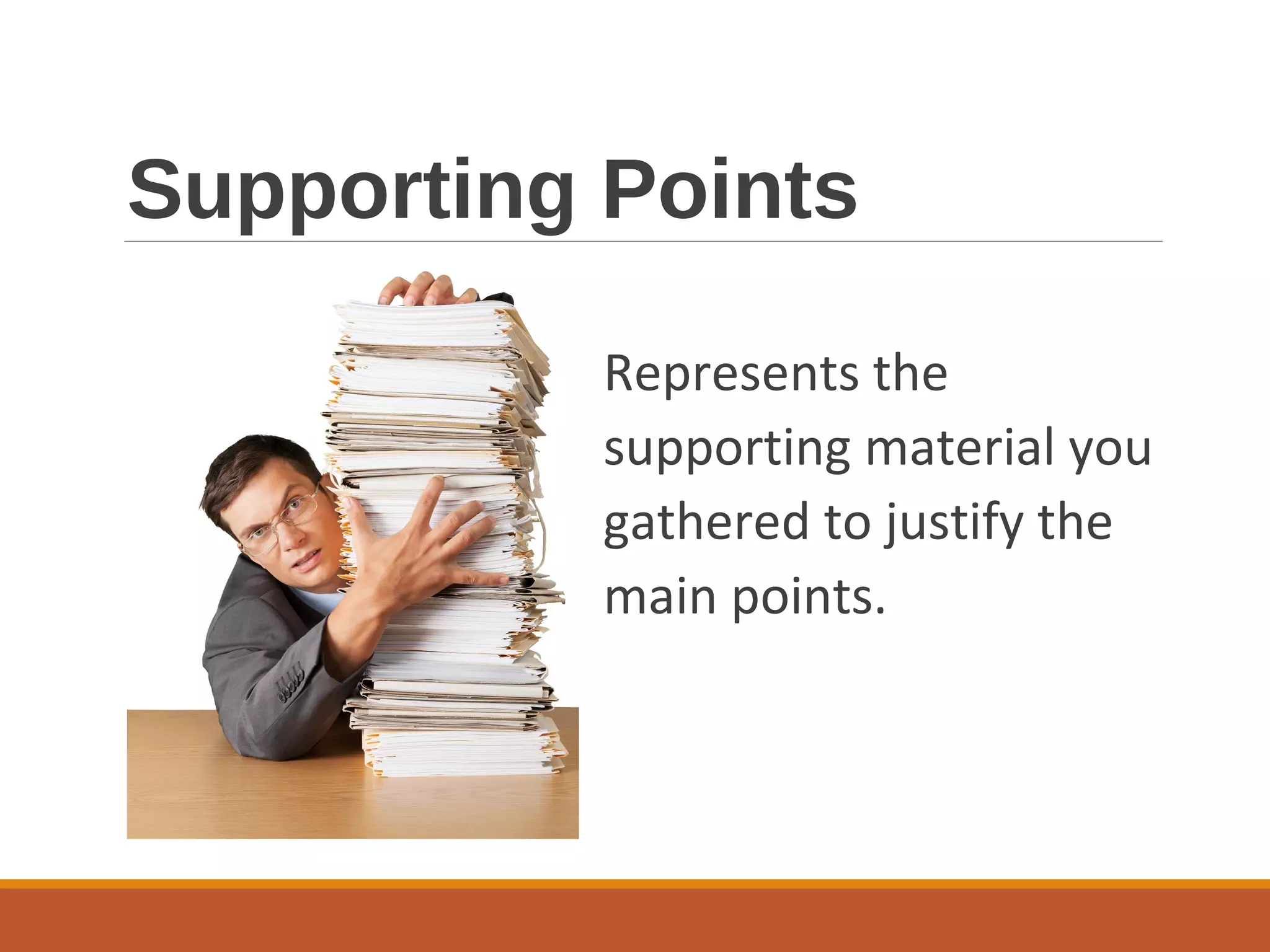
Represents the
supporting material you
gathered to justify the
main points.
Types of Supporting
Materials
1. Definitions
2. Statistics/Numbers
3. Examples, Illustrations & Descriptions
4. Testimony
5. Facts
6. Stories
How can you tie your ideasHow can you tie your ideas
together?together?
BY USING CONNECTIVES!
Connectives
Are words, phrases or
sentences that tie the speech
ideas together. They keep the
audience and speaker on track.
 Internal Preview & Summaries
 Restate-Forecast Transitions
 Rhetorical Questions
 Signpost Transitions
Internal Previews &
Summaries
Previews
Previews key points of
a section of the body of
the speech
Example: I will focus on
three solutions…..
Summaries
Summarizes or reviews a
section just covered to
reinforce key on the body
of the speech
Example: Let’s pause for a
moment to summarize
what we have found so far.
Restate-Forecast
Transition
States the main point just covered, then
previews the next main point.
Examples:
Now that we have explored the ancient origins
of
astrology, let us turn to its modern popularity.
So much for the present; what about the
future?
Rhetorical Question
Transition
Are questions that do not invite an actual
response. They make the audience think.
Example: How do the costs of contests stack up
against the expense of training new
employees?
Signpost Transition
Brief phrases that indicate
exactly where you are in a
speech.
◦Numbers
◦Focused attention words
Examples of Signposts
Numbers
The first cause of this
problem is…
The second cause is..
The final cause is..
Focused Attention Words
Finally…
Next…
We now turn to….

Organizing and Outlining Your Speech

  • 1.
    ORGANIZING & OUTLINING YOUR SPEECH SpeechCourse -Kelly Soczka Steidinger Chapters 9, 10, and 11 from The Art of Public Speaking by Stephen Lucas
  • 2.
    Why should you writea speech outline? 1. An organized speech, lowers the speaker’s anxiety 2. So that your audience does not get lost (Listeners only have one chance to hear & understand you!) 3. So that the speaker does not get lost 4. Well organized speeches are perceived as more competent and credible because it exhibits your critical thinking skills
  • 3.
    3 Parts ofa Speech  Introduction  Body  Conclusion
  • 4.
    Three Types of Outlines 1.Preparation This is the one you will turn into the instructor Includes your list of references 2. Speaking This one will be written on your notecards
  • 5.
    Preparation Outline Is adetailed outline developed during the speech writing process that includes: Full Sentences The Introduction – The AGD, Thesis, Est. Credibility & Preview of Main Points Body – Main Points, Supporting Points, Sub-Supporting Points & Transitions/Connectives Conclusion References – Both in-text citations & Reference page
  • 6.
    Speaking Outline A briefoutline used to jog a person’s memory during the presentation. *Hint: You can write notes to yourself to enhance delivery on your note cards – i.e. Speak Louder, Pause, Breath, Look Up.
  • 7.
    Guidelines for theSpeaking Outline  Use a visual framework  Make sure it is legible  Keep it as brief as possible  Give yourself speaking clues
  • 8.
    Visual Framework A patternof symbolization & indentation in a speech that shows the relationships among the speaker’s ideas. Indentation Roman Numerals, Letters, & Numbers
  • 9.
    Example of Visual Framework I.Main Point A. Supporting point B. Supporting point 1. Sub-supporting point 2. Sub-supporting point a. Sub-sub supporting point Transition: II. Main Point
  • 10.
    Main Points The keyideas or claims developed in the body of a speech.
  • 11.
    Tips for WritingMain Points 1. Keep main points separate – use only one key idea per main point 2. Try to use the same pattern of wording for main points 3. Balance the amount of time devoted to main points
  • 12.
    1. Keep TheMain Points Separate Example Incorrect Correct I. West Texas has its own Grand Canyon, and South Texas has its own desert. I. West Texas boasts its own Grand Canyon. II. South Texas boasts its own desert.
  • 13.
    2. Use thesame pattern of wording I. Regular exercise increases endurance. II. Regular exercise improves your sleeping pattern. III. Regular exercise helps control your weight.
  • 14.
    3. Give equaltime to main points to balance your speech. Incorrect Correct I. 75% II. 20% III. 5% I. 30% II. 40% III. 30%
  • 15.
    How can youorganize How can you organizeyour main points? your main points? By Using Informative Speech Organizational Patterns
  • 16.
    Organizational Patterns for InformativeSpeeches Include: 1. Time Arrangement 2. Spatial Arrangement 3. Cause-Effect Arrangement 4. Topical Arrangement
  • 17.
    Chronological Arrangement Organizing your speechbased on a time or date Thesis: Americans believe they have a fundamental right to privacy. I.More than a century ago, Justice Louis D. Brandeis called privacy “the right to be alone.” II.Within a decade, the courts began to recognize the right to privacy. III.The Supreme Court relied on a privacy rationale in teaching its fundamental and controversial decisions on abortion. IV.Threats to privacy are abound in today’s society.
  • 18.
    Time pattern isalso used when explaining a process… Thesis: There are four main steps to getting a professional tattoo. I. First, the hair is shaved….. II. Second, the main lines are drawn. III. Third, colored pigments are applied inside the outline….
  • 19.
    Spatial Arrangement The mainpoints follow a directional pattern. The main points proceed from top to bottom, left to right, front to back, inside to outside, east to west or in some other route.
  • 20.
    Spatial Example Thesis: A hurricaneis made up of three major cloud formations. I. At the center of the hurricane is the calm, cloud-free cloud. II. Surrounding the eye is the eye-wall, a dense ring of clouds that produces the most intense wind and rainfall. III. Rotating around the eye wall are large bands of swirling clouds.
  • 21.
    Cause-Effect Arrangement Main points areorganized in a cause – effect relationship. This speech has two main points: 1. One dealing with the causes of an event 2. The other dealing with its effects **Can appear in reverse order – the effect, then the Cause, but this is rare.**
  • 22.
    Cause-Effect Example I. Causedby the bite of infected mosquito, West Nile virus is spreading throughout the U.S. II. The effects of West Nile Virus include flu-like symptoms, convulsions, swelling of the brain and in some cases, death.
  • 23.
    Topical Arrangement The mainpoints of the speech divide the topic into logical and consistent subtopics. Speeches that do not fit under any of the other organizational patterns, usually can fit into this pattern.
  • 24.
    Topical Example I. Geneticengineering is producing new plant hybrids that will vastly increase world agricultural production. II. Genetic engineering is producing breakthroughs in medicine that will allow people to live healthier lives. III. Genetic engineering is producing bacteria that will help clean up industrial pollutants.
  • 25.
    Once you haveyour main points organized, it is time to add supporting points with supporting materials (evidence) to your speech outline. Yahoo!
  • 26.
    Supporting Points Represents the supportingmaterial you gathered to justify the main points.
  • 27.
    Types of Supporting Materials 1.Definitions 2. Statistics/Numbers 3. Examples, Illustrations & Descriptions 4. Testimony 5. Facts 6. Stories
  • 28.
    How can youtie your ideasHow can you tie your ideas together?together? BY USING CONNECTIVES!
  • 29.
    Connectives Are words, phrasesor sentences that tie the speech ideas together. They keep the audience and speaker on track.  Internal Preview & Summaries  Restate-Forecast Transitions  Rhetorical Questions  Signpost Transitions
  • 30.
    Internal Previews & Summaries Previews Previewskey points of a section of the body of the speech Example: I will focus on three solutions….. Summaries Summarizes or reviews a section just covered to reinforce key on the body of the speech Example: Let’s pause for a moment to summarize what we have found so far.
  • 31.
    Restate-Forecast Transition States the mainpoint just covered, then previews the next main point. Examples: Now that we have explored the ancient origins of astrology, let us turn to its modern popularity. So much for the present; what about the future?
  • 32.
    Rhetorical Question Transition Are questionsthat do not invite an actual response. They make the audience think. Example: How do the costs of contests stack up against the expense of training new employees?
  • 33.
    Signpost Transition Brief phrasesthat indicate exactly where you are in a speech. ◦Numbers ◦Focused attention words
  • 34.
    Examples of Signposts Numbers Thefirst cause of this problem is… The second cause is.. The final cause is.. Focused Attention Words Finally… Next… We now turn to….