CONTENTS ………..

2
• Information technology is the study of engineering
computer applications to support the operation of an
organization : operating , installing and maintaining software
and data.

3






COMPUTER
COMMUNICATION TECHNOLOGY
CONTENT TECHNOLOGY
CHARACTERISTICS OF A COMPUTER
COMPONENTS OF A COMPUTER
SYSTEM
 MEMORY
 UNITS OF MEMORY
 STORAGE DEVICES
 TYPES OF SOFTWARE
 COMPUTER NETWORKING

4
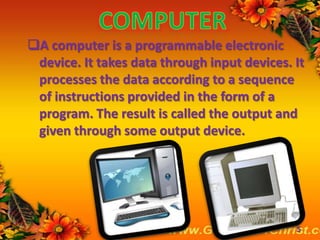
A computer is a programmable electronic
device. It takes data through input devices. It
processes the data according to a sequence
of instructions provided in the form of a
program. The result is called the output and
given through some output device.

5
• Communication technology is the
study of technology applications used
in telecommunications.

6
7
CHARACTERISTICS OF A COMPUTER

8
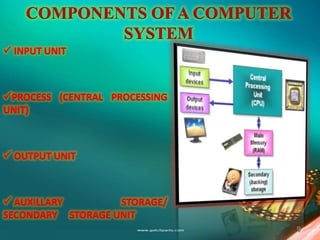
COMPONENTS OF A COMPUTER
SYSTEM
 INPUT UNIT

PROCESS (CENTRAL PROCESSING
UNIT)

 OUTPUT UNIT

 AUXILLARY
STORAGE/
SECONDARY STORAGE UNIT
9
Computer uses several different types of memory. They
are : 

INTERNAL MEMORY
RAM )

Main memory (
Cache

memory
MAIN MEMORY
 EXTERNAL MEMORY
memory
• RAM is volatile.
• It is temporary memory.
• It has limited storage
capacity.
• It is very expensive.
• It is not portable.

SECONDARY MEMORY
Secondary

• It is non volatile.
• It is permanent
memory.
• It has large storage
capacity.
• It is cheaper .
• It is portable.

10
11
Secondary storage devices are classified into two types : MAGNETIC STORAGE MEDIA

OPTICAL STORAGE MEDIA

 FLOPPY DISK

 CD ( COMPACT DISC )

 HARD DISK

 PEN DRIVE

12
TYPES OF SOFTWARE
• SYSTEM SOFTWARE

• APPLICATION SOFTWARE

• UTILITY SOFTWARE
13
14
APPLICATION SOFTWARE
• Application software are a set of program
that are put together for specific purpose or
task. There are two types of application
software:• General Purpose Application Software

• Customized Software
15
• Utility software is a small program that
provides additional capabilities to the
operating system.
• For example :- disk defragmenter ,
registry cleaners.
• WinZip is very popular compression and
archive utility .

16
 LAN ( LOCAL AREA NETWORK )
 MAN ( METROPOLITAN AREA NETWORK )
 WAN ( WIDE AREA NETWORK )
 INTERNET
 WIRED NETWORKING TECHNOLOGY
 WIRELESS NETWORKING TECHNOLOGY
 WI-FI TECHNOLOGY
17
A local area network is a
computer network that
interconnects computers in a
limited area such as a home,
school, computer laboratory, or
office building using network
media .

18
19
A wide area network (WAN) is
a network that covers a broad
area (i.e., any
telecommunications
network that links across
metropolitan, regional, or
national boundaries) using
private or public network
transports.

20
21
1.
2.
3.
4.
5.
6.
7.
8.
9.
10.
11.
12.
13.
14.

COMMUNICATION
RESEARCH
DISTANCE EDUCATION
BOOKING E- TICKETS
PLAYING GAMES
DOWNLOADING
CHATTING
TWITTER
E – COMMERCE
BLOGGING
SOCIAL NETWORKING
ENTERTAINMENT
E – GREETINGS
LISTEN SONGS
22
WIRED NETWORKING
TECHNOLOGY media are
classified based on the kind of
materials used as :
1. Ethernet Twisted Pair

• Ethernet Twisted Pair

• Coaxial Cable

2. Coaxial Cable
3. Optic Fibre Cable

• Optic Fibre Cable

23
Wireless or unguided media
means that there is no
physical path for the signal
to move. Hence
communication or
transmission is wireless. For
example :1. Bluetooth
2. Infrared
3. Wi-Fi
24
WI-FI is a popular technology
that allows an electronic
device to exchange data
wirelessly over a computer
network. Wi-Fi is an
abbreviation for wireless
fidelity known as 802.11
wireless network.

25
26
An operating system (OS) is a
collection of software that
manages computer
hardware resources and provides
common services for computer
programs. The operating system is an
essential component of the system
software in a computer system.
For example:
 MAC OS
LINUX
UNIX
27
28
A word processor is an electronic
device or computer software
application that, as directed by the
user, performs word processing: the
composition, editing, formatting and
sometimes printing of any sort of
written material. Word processing can

also refer to
advanced shorthand techniques,
sometimes used in specialized
contexts with a specially
modified typewriter. The term was

coined at IBM's Boblingen , West
Germany Laboratory in the 1960s.
29
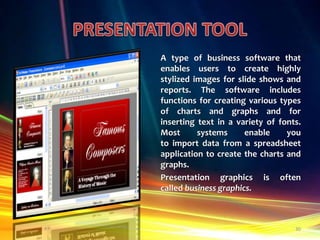
A type of business software that
enables users to create highly
stylized images for slide shows and
reports. The software includes
functions for creating various types
of charts and graphs and for
inserting text in a variety of fonts.
Most
systems
enable
you
to import data from a spreadsheet
application to create the charts and
graphs.
Presentation graphics is often
called business graphics.

30
31
32
33
34
35
36
37
38
39
40
41
42

INFORMATION TECHNOLOGY

  • 2.
  • 3.
    • Information technologyis the study of engineering computer applications to support the operation of an organization : operating , installing and maintaining software and data. 3
  • 4.
         COMPUTER COMMUNICATION TECHNOLOGY CONTENT TECHNOLOGY CHARACTERISTICSOF A COMPUTER COMPONENTS OF A COMPUTER SYSTEM  MEMORY  UNITS OF MEMORY  STORAGE DEVICES  TYPES OF SOFTWARE  COMPUTER NETWORKING 4
  • 5.
    A computer isa programmable electronic device. It takes data through input devices. It processes the data according to a sequence of instructions provided in the form of a program. The result is called the output and given through some output device. 5
  • 6.
    • Communication technologyis the study of technology applications used in telecommunications. 6
  • 7.
  • 8.
  • 9.
    COMPONENTS OF ACOMPUTER SYSTEM  INPUT UNIT PROCESS (CENTRAL PROCESSING UNIT)  OUTPUT UNIT  AUXILLARY STORAGE/ SECONDARY STORAGE UNIT 9
  • 10.
    Computer uses severaldifferent types of memory. They are :  INTERNAL MEMORY RAM ) Main memory ( Cache memory MAIN MEMORY  EXTERNAL MEMORY memory • RAM is volatile. • It is temporary memory. • It has limited storage capacity. • It is very expensive. • It is not portable. SECONDARY MEMORY Secondary • It is non volatile. • It is permanent memory. • It has large storage capacity. • It is cheaper . • It is portable. 10
  • 11.
  • 12.
    Secondary storage devicesare classified into two types : MAGNETIC STORAGE MEDIA OPTICAL STORAGE MEDIA  FLOPPY DISK  CD ( COMPACT DISC )  HARD DISK  PEN DRIVE 12
  • 13.
    TYPES OF SOFTWARE •SYSTEM SOFTWARE • APPLICATION SOFTWARE • UTILITY SOFTWARE 13
  • 14.
  • 15.
    APPLICATION SOFTWARE • Applicationsoftware are a set of program that are put together for specific purpose or task. There are two types of application software:• General Purpose Application Software • Customized Software 15
  • 16.
    • Utility softwareis a small program that provides additional capabilities to the operating system. • For example :- disk defragmenter , registry cleaners. • WinZip is very popular compression and archive utility . 16
  • 17.
     LAN (LOCAL AREA NETWORK )  MAN ( METROPOLITAN AREA NETWORK )  WAN ( WIDE AREA NETWORK )  INTERNET  WIRED NETWORKING TECHNOLOGY  WIRELESS NETWORKING TECHNOLOGY  WI-FI TECHNOLOGY 17
  • 18.
    A local areanetwork is a computer network that interconnects computers in a limited area such as a home, school, computer laboratory, or office building using network media . 18
  • 19.
  • 20.
    A wide areanetwork (WAN) is a network that covers a broad area (i.e., any telecommunications network that links across metropolitan, regional, or national boundaries) using private or public network transports. 20
  • 21.
  • 22.
    1. 2. 3. 4. 5. 6. 7. 8. 9. 10. 11. 12. 13. 14. COMMUNICATION RESEARCH DISTANCE EDUCATION BOOKING E-TICKETS PLAYING GAMES DOWNLOADING CHATTING TWITTER E – COMMERCE BLOGGING SOCIAL NETWORKING ENTERTAINMENT E – GREETINGS LISTEN SONGS 22
  • 23.
    WIRED NETWORKING TECHNOLOGY mediaare classified based on the kind of materials used as : 1. Ethernet Twisted Pair • Ethernet Twisted Pair • Coaxial Cable 2. Coaxial Cable 3. Optic Fibre Cable • Optic Fibre Cable 23
  • 24.
    Wireless or unguidedmedia means that there is no physical path for the signal to move. Hence communication or transmission is wireless. For example :1. Bluetooth 2. Infrared 3. Wi-Fi 24
  • 25.
    WI-FI is apopular technology that allows an electronic device to exchange data wirelessly over a computer network. Wi-Fi is an abbreviation for wireless fidelity known as 802.11 wireless network. 25
  • 26.
  • 27.
    An operating system(OS) is a collection of software that manages computer hardware resources and provides common services for computer programs. The operating system is an essential component of the system software in a computer system. For example:  MAC OS LINUX UNIX 27
  • 28.
  • 29.
    A word processoris an electronic device or computer software application that, as directed by the user, performs word processing: the composition, editing, formatting and sometimes printing of any sort of written material. Word processing can also refer to advanced shorthand techniques, sometimes used in specialized contexts with a specially modified typewriter. The term was coined at IBM's Boblingen , West Germany Laboratory in the 1960s. 29
  • 30.
    A type ofbusiness software that enables users to create highly stylized images for slide shows and reports. The software includes functions for creating various types of charts and graphs and for inserting text in a variety of fonts. Most systems enable you to import data from a spreadsheet application to create the charts and graphs. Presentation graphics is often called business graphics. 30
  • 31.
  • 32.
  • 33.
  • 34.
  • 35.
  • 36.
  • 37.
  • 38.
  • 39.
  • 40.
  • 41.
  • 42.