INFORMATION
SERVICES
By
Mr. Krushna K. Zambare
HOD, Pharmacology
SBSPM B. Pharmacy College, Ambajogai
Poison information centre
 The PIC is a place or unit providing information on
prevention, early diagnosis and treatment of
poisoning and risk management.
 PIC is important for assessing and treating poisoning
 PIC help in minimizing or preventing poisoning
 Improve the health of the public by minimizing
morbidity, mortality due to poisoning
Prof. Krushna K Zambare
Poison information centre
 PIC accept the query related to the poisoning either
over phone or in person or by e-mail
 PIC should collect all the information of patient and
enquirer
 Assess importance of the situation such as the
condition is an emergency, serious, not serious or no
problem.
Prof. Krushna K Zambare
PIC sourses
 The PIC sources are same as that of DIC which
include
 Primary, Secondary and tertiary sources
 Database like POISINDEX
 Textbooks and Reference books
Prof. Krushna K Zambare
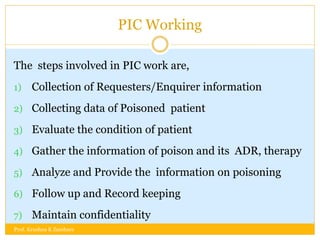
PIC Working
The steps involved in PIC work are,
1) Collection of Requesters/Enquirer information
2) Collecting data of Poisoned patient
3) Evaluate the condition of patient
4) Gather the information of poison and its ADR, therapy
5) Analyze and Provide the information on poisoning
6) Follow up and Record keeping
7) Maintain confidentiality
Prof. Krushna K Zambare
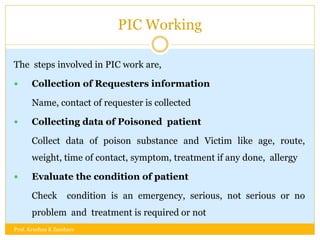
PIC Working
The steps involved in PIC work are,
 Collection of Requesters information
Name, contact of requester is collected
 Collecting data of Poisoned patient
Collect data of poison substance and Victim like age, route,
weight, time of contact, symptom, treatment if any done, allergy
 Evaluate the condition of patient
Check condition is an emergency, serious, not serious or no
problem and treatment is required or not
Prof. Krushna K Zambare
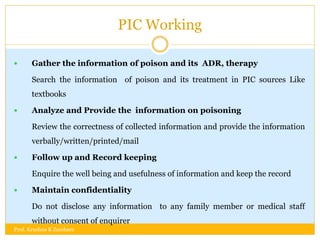
PIC Working
 Gather the information of poison and its ADR, therapy
Search the information of poison and its treatment in PIC sources Like
textbooks
 Analyze and Provide the information on poisoning
Review the correctness of collected information and provide the information
verbally/written/printed/mail
 Follow up and Record keeping
Enquire the well being and usefulness of information and keep the record
 Maintain confidentiality
Do not disclose any information to any family member or medical staff
without consent of enquirer
Prof. Krushna K Zambare
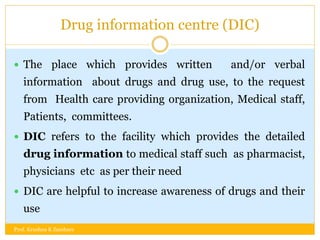
Drug information centre (DIC)
 The place which provides written and/or verbal
information about drugs and drug use, to the request
from Health care providing organization, Medical staff,
Patients, committees.
 DIC refers to the facility which provides the detailed
drug information to medical staff such as pharmacist,
physicians etc as per their need
 DIC are helpful to increase awareness of drugs and their
use
Prof. Krushna K Zambare
Objective of DIC
 To provide the complete database of medicine and its use
to the medical staff
 To provide accurate and unbiased medicine information
to medical staff
 To educate pharmacy students
 To promote rational use of drug by providing knowledge
of medicines
 To improve patient care
Prof. Krushna K Zambare
Sources of drug information
 Drug information can be obtained from journals,
research papers, Books, Pharmaceutical sales
representatives etc.
 Drug information sources are classified into three
categories,
1) Primary Sources
2) Secondary Sources
3) Tertiary Sources
Prof. Krushna K Zambare
Primary Sources
Primary sources are original information on which other
research is based, These include
1) Patents: The newly discovered drugs are reported in
patents.
2) Research Journals or Periodicals: The Scientific
research is published here
3) Reports: Reports are the research done individually
or at organization which may be published in journals
or is available at organization after paying
Prof. Krushna K Zambare
Primary Sources
4) Conferences: Research presented at conference.
These papers may be published in books or in
special issues of journals or may not be published.
5) Dissertations: These include the detailed
research work done for the completion of the higher
study like theses submitted for completion of
master of pharmacy
Prof. Krushna K Zambare
Primary Sources
Advantages
 Current information on drugs is easily available
 Provides information on new drugs
Disadvantages
 Limited data is available
 Information of drug may be controversial
Prof. Krushna K Zambare
Secondary Sources
 Secondary sources collect information from primary
sources
 These sources analyze, evaluate, interpret,
repackage, summarize and reorganize the
information reported in primary sources.
 Secondary sources include books or article etc
Prof. Krushna K Zambare
Secondary Sources
Secondary sources include,
1) Textbooks: The textbooks contain small
information of drugs like Pharmacology books
2) Review article: These are prepared from
primary source and are focuses specific topic
3) Databases : Includes Embase, Pubmed, Springer,
Medline
Prof. Krushna K Zambare
Tertiary Sources
 Tertiary sources prepared from the primary and
secondary sources
 It will provide the summery of the primary and
secondary research
 Tertiary sources includes Textbooks (sometimes
considered as secondary sources) dictionaries and
encyclopedias, manuals, guidebooks, directories,
almanacs, fact books, Wikipedia, compendium, indexing
and abstracting sources.
Prof. Krushna K Zambare
Tertiary Sources
 They provide concise but detailed information about a
particular subject
 Compendium: collection of concise but detailed
information about a particular subject
 Almanacs: Annual publication listing a set of events
forthcoming in the next year
 Encyclopedias: Book or set of books giving
information on many subjects or on many aspects of one
subject (reference work)
Prof. Krushna K Zambare
Tertiary Sources
Advantage
 Fast and Easy to use
 Provides vast information
Disadvantage
 The data is usually old
Prof. Krushna K Zambare
List DIC & PIC
 Drug Information Center, state Pharmacy Council, Maharashtra, Andhra
Pradesh, Rajasthan, Chhattisgarh, Karnataka
(http://www.mspcindia.org/DIC/HomeDIC.aspx)
 Department of pharmacy practice, national institute of pharmaceutical
education and research (NIPER), Chandigarh
 Jawaharlal Nehru medical college hospital (JNMC), Belgaum, Karnataka
 JSS, Ooty and Mysore, Karnataka
 National poisons information center, Al India institute of medical
sciences,(AIIMS) Ansari nagar, New Delhi
 http://www.nlm.nih.gov/medlineplus/medlineplus.html
Prof. Krushna K Zambare
Computerized services
 Computerized information system is easy to assess
 It provide fast access
 Computers can store very large amount of
information
 It is easy to find the information to the user via
computerized services
Prof. Krushna K Zambare
Computerized services
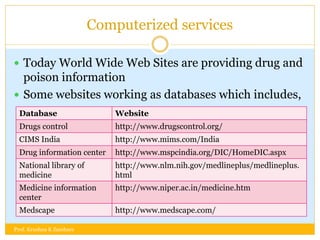
 Today World Wide Web Sites are providing drug and
poison information
 Some websites working as databases which includes,
Database Website
Drugs control http://www.drugscontrol.org/
CIMS India http://www.mims.com/India
Drug information center http://www.mspcindia.org/DIC/HomeDIC.aspx
National library of
medicine
http://www.nlm.nih.gov/medlineplus/medlineplus.
html
Medicine information
center
http://www.niper.ac.in/medicine.htm
Medscape http://www.medscape.com/
Prof. Krushna K Zambare
Storage and Retrieval of information
 Information is stored and retrieved whenever needed
 Information is collected and properly stored in files or in
computers
 Recall of the information is retrieval of information
 Information retrieval is the science of searching
for information in a document or searching within databases,
searching for documents themselves
 Retrieval of information is defined as searching, organization,
storage, retrieval and evaluation of information from stored data
Prof. Krushna K Zambare
Storage and Retrieval of information
 Information is usually stored in databases in
computers
 IR gives information for the search matter
 IR provides the correct information to the user
whenever asked
 IR does not give detailed information for the search or
query instead it provides existence or non existence of
information and the document related to the query
Prof. Krushna K Zambare
Storage and Retrieval of information
 IR is the bridge between the creator and user of
information
 For different types of organizations and business
different types of information is needs
 Based on the need of organization Information
may be a text, image, video or audio or multi media
object
Prof. Krushna K Zambare
Information Storage and Retrieval systems
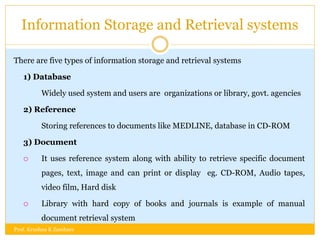
There are five types of information storage and retrieval systems
1) Database
Widely used system and users are organizations or library, govt. agencies
2) Reference
Storing references to documents like MEDLINE, database in CD-ROM
3) Document
 It uses reference system along with ability to retrieve specific document
pages, text, image and can print or display eg. CD-ROM, Audio tapes,
video film, Hard disk
 Library with hard copy of books and journals is example of manual
document retrieval system
Prof. Krushna K Zambare
Information Storage and Retrieval systems
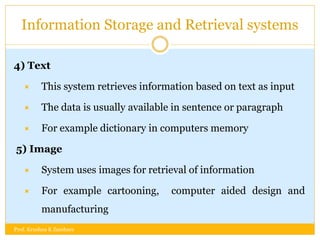
4) Text
 This system retrieves information based on text as input
 The data is usually available in sentence or paragraph
 For example dictionary in computers memory
5) Image
 System uses images for retrieval of information
 For example cartooning, computer aided design and
manufacturing
Prof. Krushna K Zambare

Information services

  • 1.
    INFORMATION SERVICES By Mr. Krushna K.Zambare HOD, Pharmacology SBSPM B. Pharmacy College, Ambajogai
  • 2.
    Poison information centre The PIC is a place or unit providing information on prevention, early diagnosis and treatment of poisoning and risk management.  PIC is important for assessing and treating poisoning  PIC help in minimizing or preventing poisoning  Improve the health of the public by minimizing morbidity, mortality due to poisoning Prof. Krushna K Zambare
  • 3.
    Poison information centre PIC accept the query related to the poisoning either over phone or in person or by e-mail  PIC should collect all the information of patient and enquirer  Assess importance of the situation such as the condition is an emergency, serious, not serious or no problem. Prof. Krushna K Zambare
  • 4.
    PIC sourses  ThePIC sources are same as that of DIC which include  Primary, Secondary and tertiary sources  Database like POISINDEX  Textbooks and Reference books Prof. Krushna K Zambare
  • 5.
    PIC Working The stepsinvolved in PIC work are, 1) Collection of Requesters/Enquirer information 2) Collecting data of Poisoned patient 3) Evaluate the condition of patient 4) Gather the information of poison and its ADR, therapy 5) Analyze and Provide the information on poisoning 6) Follow up and Record keeping 7) Maintain confidentiality Prof. Krushna K Zambare
  • 6.
    PIC Working The stepsinvolved in PIC work are,  Collection of Requesters information Name, contact of requester is collected  Collecting data of Poisoned patient Collect data of poison substance and Victim like age, route, weight, time of contact, symptom, treatment if any done, allergy  Evaluate the condition of patient Check condition is an emergency, serious, not serious or no problem and treatment is required or not Prof. Krushna K Zambare
  • 7.
    PIC Working  Gatherthe information of poison and its ADR, therapy Search the information of poison and its treatment in PIC sources Like textbooks  Analyze and Provide the information on poisoning Review the correctness of collected information and provide the information verbally/written/printed/mail  Follow up and Record keeping Enquire the well being and usefulness of information and keep the record  Maintain confidentiality Do not disclose any information to any family member or medical staff without consent of enquirer Prof. Krushna K Zambare
  • 8.
    Drug information centre(DIC)  The place which provides written and/or verbal information about drugs and drug use, to the request from Health care providing organization, Medical staff, Patients, committees.  DIC refers to the facility which provides the detailed drug information to medical staff such as pharmacist, physicians etc as per their need  DIC are helpful to increase awareness of drugs and their use Prof. Krushna K Zambare
  • 9.
    Objective of DIC To provide the complete database of medicine and its use to the medical staff  To provide accurate and unbiased medicine information to medical staff  To educate pharmacy students  To promote rational use of drug by providing knowledge of medicines  To improve patient care Prof. Krushna K Zambare
  • 10.
    Sources of druginformation  Drug information can be obtained from journals, research papers, Books, Pharmaceutical sales representatives etc.  Drug information sources are classified into three categories, 1) Primary Sources 2) Secondary Sources 3) Tertiary Sources Prof. Krushna K Zambare
  • 11.
    Primary Sources Primary sourcesare original information on which other research is based, These include 1) Patents: The newly discovered drugs are reported in patents. 2) Research Journals or Periodicals: The Scientific research is published here 3) Reports: Reports are the research done individually or at organization which may be published in journals or is available at organization after paying Prof. Krushna K Zambare
  • 12.
    Primary Sources 4) Conferences:Research presented at conference. These papers may be published in books or in special issues of journals or may not be published. 5) Dissertations: These include the detailed research work done for the completion of the higher study like theses submitted for completion of master of pharmacy Prof. Krushna K Zambare
  • 13.
    Primary Sources Advantages  Currentinformation on drugs is easily available  Provides information on new drugs Disadvantages  Limited data is available  Information of drug may be controversial Prof. Krushna K Zambare
  • 14.
    Secondary Sources  Secondarysources collect information from primary sources  These sources analyze, evaluate, interpret, repackage, summarize and reorganize the information reported in primary sources.  Secondary sources include books or article etc Prof. Krushna K Zambare
  • 15.
    Secondary Sources Secondary sourcesinclude, 1) Textbooks: The textbooks contain small information of drugs like Pharmacology books 2) Review article: These are prepared from primary source and are focuses specific topic 3) Databases : Includes Embase, Pubmed, Springer, Medline Prof. Krushna K Zambare
  • 16.
    Tertiary Sources  Tertiarysources prepared from the primary and secondary sources  It will provide the summery of the primary and secondary research  Tertiary sources includes Textbooks (sometimes considered as secondary sources) dictionaries and encyclopedias, manuals, guidebooks, directories, almanacs, fact books, Wikipedia, compendium, indexing and abstracting sources. Prof. Krushna K Zambare
  • 17.
    Tertiary Sources  Theyprovide concise but detailed information about a particular subject  Compendium: collection of concise but detailed information about a particular subject  Almanacs: Annual publication listing a set of events forthcoming in the next year  Encyclopedias: Book or set of books giving information on many subjects or on many aspects of one subject (reference work) Prof. Krushna K Zambare
  • 18.
    Tertiary Sources Advantage  Fastand Easy to use  Provides vast information Disadvantage  The data is usually old Prof. Krushna K Zambare
  • 19.
    List DIC &PIC  Drug Information Center, state Pharmacy Council, Maharashtra, Andhra Pradesh, Rajasthan, Chhattisgarh, Karnataka (http://www.mspcindia.org/DIC/HomeDIC.aspx)  Department of pharmacy practice, national institute of pharmaceutical education and research (NIPER), Chandigarh  Jawaharlal Nehru medical college hospital (JNMC), Belgaum, Karnataka  JSS, Ooty and Mysore, Karnataka  National poisons information center, Al India institute of medical sciences,(AIIMS) Ansari nagar, New Delhi  http://www.nlm.nih.gov/medlineplus/medlineplus.html Prof. Krushna K Zambare
  • 20.
    Computerized services  Computerizedinformation system is easy to assess  It provide fast access  Computers can store very large amount of information  It is easy to find the information to the user via computerized services Prof. Krushna K Zambare
  • 21.
    Computerized services  TodayWorld Wide Web Sites are providing drug and poison information  Some websites working as databases which includes, Database Website Drugs control http://www.drugscontrol.org/ CIMS India http://www.mims.com/India Drug information center http://www.mspcindia.org/DIC/HomeDIC.aspx National library of medicine http://www.nlm.nih.gov/medlineplus/medlineplus. html Medicine information center http://www.niper.ac.in/medicine.htm Medscape http://www.medscape.com/ Prof. Krushna K Zambare
  • 22.
    Storage and Retrievalof information  Information is stored and retrieved whenever needed  Information is collected and properly stored in files or in computers  Recall of the information is retrieval of information  Information retrieval is the science of searching for information in a document or searching within databases, searching for documents themselves  Retrieval of information is defined as searching, organization, storage, retrieval and evaluation of information from stored data Prof. Krushna K Zambare
  • 23.
    Storage and Retrievalof information  Information is usually stored in databases in computers  IR gives information for the search matter  IR provides the correct information to the user whenever asked  IR does not give detailed information for the search or query instead it provides existence or non existence of information and the document related to the query Prof. Krushna K Zambare
  • 24.
    Storage and Retrievalof information  IR is the bridge between the creator and user of information  For different types of organizations and business different types of information is needs  Based on the need of organization Information may be a text, image, video or audio or multi media object Prof. Krushna K Zambare
  • 25.
    Information Storage andRetrieval systems There are five types of information storage and retrieval systems 1) Database Widely used system and users are organizations or library, govt. agencies 2) Reference Storing references to documents like MEDLINE, database in CD-ROM 3) Document  It uses reference system along with ability to retrieve specific document pages, text, image and can print or display eg. CD-ROM, Audio tapes, video film, Hard disk  Library with hard copy of books and journals is example of manual document retrieval system Prof. Krushna K Zambare
  • 26.
    Information Storage andRetrieval systems 4) Text  This system retrieves information based on text as input  The data is usually available in sentence or paragraph  For example dictionary in computers memory 5) Image  System uses images for retrieval of information  For example cartooning, computer aided design and manufacturing Prof. Krushna K Zambare