1
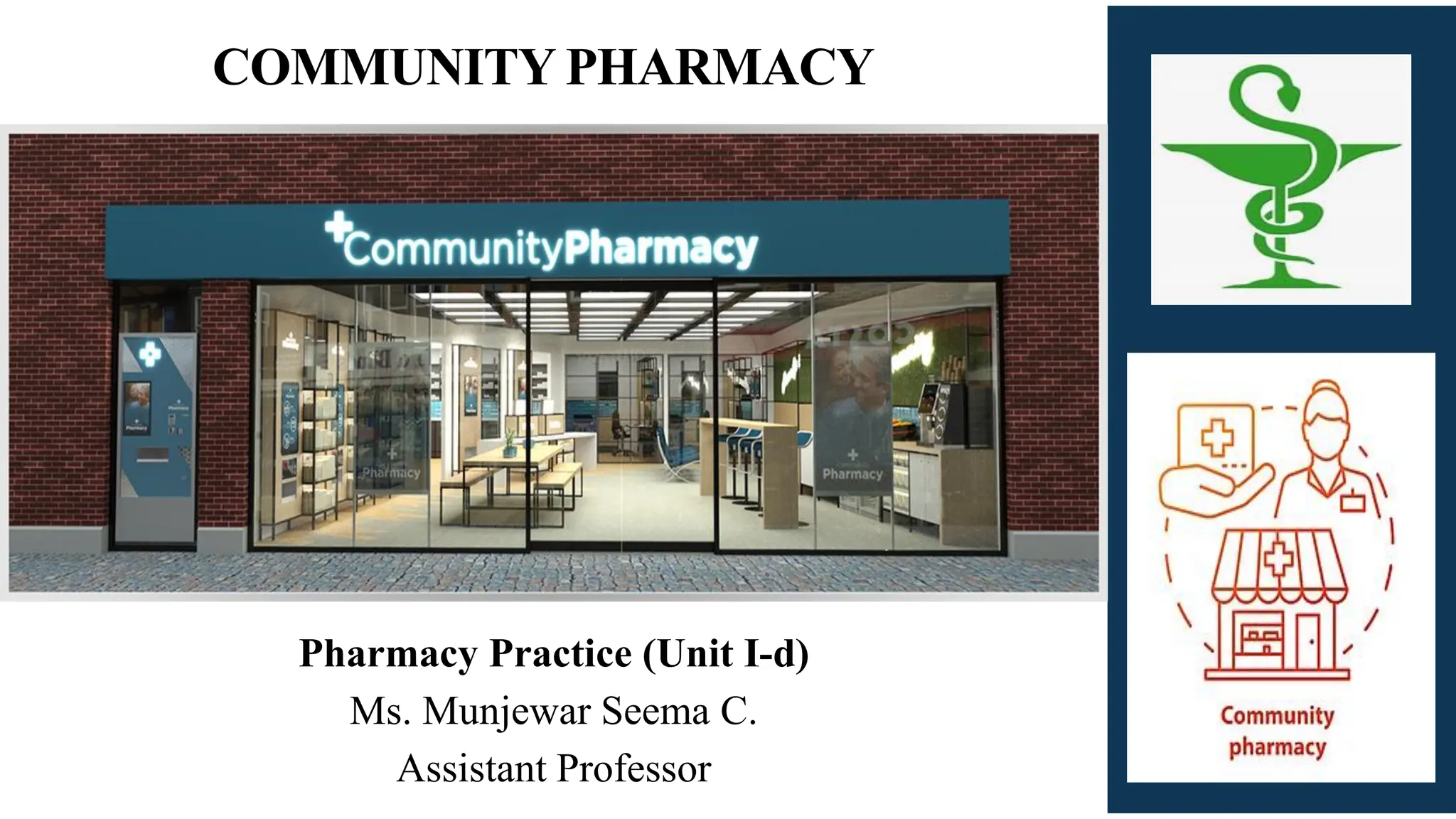
COMMUNITY PHARMACY
Pharmacy Practice (Unit I-d)
Ms. Munjewar Seema C.
Assistant Professor
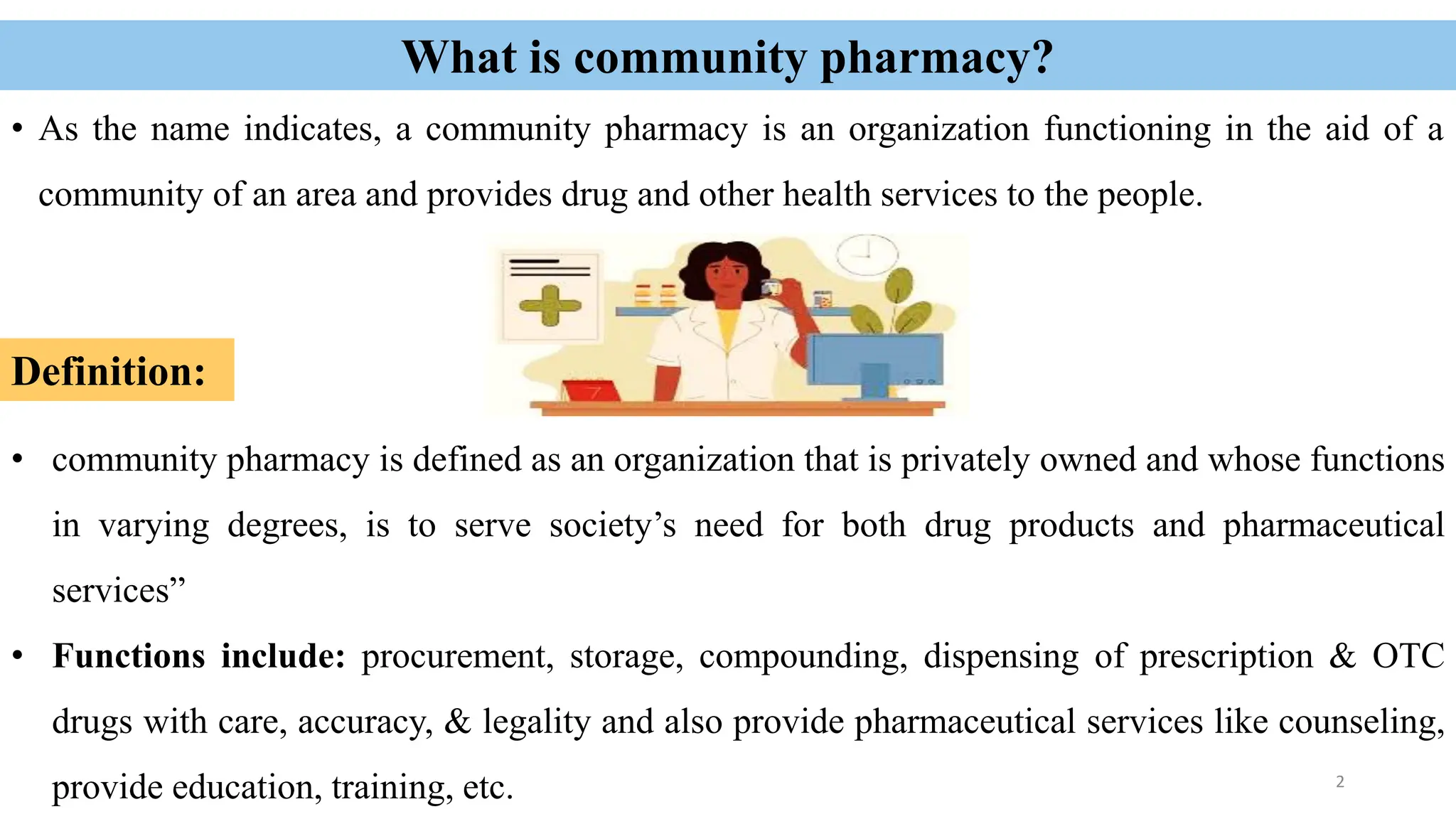
• As the name indicates, a community pharmacy is an organization functioning in the aid of a
community of an area and provides drug and other health services to the people.
2
What is community pharmacy?
Definition:
• community pharmacy is defined as an organization that is privately owned and whose functions
in varying degrees, is to serve society’s need for both drug products and pharmaceutical
services”
• Functions include: procurement, storage, compounding, dispensing of prescription & OTC
drugs with care, accuracy, & legality and also provide pharmaceutical services like counseling,
provide education, training, etc.
• The community pharmacies in India are still traditional, mostly product-oriented and
functioning with a commercial background.
• On the other hand, developed countries have modern community pharmacies that are patient-
oriented and providing pharmaceutical care to the people.
• This is because those pharmacies have highly qualified (M. pharm or Pharm.D) pharmacists,
unlike D. pharm pharmacists we have in India. 3
• Manufacturer/Producer → Wholesaler → Retailer → Consumer
• One of the main factors responsible for the success of a drug store is its location and proper
layout design.
4
Organization and structure of retail and wholesale drug store
• Best site for a pharmacy is the place where most patients visit nearby practicing physicians. So,
it should be established in a place close to the clinics of practicing physicians.
• The next best site could be near the heart of the village, town or a city where a lot of people go
shopping and the floating population is more. Here, the people bring the prescription for purchase,
old prescriptions of refilling, or for OTC medicines.
• The third viable site to establish a pharmacy is in a newly developed area or the colonies of cities
where a considerable no. of people live. As the area of residence grows and spreads, the
community pharmacy gets the advantage. Here, the growth is slow but steady.
5
Location:
6
• Apart from above three sites, pharmacies can be established inside a bus stands, railway
stations, shopping malls, etc.
• A modern drug store should fulfill all the requirements in schedule ‘N’ of the Drug & cosmetic
rules 1945.
• To start a retail drug store a minimum of 150 sq. meter area is required. Similarly to wholesale
drug store a minimum of 200 sq. meter area is required.
7
Layout Design:
• Generally the drug stores are located on ground floor of the building.
• The outer front of the drug store should be very attractive and built with innovated
construction technique.
• The material used for construction drug store front is normally glass, glazed tiles and
marbles which is easy to clean.
• They are usually constructed of cement concrete walls & mosaic tiles on the floor.
• The floor of the drug store should be smooth and washable.
• The internal fitting usually consist of racks or proper storage cupboards with glass doors,
drawers for storing strips, shelves and proper place for placing refrigerator.
• The furniture includes a counter, working table, wooden or steel chairs for staff and
customers. 8
• Good lightning system provides cheerful atmosphere for customers it also helps in
identifying the medicines quickly and easily and thus increase the efficiency of the store.
• The illumination should be steady and should not put any strain on the eyes.
9
Retail Drug Store
10
Wholesale Drug Store
• To attract a large number of customers
• To increase the sale of store
• To reduce the selling expenses to a minimum
• To provide the customer satisfaction
• To have adequate space for reserve stock, office and resting place for the employees
• To have proper entrance for coming goods
• To project a professional image and improve general appearance
• To minimize the movement of customers within the premises of the drug store
11
Objectives of Layout Design:
• Based on the layout & design community drug stores are classified as:
12
Types of Drug Stores
Drug
Store
Types
1. Traditional drug stores
2. Personal service drug stores
3. Prescription oriented drug store
4. Pharmaceutical Centre
5. Super drug store
• These types of drug stores are designed in such a way that the whole area of the drug store is
exposed to customers.
• Such a design has a pleasing & professional appearance and is convenient for both workers &
customers
13
1. Traditional drug stores:
• In these types of stores the whole area is not exposed to the customer but the customer is required to
interact with the drug store personnel at the service counter.
• During the purchasing process the customer demands an article and the Personnel provide the articles.
• This design offers maximum facilities and interaction between drug store employee and customers.
• The success of these type of drug store depends upon the convenience & Friendly service of the
personnel at the service counter.
14
2. Personal service drug stores:
• They provide a comfortable waiting area where the customers are expected to wait while his
prescription is proceeding.
• In this design health related items, drugs and prescription accessories are displayed in the
vicinity while orthopedics and surgical appliances are kept in a separate room.
• Cosmetics and gifts are arranged in a suitable area in the store of this type.
15
3. Prescription oriented drug store:
• These types of stores sell medicines, convenience articles orthopedic and surgical appliances
16
4. Pharmaceutical center:
• Drug stores have a huge floor area ranging from 5,000 to 10,000 with a square design.
• Their customers have access to almost all the area in the drug store and can inspect, handle and
select articles themselves.
• The design is on self service pattern except for the prescription department where self service
is not possible.
17
5. Super drug store:
• A person who wishes to start a retail drug store should be a registered pharmacist in state
pharmacy council or PCI.
• Along with registered pharmacist he should fulfill the requirements given in Pharmacy Act
such as:
i. The person should attained at least 18 years of age
ii. He should be a resident of the state or should be carrying out his business/profession of
pharmacy in state
iii. Should possess a degree or diploma in pharmacy or any other approved qualification, from a
institute recognized by PCI.
• A person who wishes to start a wholesale drug store may not be a registered pharmacists but
must have passed at least matriculation examination and must possess at least 4 years of
experience in handling of drugs. 18
Legal requirements for establishment and maintenance of drug store
1. Minimum qualification:
• As per schedule N of Drug and cosmetic act 1940 the minimum area required to start a retail
drug store are 150 sq. meter and wholesale drug store are 200 sq. meter
19
2. Minimum space:
3. Store arrangement:
• The area should be equipped with proper storage facility for preserving the properties of drug
• For storage of thermolabile substances such as vaccines, sera, enzymatic preparations,
antibiotics vitamins, etc. a refrigerator is required in order to store these drugs at temp. between
2°C to 8°C.
• There should be sufficient no. of storage racks for storing of drugs and pharmaceuticals.
• The requirements as specified in schedule M, to the Drug & cosmetic act should be fulfilled.
20
4. Application & Forms required:
• An Application to the drug inspector in the form of request + Form no.19 (application for grant
or renewal of license to sell, stock, exhibit or distribute drugs)
a. License for retail:
b. License for wholesale:
Form 20 For drugs other than those specified in schedule C & C1
Form 21 For drugs specified in schedule C & C1
Form 20 F For drugs specified in schedule X
Form 20 B For drugs other than those specified in schedule C & C1
Form 21 B For drugs specified in schedule C & C1
Form 20 G For drugs specified in schedule X
21
5. Other documents required:
1. Self attested copy of Registration certificate of pharmacist issued by state pharmacy
council/PCI
2. Self attested copy of proof of passing the diploma/degree course in pharmacy from institute
recognized by PCI
3. An attested copy of matriculation certificate as a proof of date of birth.
4. Proof of ownership if the applicant is the owner of premices, or if the premices are on rent,
then a copy of the rent receipt is attached with the application form.
5. NOC from local area authority.
6. Map/layout of store
7. In case of two or more persons are partners for starting drug store then a copy of
partnership is to be attached with application
8. Experience certificate of applicant not less than 4 years in case of wholesale drug store.
22
• Dispensing is a main part of pharmacy practice in which the distributor/pharmacist takes the
required order of medicine from physician on the prescription and accordingly supplies the
medicines for the treatment of patients.
23
Dispensing of Proprietary Medicines:
1. What is Dispensing?
2. What are proprietary medicines?
• Proprietary medicines are the such chemical substances which are used for medicinal purposes
and are formulated or manufactured under a name protected from competition through
copyright, trademark or patent.
3. Flow of dispensing procedure are as follows:
24
1. Receiving the order of proprietary drug (e.g. Amlodipine). Check whether this order received correctly.
2. Keep the received order at side and check for expiry date and storage conditions
3. Find the location of the shelf for the received order. Location should not be confused with other available
stock.
4. Receive the order (Amlodipine) of prescription and locate the medicine for dispensing. During locating of
medicine, dispenser should check the medicine for correctness because there may similarly sounding medicine
present next to it (e.g. Amitriptyline)
5. Identify and pick the correct medicine. Check the medicine strength and quantity as per the order received
from physician
6. Before dispensing the medicine, check the label and instructions given on the label and same to be instruct to
patients. (by orally or in written format)
7. Hand out the medicine to patient. Check the right patient to whom the right medicine is hand out.
25
• To open any drug store (retail or wholesale) the owner of drug store should have to maintain
various records and documentation.
• There are three types of records maintained by drug traders out of which the first two are
common for both retail and wholesale trades and the third one is for the retail pharmacy only.
26
Maintenance of records of retail and wholesale drug store
A. Legal records
B. Financial records
C. Patient records
• All the legal requirements related information such as refrigerators, HVAC systems, proper
storage conditions are maintained in legal records.
• According to federal and state law the pharmacy owner or manager is charged with maintaining
accurate up-to-date records of specific classes of drugs and poisons.
• Under the provisions of the Federal Controlled Substances Act of 1970, the pharmacists is
charged for maintaining accurate records related to the acquisition and disposition of certain
drugs.
• Legal records include: Purchase records, stock register, Sales register, Prescription file for
schedule x drugs, Inspection register, Communication file.
27
A. Legal records:
• Records regarding purchase of all drugs whether intended to be sold in retail or by wholesale
should be maintained:
1. Date of purchase
2. Name & address of the licensee from whom purchased and his license no.
3. Name & quantity of the drug
4. Name of the manufacturer of drug and its batch no.
• Purchase bills including cash or credit memos should be kept as records.
28
1. Purchase records:
2. Stock register:
Maintain records of all drugs present in storage section.
• Maintain records of sale of drugs specified in schedule x and sale of drugs other than those specified in
schedule x
29
Sale of drugs specified in schedule x
❑ Date of purchase
❑ The name and address of supplier and the
license no. of the supplier
❑ Name & quantity of the drug supplied
❑ Manufacturers name, batch or lot number
❑ Name & address of the patient/purchaser
❑ Reference no. of the prescription against
which supplies were made
❑ Bill no. & date of receipt of purchase or
supply made by him
Sale of drugs other than those specified in schedule x
❑ Serial no. of the entry
❑ Date of supply
❑ Name & address of the purchaser
❑ Name & address of the patient or the name & address
of the owner of the animal, if the drug is supplied for
veterinary use
❑ Name along with the quantities of drug supplied
❑ In case of schedule H and C drugs, the name of the
manufacturer, its batch no. and the expiry date, if any.
❑ Signature of the registered pharmacist under whose
supervision the medicine was made or supplied.
3. Sales register:
• Such prescriptions in which physicians prescribe schedule x drugs to patients are maintained in
record only in case of retail stores.
30
4. Prescription file for schedule x drugs:
5. Inspection register:
• All the legal data are maintained in this register regarding the drug store, its license and
personnel working, etc.
6. Communication file:
• Official letters and circulars from drug control and other government departments.
• Maintains information regarding the past and present financial status of pharmacy
• These records are required to run the pharmacy efficiently.
• Essential for making decisions regarding future money needs, personnel matters, expansion
of facilities, etc.
• Financial records include:
1. Daybook
2. Journal
3. Ledger
4. Profit and loss account including trial balance and balance sheet 31
B. Financial records:
5. Tax notices, receipts and other particulars file (income tax, GST, etc.)
6. Insurance file
7. Salary register
8. Miscellaneous file (rent, electric bill, telephone bill, etc.)
9. Employees service and leave register.
10. Also include purchase, sale and stock registers which are already discussed in legal records.
32
• These are maintained by few pharmacies only.
• Specially the modern pharmacies which offers patient-oriented services to earn name, fame and goodwill
and thereby they make money from these value-added services.
• Some pharmacies also record patient data to reduce the drug interactions and problems associated with
individual drugs.
• Patient records include:
1. Patient medication profile (history)
2. Patients family members medication profile
3. Copies of important prescriptions, lab reports, etc. of selected patients for future reference, guidance
and counselling.
• All the above records are maintained as hard copies wherever necessary & also as soft copies in
pharmacy computers with facilities for easy retrieval. 33
C. Patient records:
1. Define community pharmacy and explain the structure of retail and wholesale drug store with
appropriate diagram: 5M
2. Describe legal requirements to be establish a community pharmacy. What are the records to
be maintained in the community pharmacy: 10M
34
Questions:
1. A textbook of pharmacy practice by S. Balasubramanian, BSP books Pvt. Ltd., 2020,
ISBN: 9389974380, 9789389974386.
2. Textbook of pharmacy practice by Rakesh Saini and Sagar Singh Jough, New Delhi
New Age International (P) Limited, Publishers 2022, ISBN: 9789389802344.
3. Principles of pharmacy practice by Dr. Ramandeep Singh, Satinder Kakar and
Bhumika Mangla, PV publication, 2018, ISBN: 9781543342659.
4. Textbook of pharmacy practice by Gaurav Agarwal, CBS publishers and distributers
Pvt. Ltd., 2020, ISBN: 9789389941913.
35
References:
Thank You !

Community pharmacy: pharmacy practice unit 1d

  • 1.
    1 COMMUNITY PHARMACY Pharmacy Practice(Unit I-d) Ms. Munjewar Seema C. Assistant Professor
  • 2.
    • As thename indicates, a community pharmacy is an organization functioning in the aid of a community of an area and provides drug and other health services to the people. 2 What is community pharmacy? Definition: • community pharmacy is defined as an organization that is privately owned and whose functions in varying degrees, is to serve society’s need for both drug products and pharmaceutical services” • Functions include: procurement, storage, compounding, dispensing of prescription & OTC drugs with care, accuracy, & legality and also provide pharmaceutical services like counseling, provide education, training, etc.
  • 3.
    • The communitypharmacies in India are still traditional, mostly product-oriented and functioning with a commercial background. • On the other hand, developed countries have modern community pharmacies that are patient- oriented and providing pharmaceutical care to the people. • This is because those pharmacies have highly qualified (M. pharm or Pharm.D) pharmacists, unlike D. pharm pharmacists we have in India. 3
  • 4.
    • Manufacturer/Producer →Wholesaler → Retailer → Consumer • One of the main factors responsible for the success of a drug store is its location and proper layout design. 4 Organization and structure of retail and wholesale drug store
  • 5.
    • Best sitefor a pharmacy is the place where most patients visit nearby practicing physicians. So, it should be established in a place close to the clinics of practicing physicians. • The next best site could be near the heart of the village, town or a city where a lot of people go shopping and the floating population is more. Here, the people bring the prescription for purchase, old prescriptions of refilling, or for OTC medicines. • The third viable site to establish a pharmacy is in a newly developed area or the colonies of cities where a considerable no. of people live. As the area of residence grows and spreads, the community pharmacy gets the advantage. Here, the growth is slow but steady. 5 Location:
  • 6.
    6 • Apart fromabove three sites, pharmacies can be established inside a bus stands, railway stations, shopping malls, etc.
  • 7.
    • A moderndrug store should fulfill all the requirements in schedule ‘N’ of the Drug & cosmetic rules 1945. • To start a retail drug store a minimum of 150 sq. meter area is required. Similarly to wholesale drug store a minimum of 200 sq. meter area is required. 7 Layout Design:
  • 8.
    • Generally thedrug stores are located on ground floor of the building. • The outer front of the drug store should be very attractive and built with innovated construction technique. • The material used for construction drug store front is normally glass, glazed tiles and marbles which is easy to clean. • They are usually constructed of cement concrete walls & mosaic tiles on the floor. • The floor of the drug store should be smooth and washable. • The internal fitting usually consist of racks or proper storage cupboards with glass doors, drawers for storing strips, shelves and proper place for placing refrigerator. • The furniture includes a counter, working table, wooden or steel chairs for staff and customers. 8
  • 9.
    • Good lightningsystem provides cheerful atmosphere for customers it also helps in identifying the medicines quickly and easily and thus increase the efficiency of the store. • The illumination should be steady and should not put any strain on the eyes. 9 Retail Drug Store
  • 10.
  • 11.
    • To attracta large number of customers • To increase the sale of store • To reduce the selling expenses to a minimum • To provide the customer satisfaction • To have adequate space for reserve stock, office and resting place for the employees • To have proper entrance for coming goods • To project a professional image and improve general appearance • To minimize the movement of customers within the premises of the drug store 11 Objectives of Layout Design:
  • 12.
    • Based onthe layout & design community drug stores are classified as: 12 Types of Drug Stores Drug Store Types 1. Traditional drug stores 2. Personal service drug stores 3. Prescription oriented drug store 4. Pharmaceutical Centre 5. Super drug store
  • 13.
    • These typesof drug stores are designed in such a way that the whole area of the drug store is exposed to customers. • Such a design has a pleasing & professional appearance and is convenient for both workers & customers 13 1. Traditional drug stores:
  • 14.
    • In thesetypes of stores the whole area is not exposed to the customer but the customer is required to interact with the drug store personnel at the service counter. • During the purchasing process the customer demands an article and the Personnel provide the articles. • This design offers maximum facilities and interaction between drug store employee and customers. • The success of these type of drug store depends upon the convenience & Friendly service of the personnel at the service counter. 14 2. Personal service drug stores:
  • 15.
    • They providea comfortable waiting area where the customers are expected to wait while his prescription is proceeding. • In this design health related items, drugs and prescription accessories are displayed in the vicinity while orthopedics and surgical appliances are kept in a separate room. • Cosmetics and gifts are arranged in a suitable area in the store of this type. 15 3. Prescription oriented drug store:
  • 16.
    • These typesof stores sell medicines, convenience articles orthopedic and surgical appliances 16 4. Pharmaceutical center:
  • 17.
    • Drug storeshave a huge floor area ranging from 5,000 to 10,000 with a square design. • Their customers have access to almost all the area in the drug store and can inspect, handle and select articles themselves. • The design is on self service pattern except for the prescription department where self service is not possible. 17 5. Super drug store:
  • 18.
    • A personwho wishes to start a retail drug store should be a registered pharmacist in state pharmacy council or PCI. • Along with registered pharmacist he should fulfill the requirements given in Pharmacy Act such as: i. The person should attained at least 18 years of age ii. He should be a resident of the state or should be carrying out his business/profession of pharmacy in state iii. Should possess a degree or diploma in pharmacy or any other approved qualification, from a institute recognized by PCI. • A person who wishes to start a wholesale drug store may not be a registered pharmacists but must have passed at least matriculation examination and must possess at least 4 years of experience in handling of drugs. 18 Legal requirements for establishment and maintenance of drug store 1. Minimum qualification:
  • 19.
    • As perschedule N of Drug and cosmetic act 1940 the minimum area required to start a retail drug store are 150 sq. meter and wholesale drug store are 200 sq. meter 19 2. Minimum space: 3. Store arrangement: • The area should be equipped with proper storage facility for preserving the properties of drug • For storage of thermolabile substances such as vaccines, sera, enzymatic preparations, antibiotics vitamins, etc. a refrigerator is required in order to store these drugs at temp. between 2°C to 8°C. • There should be sufficient no. of storage racks for storing of drugs and pharmaceuticals. • The requirements as specified in schedule M, to the Drug & cosmetic act should be fulfilled.
  • 20.
    20 4. Application &Forms required: • An Application to the drug inspector in the form of request + Form no.19 (application for grant or renewal of license to sell, stock, exhibit or distribute drugs) a. License for retail: b. License for wholesale: Form 20 For drugs other than those specified in schedule C & C1 Form 21 For drugs specified in schedule C & C1 Form 20 F For drugs specified in schedule X Form 20 B For drugs other than those specified in schedule C & C1 Form 21 B For drugs specified in schedule C & C1 Form 20 G For drugs specified in schedule X
  • 21.
    21 5. Other documentsrequired: 1. Self attested copy of Registration certificate of pharmacist issued by state pharmacy council/PCI 2. Self attested copy of proof of passing the diploma/degree course in pharmacy from institute recognized by PCI 3. An attested copy of matriculation certificate as a proof of date of birth. 4. Proof of ownership if the applicant is the owner of premices, or if the premices are on rent, then a copy of the rent receipt is attached with the application form. 5. NOC from local area authority. 6. Map/layout of store
  • 22.
    7. In caseof two or more persons are partners for starting drug store then a copy of partnership is to be attached with application 8. Experience certificate of applicant not less than 4 years in case of wholesale drug store. 22
  • 23.
    • Dispensing isa main part of pharmacy practice in which the distributor/pharmacist takes the required order of medicine from physician on the prescription and accordingly supplies the medicines for the treatment of patients. 23 Dispensing of Proprietary Medicines: 1. What is Dispensing? 2. What are proprietary medicines? • Proprietary medicines are the such chemical substances which are used for medicinal purposes and are formulated or manufactured under a name protected from competition through copyright, trademark or patent. 3. Flow of dispensing procedure are as follows:
  • 24.
    24 1. Receiving theorder of proprietary drug (e.g. Amlodipine). Check whether this order received correctly. 2. Keep the received order at side and check for expiry date and storage conditions 3. Find the location of the shelf for the received order. Location should not be confused with other available stock. 4. Receive the order (Amlodipine) of prescription and locate the medicine for dispensing. During locating of medicine, dispenser should check the medicine for correctness because there may similarly sounding medicine present next to it (e.g. Amitriptyline) 5. Identify and pick the correct medicine. Check the medicine strength and quantity as per the order received from physician 6. Before dispensing the medicine, check the label and instructions given on the label and same to be instruct to patients. (by orally or in written format) 7. Hand out the medicine to patient. Check the right patient to whom the right medicine is hand out.
  • 25.
  • 26.
    • To openany drug store (retail or wholesale) the owner of drug store should have to maintain various records and documentation. • There are three types of records maintained by drug traders out of which the first two are common for both retail and wholesale trades and the third one is for the retail pharmacy only. 26 Maintenance of records of retail and wholesale drug store A. Legal records B. Financial records C. Patient records
  • 27.
    • All thelegal requirements related information such as refrigerators, HVAC systems, proper storage conditions are maintained in legal records. • According to federal and state law the pharmacy owner or manager is charged with maintaining accurate up-to-date records of specific classes of drugs and poisons. • Under the provisions of the Federal Controlled Substances Act of 1970, the pharmacists is charged for maintaining accurate records related to the acquisition and disposition of certain drugs. • Legal records include: Purchase records, stock register, Sales register, Prescription file for schedule x drugs, Inspection register, Communication file. 27 A. Legal records:
  • 28.
    • Records regardingpurchase of all drugs whether intended to be sold in retail or by wholesale should be maintained: 1. Date of purchase 2. Name & address of the licensee from whom purchased and his license no. 3. Name & quantity of the drug 4. Name of the manufacturer of drug and its batch no. • Purchase bills including cash or credit memos should be kept as records. 28 1. Purchase records: 2. Stock register: Maintain records of all drugs present in storage section.
  • 29.
    • Maintain recordsof sale of drugs specified in schedule x and sale of drugs other than those specified in schedule x 29 Sale of drugs specified in schedule x ❑ Date of purchase ❑ The name and address of supplier and the license no. of the supplier ❑ Name & quantity of the drug supplied ❑ Manufacturers name, batch or lot number ❑ Name & address of the patient/purchaser ❑ Reference no. of the prescription against which supplies were made ❑ Bill no. & date of receipt of purchase or supply made by him Sale of drugs other than those specified in schedule x ❑ Serial no. of the entry ❑ Date of supply ❑ Name & address of the purchaser ❑ Name & address of the patient or the name & address of the owner of the animal, if the drug is supplied for veterinary use ❑ Name along with the quantities of drug supplied ❑ In case of schedule H and C drugs, the name of the manufacturer, its batch no. and the expiry date, if any. ❑ Signature of the registered pharmacist under whose supervision the medicine was made or supplied. 3. Sales register:
  • 30.
    • Such prescriptionsin which physicians prescribe schedule x drugs to patients are maintained in record only in case of retail stores. 30 4. Prescription file for schedule x drugs: 5. Inspection register: • All the legal data are maintained in this register regarding the drug store, its license and personnel working, etc. 6. Communication file: • Official letters and circulars from drug control and other government departments.
  • 31.
    • Maintains informationregarding the past and present financial status of pharmacy • These records are required to run the pharmacy efficiently. • Essential for making decisions regarding future money needs, personnel matters, expansion of facilities, etc. • Financial records include: 1. Daybook 2. Journal 3. Ledger 4. Profit and loss account including trial balance and balance sheet 31 B. Financial records:
  • 32.
    5. Tax notices,receipts and other particulars file (income tax, GST, etc.) 6. Insurance file 7. Salary register 8. Miscellaneous file (rent, electric bill, telephone bill, etc.) 9. Employees service and leave register. 10. Also include purchase, sale and stock registers which are already discussed in legal records. 32
  • 33.
    • These aremaintained by few pharmacies only. • Specially the modern pharmacies which offers patient-oriented services to earn name, fame and goodwill and thereby they make money from these value-added services. • Some pharmacies also record patient data to reduce the drug interactions and problems associated with individual drugs. • Patient records include: 1. Patient medication profile (history) 2. Patients family members medication profile 3. Copies of important prescriptions, lab reports, etc. of selected patients for future reference, guidance and counselling. • All the above records are maintained as hard copies wherever necessary & also as soft copies in pharmacy computers with facilities for easy retrieval. 33 C. Patient records:
  • 34.
    1. Define communitypharmacy and explain the structure of retail and wholesale drug store with appropriate diagram: 5M 2. Describe legal requirements to be establish a community pharmacy. What are the records to be maintained in the community pharmacy: 10M 34 Questions:
  • 35.
    1. A textbookof pharmacy practice by S. Balasubramanian, BSP books Pvt. Ltd., 2020, ISBN: 9389974380, 9789389974386. 2. Textbook of pharmacy practice by Rakesh Saini and Sagar Singh Jough, New Delhi New Age International (P) Limited, Publishers 2022, ISBN: 9789389802344. 3. Principles of pharmacy practice by Dr. Ramandeep Singh, Satinder Kakar and Bhumika Mangla, PV publication, 2018, ISBN: 9781543342659. 4. Textbook of pharmacy practice by Gaurav Agarwal, CBS publishers and distributers Pvt. Ltd., 2020, ISBN: 9789389941913. 35 References:
  • 36.