Information Retrieval : 9
TF-IDF Weights
Prof Neeraj Bhargava
Vaibhav Khanna
Department of Computer Science
School of Engineering and Systems Sciences
Maharshi Dayanand Saraswati University Ajmer
TF-IDF Weights
• TF-IDF term weighting scheme:
– Term frequency (TF)
– Inverse document frequency (IDF)
• Foundations of the most popular term
weighting scheme in IR
Term-term correlation matrix
• Luhn Assumption. The value of wi,j is proportional to the term
frequency fi,j
• That is, the more often a term occurs in the text of the
document, the higher its weight
• This is based on the observation that high frequency terms
are important for describing documents
• Which leads directly to the following tf weight formulation:
• tfi,j = fi,j
Inverse Document Frequency
• We call document exhaustivity the number of index
terms assigned to a document
• The more index terms are assigned to a document, the
higher is the probability of retrieval for that document
– If too many terms are assigned to a document, it will be
retrieved by queries for which it is not relevant
• Optimal exhaustivity. We can circumvent this problem
by optimizing the number of terms per document
• Another approach is by weighting the terms differently,
by exploring the notion of term specificity
Inverse Document Frequency
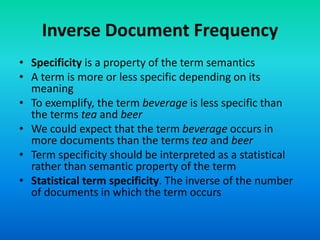
• Specificity is a property of the term semantics
• A term is more or less specific depending on its
meaning
• To exemplify, the term beverage is less specific than
the terms tea and beer
• We could expect that the term beverage occurs in
more documents than the terms tea and beer
• Term specificity should be interpreted as a statistical
rather than semantic property of the term
• Statistical term specificity. The inverse of the number
of documents in which the term occurs
Inverse Document Frequency
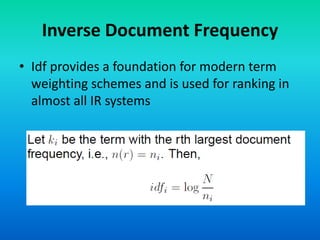
• Idf provides a foundation for modern term
weighting schemes and is used for ranking in
almost all IR systems
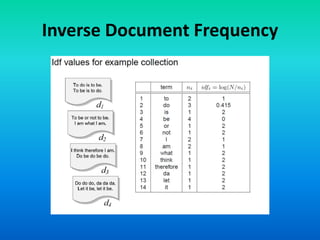
Inverse Document Frequency
TF-IDF weighting scheme
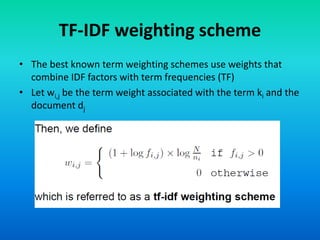
• The best known term weighting schemes use weights that
combine IDF factors with term frequencies (TF)
• Let wi,j be the term weight associated with the term ki and the
document dj
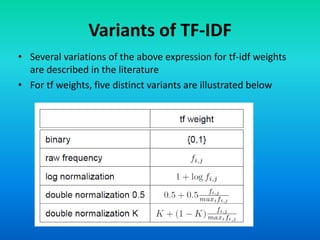
Variants of TF-IDF
• Several variations of the above expression for tf-idf weights
are described in the literature
• For tf weights, five distinct variants are illustrated below
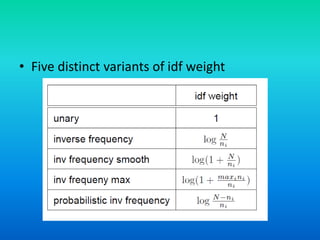
• Five distinct variants of idf weight
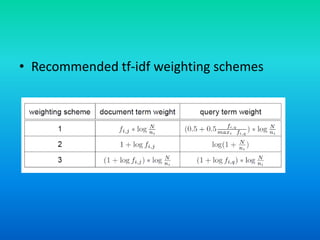
• Recommended tf-idf weighting schemes
Document Length Normalization
• Document sizes might vary widely
• This is a problem because longer documents are
more likely to be retrieved by a given query
• To compensate for this undesired effect, we can
divide the rank of each document by its length
• This procedure consistently leads to better
ranking, and it is called document length
normalization
Document Length Normalization
• Methods of document length normalization
depend on the representation adopted for the
documents:
– Size in bytes: consider that each document is
represented simply as a stream of bytes
– Number of words: each document is represented
as a single string, and the document length is the
number of words in it
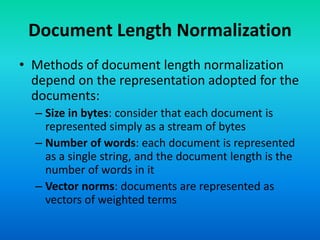
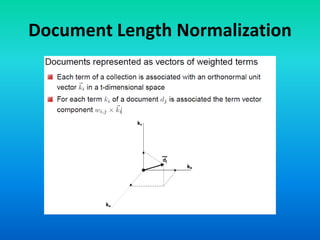
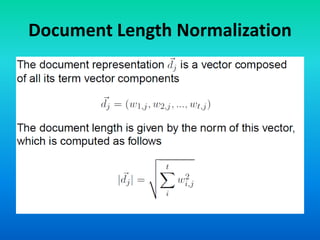
– Vector norms: documents are represented as
vectors of weighted terms
Document Length Normalization
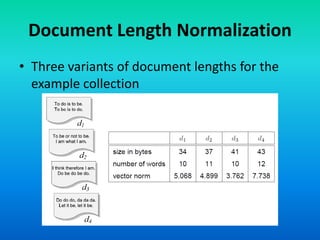
• Three variants of document lengths for the
example collection
Assignments
• Explain the TF-IDF weighting scheme in IR
• What is Document Length Normalization
Concept and why is it important in IR

Information retrieval 9 tf idf weights

  • 1.
    Information Retrieval :9 TF-IDF Weights Prof Neeraj Bhargava Vaibhav Khanna Department of Computer Science School of Engineering and Systems Sciences Maharshi Dayanand Saraswati University Ajmer
  • 2.
    TF-IDF Weights • TF-IDFterm weighting scheme: – Term frequency (TF) – Inverse document frequency (IDF) • Foundations of the most popular term weighting scheme in IR
  • 3.
    Term-term correlation matrix •Luhn Assumption. The value of wi,j is proportional to the term frequency fi,j • That is, the more often a term occurs in the text of the document, the higher its weight • This is based on the observation that high frequency terms are important for describing documents • Which leads directly to the following tf weight formulation: • tfi,j = fi,j
  • 4.
    Inverse Document Frequency •We call document exhaustivity the number of index terms assigned to a document • The more index terms are assigned to a document, the higher is the probability of retrieval for that document – If too many terms are assigned to a document, it will be retrieved by queries for which it is not relevant • Optimal exhaustivity. We can circumvent this problem by optimizing the number of terms per document • Another approach is by weighting the terms differently, by exploring the notion of term specificity
  • 5.
    Inverse Document Frequency •Specificity is a property of the term semantics • A term is more or less specific depending on its meaning • To exemplify, the term beverage is less specific than the terms tea and beer • We could expect that the term beverage occurs in more documents than the terms tea and beer • Term specificity should be interpreted as a statistical rather than semantic property of the term • Statistical term specificity. The inverse of the number of documents in which the term occurs
  • 6.
    Inverse Document Frequency •Idf provides a foundation for modern term weighting schemes and is used for ranking in almost all IR systems
  • 7.
  • 8.
    TF-IDF weighting scheme •The best known term weighting schemes use weights that combine IDF factors with term frequencies (TF) • Let wi,j be the term weight associated with the term ki and the document dj
  • 9.
    Variants of TF-IDF •Several variations of the above expression for tf-idf weights are described in the literature • For tf weights, five distinct variants are illustrated below
  • 10.
    • Five distinctvariants of idf weight
  • 11.
    • Recommended tf-idfweighting schemes
  • 12.
    Document Length Normalization •Document sizes might vary widely • This is a problem because longer documents are more likely to be retrieved by a given query • To compensate for this undesired effect, we can divide the rank of each document by its length • This procedure consistently leads to better ranking, and it is called document length normalization
  • 13.
    Document Length Normalization •Methods of document length normalization depend on the representation adopted for the documents: – Size in bytes: consider that each document is represented simply as a stream of bytes – Number of words: each document is represented as a single string, and the document length is the number of words in it – Vector norms: documents are represented as vectors of weighted terms
  • 14.
  • 15.
  • 16.
    Document Length Normalization •Three variants of document lengths for the example collection
  • 17.
    Assignments • Explain theTF-IDF weighting scheme in IR • What is Document Length Normalization Concept and why is it important in IR