Comparisons of Ranking
Algorithms
PageRank & Tf-Idf
Introduction
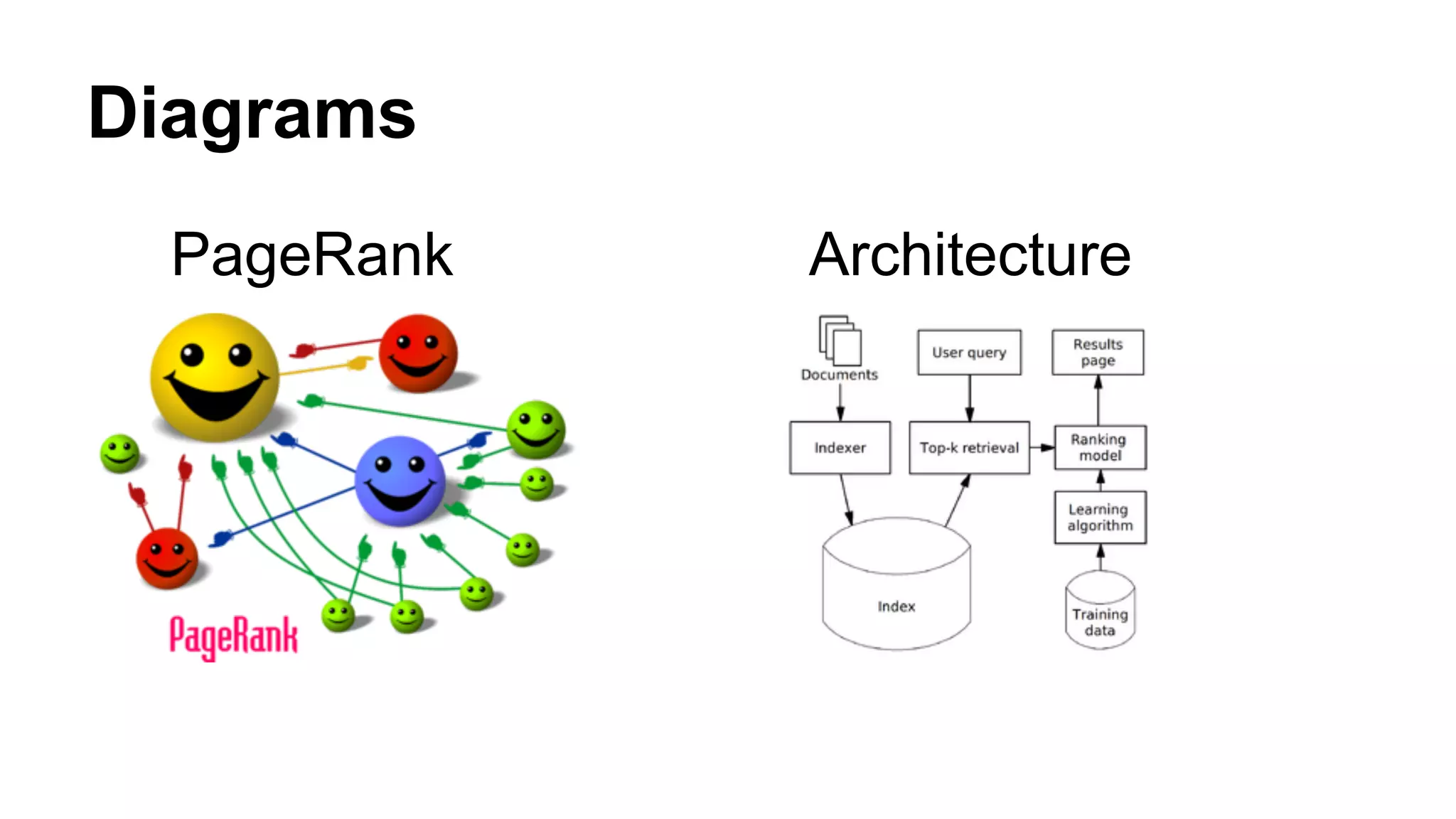
● PageRank theory is that the most important pages on the Internet are the pages with the
most links leading to them.
● PageRank thinks of links as votes, where a page linking to another page is casting a vote.
This makes sense, because people do tend to link to relevant content, and pages with
more links to them are usually better resources than pages that nobody links.
● Tf-idf stands for term frequency-inverse document frequency, and the tf-idf weight is a
weight often used in information retrieval and text mining.
● This weight is a statistical measure used to evaluate how important a word is to a
document in a collection or corpus. The importance increases proportionally to the number
of times a word appears in the document but is offset by the frequency of the word in the
corpus. Variations of the tf-idf weighting scheme are often used by search engines as a
central tool in scoring and ranking a document relevance given a user query.One of the
simplest ranking functions is computed by summing the tf-idf for each query term.
PageRank
● Extractions of title from wiki corpus
● Extractions of links from wiki corpus
● Inlink creation from forward links
● PageRank convergence
● Searching technique using pagerank
algorithm
Td -Idf
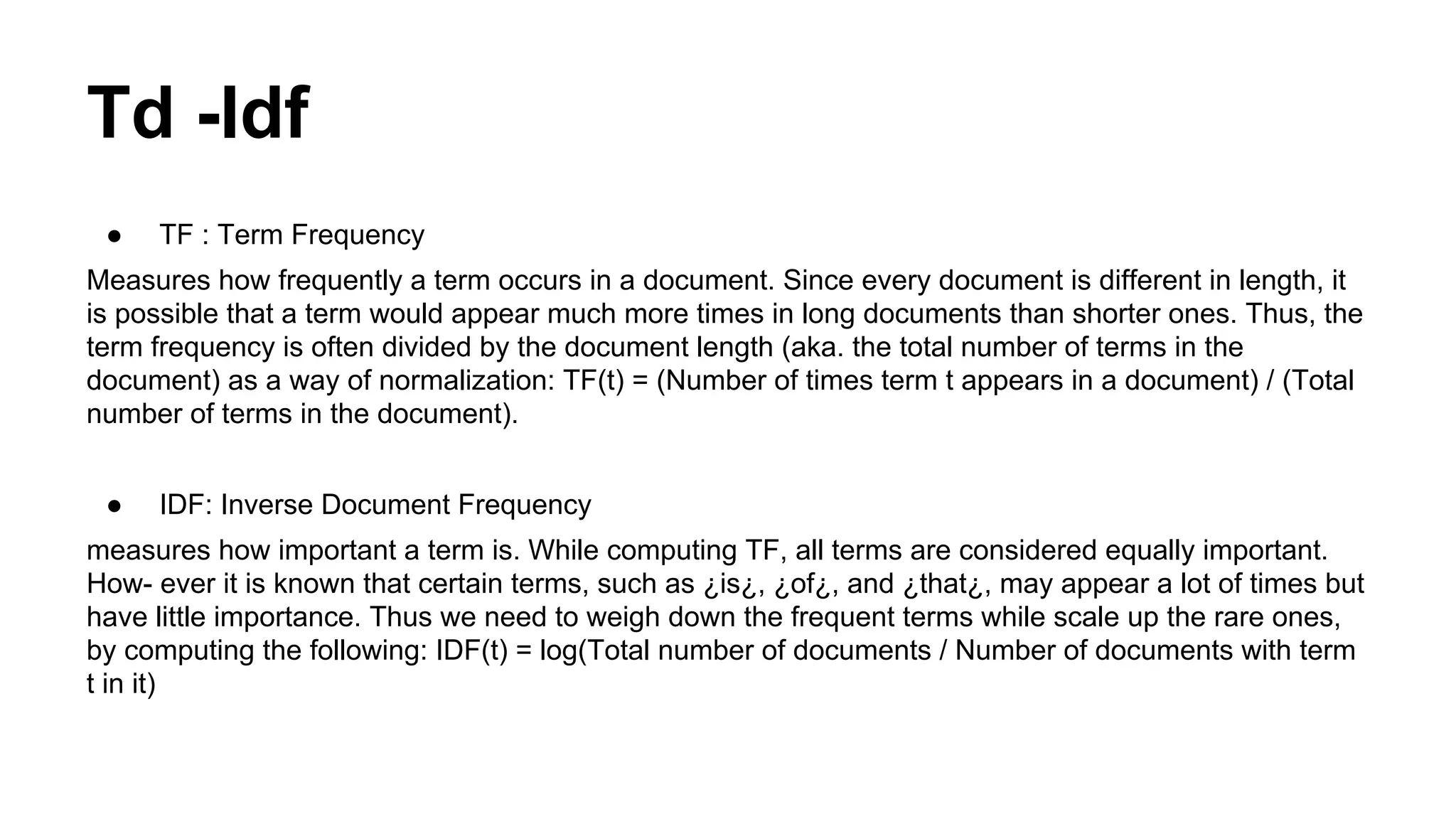
● TF : Term Frequency
Measures how frequently a term occurs in a document. Since every document is different in length, it
is possible that a term would appear much more times in long documents than shorter ones. Thus, the
term frequency is often divided by the document length (aka. the total number of terms in the
document) as a way of normalization: TF(t) = (Number of times term t appears in a document) / (Total
number of terms in the document).
● IDF: Inverse Document Frequency
measures how important a term is. While computing TF, all terms are considered equally important.
How- ever it is known that certain terms, such as ¿is¿, ¿of¿, and ¿that¿, may appear a lot of times but
have little importance. Thus we need to weigh down the frequent terms while scale up the rare ones,
by computing the following: IDF(t) = log(Total number of documents / Number of documents with term
t in it)
Diagrams
PageRank Architecture
PageRank Evaluation
● Working process : Computes values at index time and
results are sorted on the priority of pages
● I/P parameters :Inbounds links
● Complexity O(log N)
● Limitations :Query independent
Tf - idf Evaluation
● We have seen that TF-IDF is an efficient and simple algorithm for matching
words in a query to documents that are relevant to that query. From the
data collected, we see that TF-IDF returns documents that are highly
relevant to a particular query. If a user were to input a query for a particular
topic, TF-IDF can find documents that contain relevant information on the
query.
● Furthermore, encoding TF-IDF is straightforward, making it ideal for
forming the basis for more complicated algorithms and query retrieval
systems. Despite its strength, TF-IDF has its limitations. In terms of
synonyms, notice that TF-IDF does not make the jump to the relationship
between words.
Conclusion
● A typical search engine should use web page ranking techniques based on the
specific needs of the users because the ranking algorithms provide a definite
rank to resultant web pages.
● The main purpose is to inspect the important page ranking based algorithms
used for information retrieval and compare those algorithms.
● An efficient web page ranking algorithm should meet out these challenges
efficiently with compatibility with global standards of web technology.
● PageRank assigns a score to a document based upon the documents it links
to, and the documents which link to it.
● The score does not vary depending on the query used (i.e. it is a global ranking
scheme). TF-IDF is used to give a document a score based upon some query.
● The score changes based upon the query, and without a query there is no
score.

Comparisons of ranking algorithms

  • 1.
  • 2.
    Introduction ● PageRank theoryis that the most important pages on the Internet are the pages with the most links leading to them. ● PageRank thinks of links as votes, where a page linking to another page is casting a vote. This makes sense, because people do tend to link to relevant content, and pages with more links to them are usually better resources than pages that nobody links. ● Tf-idf stands for term frequency-inverse document frequency, and the tf-idf weight is a weight often used in information retrieval and text mining. ● This weight is a statistical measure used to evaluate how important a word is to a document in a collection or corpus. The importance increases proportionally to the number of times a word appears in the document but is offset by the frequency of the word in the corpus. Variations of the tf-idf weighting scheme are often used by search engines as a central tool in scoring and ranking a document relevance given a user query.One of the simplest ranking functions is computed by summing the tf-idf for each query term.
  • 3.
    PageRank ● Extractions oftitle from wiki corpus ● Extractions of links from wiki corpus ● Inlink creation from forward links ● PageRank convergence ● Searching technique using pagerank algorithm
  • 4.
    Td -Idf ● TF: Term Frequency Measures how frequently a term occurs in a document. Since every document is different in length, it is possible that a term would appear much more times in long documents than shorter ones. Thus, the term frequency is often divided by the document length (aka. the total number of terms in the document) as a way of normalization: TF(t) = (Number of times term t appears in a document) / (Total number of terms in the document). ● IDF: Inverse Document Frequency measures how important a term is. While computing TF, all terms are considered equally important. How- ever it is known that certain terms, such as ¿is¿, ¿of¿, and ¿that¿, may appear a lot of times but have little importance. Thus we need to weigh down the frequent terms while scale up the rare ones, by computing the following: IDF(t) = log(Total number of documents / Number of documents with term t in it)
  • 5.
  • 6.
    PageRank Evaluation ● Workingprocess : Computes values at index time and results are sorted on the priority of pages ● I/P parameters :Inbounds links ● Complexity O(log N) ● Limitations :Query independent
  • 7.
    Tf - idfEvaluation ● We have seen that TF-IDF is an efficient and simple algorithm for matching words in a query to documents that are relevant to that query. From the data collected, we see that TF-IDF returns documents that are highly relevant to a particular query. If a user were to input a query for a particular topic, TF-IDF can find documents that contain relevant information on the query. ● Furthermore, encoding TF-IDF is straightforward, making it ideal for forming the basis for more complicated algorithms and query retrieval systems. Despite its strength, TF-IDF has its limitations. In terms of synonyms, notice that TF-IDF does not make the jump to the relationship between words.
  • 8.
    Conclusion ● A typicalsearch engine should use web page ranking techniques based on the specific needs of the users because the ranking algorithms provide a definite rank to resultant web pages. ● The main purpose is to inspect the important page ranking based algorithms used for information retrieval and compare those algorithms. ● An efficient web page ranking algorithm should meet out these challenges efficiently with compatibility with global standards of web technology. ● PageRank assigns a score to a document based upon the documents it links to, and the documents which link to it. ● The score does not vary depending on the query used (i.e. it is a global ranking scheme). TF-IDF is used to give a document a score based upon some query. ● The score changes based upon the query, and without a query there is no score.