INFORMATION
PROCESSINGTHEORY
Introduction
Biography
History
INTRODUCTION
Information processing theory is proposed by “Atkinson & shiffrin in 1968”.
They developed Multi store Model of memory which describes Flow between three
permanent storage systems of memory
Sensory register
Short term memory
Long term memory
BIOGRAPHY
Atkinson and shiffrin both were psychologists .They developed information
processing theory in Late 1960s .They were both professorsAt Stanford
university And made significant contribution toThe field of cognitive
psychology
BIOGRAPHY OF ATKINSON
Richard Atkinson was born in October 01 , 1929 In california
He received his bachelor’s degree from university of Californi,
Los Angele, UCLA , his master degree from indiana university
And his Ph.D is from Stanford uni He went on to teach at Stanford
University , the university of California, San Deigo, UCSD , And the
University of California Berkeley . He served as a chancellor of UCSD
From 1980 -1995 And as the president of American’s association
For the advancement of science 1990 -1991 .
Atkinson passed away on 3 march , 2019 in age of 89..
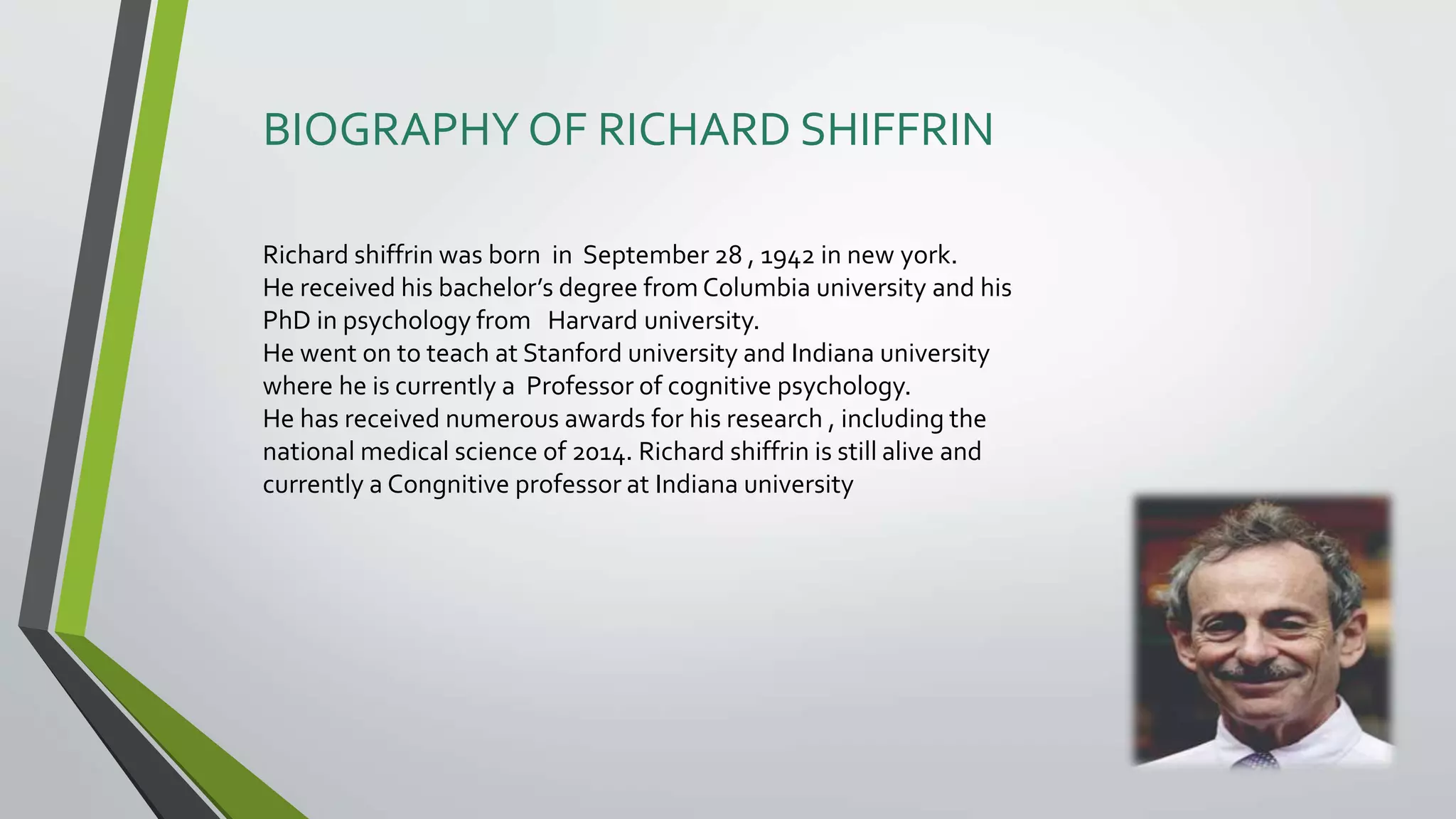
Richard shiffrin was born in September 28 , 1942 in new york.
He received his bachelor’s degree from Columbia university and his
PhD in psychology from Harvard university.
He went on to teach at Stanford university and Indiana university
where he is currently a Professor of cognitive psychology.
He has received numerous awards for his research , including the
national medical science of 2014. Richard shiffrin is still alive and
currently a Congnitive professor at Indiana university
BIOGRAPHY OF RICHARD SHIFFRIN
SCHOOL OFTHOUGHT
 Cognitive psychology is the school of psychology that studies mental processes,
including how people think, perceive, remember and learn
INFORMATION PROCESSINGTHEORY
 Definition
 Sensory memory
 Types of sensory memory
INFORMATION PROCESSING
 According to joyce and weil
 “Information processing refers to the ways people handle stimuli from the
environment, organize dara , sense problems , generate concepts and solutions to
problems, and employs verbal and non verbal symbols
INFORMATION PROCESSINGTHEORY
Cognitively
“What process’s are occurring in person’s brain when they are presented with a learning
situation “
Consequently they throw light onThe mechanisms how the brain senses , processes and
recall information . Processing depends on nature and complexity of data as they
perceived by learner
STAGES OF INFORMATION PROCESSINGTHEORY
SENSORY MEMORY
Sensory memory is the storage of information that we receive from our senses.
Examples of Sensory memory include seeing a dog,
The sensory information is first picked up by one or more Sense organs, tyen it travels
through nervous system and reach the brain for it’s interpretation.
The sensory information stays in nervous system and breifly about one or two seconds
giving brain the time for its interpretation,
After being registered in sensory register, it xan be responded immediately or
transferred to short term memory.
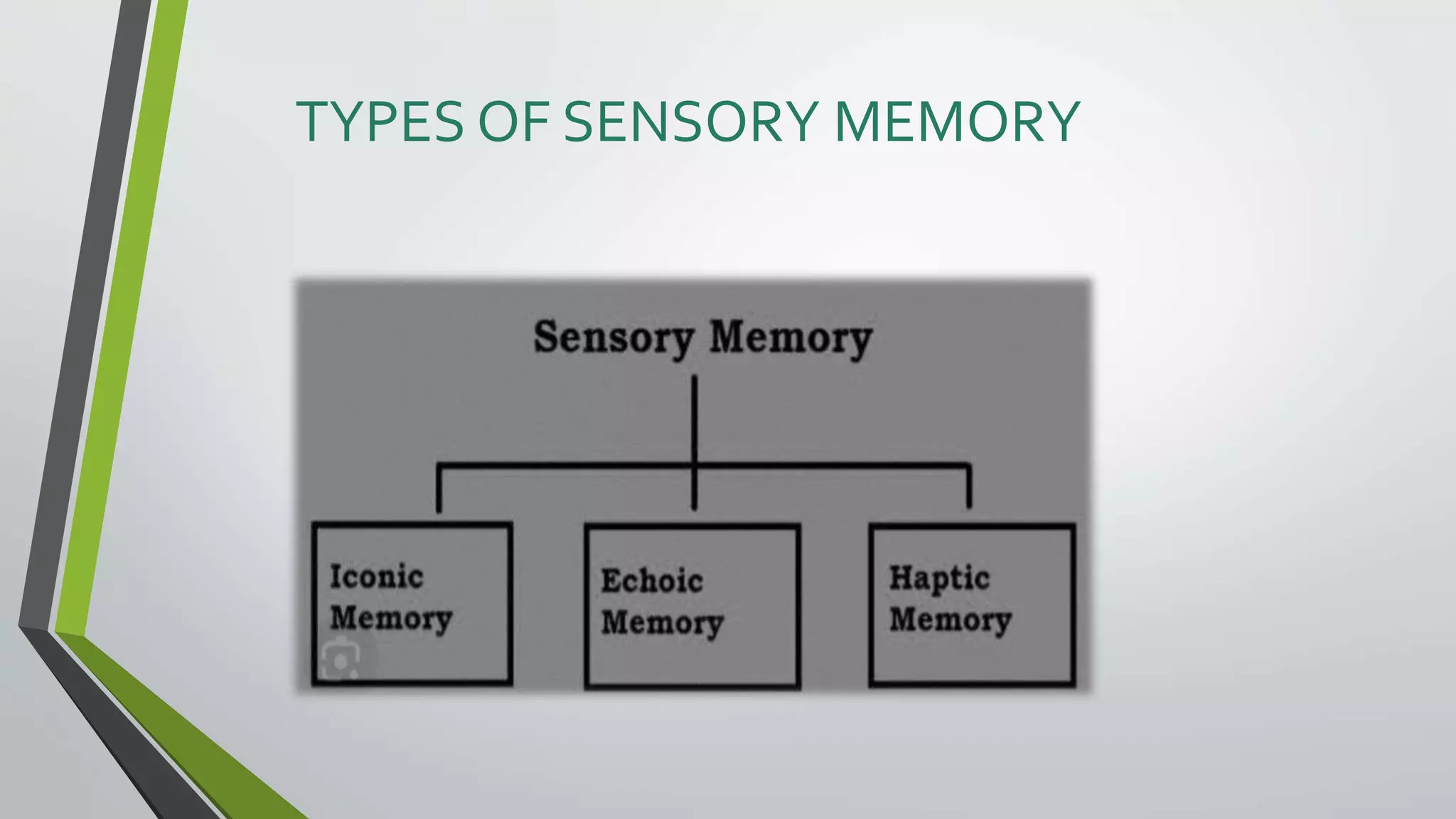
TYPES OF SENSORY MEMORY
Iconic memory:-
It is a type of sensory memory that stores images for a fraction of a second
Example:-
When you see a car passing by on the highway
Echoic memory:-
It is the ultra-short-term memory for things you hear
Example:-
When someone talks to you while you’re busy, you might not fully hear what they say. If
they repeat what they said, it will sound familiar because your echoic memory heard them
the first time.
Haptic memory:-
It is a form of sensory memory specific to tactile stimuli.
Example:-
When you feel a raindrop on your skin..
TYPES
SHORTTERM MEMORY
The information from sensory memory travels to short term memory of our brain. It may last for
20 seconds. However, it can be retained as long as an individual wants in its STM by repetition or
through rehearsal. STM is equivalent to working memory
These are three means employed for the information handling of cognitive tasks in STM.
Encoding the information in chunks.
Breaking the information in sub-parts.
Practicing the skills until they are automatic.
For Example:
Where you parked your car this morning.What you had for lunch yesterday and remembering
details from the book that you have read a few hours ago etc. are examples of STM.
LONGTERM MEMORY
The information from STM is transferred to Long term Memory .
LTM is believed to have unlimited capacity that hold information over lengthy periods of time.
TYPES OF LTM
There are two types of LTM,
i.Explicit Memory
ii.Implicit memory
Explicit Memory:
It is also known as declarative memory. It include all the memories that are available for
consciousness.
For Example:
Names and locations of different countries on map.
Implicit memory:
This type of LTM include all the memories that are available in unconsciousness.
For Example:
Riding a Bike.
Driving a car.
Buttoning a shirt.
LEVELS OF PROCESSINGTHEORY
 By Craik and Lokhart (1972)
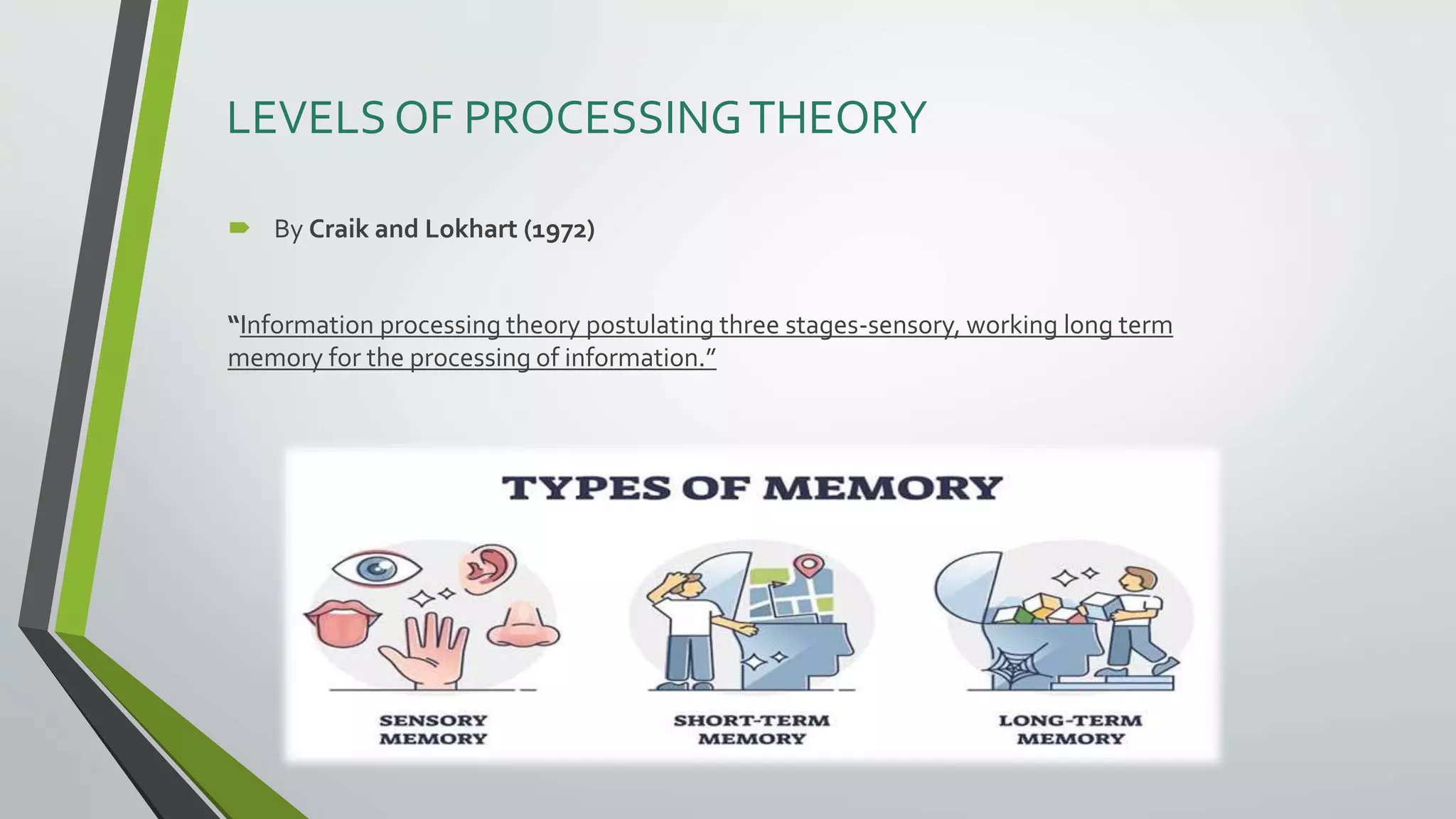
“Information processing theory postulating three stages-sensory, working long term
memory for the processing of information.”
LEVELS…
 There are three types namely, sensory, short term and long term.
 Ability to learn or remember is dependent on how deeply Information is processed by us.
 Levels of such processing may range from very shallow to very deep.
 The greater the depth of processing, the better can the material be learned or remember.For
example, for better learning you use visual images.
 Meaning full things remember well rather then the meaningless.
 Processing of information at different levels is carried out quite unconsciously a automatically
unless we attend it to that level. E.g: A student in classroom.
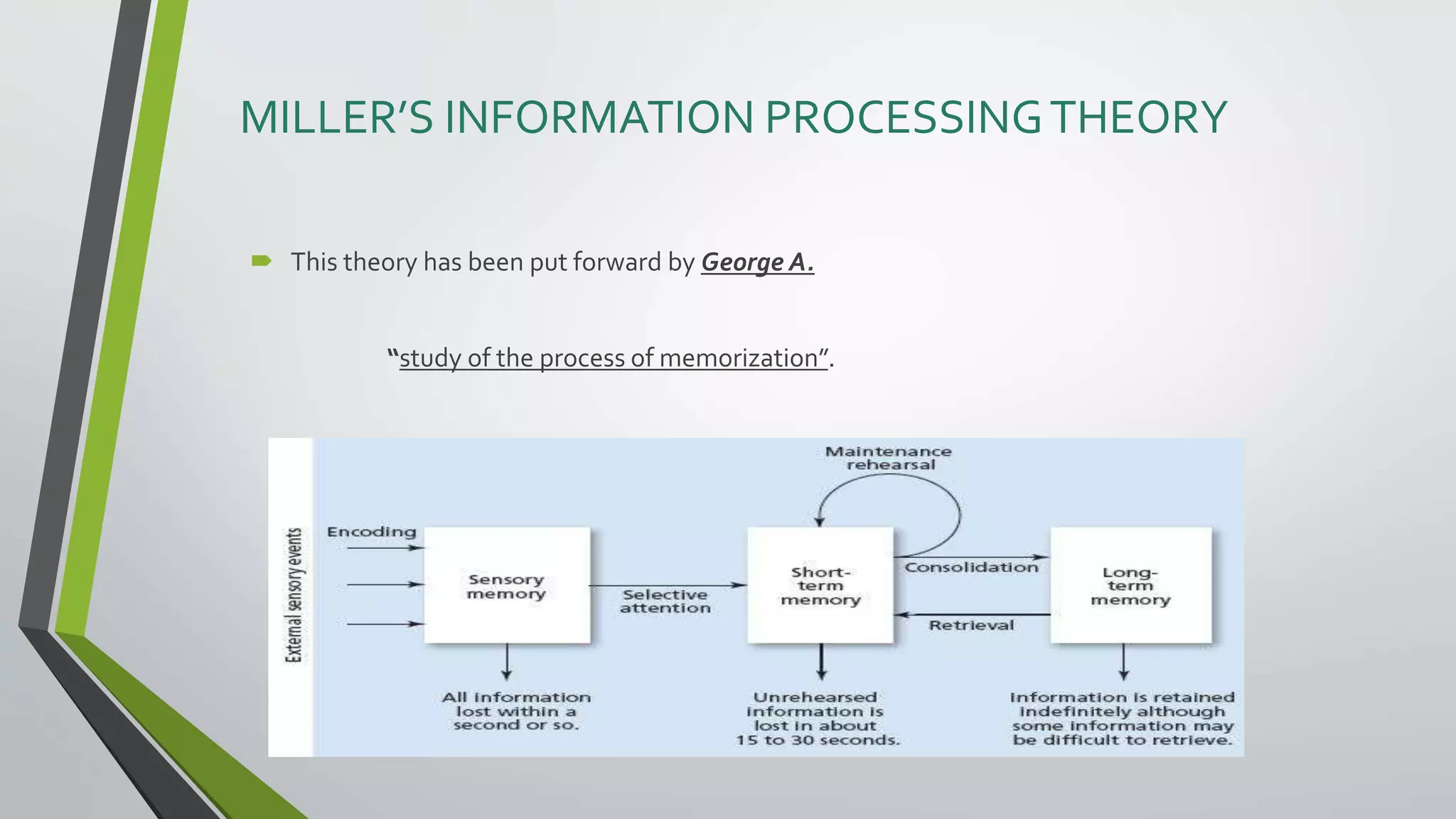
MILLER’S INFORMATION PROCESSINGTHEORY
 This theory has been put forward by George A.
“study of the process of memorization”.
 Acquiring new experiences and learning new ways of behaving.
 Students learn better when they are actively processing, storing and retrieving
information.
 helps the students build desirable cognitive structures (structuring of the subject matter)
for the proper understanding.
 Successful encoding is essential for the proper processing of the received sensory
information or data. Working memory (STM) also processes the information for being
transferred to LongTerm Memory (LTM) by encoding the information.Therefore,
meaningful encoding is a must for the desired task of information processing.
 Miller (1956) presented the concept of “Chunking” for the meaningful
organization or encoding of the subject matter at all levels of cognitive processing.
Classical example of chunks is the ability to remember long sequences of binary
numbers because they can be encoded into decimal form. For example the sequence
10100 01001 11001 101 1010 could easily be remembered as 20 9 25 5 10. Of course this
would only work for someone who can convert binary to decimal numbers (i.e. the
chunks are meaningful).
 The second useful concept propagated by Miller is concerned with his acceptance of the
computer as a model of human learning. Like the computer, the human mind takes in
information, performs operations on it to change its forms and content, stores and locates it
and generate responses to it.Thus information processing, according to Miller, involves (i)
gathering and representing information, i.e. encoding, (ii) holding information, i.e. retention
and (iii) getting at the information when needed, i.e. retrieval.
 The third useful conceptTOTE (Test OperateTest Exit). (1960) suggested thatTOTE should
replace the stimulus response mechanism as the basic unit of behavior. In aTOTE unit, a goal
is tested to see if it has been achieved through the mechanism of information processing. If
not, an operation is performed to achieve the goal, this cycle of test-operate is repeated until
the goal is eventually achieved or abandoned. By adopting this technique, an individual may
be capable of finding the solution of his problem or learning the desired way of achieving his
goal.
THANKYOU

Information processing theory. PPT2.pptx

  • 1.
  • 2.
    INTRODUCTION Information processing theoryis proposed by “Atkinson & shiffrin in 1968”. They developed Multi store Model of memory which describes Flow between three permanent storage systems of memory Sensory register Short term memory Long term memory
  • 3.
    BIOGRAPHY Atkinson and shiffrinboth were psychologists .They developed information processing theory in Late 1960s .They were both professorsAt Stanford university And made significant contribution toThe field of cognitive psychology BIOGRAPHY OF ATKINSON Richard Atkinson was born in October 01 , 1929 In california He received his bachelor’s degree from university of Californi, Los Angele, UCLA , his master degree from indiana university And his Ph.D is from Stanford uni He went on to teach at Stanford University , the university of California, San Deigo, UCSD , And the University of California Berkeley . He served as a chancellor of UCSD From 1980 -1995 And as the president of American’s association For the advancement of science 1990 -1991 . Atkinson passed away on 3 march , 2019 in age of 89..
  • 4.
    Richard shiffrin wasborn in September 28 , 1942 in new york. He received his bachelor’s degree from Columbia university and his PhD in psychology from Harvard university. He went on to teach at Stanford university and Indiana university where he is currently a Professor of cognitive psychology. He has received numerous awards for his research , including the national medical science of 2014. Richard shiffrin is still alive and currently a Congnitive professor at Indiana university BIOGRAPHY OF RICHARD SHIFFRIN
  • 5.
    SCHOOL OFTHOUGHT  Cognitivepsychology is the school of psychology that studies mental processes, including how people think, perceive, remember and learn
  • 6.
    INFORMATION PROCESSINGTHEORY  Definition Sensory memory  Types of sensory memory
  • 7.
    INFORMATION PROCESSING  Accordingto joyce and weil  “Information processing refers to the ways people handle stimuli from the environment, organize dara , sense problems , generate concepts and solutions to problems, and employs verbal and non verbal symbols
  • 8.
    INFORMATION PROCESSINGTHEORY Cognitively “What process’sare occurring in person’s brain when they are presented with a learning situation “ Consequently they throw light onThe mechanisms how the brain senses , processes and recall information . Processing depends on nature and complexity of data as they perceived by learner
  • 9.
    STAGES OF INFORMATIONPROCESSINGTHEORY SENSORY MEMORY Sensory memory is the storage of information that we receive from our senses. Examples of Sensory memory include seeing a dog, The sensory information is first picked up by one or more Sense organs, tyen it travels through nervous system and reach the brain for it’s interpretation. The sensory information stays in nervous system and breifly about one or two seconds giving brain the time for its interpretation, After being registered in sensory register, it xan be responded immediately or transferred to short term memory.
  • 10.
  • 11.
    Iconic memory:- It isa type of sensory memory that stores images for a fraction of a second Example:- When you see a car passing by on the highway Echoic memory:- It is the ultra-short-term memory for things you hear Example:- When someone talks to you while you’re busy, you might not fully hear what they say. If they repeat what they said, it will sound familiar because your echoic memory heard them the first time. Haptic memory:- It is a form of sensory memory specific to tactile stimuli. Example:- When you feel a raindrop on your skin.. TYPES
  • 12.
    SHORTTERM MEMORY The informationfrom sensory memory travels to short term memory of our brain. It may last for 20 seconds. However, it can be retained as long as an individual wants in its STM by repetition or through rehearsal. STM is equivalent to working memory These are three means employed for the information handling of cognitive tasks in STM. Encoding the information in chunks. Breaking the information in sub-parts. Practicing the skills until they are automatic. For Example: Where you parked your car this morning.What you had for lunch yesterday and remembering details from the book that you have read a few hours ago etc. are examples of STM. LONGTERM MEMORY The information from STM is transferred to Long term Memory . LTM is believed to have unlimited capacity that hold information over lengthy periods of time.
  • 13.
    TYPES OF LTM Thereare two types of LTM, i.Explicit Memory ii.Implicit memory Explicit Memory: It is also known as declarative memory. It include all the memories that are available for consciousness. For Example: Names and locations of different countries on map. Implicit memory: This type of LTM include all the memories that are available in unconsciousness. For Example: Riding a Bike. Driving a car. Buttoning a shirt.
  • 14.
    LEVELS OF PROCESSINGTHEORY By Craik and Lokhart (1972) “Information processing theory postulating three stages-sensory, working long term memory for the processing of information.”
  • 15.
    LEVELS…  There arethree types namely, sensory, short term and long term.  Ability to learn or remember is dependent on how deeply Information is processed by us.  Levels of such processing may range from very shallow to very deep.  The greater the depth of processing, the better can the material be learned or remember.For example, for better learning you use visual images.  Meaning full things remember well rather then the meaningless.  Processing of information at different levels is carried out quite unconsciously a automatically unless we attend it to that level. E.g: A student in classroom.
  • 16.
    MILLER’S INFORMATION PROCESSINGTHEORY This theory has been put forward by George A. “study of the process of memorization”.
  • 17.
     Acquiring newexperiences and learning new ways of behaving.  Students learn better when they are actively processing, storing and retrieving information.  helps the students build desirable cognitive structures (structuring of the subject matter) for the proper understanding.  Successful encoding is essential for the proper processing of the received sensory information or data. Working memory (STM) also processes the information for being transferred to LongTerm Memory (LTM) by encoding the information.Therefore, meaningful encoding is a must for the desired task of information processing.  Miller (1956) presented the concept of “Chunking” for the meaningful organization or encoding of the subject matter at all levels of cognitive processing. Classical example of chunks is the ability to remember long sequences of binary numbers because they can be encoded into decimal form. For example the sequence 10100 01001 11001 101 1010 could easily be remembered as 20 9 25 5 10. Of course this would only work for someone who can convert binary to decimal numbers (i.e. the chunks are meaningful).
  • 18.
     The seconduseful concept propagated by Miller is concerned with his acceptance of the computer as a model of human learning. Like the computer, the human mind takes in information, performs operations on it to change its forms and content, stores and locates it and generate responses to it.Thus information processing, according to Miller, involves (i) gathering and representing information, i.e. encoding, (ii) holding information, i.e. retention and (iii) getting at the information when needed, i.e. retrieval.  The third useful conceptTOTE (Test OperateTest Exit). (1960) suggested thatTOTE should replace the stimulus response mechanism as the basic unit of behavior. In aTOTE unit, a goal is tested to see if it has been achieved through the mechanism of information processing. If not, an operation is performed to achieve the goal, this cycle of test-operate is repeated until the goal is eventually achieved or abandoned. By adopting this technique, an individual may be capable of finding the solution of his problem or learning the desired way of achieving his goal.
  • 19.