Information Literacy &
Strategies to Avoid Plagiarism
Media and Information
Literacy
CABUYAO INSTITUTE OF TECHNOLOGY
JAY RICK T. ESCOBAR II, SENIOR HIGH SCHOOL
Asynchronous – Week 5 Module 4
A person must be able to recognize when information is needed and have the ability to
locate, evaluate, and use effectively the needed information.
Information Literate people are those who have learned how to learn. They know how find
information, and how to use information in such a way that others can learn from them.
They are people prepared for lifelong learning, because they can always find the
information needed for any task or decision at hand.
American Library Association Presidential Committee on Information Literacy, Final Report,
1989, p.1.
Media and Information
Literacy
CABUYAO INSTITUTE OF TECHNOLOGY
JAY RICK T. ESCOBAR II, SENIOR HIGH SCHOOL
Information Literate
Media and Information
Literacy
CABUYAO INSTITUTE OF TECHNOLOGY
JAY RICK T. ESCOBAR II, SENIOR HIGH SCHOOL
Objectives
At the end of the lesson , the learners should be able
to:
1. Define information needs, locates, accesses, assesses,
organizes, and communicates in formation and;
2. Demonstrate ethical use of information
As the ability to find, evaluate, organize, use, and
communicate information in all its various formats,
most notably in situations requiring decision
making, problem solving, or the acquisition of
knowledge. It is a combination of research skills,
critical thinking skills, computer technology skills,
and communication skills.
Information Literacy
defined as
CABUYAO INSTITUTE OF TECHNOLOGY
Media and Information
Literacy
Today, information is just at the tip of the user's fingertips.
Advancements in technology have led to insurmountable
availability information and a more convenient means of
accessing them. However, it raises issues of credibility of
the available information, requiring rigorous filtering of
information and verification. In formation literacy aims to
solve this issue.
The Information in
the Modern Age
CABUYAO INSTITUTE OF TECHNOLOGY
Media and Information
Literacy
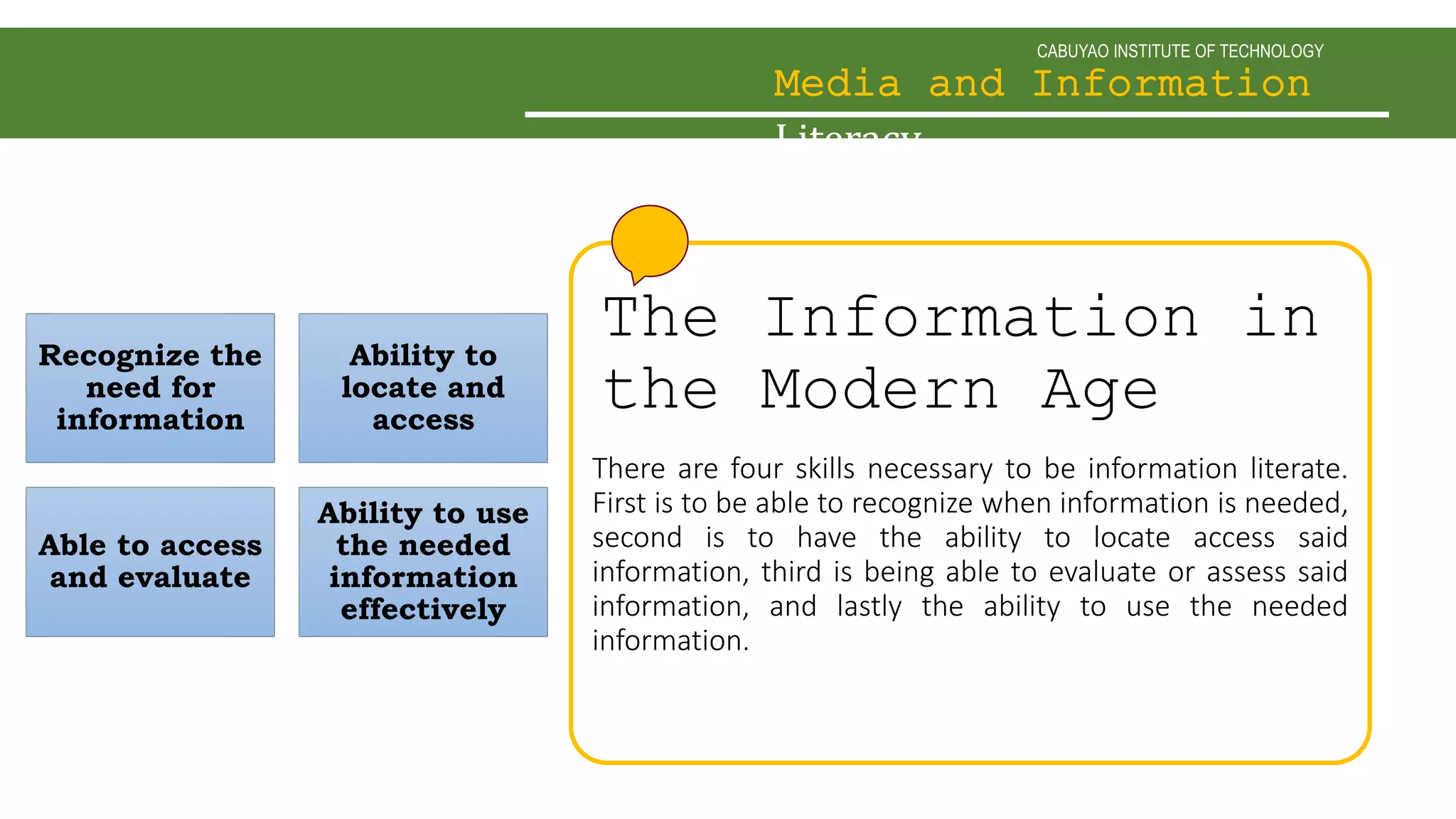
There are four skills necessary to be information literate.
First is to be able to recognize when information is needed,
second is to have the ability to locate access said
information, third is being able to evaluate or assess said
information, and lastly the ability to use the needed
information.
The Information in
the Modern Age
CABUYAO INSTITUTE OF TECHNOLOGY
Media and Information
Literacy
Recognize the
need for
information
Ability to
locate and
access
Able to access
and evaluate
Ability to use
the needed
information
effectively
Media and Information
Literacy
CABUYAO INSTITUTE OF TECHNOLOGY
JAY RICK T. ESCOBAR II, SENIOR HIGH SCHOOL
Ability to:
• Determine the extent of information needed
• Access the needed information effectively and efficiently
• Evaluate information and its sources critically
• Incorporate selected information into one’s knowledge base
• Use information effectively to accomplish a specific purpose
• Understand the economic, legal, and social issues surrounding the use of
information, and access and use of information ethically and legally.
Skills I need!
Media and Information
Literacy
CABUYAO INSTITUTE OF TECHNOLOGY
JAY RICK T. ESCOBAR II, SENIOR HIGH SCHOOL
- Demonstrate an understanding of concepts underlying hardware, software, and
networking connectivity and in the use of computers and applications;
- Demonstrate an understanding of ethics and safety issues in using electronic media
and responsible use of technology, and;
- Use technology for communication, research and collaboration and problem-
solving. With proficient technology skills, students should be able to locate, collect,
sympathize, and evaluate information from a variety of digital sources, and to use
telecommunications and other media to interact or collaborate with peers, experts,
and other audiences.
Technology literate students should be
able to:
Media and Information
Literacy
CABUYAO INSTITUTE OF TECHNOLOGY
JAY RICK T. ESCOBAR II, SENIOR HIGH SCHOOL
INC defines information need as the motivation people think and feel to
seek information. It is the reason why people go out of their way to find
answers to their questions, or solutions to their problems.
Since it is a broad subject, information needs can be further divided in
two, demands and wants according to the University of Washington.
The Information Needs
Media and Information
Literacy
CABUYAO INSTITUTE OF TECHNOLOGY
JAY RICK T. ESCOBAR II, SENIOR HIGH SCHOOL
The Information
Needs
Wants
Information
Needs
Demands
Media and Information
Literacy
CABUYAO INSTITUTE OF TECHNOLOGY
JAY RICK T. ESCOBAR II, SENIOR HIGH SCHOOL
The Information
Needs
Information needs refers to the requirement of information while information wants deals
with the desire to have information.
It is important to distinguish the distinction between the two to further understand the
concept of information needs. Taylor, (1968) explains that there are four points along the
need continuum, first is an actual but unexpressed need, the second is a conscious
description of the need, third is a formal statement of the need, and the fourth is a comprised
need.
Once the purpose of the need is recognized, identifying when information is needed becomes easier.
Media and Information
Literacy
CABUYAO INSTITUTE OF TECHNOLOGY
JAY RICK T. ESCOBAR II, SENIOR HIGH SCHOOL
The Communication of
Information
Meltzer (1971) said that communication of information
requires an understanding of the data. Transferring
information from one party to another cannot be
considered communication of information data is not
understood. This calls the need for proper evaluation of
data. This evaluation goes further than just verifying the
credibility of information; it also allows one to have a complete
understanding of the data before it can be communication.
Deciphering the meaning of information is the true task of the
Communication of Information.
X
Media and Information
Literacy
CABUYAO INSTITUTE OF TECHNOLOGY
JAY RICK T. ESCOBAR II, SENIOR HIGH SCHOOL
The Ethical Use of
Information
• Scholars define ethics as the branch of philosophy
that involves systematizing, defending, and
recommending concepts of right and wrong conduct.
• Ethics gives a predetermined set of guidelines
based on a code of morality that people in the
society will follow.
While ethics may vary
depending on a number of
factors, its core remains
the same, man-kind’s
concept of right and
wrong.
X
Media and Information
Literacy
CABUYAO INSTITUTE OF TECHNOLOGY
JAY RICK T. ESCOBAR II, SENIOR HIGH SCHOOL
The Ethical Use of
Information
• Scholars define ethics as the branch of
philosophy that involves systematizing,
defending, and recommending concepts of
right and wrong conduct.
• Ethics gives a predetermined set of guidelines
based on a code of morality that people in the
society will follow.
While ethics may vary depending on
a number of factors, its core
remains the same, man-kind’s
concept of right and wrong.
1. Give credit where credit is due
2. Practice due diligence
3. Respect everyone’s privacy
4. Separate facts from opinion
X
Media and Information
Literacy
CABUYAO INSTITUTE OF TECHNOLOGY
JAY RICK T. ESCOBAR II, SENIOR HIGH SCHOOL
Plagiarism: Using other people’s words
and ideas without clearly
acknowledging the source of the
information
Common Knowledge: Facts that can be
found in numerous places and are likely
to be widely known
Example: John F. Kennedy was elected
President of the United States in 1960.
This is generally known information.
You do not need to document this fact
Quotation: Using someone’s
words directly. When you use a
direct quote, place the passage
between quotation marks, and
document the source
according to a standard
documenting style.
Example: According to John
Smith in The New York Times,
“37% of all children under the
age of 10 live below the
poverty line”. You need to cite
the source.
Interpretation: You must
document facts that are not
generally known, or ideas that
interpret facts.
Example: Michael Jordan is the
greatest basketball player ever to
have played the game. This idea is
not a fact but an interpretation or
an opinion. You need to cite the
source.
X
Media and Information
Literacy
CABUYAO INSTITUTE OF TECHNOLOGY
JAY RICK T. ESCOBAR II, SENIOR HIGH SCHOOL
Paraphrase: Using someone’s ideas but rephrasing them in your own words.
Although you will use your own words to paraphrase, you must still
acknowledge and cite the source of the information.
Plagiarism has legal implications. While ideas themselves are not copyrightable, the artistic expression
of an idea automatically falls under copyright when it is created. Under fair use, small parts may be
copied without permission from the copyright holder. However, even under fair use - in which you can
use some parts of the material for academic or non-profit purposes - you must attribute the original
source. What is considered fair use is rather subjective and can vary from country to country.
IMPLICATIONS
1. Submit your own work for publication. You need to
cite even your own work.
2. Put quotation marks around everything that comes
directly from the text and cite the source.
3. Paraphrase, but be sure that you are not simply
rearranging or replacing a few words and cite the
source.
4. Keep a source journal, a notepad, or note cards-
annotated bibliographies can be especially beneficial
5. Use the style manual in properly citing sources
6. Get help from the writing center or library
Strategies in
Avoiding
Plagiarism
CABUYAO INSTITUTE OF TECHNOLOGY
Media and Information
Literacy
Media and Information
Literacy
CABUYAO INSTITUTE OF TECHNOLOGY
JAY RICK T. ESCOBAR II, SENIOR HIGH SCHOOL
https://www.google.com/search?q=information+needs+clipart&tbm=isch&ved=2ahUKEwi78trn2avsAhUqJaYKHeAjDw8Q2-
cCegQIABAA&oq=information+needs+clipart&gs_lcp=CgNpbWcQAzoCCAA6BAgAEB5Q1Y4HWIeuB2CdsgdoAHAAeACAAaMBiAHDB5IBAzEuN5gBAKA
BAaoBC2d3cy13aXotaW1nwAEB&sclient=img&ei=64mCX_vQAqrKmAXgx7x4#imgrc=nyYlNksD09MjwM
Naldo, E.B. (2016). Media and Information Literacy. Malabon City, PH: Mutya Publishing House Inc.
Gonzales, E.D. (2016). Media and Information Literacy. Manila, PH: JFS Publishing Services.
Ethical Use of Information. Retrieved from http://alacarte.library.csuci.edu/ subject-guide/55-Ethical-Use-of-Information
Khan, R. (2006). Internet 101: The new mass medium for Filipinos. Anvil Publishing, Inc.
How to Avoid Plagiarism. Retrieved from https://www.ediqo.com/blog/8- simple-rules-to-avoid-plagiarism/?
utm_content=buffer1f896&utm_medium=social&utm_source=facebook. com&utm_campaign=buffer
Wilson, Carolyn; Grizzle, Anton; Tuazon, Ramon; Akyempong; Kwane; Cheung, Chi-Kim (2011). Media and Information Literacy: Curriculum for
Teachers. UNESCO Press ISBN 978-92-3-104198-3 (EN); 978-959-18-07; 978-959-18-0787-8 (ES)
Woody Horton Jr., (2007). Understanding Information Literacy – a Primer. Paris, Unesco, pages 9 - 13, Annex B
References:

Information Literacy

  • 1.
    Information Literacy & Strategiesto Avoid Plagiarism Media and Information Literacy CABUYAO INSTITUTE OF TECHNOLOGY JAY RICK T. ESCOBAR II, SENIOR HIGH SCHOOL Asynchronous – Week 5 Module 4
  • 2.
    A person mustbe able to recognize when information is needed and have the ability to locate, evaluate, and use effectively the needed information. Information Literate people are those who have learned how to learn. They know how find information, and how to use information in such a way that others can learn from them. They are people prepared for lifelong learning, because they can always find the information needed for any task or decision at hand. American Library Association Presidential Committee on Information Literacy, Final Report, 1989, p.1. Media and Information Literacy CABUYAO INSTITUTE OF TECHNOLOGY JAY RICK T. ESCOBAR II, SENIOR HIGH SCHOOL Information Literate
  • 3.
    Media and Information Literacy CABUYAOINSTITUTE OF TECHNOLOGY JAY RICK T. ESCOBAR II, SENIOR HIGH SCHOOL Objectives At the end of the lesson , the learners should be able to: 1. Define information needs, locates, accesses, assesses, organizes, and communicates in formation and; 2. Demonstrate ethical use of information
  • 4.
    As the abilityto find, evaluate, organize, use, and communicate information in all its various formats, most notably in situations requiring decision making, problem solving, or the acquisition of knowledge. It is a combination of research skills, critical thinking skills, computer technology skills, and communication skills. Information Literacy defined as CABUYAO INSTITUTE OF TECHNOLOGY Media and Information Literacy
  • 5.
    Today, information isjust at the tip of the user's fingertips. Advancements in technology have led to insurmountable availability information and a more convenient means of accessing them. However, it raises issues of credibility of the available information, requiring rigorous filtering of information and verification. In formation literacy aims to solve this issue. The Information in the Modern Age CABUYAO INSTITUTE OF TECHNOLOGY Media and Information Literacy
  • 6.
    There are fourskills necessary to be information literate. First is to be able to recognize when information is needed, second is to have the ability to locate access said information, third is being able to evaluate or assess said information, and lastly the ability to use the needed information. The Information in the Modern Age CABUYAO INSTITUTE OF TECHNOLOGY Media and Information Literacy Recognize the need for information Ability to locate and access Able to access and evaluate Ability to use the needed information effectively
  • 7.
    Media and Information Literacy CABUYAOINSTITUTE OF TECHNOLOGY JAY RICK T. ESCOBAR II, SENIOR HIGH SCHOOL Ability to: • Determine the extent of information needed • Access the needed information effectively and efficiently • Evaluate information and its sources critically • Incorporate selected information into one’s knowledge base • Use information effectively to accomplish a specific purpose • Understand the economic, legal, and social issues surrounding the use of information, and access and use of information ethically and legally. Skills I need!
  • 8.
    Media and Information Literacy CABUYAOINSTITUTE OF TECHNOLOGY JAY RICK T. ESCOBAR II, SENIOR HIGH SCHOOL - Demonstrate an understanding of concepts underlying hardware, software, and networking connectivity and in the use of computers and applications; - Demonstrate an understanding of ethics and safety issues in using electronic media and responsible use of technology, and; - Use technology for communication, research and collaboration and problem- solving. With proficient technology skills, students should be able to locate, collect, sympathize, and evaluate information from a variety of digital sources, and to use telecommunications and other media to interact or collaborate with peers, experts, and other audiences. Technology literate students should be able to:
  • 9.
    Media and Information Literacy CABUYAOINSTITUTE OF TECHNOLOGY JAY RICK T. ESCOBAR II, SENIOR HIGH SCHOOL INC defines information need as the motivation people think and feel to seek information. It is the reason why people go out of their way to find answers to their questions, or solutions to their problems. Since it is a broad subject, information needs can be further divided in two, demands and wants according to the University of Washington. The Information Needs
  • 10.
    Media and Information Literacy CABUYAOINSTITUTE OF TECHNOLOGY JAY RICK T. ESCOBAR II, SENIOR HIGH SCHOOL The Information Needs Wants Information Needs Demands
  • 11.
    Media and Information Literacy CABUYAOINSTITUTE OF TECHNOLOGY JAY RICK T. ESCOBAR II, SENIOR HIGH SCHOOL The Information Needs Information needs refers to the requirement of information while information wants deals with the desire to have information. It is important to distinguish the distinction between the two to further understand the concept of information needs. Taylor, (1968) explains that there are four points along the need continuum, first is an actual but unexpressed need, the second is a conscious description of the need, third is a formal statement of the need, and the fourth is a comprised need. Once the purpose of the need is recognized, identifying when information is needed becomes easier.
  • 12.
    Media and Information Literacy CABUYAOINSTITUTE OF TECHNOLOGY JAY RICK T. ESCOBAR II, SENIOR HIGH SCHOOL The Communication of Information Meltzer (1971) said that communication of information requires an understanding of the data. Transferring information from one party to another cannot be considered communication of information data is not understood. This calls the need for proper evaluation of data. This evaluation goes further than just verifying the credibility of information; it also allows one to have a complete understanding of the data before it can be communication. Deciphering the meaning of information is the true task of the Communication of Information.
  • 13.
    X Media and Information Literacy CABUYAOINSTITUTE OF TECHNOLOGY JAY RICK T. ESCOBAR II, SENIOR HIGH SCHOOL The Ethical Use of Information • Scholars define ethics as the branch of philosophy that involves systematizing, defending, and recommending concepts of right and wrong conduct. • Ethics gives a predetermined set of guidelines based on a code of morality that people in the society will follow. While ethics may vary depending on a number of factors, its core remains the same, man-kind’s concept of right and wrong.
  • 14.
    X Media and Information Literacy CABUYAOINSTITUTE OF TECHNOLOGY JAY RICK T. ESCOBAR II, SENIOR HIGH SCHOOL The Ethical Use of Information • Scholars define ethics as the branch of philosophy that involves systematizing, defending, and recommending concepts of right and wrong conduct. • Ethics gives a predetermined set of guidelines based on a code of morality that people in the society will follow. While ethics may vary depending on a number of factors, its core remains the same, man-kind’s concept of right and wrong. 1. Give credit where credit is due 2. Practice due diligence 3. Respect everyone’s privacy 4. Separate facts from opinion
  • 15.
    X Media and Information Literacy CABUYAOINSTITUTE OF TECHNOLOGY JAY RICK T. ESCOBAR II, SENIOR HIGH SCHOOL Plagiarism: Using other people’s words and ideas without clearly acknowledging the source of the information Common Knowledge: Facts that can be found in numerous places and are likely to be widely known Example: John F. Kennedy was elected President of the United States in 1960. This is generally known information. You do not need to document this fact Quotation: Using someone’s words directly. When you use a direct quote, place the passage between quotation marks, and document the source according to a standard documenting style. Example: According to John Smith in The New York Times, “37% of all children under the age of 10 live below the poverty line”. You need to cite the source. Interpretation: You must document facts that are not generally known, or ideas that interpret facts. Example: Michael Jordan is the greatest basketball player ever to have played the game. This idea is not a fact but an interpretation or an opinion. You need to cite the source.
  • 16.
    X Media and Information Literacy CABUYAOINSTITUTE OF TECHNOLOGY JAY RICK T. ESCOBAR II, SENIOR HIGH SCHOOL Paraphrase: Using someone’s ideas but rephrasing them in your own words. Although you will use your own words to paraphrase, you must still acknowledge and cite the source of the information. Plagiarism has legal implications. While ideas themselves are not copyrightable, the artistic expression of an idea automatically falls under copyright when it is created. Under fair use, small parts may be copied without permission from the copyright holder. However, even under fair use - in which you can use some parts of the material for academic or non-profit purposes - you must attribute the original source. What is considered fair use is rather subjective and can vary from country to country. IMPLICATIONS
  • 17.
    1. Submit yourown work for publication. You need to cite even your own work. 2. Put quotation marks around everything that comes directly from the text and cite the source. 3. Paraphrase, but be sure that you are not simply rearranging or replacing a few words and cite the source. 4. Keep a source journal, a notepad, or note cards- annotated bibliographies can be especially beneficial 5. Use the style manual in properly citing sources 6. Get help from the writing center or library Strategies in Avoiding Plagiarism CABUYAO INSTITUTE OF TECHNOLOGY Media and Information Literacy
  • 18.
    Media and Information Literacy CABUYAOINSTITUTE OF TECHNOLOGY JAY RICK T. ESCOBAR II, SENIOR HIGH SCHOOL https://www.google.com/search?q=information+needs+clipart&tbm=isch&ved=2ahUKEwi78trn2avsAhUqJaYKHeAjDw8Q2- cCegQIABAA&oq=information+needs+clipart&gs_lcp=CgNpbWcQAzoCCAA6BAgAEB5Q1Y4HWIeuB2CdsgdoAHAAeACAAaMBiAHDB5IBAzEuN5gBAKA BAaoBC2d3cy13aXotaW1nwAEB&sclient=img&ei=64mCX_vQAqrKmAXgx7x4#imgrc=nyYlNksD09MjwM Naldo, E.B. (2016). Media and Information Literacy. Malabon City, PH: Mutya Publishing House Inc. Gonzales, E.D. (2016). Media and Information Literacy. Manila, PH: JFS Publishing Services. Ethical Use of Information. Retrieved from http://alacarte.library.csuci.edu/ subject-guide/55-Ethical-Use-of-Information Khan, R. (2006). Internet 101: The new mass medium for Filipinos. Anvil Publishing, Inc. How to Avoid Plagiarism. Retrieved from https://www.ediqo.com/blog/8- simple-rules-to-avoid-plagiarism/? utm_content=buffer1f896&utm_medium=social&utm_source=facebook. com&utm_campaign=buffer Wilson, Carolyn; Grizzle, Anton; Tuazon, Ramon; Akyempong; Kwane; Cheung, Chi-Kim (2011). Media and Information Literacy: Curriculum for Teachers. UNESCO Press ISBN 978-92-3-104198-3 (EN); 978-959-18-07; 978-959-18-0787-8 (ES) Woody Horton Jr., (2007). Understanding Information Literacy – a Primer. Paris, Unesco, pages 9 - 13, Annex B References: