1981-1990

1940-1952
First Generation
The vacuum tubes
were the main
element of
ordenadores.Was
slow and very
bigs.They started to
use the binary system
to represent the
information. The used
was military and
cientific.The language
was the language
machine.They used
progamaction of
punch cards to store
information.

Fifth Generation
From this generation and no
difference in the technology used
to create the machines, but the way
it is used. The fifth generation is
differentiated by the
interconnection between all types
of computers, devices and
networks (integrated).Begin to
create parallel operation schemes .
Using components for very large
scale integration (VLSI ) .Using
language of fifth generation.
Integration of data, image and
voice ( multimedia environments ).
Developments in Artificial
Intelligence, Robotics and Expert
System .

1964-1971
Third Generation
Chpis invented in 1964 , and
integrated circuits
, computers were even
smaller , more rapid and
more efficient . The
computers consume less
electricity. Desarollaron
operativosy systems
multiprogramacion.Begins
to use semiconductor
memories and magnetic
disks .

1952-1964
Second Generation
The vacuum valve is
replaced by the
transistor.The
computers were
cheaper and faster
and smaller. PCs are
used by other type
of people. The
computers started
to had new
programming
languages .The PCs
begin to use other
internal and
external memories.

1971-1981
Fourth Generation
In 1971 appears the microprocessor. It
uses technology to integrate large scale LSI circuits . Through This
technology , more circuits are Placed
Within the same chip, tasks.Created
That staff perform different computers
and microcomputers . A single
integrated circuit contains the control
unit and the arithmetic / logic unit .
As external storage unit using the
diskette (floppy disk) . Supercomputers
They created new programming
languages ​.

1990-Present
Sixth Generation
It is characterized by developments in
communications technology .
The miniaturization of components in the machines,
and cost reduction lead to high capacity.The systems
of the previous generation supercomputers are
outpaced by new workstations. The use of nets is
common, with high speeds and service integration
quality video, voice and other real-time multimedia
data. With the expansion of networks, emerged
parallel processing on massive scales in which an
infinite number of computers cooperate performing a
task (Distributed Computing and Clusters or clusters
of computers).
Internet invades the domestic world generating new
alternatives in all human activities.

Informatica time line

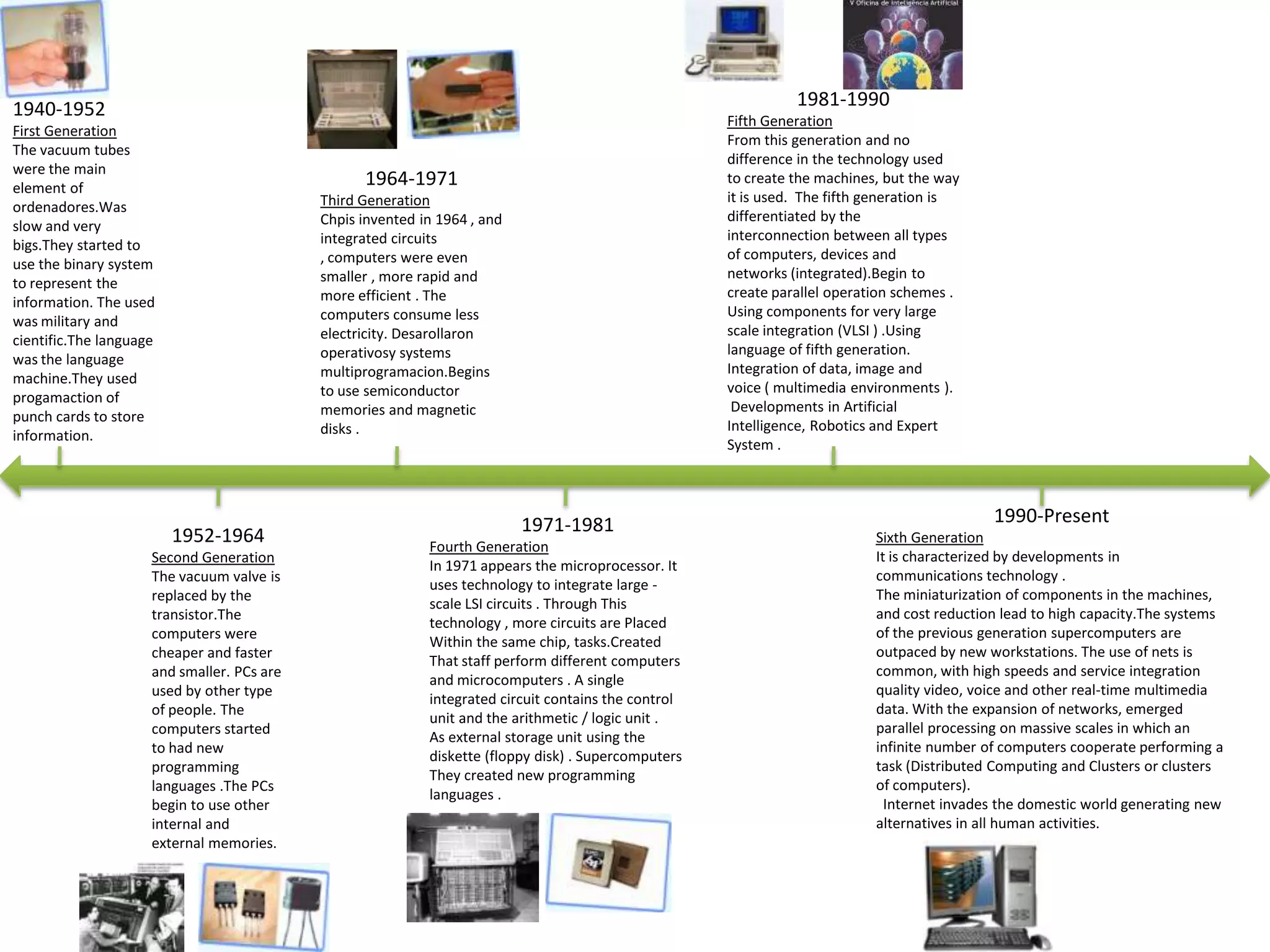
  • 1.
    1981-1990 1940-1952 First Generation The vacuumtubes were the main element of ordenadores.Was slow and very bigs.They started to use the binary system to represent the information. The used was military and cientific.The language was the language machine.They used progamaction of punch cards to store information. Fifth Generation From this generation and no difference in the technology used to create the machines, but the way it is used. The fifth generation is differentiated by the interconnection between all types of computers, devices and networks (integrated).Begin to create parallel operation schemes . Using components for very large scale integration (VLSI ) .Using language of fifth generation. Integration of data, image and voice ( multimedia environments ). Developments in Artificial Intelligence, Robotics and Expert System . 1964-1971 Third Generation Chpis invented in 1964 , and integrated circuits , computers were even smaller , more rapid and more efficient . The computers consume less electricity. Desarollaron operativosy systems multiprogramacion.Begins to use semiconductor memories and magnetic disks . 1952-1964 Second Generation The vacuum valve is replaced by the transistor.The computers were cheaper and faster and smaller. PCs are used by other type of people. The computers started to had new programming languages .The PCs begin to use other internal and external memories. 1971-1981 Fourth Generation In 1971 appears the microprocessor. It uses technology to integrate large scale LSI circuits . Through This technology , more circuits are Placed Within the same chip, tasks.Created That staff perform different computers and microcomputers . A single integrated circuit contains the control unit and the arithmetic / logic unit . As external storage unit using the diskette (floppy disk) . Supercomputers They created new programming languages ​. 1990-Present Sixth Generation It is characterized by developments in communications technology . The miniaturization of components in the machines, and cost reduction lead to high capacity.The systems of the previous generation supercomputers are outpaced by new workstations. The use of nets is common, with high speeds and service integration quality video, voice and other real-time multimedia data. With the expansion of networks, emerged parallel processing on massive scales in which an infinite number of computers cooperate performing a task (Distributed Computing and Clusters or clusters of computers). Internet invades the domestic world generating new alternatives in all human activities.