WE WILL BEGIN IN..
8
7
6
5
4
3
 
 
BASIC NETWORKING
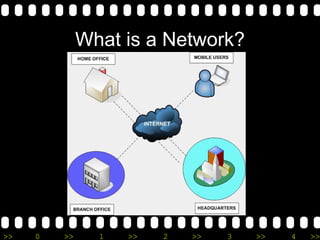
What is a Network?
Why do we network? No man is an island, so as a Computer or a device…
Benefits of a Network Resource Sharing Data and Applications Mobility Network Storage Backup Devices
 
Kinds of Network
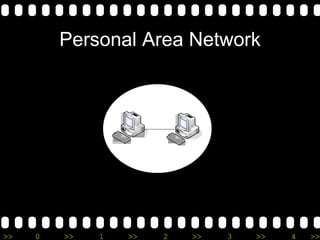
Personal Area Network
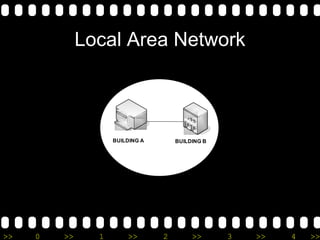
Local Area Network
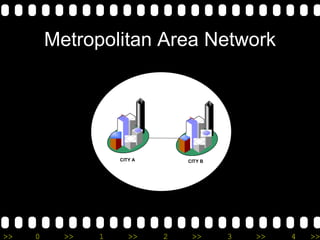
Metropolitan Area Network
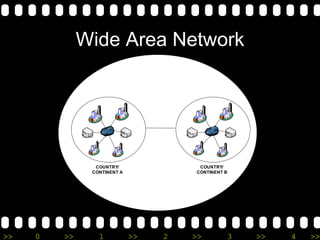
Wide Area Network
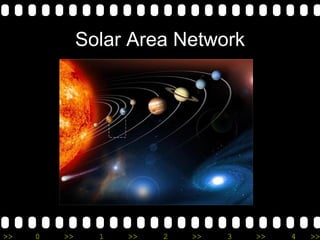
Solar Area Network
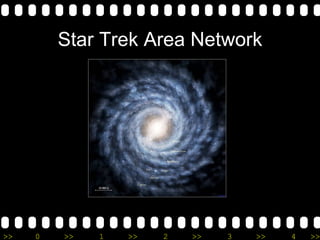
Star Trek Area Network
Network Topology
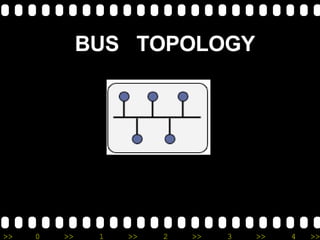
BUS  TOPOLOGY
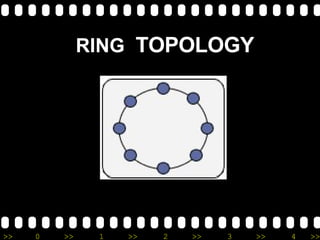
RING  TOPOLOGY
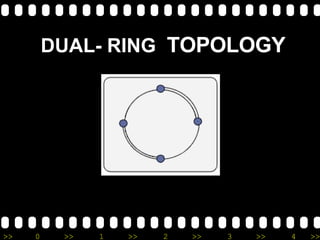
DUAL- RING  TOPOLOGY
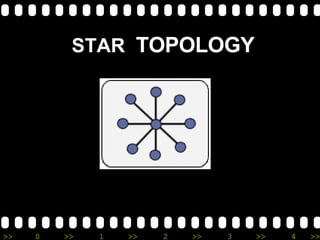
STAR  TOPOLOGY
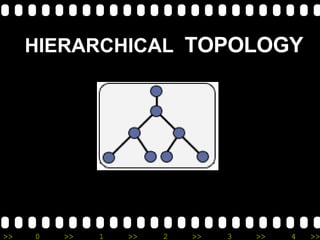
HIERARCHICAL  TOPOLOGY
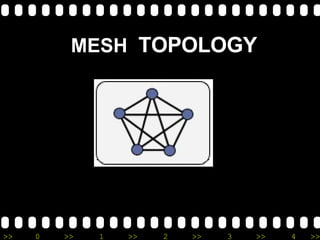
MESH  TOPOLOGY
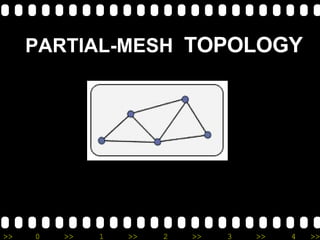
PARTIAL-MESH  TOPOLOGY
Characteristic of Network Speed Cost Security Availability Scalability Reliability Topology
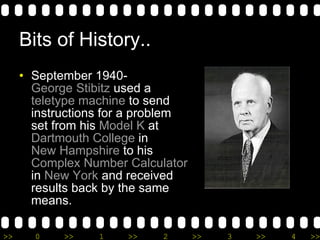
Bits of History.. September 1940-  George Stibitz  used a  teletype machine  to send instructions for a problem set from his  Model K  at  Dartmouth College  in  New Hampshire  to his  Complex Number Calculator  in  New York  and received results back by the same means.
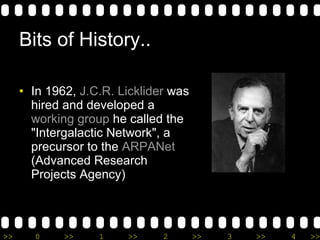
Bits of History.. In 1962,  J.C.R. Licklider  was hired and developed a  working group  he called the "Intergalactic Network", a precursor to the  ARPANet  (Advanced Research Projects Agency)
Bit of History.. In 1964, researchers at Dartmouth developed the  Dartmouth Time Sharing System  for distributed users of large computer systems. DTSS was the first large-scale  time-sharing  system to be implemented successfully
Bits of History… The same year, at  MIT , a research group supported by  General Electric  and  Bell Labs  used a computer (DEC's  PDP-8 ) to route and manage telephone connections.
Bits of History… Throughout the 1960s  Leonard Kleinrock ,  Paul Baran  and  Donald Davies  independently conceptualized and developed network systems which used datagrams or  packets  that could be used in a  packet switched  network between computer systems.
Bits of History… 1965 Thomas Merrill and Lawrence G. Roberts created the first wide area network(WAN)   The first widely used PSTN (public switched telephone network) switch that used true computer control was the Western Electric  1ESS switch , introduced in 1965.
Bits of History… In 1969 the  University of California at Los Angeles , SRI (in Stanford),  University of California at Santa Barbara , and the  University of Utah  were connected as the beginning of the  ARPANet  network using 50 kbit/s circuits. Commercial services using  X.25 , an alternative architecture to the  TCP/IP  suite, were deployed in 1972.
Bits of History… Computer networks, and the technologies needed to connect and communicate through and between them, continue to drive  computer hardware ,  software , and  peripherals  industries. This expansion is mirrored by growth in the numbers and types of users of networks from the researcher to the home user.
Bits of History… Today, computer networks are the core of modern communication . All modern aspects of the PSTN are computer-controlled Telephony increasingly runs over the  Internet Protocol ,
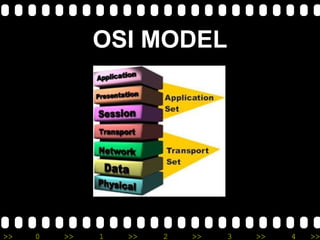
OSI OPEN SYSTEMS INTERCONNECTION MODEL
OSI MODEL

Networking

  • 1.
  • 2.
  • 3.
  • 4.
  • 5.
  • 6.
  • 7.
  • 8.
  • 9.
  • 10.
  • 11.
    What is aNetwork?
  • 12.
    Why do wenetwork? No man is an island, so as a Computer or a device…
  • 13.
    Benefits of aNetwork Resource Sharing Data and Applications Mobility Network Storage Backup Devices
  • 14.
  • 15.
  • 16.
  • 17.
  • 18.
  • 19.
  • 20.
  • 21.
  • 22.
  • 23.
  • 24.
  • 25.
    DUAL- RING TOPOLOGY
  • 26.
  • 27.
  • 28.
  • 29.
  • 30.
    Characteristic of NetworkSpeed Cost Security Availability Scalability Reliability Topology
  • 31.
    Bits of History..September 1940- George Stibitz used a teletype machine to send instructions for a problem set from his Model K at Dartmouth College in New Hampshire to his Complex Number Calculator in New York and received results back by the same means.
  • 32.
    Bits of History..In 1962, J.C.R. Licklider was hired and developed a working group he called the "Intergalactic Network", a precursor to the ARPANet (Advanced Research Projects Agency)
  • 33.
    Bit of History..In 1964, researchers at Dartmouth developed the Dartmouth Time Sharing System for distributed users of large computer systems. DTSS was the first large-scale time-sharing system to be implemented successfully
  • 34.
    Bits of History…The same year, at MIT , a research group supported by General Electric and Bell Labs used a computer (DEC's PDP-8 ) to route and manage telephone connections.
  • 35.
    Bits of History…Throughout the 1960s Leonard Kleinrock , Paul Baran and Donald Davies independently conceptualized and developed network systems which used datagrams or packets that could be used in a packet switched network between computer systems.
  • 36.
    Bits of History…1965 Thomas Merrill and Lawrence G. Roberts created the first wide area network(WAN) The first widely used PSTN (public switched telephone network) switch that used true computer control was the Western Electric 1ESS switch , introduced in 1965.
  • 37.
    Bits of History…In 1969 the University of California at Los Angeles , SRI (in Stanford), University of California at Santa Barbara , and the University of Utah were connected as the beginning of the ARPANet network using 50 kbit/s circuits. Commercial services using X.25 , an alternative architecture to the TCP/IP suite, were deployed in 1972.
  • 38.
    Bits of History…Computer networks, and the technologies needed to connect and communicate through and between them, continue to drive computer hardware , software , and peripherals industries. This expansion is mirrored by growth in the numbers and types of users of networks from the researcher to the home user.
  • 39.
    Bits of History…Today, computer networks are the core of modern communication . All modern aspects of the PSTN are computer-controlled Telephony increasingly runs over the Internet Protocol ,
  • 40.
    OSI OPEN SYSTEMSINTERCONNECTION MODEL
  • 41.