Chapter Four: InformalFallacies
A fallacy is a certain kind of defect or error in
Reasoning.
Each fallacy is a type of incorrect argument.
A fallacy is a type of argument that may seem to
be correct, but none if proved, on examination.
It is profitable to study these mistaken arguments;
because the traps (deception) they set can best be
avoided when they are well understood.
To be forewarned is to be forearmed!
2.
• In ordinarilysayings, fallacy can be understood as a
mistaken belief.
• Logic perceives it as a defect in the reasoning processes of
arguments.
• Thus, as logic dictates us that fallacy can broadly be
understood as a defect or mistake committed in arguments or
processes of reasoning.
• It is a defect of an argument which deceives or tricks the
readers or audiences since it makes an argument appear
good, correct or logical, while it in fact is not.
• Thus, fallacies can logically be understood as mistakes in
reasoning. However, they do not easily be identified as such.
• In other words, fallacies basically trick readers and listeners
in to thinking that the argument forwarded to them is logical
or correct.
3.
• Fallacies arecommitted by writers or speakers
unintentionally or intentionally; to manipulate the
weakness of audiences in fulfilling their motives
by diverting or modifying the audiences’ attention
or position without any reasonable ground.
• As it has been stated, fallacies are then logical
mistakes in arguments, and deceptive that make an
argument seems good though they are bad in
logical terms.
• Fallacies employ emotive terminologies instead of
logical evidences so as to influence audiences in
concealing logical mistakes in arguments.
4.
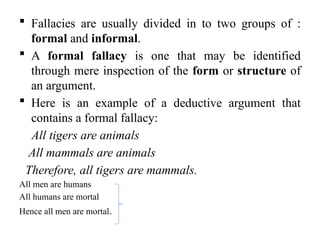
Fallacies areusually divided in to two groups of :
formal and informal.
A formal fallacy is one that may be identified
through mere inspection of the form or structure of
an argument.
Here is an example of a deductive argument that
contains a formal fallacy:
All tigers are animals
All mammals are animals
Therefore, all tigers are mammals.
All men are humans
All humans are mortal
Hence all men are mortal.
5.
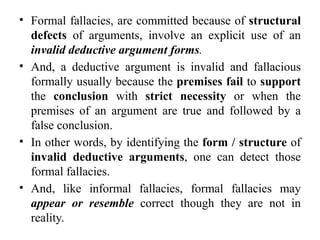
• Formal fallacies,are committed because of structural
defects of arguments, involve an explicit use of an
invalid deductive argument forms.
• And, a deductive argument is invalid and fallacious
formally usually because the premises fail to support
the conclusion with strict necessity or when the
premises of an argument are true and followed by a
false conclusion.
• In other words, by identifying the form / structure of
invalid deductive arguments, one can detect those
formal fallacies.
• And, like informal fallacies, formal fallacies may
appear or resemble correct though they are not in
reality.
6.
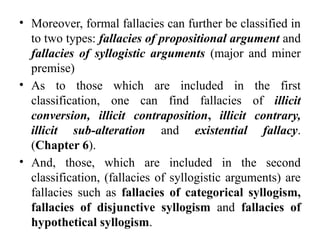
• Moreover, formalfallacies can further be classified in
to two types: fallacies of propositional argument and
fallacies of syllogistic arguments (major and miner
premise)
• As to those which are included in the first
classification, one can find fallacies of illicit
conversion, illicit contraposition, illicit contrary,
illicit sub-alteration and existential fallacy.
(Chapter 6).
• And, those, which are included in the second
classification, (fallacies of syllogistic arguments) are
fallacies such as fallacies of categorical syllogism,
fallacies of disjunctive syllogism and fallacies of
hypothetical syllogism.
7.
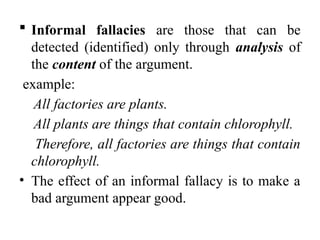
Informal fallaciesare those that can be
detected (identified) only through analysis of
the content of the argument.
example:
All factories are plants.
All plants are things that contain chlorophyll.
Therefore, all factories are things that contain
chlorophyll.
• The effect of an informal fallacy is to make a
bad argument appear good.
8.
Informal fallaciesare frequently backed by
some motive on the part of the arguer to deceive
the reader or listener.
The arguer may not have sufficient evidence to
support its conclusion and as a result may
attempt to win its acceptance by resorting to a
trick.
Sometimes the trick fools even the arguer.
The arguer may deceive himself in thinking that
he is presenting genuine evidence when in fact
he is not. Trick=mischive,illussion,deceptive
9.
• Informal fallaciesare errors in reasoning which are detected through
examining the content of an argument, not through detecting the form
of an argument.
• Informal fallacies may appear in both deductive and inductive
arguments.
• Though there are very many informal fallacies, there is no absolute
consensus as to how they can be classified.
• However, through considering some communality among them,
informal fallacies can be divided in to five groups:
Fallacies of relevance…pertinence
fallacies of weak induction…influence/persuade
fallacies of presumption...expect, assume
fallacies of ambiguity and …uncertainty
fallacies of grammatical analogy…resemblance
10.
By studying someof the typical ways in which
arguers deceive both themselves and others:
One is less likely to be fooled by the fallacious
arguments posed by others and
Is less likely to stumble/blunder blindly into
fallacies when constructing arguments for one's
own use.
• Hence, formal fallacies are committed when the
form or logical structure of arguments are violated;
whereas informal fallacies are committed when the
content of an argument is problematic.
11.
4. 2 FALLACIESOF RELEVANCE
• Fallacies of Relevance will be committed:
• When an argument is based on premises, which are not
relevant to its conclusion, and that cannot possibly establish its
truth.
• Those fallacies, involve premises, which are logically
irrelevant to the conclusion, but for psychological reasons,
they may seem relevant.
• All fallacies of relevance commonly share the following basic
features:
The premises of an argument are logically irrelevant to the
conclusion of an argument. However, they are psychologically
relevant and seem correct or persuasive.
The connection between the premises and the conclusion is
emotional, not logical.
12.
• There arearound eight fallacies under fallacy of
relevance.
1. Appeal to Force: Arguer threatens reader/listener.
• For Example:
Child to playmate: ‘‘Josy in the house’’ is the best
show on TV; and if you don’t believe it, I’m going to
call my big brother over here and he’s going to beat
you up. (Physical threat)
Secretary to boss: I deserve a raise in salary for the
coming year. After all, you know how friendly I am
with your wife, and I’m sure you wouldn’t want her to
find out what has been going on between you and that
sexpot client of yours. (Psychological threat)
13.
2. Appeal toPity: Arguer elicits pity from reader/listener.
Request of someone to others so as to get mercy, sympathy or any
kind of excuse
• Appeal to pity fallacy basically occurs:
when an arguer tries to pose a conclusion by evoking pity
from the listeners or readers.
when the emotional appeal which raises the pity of the
listeners or readers replace logical evidences or
justifications.
• Example: an attorney to the judge:
Members of the jury, I realize there is a good deal of
evidence that these two brothers killed their parents. But,
they are now orphans. They have no one to take care of
them. They must now face the cruel world afraid and alone.
Surely, they are not guilty of these heinous crimes.
14.
3.Appeal to thePeople (Argumentum ad
Populum).
• Appeals to emotion, is usually employed by
speakers and writers so as to get acceptance from
others.
• Propagandists and orators deliver their speech to
the crowds or public by forwarding premise with
contents of emotive and expressive languages and
devices so as to raise the Mob mentality of the
crowds and make the crowds accept their side or
conclusion.(JM “Qeerroo !!”
• There are two approaches: direct and indirect
15.
• Appeal tothe people (direct): Arguer arouses mob
mentality.
• Political candidates for election, military leaders and
other public figures usually employ propaganda so as to
raise their subject and make them accept their
conclusion.
• Example: Apolitical leader who opposes federalism in
USA would propagate as:
• “Today the prospect of creeping federalism threatens to
rib each of us of our cherished way of life. Government
is invading every aspect of our lives. The feds want to
tell us what to think and how to speak. They want to tell
us how to raise our kids and run our schools. Enough of
this mind control! Abolish the federal income tax.”
16.
• Appeal tothe people (indirect): Arguer appeals to reader/listener’s
desire for security, love, respect.
• The arguer directs his or her appeal not to the crowd as a whole
directly, rather to some aspects of their relationship to the crowd.
• This approach is usually common in advertising industry.
• Most of the time, products are advertised in association with things,
which excite us favorably. Fore example,
• Food items could be advertised with strength, youth fullness and
good health and
• New mobile technologies or automobiles could be advertised as
beauty, dignity and,
• Such advertisements have the power to catch up the feeling of the
audiences as buyers emotionally associate themselves with the
strength, dignity and health which are wrongly fulfilled by the
products.
17.
• Thus, commercialadvertisements usually attempt to
attract customer’s emotional approval for the purpose
of getting purchasers informing that the products are
‘comfortable’, ‘best-selling’, ‘delicate’, etc.
• These emotively charged terminologies in
advertisement industry make the customers not to
raise questions about the durability, quality, expiring
date, etc…
• There are three types of indirect approach to ad
populum fallacy:
appeal to bandwagon…attract
appeal to vanity and…excessive pride
appeal to snobbery….imitate, admire, superior
18.
A. Appeal toBandwagon
• Emphasizes that the majority’s choice is the correct one
and urges the audiences to join them.
• In other words, if some argue as you will be left behind
or left out of the group/majority if you do not use the
product.
• Example:
• A. Sure, this is a very fantastic gum with lovely flavor.
That is why the majority of the people in Addis Ababa
chew it than any other gums.
• B. Of course you want to buy Zest toothpaste. Why 90 %
of America brushes with Zest. The idea is that you will be
left behind or left out of the group if you do not use the
product.
19.
B. Appeal toVanity
• Is committed when an arguer associates
products with celebrities and popular figures
such as artists, athletes, footballers, etc. and
informs the audiences that if they buy the item
they will also be admired too.
• Example:
• You have got to see Abebe Balcha’s latest film
immediately. It is breaking the country’s film
records in terms of audiences, and everyone is
talking about it.
20.
C. Appeal toSnobbery
• Is committed when an arguer propounds the position that “if
you want to be a member of the selected few, you should use
this product” i.e.-products are usually associated with
persons with high social positions (business man, kings,
queens, and princes in general).
• Example:
• A. Friendship cafe, no doubt, is the best cafe in Addis Ababa.
That is only for distinguished and very important persons.
Come and enjoy your weekends at Friendship cafe!!!
• B.A Rolls Royce is not for everyone. If you qualify as one of
the select few, this (distinguished classic may be seen and
driven at British Motor Cars, Ltd. (By appointment only,
please.)
21.
4. Argument Againstthe Person (argumentum ad
hominem or abusive): Arguer verbally abuses other
arguer.
• Instead of responding to the argument forwarded by
Mister ‘X’, Mister ‘Y’ tries to attack against Mister
‘X’ himself.
• Here, mister ‘Y’ clearly commits argument against
the person fallacy.
• And, there are three types of fallacy of ad hominem:
Fallacy of ad hominem abusive
Fallacy of ad hominem Circumstantial
Fallacy of ad hominem tuquoque (you too)
22.
A. Fallacy ofad hominem abusive
• This is the fallacy committed when an arguer engages
him/herself in direct personal attacks or abuses against
his opponent and makes them as grounds to reject his
claim.
• Thus, rejecting our opponent by directing our attack
towards his personality rather than the contents of his
argument will result in the fallacy concerned.
• Example: Ato Gebeyehu has argued for increased
funding for the disabled. But nobody should listen to his
argument. Ato Gebeyhu is a slob who cheats on his
wife, beats his wife, beats his kids, and never pays his
bills on time.
23.
B. Fallacy ofad hominem Circumstantial
• This is the fallacy committed by an arguer who tries to
discredit his opponent’s arguments by alluding to certain
circumstances that affect them (his opponents).
• In other words, this fallacy is not directed to attacking the
person, rather on the circumstance he belongs to.
• When someone argues that his opponents’ argument is false
since they, in that position or state of mind, could be
expected to raise such claims or their circumstances make it
impossible for them to sincere or to tell the truth.
• Example:
• Ato Mohammed has just argued that we replace the public
school system with private education. But, of course, he
argues that way. He has no kids, and he does not want to
pay any more taxes for public education.
24.
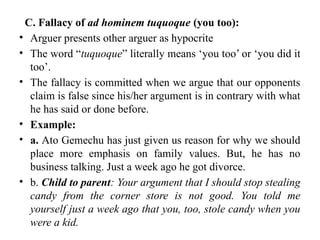
C. Fallacy ofad hominem tuquoque (you too):
• Arguer presents other arguer as hypocrite
• The word “tuquoque” literally means ‘you too’ or ‘you did it
too’.
• The fallacy is committed when we argue that our opponents
claim is false since his/her argument is in contrary with what
he has said or done before.
• Example:
• a. Ato Gemechu has just given us reason for why we should
place more emphasis on family values. But, he has no
business talking. Just a week ago he got divorce.
• b. Child to parent: Your argument that I should stop stealing
candy from the corner store is not good. You told me
yourself just a week ago that you, too, stole candy when you
were a kid.
25.
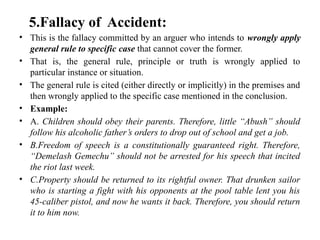
5.Fallacy of Accident:
•This is the fallacy committed by an arguer who intends to wrongly apply
general rule to specific case that cannot cover the former.
• That is, the general rule, principle or truth is wrongly applied to
particular instance or situation.
• The general rule is cited (either directly or implicitly) in the premises and
then wrongly applied to the specific case mentioned in the conclusion.
• Example:
• A. Children should obey their parents. Therefore, little “Abush” should
follow his alcoholic father’s orders to drop out of school and get a job.
• B.Freedom of speech is a constitutionally guaranteed right. Therefore,
“Demelash Gemechu” should not be arrested for his speech that incited
the riot last week.
• C.Property should be returned to its rightful owner. That drunken sailor
who is starting a fight with his opponents at the pool table lent you his
45-caliber pistol, and now he wants it back. Therefore, you should return
it to him now.
26.
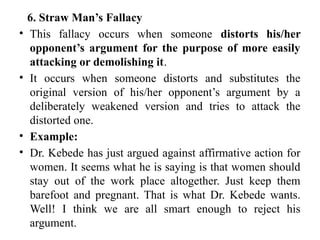
6. Straw Man’sFallacy
• This fallacy occurs when someone distorts his/her
opponent’s argument for the purpose of more easily
attacking or demolishing it.
• It occurs when someone distorts and substitutes the
original version of his/her opponent’s argument by a
deliberately weakened version and tries to attack the
distorted one.
• Example:
• Dr. Kebede has just argued against affirmative action for
women. It seems what he is saying is that women should
stay out of the work place altogether. Just keep them
barefoot and pregnant. That is what Dr. Kebede wants.
Well! I think we are all smart enough to reject his
argument.
27.
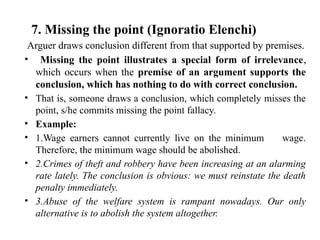
7. Missing thepoint (Ignoratio Elenchi)
Arguer draws conclusion different from that supported by premises.
• Missing the point illustrates a special form of irrelevance,
which occurs when the premise of an argument supports the
conclusion, which has nothing to do with correct conclusion.
• That is, someone draws a conclusion, which completely misses the
point, s/he commits missing the point fallacy.
• Example:
• 1.Wage earners cannot currently live on the minimum wage.
Therefore, the minimum wage should be abolished.
• 2.Crimes of theft and robbery have been increasing at an alarming
rate lately. The conclusion is obvious: we must reinstate the death
penalty immediately.
• 3.Abuse of the welfare system is rampant nowadays. Our only
alternative is to abolish the system altogether.
28.
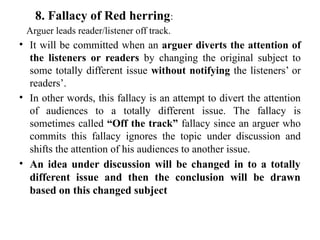
8. Fallacy ofRed herring:
Arguer leads reader/listener off track.
• It will be committed when an arguer diverts the attention of
the listeners or readers by changing the original subject to
some totally different issue without notifying the listeners’ or
readers’.
• In other words, this fallacy is an attempt to divert the attention
of audiences to a totally different issue. The fallacy is
sometimes called “Off the track” fallacy since an arguer who
commits this fallacy ignores the topic under discussion and
shifts the attention of his audiences to another issue.
• An idea under discussion will be changed in to a totally
different issue and then the conclusion will be drawn
based on this changed subject
29.
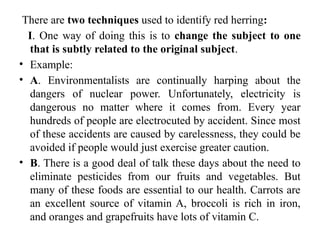
There are twotechniques used to identify red herring:
I. One way of doing this is to change the subject to one
that is subtly related to the original subject.
• Example:
• A. Environmentalists are continually harping about the
dangers of nuclear power. Unfortunately, electricity is
dangerous no matter where it comes from. Every year
hundreds of people are electrocuted by accident. Since most
of these accidents are caused by carelessness, they could be
avoided if people would just exercise greater caution.
• B. There is a good deal of talk these days about the need to
eliminate pesticides from our fruits and vegetables. But
many of these foods are essential to our health. Carrots are
an excellent source of vitamin A, broccoli is rich in iron,
and oranges and grapefruits have lots of vitamin C.
30.
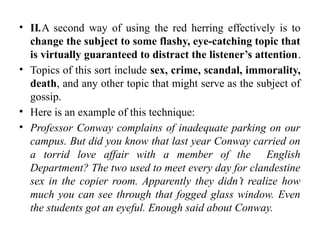
• II.A secondway of using the red herring effectively is to
change the subject to some flashy, eye-catching topic that
is virtually guaranteed to distract the listener’s attention.
• Topics of this sort include sex, crime, scandal, immorality,
death, and any other topic that might serve as the subject of
gossip.
• Here is an example of this technique:
• Professor Conway complains of inadequate parking on our
campus. But did you know that last year Conway carried on
a torrid love affair with a member of the English
Department? The two used to meet every day for clandestine
sex in the copier room. Apparently they didn’t realize how
much you can see through that fogged glass window. Even
the students got an eyeful. Enough said about Conway.
31.
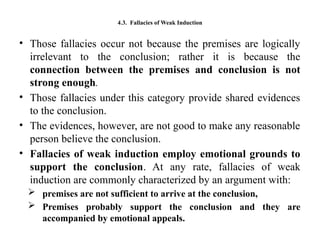
4.3. Fallacies ofWeak Induction
• Those fallacies occur not because the premises are logically
irrelevant to the conclusion; rather it is because the
connection between the premises and conclusion is not
strong enough.
• Those fallacies under this category provide shared evidences
to the conclusion.
• The evidences, however, are not good to make any reasonable
person believe the conclusion.
• Fallacies of weak induction employ emotional grounds to
support the conclusion. At any rate, fallacies of weak
induction are commonly characterized by an argument with:
premises are not sufficient to arrive at the conclusion,
Premises probably support the conclusion and they are
accompanied by emotional appeals.
32.
• 9. Appealto unqualified authority (Argumentum ad
Verecundiam )
• It is customary that individuals need to get information, suggestion; comment,
opinion and advice from others so as to achieve a certain conclusion.
• However, there are cases where those individuals who are entitled to deliver
information might not be trustworthy because:
they lack the expertise in a certain profession,
they might be biased or prejudiced, and
They might have the motive to lie or disseminate “misinformation”.
Might lack the requisite ability to perceive or recall.
• Thus, the fallacy of unqualified authority is committed when we attempt to
support our claim by:
Citing the statement of another person who is not an authority in the field
of specialization.
Referring the judgment of an authority that is likely to be biased.
Referring a person who has the habit of telling lies or disseminating wrong
information.
33.
• Example:
• A.Omer, who is a well-known astronomer, says that
AIDS epidemic is caused by a perverse alignment of
the planets, and that there is nothing anyone can do
about it. Therefore, we can only conclude that all of
these efforts to find a cure for AIDS are wastage of
time.
• B. Dr. Bradshaw, our family physician, has stated that
the creation of muonic atoms of deuterium and
tritium hold the key to producing a sustained nuclear
fusion reaction at room temperature. In view of Dr.
Bradshaw’s expertise as a physician, we must
conclude that this is indeed true.
34.
10.Appeal to Ignorance(Argumentum ad Ignorantiam)
• This fallacy is committed when the lack to evidence or proof for
something is used to support the conclusion.
• In other words, when the premises of an argument state that nothing
has been proved in one way or another about something and the
conclusion then makes a definite assertion about that thing.
• Thus, one’s ignorance, lack of evidence, knowledge or information
about something definitely supports the conclusion in appeal to
ignorance fallacy.
• In any case, ad ignorantiam fallacy will be committed when:
Someone argues that something is the case (true) because no
one has proved to be false.
Someone argues that something is not the case (false) because
no one has proved it to be true.
• Example: Nobody has ever proved the existence of ghosts.
Therefore, we have no alternative but to conclude that ghosts are
mere figments of the imagination.
35.
• However, thereare exceptional cases where
appeal to ignorance fallacy will not be committed.
These are:
• If qualified researchers or team of scientists
investigate a certain phenomenon within their range
of expertise and found nothing about it, it is at least
an inductively strong argument though it is not a
deductively valid one.
• There are also cases where there is not always
necessary that investigators have special
qualifications. The kinds of qualifications needed
depended on the situation that the mere ability to see
and report is sometimes sufficient.
36.
• Another importantexception with appeal to ignorance is
on legal procedure.
• Legal procedures recognize that a defendant is innocent
unless he/she is proved guilty.
• Appeal to ignorance fallacy is correct in legal procedure.
• However, when a judge pronounces a verdict of not guilty,
he/she is not claiming that the defendant did not commit
the act as charged.
• It is only claiming that the evidence is not weightily
enough to prove such a charge.
• Examples:
• a. People have been trying for centuries to provide
conclusive evidence for the claims of astrology, and no one
has ever succeeded. Therefore, we must conclude that
astrology is a lot of nonsense.
37.
11. Hasty Generalization(Converse Accident)
• The fallacy of hasty generalization, which is the opposite of
accident, is committed when an arguer tries to drawing a
conclusion or generalization based on unrepresentative or
small evidence or information.
• The fallacy occurs when there is a reasonable likelihood that the
sample is not representative of the group.
• Such likelihood may arise if the sample is either too small or
not randomly selected. And,
• The fallacy is usually committed by individuals who develop a
negative attitude or prejudice towards others’ belief, language,
political position, ethnic origin, color and others.
• Example:
• Six Arab fundamentalists were convicted of bombing the World
Trade Center in New York City. The message is clear: Arabs are
nothing but a pack of religious fanatics prone to violence
38.
• Exceptions
• Themere fact that a sample may be small, however, does not
necessarily mean that it is atypical/not representative.
• On the other hand, the mere fact that a sample may be large
does not guarantee that it is typical/ representative.
• In the case of small samples, various factors may intervene
that render such a sample typical of the larger group.
• Examples:
• Ten milligrams of substance Z was fed to four mice, and within
two minutes all four went into shock and died. Probably
substance Z, in this amount, is fatal to the average mouse.
• On three separate occasions I drank a bottle of Dashen beer
and found it flat and bitter. Probably I would find every bottle
of Dashen beer flat and bitter.
39.
• In thecase of large samples, if the sample is not random, it
may not be typical of the larger group.
• Example: One hundred thousand voters from Orange County,
California, were surveyed on their choice for governor, and
68 percent said they intend to vote for the Republican
candidate. Clearly, the Republican candidate will be elected.
• Hasty generalization is otherwise called ‘‘converse accident’’
because it proceeds in a direction opposite to that of accident.
• Whereas accident proceeds from the general to the particular,
converse accident moves from the particular to the general.
• The premises cite some characteristic affecting one or more
atypical instances of a certain class, and the conclusion then
applies that characteristic to all members of the class.
40.
12. False Cause
•False cause fallacy occurs whenever the link b/n premises and
conclusion depends on some imagined causal connection that
properly does not exist, an attempt to suppose that ‘X’ causes
‘Y’ where as ‘X’ probably does not cause ‘Y’ at all.
• In other words, the fallacy is committed when someone infers
causal explanations from premises, which cannot provide
sufficient evidence to it.
• The fallacy can further be divided in to three types.
• A. Post hoc ergo propter hoc fallacy: may be translated as “after
this, therefore on account of this.”
• The fallacy is shortly named as post hoc fallacy and it is
committed when we arrive at a certain conclusion by claiming that
one thing is the cause of another thing because it proceeds in time.
• A particular event ‘X’ is caused by event ‘Y’ merely because ‘X’
follows ‘Y’ or ‘Y’ precedes ‘X’ chronologically
41.
• Example:
• Everytime I take a shower, the telephone rings.
Therefore, since I’m dying to talk to somebody
right now, I should jump in the shower
• During the past two months, every time that the
cheerleaders have worn blue ribbons in their hair,
the basketball team has been defeated. Therefore,
to prevent defeats in the future, the cheerleaders
should get rid of those blue ribbons.
• ‘‘A black cat crossed my path and later I tripped
and sprained my ankle. It must be that black cats
really are bad luck.’’)
42.
B. Non Causapro Causa Fallacy: can be translated as ‘not the
cause for the cause’.
• The fallacy is committed when someone argues that something is
the cause of an effect when it is not in reality and confusion occurs
between cause and effect.
Example:
• a. There are more churches in Ethiopia today than ever before and
more HIV victims ever before; so, to eliminate the epidemic we
must abolish the church.
• b. Successful business executives are paid salaries in excess of
$50,000. Therefore, the best way to ensure that Ferguson will
become a successful executive is to raise his salary to at least
$50,000.
• c. There are more laws on the books today than ever before, and
more crimes are being committed than ever before. Therefore, to
reduce crime we must eliminate the laws.
43.
C. Oversimplified CauseFallacy
• Is committed when relevant causal antecedents of an event are
oversimplified by introducing factors insufficient to the account
of the effect.
• It will be committed when the roles of one or more of those
factors are deliberately or intentionally overemphasized at the
expense of others. i.e. a multitude of causes is responsible for
a certain effect but the arguer selects just one of these causes
and represents it as if it were the sole cause.
• Example:
• a. Most students fail in logic because teachers do not come to
class regularly.
• b. The quality of education in our grade schools and high
schools has been declining for years. Clearly, our teachers just
aren’t doing their job these days.
44.
13. Slippery Slopefallacy
• Slippery slope fallacy is a variety of false cause fallacies.
• In other words, when false cause fallacy (an argument that
considers event ‘X’ is the cause of event ‘Y’ simply
because ‘X’ happens before ‘Y’) takes place in a series of
events or actions, slippery slope fallacy will occur.
• This is of the fact that because it is logically mistaken for
someone to consider a particular action or event (usually
the first one) in series of events causes for series of
consequences.
• In other words, considering the first event, an action or
cause responsible for all events or actions in a series of
events or actions is not convincing.
45.
• It occurswhen the conclusion of an argument rests upon an alleged
chain reaction and there is not sufficient reason to think that the
chain reaction will actually take place.
• Example:
• a. It is not a good idea to put your child in a day care center. Separation
from parents causes isolation and alienation, and soon the child becomes
incapable of relating to other children, and this inability to relate causes
depression. As the child gets older, the depression leads to psychosis.
The final result is either suicide or a life wasted in a mental institution.
• b. Immediate steps should be taken to outlaw pornography once and for
all. The continued manufacture and sale of pornographic material will
almost certainly lead to an increase in sex-related crimes such as rape
and incest. This in turn will gradually erode the moral fabric of society
and result in an increase in crimes of all sorts. Eventually a complete
disintegration of law and order will occur, leading in the end to the total
collapse of civilization
46.
14. Fallacy ofWeak Analogy
• Fallacy of weak analogy is committed basically when
the analogy or similarity between two things or
situations is not strong enough to support the
conclusion to be drawn.
• In other words, weak analogy fallacy will be committed
when the significant differences between two or more
things compared are ignored or when two contrasted
things are considered Alike only in unimportant ways.
• i.e. it is committed when the analogy is not strong
enough to support the conclusion that is drawn.
• Example: No one would buy a pair of shoes without
trying them on. Why should anyone be expected to get
married without premarital sex?
47.
• Harper’s newcar is bright blue, has leather upholstery, and
gets excellent gas mile age. Crowley’s new car is also bright
blue and has leather upholstery. Therefore, it probably gets
excellent gas mileage, too.
• Because the color of a car and the choice of upholstery have
nothing to do with gasoline consumption, this argument is
fallacious.
• The basic structure of an argument from weak analogy is:
Entity A has attributes a, b, c and z
Entity B has attributes a, b, c
Therefore, entity B probably has attribute z.
• Evaluating an argument having this form requires a two-step
procedure:
(1) Identify the attributes a, b, c, . . . that the two entities A and B
share in common, and
(2) determine how the attribute z, mentioned in the conclusion,
relates to the attributes a, b, c, ...
48.
3.3 Fallacies ofPresumption
• To presume means. to take something for granted or to
assume a given idea as true or correct, which in fact needs
further proof, explanation or evidence
• The fallacy of presumption will be committed when the
assumption given in the premise is not supported by proof,
but the arguer maintains that it does not need proof and
s/he invites his/her audiences to accept it as it is.
• Moreover, the fallacy contains tricky and confusing
expressions for the purpose of concealing the wrong
assumptions stated in the premise.
• These fallacies arise not because the premises are irrelevant
to the conclusion or provide insufficient reason for believing
the conclusion but because the premises presume what they
purport to prove.
49.
• In anycase, fallacies of presumption are usually characterized by:
Drawing a conclusion from statements that are questionable.
The conclusion or consequence of an unjustifiable assumption and
presumption with their details.
• 15. Begging the Question (Petitio Principii)
• It occurs when someone uses some form of phraseology, which
tends to conceal the questionably true character of a key premise.
• Begging the question presumes that the premises provide
adequate support for the conclusion when in fact they do not.
• In any case, there are two requirements to be fulfilled for this
fallacy to occur:
The argument must be valid,
Some form of phraseology must be used to conceal the questionably
true character of a key premise.
50.
• The fallacyof begging the question is committed whenever
the arguer creates the illusion that inadequate premises
provide adequate support for the conclusion by leaving out a
key premise, by restating the conclusion as a premise, or by
reasoning in a circle.
• Examples:
• Murder is morally wrong. This being the case, it follows that
abortion is morally wrong.
• Of course humans and apes evolved from common ancestors.
Just look how similar they are.
• It’s obvious that the poor in this country should be given
handouts from the government. After all, these people earn less
than the average citizen.
• Clearly, terminally ill patients have a right to doctor assisted
suicide. After all, many of these people are unable to commit
suicide by themselves.
51.
16. Complex Question
•Is committed when a single question that is really two (or
more) questions is asked and a single answer is then applied to
both questions.
• Every complex question presumes the existence of a certain
condition.
• When the respondent’s answer is added to the complex
question, an argument emerges that establishes the presumed
condition.
• This argument is usually intended to trap the respondent into
acknowledging something that he or she might otherwise not
want to acknowledge.
• Examples:
• Have you stopped cheating on exams?
• Where did you hide the cookies you stole?
52.
17. False Dichotomy…division
•The fallacy of false dichotomy (‘‘false bifurcation’’ and the ‘‘either- or
fallacy’’) is committed when one premise of an argument is an ‘‘either...
or...’’ (disjunctive) statement that presents two alternatives as if they
were jointly exhaustive (as if no third alternative were possible).
• One of these alternatives is usually preferred by the arguer. When the
arguer then proceeds to eliminate the undesirable alternative, the
desirable one is left as the conclusion.
• Such an argument is clearly valid; but since the disjunctive premise is
usually false, the argument is almost always unsound. Of course, not all
unsound arguments are fallacious.
• The fallacious nature of false dichotomy lies in the attempt by the arguer
to delude the reader or listener into thinking that the disjunctive premise
presents jointly exhaustive alternatives and is therefore true by necessity.
• The fallacy is commonly committed by children and adolescents when
arguing with their parents, by advertisers, and by adults generally
53.
• Here aresome examples:
• Either you let me attend the Tedy Affros concert or I’ll be
miserable for the rest of my life. I know you don’t want me
to be miserable for the rest of my life, so it follows that
you’ll let me attend the concert.
• Either you use Ultra Guard deodorant or you risk the chance
of perspiration odor. Surely you don’t want to risk the
chance of perspiration odor. Therefore, you will want to use
Ultra Guard deodorant.
• Either you buy only Ethiopian-made products or you
don’t deserve to be called a loyal Ethiopian. Yesterday
you bought new Chinese jeans. It’s therefore clear that
you don’t deserve to be called a loyal Ethiopian.
54.
18. Suppressed Evidence
•It was explained that a cogent argument is an inductive
argument with good reasoning and true premises.
• The requirement of true premises includes the proviso
that the premises not ignore some important piece of
evidence that outweighs the presented evidence and
entails a very different conclusion.
• If an inductive argument does indeed ignore such
evidence, then the argument commits the fallacy of
suppressed evidence. Consider, for example, the
following argument:
• Most dogs are friendly and pose no threat to people who
pet them. Therefore, It would be safe to pet the little dog
that is approaching us now.
55.
• The mostcommon occurrence of the suppressed evidence
fallacy:
• I. appears in inferences based on advertisements/ads/.
Nearly every advertiser neglects to mention certain
negative features of the product advertised.
• As a result, an observer who sees or hears an
advertisement and then draws a conclusion from it may
commit the fallacy of suppressed evidence.
• Example: The new RCA Digital Satellite System
delivers sharp TV reception from an 18-inch dish
antenna, and it costs only $199. Therefore, if we buy it,
we can enjoy all the channels for a relatively small one-
time investment.
56.
• II. Anotherway that an arguer can commit the suppressed
evidence fallacy is by ignoring important events that
have occurred with the passage of time that render an
inductive conclusion improbable.
• Here is an example:
• During the past fifty years, Poland has enjoyed a rather
low standard of living. Therefore, Poland will probably
have a low standard of living for the next fifty years.
• This argument ignores the fact that Poland was part of the
Soviet bloc during most of the past fifty years, and this
fact accounts for its rather low standard of living.
• However, following the collapse of the Soviet Union,
Poland became an independent nation, and its economy is
expected to improve steadily during the next fifty years.
57.
• III. Yetanother form of suppressed evidence is
committed by arguers who quote passages out of
context from sources such as the Bible, the
Constitution, and the Bill of Rights to support a
conclusion that the passage was not intended to
support.
• Consider, for example, the following argument
against gun control:
• The Second Amendment to the Constitution states that
the right of the people to keep and bear arms shall not
be infringed. But a law controlling handguns would
infringe the right to keep and bear arms. Therefore, a
law controlling handguns would be unconstitutional.
58.
• The suppressedevidence fallacy is similar to
the form of begging the question in which the
arguer leaves a key premise out of the argument.
• The difference is that suppressed evidence
leaves out a premise that requires a different
conclusion, while that form of begging the
question leaves out a premise that is needed to
support the stated conclusion.
• However, because both fallacies proceed by
leaving a premise out of the argument, there are
cases where the two fallacies overlap.
59.
3.4. Fallacies ofAmbiguity
• Two fallacies arise from the occurrence of some form of
ambiguity in either the premise or the conclusion (or
both).
• An expression is ambiguous if it is susceptible to
different interpretations in a given context.
• When the conclusion of an argument depends on a shift
in meaning of an ambiguous word or phrase or on the
wrong interpretation of an ambiguous statement, the
argument commits a fallacy of ambiguity.
• The fallacies of ambiguity include Equivocation and
Amphiboly.
60.
19. Equivocation
• Thefallacy of equivocation occurs when the conclusion of an
argument depends on the fact that a word or phrase is used, either
explicitly or implicitly, in two different senses in the argument.
• Such arguments are either invalid or have a false premise, and in
either case they are unsound.
• Examples:
• Some triangles are obtuse. Whatever is obtuse is ignorant.
Therefore, some triangles are ignorant.
• Any law can be repealed by the legislative authority. But the law of
gravity is a law. Therefore, the law of gravity can be repealed by
the legislative authority.
• We have a duty to do what is right. We have a right to speak out in
defense of the innocent. Therefore, we have a duty to speak out in
defense of the innocent.
• A mouse is an animal. Therefore, a large mouse is a large animal.
61.
20. Amphiboly
• Thefallacy of amphiboly occurs when the arguer
misinterprets a statement that is syntactically
ambiguous and proceeds to draw a conclusion based
on this faulty interpretation.
• The original statement is usually asserted by someone
other than the arguer, and the syntactical ambiguity
usually arises from a mistake in grammar or punctuation
—a missing comma, a dangling modifier, an ambiguous
antecedent of a pronoun, or some other careless
arrangement of words.
• Because of this ambiguity, the statement may be
understood in two clearly distinguishable ways.
62.
• The arguertypically selects the unintended interpretation
and proceeds to draw a conclusion based upon it.
• Here are some examples:
• The tour guide said that standing in Greenwich Village,
the Empire State Building could easily be seen. It follows
that the Empire State Building is in Greenwich Village.
• John told Henry that he had made a mistake. It follows
that John has at least the courage to admit his own
mistakes.
• Professor Johnson said that he will give a lecture about
heart failure in the biology lecture hall. It must be the
case that a number of heart failures have occurred there
recently.
63.
• Two areaswhere cases of amphiboly cause serious problems
involve contracts and wills.
• The drafters of these documents often express their intentions
in terms of ambiguous statements, and alternate interpretations
of these statements then lead to different conclusions.
• Examples:
• Mrs. Hart stated in her will, ‘‘I leave my 500-carat diamond
necklace and my pet chinchilla to Alice and Theresa.’’
Therefore, we conclude that Alice gets the necklace and
Theresa gets the chinchilla.
• Mr. James signed a contract that reads, ‘‘In exchange for
painting my house, I promise to pay David $5000 and give him
my new Cadillac only if he finishes the job by May 1.’’
Therefore, since David did not finish until May 10, it follows
that he gets neither the $5000 nor the Cadillac.
64.
• Amphiboly differsfrom equivocation in two important ways.
• First, equivocation is always traced to an ambiguity in the
meaning of a word or phrase, whereas amphiboly involves a
syntactical ambiguity in a statement.
• The second difference is that amphiboly usually involves a
mistake made by the arguer in interpreting an ambiguous
statement made by someone else, whereas the ambiguity in
equivocation is typically the arguer’s own creation.
• The following example illustrates:
• The Great Western Cookbook recommends that we serve the
oysters when thoroughly stewed. Apparently the delicate flavor
is enhanced by the intoxicated condition of the diners.
• First, it is unclear whether ‘‘stewed’’ refers to the oysters or to
the diners, and so the argument commits an amphiboly. But if
‘‘stewed’’ refers to the oysters it means ‘‘cooked,’’ and if it
refers to the diners it means ‘‘intoxicated.’’ Thus, the argument
also involves an equivocation
65.
3.5. Fallacies ofGrammatical Analogy
• Arguments that commit these fallacies are grammatically
analogous to other arguments that are good in every
respect.
• Because of this similarity in linguistic structure, such
fallacious arguments may appear good yet be bad.
• The fallacies of grammatical analogy include composition
and division.
• 21. Composition
• The fallacy of composition is committed when the
conclusion of an argument depends on the erroneous
transference of an attribute from the parts of something
onto the whole.
66.
• In otherwords, the fallacy occurs when it is argued that
because the parts have a certain attribute, it follows that
the whole has that attribute too and the situation is such
that the attribute in question cannot be legitimately
transferred from parts to whole. Examples:
• Maria likes anchovies. She also likes chocolate ice
cream. Therefore, it is certain that she would like a
chocolate sundae topped with anchovies.
• Each player on this basketball team is an excellent
athlete. Therefore, the team as a whole is excellent.
• Each atom in this piece of chalk is invisible. Therefore,
the chalk is invisible.
• Sodium and chlorine, the atomic components of salt, are
both deadly poisons. Therefore, salt is a deadly poison.
67.
• In thesearguments the attributes that are transferred from the
parts onto the whole are designated by the words ‘‘Maria likes,’’
‘‘excellent,’’ ‘‘invisible,’’ and ‘‘deadly poison,’’ respectively.
• In each case the transference is illegitimate, and so the argument
is fallacious.
• Exception:Not every such transference is illegitimate,
however.
• Consider the following arguments:
• Every atom in this piece of chalk has mass. Therefore, the piece
of chalk has mass.
• Every component in this picket fence is white. Therefore, the
whole fence is white.
• In each case an attribute (having mass, being white) is
transferred from the parts onto the whole, but these
transferences are quite legitimate.
68.
22. Division
• Thefallacy of division is the exact reverse of composition. As
composition goes from parts to whole, division goes from
whole to parts.
• The fallacy is committed when the conclusion of an argument
depends on the erroneous transference of an attribute from a
whole (or a class) onto its parts (or members).
• Examples:
• Salt is a nonpoisonous compound. Therefore, its component
elements, sodium and chlorine are nonpoisonous.
• This jigsaw puzzle, when assembled, is circular in shape.
Therefore, each piece is circular in shape.
• The Royal Society is over 300 years old. Professor Thompson
is a member of the Royal Society. Therefore, Professor
Thompson is over 300 years old.
69.
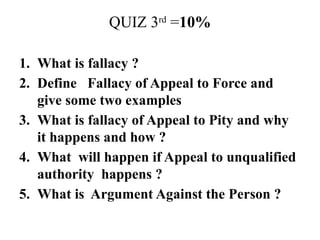
QUIZ 3rd
=10%
1. Whatis fallacy ?
2. Define Fallacy of Appeal to Force and
give some two examples
3. What is fallacy of Appeal to Pity and why
it happens and how ?
4. What will happen if Appeal to unqualified
authority happens ?
5. What is Argument Against the Person ?