TOPIC:Inflation or deflation which is better for a growing economy?   DEFLATION and DISINFLATION IN A DEVELOPING ECONOMY   By:   VIRAJ MEHTA (07927818)  T.GANESH VENKATA RAMA REDDY (07927844)
Introduction Any signs of deflation in an economy are treated as precursors to a possible recession  largely due to its association with the great depression. But is deflation all that bad? Is it a deterrent to economic growth and development?  Or is it good in the process of the development of an economy?  How does it help in the development of a  growing economy?  We shall look into these questions.  
Developing Vs. Developed A  developing economy  is one, which has, relatively low standard of living, industrial setup in the process of development, low per-capita income, lesser capital and greater poverty levels in general.   A  developed economy  is one, which has, a greater share of contribution from tertiary sector (services) to its economy, established industrial base, stable and efficient markets, and utilization of economies of scale and scope, apart from a better standard of living, greater and easier availability of capital, and very low poverty levels.
DEFINITION DEFLATION  implies reduction in the general price levels . The rate of inflation is negative.  DISINFLATION  implies reduction in the rate of increase in the general price levels, i.e. prices are increasing, but not at the pace at which they were increasing in the near past. The causes that result in deflation and disinflation might be the same.
CAUSES OF DEFLATION AND DISINFLATION   We can say that deflation or disinflation happens only when one of the following happens: The supply of money goes down. The supply of goods goes up. Demand for money goes up. Demand for goods goes down.   Disinflation or deflation can happen only when the supply of goods rises faster than the supply of money.
FACTORS THAT MAY LEAD TO DEFLATIONARY TRENDS   Decrease in government spending  . Role of central banks in decreasing money supply   Technological changes and advancements, leading to efficient production techniques and cheaper goods   Globalisation, global deregulation, mass distribution and production, global sourcing, mergers and acquisitions, consolidation of the firms in the industry, leading to economies of scale.   More and more economies converting themselves into the market driven method, like China
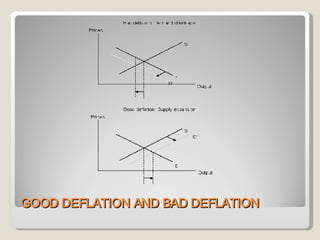
GOOD DEFLATION AND BAD DEFLATION
Examples of good deflation Tech innovation reduction in  cost of mobile phones, computer peripherals, various other electronic devices, some of the FMCG products, cost of communication, telephony.  Global deregulation and competition has allowed efficient utilization of resources in the world and has promoted the fall in prices, thus enabling greater consumption.
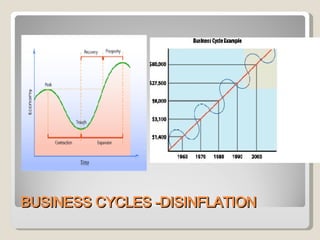
BUSINESS CYCLES  -DISINFLATION
Bad deflation Money gains value with time during deflation.   In a deflationary scenario, a borrower, who is contractually committed to making loan payments that represent more and more purchasing power while at the same time the asset the borrower bought with the loan to begin with is declining in nominal price . This leads to a deflationary spiral, which generally arises only in developed countries and not in developing countries.
THANK YOU

Inflation - Good or Bad?

  • 1.
    TOPIC:Inflation or deflationwhich is better for a growing economy? DEFLATION and DISINFLATION IN A DEVELOPING ECONOMY By:   VIRAJ MEHTA (07927818)  T.GANESH VENKATA RAMA REDDY (07927844)
  • 2.
    Introduction Any signsof deflation in an economy are treated as precursors to a possible recession largely due to its association with the great depression. But is deflation all that bad? Is it a deterrent to economic growth and development? Or is it good in the process of the development of an economy? How does it help in the development of a growing economy? We shall look into these questions.  
  • 3.
    Developing Vs. DevelopedA developing economy is one, which has, relatively low standard of living, industrial setup in the process of development, low per-capita income, lesser capital and greater poverty levels in general. A developed economy is one, which has, a greater share of contribution from tertiary sector (services) to its economy, established industrial base, stable and efficient markets, and utilization of economies of scale and scope, apart from a better standard of living, greater and easier availability of capital, and very low poverty levels.
  • 4.
    DEFINITION DEFLATION implies reduction in the general price levels . The rate of inflation is negative. DISINFLATION implies reduction in the rate of increase in the general price levels, i.e. prices are increasing, but not at the pace at which they were increasing in the near past. The causes that result in deflation and disinflation might be the same.
  • 5.
    CAUSES OF DEFLATIONAND DISINFLATION We can say that deflation or disinflation happens only when one of the following happens: The supply of money goes down. The supply of goods goes up. Demand for money goes up. Demand for goods goes down. Disinflation or deflation can happen only when the supply of goods rises faster than the supply of money.
  • 6.
    FACTORS THAT MAYLEAD TO DEFLATIONARY TRENDS Decrease in government spending . Role of central banks in decreasing money supply Technological changes and advancements, leading to efficient production techniques and cheaper goods Globalisation, global deregulation, mass distribution and production, global sourcing, mergers and acquisitions, consolidation of the firms in the industry, leading to economies of scale. More and more economies converting themselves into the market driven method, like China
  • 7.
    GOOD DEFLATION ANDBAD DEFLATION
  • 8.
    Examples of gooddeflation Tech innovation reduction in cost of mobile phones, computer peripherals, various other electronic devices, some of the FMCG products, cost of communication, telephony. Global deregulation and competition has allowed efficient utilization of resources in the world and has promoted the fall in prices, thus enabling greater consumption.
  • 9.
    BUSINESS CYCLES -DISINFLATION
  • 10.
    Bad deflation Moneygains value with time during deflation. In a deflationary scenario, a borrower, who is contractually committed to making loan payments that represent more and more purchasing power while at the same time the asset the borrower bought with the loan to begin with is declining in nominal price . This leads to a deflationary spiral, which generally arises only in developed countries and not in developing countries.
  • 11.