Adopting a Common Currency And It’s Advantages Group 2 Shakul Aggarwal (07927835) S.Prashanth (07927841)
Motivation   Vajpayee’s statement at SAARC Summit in 2004. ADB’s vision of a common currency for East Asia Adoption of Euro in 1999.
Euro as an example Motives for Single Currency in Europe To enhance Europe’s role in the world monetary system. To turn the European Union into truly unified market.
Transformation of EU into truly unified market free trade in goods free trade in services free mobility of capital free mobility of labor Roadblock Existence of separate national currencies.
The History of the Euro 30 odd years to fructify The Werner Plan  The European monetary system (EMS) The ECU
Werner Plan Laid out by Pierre Werner, the Finance Minister of Luxembourg in 1970 . 1 st  stage: reduction of fluctuation margins between the currencies of the Members States.  2 nd  stage: total liberalization of the capital movements with the integration of the financial markets 3 rd  stage: irrevocable fixing of the exchange rates between the different currencies establishment of a decision center for economic policy Failed due to international turmoil at that time
European Monetary System  (EMS) Collapse of Bretton Wood System in 1971. In 1972 EEC nations linked their currencies  An arrangement established in 1979 under the Jenkins European Commission   The ECU  An Exchange Rate Mechanism (ERM)  An extension of european credit facilities.  The European Monetary Cooperation Fund
European Currency Unit  (ECU) The ECU was conceived on 13 March 1979  a basket of the currencies of the European Community member states used as the unit of account of the European Community before being replaced by the euro. On Jan 1, 1999, the Euro replaced the ECU, at the value 1 EUR = 1 ECU.
Why was EMS not enough? Single currency was believed to produce a greater degree of European market integration than fixed exchange rates Fear of dominance of Bundesbank emphasizing German macroeconomic goals  Given the free capital movements, maintaining a single currency was the best solution.  Political stability of Europe
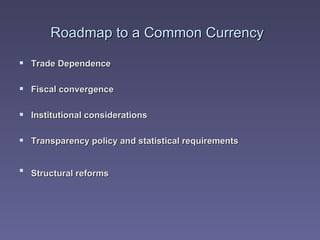
Roadmap to a Common Currency   Trade Dependence   Fiscal convergence   Institutional considerations   Transparency policy and statistical requirements   Structural reforms
Optimum Currency Area (OCA)   Geographical region which would maximize economic efficiency to have the entire region share a single currency
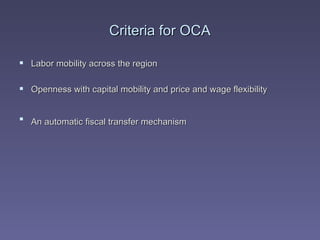
Criteria for OCA Labor mobility across the region  Openness with capital mobility and price and wage flexibility  An automatic fiscal transfer mechanism
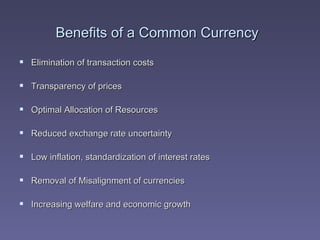
Benefits of a Common Currency   Elimination of transaction costs Transparency of prices  Optimal Allocation of Resources Reduced exchange rate uncertainty  Low inflation, standardization of interest rates  Removal of Misalignment of currencies Increasing welfare and economic growth
Planned Common Currencies Gulf cooperation council’s planned introduction of a common currency called  Khaleeji  in 2010 Caribbean Single Market and Economy’s common currency due between 2010 and 2015. Southern African Development Community’s (SADC) common currency due in 2016 .
Conclusion  Currency Union is the way to go forward as shown by the Euro Globalization Increase in the No of countries What is required? Stakeholders should form a region-wide self-help system. A strong political will .
THANK YOU!!

Adopting A Common Currency

  • 1.
    Adopting a CommonCurrency And It’s Advantages Group 2 Shakul Aggarwal (07927835) S.Prashanth (07927841)
  • 2.
    Motivation Vajpayee’s statement at SAARC Summit in 2004. ADB’s vision of a common currency for East Asia Adoption of Euro in 1999.
  • 3.
    Euro as anexample Motives for Single Currency in Europe To enhance Europe’s role in the world monetary system. To turn the European Union into truly unified market.
  • 4.
    Transformation of EUinto truly unified market free trade in goods free trade in services free mobility of capital free mobility of labor Roadblock Existence of separate national currencies.
  • 5.
    The History ofthe Euro 30 odd years to fructify The Werner Plan The European monetary system (EMS) The ECU
  • 6.
    Werner Plan Laidout by Pierre Werner, the Finance Minister of Luxembourg in 1970 . 1 st stage: reduction of fluctuation margins between the currencies of the Members States. 2 nd stage: total liberalization of the capital movements with the integration of the financial markets 3 rd stage: irrevocable fixing of the exchange rates between the different currencies establishment of a decision center for economic policy Failed due to international turmoil at that time
  • 7.
    European Monetary System (EMS) Collapse of Bretton Wood System in 1971. In 1972 EEC nations linked their currencies An arrangement established in 1979 under the Jenkins European Commission The ECU An Exchange Rate Mechanism (ERM) An extension of european credit facilities. The European Monetary Cooperation Fund
  • 8.
    European Currency Unit (ECU) The ECU was conceived on 13 March 1979 a basket of the currencies of the European Community member states used as the unit of account of the European Community before being replaced by the euro. On Jan 1, 1999, the Euro replaced the ECU, at the value 1 EUR = 1 ECU.
  • 9.
    Why was EMSnot enough? Single currency was believed to produce a greater degree of European market integration than fixed exchange rates Fear of dominance of Bundesbank emphasizing German macroeconomic goals Given the free capital movements, maintaining a single currency was the best solution. Political stability of Europe
  • 10.
    Roadmap to aCommon Currency Trade Dependence Fiscal convergence Institutional considerations Transparency policy and statistical requirements Structural reforms
  • 11.
    Optimum Currency Area(OCA) Geographical region which would maximize economic efficiency to have the entire region share a single currency
  • 12.
    Criteria for OCALabor mobility across the region Openness with capital mobility and price and wage flexibility An automatic fiscal transfer mechanism
  • 13.
    Benefits of aCommon Currency Elimination of transaction costs Transparency of prices Optimal Allocation of Resources Reduced exchange rate uncertainty Low inflation, standardization of interest rates Removal of Misalignment of currencies Increasing welfare and economic growth
  • 14.
    Planned Common CurrenciesGulf cooperation council’s planned introduction of a common currency called Khaleeji in 2010 Caribbean Single Market and Economy’s common currency due between 2010 and 2015. Southern African Development Community’s (SADC) common currency due in 2016 .
  • 15.
    Conclusion CurrencyUnion is the way to go forward as shown by the Euro Globalization Increase in the No of countries What is required? Stakeholders should form a region-wide self-help system. A strong political will .
  • 16.