Economics Presentation
Inflation, Everyone’s illusion of money.
Topic :
Team : Abhinav Duggal & Vikesh Khanna
(071301) (070829)
B.Tech. Computer Science, II Year.
Batch :
“Some things you
should know ”
“Inflation is when you pay fifteen dollars for the
ten-dollar haircut you used to get for five dollars when you had hair”
Origin & Definitions
Measures and Indices
Effects on Global Economy
Major Causes
Control Measures
Present Scenario
Contents
A glimpse of what is
to come.
nflation
What is
Inflation
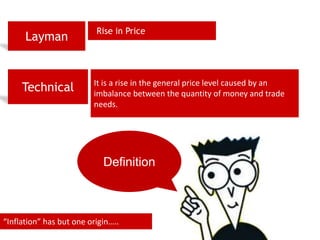
Layman
Rise in Price
Technical It is a rise in the general price level caused by an
imbalance between the quantity of money and trade
needs.
Definition
“Inflation” has but one origin…..
Origin
 The term “Inflation” originated as devaluation
of currency and not rise in price of goods as we
now know it.
In times when gold was used as currency, the
government or the king used dilution as a
measure to raise the profits through Seigniorage.
This practice increased the money supply but at
the same time lowered the relative value of each
coin. Due to this, more coins were needed for the
same goods & services.
Hence, the price rose.
A Walk down the timeline for some answers
1 A change in the value or resource costs.
2
Currency depreciation resulting from an increased
supply of currency relative to the quantity of
redeemable metal backing the currency.
A change in the ‘actual price of money’ which then
(was usually referred to the metallic content in the
currency).
3
Factors giving rise to concept of inflation
“Inflation is the process of making addition to currencies not based on
commensurate increase in production of goods
-Federal Reserves Bulletin
”
Later in the 19th century, the term ‘inflation’ originated as a direct reference
to currency depreciation or debasement, and not rise in price of goods.
Measuring Inflation
Measures in terms of Price Index
Personal Consumptions Price Index
Consumer Price Index
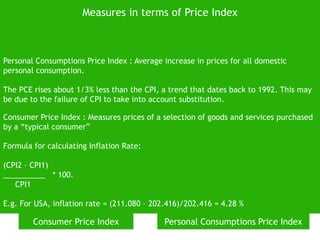
Personal Consumptions Price Index : Average increase in prices for all domestic
personal consumption.
The PCE rises about 1/3% less than the CPI, a trend that dates back to 1992. This may
be due to the failure of CPI to take into account substitution.
Consumer Price Index : Measures prices of a selection of goods and services purchased
by a “typical consumer”
Formula for calculating Inflation Rate:
(CPI2 – CPI1)
__________ * 100.
CPI1
E.g. For USA, inflation rate = (211.080 – 202.416)/202.416 = 4.28 %
Other Widely Used Price Indices
Cost of Living Indices
Producer price indices
Commodity Price Indices
Core Price indices
1. GDP Deflator
2. Regional Inflation
3. Historical Inflation
Other Measures of Inflation
Other related definitions of inflation
Related Definitions
Causes Of Inflation
“An increase in the general level of prices implies a decrease in the purchasing power
of currency”
A popular economic (Keynesian) theory proposes that money is
transparent to the real forces in the economy and the visible inflation
is the result of pressures in the economy expressing themselves in
prices.
On the contrary, another view(Monetarist view) believes that it is a result of
ineffective government fiscal policy, or spending and taxation.
Demand Pull Theory
Cost Push Theory Built-in Theory
The Triangle
Theory
of
Inflation
Demand
is increasing
Supply is not!
Demand Pull Theory
Cost Push Theory on the other hand states that
inflation occurs when the cost of producing rises
and the increase is passed on to the consumer.
Built-in theory attributes the rise in prices to adaptive
expectations, that is, workers trying to keep their wages up,
pass higher costs on to consumers in the form of higher prices.
Effects of Inflation
Time Value of Money :
Time Value of Money is most commonly expressed in terms of
Interest it receives and inflation is the principal component affecting
The rates of interests.
Treasury of the Nation :
To assure that the public gets back their money,
governments like USA provide for Treasury Inflation-Protected
Securities (TIPS) that charge lesser interest rates. Therefore
The treasuries are adversely affected.
Allocation of Money:
Affects the dealing of lenders and borrowers because the loan sanctioned before the inflation
period are paid back later in the form of inflated money, i.e money with lesser relative value.
Purchasing Power of currency:
One of the most immediate effects of inflation is the
decrease in the purchasing power of currency owing
to the decrease in the relative value of currency.
Control Measures
Monetary Policy:
Monetary Policy essentially implies the policy followed by financial institutions.
High interest rates and slow growth of the money supply are the traditional ways
through which central banks fight or prevent inflation..
Fixed Exchange Rates:
Under a fixed exchange rate currency regime, a country's currency is tied in value to
another measure of value such as gold. In this monetary system a region's common media of
exchange are paper notes that are normally freely convertible into pre-set, fixed quantities of
gold.
Fiscal Policy:
Fiscal policies are effective in increasing the leakage rates from the circular income flow,
thereby rejecting all further additions into this particular flow of income.
Present Scenario
India:
A glimpse of inflation in India
• In 2008,India’s Economic Survey Report targeted a drop in India’s Inflation Rate from 5.77% to 4.1%.
However, the beginning of 2008 has seen a dramatic rise in the price of rice and other basic food stuffs.
Indeed, by July 2008, the key Indian Inflation Rate had risen above 11%, its highest rate in 13 years.
This is more than 6% higher than a year earlier and almost three times the RBI’s target of 4.1%.
India is deeply intolerant of high inflation accounting to very
conservative policy makers. The highest inflation that India
has ever seen in the past two centuries was 53.8%
Zimbabwe:
A special reference.
•Hyperinflation in Zimbabwe has persisted since 2000, shortly after that country's confiscation of
white-owned farmland and its repudiation of debts to the International Monetary Fund.
Recent figures (as of 14 November 2008) estimate Zimbabwe's annual inflation rate at 89.7
sextillion (10^21) percent.
• Early in the 21st century Zimbabwe started to experience hyperinflation. Inflation reached
624 percent in early 2004, then fell back to low triple digits.
• On 16 February 2006, the governor of the Reserve Bank of Zimbabwe, Dr. Gideon Gono,
announced that the government had printed ZWD 21 trillion in order to buy foreign currency to
pay off IMF arrears.
The Reserve Bank of Zimbabwe issued a ZWD 10,000,000 note in January 2008,
roughly equivalent of 4 US dollars.
Zimbabwe's inflation soared to a record high of 26,470.8 percent as the economy
contracted by 6 percent, the central bank said.
Questions,
Anyone?
Courtesy
We would like to thank following for assisting us in making this presentation :
1. En.Wikipedia.org
2. Economywatch.com
3. Origin and Evolution of World Inflation by Michael F. Bryan.
4. International Price Levels and Global Inflation by Michael Ward.
5. LiveMint.com – Inflation, a short history.
6. WikiPridia.org
7. Deepali Babbar
Questions,
Anyone?

Inflation

  • 1.
    Economics Presentation Inflation, Everyone’sillusion of money. Topic : Team : Abhinav Duggal & Vikesh Khanna (071301) (070829) B.Tech. Computer Science, II Year. Batch : “Some things you should know ”
  • 2.
    “Inflation is whenyou pay fifteen dollars for the ten-dollar haircut you used to get for five dollars when you had hair” Origin & Definitions Measures and Indices Effects on Global Economy Major Causes Control Measures Present Scenario Contents A glimpse of what is to come.
  • 3.
  • 4.
    Layman Rise in Price TechnicalIt is a rise in the general price level caused by an imbalance between the quantity of money and trade needs. Definition “Inflation” has but one origin…..
  • 5.
    Origin  The term“Inflation” originated as devaluation of currency and not rise in price of goods as we now know it. In times when gold was used as currency, the government or the king used dilution as a measure to raise the profits through Seigniorage. This practice increased the money supply but at the same time lowered the relative value of each coin. Due to this, more coins were needed for the same goods & services. Hence, the price rose. A Walk down the timeline for some answers
  • 6.
    1 A changein the value or resource costs. 2 Currency depreciation resulting from an increased supply of currency relative to the quantity of redeemable metal backing the currency. A change in the ‘actual price of money’ which then (was usually referred to the metallic content in the currency). 3 Factors giving rise to concept of inflation
  • 7.
    “Inflation is theprocess of making addition to currencies not based on commensurate increase in production of goods -Federal Reserves Bulletin ” Later in the 19th century, the term ‘inflation’ originated as a direct reference to currency depreciation or debasement, and not rise in price of goods.
  • 8.
  • 9.
    Measures in termsof Price Index Personal Consumptions Price Index Consumer Price Index Personal Consumptions Price Index : Average increase in prices for all domestic personal consumption. The PCE rises about 1/3% less than the CPI, a trend that dates back to 1992. This may be due to the failure of CPI to take into account substitution. Consumer Price Index : Measures prices of a selection of goods and services purchased by a “typical consumer” Formula for calculating Inflation Rate: (CPI2 – CPI1) __________ * 100. CPI1 E.g. For USA, inflation rate = (211.080 – 202.416)/202.416 = 4.28 %
  • 10.
    Other Widely UsedPrice Indices Cost of Living Indices Producer price indices Commodity Price Indices Core Price indices
  • 11.
    1. GDP Deflator 2.Regional Inflation 3. Historical Inflation Other Measures of Inflation
  • 12.
  • 13.
  • 14.
  • 15.
    “An increase inthe general level of prices implies a decrease in the purchasing power of currency” A popular economic (Keynesian) theory proposes that money is transparent to the real forces in the economy and the visible inflation is the result of pressures in the economy expressing themselves in prices. On the contrary, another view(Monetarist view) believes that it is a result of ineffective government fiscal policy, or spending and taxation.
  • 16.
    Demand Pull Theory CostPush Theory Built-in Theory The Triangle Theory of Inflation
  • 17.
    Demand is increasing Supply isnot! Demand Pull Theory
  • 18.
    Cost Push Theoryon the other hand states that inflation occurs when the cost of producing rises and the increase is passed on to the consumer.
  • 19.
    Built-in theory attributesthe rise in prices to adaptive expectations, that is, workers trying to keep their wages up, pass higher costs on to consumers in the form of higher prices.
  • 21.
  • 22.
    Time Value ofMoney : Time Value of Money is most commonly expressed in terms of Interest it receives and inflation is the principal component affecting The rates of interests.
  • 23.
    Treasury of theNation : To assure that the public gets back their money, governments like USA provide for Treasury Inflation-Protected Securities (TIPS) that charge lesser interest rates. Therefore The treasuries are adversely affected.
  • 24.
    Allocation of Money: Affectsthe dealing of lenders and borrowers because the loan sanctioned before the inflation period are paid back later in the form of inflated money, i.e money with lesser relative value.
  • 25.
    Purchasing Power ofcurrency: One of the most immediate effects of inflation is the decrease in the purchasing power of currency owing to the decrease in the relative value of currency.
  • 26.
  • 27.
    Monetary Policy: Monetary Policyessentially implies the policy followed by financial institutions. High interest rates and slow growth of the money supply are the traditional ways through which central banks fight or prevent inflation..
  • 28.
    Fixed Exchange Rates: Undera fixed exchange rate currency regime, a country's currency is tied in value to another measure of value such as gold. In this monetary system a region's common media of exchange are paper notes that are normally freely convertible into pre-set, fixed quantities of gold.
  • 29.
    Fiscal Policy: Fiscal policiesare effective in increasing the leakage rates from the circular income flow, thereby rejecting all further additions into this particular flow of income.
  • 30.
  • 31.
    India: A glimpse ofinflation in India • In 2008,India’s Economic Survey Report targeted a drop in India’s Inflation Rate from 5.77% to 4.1%. However, the beginning of 2008 has seen a dramatic rise in the price of rice and other basic food stuffs. Indeed, by July 2008, the key Indian Inflation Rate had risen above 11%, its highest rate in 13 years. This is more than 6% higher than a year earlier and almost three times the RBI’s target of 4.1%. India is deeply intolerant of high inflation accounting to very conservative policy makers. The highest inflation that India has ever seen in the past two centuries was 53.8%
  • 32.
  • 33.
    •Hyperinflation in Zimbabwehas persisted since 2000, shortly after that country's confiscation of white-owned farmland and its repudiation of debts to the International Monetary Fund. Recent figures (as of 14 November 2008) estimate Zimbabwe's annual inflation rate at 89.7 sextillion (10^21) percent. • Early in the 21st century Zimbabwe started to experience hyperinflation. Inflation reached 624 percent in early 2004, then fell back to low triple digits. • On 16 February 2006, the governor of the Reserve Bank of Zimbabwe, Dr. Gideon Gono, announced that the government had printed ZWD 21 trillion in order to buy foreign currency to pay off IMF arrears.
  • 34.
    The Reserve Bankof Zimbabwe issued a ZWD 10,000,000 note in January 2008, roughly equivalent of 4 US dollars. Zimbabwe's inflation soared to a record high of 26,470.8 percent as the economy contracted by 6 percent, the central bank said.
  • 35.
    Questions, Anyone? Courtesy We would liketo thank following for assisting us in making this presentation : 1. En.Wikipedia.org 2. Economywatch.com 3. Origin and Evolution of World Inflation by Michael F. Bryan. 4. International Price Levels and Global Inflation by Michael Ward. 5. LiveMint.com – Inflation, a short history. 6. WikiPridia.org 7. Deepali Babbar
  • 36.