The following will further illustrate the
difference between macroeconomics and
microeconomics:
Microeconomics seeks how the supply of rice
might affect its price; Macroeconomics asks
how a drop in the price can affect
government policies on rice production.
Microeconomics studies particular aspects of
the market, such as which products are hot
and which are not; Macroeconomics studies
overall trends and factors that affect the
performance of the market as a whole.

Microeconomics deals with the way house
holds consume goods using money income;
Macroeconomics answers how controlling
the money supply may affect the country’s
economy.
Macroeconomics pertains to the overall
aspects of the economy, most nations have
macroeconomics aspects in place and the
success of their economy depends on the
success of their macroeconomic programs
and policies.
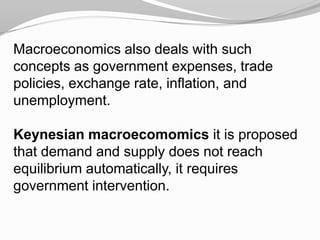
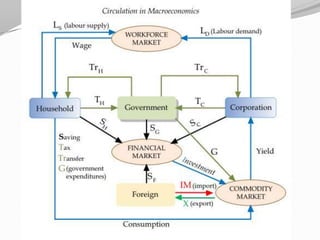
Macroeconomics also deals with such
concepts as government expenses, trade
policies, exchange rate, inflation, and
unemployment.

Keynesian macroecomomics it is proposed
that demand and supply does not reach
equilibrium automatically, it requires
government intervention.
INFLATION AND DEFLATION
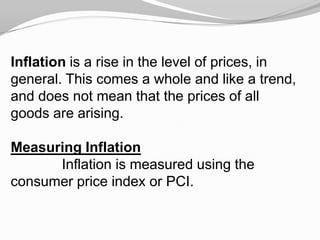
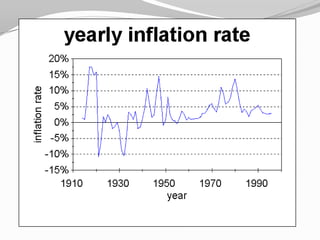
Inflation is a rise in the level of prices, in
general. This comes a whole and like a trend,
and does not mean that the prices of all
goods are arising.
Measuring Inflation
Inflation is measured using the
consumer price index or PCI.
The Consumer Price Index is the common
measure of the general or overall level of
prices.
The inflation rate is the general rate in the
rise of prices. If the inflation rate is 7%, then
that means the cost of these prices or the
cost of living has generally risen by 7%, and
the power of your money to purchase
decreases.
Theories and Causes of Inflation

Inflation has been attributed to two major
causes. The first one is called demand-pull
inflation. Demand-full inflation happens when
there is excess or too much demand for
certain goods and services that are not met
by a corresponding increase in the supply of
those goods and services.
Cost-push inflation this inflation happens due to
changes in the supply side of the market. This
happens when there is a general increase in the
cost of production that may be due to higher wages
or increases in the cost of raw materials and other
inputs.
Effects of inflation
The effects of inflation may range from
the ordinary rise in prices to the most bizarre
changes in an economy. The following are
some of it’s effects:

•Inflation reduces the purchasing power of
money. People could buy less with what
they have, and will need to spend less to
afford the cost of living.
Inflation is a big burden to fixed income
earners, or those with no capacity to raise
their incomes quickly.

Because of inflation, people will discouraged or unable to save, because the reduced
value of money would not be enough even for their daily needs, and they will assume
that the money they will save will have less value in the future.
-Inflation may lead to an inflationary spiral; as
prices rise due to inflation, workers may
request for an increase in wages. If
businessmen agree to an increase, then they
will be forced to increase the prices of their
products, thus leading to another inflation
situation, and so on.
-When inflation leads to hyperinflation, or an
rapid type of inflation that has a devastating
effect on the economy, then it may further
lead, given the combination of event and
situations, to an economic collapse.
-One good effect of inflation is the benefit
derived by business who have just bought
machines, equipment, or other capital goods
before the advent of an inflation; thus they
may have benefitted from the transaction.
Inflation Through the Years

Inflation has occurred in various ways
and in varying degrees among many
countries. Indeed , inflation is arbitrary and
exists even if it runs counter to society’s
objectives.
Here are some ways by which inflation has
occurred in some countries:
-Since 1965, the United States has experienced a
yearly growth of its inflation rate. But this has been
limited to not more than 4 percent annually.
-The Philippines has also been experiencing a
steady increase in its inflation rate in the past
decades.
-Brazil experienced a hyperinflation in 1993 at
the rate of more than 2000 percent, severely
affecting its economy.
-In the 1920s, during one of the lowest points
in German economic history, inflation was so
high that price levels rose trillions of
times, with common food items costing
millions in their currency.
Combating Inflation
There are ways by which inflation may be
limited to acceptable levels.
At the highest level, countries can set up
fiscal and monetary policies that can effectively
counter inflation or inflationary tendencies.
At the level of the individual, consumers
should be more conservative and careful in the
use and consumption of resources, and should
practice selective buying.
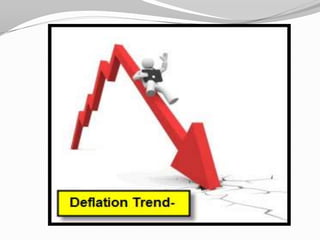
Deflation

Deflation is a fall in the average level of
prices in the economy, or some reduction in
the level of economic activity. As government
executes measures to counter inflation, such
as an increase in interest rates and taxes and
a decrease in the money supply and
government spending, then deflation may
occur.
Presentation1 (2)

Presentation1 (2)

  • 2.
    The following willfurther illustrate the difference between macroeconomics and microeconomics: Microeconomics seeks how the supply of rice might affect its price; Macroeconomics asks how a drop in the price can affect government policies on rice production.
  • 3.
    Microeconomics studies particularaspects of the market, such as which products are hot and which are not; Macroeconomics studies overall trends and factors that affect the performance of the market as a whole. Microeconomics deals with the way house holds consume goods using money income; Macroeconomics answers how controlling the money supply may affect the country’s economy.
  • 4.
    Macroeconomics pertains tothe overall aspects of the economy, most nations have macroeconomics aspects in place and the success of their economy depends on the success of their macroeconomic programs and policies.
  • 5.
    Macroeconomics also dealswith such concepts as government expenses, trade policies, exchange rate, inflation, and unemployment. Keynesian macroecomomics it is proposed that demand and supply does not reach equilibrium automatically, it requires government intervention.
  • 7.
  • 8.
    Inflation is arise in the level of prices, in general. This comes a whole and like a trend, and does not mean that the prices of all goods are arising. Measuring Inflation Inflation is measured using the consumer price index or PCI.
  • 9.
    The Consumer PriceIndex is the common measure of the general or overall level of prices. The inflation rate is the general rate in the rise of prices. If the inflation rate is 7%, then that means the cost of these prices or the cost of living has generally risen by 7%, and the power of your money to purchase decreases.
  • 11.
    Theories and Causesof Inflation Inflation has been attributed to two major causes. The first one is called demand-pull inflation. Demand-full inflation happens when there is excess or too much demand for certain goods and services that are not met by a corresponding increase in the supply of those goods and services.
  • 12.
    Cost-push inflation thisinflation happens due to changes in the supply side of the market. This happens when there is a general increase in the cost of production that may be due to higher wages or increases in the cost of raw materials and other inputs.
  • 13.
    Effects of inflation Theeffects of inflation may range from the ordinary rise in prices to the most bizarre changes in an economy. The following are some of it’s effects: •Inflation reduces the purchasing power of money. People could buy less with what they have, and will need to spend less to afford the cost of living.
  • 14.
    Inflation is abig burden to fixed income earners, or those with no capacity to raise their incomes quickly. Because of inflation, people will discouraged or unable to save, because the reduced value of money would not be enough even for their daily needs, and they will assume that the money they will save will have less value in the future.
  • 15.
    -Inflation may leadto an inflationary spiral; as prices rise due to inflation, workers may request for an increase in wages. If businessmen agree to an increase, then they will be forced to increase the prices of their products, thus leading to another inflation situation, and so on.
  • 16.
    -When inflation leadsto hyperinflation, or an rapid type of inflation that has a devastating effect on the economy, then it may further lead, given the combination of event and situations, to an economic collapse.
  • 17.
    -One good effectof inflation is the benefit derived by business who have just bought machines, equipment, or other capital goods before the advent of an inflation; thus they may have benefitted from the transaction.
  • 18.
    Inflation Through theYears Inflation has occurred in various ways and in varying degrees among many countries. Indeed , inflation is arbitrary and exists even if it runs counter to society’s objectives.
  • 19.
    Here are someways by which inflation has occurred in some countries: -Since 1965, the United States has experienced a yearly growth of its inflation rate. But this has been limited to not more than 4 percent annually. -The Philippines has also been experiencing a steady increase in its inflation rate in the past decades.
  • 20.
    -Brazil experienced ahyperinflation in 1993 at the rate of more than 2000 percent, severely affecting its economy. -In the 1920s, during one of the lowest points in German economic history, inflation was so high that price levels rose trillions of times, with common food items costing millions in their currency.
  • 21.
    Combating Inflation There areways by which inflation may be limited to acceptable levels. At the highest level, countries can set up fiscal and monetary policies that can effectively counter inflation or inflationary tendencies. At the level of the individual, consumers should be more conservative and careful in the use and consumption of resources, and should practice selective buying.
  • 22.
    Deflation Deflation is afall in the average level of prices in the economy, or some reduction in the level of economic activity. As government executes measures to counter inflation, such as an increase in interest rates and taxes and a decrease in the money supply and government spending, then deflation may occur.