INFLATION
Inflation
Meaning of Inflation
• Inflation is the rate at which the general level of
prices for goods and services is rising and,
consequently, the purchasing power of currency is
falling.
In other words we can say that inflation is a
sustained increase in the general price level of goods
and services in an economy over a period of time.
Reasons of inflation
Cost push inflation
Demand pull inflation
Money supply
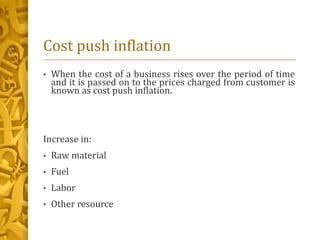
Cost push inflation
• When the cost of a business rises over the period of time
and it is passed on to the prices charged from customer is
known as cost push inflation.
Increase in:
• Raw material
• Fuel
• Labor
• Other resource
Demand pull inflation
• When the economy noticed a hike in demand from
people in certain period of time may be because of
increase in purchasing power of people and it result
as price high and known as a demand pull inflation.
Money supply
• When money circulation in the market is increased
by some of the reasons may be because of excess
money printing or increase in govt. debts results as
decrease in value of money and it caused inflation.
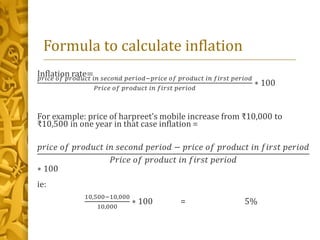
Formula to calculate inflation
Inflation rate=𝑝𝑟𝑖𝑐𝑒 𝑜𝑓 𝑝𝑟𝑜𝑑𝑢𝑐𝑡 𝑖𝑛 𝑠𝑒𝑐𝑜𝑛𝑑 𝑝𝑒𝑟𝑖𝑜𝑑−𝑝𝑟𝑖𝑐𝑒 𝑜𝑓 𝑝𝑟𝑜𝑑𝑢𝑐𝑡 𝑖𝑛 𝑓𝑖𝑟𝑠𝑡 𝑝𝑒𝑟𝑖𝑜𝑑
𝑃𝑟𝑖𝑐𝑒 𝑜𝑓 𝑝𝑟𝑜𝑑𝑢𝑐𝑡 𝑖𝑛 𝑓𝑖𝑟𝑠𝑡 𝑝𝑒𝑟𝑖𝑜𝑑
∗ 100
For example: price of harpreet’s mobile increase from ₹10,000 to
₹10,500 in one year in that case inflation =
𝑝𝑟𝑖𝑐𝑒 𝑜𝑓 𝑝𝑟𝑜𝑑𝑢𝑐𝑡 𝑖𝑛 𝑠𝑒𝑐𝑜𝑛𝑑 𝑝𝑒𝑟𝑖𝑜𝑑 − 𝑝𝑟𝑖𝑐𝑒 𝑜𝑓 𝑝𝑟𝑜𝑑𝑢𝑐𝑡 𝑖𝑛 𝑓𝑖𝑟𝑠𝑡 𝑝𝑒𝑟𝑖𝑜𝑑
𝑃𝑟𝑖𝑐𝑒 𝑜𝑓 𝑝𝑟𝑜𝑑𝑢𝑐𝑡 𝑖𝑛 𝑓𝑖𝑟𝑠𝑡 𝑝𝑒𝑟𝑖𝑜𝑑
∗ 100
ie:
10,500−10,000
10,000
∗ 100 = 5%
Deflation
• Deflation is a decrease in the general price level of goods
and services.
Deflation occurs when the inflation rate falls below 0% (a
negative inflation rate).
* Deflation is distinct from disinflation, a slow-down in the inflation rate, i.e.
when inflation declines to a lower rate but is still positive.
Types of deflation
• Debt deflation
• Money supply side deflation
• Credit deflation
• Deflation caused by lower costs ‘good deflation’
Debt deflation
• A situation in which the collateral used to secure
a loan decreases in value.
Money supply side deflation
• deflation is caused primarily by a reduction in
the velocity of money* and/or the amount of money
supply per person.
* The term "velocity of money" (also "The velocity of circulation of
money") refers to how fast money passes from one holder to the next.
Credit deflation
• In modern credit-based economies, deflation may be
caused by the central bank initiating higher interest
rates (i.e., to 'control' inflation)
Deflation caused by lower costs
‘good deflation’
• If the cost of production decreases which may result
as decrease in the price of goods and it can be
considered as GOOD DEFLATION
Inflation

Inflation

  • 1.
  • 2.
  • 4.
    Meaning of Inflation •Inflation is the rate at which the general level of prices for goods and services is rising and, consequently, the purchasing power of currency is falling. In other words we can say that inflation is a sustained increase in the general price level of goods and services in an economy over a period of time.
  • 5.
    Reasons of inflation Costpush inflation Demand pull inflation Money supply
  • 6.
    Cost push inflation •When the cost of a business rises over the period of time and it is passed on to the prices charged from customer is known as cost push inflation. Increase in: • Raw material • Fuel • Labor • Other resource
  • 7.
    Demand pull inflation •When the economy noticed a hike in demand from people in certain period of time may be because of increase in purchasing power of people and it result as price high and known as a demand pull inflation.
  • 8.
    Money supply • Whenmoney circulation in the market is increased by some of the reasons may be because of excess money printing or increase in govt. debts results as decrease in value of money and it caused inflation.
  • 9.
    Formula to calculateinflation Inflation rate=𝑝𝑟𝑖𝑐𝑒 𝑜𝑓 𝑝𝑟𝑜𝑑𝑢𝑐𝑡 𝑖𝑛 𝑠𝑒𝑐𝑜𝑛𝑑 𝑝𝑒𝑟𝑖𝑜𝑑−𝑝𝑟𝑖𝑐𝑒 𝑜𝑓 𝑝𝑟𝑜𝑑𝑢𝑐𝑡 𝑖𝑛 𝑓𝑖𝑟𝑠𝑡 𝑝𝑒𝑟𝑖𝑜𝑑 𝑃𝑟𝑖𝑐𝑒 𝑜𝑓 𝑝𝑟𝑜𝑑𝑢𝑐𝑡 𝑖𝑛 𝑓𝑖𝑟𝑠𝑡 𝑝𝑒𝑟𝑖𝑜𝑑 ∗ 100 For example: price of harpreet’s mobile increase from ₹10,000 to ₹10,500 in one year in that case inflation = 𝑝𝑟𝑖𝑐𝑒 𝑜𝑓 𝑝𝑟𝑜𝑑𝑢𝑐𝑡 𝑖𝑛 𝑠𝑒𝑐𝑜𝑛𝑑 𝑝𝑒𝑟𝑖𝑜𝑑 − 𝑝𝑟𝑖𝑐𝑒 𝑜𝑓 𝑝𝑟𝑜𝑑𝑢𝑐𝑡 𝑖𝑛 𝑓𝑖𝑟𝑠𝑡 𝑝𝑒𝑟𝑖𝑜𝑑 𝑃𝑟𝑖𝑐𝑒 𝑜𝑓 𝑝𝑟𝑜𝑑𝑢𝑐𝑡 𝑖𝑛 𝑓𝑖𝑟𝑠𝑡 𝑝𝑒𝑟𝑖𝑜𝑑 ∗ 100 ie: 10,500−10,000 10,000 ∗ 100 = 5%
  • 10.
    Deflation • Deflation isa decrease in the general price level of goods and services. Deflation occurs when the inflation rate falls below 0% (a negative inflation rate). * Deflation is distinct from disinflation, a slow-down in the inflation rate, i.e. when inflation declines to a lower rate but is still positive.
  • 11.
    Types of deflation •Debt deflation • Money supply side deflation • Credit deflation • Deflation caused by lower costs ‘good deflation’
  • 12.
    Debt deflation • Asituation in which the collateral used to secure a loan decreases in value.
  • 13.
    Money supply sidedeflation • deflation is caused primarily by a reduction in the velocity of money* and/or the amount of money supply per person. * The term "velocity of money" (also "The velocity of circulation of money") refers to how fast money passes from one holder to the next.
  • 14.
    Credit deflation • Inmodern credit-based economies, deflation may be caused by the central bank initiating higher interest rates (i.e., to 'control' inflation)
  • 15.
    Deflation caused bylower costs ‘good deflation’ • If the cost of production decreases which may result as decrease in the price of goods and it can be considered as GOOD DEFLATION