Inflammatory bowel disease:
aminosalicylates
Domina Petric, MD
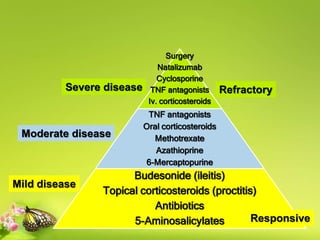
Surgery
Natalizumab
Cyclosporine
TNF antagonists
Iv. corticosteroids
TNF antagonists
Oral corticosteroids
Methotrexate
Azathioprine
6-Mercaptopurine
Budesonide (ileitis)
Topical corticosteroids (proctitis)
Antibiotics
5-Aminosalicylates
Severe disease
Moderate disease
Mild disease
Refractory
Responsive
• These drugs contain 5-aminosalicylic acid (5-ASA).
• 5-ASA differs from salicylic acid only by the addition
of an amino group at the 5 (meta) position.
• Aminosalicylates work topically in areas of
diseased gastrointestinal mucosa.
• A number of formulations have been designed to
deliver 5-ASA to various distal segments of the
small bowel or the colon.
• Sulfasalazine, olsalazine, balsalazide and various
forms of mesalamine.
Aminosalicylates
Azo-compounds
• Sulfasalazine, balsalazide and olsalazine
contain 5-ASA bound by an azo (N=N) bond to
an inert compound or to another 5-ASA
molecule.
• Sulfasalazine: 5-ASA is bound to sulfapyridine.
• Balsalazide: 5-ASA is bound to 4-
aminobenzoyl-β-alanine.
• Olsalazine: two 5-ASA molecules are bound
together.
• The azo structure markedly reduces absorption
of the parent drug from the small intestine.
Azo-compounds
• In the terminal ileum and colon,
resident bacteria cleave the azo
bond by means of an
azoreductase enzyme, releasing
the active 5-ASA.
• High concentrations of active
drug are made available in the
terminal ileum or colon.
Mesalamine compounds
• These compounds have been
designed to package 5-ASA itself in
various ways to deliver it to different
segments of the small or large bowel.
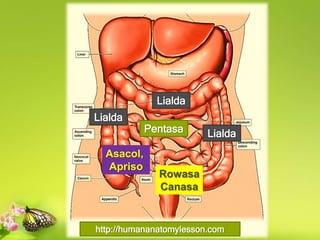
• Pentasa is a mesalamine formulation
that contains timed-release
microgranules that release 5-ASA
throughout the small intestine.
Mesalamine compounds
• Asacol and Apriso have 5-ASA
coated in a pH-sensitive resin that
dissolves at pH 6-7: distal ileum and
proximal colon.
• Lialda uses a pH-dependent resin
that encases a multimatrix core: slow
release of mesalamine throughout
the colon.
Mesalamine compounds
Enema formulations
(Rowasa) and
suppositories (Canasa) are
used to deliver 5-ASA in
high concentrations to the
rectum and sigmoid colon.
http://humananatomylesson.com
Pentasa
Asacol,
Apriso
Lialda
Lialda
Lialda
Rowasa
Canasa
Pharmacokinetics
• Unformulated 5-ASA is readily
absorbed from the small intestine.
• Absorption of 5-ASA from the colon is
extremely low.
• 20-30% of 5-ASA from current oral
mesalamine formulations is
systemically absorbed in the small
intestine.
Pharmacokinetics
• Absorbed 5-ASA undergoes N-
acetylation in the gut epithelium
and liver to a metabolite that
does not possess significant anti-
inflammatory activity.
• The acetylated metabolite is
excreted by the kidneys.
Pharmacokinetics
• The azo compounds, 10% of
sulfasalazine and less than 1% of
balsalazide are absorbed as native
compounds.
• After azoreductase breakdown of
sulfasalazine, over 85% of the carrier
molecule sulfapyridine is absorbed
from the colon.
Pharmacokinetics
• Sulfapyridine undergoes hepatic
metabolism (including acetylation)
followed by renal excretion.
• After azoreductase breakdown of
balsalazide, over 70% of the carrier
peptide is recovered intact in the feces.
• Only a small amount of systemic
absorption occurs.
Pharmacodynamics
• The primary action of salicylate and
other NSAIDs is due to blockade of
prostaglandin synthesis by inhibition
of cyclooxygenase.
• 5-ASA modulates inflammatory
mediators derived from both the
cyclooxygenase and lipooxygenase
pathways.
Pharmacodynamics
• 5-ASA inhibits the activity of nuclear
factor-κB (NF-κB): that is important
transcription factor for
proinflammatory cytokines.
• 5-ASA may inhibit cellular functions
of natural killer cells, mucosal
lymphocytes and macrophages.
• It may also scavenge reactive oxygen
metabolites.
Clinical use
• 5-ASA drugs induce and maintain
remission in ulcerative colitis: first-line
agents for treatment of mild to moderate
active UC.
• Efficacy in Crohn´s disease is
unproven, but 5-ASA are used as first-
line therapy for mild to moderate
disease involving the colon or distal
ileum.
Clinical use
5-ASA suppositories or
enemas are useful in patients
with ulcerative colitis or
Crohn´s disease confined to
the rectum (proctitis) or distal
colon (proctosigmoiditis).
Clinical use
• In patients with UC or Crohn´s colitis
that extends to the proximal colon,
both the azo compounds and
mesalamine formulations are useful.
• For the treatment of Crohn´s disease
involving the small bowel:
mesalamine compounds, which
release 5-ASA in the small intestine.
Adverse effects
• Slow acetylators of sulfapyridine have
more frequent and more severe adverse
effects than fast acetylators.
• Up to 40% of patients can not tolerate
therapeutic doses of sulfasalazine.
• Dose-related side effects: nausea,
gastrointestinal upset, headaches,
arthralgias, myalgias, bone marrow
suppresion, malaise.
Adverse effects
• Hypersensitivity to sulfapyridine or,
rarely, 5-ASA can result in fever,
exfoliative dermatitis, pancreatitis,
pneumonitis, hemolytic anemia,
pericarditis or hepatitis.
• Sulfasalazine can cause
oligospermia, which reverses upon
discontinuation of the drug.
Adverse effects
• Sulfasalazine impairs folate
absorption and processing: dietary
supplementation with 1 mg/d folic
acid is recommended.
• Olsalazine may stimulate a secretory
diarrhea in 10% of patients.
• High doses of aminosalicylates may
cause renal tubular damage.
Adverse effects
• Rare cases of interstitial nephritis
are reported, particularly in
association with high doses of
mesalamine formulations.
• Sulfasalazine and other
aminosalicylates rarely cause
worsening of colitis.
Literature
• Katzung, Masters, Trevor.
Basic and clinical
pharmacology.
• http://humananatomylesson.com

Inflammatory bowel disease: aminosalicylates

  • 1.
  • 2.
    Surgery Natalizumab Cyclosporine TNF antagonists Iv. corticosteroids TNFantagonists Oral corticosteroids Methotrexate Azathioprine 6-Mercaptopurine Budesonide (ileitis) Topical corticosteroids (proctitis) Antibiotics 5-Aminosalicylates Severe disease Moderate disease Mild disease Refractory Responsive
  • 3.
    • These drugscontain 5-aminosalicylic acid (5-ASA). • 5-ASA differs from salicylic acid only by the addition of an amino group at the 5 (meta) position. • Aminosalicylates work topically in areas of diseased gastrointestinal mucosa. • A number of formulations have been designed to deliver 5-ASA to various distal segments of the small bowel or the colon. • Sulfasalazine, olsalazine, balsalazide and various forms of mesalamine. Aminosalicylates
  • 4.
    Azo-compounds • Sulfasalazine, balsalazideand olsalazine contain 5-ASA bound by an azo (N=N) bond to an inert compound or to another 5-ASA molecule. • Sulfasalazine: 5-ASA is bound to sulfapyridine. • Balsalazide: 5-ASA is bound to 4- aminobenzoyl-β-alanine. • Olsalazine: two 5-ASA molecules are bound together. • The azo structure markedly reduces absorption of the parent drug from the small intestine.
  • 5.
    Azo-compounds • In theterminal ileum and colon, resident bacteria cleave the azo bond by means of an azoreductase enzyme, releasing the active 5-ASA. • High concentrations of active drug are made available in the terminal ileum or colon.
  • 6.
    Mesalamine compounds • Thesecompounds have been designed to package 5-ASA itself in various ways to deliver it to different segments of the small or large bowel. • Pentasa is a mesalamine formulation that contains timed-release microgranules that release 5-ASA throughout the small intestine.
  • 7.
    Mesalamine compounds • Asacoland Apriso have 5-ASA coated in a pH-sensitive resin that dissolves at pH 6-7: distal ileum and proximal colon. • Lialda uses a pH-dependent resin that encases a multimatrix core: slow release of mesalamine throughout the colon.
  • 8.
    Mesalamine compounds Enema formulations (Rowasa)and suppositories (Canasa) are used to deliver 5-ASA in high concentrations to the rectum and sigmoid colon.
  • 9.
  • 10.
    Pharmacokinetics • Unformulated 5-ASAis readily absorbed from the small intestine. • Absorption of 5-ASA from the colon is extremely low. • 20-30% of 5-ASA from current oral mesalamine formulations is systemically absorbed in the small intestine.
  • 11.
    Pharmacokinetics • Absorbed 5-ASAundergoes N- acetylation in the gut epithelium and liver to a metabolite that does not possess significant anti- inflammatory activity. • The acetylated metabolite is excreted by the kidneys.
  • 12.
    Pharmacokinetics • The azocompounds, 10% of sulfasalazine and less than 1% of balsalazide are absorbed as native compounds. • After azoreductase breakdown of sulfasalazine, over 85% of the carrier molecule sulfapyridine is absorbed from the colon.
  • 13.
    Pharmacokinetics • Sulfapyridine undergoeshepatic metabolism (including acetylation) followed by renal excretion. • After azoreductase breakdown of balsalazide, over 70% of the carrier peptide is recovered intact in the feces. • Only a small amount of systemic absorption occurs.
  • 14.
    Pharmacodynamics • The primaryaction of salicylate and other NSAIDs is due to blockade of prostaglandin synthesis by inhibition of cyclooxygenase. • 5-ASA modulates inflammatory mediators derived from both the cyclooxygenase and lipooxygenase pathways.
  • 15.
    Pharmacodynamics • 5-ASA inhibitsthe activity of nuclear factor-κB (NF-κB): that is important transcription factor for proinflammatory cytokines. • 5-ASA may inhibit cellular functions of natural killer cells, mucosal lymphocytes and macrophages. • It may also scavenge reactive oxygen metabolites.
  • 16.
    Clinical use • 5-ASAdrugs induce and maintain remission in ulcerative colitis: first-line agents for treatment of mild to moderate active UC. • Efficacy in Crohn´s disease is unproven, but 5-ASA are used as first- line therapy for mild to moderate disease involving the colon or distal ileum.
  • 17.
    Clinical use 5-ASA suppositoriesor enemas are useful in patients with ulcerative colitis or Crohn´s disease confined to the rectum (proctitis) or distal colon (proctosigmoiditis).
  • 18.
    Clinical use • Inpatients with UC or Crohn´s colitis that extends to the proximal colon, both the azo compounds and mesalamine formulations are useful. • For the treatment of Crohn´s disease involving the small bowel: mesalamine compounds, which release 5-ASA in the small intestine.
  • 19.
    Adverse effects • Slowacetylators of sulfapyridine have more frequent and more severe adverse effects than fast acetylators. • Up to 40% of patients can not tolerate therapeutic doses of sulfasalazine. • Dose-related side effects: nausea, gastrointestinal upset, headaches, arthralgias, myalgias, bone marrow suppresion, malaise.
  • 20.
    Adverse effects • Hypersensitivityto sulfapyridine or, rarely, 5-ASA can result in fever, exfoliative dermatitis, pancreatitis, pneumonitis, hemolytic anemia, pericarditis or hepatitis. • Sulfasalazine can cause oligospermia, which reverses upon discontinuation of the drug.
  • 21.
    Adverse effects • Sulfasalazineimpairs folate absorption and processing: dietary supplementation with 1 mg/d folic acid is recommended. • Olsalazine may stimulate a secretory diarrhea in 10% of patients. • High doses of aminosalicylates may cause renal tubular damage.
  • 22.
    Adverse effects • Rarecases of interstitial nephritis are reported, particularly in association with high doses of mesalamine formulations. • Sulfasalazine and other aminosalicylates rarely cause worsening of colitis.
  • 23.
    Literature • Katzung, Masters,Trevor. Basic and clinical pharmacology. • http://humananatomylesson.com