GERUND
VS
INFINITIVE
GERUNDS
 A gerund is a noun made from a verb by
adding "-ing." You can use a gerund as
the subject, the complement, or the
object of a sentence.
EXAMPLES
Reading helps you learn English. subject
of sentence
Her favorite hobby is reading. complement
of sentence
I enjoy reading. object of sentence
 Gerunds can be made negative by
adding "not.“
Examples:
He enjoys not working.
The best thing for your health is not
smoking.
INFINITIVES
 Infinitives are the "to" form of the verb.
You can also use an infinitive as the
subject, the complement, or the object of
a sentence.
EXAMPLES
To learn is important. subject of sentence
The most important thing is to
learn. complement of sentence
He wants to learn. object of sentence
 Infinitives can be made negative by
adding "not.“
Examples:
I decided not to go.
The most important thing is not to give up.
Both Gerunds &
Infinitives
 can be used as the subject or the complement
of a sentence. However, as subjects or
complements, gerunds usually sound more like
normal, spoken English, whereas infinitives
sound more abstract. In the following
sentences, gerunds sound more natural and
would be more common in everyday English.
Infinitives emphasize the possibility or potential
for something and sound more philosophical. If
this sounds confusing, just remember that 90%
of the time, you will use a gerund as the
subject or complement of a sentence.
EXAMPLES
 Learning is important. normal subject
 To learn is important. abstract subject less common
 The most important thing
is learning. normal complement
 The most important thing is to
learn. abstract complement - less
common
As the object of the
sentence…
 It is more difficult to choose between a gerund
or an infinitive. In such situations, gerunds and
infinitives are not normally interchangeable.
Usually, the main verb in the sentence
determines whether you use a gerund or an
infinitive.
Examples:
He enjoys swimming. "Enjoy" requires a
gerund.
He wants to swim. "Want" requires an
infinitive.
Some verbs are followed
by gerunds as objects
admit
advise
appreciate
avoid
can't help
complete
consider

delay
deny
detest
dislike
enjoy
escape
excuse

finish
forbid
get
through
have
imagine
mind
miss

permit
postpone
practice
quit
recall
report
resent

resist
resume
risk
spend
(time)
suggest
tolerate
waste
(time)
Some verbs
followed by
agree
aim
appear
arrange
ask
attempt
be able
beg
begin
care
choose
condescend

consent
continue
dare
decide
deserve
detest
dislike
expect
fail
forget
get
happen

are
Infinitives

have
hesitate
hope
hurry
intend
leap
leave
like
long
love
mean
neglect

offer
ought
plan
prefer
prepare
proceed
promise
propose
refuse
remember
say

shoot
start
stop
strive
swear
threaten
try
use
wait
want
wish
 Gerunds can often be modified with
possessive forms such as his, her, its,
your, their, our, John's, Mary's, the
machine's, and so on. This makes it
clearer who or what is performing the
action.
Examples
 I enjoyed their singing. They were singing.
 She understood his saying no to the offer. He
said no.
 Sam resented Debbie's coming late to the
dinner. Debbie came late to the dinner.
 We discussed the machine's
being broken. The machine is broken.
 Some verbs are followed by a noun plus
an infinitive. In some situations, the noun
is required. In other situations, the noun
is optional
Examples:
The police ordered the man to
stop. noun is required
She asked to leave. noun is optional
She asked him to leave. noun is
optional
Verbs
NOUN
advise
allow
ask
beg
bring
build
buy
challenge

followed by
+ Infinitive
choose
command
dare
direct
encourage
expect
forbid
force

have
hire
instruct
invite
lead
leave
let
like

love
motivate
order
pay
permit
persuade
prepare
promise

remind
require
send
teach
tell
urge
want
warn
Gerunds are used
AFTER prepositions…
 “Verb + preposition" combinations.
Examples:
They are looking forward to seeing you.
Leslie apologized for forgetting my birthday.
He is thinking about studying abroad.
 “Adjective + preposition" combinations and “Noun + preposition"
combinations as well.
Examples:
Sandy is scared of flying. adjective + preposition
Nick is anxious about taking the examination. adjective +
preposition
His interest in becoming a professional snowboarder
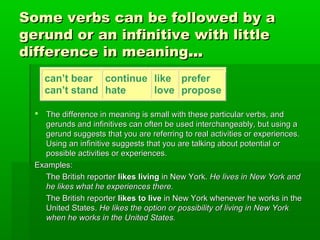
Some verbs can be followed by a
gerund or an infinitive with little
difference in meaning…
can’t bear continue like prefer
can’t stand hate
love propose
 The difference in meaning is small with these particular verbs, and
gerunds and infinitives can often be used interchangeably, but using a
gerund suggests that you are referring to real activities or experiences.
Using an infinitive suggests that you are talking about potential or
possible activities or experiences.
Examples:
The British reporter likes living in New York. He lives in New York and
he likes what he experiences there.
The British reporter likes to live in New York whenever he works in the
United States. He likes the option or possibility of living in New York
when he works in the United States.
Some verbs can be followed by
a gerund or an infinitive, but
with a difference in meaning…
forget
He forgot opening the window.
(Meaning: He opened the window, but he
forgot doing so.)
He forgot to open the window
(Meaning: he was supposed to open the
window, but he forgot.)
regret
She regrets quitting her job.
(She quited her job, and now she regrets
it.)
She regrets to quit her job.
(She is sorry to quit her job.)
remember
I remembered locking the storage.
(I had a memory in my mind of locking
the storage.)
I remembered to lock the storage.
(I locked the storage as I should have.)
try
They tried moving to Australia.
(They moved to Australia for some time to see
if it works out for them.)
They tried to move to Australia.
(They made an attempt to move to Australia,
but it wasn't successful. They didn't move to
Australia after all.)
stop
He stopped chatting.
(He was chatting, and then he stopped.)
He stopped to chat.
(He was doing something else, and then
he stop in order to chat.)
Infinitives are also
used
 Following combinations “BE +
ADJECTIVE”
She was delighted to receive such
good feedback.
He is lucky to have such good friends.
 Following some NOUNS:
It was a good decision to move to San
Francisco.
His wish to become an actor was well
known.
Laura's desire to improve impressed
me.
 To express the idea of "in order to do
something.“ (purpose)
He bought the English dictionary to look
up difficult words. in order to look up
Janine sold her car to get the money that
she needed. in order to get
FORMS
GERUND FORMS

INFINITIVE FORMS

SIMPLE

The teacher enjoys teaching.

The teacher wants to teach.

PROGRESSIVE

Mr. Smith is really enjoying teaching his class.
LOOKS THE SAME AS SIMPLE FORM ABOVE.

Mr. Smith would like to be teaching his
class.

PASSIVE

The students enjoy being taught.

The students want to be taught.

PERFECT

The retired teacher recalled having taught.

The teacher was expecting to have
taught that already.

PASSIVE +
PROGRESSIVE

The students are enjoying being taught by such an
exciting new teacher.

The students would like to be being
taught by Mr Smith.

LOOKS THE SAME AS THE PASSIVE FORM ABOVE.

PASSIVE + PERFECT

The older students recalled having been taught that
already.

The students were expecting to have been
taughtthat by now.

Gerundsvsinfitives

  • 1.
  • 2.
    GERUNDS  A gerundis a noun made from a verb by adding "-ing." You can use a gerund as the subject, the complement, or the object of a sentence.
  • 3.
    EXAMPLES Reading helps youlearn English. subject of sentence Her favorite hobby is reading. complement of sentence I enjoy reading. object of sentence
  • 4.
     Gerunds canbe made negative by adding "not.“ Examples: He enjoys not working. The best thing for your health is not smoking.
  • 5.
    INFINITIVES  Infinitives arethe "to" form of the verb. You can also use an infinitive as the subject, the complement, or the object of a sentence.
  • 6.
    EXAMPLES To learn isimportant. subject of sentence The most important thing is to learn. complement of sentence He wants to learn. object of sentence
  • 7.
     Infinitives canbe made negative by adding "not.“ Examples: I decided not to go. The most important thing is not to give up.
  • 8.
    Both Gerunds & Infinitives can be used as the subject or the complement of a sentence. However, as subjects or complements, gerunds usually sound more like normal, spoken English, whereas infinitives sound more abstract. In the following sentences, gerunds sound more natural and would be more common in everyday English. Infinitives emphasize the possibility or potential for something and sound more philosophical. If this sounds confusing, just remember that 90% of the time, you will use a gerund as the subject or complement of a sentence.
  • 9.
    EXAMPLES  Learning isimportant. normal subject  To learn is important. abstract subject less common  The most important thing is learning. normal complement  The most important thing is to learn. abstract complement - less common
  • 10.
    As the objectof the sentence…  It is more difficult to choose between a gerund or an infinitive. In such situations, gerunds and infinitives are not normally interchangeable. Usually, the main verb in the sentence determines whether you use a gerund or an infinitive. Examples: He enjoys swimming. "Enjoy" requires a gerund. He wants to swim. "Want" requires an infinitive.
  • 11.
    Some verbs arefollowed by gerunds as objects admit advise appreciate avoid can't help complete consider delay deny detest dislike enjoy escape excuse finish forbid get through have imagine mind miss permit postpone practice quit recall report resent resist resume risk spend (time) suggest tolerate waste (time)
  • 12.
    Some verbs followed by agree aim appear arrange ask attempt beable beg begin care choose condescend consent continue dare decide deserve detest dislike expect fail forget get happen are Infinitives have hesitate hope hurry intend leap leave like long love mean neglect offer ought plan prefer prepare proceed promise propose refuse remember say shoot start stop strive swear threaten try use wait want wish
  • 13.
     Gerunds canoften be modified with possessive forms such as his, her, its, your, their, our, John's, Mary's, the machine's, and so on. This makes it clearer who or what is performing the action.
  • 14.
    Examples  I enjoyedtheir singing. They were singing.  She understood his saying no to the offer. He said no.  Sam resented Debbie's coming late to the dinner. Debbie came late to the dinner.  We discussed the machine's being broken. The machine is broken.
  • 15.
     Some verbsare followed by a noun plus an infinitive. In some situations, the noun is required. In other situations, the noun is optional Examples: The police ordered the man to stop. noun is required She asked to leave. noun is optional She asked him to leave. noun is optional
  • 16.
  • 17.
    Gerunds are used AFTERprepositions…  “Verb + preposition" combinations. Examples: They are looking forward to seeing you. Leslie apologized for forgetting my birthday. He is thinking about studying abroad.  “Adjective + preposition" combinations and “Noun + preposition" combinations as well. Examples: Sandy is scared of flying. adjective + preposition Nick is anxious about taking the examination. adjective + preposition His interest in becoming a professional snowboarder
  • 18.
    Some verbs canbe followed by a gerund or an infinitive with little difference in meaning… can’t bear continue like prefer can’t stand hate love propose  The difference in meaning is small with these particular verbs, and gerunds and infinitives can often be used interchangeably, but using a gerund suggests that you are referring to real activities or experiences. Using an infinitive suggests that you are talking about potential or possible activities or experiences. Examples: The British reporter likes living in New York. He lives in New York and he likes what he experiences there. The British reporter likes to live in New York whenever he works in the United States. He likes the option or possibility of living in New York when he works in the United States.
  • 19.
    Some verbs canbe followed by a gerund or an infinitive, but with a difference in meaning… forget He forgot opening the window. (Meaning: He opened the window, but he forgot doing so.) He forgot to open the window (Meaning: he was supposed to open the window, but he forgot.)
  • 20.
    regret She regrets quittingher job. (She quited her job, and now she regrets it.) She regrets to quit her job. (She is sorry to quit her job.)
  • 21.
    remember I remembered lockingthe storage. (I had a memory in my mind of locking the storage.) I remembered to lock the storage. (I locked the storage as I should have.)
  • 22.
    try They tried movingto Australia. (They moved to Australia for some time to see if it works out for them.) They tried to move to Australia. (They made an attempt to move to Australia, but it wasn't successful. They didn't move to Australia after all.)
  • 23.
    stop He stopped chatting. (Hewas chatting, and then he stopped.) He stopped to chat. (He was doing something else, and then he stop in order to chat.)
  • 24.
    Infinitives are also used Following combinations “BE + ADJECTIVE” She was delighted to receive such good feedback. He is lucky to have such good friends.
  • 25.
     Following someNOUNS: It was a good decision to move to San Francisco. His wish to become an actor was well known. Laura's desire to improve impressed me.
  • 26.
     To expressthe idea of "in order to do something.“ (purpose) He bought the English dictionary to look up difficult words. in order to look up Janine sold her car to get the money that she needed. in order to get
  • 27.
    FORMS GERUND FORMS INFINITIVE FORMS SIMPLE Theteacher enjoys teaching. The teacher wants to teach. PROGRESSIVE Mr. Smith is really enjoying teaching his class. LOOKS THE SAME AS SIMPLE FORM ABOVE. Mr. Smith would like to be teaching his class. PASSIVE The students enjoy being taught. The students want to be taught. PERFECT The retired teacher recalled having taught. The teacher was expecting to have taught that already. PASSIVE + PROGRESSIVE The students are enjoying being taught by such an exciting new teacher. The students would like to be being taught by Mr Smith. LOOKS THE SAME AS THE PASSIVE FORM ABOVE. PASSIVE + PERFECT The older students recalled having been taught that already. The students were expecting to have been taughtthat by now.

Editor's Notes