Infection control measures
for TB Laboratory
Dr. Yogita Mistry
Microbiologist
TB-IRL ,Surat
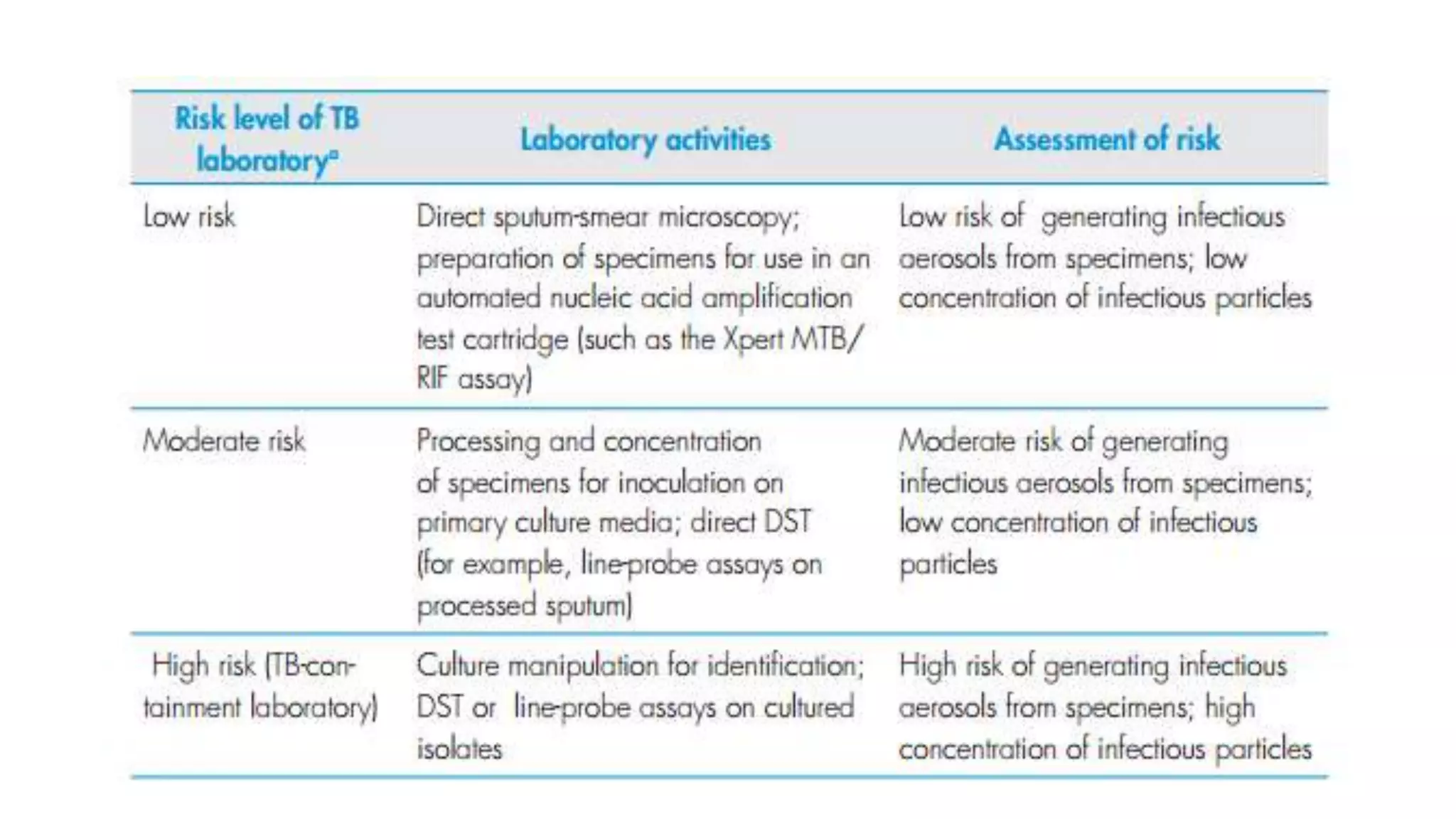
Low Risk Laboratory
• manipulate sputum specimens for direct sputum-smear microscopy;
• manipulate sputum specimens for the Xpert MTB/RIF®assay
Specific features and essential minimum
biosafety measures
• Use of bench space
• Ventilation-natural/mechanical
• Minimizing the generation of aerosols
• Handling leaking specimen
• PPE-lab coat, gloves,mask
7
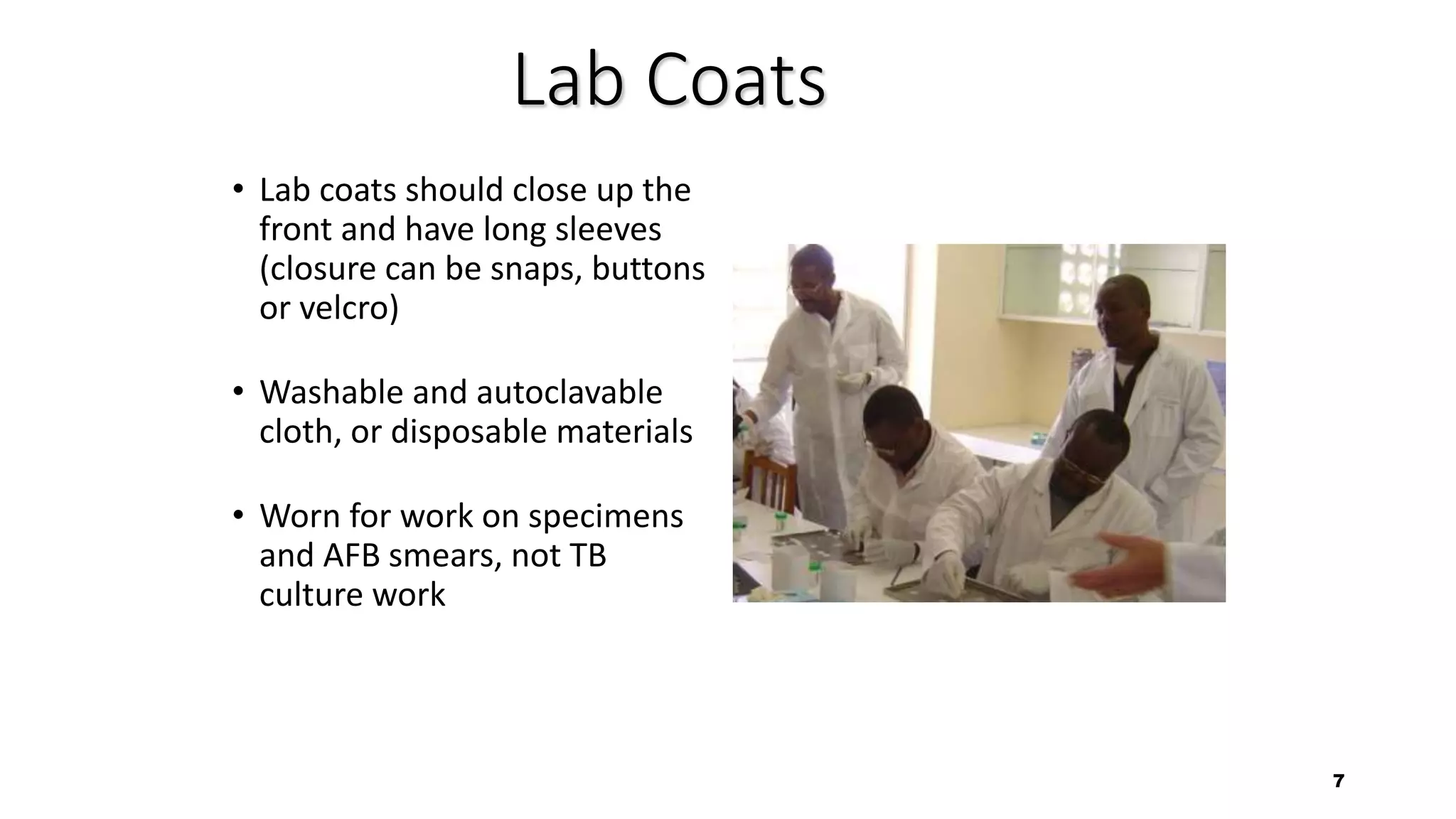
Lab Coats
• Lab coats should close up the
front and have long sleeves
(closure can be snaps, buttons
or velcro)
• Washable and autoclavable
cloth, or disposable materials
• Worn for work on specimens
and AFB smears, not TB
culture work
Factors that increase the risk of infection
• Bench spaces may be used improperly;
• Specimen containers may leak
• Specimens manipulated carelessly may lead to subsequent
aerosolization;
• Specimens may be shaken vigorously;
• Ventilation or illumination may be poor.
Moderate Risk TB Laboratory
• Process specimens for inoculation on primary solid-culture media;
• Perform direct DST (for example, direct line-probe assays, Microscopic
observation drug susceptibility [MODS], Nitrate reductase assay
[NRA] on processed sputum
Factors that increase the risk of infection
• poor ventilation;
• BSCs
• The work environment
• Careless manipulation of specimens
• Precautions for using the vortex may not be followed
• Specimen containers may break or leak during centrifuging
Specific features and essential minimum
biosafety measures
• Biological safety cabinets
• Ventilation
• Personal protective equipment
• Laboratory design
• Decontamination and waste disposal
• Minimizing the generation of aerosols
12
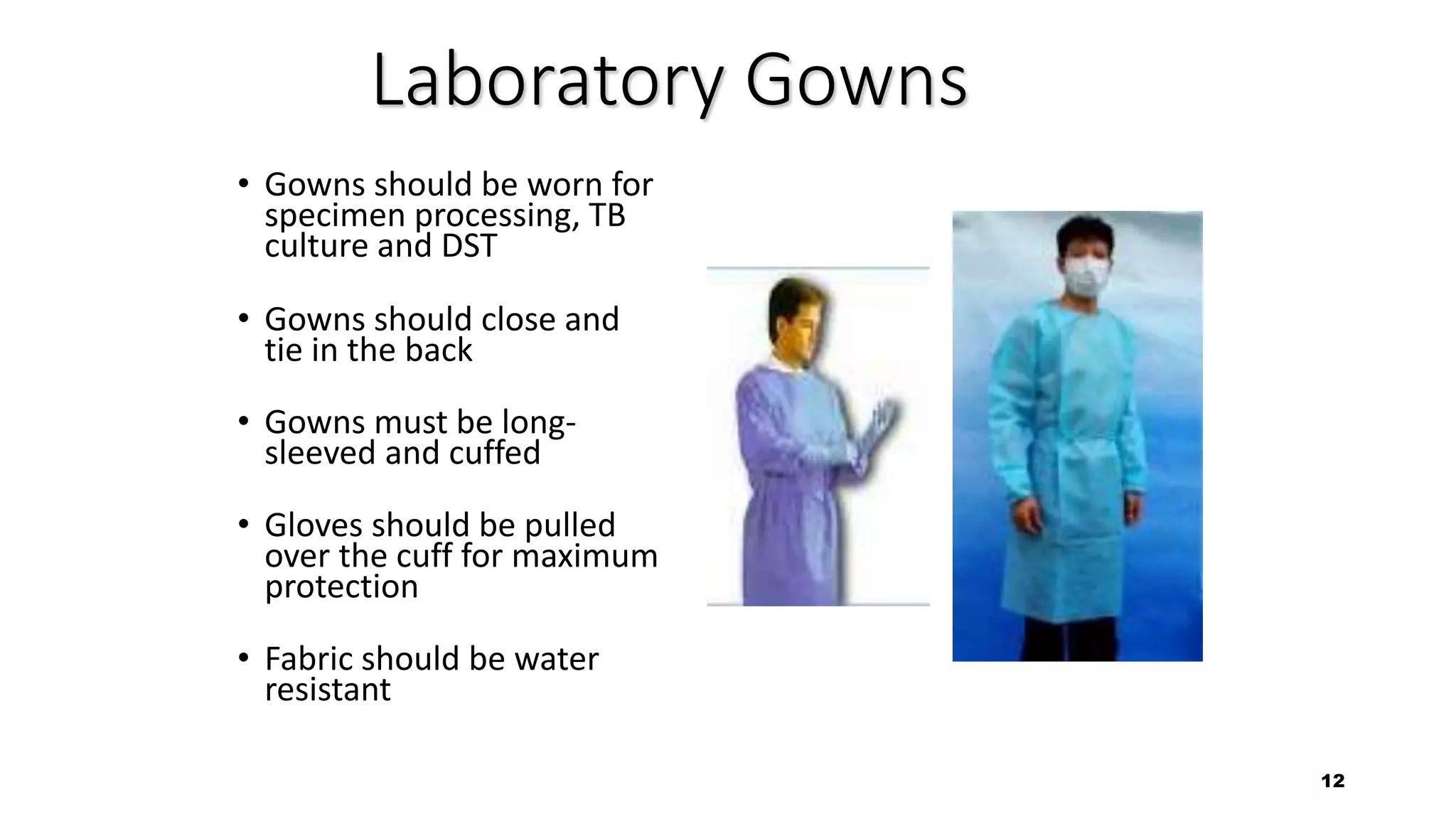
Laboratory Gowns
• Gowns should be worn for
specimen processing, TB
culture and DST
• Gowns should close and
tie in the back
• Gowns must be long-
sleeved and cuffed
• Gloves should be pulled
over the cuff for maximum
protection
• Fabric should be water
resistant
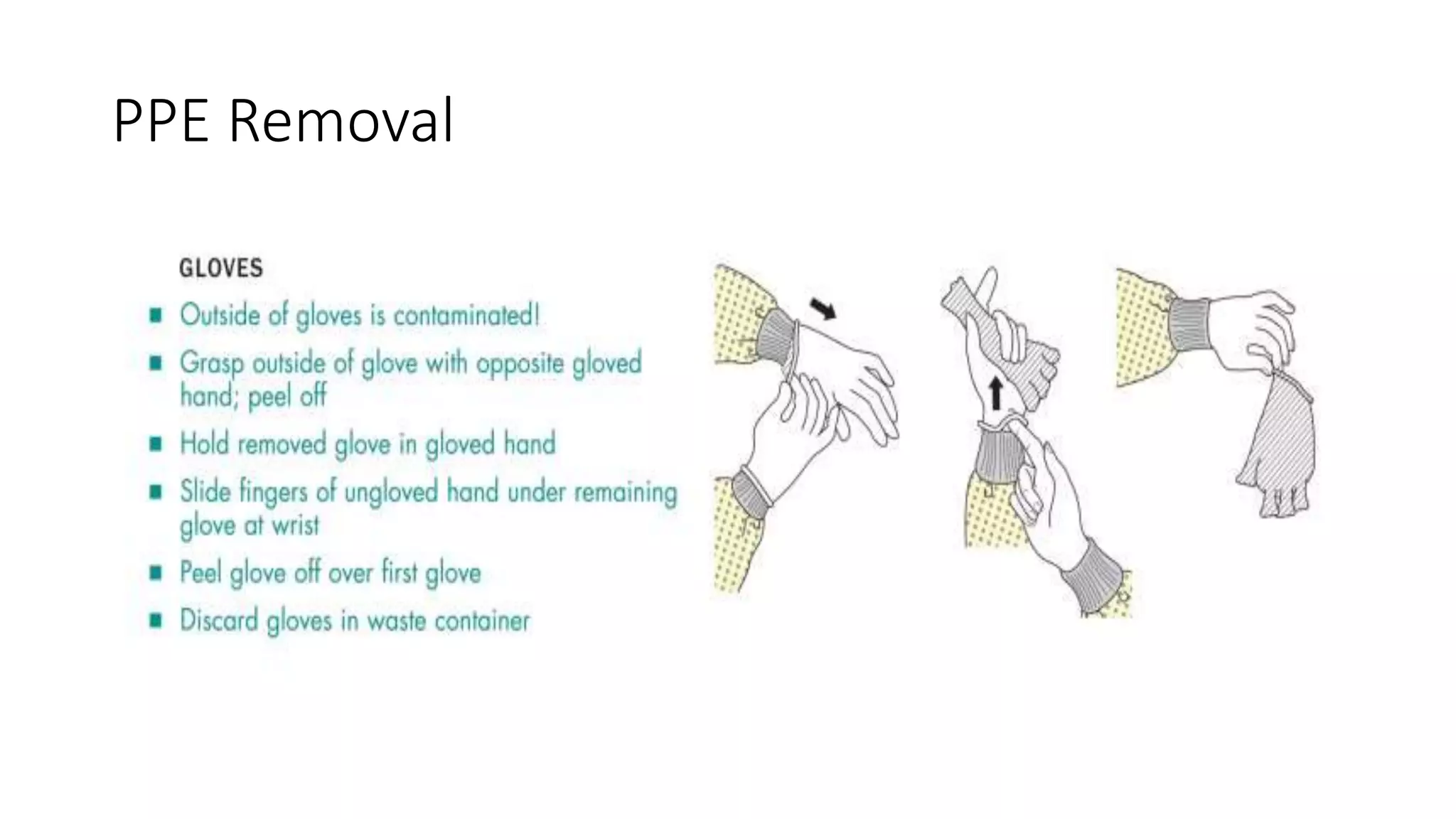
PPE Removal
High-risk TB laboratories (TB-containment
laboratories)
• Manipulate cultures to identify M. tuberculosis;
• Manipulate cultures or suspensions of tubercle bacilli for all indirect
DST methods and molecular assays.
Factors that increase the risk of infection
• Staff must open positive culture vials;
• Staff must prepare smears from positive cultures;
• DNA extraction must be performed on a positive culture;
• Manipulation of cultures for identifi cation and indirect DST;
• Broken culture containers must be disposed of;
• Cultures or areas where spills occurred must be decontaminated.
Specific features and required
biosafety measures
• Laboratory design
• Personal protective equipment
• Decontamination and waste disposal facility
Safety equipments
• Biosafety cabinets
• Centrifuges with safety buckets
• Autoclaves
24
4 Main Types of Disinfectants
•Phenol-based
•Hypochlorite (bleach)
•Peroxygens (peracetic acid)
•Alcohol
25
Phenol-based Disinfectants
• Main uses for phenol-based disinfectants:
• In discard containers that are used for:
• Decanting contaminated liquids
• Discarding contaminated supplies
• Surface decontamination
• Clean up of spills – both major and minor, inside and outside BSC
• For phenol-based disinfectants to be effective
• Disinfectant must be left in contact with contaminated material for
at least 15 minutes to ensure killing
26
Phenol-based
disinfectant
Tuberculocidal
Commercially-available Phenolic Disinfectants
• Many commercial disinfectants
use phenol derivatives
• Some phenolic derivatives are
inactivated by water hardness and
should be diluted to the appropriate
concentration using de-ionized water
• Check to ensure the product is labeled
tuberculocidal
27
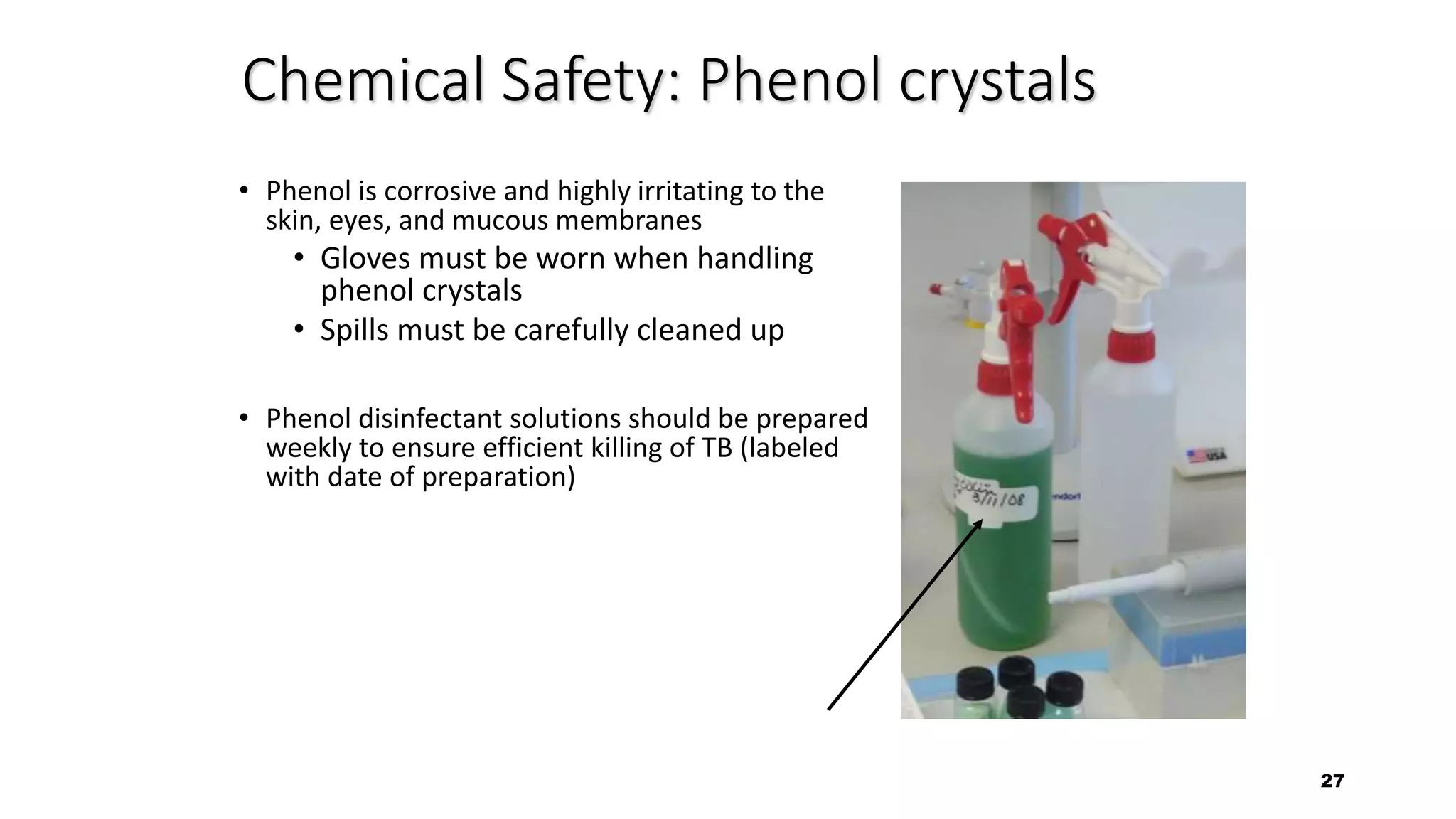
Chemical Safety: Phenol crystals
• Phenol is corrosive and highly irritating to the
skin, eyes, and mucous membranes
• Gloves must be worn when handling
phenol crystals
• Spills must be carefully cleaned up
• Phenol disinfectant solutions should be prepared
weekly to ensure efficient killing of TB (labeled
with date of preparation)
28
Hypochlorite (Bleach)
• Main uses for hypochlorite (bleach)
• In discard containers that are used for:
• Decanting contaminated liquids
• Discarding contaminated supplies
• Surface decontamination
• For hypochlorite disinfectants to be effective in killing
TB
• Disinfectant must be left in contact with contaminated material for at
least 15 minutes
• Diluted solution must be prepared daily because escape of chlorine
gas lessens disinfectant activity
• Know initial percentage of NaOCl in concentrated solution
• Final chlorine concentration should not fall below 0.5%
29
Hypochlorite (Bleach) is Corrosive
• Bleach, even in diluted solutions, is irritating to the
skin and VERY corrosive to metal and plastic surfaces
(such as BSCs, centrifuges, pipettors)
• If used to disinfect metal and plastic surfaces:
• Wash the surface with sterile water or 70% alcohol after
the bleach has disinfected the area (for at least 15
minutes)
30
Alcohol
• Alcohol used as a surface disinfectant
• Surface decontamination on both skin and work surfaces
• Denatured ethanol diluted and used as 70% solution
• Safe for use on metal (BSCs, centrifuges, other
equipment)
• Major advantage: will not corrode or leave a residue
on treated items
• High evaporation rate: An absorbent surface that is
sprayed with 70% Alcohol has disinfection activity for
only 20 minutes – not appropriate for specimen
processing
31
Spills
• When a spill occurs the laboratory staff must first
decide how to react
• The actions required are dependent on:
• Where the spill occurred
• Inside the BSC
• Outside the BSC
• The severity of the spill
• Type of culture (solid or liquid)
• Amount of live organisms involved
32
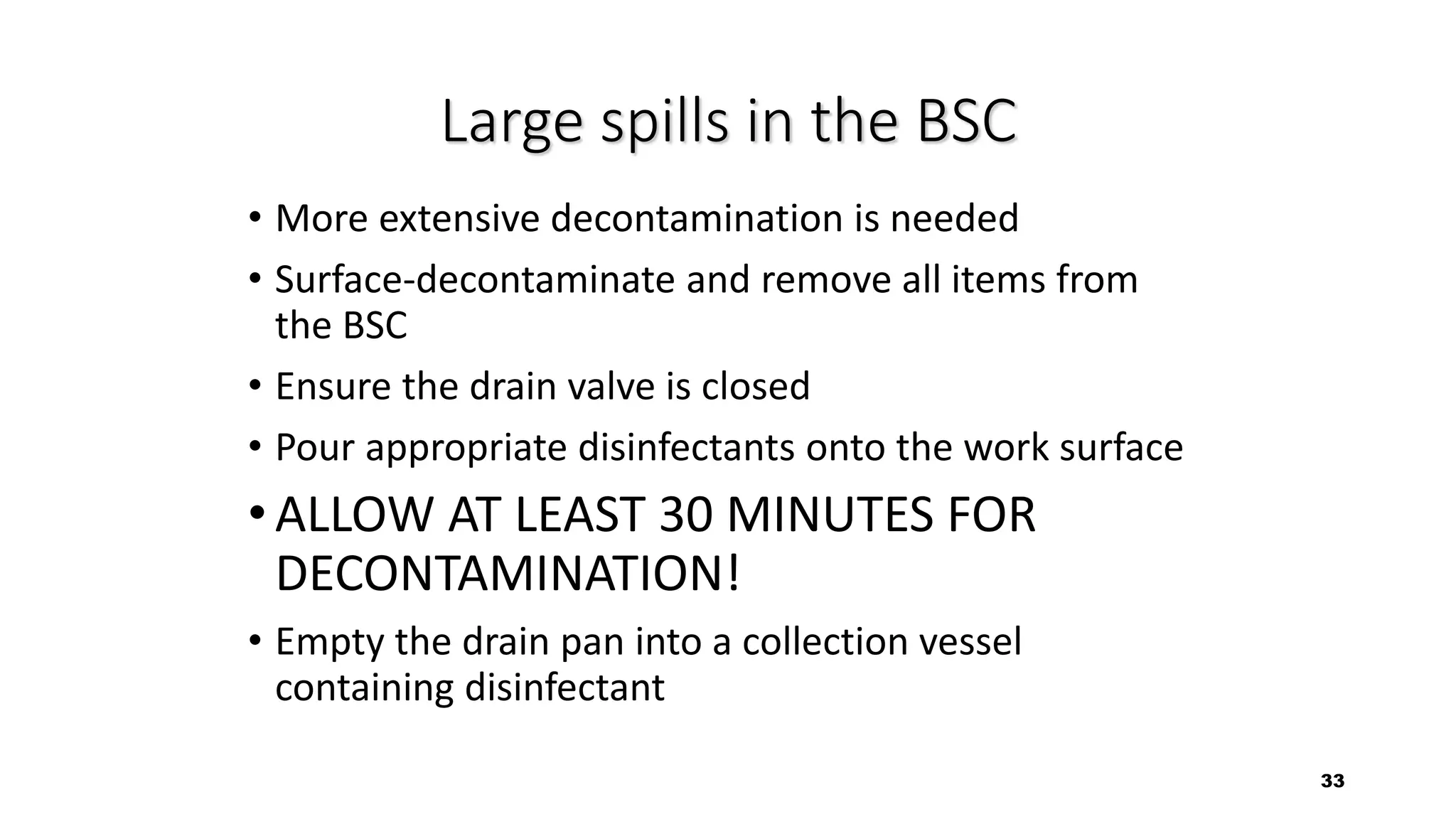
Small spills in the BSC
• Clean up spill with absorbent paper towel saturated with
disinfectant such as 5% phenol or hypochlorite
• Place contaminated absorbent paper towel into a disposable
bag while in the BSC, tie the bag and place it in container to
be autoclaved
• Change gloves if gloves have been contaminated
• Immediately wipe the interior surface and walls of the
biosafety cabinet and any items or equipment within the
cabinet with a paper towel saturated with a disinfectant
solution (5% phenol)
33
Large spills in the BSC
• More extensive decontamination is needed
• Surface-decontaminate and remove all items from
the BSC
• Ensure the drain valve is closed
• Pour appropriate disinfectants onto the work surface
•ALLOW AT LEAST 30 MINUTES FOR
DECONTAMINATION!
• Empty the drain pan into a collection vessel
containing disinfectant
34
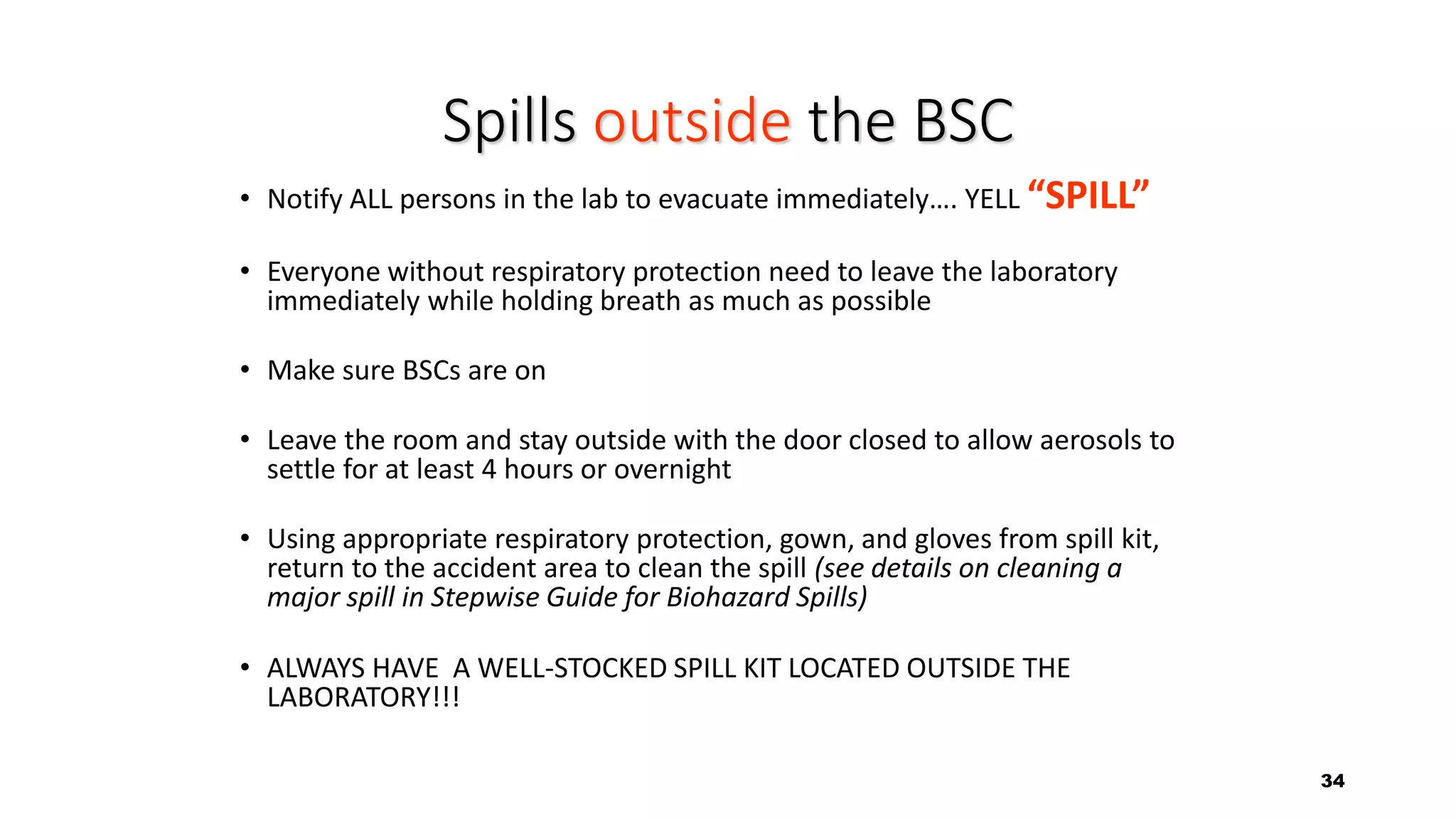
Spills outside the BSC
• Notify ALL persons in the lab to evacuate immediately…. YELL “SPILL”
• Everyone without respiratory protection need to leave the laboratory
immediately while holding breath as much as possible
• Make sure BSCs are on
• Leave the room and stay outside with the door closed to allow aerosols to
settle for at least 4 hours or overnight
• Using appropriate respiratory protection, gown, and gloves from spill kit,
return to the accident area to clean the spill (see details on cleaning a
major spill in Stepwise Guide for Biohazard Spills)
• ALWAYS HAVE A WELL-STOCKED SPILL KIT LOCATED OUTSIDE THE
LABORATORY!!!
35
Contents of the SPILL KIT
• Instructions (SOP) for spill clean-up
• Phenol disinfectant
• Biohazard signs for laboratory doors
• Autoclave bags
• Absorbent towels or cotton
• N-95 respirators
• Gown or jumpsuit
• Shoe covers
• Gloves (different sizes)
36
Spills in the centrifuge
• Tubes containing patient specimens or TB
isolates can break or leak during the stress
of centrifugation
• If a tube breaks or leaks in a centrifuge
with no safety cups follow the
procedure for a spill outside the BSC!
• Containment of tube leakage is the main
advantage of using safety cups
• Contains aerosols produced during
centrifugation
• Contains release of contaminated liquids
inside centrifuge
• Reduces risk of aerosol escape or surface
contamination during clean up
37
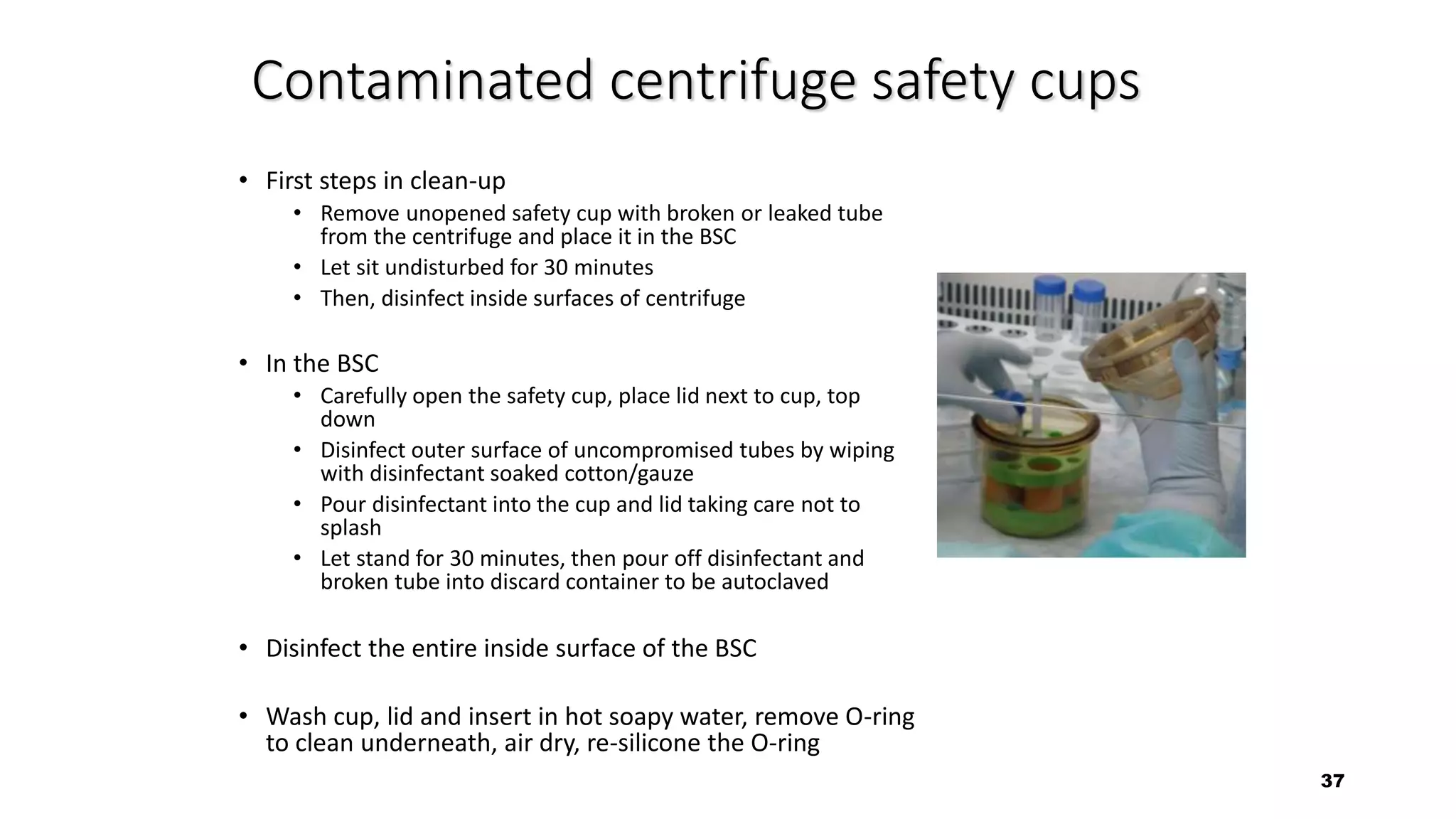
Contaminated centrifuge safety cups
• First steps in clean-up
• Remove unopened safety cup with broken or leaked tube
from the centrifuge and place it in the BSC
• Let sit undisturbed for 30 minutes
• Then, disinfect inside surfaces of centrifuge
• In the BSC
• Carefully open the safety cup, place lid next to cup, top
down
• Disinfect outer surface of uncompromised tubes by wiping
with disinfectant soaked cotton/gauze
• Pour disinfectant into the cup and lid taking care not to
splash
• Let stand for 30 minutes, then pour off disinfectant and
broken tube into discard container to be autoclaved
• Disinfect the entire inside surface of the BSC
• Wash cup, lid and insert in hot soapy water, remove O-ring
to clean underneath, air dry, re-silicone the O-ring
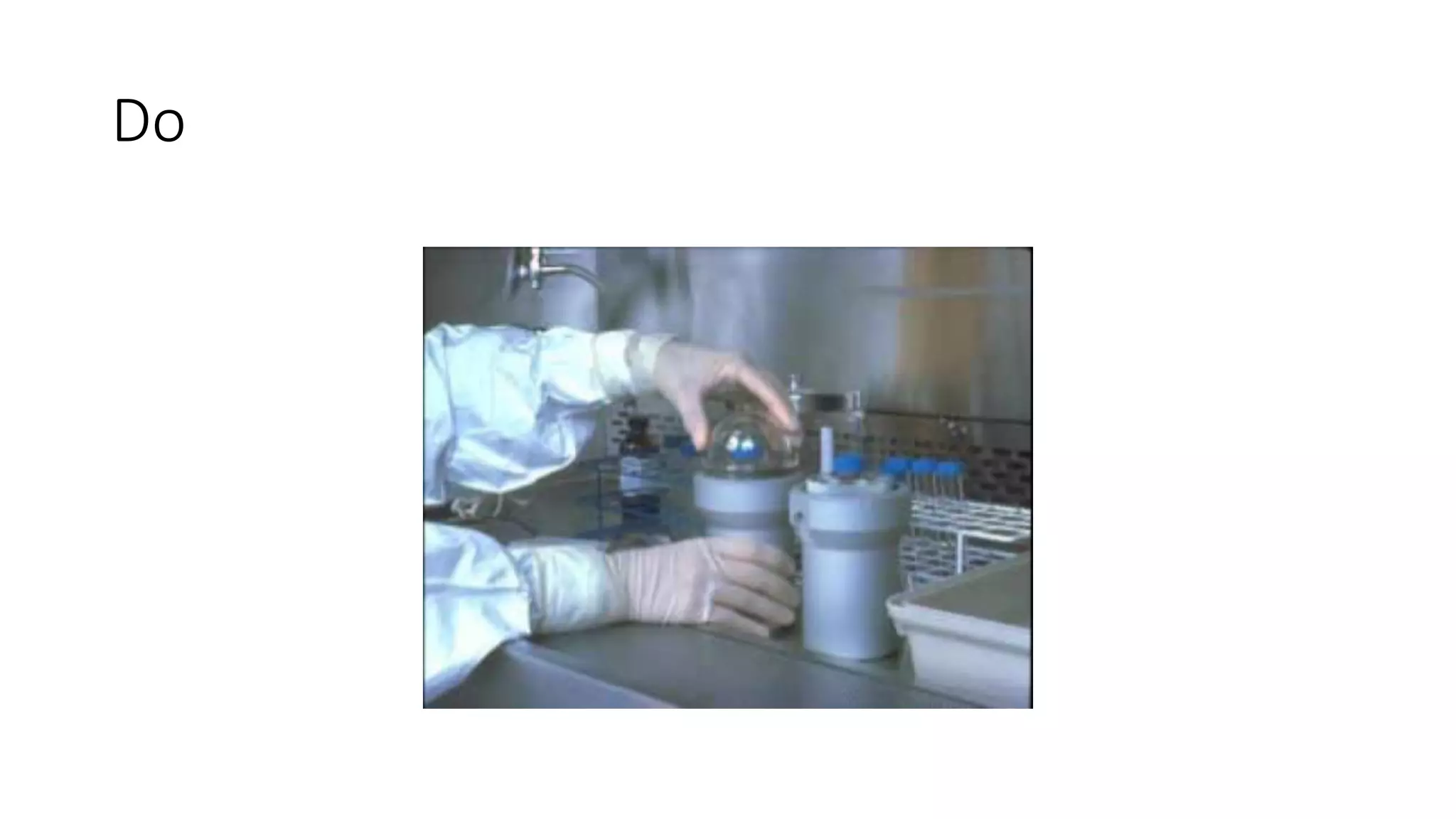
Do
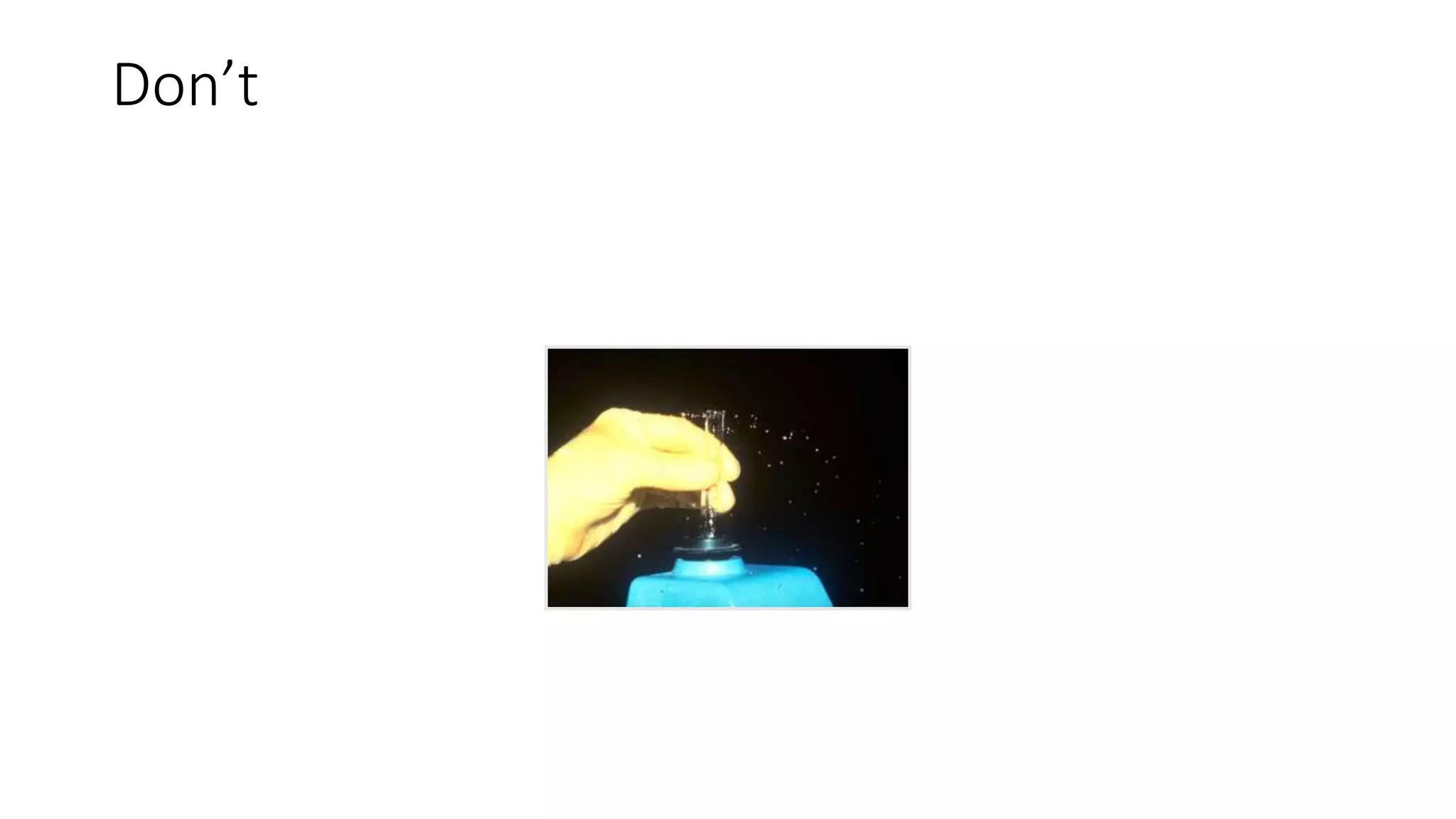
Don’t
Don’t Do
Vigorous shaking or votexing of open tube Vortexing of closed tubes
Mouth pipetting Disposable pippets
Heating of smear before air drying Proper air drying of smear
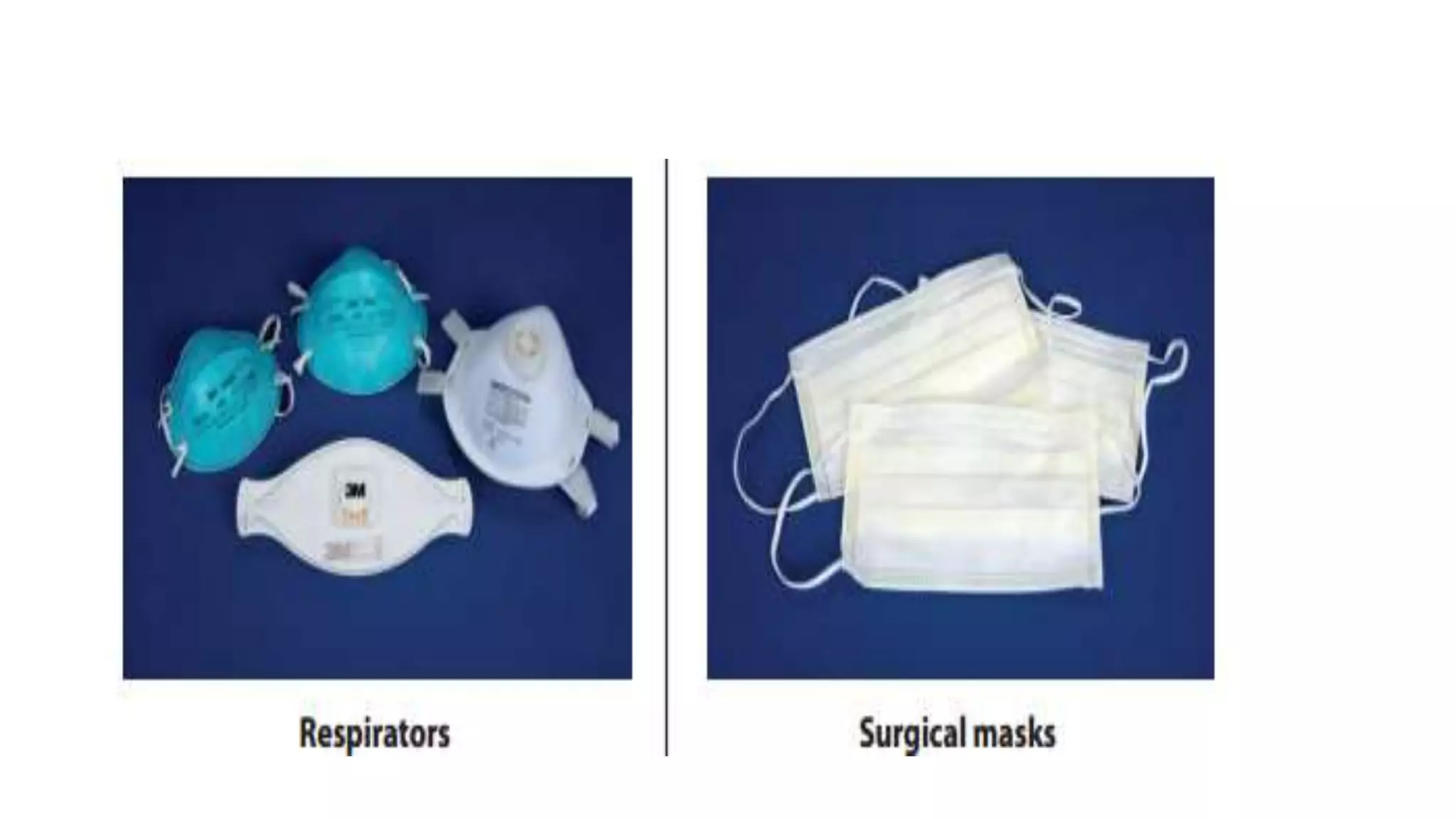
Surgical mask Respirators
Drinking, Eating, Mobile phones No eating, drinking or use of mobile phones
Entry in all rooms by all persons Restricted entry, dividing work area as clean and
contaminated
Bench works Use of biosafety cabinets
Avoiding routine check up for TB diagnosis Regular check up for TB diagnosis
•Thank you

Infection control measures in tb laboratory

  • 1.
    Infection control measures forTB Laboratory Dr. Yogita Mistry Microbiologist TB-IRL ,Surat
  • 5.
    Low Risk Laboratory •manipulate sputum specimens for direct sputum-smear microscopy; • manipulate sputum specimens for the Xpert MTB/RIF®assay
  • 6.
    Specific features andessential minimum biosafety measures • Use of bench space • Ventilation-natural/mechanical • Minimizing the generation of aerosols • Handling leaking specimen • PPE-lab coat, gloves,mask
  • 7.
    7 Lab Coats • Labcoats should close up the front and have long sleeves (closure can be snaps, buttons or velcro) • Washable and autoclavable cloth, or disposable materials • Worn for work on specimens and AFB smears, not TB culture work
  • 8.
    Factors that increasethe risk of infection • Bench spaces may be used improperly; • Specimen containers may leak • Specimens manipulated carelessly may lead to subsequent aerosolization; • Specimens may be shaken vigorously; • Ventilation or illumination may be poor.
  • 9.
    Moderate Risk TBLaboratory • Process specimens for inoculation on primary solid-culture media; • Perform direct DST (for example, direct line-probe assays, Microscopic observation drug susceptibility [MODS], Nitrate reductase assay [NRA] on processed sputum
  • 10.
    Factors that increasethe risk of infection • poor ventilation; • BSCs • The work environment • Careless manipulation of specimens • Precautions for using the vortex may not be followed • Specimen containers may break or leak during centrifuging
  • 11.
    Specific features andessential minimum biosafety measures • Biological safety cabinets • Ventilation • Personal protective equipment • Laboratory design • Decontamination and waste disposal • Minimizing the generation of aerosols
  • 12.
    12 Laboratory Gowns • Gownsshould be worn for specimen processing, TB culture and DST • Gowns should close and tie in the back • Gowns must be long- sleeved and cuffed • Gloves should be pulled over the cuff for maximum protection • Fabric should be water resistant
  • 15.
  • 20.
    High-risk TB laboratories(TB-containment laboratories) • Manipulate cultures to identify M. tuberculosis; • Manipulate cultures or suspensions of tubercle bacilli for all indirect DST methods and molecular assays.
  • 21.
    Factors that increasethe risk of infection • Staff must open positive culture vials; • Staff must prepare smears from positive cultures; • DNA extraction must be performed on a positive culture; • Manipulation of cultures for identifi cation and indirect DST; • Broken culture containers must be disposed of; • Cultures or areas where spills occurred must be decontaminated.
  • 22.
    Specific features andrequired biosafety measures • Laboratory design • Personal protective equipment • Decontamination and waste disposal facility
  • 23.
    Safety equipments • Biosafetycabinets • Centrifuges with safety buckets • Autoclaves
  • 24.
    24 4 Main Typesof Disinfectants •Phenol-based •Hypochlorite (bleach) •Peroxygens (peracetic acid) •Alcohol
  • 25.
    25 Phenol-based Disinfectants • Mainuses for phenol-based disinfectants: • In discard containers that are used for: • Decanting contaminated liquids • Discarding contaminated supplies • Surface decontamination • Clean up of spills – both major and minor, inside and outside BSC • For phenol-based disinfectants to be effective • Disinfectant must be left in contact with contaminated material for at least 15 minutes to ensure killing
  • 26.
    26 Phenol-based disinfectant Tuberculocidal Commercially-available Phenolic Disinfectants •Many commercial disinfectants use phenol derivatives • Some phenolic derivatives are inactivated by water hardness and should be diluted to the appropriate concentration using de-ionized water • Check to ensure the product is labeled tuberculocidal
  • 27.
    27 Chemical Safety: Phenolcrystals • Phenol is corrosive and highly irritating to the skin, eyes, and mucous membranes • Gloves must be worn when handling phenol crystals • Spills must be carefully cleaned up • Phenol disinfectant solutions should be prepared weekly to ensure efficient killing of TB (labeled with date of preparation)
  • 28.
    28 Hypochlorite (Bleach) • Mainuses for hypochlorite (bleach) • In discard containers that are used for: • Decanting contaminated liquids • Discarding contaminated supplies • Surface decontamination • For hypochlorite disinfectants to be effective in killing TB • Disinfectant must be left in contact with contaminated material for at least 15 minutes • Diluted solution must be prepared daily because escape of chlorine gas lessens disinfectant activity • Know initial percentage of NaOCl in concentrated solution • Final chlorine concentration should not fall below 0.5%
  • 29.
    29 Hypochlorite (Bleach) isCorrosive • Bleach, even in diluted solutions, is irritating to the skin and VERY corrosive to metal and plastic surfaces (such as BSCs, centrifuges, pipettors) • If used to disinfect metal and plastic surfaces: • Wash the surface with sterile water or 70% alcohol after the bleach has disinfected the area (for at least 15 minutes)
  • 30.
    30 Alcohol • Alcohol usedas a surface disinfectant • Surface decontamination on both skin and work surfaces • Denatured ethanol diluted and used as 70% solution • Safe for use on metal (BSCs, centrifuges, other equipment) • Major advantage: will not corrode or leave a residue on treated items • High evaporation rate: An absorbent surface that is sprayed with 70% Alcohol has disinfection activity for only 20 minutes – not appropriate for specimen processing
  • 31.
    31 Spills • When aspill occurs the laboratory staff must first decide how to react • The actions required are dependent on: • Where the spill occurred • Inside the BSC • Outside the BSC • The severity of the spill • Type of culture (solid or liquid) • Amount of live organisms involved
  • 32.
    32 Small spills inthe BSC • Clean up spill with absorbent paper towel saturated with disinfectant such as 5% phenol or hypochlorite • Place contaminated absorbent paper towel into a disposable bag while in the BSC, tie the bag and place it in container to be autoclaved • Change gloves if gloves have been contaminated • Immediately wipe the interior surface and walls of the biosafety cabinet and any items or equipment within the cabinet with a paper towel saturated with a disinfectant solution (5% phenol)
  • 33.
    33 Large spills inthe BSC • More extensive decontamination is needed • Surface-decontaminate and remove all items from the BSC • Ensure the drain valve is closed • Pour appropriate disinfectants onto the work surface •ALLOW AT LEAST 30 MINUTES FOR DECONTAMINATION! • Empty the drain pan into a collection vessel containing disinfectant
  • 34.
    34 Spills outside theBSC • Notify ALL persons in the lab to evacuate immediately…. YELL “SPILL” • Everyone without respiratory protection need to leave the laboratory immediately while holding breath as much as possible • Make sure BSCs are on • Leave the room and stay outside with the door closed to allow aerosols to settle for at least 4 hours or overnight • Using appropriate respiratory protection, gown, and gloves from spill kit, return to the accident area to clean the spill (see details on cleaning a major spill in Stepwise Guide for Biohazard Spills) • ALWAYS HAVE A WELL-STOCKED SPILL KIT LOCATED OUTSIDE THE LABORATORY!!!
  • 35.
    35 Contents of theSPILL KIT • Instructions (SOP) for spill clean-up • Phenol disinfectant • Biohazard signs for laboratory doors • Autoclave bags • Absorbent towels or cotton • N-95 respirators • Gown or jumpsuit • Shoe covers • Gloves (different sizes)
  • 36.
    36 Spills in thecentrifuge • Tubes containing patient specimens or TB isolates can break or leak during the stress of centrifugation • If a tube breaks or leaks in a centrifuge with no safety cups follow the procedure for a spill outside the BSC! • Containment of tube leakage is the main advantage of using safety cups • Contains aerosols produced during centrifugation • Contains release of contaminated liquids inside centrifuge • Reduces risk of aerosol escape or surface contamination during clean up
  • 37.
    37 Contaminated centrifuge safetycups • First steps in clean-up • Remove unopened safety cup with broken or leaked tube from the centrifuge and place it in the BSC • Let sit undisturbed for 30 minutes • Then, disinfect inside surfaces of centrifuge • In the BSC • Carefully open the safety cup, place lid next to cup, top down • Disinfect outer surface of uncompromised tubes by wiping with disinfectant soaked cotton/gauze • Pour disinfectant into the cup and lid taking care not to splash • Let stand for 30 minutes, then pour off disinfectant and broken tube into discard container to be autoclaved • Disinfect the entire inside surface of the BSC • Wash cup, lid and insert in hot soapy water, remove O-ring to clean underneath, air dry, re-silicone the O-ring
  • 38.
  • 39.
  • 43.
    Don’t Do Vigorous shakingor votexing of open tube Vortexing of closed tubes Mouth pipetting Disposable pippets Heating of smear before air drying Proper air drying of smear Surgical mask Respirators Drinking, Eating, Mobile phones No eating, drinking or use of mobile phones Entry in all rooms by all persons Restricted entry, dividing work area as clean and contaminated Bench works Use of biosafety cabinets Avoiding routine check up for TB diagnosis Regular check up for TB diagnosis
  • 44.