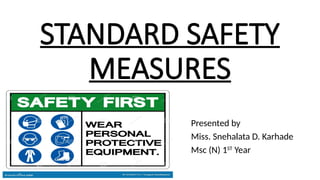
STANDARD SAFETY
MEASURES
Presented by
Miss. Snehalata D. Karhade
Msc (N) 1ST
Year
 GENERAL OBJECTIVE:
At the end of the class, student will be able to gain in depth knowledge regarding
Standard safety measures and apply this knowledge in routine clinical practice.
SPECIFIC OBJECTIVE: Student will be able to,
• To introduce Standard safety measures
• To define Standard safety measures
• To Discuss Principles of standard safety measures
• To Enlist Standard precautions in medical and surgical asepsis
• To Explain Handwashing
• To Describe Gloving
• To Identify Mask and protective eyewear
• To Discuss disposing of contaminated equipment
• To Explain Disinfection
• To discuss Surgical Asepsis
• To Describe of managing injuries
STANDARD SAFETY MEASURES
INTRODUCTION
Standard safety measures are a set of infection control practices used
to prevent transmission of diseases that can be acquired by contact
with blood, body fluids, non-intact skin (including rashes), and mucous
membranes.
These measures are to be used when providing care to all individuals,
whether or not they appear infectious or symptomatic.
DEFINITION
• Standard Safety measures are the minimum infection
prevention practices that should be used in the care
of all patients all of the time. These practices are
designed to both, protect the healthcare worker and
to prevent the healthcare worker from spreading
infections among patients.
Principles of standard safety measures
• it help to control the communicable disease in hospital
• it prevent the harmful infection in hospital or other health care center
• its prevents the transmission of infection or disease
• to prevent the cross infection in hospitals
STANDARD PRECAUTIONS
IN MEDICAL ASEPSIS AND
SURGICAL ASEPSIS
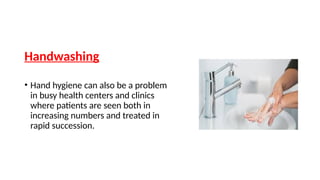
Handwashing
• Hand hygiene can also be a problem
in busy health centers and clinics
where patients are seen both in
increasing numbers and treated in
rapid succession.
5 Moments of
Handhygiene
Three Kinds of Handwashing
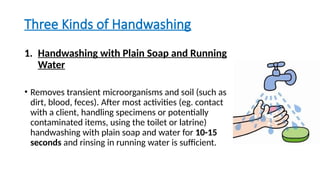
1. Handwashing with Plain Soap and Running
Water
• Removes transient microorganisms and soil (such as
dirt, blood, feces). After most activities (eg. contact
with a client, handling specimens or potentially
contaminated items, using the toilet or latrine)
handwashing with plain soap and water for 10-15
seconds and rinsing in running water is sufficient.
2. Handwashing with Antiseptic Soap and Running Water
• This type of handwashing is appropriate in high-risk situations (such
as before invasive procedures or contact with immuno-compromised
clients at high risk of infection).
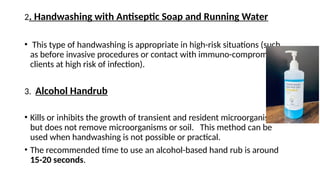
3. Alcohol Handrub
• Kills or inhibits the growth of transient and resident microorganisms
but does not remove microorganisms or soil. This method can be
used when handwashing is not possible or practical.
• The recommended time to use an alcohol-based hand rub is around
15-20 seconds.
Gloving
Gloves provide a barrier against potentially infectious
microorganisms that can be found in blood, other body
fluids, and waste. Gloves act as a barrier that protects
healthcare workers and clients.
• The Three Kinds of Gloves
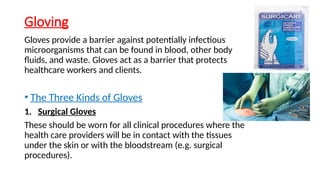
1. Surgical Gloves
These should be worn for all clinical procedures where the
health care providers will be in contact with the tissues
under the skin or with the bloodstream (e.g. surgical
procedures).
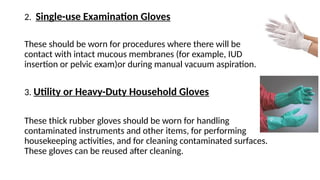
2. Single-use Examination Gloves
These should be worn for procedures where there will be
contact with intact mucous membranes (for example, IUD
insertion or pelvic exam)or during manual vacuum aspiration.
3. Utility or Heavy-Duty Household Gloves
These thick rubber gloves should be worn for handling
contaminated instruments and other items, for performing
housekeeping activities, and for cleaning contaminated surfaces.
These gloves can be reused after cleaning.
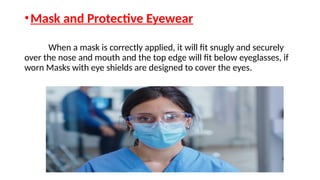
•Mask and Protective Eyewear
When a mask is correctly applied, it will fit snugly and securely
over the nose and mouth and the top edge will fit below eyeglasses, if
worn Masks with eye shields are designed to cover the eyes.
Disposing of Contaminated Equipment
• The Steps of Processing
1. • Decontamination
2. • Cleaning
3. • Either sterilization or high-level disinfection,
4. • Storage
• 1. Decontamination
• The first step in processing instruments and other items for reuse,
decontamination kills viruses (such as hepatitis B, other hepatitis
viruses, and HIV) and many other micorganisms.
• The decontamination solution:
To decontaminate items, use a 0.5% chlorine solution
• 2. Cleaning
• Cleaning refers to scrubbing with a brush, detergent, and
water to remove blood, other body fluids, organic material,
tissue, and dirt.
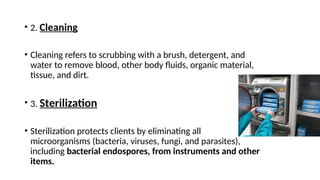
• 3. Sterilization
• Sterilization protects clients by eliminating all
microorganisms (bacteria, viruses, fungi, and parasites),
including bacterial endospores, from instruments and other
items.
Methods of Sterilization
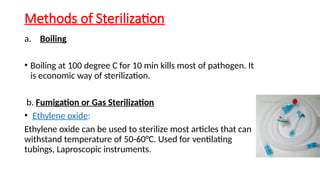
a. Boiling
• Boiling at 100 degree C for 10 min kills most of pathogen. It
is economic way of sterilization.
b. Fumigation or Gas Sterilization
• Ethylene oxide:
Ethylene oxide can be used to sterilize most articles that can
withstand temperature of 50-60°C. Used for ventilating
tubings, Laproscopic instruments.
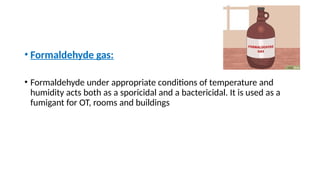
• Formaldehyde gas:
• Formaldehyde under appropriate conditions of temperature and
humidity acts both as a sporicidal and a bactericidal. It is used as a
fumigant for OT, rooms and buildings
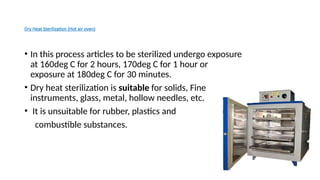
Dry Heat Sterilization (Hot air oven)
• In this process articles to be sterilized undergo exposure
at 160deg C for 2 hours, 170deg C for 1 hour or
exposure at 180deg C for 30 minutes.
• Dry heat sterilization is suitable for solids, Fine
instruments, glass, metal, hollow needles, etc.
• It is unsuitable for rubber, plastics and
combustible substances.
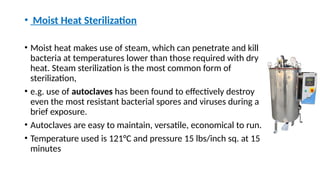
• Moist Heat Sterilization
• Moist heat makes use of steam, which can penetrate and kill
bacteria at temperatures lower than those required with dry
heat. Steam sterilization is the most common form of
sterilization,
• e.g. use of autoclaves has been found to effectively destroy
even the most resistant bacterial spores and viruses during a
brief exposure.
• Autoclaves are easy to maintain, versatile, economical to run.
• Temperature used is 121°C and pressure 15 lbs/inch sq. at 15
minutes
SURGICAL ASEPSIS
• • Surgical scrub.
• • Using barriers (surgical attire).
• • Client prep (preparing a client for clinical procedures).
• • Maintaining a sterile field.
• • Using safe operative technique (making small incisions, avoiding trauma
to tissue and surrounding structures, and controlling bleeding).
• • Maintaining a safer environment in the surgical/procedure area.
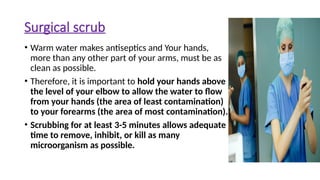
Surgical scrub
• Warm water makes antiseptics and Your hands,
more than any other part of your arms, must be as
clean as possible.
• Therefore, it is important to hold your hands above
the level of your elbow to allow the water to flow
from your hands (the area of least contamination)
to your forearms (the area of most contamination).
• Scrubbing for at least 3-5 minutes allows adequate
time to remove, inhibit, or kill as many
microorganism as possible.
Surgical Attire
• Surgical attire acts as a barrier that protects clients from exposure to
microorganisms
• These barriers include surgical gloves, caps, masks, gowns, protective
eyewear, waterproof aprons, and sturdy footwear.
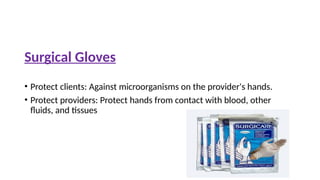
Surgical Gloves
• Protect clients: Against microorganisms on the provider's hands.
• Protect providers: Protect hands from contact with blood, other
fluids, and tissues
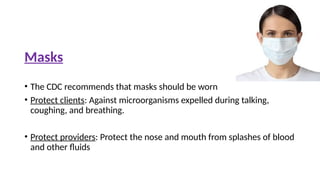
Masks
• The CDC recommends that masks should be worn
• Protect clients: Against microorganisms expelled during talking,
coughing, and breathing.
• Protect providers: Protect the nose and mouth from splashes of blood
and other fluids
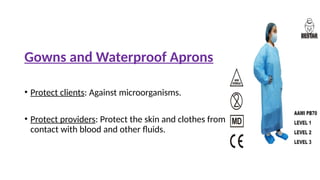
Gowns and Waterproof Aprons
• Protect clients: Against microorganisms.
• Protect providers: Protect the skin and clothes from
contact with blood and other fluids.
Caps
• Protect clients: Against microorganisms in hair and skin shed from the
provider's head
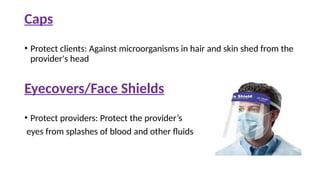
Eyecovers/Face Shields
• Protect providers: Protect the provider’s
eyes from splashes of blood and other fluids
To Maintain the Sterile Field
• Do not place sterile items near open windows or doors.
• Do not contaminate sterile items when opening, dispensing, or
transferring them.
• Do not allow sterile personnel to reach across unsterile area or to
touch unsterile items.
• Recognize that the edges of a package containing a sterile item are
considered unsterile.
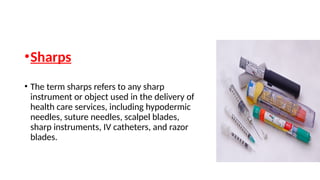
•Sharps
• The term sharps refers to any sharp
instrument or object used in the delivery of
health care services, including hypodermic
needles, suture needles, scalpel blades,
sharp instruments, IV catheters, and razor
blades.
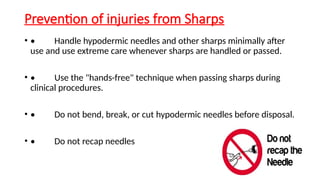
Prevention of injuries from Sharps
• • Handle hypodermic needles and other sharps minimally after
use and use extreme care whenever sharps are handled or passed.
• • Use the "hands-free" technique when passing sharps during
clinical procedures.
• • Do not bend, break, or cut hypodermic needles before disposal.
• • Do not recap needles
Safe-passing of Sharp Instruments
• Uncapped or otherwise unprotected sharps should never be passed
directly from one person to another. In the operating theater or
procedure room, pass sharp instruments in such a way that the
surgeon and assistant are never touching the item at the same time.
• This way of passing sharps is known as the "hands-free" technique
Managing Injuries and Exposure
• If you are accidentally exposed to blood or other body fluids, either by
a needlestick, an injury from another sharp object, or a splash of fluid
• • Wash the needlestick site or cut with soap and water.
• • Flush splashes to the nose, mouth, or skin with water.
• • Irrigate splashes to the eyes with water or saline.
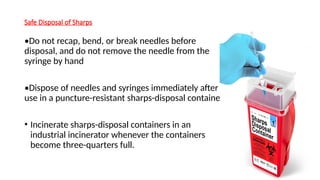
Safe Disposal of Sharps
•Do not recap, bend, or break needles before
disposal, and do not remove the needle from the
syringe by hand
•Dispose of needles and syringes immediately after
use in a puncture-resistant sharps-disposal container.
• Incinerate sharps-disposal containers in an
industrial incinerator whenever the containers
become three-quarters full.
SUMMARY
So far we have discussed about
• Introduction of Standard safety measures
• Definition
• Principles
• Standard precaution in medical and surgical asepsis
• 5 moments of handwashing
• Gloving
• Disposing of contaminated equipment
• Disinfection
• Managing injuries
• Postexposure prophylaxis
Conclusion
• Standard precautions are the work practices required to achieve a
basic level of infection prevention and control. Standard precautions
are the minimum infection prevention and control practices that must
be used at all times for all patients in all situations
Research evidence
• A study to assess the knowledge regarding standard safety precautions in labour ward among
nursing students posted at Narayana medical college hospital, Nellore, Andhra Pradesh
• Aim: The aim of the study was to assess knowledge on standard safety precautions in labour ward
• Objectives: 1. To assess the level of knowledge regarding safety measures among nursing students.
2. To associate the level of knowledge with selected demographic variables
• Methodology: 100 nursing students posted in labour ward at NMCH, Nellore were selected by
using probability simple random sampling method.
• Results: Regarding the level of knowledge among nursing students
• 95(95%) were had average knowledge,
• 4(4%) were had good knowledge
• 1(1%) were had poor knowledge regarding safety
ASSIGNMENT
•Write a sequence of Donning and Doffing
Bibliography
• 1) BS Nagoba, Microbiology for nurses, 3rd edition, published by
Wolters Kluwer, page no. 418 to 420.
• 2) Navdeep Kaur Brar, HC Rawat Textbook of Advanced Nursing
Practice; 1st edition published by Jaypee Brothers page no. 514-524
• 3) Shebeer P. Basheer, S. Yaseen Khan A Concise text book of
Advanced Nursing Practice; 3rd edition Published by Emmess Medical
Publishers Page no.345-349
• 4) https://www.slideshare.net
5) https://www.medicinenet.com

ssm ppt.pptx standardised safety measure

ssm ppt.pptx standardised safety measure

  • 2.
    STANDARD SAFETY MEASURES Presented by Miss.Snehalata D. Karhade Msc (N) 1ST Year
  • 3.
     GENERAL OBJECTIVE: Atthe end of the class, student will be able to gain in depth knowledge regarding Standard safety measures and apply this knowledge in routine clinical practice. SPECIFIC OBJECTIVE: Student will be able to, • To introduce Standard safety measures • To define Standard safety measures • To Discuss Principles of standard safety measures • To Enlist Standard precautions in medical and surgical asepsis • To Explain Handwashing • To Describe Gloving • To Identify Mask and protective eyewear • To Discuss disposing of contaminated equipment • To Explain Disinfection • To discuss Surgical Asepsis • To Describe of managing injuries
  • 4.
    STANDARD SAFETY MEASURES INTRODUCTION Standardsafety measures are a set of infection control practices used to prevent transmission of diseases that can be acquired by contact with blood, body fluids, non-intact skin (including rashes), and mucous membranes. These measures are to be used when providing care to all individuals, whether or not they appear infectious or symptomatic.
  • 5.
    DEFINITION • Standard Safetymeasures are the minimum infection prevention practices that should be used in the care of all patients all of the time. These practices are designed to both, protect the healthcare worker and to prevent the healthcare worker from spreading infections among patients.
  • 6.
    Principles of standardsafety measures • it help to control the communicable disease in hospital • it prevent the harmful infection in hospital or other health care center • its prevents the transmission of infection or disease • to prevent the cross infection in hospitals
  • 7.
    STANDARD PRECAUTIONS IN MEDICALASEPSIS AND SURGICAL ASEPSIS
  • 8.
    Handwashing • Hand hygienecan also be a problem in busy health centers and clinics where patients are seen both in increasing numbers and treated in rapid succession.

  • 9.
  • 10.
    Three Kinds ofHandwashing 1. Handwashing with Plain Soap and Running Water • Removes transient microorganisms and soil (such as dirt, blood, feces). After most activities (eg. contact with a client, handling specimens or potentially contaminated items, using the toilet or latrine) handwashing with plain soap and water for 10-15 seconds and rinsing in running water is sufficient.
  • 11.
    2. Handwashing withAntiseptic Soap and Running Water • This type of handwashing is appropriate in high-risk situations (such as before invasive procedures or contact with immuno-compromised clients at high risk of infection). 3. Alcohol Handrub • Kills or inhibits the growth of transient and resident microorganisms but does not remove microorganisms or soil. This method can be used when handwashing is not possible or practical. • The recommended time to use an alcohol-based hand rub is around 15-20 seconds.
  • 12.
    Gloving Gloves provide abarrier against potentially infectious microorganisms that can be found in blood, other body fluids, and waste. Gloves act as a barrier that protects healthcare workers and clients. • The Three Kinds of Gloves 1. Surgical Gloves These should be worn for all clinical procedures where the health care providers will be in contact with the tissues under the skin or with the bloodstream (e.g. surgical procedures).
  • 13.
    2. Single-use ExaminationGloves These should be worn for procedures where there will be contact with intact mucous membranes (for example, IUD insertion or pelvic exam)or during manual vacuum aspiration. 3. Utility or Heavy-Duty Household Gloves These thick rubber gloves should be worn for handling contaminated instruments and other items, for performing housekeeping activities, and for cleaning contaminated surfaces. These gloves can be reused after cleaning.
  • 14.
    •Mask and ProtectiveEyewear When a mask is correctly applied, it will fit snugly and securely over the nose and mouth and the top edge will fit below eyeglasses, if worn Masks with eye shields are designed to cover the eyes.
  • 15.
    Disposing of ContaminatedEquipment • The Steps of Processing 1. • Decontamination 2. • Cleaning 3. • Either sterilization or high-level disinfection, 4. • Storage
  • 16.
    • 1. Decontamination •The first step in processing instruments and other items for reuse, decontamination kills viruses (such as hepatitis B, other hepatitis viruses, and HIV) and many other micorganisms. • The decontamination solution: To decontaminate items, use a 0.5% chlorine solution
  • 17.
    • 2. Cleaning •Cleaning refers to scrubbing with a brush, detergent, and water to remove blood, other body fluids, organic material, tissue, and dirt. • 3. Sterilization • Sterilization protects clients by eliminating all microorganisms (bacteria, viruses, fungi, and parasites), including bacterial endospores, from instruments and other items.
  • 18.
    Methods of Sterilization a.Boiling • Boiling at 100 degree C for 10 min kills most of pathogen. It is economic way of sterilization. b. Fumigation or Gas Sterilization • Ethylene oxide: Ethylene oxide can be used to sterilize most articles that can withstand temperature of 50-60°C. Used for ventilating tubings, Laproscopic instruments.
  • 19.
    • Formaldehyde gas: •Formaldehyde under appropriate conditions of temperature and humidity acts both as a sporicidal and a bactericidal. It is used as a fumigant for OT, rooms and buildings
  • 20.
    Dry Heat Sterilization(Hot air oven) • In this process articles to be sterilized undergo exposure at 160deg C for 2 hours, 170deg C for 1 hour or exposure at 180deg C for 30 minutes. • Dry heat sterilization is suitable for solids, Fine instruments, glass, metal, hollow needles, etc. • It is unsuitable for rubber, plastics and combustible substances.
  • 21.
    • Moist HeatSterilization • Moist heat makes use of steam, which can penetrate and kill bacteria at temperatures lower than those required with dry heat. Steam sterilization is the most common form of sterilization, • e.g. use of autoclaves has been found to effectively destroy even the most resistant bacterial spores and viruses during a brief exposure. • Autoclaves are easy to maintain, versatile, economical to run. • Temperature used is 121°C and pressure 15 lbs/inch sq. at 15 minutes
  • 22.
    SURGICAL ASEPSIS • •Surgical scrub. • • Using barriers (surgical attire). • • Client prep (preparing a client for clinical procedures). • • Maintaining a sterile field. • • Using safe operative technique (making small incisions, avoiding trauma to tissue and surrounding structures, and controlling bleeding). • • Maintaining a safer environment in the surgical/procedure area.
  • 23.
    Surgical scrub • Warmwater makes antiseptics and Your hands, more than any other part of your arms, must be as clean as possible. • Therefore, it is important to hold your hands above the level of your elbow to allow the water to flow from your hands (the area of least contamination) to your forearms (the area of most contamination). • Scrubbing for at least 3-5 minutes allows adequate time to remove, inhibit, or kill as many microorganism as possible.
  • 24.
    Surgical Attire • Surgicalattire acts as a barrier that protects clients from exposure to microorganisms • These barriers include surgical gloves, caps, masks, gowns, protective eyewear, waterproof aprons, and sturdy footwear.
  • 25.
    Surgical Gloves • Protectclients: Against microorganisms on the provider's hands. • Protect providers: Protect hands from contact with blood, other fluids, and tissues
  • 26.
    Masks • The CDCrecommends that masks should be worn • Protect clients: Against microorganisms expelled during talking, coughing, and breathing. • Protect providers: Protect the nose and mouth from splashes of blood and other fluids
  • 27.
    Gowns and WaterproofAprons • Protect clients: Against microorganisms. • Protect providers: Protect the skin and clothes from contact with blood and other fluids.
  • 28.
    Caps • Protect clients:Against microorganisms in hair and skin shed from the provider's head Eyecovers/Face Shields • Protect providers: Protect the provider’s eyes from splashes of blood and other fluids
  • 29.
    To Maintain theSterile Field • Do not place sterile items near open windows or doors. • Do not contaminate sterile items when opening, dispensing, or transferring them. • Do not allow sterile personnel to reach across unsterile area or to touch unsterile items. • Recognize that the edges of a package containing a sterile item are considered unsterile.
  • 30.
    •Sharps • The termsharps refers to any sharp instrument or object used in the delivery of health care services, including hypodermic needles, suture needles, scalpel blades, sharp instruments, IV catheters, and razor blades.
  • 31.
    Prevention of injuriesfrom Sharps • • Handle hypodermic needles and other sharps minimally after use and use extreme care whenever sharps are handled or passed. • • Use the "hands-free" technique when passing sharps during clinical procedures. • • Do not bend, break, or cut hypodermic needles before disposal. • • Do not recap needles
  • 32.
    Safe-passing of SharpInstruments • Uncapped or otherwise unprotected sharps should never be passed directly from one person to another. In the operating theater or procedure room, pass sharp instruments in such a way that the surgeon and assistant are never touching the item at the same time. • This way of passing sharps is known as the "hands-free" technique
  • 33.
    Managing Injuries andExposure • If you are accidentally exposed to blood or other body fluids, either by a needlestick, an injury from another sharp object, or a splash of fluid • • Wash the needlestick site or cut with soap and water. • • Flush splashes to the nose, mouth, or skin with water. • • Irrigate splashes to the eyes with water or saline.
  • 35.
    Safe Disposal ofSharps •Do not recap, bend, or break needles before disposal, and do not remove the needle from the syringe by hand •Dispose of needles and syringes immediately after use in a puncture-resistant sharps-disposal container. • Incinerate sharps-disposal containers in an industrial incinerator whenever the containers become three-quarters full.
  • 36.
    SUMMARY So far wehave discussed about • Introduction of Standard safety measures • Definition • Principles • Standard precaution in medical and surgical asepsis • 5 moments of handwashing • Gloving • Disposing of contaminated equipment • Disinfection • Managing injuries • Postexposure prophylaxis
  • 37.
    Conclusion • Standard precautionsare the work practices required to achieve a basic level of infection prevention and control. Standard precautions are the minimum infection prevention and control practices that must be used at all times for all patients in all situations
  • 38.
    Research evidence • Astudy to assess the knowledge regarding standard safety precautions in labour ward among nursing students posted at Narayana medical college hospital, Nellore, Andhra Pradesh • Aim: The aim of the study was to assess knowledge on standard safety precautions in labour ward • Objectives: 1. To assess the level of knowledge regarding safety measures among nursing students. 2. To associate the level of knowledge with selected demographic variables • Methodology: 100 nursing students posted in labour ward at NMCH, Nellore were selected by using probability simple random sampling method. • Results: Regarding the level of knowledge among nursing students • 95(95%) were had average knowledge, • 4(4%) were had good knowledge • 1(1%) were had poor knowledge regarding safety
  • 39.
    ASSIGNMENT •Write a sequenceof Donning and Doffing
  • 40.
    Bibliography • 1) BSNagoba, Microbiology for nurses, 3rd edition, published by Wolters Kluwer, page no. 418 to 420. • 2) Navdeep Kaur Brar, HC Rawat Textbook of Advanced Nursing Practice; 1st edition published by Jaypee Brothers page no. 514-524 • 3) Shebeer P. Basheer, S. Yaseen Khan A Concise text book of Advanced Nursing Practice; 3rd edition Published by Emmess Medical Publishers Page no.345-349 • 4) https://www.slideshare.net 5) https://www.medicinenet.com