Dr. Moustapha Ahmed Ramadan
Head of Infection Control Department
Al-Adan Hospital
March 2016
1
Environmental Contamination
 There is excellent evidence in the scientific
literature that environmental contamination plays
an important role in the transmission of several
key healthcare-associated pathogens.
 Including methicillin-resistant Staphylococcus
aureus [MRSA] , vancomycin-resistant
Enterococcus [VRE], Acinetobacter, norovirus, and
Clostridium difficile.
2
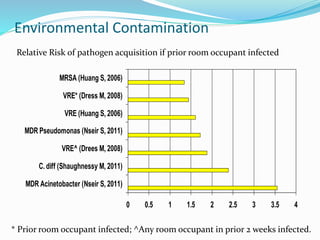
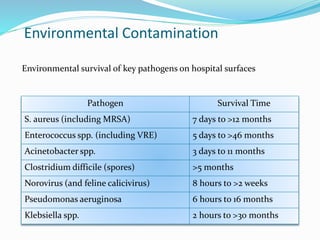
Environmental Contamination
 Admission to a room previously occupied by a
patient colonized or infected with certain
nosocomial pathogens increases the risk of
acquisition by subsequent occupants.
 Studies showed that inadequate terminal cleaning
of rooms, patients acquire the organism
• directly from contaminated surfaces
• from HCWs who contaminate their hands in
the room
3
Environmental Contamination
 While routine cleaning can reduce the microbiological
burden in a patient room it does not always eliminate
the presence of bacteria and hence risk of infection.
 Traditional cleaning strategies do not remove all
environmental MDROs.
 The complications of room topology, and the presence
of dust, grime or biofilm significantly increase the
resistance of bacteria to decontamination methods.
4
• Housekeepers and nursing staff often do not agree on
who should clean what
• Housekeepers do not always understand
– Which detergent/disinfectant to use
– What concentration should be used
• Other contributing factors
– Staff shortages and frequent turnover of personnel
with demands for fast room.
Environmental Contamination
5
Environmental Contamination
0 0.5 1 1.5 2 2.5 3 3.5 4
MDR Acinetobacter (Nseir S, 2011)
C. diff (Shaughnessy M, 2011)
VRE^ (Drees M, 2008)
MDR Pseudomonas (Nseir S, 2011)
VRE (Huang S, 2006)
VRE* (Dress M, 2008)
MRSA (Huang S, 2006)
* Prior room occupant infected; ^Any room occupant in prior 2 weeks infected.
Relative Risk of pathogen acquisition if prior room occupant infected
Environmental Contamination
Pathogen Survival Time
S. aureus (including MRSA) 7 days to >12 months
Enterococcus spp. (including VRE) 5 days to >46 months
Acinetobacter spp. 3 days to 11 months
Clostridium difficile (spores) >5 months
Norovirus (and feline calicivirus) 8 hours to >2 weeks
Pseudomonas aeruginosa 6 hours to 16 months
Klebsiella spp. 2 hours to >30 months
Environmental survival of key pathogens on hospital surfaces
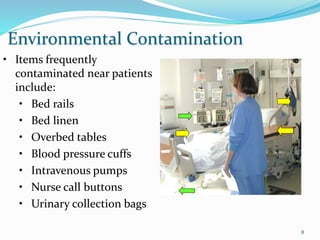
Environmental Contamination
• Items frequently
contaminated near patients
include:
• Bed rails
• Bed linen
• Overbed tables
• Blood pressure cuffs
• Intravenous pumps
• Nurse call buttons
• Urinary collection bags
8
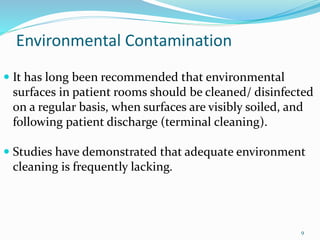
Environmental Contamination
 It has long been recommended that environmental
surfaces in patient rooms should be cleaned/ disinfected
on a regular basis, when surfaces are visibly soiled, and
following patient discharge (terminal cleaning).
 Studies have demonstrated that adequate environment
cleaning is frequently lacking.
9
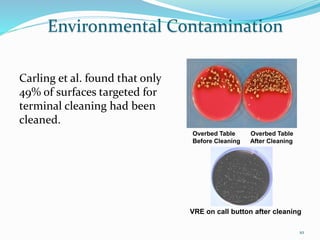
Carling et al. found that only
49% of surfaces targeted for
terminal cleaning had been
cleaned.
Overbed Table Overbed Table
Before Cleaning After Cleaning
VRE on call button after cleaning
Environmental Contamination
10
Environmental Contamination
A number of studies have shown that improved cleaning
and disinfection of environmental surfaces can reduce
transmission of pathogens such as C. difficile,
vancomycin-resistant enterococci (VRE), and methicillin-
resistant S. aureus (MRSA)
11
Environmental Contamination
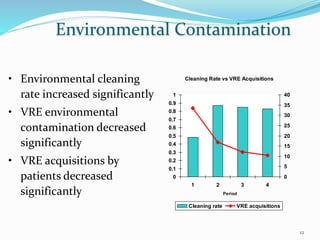
• Environmental cleaning
rate increased significantly
• VRE environmental
contamination decreased
significantly
• VRE acquisitions by
patients decreased
significantly
Cleaning Rate vs VRE Acquisitions
0
0.1
0.2
0.3
0.4
0.5
0.6
0.7
0.8
0.9
1
1 2 3 4
Period
0
5
10
15
20
25
30
35
40
Cleaning rate VRE acquisitions
12
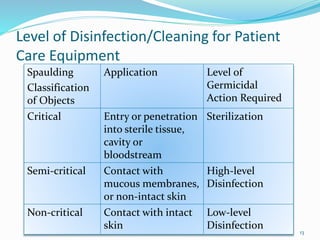
Level of Disinfection/Cleaning for Patient
Care Equipment
Spaulding
Classification
of Objects
Application Level of
Germicidal
Action Required
Critical Entry or penetration
into sterile tissue,
cavity or
bloodstream
Sterilization
Semi-critical Contact with
mucous membranes,
or non-intact skin
High-level
Disinfection
Non-critical Contact with intact
skin
Low-level
Disinfection 13
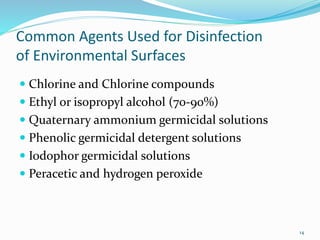
Common Agents Used for Disinfection
of Environmental Surfaces
 Chlorine and Chlorine compounds
 Ethyl or isopropyl alcohol (70-90%)
 Quaternary ammonium germicidal solutions
 Phenolic germicidal detergent solutions
 Iodophor germicidal solutions
 Peracetic and hydrogen peroxide
14
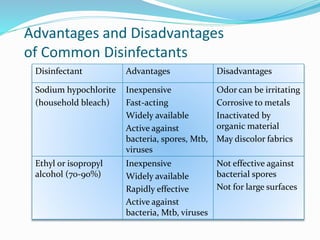
Advantages and Disadvantages
of Common Disinfectants
Disinfectant Advantages Disadvantages
Sodium hypochlorite
(household bleach)
Inexpensive
Fast-acting
Widely available
Active against
bacteria, spores, Mtb,
viruses
Odor can be irritating
Corrosive to metals
Inactivated by
organic material
May discolor fabrics
Ethyl or isopropyl
alcohol (70-90%)
Inexpensive
Widely available
Rapidly effective
Active against
bacteria, Mtb, viruses
Not effective against
bacterial spores
Not for large surfaces
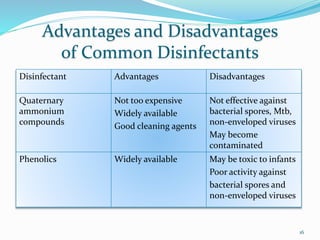
Advantages and Disadvantages
of Common Disinfectants
Disinfectant Advantages Disadvantages
Quaternary
ammonium
compounds
Not too expensive
Widely available
Good cleaning agents
Not effective against
bacterial spores, Mtb,
non-enveloped viruses
May become
contaminated
Phenolics Widely available May be toxic to infants
Poor activity against
bacterial spores and
non-enveloped viruses
16
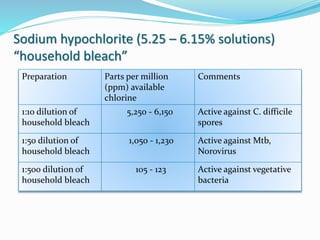
Sodium hypochlorite (5.25 – 6.15% solutions)
“household bleach”
Preparation Parts per million
(ppm) available
chlorine
Comments
1:10 dilution of
household bleach
5,250 - 6,150 Active against C. difficile
spores
1:50 dilution of
household bleach
1,050 - 1,230 Active against Mtb,
Norovirus
1:500 dilution of
household bleach
105 - 123 Active against vegetative
bacteria
Improving Cleaning/Disinfection
Practices
• Develop policies regarding which patient-care
equipment and environmental surfaces are to be
cleaned by housekeepers and by nursing staff
• Educate and train housekeepers regarding
recommended cleaning practices and the importance
of following hospital cleaning policies
18
Improving Cleaning/Disinfection
Practices
• Ensure and audit compliance of cleaning and
disinfection procedures
• Develop and apply new technologies/ devices for
environmental cleaning and equipment disinfection.
19
Methods for Assessing Cleaning
Practices
• Visual inspection
– Check list to assure surfaces have been wiped
• Marking surfaces with fluorescent dye, and
checking to see if marker was removed during
cleaning
20
Methods for Assessing Cleaning
Practices
• Culturing surfaces (aerobic colony counts)
– Contact agar plates or moistened swab cultures
• ATP bioluminescence assays to measure cleanliness
21
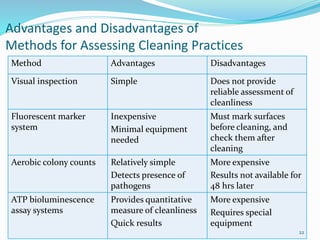
Advantages and Disadvantages of
Methods for Assessing Cleaning Practices
Method Advantages Disadvantages
Visual inspection Simple Does not provide
reliable assessment of
cleanliness
Fluorescent marker
system
Inexpensive
Minimal equipment
needed
Must mark surfaces
before cleaning, and
check them after
cleaning
Aerobic colony counts Relatively simple
Detects presence of
pathogens
More expensive
Results not available for
48 hrs later
ATP bioluminescence
assay systems
Provides quantitative
measure of cleanliness
Quick results
More expensive
Requires special
equipment
22
NEW TECHNOLOGIES TO
IMPROVE DISINFECTION OF
ENVIRONMENTAL SURFACES
23
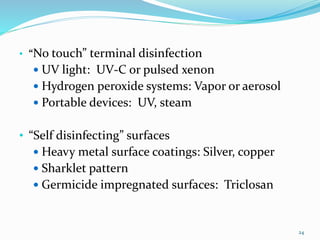
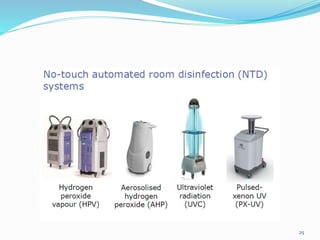
• “No touch” terminal disinfection
 UV light: UV-C or pulsed xenon
 Hydrogen peroxide systems: Vapor or aerosol
 Portable devices: UV, steam
• “Self disinfecting” surfaces
 Heavy metal surface coatings: Silver, copper
 Sharklet pattern
 Germicide impregnated surfaces: Triclosan
24
25
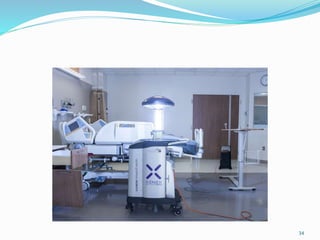
NTD/ UV-C
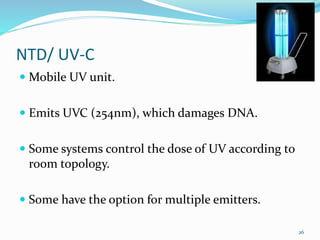
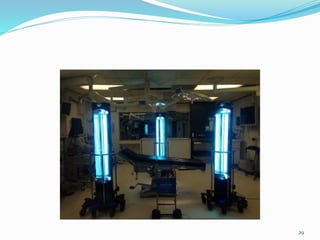
 Mobile UV unit.
 Emits UVC (254nm), which damages DNA.
 Some systems control the dose of UV according to
room topology.
 Some have the option for multiple emitters.
26
NTD/ UV-C
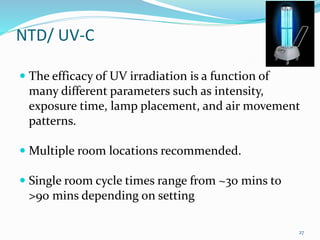
 The efficacy of UV irradiation is a function of
many different parameters such as intensity,
exposure time, lamp placement, and air movement
patterns.
 Multiple room locations recommended.
 Single room cycle times range from ~30 mins to
>90 mins depending on setting
27
NTD/UV-C
Results/ Findings:
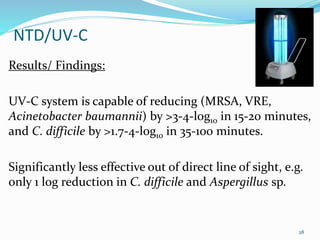
UV-C system is capable of reducing (MRSA, VRE,
Acinetobacter baumannii) by >3-4-log10 in 15-20 minutes,
and C. difficile by >1.7-4-log10 in 35-100 minutes.
Significantly less effective out of direct line of sight, e.g.
only 1 log reduction in C. difficile and Aspergillus sp.
28
29
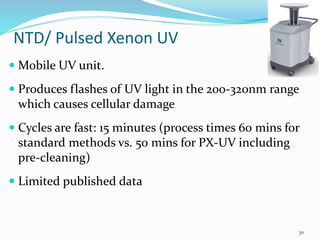
NTD/ Pulsed Xenon UV
 Mobile UV unit.
 Produces flashes of UV light in the 200-320nm range
which causes cellular damage
 Cycles are fast: 15 minutes (process times 60 mins for
standard methods vs. 50 mins for PX-UV including
pre-cleaning)
 Limited published data
30
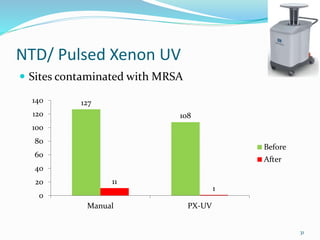
NTD/ Pulsed Xenon UV
 Sites contaminated with MRSA
127
108
11
1
0
20
40
60
80
100
120
140
Manual PX-UV
Before
After
31
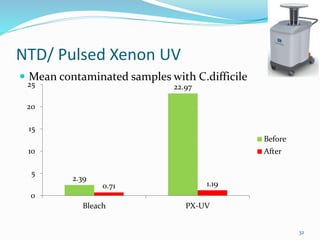
NTD/ Pulsed Xenon UV
 Mean contaminated samples with C.difficile
2.39
22.97
0.71 1.19
0
5
10
15
20
25
Bleach PX-UV
Before
After
32
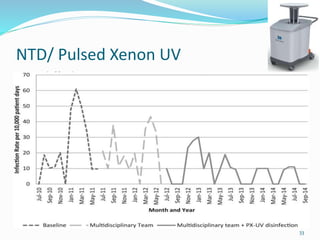
NTD/ Pulsed Xenon UV
 C. difficile transmission
33
34
Pros and Cons of UV system
Advantages:
 Reliable biocidal activity against a wide range of
healthcare-associated pathogens as room surfaces and
equipment decontaminated (but not eliminated)
 Room decontamination is rapid (~15-25 minutes) for
vegetative bacteria
 Effective against Clostridium difficile, although
requires longer exposure (~50 minutes)
35
Pros and Cons of UV system
Advantages:
 HVAC (heating, ventilation and air conditioning)
system does not need to be disabled and the room
does not need to be sealed
 UV is residual free and does not give rise to health or
safety concerns
 No consumable products so costs include only capital
equipment and staff time
36
Pros and Cons of UV system
Disadvantages:
 All patients and staff must be removed from the room
prior to decontamination
 Decontamination can only be accomplished at
terminal disinfection (i.e., cannot be used for daily
disinfection) as room must be emptied of people
 Hence cleaning must precede UV decontamination
37
Pros and Cons of UV system
Disadvantages:
 Sensitive to use parameters (e.g., wavelength, UV dose
delivered)
 Requires that equipment and furniture be moved away
from the walls
 Less effective out of direct line of sight
38
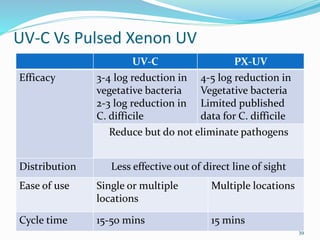
UV-C Vs Pulsed Xenon UV
UV-C PX-UV
Efficacy 3-4 log reduction in
vegetative bacteria
2-3 log reduction in
C. difficile
4-5 log reduction in
Vegetative bacteria
Limited published
data for C. difficile
Reduce but do not eliminate pathogens
Distribution Less effective out of direct line of sight
Ease of use Single or multiple
locations
Multiple locations
Cycle time 15-50 mins 15 mins
39
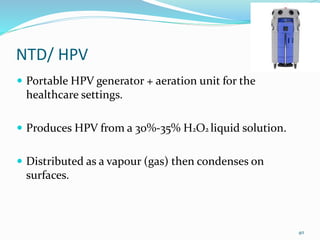
NTD/ HPV
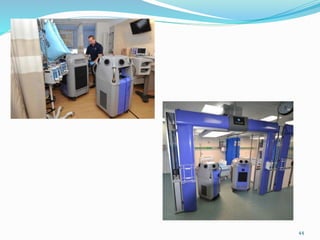
 Portable HPV generator + aeration unit for the
healthcare settings.
 Produces HPV from a 30%-35% H2O2 liquid solution.
 Distributed as a vapour (gas) then condenses on
surfaces.
40
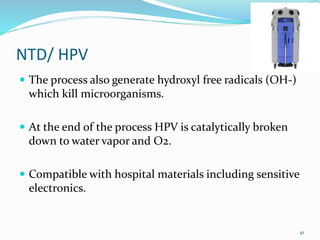
NTD/ HPV
 The process also generate hydroxyl free radicals (OH-)
which kill microorganisms.
 At the end of the process HPV is catalytically broken
down to water vapor and O2.
 Compatible with hospital materials including sensitive
electronics.
41
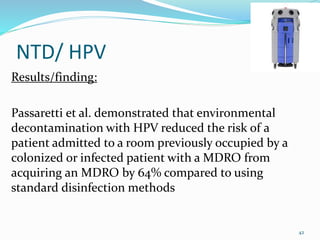
NTD/ HPV
Results/finding:
Passaretti et al. demonstrated that environmental
decontamination with HPV reduced the risk of a
patient admitted to a room previously occupied by a
colonized or infected patient with a MDRO from
acquiring an MDRO by 64% compared to using
standard disinfection methods
42
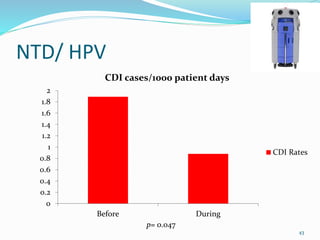
NTD/ HPV
0
0.2
0.4
0.6
0.8
1
1.2
1.4
1.6
1.8
2
Before During
CDI cases/1000 patient days
CDI Rates
p= 0.047
43
44
NTD/ aPV
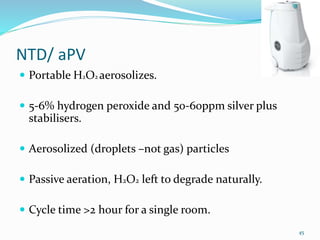
 Portable H2O2 aerosolizes.
 5-6% hydrogen peroxide and 50-60ppm silver plus
stabilisers.
 Aerosolized (droplets –not gas) particles
 Passive aeration, H2O2 left to degrade naturally.
 Cycle time >2 hour for a single room.
45
NTD/ aPV
Results/finding:
Exposure to 0.35 ml-aHP/ft3 achieved a 2.5-log
reduction in Norovirus, 4.3, and 3.4-log reduction
Feline Calcivirus and Tulane virus respectively.
46
NTD/ aPV
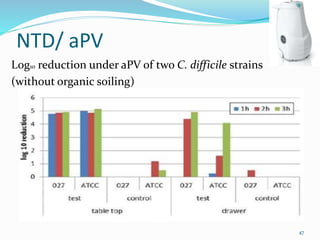
Log10 reduction under aPV of two C. difficile strains
(without organic soiling)
47
NTD/ aPV
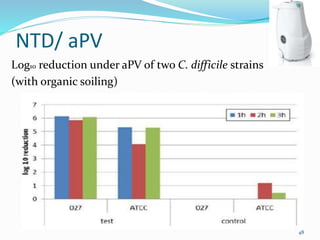
Log10 reduction under aPV of two C. difficile strains
(with organic soiling)
48
0
1
2
3
4
5
6
7
8
9
Conventional Cleaning H2o2
Before
After
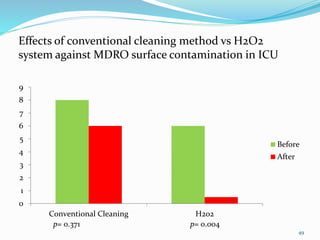
Effects of conventional cleaning method vs H2O2
system against MDRO surface contamination in ICU
p= 0.371 p= 0.004
49
0
5
10
15
20
25
30
HPV aHP aHP
Before
After
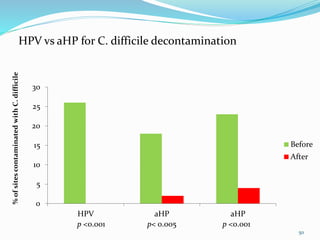
HPV vs aHP for C. difficile decontamination
%ofsitescontaminatedwithC.difficile
p <0.001 p< 0.005 p <0.001
50
Pros and Cons of Hydrogen peroxide system
Advantages:
 Reliable biocidal activity against a wide range of
healthcare-associated pathogens on room surfaces and
equipment
 Useful for disinfecting complex equipment and
furniture
 Does not require that furniture and equipment be
moved away from the walls
51
Pros and Cons of Hydrogen peroxide system
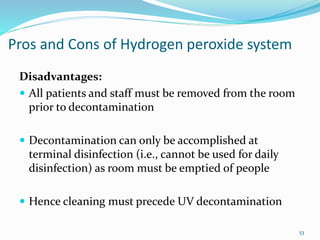
Advantages:
 Demonstrated to reduce healthcare-associated
infections (i.e., Clostridium difficile)
 HPV is residual free and does not give rise to health or
safety concerns (aeration unit converts HP into oxygen
and water)
 Uniform distribution in the room via an automated
dispersal system
52
Pros and Cons of Hydrogen peroxide system
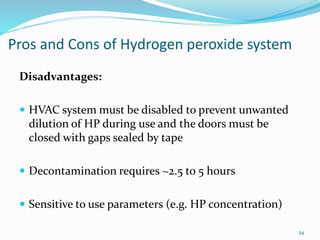
Disadvantages:
 All patients and staff must be removed from the room
prior to decontamination
 Decontamination can only be accomplished at
terminal disinfection (i.e., cannot be used for daily
disinfection) as room must be emptied of people
 Hence cleaning must precede UV decontamination
53
Pros and Cons of Hydrogen peroxide system
Disadvantages:
 HVAC system must be disabled to prevent unwanted
dilution of HP during use and the doors must be
closed with gaps sealed by tape
 Decontamination requires ~2.5 to 5 hours
 Sensitive to use parameters (e.g. HP concentration)
54
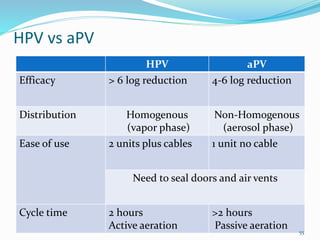
HPV vs aPV
HPV aPV
Efficacy > 6 log reduction 4-6 log reduction
Distribution Homogenous
(vapor phase)
Non-Homogenous
(aerosol phase)
Ease of use 2 units plus cables 1 unit no cable
Need to seal doors and air vents
Cycle time 2 hours
Active aeration
>2 hours
Passive aeration 55
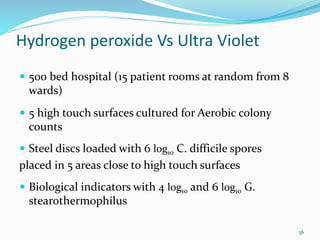
Hydrogen peroxide Vs Ultra Violet
 500 bed hospital (15 patient rooms at random from 8
wards)
 5 high touch surfaces cultured for Aerobic colony
counts
 Steel discs loaded with 6 log10 C. difficile spores
placed in 5 areas close to high touch surfaces
 Biological indicators with 4 log10 and 6 log10 G.
stearothermophilus
56
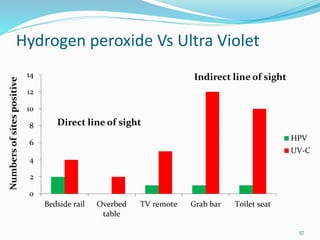
Hydrogen peroxide Vs Ultra Violet
0
2
4
6
8
10
12
14
Bedside rail Overbed
table
TV remote Grab bar Toilet seat
HPV
UV-C
Direct line of sight
Numbersofsitespositive
Indirect line of sight
57
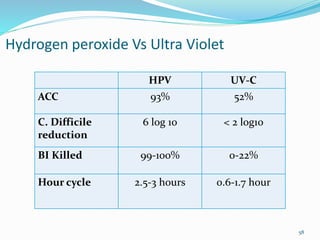
Hydrogen peroxide Vs Ultra Violet
HPV UV-C
ACC 93% 52%
C. Difficile
reduction
6 log 10 < 2 log10
BI Killed 99-100% 0-22%
Hour cycle 2.5-3 hours 0.6-1.7 hour
58
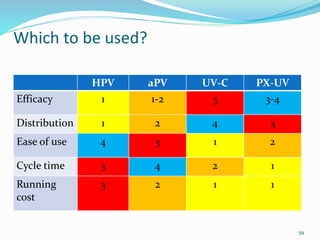
Which to be used?
HPV aPV UV-C PX-UV
Efficacy 1 1-2 3 3-4
Distribution 1 2 4 3
Ease of use 4 3 1 2
Cycle time 3 4 2 1
Running
cost
3 2 1 1
59
60
61
62
Heavy metals coatings
Antimicrobial copper works on two steps
 First step is a direct interaction between the surface
and the bacterial outer membrane, causing the
membrane to rupture.
 Second is related to the holes in the outer membrane,
through which the cell loses vital nutrients and water,
causing a general weakening of the cell.
63
Heavy metals coatings
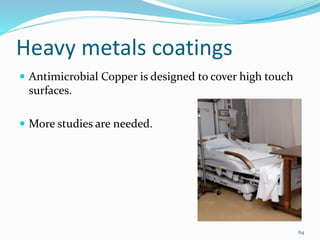
 Antimicrobial Copper is designed to cover high touch
surfaces.
 More studies are needed.
64
Heavy metals coatings
 The antimicrobial effects of silver are through protein
inactivation, DNA association and penetrating the cell.
 Mainly used for medical devices and equipment as in
silicone based medical devices.
65
Germicide impregnated surfaces
 Not designed to protect users from disease causing
microorganisms.
 Protects against stain and odors.
 Not recommended any more in several settings.
66
Sharklet pattern
 New technology aims to inhibit bacterial growth
through physical surface modification alone.
 The surface topography is made of millions of
microscopic diamonds that disrupt the ability for
bacteria to aggregate, colonize, and develop into
biofilms.
 High touch surfaces/ medical equipment
67
Conclusion
 The surface environment in rooms of colonized or
infected patients is frequently contaminated with
pathogens.
 These pathogens are capable of surviving on hospital
room surfaces and medical equipment for a prolonged
period of time.
 Contact with hospital room surfaces or medical
equipment by healthcare personnel frequently leads to
contamination of hands and/or gloves.
68
Conclusion
 Patient admitted to a room previously occupied by a
patient colonized or infected with a pathogen has an
increased likelihood of developing colonization or
infection with that pathogen
 The frequency with which room surfaces are
contaminated correlates with the frequency of hand
and/or glove contamination of healthcare personnel
69
Conclusion
 Clonal outbreaks of pathogens contaminating the
room surfaces of colonized or infected patients are
demonstrated to be due to person-to-person
transmission or shared medical equipment
 Improved terminal cleaning and disinfection of rooms
leads to a decreased rate of infections
70
Conclusion
 These technologies supplement, but do not replace,
standard cleaning and disinfection because surfaces
must be physically cleaned of dirt and debris.
 Additionally, these methods can only be used for
terminal or discharge room decontamination (i.e.,
cannot be used for daily room decontamination)
because the room must be emptied of people.
71
THANK YOU
72

New technologies in environmental cleaning

  • 1.
    Dr. Moustapha AhmedRamadan Head of Infection Control Department Al-Adan Hospital March 2016 1
  • 2.
    Environmental Contamination  Thereis excellent evidence in the scientific literature that environmental contamination plays an important role in the transmission of several key healthcare-associated pathogens.  Including methicillin-resistant Staphylococcus aureus [MRSA] , vancomycin-resistant Enterococcus [VRE], Acinetobacter, norovirus, and Clostridium difficile. 2
  • 3.
    Environmental Contamination  Admissionto a room previously occupied by a patient colonized or infected with certain nosocomial pathogens increases the risk of acquisition by subsequent occupants.  Studies showed that inadequate terminal cleaning of rooms, patients acquire the organism • directly from contaminated surfaces • from HCWs who contaminate their hands in the room 3
  • 4.
    Environmental Contamination  Whileroutine cleaning can reduce the microbiological burden in a patient room it does not always eliminate the presence of bacteria and hence risk of infection.  Traditional cleaning strategies do not remove all environmental MDROs.  The complications of room topology, and the presence of dust, grime or biofilm significantly increase the resistance of bacteria to decontamination methods. 4
  • 5.
    • Housekeepers andnursing staff often do not agree on who should clean what • Housekeepers do not always understand – Which detergent/disinfectant to use – What concentration should be used • Other contributing factors – Staff shortages and frequent turnover of personnel with demands for fast room. Environmental Contamination 5
  • 6.
    Environmental Contamination 0 0.51 1.5 2 2.5 3 3.5 4 MDR Acinetobacter (Nseir S, 2011) C. diff (Shaughnessy M, 2011) VRE^ (Drees M, 2008) MDR Pseudomonas (Nseir S, 2011) VRE (Huang S, 2006) VRE* (Dress M, 2008) MRSA (Huang S, 2006) * Prior room occupant infected; ^Any room occupant in prior 2 weeks infected. Relative Risk of pathogen acquisition if prior room occupant infected
  • 7.
    Environmental Contamination Pathogen SurvivalTime S. aureus (including MRSA) 7 days to >12 months Enterococcus spp. (including VRE) 5 days to >46 months Acinetobacter spp. 3 days to 11 months Clostridium difficile (spores) >5 months Norovirus (and feline calicivirus) 8 hours to >2 weeks Pseudomonas aeruginosa 6 hours to 16 months Klebsiella spp. 2 hours to >30 months Environmental survival of key pathogens on hospital surfaces
  • 8.
    Environmental Contamination • Itemsfrequently contaminated near patients include: • Bed rails • Bed linen • Overbed tables • Blood pressure cuffs • Intravenous pumps • Nurse call buttons • Urinary collection bags 8
  • 9.
    Environmental Contamination  Ithas long been recommended that environmental surfaces in patient rooms should be cleaned/ disinfected on a regular basis, when surfaces are visibly soiled, and following patient discharge (terminal cleaning).  Studies have demonstrated that adequate environment cleaning is frequently lacking. 9
  • 10.
    Carling et al.found that only 49% of surfaces targeted for terminal cleaning had been cleaned. Overbed Table Overbed Table Before Cleaning After Cleaning VRE on call button after cleaning Environmental Contamination 10
  • 11.
    Environmental Contamination A numberof studies have shown that improved cleaning and disinfection of environmental surfaces can reduce transmission of pathogens such as C. difficile, vancomycin-resistant enterococci (VRE), and methicillin- resistant S. aureus (MRSA) 11
  • 12.
    Environmental Contamination • Environmentalcleaning rate increased significantly • VRE environmental contamination decreased significantly • VRE acquisitions by patients decreased significantly Cleaning Rate vs VRE Acquisitions 0 0.1 0.2 0.3 0.4 0.5 0.6 0.7 0.8 0.9 1 1 2 3 4 Period 0 5 10 15 20 25 30 35 40 Cleaning rate VRE acquisitions 12
  • 13.
    Level of Disinfection/Cleaningfor Patient Care Equipment Spaulding Classification of Objects Application Level of Germicidal Action Required Critical Entry or penetration into sterile tissue, cavity or bloodstream Sterilization Semi-critical Contact with mucous membranes, or non-intact skin High-level Disinfection Non-critical Contact with intact skin Low-level Disinfection 13
  • 14.
    Common Agents Usedfor Disinfection of Environmental Surfaces  Chlorine and Chlorine compounds  Ethyl or isopropyl alcohol (70-90%)  Quaternary ammonium germicidal solutions  Phenolic germicidal detergent solutions  Iodophor germicidal solutions  Peracetic and hydrogen peroxide 14
  • 15.
    Advantages and Disadvantages ofCommon Disinfectants Disinfectant Advantages Disadvantages Sodium hypochlorite (household bleach) Inexpensive Fast-acting Widely available Active against bacteria, spores, Mtb, viruses Odor can be irritating Corrosive to metals Inactivated by organic material May discolor fabrics Ethyl or isopropyl alcohol (70-90%) Inexpensive Widely available Rapidly effective Active against bacteria, Mtb, viruses Not effective against bacterial spores Not for large surfaces
  • 16.
    Advantages and Disadvantages ofCommon Disinfectants Disinfectant Advantages Disadvantages Quaternary ammonium compounds Not too expensive Widely available Good cleaning agents Not effective against bacterial spores, Mtb, non-enveloped viruses May become contaminated Phenolics Widely available May be toxic to infants Poor activity against bacterial spores and non-enveloped viruses 16
  • 17.
    Sodium hypochlorite (5.25– 6.15% solutions) “household bleach” Preparation Parts per million (ppm) available chlorine Comments 1:10 dilution of household bleach 5,250 - 6,150 Active against C. difficile spores 1:50 dilution of household bleach 1,050 - 1,230 Active against Mtb, Norovirus 1:500 dilution of household bleach 105 - 123 Active against vegetative bacteria
  • 18.
    Improving Cleaning/Disinfection Practices • Developpolicies regarding which patient-care equipment and environmental surfaces are to be cleaned by housekeepers and by nursing staff • Educate and train housekeepers regarding recommended cleaning practices and the importance of following hospital cleaning policies 18
  • 19.
    Improving Cleaning/Disinfection Practices • Ensureand audit compliance of cleaning and disinfection procedures • Develop and apply new technologies/ devices for environmental cleaning and equipment disinfection. 19
  • 20.
    Methods for AssessingCleaning Practices • Visual inspection – Check list to assure surfaces have been wiped • Marking surfaces with fluorescent dye, and checking to see if marker was removed during cleaning 20
  • 21.
    Methods for AssessingCleaning Practices • Culturing surfaces (aerobic colony counts) – Contact agar plates or moistened swab cultures • ATP bioluminescence assays to measure cleanliness 21
  • 22.
    Advantages and Disadvantagesof Methods for Assessing Cleaning Practices Method Advantages Disadvantages Visual inspection Simple Does not provide reliable assessment of cleanliness Fluorescent marker system Inexpensive Minimal equipment needed Must mark surfaces before cleaning, and check them after cleaning Aerobic colony counts Relatively simple Detects presence of pathogens More expensive Results not available for 48 hrs later ATP bioluminescence assay systems Provides quantitative measure of cleanliness Quick results More expensive Requires special equipment 22
  • 23.
    NEW TECHNOLOGIES TO IMPROVEDISINFECTION OF ENVIRONMENTAL SURFACES 23
  • 24.
    • “No touch”terminal disinfection  UV light: UV-C or pulsed xenon  Hydrogen peroxide systems: Vapor or aerosol  Portable devices: UV, steam • “Self disinfecting” surfaces  Heavy metal surface coatings: Silver, copper  Sharklet pattern  Germicide impregnated surfaces: Triclosan 24
  • 25.
  • 26.
    NTD/ UV-C  MobileUV unit.  Emits UVC (254nm), which damages DNA.  Some systems control the dose of UV according to room topology.  Some have the option for multiple emitters. 26
  • 27.
    NTD/ UV-C  Theefficacy of UV irradiation is a function of many different parameters such as intensity, exposure time, lamp placement, and air movement patterns.  Multiple room locations recommended.  Single room cycle times range from ~30 mins to >90 mins depending on setting 27
  • 28.
    NTD/UV-C Results/ Findings: UV-C systemis capable of reducing (MRSA, VRE, Acinetobacter baumannii) by >3-4-log10 in 15-20 minutes, and C. difficile by >1.7-4-log10 in 35-100 minutes. Significantly less effective out of direct line of sight, e.g. only 1 log reduction in C. difficile and Aspergillus sp. 28
  • 29.
  • 30.
    NTD/ Pulsed XenonUV  Mobile UV unit.  Produces flashes of UV light in the 200-320nm range which causes cellular damage  Cycles are fast: 15 minutes (process times 60 mins for standard methods vs. 50 mins for PX-UV including pre-cleaning)  Limited published data 30
  • 31.
    NTD/ Pulsed XenonUV  Sites contaminated with MRSA 127 108 11 1 0 20 40 60 80 100 120 140 Manual PX-UV Before After 31
  • 32.
    NTD/ Pulsed XenonUV  Mean contaminated samples with C.difficile 2.39 22.97 0.71 1.19 0 5 10 15 20 25 Bleach PX-UV Before After 32
  • 33.
    NTD/ Pulsed XenonUV  C. difficile transmission 33
  • 34.
  • 35.
    Pros and Consof UV system Advantages:  Reliable biocidal activity against a wide range of healthcare-associated pathogens as room surfaces and equipment decontaminated (but not eliminated)  Room decontamination is rapid (~15-25 minutes) for vegetative bacteria  Effective against Clostridium difficile, although requires longer exposure (~50 minutes) 35
  • 36.
    Pros and Consof UV system Advantages:  HVAC (heating, ventilation and air conditioning) system does not need to be disabled and the room does not need to be sealed  UV is residual free and does not give rise to health or safety concerns  No consumable products so costs include only capital equipment and staff time 36
  • 37.
    Pros and Consof UV system Disadvantages:  All patients and staff must be removed from the room prior to decontamination  Decontamination can only be accomplished at terminal disinfection (i.e., cannot be used for daily disinfection) as room must be emptied of people  Hence cleaning must precede UV decontamination 37
  • 38.
    Pros and Consof UV system Disadvantages:  Sensitive to use parameters (e.g., wavelength, UV dose delivered)  Requires that equipment and furniture be moved away from the walls  Less effective out of direct line of sight 38
  • 39.
    UV-C Vs PulsedXenon UV UV-C PX-UV Efficacy 3-4 log reduction in vegetative bacteria 2-3 log reduction in C. difficile 4-5 log reduction in Vegetative bacteria Limited published data for C. difficile Reduce but do not eliminate pathogens Distribution Less effective out of direct line of sight Ease of use Single or multiple locations Multiple locations Cycle time 15-50 mins 15 mins 39
  • 40.
    NTD/ HPV  PortableHPV generator + aeration unit for the healthcare settings.  Produces HPV from a 30%-35% H2O2 liquid solution.  Distributed as a vapour (gas) then condenses on surfaces. 40
  • 41.
    NTD/ HPV  Theprocess also generate hydroxyl free radicals (OH-) which kill microorganisms.  At the end of the process HPV is catalytically broken down to water vapor and O2.  Compatible with hospital materials including sensitive electronics. 41
  • 42.
    NTD/ HPV Results/finding: Passaretti etal. demonstrated that environmental decontamination with HPV reduced the risk of a patient admitted to a room previously occupied by a colonized or infected patient with a MDRO from acquiring an MDRO by 64% compared to using standard disinfection methods 42
  • 43.
    NTD/ HPV 0 0.2 0.4 0.6 0.8 1 1.2 1.4 1.6 1.8 2 Before During CDIcases/1000 patient days CDI Rates p= 0.047 43
  • 44.
  • 45.
    NTD/ aPV  PortableH2O2 aerosolizes.  5-6% hydrogen peroxide and 50-60ppm silver plus stabilisers.  Aerosolized (droplets –not gas) particles  Passive aeration, H2O2 left to degrade naturally.  Cycle time >2 hour for a single room. 45
  • 46.
    NTD/ aPV Results/finding: Exposure to0.35 ml-aHP/ft3 achieved a 2.5-log reduction in Norovirus, 4.3, and 3.4-log reduction Feline Calcivirus and Tulane virus respectively. 46
  • 47.
    NTD/ aPV Log10 reductionunder aPV of two C. difficile strains (without organic soiling) 47
  • 48.
    NTD/ aPV Log10 reductionunder aPV of two C. difficile strains (with organic soiling) 48
  • 49.
    0 1 2 3 4 5 6 7 8 9 Conventional Cleaning H2o2 Before After Effectsof conventional cleaning method vs H2O2 system against MDRO surface contamination in ICU p= 0.371 p= 0.004 49
  • 50.
    0 5 10 15 20 25 30 HPV aHP aHP Before After HPVvs aHP for C. difficile decontamination %ofsitescontaminatedwithC.difficile p <0.001 p< 0.005 p <0.001 50
  • 51.
    Pros and Consof Hydrogen peroxide system Advantages:  Reliable biocidal activity against a wide range of healthcare-associated pathogens on room surfaces and equipment  Useful for disinfecting complex equipment and furniture  Does not require that furniture and equipment be moved away from the walls 51
  • 52.
    Pros and Consof Hydrogen peroxide system Advantages:  Demonstrated to reduce healthcare-associated infections (i.e., Clostridium difficile)  HPV is residual free and does not give rise to health or safety concerns (aeration unit converts HP into oxygen and water)  Uniform distribution in the room via an automated dispersal system 52
  • 53.
    Pros and Consof Hydrogen peroxide system Disadvantages:  All patients and staff must be removed from the room prior to decontamination  Decontamination can only be accomplished at terminal disinfection (i.e., cannot be used for daily disinfection) as room must be emptied of people  Hence cleaning must precede UV decontamination 53
  • 54.
    Pros and Consof Hydrogen peroxide system Disadvantages:  HVAC system must be disabled to prevent unwanted dilution of HP during use and the doors must be closed with gaps sealed by tape  Decontamination requires ~2.5 to 5 hours  Sensitive to use parameters (e.g. HP concentration) 54
  • 55.
    HPV vs aPV HPVaPV Efficacy > 6 log reduction 4-6 log reduction Distribution Homogenous (vapor phase) Non-Homogenous (aerosol phase) Ease of use 2 units plus cables 1 unit no cable Need to seal doors and air vents Cycle time 2 hours Active aeration >2 hours Passive aeration 55
  • 56.
    Hydrogen peroxide VsUltra Violet  500 bed hospital (15 patient rooms at random from 8 wards)  5 high touch surfaces cultured for Aerobic colony counts  Steel discs loaded with 6 log10 C. difficile spores placed in 5 areas close to high touch surfaces  Biological indicators with 4 log10 and 6 log10 G. stearothermophilus 56
  • 57.
    Hydrogen peroxide VsUltra Violet 0 2 4 6 8 10 12 14 Bedside rail Overbed table TV remote Grab bar Toilet seat HPV UV-C Direct line of sight Numbersofsitespositive Indirect line of sight 57
  • 58.
    Hydrogen peroxide VsUltra Violet HPV UV-C ACC 93% 52% C. Difficile reduction 6 log 10 < 2 log10 BI Killed 99-100% 0-22% Hour cycle 2.5-3 hours 0.6-1.7 hour 58
  • 59.
    Which to beused? HPV aPV UV-C PX-UV Efficacy 1 1-2 3 3-4 Distribution 1 2 4 3 Ease of use 4 3 1 2 Cycle time 3 4 2 1 Running cost 3 2 1 1 59
  • 60.
  • 61.
  • 62.
  • 63.
    Heavy metals coatings Antimicrobialcopper works on two steps  First step is a direct interaction between the surface and the bacterial outer membrane, causing the membrane to rupture.  Second is related to the holes in the outer membrane, through which the cell loses vital nutrients and water, causing a general weakening of the cell. 63
  • 64.
    Heavy metals coatings Antimicrobial Copper is designed to cover high touch surfaces.  More studies are needed. 64
  • 65.
    Heavy metals coatings The antimicrobial effects of silver are through protein inactivation, DNA association and penetrating the cell.  Mainly used for medical devices and equipment as in silicone based medical devices. 65
  • 66.
    Germicide impregnated surfaces Not designed to protect users from disease causing microorganisms.  Protects against stain and odors.  Not recommended any more in several settings. 66
  • 67.
    Sharklet pattern  Newtechnology aims to inhibit bacterial growth through physical surface modification alone.  The surface topography is made of millions of microscopic diamonds that disrupt the ability for bacteria to aggregate, colonize, and develop into biofilms.  High touch surfaces/ medical equipment 67
  • 68.
    Conclusion  The surfaceenvironment in rooms of colonized or infected patients is frequently contaminated with pathogens.  These pathogens are capable of surviving on hospital room surfaces and medical equipment for a prolonged period of time.  Contact with hospital room surfaces or medical equipment by healthcare personnel frequently leads to contamination of hands and/or gloves. 68
  • 69.
    Conclusion  Patient admittedto a room previously occupied by a patient colonized or infected with a pathogen has an increased likelihood of developing colonization or infection with that pathogen  The frequency with which room surfaces are contaminated correlates with the frequency of hand and/or glove contamination of healthcare personnel 69
  • 70.
    Conclusion  Clonal outbreaksof pathogens contaminating the room surfaces of colonized or infected patients are demonstrated to be due to person-to-person transmission or shared medical equipment  Improved terminal cleaning and disinfection of rooms leads to a decreased rate of infections 70
  • 71.
    Conclusion  These technologiessupplement, but do not replace, standard cleaning and disinfection because surfaces must be physically cleaned of dirt and debris.  Additionally, these methods can only be used for terminal or discharge room decontamination (i.e., cannot be used for daily room decontamination) because the room must be emptied of people. 71
  • 72.