SALSO COURSE Maternal Mortality
Introduction  World wide, pregnancy and childbirth claim the lives of an estimated  514,000  women each year. This translates to one woman dying every minute. Maternal mortality is one of the measures of the QUALITY of health care system. In Malaysia, significant reduction in MMR over the last 50 yrs: 540/100,000 LB in 1950 139/100,000LB in 1970 44/100,000 LB in 1991 28.1/100,000 LB in 2000 National objective - to reduce MMR to <20/100,000 LB.
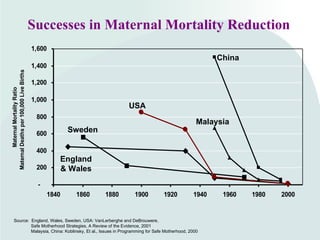
Successes in Maternal Mortality Reduction China Malaysia USA England & Wales Sweden Source:  England, Wales, Sweden, USA: VanLerberghe and DeBrouwere, Safe Motherhood Strategies, A Review of the Evidence, 2001 Malaysia, China: Koblinsky, Et al., Issues in Programming for Safe Motherhood, 2000
Maternal Death The death of a woman while pregnant or within 42 days of termination of pregnancy, irrespective of the duration and site of pregnancy, from any cause related to or aggravated by the pregnancy or its management, but not from accidental or incidental causes
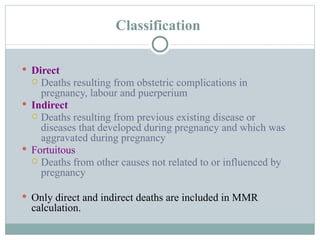
Classification  Direct Deaths resulting from obstetric complications in pregnancy, labour and puerperium Indirect Deaths resulting from previous existing disease or diseases that developed during pregnancy and which was aggravated during pregnancy Fortuitous Deaths from other causes not related to or influenced by pregnancy  Only direct and indirect deaths are included in MMR calculation.
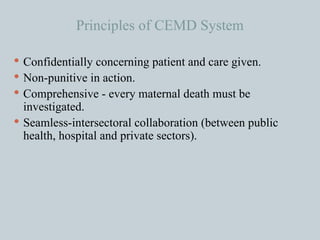
Principles of CEMD System Confidentially concerning patient and care given. Non-punitive in action. Comprehensive - every maternal death must be investigated. Seamless-intersectoral collaboration (between public health, hospital and private sectors).
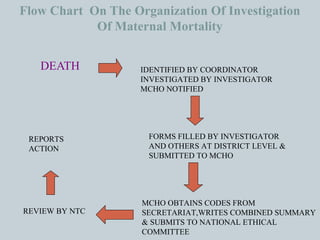
Flow Chart  On The   Organization Of Investigation Of Maternal Mortality DEATH IDENTIFIED BY COORDINATOR INVESTIGATED BY INVESTIGATOR MCHO NOTIFIED FORMS FILLED BY INVESTIGATOR AND OTHERS AT DISTRICT LEVEL & SUBMITTED TO MCHO MCHO OBTAINS CODES FROM SECRETARIAT,WRITES COMBINED SUMMARY & SUBMITS TO NATIONAL ETHICAL COMMITTEE REVIEW BY NTC REPORTS ACTION
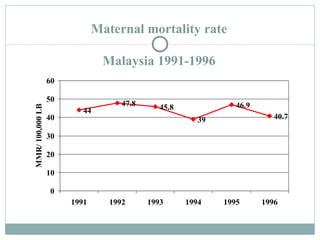
Maternal mortality rate Malaysia 1991-1996
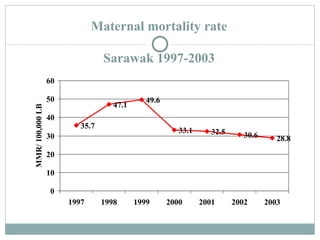
Maternal mortality rate Sarawak 1997-2003
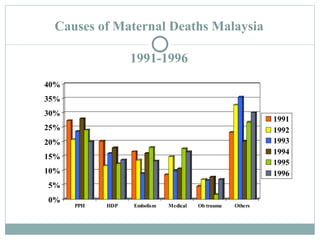
Causes of Maternal Deaths Malaysia 1991-1996
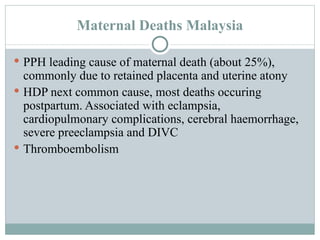
Maternal Deaths Malaysia PPH leading cause of maternal death (about 25%), commonly due to retained placenta and uterine atony HDP next common cause, most deaths occuring postpartum. Associated with eclampsia, cardiopulmonary complications, cerebral haemorrhage, severe preeclampsia and DIVC Thromboembolism
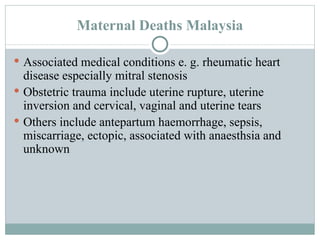
Maternal Deaths Malaysia Associated medical conditions e. g. rheumatic heart disease especially mitral stenosis Obstetric trauma include uterine rupture, uterine inversion and cervical, vaginal and uterine tears Others include antepartum haemorrhage, sepsis, miscarriage, ectopic, associated with anaesthsia and unknown
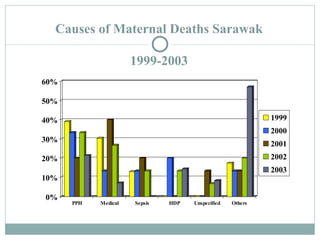
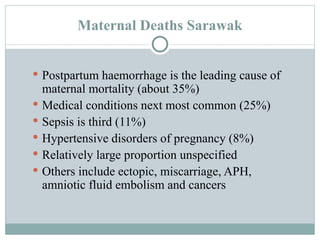
Causes of Maternal Deaths Sarawak 1999-2003
Maternal Deaths Sarawak Postpartum haemorrhage is the leading cause of maternal mortality (about 35%) Medical conditions next most common (25%) Sepsis is third (11%) Hypertensive disorders of pregnancy (8%) Relatively large proportion unspecified Others include ectopic, miscarriage, APH, amniotic fluid embolism and cancers
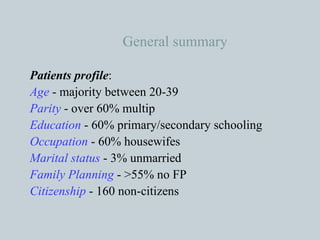
General summary Patients profile : Age  - majority between 20-39 Parity  - over 60% multip Education  - 60% primary/secondary schooling Occupation  - 60% housewifes Marital status  - 3% unmarried Family Planning  - >55% no FP Citizenship  - 160 non-citizens
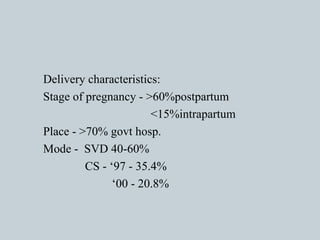
Delivery characteristics: Stage of pregnancy - >60%postpartum <15%intrapartum Place - >70% govt hosp. Mode -  SVD 40-60% CS - ‘97 - 35.4% ‘ 00 - 20.8%
The areas with the most potential for preventing maternal deaths are direct deaths More emphasis are needed on family planning Continuous training for health care providers involved to be familiar with manuals and protocols by MOH
Post Partum Haemorrhage Contributes about 20% Uterine atony & retained or adherent placenta - main cause Risk factors - >40yrs , multiparity  Home delivery - 19-37% of deaths Risk of dying from PPH for mothers delivering at home is 3-5x higher than govt. facility. Additional risks - untrained attendants and no adequate ANC
Contributing factors - -recurring problem of delayed or unavailable emergency transportation to hospital -geographical remoteness -inaccessabilty to health care  facilities
Recommendations : family planning Adequate ANC counselling and accurate risk assessment Availability facilities for adequate resuscitation-blood and blood products Emergency transport arrangements to higher level of care Early admission for patients living far from health centres
Obsteric trauma Most frequent causes - uterine rupture  , pelvic haematoma, cervical lacerations, uterine inversion Risk factors - high parity - injudicious use of  oxytocics Remediable clinical factors- inappropriate utilisation of oxytocics Failure to diagnose  Failure to appreciate severity of clinical problem Late referral  Delayed involvement of senior staff
Recommendations - Need for proper protocol & guidelines on augmentation & induction of labour increase awareness of problems especially uterine rupture, difficult deliveries, grand multips and scarred uterus Need for birth attendants to be able to recognise inversion and able to institute appropriate treatment Train birth attendants on management of third stage
Hypertensive disorders of pregnancy 1/3 were primigravida The immediate association with death were eclampsia,cardiopulmonary complications,cerebral h’age,severe PE & DIVC. Deaths could have been prevented if health care providers were more aggressive and vigilant in their management. Proteinuria in pregnant women should be carefully investigated and monitored. 24hr urine protein - gold standard but not always practical. Dipstick commonly used- protein 2+ cut off for abnormal
Magnesium sulphate not widely used in management of eclampsia Prevention and treatment for eclampsia Consider prophylactic MgSO4 in cases of severe PE Drug availability to nurses/midwifes who could administer it IM
Obstetric embolism Amniotic fluid & blood clot embolism. Only 11/91 had post mortem confirmation. Subjective clinical assessment unreliable Any women with signs and symptoms of VTE should have objective tests performed expeditiously to avoid risks, inconvenience and costs of inappropriate anti coagualtion AFE - previously high mortality rate , now 16-30% due to better intensive care and recognition of the fact that milder cases do occur
Recommendations awareness of the need for thromboprophylaxis for at risk cases. quality assurance checklists to evaluate the number of at risk mothers who actually receive thromboprophylaxis. objective tests should be performed to evaluate all cases of suspected DVT and PTE D-dimer assays can be used as a quick test to help decide on cases which may requre objective testing Amniotic fluid registry could help improve our understanding on this condition MO’s need to be aware of a possible AFE if the baby is born in a sudden unexpectedly poor condition A multidisciplinary approach to resuscition of the collapsed patient provides best results
Home delivery Cause - majority were PPH due to retained placenta and uterine atony. There were also death due to uterine rupture <20% conducted by trained staff
Recommendations Should be discouraged All delivered by trained staff ABC - alternative for those who refuse hosp. delivery, only low risk Those from remote areas brought out and housed near ABC/health centres Flying squad in remote areas to retrieve mothers
Heart Diseases in Pregnancy Majority of deaths in post partum period Commonest pathology - RHD with MS Health care provider must understand changes in pregnancy  -proper history taken and examination done -once diagnosed -investigate-ECG,Echo,CXR Most cases  patient or spouse does not volunteer the relevant history at antenatal visits Doctors fail to examine heart or misses findings Pathological murmurs mistaken for physiological ones
Ideally seen in preconception clinic Contraceptive advice - permanent contraception in those with Eisenmenger’s syndrome, pulmonary hypertension and cardiomyopathy - manage in combined clinic
HIV/AIDS  Increasing trend in many Asian countries 12 deaths ‘97-’00 They were in an advanced stage of their disease at the time of presentation for antenatal care or for delivery Oral thrush/respiratory symptoms were primary presentation Diagnosis was delayed in 50% of cases In those known HIV cases management was inadequate Majority had no knowledge of their seropositivity prior to pregnancy and also they were from lower socio-economic stratum and had lower education level
Utilisation of point-of-care HIV testing during labour should be seriously considered for those who present with no prior HIV testing prenatally, so that not to deny the unborn child of the benefit of antiretroviral therapy intrapartum to reduce maternal to child transmission.
Benefits of CEMD 1.Improvement in the reporting system of maternal deaths.Since the CEMD was established in’91, it has succeeded in enhancing data capture on maternal deaths. 2. Changing trends in maternal deaths.Direct maternal death:81%(’91) to 63%(’94), 58.1%(’96) and 56.4(‘00). Indirect: 8%(’91) to 15% (’96), 10.5%(‘00)
Cont… 3. Impact on policies and practices. Specific financial allocation for purchase of equipments & improvement of the Ix system have been made after the CEMD was started. Various policies,strategies & specific were developed such as:
Cont… A. Infrastructure strengthening: Alternative birthing centre. Improvement of communication. Equipment. Training –national/state level, training curriculum, educational materials/training modules.
Cont… B. Improvement of work process. Use of partogram for home deliveries. Home based maternal health records. Development of mx protocols. Establishment of combined clinics. Identification of areas for further research.
Terima Kasih

Maternal Mortality

  • 1.
  • 2.
    Introduction Worldwide, pregnancy and childbirth claim the lives of an estimated 514,000 women each year. This translates to one woman dying every minute. Maternal mortality is one of the measures of the QUALITY of health care system. In Malaysia, significant reduction in MMR over the last 50 yrs: 540/100,000 LB in 1950 139/100,000LB in 1970 44/100,000 LB in 1991 28.1/100,000 LB in 2000 National objective - to reduce MMR to <20/100,000 LB.
  • 3.
    Successes in MaternalMortality Reduction China Malaysia USA England & Wales Sweden Source: England, Wales, Sweden, USA: VanLerberghe and DeBrouwere, Safe Motherhood Strategies, A Review of the Evidence, 2001 Malaysia, China: Koblinsky, Et al., Issues in Programming for Safe Motherhood, 2000
  • 4.
    Maternal Death Thedeath of a woman while pregnant or within 42 days of termination of pregnancy, irrespective of the duration and site of pregnancy, from any cause related to or aggravated by the pregnancy or its management, but not from accidental or incidental causes
  • 5.
    Classification DirectDeaths resulting from obstetric complications in pregnancy, labour and puerperium Indirect Deaths resulting from previous existing disease or diseases that developed during pregnancy and which was aggravated during pregnancy Fortuitous Deaths from other causes not related to or influenced by pregnancy Only direct and indirect deaths are included in MMR calculation.
  • 6.
    Principles of CEMDSystem Confidentially concerning patient and care given. Non-punitive in action. Comprehensive - every maternal death must be investigated. Seamless-intersectoral collaboration (between public health, hospital and private sectors).
  • 7.
    Flow Chart On The Organization Of Investigation Of Maternal Mortality DEATH IDENTIFIED BY COORDINATOR INVESTIGATED BY INVESTIGATOR MCHO NOTIFIED FORMS FILLED BY INVESTIGATOR AND OTHERS AT DISTRICT LEVEL & SUBMITTED TO MCHO MCHO OBTAINS CODES FROM SECRETARIAT,WRITES COMBINED SUMMARY & SUBMITS TO NATIONAL ETHICAL COMMITTEE REVIEW BY NTC REPORTS ACTION
  • 8.
    Maternal mortality rateMalaysia 1991-1996
  • 9.
    Maternal mortality rateSarawak 1997-2003
  • 10.
    Causes of MaternalDeaths Malaysia 1991-1996
  • 11.
    Maternal Deaths MalaysiaPPH leading cause of maternal death (about 25%), commonly due to retained placenta and uterine atony HDP next common cause, most deaths occuring postpartum. Associated with eclampsia, cardiopulmonary complications, cerebral haemorrhage, severe preeclampsia and DIVC Thromboembolism
  • 12.
    Maternal Deaths MalaysiaAssociated medical conditions e. g. rheumatic heart disease especially mitral stenosis Obstetric trauma include uterine rupture, uterine inversion and cervical, vaginal and uterine tears Others include antepartum haemorrhage, sepsis, miscarriage, ectopic, associated with anaesthsia and unknown
  • 13.
    Causes of MaternalDeaths Sarawak 1999-2003
  • 14.
    Maternal Deaths SarawakPostpartum haemorrhage is the leading cause of maternal mortality (about 35%) Medical conditions next most common (25%) Sepsis is third (11%) Hypertensive disorders of pregnancy (8%) Relatively large proportion unspecified Others include ectopic, miscarriage, APH, amniotic fluid embolism and cancers
  • 15.
    General summary Patientsprofile : Age - majority between 20-39 Parity - over 60% multip Education - 60% primary/secondary schooling Occupation - 60% housewifes Marital status - 3% unmarried Family Planning - >55% no FP Citizenship - 160 non-citizens
  • 16.
    Delivery characteristics: Stageof pregnancy - >60%postpartum <15%intrapartum Place - >70% govt hosp. Mode - SVD 40-60% CS - ‘97 - 35.4% ‘ 00 - 20.8%
  • 17.
    The areas withthe most potential for preventing maternal deaths are direct deaths More emphasis are needed on family planning Continuous training for health care providers involved to be familiar with manuals and protocols by MOH
  • 18.
    Post Partum HaemorrhageContributes about 20% Uterine atony & retained or adherent placenta - main cause Risk factors - >40yrs , multiparity Home delivery - 19-37% of deaths Risk of dying from PPH for mothers delivering at home is 3-5x higher than govt. facility. Additional risks - untrained attendants and no adequate ANC
  • 19.
    Contributing factors --recurring problem of delayed or unavailable emergency transportation to hospital -geographical remoteness -inaccessabilty to health care facilities
  • 20.
    Recommendations : familyplanning Adequate ANC counselling and accurate risk assessment Availability facilities for adequate resuscitation-blood and blood products Emergency transport arrangements to higher level of care Early admission for patients living far from health centres
  • 21.
    Obsteric trauma Mostfrequent causes - uterine rupture , pelvic haematoma, cervical lacerations, uterine inversion Risk factors - high parity - injudicious use of oxytocics Remediable clinical factors- inappropriate utilisation of oxytocics Failure to diagnose Failure to appreciate severity of clinical problem Late referral Delayed involvement of senior staff
  • 22.
    Recommendations - Needfor proper protocol & guidelines on augmentation & induction of labour increase awareness of problems especially uterine rupture, difficult deliveries, grand multips and scarred uterus Need for birth attendants to be able to recognise inversion and able to institute appropriate treatment Train birth attendants on management of third stage
  • 23.
    Hypertensive disorders ofpregnancy 1/3 were primigravida The immediate association with death were eclampsia,cardiopulmonary complications,cerebral h’age,severe PE & DIVC. Deaths could have been prevented if health care providers were more aggressive and vigilant in their management. Proteinuria in pregnant women should be carefully investigated and monitored. 24hr urine protein - gold standard but not always practical. Dipstick commonly used- protein 2+ cut off for abnormal
  • 24.
    Magnesium sulphate notwidely used in management of eclampsia Prevention and treatment for eclampsia Consider prophylactic MgSO4 in cases of severe PE Drug availability to nurses/midwifes who could administer it IM
  • 25.
    Obstetric embolism Amnioticfluid & blood clot embolism. Only 11/91 had post mortem confirmation. Subjective clinical assessment unreliable Any women with signs and symptoms of VTE should have objective tests performed expeditiously to avoid risks, inconvenience and costs of inappropriate anti coagualtion AFE - previously high mortality rate , now 16-30% due to better intensive care and recognition of the fact that milder cases do occur
  • 26.
    Recommendations awareness ofthe need for thromboprophylaxis for at risk cases. quality assurance checklists to evaluate the number of at risk mothers who actually receive thromboprophylaxis. objective tests should be performed to evaluate all cases of suspected DVT and PTE D-dimer assays can be used as a quick test to help decide on cases which may requre objective testing Amniotic fluid registry could help improve our understanding on this condition MO’s need to be aware of a possible AFE if the baby is born in a sudden unexpectedly poor condition A multidisciplinary approach to resuscition of the collapsed patient provides best results
  • 27.
    Home delivery Cause- majority were PPH due to retained placenta and uterine atony. There were also death due to uterine rupture <20% conducted by trained staff
  • 28.
    Recommendations Should bediscouraged All delivered by trained staff ABC - alternative for those who refuse hosp. delivery, only low risk Those from remote areas brought out and housed near ABC/health centres Flying squad in remote areas to retrieve mothers
  • 29.
    Heart Diseases inPregnancy Majority of deaths in post partum period Commonest pathology - RHD with MS Health care provider must understand changes in pregnancy -proper history taken and examination done -once diagnosed -investigate-ECG,Echo,CXR Most cases patient or spouse does not volunteer the relevant history at antenatal visits Doctors fail to examine heart or misses findings Pathological murmurs mistaken for physiological ones
  • 30.
    Ideally seen inpreconception clinic Contraceptive advice - permanent contraception in those with Eisenmenger’s syndrome, pulmonary hypertension and cardiomyopathy - manage in combined clinic
  • 31.
    HIV/AIDS Increasingtrend in many Asian countries 12 deaths ‘97-’00 They were in an advanced stage of their disease at the time of presentation for antenatal care or for delivery Oral thrush/respiratory symptoms were primary presentation Diagnosis was delayed in 50% of cases In those known HIV cases management was inadequate Majority had no knowledge of their seropositivity prior to pregnancy and also they were from lower socio-economic stratum and had lower education level
  • 32.
    Utilisation of point-of-careHIV testing during labour should be seriously considered for those who present with no prior HIV testing prenatally, so that not to deny the unborn child of the benefit of antiretroviral therapy intrapartum to reduce maternal to child transmission.
  • 33.
    Benefits of CEMD1.Improvement in the reporting system of maternal deaths.Since the CEMD was established in’91, it has succeeded in enhancing data capture on maternal deaths. 2. Changing trends in maternal deaths.Direct maternal death:81%(’91) to 63%(’94), 58.1%(’96) and 56.4(‘00). Indirect: 8%(’91) to 15% (’96), 10.5%(‘00)
  • 34.
    Cont… 3. Impacton policies and practices. Specific financial allocation for purchase of equipments & improvement of the Ix system have been made after the CEMD was started. Various policies,strategies & specific were developed such as:
  • 35.
    Cont… A. Infrastructurestrengthening: Alternative birthing centre. Improvement of communication. Equipment. Training –national/state level, training curriculum, educational materials/training modules.
  • 36.
    Cont… B. Improvementof work process. Use of partogram for home deliveries. Home based maternal health records. Development of mx protocols. Establishment of combined clinics. Identification of areas for further research.
  • 37.