Child mortality indicators:
Child death rate &
Under-5 mortality rate
Dr. S. A. Rizwan, M.D.,
Asst. Professor,
Dept. of Community Medicine,
VMCHRI, Madurai
Learning objectives
• At the end of this lecture you sh. be able to
• Define each indicator (numerator/denominator)
• Describe the meaning and importance of each
indicator
• List the major causes of such deaths
• List the measures required to reduce these rates
Revision
• What is an indicator?
• What is a health indicator?
• Name some health indicators from previous classes
• How do health indictors help you?
Indicator
1-4 year
mortality
rate
0-5 year
mortality
rate
Age-specific mortality
rates in India
Deaths in each age group - 1986
20.9
1.7 1.0 1.7 2.1 2.3 2.4 3.3 4.0
7.3
11.8
18.0
27.2
38.2
88.1
0.0
10.0
20.0
30.0
40.0
50.0
60.0
70.0
80.0
90.0
100.0
0-4 5-9 10-14 15-19 20-24 25-29 30-34 35-39 40-44 45-49 50-54 55-59 60-64 65-69 70+
Mortality rates in 1986 in India
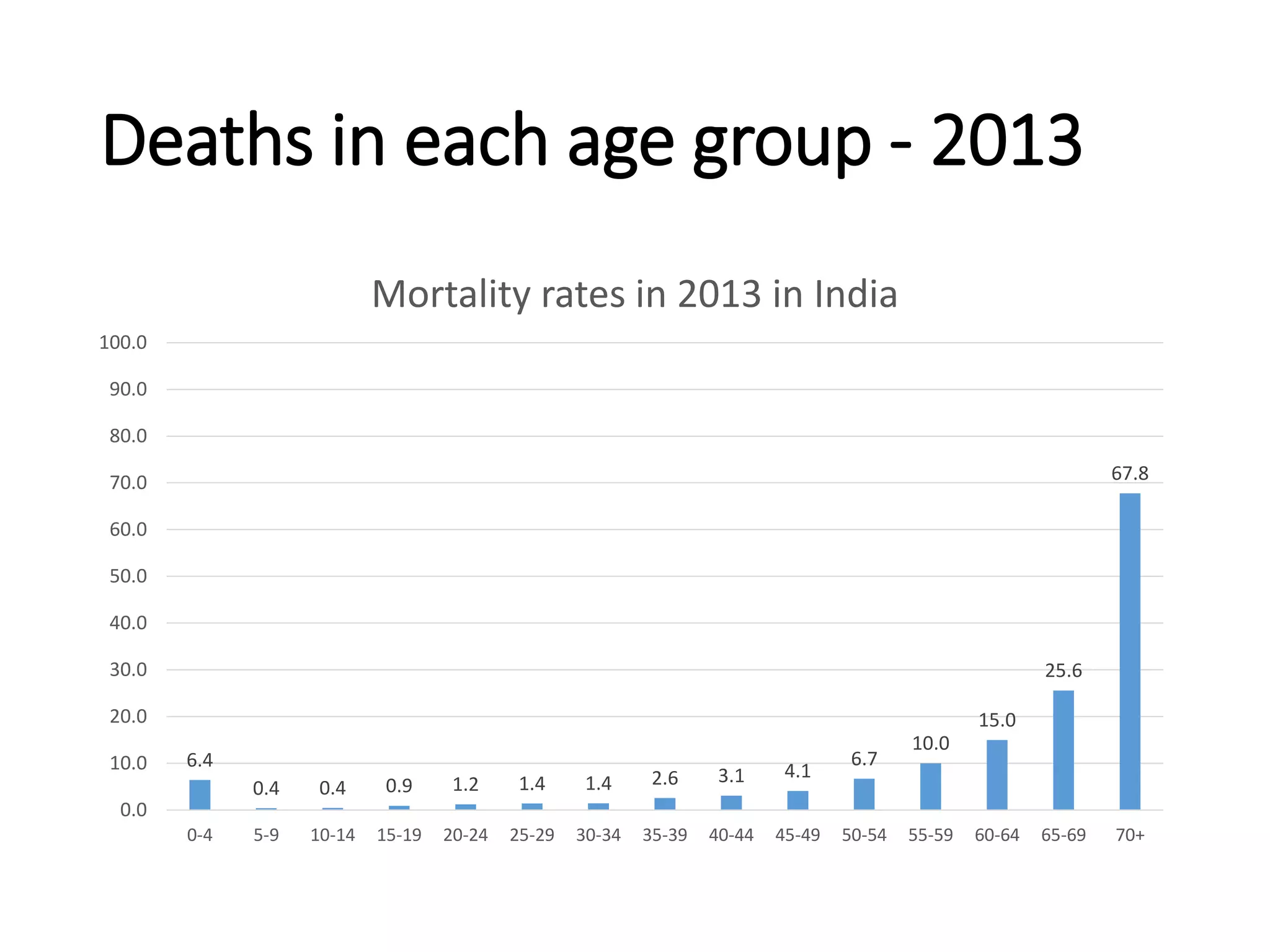
Deaths in each age group - 2013
6.4
0.4 0.4 0.9 1.2 1.4 1.4 2.6 3.1 4.1
6.7
10.0
15.0
25.6
67.8
0.0
10.0
20.0
30.0
40.0
50.0
60.0
70.0
80.0
90.0
100.0
0-4 5-9 10-14 15-19 20-24 25-29 30-34 35-39 40-44 45-49 50-54 55-59 60-64 65-69 70+
Mortality rates in 2013 in India
Child death rate
(mortality in 1-4 years age group)
Definition of 1-4 year MR
•Child death rate =
No.of child deaths aged 1−4 years
Total no.of children aged 1−4 years
x 1000
Description of 1-4 year MR
• More refined indicator of social situation of the
country than IMR
• Unlike IMR, it reflects exogenous causes
• Reflects the influence of environment
• Nutrition, Hygiene, Infection, Accidents
• 50% deaths occur in 2nd year in this age group
• 30-50 times greater in developing countries
How much 1-4 year MR in India?
• 2.8% of all deaths that occurred in 2012
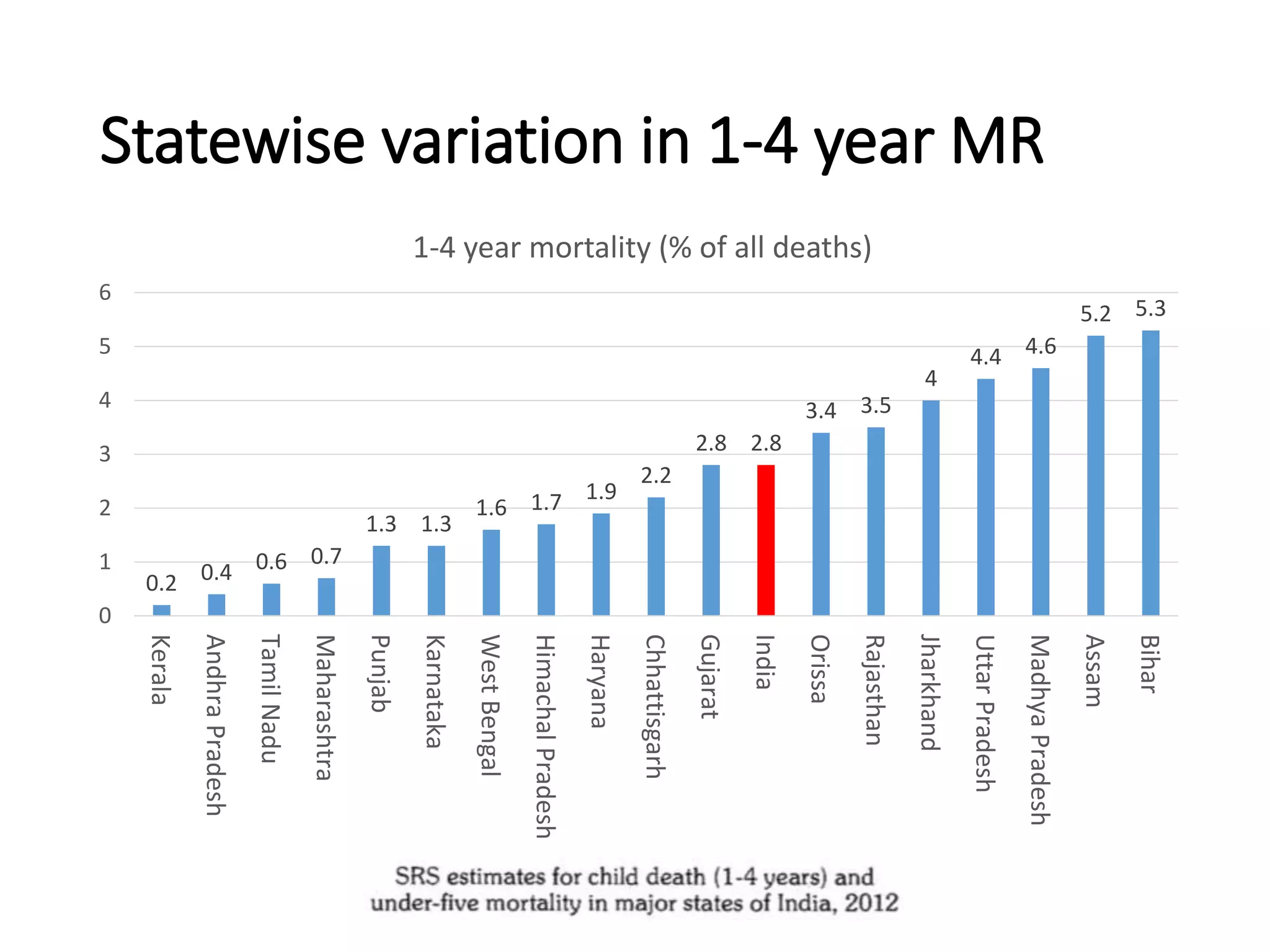
Statewise variation in 1-4 year MR
0.2 0.4 0.6 0.7
1.3 1.3
1.6 1.7 1.9
2.2
2.8 2.8
3.4 3.5
4
4.4 4.6
5.2 5.3
0
1
2
3
4
5
6
Kerala
AndhraPradesh
TamilNadu
Maharashtra
Punjab
Karnataka
WestBengal
HimachalPradesh
Haryana
Chhattisgarh
Gujarat
India
Orissa
Rajasthan
Jharkhand
UttarPradesh
MadhyaPradesh
Assam
Bihar
1-4 year mortality (% of all deaths)
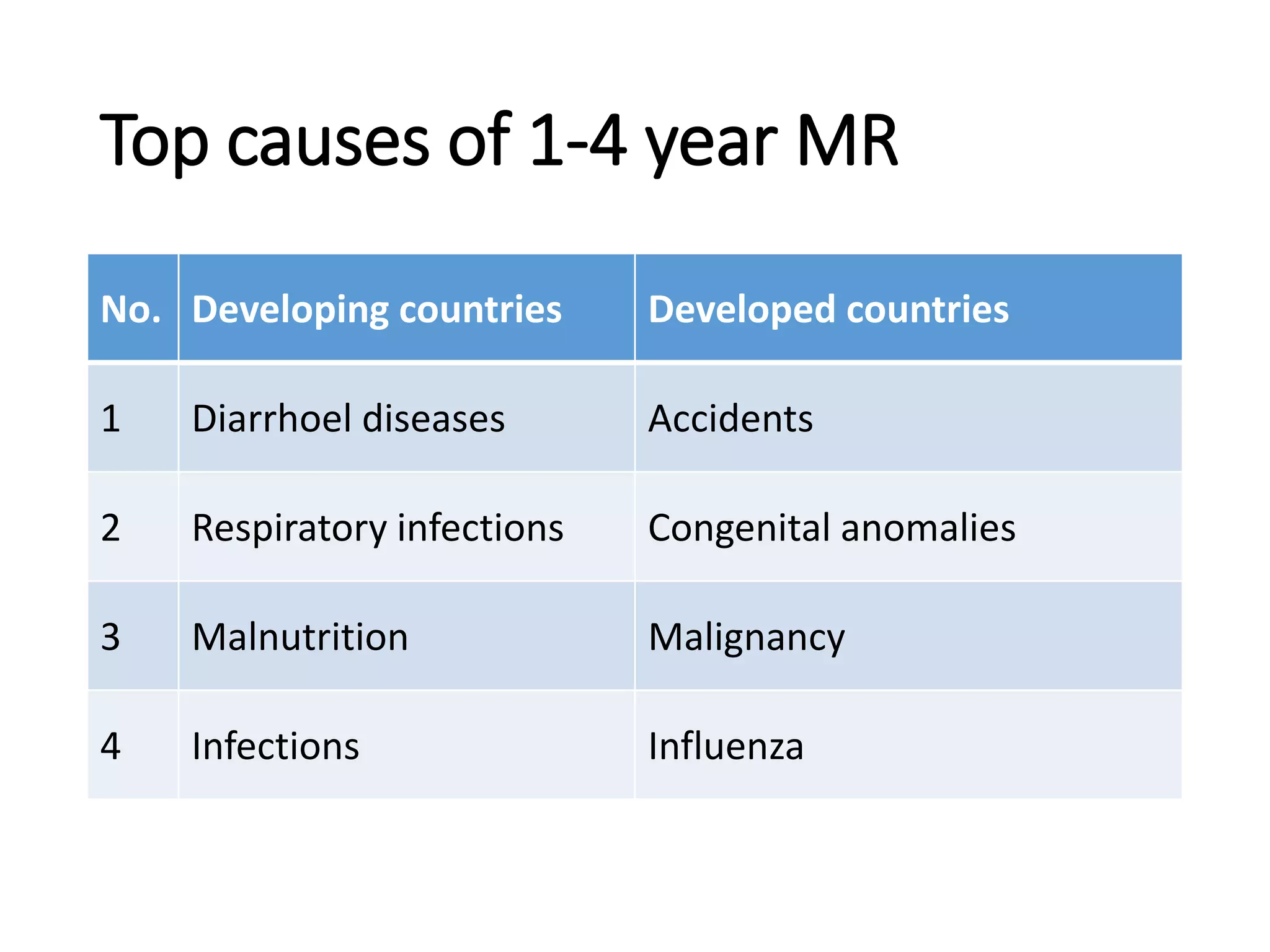
Top causes of 1-4 year MR
No. Developing countries Developed countries
1 Diarrhoel diseases Accidents
2 Respiratory infections Congenital anomalies
3 Malnutrition Malignancy
4 Infections Influenza
Type of accidents responsible
• Falls from stairs
• Suffocation
• Burns
• Poisoning
Top causes of 1-4 year MR in India
Pneumonia
18.2%
Diarrhoeal diseases
17.9%
Injuries
16.9%
Other noncommunicable
diseases
10.6%
Malaria
7.0%
Fever of unknown origin
6.3%
Other infectious and
parasitic diseases
4.0%
Congenital anomalies
3.5%
Meningitis/encephalitis
3.5%
Ill defined or cause
unknown
3.2%
All Other Remaining
Causes
8.9%
Top Ten Causes of Death Age 1 - 4 Years: 2010-2013
Pneumonia
18.2%
Diarrhoea
17.8%
Injuries
16.9%
Under-5 mortality rate
(mortality in 0-5 years age group)
Definition of U5MR
•Child mortality rate =
No.of child deaths aged 0−59 months
Total no. of live births
x 1000
Description of U5MR
• Single best indicator of social development than
national income
• A major decline has been achieved in the past 2
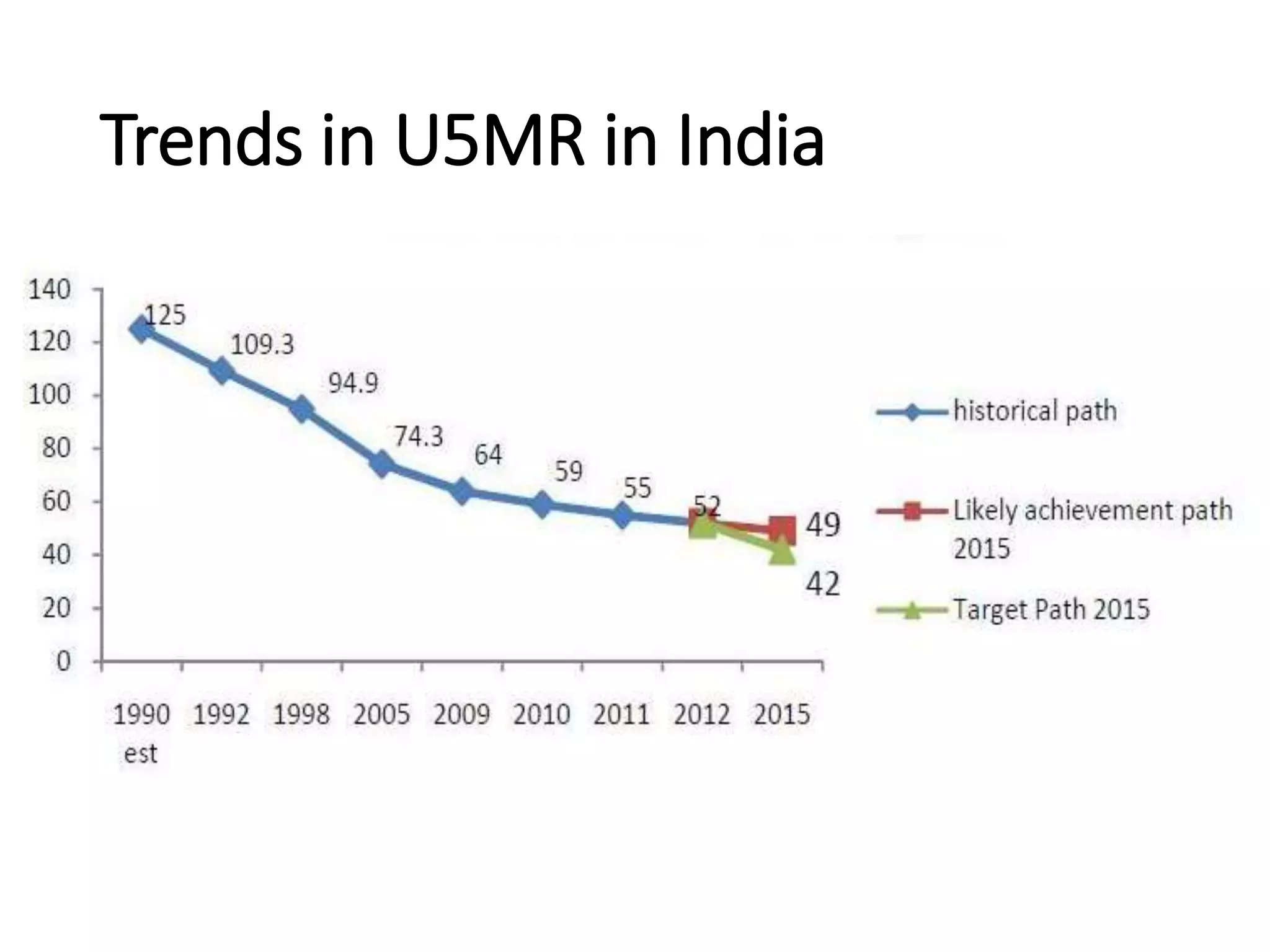
decades, nearly 50% from 90 to 56 per 1000 LB
• Major factor was the implementation of MDGs
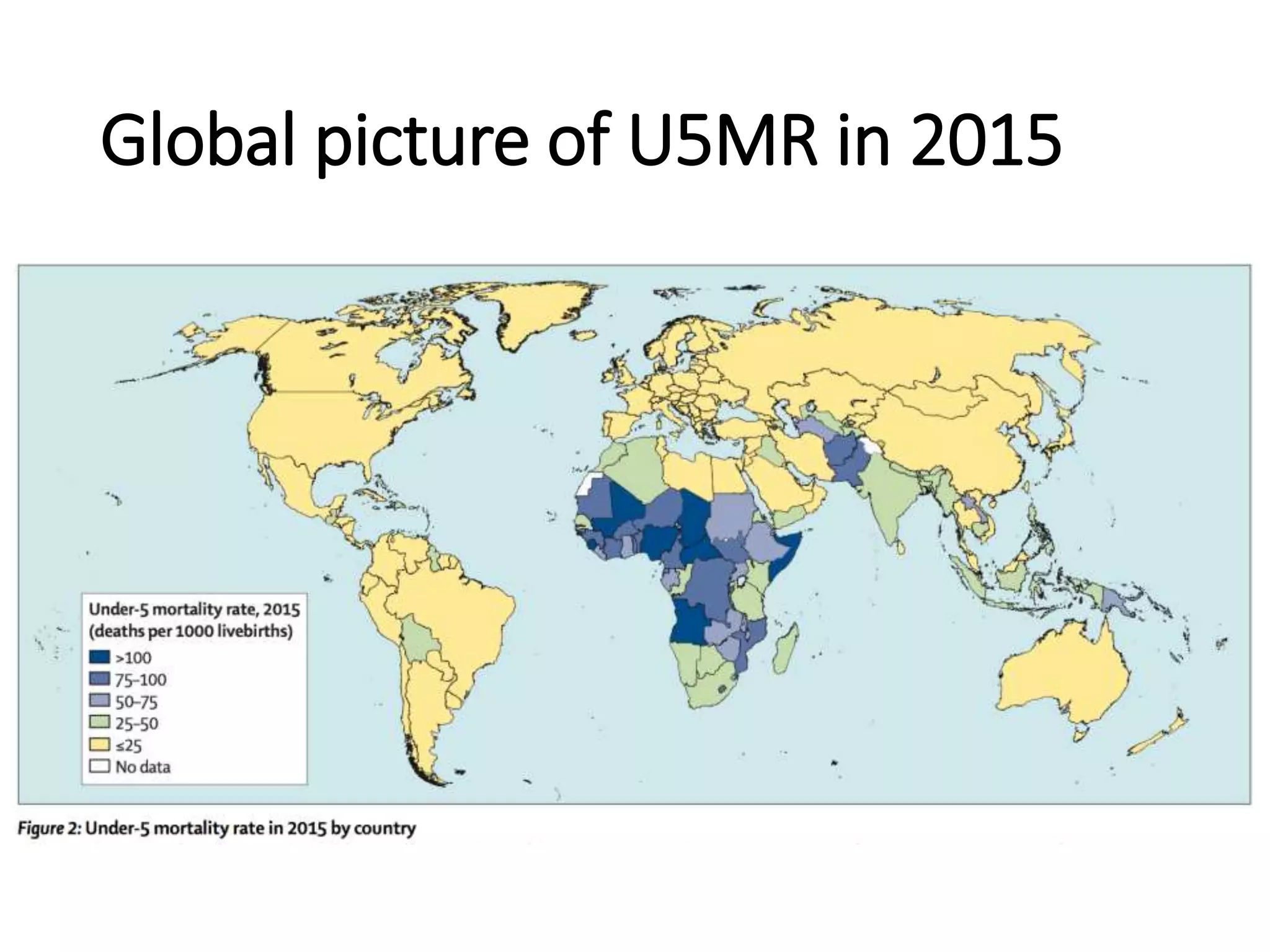
Global picture of U5MR in 2015
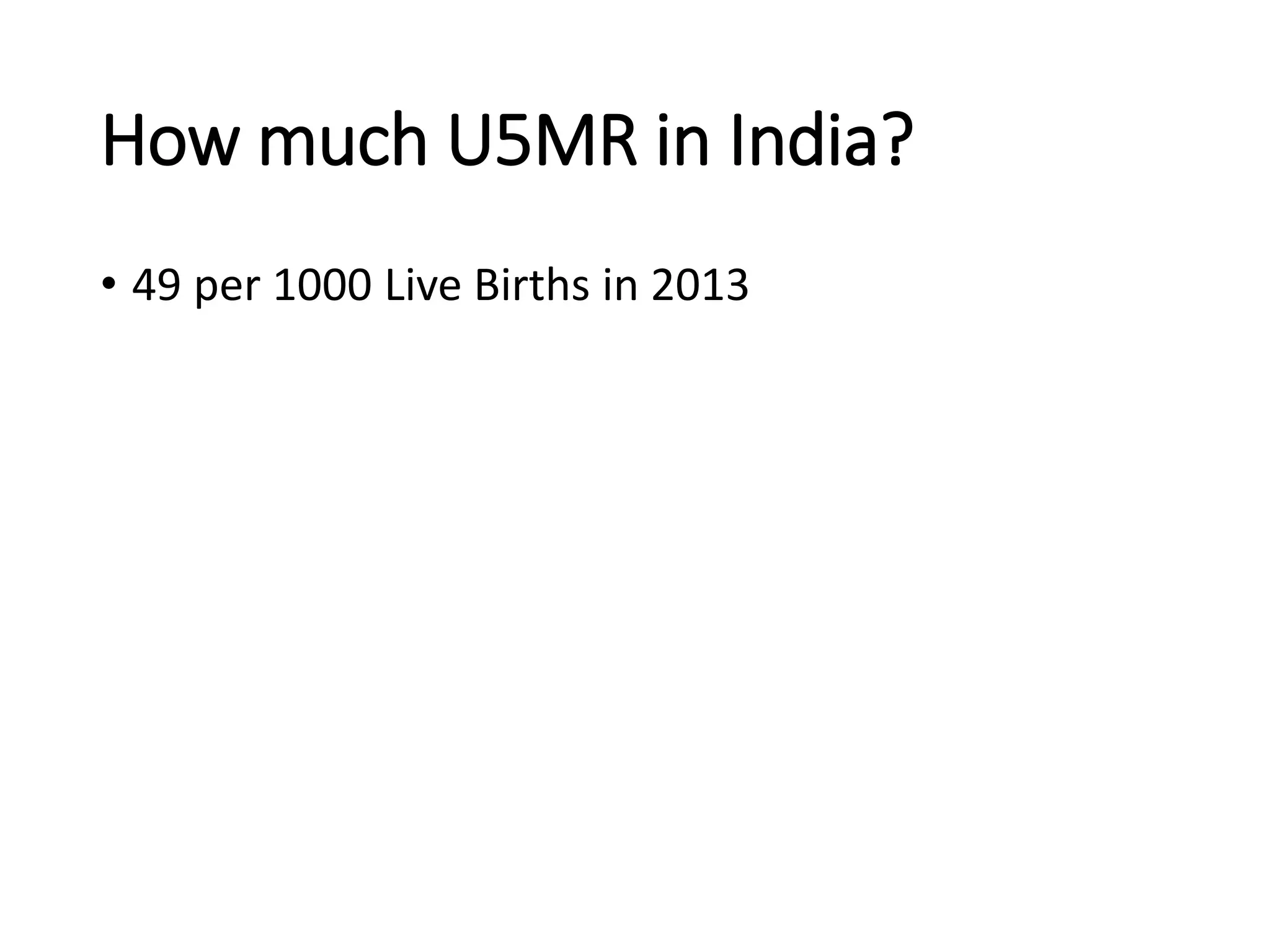
How much U5MR in India?
• 49 per 1000 Live Births in 2013
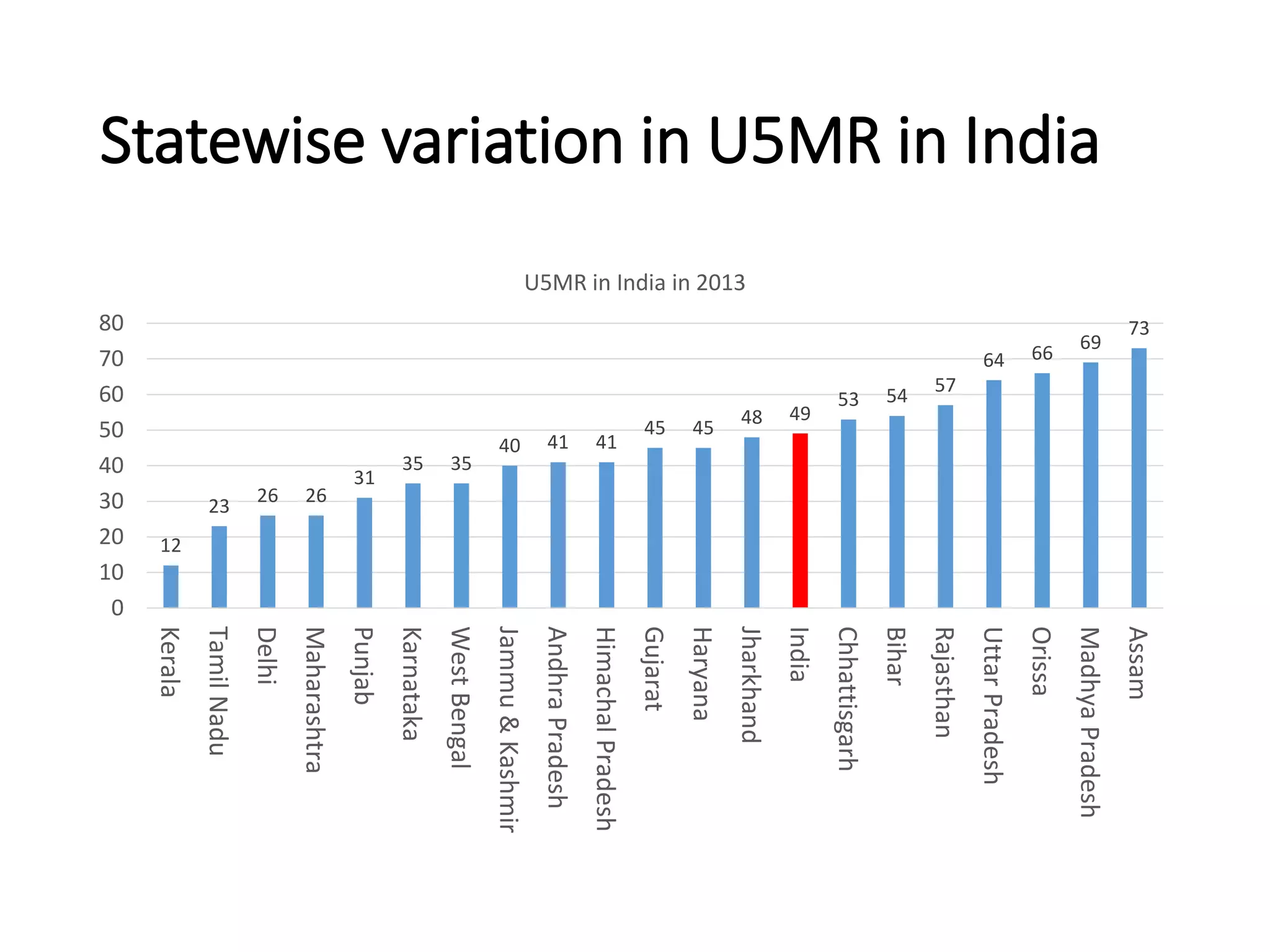
Statewise variation in U5MR in India
12
23
26 26
31
35 35
40 41 41
45 45
48 49
53 54
57
64 66
69
73
0
10
20
30
40
50
60
70
80
Kerala
TamilNadu
Delhi
Maharashtra
Punjab
Karnataka
WestBengal
Jammu&Kashmir
AndhraPradesh
HimachalPradesh
Gujarat
Haryana
Jharkhand
India
Chhattisgarh
Bihar
Rajasthan
UttarPradesh
Orissa
MadhyaPradesh
Assam
U5MR in India in 2013
Trends in U5MR in India
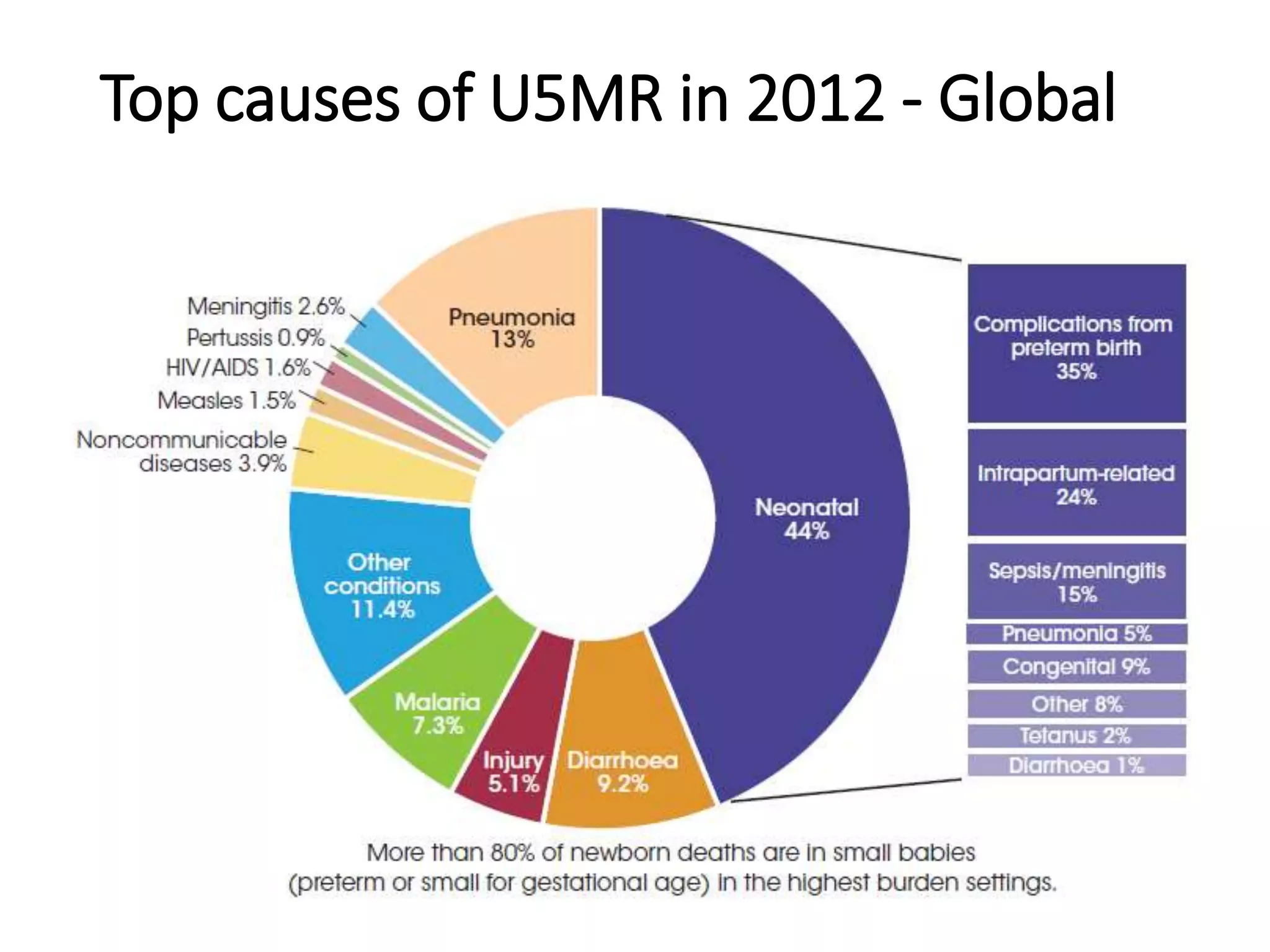
Top causes of U5MR in 2012 - Global
Top causes of U5MR in 2013 - India
Rank Cause %
1 Neonatal period causes 44%
2 Pneumonia 13%
3 Diarrhoea 9%
4 Malaria 7%
5 Injury 5%
6 Meningitis 2%
7 Measles 2%
8 AIDS 2%
9 Others 16%
Child Survival Index
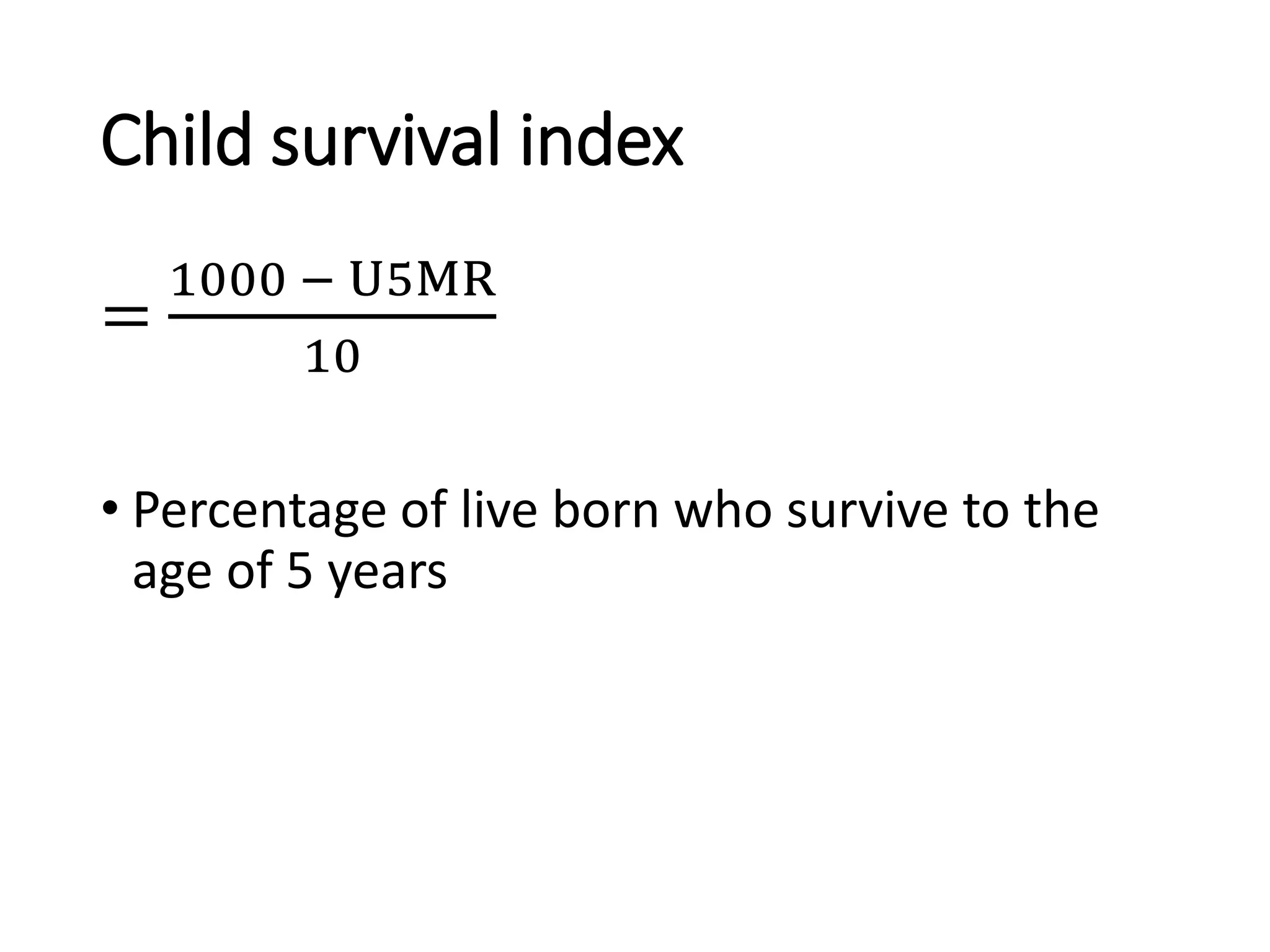
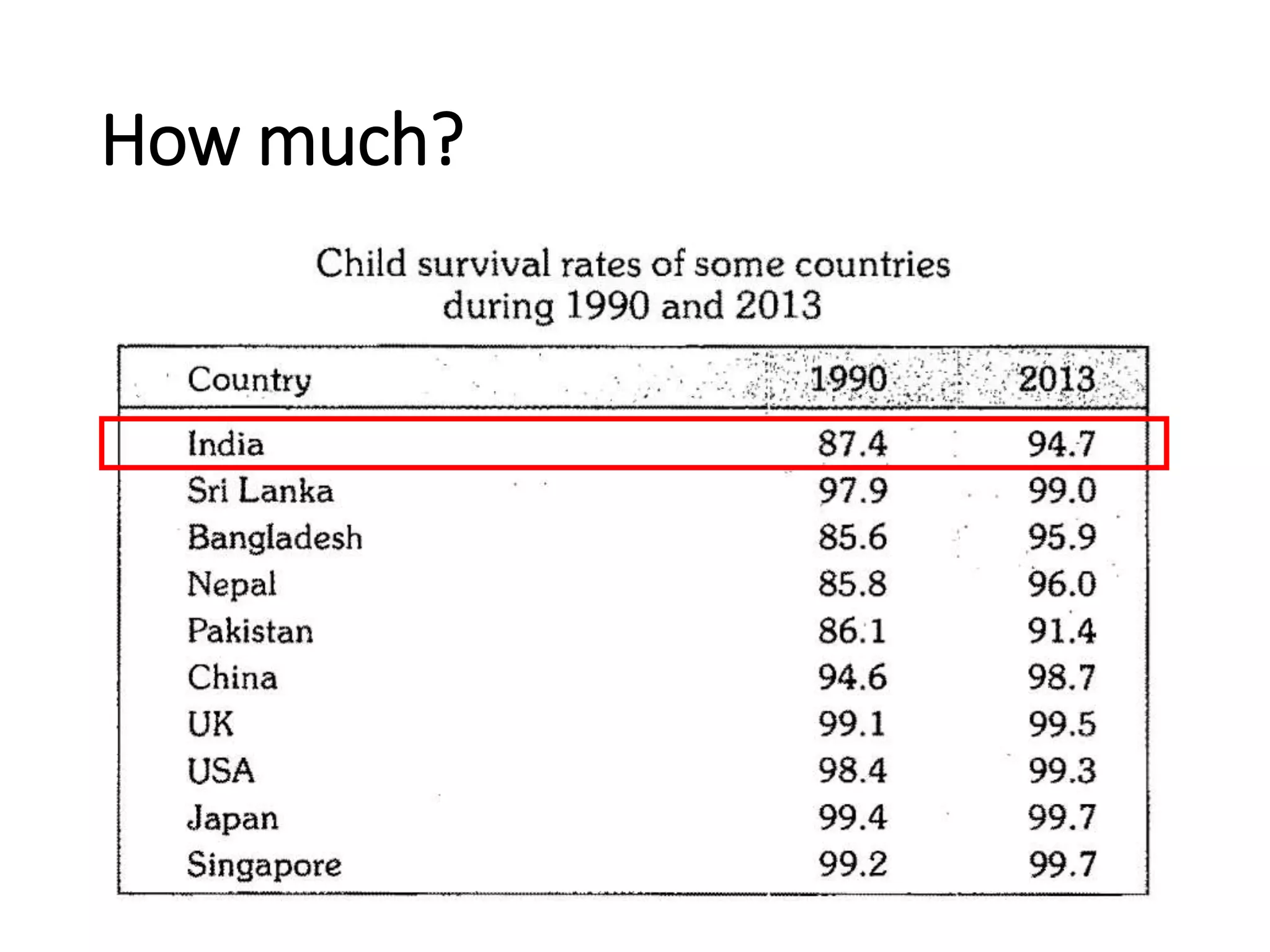
Child survival index
=
1000 − U5MR
10
• Percentage of live born who survive to the
age of 5 years
How much?
Recap of causes of child
mortality in India
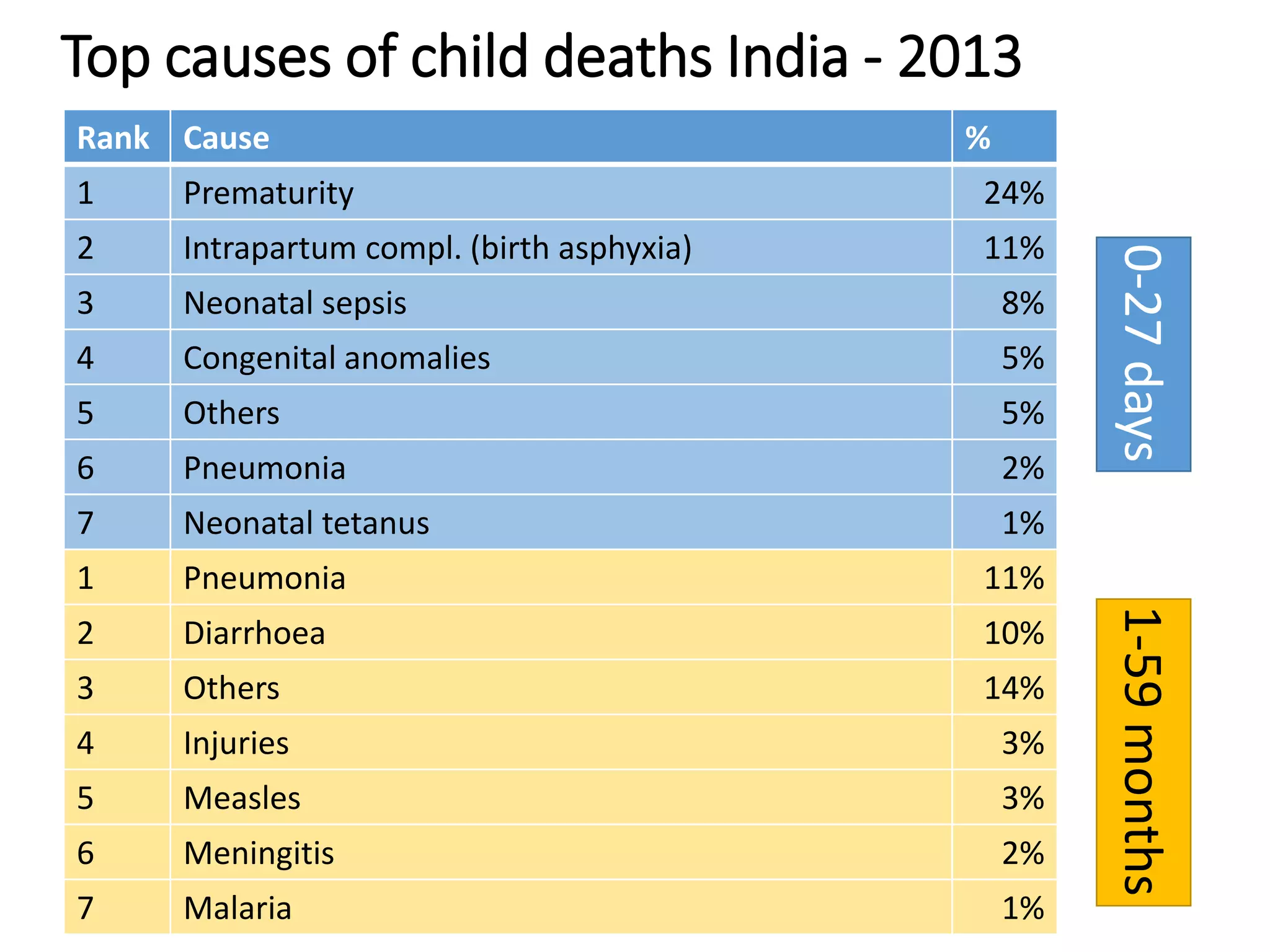
Top causes of child deaths India - 2013
Rank Cause %
1 Prematurity 24%
2 Intrapartum compl. (birth asphyxia) 11%
3 Neonatal sepsis 8%
4 Congenital anomalies 5%
5 Others 5%
6 Pneumonia 2%
7 Neonatal tetanus 1%
1 Pneumonia 11%
2 Diarrhoea 10%
3 Others 14%
4 Injuries 3%
5 Measles 3%
6 Meningitis 2%
7 Malaria 1%
0-27days1-59months
How to reduce U5MR?
Measures to reduce U5MR
• Different approached, different agencies, different
outcomes
• WHO - rapid scale up of key effective, affordable
interventions
• Care for newborns and their mothers
• Infant and young child feeding
• Vaccines
• Prevention and case management of pneumonia,
diarrhoea and sepsis
• Malaria control
• Prevention and care of HIV/AIDS
Measures to reduce U5MR
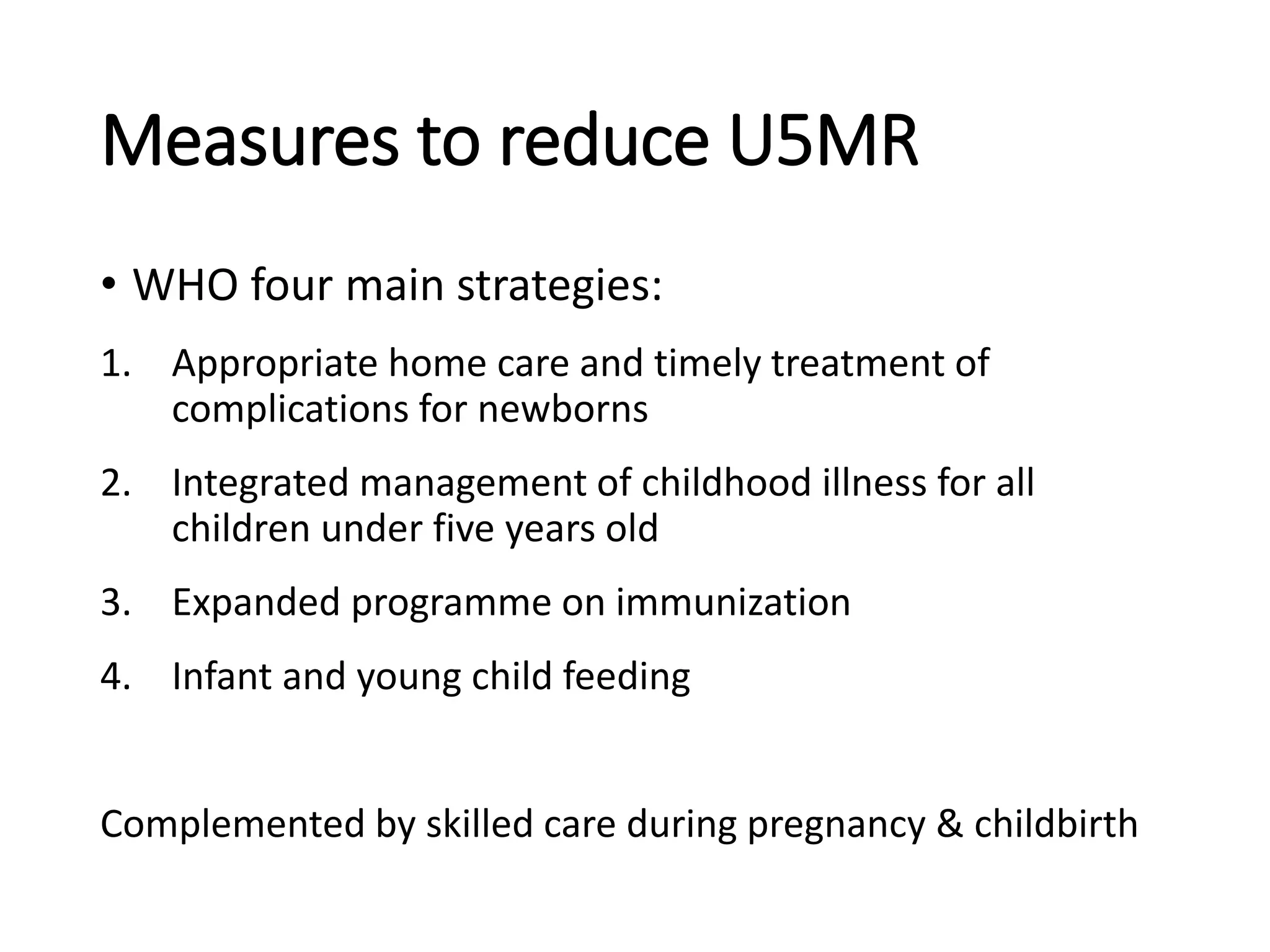
• WHO four main strategies:
1. Appropriate home care and timely treatment of
complications for newborns
2. Integrated management of childhood illness for all
children under five years old
3. Expanded programme on immunization
4. Infant and young child feeding
Complemented by skilled care during pregnancy & childbirth
3 delays model of child deaths
Main programme strategies in
India related to child health
• NRHM, NUHM or NHM
• RMNCH + A
• ASHA
• HBPNC
• IYCF
• BFHI
• IMNCI
Interventions, neonatal - prematurity
Pregnant
Premature
SurviveDie
Treated bednets &materials*
Intermittent preventive therapy
Newborn temperature
management
Prevention Treatment
Antinatal steroids
Antibiotics for premature
rupture of membranes
* Indoor residual spraying may be used as an alternative
Interventions, neonatal - infections
Exposure to
infections
Severe bacterial
infection
SurviveDie
Breastfeeding
Antibiotics for sepsis
Prevention Treatment
Clean delivery
Antibiotics for premature
rupture of membranes
Interventions by cause - pneumonia
Exposure to
pneumonia
Pneumonia
SurviveDie
Hib vaccine
Complementary feeding
Antibiotics
Prevention Treatment
Future: Pneumococcal vaccine, zinc for therapy, reduction of indoor air pollution
Breastfeeding
Zinc
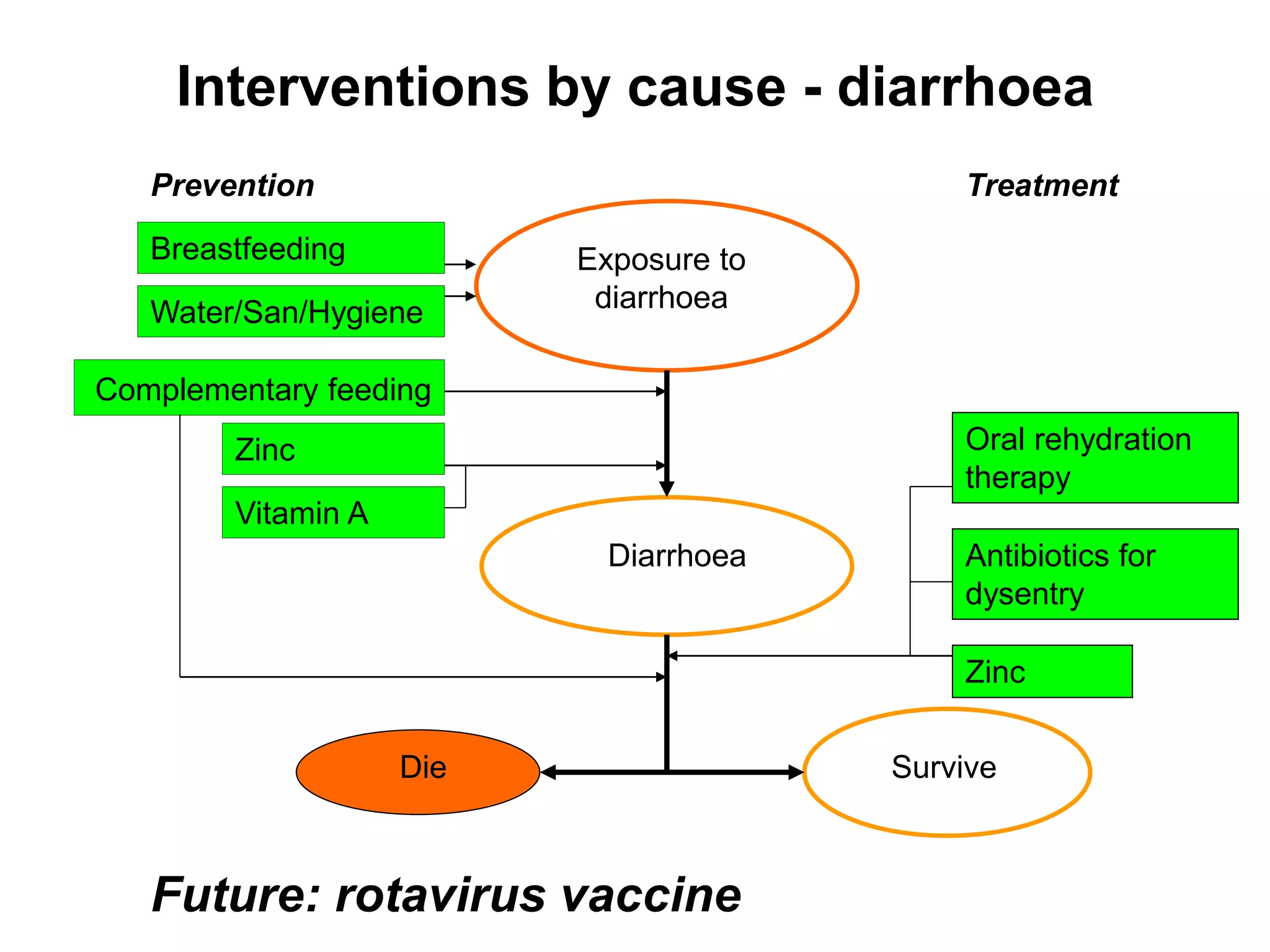
Interventions by cause - diarrhoea
Exposure to
diarrhoea
Diarrhoea
SurviveDie
Breastfeeding
Complementary feeding
Treatment
Zinc
Future: rotavirus vaccine
Vitamin A
Antibiotics for
dysentry
Oral rehydration
therapy
Zinc
Water/San/Hygiene
Prevention
Cause based strategies: post-
neonatal children
Cause of death Risk factors Prevention Treatment
Pneumonia, or
other acute
respiratory
infections
Low birth weight
Malnutrition
Non-breastfed
children
Overcrowding
Vaccination
Adequate nutrition
Exclusive
breastfeeding
Reduction of IAP
Appropriate care
by trained provider
Antibiotics
Oxygen for severe
illness
Childhood
diarrhoea
Non-breastfed
children
Unsafe drinking
water and food
Poor hygiene
practices
Malnutrition
Exclusive
breastfeeding
Safe water and
food
Adequate
sanitation and
hygiene
Adequate nutrition
Vaccination
Low-osmolarity
oral rehydration
salts (ORS)
Zinc supplements
Every Newborn Action Plan
% of deaths preventable by each intervention
in India 0% 2% 4% 6% 8% 10% 12% 14% 16% 18%
Breastfeeding
Complementary feeding
Clean delivery
Hib vaccine
Clean water, sanitation, hygiene
Zinc
Vitamin A
Antenatal steroids
Newborn temperature management
Tetanus toxoid
Antibiotics for PRM
Measles vaccine
Nivirapine and replacement feeding
Insecticide-treated materials
Antimalarial IPT in pregnancy
Intervention
Percent
Review
Review 1
• Which one of the following is the leading cause of
death in the under 5 age group in developing
countries?
a) Malaria
b) Acute Respiratory Infections
c) Hepatitis
d) Prematurity
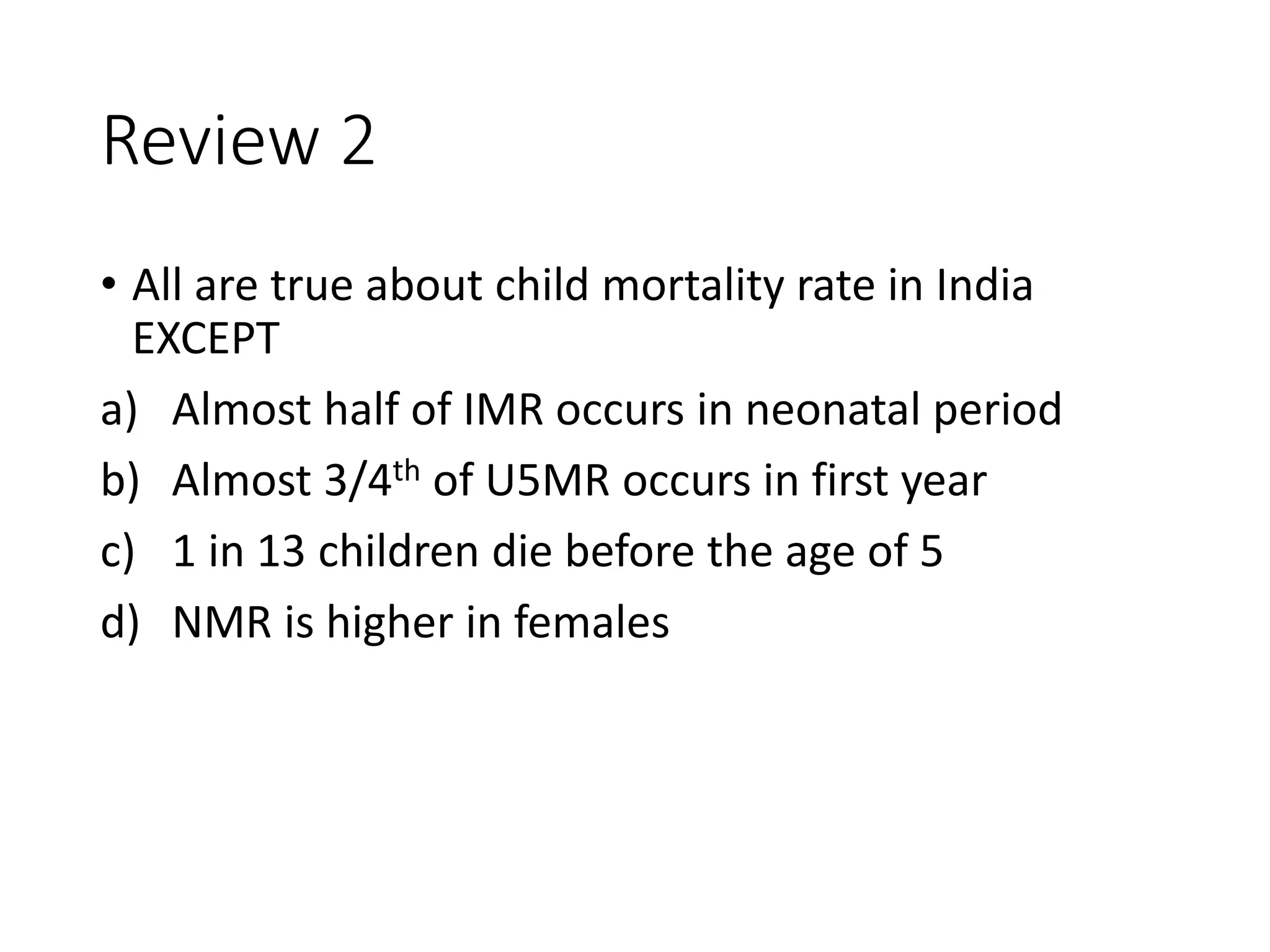
Review 2
• All are true about child mortality rate in India
EXCEPT
a) Almost half of IMR occurs in neonatal period
b) Almost 3/4th of U5MR occurs in first year
c) 1 in 13 children die before the age of 5
d) NMR is higher in females
Review 3
• Child survival index is calculated from
a) MMR
b) IMR
c) NMR
d) U5MR
Review 4
• All are important causes of PNMR EXCEPT
a) Diarrhea
b) ARI
c) Malnutrition
d) Tetanus
Review 5
• Child Death Rate is
a) Child Mortality Rate
b) 1-5 years mortality
c) 0-4 years mortality
d) 13-48 months mortality
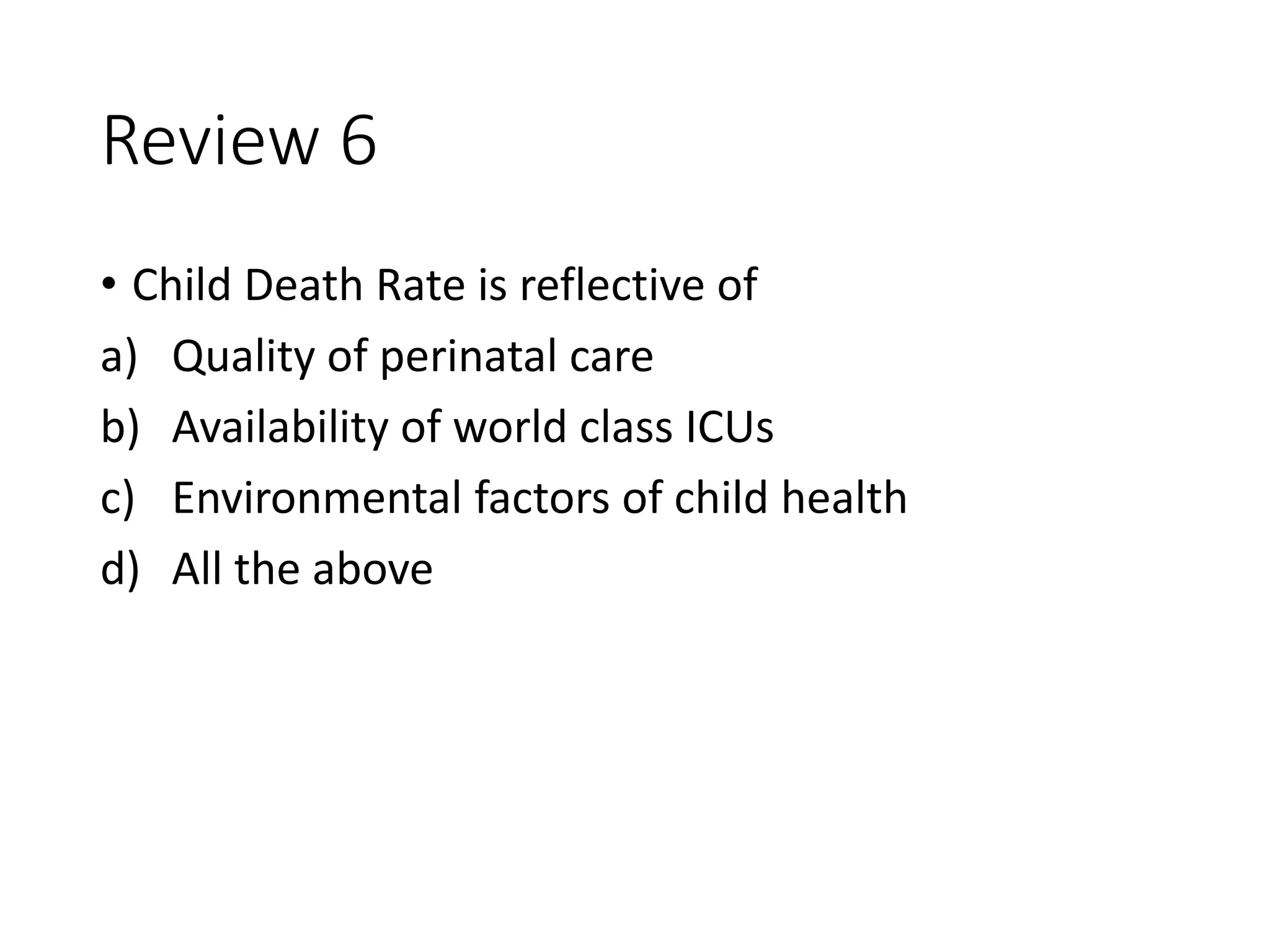
Review 6
• Child Death Rate is reflective of
a) Quality of perinatal care
b) Availability of world class ICUs
c) Environmental factors of child health
d) All the above
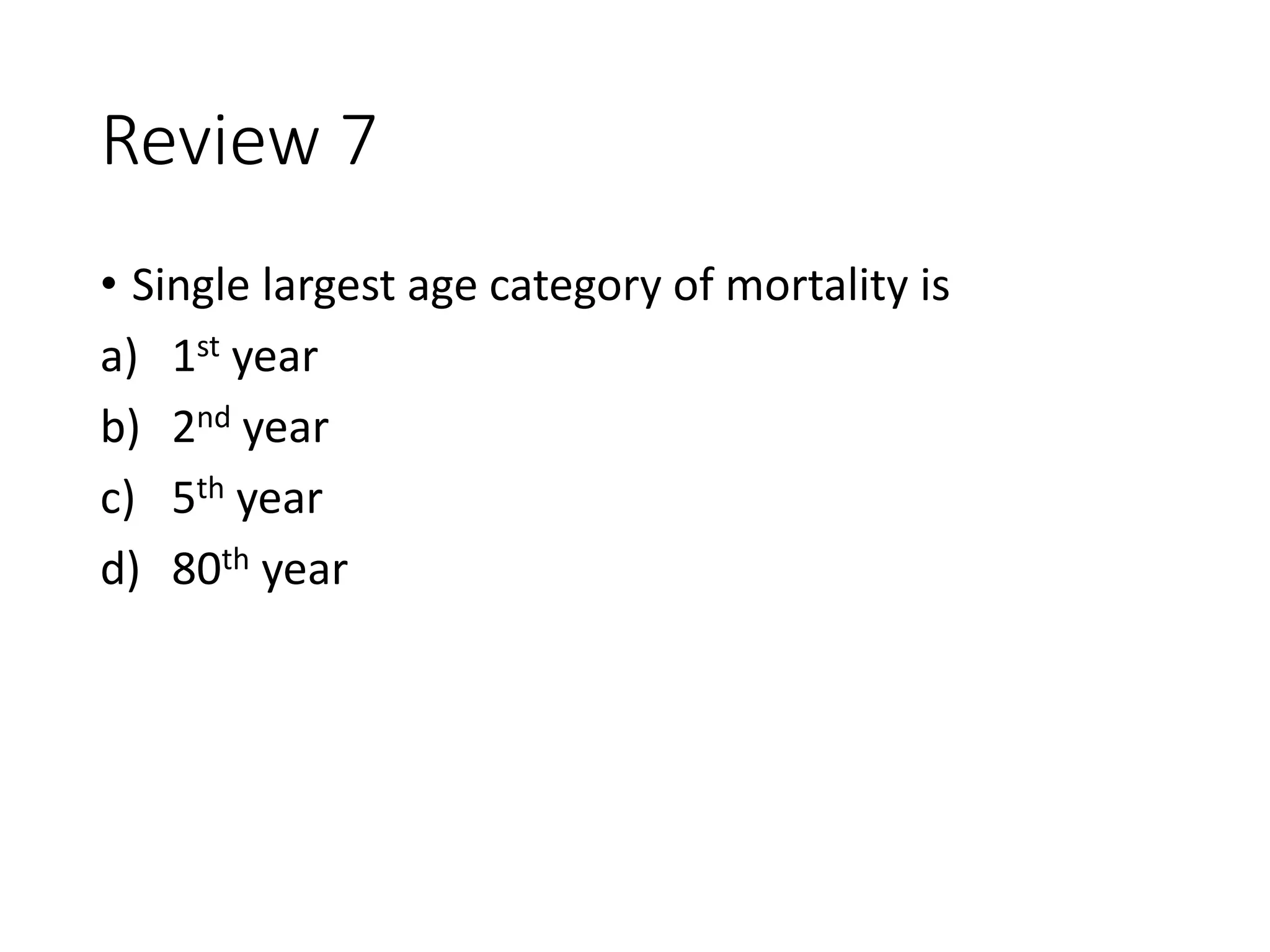
Review 7
• Single largest age category of mortality is
a) 1st year
b) 2nd year
c) 5th year
d) 80th year
Review 8
• What proportion of deaths occurred in the 1-4 year
age group in India in 2012
a) <3%
b) 1%
c) 50%
d) 4%
Review 9
• All the following states have a proportion of child
deaths that is higher than the national average
EXCEPT
a) Bihar
b) Orissa
c) Madhya Pradesh
d) Gujarat
Review 10
• MDG goals for the U5MR in India has been
achieved
a) True
b) False
Review 11
• Top causes of child deaths are all EXCEPT
a) Prematurity
b) Birth Asyphxia
c) Pneumonia
d) Diarrhoea
e) Congenital anomalies
f) None of the above
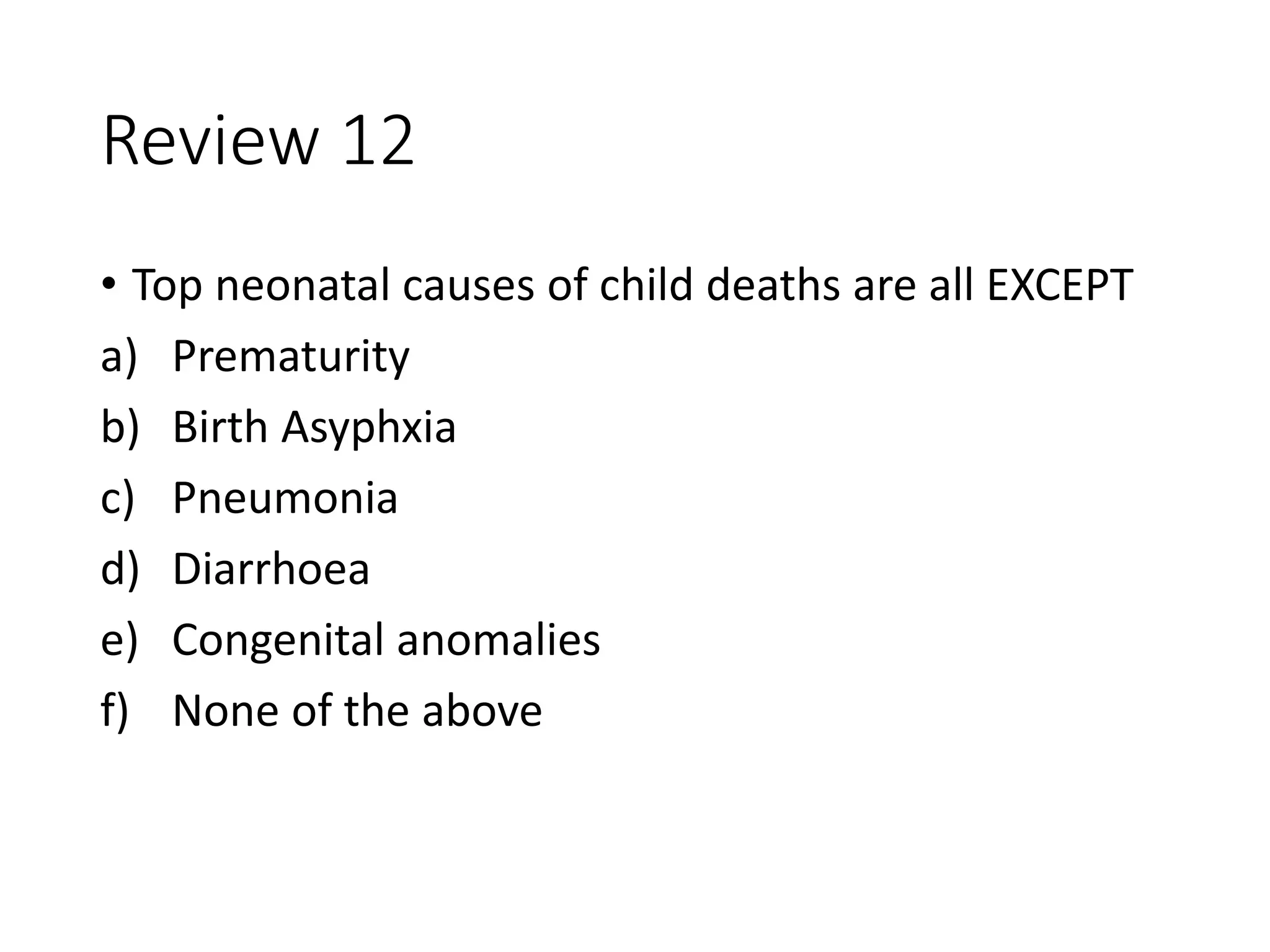
Review 12
• Top neonatal causes of child deaths are all EXCEPT
a) Prematurity
b) Birth Asyphxia
c) Pneumonia
d) Diarrhoea
e) Congenital anomalies
f) None of the above
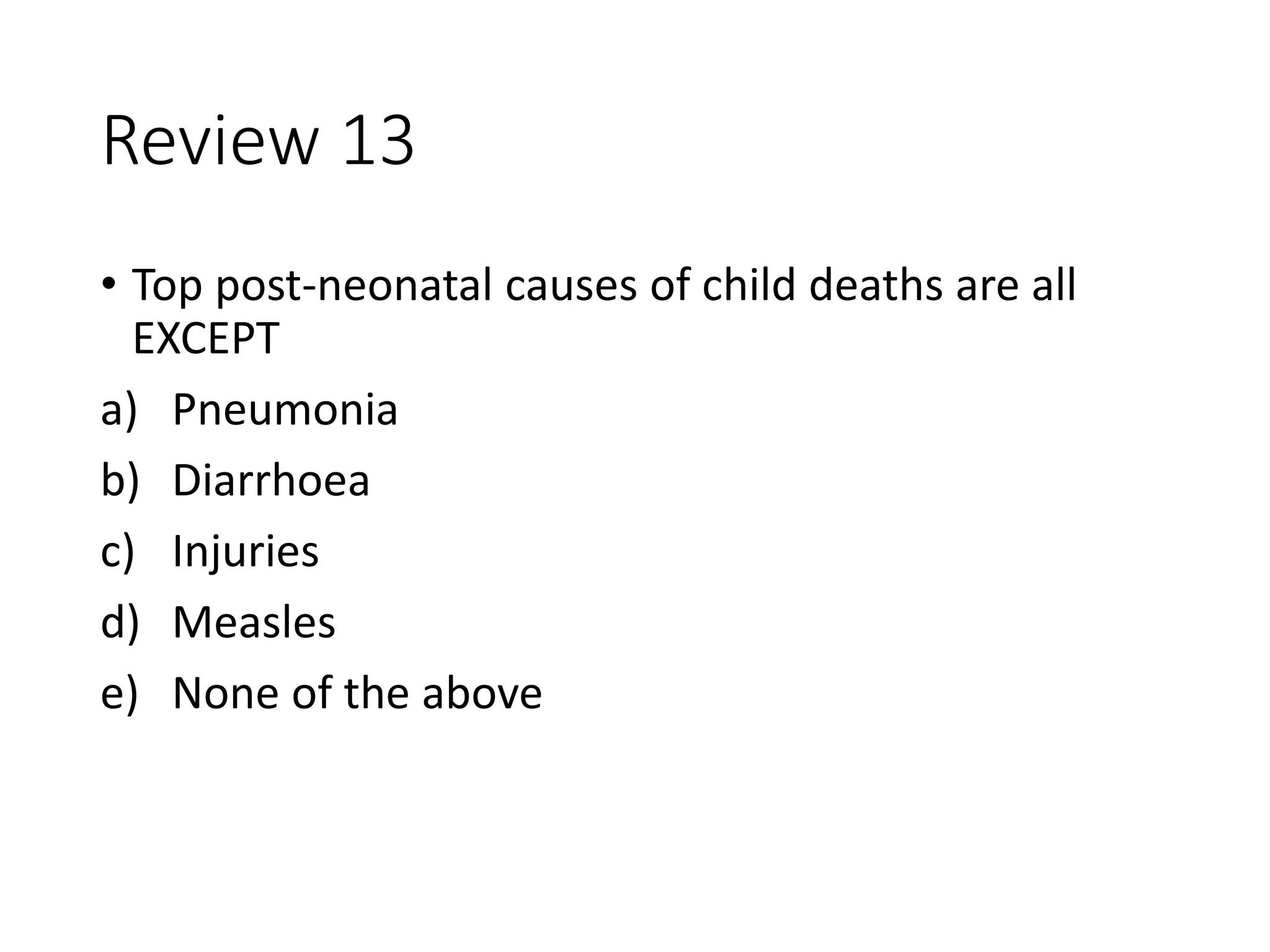
Review 13
• Top post-neonatal causes of child deaths are all
EXCEPT
a) Pneumonia
b) Diarrhoea
c) Injuries
d) Measles
e) None of the above
Review 13
• Top post-neonatal causes of child deaths are all
EXCEPT
a) Pneumonia
b) Diarrhoea
c) Injuries
d) Measles
e) None of the above
Review 14
• Priority strategies for reduction of child mortality in
India include (PGI type Q)
a) Skilled birth attendant
b) Promotion of IYCF practices
c) Immunization
d) IMNCI
e) Injury prevention
Review 15
Rank the strategies in order of highest to lowest impact on
reduction of U5MR
1. Skilled birth attendant
2. Measles vaccine
3. Promotion of IYCF (BF and CF)
4. Sanitation & hygiene
a) 1, 2, 3, 4
b) 2, 3, 4, 5
c) 4, 1, 2, 3
d) 3, 1, 4, 2
Review 16
• What is the current U5MR in India?
a) 50 per 1000 Births
b) 49 per 1000 Live Births
c) 52 per 1000 Live Births
d) 37 per 1000 Live Births
Thank you
Send your queries to sarizwan1986@outlook.com

Child mortality indicators in India

  • 1.
    Child mortality indicators: Childdeath rate & Under-5 mortality rate Dr. S. A. Rizwan, M.D., Asst. Professor, Dept. of Community Medicine, VMCHRI, Madurai
  • 2.
    Learning objectives • Atthe end of this lecture you sh. be able to • Define each indicator (numerator/denominator) • Describe the meaning and importance of each indicator • List the major causes of such deaths • List the measures required to reduce these rates
  • 3.
    Revision • What isan indicator? • What is a health indicator? • Name some health indicators from previous classes • How do health indictors help you?
  • 4.
  • 5.
  • 6.
    Deaths in eachage group - 1986 20.9 1.7 1.0 1.7 2.1 2.3 2.4 3.3 4.0 7.3 11.8 18.0 27.2 38.2 88.1 0.0 10.0 20.0 30.0 40.0 50.0 60.0 70.0 80.0 90.0 100.0 0-4 5-9 10-14 15-19 20-24 25-29 30-34 35-39 40-44 45-49 50-54 55-59 60-64 65-69 70+ Mortality rates in 1986 in India
  • 7.
    Deaths in eachage group - 2013 6.4 0.4 0.4 0.9 1.2 1.4 1.4 2.6 3.1 4.1 6.7 10.0 15.0 25.6 67.8 0.0 10.0 20.0 30.0 40.0 50.0 60.0 70.0 80.0 90.0 100.0 0-4 5-9 10-14 15-19 20-24 25-29 30-34 35-39 40-44 45-49 50-54 55-59 60-64 65-69 70+ Mortality rates in 2013 in India
  • 8.
    Child death rate (mortalityin 1-4 years age group)
  • 9.
    Definition of 1-4year MR •Child death rate = No.of child deaths aged 1−4 years Total no.of children aged 1−4 years x 1000
  • 10.
    Description of 1-4year MR • More refined indicator of social situation of the country than IMR • Unlike IMR, it reflects exogenous causes • Reflects the influence of environment • Nutrition, Hygiene, Infection, Accidents • 50% deaths occur in 2nd year in this age group • 30-50 times greater in developing countries
  • 11.
    How much 1-4year MR in India? • 2.8% of all deaths that occurred in 2012
  • 12.
    Statewise variation in1-4 year MR 0.2 0.4 0.6 0.7 1.3 1.3 1.6 1.7 1.9 2.2 2.8 2.8 3.4 3.5 4 4.4 4.6 5.2 5.3 0 1 2 3 4 5 6 Kerala AndhraPradesh TamilNadu Maharashtra Punjab Karnataka WestBengal HimachalPradesh Haryana Chhattisgarh Gujarat India Orissa Rajasthan Jharkhand UttarPradesh MadhyaPradesh Assam Bihar 1-4 year mortality (% of all deaths)
  • 13.
    Top causes of1-4 year MR No. Developing countries Developed countries 1 Diarrhoel diseases Accidents 2 Respiratory infections Congenital anomalies 3 Malnutrition Malignancy 4 Infections Influenza
  • 14.
    Type of accidentsresponsible • Falls from stairs • Suffocation • Burns • Poisoning
  • 15.
    Top causes of1-4 year MR in India Pneumonia 18.2% Diarrhoeal diseases 17.9% Injuries 16.9% Other noncommunicable diseases 10.6% Malaria 7.0% Fever of unknown origin 6.3% Other infectious and parasitic diseases 4.0% Congenital anomalies 3.5% Meningitis/encephalitis 3.5% Ill defined or cause unknown 3.2% All Other Remaining Causes 8.9% Top Ten Causes of Death Age 1 - 4 Years: 2010-2013 Pneumonia 18.2% Diarrhoea 17.8% Injuries 16.9%
  • 16.
    Under-5 mortality rate (mortalityin 0-5 years age group)
  • 17.
    Definition of U5MR •Childmortality rate = No.of child deaths aged 0−59 months Total no. of live births x 1000
  • 18.
    Description of U5MR •Single best indicator of social development than national income • A major decline has been achieved in the past 2 decades, nearly 50% from 90 to 56 per 1000 LB • Major factor was the implementation of MDGs
  • 19.
    Global picture ofU5MR in 2015
  • 20.
    How much U5MRin India? • 49 per 1000 Live Births in 2013
  • 21.
    Statewise variation inU5MR in India 12 23 26 26 31 35 35 40 41 41 45 45 48 49 53 54 57 64 66 69 73 0 10 20 30 40 50 60 70 80 Kerala TamilNadu Delhi Maharashtra Punjab Karnataka WestBengal Jammu&Kashmir AndhraPradesh HimachalPradesh Gujarat Haryana Jharkhand India Chhattisgarh Bihar Rajasthan UttarPradesh Orissa MadhyaPradesh Assam U5MR in India in 2013
  • 22.
  • 23.
    Top causes ofU5MR in 2012 - Global
  • 24.
    Top causes ofU5MR in 2013 - India Rank Cause % 1 Neonatal period causes 44% 2 Pneumonia 13% 3 Diarrhoea 9% 4 Malaria 7% 5 Injury 5% 6 Meningitis 2% 7 Measles 2% 8 AIDS 2% 9 Others 16%
  • 25.
  • 26.
    Child survival index = 1000− U5MR 10 • Percentage of live born who survive to the age of 5 years
  • 27.
  • 28.
    Recap of causesof child mortality in India
  • 29.
    Top causes ofchild deaths India - 2013 Rank Cause % 1 Prematurity 24% 2 Intrapartum compl. (birth asphyxia) 11% 3 Neonatal sepsis 8% 4 Congenital anomalies 5% 5 Others 5% 6 Pneumonia 2% 7 Neonatal tetanus 1% 1 Pneumonia 11% 2 Diarrhoea 10% 3 Others 14% 4 Injuries 3% 5 Measles 3% 6 Meningitis 2% 7 Malaria 1% 0-27days1-59months
  • 30.
  • 31.
    Measures to reduceU5MR • Different approached, different agencies, different outcomes • WHO - rapid scale up of key effective, affordable interventions • Care for newborns and their mothers • Infant and young child feeding • Vaccines • Prevention and case management of pneumonia, diarrhoea and sepsis • Malaria control • Prevention and care of HIV/AIDS
  • 32.
    Measures to reduceU5MR • WHO four main strategies: 1. Appropriate home care and timely treatment of complications for newborns 2. Integrated management of childhood illness for all children under five years old 3. Expanded programme on immunization 4. Infant and young child feeding Complemented by skilled care during pregnancy & childbirth
  • 33.
    3 delays modelof child deaths
  • 34.
    Main programme strategiesin India related to child health • NRHM, NUHM or NHM • RMNCH + A • ASHA • HBPNC • IYCF • BFHI • IMNCI
  • 35.
    Interventions, neonatal -prematurity Pregnant Premature SurviveDie Treated bednets &materials* Intermittent preventive therapy Newborn temperature management Prevention Treatment Antinatal steroids Antibiotics for premature rupture of membranes * Indoor residual spraying may be used as an alternative
  • 36.
    Interventions, neonatal -infections Exposure to infections Severe bacterial infection SurviveDie Breastfeeding Antibiotics for sepsis Prevention Treatment Clean delivery Antibiotics for premature rupture of membranes
  • 37.
    Interventions by cause- pneumonia Exposure to pneumonia Pneumonia SurviveDie Hib vaccine Complementary feeding Antibiotics Prevention Treatment Future: Pneumococcal vaccine, zinc for therapy, reduction of indoor air pollution Breastfeeding Zinc
  • 38.
    Interventions by cause- diarrhoea Exposure to diarrhoea Diarrhoea SurviveDie Breastfeeding Complementary feeding Treatment Zinc Future: rotavirus vaccine Vitamin A Antibiotics for dysentry Oral rehydration therapy Zinc Water/San/Hygiene Prevention
  • 39.
    Cause based strategies:post- neonatal children Cause of death Risk factors Prevention Treatment Pneumonia, or other acute respiratory infections Low birth weight Malnutrition Non-breastfed children Overcrowding Vaccination Adequate nutrition Exclusive breastfeeding Reduction of IAP Appropriate care by trained provider Antibiotics Oxygen for severe illness Childhood diarrhoea Non-breastfed children Unsafe drinking water and food Poor hygiene practices Malnutrition Exclusive breastfeeding Safe water and food Adequate sanitation and hygiene Adequate nutrition Vaccination Low-osmolarity oral rehydration salts (ORS) Zinc supplements
  • 40.
  • 41.
    % of deathspreventable by each intervention in India 0% 2% 4% 6% 8% 10% 12% 14% 16% 18% Breastfeeding Complementary feeding Clean delivery Hib vaccine Clean water, sanitation, hygiene Zinc Vitamin A Antenatal steroids Newborn temperature management Tetanus toxoid Antibiotics for PRM Measles vaccine Nivirapine and replacement feeding Insecticide-treated materials Antimalarial IPT in pregnancy Intervention Percent
  • 42.
  • 43.
    Review 1 • Whichone of the following is the leading cause of death in the under 5 age group in developing countries? a) Malaria b) Acute Respiratory Infections c) Hepatitis d) Prematurity
  • 44.
    Review 2 • Allare true about child mortality rate in India EXCEPT a) Almost half of IMR occurs in neonatal period b) Almost 3/4th of U5MR occurs in first year c) 1 in 13 children die before the age of 5 d) NMR is higher in females
  • 45.
    Review 3 • Childsurvival index is calculated from a) MMR b) IMR c) NMR d) U5MR
  • 46.
    Review 4 • Allare important causes of PNMR EXCEPT a) Diarrhea b) ARI c) Malnutrition d) Tetanus
  • 47.
    Review 5 • ChildDeath Rate is a) Child Mortality Rate b) 1-5 years mortality c) 0-4 years mortality d) 13-48 months mortality
  • 48.
    Review 6 • ChildDeath Rate is reflective of a) Quality of perinatal care b) Availability of world class ICUs c) Environmental factors of child health d) All the above
  • 49.
    Review 7 • Singlelargest age category of mortality is a) 1st year b) 2nd year c) 5th year d) 80th year
  • 50.
    Review 8 • Whatproportion of deaths occurred in the 1-4 year age group in India in 2012 a) <3% b) 1% c) 50% d) 4%
  • 51.
    Review 9 • Allthe following states have a proportion of child deaths that is higher than the national average EXCEPT a) Bihar b) Orissa c) Madhya Pradesh d) Gujarat
  • 52.
    Review 10 • MDGgoals for the U5MR in India has been achieved a) True b) False
  • 53.
    Review 11 • Topcauses of child deaths are all EXCEPT a) Prematurity b) Birth Asyphxia c) Pneumonia d) Diarrhoea e) Congenital anomalies f) None of the above
  • 54.
    Review 12 • Topneonatal causes of child deaths are all EXCEPT a) Prematurity b) Birth Asyphxia c) Pneumonia d) Diarrhoea e) Congenital anomalies f) None of the above
  • 55.
    Review 13 • Toppost-neonatal causes of child deaths are all EXCEPT a) Pneumonia b) Diarrhoea c) Injuries d) Measles e) None of the above
  • 56.
    Review 13 • Toppost-neonatal causes of child deaths are all EXCEPT a) Pneumonia b) Diarrhoea c) Injuries d) Measles e) None of the above
  • 57.
    Review 14 • Prioritystrategies for reduction of child mortality in India include (PGI type Q) a) Skilled birth attendant b) Promotion of IYCF practices c) Immunization d) IMNCI e) Injury prevention
  • 58.
    Review 15 Rank thestrategies in order of highest to lowest impact on reduction of U5MR 1. Skilled birth attendant 2. Measles vaccine 3. Promotion of IYCF (BF and CF) 4. Sanitation & hygiene a) 1, 2, 3, 4 b) 2, 3, 4, 5 c) 4, 1, 2, 3 d) 3, 1, 4, 2
  • 59.
    Review 16 • Whatis the current U5MR in India? a) 50 per 1000 Births b) 49 per 1000 Live Births c) 52 per 1000 Live Births d) 37 per 1000 Live Births
  • 60.
    Thank you Send yourqueries to sarizwan1986@outlook.com