

‫اآلية‬ ‫البقرة‬ ‫23سورة‬
Building Better Infant Brain
19-8-2020
Khaled Saad. MD, MSc, PhD
Professor & Consultant of Pediatrics
Assiut University
Board member of European Society for Clinical Nutrition and Metabolism (ESPEN)
European Council for Nutritional and Environmental Medicine (CONEM)
The Brain is Still a Mystery
Objectives
 To highlight the importance of Early
Brain & Child Development (EBCD).
 To recognize some important nutritive
materials for development of children’s
brain.
Agenda
“It’s all about promotion children brain
and their future”
“Change the first five years and
you will change everything”
Why is early brain & child
development important?
Work in neuroscience,
molecular biology, and
genomics tells us that:
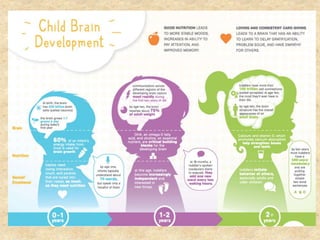
The first 1000 days from
pregnancy to 2 years is the
time that have a profound
impact on a child’s brain
growth and development.
Source: Center on the Developing Child at Harvard University
 Encouragement of
relationships with
parents in the early
years are critical.
 Early relationships,
environments, and
experiences affect all
aspects of a child’s
brain development.
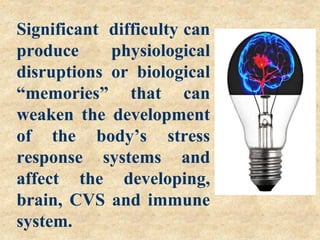
Significant difficulty can
produce physiological
disruptions or biological
“memories” that can
weaken the development
of the body’s stress
response systems and
affect the developing,
brain, CVS and immune
system.
 Early interventions are critical for
optimal life course outcomes because
these physiological disruptions can
persist into adulthood and lead to
lifelong impairments in both physical
and mental health.
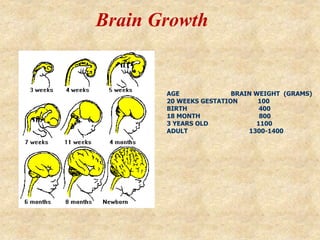
Brain Growth
AGE BRAIN WEIGHT (GRAMS)
20 WEEKS GESTATION 100
BIRTH 400
18 MONTH 800
3 YEARS OLD 1100
ADULT 1300-1400
Brain development starts early….
 Brain cells form in first months of fetal
development. Born with 100 billion brain
cells. Enough brain cells to learn anything
are developed after birth.
Brain Connections
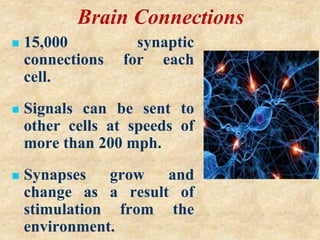
 15,000 synaptic
connections for each
cell.
 Signals can be sent to
other cells at speeds of
more than 200 mph.
 Synapses grow and
change as a result of
stimulation from the
environment.
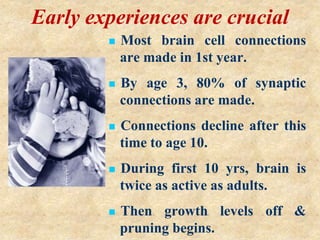
Early experiences are crucial
 Most brain cell connections
are made in 1st year.
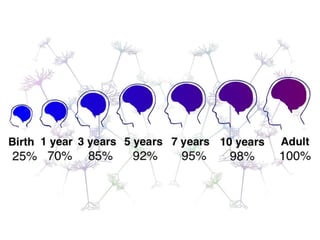
 By age 3, 80% of synaptic
connections are made.
 Connections decline after this
time to age 10.
 During first 10 yrs, brain is
twice as active as adults.
 Then growth levels off &
pruning begins.
Use it or Lose it
 What is not used is lost.
 What is used develops
stronger connections.
 Develops in “spurts” when
the brain is best equipped to
learn certain skills.
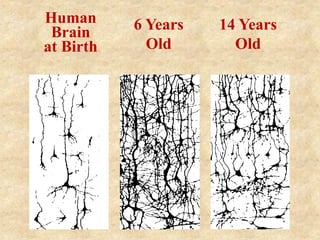
Human
Brain
at Birth
6 Years
Old
14 Years
Old
5 Days 2
Months
1 Year 28 Years
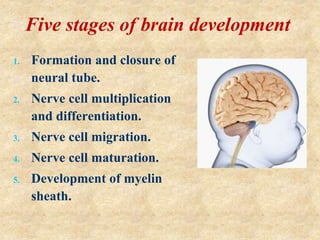
Five stages of brain development
1. Formation and closure of
neural tube.
2. Nerve cell multiplication
and differentiation.
3. Nerve cell migration.
4. Nerve cell maturation.
5. Development of myelin
sheath.
How does the developing brain
become aware, learn, think?
 Overproduction of neurons and connections
among neurons
 Selective reduction of neurons and
connections among neurons
 Waves of intense branching and connecting
followed by reduction in neurons
 Before birth through 3-years-old
 Again at 11- or 12-years-old
Located in front of the
central sulcus.
Concerned with
reasoning, planning,
parts of speech and
movement (motor
cortex), emotions, and
problem-solving.
Located at the back of
the brain, behind the
parietal lobe and
temporal lobe.
Concerned with many
aspects of vision.
Located below the lateral
fissure. Concerned with
perception and recognition
of auditory stimuli (hearing)
and memory
(hippocampus).
Located behind the central
sulcus. Concerned with
perception of stimuli related
to touch, pressure,
temperature and pain.
Occipital lobe
Parietal
lobe
Temporal
lobe
Frontal lobe
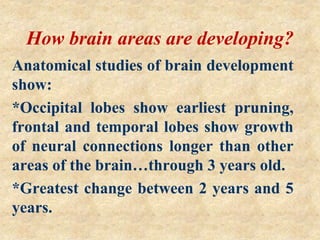
How brain areas are developing?
Anatomical studies of brain development
show:
*Occipital lobes show earliest pruning,
frontal and temporal lobes show growth
of neural connections longer than other
areas of the brain…through 3 years old.
*Greatest change between 2 years and 5
years.
Myelinization
 Speed of connection: Begins at
birth, rapidly increases to 2-years
old, continues to increase more
slowly through 30-years-old.
How brain functions are developing?
Brain areas with the longest
periods of organization related to…
Self-regulation
Problem-solving
Language/
communication
Social bonding
Most
vigorous
growth,
pruning,
connecting,
and activity
occurs
between 1-
1/2 years
through 3 or
4 years old.
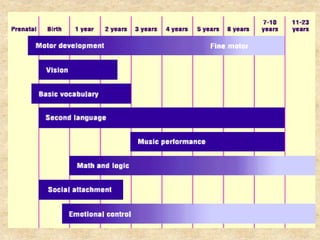
 Neuroscience is telling us that the age from
1-4 may be one of the most important periods
for developing self-regulation, problem-
solving, social-emotional, and language
/communication behaviors.
Why Early Experiences Matter?
Newborn Brain
Average Weight
333 grams
2 Year Old’s Brain
Average Weight
999 grams
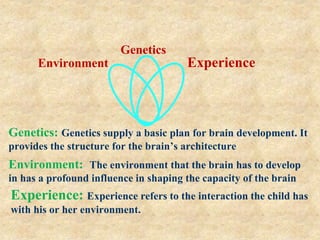
The architecture of the brain depends on
the mutual influences of the following
 Genetics
 Environment
 Experience
The Biology of Health
Source: National Scientific Council on the Developing Child, Working Paper 5, The Timing and Quality of Early Experiences Combine to
Shape Brain Architecture. Center on the Developing Child at Harvard University.
Environment
Genetics
Experience
Genetics: Genetics supply a basic plan for brain development. It
provides the structure for the brain’s architecture
Environment: The environment that the brain has to develop
in has a profound influence in shaping the capacity of the brain
Experience: Experience refers to the interaction the child has
with his or her environment.
The Foundations of Health
• The biology of health explains how
experiences and environmental influences
interact with genetic predispositions which
result in various combinations of
physiological adaptation and disruption that
can affect lifelong health, mental well-being,
learning and behaviors. This highlights the
importance of understanding and
addressing the early childhood origins of
lifelong illness and disability.
Source: Center on the Developing Child at Harvard University
• The fundamentals of health are three
domains that provide the early roots of
physical and mental well-being are
nourished. These are:
1. A stable and responsive environment of
relationships.
2. Safe and supportive physical, chemical and
built environments.
3. Appropriate nutrition.
Genetics
EnvironmentNutrition
Brain
development
•Helping build a strong foundation in the first
1,000 days is key to building better brains and
futures.
Stable and Responsive
Environments
• Provide consistent, encouragement and
protective interactions with adults
• Positive relationships can serve as social-
emotional buffers against stress.
Source: Center on the Developing Child at Harvard University
 With insufficient levels of social-emotional
buffering, the physiologic stress response
is prolonged and becomes toxic, resulting
in potentially permanent alterations to the
epigenome, brain structure, and behavior.
Safe and Supportive
Physical Environments
• Safe places to learn.
• Places free of toxins.
• Places that support families.
Source: Center on the Developing Child at Harvard University
TOXIC STRESS
Chronic “fight or
flight;” cortisol /
norepinephrine
Changes in Brain
Architecture
Hyper-responsive
stress response;
calm/coping
CHILDHOOD STRESS
Early Stress
Early Stress
This picture demonstrates how toxic stress (in this case,
via extreme neglect) early in life can change physical
brain architecture.
Docosahexaenoic (DHA) Acid
and Cognition throughout the
Lifespan
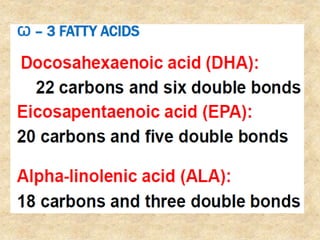
 (DHA) is the predominant omega-3 (n-
3) (PUFA) found in the brain and can
affect neurological function by many
ways (signal transduction pathways,
neurotransmission, neurogenesis,
myelination, membrane receptor
function, synaptic plasticity, and
membrane organization.
 DHA is rapidly accumulated in the
brain during gestation and early
infancy.
 Nutrients. 2016 Feb; 8(2): 99.
 DHA is necessary for the growth and
maturation of an infant’s brain and
retina, DHA is essential for humans since
it cannot be synthesized efficiently.
 The adequate supply of DHA to the
developing brain is largely dependent on
the dietary intake of the mother, and this
supply is very important to the cognitive
development of the progeny.
 Nutrients. 2016 Feb; 8(2): 99.
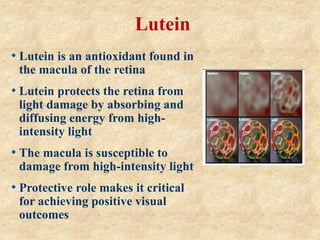
• Lutein is an antioxidant found in
the macula of the retina
• Lutein protects the retina from
light damage by absorbing and
diffusing energy from high-
intensity light
• The macula is susceptible to
damage from high-intensity light
• Protective role makes it critical
for achieving positive visual
outcomes
Lutein
Kang, Ascherio et al. 2005 Johnson, McDonald et al. 2008
• An epidemiologic study found women who
consumed high levels of green leafy
vegetables and cruciferous vegetables (rich
sources of lutein) experienced less cognitive
decline than women who ate fewer of these
vegetables
• Evaluated elderly women receiving
lutein and DHA supplements for 4
months
Verbal fluency scores improved
significantly in the groups receiving
lutein alone, DHA alone and lutein +
DHA in combination
Vishwanathan, M et al. 2011
• Evaluate the presence of lutein in infant brain
• Lutein was the predominant carotenoid in the frontal, auditory and occipital cortex
as well as hippocampus
• The outcomes support the concept that
Lutein is accumulated in areas of the brain associated with learning
Lutein may play an important role in cognitive development
1. Vishwanathan M, et al. 16th International Symposium on Carotenoids. Krakow, Poland 2011; 2. Kang, JH, et al. Ann Neurol.
2005;57(5): 713-720; 3. Johnson, EJ, et al. Nutr Neurosci. 2008;11(2): 75-83.
Human studies that may support the role of
lutein in cognition
The aim was to explore the relation of human
milk lutein; choline; and docosahexaenoic acid
(DHA) with recognition memory abilities of six-
month-old infants.
Choline
Higher choline with higher DHA was related to
better recognition memory. Interactions between
human milk nutrients appear important in
predicting infant cognition, and there may be a
benefit to specific nutrient combinations.
Choline is an important nutrient for
brain development & memory
 Choline is both synthesized in the body & supplied
by diet , during periods of high demand like the
1st year of life & pregnancy , dietary Choline
becomes essential.
 Key nutrients for the synthesis of Choline includes
 Vit.B12, Folate & Methionine.
 Choline is the precursor of the phospholipid
phosphatidylcholine & Sphingomyelin 
cell membrane. The neurotransmitter
Acetylcholine A methyl donor.
Georgieff MK. Am J Clin Nutr. 2007;85:614S-620S. 2. Zeisel SH. Zeisel SH. J Am Coll Nutr. 2000;19(5):528S-531S.
3.Nutrition. 2000;16(7/8):669-671. 4.Guthrie HA, Picciano MF. Human Nutrition. St. Louis, MO: Mosby; 1995:496. 5. Zeisel
SH and da Costa KA. Nutr Rev. 2009; 67(11):615-623.
Choline Metabolism
It is easier to build strong children
than to repair broken men.
Frederick Douglass
THANK YOU
Khaled Saad
Infant brain development

Infant brain development

  • 2.
  • 3.
    Building Better InfantBrain 19-8-2020 Khaled Saad. MD, MSc, PhD Professor & Consultant of Pediatrics Assiut University Board member of European Society for Clinical Nutrition and Metabolism (ESPEN) European Council for Nutritional and Environmental Medicine (CONEM)
  • 5.
    The Brain isStill a Mystery
  • 6.
    Objectives  To highlightthe importance of Early Brain & Child Development (EBCD).  To recognize some important nutritive materials for development of children’s brain.
  • 7.
    Agenda “It’s all aboutpromotion children brain and their future”
  • 8.
    “Change the firstfive years and you will change everything”
  • 9.
    Why is earlybrain & child development important? Work in neuroscience, molecular biology, and genomics tells us that: The first 1000 days from pregnancy to 2 years is the time that have a profound impact on a child’s brain growth and development. Source: Center on the Developing Child at Harvard University
  • 10.
     Encouragement of relationshipswith parents in the early years are critical.  Early relationships, environments, and experiences affect all aspects of a child’s brain development.
  • 11.
    Significant difficulty can producephysiological disruptions or biological “memories” that can weaken the development of the body’s stress response systems and affect the developing, brain, CVS and immune system.
  • 12.
     Early interventionsare critical for optimal life course outcomes because these physiological disruptions can persist into adulthood and lead to lifelong impairments in both physical and mental health.
  • 13.
    Brain Growth AGE BRAINWEIGHT (GRAMS) 20 WEEKS GESTATION 100 BIRTH 400 18 MONTH 800 3 YEARS OLD 1100 ADULT 1300-1400
  • 15.
    Brain development startsearly….  Brain cells form in first months of fetal development. Born with 100 billion brain cells. Enough brain cells to learn anything are developed after birth.
  • 16.
    Brain Connections  15,000synaptic connections for each cell.  Signals can be sent to other cells at speeds of more than 200 mph.  Synapses grow and change as a result of stimulation from the environment.
  • 17.
    Early experiences arecrucial  Most brain cell connections are made in 1st year.  By age 3, 80% of synaptic connections are made.  Connections decline after this time to age 10.  During first 10 yrs, brain is twice as active as adults.  Then growth levels off & pruning begins.
  • 18.
    Use it orLose it  What is not used is lost.  What is used develops stronger connections.  Develops in “spurts” when the brain is best equipped to learn certain skills.
  • 19.
  • 20.
    5 Days 2 Months 1Year 28 Years
  • 21.
    Five stages ofbrain development 1. Formation and closure of neural tube. 2. Nerve cell multiplication and differentiation. 3. Nerve cell migration. 4. Nerve cell maturation. 5. Development of myelin sheath.
  • 25.
    How does thedeveloping brain become aware, learn, think?  Overproduction of neurons and connections among neurons  Selective reduction of neurons and connections among neurons  Waves of intense branching and connecting followed by reduction in neurons  Before birth through 3-years-old  Again at 11- or 12-years-old
  • 27.
    Located in frontof the central sulcus. Concerned with reasoning, planning, parts of speech and movement (motor cortex), emotions, and problem-solving. Located at the back of the brain, behind the parietal lobe and temporal lobe. Concerned with many aspects of vision. Located below the lateral fissure. Concerned with perception and recognition of auditory stimuli (hearing) and memory (hippocampus). Located behind the central sulcus. Concerned with perception of stimuli related to touch, pressure, temperature and pain. Occipital lobe Parietal lobe Temporal lobe Frontal lobe
  • 30.
    How brain areasare developing? Anatomical studies of brain development show: *Occipital lobes show earliest pruning, frontal and temporal lobes show growth of neural connections longer than other areas of the brain…through 3 years old. *Greatest change between 2 years and 5 years.
  • 32.
    Myelinization  Speed ofconnection: Begins at birth, rapidly increases to 2-years old, continues to increase more slowly through 30-years-old.
  • 33.
    How brain functionsare developing? Brain areas with the longest periods of organization related to… Self-regulation Problem-solving Language/ communication Social bonding
  • 34.
  • 36.
     Neuroscience istelling us that the age from 1-4 may be one of the most important periods for developing self-regulation, problem- solving, social-emotional, and language /communication behaviors.
  • 37.
    Why Early ExperiencesMatter? Newborn Brain Average Weight 333 grams 2 Year Old’s Brain Average Weight 999 grams
  • 38.
    The architecture ofthe brain depends on the mutual influences of the following  Genetics  Environment  Experience The Biology of Health Source: National Scientific Council on the Developing Child, Working Paper 5, The Timing and Quality of Early Experiences Combine to Shape Brain Architecture. Center on the Developing Child at Harvard University.
  • 39.
    Environment Genetics Experience Genetics: Genetics supplya basic plan for brain development. It provides the structure for the brain’s architecture Environment: The environment that the brain has to develop in has a profound influence in shaping the capacity of the brain Experience: Experience refers to the interaction the child has with his or her environment.
  • 40.
    The Foundations ofHealth • The biology of health explains how experiences and environmental influences interact with genetic predispositions which result in various combinations of physiological adaptation and disruption that can affect lifelong health, mental well-being, learning and behaviors. This highlights the importance of understanding and addressing the early childhood origins of lifelong illness and disability. Source: Center on the Developing Child at Harvard University
  • 41.
    • The fundamentalsof health are three domains that provide the early roots of physical and mental well-being are nourished. These are: 1. A stable and responsive environment of relationships. 2. Safe and supportive physical, chemical and built environments. 3. Appropriate nutrition.
  • 42.
    Genetics EnvironmentNutrition Brain development •Helping build astrong foundation in the first 1,000 days is key to building better brains and futures.
  • 43.
    Stable and Responsive Environments •Provide consistent, encouragement and protective interactions with adults • Positive relationships can serve as social- emotional buffers against stress. Source: Center on the Developing Child at Harvard University
  • 44.
     With insufficientlevels of social-emotional buffering, the physiologic stress response is prolonged and becomes toxic, resulting in potentially permanent alterations to the epigenome, brain structure, and behavior.
  • 46.
    Safe and Supportive PhysicalEnvironments • Safe places to learn. • Places free of toxins. • Places that support families. Source: Center on the Developing Child at Harvard University
  • 47.
    TOXIC STRESS Chronic “fightor flight;” cortisol / norepinephrine Changes in Brain Architecture Hyper-responsive stress response; calm/coping CHILDHOOD STRESS Early Stress
  • 48.
    Early Stress This picturedemonstrates how toxic stress (in this case, via extreme neglect) early in life can change physical brain architecture.
  • 49.
    Docosahexaenoic (DHA) Acid andCognition throughout the Lifespan
  • 51.
     (DHA) isthe predominant omega-3 (n- 3) (PUFA) found in the brain and can affect neurological function by many ways (signal transduction pathways, neurotransmission, neurogenesis, myelination, membrane receptor function, synaptic plasticity, and membrane organization.  DHA is rapidly accumulated in the brain during gestation and early infancy.  Nutrients. 2016 Feb; 8(2): 99.
  • 52.
     DHA isnecessary for the growth and maturation of an infant’s brain and retina, DHA is essential for humans since it cannot be synthesized efficiently.  The adequate supply of DHA to the developing brain is largely dependent on the dietary intake of the mother, and this supply is very important to the cognitive development of the progeny.  Nutrients. 2016 Feb; 8(2): 99.
  • 54.
    • Lutein isan antioxidant found in the macula of the retina • Lutein protects the retina from light damage by absorbing and diffusing energy from high- intensity light • The macula is susceptible to damage from high-intensity light • Protective role makes it critical for achieving positive visual outcomes Lutein
  • 55.
    Kang, Ascherio etal. 2005 Johnson, McDonald et al. 2008 • An epidemiologic study found women who consumed high levels of green leafy vegetables and cruciferous vegetables (rich sources of lutein) experienced less cognitive decline than women who ate fewer of these vegetables • Evaluated elderly women receiving lutein and DHA supplements for 4 months Verbal fluency scores improved significantly in the groups receiving lutein alone, DHA alone and lutein + DHA in combination Vishwanathan, M et al. 2011 • Evaluate the presence of lutein in infant brain • Lutein was the predominant carotenoid in the frontal, auditory and occipital cortex as well as hippocampus • The outcomes support the concept that Lutein is accumulated in areas of the brain associated with learning Lutein may play an important role in cognitive development 1. Vishwanathan M, et al. 16th International Symposium on Carotenoids. Krakow, Poland 2011; 2. Kang, JH, et al. Ann Neurol. 2005;57(5): 713-720; 3. Johnson, EJ, et al. Nutr Neurosci. 2008;11(2): 75-83. Human studies that may support the role of lutein in cognition
  • 56.
    The aim wasto explore the relation of human milk lutein; choline; and docosahexaenoic acid (DHA) with recognition memory abilities of six- month-old infants. Choline
  • 57.
    Higher choline withhigher DHA was related to better recognition memory. Interactions between human milk nutrients appear important in predicting infant cognition, and there may be a benefit to specific nutrient combinations.
  • 58.
    Choline is animportant nutrient for brain development & memory  Choline is both synthesized in the body & supplied by diet , during periods of high demand like the 1st year of life & pregnancy , dietary Choline becomes essential.  Key nutrients for the synthesis of Choline includes  Vit.B12, Folate & Methionine.  Choline is the precursor of the phospholipid phosphatidylcholine & Sphingomyelin  cell membrane. The neurotransmitter Acetylcholine A methyl donor.
  • 59.
    Georgieff MK. AmJ Clin Nutr. 2007;85:614S-620S. 2. Zeisel SH. Zeisel SH. J Am Coll Nutr. 2000;19(5):528S-531S. 3.Nutrition. 2000;16(7/8):669-671. 4.Guthrie HA, Picciano MF. Human Nutrition. St. Louis, MO: Mosby; 1995:496. 5. Zeisel SH and da Costa KA. Nutr Rev. 2009; 67(11):615-623. Choline Metabolism
  • 61.
    It is easierto build strong children than to repair broken men. Frederick Douglass
  • 62.